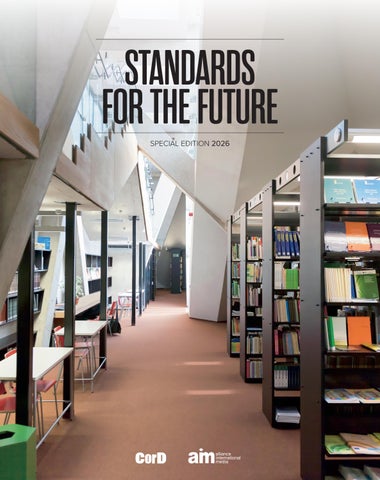
STANDARDS FOR THE FUTURE
SPECIAL EDITION 2026


By Ryan Bollhorn

![]()
SPECIAL EDITION 2026


By Ryan Bollhorn

In contemporary societies, education occupies a central place in debates on economic development, social cohesion and long-term stability. Yet, despite its acknowledged importance, the conditions in which education systems operate are often shaped by political uncertainty, financial constraints and uneven institutional support

In this issue of CorD, the interview with the Rector of the University of Belgrade provides a broader institutional context for understanding the challenges facing public education in Serbia. His observations highlight pressures on academic autonomy, the importance of professional standards and the responsibility of institutions to safeguard the rule of law. Positioned at the beginning of the edition, the interview serves as a framework for interpreting the wider environment in which educational actors operate.
At the same time, contemporary education is increasingly influenced by diverse models and practices, particularly within international and private institutions that introduce new approaches to learning, governance and professional development. It is within this evolving landscape that our mini-special on education is positioned.
Rather than offering a comprehensive overview of the sector, this section presents selected examples of educational practice that reflect broader global trends: personalised learning, greater attention to student wellbeing, responsible use of digital tools and closer alignment between education and social responsibility.
These institutions illustrate a gradual shift away from rigid, standardised models towards more flexible, student-centred approaches. Teaching is increasingly understood as a collaborative process grounded in trust, continuous evaluation and professional reflection. Technology, when applied thoughtfully, supports rather than replaces human interaction.
CONTEMPORARY EDUCATION IS NO LONGER DEFINED BY RIGID SYSTEMS, BUT BY THE ABILITY OF INSTITUTIONS TO BALANCE INNOVATION WITH RESPONSIBILITY AND LONG-TERM SOCIAL VALUE
At the core of these developments lies a renewed understanding of education as a long-term investment in human capital. Sustainable models depend not only on infrastructure and curricula, but also on institutional integrity, qualified staff and stable governance frameworks. They require consistent public policy, transparent regulation and a clear commitment to quality.
For Serbia, these issues are particularly relevant. As the country seeks to strengthen its competitiveness and retain young talent, education becomes a strategic resource. Public and private institutions alike must respond to technological change and labour market demands while preserving academic values and professional autonomy.
This mini-special aims to contribute to an informed discussion on how contemporary education can balance innovation with responsibility, flexibility with standards and international integration with local relevance. The examples presented here should be understood as part of a broader process of transformation shaping learning environments across Europe and the wider region.
Ultimately, the quality of education remains one of the most reliable indicators of a society’s capacity for long-term development. Its future will depend on cooperation between institutions, educators and policymakers in creating resilient, inclusive and sustainable systems.
The Invisible Architecture of Teaching

EByRyanBollhorn
ach school day at ISB unfolds within a carefully constructed framework of preparation, reflection and human connection. Much of that work remains invisible. Long before the first bell rings, teachers are already considering how to support the students who will soon enter their classrooms — academically, socially and emotionally.

This preparation does not always take the form of written plans or formal documentation. Often, it begins with attentive observation and intentional design. Ashley, one of ISB’s Early Years teachers, describes how her mornings start with a simple question: what are my students curious about, and how can I build that curiosity into today’s learning?

In the Early Years, learning begins with connection. Teachers pay close attention to how children enter the space — their body language, their energy, the child who needs reassurance, or the quiet moment that signals uncertainty. These interactions may appear small, yet they establish the foundation for trust and readiness to learn. A welcoming gesture, a brief conversation, or simply creating a sense of safety becomes part of the educational architecture that supports longterm development.
As students progress through Primary School, that attentiveness evolves into structured academic planning. In Grade 2, Sabina approaches each lesson through the lens of Universal Design for Learning, ensuring that concepts are accessible through multiple pathways — visual, auditory and experiential. Curiosity is deliberately sparked, and connections between past and present learning are encouraged. Those moments, when a student independently links prior knowledge to new ideas, signal genuine intellectual growth.
Milena follows a similar philosophy. While she begins with clear objectives, she adapts her teaching to students’ interests and motivations. Inquiry often starts with a provocation — a question or scenario designed to encourage critical thinking. Growth, she notes, rarely happens in dramatic leaps. It unfolds in phases, through incremental risk-taking and confidence-building.
By Secondary School, those early foundations translate into deeper dialogue and intellectual independence. In Ayesha’s drama classroom, cultural diversity enriches discussion. Students draw on lived experiences from different
parts of the world, shaping lessons in unexpected yet meaningful ways. Learning becomes collaborative, rooted in perspective and reflection.
In science laboratories and Diploma Programme classrooms, Dan describes a shift from instruction to partnership. The emphasis moves away from delivering content and toward guiding inquiry. Students are encouraged to take ownership of their learning, to question, experiment and articulate their reasoning. The goal is not only mastery of subject matter, but the development of analytical skills and intellectual responsibility.
When the school day ends, preparation continues. Teachers review assessments, refine lesson plans, engage in professional development and reflect on how to better support individual learners. Teaching at ISB is understood as an evolving practice — shaped by experience, research and collaboration.
Across divisions and departments, a shared philosophy emerges: meaningful education is built not only on curriculum, but on relationships, reflection and professional commitment. The daily work of teachers — often unseen — forms the structure that sustains student growth.
At ISB, this invisible architecture is not incidental. It is central to the school’s educational model and long-term vision.


Imagine bringing the world’s most respected educational model to the very heart of Serbia. Not as an experiment, but as a carefully crafted reality, where academic excellence and emotional wellbeing weave together seamlessly. This is EDUCA – Belgrade’s only Finnish International Kindergarten & School, where children learn with purpose, grow and glow.
Finland consistently ranks at the pinnacle of global education. Its approach rests on a profound understanding: when hearts feel safe, minds can create. At EDUCA, authentic Finnish pedagogical principles remain intact, thoughtfully adapted for children growing up in Serbia. Teachers craft personalised pathways to success through discovery, play and curiosity. From ages 3 to 15, children experience education that honours their individual pace and unique talents. No grades. No tests. Yet remarkable results.
Principal, EDUCA Finnish International Kindergarten & School
Each child’s brain is wonderfully unique, forming connections at its own rhythm. By understanding the neuroscience behind learning – how emotion, movement, rest and challenge interact –EDUCA’s teachers create classroom experiences where every child can find their optimal path to growth.
Pedagogy meets heart. Science shapes mind. Knowledge serves wonder.

Smart technology. Dedicated teachers. Child-centred approach.
Nestled in a green, tree-lined street in Dedinje, where birdsong replaces traffic noise, EDUCA’s campus offers an environment where hearts and minds can develop naturally. For international families, this provides an ideal balance: proximity to diplomatic missions and business centres, combined with tranquillity where children can breathe, explore and grow. Nature classrooms. Urban convenience. Harmony without compromise.

EDUCA’s educational alchemy transforms the way learning happens. Through the Neuroeducation for Transformative Classrooms (NTC Framework), the school weaves brain science into everyday teaching. It centres on a simple truth: learning is not one-size-fits-all.
As one of the first schools in Europe to embrace the Cleo AI mentor platform, EDUCA has addressed one of education’s greatest challenges: how to personalise learning for every child. Cleo does not replace teachers – it empowers them.
This innovative neuroeducation ecosystem analyses how each child learns best and helps teachers respond with precision. For neurodivergent learners in particular, Cleo becomes a learning companion that recognises individual strengths, understands different learning patterns and adapts accordingly.
As a non-profit organisation within the Education for Serbia Foundation, EDUCA places children’s wellbeing above financial gain. Every resource is reinvested directly into students – exceptional teachers, innovative programmes and nurturing environments.
For discerning families, this offers invaluable assurance: their children’s development will always come first.
Visit EDUCA and experience education that honours both hearts and minds, blending academic rigour with joy and celebrating achievement alongside emotional wellbeing.
Inspired by children. Created with love. Curated with care.

In an era marked by technological acceleration, social uncertainty and profound changes in the labour market, education is increasingly being recognised as one of the most important pillars of long-term social stability and economic development. Schools are no longer expected merely to transmit knowledge. They are now called upon to cul tivate emotional intelligence, critical thinking, adapt-
ability and a strong sense of personal responsibility.
Across Europe and beyond, this shift has given rise to new educational models that combine academic rigour with wellbeing, individualised learning and continuous professional development. In Serbia, this transformation is becoming increasingly visible through the work of international and private educational institutions that are introducing innovative pedagogical practices while remaining attentive to local context and cultural values.
These examples reflect broader trends that are increasingly shaping educational policy across Europe and the Western Balkans.
One such example is the Finnish-based approach implemented by EDUCA, which emphasises emotional safety, personalised learning pathways and the integration of neuroscience into everyday
teaching practice. Its model rests on the understanding that when children feel secure and supported, they are more open to learning, creativity and intellectual exploration. Rather than relying on traditional grading systems and standardised testing, EDUCA focuses on discovery, play and individual development, guided by contemporary research in neuroeducation and supported by advanced digital tools.
Through its neuroeducation framework and the use of personalised digital platforms, the school seeks to respond to the diversity of learning styles and cognitive rhythms among students. Technology, in this context, is not treated as a substitute for human interaction, but as a means of strengthening the relationship between teachers and learners.
Equally important is the institutional commitment to placing stu-
dents’ wellbeing above commercial considerations. As a non-profit organisation, EDUCA reinvests resources into teaching quality, learning environments and professional development, reinforcing trust among parents and the wider community. This approach reflects a broader European trend towards viewing education as a long-term public good rather than a shortterm market product.
ing begins with emotional connection and attentiveness to students’ wellbeing. In primary education, structured planning is combined with inclusive teaching strategies to ensure accessibility and engagement.
As students progress, teaching evolves into a collaborative process in which inquiry, dialogue and independent reasoning become central. In secondary education and

MEANINGFUL
BUILT ON
TRUST AND PROFESSIONAL INTEGRITY, NOT ON SHORT-TERM RESULTS OR FORMAL STANDARDS ALONE
A complementary perspective on contemporary education emerges from the experience of the International School of Belgrade, where attention is focused on what might be described as the “invisible architecture” of teaching. Much of the work that shapes student development takes place beyond the classroom spotlight — in careful preparation, reflection and continuous adaptation to individual needs.
From early childhood education to secondary and diploma programmes, teachers build learning environments grounded in trust, observation and intellectual curiosity. In the early years, learn-
Taken together, these examples illustrate a broader shift in contemporary education: from standardisation to personalisation, from instruction to mentorship, and from short-term outcomes to long-term development. They also highlight the growing importance of integrating scientific research, digital innovation and ethical responsibility into educational practice.
For Serbia, this evolution is particularly significant. As the country seeks to strengthen its human capital and retain young talent, the quality and relevance of education will play a decisive role. International schools and innovative institutions are contributing to this process by introducing new standards, encouraging professional exchange and fostering a culture of lifelong learning.
At the same time, their experience raises important questions for the wider educational system. How can personalised learning be scaled within public institutions? How can teacher autonomy and accountability be balanced? How can technology be used responsibly without undermining human connection? And how can educational policy support long-term stability rather than short-term reforms?
science laboratories, instruction gives way to partnership, encouraging students to take ownership of their intellectual development and to articulate their thinking with confidence.
Crucially, this model views teaching not as a fixed profession, but as an evolving practice shaped by research, experience and cooperation. Continuous professional development and institutional reflection are seen as essential components of educational quality. In this sense, the school functions as a learning organisation in which educators and students grow together.
There are no simple answers. Yet what emerges clearly from both holistic and reflective educational models is that meaningful education is built on relationships, trust and professional integrity. It requires sustained investment, institutional autonomy and a shared commitment to placing students’ development at the centre of public policy.
In a world defined by rapid change, education remains one of the few enduring foundations of social progress. Its future will depend not only on innovation and infrastructure, but on the willingness of institutions, educators and policymakers to work together in shaping learning environments that are inclusive, resilient and oriented towards the common good.