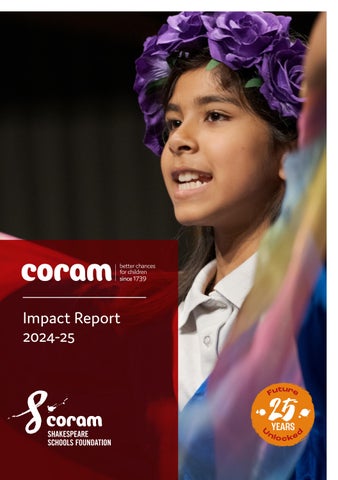
CSSF Impact Report 2024-25

Page 1


“Danny’s confidence came a long way, especially with regard to delivering lines on stage. We are so proud of him and what he has achieved. He gave the piece a lot of one-liners that were so funny! This is the reason why I do what I do - to see such progress is so rewarding!”

“Kyle thought he couldn’t be in the play because he couldn’t read well or remember his words. He still had a fantastic, fun part when he acted and danced, and his words after the performance were: ‘I did it, miss! I did it!’”

Kyle’s joy captures everything Coram Shakespeare Schools Foundation stands for: the moment a young person discovers what they’re capable of. Through the expressive arts, confidence blossoms, aspirations rise, and potential shines.

For 25 years, our Festival has offered young people from every corner of the UK the chance to step onto a professional stage, speak Shakespeare’s timeless words, and experience the transformative power of performance. Each child who takes part grows in courage, creativity and self-belief – qualities that stay with them long after the curtain falls.

This year we celebrate that remarkable legacy. Since our first performance in 2000 at the Torch Theatre, Milford Haven, Shakespeare Schools Festival has grown into a nationwide movement and the world’s largest youth drama project. From midsummer to twelfth night, we are marking a quarter-century of collaboration between regional theatres, teachers, artists and artist practitioners who have made it

possible for more than 350,000 young people to take part.

Our 25 Years, 25 Stories campaign shines a light on some of those journeys; from first-time performers to alumni now thriving in classrooms, boardrooms and courtrooms. You can meet Maisie, Evie and Caleb, three of these remarkable alumni, on page 29.

This milestone year also launches our new 2030 strategy, All the World’s Our Stage. Together, we are committed to tackling educational and social disadvantage, unlocking confidence and creativity, and ensuring that every young person can experience the performing arts as a catalyst for change, whatever their background.

Across the next 25 months, we aim to reach 25,000 children and young people with opportunities to perform, learn and grow through Shakespeare. With your support, we will make that ambition real.

Teachers remain at the heart of our story. Each year, hundreds of

Teacher-Directors guide pupils through the challenge of staging a 30-minute Shakespeare production. In the process, young people learn far more than lines: they rehearse teamwork, empathy, problem-solving and resilience. This past year, 330 schools performed in 55 partner theatres, bringing Lady Macbeth, Bottom, Brutus and Beatrice to life for their local communities.

Through our targeted outreach we worked with 125 priority schools* and around 3,500 young people in these settings who face additional barriers to learning. At Magdalen College, Oxford, pupils from Nottinghamshire joined care-experienced students from the Leicester City Virtual School to perform side by side — an unforgettable demonstration of inclusion in action.

Beyond the stage, our experiential production arts workshops at the Criterion Theatre introduced 20 London secondary schools to the offstage worlds of lighting, costume and sound. Our Play in a Day workshops reached 1,000 primary aged pupils from Manchester to Hampshire, offering joyful first encounters with Macbeth, Hamlet and A Midsummer Night’s Dream. Internationally, more than 30 schools from countries including China, Spain, Belgium, the UK and Norway took part in our growing Film Festival, submitting inspiring Shakespeare shorts.

We continue to advocate nationally for creativity in education. In our

“When a child finds their voice on stage, they find it everywhere”

submission to the UK Government’s Curriculum and Assessment Review, we called for the arts to be restored to the heart of the school day. The decline in creative subject uptake at GCSE - now at a 15-year low –is a warning sign. We believe the expressive arts are essential, not optional: they nurture oracy, critical thinking, empathy and aspiration, equipping young people for life, work and citizenship.

Kyle’s story reminds us that when a child finds their voice on stage, they find it everywhere.

Thank you for standing with us and for believing in young people, in teachers, and in the power of Shakespeare to reveal what’s possible.

Warm regards, Mike Tucker

* Priority schools include those with high % FSM eligibility, SEND settings and schools located in the top three deciles of the IMD.

Our Year In Numbers

Coram Shakespeare Schools Foundation gave thousands of young people of all ages, abilities and backgrounds a chance to shine in 2024-25. Through our Theatre Festival, Film Festival and workshops, young people have come together to learn, play and create, building key skills they will need for life.

This was our year.

9,600

pupils supported through Theatre and Film Festivals, and workshops.

301

teachers supported to develop their skills through our resources and workshops.

384 99%

primary, secondary, SEND schools and pupil referral unit classes involved.

388 94%

workshops delivered across schools and theatres in every corner of the UK.

of teachers reported students had developed their creative skills through our Festival.

“One of our students is not one of the ‘performance’ kids but he’s done four festivals now. He is a fantastic actor and he had a bigger part this year - it’s been good to see him settle into a different ‘tribe.’”

Hannah, Secondary School Teacher, Keighley

of teachers said their

Who we work with

Across 2024-25 we worked with young people in all four nations of the UK and in six other countries.

Secondary schools - 48%

SEND or SEMH schools - 11%

Primary schools - 41%

Diversity and inclusion are at the heart of Coram Shakespeare Schools Foundation’s ethos. We want to reach more students from ethnic minority backgrounds, more students with EAL (English as an additional language) and children who are eligible for free school meals. You can help us achieve this - find out how on page 35.

Our Reach

Yazmin and Nick’s Story

Barbara Priestman Academy

Barbara Priestman Academy is a Sunderland-based specialist school for students with autism and/or complex learning difficulties. They have participated in the Theatre Festival for 15 years with Emily as Teacher-Director since 2016. The cast performed a modern, summer-themed Much Ado About Nothing. Two students, Yazmin and Nick, had a transformative experience performing at Northern Stage.

Usually, Yazmin does not communicate verbally and uses a board to write down her ideas. The first time Emily heard Yazmin speak was during auditions, and she was cast in the role of watchman with two lines. Emily decided that the watchmen would be a big group who could all lean on each other during their scenes. They were inspired by Scooby Doo in developing their characters, and Yazmin had a lot of fun developing her comedic creeping walk. The rehearsal process took Yazmin out of her comfort zone and at times it seemed like it might be too much, but, with reassurances that she didn’t have to talk if she didn’t want to, she persevered. Emily believed that Yazmin felt safe to

speak in the performance because it was a moment she could control, and this was a “huge confidence booster.”

On the performance day, Emily was in the wings, unsure if Yazmin would deliver her lines, but excited to see her performing on stage. Yazmin said her lines loudly during the tech and then again during a sold-out performance. Yazmin and the teaching staff were overjoyed by this “phenomenal achievement.”

Nick was also part of the watchmen’s crew. He has autism, has difficulty engaging in classwork and requires 1:1 assistance. He had not previously shown an interest in Shakespeare or performance, so his teachers were surprised at his desire to audition but he delivered an excellent performance. He attended the tech rehearsal and was able to join in with everyone throughout the day. He went on stage with his 1:1 teaching assistant and for some points in the play was on stage by himself without 1:1 support and spoke several lines. The audience particularly enjoyed it when he hid in the hedge during Benedick and Beatrice’s argument scene. Following his performance Nick developed a keen interest in theatre. Nick’s parents, who were in the audience, said, “they never thought their son would be on stage performing in a Shakespeare play.”

Emily felt that what made the performance night truly special was the “experience of going to a real theatre.” In both cases Emily said it was a great process and that “no one could believe it, no one expected it.”

Case STudy

Our Year in Moments

From the start of our programming year in April 2024, through two Festivals, dozens of teacher CPD sessions and hundreds of performances, we were proud to bring the magic of Shakespeare to thousands of young people.

Here is 2024-25 in a few key moments.

https://www.shakespeareschools.org

The Need for this work

Essential Skills

Access to essential skill development opportunities is important for social mobility, life and job satisfaction, personal development and even expected income, according to research carried out by the Skills Builder partnership. This year, CSSF has expanded its work with Skills Builder and integrated their updated Universal Framework even more closely into its programmes. Our goal was to establish our work’s profound effect in developing essential skills like creativity, teamwork and planning.

For too long, the vital skills which are developed in the rehearsal room have been denigrated as ‘soft’ skills. The shift to ‘essential’ skills reconfigures the practice of, for example, adapting, problem-solving or leadership, as crucial to relationship-building, confidence and employability. CSSF has worked with Skills Builder to cultivate a shared language of essential skills which unites educators and employers.

Arts Participation

We await the final report from the Curriculum and Assessment Review panel against a backdrop of ever-decreasing access to high-quality arts education, especially for the most disadvantaged young people.

The Campaign for the Arts reported this year that since 2010 entries for Drama have now decreased by 48% at GCSE, and by 53% at A Level; National Drama reports that 41% of schools now enter no students for GCSE Drama at all.1 2

Whilst independent schools invest heavily in arts and enrichment opportunities, young people experiencing disadvantage increasingly lack the time, space and expert guidance they need to unlock their creative potential.3 4

CSSF programmes equip teachers to lead high quality expressive arts experiences in school and to become confident facilitators of creativity across the curriculum. We bring young people from all backgrounds together in community spaces to share in a transformative cultural experience, to which they might not otherwise have had access.

Inclusive Education

Arts programmes which put young people from SEND settings onstage alongside their peers in mainstream schools are sparingly few, even though the number of young people in England with recognised SEND has grown to nearly 20% - a total of 1.7 million children nationwide – most of whom are educated in mainstream settings. CSSF has been led creatively for many years by the ingenious ways Shakespeare is reimagined by the 10% of schools across our Theatre and Film Festivals who are SEND specialist settings, and this makes us exceptionally well-placed to continue to champion that work and to meet the growing need in mainstream schools for evidence-based inclusive practice in the arts.

Mainstream schools know this is important: in 2024, nearly three quarters of academy trusts said that provision of inclusive education was their top priority. With a range of policy and funding reforms being considered at regional and national level, drama and the arts should not be neglected as part of the solution. Research carried out by CSSF partner Arts Award shows that arts-based projects can boost social skills and emotional wellbeing, and a Coram study on creative interventions for young people experiencing disadvantage highlighted the importance of skilled facilitators who can build a safe space with young people where self-esteem and communication skills can flourish.5 6

The Need

Appropriate support is vital: we know that SEND need intersects with other vulnerabilities, and that young people with SEND are more likely to be persistently or severely absent from school, and more likely to be excluded. Education leaders are becoming aware of the paramount importance of building cultures of belonging, and 98% of Teacher-Directors agreed that because of the Theatre Festival, their students had developed a sense of belonging at school – 81% strongly agreed. 93% noted a specific link between taking part in the Festival and improved attendance.

1 https://www.campaignforthearts.org/news/exam-results-2025

2 https://www.nationaldrama.org.uk/wp-content/uploads/A-NATIONAL-PLAN-FOR-DRAMA-AND-THEATRE-EDUCATION-Feb-2025.pdf

3 https://www.independent.co.uk/news/education/education-news/creative-subjects-being-squeezed-out-ofpoorer-schools-says-major-arts-study-10052283.html

4 https://www.edge.co.uk/news-and-events/blogs/the-narrow-curriculum-in-state-schools-is-levelling-down-creative-opportunities-for-young-people/

5 https://blog.artsaward.org.uk/unlocking-creativity-for-send-learners

6 https://www.coram.org.uk/wp-content/uploads/2025/06/The-efficacy-of-creative-interventions-with-children-and-young-people-experiencing-disadvantage.pdf

Shakespeare Schools Festival At Magdalen College

In the fourth year of our partnership with Magdalen College Oxford, 50 young people, from schools which do not have a history of sending pupils on to Russell Group universities or to Oxbridge, visited the college for a three-day residential. Here they experienced university life and performed a reimagined Shakespeare play in Magdalen’s on-site theatre.

Participants also toured the local area, attended an academic seminar given by Dr. Gillian Woods on their play, and stayed in undergraduate halls of residence. The project is designed to broaden horizons, help young people develop the essential skill of planning, and show them that they can make their mark on a famous academic institution like Magdalen.

100% of participating teachers strongly agreed that as a result of the project students had gained confidence and were able to express themselves creatively. 100% of teachers also agreed that as a result of the project, students were more interested in attending university, and that they themselves felt more informed about the University of Oxford.

“Incredible, inspiring; it was like being in a wonderful bubble of Shakespeare, theatre and Oxford for three days! We all didn’t want to leave.”

Catherine, Teacher, Bramcote College, Nottingham

Youth Board

In October 2024, 15 passionate young people from across the UK arrived in London for the inaugural Youth Board Summit. Returning members welcomed new recruits, and together they explored CSSF’s mission and shared their perspectives with the senior leadership team on a range of topics.

The Youth Board contributed to our work across the year by advising on engagement with local theatres, the Curriculum and Assessment Review, and CSSF’s digital presence. They developed their own skills through creative challenges, ‘question time’ sessions with senior leaders, and a visit to parliament to mark CSSF’s 25th anniversary and the launch of our 2030 strategy.

Working in two sub-groups, members helped shape a new framework for evaluating CSSF’s impact and produced a resource for Teacher-Directors on gender, queerness, and Shakespeare. Each member also benefited from individual mentoring with professionals from across the arts, education, and creative industries.

The Youth Board have been vital ambassadors for CSSF, helping to shape Strategy 2030 and championing the importance of creativity, inclusion, and young people’s voices in everything we do.

“I have gained so many memories, friends and experiences from the Youth Board that have set me up with skills for life.”
Members of the Coram Shakespeare SchoolsFoundation Youth Board at Parliament alongside Manuela Perteghella MP.
Mathilde, Youth Board member

Strategy 2030

This year, we celebrate 25 years of Shakespeare Schools Festival.

Across 2025, from midsummer to twelfth night, we will celebrate the achievements of dozens of regional theatres, hundreds of staff and volunteers, thousands of Teacher-Directors, and hundreds of thousands of young people. We will share 25 Years, 25 Stories to catalogue the transformative impact of participating in Shakespeare Schools Festival.

We’ve also launched our new five-year strategy, All the World’s Our Stage. Together we’ve called for more opportunities to tackle educational and social disadvantage, increase aspiration and unlock the confidence, skills and creativity of our next generation.

Our first step is to ensure that, across the next 25 months, 25,000 children and young people can discover the power of Shakespeare to unlock their futures. Together, with the three pillars of our Strategy 2030 guiding the way, we’ll show them that all the world’s their stage.

Primary school students perform at All the World’s Our Stage, the launch of our 25th anniversary strategy, attended by supporters including Manuela Perteghella MP.

Confidence Unlocked

Participatory programmes for all young people

Our flagship project, Shakespeare Schools Theatre Festival will continue to reach thousands of young people every year, uniting them as a company and offering them access to everything their local professional theatre has to offer. Our Film Festival and suite of standalone workshops continue to grow in popularity alongside the Theatre Festival, reaching even more diverse cohorts of participants in the UK and across the world. By 2030, 50,000 children will have participated in these programmes and unlocked the confidence and essential skills they need for life.

Opportunity Unlocked

Supporting young people facing disadvantage

Working closely with colleagues across the Coram Group and beyond, we will continue to develop targeted offers for young people facing structural disadvantage, be that in relationship to care experience, special educational needs or regional disadvantage. Using the expertise developed over years of delivering our core programmes we will design projects to harness the power of the arts to address need and deliver the greatest impact.

Future Unlocked

Creativity through teacher development

There is a crisis of teacher recruitment, retention and wellbeing in the UK. At CSSF we want to support teachers to put playfulness and joy back in the classroom and weave creativity across the curriculum. We are uniquely positioned to bring the latest professional theatre approaches into our vast network of educators. From supporting initial teacher training to developing current and future leaders, we will equip teachers to enliven their pedagogy.

25 years of CSSF

Measuring the Impact

At the end of each Festival, we ask Teacher-Directors to tell us how they, and their young people, have changed through the project. As a result of the latest Festival, our teachers told us: of teachers reported their students have developed their confidence

“A number of our student participants have behavioural issues in class and yet were an amazing and respectful member of the Macbeth ensemble. Their increased self-esteem had much to do with this.”

Natalie, Primary School Teacher, Hertfordshire

“One student who could not take part in the final performance last year, due to challenging and violent behaviours, was able to confidently take part in all of this year’s rehearsals and the final performance, with minimal behavioural outbursts. He benefited from a sensory chillout area that we incorporated into rehearsals and was something we could have on the stage as well.”

Theatre Festival

“Several children in our cast come from vulnerable backgrounds, and throughout this experience, they have shown remarkable growth in their confidence. Through their involvement, they have developed greater selfassurance, improved their social skills, and discovered a sense of belonging within the group.”

Anna’s Story

Trinity CofE VA Primary and Nursery School • Exeter

Last year, Trinity CofE VA Primary and Nursery School in Exeter took part in the Theatre Festival for the first time. Teacher-Director Chloe led the project as an after-school club and came to see it as the highlight of her week. ‘The Festival was absolutely the best thing I did this year,’ she said. ‘It inspired and enthused me, and I would leave rehearsals feeling energised.’

Anna, a Year 5 student, was a nervous participant to begin with. Despite having signed up for the club she was shy and anxious about contributing. Even in warm-up games she was hesitant about speaking up. Having communicated with her parents about these challenges, Chloe offered Anna the opportunity to take on an integral backstage role as Lighting Designer –and everything changed.

Chloe described an immediate difference in Anna’s engagement in rehearsals: ‘She came out of herself, making key decisions and taking ownership over the technical design. From the initial stages where there was a real reluctance and not really wanting to be there, to doing such an amazing job at visually telling the story of Romeo and Juliet and feeling like an essential part of the

production. The role captured her interest in a way the performance side hadn’t.’

Since the performance, Anna’s newfound confidence and success in her role has helped her to tackle new challenges head on, with a new sense of faith in herself.

Anna was introduced to the lighting designer role using the Student Technician Handbook resource. It was ‘so brilliant’ for her, said Chloe. The handbook gave clear tasks and creative challenges for each rehearsal, and by the performance day Anna was in the tech box, headset on, and fully involved in teching the show. ‘The technicians at the Barnfield Theatre were so fantastic at including her and talking things through - her interest was really sparked,’ Chloe told us. In the tech box, Anna found her own spotlight, and her own chance to shine.

Case Study

Confidence Unlocked

In 2024-25, our renowned Theatre Festival and expanding International Film Festival gave young people access to high quality participatory arts experiences at school. Through strengthened relationships with regional partner theatres and artists, we’re bridging the ‘enrichment gap’ by ensuring confidence-enhancing cultural experiences are not a privilege, but a right for every child.

“A student with anxiety stated that he was not going to do the play. He agreed to go along with the rehearsals because the team were relying on him but he would NOT be getting on the stage. He did in the end, and we’ve had many discussions about him feeling fear and doing it anyway. He agrees this will help him enormously in the future when he wants to run away from things that make him worry.”

Prepare

We ran 18 Theatre Festival Teacher Workshops in eight regions of the UK, where 225 teachers came together to share practice, learn new techniques, and get expert advice from our team of artistic associates. Two of these workshops focused specifically on inclusive practice for staff working in specialist SEND or AP settings.

Our Film Festival CPD programme was comprised of five workshops and masterclass sessions across June and September. Our community of filmmakers learned about directing and adapting Shakespeare for film, and about shooting and editing. We also welcomed Mamma Mia and The Iron Lady director Phyllida Lloyd to deliver our industry guest masterclass.

We also delivered standalone CPD to teachers at Lancashire County Council and at the Music and Drama Expo in London’s Business Design Centre, looking at embedding creativity across the curriculum.

Play

Every school in the Theatre Festival was visited by a trained facilitator who ran a half-day workshop with the students in each company and provided 1:1 support to the Teacher-Director.

Perform!

Across 56 professional theatre venues, 8,999 young people reimagined Shakespeare on stage, bringing their unique voices and perspectives to these famous stories.

In the Film Festival, 27 schools from seven countries planned, shot and edited a Shakespeare film. From the streets of Budapest to a remote Hebridean island, and into outer space, we saw truly original adaptations. We celebrated the Best of the Fest with a screening event in London attended by supporters and a panel of Film Festival participants.

Our standalone workshops team delivered 36 workshops in schools across the UK and also at the Criterion Theatre in the West End, where our pilot technical skills workshop project has developed into an established termly offer. This workshop, delivered in collaboration with the theatre, sees young people take on the roles of lighting and sound designers, deputy stage managers and directors to create their own unique stagings of Shakespeare scenes.

Opportunity Unlocked

Following successful pilots with virtual schools in Leicester and Barking & Dagenham, Coram Ambitious for Adoption, and the West End’s Criterion Theatre, we will grow our programmes tailor-made for young people who face structural disadvantage, including care-experienced children, pupils in Virtual Schools, learners with special educational needs and disabilities (SEND), and those from underserved communities.

Through specialist partnerships and through tapping into the expertise within the Coram Group, we’ll take our work into new spaces, giving more vulnerable children and young people a chance to shine through participatory arts programmes.

“The student who plays Duke Orsino hasn’t had a chance to explore his love of theatre with school shows as he isn’t a big fan of musicals and it’s been amazing watching him take his space on stage and grow as a performer and develop friendships with his peers.”

Honor, Secondary School Teacher, Birmingham

Is Shakespeare Funny?

Marking the 25th anniversary of Coram Shakespeare Schools Foundation, we present The Trial of Shakespeare, a star-studded, one-off fundraising evening where we will put the Bard himself on trial.

We know he can do romance, tragedy and political intrigue, but is he funny?

Come and find out as top barristers cross-examine expert scholars and leading comedians as they take to the witness box to defend –or condemn – our national poet: genius wit or unfunny hack?

7:30pm • Monday 8 December • Criterion Theatre, London

Starring:

We’d love for you to join us and be part of this unforgettable night. Get your tickets now at criterion-theatre.co.uk or by scanning the QR code.

Paterson Joseph Actor, author and CSSF patron
Lee Mack Comedian and actor
Emma Smith Professor of Shakespeare Studies
Richard Ayoade Comedian, actor, writer and director
Dame Joanna Smith High Court judge
Dinah Rose KC Barrister and President of Magdalen College, Oxford

Future Unlocked

Using our 25 years of experience in joining up cutting-edge rehearsal room techniques with creative pedagogy, this year CSSF launched Playful Spaces: The Classroom as Rehearsal Room. The inaugural event which took place at Mountview Academy of Theatre Arts in July brought together speakers from the theatre and education sectors, including Professor Bill Lucas, Mischief Theatre, Matthew Xia and Tinuke Craig.

Through professional development opportunities – including events, networking, partnership and consultancy – we’ll continue to support educators to embed creativity in the classroom, in a world where a focus on EBacc subjects has led to a narrowed curriculum and increasingly scaled-back provision for drama and expressive arts subjects at school, and where the total number of drama teachers has dropped by more than 20% in just over a decade.

“One

of our SEND children got the biggest laugh of the night for his one line! He would not have dreamed of saying anything on stage at this point last year.”

Peter, Primary School Teacher, Newcastle

25 Years, 25 Stories

To celebrate our 25th anniversary, we heard from hundreds of alumni who had the chance to shine through our Theatre Festival. We spotlight 25 of their stories, illuminating how the experience transformed their lives, equipping them with confidence and essential skills for careers in the rehearsal room, classroom, boardroom or courtroom.

“I can’t overstate how pivotal Shakespeare Schools Festival was to me and to getting me where I am now.”

“It was the first time I’d properly felt like a grownup within a school environment. It placed a lot of responsibility with the seniors in the group to nurture and support the younger actors. It felt meaningful. It was a real bonding experience, which brought everyone out of the politics of their year group.”

“Every time I get into the theatre for the first time, it’s just this childlike feeling of ‘wow, this is so cool.’ Seeing the seats and the vivid colours, I just remember being really excited. It hasn’t really changed that much.”

Unlocked

Read more. Discover other stories from Shakespeare Schools Festival alumni at www.shakespeareschools.org.

Milly’s Story

Belle Vue Primary School • Cumbria

Each year, Belle Vue Primary School in Carlisle, Cumbria, get an overwhelming response from pupils in Year 3-6 wanting to take part in Shakespeare Schools Theatre Festival. Over 100 children signed up to audition for their 2024/5 production of A Midsummer Night’s Dream.

Milly, who was cast as Snug the Joiner, had a particularly significant journey from classroom to stage. When Milly joined the school in Reception, her teachers noticed that she was struggling with her speech and could not make herself understood. By the start of Year 3, Milly had an EHCP and had begun speech therapy in school.

When Milly joined the company of A Midsummer Night’s Dream in Year 5, her teachers began to see a new side to her, one she’d never before had the opportunity to explore. She found an enormous sense of fun and community in rehearsals, and was determined to make her character her own by experimenting with physical comedy. Her teachers were astounded by the development in her confidence between the company’s very first rehearsal and their final performance at Theatre by the Lake. On stage, Milly delivered

her lines with fantastic clarity and humour. She made her teachers and family incredibly proud. Participating in the project gave Milly the opportunity to make her voice heard by her school community for the very first time. From not being able to speak to delivering Shakespeare in a professional theatre, Milly’s journey is one that her teachers will never forget.

Milly said: “It was exciting to be on stage. I had never performed in a play before or spoken in front of that many people. I really enjoyed rehearsals too, because they gave me more opportunities to talk to my classmates. I learnt that performing is something I can do, and I would like to do it again in the future.”

Milly’s teacher, Mark, has led the Theatre Festival for many years. Here, he reflects on the long-term potential of the project:

“For children like Milly, the Theatre Festival can change their lives. It can be transformative for them; a gateway to the future. We aim to give as many pupils as possible the opportunity to participate. It is only through performing Shakespeare that they can really understand it and make it their own.”

Case Study

Thank You

Coram Shakespeare Schools Foundation’s work wouldn’t be possible without the extraordinary generosity of a passionate and committed group of individuals and organisations across the UK. We want to say a huge thank you to all those who help transform lives through the unique power of Shakespeare.

– Belacqua Trust

– Charlotte Aitken Fund

– Gowling WLG (UK) Charitable Trust

– Maria Björnson Memorial Fund

– Old Possum’s Practical Trust

– The 29th May 1961 Charitable Trust

– The Stevenson Family’s Charitable Trust

Coram Shakespeare Schools FOundation’s Trustees

– Dr James Dray (Chair) – Jeff Tijssen

Turn static files into dynamic content formats.

Create a flipbook
Issuu converts static files into: digital portfolios, online yearbooks, online catalogs, digital photo albums and more. Sign up and create your flipbook.