10
Museum in motion There’s a museum in the city that goes from Baixa to Odivelas and Amadora to Oriente. And that is visited by more people and has the longest opening hours. Discover the stations of the Lisbon Metropolitan and embark on a veritable journey into the world of art. Every Lisbonite likes to have the metro at her feet. It
tive work by the painter Lourdes de Castro made up
comes on time, never stops and is comfortable. But
of three areas onto which passengers’ shadows are
there’s nothing new in that. What might come as a real
projected.
surprise, however – chiefly to those who travel on it
At the station in Alvalade, there’s monumentality, bold
everyday – is the wealth of art on the station walls.
colours, joy and even some humour in the 300 square
So here’s the challenge: next time you get off a train,
metres of tiles by Bela Silva (6, 8). Older travellers will
slow down and look around for a few minutes. We’ll
recall the traditional story that was the inspiration for
give you a few tips about what you’re likely to find at
the panels.
the stations in Alameda (Green line), Areeiro, Roma,
And if everything has come a surprise until now, at En-
Alvalade, Entre Campos and Campo Pequeno. of these stations are unavoidable. When you climb the
tre Campos you have to get close up to the walls not to miss any of the details. Bartolomeu Cid dos Santos (5), invited to work at the station in 1993, created the
steps up from the platforms or when passing through
fantastic panels on engraved stone that take us on a
the ticket barriers, there they are. Geometric, bright and
journey through Portuguese literature. You’ll discover
colourful and full of movement. They were designed,
book titles, poems, names of writers and figures of po-
just as Lisbon Metro wanted at the time, to be economic
ets. And of course in Campo Pequeno there are marble
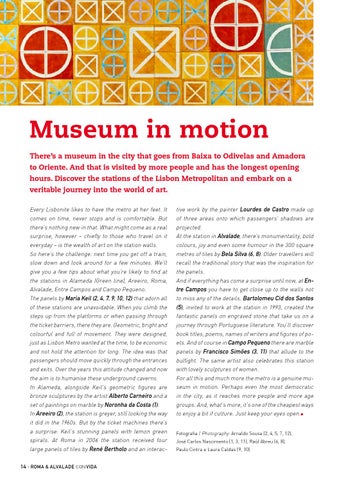
The panels by Maria Keil (2, 4, 7, 9, 10, 12) that adorn all
and not hold the attention for long. The idea was that
panels by Francisco Simões (3, 11) that allude to the
passengers should move quickly through the entrances
bulfight. The same artist also celebrates this station
and exits. Over the years this attitude changed and now
with lovely sculptures of women.
the aim is to humanise these underground caverns.
For all this and much more the metro is a genuine mu-
In Alameda, alongside Keil’s geometric figures are
seum in motion. Perhaps even the most democratic
bronze sculptures by the artist Alberto Carneiro and a
in the city, as it reaches more people and more age
set of paintings on marble by Noronha da Costa (1).
groups. And, what’s more, it’s one of the cheapest ways
In Areeiro (2), the station is greyer, still looking the way
to enjoy a bit if culture. Just keep your eyes open.•
it did in the 1960s. But by the ticket machines there’s a surprise: Keil’s stunning panels with lemon green
Fotografia / Photography: Arnaldo Sousa (2, 4, 5, 7, 12),
spirals. At Roma in 2006 the station received four
José Carlos Nascimento (1, 3, 11), Raúl Abreu (6, 8),
large panels of tiles by René Bertholo and an interac-
Paulo Cintra e Laura Caldas (9, 10).
14 · roma & alvalade con vida