liberdade in loco
AS MARCHAS DE LISBOA
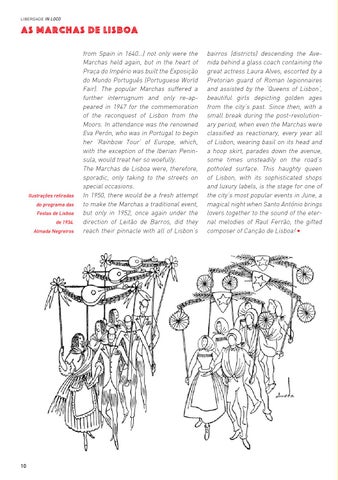
Ilustrações retiradas do programa das Festas de Lisboa de 1934. Almada Negreiros
10
from Spain in 1640…) not only were the Marchas held again, but in the heart of Praça do Império was built the Exposição do Mundo Português (Portuguese World Fair). The popular Marchas suffered a further interrugnum and only re-appeared in 1947 for the commemoration of the reconquest of Lisbon from the Moors. In attendance was the renowned Eva Perón, who was in Portugal to begin her ‘Rainbow Tour’ of Europe, which, with the exception of the Iberian Peninsula, would treat her so woefully. The Marchas de Lisboa were, therefore, sporadic, only taking to the streets on special occasions. In 1950, there would be a fresh attempt to make the Marchas a traditional event, but only in 1952, once again under the direction of Leitão de Barros, did they reach their pinnacle with all of Lisbon’s
bairros (districts) descending the Avenida behind a glass coach containing the great actress Laura Alves, escorted by a Pretorian guard of Roman legionnaires and assisted by the ‘Queens of Lisbon’, beautiful girls depicting golden ages from the city’s past. Since then, with a small break during the post-revolutionary period, when even the Marchas were classified as reactionary, every year all of Lisbon, wearing basil on its head and a hoop skirt, parades down the avenue, some times unsteadily on the road’s potholed surface. This haughty queen of Lisbon, with its sophisticated shops and luxury labels, is the stage for one of the city’s most popular events in June, a magical night when Santo António brings lovers together to the sound of the eternal melodies of Raul Ferrão, the gifted composer of Canção de Lisboa! •