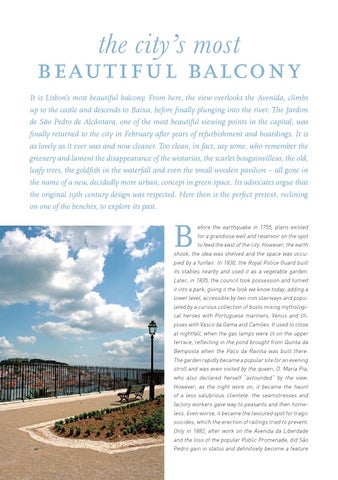
the city’s most beautiful balcony It is Lisbon’s most beautiful balcony. From here, the view overlooks the Avenida, climbs up to the castle and descends to Baixa, before finally plunging into the river. The Jardim de São Pedro de Alcântara, one of the most beautiful viewing points in the capital, was finally returned to the city in February after years of refurbishment and hoardings. It is as lovely as it ever was and now cleaner. Too clean, in fact, say some, who remember the greenery and lament the disappearance of the wistarias, the scarlet bougainvilleas, the old, leafy trees, the goldfish in the waterfall and even the small wooden pavilion – all gone in the name of a new, decidedly more urban, concept in green space. Its advocates argue that the original 19th century design was respected. Here then is the perfect pretext, reclining on one of the benches, to explore its past.
B
efore the earthquake in 1755, plans existed for a grandiose well and reservoir on the spot to feed the east of the city. However, the earth
shook, the idea was shelved and the space was occupied by a funfair. In 1830, the Royal Police Guard built its stables nearby and used it as a vegetable garden. Later, in 1835, the council took possession and turned it into a park, giving it the look we know today, adding a lower level, accessible by two iron stairways and populated by a curious collection of busts mixing mythological heroes with Portuguese mariners, Venus and Ulysses with Vasco da Gama and Camões. It used to close at nightfall, when the gas lamps were lit on the upper terrace, reflecting in the pond brought from Quinta da Bemposta when the Paço da Rainha was built there. The garden rapidly became a popular site for an evening stroll and was even visited by the queen, D. Maria Pia, who also declared herself “astounded” by the view. However, as the night wore on, it became the haunt of a less salubrious clientele: the seamstresses and factory workers gave way to peasants and then homeless. Even worse, it became the favoured spot for tragic suicides, which the erection of railings tried to prevent. Only in 1882, after work on the Avenida da Liberdade and the loss of the popular Public Promenade, did São Pedro gain in status and definitively become a feature