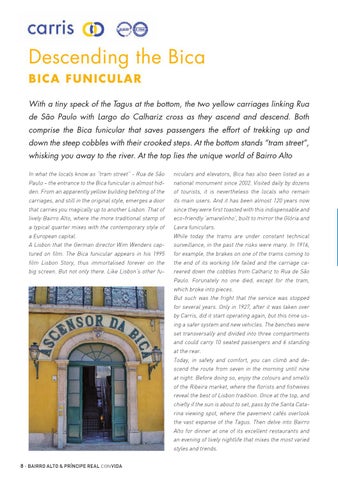
Descending the Bica B i c a F un i cu l a r With a tiny speck of the Tagus at the bottom, the two yellow carriages linking Rua de São Paulo with Largo do Calhariz cross as they ascend and descend. Both comprise the Bica funicular that saves passengers the effort of trekking up and down the steep cobbles with their crooked steps. At the bottom stands “tram street”, whisking you away to the river. At the top lies the unique world of Bairro Alto In what the locals know as “tram street” - Rua de São
niculars and elevators, Bica has also been listed as a
Paulo – the entrance to the Bica funicular is almost hid-
national monument since 2002. Visited daily by dozens
den. From an apparently yellow building befitting of the
of tourists, it is nevertheless the locals who remain
carriages, and still in the original style, emerges a door
its main users. And it has been almost 120 years now
that carries you magically up to another Lisbon. That of
since they were first toasted with this indispensable and
lively Bairro Alto, where the more traditional stamp of
eco-friendly ‘amarelinho’, built to mirror the Glória and
a typical quarter mixes with the contemporary style of
Lavra funiculars.
a European capital.
While today the trams are under constant technical
A Lisbon that the German director Wim Wenders cap-
surveillance, in the past the risks were many. In 1916,
tured on film. The Bica funicular appears in his 1995
for example, the brakes on one of the trams coming to
film Lisbon Story, thus immortalised forever on the
the end of its working life failed and the carriage ca-
big screen. But not only there. Like Lisbon’s other fu-
reered down the cobbles from Calhariz to Rua de São Paulo. Forunately no one died, except for the tram, which broke into pieces. But such was the fright that the service was stopped for several years. Only in 1927, after it was taken over by Carris, did it start operating again, but this time using a safer system and new vehicles. The benches were set transversally and divided into three compartments and could carry 10 seated passengers and 6 standing at the rear. Today, in safety and comfort, you can climb and descend the route from seven in the morning until nine at night. Before doing so, enjoy the colours and smells of the Ribeira market, where the florists and fishwives reveal the best of Lisbon tradition. Once at the top, and chiefly if the sun is about to set, pass by the Santa Catarina viewing spot, where the pavement cafés overlook the vast expanse of the Tagus. Then delve into Bairro Alto for dinner at one of its excellent restaurants and an evening of lively nightlife that mixes the most varied styles and trends.
8 · BAIrro alto & príncipe real con vida