Fort Rinella This fort is one of only four 100ton gun batteries constructed in Malta and Gibraltar by the British. Built in 1878, it houses the 100-ton Armstrong gun (the world’s largest muzzle-loading cannon ever to be built). The gun itself is impressive because of its immense size, but also because it was placed at the entrance to Grand Harbour so as to better pierce through the steel plates of approaching enemy ships. In order to make the most of your visit, it is advisable to get here in time for the signalling display that takes place between 11.30am and noon, followed by a horse-and-marching display, and a DVD presentation at 1pm. Free audio guides are available in many languages. St Rocco Road, Kalkara (2180 0992, www.fortrinella.com). Open 10am5pm Tue–Sun. Admission €10; €8 reductions; €5 under-16s; €25 family.
Inquisitor’s Palace If you only venture inside one museum in Vittoriosa, make it the Inquisitor’s Palace. This building first served as the law courts during the era of the Order of St John, and the oldest parts of the building date back to pre-1530. It was then used as the official residence of the island’s inquisitors and other high-ranking individuals until 1798. More recent additions include the opening of the Inquisitor’s bedroom and the launch of a new visitors’ trail. Apart from its riveting history, this location is also home to permanent Christmas and Good Friday exhibitions, where you can take a closer look at miniature procession statues, instruments such as the cuqlajta or clapper (which are only used during Holy Week when church bells cannot be rung) and the process of crib-making. The palace also hosts a permanent exhibition on the impact of the Inquisition on Maltese society, which studies themes such as the Holy Family and the cult of saints. Look out for the combo ticket offer if you visit the palace and the Maritime Museum (see p97). Main Gate Street, Vittoriosa (2182 7006, www.heritagemalta.org). Open 9am-4.30pm daily. Admission €6; €4.50 reductions; €3 under-11s.
Fort St Angelo For the best views of this imposing fort, stop at St Barbara Bastions or the Upper Barrakka Gardens in Valletta, or along the Valletta Waterfront. It is situated bang in the centre of Grand Harbour and is a wonderful legacy of Malta’s military heritage. It became the seat of the Grand Master and the Order of St John’s primary fortification when, upon their arrival in Malta, the Knights settled in Vittoriosa. During the Great Siege of 1565, the fort played a very important role in the Knights’ successful endeavours to repel the Ottomans. Though various reinforcements and modifications enlarged and strengthened the fort, today’s layout is largely attributed to the design of the Spanish military engineer Colonel Don Carlos de Grunenburgh, executed in the late 17th century. His coat of arms still stands above the main gate. The fort retained its importance under British rule and was handed to the Maltese government when the Royal Navy left the island in 1979. Major restoration works are ongoing here to bring the fort back to its former glory and it will be open to the public in the very near future. Gardjola Garden Don’t miss this pretty garden – the only public garden in the city – which is popular for its gorgeous views and photo opportunities. You’ll happen across it as you walk around Senglea, and it
Senglea Waterfront You’ll reach this tranquil waterfront through the warren of residential streets in Senglea. This spot offers insight into the slower-paced amble of local life, and it is more authentic than the busier Vittoriosa Waterfront across the bay. Watch the boats ebb by and interact with local families as they enjoy the evening and fresh sea air while sipping a drink on the esplanade. Visit at dusk and take in views of the beautifully lit Vittoriosa Waterfront and the yachts berthed there. Vittoriosa Waterfront There’s a sense of glamour to be enjoyed on this side of the harbour, as super yachts bob on the water and Valletta’s magnificent bastions stand opposite. This is a busy area, usually packed with people strolling along or enjoying a drink by the water’s edge. It’s now one of the island’s top spots, with a number of stylish restaurants and cafés, several luxurious apartments and a home furnishings boutique. Make sure to wander right to the end of the waterfront, where Fort St Angelo lies; you’ll be able to take in some great views here.
98 Time Out Malta & Gozo for Visitors 2015/16
TOURS AND DETOURS
Around the Three Cities viewingmalta.com/Clive Vella
stands above the fortifications overlooking the capital. It was built in 1551 by Grand Master de la Sengle and owes its name to the sentry box – gardjola – which juts out over the sea. This pictureperfect setting, featured on many postcards, is also gaining ground as a wedding reception venue.
O
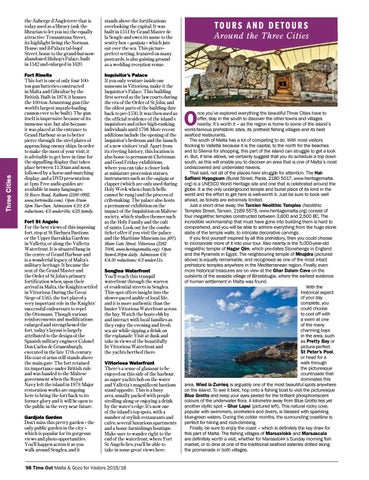
nce you’ve explored everything the beautiful Three Cities have to offer, stay in the south to discover the other towns and villages nearby. It’s worth it – as the region is home to some of the island’s world-famous prehistoric sites, its prettiest fishing villages and its best seafood restaurants. The south of Malta has a lot of competing to do. With most visitors flocking to Valletta because it is the capital, to the north for the beaches and to Sliema for shopping, this part of the island can struggle to get a look in. But, if time allows, we certainly suggest that you do schedule a trip down south, as this will enable you to discover an area that is one of Malta’s most undiscovered and underrated havens. That said, not all of the places here struggle for attention. The HalSaflieni Hypogeum (Burial Street, Paola, 2180 5017, www.heritagemalta. org) is a UNESCO World Heritage site and one that is celebrated around the globe. It is the only underground temple and burial place of its kind in the world and the effort to get here is well-worth it. Just be sure to book well ahead, as tickets are extremely limited. Just a short drive away, the Tarxien Neolithic Temples (Neolithic Temples Street, Tarxien, 2169 5578, www.heritagemalta.org) consist of four megalithic temples constructed between 3,600 and 2,500 BC. The incredible workmanship that must have gone into building them is hard to comprehend, and you will be able to admire everything from the huge stone slabs of the temple walls, to intricate decorative carvings. If you find yourself inspired by all this prehistory, then you could choose to incorporate more of it into your tour. Also nearby is the 5,000-year-old megalithic temple of Hagar Qim, which pre-dates Stonehenge in England and the Pyramids in Egypt. The neighbouring temple of Mnajdra (pictured above) is equally remarkable, and recognised as one of the most intact prehistoric temples anywhere in the Mediterranean region. Finally, even more historical treasures are on view at the Ghar Dalam Cave on the outskirts of the seaside village of Birzebbugia, where the earliest evidence of human settlement in Malta was found. With the historical aspect of your day complete, you could choose to cool off with a swim at one of the many charming bays in the area, such as Pretty Bay or picture-perfect St Peter’s Pool, or head for a walk through the picturesque countryside that dominates this area. Wied iz-Zurrieq is arguably one of the most beautiful spots anywhere on the island. To see it best, hop onto a fishing boat to visit the picturesque Blue Grotto and keep your eyes peeled for the brilliant phosphorescent colours of the underwater flora. A kilometre away from Blue Grotto lies yet another idyllic spot – Ghar Lapsi (pictured left). This natural rocky cove, popular with swimmers, snorkelers and divers, is blessed with sparkling blue-green waters. During the colder months, the surrounding coastline is perfect for hiking and rock-climbing. Finally, be sure to enjoy the coast – which is definitely the key draw for this part of Malta. The fishing villages of Marsaxlokk and Marsascala are definitely worth a visit, whether for Marsaxlokk’s Sunday morning fish market, or to dine at one of the traditional seafood eateries dotted along the promenade in both villages. viewingmalta.com/Mario Galea
Three Cities
the Auberge d’Angleterre that is today used as a library (ask the librarian to let you in); the equally attractive Tramuntana Street, its highlight being the Norman House; and il-Palazz tal-Isqof Street, home to the grand-but-nowabandoned Bishop’s Palace, built in 1542 and enlarged in 1620.