NEWS
l
FEATURE
F L A N D E R S T O D AY i N O V E M B E R 1 2 , 2 0 0 8 i 3
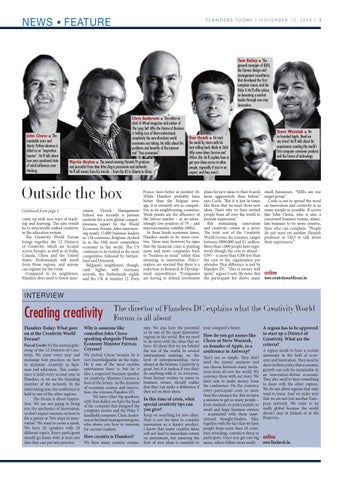
Tom Kelley l The general manager of IDEO, the famous design and management consultancy that developed the first computer mouse and the Palm V. He’ll offer advice on becoming a market leader through non-stop innovation.
John Cleese l The inimitable actor and Monty Python alumnus is billed as an “inspiration booster”. He’ll talk about how your emotional state of mind influences your thinking.
Chris Anderson l The editor-inchief of Wired magazine and author of The Long Tail: Why the Future of Business is Selling Less of More understands completely the new directions world economies are taking. He talks about the problems and benefits of the internet and “free economies”. Martin Heylen l The award-winning Flemish TV producer and journalist from Man Bites Dog is passionate and authentic. He’ll tell stories from his travels – from the US to Siberia to China.
Outside the box Continued from page 1 come up with new ways of teaching and learning. The aim would be to structurally embed creativity in the education system. The Creativity World Forum brings together the 12 Districts of Creativity, which are located across Europe, as well as in India, Canada, China and the United States. Professionals will travel from those regions, and anyone can register for the event. Compared to its neighbours, Flanders does need to boost inno-
vation. Vlerick Management School was recently a partner institute for a new global competitiveness report by the World Economic Forum. After interviewing nearly 13,000 business leaders in 134 countries, Belgium clocked in as the 19th most competitive economy in the world. The US continues to be ranked as the most competitive, followed by Switzerland and Denmark. Belgium’s neighbours, though, rank higher, with Germany seventh, the Netherlands eighth and the UK at number 12. Even
Dan Heath l He took the world by storm with his best-selling book Made to Stick: Why some Ideas Survive and Others Die. He’ll explain how to get your ideas across to other people, especially if you’re an expert, and they aren’t.
France fares better at number 16. While Flanders probably fares better than the Belgian average, it is certainly not as competitive as its neighbouring countries. Weak points are the efficiency of the labour market – at an astonishingly low position of 79 – and macroeconomic stability (60th). In these harsh economic times, Flanders needs to be more creative. There may, however, be signs that the financial crisis is pushing more and more companies back to “business as usual” rather than investing in innovation. Policymakers are worried that there is a reduction in Research & Development expenditures. “Companies are having to defend investment
plans for new ideas to their boards more aggressively than before,” says Cools. “But it is just in times like these that we need those new ideas. That’s why we have invited people from all over the world to provide inspiration.” But stimulating innovation and creativity comes at a price. The total cost of the Creativity World Forum, for instance, ranges between €800,000 and €1 million. More than 1,000 people have registered, though the cost to attend – €395 – is more than €200 less than the cost to the organisation per attendee. That difference is met by Flanders DC. “This is money well spent,” argues Cools. He notes that the participant list shows many
Steve Wozniak l He co-founded Apple. Need we say more? He’ll talk about his experiences creating the world’s first computer consumer products and the future of technology.
small businesses. “SMEs are our target group.” Cools is out to spread the word on innovation and creativity to as many people as possible. If actors like John Cleese, who is also a renowned business trainer, stimulate business to be more creative, then who can complain. “People do not want yet another Flemish professor or CEO to talk about their experiences.”
online
www.creativityworldforum.be
INTERVIEW
Creating creativity
The director of Flanders DC explains what the Creativity World Forum is all about
Flanders Today: What goes on at the Creativity World Forum?
Why is someone like comedian John Cleese speaking alongside Flemish Pascal Cools: It’s the annual gath- Economy Minister Patricia ering of the 12 Districts of Crea- Ceysens? tivity. We meet every year and exchange best practices on how to stimulate creativity in business and education. This conference is held every second year in Flanders, as we are the founding member of the network. In the intervening year, the conference is held in one of the other regions. The forum is about inspiration. We are not going to bring you the mechanics of innovation, so don’t expect sessions on how to file a patent or “five steps to innovation”. We want to create a spark. We have 26 speakers with 26 different topics. Every participant should go home with at least one idea they can put into practice.
We invited Cleese because he is very knowledgeable on the topic. He is one of the most creative entertainers there is, but he is also a respected business speaker on creativity. Minister Ceysens is host of the forum. As the minister of economy, science and innovation, she oversees Flanders DC. We have other big speakers: with Tom Kelley, we have the head of the company that designed the computer mouse and the Palm V handheld computer. Chris Anderson is the latest management guru, who shows you how to innovate for current markets.
nies. We also have the potential to be one of the most innovative regions in the world. But we need to do more with the ideas that we have. It’s there that we are behind the rest of the world. In several international rankings on the level of entrepreneurship, we’re always at the bottom. Creativity is great, but it is useless if you don’t do anything with it. So everyone, from factory worker to nurse to business owner, should realise that they can make a difference if they act on their ideas.
In this time of crisis, what special creativity tips can you give?
Keep on searching for new ideas. Now is not the time to consider innovation as a luxury product. I know that many creative ideas will not lead to immediate return How creative is Flanders? on investment, but ensuring the We have many creative compa- flow of new ideas is essential to
your company’s future.
How do you get names like Cleese or Steve Wozniak, co-founder of Apple, to a conference in Antwerp?
A region has to be approved to start up a District of Creativity. What are the criteria? A region needs to have a certain autonomy in the field of economy and innovation. They need to show in their policy that economic growth can only be sustainable in an innovation-driven economy. They also need to have something to share with the other regions. We do not allow regions that only want to learn. And we make sure that we are not just another European network. We want to be really global because the world doesn’t stop in Ireland or at the Bosporus.
That’s not so simple. They don’t need the money anymore and can choose between many invitations from all over the world. We convince them with our story. We don’t aim to make money from the conference. On the contrary, every participant costs us more than the entrance fee. But we have a mission to get as many people – from students, to policymakers to small and large business owners – acquainted with these inspirational thought-leaders. This, together with the fact that we have people from more than 18 countries attending, convinces them to participate. Once you get one big online name, others follow more easily. www.flandersdc.be