









FEBRUARY 27 & 28, 2026




























RENASANT CONVENTION CENTER
MEMPHIS, TENNESSEE
































































































THURSDAY, FEBRUARY 26
THE PEABODY HOTEL, 149 UNION AVENUE, MEMPHIS, TENNESSEE
1:30 P.M.
SOUTHERN COTTON GINNERS ASSOCIATION AND FOUNDATION ANNUAL MEETINGS


Welcome and National Update
Venetian Room | All association members welcome


Potential of the Cotton Plant - Quality and Yield Prospects

Brad Williams, President National Cotton Ginners Association
Jay Mahaffey, Senior Fellow, Bayer, Scott Learning Center
Future of U.S. Cotton - Challenges and Opportunities


Gary Adams, National Cotton Council, Cordova, Tenn.
Integrating Gin Technology for the Farmer and Ginner

Jonathan McBride, Bogue Chitto Gin, Macon, Miss.

Ag Achievement Awards
Dan Patterson, Silverleafe Cotton Tracing, Germantown, Tenn.
Isaac and Megan Davis, Bayou Saladore Farm, LLC., Oil Trough, Ark.






Steven Green, PhD, Professor of Soil & Water Conservation, Arkansas State University
Cotton Gin Service Award




Larry Dickey, D & S Gin Supply Inc., Memphis, Tenn.











6:30 P.M. HONORS RECEPTION SPONSORED BY MEMPHIS TOURISM

Peabody Forest Room | All Association Members Welcome (tickets are required)

7:15 P.M. HONORS BANQUET SPONSORED BY BAYER, MARTIN SPECIALTY PRODUCTS AND SIGNODE

Ginner of the Year

Peabody Continental Ballroom | All Association Members Welcome (tickets are required)
Bill Newsom, Grundfest and Klaus Gin, Inc., Cary, Miss.
Chase Sain, Graves Gin Corp, Rector, Ark.
SCGA Memorial Scholarship Honoree
David T. Cochran, Jr., Avon Gin Inc., Avon, Miss.

The A.L. Vandergriff Cotton Pioneer Award
Joe Nicosia, Louis Dreyfus Company, Cordova, Tenn.




FRIDAY, FEBRUARY 27
RENASANT CONVENTION CENTER, 255 N. MAIN STREET, MEMPHIS, TENNESSEE
Shuttle Bus Service from Peabody Hotel to the Renasant Convention Center begins at 7:30 a.m.
8:30 A.M. AG OUTLOOK

Cannon Center Stage

Presiding | Allen Espey, President, Southern Cotton Ginners Association
Cotton Issues | Nathan Reed, Chairman, National Cotton Council

Outlook for U.S. and World Cotton | Joe Nicosia, Trading Operations Officer, Head of the Cotton Platform for Louis Dreyfus Company, Executive Vice President of Louis Dreyfus Company LLC., Cordova, Tenn.

9:00 A.M. MID-SOUTH FARM & GIN SHOW OPENS
11:00 A.M. MID-SOUTH AGRICULTURAL TRADE CONFERENCE
Room 115 Level 1

1:00 P.M. MANAGING STRESS AND ANXIETY IN AN UNCERTAIN WORLD - PANEL DISCUSSION

Room 102 Level 1
With the economic realities all of us in agriculture are facing, challenges with stress & mental health individually or in community are rising. Talking about it can feel uncomfortable for many of us, but our panelists have worked through it and found benefit from reaching out. Several perspectives including a farmer, a pastor who has worked with his community to build support, and a couple of therapists join our moderator for this workshop that is open to all.
Jason Brown, Arkansas Farm Bureau (Moderator)
James Barham, Arkansas Baptist Family Ministries
Jason Franklin, Clarksdale Methodist Church
Richard Noe, Producer/Vance Gin
Mandy Young, Training Director, Agricultural Mental Health Outreach
2:30 P.M. INTEGRATING GIN TECHNOLOGY FOR THE FARMER & GINNER
Room 109 Level 1
Hear discussions, challenges & success stories of ginners, farmers, ag equipment dealers, and others.
3:00 P.M. MSU ALUMNI RECEPTION
Room 103 Level 1
5:00 P.M.
FARM & GIN SHOW CLOSES
SATURDAY, FEBRUARY 28
Shuttle Bus Service from Peabody Hotel to the Renasant Convention Center begins at 7:30 a.m.
8:30 A.M.


Cannon Center Stage

Presiding | Allen Espey, President, Southern Cotton Ginners Association Grain Marketing Outlook/Marketing Strategies/Projections for 2026: Richard Brock, Richard Brock Associates, Milwaukee, Wis. will provide a grain market outlook and his unique insight into grain marketing and the challenges farmers will face in the year ahead.




At the Crossroads of Fundamental Change | A panel discussion hosted by Richard Brock and moderated by Jason Moss. The panel will include Brock, and representatives from the ag equipment, seed, and ag financial sectors. This bonus content will include information relative to this key question: What can be done individually and collectively to improve the profitability of US farmers and restore US farmer competitiveness in the global marketplace?







Eighteen teams of 4-H members from five states will compete in a food challenge to demonstrate their knowledge and skills as it relates to preparing a healthy meal with items commonly found in a local food pantry. The contest will emphasize limiting food waste, food efficiency, and healthiness of a meal. Attend the award ceremony to see the winning recipes and the top three 4-H Chopped teams!




• Agriculture Guaranty
• AZA Import & Export Co.
• Delta Spindle Picker Repair, Inc.
• Egon Keller, Inc.
• Ennis Tag & Label
• Indianola Electric Co.

• Langston Companies, Inc
• Lummus Ag Solutions
• McCleskey Saw & Machine,
• MTS Kimbell
• Olam Agri
• Samuel Packaging




• Signode
• Smith Fans Inc.
• Square Weber, LLC
• TAMA-USA
• Vandergriff American
Thanks to all the Jamboree Sponsors for helping make the Farm & Gin Show a success in 2026























Peterbilt .......................................5100
Bourbon Infused Maple Syrup .................2211
Continental-Pipe .....................................2007
Cotton Museum, Inc. .................................2114
Fairbanks Scales Inc. ..............................2107
Fresh Air Solutions .................................2205
Hess Shoes ..............................................2202
LeafFilter Gutter Protection ...................2110
Next Gen Tuning and Diagnostics ........2207
Peco Foods ...............................................2108
PICKSMART by SMA .................................2100
Quality Craft Tools ...................................2104
Rustic Tennessee Cowhide
Boutique & Décor .................................2212
SetaTech USA Inc. ......................................2111
Shantyman...............................................2206
Simon Sayz LLC .......................................2209
Southern Candies Etc ..............................2112
Tannehill- Mi-T-M Hot Water
Washers - Air Compressors / VAL 6
Heaters / Cajun Kooling .....................2000
The Cotton Store ....................................2200
Topline Enterprises ...............................2005
Vacation Headquarters, Inc. ..................2110
4S&J, INC .................................................3379
Ab Jewelry ...............................................3906
Abilene Machine LLC ..............................3684
Adams Welding Millwright and Crane ..3927
Advanced Drainage Systems, Inc .........3465
Ag Spray Equipment ...............................3202
Ag Technology Solutions Group ............3407
AgroEcoPower ..........................................3513
Alliance Ag Equipment ...........................3602
Alliance Tires ............................................3571
AMADAS Industries, Inc ...........................3156
AMCO Manufacturing Company.............3256
Arcot Industrial Manufacturing ............3355
AST Cotton Picker Parts.........................3463
AZA ............................................................3576
BAJAJ CONEAGLE LLC ............................3062
Baker Implement Company ...................3276
Baling Green Cotton Wrap ......................3418
BC Supply ..................................................3413
Best Wade Petroleum.............................3546
Bigham by Adams ...................................3579
BigIron ......................................................3572
Bobby Henard Tire Service ...................3642
Brooks Custom Application ...................3362
Caroline Taylor Jewelry .........................3905
Case IH .....................................................3070
Ceres Air & XAG Advancing Agriculture ............................................3742
Certi-PIK USA ...........................................3345
Cherokee Fabrication Co., Inc...............3342
CoHelms Ag Services .............................3563
Compass Systems ...................................3519
Cotton Board ............................................3561
Custom Farm Toys ..................................3909
Cutco Business Gifts ...............................3146
D & S GIN SUPPLY INC ............................3252
Delta Harvest Center Inc. ......................3532
Delta Spindle Picker Repair Inc. ...........3250
DeltAg Formulations ...............................3365
Directpivotparts.com .............................3456
Dobbs Peterbilt .........................................3611
Dodge Industrial ......................................3319
Drexel Chemical Company ....................3278
Duck Tote ..................................................3152
Ecodrum Composter ..............................3435
EUROPARTS ..............................................3535
EzeWrap ...................................................3645
FARCO ........................................................3214
Farm Credit..............................................3224
Farm Livin’ ...............................................3903
Gen 3 Dynamics ......................................3470
Gentry Controls .......................................3476
German Roasted Nuts ...........................3900
Get Wet Irrigation Engines, Inc. ............3432
Grain Systems Distribution ....................3414
Greenleaf Technologies .........................3266
GreenPoint Ag...........................................3516
Growers Mineral Solutions .......................3411
H&R Agri-Power ......................................3368
Harvest Time Ag......................................3926
Hays-LTI ...................................................3668
Helena Agri Enterprises .........................3924
Hobbs Equipment Co. .............................3624
House Industries, Inc. ............................3262
Humphrey Coker Machinery ..................3569
Hunter Agricultural Irrigation ...............3274
INCO Irrigation and AG Drainage ............3311
John Deere ..............................................3024
Jones Irrigation, Installation & Repair, Inc. ...........................................3373
Keeling Company ....................................3333
Keeper Packing LLC
PPF Gin & Warehouse, LLC.....................3318
Pritchett Twine and Netwrap llc............3517
Pyramid Ag...............................................3613
Rea Agri Service......................................3584
Red Dirt Plastics.....................................3366
Riceland Foods, Inc................................3454
RM Wrapper..............................................3310
Rooted Ag Systems.................................3573
S&K Packaging.......................................3433
S.I. Distributing .......................................3462
Safe Scan.................................................. 3312
Samuel Jackson, Inc..............................3662
Samuel Packaging Systems Group......3502
Schaeffer Oil / Melvin Morris................3329
Schlagel Manufacturing.........................3401
Scoular.....................................................3578
Seametrics..............................................3557
Shivvers Mfg., Inc....................................3673
SHOUP MFG CO..........................................3218
Signode....................................................3752
Sm Fab Inc. ..............................................3553
SOLSTICE Comfort Solutions.................3920
Southern Application Management......3524
Stalk Knockers......................................... 3512
STOR-LOC..................................................3531
Stover Equipment Co.............................3042
Summit Fire & Security..........................3251
System Scale............................................3371
tCotton by TSW Automation, Inc. ..........3302
TeeJet Technologies..............................3349
The Concrete Fence Co...........................3317
The KBH Corporation..............................3012
The Kelly Group.......................................3234
The Reluctant Beekeeper......................3902
Thompson Machinery.............................3046
Triple J of Mississippi Inc......................3442
Trupick......................................................3918
Turnrows Apparel...................................3944
Tyson Foods Local Grain Services........3410
UniSouth Genetics, Inc...........................3375
USC, LLC...................................................3542
USDA, AMS Cotton & Tobacco
Program................................................3253
Valley View Agri-Systems......................3378
Vantage South.........................................3744
Wilger Inc.................................................3246
Wind Crafts - The Flag Shop................... 3911
Before You Dig...................................4029
ACSA International Cotton Institute....... 4112
Ag Diesel Solutions..................................4215
AgHeritage Farm Credit Services..........4138
AGMARKET.NET.........................................4219
Agri Drone Solutions...............................4012
Agri Placements International..............4001
Agricenter International........................4239
Agrijewelry.com ......................................4240
AgroLiquid.................................................4011
Aquarius Farm Controls - Applied
Digital Inc............................................4208
Arkansas Rice........................................... 4141
Arkansas Soybean Promotion Board ....4135
Arkansas State University......................4133
Banyon Game Calls..................................4319
Beck’s........................................................4229
Belle’s Grace All Natural Dog Treats.....4201
Benchmark AG Partners.........................4221
Better Cotton Initiative..........................4237
BRANDT Professional Agriculture.........4016
Brock Associates....................................4033
CGB AgriFinancial Services, Inc............. 4110
Cotton Grower Magazine.......................... 4116
Cotton Technologies..............................4320
Cutco Business Gifts.............................4000
Delta Farm Press....................................4224
Delta Plastics / Revolution....................4338
Delta Spray Drones.................................4244
Delta State University Agricultural
Aircraft Career Pathway....................4200
Digifarm VBN...........................................4027
Ducks Unlimited.......................................4134
EasyFarm - Vertical Solutions..............4037
Enforcer One, LLC.................................... 4128
EWR, Inc....................................................4144
Farm Bureau............................................4036
FarmChem Corp.....................................4005
Farmers Mutual Hail Insurance.............4105
Financial Wealth Solutions...................4009
First Financial Bank...............................4226
First South Farm Credit.........................4204
Gilland Ag Service...................................4014
H2A Complete..........................................4230
Hill Manufacturing Company, Inc........4028
Ignited Digital Marketing.......................4234
Keller Williams Real Estate Co..............4332
Koch Agronomic Services......................4218
Leaf Guard................................................. 4131
LiQuiTube Total Tire Protection............4303
Lone Oaks Farm - University of Tennessee............................................... 4119
MetLife Investment Management | Agricultural Finance............................4225
Mississippi Land Bank.............................4341
MSU/Ag. & Bio. EngineeringEducational..........................................4026
NACHURS...................................................4214
National Cotton Council........................... 4114
Nichino........................................................4111
On Point Realty........................................4010
Oxpipe......................................................4334
Poseidon LLC...........................................4232
Power Cleaning Equipment....................4145
Premier Farm Realty Group.................... 4312
Primrose Oil Company, Inc.....................4104
ProAg........................................................4013
Purple Wave
You can access the map of the exhibit hall by using the QR code below.
While some of the companies at the 2026 Mid-South Farm & Gin Show are returning exhibitors – some going back to the first show 74 years ago – a host of new exhibitors will be at the show for the first time.
There are more than 60 companies at the 2026 show that were not at the 2025 show. New exhibitors for the 2026 show include:
Alliance Tires, Charleston, SC; Arkansas State University, State University, AR; Belle’s Grace, Williston, TN; Benchmark AG Partners, Arkadelphia, AR; Best Wade Petroleum - Mobil Authorized Distributor, Ripley, TN; Bourbon Infused Maple Syrup, Wellington, FL; CGB Agri Financial Services, Inc., Louisville, KY; CoHelms AgServices, Stuttgart, AR; Compass Systems, Barberton, OH; Delta Spray Drones, Clarendon, AR; Dobbs Peterbilt, Memphis, TN; Dodge Industrial, Simpsonville, SC; East Mississippi Trading Company, LLC, Tupelo, MS; First Financial Bank, El Dorado, AR; Fresh Air Solutions, Hernando, MS; Growers Mineral Corp., Milan, OH; H2A Complete, Southaven, MS; Harvest Time Ag, Leesville, SC; Keller Williams Real Estate Co, Bartlett, TN; Kelley Manufacturing Co., Tifton, GA; LeafGuard, Bartlett, TN; Magnum Metals LLC, Nettleton, MS; Owens Marketing LLC -
Indutar, Jonesboro, AR; Pete Industries, LLC, Woonsocket, SD; Phoenix Building Solutions, Tupelo, MS; Poseidon LLC, Alcester, SD; Premier Farm Realty Group, Jackson, TN; Pritchett Twine and Netwrap LLC, O’Neill, NE; Pyramid Ag, Memphis, TN; METAG WRAP, Qingdao, China; Red Dirt Plastics, Seagraves, TX; Red E Ag, Fargo, ND; Safe Scan/1st Fire Safety, Cedar Park, TX; SetaTech USA Inc, Huntsville, AL; Scott Agri, Maumelle, AR; Sichuan Jinglianggaoxin Material Co., Ltd, Irvine, CA; Silverleafe Cotton Tracing, Germantown, TN; Silverpack Solutions LLC, Clarksdale, MS; Simon Sayz LLC, Sherman Oaks, CA; Simply Amazing Apples, Nashville, TN; SOLDasap, LLC, Paragould, AR; SOLSTICE Comfort Solutions, Moneta, VA; Southeast Grain Management, Clifton, TN; Southern Candies Etc., Sarah , MS; Summit Fire & Security, North Little Rock, AR; Taixing AST Cotton Picker Parts Co., Ltd, Taixing, AL; The Concrete Fence Co., Hohenwald, TN; The Land App, Proctor, AR; The Nowell Agency, Greenwood, MS; Titan Ag, Humboldt, TN; Travis CBD for Wellness, Grand Junction, TN; Two Southern Belles, Florence, AL; UniSouth Genetics, Inc., Dickson, TN; University of Memphis, Memphis, TN; US Ag Fertilizer, Hogansville, GA; USA Farm Labor, Waynesville, NC; USC, LLC, Sabetha, KS; USDA Farm Service Agency, Nashville, TN; Vacation Headquarters, Inc., Wellington, FL; Watson Roofing and Associates LLC., Alamo, TN; Xinjiang Longtai Trade Co.Ltd, Urumqi, China.
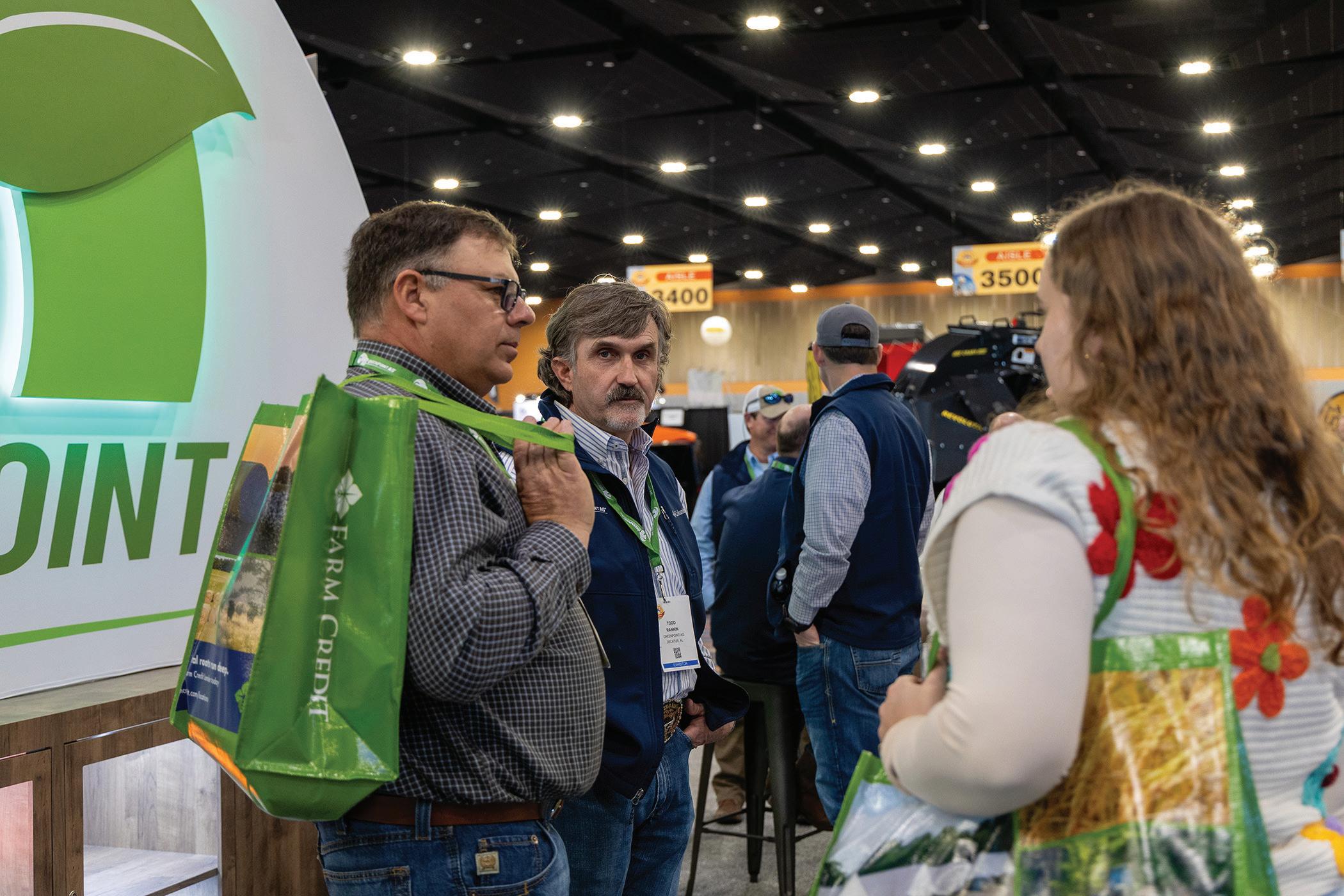
Agriculture is an industry based on cycles and seasons. But the past several years has been economically challenging and conversations at coffee shops and tailgates are showing the MidSouth grappling with big questions. Those big questions are the focus of the 2026 Mid-South Farm & Gin Show, according to the show’s director Tim Price.
He says the show will feature more opportunities to listen to attendees, gather insights, and make sure others understand the reality, and gravity of the situation. “We’ve been in a challenging environment for a few years already and this year we are seeing some in agriculture may be at the breaking point,” Price explains. “People have looked at where they can improve profitability time and time again. We’re hearing the stress is reaching new levels and yet that stress isn’t well understood by people who don’t live Mid-South agriculture.”
In early February Mid-South Farm & Gin Show launched a survey to capture some insights from our attendees, exhibitors and others. The survey is open throughout the event, with university students doing in-person videos soliciting opinions and tips.
The survey is being conducted digitally and provides some demographic information as well as a series of questions that provide multiple choices, and space to put comments in the individual’s own words. Some of the questions include:
• As you look at your operation and the viability of local communities over the next two years, will you be better off or worse off than you are now?
• Given a list of factors impacting agriculture, which are most concerning to you? Looking at the top five factors you selected, what recommendations could help improve the situation?
• How competitive do you believe U.S. agriculture is today in the global market compared to major competitors? Has it improved or declined over the past 5 years?
You can take the survey at: https://bit.ly/MSFGSsurvey or click on the QR code at the right.
Price adds “Pulling together this grassroots input can help the industry have more in-depth discussions about how unique this current environment is and how it is shaping the future of US agriculture. To further connect the dots, we have some new sessions on the agenda that encourage dialogue around some of these critical topics.”



I don’t know that we have ever done a survey in connection with the Mid-South Farm & Gin Show. I know we haven’t done one in my tenure as Show Manager. But, then again, I don’t know when we have seen this kind of challenge, or when there has been such a need for meaningful, first-person data.
If you’re reading this show program in chronological order, you will have seen an outline of what we’re doing and why. We need as much input from as many in agriculture as possible to demonstrate to Congress and the Administration the gravity of the situation.
We need you to take a few minutes to complete the survey. You can find it at www.farmandginshow.com, or you can capture the QR code on signs and banners throughout the exhibit halls and Convention Center lobby areas, and food courts, and take it on your mobile device. Whatever your method, your input is crucial to our mission.
It seems as if our survey is well-timed.
A group of former Ag Department officials, and leaders of farm and commodity organizations, recently sent a letter to the chairs of the House and Senate Ag Committees warning of “widespread collapse” of American agriculture. They cited economic conditions, government policies, and congressional inaction as key drivers in US farmers’ higher input costs, reduced competitiveness in the global market, and lower farm income. The three-page letter provided statistics and examples of the damage done to American farmers and rural communities.
Bottom line: they called for congressional hearings, urged various groups to convene meetings with farmers to discuss their challenges and “gather input on additional policy solutions, and build momentum to address the farm crisis.”
Please, take the survey, give us your thoughts, and be ready to participate in any meetings and hearings. We really need your input and the easiest way to do that is to take the survey.
We have realized – or most of us have – that doing what we have always done will never get us where we want, and need, to go. The momentary infusion of money into a situation that hasn’t changed doesn’t address the inevitable change occurring in agriculture today.

Don’t get me wrong. forthcoming outlays from the federal government are very welcomed, but it’s not nearly enough, and not likely to restore US farmer profitability and competitiveness in the world market.
In 1862, President Abraham Lincoln, in addressing the second annual meeting of Congress, at the start of the Civil War, alluded to the need for different solutions.
“The dogmas of the quiet past are inadequate to the stormy present. The occasion is piled high with difficulty, and we must rise with the occasion. As our case is new, so we must think anew, and act anew. We must disenthrall ourselves. And then we shall save our country.”
Sir Ken Robinson quoted Lincoln in his TED talk on learning. Taken with the word disenthrall, Robinson explained how we can free ourselves to think differently.
“The idea that we’re often captive to assumptions we barely notice - ideas formed for a different time, but still shaping how we think and act today. Many of the systems we live
with - especially in education - aren’t broken because people don’t care. They’re broken because we’re still enthralled by old ideas that once made sense, but no longer fit the world we’re in. Progress doesn’t begin with better answers. It begins with better questions - and the courage to rethink what we’ve taken for granted.”
We’re at a critical juncture. We find ourselves in the middle of fundamental change, unsure which question(s) will get to the root of why US farmers aren’t as competitive in the global markets as others, and what factors are driving down US farm income.
Like Robinson suggests, our subconscious mind goes back to the familiar, that’s just how we’re programmed. The phrase “let go of the past” is appropriate beyond personal encounters and can include past solutions for some big problems. Adopting a different mindset, a new way of thinking, allows us to explore the myriad ideas that haven’t been thought of or applied to present day agriculture.
We’re looking for input at a panel discussion scheduled as part of the Ag Outlook seminar on Saturday, February 28, in the Cannon Center. The panel is hosted by Richard Brock, moderated by Jason Moss, and features representatives from seed, ag equipment, and ag financial sectors. We will also share initial survey results.
The focus will be on surfacing solutions to this key question: What can be done individually and collectively to improve the profitability of US farmers and restore US farmer competitive in the global marketplace?
Here’s how you can weigh in on this: take the survey and participate in the panel discussion Saturday. The panel discussion will begin right after the grain marketing outlook, which starts at 8:30 a.m. Bring your questions as there will be plenty of time for audience engagement.
If you don’t take the survey before the show, you’ll have a few ways to do so. The survey will be available on the Farm & Gin Show website and remain open until March 10. You can also encourage others to take the survey. We need everyone’s participation.
Once the survey closes, we will take information from the survey, the panel discussion, Q & A, and in-person interviews, and produce a report to share with state and federal elected officials and state and federal farm and commodity organizations with a specific call to action: to bring together all stakeholders to together to develop the American farmers’ roadmap for restoring American farmer competitiveness and improving US farmer profitability.
Farm income, farmer competitiveness, needed changes in public policy, reports of ag productivity growth slowing, and the possible restructuring that will need to be made under current legislation, are all issues adding pressure on farmers.
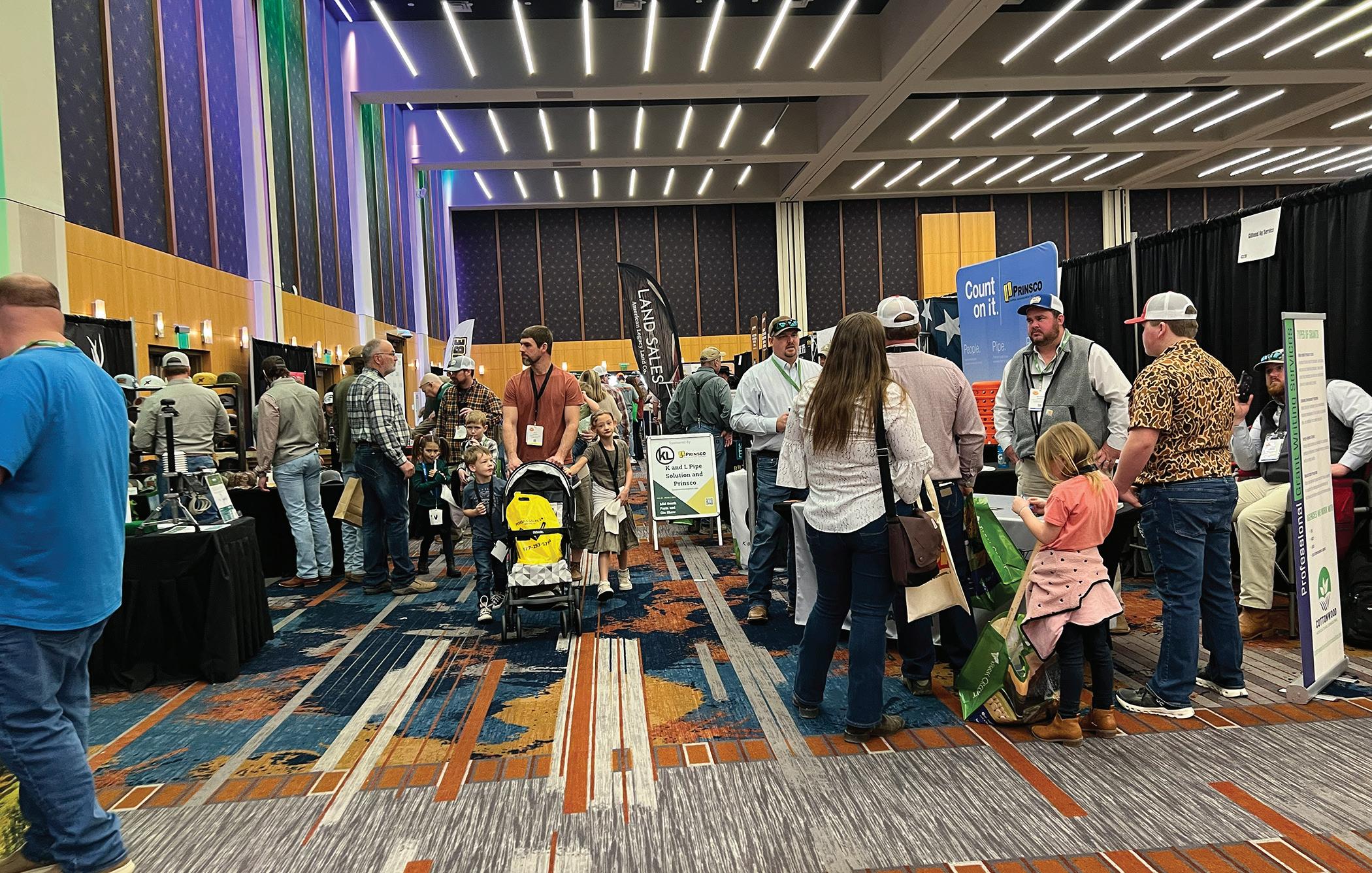
How can we handle it all, especially knowing it will take some time to resolve? To learn how some individuals have weathered the storms, join us for Managing Stress and Anxiety Amid Uncertainty. Talking through the issues we face individually and in community can feel incredibly uncomfortable for many of us, but our panelists have worked through it and found benefit from connecting with others. We’ll have several perspectives including a farmer, a pastor who has worked with his community to build support, a therapist, and someone in industry, all of whom engage in this topic personally. The session will be Friday, February 27, at 1 PM, Room 102 Level 1.
We know this will be another challenging year. It’s been difficult for me to wrap my head around what we’re facing. It’s a monumental task, but it’s not insurmountable. It will take unlearning, deconstructing, and leaving behind what we have relied on for decades but no longer works. Creating a new base of policies and programs that support US farm income and make us more competitive in the global marketplace will take time and tenacity. It won’t be easy.
Still, I believe in the future of agriculture.
Those are the first words of the FFA Creed. It was 1928 when E.M. Tiffany penned those words, and there was no way to have known how enduring those words would be. Yet, here we are nearly a Century later quoting the Creed as a reminder of our/agriculture’s resilience.
I think the rest of the first paragraph of the FFA Creed sums it up:
“I believe in the future of agriculture, with a faith born not of words but of deeds – achievements won by the present and past generations of agriculturists; in the promise of better days through better ways, even as the better things we now enjoy have come to us from the struggles of former years.”
It takes all of us, with different perspectives and experiences, to work together toward a common goal of improving US farm profitability and restoring our competitiveness in the global marketplace. Welcome
to the show … where it all comes together.
~ Tim Price




Gary Adams is the National Cotton Council’s president and chief executive officer. In that role, he helps guide the industry’s seven segments to reach consensus on critical policies affecting U.S. cotton, with the mission of helping all U.S. cotton industry segments compete effectively and profitably in global markets. Adams also serves as president of the U.S. Cotton Trust Protocol that was launched in July 2020. Before being named Council President/CEO in 2015, Adams served for 13 years as Council vice president of Economic and Policy Analysis providing economic outlooks for global cotton markets and analyzing the impacts of farm and trade policies. Adams earned B.S. and M.A. degrees in Applied Mathematics from the University of Alabama and a Ph.D. in Agricultural Economics from the University of Missouri. He and his wife, Carol, have four children.
Richard Brock is Chairman of Brock Holding Company which is comprised of Brock Associates, an agricultural marketing advisory service and publisher of The Brock Report, established in 1980 and Brock Investor Services (futures and options brokers). The firm, based in Milwaukee, WI, now has six offices and manages grain sales on approximately 800,000 acres throughout the U.S. and is an advisor on purchasing strategies for many large poultry, pork, dairy and food companies. Brock grew up on the family grain and pork farm in central Indiana. He received his Agricultural Economics degree from Purdue University and his master’s degree from Cornell University. He and his wife Cathy have three grown children and eleven grandchildren.
Jay Mahaffey is Learning Center Manager/Science Fellow of Bayer’s Learning Center in Scott, Mississippi, where they test the latest advanced agronomic practices with Bayer Products consisting of corn, cotton and soybeans. A native of Chase, Louisiana, Jay received a bachelor’s degree in Agricultural Aviation from the University of Louisiana Monroe. He earned a master’s degree in Entomology and Statistics at North Carolina State University working with Bollgard in some of the very early studies with the product. In the early 90’s Jay joined D&PL as an entomologist in the Technical Services group working in the development and support of new transgenic products, seed treatments, and other technology for the cotton seed market. He has also worked with Roundup Ready, Bollgard II and Roundup Ready Flex. Jay and his wife Jill have two children.
Jonathan McBride is general manager of Bogue Chitto Gin, Macon, Mississippi. Since 2017, McBride has worked to integrate R-F-I-D technology to help give producers more information about what’s happening in their cotton. McBride entered the cotton ginning business at Holly Bluff-Silver Creed Gin in the fall of 2000. In 2017, McBride joined Bogue Chitto Gin, where he has worked to make the gin more efficient and consistent. McBride introduced R-F-I-D technology at Bogue Chitto Gin, helping producers use the chip technology in each round module wrapper to better understand what’s happening in the cotton. McBride is one of the first three students to go through Mississippi State’s Gin Management and Technology Program, part of its four-year agricultural engineering, technology and business degree. In addition to a degree from Mississippi State, McBride is a graduate of New Orleans Baptist Theological seminary. He and his wife Emily have one child.

Joe Nicosia is the Global Trading Operations Officer for Louis Dreyfus Company as well as the Head of the Cotton Platform. He also is Executive Vice President of Louis Dreyfus Company LLC and Chief Executive Officer of Allenberg Cotton Co. Nicosia graduated from Dartmouth College in 1981 with a Bachelor of Arts degree in Economics and the same year joined Louis Dreyfus Company as a grain trader in Minneapolis. In 1982 he transferred to Allenberg Cotton Co. and in 1985 assumed responsibility for cotton trading worldwide. Nicosia is active in several cotton industry associations and is past Chairman of the National Cotton Council. He is past Chairman and serves on the board of directors of the American Cotton Shippers Association (“ACSA”). He is also the long-time chairman of the Futures Committee of ACSA.



Dan Patterson is a seasoned entrepreneur and agricultural industry executive with extensive experience and an innovative approach to cotton supply chain technology. Patterson is the founder of Silverleafe Cotton Tracing (SCT), operating under Silverleafe Global Ag Tech, LLC, which he established in August 2022. His company addresses critical traceability challenges in global cotton supply chains, particularly focusing on proving machine-harvested versus human-harvested cotton through patented optical mass flow sensing technology. The Patterson family has deep generational roots in cotton production, with operations spanning Mississippi and expanding internationally to Uzbekistan since 2018. This heritage provides Dan with intimate knowledge of cotton farming challenges and opportunities across different global markets.
Nathan Reed is chairman of the National Cotton Council. He manages approximately 9,000 acres of crops, with 4,500 acres dedicated to cotton, in Marianna, Arkansas. In addition to cotton, he cultivates rice, corn, and soybeans. Reed also owns a farmland and wildlife property improvement business. His services include GPS land forming for better drainage and irrigation, as well as the construction and maintenance of wildlife habitats. Reed has held leadership roles in various agricultural organizations. He is the immediate past Chair of American Cotton Producers and the current Chairman of the Arkansas Agriculture Council. He also serves on the Board of Directors of the Arkansas State Plant Board. Reed earned his B.S.B.A. in Agricultural Business from the University of Arkansas in 2002 and his J.D. from the University of Arkansas School of Law in 2005. He and his wife Kristin have four children.
Brad Williams is president of the National Cotton Ginners Association. He is vice president of Burlison Gin Co., Burlison, Tenn., a managing partner of Kelley Enterprises, and operations manager of Kelcot Warehouses LLC. On the farm, he manages approximately 14,000 acres of cotton. He earned a finance degree at University of Memphis and worked for a cotton buyer while still in college. In addition to his role on the National Cotton Ginners Association, Williams serves on the board of Southern Cotton Ginners Association, where he served as President in 2021, and the National Cotton Council.
By Whitney Shannon Heckel
Managing cover crops and adopting no-till may seem daunting to some but not for 29-year-old Isaac Davis. He has witnessed the benefits of conservation practices – practices endorsed by Arkansas State University - firsthand in his fields near Oil Trough, Ark.
Davis and the Arkansas State University are being honored by the Southern Cotton Ginners Association with the 2026 Ag Achievement Award for their work in cover crops.
During recent flooding onto Davis’s farmland, which lies within the floodplain of the White River, he observed a noticeable reduction in erosion on cover cropped fields. He also attributed his overall reduction of input costs to cover cropping and no-till.
The key to his success lies in understanding the optimal scenarios and soil types for cover crops and the appropriate species to plant ahead of each row crop. Through methodical refinement, he continues to expand conservation efforts on his nearly 2,000 acres.
In 2025, Davis cover cropped around 600 acres, and at spring planting, half of the farm was no-till. He intends to do the same this year, hoping to plant more acres in cover crops and to try growing winter peas, a new species for his operation.
Davis, now in his fifth crop year, was born a farm kid, but he is technically a first-generation farmer and started his farming business from the ground up.
When Davis was 4, his dad and grandfather decided to step away from farming. His dad went to work at the Farm Bureau office in Batesville, Ark., the town where Davis grew up. In his mid-teens, Davis went to work on a farm in Oil Trough, just a few miles down the road from his hometown.
After high school, Davis attended Arkansas State University and earned a degree in plant and soil science. He secured a job at a farm near Oil. The farmer, Joe Massey, was planning on retiring but had no family, so he agreed to transition the operation to Davis at the start of the 2023 crop year.
Davis and his wife, Meagan, purchased an additional 300 acres, accelerating his first year of independent farming. He rented equipment while continuing to work alongside the older farmer who used cover crops.
“That was my first experience with cover crops,” Davis said. “I learned firsthand what works and what doesn’t.”

ECONOMICALLY SOUND: First-generation farmer Isaac Davis grows rice, corn and soybeans on his farm in northeastern Arkansas and can attest to the economic benefits of no-till and cover crop practices across his operation. Photo by Whitney Shannon Heckel
Davis’ start
Davis typically rotates row crops of rice, corn and soybeans.
In 2024, he said the farm’s acreage comprised approximately one-third of each crop. Following harvest, Davis plants a winter cover crop blend or winter wheat on fields intended for either corn or soybean the next growing season.
“You have to know what species of cover crop to plant ahead of what crop you are going to raise,” he said.
For the first couple of years he farmed on his own, Davis experimented with cover crops on a limited scale. Seeing the results, he has progressively expanded the practice.
“I always thought this would work. It costs us a little more to implement, and there is a little more to it in the fall,” he said. “We are basically trading our time on those fields because there is much less work in the spring, and we are seeing the benefits.”
At first, Davis was primarily concerned about potential yield reduction, but that has not been the case. He emphasized that success hinges on planting the right cover crop species blends, which requires careful planning and consideration of factors such as nitrogen availability and cover crop termination when spring planting season arrives.
As Steve Green, professor of soil conservation at Arkansas State University, explained, “The soil is alive. It is not an inert material; it is a living material.”
The soil system contains both nonliving components — sand, silt and clay — and a living community of microorganisms. Certain management practices can maximize the soil’s health, creating a robust system of thriving microbial activity with significant added benefits.
Management practices in regenerative ag focus on minimal soil disturbance, integration of cover crops and increasing biodiversity through things like composting and rotational grazing. Each adopted practice stacks benefits to the farming operation, creating an abundance of soil microbes in a self-sustaining nutrient system.
“What those microorganisms are doing in the soil is cycling nutrients. We need nutrients to cycle in the soil. If we have an abundance of organic matter in the soil, there are nutrients in that organic matter releasing nutrients to the soil. This allows plants to get nutrients without us spending quite as much money to provide those nutrients synthetically,” Green said.
As nitrogen is stored and carbon is built in these systems, microbes begin to thrive. Then, the health of the soil can be quantified through carbon dioxide respiration testing to measure microbial activity.
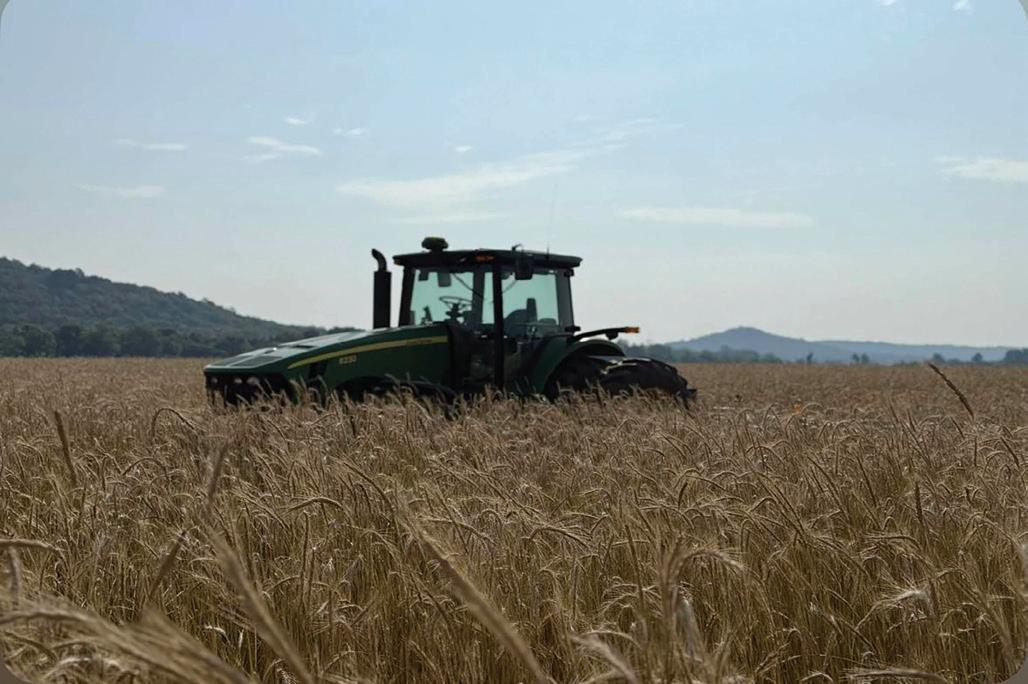
GRASS-HEAVY CROP: Davis prefers growing a cover crop heavy in grasses in fields intended for soybeans in the spring. After termination, the cover crop is rolled with a roller-crimper, creating a thick mat across the field that helps retain soil moisture and reduce erosion. Photo courtesy of Isaac Davis
and he has been pleasantly surprised by the
Green is part of a team at Arkansas State University that support growers efforts to help growers build that thriving soil health.
It is part of the reason why Isaac Davis and ASU were honored with the Ag Achievement Award during the SCGA Annual Meeting on Thursday, February 26 at the Peabody Hotel in Memphis, Tenn.
Adam Martin is stepping into his role as the incoming president of the Southern Cotton Ginners Association, bringing with him a fresh perspective and a drive to encourage the next generation to actively participate in the industry. As gin manager at Lee Wilson & Co. in Wilson, Ark., Martin represents a new wave of leadership focused on quality, innovation, and community engagement.
Martin’s journey to become a cotton ginner began in 2013 when he joined DG&G Cotton Gin, in Parma, Mo. He had just graduated from college at Harding University in Central Arkansas, where he met his wife.
“I came out of college not knowing the industry and really just needed a job,” Martin said. “I didn’t care what it was and I got a job with DG&G.”
Originally from Sikeston, Mo., Martin started on the land side of operations with DG&G before transitioning to ginning operations. He moved to Wilson in 2019 when the Lee Wilson & Co., which owned DG&G, consolidated its operations.
He has served as gin manager for the past three years. The transition from Missouri to Arkansas marked a significant chapter in both his professional and personal life, as he and his family became deeply integrated into the local Wilson community.
At Lee Wilson Gin, Martin oversees operations that prioritize quality over speed. The gin operates on an extended season model, compared to the typical six to seven weeks at many facilities.
“We run our gin a little different,” he said. “We run for little more extended season.”
This approach allows the gin to maintain consistent quality standards while providing stable employment for local workers.
The gin processes cotton from both Missouri and Arkansas, serving farmers across a broad geographic area. Martin emphasizes that quality measurement is central to their operations.
“We measure all weights of all products going in and out,” he said. “Here at Lee Wilson, they strive for excellence and quality from the first bale to the last bale for our customers.”
This dedication involves thorough equipment maintenance during the off-season, with the team touching every piece of equipment and conducting comprehensive repairs annually.

While he is dedicated to his work, Adam Martin’s top priority is family, from left, Adam, Deason, Whit, Logan, Sims Martin. Photo provided by Adam Martin
One of Martin’s key strengths lies in workforce development and retention. The gin has successfully maintained a stable workforce of local employees, many of whom return seasonally for decades.
“We have seasonal employees coming back for 20 to 25 years,” he said. “You can’t train that kind of experience in a year.”
The extended season model directly supports this workforce stability by providing longer-term employment opportunities. “By this, we can provide a job for much longer and retain high-quality employees.”
As incoming president of the Southern Cotton Ginners Association, Martin brings a clear vision focused on engaging younger professionals and questioning traditional practices.
“What I want to do is encourage the next generation to be a part of these organizations and start asking questions, like why do we do the things we do and asking, are there better ways to do it?”
Martin has been attending association meetings for the past ten years and believes fresh perspectives are essential for industry advancement.
“I think sometimes we get in a pattern where we’re just doing the same thing over and over,” he said, emphasizing the need for continuous improvement and innovation. “I just want the younger generation to get into these types of organizations and understand them and speak up. Ask questions.”
Martin believes that improvement comes from people examining established practices and thinking critically about better approaches.
Beyond his professional responsibilities, Martin brings a grounded perspective to his leadership role. Drawing inspiration from a college friend’s father who said he wasn’t farming but “raising boys,” Martin applies this philosophy to his own work.
“I don’t consider myself the boss here,” he said. “I work alongside my teammates and we’re raising our kids here. That’s why I’m doing what I’m doing.”
As Martin prepares to lead the Southern Cotton Ginners Association, his combination of operational excellence, community focus, and forward-thinking approach positions him to guide the organization toward a future that honors tradition while embracing necessary change and innovation.
Despite the industry facing a trying year in 2025, Martin notes that there is hope out there.
“I just want to remind people to put their hope in Jesus, not in the markets,” he said.
Martin will take over the helm of president at SCGA in March 2026.

Allen Espey, the outgoing president of the Southern Cotton Ginners Association, offered a ray of optimism as he reflected on his term of office.
“It’s been a tough year,” he said. “But we’ve seen tough times before. In the 70s we saw demand for cotton drop. It goes in cycles. We’ve just got to get that demand back up.”
If anyone has seen the cycle of the cotton market and demand for the fiber, it’s been Espey. He started working at Espey Gin at the age of nine in 1974 after his father bought the gin.
During ginning season, he’d ride the school bus to Espey Gin, which is within the town limits of McLemoresville, Tenn., to help out in the family operation.
The original gin had been built in 1898 by James H. Bramley and passed down from father to son to daughter and son-inlaw before Espey’s father, Billy, purchased the site in 1974. He is passing this dedication on to the next generation as his son, Will, is actively involved in the farming and cotton gin operations.
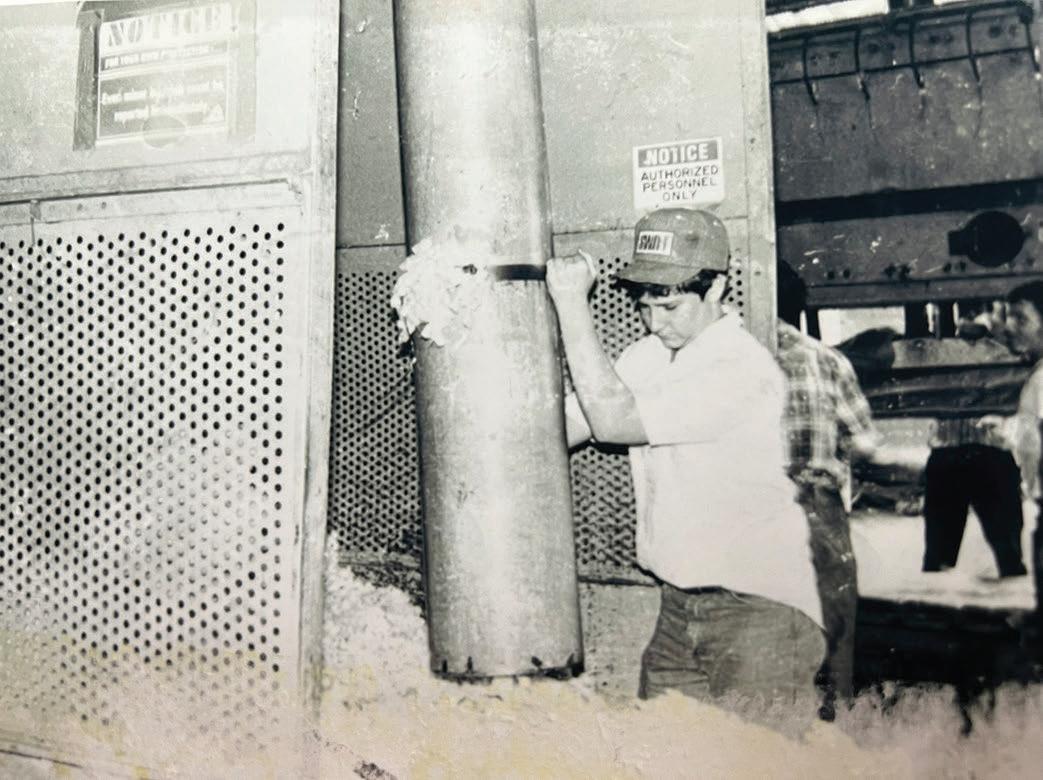
When Espey started, they were pulling cotton out of cotton trailers with a suction pipe. Today the cotton is fed into the gin from round modules by a module feeder.
He’s also seen an evolution organizationally through the ginners’ association.
“I haven’t missed a gin show since I was nine years old,” he said of his first exposure to the Southern Cotton Ginners Association. So, his involvement with the association goes back half a century.

He began participating actively in the association in the late 1980s, first going to the meetings, and then sitting on committees. He sees the necessity for organizations like SCGA, as well as other associations like the National Cotton Council and Cotton Incorporated that have helped advance the mission of cotton and move the needle forward for cotton gins and cotton growers.
He is quick to mention cotton promotional effort programs like the creation of the cotton logo and the “Fabric of Our Lives” campaign.
It’s that perspective that keeps him optimistic about the industry, in spite of the slump it is currently experiencing.
As for the workings of SCGA, he credits Executive Director Tim Price and his staff for effective management.
“It was a good year for the operations of the association,” he said. “We had our meetings that we always have all through the year and have kept up with issues – the district meeting, the safety meetings, the midyear meeting – they were all well attended.”
Espey explained that what he enjoyed the most in his year as president was getting to meet other ginners, that he had not met before – the people with the common interest in the cotton business.
One of the issues the association hit head on was the retirement of Safety Director William Lindamood.
“We will have a new safety director, Austin Yarbro, who will take over the job in April,” Espey said.
Yarbro came on board in December to work with Lindamood until March 31. Safety meetings are held each year in each association district. Gin safety assessments are also made by the safety director.
“Austin is going to be good,” Espey said. “He young and has a lot to give, so that’s good.”
Espey was quick to acknowledge the current plight of the cotton industry and agriculture in general.
“This was just a tough year,” he said. “I don’t think anyone made any money. The government payment will help, but as far as cotton goes, we just need more demand. There needs to be more cotton being used.”
He points to the current National Cotton Council “Plant not Plastics” campaign, which educates consumers on reducing microplastic pollution by choosing natural cotton over synthetic fabrics like polyester.
“We’ve got to get people wearing cotton and using cotton more,” he said. “I think that’s the biggest problem. We got to get our demand up.”
Espey believes in the future of the cotton industry and wants to continue to help make it profitable. Cotton means a lot to the livelihood of his community in Carroll County, as well as those who grow the crop throughout the U.S. This past year has just been part of that service to his industry and the Southern Cotton Ginners Association.
“It’s a good organization,” he said. “It’s been good to be a part of it.”








By Brent Murphree
The Southern Cotton Ginners Association will present the 2026 Ginner of the Year Award to Bill Newsom of Mississippi and Chase Sain of Arkansas during the SCGA annual meeting Feb. 26.
Newsom went into the 2025 cotton ginning season knowing it would be his last as manager of Grundfest and Klaus Gin in Cary, Miss. While he doesn’t have specific plans, he said he’s not going far and plans on staying connected to the cotton industry.
His introduction to managing a gin came on suddenly. In August 1991, Bill Newsom was hired as assistant manager for Grundfest and Klaus Gin. Two weeks later, he found himself in charge.
“When the manager quit, it was just me,” he said. The gin’s owner, Ben Lamensdorf, made Newsom the new manager.
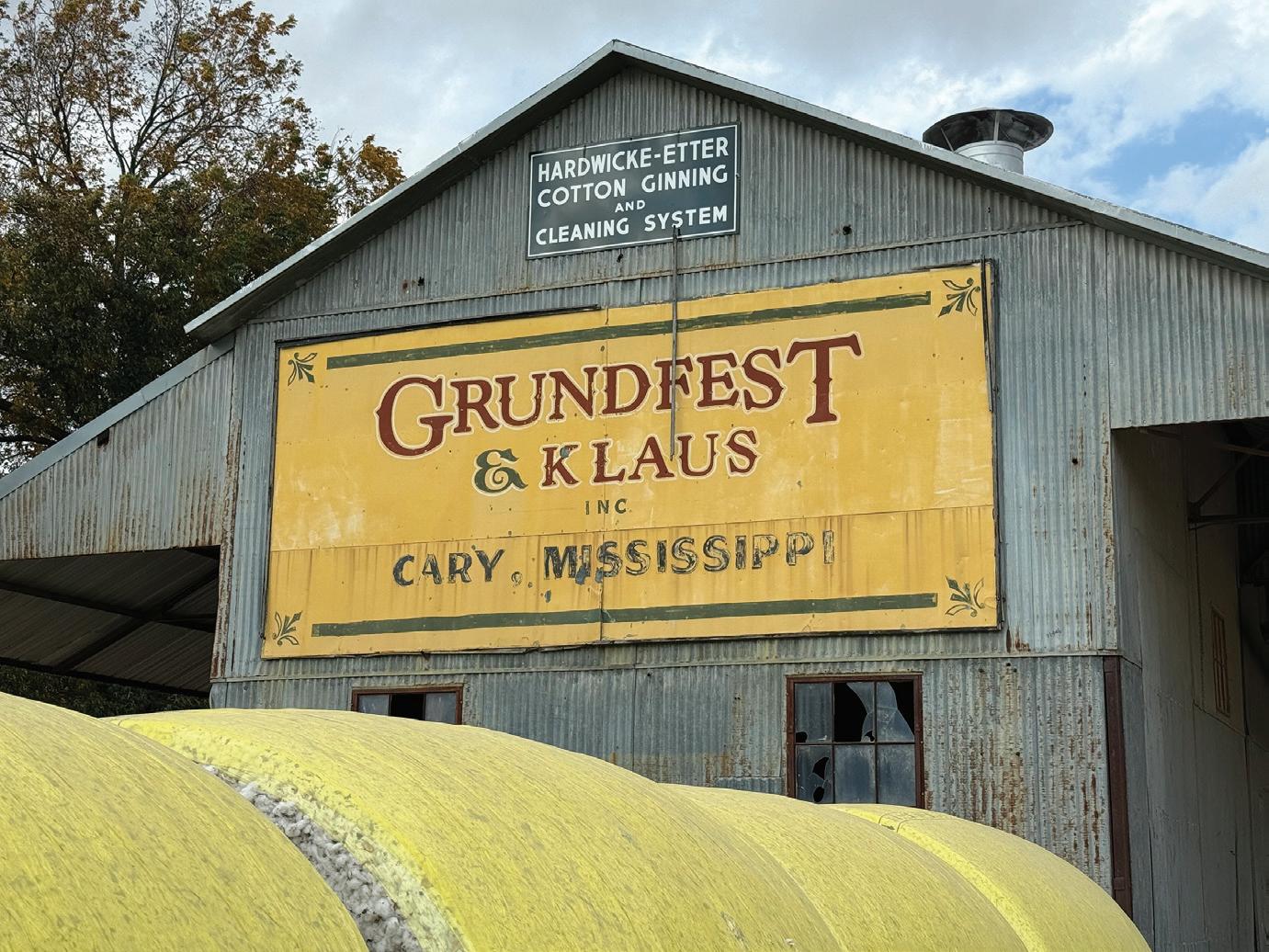
TIME-HONORED:
Incorporated in 1937, the heart of Grundfest and Klaus Gin is a Hardwicke-Etter plant. At one time, the company was a prominent manufacturer of cotton gin machinery, innovating the idea of a dual saw gin and advanced bale presses.
“I’d never seen a Hardwicke-Etter gin stand before,” Newsom said. “But I didn’t have to learn it all own my own.”
Contributions from two notable mentors Steve Washburn of Cary Gin across the street and Buel Ballou of Mid-Delta Cotton Processors in nearby Belzoni, Miss., were invaluable, Newsom said.
“Mr. Buel came over on two Sundays prior to the gin season and gave me all these tips, ‘Do this. Don’t do this. Watch out for this,’ on these Hardwicke-Etter gin stands,” Newsom said. “Those lessons were so valuable to me over the years. I ran those gin stands until 2012. They could be a grizzly bear to work on at times, but they were the tools of my trade. Actually, the H-E stands were known to be gentle on the cotton seed and helped us participate in the Delta Pine planting seed program over the years.
“Gin mechanics Bobby Tarver and Hilton Tarver of Greenville, Miss., have been invaluable. Ginners Tom Calloway and David Grossman also come to mind. David even flew his plane over one day to help!”
Since that time, Newsom has seen an evolution of technology in the industry.
“We were using sucker pipes when I started at Grundfest and Klaus,” he said. “We transitioned from cotton trailers and early modules built on pallets to conventional modules and then ginning the majority round modules for the last decade.”
In 1991, Grundfest and Klaus was ginning primarily on trailers.
“I mean it was 50-plus trailers just from Mr. Lamensdorf,” he said. “I had other customers as well that had trailers. There was always a flat tire. You had to try to get cotton covered up if it rained and that sort of thing. If it got rained on, you had to deal with wet cotton. Those days were tough.”
The gin used manual suction pipes to pull the cotton from the trailers or modules.
“There were four guys that would rotate operating the pipe,” Newsom said, adding that eventually they would tire and slow down. “I would beat on the outside wall of the gin saying, ‘More cotton, more cotton,’” he said with a laugh. “We’d be trying to fill up that third gin stand, and it was a challenge to do when the guys were so tired.”
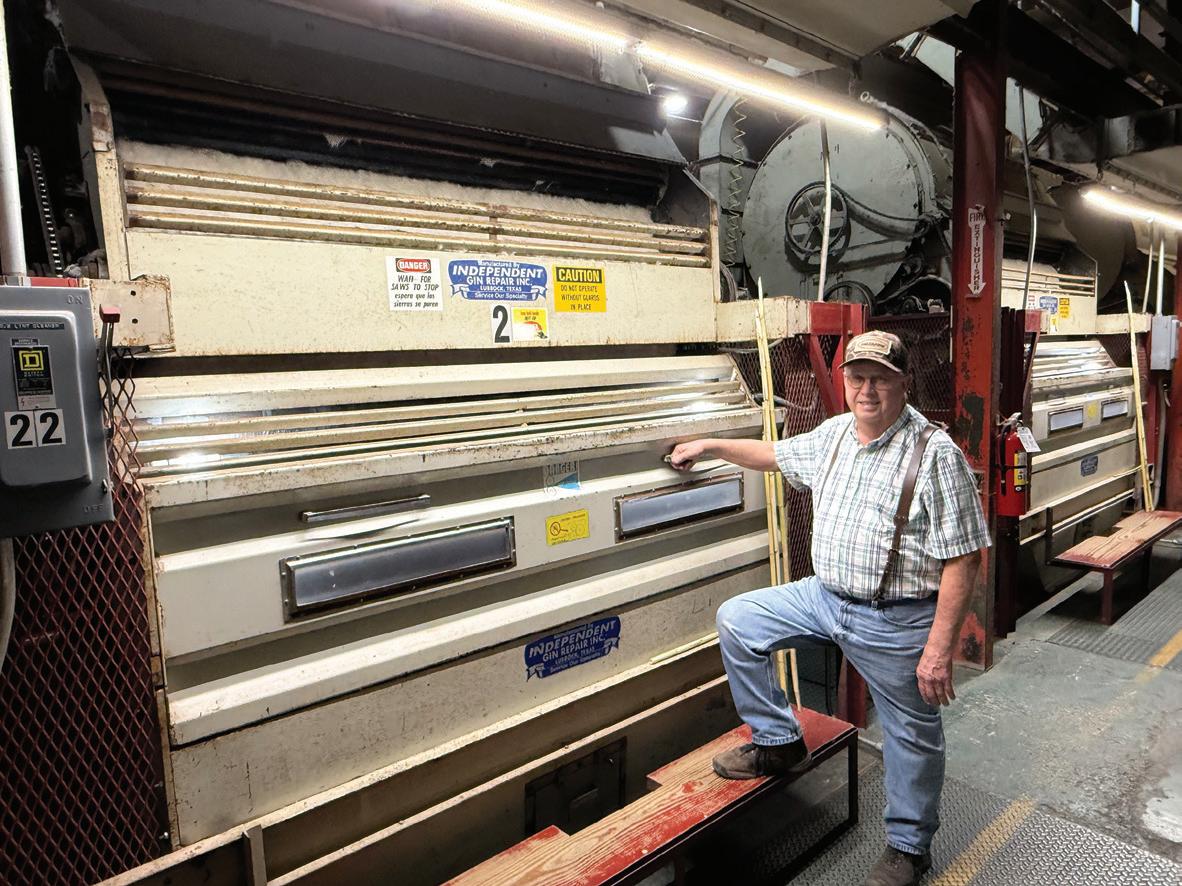
Early on, Newsom began improving the gin. “Being the fastest gin in the county has never been my goal,” he said. “I care about fixing problems to make the process better and doing a job right whether that’s sweeping the floor, building a safety guard or ginning for a customer. Over the years, I’ve tried to convey to my employees to do their best whatever they are working on.
“We were also one of the first gins in Mississippi to put plastic strapping on the bale. That was a home run.”
“In 2008, we got into round modules and added a module feeder,” he said. “I upgraded the Hardwicke-Etters in 2013, putting in two BC Supply 170 stands. We also replaced the inclines and stick machines to improve our grades and production. Clifford Fischer of BC Supply was a friend and valuable resource throughout these upgrades.”
Newsom noted that the changes were good. While the old H-E gin stands were easy on the seed, resulting in fewer seed fragments, the new gin stands were faster and easier to work on.
The gin remains in good running condition. “I’ve always enjoyed my work. Every day was different at Grundfest and Klaus,” he said.
Lamensdorf is retiring this year from the operation. His son Mike said that Newsom deserves the Ginner of the Year award.
“There’s not a ginner around here that’s more respected than Bill,” he said. “He’s always busy. During the off-season he goes through the gin so it’s in good shape when it starts. Most days when the gin is running, he cranks it up at 6 a.m. It runs till he turns the key off at 9:30 at night.”
cotton journey
Sain was still a toddler when Newsom landed his job at Grundfest and Klaus. But Sain may still have a bit of a time advantage over Newsom, as he was born into the cotton industry and is the third generation to co-manage the Graves Gin operation in Rector, Ark.
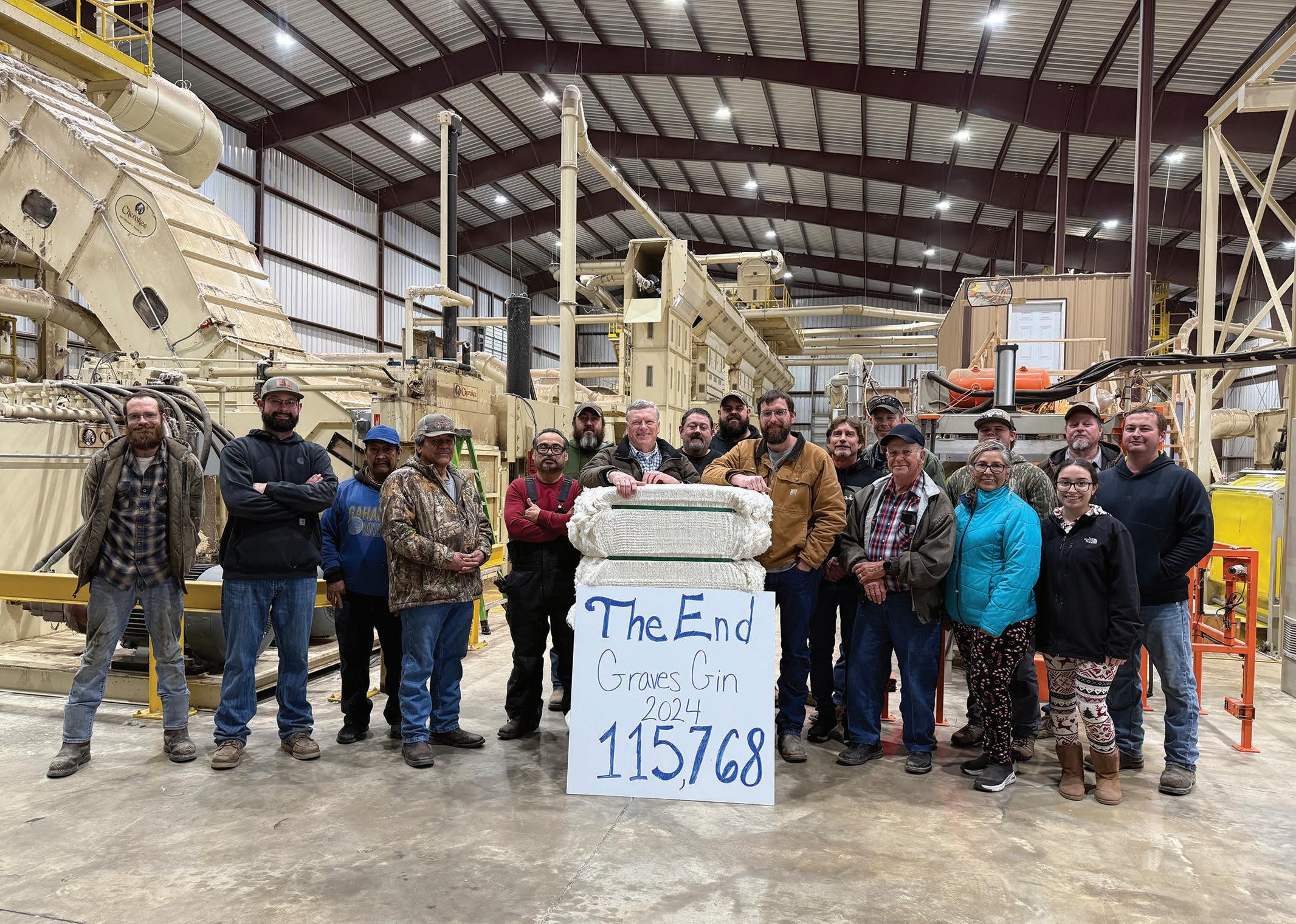
Four years ago, the longtime farm and gin family operation calculated the risk, consolidated the operation and built a new, state-of-the-art gin facility, expanding the site of the old Rector Gin. Despite the ag economic downturn, Graves Gin is still moving forward in the new facility.
“The last two years we’ve had a couple phenomenal years,” Sain said in November.
In 2023, he ginned just short of 100,000 bales, and in 2024, he ginned close to 115,000 bales. With fewer acres of cotton overall in 2025, they were down 25%. But the efficiencies of the new gin have shined. As speed increased, they were averaging 70 bales an hour in November. In effect, reducing labor, improving quality, and saving the gin and its customers money.
“We have basically got it fine-tuned and running at full efficiency,” Sain said.
One of the reasons for the increased speed is the 16-foot lint cleaner installed before the raw cotton hits the gin stand.
Continued on the next page.
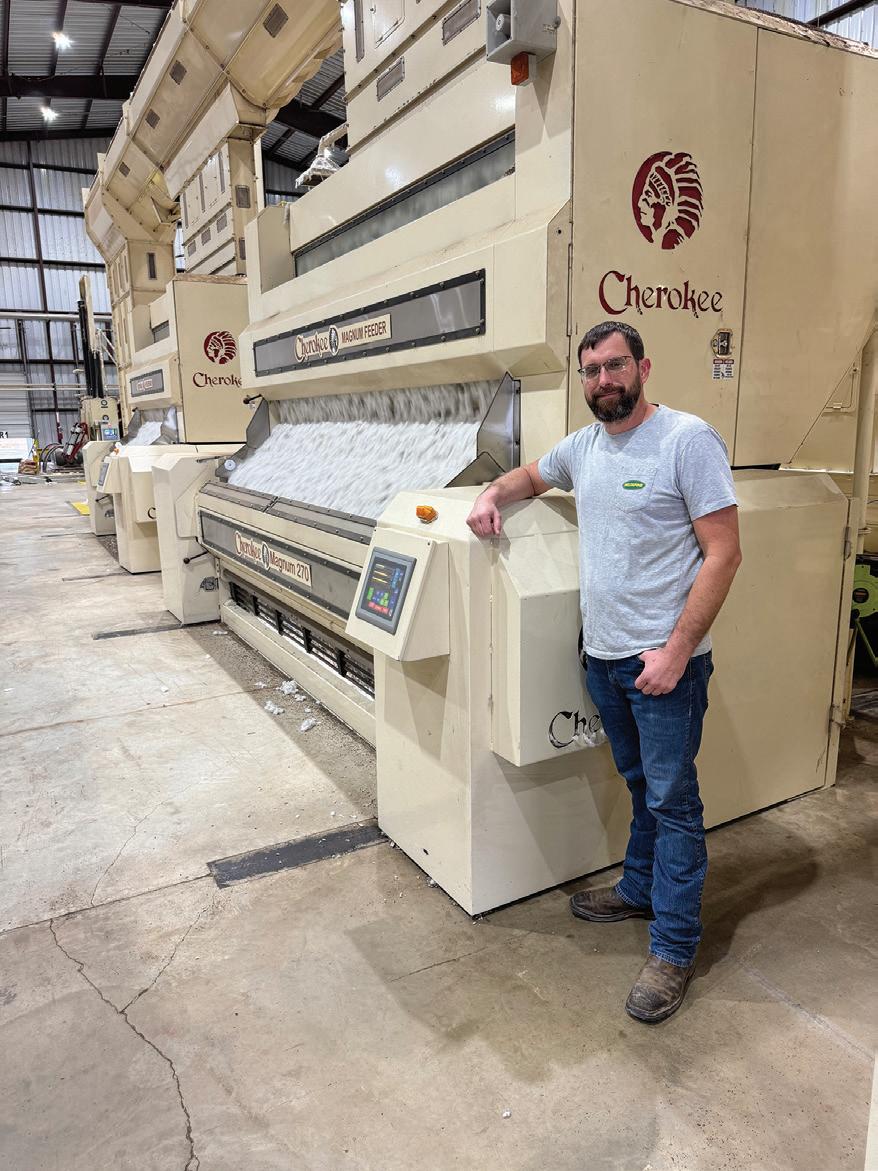
It’s one of only three 16-foot precleaners that Sain knows of, eliminating the normal, two 12-foot cleaners in most gins.
The 16-footer has the same number of motors as a single 12-foot cleaner. There is also only one burner. The new expanded building also houses two Cherokee Magnum 270 gin stands and one Cherokee Avenger 193 gin stand.
“People were scared of new stuff,” he said. “The first year of this gin, I thought we had majorly screwed up — I’m not going to lie. We got through it. That’s part of being the Guinea pig. We put in equipment that they weren’t ever able to test at full capacity.
“They didn’t know what this equipment would do when I bought it. But we built a 60-bale-an-hour gin, and we’ve got a 70-bale-an-hour gin. So, it was nice to kind of pioneer that and figure we’ve still not capped out what it can do.”
And, that’s a pretty good breath of fresh air after managing two gins – the old 25-bale per hour gin in Rector and a
35-bale per hour gin in White Oak, Mo. – with about twice the man hours and overhead that the new gin demands.
“Our main goal was to do everything in one location,” Sain said in a Farm Press interview in 2023. “Because of logistics, probably 80% of my cotton is in Arkansas and 20% is in Missouri.
“We can control the entire plant from one spot. Everything is automated where if a motor kicks out, it shuts everything down.”
And Cain can monitor gin activity from his office in another building. The area took a big hit in 2025 with extreme weather — flooding and drought in the same year. But what does 2026 look like?
“My most devout cotton growers sustaining their acres would be best-case scenario,” he said. “But with prices the way they are, it’s just going to be hard to want to plant cotton.”
But with a crew he is proud of and a refined gin plant, Cain said he will press on into the upcoming season.
William Lindamood, Retiring Safety Director Southern Cotton Ginners Association
Mid-South cotton gins continue to make good use of the safety and regulatory tools the Southern Cotton Ginners Association (SCGA) provides in the Gin Safety Program binder and various seminars. Our goal remains: Develop a culture for safety and work year-round to prevent accidents.
Thank you to our gin members for your efforts to comply with regulatory requirements, complete safety program training and documentation, and to educate me. Thank you, too, for your continued safety training throughout the year. Together we have improved crew training and helped our gin crews stay safe and improve performance.
SCGA gin members will face two primary challenges going forward:
1) The continually changing Department of Labor and Department of Transportation organizations and regulatory environment must be understood and addressed as directly and simply as possible.
2) Most important, however, is the morale, efficiency and health of our gin crews.
Both can be met with documented compliance and continued training. Safety training based on written job descriptions at the duty station must be provided upon hiring, and retraining must be provided for duty change. Retraining must also be provided and documented when safety violations are identified.
Recognizable hazards must be removed from the workplace. The in-season safety audits can help accomplish this. The safety audits are also important in evaluating documentation of required training and regulatory compliance.
At the SCGA Honors Banquet, we will recognize the Ginner of the Year. This year, we highlight the generational change in the industry as, for the first time, we recognize two ginners –Bill Newsom and Chase Sain. Bill is completing a distinguished career at Grundfest and Klaus Gin, and Chase, with Graves Gin Corporation, is an outstanding example of the next generation of gin manager. We look forward to honoring both and celebrating the changes and challenges of 2026.
The cotton industry is resilient, and SCGA looks forward to helping create a successful and safe operating environment. I will be retiring March 31, 2026. SCGA has hired Austin Yarbro, an

ag engineer with cotton scouting and precision ag experience, as its new Safety Director for Mid-South cotton gins. If you have not already met Austin, we will both be at the SCGA Annual Meeting and Safety Awards luncheon.
Ginners, please keep us informed of your experiences. Austin will have the responsibility of Safety Director after March 31, and his business card will be included in the 2026/2027 Safety Binder. He will continue to provide each gin with the instruction and evaluation that you value.

The Southern Cotton Ginners Association will name its Memorial Scholarship in honor of David Cochran Jr. This decision reflects David’s many contributions to the cotton ginning industry and his commitment to the leadership of the association.
David, who passed away on May 19, 2025, was a lifelong resident of Washington County, Mississippi, as well as a member of the cotton community. His career spanned nearly four decades, during which he worked as a cotton and soybean producer, inventor, and advocate for the agricultural community.
His leadership extended to numerous roles, including serving as president of the Southern Cotton Ginners Association, a delegate to the National Cotton Council, and a board member of the Planters Cotton Oil Mill cooperative. His dedication to the industry was matched by his commitment to community service, as evidenced by his involvement with the Delta Council, the Mississippi Levee Board, and the Memphis Branch of the Federal Reserve Bank of St. Louis.
“David was a big part of our industry,” said SCGA President Allen Espey. “Naming our memorial scholarship for him makes
sense because of his leadership in the association and everything else he has done for cotton.”
The scholarship provides financial assistance to students pursuing degrees in agricultural engineering, agribusiness, crop science, and related fields. Recipients are selected based on academic achievement, leadership potential, and a demonstrated interest the industry.
“David understood the importance of investing in people and helping them develop the skills needed to advance,” SCGA Executive Director Tim Price said. “This scholarship will help ensure that education and mentorship continues to benefit those that want to learn.”
The scholarship fund has been established through contributions from SCGA members, industry partners, and David’s family and friends. Applications will be available through the SCGA website and the scholarship committee will review submissions. David was known for his innovative spirit. He was dedicated to improving the ginning process as well as building equipment
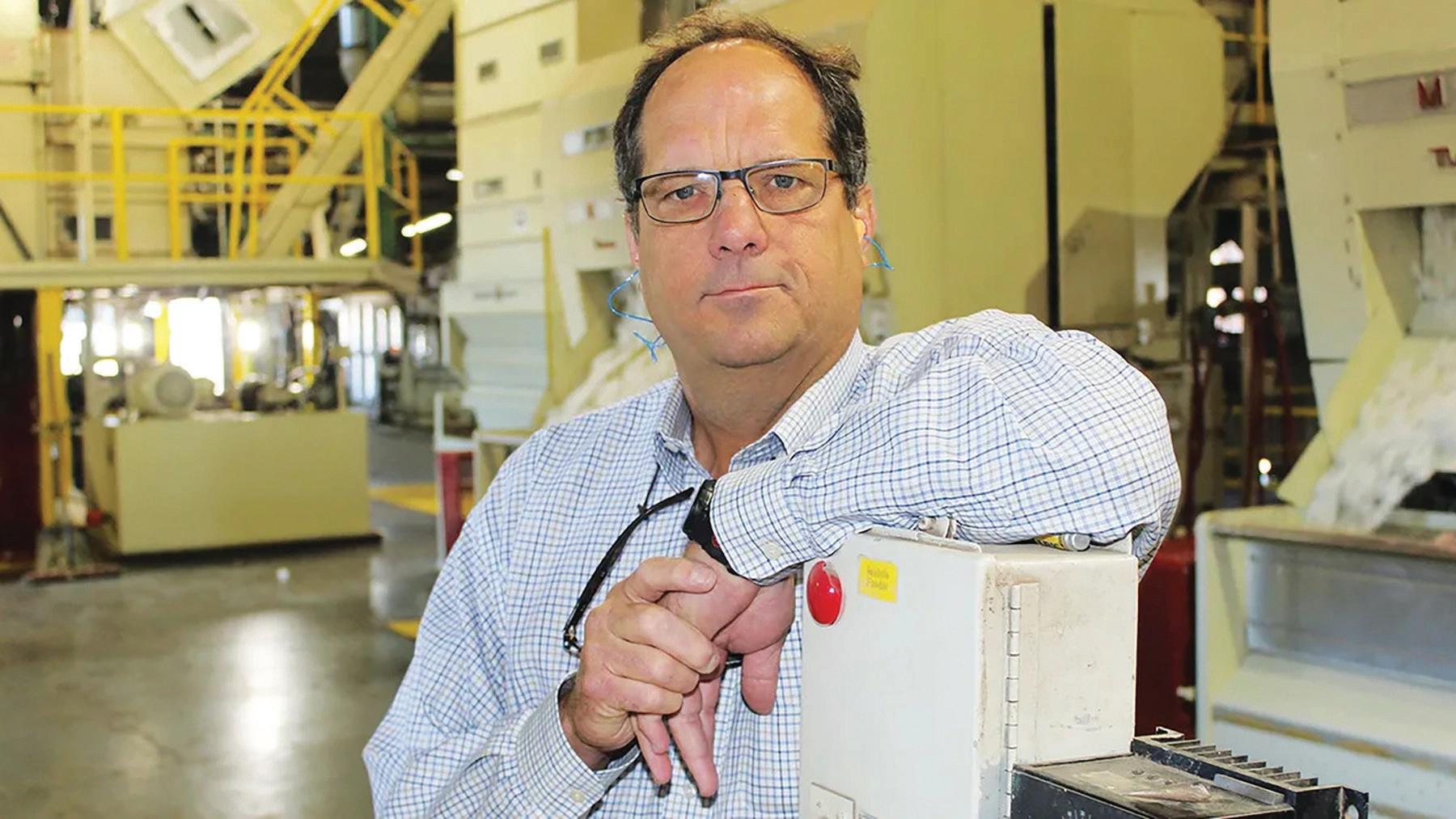
for farming and hunting. He also applied that spirit of innovation to sharing with friends. He was known to serve up steaks, smoked chicken and pots of crawfish on a grill and smoker he built himself.
The Cochran family is known for their lunches at Avon Gin, a landmark along Highway 1, south of Greenville. For well over a hundred years the gin ran at the south end of town. In 1994, David’s dad, Buddy, purchased the gin when the cooperative of farmers that owned it decided to sell. They had to do a little cleaning up.
“We had to clean out fast food containers from the fan motors, and get skunks out of the press pit,” David told Delta Farm press in 2018. “It was a mess, but somehow we managed to gin a crop that year.”
It became not only a place to gin cotton, but a place to visit old friends.
The family implemented upgrades to enhance efficiency and fiber quality at the gin. These included the installation of a Samuel Jackson Moisture Control System and a unique Lipsey GinTech module feeder with a Keith Walking Floor. And, a few of Cochran’s inventions, like a round module transport, that could be found on the gin yard.
The gin ceased operation shortly following Buddy’s passing in 2021.
Beyond his professional achievements, David was known for his warmth, sincerity, and ability to make personal connections. He has been described as one of those guys that made the cotton industry feel like family. One who looked a person in the eye and asked how they were doing. He made personal connections tangible with strong handshakes and pats on the back.
His contributions to the SCGA, the National Cotton Council, and other organizations have left their mark on the industry. His legacy is one of innovation, mentorship, and service with contributions to the cotton industry and the next generation of agricultural professionals. The Southern Cotton Ginners Association encourages students interested in cotton ginning, agricultural engineering, and related fields to apply for this meaningful scholarship opportunity.
David will be honored at the 2026 SCGA Honor Banquet on Thursday, February 26 at the Peabody Hotel in Memphis, Tenn., as part of the 2026 Mid-South Farm and Gin Show.
For more information about the Memorial Scholarship or the Southern Cotton Ginners Association, visit www.southerncottonginners.org or contact the association office at 901-947-3104.

The Southern Cotton Ginners Association (SCGA) is proud to announce that Joe Nicosia, a visionary leader in the global cotton industry, will be honored with the prestigious A.L. Vandergriff Cotton Pioneer Award at the 2026 SCGA Annual Meeting. The event will take place on February 26, 2026, at the historic Peabody Hotel in Memphis, Tennessee.
The A.L. Vandergriff Cotton Pioneer Award is presented annually to individuals or organizations that have made significant, innovative contributions to the U.S. cotton industry. Past recipients include notable figures such as Archie Tucker (2024), Cotton Incorporated (2022), and Dr. Fred Bourland (2021). This year, the award will celebrate Joe Nicosia’s remarkable achievements and enduring impact on the cotton sector.
Joe Nicosia’s career in the cotton industry spans decades, marked by innovation, strategic foresight, and a deep commit-
Joe will be recognized Thursday evening during the SCGA Honors Banquet.
ment to advancing the sector. Currently serving as the Global Trading Operations Officer for Louis Dreyfus Company, Nicosia is also the Executive Vice President of Louis Dreyfus Company LLC and the Chief Executive Officer of Allenberg Cotton Co. His leadership has been instrumental in shaping global cotton production, marketing, and logistics.
Nicosia graduated from Dartmouth College in 1981 with a Bachelor of Arts degree in Economics. He joined Louis Dreyfus Company as a grain trader and soon transitioned to Allenberg Cotton Co., where he assumed responsibility for cotton trading worldwide by 1985. His expertise and dedication have earned him recognition as a thought leader in the industry.

In addition to his corporate roles, Nicosia has held influential positions in several cotton industry associations, including the American Cotton Shippers Association (ACSA) and the International Cotton Association. He is a past chairman of ACSA and has served as the long-time chairman of its Futures Committee. In 2024, Nicosia was elected Chairman of the National Cotton Council (NCC), becoming only the third merchant to hold this position since the organization’s founding in 1938.
Nicosia’s leadership philosophy emphasizes unity within the cotton industry. He advocates for collaboration among the seven segments of the U.S. cotton industry—producers, ginners, warehousers, merchants, cottonseed, cooperatives, and manufacturers—to address challenges and seize opportunities. His annual cotton market outlook presentations at the Mid-South Farm and Gin Show are highly anticipated events, drawing professionals from around the world.
As Chairman of the NCC, Nicosia focused on tackling pressing issues such as competition from other cotton-producing

countries, marketing and logistics challenges, and the impact of U.S. and global economic conditions. He has highlighted the need to increase the safety net for growers, particularly in light of devastating droughts in Texas and growing competition from Brazil.
Nicosia’s passion for the cotton industry is evident in his dedication to advocacy and resilience. He views the National Cotton Council as a critical forum for presenting the industry’s voice and finding solutions to regulatory challenges. His ability to unite diverse segments of the industry and his commitment to excellence make him a deserving recipient of the A.L. Vandergriff Cotton Pioneer Award.
The Southern Cotton Ginners Association invites industry professionals and stakeholders to join us in celebrating Joe Nicosia’s achievements at the 2026 SCGA Annual Meeting. The event promises to be a memorable occasion, honoring a leader whose contributions have shaped the future of the cotton industry.



Harrison Ashley, Executive Director National Cotton Ginners Association
The National Cotton Ginners Association (NCGA) continues to address important regulatory issues that could significantly impact ginners, and each year that I write this update, there are always a few issues that remain unresolved.
One of these ongoing issues is the OSHA Heat Injury and Illness Prevention in Outdoor and Indoor Work Settings August 30, 2024 Proposed Rule, which is the first-ever national heat stress rule that is aimed at protecting workers from heat-related illnesses and fatalities. It was hoped that when Trump was elected, this rule would disappear, but that did not happen, and OSHA conducted additional hearings and opened the rule for more comments.
On June 20, 2025, during this hearing, NCGA President, Larry Black, presented testimony, discussed what gins are currently doing to prevent heat-related illness, and explained our concerns with many requirements of the rule, including the one-size-fits-all approach, the nationwide heat index triggers of 80° and 90°, and the impracticalities of the implementation of this rule.
The proposed rule also requires scheduled work breaks, administrative controls, the monitoring and recording of workplace temperatures, maintaining these records, and the acclimatization of new and returning workers. There is still a hope that the Trump Administration will seriously rein in the or limit the rule going forward.
NCGA is continuing to closely follow the H-2A Visa program, as more of our ginners are resorting to this program to fill their employee needs.
The Trump Administration suspended enforcement thereby eliminating the 2024 Farmworker Protection Rule that would have made it more difficult to use the program and added layers of unnecessary requirements to the program. In October, there were significant changes to address how the Adverse Effect Wage Rate (AEWR) is calculated, and the DOL estimates that the new rule will save farmers an average of $2.4 billion per year over the next 10 years. The key changes is that the AEWR will now use the Bureau of Labor Statistics Occupational Employment & Wage Statistics as the wage data source rather than using the USDA Farm Labor Survey.

The new rates included two wage rate tiers, or skill levels per occupation in each state, and added a compensation adjustment for employer-provided housing. It should be noted that in some states, the AEWR wage rate for Skill Level I may be lower than the state minimum wage rate, and in those cases, the state minimum wage rate becomes the floor.
The H-2A program rule will need to be monitored closely, as the rule was released as an interim final rule, and while these changes are helpful, there are litigation risks that are associated with the AEWR’s methodology, and it is possible that the program rule could evolve based on submitted comments and agency priorities.
We are also continuing to monitor federal actions that are impacting CDLs for H-2A workers, and while in a recent rule, the Administration specifically included employees in the H-2A program, there are still some questions that remain. In January, the State Department announced changes in its review policy for those job orders that require CDLs for H-2A visa applicants.
The review policy includes that applicants must provide the following documentation during their consular interview: a copy of the criminal background check from each state in which the applicant has worked or has resided for more than three months in the last 10 years and copies of all CDLs and/or federal driver’s licenses that are issued to the applicant. This review policy is a new development, and it is something that we will continue to monitor closely.
Another important issue that remains unresolved is the National Ambient Air Quality Standards (NAAQS) for fine particulate matter, or PM2.5, and the recent lowering of the annual standard from 12 to 9 micrograms/cubic meter. It is important to note that the NAAQS was one of the 31 regulations on EPA’s list for reconsideration, and we remain hopeful that we could have a positive outcome.
Our concern is that the new standard is set at such low levels that it is approaching the background level of 8 micrograms/ cubic meter. However, if the standard remains as is, it could put
additional areas into nonattainment. Additionally, the oversampling of particulate matter by using current EPA-approved monitors and methods remains an ongoing issue, as this issue is directly related to the NAAQS.
There are several possible outcomes, but it is hoped that we will revert back to the former 12 micrograms/cubic meter or that new samplers and methods that are not as biased and that do not overestimate particulate matter will be used. However, if nothing changes, the current 9 μg/m3 does not leave headroom for new construction or for the expansion of existing facilities.
The NCGA’s committees and subcommittees are involved in many issues that include bale weight, bale packaging, the implementation of ASABE’s Cotton Module Cover Standard for round modules, cotton varieties and classing, cottonseed quality, property insurance, ongoing efforts to reduce the incidence of fires, and the industry’s continued work to support our three gin labs throughout the appropriations process.
While we have entered a more favorable business environment, we have many unresolved issues, and OSHA plans to update the Hazardous Energy Control Rule and focus on various respiratory protection requirements. More information, including the NCGA’s Board Book, is available to members at https://www. cotton.org/ncga/index.cfm
The National Cotton Council continues to focus on strengthening the producer safety net, stabilizing markets, and safeguarding the competitiveness of U.S. cotton across a rapidly changing policy and trade landscape. NCC entered 2025 with hopes to secure immediate economic relief and to strengthen the farm safety net for the long term. The gains now in place are a direct result of industry engagement and a consistent, focused presence in Washington.
With strong leadership in Congress, the Administration, and active engagement by our members, the One Big Beautiful Bill Act (OBBBA) delivered landmark improvements for cotton. The law raises the seed cotton reference price to 42 cents per pound beginning with the 2025 crop. NCC economists show that a typical PLC lint yield will receive materially stronger per-acre support compared to the previous reference price, giving growers a more reliable backstop.
Beginning with the 2026 crop, the legislation also increases premium support for the Supplemental Coverage Option (SCO) and Enhanced Coverage Option to 80 percent, raises the upland cotton Marketing Assistance Loan rate to 55 cents per pound with program adjustments to further improve the value of the loan, and adds marketing loan repayment provisions to the Pima loan rate while boosting the rate to $1.00 per pound. It also increases Economic Adjustment Assistance for Textile Mills to five cents per pound and doubles funding for USDA commodity trade promotion initiatives. These reforms reflect years of member input and are essential to restoring confidence for producers, lenders, and rural communities. The Council’s outreach — 49 farm bill information meetings across the Cotton Belt with more than 2,000 participants — helped producers understand and navigate these changes, as well as prepare for 2026.
With many of these enhancements not reaching producers until later in 2026, NCC also advocated for immediate assistance. USDA has implemented the Emergency Commodity Assistance Program (ECAP) for 2024 economic losses and has begun delivering Supplemental Disaster Relief Program (SDRP) payments, first for indemnified losses and then for shallow and quality losses. At the end of 2025, USDA’s Farm Service Agency announced the Farmer

Bridge Assistance (FBA) program, proving key transitional support until OBBBA’s benefits are fully in place. Under the authority of the Commodity Credit Corporation Charter Act, USDA will provide $11 billion in one-time payments to program crop farmers, with an additional $1 billion available for other commodities. Cotton’s payment rate is $117.35 per planted acre.
The Council continued work to protect market access and supply chain integrity. NCC urged duty-free treatment for qualifying USMCA and CAFTA-DR trade, supported a full 16-year USMCA renewal, and successfully advocated to end de minimis treatment for commercial shipments, a long-standing distortion undermining U.S. cotton and textile competitiveness.
On the regulatory front, the Council pressed for practical, science-based policy: urging clarity in WOTUS; supporting EPA’s reconsideration of the PM2.5 standard to protect essential ginning and manufacturing capacity; advancing uniform pesticide labeling; advocating for the timely release of a label for the over-
the-top use of dicamba; and working with EPA and USDA on endangered species strategies that preserve effective crop protection products. Together with APHIS, ARS, universities, and state partners, we coordinated quickly and funded research and education on the two-spotted cotton leaf hopper and cotton seed bug.
NCC also proactively invested in the future of the fiber by working to build demand and expand market opportunities. The U.S. Cotton Trust Protocol added notable brand and retailer members and continued aligning field-level data with market demands. Cotton Council International welcomed new leadership and advanced a refreshed global strategy, including focused market development in high-potential regions. The Cotton Foundation supported priority research and leadership programs. The Council also launched the “Plant Not Plastic” campaign to bridge the knowledge gap by educating consumers on the simple, impactful choice of natural fibers in their clothing to reduce microplastic pollution and its potential health implications.
NCC will stay fully engaged with USDA to keep these programs on track and to build on the safety-net gains the industry has just achieved. We understand challenging conditions remain, but the combination of stronger long-term policy, targeted disaster relief, and FBA bridge payments represents real progress and a reminder that when cotton speaks with one voice, the industry delivers results.







Even if the unexpected happens, Simplot Grower Solutions gives you the tools, expertise, and optimism to move forward and make progress.
Discover the confidence of “Even If” farmers at EvenIfFarmers.com.


By Stacey Gorman, Senior Director of Communications, The Cotton Board
The business of cotton has changed so much in recent years – prices, input costs, synthetic fiber competition – the Cotton Research & Promotion Program made a bold decision to take a hard look at itself in 2025 and evaluate the work being done on behalf of the industry.
The Cotton Board and Cotton Incorporated jointly commissioned a comprehensive third-party evaluation of the Program last year. Conducted by Deloitte, the evaluation was designed to do more than confirm what was already working. Its purpose was to identify where the Program could be more effective, more targeted, and more accountable in today’s market environment, and then make deliberate changes based on what was learned.
The evaluation examined how decisions are made, dollars are invested, and impact is measured, all with one question in mind: are producer and importer checkoff dollars working as hard as they can to build cotton demand and support long-term profitability?
The results reinforced that the Cotton Research & Promotion Program is built on a strong foundation. The system works, the governance structure is sound, and the scope of research and demand-building efforts is significant. But the evaluation also confirmed what many producers could already sense, that the marketplace has changed and cotton’s competitive challenges are different than they were even a decade ago.
If cotton isn’t chosen earlier in the supply chain, it never reaches a store shelf. Refocusing marketing efforts is a necessity.


Cotton’s natural advantages matter, but only if they are backed by research and communicated clearly to the people making sourcing decisions.
In a tighter funding environment, it is critical to measure results, adjust quickly, and redirect resources when initiatives are not delivering meaningful impact.
The most important outcome of the 2025 evaluation isn’t the report itself but instead what’s happening next.
Heading into 2026, Cotton Incorporated is implementing four clear strategic shifts informed directly by the evaluation.
First is a change in marketing focus. While consumer marketing remains part of the mix, more effort is being directed toward the supply chain by engaging mills, manufacturers, brands, and retailers where fiber choices are made. This approach is designed to protect cotton’s position in core categories.

Second, there is a renewed emphasis on cotton’s natural advantages. Cotton Incorporated is positioning cotton as a natural, biodegradable, and compliant fiber in sustainability and regulatory discussions, supported by decades of research on fiber quality, biodegradability, and microplastics. This work ensures cotton’s story is grounded in data, not marketing language.
Third, the Program is prioritizing partnerships that influence real purchasing decisions. Rather than trying to be everywhere, Cotton Incorporated is focusing on collaborations that can lead directly to cotton being specified in products, from the use of the Seal of Cotton to supply-chain product development initiatives.
Finally, there is a stronger focus on measuring impact. New key performance indicators are being applied across projects, along with a “fail fast” mindset. If something isn’t working, it can be adjusted or discontinued so funding can be redirected to higher-impact efforts. The goal is simple: make sure every dollar is working where it can have the most impact.
While marketing strategy is evolving, one thing has not changed. Increasing producer profitability remains the top priority of Cotton Incorporated’s agricultural and environmental research program.
Hundreds of research projects continue each year across agronomy, pest management, fiber quality, engineering, and cottonseed, guided directly by producer input through boards, committees, and the State Support Program. Just as importantly, that research is being translated into practical, timely guidance

The QR Code takes you to sign up for the Cotton Cultivated newsletter.
through tools like Cotton Cultivated, ensuring results don’t sit on a shelf but reach producers when decisions are being made in the field.
As producers gather at the Mid-South Farm & Gin Show, conversations naturally turn to what’s next — new equipment, new technologies, and new strategies for navigating another season. The Cotton Research & Promotion Program exists to support those conversations beyond the farm gate, working to protect cotton’s competitiveness throughout the value chain.
The 2025 evaluation marked a turning point, not because something was broken, but because the Program recognized the need to adapt. The work underway in 2026 reflects a Program that listened, adjusted, and is moving forward with purpose.
In a global marketplace that continues to change, cotton is stronger when the industry moves together. The Cotton Research & Promotion Program is committed to making sure that producer and importer investments are focused, accountable, and aligned with the realities cotton faces today and with the opportunities still ahead.
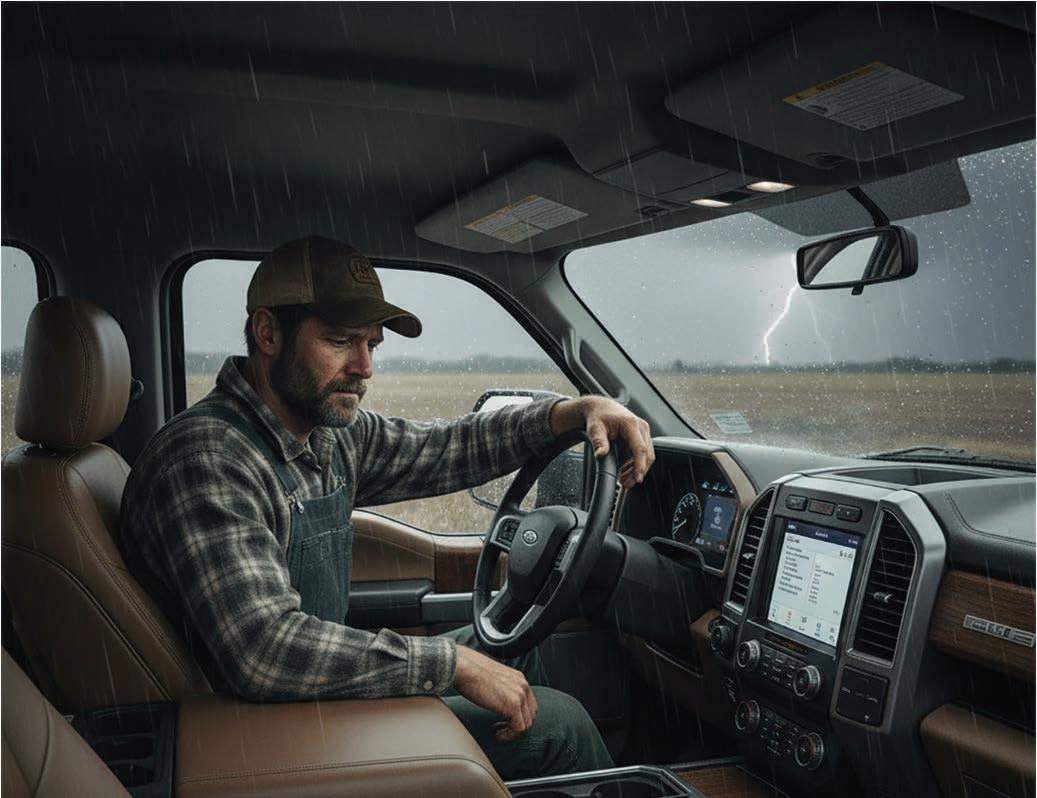

By Janice Person
As the farming community braces for another season marked by tight margins and uncertainty, a special workshop at this year’s Mid-South Farm & Gin Show is set to shine a light on a topic all-too-often left in the shadows: mental health and stress in agriculture. With an array of seasoned panelists—including a producer, a pastor, and two mental health professionals—this may be one of the most timely and meaningful sessions on the show calendar.
There’s a string of hard seasons, economically, and many of us realize we need to place more of an emphasis on mental health services because we’re experiencing a crisis. A panel of
people who see ways to work through the challenges in ways that offer individuals, families and communities hope will include:
• Jason Brown, Arkansas Farm Bureau
• James Barham, a therapist with Arkansas Baptist Family Ministries
• Reverend Jason Franklin, pastor at Clarksdale Methodist Church
• Richard Noe, a fourth-generation producer from the Mississippi Delta
• Mandy Young, a therapist and serving as the Agricultural Mental Health Outreach for Tailgate Time
The conversation will move beyond statistics and open the floor to hard truths that many in agriculture have faced but few have discussed openly. “One of the very first conversations I had when I started at Clarksdale Methodist Church was with a farmer my age, 54, sitting across from me, telling me they were going to lose everything—the farm, the equipment,” Reverend Franklin shares. “Then, in the next six months, I heard conversation after conversation that went the same way. We are in a crisis situation for the agriculture community in the Mississippi Delta.”
It isn’t just financial distress. The intersection of generational pressure, identity, family responsibilities, and community expectation all add layers to the challenge. “There’s a lot of complexity in farming,” says Richard Noe, who’s felt firsthand the weight of sustaining a legacy. “You just feel like nobody understands what we’re going through, the difficulties we’re facing every year.”
This workshop takes place Friday at 1 PM in Room 102 Level 1 in the Renasant Center
Workshops like this are opening doors, and participants will leave with more than sympathy—they’ll get resources and strategies. Mandy Young discusses her nonprofit, Tailgate Time, which meets producers and ag professionals where they are— literally. “We provide mental health care completely free of charge to those that have their hands in the dirt. Even support staff and family members are eligible, no questions asked about financials. We’ll go to tailgates, co-ops, wherever is needed. With telehealth, there’s no excuse not to reach out.”
The atmosphere promises to be supportive and practical, built on shared experience. “Farmers are my heroes,” says James Barham, who was raised on a farm and now counsels rural families. “Getting resources to the Delta—especially for families and marriages—matters. Most of my motivation comes from wanting to get those resources to farm families.”
The panel recognizes the essential role of faith-based and community support. Churches across the region are working to change the stigma.
“When you start seeing families who are losing generational farms, platitudes don’t cut it,” says Reverend Franklin. “We’ve started ministries like F3—faith, family, and farming—so that our church concretely supports each part of our farmers’ lives. It makes a difference to know your community is standing behind you.”
Jason Brown hopes attendees will leave knowing, “It’s okay not to be okay. If we can let people know what to do when they have these thoughts or feelings, and who to talk to, we’ll consider the workshop a success.”
Farmers, family members, ag business professionals, and anyone feeling the strain of today’s ag economy are encouraged


to attend. There will be space for questions—even for conversations that linger after the presentation is done.
“We don’t want to promise we can solve everyone’s issues,” says Brown, “but if people come and get a resource, or find a reason for hope, that’s a win.”
The session is scheduled for Friday afternoon at 1 pm in room 102 of the Renasant Convention Center. The timing on the show’s busiest day, in a first-floor room well-marked and easy to find. Whether your concern is personal, for a friend, or for your community, this is a conversation the region’s farmers need—and one you’re invited to join.
If you’re ready to start the conversation, this session is the place to be.



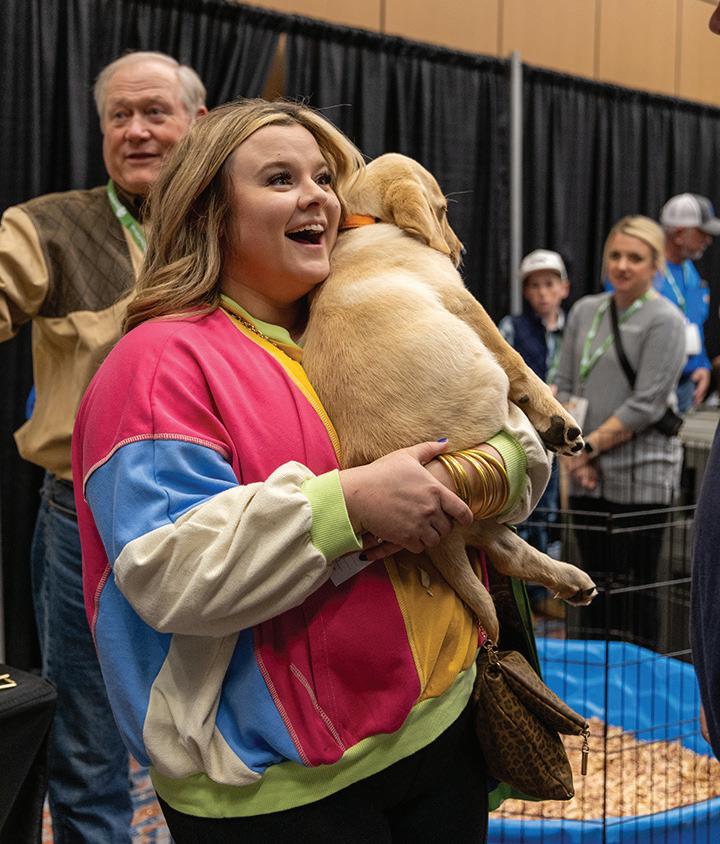
By Janice Person
Most people who have cooked for a family remember that feeling of what in the world are we going to eat for dinner. You look at the pantry and refrigerator thinking you really should have gone to the grocery today. Whether you didn’t stop due to time or because finances are too tight at the moment, it can feel overwhelming to know hunger is coming and you need to solve for it.
But dozens of 4-Hers across the Mid-South are learning to look at the pantry with a creative perspective. They take into account the nutrition, taste and the budget to produce something they would be proud to serve.
That’s what the 4-H Mid-South Food Pantry Competition is all about, according to Erin Ortiz, University of Tennessee’s extension specialist for 4-H Youth Development. Ortiz has led the program the last several years, coordinating with 4-H specialists in Arkansas, Louisiana, Mississippi and Missouri.
Up to 5 teams of 2-4 youth from each state compete, some competing locally and statewide to get to the regional competition that is held during the Mid-South Farm and Gin Show in Memphis.
“The energy we get from having teams of students from each state is truly something to behold,” says Tim Price, manager of the Mid-South Farm and Gin Show. “Every year we see more interest from students, the community and the in-house audience. We have it set up for an audience to watch with the feel of TV competition shows. Our team hosts the event with cameras and microphones capturing some of the student’s thoughts and actions as teams work together to find the right combination of ingredients and create a recipe. It’s become a real highlight of the show.”

Each team brings approved cooking supplies including:
•hot plates
•pots & pans
•cooking utensils
• some basic food items (rice, pasta, etc.)
Ortiz says “the creativity really kicks in as each team receives a surprise item that must be included in the dish. They also have chips to get a couple of things from the pantry. When the timer starts, the surprise ingredients are opened with each team receiving something different, and from then until the timer rings the team needs to determine what they will make and capture the recipe. The students do all the prep, cooking, work through nutrition and present to judges.”
Missouri 4-H leader Maureen Michel coached Missouri’s first team to compete in 2025 and she thinks her county and the neighboring one will have a combined 3-4 teams participate in 2026.
“With it being our first time, we weren’t really sure of the ins and outs but our team did great and they haven’t stopped talking about it since! They love being able to get creative with cooking and that they have to think on their toes. Our kids scored well on knife skills, balancing food groups and nutrition. They have been
working on presentation skills in that tight timeframe for the 2026 show and want to get in more practice competitions.”
Arkansas 4-Hers have a strong track record at the event. Rachel Chaney coached a team as a county agent and is taking on the state coordination from JeAlberne Smith. Chaney explains the presence of food deserts makes this an important life skill.
“We work with the team to introduce some of the basics of cooking and ensure they understand the competition. Then the kids are encouraged to be creative, and they all feel motivated to do their best” Chaney says. “Many of our kids only have a dollar
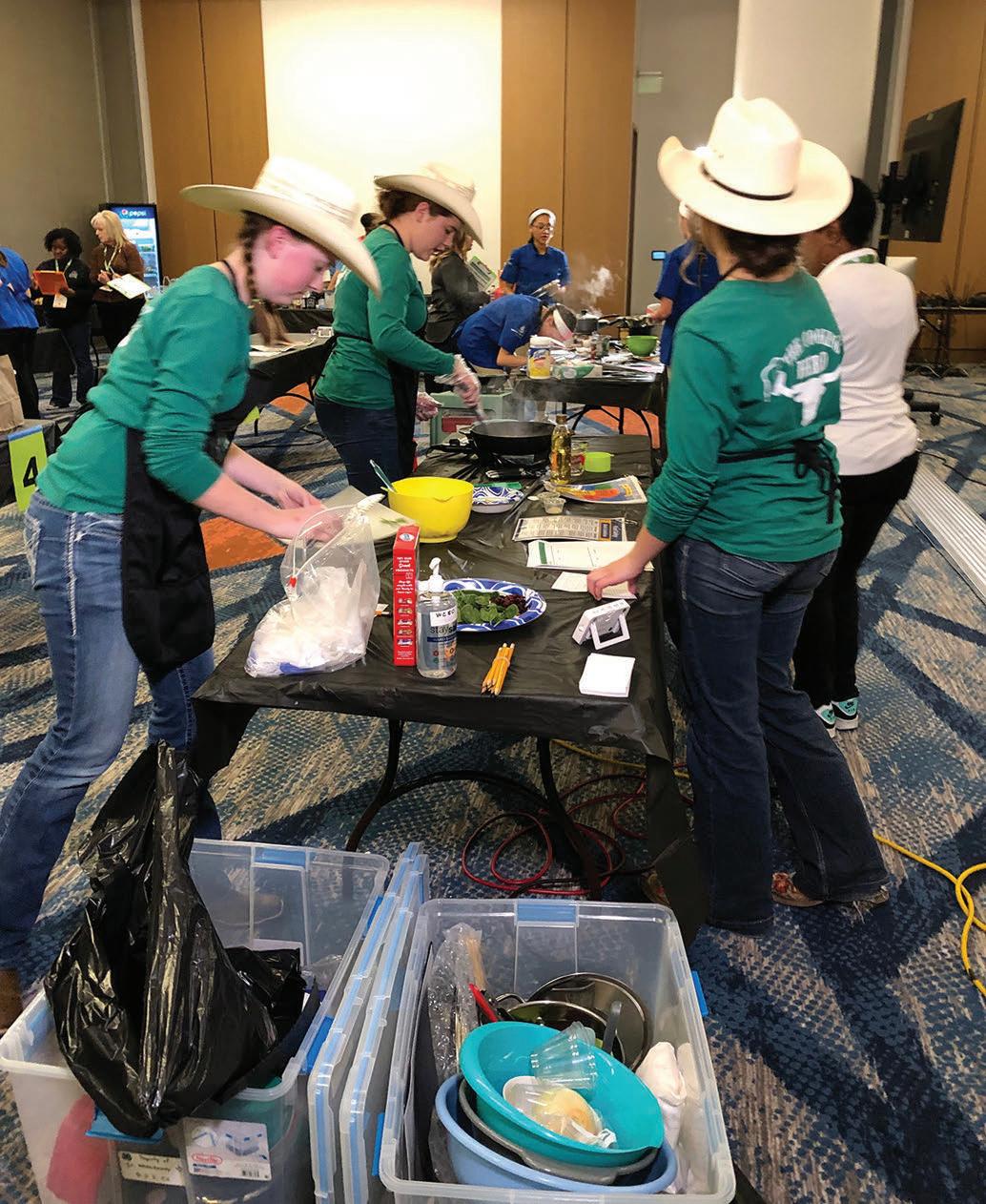

store nearby, so we ask them how they can make the most of what they have. You want good-tasting food, of course, but nutrition is also critical. The challenge fosters a more adventurous mindset, and the students try new foods. They also read food labels and think about how to combine the ingredients they have on hand.”
Smith says the state really has embraced the competition since the beginning. The growth has been big enough that last year they held district competitions to get to the 35 who went to the state. The top five go to the regional in Memphis.
She adds, “You see the accomplishment on the faces of students, especially as they get to checking out what other teams did and tasting their competitors work. And last year one of our teams came in second. They can’t wait to go back; the sense of accomplishment has all the teams excited for each other as it’s such a friendly competition.”
Be in the audience cheering on teams and picking up a few recipes at the 2026 4-H Mid-South Food Pantry Competition at the Renasant Convention Center on Saturday, February 28, 2026. There is programming for the entire family during the show and hundreds of exhibitors will be showcasing goods and services Friday and Saturday.
4-H Mid-South Food Pantry Competition sponsored by Dollar General.
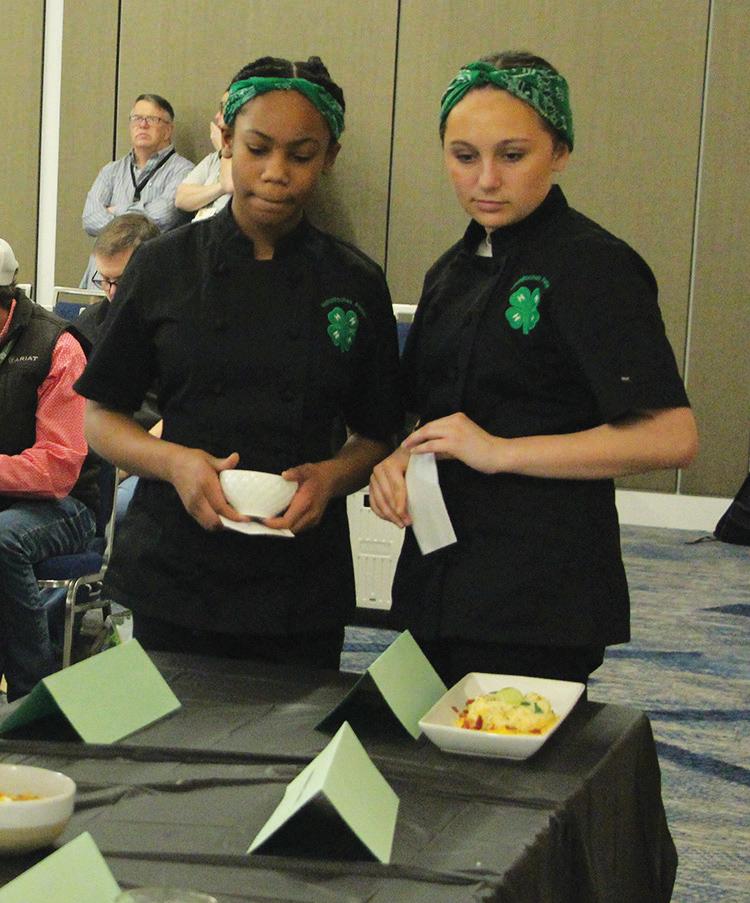
By Brent Murphree
Cotton farmers depend upon the whim of the market for the prices they receive for their crop. Two west Tennessee families that rely on cotton to keep their operations viable have developed a plan to market their crop direct to consumers, thus ensuring demand for their crop and more surety in their marketing.
Jeffrey Daniels and Franklin Carmack are leading a charge to develop a direct-to-consumer apparel line — 5th Gen Cotton Co. — using the cotton they grow on their farms in Lauderdale County, Tenn.
For years, it was something that floated in the ether, each man wondering how to best determine the future sustainability of their heritage in cotton, each in the fifth generation of their family farming cotton.
“It’s a passion and love,” Daniels said. “We don’t want to lose that.”
They both expressed the desire to ensure they could pass that along to future generations, but current economics were making that difficult.
“It didn’t make any sense,” said Daniels. “Someone’s making the money, and it’s not the farmer.”
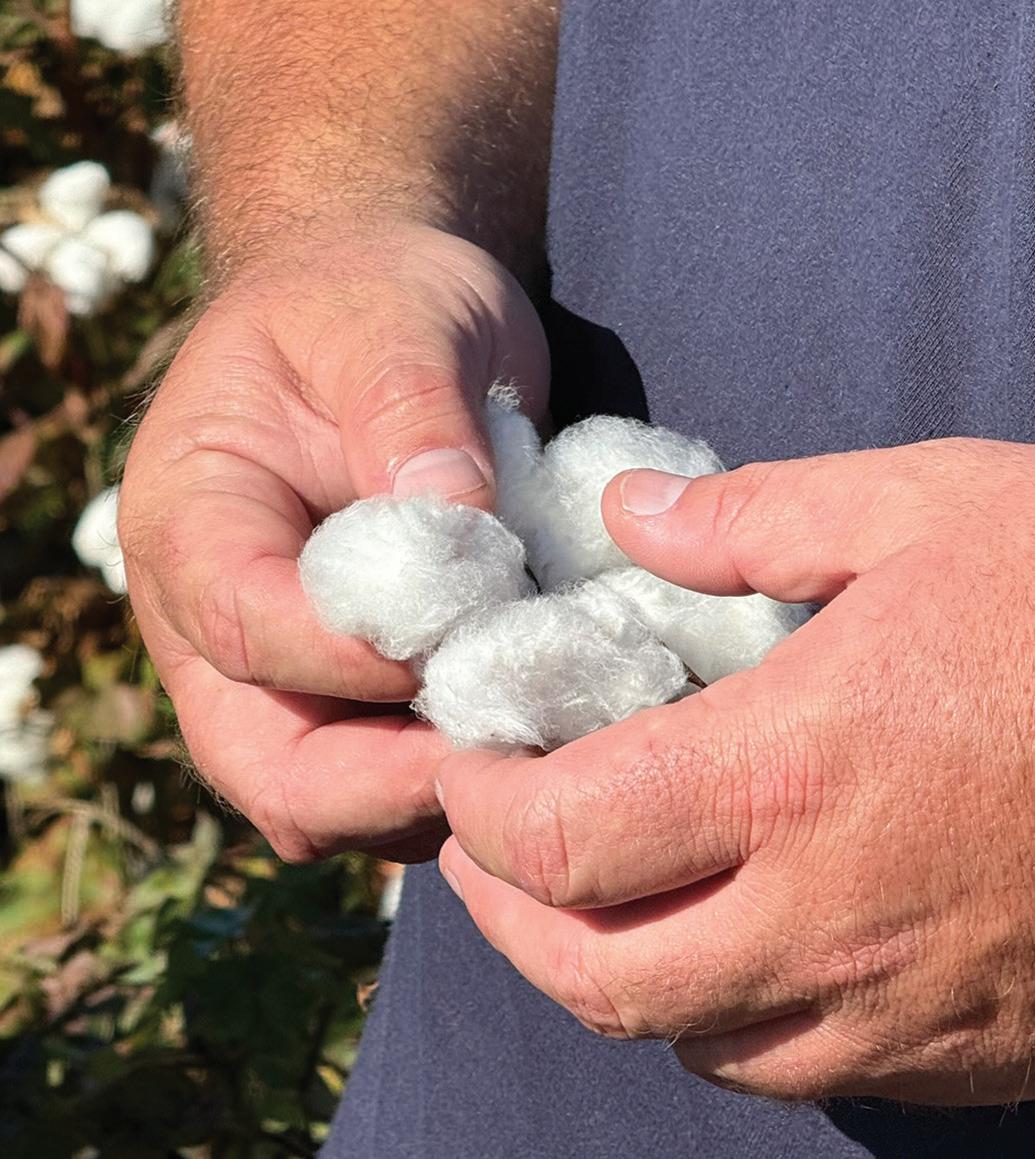
WARDROBE STAPLES: Americot is helping to support 5th Gen Cotton’s efforts for a line of apparel by developing Tennessee-bred NexGen varieties of cotton for with longer staple and quality characteristics.
They are also concerned about the use of polyester in apparel and the effects of microplastics on the environment and in our bodies.
“They are using 342 million barrels of oil a year [to make polyester] to compete against our natural fiber that decomposes naturally,” Daniels said. “Microplastics are in our waterways. We are in a crisis. We need to speak up and not hold back.
“Franklin and I both read where they had done a study that said the average American has the equivalent of a plastic spoon inside their body. Yeah, that bothers me.”
One night, he told his wife he wished he could back his truck up to the gin and have them throw a bale of cotton in the back of his truck so he could take it home.
“We could order some pillowcases and stuff ‘em full of cotton,” he told her. His intention was to maybe decorate them and sell them on their own.
His wife didn’t think that would work, but their discussion continued as they tried to come up with ideas to sell their own cotton.
Carmack was having the same thoughts and discussions.
“You know, you go to the cotton field and you spend long
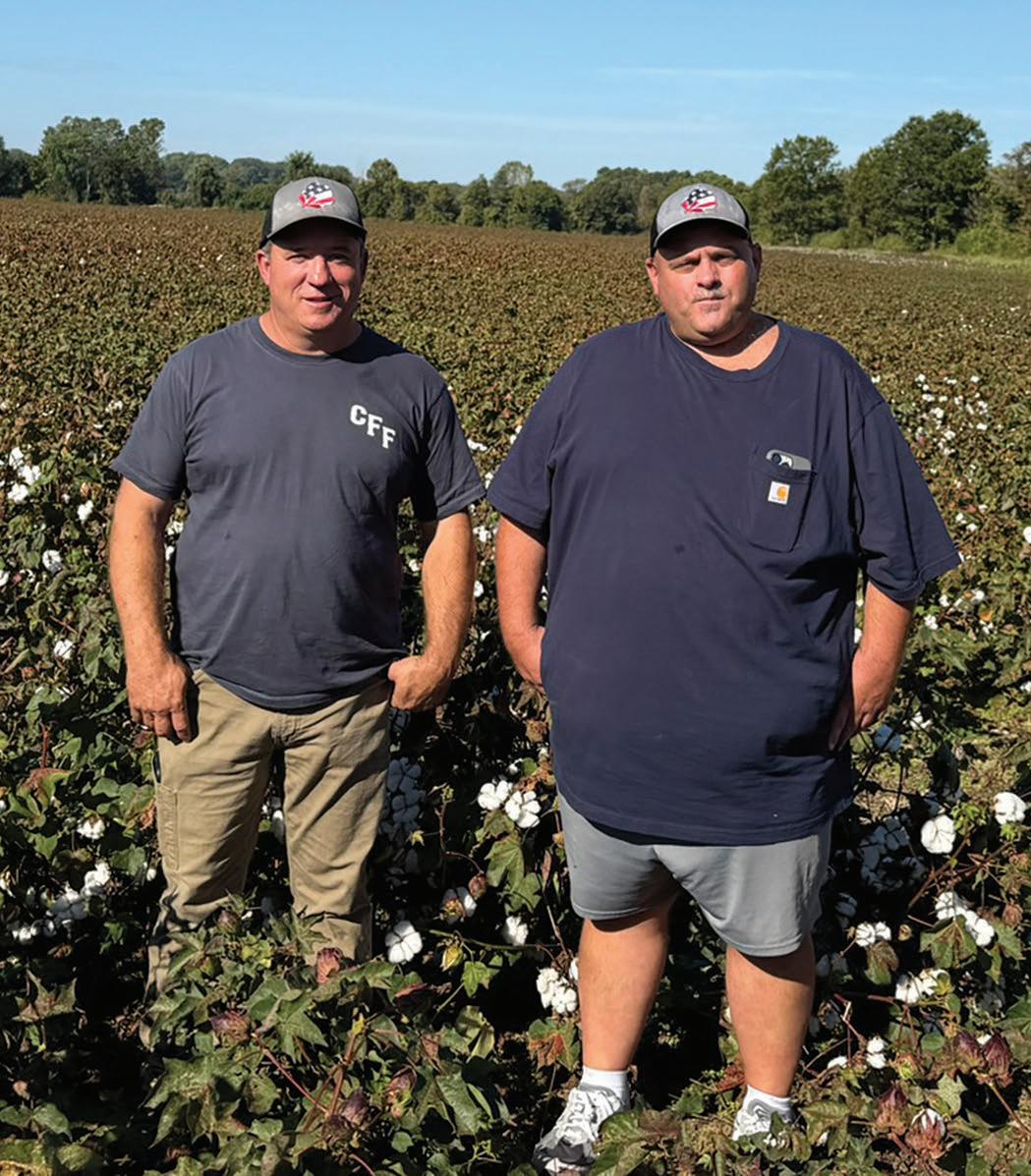
SAY NO TO POLYESTER: Franklin Carmack, left, and Jeffrey Daniels are driving a direct-to-consumer apparel venture in Lauderdale County, Tenn., 5th Gen Cotton Co.
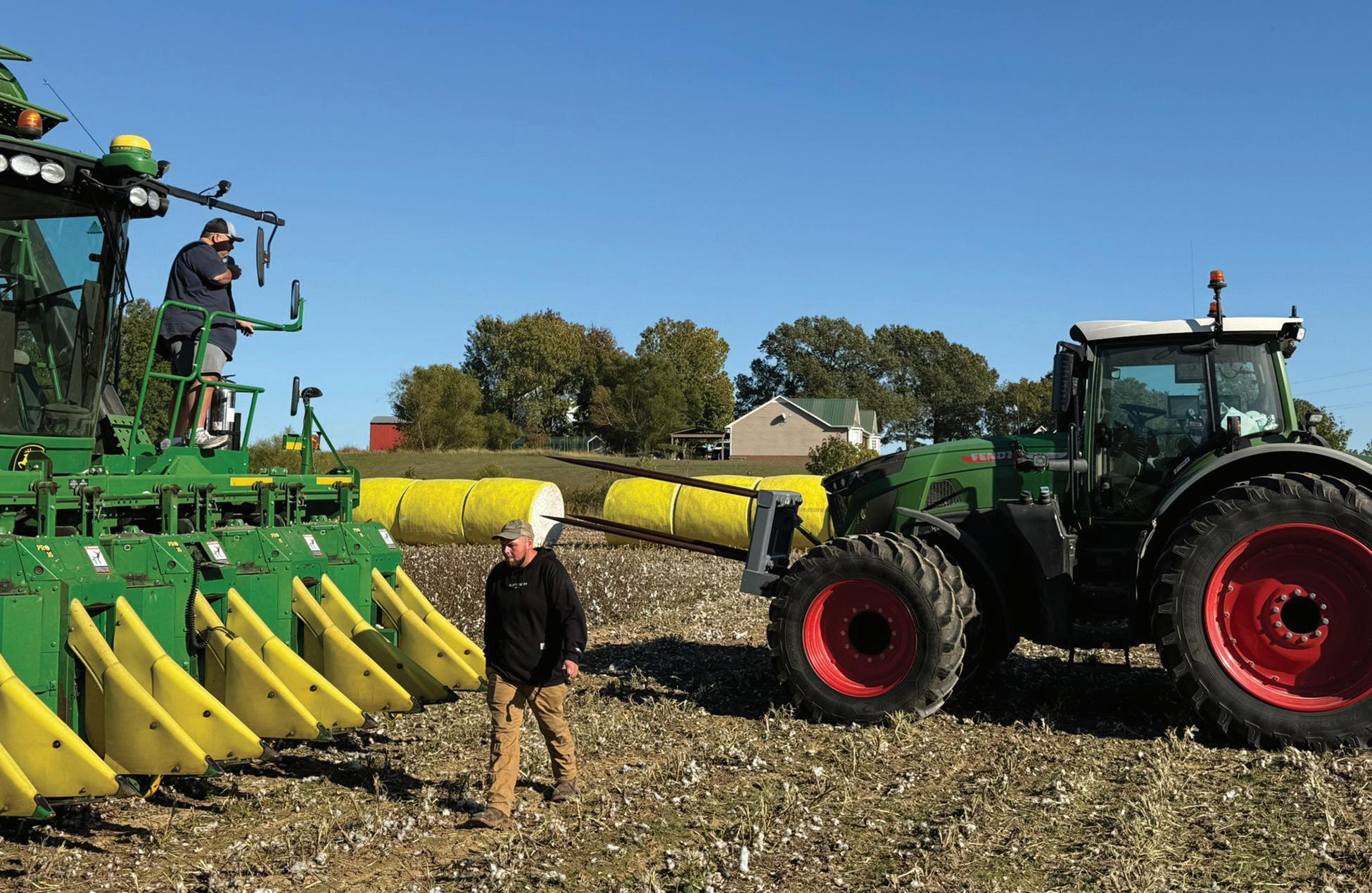
FARM TO SHIRT: The cotton harvested on Daniels’ and Carmack’s farms will go directly into the apparel line.
lonesome hours on a cotton picker daydreaming,” he said. “You always wonder where your cotton is.
“My son and I had talked about it briefly off and on for a couple of years about how we ought to try to do something with our cotton. But that’s so far-fetched. You talk about it and then you just move on.”
Then last summer, they were fishing on the Mississippi River when Daniels mentioned to Gunner, one of Carmack’s sons, “Man, we gotta figure out how to get our cotton direct to the consumer.”
Gunner told him that his dad had been talking about the same thing — developing a product that was sourced with U.S. cotton, cut and sewn in America. Discussions and discovery began in earnest and continued in the fall and winter.
One of the calls they made was to the company that supplies their cottonseed to see if there was a variety they could grow that would have good quality, strength and fiber length for apparel. Through their local representative Andy Rowsey, Americot showed interest in their project.
“They called me back in the winter and pitched their idea about 5th Gen Cotton, and I thought it was a fantastic idea,” Rowsey said. “Americot is a 100%, solely owned U.S. company. We have a portfolio of products through NextGen varieties with fiber qualities and the traits that will work for the apparel that they’re
trying to produce.”
The ball was beginning to roll and momentum was building. They knew someone who had connections with the textile industry. That person put them in contact with a manufacturer who started them on the right path.
“She gave me a complete list of manufacturers,” Daniels said. “Wow, connections for the yarn, cutting and sewing, the whole shebang.”
With the list of connections and an idea of what they wanted to start with, they laid out a plan. Winter brought with it some downtime on the farms, and they used that to their advantage.
“We finally just loaded up and headed to the East Coast and went and met with a bunch of people,” Daniels said. “I just randomly was calling, ‘Hey, we farm, we’re in West Tennessee and we want to take our cotton direct to consumer. We want to start an apparel company.’”
It was all very grassroots. They started in North Carolina, working their way through South Carolina and Georgia, contacting manufacturers and telling them they were going to be in the area and inquiring whether they could meet to discuss a project.
Continued on the next page.

A FULL WARDROBE: Starting with cotton T-shirts, 5th Gen Cotton Co. plans on moving into polo shirts, blue jeans and other apparel products.
“We peeked through the ones that we visited with and we put together what we thought was the best fit for our company,” Daniels said.
They moved fast, but with purpose.
“It wasn’t three days after they headed to North Carolina and they called me and said, ‘Look, we got this,’” Rowsey said. “And I’m like, whoa, wait a minute, son. They hammered down and by the time the Mid-South Farm & Gin Show rolled around at the end of February, it was rolling.”
They were able to secure a spinner, knitter and sewer to put together T-shirts using cotton they grew on their own operations.
Through the fall and into the summer, they were pulling their cotton to be spun and working with the manufacturers to build their shirts.
They spoke with the Tennessee Department of Agriculture about possibly supplying T-shirts for the booth the department has at the Tennessee State Fair.
“The state of Tennessee purchased 1,000 shirts,” Carmack said. “We kind of had to jump through some hoops to get that done for them. On our 26th anniversary in August, my wife and I drove to Georgia and actually picked up the shirts that had been cut and sewn, just to get them to the state fair on time.”
The original plan was to use 500 shirts for the fair and have 500 shirts left to use for the rest of the year. The state developed a logo for the shirts celebrating the 250th anniversary of the United States.
“We were both there with Mr. Andy at the Tennessee booth,” Carmack said. “We could see people looking at the shirts. Ninety-nine percent of the people we interacted with took a shirt.
“They sold out within three days. So they had to go get the other 500 and get them screen printed. They sold out again.”
Since then, they have taken their shirts to the West Tennessee State Fair in October, with their own 5th Gen Cotton logo, and are gaining a following.
“Right now we’ve got T-shirts, but would like to have polos, denim and women’s clothing,” Carmack said.
They are also looking at different business models, including cooperating with other farmers, building their brand and once again helping to create a demand for U.S. cotton.
“Part of our mission would be to try to educate the American consumer,” Daniels said. “This is the best idea we could come up with to try to survive. And we’d just like to share that with everyone and educate the American consumer on wearing natural fibers.”
Visit their website at 5thgencottonco.com to learn more.

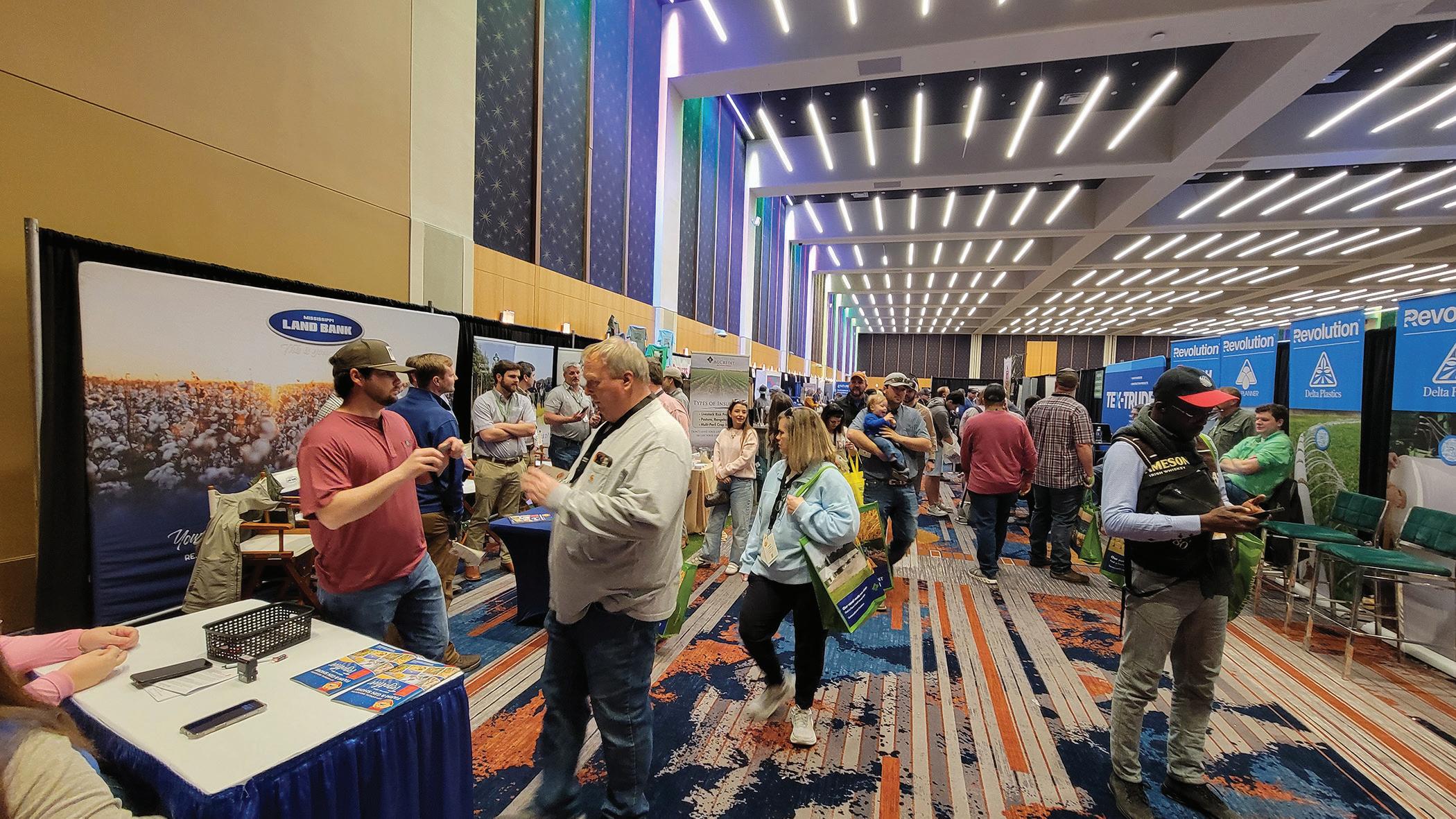


By Whitney Shannon Heckel whitney.heckel@farmprogress.com
In 2026, cotton farmers can expect commercial availability of 13 new varieties. Here is the annual roundup of the newest varieties for farmers across the Cotton Belt.
Cotton farmers can look forward to two new NexGen varieties from Americot, both of which are Bollgard 3 XtendFlex Technology (B3XF) and have demonstrated impressive performance in university and Extension trials for the past two years.
NG 4611 B3XF. This medium-maturity variety has excellent seedling vigor and aggressive early-season growth. It produces a tall plant and, with good plant growth regulator (PGR) manage-
ment, forms a wide boxy canopy. The variety has a long staple and high turnout percentage, and has consistently demonstrated strong yields in the South, Delta, Southeast and mid-Atlantic regions.
NG 4626 B3XF. This medium-maturing, medium-to-tall plant responds well to PGR management. It adapts well across the Cotton Belt, has excellent heat tolerance and produces a strong terminal and boll load with a stormproof boll type. This variety boasts great yield potential, high turnout and excellent fiber quality.
“These new varieties were in both small-plot university trials and in our large-scale on-farm Americot ACE trials in 2025, and the results were the same,” said Robert Lemon, Americot product development manager. “They simply outperformed the competition.”
In 2026, Armor Seed builds upon the momentum created by the company’s newest cotton variety, shown to be a dependable agronomic profile. A key component of this variety’s success is the integration of ThryvOn insect protection to reduce feeding injury of early-season pests, such as thrips and plant bugs. This protection reduces the need for early rescue treatments and helps maintain yield potential through the plant’s critical establishment window.
Armor 9245 B3TXF. The variety is characterized by steady early-season vigor, uniform stand establishment and a balanced growth habit that supports efficient canopy development. The variety also boasts high fiber potential and has proven to be an adaptable choice for growers across various management systems.
Growers have noted the variety’s ability to maintain consistent fruit retention and transition smoothly into reproductive growth without excessive need for PGR management.
The BASF portfolio expands with three new Stoneville cotton varieties, all including Axant Flex technology — the first and only quad-stacked herbicide trait in cotton. Each of the varieties include three-gene insect control with the TwinLink Plus trait.
ST 4130AXTP. This early-maturing variety has exceptional early-season vigor and a large seed size. It is a good fit on a range of soil types, from productive to challenging, and produces great fiber quality for the eastern Cotton Belt. This variety also features tolerance to root knot and reniform nematodes.
ST 4650AXTP. This plant demonstrates great early-season vigor and is a high-yielding variety for the eastern Cotton Belt. It is a good fit on a range of soil types and features bacterial blight resistance and root knot nematode tolerance.
ST 5260AXTP. This mid-maturing variety shows consistent performance across the Mid-South. Its easy-to-manage plant height comes with a complete trait package for protection against root knot and reniform nematodes, plus resistance to bacterial blight.
“Our new Stoneville varieties are designed to give cotton growers doing the biggest job on Earth the confidence they need to tackle the toughest challenges in their fields,” said Bryan Perry, head of seeds and traits for BASF. “A successful season starts with the right seed, and with Stoneville and FiberMax cotton, we’re helping farmers lay the groundwork for strong yields and premium fiber quality.”
Five new varieties were revealed as the Deltapine Class of ’26 during the New Product Evaluator Summit in December. Four of those varieties feature Bollgard 3 ThryvOn with XtendFlex Technology (B3TXF).
“With this class, the Deltapine brand is again raising the performance potential with grower-proven varieties,” said Eric
Best, Deltapine cotton product manager. He also praised the NPE program, saying that “The truest test of a cotton variety is when it is planted in real-farm conditions and managed through harvest by a seasoned grower.”
DP 2615 B3TXF. The early-maturity cotton demonstrates good terminal strength and bacterial blight resistance. It is targeted for central and southern Texas, with an 80% approval rating by NPE growers.
DP 2635 B3TXF. This mid-maturing variety shows high yield potential. The variety is marketed toward the upper Southeast regions, with a 90% NPE grower approval rating.
DP 2635 B3TXF. The mid-maturity plant showcases excellent fiber quality and resistance to bacterial blight. The variety is targeted at the upper and lower Southeast, with an 85% NPE grower approval rating.
DP 2624NR B3TXF. This early to mid-maturity variety has resistance to root knot nematodes. Its yield potential is described as stable, and the variety is targeted at the upper and lower Southeast regions. It has an 85% approval rating from NPE growers.
DP 2644NR XF. The mid- to full-maturity plant has a herbicide-only trait platform. The variety is well-adapted across diverse yield environments in the Texas High Plains, and it is resistant to bacterial blight and root knot nematodes. It received an 85% approval rating from NPE growers.
In 2026, farmers can expect two new PhytoGen varieties, fitting an array of growing environments, whether irrigated or dryland. These varieties were tested in research trials and on grower fields through the PhytoGen Horizon Network (PHN) program.
Joel Faircloth, PhytoGen’s cotton portfolio leader, described the new releases as “next-level yield,” and bred with advanced germplasm and native traits for broader resistance.
PHY 357 W3FE. This medium-tall plant offers early- to mid-maturing and resistance to root knot nematodes, reniform nematodes and bacterial blight. It was the highest-yielding variety in the 2024 Mississippi State University Official Variety Trials and the top-yielding commercial variety in the 2025 MSU OVTs, with consistent top yields across various growing environments.
PHY 433 W3FE. This mid-maturity, medium-tall plant resists root knot nematodes, reniform nematodes and bacterial blight. The high-yielding variety has a robust growth habit and is ideal for farmers who struggle with canopy closure. It also meets the demand for longer staple cotton, producing lengths of 39, or 1.22 inches in the 2024 MSU OVTs.
Parker Adcock, a farmer in Holly Bluff, Miss., grew both varieties last year. “PHY 433 W3FE was the highest yielder in our trial with 2,082 pounds per acre,” he said. “PHY 357 W3FE yielded 1,826 pounds per acre, which is great, but I think it could yield as good or better than PHY 433 W3FE with the right PGR program. I’ll plant both of them with PHY 411 W3FE next year.”

By Whitney Shannon Heckel whitney.heckel@farmprogress.com
Rice farmers who grow Acetyl-CoA carboxylase (ACCase) or imidazolinone (IMI) herbicide technologies to battle herbicide weed resistance issues can look forward to a slate of new releases and an increased seed supply in 2026. Two companies leading in these technologies gave an overview of what farmers can expect, along with an outlook for the upcoming season.
From RiceTec, Garrison Hardke, U.S. marketing manager, discussed the Max-Ace Cropping Solution with ACCase technology and the FullPage Cropping Solution with IMI technology.
From Horizon Ag, CEO Tim Walker discussed the Provisia Rice System with ACCase technology and the Clearfield Rice System with IMI technology.
Hardke said Max-Ace hybrid production was a significant focus for RiceTec last season, resulting in a substantial increase in seed availability for 2026. “This isn’t our launch of Max-Ace, but
it’s our launch of Max-Ace on big acres. This is the first year we have had a huge increase in Max-Ace hybrid availability, giving more farmers the opportunity to get the genetics, yield and technology they want, whereas supply has been limited in the past,” he said.
Max-Ace hybrids are particularly critical in areas like southern Louisiana, where ACCase rice is a must. The cropping system is also gaining traction northward into the Mid-South. Hardke emphasized that this technology is essential to address outcrossing issues with FullPage hybrids and to preserve the longevity of existing crop systems. “Farmers have been using FullPage for a long time, but we need to work in this Max-Ace technology,” he said.
Hardke also highlighted reduced prices on all RiceTec products for the upcoming crop year by an average of 5% less across the board. “The take-home is that every product on our product list is cheaper than it was last year,” he said. Price cuts are attributed to company efforts by RiceTec to streamline its portfolio and improve efficiencies, from the administrative level to seed production.
RiceTec has also bumped up its loyalty rebate program so that growers will receive an extra percent. “We are glad to be able to do that for our growers and share some of the burden we are all facing right now,” Hardke said of the lower prices and higher rebate percent.
Here are some of the RiceTec products growers can expect this year. First up is Max-Ace rice:
RT7531 MA. Hardke described this one as a standout product. But as with all the Max-Ace hybrids, this new launch will likely sell out quickly.
RT7302. This is a newer long-grain rice hybrid and a replacement for the widely known XP753. Hardke said XP753 has been like the “Michael Jordan of rice” for a long time. “XP753 has been the genetics that everybody can count on, the highest-yielding long-grain rice in America. So it has been a tough one to top,” he said.
RT7302 surpasses that performance with higher yields, better milling quality and an amylose content aligned to market preferences. “We are really excited about that, and we have a much better supply of RT7302 this year,” he said.
RT7301. This conventional long-grain rice has a similar performance and agronomic qualities to XP753. “When we plant the two side by side, you cannot tell a difference in the field,” Hardke said. RT7301 also gives RiceTec more flexibility in seed production for future growing seasons.
Here are the new products from FullPage rice: RT7521 FP. This rice will be available in the highest volume of all the hybrids in the FullPage cropping system. Hardke noted that RT7521 has been the most widely planted long-grain rice in America for the last five consecutive years.
RT3202. The medium-grain rice is in its second year of commercial availability. RT3202 is early maturing with good standability and a yield advantage — all qualities growers look for when planting a medium-grain rice. RiceTec continues to work toward full market acceptance with Kellogg approval of this cultivar.
This year, Horizon Ag added new Provisia lines to the company portfolio. Walker’s hope is for more rice growers to consider adopting Provisia technology as part of their Clearfield rotation. So far, Provisia adoption has been slower in the northern Delta compared to in southern Louisiana where the technology is essential.
Walker gave an overview of a few Horizon Ag products that growers can expect this year. First up is Provisia rice: PVL05. Developed at Louisiana State University, this semidwarf variety has early maturity, blast resistance and good milling quality. In trials, it has demonstrated good field performance over PVL03, and PVL05 has also proved acceptable in Latin American markets. PVL05 will launch on a limited basis.
PVL06. Developed at the University of Arkansas, PVL06 has shown exceptional performance in variety trials across the Delta, leading the pack in conventional performance data and herbicide tolerance. Walker hopes this variety will encourage the adoption of ACCase technology throughout the Midsouth.
“A variety like PVL06 will give more confidence in transitioning to Provisia, so farmers can rotate both herbicide-tolerant technologies,” Walker said.
Clearfield rice varieties include the following:
CLHA03. This ricecompetes in production with the highest-selling semidwarf Clearfield variety, CLL19, and has demonstrated better milling stability between the two. Walker highlighted the success of CLHA03, with its high-amylose qualities that make it competitive in Latin American markets.
CLM05. This medium-grain option was introduced in 2025 and continues to demonstrate good field performance. “CLM05 was out there this year for the first time commercially, and it fills variety-specific market needs for medium grains,” Walker said.
Undoubtedly, economic pressures are expected to impact the 2026 growing season, potentially affecting planted rice acres. “A lot of farmers are not sure if they’re going to be able to farm next year, then others are not sure how much rice they can afford to grow,” Hardke said.
While the federal government announced an $11 billion bridge payment in early December, the aid package may not be enough to regain financial stability. “When you look at the dollar figure and consider it is for the entire U.S. row crop sector, it spreads thin pretty quickly,” Hardke said. “Some think another round of bridge payments may be necessary, but growers ultimately don’t want a check. They want market access and to be able to sell their crop with fair competition in export markets.”
Generally, the consensus is that rice acres will be lower this year across the Mid-South, and there is chatter about farmers shifting some rice acres from long grain to medium grain. “We hear medium grain is going to be pretty popular in 2026,” Walker said.
Hardke said that farmers are looking for any financial edge they can get, and the premium price for medium grain could spur a shift in planted rice acres. The catch is marketing the crop. “If you are thinking about growing a medium grain, our suggestion is to talk to your buyer or even consult other buyers to make sure there is an avenue for marketing that rice before you plant it,” he said.
No matter which of the cropping systems you choose, stewardship of the technology is crucial. Both Hardke and Walker discussed the need to adopt ACCase technology in an effort to better steward the technology and preserve the effectiveness of IMI-resistant rice varieties.
It is also important to plan ahead. “If there are hybrids that growers specifically want, you need to have those conversations early,” Hardke said.
By Raney Rapp raney.rapp@farmprogress.com
Looking for a record-high corn yield? Look no further than East Tennessee, where a former dairy farmer refused to believe corn success was only found in the I-states.
Josh Watson and his son Jabe of Sweetwater both cleared firsts in the 2025 National Corn Growers Association Yield Contest, with a yield-busting 387 bushels in the conventional nonirrigated category.
Why aim for over-the-top production in the little fields at the base of the Smoky Mountains? Because the lessons learned in yield plots can inform sound decisions over all corn acres.
“I’ve learned a lot from the NCGA contest, including how to apply it to my regular production acres,” Watson said. “There’s just a few little things that’s helped in big ways for my production.”
Watson offers these tips:
1. Field orientation. In 2026, switching up directional planting was one change that gave Watson’s top-yield pursuit an extra boost, enough to beat a Tennessee state record.
“One of the things we learned … is we planted our fields north to south,” Watson said. “A lot of my fields lay north to south, but planting in that orientation helps conserve moisture better, especially on dryland.”
2. Deep tillage. After buying an oversized tractor specifically for deep tillage, Watson has made it a regular practice, with big benefits in water savings.
“Deep tillage buys me an extra week in dry weather,” he said. “When it turns dry, water is always the biggest factor here. Once it gets hot, within 10 to 14 days, you can be in a bad situation for water.”
Typically Watson does inline ripping in the fall and then an additional pass in the spring with a vertical tillage tool. “It warms the soil up, and we can plant early to get off to a good start and conserve our available daylight,” Watson said.
3. Out-of-the-box inputs. Every yield-maxer has their secret ingredients. For Watson, it’s a corn byproduct that likely originated on his own fields with an application he said benefits the soil microbes.
“We apply a byproduct out of a local corn syrup plant, and we’ve been doing that for the last three years,” he said. “If we incorporate it, we’ve seen better results.”
4. Right hybrid. A 118-day maturity corn, specifically a Dekalb variety, has proved to be a tried-and-true method for Watson.
“As I think through some of our top products, Dekalb DKC6835 is our No. 1 product in the nation,” said Jamie Horton, Dekalb
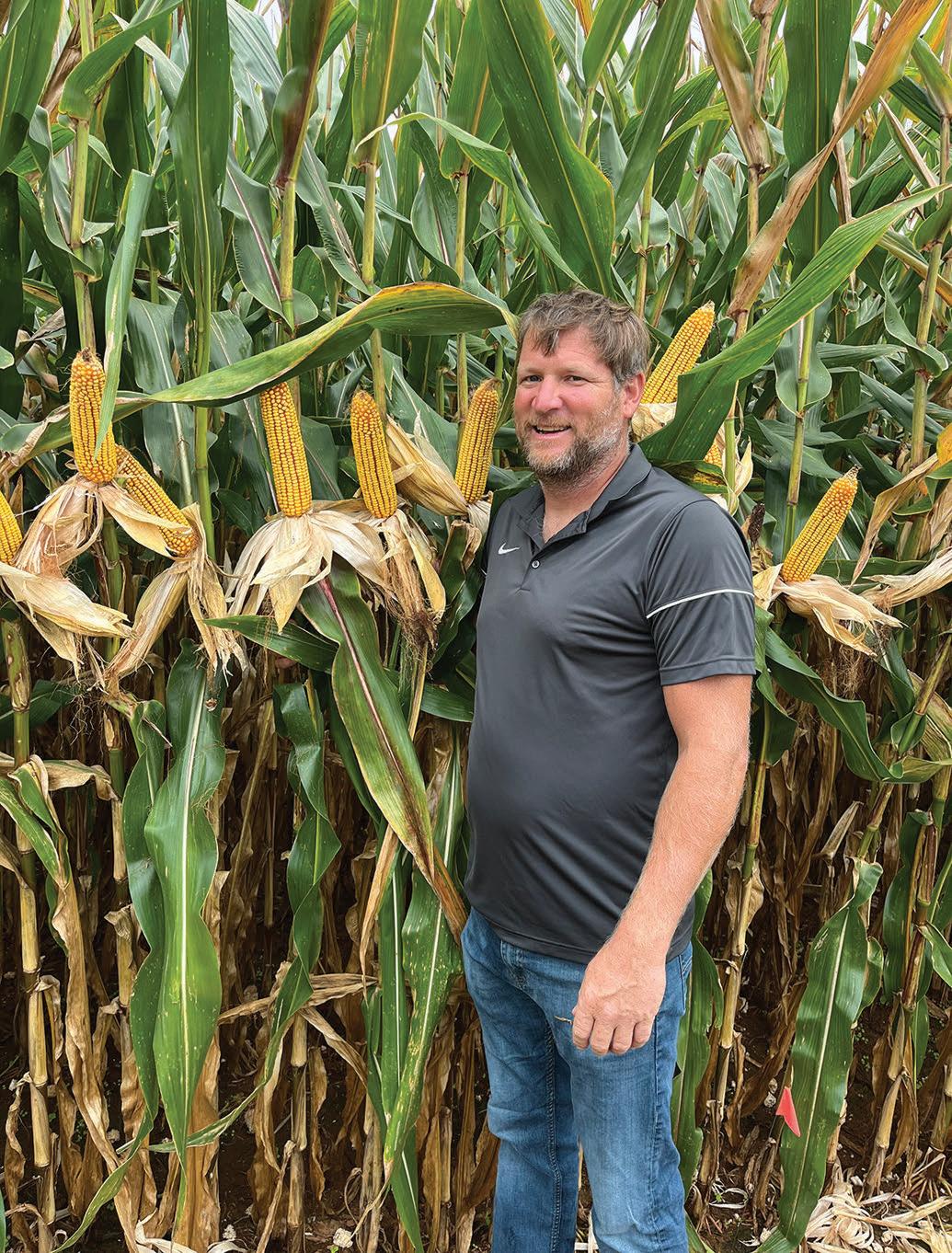
RECORD YIELD: Josh Watson of Sweetwater, Tenn., achieved a groundbreaking 387 bushels per acre of nonirrigated corn in the National Corn Growers Association Yield Contest, proving that persistence and smart practices can shatter expectations. Photo courtesy of Josh Watson
brand manager. “That’s really been a powerhouse-type product for us in that 118-day relative maturity.”
When a fellow farmer farther north wanted to try, Watson sent him five bags of seed. The result was a fellow yield-winner in another category.
“I think we have found the right hybrid for our area,” Watson said. “I think growing the longest-maturity-day corn that you can for your area really helps maximize yield.”
5. Early planting. Taking advantage of daylight, getting corn in the ground early and beating the South’s hottest temperatures help Watson produce his best corn. “I like to see my crop far along by June 21, the summer solstice. We actually planted corn March 13 this past year, which was the earliest we’ve ever planted.”
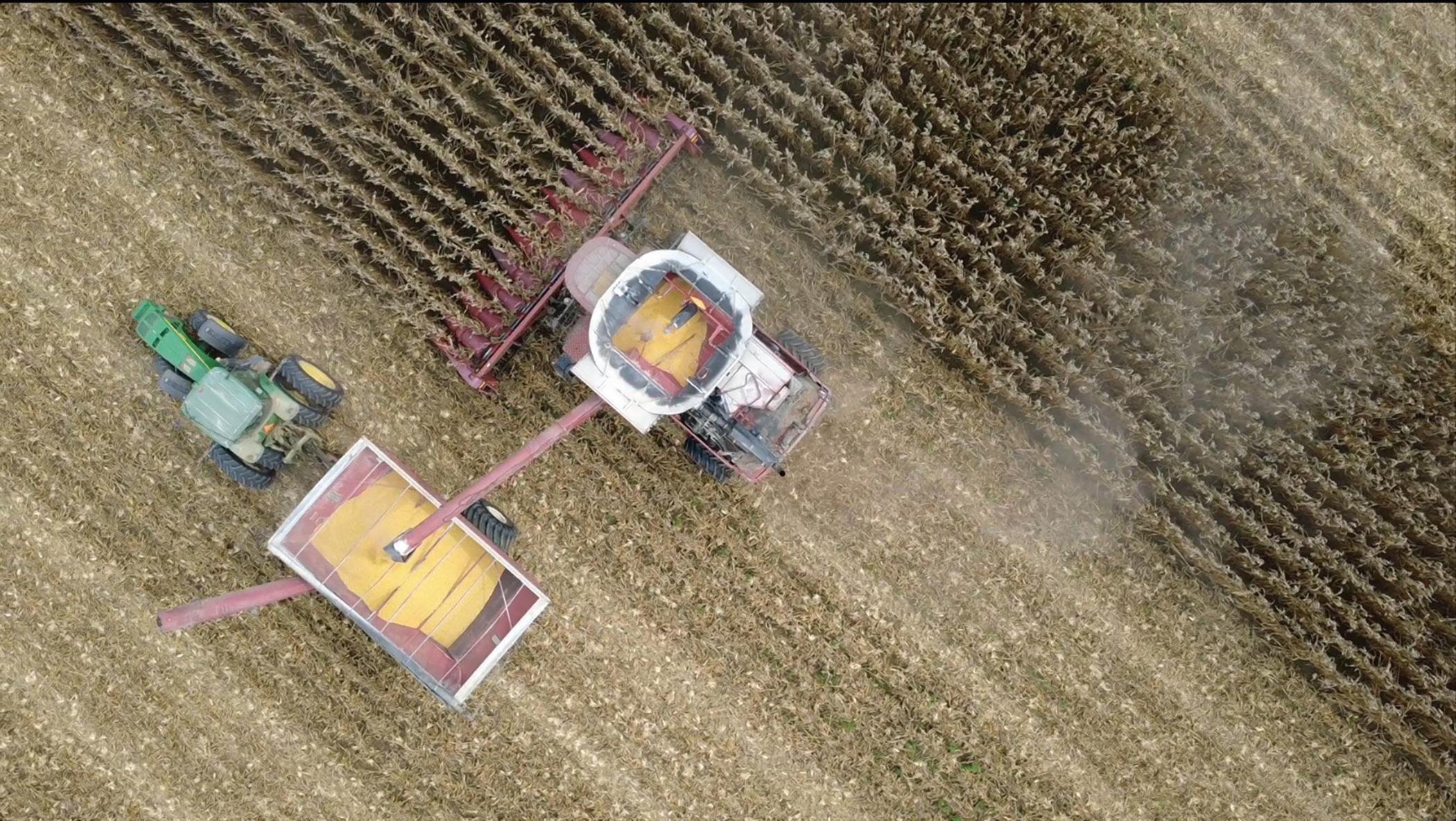
FIELD STRATEGY: Planting north to south helped Josh Watson conserve moisture and maximize yields in his nonirrigated cornfields at the base of the Smoky Mountains. Photo by Raney Rapp
A dairy farmer from East Tennessee topping out national corn yield contests in multiple categories? It looks unlikely next to the rows of same-state entries and that fact drives Josh Watson of Sweetwater to try that much harder to be on top year after year.
“I’ve just always been told that, you know, growing up in East Tennessee, that we couldn’t grow big-bushel corn,” Watson said. “Yield is for the farmers in Illinois, or in West Tennessee where they’ve got the better ground. That’s what I’ve heard most of my life.”
In 2018 when his milk contract was quickly cutoff, Watson was turned to his row crop acres to cover the bills. Aiming for higher yields, he ran test plots to see just how high his acreage could go.
“In maybe 2019, I did my own corn plot, and tested different varieties of corn and different populations,” he said. A county agent with a weigh wagon measured one of
the plots at 312 bushels, “which was unheard of for our area. At that point, I knew I wanted to sign up for the contest.”
Watson’s farm in Sweetwater is a unique place to farm, dotted with small fields around 900 to 1200 feet in elevation at the base of the Smokey Mountains. The red limestone soils make a great growing environment and the cooler temperatures compared to the rest of the southeast give corn room to mature without fighting hot nights.
The introduction of irrigation, via a 10,000-gallon springfed holding pond, helped Watson reach peak yields across all his fields in both corn and soybeans. Still, the last five years have held endless challenges.
“I’ve got the best plot, the best yield I’ve ever had in my life, but the season was just fair,” Watson said. “It’s hard to explain to people that I can be beating Tennessee state records on one end of the county and looking at crop insurance claims on the other — but that’s farming.”
PROFIT POTENTIAL: Selecting the right soybean variety, adjusting seeding rates and perfecting harvest timing could help farmers gain up to $108 an acre, according to Mississippi State research. Photo by Raney Rapp
Raney Rapp
raney.rapp@farmprogress.com
Selecting the right variety, planting the perfect quantity of seeds and harvesting at the right time gains soybean producers up to $108 an acre. It sounds simple, but farmers know perfecting all the little aspects of growing soybeans in the midst of growing season chaos is significantly more complex than it appears.
The search for cost-free solutions for soybean profitability is what sent Mississippi State Extension soybean specialist Justin Calhoun on a deep dive through more than 10 years of on-farm trial data across over 300 locations. “We’re in a tough economic situation right now,” Calhoun said. “What can we do that requires very little input cost for us and gives us a better return on investment? That’s where we’re going to start.”
Farmers who prioritize brand loyalty above all else are statistically more likely to miss the mark. If decisions are made based on brand alone, farmers have only a 35% to 40% statistical likelihood of selecting a top-three profit-producing variety for their farm.
Similar odds prevail when producers prioritize maturity group, with about 30% odds of picking a top-three variety for profitability. To bridge the gap and gain truly peak performance, variety selection can be based on multiple more influential factors.
• Delta Region:
In the Delta regions of Mississippi, Calhoun said maturity group 5 soybeans showed a low chance of outperforming maturity group 4 soybeans regardless of latitude. “That’s pretty common,” Calhoun said. “We’ve seen the group fives all but disappear from the landscape there.”
Late maturity group fours from 4.5 to 4.9 proved to be reliable and stable, but without much change in yield potential, especially around latitude 33.5, which lines up closely with the Highway 80 corridor.
For the Delta areas of the state, early group 4 soybeans from 4.1 to 4.4 maturity group showed the most “boom” potential.
“Especially if I’m north of Highway 80 — Bolivar County, Coahoma County, Tunica County — we see a really sharp rise in yield potential for the early maturity group fours,” he said.
• Hills Regions:
“In the South Hills, group fives pretty well dominate, but like the early group fours in the Delta, they’re less stable,” Calhoun said. As soybean production moves farther north, yield potential falls off for group 5 options compared to early and mid to late group 4 options.
In the North Hills region, “Group fives fall well below maturity group fours,” Calhoun said.
In first-year research data at Mississippi State investigating seeding rates and impacts on profitability above seed costs, researchers saw significant savings without impact to yield by reducing seeding rates by around 20,000 seeds per acre.
“On some really good soybean ground with good yield potential, we could probably back up to 105,000 seeds and save ourselves about $12 an acre compared to 135,000 seeds and not cost us anything in terms of yield,” Calhoun said.
Typically, researchers have suggested applying harvest aids in Mississippi at the R6.5 growth stage. Shifting that maturity mindset slightly could have big impacts for some producers.
“Throughout all the different regions they conducted research in, we saw a statistical difference between r6.5 and r7 every time in terms of yield when we apply our harvest aid at r6 versus r7,” Calhoun said. “Every time I look at this, I come up with the idea that we’re losing somewhere around 3 or 4 bushels an acre when we spray a harvest aid at r6 versus or r6.5 versus r7.”
Selecting the right soybean seeds, seeding rates and harvest aid practices depends on more information than simple selection data like personal preference or brand loyalty. Creating repeatable soybean yield bumps comes from working through available information and tailoring a system to the environment.
After working through more than 10 years of field trial data, Calhoun said the possibility of creating cost savings and yield increases through small shifts in production without costing cash could be an exciting prospect for farmers.
By Raney Rapp raney.rapp@farmprogress.com
Sweet potatoes are a small side dish with a big economic impact for farms across the Mid-South, providing a $90 million boost to the economy of Louisiana alone. In 2025, holding-steady acreages and higher-than-normal prices meant sweet potato growers had a lot to be thankful for in spite of the many challenges farmers face regarding input prices, labor needs and efficiency of production.
In Mississippi, sweet potato producers face considerable weather challenges resulting in a less than stellar crop production, while Louisiana, poised just a few weeks later in the growing season, saw great success. It was a tale of two very distinct seasons.
“We had a lot of early rains, much like we did last year. May and the first part of June was pretty wet,” said Louisiana State University sweet potato specialist Cole Gregorie. “But like last year, our growers were able to get in and plant between the rains. [They] really saw some excellent root sets because of that.”
Good early rains provide a pivot point for Louisiana growers, who need quality moisture for planting and then carefully control crop conditions the remainder of the season.
“We’re also about 95% irrigatable land here in Louisiana compared to some of our neighboring states like Mississippi, where that number is much lower in the 20% to 30% range,” Gregorie said. “They’re really more reliant on good weather conditions where, when
we did get a little bit dryer in August, our growers were able to water to finish off the crop to get ready for harvest.”
Where early rains were a boon to Louisiana producers, the same weather movement was a bane in Mississippi.
“We started off [with] record levels of rainfall in the very beginning that pushed transplanting back probably about two weeks later than usual,” said specialist Lorin Harvey, Mississippi State University’s sweet potato specialist. “Then the water turned off and it didn’t really turn back on for the rest of the growing season.”
Some growers reported rainfall rates from 6.5 inches to as little as 2 inches for the entirety of the growing season. “You just really need more than 6.5 inches of rain to grow good potatoes,” Harvey said.
The lack of rain went over well in Louisiana, where hurricane season can often take a devastating toll on farmers.
“I don’t believe there was a single name hurricane that landed on the continental U.S. this year. So for Louisiana, that’s always a really big deal,” Gregorie said. “You get those late heavy rains and high heats that follow a hurricane and it really becomes a haven for bacterial and fungal breakdown.”
Sweet potato yields can be deceiving because high measurements in pounds can sometimes be attributed to a few large potatoes, rather than high quality and quantity. In Louisiana, near-record yield was a result of lots of high-quality, perfectly sized potatoes.
“The yields that we captured this year were not because the potatoes were just grown larger,” Gregorie said. “For the fresh market,
FOR CELEBRATION: Louisiana growers celebrate near-record yields with perfectly sized sweet potatoes ready for the fresh market. Photo by Cole Gregorie
TOO TINY: Mississippi growers faced smaller sweet potatoes this season due to drought and challenging growing conditions. Photo by Lorin Harvey
people tend to want a smaller-profile, very uniform sweet potato, and that’s a lot of what we saw in the growers’ fields this year, and that yield was really divided into a large quantity of sweet potatoes.”
In Mississippi, sweet potato yields weren’t catastrophic, but they were around 30% lower than average. Small potatoes plagued fields fighting low rainfall and inferior growing conditions.
“Potato size profiles were pretty small because the lack of rainfall,” Harvey said. “Normally, you get a good bell curve, but this year that whole bell curve was shifted down toward the smaller size profiles.”
Because sweet potatoes are sold based on weight and not count, small potatoes can lower producers’ profits.
“It’s two-fold on how it hits you,” Harvey said. “Smaller sizes, less yields and can generally be associated with a lower price.”
Sweet potato producers faced two main potato problems this year: skinning and Streptomyces. In Louisiana, producers worked to prevent skinning — and therefore yield loss — during harvest.
“Skinning was a factor throughout the season,” Gregorie said. “It was a dry harvest. So a lot of our growers were having to water ahead and then trying to time their de-vining so the potatoes could somewhat cure under the ground. It was an issue, but it was one that I think our growers did a pretty good job of mitigating throughout the season.”
In Mississippi, Streptomyces caused significant cracking. Harvey witnessed some fields suffer yield losses of up to 85% due to severe cracking. While cracking severity fluctuated from field to field, it was a challenge across the state.
“One of the bigger issues is called Streptomyces. It is a bacteria that lives in the soil,” Harvey said. “It’s super common, but it’s always
BIG LOSS: Streptomyces damage caused severe cracking in Mississippi sweet potatoes, with some fields losing up to 85% of yields. Photo by Lorin Harvey
way worse in dry years. So hot, dry environments, those levels of Streptomyces just bloom and that potato is already stressed out and so it causes a whole bunch of hash mark cracking across the potato.”
Sweet potato farmers consider themselves devoted to the crop despite setback seasons. Even in tough years, growing great sweet potatoes can be a rewarding pursuit.
“It’s a very expensive crop to grow. In Louisiana, its economic value exceeds that of all our other horticultural crops combined,” Gregorie said. “But there can be a lot of reward in it for producers.”
BOUNTY: Louisiana farmers harvest a bumper crop of sweet potatoes, bolstered by irrigation and favorable weather. Photo by Cole Gregorie
By Forrest Laws
When Midsouth farmers hear the word amaranth, they mostly think of the weed — as in Palmer amaranth or Palmer pigweed — that has defied efforts aimed at economical control in cotton and soybeans for more than two decades.
But there are other species of Amaranthus that, while they share some of the attributes of Amaranthus palmeri such as drought tolerance and prolific growth and seed production, also provide nutritional seed, leaves and flowers for grain or forages suited to dryland and irrigated agriculture.
“Most people say Amaranthus cruentus and A. hypochondrias as crops are between 8,000 and 4,000 years old,” said Dr. Matthew Blair, research professor in the Department of Agricultural and Environmental Sciences at Tennessee State University. “They originated in an area between the border of Mexico with Arizona and Honduras, what scientists call Middle America.”
Blair has been working with grain amaranths since he first encountered them as an intern at Rodale Research Institute and Center
in Emmaus, Pa. (J.I. Rodale, the founder of the Institute, is credited with starting reintroduction of grain amaranths to North American commercial agriculture in the 1940s.)
Dr. Ivonne Sanchez del Pino, a researcher with the Center of Scientific Investigation of Yucatan (CICY) in Mexico who spoke at the Amaranthus Institute Conference held by TSU in 2022, says Amaranthus species are among the oldest crops in America.
“It was domesticated more than 4,000 years ago by pre-Columbian cultures, and it was used alongside corn, beans and squash by the Aztecs in the Valley of Mexico, the Mayas in Guatemala, and the Incas in Peru, Bolivia, and Ecuador along with potatoes and corn,” she said.
“Amaranthus not only had great importance as a food to pre-Columbian people, it was also a symbolic element within the Middle American worldview. It was present along with corn in ceremonies related to fertility and the agricultural cycle.”
Indigenous people in those areas continued to grow Amaranthus species for grain and religious uses until the Spanish arrived in the
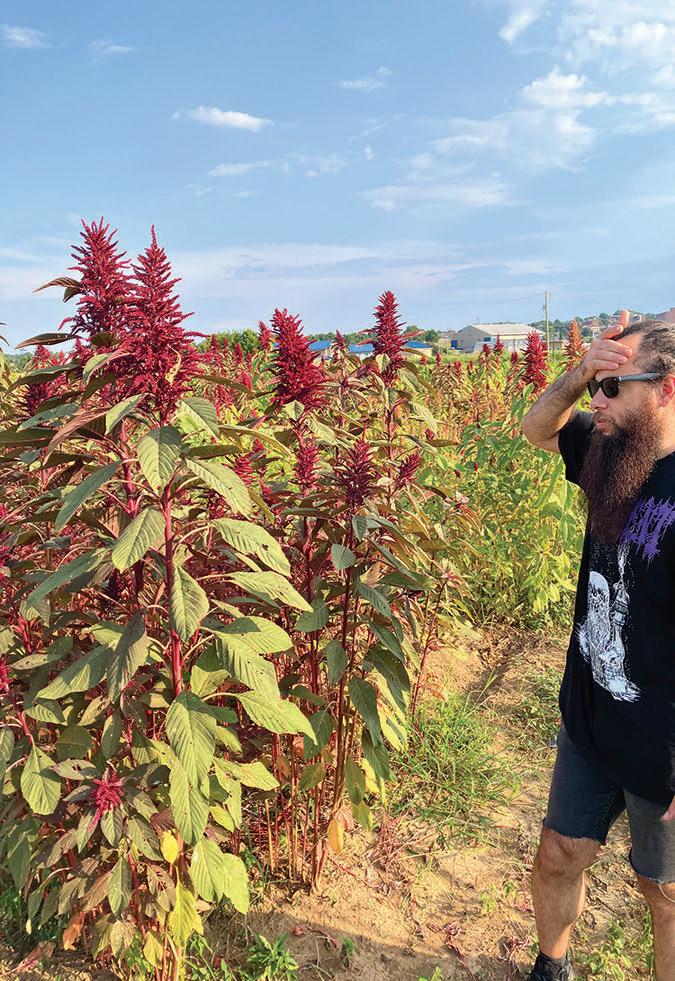
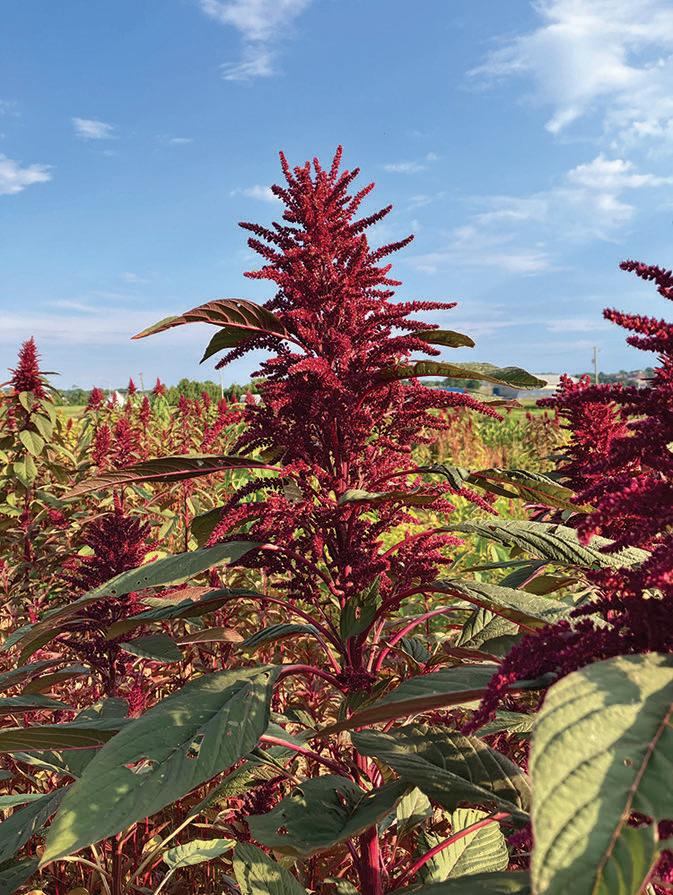
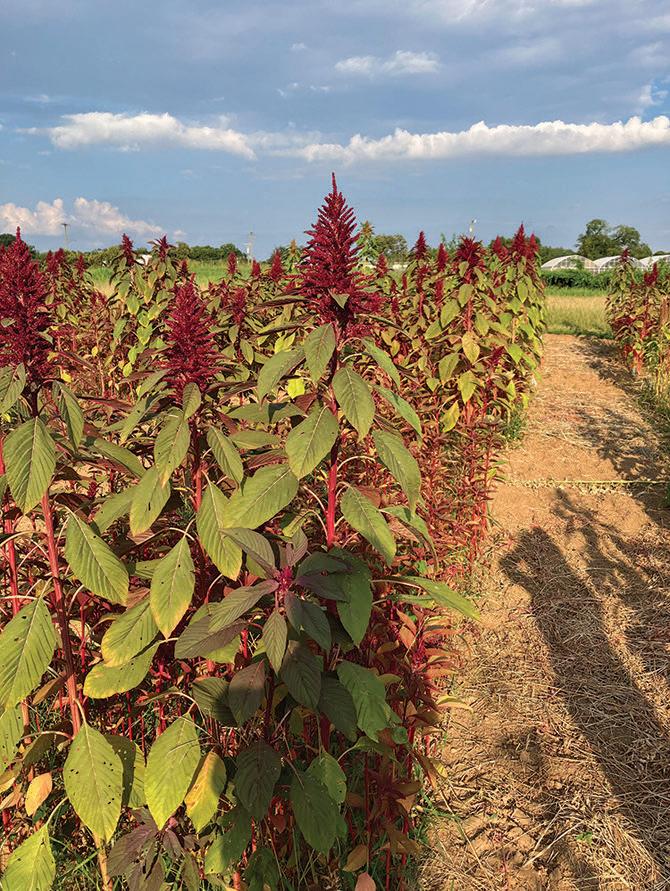
DOUBLE TAKE: Amaranth plants under cultivation in rows might be an unusual sight for row crop farmers used to trying to reduce populations of Palmer amaranth in their fields.
Photo by Forrest Laws
Western Hemisphere in the 1500s. Catholic priests discouraged the cultivation of amaranth because they believed the red coloring of some Amaranthus plants was associated with the devil.
Seed collection
Blair began working with Amaranthus species after he arrived at Tennessee State as a professor of plant breeding in 2013. Tennessee State is an 1890s land-grant university that has been involved in international studies and work with alternative crops, such as these grain amaranths.
“We started the Amaranthus germplasm screening program in 2014. In 2014, we were asking people for seed, and we are very grateful to David Brenner, who sent us the entire USDA core collection of Amaranthus germplasm from Ames, Iowa.”
(Brenner is curator of Amaranthus, millets and other species at USDA’s North Central Regional Plant Introduction Station at Iowa State University.)
“We also found another organization in Iowa, the Seed Savers Exchange,” Blair continued. “We received 34 land-raised varieties from Seed Savers and 260 accessions from the USDA collection. That means we had almost 300 genotypes to start with, so that was a lot of work. We decided to treat the Seed Savers differently, and that was partly because a lot of that material was from the Rodale program that I had been involved with years before. We put them in a randomized complete block design.”
All the testing was done at Tennessee State’s Research Farm, which is located along the Cumberland River near downtown Nashville.
Initially, the researchers planted using transplants in June and later planted as a directly seeded crop in May. They harvested the grain in September and October and dried the seed in a hoop house. They also allowed some of the seed to “freeze-dry” in the field when frosts occurred.
“Because of the amount of work involved, we changed from transplanting to direct seeding the plots after a couple of years,” he
noted. “That proved to be fortuitous when a tornado destroyed our greenhouse.
“We had good uniformity throughout the field. We realized that we had to eliminate plants that wouldn’t flower here in our trials. Many of these were from the Amaranthus caudatus species, genotypes from short-day locations in equatorial South America.”
From 2015 to 2018, the researchers reduced the number of genotypes being studied from the initial 260 lines in 2015 to 150 in 2016 and 100 in 2017. In 2018, they moved from transplants to direct seeding. They have since reduced the number to the top two USDA cultivars and the top two Seed Saver cultivars compared to an orange TSU selection for potential seed release.
“We’ve compared them to Missouri releases from Dr. Rob Myers with the University of Missouri’s Center for Regenerative Agriculture and the USDA-SARE [Sustainable Agriculture Research and Education Program],” he said. Myers also spoke on his research on Amaranthus species during the Amaranthus Institute Conference at TSU.
While Amaranthus is not well-known as a grain crop in the United States, it has become established as a crop for grain or leaves in Africa and much of Asia, especially India and Nepal, for nutritional seed, according to a paper published by Iowa State University. Recently, amaranth has been grown by a larger number of farmers in China, Russia, Eastern Europe and South America and is reemerging as a crop in Mexico.
Blair has been seeking grants to expand the work on amaranth at Tennessee State University. “Amaranth seed and flour is mostly sold in organic food stores because it is high in protein and other nutrients, and it’s gluten-free,” he said. “We believe it has crop potential for farmers in Tennessee and other states if we can expand its uses.”
Laws is a former editor and a contributor to Delta Farm Press. He is based in Memphis, Tenn.
By Brent Murphree Brent.Murphree@farmprogress.com
Chad Rosen is setting the bar pretty high, and for good reason. He is the founder and CEO of Victory Hemp Foods and believes that industrial hemp is ready to position itself among the other top U.S. grain crops alongside soybeans, corn and wheat.
“The U.S. hemp grain supply chain is really at a critical milestone, given where farming is in general and how far industrial hemp has come in less than a decade after 80 years of prohibition,” Rosen said. Victory straddles a great deal of the value chain relating to genetics, agronomy, processing, policy, marketing and food science.
“We’ve made a lot of progress and food ingredients from hemp seeds check a lot of boxes for customers who are looking to eat healthy, as [hemp] relates to proteins and fats as well as sweeteners,” Rosen said.
Hemp fits well into crop rotation and may financially out-compete some of the crops grown on the farm today, according to Rosen. It uses the same equipment as other small grains and requires direct-to-processor contracts in most cases.
Industrial hemp can be used for a wide range of products, but Victory Hemp Foods is focused on seed, which can be processed for oil, meal and hulls. With a THC of less than .03%, the seed can be processed without intoxicating effects and is categorized as “Generally Regarded as Safe” by the USDA.
Among other things, the seed protein can be used to replace eggs in gluten-free baking systems and whey proteins in nutrition
In 1937, the Marijuana Tax Act led to the regulation of hemp and the prohibition of cannabis. Brian Furnish noted that because of hemp’s association with cannabis, it has been a long haul to get it recognized in Washington as a viable commodity. He also believes that other powerful lobbies have blocked hemp’s potential growth.
But positive movement with USDA and the department’s Risk Management Agency is pointing in the right direction. The sometimes-sullied reputation of hemp is on the rise as reputable growers like Furnish and Alan Tank, who have experience in farm policy, are steering the conversation to the beneficial potential of hemp seed food ingredients.
“We’ve had a lot of gold chasers who were going to come here and get rich,” Furnish said. “When things got tough, they all disappeared, left the farmer holding the crop with no income. Now, moving forward, this is a much more professional industry.”
“I’m spending my time and effort to work with Chad and the team to try to create this vision and create this opportunity to look at growers across the country, like Brian, and give them
bars and drinks. The oil is high in polyunsaturated fats and essential fatty acids; hulls have high concentrations of xylitol, which is widely used as sweetener in confectionary products, mainly chewing gums.
Rosen believes hemp has the same growth potential soybeans had in the 1850s when first planted in Iowa and Illinois, increasing production exponentially.
The Victory Hemp Foods team has increased the capacity of their processing facility in Carrollton, Ky., to meet customer demand for use in protein bars, protein powders, baked goods and beverages. The company supplies ingredients for the food products made by companies like Laird Superfood, Unreal, Stellar Snacks, Manitoba Harvest, New York Bakery and Griffith Foods, one of the largest suppliers of quick service restaurants.
“We’re trying to build this supply chain for Victory by pulling the production through demand,” said entrepreneur, investor and Iowa farmer Alan Tank, who is also the chairman of the board at Victory Hemp Foods. “There is a market opportunity for protein, for oil and for sweetener. There’s this really interesting paradigm, a market opportunity that’s emerging.”
Tank has been involved in food policy on a national level since the early 1980s, working as a lobbyist for the National Corn Growers Association and working with other commodities in Washington, D.C., on food and ag policy domestically and on an international scale.
tools and opportunities to do something else, to diversify their risk, diversify their production, create new economic opportunities for that acre,” said Tank.
Rosen noted in November that a recent statement by Kentucky senator Mitch McConnell regarding closing a loophole in the 2018 Farm Bill was aimed at keeping intoxicants out of the market.
“This is not a ban on hemp,” Rosen wrote in a blog post. “This is a targeted response to intoxicating products being produced and sold under a loophole created in the 2018 Farm Bill. Whatever one believes about legalization or personal choice, those products were not the intended focus of the Farm Bill.
“We produce food ingredients from the hemp seed. We do not produce intoxicating products. Our ingredients are well-established, safe, functional and recognized by the FDA as Generally Regarded as Safe.”
He and his team are working to assure investors, customers and farmers that hemp grown for seed and fiber are not in the scope of this legislation.
“We are at a point now where we need to rethink about new ag policy, new ag innovation,” he said. “The reality of the situation is that we have to look for new things. We’re going to have to see some innovation. There’s a tremendous need. There’s a tremendous opportunity.”
That opportunity, he believes, lies with industrial hemp, and he’s spending his time and effort with Rosen and the rest of the team to push that vision forward to create an opportunity to diversify risk, diversify production and create new economic opportunities on the farm.
“We’re looking for people to help increase production,” Rosen said. “We’re looking for the story to be told because we think there’s an opportunity that’s worth the effort.”
PLANT EXPANSION: Victory Hemp Foods recently expanded their operation to provide more product to their customers.
Eighth-generation Kentucky farmer Brian Furnish agrees. In addition to hemp, Furnish grows tobacco, soybeans, corn, canola, hay and wheat and raises cattle and sheep on his farm in northeast Kentucky.
“Hemp offers us the opportunity to put another tool in our toolbox as we’re looking at diversification and crop rotation,” Furnish said.
He has been growing hemp since 2014. This year, he planted 200 acres of hemp for food content. He notes that the biggest problem with other crops has always been the processing entities — the middlemen — between the farmer and the finished product.
“We are grateful that Chad has set up here in Kentucky to help build out this crop,” he said. “I think hemp is one of the most dynamic plants or crops in the history of mankind, but it was too good of a crop.”
Research facilities like the University of Kentucky and Cornell University are working to develop more uniform varieties with high seed production. Privately owned seed breeders are also getting into the action.
“New West Genetics is a good example out of Colorado,” Tank said. “They have a lot of commercial activity going on with hemp. They’re a really good privately held commercial seed breeder.”
The crop is improving and evolving quickly, according to Tank. Limitations in breeding are being addressed and mitigated. A more uniform seed allows for more efficient harvest with the same equipment that’s used in the current grain crop.
With a nod toward crop rotation, low or no tillage, and a reintroduction of organic matter into the biome, soil health is also a major consideration for growers.
“Based on the data, we’ve seen that it really enhances soil health,” Tank said. “Too much rain, no rain, it’s really a tolerant crop. The ability for this crop to be grown in a wide geographic
region is really valuable, but probably more valuable on more marginal soils.”
Tank notes that it’s an opportunity for growers to diversify, and it fits today’s production dynamics.
“They say there’s 20,000 uses for the plant,” Furnish said. “Well, I don’t need 20,000, I need three or four, and we’re figuring that out now. Yeah, and I’m excited about the future of it.”
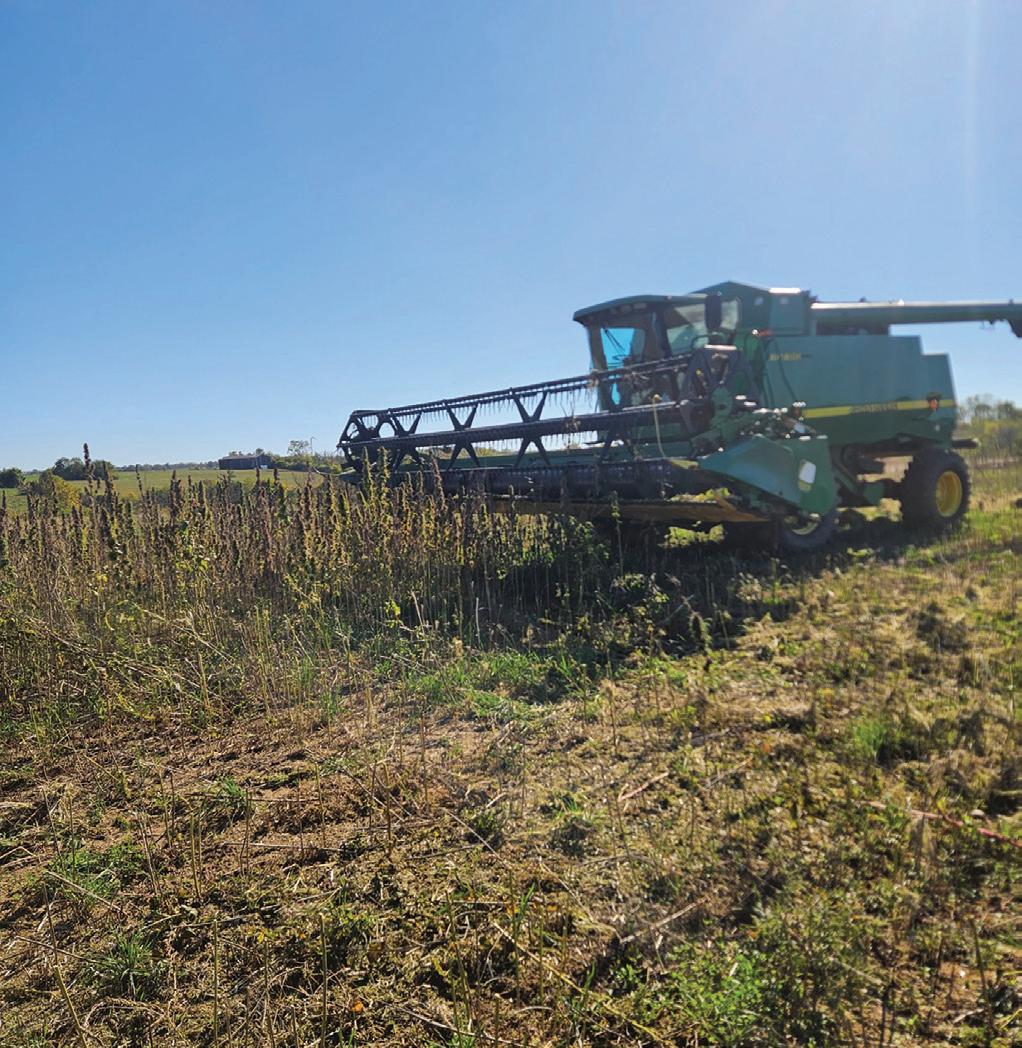

The 2025 growing season resulted in yet another challenging year for row crop producers across the United States. Tennessee was no exception.
Farmers statewide continue to face high input costs, low commodity prices, and unpredictable markets. Today, research-based information is more valuable than ever.
At the University of Tennessee Institute of Agriculture (UTIA), researchers and Extension specialists work year-round to provide data on all aspects of crop production, including agronomics, irrigation, soil health, disease management, insect control, and more. One of the most essential areas, however, is weed management.
Meet Larry Steckel, UTIA’s row crop weed specialist for 22 years, whose career has centered on managing yield-reducing weeds amid rising pesticide resistance. With no new herbicide modes of action developed since the 1980s, modern weed control depends on using existing tools wisely.
For example, Palmer amaranth, often known as pigweed, has become resistant in Tennessee to both dicamba and 2,4-D,
leaving Liberty as the only remaining herbicide still providing adequate control.
“Some of my graduate students are studying ryegrass resistant to glyphosate, which is already a well-known concern,” says Steckel. “Now, we are even encountering ryegrass resistant to clethodim, further limiting control options.”
To stay ahead of emerging resistance, Steckel conducts field trials across the state along with controlled greenhouse studies. He evaluates application types, rates, and timing to provide producers with reliable, research-based recommendations. Results are posted on UTCrops.com, where farmers can find the annual Weed Control Manual and weekly updates from UTIA specialists on all areas of crop production.
Steckel leads hands-on education through the annual Weed Tour Field Day at the West Tennessee AgResearch and Education Center, spotlighting various weed control trials across major commodities. He also presents at other local and statewide events, such as the West Tennessee Grain and Soybean Producers Conference, the Cotton Tour Field Day, Milan No-Till Field Day, county Extension meetings, and more.
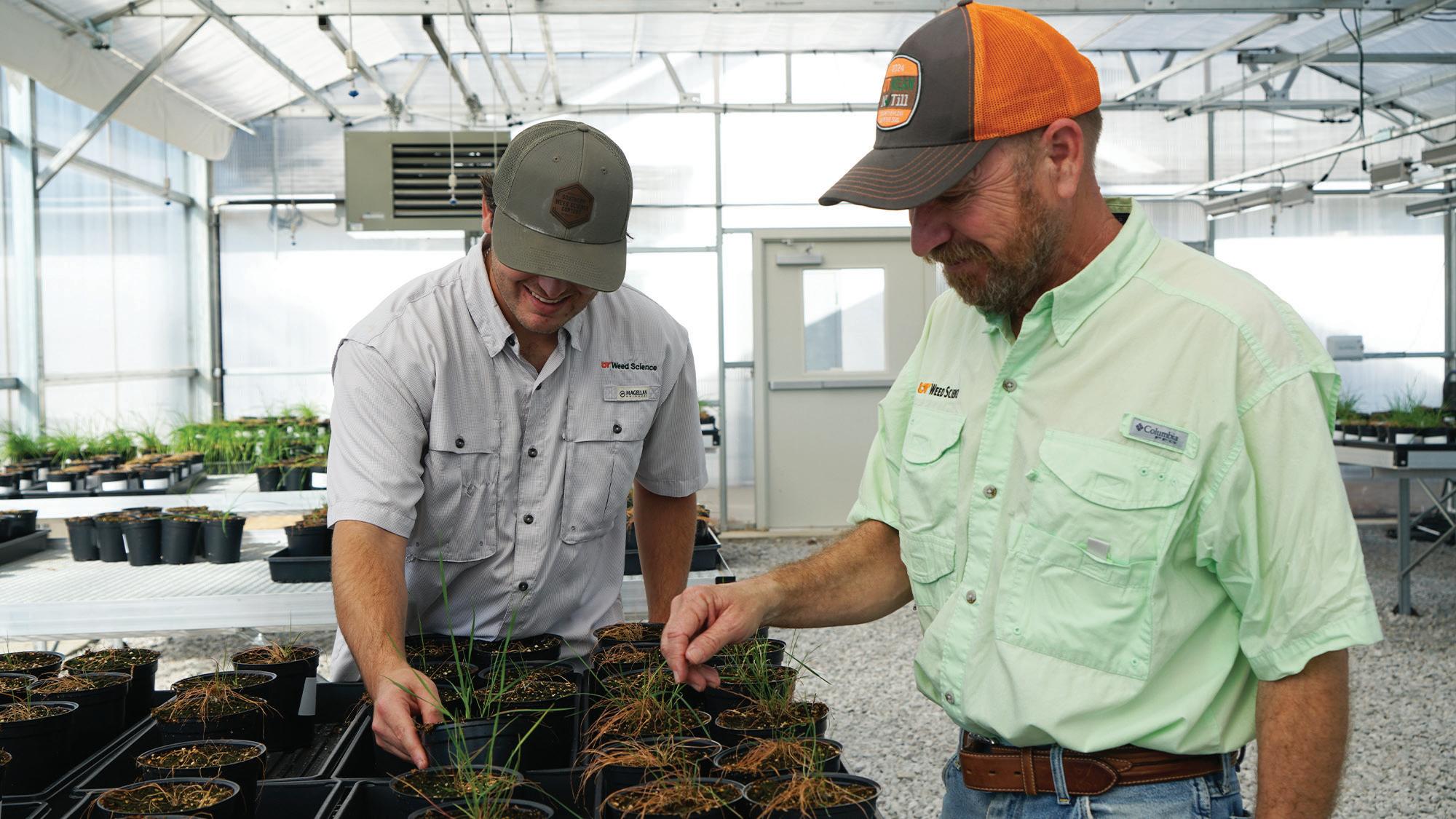
“Weeds can rapidly overtake a field if not addressed,” says Steckel. “It’s essential to scout regularly, identify pests, and treat them using the most up-to-date data possible.”
Even with strong agronomic practices and ongoing weed control solutions, many producers still face financial pressures.
“One of the biggest challenges is high input costs, which directly impacts long-term profitability as crop markets remain unpredictable,” says Aaron Smith, Extension economist and interim assistant dean of UT Extension. “Tennessee cotton producers face losses of $250 to $350 per acre in 2025. We predict that as many as 30% of Tennessee farm operations are under severe financial stress going into 2026.”
Smith, faculty member in the UT Department of Agricultural and Resource Economics (AREC), analyzes market trends and their effects on Tennessee agriculture. His work helps guide policy discussions at state and national levels.
“There are many high-level concerns right now. Will producers struggling financially receive payments and support? If so, what does this look like and will it be enough?” says Smith. “We don’t know if assistance is coming, so we must prepare for future growing seasons by optimizing the resources we have at hand.”
Continued on next page

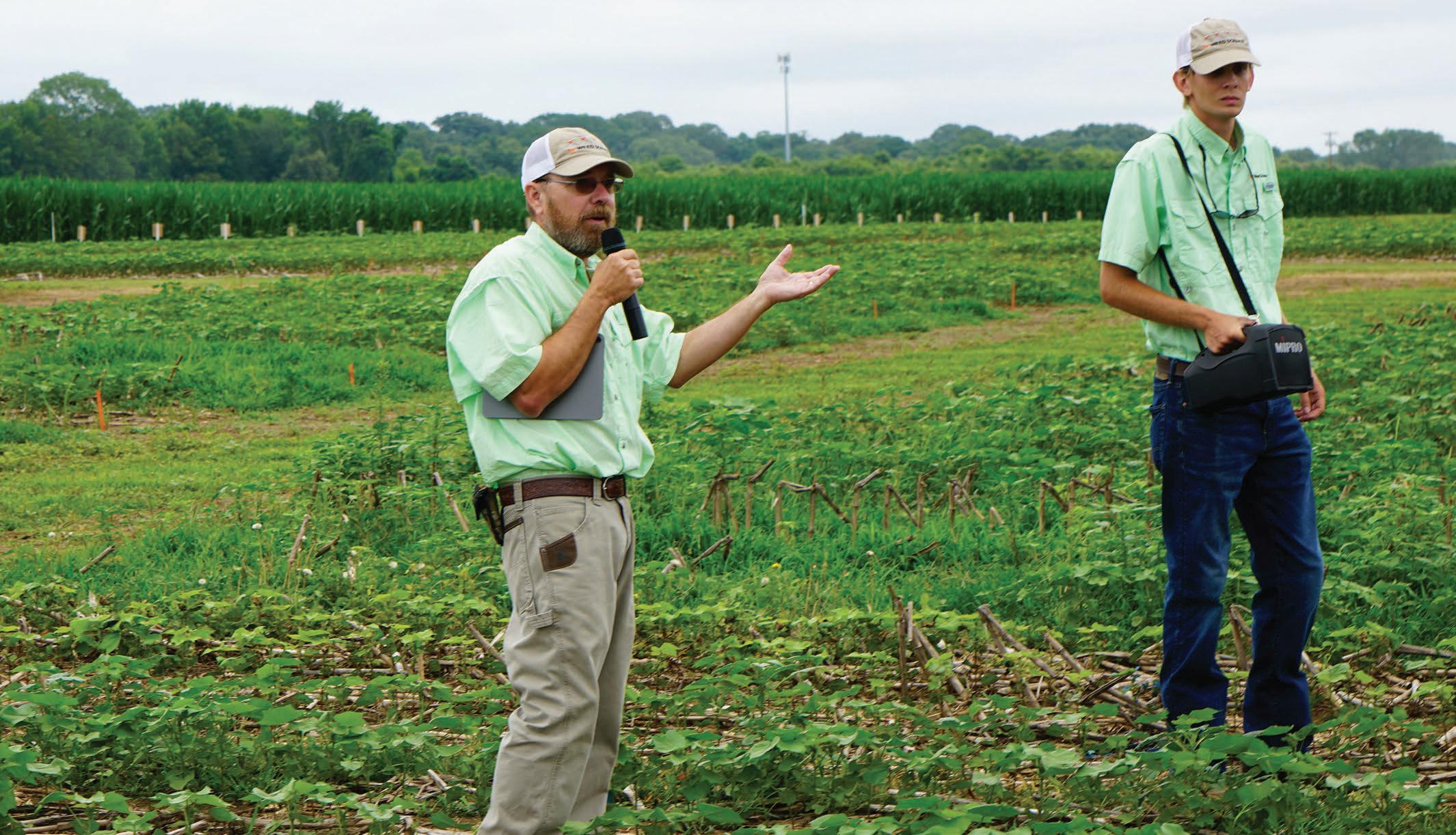
To support producers, Smith seeks to improve farmer education in four key areas of crop economics: marketing and risk management, crop insurance, farm and financial management, and production economics. Year-round workshops provide essential guidance, while resources for Extension agents enhance economic advisement at the county level.
The UT Center of Farm Management, another component of AREC, offers one-on-one farm financial management guidance, helping producers attain profitability based on individual factors.
“Despite concerns for the future, there is a path forward,” says Smith. “It may not be easy, but we are going to help farmers navigate these difficult waters. However, there are always challenges at a global scale we simply cannot control.”
International markets add another layer of complexity. Andrew Muhammad, professor in AREC and Blasingame Chair of Excellence in Agricultural Policy, is one of UTIA’s leading experts on global trade.
“Recent trade tensions have significantly altered both imports and exports,” says Muhammad. “In addition to rising prices for fertilizer, equipment, machinery, and more, the ways in which U.S. commodities compete abroad are constantly shifting.”
In a typical year, as much as 80% of cotton produced in the U.S. is exported out of the country, often arriving in China and other countries for textile production. However, Brazil recently surpassed the U.S. as the world’s top cotton exporter, threatening this industry that generated almost $300 million in cash receipts for Tennessee in 2023.
Other sectors are feeling pressure as well. Tennessee’s forestry industry saw cash receipts drop from $290 million in 2017 to less than $200 million in 2024. Distilled spirits, including the iconic Jack Daniel’s whiskey produced in Lynchburg, Tennessee, are experiencing declining sales.
Despite challenges, new trade avenues are emerging. Muhammad works closely with stakeholders such as the Tennessee Department of Agriculture and national industry groups to build international partnerships.
In fall 2025, he joined a U.S. delegation to Kenya to negotiate expanded soybean exports to West Africa. In 2023, he partnered with officials in Vietnam to expand hardwood exports, an effort that resulted in a 70% increase in Tennessee logs and lumber entering international markets.
“Manufacturers in Vietnam purchased $1 million of hardwood in just one week during the U.S. visit,” says Muhammad. “And with a recent agreement between the United States and China on

soybean exports, other sectors could see renewed momentum as trade avenues open.”
As Tennessee producers move into the 2026 growing season, they face a complex landscape shaped by herbicide-resistant weeds, tight financial margins, and evolving global markets. Yet ongoing research, stronger financial education, and expanded trade efforts provide reasons for optimism.
UTIA specialists will continue working alongside producers to help them adapt and remain resilient in the face of rapid change.
For more information on agricultural production, please contact your local Extension office for research-based support.
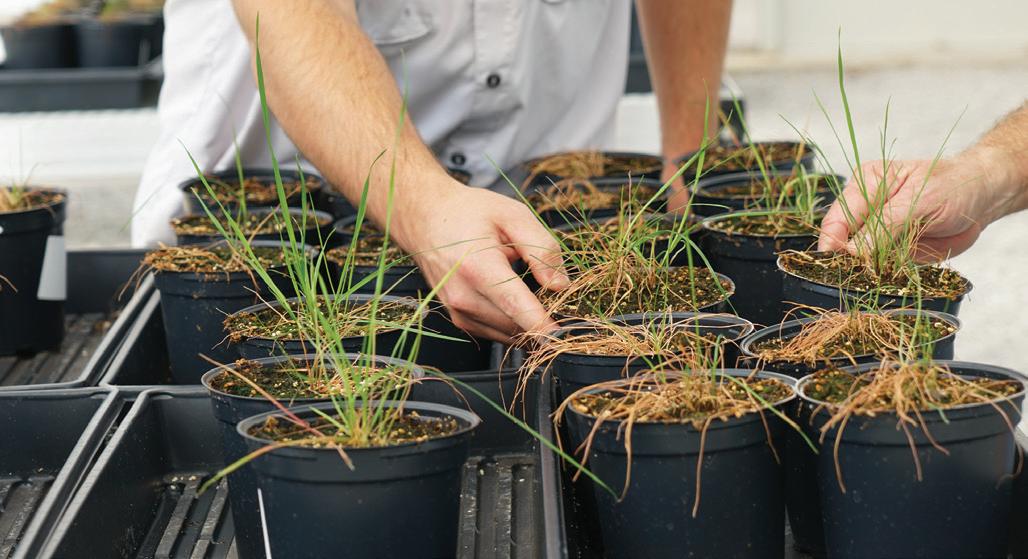
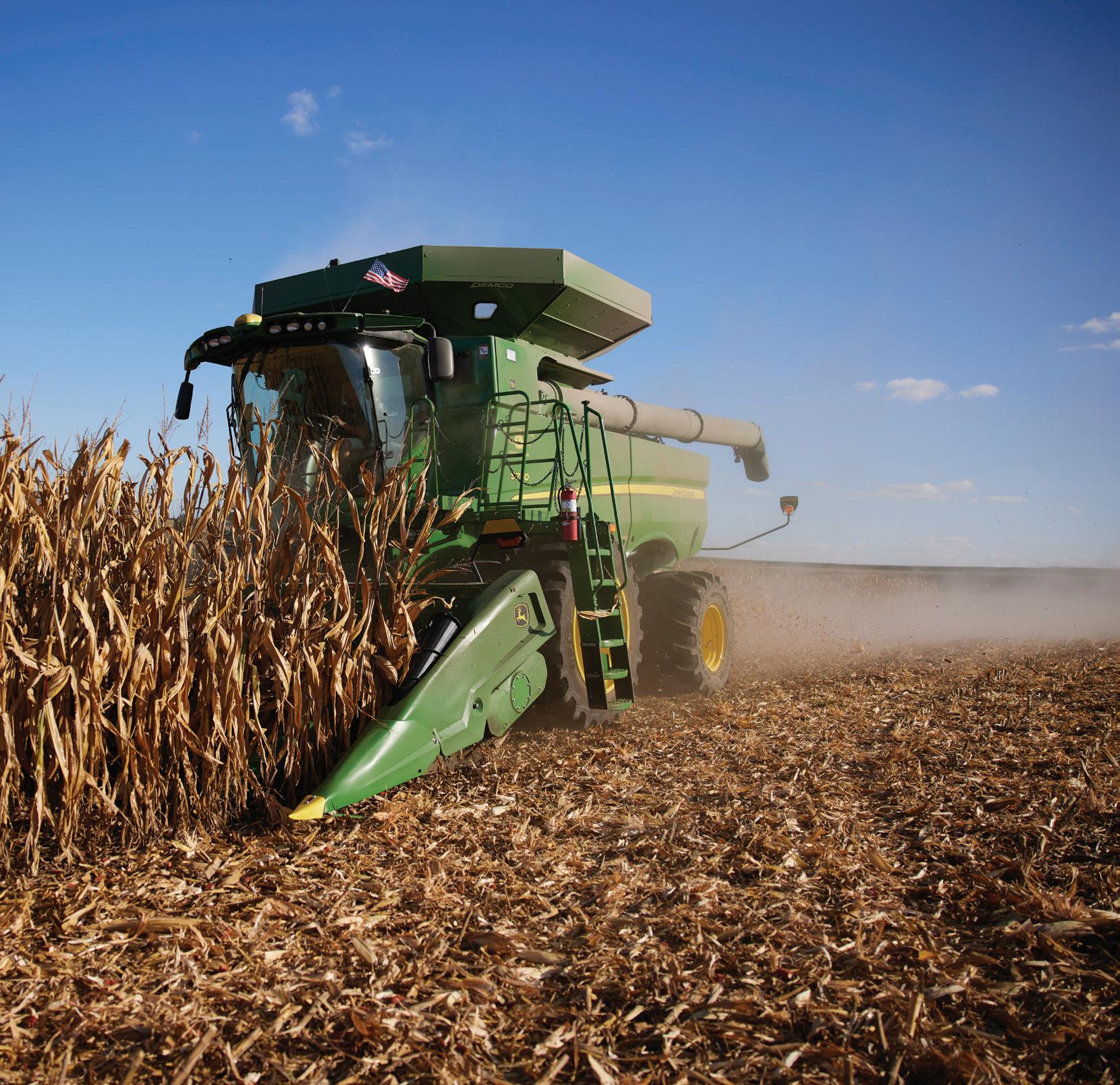
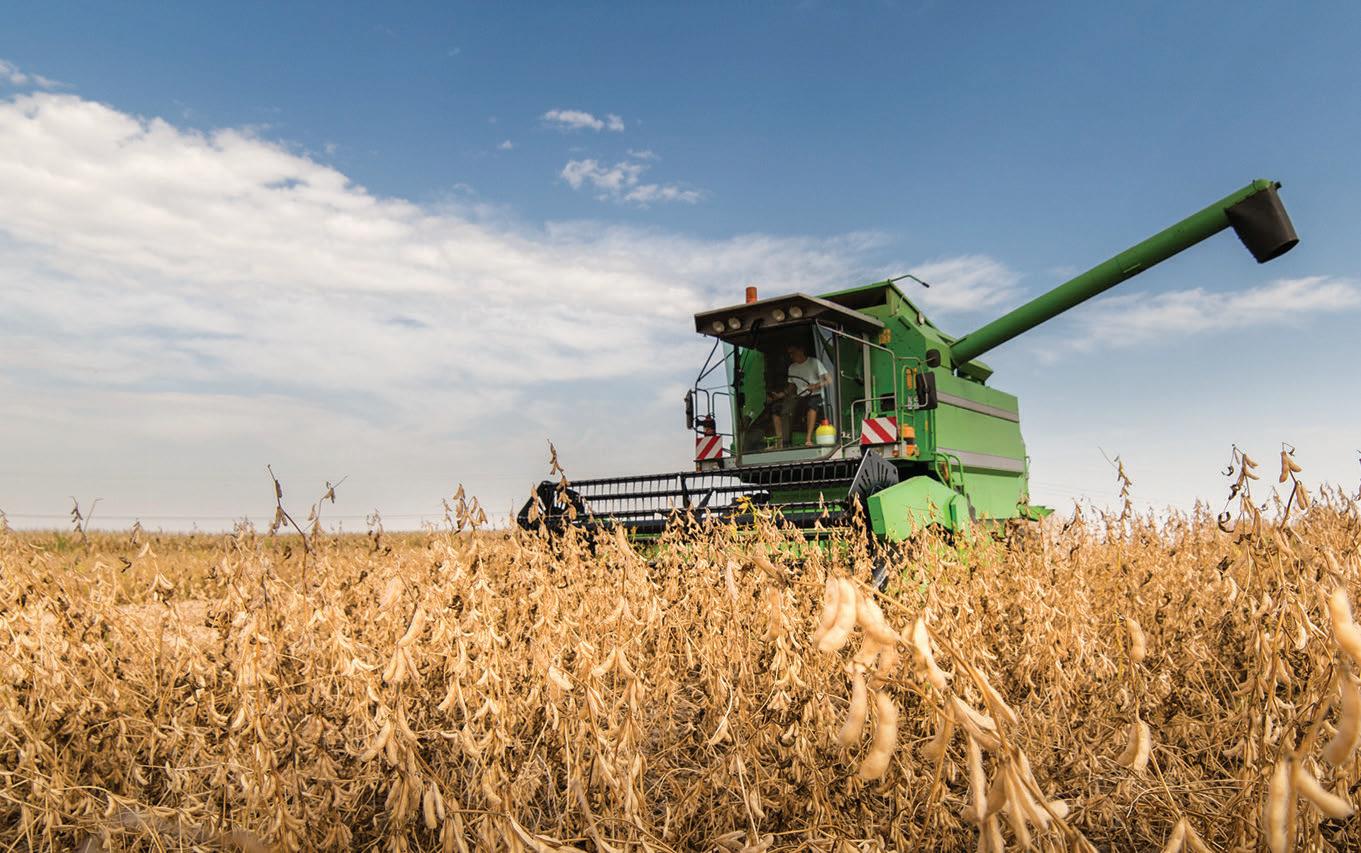
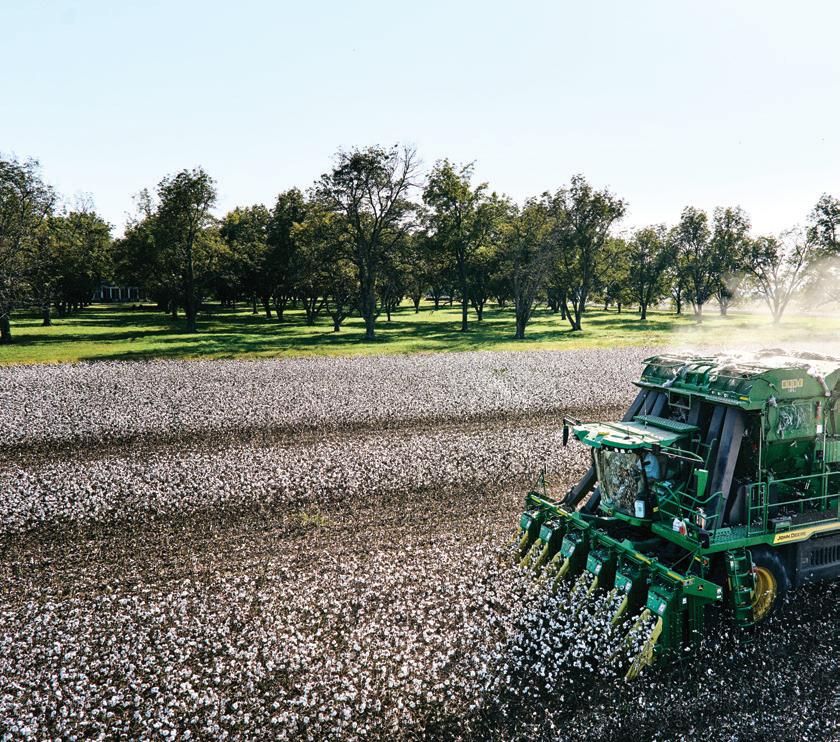
By Whitney Shannon Heckel whitney.heckel@farmprogress.com
There is an artistry to making honey, and David Coy’s family has traversed the beekeeping industry since 1969, when his father, Bobby, took on the art. It started as a hobby in Jonesboro, Ark., that later grew into permanent beeyards in the Mid-Ssouth before expanding to having migratory hives across the country.
“Bees are livestock and caring for them is animal husbandry. Many people do not realize that beekeeping is much closer to ranching than row crop farming. This is part of the business that becomes more of an art,” Coy said.
Today, Coy’s Honey Farm continues to thrive with beehives located across the Mississippi Delta and Gulf Coast, along with more far-flung places such as North Dakota and California. Their honeybees pollinate crops while producing 100% domestically sourced honey that can be traced back to their farm locations.
With years of experience, Coy has adopted relevant business strategies, including a 25-year long membership with the Sioux Honey Association Co-op, where he serves on the board of directors. Recently, Sioux Honey joined other U.S. Farmed-certified brands, such as Anheuser Busch, through partnership with American Farmland Trust.
The U.S. Farmed seal is proudly displayed on Sioux Honey products, such as Sue Bee and Aunt Sue’s honey, that shoppers can find in grocery store aisles. “Marketing a domestically produced honey in a market flooded with cheap imports is not easy. It is important for business strategies to change with the times,” Coy said.
For as long as he can remember, Coy has been surrounded by honeybees. He recalled getting stung at age 4. The sting caused a reaction that required a visit to the doctor. Coy’s father asked the doctor how to avoid such reactions, and the doctor replied, “Just don’t let your son get stung.”
Obviously, that was not an option for a beekeeper, so Coy’s parents found an allergy doctor, and Coy underwent weekly immunotherapy treatments. The process to build his immunity took years, but Coy has experienced no issues since.
At the time, the family was maintaining permanent, commercial beeyards in Jonesboro. Then in 1994, Bobby purchased bees on the Mississippi Gulf Coast and took on migratory beekeeping. He moved the bees between the Gulf Coast and northeast Arkansas to optimize honey production.
“By doing this, he was able to take advantage of the early springs on the Coast, then move established hives north for a summer honey crop,” Coy explained. “Because of palletizing hives and purchasing forklifts and larger flatbed trucks, we could move bees more efficiently. It allowed us to become better pollinators.”

David Coy has been immersed in beekeeping his entire life. Now as a commercial beekeeper, he tends to bees around the country, producing honey as a member and board director of the Sioux Bee Honey Association Co-Operative. Recently, the co-op announced a partnership with American Farmland Trust, placing U.S. Farmed-certified branding on their honey products.
At 16, Coy began caring for bees in beeyards. He and his brothers spent hours in the early mornings and after school on the Arkansas operation, while their summers were spent on the Gulf Coast harvesting honey.
In 2006, the Coys further expanded their operation to Perkinston, Miss., where they purchased land and built a shop. They increased honey production and began selling honeybees, which included queen honeybees. From then until 2018, they maintained a 12,000-beehive operation, producing an average of 1 million pounds of honey each year.
Coy went on to college, earning a degree in plant science from Arkansas State University. Then, he took on the family beekeeping business. In 2019, the Coys left Arkansas and set up shop in Hebron, No.Dak., where they replaced the extracting facility left behind in Jonesboro and built more storage. By 2021, the Coys
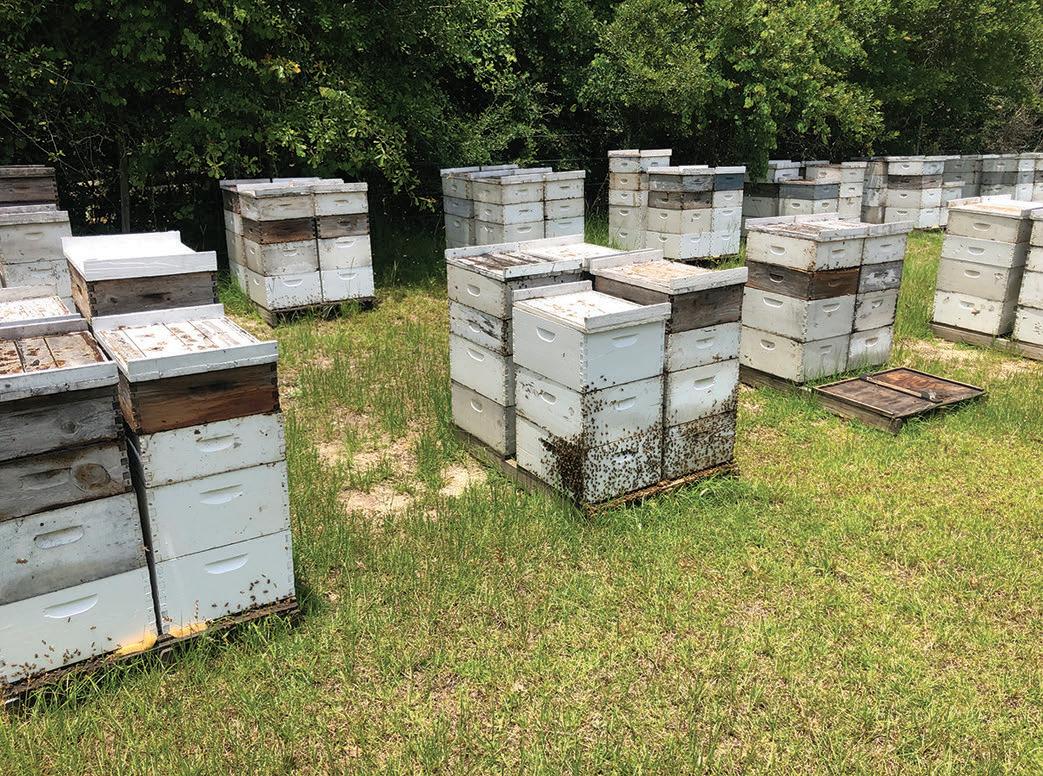
Beekeeping is animal husbandry, pollinating crops while making honey, defined by decades of work on the Coy’s Honey Farm.
had purchased the North Dakota operation, which now included 11,000 hives each year.
Commercial beekeeping in today’s times
“In my career, I have seen major changes. It is not easy to move a business, let along your family, because of things that happen out of your control,” Coy said.
Today, the Coys operate 100 locations along the Gulf Coast, 40 in the Mississippi Delta and 140 in North Dakota. They also partner with other beekeepers in the Midwest to place beehives that support local honey production and send 3,000 to 4,000 hives to California each year to pollinate almond crops.
Coy contracts his production through Sioux Honey, and his co-op membership provides him with food-grade totes and 55-gallon drums for honey storage. This not only reduces the need for large storage facilities but also allows the co-op to take care of logistics to move the honey crop in a timely manner.
“We know we have a home for every drop of honey our bees produce,” Coy said. “We also feel confident that the co-op is doing its best to get the most for our crop that the market can handle while suppling the end user with quality.”
All Sioux Honey co-op members are 100% domestic producers, so the U.S. Farmed seal on their products easily paired with the company’s business model.
“It is a perfect fit for us, because all of our 180-plus members are domestic producers and comply with our traceability standards to prove the honey was sourced and packaged right here in the United States,” said Dustin Livermore, vice president of quality and supply at Sioux Honey.
When honey arrives at Sioux Honey facilities, it is tagged with a unique receiving number, and that number is followed all the way through processing.
All records are third-party verified against batch records. “Traceability has been part of Sioux Honey’s standard, so participating in the American Farmland Trust’s program for U.S. Farmed aligned with what Sioux Honey was already doing,” Livermore said.
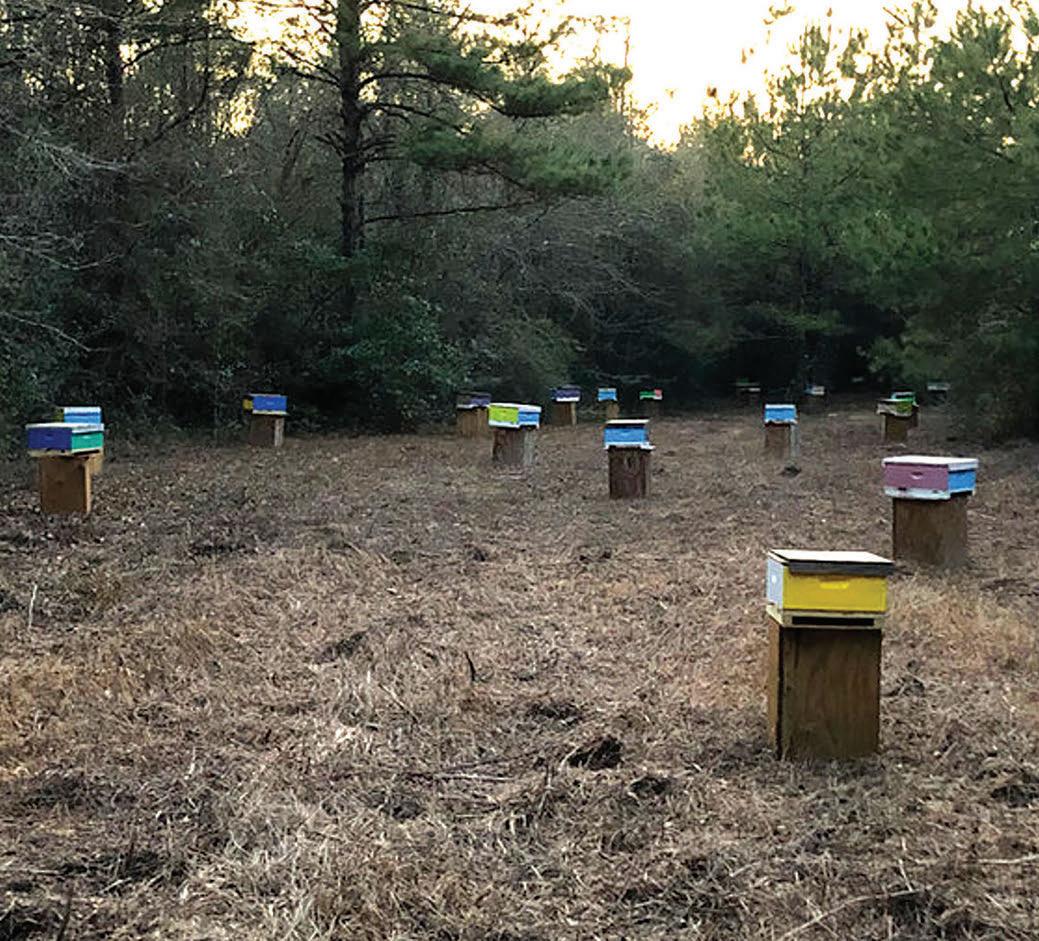
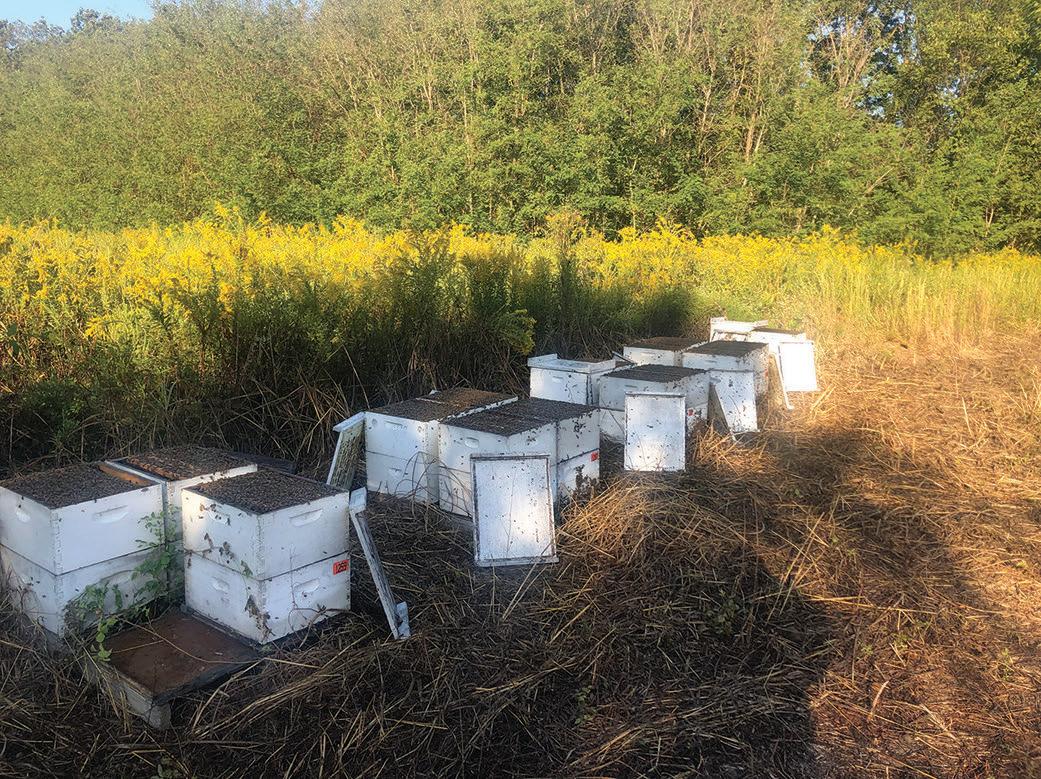
The co-op also seeks new members, particularly in the Southeast. Coy encourages interested producers to reach out to Sioux Honey’s member relations department or attend recruitment meetings this fall.
One in every three bites of food is pollinated by a honeybee in some way, making honey’s economic impact huge. “This has been a great partnership in working with American Farmland Trust,” Livermore said. “They have directly spoken to our membership, and there is a lot of synergy between their end goal and ours.”
As for the American shopper looking to buy domestically sourced products, Sioux Honey delivers. “Choosing U.S. Farmed certified directly supports the U.S. beekeeper [and] directly supports the U.S. farmer and U.S agriculture. By purchasing these products, you support the food system throughout the United States,” Livermore said.

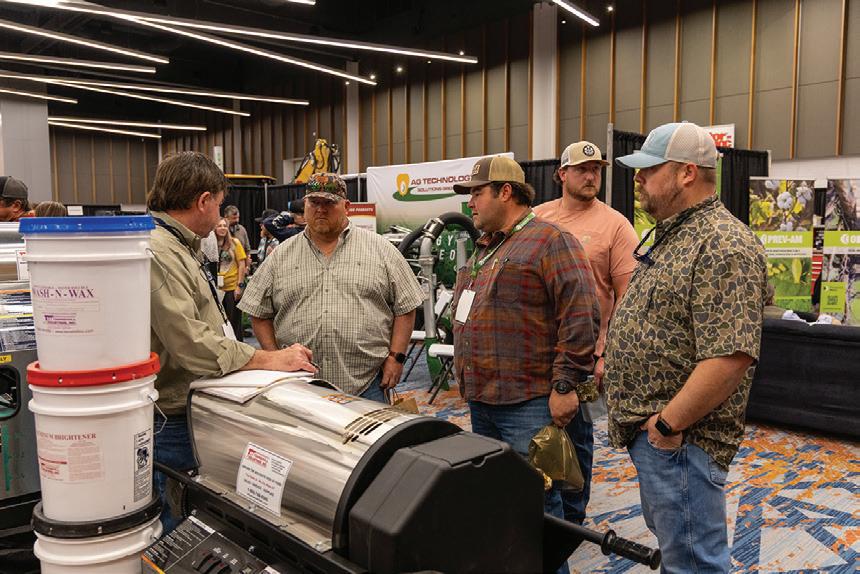
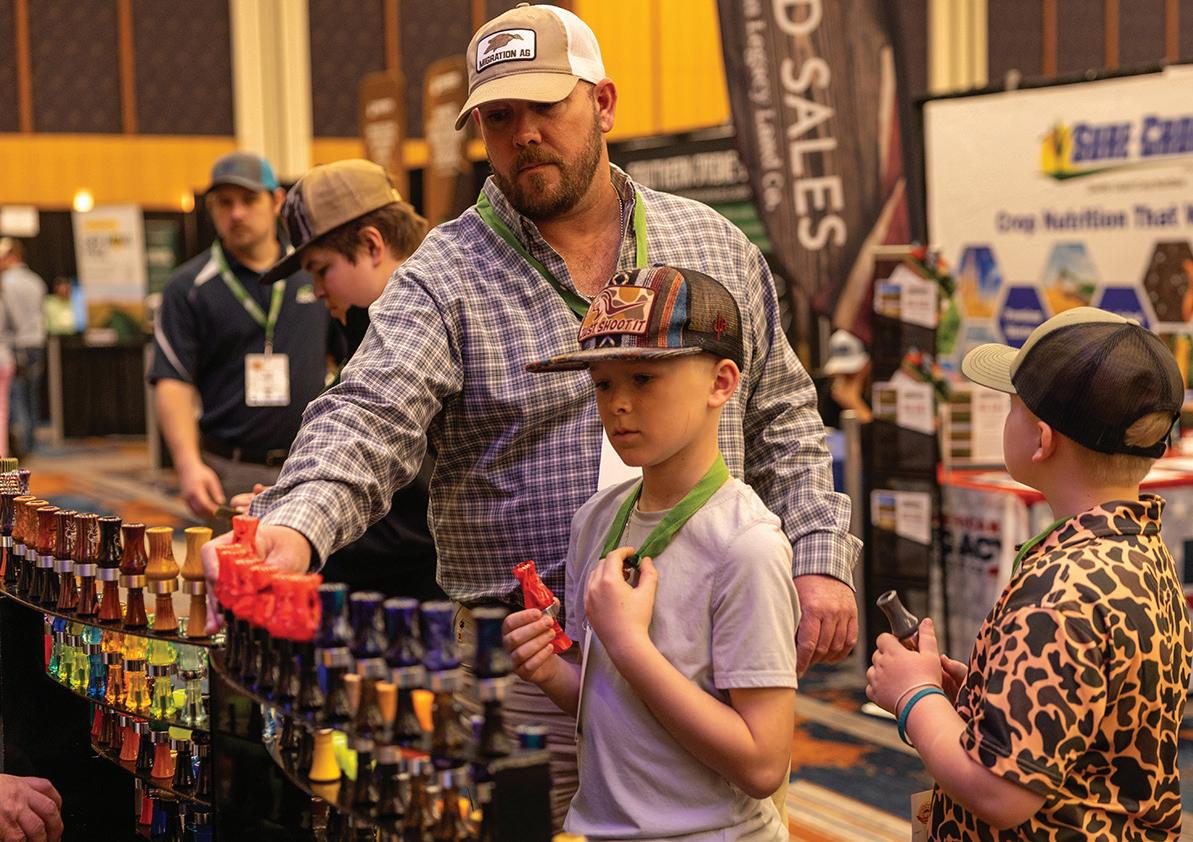

When you come to Memphis, you have so many options of places to go & things to do. From the music of Beale Street to Graceland, Memphis offers a seemingly endless array of entertainment options. The city is filled with unexpected fusions:
Memphis Rock ‘n’ Soul Museum, 191 Beale in the FedEx Forum. — The story of Memphis music is about people connecting: black, white, rich, poor, country folk, and city folk. And no place better dramatizes and organizes the cultural and social ramifications of Memphis’ musical connection to the world than this Smithsonian-crafted, seven-gallery chronicle. American Songwriter magazine calls the Rock ’n’ Soul Museum perhaps “the single best exhibition of American musical history in the country.” For current days and hours of operation, go to www. memphisrocknsoul.org.
Sun Studio, 706 Union. — Ground zero for rock ’n’ roll’s explosion, Sam Phillips’ studio is packed with memories and memorabilia, allowing visitors to experience the stories that put legends like Elvis Presley, Johnny Cash, Carl Perkins and Jerry Lee Lewis on the map. 901-521-0664.
Stax Museum of American Soul Music, 926 E. McLemore Ave. — This 17,000-square-foot museum houses over 2,000 cultural artifacts, celebrating the music made famous by Otis Redding, Booker T. and the MGs, Isaac Hayes, Al Green and many more. Tour time 1½ hours. 901-261-6338.

Elvis Presley’s Graceland, 3717 Elvis Presley Blvd. — No musical pilgrimage would be complete without a trip to the second most popular home in America. The legendary empire takes visitors back in time to see how Elvis lived, touring his private
high culture and outdoor adventure, soul food and haute cuisine, world-class infrastructure and greenways, rich heritage and forward thinking. And few cities tell the story of cotton any better!
jets, automobile collection, the legendary Jungle Room and more. 901-332-3322.
Beale Street — Home to the best live blues, R&B and rock anywhere, Beale Street Entertainment District is a must-see and includes W.C. Handy House, B.B. King’s Blues Club, Rum Boogie Café, Alfred’s Bar & Grill on Beale and over 26 restaurants, clubs and shops.
Old Dominick Distillery, 305 S. Front St. — Join the Old Dominick Distillery team and Domenico Canale’s spirit, while we share with you our stories, our traditions, give you a full tour of our extensive grain to glass spirit making facility and take you through a 45-minute sensory journey. We’ll finish with a tasting of Old Dominick’s fine spirits and a toast. 901-260-1250.
Mighty Lights — Experience the biggest nightly light show on the mighty Mississippi River. See it in all its shining glory at the top of each hour after sundown until the 10 p.m. finale. Thousands of LED lights illuminate Big River Crossing and the Hernando de Soto Bridge in a dazzling and colorful light show that is visible from the riverfront from Beale Street Landing to Fourth Bluff, as well as elevated locations throughout Downtown Memphis including the rooftop bar at the Hu. Hotel and The Lookout restaurant and bar atop the Bass Pro Pyramid.
Backbeat Tours, 197 Beale St. — Led by Memphis musicians, Backbeat Tours provides a rocking ride through Memphis music history in their vintage 1959 GM transit bus, “Miss Clawdy.” 901527-9415.
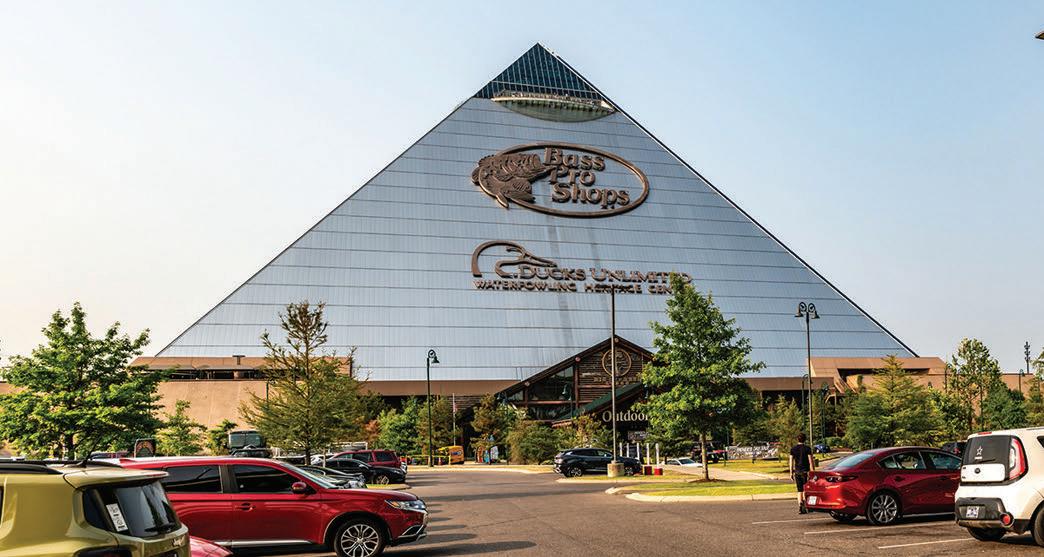

Memphis features entertainment for just about any taste, from waddling ducks to touring Broadway shows.
Bass Pro Shops at the Pyramid, 1 Bass Pro Dr. — Visit the largest retail space for a single retailer in the world, and immerse yourself in this outdoors-man’s paradise. Pick up a few things in the retail shop, dine and bowl at Uncle Buck’s Fish Bowl, or get a picture-perfect view when you take the largest free-standing elevator in the country to The Lookout atop the Pyramid.
Metal Museum, 374 Metal Museum Dr. — Where art is made, not just displayed. The only museum in the United States dedicated exclusively to the exhibition and preservation of fine metalwork. 901-774-6380.
Downtown Shuttles — Memphis Area Transit Authority shuttles operate along Mid-America Mall and other downtown areas. Stops are convenient to most downtown restaurants and attractions. Schedules/fares are posted at stations.
Peabody Ducks, Peabody Hotel, 149 Union.— In the 1930s, Peabody Hotel general manager Frank Shutt placed his live hunting decoys in the lobby fountain, starting a tradition. At precisely 11 a.m., the ducks arrive, marching on their own red carpet to Sousa’s “King Cotton March.” The show repeats at 5 p.m. Due to COVID-19 restrictions, the Duck March is currently open only to hotel residents.
A nine-acre area along Front Street played a dominant role in the history of cotton in Memphis. Designated as the Cotton Row Historical District, many of the structures that housed cotton’s
movers and shakers remain, some still engaged in the business of cotton.
The Cotton Museum is on the first floor of the Cotton Exchange, at 65 Union Ave. When you step inside the Cotton Museum, you’ll have an experience once reserved for a privileged few. You can stand in the very phone booths used by legendary cotton men — and hear stories about everything from the cotton fields to Front Street. Exhibits include an authentic Western Union telegraph office, used to constantly update the merchant offices down the block.
Ten feet off the floor is a massive trading board, with 1939 prices hastily scribbled in chalk. Look higher, and you can see the story of cotton in pictures, as told in a 135-foot custom mural created by renowned Memphis artist David Mah.
There’s more to hear and see on the floor itself, reading, studying artifacts, and viewing video. You’ll be surprised how this downy white fiber has weaved its influence into your life and world. Exhibits include: The Story of Cotton; The Society of Cotton; Cotton in the South; Music and its Cultural Impact; Cotton Today; Technology of Cotton; The History of Front Street; and The History of the Memphis Cotton Exchange.
The building housing the museum was built in 1924 by the Memphis Cotton Exchange. The first two floors are still owned by the cotton trading organization. Calvin Turley is president of the museum’s board of directors. The exhibit is open from 10 a.m. to 5 p.m., but is receptive to staying open longer during the Gin Show.
If you have a group of 12 or more, you can enjoy special discounted rates when you book in advance. The museum can also arrange a guided tour. For more information, call 901-531-7826.
Other sites to catch on Cotton Row:
• Cotton Exchange, 84 South Front. — The first and second Exchange buildings were at Madison and Second Street. The Cotton Exchange was moved to its present location on Front Street in Cotton Row in 1924.
• Armistead & Lundee, 66-70 South Front. — This former cotton office is now an apartment building.
• Reichman-Crosby Co., 60 South Front. — One of the most architecturally ornate cotton offices on Front Street.
• Mid-South Cotton Growers Association, 44 South Front. — Formed in 1931, this organization helped farmers receive loans during the Great Depression. The association ceased operations in 1977.
• Shrine Building, 66 Monroe. — Before this building was constructed, this site was the location of Orgill Brothers and Company, founded around 1862. The company supplied equipment for settlers and farmers.
• Howard’s Row, 35-49 Union. — The south side of Union has some of the oldest commercial buildings in the city. The block housed cotton brokers and merchants from around 1843 to 1928. The building at 45-47 Union may have served as a hospital during the Civil War.
• Oliver Building, 99-103 South Front. — The last of many seed and feed stores which were established on Front Street.


The choices in where to get dinner, drinks or a cup of coffee are nearly limitless in Memphis! With a range of small, locally-owned cafes and restaurants and major chains too, you can find just what fits your mood and taste buds.
We’ve pulled together a list of places within walking dis-
Amelia Gene’s, 255 S. Front St. – Incredible meals, cocktails and service come together for dinner. Reservations encouraged.
Arcade Restaurant, 540 S. Main. — Memphis’ oldest café offers family-style cooking, especially famous for breakfast and brunch.
Automatic Slim’s Restaurant, 83 S. Second. — Memphis meets Manhattan. Southwestern and Caribbean-inspired cuisine.
The Blue Monkey, 513 S. Front St. — The place to go for good food and good drinks in a comfortable atmosphere. A great place to get the real feel of Memphis. Custom-built back bar and loads of artistic appeal.
Brass Door, 152 Madison Ave. — Downtown Irish pub, serving breakfast, lunch and dinner in a relaxed atmosphere.
Capriccio Grill, Peabody Hotel, 149 Union. —Flavorful U.S. prime steaks, fresh seafood, and savory Italian dishes. Classic cuisine with a distinctive Italian twist.
Central BBQ, 147 E. Butler Ave. — Voted No. 1 BBQ in Memphis for award-winning, mouthwatering pulled pork, hot wings and more.
Chez Philippe, Peabody Hotel. — 149 Union Ave. Four-star gourmet restaurant.
Earnestine’s and Hazel’s, 531 S. Main. — The greatest dive in Memphis, live music often. Delicious Soul Burger.
Flight Memphis, 39 S. Main. — Fine dining and flights of wine. Flying Fish, 105 S. Second. — Main selections are fresh catfish, shrimp, oysters, and specialties that include salmon, trout, or tilapia.
Flying Saucer Draught Emporium, 130 Peabody Place. — Large selection of handcrafted beer. “Out of this world” eclectic menu designed to be washed down with “brews from other planets.”
Gus’s World Famous Fried Chicken, 310 S. Front. — A Memphis favorite for hot and spicy fried chicken.
Huey’s Restaurant, 77 S. Second. — Winner of “Best Burger in Memphis” year after year. Live music Sunday afternoons and live blues bands Sunday nights.
tance of the show, some a short shuttle/taxi ride of restaurants and nightlife, as well as areas further into the city like Overton Square, Cooper Young or beyond.
Here are some of the favorite local restaurants within a short distance of the Memphis Convention Center.

Kooky Canuck, 87 S. Second. — Home of 4-pound burger, “The Sas-quatch.” Eat it in less than an hour, all by yourself, and it’s on the house.
Local Gastropub, 95 S. Main. — Chef-inspired twists to favorite menu items. Delicious food from burgers and lobster tacos to fish n’ grits and chicken with sweet potato waffles.
The Lookout at the Pyramid, 1 Bass Pro Dr. – Amazing views of the river from the top of the pyramid as well as great food and service.
Majestic Grille, 145 S. Main. — Flatbreads (another word for tasty pizzas), plus burgers and sandwiches.
McEwen’s, 120 Monroe. — Great food, sophisticated, down-toearth atmosphere.
Rendezvous, 52 S. Second. — Dry-rub ribs are a specialty. Rumba Room, 303 S. Main. — Mission is to introduce Latin culture to the greater Mid-South through food, music, dance. Silly Goose, 100 Peabody Place, #190. — Downtown cocktail lounge.
South of Beale, 345 S. Main St. — Memphis’ first gastro-pub, serving fresh local ingredients and creative cocktails. Texas de Brazil, 150 Peabody Place. — Carvers serve choice cuts of meat.
Wahlburger’s Wild, 1 Bass Pro Dr. – Well-known nationally chain with some unique wild signature items.
One of America’s most famous streets, Beale Street offers a variety of dining experiences, plus live entertainment venues, and features a statue of W. C. Handy. His home sits at the corner of Beale and Fourth.
Alfred’s, 197 Beale. — Full-service bar, casual dining, live music and lots of fun.
B.B. King’s Blues Club and Restaurant, 143 Beale. — The world’s premier blues address. Live blues nightly.
Beale St. Tap Room, 168 Beale. — Cold beer.
Blues City Cafe, 138 Beale. — Old school juke joint & eatery. Homemade hot tamales, shrimp, ribs, catfish, burgers, steaks.
Coyote Ugly Saloon, 326 Beale. — Could be the most famous bar on the planet thanks to the movie. In the heart of Memphis’ famed Beale Street.
Dyer’s Burgers, 205 Beale. — Burgers and shakes. A Memphis original.
Itta Bena, 145 S. Beale (3rd level of B.B. King’s Blues Club). — Tucked away behind a hidden door awaits a warm, friendly place to eat, drink, and have fun in an authentic Beale St. environment.
King’s Palace Cafe, 162 Beale. — Shrimp and crawfish etouffée, live blues and jazz.
Mr. Handy’s Blues Hall, 182 Beale. — The last real juke joint on Beale Street. Inside Rum Boogie Cafe. Live music seven nights a week. Open for dinner.
Pig on Beale, 167 Beale. — Pork with an attitude. Memphis-style ribs.
Rum Boogie Cafe, 182 Beale. — Memphis blues and Cajun cuisine, chicken, and barbecue. Guitar collection of world-famous musicians.
Silky O’Sullivans, 183 Beale. — Piano sing-along. Large patio with live goats. For the Irish in you.
Wet Willie’s on Beale, 209 Beale. Entertainment with live bands and DJs on the weekend; a variety of food.
One of the oldest sections of the city, the Pinch district was settled by Irish immigrants in the late 1800s. Now it is known for its restaurants, night-spots, and antique shops. The trolley stops right in the heart of it.
Alcenia’s, 317 N. Main. — Home-cooking, fried green tomatoes, southern-style breakfast.
Comeback Coffee, 358 N Main St. – Locally owned and operated coffee shop with swagger.
Kinfolk, 111 Harbor Town Square on Mud Island – After years of popups, this Southern cooking has a permanent home for breakfast and lunch. Whether you crave biscuits and gravy or pancakes, you will love your fill here.
Westy’s, 346 North Main Street. — Full-service restaurant with sandwiches, Creole dinners, burgers, wild rice dishes, and hot fudge pie.
Babalu Tacos & Tapas, 2115 Madison Ave. — Southern-influenced tacos, tapas and cocktails.
Bosco’s Restaurant and Brewing Company, 2120 Madison Ave. — Hand crafted beer, wood-fire pizza, fresh fish, steak and sandwiches.
Check out the top 7 things to do this weekend on page 70.
Crosstown Concourse, 1350 Concourse Ave. – Not sure what you want, check out a combination of local eateries in Crosstown. From fried chicken to Vietnamese, burgers to baked items, you’ll find lots of options.
Lafayette’s Music Room, 2119 Madison Ave. — Indoor/Outdoor music club with vintage vibe and live music 7 nights a week.
Enjoy the music & chill vibes at Candlelight: Coldplay & Imagine. The Candlelight concerts bring the magic of a live, multi-sensory musical experience with a quartet of musicians playing pop music in dramatic candlelight. There is a performance at the Memphis Brooks Museum of Art, Friday, February 27 at 8:45 pm.

Catch exhibits, the planetarium and movies at the Pink Palace. There are exhibits covering steamboat stories of Memphis and the science and culture of food. This weekend movies featured on the giant screen include films about the prehistoric planet & dinosaurs, medical marvels of the body, the sun, stargazing, oceans, Apollo 11 and they even show the now classic Back to the Future on Friday night.
Take in a Shakespeare play with a musical twist! The University of Memphis is doing an adaptation of Shakespeare’s “As You Like It.” The classic tale of love, exile and transformation blends the wit of literature with a captivating theatrical performance. At the Edward & Bernice Humphreys Theater on the UofM campus.
Celebrate 50 years of Dixon Gallery & Gardens. There are several exhibits to take note of at the Dixon right now including: Meet the Dixons, Black Artists in America: From the Bicentennial to September 11, and Roger Allan Cleaves: A World on Fire. Note: entrance to the Dixon is free to the public.
Catch the Grizzlies games with other fans! It’s a bummer that the Grizzlies are traveling this weekend, but the game against Dallas Friday night and Sunday afternoon’s game in Indianapolis will likely make some of the sports bars perfect for fans. Consider Huey’s (great burgers too!), the Flying Saucer and Ghost River Brewing (for beer lovers) Max’s Sports Bar and Bardog Tavern!
Live Music – Frankie Holly & the Noise will be at the Flying Saucer Friday night and The ShotgunBillys will be there Saturday night. BB King’s Blues Club Allstar Band plays at BB King’s on Beale both nights. There is always a lot more live music too so check out social media from @ILoveMemphis, @Choose901 and others.

Attend the Mid-South Farm and Gin Show! This show has something for everyone on or near the farm. We have deep dives into the markets with experts, exhibits of equipment big and small, service providers of all kinds and merchants selling various tools and other items.



























MEMPHIS, TENNESSEE