The editor accepts letters and manuscripts for publication from readers all over the world. Include your name and address as a sign of good faith although you may request your name to be withheld from publication. We reserve the right to edit any material submitted .
Send your letters to: info@constructionreviewonline.com
Construction Review is published eleven times a year and is circulated to members of relevant associations, governmental bodies and other personnel in the building and construction industry as well as suppliers of equipment, materials and services in Africa, the Middle and Far East. The editor welcomes articles and photographs for consideration. Material may not be reproduced without prior permission from the publisher. The publisher does not accept responsibility for the accuracy or authenticity of advertisements or contributions contained in the journal. Views expressed by contributors are not necessarily those of the publisher.
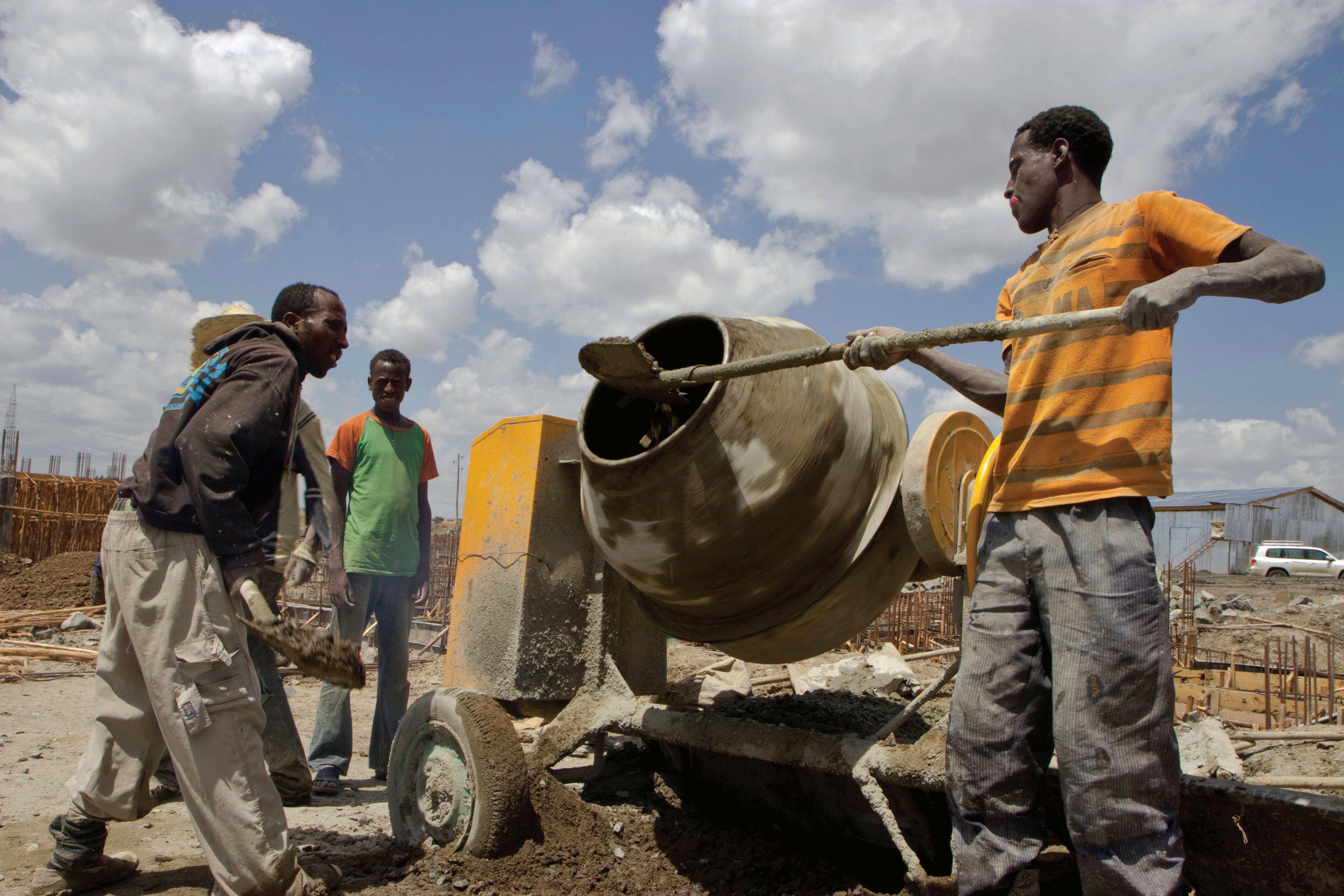
To a budding contractor wishing to establish himself but facing financial constraints, this could be a perfect start point to improve on workmanship, cost and time savings.
Cover Picture
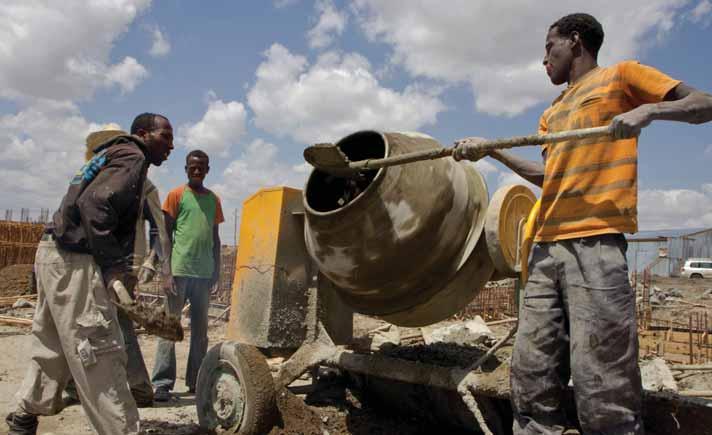
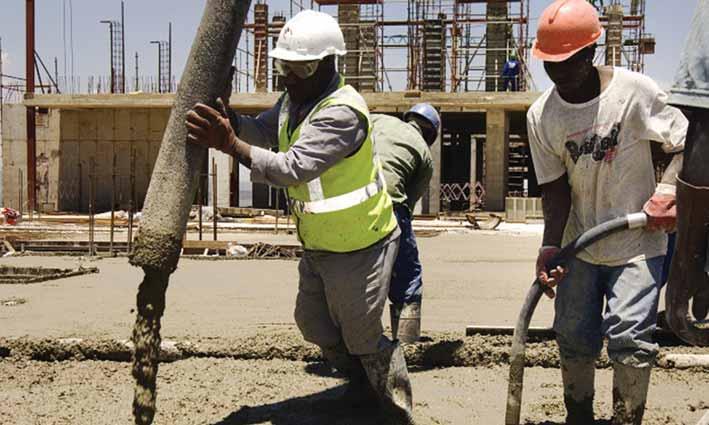
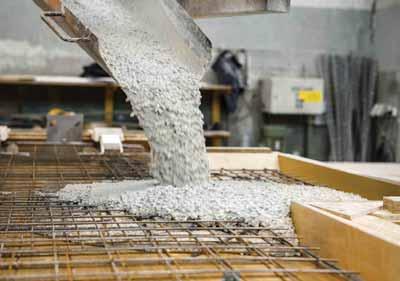
At a construction site in Ethiopia. The use of concrete mixers ensures better consistency of the concrete for small sites where ready mixed concrete cannot be supplied economically.
Ugaandda A Ageent t Proojectts U Unussuaal Uggandda L Ltd Jemmba a Plaaza, Luuwum m St t Kammpaala, Ugaandda Tel: +2256 776 6 88831881 betttykaatonngolle@@yahhoo.com m
Maalawwi Office Cenntre e for r Meedia a Addvoccacy
P.OO. Boox 1 17322, B Blanttyree, Malawwi Tel: 2665999548854 4
E-mmaill: m malawwi@@groouppafriicappubllishiing.com m
Bottswwanna
TENTS
Mechanically Stabilised Walls
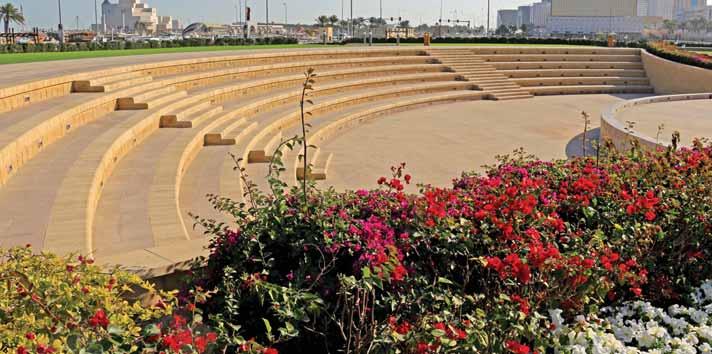
The need for an Amphitheatre, to complement an underground parking facility for shoppers at SouqWaqif shopping hub in Doha, Qatar. We see how this was achieved.
Editor's Comment
Which way for oil pipeline
AAK Award a Major Boost for Aleem Manji Architects
The Architectural Association of Kenya (AAK), organized a forum to recognize outstanding works of architecture in the country. We take a look at some of the winners
In East Africa a tussle is underway regarding which route an oil pipeline from Uganda’s oil fields should follow and whether it should terminate at Lamu or Dares-Salaam. The benefits for the winner will be both political and economical for either Kenya or Tanzania. For Kenya the development of the pipeline will enhance the viability of the Lamu Port that is on the drawing board at present while on the other hand for Tanzania it will be a major coupe’ for the Port of Dar-es-Salaam. Currently it looks like the route through Tanzania is more likely to prevail given that Total who are the main financiers of the US$4billion project have dug in their heels and insisted this is the route they will fund. It appears that the major concerns revolve around the security concerns for a route passing through northern Kenya that would expose the pipeline to the threat of sabotage by Al Shabaab operatives out of Somalia which has the potential to disrupt the construction of the project as well as actual supplies once complete. For Uganda this route is attractive because it will also reduce Uganda’s reliance on Kenya as its sole access to the coast.
Either way the pipeline will bring with it the development of large swathes of the hinterland of East Africa with the promise of rail and road developments, a refinery and liquid gas plant as well as skill transfers.
Kollline e & Hemmed d Innc., B B.P. 33328, , Kiggali, Rwwandda
Tel: +2250 03 7488106
E-mmaill: rwwandda@@grrouppafriicappubblishhingg.com m
Weebsitte: w wwww.kkollinnehhemeed.oorg
Zammbbia Office
Dayyflex x Liimitted, , 4thh. Flloor r Tazzara a Hoousse
Deddan n Kimmathhi R Roaad, L Lusaaka, , Zaambiia. Tel: +2260 211 1 2330 529 / +2260 0 977 7 7556 6 663
Emmail: maakukkasuue@@maail.ccomm, daayfleex06@@gmmail com m
EgyptSouth Africa
Kuwait Fund to support major power plant
Kuwait Fund for Arab Economic Development (KFAED), Middle East’s first institution to undertake an active role in international development affairs has signed a financing agreement to fund the construction of a major power plant in Egypt to the tune of US$100 millions.
The fund currently has 105 beneficiary countries and boasts over US$18 trillion in loan commitments. The funding will go towards funding the South Helwan Power project whose construction cost is valued at US$1.7 billion. According to the terms of the agreement, the loan has a 20 years repayment period at an annual interest rate of 2.5%.
The loan also has a five year grace period. KFAED joins a group of other partners that have already signed up to finance the project. World Bank has offered about US$503.8 million, the Islamic Development Bank has loaned US$450 million, the Arab Fund 55 million Kuwait dinars while the African Development Bank has committed US$ 90 million. The agreement was signed by Egypt’s minister in charge of International Cooperation Sahar Nasr and Abdulwahab Ahmed Al-Bader, the Director General of Kuwait Fund and witnessed by Egypt’s Minister of Electricity Mohamed Shaker.
First solar powered airport opens
The first solar powered airport in South Africa has officially been opened making it a first of its kind in Africa. Environmental Affairs Minister Edna Molewa congratulated the Department of Transport as it is one of the key departments paving way for South Africa’s Green Economy Strategy. Majority of the airport’s energy needs will be supplied through 200 square meters of photo-voltaic (PV) panels PV technology generates electricity from solar radiation providing a renewable and clean energy source.The first phase will involve generation of 750kw through this clean energy source sufficient to meet the airport’s daily needs. This is however expected to increase with plant capacity in future. The minister said the government is on track in transitioning South Africa to a low-carbon, resource efficient and green economy. Green transport initiatives form part of government’s strategy to shift the economy towards sustainable industries with low environmental impact. This is in alignment with South Africa’s National Climate Change Response Policy whose objective is to effectively manage climate change impacts through interventions that build and sustain South Africa’s social, economic and environmental resilience and emergency response capacity.
Ghana
China to construct two 350MW coal-fired power plants
Shenzhen Energy Group Co. Ltd. of China (SEC) is expected to construct two 350MW coal-fired power plants in Ghana. The Chinese company in collaboration with Volta River Authority (VRA) aims to construct the two power projects to meet future power demand in the country. China-Africa Development Fund (CADFund) has committed to provide US$1.5bn long-term loan towards the construction of the power plants which will be located at Aboano in the Ekumfi district of the Central Region. Besides SEC being considered the largest power producer, it seeks to strengthen the country’s base load and forestall any future shortage of power while the existing plants are due for mandatory maintenance. In fact, the plant will be further expanded by either a 4×350MW (or 2×600MW) super-critical coal-fired generating units in the future as power demand is expected to rise. Presently, the country’s power demand stands at about 2,225MW of which the demand is expected to hit 7,000MW of power by 2030. VRA and SEC conducted a successful pre-feasibility study and design of the plant.
Rwanda
Deal signed with AfDB for Ruzizi III hydropower plant
The African Development Bank (AfDB) in conjunction with the Government of Rwanda has signed a US$25m agreement that will see the construction of the Ruzizi III regional hydropower plant come to birth. The Minister for Finance and Economic Planning, Mr. Claver Gatete confirmed the news and said that the concessional loan is one of the cheapest and is to be paid back in 38 years with a grace period of 5 years. He also noted that the project emphasizes on ensuring reliable and affordable power supply in the region.
“The project highlights the importance of ensuring reliable and affordable electric power supply to achieve sustainable economic transformation, Gatete said. Ruzizi III hydropower plant which is shared by Rwanda, Burundi, and the Democratic Republic of Congo (DRC) is anticipated to generate more than 147MW of electricity, the electricity will hence be shared equally amongst the three participating countries with Rwanda getting at least 50MW of electricity. Mr. Gatete also pointed out that this is the first regional project designed as a public-private partnership aimed at optimizing the hydropower potential across the region. Negatu Makonnen, the AfDB country representative, said that the development includes the construction of an 8.3 kilometer and 220KV transmission line connecting Kyamanyola power dispatch center and associated power evacuating lines.
Zambia
Itezhi-Tezhi HydroPower station inaugurated
The newly-constructed ItezhiTezhi Hydro-power station in Zambia has officially been commissioned by President Edgar Lungu. The 120 megawatts (MW) station was constructed at a cost of US$142 million and funded by among others, banking institutions in partnership with the Development Bank of Southern Africa. The inauguration of this project reiterated the government’s commitment to mitigate and curb the current power shortfall caused by both global and natural factors.
The President said despite the challenges the country was experiencing, his administration remains on course to making Zambia an energy power house in the region and delivering electricity to every part of the country. This is being addressed through a number of key projects geared at addressing the entire power grid infrastructure. This project is a brainchild of The Itezhi-tezhi Power Corporation, a joint venture company between Tata Zambia and Zesco and was started in 2011. To further enhance the country’s power generation capacity, the President directed the Energy and Water Development Minister Dora Siliya to ensure all the pending electricity projects were completed.
Nigeria
Infrastructure development boosts construction industry
Nigerian construction industry will continue to grow exponentially thanks to a parallel growth and expansion of infrastructure construction in Nigeria. This is according to a new report from Timetric’s Construction Intelligence Centre (CIC). According to the report, the future is promising for the Nigerian construction industry with the industry’s annual average growth of 9% over the next five years The industry has already registered an annual growth of about 12% over the past five years. The industry is therefore projected to grow from US$56.1 billion recorded in 2015 to US$88.2 billion in 2020 based on a constant 2010 USA dollar exchange rates. The Nigerian government has increased the budgetary allocation on infrastructural development so as to address the deficit in the country. An allocation of close to US$ 5 billion in the 2016 budget will be used in improving Nigeria’s road, rail, airport and other related infrastructural projects. Additionally, the government intends to set a fund of US$25 billion to steer infrastructural improvement by 2020. With this expansion, the construction industry is set to benefit to a bigger percentage.
Nigeria
Arab Contractors to construct multi-million dollar port
Egyptian leading construction firm Arab Contractors will be in charge of the construction of a multi-million dollar port in Nigeria the firm’s Chairman Mohsen Salah has said. The multi-million dollar port in Nigeria is expected to cost the Nigerian government USD280 million. Mr Salah said that they will work to ensure that the project is completed in time. “We will be using the latest technology which will ensure that the port lasts for many years and still look new” he added. Arab Contractors has also been commissioned to oversee the main utilities extension project in a residential city in Nigeria, worth 1.7 billion Egyptian pounds, Salah noted. The latest projects come as part of a series of other construction businesses in Nigeria being managed by Arab Contractors. The company’s volume of business in Nigeria has registered one billion pounds. On the other hand, AC has captured a large number of utilisation and road projects in Equatorial Guinea and Chad. Arab Contractors is considered one of the most prominent construction firms in the Middle East and North Africa, and one of the largest companies in Egypt.
Kenya
Construction design of Mombasa gate bridge begins
The design for the construction of the Mombasa Gate Bridge has commenced by the government through the Ministry of Transport and Infrastructure. Once complete, the new bridge will offer an alternative passage to the south coast from the island which is currently serviced by ferries managed by the Kenya Ferry Services. Infrastructure Principal Secretary Eng. John Mosonik confirmed the reports and said that the Survey team has already started their work of which the first phase will be conducted until July this year while the second phase will be carried out up to February 2017.
“The design study commenced on 14th March, 2016 and the final report and designs will be ready by end of March 2017,” Mr. Mosonik said. Provision of a permanent crossing will facilitate movement of goods and people between the Island and South Coast and beyond to Tanzania, reduce conflict between docking ships and ferries and decongest the Island by ensuring free flow of traffic. The financing for the eventual construction work will be known after the completion of the Survey. “The channel between the Mombasa Island and the Southern Coast, will serve as the access to the port of Mombasa from the open sea. In light of these traffic volumes and which is projected to grow it was necessary for the government to explore an alternative crossing at this location, so as to provide a more reliable and efficient crossing,” Mosonik noted.
Kenya KenyaSouth Africa
Sarit Centre mall to construct a US$ 40m building
Sarit Centre which is among Kenya’s oldest malls has revealed that it is planning to construct a US$ 40m extension besides its existing mall so that it can serve the growing population in Westlands, Nairobi. The four storey development will constitute 250,000 square feet of retail space and a whole floor of it will be devoted to a new supermarket. The other three floors will have extra retail space, food courts, an exhibition hall and entertainment facilities. The new construction will also accommodate a multi-storey car parking silo which will help create more parking space. “Westlands has become one of the prime spots for office and retail space expansion. With the burgeoning growth in the population of Westlands and the development of competing malls, this expansion is almost inevitable,” an environmental audit report says.
However, some facilities will be demolished to pave way for the proposed development including the existing car park, one office building and a few residential apartments. Sarit Centre which is owned by Soma Properties has been a major landmark in Westlands since its establishment 33 years ago. This will be the second major expansion bid since the first one was launched in 1997. The building currently houses 130 tenants who include retailers, service companies and offices.Kenya has been in the limelight over the last decade with numerous malls being constructed across Nairobi offering more competition to the older shopping establishments like Sarit Centre.
Centum to construct exclusive city in Kilifi County
The construction of an exclusive city in Kilifi County at the Kenyan Coast is set to commence; this is according to NSE-listed investment company, Centum which is the company behind the mega project. The city will sit on a 9,500 acre piece of land currently under sisal. Centum has already begun on preparations for the construction and through this advancement they will have extended their entry into the high-end real estate development. Regulatory filings illustrate that the project which is dubbed the economic hub will be developed in phases. The first phase will see the construction of an infrastructure on 900 acres of the land and is expected to cost US$ 8m. The 900 acres has been sub divided and it includes residential, commercial, industrial, institutional, recreational, and public zones. “The Master Plan development has been phased for over 30 years and it will be gradually implemented at an average rate of 900 acres in the first years and 200 acres per year starting with areas without sisal and later on land with old crop that will not be replaced,” says part of the regulatory filings. Centum’s subsidiary, Athena Properties Ltd which is a construction firm, will carry out the infrastructure works for the state-of-the-art development in Kilifi.
South Africa
Tallest building in Africa proposed for Durban
The tallest building in Africa has been proposed for Durban city in South Africa if the ambitious proposal for a US$390m project presented to the city’s economic development and planning committee recently is effected. eThekwini Municipal spokesperson Tozi Mthethwa recently said that a proposal for the 88 storey building had been presented to the municipality‘s Economic and Development Planning Committee by the Durban Tower Development Company. He was however quick to clarify that this is just a proposal at this stage awaiting final decision from the relevant stakeholders. ”No final decision has been made regarding the development and it is still in the proposal phase,” Mthethwa said. If the proposal is adopted, this skyscraper will be constructed to a tune of R6 billions and will be ready for occupation in 2021. This building will be multi-functional and will host retail, commercial, parking, hotel and residential facilities. If adopted, the building would be 370 metres above ground and would be the tallest building in Africa as well as the Southern Hemisphere a status that is currently held by Carlton centre located in Johannesburg.
Cape Town International Centre to be expanded
The City of Cape Town and Western Cape government have jointly initiated the expansion of The Cape Town International Convention Center to a tune of R832 m (US$54m). This initiative is aimed at increasing the competitiveness of Cape Town as a world-class meetings and events destination. According to CTICC CEO JulieMay Ellingson, this expansion is aimed at increasing CTICC’s existing exhibition capacity to accommodate more business opportunities, house more and bigger events and ensure economic sustainability.
He reiterated the significance of this facility in the local economy, having created more than 91,000 direct and indirect jobs since its inception. Grossly, the CTICC has contributed R28.8bn into South Africa’s gross domestic product and a further R25.6bn to the gross geographical product of the Western Cape. This expansion will see an additional 10,000m2 of multi-purpose conference and exhibition space and 3,000m2 of both formal and informal meeting space created. The facility will be enhanced further through the underground tunnel that will connect CTICC West and East, enabling guests to move smoothly between the two buildings. With only 40% of the work remaining, the CTICC is practically moving to its completion at the end of 2016. The building is scheduled to be commissioned somewhere between November 2016 and February 2017 with official expansion scheduled to open in March 2017.
NUCA assigns units to contractors for Tahya Masr housing project
As Egypt embarks on curbing the housing shortage that is currently facing its growing population, the ministry of housing through the New Urban Communities Authority (NUCA), has started assigning new housing units to contractors to start implementing the “Tahya Masr social housing project”. The housing projects that were early on launched by Egyptian President Abdel Fattah Al-Sisi in Febuary are set to be implemented by the contractors that will be chosen by Urban Communities Authority. The Tahya Masr (Long Live Egypt) is a donation based fund that was launched by the president in June 2014. Several businessmen and banks made notable donations.
The main purpose of the fund is to assist establishing services and development projects including financing micro-enterprises, infrastructure projects, small projects for the youth demographic, the development of the informal housing sector, the reduction in the number of homeless and street children, and other projects contributing to the economic and social situation of the country. According to President Sisi the government will pump more funds to ensure that the project is implemented and the funds will accumulate by the end of the year 2016.
Nigerian Society of Chemical Engineers wants economy diversified
The Nigerian Society of Chemical Engineers (NSChE) has urged the Federal Government to promote other sectors of the economy in the country and stop the reliance on oil and gas due to unstable crude oil prices. The association made the plea at the NSChE’s first Public Lecture by the International Chemical Engineers (IChemE), United Kingdom, held at the University of Lagos, Akoka, Nigeria. According to Dr. John Erinne, the association’s International Affairs Committee Chairman, the challenges facing the nation such as the dwindling oil prices and oil returns requires professional bodies to offer solutions such as what value chemical engineers can provide to help Nigeria get out of the current situation. “The country can decisively move in the area of diversifying and reducing the reliance on oil as a source of revenue,” stated Dr. Erinne. “Chemical engineering is not all about oil and gas. It is a broad profession in any area that involves transformation and processing of materials from one form to the other,” he added. Chemical engineers are at the forefront for the diversification of the country’s economy. They poses a lot of skills to contribute towards improving agriculture and agricultural produce as well as solid minerals.
According to the Federated Employer’s Mutual Assurance Company (FEM), which provides cover to employers in the construction industry, 7,721 injuries occurred nationally in South Africa amongst policy holders during 2015. This resulted in 61 fatalities, 603 permanently disabled persons and 34,385 lost man days. Deon Bester, Occupational Health and Safety Manager at the Master Builders Association of the Western Cape (MBAWC), says, “The rate of accidents in the construction industry still remain unacceptably high.”In the Western Cape alone, the number of accidents that have taken place over the past five years has risen by an average of 12 percent year on year. Between 2011 and 2015 there were 18 deaths and 202 permanent disabilities resulting from accidents. Furthermore, 29,671 man hours were lost and the average cost per accident stood at R17,532,20. He continues, “The Western Cape remains one of the provinces with the highest accident frequency rate. At a current rate of 3.7 percent , versus the national average of 2.67 percent, we are 28 percent worse than the average. In other words, we have 28% more accidents per 100 people employed in the construction industry.
Substantial
increase in CMA Awards For excellence entries
The 2016 Concrete Manufacturers Association NPC, (CMA) Awards for Excellence competition has drawn a bumper crop of entries, which at 123was almost double the 77 submissions entered during the last competition. Images and entry details of the competition’s six categories can be found in the Awards entry book which has been published electronically on the CMA’s websitewww. cma.org.za. The book provides a valuable reference document on some of the country’s most prestigious construction projects using precast concrete.
Chairperson of the Awards committee, Monique Eggebeen, says that the standard of this year’s submissions was high and in some cases extremely so. “It is quite clear from this year’s entry submissions that the use of precast concrete is growing rapidly across diverse applications, offering ease of installation, as well as high standards of finish and durability. “First staged in 1985, the Awards have since become the undoubted highlight of the precast concrete industry’s calendar. They provide an excellent vehicle for southern African designers and project developers to establish themselves as trendsetters across several disciplines, and in doing so, to gain national recognition.
MBAWC releases report on accidents in construction industry
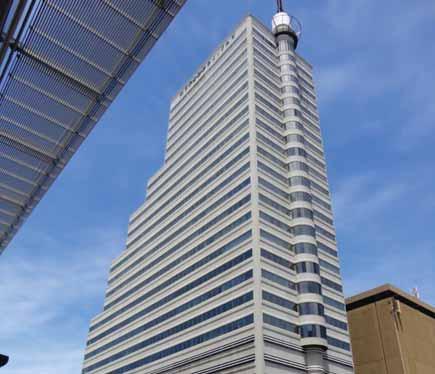
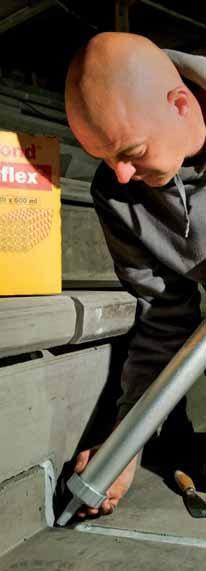
Completed in 1993 and owned by Eris Property Group, the 28-storey premier grade Metlife Centre is one of the tallest buildings in Cape Town; its roof spire soaring to a height of 120m above the city’s Foreshore District. Sika’s high performance repair products were chosen for its recent renovation. When a project was approved to weather-seal the building’s precast concrete façade, LH Consulting Engineers needed no persuasion in specifying Sikaflex AT-Façade, a high performance elastic joint sealant that ticked all the right boxes for the most effective protection.With over a decade’s experience in high rise building refurbishments, Skysite was awarded the contract which necessitated rope access for the entire project.
Sikaflex AT-Façade is a one-part, moisture-curing sealant based on silane terminated polymers. Offering excellent workability characteristics as well as low stress to the substrate, it is solventfree and silicone-free and although primerless adhesion on many substrates is possible with Sikaflex AT-Facade, the extreme weather exposure of the Metlife Centre necessitated the specification of a primer. The precast concrete facade panels were initially primed with Sika Primer-3N (24 units) specifically designed for application on porous substrates. This one-component, epoxy-polyurethane solvent-based product is easy to apply and provides good wetting out properties.Upon completion of the project in September 2015, 2000 cartridges of Sikaflex AT-Facade had been applied. The main factors leading to the specification of this top class Sika product included outstanding adhesion, a movement capability of 25%, plus exceptional weatherability with the highest possible UV resistance. Thanks to Sika, Cape Town’s Metlife Centre, a modernism-style office tower, has a new lease of life.
Kenya corrosion mapping project initiated by Mabati Rolling Mills Ltd
Mabati Rolling Mills (MRM) has inaugurated a Kenya Corrosion Mapping Project at it’s Mariakani Factory site, near Mombasa in Kenya. The Project is a structured research program being carried out jointly with the University of Nairobi Department of Chemistry under Dr. John Onyatta. The objective of this Project is to provide live data to help identify the different climatic corrosion zones in Kenya. This type of data is currently lacking in Kenya and MRM has taken leadership, together with the University to bridge this gap. For a long time, Professionals within the Built Industry have had to use what can at best be described as guesswork when it comes to roofing products specification and often this has led to products failing to meet client’s expectations especially within the harsh coastal zone.
No scientific study has ever been conducted previously to guide professionals in matching different roofing products with the different climatic zones in the region. Materials specified for any project must take cognizance of the environmental conditions within which it’s being used if it is give the reliable service life expected from it. The University has assigned a Graduate Consultant, Mr. Juspher Omondi, to the site and final touches are now being done to the Mariakani corrosion exposure site before being rolled out to another three sites in Kenya and one more in Dar es Salaam, Tanzania. In Kenya, other sites will be located at Mombasa, Athi River and Kisii.
BBOXX to invest more solar power in Africa
British based solar energy provider BBOXX has completed a significant funding round of approximately $15m which will accelerate the company’s vision of improving access to energy across Africa and the developing world. This latest round of funding means that BBOXX will have secured a total of $9.8m in equity investment and $5.3m in debt funding in 2015, including a scalable working capital facility. This has been contributed to by existing investors DOEN Foundation, Bamboo Finance, Ceniarth, Khosla Impact Fund and Synergy Energy, as well as new backers ENGIE Rassembleurs d’Energies and MacKinnon, Bennett & Co.
BBOXX has secured a landmark US$500,000 securitization deal with Oiko credit, a social investor and worldwide cooperative providing loans and equity to enterprises within low income countries. This is the industry’s first ever deal – called Distributed Energy Asset Receivables (DEARs) – that uses securitisation as a means of financing solar home systems in Africa. The securitization will allow BBOXX to realise income from its payment plan sales model up to three years earlier, and with the additional investment allows the company to produce more solar home systems and therefore bring power to more households living without grid electricity. Persistent Energy Capital acted as financial advisors in the DEARs transaction.
Cape Town Skyscraper gets Sika Treatment
PUMPMAKERS launches first platform for DIY
PUMPMAKERS (www. pumpmakers.com) from Austria have launched the PUMPMAKERS PLATFORM, a virtual marketplace that helps people help themselves by providing individuals, local companies,NGO’s and volunteers with free access to the easy-to-use Do-It-Yourself Solar Pump and a global network to implement projects for everyone where there is a need of water. This helps reduce the global water shortage, strengthens the local economy, creates jobs and prevents migration from rural areas. PUMPMAKERS have successfully installed DIY Solar Pumps in Africa and Europe since 2012. A single pump system provides up to 1,000 people a day with clean drinking water. Building on the success of these first projects, new PUMPMAKERS projects are following suit in Somalia, Morocco, Zambia, Cameroon and Tanzania. PUMPMAKERS are expanding the PUMPMAKERS PLATFORM globally with new projects and project partners in the African region. To this effect, entrepreneurs, local companies, NGOs and simply individuals requiring water every day may register themselves free of charge on the PUMPMAKERS PLATFORM, and present their company, organization or project to a global community.
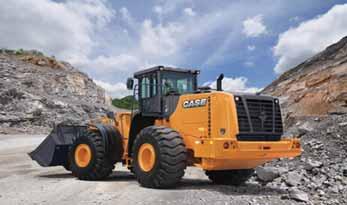
CASE Unveils the Tier 4 Final 521F Wheel Loader
CASE Construction Equipment has introduced the new 521F wheel loader that meets federal Tier 4 Final emissions standards using Selective Catalytic Reduction (SCR) technology. The new machine delivers best-in-class 131 net peak horsepower with an FPT Tier 4 Final-certified engine that also provides quick throttle response and impressive torque. The 22,948-pound wheel loader has a bucket breakout force of 19,303 pounds with 2.3-cubic-yard bucket capacity. The SCR technology allows the machine to handle inconsistent engine loads while running at peak performance without compromising power. This is accomplished with a faster throttle response and acceleration, all while maintaining lower exhaust temperatures and improving fuel efficiency. With SCR technology, the 521F Tier 4 Final wheel loader features 10 percent greater fuel economy over wheel loaders featuring CEGR-DPF solutions. Additional fuel savings are achieved with a standard auto-idle feature that helps minimize excessive fuel burn during operator inactivity by further lowering engine RPM. Standard auto shutdown then shuts down the engine after an operator-selected length of time to further preserve fuel.
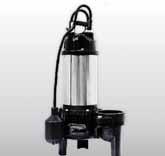
Hung Pump launches NonClogging Vortex Sewage
Leading pump manufacturer
Hung Pump not only has strong manufacturing facilities in both Taiwan and China, but their facilities are also supported by multiple engineering team. Recently the company launched the Non-Clogging Vortex
Sewage Submersible Pump with the following characteristics
Liquid temperature: 0 °C to 40 °C/ +32 °F to +104 °F
HP range: 1/2 to 3 HP / 0.4 kW to 2.2 kW
pH : 6 to 8
Protection class: IP68
Maximum immersion depth : 8M
Leading lubricant compnat lubriplate has introduced an Environmentally Acceptable Lubricant (EAL) that was designed to outperform conventional products in a variety of marine applications. It has excellent water Lubriplateresistance, good oxidative stability and provides a high level of protection against rust and corrosion. It is excellent for all slow to medium speed bearings. It has exceptional high shear stability, excellent water resistance and outstanding loadcarrying properties.
APPLICATIONS:
Articulated Tug Barge (ATB) Notch Interface, Coupler Ram and Drive Screws, Above Deck Equipment, Rud- der Shafts, Wire Rope, Port Equipment and Cranes, Barges, Oil Platforms, Water Treatment and Hydroelectric Facilities and Wherever an Environmentally Acceptable Lubricant (EAL) is required.
Hung Pump has kept upgrading their design capability and insist on every pump meeting international standards while closing the emerging trends in global innovation, energy efficiency, and environmental awareness.
Lubriplate introduces Biobased EP-2 Grease
2nd ZambiaBuild
International Construction and Interiors
Exhibition
The Zambia International Building, Construction and Interiors Exhibition returns following a very successful first edition in 2015. ZambiaBuild 2016, organised by ZPTE and AME Trade Ltd and supported by the National Council for Construction (NCC), Zambia Development Agency (ZDA), the Engineering Institute of Zambia (EIZ) and the American Chamber of Commerce (AMCHAM), is the leading and most significant event in the construction & building industries in Zambia. ZambiaBuild 2016 will be held at the New Government Complex Conference Centre, Lusaka, Zambia, from 23-24 June 2016.
Kenya
- Architectural Association of Kenya
Roads and Highways Egypt Conference, Cairo, Egypt
Date: 14-25 May 2016
Venue: Cairo
Website: http://bit.ly/1o27ROf
Join key stakeholders from the Egyptian Ministry of Transport, Egyptian Holding Company for Roads, Bridges and Land Transport, Egyptian Ministry of Housing, Egyptian Ministry of Finance, AMG Al Amar Consulting Group S. A., and more at the Roads and Highways Egypt Conference (24-25 May 2016, Cairo). These stakeholders are looking for solutions to solve challenges relating to Phase 2 of the National Roads Programme, the National Intelligent Transport Systems Programme as well as the CATIC refurbishment projects.
Botswana
- Institute of Botswana Quantity Surveyors
Association Partners
- Institute of Quantity Surveyors of Kenya
- Institute of Engineers of Kenya
- Association of Consulting Engineers of - Kenya
- Association of Professional Societies of East Africa APSEA)
- Kenya Property developers Association
- Institution of Surveyors of Kenya
South Africa - ASAQS - SAICE
- South African Council for the Quantity Surveying Profession
- Khuthaza ( Women for Housing)
- Concrete Manufacturers Association
- Green Building council of SA
- South African Property Owners Association
- Master Builders South Africa
Uganda
Institute of Surveyors of Uganda
Ethiopia
- Association of Ethiopian Architects
- Ethiopian Association of Civil Engineers
Ethiopia
- Construction Contractors Association of Ethiopia
Zimbabwe
- Zimbabwe Institute of Quantity Surveyors
- Zimbabwe Institute of Engineers
- The Construction Industry Federation of Zimbabwe (Cifoz)
Ghana
- Ghana Institute of Engineers
- Architects Registration Council
- Ghana Institute of Surveyors
- Ghana Green Builders Association
- Ghana Institute of Planners
- Association of Building and Civil Engineering Contractors of Ghana
Namibia
Institute of Namibian Quantity Surveyors Association of Consulting Engineers of Namibia Tanzania
Accra Building Show to boost housing efforts
Africa is rapidly urbanizing and will lead the world’s urban growth in the coming decades, says a World Bank report* published in March 2016. However, in Sub-Saharan Africa, urbanization is not accompanied by the level of per-capita economic growth or housing investment that is observed elsewhere in global trends. Ghana is far from immune from this situation, which is why the upcoming Water Africa & West Africa Building & Construction Exhibition & Seminars being held in Accra, Ghana from 2224 June 2016 will be a timely push to provide developers and contractors with new ideas and tools to get housing construction moving faster. A look at the same event last year provides an idea of the importance the housing and building sector .
- Tanzania Institute of Quantity Surveyors
- Construction Regulation Board (CRB)
- Tanzania’s Registration Board of Architects and Quantity Surveyors (AQSRB)
Nigeria
- Association of Consulting Engineers Nigeria
- Association of Professional Women Engineers Of Nigeria
- Council of Registered Builders of Nigeria
- The Nigerian Institute of Architects
- American Association of Petroleum Geologists Africa Region
- Nigeria Society of Engineers
- Nigeria Institute of Architects
- Building and Construction Skilled Artisans Association of Nigeria (BACSAAN)
Zambia
- Zambia Institute of Architects (ZIA)
- Association of Building and Civil Engineering Contractors (ABCEC).
Louis Shaffer, Distributed Energy Segment Manager, EMEA Eaton
Harnessing the power of solar for development in Africa
Did you know that two out of three people in Africa live without electricity? Solar may be the answer to quickly changing that picture. This is because over the last decade, the cost of installed solar energy generation has decreased dramatically, but also because photovoltaic solar or PV can be installed anywhere the sun can reach. PV is thus extremely apt for distributed applications such as roofs, street lamps, and mobile applications. Solar power requires only a few simple components, and can quickly be up and providing much needed electricity at the point where it is needed. This is why PV solar, much like mobile telephone penetration before it, is quickly becoming a viable solution for Africans of all kinds.
When it comes to the development of the lives of the excluded, renewable energy growth in Africa is growing in leaps and bounds, and allowing people who previously had limited access to reliable, affordable, safe energy to change their lives. Renewable energy has become a buzzword in regards to power generation in Africa, but it will not quickly overcome fossil fuels as the main source of power. That said, it is important that the future includes increasing solar power and other renewables as Africa sustainably and gradually shifts towards efficient and affordable power for all of its people.
huge geographical area. At the same time, Africa boasts excellent irradiance (available sun energy) as well as abundant land on which to set up solar energy infrastructure. As costs come down, more and more African people, businesses, and governments are coming around to realise that solar changes the paradigm of how to get reliable and cost effective power that in turn will only speed the progress already taking place. Further investment from the private sector coupled by government funding and supportive legislation is key to enabling this push forward into solar, and ensuring a fully powered Africa in the near future.
Growth prediction
Renewable energy in Africa is growing in leaps and bounds, and allowing people who previously had limited access to reliable, affordable, safe energy to change their lives.
As African economies grow, we already see a corresponding rise in energy demand across the continent, often beyond what the current power sources can supply. The effects of this reality have already been felt in the two biggest economies, Nigeria and South Africa; which are forced to consume large amounts of diesel as backup when there are power shortages on the grid – or to go without power altogether in such cases. Adding new electricity production by nonrenewable means is costly for governments in Africa, and there are immense challenges in any case to transport power across such a
In their “Brighter Africa” report, McKinsey & Company forecast some major megatrends for sub-Saharan Africa. By 2040, the population will double for 2010, and the GDP will see a five-fold increase. This in turn will require that power consumption that is four times greater in just 30 years than the estimated 400 TWh currently being consumed. African governments have not been sitting still or ignoring renewable energy. The South African government has led the way with the highly innovative REIPP Procurement program. This program in just 3 rounds of bidding has allowed a tremendous growth in renewable energy, all the while cutting the costs by a factor of over 3. The independent agency Council for Scientific and Industrial Research had already reported a conservative estimate by early 2015 that this program had actual saved the country almost $1-billion.
Governments in many of the other countries have also been implementing their first major renewable projects. Examples of this are wind farms in Ethiopia and Kenya, and major solar announcements in first projects in Nigeria and many other countries. As an example of Africa’s leading innovation, the Kenyan government recently announced
an investment partnership with the private sector in a bid to generate over 50% of its electricity from solar. Not to be outdone, Rwanda also announced the opening of East Africa’s largest solar power plant.
South Africa’s Transport Minister, Dipuo Peters, also announced the launch of Africa’s first solar powered airport in George in February 2016 which consists of a 200 square metre clean energy source designed to supply the airport with 750kw of its total electricity needs. Commercial and private individuals are also now investing in solar as a way to offset or eliminate diesel backup costs in applications ranging from mining to small commercial enterprises. Perhaps most encouraging are the growing “micro solar” penetration in countries like Kenya, where for less cost than kerosene, hundreds of thousands of small homes are able to have lights, power for computers and phone charging, and radio / TV’s. Such systems often are paid off in less than a year, after which the user has more disposable income to invest in more solar.
Furthermore, this alleviates the safety and logistic problems associated with kerosene for lighting. This is an example of how the demand for electricity is outpacing supply across Africa, because as mentioned above, serious challenges exist to build new power stations, but even more to build a transmission network to rural areas.
Not without challenges
Solar power is not without challenges, especially as it disrupts what till now has been a very simple, if not very efficient model of power produced then transmitted over long distances, then distributed to individuals and businesses. Solar changes this flow to multidirectional, and also can impact current business models for power producers. Also, grid operators must manage the supply which now fluctuates. While demand has also always fluctuated, the speed to have solar in place presents challenges to grid operators that are not negligible.
Fortunately, solar power is quite predictable and controllable. With proper rate schemes and regulations, it is possible to grow rapidly the amount of power available, while maintaining a steady grid. Germany, the leader in installed renewable power, only experiences a few minutes of power outages a year! Furthermore, energy storage prices are now also dropping rapidly, and many users are already combining solar plus storage to ensure that most if now all locally produced solar is also consumed at source. It is clear that Africa is going to see a rapid growth in the deployment of solar power. This form of energy is a viable option that can be deployed in the most remote of regions, where most of the population lives.
Solar power has been shown to produce strong job growth wherever it has been deployed, and this is something that will also benefit African entrepreneurs. Solar is not without challenges, and it will take time to go through the learning curve, to train people technically, and to understand how a distributed energy source can co-exist with the current central power production model. Still, the benefit of focusing on solar power from both a private and public standpoint far outweighs any potential negatives. As renewable energy continues to fill an unmet demand here on the continent, solar is uniquely poised to play a key role in enabling the growth and prosperity Africa so richly deserves.
Portable Concrete Mixers
To a budding contractor wishing to establish himself but facing financial constraints, this could be a perfect start point as the cost is quite accommodative
Everywhere you turn these days there seems to be a construction project which is either a housing project, office block or in the peri-urban areas, it is the mushrooming single dwellings. These smaller single dwelling projects have become the bread and butter
for many small contractors eager to tap into the booming construction industry in Africa. The typical single dwelling belongs to a single family that has bought a small piece of land and are eager to make the jump from being a tenant to a house owner and they have engaged a contractor to make their dream come true.
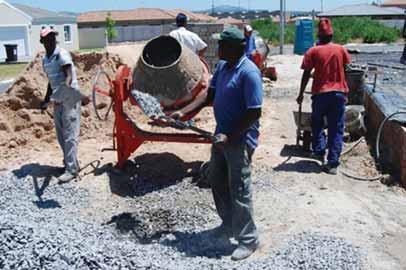
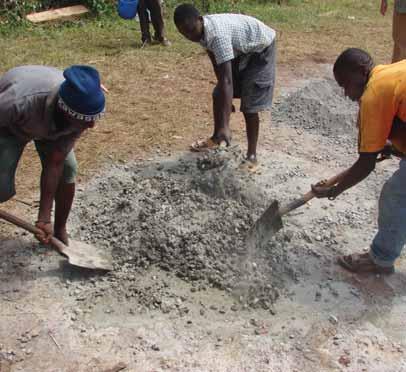
In these small sites all too often the mixing of concrete is done by using the abundant labor resource consisting of the many eager young men looking for temporary work, but the problem with this is that the process is wasteful, timeconsuming and exposes the concrete to the risk of setting if it is not used fast enough. Enter the portable concrete mixer. This small machine is used to homogeneously combine cement, sand or gravel and water to make concrete just like any other concrete mixture but portable concrete mixers are the perfect choice for accomplishing not only small scale concrete construction jobs but also serve as a backup for major construction projects. Owing to their small size and light weight, portable mixers can easily be moved around which is a great advantage that
allows a contractor to quickly setup and begin producing concrete even in tight site conditions. They provide the best choice for small amounts of onsite concrete mixing.
The machines come in varying types, sizes and configurations depending on the task at hand. Despite the attraction of using manual labour on small projects which is a prevalent tendency in many African building sites because of the low costs involved, portable mixers do allow for mixing of a considerably larger amount of cement with water throughout the project saving on time and energy. Another advantage over manually mixing concrete, is the fact that the concrete will mix better and have greater consistency every time. Whether you are doing a small, do-it-yourself home improvement project or undertaking a major commercial mega project, there are different mixers to suit the different construction needs.
Generally available in sizes ranging from 3 to 12 cubic feet, the smaller models will fit in the trunk of most cars while the larger capacity units can be towed easily on wheels or hoisted onto a truck for longer distances. With their small size and easy portability they can be used even in remote areas that characterize most African settings. To a budding contractor wishing to establish himself but facing financial constraints, this could be a perfect start up as their costs are quite accommodative
Many contractors always find it advantageous to have their own mixers as opposed to depending on outside vendors and if you are a new entrant to the construction industry it’s an investment worth making. The mixer will ensure independence, flexibility in working time and convenience and goes a long way in cutting costs and ensuring a continuous and uninterrupted workflow.
Advantages
The biggest advantage in owning a portable mixer is realized when working on sidewalks, foundations and binding block, and when preparing mortar bases. Many decorative concrete contractors find the portable mixers ideal too. A good example is the monument works industry which mostly has mixers mounted on their own trucks. The same holds true for many landscape and fence builders. One interesting model of portable mixers is the wheelbarrow-style mixer that fits comfortably through a 30-inch-wide opening. This allows the user to mix and pour right where the product is needed.
Hire or buy
While weighing on whether to call on ready-mix concrete delivery or owning your own mixers, many factors should be weighed. These include among others, job scope, the location of the site, size and quality of staff and the time frame attached to the project. For instance, it is counterproductive for a contractor to use a portable concrete mixer when he needs to pour a slab of 50 square metres. He is much better served using ready-mix.
Similarly, if a job needs to be completed in an hour so contractors can move on to the next job, ready-mix is a smarter choice. On the other hand contractors working in a back yard or space-restricted area where accessibility is a problem, he will find a portable mixer much more effective. Smaller mixers are highly recommended for mixing concrete to anchor fence posts; for patching; for small concrete slabs on grade; and for mixing non-stick grout.
For high-production jobs such as concrete slabs, sidewalks and block walls, larger-capacity models are better suited. There are many styles and sizes to choose from, from a 2-cubic-foot pedestal style to a 31⁄2-cubicfoot wheelbarrow style to a 9-cubic-foot towable unit. The utility mixers start at 11⁄2 cubic feet and can be mounted or be made stationary; or an optional low- or high-speed
The low cost of labour makes manual mixing of concrete attractive but it also compromises the concrete
Lino Sella World builds mixers durable enough for Africa
tow kit can be added. The mixers come with either electric- or gasoline-powered sources. Single-phase electric motors are available in the 1⁄2- to 11⁄2-horsepower range while gas engines span from 3 to 13 horsepower. Mixers also have speed controls that can be adjusted to fit the requirements of the specific job. Most manufacturers offer steel and polyethylene drums to fit individual user preferences. Steel drums are more durable, but cleaning can often be tedious and other damage to the drum is a possibility. Poly drums, which resist rust, can be cleaned in minutes by simply tapping with a rubber mallet and they are lighter than their steel counterpart.
Maintain your mixer
Per manufacturer recommendations, contractors should check the oil levels and filters of portable mixers daily. In using the mixer, the mixer V-belt and pulleys should be tight while the necessary parts should be greased frequently. Gears on a concrete mixer, however, should never be greased. Debris, sand, sediment or other material can become trapped in the gears, causing major damage to the unit. Simple cleaning and lubrication will help keep the mixer running trouble-free for years to come.
Choosing
In planning to purchase a mixer, a contractor has to put a number of factors into consideration. Amount of fuel used is of great importance
when evaluating costs. An ideal mixer should be economical in terms of fuel consumption without necessarily compromising the amount and quality of work dispensation. This will help curb cost escalation. It is paramount to buy a machine that can be easily maintained in case of a break down. Availability of spare parts and technical assistance in case of mechanical breakdown. The nature and volume of work is a factor to consider in choosing the right mixer. Big-scale construction projects require bulk concrete mixers which can mix large quantities of concrete both onsite and offsite. For small scale projects, smaller mixers can apply. The size of construction site is a major factor to consider. Remember smaller mixers can fit well in squeezed sites while large open sites can comfortably accommodate the bigger ones.
Lino Sella World
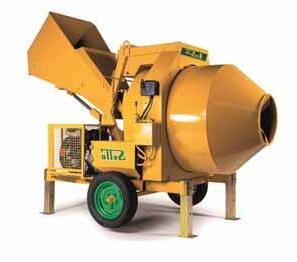
Lino Sella World is an Italian manufacturer of construction machinery including portable concrete mixers. Their concrete mixers are particularly suitable for Africa because they are built on a robust steel frame and are suitable for towing on strong pneumatic wheels. According to Mr Paolo Sella the company has sold several units in Africa which is proof of their durability and suitability.
Quality a Hallmark of Apex Steel
History
Back in 1970, inside a successful General Hardware and Construction Material Trading and Supply House in Mombasa, the company’s founders had a vision. What they saw led to a company that, 46 years later, now manufactures the best structural steel in East and Central Africa. Producing the region’s best steel doesn’t happen by chance. It requires a strategy. From the start Apex Steel decided to do things differently, focusing on innovation, creation of value for their customers and an uncompromising commitment to quality.
Quality
Kenya Bureau of Standards (KEBS) recognized the superior quality of Apex Steel, and hence Apex Steel was the first to get a KEBS mark; and subsequently the first ever steel company to be awarded the ‘Diamond Mark of Quality’. Apex Steel can claim another important first. It is the
only steel company in East and Central Africa that manufactures steel that is globally recognized as nature friendly. As such, it is the only steel company to be awarded a Leadership in Energy and Environmental Design (LEED) Certificate. Now the company’s customers can build strong and ‘Go-Green’. This is the second year in a row that Apex Steel has been awarded Superbrands status.
Key Product
‘APEX TMX’, Apex Steel’s flagship brand, is manufactured through German Technology with ISO certification ISO 6935- 2:2007 and BS: 4449. Locally, Kenya Bureau of Standards (KEBS) requires deformed steel bars of Grade 460. ‘APEX TMX’ is Grade 500. At another ‘state-ofthe-art’ manufacturing facility, Apex Steel manufactures hollow tubes that have raised the bar and revolutionized the fabrication industry.
Other Products
Apex Steel also manufactures tubes, rectangular hollow sections, square hollow sections, circular hollow sections; furniture tubes, black pipes for scaffolding, MS Plates; Angles, Flats, T and Z sections. It is one of the region’s largest importers of beams, channels, shafts, seamless pipes, and deals in more than 4,000 general hardware items and wire products. It also sells roofing sheets and Z- Purlins. Driven by innovation, efficiency and value addition, Apex Steel is the exclusive distributor of Wavin, the global leader in piping and plumbing solutions.
Wavin’s ‘push-fit’ plumbing technology is revolutionizing the construction industry. The company proudly offers GROHE bathroom taps and sanitary solutions. GROHE combines award-winning design with the finest materials and the latest industry-leading technologies.
Concrete admixtures gain traction in Africa
With the growth in the demand for cement in Africa, a huge market for admixtures has emerged as the need to improve concrete performance and greater need for cost savings become paramount.
The construction industry in Africa has experienced an enormous growth as the continent’s economy slowly emerges from years of slow growth. Between 1990 and 1995, Sub Saharan Africa’s annual GDP recorded one of its lowest levels at 0.8%. The GDP began to stabilize in 1996 recording a 3.1% growth to stand at 3.9%. The tide seemed to have turned in the first decade of the 21st century. Six of the 10 fastest growing economies in the world were in sub-Saharan Africa: Mozambique, Rwanda, Angola, Nigeria, Chad and Ethiopia. The economic growth of the continent has fuelled the boom in the construction industry that is now being experienced.
With increased construction activities, demand for concrete can only rise. The surging demand for concrete has informed the growth of cement factories to bolster the production of this vital element of concrete. Cement production in Africa has hit 5% cumulatively over the
past decade especially fuelled by the rising construction activity on the continent. Nigeria ranks high in cement consumption followed by South Africa. Combined, the two countries consume half the cement produced in Sub Saharan Africa. Angola is the largest consumer of cement in Central Africa. We can therefore expect huge markets for the use of concrete admixtures in these countries especially considering that most of Africa’s production is for domestic consumption.
Need for concrete
Early this year Deloitte Africa released its Fourth Annual Africa Construction Trends Report giving an overview of the past three years on infrastructural projects and its financiers in the East African region. According to the report, East Africa accounted for 20 percent of all the ongoing projects in Africa valued at US$ 57.5 billion in 2015 compared to US$ 60.7 billion in 2014, with Kenya taking
the lead with 20 projects out of 61, followed by Ethiopia with 12 projects.
Southern Africa has the highest number of projects at 38 percent, followed by East Africa 29 percent, West Africa percent North Africa 7 percent and Central Africa 5 percent.
In Kenya building and construction has emerged as the top performing sector which has expanded by 13.1% and the sector’s rapid growth is the reason for the expansion of construction material manufacturers like cement factories. “Construction and infrastructure projects are going to be government’s priority in the short and medium term and the total expenditure for infrastructure development is expected to rise substantially,” Kenya’s Transport minister James Macharia.
During the unveiling of its annual budget, South Africa announced plans to boost investment in the country’s energy, transport and communications sectors. Finance minister Nhlanhla proposed to spend Zar9bn (US$591bn) on housing projects and associated bulk infrastructure requirements which he believes will spur economic growth.
The Nigerian government says it is focusing on completing the construction activities at the 700MW Zungeru power plant
and plans to continue towards the takeoff of the 3050MW Mabilla power plant.
According to its 2015 budget report considerable progress is being made in the completion of some major road projects such as East – West road, the dualization of the Abuja_Abaji-Lokoja road, Lagos Ibadan Expressway and Niger Bridge. Work is expected to be completed on the reconstruction of major airport terminals across the country. Perhaps, the main reason why there has been unprecedented uptake of concrete in Africa is the bursting population in Africa that demands for housing.
In Egypt real estate is leading investment in the construction industry. Wael Ziada who is Head of Research at EFG Hermes says he expects growth rates of the building and construction sector to reach the pre-2011 levels, which exceeded 7%. The expert predicted the Egyptian economy to register a growth rate of about 4.5% during the current fiscal year 2015/2016 mainly being driven by the construction industry.
A 2015 report compiled by World Bank Group notes that Africa faces a major housing crisis due to rapid urbanization and a growing slum population. Different countries have deficits in housing units and
that no country in Africa has managed to house its entire population notes the report. South Africa for instance, has over 3 million housing deficit while Nigeria has a housing demand of 700,000 units per year.
Kenya is no exception. The country’s urban centers face a shortage of 200,000 housing unit annually, with only 50,000 new units being constructed every year. According to a recent report by management firm Cytonn Investments on housing status in the country, students and middle income earners are the most affected by the housing shortage whose shortfall leaves close to 150,000 Kenyans un-housed every year. It is a sign of economic recovery for a continent whose construction activities had plummeted to record low levels. In Zimbabwe for example, construction activities are beginning to kick off after years of stagnation owing to harsh economic condition of the country. An African economic outlook report projects that the continent’s economy will grow at 5% in 2016 up from 4.5% in 2015.
Admixtures
Even as consumption of concrete continues to grow exponentially, the use of concrete admixtures is quickly making inroads in Africa. This has been spearheaded by international firms keen to tap the African market. In 2015, Germany based construction product manufacturer BASF Construction Chemicals launched its first concrete admixtures production plant in Nigeria to help meet growing demand of concrete admixtures in the country. The firm has also established production plant for concrete admixtures in Kenya as it seeks to position itself for the ongoing infrastructure projects in the country.
Christian Geierhaas who is BASF’s Regional head for the Construction Chemicals division says that the company aims to support the local industry by reducing imports thus cutting down on cost and other transport related issues.
Last year,US based construction products manufacturer X-Calibur Construction Chemistry Inc announced its entry into the Kenyan market with the construction of a concrete and cement additive manufacturing plant in Kenya aiming to tap on the wider East African region. The concrete admixtures manufacturing plant is expected to produce approximately one million litres of concrete and cement additives.
X-Calibur managing director Brian Davies said during an interview with Construction Review that they will mainly concentrate on concrete. The firm enters Kenya when the country continues to record a booming construction industry that has seen real estate developers flock in the country to jostle for the lucrative market.
In Zambia, Chinese concrete admixtures manufacturers Shanxi Jiawei Building Materials (SJBM) and Shanxi Construction companies are in their final plans to enter the admixtures market in Zambia that has seen growth in construction activities in the country. Zambia intends to use
the opportunity to export admixtures to regional markets. Zambia has embarked on massive construction of roads in the country and says it needs support from China to realize its infrastructure goal.
Others firms that have not been able to set up concrete chemicals manufacturing plants in Africa have continued to export the products to the African market. One such company is Fosroc International (see advertisement elsewhere) which is a leading global manufacturer of Construction Chemicals. The firm has presence in more than 125 countries around the world.
Apart from supplying a range of admixtures products, the company has also been involved in supplying flooring products, repair products, non-shrink grouts, protective coatings and cement grinding aids.
Why use admixtures
Admixtures can effectively improve the performance of concrete. In many countries, where they are widely being used, it has become an integral part of concrete material. Admixtures are known to reduce consumption of cement in concrete production. This way, concrete strength is enhanced. Since these agents are organic by nature, they lubricate the mix reducing the friction and increasing the workability. Admixtures cause a thin layer to be formed over the cement particles protecting them from hydration and increasing the setting time. Most normal plasticizers give some retardation ranging from 30–90 minutes. The function of retarders is to delay or extend the setting time of cement paste in concrete. These are helpful for concrete that has to be transported to long distance, and helpful in placing the concrete at high temperatures.
Construction experts advocate using concrete admixtures to reduce the required quantity of cement and make concrete more economical. Fosroc International Business Development Manager Talal Hassanein, advices every contractor to use admixtures saying it helps reduce the early heat of hydration and overcome thermal cracking problem in concrete. Concrete admixtures are also known to boost the workability of concrete.
Despite the enormous benefits of concrete admixtures, the uptake of the products in Africa is still wanting. In Kenya for instance, X-Calibur noted a general lack of technical knowledge on concrete technology. “Construction courses in Kenya are pretty good especially in finishing, but we have realized some weakness in concrete technologies applied in this market. We believe more can be done,” said managing director Brian Davies adding that the firm plans to train University of Nairobi’s civil engineering graduates through its Engineers for Africa initiative geared towards having technical skills on the project. Manufacturers also note a general lack of awareness of the need to adopt concrete additives in their construction business.
Construction industry players say that the use of concrete admixtures in Africa will continue to grow despite the challenges. Charles Nmai from BASF Corporation reckons that the benefits of concrete have lured contractors and developers to adopt its use.
“In overall, the real benefit of chemical admixtures is that they make it possible to produce concrete for challenging applications,” he asserts.
MoyaProof & MoyaShield
For a Seamless, Waterproof and Leakproof Structure
range of solutions for achieving watertight structures...
Water Plugs and Water Repellants
FOSROC'S PCE Technology
Fosroc is a world leader in the delivery of tailored Constructive Solutions for virtually any type of construction project, combining high quality products, expert technical support, customer service and innovation. Fosroc has worked with exact specifications and successfully provided a wide range of engineered products. A number of different admixtures (Polycarboxylate and Polycarboxylate ether base) and concrete products are developed every year for specific applications to comply with the customer needs. New admixtures PCE based, cement grinding aids, concrete accelerators, special admixtures for cable injection cement pastes, waterproofing admixtures, etc ,recently developed are the main examples.
PCE technology
FOSROC’s latest contribution to the ever changing needs and requirements of the construction industry is the new generation of hyperplasticiser based on Polycarboxylate Ether (PCE) technology. This superior PCE Technology is steadily establishing a strong track record throughout the world with progress being made in the Middle East. Polycarboxylate Ether based products showcase water dispersible comb-polymers with a more complex molecular structure than conventional superplasticizers. The two most important mechanisms attributed to dispersion in polycarboxylate systems are linked to polymer adsorption and steric hindrance caused by the thickness of the adsorbed polymer layer onto the cement particle and electrostatic repulsion through induced electrical charge.
Our product range is under continuous review covering all the customer’s needs and requirements, trying to optimise our added value for the customer. Al Gurg Fosroc technical department has a wide experience in tailor-making concrete admixtures for dealing with all the customer requirements. The value of this type of support is usually seen in terms of durable and high performance concrete mix designs.
Other ways in which value is added is through joint development of special concretes for more exact specifications and projects. Many new techniques have been learned working the in the very demanding market that is here in UAE. Where the requirement for high early and late strength pumpable concretes, self compacted concrete have been in use for a number of years.
In terms of technical consultancy and as a support by our very specialised sales force, Fosroc uses on line consultancy services, attended by fully qualified chemists/ specialists in concrete/admixture technology which will be able to respond either to unusual questions or challenges.Our technical department is responsible for all technical support , consultancy, lab and on site trials, raw materials selection, product performance checking and quality control, product specifications and product development. A group of more than ten technicians are led by a very experienced technical manager. With additional experienced resources available from around the Fosroc Group.
Why waterproofing is a necessary exercise in construction
The feeling amongst many real estate developers is that waterproofing is expensive and unnecessary. However costly remedial action becomes a painful lesson for many.
Concrete is highly porous and as such can allow water and other chemical to infiltrate it. Left unattended, this can lead to the deterioration of a building. According to construction expert Bill Palmer, the source of the vast majority of foundation problems is water. Apart from burning down, perhaps the worst thing that can happen to a residential structure or a building is a foundation problem. Wet soil beneath a foundation can swell or lose strength. This is one of the reasons to always keep the foundation dry. It is worth remembering that doing it right the first time is critical, because coming back to fix it is costly affair.
In this light, it is advisable that concrete is waterproofed. However, choosing the best way to waterproof the concrete has continued to be a daunting task to most developers. Ensuring that water passage in a concrete is prevented and hydrostatic pressure resisted, a concrete can be waterproofed from the positive (exterior) side, negative (interior) side or from within the concrete itself (integral systems). In most cases, the most widely used positiveside technology is sheet membrane waterproofing. However, its failures and limitations are also common and costly. This has deterred most contractors from embracing waterproofing. Seth Okoth for instance, not his real name, is a Kenyan investor who recently ventured into real estate. However, he has of late sustained heavy losses in his business. Following heavy rains that were experienced in Nairobi recently, the basement of one of his buildings full of water.
He tried several interventions but failed. He then decided to approach his consultant who told him that the problem will not end until intensive waterproofing is done in the basement. Not satisfied by his consultant, Okoth decided to enquire from a company in Nairobi which deals with waterproofing materials.
The engineer of the waterproofing company visited his building and after an assessment he urged him to consider a thorough water proofing exercise that could cost him Ksh 1m. Alarmed by the huge cost, Okoth gave up.
Okoth’s case is not isolated. Many basements of buildings in Nairobi are not usable due to leakage due to the high level of the table water. However many developers waterproofing is something that they want to avoid and something that they deem unnecessary.
Expensive affair
According to John Gichohi, who is the Operations Director at Kenya Waterproofing Company, most contractors seek to do away with waterproofing as a way of saving on cost. Some have also chosen to believe in the notion that waterproofing cannot be relied upon. On the contrary says Gichohi, the whole process becomes an expensive affair, when waterproofing is done after a building has been completed. “To waterproof a floor for instance will require that the whole area be excavated and the job be done afresh,” reveals Gichohi who’s company has been offering waterproofing solutions for 23 years.
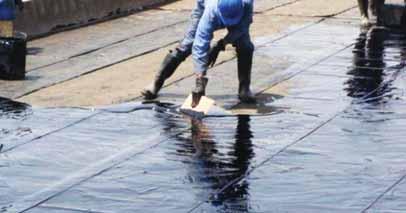
He however notes that some people would prefer to stop leakages especially on rooftops by applying tar. This he says,helps the situation temporarily but after a while the leakage resumes. For those who shy away from waterproofing materials due to cost, Gichohi is quick to point out that Kenya does not manufacture waterproofing materials. Indeed most of the chemicals are imported from Europe and the USA where quality if of a high standard. The only African country that manufacture waterproofing material is Egypt but often quality is compromised.
Currently Kenya waterproofing Company uses Masterseal 501 and Masterseal 601as waterproofing chemicals. So how does the chemical work? When water seeps through he concrete in a building, the chemical reacts with it to form granular particles, which further prevents leakage by sealing the pores present in concrete.
Kenya Water Proofing Company has technical personnel in building sites who oversee the waterproofing exercise. When waterproofing is done by the company, a guarantee of up to 10 years is normally given. The decision to manage waterproofing exercise for clients was arrived at after many of clients failed to follow the instructions correctly when applying the waterproofing materials.
Using waterproofing membranes for stone installations
More and more stone installations are being applied in wet areas. These areas include showers, tubs, spas, steam rooms, fountains and pools. These are generally considered constant wet areas and by building code and design specification, a waterproofing membrane must be used to protect spaces below and adjacent to the stone installation.
The Tile Council of North America’s Handbook for Ceramic Tile Installations provide many details that depict the use of waterproofing membrane in an array of installation methods, including walls, floors, decks, tubs, showers and pools for ceramic tile application. Many of the same principles and methods apply to stone installations.
In addition, to the constant wet area applications, a waterproofing membrane can also be used in intermittent wet area applications. For instance, the floor areas outside of a tub or shower are great candidates for waterproofing membranes. In many cases, water spills or splashes out onto these area. Left untreated, the water can migrate through the stone and grout and affect the substrate and the spaces below. Even minor water damage can prove to be very costly to repair.
Many of the membranes available today serve a dual purpose; providing both waterproofing and anti-fracture protection. The anti-fracture function helps to reduce the potential for hairline shrinkage and spider web cracks from telegraphing through to the stone surface. An excellent use area for these dual functioning membranes is electric radiant flooring warming systems and hydronic floor heating systems.
The membrane not only protects the spaces below and around the stone installation and the heating system, but it also helps to reduce the effects of thermal cycling that these types of installations can experience. The cyclying of the heating system can create thermal
Arthur
Mintie, Director, Technical Services LATICRETE International, Inc.
stresses in the setting system. The thermal stresses can cause small hairline cracks to transmit up through the stone finish. The use of dual purpose waterproofing and antifracture membrane can help to protect the stone finish.
Other areas that can also be waterproofed include, tub decks and surrounds, shower walls and ceilings, countertops, kitchens, exterior facades, building and home entry areas and mud rooms to just mention a few.
It has been proven that the use of waterproofing membranes within stone installations significantly reduces the potential for mold and mildew in wet areas. Some of today’s waterproofing membranes come equipped with anti-microbial protection and help to fight the effects of stain causing mold and mildew.
Waterproofing membranes also help to keep homes and buildings healthy. They help to prevent the occurrence of poor indoor air quality by protecting against the effects of water damage, including rot, deterioration of building materials, mold and mildew. A few select waterproofing membranes are certified by 3rd party independent agencies
for compliance with strict volatile organic compound (VOC) guidelines. These membranes really help keep the building and home environment healthy!
Generally, waterproofing membranes for the stone and tile industry fall into three categories:
1. Liquid Latex Rubber Applied Type
2. Sheet Type
3. Reinforced Latex Fortified Portland Cement Type
Within these categories are many membranes; which are thin and load bearing, adding no appreciable thickness to the installation and are fully compatible with latex fortified portland cement based thin set and medium bed mortars. In order to apply the waterproofing membrane, the appropriate substrates should be properly prepared in a similar manner as if a direct bond latex fortified portland cement thin set mortar were to be applied.
In conclusion, stone can be successfully installed in wet area applications both for interior and even in demanding exterior applications. The use of waterproofing membranes makes sense in many stone applications. The investment that is made in selecting and installing these systems requires that consideration be given to this important installation feature. The added cost to include a waterproofing membrane in the stone installation is minute when compared to the potential repair or replacement costs that may arise from water and moisture damage. The use of waterproofing membranes provides great peace of mind to both the installer and the building owner.
Producing aerated or foamed concrete blocks
We look at what it takes to produce aerated and foamed concrete commercially for customers and which of the two is cheaper.
Demand for foamed concrete and aerated concrete
Both materials have high flow-ability, low self-weight, minimum consumption of aggregate, controlled low strength, and excellent thermal insulation properties. So there is no significant difference for customer between aerated and foamed concrete blocks.
Cost of equipment
Let’s take a closer look at the equipment which is used for production of foamed and aerated concrete blocks.
Mixer
A mixer designed for foamed concrete production is technically more complicated. The mixing process is done under pressure by means of foam generators or in an open mixer by means of gerotor type pump. It is vital to maintain the same pressure level but that leads to excessive wear of fillers, gland seal etc. The gerotor type pump is more expensive and technically complicated. On the bright side it is a slow speed mixing process and requires a lesser load for bearing unit, you also are able to pour the mixture into the molds by hoses from a distance. Mixers designed for aerated concrete have
simpler construction and are easier to use as they mix liquid mixture. All that you need is to just to provide a mixer with small vanes and high speed for a proper mixing process. There is no pressure and special drain devices – mixture is discharged by gravity. There is a disadvantage though – you have to arrange movement of the molds or mixer as there is no way to pour the mixture into the molds from a distance.
Molds
The main requirements for molds are size accuracy, quality locks, which prevent leaks, and smooth surface. The molds are made of thin walled sheet metal with frame made of shaped tubes. These molds are light, easy to use, move and its production doesn’t require a lot of investment. Battery molds are popular among foamed concrete producers. These molds are constructed by workers before pouring the process and that takes a lot of time. Strict requirements are applied for materials used for production of these molds as they directly influence geometry of blocks and the speed of its construction. That is why molds are made of thick – walled metal which makes it heavier and more expensive. More over at first these molds
promote excellent geometry of blocks but later deformations are inevitable.
Dosing system
There are various kinds of dosing systems for aerated concrete as well as for foamed concrete. They have similar characteristics so there is no significant difference.
Cutting device
When using battery molds for foamed concrete you won’t need to cut the array. But some producers use cutting technology for foamed concrete as well as for aerated concrete. Foamed concrete need more time to develop enough strength before unmolding, it takes from 8 to 20 hours depending on usage of heating devices. As for aerated concrete – it can be cut just in 1,5 – 3 hours after pouring. There is another difference in cutting technology: aerated concrete is cut by string saws manually or by an automated cutting machine. To cut foamed concrete one needs to use circular or belt saws. A string cutting device costs less than a set of saws, besides saws have accelerated wear.
Technological complexity and cost of raw materials
The main difference between foamed concrete and aerated concrete is production technology. Foamed concrete is produced by mixing sand, cement, water and foaming agent. Foam is supplied by a foaming machine directly into a mixer with targeted frequency and weight. During the mixing process particles of cement and sand envelop foam bubbles. The mixture is poured into an assembled and lubricated mold. The array gain stripping strength during 12-24 hours. The main technological difficulties.
WATER AFRICA & WEST AFRICA BUILDING & CONSTRUCTION Exhibition and Seminars
Accra International Conference Centre 22-24 June 2016
Top Water, Sanitation, Construction & Housing Show returns to Ghana
Water Africa and West Africa Building & Construction is returning to Ghana in 2016
This is a three day exhibition with products being displayed from all over the world as well as from Ghana for the Water Supply, Sanitation and Building and Construction sectors.
Running alongside the exhibition will be comprehensive seminar programme tackling important issues of urban and rural water supply and sanitation, low cost housing and urban and rural development. If you wish to give a presentation you still have time to submit an abstract as the deadline is the 31st of March.
With over 75% of the space already booked please contact us to reserve your location to avoid disappointment.
WEST AFRICA BUILDING AND CONSTRUCTION 2016 is
The
Polo Vivo Xpress. What you cram in is your business.
We’ve packed the Xpress with features, so you can pack in whatever you want. An impressive load space and air conditioning come standard. The equally impressive optional features include 14” Portland alloy wheels, a rough road package and cruise control. Add all this to the fact that VAT registered customers can claim back VAT on this Light Commercial Vehicle, and it makes good business sense.
Souq Waqif’s amphitheatre
The need for an for an Amphitheatre, to complement an underground parking facility for shoppers at Souq Waqif shopping hub in Doha, Qatar, led to the demand for 4x4 Multi Step blocks and 4757 L16 blocks, products that could serve both retaining and seating purposes.
One of the elements that define great architectural design is the ability to create synergies – between places, which in the eyes of a casual observer, would seem to be totally dissimilar. And this is what has been accomplished in Doha, Qatar.
Souq Waqif is a historic shopping hub, a must-see highlight of Doha, which was revived in the last decade as the social heart of the city. There has been souq (trade) on this site for centuries; the Bedu would bring their sheep, goats and wool here to trade, and the entire market area has been skillfully redeveloped to look like a 19th-century souq, with mud-rendered shops, exposed timber beams and some beautifully restored original Qatari buildings.
And to cater for and cope with a large number of visitors which had quadrupled in recent years, the development of an underground parking facility, located opposite the Msheireb, Downtown Doha became necessary. The design of the car park offered architects some extra space above ground to facilitate place making, a collaborative process that shapes the public realm in order to maximise shared value. Accordingly, with this is mind, Dragana Lutic Djokic, Landscape Architect at Parsons Qatar, contacted Consent LLC (Terraforce Licensees in the UAE) in 2012, requesting an Amphitheatre design. Specifically, the engineers at Parsons were in search of a product that can be used both for retaining and seating purposes. But where would they find it? And who would provide it?
Consent subsequently proposed an arena design with the
Terraforce 4x4 Multi Step block, a light, dry-stack concrete unit, generally used for constructing low terrace walls, stairs and seating arrangements. Aimed at providing efficient and economical steps in conjunction with the original Terraforce retaining blocks, in this case the L16, they have became very popular (in South Africa and abroad) not only for stairway access, but comfortable, practical stair and seating arrangements at leisure amenities and school sports facilities.
Initially Djokic specified another pre-cast system for the proposed Amphitheatre design, but after a presentation by Consent on the Terraforce 4x4 Multi Step block and L16 retaining block and their colour options, the design was rerendered with Terraforce blocks.
The final design, completed by Fred Laker of Terrasafe, Terraforce’s international retaining wall design service, was approved by Parsons, and in October 2013, Palmera Agriculture Business L.L.C put in the order for the 4x4 Multi Step and L16 blocks. Approximately 5100 4x4 Multi Step blocks and 4757 L16 blocks were used, and LED lighting installed at intervals for nighttime ambiance. The amphiteater was completed in 2014.
JAIN Sustainable Engineering Solutions, Design Consultant: Parsons, Qatar, Main Contractor: UrbaCon trading and contracting, Sub Contractor: Palmera Agriculture Business L.L.C, Wall design: Terrasafe and Block Supplier - Consent LLC.
„We
Jens Wätzlich Quality Control
THE
machines & installations
modern technology
individual solutions
after-sales-service
over 60 years of experience global references
www.weiler.net
Fire
& Ice Protea Hotel in Menlyn.
Kings Pride Properties Limited
Doing things differently
Although some observers point to a slowdown in real estate boom in Kenya, the actual situation on the ground appears to paint a different picture. This is informed by the fact that the country still suffers from an acute housing shortage and the middle class has not stopped growing. Consequently, the need for homes and shopping services will continue to be sustained in the foreseeable future. However, developers will need to be innovative in their products due to a wide array of choices available to the discerning consumer.
Kings Pride Properties Limited is among the few developers that realized that the real estate landscape is constantly changing and have therefore adapted to be a step ahead. Established less than 10 years ago by Major (Rtd.)
David Karau, who is the Chairman and Chief Executive Officer, the company offers customers comprehensive solutions in mixed use properties ranging from local urban nodes to large scale new city developments across Kenya. Broadly, Kings Pride Properties addresses four key development components in one seamless offering:
• Joint Venture Developments: Here, the company partners with land owners to develop viable real estate projects, thus returning handsome returns on investment (ROIs) to the landowners by unlocking the latent value in the land to be developed through value addition activities.
• Project Management: This involves actual management of the project engineering services and coordination of the various consultants involved in a project right from project conception to completion (turn-key level).
• General Construction: Kings Pride Properties has a sister company (Kings Pride Constructors) that undertakes the actual construction. Its NCA 1 rating enables it to carry projects of virtually any scale.
• Property Marketing and Sales: This entails developing marketing tools to put the developments on a platform where prospective buyers get exposed to them and managing the sale closure process.
• Property Leasing and Management: The Company
offers after sale service, property end user management, facilities and amenities management as well.
This “one-stop shop” arrangement is one of the pillars of Kings Pride Properties but is certainly not the only one. The company prides itself in being “home of zero deposit” in home ownership. Typically, most financiers will require customers to make a down payment of between 10-30 percent of the home’s value before taking possession. But Kings Pride Properties have realized that this requirement has been a challenge to most home buyers. As developers of its own projects, the company is uniquely placed to provide a more flexible payment plan for its customers. In addition, Kings Pride Properties negotiates low mortgages for its clients.
“A uniqueness aspect here is that for most of our off-plan properties and through the zero deposit plan, a buyer will be able to offset most of the payments, leaving a small amount once the property is complete,” explains George Fundi, the company’s Chief Operating Officer. “A client can therefore comfortably pay this through personal loans without affecting his/herpay slip through mortgage. This has made our properties to be a favorite buy amongst investors.”
The company partners with other entities to provide affordable housing. These include Shelter Afrique, a reputable Pan African institution that supports the development of affordable housing and real estate sector on the continent. Other partners are locally based financial institutions that offer end user financing. Another aspect that keeps Kings Pride Properties ahead is the company’s adoption of American construction technology that, according to Mr George Fundi, has enabled the company to benefit from economies of scale and resulted in huge time and labour savings. In addition, the increasingly popular Kenyans Diaspora Homes Expo, an event held annually in the United States to showcase properties available in Kenya among citizens living in the US, is the brainchild of Kings Pride Properties. The company is also the main sponsor of the expo.
Glenwood Gardens
Among Kings Pride Properties’ current projects is Glenwood Gardens. This is a gated community located in the rapidly growing Ruaka area, a few miles from Nairobi. It consists of 240 units in 2 and 3-bedroom configuration. The development is a short drive from the upcoming mega mall – Two Rivers. Glenwood features include: master ensuite in all units; guest cloakrooms; a mini commercial complex with health spa, bar/kitchen; a swimming pool; lush green landscaped gardens; a recreational park; high speed lifts; back-up generators and ground floor parking. Construction kicked off in December 2015 and is expected to be complete in the last quarter of 2017.
Beglin Woods Architects was honoured with AAK awards this year for Nova Apartments – 1st Best Concept/ Ongoing Projects, Naivasha Simba Lodge – 1st Runner Up for Best Hospitality Industry Project and Project.
Competition over the last couple of years has increased, challenging us
did not expect that several of our projects would emerge winners in the recently concluded awards.
Our reaction was excitement and surprise. It does change the way we work. From now on we hope that every project we do could be put forward for an award.
The awards are given for the project excellence, so they really go to the full consultants team. The awards also serve to recognize the efforts of
It certainly changes some aspects of business award winning projects, in that they usually are able to sell or let faster.
In addition to these awards, we would like all our projects to receive creditiation for green council awards and we are aiming all our jobs at
Winner - Best Concept/ Ongoing Project1st Runner Up- Best Commercial Building Project
1st Runner Up- Best Hospitality Industry Project
NOVA APARTMENTS - #1 BEST CONCEPT/ ONGOING PROJECT
the AAK prize for new concepts in this year’s awards is starting to gain strong attention from the rapidly changing residential market, whose expectations on design and quality is rapidly rising.
Beglin Woods Architects are managing a strong team of leading professionals on the project which located on a prime site of 0.75 acres on Waiyaki Way. Nova is already turning heads even through construction has just started.
The slope on the site from Waiyaki Way to Muthangari Drive accommodates 3 levels of generous parking. At Waiyaki Way level, the common facilities are located and cover the entire site in a combination of spectacular indoor and outdoor facilities which include an Indoor/ Outdoor Pool, Cafeteria, Laundry, Residents Lounge, Spa, Salon, Gym, Indoor Games Room, Cinema Screening Room, Convenience Store and a Spectacular half acre open grassed area within water features, outdoor seating and a jogging track.
High above this level there are 132, two bedroom apartments with en suite Bathrooms and a Lounge, Kitchen and Dining Area. A major feature of the design is the spectacular curved balcony opening at the Lounge and affording panoramic views to East and West. These views become more and more spectacular on the upper levels.
top entertainment area and private landscaped garden. These luxury penthouses aspire to be quite unique in Kenya. Nova offers its’ residents
the opportunity to live in close proximity to Westlands and Lavington, close to shopping, commercial and recreational facilities. Nova is a self-contained residential community in itself and residents will enjoy all the community facilities normally associated with luxury
using top quality up to the minute features.
The development is aiming to be given LEED and Green Council status for sustainability. This type of luxury high density residential development is now becoming more common in Nairobi, with each new project providing better and more up to the minute facilities than
for this product and to the quality of its design.
Ltd
Architect & Interior
Structural & Civil
Services
Quantity
Electrical
NAIVASHA SIMBA LODGE- 1ST RUNNER UP HOSPITALITY INDUSTRY PROJECT
Naivasha Simba Lodge, designed by Beglin Woods Architects, is a continuation of an ongoing relationship between the architects and Simba Lodges. Beglin Woods also designed the Buffalo Springs Simba Lodge and the Mara Simba Lodge for the same client.
The site at Naivasha on 50 acres presented an ideal opportunity for the client’s to develop an upmarket luxury resort. The concept was to design a stylish and elegant lodge built from local and sustainable materials and involving the minimum of post contract maintenance.
The public areas consist of a series of individual pavilions linked by covered walkways. Using this layout we were able to achieve great
to contours on site. The lounge bar, entrance lobby, administration buildings and pool buildings are all accommodated in this type of pavilion with the maximum amount of open walls and the fewest windows possible.
the roofs are steel tiles and the windows are hardwood. This simple palette of materials produces an exterior and interior scheme of great sophistication and elegance.
One of the challenges with lodge design, is keeping walking distances and infrastructure and to a minimum. This has been achieved by arranging the bedrooms in 8 individual blocks with each block accommodating 10 bedrooms.
The bedroom blocks are developed around elegant external two-storey staircases which are architectural works in their own right and the rooms enjoy privacy and uninterrupted views over the surrounding landscape. The rooms have a distinctive layout with a split level which allows a sleeping accommodation at the upper-level and steps down
onto a lounge level which opens onto either a terrace or a balcony. The lounge contains a sofa which can double as a third bed. These rooms can readily accommodate 3 guests without the addition of an extra bed. The sustainable aspect of the building is carried through in the use of a and used for recycling as irrigation using automated pop-up sprinklers.
We are proud to advise that all of the tourism projects and the urban hotels which we have developed have been built within budget, within the construction period and at a construction cost which allows a rapid payback of borrowed capital.
WATERMARK
OFFICE PARK- 1ST RUNNER UP COMMERCIAL BUILDING PROJECT
Development in Africa as well as an award for Commercial Design from the AAK.
The project is located strategically on a 10 acre plot on the on the corner of Langata Road and Ndege Road in Karen. The design of Watermark, aims at high sustainability and low impact.
The site plan is arranged to accommodate 500 cars around the perimeter arranged in four, two and three storey blocks arranged around the perimeter of the site.
The blocks all face into spectacular 5 acre garden which has a network of ponds and nature features and a stunning central gazebo building, built over a waterfall with ponds on two levels.
The two and three storey buildings at Watermark are built in hand cut local stone with pitched tiled roofs and aluminium windows. The design is elegant, modest and low density. The site is serviced by a sewage treatment plant with a pop up sprinkler system. Waste water
an exceptional outdoor environment. Most of the trees on site were retained. The ambience between the buildings is relaxed and attractive and already is being used extensively as an outdoor working space. The design development includes a day care centre and a restaurant to cater for those working on site.
This is a happy combination where an exceptional design has produced a highly sustainable series of buildings, a highly successful investment to the developers in a scheme that has been quickly accepted as a part of the Karen landscape. As one resident announced “It looks like it’s always been there”. This is the way all developers aspire to having their work accepted.
Congratulations Beglin Woods Architects on your Recognition at AAK Awards 2016. We are proud to be associated with you
USIU Student Centre
M J VEKARIA ELECTRIC LIMITED ENGINEERS & CONTRACTORS
AAK Award a Major Boost for Aleem Manji Architects
Earlier in the year, the Architectural Association of Kenya (AAK), organized a forum to recognize outstanding works of architecture in the country. The event was seen as an attempt to appreciate the immense effort that architects exert in their work, the end results of which are often breathtaking structures in the built environment. As expected, established practices that have been on the scene for decades did walk away with a substantial number of awards. Impressively though, younger firms that have vigorously strivedto make a mark on the architectural landscape through unique designs and innovative concepts were also recognized.Among them was AleemManji Architects (AMA-Kenya).
At only 6 years of age, AMA-Kenya has attracted attention through their deliberate effort to break away from the norm. Looking at the projects the young practice has handled over this short period, one can clearly see a different approach in the way the projects are designed and executed. But it was, The Elegance, a commercial complex that will soon be coming up in Nairobi’s high end Westlandssuburb that endeared AMA-Kenya to the judging panel leading to a Runners-Up award for Best Concept and Innovation. According to the Principal Architect AleemManji and Architect Nina Ndichu who are working on the project, The Elegance is an “exciting, unique and new office block in town”.
“The basic concept is a rotation of each floor plate by approximately 5 degrees as you move upwards, to create an effect similar to a deck of cards fanned out.” According to the Architects, the client’s brief was to create the ultimate commercial address for businesses with a serene working environment featuring luxurious interiors. Thebuilding will occupy 12,500 square metres and will feature special glass to regulate temperature, conventional and stacked parking as well as access control and green landscaped terraces among other attractions. “It is a unique piece of architecture, a steel structure with striking colours and a fairly unique form that strikingly steps away from the conventional curtain walled commercial blocks that are common in the country,” say the architects.
And it was not a rosy path coming up with the final design. According to the Architects, the unique footprint meant that each level had to be planned individually while at the same time maximizing the spaces within. “In addition, the requirement for ample parking space meant that all this had to be done while maintaining the maximum comfort gridline for parking below, and at the same time due consideration of the end user and the user experience. Besides, as we were dealing with systems we hadn’t dealt with before, we
We are proud to be associated with Aleem Manji Architects on the Award Winning Project - The Elegance
encountered interesting challenges along the way, for example stacked parking requires a great deal of headroom and this being a steel structure we had to consider the secondary steel structure beams which in turn affected the original heights of the building. We therefore had to redesign major vertical spaces that were affected as we could not have ramps that were lower than the standard ratios and staircases needed to be comfortable for the user. But in the end, all was well and we achieved the desired architectural standards.” The AMA-Kenya team was clearly elated with the AAK recognition. And although they say that the announcement came as a pleasant surprise, they add: “In a way though, it almost felt that a concept such as The Elegance deserved some semblance of recognition, so I suppose there was also an accompanying feeling of satisfaction as well.” They speak highly of the teamwork that goes into every project handled by the practice saying that each individual in the team excels in their role culminating in unique designs such as The Elegance.
So what does this award mean to AMA?
“Hopefully it will provide much needed impetus and positivity for us to keep doing what we do: to keep trying to push boundaries and think outside the box and, hopefully, play a small part in changing the skyline of Nairobi”, say the leading architects at the practice. They reveal that they are currently working on other exciting projects. Among them is Rumaisa, a new apartment block in Riverside, Nairobi, which features a massive rooftop swimming pool with a running length of over 100m. Others are Solitaire (see CR November 2015 issue), Solitaire Encore, White Oak and Oshwal Park.
“Hopefully we will be able to keep doing what we enjoy doing the most - creating beautiful spaces and iconic buildings”, they conclude.
We Congratulate Aleem Manji Architects & The Elegance Team on their success at the AAK 2016 Awards.
Safe. Comfortable. WOHR
MERRYWATER celebrates 25 years in Tanzania and the opening of their new office facilities in Dar es Salaam.
Merrywater was established in Tanzania in 1989 and has since developed into an organization occupying more than 75 employees. Merrywater is undoubtedly the leading supplier of quality products within the water treatment industry and one of the key suppliers of Diesel Generators in Tanzania. The philosophy of Merrywater was from the beginning and still remains today to provide their customers with products of high quality and maintaining an efficient and professional service.
During the past few years Merrywater has invested in upgrading their facilities in Dar es Salaam including storage and workshops accomplished now by the completion of their new office facilities that include show room and in-house training facilities.
Simultaneously Merrywater is introducing a new line of business: Supply of Solar Power producing equipment and they have fitted the largest solar plant currently existing in Dar es Salaam on the roof top of their new office building. The technology usedis simply reducing the electricity consumed from Tanesco-the more the sun shines the lower is the electricity bill. The re-payment time of the investment of such a system is approximat ely 5-6 years.
Merrywater is committed to continue developing their business in Tanzania by providing products of high, sustainable quality, permanent training of personnel and facilitating transfer of technology.
Building with sustainable productivity
Innovative and reliable construction equipment builds infrastructure faster and in a more sustainable way.
Atlas Copco Tanzania Ltd
Plot 75B,Julius Nyerere Rd
P O Box 39966,Dar es salaam,Tanzania
Phone:+255 22 286 1571 www.atlascopco.com
ATLAS COPCO CONSTRUCTION EQUIPMENT AND GENERATORS
PREDICTABLE POWER
Atlas copco Predictable Power brings peace of mind to customers in the on-site generator and power generation business, peace of mind with solutions that combine low cost of ownership, reliable performance and risk-free operation.
Atlas Cocpo generators are designed to perform, built to last. They offer the following key benefits:
- Performance - Accurate and stable power
- Versatility - Ability to power a wide range of applications
- Service efficiency - Increased up - time
- increased transport efficiency
- Superior resale value
CONSTRUCTION TOOLS
PORTABLE AIR COMPRESSORS
Atlas Copco is the leading manufacturer of portable compressed air machines in the world, and through constant research and technology, superior products are developed. The combination of performance, reliability, economy and convenience has resulted in an innovative range of single axle high capacity air compressors used in a variety of industries. industries.
Our range of compaction and breaking equipment will take your productivity to a whole new level. The equipment has low maintenance costs, high availability, ergonomic. Intelligent engineering, top quality materials, first-class components and mordern engines contribute to long lasting machines with high trade-in values.
Breakers Plate CompactorsRammersTex
Breakers
DYNAPAC BUILDS THE FUTURE
Low noise - high power
The powerful and quiet water-cooled diesel engines. With the large drum diameter and the drive motors connected in series, there is excellent accessibility and hill-climbing capability.
Operator friendly
A spacious, vibration-damped operator platform and an ergonomically positioned step make these machines extremely operator-friendly. A modern, easily legible instrument panel with a warning panel and a fuel gauge is standard.
Easy transportation
To easily transport the roller between workplaces, the machines are fitted with a robust central lifting eye that allows fast and easy loading. Standard folding ROPS keeps the transport height to a minimum.
Minimum service required
Extended service intervals minimize maintenance costs. The machines have a maintenance-free steering hitch and steering cylinder. The few remaining service points are easily accessible.