

WHY BATTERY TOOL ADOPTION IS RISING RAPIDLY



04 Saws: a cut above the rest How battery saws are delivering comparable performance next to petrol versions
06 Breakers: paving the way Cordless breakers are emerging as a credible alternative to their corded counterparts
08 Diamond drills: making a point When the latest technology aids faster deployment and greater flexibility
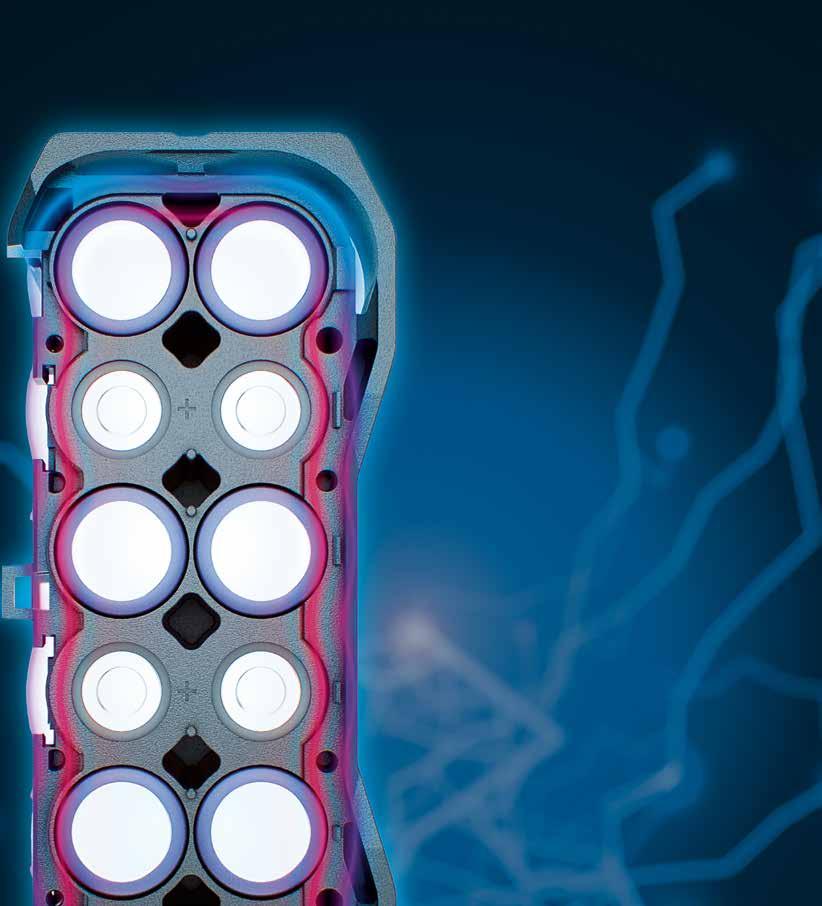
09 Batteries: powering up Lifting the lid on Hilti’s Nuron battery platform
10 Interview: Ted Przybylowicz Hilti’s executive vice president talks technology and innovation
The Power of Cordless supplement is brought to you by Construction Management, published by Atom Media Partners. The contents of this magazine are copyright. Reproduction in part or in full is forbidden without permission of the editor.
Mann, editor

Cordless power tools are moving rapidly from the margins to the mainstream of construction. Their adoption has been driven by tough health and safety regulations and testing sustainability targets, while concerns about the power and productivity of battery-powered kit have receded, thanks to technology advances pioneered by manufacturers such as Hilti. On major construction sites, cordless power tools are now central to the operations of most contractors, hirers and their supply chains. Let’s drill down into the reasons for this change. Safety is probably number one. Cordless tools remove hazards associated with petrol-powered equipment, including exhaust fumes, hot components and fuel handling, while reducing noise and vibration levels. For internal, confined or sensitive environments, the absence of on-site emissions is increasingly critical. Sustainability is another powerful driver. With major contractors committing to net-zero carbon targets, attention is turning to the cumulative impact of site operations. Cordless equipment offers zero on-site emissions, supporting cleaner, quieter working environments and aligning with client requirements as well as regulatory and procurement pressures. Productivity considerations are also
influential. Historically, concerns around power output, runtime and durability have limited the use of cordless tools in heavierduty applications. However, advances in battery technology, electronics and motor design are now addressing those concerns. High-output battery platforms, smarter energy management and improved ergonomics mean the latest cordless tools can deliver performance comparable to petrol or mains-powered alternatives.
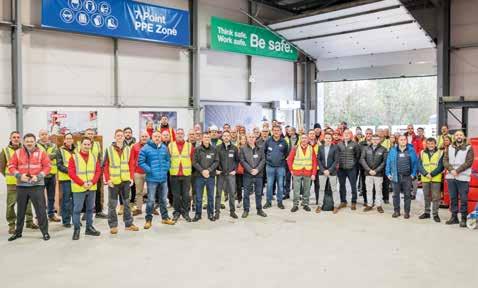
All these developments were showcased at a recent demonstration event organised by Hilti, which brought contractors and tool hire companies together to see the latest cordless power tool technology in action.
Attendees could compare cordless and petrol tools from different manufacturers side by side, assessing performance, safety features and usability under real working conditions.
This supplement, The Power of Cordless, explores those demonstrations in detail, with feedback from the major contractors and hirers present. We review the performance of saws, breakers and drills, when put to the test by industry specialists, alongside an in-depth look at the battery technology that underpins modern cordless performance. Finally, we chat to Hilti head of power tools Ted Przybylowicz on the thinking behind the manufacturer’s latest generation of cordless technology – and what to expect in the future.
In association with

If you type “cordless construction tools” into any AI platform, the results are intriguing.
“Cordless construction tools are generally viewed as the modern standard for on-site efficiency and convenience with advancements in lithium-ion batteries and brushless motors making them comparable to corded tools in power,” responds Google’s Gemini.
The key advantages are already well known: mobility and convenience;
safety; efficiency; platform ecosystems; instant pick-up-and-go usability.
However, the key disadvantages still reads like a list of general objections from a generation ago: battery management and cost; reduced runtime under heavy load; weight; longevity concerns; cold weather performance.
In a world where battery technology has evolved to become an integral, accepted part of our everyday lives, cordless construction equipment is still seen to be lagging behind in terms of innovation and performance. Nothing

In just a few short years, our capacity to draw even more power out of batteries has increased tenfold, resulting in the launch of Nuron products in our biggest tools
could be further from the truth. Hilti’s single 22V cordless battery platform system offers a combination of better performance, greater efficiency on construction sites, enhanced worker safety, sustainability and, perhaps most importantly, are a step towards bigger annual profits.
When it was launched in 2022, it did so alongside 70 new tools, all classed as small and mid-sized products.
And, in just a few short years, our capacity to draw even more power out of batteries has increased tenfold, resulting in the launch of Nuron products in our biggest tools, up to the 30kg breaker class TE 3000-22.
Of course, the big question is how, and this is why we have worked with Construction Management and some of the UK’s leading construction, engineering, HVAC, tool hire and utilities businesses to bring you this supplement.
We will look closely at Nuron, all its benefits, the performance against corded and gas tools, and answer how we have reached today’s performance pinnacle.
Nuron is the foundation for our vision for a fully cordless jobsite. There is still much work to be done – and AI will undoubtedly catch up on its out-of-date reporting soon. However, our vision is another step closer to becoming a reality. ●
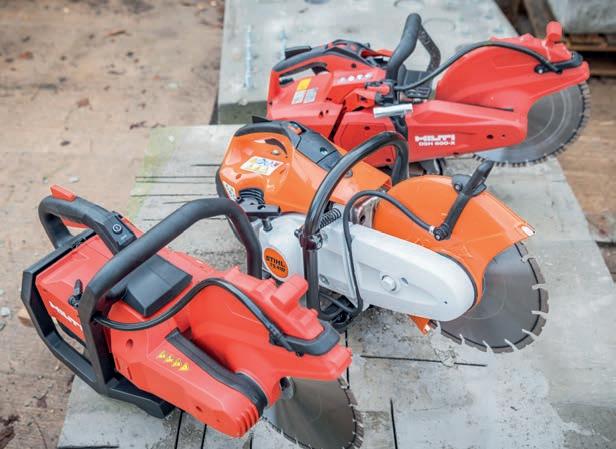
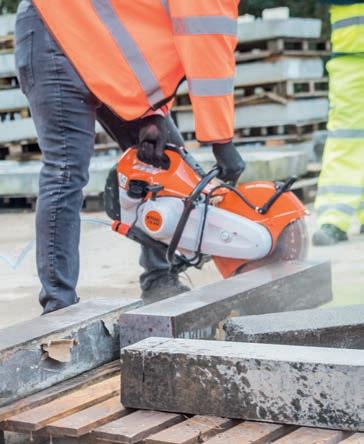
On-site testing shows that battery saws now deliver the cutting speed, depth, control and safety traditionally associated with petrol
Cut-off saws have traditionally been one of the most maintenance-heavy tools on construction sites, relied upon for demanding cutting tasks where power and reliability are critical. However, the latest generation of battery-powered cut-off saws is demonstrating that petrol is no longer the default choice, delivering cutting speed, depth, control and durability required on site while
significantly reducing emissions, noise and whole-life operating costs.
At Hilti’s cordless technology demonstration day, plant hire companies and contractors were able to compare battery and petrol cut-off saws side by side under real working conditions.
Demonstrating performance on site
The demonstration compared three tools: Hilti’s DSH 600-22 ATC battery cut-off saw, Hilti’s DSH 600-X petrol
The demonstration compared three tools: Hilti’s DSH 600-22 cordless cut-off saw, Hilti’s DSH 600-X petrol saw and the Stihl TS 410 petrol saw
saw and the Stihl TS 410 petrol saw. This provided a direct comparison between battery-powered and traditional petrol machines, allowing attendees to assess performance, safety and usability first-hand.
Across a range of cutting tasks, the DSH 600-22 ATC demonstrated cutting speed comparable to, and in some cases exceeding, petrol equivalents. Notably, the battery saw offers a greater cutting depth than petrol models, enabled by a patented belt drive system. This challenged the long-standing assumption that petrol power is required for deeper or more demanding cuts.
Safety was another clear differentiator. The DSH 600-22 ATC features active torque control (ATC) to reduce the risk of kickback, a fastacting blade brake, and electronic monitoring systems designed to protect the operator. Lower vibration and reduced noise levels further improve usability, particularly during prolonged periods of operation.
Water flow control also impressed during the demonstrations, with more consistent dust suppression and better control compared with petrol saws. Combined with the absence of fumes, this makes the battery saw particularly well suited to indoor, confined or sensitive environments where petrol machines are increasingly restricted.
Hilti’s battery proposition is underpinned by its 22v Nuron battery platform, designed for high-demand tools such as cut-off saws. The
The Hilti DSH 600-22 cordless saw offers a greater cutting depth than many petrol models, enabled by a reduced blade flange design
platform delivers consistent power while simplifying and reducing fleet management for hire companies.
Battery wear cover, free-ofcharge repair and maintenance, and Hilti’s State of Health system – which replaces underperforming batteries at no cost – all contribute to significantly lower whole-life costs compared with petrol saws. With no fuel, fewer moving parts and reduced servicing requirements, battery saws offer a compelling cost case over the life of the asset.
Industry response
Construction and hire companies attending the demonstration reported strong customer interest and positive feedback from the battery saws following trials on site.
David Johnson, managing director at Your Equipment Solutions, said: “The cost of two tanks of petrol, oil plus time for mixing and sourcing can be equivalent to four fully charged Hilti batteries – but comes with all the convenience of battery power.”
Matthew Wilson, managing director of SHC Hire, said response from his construction customers to the Hilti Nuron battery cut-off saw had been “outstanding”.
“Customers have noted that it cuts with power comparable to a petrol saw, without the associated inconvenience – no fumes, no manual pull-starting, simply pushbutton operation,” he said. “The improved balance and reduced vibration have been particularly well
received, resulting in consistently smooth cuts.”
Battery performance was also cited as exceeding expectations, with customers reporting that a full day’s work could be completed using the four batteries supplied with the saw.
From a strategic perspective, GAP head of asset management and supply chain David Munro described the battery saw as an important step forward for both productivity and sustainability.
“It’s a really good innovation that will help our customers on site and support ESG goals,” he said, while noting the importance of continued education around charging infrastructure and whole-life cost.
Keith Hallam, trading director at Bradfords, highlighted similar benefits: “Great feedback so far – no emissions, less noise and no fuel on site. It’s a real benefit to customers. The challenge now is encouraging wider adoption.”
Education was a recurring theme among hirers.
South West Tool Hire director Lee Edward said that battery saws are already proving effective in domestic, internal and office environments where fumes are a concern. “It’s about educating people on site to ensure batteries are fully charged and used correctly to get the full benefit.”
Marcus Gunning, managing director at ET Hire, pointed to rapid advances in battery technology and growing Tier 1 uptake. “Power
In association with

is not an issue,” he said. “Battery technology is improving quickly, and we now need to push that further down through the industry.”
Adam Langham, director at Champion Hire, highlighted the improvements in Hilti’s latest model, particularly its deeper cutting capability. “The concept is strong,” he said. “It’s about getting the saw on site and letting customers see the benefits for themselves.”
A credible shift away from petrol
The demonstration underlined how far battery cut-off saws have progressed. With petrol-comparable performance, enhanced safety features, lower running costs and zero on-site emissions, Hilti’s DSH 600-22 ATC has established itself as a credible – and increasingly compelling – alternative to petrol saws. ●
Industry feedback from live testing highlighted how Hilti’s cordless breakers are emerging as a credible alternative to corded tools
Concrete breaking has long been dominated by heavy, corded equipment, particularly on large infrastructure and demolition projects. However, advances in cordless technology mean battery-powered breakers are now emerging as a serious alternative, offering comparable performance while delivering clear benefits in safety, productivity and whole-life cost.
Cordless breakers remove the need for trailing cables, simplifying site logistics and reducing risk. Lower noise and vibration levels improve operator welfare and help contractors manage HAVS exposure. From a productivity perspective, removing mains power management and reducing maintenance cuts downtime and allows tools to be deployed more flexibly across site activities.
Demonstrating cordless performance
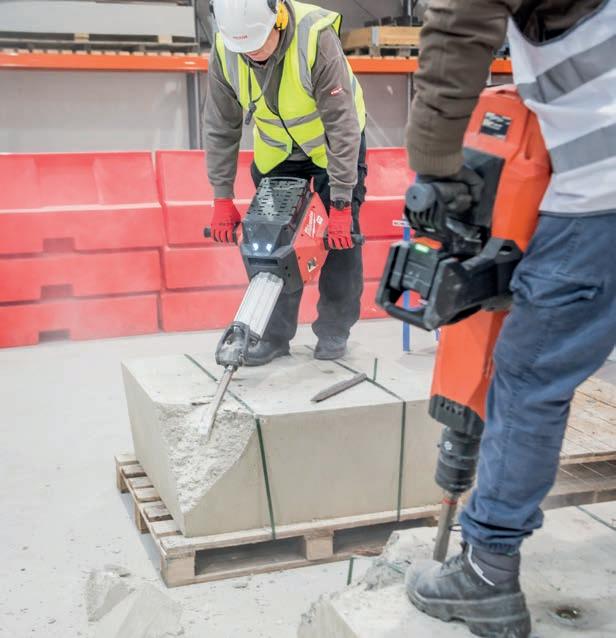
These advantages were demonstrated during Hilti’s evaluation of its cordless breaker range, where a series of side-by-side comparisons were carried out against competitor equipment. Tools assessed included the Hilti TE 3000-22 cordless breaker, the Hilti TE 1000 in both corded and cordless formats, alongside the Milwaukee MXF
DH2528H-802 and Makita HM1317C. The comparison between the TE 3000-22 and the Milwaukee MXF breaker highlighted significant differences in output and efficiency.
The Hilti breaker delivers a blow energy of 85 joules, compared with 64 joules for the Milwaukee, despite operating at a lower full-load hammer action speed of 858 blows per minute versus 1,300 bpm.
This higher impact energy per blow translated directly into faster concrete breaking during the demonstration, with the
Lower vibration levels help contractors manage HAVS exposure
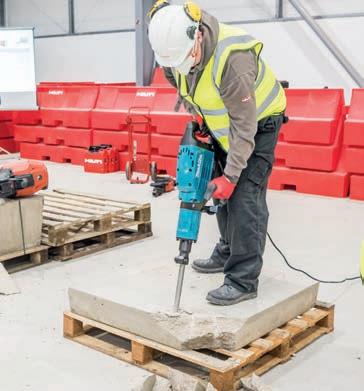
TE 3000-22 completing tasks up to twice as quickly.
While the Milwaukee unit is lighter on paper when measured without batteries, Hilti’s ergonomic design improved handling and reduced operator fatigue during prolonged use. Vibration levels were also well controlled on the Hilti tool, supporting safer long-term operation.
In the 10kg breaker category, the comparison between the cordless TE 1000-22, the corded TE 1000 and the Makita HM1317C highlighted how cordless performance has caught up with – and in some areas surpassed –traditional solutions.
Despite running on a 22V battery platform, the TE 1000-22 delivers equivalent breaking performance to its corded counterpart, achieving comparable output while offering lower vibration levels. The cordless model records vibration of 5.0 m/s², compared with 5.9 m/s² for the corded TE 1000, and 9.2 m/s2 for the Makita HM1317C.
Both Hilti breakers are also substantially lighter in weight than the Makita model, improving both safety and ease of use.
Safety features were a consistent differentiator across the Hilti range. Advanced vibration reduction systems, optimised handle design and electronic monitoring all contribute to reduced operator
In association with
fatigue and improved control. Features such as Active Torque Control, fast tool response and integrated dust extraction support safer working practices and help contractors meet increasingly stringent health and safety requirements.
Industry reaction
Feedback from hire companies and contractors at the demonstration was positive towards the battery tools.
Matthew Wilson, managing director at SHC Hire, described the Hilti cordless breaker as a step-change in capability.
“The TE 2000 has proven to be a significant advancement,” he said. “Initial scepticism around a batterypowered breaker of this size has been replaced by widespread satisfaction. Performance matches our corded jackhammers, while reduced vibration and lighter weight have made a real difference to operator comfort and productivity.”
Wilson also highlighted the benefits of cordless operation on site. “Battery life is excellent, and working without cords or generators has significantly improved
Testing out the Hilti and Milwaukee tools
Performance matches our corded jackhammers, while reduced vibration and lighter weight have made a real difference to operator comfort
productivity. It’s a tool we would choose to hire repeatedly.”
Champion Hire director Adam Langham said the demonstration clearly showed the value of Hilti’s platform approach. “It was reassuring to see the benefits of a single Nuron battery platform across the range, and to hear how Hilti considers every aspect of tool design, from handles through to internal components,” he said. He also noted growing demand for compact cordless breakers within hire fleets.
Matthew Wilson of Skipton Hire Centres added that Hilti’s cordless breakers outperform key competitors in several areas. “Compared with Milwaukee, Hilti’s cordless breakers offer better power, handling and vibration control, and are a real alternative to hydraulic or compressed air tools,” he said.
A shift in breaking technology
The demonstration showed that cordless breakers are no longer limited to light-duty tasks.
With performance approaching – and in some cases exceeding – corded alternatives, combined with improved safety and reduced operating costs, Hilti’s cordless breaker range is reshaping expectations of what batterypowered tools can deliver.
For contractors and hire companies alike, cordless breaking is increasingly a practical, productive and commercially viable option. ●
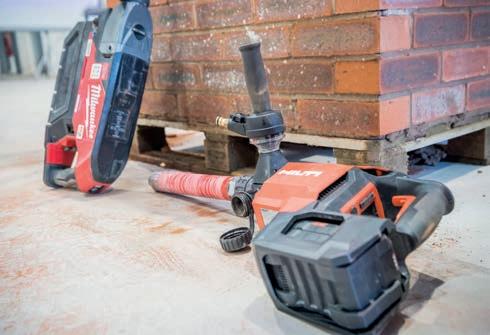
The latest technology shows how battery-powered diamond drills are delivering significant safety, performance and productivity gains
Diamond drilling has traditionally been associated with heavy, highpowered equipment, typically reliant on mains power to deliver the torque and consistency required for structural work. However, advances in cordless technology mean battery-powered diamond drills are a credible alternative, offering comparable performance while delivering clear benefits in safety, sustainability and productivity.
Cordless battery diamond drills eliminate trailing cables and electrical hazards and offer improved ergonomics for site operatives, meaning a safer worksite. With no reliance on
mains power, they enable faster deployment and greater flexibility.
Demonstrating the advantages
These advantages were demonstrated clearly during Hilti’s recent showcase of its cordless diamond drilling technology, where the Hilti DD 150-22 DD 150-U-22 was assessed alongside competitor equipment, in this case the Milwaukee MXFDCD150-302C.
In terms of capability, the DD 150-22 offers a maximum drilling diameter of 162mm, exceeding the Milwaukee’s 152mm.
Vibration performance was another key differentiator. The Hilti drill delivers consistent vibration levels of 3.9 m/s², compared with a wider range of 3.0-7.0 m/s² on
Cordless diamond drills offer improved ergonomics
The health and safety features and the performance of the tool were highlighted by both site teams and our H&S team Luke Cassidy, Careys
the Milwaukee unit. This provides a clear safety advantage and supports efforts to manage HAVS exposure on site. Hilti’s cordless drill also integrates on-tool dust extraction, removing the need for additional equipment and helping contractors meet dust control requirements.
feedback
Comments from both contractors and hirers at the demonstration reinforced these technical advantages.
Luke Cassidy, operations manager at Careys, reported strong site response to the DD 150-22.
“The health and safety features and the performance of the tool were highlighted by both site teams and our H&S team,” he said.
Murphy product leader Andy Nichols pointed to the importance of vibration control and power delivery. “HAVS is a major concern for Murphy,” he explained, noting that improved gearing and site charging infrastructure are helping cordless technology become a practical option for heavy-duty drilling.
Champion Hire managing director
Adam Langham added: “Hilti is the market leader when it comes to diamond drilling, and introducing cordless versions makes the process even more convenient and easier to carry out.”
A compelling proposition
The demonstration showed that cordless diamond drills are no longer a compromise. With strong performance, advanced safety features and lower operating costs, Hilti’s DD 150-22 underlines how cordless technology is reshaping one of the most demanding areas of site work. ●
In association with
Battery performance and whole-life cost are critical to cordless tools, with Hilti’s technology addressing wear, durability and long-term power delivery
One of the long-standing challenges with cordless tools has been battery wear, which can have an adverse impact on power, vibration exposure and productivity. In most cases, battery replacement is not covered under warranty, and replacement costs can be substantial.
With its Nuron battery platform, Hilti is focusing on long-term performance and predictable cost of ownership. The manufacturer offers battery cover for up to four years, replacing batteries free of charge if performance falls below acceptable levels.
Hilti’s design focuses on robustness, and its Nuron batteries feature fully potted electronics that protect circuit boards, along with patented
Drills demonstrate Hilti battery power
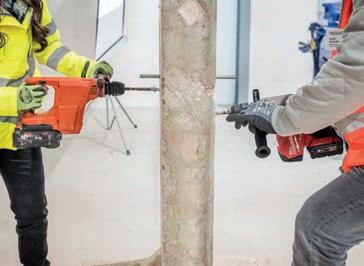
The recent advances in battery technology were showcased at Hilti’s demonstration day by a comparison of three cordless SDS (slotted drive system) drills.
Site operatives put the Hilti TE 8-22, a mid-range cordless SDS drill, through its paces alongside equivalent Milwaukee
battery bumpers and fiberglass housing to increase durability.
Power delivery is another key differentiator. Hilti uses springloaded, high-conductivity copper wires to maximise energy transfer. This enables higher continuous performance and more consistent output over the life of the battery, even in demanding applications.
and Makita cordless models.
The TE 8-22 is positioned as a step up from compact SDS drills, delivering higher drilling speed and torque while remaining lighter and more controllable than larger tools.
During testing, the TE 8-22 demonstrated noticeably lower vibration levels than competing tools, a key factor for repetitive drilling applications. Balance and handling were also highlighted as
Hilti’s State of Health feature provides built-in diagnostics, which continuously monitor battery condition, making it easier to identify when performance has degraded.
Contractors and hirers who attended Hilti’s cordless demonstration day were impressed.
David Johnson, managing director at Your Equipment Solutions, pointed to the direct operational comparison: “The cost of two tanks of petrol, oil plus time for mixing and sourcing can be equivalent to four fully charged Hilti batteries, but with all the convenience of cordless power.”
Mark Hurkett, divisional works manager for Knights Brown, added: “The live demonstrations showed how the new Nuron lithium-ion battery fits a full range of tools efficiently, offering the same if not higher performance as corded tools. The dust suppression and vacuum extraction features stood out too, offering a real boost to workforce safety.”
Steve Gillett, product manager at Select Plant Hire, also highlighted safety as a key driver. “There’s a clear hierarchy of safety in getting petrol off site,” he said. “The technology is moving quickly and charging infrastructure is improving.” ●
strengths during extended use. Contractors who tried out the tools gave positive feedback on the TE 8-22’s performance.
Luke Cassidy, operations manager at Careys, noted the difference immediately when comparing the Hilti and Milwaukee tools.
“There is much less vibration,” he said. “I used the tools in exactly the same way, but could really feel the difference in my arm and elbow.”
Darren Smith, operations manager at PCE, described the TE 8-22 as delivering a clear performance advantage.
“It feels more powerful and faster through concrete than anything else in this category, without having to move up to the next class of drill,” he said. Smith also highlighted comfort and balance: “The TE 8 feels smoother, more comfortable and well balanced in the hand.”
Hilti executive vice president Ted Przybylowicz talks to CM’s Rod Sweet about the pace of innovation in cordless technology – and what’s coming next
Hilti has been in the cordless tool business for almost 40 years, but the unveiling of its Nuron cordless platform four years ago – bringing an all-on-one platform, greater power and performance, better health and safety, and data-driven services – significantly highlighted the importance of cordless as a core development strategy.
The company confirmed this direction of travel in October 2025 at its Unboxed event in Munich, unveiling more than 60 new cordless tools on the heavier end of the spectrum, along with charging systems unrivalled in speed and capacity. This included a new 30kg category breaker, the largest tool in the Nuron family, plus a new Compaction Plate, the first time Hilti has produced such a tool because only now does it feel the batteries can delivery the required performance.
Crucially for Hilti, all the new gear is 100% compatible with the Nuron platform, which now consists of well over 150 cordless tools.
“Putting everything on one battery and charger platform takes engineering discipline, but it really
matters to our customers,” says Ted Przybylowicz, executive vice president and global business unit head.
“Juggling multiple battery systems can really hurt our customers’ productivity and increase their acquisition costs. That’s why we’re so committed to bringing everything onto Nuron.
Przybylowicz estimates that while more that 70% of power tools today are cordless, that number drops to < 10% among heavy tools like combi hammers or breakers because of customer perceptions on power and prior investment in corded or pneumatic systems.
“But the rate of take-up will accelerate in the coming years, the same way it did with many of the lighter tools over the past couple of decades,” he says. “The shift to heavier cordless tools will be driven by platforms like Nuron – built for high power, high capacity and the tough conditions of real jobsites.
“When you combine the strength on the Nuron platform with the coming advancements in battery technology, things get really exciting.”
Today, Hilti’s biggest battery packs
The shift to heavier cordless tools will be driven by platforms like Nuron –built for high power, high capacity and the tough conditions of real jobsites Ted Przybylowicz, Hilti
have 4.5Ah (amp hours), but the company says it has line of site – ie cells in testing – to packs that can use 6Ah cells.
“When you start getting to those capacity levels, 450 watt hours per battery, and you put two batteries on a tool, you start to approach the working range needed to really convert even our heaviest tools to cordless,” Przybylowicz says.
“And when you combine that higher capacity with efficient tools that do a better job translating the energy into the application, you have enough capacity to enable most customers to work for half a day before recharging their batteries over the lunch hour.
“I think that’s the breaking point,” he adds. “When customers have to charge three or four times a day, maybe it’s OK for rental and smaller applications, but for true construction I think we need to get to that half-day mark before you need to recharge.”
When Hilti launched Nuron in 2022, it said the platform was “future-ready”. Przybylowicz explains what that meant.
“We knew we were going to get new battery cell technology coming out in the coming years that would have lower internal resistance. Put in simple terms, it means that the ‘pipe’ that can draw the energy out of the cell is just bigger, and therefore you can pull more power out faster.
“So, we wanted to make sure we had an interface that could manage currents far above what our first products needed. When we initially launched, I think our highest current draw was around 50amps. Now our tools can handle over 110amps without overheating.
“You can run that kind of current through some of our competitors’
In association with

interfaces, but the big difference is ours stay cool, below that magical temperature of 30-40ºC. If you try to put that amount of current through competitor systems, they start to burn up, which not only is going to impact the lifetime of the battery, but it also wastes that battery energy by converting it into heat and not into the application.
“The second big thing we did from a design perspective is create a system that can handle high vibratory loading, which you get in heavy-duty applications like
breaking and drilling concrete, compacting or even coring concrete, which has its own resonance.
“To do that, we made sure the interface between the battery and the tool remains very stable by separating them with springs and dampeners in multiple directions. When you have vibration and abrasion between two metal elements, it starts to wear away important parts and it can create short circuits. We avoid this by creating an isolated interface that keeps things aligned even in the heaviest vibratory loads.
Hilti’s Ted Przybylowicz says he is keen to find solutions that improve customers’ productivity
Hilti’s commitment to its future-ready cordless platform goes hand-inhand with its ever-evolving datadriven asset management offering, ON!Track, now in its 10th year.
Over that time, it has evolved from a manual check-in, check-out system to a complete ecosystem of gateways, Bluetooth and GPS tags, telemetry and integration with service providers like Trackunit to keep tabs on everything from a ladder up to a backhoe.
ON!Track not only tells you where an asset is, it can monitor the health of batteries remotely, which helps customers take advantage of Hilti’s four-year battery warranty.
“For many customers, this is a key part of their ERP system, so we’ve worked over the years to build interfaces to allow that data to be drawn out and used however the customer wants,” he says. “It’s a cool software and service and one we’ll continue to invest in.”
Hilti’s value proposition still finds its sweet spot in the tool-hire business, Przybylowicz says, because of its tools’ durability, trackability, cordless convenience and everrising charging speed.
“The core of the tool-hire business is still those heavy-duty tools that many construction companies might use occasionally like core-rigs, breakers, combis – and that’s Hilti’s home turf.
“We also work on our charging infrastructure to enable set-ups where rental companies can charge over 20 packs simultaneously, but without blowing a circuit. Those are the kind of solutions we will continue to work closely with our tool hire partners to enable their productivity as well as their customers’.” ●
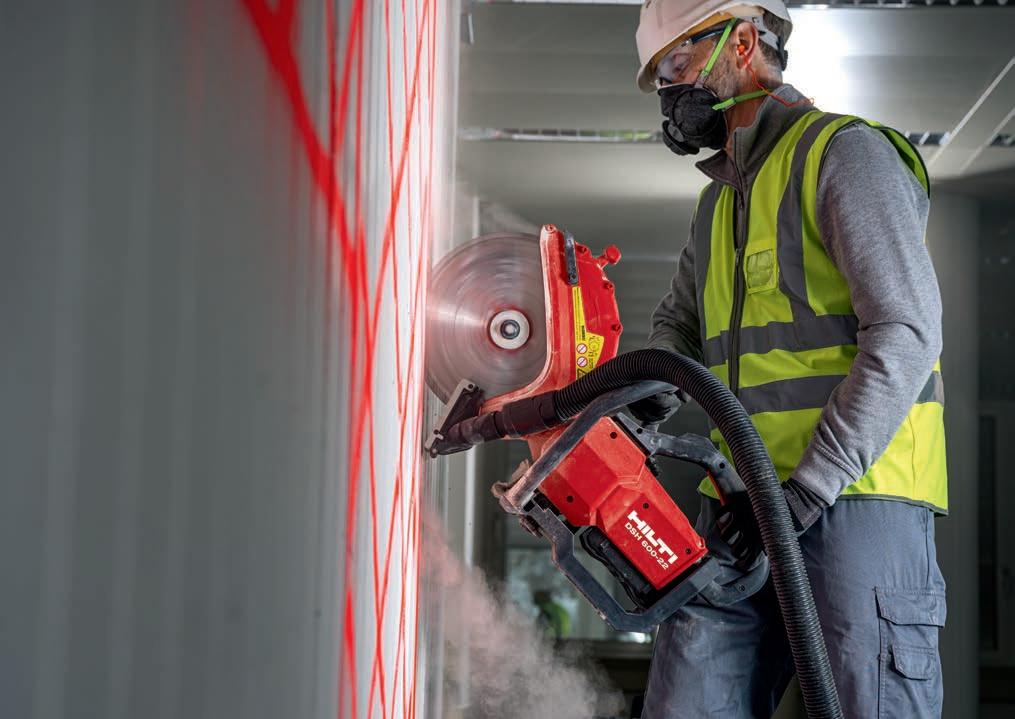
Switch to Hilti battery-powered cut-off saws—a safer, more productive alternative for users who can save on the price of two tanks of petrol per day while achieving zero CO₂ emissions at point-of-use plus lower maintenance and labour costs.
Grab your Hilti cut-off saw at the following hire locations:
Alliance Tool Hire / Pool, Ashford, Salisbury, South London, North London, East London, Gatwick, Bath, Bristol. Bradfords / Yeovil, Glastonbury, Bridport, Newton Abbot, Plympton Weston Super Mare, Helston. Champion Hire / Sheffield, Chesterfield, Leeds, Nottingham, Derby.
EPS Hire Centres / Hebden Bridge. ET Hire Ltd / Manchester, Bolton. GAP Group / Aberdeen, Anniesland, Birmingham, Bristol, Colchester, Croydon, Dundee, Heathrow, Hull, Lincoln, Liverpool, Northampton, Oxford, Plymouth, Portsmouth, Reading, Sighthill, Tewkesbury, Tower Bridge, Iverness, Norwich, Manchester.
SHC Hire / Skipton, Belook likley, Ripon, Northallerton, Morcombe, Lancaster, Carforth, Kendal, Windermere. South West Tool Hire / Bristol, Exeter, Bridgewater, Bodmin. Your Equipment Solutions / Glasgow, Edinburgh, Dundee.