

















6th November 2025




Hosted by The Construction IT Alliance
Edited Dr. Alan Hore
Dr. Barry McAuley
Professor Roger West
Published in 2025 ISBN 978-1-911652-00-7
Published by The Construction IT Alliance.
© Copyright Declaration: All rights of papers in this publication rest with the authors.
This publication is part of the proceedings of the CitA BIM Gathering Conference held on the 6th November 2025.
This publication can only be sourced online at www.bimgathering.ie.

Organisation Committee
Dr. Alan Hore
CitA (Conference Chair)
Suzanne Purcell
CitA
Aidan O’Connell
Punch Consulting
Sandra Gannon
IBM
Mary Flynn
Dublin City Council
Seán Dennison
GS1 Ireland
Dr. Claire Penny
TPS LTD
Gerard Nicholson
Atlantic Technological University
Sean Carroll
Munster Technological University
Scientific Committee
Dr. Alan Hore CitA
Professor Roger West
Trinity College Dublin
Barry McAuley
Technological University Dublin
Dr. Ken Thomas
South East Technological University
Dr. Martin Taggart
Atlantic Technological University
Dr. Conor Shaw
LUT University
Dr. Daniel McCrum
University College Dublin
Dr. Jason Underwood
Salford University
Professor Ibrahim Motawa
Ulster University
Dr. Malachy Mathews
Technological University Dublin
The 2025 CitA BIM Gathering carries special significance as it marks the 25th anniversary of the Construction IT Alliance (CitA), founded in 2000 in DIT Bolton Street with a clear purpose: to build a collaborative community that could accelerate the digital transformation of the Irish construction sector. Over the past 25 years CitA has grown from a small group of digital advocates into a national leader in BIM, digital construction, and more recently focusing on Modern Methods of Construction (MMC).
Our 2025 Gathering, held on 6 November in Dublin, was one of our strongest events to date. Under the theme “Realising Visions, Advancing Automation,” the conference brought together industry, academia, technology providers and government stakeholders at a time when the construction sector faces profound challenges: housing delivery, sustainability targets, productivity pressures and an urgent need for new skills. The discussions reinforced the sector’s shared ambition to use digital processes, reliable data and automation as enablers of better, faster and more sustainable project outcomes.
This year’s proceedings present 20 peer-reviewed papers reflecting the growing maturity and diversity of digital construction research. They cover topics including BIM for temporary works, automated compliance checking, heritage façade preservation, digital twins, simulation, data quality, safety, intelligent workflows and automated quantity
take-off. Many papers highlight the evolving relationship between BIM and MMC, emphasising the need for structured data, interoperable processes and industrialised approaches to design and construction. Others focus on people—skills, decision-making and organisational readiness. Collectively, these contributions demonstrate how BIM has advanced from a modelling tool to a strategic driver of transformation across the built environment.
As we celebrate 25 years of CitA, the principles that shaped the organisation in Bolton Street— collaboration, openness and shared learning— remain central to our mission. The success of the 2025 Gathering is a testament to the strength of the community that has formed around those values and its continuing commitment to digital excellence.
I would like to thank all authors, reviewers, delegates, partners and sponsors for their contribution to this year’s Gathering and for supporting CitA’s ongoing work. We look forward to building on this momentum as we enter the next chapter of CitA’s journey.
Dr. Alan Hore

Chair,
CitA BIM Gathering 2025
Best Innovation/Impact Papers
Sponsored by BAM UK and Ireland
Overall Best Paper Towards Urban-Scale Renovation: Integrating Multi-Agent Urban Digital Twin Framework with the RINNO Suite.
Omar Doukari and Marzia Bolpagni
Highly Commended BIM properties for a Psychological-Based Code Compliance Checking for Mental Healthcare facilities.
Silpa Singharajwarapan and Ibrahim Motawa
Automating Quantity Take-off and Data Validation in a BIM-Based Workflows.
Sean Auden and Malachy Mathews
Best Emerging Researcher Paper
Sponsored by Garland Consulting Engineers
Overall Best Paper
A critical review of the use of Generative Pre-trained Transformers (GPT) models in the generative design process of cleanroom architectural design.
Kemil Naidoo and Kieran O Neill
Highly Commended
A Process Map identifying pathways for integrating Artificial Intelligence (AI) tools and techniques into clash management workflows within the design process of large-scale residential buildings.
Bruna Gil Donnarummo and Emma Hayes
Barriers and Enablers to Digital Document Approval in Common Data Environments within the Irish Construction Industry.
Ciara Sinden
Best Industry - Academic Collaboration Paper
Sponsored by John Paul Construction
Overall Best Paper Building the Future – The Role of Artificial Intelligence (AI) in Construction Management in Ireland and the UK.
Taseen Muhammad, Colin Harte, Daniel Clarke Hagan, Mary Catherine Greene and Michael Curran
Highly Commended Benchmarking Organisational BIM Certification in Ireland: Motivations, Benefits, and Future Needs.
Davitt Lamon, Barry McAuley and Mark Mulville
Visualising Embodied Carbon for Building Design.
Killian Collins and Malachy Mathews
CitA BIM Gathering Conference 2025 Sponsors
Platinum Sponsors

Gold Sponsors






Silver Sponsors




Theme 1: AI, Automation and Data-Driven Workflows
A process map integrating Artificial Intelligence (AI) tool and techniques into clash management workflows within the design process of large-scale residential buildings.
Bruna Gil Donnarummo and Emma Hayes, Technological University Dublin.
Building the future – The role of Artificial Intelligence (AI) in construction management: in Ireland and the UK.
Taseen Muhammad, Colin Harte, Michael R. Curran, Daniel Clarke Hagan - Atlantic Technological University Sligo and Mary Catherine Green, Glenveagh Properties Plc.
A systematic analysis of the emerging synergy: Exploring the integration of BIM and AI for the future of construction.
Taseen Muhammad, Colin Harte, Michael R. Curran, Teni Bada, Enda Mitchell and Daniel Clarke Haga, Atlantic Technological University Sligo, Michael Curran, University of Limerick and Mary Catherine Greene, Glenveagh Properties Plc.
A critical review of the use of Generative Pre-trained Transformers (GPT) models in the generative design process of cleanroom architectural design.
Kemil Naidoo and Kieran O’Neill, Technological University Dublin.
AI agents and generative design: Reshaping architectural workflows for the built environment. Bruno Martorelli, MCROM Architects.
Theme 2: BIM Adoption, Maturity, Policy and Digital Delivery
Benchmarking organisational BIM certification in Ireland: Motivations, benefits, and future needs. Davitt Lamon, Barry McAuley and Mark Mulville, Technological University Dublin.
Building Information Modelling in Ireland 2025: A retrospective review of the BIM in Ireland 2019 report.
Barry McAuley, Technological University Dublin, Roger West, Trinity College Dublin (retired) and Alan Hore, Construction IT Alliance.
Navigating the CWMF mandate for a small architectural firm.
Ian McDonnell, AKM Design Group and Claire Simpson, Technological University Dublin.
Professionals’ perceptions of BIM effectiveness in construction projects: A comparative study between the United Kingdom and Saudi Arabia
Lina T. Karad, Pablo M. Rodriguez, Marzia Bolpagni, Northumbria University.
Barriers and enablers to digital document approval in Common Data Environments within the Irish construction industry.
Challenges & opportunities for construction SMEs.
Ciara Sinden, John Sisk & Son
Theme 3: Advancing Intelligent BIM Workflows
BIM for temporary works.
Craig Wilson, Strathclyde University and Ibrahim Motawa, Ulster University.
BIM properties for a psychological-based code compliance checking for mental healthcare facilities.
Silpa Singharajwarapan, Strathclyde University and Ibrahim Motawa , Ulster Universitye.
BIM for preserving building facades.
Panagiotis, Strathclyde University and Ibrahim Motawa, Ulster University.
Automated quantity take-off and data validation in a BIM-based workflow.
Sean Auden and Malachy Mathews, Technological University Dublin.
Towards urban-scale renovation: Integrating multi-agent urban digital twin framework with the RINNO suite.
Omar Doukari and Marzia Bolpagni, Northumbria University.
Theme 4: MMC, Industry 4.0 and Emerging Construction Technologies.
Prospects and challenges of 3D concrete printing in Ireland.
Thomas Flynn, Paul Hamilton, Daniel Clarke Hagan, Atlantic Technological University Sligo, Michael Curran, University of Limerick and Mary Catherine Greene, Glenveagh Properties Plc.
Investigating the use of blockchain in the Irish Construction Industry.
Caoimhe Clarke Hagan, Daniel Clarke Hagan, Mairead Lynam, Atlantic Technological University Sligo, Michael Curran, University of Limerick and Mary Catherine Greene, Glenveagh Properties Plc. .
Theme 5: Sustainability, Circularity & Carbon Reduction
ARISE: Catalysing sustainable energy skills development through digital recognition and upskilling pathways.
Barry McAuley, Technological University Dublin, Eduardo Rebelo and Andrew Hamilton, Belfast Metropolitan College, Anna Moreno, Institute BIM Italy, Antonio Aguiar Costs, Universidade de Lisboa, Dijana Likar, Institute for Research in Environment Civil Engineering and Energy, Jan Cromwijk, Centraal Register Techniek, Paulo Carreira, Instituto Superior Tecnico and Paul McCormack, Hydrogen Ireland.
Visualising embodied carbon for building design. Killian Collins and Malachy Mathews, Technological University Dublin.
Sustainability – Use of BIM and construction waste management.
Shahida Kizhakke Thalakkal, Marzia Bolpagni and Talib E. Butt, Northumbria University.




















Bruna Gil Donnarummo, brunadonnarummo@gmail.com
Technological
University Dublin
Emma Hayes, emma.hayes@tudublin.ie
Technological
University Dublin
Abstract
Building Information Modelling (BIM) is widely used to pre -check multidisciplinary designs, facilitate early clash detection and reduce coordination issues in early design stages. However, despite these advancements, traditional clash avoidance, detection, and resolution remain labour-intensive and time-consuming, limiting coordination effectiveness. Persistent inefficiencies, such as excessive false positives, manual filtering and grouping, and delayed conflict resolution decisions continue to constrain BIM’s potential to fully optimise coordination. This research aimed to investigate pathways and techniques - including machine learning, genetic algorithms, knowledge-based rules, and natural language processing - for integrating Artificial Intelligence (AI)into clash management and make this process faster, more accurate, and better suited to complex projects such as large -scale residential projects. The outcome was a structured process map address ing the gap between BIM and AI in clash management workflows according to BIM specialists’ feedback, offering practical AI-supported possibilities to optimise decision -making, reduce manual interventions, and improve design model quality.
Keywords: BIM Coordination, Artificial Intelligence, Clash Management
Over the past two decades, advancements in digital tools have significantly transformed the way designers work. Previously, they would sketch ideas on paper, then use AutoCAD to create drawings, and more recently, they would collaborate on Building Information Models (BIM) in the cloud to improve coordination and productivity. Now, AI promises to disrupt the Architecture, Engineering, and Construction (AEC) industry once again.
While data-driven insights can optimise the BIM process. There is limited expertise in identifying pathways and responsibilities for AI integration . Combined with a gap in research and practice, most studies focus on separate applications of BIM or AI (Zhang et al., 2022).This means professionals still spend considerable time coordinating design teams across disciplines, especially for complex challenges like clash management (Hsu et al., 2020).
Donnarummo and Hayes (2025), A Process Map integrating Artificial Intelligence (AI) into clash management workflows
During the design stages of large-scale residential BIM projects, models produced by various specialists, such as architects, structural and civil engineers, mechanical and electrical designers, are combined to pre-check designs visually and automatically identify clashes to mitigate the main projects’delay-causing factors (Pérez-Garcia et al., 2024).
In BIM workflows, the most important concern is how all potential issues can be identified early, coordinated efficiently and easily solved in a short period (Luo et al., 2022). However, the precision of clash detection within BIM -based processes is not sufficiently high and methods to simplify and optimise the work of BIM project teams during clash management have been underexplored (Akhmetzhanova et al., 2022).
Automated methods are urgently needed to quickly process large amounts of geometric data from a wider range of construction projects, and to reduce the need for manual intervention, minimising human errors or omissions (Pärn et al., 2018).
In light of this evolving approach, the purpose of this research is to develop a process map that identifies pathways to integrate AI -based solutions - including both AI tools and AI agents - to optimise clash management within the AEC industry’s design process. By examining existing workflows and evaluating the potential of AI to improve their efficiency, four objectives were outlined for this research, each providing context for the next objective:
1) To assess the existing key tasks in clash management workflows to identify gaps or time-consuming activities and investigate possibilities for AI to enhance efficiency.
2) To identify the typical clashes in large -scale residential buildings during the design stage and explore opportunities for utilising data from previous projects.
3) To identify the barriers to the adoption of AI in clash management workflows, informing an understanding of the challenges currently faced by the industry.
4) To develop a Process Map refined by BIM professionals to provide actionable insights tailored to specific needs to integrate AI into existing clash management workflows.
2. Literature Review
Design clash is comparable to ''collision'' or ''conflict'' and is defined as a positioning error where elements overlap each other when the original individual drawings or BIM models are merged (Pärn et al., 2018). Clashes can vary in nature, including "h ard" clashes, where two objects physically occupy the same space and "soft" clashes, where one object interferes with the operating or maintenance space of another (Akhmetzhanova et al., 2022).
Clash management includes two procedures: detecting clashes and solving clashes, which are traditionally integrated (Hu and Castro -Lacouture, 2018). This paper also includes clash avoidance in the study, since effective collaboration (leading to clash avoidance) and coordination (leading to clash detection and resolution) are key processes of the overall design development (Chahrour et al., 2021).
In a BIM project, clashes are identified in multi-disciplinary BIM models, and manually filtered, compiled, and presented during design coordination meetings where design teams collaborate to analyse the conflicts and discuss effective solutions. However, the detection precision of design clashes is not sufficiently high because the detection algorithms in BIM are too simple (Zhang et al., 2022). As long as two building components are spatially overlapping or within a given distance, they are recognised
Donnarummo and Hayes (2025), A Process Map integrating Artificial Intelligence (AI) into clash management workflows
as conflicts and included in the detection report (Lin and Huang, 2019) . Identifying and analysing this, given clash data, is still a labour-intensive task dependent on BIM managers and BIM coordinators (Akhmetzhanova et al., 2022).
Given the growing pressure for optimising design automation, research increasingly explores AI-driven solutions for clash management. Lin and Huang (2019) developed a machine learning method that can automatically filter irrelevant clashes, increasing detection accuracy by 15%–17%. Similarly, Hu and Castro-Lacouture (2018) applied supervised machine learning to distinguish relevant from irrelevant clashes, demonstrating how historical data and expertise can enhance the process
In terms of clash resolution, Liu et al. (2024) proposed an advanced genetic algorithm to automatically generate clash solutions based on spatial networks and priority constraints. A genetic algorithm is a heuristic search algorithm that mimics the evolutionary mechanism of natural selection, where strong individuals survive and the weak die, and only promising solutions are allowed to survive in the population (Yüksel et al., 2023). In their study, Liu et al. (2024) produced an automatic range of optimal solutions suggested to accelerate the decision -making to resolve clashes in underground parking in a residential project. The best solutions were based on the minimisation of both the number of elements involved and the minimum moving distance of components as optimisation objectives.
Moreover, a few studies highlight that proactive methods for avoiding clashes receive little attention, with research primarily focusing on detection and resolution. Teams often take a reactive approach, addressing clashes only after they occur (Pärn et al., 2018). AI-powered knowledge-based systems, however, can analyse patterns from past projects to help design teams anticipate and prevent clashes (Hsu et al., 2020; Zhang et al., 2022).
In large-scale residential projects, the repetitive layouts and standardised MEP systems create predictable spatial conflicts, offering opportunities for AI -driven optimisation. Despite AI’s potential to enhance clash management efficiency and accuracy, most studies focus on a single discipline or task (Hu et al., 2023) rather than structure pathways and tools for the AI integration process. There is a lack of workflows that incorporate automation tools, faster decision -making supported by AI, dependency analysis, and proactive clash prevention strategies.
To address this gap, a structured process map establishing pathways for both AI agents and AI-assisted workflows could serve as a practical guide for AI adoption, reducing the labour-intensive research for innovation techniques to increase productivity and simplify BIM design coordination.
To achieve a comprehensive understanding of AI integration in clash management, this qualitative research employed a theory triangulation approachsummarised in Fig. 1, combining multiple theories to simultaneouslyleverage the strengths of different methods and mitigate their weaknesses. The methodology included: a literature review of peer-reviewed papers to identify gaps in traditional BIM clash management and explore potential AI tools; semi-structured and open-ended interviews with experienced BIM and Digital Construction stakeholders in Ireland and the United Kingdom to capture a holistic representation of the clash management process and detailed information about current AI knowledge; and follow-up focus groups to
Donnarummo and Hayes (2025), A Process Map integrating Artificial Intelligence (AI) into clash management
critique, refine, and validate the proposed Process Map, eliciting additional perspectives not initially considered by the researcher.
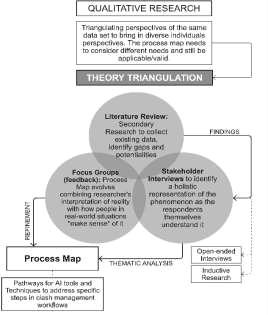
Figure. 1. Summary of how the research triangulates to gather and validate diverse perspectives
By integrating these research methodologies, this iterative approach allowed the intersection of theoretical knowledge with practical industry perspectives. The literature review established a theoretical foundation, while interviews provided industry -specific insights that, through thematic analysis, identified key patterns forming the basis of the Process Map, which was further refined through focus groups to ensure its validity.
The findings from the coded, interpreted, and visually interconnected data collected through interviews, following a thematic analysis process, are summarised below:
The first set of topic-based interview questions focused on the participants’ experience with clash management in large -scale residential projects and the types of clashes often encountered in these buildings. Most of the responses focused on common clashes between different disciplines and where they tend to happen. Clashes involving MEP were mentioned by seven participants, occurring both between MEP and other disciplines, such as structure and architecture, as well as among MEP systems themselves.
In terms of building locations, recurring areas where clashes are usually found include corridors and ceiling voids, as reported by four interviewees. Other common areas included lift lobbies, plant rooms, risers, and roofs.
A few participants noted these clashes are not unique to residential buildings, as conflicts are similar across building types. All participants agreed that standardisation of these types of buildings is highly beneficial since similar floor plates and stacked apartment units make the clash management process quicker. Once one level is coordinated and all clashes are resolved, the same reference level can be copied to
Proc. of the CitA BIM Gathering Conference2025, November 6th 2025, Dublin Ireland
other levels. However, four professionals noted that bigger concerns arise when the typical layout changes, such as on top floors or basements.
The following set of interview questions relate d to understanding the current clash avoidance, detection, and resolution workflows according to the BIM and digital construction stakeholders.
Clash avoidance primarily occurs through collaboration in Common Data Environments such as ACC or BIM 360, where BIM managers communicate prevention strategies based on prior experience and lessons learned, although some participants noted these documents are not always reviewed by designers. Clash detection extends beyond automated testing, involving manual filtering, grouping, and visual inspection of models, with early prioritisation guided by the number of disciplines involved, cost, impact to surrounding areas, level of importance, and project programme. Experience also informs the focus on critical zones such as MEP, structural, and fire protection areas. Finally, clash resolution typically takes place during coordination meetings, where responsibilities are discussed and assigned across disciplines, supported by tools such as Plannerly and clash matrices to track and monitor progress.
Based on feedback from all the interviews, low-quality models from design teams were highlighted as a major issue. These models often contained errors and inconsistencies attributed to factors such as vague or late client decisions, poor quality checks, an d inexperienced modelling staff. Another challenge, mentioned by three participants, concerns the lack of information included, often due to consultants being brought into the project too late or models not aligning with BIM guidelines.
Additionally, all interviewees noted that manual processes were a major source of inefficiency. Tasks like creating and assigning issues, applying clash rules, and developing reports were still done manually, slowing progress and increasing risk.
The stakeholders also mentioned that significant time was spent going through all the detected clashes to ensure they were actual issues and classifying and grouping them. Particularly when it comes to conflicts irrelevant in design phases, when less experienced staff lacked the knowledge to filter out low -priority clashes, it often resulted in an overwhelming volume of clashes and wasted time in coordination meetings.
In terms of inefficiencies, data was sometimes poorly recorded, making it difficult to track previous decisions, issue resolution, or the biggest cost and impact of unresolved or undetected issues over time. Interestingly, it was noted by two interviewees that, despite many similar large-scale residential projects having been delivered in the past, information from previous coordination efforts was often not properly recorded or carried forward. As a result, valuable lessons and decisions were lost, reducin g the opportunity to improve efficiency in future projects.
Additionally, a lack of engagement was highlighted by four of the interviewees. Design teams were not actively attempting to avoid or resolve clashes, and in some cases, both clients and design teams struggled to fully grasp the visual impact of their
Proc. of the CitA BIM Gathering Conference2025, November 6th 2025, Dublin Ireland
decisions on the model and overall coordination. On top of that, models received for coordination were sometimes outdated due to designers not sharing latest versions.
Regarding the interview findings related to addressing the identified inefficiencies in clash management using AI, interviewees shared a range of ideas about the potential to automate repetitive tasks, mainly related to clash detection – filtering, issues classification, issues creation, assigning responsibilities, and understanding priorities. Seven specialists expressed strong interest in using AI to support decision -making, especially for less experienced staff, and to optimise coordination between design teams and BIM managers through improved modelling understanding and communication. Participants also suggested that AI could be used to identify priority areas based on cost, impact, unassigned clashes, or zones with high issue concentrations from lessons learned, while certain clashes could be automatically deprioritised at specific project stages, such as perpendicular MEP services pass ing through walls without openings during early design phases.
When discussing AI techniques, participants mainly highlighted AI’s ability to understand and generate written information, as well as to respond to pre -defined knowledge-based rules inputted by experts. A summary containing the main techniques pointed out by the interviewees is listed below:
Machine learning enables systems to discover hidden patterns in large datasets and use those insights for automated decision -making. This makes processes more objective, data-driven, and less dependent on manual observation or specialist judgement (Pan and Zhang, 2021). According to the interviewees and as noted in the clash detection section of the proposed Process Map (Figure 3), ML could be trained on data from previous projects to become an AI -agent that recognises patterns in clash types to group and classify them and go beyond this by automatically assigning issues based on data extracted from the project clash matrix.
Additionally, ML has the potential to identify common problems to understand where clashes are likely to occur, produce project-specific clash matrices and create lessonslearned models by analysing past data where the clashes were coordinated and resolved. However, although machines that are trained from previous projects were viewed as valuable, six participants noted that this information is often not properly recorded and that huge amounts of data from past clashes would be needed to identify patterns and predict where clashes are likely to occur.
Knowledge-based rules use a symbolic representation of domain knowledge (e.g. experience of experts and previous cases) to build knowledge -based systems rather than using complex algorithms. Specifically, experts are interviewed to retrospectively share their experiences in similar cases, such as how to determine the types of BIM clashes to find an applicable action or conclusion (Zhang et al., 2022)
According to the interviews, knowledge -based systems are seen as more promising techniques when compared to machine learning. This is largely because clash detection involves rule-based decisions that might need to be flexible depending on the type of project and stage, such as identifying false positives, assigning priority levels, or determining which clashes can be ignored based on known previous input,
Proc. of the CitA BIM Gathering Conference2025, November 6th 2025, Dublin Ireland
(2025),
as these decisions typically do not require large volumes of previous data or interpretation. As an interviewee noted, this kind of automation does not require subjective judgement; it is often a simple yes or no decision, but there is still a need for an expert to input the rules, as illustrated in the Process Map proposed in this research.
When it comes to improving accuracy and efficiency in clash management, six interviewees recognised that the predefined rules could help distinguish between relevant and irrelevant clashes, such as minor overlapswhich are well-known in practice not to require action, allowing teams to focus on meaningful issues.
Finally, three stakeholders mentioned the potential for knowledge -based rules to understand the priority areas that are to be checked in a given project time, and also the priority clashes that are to be resolved considering programme, cost and impact.
Although participants did not explicitly reference genetic algorithms, their insights aligned with the core principles of this technique to address its use in resolution optimisation based on multiple objectives that are to be considered when adjusting elements to resolve a clash (e.g. cost, impact, priority, design intent preservation). According to Yüksel et al. (2023), during the design phase of engineering design, GAs can be used in the decision-making and evaluation process, and compared to classical methods to evaluate best clash solutions, they can save time and labour.
In line with this, an interviewee also emphasised the value of AI to explore a wide range of design alternatives to identify solutions that balance multiple objectives to understand the best design strategies to avoid clashes, for example, identifying optimal modelling choices to position elements that minimise the likelihood of conflicts. This approach was considered as an AI tool to support decisions in the clash resolution section of the suggested process map.
Natural Language Processing (NLP) drives computers to process, explore, and interpret language-related data in the form of text and words. It supports a human -like understanding of language, allowing for more accurate content analysis and reducing ambiguity in interpretation (Pan and Zhang, 2021).
According to six interviewees, a possible way to simplify the clash management process would be to use AI to provide a clash summary and classification, making it easier for everyone involved in the process to understand the nature and context of clashes. As mentioned by one of the BIM professionals, tools like ChatGPT could potentially look at an image, understand what is clashing, and provide useful descriptions. This kind of tool could help go through large lists of clashes and make it easier to prioritise them and share the right information with the right people.
Also, four participants mentioned that automating clash reports , including descriptive titles, comments, and responsible disciplines to solve the issue , would help to save time and reduce the burden of manual documentation.
Overall, NLP was viewed not simply as a reporting tool but as a communication technique to address the gap between raw detected clash data and meaningful project insights. From this perspective, these AI -based solutions are identified as relevant during all clash management stages due to their potential to support humans in interpreting, summarising, and generating text data.
Proc. of the CitA BIM Gathering Conference2025, November 6th 2025, Dublin Ireland
(2025),
Additionally, other tools and techniques mentioned by the interviewees to optimise the clash management workflows were the possibility for AI plug -ins to be connected to existing software that professionals are already familiar with . This includes live clash detection while modelling to avoid the overwhelming amount of conflicts in the models, and immersive technologies like Virtual Reality and Augmented Reality to support decision-making, particularly for less experienced team members.
Despite the potential benefits of AI in clash management identified by the interviewees, this research also sought to understand the barriers to adopting AI in BIM coordination workflows. These barriers are summarised in the pie chart in Fig. 2 and further explained below.
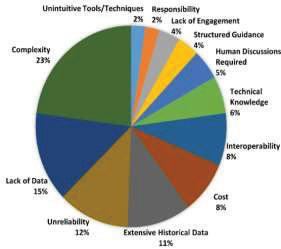
Figure. 2. Significant barriers to AI adoption in BIM Coordination workflows according to stakeholders’ interviews
Four participants noted that their companies are still not using AI for clash management, specifically due to issues such as poor engagement, lack of reliable datasets, and concerns about complexity - especially in terms of tasks relying on human judgement which are not easy for AI to interpret. Participants explained that many clashes require discussions between different disciplines, consideration of project priorities, and sometimes even negotiation between teams. Because projects are always different, it is hard to create one-solution that could suit all the projects.
This complexity also connects to the cost of using AI since creating or implementing AI tools that can deal with clash management tasks can be expensive. Smaller companies may not have the budget or the right people to support this technology. For them, the high costs and the need for technical knowledge make it even harder to start using AI in their projects.
Concerns were also raised around taking responsibility in the context of fully AI automation for specific tasks, with an interviewee commenting that fully automated solutions are unlikely to be adopted for complex tasks and decisions because accountability must be assigned to a human rather than a tool when errors occur. Also, trust in the technology itself was mentioned by four participants, especially in cases where results have not been proven or where data security could be at risk.
In summary, the findings informed the development of the Process Map by identifying specific clash management stages where AI could be effectively integrated, with
Proc. of the CitA BIM Gathering Conference2025, November 6th 2025, Dublin Ireland
Donnarummo and Hayes (2025), A Process Map integrating Artificial Intelligence (AI) into clash management workflows
pathways for improvement and automation. Interview feedback validated the sequence and practicality of the process. The initial map, based on the researcher’s interpretation, was refined through focus groups , with stakeholders previously interviewed, providing feedback on its structure and usefulness.
Participants noted that rather than an all-encompassing AI solution, the map’s strength lies in helping organisations identify and refine specific tasks where AI tools or AI agents can be applied, instead oftrying to optimise every aspect of the clash management process at once. In this sense, the proposal was seen as more viable when presented as a modular framework with targeted tools and techniques. Another critical discussion was in terms of limiting the process map to large -scale residential projects. One participant noted that AI is highly customisable and the framework can be adapted to various project types.
Additionally, three participants noted that the process map itself helped them save time during their own research into AI applications. The clarity and detail of the diagram made it easier to understand the areas where specific AI agents and tools could be introduced in clash management workflows to address their needs. One participant even mentioned that a few techniques presented in the meeting have already begun to be tested within their company to optimise coordination processes. Based on the focus groups insights, the proposed Process Map was revised and finalised as an outcome of this research, as illustrated in Fig. 3 below.
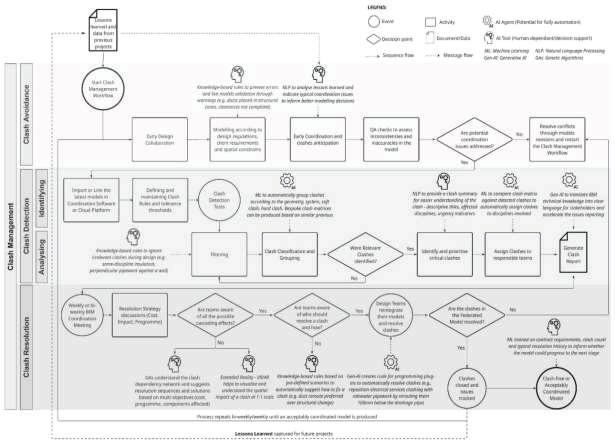
To use the Process Map effectively, teams should begin by pinpointing which clash management stage - avoidance, detection, or resolution - presents the greatest
Proc. of the CitA BIM Gathering Conference2025, November 6th 2025, Dublin Ireland
challenges in their coordination context. Next, they select specific tasks that are timeconsuming, laborious, or low accuracy in their workflows. Using the integration points marked by gear icons, teams can identify the most suitable AI -driven technique to improve that task and understand whether the solution would function as a fully automated AI tool or as an AI agent to support decision-making.
During early project stages, teams can align their model coordination strategies with the top section of the Process Map prior to and during the modelling process, ensuring models are structured and classified in a way that supports data extraction for AI processing. At this point, the map guides teams to apply predictive AI tools that assess likely clash zones before full model deve lopment, allowing for clash avoidance rather than just detection or resolution.
In the detection section, the Process Map guides the coordination team through the preparation and execution of clash identification and analysis. Automated tools identify clashes, followed by filtering to remove irrelevant or low -priority issues. AI-supported techniques can assist in grouping, prioritising, and assigning clashes to responsible teams, ensuring only actionable issues move to resolution
In the resolution stage, activities focus on addressing clashes in a coordinated and optimised manner, based on factors such as model ownership, clash impact, design intent, and cost. AI-driven tools can help flag which clashes require immediate attention and which can be temporar ily accepted. Once clashes are detected and prioritised, AI agents can proactively suggest adjustments by analysing patterns from past coordination cycles and BIM experts’ inputs.
In the final stages of the process, AI can assist in tracking resolution actions, ensuring that accepted clashes are documented and monitored, and decisions regarding responsibilities are recorded. The cycle repeats weekly or bi -weekly to confirm that agreed changes are implemented and to check for new clashes that should be addressed in subsequent cycles. Crucially, the workflow is not linear; it includes iterative loops that ensure clashes are managed as the project evolves.
Overall, the Process Map is designed to be a modular and adaptable tool that helps coordination teams focus on the most problematic areas within clash management rather than on all activities involved in the process. By identifying the most labourintensive activities and aligning them with suitable AI techniques, teams can make informed decisions about where automation or AI support can bring value.
This paper presented an investigation to develop a Process Map to be used as a practical guide for BIM specialists to identify pathways for integrating AI -based solutions within their existing workflows. The suggested approach was explored to indicate actionable strategies for AI techniques to be implemented to address specific coordination needs during the design phase of projects. This responds to growing interest in the applicability of AI to enhance BIM coordination processes, as highlighted by Zhang et al. (2022), who emphasise the lack of existing knowledge in research and practice combining BIM and AI.
The research identified that appropriately targeted automated agents and humanassisted tools could address inefficiencies in clash management, including manual filtering, rule creation, delayed decisions, labour -intensive issue assignment, and irrelevant clashes. Techniques such as machine learning, knowledge -based rules,
Proc. of the CitA BIM Gathering Conference2025, November 6th 2025, Dublin Ireland
Donnarummo and Hayes (2025), A Process Map integrating Artificial Intelligence (AI) into clash management
genetic algorithms, and natural language processing were identified as supporting automation and improving consistency in BIM coordination. There are limitations to this research; the Process Map was not tested in live projects, making it a strategic framework rather than an industry -validated solution. Future research should focus on empirical testing to evaluate its practical effectiveness and scalability, as well as exploring adoption barriers and potential over-reliance on automated assumptions.
References
Akhmetzhanova, B., Nadeem, A., Hossain, M.A., Kim, J.R., 2022. Clash Detection Using Building Information Modeling (BIM) Technology in the Republic of Kazakhstan. Buildings 12, 102. https://doi.org/10.3390/buildings12020102 [Accessed at 20/04/2025]
Chahrour, R., Hafeez, M.A., Ahmad, A.M., Sulieman, H.I., Dawood, H., RodriguezTrejo, S., Kassem, M., Naji, K.K., Dawood, N., 2021. Cost -benefit analysis of BIM-enabled design clash detection and resolution. Constr. Manag. Econ. 39, 55–72. https://doi.org/10.1080/01446193.2020.1802768 [Accessed at 21/04/2025].
Hsu, H.-C., Chang, S., Chen, C.-C., Wu, I.-C., 2020. Knowledge-based system for resolving design clashes in building information models. Autom. Constr. 110, 103001. https://doi.org/10.1016/j.autcon.2019.103001
Hu, Y. and Castro-Lacouture, D. (2018) ‘Clash Relevance Prediction Based on Machine Learning’, Journal of Computing in Civil Engineering, 33(2), p. 04018060. Clash Relevance Prediction Based on Machine Learning | Journal of Computing in Civil Engineering | Vol 33, No 2[Accessed at 20/04/2025]
Hu, Y., Xia, C., Chen, J., Gao, X., 2023. Clash context representation and change component prediction based on graph convolutional network in MEP disciplines. Adv. Eng. Inform. 55, 101896. https://doi.org/10.1016/j.aei.2023.101896 [Accessed at 20/04/2025]
Lin, W.Y., Huang, Y.-H., 2019. Filtering of Irrelevant Clashes Detected by BIM Software Using a Hybrid Method of Rule -Based Reasoning and Supervised Machine Learning. Appl. Sci. 9, 5324. https://doi.org/10.3390/app9245324 [Accessed at 21/04/2025].
Liu, X., Zhao, J., Yu, Y., Ji, Y., 2024. BIM-based multi-objective optimization of clash resolution: A NSGA-II approach. J. Build. Eng. 89, 109228. https://doi.org/10.1016/j.jobe.2024.109228 [Accessed at 21/04/2025].
Luo, S., Yao, J., Wang, S., Wang, Y., Lu, G., 2022. A sustainable BIM -based multidisciplinary framework for underground pipeline clash detection and analysis. J. Clean. Prod. 374, 133900.https://doi.org/10.1016/j.jclepro.2022.133900 [Accessed at 21/04/2025].
Pan, Y., Zhang, L., 2021. Roles of artificial intelligence in construction engineering and management: A critical review and future trends. Autom. Constr. 122, 103517. https://doi.org/10.1016/j.autcon.2020.103517 [Accessed at 21/04/2025].
Pärn, E.A., Edwards, D.J., Sing, M.C.P., 2018. Origins and probabilities of MEP and structural design clashes within a federated BIM model. Autom. Constr. 85, 209–219. https://doi.org/10.1016/j.autcon.2017.09.010 [Accessed at 21/04/2025].
Proc. of the CitA BIM Gathering Conference2025, November 6th 2025, Dublin Ireland
Donnarummo and Hayes (2025), A Process Map integrating Artificial Intelligence (AI) into clash management workflows
Pérez-García, A., Martín-Dorta, N., Aranda, J.Á., 2024. Enhancing BIM implementation in Spanish public procurement: A framework approach. Heliyon 10, e30650. https://doi.org/10.1016/j.heliyon.2024.e30650 [Accessed at 21/04/2025].
Yüksel, N., Börklü, H.R., Sezer, H.K., Canyurt, O.E., 2023. Review of artificial intelligence applications in engineering design perspective. Eng. Appl. Artif. Intell. 118, 105697. https://doi.org/10.1016/j.engappai.2022.105697 [Accessed at 21/04/2025].
Zhang, F., Chan, A.P.C., Darko, A., Chen, Z., Li, D., 2022. Integrated applications of building information modeling and artificial intelligence techniques in the AEC/FM industry. Autom. Constr. 139, 104289. https://doi.org/10.1016/j.autcon.2022.104289 [Accessed at 21/04/2025].
Proc. of the CitA BIM Gathering Conference2025, November 6th 2025, Dublin Ireland
Taseen (Taz) Muhammad, taseenmuhammad2@hotmail.com
Atlantic Technological University Sligo
Colin Harte,colin.harte@atu.ie
Atlantic Technological University Sligo
Michael R. Curran, michael.curran@ul.ie
University of Limerick
Daniel Clarke Hagan,daniel.clarkhagan@atu.ie
Atlantic Technological University Sligo
Mary Catherine Greene,mary-catherine.greene@glenveagh.ie
Glenveagh Properties Plc
Abstract
This research critically examines the transformative impact of Artificial Intelligence (AI) technologies on construction practices, analysing their benefits, challenges, and ethical implications. A sequential mixed -methods approach integrates a literature review, semi-structured interviews, and a questionnaire survey. Results highlight AI’s potential to enhance project management, optimise resources, and improve safety through predictive analytics and real-time monitoring. Key challenges include high implementation costs, training demands, data security risks, and accountability concerns. Findings emphasise the need to balance efficiency with ethical considerations for sustainable growth. This work offers a novel integrative perspective, providing actionable insights for stakeholders adopting AI in construction management practices.
Keywords: Artificial Intelligence (AI), Construction Management, Digital Transformation.
1. Introduction
Construction is a dynamic activity which blends the attributes of expertise, experience, and efficiency. The integration of AItechnology in construction practices has enabled the industry to make significant strides in these areas, particularly in enhancing professional expertise, leveraging collective experience, and improving overall efficiency Regarded as the next potential frontier in the industry ( Pan and Zhang, 2023), AI has led to the creation of innovative tools such as AI drones (Choi et al., 2023) and more efficient procedures that have increased safety and quality. However, there are significant challenges including high implementation costs, extensive training requirements, and the need for government regulations(Taiwo et al., 2024) Expensive AI systems can limit access for small- and medium-sized firms (SMEs), while workforce upskilling demands considerable time and resources. Furthermore, the absence of robust regulatory frameworks creates uncertainty around accountability, data security, and ethical deployment.
As a result, this research study aims to analyse real-world applications and address implementation challenges to explore the practical implications of incorporating AI in construction practices in Ireland and the UK The rapid advancement of AI mak es research in this area both timely and essential. AI technologies offer significant potential to enhance project efficiency and productivity (Obiuto et al., 2024) by optimising scheduling, resource allocation, and decision -making, leading to substantial time and cost savings for construction firms and their clients. Additionally, AI-driven solutions such as real-time monitoring and predictive analytics contribute to safer work environments by minimising accidents and improving compliance with safety protocols(Musarat et al., 2024) Embracing AI also fosters innovation and competitiveness, positioning organisations at the forefront of technological progress in construction(Rane, 2023). Therefore, this research seeks to provide an understanding of both the opportunities and complexities of AI adoption, enabling construction professionals to make informed decisions that drive safer, more efficient, and innovative industry practices.
The integration of AI is transforming the construction industry, offering new opportunities for innovation, efficiency, and safety.Driven by labour shortages, the COVID-19 pandemic, and global sustainability objectives such as the United Nations (UN) Sustainable Development Goals which promote innovation, sustainable infrastructure, and responsible production , AI adoption is growing rapidly It is reshaping processes from project planning and predictive maintenance to safety management, supply chain optimisation, and Building Information Model ling (BIM) integration (Blanco et al., 2018; Gidiagba et al., 2024; Egwim et al., 2023). AI is defined as an area of computer science focused on developing machines capable of performing cognitive tasks that typically require human intelligence (Sarker, 2022; Mondal, 2020). Haenlein and Kaplan (2019) argue that its emergence from science fiction into real-world applications illustrates its rapid technological progression.
2.1Key Applications of AI in Construction
AI enhances planning by optimising resource allocation, sequencing, and schedule predictions. It supports integrated demand forecasting and production planning, reducing delays and improving coordination ( Blanco et al., 2018). AI-enabled predictive maintenance systems monitor equipment health in real -time, allowing for proactive interventions. This reduces downtime and extends asset lifespans (Edwards et al., 1998) Gidiagba et al. (2024) support that when combined with the Internet of Things (IoT), AI can predict failure patterns and automate maintenance schedules. Construction sites are inherently hazardous, and AI significantly enhances safety management. Machine learning algorithms process data from wearables and environmental sensors to identify risk patterns and prevent accidents (Abioye et al., 2021; Egwim et al., 2023). Predictive analytics enables early detection of unsafe conditions, thus improving site safety (Cain, 2023; Be ll, 2023). Regarding supply chains and logistics, Ivanova et al. (2023) argue that AI automates construction logistics by integrating sensor networks and intelligent control systems. This facilitates real-time monitoring of materials, reduces delays, and improves supply chain efficiency. Furthermore, AI complements BIM by improving data analysis, energy tracking, and visual analytics. Bouabdallaoui et al. (2021) highlight that BIM’s 3D modelling capabilities support stakeholder collaboration, while AI enhances its predictive and operational capabilities.
Proc. of the CitA BIM Gathering Conference2025, November 6th, 2025, Dublin Ireland
To meet the demands of an AI-enabled future, Levesque (2018) argues that education systems must evolve. Southworth et al. (2023) and Hié and Thouary (2023) agree that integrating AI into core curricula prepare s students for emerging job roles, ensuring a proactive and adaptable workforce . Long (2022) emphasises the need for interactive training, as these tools allow safe experimentation and faster upskilling (Oren, 2023) , but according to Illanes et al. (2018),large-scale retraining requires coordinated efforts across governments, academia, and industry.Construction remains one of the most hazardous industries (Baker et al., 2020), yet AI technologies are improving health and safety in various ways.Bell (2023) highlights the importance of p redictive analytics, with Cain (2023) supporting its ability toidentify high-risk patterns from previous accidents and near misses. However, Hovnanian et al. (2019) believe that the adoption of predictive analytics can pose challenges due to the variety and unpredictability of construction projects, and mid-project changes in progress-tracking systems.
In the field of robotics, the unstructured and unpredictable character of building projects has traditionally restricted the usage of robots. Nonetheless, repetitive and predictable operations such as welding, tiling and bricklaying can be maximised using robotics. Wearable technologies are becoming commonplace on -site, and examples such as smart helmets and sensor vestsallow for real-time monitoring of workplace conditions and health (Farhadi, 2023). However, issues remain about data quality and trust, raising concerns about the device’s reliability (Canali et al., 2022). Virtual Reality (VR) and Augmented Reality (AR) provide realistic simulations for emergency response and equipment handling, allowing workers to practice real-world scenarios in risk-free settings (Yoo et al., 2023)
The rapid development of AI requires strong regulations to oversee its use, and some governance frameworks have emerged worldwide to ensure responsible AI deployment. The European Union (EU) (2024) AI Act is the world’s first comprehensive AI law classifying systems by risk and promotes trust, transparency, and public safety. Canada’s AI and Data Act (AIDA) addresses high-impact AI systems and establishes oversight through an AI and Data Commissioner (Medeiros and Beatson, 2022), and globally, the United Nations (UN) (2024) advocate for inclusive and ethical AI usage. Cath (2018) argues that ethical governance remains a key element ofAI policy, concentrating on crucial concerns such as fairness, transparency and product distribution. As AI systems become integral to construction, cybersecurity risks grow . Bradley (2024) reveals that many firms are unprepared and ill -equipped for cyberattacks, with a startling disparity between awareness and action.AI systems can be prone to breaches if resilient cybersecurity measures are not implemented, thus, calls for robust legal and ethical frameworks to mitigate these threats have been made (Humphreys et al., 2024). Therefore, further research in this area isnecessary.
While the literature demonstrates rapid progress in AI applications for planning, safety, and logistics, significant gaps remain in understanding how these technologies can be systematically integrated into everyday construction practices, particularly within an Irish and UK context. Existing studies often examine AI benefits in isolation rather than through a combined operational, managerial, and ethical lens. Consequently, this research seeks to bridge that gap by exploring the real -world challenges and opportunities of AI adoption across multiple stakeholder perspectives in the both the Irishand UK construction industries.
According to Clarke-Hagan et al. (2018) construction managers who undertake research to successfully solve the problems faced by the construction industry need to adopt a strong methodological approach, that considers both ontological and epistemological viewpoints.As a result, this study employs a sequential mixedmethods approach to investigate the adoption and impact of AI in construction management. Mixed methods research was deemed appropriate for capturing both measurable trends and nuanced, lived ex periences of industry professionals (MolinaAzorín, 2016; Shorten and Smith, 2017). The design enabled triangulation across qualitative and quantitative data sources, enhancing the reliability and depth of findings. Following an informative literature review, the qualitative component consisted of three semi-structured interviews with construction professionals based in Ireland and the UK. Participants were selected using purposive and convenience sampling, focusing on roles directly involved in AI implementation and project delivery, and included a Project Manager, Graduate Engineer and BIM Coordinator. The Project Manager provides strategic and operational insight into AI adoption at the site and project level, the Graduate Engineer represents emerging am navigating AI-enabled workflows, and the BIM Coordinator offers technical expertise on digital modelling and AI-integrated BIMprocesses. Collectively, these roles capture perspectives across managerial, technical, and early-career practitioner viewpoints. Semi-structured interviews were selected for their flexibility in exploring complex themes (De Jonckheere and Vaughn, 2019). Interviews were transcribed and analysed thematically using an inductive coding approach, revealing emerging themes including automation anxiety, regulatory uncertainty, and skills transition.
To complement the interviews, the quantitative component consisted of a structured questionnaire disseminated online to professionals across the Irish and UK construction sectors Out of the 52 respondents, 17 were based in Ireland, 15 in the United Kingdom, 10 in Canada, and the remaining 10 were located across various countries in Europe. Fitzpatrick et al. (2024) support the use of online questionnaires due to increased response rates through ease of access, and greater individual anonymity compared to face-to-face interviews.Fifty valid responses were collected , with the anonymous survey primarily reaching site engineers, quantity surveyors, and recent graduates through targeted industry contacts, ensuring practical insights while maintaining respondent confidentiality and anonymity. While the qualitative interviews included a BIM Coordinator to capture AI-integrated digital workflow perspectives, the survey did not specifically target BIM professionals. The survey included closed and Likert-scale questions exploring AI familiarity, current implementation, perceived risks, and anticipated benefits. Descriptive statistical methods were applied to identify key trends. According to Albers (2017), quantitative data is essential for measuring adoption levels and identifying patterns that support generalisability This methodological design allowed the study to combine the detailed personal insights of practitioners with broad industry-wide perspectives. By integrating qualitative depth with quantitative reach, the research provides a well-rounded foundation for assessing AI’s transformative role in construction management
To provide a clear and succinct overview, the results have been summarisedwith key findings illustrated in Tables 1 and 2 The tables outline the main insights gathered from each data source, highlighting core themes and participant responses related to the implementation, perception, and impact of AI within the construction industry The
research revealed three major challenges impacting the adoption of AI in construction: graduate capability, regulatory gaps, and data security concerns, alongside two dominant benefits: enhanced project efficiency and improved safety. Each is explored through integration of interviews, survey data, and literature Three construction professionals participated in semi-structured interviews: Interviewee A, a Project Manager; Interviewee B, a Graduate Engineer; and Interviewee C, a BIM Coordinator. These participants were selected to capture perspectives across managerial, technical, and early-career roles directly involved in AI adoption within construction projectsacross Ireland and the UK.
4.1.1
AI graduate capabilities and education gaps were widely reported across both interviews and survey responses. Interviewees expressed concern about higher education’s ability to equip students with practical AI competencies, particularly in data analytics and machine learning. Interviewe e A called for ‘programmatic reviews’ of construction management higher education pr ogrammes, while Interviewee B advocated for greater industry exposure and hands -on training and practical experience Similarly, Interviewee C emphasised the importance of educational changes in preparing students for a labour market increasingly dominated by AI, arguing that adaptability and AI competency are critical. The literature reinforces these views, as Southworth et al. (2023) and Hié and Thouary (2023) urge the integration of AI into core education program mes, while Levesque (2018) argues curricula must be adaptive and evolve to prepare students not only for today’s demands, but for future roles that AI will create. Survey results echoed these conc erns: 65% of respondents did not believe graduates possessed adequate AI -related skills for the construction industry, and 94% agreed that educational institutions must do more to prepare students. To address this gap, stronger academic-industry partnerships are essential, along with AI-focused curricula that combine theoretical and applied learning. Ongoing continual professional development and upskilling options can help to ensure that the workforce remains competent in the face of rapid advancements in AI technology
Regulatory frameworks were another pressing concern. Interviewees were united in emphasising the lack of clear AI regulation, particularly regarding ethical use and misinformation. Interviewee A voiced concerns over AI’s ability to generate plausible but false content, warning that unregulated AI could undermine public trust. Interviewee B noted the importance of regulations in setting ethical standards that respects human rights, and Interviewee C argued for the critical role of regulations in directing both local and global development of AI, ensuring that deployment across industries like construction remains safe and compliant with building codes. These perspectives are aligned with wider policy efforts. The EU (2024) AI Act has been recognised as a pioneering legal framework designed to promote trustworthy AI , while the UN (2024) has called for global cooperation to mitigate risks.Survey results reflect a similar consensus: 79% of participants rate government regulation as extremely important to ensure ethical and safe AI deployment. This highlights a shared industry concern about the consequences of unregulated AI development and supports the growing demand for legal structures that can keep pace with technological change.
As AI becomes increasingly integrated into construction operations, data security has emerged as a critical issue. Interviewee A describe d current AI data use as ‘unregulated’, warning of the risks associated with rapid AI evolution. Interviewee B highlighted the need for proactive security strategies, including encryption and transparent policies, to build trust with users and clients. The literature supports these concerns, with Bradley (2024) identifying a significant gap between the growing cybersecurity risks of AI and the weak protective measures adopted by many firms. Hackers areexploiting flaws in AI systems, while Brundage et al. (2020) warn of AI’s dual-use potential which optimises both construction tasks and cyberattacks. These concerns were validated by the survey as 65% of participants expressed serious worry about AI-related data breaches. As projects increasingly rely on AI -powered tools and digital infrastructure, companies must prioritise cybersecurity frameworks and promote a culture of ethical, responsible AI u se to strengthen against attack.
THEME
SUMMARY OF INSIGHTS FROM INTERVIEWS
AI Understanding AI is widely recognised as transformative but still misunderstood; seen as both promising and potentially disruptive.
Integration and Use Cases
Perceived Benefits
Safety Enhancements
Predictive Maintenance
Supply Chain Optimisation
Workforce Preparation
Ethical Concerns
Implementation Barriers
Applied in areas like remote site walk-throughs, predictive analytics, satellite imagery, and AI chatbots.
Improved efficiency, risk management, safety, design accuracy, and client collaboration.
Used for facial recognition, real-time site access control, Personal Protective Equipment (PPE) monitoring, and hazard detection.
Recognised for its future role in cost-saving and reducing emergency repairs; but not fully deployed yet across all sectors.
Applied for material prediction, stock control, and sustainability tracking.
Emphasis on continuous learning, industry collaboration, and education reform to prepare future graduates.
Risks include job displacement, data privacy, and unregulated AI development. Call for accountability and strong governance.
High costs, lack of regulation, limited technical skill, and distrust remain major obstacles.
Sector Comparison AI adoption in construction seen as slower compared to healthcare due to SME constraints and limited incentives.
Government and Regulation
Consensus on need for international standards, investment, and targeted incentives to support responsible AI adoption.
4.2.1 Project Efficiency
One of the most consistent themes in both the interviews and literature was AI’s role in enhancing project management efficiency. Interviewee A highlight ed how AI supports early decision-making by providing data visualisations that improve feasibility assessments, saving time and money. Interviewee B emphasised AI's role in optimising resource allocation and automating routine tasks, which significantly reduces downtime and improves operational efficiency. Interviewee C shared a specific application of AI in satellite imaging for accurate mapping, which has streamlined planning and execution phases, notably in measuring roofing and facade
materials. This precision in planning directly contributes to cost savings and waste reduction, marking a significant enhancement in project efficiency. AI’s influence on cost, quality, and time is central to project success, and Matel et al. (2022) note A I’s ability to produce more accurate cost estimates. Furthermore, Mohapatra et al. (2023) link AI’s predictive capabilities to improved quality outcomes, while Ivanova et al. (2023) and Datta et al. (2024) report AI’s effectiveness in expediting planning a nd reducing risk during the pre-construction phase. Regarding the survey results, 79% of respondents believed AI is ‘extremely effective’ at improving efficiency and reducing costs. Moreover, 75% agreed AI contributes significantly to sustainability and construction quality. Despite these benefits, stakeholders must also remain alert to challenges such as data quality, automation risks, and implementation costs.
QUESTION TOPIC
AI Familiarity
Premature Adoption Concern
Job Displacement
Data Security Concerns
AI and Safety
Graduate AI Skills Readiness
Need for AI Education
Importance of Government Regulation
Ethical Governance Role of Government
Incentives for AI Integration
AI and Project Efficiency (Cost & Delay Reduction)
AI and Sustainability
Overall Impact of AI on Construction
KEY FINDINGS
89% had used AI technology in some form.
65% disagreed AI was released too early; 14% felt it was.
38% saw job loss as likely; 44% were neutral.
89% expressed concern about AI-related data breaches.
83% believed AI significantly enhances safety in construction.
77% felt graduates lack adequate AI skills for the industry.
94% agreed more dedicated AI programs are needed.
94% said regulation of AI is crucial; none disagreed.
90% supported stronger state-led ethics in AI.
92% supported financial or regulatory incentives for AI adoption.
87% said AI would be effective or very effective in improving cost control and reducing delays.
89% believed AI enhances project quality and sustainability.
90% viewed the overall impact as positive or very positive; only 4% reported a negative view.
AI has demonstrated a clear role in improving health and safety practices on-site, with Interviewee A discussing the example of using AI-driven facial recognition during the COVID-19 pandemic to manage site access and enforce social distancing .Interviewee B pointed to computer vision systems used to monitor personal protective equipment (PPE) compliance, as real-time monitoring supports immediate corrective action s. Interviewee C focused on AI’s predictive analytics in roofing, which can identify structural risks and potential dangers before they materialise. This aligns with findings from Baker et al., (2020) who note that AI has already contributed to reduced injury rates in construction by detecting risks before they become apparent to human supervisors. Predictive analytics are enabling earlier interventions by identifying patterns of risk (Cain, 2023; Bell, 2023), and robotics and wearables also support safer operations by automating dangerous tasks and monitoring worker conditions to
prevent accidents (Farhadi, 2023). The survey results are mostly positive regarding AI's role in improving safety, with 73% of respondents viewing AI as ‘extremely effective’ at enhancing safety, and 7 5% supported measures to accelerate its integration. However, some challenges persist , as Hovnanian et al. (2019) warn that unpredictable site conditions can affect AI accuracy, and there is an ongoing need to address legal and cultural resistance to emerging safety technologies.
This exploratory study aimed to examine if AI is transforming construction management practicesin Ireland and the UK, with a focus on measurable impacts on project efficiency, site safety, planning accuracy, and resource management. Using a mixed-methods approach including a literature review, semi-structured interviews, and a questionnaire survey, the research found that AI is increasingly influencing core construction functions. For example, 79% of survey respondents indicated that AI is highly effective in improving project efficiency, 75% reported it significantly enhances safety, and 77% felt that current graduates lack adequate AI -related skills for industry needs. Tools such as predictive analytics and automated scheduling systems support earlier and more informed decision-making, improve coordination, and reduce delays and material waste. Real-world applications, including satellite imaging and sensorbased monitoring, are contributing to measurable improvements in project planning and execution. Technologiessuch as wearables, computer vision, and predictive analytics are also being used to detect hazards, monitor compliance, and prevent accidents on-site, improving health, safety and welfare.
However, despite these benefits, adoption remains constrained by several critical challenges. Skills gaps between graduates and industry expectations limit workforce readiness, with many graduates lacking hands -on experience with AI tools and companies having limited capacity to deliver in-house AI training. Higher education institutions must update curricula to integrate AI more comprehensively, while companies should invest in continuous professional development. Regulatory uncertainty and ethical oversight also pose significant barriers. Participants highlighted the absence of clear legal frameworks for issues such as data ownership, algorithmic bias, and automated decision -making. While initiatives like the EU AI Act represent progress, further industry engagement is needed to develop practical, enforceable standards that reflect the realities of construction management practices.
Data security remains a dominant concern, and as AI relies heavily on project and personnel data, the risk of cybersecurity breaches remains high. Interviewees emphasised embedding robust security measures such as encryption, regular audits, and clear data usage policies throughout the AI lifecycle to build trust and ensure compliance. The financial burden of AI implementation, particularly for SMEs, further limits adoption. Without targeted funding, public -private partnerships, or staged investment models, smaller companies risk being excluded from AI's potential benefits. Although this study was conducted within the Irish and UK construction sectors, the findings provide insights that are broadly applicable to construction management practices internationally. In conclusion, AI is demonstrating measurable improvements in key construction metrics such as efficiency, safety, and planning accuracy, but its transformative potential depends on concurrent investments in workforce capability, regulatory frameworks, ethical governance, and infrastructure. The key contribution of this study lies in highlighting both the benefits of AI adoption and the conditions necessary to ensure itsethical, effective, and inclusive integration into construction management practice in Ireland, the UK and beyond.
Proc. of the CitA BIM Gathering Conference2025, November 6th, 2025, Dublin Ireland
References
Abioye, S.O., Oyedele, L.O., Akanbi, L., Ajayi, A., Delgado, J.M.D., Bilal, M., Akinade, O.O. and Ahmed, A., (2021). Artificial intelligence in the construction industry: A review of present status, opportunities and future challenges. Journal of Building Engineering, 44
Albers, M.J., (2017). Quantitative data analysis – In the graduate curriculum. Journal of Technical Writing and Communication , 47(2), pp.215-233.
Baker, H., Hallowell, M.R. and Tixier, A.J.P., (2020). AI -based prediction of independent construction safety outcomes from universal attributes. Automation in Construction, 118.
Bell, R., (2023), How contractors are using AI and analytics to reduce risk and improve safety, available at: https://blogs.oracle.com/construction -engineering/post/aianalytics-improve-safety
Blanco, J.L., Fuchs, S., Parsons, M. and Ribeirinho, M.J., (2018), Artificial intelligence: Construction technology's next frontier. The Building Economist, (Sep 2018).
Bouabdallaoui, Y., Lafhaj, Z., Yim, P., Ducoulombier, L. and Bennadji, B., (2021). Predictive maintenance in building facilities: A machine learning -based approach. Sensors, 21(4).
Bradley, P.J., (2024), Four Takeaways from the McKinsey AI Report, available at: https://www.tripwire.com/state-of-security/four-takeaways-mckinsey-ai-report
Brundage, M., Avin, S., Clark, J., Toner, H., Eckersley, P., Garfinkel, B., Dafoe, A., Scharre, P., Zeitzoff, T., Filar, B. and Anderson, H., (2018). The malicious use of artificial intelligence: Forecasting, prevention, and mitigation. arXiv preprint arXiv:1802.07228.
Cain, D., (2023), Construction Safety using AI, available at: https://www.linkedin.com/pulse/ai-construction-safety-david-cain/
Canali, S., Schiaffonati, V. and Aliverti, A., (2022). Challenges and recommendations for wearable devices in digital health: Data quality, interoperability, health equity, fairness. PLOS Digital Health, 1(10), p.e0000104.
Cath, C., (2018). Governing artificial intelligence: ethical, legal and technical opportunities and challenges. Philosophical Transactions of the Royal Society A: Mathematical, Physical and Engineering Sciences, 376(2133), p.20180080.
Choi, H.W., Kim, H.J., Kim, S.K. and Na, W.S., (2023). An overview of drone applications in the construction industry. Drones, 7(8), p.515.
Clarke-Hagan, D., Spillane, J. and Curran, M., (2018), 'Mixed Methods Research: A Methodology in Social Sciences Research for the Construction Manager’, in proceedings of annual RICS COBRA Conference, 23 -24 April 2018, London, England, Royal Institute of Chartered Surveyors
Datta, S.D., Islam, M., Sobuz, M.H.R., Ahmed, S. and Kar, M., (2024). Artificial intelligence and machine learning applications in the project lifecycle of the construction industry: A comprehensive review. Heliyon.
DeJonckheere, M. and Vaughn, L.M., (2019), Semi structured interviewing in primary care research: a balance of relationship and rigour. Family medicine and community health, 7(2), p.e000057.
Proc. of the CitA BIM Gathering Conference2025, November 6th, 2025, Dublin Ireland
Edwards, D.J., Holt, G.D. and Harris, F.C., (1998). Predictive maintenance techniques and their relevance to construction plant. Journal of Quality in Maintenance Engineering, 4(1), pp.25 -37.
Egwim, C.N., Alaka, H., Demir, E., Balogun, H., Olu -Ajayi, R., Sulaimon, I., Wusu, G., Yusuf, W. and Muideen, A.A., (2023). Artificial intelligence in the construction industry: A systematic review of the entire construction value chain lifecycle. Energies, 17(1), p.182.
European Union, (2024). Shaping Europe’s digital future, available at: https://digitalstrategy.ec.europa.eu/en/policies/regulatory-framework-ai
Farhadi, F., (2023), Top 12 Wearable Technology in Construction Industry, available at:https://neuroject.com/wearable-technology-in-construction/
Fitzpatrick, C, Curran, M R, Clarke-Hagan, M , Spillane, J P and Bradley, J.G., (2024) Is a Compressed Workweek Viable for Work -Life Balance in the Irish Construction Industry? An Exploratory Study into a Four -Day Week, In: Thomson, C and Neilson, C.J., (Eds) Proceedings of the 40th Annual ARCOM Conference, 2-4 September 2024, London, UK, Association of Researchers in Construction Management, 309-318.
Gidiagba, J.O., Nwaobia, N.K., Biu, P.W., Ezeigweneme, C.A. and Umoh, A.A., (2024), Review on the evolution and impact of iot -driven predictive maintenance: assessing advancements, their role in enhancing system longevity, and sustainable operations in both mechanical and electrical realms. Computer Science & IT Research Journal, 5(1).
Haenlein, M. and Kaplan, A., (2019). A brief history of artificial intelligence: On the past, present, and future of artificial intelligence. California management review, 61(4), pp.5.
Hié, A. and Thouary, C., (2023), How AI Is Reshaping Higher Education, available at: https://www.aacsb.edu/insights/articles/2023/10/how-ai-is-reshaping-highereducation
Hovnanian, G., Kroll, K. and Sjödin, E., ( 2019), How analytics can drive smarter engineering and construction decisions, available at: https://www.mckinsey.com/capabilities/operations/our-insights/how-analyticscan-drive-smarter-engineering-and-construction-decisions
Humphreys, D., Koay, A., Desmond, D. and Mealy, E., (2024). AI hype as a cyber security risk: The moral responsibility of implementing generative AI in business. AI and Ethics, 4(3), pp.791-804.
Illanes, P., Lund, S., Mourshed, M., Rutherford, S. and Tyreman, M., (2018), Retraining and reskilling workers in the age of automation , available at: https://www.mckinsey.com/featured-insights/future-of-work/retraining-andreskilling-workers-in-the-age-of-automation
Ivanova, S., Kuznetsov, A., Zverev, R. and Rada, A., 2023. Artificial intelligence methods for the construction and management of buildings. Sensors, 23(21).
Levesque, E. M., (2018), The role of AI in education and the changing US workforce , available at: https://www.brookings.edu/articles/the -role-of-ai-in-education-andthe-changing-u-s-workforce/
Proc. of the CitA BIM Gathering Conference2025, November 6th, 2025, Dublin Ireland
Long, E., (2022), How to Train Construction Workers on New Technology,available at: https://www.nccer.org/newsroom/how-to-train-construction-workers-on-newtechnology/
Matel, E., Vahdatikhaki, F., Hosseinyalamdary, S., Evers, T. and Voordijk, H., (2022). An artificial neural network approach for cost estimation of engineering services. International journal of construction management, 22(7), pp.1274 -1287.
Medeiros, M. and Beatson, J., (2022). Bill C -27: Canada’s first artificial intelligence legislation has arrived, available at: https://www.nortonrosefulbright.com/enca/knowledge/publications/55b9a0bd/bill-c-27-canadas-first-artificialintelligence-legislation-has-arrived
Mohapatra, A., Mohammed, A.R. and Panda, S., (2023). Role of Artificial Intelligence in the Construction Industry – A Systematic Review. Int. J. Adv. Res. Comput. Commun. Eng, 12, pp.24 -29.
Molina-Azorin, J., (2016). Mixed methods research: An opportunity to improve our studies and our research skills. European Journal of Management and Business Economics, 25(2)
Mondal, B., (2020). Artificial intelligence: state of the art. Recent trends and advances in artificial intelligence and internet of things, pp.389 -425.
Musarat, M.A., Khan, A.M., Alaloul, W.S., Blas, N. and Ayub, S., (2024). Automated monitoring innovations for efficient and safe construction practices. Results in Engineering, 22.
Obiuto, N.C., Adebayo, R.A., Olajiga, O.K. and Festus -Ikhuoria, I.C., (2024) Integrating artificial intelligence in construction management: Improving project efficiency and cost-effectiveness. Int. J. Adv. Multidisc. Res. Stud , 4(2), pp.639647.
Oren, M., (2023), 4 ways AI is revolutionising the construction industry, available at: https://www.weforum.org/stories/2023/06/4-ways-ai-is-revolutionising-theconstruction-industry/
Pan, Y. and Zhang, L., (2023). Integrating BIM and AI for smart construction management: Current status and future directions. Archives of Computational Methods in Engineering , 30(2), pp.1081-1110.
Rane, N., (2023). Role of ChatGPT and similar generative artificial intelligence (AI) in construction industry. Available at SSRN 4598258.
Sarker, I.H., (2022). AI-based modeling: techniques, applications and research issues towards automation, intelligent and smart systems. SN computer science , 3(2).
Shorten, A. and Smith, J., 2017. Mixed methods research: expanding the evidence base. Evidence-based nursing, 20(3), pp.74-75.
Southworth, J., Migliaccio, K., Glover, J., Glover, J.N., Reed, D., McCarty, C., Brendemuhl, J. and Thomas, A., (2023). Developing a model for AI Across the curriculum: Transforming the higher education landscape via innovation in AI literacy. Computers and Education: Artificial Intelligence , 4, p.100127.
Taiwo, R., Bello, I.T., Abdulai, S.F., Yussif, A.M., Salami, B.A., Saka, A. and Zayed, T., (2024). Generative AI in the Construction Industry: A State -of-the-art Analysis. arXiv preprint.
Proc. of the CitA BIM Gathering Conference2025, November 6th, 2025, Dublin Ireland
United Nations (UN), (2024), The UN’s role in setting international rules on AI, available at: https://news.un.org/en/interview/2024/01/1145192
Yoo, J.W., Park, J.S. and Park, H.J., (2023). Understanding VR -based construction safety training effectiveness: The role of telepresence, risk perception, and training satisfaction. Applied Sciences, 13(2), p.1135.
Proc. of the CitA BIM Gathering Conference2025, November 6th, 2025, Dublin Ireland
Teni Bada. badateni@gmail.com
Atlantic Technological University Sligo
Enda Mitchell. Enda.mitchell@atu.ie
Atlantic Technological University Sligo
Mary Catherine Greene. mary-catherine.greene@glenveagh.ie Glenveagh Properties Plc
Michael Curran. michael.curran@ul.ie University of Limerick
Daniel Clarke Hagan. Daniel.clarkhagan@atu.ie
Atlantic Technological University Sligo
Abstract
This paper systematically analyses the synergy between Building Information Modelling (BIM) and Artificial Intelligence (AI), highlighting their transformative potential in construction using a sequential mixed-method research methodology including a literature review, five semi-structured interviews, and a targeted questionnaire Results indicate a positive outlook towards AI and BIM, highlighting enhanced efficiency, improved accuracy and cost -effectiveness as key benefits. However, these benefits are tempered by concerns over job displacement, ethical issues, high implementation costs and the necessity for protective measures against potential negative impacts of AI. It is recommended that industry develops comprehensive training programs, updates regulatory frameworks and fosters industry-wide collaboration.
Keywords: Building Information Modelling (BIM), Artificial Intelligence (AI), Construction Industry
1. Introduction
The construction industry is experiencing a significant transformation through digitalisation, within the architecture, engineering, and construction (AEC) sector increasingly embracing technologies that enhance efficiency and intelligence in project delivery. Among these, BIM and AI stand out as pivotal tools. Individually, BIM facilitates information-rich digital representations of physical spaces, while AI simulates intelligent behaviour, automating analysis and decision -making processes. The convergence of these technologies represents a paradigm shift with significant implications for planning, design, construction management, and operational efficiency.
This research addresses a critical gap in scholarly and practical discourse: how BIM and AI, when used in tandem, can revolutionise construction practices. The aim of this study is to examine the distinct roles of BIM and AI in construction and explore how their integration can drive innovation and advancement in the industry's future development, assisting professionals and researchers in navigating and optimi sing this emerging technological synergy.
BIM’s historical trajectory was explored from its early CAD origins in the 1960s to its current use as a multidimensional digital model that manages data throughout a building’s life cycle. Eastman et al.(2009) and Smith (2014) outline BIM’s transition from simple 2D drafting tools to complex, data -integrated systems supporting 3D visualisation, 4D scheduling, 5D cost analysis, and beyond. Modern BIM software such as Autodesk Revit, Navisworks, and ArchiCAD offer parametric capabilities , realtime collaboration, and design simulation, which streamline planning, reduce errors, and increase stakeholder coordination. These systems have gained significant traction globally, reinforced by national and regional mandates. In Ireland, the Nation al Standards Authority of Ireland (NSAI) introduced the 2024 framework for BIM adoption, promoting ISO 19650 compliance, open data standards, and standardised workflows. This policy supports interoperability and seeks to reduce fragmentation in construction technology usage (NSAI 2023 ; Donohoe2024). AI, in contrast, originated from the broader field of computer science in the 1950s, introduced through Alan Turing’s seminal work on machine reasoning and JohnMcCarthy’s coining of the term ‘Artificial Intelligence’ in 1956. AI looks to use a computer’s ability to simulate human intelligence, perform tasks associated with humans and solve problems (Boucher, 2020). Regona et al. (2022) determine that AI is comprised of components, types and subfields, whichincludescore elements such as components, types of AI machine learning, knowledge-based systems, computer vision, robotics, natural language processing, automated planning and scheduling and optimization. See Figure 1 below.
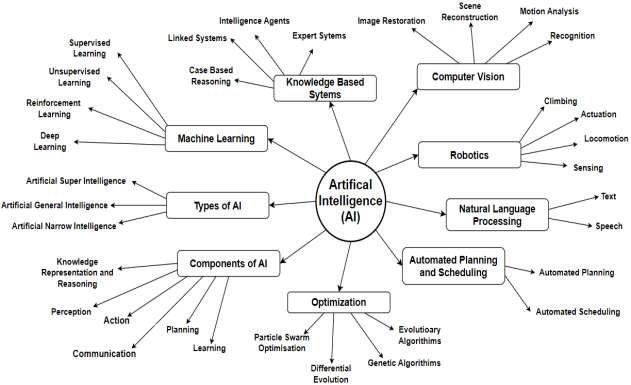
Proc. of the CitA BIM Gathering Conference2025, November 6th 2025, Dublin Ireland
While there is a common conception that AI is a recent development it has in fact been the focus of many inventors and technologists. There are accounts of ideas and designs of machines capable of autonomous movement without human involvement dating back to 400BC Greek philosophers, with Leonardo da Vinci, successfully creating automations in 1495 (Tableau, 2023). These thinkings and inventions have laid the foundation for modern day AI. A surge of investigation into AI develop ed during the first half of the 20th century (1900-1950), with key concepts and terms coined such as robot, computer, machines that think and giant brains. Between 1950 and 1956 Alan Turning published his work ‘Computer Machinery and Intelligence’ which later evolved into ‘The Turning Test’. In 1955 John McCarthy presented his work and coining the term ‘Artificial Intelligence’ . The remainder of the 20 th century saw strides in computer development and use, with increasing functionality and application developed, with continued focus on the computer ’s ability to think like a human and learn, forming the current concept of AI. By 2023 AI had surpassed human performance in a Stanford reading and comprehension test Tableau, (2023) In 2021 OpenAI introduced DALL-E, advancing AI’s understanding of the visual world Tableau (2023). The literature reviewed demonstrates that AI in construction has moved from conceptual modelling to practical deployment. Tools now include machine learning algorithms for predictive maintenance, natural language processing for documentation, and computer vision systems for health and safety compliance (Dockery 2023 and Tableau, 2023). AI’s role in data extraction, risk analysis, scheduling, and autonomous decision -making continues to expand, although adoption remains limited due to cost and technical complexity (Rao, 2022).
This study employs a sequential mixed-methods research design to explore the integration of BIM and AI in the construction industry. It combines a comprehensive Systematic Literature Review (SLR) with empirical primary research methods , structured surveys and semi-structured interviews. Tranfield et al. (2003) suggest this dual approach provides both theoretical depth and practical insight, capturing not only existing academic discourse but also real-world applications and perspectives from active professionals within the industry. The methodology was crafted to ensure validity, replicability, and relevance to the rapidly evolving construction technology landscape. The SLR formed the theoretical backbone of this study, conducted using academic databases such as Scopus, Google Scholar, ScienceDirect, ResearchGate, and the Yeats Library Search terms included “Artificial Intelligence in construction,” “Building Information Modelling adoption,” “BIM benefits and challenges,” “AI ethics,” and “digital transformation in construction.” Studies were filtered by relevance, publication date and peer-reviewed status. This resulted in the inclusion of high -quality sources, forming the academic basis for tracing the evolution, current roles, challenges, and ethical considerations of BIM and AI.
The SLR follows a structured, evidence-based approach as conceptualized by Tranfield et al. (2003) encompassing three core stages: Planning the Review, Conducting the Review, and Reporting and Dissemination This paper seeks to critically examine the distinct functions of BIM and AI within the construction sector, and to investigate how their convergence can serve as a catalyst for advancing innovation and shaping the industry's future trajectory. The primary objective of this study is to undertake a critical examination of the evolving relationship between AI and BIM within the construction industry. Specifically, the research seeks to trace the historical evolution of both technologies, elucidating the contextual factors that have
Proc. of the CitA BIM Gathering Conference2025, November 6th 2025, Dublin Ireland
shaped their adoption and highlighting the associated opportunities and constraints encountered in construction practice. It further aims to analyse the current operational capacities of AI and BIM, delineating their functional roles and contributions to project delivery, coordination, and decision-making. Additionally, the study probes the ethical and legal ramifications of their integration, addressing complex issues such as data ownership, algorithmic accountability, and professional liability.
This study’s empirical component was split between qualitative and quantitative methods. The qualitative data was collected through five semi -structured interviews with professionals from a range of roles BIM coordinators, project managers, Operations Managers and Principal Engineers, with varied tenures from 5 to 20 years. These interviews were designed to elicit detailed, narrative -based insights into technology implementation experiences. The questions were structured around four core themes: familiarity with BIM and AI, perceived benefits, challenges faced, and expectations for future use. Interviews were recorded, transcribed, and analysed thematically using a coding framework to identify dominant themes, recurring concerns, and emerging recommendations. Quantitative data was collected via a structured online questionnaire comprising 12 close -ended and short-response questions. It was distributed to industry professionals across disciplines, including architects, engineers, contractors, and consultants. A total of 65 valid responses were received.
The questionnaire focused on assessing the following areas: current usage of BIM and AI tools, level of training, organisational adoption strategy, perceived obstacles, and perceived benefits. The data was cleaned and analysed using descriptive statistical techniques. Figures such as pie charts and frequency tables were generated to illustrate usage trends, tool familiarity, and consensus on integration impacts. Ethical considerations are rigorously followed, all participants received an informed consent form outlining the research purpose, voluntary nature, and confidentiality protocols. Anonymity was maintained throughout, with interviewees identified only numbers 1 –5. No personally identifiable information was collected in surveys. Ethical approval was granted by the academic supervisor at Atlantic Technological University, and data was stored securely in compliance with GDPR guidelines.Limitations of this methodology were acknowledged
Firstly, while qualitative interviews provided deep insight , the sample size was relatively small and geographically concentrated in Ireland, potentially limiting broader applicability. Secondly, although the survey achieved a moderate response rate, it may reflect the perspectives of early adopters or those alread y engaged in digital transformation. Furthermore, the inherent novelty of AI in construction may mean that current applications are underrepresented in both academic and industry narratives. These limitations, however, are mitigated by triangulating qualitative and quantitative data with literature findings, ensuring comprehensive and credible results.
Overall, the chosen mixed methods methodology ensures that this study captures the multifaceted and evolving relationship between BIM and AI in construction. It situates the findings within a robust theoretical context while incorporating the lived experiences and expectations of industry professionals. The integration of policies and current adoption figures grounds the research in the Irish context, while the mixedmethods approach ensures relevance to the broader global construction discourse.
Proc. of the CitA BIM Gathering Conference2025, November 6th 2025, Dublin Ireland
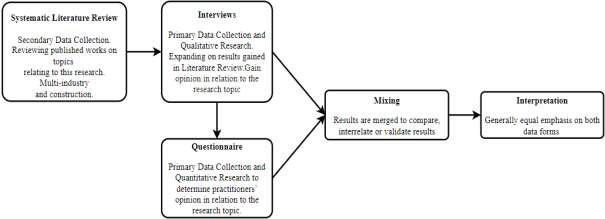
This section details the empirical insights generated through the integration of quantitative survey analysis and qualitative interview responses. The aim is to articulate how construction professionals engage with, interpret, and respond to the evolving presence of BIM and AI technologies in practice. By leveraging both numerical patterns and practitioner narratives, the findings offer a comprehensive portrayal of the sector’s digital transformation landscape.The results are organised around emergent themes that reflect industry attitudes, operational realities, and strategic imperatives. In doing so, the chapter highlights key dimensions such as technological uptake, functional utility, institutional readiness, and perceived limitations. Collectively, these findings establish a critical basis for evaluating the practical integration of BIM and AI and inform the study’s broader theoretical and applied implications. The survey results indicate a high level of industry familiarity with BIM, with a high rate of respondents reporting active use or working knowledge of BIM tools. Conversely, a lower margin of participants confirmed interest in the use of AI applications in their current workflow, with the remainder either unaware of its capabilities or reporting limited exposure. This disparity highlights a clear adoption gap, suggesting that while BIM has become an industry standard, AI remains in the prepubescent stages of integration. Respondentsidentified Revit, Navisworks, and AutoCAD as the most frequently used BIM platforms, indicating a preference for established tools with proven performance records.
In contrast, AI technologies were referenced more generally often described in terms of automation, prediction, and machine learning without the same level of tool-specific identification. This suggests a lower degree of technical penetration and a need for better-defined AI applications tailored to the construction sector. When asked about the perceived benefits of integrating BIM and AI, the top responses included improved coordination, reduced project errors, and enhanced planning and forecasting capabilities. Respondents credited BIM for its ability to centrali se data and improve collaboration across trades, while AI was noted for its predictive modelling potential and automation of repetitive tasks.Interviewees emphasized that AI has the ability to enhance safety analysis by predicting potential hazards and automating compliance checks using real-time data (George et al., 2018). BIM, meanwhile, was consistently recognised as a catalyst for improving communication across stakeholders and reducing design-stage errors through clash detection and 3D visualisation. Together,
Proc. of the CitA BIM Gathering Conference2025, November 6th 2025, Dublin Ireland
these tools are perceived to enhance productivity and streamline the entire project lifecycle. Despite strong support for BIM and cautious optimism about AI, several challenges and barriers were cited repeatedly, as highlighted in Table 1.
Table 1. Barriers highlighted by interviewees and survey respondents (Bada et al., 2025)
Identified Barrier
High Implementation Costs
Lack of In-House Expertise
Fragmentation of Tools
Resistance to Change
Over 60% of respondents indicated that the initial investment required for software licenses, hardware upgrades, and training remains a significant deterrent.
A shortage of skilled professionals with knowledge of AI technologies was mentioned by 62% of respondents, particularly in smaller firms.
Interviewees raised concerns about software compatibility and data exchange issues between BIM platforms and AI tools.
Several participants cited cultural inertia within firms as a limiting factor in technology adoption, especially in companies with long-established processes.
These challenges suggest that although technological capability exists, organi sational readiness and workforce development need to advance in parallel to achiev ing meaningful integration.
The following tables are a consolidation of the results obtained from the stages in the research methodology around the stated research objectives.
Table 2: Objective 1: Unearth historical roots of AI and BIM, pinpointing opportunities and challenges in construction (Bada et al., 2025)
Research Aspect Requirements and Results
Literature Review (Results)
Qualitative Data
Results (Interviews)
Quantitative Data Results (Questionnaire)
Bada et al., 2025. A Systematic Analysis of the Emerging Synergy: Exploring the Integration of BIM & AI for the Future of Construction. Proc. of the CitA BIM Gathering Conference2025, November 6th 2025, Dublin Ireland
Traced the development of BIM and AI, highlighting milestones such as CAD/CAM, BDS, and the EU AI Act. Identified early opportunities in design and project management and challenges such as lack of standards and resistance to innovation.
Interviewees referenced the current nascent stage of AI and BIM, expressing optimism about their transformative potential. Challenges such as resistance to change and training needs were seen as echoes of past transitions in construction technology.
Results reflect a young demographic (74% with 0–5 years’ experience), suggesting openness to new technologies. Resistance to BIM and AI adoption persists, particularly for AI, indicating ongoing challenges despite optimism about their benefits.
Bada et al., 2025. A Systematic Analysis of the Emerging Synergy: Exploring the Integration of BIM & AI for the Future of Construction.
Table 3: Objective 2: Illuminate the present-day functions of AI and BIM in construction(Bada et al., 2025)
Research Aspect Requirements and Results
Literature Review (Results)
Qualitative Data Results (Interviews)
Quantitative Data Results (Questionnaire)
Demonstrated how AI and BIM are used in modern construction for communication, risk management, cost control, and sustainability. Tools such as generative design, automation, and facility management systems were described.
All interviewees acknowledged AI’s and BIM’s roles in automating tasks, improving design accuracy, enhancing site monitoring, and reducing rework. Practical applications such as report writing, tracking, and health and safety monitoring were highlighted as current uses.
Over 61% had successfully implemented BIM. A majority (5 7%) strongly agreed that AI and BIM improve project planning and scheduling. High willingness (87%) to use AI in daily workflows suggests current functions are being recognized and increasingly adopted.
Table 4: Objective 3: Probe the ethical and legal dimensions of integrated BIM and AI systems (Bada et al., 2025)
Research Aspect Requirements and Results
Literature Review (Results)
Qualitative Data Results (Interviews)
Quantitative Data Results (Questionnaire)
Highlighted key legal standards (ISO 19650, EU AI Act), addressing data protection, ethical use, and transparency. Emphasized the need for legal frameworks to evolve with technology.
Strong concern about privacy, GDPR, and the ethical use of AIcollected data. Interviewees called for legal clarity, emphasizing transparency, ethical frameworks, and oversight as essential to address liability and misuse of sensitive data.
Ethical concerns were significant: 52% strongly agreed on their importance. Awareness of the EU AI Act was low (52%), and 78% believed clients should be informed about AI/BIM use underscoring the perceived importance of transparency and ethical regulation.
Table 5:Objective 4: Map future trends and advancements combining BIM and AI for construction (Bada et al., 2025)
Research Aspect Requirements and Results
Literature Review (Results)
Qualitative Data Results (Interviews)
Quantitative Data Results (Questionnaire)
Forecasted future integration trends in automation, generative design, and sustainability. Described emerging areas like cloud collaboration and AI-enhanced decision-making in BIM workflows.
Interviewees projected increasing integration of AI and BIM, noting benefits like enhanced decision-making and predictive analytics. While some were optimistic, others were cautious about regulatory lag and the need for standardization and training to manage emerging tools.
High openness to future use (85%) and strong interest in training (71%) suggest readiness for broader adoption. However, concerns over job displacement (60% agreement) and low awareness of legislation point to areas that must be addressed to enable successful future integration.
Proc. of the CitA BIM Gathering Conference2025, November 6th 2025, Dublin Ireland
The interviews offered rich narrative insights that contextuali sed the quantitative findings. One BIM coordinator emphasised the importance of government mandates and policy alignment to push widespread adoption. Another professional described AI’s role in predictive maintenance and asset management, noting its impact on construction cost savings and health and safety planning. Common themes emerging from interviews included the need for standardi sation, the value of integrated training programs, and the growing role of cloud -based platforms in facilitating real -time collaboration. Professionals also voiced concerns about data governance, ethical implications of AI, and the risks of over-automation without adequate human oversight (Nahra, 2024). While attitudes toward BIM were universally positive, the outlook on AI was more varied rangingfrom excitement about its potential to caution regarding its unpredictable consequences. This divergence underscores the importance of structured frameworks, clear regulations, and continuous professional development in ensuring responsible innovation. The findings indicate that the integration of BIM and AI is seen as not only beneficial but necessary for advancing construction practices. However, achieving this integration will require a concerted effort in training, regulation, and cross-disciplinary collaboration.
This study has explored the intersection of BIM and AI within the construction industry through a structured mixed -methods approach. Drawing on a systematic literature review, practitioner surveys, and semi-structured interviews, the research has revealed that while BIM is well-established as a foundational d igital tool, AI remains emergent offering transformative potential but facing significant adoption barriers.
The findings demonstrate that BIM is widely used for coordination, visualisation, and error reduction, with tools like Revit and Navisworks forming the core of digital workflows. AI, although less visible, is beginning to support predictive planning, safet y monitoring, and automation. Industry professionals recognise the value of combining these technologies, particularly in enhancing efficiency, data management, and proactive risk mitigation. However, the pace of AI adoption remains limited by high implementation costs, technical fragmentation, unclear regulatory guidance, and a widespread lack of expertise.
The study also underscores the role of policy frameworks such as the NSAI’s BIM standards, which provide a foundation for interoperability and consistency. The absence of comparable AI regulation, however, presents a critical challenge. Without clear ethical, legal, and operational structures, AI risks being implemented in isolated or ad hoc ways that undermine its potential.
In conclusion, the integration of BIM and AI is not only desirable but inevitable for a sector increasingly driven by data, sustainability, and performance outcomes. Yet this transformation must be approached with care. Advancing from experimentation to maturity will require coordinated efforts in education, leadership, standardisation, and cross-disciplinary collaboration.
This paper contributes to that discourse by offering an empirical snapshot of current practices and perceptions, while calling for more robust strategic alignment between technology, industry readiness, and institutional support.
Proc. of the CitA BIM Gathering Conference2025, November 6th 2025, Dublin Ireland
The Authorswish to thank all the industry professionals who generously contributed their time and insights to this study; their perspectives were invaluable in shaping the practical relevance of this research. Additionally, they extend their gratitude to the broader academic community and previous researchers whose foundational work has informed and enabled this study.
Further, the Authors wish to thank the CitA Committee for affording the opportunity to present the findings of this study. Their continued efforts to promote innovation, research, and collaboration within the construction and built environment sectors has created an invaluable platform for emerging voices and ideas.
References
Boucher, P. (2020). Artificial intelligence: How does it work, why does it matter, and what can we do about it? Panel for the Future of Science and Technology , European Parliamentary Research Service
Chandra, A., 2024. Liability Issues In Relation to Autonomous Ai Systems.[Online] [Accessed 15 April 2024].
CWMF, (2024). Public Sector BIM Adoption Timeline | Capital Works Management Framework. [Online] Available at: https://constructionprocurement.gov.ie/bim/public-sector-bim-adoptiontimeline/ [Accessed 13 April 2024].
Creswell, J. and Plano Clark, V. (2007). Designing and Conducting Mixed Methods Research. (1st Edition) Sage Publications: CA.
Donohoe, P., (2024). Houses of the Oireachtas. [Online]
Available at: https://www.oireachtas.ie/en/debates/question/2024 -0502/147/#:~:text=Acknowledging%20the%20transformative%20role%20it,cover %20all%20public%20works%20projects. [Accessed 15 July 2025].
Dockery, D., (2023). AI in Construction Has Landed. [Online] Available at: https://www.constructconnect.com/blog/ai-in-construction-has-landed [Accessed 20 December 2023].
Eastman, C., (2009). Automated Assessment of Early Concept Designs. Architectural Design, 79(2), pp. 52 - 57.
European Parliament. [Online] Available at:https://digitalstrategy.ec.europa.eu/en/policies/regulatory-framework-ai [Accessed 13 April 2024].
George F, B. S. A. L. O. and. N. J., (2018). Artificial Intelligence for Construction Safety: Mitigation of the Risk of Fall. s.l., Proceedings of SAI Intelligent Systems Conference.
Greene. M.C. Clarke-Hagan, D. Curran, M. (2020). Achieving Smarter Buildings and More Efficient Facilities Management: The Implementation of Big Data. International Journal of Digital Innovation in the Built Environment Volume 9 • Issue 2 • July-December 2020
Jabi, W., (2013). Parametric design for architecture. 1st ed. London: Laurence King Publishing.
Proc. of the CitA BIM Gathering Conference2025, November 6th 2025, Dublin Ireland
Bada et al., 2025. A Systematic Analysis of the Emerging Synergy: Exploring the Integration of BIM & AI for the Future of Construction.
Jantanee Dunrak, S. A. Z., (2023) The role of artificialIntelligence. Emerald Insight, p. 25.
(Kirk J.Nahraet al.,(2024) The European Parliament Adopts the AI Act [Online] https://www.wilmerhale.com/en/insights/blogs/wilmerhale-privacy-andcybersecurity-law/20240314-the-european-parliament-adopts-the-ai-act [Accessed 16 April 2024]Plano Clark, V. Ivankova, N. (2016), Mixed Methods Research: A guide to the field. Thousand Oaks, California. Sage Publications.
Lawrence, R. G., (2023). AI is coming for construction, experts say. [Online] Available at:https://www.constructiondive.com/news/ai-is-coming-forconstructionexperts-say/639570/ [Accessed 19 December 2023].
Machinist, A. (1998). The CAD/CAM Hall of Fame. [Online] Available at: https://www.americanmachinist.com/cad-and-cam/article/21892098/thecadcam-hall-of-fame [Accessed 18 December 2023].
Martin Luther King, J., 1954. Martin Luther King, Jr.: Sometimes to Move Forward, We Have to Go Backward. Detroit, Michigan: https://theinwardturn.com/martinluther-king-jr-sometimes-to-move-forward-wehave-to-go-back/.
McCarthy, J. (1959). Programs with Common Sense. Standford University, 15. Moubarac J-C, Cargo M, Receveur O, Daniel M (2012) Describing the Situational Contexts of Sweetened Product Consumption in a Middle Eastern Canadian Community: Application of a Mixed Method Design. PLoS ONE 7(9): e44738. https://doi.org/10.1371
NSAI, (2023). BIM -Building Information Modelling, Ireland: National Standards Authority of Ireland.
Rao, S., (2022). The Benefits of AI In Construction. [Online] Available at: https://constructible.trimble.com/construction-industry/the-benefits-ofai-inconstruction [Accessed 10 December 2023].
Regona, M., Yigitcanlar, T., Xia, B., and Li, R. Y. M. (2022). Opportunities and Adoption Challenges of AI in the Construction Industry: A PRISMA Review. Journal of Open Innovation: Technology, Market, and Complexity, 8(1), 45. https://doi.org/10.3390/joitmc8010045
Sofiat O. Abioye et al., (2021) Artificial intelligence in the construction industry: A review of present status, opportunities and future challenges. Journal Of Building Engineering, 44(1), p. 10399.
Tableau, (2023). What is the history of artificial intelligence (AI )? [Online] Available at:https://www.tableau.com/data-insights/ai/history [Accessed 16 December 2023].
Tranfield, D. Denyer, D. Smart, P. (2003). Towards a Methodology for Developing Evidence-Informed Management Knowledge by Means of Systematic Review. British Journal of Management, Vol. 14. 207-222 (2003)
Yasar, K., (2023). TechTarget. [Online] Available at: https://www.techtarget.com/whatis/definition/digitization [Accessed 18 December 2023].
Proc. of the CitA BIM Gathering Conference2025, November 6th 2025, Dublin Ireland
A critical review of the use of Generative Pre -trained Transformers (GPT) models in the generative design process of cleanroom architectural design.
Kemil Naidoo kemil@totarch.ie
TOT
Architects
Kieran O Neill
kieran.oneill@tudublin.ie
Technological University Dublin
Abstract
The integration of Artificial Intelligence (AI), mainly Generative Pre -trained Transformers (GPT) models, into the Architecture, Engineering and Construction (AEC) industry is transforming the design workflows and Building Information Modelling (BIM) frameworks. This study aims to critically examine the application of GPT models in the generative design of cleanrooms at the early stages of design with an emphasis on the integration of these models into existing BIM workflows. An experimental framework combining prompt engineering, dynamo visual scripting and Revit’s generative design tool is developed as part of this paper to demonstrate the automationand efficacyof cleanroom layout generation process.
Keywords: Cleanroom Design, Generative Pre-Trained Transformer (GPT) models, Building Information Modelling (BIM)
1. Introduction
Cleanrooms are highly specialised environments designed to control contamination levels such as dust, airborne microbes, aerosol particles and chemical vapours (Abdou’ and Peyton, n.d.; EN ISO 14644 -1, 2016; EN ISO 14644 -4, 2022) In recent years, their design has evolved significantly to meet the increasing demands of the medical, pharmaceutical, and manufacturing industries in Ireland. Modern cleanroom design now prioritises regulatory compliance, international standards such as I SO 14644, and operational efficiency (Zhao et al., 2023). As noted by (Hairston et al., n.d.), the spatial configuration of a cleanroom is critical to its operational efficiency, compliance, and sustainability. The design and construction of such environments present complex architectural challenges, requiring responses to evolving industry expectations, innovative manufacturing methods such as smart manufacturing or Industry 4.0 (Groeneveld et al., 2023), and increasing environmental demands (Peyton’ and Abdou, n.d.) Simultaneously, the rapid expansion of data availability and computational power has renewed interest in Artificial Intelligence (AI) (Gallo Guiseppe et al., 2020) The Architecture, Engineering, and Construction (AEC) sector traditionally slow to adopt innovation has experienced notable transformation through AI applications (Saka et al., 2024). Generative AI, particularly in the form of Generative Pre-trained Transformer (GPT) models, is reshaping architectural design processes (Lui, 2024). While existing studies examine generative design, GPT models, and cleanroom design independently, no research currently integrates these domains.
Moreover, there is an absence of a clear methodology for applying these technologies to cleanroom design from an architectural perspective. The aim of this research is to investigate how the integration of GPT models with Building Information Modelling (BIM) can enhance the efficiency of spatial planning for cleanrooms at the early design stage. It will establish frameworks for data collection, analysis, and interpretation through BIM collaboration tools to automate spatial layout generation. Additionally, this research will explore how these integrated technologies can improve early -stage decision-making, collaboration across design teams, and compliance with industry and regulatory standards.
Section 2 will critically review design -based literature to define optimal cleanroom environments and relevant regulations, while examining the potential of GPT and generative design within the AEC sector. Section 3 will experimentally develop a framework for implementing GPT within a BIM workflow to optimise spatial design parameters. Section 4 will evaluate the proposed framework through dialogical action research involving semi-structured interviews with industry experts, whose feedback will guide iterative refinement and final appraisal of the methodology
2.1Design approaches to cleanroom construction.
Previous research in cleanroom technology has primarily concentrated on the mechanical system design, which comprises three subsystems: filtration, pressurisation, and ventilation (Peyton and Abdou, n.d.). Since cleanroom performance depends largely on controlling contaminants within the airflow, the focus on these subsystems is justified. Effective airflow management has led to two principal cleanroom types: the conventional cleanroom and the laminar flow or unidirectional flow cleanroom (Groeneveld et al., 2023; Peyton’ and Abdou, n.d.) Conventional cleanrooms, representing early attempts at sterile industrial environments, utilise traditional ventilation principles but face considerable challenges in maintaining stringent contamination control (Abdou’ and Peyton, n.d.). In contrast, laminar flow cleanrooms operate on the principle of airflow displacement, removing contaminants from the sterile zone and achieving higher cleanliness levels (Abdou’ and Peyton, n.d.; Groeneveld et al., 2023). Unlike conventional systems that dilute contaminants through air circulation, laminar flow cleanrooms achieve high air change rates often 600 or more per hour rapidly displacing contaminants from the controlled space (Abdou’ and Peyton, n.d.; Peyton’ and Abdou, n.d.) . Furthermore, the introduction of high-efficiency particulate air (HEPA) and ultrahigh -efficiency particulate air (ULPA) filtration technologies has significantly enhanced air purity standards in cleanroom environments (Abdou’ and Peyton, n.d.; Zhao et al., 2023) .
2.2Background
The application of AI within the AEC industry, particularly in architectural design, has evolved through several transformative phases from early rule-based systems to modern machine learning driven generative models (Caetano et al., 2020) This progression spans the development of Computer -Aided Design (CAD), Building Information Modelling (BIM), and Generative Design (GD), as initially predicted by (Eastman, 1975) The introduction of parametric and generative design methods, originating from numerical optimisation techniques in the 1970s, revolutionised architectural design by enabling the exploration of complex architectural forms (Galanos et al., 2023) (Galanos et al., 2023) and (Krausková and Pifko, 2021)
describe parametric design as the study of complex geometric relationships using computational representation, while Generative Design (GD) involves creating complex forms from simple specifications. As (Caetano et al., 2020) highlights, GD develops computational systems capable of autonomously generating architectural concepts and spatial configurations without human supervision. These evolutionary systems explore numerous design options to identify optimal solutions that meet both aesthetic and performance objectives, allowing designers to address complexity and accuracy while enhancing creativity and innovation (Abrishami et al., 2021) The integration of GD within BIM-based environments has expanded significantly, becoming widely adopted across the AEC sector. Contemporary BIM generative workspaces now include Application Programming Interfaces (APIs) such as the Dynamo Plugin and GD Plugin for Revit, which enable user-friendly interactions, decision-support mechanisms, and automated design rule implementation (Y. Wei et al., 2022). Dynamo, based on visual programming, employs graphical nodes or blocks instead of textual coding, while the GD Plugin for Revit utilises this platform to optimise and rationalise the design process autonomously according to defined parameters (Kossakowski, 2023).
Generative pre-trained transformers (GPT) are a family of large language models (LLMs) based on a transformer deep learning architecture. Transformer models in are a type of deep learning model introduced in 2017 which have become fundamental in natural language processing (NLP) (Belcic Ivan and Stryker Cole, n.d.; Vaswani et al., n.d.). The transformer model, a type of neural network specialises in NLP through identifying the intent and meaning of the end -user's text -based input. These models can dynamically process inputs, prioritizing the most important words with a text -based sentence and evaluate and predict the desired output. Furthermore, GPT models do not comprehend language in the same manner as humans do, instead, they identify words and transform them into discrete units known as tokens, with some words being segmented into multiple tokens. The GPT models, by evaluating all token simultaneously can establish long-range dependencies to process inputs contextually (Belcic Ivan and Stryker Cole, n.d.; Koubaa et al., 2023; Saka et al., 2024)
2.4Application of GPT models in the AEC industry.
In recent years, the use of AI systems within the AEC sector has increased significantly. A prominent area of emerging research involves the application of GPT models in the architectural and construction domain (Saka et al., 2024, 2023). (Jang and Lee, n.d.) explored the capability of GPT models to perform complex pattern recognition and generate meaningful insights, identifying their potential to revolutionise architectural design processes. When integrated within a BIM workflow, GPT models can enhance collab oration among stakeholders and improve both the quality and efficiency of design processes (Jang and Lee, n.d.) (Galanos et al., 2023) demonstrated the use of pre -trained language models (PLMs) to generate architectural floorplans directly from language prompts. Their framework, Architext, fine-tuned on residential layout datasets with spatial and geometric descriptions, enabled users to produce new architectural designs using text inputs alone. This opensource, scalable framework proved efficient and accurate for residential design generation (Galanos et al., 2023). However, due to its dataset limitations, the findings cannot yet be extended to commercial or industrial design contexts. Despite the advantages of such methods, limitations remain. Data interoperability and the restricted token capacity of GPT models continue to pose technical challenges.
Systems like GAIA, which utilise XML inputs, and frameworks such as Architext illustrate the need to translate human intentions into machine -readable formats while accounting for data availability and model constraints (Jang and Lee, n.d.). Furthermore, (Prieto et al., 2023) investigated GPT integration with BIM processes for automating construction scheduling. By leveraging ChatGPT’s natural language processing, the author demonstrated the model’s capability to generate coherent task breakdowns, timelines, and dependencies from unstructured text, streamlining project management workflows (Prieto et al., 2023)
3.1 Process Framework.
Section 1 and Section 2 of this paper highlighted the lack of integration of GPT models and existing BIM workflows including generative design approaches with cleanroom designs. Furthermore, the two sections above also displayed the lack of understanding of the architectural role within cleanroom design and hence for this study, the researcher’s suggested solution for the optioneering and optimisation of spatial designs at preliminary stages of cleanroom designs is an experimental process framework organised in the following steps: The design of three geometric models to allow the production of multiple design variations. Secondly, the use of prompt engineering to extract necessary information from the various client’s documents, briefs and guidance documents that informs the design of cleanrooms or any assets at early design stages. Thirdly, the development of a dynamo script – a visual programming algorithm to convert the extracted information into an intelligible dataset for the automation and optioneering of generative design variations for the spatial planning exercise. Lastly, the use of generative design plugin in Revit version 2024.3 to examine and evaluate the resulting options generated by the dynamo script and data visualisation in the project Information model (PIM).
The first step in the experimental framework is the interpretation and analysis of the as-built drawings of an existing manufacturing facility which incorporate cleanrooms zones with ancillary areas to support the activities of the cleanrooms. The existing layout previously generated in 2D-Autocad are linked and overlaid into Revit and new geometries and boundaries created within the 3D environment. Furthermore, the following steps are used: Input new geometry-build outer building walls, build new internal boundary walls and ancillary zones and circulation zones within the layout. Identify and draw façade lines and main access points to the dedicated cleanroom room boundary. Creation ofa room boundary as illustrated in figure 1 to set the constraint parameters for the dynamo visual programming script. Creation of a ‘Room Number’ and ‘Room Name’ parameter.
Finally, the model as illustrated in figure 2 is purged from all unnecessary data and information not relevant to the study. This is crucial to the process framework to enable Figure 1 & 2 Room boundary created within PIM & 3D
minimum interference with the dynamo script and allow for faster computation time by the algorithm.
The second step in the experimental framework is the use of prompt engineering within Open AI’s Chat GPT models. The selected models for this study are GPT chatgpt -4olatest commercial version and o3 -mini (o3-mini- Released on 2025-01-31) beta version with advanced reasoning algorithm. The experimental workflow is designed to assess the efficacy of the design process from gathering data from the Employers Information requirements (EIR), User Requirements Specification document (URS), ISO standards and building compliance and the analysis of such data. The information gathered is then reviewed and collated into different categories and tabulated using Open AI Chat-GPT model.
Using prompt engineering techniques, targeted information is extracted from the abovementioned sample documents. As highlighted by Open AI platform Open AI Cookbook and emphasised by (J. Wei et al., 2022), intelligent prompt engineering strategies allows for enhanced results within the LLM’s framework. The six strategic steps allowing for targeted information are as follows: Clearinstructions as inputsDetails about the query should be included for more precise output by the models. Ask the model to adopt a person. For this study the model is asked to act as a data analyst and Excel data expert. Specify the steps required to complete the task. Example for this study: Extract data from sample documents, tabulated the extracted information into various categories and finally convert the extracted information into an excel file or comma-separated values (CSV) format file. Provide the relevant input informationsample pdf, word document or inserted text.Splitting complex task into simpler subtasks. Evaluate model outputs by changing the input prompts and analyse whether the model generates a systematic and constant output.
The client brief in the form of an EIR, the URS, ISO standard document for cleanroom design ISO 14644-1:2016 and Technical Guidance document for Part M (Access and Use) and Part B (Fire Safety) are all combined into one singular document for ease of analysis by the GPT model. To ensure precise and accurate data output from the GPT models, clear and detailed instructions is inserted into the GPT models with comprehensive information about the query. Furthermore, for this study, the GPT model is tasked to assume the role of a data analyst and excel data expert to extract the relevant information from the sample document inserted as the data input. In this case, all relevant architectural data is extracted from the sample document, the architectural data pertinent to this study are as follows: Project name / description, max occupancy as proposed by the client , key ISO requirements-ISO designation, room/department name, area footprint of all departments, room heights, room numbers, roomadjacency, architectural floor, ceiling finishes, architectural / structural loadings, Part M min requirements for corridors and escape width,Part B min requirements for number of escapes exits.
Following the identification and analysis of the relevant information by the human supervisor (the author of this research) the GPT model is then tasked to tabulate the information abovementioned into three separate sheets to facilitate processing of the information and data conversion from a text -based format into a CSV or Excel format. Finally, the steps above are repeated with varying the input prompts to analyse and evaluate the different outputs generated to ensure systematic and reliable information .
Following the data extraction, analysis and conversion using the GPT models, the third step in the experimental framework requires the data acquired to be inserted into the dynamo script designed specifically for the spatial planning optimisation and randomisation. The data from the CSV file is extracted using the ‘file path’ code block of the dynamo script For this demonstration, additional room / departments were added to the csv file after the extraction process from the GPT model to better illustrate the efficacy of the dynamo script.
Once the two starting nodes are coded to the script and the correct parameters inserted, the information is plugged into the DynaSpace package. DynaSpace is a targeted package for spatial performance analysis. The package utilises user -provided input layouts and CSV input data compromising of room department, room adjacency and room size to generate multiple arrangement options, allowing users to allocate room positions effectively within an allocated layout footprint. The main working mechanism for the package are as follows: DynaSpace reads input parameters from an Excel file or CSV file formatted with space name, department names, department adjacencies and department sizes. Based on the data in the Excel sheet, the script generates a rudimentary bubble diagram with corresponding areas and arranges them logically according to a predefined input conditions such as boundary strength, sphere collision strength, and department cohesion strength, among others as per figure 3 below.
Finally, the Generative design plugin in Revit is used to visually interpret the dynamo script iteration process by providing a user interface that allows the end -user to visually assess the multiple layouts generated by the script. Through the generative design plugin, the script uses a family named SpacePlanningBubble to generate multiple bubbles and assign appropriate radii to match the areas specified in the CSV file as closely as possible. The plugin also allows to control the generation of layout thro ugh two processes:
• Seed: DynaSpace takes a fundamental input parameter called Seed, which acts as an initial value to generate randomness in each run. This allows DynaSpace to create thousands of different random layouts.
• Randomisation –Allows for random iteration of layouts options.
• Optimisation-Allows for optimization of one layout option and uses a multiobjective genetic algorithm (MOGA) iteration process to generate layouts as illustrated in figure 4 & 5
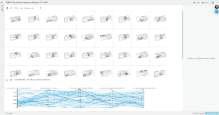

Figure 4& 5. showing MOGA in Generative Design plugin in Revit 2024.3 and showing filtering parameters
To evaluate the experimental framework designed for this capstone research, extensive data was collected in the form of qualitative methods. The methodology employed for this capstone research is Dialogical Action Research which is a subset of action research whereby active participation of the researcher is required through problem formation, action hypotheses, implementation, interpretation and diagnostic iterative cycle (Fellows Richard & Liu Anita, 2015) Using dialogical action research methodology, a panel of industry experts were selected to participate in a semistructured interview process. The various participants comprised of Architects, Process engineers, cleanroom specialist, and cleanroom end -users all of whom demonstrated elevated level of expertise, knowledge and experience in their field and engagement throughout the interview process. The interview process was structured in two distinct phases in line with the dialogical action research method ology employed to allow for further refinements of the experimental research and further review and critique from the panel of industry experts. The initial data collected from the first interview phase can be demonstrated through the Table 1 below. As pre dicted prior to the interviews, very few participants had a full understanding of GPT models and their use with the AEC landscape. Therefore, a brief overview of the subject matter was provided at the start of the session to assist the participants.
1
2 Pharmaceutical /Cleanroom Enduser 13-14
3 Architecture 6-7
consideration from the TGD docs.
5 Process Engineer / Cleanroom Designer 30Average Data availability for LLM training / QA & QC by human element.
6
Table 1: Experts demographic details and insights. *Provided all sensitive information is removed from the initial input data. *IP: Intellectual property rights and ownership.
The aim of the first phase interviews was to collect data on the experimental framework showcased and to establish whether the experimental framework contributes to any significant advantages to existing workflows for cleanroom designs from an architectural perspective.
The findings demonstrated key themes emerging from the phase 1 interviews, most of the participants agreed that the integration of GPT models workflows provides a digital transformation of the early design phase of cleanroom bridging the gap between documentation and BIM workflows. The conversion of the URS, EIR and TGD’s documents into a digital and interactive data set that can then be integration with a Dynamo script significantly improves data analysis and visual interpretation of information. The experts highlighted that this process provides grounds for shifting focus from a traditional process driven design approach into a multi -collaboration approach. Furthermore, the integration of GPT models with generative design tools via tools like Dynamo allows for the automation of traditionally labour -intensive processes at early design stages. This workflow as highlighted by the experts, allows for the translation of massive document data datasets into actionable spatial layout design and enables real time parametric driven design iterations. Additionally, the experimental workflow streamlines the design process and promotes a more holistic, architecturally informed design approach to cleanroom design that could lead to enhanced overall cleanroom performance as suggested by the experts.
However, despite the numbers of benefits, the participants also highlighted some technical and ethical barriers with the current experimental workflow. The interviewees emphasized the importance of refining the data inputs for the GPT models and refining the input prompts to efficiently extract key architectural data from the extensive set of cleanroom design data documents. Some participants raised some concerns in relation to data noise within the URS and EIR documents and stressed that the excessive amount of data may impact the accuracy of the output information and have limitations on the computational power of the dynamo script thus affecting reliability and efficiency of the generative design process. Furthermore, the participants also expressed the need to manually extract key sensitive information within the URS that may compromise IP (Intellectual property) rights and ownership by revealing key process flow methodologies or manufacturing techniques. Additionally, the expert participants suggested refinements to the experimental framework to address some key technical limitations oof the framework. The participants suggested the following: Bubble diagram conversion to volumetric cube or cuboid shapes and access and egress points and circulation routes.
The implementation of volumetric shapes as suggested by the participants allows for an element of height within the 3D model and could potentially be used to inform on
spatial requirements and potential clashes with mechanical and electrical services. Similarly, the addition of another dynamo script to identify access and egress point allows the for the visualisation of circulation spaces within the cleanroom layout and optimum access and egress location at a macro level. At a micro level, the script could potentially be used to identify circulation flow, optimum distances between workspaces and high activity areas within room departments inside the cleanroom spaces. Using the feedback received from the phase 1 interviews, the dynamo script was further refined. The refinements included the addition of a new code block that allowed for the visualization of volumetric cuboid shapes circumscribed within the bubble diagrams as shown in figure 6 below. The heights of the volumetric shapes correspond to the height identified within the CSV file extracted from the URS data interpretation by the selected GPT models, chatgpt-4o-latest and o3-mini (o3-mini- Released on 2025-01-31) beta version with advanced reasoning algorithm.
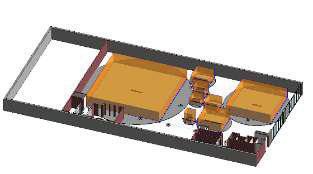
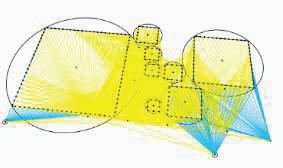
Additionally, another Dynamo script was created to allow for the visualization of access and egress points as suggested by the experts. Figure 11 below demonstrates the execution of the Dynamo script using the principles of maximum travel distances allowed in one single direction of travel and multiple direction of travel as per the Technical Guidance Document Part B 2024, Fire Safety -Volume 1. Under TGD, Part B, the maximum travel distance in one direction and multiple direction of travel are 25 metres and 45 metres respectively for purpose group 6(a) Industrial Normal hazarduse of premises.
This paper explored the integration of GPT models within existing BIM workflows for cleanroom design through the development and testing of an experimental framework. The framework presents a novel approach that embeds GPT models into the traditionally manual workflow of architectural spatial planning. The key contribution of this research lies in bridging the gap between textual documentation such as EIRs and URS and data-driven design processes within BIM, redefining cleanroom layout conceptualisation. The study demonstrates that GPT models, when effectively applied through strategic prompt engineering, can interpret complex regulatory and user requirement documents to extract actionable data for automating cleanroom spatial layout generation. By utilising existing BIM tools, this approach offers scalability, reliability, and a data-driven methodology that supports a more holistic, multidisciplinary design process compared to traditional manual methods. When benchmarked against the case study project, the e xperimental framework achieved high spatial accuracy and design similarity. It reduced the design team’s workload from 4–6 weeks to approximately 15 minutes across 40 iterations using the Dynamo script
and GD plugin in Revit, with identical data inputs derived from URS and EIR documents.
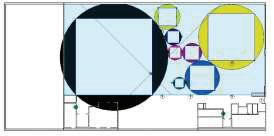
Moreover, feedback from expert participants through dialogical action research further validated the framework’s utility and identified areas for technical refinement. These insights confirmed the architectural relevance of the framework and its potential to implement performance- and data-driven metrics during early design stages. Despite these promising results, several challenges remain for broader adoption of GPT models in the AEC industry. Experts identified key legal and ethical barriers, including data privacy, intellectual property, design copyright, and reliability concerns. The lack of comprehensive industry guidelines from governing bodies such as the Royal Institute of Architects Ireland (RIAI) and the Construction Industry Federation (CIF) poses additional constraints. Furthermore, the AEC industry’s slow adoption of new technologies hampers the creation of accurate, domain -specific datasets needed to train specialised GPT models.In summary, this research provides an initial experimental framework demonstrating the feasibility and transformative potential of integrating GPT models with BIM workflows for cleanroom design. The findings and expert feedback validate the replicable methodology and highlight directions for future research, including larger datase ts, iterative model refinement, and enhanced data pipelines. Further investigations should focus on scalability, ethical safeguards, and legal frameworks to ensure the protection of intellectual property while realising the full potential of GPT-assisted architectural design.
References
Abdou’, O.A., Peyton, T.H., n.d. Industrial clean rooms: architectural engineering considerations.
Abrishami, S., Goulding, J., Rahimian, F., 2021. Generative BIM workspace for AEC conceptual design automation: prototype development. Engineering, Construction and Architectural Management 28, 482 –509. https://doi.org/10.1108/ECAM-04-2020-0256
Belcic Ivan, Stryker Cole, n.d. Explore IBM’s AI solution Subscribe to AI updates.
Caetano, I., Santos, L., Leitão, A., 2020. Computational design in architecture: Defining parametric, generative, and algorithmic design. Frontiers of Architectural Research. https://doi.org/10.1016/j.foar.2019.12.008
Eastman, C.M., 1975. The Use of Computers Instead of Drawings in Building Design.
EN ISO 14644-1, 2016. BSI Standards Publication Cleanrooms and associated controlled environments.
EN ISO 14644-4, 2022. BSI Standards Publication Cleanrooms and associated controlled environments.
Naidoo et al., 2025 A critical review of the use of GPT models in the design process of cleanroom s.
Fellows Richard, Liu Anita, 2015. Research Methods for Construction. Galanos, T., Liapis, A., Yannakakis, G.N., 2023. Architext: Language -Driven Generative Architecture Design.
Gallo Guiseppe, Tuzzolino Giovani Franceso, Wirz Fulvio, 2020. The role of Artificial Intelligence in Architectural design: Conversion with designers and researchers. Groeneveld, T., Ghafoorpoor, P., Huisken, M., Thiede, S., 2023. Methodology for systematic design of cleanroom assembly workstations, in: Procedia CIRP. Elsevier B.V., pp. 410–415. https://doi.org/10.1016/j.procir.2023.09.011
Hairston, D., Staff, E., Matthews, R.A., n.d. Global Standards for Cleanroom Design and Construction FULL TEXT Headnote An internationally accepted protocol will go a long way toward closing the gaps in production and opening channels for tradetrade.
Jang, S., Lee, G., n.d. Interactive Design by Integrating a Large Pre -Trained Language Model and Building Information Modeling.
Kossakowski, P.G., 2023. Visual Programming as Modern and Effective Structural Design Technology Analysis of Opportunities, Challenges, and Future Developments Based on the Use of Dynamo. Applied Sciences (Switzerland) 13. https://doi.org/10.3390/app13169298
Koubaa, A., Boulila, W., Ghouti, L., Alzahem, A., Latif, S., 2023. Exploring ChatGPT Capabilities and Limitations: A Critical Review of the NLP Game Changer. https://doi.org/10.20944/preprints202303.0438.v1
Krausková, V., Pifko, H., 2021. Use of Artificial Intelligence in the Field of Sustainable Architecture: Current Knowledge. Architecture Papers of the Faculty of Architecture and Design STU 26, 20–29. https://doi.org/10.2478/alfa-2021-0004
Lui, R.A.I.B.I., 2024. Application and Challenges of Generative AI in Architectural Design_ A Case Study of GPT-4. ESIC2024.
Peyton’, T.H., Abdou, O.A., n.d. E nvironmental control concepts for industrial cleanroom facilities.
Prieto, S.A., Mengiste, E.T., García de Soto, B., 2023. Investigating the Use of ChatGPT for the Scheduling of Construction Projects. Buildings 13. https://doi.org/10.3390/buildings13040857
Saka, A., Taiwo, R., Saka, N., Salami, B.A., Ajayi, S., Akande, K., Kazemi, H., 2024. GPT models in construction industry: Opportunities, limitations, and a use case validation. Developments in the Built Environment. https://doi.org/10.1016/j.dibe.2023.100 300
Saka, A.B., Oyedele, L.O., Akanbi, L.A., Ganiyu, S.A., Chan, D.W.M., Bello, S.A., 2023. Conversational artificial intelligence in the AEC industry: A review of present status, challenges and opportunities. Advanced Engineering Informatics. https://doi.org/10.1016/j.aei.2022.101869
Vaswani, A., Brain, G., Shazeer, N., Parmar, N., Uszkoreit, J., Jones, L., Gomez, A.N., Kaiser, Ł., Polosukhin, I., n.d. Attention Is All You Need.
Wei, J., Wang, X., Schuurmans, D., Bosma, M., Ichter, B., Xia, F., Chi, E., Le, Q., Zhou, D., 2022. Chain-of-Thought Prompting Elicits Reasoning in Large Language Models.
Wei, Y., Choi, H., Lei, Z., 2022. A generative design approach for modular construction in congested urban areas. Smart and Sustainable Built Environment 11, 1163 –1181. https://doi.org/10.1108/SASBE -04-2021-0068
Zhao, W., Li, H., Wang, S., 2023. Energy performance and energy conservation technologies for high-tech cleanrooms: State of the art and future perspectives. Renewable and Sustainable Energy Reviews. https://doi.org/10.1016/j.rser.2023.113532
Proc. of the CitA BIM Gathering Conference2025, November 6th 2025, Dublin Ireland
Bruno Martorelli bmartorelli@mcorm.com MCORM
Abstract
This practice‐based paper offers practitioner guidance rather than a formal academic study. Drawing on live conference demonstrations, vendor documentation and market scans, it explains the agent roles (planner, doer, checker, memory), how the Model Context Protocol (MCP) enables assistants to act in Revit, and why firm ‐controlled data lakes matter for speed and collaboration. Because rigorous academic publishing cycles are slower peer review, replication and longitudinal studies take time the literature often lags the pace of tool change; practice‐based reports therefore capture current conditions, constraints and trade ‐offs as they are experienced on the ground. Evidence is indicative and drawn from practice; any figures are illustrative. We provide concrete adoption steps, guardrails and lessons learned for teams that want to start small, reduce rework and move toward vendor‐agnostic, data‐centric workflows.
Keywords: AI agents; Data lakes; MCP
1. Introduction
Architectural teams face familiar pressures: compressed schedules, cost control, and higher expectations for sustainability and customisation. AI agents can help by turning plain‐language intent into consistent design actions, while keeping human judgement in control. In conversations with practitioners, the near ‐term ask is simple: they want to chat with their IFC/Revit models and get trustworthy answers without hunting through menus. This is becoming feasible not just because of better models, but because the community is rallying around standards such as the Model Context Protocol (MCP) and standards are what ultimately drive consistency and adoption speed. This paper translates these developments into practical guidance, focusing on what teams can adopt now and how to do it safely.
2. Scope and Sources
This section is practice‐oriented and focuses on concept ‐to‐documentation tasks. Our sources include a desk review of vendor documentation and public talks, observations from live demonstrations at industry events, and informal conversations with practitioners. Claims are presented as indicative examples rather than statistically generalisable findings.
3. Core Concepts
This short primer sets the stage before we dive into details. It explains the three building blocks you will meet throughout the paper agents as teammates (planner,
doer, checker, memory), MCP as a safe “universal remote” for Revit and other tools, and open data lakes as your firm ‐controlled source of truth. You will see how these pieces fit together in everyday tasks, where humans stay in control, and what guardrails to apply. If you only read one section to brief a project team, make it this one.
Think of an agent as a small team you brief, not a single magic button. The same four roles show up again and again, and they help you decide where people stay in control:
• Planner: translates a goal into steps. Example: “Lay out 12 apartments on Level 4 with two cores” becomes a to‐do list:
o set levels
o place cores
o array units
o name rooms
o create sheets.
• Doer: carries out those steps inside your tools (e.g., Revit via MCP), reporting progress and asking for help when it’s unsure.
• Checker: verifies results against rules (code, naming, clashes). If a check fails, it blocks the change or flags it for review.
• Memory: keeps a log of what worked (prompts, parameters, fixes) so the next run is faster and more consistent. Teams can share these “playbooks.”
However, its paramount to keep humans in charge at natural checkpoints: before publishing sheets, when exceeding area/egress thresholds, or when the Checker reports low confidence. Define stop conditions (what the agent may not do) and sign‐off roles (who approves what). Example hand‐off:
• You type a goal.
• The Planner proposes steps.
• You approve the plan.
• The Doer executes the steps.
• The Checker reports pass/fail with notes.
• You accept or request changes.
• The Memory stores the run.
In plain terms, the Model Context Protocol (MCP) is a simple, shared way for smart tools to ask your BIM applications to act creating a wall, setting a parameter, or making sheets without you clicking through menus. Because every step is logged, results are consistent and auditable; repetitive work shrinks; and assistants can be swapped or upgraded without retraining the team. MCP does not replace modelling skill or office standards; it provides a safe, well ‐lit pathway for an assistant to operate
Proc. of the CitA BIM Gathering Conference2025, November 6th 2025, Dublin Ireland
insi e e it an across the emerging ecosystem o try it, install a small bridge or plug‐in, grant limited permissions (project, categories, operations), then run a uic hello orl ” such as creating t o sheets ith title block A1 and review the log. As adapters mature, the same messages will reach Revit, Rhino, IFC viewers and even robotics, reducing tool lock‐in over time.
3.3Open Data Lakes and BIM 2.0
ata la e is best thought o as your irm s ri ate, searchable ault o element ‐level facts extracted from Revit/IFC GUIDs, categories, levels, sizes, materials and dates. Because this copy stays in your control, you can answer questions quickly, power dashboards and feed agents without handing live models to a third party.
Start small and purposeful. Begin with element IDs and type names, then include only the parameters your team uses (for example, fire rating, area and level), plus room/space relationships and a light history of when things were created or updated. With that scope in mind, a minimum viable lake is straightforward: schedule a nightly export to CSV or Parquet, keep stab le IDs and a one‐page data dictionary so everyone speaks the same language, and provide a simple read ‐only viewer so colleagues can search without opening Revit.
Even this lean setup unlocks practical questions that would otherwise cost time to answer: How many FD30S doors are missing closers on Level 3? What is the total GLA by floor? Which rooms fail a minimum ‐daylight rule? These queries become fast look‐ups instead of model‐opening exercises.
A few guardrails help in practice. Start read ‐only and clearly tag sensitive data; document who is allowed to publish changes from the lake back into BIM; avoid the temptation to sync every property on day one; and do not try to replace quality assurance—use the lake to make QA faster and more consistent.
This section distils on‐the‐ground experience: where agents help today, where they stumble, and how teams are adapting. We group the insights into four themes and support them with short, anonymised quotes to show real trade ‐offs. Treat these as conversation starters for your own pilots , not universal truths.
4.1Recurring
e ore you ic a tool or rite a rom t, it hel s to no the groun you are standing on cross con ersations an emos, our atterns e t sur acing reat them as le ers: they tell you here agents hel irst, hat to clean u in your ata, an ho to ee eo le in control
• heme 1: rea ing u the monolith eams mo e aster hen they s a one huge “does‐e erything” suite or a small stac o ocuse tools that connect ell hin o it li e tra ing a iss‐ rmy ni e or a ti y toolbo tart by listing t o or three tas s that bog you o n (e g , sheet sets, sche ules) an as : hich tool oes that ob best, an oes it ha e an my agent can ri e ect some riction too many tools can also o er helm a ro ect (see –) so aim or a eliberate, limite stac you can e lain in one sli e ( )
Proc. of the CitA BIM Gathering Conference2025, November 6th 2025, Dublin Ireland
• Theme 2: Data you own and can search. A firm‐hosted data lake pays off quickly because the agent can answer questions without opening Revit: counts, checks, carbon, naming. Begin with the few parameters your teams use, keep stable IDs, and publish a one ‐page data dictionary so everyone speaks the same language. The win is speed and visibility; the watch ‐out is quality LLMs struggle with messy IFC and ambiguous fields, so pair the lake with simple validators and rule checks (Q11) and do not overshare sensitive data.
• Theme 3: Low‐risk wins first. Agents earn trust by removing drudgery, not by “designing the building” on day one. Compliance checks, door schedules, and drawing‐sheet setup are ideal pilots because the rules are crisp and the impact is visible. If a pilot adds burden extra clicks, unclear logs stop and pick a simpler target (Q4). Always measure a tiny baseline (two runs is better than none) so you can show the delta and decide whether to scale.
• Theme 4: Skills and guardrails. Great outcomes come from boring ‐but‐vital habits: naming conventions, prompt patterns, and review checklists. Clarify who signs off what, where the agent must stop, and how to roll back a bad change. Treat “Memory” as a shared playbook so new colleagues do not repeat old mistakes. Vendors who act like partners learning your stack and constraints accelerate this maturity; hiring signals now emphasise by -laws/compliance know-how plus human-in-the-loop practice (Q5, Q14).
4.2Short Quotations (anonymized, 1–2 lines)
Why anonymity? To encourage candid insight into live projects and avoid commercial sensitivity/endorsement issues, names are withheld. We show role and organization type so readers can still weigh context and credibility.
• [Q1 – T1 contrasting] “On one Boston project the team had to touch 18 different tools every day our systems plus the client’s. People feel the overload.”
Digital leader, Tier‐1 contractor
• [Q2 – T1 contrasting] “We keep hearing two messages: ‘let’s innovate’ and ‘we’re overwhelmed by the sheer volume of tools.’ There’s real tech fatigue in the field.” —Programme manager, Tier‐1 contractor
• [Q3 – Governance] “We’re mapping 200 –300 tools to business capabilities so we can see where we have three apps solving the same problem.”
Technology portfolio owner, Tier‐1 contractor
• [Q4 – T3 low‐risk wins] “If a pilot adds burden instead of removing it, that is a red flag we stop and pick a simpler target.” Delivery lead, Tier‐1 contractor
• [Q5 – T4 guardrails] “There’s incredible pressure from the field to simplify; our job is to thread the needle simplify for teams and still make space to innovate.”
Head of digital, Tier‐1 contractor
• [Q6 – Vendor stewardship] “Founders who win are the ones who act like partners—first they understand our stack because we have so much stuff already.” —Innovation manager, Tier‐1 contractor
Tools & tech —MCP, integration & skills
Proc. of the CitA BIM Gathering Conference2025, November 6th 2025, Dublin Ireland
• [Q7 – MCP momentum] “MCP matters less for the tech and more because the AI community is rallying around it standards drive adoption and speed.”
Agent platform engineer, startup
• [Q8 – Rhino/Revit tinkering] “Rhino was easy to hook up and Python makes it powerful; Revit MCP needs more functions and better prompts to reach real value.” —Computational designer, SME
• [Q9 – ‘Chat my design’] “I want to chat with my IFC/Revit model ask questions and get answers I can trust.” —Design technology lead, architect
• [Q10 – Healthy scepticism] “We’re back to slapping ‘AI ‐powered’ on anything with a BIM model—proof and guardrails matter.” Structural engineer
• [Q11 – LLM limits with IFC] “LLMs struggle with IFC’s inconsistencies and abstract reasoning; you need checks beyond plain chat.” BIM data specialist
• [Q12 – Bridge ideas] “Could Speckle help bridge Rhino and Revit MCP? The plumbing is there scene understanding is the gap.” Developer, integration firm
• [Q13 – Future scope] “Anyone exploring FEA automation with agents assistants that prepare load cases and boundary conditions, generate meshes, call a verified solver, and auto ‐summarise results (maps, envelopes, pass/fail) for engineer sign‐off? The pieces are appearing across AEC MCPs.”
Research engineer
• [Q14 – Skills market] “Hiring asks now include agentic dev for bylaws and checks—LLMs plus constraints, GIS and human ‐in‐the‐loop.” — Talent lead, AEC tech Before you pick a tool or write a prompt
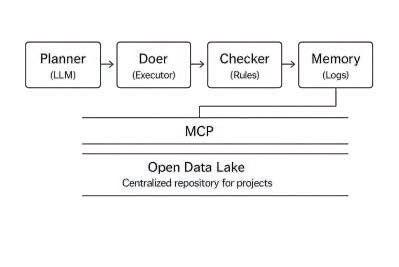
What this is. A lightweight path from interest to a safe , evidence‐based pilot you can run in a week or two. Each step adds just enough structure so you learn quickly, avoid surprises, and have numbers and notes you can show to leadership.
Start where setup is easiest: “Rhino was easy to hook up and Python makes it powerful; Revit MCP needs more functions and better prompts to reach real value.”
Computational designer, SME (Q8)
• Pick one repetitive task: Choose a high ‐frequency, low‐risk chore with clear rules and visible impact (e.g., sheet creation, door schedules). Write a one ‐line
Proc. of the CitA BIM Gathering Conference2025, November 6th 2025, Dublin Ireland
goal (what changes) and a short “done” checklist (what must be true when finished). Name a sign‐off role (who approves output).
• Export nightly project data: Set up a read ‐only export to a secure, searchable store (IDs, types, key parameters, locations). Start minimal only the fields your team actually uses—and keep stable IDs. Add a one ‐page data dictionary and confirm who can read vs. publish back to BIM.
• Prototype an assistant: Build the smallest thing that proves the loop: Planner Doer Checker Memory. Limit permissions to a test model and log every action. Start with a “hello world” (e.g., create two sheets with title block A1), then expand to the chosen task with a few sample cases.
• Measure baseline vs. assistant: Time two runs manual and two runs with assistant. Capture: authoring time, rework time, error count at first check, any blocked steps. Enter numbers in the table below and compute % change = (baseline − assistant)/baseline Keep scope identical across runs.
• Write guardrails: Document stop conditions (what the assistant may not do), review points (where human checks are mandatory), and a rollback plan (how to undo changes). Keep an auditable log and note any data sharing limits (privacy/commercial sensitivity).
• Share patterns & train: Store prompts, scripts and checklists in a shared repo with simple versioning. Hold a one‐hour clinic to show the workflow, emphasise naming conventions, and collect feedback. Turn good fixes into Memory so next runs are faster and more consistent.
“We’re back to slapping ‘AI‐powered’ on anything with a BIM model proof and guar rails matter ” Structural engineer (Q10)
This section provides final, practice -based benchmarks adopted for the paper. The figures summarise commonly reported time savings when assistants support tightly scoped tasks in day‐to‐day delivery. They are intended to give readers a realistic planning baseline without needing any external attachment.
Scenario definitions (what each row means):
• Unit layout – typical floor: placing cores, arrays of unit types, room naming/numbering and basic circulation on a repeatable floor plate; excludes detailed interiors and façade.
• Sheet creation – 30 sheets: batch creation of sheets from a standard title block with automated view placement and naming; excludes drafting/detailing beyond view placement.
Proc. of the CitA BIM Gathering Conference2025, November 6th 2025, Dublin Ireland
• Door schedule update: detecting changed doors, repopulating required parameters (e.g., fire rating, ironmongery sets) and regenerating schedules; excludes field verification.
Table 1. A table showing the gains in productivity
Interpretation notes: Figures assume (1) clean office standards, (2) a working MCP bridge or equivalent automation interface, and (3) a human review checkpoint before issue. Actual results vary with scope and model quality.
Formula: % change = (baseline − assistant) / baseline
Conclusions from these benchmarks are the following:
• Assistants deliver outsized gains on rule ‐based documentation tasks ( ≈90–94% time reduction for sheets and schedules), where standards are clear and steps are repeatable.
• Layout work benefits but remains hybrid ( ≈50% reduction), indicating that human judgement plus agent execution is the most effective pattern.
• For near‐term planning, teams can reasonably assume 2 –4× throughput on documentation and ~2× on repetitive layout, provided office standards are stable, an automation interface (e.g., MCP) is in place, and a human review checkpoint is enforced.
This section sets the ground rules for using agents safely in day ‐to‐day practice who stays accountable, what gets reviewed, what is logged, and how to prevent or roll back mistakes. Treat it as the working agreement between people and software.
Maintain human accountability by assigning a named approver for each agent‐supported task, setting clear sign ‐off thresholds (e.g., any code or life ‐safety change requires human review), and keeping an immutable audit log (timestamp, model GUIDs, action, before/after values) with a simple rollback plan.
Mitigate bias by documenting training examples and prompt templates, curating an “edge‐case library” (accessibility scenarios, unusual geometries, heritage constraints), and periodically red‐teaming the assistant. Track basic accuracy against ground truth and pause when confidence is low.
Protect data by classifying model information, keeping sensitive parameters in the firm‐controlled lake with read‐only defaults, applying least ‐privilege service accounts, stripping PII, and approving any outbound sharing via a short data ‐processing checklist.
Support junior staff with a clear progression: from redlining, to prompt writing, to checker‐rule authoring and finally agent design. Pair with mentors, require two ‐person reviews on early contributions, and record authorship in internal notes so learning compounds.
Proc. of the CitA BIM Gathering Conference2025, November 6th 2025, Dublin Ireland
Martorelli (2025) AI Agents and Generative Design: Reshaping architectural workflows for
Before scaling beyond pilots, it’s worth being explicit about the edges of today’s tools and the direction of travel. This brief note flags current constraints you should plan around, near‐term research that may unblock them, and a simple takeaway to guide day‐to‐day choices.
• Reality checks. Language models can struggle with IFC inconsistencies and abstract reasoning, so rely on validation beyond plain chat (Q11). Expect plumbing work scene understanding functions, better prompts, and bridging between tools (e.g., Speckle across Rhino/Revit MCP) to mature (Q12).
• Research directions. The community is already asking about FEA automation with agents (Q13). In the near term, keep agents in “assist” mode, log actions, and escalate complex cases to specialists.
• Practice takeaway. Use agents where data is clean and rules are clear; require human sign‐off elsewhere. Document exceptions and invest in shared patterns so teams learn together.
What we mean by FEA: Finite Element Analysis (FEA) is the family of simulations used to predict structural behaviour (stresses, deflections, vibration) by discretising a model into small elements and solving the physics across them. In this paper, “FEA automation with agents” refers to assistants that help with pre‐processing (load cases, boundary conditions, meshing), orchestrate a verified solver with standard load combinations, and auto ‐summarise results (contours, envelopes, pass/fail) for engineer sign‐off—leaving modelling assumptions, mesh quality checks and interpretation to qualified engineers.
8. Conclusion
This brief wrap‐up turns the playbook into immediate next steps, what to try first, how to measure progress, and how to scale safely without losing control.
Start small, measure openly, and document the rules. Agents and open data can reduce rework and improve coordination without locking teams into a single platform. With clear guardrails, the approach supports faster delivery and better decisions while keeping architects in charge.
References
Bentley Systems (2024) Model Context Protocol (MCP): An Open Standard for Agent–BIM Interaction. White paper. Available at: https://github.com/ (Accessed 9 October 2025).
Liang, X., Zhang, Y. and Wang, P. (2023) ‘Ethical considerations of artificial intelligence in architecture, engineering and construction’, Automation in Construction, 150, 104862. Available at: https://doi.org/10.1016/j.autcon.2023.104862 (Accessed 9 October 2025).
OpenAI (2024) GPT-4o System Card. arXiv preprint. Available at: https://arxiv.org/abs/2410.21276 (Accessed 9 October 2025).
LIFTbuild (2025) ‘CASE STUDY: Generative Design’. Available at: https://www.liftbuild.com/news/case-study-generative-design/ (Accessed 9 October 2025).
LIFTbuild (2025) ‘Building Optimization Layout Tool (BOLT)™’. Available at: https://www.liftbuild.com/bolt/ (Accessed 9 October 2025).
Proc. of the CitA BIM Gathering Conference2025, November 6th 2025, Dublin Ireland
Martorelli (2025) AI Agents and Generative Design: Reshaping architectural workflows for the Built Environment
Speckle (2025) ‘Zutari automated report writing with Speckle’. Available at: https://speckle.systems/customer-stories/zutari-automated-report-writing-withspeckle/ (Accessed 9 October 2025).
Speckle (2025) ‘Customer stories (case study index)’. Available at: https://speckle.systems/customer-stories/ (Accessed 9 October 2025).
ArchiLabs (2025) ‘Revit AI Assistants in 2025: A Real-World Benchmark’. Available at: https://archilabs.ai/posts/revit-ai-assistants-in-2025-a-real-world-benchmark (Accessed 9 October 2025).
Proc. of the CitA BIM Gathering Conference2025, November 6th 2025, Dublin Ireland
Theme 2: BIM Adoption, Maturity, Policy and Digital Delivery
Davitt Lamon– Davitt.Lamon@NSAI.ie
National Standards Authority of Ireland
Barry McAuley – Barry.McAuley@TUDublin.ie
Technological University Dublin
Mark Mulville – Mark.Mulville@TUDublin.ie
Technological University Dublin
Abstract
This study benchmarks the value of organisational BIM certification in Ireland through interviews and a survey with 13 organisations certified under a national ISO 19650 -2 scheme. It explores motivations, perceived benefits, and future certification needs, offering insights into how certification supports digital delivery maturity. Findings highlight growing client recognition, internal process improvements, and interest in expanded schemes, including individual and project -level certification. As the first academic study of its kind in Ireland, it addresses a significant gap in the literature and informs the ongoing development of certification policy and practice in the Irish construction sector.
Keywords: BIM; ISO 19650; Certification
1. Introduction
1.1Context
The construction sector in Ireland is undergoing significant transformation driven by national policy, industry innovation, and the adoption of digital technologies such as Building Information Modelling (BIM). Government -led initiatives, including the National BIM Council’s (NBC) roadmap for digital transition (NBC, 2020) and the Build Digital Project (Build Digital Project, 2023), have positioned BIM as a critical enabler of productivity, collaboration, and information management. In response, the Irish public sector introduced a phased BIM mandate in January 2024, aligning procurement requirements with ISO 19650 standards for infor mation management across the asset lifecycle (DPENDPDR, 2024; OGP, 2024)
Organisational BIM certification schemes, aligned with ISO 19650 -2 and assessed under ISO/IEC 17065, have emerged as a mechanism to demonstrate structured capability in managing information(ISO, 2018a; ISO/IEC, 2012). These schemes provide formal recognition of an organisation’s ability to implement consistent digital delivery processes. As Ireland seeks to build a more digitally mature and internationally competitive construction industry, such certification offers a potential
benchmark for quality, consistency, and continuous improvement (McKenna et al., 2024; PwC, 2024)
1.2Research Problem
While the implementation of ISO 19650 has gained momentum in Ireland, there remains a lack of academic research examining the impact of organisational BIM certification. Existing literature on BIM adoption in Ireland has primarily focused on uptake trends, policy interventions, and skills development (Hore et al., 2023, 2019; Kuang et al., 2023). Although several certification schemes are now operational in Ireland and internationally, including those offered bythe British Standards Institute (BSI), Building Research Establishment (BRE), Lloyd’s Register Quality Assurance (LRQA), and the National Standards Authority of Ireland (NSAI), there is limited empirical analysis of their value or influence on digital delivery capability (BRE Global, 2016; BSI, 2020; LRQA Group, 2021; NSAI, 2023) .
Where BIM certification is discussed in academic literature, it typically refers to using information models to support environmental assessment or asset performance, rather than certification of organisational processes or competence (Alaghbandrad, 2015). As a result, there is a critical evidence gap regarding how certified organisations perceive the purpose, outcomes, and future direction of BIM certification in the context of ISO 19650 and Ireland’s broader digital transition.
1.3Research Objective
This study aims to explore the value of organisational BIM certification in the context of Ireland’s ongoing digital transformation. Specifically, it investigates the motivations that drive organisations to pursue certification, the benefits they perceive following certification, and their expectations for the future development of certification schemes. The research focuses on organisations certified under ISO 19650 -aligned schemes and contributes to a better understanding of how certification supports structured information management, digital delivery maturity, and alignment with public procurement requirements.
1.4Literature Review
The digitalisation of the construction sector across Europe has been driven by a combination of policy initiatives, standards development, and capacity -building programmes. Within this context, BIM has emerged as a central enabler of structured information management across the asset lifecycle. European efforts to promote BIM adoption, such as those outlined by the European Construction Sector Observatory, have called for increased public sector lea dership, consistent procurement practices, and standardised training and certification frameworks (European Construction Sector Observatory, 2021, 2019). Ireland’s national response has involved a range of initiatives including the BIM Innovation Capability Programme (2016), National BIM Council’s roadmap (NBC, 2020), the Build Digital Project(Build Digital Project, 2023) and a phased BIM mandate for public sector projects introduced in 2024 (DPENDPDR, 2024). The NBC’s roadmap specifically references the role of the NSAI in establishing a BIM certification framework to support Ireland’s digital construction ambitions (NBC, 2020).
Certification will become even more important given that the BIM mandate aligns with the National Upskilling Roadmap2030, which suggests accelerating the implementation of the mandate and digital skills, particularly targeting micro, small, and medium-sized businesses (BUSI2030, 2024). This can assist in addressing
Proc. of the CitA BIM Gathering Conference2025, November 6th 2025, Dublin Ireland
challenges related to labour shortages, competitiveness, resource and energy efficiency, quality and productivity while boosting construction output, as highlighted by the Digital Ireland Framework (Department of the Taoiseach, 2022)
The publication of ISO 19650 has provided a globally recognised framework for managing information over the delivery and operational phases of built assets (ISO, 2018a, 2018b). Part 2 of the standard, which sets out requirements for the delivery phase of assets, has been of particular importance for certification schemes aimed at organisations. In Ireland, the implementation of ISO 19650 -2 is supported by a National Annex that contextualises the requirements within national practices (NSAI, 2021). Certification schemes that assess conformity to ISO 19650 -2 requirements have been developed in alignment with ISO IEC 17065, the international standard for certifying products, processes, and services(ISO/IEC, 2012). This approach to certification was informed by a pilot study conducted by the United Kingdom Accreditation Service (UKAS), which trialled conformity assessment to ISO IEC 17065 for ISO 19650-2 with BSI, BRE, and LRQA (UKAS, 2025). These schemes aim to assure clients and stakeholders that organisations possess the necessary capability to manage information effectively across projects.
Several bodies, including BSI, BRE, LRQA, and the NSAI, now offer organisational BIM certification schemes. These schemes vary in their assessment scope, but typically involve an audit of organisational processes, documented evidence of compliance with ISO 19650-2, and verification of roles, responsibilities, and information workflows(BRE Global, 2016; BSI, 2020; LRQA Group, 2025)
Certification is promoted as a mechanism to reduce risk, improve quality, and align with client expectations in increasingly digital project environments (BSI, 2023; NSAI, 2023). However, the academic literature on these schemes remains underdeveloped. Studies that address BIM certification often refer to the use of digital models in support of sustainability or green building assessment, rather than the certification of organisational processes for information management (Alaghbandrad, 2015).
Further distinction is required between organisational certification and schemes targeted at individual competence , for example, the buildingSMART Professional Certification Programme, aligned with ISO IEC 17024, assesses the knowledge of individuals against openBIM and ISO 19650 principles, and is gaining traction internationally (buildingSMART International, 2024, 2021) . In contrast, organisational certification evaluates whether a company has embedded ISO 19650 -based processes within its project delivery framework. Despite the growing number of organisations achieving certification, there is limited independent analysis of how these schemes are perceived, what benefits they deliver, and how they may evolve to meet future industry needs.
Recent national reports have called for greater alignment between BIM certification, skills development, and public procurement strategies to strengthen Ireland’s digital delivery capacity (DFHERIS, 2024; EGFSN, 2020; McKenna et al., 2024) . Yet academic research remains behind practice, particularly in relation to the experiences of certified organisations. As such, there is a need for empirical evidence to evaluate the role that certification plays in supporting organisational maturity and capability development within the Irish construction sector.
This paper presents the first empirical academic study focused on organisational BIM certification in Ireland. Original data collected from certified organisations provides
Proc. of the CitA BIM Gathering Conference2025, November 6th 2025, Dublin Ireland
evidence on motivations, perceived benefits, and evolving needs concerning certification. The study addresses a gap in national and international literature, offering a benchmark for future policy, industry, and research initiatives concerned with digital delivery assurance. It also contributes to broader discussions on the role of certification in supporting ISO 19650 implementation and digital maturity in the built environment.
2.1Research
This study employed a qualitative -dominant mixed methods approach to explore the experiences of organisations certified under BIM certification schemes in Ireland. The research was conducted in two phases. Phase one consisted of semi -structured interviews to gather detailed qualitative insights. Phase two involved a follow -up survey designed to validate and expand upon the themes identified in the interviews. This sequential design enabled depth and breadth of understanding while grounding quantitative findings in participant experience.
2.2Participants
The study targeted the full population of organisations certified to ISO 19650 -2 under a single national certification scheme in Ireland. As of 1 January 2025, a total of 21 organisations had achieved certification. Thirteen organisations agreed to partici pate, resulting in a response rate of 62 percent. This sampling approach ensured that all participants had direct experience achieving organisational BIM certification under the same scheme, providing a consistent basis for comparative analysis.
The representatives who participated in the study were senior personnel directly responsible for the implementation and oversight of BIM processes within their organisations. Typical roles included BIM Director, Head of Digital Construction, BIM Manager, Director, and QA Manager. Their involvement ensured that responses reflected both strategic and operational perspectives on BIM certification, drawing on first-hand experience with the requirements, challenges, and benefits of achieving ISO 19650-2 certification. This targeted approach further strengthened the validity of the findings by capturing insights from those most closely engaged with digital delivery and information management at an organisational level.
2.3.1
Semi-structured interviews were conducted with representatives from certified organisations to gather qualitative insights into their experiences with BIM certification. This method allowed for guided discussion while remaining open to emergent themes. Interviews followed a consistent set of thematic prompts focused on the certification process, motivations for certification, perceived value, and future opportunities for scheme development.
A total of 13 interviews were completed, one per participating organisation. The conversational format enabled participants to reflect openly on their experiences and provide candid feedback. Topics explored included the drivers behind certification, the impact of certification on business practices, internal process improvements, and perspectives on future directions for certification , such as individual and project-based schemes or expanding certification to additional ISO 19650 parts.
Proc. of the CitA BIM Gathering Conference2025, November 6th 2025, Dublin Ireland
The interviews yielded rich contextual data regarding how certification supports organisational maturity, enhances market competitiveness, and aligns with evolving client and regulatory expectations. Insights from these discussions informed the structure of the follow-up survey and shaped the thematic analysis of findings.
Following the interviews, a short, structured survey was distributed to the same cohort of certified organisations to validate and expand on emerging themes. The survey consisted of closed and open -ended questions focused on motivations, perceived benefits, overall value, and potential future certification needs. The survey was anonymous, which encouraged candid responses and protected organisational confidentiality.
Thirteen responses were received, consistent with the number of interview participants. Questions included Likert-scale ratings, multiple-choice items, and optional comment fields to provide qualitative elaboration. This approach enabled triangulation of findings while capturing both quantitative trends and individual reflections on the certification experience.
All participants were informed of the purpose of the study and provided with a plain language statement and informed consent form prior to participation. Consent was obtained before conducting interviews and distributing the survey. Participation was voluntary, and respondents were advised of their right to withdraw at any time without consequence. To protect anonymity, all survey responses were submitted without identifying information, and interview data were anonymised during analysis. Ethical principles of confidentiality, transparency, and informed participation were observed throughout the research process.
2.5Scope and Limitations
This study focused exclusively on organisations certified under the ISO 19650 -2 certification scheme operated by the NSAI. As such, it does not capture the experiences of organisations certified under alternative schemes offered by BSI, BRE, or LRQA, nor does it address individual certification pathways such as those provided by buildingSMART. While the sample reflects a strong cross-section of certified organisations, the total number remains limited due to the emerging nature of certification in the Irishmarket. Findings are therefore context -specific but may offer transferable insights for similar national or early-stage certification environments.
3. Findings
3.1Participant Profile
Thirteen organisations participated in the study, representing 62 percent of the total organisations certified to ISO 19650 -2 under the NSAI’s national certification scheme as of 1 January 2025. Participants were drawn from various sectors involved in BIM delivery, as illustrated in Table 1, providing a diverse perspective on the certification experience.
While the survey was conducted anonymously, participants disclosed their organisation type during interviews. This diversity supports the validity of the thematic findings across multiple project roles and organisational contexts.
Proc. of the CitA BIM Gathering Conference2025, November 6th 2025, Dublin Ireland
Table 1. Participating Organisations by Type
Participants identified several primary reasons for pursuing organisational BIM certification, as summarised in Table 2. Demonstrating compliance with ISO 19650 was the leading driver, cited by ten of the thirteen respondents ( 77 percent). Almost as frequently mentioned was improving internal BIM processes and information management, selected by nine organisations (69 percent).
Three motivations were each reported by eight respondents ( 62 percent): supporting project tendering and pre-qualification requirements, gaining a competitive advantage in the market, and building trust with clients, stakeholders, and project partners. Securing independent, third -party recognition of BIM capability motivated six organisations (46 percent), while alignment with emerging national policy initiatives, such as the BIM Mandate and Housing for All (HfA), was noted by five (38 percent). No respondents selected the “Other” option, indicating that the interview -derived list captured the full spectrum of considerations for this cohort.
Taken together, these findings show that standards compliance and internal process improvement are the foremost motivations, with market positioning and procurement benefits also featuring prominently. Interview commentary further revealed that several organisations view certification as a strategic investment in future readiness, helping them stay “ahead of the curve” even in the absence of explicit client mandates.
Certified organisations reported a range of benefits associated with BIM certification, as shown in Table 3. The two most frequently cited were improved consistency and quality in BIM documentation and a structured approach to continuous improvement, each selected by nine of the thirteen respondents (69 percent). Independent validation of internal BIM capability was acknowledged by eight organisations (62 percent), while seven respondents (54 percent) cited an enhanced reputation and credibility with clients and partners.
Approximately two-fifths of the cohort (five respondents, 38 percent) noted greater success in public or private-sector tenders and reported clearer roles, responsibilities, and workflows for information management. Several participants added that BIM certification has already become a formal tendering requirement on certain projects, a condition they expect to become increasingly common as digital delivery expectations mature. Alignment with national standards and public -sector policy was highlighted by four organisations (31 percent). Only one respondent (8 percent) indicated that no significant benefits had yet been observed, and no additional benefits were suggested under “Other”, indicating that the predefined list captured participants’ experience comprehensively.
Table 3. Reported Organisational Benefits Experienced Following BIM Certification
Overall, these results show that the principal value of certification lies in strengthening internal information-management practice and providing credible, third -party assurance of BIM capability. Strategic benefits, such as enhanced market reputation, improved tender outcomes, and readiness for mandatory certification clauses, are also emerging, particularly where clients request explicit evidence of digital competence. Interview feedback further confirmed that certification offers a common framework for training, onboarding, and knowledge transfer, positioning organisations to meet evolving industry expectations.
All participants indicated they would recommend BIM certification to other organisations; however, several limitations were noted. The most frequently cited
Proc. of the CitA BIM Gathering Conference2025, November 6th 2025, Dublin Ireland
challenge was clients' limited awareness or understanding of BIM certification . While some projects had begun to include certification as a tendering requirement, participants observed inconsistency in how certification was recognised or valued across the industry. This lack of alignment reduced the immediate commercial impact of certification for some organisations.
There was also a concern that without broader market recognition and consistent client demand, the strategic value of certification could be undermined. Several participants expressed a need for clearer industry messaging and client education to ensure certification is understood not simply as a compliance exercise but as a meaningful indicator of digital capability.
Some organisations also highlighted the resource demands of the certification process, particularly for smaller firms managing the documentation and audit requirements alongside project delivery. While most viewed the process as manageable, the balance of effort and return was a consideration for some respondents.
Participants were broadly supportive of expanding BIM certification offerings in Ireland. Several expressed interest in the development of additional scheme options, such as certification for individuals, project-level certification, or certification align ed to ISO 19650-6 regarding health and safety information. These developments were seen as logical extensions of current frameworks and necessary to address evolving client and project requirements.
Survey responses indicated strong interest in certification of individuals, similar to the buildingSMART Professional Certification Programme, particularly in roles related to information management. Some participants highlighted the need for clearer pathw ays to demonstrate personal competency in parallel with organisational certification. Others suggested that project-specific certification could help verify the consistent application of information management processes in real project environments.
Finally, participants emphasised the importance of continued national leadership and alignment between certification, procurement, and skills development. Greater integration with client expectations, public sector mandates, and structured upskilling initiatives was identified as essential to ensuring the long -term relevance and value of BIM certification in Ireland.
This study examined the experiences of organisations certified under a national ISO 19650-2 BIM certification scheme in Ireland. Key findings indicate that organisations were primarily motivated to demonstrate compliance with international standards, improve internal processes, and enhance market credibility. Certification was also increasingly seen as a strategic asset in public sector tendering. When asked how valuable BIM certification had been to their organisation , on a scale from 1 (little or no perceived value) to 5 (extremely valuable) , respondents gave an average rating of 4.15, indicating a generally high level of perceived value across the cohort.
Perceived benefits included improved internal clarity, stronger alignment with ISO 19650, and enhanced client confidence. All participants stated they would recommend certification to others, although challenges such as limited client awareness and the
Proc. of the CitA BIM Gathering Conference2025, November 6th 2025, Dublin Ireland
resource demands of the process were noted. Participants also expressed strong support for expanding certification offerings, including individual, project -based, and other ISO 19650-aligned schemes, alongside a need for continued national coordination and integration with procurement and skills initiatives.
This study provides the first empirical analysis of organisational BIM certification in Ireland and contributes to a limited body of international literature on this topic. By capturing the perspectives of certified organisations, it offers evidence-based insights into the motivations, benefits, and evolving needs associated with certification. The findings support policy, industry, and academic stakeholders in understanding how certification contributes to digital delivery maturity and inform the future de velopment of certification schemes and related interventions.
The study was limited to organisations certified under a single national ISO 19650 -2 certification scheme operated by the NSAI. As such, it does not reflect the experiences of organisations certified through alternative schemes or those without certificati on. The sample size, while representing the majority of certified organisations at the time, remains relatively small. Additionally, survey anonymity restricted the ability to crossreference responses with organisational characteristics. These limitations should be considered when interpreting the findings and their applicability beyond the Irish context.
The findings suggest a need to increase client and industry awareness of BIM certification and its relevance to procurement and project delivery. Public sector bodies, in particular, could play a stronger role in recognising and reinforcing certification through clear policy signals. Further development of complementary schemes, such as individual certification, project-level certification, and alignment with other ISO 19650 standards,would respond to emerging market needs.
Future research should expand to include organisations certified under other schemes and those operating in different national contexts. Comparative studies could examine the consistency of certification outcomes and their relationship to digital delivery performance. Additionally, longitudinal research would help assess the sustained impact of certification on organisational practice and project success over time.
Acknowledgements
The author would like to thank the participating organisations for their time and valuable insights, as well as the certification personnel whose work continues to support the development and delivery of BIM certification in Ireland.
References
Alaghbandrad, A., 2015. BIM Maturity Assessment and Certification in Construction Project Team Selection (Master’s Thesis). École de Technologie Supérieure, Université du Québec, Montreal, Canada.
BRE Global, 2016. BRE Global BIM Certification – Overview of Business and Professional Certification Schemes.
BSI, 2023. BSI Qualifications Guide –BIM and Built Environment Pathways.
BSI, 2020. Building Information Modelling (BIM) Certification and Supply Chain Verification.
Proc. of the CitA BIM Gathering Conference2025, November 6th 2025, Dublin Ireland
Build Digital Project, 2023. Industry Colloquium Report: Aligning the Build Digital Project with Industry Needs. Department of Public Expenditure, NDP Delivery and Reform (PENDR).
buildingSMART International, 2024. openBIM Practitioner Certification – Applicant Guide (Version 1.1).
buildingSMART International, 2021. Professional Certification – Foundation Program Overview (Version 2.0).
BUSI2030, 2024. National Upskilling Roadmap 2030. Department of the Taoiseach, 2022. Harnessing Digital: The Digital Ireland Framework.
DFHERIS, 2024. An Update to the Report on the Analysis of Skills for Residential Construction and Retrofitting. Government of Ireland.
DPENDPDR, 2024. Build 2024: Construction Sector Performance and Capacity. National Investment Office, Government of Ireland.
EGFSN, 2020. Building Future Skills – The Demand for Skills in Ireland’s Built Environment Sector to 2030. Department of Enterprise, Trade and Employment.
European Construction Sector Observatory, 2021. Digitalisation in the Construction Sector: Analytical Report. European Commission –ECSO.
European Construction Sector Observatory, 2019. Building Information Modelling in the EU Construction Sector: Trend Paper. European Commission –ECSO.
Hore, A., McAuley, B., West, R., 2019. Building Information Modelling in Ireland 2019. Construction IT Alliance (CitA), Dublin, Ireland.
Hore, A., West, R., McAuley, B., 2023. Accelerating BIM Adoption in Ireland: A TenYear Review of CitA BIM Gathering Proceedings, in: Proceedings of the 6th CitA BIM Gathering. Technological University Dublin, pp. 10 –22. https://doi.org/10.21427/41YA -7402
ISO, 2018a. ISO 19650-2:2018 – Organization and digitization of information about buildings and civil engineering works, including building information modelling (BIM) – Information management using building information modelling – Part 2: Delivery phase of the assets.
ISO, 2018b. ISO 19650-1:2018 – Organization and digitization of information about buildings and civil engineering works, including building information modelling (BIM) – Information management using building information modelling – Part 1: Concepts and principles.
ISO/IEC, 2012. ISO/IEC 17065:2012 – Conformity assessment – Requirements for bodies certifying products, processes and services.
Kuang, S., Hore, A., Hassan, A., McAuley, B., West, R., 2023. Public Sector BIM Adoption: Development and Evaluation of Government Policy Interventions – A Systematic Literature Review, in: Proceedings of the International Conference on Intelligent Computing in Engineering (EG-ICE 2023). London, United Kingdom. https://doi.org/10.21427/VNFV -X324
LRQA Group, 2025. Building Information Modelling (BIM) Certification Scheme Requirements –UK Guide.
LRQA Group, 2021. Building Information Modelling (BIM): Datasheet.
McKenna, T., Lamon, D., Murphy, R., Carroll, S., Collins, J., Concannon, R., Horgan, E., Otreba, M., 2024. International Information Management and BIM Best Practice Report. Build Digital Project – CSG Innovation and Digital Adoption Sub-Group. https://doi.org/10.21427/0Y3M-X874
Proc. of the CitA BIM Gathering Conference2025, November 6th 2025, Dublin Ireland
NBC, 2020. Roadmap to Digital Transition for Ireland’s Construction Industry 2018 –2021 (Updated 2020). National BIM Council, supported by Enterprise Ireland and Government of Ireland.
NSAI, 2023. BIM Certification Information Flyer – ISO 19650-2:2018 Overview.
NSAI, 2021. NA:2021 to I.S. EN ISO 19650 -2:2018 – Irish National Annex to ISO 19650-2:2018 – Information management using building information modelling –Delivery phase of the assets.
OGP, 2024. BIM Requirements in the CWMF from January 2024 [WWW Document]. URL https://constructionprocurement.gov.ie/bim -requirements-in-the-cwmffrom-january-2024/
PwC, 2024. Analysis of the Adoption of Building Information Modelling (BIM) across the EU27 for Public Sector. European Innovation Council and SMEs Executive Agency (EISMEA), European Commission.
UKAS, 2025. About the UKAS Building Information Modelling programme [WWW Document]. UKAS. URL https://www.ukas.com/accreditation/about/developing-newprogrammes/development-programmes/building-information-modelling/ (accessed 3.23.25).
Proc. of the CitA BIM Gathering Conference2025, November 6th 2025, Dublin Ireland
Barry McAuley barry.mcauley@tudublin.ie
Technological University Dublin
Alan Hore alan.hore@cita.ie
Construction IT Alliance
Roger West rwest@tcd.ie
Trinity College Dublin
Abstract
This paper presents a reflective study on the maturity of Building Information Modelling (BIM) in the Irish Architectural, Engineering, and Construction sector, building on previous research conducted in 2019. With the introduction of mandatory BIM requirements for the Irish public sector since 2024, the study evaluates the progress made since the last review to determine the industry's maturity in successfully working within these new requirements. The paper reviews the macro -BIM maturity models used in 2019 and examines existing literature post -2019 to identify what growth, if any, has been achieved within the five key areas of BIM diffusion. The findings indicate that while challenges related to resourcing persist, significant advancements have been achieved in the adoption of BIM standards and practices, driven by governmental and industry initiatives. The study concludes by highlighting areas needing further improvement in enhancing digital construction capabilities.
Keywords Digital construction, BIM, Mandate, Maturity Ireland
1. Introduction
This study follows on from a previous review of the industry undertaken by the authors to gauge the Building Information Modelling (BIM) maturity of the Irish Architectural / Engineering, and Construction (AEC) Sector in 2017 and 2019 (McAuley et al , 2019a&b and Hore et al , 2017a&b). A subsequent review was also undertaken in 2020, where the authors explored the Irish Construction Industry's state of readiness for a BIM mandate in 2020 (McAuley et al , 2020). Since these publications, the Irish AEC sector has continued to embrace BIM, which has been underpinned by the recent Irish Public Sector mandate, which came into effect in 2024.
As highlighted above, BIM has become a mandatory requirement for the Irish public sector, set to extend to all projects under €1 million by 2028 (CWMF, 2023). This initiative aligns with the National Upskilling Roadmap 2030, which suggests accelerating theimplementation of the BIM mandate and digital skills, particularly targeting micro, small, and medium -sized businesses. This can assist in addressing challenges related to labour shortages, competitiveness, resource and energy
efficiency, quality and productivity while boosting construction output, as highlighted by the Digital Ireland Framework. The purpose of this paper is to examine whether the Irish AEC sector has progressed sufficiently since 2019 in order to meet the requirements of the mandate.
The scope of this paper is confined to a review of literature released post 2020, with the aim of establishing whether the Irish construction industry has put in place the necessary supports to drive a mandate. In previous studies, the authors applied a macro-BIM maturity model that consisted of five conceptual models, which had been utilised to measure macro-BIM adoption across the world. The original study was part of the BIMe Initiative Macro Adoption Project based on the published research of Succar and Kassem. Instead of reapplying these models again, the authors will use existing literature to examine if Ireland has advanced or regressed within these particular areas. The results from each of the five conceptual models will be discussed based on this review. As the same methodology as 2019 was not executed, the paper will not be able to provide a definitive quantitative update to compare the previous results. However, a summary of the previous findings in 2019 will be introduced before recent existing literature is synthesised to understand Ireland's growth in this area. The benchmarking of the findings against international studies is outside the scope of this paper.
This section will focus on five key areas comprising
1. BIM diffusion areas.
2. Macro maturity components.
3. Macro diffusion dynamics.
4. Policy actions.
5. Macro-diffusion responsibilities.
In 2019, the sector was still embracing the NBC Roadmap and the Government's digital strategy. However, it was noted by McAuley et al. (2019b) that both failed to adequately propel the industry to the next stage due primarily to a lack of funding. In the same year, Project Ireland 2040 introduced a vehicle to ensure regular and open dialogue between the Government and the construction sector by the establishment of a Construction Sector Working Group (CSG). A part of the CSG's remit was to investigate how industry and Government departments could take forward proposals on BIM. The next section of the paper will examine Ireland's maturity across various areas to determine if there has been any growth following the 2019 initiatives.
The macro-adoption model clarifies how the BIM field types (technology, process, and policy) interact with BIM capability stages (modelling, collaboration, and integration) to generate nine areas for targeted BIM diffusion analysis and planning. In 2019, I reland was experiencing a consistent increase in collaboration and integration regarding BIM processes and policies. This progress could be partially linked to the NBC roadmap and the Government's digital strategy. A key factor in this improvement at the time was the introduction of ISO standards, which provide a standardised approach for using BIM in asset delivery. It was anticipated that this maturity model would continue
growing as the National Standards Authority of Ireland (NSAI) was offering third -party certification for I.S. EN ISO standards. This was complemented by other organisations that had developed BIM certification pathways, focusing on the expanding Irish market. Figure 1 provides an overview of the BIM diffusion areas for Ireland in 2019 across the different field types and BIM capability stages.
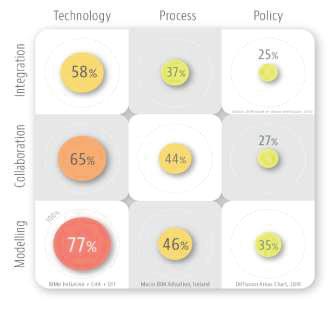
Figure 1: BIM diffusion areas model for Ireland in 2019
It should be noted that since 2019, Ireland has continued to advance in this area. In 2021, Ireland released the National Annex, which provides guidance on how to implement I.S. EN ISO 19650 -2:2018 within the national context of construction projects. Morespecifically, it contains the Irish technical parameters on data components used in BIM, such as field identification and information containers (NSAI, 2021). In addition, several bodies, including BSI, BRE, LRQA, and the NSAI, now offer organisational BIM certification schemes. As of the 1st of January 2025, a total of 21 organisations had achieved certification. The ISO 19650 series is also being adopted into the Capital Works Management Framework on a phased basis to impose standards on information for project delivery across the public sector (Lamon et al ., 2025). Based on the recent Build Digital national survey results for 2024, where 137 participants completed the survey, it was recorded that half of the respondents had experience using contracts tha t specify BIM in accordance with ISO 19650 standards. It should be acknowledged that while the government’s BIM adoption timeline supports standardisation, challenges persist, including skills gaps, financial constraints, and SME adoption disparities (Samp son et al., 2025). These will be explored in further sections.
The macro maturity model outlines eight key components for assessing BIM maturity at national and organisational levels: Objectives, stages, and milestones; Champions and drivers; Regulatory framework; Noteworthy publications; Learning and education; Measurements and benchmarks; Standardised parts and deliverables; and Technology infrastructure. By 2019, Ireland had experienced moderate growth in most components (from 2017 to 2019). Factors such as the Roadmap, the Government's
Proc. of the CitA BIM Gathering Conference 2025, November 6th 2025, Dublin Ireland
digital strategy, and ISO publications contributed to advancing these metrics. Ireland's technology infrastructure at the time continued to attract foreign investment, supported by Project Ireland 2040. Learning and education efforts were strong, with a fo cus then on digital construction in higher education.
Within the 6-year time frame of this review, Ireland has continued to make progress in all areas. Based on the recent Build Digital national survey, it was noted that 66% of respondents are personally involved in their organisation's digital transformation journey. 72% of respondents further indicated that they have experience with multiple digital deliverables using digital tools and methods.
With the BIM mandate in partnership with the suite of ISO 19650 standards now in place, the regulatory framework and standardised parts and deliverables associated with this maturity model have been progressed. Digital Construction education continues to expand with multiple Level 9 courses now established, ranging in areas such as applied BIM, digital leadership, and digital construction analytics, amongst others. Universities continue to embrace BIM and, in multiple examples, have integrated it into theircurriculum. These have been assisted through subsidised funding, such as that provided by Springboard, Skillnet, and DABSE. However, the Build 2024 report highlights a critical skills gap in roles, such as the BIM Manager and BIM Coordinator/Technician, which have been added to the Critical Skills Occupation List. The SOLAS November 2024 vacancy survey supports this, showing that BIM professionals are scarce, while the National Skills Bulletin (2024) reiterate s recruitment challenges for BIM technicians. The issue of recruiting BIM professionals remains an ongoing problem, considering that this issue was flagged as far back as 2020 within the Building Future Skills report, which mentions that respondents found BIM one of the top three roles the most difficu lt to recruit for. The Solas Green Skills 2030 report also highlights BIM as a specific skills gap, with upskilling actions recommended within this area, to assist in meeting the key criteria outlined in the European Performance Building Directive. This ad ds further importance to the ongoing commitment of 3rd level institutes to provide upskilling options in this domain.
In the period since the BIM in Ireland 2019 report, a number of new champions have emerged. A part of the CSG's remit was to investigate how industry and Government departments could take forward proposals on BIM. The CSG Innovation and Digital Adoption subgroup has achieved this through the establishment of the Build Digital Project, which was created to encourage higher levels of innovation and continuous improvement approaches within the construction sector in Ireland. One of Build Digital's objectives was to enhance the skills and capabilities of the AEC workforce to mitigate the skills gap throughout all levels and areas of specialisation. In addition, Construct Innovate was established with the responsibility to make Ireland a global leader in sustainable construction and built environment technology. These organisations have helped to raise the profile of BIM and have aided in advancing the maturity component of noteworthy publications. Furthermore, a robust number of peerreviewed academic papers have driven Ireland further within the digital landscape. Previous research by West et al. (2020) and Hore et al. (2023) has identified and categorised these studies around essential themes. Despite substantial growth in research since 2019, Sampson et al. (20 25) observed that Ireland's BIM research still falls behind on the global stage. Advancing Ireland’s research agenda is crucial as it addresses the complex challenges of BIM implementation worldwide; this research can identify and help overcome significant barriers while highlighting essential enablers for BIM adoption (Chance and McAuley, 2023).
This model evaluated how diffusion processes operate within a population, identifying three dynamics: top-down, middle-out, and bottom -up, alongside three pressure mechanisms: downwards, upwards, and horizontal. The 2019 findings indicated that Ireland's diffusion was middle-out, where larger organisations were promoting the BIM agenda rather than the Government. The lack of strategic funding and guidance from the Government for BIM implementation at the time had kept the model static, which was worrisome, as it was predicted that inadequate support may further alienate SMEs in a highly competitive sector.
As of 2025, this dynamic has changed in that the Irish Government is now proactively driving BIM through a mandate. Regarding the alienation of SMEs, attempts have been made through the Build Digital portal to provide free access to gap analysis tools, templates, project information standards, assessor tools, CWMF process w orkflows, information management / BIM implementation guides, among other resources. Although the uptake of this resource is unknown, it presents a resource that was not readily availablein 2019. Other funded initiatives include the Disruptive Technologies Innovation Fund, which aimed to accelerate the adoption of digital technologies in the AEC sector by promoting awareness of digital transformation's significance. The €500 million fund, established under the National Development Plan, supports collaboration between research and industry to develop and deploy disruptive technologies. Construct Innovate also provides funding to develop new technologies or adapt existing technologies in response to specific construction-related challenges. They also work closely with Enterprise Ireland's Built to Innovate initiative, which provides a suite of lean, digitalisation and research and innovation grant aid packages.
It must be noted that larger organisations continue to promote the BIM agenda and remain a vital player in BIM adoption.
This model assesses the actions policymakers can take to promote market -wide adoption of initiatives, categorising these actions into three approaches: passive, active, and assertive. These approaches are aligned with three policy activities: awareness, encouragement, and observation. In 2019, it was noted that Irish policymakers shifted (as of 2017) from mostly passive approaches to a more active stance, particularly in communication. The formation of the CSG exemplified this. It was noted at the time thatthere had been a slight decline in incentivisation for BIM adoption, although training had increased. It was pointed out that without further government encouragement, these trends may stagnate or decline. Figure 2 illustrates Ireland's maturity within each area at the time.
As highlighted in the previous model, government interventions have led to a shift towards a more assertive approach. In 2020, an economic analysis of productivity in the Irish construction sector report undertaken by TU Dublin and KPMG highlighted that a strong appetite to embrace technology advances was evident; however, there had been a low uptake of funding and training supports for technology and innovation development. Following this report, the CSG identified seven key tasks to modernise the industry, focusing on digital adoption for design and Modern Methods of Construction (MMC), as outlined in the National Development Plan 2021 –2030. The CSG subgroup provided a cohesive link regarding integrating circular economy principles into all projects to minimise waste, developing systems for off -site
construction that enhance MMC, and promotion of BIM and digital adoption across Ireland. The establishment of a connective tissue between all of these initiatives can help to support priority actions, such as those within the Housing for All report, which requires a focus on utilising MMC to overcome housing challenges. This has seen the launch of the Roadmap for increased adoption of MMC in public housing delivery. This was complemented by the joint department MMC Action Plan launched in June 2025. This plan outlines 58 actions focused on skills development, innovation, and the transition to more efficient and sustainable construction methods The partnering of BIM and MMC can result in improved collaboration and communication among project stakeholders, reduced errors and clashes through clash detection, better visualisation and simulation of the construction process, enhanced cost and time management, and the ability to generate more accurate quantity take -offs and cost estimates (Ernest and Young, 2025).
It must also be highlighted that the Irish Construction sector faced unprecedented challenges as a result of Covid, along with inflationary pressures and supply chain disruptions during the period between 2019 and 2025. Build 2024 highlights that despite the challenges, there remains a strategic focus on the initiatives underway in the public and private sectors to increase the sector's efficiency and productivity. These include the adoption of MMC and the introduction of a public sector BIM mandate, as well as reforms to the planning system. All of these initiatives show a clear focus by the Irish Government from the previous iterations of this study.
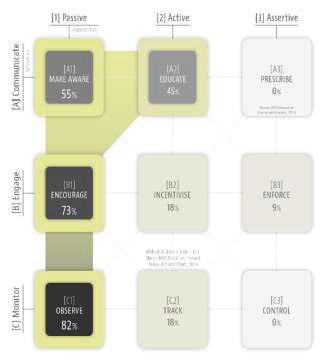
This model examines the diffusion of BIM through various industry stakeholders organised into nine groups across three areas: technology, process, and policy. These groups include policymakers, educational institutions, construction organisations,
Proc. of the CitA BIM Gathering Conference 2025, November 6th 2025, Dublin Ireland
individual practitioners, technology developers, technology service providers, industry associations, communities of practice, and technology advocates. In 2019, educational institutions showed a higher level of BIM diffusion compared to policymakers, whose influence had notably declined at the time, despite efforts to enhance regulatory frameworks and communication strategies. Construction organisations stood out as key players in the BIM process, with industry associations and communities of practice alsoplaying significant roles.
Again, as evidenced across all models, there has been a continued growth within this diffusion. The educational institutions, as highlighted previously, continue to respond in kind, as seen through the growing number of undergraduate and postgraduate BIM courses. There continues to be a marked improvement in BIM -related research projects, with multiple universities securing funding in this area. The industry associations remain extremely relevant, with publications including the 2nd revision of the Royal Institute of Architects Ireland BIM Pack, the Society of Chartered Surveyors of Ireland's BIM Information Guide, Construction Professionals Skillnet Digital Construction Pack, among others. These initiatives are complemented by the previously discussed bank of resources provided by Build Digital. Additionally, Enterprise Ireland continues to offer support through its BIM Enable and Implement Training schemes.
It would appear that the communities of practice have somewhat reduced since 2019, with the BIM regions a noticeable absence. In addition, previous communities of practice, such as the BIM Academic Forum Ireland (BAFI) and the BIM Umbrella Group, are no longer in existence. Both groups previously provided updates on the broader initiatives of academic and professional bodies related to BIM. However, organisations such as the Construction IT Alliance (CitA) continue to provide access to an essential network of digital construction experts through their Automation series and BIM Gatherings. CitA will also launch the national Skillnet MMC Accelerate platform, which will provide targeted training, insights, and resources to empower businesses to adopt MMC. In addition, BIM Heroes, a community of BIM coordinators and AEC professionals, has been launched. This community is connected to the BIM Coordinators Summit, an annual gathering for the global BIM and AEC community.
In 2019, the Technology Developers, Providers, and Advocates were the most influential technology players. Without applying a similar methodology for this update, as was done in 2019, it is difficult to ascertain if this is still the case. However, given that the global BIM market is expected to grow from approximately US $9.9 billion in 2025 to an estimated US $19.0 billion by 2030, at a 13.9% compound annual growth rate, it can be confidently stated that these groups still remain key players in the market (Mordor Intelligence, 2025).
The results from this study show a steady and progressive maturity in BIM over the last 6 years. Given the timeframe, some obvious growth was expected; however, this had to be tempered by the impact of Covid and unexpected inflationary constraints. Despite this, Ireland has demonstrated measurable progress in its digital construction journey. The introduction of a public sector mandate for BIM has helped to indicate a formal recognition of BIM's importance. To advance this, the Irish Government is proactively working to promote BIM adoption across all public sector projects, particularly through reports such as BuildUp Skills Ireland 2030, which emphasises the need for digital skills and training to support SMEs. The formation of the CSG Subgroup, Build Digital and Construct Innovate, along with similar initiatives in the
Proc. of the CitA BIM Gathering Conference 2025, November 6th 2025, Dublin Ireland
circular economy and MMC, has highlighted the policy emphasis on the importance of digitisation. Along with the continued commitment from third -level institutes, industry bodies, and relevant practice communities, it is anticipated that there will be a continued growth in BIM maturity. The requirement to upskill will become even more important as the 31 local authorities in Ireland seek to meet the requirements of a mandate expected to be in place for projects under one million euros in value by 2028.
It can be argued that lessons were learned from the BIM initiatives pre -2019, predominantly the NBC Roadmap. While this Roadmap played a key part in advancing BIM within the sector, it did not make the expected impact due to a lack of funding post-2019. With respect to the Roadmap, several key milestones were achieved through other initiatives, and it was used as a vital guidance tool across multiple organisations. The subsequent funding provided by the Irish Government over the past few years has significantly assisted in ensuring that this lesson was not repeated.
Despite advancements, challenges persist in achieving a coordinated and unified approach to BIM adoption across the sector. While in practice the implementation of ISO 19650 should provide a solution for this, the fragmented nature of the industry and the fact that it consists largely of SMEs will mean that this will need to be monitored and resources continuously made available. Without targeted support and measurable outcomes, the risk of digital exclusion for smaller firms remains high. In addition, while progress has been made regarding fostering collaboration, information standards and skill development, less attention has been given to fostering behavioural changes. There is limited evidence of widespread behavioural change across the sector, and therefore, cultural resistance and fragmented practices continue to hinder the full integration of BIM workflows. This must be balanced with the fact that National reports consistently highlight a shortage of BIM professionals, who are now listed on the Critical Skills Occupation List, indicating a gap between educational output and industry demand.
It is also recommended that similar communities of practice, such as the BIM Academic Forum and Umbrella BIM Group, be reinstated, as these enable a holistic sharing of information that provides a significant benefit to the sector.
5.
BIM maturity within the Irish AEC sector has shown notable advancements since the previous studies in 2019, conducted by the authors. The review of literature post -2019 reveals that Ireland has made significant strides in enhancing its BIM capabilities through policy actions, increased collaboration, and the establishment of standards that facilitate effective implementation. While Ireland's BIM journey reflects an increasing coordination and commitment to enhancing digital construction capabilities, sustained investment in behavioural change, SME engagement, and workforce development is crucial. Addressing these challenges will ensure that BIM adoption is not only widespread but also effective. The collective efforts of industry participants, government bodies, communities of practice, and educational institutions are essential to establish a skilled workforce capable of successfully implementing the required information management standards and processes. This will enable Ireland to further position itself as a leader in digital construction within an increasingly competitive and challenging global market.
References
BIM Coordinators Summit (2025) Where Minds Meet & Information Matters !, available at< https://www.bimcoordinatorsummit.net/
Build Digital ( 2025) Enabling Digital Construction Adoption in Ireland, available at< https://www.builddigitalproject.ie/ >
Build Digital (2024) 2024 Build Digital Annual Survey Results, available at< https://www.builddigitalproject.ie/annual-survey-dashboard-2024>
Build Digital (2025) Exchange Potential, available at < https://www.builddigitalproject.ie/exchange>
BuildUp Skills ( 2024) National Upskilling Roadmap 2030: For the Built Environment , available at< https://www.igbc.ie/resources/national -upskilling-roadmap-2030/>
Chance, S. and McAuley, B. (2023) Infusing Research Know -How into the Construction Sector: Pedagogies to Support Digital Construction in Ireland, Proceedings of the American Society for Engineering Education , Baltimore, June 25th 0 June 28th, pp 1-12
Construct Innovate ( 2025), Ireland's National Research Centre for Construction Technology and Innovation, available at < Ireland's National Research Centre for
Construct Innovate (2025) Innovation Support, available at https://constructinnovate.ie/innovation-support/>.
Construction It Alliance (2025). Welcome to CitA, available at< https://www.cita.ie/>
Construction Professionals Skillnet (2023) Digital Construction Pack Digital , available at < https://www.cpskillnet.ie/wp-content/uploads/2023/06/Digital-ConstructionPack-10-Digital-Compressed.pdf>
Construction Sector Group (2019) A response by CSG industry members to the CSG Sub-Group on Growth & Productivity, June 2019.
CWMF (2023) BIM requirements in the CWMF from January 2024 , available at < https://constructionprocurement.gov.ie/bim-requirements-in-the-cwmf-fromjanuary-2024/.
DASBE (2025) Digital Academy for the Sustainable Built Environment , available at < https://dasbe.ie/>
Department of Enterprise, Tourism and Employment ( 2025) Disruptive Technologies Innovation Fund , available at< https://enterprise.gov.ie/en/what -wedo/innovation-research-development/disruptive-technologies-innovation-fund/>
Department of Further and Higher Education, Research, Innovation and Science ( 2025) Minister Lawless launches Springboard+ 2025, highlighting 'Futureproofing' as a key motivator for potential applicants , available at < https://www.gov.ie/en/department -of-further-and-higher-education-researchinnovation-and-science/press-releases/minister-lawless-launches-springboard2025-highlighting-futureproofing-as-a-key-motivator-for-potential-applicants/>
Department of Housing, Local Government and Heritage ( 2021) Housing for All - a New Housing Plan for Ireland , Irish Government.
Department of Housing, Local Government and Heritage and Department of Enterprise, Tourism and Employment (2024 ) Roadmap for increased adoption of Modern Methods of Construction in Public Housing delivery , Irish Government.
Department of the Taoiseach (2022) Harnessing Digital: The Digital Ireland Framework, Government of Ireland
Proc. of the CitA BIM Gathering Conference 2025, November 6th 2025, Dublin Ireland
McAuley et al., 2025 Building Information Modelling in Ireland 2025: A Retrospective Review of the BIM in Ireland 2019 Report
Enterprise Ireland ( 2025) Building Information Modelling (BIM), available at< https://www.enterprise-ireland.com/en/supports/claims/building-informationmodelling-bim>
Ernst & Young ( 2025) Modern Methods of Construction Action Plan, Department of Further and Higher Education , Research, Innovation and Science
Future Skills Needs National Skills Council (2020) The Demand for Skills in Ireland's Built Environment Sector to 2030, Building Future Skills:
Government Contracts Committee for Construction (2017) A Public Sector BIM Adoption Strategy, Ref CCP 01/17, 15th March 2017.
Hore, A., McAuley, B., West, R., Kassem, M. and Kuang, S. (2017) Ireland's BIM Macro Adoption Study: Establishing Ireland's BIM maturity , Proceedings of the 3rd CitA BIM Gathering , Dublin, 23rd -24th November 2017, pp 32-40.
Hore, A., West, R. and McAuley, B. (2023) Accelerating BIM Adoption in Ireland: A ten-year review of CitA BIM Gathering Proceedings 2013 – 2023, Proceedings of the 6th CitA BIM Gathering , Athlone, September 18th – 20th, 10-22
Hore, A.V., McAuley, B., and West, R.P. (2017). BIM in Ireland 2017. CitA Ltd.
Igwe Sampson, U. Mulville, M; Hore, A and Bruno Lot, T. (2025) Advancing Building Information Modelling (BIM) in the Irish Construction Industry: A Scientometric and Practical Analysis of Adoption Trends and Challenges, Proceedings of the 23rd World Building Congress 2025, University Of Purdue, West Lafayette, Indiana, USA, 19-23 May 2025, Article 153
Kehily, D. (2021) BIM - Route for the QS into the 4D and 5D Digitised Workflow, Society of Chartered Surveyors, available at< https://scsi.ie/wpcontent/uploads/2021/02/SCSI-TU-Dublin-BIM-Information-Guide-Final.pdf>
KPMG, Future Analytics and TU Dublin (2020) Economic analysis of productivity in the Irish construction sector, Department of Public Expenditure and Reform
Lamon, D., McAuley, B. and Mulvile, M. (2025) Benchmarking Organisational BIM Certification in Ireland: Motivations, Benefits, and Future Needs, Proceedings of the 7th Cita BIM Gathering, Dublin, pp 1-10.
McAuley, B., Hore, A., and West, R. (2019) BIM in Ireland 2019: A study of BIM maturity and diffusion in Ireland , Proceedings of the 4th CitA BIM Gathering, Galway, 26th -27th September, pp 222 -229.
McAuley, B., Hore, A.V. and West, R.P. (2019) BIM in Ireland 2019 , CitA Ltd.
McAuley, B., West, R. and Hore, A. (2020) The Irish Construction industry's state of readiness for a BIM mandate in 2020, Proceedings of the Civil Engineering Research in Ireland 2020 Conference , Cork, 27th - 28th August 2020, pp 740745.
Mordor Intelligence ( 2025) G lobal Building Information Modelling (BIM) Market Set to Reach US $19.04 Billion by 2030 , Driven by Digital Adoption and Asia ‐Pacific Expansion, available at < https://www.openpr.com/news/4093367/globalbuilding-information-modeling-bim-market-set-to-reach>
National BIM Council (2017) Roadmap to Digital Transition for Ireland's Construction Industry, December 2017.
Proc. of the CitA BIM Gathering Conference 2025, November 6th 2025, Dublin Ireland
Expansion, available at < https://www.openpr.com/news/4093367/globalbuilding-information-modeling-bim-market-set-to-reach>
National BIM Council (2017) Roadmap to Digital Transition for Ireland's Construction Industry, December 2017.
National Investment Office (2024) Build 2024 - Construction Sector Performance and Capacity, Department of Public Expenditure, NDP Delivery and Reform.
NSAI (2021) BIM' National Annex published and available to purchase, available at https://www.nsai.ie/about/news/bim-national-annex-published/>
Royal Institute of Architects Ireland (2021 ) RIAI BIM Pack 2: BIM Update with ISO 19650 Series & BIM Guide for SMEs, available at< https://www.riai.ie/whatson/news/riai-bim-pack-2-update-iso-19650-series-and-bim-guide-for-smes>
Rudden, PJ (2024) Transforming the future of Irish construction, Irish Construction News, available at< https://constructionnews.ie/innovation -digital-adoptionsubgroup/)
Skillnet Ireland (2025) Building Competitiveness Through Skills, available at < https://www.skillnetireland.ie/>
Skillnet Ireland (2025) Minister James Lawless Launches Skillnet MMC Accelerate Modern Methods of Construction Upskilling Platform , available at < https://www.skillnetireland.ie/news/minister-james-lawless-launches-skillnetmmc-accelerate-platform>
Solas (2024) Difficult-to-fill vacancies survey, available at < https://a.storyblok.com/f/70398/x/16b38e96de/solas-recruitment-agencysurvey.pdf>
Solas (2024) National Skills Bulletin , Government of Ireland.
Solas (2024) Green Skills 20 30: The 1st National Further Education & Training (FET) Strategy for the Green Transition, available at< https://www.solas.ie/programmes/green-skills/>
Succar, B., and Kassem, M. (2015). Macro-BIM adoption: Conceptual structures. Automation in Construction, 57, 64–79. doi:10.1016/j.autcon.2015.04.018
Succar, B., and Kassem, M. (2017). Macro BIM adoption: Comparative market analysis. Automation in Construction, 81, 286–299. doi:10.1016/j.autcon.2017.04.005
West, R., Hore, A. and McAuley, B. (2020) BIM research in Irish academic institutions 2015-19, Proceedings of the Civil Engineering Research in Ireland 2020 Conference, Cork, 27th - 28th August 2020, pp 715 -721
West, R.P., Hore. A.V. and McAuley, B. (2021) Digital Construction and BIM Research in Ireland 2016-2020, Proceedings of the 5th CitA BIM Gathering , Online, September 21st - 23rd, pp 8-21
Proc. of the CitA BIM Gathering Conference 2025, November 6th 2025, Dublin Ireland
Ian McDonnell,imcddsl@gmail.com
AKM Design Group
Claire Simpson claire.simpson@tudublin.ie
Technological University of Dublin
Abstract: Ireland’s 2024 Capital Works Management Framework (CWMF) BIM mandate poses challenges for small architectural practices, which often have limited staff and focus on smaller-scale projects. Although SMEs account for over 90% of construction employment, many struggle to justify the adoption of BIM . This research identifies the key barriers and benefits of BIM implementation through a literature review, followed by international case comparisons to evaluate successful BIM adoption strategies. The study also assesses current government support mechanisms. Based on these findings, it offers practical, tailored recommendations to help Irish micro-SMEs (MSMEs) adopt BIM effectively,supporting compliance with the CWMF mandate while leveraging its potential for productivity gains and waste reduction across the sector.
Keywords: BIM adoption, Irish SMEs, CWMF compliance
The architectural, engineering, and construction (AEC) sector is undergoing a transformational shift toward digitalisation, utilising building information modelling (BIM) (Charef et al., 2019). Globally, this shift is being experienced through new working practices, from pilot projects to government mandates (Fenby-Taylor et al., 2016). The construction sector is well known for incurring significant financial losses due to low productivity and inefficient, repetitive processes. However, by utilising BIM, the industry is striving to change this (Igwe et al., 2023). In Ireland, BIM was first officially referenced in a 2013 Forfás report on the construction industry (Forfás, 2013). It was not until January 2024 that the Irish government mandated that all government contracts exceeding €100 million must have full BIM implementation (Capital Works Management Framework Overview | Capital Works Management Framework , 2024)
Architectural firms play a central role in construction projects and are typically the first point of contact(Hochscheid & Halin, 2018) According to IBIS World's Irish industry statistics, an Architectural practice in Ireland has an average of 2.8 employees (IBISWorld - Industry Market Research, Reports, and Statistics , 2024) The Central Statistics Office (CSO) classifies small and medium -sized enterprises (SMEs) as firms with fewer than 250 employees, further subdivided into micro (fewer than 10 employees), small (10–49 employees), and medium (50 –249 employees). In 2021, it was reported that 91.1% of employment in the construction sector was within SMEs (Small and Medium Enterprise Business in Ireland 2021 – Detailed Results -Central Statistics Office, 2024). Based on these figures, it can be inferred that most Irish architectural practices are micro-enterprises, with the remainder falling into the small
enterprise category.SMEs reportedly face challenges such as high costs, limited training, time constraints, and resistance to change, making it challenging to justify BIM, especially on small projects. Case studies show that even partial adoption can yield significant time and cost savings (Hochscheid & Halin, 2018; Igwe et al., 2023; Klaschka, 2014) On this basis, the central question of this study is: How can small Irish architectural practices meet the requirements of the CWMF BIM mandate? To answer this, this research investigates the key barriers and benefits of BIM adoption among SMEs through a comprehensive literature review . It then conducts a comparative case study of international SME approaches to BIM adoption. Based on these insights, this research then aims to proposerecommendations to guide Irish ArchitecturalMSMEs in adopting BIM, supporting compliance with the CWMF mandate.
The National Building Specification (NBS) defines BIM as a collaborative process for managing and storing built -asset information throughout the project’s lifecycle, resulting in data-rich 3D models (Hamil, 2021) While BIM is widely discussed in both academia and practice, it is observed that larger companies with more resources are better positioned to adopt BIM (Kamari & Makowski, 2019) Since the early 2000s, BIM has gained widespread adoption on a global scale. The BIM market size is projected to grow from $8 billion in 2024 to $14.8 billion by 2029, with increased government initiatives being a significant driver of this growth (Markets and Markets, 2024) The World Economic Forum reports that the engineering and construction sector generates $10 trillion annually, accounting for 6% of global GDP. Digitisation could save 12% to 20%, or $1 to $1.7 trillion annually , within 10 years (The Boston Consulting Group & World Economic Forum, 2018) . The NBS Digital Construction Report 2023 (see Figure 1) indicates that BIM adoption has remained steady at 70% over the past five years, with most respondents (72%) from the UK and the remainder from around the world. Adoption varies among stakeholders, with 73% among AEC consultants and 53% among clients. It also relates to organisation size: 60% for those with 25 or more employees, decreasing to 56% for organisations with 15 or fewer employees (NBS & Glenigan, 2023)
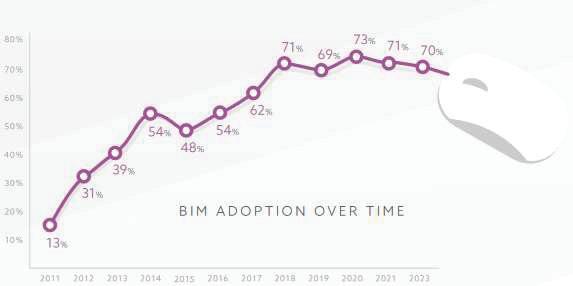
Figure 1. NBS BIM adoption (NBS & Glenigan, 2023, p.8)
Since 2013, Ireland’s BIM journey has mainly been industry -led. A survey conducted by McAuley et al. (2020) found that 73% of businesses had implemented some
aspects of ISO 19650. It also found that 17% of firms had accessed financial support. However, 28% were unaware of any funding. Respondents emphasised the importance of clear government communication on BIM policies, with adequate funding, guidance, and training for clients and SMEs being crucial for success (McAuley et al., 2020)
2.2Main organisationalbarriersfor SMEs in adopting BIM
Challenges relating to BIM adoption differ across organisations depending on their size. Large firms face challenges relatedto motivation, cooperation,and skills. Medium firm’s challenges relate to the knowledge gaps, and small firm’s challenges relate to software-relevant aid and cost (Kamari & Makowski, 2019). Dainty et al. (2017) argue that investing in BIM is unlikely to be justified for SMEs working on both public and private projects. The barriers have been divided by theme in the following sections.
2.2.1 Behavioural dynamics in organisations
Managing the fear of change is a significant barrier to BIM implementation, with research identifying cultural resistance. Smaller firms often have traditional management structures, and older generations are particularly resistant to change due to a reluctance to abandon familiar workflows (Andersson & Eidenskog, 2023) .Case studies show that organisational issues, time pressure, and a digital divide intensify these challenges. The AEC industry often values experience over technological skill, leaving tech-savvy junior staff underutilised. This disconnect can increase sta ff turnover, reduce project resources, and limit opportunities to adopt new ways of working (Andersson & Eidenskog, 2023; Hochscheid & Halin, 2018).
2.2.3 Education and Training
Centanni & McAuley (2023)found that the most significant barriers affecting BIM adoption were training and education. In their study,MacLoughlin & Hayes (2019) noted that interviewees called for more formal training, which, in some SMEs, is available but typically conducted outside office hours, causing reluctance to engage in further training. Furthermore, BIM implementation entails significant upfront operational and training costs(Charef et al., 2019). Staff training, whether for existing or new employees, represents a substantial investment and a potential barrier (Dainty et al., 2017; Igwe et al., 2023). In most SMEs, skills are primarily acquired through onthe-job training, which, without formal instruction, can lead to poor practices (Centanni & McAuley, 2023; Dainty et al., 2017)
2.2.4
A key focus for most organisations concerning BIM implementation is “return on investment” (Ghaffarianhoseini et al., 2017; Kamari & Makowski, 2019; Pham et al., 2020) Larger firms can absorb implementation risks due to greater financial resources and can hire BIM specialists, putting SMEs at a competitive disadvantage(Kamari & Makowski, 2019). SMEs also face financial challenges related to softwareinvestment and computer upgrades (Centanni & McAuley, 2023; Dainty et al., 2017; Igwe et al., 2023; Loveday et al., 2016). Kamari & Makowski (2019)found lower BIM adoption in SMEs, partly because BIM software is often overly complex and not customisable. For SMEs, BIM adoption is usually driven by client requirements and project size.
2.2.5 Implementation & software use
With numerous discipline-specific BIM software packages available, interoperability is essential. Igwe et al. (2023) found that a lack of standards and processes hindered the implementation of BIM, as well as causing interoperability issues. Collaborative environments can pose challenges, especially in ensuring data reliability and clarifying user responsibility for errors (Ghaffarianhoseini et al., 2017; MacLoughlin & Hayes, 2019)
2.3Benefits
The following section discusses the benefits of BIM to SMEs.
2.3.1 Education & training
More education leads to greater awarenessand reduces resistance to BIM. In their study, MacLoughlin & Hayes (2019) reported that one respondent remarked, “everything is happening at once,” while another noted, “we are building at an exaggerating rate which is only possible by BIM” (p. 8). However, while clients may embrace BIM, managing their expectations can present significan t challenges.
2.3.2 Finance & time constraints
Despite high initial investment costs, BIM reduces time spent on rework and minimises documentation errors. Scheduling and quantity take -offs can be directly extracted from the model, while features such as clash detection, visualisation, and improved coordination further enhance efficiency. As all 2D outputs are generated from the 3D model, coordination efforts are significantly reduced (Ghaffarianhoseini et al., 2017; Pham et al., 2020)
2.3.3 Implementation & software use
Although initial software costs may be high for SMEs, early use of BIM for Virtual Design and Construction (VDC) enables real-time collaboration between designers and clients, reducing errors and improving client satisfaction (Ghaffarianhoseini et al., 2017). Interoperability supports cross-disciplinary collaboration andemphasising it could increase BIM adoption. A Common Data Environment (CDE) centralises realtime data, enhancing efficiency, coordination, and information sharing across teams (Andersson & Eidenskog, 2023). Traditionally, AEC firms operated in silos, producing separate drawings, schedules, and documentation, with information shared through RFIs, meetings, and emails, often leading to errors and rework. BIM, however, has been shown to reduce such issues significantly (Ghaffarianhoseini et al., 2017).
2.4The BIM Mandate in Ireland
In Ireland, where SMEs comprise over 90% of the sector, BIM was mandated in January 2024 through the CWMF, requiring its use on all government contracts exceeding €100 million and gradually extending to projects under €1 million within the next four years. The CWMF provides best practice guidance, standard contracts, and template documents across four pillars: public works contracts; conditions of engagement; cost planning, control, and sustainability; and guidance notes with a glossary (Capital Works Management Framework Overview | Capital Works Management Framework, 2024).
2.5 Irish Governmentand Industrysupport for SMEs in adopting BIM
In recent years, several government and industry strategies, training programmes, and educational initiatives have been introduced nationwide. These include:
• Project Ireland 2040: This is Ireland's overarching national development plan, aiming to guide the country's social, economic, and environmental development over the next two decades. The Build Digital Project, which promotes the adoption of Building Information Modeling (BIM) in the construction sector, is a key initiative within Project Ireland 2040 (Project Ireland 2040, 2024).
• Build Digital Project: Led by Technological University Dublin , the Build Digital Project is a partnership between 3rd level educational institutions, as part of Project Ireland 2040. Their aim through their five pillars of Digital Leadership & Cultural Change, digital standards, digital education & training, digital procurement, sustainability, and climate action, is to digitally transform the construction sector, including SMEs (“Build Digital Project,” n.d.).
• Subsidised BIM Courses: Springboard+ is a government initiative, co -funded by the Irish Government (via the National Training Fund) and the EU, in partnership with the Higher Education Authority, providing heavily subsidised courses, including a wide range of BIM and digital construction programs.Additionally, Skillnet Ireland, overseen by the Irish Government, provides short upskilling and reskilling programs in Industry 4.0 technologies, including BIM and Autodesk courses.
• Construction IT Alliance (CitA): CitA is an industry-ledinitiative and has been promoting Building Information Modeling (BIM) adoption across the construction industry for over 20 years. They offer in-company training and self-learning courses in BIM and Revit, as well as other course types. Funding grants are available, against the cost of BIM-related courses at 3rd level, at postgraduate and master’s level through CitA Skillnet (CitA Skillnet Training,” n.d.).
• Financial support for SMEs: Enterprise Ireland and the Local Enterprise Office (LEO) offer financial support for SMEs adopting BIM or digitalising their business Microfinance Ireland also provides loans to startups and MSMEs (under €2M turnover and fewer than 10 employees) through the Government's Microenterprise Loan Fund (“Small Business Loans,” n.d.). Eligibility varies by organisation size, with LEO and MicrofinanceIreland more suitable for MSMEs.
• The Royal Institute of the Architects of Ireland (RIAI) : The RIAI has published a BIM pack for SMEs to help architects understand and implement BIM. It recognises the complexities of BIM and suggests ways that parts of the ISO 19650 standards could be simplifiedto suit any project size (The Royal Institute of the Architects of Ireland - RIAI, 2022)
3. Methodology
This research employs a qualitative approach combining a literature review with a comparative case study. The literature review establishes the research context, identifying barriers, enablers, and international trends in BIM adoption among small practices. Literature reviews are widely recognised as an essential foundation for building conceptual clarity, synthesising prior findings, and identifying resea rch gaps (Snyder, 2019). The comparative case study method was selected because it allows for an in-depth exploration of BIM adoption in real-world settings, enabling a nuanced understanding of organisational practices within their specific contexts (Yin, 2002). By comparing cases from different but comparable jurisdictions, the study can identify patterns and contrasts that inform the Irish situation. On that basis, the following two cases were selected:
• French case study (CS1): Provides a contrasting EU perspective, illustrating voluntary BIM adoption in small firms motivated by innovation and competitiveness rather than regulatory compliance.
• UK case study (CS2): Chosen for its regulatory and industry parallels with Ireland. Conducted prior to the UK’s 2016 BIM mandate, it mirrors Ireland’s premandate situation, providing insight into small firms’ preparation for mandated adoption.
It should be noted that Irish case studies were not selected because, at the time of research, interviews were not possible and empirical data on small Irish practices adopting BIM in the context of the CWMF mandate is limited, as the mandate is recent. In the absence of such data, examining international cases that closely resemble Ireland’s current and emerging situation provides a robust proxy, ensuring that the analysis remains both relevant and timely. The methodological design ensures that the findings are both context-sensitive and generalisable to firms facing similar regulatory pressure.
A deductive thematic approach guided the case study analysis, using three questions: (Q1) What was the motivation for adopting BIM? ; (Q2) What strategy or plan was followed?; and (Q3) How was BIM implemented? These questions draw on Rogers' (1995) Diffusion of Innovations, which frames adoption as progressing from motivation to decision and implementation, and on BIM adoption frameworks that emphasise organisational drivers, planning, and operationalisation (Gu & London, 2010; Succar, 2009). Motivation reflects regulatory, efficiency, and competitive pressures (Rogers, 1995); strategy captures the role of structured planning and readiness(Succar, 2009); and implementation addresses capability, process change, and collaboration (Succar, 2009). Together, these questions provide a conceptually grounded structure for crosscase comparison.
For clarity, at the time these case studies were published, the BIM Maturity levels0-3 were still in use. The comparative analysis will identify key aspects from each paper using thethree questionsoutlined above Table 1 below provides an overview of Case Study 1 (CS1) and Case Study 2 (CS2).
Table 1 Case Study Overview
Case Study 1 (CS1)
Paper Title BIM Implementation in SMEs: An Experience of Cooperation between an Architect Agency and a Carpentry Firm
Authors E Hochscheid, M RibereauGayon, G.Halin, & D Hanser
Case Study 2 (CS2)
BIM Adoption and Implementation for Architectural Practices
Y. Arayici, P. Coates, L. Koskela & M. Kagioglou
Publication year 2016 2011
Location France United Kingdom (UK)
Company Size SME ( 2 employees) SME (exact number not specified)
Project Types Timber house projects in collaboration with a carpentry firm
Social housing and regeneration, one-off homes, and large residential extensions
Motivation for BIM adoption Better interoperability and to reduce errors Improve collaboration with stakeholders and utilize more efficient drawing software
Q1. What was the motivation for adopting BIM?
CS1 had used AutoCAD for over a decade before acquiring the BIM authoring tool ArchiCAD. While still completing projects in AutoCAD, they aimed to adopt 3D modelling to address design changes from architects and engineering decisions concurrently. Similarly, CS2 had relied on CAD for over 20 years without adopting a 3D modelling tool. Using multiple software packages for graphical and non -graphical data caused duplication, inefficient information exchange, and incoherent data, prompting both cases to adopt BIM primarily to improve efficiency and save time.
Q2. What strategy/plan was followed?
CS1 engaged a student from the HAL Open Science research centre and had an inhouse architectural intern. While proficient in CAD, they also understood the potential of BIM. Similarly, CS2 collaborated with the University of Salford through a Knowledge Transfer Partnership (KTP). CS2 approached BIM more cautiously. They reviewed internal processes and evaluated ArchiCAD, Revit, and Allplan, with vendor demonstrations raising awareness and reducing resistance, while CS1 had already purchased ArchiCAD and sou ght guidance; in both cases, initial apprehension was overcome, leading to BIM acceptance
Q3. How was BIM implemented?
CS1 committed time alongside regular projects and engaged HAL to establish a Digital Mock-Up (DMU) involving a student researcher, an architectural intern, and the carpentry firm. Their pilot, a single -family house designed initially in 2D CAD, was selected due to a construction -phase error. The intern developed a BIM model while balancing research and architectural duties, partially assuming the architect’s workload. This pilot allowed the firm to observe time and effort savings. Similarly, CS2 piloted a housing project, transitioning it from CAD to BIM. They qui ckly generated BIM models with 2D outputs and developed a reusable object library of Revit families. Both pilots demonstrated the benefits of BIM.In CS1, the HAL student found France’s BIM Project Execution Planning Guide (BPEPG) too complex for SMEs, prompting the development of a simplified implementation method. This formed a reasonable basis for discussion with staff, and feedback was provided. CS2 also created what they called a “knowledge management database .” This was used for all their non-graphical information from past projects. This was subsequently linked to the BIM project database to facilitate the sharing of information.
Both case studies reached similar conclusions. Each initiated a pilot using existing CAD drawings and created tailored implementation plans. CS1 had already invested in BIM software and, despite interoperability issues, collaborated with carpenters who requested an IFC-format DMU. The firm frequently collaborates using 3D models, and BIM level 2 is now embedded in their practice. The participants were satisfied with the outcome and were willing to invest money to further their BIM journey. CS2, after
achieving staff buy-in through software demonstrations and support from senior staff, is also committed to BIM adoption. CS1 highlighted the rarity and value of cross -firm experiments involving SMEs and research labs, emphasising the need to align BIM processes with daily workflows. CS2 similarly recognised that successful BIM adoption depends not only on tools and processes, but also on the people involved. Both cases illustrate that external support and top -level buy-in reduce resistance and encourage long-term investment in BIM.
6. Recommendations
This research presents a series of recommendations informed by insights from the literature review and empirical findings derived from the case studies(see Figure 2).
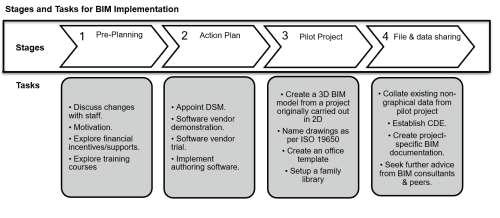
Stage 1 –Pre-planning: In the literature review, MacLoughlin & Hayes (2019) found, the change from 2D CAD to 3D BIM can be significant. Th is research recommends discussing changes with staff, seeking their input, and getting them motivated early as found in CS2 (Arayici et al., 2011) Also, explore the available financial support and educational/training courses
Stage 2 – Action Plan: This research recommends appointing a designated staff member (DSM) to carry out a pilot project. This could be an internor an existing staff member with the appropriate skill set. In addition to proficiency with the authoring software, the DSMshould have a strong understanding of how architecturalpractices operate In CS1, the intern’s tasks were divided between architectural and BIM -related duties (Hochscheid et al., 2016) Consult software vendors regarding trial versions and potential demonstrations. Demonstrations should involve all company members, including management, and ideally should be tailored to a previously completed or ongoing project. It is also advisable to consider a platform for the Common Data Environment (CDE). However, implement the authoring software first to prevent overwhelming the change process.
Stage 3 – Pilot project: During this stage,create a 3D BIM model from a project originally carried out in 2D. The DSM’s time can be divided between supporting live projects and contributing to the BIM pilot. A dditional staff members should assist with the pilot to facilitate knowledge sharing. Recommended tasks during the pilot include creating an office template in the authoring software and developing a library of commonly used objects (e.g., doors, windows). Though time -intensive, these resources are reusable and will improve efficiency onfuture projects. As the CWMF mandate aligns with ISO 19650 standards, the DSM should become familiar with these standards, and all drawings and models should be named and filed accordingly.
Proc. of the CitA BIM Gathering Conference2025, November 6th, 2025, Dublin Ireland
Stage 4 – File & data sharing: This research recommends compiling non -graphical data from past projects into a database linked to the CDE, as done in CS2. The DSM should assist in setting up a CDE for the firm in consultation with a BIM consultant (if needed) to demonstrate interoperability, following examples from CS1 and CS2. Simplified versions of the EIR, mobilisation plan, BEP, responsibility matrix, MIDP, and TIDP should be created to suit project scaleusing the RIAI BIM pack and published to the CDE.The DSM should hold weekly/bi-weekly workshops to update all practice members. The entire practice should familiarise itself with the ISO 19650 standards. Engaging a BIM consultant and consulting other practices with BIM experience is strongly advised. Both case studies presented showcase that BIM implementation is possible regardless of organisationalsize.
Theresearch aimed to provide recommendations for Irish architectural MSMEs to facilitate the adoption of BIM, thereby supporting compliance with the CWMF BIM mandate. The literature review identified common SME barriers, adoption benefits, and available industry and government support, noting that financial assistance , such as LEO grants or Micro Finance Ireland loans , is limited and not BIM-specific. The comparative case study analysis highlighted the value of pilot projects for testing BIM workflows and showed that company size is not necessarily a barrier to successful implementation.
This research acknowledges the limitation that the case studies examined are not based in the Irish context and focus exclusively on an architectural MSME/SME. While international case comparisons offer valuable insights, future research would benefit from empirical studies involving architectural MSMEs in Ireland, as well as crossdisciplinary perspectives. SMEs represent over 90% of employment in the construction sector, a sector that incurs significant financial losses due to inadequate productivity and repetitive processes. Undoubtedly, Architects play a pivotal role in the project process. BIM represents a significant transformation, comparable to the shift from paper-based drafting to CAD over two decades ago. Nevertheless, architectural MSMEs should view BIM not as a barrier, but as an opportunity to reduce sectoral waste and enhance productivity. Embracing such change is essential to remain competitive in a continually evolving industry.
References
Andersson, R., & Eidenskog, M. (2023). Beyond barriers –exploring resistance towards BIM through a knowledge infrastructure framework. Construction Management and Economics , 41(11–12), 926–941. https://doi.org/10.1080/01446193.2023.2218498
Arayici, Y., Coates, P., Koskela, L., Kagioglou, M., Usher, C., & O’Reilly, K. (2011). BIM adoption and implementation for architectural practices. Structural Survey, 29(1), 7–25. https://doi.org/10.1108/02630801111118377
Build Digital Project. (n.d.). In Build Digital Project. https://www.builddigitalproject.ie Capital Works Management Framework overview | Capital Works Management Framework. (2024). https://constructionprocurement.gov.ie/capital-worksmanagement-framework/
Centanni, G., & McAuley, B. (2023). An investigation into Ireland’s BIM Skills Gap. 6th CitA BIM Gathering, Athlone, September 18th - 20th, 130–138. https://doi.org/10.21427/ZV1H-HA92
Charef, R., Emmitt, S., Alaka, H., & Fouchal, F. (2019). Building Information Modelling adoption in the European Union: An overview. Journal of Building Engineering, 25. https://doi.org/10.1016/j.jobe.2019.100777
CitA Skillnet Training. (n.d.). In Cita. https://www.cita.ie/cita-skillnet/ Dainty, A., Leiringer, R., Fernie, S., & Harty, C. (2017). BIM and the small construction firm: a critical perspective. Building Research and Information , 45, 696–709. https://doi.org/10.1080/09613218.2017.1293940
Fenby-Taylor, H., Thompson, N., MacLaren, A., Bartley, T., Rossiter, D., Tennyson, R., & Philp, D. (2016). Scotland Global BIM Study (produced for the Scottish Futures Trust). dotBuilt Environment. https://doi.org/10.13140/RG.2.1.5108.8889
Forfás. (2013). Ireland’s Construction Sector: Outlook and Strategic Plan to 2015 . https://enterprise.gov.ie/en/publications/publication-files/forf%C3%A1s/irelands-construction-sector-outlook-and-strategic-plan-to-2015.pdf
Ghaffarianhoseini, A., Tookey, J., Ghaffarianhoseini, A., Naismith, N., Azhar, S., Efimova, O., & Raahemifar, K. (2017). Building Information Modelling (BIM) uptake: Clear benefits, understanding its implementation, risks and challenges. Renewable and Sustainable Energy Reviews , 75, 1046–1053. https://doi.org/10.1016/j.rser.2016.11.083
Gu, N., & London, K. (2010). Understanding and facilitating BIM adoption in the AEC industry. Automation in Construction , 19(8), 988–999. https://doi.org/10.1016/j.autcon.2010.09.002
Hamil, S. (2021). What is BIM? In NBS. https://www.thenbs.com/knowledge/what-isbuilding-information-modelling-bim
Hochscheid, E., & Halin, G. (2018, September). BIM Implementation in Architecture Firms Interviews, case studies and action research used to build a method that facilitates implementation of BIM processes and tools. 36th International Conference on Education and Research in Computer Aided Architectural Design in Europe. https://hal.science/hal-02868676
Hochscheid, E., Ribereau-Gayon, M., Halin, G., & Hanser, D. (2016). BIM Implementation in SMEs: an Experience of Cooperation between an Architect Agency and a Carpentry Firm. 16th International Conference on Computing in Civil and Building Engineering
IBISWorld -Industry Market Research, Reports, and Statistics . (2024). https://www.ibisworld.com/default.aspx
Igwe, U. S. , Hore, A., & Kehily, D. (2023). Barriers to BIM Implementation for Cost Management in the Irish Construction Industry https://www.researchgate.net/publication/378286812
Kamari, A., & Makowski, P. (2019). BIM-adoption within Small and Medium Enterprises (SMEs): An existing BIM-gap in the building sector https://www.researchgate.net/publication/336023248
Klaschka, R. (2014). BIM in small practices: illustrated case studies . NBS.
Loveday, J., Kouider, T., & Scott, J. (2016). The Big BIM battle: BIM adoption in the UK for large and small companies. Universidad de Alicante. http://rua.ua.es/dspace/handle/10045/55250
Proc. of the CitA BIM Gathering Conference2025, November 6th, 2025, Dublin Ireland
MacLoughlin, S., & Hayes, E. (2019). Overcoming Resistance To BIM: Aligning A Change Management Method with A BIM Implementation Strategy
Markets and Markets. (2024). Building Information Modeling Market Size, Share and Growth - 2032. In MarketsandMarkets https://www.marketsandmarkets.com/Market-Reports/building-informationmodeling-market-95037387.html
McAuley, B., Hore, A. V, & West, R. P. (2020). The Irish Construction Industry’s State of Readiness for a BIM mandate in 2020 NBS, & Glenigan. (2023). Digital Construction Report 2023 NBS & Glenigan https://www.thenbs.com/digital-construction-report-2023/
Pham, T. N. T., Skelton, L., & Samarasinghe, D. A. S. (2020). A study of the implementation of BIM in the AEC industry in New Zealand Rogers, E. M. . (1995). Diffusion of innovations. Free Press. Small and Medium Enterprises Business in Ireland 2021 – Detailed Results. (2024). https://www.cso.ie/en/releasesandpublications/ep/pbiidr/businessinireland2021detailedresults/smallandmediumenterprises/ Small Business Loans. (n.d.). In Microfinance Ireland . https://microfinanceireland.ie/ Snyder, H. (2019). Literature review as a research methodology: An overview and guidelines. Journal of Business Research, 104, 333–339. https://doi.org/10.1016/j.jbusres.2019.07.039
Succar, B. (2009). Building information modelling framework: A research and delivery foundation for industry stakeholders. Automation in Construction , 18(3), 357–375. https://doi.org/10.1016/j.autcon.2008.10.003
The Boston Consulting Group & World Economic Forum. (2018). Shaping the future of construction. An Action Plan to Accelerate Building Information Modeling (BIM) Adoption https://www3.weforum.org/docs/WEF_Accelerating_BIM_Adoption_Action_Plan .pdf
The Royal Institute of the Architects of Ireland -RIAI. (2022). RIAI BIM Pack 2 : BIM Update with ISO 19650 Series & BIM Guide for SMEs . Yin, R. K. (2002). Case Study Research: Design and Methods . Sage Publications.
Lina T. Karad arch-lina@hotmail.com
Northumbra University
Pablo M. Rodriguez pablo.rodriguez@northumbria.ac.uk
Northumbrai University
Marzia Bolpagni marzia2.bolpagni@northumbria.ac.uk
Northumbria Universityand Mace Consultant
Abstract
Building Information Modelling (BIM) is transforming the construction industry through enhanced collaboration, efficiency, and project outcomes. This study compares BIM adoption in Saudi Arabia and the United Kingdom, examining perceived effectiveness, skills readiness, challenges, and attitudes. A structured questionnaire yielded 115 valid responses (51.3% Saudi Arabia, 48.7% UK). Statistical analyses confirmed reliability and validity. Results show UK professionals report greater satisfaction, competence, and perceived benefits, while both regions cite high costs, limited training, and collaboration issues as key barriers. Findings highlight the need for targeted training, supportive policies, and international knowledge exchange to advance BIM integration.
Keywords: Building Information Modelling (BIM); Adoption Challenges; Skills Readiness.
1. Introduction
Building Information Modelling (BIM) has become a pivotal innovation reshaping how the construction industry conceptualizes, designs, and delivers projects. Moving beyond traditional two-dimensional drawings, BIM integrates material, geometric, cost, and scheduling data into a shared digital environment, enabling collaboration across all project participants (Cetin et al., 2025). According to ISO 19650, BIM uses a common digital representation of a built asset to support design, construction, and operation, providing a reliable basis for decision -making (ISO, 2018). Since its early development in the 1970s and global expansion in the 2000s, BIM has become a transformative methodology that supports innovation and efficiency across the built environment. Introduction Globally, BIM adoption has accelerated, driven by technology and policy reforms. The UK has advanced through government -led mandates that established international standards such as ISO 19650 (Malla et al., 2024), while Saudi Arabia's Vision 2030 has encouraged BIM integration across major projects (Hasanain and Nawari, 2021). However, challenges such as limited training, high costs, and resistance to change-continue to hinder progress (Chmeit et al., 2024).
Karad et al., (2025), Professionals’ perceptions of BIM in Construction Projects: A Comparative Study Between the United Kingdom and Saudi Arabia
Studies indicate that while large firms are embracing BIM, smaller organizations struggle due to limited expertise and resources (Soyingbe and Jago, 2025). Recent research highlights BIM's technical strengths, such as clash detection and enhanced coordination, but also underscores that its success relies on effective collaboration and integrated workflows (Alsulami et al., 2023). Additionally, user perceptions remain critical to adoption outcomes, influencing communication, learning, and productivity. However, few studies offer a cross-regional view of user attitudes. This study addresses that gap by comparing how professionals in Saudi Arabia and the UK perceive BIM's effectiveness, challenges, and training demands, providing insight for policy and educational development.
Globally, the adoption of Building Information Model ling (BIM) varies significantly by region, shaped by factors such as government mandates, industry maturity, technological infrastructure, and workforce training capacity. The UK remains a global leader due to the 2011 Government Construction Strategy, which mandated Level 2 BIM on all centrally procured public projects by 2016. This requirement has since evolved into a broader Information Management mandate (IMI) outlined in the Transforming Infrastructure Performance: Roadmap to 2030 (IPA, 2021), now replaced by the Information Management Initiative by NIMA and supported by the Construction Leadership Council, rather than direct government legislation .Across Europe, the Nordic countries-particularly Finland, Sweden, and Norway are often cited as benchmarks in BIM implementation. Their early integration of openBIM standards, supported by strong public sector mandates and strategic governmental initiativ es, has positioned them as global leaders (Mitera- i basa & Zima, 2024; Jalaei et al, 2024). Other nations such as Italy, Germany, Austria, and France have adopted more phased approaches to BIM rollout, often in line with evolving EU digital transformation policies. In Asia, countries like South Korea and Singapore have integrated BIM extensively into smart city planning, leveraging it as a core component of national digitalization strategies. In the Middle East, the United Arab Emirates and Saudi Arabia are increasingly embedding BIM into large -scale infrastructure and urban development initiatives aligned with national visions such as Saudi Vision 2030. Despite significant investment, these countries face persistent challenges related to capacity-building, standardization, and regulatory alignment (Bahreldin et al., 2025, Iqbal et al, 2025).
Recent studies confirm that BIM offers significant advantages across project lifecyclesenhancing visualization, coordination, and design accuracy while reducing rework and cost overruns. Notably, its integration with emerging technologies like blockchain and loT enables real-time data sharing, improves facility management, and supports digital twin applications, enhancing ROI and operational efficiency (Celik et al., 2023, Singh & Kumar, 2024).
Despite its potential, BIM adoption continues to face barriers. Chief among these are interoperability issues, lack of skilled personnel, and resistance to organizational change. Financial constraints, particularly among SMEs, and unclear standards further complicate adoption efforts. Moreover, integrating advanced systems like blockchain adds complexity without coordinated f rameworks (Raval & Sarkar, 2023; An et al., 2025).
Proc. of the CitA BIM Gathering Conference2025, November 6th 2025, Dublin Ireland
Karad et al., (2025), Professionals’ perceptions of BIM in Construction Projects: A Comparative Study Between the United Kingdom and Saudi Arabia
Training remains central to effective BIM implementation. Recent evidence highlights that countries like China and Malaysia have benefited from coordinated academicindustry-government programs to boost BIM capability. In contrast, Saudi Arabia still experiences fragmented training efforts. Despite increased awareness, many professionals lack hands-on BIM expertise-pointing to a need for structured, largescale capacity-building strategies (Algohtany et al, 2023, Iqbal et al, 2025).
This study adopts a quantitative cross-sectional design to examine how construction professionals in the United Kingdom and Saudi Arabia perceive the effectiveness of Building Information Modelling (BIM) in improving project outcomes such as coordination, communication, training, and user satisfaction. This research focuses on four constructs: 1) the perceived BIM effectiveness; 2) BIM training; 3)barriers to BIM implementation; and 4)satisfaction with BIM adoption Each construct is measured using multiple 5-point Likert-scale items. These items explored BIM's role in enhancing collaboration, decision-making, and overall performance (Sacks et al., 2025; Succar & Kassem, 2021).
Primary data is collected through an online survey distributed via social media and professional engineering networks The survey consists of demographic questions and 16 structured items aligned with the four constructs. Participants include architects, engineers, project managers, and consultants. Responses are then analysed using SPSS software. The population consists of over 200 BIM professionals across both countries. After manual revision, a total of 115 valid responses are collected, ensuring consistency and validity of the posterior analysis
Instrument validity is confirmed using convergent validity and Pearson's correlation. Reliability was assessed via Cronbach's alpha, with all values exceeding the 0.7 threshold (Hair et al, 2019; Berman & Wang, 2019). Independentsample t-tests compared perceptions between UK and Saudi respondents on each construct. Results are then evaluated through statistical analysis and significance to confirm the hypothesis under testing (Field, 2021), with p < 0.05 indicating statistical significance.
This section presents the detailed results from 115 valid responses collected from construction professionals in the United Kingdom (UK) and Saudi Arabia (KSA). The findings are discussed in relation to the study objectives, supported by statistical evidence, and compared with existing literature to evaluate whether they confirm or contrast previous research on Building Information Modelling (BIM) adoption and perception.
Respondents from both countries strongly agreed that BIM enhances project outcomes, with an overall mean score of 4.13 (82.6% agreement). The highest -rated benefits were error reduction and rework minimization (M=4.34), followed by improved communication (M=4.12) and decision-making support (M=4.10) These findings are consistent with prior studies by Olawumi & Chan (2019) and Dixit et al. (2019) , who reported that BIM enhances collaboration and wide ns a shared information environment across stakeholders. In this study, UK participants demonstrated a higher agreement on BIM's project improvement potential compared to their Saudi counterparts (p=0.033). This aligns with Eadie et al. (2013), who highlighted the UK's advanced digital infrastructure and government -led BIM initiatives as key enablers of
Proc. of the CitA BIM Gathering Conference2025, November 6th 2025, Dublin Ireland
Karad et al., (2025), Professionals’ perceptions of BIM in Construction Projects: A Comparative Study Between the United Kingdom and Saudi Arabia
adoption. Conversely, limited BIM maturity in Saudi Arabia reflects the barriers noted by Alreshidi et al. (2017), including high initial costs and lack of regulatory enforcement Interpretation. These results confirm the literature consensus that BIM significantly improves communication, reduces design conflicts, and enhances project predictability. However, the regional gap suggests that effectiveness depends on the maturity of BIM ecosystems and the availability of supportive policies.
Training recorded the lowest mean score (M=2.88), indicating a widespread perception of inadequate professional preparation, especially in Saudi Arabia (p=0.001). Respondents emphasized a lack of structured BIM education and limited access to continuous professional development opportunities. This corroborates Gu and London (2010) and Chan (2014), who found that the absence of formalized training and institutional support remains a major obstacle to BIM utilization. In contrast, the UK's sustained investmen t in national digital training frameworks as identified by HM Government (2013) explains the higher competence and satisfaction among UK practitioners. The results confirm that training remains the weakest dimension in both contexts. This finding validates literature arguments that human capital development is fundamental to BIM success. As Ismail (2017) and Travaglini et al. (2014) suggested, national strategies integrating BIM into higher education and vocational curricula are essential to improve long-term adoption
4.3Barriers
Most participants across countries agreed that multiple barriers exist in their implementation of BIM across projects (M-3.34), with lack of training (M=4.10) and high implementation costs (M=3.35) identified as primary challenges. Other issues included insufficient collaboration, software complexity, and unclear organizational strategies. These outcomes reinforce findings from A bubakar et al. (2014) and Van Tam et al. (2023), who reported that cost, resistance to change, and poor interoperability remain persistent barriers worldwide. In KSA, these challenges are compounded by fragmented project delivery systems and limited government mandates, as highlighted by Alasmari et al. (2022) and Al -Yami & Sanni-Anibire (2019). The study's evidence supports the literature that barriers are both organizational and cultural. Financial constraints, lack of awareness, and weak collaboration networks hinder effective BIM diffusion, particularly in developing contexts. Strategic policyand institutional support are required to overcome these systemic challenges.
Satisfaction achieved the highest overall mean (M=4.18), reflecting a positive attitude toward BIM's values. However, satisfaction levels were notably higher in the UK (p=0.007), suggesting that confidence correlates with training availability and implementation maturity. These findings align with Harding et al. (2014), who noted that satisfaction with BIM grows when organizations embed BIM practices into project workflows. Moreover, Rogers et al. (2015) demonstrated that trained professionals exhibit greater trust and satisfaction with digital project delivery systems. In Saudi Arabia, satisfaction remains cautiously optimistic professionals acknowledge BIM's potential but express concern over sustainability of training and cost efficiency. The comparative results validate Eadie et al. (2015) and Mitera - i a a i a (2024) who assert that national strategies drive perception differences. The UK's institutional
Proc. of the CitA BIM Gathering Conference2025, November 6th 2025, Dublin Ireland
Karad et al., (2025), Professionals’ perceptions of BIM in Construction Projects: A Comparative Study Between the United Kingdom and Saudi Arabia
maturity directly contributes to higher satisfaction and trust in BIM processes, while Saudi Arabia's emerging ecosystem is still navigating foundational challenges
4.5Summary of Key Findings
Overall, this study confirms the literature that BIM improves project outcomes, reduces rework, and enhances collaboration. However, it contradicts earlier claims that cost is a diminishing barrier- in this study, cost remains a significant challenge, espe cially in developing contexts. The training gap identified strongly echoes the concerns raised by Gu & London (2010) and Rogers et al. (2015), reinforcing the view that technical proficiency and organizational learning are prerequisites for successful adop tion. Furthermore, the comparative perspective expands current literature by showing that while both the UK and KSA professionals recognize BIM's effectiveness, implementation maturity, government mandates, and institutional support significantly influence perceptions of success.
Table 1: Summary of Key Findings
faces stronger structural and cost related barriers
UK professionals more satisfied overall
The findings confirm BIM global value in improving project delivery but highlight persistent gaps in training, cost efficiency, and strategic alignment. The results are consistent with the broader literature, reinforcing that human, financial, and institutional factors must advance concurrently to achieve sustainable BIM adoption.
5.Recommendations
5.1. Development of Structured, Context-Specific BIM Education and Training Frameworks
The establishment of comprehensive, accessible, and culturally adapted BIM training programs emerges as a critical priority, particularly in markets where digital construction practices are still maturing, such as Saudi Arabia. Current findings reveal significant disparities in digital literacy and BIM competency across different geographical regions, which directly impacts implementation success rates and project outcomes. To address this challenge, a multi -faceted approach is recommended that bridges the persistent gap between theoretical knowledge and practical application.
Strategic partnerships between academic institutions and construction industry practitioners can facilitate the co-development of curricula that reflect real -world project demands while incorporating regional construction practices and regulatory frameworks (Malla et al., 2024). These collaborations should extend beyond traditional classroom instruction to include industry placements, mentorship programs, and continuing professional development initiatives that keep practitioners current with evolving BIM standards and technologies. Furthermore, training programs should be
Proc. of the CitA BIM Gathering Conference2025, November 6th 2025, Dublin Ireland
Karad et al., (2025), Professionals’ perceptions of BIM in Construction Projects: A Comparative Study Between the United Kingdom and Saudi Arabia
tiered to address different professional roles, e.g. design professionals,engineers, construction managers, and facility operators, ensuring that all stakeholders possess appropriate competencies aligned with their responsibilities within BIM -enabled workflows.
Beyond technical implementation, the sustained effectiveness of BIM requires its formal integration into corporate strategy, organizational governance structures, and project management methodologies. Current evidence suggests that organizations treating BIM merely as a software tool, rather than as a fundamental business transformation, experience limited returns on investment and fail to realize the technology's full potential for process optimization and value creation. Project stakeholders across all tiers, from leadership to project delivery teams , must embed BIM principles into decision-making frameworks, procurement strategies, contract structures, and performance measurement systems (Chmeit et al., 2024). This strategic alignment necessitates the development of BIM execution plans that are integrated with broader business objectives, the establishment of clear roles and responsibilities throughout the project lifecycle, and the creation of accountability mechanisms that ensure consistent BIM protocol adherence. Additionally, organizations should develop maturity assessment frameworks that enable systematic evaluation of BIM capability progression and identify areas requiring targeted improvement initiatives.
Given the variable rates of BIM adoption and maturity levels observed across different national contexts, international knowledge exchange mechanisms represent a valuable accelerator for capability development and innovation diffusion. Countries with advanced BIM implementation frameworks, such as the United Kingdom, Singapore, and Scandinavian nations, possess substantial expertise in regulatory development, standardization, change management, and technical implementation that can inform strategies in emerging markets.
Structured knowledge-sharing initiatives might include international benchmarking studies, cross-national research collaborations, professional exchange programs, and the development of globally applicable yet locally adaptable implementation guidelines. Regional organizations and international professional bodies can play pivotal roles in facilitating these exchanges through conferences, workshops, published case studies, and digital knowledge platforms. Such collaborative approaches enable countries to learn from both successes and failures in other jurisdictions, potentially accelerating adoption timelines while avoiding common implementation pitfalls. Furthermore, these networks can foster the development of interoperable standards that facilitate collab oration on international construction projects.
The substantial capital investment required for BIM adoption , including software licenses, hardware infrastructure, training programs, and process redesign , remains a significant barrier, particularly for small and medium -sized enterprises (SMEs) that constitute the majority of construction industry participants in most economies. Without
Proc. of the CitA BIM Gathering Conference2025, November 6th 2025, Dublin Ireland
targeted interventions, these cost barriers risk creating a two -tier industry structure where larger firms leverage digital advantages while smaller organizations remain excluded from major projects requiring BIM compliance.
Government policy interventions, including financial incentives, tax credits, subsidized training programs, and technology access schemes, can significantly reduce adoption barriers and promote more equitable industry transformation (Alsulami et al., 2023) , providing scalable solutions appropriate for organizations of varying sizes and project portfolios. Industry associations and public -sector clients can further support SME participation by developing standardized, simplified BIM protocols appropriate for smaller project scales and by providing technical support services that reduce implementation risks.
5.5.
As the construction industry advances toward increasingly digitalized and data -centric operational models, future research must systematically explore BIM's integration with complementary emerging technologies that promise to fundamentally transform project delivery and asset management paradigms. The convergence of BIM with Artificial Intelligence (AI), machine learning algorithms, Internet of Things (IoT) sensors, digital twin technologies, and blockchain -based systems present unprecedented opportunities for enhanced decision support, predictive analytics, automated compliance verification, and transparent supply chain management (Celik et al., 2023).
Specifically, AI integration can enable automated design optimization, clash detection, quantity take-off, and schedule prediction, while digital twins dynamic virtual replicas synchronized with physical assets through real-time data feeds offer transformative capabilities for facility operations, predictive maintenance, and performance optimization throughout the asset lifecycle. Blockchain technology presents promising applications for smart contracts, transparent documentation, and secure information exchange among project participants. Comparative international research examining how different regulatory environments, industry structures, and technological infrastructures influence the adoption and effectiveness of these integrated systems would provide valuable guidance for policymakers and industry leaders navigating the evolving digital construction landscape.
6.Conclusions
This study confirms that BIM is widely viewed as beneficial across both the UK and Saudi Arabia, especially for improving quality, communication, and decision -making. However, UK professionals reported higher satisfaction and integration -reflecting stronger institutional support. Findings align with recent literature but also add new cross-cultural insights into how local training, policy, and readiness shape BIM success. Shared barriers such as cost and limited training suggest the need for systemic interventions. Future research should expand on regional behaviour, sectorspecific dynamics, and long-term adoption patterns. BIM's potential is clear -but its impact depends on aligning people, policy, and digital capability .
References
Abubakar, M., Ibrahim, Y.M., Kado, D. and Bala, K. (2014) Contractors’ perception of the factors affecting Building Information Modelling (BIM) adoption in the
Karad et al., (2025), Professionals’ perceptions of BIM in Construction Projects: A Comparative Study Between the United Kingdom and Saudi Arabia Proc. of the CitA BIM Gathering Conference2025, November 6th 2025, Dublin Ireland
Karad et al., (2025), Professionals’ perceptions of BIM in Construction Projects: A Comparative Study Between the United Kingdom and Saudi Arabia
Nigerian construction industry Computing in Civil and Building Engineering , pp.167–174.
Algohtany, M., Radzi, A.R. and Al-Mohammad, M.S. (2023) Government initiatives for enhancing BIM adoption in Saudi Arabia Buildings, 13(9), p.2130. https://doi.org/10.3390/buildings13092130
Alasmari, T., Al-Seghayer, M., and Al-Ghamdi, S. (2022) Barriers to Building Information Modelling (BIM) adoption in Saudi Arabia’s construction industry . International Journal of Construction Management , 22(6), pp.1011–1022.
Alreshidi, E., Mourshed, M. and Rezgui, Y. (2017) Factors for effective BIM governance. Journal of Building Engineering , 10, pp.89–101.
Alsulami, B., Al-Sabah, S. and Mahamid, I. (2023) Investigating the benefits and barriers of Building Information Modelling (BIM) in large -scale infrastructure projects Automation in Construction , 149, p.104838.
An, Q., Bi, X., Xu, Y., Chong, H.Y. and Liao, X. (2025) Analyzing barriers of BIM and blockchain integration: A hybrid ISM-DEMATEL approach Buildings, 15(8), p.1370.
Bahreldin, I., Samir, H. and Maddah, R. (2025) Leveraging advanced digital technologies for smart city development in Saudi Arabia: Opportunities, challenges, and strategic pathways International Journal of Low-Carbon Technologies, 20(4), pp.879–893.
Berman, E.M. and Wang, X.H. (2019) Essential statistics for public managers and policy analysts. 4th ed. Washington, DC: CQ Press.
Celik, Y., Petri, I. and Rezgui, Y. (2023) Integrating BIM and blockchain across construction lifecycle and supply chains Computers in Industry, 152, p.103000.
Cetin, K.S., Kula, B., Stenzel, T.E., Cetin, B. and Congress, S. (2025) Digital collaboration using Industry Foundation Classes (IFC) and Building Information Modeling. [Online] U.S. Department of Transportation. Available at:
Chan, D. (2014) Barriers to Building Information Modelling implementation and their impact on project performance . Journal of Construction Engineering and Management, 140(2), 04013016.
Chmeit, R., Lyu, J. and Pitt, M. (2024) Implementation challenges of Building Information Modelling (BIM) in small to medium-sized enterprises (SMEs) participating in public projects in Qatar Computer and Decision Making: An International Perspective , 10(3), pp.45–59.
Dixit, M.K., Venkatraj, V., Ostadalimakhmalbaf, M., Pariafsai, F. and Lavy, S. (2019) Integration of facility management and building information modeling (BIM): A review of key issues and challenges Facilities, 37(7/8), pp.455–483.
Eadie, R., Browne, M., Odeyinka, H., McKeown, C. and McNiff, S. (2013) BIM implementation throughout the UK construction project lifecycle: An analysis Automation in Construction , 36, pp.145–151.
Field, A. (2021) Discovering statistics using IBM SPSS statistics . 5th ed. London: SAGE Publications.
Gu, N. and London, K. (2010) Understanding and facilitating BIM adoption in the AEC industry. Automation in Construction , 19(8), pp.988–999.
Proc. of the CitA BIM Gathering Conference2025, November 6th 2025, Dublin Ireland
Karad et al., (2025), Professionals’ perceptions of BIM in Construction Projects: A Comparative Study Between the United Kingdom and Saudi Arabia
Hair, J.F., Hult, G.T.M., Ringle, C.M. and Sarstedt, M. (2019) A primer on partial least squares structural equation modeling (PLS -SEM). 2nd ed. Thousand Oaks, CA: SAGE Publications.
Harding, J., Aouad, G. and Child, T. (2014) Collaboration challenges in BIM adoption International Journal of Architectural Computing , 12(4), pp.331–349.
Hasanain, F. and Nawari, N.O. (2021) The BIM-Mostadam application model . In: Computing in Civil Engineering 2021 . Reston, VA: American Society of Civil Engineers, pp.550–561.
HM Government. (2013) Construction 2025: Industrial strategy for construction . London: Department for Business, Innovation and Skills.
Iqbal, M., Ullah, I., Abdou, H., Alzara, M. and Yosri, A.M. (2025) Blueprint for progress: Understanding the driving forces of BIM adoption in Kingdom of Saudi Arabia (KSA) construction industry PLOS ONE, 20(10), e0313135.
ISO. (2018) ISO 19650-1:2028 – Organization and digitization of information about buildings and civil engineering works, including building information modelling (BIM) – Information management using building information modelling – Part 1: Concepts and principles. Geneva: International Organization for Standardization.
Ismail, Z. (2017) The role of education and training in BIM adoption International Journal of Construction Education and Research , 13(1), pp.45–60.
Jalaei, F., Davari, S. and Sultan, Y. (2024) Analysis of openBIM adoptions and implementations: Global perspectives and Canadian industry adoption Proceedings of the International Conference on BuildingSMART , pp.122–135.
Kish, L. (1965) Survey sampling . New York: Wiley.
Lu, Y., Wu, Z., Chang, R. and Li, Y. (2020) Building Information Modeling (BIM) for green buildings: A critical review and future directions . Automation in Construction, 110, 103018.
Malla, V., Tummalapudi, M. and Delhi, V.S.K. (2024) Perceptions of built-environment professionals on using ISO 19650 standards for information management . Journal of Legal Affairs and Dispute Resolution in Engineering and Construction , 16(3), pp.1–12.
Mitera- i a a, . and i a, . (2024) BIM policy trends in Europe: Insights from a multi-stage analysis Applied Sciences, 14(11), p.4363.
IPA. (2021) Transforming Infrastructure Performance: Roadmap to 2030 Infrastructure and Projects Authority
Olawumi, T.O. and Chan, D.W.M. (2019) Identifying and prioritizing the benefits of integrating BIM and sustainability practices in construction projects: A Delphi survey of international experts Sustainable Cities and Society , 40, pp.16–27.
Raval, P. and Sarkar, D. (2023) Enhancing construction project interoperability with blockchain and BIM: A Fuzzy TOPSIS evaluation approach . In: Computational Modeling and Sustainable Energy . Cham: Springer, pp.249–265.
Rogers, J., Chong, H.Y. and Preece, C. (2015) Adoption of Building Information Modelling technology (BIM): Perspectives from the Singapore construction industry. Engineering, Construction and Architectural Management , 22(4), pp.424–445.
Proc. of the CitA BIM Gathering Conference2025, November 6th 2025, Dublin Ireland
Karad et al., (2025), Professionals’ perceptions of BIM in Construction Projects: A Comparative Study Between the United Kingdom and Saudi Arabia
Sacks, R., Lee, G., Burdi, L., and Bolpagni, M.. (2025) BIM handbook: A guide to building information modeling for owners, designers, engineers, contractors, and facility managers 4th ed. Hoboken, NJ: Wiley.
Singh, A.K. and Kumar, V.R.P. (2024) Analyzing the barriers for blockchain -enabled BIM adoption in facility management using best -worst method approach Built Environment Project and Asset Management , 14(2), pp.259–273.
Soyingbe, A.A. and Jago, A.C. (2025) Barriers to adoption of Construction 4.0 for circular economy: A qualitative approach . Arid Zone Journal of Engineering, Technology and Environment , 21(1), pp.88–102.
Succar, B. and Kassem, M. (2021) A performance-based taxonomy for BIM competency assessment. Automation in Construction , 124, p.103563.
Travaglini, A., Radujković, M. and Mancini, M. (2014) Building Information Modelling (BIM) and project management: A comparative review of methodologies Procedia Technology, 16, pp.1130–1139.
Van Tam, N., Lee, S. and Kim, H. (2023) Critical barriers to BIM implementation in developing countries: A case of Vietnam Buildings, 13(2), p.278.
Proc. of the CitA BIM Gathering Conference2025, November 6th 2025, Dublin Ireland
Ciara Sinden c.sinden@sisk.ie
John Sisk and Son
Abstract
This study explores the barriers and enablers affecting document approval workflows within Common Data Environments (CDEs) in the Irish construction sector.Interviews were conducted with industry professionals, identif ying key barriers including limited small organisation engagement, insufficient training, resistance from personnel, platformcomplexity, and time constraints. Enablers include file tracking, automation, phased adoption, platform simplicity, and stakeholder training. The findings highlight a gap in literature specific to approval workflows, offering practical recommendations such as simplified user interfaces, plain language contract templates, and tailored onboarding for smaller firms.
Keywords: Common Data Environment (CDE), Digital Approval Workflow, BIM -based Construction, Construction Project Management
1. Introduction
The construction industry is undergoing rapid digital transformations, with Common Data Environments (CDE) central to managing project documentation. Despite CDE implementation, document approval processes encounter significant barriers that hinder full adoption and user engagement. While these barriers exist, there are enablers that can support successful approval process implementation. Existing literature highlights the advantages of the CDE but largely overlooks the document approval process and how to encourage end-user engagement into this process.
This study aims to explore and understand the key barriers and enablers to effective utilisation of the CDE for document approval workflows. The main objectives are:
•Identify the primary barriers to CDE-based approvals
•Identify the key enablers that support adoption
•Compare the experiences of current industry professionals with existing literature
•Develop recommendations to improving end-user engagement
This research focuses specifically on the document approval process within CDE platforms as they are implemented in the Irish construction industry. It does not attempt to compare different CDE solutions or understand other Building Information Modelling (BIM)processes within the CDE.
To understand the barriers and enablers of the document approval process, this study combined a literature review with narrative inquiry. The literature review examined common themes from papers relating to CDE’s and approval workflows, focusing on publications from 2019 onwards to reflect the rapid pace of technological change and the onset of Covid-19
Upon completion of the literature review, semi structured interviews were completed using a narrative inquiry approach. Narrative inquiry relies upon the belief that humans are natural storytellers and lead storied lives (Connelly and Clandinin, 1990). This method provides industry professionals with a sense of being heard in a field where practices are often imposed upon them and allows for new and novel ideas to be identified that may not emerge with more structured approaches.
Six respondents were selected ensuring broad representation across varying roles and experience levels Participants were eligible for the study if they were over 18 years of age, had experience in the Irish construction industry in the last 2 years, and had worked on projects utilising the CDE for documentation approvals. The interviews took place face-to-face where possible, or online via Microsoft Teams. Ethics approval was granted by Technological University Dublin, ensuring informed consent, anonymity and compliance with data protection.
Data was analysed using Labov’s model of analysis (Labov, 1972), which breaks stories into six components: Abstract, Orientation, Complicating Action, Evaluation, Resolution, and Coda.The main barriers and enablers were extracted from the complicating actions, evaluation, and resolutions This was then assessed against the barriers and enablers identified in the literature.
3. Literature Review
3.1Definitions and Standards
BIM is not a software or simply a 3D model, as is commonly believed, but a set of interacting processes (Oraee et al., 2022; Alankarage et al., 2024). Due to this there is an emergence of the acronym “BIM” standing for Building Information Managemen t This ensures focus on the overarching goals of BIM and full BIM process (Bolpagni et al., 2021)
Within this process, documents are uploaded, stored, reviewed, approved, and viewed on the CDE. The CDE is an important tool in collaboration and is a cloud -based location where the exchange of information can take place. This is key to ensuring collaboration on a project, and reducing errors or duplication (Jaskula et al., 2024). International BIM standard ISO 19650 defines the CDE as an “agreed source of information for any given project or asset, for collecting, managing, and disseminating each information container through a managed process” This standard gives guidelines for implementing and operating the CDE, ensuring the full document life cycle is conducted and documented digitally (International Organisation for Standardisation, 2018)
3.2Successful Implementation of the CDE
Much of the current literature focuses on the benefits CDE implementation. A core benefit of the CDE is itsability to provide a single environment where stakeholders can collaborate, improving communication, dispute resolution, and decision-making. This is achieved by ensuring all stakeholders are accessing the same up to date and
Proc. of the CitA BIM Gathering Conference2025, November 6th 2025, Dublin Ireland
current information (Singh et al., 2023; Seyis and Ozkan, 2024). This is especially important when teams are in different geographical locations , with BIM based communication through the CDE enabling impromptu meetings. This allows for decisions to be made quicker and more efficiently (Oraee et al., 2022; Singh, et al., 2023).
Beyond collaboration, CDE use has been linked to reduced rework, less issues, and less defects on site. This is due to version control, data comparisons, and real time inspection of site works This benefit has clear implications for the on -site teams, including those who may not be engaging with the BIM process (Özkan and Seyis, 2021).
Research specifically on approvals show significant efficiency gains. Lazaro-Aleman et al (2020) assesses the impact of utilising digital tools for the information management process. This research found that utilising digital workflows reduced approval tasks from 53% of a worker's time to 38%, while raising the quality of the review from 7% to 54%. These findings illustrate how an effective CDE, implemented properly could improve the document approval workflow, reducing delays and costs to the project.
Despite clear advantages, CDE implementationdoes not come without its challenges. One of the most prominent barriers identified is poor communication and coordination among stakeholders.
Many teams continue to rely on emails and face-to-face meetings, bypassing the CDE (Singh et al , 2023; Jaskula et al., 2024). Borkowski et al (2023) believes it is not reasonable to expect that a single channel of communication is enough to exchange all project information, and additional communication methods should be documented within the BIM Execution Plan. Funtík and Mayer (2022) determined that most communication in Slovakia took place outside of the CDE, which has been proven to be inefficient and increase the number of errors .
Training deficiencies also limit adoption, with 61% of experts stating it as a barrier in the National BIM Report (NBS, 2018). BIM training is increasing within the industry as a whole; however, some countries are making this training more accessible than others (Farea et al., 2023). It is also understood that the attendance rate is often very low. In Ireland the Build Digital Project are trying to overcome this by ensuring that companies have access to training, allowing the upskilling of individuals within their organisation (Build Digital Project, no date ) Research highlights that early, personalised training is crucial for successful implementation (Oraee et al., 2022; Singh et al., 2023).
Jaskula et al. (2024) shows that complexity of projects is a large barrier, with complex information flows becoming difficult to manage. Additionally, interoperability, improper use of the CDE, and manual work were noted as leading issues. Farea et al. (2 023) states that the Irish construction industry does encounter barriers implementing BIM, such as a lack of client awareness and insufficient expertise in-house.
Several other issues have been identified as barriers to implementing the CDE such as technological readiness, undisciplined use, CDE features, and security and privacy concerns (Keskin et al.,Salman and Ozorhon, 2021; Lestari et al., 2022).
Proc. of the CitA BIM Gathering Conference2025, November 6th 2025, Dublin Ireland
Studies show that using the CDE improves traceability, transparency, and speeds up approvals (Matthei and Klemt-Albert, 2023; Mohammad and Azmi, 2023). Centralised data allows closer collaboration, and the flow of data becomes more efficient Additionally,role-specific permissions, has been shown to reduce disputes (Borkowski et al., 2023; Singh et al., 2023). Despite this, in practice, approvals are still frequently completed outside the CDE. It has been determined that 37% of the industry still use paper to capture, track, and manage data (Ketterl et al., 2024).
Radl and Kaiser (2019) reported on a Czech highway projectutilising the CDE and determining the benefits, however, much of the information was created in paper form and digitised later.Ozkan and Seyis (2021) state that this does not meet the digitalisation requirements and hinders the primary purpose of implementing the CDE. Additionally, Regulatory demands sometimes require paper -based processes, for instance building permits in Germany (Achenbach et al., 2023). It may be appropriate for these requirements to be modernised, utilising digital signatures
Effective use of the CDE for tracking comments, statuses, and changes could assist with preventing misunderstandings, enhancing coordination between stakeholders, and ensuring documentation and decisions can be tracked and called upon when needed (Lestari, 2022; Seyis and Ozkan, 2024). Yet these benefits depend heavily on platform choice and consistent process implementation. Without this, teams risk working in silos, fragmented documentation and inefficient workflows (Abdelmeguid et al., 2022; Mohammad and Azmi, 2023; Jaskula et al., 2024).
Perez et al (2024) identified that documentation is one of the leading causes of project delays. This includes insufficient design information, delays in reviewing information, and poor communication with project designers. The CDE should facilitate coordination and communication, not hinder it.
4.1Identified Barriers
4.1.1 Barriers Faced by Small Organisations
Interviewees consistently highlighted difficulties faced by small subcontractors in engaging with document approval workflows. These stakeholders often prioritised physical work and products over administrative tasks, leading to incomplete or incorrect submissions. General contractors often found themselves having to step in to manage documentation , adding to their workload. Interviewees noted that users who utilise the system daily are proficient and understand the document workflows, however the smaller subcontractors often lack t he time, training, and resources for this.
Additionally, some subcontractors perceive approvals as non -value adding tasks that do not generate profit. Project commercial teams often prefer to employ the cheaper and often smaller subcontractors; despite the workload this can place on their own teams. One interviewee stated that while they spend time with the subcontractors, ensuring they see the benefits and understand the process, when programme pressures arise on the project they end up managing the process for them.
The literature echoes these findings, noting SMEs have less experience utilising the CDE, and require more effort and training. (Jaskula et al, 2024; Farea et al, 2023
Proc. of the CitA BIM Gathering Conference2025, November 6th 2025, Dublin Ireland
SMEs often form the largest group in construction supply chains , meaning their disengagement poses high risk of the approval process implementation failing (Funtík and Mayer, 2022).
A lack of effective training was another barrier impacting all firms across all disciplines. One interviewee described being the sole employee trained on a project to use the CDE, leaving the rest of the team unable to recognise the benefits. Graduates also reported leaving university with no exposure to the digital approval process, highlighting a gap in education at university level.
Even when training was available, attendance is often poor. One interview stated they did not attend training, despite regular availability. Professionals simply lacked motivation to engage with digital tools, however newer professionals were more likely to believe the process is simple and straight forward, showing a generational gap may be present.
Literature reinforces this theme. It is known that implementing new digital strategies require training, and that this is critical to the success of digital technology , especially when digital technologies are implementing new working practices and routines (Lazaro-Aleman et al., 2020; Matthei and Klemt -Albert, 2023; Singhet al., 2023). This may also tie into the previous barrier for small contractors, with interviews from Jaskula et al. (2024) stating that a project with many small companies requires a lot of time consuming and intensive training.
4.1.3 Personnel-Related Challenges
Personnel issues emerged as a third barrier. Resistance to change was common, with some individuals refusing to collaborate within the CDE. One interviewee stressed the importance of a strong document control team, suggesting without it rules are bent or ignored.
Technological literacywas also uneven with older staff often described as “old school” and reluctant to use digital tools. This resulted in younger engineers handling the documentation process on their behalf. Responsibility avoidance also surfaced, with one interviewee recounting a time where approval roles were assigned at project outset, yet interpretation varied, and this led to disputes over accountability and caused trouble coordinating comments. While this issue was mentioned across all disciplines, collaboration concerns were most frequent among general contractors.
Literature offers limited discussion of personnel issues butdoes highlight a lack of motivation and technological literacy within the industry(Seyis and Ozkan, 2024). Little research has discussed the resistance of older generations; however, this is highlighted by Oraee et al. (2022) who notes that internal workshops are often conducted for these personnel who often believe existing training courses are unproductive.
4.1.4 Challenges with CDE Functionality
Functionality issues were a recurring frustration, especially among Design Teams and Subcontractors. Interviewees reported that the sheer number of systems across projects required them to learn new systems regularly, depending on the client or general contractor. This led to confusion and inefficiency. Notification settings also caused problems, with some users overwhelmed by excessive notifications, and other missing critical updates.
Proc. of the CitA BIM Gathering Conference2025, November 6th 2025, Dublin Ireland
Performance issues, such as slow speeds, unclear document statuses, notifications, and difficulty viewing comments further reduced confidence in platforms. Many workflows were complex, requiring manual reviews and complicating and elongating the review process. Limitations in assigning lead reviewers and aggregating comments often forced teams to collaborate offlineor via email, undermining the purpose of the CDE. User interface wasemphasised, with interviewees arguing that a visually appealing and intuitive platform greatly influenced end-user engagement.
Literature recognises these challenges but rarely focuses on approval workflows. Tao et al. (2021) acknowledge s that workflows are cumbersome, leading to rework and redundant data. Jaskula et al. (2024) notes that some users find it difficult to find relevant information with excessive notifications. Comparative studies confirm limitations of current CDEs, noting that platforms without workflow functionality were often used, accounting for 60% of project information. Those with workflow functionality encountered issues such as manual metadata input, lack of interoperability and securityconcerns(Jaskulaet al., 2023).
4.1.5
Several additional barriers were noted. Contractual issues arose when stakeholders failed to understand their responsibilities or deviated from the BEP. Time pressures were cited as another challenge, with stakeholders reverting to email approvals under tight deadlines. Some interviewees stated they prefer to manage the process themselves, rather than spending time with the subcontractors when under time pressure. Manual labour requirements persisted with extensive user input required leading to human error and inefficiencies.
The literature supports these observations. Oraee et al. (2022) found contract structures can influence the level of digital collaboration, with intellectual property concerns. Poor contract management has been linked to CDE underuse but does not explain roles and responsibilities being misunderstood(Celoza, 2024; Pérez et al., 2024; Seyis and Ozkan, 2024). Time pressures are more contested, while interviewees described them hindering the process, literature suggests that the CDE should reduce the likelihood of delays (Özkan and Seyis, 2021). Manual tracking is acknowledged as a barrier, enabling human error (Jaskula et al., 2023).
4.2Identified Enablers
4.2.1 Importance of File Tracking and Traceability
All interviewees identified file tracking and workflow history as a major enabler. The ability to trace how approved documents, when, and under what circumstance was seen as essential for minimising liabilityand resolving disputes. This was a more common theme amount general contractors with one interviewee sharing a story where emails had been lost, but critical documentation was retrieved through the CDE resolving a client dispute. This directly reduced the need to rework on site.
Resistance to CDE use from some stakeholders reduced once they realised how easily they could locate project documentation and approval comments. Across all interviews, file history emerged as a vital enabler.
Literature supports this point, noting that digitalising processes can improve traceability (Sibenik et al., 2022) Alankarage et al. (2024) discusses the streamlining of tracking and managing approvals by utilising BIM based workflows. However, literature does not reference users locating old project data and how the workflow enables them to understand this data. Interviews highlight that automation not only saves time, as noted in literature, but also influences end-user engagement.
Proc. of the CitA BIM Gathering Conference2025, November 6th 2025, Dublin Ireland
4.2.2
Automation was another strong enabler, with interviewees emphasising autorevisioning, mandatory metadata input, and automated compliance checks as vital to minimising human error. Removing manual tracking requirements andreplacing them with detailed and smarter notifications could help streamline workflows. Interviewees noted that further automating the process could lead to increased adoption, as they would face less time-consuming tasks.
Literature recognises automation as critically important for effective CDE workflows. While Jaskula et al. (2024) discusses a lack of automation affecting CDE workflows, resulting in errors and delays, other literature typically discusses that the CDE alre ady allows for automated workflows, allowing for a more collaborative and systematic process (Keskinet al., 2021; Alankarage et al., 2024).
4.2.3
Allowing time for users to adapt emerged as a key enabler. One interviewee described a company’s phased CDE rollout, beginning with a small team before expanding adoption. This phased approach reduced resistance and allowed staff to build confidence. Other interviewees admitted initial confusion when introduced to the CDE, but became comfortable over time.
Phased rollouts for approvals are rarely discussed in literature, however parallels can be drawn from Ireland’s national BIM adoption strategywhich introduces requirements gradually (‘BIM Adoption Strategy - Statement of Intent’, 2017; ‘BIM requirements in the CWMF from January 2024 | Capital Works Management Framework’, 2024). Furthermore, Singh et al., (2023) recommend that after training has been provided, organisations should allow practice time for staff. The emphasis of this point within interviews could suggest that the industry has moved too quick, leaving users undersupported.
4.2.4 Role of Training and Knowledge
Training also emerged as an enabler when delivered effectively. Younger and more digitally literate staff often informally trained colleagues, creating natural peer -to-peer support. Formal training was also highlighted, with one interviewee discussing a project where the use of digital workflows was supported by active engagement of the software provider, internal teams, and a clear roadmap.
Literature consistently recognises training as both a barrier and enabler. LazaroAleman et al. (2020) enforces the idea, stating that the construction industry does not have a developed digital culture and that there is a need for education and training to allow for digital processes to be implemented. Additionally, training hasbeen identified as a key enabler for managing stakeholders on BIM -based projects (Singh et al., 2023). While Radl and Kaiser (2019) suggest that investment into BIM training will grow after digital benefits become visible, research shows that without early investment stakeholders are reluctant to engage, limiting these benefits from materialising.
4.2.5
Additional enablers identified included early integration of stakeholders and platform simplicity. Early kick-off meetings that clearly explained roles and responsibilities , along with early support given to teams were discussed as key enablers . Interviewees also emphasised CDE simplicity and easy-to-use platforms withintuitive workflows. It was noted that uploading and approving documents should feel as effortless as sending an email.
Literature strongly supports that involving project stakeholders from early in the project, helping the management of key stakeholders and allowing for increased engagement (Singh et al., 2023; Celoza, 2024). Furthermore, understanding the project requirements and implementing the CDE at this early stage ensures the project process is auditable, prevents misunderstandings and establishes a shared project vision (Özkan and Seyis, 2021; Faris et al., 2022; Jaskula et al., 2024). There is little discussion around the importance of CDE simplicity and user interface design. Regardless, it is understood that companies often utilise simpler tools such as file sharing repositories due to the complexity of the CDE , and the approval process remaining long and complex (Jaskula et al., 2024; Matthei and Klemt-Albert, 2023).
5.1Overview of
This study identified multiple barriers to adopting digital workflows within the CDE including small subcontractors, insufficient training, personnel issues, contractual misunderstandings and limitations of the CDE. These issues hinder the engagement with the process and often force teams to revert to email or paper-based approvals.
Conversely, several enablers were identified such as file tracking and traceability, workflow automation, phased rollouts, minimised liability, and platform simplicity. Many enablers directly address the identified barriers, for example training and early engagement mitigates subcontractor resistance.
5.2New Insights from this Research
This study contributes to BIM and CDE research by specifically focusing on the document approval process through the CDErather than general adoption. In the Irish context, where a government BIM mandate is accelerating digitalisation, approval processes are being more important.
Several novel insights emerged:
- File tracking and traceability are valued for historical file records and postproject dispute resolution, yet this remains underexplored in literature.
- Automation was strongly emphasised, limiting human error and enabling the tracking of files to be accurate.
- User interface and simplicity were found to influence end -user engagement, a topic rarely discussed within CDE and BIM literature.
- Personnel issues, particularly generational resistance and responsibility avoidance play a larger role in approvals than the existing literature emphasises.
5.3.1 Targeted Support for Small Organisations
It is largely understood that small companies struggle to perceive the benefits of the digital approval process. Project specific support, simplified lightweight guides and starter packs outliningexpectations, and early support can help reduce resistance.
5.3.2 CDE Training Programs
There may be a benefit to rolling out mandatory, role-specific training delivered before stakeholders engage with the project, with regular refresher sessions available. Peer mentoring should be promoted, allowing more digitally literate staff to support
Proc. of the CitA BIM Gathering Conference2025, November 6th 2025, Dublin Ireland
colleagues. This may be achieved by nominating documentation mentors, bridging the gap between site teams and document control teams.
5.3.3 Simplification of CDE Platforms
Providers should prioritise user-centred intuitive design, configurable notifications, and reduced workflow complexity. Features such as auto-revisioning, auto-compliance checks, and in-depth file tracking could minimise manual work while retaining traceability.
5.3.4 Plain Language Contract Documentation
Contractual misunderstandings could be reduced by implementing plain language contracts, ensuring obligations are explained clearly , and succinctly. This can reduce misunderstandings, especially among smaller subcontractors.
5.3.5 Early Stakeholder Project Involvement
Early kick-off meetings should clarify CDE requirements, roles, and workflows from the outset. Allowing an adjustment period and practice time can support user confidence and allow users time to attend follow up training.
5.4Limitations of this Study
While this study provides valuable insights into the barriers and enablers associated with the document approval process within the CDE, several limitations must be acknowledged.
- A small sample of interviewees, mainly from general contractors may not capture a full range of perspectives
- Narrative inquiry focuses on story based accounts. Findings are based on selfreported experiences and their own perceptions which may lead to recall bias.
- Participants rarely specified which CDE platform was used, limiting the ability to compare systems or understand if a wide range of systems are represented.
- This study was conducted during a transitional period in Ireland, where government mandates may have influenced perspectives.
6. Conclusion
Through narrative inquiry and a review of the current literature, this research identified critical factors that could lead to increased end -user engagement into the document approval process. These include barriers such as training, personnel, CDE functionality, and smaller organisations. Additionally, enablers were identified, including workflow automation, file traceability, simplicity of CDEs, early engagement and stakeholder adjust periods.
These findings may help the Irish construction industry to focus on small organisations, developing training plans and ensuring contractual documents are clear and understood. Additionally, they may provide CDE software providers with a clear understanding of where they may need to develop their software to assist project teams with stakeholder engagement. However, it is acknowledged that there are limitations, such as study size, demographics and study timing.
Further research is needed to build upon these findings , expanding the sample size to include a wider range of stakeholders, such as client representatives , product suppliers, and CDE providers. Further research could also investigate the role of the CDE and workflow user interface along with the platform simplicity. This area of study
Proc. of the CitA BIM Gathering Conference2025, November 6th 2025, Dublin Ireland
and
is significantly under explored within BIM-specific contexts and may provide a deeper understanding of the impact this has on stakeholder involvement.
References
Abdelmeguid, M.K., Eldash, K. and Mohamed, S.A. (2022) ‘Assessing the Impact of Delay of Shop Drawing Process in Construction Projects’, Engineering Research Journal (Shoubra), 51(4), pp. 161–180. Available at: https://doi.org/10.21608/erjsh.2022.155645.10 72.
Achenbach, M., Rivas, P. and Weber, B. (2023) ‘Application of BIM in design review processes for buildings’, in Life -Cycle of Structures and Infrastructure Systems. CRC Press.
Alankarage, S. et al. (2024) ‘Diagnosing Organizational BIM Culture: A Qualitative Case Study Using Schein’s Model’, Journal of Management in Engineering, 40(3), p. 05024005. Available at: https://doi.org/10.1061/JMENEA.MEENG5672.
‘BIM Adoption Strategy - Statement of Intent’ (2017). Available at: https://constructionprocurement.gov.ie/wp-content/uploads/BIM-AdoptionStrategy-Statement-of-Intent.pdf (Accessed: 7 December 2024).
‘BIM requirements in the CWMF from January 2024 | Capital Works Management Framework’ (2024). Available at: https://constructionprocurement.gov.ie/bimrequirements-in-the-cwmf-from-january-2024/ (Accessed: 12 February 2025).
Bolpagni, M., Gavina, R. and Ribeiro, D. (2021) Industry 4. 0 for the Built Environment: Methodologies, Technologies and Skills. Cham, SWITZERLAND: Springer International Publishing AG. Available at: http://ebookcentral.proquest.com/lib/tudublin/detail.action?docID=6850459 (Accessed: 12 February 2025).
Borkowski, A.S. et al. (2023) ‘Use of the CDE Environment in Team Collaboration in BIM’ n or a ka u o a ka o iar o odarce i c ronie rodo i ka 13(4). Available at: https://doi.org/10.35784/iapgos.4261.
Build Digital Project (no date) Project Ireland 2040, Build Digital Project. Available at: https://www.builddigitalproject.ie/project-ireland-2040 (Accessed: 7 December 2024).
Celoza, A. (2024) ‘Information management for digital asset development and delivery’, Automation in Construction, 165, p. 105518. Available at: https://doi.org/10.1016/j.autcon.2024.105518.
Connelly, F.M. and Clandinin, D.J. (1990) ‘Stories of Experience and Narrative Inquiry’, Educational Researcher, 19(5), pp. 2 –14. Available at: https://doi.org/10.3102/0013189X019005002.
Farea, A. et al. (2023) ‘Comparison of the Barriers to BIM Adoption and Digital Transformation within the Construction Industry of Pakistan and Ireland’, in 2023 IEEE 22nd International Conference on Trust, Security and Privacy in Computing and Communications (TrustCom). 2023 IEEE 22nd International Conference on Trust, Security and Privacy in Computing and Communications (TrustCom), pp. 2394–2399. Available at: https://doi.org/10.1109/TrustCom60117.2023.00337.
Faris, H., Gaterell, M. and Hutchinson, D. (2022) ‘Developing a collaborative framework for construction projects in emerging economies’, Smart and
Proc. of the CitA BIM Gathering Conference2025, November 6th 2025, Dublin Ireland
Sustainable Built Environment, 13(1), pp. 199 –216. Available at: https://doi.org/10.1108/SASBE -10-2021-0186.
Funtík, T. and Mayer, P. (2022) ‘Analysis of BIM Management and Coordination Processes in Slovakia’, Czech Journal of Civil Engineering, 8(2), pp. 18 –26. Available at: https://doi.org/10.51704/cjce.2022.vol8.iss2.pp18 -26.
Hamil, S. (2021) What is BIM?, NBS. Available at: https://www.thenbs.com/knowledge/what-is-building-information-modelling-bim (Accessed: 13 October 2024).
International Organisation for Standardisation (2018) ‘Organization and digitization of information about buildings and civil engineering works, including building information modelling (BIM) – Information management using building information modelling – Part 1: Concepts and Principles’. Geneva: International Organization for Standardization. Available at: https://eu -i2-saiglobalcom.tudublin.idm.oclc.org/management/display/index/0/1287272//f0fbad451561156820d9e4ccfd8aacac (Accessed: 7 December 2024).
Jaskula, K. et al. (2024) ‘Common data environments in construction: state -of-the-art and challenges for practical implementation’, Construction Innovation, ahead -ofprint(ahead-of-print). Available at: https://doi.org/10.1108/CI-04-2023-0088.
Jaskula, K., Papadonikolaki, E. and Rovas, D. (2023) ‘Comparison of current common data environment tools in the construction industry’, in. EC3 Conference 2023, European Council on Computing in Construction (Computing in Construction), pp. 0–0. Available at: https://doi.org/10.35490/EC3.2023.315.
Keskin, B., Salman, B. and Ozorhon, B. (2021) ‘Airport project delivery within BIMcentric construction technology ecosystems’, Engineering, Construction and Architectural Management, 28(2), pp. 530–548. Available at: https://doi.org/10.1108/ECAM-11-2019-0625.
Ketterl, M. et al. (2024) Construction Digital Delivery Technology Scan. SPR -1735. Available at: https://rosap.ntl.bts.gov/view/dot/76628 (Accessed: 2 October 2024).
Labov, W. (1972) ‘The Transformation of Experience in Narrative Syntax’, in Scribd. University of Pennsylvania Press, pp. 354–396.
Lazaro-Aleman, W. et al. (2020) ‘Digital Transformation Model for the Reduction of Time Taken for Document Management with a Technology Adoption Approach for Construction SMEs’, in 2020 9th International Conference on Industrial Technology and Management (ICITM). 2020 9th International Conference on Industrial Technology and Management (ICITM), pp. 1 –5. Available at: https://doi.org/10.1109/ICITM48982.2020.9080390.
Lestari, S.A., Purwanto, H. and Saputra, J. (2022) ‘ Application of Common Data Environment (CDE) as a Method of Design Review in Construction Project’, Logic : Jurnal Rancang Bangun dan Teknologi, 22(2), pp. 103–109. Available at: https://doi.org/10.31940/logic.v22i2.103 -109.
Matthei, J. and Klemt-Albert, K. (2023) ‘Data driven planning and approval processes of public road construction projects’, ce/papers, 6(5), pp. 365 –371. Available at: https://doi.org/10.1002/cepa.2031.
Proc. of the CitA BIM Gathering Conference2025, November 6th 2025, Dublin Ireland
NBS (2018) The National BIM Report 2018, NBS. Available at: https://www.thenbs.com/knowledge/the-national-bim-report-2018 (Accessed: 16 October 2024).
Oraee, M. et al. (2022) ‘Collaboration in BIM -based construction networks: a qualitative model of influential factors’, Engineering, Construction and Architectural Management, 29(3), pp. 1194–1217. Available at: https://doi.org/10.1108/ECAM-10-2020-0865.
Özkan, S. and Seyis, S. (2021) ‘Identification of Common Data Environment Functions During Construction Phase of BIM-based Projects’, in.
Pérez, Y., Ávila, J. and Sánchez, O. (2024) ‘Influence of BIM and Lean on mitigating delay factors in building projects’, Results in Engineering, 22, p. 102236. Available at: https://doi.org/10.1016/j.rineng.2024.102236.
Radl, J. and Kaiser, J. (2019) ‘Benefits of Implementation of Common Data Environment (CDE) into Construction Projects’, IOP Conference Series: Materials Science and Engineering, 471(2), p. 022021. Available at: https://doi.org/10.1088/1757 -899X/471/2/022021.
Seyis, S. and Ozkan, S. (2024) ‘Benefits and Challenges of Implementing the Common Data Environments in the Construction Phase of BIM-Based Projects’, Journal of Construction Engineering and Management, 150(8), p. 04024091. Available at: https://doi.org/10 .1061/JCEMD4.COENG-14133.
Sibenik, G., Sreckovic, M. and Radu, A. (2022) ‘Modular process patterns in the design phase’, Proceedings of the Institution of Civil Engineers - Smart Infrastructure and Construction, 175(4), pp. 141–151. Available at: https://doi.org/10.1680/jsmic.21.00024.
Singh, S., Chinyio, E. and Suresh, S. (2023) ‘The key enablers, techniques and benefits of managing stakeholders within BIM supported projects’, Journal of Engineering, Design and Technology, 21(2), pp. 469 –485. Available at: https://doi.org/10.1108/JEDT-04-2021-0203.
Tao, X. et al. (2021) ‘Distributed common data environment using blockchain and Interplanetary File System for secure BIM-based collaborative design’, Automation in Construction, 130, p. 103851. Available at: https://doi.org/10.1016/j.autcon.2021.103851.
Wan Mohammad, W.N.S. and Mohd Azmi, N.N. (2023) ‘Building Information Modeling (BIM)-Based Information Management Platform in the Construction Industry’, International Journal of Academic Research in Business and Social Sciences, 13(4), p. Pages 1957 -1967. Available at: https://doi.org/10.6007/IJARBSS/v13i4/16922.
Proc. of the CitA BIM Gathering Conference2025, November 6th 2025, Dublin Ireland
Theme 3: Advancing Intelligent BIM Workflows.
Craig Wilson, craig.wilson@strath.ac.uk
Strathclyde University
Ibrahim Motawa, i.motawa@ulster.ac.uk
Ulster
Univeristy
Abstract
Temporary works are essential parts of every construction project. This paper focuses on Scaffolding systems as elements of temporary works due to its frequent use in most construction projects and its high impact on safety measures in construction sites. This paper aims to review the current state of the scaffolding industry and identify areas within the design of scaffolding systems that require further consideration by BIM facilities. From the review it was apparent that the need for automation in the industry was high. This was due to the reactive nature of temporary works resulting in frequent geometry changes causing many extra hours of rework to both the structure design and related safety registers. It was concluded that the commercially available BIM applications are insufficient to provide fully tested temporary works. Although attempts have been made, they need to move from the current simple geometry modelling to a further functionality modelling.
Keywords: BIM, Temporary Works, Scaffoldingsystems
1.Introduction
Within Architecture, Construction and Engineering (AEC) industries, temporary works are essential for all construction projects. The role of temporary works varies from supporting or protecting works under construction to helping provide access to the site. The focus of this review will be on scaffolding systems and other related works. In order to have a successful construction project it is essential to understand the proper design of scaffolding necessary to improve the performance of overall site safety, project cost and duration. In a recent report, the National Access and Scaffolding Confederation (NASC) reported 89 accidents relating to scaffolding alone in a oneyear period (NASC Safety Report, 2018). Although advancements in Building Information Modelling (BIM) have streamlined manyof the processes in the AEC industry, temporary works, especially scaffolding, are yet to reap the rewards that 4D and 5D BIM can bring (Jongeling et al, 2008).
This paper aims to highlight the issues within the scaffolding design process that hinder the overall workflow of a project. After identification of the issues, the current literature and viable commercial approaches surrounding this industry will be evaluated to determine whether potentially viable solutions to the problems faced by the industry are either already available or in development. This will help increase the adoption of BIM technology by the scaffolding industryto streamline its design process.
In traditional design situations, without the use of BIM, temporary works and permanent works are treated somewhat similar. Unsurprisingly in temporary design, the drawings and calculations are required to be “undertaken with similar rigour” (Hse.gov.uk, 2019) to permanent works, usually just with different materials, aluminum as opposed to steel, timber instead of concrete. However, the level of planning involved in each of these disciplines often varies drastically.
From the project outset thought is given to the design of the permanent structure and how it will be constructed but the detailed design of the works needed for construction are often left as an afterthought. In a traditional design and build project the m ain contractor is responsible for ensuring the collaboration between all designers and direct contact can be made between all the involved parties. However, when a design and build contract is not used and the client appoints the permanent works designer, the temporary works design is often retrofitted to the completed structural design, with little to no contact between the parties. This is problematic and can lead to a lack of coordination, Carpenter(2019) and Liu, et al. (2022)
The permanent works designer may have to go through many different points of contact to communicate with the temporary works designer. In some cases, the temporary works designer may not be appointed until much later in the process making effective collaboration impossible. As a result, the industry has adopted a reactive approach with unexpected clashes, budget and human error frequently altering designs and schedules without notice being a common occurrenc e (Temporary Works forum, 2017).
The lack of early collaberation between the deisgn teams can lead to a number of issues on site with essential temporary elements being ommited from construction scheduling causing delays, unsuitable woks being completed on site causing a haulting of operations and innaccurate estimation of required temporary elements being but a few, Kyungki & Jochen (2014), Jin and Goodrum (2023). However, the most critical result of the failure to plan effectively is the inability to properly account for the risks and safety surrounding the temporary facilities.
Due to temporary works’ susceptibility to be altered at short notice, the Temporary Works Registers (TWR) that are required to be completed are often updated after the work has started and, in some cases, when the work has been completed (Hse.gov.uk, 2019). This is a problem for the industry, as even a slight alteration in the location or use case of a temporary structure can greatly alter the level of risk associated with it. The delay in updating the TWR may be due in part to the inefficient and error -prone manual efforts required for this task to be completed and is most likely encouraged by time pressures faced in the later stages of a project (Kim & Cho, 2015).
BIM usage and awareness in the AEC industry increases year on year show ing that “Nearly all practices intending to adopt BIM” (NBS, 2018) in the future. However, according to Feng & Lu (2019) temporary works practices are not following suit. Some members of the AEC believe that there is little to gain from the implementation of temporary works data to the BIM process, Feng & Lu (2019). When carrying out a
Proc. of the CitA BIM Gathering Conference 2025, November 6th 2025, Dublin Ireland
design it is common practice to omit temporary structures from the drawings and 3D models in the earlier stages and later add in a visual representation devoid of any rich information.
In comparison to permanent works, there is lower number of manufacturers who create BIM Objects which make the process much more streamlined. Manually adding temporary elements to a BIM model involves: deciding on the appropriate structure, creating a detailed model and finally, adding this to the BIM model of the project (Kim et al 2018). This process is often carried out by an engineer who may not entirely be familiar with temporary design and will often just “block off” an area that will contain the proposed temporary structure then the detailed design will be carried out by an experienced temporary works designer and then retrofitted at a later date. An example of this practice is shown in Figure 1.
In Figure 1, “asset tagging” is used to assign the attributes to the proposed temporary elements. This is like the system used in the Uniclass 2015 guidelines (NBS, 2019), it includes basic information about the structure like: dimensions, generic health and safety requirements, duration of implementation, warranty information etc. This is the information required for the structure to fall in line with ISO 19650 (formerly BIM level 2) guidelines at the “operation and maintenance” phase of the project. Along with basic cost and scheduling estimation, this allows the client to visualise and better understand the project and come to a solution that is acceptable for all parties (KITALL, 2019).
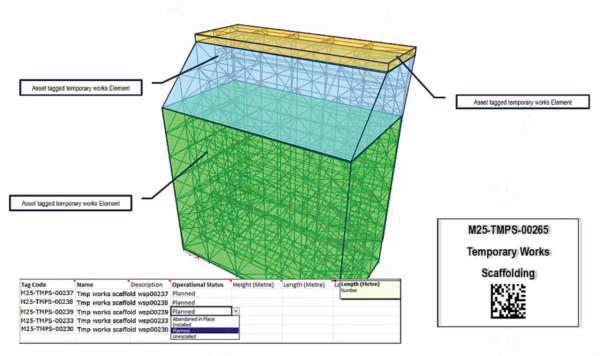
1 Typical visualization of temporary structure in BIM. Areas are blocked off and asset tagged with the proposed temporary element (Miskimmin, 2019).
In terms of safety, the generic safety information included in the asset tag are often missing critical information that is required to provide a complete safety plan. For example, scaffolding can have many different risks and safety hazards depending on its precise geometry, location and use case. Seemingly unimportant aspects such as the direction of work can have a massive impact on the overall safety risk of the project. This is highlighted by Kim et al (2016) in their study based on a live project. The y
Proc. of the CitA BIM Gathering Conference 2025, November 6th 2025, Dublin Ireland
suggest that due to the spatiotemporal conflicts occurring with a change in work direction, the risks to the workers can vary drastically if these are not accounted for in the original plan, Kim et al (2016). In their study they found a substantial difference in hazard score when reversing the order of work in a scaffolding crew. Along with this, the size of the work crew used in the erection, the speed of the work and other factors not required in the ISO 19650 (formerly BIM level 2) standards can combine to create very different situations which, if overlooked, may unnecessarily put the workers in an increased level of danger.
Zhang et al (2015) developed a safety rule -based checking system which allows the detection and subsequent prevention of fall risk hazards on temporary structures. This process is done automatically base d on the geometry of the building and as such is capable of providing cost and time saving when implemented on a project. The algorithm was applied to two case studies and in both cases, it was found that it was able to generate the appropriate safety equipment visually in the model and create a separate output including the materials and quantities of the equipment required. After verification of the system, it was deemed that the risks presented on the real -life case studies were adequately mitigated. The output data was also able to interact with 4D BIM programming due to the scheduling data being imbedded in the generated models.
Although this system was developed for safety hazards relating to falls, it is clear that a similar methodology could be applied to create, not only safety railing, but full scaffolding works if further development was put in place.
Feng & Lu (2017) presented a framework to produce solutions to various scaffold related hazards using Revit software. Their research is based on creating an ontology based on various risk factors and from this, using a Revit plug -in they can “automatically” produce scaffolding into the BIM model. After the model is produced Navisworks is used to create several safety animations and highlight areas that may cause potential risk in the current configuration.The main drawback of this proposed method is the need to manually input the scaffolding. Although the authors claim this is automatic, it requires the user to manually select the areas of the target building that require the scaffolding, input the overall geometry of the scaffolding system, select the connection points of the scaffold to the structure and then manually insert the individual elements generated by this model. The software program identifies issues in the scaffolding arrangement (that it automatically created) making it slightly redundant as no iterative process was introduced, meaning the user would be required to manually correct any errors produced by the program. Along with this, only generic scaffolding safety risks are identified. This means that risks that can vary between sites like spatiotemporal conditions are not considered. The lack of an automatic risk reporting feature also adds to the manual labor associated with the model being analyzed. After identifying the potential hazards, the user would then have to manually record the appropriate safety hazards and update any required registered, meaning any changes in the building geometry would result in the repetition of the entire process. Although this method has an original methodology for identifying the risks associated with scaffolding design, this would require major alterations to the program before any benefit of its use would be seen in an industry situation.
Kim et al(2018) have made the most development into the advancement of BIM based scaffolding technology in recent years. In their research they have developed a
Proc. of the CitA BIM Gathering Conference 2025, November 6th 2025, Dublin Ireland
framework in which the existing model of a building’s geometry is processed. This identifies areas in which scaffolding will be required in the structure and differs from other research in the field which requires manual selection of the areas requiring scaffolding. The size, work rate and possible work directions of the scaffolding crews are decided based on several user input variables. This allows the user to input site specific variables that will be used in an options analysis to create the most effici ent strategy. From this a scaffolding model incorporating cost, spatiotemporal and safety information is created and presented in a user-friendly output. The graphical output is shown in Figure 2 below.
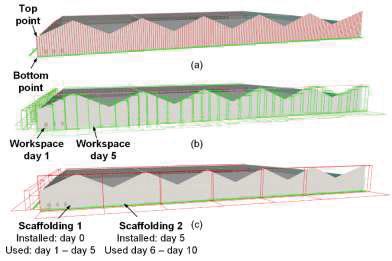
The framework allows the user to select the most appropriate solution based on experience of the project which could be very beneficial in reducing the amount of rework required later in the process.However, there are limitations to the process. Although this method has considered many more variables than other research completed in this field it still lacks some functionality that would truly make it automatic. The most notable omission is the lack o f any code compliance or detailing of the scaffolding. The research could be improved by testing functionality on a building with more complex geometry. If the above process can only by carried out on simple geometry like the one shown in Figure 2 it drastically reduced its usefulness in an industry setting.
The need for further optimisation in the scaffolding design sector is highlighted by the functionality of the industry’s leading software. SMART Scaffolder (SMART Scaffolder, 2023) allows the user to input 2D or 3D models into the proprietary software and generate a scaffolding solution that is compliant with TG2021 regulations based on the manually identified geometry. Further to this it automatically highlights which parts of the produced model require a full structural design and produces a costing schedule base on the scaffold manufacturer chosen and the quantity of material. The models can then be exported using IFC to other BIM software Although potentially useful in a number of simple design situations and very effective of producing an accurate design in the early stages of the project, it falls short of being a complete software for scaffolding design. The lack of automated geometry recognition coupled with the
Proc. of the CitA BIM Gathering Conference 2025, November 6th 2025, Dublin Ireland
disregard of spatiotemporal conditions makes it highly labour intensive. There is poor functionality to create 4D or safety attributes in the model, this would have to be completed manually in a separate software.
Much of the referenced literature provided methods of mitigating the current shortcomings described in the previous section but failed to provide a working method of doing so. As such the review was focused on research where a working model was presented. The main issues identified in the previous sections were as follows:
1-Lack of collaboration between temporary and permanent works designers.
2- Manual creation of BIM models which is slow and inefficient.
3- Inefficient completion of safety registers.
4-Models lack rich data, preventing accurate 4D and 5D simulation.
From this list the following criteria was used to assess the viability of the proposed solutions in the referenced literature and commercial marketplace.
1-Functionality- Adequate functionality for an inexperienced designer to allow them to reap the benefits of BIM without having to involve temporary works designer at a detailed design stage.
2-Geometry-Automation of the creation of temporary BIM objects.
3-Safety-Automation of non-generic safety information.
4-Quality-Provide data rich models adequate for 4D and 5D simulations.
The chosen criteria were then used to assess the analysed literature and commercially available solutions to determine their overall effectiveness at mitigating the problems within the industry. The results are shown in Table 1 below.Each of entries were given a rating based on their ability to fulfill the criteria defined above. This was an aggregated figures by a number of experts in scaffolding design. “Highly automated” is awarded to the solutions that are able to be performed withlittle to no scaffolding experience with minimal inputs. “Sufficiently Automated” is awarded to those where some of the processes were required manual operation but still required less work than the traditional alternative. And “Ineffective” was awarded where the proposed solution did not improve over traditional design solutions.
commercially available applications
Literature Commercial (Zhang et al, 2015) (Feng & Lu, 2017) (Kim et al 2018) (SMART Scaffolder, 2023)
A- Highly Automated S- Sufficiently Automated I- Ineffective - Not Applicable
5. Conclusion
With scaffolding being such a critical element to every construction project, this industry is paying for not investing in BIM for the future. There is little research being conducted in the area with few viable literature sources to evaluate. T his paper set out to provide an insight on how the temporary works industry, mainly scaffolding, is
Proc. of the CitA BIM Gathering Conference 2025, November 6th 2025, Dublin Ireland
currently implemented in the BIM process. Through research into the shortcomings of the current industry practices,a list of key issues was identified:
1. Lack of collaboration between temporary and permanent works designers.
2. Manual creation of BIM models which is slow and inefficient.
3. Inefficient completion of safety registers.
4. Models lack rich data, preventing accurate 4D and 5D simulations.
Using this information, a list of criteria was created with the aim of evaluating the most recent developments in the latest scaffolding related technology and if they are solving the industry’s problems. Through analyzingthe most recent literature it was clear that the industry has made little progress in mitigating the biggest factors affecting the workflow efficiency in scaffolding design. A comprehensive system is still needed to provide full functionality to scaffolding design which will encompass all aspects of design, like automated geometry creation, spatiotemporal clash detection (4D) and option analysis (5D and safety registers), automatic design code compliance checks and the visualisation of scaffolding design. The next stage of this study will be to validate the study outcomes by interviewing specialist scaffolding contractors to gather their opinions and also to speculate on how AI might evolve to address some of the stated problems.
References
Carpenter, J. (2019). TWf Library - Temporary Works Forum. [online] Twforum.org.uk. Available at: https://www.twforum.org.uk/viewdocument/the -roles-andresponsibilities-of-p [Accessed 5 Dec. 2024].
Feng, C. & Lu, S. (2017). Using BIM to Automate Scaffolding Planning for Risk Analysis at Construction Sites. International Symposium on Automation and Robotics in Construction, 34, pp.1 -8.
Feng, C. & Lu, S. (2019). Site logistics planning and control for engineer -to-order prefabricated building systems using BIM 4D modeling. International Symposium on Automation and Robotics in Construction, [online] 34, pp.1 -8. Available at: https://www.iaarc.org/publications/fulltext/ISARC2017-Paper085.pdf [Accessed 8 Dec. 2024].
Hse.gov.uk. (2019). Recording Construction Division’s Plan of Work 2010/11 on COIN -SIM 02/2010/03. [online] Available at: http://www.hse.gov.uk/foi/internalops/sims/constrct/2_10_04.htm#temporaryworks-procedures [Accessed 5 Dec. 2024].
Jin, H. and Goodrum, P.M. (2023) Integrated Decision Support Framework of Optimal Scaffolding System for Construction Projects. Algorithms 2023, 16, 348.
Jongeling, R., Kim, J., Fischer, M., Mourgues, C. & Olofsson, T. (2008). Quantitative analysis of workflow, temporary structure usage, and productivity using 4D models. Automation in Construction, 17(6), pp.780-791.
Liu, H., Cheng, J., Gan, V., and Zhou, S. (2022). A knowledge model -based BIM framework for automatic code -compliant quantity take-off, Automation in Construction, Volume 133, 2022, 104024.
Kim, K. & Cho, Y. (2015). BIM-Based Planning of Temporary Structures for Construction Safety. Computing in Civil Engineering 2015.
Proc. of the CitA BIM Gathering Conference 2025, November 6th 2025, Dublin Ireland
Kim, K., Cho, Y. & Zhang, S. (2016). Integrating work sequences and temporary structures into safety planning: Automated scaffolding -related safety hazard identification and prevention in BIM. Automation in Construction, 70, pp.128 -142.
Kim, K., Cho, Y. & Kim, K. (2018). BIM -Based Decision-Making Framework for Scaffolding Planning. Journal of Management in Engineering, 34(6).
KITALL. (2019). The Basics of BIM for Temporary Works | Kitall. [online] Available at: https://www.kitall.co.uk/ [Accessed 8 Dec. 2024].
Kyungki, K. & Jochen, T., 2014. Automatic design and planning of scaffolding systems using buildinginformation modeling. Advanced Engineering Informatics, pp. 6680
Miskimmin, I. (2019). TWf Library - BIM :Current Industry Thinking. [online] Twforum.org.uk. Available at: https://www.twforum.org.uk/viewdocument/bimcurrent-industry-thinking-1 [Accessed 11 Dec. 2024].
NASC Safety Report 2018. (2018). NACS Safety Report. [online] National Access and Scaffolding Confederation (NASC), pp.1 -5. Available at: https://www.nasc.org.uk/information/safety-reports/ [Accessed 9 Dec. 2024].
NBS (2018). National BIM Report 2018. [online] RIBA, pp.1 -27. Available at: https://www.thenbs.com/knowledge/the-national-bim-report-2018 [Accessed 5 Dec. 2024].
NBS (2019). Uniclass 2015. RIBA.
SMART Scaffolder (2023). Online help. [online] Available at: https://smartscaffolder.com/help-centre [Accessed 9 Dec. 2024].
Temporary Works forum(2017). TWf INFORMATION SHEET No. 3, London: Temporary Works forum.
Zhang, S., Sulankivi, K., Kiviniemi, M., Romo, I., Eastman, C. & Teizer, J. (2015). BIMbased fall hazard identification and prevention in construction safety planning. Safety Science, 72, pp.31-45.
Proc. of the CitA BIM Gathering Conference 2025, November 6th 2025, Dublin Ireland
Silpa Singharajwarapan, silpa.singharajwarapan@strath.ac.uk Strathclyde University
Ibrahim Motawa, i.motawa@ulster.ac.uk Ulster Univeristy
Abstract
Mental healthcare facilities require special design considerations, especially when locals, patient populations, and equipment become all varied. Designing these facilities requires innovative techniques to improve patient and staff psychological health, whether through service improvement, organisation governance improv ement, or facility improvement with emphasis on patient centred practice - where the patients’ needs inform the design and the operation of the healthcare services and facilities. For such buildings, new ways are needed to evaluate building performance and ensure building compliance. In this regard, Building Information Modelling (BIM) can capture the required properties that can affect the patient’s psychological requirements. This paper identifies the key BIM properties of healthcare facility buildings to be considered for a Psychological-Based Code Compliance Checking BIM System. The key components of the methodology are discussed based on the covered relevant literature. The main findings are about the identification of the key psychological factors, the architectural design parameters of healthcare facilities and their BIM requirements in relation to the psychological factors. From the identified list of factors and parameters, the proposed framework is used as a Psychological-Based Code Compliance Checking BIM System for Healthcare facilities.
Keywords: BIM, Code Compliance Checking, Mental Health Facilities
Traditionally, healthcare and hospital buildings are designed based on past experience with similar projects and architectural standards (Parkin Architect, 2018). However, this lacks the evidence that such experience will be transferrable, especially when locals, patient populations, and equipment become all varied. In addition, staff experiences are often based solely on current conventions, lacking the opportunity to introduce new concepts and explore the design interventions’ positive and negative impacts on patients and staff (Zimring, 2002; Alfonsi et al., 2014; Parkin Architect, 2018). Local context would have a significant impact on design, as local custom, environment, and socioeconomic status would inform the occupants’ interaction with the facility and affect the quality, design choice, and other facility management (FM) concerns (Hamilton, 2003; Azizpour et al., 2013; Chungsatiansup et al., 2017).
In Thailand (the special case of this study), the Thai healthcare institutes' design process is similar to international practices. Chungsatiansup et al. (2017; 2020) noted that the traditional Thai hospital design process is managed by a committee of stakeholders from the medical sector and a design team with experience in designing healthcare buildings. This process disregards the opportunity to implement an unconventional design, informed by other stakeholders’ input, especially the patients.
Aside from relevant conventional building laws, Thai healthcare institution also falls under the Ministry of Public Health, Thailand (MOPH) jurisdiction. In 2015, MOPH declared the 20-Year Thailand National Strategy Roadmap to improve the healthcare system in preparation for Thailand to transition into an aging society within the next decade (Department of Health, 2016; Ministry of Public Health, 2017). The roadmap promotes innovative techniques to improve patient and staff psychological health, whether through service improvement, organisation governance improvement, or facility improvement with emphasis on patient centred practice - where the patients’ needs inform the design and the operation of the healthcare services and facilities.
With such new design approaches, new ways are needed to evaluate building performance and ensure building compliance. Building Information Modelling (BIM) offers the potential for a new generation of tools that can automate the checking of compliance with building codes, thus improving building desig n and procurement (Li, 2015). Unlike graphical Computer-Aided Design (CAD) systems, Code Checking Systems based on object-oriented platforms (such as BIM) allow different building elements to be deciphered and e valuated more efficiently (Khemlani, 2015). As the manual checking of building designs for compliance against building codes is complex and prone to human error with significant cost implications, automated compliance checking would benefit designers (Tan et al., 2010). The Institute of Siamese Architects also surmised that the wide adoption of BIM in Thailand is an inevitable development that must be met for Thailand to maintain international competitiveness in the Architectural, Engineering, and Construction (AEC) industry (Ngowtanasawan, 2016). The wide adoption of BIM also means that there is a potential for adoption of a Thai-specific BIM-Based Code Checking System.
However, one limitation of conventional BIM-Based Code Checking Systems for healthcare facilities is that they operate with conventional design code compliance logic (Dimyadi & Amor, 2013; Martins, 2013). As a result, the Code Checking System could only determine the physical attributes of a building in compliance with the relevant building code and regulation, lacking the capability to inform the designer of the patient’s psychological requirement (Martins, 2013; Latiffi, et al. 2015).
Therefore, this study introduces a framework for a Psychological -Based Code Compliance Checking BIM System for Healthcare facilities (with focus on Thailand as a case study). This paper first discusses the methodology adopted to develop the framework. Then, relevant literature is reviewed to identify the key components of the framework (e.g., the best-fit psychological factors, the architectural design parameters of healthcare facilities and their BIM requirements (platform, elements, supplement data, simulation engine, and attrib utes) in relation to the psychological factors
The methodology adopted to develop the proposed framework is based on the linkage between building design and the socio -economic factors affecting the usage of a building considering societal cultures. In the Thai context, many studies show linkage between architectural design and mental health in healthcare facilities. Some studies also opined that it is helpful to include Buddhist philosophy into design consideration as 95% of the Thai population practise Buddhism (Chungsatiansup & Nakwannakit, 2010, Chungsatiansup & Sativaro, 2018). In addition, Buddhism is a key factor that impacts Thai socio-economic interactions, societal paradigm, and building usage (Prapromkunaporn, 2008). Vorasirisuvimon (2017) reviewed Thai hospital design literature and discussed the Healing Environment (i.e., hospital design features and its effect on healing patient). The results noted that many Healing Environment design choices are based on design patterns found through the Evidence -Based Design methodology.
Evidence-Based Design (EBD), promoted by Ulrich (1984) is a scientific analysis methodology that emphasises the use of data acquired to influence the design process. EBD relies on finding a design pattern (i.e., measurable empirical evidence of a correlation between the architectural design parameters and building users conditions (Ulrich et al., 2004; Claridge & Fabian, 2005)). EBD becomes a viable methodology for healthcare institutes as they contain so many architectural elements and a revolving group of users (patients) that make a controlled trial of a design element ineffective (Perkins, 2008). Ulrich et al. (2008) stated that design patterns for specific environmental conditions would emerge from examining various databases to define relationships between healthcare outcome (whether physically or psychologically) and the relevant architectural elements. By analysing the frequency of occurrence, a statistically significant pattern would emerge. Within the Thai context, Chungsatiansup (2016) and Chungsat iansup et al. (2017; 2020) have implemented few design choices informed by the EBD works of Ulrich et al. (2008) within selected Thai-regional hospitals. Post-implementation survey on patients showed a statistically significant positive impact on mental health and occupants’ comfort. Their results can serve as a proof of concept for further EBD studies and implementation in Thai Healthcare institute design. To develop the proposed framework, this paper will use EBD design patterns methodology to identify the key psychological factors and architectural design parameters for mental healthcare facilities. The overall aim of the framework is to develop a code compliance checking system for healthcare buildings considering the patients’ psychological factors and utilising Building Information Modelling (BIM).
Automated code compliance checking using BIM models have been used over the last decades. However, among the limitations identified for the available checkers, they do not allow complete customisation of checkable rules (Greenwood et al., 2010; Dimyadi & Amor, 2013; Martins, 2013) especially with the existence of subjective rules. Therefore, several popular BIM modelling Platforms allow plugins to be developed using Visual Programming Languages (VPL) to integrate customised code -checking routines according to specific design needs. This facility is supported by the major venders such as Autodesk (Dynamo), Bentley (Generative Components) or Rhinoceros 3D (Grasshopper) (Martins, 2013).
Singharajwarapan
It is also noted that even if a rule is checkable, it may not be feasible to do so if it requires the model to have a high Level of Detail (LOD). It is always recommended that a feasible code checking system may require LOD 300 as highest to ensure a cost-efficient design process. In addition, different LOD levels should be used to check compliance at different stages of design: LOD 100 for Conceptual design phrase and LOD 300 for pre-construction phrase (Latiffi, et al. 2015).
A typical BIM-based code compliance checking system consists of: Rule Interpretation (i.e. the translation of rules into a machine -interpretable language), Rule Execution (i.e the digital rules are to be processed on the digital building model, which requi res BIM element requirement check and level of checkable rules to be defined), and Reporting (i.e. define relevant checking issues and may offer re -modelling or correction of the BIM model (Preidel & Borrmann, 2015).
This paper is part of a study that aims to develop a framework for a psychologicalbased code compliance checking BIM system for healthcare facilities. The framework will respond to the needs of a typical structure of BIM -based checking systems, namely: the BIM requirements and LOD, the checkable rules based on the key psychological factors and key architectural design parameters, and the reporting on the building compliance.
In a previous study by the authors (Singharajwarapan and Motawa (2023)), the key psychological factors and architectural design parameters of healthcare facilities have been identified as listed in Table 1.
Table 1. Selected psychological factors and architectural design parameters (Singharajwarapan and Motawa (2023))
Psychological factors
1. Stress
2. Satisfaction
3. Depression
4. Pain
5. Sleep Quality
6. Length of stay
7. Medical Consumption
Architectural design parameters
1. Natural Light
2. Nature view
3. Single Patient Room
4. Acoustical Quality
5. Thermal Comfort
6. Effective Layout / Spatial Disorientation
7. Family Zoning
8. Patient Control Choice
To identify the significant psychological factors for patients in mental healthcare institutions, a thorough literature review was conducted for both international and Thai context. The covered literature included publications on: ‘Evidence Based Design’, ‘Healthcare’, ‘Mental Health’, ‘Psychological Factors’, ‘Psychological Assessment’, ‘Psychological Response, ‘Healthcare Outcome’. This yields 121 bodies of literature. From these sources, the relevant psychological responses or factors were extracted. Healthcare outcomes that are not psychological, such as patient falls, medical errors, and hospital-acquired infections were discarded. Some objective measures were retained as psychological factors, namely: Length of Stay and Medical Consumption as many studies considered them to be indicative of patients’ psychological response (Beauchemin & Hays, 1996; Wallace -Guy et al., 2002; Walch et al., 2005). The analysis of the literature followed Pareto Principle(80-20%), therefore, a number of factors were disregarded that were also reported only once in literature, the initial psychological factors identified were: Stress, Satisfaction, Depression, Pain, Sleep
Quality, Length of Stay, Medical Consumption, Anxiety, Anger, Irritation, Nervousness, Fatigue, Resilience, Self-Confidence, Self-Esteem, Eating Disorder.
Most factors (i.e., Stress, Satisfaction, Depression, Pain, Sleep Quality) can be measured subjectively through self-reporting by the patient using Psychological Questionnaire such as Profile of Mood States - Short Form, 1983 (POMS-S), and the Multidimensional Personality Questionnaire, 1982 (MPQ) (Bernhofer et al., 2013). Some factors can be observed in objective ways. For example, Sleep Quality can be measure using the number of hours of undisrupted sleep per night per patient, Length of Stay by the numbe r of days from intake to discharge of the patient, and Medical Consumption by the average analgesic medication use per hour (mg/hr) for the entire length of stay (Walch et al., 2005).
The architectural design parameters that are noted to impact psychological factors according to the body of literature (the previously selected 121 literature) were identified. Disregarding parameters that are reported only once, the initial design parameters identified are: Natural Light, Nature View, Single Patient Room, Acoustical Quality, Thermal Comfort, Effective Layout / Spatial Disorientation, Family Zoning, Patient Control Choice, Air Quality, Adaptable Room, Floor Finish/Material, Wayfinding, Staff Facility Distance, Access, Visual Privacy, Religious Space, Interior Finish, Handwashing Facility, Water System, Building Footprint.
Table 2 shows the Architectural Design Parameters and their BIM properties required to conduct BIM simulation. While there are different measuring metrics could be used, only the measuring metrics that can be simulated within BIM platforms are defined for the proposed framework. The BIM properties requirements for the design parameters are identified to be within LOD 300, as suggest by Latiffi, et al. (2015) to be the highest LOD level for feasible code checking system. These BIM properties requirements are : Privacy/Single Patient Room (SPR%), Spatial disorientation, Family zoning, Patient control choices, Natural Light, Nature View, Acoustical Quality, Thermal Comfort, and Thermal Quality. For Natural light and Thermal Comfort, an external Weather data file will be also needed for running simulations.
Architectural design parameters
1. Natural Light
2. Nature view
3. Single Patient Room
4. Acoustical Quality
BIM properties Requirement
Room Geometry
Room Schedule
Building Envelope Geometry
Building Orientation
*Weather Data File (Non-BIM data)
Room Geometry
Room Schedule
Building Envelope Geometry
Building Orientation
Site Geometry
Nature Element
Room Geometry
Room Schedule
Label Single Patient Room
Label Critical Room
Room Geometry
Proc. of the CitA BIM Gathering Conference 2025, November 6th 2025, Dublin Ireland
5. Thermal Comfort
6. Effective Layout / Spatial Disorientation
7. Family Zoning
8. Patient Control Choice
4. Conclusion
Room Schedule
Building Envelope Geometry
Building Orientation
Building structure
Building Floor system
Label Noise Generator
Material Properties (Ceiling Finish, Floor Finish, Wall Finish)
Room Geometry
Room Schedule
Building Envelope Geometry
Building Orientation
Building structure
Building Floor system
Material Properties (Ceiling Finish, Floor Finish, Wall Finish)
Thermal Load
*Weather Data File (Non-BIM data)
Room Geometry
Room Schedule
Label Single Patient Room
Label Patient Room
Label Critical Room
Room Geometry
Room Schedule
Label Single Patient Room
Label Patient Room
Label family seat/area
Room Geometry
Room Schedule
Label Single Patient Room
Label Patient Room
Label Patient controllable element
The paper identified the most measured psychological factors for mental health patients as: Stress, Satisfaction, Depression, Pain, Sleep Quality, Length of Stay, and Medical Consumption. The architectural design paraments in relation to these psychological factors were also defined and included: Natural Light, Nature View, Single Patient Room, Acoustical Quality, Thermal Comfort, Effective Layout / Spatial Disorientation, Family Zoning, and Patient Control Choice. From the identified list of factors and parameters, a proposed framework will be developed to be used as a Psychological-Based Code Compliance Checking BIM System for Healthcare facilities. The BIM-related requirements were identified as the engine of the framework which include the BIM properties. The study investigation established that the relationship between the psychological factors and design parameters are to be developed as checkable building rules by correlation analysis yielding discrete/nondiscrete and qualitative measurements. While the collected data to develop the framework is Thai focused and only considers the Thai idiosyncrasies, the approach can be applied within other geographical and/or cultural recontextualisation.
Proc. of the CitA BIM Gathering Conference 2025, November 6th 2025, Dublin Ireland
Singharajwarapan and Motawa 2025 BIM properties for a Psychological-Based Code
References
Alfonsi, E., Capolongo, S. & Buffoli, M. (2014). Evidence based design and healthcare: an unconventional approach to hospital design. Annali di igiene: medicina preventiva e di comunita, 26(2), 137-143. https://doi.org/10.7416/ai.2014.1968.
Azizpour, F., Moghimi, S., Salleh, E., Mat, S., Lim, C.H. & Sopian, K. (2013). Thermal comfort assessment of large-scale hospitals in tropical climates: A case study of University Kebangsaan Malaysia Medical Centre (UKMMC). Energy and Buildings, 64(1), 317-322. https://doi.org/10.1016/j.enbuild.2013.05.033.
Beauchemin, K & Hays, P. (1996). Sunny hospital rooms expedite recovery from severe and refractory depressions. Journal of Affective Disorders, 40(1), 49-51 Bernhofer, E., Higgins, P., Daly, B., Burant, C. & Hornick, T. (2013). Hospital lighting and its association with sleep, mood and pain in medical inpatients. Journal of advanced nursing, 70 (5), 1164-1173.
Chungsatiansup, K. & Nakwannakit, K. (2010). Healing Environment. Nontaburi, Thailand: The Healthcare Accreditation Institute
Chungsatiansup, K. & Sativaro, A. S. (2018). Buddhist healthcare healing environmental management. Mahachulalongkornrajavidyalaya University Journal of Buddhist Paradigm, 2(2), 92-111
Chungsatiansup, K. (2016). Healthcare healing environment design . Retrieve 20 December 2021, from: https://www.hfocus.org/content/2016/12/13133
Chungsatiansup, K., Phaensomboon, P. & Sararum, T. (2017). Healthcare healing environment design (2nd year). Bangkok, THAILAND: Health Systems Research Institute
Chungsatiansup, K., Phaensomboon, P., Sararum, T., Lillahkul, N. & Kittimanont, H. (2020). Healthcare healing environment design (3rd year) . Bangkok, THAILAND: Health Systems Research Institute
Claridge, J. A. & Fabian, T. C. (2005). History and development of evidence -based medicine. World Journal of Surgery , 29(5), 547-53. https://doi.org/10.1007/s00268 -005-7910-1.
Department of Health. (2016). GREEN & CLEAN Hospital practical methodology Nontaburi, THAILAND: Mahachulalongkorn University Press
Dimyadi, J. & Amor, R. (2013). Regulatory knowledge representation for automated compliance audit of bim-based models. University of Auckland working paper. Retrieved 20 December, 2021, from: https://www.cs.auckland.ac.nz/~trebor/papers/DIMY13A.pdf
Greenwood, D., Lewis, S. & Lockley, S. (2010). Contractual issues in the total use of Building Information Modelling. in Barrett, P., Amaratunga, D., Haigh, R., Keraminiyage, K. & Pathirage, C. (eds) Proceedings of CIB 2010 World Congress ‘Building a Better World’ . Salford, May 2010. The University of Salford. Hamilton, K. (2003). The four levels of evidence -based design practice. Healthcare Design, 3(9), 18-26. Khemlani, L. (2015). Automating code compliance in AEC . AECbytes Feature (October 22, 2015). Retrieved 20 December, 2023, from: http://www.aecbytes.com/feature/2015/AutomatingCodeCompliance.html
Latiffi, A. & Brahim, J. & Mohd, S. & Fathi, M. (2015). Building Information Modeling (BIM): Exploring Level of Development (LOD) in Construction Projects. Applied Mechanics and Materials. 773 -774. 933-937. 10.4028/www.scientific.net/AMM.773-774.933.
Martins, A. M. (2013). LicA: A BIM based automated code -checking application for water distribution systems. Automation in Constructio n, 3(1), pp. 12-23.
Proc. of the CitA BIM Gathering Conference 2025, November 6th 2025, Dublin Ireland
Singharajwarapan and Motawa 2025 BIM properties for a Psychological-Based Code
Ministry of Public Health. (2017). P&P Excellence . Bangkok, THAILAND: Ministry of Public Health.
Ngowtanasawan, G. (2016). A causal model of BIM adoption in the Thai architectural and engineering design industry. International High-Performance Built Environment Conference - A Sustainable Built Environment Conference 2016 Series (SBE16).
Parkin Architect. (2018). Evidence-based design. Retrieved 20 December, 2021, from: http://www.parkin.ca/blog/evidence -based-design/ Perkins, L. (2008). Book review: A visual reference for evidence -based design. Health Environments Research & Design Journal, 1 (4), 141-143. https://doi.org/10.1177/193758670800100415.
Prapromkunaporn. (2008). Modern medicinal practice through Buddhist perspective (6th edition). Bangkok, THAILAND: Sahathanmic Press
Preidel, C. & Borrmann, A. (2015). Automated code compliance checking based on a visual language and Building Information Modeling. Proceedings of the International Symposium on Automation and Robotics in Construction and Mining (ISARC 2015). https://doi.org/10.13140/RG.2.1.1542.2805 .
Singharajwarapan S and Motawa I (2023). Case Architectural design parameters affecting patient’s psychological requirements in mental healthcare facilities. In the Proceedings of the 7th TICC International Conference 2023 “Toward Sustainable Development Goals: Digital Transformation and Beyond”, February 4-5th, 2023, Chiang Mai, Thailand
Tan X. & Hammad, A. and Fazio, P (2010) Automated Code Compliance Checking for Building Envelope Design, Journal of Computing in Civil Engineering , ASCE, Vol. 24(2), 203-211.
Ulrich, R. S. (1984). View through a window may influence recovery from surgery. Science, 224(46-47), 420-421. https://doi.org/10.1126/science.6143402
Ulrich, R. S. (1999). Effects of gardens on health outcomes: Theory and research. In C. Cooper Marcus and M. Barnes (Eds.), Healing gardens. New York, NY: John Wiley & Sons, Inc.
Ulrich, R. S., DuBose, Zhu, X., J. & Zimming, C. (2008). A review of the research literature on evidence-based healthcare design. Health Environments Research & Design Journal, 1(3), 63-125. https://doi.org/10.1177/193758670800100306
Ulrich, R. S., Zimring, C., Joseph, A., Quan, X. & Choudhary, R. (2004). The role of the physical environment in the hospital of the 21st century: A once -in-a-lifetime opportunity. Concord, CA: Center for Health Design
Vorasirisuvimon, W. (2017). Health care architecture: General hospital Tha Yang. [Master Thesis, Sripatum University]. Sripatum University Online Repository.
Walch, J. M., Rabin, B. S., Day, R., Williams, J. N., Choi, K., & Kang, J. D. (2005). The effect of sunlight on postoperative analgesic medication usage: A prospective study of spinal surgery patients. Psychosomatic Medicine, 67(1), 156 –163.
Wallace-Guy, G., Kripke, D., Jean-Louis, G., Langer, R., Elliott, J., & Tuunainen, A. (2002). Evening light exposure: Implications for sleep and depression. Journal of the American Geriatrics Society, 50(4), 738–739.
Zimring, C. (2002). Post-occupancy evaluation: Issues and implementation. In R.B. Bechtel (Ed.). Handbook of environmental psychology . New York, NY: John Wiley & Sons, Inc.
Proc. of the CitA BIM Gathering Conference 2025, November 6th 2025, Dublin Ireland
Panagiotis Ninios, p.ninios@strath.ac.uk Strathclyde University
Ibrahim Motawa, i.motawa@ulster.ac.uk Ulster Univeristy
Abstract
Over the last decades, urban conservation has made many steps into becoming a conventional practice with more appreciation for cultural built heritage preservation initiatives. In this respect, the concept of “Façadism” has become an interesting approach into renovating buildings while keeping its façade preserved. With the release of new technologies comes along a wave of innovative methods to improve the way of designing renovation projects . BIM is considered as a new interface that can be utilized to facilitate this design process . New interactions, methods of work, and the innovative BIM applications can help minimize construction costs, project risks and delays, and increase the effective collaboration of designers, engineers, and other project stakeholders. This paper explores how BIM could aid urban conservation in order to preserve a city’s built heritage unharmed during renovation projects
Keywords: Renovating, BIM, Building Façade
1.Introduction
Buildings have acquired the dynamics of representing their corresponding country’s identity for hundreds of years. Rapid developments of new technologies have affected the way buildings are now constructed. However,the modern industry cannot produce landmark buildings like those from the past. Therefore, it is very important for nations to preserve as much of their history as possible. For this reason, modern and efficient methods have to be developed so that historical buildings can keep their features includingpreservation of the unique facades. This should also allow their inner shells to accommodate modernized facilities that comply with the new building standards.
Consequently, the Façadism movement, as it is referred to, was created for the preservation of the facades of historical buildings with the simultaneous internal remodelling. Façadism refers to the method in which the façade of a building is preserved and at the same time, new structures are erected behind or around it (Bargery, 2018) The method of preserving the historical facades of the buildings together with a complete demolition of the interior shells, and often, the excavation of new basements, with varied depth levels, has created the need for a new platform to manage all aspects of the construction phases.
Building Information Modelling (BIM) becomes a suitable platform that can potentially help the project team consider set -out, manage, and close-out their task, through collaborative working. Individual elements need to be considered by design teams. Elements such as soil quality, geotechnical characteristics, and neighbouring properties, climate conditions are some of the key parameters to be examined for buildings design and management Utilising these elements within BIM database can help build the appropriate technical, economic, and environmentalmodelsof projects like the preservation of historical building façades.
Adopting the concept of Façadism can be very beneficial, and research shows that there are notable practices around the world. This paper aims to examine how BIM can facilitate the way a building’s facade can be preserved while at the same time the inner core is renovated to support the needs of users/occupants.
In the UK by the mid-19th century most of the country’s cultural heritage was slowly destroyed or badly managed, even by the well -intentioned archaeologists who were excavating for them. This excessive miss-exploitation of built heritage and archaeologies started to change when John Lubbock emerged as the person to “save” the country's national heritage (Britannica, 2015). Lubbock familiarized the parliament with the need for the country to administrate the protection of ancient monuments; this action was translated into what is also known as “The Ancient Monuments Protection Act 1882” (Parliament, 2018), covering, at that time, 68 sites of cultural interest. More Acts followed and charities appeared, along the lines of the National Trust in 1894, English Heritage in 1983, and The Town and Country Planning Act in 1944 that was updated in 1990. It was then that steps toward historic preservation reached an extraordinary scale (The National Trust, 2018). Finally, the Planning Act 1990, created more ways to control the way Listed Buildings would be treated. Demolition, alteration, or retrofitting were monitored closely as the database of buildings grew larger and in more detailed. Three grades of buildings were introduced:
• Grade III: Buildings of special interest
• Grade II: Buildings of more than special interest
• Grade I: Buildings of exceptional importance
Reasons behind receiving a listed status can vary:
• Great Architectural Importance (innovative design, decoration or craftsmanship)
• Historic Importance (representative of a particular time era, for instance)
• Historic Connection (association with significant people or events)
• Group value (part of a larger group of listings)
When there is a listed building, both its interior and exterior are protectedfor any major alterations and can only be allowed by the respective planning authority. Failure to comply with this is a criminal offence and can have works reversed and hefty fines paid.
BIM is defined as the intelligent 3D model -based process that provides the Architecture, Engineering, and Construction (AEC) authorities with tools to strategize,
design, construct, and manage construction project. BIM processes become common practice for new buildings/infrastructure design, and have added potentials in retrofitting and refurbishment projects, when paired with features such as laser scanning (HM Government, 2012) Early implementation of BIM lets projects to become more visualised during planning stages with the option of virtual simulation that allow the client and project teams to review and discuss any concerns (Schade, et al., 2011). Enhanced team collaboration is achieved through global access to the information, therefore leveraging better information flow with ease of access to all information relating to a task in hand.
Existing buildings (including historical ones) require more complicated processes to create their BIM models when compared with creating new models for new buildings. For this regard, cutting edge laser scanning surveys can help creating BIM 3D models. Geometrical data captured will be fully exploitable to produce a model showing the irregularities and complexities that could influence works later.
Modern preservation moves away from the past techniques and the concept of Façadism becomes more accepted by owners of listed buildings. In addition, people also accept as true the notion that, building conservation has always been fundamentally a sustainable practice.
According to the E202-2008 BIM Protocol released by American Institute of Architects (AIA) in 2008, for a façade preservation example, the team has tougher task in hand, since the structure is already in place. Photographs, scans of the location, and proper translations of the hand drawings into a database will help the team create a 3D representation of the façade. Precise measurements and information provided, with as much detail as possible, will lead towards amore precise work by the construction team. Then, design teams can remodel the inner core and the rest features of the new structure using a suitable BIM environment with any required analysis tools (e.g. Structural, environmental, etc.). Considering the introduction of ISO 19650, Table 1 shows how BIM can generally help in this process.
Table 1: BIM Techniques &Activities
Activities Tools
Surveying/Reality Capture
Data Processing / Cleanup
Segmentation / Classification
Modelling in BIM Environment
Applying Textures & Condition Data
Deliverables & Documentation
TLS, drone photogrammetry, or handheld scanning to collect point clouds/meshes
Register/align multiple scans or images; clean noise; fill gaps; remove extraneous elements (vegetation, furniture, etc.).
Identify façade elements (openings, decorative features, structural elements) and classify them into categories (regular vs irregular, material types etc.).
Import point cloud/mesh into BIM software. Trace or model façades based on reality capture. Use parametric families where possible. Set up correct coordinate systems.
Use orthophotos for textures; map condition / decay; overlay photo documentation; create parts with material/finish metadata.
Produce elevation drawings, sections, schedules, condition reports, 3D visualizations. Provide accurate dimensions for restoration or retention work. Balance LOD vs cost/time.
Challenges of BIM usage for façade capture
• Cost & Time: High-resolution scanning, especially of ornate facades, and post-processing (cleaning point clouds, segmentation) takes time and resources.
• Data Volume & Managing Big Data: Point clouds and meshes are often huge; working with them slows software; requires hardware capable of handling big datasets.
• Complex/Irregular Geometry: Ornamental features, weathered or damaged surfaces, irregular stonework are hard to parameterize or model in standard BIM families. May require custom modelling or approximations.
• Accuracy vs Practicality: For some parts, ultra-high precision may not be needed (or useful). Decide what level of detail is required vs what is cost-justifiable.
• Access & Visibility: Some façade parts may be inaccessible; shadows, obstructions, safety constraints may limit scanning / photography.
• Material & Condition Complexity: Visual decay (cracks, discoloration etc.) may not always be well captured in geometry; need good photographic documentation vs just geometry.
The examples below show how this methodology was approached differently by design teams. Effective use of modelling was used in all three cases and engineers were able to provide a solution to their client that would be effective. The examples show how the use of BIM can become a key feature towards a better flow of information, design and project management, and very crucially it would reduce errors and risks compared with traditional CAD approaches
3.1Lixouri, Greece
In Figure 1, a BIM model and simulation for a Municipal Library in a Greek town of Lixouri has been created. Two strong seismic vibrations created serious damages to the existing structure judging it unfit for public use. Similarly, in a façade preservation and retrofitting of this type of project, even with inner core demolitions, an analogous approach is advised
A stiff enough support system was recommended to be temporarily installed on the face of the structure to avoid unwanted movements that could cause cracking or total wall collapse. Later support is provided by a shoring scheme, placed around the perimeter of the structure, as seen in Figure 2. This technique is a very common approach used for temporarily retaining walls with stability issues. The structure is made stable and safe to walk around, during drilling and excavating, to prevent the bulging out of walls, or when works take place at an adjacent structure. For the setting up of the shoring system materials used include timber, structural steel, and framed tube-shaped scaffolding.
3.2Glasgow, Scotland
Glasgow’s General Post Office Headquarters built on 1876 has been converted by Façadism into a completely new No 1 Glasgow building as shown in Figure 3. A view from the inside during the preservation process, after the inner core of the building was completely removed is shown in Figure 4. The only feature kept authentic is just the building’s façade; the rest is all new construction made inside the perimeter of the façade with a brand new nine-floor development.
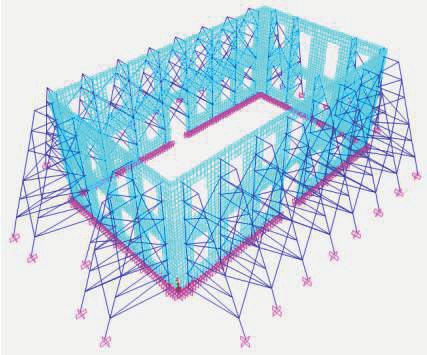



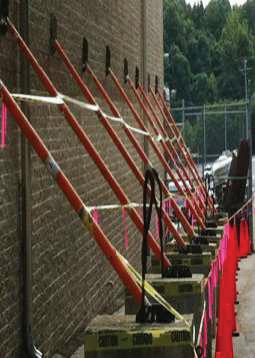

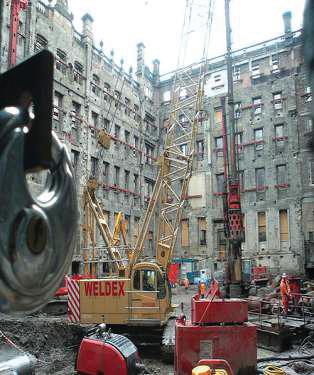

The demolition and façade retention project required careful planning and commitment from the project teams for a period of 26 weeks. A BIM model for the entire area including the building would have been so beneficial to overcome the three most important challenges faced in this project; which were regarding the traffic control (site is located on one of the busiest road in the Glasgow city center), the pedestrians’ walking patters around the worksite, and the ease of access to the site. The sidewalk and road in front of the north face of the building had to be closed off, and diverted across the street, allowing safer passage for the pedestrians and cars. For heavier bulkier machinery a 5x5m opening was cut out from the listed façade after the external steelwork was installed for the structural stability and support. Once the façade was secured in place the contractors would slowly and carefully demolish/deconstruct the inner core of the structure.
Another laborious project worth noting is the Queen Elizabeth Hospital in the city of London. The project started in summer of 2014 and construction was completed in January of 2018. Retaining the impressive Victorian era façade was the project manager’s main concern when planning the offer to the client. Therefore, a BIM model for the building would have helped the fixing of the steel frame attached to the façade. Although the building was not part of the listed structures around London, the local community opposed to the previous plans of knocking it down. The final decision was to knock down everything keeping only the façade in place and the incorporating it to the design in mind, a nine-block of flats arrangement where the façade would have the front block integrated into it.
Compared to the temporary solutions mentioned in the previous cases, here the façade was supported by a permanent steel frame, Figure 5; the same frame would then be used as the bases of constructing the frame for the front block of flats attached to the façade. This idea helped reduce on temporary propping, and avoided the need for foundation installations. In addition, geotechnical investigations showed a raised water table. This was result of water leakage from a pipe main. Therefore, the plans for the piling mat had to be revised to determine a more optimum level at which water would not affect them. In addition, some 30,000 hand excavated London stock bricks that were salvaged, were used as a way of restoring the original appearance.
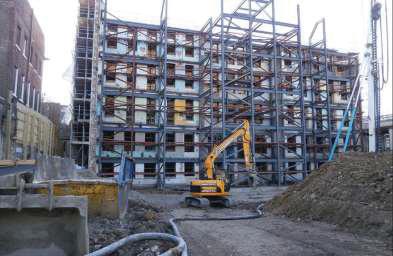
In a properly planned project, there are major phases during which people make important decisions, carry out meetings to discuss potential problems, and work collaboratively in order to safely and correctly manage the design of it.
A BIM related challenge is the practical aspect of using the software (Rocha, et al. 2020). Extensive experience and knowledge of the interface is required, so time and money should be heavily invested for it. Some of the smaller design offices might not
even be able to afford the option of training their employees to learn a new program, or even to pay the steep prices of some thousands of pounds in licensing.
Retaining a façade, however, is not a task where the only thing required would be to just keep the face intact and change the rest of the structure. Many BIM parameters come into consideration when attempting the task. Various materials (stone, metals, glass, and concrete) need careful handling in order to retain their characteristics , Hussein et al (2024). Awkward movements, vibrations, or heavy equipment can easily compromise their physical form and could even lead to collapse. As previously mentioned, the inner core is expected to be removed. The elapse time between demolition and final construction is the most crucial. This is when environmental worries (excessive wind, earthquakes), and spatial problems (access, lack of space around the face) arise. Forthis reason, solutions have been created to tackle this concern. Subtle injections of cement into the voids of the retained face are made, pretensioned anchors and retaining walls combined with temporary metal frames are installed to hold the structure in place.
If basements are designed for the new structure, then an extensive geotechnical assessment will be required to study the ground conditions and the state of the foundations. Soil layers and the presence of groundwater will need to be identified as well, as early as possible. Neighboring buildings’ foundations and sides adjacent to the new structure must be acknowledged, cracks and voids need to be pointed out and considered when carrying out future tasks. Monitoring instrument are required as well to ensure that during the construction phase no changes occurred. Inclinometers and tiltmeters as well as pressure gauges should be installed at key locations to detect early any deformation.
As an example of poor decision, a considerable amount of people around the world believes that both preservation and Façadism should not take place (Heffern, 2001). The argument stands on claims that some efforts made have been very disappointing. In Figure 6, the beautiful 19th century façade, that managed to last in great condition through the years, is retained to be later used as an entrance to what has resulted to be an architectural abomination; a high -rise, dull grey-colored 23-storey tower of no architectural merits.
The research carried out shows that there is a need to utilize a standardized platform for using BIM interface together with proper construction and project management on the field of high-quality specialized construction, such as that of preserving a historic building. This will be the added benefit that could push some projects out of the ordinary construction limits.
Information technology has become an essential part and tool for the design and management of technical works at all levels and phases, from the beginning and concept design to the qualitative and quantitative delivery of the project in order to achieve the pillars of project management:
• Safety of construction,
• Maintaining costs at predicted levels and avoiding unpredictable additional workloads
• Completion and delivery of the project according to the initial time forecasted
• The continuous and correct coordination and planning of all parameters for the construction of a project,

It is crucial that the project teams integrate all four of them into the design philosophy and management of each technical project’s various stages. Smart use of materials is also playing a key role when discussing sustainability and preserving the charac ter of a structure. Finally, stakeholder preparedness and awareness of all stages of the construction make risk management a job that requires less work without implying that its importance is crucial.
The research carried out, has indicated some gaps in the way the AEC industry is incorporating BIM into their plans for retaining a building façade. The resources are available, however, the current usage is still limited. BIM can help in Façade for various functions including:
• Creation of “Digital Twin” via Reality Capture
• Integration of Multiple Data Types
• Segmentation & Classification
• Parameterization & Parametric Modelling
• Precise Alignment & Georeferencing
• Levels of Detail (LOD) & Documentation Levels
• Historic Condition / Decay Mapping Over Time
• Visualization, Analysis, & Risk Assessment
References
Bargery, R. (2018) buildingconservation.com. [Online]
Available:http://www.buildingconservation.com/articles/facadism/facadism.htm [Accessed 27 March 2024].
Britannica(2015) Encyclopedia Britannica. [Online]
Available at: https://www.britannica.com/biography/John-Lubbock-1st-BaronAvebury [Accessed 25 March 2024].
Proc. of the CitA BIM Gathering Conference 2025, November 6th 2025, Dublin Ireland
Crespi, Ronca, Giordano & Scamardo (2015) From BIM to FEM: the analysis of an historical masonry building. Milan, s.n. Derelictplaces (2008) Derelict Places. [Online]
Available at: https://www.derelictplaces.co.uk/main/misc-sites/10226-1-georgesquare-glasgow-dec-2008-a.html#.Wr_xRC7OW70[Accessed 26 March 2024]. Designing Buildings (2018) designingbuildings.co.uk. [Online]
Available at: https://www.designingbuildings.co.uk/wiki/File:Shoring.jpg [Accessed 25 June 2024].
Greek Ministry of Education Proceedings(2017) ΜΕΛΕΤΗ
Ministry of Education .
Athens: Greek
Heffern, S. (2001). When History Is Only Skin Deep. National Trust for Historic Preservation , 26 April, pp. 1-2.
HM Government(2012). Industrial strategy: government and industry in partnership, s.l.: HM Government.
Hussein, K., Abrahim, A., Mohammed, A., Ali, K. (2024). Digital preservation of heritage urban facades: An integrated approach using historic building information modeling and shape grammar analysis, J. of Digital Applications in Archaeology and Cultural Heritage, Volume 35, ISSN 2212-0548
Parliament (2018) parliament.uk. [Online]
Available at: https://www.parliament.uk/about/livingheritage/transformingsociety/towncountry/landscape/overview/historicsites/ [Accessed 27th March 2024].
Rocha, G.; Mateus, L.; Fernández, J.; Ferreira, V. A Scan-to-BIM Methodology Applied to Heritage Buildings. Heritage 2020, 3, 47-67.
Schade, Olofsson & Schreyer (2011). Decision‐making in a model‐based design process. Construction Management and Economics, Volume 29, pp. 371-382. The National Trust(2018) The National Trust. [Online]
Available at: https://www.nationaltrust.org.uk[Accessed 26 March 2024].
Urbanrealm(2012) urban realm. [Online]
Available at:http://www.urbanrealm.com/buildings/739/G1_George_Square.html [Accessed 26 March 2024].
Wainwright, O. (2014). Some front: the bad developments making a joke of historic buildings. The Guardian, 25 August2014
Proc. of the CitA BIM Gathering Conference 2025, November 6th 2025, Dublin Ireland
Sean Auden: sean_auden@yahoo.com TechnologicalUniversity Dublin
Dr. Malachy Mathews: malachy.mathews@tudublin.ie TechnologicalUniversity Dublin
Abstract
There is a growing demand for efficient and transparent cost estimation in the Irish residential construction sector. Longstanding challenges affect the accuracy and consistency of Quantity Takeoff (QTO) practices. The industry traditionally relies on manual measurement from 2D drawings. This creates inefficiencies, hinders crossdisciplinary collaboration, and limits standardisation, especially for small to medium residential projects. This research addresses inefficient and unstructured QTO by proposing a streamlined workflow within a Building Information Modelling (BIM) environment. Previous research has explored BIM automation of QTO, but not a workflow structured to align with the Agreed Rules of Measurement (ARM5) in Ireland. The aim of this study is to develop and evaluate a BIM -based QTO and model validation workflow. This workflow supports early-stage design evaluation, improves data accuracy, and enhances interdisciplinary communication.
Keywords: Building Information Modelling (BIM), Quantity Takeoffs (QTO), ARM5, Model Validation, Visualisation
The Irish residential construction sector faces increasing pressure to deliver efficient and affordable housing due to an ongoing crisis. Project volumes and complexity are growing, and professionals are expected to address these issues. Yet, industry practices still lead to cost overruns as they remain time -consuming and error-prone. Quantity Takeoffs (QTO) are often measured using traditional 2D methods (Sepasgozar et al., 2022). Building Information Modelling (BIM) is recognised as a tool that can addres s some industry inefficiencies (Olsen & Taylor, 2017). BIM combines model data and cost -based principles, offering automation for QTO and enabling visual and structured model validation. There is a shift towards BIM in Ireland, supported by public procurem ent policy and professional advocacy. Organisations like the Society of Chartered Surveyors Ireland (SCSI) and the Royal Institute of the Architects of Ireland (RIAI) promote BIM adoption. However, BIM’s potential remains underutilised in small to medium residential projects. The SCSI’s BIM Survey (2017) found that 82% of Quantity Surveyors (QSs) believe BIM
Mathews,
The lack of structured outputs from BIM models, such as the Agreed Rules of Measurements (ARM5), makes these issues more complicated. If a BIM -based QTO solution is to be implemented into the workflows of these professionals, consistent classification and validation methods are required.
This research focused on the development and evaluation of a BIM -based workflow for automating Quantity Takeoff (QTO) and model validation, specifically within the context of Irish residential construction. This study lies between digital construction proc esses and cost estimation practices, aimed to address the inefficiencies and inconsistencies present in traditional QTO methods used by Quantity Surveyors (QS).
Given this research’s Irish context, the quantitative data structure aligns with the Agreed Rules of Measurement Version 5 (ARM5), Ireland’s national standard. The workflow uses Autodesk Revit for modelling, Dynamo for rule -based data extraction, Excel for classification and logic processing, and Power BI for visualisation and anomaly detection. The demonstration used a researcher-built model developed to Level of Development (LOD) 300. Due to time and resource constraints, the study was limited to a single case study model. It did not measure cost savings or time efficiency in a quantitative manner.
The literature review examined the application of BIM and QTO in residential construction, with a focus on the Irish context. The use of automation will be explored using Autodesk Revit, Dynamo, Excel, and Power BI to streamline quantity extraction and dat a validation. Furthermore, it will review the role of standardisation frameworks such as ARM5 and model-checking practices within the industry. Finally, the current challenges experienced in implementing automated QTO workflows will be examined, as well as potential solutions that aim to enhance the efficiency, consistency, and reliability of outputs from BIM models.
BIM is becoming an increasingly integrated tool in Irish residential construction, with the outlook seeing improvements in project collaboration, cost control, and information reliability. The CitA report carried out in 2019 outlined BIM as pivotal in addr essing housing delivery issues in Ireland, with adoption still unbalanced across residential projects (Hore et al., 2019). The importance of ‘advanced’ BIM in affordable housing across multiple countries is explored by Benedict Adeyemi et al. (2024), where the implementation of BIM had reduced project time by 25%, with stakeholder engagement also improved by 30%. This highlights the potential to enhance decision -making and stakeholder integration in these projects. In the Irish context, BIM implementation i s progressing, but a report completed by TU Dublin in 2023 showcased that among Quantity Surveyors (QSs), 67% lacked training in this software and 76% lacked in -house expertise, consequently revealing these to be key reasons for the lack of adoption (Sampson Igwe et al., 2023). The adoption of BIM across projects in housing shows promise with regard to delivery and efficiency; however, there is still a gap between the knowledge in the industry and the implementation of these methods.
Proc. of the CitA BIM Gathering Conference 2025, November 6th 2025, Dublin Ireland
The demand for model-based automation has increased, with the integration of Autodesk Revit, Dynamo, and Microsoft Power BI are emerging as a practical solution for automating the QTO process (Muthahharuddin Azher & P R, 2025). Revit serves as a platform for a data-rich modelling environment, and Dynamo extends upon this as a visual programming tool enabling the extraction and filtering of quantities based on parameters such as element type, location, and classification ( Revit Overview, 2025). This data can be directed to Power BI to visualise and analyse in real time, allowing for stakehold ers on a project to interpret it in an accessible format ( Power BI, 2025). The effectiveness of these tools in reducing manual effort and increasing the accuracy of QTO is supported by recent literature. A Dynamo-Power BI workflow was developed by Kadcha et al. (2022), which reduced the quantity extraction time by 53% compared to traditional Revit schedules. The dashboard that was developed allowed the users to get real -time updates from design changes and highlighted any anomalies that would appear. In a s imilar study conducted by Valinejadshoubi et, al. (2024), they demonstrated using a similar system on a project where architectural and structural models were included. The system identified errors across 90% of the reviewed models regarding similar issues, highlighting the strength of integrating a rule-based automation approach to QTO with data validation. Parsamehr et al. (2023) also noted in a study they completed that automated QTO workflows achieve 90% accuracy when compared to traditional methods tha t exhibit much larger discrepancies. While these studies highlight the potential for such workflows to improve overall project delivery, there is a learning curve present in the industry that needs to be acknowledged.This is emphasised in research completed by Elghaish et al. (2022), where initial investments in training and setup limit accessibility to ‘Small to Medium Enterprises’ and residential developers with constrained budgets. This is relevant as their survey data suggested that it can take between 3 and 6 months before these firms will see any measurable productivity gains, thus implying the need for user -friendly tools with pre-built templates or Dynamo scripts.
The accuracy and reliability of QTO in the BIM environment rely not solely on the models’ geometry, but rather on how the quantities extracted are structured and formatted. Currently, QSs traditionally follow the national standard rules of measurements, an d in Ireland, the current standards adopted in November 2024 are the Agreed Rules of Measurement Version 5 (ARM5) ( Agreed Rules of Measurement (ARM) 5 , 2024). The use of these standards ensures that Bills of Quantities (BOQs) are consistent and compliant with the industry norms within a given geographical context (Cunningham, 2016). Despite the increasing use of BIM for quantity extraction on construction projects, there is limited evidence to show that these standardised rules are widely embedded in current digital workflows.
Previous studies have presented their automated QTO workflow as beneficial in increasing accuracy and reducing time consumption, but these workflows still export raw schedules that need to go through ‘post-processing’ by the QSs, meaning this data needs to be manually cleaned and restructured to match measurement standards.
Proc. of the CitA BIM Gathering Conference 2025, November 6th 2025, Dublin Ireland
Auden and Mathews, 2025 Automating Quantity Takeoff and Data Validation in a BIM-Based Workflow
The disconnect between the rule -based quantities and the raw quantities produced was seen as a major barrier to trust in BIM -based QTO outputs in a study done by Khaleel and Naimi (2022). When they analysed their cost control automation system, it was foun d that data structures failed to align with professional measurement norms, with QSs often rejecting BIM quantities altogether and reverting to the manual methods. Similar is seen by Parsamehr et al. (2023) when they argue that data needs to be formatted t o QS conventions, otherwise the most accurate BIM model will fail to improve downstream efficiency.
Recent trends in the industry have led to commitments to solutions that enhance a BIMbased QTO solution. The integration of artificial intelligence (AI) has emerged, with the industry investigating ‘AI-Driven Solutions’ to tackle areas like facilities man agement, lighting design, and more (Pachani, 2024). The implementation of AI to automate the QTO process was explored by Karan et al. (2021), where they extracted and measured quantities by using 2D digital drawings from the BIM model. They used multiple A I techniques to carry this out, including natural language processing, machine learning, image processing, and expert systems. They found that while it reduced manual effort and improved accuracy, challenges were noted, such as data availability, the legal concerns over data sharing, and the need for training the datasets.
These factors are ones that can be addressed more easily by larger practices, thereby creating a divide between small-scale and large-scale projects and how accessible AI can be for them. While this and other solutions show the potential to address these issues in the Irish construction sector, overcoming the existing challenges requires a multifaceted approach. Tackling all these areas within the industry will allow for the full potential of a BIM-based QTO solution, fostering a more efficient, accurate, and collaborative construction process.
Design Science Research (DSR) is a research methodology used frequently across disciplines where a technical artefact, such as a tool or process, is created and evaluated. The process that is being followed in this study is based on the DSR model proposed by Peffers et al.
(2008), where there are six iterative and sequential steps:
• Problem Identification and Motivation
• Define Objectives for a Solution
• Design and Development
• Demonstration
• Evaluation
• Communication
Proc. of the CitA BIM Gathering Conference 2025, November 6th 2025, Dublin Ireland
Auden and Mathews, 2025 Automating Quantity Takeoff and Data Validation in a BIM-Based Workflow
Each of the steps outlined was represented in this research, where, firstly, the problem of inefficient and unstructured QTO workflows was identified through an investigative literature review. Objectives for the research were established, with an emphasis on standardisation, automation, and data validation. The proposed workflow was designed and developed using several software and demonstrated on a residential case study and validated through semi-structured interviews with industry professionals. Utilisi ng this structure allowed for this research to address both theoretical and practical needs, enabling iterative improvement throughout the process when feedback was captured and used to refine the artefact. Unlike using purely qualitative methods, DSR allo ws for technical experimentation and performance testing; however, it provides the opportunity for exploratory feedback.
The research was structured into four distinct phases, each with correspondence to a specific research objective as outlined in Section 1.2. This structure ensures a coherent progression from problem identification to artefact evaluation.
3.2.1
The first phase of this research aimed to establish the current challenges in QTO workflows, as well as any emerging trends within the construction industry, in the context of Irish residential construction. A comprehensive literature review was carried ou t, uncovering several recurring challenges which included the lack of consistency in QTO outputs from BIM models, limited integration of national standards such as ARM5, and the absence of systems to validate classifications and quantity accuracy within th e industry. Furthermore, few studies offered practical strategies that can be applied within current Irish practices. Table 1 presents the strategy and criteria used for the literature review.
Table 1 - Literature Search Strategy (author)
Databases Used: ScienceDirect, ResearchGate, Google Scholar
Keywords: “BIM-based Quantity Takeoff”, “Residential Construction”, “Standard Rules of Measurement”, “Model Validation”
Date Ranges: 2020 – 2025
Peer Reviewed articles, Focus on BIM and QTO integration
Selection
Criteria:
3.2.2
In the second phase, a suitable project was selected to represent the criteria of a typical small-scale residential project, against which the proposed workflow could be tested. A typical two-storey residential dwelling was selected as a case study, based on a site located in Foxrock, Co. Dublin. This choice reflects the scale and typology commonly
Proc. of the CitA BIM Gathering Conference 2025, November 6th 2025, Dublin Ireland
Auden and Mathews, 2025 Automating Quantity Takeoff and Data Validation in a BIM-Based Workflow
encountered in Irish domestic construction. Figure 1 shows the current proposed ground floor plan for this selected project.
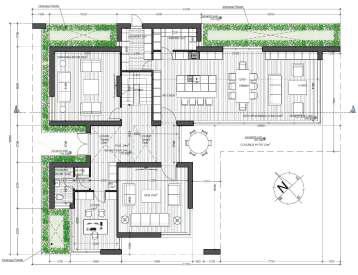
A purpose-built Revit model was made to a Level of Development (LOD) 300, which ensured all major elements were included, such as walls, roofs, doors, windows, and others, thus providing sufficient detail to allow for quantity extraction. To integrate the ARM5 structure, including metrics like classification categories, custom shared parameters were added to the models’ families, with an example of this seen in Figure 2 for the external walls. This allowed the user to input the relevant information to the s pecific element based on the ARM5 standards and can be used to further process the quantities. The model was created with intentional data anomalies during the simulation, such as missing classifications, to test the anomaly detection functionality of the workflow in Section 3.2.3.
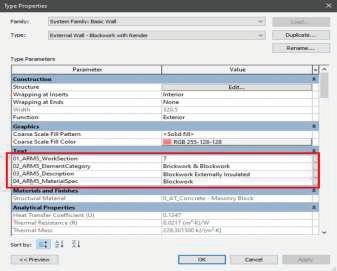
Proc. of the CitA BIM Gathering Conference 2025, November 6th 2025, Dublin Ireland
Mathews,
The third phase of this research focused on the creation and refinement of the workflow, utilising a suite of selected software. The workflow was developed to extract, validate, and visualise the QTO data using rule -based logic tailored to the ARM5 structuring. The logic of the workflow involved exporting element data from Revit to Excel by using a Dynamo script created by the researcher, where ARM5 classification logic and rules were applied from an ‘ARM5 Mapping File’ (AMF). This dataset was then imported and visualised on Power BI via an interactive dashboard, including functions like data filters, data charts, and the case study BIM model.
This section presents the findings from the workflows’ performance.
The developed BIM workflow was tested on the case study Revit model developed to LOD 300. The model was developed to reflect the standard housing typologies commonly encountered in a residential project, including but not limited to elements such as walls, windows, floors, and roofs. The elements were used based on a Revit template developed by the researcher, which included built -in materials and custom shared parameters that were configured to reflect the ARM5 standardisation.
4.1.1
A Dynamo script was needed to extract data from the model related to the elements’ quantities and standardisations. The Dynamo script is accessible through the Dynamo Player in Revit, thereby allowing users with less experience in Revit to access this workflow. The author built this Dynamo script. The Dynamo script, when selected, opened a ‘Model Checker User Interface’ (UI), allowing the user to provide the programme with further information without leaving the Dynamo Player.
The UI prompts the user to provide the AMF used to fill out the classification information in the models’ elements, and a location for the output Excel file to be saved. Once the user provided the datasets the Dynamo script required, the elements in the model would firstly go through a Python script developed by the researcher to carry out a ‘Similarity Checker’ (SC) (Cuffe & Goldschlag, 2018).
The SC would confirm if the elements had a Works Section number applied in the custom shared parameters, and whether this existed in the AMF. Additionally, the SC would evaluate if the element’s name, provided in the model, had a logical correspondence wit h the requirements in the AMF. After the elements were processed by the SC, the elements’ quantities would be extracted from the model.
The quantities extracted were only those required in the AMF, including but not limited to units like linear metres (m) or cubic metres (m3), meaning that excess quantities not required were excluded. Figure 3 provides a schematic of the logic that the qua ntities went through in the Dynamo script.
Auden
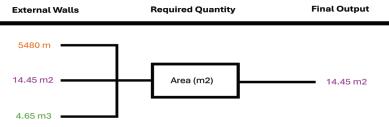
The output Excel file, which is seen in Figure 4, contained a raw dataset including several columns providing information on each of the elements, with emphasis on the requirements from ARM5. Each element would be assigned a ‘Match’ or ‘No Match’, alongside a summary of the reasoning behind this assignment. The decision for a ‘No Match’ would come from either missing the Works Section or the incorrect Works Section being used based on its correlation with the AMF.

Although no genuine anomalies existed within the model since it was purpose -built for testing, some inputs in the model were left empty to simulate potential scenarios, which the workflow effectively identified.
The data in the output Excel file was crucial to the workflow, but was in a format that was not accessible to users to accurately interrogate and isolate individual elements. To address this, the dataset was visualised in Microsoft Power BI, offering the u ser an interactive dashboard.
The Revit model was also connected to the dashboard using a Revit-Power BI connector called ‘Speckle’, which is an open -source digital infrastructure providing automation and collaboration solutions across multiple software used in the digital construction environment(About Us, 2025). A relationship between the Revit model and the output Excel file was established by using the common denominator between them, their ‘IfcGUID’ value.
The information between the elements in the interactive model and the Excel data had a direct relationship, providing the dashboard the opportunity to show anomalies by category or classification type, compliance status to ARM5 standards, and statistics of classified and unclassified components. Figure 5 highlights what the user would see on
Proc. of the CitA BIM Gathering Conference 2025, November 6th 2025, Dublin Ireland
Auden and Mathews, 2025 Automating Quantity Takeoff and Data Validation in a BIM-Based Workflow
the dashboard if they were to filter by ‘Walls’, alongside further explanation on the purpose of each of the data charts. The insights from this dashboard can be used to inform the user of the data that needs to be included or adjusted to allow the BIM mod el to stay in accordance with ARM5. The workflow was developed in such a way that allowed the process to be repeated until the model was fully synchronised with the requirements set out, as evidenced by the workflow sequence in Figure 6.
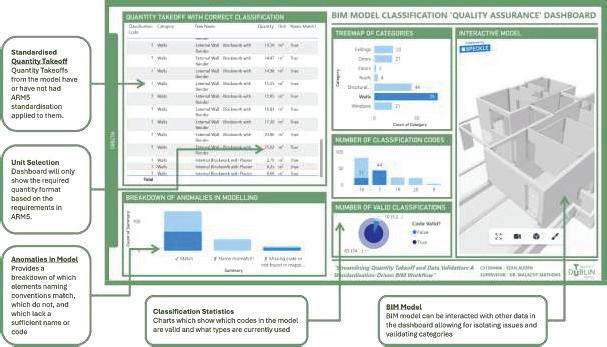
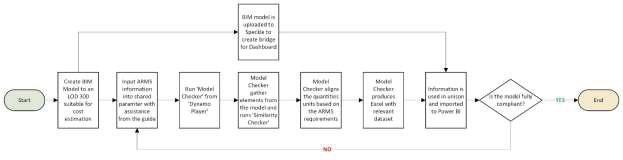
5.Discussion
The broader implications of the proposed workflow’s application in the residential sector are explored, as well as assessing the technical and practical challenges involved in its adoption.
This study presented several practical implications for professional practice, the first of which is the use of workflows for ARM5 -aligned outputs. This structuring supports the
Proc. of the CitA BIM Gathering Conference 2025, November 6th 2025, Dublin Ireland
Auden and Mathews, 2025 Automating Quantity Takeoff and Data Validation in a BIM-Based Workflow
communication between QSs by providing a consistent structure for interpreting any data from the BIM model. Having standardisation implemented into the quantity information reduces the potential for misinterpretation or errors.
Secondly, integrating the visual dashboard into the workflow enhances the accessibility of more complex project data. It allows stakeholders with less familiarity in BIM environments to analyse and better understand project metrics at an early stage, thus supporting clearer decision-making. Thirdly, automation has the potential to increase efficiency; however, professionals remain cautious about placing full responsibility on automated outputs. Based on this, the adoption of this workflow may be more effect ive if implemented as a supplementary tool to allow users to build trust in the system. Finally, the findings highlight the urgency for further BIM training by providing accessible templates, user guides, and case studies of successful application to help reduce these barriers to adoption.
This study set out to develop and evaluate a BIM -based workflow for streamlining the QTO process through standardisation and model validation with a focus on residential projects. A DSR approach to the research allowed for a prototype workflow to be create d, which combined software and tools, including Revit, Dynamo, Excel, and Power BI, and tested on a purpose-built case study model. The findings from this research demonstrated that the proposed workflow could effectively extract and structure quantities a ligned with ARM5 standards, while providing a clear and interactive dashboard for identifying anomalies.
References
About us. (2025). Speckle. https://www.speckle.systems/about Agreed Rules of Measurement (ARM) 5 . (2024, November 26). Construction Industry Federation and the Society of Chartered Surveyors Ireland. https://scsi.ie/agreed -rulesofmeasurement-arm-5/
Benedict Adeyemi, A., Chimaobi Ohakawa, T., Chukwudi Okwandu, A., Iwuanyanwu, O., & Ifechukwu, G.-O. (2024). Advanced Building Information Modeling (BIM) for affordable housing projects: Enhancing design efficiency and cost management. Comprehensive Research and Reviews in Science andTechnology https://www.researchgate.net/profile/Ifechukwu-GilOzoudeh/publication/384079744_Advanced_Building_Information_Modeling_BIM_for_ affordable_housing_projects_Enhancing_design_efficiency_and_cost_management/link s/ 66e9b86cdde50b32587a3453/Advanced -Building-Information-Modeling-BIMforaffordable-housing-projects-Enhancing-design-efficiency-and-cost-management.pdf
Cuffe, J., & Goldschlag, N. (2018). Squeezing More Out of Your Data: Business Record Linkage with Python. Center for Economic Studies, U.S. Census Bureau. https://ideas.repec.org/p/cen/wpaper/18-46.html
Cunningham, T. (2016). The Function and Format of Bills of Quantities:an Irish Context . https://doi.org/10.21427/7Y94 -A321
Proc. of the CitA BIM Gathering Conference 2025, November 6th 2025, Dublin Ireland
Auden and Mathews, 2025 Automating Quantity Takeoff and Data Validation in a BIM-Based Workflow
Elghaish, F., Farzad, P. R., Brooks, T., Dawood, N., & Abrishami, S. (2022). Chapter 3: Blockchain of things and deep learning applications in construction: Digital construction transformation. In Blockchain of things and deep learning applications in construction: Digital construction transformation. Springer International Publishing AG. https://ebookcentral.proquest.com/lib/tudublin/reader.action?docID=7042236&ppg=53
Hore, A., McAuley, B., & West, R. (2019). CitA BIM Study
Kadcha, Y., Legmouz, D., & Hajji, R. (2022). AN INTEGRATED BIM -POWER BI APPROACH FOR DATA EXTRACTION AND VISUALIZATION. The International Archives of the Photogrammetry, Remote Sensing and Spatial Information Sciences , XLVIII-4/W4-2022, 67–73. https://doi.org/10.5194/isprs-archives-XLVIII-4-W4-2022-672022
Karan, E., Mansoob, V. K., Khodabandelu, A., Asgari, S., Mohammadpour, A., & Asadi, S. (2021). Using Artificial Intelligence to Automate the Quantity Takeoff Process . 13–14.
Khaleel, A., & Naimi, S. (2022). Automation of cost control process in construction project building information modeling (BIM) 10(6). https://hdl.handle.net/20.500.12939/3301
Muthahharuddin Azher, S., & P R, D. (n.d.). Autodesk Construction Cloud Data Exchange and Power BI in Action: Achieve Real-Time Synchronized Updates [Class].
https://www.autodesk.com/autodesk -university/class/Autodesk-Construction-CloudDataExchange-and-Power-BI-in-Action-Achieve-Real-Time-Synchronized-Updates 2024?utm_source=chatgpt.com
Olsen, D., & Taylor, J. M. (2017). Quantity Take-Off Using Building Information Modeling (BIM), and Its Limiting Factors. Procedia Engineering, 196, 1098–1105. https://doi.org/10.1016/j.proeng.2017.08.067
Pachani, H. (2024, June 11). Innovative BIM trends in 2024 and in the future —Pinnacle IIT. Pinnacle IIT. https://pinnacleiit.com/blogs/bim/innovative -bim-trends-in-2024-andinfuture/
Parsamehr, M., Perera, U. S., Dodanwala, T. C., Perera, P., & Ruparathna , R. (2023). A review of construction management challenges and BIM -based solutions: Perspectives from the schedule, cost, quality, and safety management. Asian Journal of Civil Engineering, 24(1), 353–389. https://doi.org/10.1007/s42107 -022-00501-4
Peffers, K., Tuunanen, T., Rothenberger, M. A., & Chatterjee, S. (2007). A Design Science Research Methodology for Information Systems Research. Journal of Management Information Systems , 24(3), 45–77. https://doi.org/10.2753/MIS07421222240302
Power BI. (2025). Microsoft. https://www.autodesk.com/eu/products/revit/overview Revit Overview. (2025). Autodesk. https://www.autodesk.com/eu/products/revit/overview
Sampson Igwe, U., Hore, A., Kehily, D., & Colmennero Lechuga, D. (2023). Barriers to BIM Implementation for Cost Management in the Irish Construction Industry https://doi.org/10.21427/AR6Q -PT51
SCSI BIM survey 2017 . (n.d.). https://constructionprocurement.gov.ie/wpcontent/uploads/SCSI-
Proc. of the CitA BIM Gathering Conference 2025, November 6th 2025, Dublin Ireland
Auden and Mathews, 2025 Automating Quantity Takeoff and Data Validation in a BIM-Based Workflow
BIM-Survey-2017-DEPR.pdf
Sepasgozar, S. M. E., Costin, A. M., Karimi, R., Shirowzhan, S., Abbasian, E., & Li, J. (2022). BIM and Digital Tools for State -of-the-Art Construction Cost Management. Buildings, 12(4), 396. https://doi.org/10.3390/buildings12040396
Valinejadshoubi, M., Moselhi, O., Iordanova, I., Valdivieso, F., & Bagchi, A. (2024). Automated system for high -accuracy quantity takeoff using BIM. Automation in Construction, 157, 105155. https://doi.org/10.1016/j.autcon.2023.105155
Proc. of the CitA BIM Gathering Conference 2025, November 6th 2025, Dublin Ireland
Omar Doukari Omar.Doukari@northumbria.ac.uk
Northumbria University
Marzia Bolpagni marzia2.bolpagni@northumbria.ac.uk
Northumbria University and Mace Consultant
Abstract
Deep building renovation requires integrated digital solutions spanning entire project lifecycles and scaling to urban deployment. This paper presents the RINNO Suite, a comprehensive Building Information Modelling (BIM)-enabled platform combining specialised tools for renovation planning and execution, demonstrated through a residential building case study in Lille, France. The Techno-Economic Assessment (TEA) tool automates Planning and Design phase assessment, whilst the Retrofitting Manager (RRM) platform manages Retrofitting phase execution. Building on this foundation, the paper introduces Multi-Agent Urban Digital Twin (MAUDIT), a framework that enables city-wide renovation prioritisation, building pathology assessment, and circular economy coordination, representing the evolutionary pathway for scaling building-level tools to massive urban renovation programmes.
Keywords: Deep Renovation, Multi-Agent System, Urban Digital Twin
1.1 The urban renovation challenge
The European building stock accounts for approximately 40% of primary energy consumption and 30% of greenhouse gas emissions, presenting a significant challenge to achieving carbon neutrality by 2050 (Lynn et al., 2021). Current annual renovation rates hover around 1%, far below the 2 to 3% required to achieve the EU’s decarbonisation goals. Lynn et al. (2021) identify a range of human, technological, organisational, and environmental barriers across the renovation value chain, including inadequate planning, communication failures, and coordination challenges. Building Information Modelling (BIM) and digital twins (DT) offer potential to address these barriers through integrated digital workflows and data-driven monitoring that support collaborative decision-making across project phases (Bolpagni et al., 2022; Sacks et al., 2025). Beyond individual building challenges, the transition to urban-scale deployment presents distinct coordination difficulties that remain inadequately addressed. Most European cities contain extensive pre-1970s building stock requiring deep renovation, yet current approaches proceed largely ad-hoc, building-by-building, without systematic prioritisation. Municipal authorities and large estate owners lack comprehensive assessment capabilities to prioritise interventions based on energy performance, structural condition, and strategic value. Individual building renovations proceed without visibility into neighbouring projects that could enable material reuse, equipment sharing, or sequential workforce deployment. These coordination failures constrain achieving renovation rates necessary to meet climate targets within available resources.
1.2Research objectives and contributions
This paper addresses the critical gap between building-level renovation tools and urban-scale deployment strategies through integration of the RINNO Suite, a validated platform for individual building renovation, with MAUDIT (Multi-Agent Urban Digital Twin), a framework enabling citywide coordination. The RINNO Suite, developed under the EU’s Horizon 2020 programme,
Bolpagni,
integrates several software tools, including the TEA (Techno-Economic Assessment) tool for Planning and Design phase evaluation with the RRM (RINNO Retrofitting Manager) platform for Retrofitting phase execution. Demonstration through a residential building in Lille, France validates lifecycle integration whilst revealing urban-scale coordination limitations.
Building on this validated foundation, the paper’s primary contribution introduces MAUDIT, a framework enabling city-wide renovation coordination that complements RINNO Suite building execution capabilities. MAUDIT employs a multi-agent architecture encompassing drone-based building condition assessment, scheduling modelling (4D) of building stock evolution, strategic prioritisation algorithms, and circular economy material flow coordination. The integration creates a multiscale system addressing both “which buildings to renovate in what sequence” (MAUDIT urban planning layer) and “how to optimise individual building renovation” (RINNO Suite execution layer), providing a comprehensive approach to the massive urban renovation programmes necessary for achieving EU 2050 targets. The paper thus demonstrates not merely two independent tools but their necessary integration within hierarchical architecture where urban strategic planning informs and coordinates building-level execution whilst feedback from completed projects enhances future prioritisation and assessment accuracy.
2 The RINNO Suite: building-level foundation
2.1Platform capabilities and lifecycle integration
The RINNO Suite addresses building-level renovation management through integration of BIM and specialised tools spanning the complete project lifecycle. The platform’s architecture employs web-service technologies enabling distributed collaboration across geographically dispersed teams whilst maintaining data consistency through a shared BIM (Building Information Modelling) repository. This integrated approach recognises that effective renovation delivery requires seamless information flow from initial assessment through renovation completion, avoiding the fragmentation that characterises current tool landscapes.
The TEA tool automates Planning and Design phase assessment through BIM -based multiscenario simulation (Doukari et al., 2023). The tool enriches information models with semantic data and renovation activity definitions, then simulates alternative intervention strategies to generate comprehensive performance profiles. Scenarios range from targeted envelope improvements to comprehensive deep renovation incorporating heating system repla cement, mechanical ventilation, and renewable energy installations. For each scenario, the tool employs Resource Constrained Project Scheduling Problem optimisation (Blazewicz et al., 1983) to generate optimal activity sequences whilst quantifying duration, cost, resource requirements, and multi-dimensional disruption impacts across six categories including noise, dust, vibration, utilities, physical space, and traffic. The multi-scenario comparison enables systematic evaluation of trade-offs between renovation ambition and practical constraints of time, finance, and occupant disruption, transforming abstract renovation options into quantified alternatives that stakeholders can evaluate against their specific priorities.
The RRM platform coordinates Retrofitting phase execution through distributed web -based workflow management implementing Lean construction principles (Doukari et al., 2024). The platform architecture comprises six integrated components providing role-based user interfaces connected to remote services performing specialised processing via REST API. Role -based authentication across eleven user profiles ensures appropriate information access for diverse stakeholders from construction directors through site wor kers to building owners. The Planning Component implements a three-level scheduling approach operationalising principles established by Ballard’s (2000) Last Planner System, progressively refining plans from strategic project baselines through tactical look-ahead schedules to operational weekly commitment plans that release constraint-free work to production crews (Heigermoser et al., 2019). The M onitoring Component tracks actual progress through BIM-based visualisation overlaying completion status onto 3D building models, enabling spatial coordination between on-site teamsand proactive management intervention when performance trends suggest potential problems.
The critical integration between TEA and RRM operates through structured data exchange where selected renovation scenarios transfer from Planning and Design assessment into Retrofitting execution planning. The information model functions as persistent shared information backbone ensuring geometric and semantic consistency across the phase boundary, whilst JSON templates map TEA outputs to RRM inputs through explicitly defined schemas, ensuring compatibility across diverse tools (Pauwels and Terkaj, 2016). The feedback mechanisms connecting actual construction performance to assessment methodologies enable continuous improvement, progressively enhancing predictive capabilities as renovation programme experience accumulates (Doukari et al., 2023, 2024). This lifecycle integration represents a significant advance over fragmented approaches where design teams and construction teams operate with disconnected information systems.
However, the RINNO Suite’s validation through demonstration projects, whilst establishing comprehensive building-level renovation management capability, simultaneously reveals what such platforms cannot address. A municipal authority managing thousands of buildings requiring renovation cannot employ the suite to determine which hundred buildings merit priority, nor can regional construction consortia use it to optimise equipment sharing across multiple concurrent sites. The platform optimises “how to renovate” individual buildings but provides no guidance on “which buildings to renovate when”: precisely the strategic questions that urban-scale renovation programmes must address. This limitation reflects not platform inadequacy but rather the fundamentally different character of urban planning versus building execution, requiring different data types, analytical methods, and decision support frameworks. The platform ’s demonstrated capabilities and validated integration mechanisms position it as the essential building execution layer for urban programmes, yet this execution layer requires a complementary urban planning layer addressing prioritisation, sequencing, and circular economy coordination at city scale. The French demonstration case study, presented in the following section, provides empirical evidence of both the platform’s building-level achievements and the necessity for urban-scale strategic frameworks.
3 French case study: validation and gap identification
3.1Building context and BIM development
The French demonstration site comprises a four-storey residential building containing twenty-nine small apartments in Lille, managed by Lille Métropole Habitat (Figure 1)
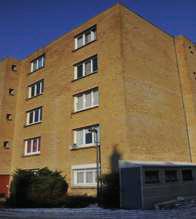
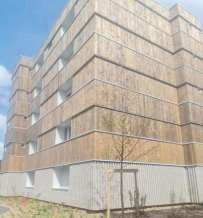
Constructed during the pre1970s period, the building exhibits typical thermal performance deficiencies of its era with poor envelope insulation and natural gas boiler heating. The occupied building context imposed significant constraints on intervention strategies, requiring careful disruption management to maintain resident habitability throughout the renovation process. This real-world complexity provided a rigorous validation environment for assessing the RINNO Suite’s capabilities under realistic conditions.
The demonstration project required comprehensive as-built information model creation to enable RINNO Suite application, employing contemporary 3D scanning technologies combining Leica BLK360 laser scanner for interior spaces with DJI Phantom 4 RTK drone for exterior facades. The scanning methodology achieved eighteen minutes per apartment average duration, proving acceptable to occupied residents whilst generating point cloud data sufficient for detailed information model development through Autodesk ReCap and Revit. The enrichment process
assigned alphanumerical information based on construction period knowledge and visual inspection, creating the information-rich model necessary for TEA tool scenario simulation. This validation of 3D scanning as a viable approach for existing building documentation addresses a frequent objection that BIM adoption for renovation remains impractical due to modelling effort requirements.
The TEA tool’s application evaluated six renovation scenarios, with comparison between Scenario S1 (renovation from outside) and Scenario S3 (comprehensive deep renovation) revealing substantial performance trade-offs characteristic of renovation decision-making(Figure 2). S1 required 336 days duration employing 770 man-days at 229,000 euros total cost, addressing envelope thermal performance through external insulation and glazing replacement whilst minimising interior disruption. In contrast, S3 pursued transformational improvement through 12 renovation activities including heat pump installation, mechanical ventilation systems, and photovoltaic generation, requiring 814 days, 2,200 man-days, and 905,000 euros investment (approximately 619 euros per m2). The simulation revealed strong positive correlations between duration and worker requirements, whilst disruption analysis showed S3 generating sustained impacts across all measured dimensions throughout the extended construction period, raising serious questions about maintaining building occupation during comprehensive interventions.
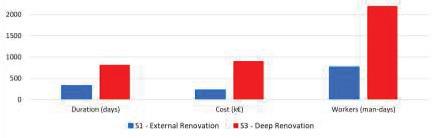
The energy performance analysis following ISO 14040 and ISO 14044 standards (ISO, 2006a, 2006b) indicated substantial operational improvements from deep renovation, with the transition to electric heat pump heating powered partially by on-site photovoltaic generation substantially reducing primary energy demand and greenhouse gas emissions. However, the life-cycle cost analysis revealed challenging economics with capital investment requiring decades of operational savings to achieve financial break-even, highlighting that technical solutions alone prove insufficient without supportive policy and financing mechanisms.
The RRM platform deployment for Retrofitting phase coordination validated distributed workflow management capabilities across six integrated components. Technical testing confirmed errorfree operation from authentication through multi-level schedule generation to BIM-based progress monitoring, with successful integration to remote Cockpit service generating comprehensive KPI visualisations overlaid on the French building information model. User evaluation engaging 29 construction industry representatives revealed positive reception regarding role-based access, three-level planning structure, and spatial progress visualisation, confirming that the platform addresses genuine industry coordination challenges. However, feedback also identified adoption barriers including learning curve requirements, information model prerequisites, and small enterprise resource constraints, indicating that technology deployment must be accompanied by training programmes and implementation support.
3.3Critical insight: the strategic planning gap
The demonstration validated comprehensive building-level renovation management whilst revealing a fundamental limitation that motivates the MAUDIT framework introduction. The RINNO Suite optimised assessment and execution for Project Sarrazins, integratingPlanning and Design scenarios generated through the TEA tool (Doukari et al., 2024) with Retrofitting phase coordination. The platform successfully managed complex workflows involving multiple stakeholders, maintained data consistency across phase transitions, and enabled informed decision-making through comprehensive scenario comparison. However, the platform provided no capability for addressing whether this particular building should be renovated now versus later
Proc. of the CitA BIM Gathering Conference2025, November 6th 2025, Dublin Ireland
within Lille Métropole Habitat’s extensive portfolio of hundreds of similar buildings, nor how its renovation should coordinate with other buildings to enable material reuse or contractor resource sharing.
This gap between building execution optimisation and urban strategic planning extends beyond mere scope limitation to represent a fundamental difference in problem character. Building -level tools address operational questions about specific structures using detailed technical data and short-term timeframes. Urban-scale planning addresses strategic questions about entire portfolios using coarse-grained information and multi-year horizons. The housing association managing thousands of units needs to determinewhich buildings offer greatest carbon reduction potential per euro invested, which require urgent intervention due to deteriorating conditions, and how renovation sequencing can enable material reuse from buildings identified for demolition. These strategic questions precede individual building project initiation yet prove essential for systematic programme development capable of achieving required renovation rates. The MAUDIT framework, introduced in the following section, addresses precisely these urban-scale planning requirements whilst maintaining integration with the RINNO Suite’s validated building execution capabilities.
4.1From building optimisation to urban coordination
The French demonstration exemplifies both the achievement and limitation of building -level renovation tools. Whilst the RINNO Suite optimised assessment and execution for a single building, Lille Métropole Habitat manages thousands of residential units across hundreds of buildings, facing complex challenges in determining renovation priorities, intervention sequencing, and resource allocation to maximise environmental impact within constrained budgets. Current prioritisation approaches rely primarily on minimum Energy Performance Certificate (EPC) requirements, grant programme eligibility, and voluntary owner initiatives, lacking systematic assessment and strategic coordination. Buildings renovate when owners secure financing rather than when their renovation would contribute most effectively to urban decarbonisation or enable circular economy benefits through material reuse. This atomised approach generates systemic inefficiencies: contractors mobilising without visibility into adjacent projects, demolished building materials ending in landfill whilst new materials are manufactured for nearby renovations, and renovation activity concentrating in affluent areas whilst neglected neighbourhoods receive limited attention. These coordination failures fundamentally constrain achieving EU 2050 targets, necessitating frameworks operating at urban scale.
4.2 Multi-agent architecture and innovations
The MAUDIT framework addresses urban-scale challenges through multi-agent architecture distributing assessment, analysis, and communication functions across specialised components with clearly defined interfaces and data exchange protocols (Figure 3). The framework builds upon 3D virtual city models, such asVirtual NewcastleGateshead (VNG) spanning 100 square kilometres developed through stereo aerial photogrammetry and terrestrial laser scanning (Northumbria University, 2023). MAUDIT extends such geometric models through systematic integration of property records, EPC databases, demographic data, and utility consumption patterns, transforming spatial representations into information-rich DT supporting strategic renovation planning. The Data Acquisition Agent establishes the DT synchronization loop through drone-based infrared imaging at urban scale. Object recognition algorithms automatically identify building pathologies including heat losses, faulty insulation, facade deterioration, and structural defects. The agent enables convergence between physical and digital building states at synchronization rates appropriate to programme needs, quarterly for strategic planning or more frequently for active monitoring (ISO/IEC, 2023). This automated approach substantially reduces costs and timeframes relative to traditional surveys whilst confronting limitations including weather dependency and automated recognition requiring validation. The Social Agent manages data storage, transmission, and access control within cloud-based infrastructure whilst implementing adaptive learning capabilities. Connectivity with diverse urban information systems through open Application Programming Interface (API) technologies ensures building condition data integrates with EPC, ownership records, and infrastructure networks. Learning capabilities enable
Proc. of the CitA BIM Gathering Conference2025, November 6th 2025, Dublin Ireland
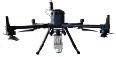


. MAUDIT – multi-agent urban digital twin framework for building pathology assessment and massive retrofit planning and delivery. (A) Physical. (B) Digital. (C) Automated Decision-making process.
continuous improvement as renovation programmes generate performance data. The Cognitive Agent performs analytical reasoning transforming building condition data into strategic renovation priorities, evaluating pathologies across structural, environmental, and functional dimensions. The agent’s innovation comprises 4D city simulations incorporating temporal information alongside spatial geometry, introducing pathology-specific age variants reflecting how different characteristics deteriorate at different rates. These multiple temporal dimensions enable scenario exploration projecting how alternative strategies affect building stock evolution, supporting evidence-based municipal strategy development. The Visualisation Agent presents complex urban building stock information through intuitive 3D representations accessible to diverse stakeholders. Building upon platforms such as VNG, the agent overlays real-time pathology data onto virtual city models through colour-coded visualisations (Figure 4). The interactive interface supports exploration from city-wide overviews through neighbourhood detail to individual building inspection, facilitating strategic programme development and stakeholder engagement.
4.3Strategic prioritisation and circular economy coordination
The framework’s prioritisation capabilities depend on comprehensive energy performance characterisation. EPC provide standardised assessment generating ratings from A (excellent) through G (very poor), yet significant coverage gaps persist. MAUDIT addresses this through predictive modelling estimating ratings for uncertificated buildings based on construction year, building type, and location, with machine learning trained on certificated buildings. Urban -scale performance mapping reveals spatial patterns with strategic planning implications, such as poorperforming building concentrations indicating opportunities for area-based programmes achieving economies of scale.
Beyond energy prioritisation, the framework’s transformative potential emerges through material flow coordination enabling circular economy approaches. MAUDIT addresses coordination failures through systematic matching of material supply from buildings recommended for demolition against renovation project demand. When the Cognitive Agent identifies buildings
requiring demolition, these enter a material source database cataloguing available resources. The framework cross-references renovation requirements generated by RINNO Suite’s RRM platform against available supplies, identifying matches enabling reuse rather than new procurement, generating embodied carbon reductions and waste diversion from landfill. Furthermore, material flow coordination introduces strategic programme sequencing considerations beyond individual building optimisation. A building yielding modest energy improvements might merit early
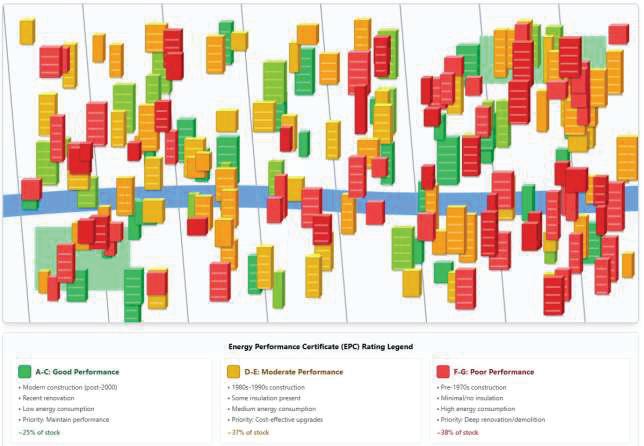
A-C: Good Performance
Modern construction (post -2000)
Recent renovation
Low energy construction
Priority : Maintain performance ~25 % of stock
D-E: Moderate Performance
1980 s-1990 construction
Some insulation present
Medium energy consumption
Priority: Cost~37 % of stock
F-G: Poor Performance
Pre-1970 s construction
Minimal /no insulation
High energy consumption
Priority: Deep renovation/deconstruction ~38 % of stock
Figure . VNG visualisation concept showing 3D city model with colour-coded building energy performance overlay (red = poor EPC F-G, yellow = moderate EPC D-E, green = good EPC A-C) across Newcastle-Gateshead urban area
demolition if its material recovery could supply multiple renovations, generating greater aggregate benefits. This portfolio-level optimisation represents a fundamentally different paradigm than evaluating each building independently.
4.4Multiscaleintegration: from urban strategy to building execution
The integrated architecture positions MAUDIT as urban planning layer and RINNO Suite as building execution layer within a comprehensive multiscale system (Figure 5). This hierarchical structure maintains clear separation between municipal planning responsibilities and project execution activities whilst ensuring seamless information flow through standardised data exchange protocols.The workflow commences at urban planning where MAUDIT performs building stock assessment through drone-based scanning and automated pathology identification. The Cognitive Agent analyses these assessments alongside EPC data to generate building-specific recommendations regarding renovation suitability and urgency. Prioritisation algorithms balance multiple objectives including carbon reductions, cost efficiency, social equity, and material flow optimisation, producing ranked building lists validated through stakeholder engagement facilitated by the Visualisation Agent. Once buildings receive priority status, the workflow transitions to building execution where RINNO Suite performs detailed assessment and coordination. The TEA tool receives building information from MAUDIT including geometric data, pathology assessments, and material availability, initialising assessment whilst providing context regarding reuse opportunities. Following scenario simulation and selection, the RRM platform coordinates Retrofitting phase execution with its Planning Component receiving schedules from TEA whilst accessing material delivery schedules from MAUDIT’s circular economy coordination. The Monitoring Component’s performance data feeds back to both TEA databases and MAUDIT
Bolpagni,
Strategic Prioritisation & Coordination (City /Portfolio Scale )
Data Acquisition Agent
Drone scanning
Infrared imaging
Pathology detectio n
Strategic Outputs:
Priority building rankings
Social Agent
Data integration
Cloud storage
Adaptive learning
Renovation sequencing plan
Resource allocation strateg y
Cognitive Agent
4D simulations
Prioritisation
Recommendations
Visualisation Agent 3D city model
Color-coded EPC
Stakeholder UI
Circular Economy : Material supply demand matching

Detailed Assessment & Construction Delivery (Individual Building Scale )
TEA Tool
Planning & Design Phase
BIM model enrichment
Multi-scenario simulation
Cost, duration, disruption analysis
Optimal strategy selection
Incorporate material availability
Building -level Outputs:
RRM Platform
3-level Lean planning
Multi -stakeholder coordination
Progress monitoring (BIM -based )
KPI tracking
Material delivery coordination
Detailed renovation plan > Construction schedule > Actual performance data
Figure . Multiscale integration architecture showing MAUDIT urban planning layer and RINNO Suite building execution layer with bidirectional feedback loops and circular economy coordination
prioritisation algorithms, enabling continuous improvement.This bidirectional information flow proves essential for adaptive programme management. When renovations achieve energy savings differing from predictions, this updates performance models informing future prioritisation. The learning mechanisms transform renovation programmes from static implementation into dynamic systems progressively enhancing effectiveness through accumulated experience, whilst multiscale architecture ensures strategic improvements inform tactical decisions and vice versa.
5 Discussion: integration and implementation
5.1Framework contributions and critical success factors
The integrated framework demonstrates that systematic urban-scale renovation requires capabilities spanning two complementary scales, with neither sufficient independently. The French demonstration validated that RINNO Suite provides comprehensive building-level lifecycle integration from Planning and Design through Retrofitting phases, addressing known renovation challenges through BIM-based automated assessment enabling systematic multi-scenario exploration and coordinated workflow management implementing Lean construction principles.
MAUDIT addresses the strategic layer that building-level tools cannot encompass, enabling rapid building stock assessment through drone-based infrared imaging, strategic prioritisation through 4D modelling projecting building stock evolution under alternative scenarios, and circular economy coordination through material flow matching. The multi-agent architecture’s distribution of functions enables flexible deployment whilst integration with RINNO Suite maintains appropriate separation between municipal planning and project execution.
Critical success factors span technical, organisational, and data dimensions. Comprehensive building information models constitute essential prerequisites, yet substantial documentation effort represents a capacity constraint requiring selective deployment strategies. At urban scale, 3D virtual city models provide geometric foundation whilst EPC databases enable performance characterisation. Organisational agreements regarding data sharing across institutional boundaries prove essential for coordinated operation, as do progressive circular economy barrier reductions regarding quality assurance and logistics coordination
The European Commission’s Renovation Wave strategy recognises that achieving climate targets requires massive renovation acceleration, proposing to at least double annual rates. However, even perfectly optimised individual renovations occurring at current ad -hoc rates prove insufficient. The fundamental challenge concerns dramatically increasing how many renovations occur annually through systematic urban-scale deployment, which the integrated framework enables through strategic prioritisation supporting evidence-based programme development pursuing maximum environmental impact within constrained resources.
Yet achieving required acceleration depends critically on addressing fundamental economic challenges exemplified by the French case study, where deep renovation capital requirements generate extended payback periods challenging viability without policy interventions including grants, subsidised financing, or regulatory mandates. The pathway toward 2050 targets involves progressive evolution as frameworks demonstrate value, industries adapt practices, policies develop supportive environments, and financing mechanisms mature. Future research requires MAUDIT pilot implementations at meaningful scale to validate assessment accuracy, prioritisation effectiveness, and circular economy facilitation. Additional priorities include investigating governance structures for multi-entity coordination, evaluating alternative policy instruments, and ensuring distributional equity alongside environmental goals.
This paper addressed scaling building renovation from isolated projects to systematic urban programmes capable of meeting EU carbon neutrality targets through integration of two complementary frameworks operating at different scales yet designed for coordinated deployment. The RINNO Suite, validated through the French demonstration in Lille, provides comprehensive building-level capabilities spanning Planning and Design phase assessment (TEA tool) through Retrofitting phase execution (RRM platform), demonstrating seamless workflow integration using BIM as shared repository and generating substantial improvements in renovation project planning, stakeholder coordination, and construction delivery.
However, building-level optimisation cannot address strategic questions of which buildings merit priority within extensive portfolios, optimal intervention sequencing, and material flow coordination enabling circular economy approaches. The MAUDIT framework provides this urban planning layer through multi-agent architecture encompassing automated building condition assessment via drone-based infrared imaging, strategic prioritisation incorporating 4D modelling of building stock evolution, and material flow coordination enabling systematic reuse through matching demolition material supply with renovation demand. The integrated multiscale system enables MAUDIT to identify renovation priorities and coordinate material flows whilst RINNO Suite optimises individual building execution, with bidirectional feedback loops enabling continuous improvement as programmes generate empirical performance data.
The research contributes technically through demonstration of seamless Planning and Design to Retrofitting phase integration, methodologically through articulation of how building-level tools scale to urban deployment via appropriate planning layer integration, and practically through frameworks supporting both construction industry stakeholders and municipal programme developers. The circular economy coordination capability addresses fundamental unsustainability of linear construction models through systematic material flow matching at urban scale, though realising this potential requires progressive barrier reduction regarding quality assurance, logistics coordination, and industry practice transformation.
The fundamental challenge confronting European societies concerns not whether existing building stock requires deep renovation but rather whether frameworks can be deployed sufficiently rapidly within timeframes that climate science demands. The integrated frameworks demonstrate that technical foundations for systematic urban-scale renovation exist, validated through real-world demonstration and grounded in established technologies. The remaining barriers are predominantly organisational, financial, and political rather than technical, suggesting that achieving 2050 targets depends critically on sustained commitment to renovation
Doukari and Bolpagni, 2025 Towards Urban-Scale Renovation: Integrating MAUDIT Framework with the RINNO Suite
acceleration. The frameworks provide the tools; societal will must supply the determination to deploy them at the scale and pace required to address the climate emergency
References
Ballard, H.G. (2000). The Last Planner System of Production Control. Doctoral thesis, University of Birmingham. https://etheses.bham.ac.uk/id/eprint/4789/
Bolpagni, M., Gavina, R., & Ribeiro, D. (2022). Industry 4.0 for the Built Environment: Methodologies, Technologies and Skills (Vol. 20, Structural Integrity). Springer.
Blazewicz, J., Lenstra, J.K. and Kan, A.H.G.R. (1983). Scheduling subject to resource constraints: classification and complexity. Discrete Applied Mathematics, 5(1), pp.11–24.
Doukari, O., Kassem, M. and Greenwood, D. (2024). A distributed collaborative platform for multistakeholder multi-level management of renovation projects. ITcon, 29, pp.217–243.
Doukari, O., Kassem, M., Scoditti, E., Aguejdad, R. and Greenwood, D. (2024). A BIM based tool for evaluating building renovation strategies: The case of three demonstration sites in different European countries. Construction Innovation: Information, Process, Management, 24(1), pp.365–383.
Doukari, O., Scoditti, E., Kassem, M. and Greenwood, D. (2023). A BIM-based techno-economic framework and tool for evaluating and comparing building renovation strategies. ITcon, 28, pp.246–265.
European Commission (2020). A Renovation Wave for Europe - Greening Our Buildings, Creating Jobs, Improving Lives - COM(2020) 662 final. Brussels: European Commission.
EPC-EU (2024). Directive (EU) 2024/1275 of the European Parliament and of the Council of 24 April 2024 on the Energy Performance of Buildings (Recast). Official Journal of the EU
Heigermoser, D., García de Soto, B., Abbott, E.L.S. and Chua, D.K.H. (2019). BIM -based Last Planner System tool for improving construction project management. Automation in Construction, 104, pp.246–254.
ISO (2006a). Environmental Management - Life Cycle Assessment - Principles and Framework (ISO 14040:2006).
ISO (2006b). Environmental Management - Life Cycle Assessment - Requirements and Guidelines (ISO 14044:2006).
ISO/IEC (2023) ISO/IEC 30173:2023 Digital twin - Concepts and terminology. Geneva: International Organization for Standardization/International Electrotechnical Commission.
Lynn, T., Rosati, P., Egli, A., Krinidis, S., Angelakoglou, K., Sougkakis, V., Tzovaras, D., Kassem, M., Greenwood, D. and Doukari, O. (2021). RINNO: Towards an open renovation platform for integrated design and delivery of deep renovation projects. Sustainability, 13(11), 6018.
Northumbria University (2023). 3-D City Model (Virtual Newcastle-Gateshead). Northumbria KnowledgeBank. Available at: https://northumbriaknowledgebank.flintbox.com/technologies/40711474-b297-4ba6-8f49e48e2bc55a01
Northumbria University (2025). Virtual NewcastleGateshead. Available at: https://www.northumbria.ac.uk/about-us/academic-departments/architecture-and-builtenvironment/research/virtual-reality-visualisation/research-enterprise-projects/virtualnewcastle-gateshead/
Pauwels, P. and Terkaj, W. (2016). EXPRESS to OWL for construction industry: Towards a recommendable and usable ifcOWL ontology. Automation in Construction, 63, pp.100–133.
Sacks, R., Lee, G., Burdi, L., & Bolpagni, M. (2025). BIM handbook: A guide to building information modeling for owners, designers, engineers, contractors, and facility managers (4th ed.). John Wiley & Sons.
Proc. of the CitA BIM Gathering Conference2025, November 6th 2025, Dublin Ireland
Theme 4: MMC, Industry 4.0 and Emerging Construction Technologies.
Thomas Flynn Thomasflynn390@gmail.com .
Atlantic Technological University Sligo
Paul Hamilton, paul.hamilton@atu.ie
Atlantic Technological University Sligo
Daniel Clarke Hagan Daniel.clarkhagan@atu.ie
Atlantic Technological University Sligo
Mary Catherine Greene. mary-catherine.greene@glenveagh.ie
Glenveagh Properties Plc
Michael R. Curran, michael.curran@ul.ie
University of Limerick
Abstract
The research aims to establish why 3D concrete printing is not being used extensively as a solution to the current housing crisis, whilst highlighting advantages and challenges.The research employs a three tiered, sequential mixed -methods approach combining, a literature review, semi structured interviews and a questionnaire.The research confirms 3Dconcrete printing is still largely in the research phase for many, Ireland included. Identified advantages of 3D concrete printing are speed of construction, offers a solution to current labour shortages, aids in waste reduction. The main challenges identified are costs, printer transportation and workers adapting to new technologies and regulations.
Keywords: 3D Concrete Printing, housing crisis, waste reduction
1. Introduction
The construction industry is undergoing a transformative shift, with technological innovations driving changes in how structures are designed and built (Maskuriy et al., 2019). Among these innovations, 3D Concrete Printing (3DCP) has emerged as a promising method that offers faster construction times, reduced material waste, and greater design flexibility compared to traditional methods (Ghaffar et al., 2018; De Schutter et al., 2018).
While interest in 3DCP has grown rapidly in recent years, particularly for residential housing, its widespread adoption remains limited by several factors. These include high initial investment costs (Adaloudis and Bonnin Roca, 2021), printer reliability ( ElSayegh et al., 2020), lack of skilled labour (Hossain et al., 2020), and absence of regulatory frameworks (Puzatova et al., 2022).
Despite these challenges, emerging studies highlight its potential to disrupt the construction sector by offering sustainable, cost -efficient, and innovative alternatives
Flynn et. al., 2025, The Prospects and Challenges of 3D Concrete Printing in Ireland
to conventional practices (Anton et al., 2021; Tu et al., 2023). This research investigates the prospects and challenges associated with 3DCP.
The aim of this paper is to assess the potential of 3DCP, compare its performance against traditional construction methods, and identify key barriers to its adoption.
3D printing, which is also known as Additive Manufacturing (AM) is the process from which a structure is formed from a digital file, through the continuous layering of a chosen material, primarily a concrete mix, using a 3D printer (Horn 2022). Additive manufacturing evolved from Thomas Edison’s research at the beginning of the 20th Century, with Penga incorporating it into construction in the late 1990s (El -Sayegh et al. 2020). In a study conducted by Hosain et al (2020), numerous 3DCP companies are discussed, with the study identifying Winsun 3D, founded by the Chinese entrepreneur Ma Yihe, in July of 2003 as the most significant for the construction industry. Winsun 3D prints Concrete and glass fibre composite materials in a factory, these are then assembled into structures onsite. In 2014 the company Constructed a 10m High five story apartment block using 3D printed concrete components. Available research indicates a growing appetite for all types of MMC especially 3D printing, in 2018 Icon was the first American company given a permit for a 3D printed home, they have continued to progress in 3D concrete printing with numerous projects. Across Europe structure delivery through 3DCP is growing in use, in 2020 the CP3O project in Antwerp delivered its first 3D concrete printed houses ( Aerts, 2025), in March 2023 BAM completed works on the Sighthill Bridge, over the M8 motorway near Glasgow, Scotland which incorporated 3D printed stairs (BAM, 2022). 3DCP has the ability to provide both elements and full structure printing to the construction industry.
Currently there are two different types of printers used in 3D concrete printing, Gantry Frame and Robotic Arm. As the name suggests a gantry frame 3D concrete printer utilises a gantry system to carry and support the 3D print head. By mounting the print head on rails, it has the ability to move across the gantry framework on an X, Y or Z axes, facilitating precise layering of the extruded material (El -Sayegh et al. 2020). In contrast a robotic arm 3D printer comprises an interconnected multi -segmented robotic arm with extrusion nozzle, mounted on a stable base or mobile platform which moves around the design as necessary, depositing the extruded material in layers (COBOD.COM, 2025), Both types of 3D printers are in use across the global construction industry. American firm Icon uses a gantry frame system which works from a fixed position and must be assembled and reassembled for large projects. Cobod, the largest distributer of Gantry frame printers in Europe, state that these printers can print a standard two-story building without having to move the printer. In contrast Apis Cor in Florida uses a Single robotic arm printer which has the ability to rotate 360 degrees and reach across the structure location. This type of printer is free standing and can move itself to new positions (Horn. 2022). In both applications, the extruding nozzle follows a path which is set out in a 3d digital file, constantly adding layers until the required 3D structure is formed(El-Sayegh et al., 2020).
The research indicates that at present Gantry-Style setups are the dominating on -site solution for printing whole building structures(Lund-Nielsen, 2022).
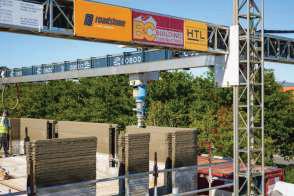
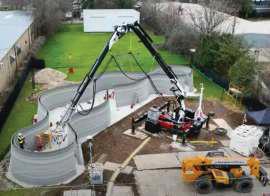
One of the main challenges with the 3DCP, is choosing a suitable material. The material must be well designed and have the following properties: rheological, flowability, extrudability, buildability, and hardened strength. The material needs to be able to flow through the printer and be fine enough to be extruded out of the nozzle so as to prevent clogging (Ahmed, 2023). Once extruded, the material must be strong enough to withstand the weight of the next layers and must provide the desired structural properties once cured These constraints mean a zero-slump concrete with a low water-to-cement ratio and increased stiffness is necessary. This type of concrete brings both advantages and challenges, the lower water content promotes a higher compressive strength and reduced cracking, but the stiffer mix reduces the workability and requires accurate placement (Abdulkareem et al., 2024) In addition to the mix requirements the ability to control the printing process is essential for 3DCP structures. The speed at which the printer moves must be calibrated to suit the setting time of the concrete. The speed must be fast enough so that a good bond is formed with the layer below but slow enough that the previous layer is able to support each new layer. The printer must move quickly around corners, which may cause filament cracking, the use nozzle which can be turnedin tandem with the robot arm will prevent this. (Owen-Hill, 2019).

3DCP currently uses large volumes of concrete, which is not ideal from a carbon or sustainability perspective. To combat this widespread research and testing are being carried out with the aim of finding a sustainable solution. In Construction terms sustainability means much more than using raw materials and their associated environmental impact and is most often me asured by the three pillars of social, economic, and environmental impacts. For the construction industry, economic consequences are often the easiest to measure with social being the most difficult. From an economic standpoint the overall project costs can be reduced through speed of construction, reduced labour and eliminating waste .However the material costs, especially concrete costs increase due to mix, uncommon ingredients, a requirement for greater control over the ratios within the material, and a need for a higher level of expertise both at concrete manufacture and printer operation increase the costs associated with the concrete. Environmental aspects are negatively affected by items such as binder content but can be positively impacted by the reduction of waste and elimination of formwork. Using automation and robotics can drive a positive social impact, by reducing the manual labour required to install formwork, add and finish concrete, the likelihood of errors and accidents is reduced (De Schutter et al. , 2018). The focus on sustainability and continued research into it, CO2 emissions and greener concretes have the potential to help to achieve the United Nations Sustainable development goals for the 2030 agenda. Ongoing research on the option of using recycled concrete from demolition is under consideration as a possible aggregate for 3DCP, however challenges remain around the ability to fully remove all contaminants such as rebar, other debris and fragments. A key objective when producing a sustainable material is to reduce the cement content. Other considerations are related to the CO2 emissions and the possibility of global warming. Research conducted by (Yu et al. 2022) looked at the energy contained and the carb on footprint as the key indicator for sustainability. Weng et al. 2020 determined that the type of mixer, pump, printer and printer scale will affect factors such as energy, consumption, consumables, and useful life.
Ireland's first 3D printed social housing project at Grange Close, Dundalk, marks a milestone in additive manufacturing for Irish construction. Delivered by Harcourt Technologies Ltd in collaboration with B&C Contractors, Roadstone, and supported by FutureCast and the Louth & Meath Education and Training Board, the scheme comprises three two-storey, three-bedroom homes of 110m² each (Waite, 2025; Morley, 2024).The superstructures were printedusing a gantry 3D concrete printer in just 12 days, with total machine time on site recorded at 18 working days, resulting in a construction programme reduction of over 35% (Roadstone, 2024). A COBOD 3D printer using Roadstone’s Ready-Mix Concrete integrated for the first time in Europe—was used, producing cavity walls without rebar that are reportedly five times stronger than conventional blockwork (Waite, 2025). The homes are fully compliant with ISO/ASTM 52939:2023 and were awarded the NSAI 'Standards Innovation Award' for their contribution to safe and regulated additive construction. Future Cast played a pivotal role in enabling the project by supporting training, facilitating funding access, and linking key industry stakeholders. The collaborative approach underline s the potential of 3D concrete printing to accelerate sustainable housing delivery while meeting high structural and regulatory standards and further demonstrates the potential of 3DCP as a solution to the housing crisis. Challenges remain, including
training skilled operators and aligning building codes, but the Dundalk project is a strong proof of concept for scaling this innovation across Ireland and beyond.
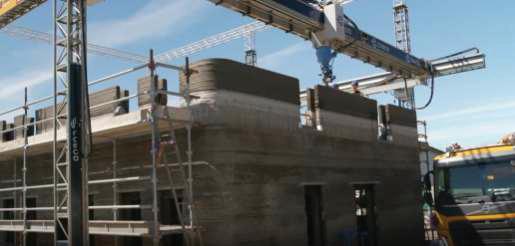
3DCP has the potential to solve some of constructions current issues , however as identified by (Xiao et al., 2021) its transitions from experimental and small -scale applications to more mainstream and larger-scale construction is of a challenge.
3Methodology
This gateway research employed a mixed-method approach to investigate the prospects and challenges associated with 3D Concrete Printing (3DCP). This type of a study enables a researcher to understand complex phenomena qualitatively as well as to explain the phenomena through numbers, charts, and basic statistical analyses (Creswell, 2003). By utilising a mixed method methodology, the researcher gains a greater understanding of the research problem, as this approach uses a broad range of information sources, which allows the researcher to triangulate and cross check information to ensure its validity. Qualitative and quantitative research have varying strengths, therefore when they are used in combination it provides a much stronger research project. This study combined a comprehensive literature review and semistructured interviews to ensure a well-rounded and up-to-date understanding of the technology’s development, current applications, and practical limitations. The literature review served as the foundation for the study, examining peer -reviewed journal articles, academic books, industry publications, and recent case studies related to 3DCP. The selected sources covered key topics such as technical capabilities (Chen et al., 2021), economic considerations (Weng et al., 2020), material performance (Yu et al., 2022), environmental impact (Yao et al., 2019), and regulatory concerns (Puzatova et al., 2022).The review aimed to synthesise current knowledge, highlight existing gaps, and inform the structure of the subsequent interview phase (De Schutter et al., 2018). To address knowledge gaps identified during the literature review—particularly around practical implementation, mix development, workforce readiness, and printer reliability (Ghaffar et al., 2018; Hossain et al., 2020) three semistructured interviews were conducted with professionals who had direct experience in 3DCP-related roles. Participants were selected based on their involvement in either active 3DCP projects or technical research within the field (Malaeb et al., 2019). The interview questions were designed to align with the research objectives, focusing on real-world experiences, observed benefits, encountered limitations, and perspectives on the future of 3DCP (Anton et al., 2021).
BIM Gathering Conference 2025, November 6th 2025, Dublin Ireland
Data from the interviews were transcribed and analysed thematically, allowing key insights to be categorised and compared against findings from the literature. This triangulated approach helped to validate existing research while also uncovering new or underreported themes such as printer maintenance protocols, mix advancements with structural capacity, and emerging trends in workforce training (Puzatova et al., 2022). Qualitative research was supplemented by undertaking a case study of houses constructed using 3DCP in Co. Louth, Ireland. Quantitative Research is a way of gathering first hand data, numerical data, and statistical analysis to test a hypothesis or theory usually produced with numbers and scores. After analysing different methods for gathering quantitative research, a Questionnaire proved to be the best option. The questions which formed the survey were taken from the Literature review and Interviews based on the research questions which were set at the beginning of the project. The aim behind this method was to verify theories made in the qualitative research Mixed Methods Research creates a clearer picture besides using either research method on their own. Bergman, (2011) states that this allows the researcher to obtain accurate validation and understanding of the data, which is useful for achieving the objectives of the study.This method ensured that the prospects and challenges of 3DCP were thoroughly investigated. This type of a study enables a researcher to understand complex phenomena qualitatively as well as to explain the phenomena through numbers, charts, and basic statistical analyses. (Creswell, 1999) By utilising a mixed method methodology, the researcher will gain a greater understanding of the research problem. A key limitation of the study was the relatively small number of industry practitioners actively involved in 3DCP in Ireland, which constrained the participant pool for interviews. Additionally, the novelty of the technology means that much of the available literature is eit her conceptual or exploratory, with limited longitudinal data or established case studies (Hossain et al., 2020). Despite these limitations, the chosen methodology enabled the collection of credible, experience-based insights that complement academic resea rch and support a more nuanced understanding of 3DCP's viability within the current construction landscape (De Schutter et al., 2018)
The research findings are drawn from a combination of literature analysis and qualitative data gathered through interviews with industry professionals. The primary prospects and challenges identified within this research in relation to 3D Concrete Printing(3DCP), are outlined below
From the literature and interviews, several key benefits of 3DCP were consistently noted:
● Speed of Construction: 3DCP was shown to reduce overall construction time significantly, enabling Just-In-Time (JIT) delivery and rapid project turnaround.
● Reduction in Labour and Waste: Both sources noted a decreased reliance on manual labour and material wastage due to the precision of automated printing.
● Complex Geometries: The technology allows for the creation of intricate and bespoke forms that are difficult to achieve using traditional formwork.
● Off-site Fabrication: Prefabrication of components was recognised as a viable advantage, especially in controlled environments.
Flynn et. al., 2025, The Prospects and Challenges of 3D Concrete Printing in Ireland
● Potential for Enhanced Strength: Interviewees described recent developments in mixes with improved structural performance, contrasting with earlier literature that focused primarily on non -structural mortar-based prints.
Table 1. Summary of Prospects Identified from Literature and Interviews Prospect
Faster construction
Reduced waste and labour
Complex design flexibility
Off-site manufacturing benefits
Structurally stronger mixes
Several recurring challenges were reported:
Limited
● High Initial Investment: The cost of acquiring and maintaining 3D printers remains a barrier to widespread adoption.
● Workforce Skills Gap: A need for significant upskilling and training was acknowledged in both literature and interviews.
● Material Formulation: Creating an optimal, printable mix that balances strength, workability, and printability was a shared concern.
● Technology Failure Risk: Printer malfunction can lead to substantial delays and losses; some protocols are in place, but risks remain.
● Insurance and Regulation: Uncertainty persists around home insurance and compliance due to the absence of established codes or guidelines.
Table 2. Summary of Challenges Identified from Literature and Interviews
Challenge
Printer cost
Training and skills development
Material mix development
Equipment reliability Limited
Insurance and regulatory gaps
The research also identified gaps, particularly in:
● Scalable deployment of 3DCP for large and complex projects.
● Detailed case studies documenting full lifecycle performance.
● Comparative long-term cost analysis versus traditional methods. These gaps indicate the need for more empirical and field -based studies as the technology matures.
5. Conclusion
This research set out to investigate why 3D Concrete Printing (3DCP) has not yet been widely adopted as a solution to the current housing crisis, despite its apparent
CitA BIM Gathering Conference 2025, November 6th 2025, Dublin Ireland
Flynn et. al., 2025, The Prospects and Challenges of 3D Concrete Printing in Ireland
advantages. Through a combination of literature review and semi -structured interviews with industry professionals, the study identified key benefits, challenges, and knowledge gaps associated with the technology. The findings confirm that while 3DCP offers significant potential particularly in terms of faster construction times, reduced labour demands, minimised material waste, and complex design flexibility it remains largely in the research and pilot stage, particularly in regions such as Ireland. The technology’s limited commercial uptake is primarily due to high initial costs, logistical challenges in transporting equipment, a lack of skilled labour, and an absence of clear regulatory frameworks. Importantly, the interviews revealed recent advancements in printable concrete mixes with improved structural capacity, suggesting that the technical capabilities of 3DCP are progressing faster than its regulatory and industrial integration. This underscores the need for collaborative efforts among industry stakeholders, policymakers, and researchers to develop standards, training pathways, and cost -reduction strategies. The study contributes to the growing body of work on digital construction technologies by offering a current and context-specific analysis of 3DCP's viability. It highlights the socio -technical factors that influence adoption, moving beyond purely technical assessments to consider workforce readiness and institutional barriers. However, the study’s limitations must be acknowledged. The small sample size for interviews reflects the nascent state of the technology in the Irish context, and much of the available literature remains conceptual or based on early-stage implementations. As such, the conclusions drawn are indicative rather than definitive. See Figure 1 for summation.
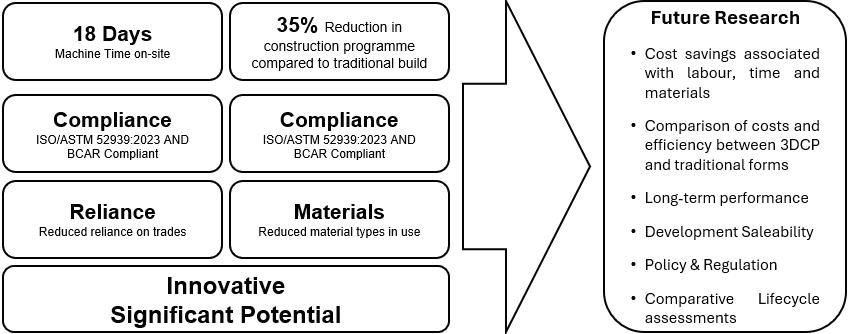
Why is “Compliance” box above repeated??
The research concludes that whilst 3DCP is not yet a mainstream solution to the housing crisis, it holds substantial promise. With targeted investment, supportive policy development, Regulatory guidance and industry collaboration, it could become a transformative force in sustainable and affordable housing delivery.
References
Abdulkareem, O. Alshahwany, R. Shlla, R. Ahmed, A. (2024). Performance of ZeroSlump Concrete Made With Recycled Concrete Aggregate. Civil and Environmental Engineering. Vol. 20, Issue 1
Adaloudis, M. and Bonnin Roca, J. (2021). Sustainability trade-offs in the adoption of 3D Concrete Printing in the construction industry. Journal of Cleaner Production, 307, p.127201. Doi: https://doi.org/10.1016/j.jclepro.2021.127201.
CitA BIM Gathering Conference 2025, November 6th 2025, Dublin Ireland
Flynn et. al., 2025, The Prospects and Challenges of 3D Concrete Printing in Ireland
Aerts, M. (2025). Project C3PO. Available at:https://www.kampc.be/en/projects/c3po. [Accessed 10th April 2025].
Ahmed, G. (2023). A review of “3D concrete printing”: Materials and process characterization, economic considerations and environmental sustainability Journal of Building Engineering, Volume 66.
Anton, A., Reiter, L., Wangler, T., Frangez, V., Flatt, R.J. and Dillenburger, B. (2021). A 3D concrete printing prefabrication platform for bespoke columns. Automation in Construction, 122(4), p.103467. Doi: https://doi.org/10.1016/j.autcon.2020.103467
BAM (2022). Big step forward for Glasgow bridge as BAM installs Scotland’s first 3D concrete printed staircase. Available at: https://www.bam.co.uk/mediacentre/news-details/big-step-forward-for-glasgow-bridge-as-bam-installsscotland-s-first-3d-concrete-printed-staircase. [Accessed 10th April 2025].
Bergman, M. (2011). Advances in Mixed Methods Research. Sage Publications: London.
Creswell, J. W. (2003). Research Design: Qualitative, quantitative, and mixed methods approach (2nd edn). Thousand Oaks, CA: Sage.
Chen, Y., Zhang, Y., Pang, B., Liu, Z. and Liu, G. (2021). Extrusion-based 3D printing concrete with coarse aggregate: Printability and direction-dependent mechanical performance. Construction and Building Materials, 296, p.123624.
De Schutter, G., Lesage, K., Mechtcherine, V., Nerella, V.N., Habert, G. and AgustiJuan, I. (2018). Vision of 3D printing with concrete — Technical, economic and environmental potentials. Cement and Concrete Research, [online] 112, pp.25–36. Doi: https://doi.org/10.1016/j.cemconres.2018.06.001 .
El-Sayegh, S., Romdhane, L. and Manjikian, S. (2020). A critical review of 3D printing in construction: benefits, challenges, and risks. Archives of Civil and Mechanical Engineering, 20(2). Available at: https://link.springer.com/article/10.1007/s43452-020-00038-w [Accessed 11th April 2025].
Ghaffar, S.H., Corker, J. and Fan, M. (2018). Additive manufacturing technology and its implementation in construction as an eco-innovative solution. Automation in Construction, 93, pp.1–11. Available from:
Hill, O. (2019). Researchers Tackle the 5 Challenges of 3D Concrete Printing. Robo DK Blog. Available at: https://robodk.com/blog/3d -concrete-printing-challenges/ Horn, C. (2022). 3D printing: The building block to construct new homes. The Irish Times. Available at: https://www.irishtimes.com/business/innovation/ 2022/09/01/3d-printing-the-building-block-to-construct-new-homes
Hossain, Md.A., Zhumabekova, A., Paul, S.C. and Kim, J.R. (2020). A Review of 3D Printing in Construction and its Impact on the Labour Market. Sustainability, [online] 12(20), p.8492. Doi: HTTPs://doi.org/10.3390/su12208492
ICON (2025) Available at: https://iconbuild.com/ [Accessed 11 th April 2025]
Levy, D. (2006). 'Qualitative Methodology And Grounded Theory in Property Research', Pacific Rim Property Research Journal, Vol. 12(4).
CitA BIM Gathering Conference 2025, November 6th 2025, Dublin Ireland
Flynn et. al., 2025, The Prospects and Challenges of 3D Concrete Printing in Ireland
Lund-Neilson, P. (2023). Philip Lund-Nielsen on LinkedIn: World of Concrete 3D Printing’24. [online] www.linkedin.com. Available at: https://www.linkedin.com/posts/lundnielsen_world-of-concrete-3d-printing-24 activity7134928196986118145 -cOzw [Accessed2nd Dec.2023].
Malaeb, Z., Alaska, F. and Hamzeh, F. (2019). Chapter 6 -3D Concrete Printing: Machine Design, Mix Proportioning, and Mix Comparison Between Different Machine Setups. Sanjayan, J. G., Nazari, A., and Nematollahi, B., eds. ScienceDirect, pp.115–136
Maskuriy, R., Selamat, A., Maresova, P., Krejcar, O. and Olalekan, O. (2019). Industry 4.0 for the Construction Industry: Review of Management Perspective. Economies, 7(3), p.68.
Morley, K. (2024) ‘3D Printed Homes Make History in Ireland’, Medium, 17 February. Updated 30 May. Available at: https://medium.com/@kieranmorley (Accessed: 18 July 2025)
Puzatova, A., Shakor, P., Laghi, V. and Dmitrieva, M. (2022). Large-Scale 3D Printing for Construction Application by Means of Robotic Arm and Gantry 3D Printer: A Review. Buildings, 12(11), p.2023. Doi: https://doi.org/10.3390/buildings12112023
Perkins, I. and Skitmore, M. (2015). Three-dimensional printing in the construction industry: A review. International Journal of Construction Management, 15(1), pp.1–9.
Roadstone. (2024) 75 Truck Outside 3DCP Completed Home Drogheda Internal Briefing Document, December
RTE. (2024). Ireland's first 3D printed homes being built in Dundalk. Available at: https://www.rte.ie/news/regional/2024/0710/1459098 -3d-printed-homesdundalk/ [Accessed 11th April 2025]
Tu, H., Wei, Z., Bahrami, A., Ben Kahla, N., Ahmad, A. and Özkılıç, Y.O. (2023). Recent advancements and future trends in 3D printing concrete using waste materials. Developments in the Built Environment, [online] 16, p.100187. Doi: https://doi.org/10.1016/j.dibe.2023.100187.
Waite, R. (2025) ‘How a Social Housing Scheme Pioneered 3D Printing’, Architects’ Journal, 24 January.
Weng, Y., Li, M., Ruan, S., Wong, T.N., Tan, M.J., Ow Yeong, K.L. and Qian, S. (2020). Comparative economic, environmental and productivity assessment of a concrete bathroom unit fabricated through 3D printing and a precast approach. Journal of Cleaner Pro duction, March 2020, p.121245.
Xiao, J., Ji, G., Zhang, Y., Ma, G., Mechtcherine, V., Pan, J., Wang, L., Ding, T., Duan, Z. and Du, S. (2021). Large-scale 3D printing concrete technology: Current status and future opportunities. Cement and Concrete Composites, 122, p.104115. Doi: https://doi.org/10.1016/j.cemconcomp.2021.104115 .
Yao, Y., Hu, M., Di Maio, F. and Cucurachi, S. (2019). Life cycle assessment of 3D printing geo‐polymer concrete: An ex‐ante study. Journal of Industrial Ecology, 24(1), pp.116–127.
Yu, S., Sanjayan, J. and Du, H. (2022). Effects of cement mortar characteristics on aggregate-bed 3D concrete printing. Additive Manufacturing [online], 5
CitA BIM Gathering Conference 2025, November 6th 2025, Dublin Ireland
Caoimhe Clarke Hagan S00225247@atu.ie
Atlantic Technical University Sligo
Daniel Clarke Hagan Daniel.clarkhagan@atu.ie
Atlantic Technical University Sligo
Mary Catherine Greene mary-catherine.greene@glenveagh.ie Glenveagh Properties Plc
Mairead Lynam mairead.lynam@atu.ie
Atlantic Technical University Sligo
Michael R. Curran, michael.curran@ul.ie University of Limerick
Abstract
The research critically evaluates the use of Blockchain within construction, analysing its’ benefits, challenges and limitations. A three-tiered, sequential mixed methods approach that includes a literature review, five semi-structured interviews and a questionnaire. Results indicate an increasing use of Blockchain technologies, but implementation is fragmented and must improve. They also reveal that Blockchain aids sustainability and lean practices. Further, it provides accountability, traceability and may solve the ongoing lack of transparency and inefficiencies in contract management. Limitations identified are, cultural resistance to change, legal limitations and a lack of clarity around regulations.
Keywords: Accountability, Blockchain, Transparency.
1. Introduction
The construction industry evolves by implementing new technologies, these technologies have several benefits ; improving efficiency, transparency, and sustainability within the industry, all vital for economic growth. The Internet of Things (IoT), Augmented & Virtual reality, Artificial intelligence (AI), Building Information Modelling (BIM), Drones and 3D Printing being key examples. Blockchain, a type of distributed ledger technology (DLT), is the latest innovation to enter the industry . Originating from the 2008, Satoshi Nakamoto crypto -currency introduction of ‘Bitcoin’, which offered solutions for a peer-to-peer transaction eliminating a third -party authorization (Nakamoto, 2008), blockchain has been steadily innovating and growing in attraction. With key Blockchain characteristics including transparency, traceability, and collaborationthe question must be asked of how these innovat ive solutions can be put into practice in the construction industry and what benefits it can have? The industry relies heavily on planning, scheduling, and data to understand project position but current practices have inefficiencies resulting in fragmentation, thus driving a need for research and development into the potential benefits of Blockchain technology. Investigation into all aspects is essential, understanding how it is currently being used where it can be implemented in the future, what does it mean for the built environment, and is it a reliable ledger are among key questions that must be considered. The focus
Clarke Haganet al., 2025 Investigating the Use of Blockchain in the Irish Construction Industry
of this research is to understand the growing popularity of blockchain within the construction industry. The research recognizes that whilst Blockchain is not new, its’ use within construction is in itsinfancy but growing due to its applications in;supply chain, construction management, procurement, and payments. See Figure 1.

The research has identified several key challenges (See Figure 2) withblockchain technology within construction , they are: Integration, Regulatory Uncertainty, Cultural Resistance, Cost and Scalability.
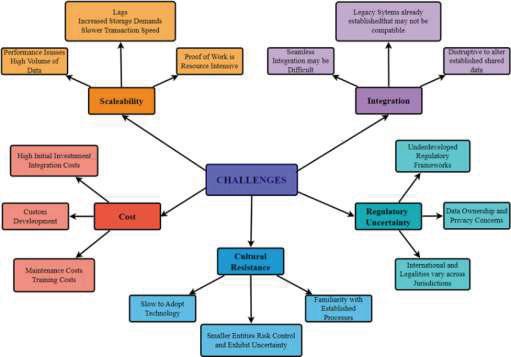
Proceedings of the CitA BIM Gathering Conference2025, November 6th 2025, Dublin Ireland
Haganet al., 2025
2. Methodology
Thisstudy uses a sequential mixed methods research approach. (See Figure3).
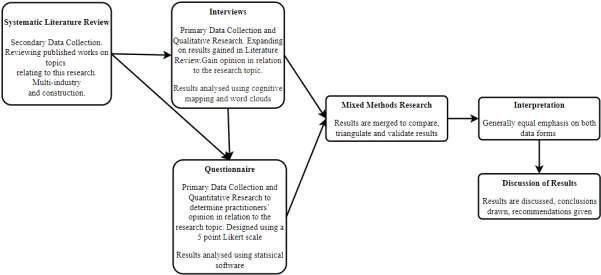
3. Research Methodology Flowchart (Clarke Hagan et al., 2025 Adapted from Greene, Clarke Hagan & Curran, 2020)
This approach combines an in-depth critical literature review, examining themes such as historical blockchain, key features and blockchain within construction, to outline current trends, interpretations, and opinions on blockchain while revealing gaps in knowledge. Expanding on the literature review qualitative data is collected through five semi-structured interviews, conducted with experienced industry professionals to obtained additional knowledge and opinion. (See Figure 4).
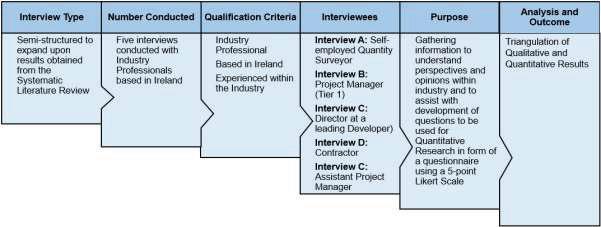
Figure 4. Interview Infographics (Clarke Hagan et al., 2025)
Quantitative research involved data collated via a questionnaire using a five-point Likert scale and then analysed through statistical analysis assists in determining industry opinion in relation to the research. Quantitative research is objective in nature. It is defined as an inquiry into a social or human problem, based on testing a hypothesis or a theory composed of variables, measured with numbers, and analysed with statistical procedures, to determine whether the hypothesis or the theory hold true (Cresswell, 1994). Quantitative data is, therefore, not abstract, they are hard and reliable they are measurements of tangible, countable and sensate features of the world (Bouma and Atkinson, 1995).The purpose of quantitative research is to test the
Proceedings of the CitA BIM Gathering Conference2025, November 6th 2025, Dublin Ireland
Clarke Haganet al., 2025 Investigating the Use of Blockchain in the Irish Construction Industry
researcher’s theory rather than develop it. The theory becomes a framework for the entire study (Cresswell, 1994).
2.1 . What is the justification for using Mixed Methods
Mixed methods research integrates the best of qualitative and quantitative research to produce a more in-depth evaluation of findings. See Table 1. It has been called the “third methodological movement” following the development of first quantitative and then qualitative research (Teddlie and Tashakkori, 2009).
Table 1. Advantages and Disadvantages of Mixed Methods Research.
Sources: (Bazeley 2004; Clarke Hagan, Spillane and Curran 2018; Creswell 2003, 2009; Creswell and Plano Clark 2007, 2011; De Silva 2009; Johnson and Onwuegbuzie 2004; Teddlie and Tashakkori, 2009)
Advantages
Strengths offset the weaknesses of both quantitative and qualitative research
Pluralist methodology provides a more
Disadvantages
Research design may be very complex
Requires longer time span and resources to plan and implement complete and comprehensive understanding of the research problem than a singular methodology
Increases the ability to generalise the results
Helps to explain findings or how causal processes work
Provides an approach for developing better, more context specific instruments
More comprehensive research
Answers a broader range of research questions
Words, pictures, and narrative can be used to add meaning to numbers
Can answer a broader and more complete range of research questions
Robust evidence provided for a conclusion through convergence and corroboration of finding
May be difficult to plan and implement one method by drawing on the findings of another
May be difficult to resolve discrepancies that arise in the interpretation of the findings
More costly in terms of; time, money and energy
Researcher has to learn about multiple methods and approaches
Increased workload for researcher
Can be difficult for a single researcher, especially when the two approaches are used concurrently
Difficult when used in a single study
As seen in table 1, advantages outweigh disadvantages and so a mixed methods approach best suits this research as it ensures that this methodology best captures the complex and evolving relationship betweenBlockchain and the construction industry.
The research highlights blockchain's potential to transform construction supply chains through improved transparency, traceability, and trust (Perera, Nanayakkara and Weerasuriya, 2021). Participant A, highlighted blockchains application to help supply chain management and facilitate payments quicker similarly to Participant B who noted that blockchain appears to be particularly useful for tracking repeatable processes, such as those in the supply chain, blockchain-based supply chain records can significantly enhance trust and traceability 17.7% strongly agreed and 48.8% agreed that clients would benefit from blockchain enabled trust. Participant B also noted that they see supply chain integration and smart contracts as the way forward, although
Proceedings of the CitA BIM Gathering Conference2025, November 6th 2025, Dublin Ireland
broader adoption will require building greater trust in the technology. 12.2% of questionnaire respondents strongly agreed and 61% agree that blockchain enhances traceability of materials and equipment with 22% responding neutral.
Smart contracts are frequently discussed in the literature as a transformative tool in construction, particularly for automating payments upon milestone completion, reducing administrative delays, and increasing trust through immutable records (Mason & Escott 2018; Ferreira et al. 2024; Wang et al. 201 8; Rathnayake et al. 2022). However, Interview responses reflect a more cautious, mixed reality response. Participant A was particularly sceptical, stressing that both large and small companies would resist compromising control over cashflow, highlighting that financial trust is built through profit, not technology alone which 51.2% of questionnaire respondents agreed blockchain threating contractors’ control over payment timings and 46.3% agreed that it would be more likely to be adopted if profitability increases. This diverges from the literature’s suggestion that smart contracts alone can rebuild trust. Participants B and D recognised the benefits particularly for subcontractors but stressed the need for integrated systems or human oversight, Interview B shared a working example in facilities management, affirming the efficiency of smart contracts, but insisted trial runs and integrated systems were necessary for trust. Participants C and E similarly stressed that while automation might appeal to those receiving payments stakeholders who are paying would be uncomfortable due to data accuracy and privacy concerns, 26.8% and 39% agreed blockchain raises concerns about data privacy with 7.3% disagreeing. Across the interviews, there was consensus that while smart contracts could streamline processes, human verification, dispute mechanisms, trust and integration with existing platforms remain essential for its application.
The literature presents blockchain as a tool capable of transforming sustainability in construction through lifecycle material tracking, transparent verification of environmental claims, and support for certifications such as LEED (Wang et al. 2020; Perera et al. 2020; Gopalakrishnan et al. 2021). The literature aligns most strongly with participant B, who described blockchain’s potential in tracking carbon output, waste management, and supply chain compliance, positioning it as ideal for meeting client sustainability expectations and certification demands. Similarly, participant D identified blockchain as useful for verifying supplier claims, particularly around emissions and recycled materials, reinforcing its role in enhancing accountability and reducing greenwashing.17.1% s of questionnaire respondents strongly agreed and 34.1% agreed blockchain can contribute to sustainable and ethical procurement practices whilst 34.1% remain neutral. Participant C offered a more cautious response, suggesting that blo ckchain cannot support sustainability on its own and would need to be integrated into a wider system of sustainable practices. Participant E also sees blockchain as a supporting mechanism rather than a driver, recognising its usefulness for auditing, reporting, and potentially enabling lean construction by reducing material waste through shared visibility of leftover materials between contractors. By contrast, participant A diverged from the literature, seeing no direct link between blockchain and sustainability, unless considered in terms of time or staff efficiencies leading to leaner operations. This range of responses highlights a divide between the theoretical potential presented in academic sources and the practical scepticism or conditional acceptance observed among industry professionals.
Proceedings of the CitA BIM Gathering Conference2025, November 6th 2025, Dublin Ireland
3.2.1
The integration of blockchain with existing digital technologies such as BIM, IoT, and AI is largely supported in the literature to enhance transparency, automate processes, and contribute to the circular economy (Elghaish et al. 2021; Savage 2020) . The interviewees showed different views on how blockchain could integrate with these existing technologies. Participant A noted that while BIM is essential for higher -level contracting, its integration with blockchain is likely to be relevant only for larg er companies. Smaller contractors, according to participant A, are unlikely to be familiar with these technologies, suggesting a gap in adoption across the industry, 29.3% of questionnaire respondents strongly agreed and 34.1% agreed that the construction industry lack blockchain knowledge with 17.1% disagreeing Participant B highlighted a significant barrier to blockchain integration being the need to ensure that all existing platforms are compatible with blockchain systems. This challenge of seamless integration could disrupt current workflows and payment systems, making full adoption more difficult. On the other hand, Participant C saw blockchain as having potential to enhance BIM processes, especially in areas like payments and asset management, but noted that in their experience, this integration has not yet been widely established in construction projects. Participant D also acknowledged the complementary potential of blockchain but stressed that for many in the industry particularly smaller companies, it could be disruptive. They suggested that integrating blockchain with existing tools would be beneficial, but significant changes to systems and processes might be met with resistance. Consensus among interviewees, is that blockchain has a high potential to be adopted if it is compatible with existing systems, proves to make processes more efficient and there is a legal framework in place.
The research revealed that blockchain’s potential in facilities management revolves around enhancing efficiency, reducing paper-based processes, and improving decision-making through real-time data and analytics. The literature supports the notion that blockchain can be particularly beneficial in managing vendors, equipment maintenance, and ensuring better cybersecurity, especially as the number of IoT devices in facilities increases (Shi and Tay, 2019). Blockchain can enable data storage and analysis with increased security, protecting against cyberattacks while improving processes such as lifecycle assessment, cost, and analysis (Intellis, 2020). The practical applications of blockchain in FM were highlighted by Participant B shared an example of blockchain being integrated with IoT sensors in HVAC systems. This integration allowed for automated monitoring and servicing, where a smart sensor would trigger the required maintenance alerts, automatically notify the r elevant parties, and trigger payment through a smart contract without manual intervention. This process, according to the participant, reduced time delays and increased efficiency. 22% strongly agreed and 51.2% agreed that integration with IoT devices woul d make blockchain more valuable on site, 7.3% disagree. Despite this positive example, Participant B, like the literature, acknowledged that blockchain adoption in FM is still in its early stages. There is agreement that while blockchain offers advantages, widespread application is still a long way from being fully comprehended.
of the CitA BIM Gathering Conference2025, November 6th 2025, Dublin Ireland
inertia, where long-standing beliefs and habits hinder the openness to new technologies, is particularly prominent in Irish construction (Ahmadisheykhsarmast et. al. 2018; Zarei et al. 2023). Interviews revealed similar opinions. Participant A noted that cultural resistance often manifests on both individual and group levels, where semi-permanent relationships within construction teams create a sense of cohesion, introducing blockchain could disrupt these established dynamics, leading to disputes. 58.5% agreed that industry practitioners are reluctant to adopt new systems due to disruption of their established social dynamics 9.8% disagree and 19.5% are neutral Participant B pointed out that trust barriers, data protection concerns, and the need for upskilling remain significant obstacles. Participant C acknowledged that while Irish construction might appear slower in adopting certain technologies, it is not due to a lack of innovation within the industry but rather due to regulatory hurdles and slowmoving government processes. They argued that Irish construction professionals are adaptable and progressive but face challenges with government -led restrictions. 26.8% of questionnaire respondents strongly agreed and 46.3% agreed blockchain would require a full rewrite of current legal frameworks. Participants D and E highlighted that the Irish construction is traditionally resistant to digital adoption, particularly when it comes to administrative processes. However, responses to the questionnaire showed 46.3% agreeing that smart contracts can support traditional contract processes. Senior staff members, who are accustomed to traditional ways, are often hesitant to embrace digital tools like blockchain. Participant E further highlighted that unless leadershipactively supports innovation with proper training, blockchain adoption will remain slow. These cultural barriers, and a need for a clear legal framework, prevent blockchain from gaining traction in the industry.
The research highlights that the development of industry -wide standards and regulatory frameworks is essential for blockchain adoption in construction. Current legal ambiguity surrounding blockchain, particularly regarding the enforceability of smart contracts, data ownership, privacy rights such as GDPR compliance, and liability issues, poses significant challenges. (Ayele et al. , 2021) argue that clearly defined legal frameworks would help reduce uncertainty and encourage investment, which is currently hindered by fragmented and underdeveloped regulations. Furthermore, international projects face the added complexity of varying blockchain governance across jurisdictions (Kumar Singh et al., 2023). Interviewees shared similar concerns about the legal and regulatory hurdles associated with blockchain adoption. Participant A highlighted that the construction industry’s resistance to technological change and fragmented teams, along with a lack of knowle dge-sharing, complicates the implementation of blockchain.This cultural barrier is combined by outdated contracts and legal frameworks that do not yet account for blockchain, leading to challenges in integrating new payment structures and contractual dynamics. 39% agreed subcontractors lack clarity on their legal rights in payment systems and 22% strongly agreed however, 34.1% remain neutral. Participant B suggested that blockchain adoption in construction could benefit from government mandates, like how BIM was adopted, but it would require significant regulato ry amendments. Once blockchain reaches maturity and can seamlessly integrate with existing systems, regulatory support could drive its widespread adoption. Participant C pointed out that the reliance on historical legal precedents could delay blockchain's acceptance, and there may be challenges in ensuring that stakeholders fully understand the smart contracts they sign. This could lead to disputes, especially if users do not comprehend the contract terms. 56.1% of questionnaire respondents agreed regulatory uncertainty poses a
Proceedings of the CitA BIM Gathering Conference2025, November 6th 2025, Dublin Ireland
3.3.1
Cultural resistance is a significant barrier to blockchain adoption in the construction industry, with a historical preference for traditional, manual processes. This cultural inertia, where long-standing beliefs and habits hinder the openness to new technologies, is particularly prominent in Irish construction (Ahmadisheykhsarmast et. al. 2018; Zarei et al. 2023). Interviews revealed similar opinions. Participant A noted that cultural resistance often manifests on both individual and group levels, where semi-permanent relationships within construction teams create a sense of cohesion, introducing blockchain could disrupt these established dynamics, leading to disputes. 58.5% agreed that industry practitioners are reluctant to adopt new systems due to disruption of their established social dynamics 9.8% disagree and 19.5% are neutral . Participant B pointed out that trust barriers, data protection concerns, and the need for upskilling remain significant obstacles. Participant C acknowledged that while Irish construction might appear slower in adopting certain technologies, it is not due to a lack of innovation within the industry but rather due to regulatory hurdles and slowmoving government processes. They argued that Irish construction professionals are adaptable and progressive but face challenges with government -led restrictions. 26.8% of questionnaire respondents strongly agreed and 46.3% agreed blockchain would require a full rewrite of current legal frameworks. Participants D and E highlighted that the Irish construction is traditionally resistant to digital adoption, particularly when it comes to administrative processes. However, responses to the questionnaire showed 46.3% agreeing that smart contracts can support traditional contract processes. Senior staff members, who are accustomed to traditional ways, are often hesitant to embrace digital tools like blockchain. Participant E further highlighted that unless leadership actively supports innovation with proper training, blockchain adoption will rem ain slow. These cultural barriers, and a need for a clear legal framework, prevent blockchain from gaining traction in the industry.
The research highlights that the development of industry -wide standards and regulatory frameworks is essential for blockchain adoption in construction. Current legal ambiguity surrounding blockchain, particularly regarding the enforceability of smart contracts, data ownership, privacy rights such as GDPR compliance, and liability issues, poses significant challenges. (Ayele et al. , 2021) argue that clearly defined legal frameworks would help reduce uncertainty and encourage investment, which is currently hindered by fragmented and underdeveloped regulations. Furthermore, international projects face the added complexity of varying blockchain governance across jurisdictions (Kumar Singh et al., 2023). Interviewees shared similar concerns about the legal and regulatory hurdles associated with blockchain adoption. Participant A highlighted that the construction industry’s resistance to technological change and fragmented teams, along with a lack of knowle dge-sharing, complicates the implementation of blockchain.This cultural barrier is combined by outdated contracts and legal frameworks that do not yet account for blockchain, leading to challenges in integrating new payment structures and contractual dynamics. 39% agreed subcontractors lack clarity on their legal rights in payment systems and 22% strongly agreed however, 34.1% remain neutral. Participant B suggested that blockchain adoption in construction could benefit from government mandates, like how BIM was adopted, but it would require significant regulato ry amendments. Once blockchain reaches maturity and can seamlessly integrate with existing systems, regulatory
Proceedings of the CitA BIM Gathering Conference2025, November 6th 2025, Dublin Ireland
support could drive its widespread adoption. Participant C pointed out that the reliance on historical legal precedents could delay blockchain's acceptance, and there may be challenges in ensuring that stakeholders fully understand the smart contracts they sign. This could lead to disputes, especially if users do not comprehend the contract terms. 56.1% of questionnaire respondents agreed regulatory uncertainty poses a bigger barrier than the technology itself. Participant D highlighted that construction law has not yet caught up with blockchain technology, especially concerning the legal recognition of smart contracts in Ireland. Without legal backing, companies may be hesitant to adopt blockchain due to uncertainty about its enforceability. Participant E is concerned about the traditional nature of construction contracts, particularly in public projects, where smart contracts and blockchain are not widely standardised in legal systems. This lack of legal clarity creates risks for companies, especially when dealing with disputes or cross-jurisdictional projects.
The research has found that blockchains’ key features are decentralisation enhancing collaboration among stakeholders, immutability reinforcing trust among parties, transparency ensuring a history of records and transactions between parties and security by encrypting data and protecting it from unauthorised entities and cyberattacks. Key uses of blockchain have been identified as being beneficial to the supply chain by enabling transparency and traceability of the tracking of materials and ensures ethical sourcing, which leads to promoting sustainability by improving the tracking of materials throughout their lifecycle and promoting waste management and re-use of materials. Smart contracts are a key use of blockchain,improving trust among stakeholders and ensure obligations are met without reliance on intermediaries. Blockchain can aid disputes , by recording actions and exchanges of information in real time,reducing arbitration and litigation in traditional systems. It has a real chance to sustain popularity by integrating it into existing systems and platforms like BIM and IoT. Blockchain can improve FM, through secure, decentralized systems for tracking assets, managing maintenance, and improving cybersecurity. Blockchain has the potential to improve industry efficiencies, aid in reducing project delays and cost overruns, and support key goals such as sustainability and digital integration but with current regulations remaining fragmented and underdeveloped, this leads to legal ambiguity around smart cont ract enforceability, data ownership, and cross -border compliance. However, the challenges of blockchain implementation were also acknowledged. There is a degree of cultural resistance to change within the construction industry, particularly among contractors and SMEs, who tend to adopt new technologies at a slower pace due to reliance on legacy systems and uncertainty about regulatory frameworks but with many companies relying on legacy systems that may not be compatible with blockchain technology compatibi lity issues will hinder the seamless exchange of information between blockchain platforms and other systems like ERP, BIM, and project management tools hindering blockchains ability to gain traction.Despite identified limitations, the research suggests that if these concerns were properly addressed, blockchain applications have significant potential for successful adoption within the built environment, enabling the industry to capitalise on the identified benefits within the research.
References
Ahmadisheykhsarmast, Salar & Sonmez, Rifat. (2018). Smart Contracts in Construction Industry. Conference: 5th international Project and Construction
Proceedings of the CitA BIM Gathering Conference2025, November 6th 2025, Dublin Ireland
Clarke Haganet al., 2025 Investigating the Use of Blockchain in the Irish Construction Industry
Management Conference (IPCMC2018)At: Cyprus International University, North Cyprus
Ayele, T., Mohammed, A., and Desta, T. (2021). Regulatory challenges of blockchain in construction. Construction Management and Economics, 39(5), pp. 451-466.
Bazeley, P. (2004). Issues in Mixing Qualitative and Quantitative Approaches to Research. Cited in: R. Buber, J. Gadner and L. Richards (Eds), Applying Qualitative Methods to Marketing Management Research (pp. 141 -56). Basingstoke, UK: Palgrave Macmillan.
Bouma, G.D., Atkinson, G.B.J., (1995). A Handbook of Social Science Research, 2nd ed. Oxford University Press, United Kingdom
Clarke Hagan, D. Spillane, J. Curran, M. (2018). Mixed Methods Research: A Methodology in Social Sciences Research for the Construction Manager. London. COBRA, Royal Institute of Chartered Surveyors
Creswell, J. (1994). Research Design: Qualitative, Quantitative Approaches. Thousand Oaks, California. Sage Publications
Creswell, J. W. (2003). Research Design: Qualitative, quantitative, and mixed methods approach (2nd edn). Thousand Oaks, CA: Sage.
Creswell, J. (2009). Research Design: Qualitative, Quantitative, and Mixed Methods Approaches. 3rd Edition. Sage Publications Inc: Los Angeles.
Creswell, J. and Plano Clark, V. (2007). Designing and Conducting Mixed Methods Research. (1st Edition) Sage Publications: CA.
Creswell, J. Plano Clark, V. (2011), Designing and Conducting Mixed Methods Research. 2nd Edition. Thousand Oaks, California. Sage Publications
De Silva,T. (2009). Benefits of Mixed Methods in Environmental Reporting Research. Christchurch, NZ: Lincoln University.
Elghaish, F., Hosseini, M.R., Matarneh, S., Talebi, S., Wu, S., Martek, I., Poshdar, M. and Ghodrati, N. (2021). Blockchain and the ‘Internet of Things’ for the construction industry: research trends and opportunities. Automation in Construction, 132, p.103942.
Ferreira, I.A., Palazzo, G., Pinto, A., Pinto, P., Sousa, P., Godina, R. and Carvalho, H. (2024). A blockchain architecture with smart contracts for an additive symbiotic network - a case study. Operations management research/Operations management research: advancing practice through research.
Greene. M.C. Clake-Hagan, D. Curran, M. (2020). Achieving Smarter Buildings and More Efficient Facilities Management: The Implementation of Big Data. International Journal of Digital Innovation in the Built Environment Volume 9 • Issue 2 • July-December 2020
Gopalakrishnan, PK.Hall,J. Behdad S. (2021). Cost analysis and optimization of Blockchain-based solid waste management traceability system. Waste Management. 2021 Feb 1;120:594-607.
Intellis (2020). What are the benefits of Blockchain for Facilities Managers? [online] Intellis.io
Proceedings of the CitA BIM Gathering Conference2025, November 6th 2025, Dublin Ireland
Clarke Haganet al., 2025 Investigating the Use of Blockchain in the Irish Construction Industry
Johnson, B. R., Onweuegbuzie, A. J. (2004). Mixed Methods Research: A Research Paradigm Whose Time Has Come: Educational Researcher, Vol. 33, No. 7 (pp. 14-26 American Educational Research Association.
Kumar Singh, A., Kumar, V.R.P., Dehdasht, G., Mohandes, S.R., Manu, P. and Rahimian, F.P. (2023). Investigating the barriers to the adoption of blockchain technology in sustainable construction projects. Journal of Cleaner Production, 403, p.136840.
Levy, D. and Schuck, E. (2005). 'The Influence of Clients on Valuations: the clients’ perspective', Journal of Property Investment and Finance, Vol. 23(2)
Levy, D. (2006). 'Qualitative Methodology And Grounded Theory in Property Research', Pacific Rim Property Research Journal, Vol. 12(4).
Lincoln, Y. S., & Guba, E. G. (1985). Naturalistic inquiry. Beverly Hills, CA: Sage.
Mason, J. and Escott, H. (2018). Smart Contracts in Construction: Views and Perceptions of Stakeholders. FIG Congress. Embracing our smart world where the continents connect: enhancing the geospatial maturity of societies. Istanbul, Turkey
Nakamoto, S. (2008). Bitcoin: A Peer-to-Peer Electronic Cash System. Retrieved from https://bitcoin.org/bitcoin.pdf
Nanayakkara, S., Perera, S., Senaratne, S., Weerasuriya, G.T. and Bandara, H.M.N.D. (2021). Blockchain and Smart Contracts: A Solution for Payment Issues in Construction Supply Chains. Informatics, 8(2), p.36.
Perera, S., Nanayakkara, S. and Weerasuriya, T. (2021). Blockchain: The Next Stage of Digital Procurement in Construction. Academia Letters.
Rathnayake, I., Wedawatta, G. and Tezel, A. (2022). Smart Contracts in the Construction Industry: A Systematic Review. Buildings Savage, D. (2020). Thoughts for the new decade: Smart contracts, blockchain and construction dispute resolution. Thomson Reuters Prac. L.Construction Blog. Available at: http://constructionblog.practicallaw.com/thoughts -for-the-newdecade-smart-contracts-blockchain-and-construction-dispute-resolution/ [Accessed 10th April 2025].
Shi, P. and Tay, J. (2019). Blockchain For Facilities Management. SSRN Electronic Journal.
Teddlie, C. and Tashakkori, A. (2009). Foundations of Mixed Methods Research: Integrating Quantitative and Qualitative approaches in the Social and Behavioural Sciences. Sage: CA
Wang, H., Zheng, Z., Xie, S., Dai, H.N. and Chen, X. (2018). Blockchain Challenges and Opportunities: A Survey. International Journal of Web and Grid Services, [online] 14(4), pp.352–375.
Wang, M., Wang, B. and Abareshi, A. (2020). Blockchain Technology and Its Role in Enhancing Supply Chain Integration Capability and Reducing Carbon Emission: a Conceptual Framework. Sustainability, 12(24), p.10550.
Wang, S., Wang, J., and Ding, J., (2020). Blockchain technology in the construction industry: Applications, benefits, and challenges. International Journal of Information Management, 52, p.102084.
Proceedings of the CitA BIM Gathering Conference2025, November 6th 2025, Dublin Ireland
Clarke Haganet al., 2025 Investigating the Use of Blockchain in the Irish Construction Industry
Zarei, S. Karbassi, A. Sadrinasab, M. Sarang, A(2023). Development and application of novel risk indices for assessing heavy metal pollution in aquatic sediments, Marine Pollution Bulletin, Volume 19 5
Proceedings of the CitA BIM Gathering Conference2025, November 6th 2025, Dublin Ireland
Barry McAuley barry.mcauley@tudublin.ie Technological UniversityDublin
Eduardo Rebelo erebelo@belfastmet.ac.uk
Belfast Metropolitan College
Andrew Hamilton andrewhamilton@belfastmet.ac.uk
Belfast Metropolitan College
Anna Moreno comunicazione@ibimi.it
Institute BIM Italy
António Aguiar Costa aguiar.costa@tecnico.ulisboa.pt Universidade de Lisboa
Dijana Likar dijana.likar@gim.com.mk
Institute for Research in Environment Civil Engineering and Energy
Jan Cromwijk j.cromwijk@isso.nl
Centraal Register Techniek
Paulo Carreira paulo.carreira@tecnico.ulisboa.pt
Instituto Superior Técnico
Paul McCormack paul.mccormack@hydrogenireland.org
Hydrogen Ireland
Abstract
The Arise project aimed to tackle the pressing challenges faced by the European AEC sector in achieving ambitious climate targets. It focuses on enhancing the workforce's skills in digital construction technologies and sustainable energy through innovative training methods, including the integration of blockchain technology. Building on insights from prior Horizon 2020 and Erasmus+ initiatives, the project sought to create a comprehensive digital delivery system for Continuous Professional Development. To accomplish this, ARISE piloted exemplary teaching methodologies, materials, assessment strategies, and delivery tools to enrich the learning experience and establish best practices within the construction industry. This paper examines the final testing phase and illustrates how the developed training materials contribute to upskilling professionals in key areas such as Building Information Modelling, sustainability, and digitalisation. It is hoped that the curated selection of modules now offered on the ARISE platform will significantly enhance the learning experience for users, equipping them with the necessary skills to navigate the evolving landscape of the construction sector.
Keywords: Building Information Modelling, Sustainability, Education
The European Green Deal emphasises the need for widespread upskilling and reskilling to achieve a climate-neutral economy by 2050. This involves equipping individuals with the skills needed for green jobs and ensuring a just transition to a sustainable economy, leaving no one behind. To facilitate this, the European Skills Agenda, launched in 2020, puts forward 12 actions organised around four building blocks based on sustainable competitiveness, social fairness, and resilience. This agenda supports the Green Deal by fostering lifelong learning, skills development, and addressing skills shortages, ensuring a sustainable and competitive workforce. The Greening of the EU Construction Sector report notes that, under the umbrella of the European Green Deal, namely the Renovation Wave and the New European Bauhaus, the strategic importance of the construction sector for securing the transition to a greener EU is highlighted. In addition to making buildings more energy efficient, the report notes that meeting future construction demand will depend on a sufficient supply of construction skills.
To meet the targets set out in the Green Deal, the construction industry must address a significant shortage of skilled labour and declining interest from younger generations. The European Commission has identified 42 skill shortages within EU Member State s, particularly affecting roles such as civil engineers, bricklayers, carpenters, and joiners. The sector's transition towards decarbonisation goals and the implementation of zeroemission buildings, as outlined in the revised Energy Performance of Buildin gs Directive (EPBD), requires workers to acquire new skills in digitalisation, the circular economy, energy efficiency, and technologies such as heat pumps and solar energy systems (Build, 2025). This must be managed in addition to the requirement that between 486,600 and 1,549,000 additional workers will be needed in the construction and energy renovationsector between 2023 and 2030 (Andrés, 2023). It is further noted that the most significant demand to achieve a green economy will be placed on existing occupations, where people will need to acquire new skills to work in a greener manner. Jobs are more likely to have to undergo Greening in the manufacturing and agriculture sectors, while sectors like renewables, construction, and Environmental goods and services will generate new jobs (Solas, 2025).
To reach these targets, the EU is encouraging and supporting the education and training sector to take action for a greener, more sustainable future and to build the sustainability competencies of learners. To further this agenda, they have established the GreenComp, a reference framework for sustainability competencies. It provides a common ground for learners and guidance to educators, advancing a consensual definition of what sustainability as a competence entails (The Joint Research Centre, 2025). The European Commission notes that this must be balanced with the existing barriers faced by teachers, such as limited time, inadequate space, and a lack of suitable resources and guidance, which hinder their ability to incorporate sustainability into their curricula effectively. This adds further weighting to the subject matter within this paper, which seeks to promote new and innovative methods of upskilling.
To assist these targets, multiple EU policies have been implemented to promote skill acquisition for all workers in the construction sector. Since 2022, Europe has focused on developing national roadmaps and training programs. The EPBD emphasises the importance of skills in zero-emission buildings, while related initiatives, such as the Renewable Energy Directive (RED) and the Energy Efficiency Directive (EED), establish competency requirements for energy efficiency professionals and renewable
energy system installers. Another key initiative put in place by the EU is BUILD UP Skills (BUS), which was launched in 2011 and is now funded under the LIFE Clean Energy Transition sub-programme. BUS enhances upskilling for professionals in the construction and renovation sector and focuses on piloting innovative approaches to address skill challenges in the building value chain. By 2025, the initiative will have supported over 100 projects. The BUS initiative brings together several policy priorities, namely energy efficiency, economic growth, circularity, education, and digitalisation, in recognition that, without skilled construction workers and professionals at all levels, the decarbonisation of our building stock, which is one of the essential pillars of the Green Deal, will not be achieved (Behan et al., 2023). The ARISE project outcomes are critical to Programme Two of BUILD UP Skills, where the focus is on demand creation, as well as meeting national and continental needs. The ARISE project aims to develop and implement a unified method for recognising competencies in digital and energy construction skills across Europe. The primary objective is to enhance collaborative skills among practitioners in the construction industry regarding BIM and other relevant technologies, thereby facilitating the delivery of energy-efficient buildings.
The ARISE project originated from an initiative in 2018 that brought together partners from previous Horizon 2020 and Erasmus+ projects, focusing on BIM and energy performance. This coalition, known as the BIM Energy Performance Alliance (BIMEPA), aimed to enhance the construction sector's capacity for sustainable energy by improving training in digital construction. The alliance had already demonstrated the effectiveness of BIM in fostering energy efficiency compared to traditional methods and developed training programs aimed at upskilling the workforce in these areas.
Responding to a new Horizon 2020 funding call aimed at supporting a low -carbon, climate-resilient future in alignment with the Paris Agreement, a consortium comprising of partners from Northern Ireland (project lead- Belfast Metropolitan College), Republic of Ireland (Technological University Dublin), Portugal (CERIS/Instituto Superior Técnico), North Macedonia (Institute for Research in Environment, Civil Engineering, and Energy), Netherlands (Stitching ISSO and Building Changes Support BV), Italy (IBIMI), Denmark (Copenhagen School of Design & Technology) and Belgium ( Architects' Council of Europe ) set out to create an integrated training response. The collaboration aimed to build upon previous outputs and deliver a cohesive training framework consistingof four key steps (McAuley et al., 2021).
The first step involved harmonising activities among past EU -funded projects to define competencies related to sustainable energy and digitalisation. This facilitated the mutual recognition of skills, aligning existing training materials from the BIM -EPA with newly developed ARISE content to establish a standardised set of Learning Outcomes.
The second step focused on creating a digital system for Continuous Professional Development (CPD), recognising different training pathways and structuring these into bite-sized microlearning units. This modular approach enables professionals to acquire the necessary skills and earn micro-credentials that enhance their career mobility.
To stimulate demand for these upskilling efforts, the third step involved developing an on-demand, mobile-friendly training portal focused on digitisation and sustainable energy within the construction sector. This e -learning platform aimed to support
individuals, companies, and public authorities in achieving digital energy skills maturity. It also incorporated mechanisms to track progress and issue accreditation. Finally, the ARISE initiative sought to harness blockchain technology to establish a trusted form of CPD accreditation, thereby creating a model that offers professionals a recognised and comparable means of showcasing their skills, ultimately raising standards within the construction sector. A Learning Record Store would enable the digital delivery of training and recognition, with blockchain technology providing independent verification and quality assurance of skills recognition. This approach ensures data traceability and integrity in learning records, thereby enhancing trust for all parties involved and supporting compliance with and adherence to regulatory requirements.
For these objectives to be achieved, collaboration with key industry stakeholders, such as public authorities, professional associations, building owners, tenants, and facility managers, was central to stimulating demand for these digital skills. Figure 1 provides a schematic overview of the vision of ARISE on the digitisation of recognition.
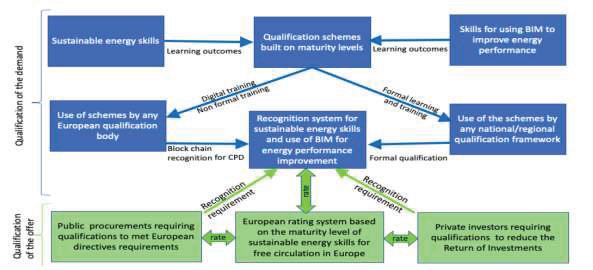
Before piloting the platform and materials, it was essential to create a task-based qualification framework designed to enhance skills related to renewable energy systems, energy efficiency, energy performance in buildings , and the use of BIM to improve energy performance. The overarching goal was to utilise digitalisation as a catalyst for developing these skills. This framework was designed for a wide range of stakeholders, including training providers, certification inst itutes, educational centres, schools, professionals, workers, suppliers, customers, public authorities, and property owners. By addressing both the supply and demand sides of skill development, the initiative empowers various entities to enhance their competencies and gain access to training products or services. This effort alig ns with the transition toward sustainable construction, emphasising efficient and high -quality delivery.
The resulting qualification framework focused on task and skill maturity. It was structured around units of learning outcomes, which provided a comprehensive
approach to skill development. The framework not only aimed to stimulate demand for new skills but also organises the supply of educational resources, thus contributing to a more robust ecosystem for CPD. To establish pathways that facilitate progress from one qualification to another, learning modules w ere adapted, along with their associated outcomes, to create a structure that enables micro -credentials to contribute towards broader qualification certificates.
The platform aimed to incorporate a gamified element to enhance digital learning by rewarding milestones for users. The initiative explored the use of blockchain technology to document educational achievements, enabling progress tracking and awarding. A significant outcome of this development was the adoption of the Open Badges 3.0 standard, which facilitates secure, GDPR -compliant recognition of skills through verifiable credentials. The implementation of Open Badges instead of an Learning Record Store (LRS) for interconnectivity between learning tools was favoured due to its capacity to retain detailed learning progress information while being more portable than LRS data. The Open Badges system was linked to modular elearning materials on the platform. This involved syncing Moodle with the Open Badge provider to issue badges effectively.
The incorporation of gamification was identified as a vital strategy to motivate and engage learners. Users could earn experience points (XP) and badges, which serve as visual representations of their achievements. Upon completing a module, users will receive an external Open Badge acknowledging their acquired skills. The platform was designed to be accessible via a browser, ensuring compatibility across multiple devices, including PCs, tablets, and smartphones.
The learning materials developed were designed to support various stakeholders in public administration, clients, professionals, and blue-collar workers, aligning with the maturity qualification framework. The integration of learning tools compatible with the digital tools platform and the adoption of a blended learning approach, combining IT applications and gamification, allowed users to select relevant micro -modules rather than following a traditional linear education path. Adaptive assessment methods we re employed to enhance user engagement. The overarching goal was to enhance innovation and professional development in sustainable energy and digital skills, while making learning accessible and applicable to the diverse needs of users in the construction sector.
The two primary objectives of the pilots were first, to validate and enhance a comprehensive matrix of competences and qualifications designed to meet market demands and industry needs. This testing focused on confirming the appropriateness of the content in the matrix and its training methodology. Additionally, the impact of the acquired skills on trainees and the recommendations for improving outputs for other work packages were meticulously gathered for evaluation purposes. Surveys were used to collect feedback from target stakeholders before and during various engagements and upskilling activities. The primary goal was to assess existing skills and competencies among trainees, identifying potential gaps that could inform future iterations of training materials. Accompanying this survey was a presentation outlining the Matrix of Competence as part of the broader ARISE framework.
The second objective was to build capacity among various market drivers, facilitating a mutual understanding of the benefits derived from the digitalisation skills and certification programs developed through the project. This was achieved through the
piloting of a diverse group in terms of professional backgrounds, geographical locations, and educational levels. This demographic variety enriched the feedback received, ensuring a well-rounded assessment of the training tools. The pilot was implemented through a series of workshops and training modules that focused on various digital tools designed to enhance learning experiences. Each module incorporated a "Completion Survey" that participants were mandated to complete for module certification and badges. This survey collected valuable insights regarding the quality and relevance of the training content.
The pilot sought to increase the number of skilled building professionals via direct market action. Thiswas facilitated through a high number of training initiatives, including the use of BIM modelling tools, energy performance integration, and collaboration using digital techniques (figure 2).
The platform could be accessed through https://www.ariseproject.eu. Some engagement results include the upskilling of 1,939 individuals, exceeding the target of 1,000 upskilled professionals through engagement from the consortium at 25 conferences. Variousplatforms, including websites and social media, also reported impressive engagement, with 11,469 sessions on their website and a substantial number of active users on social media platforms. It was found that the mixed -methods approach (live sessions coupled with recorded content and interactive components) was widely appreciated. Many participants cited the effectiveness of this varied methodology in enhancing their learning experiences.
In total, over 3,361 registered users were recorded on the ARISE platform, with 2,813 enrolled in various micro-modules. Of those users, 2,395 have actively completed training modules, resulting in 3,575 badges being awarded. A total of 20 SMEs and 10 public authorities were involved throughout the pilots. There has been significant participation from users across Europe, with a notable dominance from Portugal, suggesting a successful outreach strategy.
The pilots culminated in several key deliverables, including a competency matrix, learning outcomes, and training models, all of which were validated through a wide -
Proc. of the CitA BIM Gathering Conference2025, November 6th 2025, Dublin Ireland
scale demonstration across Europe. This collaborative effort ensured that the qualifications developed were suitable for recognition within the sustainable energy sector. Ultimately, the pilot laid a strong foundation for continuous improvement, ensuring that the digital training tools can effectively meet the evolving needs of participants in future iterations.
The ARISE project has had a noteworthy impact during its project's duration and has fundamentally influenced the learning environment for construction professionals. The following sub-sections provide a deeper review into the multifaceted impacts of ARIS E.
The ARISE project has assisted educational practices by emphasising a competencybased learning framework designed to equip practitioners with the vital skills necessary for digital energy efficiency. By introducing micro -learning modules, ARISE allows professionals to engage in bite-sized learning experiences that fit into their busy schedules. Each module is designed to focus on specific competencies, making it easier for learners to digest information and apply skills immediately in their work contexts. The collaboration among project partners has led to the development of curricula tailored to the current and emerging needs of the construction industry. This curriculum not only aligns with technological advancements but also encompasses the latest trends in energy efficiency and sustainable practices. ARISE has also contributed to the development of a robust assessment framework that enables the evaluation of skills acquired through microlearning modules. These frameworks ensure that the competencies gain ed are relevant, measurable, and applicable to realworld scenarios. The framework was aligned with CPD schemes in multiple countries, and although full integration into national systems was not achieved during the project, groundwork was laid for future adoption.
The transition to Open Badges represents a progressive shift in how competencies are recognised and validated. Open Badges provide a digital and portable means for individuals to showcase their achievements, aligning with the tech -savvy nature of the current workforce. This shift is crucial in establishing a culture of continuous learning where professionals can easily share their qualifications with employers or peers. By emphasising digital credentials through Open Badges, ARISE has reduced barriers to entry when seeking employment in different regions, allowing professionals to pursue opportunities based on their skill sets rather than being hindered by geographical limitations.
The framework established by ARISE facilitates the cross-border recognition of skills, enabling professionals to move more easily within the EU workforce. This is particularly important in an increasingly globalised economy, where the need for skilled labour often extends beyond national borders. The project's focus on inclusivity encouraged the engagement of diverse stakeholders, therefore contributing to a more equitable representation in the construction industry. This targeted approach has opened doors for individuals who may not have previously considered a career in construction or energy efficiency.
With enhanced recognition of competencies comes increased job opportunities where professionals are more likely to be sought after by employers seeking individuals who possess the latest skills in BIM and energy -efficient practices. The project's focus on mutual recognition of skills and support for cross -border mobility opened up new employment pathways. At the same time, its engagement with SMEs and public authorities helped stimulate market demand for qualified workers. By bridging the digital skills gap and aligning training with industry needs, ARISE laid a strong foundation for sustainable career growth in a rapidly evolving construction landscape.
The ARISE project has provided substantial contributions to environmental sustainability by instilling energy-efficient practices within the construction industry . The principles established by ARISE encourage the notion of sustainability as a core value within the construction sector. Future projects are likely to build on this foundation, expanding efforts to promote environmentally responsible practices across all levels of operation. Professionals trained under the ARISE framework are more adept at employing sustainable construction practices, therefore translating to improved energy efficiency in buildings, reduced waste generation, and optimised resource management throughout the construction lifecycle. Through its digital platform, more than 2,395 users actively engaged in microlearning modules, earning over 3,575 digital badges that recogni sed competencies in energy efficiency and digital construction skills, particularly BIM. This widespread engagement contributed to an estimated 4.5 GWh/year in prim ary energy savings and 2.25 GWh/year in renewable energy generation, based on the application of acquired skills in real -world projects
Overall, the ARISE project has had a significant impact on the construction and energy sectors by promoting education through competency -based frameworks, enhancing skills recognition, and fostering collaborative industry relationships. Its commitment to inclusivity has broadened access for a diverse workforce, and its focus on future implications ensures that valuable lessons will contribute to ongoing advancements. The ARISE project has successfully exceeded its targets in promoting sustainable energy practices alongside digital proficiency. The project's achievements, including an increase in skilled professionals and the establishment of a vocational mobility platform, highlight its effectiveness within the BUS initiative. To maintain this momentum and further enhance skill development in the AEC sector, ongoing engagement with stakeholders, cultivating partnerships, and evolving training methodologies will be essen tial.
ARISE is a European-wide project, funded by the European Union 's Horizon 2020 research and innovation programme, under the Work Program for Clean, Secure and Efficient Energy. This project received funding from the European Union's Horizon 2020 research and innovation programme under grant agreements No. 785155 and No. 101033864.
References
Andrés Mella and Edmundo Werna (2023). Skills and Quality Jobs in Construction: In the framework of the European Green Deal and the Post -COVID Recovery, JTCITUC and EFBWW, available at < https://www.efbww.eu/publications/reportsand-studies/skills-and-quality-jobs-in-construction-in-the-framework-ofthe/2849-a>
Behan, A., McCormack, P. and McAuley, B. (2023) Skills Matter – up-skilling across construction stakeholders for emerging roles, Proceedings of the 6th CitA BIM Gathering, Athlone, September 18th – 20th, pp 164-173
Build Up (2025) Skills in Europe's construction and building sector: New developments in the EU policy framework, European Commission, available at https://buildup.ec.europa.eu/en/resources -and-tools/articles/skills-europes-constructionand-building-sector-eupolicies#:~:text=European%20Social%20Fund%20Plus%20(ESF,architecture% 20and%20the%20built%20environment.
European Commission (2019) European Skills Agenda, Employment, Social Affairs and Inclusion, available athttps://employment-socialaffairs.ec.europa.eu/policies-and-activities/skills-and-qualifications/europeanskills-agenda_en
European Commission (2025) Green education initiatives: Quality education and training for all, available at < https://education.ec.europa.eu/focus -topics/greeneducation/about-greeneducation#:~:text=The%20European%20Union%20(EU)%20is,EU%20policy% 20cooperation%20in%20education.
McAuley, B., McCormack, P., Hamilton, A. and Rebelo, E. (2021) ARISE (certCOIN)inspiring demand for sustainable energy skills, Proceedings of the 5th CitA BIM Gathering, Online, September 21st - 23rd , pp 97 - 102
Solas (2024) Green Skills 2030 - The 1st National Further Education & Training (FET) Strategy for the Green Transition, Government of Ireland ( Report references International Labour Office (2019), 'Skills for A Greener Future: A Global View
The European Centre for the Development of Vocational Training (2023). The Greening of the EU construction sector , available at https://www.cedefop.europa.eu/en/data -insights/greening-eu-constructionsector
The Joint Research Centre: EU Science Hub (2025) GreenComp: the European sustainability competence framework, available at< https://joint-researchcentre.ec.europa.eu/greencomp-european-sustainability-competenceframework_en?
Killian Collins killiancollins.at@gmail.com
O’Mahony Pike Architects
Malachy Mathews malachy.mathews@tudublin.ie
Technological University Dublin
Abstract
Designers have a crucial role in reducing the environmental impact of buildings. This research argues that an automated BIM workflow enabling designers to visualise embodied carbon can transform decision-making for sustainable construction. The central aimis to empower designers in Ireland and the UK to easily assess the carbon impact of material choices in domestic construction, supporting national emissions targets for 2030. By combining data mapping and digital visualization, the workflow identifies high-carbon materials and enables immediate, informed substitutions to reduce a building’s overall carbon footprint. The author has developed a tool that building designers can use to identify building materials and their validated embodied carbon values. Thi s research contends that instant visual feedback will enable designers to meet embodied carbon targets by informing their choices throughout the design process.
Keywords: Building Information Modelling (BIM), Global Warming Potential (GWP), Visualisation, Embodied Carbon
1. Introduction
Technical designers are aware of their responsibility in creating resilient built environments to address the global challenge of climate change. Digital modelling and data visualisation are especially important as innovative tools that enable design professionals to advance design and construction techniques. Innovative solutions are needed for the design, construction, and operation of the built environment to significantly reduce environmental impact and achieve net zero by 2050. Extracting data from dig ital models to interactive dashboards such as Power BI can change how designers understand projects, improving decision -making. Many BIM tools and software have been evaluated as part of this research and workflow. Thirty -seven percent of Ireland's emissions stem directly from the built environment, with 14% due to embodied carbon emissions from the transport, construction, maintenance, repair, and disposal of infrastructure and building materials (Fómhair, 2022). The Oireachtas Committee on Housing, Local Government, and Heritage notes limited expertise in EC and suggests
Proc. of the CitA BIM Gathering Conference 2025, November 6th 2025, Dublin Ireland
mandating a Whole Life Carbon assessment for planning permission (Oireachtais, 2022). Though individual efforts are possible, legislation would ensure legal compliance. Streamlining BIM workflows for embodied carbon assessment is critical with the BIM mandate's introduction in the Capital Works Management Framework (CWMF) procurement. The Irish Government enacted legislation making BIM mandatory from January 2024 in public works contracts worth over €100 million, gradually including projects over €1 millionwithin four years (Capital Works Management Framework, n.d.). This study uses Environmental Product Declarations (EPDs) to gather and visualise accurate life cycle analyses of designs. Validated EPD data is preferred for material libraries, but a current limitation is the availability of EPDs. Where required, materials from the Inventory of Carbon & Energy (ICE) database are used. Currently, 102 EPD/DoPCs are available, compared to 1,153 entries on Germany's ÖKOBAUDAT platform (Dempsey & Mathews, 2023). Whole-life global warming potential is considered where EPDs are used. Due to this limitation, this research places greater emphasis on EC within stages A1-A3 (production stage), a key concern for early design decisions. According to Rock, M. et al. (2022), the average lifecycle EC emissions for European residential buildings, based on 769 case studies (634 residential) from five European nations, are 600 kgCO2e/m2. They found that Stage A, representing upfront emissions, made up almost two-thirds of total GHG emissions (Hegarty & Kinnane, 2023).
The research is located in Ireland, and the author acknowledges that there is other research in the area and other solutions available in the European Union countries. An example of this is the Danish Materials Pyramid located here: https://www.materialepyramiden.dk/. The author also acknowledges that this research is focused on stages A1-A3 of the product stage within the larger framework of LCA. The core of the research is to arm building designers with visual feedback on building material selection with reference to embodied carbon and to make better choices, which will add to the overall LCA process. The author acknowledges that other European countries have enacted the provisions to regulate the management of embodied carbon emissions in the construction sector, in the EU Revised Energy Performance Building Directive https://energy.ec.europa.eu/topics/energy-efficiency/energy-efficient-buildings/energyperformance-buildings-directive_en(2024). This research does not address the variation in product and material costs.
A review of existing literature was conducted to analyse the implementation of BIM, LCA, and construction materials within the construction industry. The literature review includes a discussion of existing LCA methodologies, their accuracy, and the framewo rk and principles they follow.
Proc. of the CitA BIM Gathering Conference 2025, November 6th 2025, Dublin Ireland
BIM is an information management technique supported by digital technologies and collaboration. It utilises an asset's shared digital representation to accelerate the processes of designing, constructing, and operating it as laid out in the ISO 19650 suite of standards, laying the groundwork for effective decision -making. Examples of BIM software currently utilised in the construction sector include Autodesk Construction Cloud, Autodesk Revit, Autodesk Forma, Autodesk Navisworks, Dynamo and ArchiCAD. According to Lewis Anderson et al. (2015), BIM provides ways to quickly provide energy outputs in the context of sustainability, allowing design teams to evaluate and contrast the most economical, energy-efficient options. Life cycle assessment is another extensively used technique for measuring and enhancing sustainability (Dempsey & Mathews, 2023). A digital 3D model serves to analyse various design possibilities and offer stakeholders accurate visualisations, allowing them to envision the finished building before construction commences. This allows accurate representation of data, in the case of this research, Whole-Life Global Warming Potential of building materials is the focus. Due to the new CWMF mandates for BIM integration projects a larger emphasis will be placed on Level of Detail (LOD) within projects. The ISO 19650 standards now use the term "level of information" instead of "level of detail". ISO/DIS 7817 defines the level of information required in BIM (Dempsey & Mathews, 2023). This will allow for g reater levels of data exchange, requirements for accurate data regarding all aspects, including the whole-life global warming potential of the design. Developing a digital BIM empowers stakeholders involved with the building to enhance their decision -making, ultimately leading to increased overall asset value throughout its lifecycle (BIM and the CWMF, 2023). Adherence to the ISO19650 framework will become mandatory for all projects over the next four years, significantly impacting BIM-integrated LCA. The data linked to model elements will be invaluable for accurately assessing their impacts.
Life cycle assessment (LCA), by definition, assesses the effects that products or services have on the environment over the course of a building's whole life (Quist,2023). LCA takes account of a product's complete life cycle, starting with the extraction and purchase of raw materials and continuing through the manufacturing and generation of energy and materials, consumption, end-of-life care, and disposal. The methods of measurement are specified in an LCA study in BS EN 15978 and ISO 14040. According to M almqvist et al. (2011) the difficulty and uncertainty of LCA results, which are supposed to simplify the approach, are frequently seen as the main barriers to the growing usage of LCA. Inconsistent outcomes are inevitable when inconsistent data is employed. On the other hand, it is frequently safer to make imperfect environmental assessments throughout the development cycle than to ignore such effects.
Proc. of the CitA BIM Gathering Conference 2025, November 6th 2025, Dublin Ireland
In Ireland, environmental regulations prioritise reducing operating energy use, resulting in rules to minimise thermal transmittance (u-values) (Hegarty & Kinnane, 2023). Recent research found that EC from the built environment accounts for 13% of total Ir ish emissions. Cement production accounts for approximately half of this total (Hegarty & Kinnane, 2023). While researchers have attempted to limit their environmental impact and usage, and while there has been some progress, the problem of cement and stee l use persists (Csaszar, 2022). The residential sector in Ireland emits significant amounts of greenhouse gases (GHG) due to both operational and EC (Hegarty & Kinnane, 2023). National climate policies in Europe prioritise reducing operational energy in the residential sector, but rarely include the embodied emissions associated with its development (Hegarty & Kinnane, 2023). Operational energy emissions are expected to decrease in the coming years due to the advancements of new building system technologies and high-performing insulation materials, but the EC portion is on the rise. Data is taken from a combination of CSO databases, namely BHA03 and NDA02 (IGBC, 2022). These advancements come with an environmental cost. Due to the low thermal transmittance (U-values) required for meeting building regulations, it is crucial to consider the carbon footprint of materials used in new structures (Csaszar, 2022). In Ireland, there is currently no legislation in place to govern the management of EC emissions in the construction sector. Here, whole-life global warming potential signifies the energy expended in extracting and processing raw materials to produce finished goods. Notably, Ireland's construction industry contributes to 37% of all greenhouse gas (GHG) emissions (IGBC, 2022).
The area of BIM-integrated LCA has been explored using numerous methods. Obrecht et al. (2020) evaluated numerous studies that classified them. In the most comprehensive classification. They are classified into five categories. In the first and second form s, BIM data is directly exported to other LCA programmes via bill of quantities or International Foundation Class (IFC) files. The third kind involves processing BIM data in a BIM viewer before submitting it to LCA tools. The fourth category involves devel oping LCA plug-ins in BIM software. Furthermore, LCA information can be associated with BIM objects in the fifth type (Obrecht et al., 2020). In addition, Chen et al. (2021) compared the use of BIM technology to traditional methods for calculating EC.
However, both have drawbacks. Process-based approaches may underestimate emissions due to truncation problems, while input -output methods are less specific. The study emphasises the significance of LOD in analysing embodied carbon data at various phases. The success of BIM technology in calculating EC highlights the need for future development of such tools in the AEC industry
A survey that was conducted by Ariyaratne & Moncaster (2014) highlighted that there are three fundamental concerns associated with stand -alone embodied carbon analysis tools. These include methods for generating the required quantities to accurately
Proc. of the CitA BIM Gathering Conference 2025, November 6th 2025, Dublin Ireland
calculate EC, for acquiring the most recent data available while working with a limited supply of information, and for adopting a flexible approach that can be used by a diverse range of users (Ariyaratne & Moncaster, 2014). Chen et al. (2021), along with Ariyaratne and Moncaster (2014), highlight that to reduce EC in construction, it is crucial to use integrated, holistic approaches, such as BIM and digital twin technology, rather than relying on standalone tools.
The author emphasises the dynamic nature of sustainable construction methods and the ongoing research to develop stronger approaches and tools. To investigate a BIM -based LCA process in the early design phase of buildings, Nilsen and Bohne (2019) employ OneClick LCA for design analysis. A case study approach involves developing and evolving a building model at various levels of development (LODs). Frameworks should define LOD information across the project life cycle, use consistent LCA databases, and establish relationships between LOD levels and databases. Using the framework to connect databases enhances GWP material substitution and focuses on design decisionmaking before the planning stage. Nilsen and Bohne (2019) recommend investing more time in the design stage of a project, while modelling at a high LOD will improve transparency and information levels within the project.
3.1 Case Study Research
Case studies can be used in evaluation to investigate the contextual conditions of a case and capture its complexity, including temporal changes. Furthermore, Holweck (2015) establishes three primary scenarios where case studies can be employed and provide s comprehensive explanations, demonstrating their adaptability to diverse contexts. Completing a case study benefits the author as it tests theories in a practical context. Case studies offer a chance to examine the environment in which a phenomenon occurs This is essential to understanding the nuances and complexities that affect the results (Yazan, 2015).
3.2Research Methods
Throughout the literature review, there were many existing LCA tools investigated and evaluated for stand-alone calculators and tools integrated with BIM software. Although the interface of LCA tools is user-friendly, individuals who lack sufficient knowle dge may find their technical nature intimidating (Dempsey & Mathews, 2023). Furthermore, practitioners may be discouraged from adopting LCA tools due to the extra costs involved in training, licences, and plug-ins, on top of the already expensive BIM softw are platforms (Dempsey & Mathews, 2023). It is evident from the existing literature that steps towards BIM integration of LCA and GWP visualisation is required to support the decarbonisation of the built environment. The process for conducting this case study research will be structured into key stages as outlined below:
• Identify benchmarks and prepare validated and unvalidated data sources to be used in the study.
Proc. of the CitA BIM Gathering Conference 2025, November 6th 2025, Dublin Ireland
• Create a material library and map GWP data to materials through the development of a visual programming script.
• Model case study building for experimentation of the study.
• Creation of an interactive dashboard to visualise the whole -life global warming potential of materials within the project.
The benchmark in which the study is working is the RIAI 2030 Climate Challenge (RIAI, 2021). The target set out for domestic construction is 625 kgC02e/m2, see table 1 (RIAI,2021). The Databases utilised are the Inventory of Carbon and Energy (ICE) and validated Environmental Product Declarations EPDs/DoPC retrieved from EPD Ireland and manufacturers to EN 15804 standards (Irish Green Building Council, 2024). Validated data from manufacturers was preferred, but it has been identified that there is a limit o f materials that have verified EPDs (Dempsey & Mathews, 2023).

Various methods were explored in the literature review for integrating GWP data into materials in Revit. To reduce manual errors, Abu -Ghaida et al. (2021) highlight the significance of automating material mapping. However, their proposal encountered a challenge in automatically mapping EPD/DoPCs to pre-existing materials in Revit. If the names of materials differ between Revit and the dataset, they will not align during mapping. Dempsey & Mathews (2023) explored an alternative route to automate the mapping of EPD/DoPC data to materials in Revit. A visual programming script was created to read EPD/DoPCs as Extensible Markup Language (XML) files. This method eliminated the manual user error, but as a conclusion, each EPD/DoPCwould have to be identified and mapped individually.
After evaluating previous methods, it became clear to automate the mapping of data from one dataset. Given the limited number of validated EPD/DoPCs, materials from the ICE database will also need to be mapped. Utilizing both EPD/DoPCs and ICE databases, a proposal emerged for a combined material library, managed through Microsoft Excel. By creating materials during the data mapping process, any failures in data mapping can be avoided. Materials in Revit will be generated as part of the data mapping stage, rather than mapping data to existing materials. This approach enables users to create materials based on the names provided in the dataset. Visualising the whole-life global warming
Proc. of the CitA BIM Gathering Conference 2025, November 6th 2025, Dublin Ireland
potential of the designs is crucial to a designer as it allows them to comprehend the impact their material selection has on the environment.
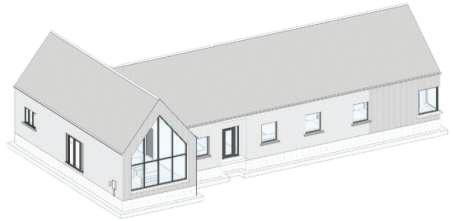
1; 3D Model of Case Study Dwelling
The chosen case study building is a single-storey domestic dwelling house in Co. Cavan, Ireland, with a floor area of 213m2. Figure 1 shows a 3d view of the house. This project has been specified using traditional Irish materials such as concrete block, ti mber cut roof, and in-situ concrete floor. This proved to be the correct baseline to test the research methods, as the building can be assessed accurately and visualised to identify whether the materials selected are meeting the RIAI 2030 targets. The first step was to identify the materials specified in this project. The author worked on this project in practice and was given permission to access the specification outlined in the construction process. Within this study, the main fabric of the building is c alculated, including windows and doors. See Table 2 for fabric and materials.
Table2; Fabric and Material List
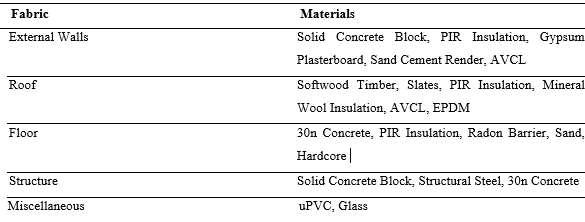
Proc. of the CitA BIM Gathering Conference 2025, November 6th 2025, Dublin Ireland
3.4Focus
A focus group was approached to test the methods in a real -life setting within the built environment. This focus group consisted of Architectural technologists, Architects, Architectural engineers, and MSc in climate action and environmental policy. The go al for this area of the study is to conclude thoughts on the proposed workflow and the implementation of further research surrounding BIM -integrated LCA. As this is only a small proportion of the built environment, the data received is opinion -based and therefore qualitative.
The research has led to the development of a new, readily accessible tool and process that empowers the designer to make ED -positive material selections for their designs. A Revit template including all pre-built schedules and parameters was created to give users a seamless experience. This way, the package can be used by any person familiar with the Revit environment, and no upskilling is required to use the proposed workflow.
The first step to creating a material library was identifying where the data was being inputted to, which was achieved by creating a suite of shared parameters that are housed in the materials.. After analysis of the existing methods outlined in 3.2.2, a s ingle dataset was chosen as the proposal. A manually inputted Excel dataset where the author inputs both ICE and EPD/DoPC data structured in the template. This enables the creation and mapping of materials with GWP data in real -time. The material name is identified by the user, density, and all stages of GWP are input. A dynamo script was created to create materials input into the dataset while mapping materials to the shared parameters housed within the material parameters. This method was proposed due to the nature of automating successful material mapping. Using the created Dynamo script, the user can play the script through the use of Dynamo Player within Revit. This allows access to the script without entering Dynamo for ease of use. When the script is played, the materials outlined in the dataset are created with their associated GWP values. When the digital building is modeled using the imported materials, the materials will automatically populate within a pre-built material takeoff schedule. This allo ws for automatic calculations of the GWP of the selected materials in the building. The schedule is subsequently employed to compute a cumulative total. The formula outlined below serves as the foundation for this calculation.
GWPbuilding = Σ (GWPproduct 1, GWPproduct 2 … GWPproduct n)
Where: GWPproduct = GWP Product Stage(A1−A3) + GWP Construction Stage(A4−A5) + GWP
Use Stage(B1−B7) + GWP End of Life Stage(C1−C4)
As projects progress, the schedule will automatically finalise the foundational material selection and incorporate it via the 'yes/no' parameter labeled ‘include in GWP schedule’.
Proc. of the CitA BIM Gathering Conference 2025, November 6th 2025, Dublin Ireland
In the preliminary stages of a design where specific materials are not known, the ICE materials are used as they are generic and not manufacturers' products. This can lead to inaccurate calculations because of unvalidated data. It is essential that a greater push is placed on initiating government policies around GWP calculations at the pre -planning stages of a project. The government does intend to introduce these policies outlined in section 13 of the Climate Action Plan 2021 (CAP21) (Climate Action Plan, 2024).
The materials used in the building have been identified, and collecting the required data took place within the created Excel data set. EPD/DoPCs were used where available, as the calculations aimed to be as accurate as possible. The building was modelled in Revit using the created materials with embedded GWP data. For this study, the model was constructed to LOD300 as the focus was on material analysis of the building fabric. The materials used within this study are as specified, including compliance with the required U-Values. They have been identified as ‘traditional’ materials as they are the commonly known materials used in domestic construction in Ireland.
When the building was complete, the materials were automatically populated into the material take-off schedule. It was calculated that the building reached 219,463.57 kgC02e with a floor area of 213m2, translated to 1,040 kgC02/m2, surpassing the RIAI 2030 target for domestic construction of 625 kgC02e/m2 by 415 kgC02e/m2. So the legitimate question here now is, “How does the designer identify which materials are causing the target to be missed”. This is where the use of data visualisation tools is benefici al, especially to designers with little to no knowledge surrounding the EC of materials
4.3Visualising
The tool selected, which is intended to supply the user with this visualisation, is Microsoft Power BI. The author wanted to be able to analyse not just the primary building element (PBE) but also each material within the PBE. To achieve this, the author u sed a plugin to Revit called ‘Tracer’ from Proving Ground. This plugin exports the model with all associated data into a database file (.db). This file is then imported into a created Power Bi template as prompted on screen by copying the file path from the database file into the input box. Wh en the file is loaded,
a series of pre-built data visuals automatically populate, including an interactive representation of the BIM model, with associated GWP data within the project. The Power Bi is an interactive dashboard which identifies the building's overall kgC02e, its comparison per m2 to the RIAI 2030 targets, and individual materials kgC02e (see figure 2). Within Power Bi the author can create a second tab to visualise a second option created in Revit, so a side-by-side comparison is visualised to compare the impact of materials within selected elements (see figure 2).
Proc. of the CitA BIM Gathering Conference 2025, November 6th 2025, Dublin Ireland
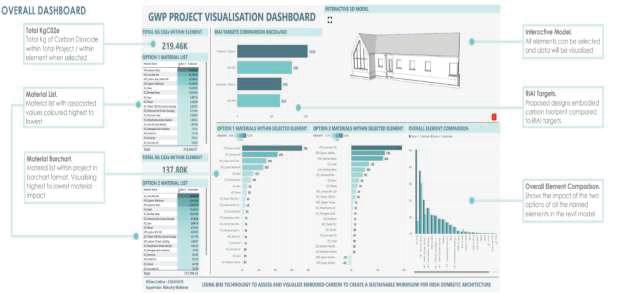
When visualised, the external walls within the project were identified as the problematic area, along with the insulation within the floor and roof. A timber frame external wall with Woodfibre insulation proved to lower the impact of the building by 42,822 .97 kgC02e. Insulation within the floor was substituted from PIR insulation to EPS100 insulation, which resulted in a reduction of 7,410.88 kgC02e. Lastly, insulation within the roof was substituted from PIR insulation to Gutex Woodfibre insulation. This change resulted in a 9,316.54 kgC02e decrease from the traditional option 1.
It should be noted that the baseline figure is the u -value of the material and not the thickness specified.
Revit is a powerful visualisation tool; however, further visualisation was needed to analyse the data from the digital model. The author has presented a design decision support (DDS) tool, which can identify problematic areas within the design in regard tothe GWP of material selection, and so will aid in the decision -making by building designers, having a positive effect on the design and construction industry.
When the project is imported, the graphs and values presented will show the building designer which materials and systems need to be revised to meet the RIAI targets. Material changes identified resulted in an 81,664.35 kgC02e reduction between the two options. The overall footprint of the building was lowered from 1,040 kgC02e/m2 to 646 kgC02e/m2.Author
Proc. of the CitA BIM Gathering Conference 2025, November 6th 2025, Dublin Ireland
This footprint surpassed the RIAI 2025 target of 800 kgC02e/m2 but narrowly missed out on the RIAI 2030 target of 625 kgC02/m2. The workflow proved successful in promoting material decisions amongst the participants.
Testing has highlighted Ireland's limited availability of validated EPD data. There is currently no GWP threshold established in Ireland, so the Building a Zero Carbon Ireland plan will require the disclosure of EC values and ultimately enforce a set of re strictions on EC (IGBC, 2022).
The positive feedback from the focus group shows the potential of the case study process. Looking forward in the near future, EC calculations will become a standard requirement in the design of buildings, and this case study process, combining digital tech nologies with a digital model, provides a platform for design decision -making for EC choices for stakeholders in the design and construction industry.
This research fills a gap in the process of designing buildings, where the demonstrated process provides visual feedback on material selection in an effort to help designers reduce the embodied carbon of their building designs.
References
Abu-Ghaida, H. et al. (2021).Økoengineer – A web-based game platform for guided discovery-based sustainability learning in engineering curricula. In: Volume 4: 18th International Conference on Design Education (DEC) . 17 August 2021. American Society of Mechanical Engineers. [Online]. Available at: doi:10.1115/detc2021 -69406.
Ariyaratne, C. I. and Moncaster, A. M. (2014). Stand-alone Calculation Tools are not the Answer to Embodied Carbon Assessment. Energy procedia, 62, pp.150–159. [Online]. Available at: doi:10.1016/j.egypro.2014.12.376.
Chen, C., Zhao, Z., Xiao, J., & Tiong, R. (2021). A conceptual framework for estimating building embodied carbon based on digital twin technology and life cycle assessment. Sustainability (Switzerland), 13(24). https://doi.org/10.3390/su132413875
Csaszar, B. (2022). forensic analysis and comparison of building envelopes, thermal performance and embodied carbon of public buildings . School of Architecture, Planning and Environmental Policy.
Department of Finance (2007) Capital Works Management Framework - Guidance Note for Public Works Contracts, Department of Finance
Dempsey, R., & Mathews, M. (2023). Using BIM technologies to calculate and visualise the global warming potential of building materials .
Proc. of the CitA BIM Gathering Conference 2025, November 6th 2025, Dublin Ireland
EU Revised Energy Performance Building Directive https://energy.ec.europa.eu/topics/energy-efficiency/energy-efficient-buildings/energyperformance-buildings-directive_en(2024)
Fómhair, D. (2022). An Comhchoiste um Thithíocht, Rialtas Áitiúil agus Oidhreacht Carbón Corpraithe sa Timpeallacht Fhoirgnithe Joint Committee on Housing, Local Government and Heritage Embodied Carbon in the Built Environment framework. In EN ISO 14040. London: BS
Hegarty, R. O., & Kinnane, O. (2023). A whole life carbon analysis of the Irish residential sector - past, present and future . Energy and Climate Change, 4. https://doi.org/10.1016/j.egycc.2023.100101
Hollweck, T. (2015). Robert K. Yin. (2014). Case Study Research Design and Methods (5th ed.). . Canadian Journal of Program Evaluation, 30(1), 108 –110. https://doi.org/10.3138/cjpe.30.1.108
IGBC, (2022). Whole Life Carbon in Construction and the Built Environment in Ireland. ISO. (2011). BS EN 15978.pdf.
Lewis, A. M., Valdes-Vasquez, R., Clevenger, C., & Shealy, T. (2015). BIM energy modeling: Case study of a teaching module for sustainable design and construction courses
Nilsen, M. and Bohne, R. A. (2019). Evaluation of BIM based LCA in early design phase (low LOD) of buildings. IOP conference series. Earth and environmental science , 323 (1), p.012119. [Online]. Available at: doi:10.1088/1755 -1315/323/1/012119.
Journal of Professional Issues in Engineering Education and Practice, 141(2). https://doi.org/10.1061/(ASCE)EI.1943-5541.0000230
Obrecht, T. P., Röck, M., Hoxha, E., & Passer, A. (2020). BIM and LCA integration: A systematic literature review. In Sustainability (Switzerland) (Vol. 12, Issue 14). MDPI. https://doi.org/10.3390/su12145534
Quist, Z. (2023). Life Cycle Assessment (LCA) – Complete Beginner’s Guide . Ecochain. https://ecochain.com/knowledge/life -cycle-assessment-lca-guide/ RIAI. (2021). RIAI_2030_Climate_Challenge.pdf.
Rock, M. et al., (2022). “Towards embodied carbon benchmarks for buildings in Europe#1 facing the data challenge,” Zenodo, Mar. 2022. https://doi.org/10.5281/ZENODO.6120522
Röck, M., Sørensen, A., Steinmann, J., Le Den, X., Lynge, K., Horup, L. H., ... Birgisdottir, H. (2022). Towards Embodied Carbon Benchmarks for Buildings in Europe – Facing the data challenge https://doi.org/10.5281/zenodo.6120522
Yazan, B. (2015). Three Approaches to Case Study Methods in Education : Yin, Merriam, and Stake. In Teaching and Learning Article (Vol. 20, Issue 2).
Proc. of the CitA BIM Gathering Conference 2025, November 6th 2025, Dublin Ireland
Oireachtais, T. A. (2022, December 1). Dáil Éireann díospóireacht - Thursday,1 Dec 2022. https://www.oireachtas.ie/ga/debates/debate/dail/2022-12-01/43/
BIM requirements in the CWMF from January 2024 | Capital Works Management Framework. (2023). https://constructionprocurement.gov.ie/bim-requirements-in-thecwmf-from-january-2024/
Gov.ie Climate Action Plan . (2024, January 8).https://www.gov.ie/en/publication/67104climate-actionplan/#:~:text=The%20Climate%20Action%20Plan%202021,in%20the%20Climate%20A ct%202021
What is an EPD? - Irish Green Building Council. (2024, February 13). Irish Green Building Council. https://www.igbc.ie/what-is-an-epd/
https://www.igbc.ie/wp-content/uploads/2022/10/WLC-UCDIGBC_30.09.22_V4.0_MidRes.pdf
Proc. of the CitA BIM Gathering Conference 2025, November 6th 2025, Dublin Ireland
Shahida Kizhakke Thalakkal shahidakizhakkethalakkal@gmail.com Northumria University
Talib. E. Butt t.e.butt@northumbria.ac.uk Northumria University
Marzia Bolpagni marzia2.bolpagni@northumbria.ac.uk Northumbria University and Mace Consultant
Abstract
Despite its significant socioeconomic contributions, the construction industry continues to face the persistent challenge of waste, which adversely affects its sustainability performance. Despite its socioeconomic contributions, the construction industry faces persistent waste challenges that harm the environment and cause economic losses and non-social impacts. Building Information Modelling (BIM) offers multiple uses across the construction process, including sustainability applications with significant potential to address these issues.However, limited research has examined how BIM’s sustainability-related uses can be directly applied to construction waste management. This study identifies and defines this knowledge gap, conceptualizing the integration of BIM’s sustainability uses with construction waste management theories and practices. This study proposes a conceptual framework that maps the interactions between BIM uses for sustainability and construction waste management, guiding construction stakeholders with a more holistic and structured perspective on sustainable construction waste management and explores the potential role of BIM in supporting enhancing the industry’s transition towards a more sustainable future.
Keywords: BIM (Building Information Modelling), Sustainability, Construction Waste Management
1. Introduction
1.1Background
In several countries, the construction industry makes a major contribution to the Gross Domestic Product (GDP), making it an important sector of national economies. The construction industry, one of the world’s largest sectors, is expected to grow further in the coming years. According to Statista (2022), the worldwide construction business was estimated to be about $6.4 trillion in 2020 and is expected to more than double to $14.4 trillion by 2030 (Gerth et al., 2025). It plays a crucial role in supporting socioeconomic development by delivering essential facilities such as housing, transport networks, healthcare, and education infrastructure. Despite its economic
significance, the industry remains highly fragmented and complex, leading to persistent issues such as cost overruns, time delays, and substantial waste generation (Gerth et al., 2025).
The construction industry accounts for approximately one -third of the total waste generation globally (Ferriz-Papi et al., 2024). The sector’s heavy consumption of materials and energy makes it one of the largest environmental polluters, with adverse effects on ecosystems and public health. These challenges underscore the urgent need for the industry to adopt more sustainable practices and technologies (Eštoková et al., 2022).
In response to growing global pressures for sustainability, the construction industry has begun exploring digital innovations to improve efficiency and minimise waste. Building Information Modelling (BIM) has emerged as one of the most promising approaches for achieving these objectives (Sepasgozar et al., 2020). As a collaborative, data-rich digital process, BIM enables enhanced design visualisation, automated quantity take-offs, construction sequencing, and performance monitoring (Sacks et al., 2025).
1.2Problematization
The construction industry is a major contributor to global waste generation, leading to significant environmental, economic, and social impacts. Excessive waste not only depletes natural resources and contributes to pollution but also increases project cos ts and affects community wellbeing. Despite the growing emphasis on sustainability, effective waste management remains a challenge due to fragmented processes, lack of data integration, and limited collaboration among project stakeholders (Ferriz-Papi et al., 2024).
By integrating sustainability principles within, construction industry can potentially reduce waste, improve resource efficiency, and enhance economic and social outcomes. However, the link between BIM and sustainable waste management remains underexplored, particularly in addressing how BIM contributes to all three pillars of sustainability, i.e., environmental protection, economic efficiency, and social responsibility(Akbari et al., 2024) This knowledge gap is the focus of the study.
The aim of this study is to conceive and develop a conceptual framework to capture the implications of the relationship between construction waste and BIM via its sustainability- use. The term 6D, often used to address the application of BIM for sustainability analyses, is not used in this paper due to its ambiguity as identified by (Wildenauer, 2020).
2. Methodology
This study employs a qualitative research approach based on a critical review of existing literature to examine the relationship between BIM and construction waste management. Academic journals and conference papers were systematically reviewed to identifycurrent practices, theoretical insights, and gaps related to BIM’s sustainability use in general and construction waste in particular. The reviewed literature was examined and interpreted to identify key themes on how BIM supports sustainability in the construction sector across environmental, social, and economic perspective. Based on the insights gained, this study develops a conceptual framework as formulated to map the interactions between BIM uses and construction waste management. The Framework is presented in the form of a conceptual model
Proc. of the CitA BIM Gathering Conference2025, November 6th 2025, Dublin Ireland
with the clear mention of main references which have informed the model development
Waste is an unavoidable by-product of human activity, but in construction it poses a major sustainability challenge. Construction waste refers to surplus materials generated during construction, renovation, and demolition (Amasuomo & Baird, 2016). It not only depletes resources and causes pollution but also increases project costs and reduces productivity (Yuan, 2012). Around 10–15% of materials delivered to sites become waste, with most ending up in landfills (Yuan, 2012). In the UK, approximately 70 million tonnes of construction waste are produced annually, while the EU generates up to five times more than residential activities (Hassan et al., 2022).
The waste hierarchy, formalized in the EU Waste Framework Directive (Directive 2008/98/EC), provides a structured approach to preventing and managing waste (European Parliament and Council, 2008). Evolving from the 3Rs concept (Reduce, Reuse, and Recycle) promoted by initiatives like the UN Earth Summit (1992), it aims to minimise environmental impacts, conserve resources, and encourage sustainable consumption. Over time, it has expanded into the 7Rs & L framework (Refuse, Reduce, Reuse, Repurpose, Recycle, Rot, Recover, Landfill) and is now widely applied across policy, industrial, and construction sectors, with BIM supporting its practical implementation for more sustainable waste management (Min et al., 2024; Abdullah, 2021; Pires & Martinho, 2019; Butt et al., 2016).
BIM is a collaborative digital process that creates, manages, and shares information about a building’s physical and functional characteristics throughout its lifecycle (Sacks et al., 2025). It provides a unified platform for visualisation, coordination, simulation, and decision-making. Several BIM uses have been identified (Succar et al., 2016), including Sustainability analysis and Construction Waste Management.
Sustainability is the capability to exist and progress without destroying existing or future natural resources.The three pillars of sustainability are an effective instrument for describing the complexity of the sustainability problem. This includes the economic, social, and environmental pillars at a minimum. If anyone pillar is weak, the system cannot be sustained(Purvis et al., 2019)
The use of BIM for sustainability has become a major focus of research, particularly for assessing energy performance, embodied carbon, and material efficiency (MontielSantiago et al., 2020). However, sustainability encompasses multiple BIM uses beyond energy modelling including water management, biodiversity preservation, and construction waste management, which remains underexplored. Scholars such as (Succar et al., 2016) argue for a more granular view of BIM uses, recognising sustainability as a collective set of applications that contribute to environmental, social, and economic performance. In this context, BIM serves as both a technological enabler and a collaborative process for achieving sustainability in construction.
The intersection between BIM and construction waste management is gaining attention as digital technologies increasingly shape sustainability practices. BIM supports waste management by improving coordination, optimising material
Proc. of the CitA BIM Gathering Conference2025, November 6th 2025, Dublin Ireland
procurement, and facilitating prefabrication (Guerra et al., 2020). By enabling detailed design visualisation, BIM allows teams to identify inefficiencies and reduce designrelated waste. Data integration within BIM models provides transparency across the supply chain, supporting circular material flows and tracking waste from design through to demolition (Tomczak et al., 2024).
Although research on BIM-based waste management is growing, studies remain fragmented. Many focus on energy modelling or carbon analysis, with fewer addressing waste as a core sustainability issue (Montiel -Santiago et al., 2020; Abanda et al., 2017; Park & Cai, 2017). There is a clear gap in establishing comprehensive frameworks that link BIM uses directly with waste hierarchy principles and the three pillars of sustainability. Habib and Kadhim (2021) highlight the need for automated workflows, standardised data exchange, and integration of BIM with environmental management systems. Likewise, Vasudevan (2020) identifies a lack of practitioner awareness and training as key barriers to BIM-based waste management adoption. This paper contributes to addressing this gap by conceptualising a framework that integrates BIM uses for sustainability with construction waste management practices. The framework aims to demonstrate how BIM can operationalise waste hierarchy principles and strengthen environmental, economic, and social outcomes within sustainable construction.
The literature identified during the review are contained in Table 1, titled Literature Review Matrix. The idea of the matrix to objectively and visually present a snapshot of the literature review exercise carried out in the study. The matrix demonstrates that while there is substantial amount of literature on construction waste and BIM, separately in their individual right, there is limited integration of both areas in existing studies. The literature while focusing on the construction waste, still does n ot cover the 7Rs of the sustainable waste hierarchy. On the other hand, the literature that dwells on BIM, still does not appear to focus on the three individual pillars of the sustainability philosophy despite it is a one of the crucial uses of BIM. Furthermore, the matrix shows that the construction waste is under studied in connection to BIM. When it comes down to construction waste in relation to BIM, some literature is available, but no evidence has been found in the literature to date which captures c onstruction waste specifically. This knowledge gap is not helping the construction industry to effectively apply BIM in managing construction waste sustainably. Thus, there is a need to establish the relationship between construction waste and BIM.
Proc. of the CitA BIM Gathering Conference2025, November 6th 2025, Dublin Ireland
Table 1. A table demonstrating the Literature Review Matrix
Hassan et al
Habib et al
Kaewunruen et al
Montiel et al
Guerra et al
Abanda et al
Vasudevan et al
Tomczak et al
Butt et al
Amasuomo et al
Sacks et al
Succar et al
Yuan et al
Purvis et al
Sustainability and BIM is not addressed.
Construction waste not in the scope.
Relationship between construction waste and BIM is not in the remit.
Discusses BIM and BIM uses.
Sustainability is not covered.
Discusses BIM and BIM uses.
Discusses BIM and its uses. Waste is not addressed.
BIM and waste are addressed.
BIM
its uses are not covered.
Discuss waste and waste management. BIM is not in the remit.
Discusses BIM only.
Relationship between construction waste and BIM is not in the remit.
& its uses are not covered.
BIM and Construction Waste is not addressed.
This conceptual framework (Figure 1) illustrates the relationship between BIM and construction waste management, emphasizing how BIM uses collectively to support sustainable waste reduction during both construction and deconstruction phases. In traditional construction, waste arises from poor design coordination, inaccurate material estimation, and inefficient scheduling. In this context, the specific use of BIM, which regards quantity surveying and corresponding cost estimation, can be particularly adaptive. This can be further underpinned by the geometrical dimensions (0D- location points,1D-lines, 2D-surfaces & 3D-volumes), which form the volumetric design of a given asset, may well be used to control construction waste.
Design Authoring allows for accurate modelling and visualisation, which aids in the early detection of design flaws and over -design, decreasing material waste before construction begins. This is supplemented by Quantity Take -off(QTO), which offers precise measurement and cost estimation to help prevent over -ordering and eliminate surplus supplies(Ershadi et et al., 2021)
Furthermore, Sustainability Analysis incorporates crucial environmental, social, and economic performance indicators, such as energy consumption, carbon footprint, and material selection, to promote sustainable material choices and resource efficiencies (Succar et al., 2016; Montiel-Santiago et al., 2020; Ershadi et et al., 2021)
These processes are supported synergistically by Lean Construction Planning, which uses core lean principles such as defining value, mapping the value stream, creating flow, establishing pull, and seeking perfection to reduce non -value-adding activities and physical waste during both the construction and deconstruction phases (Nikmehr et al., 2021). Overall, BIM acts as a central enabler of sustainable waste management, promoting circularity, reduced environmental impact, and alignment with the three pillars of sustainability i.e., environmental, economic, and social (Handayani et al 2022).
This study not only categorically identifies the knowledge gap in terms of lack in the connection between construction waste and the BIM’s use. But also, for the first time in the literature, this study formulates a conceptual model to bridge this knowledg e gap. At this point in time, model is just conceptual which, via future research works, can be enhanced. That is further studies are needed to breakdown all the BIM uses into its components and aspects thereby mapping them mapping them with different aspects of construction and deconstruction waste. When the model is comprehensively developed, it can assist a diverse range of stakeholders in construction industry to manage waste more sustainably ideally by designing the waste out at the outset of the proje ct lifecycle.
Proc. of the CitA BIM Gathering Conference2025, November 6th 2025, Dublin Ireland
Geometrical dimensions
Define value Map the value stream Create flow Establish Pull Seek Perfection
Figure 1 Conceptual Framework development of Sustainability use of BIM in Construction waste. (Adapted From: (Succar et al., 2016; Montiel-Santiago et al., 2020; Ershadi et et al., 2021;Nikmehr et al., 20))
Proc. of the CitA BIM Gathering Conference2025, November 6th 2025, Dublin Ireland
This study not only categorically identifies the knowledge gap in terms of lack in the connection between construction waste and the BIM’s use. But also, for the first time in the literature, this study formulates a conceptual model to bridge this knowledg e gap. At this point in time, model is just conceptual which, via future research works, can be enhanced. That is further studies are needed to breakdown all the BIM uses into its components and aspects thereby mapping them mapping them with different aspects of construction and deconstruction waste. When the model is comprehensively developed, it can assist a diverse range of stakeholders in construction industry to manage waste more sustainably ideally by designing the waste out at the outset of the project lifecycle.
References
Abanda, F.H., Kamsu-Foguem, B. and Tah, J.H.M. (2017). BIM – New rules of measurement ontology for construction cost estimation. Engineering Science and Technology, an International Journal , 20(2), pp.443–459. doi:https://doi.org/10.1016/j.jestch.2017.01.007.
Abdullah, S.M. (2021). Circular Economy and Environmental Recovery in the PostPandemic Period. ICR Journal, 12(2), pp.347–349. doi:https://doi.org/10.52282/icr.v12i2.858.
Akbari, S., Sheikhkhoshkar, M., Pour Rahimian, F., El Haouzi, H. B., Najafi, M. & Talebi, S. (2024) ‘Sustainability and building information modelling: Integration, research gaps, and future directions’, Automation in Construction , 163 Amasuomo, E. & Baird, J., 2016. The Concept of Waste and Waste Management. Journal of Management and Sustainability, 6(4), pp. 88-96.
Butt, T.E., Gouda, H.M., Alam, Z., Javadi, A.A., Nunns, M.A. and Allen, T.M. (2016). Baseline study in environmental risk assessment: Escalating need for computer models to be whole-system approach. 47(5), pp.289 –313. doi:https://doi.org/10.1080/10643389.2016.1268366.
Ershadi, M., Jefferies, M., Davis, P. & Mojtahedi, M. (2021). Implementation of Building Information Modelling in infrastructure construction projects: A study of dimensions and strategies . International Journal of Information Systems and Project Management, 9(4), 43 -59.
Eštoková, A., Wolfová Fabiánová, M. and Ondová, M. (2022). Concrete Structures and Their Impacts on Climate Change and Water and Raw Material Resource Depletion. International Journal of Civil Engineering , 20(6), pp.735–747. doi:https://doi.org/10.1007/s40999-022-00701-8
Gerth, F., O’Brien, M. and Sikora, K.S. (2025). Socio -Economic Determinants of Construction Sector Development. SocioEconomic Challenges, 9(2), pp.78–91. doi:https://doi.org/10.61093/sec.9(2).78-91.2025.
Guerra, B. C., Leite, F. & Faust, K. M., 2020. 4D -BIM to enhance construction waste reuse and recycle planning:Case studies on concrete and drywall waste streams. Waste Ma7Rnagement, Volume 116, p. 79–90.
Handayani, T.N., Putri, K.N.R., Istiqomah, N.A. and Likhitruangsilp, V. (2021). The Building Information Modeling (BIM)-Based System Framework to Implement Circular Economy in Construction Waste Management. Journal of the Civil Engineering Forum, pp.31–44.
Proc. of the CitA BIM Gathering Conference2025, November 6th 2025, Dublin Ireland
Kizhakke-Thalakkal et al., 2025 Sustainability-Use of BIM and Construction Waste Management
Hassan, S. H., Aziz, H. A., Johari, I., & Hung, Y. -T. (2021). Solid waste management in the context of the circular economy. In Solid Waste Engineering and Management (pp. 1-23). Springer, Cham Hosny, S., Ibrahim, A.H. and Nabil, Y. (2023). Reducing Reinforced Concrete Materials Waste in Construction Projects Using Building Information Modeling in Egypt. Journal of Information Technology in Construction , 28, pp.332–345.
Juan Antonio Ferriz-Papi, Lee, A. and Mahmoud Alhawamdeh (2024). Examining the Challenges for Circular Economy Implementation in Construction and Demolition Waste Management: A Comprehensive Review Using Systematic Methods. Buildings, 14(5), pp.1237–1237.
M. Habib, H. & Kadhim, E., 2021. Employ 6D -BIM Model Features for Buildings Sustainability Assessment. s.l., IOP Conf. Series: Materials Science and Engineering.
Montiel-Santiago, F. J., Hermoso-Orzáez , M. J. & Terrados-Cepeda, J., 2020. Sustainability and Energy Efficiency: BIM 6D. Study of the BIM Methodology Applied to Hospital Buildings. Value of Interior Lighting and Daylight in Energy Simulation. Sustainability, 12(16), p. 5731.
Sac s, ., Lee, G., Burdi, L., & Bolpa ni, M. (202 ). BIM Handbook: A Guide to Building Information Modeling for Owners, Designers, Engineers, Contractors, and Facility Managers (4th ed.). John ile & Sons.
Park, J. and Cai, H. (2017). WBS-based dynamic multi-dimensional BIM database for total construction as-built documentation. Automation in Construction , 77, pp.15–23.
Purvis, B., Mao, Y. and Robinson, D. (2019). Three Pillars of sustainability: in Search of Conceptual Origins. Sustainability Science , [online] 14(3), pp.681–695
Sepasgozar, S. M. E., Hui, F. K. P., Shirowzhan, S., Foroozanfar, M., Yang, L. & Aye, L. (2020) ‘Lean practices using Building Information Modeling (BIM) and digital twinning for sustainable construction’, Sustainability, 13(1), 161. doi:10.3390/su13010161.
Succar, B., Noha Saleeb and Sher, W. (2016). Model uses: Foundations for a modular requirements clarification language.
Tomczak, A., Benghi, C., Léon van Berlo and Eilif Hjelseth (2024). Requiring Circularity Data in Bim With Information Delivery Specification. Circular Economy, 1(2).
asudevan, G., 2020. he enefits of implementation of B M technolo ies and tools in significantly construction wastes in the Malaysia construction industry. IOP Conference Series: Materials Science and Engineering, Volume 849. ildenauer, . . (2020). C C L SSESSME F E E S G DEFINITIONS OF BIM DIMENSIONS ON THE EXAMPLE OF SWITZERLAN. INTERNATIONAL JOURNAL OF CIVIL ENGINEERING AND TECHNOLOGY (IJCIET), 11(4).
Yuan, H., 2012. A model for evaluating the social performance of construction waste management. Waste Management, Volume 32, p. 1218 –1228.
Proc. of the CitA BIM Gathering Conference2025, November 6th 2025, Dublin Ireland








Construction IT Alliance CitA Ltd.
29 Mount Street Upper Dublin 2 D02 K003 Ireland admin@cita.ie www.cita.ie

Harnessing the potential of Information Communications Technology in the Irish Construction Industry