March


 By Cindy Riley CEG CORRESPONDENT
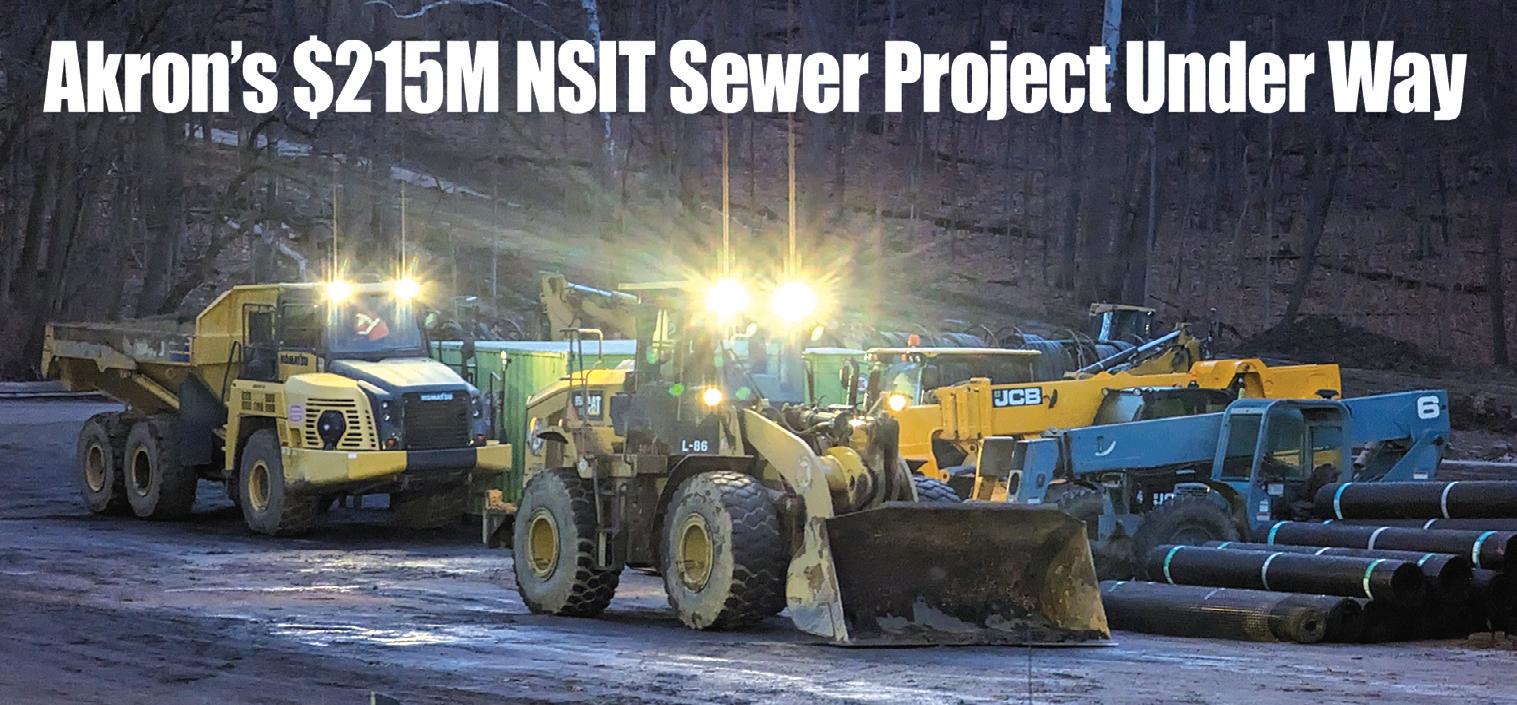
Construction crews in Ohio are tackling a multi-year sewer project that involves building a 16.5-ft. internal diameter tunnel. Work on the city of Akron’s $215 million Northside Interceptor Tunnel (NSIT) assignment began in fall of 2023.
“The tunnel will reduce combined sewer overflows to the Cuyahoga River, which will improve water quality in Akron,” said city of Akron senior engineer Heather Ullinger. “This benefits the local community and the adjacent and downstream communities, including Cuyahoga Falls, the Cuyahoga Valley National Park, Cleveland and Lake Erie.
“The improvements made by the Akron Waterways Renewed Program have dramatically improved water quality for our region. The tunnel also will replace a major portion of the city’s Northside Interceptor sewer, which was built more than 100 years ago.”
The NSIT undertaking is one of the final projects of the EPA-mandated consent decree, entered in 2014, to improve the city’s sewer infrastructure and reduce combined sewer overflows (CSOs). The tunnel will collect and store CSOs from four overflow locations. It will be 6,660 ft. long, more than 100 ft. below ground in rock and will be able to store more than 10 million gal. of combined flow.
The design for the tunnel was completed in early 2023.
“The most detailed element is the tunnel diversion structure [TDS],” Ullinger said. “This is the heart of the project. It’s the downstream end of the mainline tunnel and receives flow from the Rack 32 consolidation sewer. The TDS conveys dry weather and typical year flows to the existing interceptor sewer to dewater the tunnel. It includes floatable screening and baffle drops to slow flows.”
Because of the deadlines set in the federally-mandated decree, the project schedule is aggressive.
“From a construction standpoint, the project involves about 2,500 feet of a soft ground tunnel,” said Ullinger.
“Access to the shaft location and geotechnical conditions for this consolidation sewer are challenging. This is happening right alongside another major, multi-stage project, the Gorge Dam removal. Coordinating the two requires daily communication and teamwork.”
To determine underground conditions, officials implemented an extensive geotechnical program which started in 2020. Currently, crews are preparing the site by stripping topsoil and grading in the area of the TDS. Tree removal is complete and utility relocation continues.
No blasting is anticipated; however, to reduce the impact of the project, the city of Akron decided to keep all spoils from tunneling and other earthwork on-site permanently.
“This requires a sophisticated work plan for the project’s main staging area to ensure there’s enough room for the stored materials and day-to-day operations. The project is occurring in a Summit Metro Park, with beautiful views of the Cuyahoga River.” see NSIT page 6
CALL 800-367-4937 *On approved credit Financing Available SHIP WITHIN 48 HOURS SAME DAY PARTS AVAILABILITY 24 HOUR TECHNICAL SUPPORT BACKED BY A 75 YEAR BUSINESS State Supplement sponsored by: Affordable Price. Premium Service. Thousands in Service!
OHIO STATE EDITION A Supplement to: Your Ohio Connection: Natalie Spain, Fort Wayne, IN • 1-800-810-7640 23 30 422 68 80 76 75 77 ®
Read Construction
“The Nation’s Best
Newspaper… Founded in 1957.”
2 2024 Vol. XVIII • No. 5
Thomarios/City of Akron photo
The city worked closely with officials to reduce environmental impact to the park’s natural features by optimizing design of the project to reduce tree clearing and impact to key features.
Gov. Announces Support for Local Major Bridge Projects
Ohio Gov. Mike DeWine and Ohio Department of Transportation (ODOT) Director Jack Marchbanks announced Feb. 7 that more than 12 major local bridge projects will receive funding to support rehabilitation and replacement work.
Nearly $59.5 million will be awarded to support 17 bridge projects in 12 counties as part of ODOT’s Local Major Bridge Program. In 2022, DeWine expanded the definition of a “local major bridge,” which more than quadrupled the number of bridges that qualify for the program. In this round, 11 newly eligible bridges are receiving funding.
“We expanded this program to make an impact on more communities,” said DeWine. “With these funding awards, we’re helping local communities invest in

the upkeep or replacement of bridges to ensure that those who cross them are safe.”
Projects include lift bridge updates;
deck replacements; new lighting and fencing; new bridge design; road resurfacing; sidewalks; and mechanical and electrical
system repairs.
“Governor DeWine’s commitment to supporting infrastructure projects allows ODOT to further help our local government partners address critical bridge needs and enhance the overall safety and accessibility of their communities,” said Marchbanks.
To qualify for the program, the bridge must be a moveable/lift bridge or a bridge having a deck area greater than 15,000 sq. ft. ODOT will fund up to 80 percent of eligible costs for all phases of the projects receiving awards. There is a maximum project cap of $20,000,000.
Last year, DeWine announced $28 million in funding from ODOT’s Municipal Bridge Program to support local projects to repair, replace or demolish two dozen smaller bridges in Ohio.
Transportation Review Advisory Council OKs Draft Project List

The Transportation Review Advisory Council (TRAC) has approved the 2024 draft list of projects to receive funding through the Ohio Department of Transportation’s Major New Capacity Program. It includes $127.3 million in new funding commitments for 18 projects over the next four years.
TRAC will vote on the final list at Feb. 28 meeting.
“Businesses are choosing Ohio as the place to locate or expand their operations. These economic wins also bring infrastructure challenges. These projects will ensure that Ohio has the infrastructure not only to meet today’s needs, but tomorrow’s as well,” said ODOT Director Jack
Marchbanks.
There were 28 applications submitted this year.
TRAC operates on an annual application cycle. At the completion of the application process TRAC members vote on the approval of the Major New Construction Program List of funding commitments for preliminary engineering, detailed design, right-of-way and project construction. Projects receiving funding commitments are placed into three “tiers” based upon the level of project development:
• Tier I — The group of projects recommended for construction during the upcoming four-year construction period.

• Tier II — The group of projects recommended for additional environmental, design or right-of-way development activities necessary before the projects would be available for construction.
• Tier III — The group of projects with previous phases funded for construction in Tier I. Projects placed in Tier III status are part of a long-range funding plan to advance multiple phase projects.
About TRAC
The Transportation Review Advisory Council (TRAC) was established by Ohio Revised Code in 1997 to help the Ohio Department of Transportation (ODOT) develop and modify a project selection
process which approves funding for the development and construction of the Major New Capacity Program.
The TRAC has nine members and is chaired by the director of ODOT. Six members are appointed by the governor and one each by the speaker of the Ohio House of Representatives and the president of the Ohio Senate. Members have overlapping terms. The director provides funds for new construction only after assuring that system preservation needs have been met. The use of the new construction funds is the responsibility of the TRAC, but the TRAC does not have authority over other aspects of the Department of Transportation.
Page 2 • March 2, 2024 • www.constructionequipmentguide.com • Ohio State Supplement • Construction Equipment Guide
ODOT graphic
ODOT photo
ODOT image





Construction Equipment Guide • Ohio State Supplement • www.constructionequipmentguide.com • March 2, 2024 • Page 3 ow. l n nti , u possible e m h n t o retes idsk t if n l a t c n. I ee r s eve o c b scopi lee h a t wit s d i isk lee Te C e J Th r g a t Introducin B T ou s y are s a scce n a a d c n t a arke g d i d d n r a the ur h f ac e , r r,igheh ats re t v os e m h t t g i inka , m om r a ete d s ik y s nl d o n t a s r e fi ht ith e w achin e m niqu y u ul r hought e t v av t h ’wouldn rthe y o n n a ah r t peee ve ’ ou e y achin e m il roade k l ac r t t ompac d c n ossibilities. s p endles a jcb.com/tteleskid / 5338 Buck and Knobby JCB Covering Northwest Ohio 9127 Airport Highway Holland, OH 43528 419-491-2362 www.buckandknobbyjcb.com Burns JCB Covering Northeast Ohio 8155 Roll & Hold Pkwy. Macedonia, OH 44056 866-459-6713 www.burnsjcb.com Company Wrench JCB Covering Central Ohio 866-262-4181 Toll Free 4805 Scooby Lane Carroll, OH 43112 740-654-5304 920 Deneen Avenue Monroe, OH 45050 513-649-8105 www.companywrenchjcb.com


Page 4 • March 2, 2024 • www.constructionequipmentguide.com • Ohio State Supplement • Construction Equipment Guide


Construction Equipment Guide • Ohio State Supplement • www.constructionequipmentguide.com • March 2, 2024 • Page 5
NSIT Project Requires Excavation, Grading for Tunnel
The city worked closely with officials to reduce environmental impact to the park’s natural features by optimizing design of the project to reduce tree clearing and impact to key features.
Ullinger noted that more than 150,000 cu. yds. of tunnel muck and excavated material will be placed adjacent to the construction site, reducing hauling mileage and providing an environmental solution.
Crews also must monitor outdoor conditions.
“Inclement weather, such as heavy rain, snow or extreme heat, can lead to delays with NSIT,” said Ullinger. “Wet or frozen ground can be challenging to work with, making excavation, concrete placements and concrete curing problematic.”
Equipment on site includes a Cat 470G excavator; Terex TA30 articulating dump truck; Dynapac rubber tire smooth drum roller; Cat 950 loader; Komatsu 65PXi bulldozer; four Komatsu HM300 articulating dump trucks; a Cat CP-563E sheepsfoot roller; woodchippers and bulldozers.
Overseeing construction of a 16.5-ft. internal diameter tunnel is demanding, but not overwhelming, according to Ullinger.
“The city is experienced in managing large, challenging projects. We have completed 24 out of 26 projects in our federallymandated consent decree, which have cost almost a billion dollars.”
Once construction is completed, Akron will reportedly reduce CSO and water reclamation facility secondary bypass by more than 2 billion gal. The city will be capturing and treating 99 percent of wet weather flows and reducing the number of CSO events by almost 100 percent.
Funding for the project will be awarded through Ohio EPA’s Water Pollution Control


Loan Fund (WPCLF). Additionally, the city has worked with Ohio EPA and partners across the state to sponsor more than half-adozen projects that serve to protect valuable habitat and water resources.
Thomarios is the construction manager of the project, while Granite Construction Company serves as the contractor.
“Members of the Granite team were involved in construction of the city’s first tunnel,” said Ullinger. “They have local experience and relationships that will contribute to the project’s success.”
Ullinger said that while the project is far from glamorous, it serves a critical need.
“Sewers are essential to every community, but they’re not like other infrastructure improvements, which can be easily seen. The improvements we see and celebrate are the water quality benefits, which are highlighted in our local and regional parks, trails and greenways.” CEG

Page 6 • March 2, 2024 • www.constructionequipmentguide.com • Ohio State Supplement • Construction Equipment Guide
NSIT from page 1
Thomarios/City of Akron photo
Thomarios is the construction manager of the project, while Granite Construction Company serves as the contractor.
Thomarios/City of Akron photo
Equipment on site includes a Cat 470G excavator; Terex TA30 articulating dump truck; Dynapac rubber tire smooth drum roller; Cat 950 loader; Komatsu 65PXi bulldozer; four Komatsu HM300 articulating dump trucks; a Cat CP-563E sheepsfoot roller; woodchippers and bulldozers.
Thomarios/City of Akron photo Construction crews in Ohio are tackling a multi-year sewer project that involves building a 16.5-ft. internal diameter tunnel.
Thomarios/City of Akron photo
Work on the city of Akron’s $215 million Northside Interceptor Tunnel (NSIT) assignment began in fall of 2023.
Thomarios/City of Akron photo
The tunnel will collect and store CSOs from four overflow locations. It will be 6,660 ft. long, more than 100 ft. below ground in rock and will be able to store more than 10 million gal. of combined flow.
Thomarios/City of Akron photo
The design for the tunnel was completed in early 2023.
Turnpike Commission OKs $254M Budget for Projects in 2024
This year, the Ohio Turnpike and Infrastructure Commission has a budget of about $254 million for capital improvement projects across the 241-mi. toll road. This includes nearly $238 million for projects beginning in 2024 and completing prior year projects. About $16.4 million remains in uncommitted funds for unforeseen expenditures in 2024.
More than $162 million of the 2024 capital plan is allocated for roadway and bridge projects. Nearly 142 lane mi. of pavement will be resurfaced, the pavement at a toll plaza interchange will be reconstructed, and an extensive amount of work will be performed on 26 bridges.
The 2024 projects include:
• Completing pavement replacement and the removal of the old Westgate Toll Plaza (milepost 2) and the continuation of the pavement resurfacing (milepost 14 to 27) in Williams County;
• Interchange pavement reconstruction at Toll Plaza 34 (State Route 108/Wauseon) and work on overhead bridges in Fulton County (Township Road 3, Township Road 12-1, Township Road 17 and Township Road 22);
• Mainline resurfacing (milepost 51 to 55 and milepost 64 to 74) with a bridge deck overlay (state Route 420) in Wood County;
• Bridge deck replacements in Sandusky County (Wagoneer Road, Fought Road, Shannon Road, Carley Road, Copp Road and Northwest/Southwest Road);
• Bridge deck replacements in Erie County (State Route 269, Deyo Road, Skadden Road/State Route 99 and State Route 13);
• Bridge deck replacements in Lorain County (ramp bridge at Lorain Road interchange, Lorain Road and Bagley Road);
• Continuation of the bridge replacement over Tinker’s Creek (milepost 185.6) in Summit and Portage counties, and bridge work in Portage County (State Route 43, State Route 88, Bryant Road and North Main St.); and
• Mainline resurfacing (milepost 230 to 236), replacing the Boardman Canfield/U.S. Route 224 bridge over the Ohio Turnpike, and the completion of pavement work at Eastgate Toll Plaza (milepost 239) in Mahoning County.
In addition, the planned 2024 capital expenditures include the completion of the toll collection system (TCS) modernization program and the design, furnishing and installation of Intelligent Transportation System (ITS) cameras and sign boards along the Ohio Turnpike’s mainline.


Construction Equipment Guide • Ohio State Supplement • www.constructionequipmentguide.com • March 2, 2024 • Page 7 SPHALT A Y 85 LEEBO VER PA 520 d and r COMMIT We are LeeBoy. The name behind the world’s m equipment: pavers, graders, distributors, maintai most trusted and requested around the world. B OU. O Y . COMMITTED T ALITY O QU e understand TTED T m ost dependable and productive commercial asphalt paving ners and more. The LeeBoy family of products are among the ecause we understand what drives you and we deliver. Each u, day, lik e you we p q put it all on the line . It’s how w eeBoy ’reL e W e ’rebuilt. eL y . As depen d OW y able as your day is long. N Fax: Phon Colum Fax: 330-655-5969 Phone: 330-665-5900 Hudson, OH 44236 6681 Chittenden Road3155 LeeBoy, Ros available at HUDSON C SELLING N WESTCHESTER Fax: 513-777-4494 Phone: 513-777-5556 West Chester, OH 45069 614-475-0069 e: 614-475-2880 mbus, OH 43219 o 8131 Regal Lane 5 E. 17th Avenue b sco and LBPerformance brand equipment this reputable Dealer’slocations: COLUMBUS
The Ohio Turnpike and Infrastructure Commission has a budget of about $254 million for capital improvement projects across the 241-mi. toll road.
Ohio Turnpike photo


to using con oduction d found pr on a cement-stabili ews we When the cr W“ urton Scot Contractors ventional dozers. ed oubled compar ized subgrade, we e installing stone er


Scot Paulitsch | B


Page 8 • March 2, 2024 • www.constructionequipmentguide.com • Ohio State Supplement • Construction Equipment Guide
