Three of a Kind
C.W. Matthews Replacing Trio of Bridges Along SR 400
By Irwin Rapoport CEG CORRESPONDENT
Construction of the Georgia Department of Transportation’s (GDOT) $55 million SR 400 Bridge Replacements project — taking place in Fulton County — has begun and C.W. Matthews Contracting Co. Inc. is expected to deliver the three new bridges between April and June of 2024.



“The new bridges will provide operational and local road improvements in advance of the major express lanes construction,” said Georgia DOT Design-Build Project Manager Rick O’Hara. “The department was pleased with the number of competitive bids received and looks forward to advancing this important project along a critical corridor in metro Atlanta with the selected design-build team.”
The design-build project “was pulled forward as part of the phased delivery of the planned SR 400 Express Lanes,” states the project web page.
The Pitts Road, Roberts Drive and Kimball Bridge Road bridges over SR 400, which are more than 50 years old and
see BRIDGE page 6
Albany Looks at New Opportunities to Improve Flint River
When the city of Albany, Ga., was built in the 1830s, it was constructed around the Flint River, which still flows through the heart of downtown while providing abundant natural resources and opportunities for growth.
In Albany, the river uniquely flows on top of the Floridan aquifer, one of the principal aquifers in the United States, as well as one of the most productive in the world, according to the U.S. Geological Survey.
Hundreds of millions of gallons of cool, fresh groundwater are pumped into the Flint’s waters, which allows southwest Georgians to use it for agricultural irrigation.
Currently, the city is working on revitalizing the river through a major stormwater and

sewer project as well as looking into new planning grants for development along its banks.
Henry Jackson, the Flint Riverkeeper’s outreach and development director, told the Albany Herald that the bedrock of the portion of the river that flows through Albany is made up of porous limestone. That makes for a direct relationship between the surface waters of the Flint and the groundwater from the aquifer, he said.
This creates places like Radium Springs, which is one of Georgia’s seven natural wonders and a main attractor to Albany, along with multiple other blue holes that exist along the Flint — some open to the public and some not.
These features are special, Jackson said, while adding the portion of the Flint that flows through Albany has much potential for usability and revitalization of the community.
Kayaking and other paddle sports along the Flint have grown in popularity in the last few years — especially, Jackson noted, during the COVID pandemic when gyms were closed.
“People need a place to go,” he said. “They need sunlight, they need movement, they need challenge, and they need somewhere to venture out and explore and experience. The Flint River gives us all of that.”
According to Jeanne Yarger, who owns the Flint River Outpost, a canoe and kayak-
ing service that has operated since 2001, people travel from all over to kayak the Flint, including regulars from north Georgia, Florida and Alabama.
“I definitely think that the Flint is a tool that could be used to attract people to Albany or just to keep people busy in Albany,” Yarger said. “The fishing is phenomenal. There’s so much to do in that river.”
However, Visit Albany GA Executive Director Rashelle Minix said right now the Flint is an attraction, not an attractor, due to a lack of visibility and accessibility, adding, “If you don’t have your own kayak, your own boat, those types of things, it makes it more difficult.”
see FLINT page 6
CALL 800-367-4937 *On approved credit Financing Available SHIP WITHIN 48 HOURS SAME DAY PARTS AVAILABILITY 24 HOUR TECHNICAL SUPPORT BACKED BY A 75 YEAR BUSINESS State Supplement sponsored by: Affordable Price. Premium Service. Thousands in Service!
GEORGIA STATE EDITION A Supplement to:
®
Your Georgia Connection: Rich Olivier, Atlanta, GA • 1-800-409-1479
October 4 2023 Vol. XXV • No. 20
“The Nation’s Best Read Construction Newspaper… Founded in 1957.”
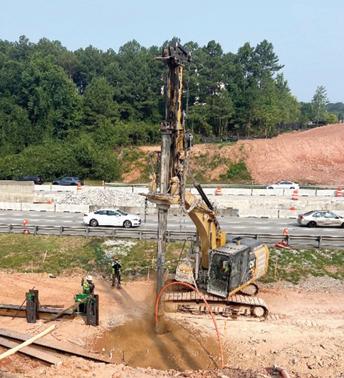
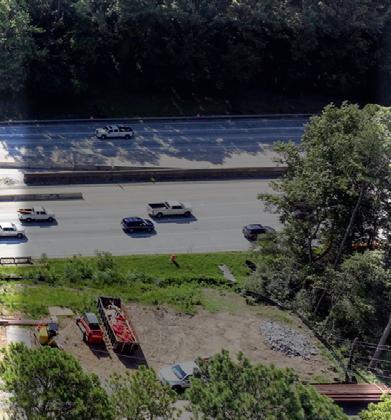
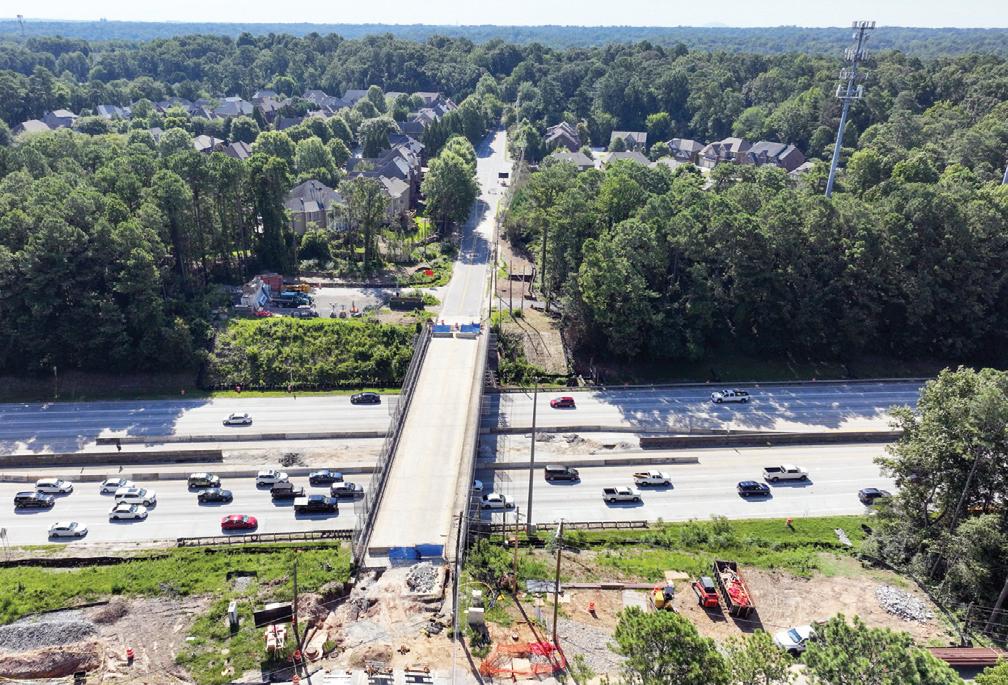
The Pitts Road Bridge is being replaced and widened with a raised profile.
The general contractor is expect- ed to deliver the three new bridges between April and June of 2024.

Page 2 • October 4, 2023 • www.constructionequipmentguide.com • Georgia State Supplement • Construction Equipment Guide

































Construction Equipment Guide • Georgia State Supplement • www.constructionequipmentguide.com • October 4, 2023 • Page 3 T’S T VICSER AMERICA MADE FOR THA LOCA TS EW IS THE N ADED ED LO FULLY ANDARD AST ANY America, Inc ©2023 S sanyamerica.com centra A 42 7 SY215C LC alatlantatractor.com tlanta, GA 30336 At e SW . Driv 240 MLK Jr 70-819-6600


Page 4 • October 4, 2023 • www.constructionequipmentguide.com • Georgia State Supplement • Construction Equipment Guide Atlanta, GA 404-696-7210 Birmingham, AL 205-841-6666 Huntsville, AL 256-536-9390 Mobile, AL 251-633-4020 Montgomery, AL 334-262-6642 Oxford, AL 256-832-5053 Pensacola, FL 850-479-3004 Tuscaloosa, AL 205-848-4147 Lawrenceville, GA Coming Soon COWIN.COM | 1-800-239-2694

Construction Equipment Guide • Georgia State Supplement • www.constructionequipmentguide.com • October 4, 2023 • Page 5
Bridge Replacements Due to Complete in Spring 2024
BRIDGE from page 1
nearing their end of lives, are being replaced and widened to accommodate the future express lanes along SR 400, according to project details. The new bridges will be replaced with taller, wider structures which will feature multiuse paths and sidewalks.
The Pitts Road Bridge is being replaced and widened with a raised profile to allow for a 12-ft. multiuse path on the south side, a sidewalk on the north side, as well as interior barrier walls on both the north and south sides separating pedestrians from the two travel lanes. There is a local agreement with the city of Sandy Springs for bridge aesthetics.
The Roberts Drive Bridge will undergo a similar reconstruction, with an interior barrier wall on the south side separating pedestrians from the travel lanes.
The Kimball Road Bridge will be replaced with a raised profile, increased from two to four lanes with a median, a multiuse path on the north side and a sidewalk on the south side. There is a local agreement with the city of Alpharetta for bridge aesthetics.
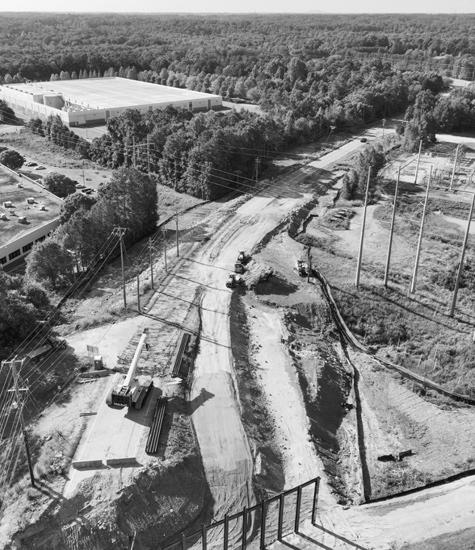
The Roberts Drive bridge is under construction with the new structure being built alongside the existing structure, with completion expected on May 22, 2024.
This project is impacting traffic. The Kimball Bridge Road bridge was closed to traffic on May 8, 2023, and the Pitts Road bridge was closed to traffic on June 12, 2023. Detours have been established until the bridges re-open in late April of next year.
(All photos courtesy of GDOT.)
Stormwater Project Aims to Improve Flint River Commerce
FLINT from page 1
However, opening a brick-and-mortar kayak outpost in Albany’s downtown could push the Flint toward becoming an attractor, Minix explained. The city also has made efforts in the last few years to create more accessibility by adding trails, docks and launches, she said.
Glenn Singfield II, co-owner of the Albany Fish Company and The Flint restaurants, believes that adding more diverse eating establishments is an effective way to revitalize the downtown area of Albany that sits next to the river.
Singfield’s mother, Tandra, opened her first business in the early ‘80s on Jackson Street. As a kid, he said he remembers downtown Albany filled with businesses right alongside the waterway.
In the 1990s and early 2000s, the city began developing west and north. Now, though, Singfield said he believes people are ready to come back downtown.
The Flint Riverkeeper’s office is constantly trying to create and maintain the love between the river and Albanians. This involves not only being active on the river but understanding the health of the river, officials with the organization said.
In a recent workshop hosted by the Albany Museum of Art, a demonstration from the Flint Riverkeeper’s R.J. Gipaya and Jessica Rutledge showed how different pol-
lution sources can flow into a body of water.
Gipaya, the group’s watershed specialist, said that Albany is about 300 mi. from the river’s source, “So, it’s collecting everything from the Atlanta airport, all the way down to here.”
Pollution in the Flint can stem from both point and nonpoint sources, noted Rutledge, the operations coordinator for Flint Riverkeepers. Agricultural and industrial runoff are huge contributors, but sometimes sources can be hard to pinpoint, she said.
With the Floridan Aquifer running from southwest Georgia east to Savannah and south through half of Florida, the pollution that Albany gets from Flint River is seeping in and spreading to other communities, too, Gipaya explained.
Albany operates on a combined sewer overflow system, where stormwater and wastewater are collected into a single pipe, Jackson said. This system functions well during dry weather or moderate rainfall, but during extended rainfall there can be too much water moving through the pipes, and some of it has to be discharged into the Flint.
The city has permitted legal discharges along the river, he explained.
“It’s legal pollution, but it is still pollution,” Jackson told the Herald. “The ultimate goal is that none of that water goes to the river until it passes through the wastewater treatment plant.”
In 2020, the city was issued an Environmental Protection Department directive requiring 85 percent of combined sewer flow go to a treatment plant by 2025.
Currently, a more than $100 million project to separate the stormwater and sewage systems is being built. Albany city officials announced at the beginning of August that the project was on schedule to meet the federally mandated deadline.
“It’s expensive and it’s time-consuming and it’s just rough,” Jackson added. “Streets are being closed down, sidewalks are being ripped out, pipes are being replaced. So, this is a big deal.”
Albany City Commissioner Chad Warbington said the municipality is in the progress of applying for a planning grant to provide a bridge and access to about 100 acres of land north of the downtown Flint RiverQuarium attraction.
In 1996, a strategy was developed by the Albany Tomorrow group to develop a Third Avenue promenade that extended all the way to the river. Developing that land can easily lead to more greenspace, and walking and biking trails, according to the Albany Herald.
Half of the 20 acres outside of the area that are considered to be in a flood plain could be developed into apartments that overlook the river.
The proposed bridge would most likely be
connected to the area around the downtown Phoebe Putney Memorial Hospital, Warbington said.
“There’s just so much potential between Phoebe and the river,” he said. “All that land at the moment is just untouched and nobody has ever done anything with it.”
Scott Steiner, president and CEO of the Phoebe Health System, said his company is ready to partner with the city for potential development along the river.
Steiner, who grew up alongside the Mississippi River, said he’s seen the impact a river can have on a community. He said he believes giving more people access to the river by developing housing and businesses near it is a tool to attract people into the city — especially young people.
“I’ve got 600 job openings [and] most likely the average age of people that I’m going to hire is going to be in their 20s or 30s,” he explained. “That’s what I think younger people are looking for.”
Steiner added that folks come to the Albany area “to engage with nature [and] we need to use that. As a community, as we think about growth, as we think about the next generation that’s going to live in southwest Georgia and Albany, let’s get into this untapped resource.”
Page 6 • October 4, 2023 • www.constructionequipmentguide.com • Georgia State Supplement • Construction Equipment Guide
CEG
The new bridges will provide operational and local road improvements in advance of the major express lanes construction.
The Pitts Road, Roberts Drive and Kimball Bridge Road bridges over SR 400, which are more than 50 years old and nearing their end of life, are being replaced and widened.



Construction Equipment Guide • Georgia State Supplement • www.constructionequipmentguide.com • October 4, 2023 • Page 7

Page 8 • October 4, 2023 • www.constructionequipmentguide.com • Georgia State Supplement • Construction Equipment Guide
