441
59
75
GEORGIA STATE EDITION
Cornella 19
A Supplement to:
Rome 85 27
Athens 441
Atlanta
20
Madison Augusta
85
20
Griffin 1
129
Milledgeville
75
La Grange
Macon
301
185 19
®
16
Dublin
Swainsboro Oak Park
Columbus
Statesboro
341 441 16
Lyons Americus
August 2 2017
Dorchester
341
Cuthbert
75
Albany
84
Douglas Tifton
82
95
82
Blakely
Pearson
“The Nation’s Best Read Construction Newspaper… Founded in 1957.”
301
1
82
Vol. XIX • No. 16
Savannah
McRae Cordele
27
27 84
Moultrie
19 319
84
Bainbridge
Valdosta Thomasville
Waycross Brunswick 82
1 441
Your Georgia Connection: Rich Olivier, Atlanta, GA • 1-800-409-1479
County Sees Recreation Complex By Cindy Riley CEG CORRESPONDENT
Officials in Effingham County, Ga., are preparing for a new central recreation complex that will initially include two baseball fields, three softball fields, a walking trail, playground, picnic pavilion and batting building. The facility will be known as the Clarence E. Morgan Complex, in honor of the longtime teacher and coach who helped make the facility a reality. “The project is dear to many a person who’s worked so
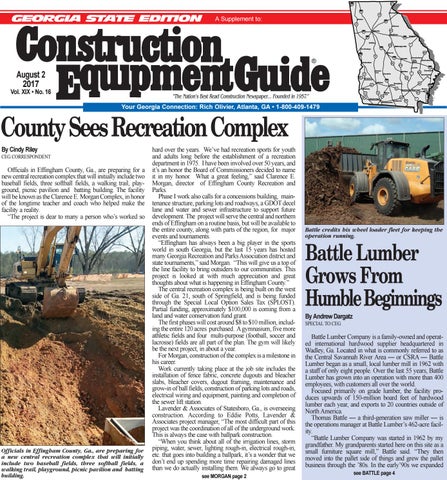
Officials in Effingham County, Ga., are preparing for a new central recreation complex that will initially include two baseball fields, three softball fields, a walking trail, playground, picnic pavilion and batting building.
hard over the years. We’ve had recreation sports for youth and adults long before the establishment of a recreation department in 1975. I have been involved over 50 years, and it’s an honor the Board of Commissioners decided to name it in my honor. What a great feeling,” said Clarence E. Morgan, director of Effingham County Recreation and Parks. Phase I work also calls for a concessions building, maintenance structure, parking lots and roadways, a GDOT decel lane and water and sewer infrastructure to support future development. The project will serve the central and northern ends of Effingham on a routine basis, but will be available to the entire county, along with parts of the region, for major events and tournaments. “Effingham has always been a big player in the sports world in south Georgia, but the last 15 years has hosted many Georgia Recreation and Parks Association district and state tournaments,” said Morgan. “This will give us a top of the line facility to bring outsiders to our communities. This project is looked at with much appreciation and great thoughts about what is happening in Effingham County.” The central recreation complex is being built on the west side of Ga. 21, south of Springfield, and is being funded through the Special Local Option Sales Tax (SPLOST). Partial funding, approximately $100,000 is coming from a land and water conservation fund grant. The first phases will cost around $8 to $10 million, including the entire 120 acres purchased. A gymnasium, five more athletic fields and four multi-purpose (football, soccer and lacrosse) fields are all part of the plan. The gym will likely be the next project, in about a year. For Morgan, construction of the complex is a milestone in his career. Work currently taking place at the job site includes the installation of fence fabric, concrete dugouts and bleacher slabs, bleacher covers, dugout framing, maintenance and grow-in of ball fields, construction of parking lots and roads, electrical wiring and equipment, painting and completion of the sewer lift station. Lavender & Associates of Statesboro, Ga., is overseeing construction. According to Eddie Potts, Lavender & Associates project manager, “The most difficult part of this project was the coordination of all of the underground work. This is always the case with ballpark construction. “When you think about all of the irrigation lines, storm piping, water, sewer, lighting rough-in, electrical rough-in, etc. that goes into building a ballpark, it’s a wonder that we don’t end up spending more time repairing damaged lines than we do actually installing them. We always go to great see MORGAN page 2
Battle credits his wheel loader fleet for keeping the operation running.
Battle Lumber Grows From Humble Beginnings By Andrew Dargatz SPECIAL TO CEG
Battle Lumber Company is a family-owned and operated international hardwood supplier headquartered in Wadley, Ga. Located in what is commonly referred to as the Central Savannah River Area — or CSRA — Battle Lumber began as a small, local lumber mill in 1962 with a staff of only eight people. Over the last 55 years, Battle Lumber has grown into an operation with more than 400 employees, with customers all over the world. Focused primarily on grade lumber, the facility produces upwards of 150-million board feet of hardwood lumber each year, and exports to 20 countries outside of North America. Thomas Battle — a third-generation saw miller — is the operations manager at Battle Lumber’s 462-acre facility. “Battle Lumber Company was started in 1962 by my grandfather. My grandparents started here on this site as a small furniture square mill,” Battle said. “They then moved into the pallet side of things and grew the pallet business through the ’80s. In the early’90s we expanded see BATTLE page 4
Page 2 • August 2, 2017 • www.constructionequipmentguide.com • Georgia State Supplement • Construction Equipment Guide
120-Acre Complex to Include Athletic Fields, Gym, Parking MORGAN from page 1 additional, quality sports facilities to satisfy the demand in lengths to coordinate and lay out the different routes and their recreation programs. “The concept plan to develop a new multi-phase recredepths of the various underground systems, but it is almost impossible to achieve a layout without some lines hitting ation complex on Hwy 21 was developed as part of that maseach other.” ter plan. Once the lands were secured by the county, we Clearing and grading have already been completed, along started work on the design of the complex in June 2015. with construction of the retention pond, underground utility “The biggest challenges on this project, as with many pubwork that includes storm, domestic water, sanitary sewer, lic projects, have been related to budget. The county has lots force main, irrigation, and electrical, the concessions build- of needs for new facilities and limited SPLOST funding, so ing structure, picnic pavilion, maintenance building, we have worked creatively with county staff and the consubdrainage system at the ball fields, the sprigging of ball struction manager to stretch those dollars as far as possible.” fields, infield mix and ballpark lighting. Graham said the existing silty sand soils on site were fine “No major issues have been encountered other than some for typical construction. However, they were not suitable for isolated areas where existing soil was found unsuitable by use in the ball fields. the testing agency, which was replaced with suitable fill and “We specified a rootzone mix (sand cap fields with organthen properly compacted,” said Potts. “This site was well suited for this application.” Asphalt paving of roads and parking lots has yet to be finished, as well as landscaping, concrete walks, the ADA playground, the batting building, painting, windows, drywall, acoustical, door hardware, specialties and signage. The most time-consuming part of the current work involves concrete sidewalks and asphalt paving. Roughly 85,000 cu. yds. of dirt is being moved during Phase 1 construction. Large earth-moving equipment, especially at the outset of the project, has been required to complete various tasks. Heavy machinery ranges from pans, tractors and dozers to off-road dump trucks, track hoes, loaders, vibratory rollers, backhoes and graders. Materials include concrete, pipe and fittings, black vinyl fencing and gates, light poles, lighting, metal building components, wood trusses, concrete block, brick, TIF 419 sprigs, drywall, acoustical ceilings, solid plastic toilet compartments, solid surface countertops, sliding aluminum windows, The Effingham County Central Sports Complex master plan. counter shutters, and trees, shrubs and mulch. Potts said building the baseball and softball fields requires a great deal of teamwork. ic amendments) to provide a suitable growing medium for “You need a good design, which we definitely have, you the outfields. We also specified a top quality clay infield mix need top quality subcontractors, good materials and a highly and worked closely with the county and construction manskilled team of supervisors and managers working in con- ager to find a suitable source in the State of Georgia for that junction with the owner, architect, and engineers to build the material. project. Coordination is one of the biggest factors in building “We are past the major earth moving and utility portions a successful ballpark.” of the project, so now we are focusing primarily on finishes. According to Potts the site was a large open field, which We’re making sure the bleacher covers, dugouts, backstops included a pecan orchard, and proved conducive for con- and other fencing are installed properly around the ball struction. fields. Soon we will be focusing on the finishes inside the CHA Consulting Inc. serves as the prime consultant on the buildings and the hardscaping and landscaping inside the design team. CHA was responsible for design of the ball complex.” fields, sports lighting and all vertical structures, including the Graham said working on the highly anticipated project has concession/restroom building, picnic pavilion and mainte- been a rewarding experience from the beginning. nance building. “We have had a great team on this project across the “CHA personnel designed the baseball and softball fields, board, including the county staff, the construction manager, dugouts, spectator areas and all hardscaping inside the ball- the site superintendent and our design team. It takes a great park,” said Patrick Graham, P.E., project manager. “Our team to deliver a quality product, and that has been our numdesign partners from Hussey Gay Bell and SDC designed ber one goal since the beginning of the project.” the vertical structures.” According to Wesley Sherrod, Effingham County civil The firm completed a facilities master plan for the engineer, one of the biggest concerns on the project was minEffingham County Recreation and Parks Department in imizing the costs associated with the rough grading. January 2015. “We tried to utilize on-site dirt by over-excavating our “We reviewed all of the existing sports and recreation detention pond, but in so doing, had to stockpile lots of unusfacilities in Effingham County against state and national able dirt,” said Sherrod. “Moreover, the ball fields were gradstandards,” said Graham. “Through that review and com- ed sloping toward the outfield corners, rather than sloping munity meetings, we determined that the county needed downward in a more standard manner in all directions from
the infield to save in required fill. “Another challenge was using this project as a piggy-back of sorts for the city of Springfield’s future utility development. This required lots of coordination between the county and the city, in order to serve both the purpose of supplying the recreation complex immediately and upon build-out and the purpose of allowing for the city’s future development expansion. “Given the detailed grading required, along with the necessary fine grading coordination with the CHA ball field experts, I believe that the preparation of the massive 3D grading file required was the most time consuming part of this project.” Sherrod said the intent was not to skimp on any aspect of the recreation park, even if that meant completing it in several sub-phases. “That was certainly the case with the selected infield mix. The specifications for the required ‘sweet spot’ mixture of clay, silt and sand, could not be achieved via local borrow pit sources. “Through lab testing, it was determined that a certain supplier could meet those conditions. Thus, the infield mix was imported from the supplier to ensure the right balance, avoiding field hardening and proper playing surface, given the amount of maintenance anticipated.” There were a few unexpected pockets of unusable soils that had to be demucked. Erosion control is ongoing and ensures that no sedimentation leaves the site. Generally, its upkeep has been satisfactory. Storm water monitoring has been challenging, as little to no runoff from the over-excavated detention pond is leaving the site. In addition to soils testing, on-site wetlands had to be delineated as a portion of a required overall topographic survey. Regarding hydrology, said Sherrod, “The detention pond is much larger than per design. Only recently has the storm water reached the outfall level. Further, the retained water will be utilized for on-site irrigation. Sherrod said that water and sewer will be owned by the city of Springfield upon completion. “There appeared to be little deviation from design. All storm drainage has been installed. Some minor top grade adjustments will be necessary.” Clearing and grubbing operations went according to plan. The property consisted of scattered trees and shrubs with native vegetation. As many trees as possible were preserved. As for site improvements, “Water quality and runoff reduction will be implemented to a notable degree, and runoff quantity will be reduced. The park should be very aesthetically pleasing, Sherrod said. “Presently, the infields are being dressed and finalized, the concessions building is being finalized, the parking lot has been compacted and prepared for GAB installation,dugout and bleacher concrete foundations are being poured, form work is prepared for the complex sidewalk concrete and the sanitary pump station is being installed.” Sherrod said, “The park in its final state should be something that the citizens of Effingham County would be pleased to showcase and utilize for years to come.” (This story also can be found on Construction Equipment Guide’s website at www.constructionequipmentguide.com.) CEG
Construction Equipment Guide • Georgia State Supplement • www.constructionequipmentguide.com • August 2, 2017 • Page 3
Page 4 • August 2, 2017 • www.constructionequipmentguide.com • Georgia State Supplement • Construction Equipment Guide
Wheel Loaders Boost Productivity for Battle Lumber BATTLE from page 1
our grade lumber operation, and built our grade mill, installed our first dry kilns and started exporting lumber. Throughout the ’90s and into the early 2000s, we just expanded on those operations, trying to improve it by putting in first-class equipment to maximize the most recovery out of every log we bring in. That’s one thing we take a lot of pride in, is having the most hightech sawmill equipment around.” Battle Lumber deploys a fleet of approximately 75 active pieces of rolling stock throughout their day-to-day operations. While they utilize multiple types of equipment on site, Battle credits his wheel loader fleet for keeping the operation running. “The wheel loaders are the heartbeat of the operation,” he said. “The wheel loaders have several different responsibilities — primarily to take logs from the bucket lines, or from the ground saws and transporting them to the mill. They can go directly to the mill, where they are either placed on a deck that transfers them to the mill, or on the base of a loader that transports them to the deck. They also will take odd pieces that the saws maybe cut that time, and take them to another spot in the yard and stage them up to be processed further.”
Making the Right Equipment Choice The primary selection factor for Battle Lumber? Uptime. “Uptime is our biggest challenge,” Battle said. “We try to size our wheel loader fleet to exactly what our operation needs. We need as close to 100 percent uptime as we can get.” The company recently purchased several Case wheel loaders up to 296 hp from Border Equipment in Augusta, Ga. “A wood yard can be a very harsh environment,” said Battle. “There are a lot of sticks out on the yard, a lot of mud and a lot of dust. The machines are all equipped with reversing fans to help blow out the coolers. The machines are equipped with guard packages to prevent sticks and logs and bark and things from getting thrown up into critical parts of the machine that could cause down time. Most of our machines are also equipped with guards over the back to prevent any bad accidents from happening when logs could come in and crush the radiators.” In a high-capacity lumber production environment, sawdust and other combustible dust/debris is everywhere. This can create challenges with certain types of Tier
IV machines — particularly those that require a high-temperature regen cycle to burn off particulate matter. Case wheel loaders are equipped with Selective Catalytic Reduction (SCR) technology, an integrated aftertreatment system that helps lower the exhaust temperatures of the machines, and eliminates the need for any kind of regen cycle. This greatly reduces the likelihood of fire events in dust-laden environments. “Our past experience with other wheel loaders is that they used burn-off systems,” said Battle. “We had some fires because dust gets trapped in the places on these machines that even with weekly pressure washing, you don’t always get them clean. There can be a lot of dust built up over time. So that played a big factor, to do away with the burn-off and some of the excess heat that is required for that type of system.” Another contributing factor to the lowtemperature solution for Battle Lumber was how Case situated its coolers. All Case wheel loaders feature innovative cooling technologies that keep operating temperatures down, keep the engine compartment clean and provide easy access for routine cleaning. Models in the 131-225 hp range feature a Case-exclusive mid-mounted cooling mod-
ule, which pushes the engine lower and further back towards the rear of the machine, improving balance and stability. Models 296 hp and up feature the Case cooling cube, and include a standard variable-speed reversible fan — an option on the smaller models — that further minimizes the need for manual cleaning. Fuel Efficiency With six wheel loaders working 12-hour shifts during the day, and two working 12hour shifts at night, fuel efficiency has a big impact on Battle Lumber Company’s bottom line. “With the amount of rolling stock that we have out here, any amount of fuel savings is huge. When you compete to buy your raw materials and you compete against the same people who sell your finished product, it’s [about] how cheap you can process it in the middle, so you know where you can save money. It’s big at the end of the day.” Battle’s new Case wheel loaders are providing up to one gallon per hour in fuel savings per machine, which adds up tremendously on a round-the-clock operation. “We’re right around four to four and a half [gallons per hour] on a heavy operation day,” see BATTLE page 6
Construction Equipment Guide • Georgia State Supplement • www.constructionequipmentguide.com • August 2, 2017 • Page 5
Albany 800.768.2892 Augusta 800.446.5131 Austell 800.282.1562 Brunswick 800.299.5010
Calhoun 800.752.9804 Columbus 800.633.5240 Dacula 800.545.2945 Macon 800.633.5180
McDonough 855.901.0100 Savannah 800.755.8382 Statesboro 888.764.6506 Valdosta 800.755.6841
Washington 888.678.3211 Waycross 888.948.2443
www.YanceyBros.com
Offer valid from July 1, 2017 to September 30, 2017 on all new models of machines manufactured by Caterpillar Inc. Building Construction Products Division. Financing and published rate and term are subject to credit approval through Cat Financial for customers who qualify. Not all buyers may qualify. Higher rates apply for buyers with lower credit rating. Offer available only at participating Cat dealers. Flexible payment terms available to those who qualify. Offer is available to customers in the USA and Canada only and cannot be combined with any other offers. Offer subject to machine availability. Payments are based on an Installment Sale Contract with 72 monthly payments. Payments do not include taxes, freight, set-up, delivery, document fees, inspections, additional options, or attachments. Final machine prices are subject to change. Offer may change without prior notice and additional terms and conditions may apply. Contact your Cat dealer for details. *Contact your Canadian Cat dealer for monthly payments in Canadian dollars. **The Powertrain Equipment Protection Plan (EPP) is provided through Cat Financial for use at participating Cat dealers. Please see your participating Cat dealer for details. © 2017 Caterpillar. All Rights Reserved. CAT, CATERPILLAR, BUILT FOR IT, their respective logos, “Caterpillar Yellow,” the “Power Edge” trade dress, as well as corporate and product identity used herein, are trademarks of Caterpillar and may not be used without permission.
Page 6 • August 2, 2017 • www.constructionequipmentguide.com • Georgia State Supplement • Construction Equipment Guide
Battle Lumber Equips Wheel Loaders With LED Lights
The company recently purchased several Case wheel loaders up to 296 hp from Border Equipment in Augusta, Ga. BATTLE from page 4
said Battle. “Some of the machines that aren’t getting run as hard, they'll be down into the low threes, but the machines that are really getting pushed out in the rough environment, handling the heavy loads — [they get] four to four-and-a-half gallons per hour. That’s better than our previous wheel loaders were doing.” Ride Control Operating in harsh environments can have a real impact on productivity. Battle chose to equip his Case wheel loaders with ride control, which is designed to improve productivity and material-retention while reducing shock loads on the machine and operator. “We are in a lumber yard. We have a lot of concrete around but there are sticks on top of the concrete — these loaders do go off into mud holes. Any hole that you have on the yard, you can imagine how the shock and impact of carrying a load goes back to the operator. Anything we can do to make the operator a little more comfortable and we feel like it’s easier on the machine, takes some of the abuse away from the machine with the ride control.” Power and Productivity For Thomas Battle, one of the true measures of equipment ROI comes down to productivity in the yard, and his new wheel loaders allow him to achieve greater productivity with fewer machines in operation. “These loaders are loaded with power, they tote the loads well so it allows my oper-
ators to be more productive around the yard. They carry in larger loads at higher speeds, so they have allowed us to be more productive. We’re actually doing what we used to do with four to five loaders with three everyday. Even on our best mill production days, these loaders have no problem keeping up the pace.” The Night Shift Battle Lumber Company runs day shifts and evening shifts, so they equipped their Case wheel loaders with an available LED light package, which has proven to be beneficial for both the evening and day shifts. “The LED lighting packages on these loaders have been very beneficial to us because some of these loaders run around the clock,” said Battle. “Even the ones that don’t run around the clock, a lot of times they start up before the sun comes up and don’t shut down until the sun goes down. A cluttered log yard and a mill yard environment like we’re in, there’s a lot of dust and a lot of shadows — log piles here and there. The LED lights have allowed us to work safer, longer into the night and earlier in the morning, and give our operators much more visibility than we’ve ever had before.” Battle also outfitted their wheel loaders with optional rearview cameras for improved safety and operator visibility. “In any operation, safety is by far everybody’s top concern. The rear-view cameras give us kind of a second sense of safety. They give our operators a little more comfort. They can use the rear-view mirrors and
Battle Lumber Company is a family-owned and operated international hardwood supplier headquartered in Wadley, Ga.
their cameras without having to sit out there in the seat all day long and constantly turn behind them. We feel like that with the cameras in place and the mirrors, the operators can see his surroundings much better.” Planned Maintenance, Warranty and Telematics All Case F-Series wheel loaders come standard with Case ProCare, a suite of product assurances that includes a three-year telematics subscription. This has given Battle Lumber the opportunity to begin exploring telematics and to get a clearer perspective on the utilization rates of its wheel loaders. “We’re starting to generate reports off of it, measuring uptime. Not the machine actually being able to run, but actually how hard our operators are pushing it. We are monitoring fuel usage as well,” said Battle. “I think it gives you the ability to size your fleets much more accurately, if you have some time to actually study it and get some seat time under your belt with it. You can say, ‘Well hey, I could do this with four machines instead of five machines if they were running at 95 percent efficiency.’ It shows you what operators are pushing loaders to the limit and which ones aren’t.” The company also credits the attention of its dealer as a primary factor in ensuring optimal uptime. “One of the biggest factors that went into that decision is probably the dealer support,”
said Battle. “Border Equipment came down, and they put a good presentation in front of us. We felt like we had their 100 percent support. We felt like they were going to stand behind their product, and that it would be a good fit for us.” Generations of Success As a third-generation saw miller, Thomas Battle is proud to be a part of a familyowned company that has grown into an international business. Their growth has been continuous over the generations, and they are showing no signs of slowing down. Even with the operation at its current size, the company continues to grow and diversify through intelligent equipment investment and a hands-on management approach. “Just a couple of years ago we started on a new venture and put in our timber mill, which is a mill that focuses on timbers — cross ties, crane mats — and we also cut a lot of pine pallet material and even pine grade on that mill as well.” “I guess not too many people wake up one morning and say, ‘Hey, I want to be a saw miller. I want to come work at the saw mill.’ You’re kind of born into it a little bit. To do what we do and love it everyday, you have to eat, sleep and breathe it.” Andrew Dargatz is the brand marketing manager, Case Construction Equipment. (This story also can be found on Construction Equipment Guide’s website at www.constructionequipmentguide.com.)
Construction Equipment Guide • Georgia State Supplement • www.constructionequipmentguide.com • August 2, 2017 • Page 7
Page 8 • August 2, 2017 • www.constructionequipmentguide.com • Georgia State Supplement • Construction Equipment Guide
Get the intelligen nt Machine Control advantage! Visit us online or o drop by any of our branc ch locations throughout Alab bama, Georgia and northwest Florida. F TEC1943 TEC1943.com
l Techno
Sh e r - GA age n a M y og