






By Irwin Rapoport
CORRESPONDENT
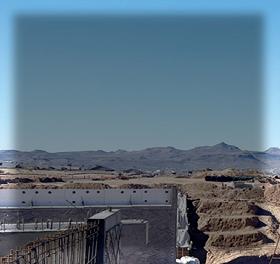
Pulice Construction Inc. is expected to deliver the Arizona Department of Transportation's (ADOT) $43.95 million I-40: Rancho Santa Fe Traffic Interchange project in the city of Kingman by late spring or early summer 2026.
The initiative, which began in December 2024, involves building a new interchange and roads. The work, in coordination with the city and the Federal Highway Administration, addresses area congestion and population growth.
“This project is providing access and accommodates future traffic volumes generated in the rapidly growing east Kingman area and to relieve congestion at the existing East Kingman interchange (Andy Devine Avenue/State Route 66, Exit 54 — three miles east of the work zone),” according to the project web page.
The average daily traffic on I-40 near the future Rancho Santa Fe interchange is approximately 24,000 vehicles. Just 3 mi. west at Andy Devine Avenue, the count increases to approximately 32,000 vehicles.
“Population is growing rapidly in the city,” said Zachary Johnson, Pulice’s project manager. “Most of the land around the interchange is owned by developers or is currently being developed. This interchange will provide immediate access to the I-40 for thousands of residents, cutting their commute time by up to 10-15 minutes.”
The future Rancho Sante Fe Parkway, now called the Flying Fortress Parkway, includes widening the two I-40 bridges over Rattlesnake Wash, constructing two new I-40 bridges at the Ranch Santa Fe interchange and building four ramps at the interchange.
Pulice also is building two four-lane streets — one along Rancho Santa Fe Parkway, north of I-40 between I-40 and Santa Rosa Drive, and another along Rancho Santa Fe
Parkway, south of I-40, between I-40 and Louise Avenue — which include bicycle lanes, sidewalks, curb and gutter and a raised center median.
In a separate project, the city is constructing a two-lane street along Parkway, north of I-40, between Grand Canyon Road and Industrial Boulevard, that will connect to the Kingman Municipal Airport.
The drainage and underground infrastructure elements include installing pipe culverts, concrete box culverts and storm drains.
The project was designed by AECOM.
“[The challenges included] designing for future development, and working with both the city and ADOT details,” Johnson said.
The Flying Fortress Parkway is based on PCCP (concrete)
lanes, while the ramps are asphalt (AC), as is the I-40 main line. So far, Pulice has completed the following elements: widening the Rattlesnake Wash bridge and detouring traffic onto ramps. The remaining work consists of finishing the construction of the Rancho Santa Fe Parkway bridges, four ramps and the Flying Fortress Parkway.
“Our schedule has been very accurate,” Johnson said.
“[We’re] aiming to finish the job later this year. The city and ADOT did an amazing job relocating all of the utilities that were in our way prior to construction. They also provided water meters for us swiftly.
“The soil on our job site is very rocky — this can cause some challenges, [although] nothing that we cannot overcome. We have very minimal night work on this job, and
see INTERCHANGE page 7

New Mexico Gov. Michelle Lujan Grisham’s $1.5 billion transportation bonding package cleared the New Mexico House of Representatives on Jan. 30, 2026, sending the measure to the governor’s desk and positioning the state to tackle a massive backlog of road and bridge projects.
Grisham signed the bill into law on Feb. 5.
The bonding package creates a stable, predictable funding source for state road construction for years to come and frees up general fund money to support local road construction and maintenance. The package also positions the state to better match federal infrastructure funding, which can amplify state investments several times over.
“This major investment in New Mexico’s transportation infrastructure is long overdue, and I’m grateful to House leadership for approving it,” Lujan Grisham said. “At the halfway point of the 30-day session, New Mexicans should be encouraged by the level of effort and the amount of work being done by the legislature to address our state’s needs.”
Key sponsors of SB 2 include Sens. Roberto “Bobby” J. Gonzales, George K. Muñoz, Pete Campos and Benny Shendo Jr., along with Rep. Art De La Cruz, who chairs the House Transportation, Public Works and Capital Improvements Committee, House Majority Whip Day Hochman-Vigil and Representative Patty Lundstrom.
The bill grants the State Transportation Commission authority to issue up to $1.5 billion in bonds to fund projects included in the state’s official plan for regionally significant projects, known as the State Transportation Improvement Program. The bonding package will generate at least $70 million each year in new, recurring revenue without raising fuel taxes.
SB 2 helps address the state’s $7.5 billion transportation funding shortfall, which has resulted in more than half of the state’s roads needing maintenance and costing New Mexico drivers more than $1,000 per year in vehicle repairs and wasted fuel.
The bill’s passage reflects broad recognition that New Mexico can no longer defer critical road investments. Senate Majority Leader Peter Wirth prioritized the legislation, helping push it through the Senate during the session’s first week. House Speaker Javier Martinez maintained the same momentum in the House during the second week of the session.
“I support Senate Bill 2 because investing in our highways and infrastructure through responsible bonding will help create jobs, improve safety and ensure New Mexico’s transportation system meets the needs of our communities,” Gonzalez said. “The bond authority will create a stable and predictable funding source and reduce ongoing dependency on one-time appropriations.”
“I am proud to co-sponsor SB 2, which will mean that the improvements needed to our roads, bridges and other transportation-related infrastructure can be accomplished more quickly,” De La Cruz said.
FNF Construction crews began widening Interstate 10 between Phoenix and Casa Grande, Ariz., in January 2026, according to azfamily.com.
The Arizona Department of Transportation (ADOT) will begin the $284 million second segment of the Wild Horse
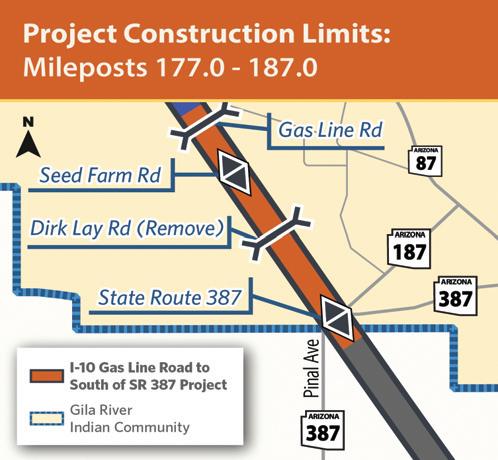
Pass Corridor Project, which will expand the freeway from two to three lanes in both directions.
This stretches 10 mi. between Gas Line Road and just south of State Route 387 in Pinal County. Work is expected to continue through late 2027, azfamily.com reported.
According to ADOT, other work includes:
• constructing a new interchange at Seed Farm Road;
• reconstructing the Pinal Avenue/SR 387 interchange;
• reconstructing and widening the Gas Line Road bridge;
• removing the Dirk Lay Road bridge; and
• improving the infrastructure and installing freeway management system with fiber optic cable, CCTV cameras and overhead message boards.
Crews expect to complete the first segment in late summer. That includes replacing and widening the eastbound and westbound bridges over the Gila River.
A $470 million third phase will be closer to the Valley and in Maricopa County, south of Ahwatukee and Chandler. It is expected to begin this summer and will widen 11 m. from Loop 202 south to the I-10 Gila River bridges. That work will continue until late 2029, according to azfamily.com.
The $158 million segment four will cover 3 mi. between the Gila River and Gas Line Road. Construction is supposed to start in late 2026.
(Photo courtesy of the Arizona Department of Transportation.)
Elected leaders and staff from the city of Apache Junction, Ariz., joined local businesses and stakeholders at Sundt Construction’s Jan. 30, 2026, groundbreaking ceremony to celebrate the start of construction on its 65,000sq.-ft. manufacturing facility.
The new industrial building will be the largest in Apache Junction and is expected to create approximately 100 new job opportunities for the city in this first phase.
In July 2025, Sundt bought a 36acre parcel near the southwest corner of Tomahawk Road and U.S. 60 for offsite manufacturing.
Sundt will use the new facility to fabricate structural and mechanical systems, which will support their construction projects locally and throughout the country.
Additionally, there will be a significant office buildout of approximately 10,000 sq. ft. to support engineering and design teams, along with a training facility for employees throughout the region. Sundt plans to expand into
other specialties in the future, reserving the remaining acreage of their property for expansion.
“Sundt has established itself as one of the most respected general contractors in the country, and this new building reflects the confidence in our area’s talented workforce and quality of life,” Apache Junction Mayor Chip Wilson said.
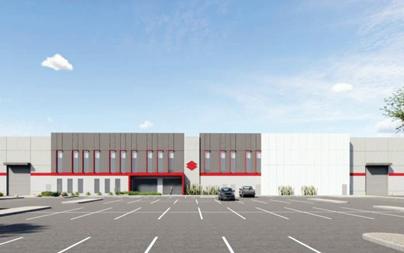
Sundt Construction is building a 65,000-sq.-ft. manufacturing facility in Apache Junction, Ariz.
“We thank Sundt for their significant investment in Apache Junction and the job opportunities that this facility will bring to our community.”
Sundt has been headquartered in Arizona since 1929, building notable projects across the valley, including the current Loop 202 widening project and the Cave Creek Water Reclamation Plant Rehabilitation.
“This new facility represents a major investment in how we deliver work for our clients and how we sup-
port our employee-owners,” said Sundt President and CEO Cade Rowley. “Apache Junction offers a strategic location for these manufacturing jobs, and it has been a pleasure working with city leadership throughout this process. We look forward to making a lasting impact on the community for years to come.”
Construction is anticipated to be completed in the first quarter of 2027.
The Loop 202 (Santan Freeway) Improvement Project, which is adding new lanes between Loop 101 (Price Freeway) and Val Vista Drive in the Southeast Valley, has reached the halfway mark toward completion.
Work on the Arizona Department of Transportation’s $200 million project started in August 2024 and is scheduled for completion in spring 2027.
Crews are building two new lanes in each direction between Loop 101 and Gilbert Road. The project is adding one lane in each direction between Gilbert Road and Val Vista Drive.
ADOT also is reconstructing Loop 202 on- and off-ramps, adding walls and widening bridges to accommodate the wider freeway within Chandler and Gilbert.
Other additions include new freeway lighting, signs, message boards and drainage systems.
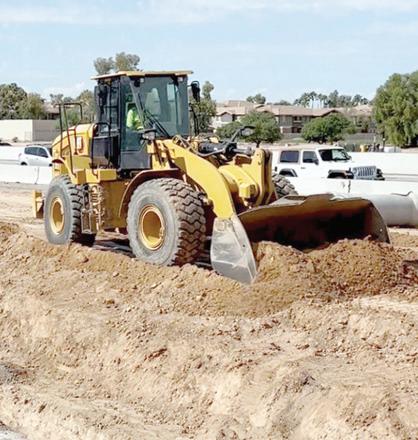
The Santan Freeway project remains on schedule for a spring 2027 completion.
Work also will continue on the installation of new fiber-optic cable for closed-circuit cameras and other equipment used to provide ADOT and the public with real-time information about traffic conditions and travel times.
ADOT is managing the Loop 202 Santan Freeway Improvement Project in partner-
ship with the Maricopa Association of Governments (MAG), which serves as the metropolitan planning organization for the greater Phoenix region.
The project is scheduled under MAG’s Regional Transportation Plan and is funded through Proposition 400, which includes a countywide half-cent sales tax for transportation improvements approved by voters in 2004.
Clearway Energy Group of San Francisco, Calif., announced on Feb. 5, 2026, that it closed financing and began construction on the Spindle Energy Center, a 199 megawatt (MW) energy storage system in Weld County, Colo.
Spindle Energy Center will use Americanmade two-hour Tesla batteries and store up to 398 MWh of dispatchable power.
Clearway is partnering with Blattner Energy on construction, which will create nearly 80 jobs. Spindle is expected to reach commercial operations in late 2026
“Spindle represents a significant investment in Weld County’s energy future, delivering reliable storage and economic benefits to the region,” said John Woody, chief development officer. “We are deeply grateful to our partners for their collaboration and look forward to continuing our work with the local community, our customer and lenders.”
Spindle is contracted with Xcel Energy’s subsidiary in Colorado, Public Service Company of Colorado under a long-term agreement that provides the energy company with dispatchable, reliable power.
To finance the $261 million energy center, Clearway assembled a bank consortium consisting of U.S. Bank National Association, BBVA, KeyBanc Capital Markets, National Australia Bank Limited and Norddeutsche Landesbank Girozentrale.
Spindle is expected to generate more than $12 million in tax revenue over the life of the project.
That money will go toward supporting area hospitals, schools, emergency responders and other public services.
The project has allocated $125,000 in community donations to date, including support for numerous local events, youth programs and the Weld Food Bank.




































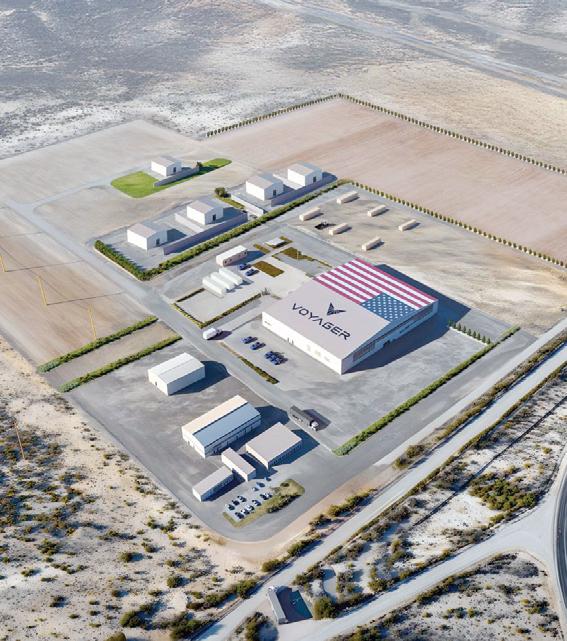
Voyager Technologies announced on Jan. 29, 2026, that it broke ground on a major expansion of the Voyager American Defense Complex near Pueblo, Colo., advancing the Pentagon’s call for industry to accelerate domestic missile defense and tactical munitions orders.
Construction is being led by H.E. Whitlock, a Pueblo-based contractor founded in 1892, and will support more than 75 employees of local trades and subcontractors. Parts of the complex are expected to be operational by year’s end.
The Voyager American Defense Complex will be 150,000 sq. ft. for advanced manufacturing, operations and testing on PuebloPlex’s 16,000 acres and more than 1,000 Earth-covered magazines.
The site was formerly the Army Pueblo Chemical Depot, according to gazette.com. It was the home of manufacturing for guidance and control systems for Pershing missiles in the 1970s and 1980s, then was a storage area for mustard gas rounds.
It is designed to support high-volume production of weapon systems-enabling components, propulsion systems and assembled energetic grains used across the U.S. military, as well as Voyager’s proprietary controllable propulsion technologies. It also can house critical chemical and black powder development, which received more than $39 million in federal funding to reonshore these resources to the United States.
“The groundbreaking of the Voyager American Defense Complex proves that Colorado is building an
epicenter for defense,” said U.S. Rep. Jeff Crank. “Voyager’s investment in our state will help defense readiness capabilities, bring advanced manufacturing and establish long-term growth in Colorado’s aerospace industry. Thank you to Voyager for their partnership with Colorado, and I look forward to seeing all the work they accomplish.”
In 2013, Pueblo Army Depot was declared surplus federal property. It is managed by PuebloPlex, formerly Pueblo Depot Activity Development Authority, to redevelop the property, support job creation and enhance the tax base.
“We are building the capacity the Pentagon is counting on to achieve President Trump’s peace through strength mandate,” said Matt Kuta, co-founder and president, Voyager. “As global threats increase and the Department of War accelerates missile-defense and tactical-munitions orders, Voyager is expanding the U.S. industrial base with the capacity, scale and speed needed to meet national-security demand.”
The company said the complex will deepen the integration of design for manufacturing, assembly and test, uniting design telemetry with AI-enabled supply chain management to cut lead times and accelerate delivery. With advanced robotics and highly automated manufacturing, capabilities uncommon in energetics, Voyager will accelerate clean-sheet design through live testing with up to 90 percent greater efficiency, enabling high-rate, safer and more scalable output, according to Voyager Technologies.
KPPC Advanced Chemicals Inc., a member of the Kanto Group, broke ground on Dec. 19, 2025, on its new U.S. Arizona Plant (UAP), an ultrapure chemical manufacturing campus at the Sonoran Valley Industrial Park in Casa Grande, Ariz.
Sundt is the project’s contractor.
The company said the investment marks a major step forward in strengthening the United States semiconductor supply chain and expanding domestic production of ultra-high-purity chemicals required for leading-edge chip manufacturing.
“This investment strengthens Arizona’s rapidly expanding, world-class semiconductor ecosystem by bringing the essential manufacturing of ultrapure chemicals to the heart of where they are needed,” Gov. Katie Hobbs said. “Best of all, it will create approximately 200 high-quality, full-time jobs for Arizonans and collaborate with our community colleges to prepare our workforce for advanced roles. Projects like
this one are key to building a resilient, localized materials network right here in Arizona.”
“The Arizona plant marks an important milestone in KANTOPPC’s global expansion,” said Jerry Lu, chairman and CEO of Kanto-PPC. By establishing this site, we strengthen our ability to serve customers across North America with the quality, reliability and speed demanded by the world’s most advanced semiconductor manufacturers.”
With an initial Phase 1 investment of more than $120 million, the UAP facility will produce ultrapure chemicals and proprietary functional chemicals used throughout semiconductor fabrication, wafer cleaning, etching, CMP, photolithography and advanced packaging.
Production is anticipated to begin in late 2027.
KPPC expects the Casa Grande site to grow into a full semiconductor chemical campus, with total investment projected to reach approximately $500 million by
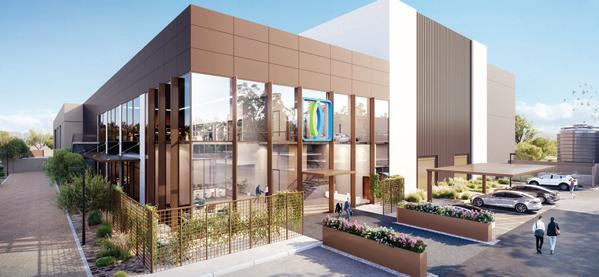
The Casa Grande facility is engineered to meet or exceed international safety, reliability and quality standards, supporting the uptime and purity required for the most advanced semiconductor nodes.
The project underscores KPPC’s confidence in Arizona’s rapidly expanding semiconductor ecosystem, supported by local leaders, workforce partners and state and regional economic development organizations.
2035.
Upon startup, the UAP facility will supply TSMC, Intel, Micron and other chipmakers across the United States with high-purity materials required for the next generation of logic and memory technologies.
The project reflects KPPC’s strategy of co-locating manufacturing capacity near critical customer fabs to reduce logistical risk, enable rapid response and create resilient, localized supply chain
infrastructure required for U.S. semiconductor competitiveness.
The United States has emphasized the importance of robust, domestic semiconductor ecosystems, including materials, equipment and supporting infrastructure. KPPC’s decision to build in Arizona aligns with national priorities related to manufacturing reshoring, enhancing the U.S. supply chain and empowering “Made in America” high-tech production.
Phase 1 of the project will create approximately 80 highly skilled jobs, growing to 200 full-time positions at full build-out. The construction phase also will generate hundreds of contractor and supplier opportunities across Pinal County and Greater Phoenix.
KPPC plans to partner with regional workforce programs, community colleges and technical institutes to support long-term talent development in chemical operations, laboratory analysis, maintenance engineering and semiconductor manufacturing support.













y ackast-tr can f tions and t solu our See how productivity technology our







most of our night work will be our traffic switches.”
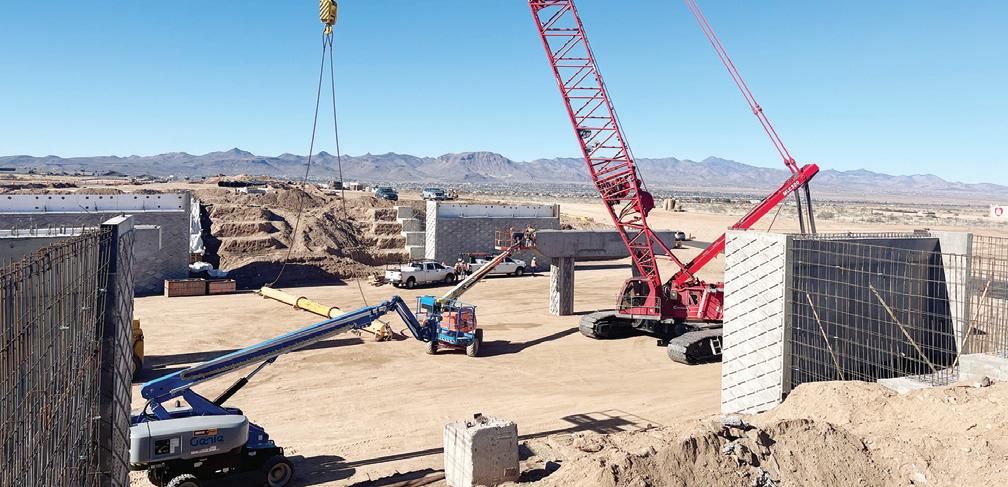
The new interchange will feature two new bridges on I-40 — 147 ft. long with two lanes — and the widening of the existing bridges over Rattlesnake Wash to accommodate the new ramp center lines.
This work is being done in three phases.
Phase 1 involves widening the bridges, extending all existing box culverts and permanent portions of the ramps and constructing the westbound and eastbound detours. Each bridge has a pier in the middle and 10 girders. The bridges have rustication on it that is made to resemble rattlesnake skin.
Phase 2 will switch traffic onto the westbound and eastbound detours, construct the new I-40 bridges and finish the new box culverts and drainage across the I-40.
Phase 3 will finish the on- and off-ramps and construct the Flying Fortress Parkway under the I-40 bridges.
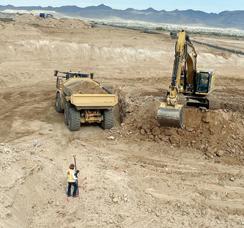
Pulice used a Cat 349 excavator and Cat 745 rock trucks for most of the roadway and drainage excavation.
“We had minimal demolition on this job,” said Johnson, “primarily consisting of the box culverts and RSW. Our site prep consisted of a ton of clearing and grubbing. Many flat tires came from the wild cholla cacti that are native to this part of Arizona. We will seed any areas that we disturbed that are not part of the construction at the end of our job.”
Equipment operators are using Cat 325, 336 and 349 excavators, Cat 966 loaders, John Deere 710 backhoes, Cat 140 motor graders, Genie 60 ft. articulating manlifts, a 90ton crane, Cat 613 scrapers and Cat 745 rock trucks, among other pieces of iron.
Construction of the two four-lane streets, whose ultimate length is tied into future expansion, is progressing.
“We excavated our roadway using a Cat 349 and Cat 745 rock trucks,” Johnson said. “We prepped our subgrade using a 140 motor grader and a 613 scraper. We then poured curbs, ADA ramps, sidewalks and catch basins. We then lowered all of our manholes and valves.
“Then we prepped our AB finish grade using a 140 motor grader and a 613 scraper. Then we will asphalt pave. Where we are doing our concrete paving, the roadway comes before the catch basins, curb, sidewalls and ADA ramps.”
Flying Fortress is a four-lane road with 12-ft. and 14-ft. lanes, and a 6.5-ft. bike lane shoulder.
The installation of the drainage and underground infrastructure is based on the job’s phasing.
“Everything flows from south to north, and the large culverts span the width of I-40,” Johnson said. “All of this work is complete except for the storm drain under the Rancho Santa Fe Parkway bridges.
Busy days have 45-60 Pulice and subcontractor personnel on site, Johnson said.
Many subcontractors are working on the project.
They include Qualil Construction, Howe Precast
Concrete Barriers, Construction Arizona, A Core Concrete Cutting, Professional Police Services, Western Technologies, Mohave Engineering Associates, Ammex Rebar Placers, Vulcan Fence, Precision Sweeping Services, Keller North America, Roadway Electric, Hoque & Associates, Paveco, PAP Construction, Arizona Super Trucking, WSP, Desert States Contracting and JSC Trucking.
Other subcontractors include Bedrock Landscape Products, Brundage-Bone Concrete Pumping, Apache Construction Co., Gallagher Reclamation, Franklin Striping, Encon Arizona, Hot AZ Helle Welding and Fabrication, DD Wheeler, Big Bob’s Transport, EPC Transport, DLM Excavation & Construction, Iinad Trucking, Auza Contracting, Quality Testing, Signature Trucking & Transport, Ochoa Hauling, Consor North America and Bragg Investments Co.
Excavation operations generated 465,887 cu. yds. of material, along with 46,428 cu. yds. of embankment. Pulice has assembled a large fleet for the project, as well as others in the Southwest region.
“[We’re experiencing] normal wear and tear, tires, hydraulic lines, etc.,” Johnson said. “Empire CAT has been amazing about getting out here the same day to fix our large equipment.” Gavin Hazen is serving as Pulice’s onsite mechanic.
Asked about the project’s maintenance keys, Johnson said: “We refresh our own traffic control every week; this ensures the safety of our crew and the public.” CEG
(All photos courtesy of Pulice Construction.)