97
Crescent City
395 139
5
101 299 89
Burney Eureka 299 Rio Dell
CALIFORNIA STATE SUPPLEMENT
395
299 44
44 36
101
89
Leggett
99
395
70
Chico
Oroville
5
49
Fort Bragg Point Arena 20 1
89
80 Tahoe City Auburn 50 South Lake Sacramento Tahoe
65
101
70 5
Santa Rosa
505 80
99
395 49
680
San Francisco
Sonora
Berkley 580 Oakland 280
120 120
120
6
Modesto
880
San Jose
140
99
41
5
101 1
395 152
Madera
Santa Cruz Montery
Fresno
33
180
190
198 1
October 24 2009
Death Valley Junction
King City Lucia
198
65
101 127 46
178 15
14
San Luis 33 Obispo Santa Maria
Bakersfield
Baker
395
58
5
Barstow
101
Vol. IV • No. 22
40
15
1
14
Santa Barbara
Ventura
95
Glendale San Bernadino Los Angeles Riverside Santa Monica Santa Ana 10 Palm Springs Long Beach 1
“The Nation’s Best Read Construction Newspaper… Founded in 1957.”
101
10
5
15
86
Oceanside
Your California Connection – Frank Strazzulla – 1-877-7CEGLTD – fstrazzulla@cegltd.com
San Diego 8
Caltrans Upgrades $39.2M Manzanar/Independence By Erik Pisor CEG CORRESPONDENT
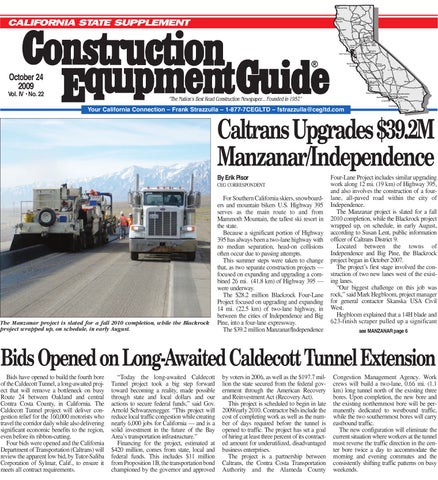
The Manzanar project is slated for a fall 2010 completion, while the Blackrock project wrapped up, on schedule, in early August.
For Southern California skiers, snowboarders and mountain bikers U.S. Highway 395 serves as the main route to and from Mammoth Mountain, the tallest ski resort in the state. Because a significant portion of Highway 395 has always been a two-lane highway with no median separation, head-on collisions often occur due to passing attempts. This summer steps were taken to change that, as two separate construction projects — focused on expanding and upgrading a combined 26 mi. (41.8 km) of Highway 395 — were underway. The $28.2 million Blackrock Four-Lane Project focused on upgrading and expanding 14 mi. (22.5 km) of two-lane highway, in between the cities of Independence and Big Pine, into a four-lane expressway. The $39.2 million Manzanar/Independence
Four-Lane Project includes similar upgrading work along 12 mi. (19 km) of Highway 395, and also involves the construction of a fourlane, all-paved road within the city of Independence. The Manzanar project is slated for a fall 2010 completion, while the Blackrock project wrapped up, on schedule, in early August, according to Susan Lent, public information officer of Caltrans District 9. Located between the towns of Independence and Big Pine, the Blackrock project began in October 2007. The project’s first stage involved the construction of two new lanes west of the existing lanes. “Our biggest challenge on this job was rock,” said Mark Hegbloom, project manager for general contactor Skanska USA Civil West. Hegbloom explained that a 14H blade and 623-finish scraper pulled up a significant see MANZANAR page 6
Bids Opened on Long-Awaited Caldecott Tunnel Extension Bids have opened to build the fourth bore of the Caldecott Tunnel, a long-awaited project that will remove a bottleneck on busy Route 24 between Oakland and central Contra Costa County, in California. The Caldecott Tunnel project will deliver congestion relief for the 160,000 motorists who travel the corridor daily while also delivering significant economic benefits to the region, even before its ribbon-cutting. Four bids were opened and the California Department of Transportation (Caltrans) will review the apparent low bid, by Tutor-Saliba Corporation of Sylmar, Calif., to ensure it meets all contract requirements.
“Today the long-awaited Caldecott Tunnel project took a big step forward toward becoming a reality, made possible through state and local dollars and our actions to secure federal funds,” said Gov. Arnold Schwarzenegger. “This project will reduce local traffic congestion while creating nearly 6,000 jobs for California — and is a solid investment in the future of the Bay Area’s transportation infrastructure.” Financing for the project, estimated at $420 million, comes from state, local and federal funds. This includes $11 million from Proposition 1B, the transportation bond championed by the governor and approved
by voters in 2006, as well as the $197.7 million the state secured from the federal government through the American Recovery and Reinvestment Act (Recovery Act). This project is scheduled to begin in late 2009/early 2010. Contractor bids include the cost of completing work as well as the number of days required before the tunnel is opened to traffic. The project has set a goal of hiring at least three percent of its contracted amount for underutilized, disadvantaged business enterprises. The project is a partnership between Caltrans, the Contra Costa Transportation Authority and the Alameda County
Congestion Management Agency. Work crews will build a two-lane, 0.66 mi. (1.1 km) long tunnel north of the existing three bores. Upon completion, the new bore and the existing northernmost bore will be permanently dedicated to westbound traffic, while the two southernmost bores will carry eastbound traffic. The new configuration will eliminate the current situation where workers at the tunnel must reverse the traffic direction in the center bore twice a day to accommodate the morning and evening commutes and the consistently shifting traffic patterns on busy weekends.
Page 2 • October 24, 2009 • www.constructionequipmentguide.com • California State Supplement • Construction Equipment Guide
We can do it, and we will. In challenging times, many equipment dealers as well as contractors are forced to close their doors. That’s not the case with Johnson Machinery, and we hope it’s not the case with you. We have been serving the Inland Empire since 1940, offering businesses like yours solutions to the challenges you face every day. Partnering with Johnson Machinery is the key to protecting your value. We offer the industry’s most knowledgeable service technicians, immediate parts availability, and maintenance programs that enable you to extend the life and increase the profitability of your machines. Not a Cat? Not a problem. We will work on any type of construction equipment. We want to help you through these tough times. Contact us today to find out what we can do to help you - we have special offers tailored to fit your business needs and are prepared to make you an offer you can’t refuse. Just ask us.
Construction Equipment Guide • California State Supplement • www.constructionequipmentguide.com • October 24, 2009 • Page 3
Caltrans to Distribute $34 Million in Federal Stimulus, Recovery Act Rural Transit Grants Proposition 1B, to Gov. Arnold Schwarzenegger announced that the state has been federally awarded $34 million in transit grants from the American Recovery and Reinvestment Act of 2009 (Recovery Act). Federally designated to promote and enhance public transportation in rural areas, these grants will be distributed by the California Department of Transportation (Caltrans) to 77 rural transit agencies representing California’s cities, counties and regions for 141 projects throughout the state. “My Administration is working around the clock to pump President Obama’s federal stimulus funding into California quickly and responsibly to help drive our economy down the road to recovery,” said Schwarzenegger. “This funding also is an investment in the future of California’s G o v. rural transportation infrastructure — and will help provide safe, reliable and efficient public transportation options throughout our state.” The federally designated purpose of these transit funds is to promote and enhance public transportation in rural areas through capital infrastructure investments and to stimulate local economies. The funds will enable rural transit agencies to construct bus station terminals, improve bus fare collection systems, and upgrade safety and surveillance security
equipment and purchase over 125 new vehicles. Money also will be used to rehabilitate and renovate buses, shelters and maintenance facilities across the state. Rural transit agencies submitted grant applications to Caltrans, which approved a final list of projects for submission to the Federal Transit Administration (FTA) for authorization. California leads the nation having more than $2 billion in Recovery Act funding federally obligated to 675 highway and local street transportation projects statewide. Of these, 222 projects worth nearly $1.39 billion have already been awarded. California was the first state in the nation to obligate $1 billion of Recovery Act funding — doing so two months ahead A rn o l d S c h w a rz e n e g g e r of the federal June 30, 2009, California deadline. California has $2.6 billion available from the Recovery Act for highways and local streets and $1 billion available for transit projects. Competitive programs within the Recovery Act could provide approximately $300 million in additional funding. California also expects to be very competitive in securing a portion of $8 billion Recovery Act funding federally designated for high-speed and intercity passenger rail.
“This funding also is an investment in the future of California’s rural transportation infrastructure — and will help provide safe, reliable and efficient public transportation options throughout our state.”
Widen Interstate 215
Gov. Arnold Schwarzenegger Sept. 14 announced the start of the next two phases of the Interstate 215 Widening Project through downtown San Bernardino. Funding for these phases includes $128 million from the American Recovery and Reinvestment Act (Recovery Act) and $81 million from Proposition 1B, the 2006 voter-approved transportation bond. “Californians are seeing federal stimulus and bond dollars being put to good use,” said Schwarzenegger. “Recovery Act dollars are not only improving our highways, they are creating jobs and driving our state up the road to economic recovery.” Part of a larger $800 million, four-phase project that spans 7.5-mi. (12 km) along heavily traveled I-215, the $429 million phase 3 and 4 will continue widening the highway from Rialto Avenue to University Parkway, improve access to the east and west sides of the city of San Bernardino with 17 new bridges, and add direct connectors to State Route 210. This project is a collaborative effort between the California Department of Transportation (Caltrans), San Bernardino Associated Governments and the city of San Bernardino. “This project is a great example of collaboration between the state, regional agencies and local governments,” said Caltrans Director Randy Iwasaki. “It will stimulate the local economy and will reduce congestion for generations of motorists in the Inland Empire.” Construction on Phase 1, which rebuilt the Fifth Street Bridge, began in February 2007 and was completed in February 2008. Construction on Phase 2 began in December 2007 and is scheduled to be completed in mid-2010. Construction on Phase 3 and 4 is scheduled to begin in October 2009 and be completed in summer 2013.
AGCRecognizes CalState Chico University for Service, Skills By Pam Gray SPECIAL TO CEG
Cal State Chico University is home to the nation’s third-best collegiate construction association this year according to an analysis of award applications conducted by the Associated General Contractors of America. As a result, the student group will receive one of the association’s Outstanding Student Chapter awards, while colleagues at Boise State and Kansas State Universities will be awarded for first and second place, respectively. “AGC is proud that students at Cal State Chico University construction group were recognized for supporting their community in its time of need. The team effort demonstrated their construction abilities and their commitment to the area in which they live,” said Tom Holsman, chief executive officer
of Associated General Contractors of California. “The mix of construction skills, management expertise and project savvy these groups possess is on a par with some of the nation’s top construction firms,” said J. Doug Pruitt, the association’s president and chairman and CEO of Tempe, Arizona-based Sundt Construction. “Looking at these students’ work, it’s easy to feel optimistic about the industry’s future.” Cal State Chico University’s Student Chapter was named the nation’s thirdbest student construction group for its work supporting fire-ravaged Concow, California. Students oversaw the construction of climate controlled storage buildings for residents’ belongings while repairs were made to fire-damaged houses. The students were able to support the construction
of 12 storage buildings. The association will provide the chapter with $400. Boise State University was again selected as the top student group largely for their
Management operations. Kansas State University’s Student Chapter of the Associated General Contractors was selected as the second-best student group due to their work helping build a memorial in Chapman, Kansas, dedicated to the local victims of a tornado that struck the town in June, 2008. The group brought together over 40 volunteers to invest over 750 man-hours building the memorial park and will receive $750 from the association. A panel of seven judges representing J . D o u g P ru i t t a cross-section of the construction industry evaluated the applications for Sundt Construction this year’s Student Chapter Awards contest. School groups were rated based on work overseeing a complex project to relo- their accomplishments during the 2008cate one of the oldest Abraham Lincoln stat- 2009 school year. There are approximately ues west of the Mississippi will receive 200 University-level student construction $1,500 to help finance their Construction groups nationwide.
“Looking at these students’ work, it’s easy to feel optimistic about the industry’s future.”
Page 4 • October 24, 2009 • www.constructionequipmentguide.com • California State Supplement • Construction Equipment Guide
H U S K I E
H Y D R A U L I C
H A M M E R
y a S e W n Whe . . . ” r e v e r “Fo
r! e v e r o F n a We M e Protected By Lifetime Warranty * Profits get hammered two ways. First, when your breaker falls apart, you’re not working. Second, some parts are so expensive that it’s better to cut into your bottom line and buy a new hammer to get a fresh warranty. That’s the way it is with most hammers and their warranties. But, Huskie is really different. If you own a Huskie Hydraulic Hammer, you are covered front cap to back cap by Huskie’s industry-leading LIFETIME Limited Warranty*. • LIFETIME Coverage for Front Cap, Back Cap and Main Body • THREE YEAR Protection for All Components except • TWO YEAR Warranty for All Seals • UNLIMITED HOURS of Use Forever is a long time. But, if you own a Huskie Hammer, that’s how long you can expect to run it 24/7 and still be covered by the revolutionary Huskie Lifetime Warranty. Ask your dealer for a demo.
6188 Paramount Blvd. Long Beach, CA 90805 Phone: 562-272-7400 Fax: 562-272-7444 12435 Foothill Blvd. Sylmar, CA 91342 Phone: 818-890-3353 Fax: 818-890-5013
3216 Westminster Santa Ana, CA 92703 Phone: 714-265-5500 Fax: 714-265-5505
1930 E. Lockwood St. Oxnard, CA 93036 Phone: 805-485-2106 Fax: 805-485-7963
1950 Roemer Place Santa Maria, CA 93454 Phone: 805-922-8329 Fax: 805-922-4582
888 East Ave. L-4 Lancaster, CA 93535 Phone: 661-948-9993 Fax: 661-723-5613
4252 Saco Road Bakersfield, CA 93308 Phone: 661-399-3600 Fax: 661-399-8782
*Limited warranty. Normal wear items are not covered. See warranty statement for details and exceptions. Effective on all Huskie Hydraulic Hammers purchased after July 1, 2005. The Huskie logo and Huskie Hydraulic Hammer are registered trademarks of IPC Industries, Inc. © 2008 IPC-Huskie Hydraulic Hammer
CTC Targets $139M to Upgrade Calif.’s Transportation Systems The California Transportation Commission (CTC) allocated $139 million to improve the state’s transportation system and provide further support for the state’s economy. The allocations include $2 million in funding from the American Recovery and Reinvestment Act of 2009 (Recovery Act). The remaining $137 million in allocations came from assorted transportation accounts funded by state and federal dollars. “From one end of the state to the other, transportation projects are providing good paying jobs and improving mobility for people and businesses in California,” said Caltrans Director Randy Iwasaki. “Our focus has been and continues to be ensuring that California gets the maximum benefit from the stimulus funding.” More than 140 stimulus transportation projects worth $1.1 billion have been awarded contracts to begin work, and many more projects are in the pipeline — $724 million in federal stimulus funds are projected to be awarded by November. Among the 44 projects that received funding allocations today were: • Riverside County — $11.2 million to
repair and resurface 9 mi. (14.5 km) of heavily used State Route 91 between McKinley Street in Corona and the Orange/Riverside County line. This project will improve ride quality and safety for more than 200,000 motorists who commute daily on this section of highway. • Bay Area — $10 million to the Novato Narrows Project, which is widening 8 mi. (13 km) of Highway 101 to six lanes between Novato in Marin County and Petaluma in Sonoma County. • Los Angeles — $4.4 million to construct and install devices to remove metal pollutants and trash from storm water runoff on 8 mi. of State Route 60 from Monterey Park to the City of Industry. In addition, $61 million was allocated to Caltrans to cover operating costs for its three intercity passenger rail lines. The Pacific Surfliner, the Capitol Corridor and the San Joaquin are the second, fourth, and sixth busiest intercity passenger rail services in the nation. Collectively, more than five million persons rode these trains in fiscal year 200809.
Vermeer Pacific’s San Marcos Location Merges With RDO The Vermeer Pacific — San Marcos store, and all San Marcos team members, merged with the John Deere Construction business at the RDO Equipment Co. — Poway location — effective Sept. 21, 2009. “We, at the Poway location, are really excited about Vermeer joining our team here, for several reasons. First of all, in this very challenging market, it makes sense to consolidate some of our fixed expenses and this should have a positive effect on our respective bottom lines. Secondly, since both operations have experienced necessary reductions in people, this adds some volatility when spikes in our business do occur. With our joining forces, and some cross training,
this should relieve some vulnerability to these spikes. And thirdly, it gives both teams an opportunity to grow professionally by learning about another important shareholder, whether it be John Deere or Vermeer,” said Gary Young, Poway general manager. Merging the Vermeer Pacific — San Marcos location into the Poway store will allow access to larger facilities, more team member support throughout every department, gained efficiencies in processes, and additional support and increased level of service for customers. “This is win-win situation for all of us,” added Young.
Hawthorne CAT, EGCASponsor Scholarship Program With Trees Hawthorne CAT and the EGCA are sponsoring the EGCA Scholarship Program with a Christmas tree sale. The EGCA Scholarship Program was established in
2003 to create and ensure qualified local talent and future leaders in the construction industry. Fifty percent of the purchase price goes toward the
EGCA Scholarship Program. Orders must be placed by Oct. 31. For more information, call 619/692-0760.
Construction Equipment Guide • California State Supplement • www.constructionequipmentguide.com • October 24, 2009 • Page 5
From humble beginnings in 1945, JCB has grown to become one of the largest equipment manufacturers in the world and still remains family owned. Not only do we produce the world’s best selling backhoe loaders and telescopic handlers, we also offer complete equipment solutions from skid steer loaders to mass excavators and everything in between. Discover how JCB and your local JCB dealer are committed to Helping You Get the Job Done!® CONTACT YOUR LOCAL JCB DEALER TODAY TO FIND OUT ABOUT CURRENT OFFERS.
Kern Machinery 310 High St. Delano, CA 93215 661-725-3841 Fax: 661-725-0377
520 S. Mt. Vernon Ave. Bakersfield, CA 93307 661-833-9900
24526 Lerdo Highway Buttonwillow, CA 93206 661-746-6363 www.kernmachinery.com
Muniquip 3000 W. Capitol Ave. West Sacramento, CA 95691 866-417-4302 Fax: 916-375-2048 www.muniquip.com
For more information about the full range of JCB Construction Equipment and to find the dealer nearest you, please visit www.jcb.com
Page 6 • October 24, 2009 • www.constructionequipmentguide.com • California State Supplement • Construction Equipment Guide
The $28.2 million Blackrock Four-Lane Project focused on upgrading and expanding 14 mi. (22.5 km) of two-lane highway, in between the cities of Independence and Big Pine, into a four-lane expressway.
Caltrans Taps Granite Construction for Four-Lane Job MANZANAR from page 1
amount of rock while trying to make grade. As a result, the subgrade area could not be plated, as the project required the export of rock. “The nearest material site was approximately 50 miles away,” Lent said, explaining that in order to reduce project costs, Caltrans and the Bureau of Land Management worked together to make a nearby material site, for exporting and importing, available for Skanska. During new lane construction, rock cuts were pre-ripped with a single shank D10T, and Cat 365 excavators and Cat 740 rock trucks were used to move the larger, bonier excavation material. Additionally, 657 scrapers were utilized to move the closer, less bony excavation. “We were able to eliminate some blasting on the job by using the D10T dozer, with a single shank ripper, to get through some of our rock cuts,” Hegbloom said, adding that
anywhere from 15 to 100 workers were onsite each day. Paving operations were performed with a Skanska-owned Cedar Rapids paver and Cat CB634 rollers. Aside from rock, another project challenge involved weather, specifically wind. Because of the often strong, high desert wind gusts, one 4,000-gal. (15,142 L) water truck was utilized nearly full-time for dust control. Following new lane construction, both northbound and southbound traffic was placed on the new lanes so Skanska, who was the lowest qualified bidder on the project, could reconstruct the existing lanes and perform some AC grind/overlay work. Once all upgrade construction was complete, southbound traffic was transitioned onto the reconstructed lanes and northbound traffic began using the two new lanes. In total, 405,000 cu. yds. (310,000 cu m)
of roadway excavation, 44,470 cu. yds. (34,000 cu m) of Class 2 aggregate base, 148,800 tons (135,000 t) of asphalt, and 20,940 tons (19,000 t) of rubberized asphalt was used on the project. Hegbloom mentioned that various sized reinforced concrete pipe and corrugated steel pipe also was used throughout the project for drainage improvement. Nearly all pipe was installed with a Cat 330 excavator. Subcontractors on the Blackrock project included: J&M Landscaping, Sudhakar Intl., Crown Fence Co., Pavement Recycling, Statewide Safety & Signs, BJ Reese Enterprises and G & J Heavy Haul. Manzanar/Independence Four-Lane Project As of July 2008, Granite Construction had been working on the Manzanar/Independence project, which is similar to the Blackrock project in that it
involves expanding and upgrading 12 mi. of Highway 395. However, the Manzanar project also involves the construction of a four-lane, allpaved road within the city of Independence, which has a population of nearly 600. Construction operations within the town have resulted in the discovery of numerous underground storage tanks, which belonged to gas stations that were in business during the early 1900s, Lent said. The discovery of storage tanks caused a delay in construction, as hazardous waste remediation and removal had to be conducted by contractors who initially would not have worked on the project. Basement access to an 1880s building also was discovered when a sidewalk was removed for replacement. Expanding sidewalks, constructing shoulsee MANZANAR page 8
Construction Equipment Guide • California State Supplement • www.constructionequipmentguide.com • October 24, 2009 • Page 7
Quality Used Power... Ready to Ship. Sold Worldwide.
0OWER 0LANTS s 81 S s ,OADBANKS s 0ORTABLE 0OWER s HZ HZ %NGINES #ATERPILLAR s $ETROIT $IESEL s #RESTCHIC s #UMMINS s 7AUKESHA
Email us for a complete inventory list of generator sets, individual engines and marine engines.
*OHN $UTCH
Jim Fellis
Used Equipment Sales Manager Phone: 858-974-6804 Email: jdutch@hawthornecat.com
Used Equipment Project Manager Phone: 858-974-6835 Email: jfellis@hawthornecat.com
% 7HEEL 4RACTOR 3CRAPERS 1997, CAB w/ AC, Push Pull, Good Condition, Ready to Work, 50% plus Tires SN: 5YR00239 5YR00240 5YR00248 5YR00251
&OUR AT EACH
Quality Used Equipment... Ready to Ship. Sold Worldwide.
#!4 $ 4 4RACK 4YPE $OZER 2006, 475 hrs., Tier 3, CAB w/ AC, SU Blade, Ripper
Email us for a complete inventory list of used equipment.
S/N 0KPZ01351
Ingersoll Rand (YDRAULIC #RAWLER $RILL 2005, 2554 Engine hrs, 669 Drifter Hrs, Dust Collector, Water Injection, Cummins 6CTAA 8.3 Liter Engine, 260 hp, 2 level drilling controls, Cab w/ AC. S/N 009278BA
© 2009 Caterpillar All Rights Reserved. CAT, CATERPILLAR, their respective logos, “Caterpillar Yellow” and the “POWER EDGE” trade dress, as well as corporate and product identity used herein, are trademarks of Caterpillar and may not be used without permission.
#RAIG "AKER
Jim Gilchrist
Ass’t Used Equipment Mgr. Tel: 858-674-7131 Email: cbaker@hawthornecat.com
Used Equipment Sales Rep. Tel: 858-674-7046 Email: jgilchrist@hawthornecat.com
www.hawthornecat.com
Page 8 • October 24, 2009 • www.constructionequipmentguide.com • California State Supplement • Construction Equipment Guide
Four-Lane Job Slated for 2010 Completion Date MANZANAR from page 6
ders for parking, and installing “historic” overhead lighting also are aspects of the work underway within Independence. This amount of work within a small community has been at times hectic. “Impacts to businesses and resident access continues to be a challenge,” Lent said. Outside of town, the project includes constructing a two-lane bridge over the Los Angeles Aqueduct, and new lanes. The existing two lanes will receive rehab work similar to the Blackrock project. The project is currently on schedule for a fall 2010 completion, Lent said. Both projects are part of the Highway 395/State Route 14 Corridor project, that once completed, will provide a four-lane highway from Los Angeles to Lee Vining, an area north of Mammoth near Mono Lake. The stretch of highway from Los Angeles to Lee Vining spans more than 331 mi. (530 km). Currently only two corridor projects remain, the Olancha/Cartago Four-Lane project on Highway 395 and the Freeman Gulch Four-Lane project on Route 14. (This story also can be found on Construction Equipment Guide’s Web site at www.constructionequipmentguide.com.) CEG
This summer, two separate construction projects focused on expanding and upgrading a combined 26 mi. (41.8 km) of Highway 395.
Caltrans Awards $8.7M for Grants to Improve Local Projects The California Department of Transportation (Caltrans) Sept. 23 announced the release of more than $8.7 million allocated for transportation planning grants with 68 agencies, including local governments, planning groups, community-based organizations and tribal governments. California provided $5.4 million of the funding from its State Highway Account. The remaining $3.3 million came from the Federal Highway Administration and the Federal Transit Administration. Highlights of the grants include: • The Central Interstate 80 Rail Corridor Study — $300,000 was awarded to the Metropolitan Transportation Commission and the Alameda County Congestion Management Agency to define a strategic vision and corridor management plan for the Martinez subdivision rail corridor (between
Oakland and Martinez) and along Interstate 80 in Northern California. • The Pedestrian and Bicycle Pathway Feasibility and Options Study of the East Bay — $135,000 was awarded to the city of Lafayette to evaluate the feasibility for constructing a pedestrian and bicycle path along the East Bay Municipal Utility District Aqueduct in downtown Lafayette. • The Crenshaw Corridor Transit Plan — $220,000 was awarded to the Los Angeles Department of Transportation and the Los Angeles Urban League to develop a plan for three future transit stations. The plan will focus on bicycle and pedestrian links with public transit and other means for regional transportation south of the Metro Expo Line. • The Crenshaw Transit Corridor Community Planning
Project — $226,800 was awarded to the Los Angeles County Metropolitan Transportation Authority and the Los Angeles Neighborhood Initiative to develop a comprehensive plan to promote public transit access, mobility, and the opportunity for economic revitalization in neighborhoods surrounding the proposed Crenshaw Transit Corridor West Boulevard Station. • The Florence-Firestone Community Plan — $159,528 was awarded to the Los Angeles County Department of Regional Planning for a project to improve mobility, access and safety. This will further develop the community’s goals, policies, implementation actions, and fund a land use policy map and zoning plan. • The Intermodal Transportation Center, San Diego International Airport — $300,000
was awarded to the San Diego Association of Governments to plan for a future Intermodal Transportation Center at Lindbergh Field. • The Transit-OrientedDevelopment Studies in the Laguna Niguel Gateway — $185,280 was awarded to the city of Laguna Niguel to study transitoriented residential and mixed-use development near the existing transit station in the city’s Gateway district. • The Monterey Bay Area 511 Traveler Information System Feasibility and Implementation Plan — $259,210 was awarded to the Santa Cruz County Transportation Commission and the Transportation Agency for Monterey County to develop a feasibility and implementation plan for a traveler information system in Santa Cruz and Monterey counties.
• The Miner Avenue Streetscape Plan — $250,000 was awarded to the San Joaquin Regional Rail Commission to create a plan that will restore the historic significance of Miner Avenue in Stockton. • The Non-Emergency Medical Transportation Plan for Lake County — $53,118 was awarded to the Lake County/City Area Planning Council to develop a plan to provide non-emergency medical transportation services for Lake County residents. • The Middle Klamath River Community Transportation Plan — $165,968 was awarded to the Karuk Tribe to develop a community-based transportation plan that improves mobility, access, safety; and promotes environmental justice and economic opportunities for the communities of Orleans, Somes Bar, and Happy Camp.
Construction Equipment Guide • California State Supplement • www.constructionequipmentguide.com • October 24, 2009 • Page 9
>
Think. Big. Serious productivity demands serious thinking. Many of the numerous improvements in the K-Series came from the brightest minds in the industry - loader owners and users such as yourself. Armed with fresh insights from this Customer Advocate Group, we enlarged the cab, redesigned the cooling, enhanced the hydraulics, refined the ergonomics, and offered even more options. All with the goal of increasing productivity and uptime, while lowering daily operating costs. Owners, operators, and maintenance personnel will all benefit from big ideas found in the 844K loader.
Stop in today to your local California John Deere Dealer to see why this isn't just another loader.
N o t h i n g r u n s l i k e a D e e r e .™
COASTLINE EQUIPMENT www.coastlineequipment.com 6188 Paramount Blvd. Long Beach, CA 90805 562-272-7400 • Fax: 562-272-7444 12435 Foothill Blvd. Sylmar, CA 91342 818-890-3353 • Fax: 818-890-5013 1930 E. Lockwood St. Oxnard, CA 93036 805-485-2106 • Fax: 805-485-7963
888 East Ave. L-4 Lancaster, CA 93535 661-948-9993 • Fax: 661-723-5613 3216 Westminster Santa Ana, CA 92703 714-265-5500 • Fax: 714-265-5505
RDO EQUIPMENT www.rdoequipment.com 83-300 Avenue 45 Indio, CA 92201 760-342-8900 13625 Danielson Street Poway, CA 92064 800-905-1150
1950 Roemer Place Santa Maria, CA 93454 805-922-8329 • Fax: 805-922-4582
3275 Hwy 86 Imperial, CA 92251 800-464-4331
4252 Saco Road Bakersfield, CA 93308 661-399-3600 • Fax: 661-399-8782
20 Iowa Ave Riverside, CA 92502 800-494-4863
PAPE MACHINERY www.papemachinery.com Newark 800-231-2060 • 510-790-3600 Fax: 510-790-9120 Sacramento 800-227-3399 • 916-922-7181 Fax: 916-922-4532 French Camp 800-619-6319 • 209-983-8122 Fax: 209-983-1105
Fowler 559-834-4774 Fax: 559-834-4754 Rohnert Park 800-325-9401 • 707-584-9161 Fax: 707-584-4786 Gilroy 800-848-4150 • 408-848-4150 Fax: 408-848-5163 Redding 530-241-4555 Fax: 530-241-0619
Page 10 • October 24, 2009 • www.constructionequipmentguide.com • California State Supplement • Construction Equipment Guide
Placer • Siskiyou • Shasta Butte• Marin • Solano • Sonoma • Calaveras • Tuolumne • Kern • Glenn • Nevada • Orange • San Diego • Riverside •California... Los Angeles • San Bernardino • Santa Cruz • Trinity • Stanislaus • Inyo • Imperial • Fresno • Mendocino • Santa Barbara • El Dorado • Yolo • Contra Costa • Merced • Marin • Placer • Siskiyou • Shasta Butte• Marin • Solano • Sonoma • Calaveras • Tuolumne • Kern • Glenn • Nevada • Orange • San Diego • Riverside • Los Angeles • San Bernardino • Santa Cruz • Trinity • Stanislaus • Inyo • Imperial • Fresno • Mendocino • Santa Barbara • El Dorado • Yolo • Contra Costa • Merced • Marin Placer • Siskiyou • Shasta Butte• Marin • Solano • Sonoma • Calaveras •
‘Golden State’ Highway Lettings
The California Department of Transportation received bids for transportation-related improvement projects. Following is a list of some of the projects let. County: Fresno Contract Number: 06-342514. Location: Near Fresno from 0.5 mi. east of Temperance Avenue to Quality Avenue. Project: Construct four lane expressway. Number of Working Days: 260. Contractors and Bid Amounts: • Teichert Construction, Fowler, Calif. — $27,283,086. • De Silva Gates Construction, Dublin, Calif. — $28,241,830. • Top Grade Construction Inc., Stockton, Calif. — $28,365,865. • Security Paving Co. Inc., Sun Valley, Calif. — $28,792,682. • David A. Bush Inc., Hanford, Calif. — $28,838,652. • Emmetts Excavation Inc., Clovis, Calif. — $28,893,634. • Flatiron West Inc., Benicia, Calif. — $29,233,367. • R and L Brosamer Inc., Walnut Creek, Calif. — $29,612,681. • Diablo Contractors Inc., San Ramon, Calif. — $29,753,145. • Granite Construction Co., Watsonville, Calif. — $29,822,876. • Coffman Specialties Inc., San Diego, Calif. — $31,555,000. County: Los Angeles Contract Number: 07-1X6504. Location: Near Castaic from 1 mi. south of Templin Highway undercrossing to Templin Highway undercrossing. Project: Restore roadway alignment. Number of Working Days: 850. Contractors and Bid Amounts: • Security Paving Co. Inc., Sun Valley, Calif. — $9,137,351. • Sukut Construction Inc., Van Nuys, Calif. — $9,317,095. • C.A. Rasmussen Inc., Valencia, Calif. — $9,399,899. • Chumo Construction Inc., Baldwin Park, Calif. — $9,429,807. • Griffith Co., Sante Fe Springs, Calif. — $9,842,726. • Sema Construction Inc., Lake Forest, Calif. — $9,969,283. • Granite Construction Co., Watsonville, Calif. — $10,409,000. • J. McLoughlin Engineering Co. Inc., Rancho Cucamonga, Calif. — $11,205,596. • Peterson Chase General Engineering Construction Inc., Irvine, Calif. — $12,426,870. County: San Diego Contract Number: 11-262604. Location: In San Diego, La Mesa and Lemon Grove at westbound off ramp to College Avenue.
Project: Install signal and widen ramp. Number of Working Days: 390. Contractors and Bid Amounts: • Errecas Inc., Lakeside, Calif. — $1,361,688. • Peterson Chase General Engineering Construction Inc., Irvine, Calif. — $1,382,596. • L.B. Civil Construction Inc., San Diego, Calif. — $1,422,130. • Hazard Construction Co., San Diego, Calif. — $1,456,553. • Sim J. Harris Inc., San Diego, Calif. — $1,465,000. • Daley Corp., San Diego, Calif. — $1,715,181. • Scheidel Contracting and Engineering Inc., La Mesa, Calif. — $1,934,798.
• MCM Construction Inc., North Highlands, Calif. — $2,999,999. • Beador Construction Co. Inc., Corona, Calif. — $3,009,700. • J. McLoughlin Engineering Co. Inc., Rancho Cucamonga, Calif. — $3,074,740. • Ortiz Enterprises Inc., Irvine, Calif. — $3,212,480. • Vance Corp., Rialto, Calif. — $3,224,107. • Blaisdell Construction Inc., Redding, Calif. — $3,448,710. • C.A. Rasmussen Inc., Valencia, Calif. — $3,635,570. • Granite Construction Co., Watsonville, Calif. — $4,040,404. • Metro Builders and Engineers Group LTD, Newport Beach, Calif. — $4,767,777.
County: San Bernardino Contract Number: 08-394704. Location: Near Lucerne Valley from 1.3 mi. south of south of Artic Canyon Wash to 0.8 mi. north of Marble Canyon Road. Project: Replace bridge and realign curve. Number of Working Days: 420. Contractors and Bid Amounts: • Sema Construction Inc., Lake Forest, Calif. — $2,572,029. • Riverside Construction Co. Inc., Riverside, Calif. — $2,594,363. • Skanska USA Civil West California District Inc., Riverside, Calif. — $2,686,939. • Security Paving Co. Inc., Sun Valley, Calif. — $2,870,000. • Hazard Construction Co., San Diego, Calif. — $2,919,170.
County: Monterey Contract Number: 05-0E9604. Location: Near Lucia from 0.6 mi. north of Limekiln Creek Bridge to 1.4 mi. south of Lucia. Project: Construct bridge and rock shed. Number of Working Days: 790. Contractors and Bid Amounts: • Golden State Bridge Inc., Martinez, Calif. — $29,481,768. • Diablo Contractors Inc., San Ramon, Calif. — $30,793,955. • MCM Construction Inc., North Highlands, Calif. — $32,099,643. • Disney Condon Johnson JV, Pacifica, Calif. — $32,777,022. • C.C. Myers Inc., Rancho Cordova, Calif. — $42,142,142.
Construction Equipment Guide • California State Supplement • www.constructionequipmentguide.com • October 24, 2009 • Page 11
®
S DON'T MIS THE NEXT IA CALIFORN ENT! SUPPLEM ovember 13th N : g in s lo C vember 21st o N : g in h s li b Pu
THE CALIFORNIA STATE EDITION
ately Approxim
9,00i0ed Qualif s Buyer
Introducing Construction Equipment Guide’s Newest Western Sales Manager, Frank Strazzulla. Call for Advertising or Editorial Information.
Toll Free 877-7CEGLTD 949-459-1767 • Fax: 949-203-2859 E-Mail: fstrazzulla@cegltd.com
Page 12 • October 24, 2009 • www.constructionequipmentguide.com • California State Supplement • Construction Equipment Guide