

By Chuck MacDonald CEG CORRESPONDENT
In many counties across America, the local junior college provides an important step into adulthood. This is true for San Bernardino Valley College (SBVC).
This year, the school and its 17,000 students are celebrating its 100th anniversary and SBVC has begun construction on a Student Services building that will serve as the school’s front door.
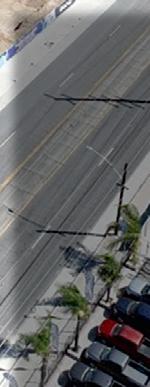
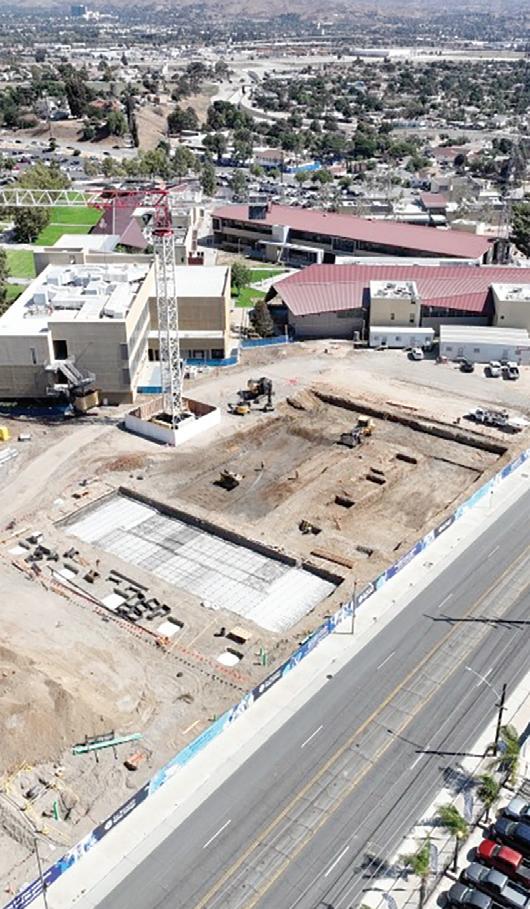
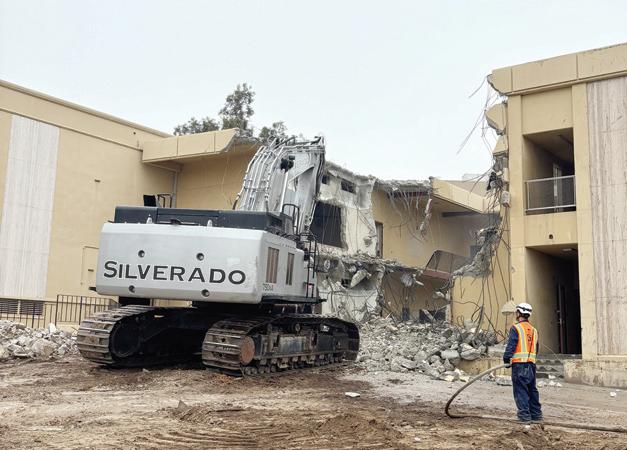
Located along busy Mt. Vernon Road in San Bernardino, the site was formerly a liberal arts building. The college hired local builders McCarthy Building Cos. to demolish the old building and build the new structure.
The new three-story building will house counseling
offices, health and wellness services, enrollment activities, tutoring and collaboration spaces and a veteran’s center.
The project’s cost is approximately $100 million.
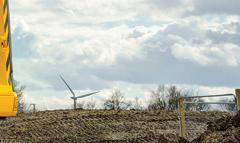
McCarthy has completed the demolition and grading of the site and laid the foundation for the new building. Of course, the building is designed in accordance with the state’s seismic requirements. The construction team is using geopiers to provide extra stability for the foundation.
This approach, also called rammed aggregate pier technology, uses rammed energy to densely compact stone and gravel to increase the strength of the surrounding soils. This process enables the soils to bear greater weight and maintain firmness.


The construction team used some 500 geopiers for the building. Planners expect to top out the concrete frame building in March, with the building ready for students by the spring of 2027.
Sarah Carr, vice president, project executive of McCarthy, is overseeing the project. She expects to have 75-100 workers on the job each day, with 50 percent of the workers hired locally.
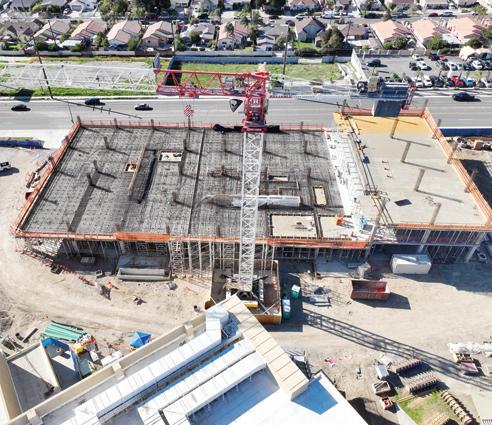
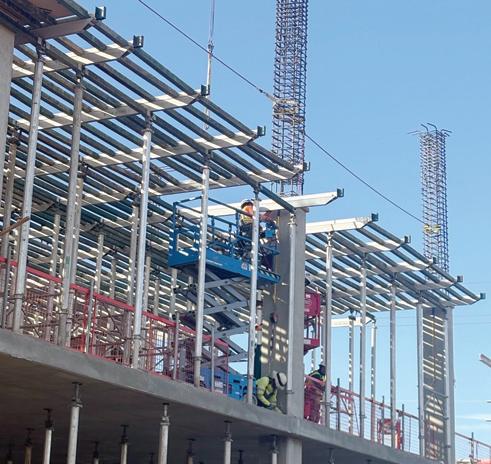
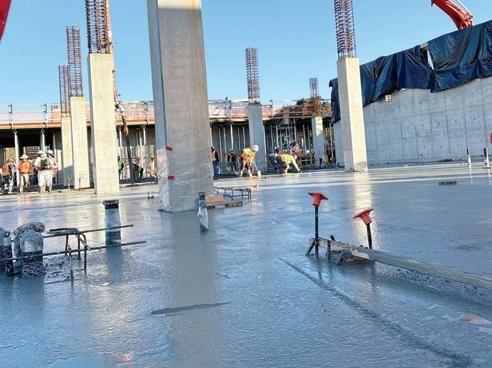
The team is pouring the second elevated deck and using a tower crane, forklifts and various other lifts to deliver construction materials to the site.
“The college is focused on sustainability, and we are targeting LEED Platinum for our environmental focus,” Carr said. “We will be installing solar panels on the roof as part of that effort.”
The exterior finish is a combination of stucco, fiber cement, vinyl/PVC, brick, metal panels and glass. A combination of polished concrete with an epoxy coating ceramic and carpet tiles will cover the interior flooring.
Safety is an important part of the planning and execution for the job.

SmithCo Mfg. Inc. and Stacy Witbeck, in a joint venture with Innovative Construction Solutions (ICS), announced on Dec. 9, 2025, that it was awarded a $63.4 million contract to relocate and construct the new LA-04 pump station supporting the Port of Long Beach (POLB) Pier B On-Dock Rail Support Facility.
This award continues the team’s longstanding partnership with the port, following the previously awarded $21.7 million Pier B Rail Yard East Expansion and the $27.5 million Locomotive Facility projects in 2024.
The pump station relocation is a key component of the first phase of the Pier B OnDock Rail Support Facility, which is a major infrastructure initiative designed to expand rail capacity, modernize freight movement, and advance the POLB’s environmental and water quality objectives.
This phase includes realigning the east end of the rail yard and constructing a new retaining wall along the 710 Freeway to accommodate the relocated flood control pump station.
The scope of work for the new pump station includes 20,000 cu. yds. of ground improvements, 72 in. to 102 in. of watertight microtunneling, a new pump station with four 250-horsepower vertical turbine
pumps, associated flow controls and a SCADA system.
Construction is anticipated to take approximately 27 months.
The relocated pump station supports expansion of the Pier B rail yard from 82 to 171 acres and enables the port’s goal of moving 35 percent of containerized cargo by rail. It aligns with the port’s fiscal 2026 capital program focused on modernizing aging water, stormwater and utility systems to
ensure reliability, resilience and continuity of operations.
This relocation supports the POLB’s broader environmental programs, including the Green Port Policy and compliance with stormwater quality standards under the NPDES permit.
This pump station construction aligns with the POLB’s FY 2026 Capital Program, which prioritizes renewal and repair of aging water, stormwater and utility systems. These
investments improve operational reliability, mitigate flood risks and ensure uninterrupted POLB operations.
“Stacy Witbeck is proud to continue supporting the POLB through projects that strengthen infrastructure, protect the environment and enhance the performance and sustainability of one of the nation’s most critical trade gateways,” said Matt Kuzmick, vice president and water market lead of Stacy Witbeck.

The U.S. Army Corps of Engineers (USACE) Los Angeles District joined Air Force officials, community partners, stakeholders and contractors on Dec. 16, 2025, to mark the start of construction on a new KC-46 Pegasus hangar and training facility at March Air Reserve Base in Riverside County, Calif.
The $133 million project will modernize maintenance and training infrastructure to support the 452nd Air Mobility Wing and longterm mission readiness.
Harper Construction will serve as the prime contractor on the project.
During the ceremony, Lt. Col. Stephen Brooks, deputy commander of the USACE Los Angeles District, said the project reflects close coordination between the Los Angeles and Louisville districts, with the Louisville District awarding the contract in support of Air Force Reserve Command.
“It’s an honor to be here today at March Air Reserve Base, as we break ground on a project of vital
importance to our nation's security and military readiness,” said Brooks, who gave a special thank you to U.S. Air Force Col. Bryan Bailey, commander of the 452nd Air Mobility Wing. “Sir, your leadership and dedication to your Airmen are the reasons we are here today, and we are proud to partner with you to deliver this critical infrastructure.”
The project includes the construction of a new two-bay aircraft maintenance and fueling hangar designed to simultaneously accommodate one KC-46A aircraft in each bay. Existing facilities within the project footprint will be demolished to make way for the new structure.
Once completed, the hangar will feature reinforced concrete foundations, a steel frame and roof system, insulated metal walls and modern utilities. The facility will include personnel support areas and dedicated storage for hazardous materials, tools, supplies and equipment.
The hangar also will be
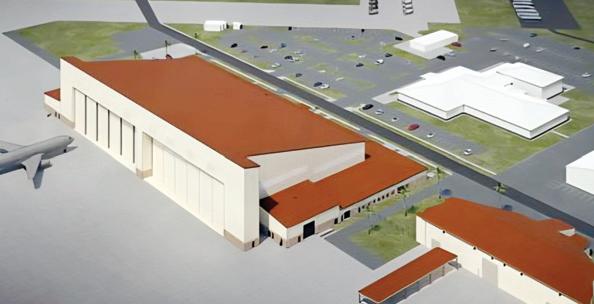
equipped with fire suppression and fall protection systems, along with environmental controls, such as floor drains connected to the sanitary sewer system and an oil-water separator. Additional work includes communications infrastructure, pavement transitions, parking areas, exterior lighting, fencing, landscaping and other associated site improvements.
In addition to the hangar, the project includes significant renova-
tions to Building 1244 to support fuselage training and cargo pallet storage operations. Planned upgrades include new classrooms, briefing rooms, office space, a breakroom, communications and maintenance areas, and restroom and shower facilities.
Building 1244 also will receive a new roof and updated heating, ventilation and air conditioning systems, along with fire suppression capabilities required for fuselage
training operations. Existing hangar doors will be sealed, two rollup doors installed, as well as improvements to traffic flow around the facility.
Construction is expected to take approximately three years. Officials said the project is part of a broader KC-46 modernization effort at March Air Reserve Base, with additional work planned in future phases.
Bailey said the new facilities will provide Airmen with modern, purpose-built spaces to train and maintain aircraft critical to the Air Force Reserve mission.
“What a historic day this is,” Bailey said. “This is the culmination of years, if not decades, of work for our community partners, and I want to say thank you for making this day happen. It didn’t happen because of anybody up here; it happened because of the relentless dedication and the advocacy to know that March Air Reserve Base has been a national power-projection platform for over a hundred years.”

Officials from Los Angeles and Ventura counties celebrated on Jan. 21, 2026, the start of construction of a $280 million project to bring additional sources of water to Southern California communities hit particularly hard by the state’s last drought.
J.F. Shea Construction is the project’s prime contractor.
The Sepulveda Feeder Pump Stations Project will allow The Metropolitan Water District of Southern California to reverse flows in its system if needed during severe California droughts, pushing water from the Colorado River and Diamond Valley Lake into communities that have limited access to these resources. These areas normally rely almost exclusively on water from the northern Sierra, delivered through the State Water Project.
During the 2020-2022 drought, when California saw its three driest years on record and State Water Project deliveries were severely curtailed, these communities in Ventura County and Los Angeles County did not have sufficient water to meet normal demands. As a result, residents and businesses were required to dramatically reduce their water use.
“Metropolitan had never before imposed such strong reductions in water use on a portion of our service area. It was an unprecedented situation sparked by the hotter temperatures and more extreme droughts we are facing as the climate changes,” Metropolitan General Manager Shivaji Deshmukh said. “When we saw the impacts of this historic drought on some portions of our service area, we committed to taking action to avoid this ever happening again.”
The Sepulveda Feeder Pump Stations Project helps fulfill
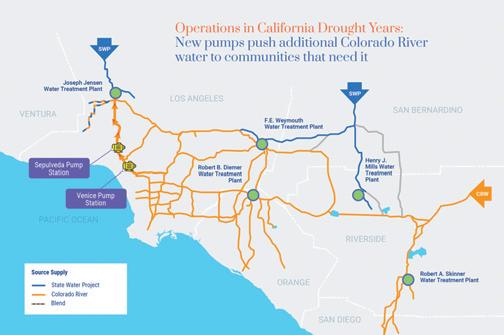
The Metropolitan Water District of Southern California graphic This graphic explains how the $280 million project will bolster water flow to drought-stricken areas.
that commitment. It consists of building two new pump stations that, when needed, can push Colorado River water and water stored in DVL, Southern California’s largest reservoir, into northern Los Angeles and southern Ventura counties, reversing normal flows in the existing Sepulveda Feeder pipeline.
When this project is complete, expected in early 2029, Metropolitan will be able to deliver up to 22,000 acre-ft. of additional water annually to the State Water Project-dependent area during severe droughts (an acre-foot is approximately 326,000 gal., enough to serve roughly three Southern California families for a year). The pump stations are being
Global construction and development firm Skanska announced on Dec. 22, 2025, that it was awarded a $107 million contract for the Mid County Parkway Ramona Expressway Project in San Jacinto by the Riverside County Transportation Commission.
Currently limited to one lane in each direction, the bid-build project will widen 8.6 mi. of the eastbound Ramona Expressway to improve safety and reduce congestion. The completed project will enhance economic opportunities in the region, lessen travel times and improve access to employment, education and multiple transportation options throughout the San Jacinto region.
“Skanska is a proud partner of the Riverside County Transportation Commission, and the Mid County Parkway Ramona Expressway Project is another infrastructure project that addresses congestion and enhances connectivity across the region,” said James Bailey, executive vice president of Skanska USA Civil’s West
Coast operations. “Safety is a large component of this project. By widening the Ramona Expressway, we are addressing a corridor with a history of severe collisions. Improvements like the added raised median and new bridge over the San Jacinto River will create a safer, more reliable route for thousands of drivers every day.”
The scope of work includes the construction of a new 2,127-ft.-long, 58-ft.-wide cast-in-place box girder bridge over the San Jacinto River and a raised median, improving safety, connectivity, mobility and access for residents and businesses in the San Jacinto area. In addition, the work will include constructing a wildlife crossing and preserving 177 acres for habitat mitigation. The project will commence in February 2026 and is expected to be completed in June 2028.
This project is funded through a combination of Measure A sales tax, local partnership contributions, Riverside County and state transportation dollars supporting safety and mobility improvements.
constructed in a manner that will allow them to be readily expanded in the future depending on water supply conditions and future board approvals.
“Under normal circumstances, our system largely relies on gravity to deliver water. But we learned during the last drought that left some communities without access to available water. Now, we will have the ability to pump more water uphill when needed,” Deshmukh said. “Simply put, this project strengthens our ability to move water where it’s needed during droughts, during emergencies, and when major infrastructure must be taken out of service for maintenance or rehabilitation.”
The Sepulveda Feeder Pump Stations project is being expedited through the use of the progressive design-build method for construction, which allows Metropolitan to use a single firm for both design and construction. It allows designers, builders and owners to work collaboratively from the very beginning and creates opportunities to deliver projects more effectively and efficiently. This is Metropolitan’s first project using the progressive design-build method since the state legislature granted the agency the authority to use such alternative methods to expedite completion of construction projects.
Metropolitan also is building four projects that together will allow additional water from Diamond Valley Lake and the Colorado River to be delivered to communities in the Inland Empire and San Gabriel Valley that also are dependent on the State Water Project and were under mandatory restrictions during the last drought. That series of projects is expected to be completed in 2027.
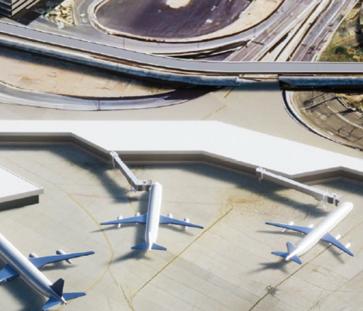
Sundt Construction announced on Jan. 28, 2026, that it was selected to construct the new Terminal 2 East Connector at the San Diego International Airport. The project will connect the new Terminal 1 with the existing Terminal 2 East.
The two-level connector project will include an employee security checkpoint, landside concessions, new airside security barriers, apron improvements and landside improvements for the traveling public at the ground level. The second level includes a secured pedestrian walkway between the terminals, two new gate hold rooms and passenger boarding bridges.
“We’re proud to continue our long-standing partnership with the Airport Authority on what is now our fifth project at the San Diego International Airport,” Sundt Project Director Brad Kirsch said. “We’re excited to lead the next phase of the airport’s transformation and create a connected terminal experience for air travelers.”
A progressive design-build project, Sundt and its design partner, HOK, have begun design development and preconstruction efforts.
Construction is anticipated to begin in
2027. The contract’s value wasn’t released. Sundt has a longstanding relationship with the airport, completing the Terminal 2 expansion in 2013, the Rental Car Center in 2017, airport support facilities in 2021 and the SAN Administration Building in 2023.








COLUSA
1960 Highway y 20
Colusa, CA 95932
DIXON
793 N First Street
Dixon CA95620
Phone: (9916) 649-00
DOS PALOS
2173 Blossom Street
Dos Palos, CA 93620
Phone: (209) 392-216
MERCED
600 S. State Highway y Merced, CA 95341
Phone: (209) 383-58






REDDING
2535 Ellis Street
Redding, C 96001
Phone: (530) 458-216
Phone: (530) 245-9000
STOCKTON
1340 W. Charter Way y
Stockton, C 95206
Phone: (209) 944-5500
STRATTFORD
20280 Main St.
Stratford, CA 93266
Phone: (559) 947-3301
TURLOCK
1215 West Glenwoo Avve
Tuurlock, C 95380-5703
Phone: (209) 634-1777






827 Nort Teehama St
Willows, CA 95988
Phone: (530) 934-3382
YUBA CITY
3056 Colusa Highway y Yuba City CA 95993
Phone: (530) 923-7675
1455 Glendale Avve. Sparks, NV 89431
Phone: (775) 358-5000







HARRISBURG
230 Sommerville Avvenue
Harrisburg, O 974446 Phone: (541) 995-2262
HILLSBORO
185 W Main St. Ext.
Hillsboro, O 97123
Phone: (503) 648-4178
MADRAS
36 NW A Street
Madras, OR 977441
Phone: (541) 475-2253















(503) 981-0151
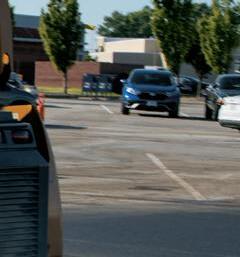
“The site is bordered by a busy street on one side and surrounded by students moving around and going to classes,” Carr said. “We have gates and fencing to keep passersby away from the work and flaggers to help control traffic. The college has placed banners around campus as well to keep students and faculty informed about the construction. Campus police are also on hand to keep the worksite safe.”
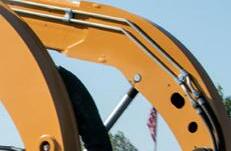
The construction team used various types of excavators for the demolition and did crushing onsite before hauling materials for recycling. Workers used bulldozers, motor graders and articulated trucks for grading and hauling. The team will be using a tower crane for the work. Concrete pumping trucks will continue their work as the building takes shape.
The company also is using drones to document the daily progress of the work and for safety and quality control.
Workers have moved 8.5 million lbs. of demolished materials, and 94 percent of it was recycled. Recycling material included 7.2 million lbs. of concrete, which was 100 percent recycled during the demolition. The team will use 10,913 cu. yds. of concrete, 1,600 tons of rebar and 150 tons of steel for the project.
“The Student Services Building is a transformative project for our campus,” said Farrah Farzaneh, executive director, facilities planning, sustainability and construction, San Bernardino Community College District. “McCarthy’s design-build approach has fostered a true partnership. Their focus on collaboration, sustainability and efficiency has allowed us to advance a facility that will serve as a modern hub for student success and equity.”
CEG
(All photos courtesy of McCarthy Building Cos.)
The California Transportation Commission (CTC) announced on Feb. 3, 2026, that it allocated nearly $1 billion to expand transit capabilities, add new highway safety features and boost the state’s continued climate action goals.
Bolstered by Governor Gavin Newsom’s Build More, Faster — For All infrastructure agenda, these improvements will make California communities safer and more climate resilient.
The $988.7 million approved includes $184 million from the federal Infrastructure Investment and Jobs Act of 2021 (IIJA) and $336 million in support from Senate Bill 1 (SB 1), the Road Repair and Accountability Act of 2017.
The investments made by these two funding sources have created an estimated 684,000 jobs, according to the CTC. It has helped Californians, businesses and visi-
tors who rely on the state’s transportation network for employment and educational opportunities, access to goods and services and connection to recreational attractions.
“Creating a brighter future in the Golden State is about addressing big challenges with meaningful investments like those made today,” California Transportation Secretary Toks Omishakin said. “This level of support funds wide-ranging transportation upgrades that provide the backbone of California’s vibrant economy by improving goods movement, expanding transit and rail systems and making our system more bikeable and walkable. These benefits will be experienced by every region, including disadvantaged communities throughout the state.”
The list of funded projects includes $96 million to improve travel times and enhance traffic safety between Ventura
County and Goleta with high-occupancy vehicle (HOV) lanes, pedestrian and bike paths and transit enhancements.
Approximately $73 million will go to improve semi-truck operations and safety on Interstate 10 in San Bernardino County, and $63 million will be used in Riverside County for a new bridge, bike lanes and wildlife crossing as part of an upgrade to the Ramona Expressway.
The commission also agreed to fund several notable transit-related projects, including $60 million to help rehabilitate Union Station in the city of Los Angeles; $17 million for 20 electric buses for the city of Glendale; and $21 million for eight new light rail vehicles for Sacramento Regional Transit
In addition, the commission allocated $18.8 million for the Wallis Annenberg Wildlife Crossing in partnership with the
California Natural Resources Agency. This crossing will provide a safe wildlife passage over U.S. 101, reducing wildlifevehicle collisions and supporting longterm species viability through improved movement. This will be the first of its kind in California and a globally significant model for wildlife connectivity in an urban corridor.
“The long-term investments allocated today will power our ongoing effort to provide the safest, most accessible transportation system possible for all users, while continuing to serve as responsible stewards of California’s environment,” Caltrans Director Dina El-Tawansy said. “From new sidewalks and bicycle lanes to bridge repairs and highway reconditioning, we are improving our transportation system for the benefit of all Californians and creating thousands of jobs in the process.”