CALIFORNIA STATE EDITION
A Supplement to:
March 15 2020 Vol. I • No. 6
“The Nation’s Best Read Construction Newspaper… Founded in 1957.” Your California Connection – Debbie Hansen – 1-702-239-0348 – dhansen@cegltd.com
S&B Construction Battles Mud Pots Near San Diego By Irwin Rapoport CEG CORRESPONDENT
The power of nature, specifically plate tectonics and seismic activity, literally forced the California Department of Transportation (Caltrans) to build a 5-mi. temporary road adjacent to state Route 111 (SR-111) and install new underground infrastructure for the two-lane highway and the Union Pacific Railroad to abandon tracks and build new ones in the Imperial Valley, east of San Diego. Due to those reasons, there was an imperative need for the Caltrans $11.7 million, SR-111 Niland Geyser Mitigation Project. A natural-occurring geyser/mud pot, in existence since 1953, is moving toward SR111 and is likely to reach the highway. “As the geyser moves west and beyond the temporary road, Caltrans will then rebuild SR-111,” said Shawn Rizzutto, Caltrans project manager. “The mud pot is releasing water, carbon dioxide and hydrogen sulfide gases in low concentrations, but does not pose a health hazard from a distance. The geyser has moved slowly in the past 11 years; however, the rate of movement has increased and the geyser has already encroached on the railroad right-ofway impacting Union Pacific tracks.” To ensure the safety of residents and those interested in seismology, access to the mud pot and public site visits have been prohibited. Project Phases Phase 1 of the project had crews from S&B Engineering Inc. build a temporary road (two lanes) and install underground
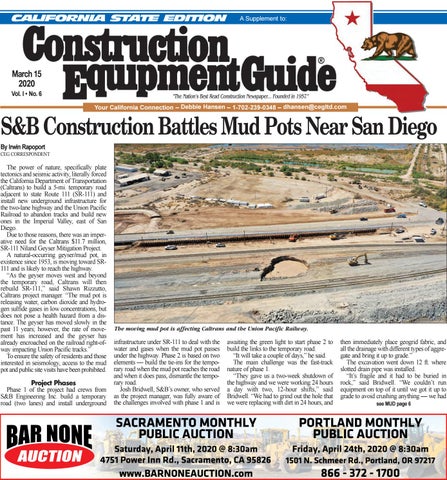
The moving mud pot is affecting Caltrans and the Union Pacific Railway.
infrastructure under SR-111 to deal with the water and gases when the mud pot passes under the highway. Phase 2 is based on two elements — build the tie-ins for the temporary road when the mud pot reaches the road and when it does pass, dismantle the temporary road. Josh Bridwell, S&B’s owner, who served as the project manager, was fully aware of the challenges involved with phase 1 and is
awaiting the green light to start phase 2 to build the links to the temporary road. “It will take a couple of days,” he said. The main challenge was the fast-track nature of phase 1. “They gave us a two-week shutdown of the highway and we were working 24 hours a day with two, 12-hour shifts,” said Bridwell. “We had to grind out the hole that we were replacing with dirt in 24 hours, and
then immediately place geogrid fabric, and all the drainage with different types of aggregate and bring it up to grade.” The excavation went down 12 ft. where slotted drain pipe was installed. “It’s fragile and it had to be buried in rock,” said Bridwell. “We couldn’t run equipment on top of it until we got it up to grade to avoid crushing anything — we had see MUD page 6
SACRA AMENTO MONTHLY PU UBLIC AUCTION
PORTLAND MO ONTHLY PUBLIC AUC CTION
Saturday, April 11th, 2020 @ 8:30am 4751 Power Inn Rd., Sacramento, CA 95826
Friday, April 24th, 20 020 @ 8:30am 1501 N. Schmeer Rd., Portland, rtland, OR 97217
www.BARNONEAUCTION.com
866 - 372 - 1700
Page 2 • March 15, 2020 • www.constructionequipmentguide.com • California State Supplement • Construction Equipment Guide
Construction Equipment Guide • California State Supplement • www.constructionequipmentguide.com • March 15, 2020 • Page 3
Page 4 • March 15, 2020 • www.constructionequipmentguide.com • California State Supplement • Construction Equipment Guide
High-Speed Rail Gets Additional $1.3 Billion in Funding By Lori Lovely CEG CORRESPONDENT
California’s bullet train soap opera continues — the project embroiled in politics, deep in debt and woefully behind schedule. Skeptics wonder if it will ever be completed, particularly since Gov. Gavin Newsom signaled in 2019 that he was scaling back the $77 billion project, dubbed “the most ambitious public works project since the transcontinental railroad opened up the West” by the Los Angeles Times. Current Status But just before Christmas 2019; however, the Sacramento Bee reported that at least 2,300 people are hard at work at more than 20 sites throughout the Valley, building bridges, viaducts and overpasses, relocating one section of Highway 99 and working on a large trench in Fresno where trains will run beneath an irrigation canal. But as the new year began, a biannual business plan update that includes an extended deadline and additional costs reignited a battle between legislators. The updated business plan aims to keep all remaining funds through 2030 focused in the Central Valley to attract a larger ridership increase and greater air quality improvements than an alternate plan to concentrate on San Francisco and Los Angeles. According to the Los Angeles Times, the new plan adds $1.3 billion to the budget, raising it to $80.3 billion — a $3 billion increase since 2018 and a $16 billion increase from 2016. The timeline also has grown from 2020 to 2033 for the overall project from San Francisco to Los Angeles, with an interim goal of 2022 for 20% completion. The original projected cost was less than $34 billion, with completion expected this year. Claims that the construction rate improved in the fourth quarter of 2019, hitting an average spending amount of $46 million a month, isn’t enough to meet the goal. The LA Times quotes Chief Financial Officer Brian Annis in stating that the spending rate needs to reach $70 million each month in order to complete the project on time. Another goal is to build 48 structures in Kings County. To date, only 12 have been started. One of the hindrances remains land acquisition. Despite that challenge, the Mercury News reports that the project is on schedule for the 2022 deadline. Under the new plan, the high-speed rail link between Silicon Valley and the Central Valley is expected to be finished in 2031. In addition to completing 119 mi., the state must have environmental clearance for all 520 mi. to meet its deadline in order to use
California High Speed Rail photo
A recent update to the California High Speed Rail now has it budgeted at a cost of $80.3 billion, a $3 billion increase from 2018.
the $3.5 billion it was awarded by the Obama administration to build the initial segment in the Central Valley. According to the LA Times, California is suing the current administration to block the withdrawal of a $929 million grant based on concern that sufficient progress isn’t being made. The plan also specifies an expansion of 171 mi. to connect Merced, Fresno and Bakersfield, testing electrified high-speed trains by 2025 and putting them into service by 2028-2029. Supporters of the plan insist that it will result in “the largest ridership and revenue increases, the most traffic congestion relief and the greatest air quality benefits” as opposed to alternative plans. California High-Speed Rail Authority Chief Executive Brian Kelly believes the plan represents California’s leadership in an environmentally and economically beneficial project. Nonetheless, currently projected available funds amount to only about a quarter of the total needed to complete the project. The final plan will be sent to state lawmakers by May, after public comments and legislative hearings. The Project The California High-Speed Rail is a publicly funded high-speed rail system intended to connect Anaheim and Los Angeles with San Francisco, traveling 380 mi. through the Central Valley in under 3 hours. Phase 2 plans include future lines to San Diego County and Sacramento. The San Franciscoto-San Jose and Los Angeles-to-Anaheim rail lines would be shared with local trains in a blended system. The bullet train would run on dedicated, grade-separated tracks from San Jose to
Burbank at speeds of up to 220 mph. The new track is slated to be built on elevated viaducts. As many as 28.4 million riders per year are expected. The California Amtrack corridor, one of the busiest in the nation, already sees 5.7 million annual riders. If the fully dedicated high-speed rail system isn’t built, to provide the same capacity from San Francisco to Los Angeles would require 4,300 new highway lane mi., 115 new airport gates and four additional airport runways, at a cost of more than $158 billion, with a 50-year maintenance cost of more than $132.8 billion. Plans Several regions are supposed to be connected, but a 2018 business plan started with opening the section between San Jose and Bakersfield in 2027. Phase One completion — 520 mi. from San Francisco to Anaheim and Los Angeles — is expected in 2033. Phase Two was scheduled to run north from the Central Valley to Sacramento and east from Los Angeles through the Inland Empire and then south to San Diego. Total system length is estimated at 800 mi. Legislation set performance standards, including a minimum speed of 200 mph, maximum travel time from San Francisco to Los Angeles of 2 hours 40 minutes, and the system must be financially self-sustaining — meaning the operation and maintenance costs must be paid for by revenue. The Authority predicts a net operating revenue of $2.23 billion by 2023. Phase 1 Sections Phase 1 of this all-electric project will connect six of the 10 largest cities in California.
• The 51-mi. San Francisco-to-San Jose section connects Silicon Valley to the rest of the state. State legislation determined the alignment and requires a blended service, with Caltrain and high-speed rail service sharing tracks. Caltrain and CHSRA are currently electrifying the corridor to enable them to share the tracks. • The San Jose-to-Merced portion will travel 84 mi. to the western limit of the Central Valley Wye, which required a separate, supplemental environmental study. Environmental clearing is expected to be complete in 2020. • The Merced-to-Fresno section is 65 mi. long and will connect the Central Valley and Silicon Valley with Fresno and Merced. • Fresno to Bakersfield is a 114-mi. section connecting the Central Valley, Silicon Valley and the Los Angeles Basin with Fresno and Bakersfield. What’s Been Done Nine companies responded to the RFP and request for bids issued by the Authority. When they finally broke ground in Fresno in 2015, they were already almost three years behind schedule. Before beginning construction on the 119-mi. section from Madera to Bakersfield, crews had to clear homes and businesses, build bridges over rivers and relocate a 2-mi. stretch of Highway 99. The 119-mi. Central Valley section is currently under construction as the CHSRA works with federal, state and local partners to improve zones at each end of the project in the Bay Area and Burbank-to-Anaheim corridors. Project development work on the Silicon Valley-to-Central Valley line continues, along with the procurement of environmental clearances needed for all Phase 1 segments. Slowing Down The LA Times reports that the project is $44 billion over budget and 13 years behind schedule. A state audit late last year cited bad decision-making, organizational faults and poor contract management as the causes. The CHSRA released a list of approved delay claims resulting from not owning the land the rail system is to be built on and more than 1,000 change orders submitted by the three construction teams that range from $126 million to $1,376.03. The total amount approved is $810 million. According to the LA Times, “Ron Tutor, chief executive of Tutor Perini, which is building the Fresno section of the rail structures, told investment analysts recently that he expects his contract will ultimately reach $2 billion, a 100-percent cost increase from its original price.” see BULLET page 10
Construction Equipment Guide • California State Supplement • www.constructionequipmentguide.com • March 15, 2020 • Page 5
TAK KE IT TO T THEE NEXT LEVEL. LEVEL *Excludes S70 Bobcat skid steers, MT55 & MT-85 mini track loaders.
Bobcat Company inventted the world's first true compact loader. And we've been improving on it ever since. The latest lineup of Bobcat® comppact track loaders is the best generatiion yet. Come and see how the best compact loader on the market outperforms thee competition.
Berchtold Equipment
Bobcat of the Bay
www.berchtold.com
www.totalequipmentandrental.com
3000 Pegasus Drive Bakersfield, CA 93308 661-323-7817 1410 W. Betteravia Rd. Santa Maria, CA 93455 805-922-7905
Bobcat of Fremont
Bobcat of Santa Rosa
43801 Osgood Rd. Fremont, CA 94539 510-897-4123
3675 Santa Rosa Ave. Santa Rosa, CA 95407 707-595-3261
Bobcat of Contra Costa 2035 E. Leland Road Pittsburg, CA 95466 925-318-4465
Bobcat®, the Bobcat logo and the colors of the Bobcat machine are registered trademarks of Boobcat Company in the United States and various other countries.
Page 6 • March 15, 2020 • www.constructionequipmentguide.com • California State Supplement • Construction Equipment Guide
Imperial Valley Construction Will Help Rebuild SR-111 MUD from page 1
to do a lot of work on the side. It was a tight work zone, especially with all the aggregate to bring in and stockpile adjacent to the Caltrans right-of-way.” S&B installed some of the conduit that AT&T needed to relocate its fiber optic line. Relations between S&B and Caltrans were excellent and issues were resolved rapidly due to the history of the work S&B has done for the DOT. “The work went according to plan,” said Bridwell. “The only issue was getting our subcontractors in once we placed the geogrid, aggregates and pipe.”
This mud pot in the Imperial Valley, one of several thousand, is unique in that it is moving, possibly due to the activities of a fault line.
A variety of heavy and specialized equipment was used on the first part of the project, which required crews to work several 24/7 days via two 12-hour shifts.
Once the subgrade was placed for the existing road, the permeable concrete was poured and covered by 6 in. of asphalt. All the material excavated from the existing highway was used to create the subgrade for the temporary road, which was also covered by 6 in. of asphalt and has a small shoulder on either side. “We put in a drainage channel and some pipe culverts,” said Bridwell. Bridwell was assisted by Danny Sokol, the onsite foreman and Ryan Spirz, the project superintendent.
“We’re good at what we do,” said Bridwell. “We specialize in Caltrans work and do quite a bit of emergency work in District 11 — we’ve worked together for years. It’s a long way to the Imperial Valley and it was a sacrifice to not see your family for a few weeks. But this was a unique project and the guys were excited to get on this one.” The crews were put up in local motels. Project Timeline Work on the project began on Aug. 2019 when construction
crews placed one-way traffic control along a 2,000-ft. segment of SR-111 at Davis and Gillespie roads, about 5 mi. northwest of Niland in Imperial County. The funding is being provided by the State Highway Operation program for emergencies. The first part of the initiative was constructed in three phases — all completed by early 2020: • Phase 1: build sheet pile walls to convey water to a gravel wash • Phase 2: construct a sub-surface drain to convey subsurface water beneath the roadway to a gravel wash on the west side of SR-111 • Phase 3: construct a detour road west of the current alignment as a contingency to re-route traffic from SR-111. “We started planning for the project about one-and-a-half years ago when we were alerted by Union Pacific that the mud pot was moving,” said Rizzutto. “We started coordinating with Union Pacific, the California Office of Emergency Services, Imperial County Emergency Services, the communities of Niland and Calipatria and other stakeholders. This road is one of two north-south corridors that we have in Imperial Valley. SR-111 acts as a major farm-to-market road for us, as well as serving Niland and Calipatria. We had a very robust public outreach program and developed a
web page for the project to communicate the progress of the work and the various stages.” The start of second stage of the project is dependent on how quickly the mud pot moves. As soon as it reaches the sheet pile wall, perpendicular for 520 ft. west from a nearby bridge, the tie-ins will be constructed and traffic switched to the temporary road. “We’re coordinating with local, state and other partners for this mitigation and are implementing this emergency project to expedite the
work,” said Cathryne BruceJohnson, public information officer, Caltrans District 11. “Caltrans will tie-in the ends of the newlybuilt roadway to the existing SR111 when the geyser water reaches the sheet pile walls located east of the highway. The temporary roadway will serve as a detour around the geyser.” The mud pot, one of several thousand in the Imperial Valley region, has been in existence for about 70 years and has moved about 100 ft. per year. In 2016 there was a swarm of seismic events and it began to move faster. There is a deep vent, over one-half mi., that is venting gases and water through a perched groundwater table. Some believe it is moving along a fault line. A seismic event could accelerate the movement or shut it off. Experts are unable to predict the speed or movement of the mud pot. Traffic counts on this section of SR-111 are based on season movement. There are no plans to widen the existing road after the mud pot crosses it. Caltrans designed the temporary road and remediation infrastructure. “Our engineers, geologists and geotechnical engineers got together and came up with a three-tiered approach that addressed construction of an emergency road, mitigatsee MUD page 14
SUBCONTRACTORS • • • • • • • •
Hayward Baker for sheet pile Pavement Recycling Systems for grinding Rove Engineering for excavation RV Concrete for permeable concrete Koch General for asphalt paving Hudson Safe-T-Lite for traffic control VSS International for microsurfacing Payco Specialties for striping
Equipment For phase 1, S&B used: Cat 330 excavators, Cat dozers (a D8 and a D6), Cat 623 paddle wheel scrapers; a Cat 140M motor grader, Cat 966 loaders and 938 wheel loaders, water trucks, and a skid steer.
Construction Equipment Guide • California State Supplement • www.constructionequipmentguide.com • March 15, 2020 • Page 7
Page 8 • March 15, 2020 • www.constructionequipmentguide.com • California State Supplement • Construction Equipment Guide
Construction Equipment Guide • California State Supplement • www.constructionequipmentguide.com • March 15, 2020 • Page 9
LIFETIME E FRAME & STRUCTUR RE WARRANTY TY
LIFETIME BOOM, FRAME A & ARM GUARANTEE E
T Ne The Nw
EC200 0 ELL
Baker kersfield Bakersfield, CA A 661 387 6090 661.387.6090 Corona Corona, CA 951.277.7620
D Designed forr Yo our Need ds
Fresno Fresno, CA 559.834.4420 Sacramento Sacramento,, CA A 916.504.2300
24 HOUR R PARTS GUARANTEE* EE**
ACTIVECARE RE DIRECT 24/7/365 MONITORING NG
2ND AND D 3RD YEAR R ADDITIONAL AL WARRANTY TY
BUY-FI SMART CREDIT
San Diego Lakeside, CA 619.441.3690 San Leandro San Leandro, CA 510.357.9131 Turlock Turlock, l k CA 209.410.6710
Rates as lo ow w as
0% for 36
FUEL EFFICIENCY CY GUARANTE EE
*
months
Th he new EC200EL is purpose-buiilt to take on your tough jobs, day in and day out. Right now, ta ake advantage of special bundle financing f and receive extended warranty w coverage for up to th hree years. Discover the power an nd performance you need combined with fuel efficiency y and a lo ow cost of ownership today at yo our local Volv Volvo Construction Equipment uipment & Services Ser location.
vcesvolvo..com
*Fiinance Guidelines/Conditions: The offering finance company for this progrram am is Volvo Volvo Financial Services (VF VFS), and the trrans ransaction is subject to to VF VFS credit approval. val. Dealer must rec ceivve e VF VFS approval val and contrract act must be funded on or before e 12-3 12-31-20 12 31 2019 for units to to qualifyy. y. Final rat ratte and tterms erms are subject bject to t credit review and underwriting by VF VFS, and all cussttomers omers may not qualifyy. VF VFS reserves the right tto o amend or canc c el this progrram am at any time without notice. Valid Valid for U.S. S. dealers and trrans ansactions. Progrram am may not be c combined with th any other offer unless explicitly permittted ed by b VF VFS. Any dea aler specific progrrams ams will supersede this offerr.. This progrram am c cannot be combined with the Conquest Excavvat ator progrram. am. ** Some restrictions applyy. For For a list of terms t and conditions, visit sit www w.volv volvoce.com/parts24.
Page 10 • March 15, 2020 • www.constructionequipmentguide.com • California State Supplement • Construction Equipment Guide
Bullet Train Project Work Continues Despite Obstacles BULLET from page 4
Legal Challenges The cities of Atherton and Menlo Park sued the Authority in 2008 over its decision to run trains over Pacheco Pass and up the Peninsula instead of running them over Altamont Pass, which would have taken trains through the East Bay. They lost their fight to keep the proposed line off the Peninsula, but there are more challenges about where trains should run. Kings County and several Central Valley farmers opposed the project and sued the Authority in 2011. The CHSRA went to court again in 2014 to fight a legal challenge about compliance with its statutory obligations under Proposition 1A regarding travel time, the blended system and whether the train would require an additional subsidy. There was also a question of whether financing needed to be secured for the entire project before construction began or for each segment along the way. It was two years before a judge ruled, allowing the project to continue but not discounting the possibility of future liti-
California High Speed Rail photo
California’s bullet train project has been stop-and-go as it’s embroiled in politics, deep in debt and behind schedule.
gation. The Governor Speaks In November 2019, Gov. Gavin Newsom announced that only the 171-mi. section through the Central Valley would continue; the rest of the project would be postponed
indefinitely, due to cost overruns and other delays. Stating that “the project, as currently planned, would cost too much and take too long,” Newsom reveals that the three contractors have completed only about 54 percent of the work. Federal funds are dependent on rail service starting on by December
2022. He planned to use all the remaining funds to complete the rail line between Bakersfield and Merced and reassess other sections. Some politicians suggested using a quarter of the investments to fund other sections in Southern California and the Bay Area, where they think the money can “do the most good, in terms of carrying more passengers, reducing greenhouse gases and generating political support to find an additional $60 billion to connect Los Angeles and San Francisco,” according to the LA Times. But that plan added 50 mi. to the current 119 mi. of construction contracts in the Central Valley and would present significant new challenges for a project that has already missed targets required under a federal grant deadline. Obstacles include right-of-way procurement and third-party agreements. Opponents of the Governor’s plan argue that it’s pointless to complete the system in the Central Valley if it isn’t connected to Los Angeles and San Francisco, but doing so means an additional $50 to $60 billion in see BULLET page 12
FEMA Agrees to Pay $300M for Oroville Dam Repairs SACRAMENTO, Calif. (AP) — In an unusual reversal, federal regulators agreed to cover about $300 million in repair costs at the Oroville Dam, where a spillway collapse three years ago prompted the evacuation of nearly 190,000 people in Northern California. The Federal Emergency Management Agency said last March that it wouldn’t pay for repairs involving damage regulators said existed at the Sierra Nevada dam before the collapse. But after an appeal, FEMA agreed to cover the repairs, the Sacramento Bee recently reported. The state now expects to be reimbursed for about $750 million of the $1.1 billion in repair costs, Erin Mellon, spokeswoman for the state Department of Water Resources, said in an email to the Bee. “This is pretty rare, and for California it’s huge money,” said Jerry Quinn, a Sacramento consultant who helps government agencies recover money from FEMA, told the paper. Local water agencies will cover anything not paid by the federal government. The dam northeast of San
Francisco was built in 1968. In February 2017, storms drenched the state, and a concrete flood-control chute broke apart as it carried heavy flows. Dam operators reduced the flow and allowed water to run down an emergency spillway — essentially a low area on the reservoir’s rim — but the flow began eroding the earthen embankment that had never been used. Authorities suddenly had to order an evacuation of people living in communities downstream. The threat of a dam collapse that would unleash a torrent of water did not happen, however, and people were allowed to go home days later. An independent panel of dam safety experts later released a nearly 600-page report that blamed the crisis on “long-term and systemic failures” by California dam managers and regulators to recognize inherent construction and design flaws in the dam. The Collapse On Feb. 7, 2017, a 200-ft. pothole opened up in the main spillway of the Oroville Dam in north-
The Federal Emergency Management Agency stated last March that it wouldn’t pay for repairs involving damage regulators said existed at the Sierra Nevada dam before the collapse.
ern California. With snowpack at 150 percent above normal in the Sierra mountains, and Lake Oroville still rising, officials reduced the amount of flow on the main spillway. On Feb. 12, as 188,000 residents downstream nervously watched on the news, water began tumbling over the never-before-used emergency spillway. Water crested the 1,000-ft.-long
emergency spillway and began carving a path down the dirt hillside, washing debris into the Feather River below. This created another dilemma. The dirt under the emergency barrier eroded faster than expected, and the integrity of the barrier was compromised. Officials evacuated residents downstream and increased the flow on the damaged main spillway.
The increased crater in the main spillway redirected the flow of water and created a separate channel to the right of the concrete structure, carving out even more dirt and debris. But it decreased the pressure just enough to allow officials to begin repairing the emergency spillway — a task that started in May of 2017 and is still ongoing. With the clock ticking, and downstream residents waiting to return home, officials needed to repair the erosion and prevent further threat of collapse quickly and effectively. They just didn't have the right equipment. Jay Selby, of Selby Soil Erosion Control, did. Selby answered the emergency call and began re-seeding the slopes of the emergency spillway that night with his fleet of Apex hydroseed applicators. Selby helped control erosion on the hillside and the critical ground beneath the emergency spillway barrier. When it came time to repair the concrete main spillway, Selby got another call, this time to help stabilize the haul roads and pads that cranes needed to access the job site.
Construction Equipment Guide • California State Supplement • www.constructionequipmentguide.com • March 15, 2020 • Page 11
NEXT ISSUE CLOSES: April 2, 2020
Page 12 • March 15, 2020 • www.constructionequipmentguide.com • California State Supplement • Construction Equipment Guide
Politics, Community Push Back on Construction Work BULLET from page 10
funding must be acquired. The government is already calling for California to return $3.5 billion in federal funds for the project. Nevertheless, the Governor has committed to finishing the environmental review documents for the entire project. Problems Politicians and the community have been pushing back on various aspects of the project. Plans include elevated viaducts between Los Angeles and Burbank through the Silicon Valley, but now that some of the lines are shared, some areas will be restricted to 110 mph instead of the 220 mph needed to meet the imposed travel time. Before anyone could worry about adhering to a timetable, problems arose. According to The Guardian, CHSRA broke ground before acquiring all the land needed, and because they failed to work with local communities, they were forced to either build around large swaths of land or purchase surplus acreage in many regions in order to obtain the land needed. Because of that, the state now owns toxic waste sites, vacant lots, rental homes and 466 acres of agricultural land under cultivation, all of which it is responsible for maintaining. State auditor Elaine Howle wrote in a report that these “unmitigated risks have contributed to $600 million in cost overruns for the three active Central Valley construction projects, with another $1.6 billion in additional costs needed to complete the projects.” In addition to these added costs, mismanagement of land acquisitions has led to construction delays, litigation and a federal audit. Original estimates of $332 million to purchase 1,000 parcels needed to build the route didn’t take into account the need to pass through orchards, vineyards and dairies with what the LA Times dubs “vast and sophisticated irrigation and trellis systems.” Because of that complication, land acquisition is now budgeted at $1.5 billion and tied up in endless litigation. Seven years after commencing its land-buying program, CHSRA still needs to acquire hundreds of parcels. Even where land purchases have been completed, there are issues because of the state’s geology and topography. In 2016, engineers reported the need to dig a 13.5-mi. tunnel through the Diablo Range because their earlier plans cut too close to the San Luis Reservoir. Boring through an unstable mix of hard sandstone, weak shale and boulders surpassed the estimated cost of that single section, with new calculations of $14.4 billion, but a tunnel,
which is still under environmental review, would allow the train to bypass the reservoir. Similar geological challenges await in the Tehachapi and San Gabriel mountains, where another expensive tunnel is being considered instead of winding the rail along state Route 14 and Interstate 5 in the San Fernando Valley, displacing 8,000 homes and businesses. This new 50-mi. route from Palmdale in Los Angeles County to Burbank would encumber an already fractured budget. Even if all the necessary land is acquired and the rail system built, some, including James Moore, director of the University of Southern California’s Transportation Engineering Program who researches transportation projects and is a longtime critic of the high-speed rail project, doubt that it will turn a profit — after construction costs are excluded. By law, it must operate without a subsidy, but Moore argues that to do so would require fares so high, no one would buy tickets. Moore thinks the project should be discontinued completely, considering it a waste of money. It seems that many agree with him. According to a 2013 USC Dornsife/Los Angeles Times poll, just 43% of residents want the project to continue. Similarly, a 2018 poll by the Public Policy Institute of California indicates that only 19% of state residents consider high-speed rail a priority. Developments In 2018, the Authority developed a new business plan that extends the completion date to 2033 — 13 years behind schedule — and increases the cost to $77.3 billion — almost twice the 2008 estimate. Despite it all, and over objections from federal regulators, in December 2019 the CHSRA began seeking bids for 30-year contracts for laying two sets of steel tracks, setting up high-voltage electrical lines, creating a digital signaling system and building a heavy maintenance train garage for the 119mi. section of the line already under construction through the central San Joaquin Valley, reports the Fresno Bee. Now the Authority needs to find $50 billion in additional funding to complete the project. Engineers and consultants for the state rail authority estimate that the work will cost about $1.6 billion, according to the Bee. That’s in addition to three contracts that total more than $4.8 billion for construction of overpasses, bridges, trenches and viaducts for the route through Madera, Fresno, Kings, Tulare and Kern counties. CEG
Construction Equipment Guide • California State Supplement • www.constructionequipmentguide.com • March 15, 2020 • Page 13
2012 CASE 570M XT, S/N SL-19-2879, 3200 Hrs, 4IN1 BKT, 4WD ..........................$38,500
2013 Freightliner M2 106, S/N T-19-2927, Cummins, 152K Mi ISC, Def, Carb Comp, Dpf, A/T, Morgan 20’ Body ........................$39,500
2013 CAT 236B3, S/N SS-17-2683, 793 Hrs, OROPS, Aux Hyd, Joystick Controls..$29,500
2013 SANY SRC865, S/N CR-19-2918, 575 Hrs, Cummins QSB6.7, 250HP, 113' Four Section main boom, 30.2'-52.5' extension ....$164,500
2013 Freightliner Cascadia DD13, S/N T-19-2874, Super 10, 245k Mi, New Demo Box w/Hyd Gate, New Tarp Sys, Carb Compliant................................................................................$92,500
2006 CAT 143H, S/N G-19-2910, 9600 Hrs, Power Steering, AM/FM, AWD ..........$89,500
2011 Harlo HP8500, S/N F-18-2838, 1906 Hrs, 8500LB MAX LIFT, 4WD ............$35,500
2013 CAT 236B3, S/N SS-17-2683, 793 Hrs, OROPS, AUX HYD, 72" BKT..............$29,500
2012 Deere 310J, S/N B-19-2877, 4in1 Bkt, 4WD, ROPS, Dsl, 70-97 HP ..............$39,500
Semi - Custom Rebuilt Vocational Trucks
2012 Freightliner Business Class M2 100…$58,000 W002788, 12 ft. Dump Bed, Manual
2011 International 4400……$64,000 W002646, 4,000 Gallon Tank, Automatic
2013 Freightliner Business Class M2 100…$24,000 W002676, 2,500 Gallon Tank, Automatic
2012 International DuraStar 4300 …$46,000 W002771, 2,500 Gallon Tank, Automatic
Two locations in California to Serve You!
14635 Valley Blvd. Fontana, CA 92335
909.822.2200
10918 Shoemaker Ave. Santa Fe Springs, CA 90670
www.scottequip.com
C A L L U S T O D AY !
562.777.0775
No Injuries Reported After Crane Collapse Outside SoFi INGLEWOOD, Calif. (AP) L.A. County Fire A large construction crane colDepartment photo lapsed the morning of Feb. 28 outside SoFi Stadium, the new home of the NFL’s Los Angeles Chargers and Rams, according to the fire department. No injuries were reported. Firefighters were dispatched to the stadium in suburban Inglewood shortly before 8 a.m. Fire Department spokesman Franklin Lopez said a crane that was being moved struck a stationary crane, causing the stationary crane to collapse. No injuries were reported when a crane collapsed There was no structural dam- at the new SoFi Stadium site on Feb. 28. age to the stadium. The 70,000-seat stadium is expected to February 2022 and the college football open in July with a Taylor Swift concert and championship game in January 2023, fola few weeks later the Rams and Chargers lowed by events during the 2028 Summer Olympics. will play their first preseason games there. It also will be the site of a newly Rams owner Stan Kroenke is privately financing the construction, most recently announced Los Angeles Bowl between football teams from the Pac-12 and Mountain estimated to cost $5 billion. SoFi Stadium will host the Super Bowl in West conferences.
Page 14 • March 15, 2020 • www.constructionequipmentguide.com • California State Supplement • Construction Equipment Guide
Construction Crews Make Most of ‘Unique Situation’ MUD from page 6
ing the gas and water through drainage and venting — a challenge because of the water table being 50 feet below the surface,” said Rizzutto. “Because of the unpredictable nature of the direction, we elected to utilize sub-surface drainage improvements and permeable concrete to vent everything out on the sides of the road. The key for us was to keep the sediment neutral. The water and the gas produces a lot of sediment and we did not want it to create cavities or voids.” The new road surface has a life expectancy of 20 years. Kinder Morgan relocated a 20-in. gas line, as were five fiber optic lines and one phone line. “This is a unique situation,” said Rizzutto. “According to the geophysicist that Union Pacific hired, this is the only mud pot moving this amount of water in the world. We’re interested to see how our engineering and construction techniques fare against this naturally occurring phenomena.” The speed limit in the construction zone was reduced to 55 mph, with motorists urged to slow down to protect construction workers and avoid hitting construction equipment. Peak days had 20 S&B and subcontractor employees on site per 12-hour shift. Around 20,000 cu. yds. of material was excavated from the existing road, which was recycled for use on the temporary road. New materials brought in so far are: 6,000 cu. yds. of Class 5 aggregate, 4,000 cu. yds. of Class 1 aggregate, 3,000 cu. yds. of 1 in. aggregate, 1,800 cu. yds. of Class 2 base, 8,000 linear ft. of 12-in. drainage pipe; 800 cu. yds. of permeable concrete, and 3,000 tons of asphalt.
An aerial shot of the construction site that features the mud pot, SR-111 and work to build the temporary road.
“There wasn’t any major wear and tear per se,” said Bridwell. “The main push was the very first night when we had to grind out the highway. We hired a local earth mover — they did the grading and moved the majority of the dirt. They brought in a mechanic for 24 hours to deal with multiple breakdowns. Our crews were not excavat-
ing, so there wasn’t a lot of tearing up of the equipment” S&B rented equipment from Toolshed Equipment Rental, Hawthorne Machinery, Ecco Equipment, and Elms Equipment. Repairs, when necessary, were done at the shops. “My family’s been in construction for 60-
Funding for the project is being provided by the State Highway Operation program for emergencies.
plus years and we’ve worked with a lot of dealerships and developed long-term relationships,” said Bridwell. “When I started my company, they helped me out from the beginning. It’s like family — we’ve known them forever and when we make a phone call, they’ll get done what needs to be done.” CEG
Pipe installation on SR-111. The pipes will vent water and gas on the sides of the road as the mud pot passes underneath it. Some experts believe the mud pot extends one-half mi. deep.
Construction Equipment Guide • California State Supplement • www.constructionequipmentguide.com • March 15, 2020 • Page 15
Max 12,000-pound lift capacity, Max Lift Height: 56’, Max Engine Power: 109 HP with NO AFTERTREATMENT. Highly maneuverable and versatile, T4 final JCB EcoMAX engine. Operator environment friendly with easy to use controls and all daily checks and greasing can be carried out at ground level on a JCB telescopic handler. To learn more about JCB 512-56, visit www.jcb.com/en-us/products/telescopic-handlers
/ /JCBNA
@JCBNA
w w.jcb.com .jcb.com JCBNA www
QMC Central California Power JCB 19487 Broken Ct, Shafter, CA 93263 (661) 589-2870 www.ccp-jcb.com
Meridian JCB 1315 Vinci Avenue Sacramento, CA 95838 916-880-5776 www.meridianutility equipmentsales.com/jcb
SoCal JCB
QMC JCB
14675 Valley Blvd., Fontana, Ca. 92337 866-522-7225 www.socaljcb.com
3820 S. K Street, Tulare, CA 93274 (559) 686-1579 961 E. 3rd Street. Hanford, CA 93230 (559) 582-9393 www.quality-mc.com
1960 Highway 20 Colusa, CA 95932 (530) 458-2166
www.nstractor.com
827 North Tehama St Willows, CA 95988 (530) 934-3382
2173 Blossom Street Dos Palos, CA 93620-2313 (209) 392-2161
1340 W. Charter Way Stockton, CA 95206 (209) 944-5500
3056 Colusa Highway Yuba City, CA 95993 (530) 923-7675
600 S. State Highway 59 Merced, CA 95341-6928 (209) 383-5888
1215 West Glenwood Ave Turlock, CA 95380-5703 (209) 634-1777
N&S Tractor
Terms & Conditions: Picture shown with optional accessories. Offers valid until April 30, 2020 at West Coast JCB dealers. Financing and published rates are subject to JCB Finance credit approval. Offers may change without notice and may not be combined. Additional terms and conditions may apply, please contact your local JCB dealer for details. JCB dealer reserves the right to withdraw, alter or decline any product from sale or any offer without prior notice. Price, if shown, does not include government fees, taxes, dealer freight/preparation, dealer document preparation charges or any finance charges (if applicable). Final actual sales price will vary depending on options or accessories selected.
Page 16 • March 15, 2020 • www.constructionequipmentguide.com • California State Supplement • Construction Equipment Guide
SALES
AND
RENTALS
Quality Machines You Can Count On for Southern California We Sell and Rent Opportunity 0% Interest Financing for 36 Months Easy In-House Financing
hablamos en español • Call Mike (909) 821-5448
Call us today for your Purchase & Rental needs: Excavators • Skid Steers • Dump Trucks • Wheel Loaders • Asphalt Rollers • Water Trucks • Water Trailers • Light Towers • Telescopic Forklifts
So Cal Sales and Rentals Call Michael Madrid direct at (909) 821-5448 202 W. Minthorn Street • Lake Elsinore, CA 92530 Office Hours: Mon-Sat 7:00-6:00 / Sun Closed
www.socalequipmentinc.com