State Supplement sponsored by:
ARIZONA STATE EDITION
A Supplement to:
Happy New Year!
2% financing* on ®
January 7 2018
Gorilla Hydraulic Breakers • 2% Financing for 24 Months!!* • Models from 250-13,500 ft. lbs. • Prices up to 50% below the competition • Ships in 48 hours to typical carriers • Fully supported by a 75-year family-owned business • Programs available for ALL buyers!*
CALL 800-367-4937
Vol. II • No. 1
“The Nation’s Best Read Construction Newspaper… Founded in 1957.”
AND START
STUFF TODAY!
www.gorillahammers.com
Your Arizona Connection – Debbie Hansen – 1-702-239-0348 – dhansen@cegltd.com
*On approved credit
$27M Redevelopment Plan ‘On Time’ at Scottsdale Airport Cindy Riley CEG CORRESPONDENT
As part of a year-long, $27 million project at Scottsdale Airport in Arizona, crews are redeveloping the former terminal building and adjacent office building. Construction includes a new aviation business center and two executive-size hangars that make better use of the airport property. “After completing an update to our airport master plan and subsequent market analysis, it showed a clear need for more executivehangar space,” said Scottsdale Airport aviation director Gary Mascaro. Mascaro said the demand for hangar space at the airport is soaring. “With limited land available, it was imperative that airport property be utilized as wisely as possible. This project affords us the opportunity to transform a not widely used terminal building and offer much-needed hangar space, an aviation business center and Veterans Memorial. As a general avia-
JE Dunn Construction photo
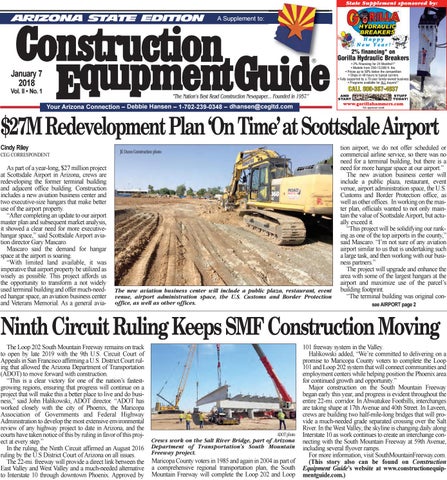
The new aviation business center will include a public plaza, restaurant, event venue, airport administration space, the U.S. Customs and Border Protection office, as well as other offices.
tion airport, we do not offer scheduled or commercial airline service, so there was no need for a terminal building, but there is a need for more hangar space at our airport.” The new aviation business center will include a public plaza, restaurant, event venue, airport administration space, the U.S. Customs and Border Protection office, as well as other offices. In working on the master plan, officials wanted to not only maintain the value of Scottsdale Airport, but actually exceed it. “This project will be solidifying our ranking as one of the top airports in the county,” said Mascaro. “I’m not sure of any aviation airport similar to us that is undertaking such a large task, and then working with our business partners.” The project will upgrade and enhance the area with some of the largest hangars at the airport and maximize use of the parcel’s building footprint. “The terminal building was original consee AIRPORT page 2
Ninth Circuit Ruling Keeps SMF Construction Moving The Loop 202 South Mountain Freeway remains on track to open by late 2019 with the 9th U.S. Circuit Court of Appeals in San Francisco affirming a U.S. District Court ruling that allowed the Arizona Department of Transportation (ADOT) to move forward with construction. “This is a clear victory for one of the nation’s fastestgrowing regions, ensuring that progress will continue on a project that will make this a better place to live and do business,” said John Halikowski, ADOT director. “ADOT has worked closely with the city of Phoenix, the Maricopa Association of Governments and Federal Highway Administration to develop the most extensive environmental review of any highway project to date in Arizona, and the courts have taken notice of this by ruling in favor of this project at every step.” In the ruling, the Ninth Circuit affirmed an August 2016 ruling by the U.S District Court of Arizona on all issues. The 22-mi. freeway will provide a direct link between the East Valley and West Valley and a much-needed alternative to Interstate 10 through downtown Phoenix. Approved by
ADOT photo
Crews work on the Salt River Bridge, part of Arizona Department of Transportation’s South Mountain Freeway project.
Maricopa County voters in 1985 and again in 2004 as part of a comprehensive regional transportation plan, the South Mountain Freeway will complete the Loop 202 and Loop
101 freeway system in the Valley. Halikowski added, “We’re committed to delivering on a promise to Maricopa County voters to complete the Loop 101 and Loop 202 system that will connect communities and employment centers while helping position the Phoenix area for continued growth and opportunity.” Major construction on the South Mountain Freeway began early this year, and progress is evident throughout the entire 22-mi. corridor. In Ahwatukee Foothills, interchanges are taking shape at 17th Avenue and 40th Street. In Laveen, crews are building two half-mile-long bridges that will provide a much-needed grade separated crossing over the Salt River. In the West Valley, the skyline is changing daily along Interstate 10 as work continues to create an interchange connecting with the South Mountain Freeway at 59th Avenue, including several flyover ramps. For more information, visit SouthMountainFreeway.com. (This story also can be found on Construction Equipment Guide’s website at www.constructionequipmentguide.com.)
Page 2 • January 7, 2018 • www.constructionequipmentguide.com • Arizona State Supplement • Construction Equipment Guide
Pros Kno Pros Kno ow! w!
®
T Those in the know w,, know Takeuchi Take euchi
Takeuchi of o ffers a wide range of compact excavatorss to help you get your tougheest tasks comppleted. PUT A TAKEUCH A HI TO WORK ON O YOUR JOBSITE AN ND EXPERIIENCE THE DIFFEREN NCE!
www.ditchwitchaz.com
4028 S 36th Street Phoenix, AZ 85040 (602) 437-0351 6975 N Camino Martin Tucson, AZ 85741 (520) 579-0261
takeuch hi us.com hi-us.com
Airport Plan Includes Business Center, New Hangars AIRPORT from page 1
structed in 1969 aiming to serve scheduled flights, but that is no longer the vision at this airport,” said Mascaro. “Instead, this project will transform this valuable land to maximize each square foot of space with office space, restaurant and event venue, and 60,000 square feet of hangar space. “When much needed partnerships were formed, it made now the right time. Those partnerships are with Gemini Air Group Inc., Volanti Restaurant and D.M.D Real Estate Group. The price tag will be financed through cityissued bonds. Revenue from the lease agreements and ancillary business permit fees will cover the debt payments over 20 years.” The highly anticipated executive hangars are slated to be completed and open for business by spring 2018. The aviation business center will be finished in late summer. The construction project will reportedly not have any impact on day-to-day operations. While there will be some limited roadway
impacts, officials will ensure access to businesses surrounding the project area at all times during construction. All businesses in and around the airport will remain open. The airport administration offices relocated to the operations center, during the interim. Located just 9 mi. north of the downtown area, Scottsdale Airport is a general aviation reliever facility that is home to many of the valley’s corporate aircraft. One of the airport’s most significant contributions is the major economic stimulus it provides to the city of Scottsdale and north valley region. A recent study found the airport generates more than $182 million annually in revenue to the area’s economy, and the combined annual impact of the airport/airpark is approximately $2.5 to $3 billion. “Scottsdale Airport has a rich history in this community,” said Sarah Ferrara, aviation planning and outreach coordinator. “This project will continue to embrace that, and offer a place for residents and visitors to fully experience the
airport, its history and maximize use of this prime airport land. The large executive hangars will fill the need for more hangar space, and the aviation business center will offer residents and visitors a place to meet, dine, walk around and enjoy aircraft.” Scottsdale Airport came into existence as Thunderbird Field II, an Army Air Corps training facility training pilots in the Stearman PT17 aircraft. The Thunderbird Field II Veterans Memorial will commemorate this, and honor all who served. JE Dunn is serving as the general contractor for the redevelopment and upgrades. Project manager Daron Kettler said the site work required for the assignment has included the selective demolition and removal of a good portion of the site work. “This includes over-excavation and compaction of the new building pads, site utility work, improvements to the existing parking lot and realignment of Airport Blvd.” Construction at the airport
began in July 2017. Several tasks have already been completed, such as the tear down of the old terminal building, demolition of the airport operations building, initial civil and earthwork and site utilities. “The hangar project will include demolition of existing structures, construction of two new 30,000 square-foot executive hangars, site work improvements to the existing parking lot and realignment of Airport Blvd.,” said Kettler. “The construction of the new executive hangar space and associated administrative office space will include tilt concrete walls and steel roof structure.” Crews are keeping a close eye on outdoor conditions, which aren’t a problem at this point. “Weather has not been a factor to date; however, we anticipate some adverse Arizona weather conditions will affect the day-today work schedule.” Kettler said many different types of equipment are being used during construction. “They include water trucks,
backhoes, standard earthwork machinery and cranes for erection of steel and tilt panels. The new executive hangars include concrete tilt walls with a steel roof structure. The new administration building will include a steel structure with the exterior finish including glass, as well as metal panels, with steel and EFIS accents.” Kettler added, “The Thunderbird Field II Veterans Memorial will include suspending a WWII era Boeing-Stearman PT-17 under a steel canopy structure at the entrance to the new airport administration building. This memorial is being constructed to pay tribute to past and present veterans and the history of the airfield. Constructing this memorial will require extensive coordination between our trade partners, Thunderbird Field II Memorial Veterans Inc. and Scottsdale Airport team. This Boeing-Stearman PT-17 plane is still being flown today.” For Steve Ziomek, chairman of Thunderbird Field II Veterans see AIRPORT page 3
Construction Equipment Guide • Arizona State Supplement • www.constructionequipmentguide.com • January 7, 2018 • Page 3
Airport Remodel Under Way AIRPORT from page 2
Memorial Inc., this portion of the project has special meaning. “The memorial will be a first for the city of Scottsdale and will commemorate the rich history of the Scottsdale Airport and honor all veterans. The airfield, named Thunderbird Field II, was built in 1942 for the sole purpose of training U.S. Army Air Corps pilots. More than 5,500 young men and women trained for war before the airport was decommissioned in October of 1944.” The centerpiece of the memorial will be an actual Stearman bi-plane, the type of plane flown by the young aviators during their primary pilot training. “It will hang from the ceiling in an openair plaza. The memorial wing will house a large monument displaying the service plaques of the U.S. Armed Services, Army, Navy, Air Force, Marine Corps, Coast Guard and the revered POW/MIA service plaque. There will be several plaques highlighting the history of the airfield, the history of the Stearman airplane and honorary donors to the Veterans Memorial project. The Stearman acquired by the Thunderbird Field II Veterans Memorial group continues to take to the skies, but on a different mission. “This beautiful plane, painted in the original Army Air Corps blue and yellow, is now being flown as part of the fundraising efforts of the non-profit,” said Ziomek. “Once the aircraft is retired and hung as the centerpiece of the memorial, those taking a flight will be able to say ‘I flew in that exact plane’, with the caveat that their flight was not in 1941.” DWL Architects + Planners Inc. is the lead architect on the project, responsible for the program and architectural design and program of the three buildings. Along with Mead & Hunt, the engineer of record, DWL Architects designed the site plan. According to Michael Braun, executive vice president with DWL Architects, the vision for the overall project was to upgrade and enhance the existing airport terminal area by maximizing use of the available site through the development of a new, efficient aviation campus. “The new facility will enhance services to the users, allowing the airport to compete on a national level to house modern aircraft. In order to do this, Mead & Hunt and DWL maximized the site and the program, designed a facility and campus that integrated the airport’s history and created an aviation business center. “There are many agencies and entities involved in the development of this airport project, each with its own regulations and requirements. In collaboration with Mead & Hunt, our goal from the beginning, as the
architect, was to coordinate all of the stakeholders and build consensus on the design, while making sure all the various goals were met. Another challenge the team had to overcome relating to the site was working with and around existing infrastructure. “Our design and construction team has worked through several barriers on the existing site to achieve a campus that will improve the flow of operations for all users and customers. Through our experiences as architects, we understand that it is rare for a project to end up on an untouched site.” Officials have been environmentally conscious from the start, with the facility targeted for LEED Gold certification. “During the initial design phases, our team took sustainability into consideration and designed with a sensitivity towards creating a beautiful design that also is integrated into the existing environment,” said Braun. “The building’s plan, organized by function, embraces its location within the Sonoran Desert, and takes full advantage of its solar orientation. The main glass façade faces north to control heat gain, while integrated shade screens, overhangs and recessed openings provide additional protection from the south and west exposures. “Interior spaces are designed to extend into the outdoors, both physically and visually, when appropriate. Materials with colors and coarse textures associated with this region also were incorporated into the facility. The design complies with the use of concrete block and self-shading ribbed metal panels. A variety of textures and natural materials are used to provide visual interest and richness, particularly at the user level.” Braun said the terminal area redevelopment project is transforming the existing airport into a community resource and point of pride for the city of Scottsdale. “The city has been very involved in the process, and is looking forward to creating a more welcoming destination for the airport users, as well as citizens of Scottsdale and also tourists. This is going to be more than just an airport — it’s a multi-functional experience with several amenities, plazas and larger hangar spaces.” She added, “The aviation business center will feature a second-floor deck that will provide a wonderful view of the Sonoran mountains. On some sunset nights, the mountains illuminate with a purplish hue. It’s absolutely beautiful. There will be great views of the luxurious aircraft landing and departing the airport.” (This story also can be found on Construction Equipment Guide’s website at www.constructionequipmentguide.com.) CEG
3 3 3 3 3 3 3
empirecat.com/eloy / l | 520-582-2900 520 582 2900
Page 4 • January 7, 2018 • www.constructionequipmentguide.com • Arizona State Supplement • Construction Equipment Guide
AU Equipment Hosts Demonstration of OilQuick USA System
A
U Equipment LLC, a regional dealer of Sandvik Mining crushing and screening equipment, Portafill crushers and screens, MB Crusher crushers and OilQuick couplers, held an open house demonstration day at Rio Salado Landfill Dec. 7 and 8 in Phoenix, Ariz. The equipment line-up included the OilQuick fully-automated quick coupler system; the Portafill 5000 tracked screening plant; and the MB Crusher S 10 screening bucket. The OilQuick quick coupler system enables the operator to change over quickly between various mechanical and hydraulic attachments from inside the cab. According to the company, the quick couplers and tool adapters are of the highest quality and ensure a precision fit and are fitted with leak-free oil quick couplings, which are eco-friendly. Fast tool change and efficient use of the excavator help to increase productivity, all while exceeding safety standards set by any independent and government agencies, according to the company. Also available for customers to test were the Fortress grapple; the OilQuick grab john; the Connect hydraulic hammer; and the Connect vibratory compactor. All were set up with the OilQuick system to demonstrate effortless attachment changing. AU Equipment had both the MB-S23 screening bucket and the MB-S14 screening bucket on display, as well as the MB L 140 skid steer jaw crusher. The MBS10 was attached to the OilQuick excavator and used to separate soil. The Portafill 5000 tracked screen was on site to process river gravel, making a concrete sand, a trap out rock and oversize river rock destined for further processing. For more information, visit auequipment.com/, rocktechnology.sandvik/en/products/mobile-crushers-andscreens/, portafillusa.com/, mbcrusher.com/us/us/. (This story also can be found on Construction Equipment Guide’s website at www.constructionequipmentguide.com.) CEG
AU Equipment employees and customers are ready to learn more about the OilQuick system and give it a try.
The demonstration featured the Portafill 5000 tracked screen and the OilQuick demonstrator unit.
An operator shows the precision of a Fortress grapple with the OilQuick fully-automated quick coupler.
Portafill 5000 tracked screen makes clean drain rock from natural sand and gravel.
Guests saw how the Portafill 5000 tracked scalping screen processes river gravel.
This excavator is used to highlight the various attachments at the OilQuick Open Day Demonstration.
Construction Equipment Guide • Arizona State Supplement • www.constructionequipmentguide.com • January 7, 2018 • Page 5
Want to run strong equipment m ? Run Doosan. Viisit uss today a to learn more.
Authorized Doosan Dealer
Ditch Witch of o Arizona 4028 South 36th Street | Phoenix, AZ 602.437.0351 www ditchwitchaaz com www.ditchwitchaz.com Doosan® and the Doosan logo are registered trademarks of Doosan Corp. in the United States and various other countries around the world.
Page 6 • January 7, 2018 • www.constructionequipmentguide.com • Arizona State Supplement • Construction Equipment Guide
Volvo EW 180E Lets Community Put Wheels Into Motion By Amy Crouse VOLVO CONSTRUCTION EQUIPMENT
The Salt River Pima-Maricopa Indian Community (SRPMIC) is carved into 52,000 acres between Scottsdale, Fountain Hills and Mesa, Ariz., with the majestic Red Mountain as a backdrop. Location and the progressive attitude of its Tribal Council make it unlike any other community in the United States. Over the past 15 years, the SRPMIC and its development arm, Salt River Devco, have been at the forefront of the metro area’s most signature commercial projects while staying true to their heritage. This included opening the 36-hole Talking Stick Golf Club and the FourDiamond Talking Stick Resort and Casino, all owned by SPRMIC peoples. Outside corporations have been attracted by lower taxes and sun-soaked vistas. The Arizona Diamondbacks and Colorado Rockies major league baseball teams transplanted their spring training fields on SRPMIC land. Most recently, McKesson, the largest health care company in the United States, serving more than 50 percent of hospitals, is relocating its corporate headquarters and 2,000 employees from San Francisco to a new office complex on 32 acres of SRPMIC lands. The goal is clear: sustainable, controlled growth to ensure the social, economic and environmental health of current and future generations of the Pima and Maricopa peoples. More than 12,000 acres of SRPMIC land, almost 25 percent of the total area, is under cultivation for commercial crops including cotton, melons, tomatoes, potatoes, onions, broccoli and carrots. The community also contracts with non-members to lease lands for farming. All this activity places heavy demand for non-potable water, which is sourced from the high mountain lakes and man-made dams that frame the community. Shuttling irrigation water to farmers and private water users across the community is the job of the Salt River Pima-Maricopa Indian Community’s Public Works Department. “We are responsible for 130 miles of irrigation canals and underground pipelines,” said Dean Emerson, irrigation operations manager. “To keep the channels flowing and free from debris is a constant cycle of dredging, brush-cutting and laying pipe.” The maze of canals crisscrosses the 101 Freeway and Arizona 87 north-south connectors as well as dense retail districts, adding to the challenge for Emerson and his crews. Emerson’s crew relies on one piece of equipment for the diversity of work: a Volvo
(L-R) are Benito Valencia, irrigation maintenance department operator, SRPMIC; Dean Emerson, irrigation operations manager, SRPMIC; Mike Douglas, Arnold Equipment; and Ramon Montiel, irrigation maintenance supervisor, SRPMIC.
EW180E wheeled excavator. Wheeled excavators, sometimes called rubber tire hoes, are still rare in the United States, but a common sight on the community’s property. With a travel speed up to 22 mph on highway and the ability to hitch a trailer, the excavator is a self-contained unit. He said, “We have used wheeled excavators for many years. With a tracked excavator you can’t do the same amount of work. The wheels allow us to twist and turn to get into tight spots along the canal banks, whereas with a traditional track hoe you have to slide the tracks and it is not always an easy fit. The counterweight and four outrigger stabilizers gives it perfect balance so we can maintain stability whether we are clearing or lifting pipe.” The Volvo 21-ton wheeled excavator is the same size class as previous competitor models used by the department but generations ahead in terms of capabilities. The approach SRPMIC used to research and customize their new excavator also is a generational change. The EW180E has a max lifting capacity of 21,605 lbs. Ramon Montiel, irrigation maintenance supervisor, represents a new era of equipment operators who are turning online before they turn to a traditional dealership to make buying decisions. “I spent a lot of time on the Volvo CE website and YouTube channels. I saw how big wheeled excavators are in Europe and the full range of Volvo models offered glob-
ally. The way they are being used in different applications around the world was very intriguing,” he said. One attachment in particular caught his eye: the Steelwrist tiltrotator. Tiltrotators were originally designed in Europe in the 1980s and today are equipped on more than 90 percent of excavators between 3 and 30 tons in Nordic countries. As its brand name implies, it works as a wrist between the boom arm and attachment to give 360degree rotation and a +/- 45-degree tilt for greater flexibility. The Steelwrist can power buckets, breakers, augers, or in Montiel’s situation, a brush cutter. When SRPMIC was ready to make their virtual excavator a reality, they contacted Mike Douglas with local Volvo dealer, Arnold Machinery Inc. in Phoenix. Douglas said, “The community had a very clear focus on what they wanted. This is a very professional group. They met with Volvo and three other competitor equipment suppliers. They really had a vision for what they wanted this machine to be and what it would do, and Arnold just worked with them from that vision.” Arnold Machinery’s “whatever it takes” attitude sums up their Silver Service philosophy — making sure each customer receives better service from Arnold than they will find with any other equipment dealer. SRPMIC put this tagline to the test when they sat down with Douglas to spec the machine.
The list of options factory-fit to the EW180 included: • Two-piece, 17 ft. 11 in. stretch boom for a larger digging envelope; • Four outriggers for extra stability on uneven terrain (in lieu of dozer blade); • LED strobe lighting package and flashers and rear light bar. “I am very safety conscious since I travel through school zones, shopping areas and residential neighborhoods. On a typical day, I drive the excavator [more than] 10 miles on highways,” said Montiel; • Single super tires instead of duals to prevent river rocks from lodging and damaging tire spacers. “When a rock is stuck you have to deflate both tires on that side to dislodge the rock and there goes your day,” Montiel explained; • Additional toolbox for tools and fluids; • Auto-lube system; • Outrigger pads to protect asphalt; • Front cab and fender guarding; • Reversible fan to expel debris and prevent engine overheating, a necessity in 120degree Arizona summer temps; and • Steelwrist Tiltrotator Douglas said, “The Steelwrist allows Ramon to work in any angle without repositioning the machine. He can work from one side of the wide irrigation canals without having to travel to the other side. It suits their needs. It is very versatile.” Montiel said it is better than a backhoe, see CREW page 7
Construction Equipment Guide • Arizona State Supplement • www.constructionequipmentguide.com • January 7, 2018 • Page 7
Final Phase of $300M Sun Devil Stadium Project Begins
After the demo work is complete, crews will get to work rebuilding the area before finishing the stadium’s interior sometime in 2019, AZCentral reported.
Emily Buenzle CEG WEB EDITOR
Crews demolished the east side of Arizona State’s Sun Devil Stadium the week of Dec. 4 as they began the last phase of a $300 million renovation project. After the demo work is complete, crews will get to work rebuilding the area before finishing the stadium’s interior sometime in
2019, AZCentral reported. The work that is currently in progress is scheduled to be complete before Sept. 1, 2018, just in time for the season kickoff. The Arizona State Athletics department is still fundraising to cover the final $40 million needed for the project. (This story also can be found on Construction Equipment Guide’s website at www.constructionequipmentguide.com.)
SRPMIC Crew Relies on Volvo Excavator’s Diversity CREW from page 6
often used for similar tasks, because the entire cab swings 360 degrees and the Steelwrist allows you to dig sideways and in reverse, essentially transforming it into a mining tractor. The Steelwrist’s third lever hydraulic controls were a knack for Montiel, who compares them to a video game. “To me, it’s like playing Xbox. You have to separate your mind from the excavator. That’s where a lot of operators get confused; they hit that block mentally,” he said. “Don’t let a fear of technology rule your mentality. You have to be open-minded. If not you will miss out. The joystick controls with the Volvo are right at your fingertips, it’s all for your benefit.” The second critical attachment on the EW180 is a Slashbuster brush cutter model HD480B. With an 18-in. diameter and 52-in. wide cutting swath it shreds and mulches in place nuisance trees and brush along canal banks.
Inside, the EW180 stays a cool 61 degrees despite broiling outside temps. Climate aside, Montiel appreciates the cab’s overall comfort. He said, “As a person who has been operated on three times for my back, when I ran the other brand it would beat me up after 10 hours. Not once has that happened with the Volvo.” Douglas said the EW180 is a Swiss Army knife in terms of functionality and that is why it was chosen by SRPMIC. Emerson added, “This machine gets you safely to the job and has superior stability and load charts when you are on the job. The fuel consumption is far better than other wheeled excavators we have had, and there’s nothing easier to maintain.” And in turn, nothing easier to use to maintain constant water supply to the Salt River Pima-Maricopa Indian Community. (This story also can be found on Construction Equipment Guide’s website at www.constructionequipmentguide.com.)
NEXT ISSUE CLOSES JANUARY 25, 2018
Page 8 • January 7, 2018 • www.constructionequipmentguide.com • Arizona State Supplement • Construction Equipment Guide
Public Auction held the 2nd Saturday of every month. Preview Every Monday - Friday 8am - 4pm Consignments Welcome 623-936-3300 wsmauctioneers.com wsmauctionbiz@yahoo.com
Western Sales Management, Inc 1616 S 67th Ave. Phoenix, AZ 85043
Next Auction February 10, 2018
File Photo
File Photo File Photo
File Photo
File Photo
File Photo
File Photo
File Photo
File Photo
File Photo