

By Cindy Riley CEG CORRESPONDENT
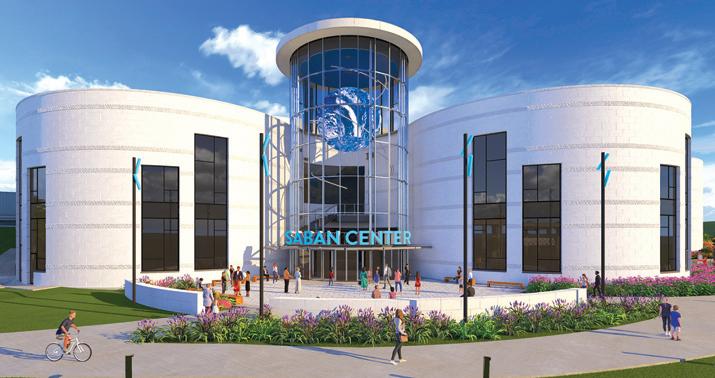
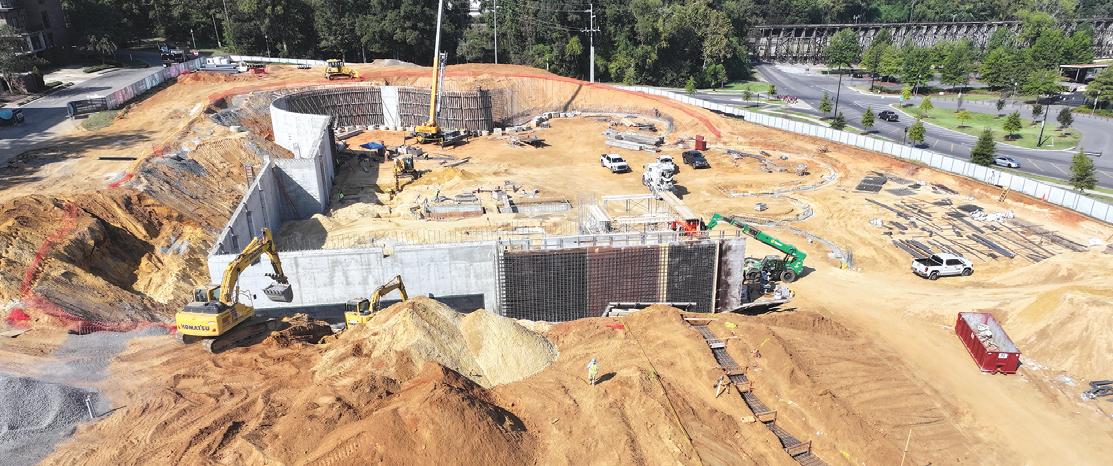
Currently under construction in Tuscaloosa’s River District, the $120 million Saban Center will uniquely prepare students, educators and the workforce for the future. Work on the facility began last year and is scheduled to be completed in late 2027.
“The Saban Center was established to address a clear need for a holistic educational asset that connects academic learning with real-world career pathways for jobs right here in Alabama,” Saban Center director Audrey Buck told Construction Equipment Guide. “It will serve as a hub for immersive STEM and arts experiences, professional development for educators and community engagement.
Buck said the Saban Center’s integrated approach to STEM and the arts acknowledges that innovation and creativity are interconnected.
“By bringing science, technology, engineering, mathematics, performance and visual creation together under one roof, the campus invites learners to explore, experiment and make cross-disciplinary connections and spark children’s interest in STEM. This broad, hands-on experience supports curiosity, builds confidence and connects exploration to future careers, a model that’s rare in traditional educational settings.”
Former Crimson Tide head coach Nick Saban and his wife, Terry, have been deeply involved in shaping the physical design of the Saban Center and its purpose.
“The building’s form and features reflect
their personal vision for a space where education, creativity and community converge. They worked closely with world-class architects Steinberg Hart and Davis Architects to guide every aspect of the structure’s form and function, ensuring that the architecture itself embodies inspiration, connection and lifelong learning.
see SABAN page 2
Steinberg Hart/Davis Architects The $120 million Saban Center will uniquely prepare students, educators and the workforce for the future.

Gov. Kay Ivey and the Alabama Department of Transportation announced that more than $40 million in state transportation funding is being awarded to cities and counties for various road and bridge projects. This announcement comes after Gov. Ivey touted in her state of the state address the tremendous progress being made by
Rebuild Alabama back in January.
“Since 2019, Alabama generated more than $2 billion, paving the way for 500 vital road and bridge projects in all 67 counties. None of these projects would have happened without the passage of Rebuild Alabama,” said Ivey during her state of the state address.
The funding is made available through the Alabama Transportation
and Improvement
(ATRIP-II), a program created by the Rebuild Alabama Act. The Rebuild Alabama Act requires ATRIP-II to be an annual program setting aside a minimum of
SABAN from page 1
“The architecture itself, defined by sweeping curves, a dramatic glass tower and an illuminated globe, is intended to serve as a landmark for learning and a beacon of possibility. Attention to detail in spatial design is critical to fostering experiences that spark curiosity and invite engagement.”
Buck said the intentional choice to use Alabama-sourced materials, including locally quarried marble, reinforces the Saban Center’s identity as a place that belongs to the state and reflects its natural beauty and heritage. Doing so supports local industry, strengthens community ties and roots the building in its regional context.
The project’s August 2025 groundbreaking was attended by Gov. Kay Ivey, state officials, city leadership and community stakeholders.
“It marked a pivotal moment in shifting the Saban Center from planning into construction,” said Buck. “The celebration emphasized the project’s long-term impact on education
and workforce readiness, reflecting broad public support for the initiative. Construction is advancing on schedule, with community enthusiasm remaining strong.
“Observing the Saban Center transition from concept to construction has been both exciting and deeply meaningful for partners and the community. Each milestone, from design unveilings to the groundbreaking, reinforces the project’s promise as a transformative educational and cultural asset for generations of learners across Alabama.”
When asked by Construction Equipment Guide about the main concerns for crews, Stone Construction project manager Trent Price said one of the logistical challenges involved a large basement wall on the southern half of the project.
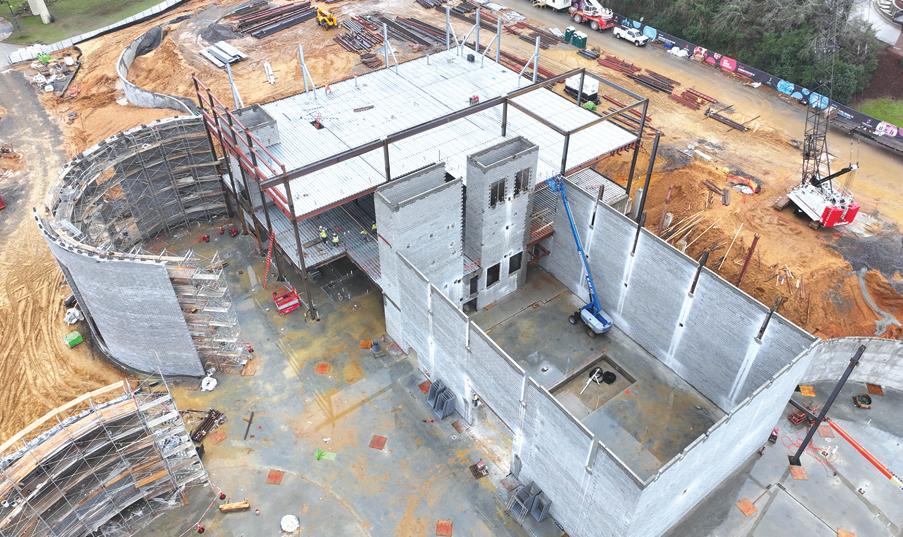
“This wall could not be backfilled until the Level 2 structural steel was installed and the slab-on-metal deck was placed and finished. As a result, the wall remained sloped back more than 22 feet for several months, and no work could begin around that portion of the building footprint.
“Another challenge has been ensuring that all building components align dimensionally around the multiple radii that define the Saban Center’s structure. Stone Building and its trade partners addressed this by back-checking and confirming the radius layouts multiple times prior to placing and finishing the concrete walls that create these curved elements.”
In order to accomplish this, the contractor used GPS layout data provided by the civil engineer. Doing so made certain that all radius points were accurately established and maintained during construction.
Workers have already completed mass grading, along with drilled piers, the basement retaining wall, all slabs-ongrade, underground MEP rough-in and CMU installation for stair and elevator shafts. Recent activities have included metal stud framing, exterior CMU installation, structural steel and decking, elevated concrete work, MEP in-wall and
see SABAN page















used CA Stop offf f at ou find somethi AT T eq ng bet






20 US-80, Montgomery
Y ur Used Equipment Yaard (located at 101 y, , AL 36117) and ttter than a souvenir to take home. Choose from the largest selection of uipment in one place, make your pick, then keep on going to the beach.

























Saban Center Foundation/City of Tuscaloosa photo
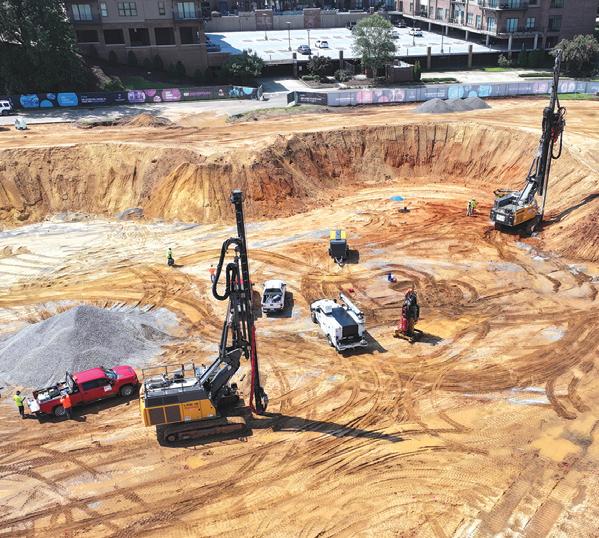
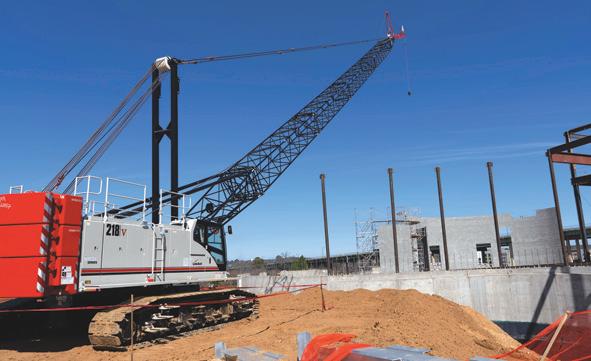
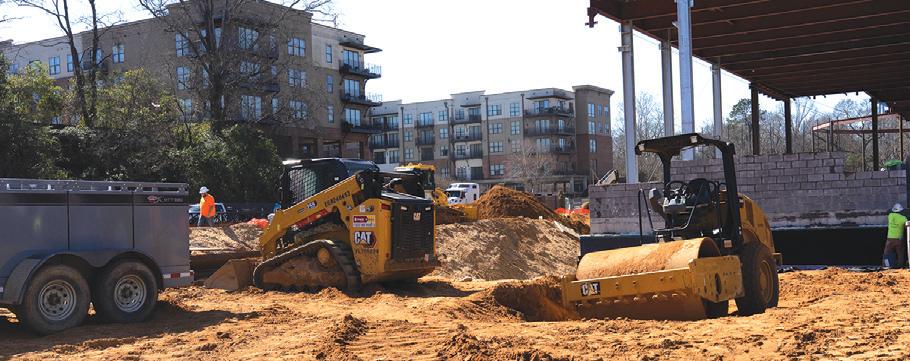
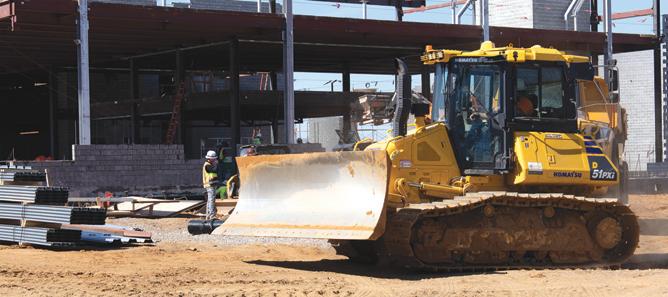
Equipment being used to build the facility includes articulated trucks, bulldozers, large excavators, drill rigs, sheepsfoot rollers, 10,000-lb. and 5,000-lb. lulls, man-lifts, scissor lifts and crawler cranes.
overhead rough-in, and retaining wall waterproofing and backfill.
Remaining tasks include installation of the exterior marble veneer, completion of structural steel and TPO roofing. Installation of exterior and interior curtain walls and all interior finishes must also be addressed.
Multiple rain delays early in the project were mitigated by working additional weekends to recover lost time during the mass grading phase. During extreme cold temperatures in January, the team implemented specialized cold-weather procedures in close coordination with testing agencies and engineers to maintain quality standards for both CMU and concrete work.
One of the building’s most dramatic features is its 70-foot glass tower. The globe structure is supported by structural steel
columns and beams, with the openings infilled using curtain wall and glazing systems. The curtain wall and glazing will be field-measured after the structural steel is installed to ensure precise dimensional alignment prior to installation.
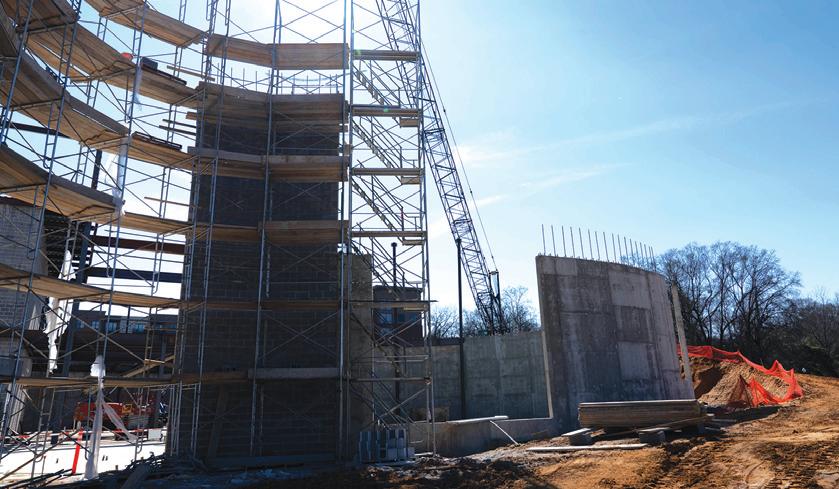
Multiple rain delays early in the project were mitigated by working additional weekends to recover lost time during the mass
phase.
Price said placing the 18-ft.-diameter illuminated globe requires a great deal of focus, as well.
“The globe will be fully assembled at the second-floor level. Hoistway winches and temporary rigging will then be used to lift and position the globe into its final location within the Galaxy Tower.”
The Saban Center is being constructed on the former site of the Tuscaloosa News. The previous building had to be fully demolished, including the structure, foundations, press foundations and supporting deep pile
Approximately 10,000 cu. yds. of imported material was brought to the site as part of the demolition package to fill the basement void and achieve the proposed subgrade elevation for the building pad. In addition, the building package includes approximately 10,000 cu. yds. of on-site unclassified excavation.
Equipment being used to build the facility includes articulated trucks, bulldozers, large excavators, drill rigs, sheepsfoot rollers, 10,000-lb. and 5,000-lb. lulls, man-lifts, scissor lifts and crawler cranes. Primary materials include structural steel, concrete, CMU and marble.
The project is supported by public funds, private donations and strategic partnerships. The Poarch Creek Indians have invested heavily in the project, to ensure more students of all backgrounds have opportunities to discover their talents and reach their full potential.
Poarch Creek Indians Chair and CEO Stephanie Bryan told Construction Equipment Guide, “The Saban Center will create lasting opportunities for generations of young Alabamians and their families. The mission closely aligns with our tribe’s values and hopes for the future, and we are honored to be able to contribute financially to this visionary project.” CEG
On March 6, 2026, HD Hyundai Electric held a groundbreaking ceremony for its second factory at Hyundai Power Transformers USA, located in Montgomery, Ala. The ceremony was attended by Young-ki Kim, president and CEO of HD Hyundai Electric, along with representatives of the Alabama state government, key customers and partner companies.
HD Hyundai Electric plans to invest $200 million to build the second factory, which is scheduled for completion in April 2027. Once completed, the facility will expand extra-highvoltage (EHV) transformer production capacity by about 50 percent and will introduce new 765kV-class EHV transformer manufacturing and testing facilities.
HD Hyundai Electric has steadily grown in the North American market since establishing
its Alabama factory in 2011. The subsidiary now generates around $400 million in revenue and employs about 460 people. With the completion of the second factory, the company plans to increase annual revenue by approximately $150 million and hire an additional 200 employees.
Through synergy with the ongoing Ulsan factory expansion (expected in September 2026), HD Hyundai Electric aims to further strengthen its competitiveness and leadership in the North American EHV transformer market. HD Hyundai Electric will continue to be a key partner in North America’s power transmission infrastructure by expanding its local production base and strengthening its technological capabilities.
For more information, visit hd-hyundaielectric.com.
$30 million off the top of ALDOT’s share of new gas tax revenue for projects of local interest on the state highway system.
Gov. Ivey has awarded $40 million in ATRIP-II grants to local governments in each of the last five years, exceeding the $30 million minimum required by the Rebuild Alabama Act.
There were 25 projects selected for funding for a total of just more than $40 million in state transportation funding. Of those awarded projects, 20 were from cities and counties putting forward more than $11 million in local funds. Under the ATRIP-II program, there is no requirement that local governments put up matching funds to be eligible. The state
has now awarded more than $260 million in state transportation funds under ATRIPII since the program’s creation in 2019.
“Rebuild Alabama continues making generational transportation improvements a reality. I am proud to award funds towards these 25 projects. Our success with Rebuild Alabama will only continue,” said Ivey.
The projects were selected by the ATRIP-II Committee created by the Rebuild Alabama Act. It is anticipated that a number of projects will be under contract during the 2026 fiscal year. All projects are required to move forward within two years of the awarding of funds.
For more information, visit dot.state.al.us/programs/ATRIPII.html.