




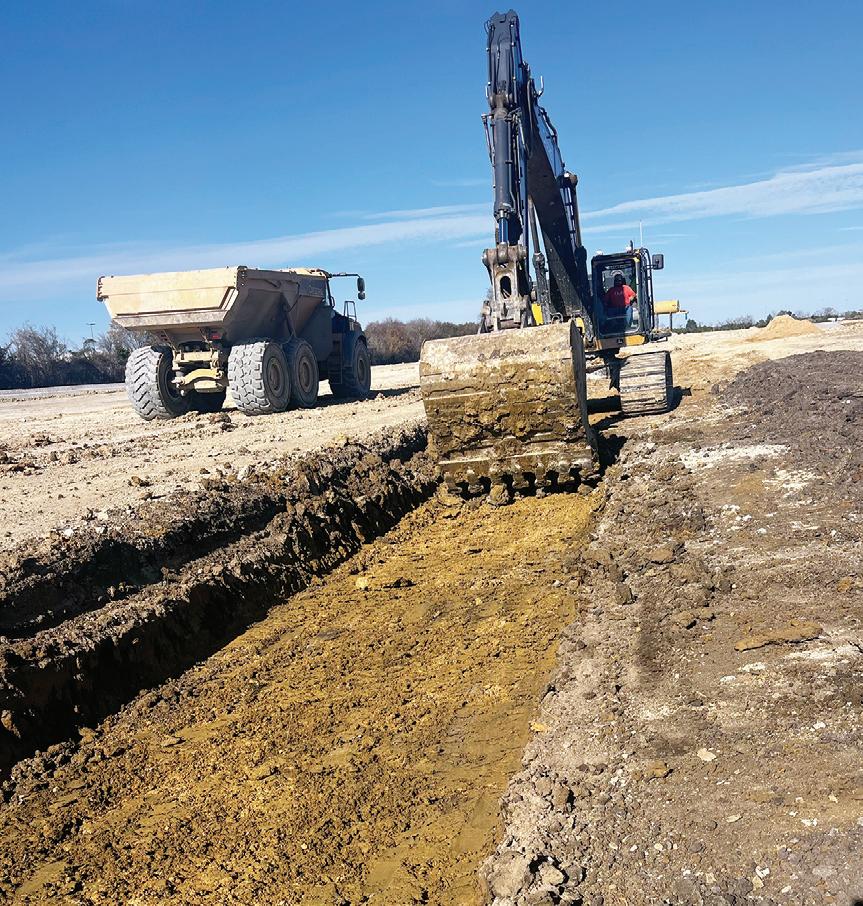
Construction crews are working on a project that will provide rail and truck connectivity between central Alabama and the Port of Mobile. The Montgomery Intermodal Container Transfer Facility (ICTF) will enhance freight mobility and is considered a critical gateway for global commerce.
“This is one of the most exciting economic development projects under way in the state,” said Alabama Port Authority interim director and CEO Doug Otto. “It represents a strategic investment in statewide logistics that will strengthen supply chains, attract new industry and create opportunity across the Southeast.”
Since the project was announced three years ago, the area surrounding the facility has attracted more than $3 billion in economic development investments from private companies. The Montgomery ICTF will feature more than 25,000 ft. of track served by CSX Intermodal. It will have a throughput capacity of 60,000 TEUs per year, which is equivalent to 30,000 shipping containers.
The Alabama Port Authority, in partnership with CSX, broke ground on the $94 million project in February. When completed, it will operate five days a week, offering express daily service from the Port in Mobile to Alabama’s automotive and manufacturing hub in Montgomery. It also will relieve stress on the interstate system, as the port sees additional cargo volume following the deepening of Mobile Harbor.
The Port Authority serves every county in the state and oversees the deepwater public port facilities at the Port of Mobile. In addition to the interstate system, the Port Authority’s container, general cargo and bulk facilities have immediate access to five Class I railroads, four short-line railroads and nearly 15,000 mi. of inland waterways.
see ICTF page 2

tral Alabama and the Port of Mobile.
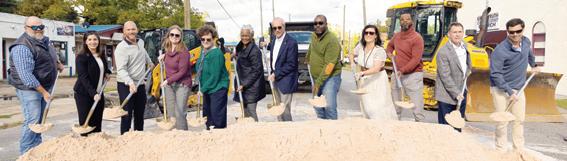
A long-neglected corridor in Mobile, Ala., once known as the city’s “Black Wall Street” and the epicenter of business activity for Black residents during segregation, is finally getting a multi-million-dollar makeover.
Dr. Martin Luther King Jr. Avenue, formerly Davis Avenue (originally named after the Confederacy’s president until it was renamed after the 20th century civil rights icon in 1986) is the focus of a major revitalization effort backed by city, county and federal partners.
The Mobile City Council approved a $11.3 million contract on Oct. 14, 2025, with Mobile-based McElhenney Construction Co. for a federally funded rebuild of a 1.2-mi. stretch of the historic street, according to AL.com.
The work comes as efforts led by Mobile County Commissioner Merceria Ludgood gain momentum to develop a civil rights and cultural heritage district — an area referred to as “The Avenue.”
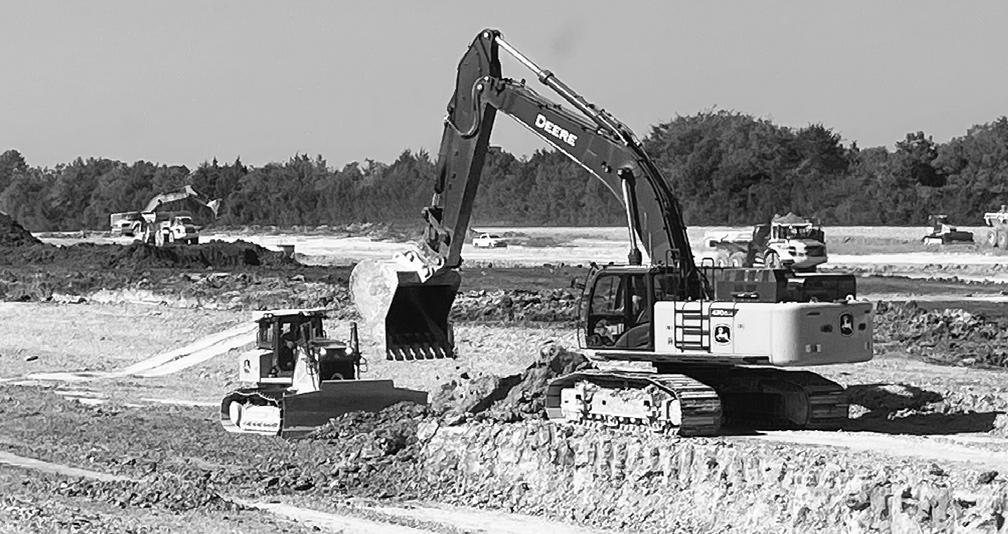
The project is located on a 272-acre site, with direct access to Interstate 85 and Highway 31.
The Montgomery ICTF will feature more than 25,000 ft. of track served by CSX Intermodal.
ICTF from page 1
According to Jeff Hanak, Ragnar Benson Construction project executive, the work is going well.
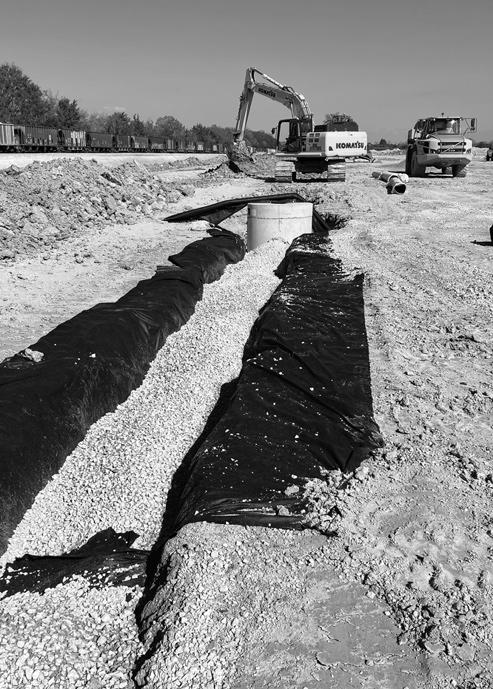
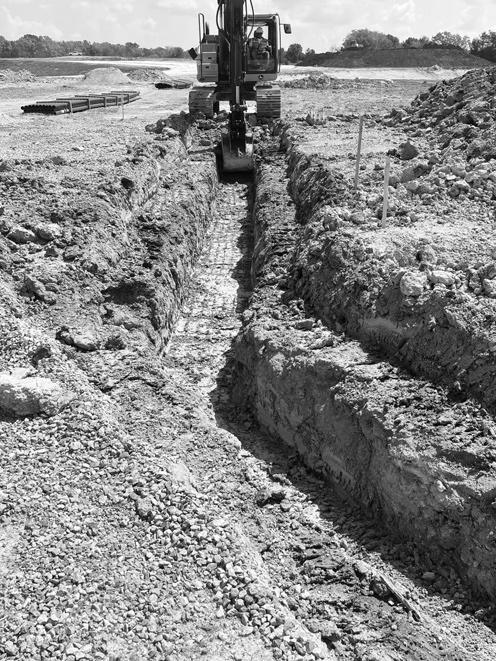
“The site grading is almost complete, and most of the storm water drainage pipe and structures have been installed,” he said. “Lime stabilization of the site subgrade is under way, and pavement crews have been mobilized.”
The project is located on a 272-acre site, with direct access to Interstate 85 and Highway 31.
“Most notably there was a historic horse racing track where one of Alabama’s Kentucky Derby winners trained,” said Hanak. “Other than that, it was mainly greenfield space with about 115 acres of clearing.
“The soils here are not the easiest to build on,” he added. “The geotechnical engineer was wise to recommend lime
stabilization, as it’s definitely needed. It’s easy to get stuck out here. Short of the native soils, the next challenge is maintaining production with an active mainline track.”
The Port Authority is building a 3-mi. rail siding and bridge for CSX. Hanak said that constructing a quality terminal and rail siding that will positively impact the economic growth of Alabama is a team effort.
“CSX has an active mainline that abuts the terminal and the location of the new three-mile siding. We have to coordinate to ensure safe work amidst active rail lines.
“Ragnar Benson has a lot of experience working with Class I railroads, so the challenge was anticipated. CSX has been great at ensuring we have flagging support, so our crews can continue to work, while also being safe.”
Construction has involved the demolition of some pre-



“I think the city recognizes the incredible historical and cultural importance of this street,” said Jennifer Greene, the city of Mobile’s director of program and project management. “We are very excited to be working side-by-side with the community, county and Commissioner Ludgood to bring the street back to where it once was.”
The MLK Avenue project includes the construction of new underground water and sewer lines, improvements to the road’s alignment, new sidewalks, a bicycle lane, on-street parking, improved drainage, new street lighting and signals.
“When residents and visitors can safely walk, bike and connect along the MLK corridor, it will boost foot traffic to historic sites, local businesses and the many cultural anchors along the corridor,” Ludgood said.
Plans call for narrowing the street to a two-lane road with crosswalks to ensure its safety for pedestrians, including children who attend The Pathway 6-8 School nearby. The portion of the roadway to be improved connects Beauregard Street at Bishop State Community College northwest to Butchers Lane on the north side of Three Mile Creek.
The project is considered an additional phase of the original and federally funded $22 million overhaul to Broad Street which loops around downtown Mobile and connects with MLK Avenue. That work was completed in 2023.
MLK Avenue’s rehabilitation will be paid for, in part, with $2.1 million that was
awarded as compensation from the 2010 Deepwater Horizon-BP oil spill in the Gulf of Mexico. Other funding included $6.6 million via a federal grant administered through the Mobile Metropolitan Planning Organization (MPO), $3 million from the Mobile Area Water & Sewer System (MAWSS) and $1.6 million from the city of Mobile.
Greene said the construction is expected to be under way before year’s end, once the final funding is secured from the council that oversees the BP oil spill settlement fund through the Revived Economies of the Gulf Coast States Act of 2012 (RESTORE Act).
After the MLK Avenue revitalization does begin, AL.com noted, it is expected to last 18 months.
“It’s an area-changing project stabilizing the streets and giving it walkability [and] landscaping,” said Mobile City Councilman William Carroll, District 2, who represents the area in and around MLK Avenue. “We not only have an opportunity to revitalize the street but anchor an entire community.”
Greene added that the project is similar to a “complete streets” overhaul that recently moved forward along St. Louis Street in downtown Mobile. That $16.8 million project also is being built by McElhenney Construction.
“A complete street project prioritizes walking, biking and safe driving,” she said. Greene explained that old infrastructure can be found underneath the roadway in the historic district. As a result, it needs
drainage upgrades, new curb and gutter and inlets. MAWSS will use its funding to replace the water lines and make sewer repairs.
The improvements come amid a growing focus on the street, once the epicenter of Mobile’s Black community life and business activity during and after segregation.
It also is a city street that has drawn both Black and white celebrities alike throughout its history, noted AL.com.
Baseball pioneer Jackie Robinson once made a memorable appearance to the avenue in 1948 to speak before a crowd that included a 14-year-old Hank Aaron. In addition, music icons like Louis Armstrong, Cab Calloway, Duke Ellington, Ella Fitzgerald and Elvis Presley all entertained in venues along the street.
In an effort to highlight the past, while reorienting MLK Avenue’s future, the heritage district is being spearheaded by Ludgood and the Mobile County Commission.
The effort has already seen progress. Earlier this year, the new $1.4 million Isom Clemon Civil Rights Memorial Park was opened at the intersection of MLK and Hamilton avenues and Congress Street.
In 2023, a library branch that once served the segregated Black community was converted into a cultural center and opened about one block from the park.
Other projects are under way along or
adjacent to MLK Avenue, including a revitalization of the 86-year-old Ace Theatre into a multi-faceted building that will include a center for jazz musicians, the rehabilitation of the Dave Patton House, named after a Black real estate entrepreneur from the early 1900s; and a local legacy site honoring Vernon Crawford, Mobile’s first Black attorney.
Housing projects also are planned along the route, and Bishop State Community College has expansion projects on the drawing board as well.
“When all of this happens, you will have people back in the community, commerce will come back and investment will start,” said Eric Finley, a Mobile historian whose family has deep roots in the city and operates businesses on MLK Avenue.
He told AL.com that the rehabilitation of the street’s infrastructure will create a new avenue that is attractive for Generation Z, or youths born between 1997-2012.
“We’ve got to get their vision and get them on board for the future so that when they come back [to Mobile], they will say,
‘I’ve got to go to Dr. Martin Luther King Jr. Avenue,’” Finley elaborated as he recalled similar comments made by older generations who longed to return to the former Davis Avenue whenever they visited Mobile.
“I knew people who were so engrossed in that street that whenever they were about to die, they would say, ‘Take me down the Avenue one more time,’” he said. “We’ve got to get back to that type of community.”
Construction has involved the demolition of some preexisting water and sanitary lines, as well as a small building. Currently, underground utilities are being installed, rebar is being tied for reinforced concrete pavement sections, grading and embankment is under way on the siding and siding bridge work has begun. Tasks remaining include asphalt paving, roller compacted concrete paving, pavement markings, high mast light pole erection and siding bridge construction.
In addition to installation and modification of multiple rail tracks and connections, the project calls for construction of operational control centers, offices and maintenance/repair buildings. Paving also is required.
“This project will receive roller compacted concrete, which is a unique pavement section many aren’t acquainted with,” said Hanak. “It’s incredibly durable and strong, perfect for a container yard’s use and is installed similarly to how asphalt is installed, only with concrete.”
In late September, the Port Authority announced its contract with Konecranes for the delivery of two rubber-tired gantry (RTG) cranes, which will serve as the backbone for
container handling at the ICTF. The Konecranes RTGs will feature smart technologies to enhance safety, accuracy and yard efficiency, helping to streamline container transfers between rail and truck. Their delivery is scheduled for late 2026.
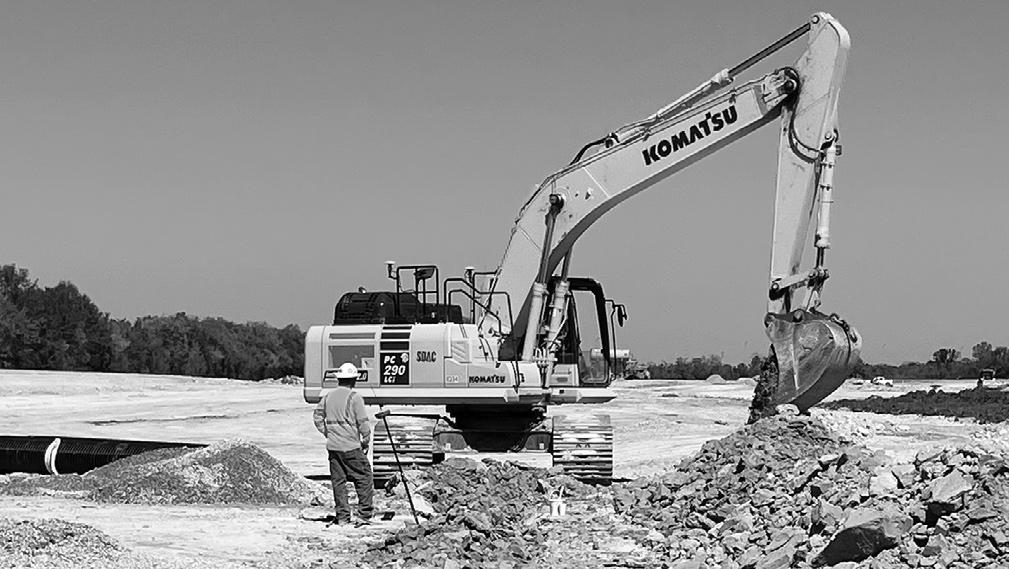
As for heavy machinery currently on the property, said Hanak, “We’ve done the site grading with tractor and pan scrapers, articulating dump trucks, bulldozers and excavators. We also have a Caterpillar 825 compactor on site, which you don’t get to see every day.”
Approximately 500,000 cu. yds. of dirt will be moved during construction. Materials used on the project include a significant amount of stone for the pavement subbase and sub ballast. Electrical duct bank, panels, transformers, high-mast light poles, watermain, hydrants, sanitary sewer and storm drainpipe are also needed to complete the project.
Not surprisingly, Hanak said weather is an ongoing concern.
“Rain is not our friend. June was a tough month, with record high rainfall for our location. With the soils present on site, that was a significant challenge to maintain production. We now have the critical stormwater conveyance portions of
the job installed, so when it does rain, we’re not inhibited for long.”
The Montgomery ICTF is expected to be operational in 2027. Despite the challenges, Hanak said he’s proud of the work accomplished so far.
“The Ragnar Benson team on this project is top-notch, and the Port chose an exceptional construction manager in Volkert to represent them and oversee this project. Everyone works very well together, and you can see that on the site.
“Our subcontractors have proven to be great assets and have further contributed to the positive environment we have on this project,” he added. “It means a lot to get to build something that will benefit the Port and CSX, as well as the state and greater region at the same time.”
“It’s been rewarding to see this project take shape through such a strong partnership between the Alabama Port Authority, Ragnar Benson Construction, CSX and our local partners,” said Otto. “The teamwork and technical expertise on site are delivering a first-class facility that will serve as a model for how infrastructure projects should be built in Alabama.” CEG
(All photos courtesy of Ragnar Benson.)