It is springtime, and for many of us, the warm weather turns our thoughts to gardening, planting, cultivating and renewing our surroundings.
The same tasks are happening right now at the U.S. Space and Rocket Center, a popular museum in Huntsville, Ala., although its plantings are considerably taller.
Rather than daisies or geraniums, workers are planting rockets in the museum’s garden — and those roots run very deep in this north Alabama city.
Since 1960, Huntsville has been the home of NASA’s George C. Marshall Space Flight Center, helping it earn the nickname “The Rocket City.” The facility was built near Huntsville’s Redstone Arsenal, a World War II-era base that was later chosen by the U.S. Army as a site for rocket and missile development.
Toward the end of the war, the U.S. military brought several German rocket scientists, led by Wernher von Braun, to Huntsville to work with American specialists in creating ballistic rockets. In the 1950s and
‘60s, von Braun and his team lent their expertise to engineering some of the first rockets and satellites to reach outer space and orbit the Earth, in addition to the legendary and massive Saturn V rocket that sent America’s Apollo astronauts to the moon, thus achieving the goal of preeminence in space.
Since then, Huntsville and the Marshall Space Flight Center has continued to be world renowned for its engineering efforts to put humans in space.
Ed Stewart, the curator of the U.S. Space & Rocket Center, told Huntsville’s WAAYTV April 15 that the museum’s upgraded “rocket park” will be like nothing anyone has ever seen.
“If you’ve been here before and you’ve walked through ‘Rocket Row,’ as I like to call it, this will be a much different experience,” he said.
see ROCKET page 6


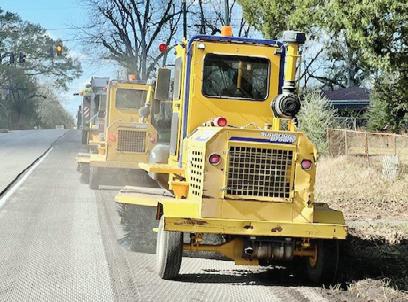
Making roads safer to drive is the mission of the Alabama Department of Transportation (ALDOT) as it continues with its federally aided Maintenance Resurfacing Program statewide.
In roads, like life, an ounce of prevention is worth a pound of cure. With that in mind, ALDOT works with the Federal Highway Administration (FHWA) to slow the deterioration of the state’s roads and, in turn, maximize the impact of every dollar spent.
By using ALDOT’s Pavement Preservation Policy, the agency’s area employees evaluate the condition of pave-
ment near them and make recommendations to the department’s deputy director of operations, who approves projects for each fiscal year.
The policy defines two types of road maintenance projects: preventive maintenance and minor rehabilitation. Federal dollars pay 90 percent of the cost of these projects, with state funds accounting for the remaining 10 percent.
To equitably distribute maintenance funds around Alabama, ALDOT organizes the state into five regions, which, in turn, are divided into areas and districts. Each area is allocated funds based on the num-
ber of state highway lane miles it contains. Preventative maintenance projects extend the “functional adequacy” or lifespan of pavement and are done on structurally sound surfaces. In some cases, drivers may not have noticed any deterioration in the road when the preventative maintenance project is finished.
The work involves removing and replacing surfaces, sealing cracks, patching, applying safety layers and high friction surfaces, stabilizing slabs, and, in many cases, includes replacing guard rails. Minor
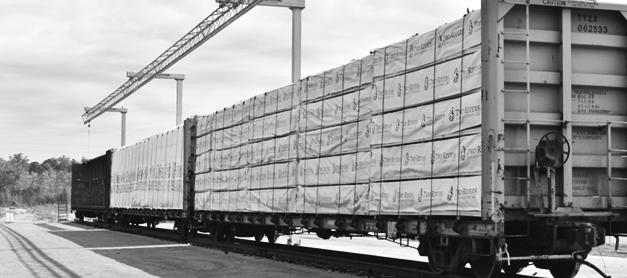
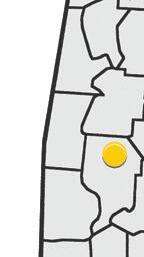
Demopolis, Ala.-based Two Rivers Lumber Co. LLC has announced plans to invest $115 million in building a modern sawmill in Coosa County, the company’s second operation in Alabama.
In addition, Two Rivers Lumber has committed to creating 130 jobs at the new sawmill, which will specialize in the production of Southern Yellow Pine dimensional lumber.
“This growth project will have a significant impact on Coosa County and cast many economic ripples throughout the region,” said Gov. Kay Ivey. “Alabama’s forest products industry is a national powerhouse, and it’s great to see Two Rivers Lumber continue to grow in its home state.”
invest
The company was established by the McElroy family, owners of McElroy Truck Lines in Cuba, Ala., and Roy Geiger, the owner of Sumter Timber in the town of Jefferson, according to Made in Alabama, the news site for the state’s Department of Commerce.
Two Rivers opened its first sawmill in Marengo County in 2017. Today, the facility near Demopolis has an annual capacity of 200 million board ft. and 145 full-time employees.
“We are happy to be expanding Two Rivers in the state of Alabama and in Coosa County,” Jay McElroy said in a statement. “We spent over a year searching for a site and planning the project, [and] we look forward to starting up the new operation in August 2025.
“The local and state support has been great throughout this process,” he added.
Peak North America, located in Irvington, Ala., is leading the construction of the planned Two Rivers facility in the community of Kellyton, northeast of Montgomery, set to
begin in June.
“Our team has a longstanding relationship with the team at Two Rivers, based on trust, integrity, and a shared commitment to a thriving forest industry,” Peak North America CEO Leif Norrgard said. “We look forward to working together on this innovative project.”
Before choosing the Coosa County site, the company also considered Mississippi as a potential location for the sawmill.
Two Rivers’ jobs creation effort will be accomplished over a one-year period, with the positions paying an average annual salary of just over $51,000, according to data from Made in Alabama.
“This investment from Two Rivers Lumber will generate
a significant number of well-paying jobs while also driving economic growth in the Coosa County area,” noted Ellen McNair, secretary of the Alabama Department of Commerce. “For local residents, this means new opportunities and a brighter future for their communities.”
To support the project, the Lake Martin Area Industrial Development Authority (AIDT) is donating 110 acres of land, valued at $2.2 million.
Denise Walls, executive director of the Lake Martin Area Economic Development Alliance, said Two Rivers is a perfect fit for the Lake Martin Regional Industrial Park, which is a partnership between nearby Alexander City and the county.
“I appreciate the support that the Coosa County Commission and Alexander City Mayor Woody Baird and his team have shown me throughout this almost 10-month recruiting process,” she explained. “We all felt like this was a project worth fighting for, and we are excited that Two Rivers will make Coosa County its new home. The local impact of this project will be profound and far-reaching.”
The high level of support from the state and its partners demonstrates the governor’s commitment to facilitating job growth in rural Alabama, added Brenda Tuck, the rural development manager of the state’s Department of Commerce.
“In collaboration with our allies across the state, we’re working hard to realize our goal of fully unlocking the growth potential of rural Alabama,” she told Made in Alabama. “It’s clear to me that opportunities are flourishing in the state’s rural communities, and the business world is beginning to take full advantage of the possibilities.”
New details about Montgomery, Ala.’s $36.6 million federal grant from the U.S. Department of Transportation (USDOT) were released March 16 by Steven L. Reed, the capital city’s mayor, according to Alabama Political Reporter.
The USDOT’s Neighborhood Access and Equity competitive grant seeks to expand transportation options and enhance access to essential services like jobs, education, healthcare, food and recreation. Funding for the program was allocated in President Biden’s Inflation Reduction Act of 2022.
The city will use the grant primarily in historic West Montgomery to reverse the persistent effects of segregation, redlining and the construction of Interstates 65 and 85.
Among other things, the funds will be applied to enhance public open spaces, increase safety and access to public safety amenities, zero-emission transportation options, workforce transportation microtransit, wayfinding enhancements and investments in future development.
Reed applied for the grant last September
and worked closely with U.S. Transportation Secretary Pete Buttigieg to secure the award. It represents the largest competitive federal grant ever presented to the city and the second-largest federal appropriation received by Montgomery behind the $42 million it accepted through the American Rescue Plan Act.
“I am pleased to announce that the city of Montgomery has received the largest competitive federal grant in our city’s history,” he said. “One of my first directives as mayor was to establish a City Grants Department to seek out more federal and philanthropic investments into our community. Ultimately, this transformative project aligns with our long-term plans for revitalizing historic West Montgomery. Combined with other initiatives already being implemented, we are creating a safer, more accessible and more connected neighborhood.”
West MontgomeryÊs Revival to Start Later in 2024
Work on the project will begin in the fall,
according to the mayor. Once completed, it will notably improve mobility for all West Montgomery residents, particularly elderly residents at the City of St. Jude Senior Assisted Living facility, students at George Washington Carver Senior High School and local elementary schools, and the residents of Gibbs Village East and Gibbs Village West housing complexes.
Key elements and infrastructure improvements within the project include:
• Redeveloping a local brownfield site into an electric vehicle (EV) charging station and microgrid.
• Repaving, striping, adding a bike lane and landscaping on West Fairview Avenue from the I-65 underpass to the Mobile Highway intersection and U.S. Highway 80.
• Establishing an EV Workforce MicroTransit site and workforce training hub to provide consistent routes to the area’s Hyundai factory, the Inland Port, downtown, the Lagoon Park Industrial Park, hospitals and other high-demand employers.
• Adding intelligent technologies such as
smart lighting, CC cameras, and Wi-Fi hotspots along Mobile Street, South Holt Street, West Fred Gray Avenue, Oak Street and West Fairview Avenue.
• Laying down an extensive fiber optic infrastructure.
• Upgrading bus stops and covered shelters.
• Enhancing navigation with more historic markers and wayfinding kiosks.
• Creating more than 2 mi. of sidewalks.
During Reed’s announcement of the USDOT grant, he thanked several groups and individuals for their work in making the improvement project a reality for West Montgomery. They included U.S. Representative Terri Sewell, D-7th District, USDOT’s Thriving Communities team, the African American Culture Heritage Action Fund, Alabama Historic Preservation Commission, the Conservation Fund, River Region Trails, the Tuskegee Agriculture Innovation Center, the Vantage Group, Alabama Power, and the city of Montgomery Grants Department.



At be t Thompson Tractor, our eyond just providing equ r commitment to your su uipment. Our dedicated uccess goes Product Support Sa an W
rdy ales Team is here to ens nd efficiently. With a range of services
Pskca Tr ber sure that your operations including:
s run smoothly
nd that’s just the beginn ffers a comprehensive s nd exceed your expectat with Thompson Tractor. ning. Our Product Suppo suite of solutions to meet tions. Experience the di rt team t your needs fference













A $14.5 million grant from the federal government was awarded to Birmingham, Ala., that will restore two-way traffic to Fourth Avenue North in the city’s historic Black business district.
On hand to make the April 3 announcement was U.S. Transportation Secretary Pete Buttigieg.
“We’re here because everybody recognizes all the ways in which infrastructure shapes our lives, and we feel it when something goes wrong,” he said. “Sometimes we don’t pay attention to it when everything goes right, but a lot of work goes into making sure that it goes right. And that’s what today is about.”
Alabama NewsCenter noted that the award comes from the USDOT’s Neighborhood Access and Equity Grant Program, which is designed in part to help reconnect underserved communities that were adversely affected by past transportation projects.
Joining Buttigieg for the announcement event were U.S. Rep. Terri Sewell, D-7th District, Birmingham Mayor Randall Woodfin, community leaders and Fourth Avenue business owners. It took place outside the historic Carver Theatre, home to the Alabama Jazz Hall of Fame and near the Birmingham Civil Rights District.
The transportation secretary added, “Part of what brings me to Birmingham today is recognizing the consequences of infrastructure decisions that were made generations ago
and our regard for a community’s vision.”
With the grant, Birmingham will be able to restore twoway traffic along 15 blocks of Fourth Avenue North, add additional features designed to revitalize the commercial district, and help reconnect the important corridor to the broader neighborhood.
As a result, the transportation secretary said people will find it easier, more comfortable, and safer to move around the area, whether they are walking, biking, riding the bus or driving.
Sewell said many past infrastructure projects created barriers between people living and working in Birmingham, and adversely impacted neighborhoods, especially in African American communities.
A prime example of that, she noted, was what happened to the Fourth Avenue North business district — regarded as the city’s “Black Main Street,” — once a thriving hub of Black businesses and neighborhoods before it was divided by the construction of Interstate 65 in the 1960s.
Ivan Holloway, executive director of Urban Impact, a nonprofit community and economic development agency, told Alabama NewsCenter in a past interview that it is inspiring to see all the activity in the Fourth Avenue Business District and the Civil Rights District, both of
The space vehicles on display have names like Jupiter, Mercury Redstone, Juno II and Saturn I. These early rockets broke barriers, set records, brought a nation together for a common goal and expanded our knowledge of the universe.
Now, they are getting the respect they deserve, Stewart explained.
He and his team are giving these icons of NASA’s past a new life, Stewart noted, adding that the upgraded display will be a showplace for the pioneering hardware that made early space exploration possible.
“It’s going to be a whole new look and feel. I think we’re really doing them justice in how we’re going to represent them.”
The new multi-million-dollar project elevates the refurbished rockets onto pedestals, surrounded by new landscape and hardscape.
But it’s been a long — sometimes frustrating — road to get to this point, Stewart told WAAY-TV.
“I would say the biggest challenge we’ve run into is mother nature,” he said.
Alabama’s fickle weather has thrown more than one curve at the construction effort. Windy conditions mean that no crane work can be done to lift the rockets into place. Additionally, rain has occasionally turned the job site into a muddy bog.
“We had the freeze in January which brought things to a screeching halt,” he reported. “I really think that’s the biggest challenge we’ve bumped up against.”
But it was all worth it, Stewart said, if the end result is showing the public the beginnings of America’s space program, which continues to this day in north Alabama.
“[Everything on display] is directly related to either the Redstone Arsenal or the Marshall Space Flight Center and this amazing city’s history in the aerospace industry,” he added.
Stewart said the museum’s administrators hope to open the new Rocket Park to the public later this year.
which are part of the larger Fountain Heights neighborhood that stretches south to Morris Avenue, and north beyond I59/20, the Birmingham-Jefferson Convention Complex, and Oak Hill Cemetery, where some of the city’s founders are buried.
“We know that the historic Fourth Avenue business district has a very rich legacy of African American ingenuity and entrepreneurship,” added Sewell. “We also know that we’ve seen the crippling effects of infrastructure policy that has sought to divide us. Our people deserve better.”
She assured that the project will “help us right these wrongs and level the playing field for the Fourth Avenue business district.”
Woodfin added that to create a thriving downtown and vibrant neighborhoods, “we need streets where a mother can safely push a stroller across a crosswalk. Our vision is to create a truly multimodal model city where people can walk, ride public transportation or ride a bike to get to their destination.”
Some of the proposed changes will not happen overnight, he said, noting that many in the community are still “trapped in a culture of car dependency.”
“It will take us some time to undo this infrastructure and redesign our streets and systems,” Woodfin continued, calling the 4th Avenue North project a “major step” in creating safer streets.
other hand, are generally more involved than preventative work but they also extend a road’s lifespan. These projects can include additional safety efforts, elevation and slope changes, widening roads and deeper removal and replacement of surfaces.
Both types of road maintenance efforts will be on display in ALDOT’s Southwest Region in 2024 as several resurfacing projects totaling approximately $40 million are about to get under way.
The Mobile area will see as many as eight projects this year across 47 mi. of area roads and highways, with up to nine more route improvements totaling 35 mi. scheduled to take place in the vicinity of Grove Hill.
Work sites around Mobile will take place in the counties of Baldwin, Escambia, Mobile and Conecuh; the Grove Hill projects are slated to happen in Clarke, Choctaw, Marengo, Wilcox and Monroe counties.
The state’s Gulf Coast region near Mobile will see people and equipment working along:
• Alabama Highway 217 from U.S. Highway 45 to Lakeview Ridge Lane in Mobile County.
• U.S. 98 from Baldwin County Road 32 to
County Road 11.
• Ala. 41 to Interstate 65 to U.S. 84/Ala. 12 in Conecuh County.
• U.S. 90 from Fowl River Bridge to Halls Mill Creek Bridge in Mobile County.
• U.S. 31 from Old U.S. 31 to Burnt Corn Creek Bridge in Escambia County.
• Ala. 21 from the Florida state line to Sunset Drive in Escambia County.
• Ala. 287 from Ala. 59 to I-65 in Baldwin County.
To the north-northeast of Mobile, several more roadway upgrades are due to begin in 2024, including:
• U.S. 84 from Clarke County Road 22 to Ala. 295.
• Ala. 178 from U.S. 43 to Clarke County Road 27.
• U.S. 84 from the Alabama-Mississippi state line to Ala. 17 in Choctaw County.
• U.S. 80 from Marengo County’s Lee Avenue to the Hale County line.
• Ala. 28 from Ala. 66 to Ala. 5 in Marengo County and Wilcox County.
• Ala. 83 from the Conecuh County line to Ala. 47 through Monroe County.
• Ala. 66 from Ala. 28 to the Marengo County line.
• Ala. 162 from just west of Dixon Creek to Ala. 28 in Wilcox County.