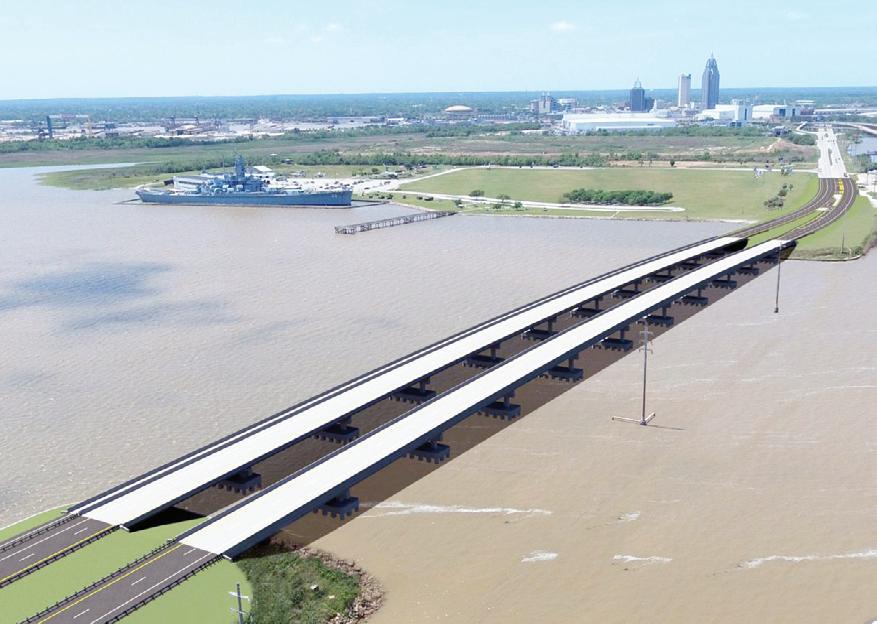
The Alabama Department of Transportation (ALDOT) will soon begin a $78.8 million project to replace the aging westbound span of the Tensaw River Bridge on the U.S. Highway 90 Causeway, just east of downtown Mobile.
Starting as early as January, ALDOT expects the project to take about two years, weather permitting, bringing essential safety upgrades, and boosting economic development along the vital route connecting Mobile with Baldwin County.
The new span will be constructed to the south of the current eastbound bridge, helping to minimize traffic impacts on the causeway during the entire build process.
Additionally, the upgrade benefits motorists and provides a dedicated pedestrian and bicycle path, supporting safe, accessible routes for all travelers near Battleship Memorial Park.
Built to modern standards, the replacement bridge will feature a durable concrete structure designed to withstand the elements and improve structural integrity.
ALDOT noted that its investment in the bridge improvement “underscores [our] commitment to enhancing transportation and promoting economic growth in the area.”
The project’s general contractor, Scott Bridge Co. Inc., from Opelika, Ala., will work closely with federal agencies to construct the Tensaw River Bridge, including the U.S. Coast Guard, U.S. Army Corps of Engineers, U.S. Fish and Wildlife Service, and the Federal Highway Administration.
ALDOT said this collaboration ensures that the project aligns with environmental regulations and maintains safe waterway access for boats traveling under the bridge during construction.
Once the work gets under way, limited vehicle lane closures will occur during non-peak hours, ensuring minimal disruption for daily commuters.
see BRIDGE page 6
The Alabama Department of Transportation (ALDOT) plans to research ways of evaluating the financial situation of municipalities seeking funding for road projects.
The move came after a meeting of the Alabama Transportation Rehabilitation and Improvement Program II (ATRIP II) committee on Jan. 16, where one legislator suggested criteria to determine whether a local government should put up matching funds for state money.
“We will put something together,” Edward Austin, the chief engineer of ALDOT, told the committee, made up of lawmakers from both chambers of the Alabama Legislature, including senior leadership and budget chairs.
The Alabama Reflector reported that Austin then proposed that the group meet once again after the Legislature gavels the end of the current 2025 legislative session.
“We need to have these criteria nailed down before we send out the calls for applications next year,” he said, and committee members agreed.
ATRIP II members are responsible for approving transportation projects through a program aimed at rehabilitating and improving the transportation infrastructure “by funding projects of local interest, proposed by one or more local governments.”
The proposal to consider a municipality’s ability to contribute funding toward a project
arose after one of the committee’s members, state Sen. Arthur Orr, R-Decatur, chair of the Senate Finance and Taxation Education Committee, expressed concerns that nine of the 22 projects before him did not have a matching contribution by the municipality that requested the project.
In the past, only a handful of proposals were submitted without a match, Orr said, and he wanted to know if a policy existed that considered the contribution made by the municipality.
“I always like to stretch the dollars,” he told members of the committee. “We have limited money.”
Orr then proposed several additional factors
that the committee could incorporate into the evaluations to decide which projects could receive funding, including need, the size of the community and the local poverty rate.
John Cooper, Alabama’s transportation director, told Orr that the law does not state that a matching fund is required for local governments to submit project proposals that would be eligible for state funding.
“When we do our work, we do not try to press on anybody any obligation to match. Therefore, we could appear to be all over the waterfront because that is what they choose to do,” Cooper explained. “We just simply do not try to enforce a match.”
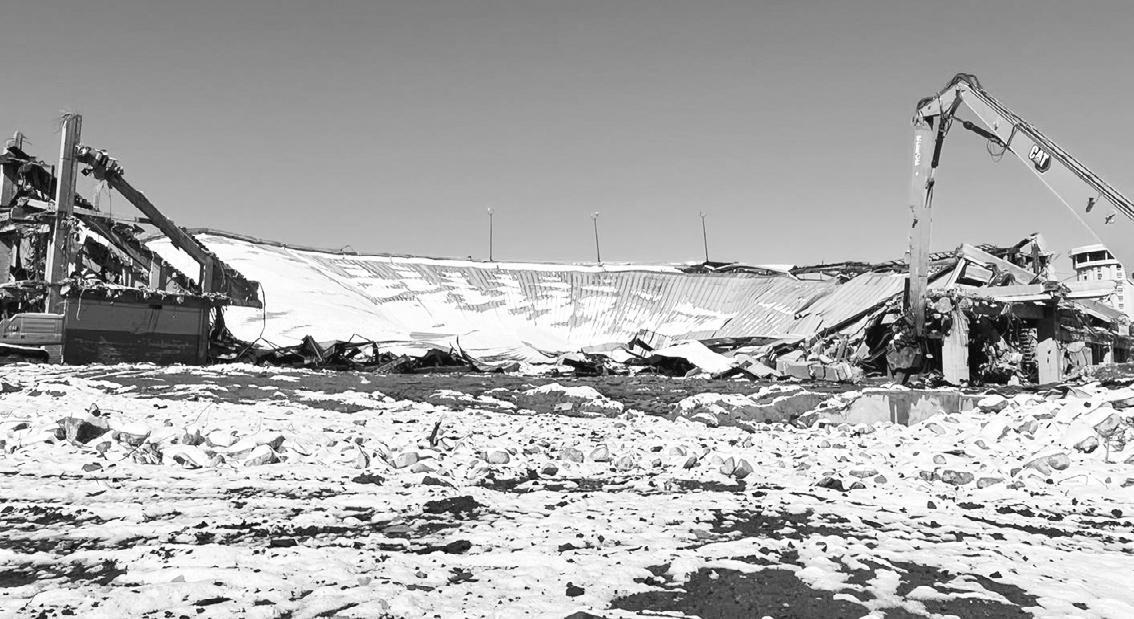
After a historic snowfall in south Alabama, the old Mobile Civic Center’s roof collapsed on Jan. 22 due to the heavy amount of frozen precipitation, the city announced.
The roof cave-in comes as crews hired by the city were already in the process of demolishing the more than 60-year-old structure in order to rebuild the facility into a $300 million entertainment arena by 2027.
Luckily, no one was injured in the collapse and the record snowfall should not delay the new arena’s construction, which is expected to begin sometime around March 12, Al.com. reported.
“Earlier this morning, the roof of the Mobile Civic Center collapsed under the weight of excessive snow,” municipal officials stated in a Facebook post. “The collapse occurred in a manner consistent with the plans for the building’s ongoing demolition. Fortunately, there were no injuries, and the mosaic murals were undamaged.”
Mobile got an unprecedented 7.5 in. of snow on Jan. 21, shattering its all-time record for snow accumulation, which had stood since 1895.
Once the new Mobile Civic Center construction gets going, the city will build a new, world-class entertainment destination suited for concerts, family shows and sporting events.
“The new facility will be uniquely designed to support Mobile’s Mardi Gras traditions while providing a state-of-the-art venue capable of bringing in major acts that previously drove through the Port City enroute to other destinations,” according to the project page on the city of Mobile’s website. “The design will ensure that structurally, functionally and aesthetically the arena will meet the current requirements from the sports entertainment industry, allowing Mobile to host top-billed entertainment that could not [have been] hosted in the [old] Civic Center.”
Its design also calls for a number of features created to provide retail spaces, luxury suites, VIP clubs, premium seating, great sightlines and dynamic acoustics, the city noted. Flexible seating and layout options will allow the new arena to accommodate a range of activities, including smaller shows and larger events with up to 10,000 spectators and fans.
Multiple ballrooms capable of hosting events of all sizes also will be part of the new venue, offering greater flexibility for Mardi Gras balls and local events, as well as creating additional spaces for conventions.
In addition to concerts and live performances, the new Mobile Civic Center will be built to host professional hockey, ice skating performances and many other youth, collegiate and professional sporting events.
ture in order to rebuild the facility into a $300 million entertainment arena by 2027.
Mobile’s new Civic Center will no longer be just a venue, noted Bama Buzz, a statewide online news service. The project’s master plan also includes utilizing the extra 16 acres of the old arena’s land to build a residential community, a theater, a parking garage, a hotel and mixed-use facilities.
A year and a half of planning, acquiring, and maneuvering became something tangible in late December as the city council in Gadsden, Ala., awarded the bid for construction of its new City Hall complex.
Clements Dean Building Co., located in Wilsonville, Ala., will build the modern $16.7 million Gadsden City Hall.
Mayor Craig Ford said that figure is well under the $20 million to $22 million range he and Heath Williamson, the city’s director of engineering, were expecting after prequalifying, the Gadsden Times reported.
“We were holding our breath,” Ford told council members. “We were tickled to death when this bid came in.”
The money will cover the renovation of the Regions Bank building at 200 Broad St., which the city purchased for $2.8 million in July 2023 as the first step toward relocating City Hall; and the adjacent Merrill Lynch building at 224 Broad St., which it bought for $2.6 million three months later. In addi-
tion, a new building will be constructed to connect the two structures.
That will free up the riverfront property — where the current City Hall and the adjoining police building have sat since 1960 — for commercial development, most notably a new hotel that Gadsden officials have long been recruiting.
The hotel would be at the site of the police building, which will be torn down, according to the Times. As for the current City Hall, Ford said that that structure will either be repurposed for commercial retail space or torn down, with the hotel developer making that call.
Everything housed in the current City Hall will move to the Regions Bank building, although the bank will still retain a small interior and drive-thru presence.
Ford said that the space will be smaller than the current City Hall, but it will be “more directional” and easier to navigate.
Gadsden’s police and fire chiefs and their command staffs will be set up in the Merrill Lynch building. Other police operations will be based at the East Gadsden precinct, and dispatch is relocating to the Etowah County 911 headquarters near the Northeast Alabama Regional Airport.
The planned connector building will house the City Council chambers on the second floor, while the first floor will be a lobby with space that the public can rent for events.
more than 60-year-old
“This is something the public will be proud of,” Ford told the Gadsden news source, adding that it will be a more professional setting for city employees and city residents needing to do business there.
Additionally, he said the new City Hall should also increase property values in the 100 and 200 blocks of Broad Street.
Ground is likely to be broken for the new Gadsden City Hall in February, Ford added, and the projected completion time for the project is 18 months.
He also explained that Clements Dean Building Co. has committed to use local firms as subcontractors, “... which is important to all of us.”
The city should not have to borrow any funds to cover the project, as roughly half the cost will come from the capital projects funds in Gadsden’s Fiscal Year 2025 budget, with the remainder coming from the FY 2026 budget.
Council members approved the bid following a unanimous consent vote to take it up on its first reading.
“It’s had its day,” the mayor said of the current City Hall, noting that aside from not being Americans with Disabilities Act compliant and having little parking, it has “substantial issues” like black mold and asbestos, and the elevators are constantly breaking down.
“This is going to be good for the citizens of Gadsden,” he said.










































































































































































em.






















This February, give your equip maintenance services and ext smoothly and avoid costly dow pment the care it deserves. With Thompso tensive parts inventory, you can keep your wntime. Affordable solutions, expert servic on Tractor’s preventative r machines running ce, and the parts you need – when you need the


































































































































































Alabama A&M University (AAMU) in Huntsville announced Dec. 18 that it had selected Freedom Real Estate and Capital LLC, also based in Huntsville, to provide construction advisory services for the school’s new Science Building and Student Amenities Building, a project with a combined value in excess of $140 million.
Freedom’s role will be to oversee the general contractor, design team and construction process, as well as make recommendations in the owner’s best interest.
“I am proud to reaffirm our partnership with Freedom Real Estate & Capital LLC for these critical initiatives,” said Daniel K. Wims, AAMU’s president. “Freedom’s expertise in construction management has been invaluable as we embark on these important projects. Together, we are committed to creating state-of-the-art facilities that will enhance our campus and support our students’ success for generations to come.”
entific discovery.
Nearby, with 93,000 sq. ft. of space, the new Student Amenities Building at AAMU is designed to serve as a hub for student engagement and support services. As such, it will feature dining facilities, meeting spaces, study areas, faculty offices, a gaming lounge and social gathering spaces — all created to enhance the campus experience.
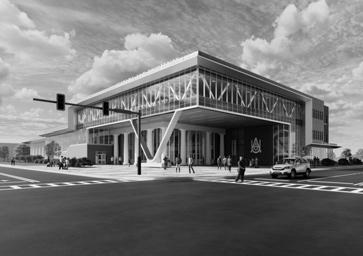
The 125,000-sq.-ft. ultramodern Science Building will house classrooms and laboratories for the physics, biology and chemistry departments, as well as give students and faculty premier spaces for teaching, learning and research.
The structure is designed to support AAMU’s growing Science, Technology, Engineering and Math (STEM) programs, and will enhance both academic instruction and sci-
In addition, the facility will address the university’s growing enrollment and provide a modern environment for academic and social development.
Tyce Hudson, Freedom project director, noted, “We are thrilled to partner with Alabama A&M University again through our advisory services in construction management. Having collaborated on several successful projects, this ongoing partnership underscores our shared commitment to innovation and excellence. Together, we are creating a lasting impact as we continue to transform the campus.”
Huntsville’s Mastin Lake Road, which, along with North Memorial Parkway/U.S. Highway 231/U.S. 431 forms one of the busiest intersections in the Rocket City, has lost its left turning lanes due to a major construction effort at the site to build an overpass, according to the Alabama Department of Transportation (ALDOT).
As a key route on the U.S. 90 Causeway, the Tensaw River Bridge serves thousands of daily commuters, travelers and commercial vehicles, the state transportation agency noted. Investing in a durable new bridge ensures reliable infrastructure that supports local businesses and tourism.
“The new Tensaw River Bridge will not only improve travel for motorists but also enhance safety for cyclists and pedestrians,” explained James Gordon, an ALDOT spokesperson. “We’re proud to invest in infrastructure that supports both mobility and environmental stewardship in this region.”
Far to the north in Huntsville, construction crews are currently working to build additional roadway lanes on U.S Highway 231/U.S. 431/North Memorial Parkway from south of the intersection of Mastin Lake Road to the intersection of Winchester Road.
The focus of the $34 million intersection redesign, though, which began in June 2023 and is part of Huntsville’s “Restore Our Roads” initiative, is to improve Memorial Parkway by building a mainline overpass at
Mastin Lake Road and extend the parkway’s service roads northward. Improvements are being made along 1.7 mi. of the North Memorial expressway all the way north to Winchester Road.
Traffic on North Memorial Parkway was diverted for the project on Nov. 22, which allows for the next step of the project — the overpass at Mastin Lake Road — to get under way, noted local WZDX-TV. The rest of the construction should take a little under two years to finish.
Rogers Group in Huntsville is the project’s general contractor.
However, as is the case in any road project like this in a busy suburban area, residents living nearby said the traffic delays and resulting lane closures from the work are causing a necessary headache. But ultimately, drivers will have to deal with the traffic and exercise caution until the roadways improve.
“The roads need to be worked on, so we can’t ask for [that to happen] and then get mad when they work on the roads,” said commuter Rod Goodlow.
Since the closure began Dec. 16, some drivers have struggled to seek an alternative route.
“A lot of crashes result from traffic stopping, starting and congestion,” said Seth Burkett, an ALDOT spokesperson, in speaking with WHNT-TV in Huntsville.
The owners of Sparks Healthcare, located on Memorial Parkway at the intersection with Mastin Lake Road, told the TV station that the construction is already having a significant impact on the number of patients they get to see in the office during the day.”
“Now we are seeing people coming in a little later in the day because they know that they have to travel a little further,” said Kaleb Sparks, who operates the clinic with his mother, Mary Sparks.
ALDOT’s Burkett told WHNT that the lanes will remain closed for the next several months for safety reasons during the $34 million overpass construction.
“We had some concerns leading up to this just due to people attempting to make those left turns at the wrong times, running red lights, and things,” he explained.
Burkett added that drivers traveling southbound on Memorial Parkway and wanting to turn left onto Mastin Lake will need to continue south and either do a U-turn at the Sparkman Drive overpass or take U.S. 72 to Mastin Lake.
Mary Sparks, the owner of the walk-in clinic, said that in the end she believes that the transition will have a positive effect on her business and the community.
ALDOT expects the left turn lanes to be closed until next April.
The Alabama Reflector noted that ALDOT’s Austin said a municipality’s ability to offer some financial contribution to a project is considered but is not weighed heavily in the consideration.
“When we have been asked to prioritize projects, we are looking at it strictly from a transportation standpoint,” he explained. “What are the projects we feel, as ALDOT, have the most impact based on the transportation criteria that we look at?”
Once that is done, if there are two or three projects with a similar priority profile, then the matching is taken under consideration, he said.
Austin cited a $2 million Limestone County project that does not have an accompanying match from the local government. However, the work is moving forward, he said, because the stretch of roadway covered by the project is dangerous and needs to be improved.
A number of the projects without a match were proposed by local governments in rural areas, many of which do not have the tax revenue to contribute as matching funds, Austin
$40M
told the ATRIP II committee.
“I would say [do] not do that … this period because the applications have come in with a certain set of rules and regulations,” ATRIP II committee member Sen. Vivian Davis Figures, D-Mobile, told Austin. “If we are going to do that, I think we should set up some type of criteria by which everybody would be treated fairly, like what is the amount of income that a county brings in, or the tax revenue that it brings in.”
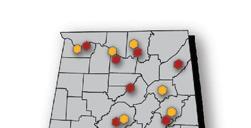
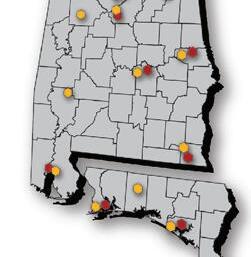
In all, 22 new projects across Alabama were approved that totaled approximately $40 million, a figure that was broken down this way:
• The east central region of the state was approved for $6.7 million.
• Another $7.5 million will go to Alabama’s west central region.
• The southeast corner of the state is due to receive $9 million worth of projects.
• The southwest region was approved for $8 million in road and highway funding.
• The remainder of the ALDOT money was committed to the northern part of the state, which has some of the most populated areas in Alabama.