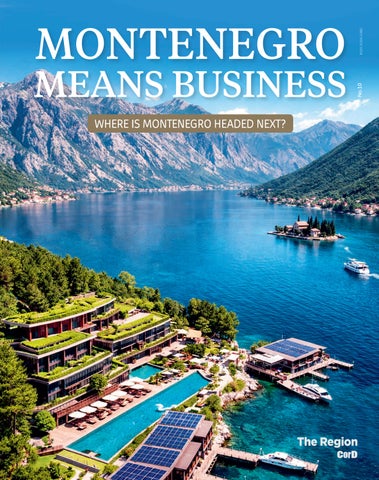
MONTENEGRO MEANS BUSINESS
WHERE IS MONTENEGRO HEADED NEXT?
The Region
DIRECTOR & EDITOR-IN-CHIEF: Ana Novčić a.novcic@connectingregion.com
DESIGN: Branislav Ninković
COMMUNICATIONS DIRECTOR: Neda Lukić n.lukic@connectingregion.com
CONTRIBUTORS: Ljubica Gojgić, Ivana Babić, Marko Nikolić, Milica Uvalić, Adriano Milovan, Armin Zeba, Dejan Azeski, Geri Kolgega, Idro Seferi, Nataša Damnjanović, Branimir Jovanović, Zoran Panović, Milan Igrutinović, Maja Vukadinović, Mila Jović, Novica Mihajlović
TRANSLATION & EDITING: Marija Jurić
PHOTOS: Zoran Petrović, Shutterstock
ADVERTISING: Biljana Dević b.devic@connectingregion.com Vesna Vukajlović v.vukajlovic@connectingregion.com
SUBSCRIPTIONS: subscribe@connectingregion.com
FINANCE: finance@aim.rs
Connecting the Regionis published by: alliance international media d.o.o. Resavska 1/III, 11111 Belgrade 17, Serbia PAK 125806, Serbia Phone: +(381 11) 2450 508 E-mail: info@connectingregion.com www.connectingregion.com www.aim.rs
All rights reserved alliance international media 2025
PRINTING: Zlatna knjiga
of Magazine’s 23 years of excellence
3009-4380
9 773009 438006 >

The views expressed in this publication are those of the presenter. They do not necessary reflect the views of the publisher
Connecting the Region is quarterly publication
CONNECTING the Region / editor in chief Ana Novčić.2023, no. 1- . - Belgrade : Alliance international media, 2023- (Subotica : Rotografika).
Tromesečno.
Cover article

9 | Editor’s Comment Montenegro’s Moment
10–13 | The Big Picture Montenegro’s economic transformation in focus.
14–15 | By the Numbers
Key indicators shaping the country’s trajectory.
16–17 | What the Budget Tells Us
Inside the priorities of Montenegro’s fiscal policy.

19 | Novica Vuković Minister of Finance, Montenegro Fiscal discipline and economic stability in a changing environment.
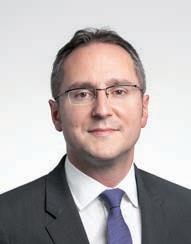
20–21 | Davor Kunc Head of Montenegro Office, European Investment Bank
European financing and the country’s development path.
22-23 | Montenegro Pulse
The news, numbers and signals shaping the business climate.
CAPITAL
26–27 | Capital & Confidence
Why investors continue to bet on Montenegro.
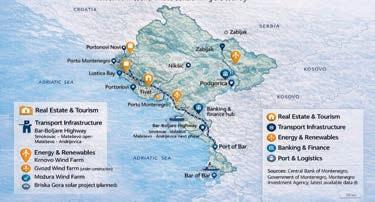
28–29 | Montenegro Investment Map
Where capital is shaping the country.
ADRIA'S VOICE IN GLOBAL BUSINESS CONTENTS
30–31 | Who’s Investing The capital driving Montenegro’s growth.
32–33 | The Visibility Economy Why reputation and communication matter for business success.




34–35 | Dr
Radović Governor, Central Bank of Montenegro Monetary stability and the future of the financial system.
36–37 | Tamaš Kamaraši CEO,
Leadership in banking during a period of transformation.
39
Regional banking strategies in
41
43 | Mirjana Kojić Executive Director, Montenegro Investment Agency
Positioning Montenegro for the next wave of investment.
45 | Foreign Investors’ Perspective on Montenegro’s Business Climate Comment by the Montenegrin Foreign Investors Council (MFIC).

46–48 | Dragan Bokan President, Voli Group
Building a retail leader in Montenegro.
Irena
CKB Banka
| Martin Leberle CEO, NLB Banka Podgorica
Montenegro.
| Christoph Schoen CEO, Addiko Bank Podgorica Financing growth in a dynamic market.
The Region
WORK & TALENT
50–51 | Working Montenegro
Labour, talent and the country’s evolving workforce.
52 | Why Montenegro Still Wins Talent
The country’s competitive advantage in attracting skilled professionals.
60–61 | Zdravko Dragaš Executive Director, EPCG
Powering the country’s next stage of development.
Digital connectivity and telecommunications growth.
54–55 | Infrastructure and Business Impact
The projects reshaping Montenegro’s economic landscape.
56 | Vojin
PhD University of
Why growth without reform risks fragile progress.
58–59 | Admir Šahmanović Minister of Energy and Mining, Montenegro
Energy security and Montenegro’s transition.

62 | Jefimija Pavićević CFO, Zeta Energy
Investing in Montenegro’s renewable future.
63 | Elcom
Smart mobility and traffic solutions for modern cities.
|



71–72 | Creators
Entrepreneurs and innovators redefining the economy.
68–70
The Women Who Decide Leadership voices shaping Montenegro’s business landscape.
Golubović,
Donja Gorica
66–67 | Branko Mitrović CEO, One Crna Gora Competition and innovation in the telecom sector.
64–65 | Zoran Milovanović CEO, MTEL Montenegro
ADRIA'S VOICE IN GLOBAL BUSINESS CONTENTS
TOURISM
74–75 | Tourism, But Smarter
How Montenegro turns visitors into longterm value
77 | BRIV Construction
Building the infrastructure behind Montenegro’s tourism growth.
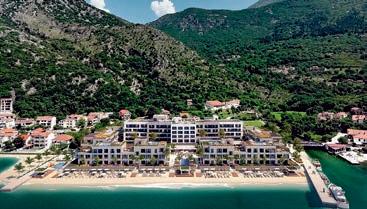
78–79 | Architecture
That Shapes the Coast Leaving a lasting mark on Montenegro’s landscape.
80–81 | Nikola Radović & Sonja Milićević Founders, NRA Atelier
Designing spaces that define modern Montenegro.

82–83 | doMEn

Supporting innovation and the digital future.


84–85 |
A new approach to regenerative aesthetics.
THE REGION LIFE
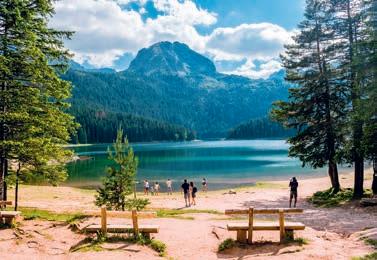
86–89 | WildScope — Black Lake Durmitor’s iconic landscape through a new lens.
90–91 | Lesser Known Tales — Cetinje Stories from Montenegro’s historic capital.
92–93 | Corporate Moves Appointments, expansions and new investments.
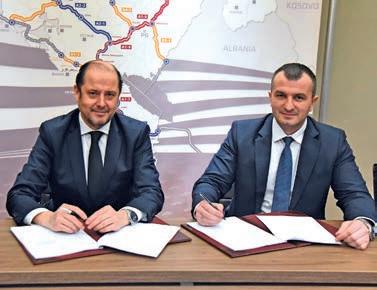
94–97 | Who Was in the Room Events shaping Montenegro’s business community.
98 | Three Things That Will Matter by 2030 Signals pointing to Montenegro’s next decade.

99 | What Comes Next How Montenegro’s story reflects the region ahead.
Dr Ioanna Regen Founder of Ioanna Clinic
GLOBAL REACH.
Whether you're launching a bold campaign, amplifying your brand’s voice, or reaching decision-makers across Southeast Europe — Region Agency delivers visibility that moves the needle.
Born from The Region magazine, we offer a trusted platform that connects your message to the people shaping the future of the Adria region — and beyond.
WHAT WE OFFER:
• High-impact visibility in The Region magazine
• Strategic digital placements across our website and newsletter
• Tailored promotion through exclusive business events
• A credible editorial environment that elevates your brand
Portonovi is just one of the many who trust us. Let your story be seen, heard — and remembered.
BE SEEN. BE KNOWN. BE PART OF THE REGION.
business@region-agency.com region-agency.com

Ana Novčić Editor-in-Chief
Why Montenegro — and Why Now
Montenegro enters 2026 with something rare in the Western Balkans: momentum that can be measured.
But in this region, momentum tends to be tested the moment it becomes visible.
Montenegro has moved further along the EU accession path than any of its neighbours. Progress is visible in chapters opened, legislation aligned and institutions increasingly tuned to European standards. The closure of Chapter 21 on Trans-European Networks — integrating the country’s transport and energy systems into Europe’s infrastructure grid — marks a shift in substance. Integration is no longer a distant objective. It is already taking shape.
That is where expectations begin to rise.
Capital follows direction that proves itself in execution. Montenegro’s edge lies in its alignment. Regulatory frameworks are converging with EU standards at a pace the region has not matched. Financial oversight is strengthening. Infrastructure, energy and digital projects are being built with European compatibility in mind, opening access to funding channels still out of reach for much of the Western Balkans.
Montenegro is ahead.
And that position changes the pressure.
Scale, often seen as a limitation, has turned into a structural advantage. Reform cycles move faster. Coordination is tighter. Adjustments that take years elsewhere can be implemented within months. Once direction is set, execution can follow with speed.
The comparison is already shifting.
As Montenegro moves closer to the EU core, regional benchmarks lose relevance. European standards become the reference point. That shift brings a different level of scrutiny — on labour markets, institutional capacity, sustainability and the speed at which decisions translate into results.
Change is visible across sectors.
Tourism is moving beyond seasonality toward year-round, capital-intensive models. Energy projects are entering the grid. Transport investments are increasingly tied to competitiveness within a wider European system.
The transformation is structural.
The political context, however, remains less predictable.
The idea of collective accession has returned to the regional conversation. Montenegro’s response has been clear. Prime Minister Milojko Spajić has signalled that the country intends to enter first and wait for others from within the Union. It is a confident position. It also raises the stakes. The frame shifts from regional comparison to European evaluation.
At this stage, integration is tested through implementation.
Momentum raises expectations.
The significance of 2026 lies in whether progress holds under pressure. Continued reform would confirm Montenegro as the most credible EU-adjacent entry point in the Adria market. Any slowdown would narrow the gap between perception and delivery — precisely because expectations are now higher.
This issue looks at Montenegro as a front-runner.
Direction has been set. Delivery will be measured. The role of this magazine remains the same: to examine progress with clarity, without exaggeration and without hesitation.
Montenegro matters now because it is ahead. The harder question is whether it can sustain that position.
CAPITAL BRIEFING
Montenegro’s Economic Playbook
2026–2030
F
or much of the past decade, Monte-
negro has been discussed through a narrow lens: tourism, luxury real estate and its dramatic Adriatic coastline. But as the second half of the 2020s begins, the country is quietly entering a different phase of its economic story.
Among EU accession candidates, Montenegro now occupies a distinctive position. It is not the largest market in the Western Balkans, nor the fastest growing. Yet it is the most institutionally aligned with the European Union, operating under regulatory frameworks that increasingly mirror those of the single market it hopes to join.
That distinction does not eliminate risk. But it changes the nature of that risk.
For investors navigating a world of geopolitical fragmentation, tightening capital conditions and rising regulatory scrutiny, direction matters more than promises. What markets reward today is not rhetoric but policy momentum and institutional predictability Montenegro, in that sense, is no longer simply a small tourism economy on Europe’s periphery. It is becoming a test case for how a small system can reposition itself within a larger Euro -
pean economic architecture
The question now is whether that repositioning can translate into durable growth.
GROWTH, IN CONTEXT
Montenegro’s economic trajectory over the past five years reflects both the vulnerability and resilience of small open economies.
The pandemic shock of 2020 exposed the country’s dependence on tourism more brutally than in most European states. GDP contracted by more than 15 percent, one of the sharpest declines on the continent. Yet the rebound that followed was equally dramatic, driven by the rapid reopening of travel and the revival of international demand for the Adriatic.
Since then, growth has gradually stabilised.
Recent economic expansion has been supported not only by tourism recovery, but also by infrastructure investment, services expansion and increasing capital inflows linked to regional connectivity
The composition of growth is therefore slowly shifting.
THE INVESTOR LENS
Montenegro at a Glance (2026)
Population
~620,000
GDP (2025 est.) ≈ €8.5–9 billion
GDP per capita ≈ €14,000
Currency Euro (unilateral adoption)
EU status
Most advanced EU accession candidate in the Western Balkans
Key growth drivers
Tourism • Energy • Infrastructure • Financial services
FDI since independence ≈ €14+ billion
Strategic location
Adriatic gateway between Central Europe and the Mediterranean
Core investor advantage
EU alignment + small-system agility
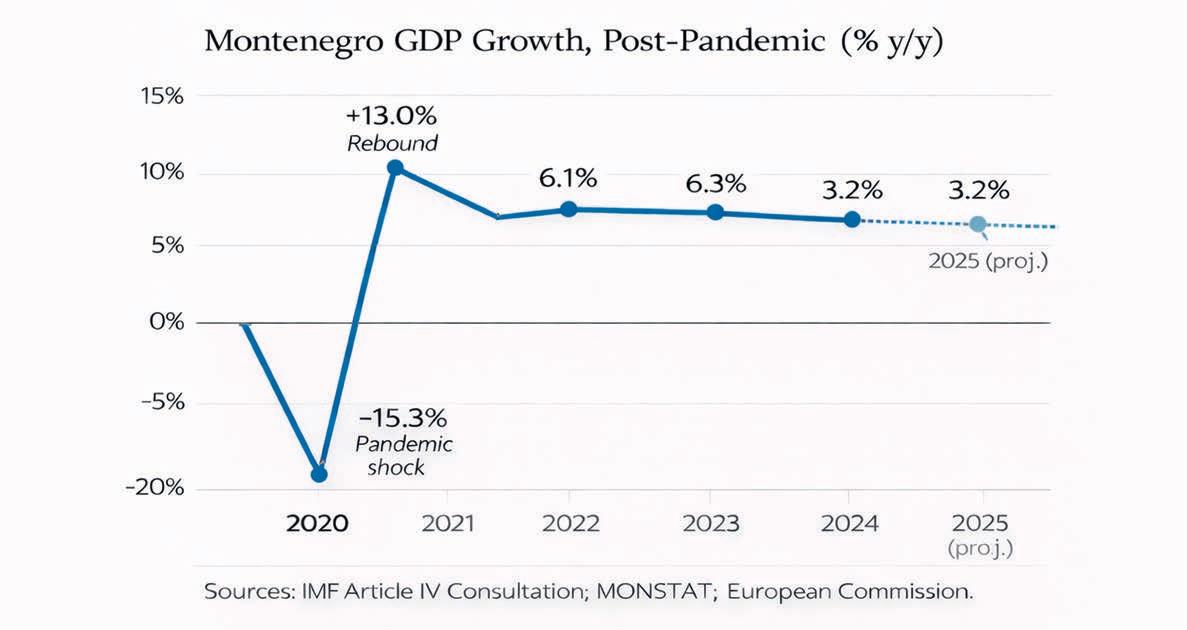
Where earlier cycles relied heavily on seasonal tourism revenue and domestic consumption, the current phase shows stronger contributions from capital formation, logistics investment and energy development projects
That transition is still incomplete. Tourism remains a central pillar of the economy. But the direction of change suggests that Montenegro’s growth model is evolving from a seasonal economy toward a more structurally diversified one.
For long-term investors, that distinction is crucial.
FOREIGN DIRECT INVESTMENT: CHANGING SHAPE
Foreign direct investment has long been Montenegro’s most visible economic strength. Since independence in 2006, the country has attracted more
than €14 billion in cumulative FDI, a remarkable figure for an economy of just over 600,000 people.
But the structure of that investment has historically been narrow.
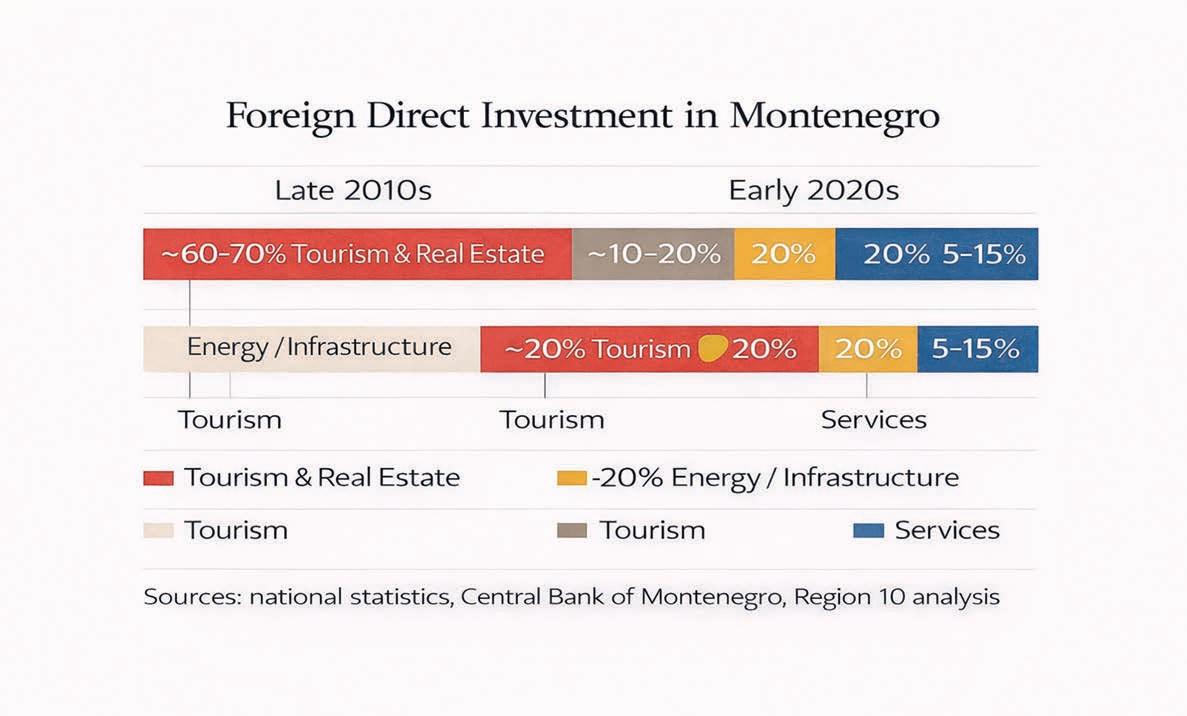
Large inflows into coastal real estate and tourism developments helped transform the country’s physical landscape — from Porto Montenegro to Portonovi and Luštica Bay — but they generated limited spillovers into productivity, exports or industrial capacity. Today, that mix is beginning to change.
Recent investment flows show a gradual diversification across several sectors:
• renewable energy projects
• transport and logistics infrastructure
• financial and business services
• digital infrastructure and connectivity
Real estate remains significant — and will likely remain so given Mon -
tenegro’s geographic advantages. Yet it is increasingly one component of a broader investment ecosystem rather than its defining feature.
Another emerging trend is the growing role of regional capital and institutional investors , including European development banks and infrastructure funds. Their participation introduces longer investment horizons and stricter governance standards, which in turn influence project design and regulatory expectations.
In other words, the story of foreign investment in Montenegro is shifting from volume to structure.
PRIORITY SECTORS: SELECTIVE BY DESIGN
Montenegro’s economic strategy is not built on scale. It is built on selectivity.
With limited domestic demand and a small labour pool, the country’s competitive advantage lies in targeted sectors where capital intensity and geographic positioning create leverage. Four areas stand out for the 2026–2030 horizon.
Energy.
Hydropower, solar and wind projects are accelerating as the region seeks greater energy security and alignment with European decarbonisation goals. Montenegro’s geography and grid interconnections position it as a potential energy node in the Adriatic system. Infrastructure and logistics.
Road corridors, port capacity and digital infrastructure are gradually strengthening Montenegro’s role in regional supply chains linking the Adriatic coast with Central Europe.
High-value tourism and real estate.
The country is moving beyond mass tourism toward luxury hospitality, marina economies and branded residential developments that generate year-round revenue rather than seasonal peaks.
Financial and business services.
Banking, project finance and advisory services are expanding alongside cross-border investment activity, increasingly operating under EU-compatible regulatory frameworks.
What links these sectors is not volume but long-term capital commitment. Energy projects illustrate this most clearly. Renewable investments require not only capital but regulatory stability, grid integration and cross-border energy trading frameworks. For Montenegro, the success of this sector will function as a credibility test for institutional capacity.
EU ACCESSION: ECONOMICS
BEFORE POLITICS
Montenegro’s EU accession process is often framed as a diplomatic or political milestone. For investors, its significance is primarily economic.
Alignment with EU rules already affects key areas of the business environment:
• competition policy
• public procurement standards
• financial supervision
• regulatory transparency
These adjustments gradually reduce transaction risk and increase compatibility with European funding instruments, including development finance from institutions such as the European Investment Bank and the European Bank for Reconstruction and Development.
The impact of this process is cumulative rather than immediate. Yet markets tend to price momentum early.
Being the most advanced accession candidate does not mean Montenegro is finished with reforms. It means it is subject to earlier scrutiny — and earlier credibility tests — than its regional peers.
REGULATION: PRO-BUSINESS, WITH REAL TESTS
Montenegro’s regulatory environment is broadly pro-business in intent. Corporate taxation remains competitive. Company formation procedures are relatively streamlined. Institutional coordination has improved compared to earlier phases of transition.
Yet structural challenges remain. Administrative capacity still varies between sectors.
Large infrastructure projects occasionally face delays.
Labour shortages are emerging in several industries, particularly tourism and construction.
None of these constraints are unique to Montenegro. But in a small system they are felt faster and corrected faster.
Credibility in such an environment depends less on policy declarations than on the consistent execution of projects and reforms.
THE STRATEGIC ADVANTAGE OF SIZE
Montenegro’s small scale is frequently described as a weakness. In practice, it can also function as a strategic advantage.
Smaller systems often benefit from:
• faster policy adjustments
• shorter institutional feedback loops
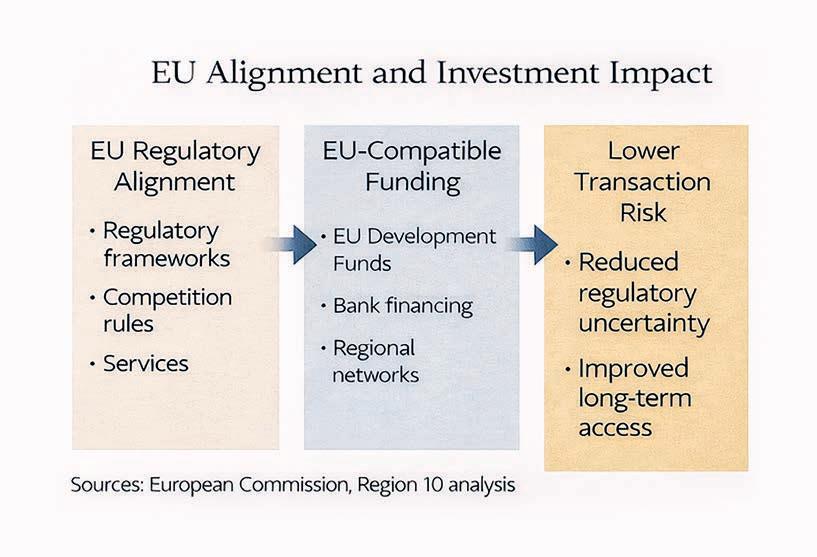
• closer coordination between public and private stakeholders
When direction is clear, implementation can follow rapidly. When direction is uncertain, however, there is little room to conceal it.
That dynamic makes policy clarity particularly important.
WHAT THIS MEANS FOR INVESTORS
Montenegro’s economic environment today is shaped by a convergence of structural factors:
• faster regulatory alignment with EU standards than most regional peers
• infrastructure projects increasingly moving from concept to execution
• energy and tourism sectors shifting toward higher value models
• greater scrutiny from European institutions alongside improved market access
For investors, the country represents neither a risk-free environment nor a speculative frontier. It occupies a
more nuanced space: a small but strategically positioned economy undergoing institutional consolidation while remaining open to external capital.
THE BOTTOM LINE
Montenegro is no longer competing for attention through promises alone. It is competing through positioning.
The coming four years will determine whether its EU-aligned institutional framework translates into durable investment, diversified growth and deeper integration into regional economic networks.
The conditions for that transition are forming.
The scrutiny surrounding it is increasing.
For investors looking at the Adriatic region, the question is no longer whether Montenegro is interesting. It is whether the country can convert direction into execution.
The pages that follow examine that question through evidence rather than optimism.
Montenegro
A small country, measured clearly.
The Economy
GDP (nominal, latest full year)
The Scale
POPULATION
623,000 (2023 census; latest official estimate)
TERRITORY
13,812 km²
COASTLINE
294 km
POPULATION DENSITY
45 people per km²
Montenegro remains one of Europe’s smallest markets — and one of its most concentrated.
Work & Income
AVERAGE NET MONTHLY SALARY
€800+
UNEMPLOYMENT RATE
Low-to-mid teens
Labour market indicators remain structurally challenged, with seasonal swings driven by tourism.

€7.6 billion
GDP PER CAPITA
€12,000+
REAL GDP GROWTH (2024) 3.2%
CURRENCY
Euro (unilateral adoption)
The economy has stabilised after post-pandemic volatility, returning to moderate but consistent growth.
Tourism
TOTAL VISITORS (2023) 2.6 million
OVERNIGHT STAYS (2024) 15.6 million
SHARE OF GDP 25–30%
FOREIGN GUESTS
Over 90% of total overnights
Tourism remains the single most dominant economic force — both a strength and a structural risk.
Structure of the Economy
SERVICES
~75% of GDP
INDUSTRY
~20%
AGRICULTURE
<5%
Montenegro’s economy is overwhelmingly service-led, with limited industrial depth.
Public Finance & Integration
PUBLIC DEBT
Below 70% of GDP
EU STATUS
Accession negotiations ongoing
EUROZONE ALIGNMENT
High (without formal membership)
Fiscal consolidation has improved credibility, but long-term convergence remains tied to reform pace.
What the Numbers Say
The Reality Check
TOURISTS VS RESIDENTS (peak season) Visitors outnumber citizens.
REGIONAL IMBALANCE
The coast drives growth; the north lags behind.
SEASONALITY
Summer defines revenues; winter defines vulnerability.

MONTENEGRO IS SMALL, OPEN, EURO-ALIGNED AND TOURISM-DEPENDENT.
ITS GROWTH STORY IS CREDIBLE — BUT NARROW.
ITS OPPORTUNITY LIES IN DIVERSIFICATION, INFRASTRUCTURE AND YEAR-ROUND VALUE CREATION.
What the Budget Tells Us
A snapshot of Montenegro’s public finances as stabilisation gives way to growth.
Public Finance Snapshot
PUBLIC DEBT: ~58 % OF GDP (SEP 2025)
BUDGET DEFICIT: ~3.6 % OF GDP (2025)
REAL GDP GROWTH: ~3.2 % (2025)
INFLATION: ~4–5 % (2025)
CURRENT BALANCE ACCOUNT: ~18 % OF GDP (LATEST AVAILABLE DATA)
Why These Numbers Matter
Debt
SIGNALS REGAINED STABILITY AFTER THE 2020 PEAK.
Deficit FRAMES THE BALANCE BETWEEN DISCIPLINE AND GROWTH.
Growth CONFIRMS ECONOMIC EXPANSION BEYOND RECOVERY.
Inflation AND THE CURRENT ACCOUNT HIGHLIGHT REMAINING MACRO RISKS INVESTORS WATCH CLOSELY.
Montenegro’s Fiscal Reset
Montenegro’s latest budget figures offer a revealing snapshot of an economy that has largely moved beyond crisis management and into a more stable, if still delicate, phase of expansion.
Only a few years ago, the country’s fiscal outlook looked far more uncertain.
The pandemic-driven collapse in tourism — the backbone of Montenegro’s economy — sent public finances sharply off course. Revenues dropped, spending rose and public debt surged above 100 percent of GDP, forcing policymakers to focus on a single priority: stabilisation.
Today’s numbers tell a different story. Public debt has fallen to around 58 percent of GDP, a level that places Montenegro much closer to the fiscal norms seen across much of Europe. The improvement reflects a combination of economic recovery, stronger tax revenues and tighter fiscal management aimed at restoring credibility in international markets.
For a small economy that relies heavily on external capital and investor confidence, that credibility matters. Fiscal stability shapes everything from borrowing costs to the willingness of international investors to finance infrastructure, tourism developments and energy projects.
The budget deficit — estimated at roughly 3.6 percent of GDP — illustrates the balancing act now facing the government. Montenegro is under pressure to maintain fiscal discipline while at the same time investing in the infrastructure and connectivity projects needed to sus-
tain long-term growth. Roads, energy networks and transport links are not simply public works; they are the foundation of the country’s broader economic strategy.
Economic growth of just over 3 percent suggests the country has entered a more
FISCAL TRAJECTORY
2020
PANDEMIC SHOCK SENDS PUBLIC DEBT ABOVE 100% OF GDP
2021
TOURISM REBOUND RESTORES REVENUES AND ECONOMIC MOMENTUM
2023
FISCAL CONSOLIDATION BEGINS REDUCING DEBT PRESSURES
2025 PUBLIC DEBT FALLS TO ~58% OF GDP, RESTORING FISCAL CREDIBILITY
measured stage of expansion. For policymakers, the challenge is no longer merely recovering from a shock but ensuring that growth becomes more diversified and less dependent on a single sector.
Tourism will remain central to Montenegro’s economy for the foreseeable future, but investors and institutions increasingly look for signals that other parts of the economy are gaining momentum as well — from energy projects to services and logistics tied to the Adriatic corridor.
Two indicators continue to draw particular attention from economists. Inflation, estimated at around four to five percent, remains elevated by European standards, reflecting the lingering effects of global price pressures and domestic demand. At the same time, Montenegro’s large current account deficit — close to 18 percent of GDP — highlights the country’s structural dependence on imports and tourism-related inflows.
Neither challenge is unusual for a small, open economy. Yet both are reminders that fiscal stability alone does not eliminate vulnerability. Montenegro’s economic model still relies heavily on external capital, seasonal tourism revenues and continued investor confidence.
What the current numbers ultimately show is a country that has moved from emergency management toward economic strategy. The immediate fiscal crisis has eased, but the next phase — converting stability into sustainable growth — will require careful choices about investment, diversification and long-term competitiveness.
For investors watching the region, that transition may be the most important signal of all.

Fiscal Discipline Without Losing Momentum
As Montenegro balances fiscal responsibility with the need for continued investment, Finance Minister Novica Vuković outlines how the country is stabilising its public finances, strengthening resilience, and laying the groundwork for sustainable growth — without compromising financial credibility.
How would you describe the current direction of Montenegro’s public finances — consolidation, stabilisation, or expansion?
Montenegro’s public finances are currently in a phase of stabilisation supported by determined consolidation. The Government is strengthening the revenue side of the budget, improving fiscal discipline, and increasing overall resilience, while at the same time supporting strategic investments essential for long-term growth.
This approach creates a solid foundation for sustainable development, strengthens the confidence of citizens and investors, and prepares Montenegro for full alignment with European fiscal standards.
What is the Government’s approach to managing public debt while continuing to invest in infrastructure and development?
The Government pursues a policy of responsible public debt management, carefully balancing sustainable borrowing with the financing of key development projects. The focus is on refinancing existing obligations under more favourable conditions, while directing investments toward infrastructure, green projects, and digitalisation.

These investments are designed to increase productivity and expand the country’s long-term fiscal capacity. The objective is clear: support growth without jeopardising financial stability.
Predictability is often cited as the most important factor for investors. How stable can Montenegro’s tax and fiscal framework be over the medium term?
Montenegro is building a stable and predictable tax and fiscal framework through clear legislation, modernised tax procedures, and harmonisation with EU standards. The Government’s objective is to ensure consistent application of regulations, transparent procedures, and a policy environment that supports sustainable investment.
For investors, this means reduced risk, clearer expectations, and a business cli-
mate focused on competitiveness rather than short-term adjustments.
How exposed is the state budget to external shocks, and where does Montenegro show the greatest financial resilience?
The budget today is more resilient than in previous years, supported by stronger fiscal reserves and a more diversified revenue base. Sectors linked to global trends, such as energy and tourism, remain more sensitive to external shocks.
However, through disciplined fiscal management, support for sustainable projects, and the gradual strengthening of domestic production, overall vulnerability has been reduced. Stable tax revenues and continued investment in public infrastructure provide an important buffer during periods of uncertainty.
Which fiscal decision taken over the past year best reflects the balance between discipline and growth?
One of the most important decisions was the adoption of a comprehensive package of financial reform laws, strengthening the tax system, banking sector, capital markets, digital resilience, and sustainable investment frameworks.
This package demonstrates that fiscal discipline and economic growth are not mutually exclusive. On the contrary, Montenegro is directing resources toward projects that increase long-term productivity while accelerating the country’s European integration.
Novica Vuković, Minister of Finance of Montenegro
Europe’s Bank Goes Local
Davor Kunc on capital, execution and Montenegro’s next investment phase
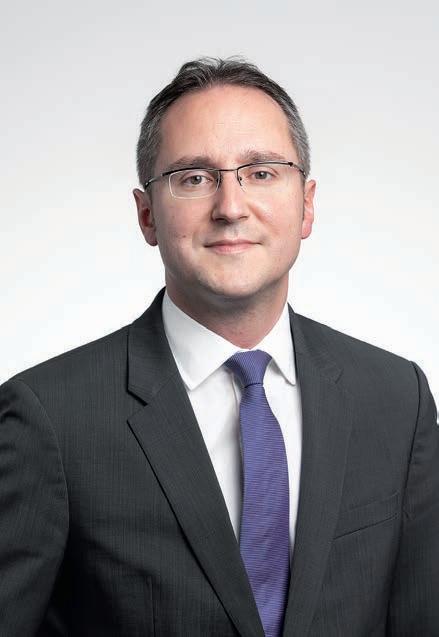
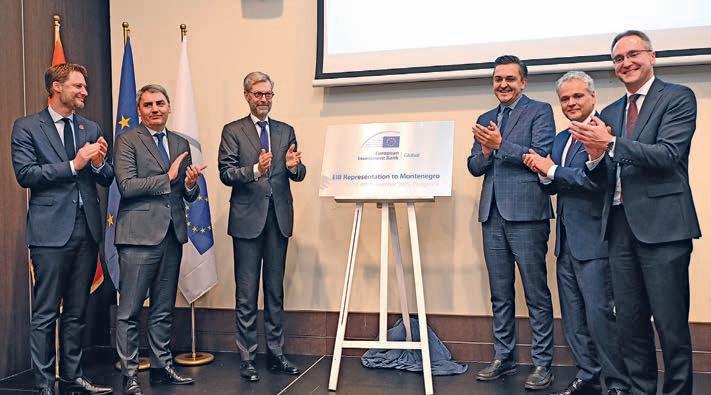
When the European Investment Bank opened its first permanent office in Montenegro, it signalled a structural shift rather than a ceremonial milestone. As the country moves toward the final stretch of EU accession, the focus is no longer limited to negotiating chapters — it is about implementation capacity, investment absorption and measurable economic impact. European capital is increasingly aligning with reform momentum, and execution is becoming the central variable. We spoke with Davor Kunc, Head of the EIB Representation to Montenegro, about where financing is headed, what still needs fixing and how Montenegro can position itself before membership rather than after it.
The EIB has opened its first office in Montenegro. Why now?
As the EU bank owned by its Member States, our mandate is to actively support Montenegro’s EU accession process. With all 33 negotiating chapters expected to close by the end of 2026, the country is entering a decisive implementation phase. Enlargement remains a strategic EU priority, and Montenegro’s steady progress has created the right conditions for a permanent presence.
A local office enables daily coordination with ministries, financial institutions and project promoters. This proximity strengthens project preparation, accelerates decision-making and allows us to deploy both financial and advisory instruments more effectively. At this stage, delivery is as important as reform commitments.
The impact is already visible. The Bar–Golubovci railway section — one of Montenegro’s key transport corridors — is supported by a €63 million EIB Global loan combined with €112 million in EU grants. The modernisation will improve safety, efficiency and capacity for more than 1.3 million passengers and nearly 1.9 million tonnes of freight annually, reinforcing Montenegro’s regional connectivity.
Where is the next wave of financing headed?
Our focus is on sectors that underpin long-term competitiveness: transport connectivity, green transition, healthcare, education and water infrastructure.
In transport, we continue financing rehabilitation of major road corridors and railway sections, as well as the modernisation of the air traffic control system. Preparatory studies for the renovation of the Port of Bar — Montenegro’s primary maritime gateway — are underway with EIB technical assistance, creating a pipeline for future strategic investment.
In healthcare, we are preparing financing for equipment upgrades in more than 30 hospitals and health centers nationwide. In education, a new framework loan for school modernisation is in preparation and may be complemented by EU grants. Through the “Better Schools for All” programme, 813 pre-school, primary and secondary schools are currently being assessed to thereafter reconstruct the prioritized schools and with it ensure safer, more inclusive and better-equipped learning environments — strengthening longterm human capital.
Support for SMEs remains central, particularly in innovation, digitalisation and decarbonisation. We are also exploring new investment opportunities in the energy sector aligned with Montenegro’s climate commitments and European transition objectives.
What still slows investment?
The primary constraint remains project readiness. A strong pipeline of well-prepared projects aligned with EU standards allows financing to move faster and at greater scale.
Further improvements in governance, regulatory simplification and permitting procedures would accelerate cap-
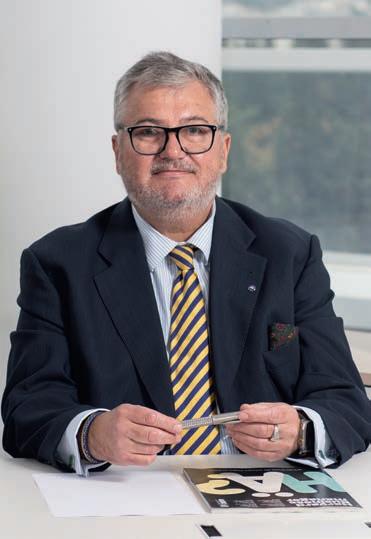
Davor Kunc
Head of the EIB Representation to Montenegro
ital flows and shorten implementation timelines. Montenegro has made significant progress, but the coming phase will depend heavily on institutional coordination and execution capacity.
Through advisory initiatives that strengthen technical preparation and mobilise EU grants, we support this process. However, implementation speed ultimately determines economic impact.
How does Montenegro compare regionally?
Financing volumes reflect growing confidence. EIB activity has increased from approximately €60 million in 2024 to €83 million in 2025, with over €200 million expected this year. This upward
In the water sector, a €57 million EIB loan combined with €59 million in EU grants is upgrading water supply and wastewater systems across multiple municipalities, particularly in the northern region, addressing structural bottlenecks that directly affect competitiveness and quality of life.
What changes for SMEs?
Through cooperation with the Development Bank of Montenegro, €100 million has supported over 300 SMEs, including €20 million dedicated to green investments. A new €50 million credit line focused exclusively on green-eligible projects is under preparation.
The EU-backed Guarantee for SME
trajectory signals both improved preparation and stronger strategic alignment.
Croatia provides a useful reference. Following EU accession, EU grants expanded significantly and EIB financing increased markedly compared to pre-membership levels. Montenegro now has the opportunity to build similar absorption capacity before accession, positioning itself to fully leverage EU funding from the first day of membership.
Current investments are already generating measurable results. In education, more than €55 million has modernised infrastructure nationwide.
Resilience is unlocking €15 million in loans, helping companies adapt to evolving EU standards, including carbon-related requirements. In parallel, the upcoming Greening Financial Systems Programme will support the Central Bank and commercial banks in assessing and reporting climate risks, strengthening alignment with European regulatory frameworks and supporting private sector competitiveness.
Five years from now, what would success look like?
Success would mean Montenegro fully integrated into the EU single mar-
ket, with infrastructure meeting European standards and institutions capable of managing large-scale investment efficiently and transparently.
It would mean driving along reliable transport corridors, patients treated in modernised hospitals and students taught in refurbished classrooms. Success would be underlined with upgraded water systems that keep Montenegro’s rivers and lakes clean, and a private sector prepared for a carbon-adjusted European economy. The opportunity is substantial. The decisive factor will be sustained execution — ensuring that reform momentum translates into durable economic growth and improved living standards.
EIB IN MONTENEGRO
The Numbers Behind the Presence
€1.4 billion
Total EIB financing in Montenegro to date 32 Projects financed
Top 3 sector by volume
Credit lines for SMEs, transport, water & sewerage
€100 million
Largest single investment (credit line signed, Development Bank of Montenegro in 2018)
€63 million loan + upcoming €112 million
EU grant Bar–Golubovci railway modernization
58%
Share of EIB Global investments in the Western Balkans in 2025 contributing to climate action
2026–2028
Focus: Transport. Healthcare. Education. Water. SMEs.
Montenegro Pulse
Foreign Investment Reaches €867 Million
Foreign direct investment inflows totaled €867 million in the first eleven months of the year, according to the Central Bank of Montenegro. Net inflows reached nearly €454 million, underlining sustained investor interest in the country.
Digital Nomad Boom
Montenegro has emerged as one of the world’s most attractive destinations for remote workers. According to the VisaGuide Digital Nomad Index, the country ranks third globally, behind Spain and the UAE, with thousands of IT professionals and startup founders now living along the Adriatic coast.

Public Debt at 60% of GDP
Montenegro’s public debt stands at roughly €4.8 billion, or about 60% of GDP. While the level remains manageable compared with similar economies, maintaining fiscal discipline will remain critical in the years ahead.
Renewable Energy Association Launched
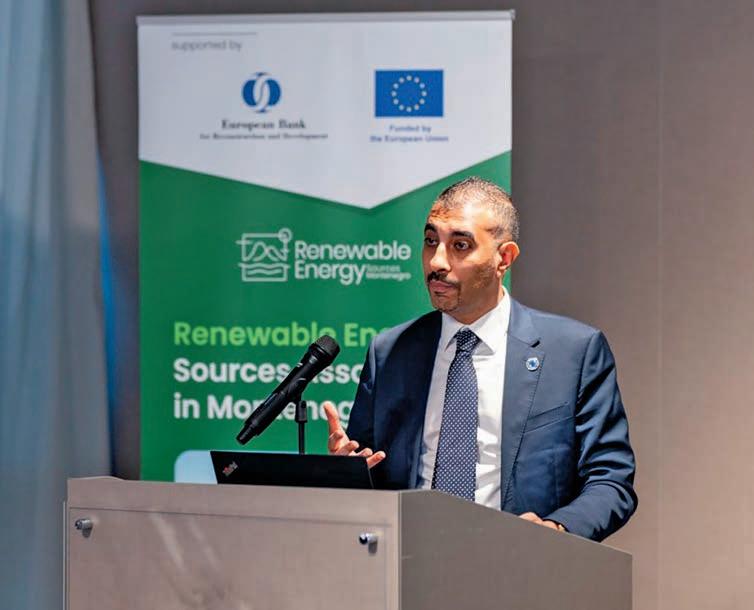
Montenegro has established a Renewable Energy Association with support from the European Bank for Reconstruction and Development. The initiative aims to improve coordination between policymakers, investors and developers while accelerating private investment in the country’s clean-energy sector.
S&P Confirms B+ Rating, Outlook Positive
Credit rating agency Standard & Poor’s reaffirmed Montenegro’s B+ sovereign rating while upgrading the outlook to positive. The decision reflects improving fiscal discipline, steady economic growth and continued progress toward EU integration.
Labour Shortage Deepens
Montenegro’s economy is facing a growing labour gap, with businesses lacking at least 40,000 workers. Companies increasingly rely on foreign labour, particularly in construction and tourism, as demographic decline and migration tighten the domestic labour market.
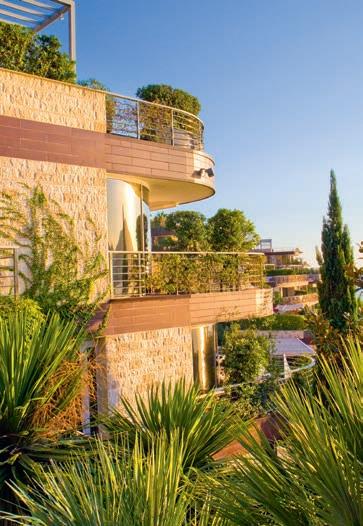
Average Apartment Price Reaches €2,200 per m²
Property prices continue to rise across Montenegro. Data from Monstat shows the average price of newly built apartments reached €2,200 per square meter, reflecting strong demand in coastal cities and sustained interest from foreign buyers.
SEPA Slashes Cross-Border Payment Costs
Montenegro’s integration into the Single Euro Payments Area (SEPA) has sharply reduced the cost of transfers to the European Union. Fees on a €5,000 transaction now average around 0.04–0.05%, placing Montenegro among the most efficient payment corridors linked to the EU.
Electricity Among the Cheapest in Europe
With household electricity prices around 11.1 cents per kWh, Podgorica ranks among the most affordable capitals in Europe for energy. The cost advantage provides relief for households and strengthens the country’s competitiveness for energy-intensive industries.
Average Salary Hits €1,026
The average net salary in Montenegro reached €1,026 in January 2026, a modest increase compared with the previous year. The highest wages remain in finance and insurance, while administrative services record the lowest earnings.

SUBSCRIBE To The Region Stay Ahead in Adria
82€
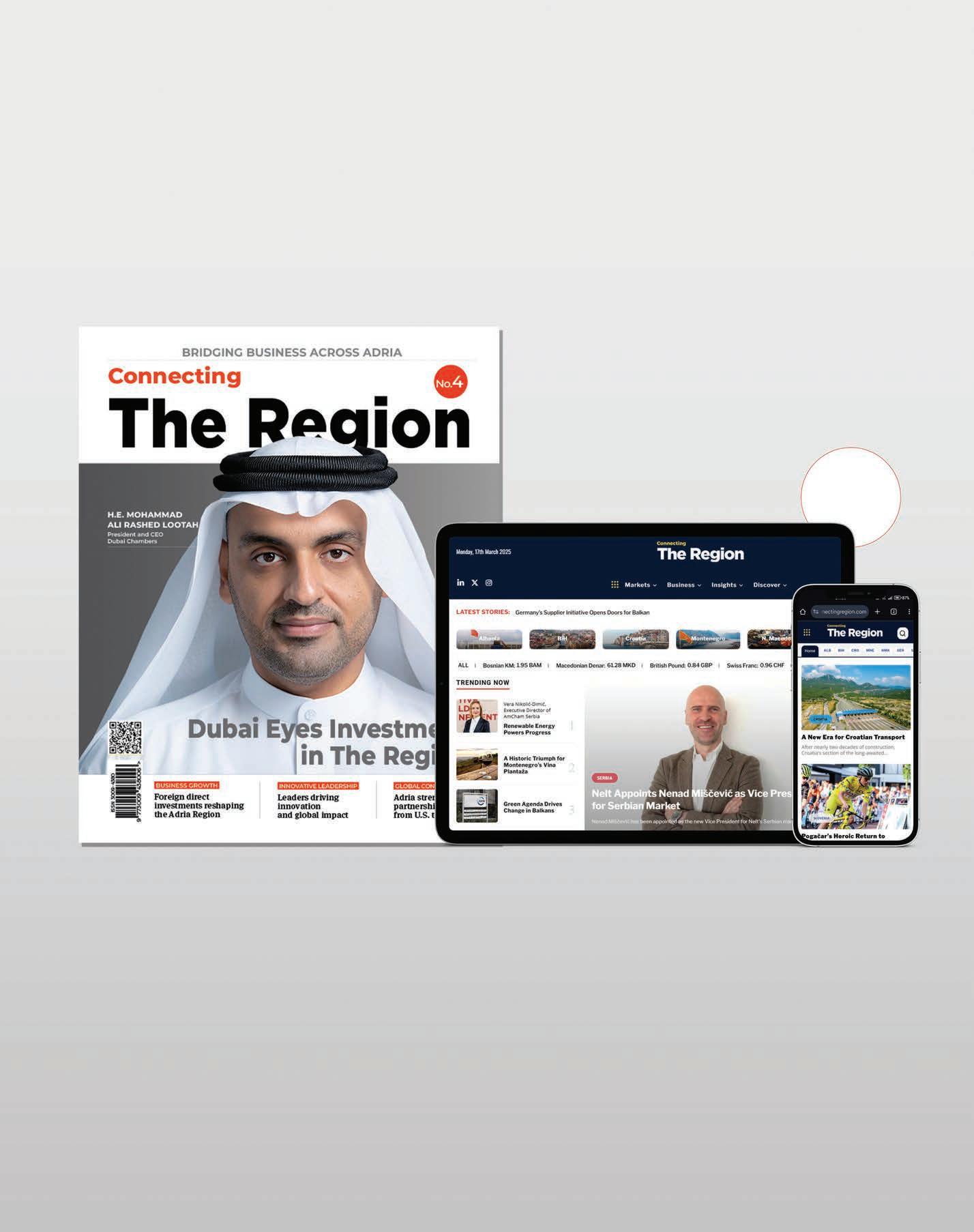
The Region is where ideas, perspectives, and ambitions from across the Adria region come together. From industry leaders to bold innovators, we bring you the stories that drive change and shape the future. Stay connected to the pulse of business, progress, and the people making an impact.

CAPITAL
The money, institutions and strategic bets shaping Montenegro’s economic future — and why global investors continue to watch this small market closely.
Capital & Confidence
Why money keeps choosing Montenegro — and what still makes it hesitate
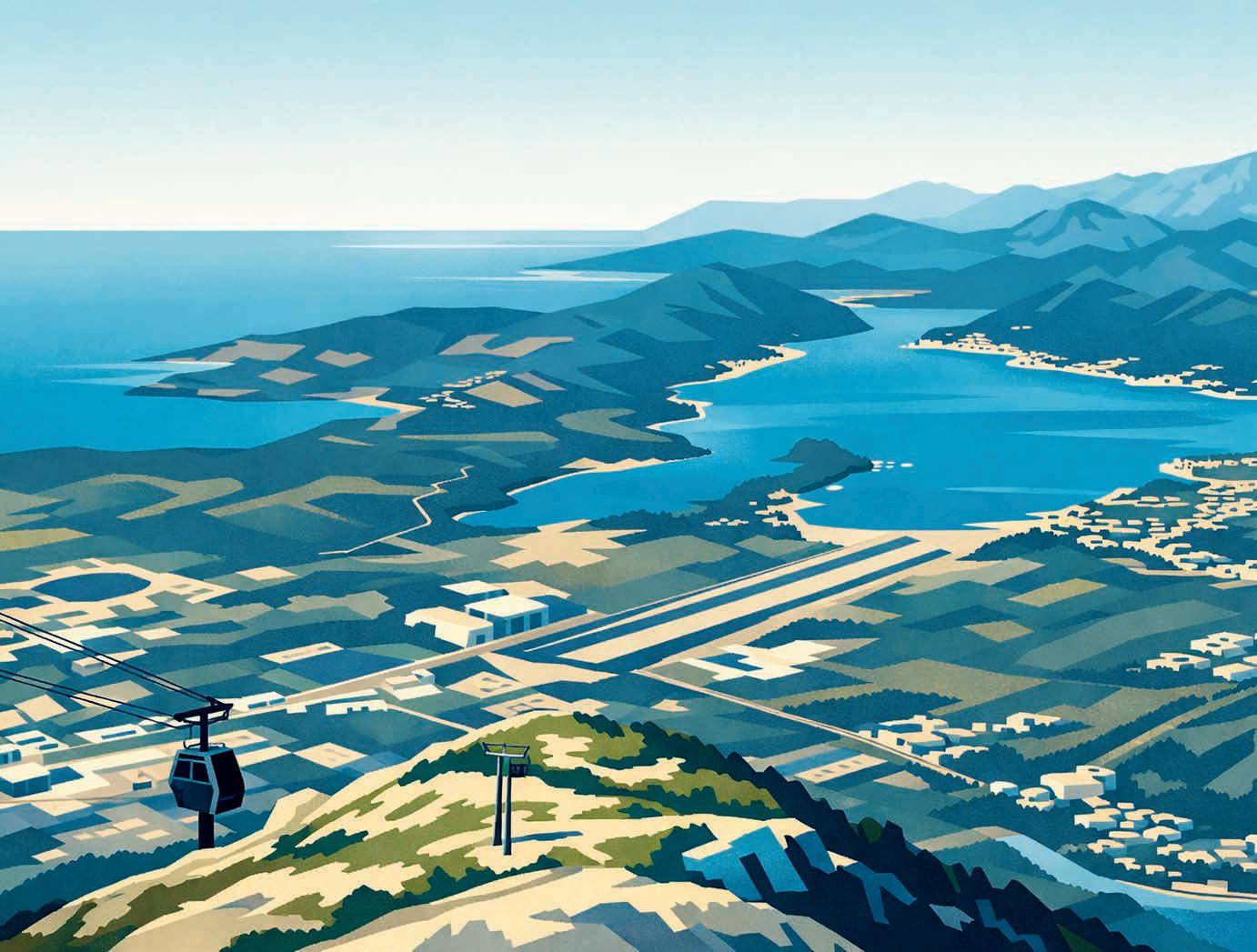
Montenegro does not compete on scale. It competes on density — of coastline, access, proximity and, increasingly, of capital that knows exactly what it is buying.
The country’s investment story is often reduced to real estate statistics and postcard imagery. But that framing misses the real dynamic. Capital does not arrive in Montenegro because it is picturesque. It arrives because the risk is legible. For investors placing long-term money, clarity often matters more than size. Montenegro has gradually learned how to make itself readable.
Foreign direct investment has remained resilient for more than a decade, with property continuing to absorb a large share of capital inflows. That pattern is neither accidental nor temporary. Real estate is typically where international capital tests a new market first — where resale value, jurisdictional risk and demand can be assessed quickly. Montenegro has passed that test repeatedly. What followed was confidence.
That confidence has visible landmarks. Porto Montenegro in Tivat, backed by international investors including the Investment Corporation of Dubai, was among the first developments to demonstrate that global standards could not only be introduced, but sustained. It was never simply a marina. It was designed as an ecosystem — residential, commercial and service-based — capable of keeping capital circulating rather than departing with the tourist season.
Further along the coast, the pattern repeats in different forms. Luštica Bay, developed by Orascom Development, was conceived less as a resort and more as a town — a bet on permanence in a country historically associated with seasonality. Portonovi in Kumbor introduced another scale of investment, combining hospitality, residences and marina infrastructure.
These projects serve a role beyond tourism. They function as signals. When they perform, other investors stop asking whether Montenegro works and start ask-
Capital Check: Montenegro
WHAT INVESTORS TRUST
REGULATORY PREDICTABILITY
Low volatility and relatively stable investment rules
EURO USAGE
No foreign-exchange risk in daily operations
FLAGSHIP PROJECT DELIVERY
Large developments completed and operational
LIFESTYLE DENSITY
Coast, capital and airport within short distances
EU ACCESSION TRAJECTORY
Long-term integration with European markets
ing where they might enter.
Policy has reinforced that signal. Montenegro combines relatively low headline tax rates with the stability of euro usage, despite not being part of the eurozone. Coupled with a political narrative oriented toward European Union accession, this has created a rare regional proposition: predictability without the complexity of larger markets.
Montenegro does not advertise regulatory stability loudly. Instead, it demonstrates it through repetition. Investors return because the rules tend not to change mid-sentence.
Yet confidence, once established, becomes demanding. Montenegro’s foreign investment structure remains heavily concentrated in property and tourism-linked assets. Productive investment — in advanced services, export-oriented sectors and parts of the energy economy beyond renewables — has grown more slowly than policymakers would like.
The question is no longer whether Montenegro is attractive to investors. That debate has largely been settled. The more relevant question is whether the in-
WHAT INVESTORS WATCH
FDI CONCENTRATION
A large share of inflows tied to real estate
JUDICIAL TIMELINES
Contract enforcement can move slowly
TALENT DEPTH
Strong service sector but limited specialised labour
INFRASTRUCTURE
DELIVERY
Execution remains more important than announcements
POLITICAL CONTINUITY
Stability valued above ideological shifts
vestment base can broaden.
Capital notices when ambition outruns execution.
It also notices when comfort replaces reform.
Montenegro is not there yet — but it is closer than it sometimes admits.
That tension defines the next phase of the country’s development. Montenegro’s greatest advantage has always been speed: a small system where decisions travel quickly and proximity compresses distance between capital and lifestyle.
Its risk lies in mistaking desirability for inevitability. Capital stays where it can grow, not just where it can rest.
The country has already answered the hardest question — whether global investors trust it. They do.
The remaining test is quieter, and more consequential: whether Montenegro can turn confidence into diversification, and reputation into resilience.
Money is patient. But it is not sentimental.
And it is already watching what comes next.
Where capital is physically reshaping Montenegro — see the Investment Map on page 38.
MONTENEGRO INVESTMENT MAP
Where capital is shaping the country.
Viewed from above, Montenegro’s investment landscape reveals a pattern that is both simple and strategic. Capital does not disperse randomly. It concentrates — along the coast, through the capital, and increasingly across a network of infrastructure and energy corridors that are beginning to redraw the country’s economic map.
What appears at first as geography is, in fact, a system.
The Adriatic coastline remains the most visible expression of this system. Over the past decade, large-scale tourism and residential developments have turned previously quiet towns into globally recognised destinations. Projects in Tivat, Kotor Bay and along the Budva riviera did more than attract visitors — they anchored Montenegro within the circuits of international capital.
But the real impact lies beneath the surface. Around each development, secondary economies have emerged: hospitality services, property management, logistics, retail and a growing ecosystem of professionals supporting an increasingly international clientele. What began as real estate investment has evolved into a broader economic platform.
Yet the coastline tells only part of the story.
IN MONTENEGRO, DISTANCE IS SHORT — BUT ECONOMIC IMPACT TRAVELS FAST.
Further inland, Podgorica operates as the country’s economic control centre. Unlike the coast, where capital is visible in cranes and construction sites, Podgorica’s influence is structural. It is where decisions are made, capital is managed and systems are coordinated. Financial institutions, telecom operators and service providers form a dense network that connects Montenegro not only internally, but also to regional and European markets.
In practical terms, this makes Podgorica less of a destination and more of a switchboard — a place where economic activity is directed rather than displayed.
Connecting these two poles is the country’s most consequential transformation: infrastructure.
The Bar–Boljare highway, still incomplete but already influential, represents more than a transport project. It signals a shift in how Montenegro positions itself — from a coastal destination to a transit and logistics corridor linking the Adriatic with inland Europe. Each new kilometre reduces internal fragmentation, bringing the north closer to the coast and the country closer to regional supply chains.
Infrastructure, in this sense, is not just about movement. It is about integration.
Parallel to this, a quieter but increasingly important layer of investment is taking shape in energy. Wind farms such as Krnovo and Možura, alongside planned solar projects like Briska Gora, are gradually expanding Montenegro’s renewable capacity. What was once
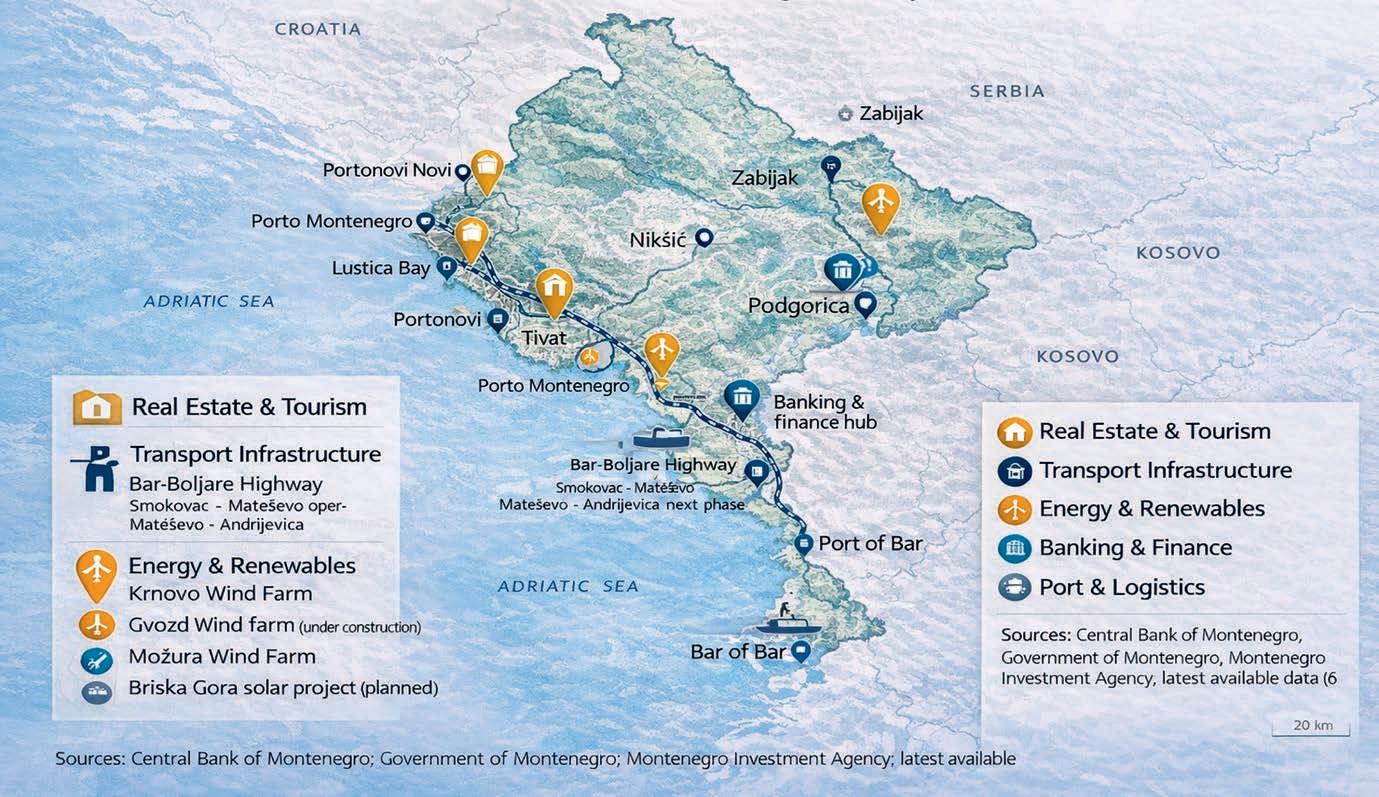
MONTENEGRO’S ECONOMIC NODES
€1.4 billion
Total EIB financing in Montenegro to date
Adriatic Coast
Tourism investment and luxury residential developments.
Podgorica
Financial, administrative and telecommunications hub.
Energy Corridors
Wind and solar projects expanding renewable capacity.
Transport Infrastructure
Road and logistics links connecting the country with regional markets.
a peripheral sector is becoming central to the country’s long-term positioning. Energy investment does two things at once: it strengthens domestic resilience and signals alignment with European green transition priorities. For investors, this combination is increasingly decisive.
Taken together, these layers — coastal development, administrative concentration, infrastructure expansion and energy investment — form a compact but highly interconnected system. Montenegro’s small size, often perceived as a limitation, becomes an advantage within this framework. Distances are short, decision-making structures are concentrated, and projects can move faster than in larger, more fragmented markets.
Proximity, in Montenegro, is not just geographic. It is economic.
This creates a distinct investment logic. Rather than competing on scale, Montenegro competes on coherence — the ability to align sectors, shorten timelines and create visible impact within a relatively small space. For investors, that clarity can be more valuable than size.
The next phase of development will depend on how well these connections are deepened. The coastline will continue to attract capital, but its long-term value will increasingly depend on how effectively it is linked to inland regions. Podgorica will remain the control centre, but its role will expand as financial and digital services grow. Infrastructure will determine speed. Energy will determine sustainability. What emerges is not a finished map, but a framework still in motion.
Montenegro may be geographically small. Its investment network, however, is becoming increasingly sophisticated — and, with each new connection, harder to ignore.
Follow the Money
Who’s Investing
The investors, institutions and companies shaping Montenegro’s economic landscape
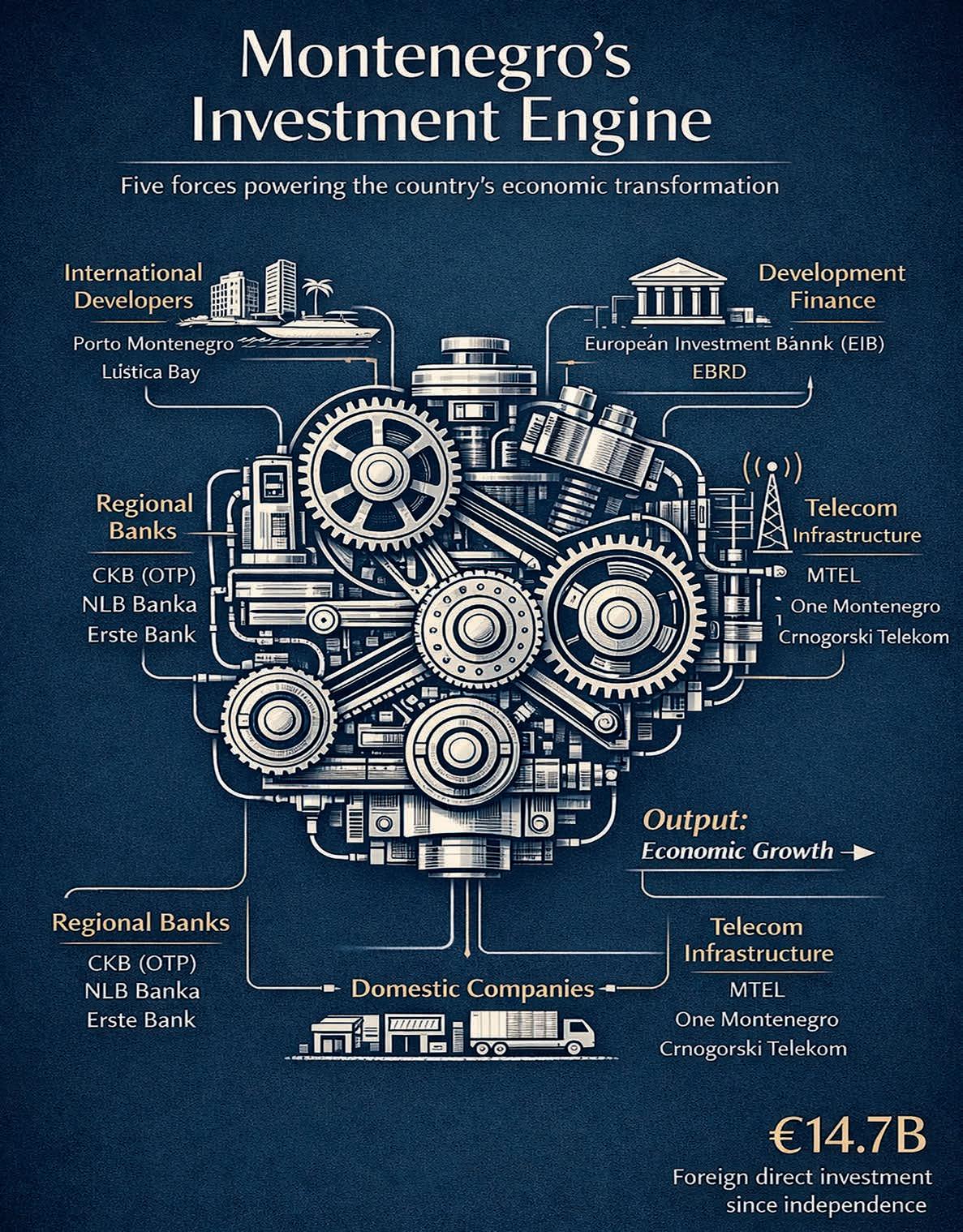
Montenegro’s investment story is often told through its coastline. Yet the cranes and construction sites visible along the Adriatic represent only part of a broader network of capital flowing into the country.
Behind the projects is a diverse ecosystem of investors: international developers, European financial institutions, regional banks and domestic companies that together form the backbone of Montenegro’s evolving economy.
Foreign developers were among the first to reshape the country’s investment landscape. Large coastal projects helped place Montenegro on the radar of global capital and demonstrated that complex developments could be executed successfully in a small market. Those early investments created momentum, attracting service companies, financial institutions and hospitality brands.
European development finance has played another important role. Institutions such as the European Investment Bank have supported projects in transport, energy and environmental infrastructure, helping strengthen the country’s economic foundations while signalling confidence to private investors.
Regional financial groups are equally significant. Banks operating in Montenegro provide capital for businesses, infrastructure and households, linking the domestic economy with broader financial networks across Southeast Europe.
At the same time, domestic companies have expanded alongside foreign investors. Retail, logistics and service firms have built the operational layer that allows large international projects to function day-to-day. Their role is often less visible than that of international developers, but no less essential.
What emerges is not a single investment narrative but a layered structure of capital. Global investors bring scale and international visibility. Development institutions provide financial stability and credibility. Regional financial groups connect markets. Domestic companies anchor economic activity locally.
For Montenegro, this combination has gradually transformed a small Adriatic economy into a more interconnected investment environment.
The country’s market may remain modest in size. But its investment ecosystem is becoming increasingly complex — and increasingly resilient.
INVESTOR LANDSCAPE
International Developers
Large tourism and residential developments along the Adriatic.
European Development Lenders
Financing infrastructure, energy and environmental projects.
Regional Banking Groups
Providing credit and financial services across the economy.
Telecommunications Operators
Expanding digital infrastructure and connectivity.
Domestic Champions
Montenegrin companies driving retail, logistics and services.
The Visibility Economy Montenegro mastered desire. CAN IT NOW MASTER CREDIBILITY?
Montenegro does not suffer from invisibility. Quite the opposite.

Over the past decade, the country has built one of the most recognisable destination brands in Europe. Its coastline, cuisine and lifestyle have travelled across international media through carefully orchestrated campaigns, high-profile events and celebrity endorsements. From Sveti Stefan’s global iconography to luxury marina developments and headline-making visits from international figures, Montenegro learned how to sell at-
mosphere — and sell it well.
Few small countries have done this as effectively.
But success in tourism branding has created an unintended side effect. While Montenegro is widely known as a place to visit, it remains far less understood as a place to do business.
That gap — between image and economic substance — defines the country’s next visibility challenge.
FROM DESIRE TO DECISION-MAKING
Global audiences associate Montenegro with beauty, leisure and exclusivity. Investors, however, ask different questions.
They want to understand regulatory alignment, governance standards, financial stability, dispute resolution mechanisms and long-term predictability. They assess talent pipelines, sector competitiveness and policy coherence. These elements exist within Montenegro’s reform trajectory — particularly as the country advances in EU accession and strengthens institutional frameworks — but they are not communicated with the same clarity and consistency as the tourism narrative.
Visibility that drives tourism does not automatically translate into credibility that drives investment.

Farzana Baduel, President & CEO of Curzon PR and a Fellow of the Chartered Institute of Public Relations in the United Kingdom, sees this challenge across emerging markets.
“The single biggest mistake countries make is failing to define a clear strategic positioning,” she says. “Too many try to be everything to all investors and trade partners, and in doing so dilute their impact entirely. Reputation for international business is built on clarity, not breadth — on depth of excellence rather than broad ambition.”
For Montenegro, the question is no longer whether it can attract attention. It
is whether it can sharpen that attention toward specific sectors, strengths and longterm advantages.
WHEN A STRONG IMAGE BECOMES A NARROW ONE
Branding is a double-edged sword. What makes a country desirable can also confine it.
The dominance of the tourism narrative has, at times, overshadowed progress in areas that matter to investors: financial reform, infrastructure planning, regulatory harmonisation and the emergence of internationally oriented companies. For global decision-makers scanning markets quickly, perception often precedes detail. If perception is incomplete, opportunity is delayed.
Baduel cautions against attempting to compensate with messaging alone.
“Credibility cannot be built through communications alone. If communications outpace reality, credibility will be short-lived. Strategic communications can articulate progress and close perception gaps — but it cannot manufacture credibility.”
In other words, communication must follow substance — but it must follow it deliberately.
A REGIONAL PERSPECTIVE ON VISIBILITY
Regional PR professionals observe that Montenegro’s international image has long been shaped by cultural and lifestyle moments.

Danijel Koletić, CEO of APRIORI WORLD in Croatia, notes that global recognition initially formed around cultural exposure and iconic imagery.
“In business terms, however,” he argues, “Montenegro’s perception still begins with tourism. Yet tourism itself receives insufficient strategic investment, particularly outside the coastline. Infrastructure visibility and consistent communication at key touchpoints — from airports to border crossings — remain underleveraged.”
His criticism points to a broader issue: visibility is not only about international campaigns. It is also about the everyday experience of partners and investors interacting with the system.
PR BEYOND PROMOTION
In small markets, PR is often equated with exposure — events, media coverage, promotional campaigns. That model
From Destination to Decision-Making
What Montenegro’s next visibility phase requires
Lifestyle branding opens doors; business clarity closes deals Strong tourism images can narrow investor perception Strategic PR is about explanation, not exposure Credibility grows through consistency, not campaigns Reputation now travels faster than reforms
works for consumer branding. It is less effective for capital markets and institutional credibility.
Strategic PR for business operates differently. It aligns leadership messaging, clarifies reform trajectories and prepares organisations for scrutiny. It manages expectations before pressure intensifies.
Ljiljana Burzan-Nikolić, Executive Director of BI Communication in Montenegro, argues that the country possesses underappreciated structural advantages.
“International partners respond strongly to Montenegro’s accessibility, geopolitical clarity and the agility of its business community,” she says. “Direct access to decision-makers and faster communication flows often compensate for limits of
scale. NATO membership and the EU path reinforce strategic alignment and security.”
Yet she adds a crucial qualifier:
“In today’s visibility economy, perception is shaped by consistency. Reputation must be treated as a strategic asset — aligning transparent governance, measurable performance and private-sector excellence into a coherent international narrative.”
The distinction is important. Visibility is not noise. It is coherence.
A NEW PHASE OF VISIBILITY
Montenegro is entering a phase where visibility must do more than inspire. It must inform.
The country has successfully positioned itself as aspirational. The next step is to position itself as predictable. Investors seek clarity more than charm. They reward alignment more than aesthetics.
This does not require abandoning the tourism brand that has served Montenegro well. It requires expanding it — layering economic narrative onto emotional appeal.
Those companies and institutions that understand this shift early will be better positioned as Montenegro’s business story matures. Those that rely solely on inherited perception may struggle to be taken seriously beyond the season.
Visibility, once again, becomes a form of capital.
WHAT MONTENEGRO’S BUSINESS LEADERS MUST NOW ASK
Are we known only for where we are — or also for how we operate?
Do international partners understand our systems, or just our scenery?
Are we shaping expectations — or inheriting them?
The next chapter of Montenegro’s international positioning will not be written in sunsets and celebrity visits. It will be written in clarity, consistency and institutional confidence.
Montenegro mastered desire.
The real test now is mastering credibility.
Stability in a Euroised System
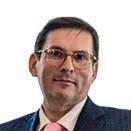
Governor Irena Radović on banking resilience, SEPA integration and the structural realities of operating without monetary autonomy.
Montenegro’s financial system rarely makes headlines — and that is precisely the point. In a small, euroised economy without independent monetary policy, stability is not accidental; it is constructed through supervision, discipline, and institutional design. As Montenegro positions itself as a serious investment destination, the health of its banking sector becomes more than a technical matter. It becomes a signal. Dr Irena Radović, Governor of the Central Bank of Montenegro speaks in Montenegro Means Business about resilience, credit dynamics, SEPA integration and the structural trade-offs of euroisation — and what financial stability means for businesses operating in and with Montenegro.
How would you assess the current state and resilience of Montenegro’s banking sector?
Montenegro’s banking sector is stable, liquid, and strongly capitalised, reflecting a sustained reform agenda led by the Central Bank to align the regulatory and supervisory framework with European Union standards.
At the end of 2025, total bank assets reached EUR 7.9 billion (over 97% of GDP), with annual growth of around 9%, confirming the sector’s central
“Euroisation provides stability and credibility, but requires disciplined institutional policy”
role in financing the domestic economy. Credit activity remains robust, with year-on-year growth exceeding 14%, while deposits of nearly EUR 6 billion (around 75% of GDP) indicate sustained public confidence.
Asset quality continues to improve, with non-performing loans at a histori-
cal low of 2.67%, confirming that credit expansion is grounded in prudent underwriting and effective supervision. A capital adequacy ratio of 19.4%, well above regulatory requirements, further underscores resilience.
Progress has also been made in meeting the closing benchmarks for EU negotiation Chapters 4 (Free Movement of Capital), 9 (Financial Services), and 32 (Financial Control), demonstrating alignment with the EU acquis.
A key milestone was Montenegro’s accession to SEPA in November 2024,
Governor Dr Irena Radović
enabling integration into the European payments market under EU rules. In parallel, the Central Bank is advancing the TIPS Clone project to strengthen instant payment capabilities and interoperability with European infrastructures.
Strong fundamentals, regulatory convergence, and integration into European financial infrastructures position Montenegro’s banking sector as resilient and prepared for sustainable growth.
Is credit activity sufficiently aligned with the needs of the economy and investment projects?
From the supply side, there are no material constraints on financing sustainable, high-quality projects, reflecting ample liquidity and a sound banking system. Credit dynamics, however, are equally shaped by demand-side factors, including the bankability of investment proposals, financial discipline, and the long-term viability of business models.
Credit expansion can reach its full potential only within a broader reform framework that strengthens the business environment and institutional capacity. Within the constraints of a euroised system, the Central Bank remains focused on preserving financial stability and enhancing financial infrastructure to support the real economy.
Credit growth depends not only on interest rates, but on the overall efficiency of the financial system and the cost structure of doing business. In this respect, Montenegro’s integration into SEPA represents a measurable structural improvement.
According to preliminary World Bank indicators, average B2B transaction fees between Montenegro and SEPA countries have fallen from around 1% to approximately 0.04% of transaction value — a significant and immediate reduction in costs. This efficiency gain frees resources for in -
vestment, expansion, and job creation.
Looking ahead, the Central Bank will continue alignment with European regulatory standards, including DORA and MiCA, while developing instant payments through the TIPS Clone system and maintaining a secure, predictable financial environment.
The objective remains clear: a resilient banking system that enables faster,
use of the euro eliminates exchange rate volatility and anchors expectations — particularly valuable for a small, open economy. It facilitates cross-border transactions and supports financial integration with the European Union.
At the same time, euroisation entails structural constraints, primarily the absence of independent monetary policy instruments, including exchange
more affordable financing aligned with productive investment needs.
In a euroised economy, where does Montenegro’s financial system gain strength, and where does it face constraints?
Euroisation provides tangible strengths, most notably monetary stability, low currency risk, and high credibility for investors and depositors. The
Banking Snapshot End - 2025
Assets: €7.9 bn (97% GDP)
Credit growth: +14% Deposits: €6 bn
19.4%
rate flexibility and autonomous liquidity provision. As a result, resilience relies more heavily on strong supervision, prudent risk management, and adequate capital and liquidity buffers.
In a system without access to monetary financing or seigniorage income, ensuring the financial sustainability of the central bank becomes particularly important. This requires robust institutional design, diversified revenue sources, and continued alignment with European standards.
Euroisation provides stability and credibility, but demands disciplined, institution-driven policy. The Central Bank therefore remains focused on regulatory convergence and institutional strength, embedding Montenegro’s financial system within the European framework while supporting long-term growth.
Banking Is Going Digital. Leadership Is Still Human.
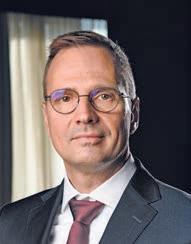
Tamás Kamarási, President of the Management Board of Crnogorska Komercijalna Banka,
explains how Montenegro’s largest bank is navigating rapid technological change, growing competition and the country’s deeper integration into the European financial system.
Montenegro’s banking sector is entering a period of transformation shaped by digital innovation, tighter regulation and the country’s gradual integration into the European financial system. As the country’s largest bank, CKB stands at the centre of these changes. Yet for Tamás Kamarási, technology alone does not define leadership. Stability, trust and close relationships with clients remain the decisive factors in modern banking.
CKB has held a leading position in Montenegro’s banking sector for many years. What does leadership in banking mean today?
Leadership is not a title that can be won once and kept forever. It must be earned every day, through every interaction with clients. Of course, strong numbers matter — CKB today manages €2.2 billion in assets and holds a 33.6% share in lending — but leadership is not defended by numbers alone. It is built through presence and service. A bank is not just a headquarters
in Podgorica. Our goal is the same professionalism and quality of service in every city. One of the clearest confirmations of that approach are our internal awards for the best branch and best customer experience in 2025, which went to teams in Pljevlja and Budva. Leadership is ultimately built through people and trust.
What advantages does belonging to OTP Group bring to CKB?
OTP Group gives CKB the strength of a large international financial network operating across eleven markets in Central and Eastern Europe. This provides access to capital, expertise and technological solutions that significantly strengthen our position.
At the same time, this international network allows us to remain strong-
ly local. Through the OTP network we support Montenegrin companies expanding abroad and serve as a natural partner for international investors entering Montenegro. Many of them already operate in markets where OTP Group is present, which makes cooperation easier and faster.
CKB also plays an active role in financing some of the country’s largest investment projects, either as the lead lender or as a partner in complex financing structures. This combination of international strength and local knowledge allows us to support investments that create new jobs and drive economic growth.
What has been the most challenging strategic decision in recent years?
The biggest challenge has been how to introduce deep digitalisation without losing the identity of the bank. Automating processes is relatively straightforward. Preserving the human element during that transformation is much more complex.
Our decision was clear: technology should strengthen people, not replace them. That is why we continue investing in education, professional development and better working conditions for our employees. At the same time, we are aware that new digital players and neobanks will increasingly compete for younger clients, which raises the bar for traditional banks.
Do you expect consolidation in Montenegro’s banking sector?
With eleven banks competing in such a small market, consolidation is
Tamás Kamarási, President of the Management Board of Crnogorska Komercijalna Banka

a natural question. The sector is facing rising costs related to digital infrastructure, cybersecurity and regulatory requirements, while margins are gradually narrowing.
In such an environment consolidation represents not only a possibility but a logical step toward a more efficient market providing incremental advantages also for the client side.
What do banking indicators reveal about Montenegro’s economy today?
From our perspective, the numbers show an economy that is more resilient than it is sometimes perceived. Tourism continues to drive growth, while household incomes have gradually stabilised.
Last year alone CKB approved around €600 million in loans to households and companies, reflecting continued investment activity. At the same time, deposit growth has not always followed the same pace as lending, which highlights the importance of careful risk management and sustainable sources of funding.
How will EU integration reshape the banking sector?
The transformation has already begun. The introduction of the SEPA payment system marked a major step in integrating Montenegro into the European financial space, enabling faster and more efficient cross-border transactions.
As Montenegro moves closer to EU membership, interest from foreign investors will grow and cross-border business will expand. For banks this means operating in a more dynamic environment where services increasingly follow European standards. For clients, it means faster transactions, lower costs and improved financial services.
What message does Montenegro’s banking sector send to international investors?
Leadership is not a title you win once and inherit — you earn it every day, in every interaction with a client.
The message is one of stability and reliability. Montenegro has a liquid and well-regulated banking system capable of supporting major investment projects.
Cooperation between the Central Bank, the Association of Banks and individual institutions also plays an important role in maintaining trust in the sector. For investors, predictability is crucial. A stable banking system provides exactly that and represents one of the foundations of a secure business environment.
How do you see CKB evolving over the next five years?
In the coming years CKB will become even more digital while remaining close to its clients. Banking will increasingly move onto mobile platforms and digital services, but the role of professional advice will remain essential.
The bank of the future will not simply be a place where transactions are completed. It will be a platform that
helps clients manage their financial goals and important life decisions. Technology will make banking faster and simpler, but trust will remain the decisive factor in choosing a bank.
CKB BY THE
Loans Approved in 2025
€600 million
Markets of OTP Group 11 countries across Central and Eastern Europe
Banks Operating in Montenegro 11
Key System Milestone
Implementation of the SEPA payment system



MONTENEGRIN M IC CENTER MARCH 28, 2 2










How NLB Bank Rewrote the Rules of Banking in Montenegro
A Decade of Change
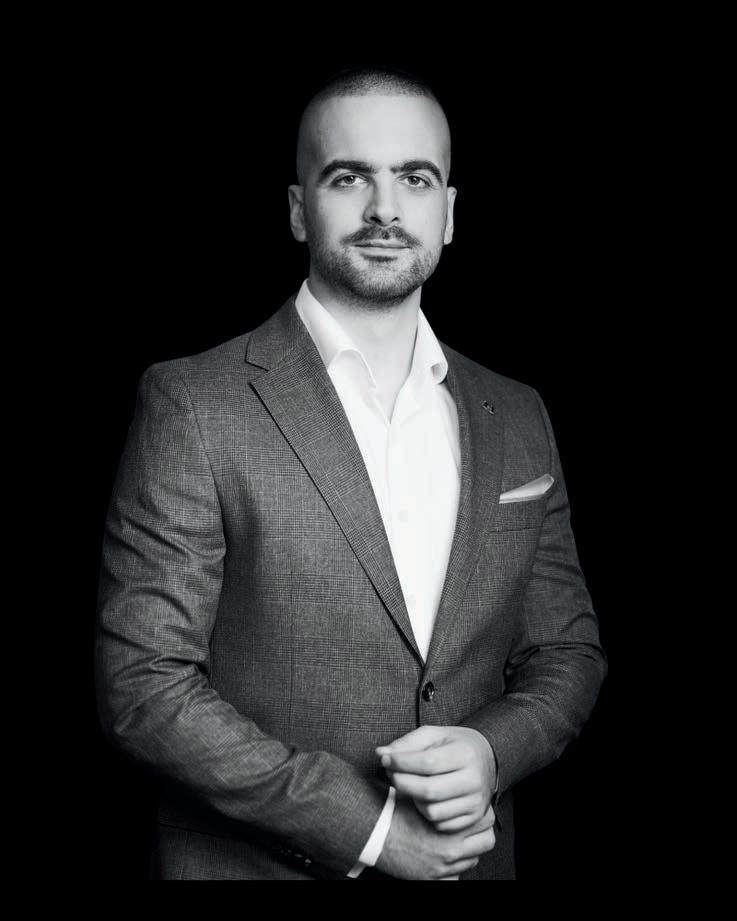
Martin Leberle on transformation, digital acceleration and the discipline required to lead
Over the past decade, NLB Bank Podgorica has undergone one of the most significant transformations in Montenegro’s banking sector. From digital acceleration to the complex integration with Komercijalna Banka, the institution has steadily repositioned itself as a modern regional player with strong local roots. As Martin Leberle marks ten years at the helm of the bank, he reflects on the strategic decisions, cultural shifts and disciplined execution that have shaped the institution’s evolution — and what they reveal about the future of banking in Montenegro.
Ten years at the helm: what moment defined NLB Bank Podgorica’s transformation under your leadership?
There was no single moment, but rather a shift in awareness. It became clear early on that tradition, however valuable, could not shield us from a market evolving faster than the region was ready to acknowledge. We needed a new rhythm, stronger discipline and the courage to act with intent.
The integration with Komercijalna Banka became the clearest symbol of that transformation — a complex, months-long project culminating at four in the morning, when every system turned green and two institutions became one. It was not simply a technological milestone but a statement of identity, proving that our people could deliver what many believed impossible: a seamless transformation executed with precision and without disruption.
From that point onward, innovation became a discipline rather than an initiative.
Regional Group vs. local market: did you need a different tempo for Montenegro?
The Group provides scale, expertise, platforms and a long-term compass that no single market could develop alone, while Montenegro contributes speed — the ability to recognise opportunities quickly and act decisively.
The launch of Apple Pay in just 37 days demonstrated how global capabilities and local execution can combine to set a regional benchmark. It is not a matter of opposing tempos but of alignment. Through honest dialogue, mutual trust and disciplined delivery, strategy adapts to the pace of the market without losing direction.
Digital banking is no longer innovation — it is survival. Where do traditional banks in smaller markets still underestimate the speed of change?
The most common misconception is that small markets move slowly. They do not. Customer expectations are global, regardless of geography, and clients in Montenegro expect the same seamless experience as those in major European cities.
The real challenge emerges when digital transformation is treated as an additional feature rather than a fundamental redesign of how the organisation operates. No interface can compensate for slow internal processes. Technology is the visible layer, but the decisive factors are disciplined execution, rapid decision-making and the willingness to replace procedures that persist simply because they have always existed.
After a decade at the helm, are you more cautious or more ambitious than you were in 2016 — and what does that mean for the future of banking in Montenegro?
I am far more ambitious today, because the past decade has shown what Montenegro can achieve when clarity of purpose is matched by strong execution.
We have transformed a traditional bank into a modern, innovation-driven institution, integrated two banks without disruption and implemented advanced technologies at a pace rarely seen even in larger markets. This experience gives me confidence that the future of banking in Montenegro will be increasingly European, digital and transparent.
The country may be small, but its capacity to leap forward is considerable. Our role is not to wait for change, but to help define it.

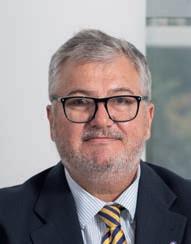
Martin Leberle CEO of NLB Bank Podgorica
Where the Money Comes From
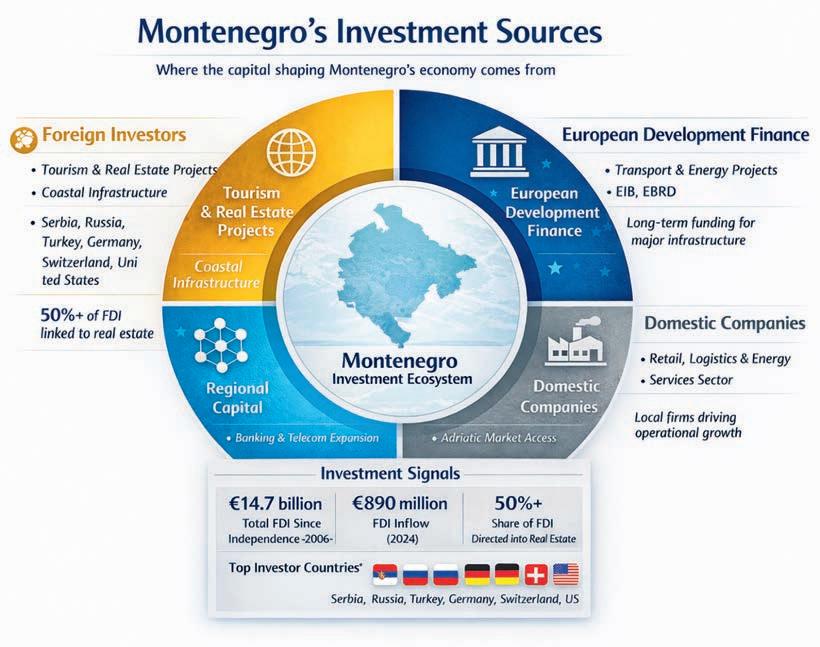
A quick look at the sources of investment shaping Montenegro’s economy
Montenegro’s investment story is often described through individual projects, but the broader picture is defined by where capital originates.
Over the past decade, foreign direct investment has come primarily from Europe and the Middle East, with investors drawn by the country’s Adriatic coastline, euroised economy and EU accession trajectory.
Large-scale tourism developments have been among the most visible examples, bringing international devel-
INVESTMENT SIGNALS
€14.7 billion
Total FDI since independence (2006–2024)
€890 million
Foreign direct investment inflow in 2024
50%+
Share of FDI directed into real estate
Top investor countries
Serbia, Russia, Turkey, Germany, Switzerland, United States
opers and hospitality brands into the market. At the same time, European financial institutions have financed infrastructure and energy projects designed to strengthen the country’s long-term competitiveness.
Regional investors also play a growing role. Companies from neighbouring countries increasingly view Montenegro not only as a tourism destination but as a market for finance, telecommunications and services.
Domestic companies complete the picture. Retail groups, energy firms and service providers continue to expand alongside foreign investors, creating the operational networks that sustain economic activity year-round. Together, these layers of capital form a compact but increasingly interconnected investment ecosystem. For a small country, the diversity of investors may prove as important as the scale of investment itself.
Clarity, Discipline and the Future of Banking Interview
Christoph Schoen, CEO of Addiko Bank AD Podgorica, explains how focused banking, digital transformation and smarter capital allocation can support Montenegro’s next phase of economic growth.
Addiko positions itself as a “straightforward bank.” In a small but ambitious market like Montenegro, where growth is fast but volatility is real, how do you balance disciplined risk management with the pressure to finance expansion?
As a specialist bank focused on consumers and SMEs, we operate in a competitive market but with a very clear positioning. Our “straightforward” model is grounded in strong segment expertise and disciplined, data-driven risk management. Even though we concentrate on unsecured lending, our risk costs remain low because we invest heavily in understanding the real financial capacity and behaviour of our customers.
Montenegro is a market with strong growth potential, but also structural volatility. That is why we combine responsible underwriting with fast, simple products tailored to the needs of our focus segments. Being a niche player allows us to maintain leadership in areas where we have deep expertise, ensuring both sustainable growth and portfolio resilience.
Digitalisation is reshaping banking across Europe. In Montenegro, is digital banking primarily about efficiency and cost, or is it becoming a competitive differentiator in customer trust and market share?
Digitalisation in Montenegro is advancing steadily, and banks today offer a wide range of digital services that significantly improve efficiency and save time for
clients. These services simplify everyday banking, reduce paperwork and provide a smoother, more convenient experience. However, to fully realise these benefits, clients also need to actively adopt digital channels instead of relying on branches for tasks that can easily be completed online. For banks, digitalisation represents a substantial long-term investment, and part of our role is to guide customers toward these solutions so that the advantages are fully realised on both sides.
At the same time, we do not expect a fully digital-only banking model to succeed in Montenegro in the near future. Financial advice remains crucial, especially for SMEs, where decisions are more complex and require a broader understanding of the business context.
For us, digitalisation is therefore both an enabler of a better customer experience and a competitive differentiator. The future will likely be hybrid: strong digital solutions for everyday banking combined with accessible expertise and advisory services where personal interaction adds value and builds trust.
If you look at Montenegro in 2026 through the lens of capital allocation, where should money flow for the country to remain credible to international investors?
For foreign investors, the way capital is allocated sends a strong signal about long-term credibility. On the public side, it is crucial that the Government contin-
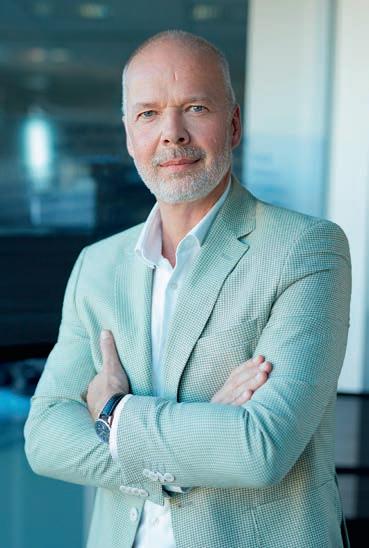
ues investing in infrastructure, healthcare, education and the rule of law. These areas create a stable business environment, ensure the availability of skilled labour and support long-term economic predictability.
From the financial sector perspective, financing should increasingly target the productive parts of the economy. We see significant room to strengthen support for SMEs, which represent the backbone of Montenegro’s growth potential and an important engine for innovation, employment and the green transition.
A balanced approach — combining public investment in stability and capacity with stronger SME financing — will be essential for maintaining investor confidence and positioning Montenegro as a reliable destination for long-term capital.
Christoph Schoen CEO of Addiko Bank AD Podgorica

Turning Investment Interest into Long-Term Value Interview
Mirjana Kojić, Acting Director of the Montenegrin Investment Agency, explains why public-private partnerships are central to Montenegro’s development strategy and which sectors offer the strongest opportunities for international investors.
As Montenegro intensifies efforts to position itself as an attractive destination for international investment, the role of the Montenegrin Investment Agency is becoming increasingly important. Acting Director Mirjana Kojić discusses the sectors with the greatest potential, the importance of strategic partnerships, and how cooperation with European institutions can translate investment interest into long-term economic value.
What is your first strategic priority as Acting Director of the Montenegrin Investment Agency?
My first strategic priority is strengthening public-private partnerships (PPPs) This model enables long-term sustainability of investments while balancing public interest and private capital.
PPPs are particularly important for delivering strategic infrastructure projects and accelerating economic development. Montenegro’s Law on Public-Private Partnerships, adopted in 2020, created a modern framework that supports this type of cooperation.
The Montenegrin Investment Agency is focused on strengthening institutional capacities, improving transparency, and creating a more predictable environment for investors. Our goal is for Montenegro to be recognised not only as a country that attracts capital, but as a destination capable of ensuring the long-term
value of those investments through sustainable projects.
Which sectors offer the most significant investment opportunities in Montenegro today?
We currently highlight several sectors with strong potential. Agribusiness, particularly production and food processing, offers important opportunities, while transport infrastructure — including ports, railways, and multimodal logistics — remains a strategic priority.
ICT and digitalisation are also key drivers of competitiveness and integration into European economic flows. In addition, energy, particularly renewable sources such as solar and wind combined with energy storage, represents a major investment opportunity.
Creative industries, culture, and tourism also have strong growth potential. Through the Accelerating Investments in Montenegro (AIM) project, implemented in cooperation with the European Union, the Agency actively promotes these sectors to international investors.
The EU–Montenegro Investment Conference held in Luštica in October 2025 gathered representatives of the government, European institutions, international financial organisations, and around 200 companies. During the conference, several cooperation memorandums and strategic investment partnerships were signed in priority sectors.
How do you build partnerships that bring long-term value to Montenegro’s economy?
With more than fifteen years of experience in international cooperation, I focus on building partnerships based on trust, transparency, and long-term alignment of interests.
Capital is important, but sustainable economic development also depends on knowledge transfer, technology, and access to new markets. Through cooperation with the European Union and international institutions, we are working to create platforms that encourage long-term investment. These partnerships are designed not only to attract funding but also to generate new jobs, strengthen local industries, and raise business standards across Montenegro’s economy.

Mirjana Kojić Acting Director of the Montenegrin Investment Agency

TForeign Investors’ Perspective on Montenegro’s Business Climate
By
the Montenegrin Foreign Investors Council (MFIC)
he Montenegrin Foreign Investors Council, which for almost two decades has brought together leading international companies operating in the country, recognises progress in several important areas over the past 12–18 months. Today, the Council consists of 40 member companies that together generate around 21% of Montenegro’s GDP and employ nearly 6,000 people, giving the organisation a credible and well-grounded position when assessing the business environment.
Amid increasingly clear signals from Brussels that Montenegro could become the next full member of the European Union as early as 2028, the most tangible progress has been made in the area of European integration and regulatory alignment with the EU acquis. The acceleration of the negotiation process and the more dynamic adoption of legislation send a strong message to investors that the reform agenda is moving in the right direction.
A particularly important milestone has been Montenegro’s accession to the SEPA system, enabling deeper financial integration with European markets. Cross-border payments are now faster, cheaper and simpler for both companies and citizens. The planned introduction of the TIPS Clone system in July will further strengthen the
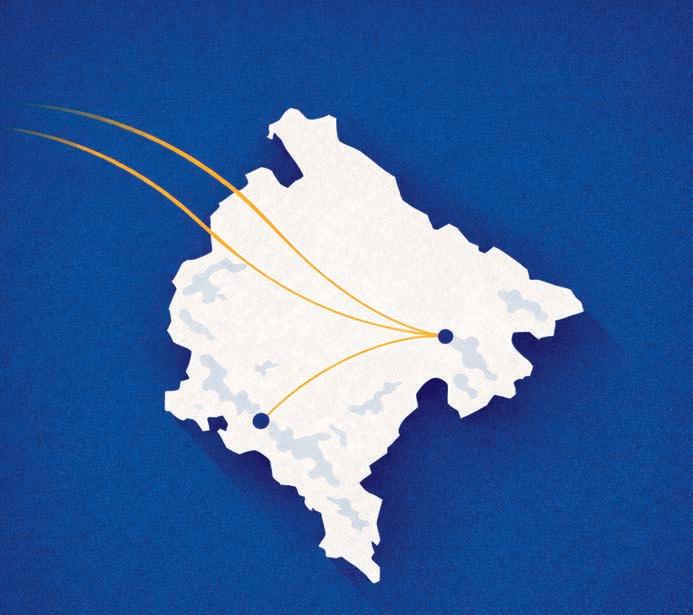
country’s instant payment infrastructure. These are precisely the kinds of concrete developments that credible investors carefully monitor when making long-term investment decisions.
Modest progress is also visible in the strengthening of dialogue between decision-makers and the business community, particularly through consultations and working groups aimed at involving the private sector more closely in policymaking. Nevertheless, there is still room for stronger cooperation with the business community, especially during the drafting and amendment of regulations that directly affect business operations.
One of the most significant challenges that remains is the issue of legal certainty and institutional efficiency. Slow administrative procedures, lengthy court processes, inconsistent application of regulations and limited predictability continue to influence perceptions of Montenegro as an investment destination.
If one reform could most meaningfully strengthen investor confidence in the coming year, it would be the accelerated digitalisation of administrative services and procedures that directly affect business activity. While one year is not a long period for systemic reform, it is sufficient to de-
liver measurable progress in simplifying and speeding up key processes.
A stronger focus on digital services, clear deadlines, transparent procedures and institutional accountability would significantly reduce barriers and the cost of doing business. It is precisely these practical and operational improvements that signal to investors that the system is capable of adapting and moving forward.
MFIC in Numbers
40 member companies
~21% share of Montenegro’s GDP generated by MFIC members
~6,000 people employed by MFIC member companies
Nearly 20 years of representing foreign investors in Montenegro
Building Scale in a Small Market
Dragan Bokan, Owner & CEO of Voli, on major investments, a twodecade partnership with EBRD, and why disciplined infrastructure is the real competitive advantage in Montenegro’s retail sector.
In a small economy, scale is rarely a given—it has to be built deliberately. Over the past three decades, Voli has grown from a local retail company into Montenegro’s largest supermarket chain and one of the country’s most significant private employers. Its expansion has been defined not only by new stores, but by a steady focus on logistics, infrastructure, and longterm partnerships.
The company’s latest investment— up to €25 million in cooperation with the European Bank for Reconstruction and Development (EBRD) for a new logistics and distribution center in Podgorica—marks the largest single investment in Voli’s history. The project reflects a broader strategy: strengthening supply chains, modernizing operations, and aligning the company with European business standards.
In this interview, Dragan Bokan , Owner and CEO of Voli, speaks about the logic behind the investment, the structural challenges of operating in a small market, and the role that disciplined management, technology, and international partnerships play in building a resilient retail system.
M r. Bokan, Voli has recently concluded its largest investment to date with the EBRD—up to €25 million for a new logistics center in Podgorica and strengthening its logistics system. What was the most important criterion when selecting this partner, and what signal does this send about the position of Montenegrin business in the region?
When selecting partners, the EBRD primarily evaluates credibility, longterm stability, experience in imple -
menting capital-intensive infrastructure projects, and the broader market impact of the investments made by its partners. The EBRD does not invest only capital—it brings international standards, a strong framework of corporate governance, and a clear message of confidence in the market where its partners operate. For Montenegrin business, particularly for privately owned domestic companies, this represents an important signal that it is possible to build long-term partnerships with international financial institutions. Over nearly two decades of cooperation with the EBRD, Voli has demonstrated financial discipline, transparency, and operational stability. These are the prerequisites for such investments and also a message to the region that Montenegro has companies
Dragan Bokan Owner & CEO of Voli
capable of delivering serious development projects.
This project also carries broader socio-economic significance. Montenegro’s economy must move toward stronger integration with European markets and adapt to the strict standards of the European Union. That is a process that requires discipline, strategic planning, and a readiness to adopt the highest criteria of business practice. I am convinced that this represents our key development opportunity.
As before, we remain strongly committed to sustainable development. The new distribution center has been designed to meet EPC B energy efficiency standards, which is one level above national requirements. In doing so, we reaffirm that EU standards are not an obstacle for us but a clear direction. Through earlier projects— such as the installation of solar panels and electric vehicle charging stations—we have already demonstrated our intention to be leaders of positive change.
Voli is expanding rapidly and investing tens of millions of euros in infrastructure and new facilities across Montenegro. How do you balance ambitious investment plans with the real risks of a small Balkan market?
As the largest retail chain in Montenegro, Voli has a responsibility to invest thoughtfully and with a longterm perspective. A small market leaves very little room for mistakes, which is why our investment model is not based on rapid expansion but on building an efficient and stable infrastructure.
That is precisely why logistics, distribution, and vertical integration are the core of our business model. The new logistics center in Podgorica rep-
resents the foundation for rationalizing costs, stabilizing supply chains, and increasing resilience to disruptions in global supply chains, while also adapting to evolving consumer needs.
This approach reduces the structural risks of a small market and makes the business environment more predictable, which is particularly important for long-term investors.
You have pointed out the shortage of labor and the imbalance within the public sector as serious obstacles to economic growth. How does Voli plan to address these challenges within its own organization?
Your partnership with the EBRD spans nearly two decades. How has that cooperation changed Voli—not only financially, but culturally and operationally?
Voli is the only company in Montenegro that has gone through the entire process—from initial credit arrangements to recapitalization and the entry of an institutional investor into its ownership structure. For that reason, I would strongly recommend to anyone who wants to conduct business in a serious, transparent, and modern way to consider cooperation with the EBRD.
On the other side, you gain a reliable and respected partner from whom you
Voli does not compete through size, but through efficiency, reliability, and a deep understanding of local markets
Voli is one of the largest private employers in Montenegro, and issues related to labor availability affect us very directly. Our response is a combination of investment in people and investment in technology.
We continuously work on improving working conditions, training programs, and creating clear career paths for employees, because the development of a qualified workforce is essential for the stability of the system.
At the same time, we are significantly investing in automation and digitalization of processes, particularly in logistics and distribution. For international investors, it is important to see that companies have a clear strategy for managing this structural risk, because labor availability has become one of the key factors influencing the investment attractiveness of the entire region.
can learn, who can guide you and open new opportunities and perspectives.
My motivation to begin cooperation with the EBRD was precisely the ambition to implement demanding European standards of business practice within our company. In retrospect, that proved to be the right decision when viewed through the lens of building a modern and successful company that today stands among the largest employers in Montenegro.
Fifteen years ago, the first credit funds were directed toward capital investments and the expansion of our retail network. At the same time, we worked intensively on improving corporate governance, financial reporting, and establishing clear management and control systems.
With the continuation of cooperation through a second credit arrangement, we used the funds to acquire the
Novito retail chain, which significantly increased our market share. Already in 2012, we began to feel the concrete value of this partnership through improvements in work processes, performance measurement, and operational optimization. Our Board of Directors played a key role in this process, with EBRD representatives—highly experienced professionals such as Miljan Ždrale and Paul Foley.
The cooperation with the EBRD has had a profound transformational effect on Voli. In addition to financial support, it involved introducing international standards in corporate governance, financial reporting, and risk management. This process was built gradually over many years and has significantly improved the company’s internal organization.
Today, Voli operates as a system that is understandable and recognizable to international financial institutions. Such a framework reduces perceived risk and opens the door to new investment cycles—something particularly important for a company that remains fully domestically owned and has grown organically.
How do you see Voli’s role in the digital transformation of retail in the region, especially considering that the logistics center you are building includes technological innovations?
In this context, I would particularly highlight the cooperation related to digital transformation. With the expert technical support of the EBRD, we will conduct a comprehensive digital analysis, define a clear transformation roadmap, and perform a full cybersecurity assessment.
This is not merely an investment in technology—it is an investment in the long-term stability and competitiveness of Voli, but also in the modernization
of business practices in Montenegro.
Digital transformation is a key prerequisite for competitiveness in modern retail. The new logistics center has been designed as a highly automated and technologically advanced platform, with integrated IT systems that allow full control over inventory, distribution, and costs.
Such infrastructure is not important only for Voli itself, but also for the broader ecosystem of suppliers, producers, and partners. It creates the foundation for scalable operations and potential regional integration—an element that institutional investors particularly value.
What does it mean today to be a “regional player” when a Montenegrin retail chain competes with companies from much larger markets? Being a regional player today means operating according to international standards, maintaining stable infrastructure, and managing capital with discipline.
Voli does not compete through size, but through efficiency, reliability, and a deep understanding of local markets.
As the market leader in Montenegro, Voli serves as a platform around which broader logistics, distribution, and investment projects can be built. This makes us a relevant partner not only for regional but also for international investors.
How does Voli plan to balance its strategy of competitive pricing with branded positioning and the need for profitability and sustainable growth over the next five years?
Sustainable growth in retail is possible only through systemic investments and operational efficiency.
Voli’s strategy of affordable prices is based on economies of scale, our
VOLI IN NUMBERS
Founded: 1995 Headquarters: Podgorica, Montenegro
Retail network: 70+ supermarkets and hypermarkets
Employees: Over 2,500 Market position: Largest retail chain in Montenegro
New investment: Up to €25 million (EBRD partnership)
own production capacities, strong private-label brands, and a highly integrated value chain.
Our goal is not short-term profitability, but stable cash flows, continuous investments, and long-term predictability of operations. This model ensures sustainable growth, security for employees, and reliability for consumers, while also providing a clear and recognizable framework for international financial institutions and investors.

What Growth Feels Like on the Ground
Montenegro’s economy is often described in numbers: growth rates, investment volumes, arrivals, megawatts. Useful, yes. Complete, no. Because an economy isn’t only measured by what it produces — but by how it feels to the people inside it.
In recent years, that feeling has changed. Volatility has given way to pressure. Growth is no longer a rebound story; it is becoming a test of capacity, discipline and speed.
Start in Bar, where the port works long before the coast wakes up. Logis-
THE SEASON THAT NO LONGER FITS THE CALENDAR
September is no longer quiet. October is no longer off-season.
Flights, hotels and restaurants now operate beyond the traditional summer peak, while labour contracts, energy pricing, school schedules and local services still assume a short, compressed season. Businesses adjust in real time. Institutions move slower.
The next phase of tourism is not about attracting more visitors. It is about redesigning the economy around the season that already exists.
tics is no longer background noise here; it is a frontline industry. Cargo volumes are up. Transit routes matter again — not as strategy papers, but as daily operations. Every delay now carries a price tag. The work is steadier than it was five years ago. It is also far less forgiving.
That sense of necessity runs through other sectors as well.
Move inland to tourism, where success now comes with an asterisk. Hotels are fuller. The season is longer. Montenegro is no longer selling only July and August — a strategic goal
In his Words
“We have been creating the foundations for economic development and attracting credible investors, in order to diversify Montenegro’s economy and ensure long-term, sustainable growth.”
Milojko Spajić Prime Minister of Montenegro
years in the making. But volume has exposed weaknesses. Staffing remains fragile. Energy and food costs rise faster than room rates. And “quality tourism” demands something Montenegro is still learning to systematise: yearround professionalism, not seasonal improvisation.
Growth is here. But it comes with discipline. And discipline is expensive.
The strain shows up most clearly in connectivity
TIVAT AIRPORT
When Growth Shows Up Physically
Tivat Airport has quietly become one of the most intense traffic nodes in the Adriatic relative to the size of the country it serves.
1.32 million passengers in the first 11 months of 2025, around 17% more than the year before More than 1 million passengers in 2024, the strongest post-pandemic result
Around 80% of traffic concentrated between May and September
Together with Podgorica, Montenegro’s airports handled over 3 million passengers in a single year — a national record
For a country of just over 600,000 people, these numbers are not just about tourism. They are a measure of pressure — on infrastructure, labour, housing, energy and services. When growth accelerates through airports, it stops being theoretical.
Then there is the young professional who stayed — or came back. Not because it was easier, but because the equation changed.
Salaries are still not European. Housing costs bite. Public systems lag. But opportunity is closer. Remote work, regional employers and hybrid careers have widened
the definition of success. Staying is no longer an emotional default or a lack of options. It is a calculated decision.
That shift may be subtle, but it is consequential. When people stop leaving automatically, an economy gains time — and time is the rarest asset small markets have.
Put together, these realities tell a simple story: Montenegro’s economy is no longer fragile — but it is demanding. It rewards competence. It exposes inefficiencies. And it leaves less room for excuses.
That is not a problem. That is progress.
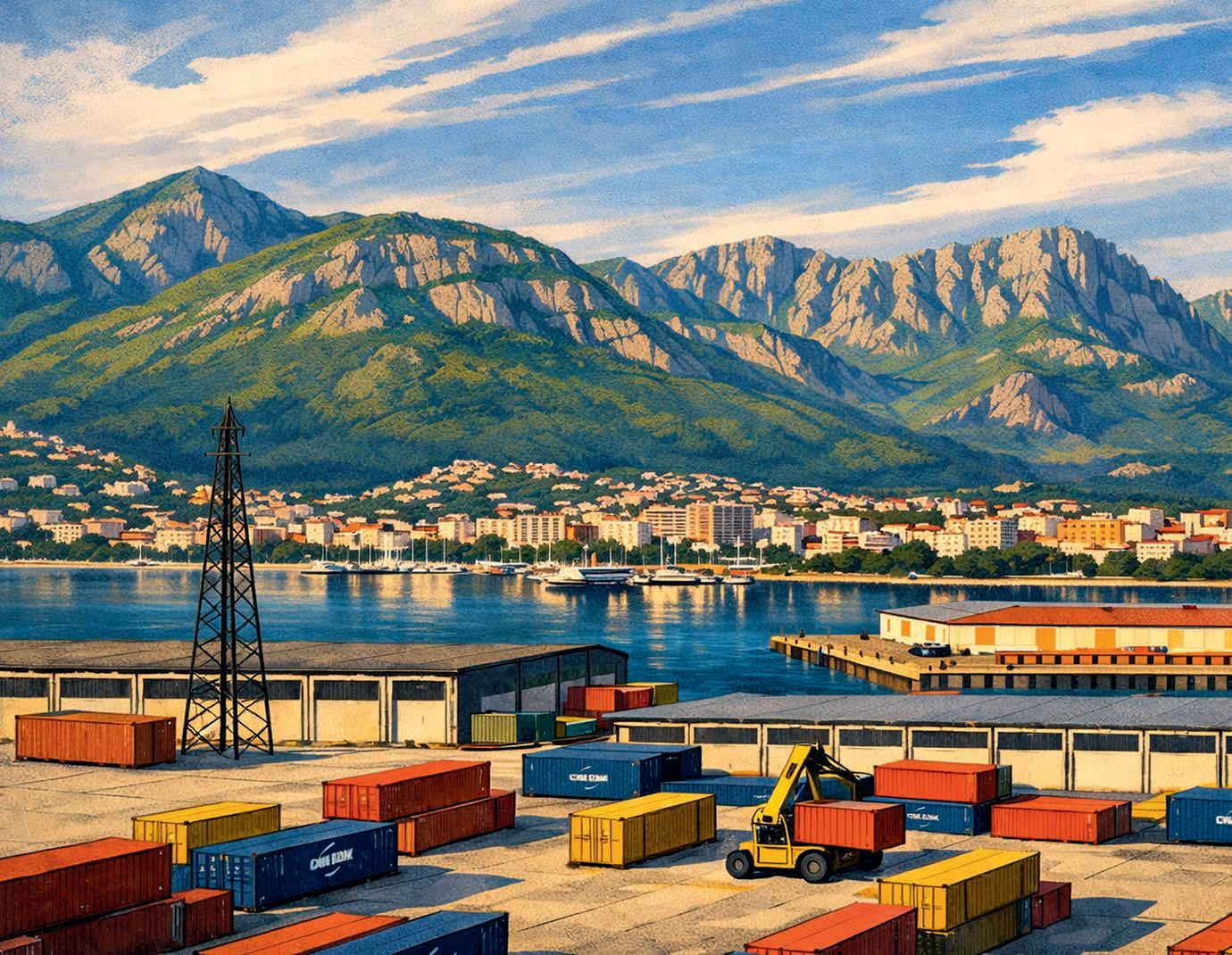
Working Montenegro
Why Montenegro Still Wins Talent
Lifestyle, flexibility and geography are quietly turning the country into a magnet for global professionals.
Inthe global competition for talent, the winners are no longer always the largest economies. Increasingly, they are the places that offer something harder to measure: quality of life, flexibility and a sense of possibility.
Montenegro, a country of just over 600,000 people on the Adriatic coast, has quietly begun to benefit from this shift.
Over the past several years, it has emerged as one of Europe’s most attractive destinations for remote professionals, entrepreneurs and digital nomads. Rankings such as the VisaGuide Digital Nomad Index place Montenegro among the top global destinations for location-independent workers, reflecting a combination of lifestyle appeal, connectivity and accessible residency conditions.
Yet the story goes beyond remote work.
Montenegro is gradually positioning itself as a place where international talent can live, build businesses and connect with regional markets. For many professionals priced out of Western European capitals or seeking alternatives to crowded global hubs, the Adriatic offers a compelling balance: Mediterranean lifestyle, manageable scale and proximity to the European Union.
Geography plays a quiet role in this appeal. Within a few hours’ drive, Montenegro offers mountains, coastline and historic towns alongside modern marinas and growing business communities. Cities such as Tivat, Kotor and Budva have developed vibrant international networks sup-
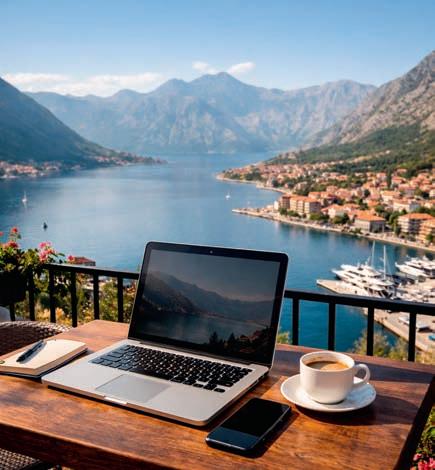
WHY TALENT CHOOSES MONTENEGRO
Mediterranean lifestyle with mountains and coastline
Growing international professional community
Easy access to European markets
Flexible conditions for remote work
Manageable scale for building networks
ported by residential developments, coworking spaces and hospitality infrastructure designed for longer stays rather than short holidays.
The country’s small scale also creates an environment where connections form quickly. Entrepreneurs, investors and technology professionals often find it easier to build networks than in larger markets where relationships take longer to develop.
This dynamic is already visible in the growth of new entrepreneurial com-
munities along the coast. Technology founders, consultants and creative professionals are increasingly using Montenegro as a base while maintaining global clients and projects.
At the same time, Montenegro’s location places it within easy reach of several European markets. From the Adriatic coast, businesses can connect with Central Europe, the Western Balkans and the Mediterranean region within a short flight.
For younger professionals especially, the appeal lies in the ability to combine international work with a lifestyle that larger cities struggle to offer. What once looked like a peripheral market now feels, for some, like a strategic base.
This growing international workforce, however, also highlights the country’s structural challenges. Labour shortages persist in sectors such as technology, engineering and tourism, while rising demand places pressure on housing and infrastructure.
For Montenegro, the real opportunity lies in turning lifestyle appeal into long-term economic advantage. Countries that succeed in the global talent race combine quality of life with credible opportunity. Montenegro has already secured the first part of that equation. The next step is ensuring that professionals who arrive for lifestyle reasons also find reasons to build companies, invest and stay. Because in the modern economy, the most valuable resource is not capital or infrastructure.
It is talent — and the places people choose to call home.
INFRASTRUCTURE
The roads, ports, energy systems and digital networks that will determine how fast Montenegro grows — and how strongly it connects to Europe.
Infrastructure and Business Impact
When roads, ports and cables stop being projects — and start being leverage
IIn Montenegro, infrastructure is often discussed as ambition. For business, it is something simpler and more unforgiving: a multiplier. When it works, markets expand. When it stalls, growth does too.
For years, Montenegro’s geography did half the work. Proximity substituted for scale; coastline compensated for capacity. Geography helps — until it doesn’t . What determines competitiveness now is not where the country sits, but how efficiently people, goods and energy move through it.
Roads are the most visible test. New highways have shortened distances that once dictated business decisions, pulling the north closer to the coast and compressing internal travel times. The effect is quiet but consequential. Logistics firms plan differently. Tourism operators rethink season length. Labour mobility increases without policy intervention. Infrastructure does not announce these changes. It enables them.
Ports are a more complicated story. The Port of Bar has long been described as strategic, less often as decisive. Its advantage lies not in volume but in optionality — the ability to serve regional trade flows if rail and road links deliver consistently. For exporters, reliability matters more than rhetoric. The port’s business impact depends less on expansion plans than on integration: how seamlessly cargo moves onward, and


how predictably timelines are kept. Infrastructure only becomes leverage when it removes excuses.
When delays disappear, so do rationalisations.
That is when markets respond.
Energy has become infrastructure’s most strategic layer. Montenegro’s renewable potential is real, but business interest focuses on stability rather than symbolism. Investors care about grid resilience, transmission capacity and the ability to support industrial demand yearround. In energy, credibility is built not through announcements, but through uninterrupted supply.
Digital infrastructure is where Montenegro’s size becomes an advantage. Smaller systems adapt faster. Connectivity projects and data capacity upgrades do not need scale to matter — they need execution. For service-based industries, speed and reliability outweigh market size. The question is whether policy keeps pace with technical potential.
What links these strands is impact, not intention. Infrastructure changes business behaviour only when it reduces friction: shorter delivery times, lower energy risk, more predictable access. When that happens, capital responds without being asked.
Montenegro’s challenge is not a lack of projects. It is sequencing and follow-through. Roads without logistics strategy underperform. Ports without hinterland connections stall.
Infrastructure Reality Check Where Impact Is Felt — and Where It Isn’t (Yet)
WHERE INFRASTRUCTURE DELIVERS
• Shorter internal travel times
North–south movement now measured in hours, not patience
• Improved logistics planning
Predictability matters more than speed
• Stronger energy security
Hydro and renewables reduce import exposure
• Digital agility
Small system, faster upgrades
WHERE BUSINESS STILL HESITATES
• Last-mile connections
Roads work better than logistics chains
• Port of Bar integration
Rail and road links define value more than capacity
• Grid resilience
Stability matters more than installed capacity
• Execution gaps
Announcements travel faster than delivery
Energy without grid investment limits growth. Infrastructure works as a system, or it does not work at all. The next phase of Montenegro’s growth will be decided less by what is announced than by what is completed — and used. For business, infrastructure is not a backdrop. It is the operating environment. And it is increasingly where credibility is either reinforced, or quietly lost.
Montenegro’s Structural Trap
Why growth without institutional reform risks becoming fragile progress
Montenegro’s deepest structural problem is what could be described as a form of state-political capitalism — a system in which politics functions as a marketplace of privileges. In such an order, the state is not merely a regulator, but the largest employer, investor and distributor of opportunity. The economic consequence is the gradual replacement of an entrepreneurial spirit with a rent-seeking one.
When access to budgets, permits and monopolies becomes more attractive than innovation and competition, energy shifts away from value creation toward proximity to power. The result is not only slower productivity growth, but an erosion of human, social and even emotional capital — foundations of long-term development. With nearly 80,000 employees across public administration and state-owned enterprises — roughly every third employed person — Montenegro has moved far from the idea of a lean, efficient “micro-state” and toward a bureaucratic structure that absorbs rather than generates dynamism.
At the same time, visibility increasingly substitutes substance. Branding campaigns, ribbon-cuttings and promotional narratives often displace the more difficult and less visible reforms: efficient courts, stable rules of the game, depoliticised regulators and genuine market competition. As Eduardo Galeano once noted, packaging can overtake content. Yet visibility only
By Vojin Golubović, PhD Faculty for International Economy, Finance and Business, University of Donja Gorica
buys time; competitiveness builds the future. Echoing Friedrich Hayek, what ultimately matters are the rules that structure the order, not the intentions of decision-makers.
GDP growth alone offers limited insight into resilience, particularly in a small, import-dependent and undiversified economy. More telling indicators include productivity levels, the share of investment in GDP, fiscal stability, debt sustainability and the health of the financial system. Public debt as a percentage of GDP may appear stable, but debt per capita reveals the actual burden carried by citizens — a figure that has risen significantly in recent years. Even international projections point to widening deficits and rising debt levels by the end of the decade, underscoring
the need to assess vulnerability beyond headline growth rates.
In a world marked by deglobalisation, regionalisation and more cautious capital flows, Montenegro’s development limits are not predetermined — but they can narrow if domestic risks persist. Unpredictability, institutional weakness and reliance on consumption-driven fiscal expansion undermine credibility. Development boundaries expand when internal risks shrink: clear rules, rule of law, transparent public investment management and genuine space for private capital.
If Montenegro seeks long-term relevance rather than short-term expansion, it must abandon pro-cyclical populism in which wages and consumption grow faster than productivity, financed by debt or ad hoc tax measures. It must also move beyond nostalgic industrial narratives. The coming decade will be shaped less by the return of large factories and more by automation and artificial intelligence. Ignoring that shift risks preparing for a past that will not return.
The first priorities of any serious tenyear strategy would therefore include establishing a fiscal anchor, rationalising public-sector wage growth, redirecting expenditure from current consumption toward productive capital projects, and strengthening institutions that lower the cost of capital by increasing trust. These are reforms that do not generate immediate applause — but they determine whether growth is sustainable or merely cyclical.
Montenegro’s Energy Transition Takes Shape
As Montenegro advances toward European Union membership and deeper integration with regional energy markets, the country’s energy sector is entering a period of strategic transformation. The government is accelerating the integration of renewable sources, modernising infrastructure, and strengthening market connectivity with Europe.
In this conversation, Minister of Energy and Mining Admir Šahmanović discusses Montenegro’s current energy mix, the investment pipeline for new renewable projects, the importance of grid modernisation, and the strategic decisions that could shape the country’s economic trajectory over the next decade.
Which energy sources currently produce electricity in Montenegro, and how secure is the current energy mix?
Security of supply is the foundation of our energy policy. The stability of the system depends on the ability of production facilities to respond quickly to fluctuations in demand and potential disturbances in the network, and this principle guides the development of the sector.
Montenegro currently produces electricity predominantly from hydropower plants and a coal-fired thermal power plant, with wind and solar power steadily increasing their share. Hydropower is our most important resource. It is flexible, stable and essential for balancing the system. The thermal power plant provides baseload security and continuity of production. According to available data, hydropower accounted for 50.94% of electricity pro-
Admir Šahmanović Minister of Energy and Mining
MONTENEGRO’S ENERGY MIX
Hydropower
– 48.60%
Thermal power (coal)
Wind & Solar
*Projection
duction in 2024 and 63.25% in 2025, while projections for 2026 indicate a share of 48.60%. The thermal power plant accounted for 38.82% in 2024 and 20.74% in 2025 due to ecological reconstruction, with a projected share of 34.20% in 2026. Wind and solar power together represented 10.24% in 2024, increased to 16.01% in 2025 and are expected to reach around 17.20% in 2026. This mix ensures stability while clearly pointing to the future direction of development — diversification and faster integration of renewable energy sources, while maintaining system reliability.
Which energy projects are financially closed and realistically next for implementation?
In 2025 Montenegro launched its first market-based auction model for renewable energy projects, with a capacity of up to 250 MW for solar projects. This represents a significant step forward towards the European model and marks the transition away from the feed-in tariff system.
A Three-Year Auction Plan for the period 2026–2028 has also been adopted, aligned with Montenegro’s National Energy and Climate Plan. Already this year, two auctions are planned — 250 MW for solar power and 200 MW for wind energy projects. We expect financially closed projects that are ready for implementation. Our objective is not administrative statistics but investments that genuinely transform the structure of our economy. Strategic partnerships with France and the United Arab Emirates are particularly important in this context. Our focus is on advancing projects that are technical-
ly mature and environmentally sustainable, bringing them to the stage of concrete implementation.
At the same time, the global economy is undergoing a transformation in which digital infrastructure, data processing and advanced technologies play an increasingly central role. Behind every server and every algorithm lies something fundamental — stable and reliable electricity. Energy demand from the digital sector is growing rapidly, and countries capable of ensuring long-term energy security will become key drivers of this new phase of economic development.
RENEWABLE ENERGY AUCTIONS
Montenegro launched its first market-based renewable energy auctions in 2025, replacing the previous feed-in tariff system.
PLANNED AUCTIONS:
250 MW solar
200 MW wind
The auctions form part of the Three-Year Auction Plan 2026–2028, aligned with Montenegro’s National Energy and Climate Plan The goal is to accelerate investment while ensuring projects are financially viable and ready for implementation.
Montenegro has natural advantages for clean energy production, a stable energy system and a geostrategic position that enables it to become a reliable energy platform for new industries — from data centres to high-tech investments. Our task is to translate these advantages into projects faster and more efficiently than before.
How serious is the challenge of grid capacity?
Countries capable of ensuring long-term energy security will become key drivers of the next phase of economic development
It is a strategically crucial challenge. Our network was designed for a system of centralised production, while the energy transition requires a decentralised, digitalised and far more flexible architecture.
We are therefore modernising both the transmission and distribution networks, introducing smart-grid systems, developing energy storage and strengthening flexible resources within the system. Investments in grid infrastructure are not simply a cost — they are a prerequisite for development.
Without strong infrastructure, there can be no serious integration of renewable energy sources and no long-term stability of the energy system.
Which decision taken today will most strongly influence Montenegro’s economy ten years from now?
The most important decision is the full integration of Montenegro into the European energy market. Montenegro already operates a day-ahead electricity market through the BELEN exchange, while the strategic objective is market coupling with the region and the European Union.
With Italy, we have signed a Memorandum of Understanding on electricity market integration, and the process is now progressing through technical and regulatory alignment towards full integration into the European electricity trading framework. The submarine cable connecting Montenegro and Italy positions our country as an energy bridge between the Balkans and the European Union.
This means more efficient management of cross-border capacities, the exchange of balancing energy, greater market liquidity and more competitive prices.
However, to fully realise this position, Montenegro must also undertake major investments in new energy facili-
ties, production capacity, energy storage and modern infrastructure capable of ensuring long-term system stability. Without a strong investment cycle, there can be neither energy security nor economic transformation.
Montenegro’s energy future is not tied to a single partner. Instead, we are building a broad and carefully structured network of cooperation — with the United Arab Emirates, France, EU member states and the United States.
Energy today is more than a sector. It is a geopolitical position, a development opportunity and Montenegro’s European pathway. The decisions we make today will shape the competitiveness of our economy, the attractiveness of our investment environment and the pace of our European integration.
ENERGY BRIDGE BETWEEN THE BALKANS & THE EU
Montenegro’s submarine electricity cable with Italy positions the country as a key energy connector between the Western Balkans and the European Union.
Integration with the European electricity market through market coupling is expected to: improve cross-border electricity trading increase market liquidity strengthen energy security deliver more competitive electricity prices.
Powering Montenegro’s Energy Transition
As Montenegro accelerates its energy transition and aligns its power sector with European standards, Elektroprivreda Crne Gore (EPCG) stands at the centre of the country’s economic and environmental future. Under the leadership of Executive Director Zdravko Dragaš, the stateowned utility is working to modernise its operations, expand renewable energy capacity and strengthen international partnerships. In this conversation, Dragaš explains how EPCG is preparing for the next decade—balancing investment speed with sustainability, addressing the challenges of Pljevlja, and positioning Montenegro’s power sector within a rapidly evolving regional energy market.
What is the one thing EPCG must change immediately to be ready for the next decade?
The most important change EPCG must make immediately concerns the way development is managed. We are entering a period in which energy companies no longer have the luxury of slow processes and unclear priorities.
That is why we insist on more efficient decision-making, clear responsibility and the modernisation of operations, fully aligned with European standards in production and corporate governance.
This process also requires stronger digitalisation and a clear link between strategy, investment and measurable results.
Renewable energy is a strategic direction, but also a politically sensitive issue. Where do you draw the line be-
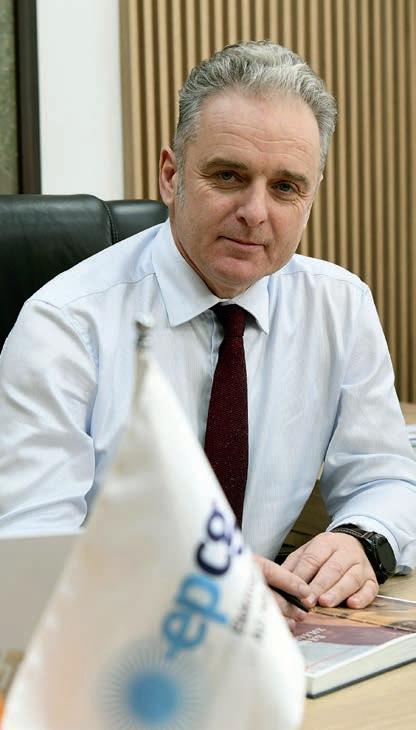
tween speed, sustainability and the public interest?
Renewable energy sources represent our strategic direction, but the speed of implementation must never outweigh quality. The line is drawn where shortterm interests intersect with long-term sustainability.
EPCG develops projects with full transparency, thorough expert analysis and open dialogue with the public. Only such an approach ensures that the energy transition is both sustainable and socially ac-
ceptable. No project can be implemented at the expense of the environment or public trust.
Our approach combines momentum with responsibility—allowing for high-quality environmental impact assessments, continuous dialogue with local communities and long-term sustainability. Only such projects have real value.
A strong example is the Gvozd I wind farm, which is expected to enter operation soon, while development continues on Gvozd II. This project, valued at around €82 million and financed by the European Bank for Reconstruction and Development (EBRD), is expected to generate between 150 and 200 GWh of electricity annually—enough to supply around 20,000 households. The Gvozd wind system will significantly increase the share of renewables in EPCG’s portfolio while substantially reducing CO₂ emissions.
Equally important is the Solari project, which has already delivered measurable results. As of January this year, more than 8,500 solar systems had been installed, with total capacity approaching 78 MWp. At the same time, CO₂ emissions have been reduced by around 114 tonnes.
We will continue intensively developing renewable projects, as they represent the future of Montenegro’s energy sector and the foundation of its long-term stability. Current projects include the Kapino Polje solar plant, the Željezara Nikšić solar facility, as well as Krupac, Štedim, Slano Dam and Vrtac Dam, for which building permits have already been secured or are close to approval.
Zdravko Dragaš Executive Director of EPCG
Pljevlja symbolises Montenegro’s energy and environmental challenges. What is the long-term solution—and what is no longer acceptable?
For EPCG, Pljevlja is both an energy and a social issue. Our long-term approach is based on the principles of a just transition, ensuring stronger environmental protection while maintaining job security and stability for the local community.
The ecological reconstruction of the Pljevlja Thermal Power Plant, along with the successful launch of the DeNOx and DeSOx systems, demonstrates that responsible management of existing capacities can deliver measurable results. Shortly after the denitrification system was commissioned, nitrogen oxide emissions fell from roughly 480 mg/Nm³ to below 130 mg/Nm³, with readings of around 108 mg recorded in some intervals—well below the designed limit of 150 mg/Nm³.
Initial measurements for sulphur dioxide show concentrations reduced to around 61 mg/Nm³. For comparison, emissions in March 2025 stood at approximately 4,544 mg/Nm³, and after the adaptation of the boiler and chimney in December 2025 they fell to 3,249 mg/Nm³. Today’s levels are many times lower than previously recorded values, confirming the high efficiency of the newly installed systems.
These results have a significant longterm impact on the health of Pljevlja’s citizens and the quality of life in the city. What is no longer acceptable is ignoring environmental standards or delaying solutions essential for protecting public health and ensuring a sustainable future for Pljevlja.
International partnerships are becoming increasingly important. Do you see EPCG primarily as a national pillar or a regional energy player?
I see EPCG as a strong pillar of Montenegro’s national energy system, but with a clear ambition to become a recognised regional player.
Ensuring the stability of the domestic system remains our priority, but partner-
ships with international companies open new opportunities. One example is the planned Kruševo hydropower plant on the lower course of the Piva River, which has attracted strong interest from the French energy group EDF.
We are also cooperating with Masdar from Abu Dhabi, which has expressed interest in jointly developing renewable energy projects, particularly wind capacity— an area where Montenegro has significant natural potential.
With both partners we have signed cooperation agreements reflecting a shared strategic interest. Such partnerships represent an important step towards aligning our operations with the European energy market and strengthening EPCG’s regional position. That ambition does not contradict the national interest—it is its natural extension.
You lead a state-owned company after working in the private sector. What business logic are you bringing into EPCG, and what system habits are hardest to change?
My experience in the private sector tells me that focus must be placed on efficiency, planning and measurable results. Every investment must have a clear justification, timeline and measurable impact—it must serve a defined purpose and deliver longterm value.
This is precisely where I see the greatest room for progress. At the same time, the most difficult challenge is changing the inertia of large systems and the habit of extending processes without real need.
Nevertheless, I am convinced EPCG can become a modern and stable state-owned enterprise—one that takes care of its people, especially those working in production, while confidently moving toward a greener energy future.
We are on the right path. Our business logic is built on modernisation, sustainability and the green transition, while fully respecting the people who have carried Montenegro’s energy system for decades.
EPCG IN FOCUS
Founded: 1910 (origins of Montenegro’s power sector)
Headquarters: Nikšić, Montenegro
Core Activities:
• Electricity generation
• Distribution and supply
• Development of renewable energy projects
Key Power Assets:
• Pljevlja Thermal Power Plant
– Montenegro’s largest single generation facility
• Perućica Hydropower Plant
– one of the country’s main hydro sources
• Piva Hydropower Plant –major producer within the national system
Renewable Expansion:
• Gvozd I Wind Farm – nearing operation
• Gvozd II Wind Farm – in development
• Solari programme – over 8,500 rooftop solar systems installed
Installed Solar Capacity (Solari): ~78 MWp
Estimated Households
Powered by Gvozd: ~20,000
Strategic Partners:
• European Bank for Reconstruction and Development (EBRD)
• Masdar (UAE)
• EDF (France)

Business Skills in the Age of Distraction
Jefimija Pavićević, Executive and Chief Financial Officer of Zeta Energy on how leadership and focus are steering Zeta Energy through disruption and innovation

Zeta Energy is a growing energy company headquartered in Danilovgrad, Montenegro, with roots in power generation and a strategic emphasis on operational stability and efficiency. The company is majority-owned by Elektroprivreda Crne Gore (EPCG), with a 49% ownership stake held by the Norwegian energy company NTE — a partnership that reflects both domestic strength and international expertise.
Operating within Montenegro’s evolving energy landscape, Zeta Energy remains focused on disciplined growth, operational reliability and long-term value creation in a sector shaped by regulatory shifts, renewable integration and rising expectations for sustainability.
Against this backdrop of market complexity and structural change, Jefimija Pavićević, Executive and Chief Financial Officer of Zeta Energy, speaks about what it takes to lead, stay focused and make
disciplined decisions in a time when distraction has become the norm.
There’s so much noise in business today — from tech disruption to market shifts. How does that affect decision-making in an energy company?
In any sector, but especially in energy, clarity matters. Whether it’s integrating renewables, managing regulatory changes, or navigating capital cycles, we can’t afford reactionary decisions. Focus is not a luxury — it’s a strategic asset. It ensures that we look beyond the buzz and make choices grounded in long-term value.
With access to information at all times, why are core business skills more important than ever?
Because data doesn’t lead; people do. Communication, organisation, leadership — these aren’t soft skills. They’re the structures that allow us to translate information into action. Especially in finance and operations, strong business skills help bridge the gap between analysis and execution.
You’ve spoken about personal development before. How does that shape career growth?
A career isn’t a straight line anymore — it’s a series of adaptations. Someone who continuously works on self-discipline, emotional intelligence and resilience is better equipped to handle uncertainty. Those qualities build credibility, which matters in stakeholder relationships and in steering teams through complexity.
What does pr ofessional development look like today?
It’s lifelong and iterative. People think it’s about certificates or courses. Sometimes it is — but often it’s about learning from setbacks, seeking feedback, and staying curious. The market evolves fast. The professionals who thrive evolve with it.
Emotional intelligence is talked about a lot. How does it play out in your work?
Technical skills tell you how something works. Emotional intelligence tells you
“In an era of endless disruption, competitive advantage doesn’t come from knowing everything — it comes from knowing where not to spend your attention.”
why people care. It’s not enough to have a good strategy or a solid balance sheet. If teams don’t feel heard, if partners don’t trust you, the execution falls apart.
Motivating teams and maintaining consistency can be hard in rapidly changing sectors. What’s your take?
Motivation fluctuates; consistency doesn’t. You stay consistent by anchoring to purpose, setting clear milestones, and creating routines that support progress. That’s how you sustain momentum when the market shifts.
Intelligent Traffic Systems for Smarter Cities
With over 30 years of expertise, ELCOM BGD helps cities modernize their traffic infrastructure using intelligent systems that enhance safety and streamline urban mobility.
Since its founding in Belgrade in 1992, ELCOM BGD has become a regional leader in advanced traffic management. We develop and integrate a wide array of solutions—including traffic signal controllers, vehicle detection, dynamic messaging, and smart parking—all engineered to optimize urban mobility and traffic flow.
Modern cities face mounting pressure from congestion, tourism, logistics, and rapid urban expansion. Traditional traffic control, relying on fixed signal plans, often fails to keep pace with sudden fluctuations in demand. ELCOM BGD addresses these challenges through adaptive traffic management systems that analyze conditions in real-time, automatically optimizing signal timing and coordination across the entire network.
These systems leverage advanced software platforms capable of processing vast amounts of data collected via sensors and detection equipment deployed throughout the road network. By utilizing sophisticated mathematical models and artificial intelligence, the system predicts traffic demand in real-time and dynamically manages intersections to minimize delays and enhance overall traffic flow.
The company collaborates closely with leading international technology providers while developing proprietary, research-based solutions tailored to the specific needs of cities in Serbia, Montenegro and the Adria region. Through continuous R&D and partnerships with academic and industrial leaders, ELCOM BGD adapts global innovations to local traffic conditions.
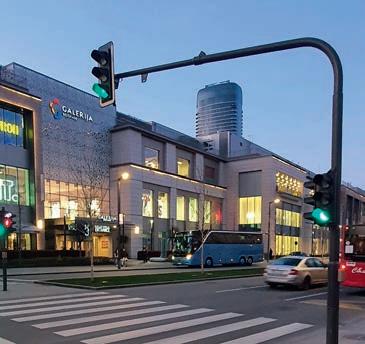
“Efficient traffic management is not just about mobility — it directly improves the productivity and quality of life
of modern cities.”
A defining element of the company’s approach is the ability to monitor traffic infrastructure remotely and in real-time. Technical teams supervise the performance of every system component, enabling proactive interventions, rapid troubleshooting, and the continuous optimization of traffic control strategies.
As cities across Southeast Europe invest in smarter, more sustainable mobility, technologies that integrate real-time data, automation and intelligent traffic control, have become essential. With over three decades of expertise, ELCOM BGD remains a trusted partner for cities and road operators seeking practical solutions to one of the region’s most persistent urban challenges: keeping traffic moving.
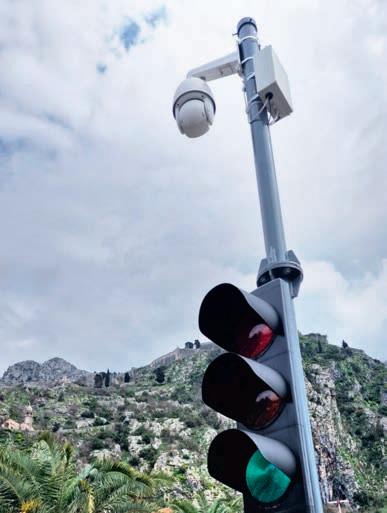

ELCOMBGD AT A GLANCE
Founded: 1992, Belgrade Field: Intelligent Transport Systems (ITS) and traffic management solutions
Core Expertise:
• Adaptive traffic signal control
• Intelligent traffic monitoring systems
• Traffic data analytics and modelling
• Smart parking and detection systems
• Integration of advanced traffic software platforms
Technology Partners: PTV • SWARCO • Schlothauer & Wauer
Focus Markets: Serbia • Montenegro • Adria Region Mission:
Improving urban mobility and traffic efficiency through intelligent infrastructure.
Interview Infrastructure Is Strategy
How MTEL is turning connectivity into a competitive advantage for Montenegro
In a small, open economy, digital infrastructure is not background technology — it is economic architecture. As Montenegro positions itself as an investment, tourism and services hub, the reliability of its networks increasingly defines its competitiveness. Zoran Milovanović , CEO of MTEL , outlines how market leadership, infrastructure scale and cybersecurity investments are shaping the country’s digital backbone.
Montenegro is a small market. Why is the quality of telecommunications infrastructure even more critical here than in larger economies?
Montenegro’s economy is open, seasonally intensive and heavily dependent on tourism and international cooperation. The market is small only in population. That is precisely why telecommunications infrastructure is not a luxury but a prerequisite for functioning.
In a small economy, every network disruption or drop in quality has an immediate and visible impact on business performance, national reputation and competitiveness. Trust is measured in numbers.
At the end of January 2026, MTEL held 42.06% of the mobile market, serving 605,000 users — the absolute market leader in Montenegro. We exceed 40% market share in cable services, hold 41.5% in television and 44.7% in internet
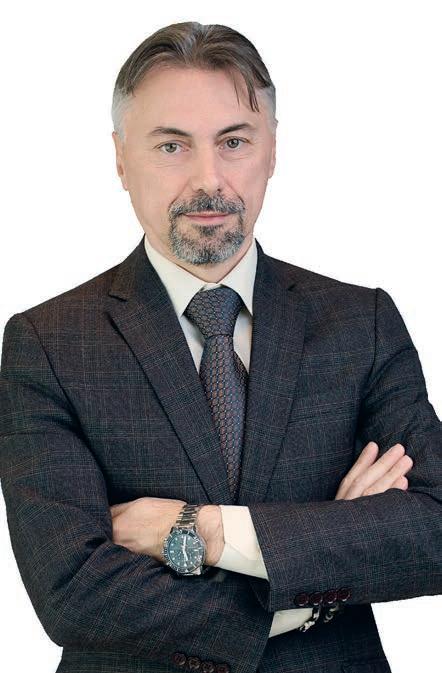
In a connectivity-driven economy, the network becomes part of national infrastructure
services. These figures reflect infrastructure quality and continuity of investment. Our fiber network extends more than 7,600 kilometers — the largest in Montenegro — with strong coverage across both urban and rural areas. Fiber stability and reliability are essential for tourism, business and public services. In a connectivity-driven economy,
the network becomes part of national infrastructure.
The past three years have permanently changed how people and companies use networks. From MTEL’s perspective, what has been the biggest and most unexpected shift?
The defining shift has been the full integration of digital services into daily life and business operations. There is no longer an “online” and “offline” world — only a continuous digital environment. What surprised us most was the speed at which users adopted cloud services, video communication, remote work and digital platforms. This required constant upgrades in capacity, security and network resilience — and we delivered.
MTEL today is not only infrastructure; we build digital ecosystems. Our advanced MOVE streaming platform has elevated digital television, while nearly 250,000 active users rely on our selfcare application — a clear indicator of trust and behavioral change.
Looking ahead, MTEL positions itself as a pillar of Montenegro’s digital economy — in fintech, digital identity and smart business services. Technology must simplify life and create measurable value.
5G is often presented as a technological breakthrough. Where in Monte-
negro is it already delivering real business impact, and where does it remain more promise than reality?
5G is already producing tangible results in logistics, smart systems, industry, video production, gaming and tourism. Its speed, reliability and low latency are generating real business impact.
However, the full potential — smart cities, autonomous systems and large-scale IoT — requires a broader ecosystem: regulatory alignment, investment and digital readiness.
Our 5G network is commercially available to prepaid, postpaid and business users, covering nearly 89% of Montenegro’s population. The infrastructure is in place. The next phase depends on how effectively businesses and institutions leverage it.
When it comes to MTEL’s investments today, what takes priority: expanding coverage, strengthening capacity, or developing new digital services?
Our strategy is balanced. We invest simultaneously in coverage expansion, capacity strengthening and digital service development. Today, a network must be smart, secure and adaptable to new business models.
We are focused on digital platforms, cloud services, IoT solutions and supporting the digital transformation of the economy. Leadership requires innovation — and responsibility.
In parallel, society must be prepared for technological change. Together with the Government of Montenegro, MTEL organizes academies, competitions and workshops. We provide internet safety and robotics programs for primary school students, app development and 3D modeling initiatives for high school students, and support university students through the Digital Factory and hackathons.
MTEL BY THE NUMBERS
MTEL in Montenegro — January 2026
42.06% mobile market share
605,000 mobile users
40%+ cable services
41.5%
TV market share
44.7% internet market share
7,600 km fiber network
89% population covered by 5G
~250,000 active self-care app users
At the same time, we continue expanding 5G and enhancing our OTT streaming platform MOVE. We remain a committed partner in sports and culture. Our investments are driven not only by technology, but by user trust and longterm societal development.
Small markets are often more vulnerable when it comes to cybersecurity and system resilience. How exposed is Montenegro in reality to these risks?
Small markets are often perceived as easier targets, which makes cybersecurity a strategic priority. Montenegro is not isolated from global risks; digital connectivity increases exposure.
MTEL continuously invests in system protection, monitoring and user educa-
tion. Our “SiguranNET” service adds an additional protection layer. Statistics show that at least 30% of users experience at least one attempted cyber incident per month — incidents our system prevents before damage occurs.
We began cybersecurity education in primary schools through interactive workshops and expanded it with the Government through the Digital Academy, focusing on digital literacy and cyber awareness for vulnerable groups.
For years, MTEL has invested in advanced detection systems, security centers and user protection mechanisms. Cybersecurity is not option-
CYBER REALITY CHECK
30% of users face at least one attempted cyber incident monthly “SiguranNET” active protection system Education in primary schools Digital Academy for vulnerable groups Telekom Srbija Group acquired PULSEC → 150 cybersecurity engineers
al — it is foundational to digital economic stability.
The broader ecosystem has been strengthened by Telekom Srbija Group’s acquisition of PULSEC, a company with 150 cybersecurity engineers specialized in protecting business systems from complex cyber threats.
Thirty Years of Moments That Connect
Branko Mitrović, Executive Director of One Crna Gora
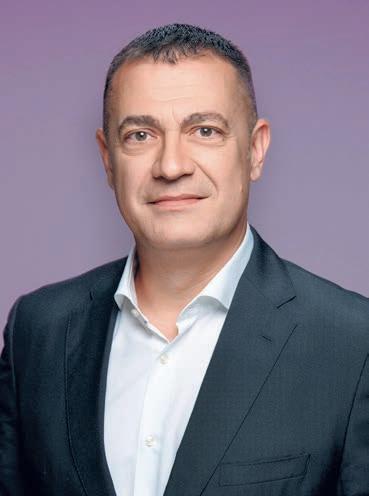
Thirty years after the first mobile phone call in Montenegro, connectivity has become part of everyday life — almost invisible, yet fundamentally essential. Behind that continuity lie decades of technological change, adaptation and responsibility, but above all, trust built day by day.
On the anniversary, the company’s evolution and the lessons that shaped both his professional and personal journey, we speak with Branko Mitrović, Executive Director of One Crna Gora.
This year marks 30 years since the first mobile phone call in Montenegro. How do you personally experience this anniversary?
I don’t see thirty years in telecommunications as a number, but as a collection of moments — first calls, staying connected,
solving problems, starting new chapters. We often call them One moments. Mobile communication is now part of daily life, but behind that normality are decades of work, adaptation and responsibility. As a company, we have gone through different identities — from ProMonte and Telenor to One — yet the essence has remained the same: responsibility toward people who entrusted us with something deeply personal — their connection to others and to the world.
This anniversary is a confirmation of that trust, but also a reminder that it is never guaranteed. For me, these 30 years represent continuity of presence, even when it might have been easier to stop or step back.
What enabled the company to remain relevant through three decades of change?
Survival in telecommunications is never the result of inertia. The industry constantly evolves, and every phase brings new challenges. What sustained us was the ability to change in time while preserving what truly matters.
Technologies came and went, but our focus on quality, reliability and customer relationships remained constant. In recent years, our company received the Best in Test award four times as the best mobile network in Montenegro, according to independent international benchmarking organisation Umlaut.
This confirms not only technical excellence, but a consistent, long-term approach to delivering reliable service. Suc-
cess comes from a series of thoughtful decisions repeated every day.
How does this anniversary shape the way you look at the future of One?
Anniversaries are a moment to pause — not to stand still. Our goal is to remain a company that understands its broader context: social, economic and human. To grow alongside the community and demonstrate responsibility even when it is not commercially driven.
If we preserve closeness with users, remain a reliable partner to employees and a stable pillar of the community, then this anniversary will have real meaning. Longevity alone has no value; meaning does.
Wh ich lesson from the past 30 years shaped you most as a leader?
I see thirty years not as a success to celebrate, but as a responsibility to carry. Few companies have been present through so many pivotal social moments — from the first mobile call to today’s digital era.
What shaped me most is the understanding that stability and relevance do not come from brand size or technology alone, but from consistency in values and the ability to listen — to users, employees and the community. One Crna Gora endured because it made responsible choices, responded thoughtfully and anticipated change.
For me, leadership means building continuity of trust, nurturing relationships and being present when it matters — while constantly encouraging growth and innovation.

The Women Who Decide Leadership
Three leaders shaping Montenegro’s business landscape reflect on the decisions that defined their year — and where they would invest their own money.
Threeleaders shaping Montenegro’s business landscape reflect on the decisions that defined their year — and where they would invest their own money.
Across Montenegro’s economy — from finance and logistics to international business networks — a growing number of women occupy positions where those de-
SANJA ĆALASAN
President AmCham Montenegro
What was the most consequential business decision you made in the past 12 months — and why did it matter?
The most significant business decision I made in the past year involved supporting an important innovation scheduled to launch in April. The final decision followed months of intensive collaboration with multifunctional teams that worked together to develop a detailed business case.
In a company with a 130-year brewing tradition and a strong market leader such as the Nikšićko brand, introducing a new innovation is never a simple step. Such decisions must be made carefully, particularly in the context of current global and local economic challenges and the scale of the investment involved.
I believe this strategic initiative will open new opportunities for market positioning and further confirm the
cisions are made daily. Their responsibilities extend beyond managing organisations; they involve navigating uncertainty, recognising opportunities and shaping the environment in which business operates.
For this special feature, The Region asked three such leaders two simple but revealing questions: What was the most
consequential decision they made in the past year, and where would they invest their own money in Montenegro today?
Their answers reveal how experienced decision-makers view the country’s economic future — balancing caution with optimism, and long-term strategy with immediate market realities.
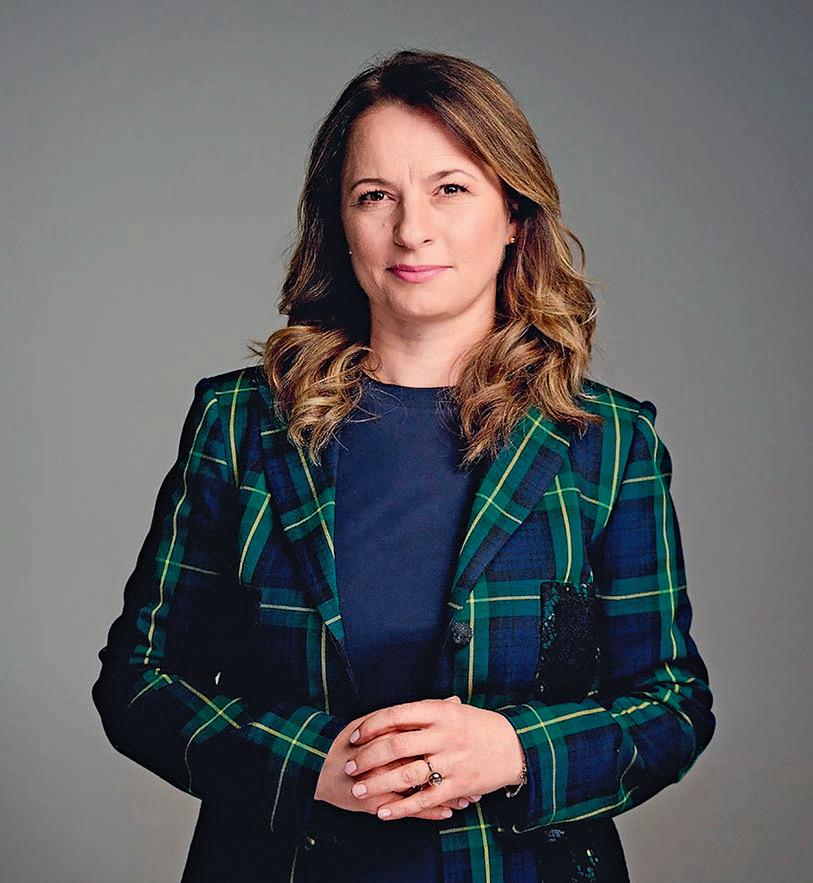
strength of the company and the people behind its success.
If you were investing your own money in Montenegro today, where would you put it — and what would you avoid?
ANA GOLUBOVIĆ
Board Member Hipotekarna Banka
What was the most consequential business decision you made in the past 12 months — and why did it matter?
In 2025, Hipotekarna Banka became part of the AIK Group, a development that marked a turning point for the bank and required careful strategic thinking.
Joining a large regional group opened access to capital, knowledge and advanced banking systems, but it also required aligning procedures, risk management practices and organisational standards with the wider group structure.
The most important decision was to treat this process not as a technical adjustment but as an opportunity for deeper transformation. Instead of minimal alignment, we used this moment to strengthen internal standards, refine organisational responsibilities and further develop our teams while preserving our strong understanding of the local market.
Today the bank is organisationally stronger and strategically clearer in its positioning, and our teams have shown they can successfully navigate complex change.
If you were investing your own money in Montenegro today, where would you
I would invest in modern senior-living concepts — projects that provide older generations not only with care, but also with safety, dignity, social connection and quality of life. I believe such developments will become increasingly im-
portant both socially and economically.
On the other hand, I would avoid projects that depend solely on a short tourist season or rely on rapid, unplanned construction without a clear long-term development strategy.
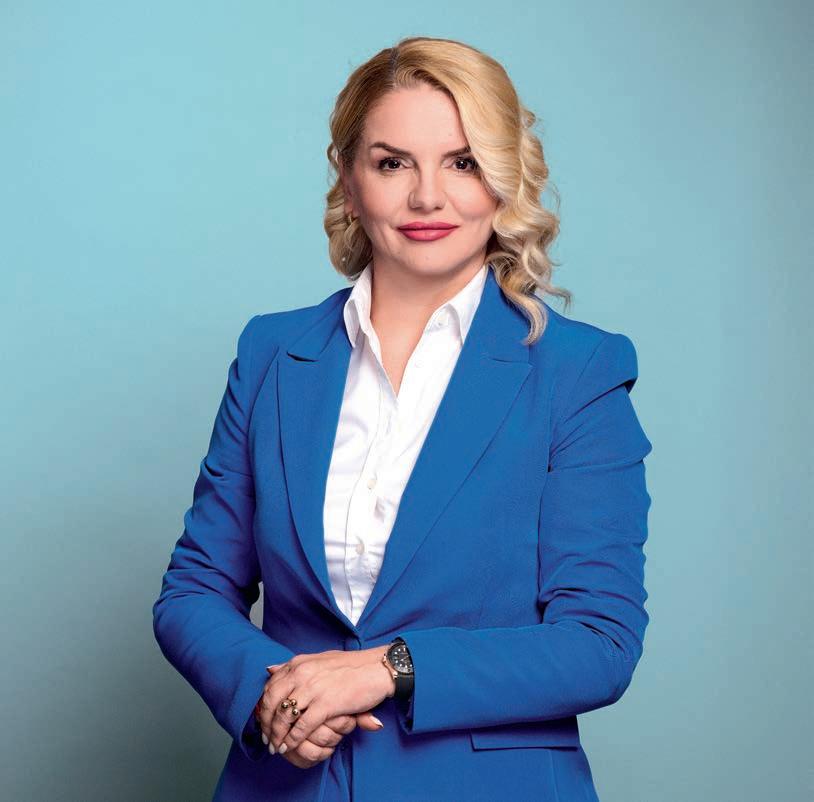
put it — and what would you avoid?
If I were investing my own capital in Montenegro today, I would focus on sectors with long-term sustainability and clear competitive advantages. First and foremost, I would invest in renewable energy, particularly solar and wind projects. Montenegro has significant natural potential that has not yet been fully utilised. I also see strong prospects in sustain-
able tourism, especially boutique and health-focused tourism capable of extending the season, as well as in digital services and technology-based businesses, which benefit from the global growth of remote work.
On the other hand, I would approach cautiously investments driven primarily by speculative real-estate price growth or projects lacking regulatory stability and a clear long-term strategy.
LJILJA PIŽURICA
Executive Director
Nelt MNE
What was the most consequential business decision you made in the past 12 months — and why did it matter?
One of the most important decisions in the past year was the integration of the companies Neregelia and Montenomaks into a single organisation — Nelt MNE.
For us, this was not simply a formal merger. It was an opportunity to combine the strengths of both systems and create additional value for our principals, clients and employees.
Through this integration we were able to offer partners complete distribution and logistics support from a single platform, while increasing operational efficiency, reliability and stability.
The move strengthened the company and confirmed our readiness to respond to market needs faster, more innovatively and with higher quality. It also reminded us that the most demanding decisions often generate the greatest longterm value.
If you were investing your own money in Montenegro today, where would you put it — and what would you avoid?
I would invest in sectors with longterm strategic importance, particularly renewable energy, infrastructure and real estate connected to the growth of tourism.
At the same time, I would invest in technology platforms and innovative industrial solutions, as digitalisation
IF MONTENEGRO WERE A PORTFOLIO
Think of Montenegro not as a country, but as an investment portfolio. Some sectors resemble stable, longterm assets. Renewable energy, supported by abundant natural resources, continues to attract investors seeking predictable returns and strategic relevance in the energy transition.
Tourism remains the portfolio’s flagship asset, but the question increasingly is not whether to invest, but how — with projects that extend the season and focus on quality rather than scale. Meanwhile, emerging opportunities lie in areas that barely existed a decade ago: digital services, technology platforms
and innovation are key to strengthening Montenegro’s long-term economic competitiveness.
I would be cautious about projects focused solely on rapid shortterm profit without creating lasting value for the economy or the wider community.
and specialised knowledge industries that can grow independently of the country’s physical size.
Like any portfolio, Montenegro rewards diversification. The most successful investors will likely be those who look beyond the obvious and build for the long term.
Power Without Permission
HOW DIGITAL VOICES ARE SHAPING BUSINESS, TOURISM, AND TRUST BEYOND THE SCREEN
Asingle post can now redirect travel flows, influence buying decisions, and shape how an entire country is perceived. What once required a coordinated campaign, a budget and institutional backing can today happen in minutes — driven by one credible voice and an audience that trusts it.
This shift has a name — the creator economy — but the label understates the reality. What’s emerging is not simply a new marketing channel, but a new layer of influence. One that operates outside institutions, budgets and official messaging, yet often proves more agile and persuasive than all three combined.
The most consequential digital voices today are not entertainers chasing attention. They are independent publishers, analysts, storytellers and explainers who have built something far more valuable than reach: credibility. Their power lies not in algorithms, but in trust accumulated over time — and in audiences that listen, act and remember.
In practical terms, this changes how impact works. A thoughtful travel creator can redirect demand from overcrowded hotspots to overlooked regions within days. A business explainer can clarify complex reforms faster than official channels, reaching audiences that would never read a policy paper. A journalist-turned-creator can shape international perception long before formal narratives circulate. The effect is measurable not in likes, but in

bookings, inquiries, investments, conversations and decisions.
For smaller markets and countries, this shift is particularly significant. Traditional nation-branding relies on scale, repetition and spend — three things smaller economies rarely have in abundance. Digital voices operate differently. They trade polish for proximity, slogans for context. When credibility is high, scale becomes secondary. One trusted voice can travel further than a glossy campaign precisely because it feels unfiltered and personal.
Montenegro sits at a delicate moment in this equation. Small in size but large in narrative potential, its global image is still being defined. In such environments, perception is shaped less by official strategy and more by lived storytelling — who tells the story, how consistently, and with what depth of understanding. Creators who engage seriously with place, history and responsibility can quietly influence how the country is discovered, discussed and remembered.
This power, however, comes with limits. The creator economy is volatile by design. Attention shifts quickly, incentives can distort judgement, and credibility — once lost — is rarely restored at the same speed it was built. The same velocity that amplifies influence can erase it overnight. Not every voice deserves amplification, and not every audience relationship translates into lasting authority. The distinction between noise and trust has never been more important.
Still, the direction is clear. Influence no longer waits for permission. It does not require institutions to validate it. It accumulates where trust does — and travels wherever attention follows.
FROM ONLINE TO OFFLINE
ONE DIGITAL VOICE ON REAL-WORLD IMPACT
ILIJA
ERKIĆ
Digital storyteller @crnogorski_vodic
What has changed in the real world because of the work you do online?
Many people tell me they had never heard of certain places in Montenegro until they saw them on my profile — and then decided to experience them for themselves. I often receive messages from travellers abroad who plan their entire visit based on the routes, stories and locations I share. Beyond encouraging visits, I try to shape how people move through these spaces — with more awareness, more respect for nature, and a deeper understanding of what makes this country worth protecting.
The most influential voices shaping economies, tourism and reputation today may never hold office or issue statements. But they already hold something more elusive: belief.
Yet the deeper change brought by the creator economy is not merely about visibility. It is about how authority is constructed.
For decades, economic narratives were largely shaped by institutions — tourism boards, ministries, investment agencies and major media organisations. They controlled the message, the timing and the distribution. Digital creators have not replaced those institutions, but they have altered the balance. Information now circulates in a far more decentralised environment,
where credibility is earned individually rather than assigned by position.
This has quietly changed how countries compete for attention. A destination is no longer defined only by official campaigns or strategic branding exercises. It is defined by the accumulation of thousands of personal narratives — videos, travel diaries, business explainers and on-theground perspectives that together form a living portrait of a place.
In such an ecosystem, authenticity becomes currency. Audiences increasingly recognise the difference between a sponsored message and a genuine observation. The most effective creators understand this instinctively. They build influence not by promoting relentlessly but by interpreting — explaining what a place means, why it matters and how it fits into a wider story.
For Montenegro and other small economies, this dynamic offers both opportunity and responsibility. A country that invites thoughtful storytelling can amplify its voice far beyond its geographic size. But the opposite is also true: superficial narratives or careless promotion can quickly flatten complexity and reduce a destination to clichés.
The real challenge, then, is not controlling the story but participating in it — creating an environment where credible voices are able to explore, question and explain the country with depth.
Because in the digital era, reputation is rarely written in official statements. More often, it emerges gradually through the stories people choose to tell — and the ones others choose to believe.
TOURISM
Montenegro built its reputation on beauty.
The next chapter is about turning that advantage into a smarter, year-round economy.
Tourism, But Smarter
How Montenegro Turns Visitors Into Long-Term Value
Tourism has always been Montenegro’s advantage — and its risk. The country sells beauty effortlessly. The harder task is turning that beauty into a business that works beyond the season.
For years, success was measured in arrivals. More beds. More nights. Fuller beaches. That logic is no longer enough. In a global tourism economy shaped by inflation, labour shortages and changing travel habits, volume alone does not equal resilience. What matters now is structure: who comes, how long they stay, and what they leave behind once the season ends.
Recent figures underline the shift. In 2025 Montenegro recorded 2.7 million tourist arrivals and 15.4 million overnight stays. Arrivals increased by 4.7%, yet overnight stays fell by 1.5%, signalling a shorter average visit. The structure of demand is also evolving. Traditional European markets declined sharply, losing more than 625,000 overnight stays, partly reflecting the disappearance of Russian tourists after sanctions and geopolitical disruption. At the same time, non-European markets expanded rapidly — particularly Israel (+46%), Azerbaijan (+68%), the United States (+12%) and China (+27%). Montenegro is attracting visitors from a wider geography, but they are staying for less time.
Montenegro’s strongest tourism assets are not its numbers, but its density. Few countries can compress coastline, capital, airport access and high-end infrastructure into such a small radius. That proximity creates a different kind of value — one that rewards longer stays, repeat visits and hybrid use. Tourism increasingly overlaps with real estate, services and lifestyle migration. The line between visitor and resident is no longer fixed.
Tourism that fails to recognise this shift ends up optimising the wrong metrics.
Luxury developments along the coast understood this early. They were never designed as seasonal resorts, but as ecosystems: residences, marinas, hospitality and services operating year-round. Their economic impact lies not in occupancy rates, but in continuity. Maintenance, staffing, supply chains and local spending do not disappear when summer ends. This is tourism behaving like an industry, not a season.
The marina economy tells a similar story. Yachting is often framed as spectacle, but its real value is logistical. Boats stay. Crews return. Services recur. High-networth visitors behave differently from short-stay tourists: they plan ahead, spend locally and come back. For Montenegro, this is less about glamour and more about predictability.
The biggest untapped opportunity lies beyond leisure. Business travel, conferences and incentive events remain underdeveloped relative to Montenegro’s potential. Geography works in its favour. Accessibility does too. What’s missing is scale and coordination. MICE tourism extends the season almost by default. It fills hotels midweek. It stabilises employment. It links tourism to sectors that are not weather-dependent.
Seasonality remains the structural fault line. Summer still does the heavy lifting, while winter waits. Closing that gap does not require reinvention. It requires alignment: transport that runs year-round, hospitality that plans beyond peak months, and policy that treats tourism as infrastructure rather than entertainment.
There is also a quieter shift underway. Remote work, long stays and lifestyle-driven relocation are changing the profile of demand. Visitors increasingly arrive with laptops, not itineraries. They
stay longer, spend differently and integrate more deeply into local economies. Montenegro’s challenge is to recognise this not as a trend, but as a category.
The danger is complacency. Beautiful destinations can afford inefficiency — until they can’t. Climate pressure, labour
Tourism Reality Check Seasonality, Value and Changing Demand
SEASONALITY
• Summer dominates revenue
• Winter exposes inefficiencies
• Year-round demand remains uneven
VALUE
• Long stays outperform short visits
• Services matter more than headcount
• Predictability beats peak volume
• Shorter average stays are becoming the norm
WHO PAYS
• High-net-worth individuals
• Long-stay and repeat visitors
• Business and incentive travellers
WHO STAYS
• Lifestyle migrants
• Remote professionals
• Marina-based and residential guests
shortages and competition from equally attractive markets are forcing tourism economies to choose: optimise, or drift.
Montenegro’s future in tourism will not be decided by how full its beaches are in August. It will be decided by how productive the rest of the year becomes. The country already knows how to attract visitors. The smarter question now is how much value stays.







COASTAL DEVELOPMENT
Building Montenegro’s Landmarks
The company behind some of the Adriatic coast’s most recognizable tourism projects
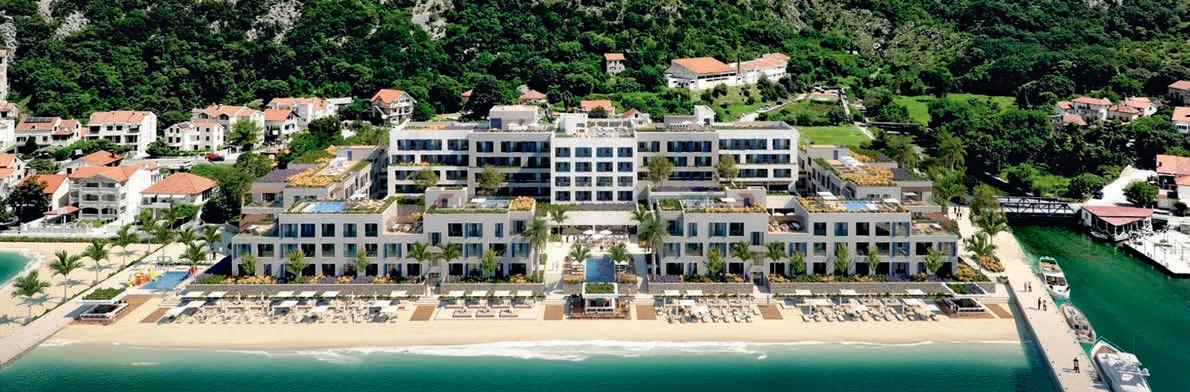
Montenegro’s transformation into one of the Mediterranean’s most attractive luxury destinations has been driven not only by international investors but also by local companies capable of delivering complex projects along the Adriatic coast. Among them, BRIV Construction has played a significant role in shaping the country’s modern tourism landscape for more than three decades.
Founded in 1990 through the merger of two family construction companies, BRIV built its reputation across construction, residential development and specialised marine and hydrotechnical engineering works. Over the past 35 years, the company has participated in some of Montenegro’s most recognizable coastal developments, including phases of Porto Montenegro, infrastructure works within the Portonovi resort in Kumbor, development of access infrastructure for Bigova Bay, the Kotor–Lovćen cable car, and the construction of the Regent Porto Montenegro Hotel in Tivat, as well as the underground pedestrian passage in Kotor.
Building on decades of experience in complex coastal construction, BRIV has recently expanded into tourism development through Briv Hospitality, a dedicated sister company focused on hotel and resort ventures.
The centrepiece of this strategy is the Mövenpick Hotel & Residences Teuta Kotor Bay, to be opened in May, in the historic town of Risan on the shores of the UNESCO-protected Bay of Kotor. De-
OUR GOAL HAS ALWAYS BEEN TO BUILD PROJECTS THAT ENDURE—STRUCTURES THAT BECOME PART OF MONTENEGRO’S LONG-TERM TOURISM AND ECONOMIC LANDSCAPE
veloped in partnership with the Accor Group, the project will introduce the globally recognised Mövenpick brand to Montenegro.
The luxury complex will combine a five-star hotel with branded residences, including 85 hotel rooms and 66 luxury residential units , alongside wellness facilities, restaurants and a private beachfront area. Unlike many tourism developments along the Adriatic coast, the resort is being developed and financed by a local company, reflecting the growing role of domestic investors in shaping Montenegro’s tourism sector.
With decades of engineering expertise and an expanding presence in hospitality development, BRIV continues to contribute to shaping Montenegro’s modern Adriatic landscape — building not only hotels and infrastructure, but the foundations of the country’s next generation of tourism destinations.
Designing the Adriatic
How international architects and local studios are quietly
reshaping Montenegro’s coast
For much of the twentieth century, Montenegro’s coastline developed slowly, shaped more by geography than by design. Stone villages climbed hillsides, narrow streets followed the contours of the terrain, and architecture evolved through tradition rather than masterplans.
Today, that coastline is undergoing a different kind of transformation. Over the past two decades, a new generation of projects has introduced an architectural approach rarely seen in the region before — one built through collaboration between international studios, local architects and long-term developers.
At the centre of that shift stand two developments that have redefined Montenegro’s modern coastal identity: Porto Montenegro and Luštica Bay
Though often mentioned together, the two projects represent fundamentally different architectural models.
A MARINA DESIGNED WITH ARCHITECTURAL CONTINUITY
When Porto Montenegro began transforming a former Yugoslav naval base in Tivat into a luxury marina village, its investors made a decision that would shape the project for decades: appoint a single architectural partner to guide its evolution.
That role fell to ReardonSmith Architects, a London-based studio with a long international portfolio in hospitality and waterfront development.
Rather than imposing a striking signature style, ReardonSmith pursued something subtler: architectural continuity. Buildings across the marina district follow a consistent Mediterranean vocab-
BUILDING A TOWN, NOT JUST A RESORT
Several kilometres away along the coast, Luštica Bay represents a different architectural philosophy.
Developed by Orascom Development, the project was conceived not as a single destination but as an entirely new coastal town unfolding over decades.
ARCHITECTURE ON MONTENEGRO’S COAST IS NO LONGER ONLY ABOUT STYLE. IT IS ABOUT CREDIBILITY, CONTINUITY AND LONG-TERM VALUE.
ulary — stone façades, shaded balconies, narrow streets that open toward the sea — creating a sense of place that feels deliberately cohesive.
In an environment where many coastal developments emerge piecemeal, Porto Montenegro’s architectural discipline has helped the project mature into a functioning urban district rather than a seasonal resort. Hotels, residences, retail streets and public squares operate as parts of the same spatial system.
For investors and residents alike, that consistency translates into something valuable: predictability. Architecture here does not merely frame views of the Adriatic. It reinforces the long-term credibility of the destination itself.
Such ambitions require a different design structure. Rather than appointing one dominant architect, the development operates as a curated ecosystem of studios working under a shared masterplan and design guidelines.
Within that framework, NRA Atelier, led by Nikola Radović, has become one of the key architectural contributors to realised phases of the project, including residential areas such as the Blok 5 residences and The Peaks townhouses.
The studio’s approach reflects the broader philosophy of the development: architecture that responds first to landscape, climate and Mediterranean urban traditions rather than visual spectacle. Buildings follow the contours of the
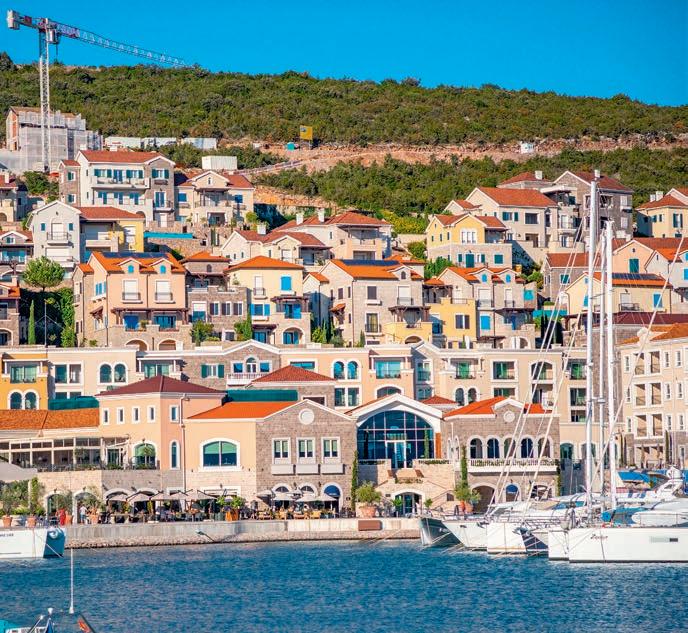
hills, streets remain walkable, and materials echo those found in historic coastal settlements.
In this model, architecture becomes less about authorship and more about translation — translating a large-scale vision into human-scale places.
FOREIGN EXPERTISE, LOCAL INTERPRETATION
The involvement of international architects has been crucial in introducing new standards of planning and construction to Montenegro’s emerging coastal developments. Studios such as ReardonSmith have brought experience from global hospitality and waterfront projects, while local practices like NRA Atelier ensure that new architecture remains rooted in regional context.
This collaboration between global expertise and local interpretation has helped Montenegro avoid a common pitfall of rapid coastal development: the loss of identity. Instead, the new projects attempt to reinterpret Mediterranean tra-
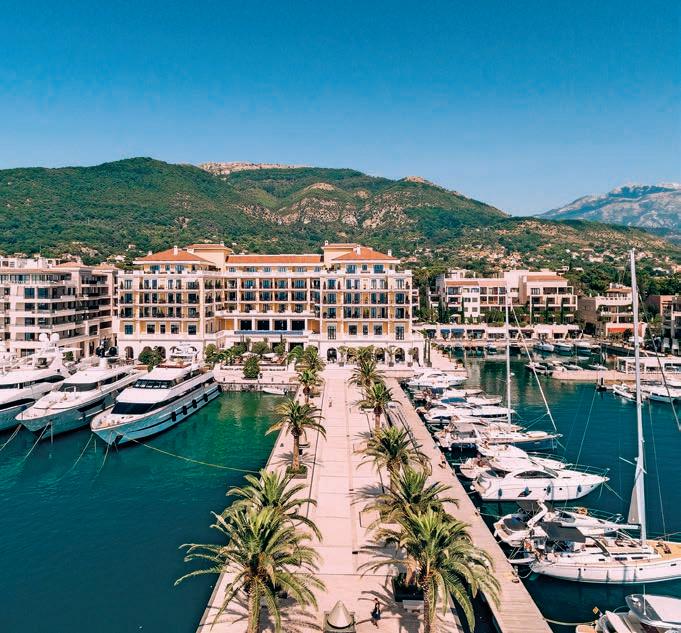
PORTO MONTENEGRO
Architectural model: Architect-led continuity
Key studio: ReardonSmith Architects
LUŠTICA BAY
Architectural model: Developer-led masterplan
Key architectural contributor: NRA Atelier
Developer: Orascom Development
ditions rather than replace them.
It is a delicate balance. Too much global influence risks producing anonymous luxury enclaves. Too little risks repeating outdated models of tourism infrastructure.
The most successful projects find a middle path.
A COASTLINE REIMAGINED
Architecture rarely transforms a country on its own. Yet in Montenegro, the physical shape of development has become inseparable from the country’s economic story.
Porto Montenegro demonstrated that a disciplined architectural vision could turn a neglected naval base into one of the Adriatic’s most recognised marinas. Luštica Bay is testing whether a carefully governed masterplan can grow into a functioning coastal town over the course of a generation.
Both projects signal a broader shift in how Montenegro approaches development: away from short-term construction and toward long-term place-making.
In the end, the architecture of Montenegro’s coast is no longer simply about buildings. It is about confidence — the belief that the Adriatic can be shaped thoughtfully, one district at a time.
Porto Montenegro
Luštica Bay
Architecture Designing Montenegro’s Next Chapter
As NRA Atelier marks ten years of practice, its founders reflect on architecture as cultural mission, responsibility to place, and the ambition to move from regional presence to international stage.

Founded in 2016, NRA Atelier emerged at a moment when Montenegro itself was entering a new phase of spatial and economic transformation. Over the past decade, the studio has grown alongside some of the country’s most ambitious developments, contributing to projects that now shape its contemporary visual identity.
As they mark ten years of practice, Nikola Radović and Sonja Milićević speak about architecture beyond technical boundaries — as a discipline rooted in responsibility, shaped by regulation and context, and driven by a long-term vision that extends beyond the region.
NRA Atelier marks ten years this year. When you look back to 2016, what was your original ambition — and how much of today’s studio reflects that vision?
When we look back at 2016, it is clear that today’s NRA Atelier embodies the realization of the ambitions that guided us at the beginning. From the outset, we approached architecture as a discipline that transcends technical boundaries and evolves into a cultural and social mission — a medium through which ideas are transformed into environments that inspire, connect, and shape community identity.
A decade later, the studio stands as the outcome of those early aspirations: multidisciplinary, open to exploration and experimentation, yet firmly anchored in responsibility toward space and society. Each project carries a trace of that original vision, enriched by the experience we have gained over time.
At the same time, we recognize this moment not as a final destination, but as a midpoint. We stand between what has been achieved and what lies ahead — mature enough to value the path behind us, yet ambitious enough to pursue new ho-
rizons. It is this constant forward momentum that allows NRA Atelier to remain faithful to its founding ambition while opening new chapters for the future.
Your projects, particularly within the Luštica Bay development, have become part of Montenegro’s contemporary visual identity. How do you balance local context with
international standards when designing spaces meant to endure for decades?
In every project, context is our starting point and the defining criterion for shaping space. We pay close attention to the character of the site and the specific qualities of the environment in which we intervene, because we believe architecture must emerge from the place where it is born.
At the same time, we operate within clearly defined planning documentation — from state and municipal regulations to international frameworks such as UNESCO guidelines, particularly when designing in Boka Bay. In such circumstances, international standards must be reconciled with local rules and values, a process that requires careful balance.
That balance is never simple. It is shaped between design vision and established regulations, between context and investor expectations. Through this equilibrium, we aim to create spaces that are sustainable in the long term — aligned with their local environment and regulatory standards, yet flexible enough to remain relevant in the years ahead.
Over the past decade, you have received several professional awards. Are they confirmation of quality, or an obligation to move further — especially in a rapidly changing market?
Awards stand as confirmation of a project’s quality and the value invested in the work. They demonstrate that our approach is recognized and appreciated within professional circles, giving us confidence that we are on the right path. However, awards are not the driving force behind our philosophy. Our work stems from a vision and the conviction that architecture must be responsible, contextual, and sustainable over time.
The obligation to move forward exists constantly — whether recognition follows or not. The market evolves rapidly, and
the expectations of investors and users continue to shift. Our responsibility is to raise standards, introduce new methodologies, and remain open to innovation. We therefore regard awards as encouragement rather than as an end goal.
Architecture today is no longer just design — it encompasses sustainability, energy efficiency, and long-term investment value. How do you see the role of the architect within large development business models?
The architect plays a pivotal role in large-scale development projects because we bridge the investor’s vision
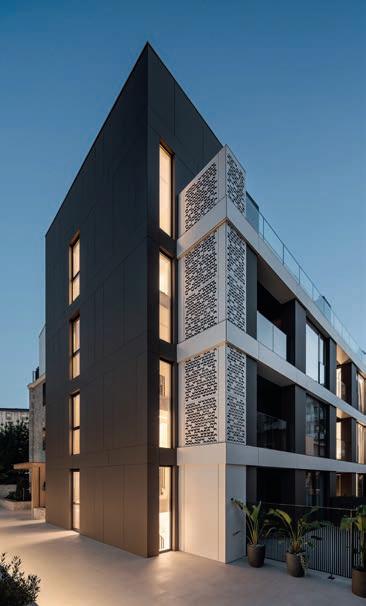
with the real context and the long-term needs of space.
Architecture today embodies responsibility — toward sustainability, rational use of resources, and the creation of enduring value. Energy efficiency and environmental performance are no longer optional considerations; they are integral to the design process itself.
In this sense, good architecture directly enhances investment value. A well-designed space does not simply meet immediate demands; it retains relevance and appeal over time.
This is why the relationship between architect and investor must be based on genuine partnership. The architect contributes vision and expertise, while the investor provides resources and business structure. Only through such synergy can projects achieve sustainability, functionality, and long-term economic viability.
Looking ahead to the next decade, what will define the success of an architectural studio in the region — and where do you see NRA Atelier?
In the coming decade, success will be defined above all by quality. Only projects that are thoughtful, responsible, and sustainable over time can remain relevant. An uncompromising commitment to the importance of the profession must remain a priority, because without clear professional standards there can be no lasting trust or recognition.
Equally important will be dedication to vision, continuous improvement across all dimensions, and a willingness to embrace architecture as a collective process — where collaboration and the joy of creation matter as much as the final result.
For NRA Atelier, a central ambition is to strengthen our presence on the international stage. We believe that our approach — rooted in quality, contextual sensitivity, and openness to innovation — can be recognized beyond the borders of the region. This combination of local experience, professional dedication, and readiness for global dialogue defines our direction for the years ahead.
Miloš Martinović
Youth & Innovation
Montenegro’s Next Innovators
Through its Spark.me STEAM Adventure programme, doMEn is helping young people turn ideas into practical solutions — from sustainable fashion and autonomous vehicles to AI tools with real public-use potential.
doMEn IS BACKING MONTENEGRO’S NEXT GENERATION OF INNOVATORS
At a time when digital and technological skills are becoming essential to the competitiveness of smaller economies, investing in young people’s knowledge is no longer a matter of corporate goodwill. It is a development strategy.
That is the logic behind Spark.me STEAM Adventure, a programme launched by doMEn d.o.o. to support young people in Montenegro through practical projects in sci-
YOUNG CREATORS DESIGN A GARMENT FOR THE FUTURE
At Fusion Lab, young creatives explored the intersection of fashion, technology and sustainability, developing experimental garments through upcycling, 3D printing and handcraft. The challenge encouraged participants to treat fashion not just as design, but as a platform for innovation and social commentary.
ence, technology, engineering, arts and mathematics. Rather than treating innovation as an abstract buzzword, the initiative focuses on something more valuable: giving young people the chance to build, test, create and solve real problems.
During 2025, the programme support-

ed eight projects designed for participants aged 15 to 30, each centred on competitions and hands-on challenges across STEAM fields. Three projects have already been successfully completed, offering early proof that Montenegro has no shortage of talent, creativity or ambition when the

right framework is in place.
The programme runs until April 2026, with a total budget of up to €100,000. Individual projects receive support ranging from €5,000 to €30,000. But its real value lies beyond the financials. Spark.me STEAM Adventure creates space for experimentation, applied learning and the development of ideas that can move beyond the classroom and into everyday life.
The three projects delivered in 2025 also reveal the breadth of the STEAM approach itself — one that stretches from creative industries to advanced engineering and artificial intelligence.
The jury included fashion designer Ana Krgović of Shift Studio, Anita Ljuljđurović from doMEn, and Uroš Bulatović, President of the Union of Young Entrepreneurs of Montenegro. Mentorship was provided by sculptor Maja Marinović and fashion designer Jovana Vujosević. The winning concept came from Elena Roganović and Sofija Stijović, students of fashion arts, whose team New Aged presented a minimalist “armour” designed for a postapocalyptic world.
FASHION, REIMAGINED THROUGH TECHNOLOGY
In October, participants took part in Fusion Lab, a three-day challenge that asked young creatives to develop innovative garments by combining upcycling, 3D printing and handcraft. Here, fashion was not treated simply as design, but as a platform for experimentation where aesthetics, technology and social awareness could meet.
The winning team presented a minimalist “armour” for a world shaped by ecological and social crisis — a concept that pointed to a bigger idea: that tomorrow’s innovation may emerge just as easily from the intersection of art and engineering as from the lab alone.
ENGINEERING SKILLS WITH A PRACTICAL EDGE
In November, the focus shifted to applied engineering through SMART Competition 2025 , where secondary-school students built and programmed autonomous vehicles capable of recognising obstacles and moving independently along a defined route.
The challenge placed practical work ahead of theory, drawing participants into electronics, coding and team-based problem-solving. It also connected local learning with global industry trends through an online masterclass led by Aleksandar Marković, who linked engineering knowledge to the fast-evolving world of gaming and digital technology.
The result was a clear demonstration of how quickly young people can absorb ad-
vanced technical skills when they are given strong mentorship, the right infrastructure and a challenge worth solving.
AI AIMED AT REAL-WORLD PROBLEMS
In December, NextGen AI Challenge brought together students and secondary-school participants to tackle concrete social issues using artificial intelligence and data analysis. Unlike many academic simulations, this project was grounded in real conditions: participants worked with local datasets and were encouraged to think about solutions with genuine public-service value.
The winning team developed a model designed to predict bus arrivals in real time and analyse the stability of public transport ser-
NEXTGEN AI CHALLENGE: APPLYING ARTIFICIAL INTELLIGENCE TO REAL-WORLD PROBLEMS
Young participants tackled practical challenges using artificial intelligence, data science and advanced analytics. The winning team VIDRA, composed of Nikola Lešić and Stefan Labović, developed a model capable of predicting bus arrival times in real time and analysing the reliability of public transport services.
SMART COMPETITION 2025: HIGH-SCHOOL ENGINEERS BUILD AUTONOMOUS VEHICLES
At this hands-on engineering challenge in Tivat, students designed and programmed autonomous vehicles capable of navigating a course while recognising obstacles. First place was awarded to the team from JU SMŠ “Mladost”
FROM SUPPORT TO STRATEGY
Taken together, the projects completed in 2025 show what is possible when young people are given the tools to experiment and the freedom to apply knowledge in a meaningful way. They also make a broader point about Montenegro’s future.
For a country seeking long-term competitiveness in a digital economy, innovation cannot depend only on imported solutions or a handful of established players. It also depends on whether the next generation is given the opportunity to develop relevant skills early, test ideas in practice and see themselves as creators rather than observers of change.
Through Spark.me STEAM Adventure, doMEn d.o.o. is investing precisely in that capacity: in young people who can help shape a more knowledge-based economy and a more competitive digital future for Montenegro.
With five more initiatives still to be implemented, the programme is not closing a chapter, but building continuity — strengthening the country’s STEAM community and widening the space for learning, experimentation and innovation.
vices — a practical example of how young talent can produce ideas capable of improving daily life for citizens.
Tivat: Uroš Vuksanović, Đorđe Martinović, Pavle Grgurović and Ivan Slovnikar.
The New Aesthetics

Elegance Beauty
A new philosophy in aesthetic medicine is quietly redefining how we think about age, beauty and confidence
For years, the beauty industry promised the same miracle: the power to erase time.
Creams, injections, lasers — the message was always the same. Aging was something to fight, to correct, to hide.
But a subtle revolution is now reshaping aesthetic medicine.
The new goal is not to look younger. It is to look better — naturally
Across Europe’s most forward-thinking clinics, a new philosophy is emerging: age is not the enemy. Done well, aesthetic medicine should not change a face, but help it remain vibrant, expressive and unmistakably its own.
“The most beautiful results are the ones that don’t look like procedures,” says Dr Ioanna, founder of Ioanna RegenClinic. “People should look rested, confident and full of life — not altered.”
Her practice reflects exactly that shift.
Based in Belgrade, Dr Ioanna works with patients from across the region and regularly treats clients in Montenegro and Bosnia and Herzegovina , where demand for subtle, regenerative treatments has grown rapidly in recent years. Many of her patients travel specifically for treatments that prioritise natural outcomes rather than dramatic transformation.
In this new aesthetic landscape, elegance has replaced excess.

REGENERATION INSTEAD OF TRANSFORMATION
The most important change in aesthetic medicine is happening beneath the surface of the skin.
Rather than forcing visible alterations, modern treatments increasingly stimulate the body’s own regenerative processes. The focus is on improv-
ing skin quality — its structure, elasticity and vitality.
When skin becomes healthier, the face naturally appears fresher.
This approach, often called regenerative aesthetics, relies on biological signals that activate repair mechanisms inside the skin. Instead of adding artificial volume, the goal is to encourage the skin to rebuild itself.
The effect is subtle but powerful: improved tone, smoother texture, softer lines and a healthier glow.
Not a different face — simply a better version of the same one.
WHEN SCIENCE WORKS WITH NATURE
Among the treatments leading this shift is PRP (Platelet-Rich Plasma) , one of the most established regenerative techniques.
PRP uses the patient’s own blood to isolate platelets rich in growth factors — biological signals that stimulate tissue repair and collagen production. Once reintroduced into the skin, these factors trigger natural regeneration processes that gradually improve skin quality.
For many patients, the results appear as something difficult to quantify but instantly noticeable: a fresher, more rested appearance.
The skin simply behaves younger.
THE NEXT GENERATION: EXOSOMES
If PRP represents the foundation of regenerative aesthetics, exosomes are quickly becoming its most exciting frontier.
These microscopic biological messengers allow cells to communicate with one another, activating repair pathways and encouraging tissue renewal.
In aesthetic medicine, exosomes are used to improve skin texture, elasticity and overall radiance. The process en-
TODAY, AESTHETIC MEDICINE
IS NOT ABOUT CHANGING A FACE — IT IS ABOUT RESTORING THE VITALITY THE SKIN ONCE HAD
hances the skin’s natural ability to regenerate, producing results that feel organic rather than artificial.
Patients often describe the outcome not as looking younger, but as looking healthier.
REPAIR AT THE CELLULAR LEVEL
Another innovation gaining attention is the use of polynucleotides, bioactive molecules derived from highly purified fragments of salmon DNA.
Their role is to stimulate fibroblasts — the cells responsible for producing collagen and elastin — while improving hydration and reducing inflammation in the skin.
The effect is a deeper form of rejuvenation that strengthens the skin from within.
In practical terms, this means firmer texture, improved elasticity and skin that reflects light more evenly — small details that together create a more youthful appearance.
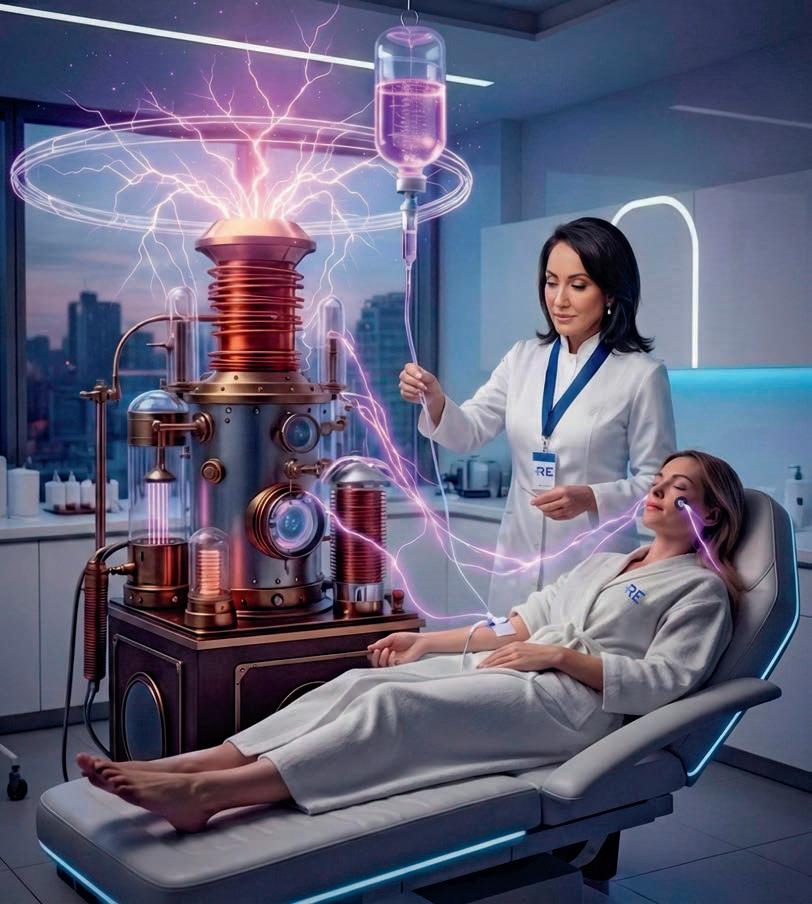
A NEW DEFINITION OF BEAUTY
Perhaps the most important shift in aesthetic medicine is philosophical.
For decades, the global beauty industry celebrated the illusion of eternal youth. Today, many patients are asking for something far more sophisticated: confidence that evolves with time
A face that still carries character.
A look that reflects experience.
“The most rewarding moment,” says Dr Ioanna, “is when someone tells a patient they look amazing — but can’t explain why.”
That quiet transformation is exactly what modern aesthetic medicine is learning to achieve.

Because in this new era of beauty, the goal is no longer to stop time. It is simply to age beautifully And sometimes, that means fifty can indeed feel like the new thirty.
Ioanna Regen Clinic Rankeova 16, Belgrade +381 11 455 0300 +381 63 80 39 369
Treatments available in Belgrade, Montenegro and Bosnia and Herzegovina.

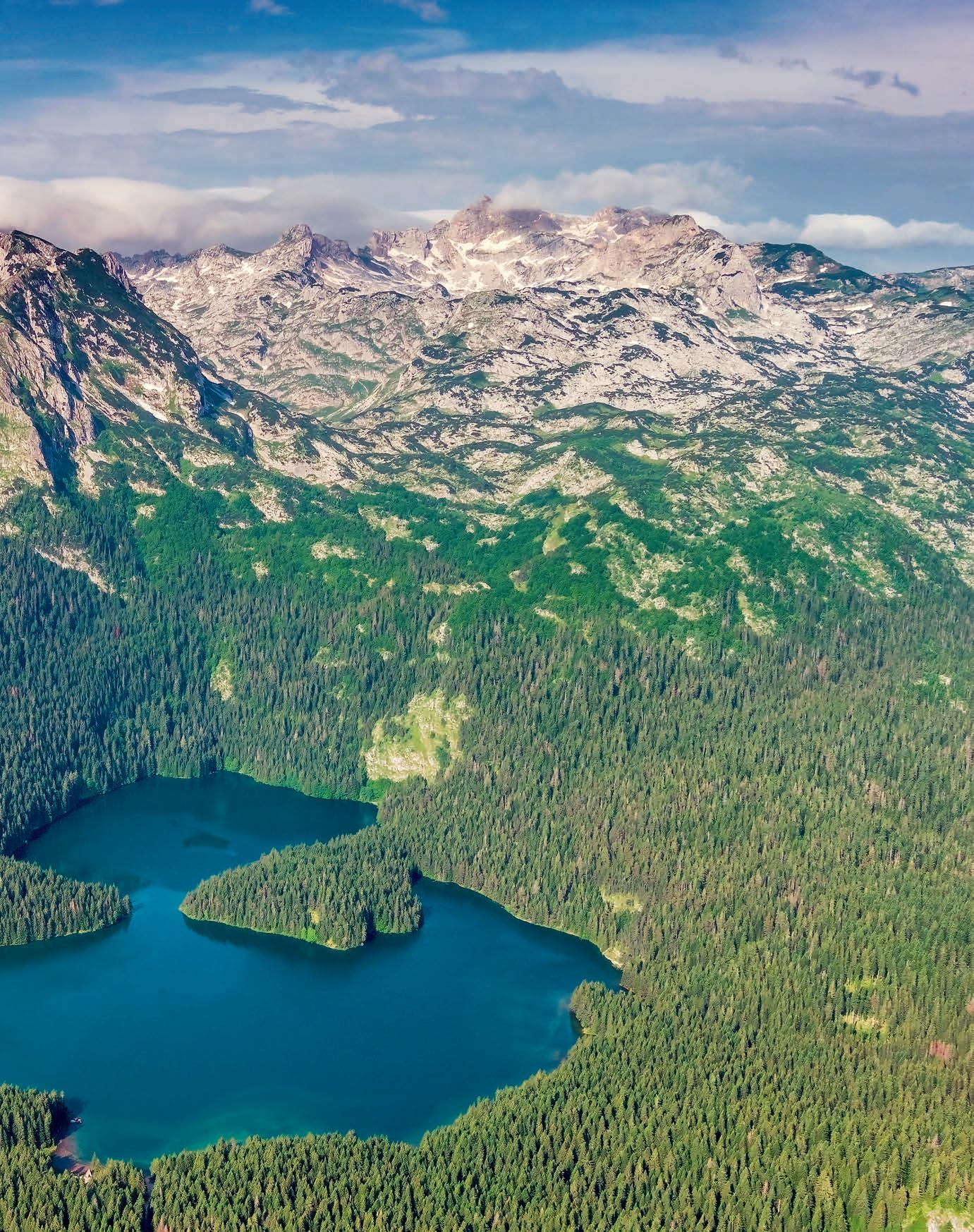
The Black Lake that Breathes
At first glance, Black Lake looks like what visitors expect Montenegro to be: dramatic, photogenic, quietly confident. Look longer, and the illusion shifts. The lake changes—without asking permission. Its edges move. Its silence varies. Locals say it breathes. They are not wrong.
Black Lake “breathes”: its water level rises and falls through hidden underground karst channels, subtly reshaping its shoreline throughout the year.
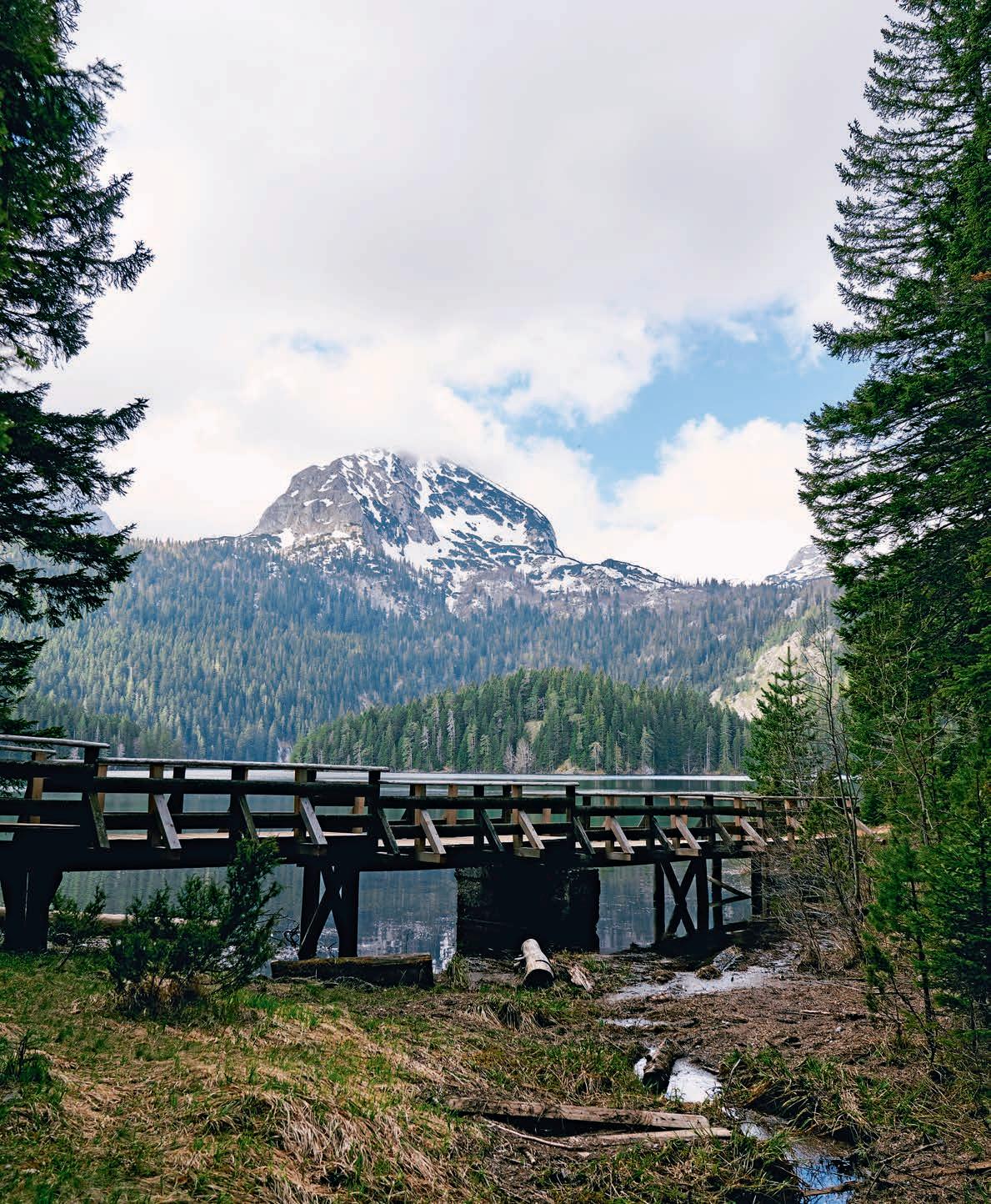
Wild Fact
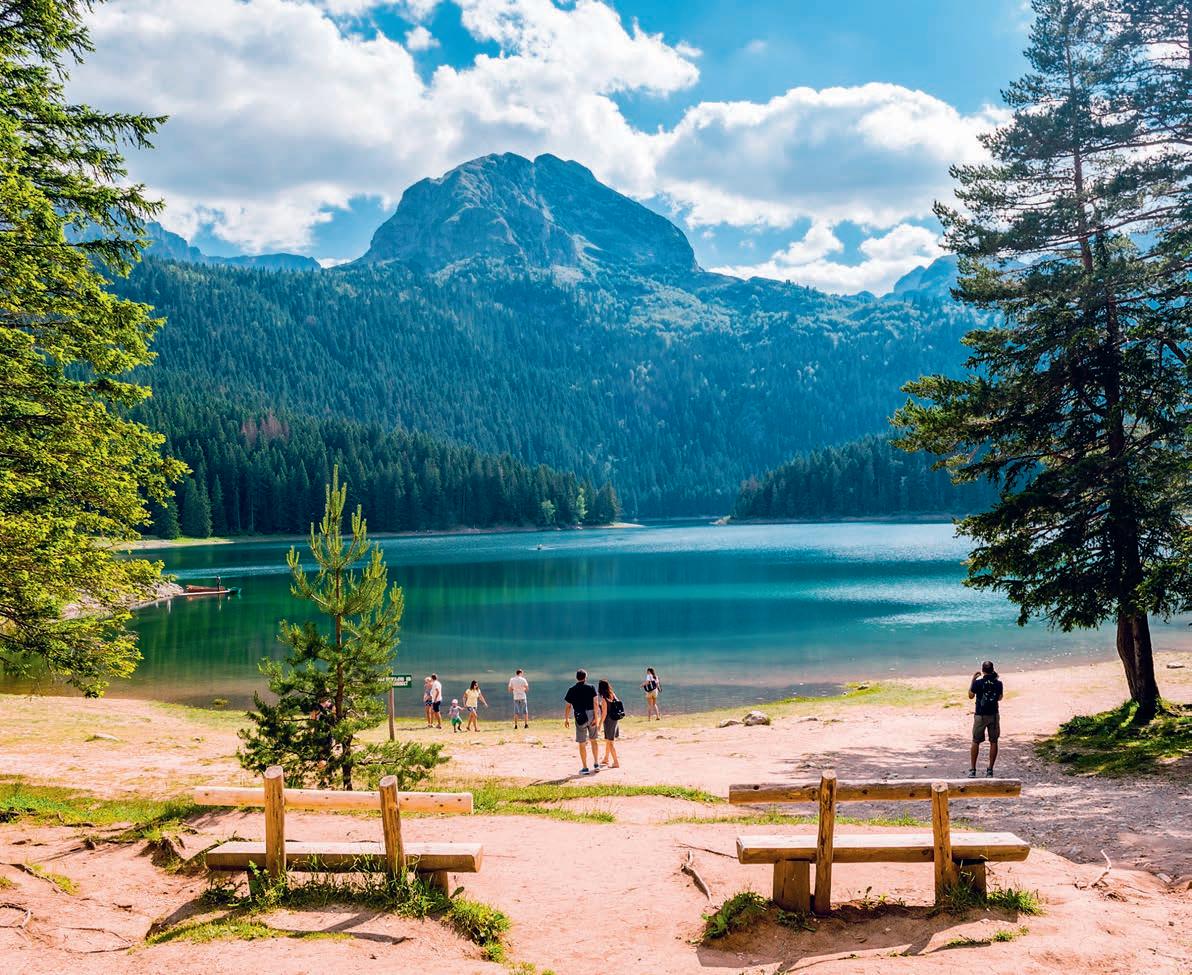
Situated at the edge of Žabljak, within Durmitor’s high-altitude plateau, Black Lake is actually two lakes joined by a narrow strait—one deeper, one shallower—whose relationship shifts with the seasons. When snowmelt arrives, water levels rise and the pair become one. In drier months, they separate again, as if reconsidering the arrangement.
The forest around it responds accordingly. Moss creeps closer to the waterline. Birds adjust nesting patterns. Amphibians wait for precise temperatures before emerging. Even the fish— encased under winter ice—depend on oxygen levels that fluctuate just enough to keep them alive, year after year.
What makes Black Lake remarkable is not scale or spectacle, but restraint. There are no waterfalls announcing themselves, no obvious drama. The intelligence is quieter. The lake absorbs weather, light and time, then releases them slowly. It teaches
patience by example.
In a country defined by sharp edges—cliffs, canyons, borders— Black Lake offers a different lesson. Stability here does not come from resistance, but from adaptation. The lake survives precisely because it yields when it must.
That may be why it unsettles those who expect certainty from landscapes. You can return to Black Lake at the same time every year and never see quite the same thing twice. Reflection is never identical. The waterline never agrees to be permanent. Even silence varies.
Nothing about it feels rushed. Nothing about it is accidental.
In Montenegro, where ambition often speaks loudly, Black Lake reminds you that endurance can be quiet—and that the most resilient systems are the ones that know when to change.
Sometimes, the smartest thing a place can do is breathe.
Lesser Known Tales
Cetinje — The Town That Refused the Coast
For a country defined by coastline, Cetinje made an unlikely choice. It turned inland—and stayed there.
While Adriatic ports traded, expanded and learned the language of visibility, Cetinje opted for altitude, isolation and restraint. It never chased ships or scale. It never tried to compete with the coast. Instead, it became something else entirely: a seat of power that resisted spectacle.
This was not an accident of geography. It was strategy.
Tucked beneath Mount Lovćen, Cetinje grew as a political and spiritual centre precisely because it was hard to reach. Distance offered protection. Modesty offered durability. In a region shaped by empires and incursions, the town’s inward gaze became a form of defence— and later, a defining habit.
Cetinje did not grow rich. It grew authoritative.
When Montenegro emerged as a modern state, its institutions took shape here, not along the shorelines where influence came and went with tides and trade. Power in Cetinje was quiet, administrative, deliberate. Decisions were made away from ports, away from foreign eyes, away from urgency. The town became a place where time slowed—and where continuity mattered more than momentum.
That legacy still lingers.
Cetinje never became large, and it never tried to. There are no grand boulevards or dominant skylines. The architecture avoids bravado. Streets feel measured, even hesitant. For visitors, it can seem subdued—almost unfinished. But that understatement is the point. Cetinje was designed to endure, not impress.
In a subtle way, this shaped Montenegro’s broader political temperament. Authority without excess. Presence without expansion. A preference for balance over dominance. Even today, national identity draws as much from this inland restraint as from the confidence of the coast.
There is a reason Montenegro has no megacity, no singular urban centre that absorbs power and attention. Influence has always been distributed—by terrain, by history, by habit. Cetinje helped set that pattern.
Its refusal of the coast also produced an unusual relationship with modernity. While coastal towns learned to adapt quickly—absorbing waves of tourism, investment and reinvention—Cetinje moved cautiously. Change here has always been filtered through memory. Progress was permitted, but never rushed.
Critics sometimes call this stagnation. Supporters call it dignity. Both miss the deeper point.
Cetinje’s real contribution lies not in what it built, but in what it declined. It declined scale. It declined speed. It declined the need to be seen. In doing so, it preserved a model of authority that values credibility over volume—a trait that continues to surface in Montenegro’s political and institutional culture.
In a business-focused conversation, that may seem abstract. But investors often discover it the hard way: Montenegro does not respond well to pressure theatrics. It prefers patience. It listens carefully. It moves when it is ready.
Cetinje taught the country that power does not have to announce itself to be effective.
Today, the town stands quieter than ever. Ministries have moved. Attention has shifted. Yet Cetinje remains essential—not as a centre of action, but as a reminder of intent. It anchors Montenegro’s sense of proportion.
The coast may define how the country is seen.
Cetinje explains how it thinks.
And in a region where visibility often masquerades as strength, that refusal still matters.
Corporate Moves
Foreign Investors Link Up with Montenegro’s Innovation Ecosystem
The Science and Technology Park of Montenegro and the Montenegrin Foreign Investors Council have signed a Memorandum of Cooperation aimed at connecting international companies with the country’s innovation and technology potential. The agreement, signed by Valentina Radulović and Arijana Nikolić Vučinić, sets a framework for closer collaboration in innovation, technology entrepreneurship and knowledge exchange. The partnership is expected to strengthen Montenegro’s investment reputation and better integrate foreign investors into the local innovation ecosystem.
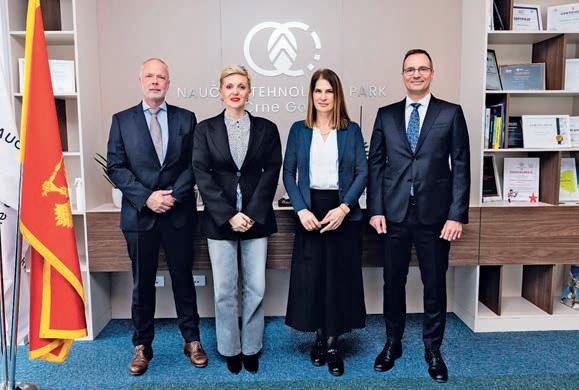
EPCG and Masdar Explore Renewable Energy Partnership
Montenegro’s state power utility EPCG has signed a framework agreement with UAE-based renewable energy group Masdar. The partnership opens the door to joint projects in solar, wind and other clean energy technologies. The move aligns Montenegro’s energy sector more closely with international investors focused on green transition.
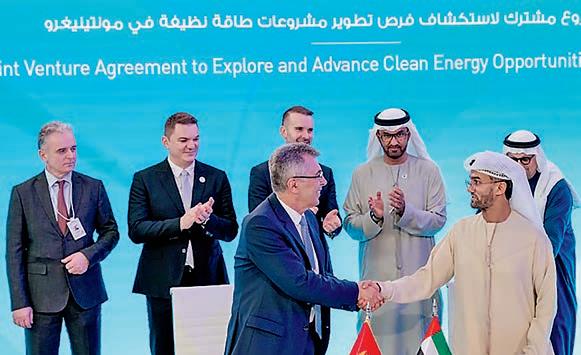
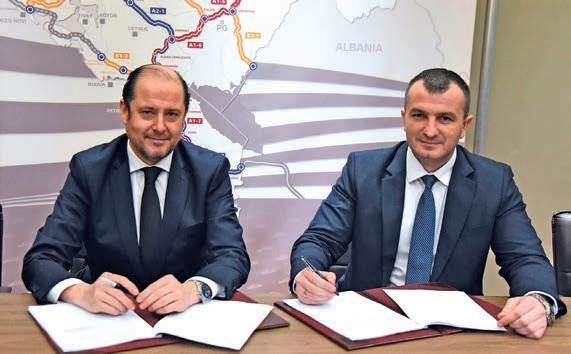
Italian Firm Oversees Key Motorway Section
Montenegro’s state road company Monteput has awarded a €14.45 million contract to Italy’s IRD Engineering to supervise the design and construction of the Mateševo–Andrijevica motorway section. The 22-kilometre stretch is part of the Bar–Boljare highway, one of the country’s most strategic infrastructure projects. Chinese companies PowerChina and STECOL are responsible for construction works.
Golden Keys Recognition for Regent Porto Montenegro Concierge
Jelena Slijepčević, Concierge Manager at Regent Porto Montenegro, has become the first woman in Montenegro to receive the prestigious Les Clefs d'Or Golden Keys certification, join-
ing the global association of elite hotel concierges representing around 4,000 professionals in more than 80 countries. The hotel also announced that five members of its concierge team — Nebojša Đurđevac, Goran Batuta, Boško Vukić, Nemanja Jokanović and Danilo Bubanja — have begun the process of obtaining the same international certification through the Hungarian association.
Air Montenegro and Turkish Airlines Launch Codeshare Partnership
Air Montenegro and Turkish Airlines have signed a codeshare agreement aimed at strengthening Montenegro’s international air connectivity.
Turkish Airlines will place its code on Air Montenegro flights between Istanbul and Podgorica and Tivat, while Air Montenegro will add its code to selected Turkish Airlines routes, initially including services to Dubai and Baku.
The partnership links Montenegro’s national carrier with one of the world’s largest airline networks, expanding travel options for passengers and strengthening the country’s global aviation connectivity.
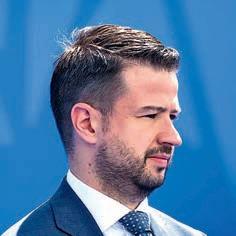
SUNDAY REST PROPOSAL What It Means for Retail & Tourism
President Jakov Milatović’s proposal to constitutionally guarantee non-working Sundays and public holidays would directly affect Montenegro’s retail, shopping mall and hospitality sectors. Supermarkets and large retail chains would likely need to adjust operating models, staffing schedules and revenue projections, while tourism operators could face differentiated rules depending on how “public interest” exceptions are defined. For investors, the key question will not be ideology but predictability — whether the amendment brings long-term legal clarity or introduces new layers of regulatory complexity in a sector where flexibility often drives profitability.
Japanese
Group Eyes Waste-to-Energy
Project
Japan’s Itochu Corporation has expressed interest in Montenegro’s planned waste-to-energy facility. The project would combine waste management with electricity generation, addressing two infrastructure gaps at once. If realised, it would mark one of the largest Japanese industrial engagements in the country.
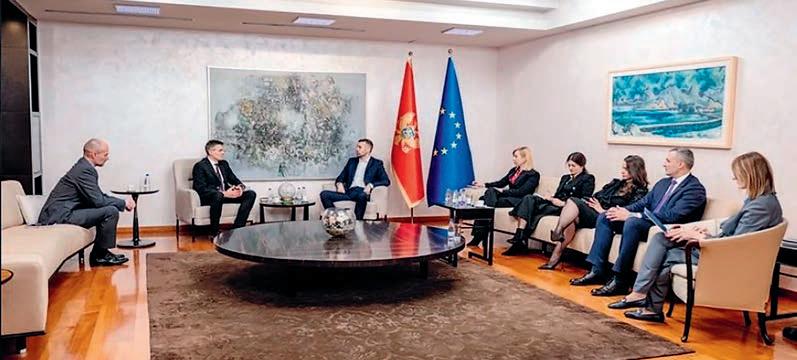
Saint-Gobain Names Regional CEO
Milan Lukić has been appointed Chief Executive Officer of Saint-Gobain CP Weber and Isover for the Serbia, Montenegro and Bosnia-Herzegovina region. He takes the helm of the building materials and insulation units with responsibili-
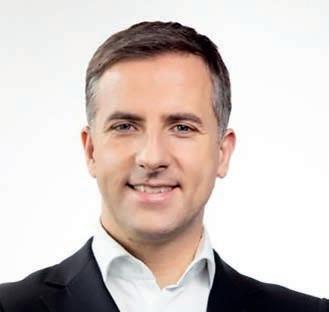
ty for overseeing regional strategy and growth across three major Adriatic and Balkan markets. Lukić’s appointment reflects Saint-Gobain’s continued commitment to strengthening its leadership footprint in Southeast Europe.
Porto Montenegro Launches Boutique Office Hub in Tivat
Porto Montenegro has introduced the Nautika Business Club, a boutique workspace concept located within the historic Maritime Heritage Museum in Tivat. The facility offers private offices, shared meeting rooms, a reception lobby
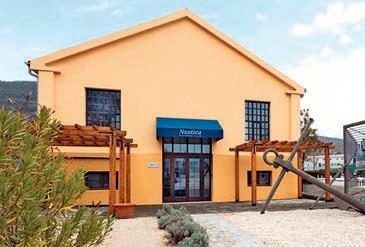
and 24-hour access, designed for professionals and small teams seeking a highend working environment. The move expands Porto Montenegro’s offering beyond marina services into a more integrated business and lifestyle ecosystem.
Who Was in the Room
AMCHAM HOSTS “OPEN WITH THE PRIME MINISTER”
At an AmCham Montenegro event in Podgorica titled “Open with the Prime Minister”, officials and business leaders discussed economic cooperation, EU integration and Montenegro’s business climate. Prime Minister Milojko Spajić said Montenegro and the United States are nearing an intergovernmental agreement aimed at strengthening cooperation in critical and digital infrastructure, building on the Memorandum of Understanding on economic cooperation signed in Washington in 2024.
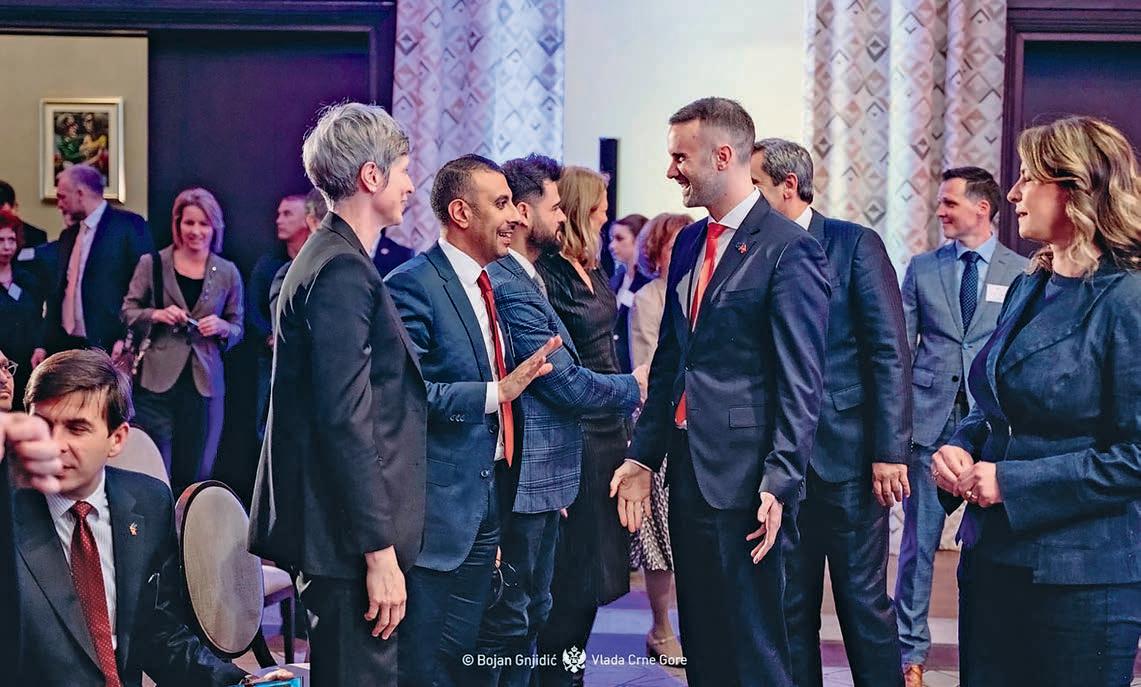
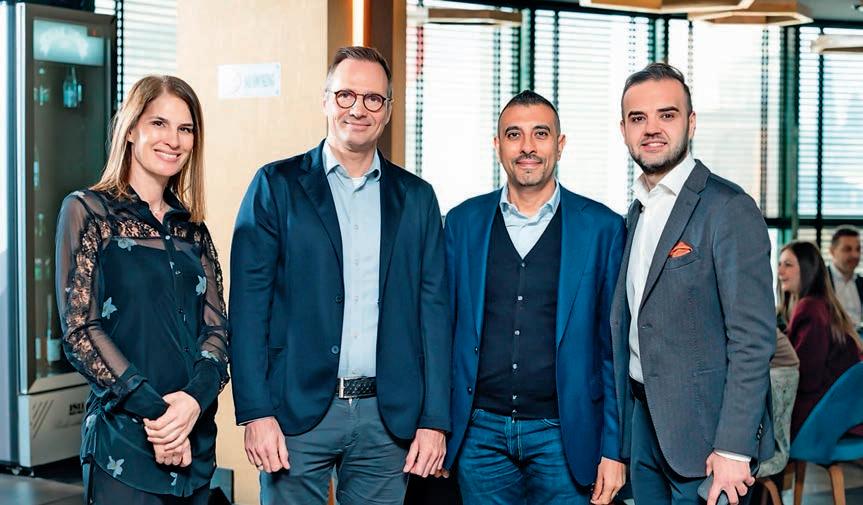
MFIC BRUNCH BRINGS MEMBERS TOGETHER
The Montenegrin Foreign Investors Council hosted its traditional MFIC Brunch, gathering member companies for an informal exchange and networking. The event also marked the arrival of several new members, while some long-standing companies upgraded their status to patron level, reflecting the continued growth of the organisation’s business community.
CBCG DELEGATION VISITS BUNDESBANK
A delegation of the Central Bank of Montenegro led by Governor Irena Radović met in Frankfurt with Joachim Nagel, President of the Deutsche Bundesbank, and Executive Board member Burkhard Balz. The talks focused on Montenegro’s progress in aligning with EU and ESCB standards, including work on SEPA integration, digital payments and broader financial sector reforms.
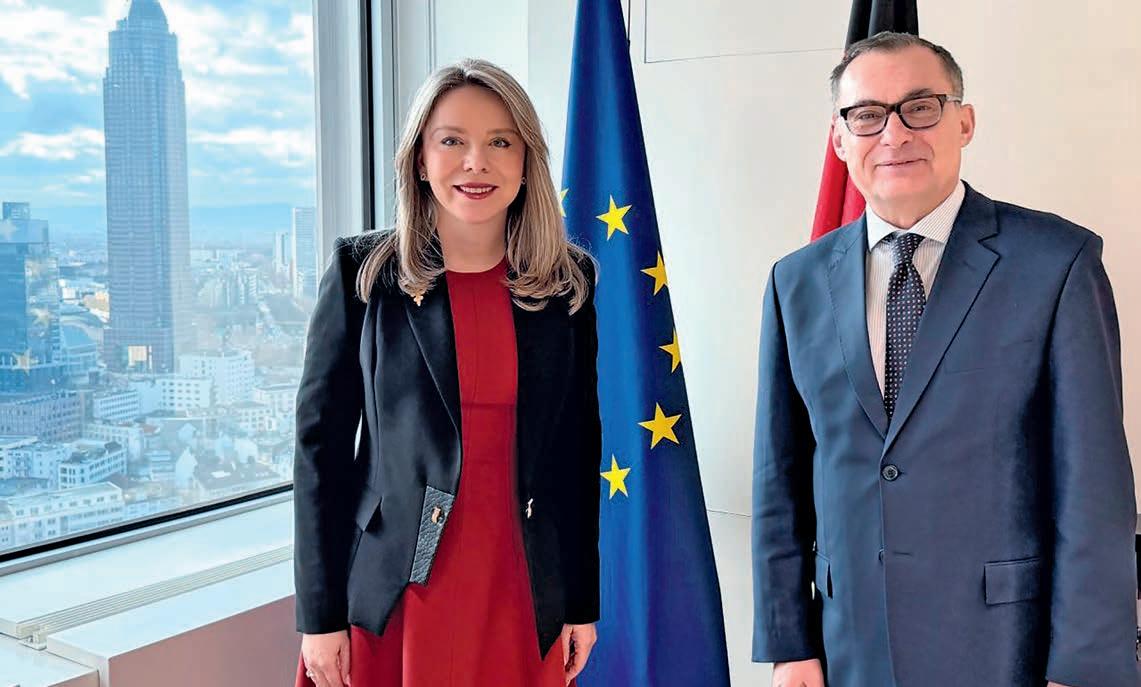
MONTENEGRO OPENS EMBASSY IN BERN
Montenegro officially opened its new Embassy in Bern, in the presence of Foreign Minister Ervin Ibrahimović and Swiss Federal Councillor Ignazio Cassis. The opening coincided with 20 years of diplomatic relations between Montenegro and Switzerland, marking a new chapter in bilateral cooperation and a stronger institutional presence in Switzerland.
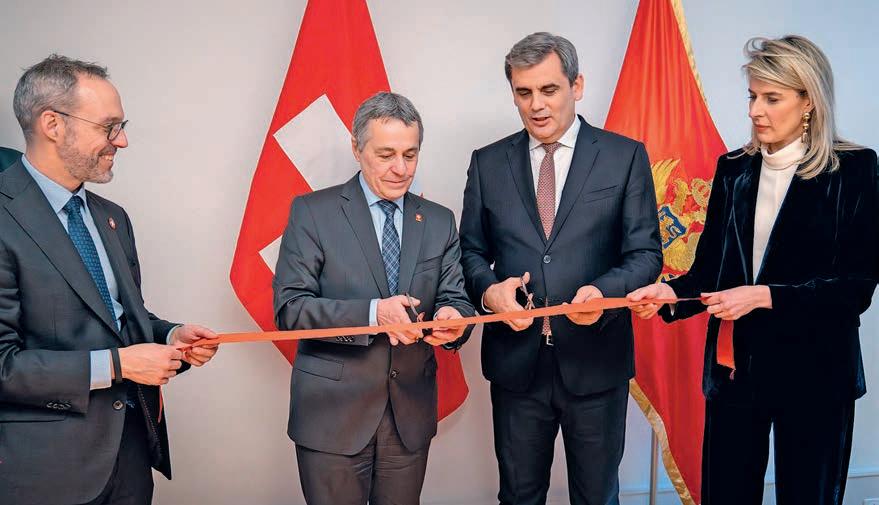
Who Was in the Room
MONTENEGRO’S MANAGERS HONOURED AT AMM AWARDS
Montenegro’s business community gathered for the annual awards ceremony of the Association of Managers of Montenegro, recognising leading executives, entrepreneurs and companies. Among the main winners were Jovan Lekić of NALL Group (Entrepreneur of the Year), Lesia Vykhodtseva of Zapad Banka (Manager of the Year – joint-stock companies), Angelo Zuccala of Regent Porto Montenegro (Corporate Governance Award) and Zoran Milovanović of Mtel Montenegro (Manager of the Year –large enterprises).

EIB MEETS UN COUNTRY TEAM IN PODGORICA
Davor Kunc, Head of the European Investment Bank Office in Montenegro, joined the UN Country Team meeting in Podgorica at the invitation of Resident Coordinator Caroline Tissot. The discussion, attended by agencies including UNOPS, UNICEF, World Health Organization and UNESCO, explored opportunities for cooperation in areas such as sustainable tourism, green finance, education, health and digitalisation.
TRANSPORT COMMUNITY MEETS GREEN PARLIAMENTARY GROUP
Matej Zakonjšek, Director of the Transport Community Secretariat, presented the organisation’s latest progress reports in Podgorica during a meeting with Montenegro’s Green Parliamentary Group and members of parliamentary committees responsible for transport, infrastructure and EU integration. The discussion focused on advancing transport reforms and aligning Montenegro’s infrastructure policies with EU standards.
MONTENEGRO’S WINEMAKERS DEBUT AT PROWEIN
Nine leading Montenegrin wineries presented their wines at ProWein in Düsseldorf (15–17 March), the world’s leading wine and spirits fair gathering around 4,000 exhibitors from more than 65 countries. Organised by the Chamber of Economy of Montenegro, the joint appearance marked the first time Montenegro had its own national stand at the prestigious event. The initiative aims to strengthen international visibility for Montenegrin wines, create new export partnerships and position the country as an emerging European wine destination.
Who Was in the Room
Three Things that will Matter by 2030
Signals, Not Predictions
Forget forecasts. What matters are pressure points — the things that quietly decide winners and losers long before anyone writes a strategy paper. Here are three.
1. TALENT WILL DECIDE SPEED
Capital follows clarity. But talent decides pace. Montenegro doesn’t need millions of workers — it needs the right ones to stay, return, and grow. The risk isn’t brain drain alone; it’s stagnation through scarcity. Countries that move fastest are those that make careers possible, not just businesses profitable.
2. ENERGY PRICES WILL DEFINE COMPETITIVENESS
Not ideology. Arithmetic. Energy costs will quietly shape which industries expand, which relocate, and which never arrive. Stability, predictability, and grid reliability will matter more than slogans. Cheap power isn’t a luxury — it’s a strategy.
3. SPACE WILL BECOME THE REAL ASSET
The coast is finite. The north is underused. Infrastructure decides which one wins. By 2030, the smartest investments won’t chase
square meters — they’ll chase access. Roads, energy, digital reach. Space without connection is scenery. Connected space is an economy.
THE TAKEAWAY
Montenegro doesn’t need to be louder. It needs to be clearer.
Clear about who it’s for.
Clear about what it rewards.
Clear about what it will no longer tolerate.
That’s how small economies win long games.

What Comes Next

Want your company featured in The Region’s March edition? Secure your spot today with a premium feature, CEO interview, or advertisement package! Contact us at business@connectingregion.com
This issue of The Region focused on Montenegro not as an exception, but as a lens. Small economies often reveal trends earlier and more clearly than large ones — where capital concentrates faster, infrastructure choices carry greater consequence, and dependence on a single sector exposes both strength and fragility.
Montenegro’s story is not unique to its borders. Questions raised here — about confidence, connectivity, seasonality, labour, and long-term value creation — echo across the Adria region. What differs is scale. What remains the same is the challenge: how to turn momentum into structure, and opportunity into resilience.
The Region will continue to move deliberately between depth and distance. Some issues will narrow their focus, examining one market closely. Others will widen the frame, connecting developments across borders, sectors and decision-making centres. The goal is not to follow a fixed sequence, but to respond to where the region is actually moving.
This approach allows space for change — economic, political and strategic — without locking the magazine into rigid forecasts or predetermined themes. The region itself does not move in straight lines. Neither should its coverage.
What endures is the editorial commitment: to prioritise substance over speed, clarity over noise, and relevance over repetition. Each issue is designed to stand on its own, while contributing to a broader, evolving picture of business and leadership in the Adria region.
The story continues — not by announcement, but by observation.