Coyote Business Park is rebranding itself with a new logo and website with the intention of attracting businesses to the industrial area on the Umatilla Indian Reservation. More on Page 19A.
Tribal veterans, from Treaty-time warriors to present-day soldiers, are remembered for Veterans Day. For a list of veterans and contributed photos, turn to Page 12A.
The new Nixyaawii Community Financial Services, which combines the current Tribal Loan Program, the Home Ownership Program, and the Wildhorse Business Development Services, is scheduled to start providing services in January. More on Page 5A.
Confederated Umatilla Journal
2 Sections, 32 pages Publish date Nov. 5, 2020
The monthly newspaper of the Confederated Tribes of the Umatilla Indian Reservation ~ Pendleton, Oregon November 2020
Section
A
Volume 28, Issue 11
Tribals to debut body cameras in December By Cary Rosenbaum of the CUJ
MISSION – Tribal police will soon be wearing body cameras to record interactions with the people they contact during their patrols. The Board of Trustees at a work session Oct. 5 passed a motion to purchase body and vehicle cameras at a cost of $54,747 from Axon Enterprises, a company that also provides body cameras for police departments in Pendleton, Hermiston and Boardman. “For a number of years, the topic of providing body cameras for our UTPD has been discussed amongst the General Council and Board of Trustees,” Board of Trustees’ Vice-Chairman Jeremy Wolf said. “Cost of the cameras and data storage has been the limiting factor in the past. The combination of reduced cost of the technology and a nation, regional and local outcry for police reform has uplifted our decision to invest how we are both protecting our citizens and our police officers.” Umatilla Tribal Police Chief Tim Addleman said the contract is for five years, with the option of renewing thereafter. The goal is to have them deployed by Dec. 1, he said. Police body cameras on page 22A
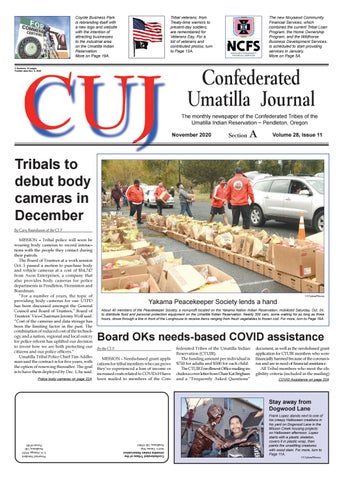
Yakama Peacekeeper Society lends a hand
CUJ photo/Phinney
About 40 members of the Peacekeeper Society, a non-profit located on the Yakama Nation Indian Reservation, mobilized Saturday, Oct. 24, to distribute food and personal protection equipment on the Umatilla Indian Reservation. Nearly 300 cars, some waiting for as long as three hours, drove through a line in front of the Longhouse to receive items ranging from fresh vegetables to frozen cod. For more, turn to Page 16A.
Board OKs needs-based COVID assistance By the CUJ
MISSION - Needs-based grant applications for tribal members who can prove they’ve experienced a loss of income or increased costs related to COVID-19 have been mailed to members of the Con-
federated Tribes of the Umatilla Indian Reservation (CTUIR). The funding amount per individual is $750 for adults and $500 for each child. The CTUIR Enrollment Office mailing includes a cover letter from Chair Kat Brigham and a “Frequently Asked Questions”
document, as well as the needs-based grant application for CTUIR members who were financially harmed because of the coronavirus and are in need of financial assistance. All Tribal members who meet the eligibility criteria (included in the mailing) COVID Assistance on page 22A
Stay away from Dogwood Lane Frank Lopez stands next to one of his creepy Halloween creations in his yard on Dogwood Lane in the Misson Creek housing projects on Halloween afternoon. Lopez starts with a plastic skeleton, covers it in plastic wrap, then paints the unsettling creatures with wood stain. For more, turn to Page 11A. CUJ photo/Phinney
Confederated Tribes of the Umatilla Indian Reservation 46411 Timine Way Pendleton, OR 97801
Presorted Standard U.S. Postage PAID Pendleton, OR Permit #100
CUJ News CTUIR executive director leaves for Spokane Half of Ted Wright’s tenure was emergency ‘nightmare’ with near constitutional crisis, floods and COVID By Wil Phinney of the CUJ
MISSION – When Ted Wright took the job as CTUIR Executive Director in November of 2018, he had a track record of sticking around for a couple of years. Two years later, Wright is gone, leaving the Confederated Tribes of the Umatilla Indian Reservation in search of happiness with the Spokane Tribe of Indians at Wellpinit in northeast Washington. “I’m going to work a few more years and I want to make a valuable contribution somewhere,” said Wright, 65. “There is so much talent here; you’ll be fine. I want to go someplace where I’m needed.” Charles F. “Chuck” Sams III was formally appointed Nov. 2 by the Board of Trustees as the Interim Executive Director and will remain in the position until a permanent replacement can be hired. Sams normally serves as the Tribes’ Deputy Executive Director. Wright’s first year was no party, working with a Board that created a near constitutional crisis over the election eligibility criteria for a sitting member of the Board. That member was eventually removed from the Board and had to go to Tribal Court to be reseated. In the end, all but one position of that previous Board changed; five members were voted out of office in November of 2019. Then 2020 hit. The first month, January, was “almost normal,” but even it “started off on the wrong foot” when the newly elected Board’s first retreat bombed. “Let’s just say the Board wished it had been organized differently, and I take responsibility for that,” Wright said. Then the February flood hit, triggering the first Incident Command Team. The flooding cost millions of dollars in damage and tribal, county, state and federal disasters were declared. The floodwaters had hardly subsided when COVID-19 reared its ugly head, activating a second emergency declaration and initiating a second Incident
Ted Wright, outgoing Executive Director for the Confederated Tribes of the Umatilla Indian Reservation, was presented with the first new CTUIR-flag saddle blankets by Board of Trustees Chair Kat Brigham. Brigham thanked Wright for his dedication, especially during this last “rough year for everyone.”
Command Team, one that would remain And Wright said the crisis mode has in effect even as Wright starts his new made an impact on what he’s been able job at Wellpinit. During the pandemic, to accomplish as the government’s top Tribal government was curtailed and hired administrator. businesses, including Wildhorse Resort & “We would have done more,” he said. Casino, were closed. “The organizational While the panassessment would Wright sees the CTUIR demic continued, have been done on there was another taking advantage of time and it would smaller flood, plus the next major change have been implefires in western Oremented in January or in the industrial sector, gon that caused such February.” hazardous smoke which is evolving, he Instead, that assessthat CTUIR closed said, from the industrial ment, considered a shop for several days. critical government People were wearing revolution of cars built evaluation, is at least their masks to keep on an assembly line to six months behind out smoke as much as the technical revolution schedule and any the coronavirus. planned changes will “It’s been a night- of the computer to next now run into financial mare of a year,” the energy revolution. restrictions. Wright said. “To “Now, because of have an Incident COVID, we’re going Command all year, that’s unheard of … to be in a deficit spending situation next right up to the day I’m leaving. Almost year,” Wright said. half my tenure has been in emergency In fact, he added, with a “frozen budmanagement.” get” employees should not expect merit or cost-of-living increases in 2021.
Confederated Umatilla Journal
46411 Timine Way Pendleton, OR 97801 Phone 541-429-7005
2A
Fax 541-429-7005 Email cuj@ctuir.org www.ctuir.org
It could have been worse if not for the CTUIR’s retro-budgeting, which limits spending to the money on hand instead of spending anticipated revenue. “We could have been looking at layoffs and cuts to programs,” Wright said. Wright said the foundations – through planning – have been or will soon be laid for progress on a number of fronts. One of the most important to him is climate change adaptation. Completion of a Tribal Energy Plan, one of his pet projects, should be completed in the next two to three months, Wright said, but it will take five to ten years to implement its features. Meanwhile, the Tribes need to be planning to create a “sustainable community,” one that can “grow its own food, raise its own proteins, and become energy independent.” Wright sees the CTUIR taking advantage of the next major change in the industrial sector, which is evolving, he said, from the industrial revolution of cars built on an assembly line to the technical revolution of the computer to next, the energy revolution. “There won’t be a point on earth that doesn’t have access to the Internet in five years,” Wright predicts. In a matter of years, Wright said, Tesla will lead the way to energizing the auto industry, homes will create power to the grid, solar will become a dominant electricity generator with new battery technology, and hydro powered dams will become irrelevant. Tribes should be leaders in the next revolution. “CTUIR should be self-sustaining in five to 10 years,” he said. “If I was here, we’d be all solar, all geothermal. I’d never design a school or a government center without energy advantages in place.” Wright said he’s confident the CTUIR “can plan and get there.” “It won’t be me, but I’m hoping this leadership will continue. We shall see. But climate change is inevitable. Climate change is going to create disasters. There will be more fires, more floods, and food availability will be critical. We will need food sovereignty; growing stuff will become a challenge.” Wright’s list of accomplishments isn’t Executive director resigns on page 22A
... The monthly newspaper for the Confederated Tribes of the Umatilla Indian Reservation Publish date
Ad deadline
News deadline
December 3
November 17
November 24
January 7
December 15
December 22
February 3
January 19
January 26
March 4
February 16
February 23
Confederated Umatilla Journal
November 2020
CUJ News No salary increases in 2021 CTUIR budget By the CUJ
MISSION – There will be no salary raises in 2021 for employees of the Confederated Tribes of the Umatilla Indian Reservation, according to a proposed budget that will be presented at 2 p.m. Nov. 5 in a Special General Council meeting. The meeting will be a Zoom video-conference call. Contact General Council Secretary Shawna Gavin (Shawnagavin@ctuir.org) for Zoom meeting ID login and call-in information. “Due to the strain of the coronavirus and shutdown in operations during 2020,” the draft budget “maintains all Tribally funded government services at their existing 2020 levels, including a salary freeze,” according to an official release provided by Board of Trustees (BOT) Treasurer Sandra Sampson. However, the draft budget does include additional money to enhance online outreach to Tribal members via the CTUIR website for General Council meetings. The CTUIR uses a retro-budgeting process for its gaming funds, meaning that the money earned in one calendar year is used to fund CTUIR programs in the following year (i.e., funds earned in 2020 are spent in 2021). CTUIR Finance Director Paul Rabb says the retrobudgeting process helps the CTUIR as it allows the BOT to make budget and spending adjustments in the following year, not in the current year. The BOT conducted work sessions in October to review the target budgets and draft annual work plans
Wildhorse Resort & Casino projects net profit loss of $9.6 million in 2000 By the CUJ
MISSION - Net profits in 2020 for Wildhorse Resort & Casino were nearly $10 million lower than expected, which is a result of a nearly three-month shutdown caused by COVID-19 earlier this year. The Board of Trustees conducted a work session Oct. 21 to review a modified 2020 budget that saw projected net profit go from $36.9 million to $27.3 million. Revenue projections were listed at $128.9 million to start the year, but are now projected at $103.7 million. “Given the current COVID-19 coronavirus pandemic, Wildhorse has been shut down 74½ days and when we have been open, WRC has operated at limited capacity – even to this day,” CEO Gary George said in an e-mail to the CUJ. “We expect
from the departments and enterprises. The draft 2021 budget is available to General Council Members by calling the CTUIR Finance Office at 541429-7150.
this trend to continue through June 2021. Being shut down for 2½ months and open with limited capacity has really impacted WRC business operations and WRC revenues. … I’m sure every business in our region has experienced significant revenue drops as well!” BOT Chair Kat Brigham noted the loss is far less than anticipated and said Wildhorse is “working to make up the shortfall.” In an e-mail statement to the CUJ, Brigham wrote: “During the October 21st BOT meeting the BOT approved a resolution to modify the Wildhorse Resort & Casino budget based on the 2020 projection that is $20 million lower than the 2019 projections. Projected revenue is $20M less, but net profit is only Fish Accords on 15A
Comments on the draft budget can be submitted in writing or by email to the BOT Treasurer, Sandra Sampson, by Nov. 12 (Sandrasampson@ctuir.org). The BOT anticipates adopting the budget in November.
CTUIR signs 2-year extension on Columbia River Accords Walla Walla Chief Sampson disagrees with the decision By the CUJ
MISSION – The tribe’s commitment toward protecting the Columbia River’s fish populations involved extending an agreement with regional tribes and government agencies. The Board of Trustees signed a twoyear extension to the Columbia Basin Fish Accord Oct. 19, directing staff to work with four organizations to develop tools to be used to inform them on hydrosystem and fishery issues and decisions. “While we’ve seen progress in tributary fish habitat conditions and lamprey returns, it’s clear we need to do more,” BOT chairwoman Kat Brigham said in an Oct. 23 press release. “Salmon fishing opportunities for our tribal members haven’t been consistent enough and we need more fish.” Don Sampson, a hereditary chief of the Walla Walla tribe who attended an October General Session via Zoom, is pessimistic about the fish accord’s benefits to fish populations. “What I demonstrated to the Board is that we’ve seen the data the tribal fisheries program produced,” he said. “We’ve only had 111 salmon harvested in 20 years. That’s an average of five salmon per year for 3,000 members, every year. There’s no way that that (Accord) represents what our tribal leaders, our
November 2020
Among the projects funded by the fish and wildlife Accord with three federal agencies is the Walla Walla spring chinook hatchery, which is scheduled for completion in 2021.
chiefs negotiated when we protected our salmon fishery in our Treaty of 1855.” Though salmon numbers may be down, Pacific lamprey fishing became a possibility for the first time in 75 years during the early years of the accord, according to the release. By signing the extension, CTUIR staff will work with Columbia River InterTribal Fish Commission (CRITFC), the CTUIR Fish and Wildlife Commission,
the Cultural Resources Committee, and the Tribal Water Commission on four projects, according to the resolution. The Federal Columbia River Power System (FCRPS) treaty rights impact report and an FCRPS tribal social and cultural impacts report from the tribal perspective. A marine policy that can be used to foster and leverage collaborative relationships on the West Coast.
Confederated Umatilla Journal
A regional energy plan to provide solutions that include Snake River Dam breaching and/or alterations coinciding with the development of other energy and transportation sources. Staff endeavor to link ongoing processes in the Columbia River Basin to this work wherever appropriate. “We will be coordinating through our internal CTUIR Columbia River Accord Fish Accords on 21A
3A
CTUIR receives another $500K in COVID relief Oregon Health Authority grant will pay for food, back rent, utilities, child care and phone bills
A number of volunteers helped the CTUIR Department of Children and Family Services distribute food to Tribal members, other Indians, and residents of the Umatilla Indian Reservation in September amidst the smoke caused by wildfires in Western Oregon. Emergency aid from the federal Coronavirus Aid, Relief, and Economic Security (CARES) Act funding received by the CTUIR was distributed by the Tribes’ Incident Command Team.
By the CUJ
MISSION – A grant from the Oregon Health Authority (OHA) will provide additional funds to help CTUIR members pay for costs incurred due to COVID-19. OHA has awarded $500,000 in federal Coronavirus Relief Funds (CRF) to the Department of Children and Family Services of the Confederated Tribes of the Umatilla Indian Reservation (CTUIR). The funding, according to OHA, is intended to serve and support the health of people in Oregon, particularly people diagnosed with or at higher risk for COVID-19 and associated complications By the CUJ Additionally, DCFS has provided emergency assistance due to longstanding social and health for 37 local Tribal members from Adams, Athena, Hermiston inequities, prioritizing tribal communiMISSION – Some Tribal members from as far away as and the Pendleton-Mission area) for a total of $37,893. ties and communities of color. Virginia and Colorado are among those receiving CARES Money is distributed directly to vendors; there are no cash Unlike other COVID-related relief, Act emergency assistance through the Confederated Tribes disbursements. The average amount paid out to the 100 Tribal the CRF does not have income-based of the Umatilla Indian Reservation. member requests is $1,347. eligibility restrictions. This CARES Act funding ($350,000), which has been alOne family of five from Portland has received more than However, Tribal members still will located through the CTUIR Incident Command Team, is not $4,200 with more than 80 percent of that going for rent. Six need to provide documentation that the same as the recently approved grant from the Oregon other families have received more than $2,100 each. Those their financial need is COVID-related, Health Authority ($500,000). (See other story on Page xA.) included a family of three from Roseburg, a family of four according to Jaimie Crane, DCFS office The COVID-19 Emergency Assistance Program offers from Portland, a family of three from Corvallis, and three manager and Julie Taylor, DCFS Direcsupport and financial services to families, elders, veterans families from Pendleton – one single person, one family of tor, who helped obtain the grant, along and workforce development participants for shelter (rent), four and the other with six. with Kathleen Elliott, DCFS Workforce food, utilities and transportation. DCFS currently is working with eight more Tribal memDevelopment coordinator, and Jody Deardorff, CTUIR Financial Services Tribal members must meet eligibility requirements re- bers who live off the reservation and two others who live manager. lated to COVID-19. The criteria includes being recently laid locally. Two of those requests are for nearly $3,400 from a The grant funding has been approved off, furloughed or hours reduced because of the pandemic; family of four in Virginia and a family of three in Colorado. to provide aid for expenses incurred increased utility and food bills due to children’s distance The rent for the family of three in Denver is $2,250 per month. from March 2, 2020 through Dec. 30, 2020 learning; be a college student or a Tribal member that has The funds have also paid for food distributions to Tribal according to Crane, so many COVIDmoved back or relocated to the Umatilla Indian Reservation members and Reservation residents from April through related expenses will be covered for because of the coronavirus pandemic. September. Tribal members. Since applications for this CARES Act funding began Elliott said recipients have been “very grateful,” and DCFS CTUIR members and their immediate in April, the Department of Children and Family Services still sends them a letter after providing assistance to remind family, along with members of other (DCFS) has completed assistance for 63 tribal members living them that their bills were paid by the Confederated Tribes federally-recognized Tribes, are eligible off the reservation for a total of $97,424, according to Kathleen of the Umatilla Indian Reservation. for funds to pay for, among other things, Elliott, DCFS Workforce Development Coordinator. food, back rent, utilities, child care and phone bills. Additionally, the federal funds will be used to provide a variety of items mentation on eligible expenses, DCFS who especially might need internet for reusable water bottle and playing cards. for “kits” that will be provided to Tribal will send a check to the appropriate tele-health services, according to Elliott. The kit contains five key components in “I think this will help put people at – a shelter bag that includes things like members much like food distributions. landlord or business, etc. Crane said the OHA grant money should be available ease,” Elliott said. “Heating bills have a rain poncho and a Mylar emergency Tribal members do not have to prove need this month. gone up, families need more food for kids blanket; a tool bag with a headlamp and to receive the Those who at home. I don’t think parents really knew can opener; a food/water bag filled with kits. The federal grant also will be plan to prohow much difference it makes when your vacuum packed meals, jerky, dried fruit “We want vide docu - kids have meals every day at school.” used to pay for five different people to and eating utensils; a first-aid bag with mentation be able to The federal grant also will be used scissors, sunscreen and vitamins; and a “kit handouts,” including a for COVIDstay in their to pay for five different “kit handouts,” hygiene bag containing nearly a dozen “stay-at-home” kit with supplies related bills/ homes, stay including a “stay-at-home” kit with items ranging from toothpaste to toilet expenses/ expected to last two weeks. warm, have needs should supplies expected to last two weeks. A paper to disposable razors. food, and acA list of more than two dozen c a l l J a i m i e list of more than two dozen items range “Distance Learning Support” kits for cess to health Crane at 541- from pasta to pet supplies, from over-the- tribal students of all ages includes a wireitems range from pasta to pet care and ed429-7309 or counter medication and board games, to less keyboard and mouse, headphones supplies, from over-the-counter ucational reDCFS Direc- humidifiers to taxi vouchers. and a host of school supplies such as a dry sources they medication and board games, to A “COVID-19 Prevention” kit includes tor Julie Tayerase board and markers, a calculator, a might need,” l o r a t 5 4 1 - a laundry basket filled with such items as humidifiers and taxi vouchers. flash drive and cell-phone stand. Crane said. fabric softener, bleach, disposable gloves 429-7315. Finally, “baby boxes” – to be delivered With the T h e C R F and masks; a bucket filled with items in large sturdy boxes that can serve as a exception of money can be like antibacterial wipes, dish soap and “safe, portable sleeping area for baby” the “kits,” the funding will be used to used to provide gift cards for food, fuel sponges; plus a mop, broom, air purifiers – will include items such as blankets, cover eligible expenses; there will be no or phone minutes. Additionally, the grant and filters. thermometer, nail clippers, pacifiers and A “homeless survival” kit includes funds could be used to provide certain cash distributions. Once provided with sufficient docu- technologies, even phones, for elders waterproof backpacks, a sleeping bag, a … condoms.
Two thirds of COVID emergency aid has gone to off-reservation Tribal members
4A
Confederated Umatilla Journal
November 2020
CUJ News New financial services to start in January Institution will continue offering same tiered system personal loans, plus homeownership and business development coaching By Wil Phinney of the CUJ
MISSION – Nixyaawii Community Financial Services (NCFS), which will consolidate three CTUIR programs home ownership, business development, and the credit loan program - should be up and running early in the new year. For answers to T r i b a l Frequently Asked members Questions about the Nixyaawii Community will still be Financial Services, visit able to borwww.wildhorsebds.com row money, the same as they’ve done in the past, in the same tiered system that allows personal loans of up to $12,000. Most of the credit program loans in the first tier are from $500 to $3,500 and are mostly paid back using Tribal gaming dividends. NCFS is a Community Development Financial Institution (CDFI) that will initially serve Tribal members, but once it is capitalized with enough money it
November 2020
could serve reservation residents and Tribal employees. CDFIs are specialized financial institutions that serve geographically defined low-income communities and/or populations that lack access to financing. By the prescribed mission, the NCFS will improve the financial well-being of people in the Umatilla Reservation community through loans and credit, effectively to build personal assets and wealth. NCFS will offer coaching and training for both homeownership and small business development, as well as youth and adult financial education and loans. New services and loans are to be developed in 2021. “We’ll be able to offer a double approach with borrowing that drives other services such as budgeting, credit ratings, things to help folks accrue personal assets and wealth,” said NCFS Executive Director Dave Tovey. Tovey will be joined by six others to work in an office whose location is yet to be officially identified.
Becky Cain, who supervised the CTUIR Credit Program, was hired in June as the Chief Financial Officer. Cain, who worked in Tribal Finance for 13 years, has “deep audit experience” and is a “stickler for details,” according to Tovey. Cain already has developed draft loan policies, an employee handbook, and is structuring the accounting and financial management system. Raven Manta, Program Manager for three years at Business Development Services at Wildhorse Resort & Casino, will continue in that role, as will Pamela Ranslam, who has been the Homeownership Program Manager in the Tribes’ Housing Department for 16 years. Recently hired as loan officers were Tribal members Raven Cody, Doris Wheeler and Quincy George. Wheeler is the former Board of Trustees Treasurer. Because of the all new staff and the high activity with November being a dividend month, Tovey advised Tribal members wishing a loan to get their applications in early to allow for processing. Tovey said the NCFS will bring a new
Confederated Umatilla Journal
The graphic for the NCFS logo was inspired by hip pouches in the Tamastslikt Cultural Institute collection. Bobbie Conner, a member of the NCFS Board and Director of Tamastslikt Cultural Institute, says she recalls elders wearing hip/ waist beaded or woven belt pouches from which they might dispense a little “kits way” along with sage advice about money, trusting others, or how to navigate the world.
process, as well as a new philosophy, to the new program. “It’s a weird thing in the CDFI world because the process is different,” Tovey said. “We never tell people they don’t Community Financial Services on page 15A
5A
CUJ Editorials Uplifting the community With COVID-19 causing emotional and mental distress perhaps as much as harming the economy and society, it is inspiring to see Nixyaawii Community School’s effort to uplift the community. In October, NCS sponored a virual photo contest to recognize Indigenous Peoples Day. The winning photo, at right, was taken by Meadow Fossek-Spencer. “Students from the new media class sponsored the contest, not specifically for the school, but for the entire community,” said Michelle Van Pelt, Career and Post Secondary Advisor. “They had talked and determined that one thing missing in the community is a sense of passion and school spirit, and it’s wonderful to see the community support their efforts.” NCS also sponsored Halloween contests for dress-up, pumpkin-carving and house decorating. Additonally, a number of activities are planned for Native American Heritage Month during the week of Nov. 16. A short story naming the contest winners and events can be found on Page 19B.
CUJ Op-Ed/Columns Coyote Stories: The new face at the CUJ
W
ay, hast sxľxalt, iswkist Sin-ka-leep. (nselxcin Salish translation) Hello, good day, my Indian name is Coyote. I also go by Cary Rosenbaum, and I am a member of the Confederated Tribes of the Colville Reservation. As of early October, I am officially a member of the Confederated Umatilla Journal staff. With that, I will be reporting for the foreseeable future and look forward to telling your stories and learning more about your way of life. I plan to share that learning process with you in the form of a column each month in hopes to encourage more culture-sharing opportunities. From what I’ve observed thus far, there are many similarities between the Umatilla and Colville. For one, both are confederations. Also, both include Washat, or Seven Drums, which is a prevalent part of my culture back home. The Nimiipuu sahaptin language is one of our three active languages, though fluent speakers comprise a small demographic of my tribe. I was saddened to read your Cayuse language “disappeared,” but it sounds like the Nimiipuu language has supplanted that. Turning through the pages of the past newspapers, I have seen several last names that exist between both the Colville and the Umatilla. Among my tribe, I would typically declare my maternal and paternal grandparents’ names to help people identify me, but since this is a new situation, let’s
CUJ Confederated Umatilla Journal
6A
just leave it as: If you know anyone from my neck of the woods (Inchelium, Nespelem, Omak, Keller, beyond) with the last name Marchand, Laramie, Zaugg, Shaffer, Boyd, Stensgar/Stanger, or Louie, there’s a good chance I’m related to them. I have moderate familiarity with this area, but my family history here is growing. Two of my brothers were Indian Relay racers who participated in Round-Up. And back in 2016, my wife and I enjoyed a trip to Wildhorse Resort & Casino after getting married through the state. Cary Rosenbaum Despite the current pandemic holding back public interaction, it appears this reservation is a very lively place. I cannot wait to start learning more. Above all, I hope to earn your trust to be able to effectively tell your stories in the tribal newspaper. I believe storytelling is a powerful tool, one utilized by our ancestors since time immemorial. Since our tribes have begun writing histories, such as those first drafts we see in newspapers, there has been an opening for a nice blend of history, culture, personality and tradition that I believe can enhance community and bring forth healing.
46411 Timine Way Pendleton, OR 97801 541-429-7005 FAX 541-429-7005 e-mail: cuj@ctuir.org www.ctuir.org
Publisher:
Matt Johnson
CUJ staff: Wil Phinney, editor Cary Rosenbaum, reporter Megan Van Pelt, part-time reporter Dallas Dick, freelance photographer
Confederated Umatilla Journal
A little more about me: I went on to Eastern Washington University in Cheney, Wash., where I earned a bachelor’s in journalism. While in college, my tribal newspaper reached out to me and offered me a job. Since 2006, I have been actively pursuing journalism as a career, which included stops at daily and weekly newspapers. And this summer, I started an online MBA in American Indian Entrepreneurship with Gonzaga University. I am very familiar with the CUJ, having been part of the Native American Journalists Association. To be honest, this newspaper has served as an inspiration for some of my work back home. What’s been created here has been a measuring stick for Indian country’s smaller and mid-size newspapers, and I hope to help continue that legacy. Please feel free to give me a call any time to discuss potential story ideas (ext. 7368, cell: 541-2159597). I believe I have the patience, sensitivity and understanding to comprehend and articulate your stories so they can be presented as forms of inspiration to the present and valuable history to those who come upon them in the future. Lim limt (Thank you in my language), Sin-ka-leep Cary Rosenbaum is a Colville Tribal member and journalist for the Confederated Umatilla Journal.
Display advertising rate $5.50 per column inch. Full page: $297 Three Quarter Page: $223 Half page: $149 Quarter page: $72 Business Card: $33 Full color and spot color available
16 awards in 2018, including first places for best feature story, feature photo, environmental coverage.
Mail Subscriptions:
$15 per year or $28 for two years.
Next CUJ: 3
November 2020
CUJ News Failing grades triggers new policy at NCS More than 60 percent of Nixyaawii students have one or more incomplete By Wil Phinney of the CUJ
MISSION – With nearly seven out of 10 students with one or more F’s after the first quarter, Nixyaawii Community School (NCS) is adopting a new grading policy for its Comprehensive Distance Learning. Many students just aren’t achieving in an on-line classroom, NCS Principal Ryan Heinrich said. “This is not “It’s happening everywhere, not just at Nixyaawii,” business as said. usual. Just as Heinrich The Pendleton School Disour teaching trict in October also adopted a new grading policy that is looks very actually more lenient than different, Nixyaawii’s. our grading NCS kept their standard grading policy, which gives a needs to be passing grade of D for scores different, of 60 percent or higher. Pendleton has adopted a plan that too.” will allow 49 percent to be a The policy passing grade. – giving There are a number of reasons why students may be students failing classes. the chance “For some it might be access to complete to the internet or not having a quiet place to work. They may courses for be dealing with other stuff at credits – home that they wouldn’t have to if they were in the building,” “focuses on Heinrich said. easing staff, In some cases, students student, just aren’t sitting down at the computer for classes. Heinrich and family noted that he knows of some stress during students who are busy at home an already watching younger siblings while parents are at work or stressful away. situation.” Heinrich said he thinks some students perhaps think -Ryan Heinrich, grades will be adjusted like NCS Principal they were last spring when everyone received a pass. “I think some kids are still hoping to pass for being here and that’s not what’s going to happen,” Heinrich said. The freshmen class of 16 students is in the worst shape. “We have some kids that did not receive any credits this last quarter and that’s never happened before,” Heinrich said. “The freshmen have struggled and many are already on track not to graduate after just one quarter. That happens every year. Freshmen struggle to start the year, but without our thumb on them here at the school helping them move along it’s even worse.” How do students end up with an F? “It’s based on not turning in assignments, not participating in class, not completing projects, not turning in
Bobbie Conner, Director at Tamastslikt Cultural Institute, the museum on the Umatilla Indian Reservation, speaks during a live-stream video produced for Travel Oregon Oct. 28.
Tamastslikt featured in Travel Oregon live-stream broadcast MISSION – Travel Oregon featured Pendleton and Tamastslikt Cultural Institute in an Oct. 28 live stream. “(We’re) live-streaming an Oregon experience,” Michelle Liberty of Attitude Marketing said, “as a way of generating interest so media writers might do a story or stories on visiting Oregon.” Attitude Marketing, based in Walla Walla, handles advertising for Tamastslikt Cultural Institute. Liberty is a member of the Confederated Tribes of the Umatilla Indian Reservation. The 10-minute video included the Round-Up arena and showcased tribal members drumming, singing and dancing. It showcased Bobbie Conner, Tamastslikt director, who rode in on her horse in full trappings. She and Jess Nowland were interviewed for Tamastslikt’s seven-minute segment. Top national media writers were invited to join the live stream and Sparkloft, a film crew from Portland, produced the broadcast. The ultimate objective, Liberty said, is to “attract visitors to our area when traveling becomes more
accessible.” The Oregon Tourism Commission, dba Travel Oregon, “works to enhance visitors’ experiences by providing information, resources and trip planning tools that inspire travel and consistently convey the exceptional quality of Oregon,” according to its website. The commission aims to improve Oregonians’ quality of life by strengthening the economic impacts of the state’s $12.3 billion tourism industry that employs more than 115,000 Oregonians. The Travel Oregon staff develops and implements a biennial strategic marketing plan, which includes advertising and marketing, publication development, cooperative promotions, consumer fulfillment, public relations, international marketing, tourism product development, State Welcome Centers, research, and industry relations. Travel Oregon cooperates extensively with local communities, industry associations, government agencies, and private businesses in the implementation of its strategic plan, its website states.
NCS Grading Policy 15A
November 2020
Confederated Umatilla Journal
7A
CUJ Almanac Obituary Josephine Marie James Lavadour Ip-naa-sha-pii-laa-kut-stit’ Jan. 18, 1942 – Oct. 21, 2020 Parents were Stanilaus James and Eva Williams James. Maternal grandparents were McKinley Williams and Susie (Colalas) Williams. She grew up on the Umatilla Indian Reservation, spent many hours and days at “Granny’s” place along the Umatilla River. Attended St. Andrew’s Mission School and later Weston, Oregon high school. She drove truck during pea and wheat harvest. Employed in early 1970’s at Tillicum Wiring Company at Mission, Lamb Weston plants in Hermiston. Later she was a homecare provider for family and community members. She also was Josephine Lavadour a babysitter for not only her family nephews and nieces, but community children. She loved children. She and Arnold were married in 1962 in Walla Walla, Washington. Forty-fifth year anniversary memorabilia was found during cleaning. People would never see one without the other. Both loved the outdoors, the mountains, and the creeks and rivers … camping, hunting, fishing, gathering foods and medicines and cutting wood was a family affair. She and Arnold were very active with St. Andrew’s church, cleaning the church, taught CCD
8A
classes, attended many Kateri conferences, and Gonzaga University monthly to obtain certification to assist with church services. She is survived by brothers Harry James, one daughter and five grandchildren, and Stanley James Sr., one son and one daughter and two grandchildren. Two sons, Maynard WhiteOwlLavadour and two grandchildren, and Anthony Lavadour. Proceeding her in death brother Roy James Sr. and two children – daughter Roya James, one daughter and two grandchildren, and son Roy James Jr.; also deceased numerous cousins whose children, great grandchildren and greatgreat grandchildren survive her. Her family lineage included James, Wocatsie and Williams. Burns Mortuary of Pendleton handled arrangements. Sign the online guestbook at www. burnsmortuary.com
Weather CTUIR Weather Report - October 2020 Weather information summarize data taken at the Pendleton Weather Station from Oct. 1-30. The average daily temperature was 66.2 degrees with a high of 87 degrees on Oct. 6 and a low of 19 degrees on Oct. 25. Total precipitation to date in October was 1.01”. Six days of the month had precipitation greater than 0.10 inches with one day greater than a half an inch. The average wind speed was 10 mph with a sustained max speed of 37 mph from the Southwest on Oct. 16. A peak speed of 48 mph occurred from the West on Oct. 10. Air Quality Index values remained healthy in the month of October despite freezing temperatures.
COVID cases climb to 100
MISSION – The number of posi- needed.” The current guidelines can tive COVID-19 cases on the Umatilla be found by clicking on the “CTUIR Indian Reservation hit 100 as of Nov. COVID-19 Information Website” tab 3, according to the Incident Command on the right-hand side of the main Team (ICT) for the Confederated CTUIR.org webpage. Tribes. ICT is “very concerned” about the Meanwhile all of the staff at the holiday season and indoor gatherUmatilla Tribal ings. A postcard Fire Department is being sent to who tested posiall Tribal memtive have comber households pleted their quarwith a reminder antine and have about maintainreturned to work, ing safety stanaccording to indards, including formation from wearing masks, the ICT. distancing, and As of Friday, Drive-through COVID19 testing was conducted gatherings of no O c t . 3 0 , t h e r e by staff from Yellowhawk Tribal Health Center m o r e t h a n 2 5 were a dozen ac- and Oregon Health Authority in the Community people. tive cases among Center parking lot Oct.21. Also, a new the community video has been members served by Yellowhawk produced with a testimonial from Tribal Health Center. Tribal member Virginia Conner reICT reported that 1,664 tests had garding her experience with the been completed at Yellowhawk as of coronavirus. Nov. 2. Of those, 1,564 were negative. CTUIR Public Safety Director Rob ICT has not issued new guidance Burnside has taken the lead for the since mid-September, “although we ICT following the resignation of Ted continue to monitor case activity and Wright, the Tribes’ former executive discuss whether additional action are director.
Confederated Umatilla Journal
November 2020
Jobs Columbia River Inter-Tribal Fish Commission Job Title: Dispatch Supervisor Department: Enforcement Classification: Regular, Full-time, Exempt Salary/Wage Range: $42,745 to $63,039 (step 1 to step 9 depending on experience) Location: Hood River, OR Closing Date: November 30, 2020 Job Summary/Primary Responsibility: The Dispatch Supervisor serves as a direct line working supervisor over the dispatch division. In addition to working a dispatch position, performing the full range of Communications Dispatcher call taking and dispatching functions, the Dispatch Supervisor also directs and supervises subordinate staff, including assigning and delegating work projects, scheduling employees to ensure proper staffing levels are maintained, and performance management including evaluating work performance, coaching, mentoring and/or implementing corrective action for performance and conduct issues. The Dispatch supervisor is responsible
CTUIR Government
for communications, record maintenance, shift coverage, routine office management, and all activities associated with dispatch. Keeps immediate supervisor informed of dispatch related matters as they affect the agency. Application Process: This recruitment will be used to fill at least one position and to create a list of qualified candidates for future openings, depending on funding. Note: Hiring preference will be given to qualified members of the four CRITFC member tribes and to qualified enrolled members of other federally recognized Indian tribes and Native Alaskans. Proof of tribal enrollment must be provided with application. Submit a letter of interest, application, list of at least three professional and three personal references, and proof of tribal enrollment, if applicable, to: Columbia River Inter-Tribal Fish Commission Attn: Human Resources 700 NE Multnomah Street, Suite 1200 Portland, OR 97232 Phone: 503-238-0667 Email: hr@critfc.org For additional details, call the HR department in Portland, 503-238-0667, or the Captain at the law enforcement office in Hood River, phone number 541-386-6363.
Pendleton Pioneer Chapel received three prestigious awards in 2009
Board of Trustees
General Council
Chair Kathryn Brigham
Chair Lindsey X. Watchman
Vice Chair Jeremy Wolf
Vice Chair Michael Ray Johnson
Treasurer Sandra Sampson Secretary Sally Kosey
Secretary Shawna Gavin Interpreter Thomas Morning Owl
At-large BOT Members: Jill-Marie Gavin General Council contact Info Office: 541-429-7378 Armand Minthorn Email: GeneralCouncil@ctuir.org Boots Pond Meeting updates and information on: www.ctuir.org/government/general-council Corinne Sams Interim Executive Director : Charles F. Sams III
w The Oregon Funeral Directors Association Award of Funeral Service Excellence w The Best Of Eastern Oregon Award as voted by the readers of the East Oregonian
General Council Meeting
w Pendleton Chamber of Commerce 2009 Business of the Year
SPECIAL GENERAL COUNCIL November 11 ZOOM CONFERENCE 2-5 p.m.
Our experienced family provides caring, compassionate care including:
Burial Services ~ Military Services Cremation ~ Monuments
CTUIR 2021 proposed budget presented by BOT Treasurer Sandra Sampson
GENERAL COUNCIL DRAFT AGENDA November 19 ZOOM CONFERENCE 2-5 P.M. Finance report, BOT member-at-large update, Law and Order Committee report, Housing Development update
CTUIR Express Phone Directory
Drug Problem? We can help.
Narcotics Anonymous of Northeast Oregon Call us at 541-805-2229 Visit our website at neo-na.org
November 2020
Tribal Court 541-276-2046
Human Resources 541-429-7180
Department of Children and Family Services 541-429-7300
Science & Engineering/Air Quality Burnline 541-429-7080
Enrollment Office 541-429-7035
Senior Center 541-240-8700
Finance Office 541-429-7150
TERF 541-276-4040
Finance – Credit Program 541-429-7155
Confederated Umatilla Journal 541-429-7399
Confederated Umatilla Journal
9A
Nixyaawii Chamber awards scholarships
From the Nixyaawii Chamber of Commerce
MISSION – One college student and two high school graduates have been selected for the 2020 Nixyaawii Chamber of Commerce (Chamber) Scholarship fund. Scholarship winners are Tyanna Van Pelt, a Nixyaawii Community School (NCS) graduate; Andrew Wolotira, a Pendleton High School graduate; and Ericka Wells, a current student at Eastern Oregon University in La Grande. Van Pelt is currently attending Oregon State University (OSU). She has been successful in securing several scholarships since her May graduation, including scholarships from Anderson Perry and AssociTyanna Van Pelt ates, Crow’s Shadow Institute of the Arts, The Confederated Tribes of the Umatilla Indian Reservation and several others. Because she did not qualify for any financial aid from the federal government Van Pelt had to seek out scholarship opportunities. She said she was excited to hear about the Chamber scholarship because she was worried about how to pay for tuition, books and for dorm costs. Van Pelt has not yet determined a major or a career field to follow. Through all of the challenges of Covid-19, Van Pelt said the most difficult obstacle has been having to deal with isolation and not getting the college experience so many freshman look forward to. Leaving Nixyaawii Community School also proved difficult because of the tight
10A
knit environment at the tribal charter school. She said, “Nixyaawii was a school that provided a lot more help to help me understand and prepare with what was to come. But you’re still living as a whole family and students need be prepared for what comes after.” Since she arrived at OSU Van Pelt has been missing her NCS family along with her family at home on the Umatilla Indian Reservation. Being placed in a dorm with a few other Native students and among a larger Muslim population has helped her feel more at home. She misses basketball, but has started weight training. Van Pelt participated in athletics at NCS for four years, including floor time with championship basketball teams. “We can’t do basketball, which makes me mad and I don’t have a roommate so that has been isolating, but my family helps me with that. They are proud I made it to college and I want to keep them proud by sticking it out. It makes me feel better that I’m still going on with my journey. I got my little path I’m walking and I’ll continue on walking to make them proud,” she said. Wolotira graduated at Pendleton High School as a member of the Jazz Band, Symphonic Band, A Capella Choir and Swing Choir. Wolotira earned first team All-Conference honors in soccer in both his junior and senior years, and was a second-team All-State selection as a senior. He plans to major in business and marketing while minoring in music and computer science. He’d also like to continue playing soccer. After college, Wolotira hopes to enter the world of marketing but, eventually,
he said he wants to switch gears and open his own combined coffee shop and music store. “My dream is to partner with an organization such as Young Life Capernaum, which provides teen-agers with disabilities the chance to experience the young life ministry, to give those young adults with disabilities an opporAndrew Wolotira tunity to be employed and gain valuable work and life skills,” he said. Wells graduated from Hermiston High School with a GPA of 3.95. She plans to attend Eastern Oregon University. Wells plans to obtain a Bachelor’s Degree in Science before pursuing a masters in Genetic counseling. She said she wants to help people who have genetic disorders. “In high school, I loved to serve my community, so I was the football manager, National Honor Society Vice President and President, FCCLA’s President, and I was an honor Ericka Wells student. I love to write, read, and create art in my spare time. I also love to adventure outside and be with my three dogs and cat. My family has always motivated me and I aspire to work in science in the future,” Wells said.
Confederated Umatilla Journal
ED recruitment team named By the CUJ
MISSION – In a tight 3-2 vote, the Board of Trustees for the Confederted Tribes of the Umatilla Indian Reservation moved forward with a number of measures toward hiring a new Executive Director. Ted Wright resigned that position in early November. The Executive Director Recruiting and Selection Committee will consist of Human Resources Director Kathryn Burke, Deputy Executive Director Charles F. Sams III, Lead Attorney Naomi Stacy, Finance Director Paul Rabb, Tamastslikt Director Roberta Conner, Wildhorse Executive Director Gary George, and BOT member Boots Pond. The Committee will hire a recruiting service to bring in qualified applicants. Key points of emphasis are advertising, collection and screening applications, and reviewing the job description, per the Resolution. Through the process, the BOT then expects to be presented with the “best qualified and suitable” for the position. “Time is of the essence,” the resolution states. Charles F. Sams III was appointed the E.D. in the interim on the same Resolution. Three Board members abstained from voting, including Sandra Sampson, Corinne Sams and Boots Pond. Voting yes was Kat Brigham, Sally Kosey and Jill-Marie Gavin. Voting against the resolution was Jeremy Wolf and Lindsey Watchman.
November 2020
Trick-or-treaters mingling with some disturbing statues include, from left, Amadeo Tewee in pink Fortnite bunny suit, Adilia Hart in purple shirt, Marsays Hart in shorts, and behind them are Kamala Tewee holding her daughter AJ Tewee. The clown isn’t real. The spooky creations in Frank Lopez’s creepy yard included a headless horseman, a warrior impailed on a spear, a young woman in chains, and a person being sliced open on an operating table.
Frank Lopez cozies up to one of his freaky blood-and-guts Halloween creations on display in the yard at his home in the Mission Creek housing projects.
The freaks were out on Dogwood Lane About five years ago Frank Lopez decided he’d create a little Halloween fun in the neighborhood and he’s been making his yard look sicker and grosser and scarier every year since. “Nobody was doing anything so I decided I’d decorate the yard and little by little … something to get the trick-or-treaters out here,” said Lopez, a Coral Aztec Indian who is married to Melva Lopez, a member of the Confederated Tribes of the Umatilla Indian Reservation. His effort started with a pair of simple ghosts hanging from string and a pumpkin or two. Now he’s into animatronics like Leary Larry who swings a lantern back and forth as he watches over a graveyard. For spooks like Leary Larry, Lopez starts with a plastic Halloween skeleton, the kind you can buy at Walmart, then creates “rotting flesh” with plastic wrap that he paints with a wood stain. He uses a windshield-wiper motor to make his monsters move. Lopez, an Army veteran who served stateside from 1990-1999, has lived on the Umatilla Indian Reservation for 10 years. His wife, Melva, is the head cook at the Senior Center. Lopez said his Halloween goal is to “outdo myself every year.”
November 2020
Confederated Umatilla Journal
Among the grizzliest manifestations in the Lopez menagerie is this skeleton of a warrior impaled on a spear. In the background, another sorry soul, fileted in living color, hangs from a pair of crossed poles.
CUJ photos/Phinney
11A
The CTUIR has had hundreds serve in the military from the Indian Wars to present
SALUTING OUR
Leslie Alexander
Stanley Alexander
Bob Burnside
Cut Mouth John
Louie H. Dick Jr.
Dustin S. Hoahwah
James J. Miles Jr.
Jennifer Minthorn
Kent M. Minthorn
VETERANS
Charles F. Sams III
Marvin Shawaway
Eric Sheoships
Susan Sheoships
Grant Waheneka
Lindsey Watchman
Lucas White
Victor Williams
Victor Williams
Warner Williams
Wilkins Williams
Viola Wocatsie
Thomas A. Sheoships
Calvin B. Shillal
Veterans Day November 11, 2020
Jasper Shippentower
Mark Stacona
To add your photo to our growing database, send an email to CUJ@ctuir.org! 12A
Confederated Umatilla Journal
November 2020
TRIBAL
VETERANS A list provided by the Veterans Services Department. To add a name to this list, contact Sam Spino at (541)429-7389 or samspino@ctuir.org.
TREATY SIGNERS Ya Ca Los Na Kas Stop cha yeou He you shi kikt Sha wa way Tam cha key Te na we na cha Whe la chey She yam na kon Ha yoma kin Johnson Pe tum ya num mox mox Peo Peo Mox Mox Mee a nee teet (Pierre) We yat ta nat tee ma nee Wenap snoot Kat matz pa lu Stik Khush Howlish Wampoo Five Crows Stocheania Te well kate ma nee Lin tinmet cheania Pe na cheanit Watus te ma ty Qua chin Keantoan U wait Quiack Tilch a waix La ta chin Kach Rolich Kanocey Som na howlish Ta we way Ha hats ma chea pus Mu Howlish
INDIAN WARS Wep tsih Victor Williams Ya tin a witz Pops time o wa Pe na wa sa kown Sut tox mathew Wat is kow kow Shap lish (Charlie) Pat se wa Chief Jim Kanine Shup ta ka ween Uma pie ma Chief Jim Badroads Qua ka kite Quig soot Pelio Dick Pio Twa ka kite He Wanghk Tok'Lo'Ki' Umashat Cut Mouth John Cas Cas Camp Henry Charlie Gum Coat Pe li lio Donald McKay James Slickpoo Chief "No Shirt" Robinson Minthorn Tipyahlahnah kaps kaps Wahlitits Jackson Sundown James Fish Hawk Anch'Kuppi Yellipet How lish ta mow nin (Red) Hin ma toy ya la kookt Tin'tin'Meet'se How'lish'wam' poo Sakh'sakh' or Tsones Ka'ow'poo
November 2020
A group photo from the 2007 Veterans March.
Toma'sin'li'wit Ollokut Ko'ta'tams Sarpsis ilpilp Jum Gyer Capt. Sump'kin
WORLD WAR I Louis Van Pelt Victor Johnley Gilbert Edward Conner Wilbur Minthorn Clarence L Gagnon Fred A Bushman Roy McIntyre Grover Minthorn Joseph Paul Perry Issac B Patrick John Thomas Phillip “Wild Bill” Bill Daniel White Ray Picard Peter Oliver Moses McBean Andrew Jackson Harle Robey
WORLD WAR II Michael A. Olsen Frank Marion Morrisette, III Wesley Morrisette Raymond Thomas Burke Charles Edward Oleson Martin L. Ricks Charles Morrisette Thomas Bushman Daniel McBean Armond Joseph Lavadour Francis A Lavadour Richard Lawyer Glen Lewis Sr. David Peter Lloyd Henry Luton William “Chief Blackhawk” Minthorn Dwayne Elliot Conner Russell A. Carden Ralph K. Minnick Daniel Motanic Henderson F. Patawa James C Penny Everett James Orton Augustine Bill (Spouse) Robert H. Chadsey Samuel Joseph Luton Harold Simpson Wallace O. Parr Jewel C. Sams Pershing A. Sams John S. Sams Marion J. Sherburn Virgil M. Sherburn James N. Showaway Leonard Thomas Cree Percy Alger Brigham Edward Frank Sams Henry Alfred Bushman David Stephen Hall Verl A. Allen Marrietta Craig Wannessey Lawrence Lewis Norwood Forrest Wilford St. Denis Edgar Thomas Simpson Normal J. Rainville Leonard E. Wilson Gilbert Cecil Conner Alfred C. Parr Elias John Quaempts Robert T. Perry Viola Rita Penny Wocatsie Alvin Joseph Bushman Gary N. Sams
Edwin J Rainville Jasper J. Shippentower Sr. Frank L. Reed Walter H. Reed Leland J. Rondeau Harle Robey Chester Archie Sampson Charles Francis Sams Herbert N. Ghangraw Archie Bushman Edward E. Gray Lawrence John Sampson Maurice Andrew Webb Emery Andrew Bergevin Wally Francis Wak Wak John Wahsise John Graham Fredrick L. Gray Betty Bergevin (Garvey) Moses Van Pelt Matthew George George Guyer Alphonse Franchot Halfmoon Cornelius Thomas Tawatoy David Anthony Halfmoon Nathan Raymond Dick Sr. Edward Spino Louis Paul Spino George Gray Douglas F. Wilson Denward L. Bergevin Fay Christopher Allen Duane M Duffy Mathew Duffy Marvin R. Duffy Robert V. Yeakel David Wolf Sr Ferman Ghangraw Elzie Byron Farrow Willie Francis Shippentower Robert Vernon Farrow Ralph A. Farrow Jr Warren “Goose” Williams Joseph M Forrest Wayne Joseph Williams JR Victor S. Williams Lester Williams David Wesley Eagleton Lawrence C. Picard John Kitson Wendell Labrache Eldon H. Lacourse Norman Lacourse Arthur E. Campbell Edward Cornoyer Eugene L. Picard John F. Slickpoo Jessie P. Picard Leander Kipp Roland Amity Picard Jack S. Pierce Michael Arthur Pierce Lawrence E. Bergevin Albert Brouillard, Jr. Franklin Wayne Lafave John Sampson Charles Miller Phillip L Bill Jr Delorm Cornoyer Julius Martin Hall Stephan H Handran Fredrick J Hart Raymond Hart, Sr. Thomas Anthony Sheoships William Hung Joseph T. Johnson James Hunt Henry W. Johnson Clair P. Sams Kenneth Elwood Bill Walter Pond Lloyd O. Wannassay Sanford Shelton James Gaylord Larue Jefferson, Jr. Arthur J. Crowley Mose Showaway
CUJ archive
Peter Hung Jr
KOREA Wendall J. Hayes Wilson Totus Willard B. Hart Richard A. Parr Alphonse Shippentower Vern McKay Ronald Parr Ivan Ignatius Bill Wallace E. Parr Larry Irvin Parr Glen Williams Raymond Totus William Herman Burke Carl Donald Sampson Marvin L. Picard Denny Williams Leroy F. Franklin Justin C. Vincent Richard Thomas Shillal Bryson G. Liberty Gerald W. Reed Leslie E. Minthorn Alvin Minthorn Phillip Minthorn Sr Marvin Patrick Sr. Clarence Sidney Mills David Arlen Franklin George Arnold Patrick James J. Miles Jr Richard James Moomaw Ronald Halfmoon Francis James “Foy” Wilson David Dean McKay Jr Cecil I. Thompson Wayne L Sampson Clifford I. Sampson Arthur R. Johnson Willie Johnley Donald Joe Richard M Sams Glen Wyman Lewis Jr. Russell L. Carter Paul Richard Brisbois Richard Burke, Jr Norman Joseph Conner Ivan K. Nicely
VIETNAM Fred M Turk Alvin L. Picard Mark Thomas Alexander Marcus Louis Luke Sr. Robert A. Shippentower Marion Arnold Kipp Vernon James Guardipee Eugene Anthony Carter Matthew Steven Farrow Sr. Dale E. Brisbois Marvin Randolph Burke Leo Wayne Sampson Randy Ray Bonifer Paul Anthony Jones David Wolfe Jr. Daniel J. Brigham Leon D. Sheoships Charles Allen Parr Raymond "Butch" Clark Jr. Virgil Dale Bronson Woodrow Wilson Star Jr. Leo Sam Stewart Orville John Sheoships Alan James Crawford Charles Walter Jones Wayne Arthur Van Pelt Reginald D. Van Pelt Arthur James McConville Jr. Gerald W. Nanegos Charles Francis Sams II Kenneth Loius Crane Kenneth Wilbur Williams JR
Confederated Umatilla Journal
Michael James Farrow John Arthur Sams Edward John McFarland David W. Turk Benjamin Bearchum JR Joseph Ghangraw Byron A. “Tony” Gould Michael Halfmoon Earl Erwin "Taz" Conner Donald Aaron Jackson Peter William James Reginald R. Johnson Roland A. Lavadour Nathan Raymond Dick II Edward Crowe Michael E. Lavadour Theordore Joseph Martineau Brady Leroy Mills James Volney Mills Darwin James Moe Gerald Dean Moe Charles Winston Murr Clifford Carson Picard Richard Alfred Picard Bruce Bearchum Sandra D. Robinson James Daniel Clark Fredrick Louis Davis
GULF WAR Edward Joseph Lewis David J Taylor Freddy War Bonnet Herrera Kipp-Soots-pa- ouyen Lewis Clay C. Christensen Kenton M. Minthorn William Ray Herrera Alvin B. Van Pelt Jr Lora Lee Burns Steven Anthony Winn Charles Francis Sams III Christian Charles Dearing Lindsay Xavier Watchman Ryan Adam Svoboda Micheal Leslie Minthorn Cameron Jacob Sheoships Lance Martin Jones Jason Butler
OPERATION ENDURING FREEDOM & OPERATION IRAQ WAR Thomas James Ochoa-Bettles Lucas T. White Ashley Wolf Derek Andrew Gavin Justin Matthew Yeager Erick Sheoships Camille Melissa Spino James Joshua Halfmoon Fasthorse William Christopher Halfmoon Derek Ray Patu- Munoz
PEACETIME Antone C. Minthorn Farren Dean "Jinks" Minthorn Robert Michael Gordon Arlene Tino Wannasay William Dwight Johnson Calvin B. Shillal LeeRoy James Henry Leo Thomas Moomaw April Laginette Shell Richard Jay Moomaw Clifford Robert (Punky)
Pond Melvin Mose Picard Emmett S. Sheoships Arnold F. Lavadour Jr Stephen Sohappy Vincent Anthony Wannassay Kurt Bearchum Mark James Martineau Stephen John Ganuelas Elizabeth “Constance” Skanen (Halfmoon) Raymond L. Shippentower Allan Dustin Towner Brian Patrick Conner Jolynne McKay David Dean McKay III Daniel Picard Arthur Randolph Picard Clayton Mathew Eastwood Thomas “Kaknish” Morning Owl Fermore Joseph Craig Sr. Alan David Harris Ross W. Simmons Francis Shillal Timothy Arlen Dale Wannassay Robert Lee Horn Sr. Victor Barkley Desiree Coyote Wayne Forrest Barnes Henry Barnhart Arthur Louis Heay Joseph Alvin Bushman Eli Kineu Harris Richard Burke, Sr Lori Dawn SiJohn Stanley Pearson Alexander Geffery Homer Malcolm Minthorn Robert Frederick Fossek Walter Price Farrow Roger L. Bonifer Orval Curtis Kipp Louie H. Dick Jr Charles A. Webb Leslie Lee Alexander John Lloyd Brown Leroy Vincent Bushman Everett James Ghangraw Phillip E Minthorn Daniel Robert Red Elk SR Amos Walter Pond Douglas Eugene Olsen Lonnie Albert Wolf James Elwood Bill Ronald Anthony Fossek Johnson Michael Jackson Sidney Arthur Williams Daniel G Craig Jr Steven Thomas Quaempts Anna Louise Sheoships Thomas Peter Shillal Leroy Lawrence Williams Clifford Brian Stanger Emmett F. Williams Anthony Wayne McClain
UNKNOWN Orville David Perry Anthony Louis Van Pelt Howard Luton Joseph Nelson Shippentower David Dean McKay Patrick Luke Mabel Sheoships (Spouse) Gaylord Larue Jefferson JR Leo Sampson Edward James Jesse Alan Zunke Lillian Minnie Spino (Spouse) Henderson Patawa
13A
Coyote Stories: Paying respect to a Umatilla hero us. We pulled into town. Every stop light there was officers waitin’ for us there. That was something.” The experience gave Merv a new appreciation for the armed forces. “(Lucas) fought so we didn’t have to.” Merv was then asked about whether the meaning of Veterans Day changed for him through the experience. “Veterans Day never meant nothing to me before. Now it means everything,” he said. Lucas White, a Umatilla hero whose life and story has touched those on several reservations, is remembered each year in Inchelium.
By Cary Rosenbaum of the CUJ
There’s a sight to be seen that connects my tribe and yours. It’s one headstone among thousands at Arlington National Cemetery in Virginia. Lucas White, an enrolled member of the Confederated Tribes of the Umatilla Indian Reservation, was laid to rest there in 2006 at age 28. I’m one of a handful of Colvilles I know to pay respects in-person. Sgt. White grew up between the Yakama Reservation and Pendleton, but his father Merv White is a Colville Tribal member. After visiting White’s grave, I sat down with Merv, who worked at a bar and grill in my hometown of Inchelium, Washington. It was Nov. 7, 2015, a day after the 9-year anniversary of his son’s death. Merv was in the process of staging a 9-ball pool tournament on the Colville Reservation in memory of his son, who was killed on patrol when his unit was attacked by small-weapons fire and an improvised explosive device. “Let me grab a cigarette,” he said. After lighting one up and taking a drag, he started the conversation with, “I used to do bad things. After (my son died), I pretty much quit all my bad stuff.” Merv remembered drinking and playing cribbage with his son in the days prior to his final deployment. He said he kissed Lucas on the lips before he left. Just weeks before Lucas was to return home, Merv received an early call. “My mom called me at 6 in the morning and says, ‘I gotta talk to you,’” he said. A little while after, Merv looked outside to see his mother and two military officers and cursed. “This is just like the movies,” he remembered thinking. “I knew (Lucas had been killed) already as soon as I seen ‘em.” Lucas’ picture and story began showing up throughout the country, including an obituary in The Seattle Times.
A portion of last year’s memorial flyer for Lucas White, who was killed in 2006 while serving in the military. Facebook
He was awarded numerous medals of valor, including the Bronze Star, Purple Heart Army Commendation Medal and Global War on Terrorism Service Medal. “It was all over everywhere,” Merv said. “On the news and everything. He was one of the first Native Americans from the northwest buried at Arlington.” Merv was invited to attend a memorial service in Moses Lake, where Lucas and his wife resided. When he entered town, he was surprised to see the outpouring of respect for his son. “We thought, ‘Holy Christ, must be a hell of a wreck,’” he recalled. “But they were all just waiting for
The headstone of Tribal soldier Lucas White. Contributed Photo / Colville Tribal Tribune
14A
Confederated Umatilla Journal
November 2020
Needs-based Continued from page 1A
may apply. The deadline for applications to be submitted is Dec. 18, 2020. The CTUIR Board of Trustees on Monday, Oct. 12, authorized the distribution of this special, needs-based grant from
federal Coronavirus Aid, Relief, and Economic Security (CARES) Act funding. For more information, questions about eligibility or how to apply for the grant, contact Tribal Enrollment at 541-429-7035 from 7:30 a.m. to 4 p.m.
Wildhorse projects losses Continued from page 3A
$9.6M less and distributions is $4.5M less. The shortfall is based on 2 ½ months of closure and reduced hours of operations after reopening at WRC. It is also recognized that WRC is not the only business who has reduced budgets because of COVID-19; across the nation most business are being hit. The BOT is very pleased that under leadership of WRC management WRC has reopened and is working to make up some of the shortfall. Funds that were originally earmarked for WRC
expansion costs were made available for CTUIR distribution to help offset the impact of a smaller distribution. The CEO is on the Incident Command Team and has established stricter guidelines than Oregon in many areas to make sure the WRC is a safe and friendly place to go.” The BOT approved the modified budget, which cites the closure of the casino due to COVID-19. On March 18, Wildhorse Resort & Casino closed following a positive test by an employee. It then re-opened
NCS grading policy Continued from page 1A
tests,” Heinrich said. The new grading policy will turn an F into an “incomplete” and students will have 12 weeks to achieve a pass and earn credits toward graduation. Heinrich said “everyone is doing the best they can to make this work and we continue to find ways to support our students and families.” Toward that goal, the policy states, teachers will provide opportunities for students to “redo, makeup, or try again to complete, show progress or attempt to complete work without penalty.” Until they make up credits, students will be ineligible for sports and other activities. “If they don’t complete the class they’ll probably end up retaking the class at another time to get the credits and that could affect graduation,” he said. “There are only so many classes in a quarter to get their credits.” At a recent Nixyaawii School Board meeting, Corinne Sams noted the social and emotional impact that’s been placed on students since the pandemic began. “It’s bigger than any of us imagined,” she said. In a CDL Grading Police handout to Board members, Heinrich wrote that, “Although we have adjusted somewhat we are still in a crisis/pandemic. CDL is lasting longer than expected and hoped for and we did not know what we did not know when this started in September.” According to the handout, traditional grading practices are “not appropriate to equitably and accurately capture and record student learning.” Families are overwhelmed more now than ever before and “we need to manage the workload given the current stress states for all of us.” A set of guiding principles states that the resources and support students have access to are not equitable. “We currently have no way to ensure all students are on equal ground” with things like internet access, internet access outside of live instruction, parental supervision and support, and adequate physical location to do work. The grading policy applies to all courses and classes, but it strives to “hold student
November 2020
harmless for CDL, which is beyond the control of our staff, students and families.” The NCS staff, during conversations about the policy, have talked about the situation for students as well as circumstances for teachers. “This is not business as usual. Just as our teaching looks very different, our grading needs to be different, too,” is one of the staff conversation points. The policy – giving students the chance to complete courses for credits – “focuses on easing staff, student, and family stress during an already stressful situation.” Meanwhile, NCS continues to offer a “day camp” for students where they can have more structure in classes supervised by a paraprofessional. The day camp was initially limited by statewide COVID regulations to groups of no more than 10 students. “At first we had one group in the lobby and one group in the gym with as many as 15 kids. But in the last two weeks we’ve had no more than four a day,” Heinrich said. On Nov. 2, statewide guidelines were relaxed so that a cohort can be up to 20 students at a time. “We could have cohorts in the lobby, in the gym and in a classroom. Realistically, we could have 60 kids if they wanted to be here,” Heinrich said. In addition to day camp, teachers are available in person from 1:30-3:30 daily. Students have been taking advantage of that opportunity and Heinrich is hoping more will do so now that the student limit has doubled from 10 to 20. During those two hours in the afternoons, students can visit any of the five NCS teachers and other staff, with one teacher, Zach Brandsen, available on Fridays from 9 a.m. to 1 p.m. Teachers have developed a “facilitated learning” process in which each lesson has no more than two assignments – one being a participation assignment/grade to give credit for attending the online classes. Participation may include logging in and viewing lessons and/or completing some evidence showing they viewed the lesson. Assignments and assessments, the grading policy states, are being prioritized to the essential core content standards.
Confederated Umatilla Journal
15A
Volunteers from the Umatilla Indian Reservation like Jill-Marie Gavin, left, joined Peacekeepers Society and other organizations at a food distribution Oct. 24.
Peacekeepers on the Road
Yakama-based group delivers food, positive message By Wil Phinney of the CUJ
MISSION – Quanah Spencer said he came to the Umatilla Indian Reservation, where he has several relatives, to “take away despair, anxiety, and give back hope” to the Native people struggling during the COVID-19 pandemic. Spencer, the Tribal Relations Director for BNSF Railroad Company, was one of more than 60 volunteers from around the Northwest who joined Peacekeepers Society, a Yakama-based non-profit that mobilizes families to “promote positive social change.” On Saturday, Oct. 24, the Peacekeepers – 40 strong who arrived in a bus – were joined by volunteers from Portland to deliver food and personal protection equipment to members of the reservation community in front of the Mission Longhouse. Cars and trucks backed up to the Bureau of Indian Affairs building and waited as long as three hours to take advantage of the food giveaway. The Peacekeepers Society, which was founded in 2015, has been delivering food and other stuff to Indian reservations around the Northwest, including the Colville, Warm Springs, Klamath Falls and Chiloquin tribes. The next stop after Mission was on the Puyallup reservation where three members of the Confederated Tribes – Shawna Gavin, Jill-Marie Gavin and Michael Ray Johnson – traveled to take
Xuxuyay Raven is the Executive Director for Peacekeepers Society, a non-profit based on the Yakama Reservation.
part in the event. Spencer, who was a lawyer in Seattle before going to work for BNSF – formerly known as Burlington Northern Santé Fe Railroad – was instrumental in persuading his employer to pay for the food that was donated for the CTUIR event. “It’s all about love, all about the people,” said Spencer, who has been committed to Saturday events
with Peacekeepers. On the Umatilla Indian Reservation, Spencer said, “They love me and I love them. I’m okay saying that with all that is happening in the world. We need to love and respect each other; hell man, what’s not to love about this?” Xuxuyay Raven, executive director for Peacekeepers, said the mission of the organizations is to change lives through mentoring and offering economic support for youth and adults. He said more than 60 families – Hispanics, tribal, non-tribal, enrolled and not enrolled – are active in the Society. Most of the Peacekeeper volunteers here were young people under the age of 30. Parents brought their children to help with the cause. “The cool thing,” Raven said, “is besides the great need for food it’s good to see how happy people are. We travel to different places to bring in a positive spirit, hope to people who need it. Look at everybody, they’re smiling and happy.” When they aren’t busy distributing food on the Yakama Reservation and other locations, the Peacekeepers Society provides workshops for youngsters and adults. The group is sponsored by grants and contributions from other tribes, foundations and organizations, Raven said. Workshops have included teaching how to build a sweat lodge, canning salmon, dressing big game,
‘They love me and I love them. I’m okay saying that with all that is happening in the world. We need to love and respect each other; hell man, what’s not to love about this?’ Quanah Spencer, a BNSF employee and Peacekeeper Society volunteer
16A
Confederated Umatilla Journal
November 2020
Quana Spencer, left directs traffic in front of the Mission Longhouse during the food distribution Oct. 24. Spencer, Tribal Relations Director for BNSF Railroad Company, was instrumental in acquiring the food contributions paid for by the BNSF. Spencer, from Yakama, has numerous relatives on the Umatilla Indian Reservation. Midori Hirose was part of volunteer group from Snack Bloc PDX, an activist organization from Portland that in addition to humanitarian activites supports rallies, protests and vigils.
‘The cool thing is, besides the great need for food, it’s good to see how happy people are. We travel to different places to bring in a positive spirit, hope to people who need it. Look at everybody, they’re smiling and happy.’ Xuxuyay Raven, Peacekeepers Society Executive Director
gathering traditional foods, and storytelling. “We started with a few moms and grandmothers who started bringing their grandsons and then the kids wanted to join,” said Raven, a motivational speaker who has worked with youth and adult drugand-alcohol recovery said. “Now year after year we want do more and more.” Raven said the Peacekeepers’ efforts would not be possible without collaboration from Portland partners, including Fires Igniting the Spirit, Snack Bloc, Don’t Shoot PDX and Symbiosis PDX. Two of the volunteers, Midori Hirose and Barak Goodman, represented Snack Bloc and Fires Igniting the Spirit, respectively. Both have been active in the Black Lives Matter movement in Portland. Hirose said the small group, only 14 at this point, support rallies, protests and vigils, and also have helped with other food distributions and recently helped with a telethon raising money for forest fire victims in Western Oregon. Goodman, who also has been involved with Don’t Shoot PDX, has helped organize “mutual aid” between activist groups. He was involved early on delivering water to the Warm Springs Reservation. A three-day Go Fund Me campaign brought in $14,000 that was used to buy a forklift for Warm Springs, a dump trailer for Yakama, and a trailer for
night after the peaceful gatherings is not his concern. “I don’t break things but I’m not going to stop somebody because it’s not my right to tell somebody how to protest,” he said. “Buildings don’t breath. Spray paint on a wall is not violence. Police beating people is violence. People not having food in their fridge is violence to me.” Also on hand, as part of a group from Washington State University, was Ermiah Butler, a 2019 graduate of Nixyaawii Community School. She and three others were handing out voting information. Butler is president of the Native American Women’s Association at WSU. “We support women, sharing a support system and resources through the women’s center,” said Butler, who is studying environWashington State University students Ermiah Butler, a 2019 Nixyaawii Community School mental science and ecosystem graduate, Fabian Modejar and Amie Kness, both from Pullman, and Isabel Walker from science. Milton-Freewater distributed voter information. Butler says Pullman is her residence now. Isabel Walker, studying animal science at WSU, is from MiltonFreewater. She was representing the Colvilles. Alpha Pi Omega, a Native American sorority that also Goodman said he felt an obligation to help on advocates for indigenous issues, focusing on Native whose land he’s living. American rights, as well as rights for other minorities, “And we don’t take used stuff, ever,” he said. including the LGBTQ community. “Some kid doesn’t need your old dusty teddy bear.” Mostly, the Peacekeepers Society and other volunGoodman said his involvement with Black Lives teer groups were here to provide resources, promote Matter protests began in March, soon after the shootemotional well-being, and simply lift spirits. ing of George Floyd in Minnesota. Jayson Umtuch, co-founder of Fires Igniting the “The first night I wore a cowboy hat and an OakSpirits said, “There’s a lot of need from people right land Raider shirt. The next week I was wearing a now. We want to give them help and some hope, let helmet and a gas mask,” he said. them know they’re not alone.” Goodman said the vandalism that goes on late at
Wildhorse distributes food to employees MISSION – Food was distributed each Tuesday in October and again Nov. 3 to nearly 250 employees of Wildhorse Resort & Casino, many of who were furloughed or laid off earlier this year due to the COVID-19 pandemic. Nine volunteers loaded into vehicles “box kits” of food in two shifts – one in the morning and one in the afternoon on Oct. 13. There were two food boxes, one that contained chest and butter, and another with meat – plus bags of other items like milk and frozen fish, as well as salad vegetables, fruit cups and yogurt. Gary George, CEO at Wildhorse Resort & Casino, said
November 2020
the food was provided through the USDA “Farmers to Families” program through a count representative from Sysco. There was no cost to Wildhorse or to the government of the Confederated Tribes of the Umatilla Indian Reservation (CTUIR). “Wildhorse and our entities are part of the tourism and hospitality related industries and all tourism and hospitality took a big economic hit with COVID and everyone staying at home,” George said in an e-mail to the CUJ. Wildhorse entities include the casino and resort operations, Arrowhead Travel Plaza, Mission Market,
Confederated Umatilla Journal
Hamley Steakhouse, and Birch Creek golf course. George said a majority of the Wildhorse workforce are employed at entry-level positions. “In fact, 667 WRC employees are making $15 [per hour] or less,” George said. “This includes 146 employees who are making minimum wage of $11.50. So offering the Free Food Box program helped our employees during the pandemic,” George said. The CTUIR offers USDA Farmers to Families box kits to reservation residents on Saturdays. The USDA food kits contain potatoes, carrots and apples, plus a box of dairy products (cheese and butter) and a carton of eggs.
17A
Nixyaawii Community Financial Services Continued from page 5A
Rather, he hopes, with other financial and budgeting information, people will be able to stretch their money without repeated loans.
qualify for a loan. We might say ‘Maybe not right now’ but we will provide maximum customer service, assistance, and make things work.” The NCFS has been capitalized by a Toward that goal, to help everyone, number of grants, including the Oregon the NCFS loan system will immediately Community Foundation that hired Cain, become easier and smoother, with even the U.S. Department of Treasury, and more efficiency in store when a new onthree grants over time totaling more than line portal is up and running. $400,000 from the Northwest Area FounThe current credit program, which will dation. remain in operation through the end of Earlier this year the Board of Trustees the year, operated with “clunky software” approved a $2 million that is being replaced. line of credit for the The client database, new CDFI to help fund ‘The changes will which includes apnew loan products proximately 1,400 allow for better and for office costs, current loans, must which included the be switched over to resources. We will new data software the new accounting be able to offer other system. Money used system. Additionally, from the line of credit the new system will programs. We can must be paid off over be taking on more 10 years, the same listen to what people data since, historicalterms under which the ly, there are typically want to accomplish CTUIR Credit Loan some 300 loan apProgram operated. plications per month. and build future Additionally, WildA f t e r s t a f f i s products to help horse Foundation protrained on the new vided $20,000 for a system, loans will be them do that.’ summer youth entreexpanded to the inpreneur program last - Becky Cain, year that included a ternet portal. Tribal clients will also be NCFS Chief Financial Officer matching savings opable to see online the tion. Another such details of their loans, program was supsuch as statements, posed to take place when payments are posted, their balance this year but COVID postponed it until, and due dates. They also will be able hopefully, the summer of 2021. to receive e-mail alerts about financial Additionally, in terms of money, Tovey literacy and skills classes. is hoping the NCFS can obtain some of “It’s going to take a little time but the CARES Act funding allocated to the there is light at the end of the tunnel for CTUIR, for direct grants to small busiclients,” Cain said. “It’s going to be more nesses on the Umatilla Indian Reservation. simple and straightforward to achieve, He said a proposal has been made to the far superior customer service than what CTUIR Board of Trustees that would prothey are currently getting.” vide money to small businesses because Further, Cain said, the NCFS will offer “building the private sector on the Umatilla additional benefits – if Tribal members Reservation is a high objective.” The details want them. For example, people who are of that proposal, if it is approved by the interested in building credit can voluntarily BOT, were not divulged. opt in and allow NCFS to report data to a Also, NCFS is applying for new lendcredit bureau so they can establish a credit ing capital to launch new loan products score. That’s totally voluntary and is the in small business, home food (gardens, client’s decision, Tovey said. cattle, chickens, etc.), and credit buildNCFS will offer a credit building loan ing to complement the other developing with a potential program that offers a services and lending products. matching savings plan as an incentive to put money away. That program will reTovey said the NCFS plans to start its quire some budget and personal finance programs with Tribal members and their classes. families, because most of those services can happen without donor restrictions. With a November dividend expected, “As we grow to scale for other loans, loan applications will likely increase be- there are others that could be served,” cause that’s when many Tribal members such as Tribal employees and their famitend to seek more money or refinance lies, and reservation residents and their current loans. families,” Tovey said. “A lot of loans are small and people Business Development Services alrely on their dividends to pay them back,” ready provides coaching and training to Cain said. non-Tribal members. Tovey said he hopes that with more Tovey said he’s looking forward to the information about finances, some Tribal New Year when NCFS can start servicmembers might decide not to take out as ing loans and offering financial literacy many loans as they do. and homeownership coaching for Tribal “We have a high incidence of refinanc- members. ing,” he said. “When loan balances go He was quick to point out that the size down people re-up on their loans. In the of the loans are going to remain the same native CDFI world, and otherwise in the to begin with. financial world, that’s kind of a concern “As we grow to scale, we’ll be able when people get in a repeated loan en- to serve others and as our loan portfolio vironment. Loans cost money in interest gets bigger it will have more impact with and fees.” a larger financial return, but it’s going to
18A
be some time before we are loaning for forward.” home mortgages,” Tovey said. Manta has been on the CDFI project Recognizing plans for new housing since 2014. projects, Tovey said Ranslam at the “I was part of the feasibility study team Housing Department is “trying to keep and that study showed our community pace” with families interested in build- would benefit greatly by building on to ing and/or purchasing homes. He said the already successful programs,” Manta NCFS won’t be able to loan the money said. “There is so much more opportunity for homes, but the services offered can to grow. CDFIs can help organizations get Tribal members ready to obtain such address land acquisitions, consolidation, loans from other mortgage lenders. savings, homeownership, small business, Ranslam said the NCFS is going to and improve financial literacy ... We have provide more financial options to Tribal already built an already successful loan members who want to own their homes program - why stop there?” on the reservation. Manta said she’s excited because the “We’re not ready to do mortgages but new NCFS will be able to create loan we can partner with other institutions products that meet the community’s and we can help get Tribal members needs, such as a Christmas loan. into mortgages,” Ranslam said. “This “The CDFI fills a market where the will give CTUIR members advantages, non-traditional lender will no or cannot,” offering more programs and products Manta said. for homeowners that they don’t currently have. Tribal members have done NCFS achieved its non-profit corporaphenomenally well in pursuing home- tion status from the IRS and the CTUIR ownership with limited access to land Board of Trustees approved its business or homes, and really, in some aspects, plan in February of 2020. mortgage programs. Definitely, there The NCFS Business Plan is governed are Tribal members by a seven-person who desire to own board of directheir own homes and ‘There is so much tors appointed by I think this CDFI is the CTUIR Board more opportunity just going to propel of Trustees “with that forward.” to grow. CDFIs can at least four of the seven board memhelp organizations Cain said NCFS bers” enrolled Tribal hopes to be a readdress land members. source for Tribal They were apacquisitions, members to learn pointed along with about as much as consolidation, the NCFS corporate borrow money. by-laws by resolu“The changes will savings, tion in February of allow for better rehomeownership, 2019 and have met sources,” she said. regularly since then. “We will be able to small business, In the recruitment offer other programs. and improve for the board, exWe can listen to what pertise and skill in people want to acfinancial literacy certain areas was a complish and build focus, namely lend... We have already future products to ing, fundraising, help them do that.” built an already small business, acThe idea for a counting, children Community Desuccessful loa and youth educavelopment Finanprogram - why stop tion, and non-profit cial Institution was management. hatched nearly 10 there?’ The NCFS board years ago with efof directors include: forts from Kathleen - Raven Manta, Kelly George, NCFS Flanagan, who was Wildhorse Business President – Tribal Land Wildhorse Business Development Service manager Acquisition Coordinator; Development Serover 10 years in the bankvices (BDS) manager ing industry for 18 years, CEO Aaron Hines, NCFS Gary George, former Vice-President – YellowBOT Vice-Chair Leo Stewart, and current hawk Tribal Health Center Human Resources Director; former BOT Treasurer and TERO Program BDS manager Raven Manta. Flanagan, who now works as Senior Manager Jim Wallis, NCFS Secretary-Treasurer – former Program Manager for the Ford Fam- Tribal and Yellowhawk Chief Financial Officer; Tribal ily Foundation in Roseburg, remembers family; Reservation resident that time. Bobbie Conner, NCFS Member – Tamastslikt “Participating in the Northwest Area Cultural Institute Director; former SBA regional Foundations cohort allowed me to learn manager; board member Eastern Oregon University, about the operations of several Native EcoTrust, and Oregon Community Foundation Sandra Sampson, NCFS Member – Board of CDFIs and to see how there were incred- Trustees Treasurer; former managerial roles with ible resources on every reservation that Wildhorse Resort & Casino and Yellowhawk Tribal we visited,” Flanagan wrote in an e-mail. Health Center; Health Commission and Water Com“I started envisioning a CDFI on the mission Gabriel Moses, NCFS Member – attorney workUmatilla Indian Reservation that could ing with the Native American Program Oregon Legal be a one-stop shop for accessing capital, Services; born/raised on Umatilla Reservation financial education, and small business Judy Moore, NCFS Member – works for the development services that would be a Greater Eastern Oregon Development Corporation tremendous asset for the community. (GEODC) on homeowner support, loan processing, I am excited to see the project moving project management, and grant-writing.
Confederated Umatilla Journal
November 2020
CUJ News
The Cayuse Business Park logo pinpoints the Umatilla Indian Reservation’s central location in Pacific Northwest. The “rebranding” includes an enhanced website and four signs along Interstate 84 have been replaced.
Coyote Business Park unveils new logo, website MISSION – Coyote Business Park, owned by the Confederated Tribes of the Umatilla Indian Reservation (CTUIR), has unveiled a redesigned logo and website as part of its rebranding efforts to promote the development opportunities of the business park. “The updated logo and website provide some new energy for Coyote Business Park,” said Bill Tovey, Director of
November 2020
the Department of Economic Development. “The property has great potential and the more ways we can promote that, the better.” The redesigned logo hones in on the central location Coyote Business Park has in the Pacific Northwest. Website visitors will notice improved functionality, with easy navigation and an interactive map showing the availability and infrastructure.
By strengthening and modernizing this feature, the website becomes a stronger tool for highlighting this enterprise zone, Tovey said. In addition, four signs located on Interstate 84 directly adjacent to Coyote Business Park will also be replaced. Coyote Business Park is designated as an IRS-certified Opportunity Zone. Located seven miles east of Pendleton,
Confederated Umatilla Journal
Oregon with access to Interstate 84 at exit 216, Coyote Business Park offers more than 170 acres of commercial and industrial use potential with certified shovel-ready sites, unique tax incentives, and flexible lease terms. For information about shovel-ready sites and development opportunities at Coyote Business Park, visit https://www.coyotebusinesspark.com/.
19A
Nixyaawii Chamber seeking two new board members MISSION – The Nixyaawii Chamber of Commerce Board of Directors is on the hunt for new members. Two members are nearing the end of their term in December and will not seek reelection. Melissa Nathan, Chamber secretary, and Chad Miltenberger, former treasurer, are both at the end of their three year terms. One vacancy has been withstanding in 2020. Due to Covid-19 the Board of Directors has not been able to hold many of their annual events and will take applications from new board members via e-mail and forgo the announcement of candidates at their usual November event. Board members are elected by Chamber members. Those interested can e-mail NixyaawiiChamber@ live.com or message the Nixyaawii Chamber of Commerce on their Facebook page for an application.
20A
November is American Indian Heritage Month Office of Management and Budget. The following facts are possible thanks to responses to the U.S. Census Bureau’s surveys. We appreciate the public’s cooperation as we continuously measure America’s people, places and economy.
By Native News Online
WASHINGTON — November is designated American Indian and Alaska Native Heritage Month by the U.S. government. Others refer to it as Native American Heritage Month. Regardless, it is a month designated to celebrate the Indigenous peoples of this country and a time educate others about the rich heritage of Native peoples. In preparation of this celebration month, the United States Census Bureau prepared the following information: The first American Indian Day was celebrated in May 1916 in New York. The event culminated an effort by Red Fox James, a member of the Blackfeet Nation who rode across the nation on horseback seeking approval from 24 state governments to have a day to honor American Indians. More than seven decades later, then-President George H.W. Bush in 1990 signed a joint congressional resolution designating the month of November “National American Indian Heritage Month.” Similar proclamations have been issued every year since 1994 to recognize what is now called "American Indian and Alaska Native Heritage Month." This Facts for
This unidentifed child is one of the photographs in a CUJ “historical” folder.
Features presents statistics for American Indians and Alaska Natives, one of the six major race categories defined by the U.S.
Confederated Umatilla Journal
Did You Know? 6.9 million: The nation's American Indian and Alaska Native population alone or in combination with other race groups in 2019. (Source: Vintage 2019 Population Estimates) 10.1 million: The projected American Indian and Alaska Native population alone or in combination with other race groups on July 1, 2060. They would constitute 2.5% of the total population. (Source: 2017 National Population Projections) 324:The number of distinct federally recognized American Indian reservations in 2019, including federal reservations and off-reservation trust land. (Source: U.S. Gazetteer Files) 574: The number of federally recognized Indian tribes in 2020. (Source: BIA, 2019) 142,972: The number of single-race American Indian and Alaska Native veterans of the U.S. Armed Forces in 2019. (Source: 2019 American Community Survey)
November 2020
Columbia River Accord Continued from page 3A
group and CRITFC to leverage relationships and resources in the region to develop these other tools to complement our tributary restoration, production, harvest and ultimately our River Vision efforts,” BOT Vice-Chair Jeremy Wolf said in the release. The Tribe signed the Accord in 2008, which included participation from Bonneville Power Administration, U.S. Army Corps of Engineers, the Bureau of Reclamation, the Yakama Nation, the Confederated Tribes of the Warm Springs Reservation, and the Columbia River Inter-Tribal Fish Commission. “The Fish Accord strengthened the tribal voice in the management of the Columbia River, and created a new relationship with three federal agencies,” the resolution states. “The Fish Accord more than doubled the capacity to implement the Confederated Tribes’ fish project designed to increase the number of salmon, steelhead, lamprey, sturgeon, and mussels available to tribal fisheries, and provided 10 years of funding certainty and stability for tribal fisheries programs, enhancing these important expressions of tribal sovereignty.” Brigham noted that reaffirming the accord “keeps in place the funding we expected since 2018, and gives us time to develop additional tools to address salmon recovery. We need an energy policy that can help change hydro operations to speed salmon recovery and a marine policy to help us advocate for our fish and their ocean habitat.” Sampson, a fish biologist who has served as BOT Chair and CTUIR executive director, said the Endangered Species
November 2020
Act, the Clean Water Act, the National Environment Policy Act (NEPA), and the Northwest Power Act are four reasons the tribe cannot sue over the loss of the salmon. Because of “all four of those,” he said, “we are restricted from filing suit. If the federal government isn’t doing enough, we can’t sue them over it. That’s the problem with it. Even though it’s a twoyear accord, I’ve pressed the Board to try to be aggressive and move forward with one thing that will work and has proven elsewhere to work: removing the four Snake River dams. Those are the biggest killers of salmon.” The agreement signed in 2018 originally was through 2022, until President Trump issued an Executive Order that accelerated the timeline for completion of the NEPA compliance documents to September 2020, according to the Resolution.
CUJ Advertising Rates:
Will you still love me, will you still need me .. when I’m 64?
$5.50 per column inch | Full page: $297 | 3/4 page: $223 1/2 page: $149 | 1/4 page: $72 | Business card: $33
Confederated Umatilla Journal
21A
Executive director resigns
Continued from page 2A
long, but what he’d like to see happen is an interesting list. He’d been an advocate of hemp since he arrived, but other than one Board member who resigned mid-term, nobody was interested in pursuing such a business venture. The new Board was game, but then America woke up to 2020 and nothing has been the same. “By now we’d have had our first crop harvested in a partnership with the OSU (Oregon State University) Extension Service, but all hell broke loose,” Wright said. “This new Board has spoken in favor of this.” As for cannabis, Wright thinks the CTUIR is overlooking the chance to make money. “Any tribe that doesn’t have a retail outlet for cannabis is missing out on an economic opportunity,” he said. “I understand why some don’t want to … the connection to harder drugs, but as a business it is completely viable.” And why, he wonders, couldn’t the lab facility at the Energy and Environmental Sciences Program (formerly known as the Department of Science and Energy - DOSE) be used to test for cannabis potency and pesticides? According to the Oregon Health Authority, of the 22 accredited cannabis testing laboratories, not one is located in Eastern Oregon. “We could be doing that for western states or Indian retail outlets,” Wright said. “And there are plenty of options besides retail cannibals … mobile processors, transport … within the industry.” Also among the things he would suggest the CTUIR do: An overhaul of the Office of Information Technology (OIT) to “get it into the 21st Century”; Make the Human Resources Depart-
‘I think the people here – everybody including leadership – because they haven’t been elsewhere - don’t know how good they have it.’ - Ted Wright, former CTUIR Executive Director
ment “customer-service oriented” so it will be better geared to help internal CTUIR departments; Push for staggered terms for elected Board of Trustees and General Council positions to create more continuity in government leadership; Contract with the executive director to promote stability; Create more for-profit business enterprises, including the farm program (hemp), under a holding company; Create a for-profit energy sector, perhaps using the Tribes’ connection to the Columbia River, “leveraging the use of hydropower to build a battery plant;” Advance the idea of more digital media, “even if it means providing a Chromebook for every household” so they can read the CUJ. Wright also had something to say about employee morale and kindness. Every few years, depending on leadership, the CTUIR goes through times of turmoil when morale seems to fall. It was like that under the former Board of
Trustees, particularly during in-fighting over the residency requirements for a sitting Board member. But Wright said employees should think twice about their situation before complaining. “I think the people here – everybody including leadership – because they haven’t been elsewhere don’t know how good they have it,” he said. “You won’t find better benefits … If people had the opportunity to see elsewhere they’d see they are treated pretty well. The compensation is good, the benefits are good, the retirement is outstanding. And this organization attempts to communicate better. If you think it’s bad in this country, go somewhere else and you’ll see it’s really not so bad here.” “Sometime, February through October, to think about what we went through,” he said.
that he needed to model kindness if he expected it from others. “I kind of do (model it), but I learned a valuable lesson through the pandemic,” Wright acknowledged. “It sounds simple. Be kind and expect someone to be kind back.” As an administrator, he said, “You can’t be soft, but that doesn’t mean you can’t be kind.” Wright said he was enlightened, ironically, from a TED Talks presentation. “Not one of mine,” he joked. “You have to make an attempt. There’s too much negativity. You look at all the comments on Facebook, all the bull---, and you think the world is a terrible place. A lot of good things happen during a crisis, really, but you might never know it. There are examples you never hear about.”
Wright was mindful in his last days here that leadership and management should strive for more kindness. He said he learned a few months ago
Wright said he’s optimistic about his future. He was surprised a few months ago when he met someone in Seattle who has become his girlfriend. “I didn’t expect that to happen,” he said. A flight from Spokane to Seattle is direct. From Pendleton it takes two hops to visit her. Leaving the Umatilla Indian Reservation was probably in his plans all along. Spokane is a place, he said, that he’s always wanted to check out. Like he wanted to check out Pendleton when he was working on a small Rancheria in Northern California. “Life is too short not to be happy. I told you that when I came here,” Wright said, referring to an interview when he first arrived in town two years ago. “That’s why I move around. Eventually I’m going to find a place where I’ll be happy all the time.”
enforcement and our community. Moving forward with this initiative ensures our community and officers are safer. “This is only one of many strategies the Board of Trustees has to improving our communities’ relationship with the Umatilla Tribal Police Department,” Sams added. “Our police chief and officers are also very supportive of these cameras and improving relationships with the CTUIR community. We are committed to continuing to implement more law enforcement best practices tailored specifically for the Umatilla Indian Reservation and the people we serve.” Addleman thanked the BOT for their support toward the purchase. “I really appreciate the board and their willingness to get the body cameras for the police department,” he said. “I think they recognize it will be a better service to the community with them.” Lt. Chuck Byram, the incoming chief of police for the Pendleton PD, stated the cameras have been working great for the city. “There have been no technology issues whatsoever,” Byram said, noting their Axon cameras have been in use for a year. “As far as accountability issues with officers, we have seen zero issues. That’s because we have robust policies in place that are clearly defined so they
know when and when not to activate the cameras and all of that. We haven’t received any complaints. I think anything that provides accountability and transparency is a good thing for the public.” Tribal PD began testing the technology as early as Sept. 13, according to a Sept. 25 memo from Addleman to the BOT, and “were impressed with the cameras and the (cloud storage). They had good resolution. The Evidence.com cloud worked seamlessly and it was found to be user-friendly, as were the cameras.” According to the memo, the funding would cover “body-worn cameras for department personnel, 12 patrol vehicles, cloud-based evidence retention and storage, recognition redaction tool, support, installment of vehicle cameras, and training for the first year of the contract.” Axon Enterprises is regarded as the global leader in connected law enforcement technologies. In early October, the company completed deals with the U.S. Border Patrol and Sarasota, Fla. The memo stated police departments for Pendleton, Hermiston and Boardman are currently using the Axon technology. “I believe having a camera system that is consistent with our regional partners will seamlessly help in mutual aid, investigations, and evidence,” Addleman wrote in the memo.
Police body cameras Continued from page 1A
ganizational Excellence goals, and hired “The main importance of body camera an external group, Moss Adams, to assist work is to obtain evidence in criminal that evaluation last year. Had hoped cases,” Addleman said. “It also helps out that the specific issue of body cams and that there have been some complaints updated police vehicle cameras would against the officers for rude conduct or have been promoted as a result of that all sorts of things, say use of force. For assessment, which we are finalizing and the most part (with the beginning to utilize now. new cameras), a major“Instead,” he added, ity of the time you’ll be “the reasons and deci‘We live in a able to see what’s going sions surrounding these small community on, hear what’s going on cameras has justifiably with historical to make a determination and effectively been elof the professionalism of evated, and as a result we differences our officers.” were ready to take action between A request for continquickly and at our own community gency funds from the cost. Understand this is BOT covered the cost not or ever the end of our members and law for each officer and veinternal evaluations to alenforcement.’ hicle to possess a camera, ways adapt and improve according to a Sept. 25 our services.” - BOT member Corinne memo from Addleman Corinne Sams, the Sams to the BOT. Wolf further BOT’s representative on stressed the importance the Law and Order Comof adding these to the mittee, said she strongly force. advocated and helped guide support for “When concerns arise, we must always the purchase. seek to look internally first, to ensure we “We live in a small community with are doing everything we can to correct historical differences between commuwhat we need to and promote what we nity members and law enforcement,” do well,” he said. “This is why the previ- she said. “I recognize the importance of ous BOT started the internal governance building trust, transparency, accountoperations assessment as part of our Or- ability and communication between law
22A
Confederated Umatilla Journal
November 2020
July Grounds plans created for community consideration By the CUJ
MISSION – Three conceptual plans for redevelopment of the July Grounds were presented for the CTUIR community to consider. The three proposals are shown at right. The conceptual designs, according to Planning Director J.D. Tovey, “created a road map” crafted by community members for Tribal leadership and staff to understand the types of uses and activities the community would like at the July Grounds. “This gives staff the ability to identify opportunities, such as grants or partnerships, and create plans for operating and maintaining facilities when they are constructed,” Tovey said. “This is the first step in the re-visioning of the July Grounds and the community input is critical to make sure it reflects the wishes of Tribal members.” Among amenities to be considered as “athletic elements”are a pool and recreation center, athletic fields, sheltered basketball courts, a skate park, ball field with ‘This is the first dugouts, walking paths, an step in the reexpanded Recvisioning of the reation/ComJuly Grounds and munity Center with fitness the community facilities and input is critical pool, and a playground. to make sure A list of it reflects the “gathering elements” inwishes of Tribal cludes an arbor members.’ and amphitheater, pedestri- J.D. Tovey, an boulevard Planning Director for markets and gatherings, picnic/earth often space, designated teepee camping, a Veterans Center/multipurpose building, a picnic enclosure, and a sweat lodge. Tovey said the development of the Nixyaawii Education Center had three components – design and construction of the schools, complete started renovations at the old Community Center gym, and development of the conceptual plans for the future of the July Grounds. In August, a survey on the CTUIR website garnered interest and feedback on activities the community would like to see. Over the last few months, Tovey said, a group of community volunteers have met with BBT Architects to put the community preferences into drawings. The community group felt three drawings best represent the ideas offered in the community survey. Tovey said community members can visit ctuir.org to find a survey about the three proposals to provide feedback. Also on the website is a link to a blank site plan for the July Grounds that can be downloaded so people can draw their own design. Those who create their own plan should take a photo of it, mail it or deliver it to the Tribal Planning Office at the Nixyaawii Governance Center. Tribal members without access to the internet can provide feedback and information by phoning the Planning Office at 541-276-3099.
November 2020
Confederated Umatilla Journal
23A
24A
Confederated Umatilla Journal
November 2020
More News
Section
The monthly newspaper of the Confederated Tribes of the Umatilla Indian Reservation ~ Pendleton, Oregon
B
November 2020
Warming station open with COVID-19 restrictions By Wil Phinney of the CUJ
MISSION - As temperatures dip below 36 degrees, homeless people on the Umatilla Indian Reservation will have a place to go again this winter when the Warming Station opens in November under new management. The Cmuytp’ama Warming Station will soon be open from 6 p.m. to 8 a.m. for up to seven adults, but will be able to accommodate perhaps twice that many once COVID-19 restrictions are lifted. The Warming Station opened in November of 2019 with the mission of providing homeless adults with warm and safe overnight accommodations in a “quiet and welcoming atmosphere” when the potential for hypothermia was elevated. Transfer of oversight of the Warming Station from Yellowhawk Tribal Health Center to the Confederated Tribes’ Department of Children and Family Services was finalized in August of 2020. According to the Warming Station Master
Plan presented to the CTUIR Board of Trustees, Cmuytp’ama “fills a demonstrated need for safe spaces where the journey to personal safety and improved health and living conditions can begin.” Toward that goal, DCFS staff want the Warming Station to function as a safe space where, with appropriate resources and personnel, comprehensive wrap-around service to tribal adults could be provided with the following: • Limited daily shelter for homeless individuals • Safe space for victims of domestic violence • Clean space to quarantine or isolate • Basic sustenance • Clean water • Basic hygiene supplies • Washing machines and dryers • Technology for resources and/or educational needs The “streamlined access” to the various programs and supports offered by DCFS for individuals at the Warming Station would include Work-
force Development to promote self-efficacy and self-sustainability, childcare assistance to ensure safe childcare while parents/caregivers attend work or school, and other programs they might qualify for such as General or Emergency Assistance. DCFS will also work with other internal programs like Housing, Public Works and Human Resources, and outside programs like the Community Action Program of East Central Oregon (CAPECO) to provide appropriate referrals or access to supporting services. CAPECO serves Umatilla, Morrow, Gilliam, Wheeler, Sherman, Wasco, and Hood River counties. According to its mission statement, CAPECO assists people to become independent, healthy and safe. CAPECO envisions the success of every youth, adult and senior to eliminate poverty and promote independence through education, employment, and the sharing of resources that move
Warming Station on page 7B
Cliff Bentz takes tour of reservation By Cary Rosenbaum of the CUJ
Finding the right one to decorate
CUJ photo/Rosenbaum
Lark Moses, 18, and her sister, Sistine Moses, 15, search through a bin of pumpkins during a drive-thru pumpkin giveaway Tuesday, Oct. 27, near the Community Center. People in dozens of vehicles picked their pumpkins throughout the evening at the socially-distanced event.
Tribal and community members gather for a candlelight vigil in honor of Domestic Violence Awareness Month. The event was just one of several projects the Family Violence Services Program conducted. For more turn to Page 8B.
November 2020
Confederated Umatilla Journal
MISSION – Representative-elect Clifford Bentz (R-Ontario) visited Nixyaawii Governance Center Tuesday, Oct. 6 for an informational tour and discussion with tribal officials. Bentz, the Republican candidate, ran against Democrat Alex Spenser to represent Oregon’s 2nd Congressional District for the position formerly held by Greg Walden, who is retiring. The visit allowed for a thorough historiCliff Bentz cal presentation by Deputy Executive Director Chuck Sams III and a tour via Kayak trolley around the reservation. “It’s great you’re taking the time to learn more about the Tribe,” Board of Trustees’ Chair Kat Brigham told Bentz from her seat in chambers, as he sat at a table approximately 20-feet away. Bentz on page 3B
Ten people had the chance to partake in a drum-making course put on by Charles Wood III at Crow’s Shadow Institute of the Arts. Photos from that event are featured on 12B.
1B
BOLSTER helps elders with firewood
Andrew Jackson carries a log during a BOLSTER - Building Life Skills, Training, and Employment Readiness - project, cutting and, ultimately, delivering firewood to elders. Several were enlisted for the effort. Photos by Julie Taylor/DCFS
Jacqueline Jones pitches a chunk of wood toward a pile.
Alan Crawford takes a break from splitting rounds.
BOLSTER crews cut and delivered firewood to about 20 homes with a few more still on the list requesting log fuel for the winter. The firewood was cut, split and stacked in a trailer on land near Deadman Pass and Emigrant Springs. The project was in coordination with CTUIR Public Works, the Department of Children Craig Blue Thunder and Fampacks split wood stacked ily Services in a tailer for return to (BOLSTER), Mission. Oregon State Parks Blue Mountain Management Unit, the Bureau of Indian Affairs fire crew and the Department of Economic and Community Development. The organizing BOLSTER staff included Jacqueline Jones, Koko Hufford, Alan Crawford, Sam Spino, John Peterson, Bill Tovey and Gordy Schumacher.. “We appreciate all the hard work, collaboration and training opportunities for CTUIR members,” said Julie Taylor, DCFS Director. For more information, call DCFS at 541-429-7300.
Tribal member harvests bighorn carrying deadly respiratory disease By the CUJ
MISSION – Tests on a bighorn sheep ram harvested from the Burnt River herd by a Confederated Tribes of the Umatilla Indian Reservation (CTUIR) hunter indicate the animal was carrying a deadly disease responsible for the loss of bighorn populations throughout the Western United States. Wildlife biologists from the CTUIR Department of Natural Resources received in late October the results of biological tests on a four-and-a-half year old bighorn sheep ram. The test results indicate the ram was carrying the bacterial disease Mycoplasma ovipneumoniae, a respiratory pathogen of domestic sheep and goats. While generally not harmful to domestic sheep and goats, the disease causes lethal pneumonia in wild bighorn sheep and mountain goats. The bacteria is not harmful to humans and the meat of infected, but otherwise healthy-looking animals, is safe to consume. However, animals with obvious symptoms of serious disease should not be consumed. Treaty harvest of bighorn sheep is tightly regulated by the CTUIR Fish
2B
Confederated Umatilla Journal
and Wildlife Commission and closely coordinated with Oregon Department of Fish and Wildlife. Mandatory harvest reporting and biological sampling are conducted by the CTUIR to help assure individual and herd health of this recovering species. “If this results in an outbreak, it could put our recovery efforts back 20 years,” said Dr. Scott Peckham, CTUIR Big Game Ecologist, “and could eliminate up to half of the tribal harvest opportunity for the foreseeable future. We will continue to monitor the situation closely and coordinate with the Oregon Department of Fish and Wildlife.” This is the first positive test for a tribally harvested bighorn and the second bighorn herd in northeast Oregon to test positive for Mycoplasma ovipneumoniae this year. It is not known where the bighorn was exposed to the pathogens, but there are numerous commercial and farm flocks of domestic sheep and goats in the immediate area. Maintaining safe, physical separation between domestic sheep and goats and wild, free ranging bighorn sheep is an ongoing management challenge that limits the abundance and availability of bighorn sheep and their harvest.
November 2020
Bentz visits NGC Continued from page 1B
“I’m very happy to be here,” said Bentz. BOT member Armand Minthorn and Legislative Affairs Manager Jane Hill were also present. QUESTIONS FROM BENTZ Before any presentations or tours began, Brigham asked Bentz if he had any questions. The candidate had multiple topics on his mind. “Where’s the tribe on the sea lions in Cascade Locks?” he asked. “We do support removal of sea lions,” Brigham said, “because of the huge impact on our salmon resources. We’ve found they have a pretty big impact on our naturally-spawning fish. And that’s what we’re looking to rebuild.” “And the cormorants?” Bentz followed. “We’re also concerned about those as well,” Brigham said. “We’re looking at all impacts.” Bentz also asked: “Is the Tribe involved in the renegotiation of the Columbia River Treaty?” “Yes,” Brigham said. “It was really interesting. When we first started, we told the chief negotiators, (Bonneville Power Association) and the (Army Corps of Engineers) that we wanted to be involved. … The 15 tribes then developed what we call a ‘white paper.’ Then the white paper was not only presented to the action agencies, BPA and the Corps, but we also presented it to the states and other federal agencies. “We met the deadline,” she added, “but we were still waiting to find out what the next steps are. I understand we’re taking baby steps, but there are steps being taken.” Bentz stated he was involved in the Columbia River Treaty as well “until it disappeared into the State Department,” he said. “Not sure when it’s going to come out of there. It’s obviously terrifically important, unbelievable important.” He noted when he visited the CTUIR last, the Tribe had acquired some land and conducted a rehab of a stream. He was curious to hear an update. “We applied our River Vision,” Brigham said. “That River Vision is to restore the habitat to a more natural state. It was Meacham Creek. We actually got 17 funding sponsors to go in and do a bunch of the work. It was great, because we had a lot of youth come in and gather the fish from the stream. Once we got all the living creatures we could get out of there into a tote, we then walked off that area and as soon as we blocked it off, the very next day we came back up and started to see springs we hadn’t seen in decades. “So it was very good,” the Chair added, “because of the 2019 and 2020 flood, it was not as bad as everybody thought. We had some impacts, but at the same time it was not at the devastation they thought it would be.”
November 2020
Cliff Bentz (R-Ontario) visited Nixyaawii Governance Center Oct. 6 to meet tribal officials and tour the Umatilla Indian Reservation via Kayak Trolley. CUJ photo/Rosenbaum
Deputy Executive Director Charles Sams III gave a 30-minute presentation to Bentz. CUJ photo/Rosenbaum
SAMS PROVIDES A HISTORY Deputy Executive Director Chuck Sams brought Bentz through a presentation that gave an overview of the Confederated Umatilla Tribes’ history. “I’m adjunct faculty at Whitman (College),” Sams said. “I teach indigenous politics there. This would normally be a 6-week course, but I’m going to try to get through this in 30 minutes.” The history Sams gave included pre-colonization, early contact, the 1855 treaty, termination and selfdetermination. It also questioned commonly-believed theories. “We don’t believe we came here on the giant ice trail,” Sams said, noting archaeological trash heaps were not found to provide evidence of the theory. “Our belief says we were put here by the Creator. Our ability to speak; our ability to see comes from the eagle; our skin comes from the hide of the elk; our hearing comes from the owl; and the most importance gift, the salmon gave us our voice, where you get what’s known
as the Chinook Jargon. “But salmon also gave up it’s life, which is why salmon are central to the Tribal people. By covenant, his people are keepers of the salmon: Those who were responsible to ensure that they return year after year, not only to replenish ourselves, our soul, but to replenish our food sources.” The presentation also keyed in on issues Bentz may come in contact with, such as federal recognition of other tribes; the Supreme Court Decision in Oklahoma that stated most of the eastern part of the state was tribal reservation land; and the CTUIR’s intention to regain land it lost on the eastern boundary of the reservation. “You can see (our reservation) was much larger,” Sams said, noting the Tribe is working with members of Congress and senators on the issue. “Congress would have to act in a way to return those lands; 90 percent of the lands are federal lands, so it wouldn’t be a hard issue. There’s no taxes in those lands already, and we would not seek any land in holdings that were private holdings be returned back to us. But we are interested in at least the federal land
Confederated Umatilla Journal
within the eastern boundary.” Sams also walked Bentz through suggested etiquette when working with Indian Country, including: Listen and be patient; learn that each community or tribe has its own timeline of when things are going to be done; each community or tribe has its own definition of success; be direct, straight and tell the truth; know what we’re seeking and recognize that whatever it is is subject to negotiation; solve problems together; remember you’re a guest in a tribal community; we always serve our elders first, they are the heart of our community; understand there’s turnover; have a sense of humor; thank people and organizations.” BRIGHAM BRIEFS ON COVID-19 Before Bentz departed on the trolley tour, Brigham noted the CTUIR would like to meet with him at a time the full Board of Trustees could attend to discuss issues further. “After Nov. 3 we’re going to be looking forward to having a meeting,” she said. “We’d like very much to sit down and talk with you.” The Tribe’s COVID-19 response was also an issue Brigham wanted to share. “COVID, as you know, when we first got word in March, we immediately closed our casino down, our education facility and our senior center,” she said. “I was really proud of our board for saying we’re going to put health above economics. It impacted us. We’re still trying to figure out how big that impact has been, because we closed down for weeks and re-opened. … The casino is what keeps us going.” Brigham noted as of Oct. 6 there were 1,308 COVID-19 tests conducted by Yellowhawk Tribal Health Center, with 81 of those positive. “We’re requiring social distance and handwashing all the time,” she said.
3B
Discover Program seeks applicants for 2021 Trainees reflect on this year’s program in hopes of encouraging more participation next year By Cary Rosenbaum of the CUJ
MISSION – Applications are being accepted for two more CTUIR employees to take part in the 2021 Pamáwaluukt Empower (Discover) Program, which offers supervisory – and now managerial - level training to Tribal members interested in advancing to management positions. “Pamáwaluukt,” the Discover program title, stands for “Each person raising themselves up.” Applications for 2021 are available on the CTUIR website. While maintaining their normal jobs, participants spend one week per month learning the ins-and-outs of different departments within the government of the Confederated Tribes of the Umatilla Indian Reservation. For the past nine months – with the exception of three months put on hiatus due to COVID-19 – this year’s participants, Janet Maddern and Steven Hart, have spent one week with a different department while maintaining their normal jobs. Maddern works at Sunridge Middle School in Pendleton, while Hart works for the Tribes’ Public Works Department. If selected, the trainees rotate between the following departments: Office of Human Resources, Department of Finance, Planning Department/Transit Program, Department of Economic & Community Development, Housing, Tribal Court, Department of Children & Family Services, Department of Public Works, Office of Legal Counsel, Office of Public Safety, and Department of Natural Resources. The Discover training is designed
4B
Discover Program trainees Janet Maddern and Steven Hart worked in the Tribal Planning Department in early October. CUJ photo/Rosenbaum
to provide knowledge about each program, including supervisory roles and responsibilities, budgetary preparation and compliance, application of personnel policies, and the services provided. In early October, Maddern and Hart were working in the CTUIR Planning Department. “I d id n’t k now not hing ab out Pamàwaluukt, and I’ve been here five years,” Hart, 42, said. “You see how different departments handle things. You know who’s serious. It’s amazing. It opens your eyes, your heart, your mind.” Maddern said the program helped her gain familiarity with tribal programs. “When the government center was built, I was never in this building. I had no idea who all the different departments were and who even worked here,” she said. Hart said he’s better able to understand the functions of the departments
now. “We just don’t sit behind the director, we go with managers, supervisors, out in the field; we get to see everything those people do,” Hart added. “I just want to thank the departments, because they’re opening their arms to us, and that’s cool.” Matt Johnson, Pamàwaluukt’s Empower Program chair, said the program presents possibilities for participants. “The valuable aspect of this is people get to rotate through so many departments and they get to learn about functions, services, activities they didn’t even know that the Tribe was providing,” Johnson said. “Aside from the credit you get toward a supervisory role, if you were to apply for one, you also just get that insight into the overall workings of the different programs of the tribe. I think there’s a ton of value in that. I think it would be worth it to almost anybody.” Lorene Broncheau, staffing and re-
Confederated Umatilla Journal
cruitment specialist in the Office of Human Resources, said one potential difference in the 2021 Discover program will be to have one supervisory-level trainee and one program manager-level trainee, Broncheau said. “Who are we looking for in 2021? We are looking for individuals who are interested in enhancing the operational knowledge of management for CTUIR. The Discover program is designed to provide opportunity for tribal members to gain experience and understanding of department functions. I encourage people who have worked for the Tribe for a really long time to still apply,” Broncheau said. “Like (Janet and Steven) had mentioned, there is some disconnect sometimes. A lot of Lorene Broncheau Tribal members who have been working here for 30 years may not have degrees, but are well qualified with the experience and training they have obtained over numerous years. “I think as a tribal member, even if it’s sometimes a supervisory or management training, you might go through the program and decide you’re fine in your current position, and that is okay. But it’s such a benefit to understand the departments, organization and understand how they work together.” The application, open to CTUIR members only, asks for employment information, experience with technology, and experience in administrative, managerial, governance and civic affairs. According to the program’s criteria, applicants must be part- or full-time employees for Discover Program on page 17B
November 2020
‘ Marie “Butch” Dick - ‘Iwácanmay “I want the children to be aware of all the drugs, alcohol. It is hard to be an Indian and live with this society. Some cannot handle and choose drugs. Listen to parents go talk to them. Go find a person to talk to. Don’t drink or smoke. Lots of new stuff and bad for your health. Eat the right foods do not fry foods. Our foods are natural medicine, Chuush, deer, roots, berries, all kinds of meat.”
How Indians dealt with pandemics, now and then Elders were selected by the Education Department, the CARES grant team, and elders. These are four elders who have been interviewed.
Les “Kite” Minthorn Koyoma Shumkin (Cougar Shirt) “The best information that you can gather it’s like gathering our food. You know you gather first. Then you preserve it and then you distribute it or share it. and I think it’s the same with information. You have to gather enough information regarding with those words “Covid-19” describe. What does that actually mean to our generation? It’s probably been coming for a long time. But now that it’s here how’s it going to affect us today? And what kind of information can we gather to help preserve our way of life on this reservation? Share some of the good things, the bad things and continue to move on the best we know how.” Richard Sam Sr.Aluya “We should still all pray for one another that we strive through this epidemic. No matter what, what the belief you have, you should take time to pray for one another.”
T
Jesse Jones Jr. Yúmapayma Cayuse Chief “The future of this tribe, the people, depends on every individual. Listen to your elders and respect what they say. Whether you believe them or not, what they say is very very truthful. And your doctors are the same way.”
November 2020
’
his package of photos and sample quotes, taken verbatem from the interviews, is presented through a National Endowment for Humanities CARES Grant: “Living in Today’s Pandemic and Historical Pandemic and Catastrophes.” The Education Department of the Confederated Tribes of the Umatilla Indian Reservation has received the CARES grant to document, through video interviews, Umatilla elders and residents providing their thoughts about the current effects of the coronavirus as well as historical pandemics and natural catastrophes that have occurred throughout the Tribes’ ceded areas. Photos by Digital Brilliance LLC. National Endowment for Humanities CARES Grant
Confederated Umatilla Journal
5B
CUJ Briefs BOT agrees to explore construction of new facility at WW Veteran Center MISSION - The Board of Trustees approved a memorandum of agreement with two regional entities to explore the construction of a two-story facility near the Jonathan M. Wainwright Memorial Veterans Affairs Medical Center in Walla Walla, Wash. The MOA includes the destruction of one building in order for the possible new construction. As a historic site for the Confederated Tribes of the Umatilla Indian Reservation, the BOT stated in an Oct. 26 resolution, the process could adversely affect the Fort Walla Walla Historic District. The proposal has the potential to disturb cultural resources, according to the plan. To mitigate the possible effects, the VA agreed to provide personnel training; ensure the building fits in with the historic district; conduct public outreach with children’s coloring pages and a panel regarding a history of the destroyed building; and to archaeologically monitor the ground-disturbing activities associated with the project. Along with the CTUIR, the Veterans Affairs of Walla Walla has consulted with the Confederated Tribes of
6B
the Colville Reservation, The Confederated Tribes and Bands of the Yakama Nation, the Nez Perce Tribe and the Wanapum Tribe.
Climate Adaptation Plan to be aired MISSION – Two climate impact events are scheduled for November. An overview of the Climate Adaptation Plan will occur Friday, Nov. 13 from 9 a.m. to 10:30 a.m. There, Colleen Sanders, the Tribe’s Climate Adaption Planner, will present alongside Mary Wister, of the Pendleton National Weather Service. The vision for the plan -- which was expected to be completed by 2021 before the COVID-19 pandemic hit, Sanders said -- is to look at climate impacts to the CTUIR’s various Indigenous food systems. Colleen Sanders “I’m using the Indigenous food system of the CTUIR for the basis of that adaptation plan,” she said. “The obstacles we see on western adaptation planning is the changes that need to be made to buffer for climate impact. The First Foods
Confederated Umatilla Journal
have been adapting to natural change in climate since time immemorial.” On Friday, Nov. 20, from 9 a.m. to 10:30 a.m. the CTUIR’s Office of Information Technology GIS program will present on “Climate impacts to surface groundwaters: Hydrology 101.” The Tribal Water Commission will also have representatives there to share information on “Governing Water” on the Umatilla Indian Reservation. “Participants can register by emailing me at ColleenSanders@CTUIR.org, or by leaving a message with their contact information (phone number or email preferred) at my office phone number (541) 429-7247,” Sanders said.
Committee, commission spots filled MISSION - Five committee and commission positions were filled by acclimation, as well as one election commission spot. Brandon Treloar (Fish & Wildlife), Rebecca Burke (Gaming), Sam Spino (Land Protection), Scott Minthorn (Education and Training) and Deb Croswell (Wildhorse Foundation) were appointed by acclimation by the Board of Trustees. Tami Rachelle was approved by General Council 4-0 to join the Election Commission.
November 2020
Warming Station Continued from page 1B
individuals from surviving to thriving, the mission statement reads. Families in need may be referred to accommodating motels, using a different pot of funding from the Oregon Health Authority, as well as to CAPECO, according to Elliott. Last year Cmuytp’ama served an average of three people per night, and also served as an area of shelter and respite for families affected by the spring floods, according to Kathleen Elliott, Workforce Development Officer at DCFS. The Warming Station will include two rooms for men and one room for women, plus a fourth room in case someone needs to be quarantined because of illness. The Board of Trustees in October allocated $74,000 to be used over two years to pay for upkeep and maintenance of the building, plus utilities and water, and the salaries for a full-time coordinator and a part-time outreach specialist. The Warming Station will be relying on volunteers to help every night. Volunteers are encouraged to call Elliott or Jamie Crane, Office Manager at DCFS, at 541-429-7300. Part of the money will also be used to help furnish the facility with everything from washers and dryers to cots and bedding. No donations of clothing or blankets are needed with the exception of scarves, mittens, hats, gloves and winter socks, Elliott said. The facility includes a full kitchen with a living room equipped with a sofa and chairs, plus a TV for watching DVD movies. Clients will be offered dinner and breakfast, and if it stays below freezing during the day or if there is a lot of snow on the ground the Warming Station may stay open longer and of-
fer a third meal. The Warming Station is going to be open to tribal members 18 and older who are Yellowhawk eligible, male or female, who will live in separate quarters - even if they are a couple. A curfew of 10 p.m. will be strictly enforced. Anyone who leaves the building after that won’t be allowed to return, Elliott said. Clients will leave their backpacks in a secure area. The backpacks won’t be searched, but the Warming Station is to be alcohol and drug free. Male and female volunteers are needed for overnight stays. The majority of the clients will be males and on nights when there are no female visitors, the female volunteer would
go home. The full-time coordinator likely will work from 2-10 p.m. with duties, among other things, being daily laundry and building sanitation. If the Warming Station is short on volunteers, the outreach specialist assistant may have to work the overnight shift from 6 p.m. to 8 a.m. Last winter, the Warming Station closed at 8 a.m. and many clients moved over to the Senior Center where they stayed all day to keep warm. But the Senior Center is closed because of COVID, which may prompt longer hours, even 24/7 if necessary, for the Warming Station, Elliott said. The biggest challenge, said Taylor, is finding volunteers to stay the
night, noting that weekday volunteers will be more difficult to line up than those on weekends. Additionally, COVID-19 will prove challenging, Taylor said. Yellowhawk is providing an infrared thermometer to measure temperatures as individuals enter the building, but if someone has a fever or symptoms they will be quarantined in the spare bedroom or they will be sent to a hotel in Pendleton designated for COVID quarantine. The Warming Station will maintain all COVID protocols with Yellowhawk providing personal protection equipment (PPE), face masks, hand sanitizer, and gloves for workers, volunteers and residents. Masks will be mandatory.
Thank you Family Violence Services would like to say thank you for all the support and appreciation that we have received from our community. A special thank you to those who have had a hand in making October Domestic Violence Awareness Month campaign a success! Thank you: Mission Market for letting us paint their windows with our messages of hope. James Crane for cutting out our silhouettes for “The Silent Witness” display. Jay Stanley for drawing our stencils for “The Silent Witness” display. Yellowhawk Tribal Health Center for allowing us to set up “The Empty Place at the Table” in the lobby and “The Silent Witness” out front. Thank you NGC for allowing us to set up “The Empty Place at Table” in the lobby and our “Silent Witness” display at main entrance. Jess Nowland for the Prayer and Song for our Candlelight Vigil. Michael Jackson for granting us permission to have our Candlelight Vigil on the BIA lawn. James Mountain Chief and Weylin Walton for all their help painting The Silent Witness silhouettes.
November 2020
Confederated Umatilla Journal
7B
Enola Dick lights the candle of Jillian MorningOwl while her mother Andi Scott observes during a Domestic Violence Awareness month candlelight vigil held Oct. 15 near the BIA offices in Mission.
Candlelight vigil held on BIA lawn
CUJ photo/Rosenbaum
By Cary Rosenbaum of the CUJ
Read it first!
Did you know the CUJ posts its stories online each week at cuj.ctuir.org? Visit us online!
8B
MISSION – A small but powerful candlelight vigil was held Oct. 15 in honor of Domestic Violence Awareness Month. Seven community members and CTUIR workers gathered on the BIA lawn to share experiences, prayers and songs, while standing in a half circle. Dana Campbell, the tribe’s child youth advocate for the Family Violence Services program, read a poem. “By lighting these candles, I hope this says to victims everywhere: On the nights you feel alone, I am with you,” Campbell said. “When people doubt you and dismiss you, I am with you. I fight every day for you and never stop fighting. I believe you. You are important. You are strong. You are beautiful. You are to be valued, respected, undeniably, every minute of every day. You are powerful, and no one can take that away from you. By being here today, we want to let victims of domestic violence know: We are with you.” Organizer Enola Dick, the On-Call Advocate for Family Domestic Violence program, said the vigil was for men, women, children and LGBTQ survivors. Her program painted windows at a local store, and set up displays at the Nixyaawii Governance Center and Yellowhawk Health Center to raise awareness. “Part of our program is about bringing awareness to our community,” she said. “It’s Domestic Violence Awareness Month, so we tried to plan a whole bunch of activities.” Campbell stated the conversation needs to change. “So when we ask a question of our victims: Why don’t they just leave? And the abuse happens again, and we say it again, we are once again abusing the victim,” Campbell said. “We say you need to act. You need to leave your home. You need to flee with your children. You need to leave your pets behind. You need to engage with authorities. You. You, who didn’t do anything wrong. We need
Confederated Umatilla Journal
to change the conversation from why don’t you leave, to why doesn’t he stop, or she stop, abusing you? So it’s time to think about the people in our lives: Our daughters, our sisters, our brothers and sons, our friends and colleagues, think about their courage and strength. Think about saying: What do you need from me? How can I support you?” A Washat blessing and song were offered by Jess Nowland, who later shared his involvement in the Tribal program. “(Domestic Violence is) a difficult cycle to break,” he said. “All of you that are here, even though we’re just a few, anytime someone talks about it, it’s words that pull that trend in another direction. I want to put it in our minds and hearts Jess Nowland that you all find the strength, courage and motivation to carry on a very difficult job, and that those who are around us can open up their hearts and mind to understand and appreciate the kind of work that needs to happen for our community; our women, our children and even our men to feel safe and protected. We can all be educated about how to appropriately respond to these kinds of things that happen, when they’re obvious and when they’re subtle.” Art McConville, 76, said he participated in the event because he’s been involved with domestic violence work “forever.” “I used to write the grants for the program,” he said. “I ran the program for several years. I try to stay involved whenever I can.” Andi Scott, who attended with her 5-year-old daughter Jillian MorningOwl, said she attended in honor of several members of her family who have been in domestic violence relationships.
November 2020
Symbolizing strength
Dana Campbell, the Tribe’s child youth advocate for the Family Violence Services program, receives a light from her co-worker Enola Dick during the candlelight vigil. CUJ photos/Rosenbaum
November 2020
Confederated Umatilla Journal
Art McConville was invited to speak during the candlelight vigil held for Domestic Violence Awareness month on the BIA lawn Oct. 15.
9B
Cecelia Sheoships hands candy to the children in the back end of Steven Hart’s rig during the Halloween drivethrough trick-ortreating Saturday, Oct. 31, on the Umatilla Indian Reservation. From left, the children are Carter McKay, 5, as the hulk; Le Andra Hart, 10, in the center; and Amadeo Tewee, 8, in the pink Fortnite bunny suit. The event was sponsored by Yellowhawk Tribal Health Center and the CTUIR Office of Child Support Enforcement.
Happy Halloween Horrors
The pumpkins grew freaky hands inside the cars driving through the trick-or-treat candy giveaway in front of the Community Center.
Nikki Whiskeyjack,a Yellowhawk employ in the Community Wellness Department, peers through the window of a vehicle and hands candy to a mobile trick-or-treater.
Quincy Sams caught the light in his werewolf costume.
The Watchmans gathered for a family portrait in the haybale photo booth set up by the CTUIR Child Support Enforcement Office. The spot gave families that were riding in cars a chance to get out for a picture to highlight the weird COVID-19 Halloween holiday. From left, this group includes Nina, Annalise, Lillian, Aniah and Tristan Watchman. A ghost in the black trench coat photo-bombed the party. CUJ photos/Phinney
10B
Confederated Umatilla Journal
November 2020
BOT signs waiver for Lucky 7 homes By Cary Rosenbaum of the CUJ
MISSION – A $1 million Oregon Housing and Community Services grant has required the Board of Trustees to approve a limited waiver of sovereign immunity. The Oct. 26 agreement allows for the replacement of 18 homes at the Lucky 7 manufactured home park, which was negatively affected by the February 2020 Umatilla River flood. Replacement is set to start in January, when 14 units will be replaced as part of the first phase. In April, the remaining four homes will be brought in. The
NOVEMBER 2020 Birthdays:
4th: Juanita Hussey and Aiyana Thompson RedElk 5th: Brigham Campbell 9th: CeeJay Medellin 11th: David Harrison 13th: Trina Derrick and Vicki LaCourse 17th: Midnight Rose Tewawina
November 2020
homes will be available for rent as the placements are completed, according to the project timeline. By signing the limited waiver of sovereign immunity, the board agrees to not assert any doctrine requiring exhaustion of Tribal Court or tribal administrative remedies prior to proceeding with any state court proceedings to enforce the requirements or remedies under the agreement, according to the resolution.` Gov. Kate Brown declared a state of emergency in Umatilla, Union and Walla Walla counties due to the flooding.
23rd: Eli Kash Kash 24th: Sharice Quaempts and Kieran Brigham 25th: James Campbell 26th: Diane Samson 27th: Ty Minthorn 28th: Ryan Marsh 30th: Kyra Van Pelt
Anniversaries:
7th: Tracy & Valentin Viegener 11th: Charlie & Dennis Quaempts
Confederated Umatilla Journal
11B
Drum-making at Crow’s
Aurora Whiskeyjack adjusts her drum during a drum-making workshop open for Tribal members and hosted by Crow’s Shadow Institute of the Arts in Pendleton. Local composer and musician Charles Wood III led a group of students making Cree-style round drums Oct. 3. The workshop for enrolled CTUIR members was funded by Pendleton High School Communicare Club and the Harold & Arlene Schnitzer CARE Foundation. Photos by Casey Brown
EMPLOYEES OF THE MONTH!
Support Staff Joe Portley, ATP Facility Maintenance Joe’s commitment to Arrowhead Travel Plaza for as many years as Joe has given is invaluable. His work ethic has been an inspiration, not only to me but all that are around him. I witness daily his interaction with long time customers that only time could have provided.
Front Line Mason Foster, Custodial Tech Mason is always willing to help out whenever is needed. There has been days where our department has been shorthanded and I wouldn’t have to ask Mason to do anything extra he just steps up and does it without being asked to do so. He is always in a great mood and never negative towards customers or employees.
Supervisor Rick Stephens, MM Supervisor Rick’s dedication and commitment to Mission Market is something to be admired, he takes pride in every new thing that is thrown at him. Rick is never afraid to step up to the plate and do what needs to be done.
Casino • Hotel • Golf • Cineplex • RV • Museum • Dining • Travel Plaza 800.654.9453 \\ Pendleton, OR \\ I-84, Exit 216 \\ wildhorseresort.com
12B
Dorothy Cyr participated in the event, which required stretching the hide over the frame.
Dylen Conner had the assistance of Charles Wood III.
Confederated Umatilla Journal
November 2020
DMV appointment slots increasing As DMV catches up with a COVID-19 backlog, more appointment slots are becoming available at many offices in Eastern Oregon. In addition, DMV now has more services available by appointment such vehicle title transfers. Please check OregonDMV.com or DMV2U.Oregon.gov to find out the best option to get your DMV service now. These offices frequently have appointment times available within a week or less: • Baker City • Burns • Hermiston • John Day • La Grande • Milton-Freewater • Ontario • Pendleton The appointment scheduler at DMV2U.Oregon.gov will guide you through the steps of choosing the right appointment type, as well as your preferred time and location. Remember to bring all the documents you need for your appointment. If you are choosing the Real ID option for your driver license or ID card, make sure you have the required documents by using our checklist tool at Oregon.gov/ RealID. You will need more ID than a standard driver license for domestic air travel starting in October 2021. When you go to DMV for your appointment, please wear your face mask and follow safe-distance practices during your visit. And with winter approaching, be sure to check TripCheck.com for road and weather conditions before you travel. Many common services are available online or by mail, such as replacing a lost
or damaged driver license or ID card. Find out what’s available now at OregonDMV.com or DMV2U.Oregon.gov. As DMV recovers from a lengthy closure for COVID-19 last spring, more types of appointments are becoming available, including drive tests this fall. DMV is hiring and training more staff for its busy field offices and phone centers to better serve you. In the meantime, please be patient with call center wait times that are longer than normal due to high call volumes.
Eastern Oregon’s premier custom framing studio and fine art gallery.
For all our safety, we are observing safe health protocol of requiring masks and shortened hours:
Mon-Fri 10 a.m. - 3 p.m.
For another time, please call for an appointment
36 SW Court Ave Downtown Pendleton 541-276-3617 pendletonartandframe.com
artofframing@eotnet.net
see us on Facebook and Instagram
HAPPY 4th Birthday Laykin! Love Mom, Dad, Cohen & Taitym
NEXT CUJ AD DEADLINE IS November 17 NEXT CUJ NEWS DEADLINE IS November 24 November 2020
Confederated Umatilla Journal
13B
EOU Board to consider library name change LA GRANDE, Ore. – Following lengthy research, the Pierce Library Naming Committee submitted its report to Eastern Oregon University President Tom Insko in August. Insko requested the report and charged a committee made up of students, faculty and staff to complete the work necessary to evaluate a name change. The report is on the agenda for EOU’s Board of Trustees during its regular meeting Nov. 12. The report recommends removal of the library’s name. The Board will review written testimony and hear public testimony before voting. “We must never be complacent in prioritizing the values of justice and equity in the work we do every day at EOU, and we must intentionally carry these values into every conversation we have in this community and every decision we make as leaders of the university,” Insko said. “The name of the library is one of those conversations that continues within, and outside of, the EOU community.” The library’s namesakes, Walter and Cornelia Pierce, held a number of public leadership roles in Oregon during the first half of the 20th Century. Walter served as a state senator and as Governor of Oregon in the early 1920s and later in the U.S. Congress. Cornelia was State Librarian and advocated for policies her husband promoted. Shortly after Walter’s death in 1954, the State Board of Higher Education named the library for him, and then 45 years later a committee of faculty mem-
‘We must never be complacent in prioritizing the values of justice and equity in the work we do every day.’
- Tom Insko, Eastern Oregon University President
Eastern Oregon University may rename Pierce Library in La Grande as its namesakes may be linked to the Ku Klux Klan. EOU
bers recommended changing the name to include Cornelia. That 1999 committee researched Pierce’s legacy to uncover whether he was a member of the Ku Klux Klan. While they found insufficient evidence to determine his membership in the KKK, it became clear he had curried favor with the Klan to win the governorship. Transcripts from Pierce’s speeches, as well as legislation he fought to pass, reveal anti-Catholic, xenophobic and white supremacist beliefs, according to the committee’s report. Over the interceding years, students have continued to question the naming.
Handmade by us, Home baked by you It’s Pizza Perfection - Love at 425 degrees
NOVEMBER SPECIAL! Large
$13 541-276-7272
613 Sw Emigrant Open Daily 10 a.m.- 9 p.m. We gladly accept EBT.
In 2018, EOU’s student government leaders called for a re-consideration of the library’s name along with the Faculty Senate, and Insko established a committee to lead an investigation. The committee of students, faculty, staff and administration identified criteria against which to judge the appropriateness of the name, and discussed whether the Pierces’ actions align with EOU’s values and principles. Students, faculty, staff, alumni and community members are encouraged to read the report and supplemental information and to submit written testimony at eou.edu/pierce-library-renaming. Writ-
FREE for **Qualified CTUIR MEMBERS WILL-WRITING and ESTATE-PLANNING VIRTUAL SERVICES
Now making confidential virtual appointments Please contact: Martha Klein Izenson, Attorney Native American Program, Legal Aid Services of Oregon (NAPOLS)
Direct Line: 541-429-7401 Email: martha.kleinizenson@lasoregon.org
Did you know?
CHICKEN GARLIC PIZZA
14B
ten comments received by Nov. 9 will be shared with trustees prior to the meeting. A limited opportunity for oral public comment will be available via Zoom video conferencing when the Board considers this agenda item. Individuals wishing to provide oral comment must sign up through the Oral Public Comment Form by Nov. 9. Time constraints may limit the number of people allowed to make oral comments. “As an academic institution, we endeavor to make decisions based on research and facts, and to follow a thorough process when making decisions that impact our campus environment so that a broad spectrum of voices and perspectives can be heard,” Insko said. “This also ensures we can all learn and be engaged in those discussions and decisions.”
The BIA Umatilla Agency is no longer storing wills for CTUIR Members. The CTUIR Enrollment Office will provide confidential, secure storage for your will within your enrollment file. **Client eligibility shall be limited to individuals who are enrolled members of the Confederated Tribes of the Umatilla Indian Reservation, and whose income does not exceed 250% of the Federal Poverty Guidelines.
Confederated Umatilla Journal
Documents that can be prepared: Wills (distribute your property) Powers of Attorney (allows others to make decisions) Living Wills (detailed end-of-life decisions)
Learn About: Your lands and your options Why writing a will is important and what you can do with your will once it’s written
November 2020
Army helicopter name meanings explained By Katie Lange of Defense.gov
WASHINGTON — You may have noticed there's a pattern in U.S. Army helicopter names — Apache, Black Hawk, Chinook and others. These crucial aircraft are all named after Native American tribes or figures. But have you ever wondered why? The U.S. military has a long history with Native Americans. Armed conflicts between the two were commonly known as the American Indian Wars and were fought intermittently from the time the U.S. was first settled by Europeans to early in the 20th century. But Native Americans also served as some of the fiercest fighters for the United States for more than 200 years. In fact, 32 Native Americans have earned the nation's highest military award, the Medal of Honor. The tradition of naming helicopters after Native Americans was once an official regulation. That regulation no longer stands, but the tradition continues. Here's how it all came about: According to an unnamed Army museum official, the naming convention goes back to before the Air Force split from the Army in 1947 when Army Gen. Hamilton Howze was assigned to Army aviation. His mission was to develop doctrine and the way forward when it came to employing Army aircraft and how they would support warfighters on the ground.
An Apache helicopter in flight. Wikipedia
According to the museum official, Howze wasn't a fan of the names of the first two helicopters – Hoverfly and Dragonfly. So, he laid out instructions for naming the helicopters after their abilities. Howze said since the choppers were fast and agile, they would attack enemy flanks and fade away, similar to the way the tribes on the Great Plains fought during the aforementioned American Indian Wars. He decided the next helicopter produced — the well-known H-13 of "M.A.S.H." fame — would be called the Sioux in honor of the Native Americans who fought Army Soldiers in the Sioux Wars and defeated the 7th Calvary Regi-
ment at the Battle of Little Bighorn. That's likely how Army Regulation 70-28 was created in 1969. The regulation listed criteria on how popular names would be given to major items of equipment. Name choices had to: 1. Appeal to the imagination without sacrificing dignity. 2. Suggest an aggressive spirit and confidence in the item's capabilities. 3. Reflect the item's characteristics including mobility, agility, flexibility, firepower and endurance. 4. Be based on tactical application, not source or method of manufacture. 5. Be associated with the preceding
qualities and criteria if a person's name is proposed. According to AR 70-28, Army aircraft were specifically categorized as requiring "Indian terms and names of American Indian tribes and chiefs." Names to choose from were provided by the Bureau of Indian Affairs. Other categories included tanks, which were to be named after American generals like Gen. William Tecumseh Sherman; infantry weapons would receive names for famous early American pioneers like Daniel Boone and Davy Crockett; and assault weapons would get fearsome reptile and insect names like cobra and scorpion. AR 70-28 was eventually rescinded and replaced with policies that didn't mention that criteria, but it's clear that the tradition has continued. You only have to look back to 2012 when the Army named its current primary training helicopter, the UH-72A Lakota, after the Lakota tribe of the Great Sioux Nation in North and South Dakota. On June 10, 2012, Lakota elders ritually blessed two new South Dakota Army National Guard UH-72A Lakotas at a traditional ceremony on the Standing Rock Reservation in North Dakota. Ceremonies like these happened often over the past several decades. So when you think of these helicopters, remember the spirit, confidence, agility, endurance and warrior ethos their names evoke.
UPCOMING TRAININGS 7: 9 a.m. - 3 p.m.: Flagging Certification in • December the Cayuse and umatilla Conference room
• the Cayuse and Umatilla Conference Room.
December 17-18, 9 a.m. - 4 p.m.: OSHA Training in Contact TERO for more information (541)429-7506
November 2020
Confederated Umatilla Journal
15B
Yakama member, 13, gets soccer scholarship OL Reign announced that OL Reign Academy players Arianna Ortiz and Tatiwyat Buck are the first players to receive the Boeing Scholarship for young players of color. Developed through OL Reign’s partnership with Boeing, the program will cover Ortiz and Buck’s full cost of participation fees in OL Reign Academy during the 2020/2021 season. The program, which was first unveiled on September 25, was developed as an effort to begin addressing the underrepresentation of girls of color in youth soccer. Applicants who met eligibility requirements for financial aid wrote a 1,000-word essay about how playing sports has impacted their lives. The essays were judged by a panel Tatiwyat Buck of OL Reign first team players that included Jasmyne Spencer, Dani Weatherholt, Steph Cox, Amber Brooks and Madison Hammond. “Both of these young women poetically portrayed themselves through their written essays in such moving ways that it easy for the committee to select them for the Boeing scholarships,” said OL Reign Academy technical director Amy Griffin. “In their own words, Tatiwyat and Ari each showed their own pride and knowledge of their cultures, their belief in participating in their communities, and their passion to learn and grow through sport, specifically their love for the beautiful game of soccer. These words match the people we see on the soccer field on a regular basis and we are thrilled about the award and that they are members of OL Reign Academy.” Ortiz, 14, plays for OL Reign Academy’s ’06 Rouge team, while Buck, 13, plays for the ’07 Rouge team. Both players are currently in eighth grade. Buck expressed gratitude to Boeing for sponsoring
16B
the scholarship program. “I am thrilled and honored to be one of the recipients of the OL Reign Academy Boeing Scholarship,” Buck said. “Thanks to your generous support, I can train and compete with the OL Reign family. My lifelong dream of one day playing soccer at the college and professional level is moving forward. The award has taken the financial burden away from my family this year and has allowed me to connect with OL Reign first teamers. Meeting Madison Hammond, the first Native American in the NWSL, is the most inspiring thing in my life, and now I am even more motivated to achieve my dreams.” Boeing Commercial Airplanes’ vice president of Government Operations Bill McSherry said the company was proud to support the scholarship program. “We are honored to support the development of promising players of color through the new Boeing Scholarship,” said Bill McSherry, vice president of Government Operations at Boeing Commercial Airplanes. OL Reign forward Jasmyne Spencer praised Ortiz and Buck for their essays. “It was an honor to be a part of the essay selection committee for the Boeing Scholarship for the OL Reign Academy,” Spencer said. “We all thought that Tatiwyat and Arianna did an excellent job of articulating how playing sports has impacted their lives. Ortiz and Buck were recognized on the broadcast of OL Reign’s final match of the NWSL Fall Series against Utah Royals FC on Saturday.
NHL team will acknowledge Indigenous land The Chicago Blackhawks announced it will read an Indigenous land acknowledgement before home games this NHL season, as part of Native American Heritage Month. The Blackhawks, which have Native American imagery in their mascot, were named after a tribal citizen of the Sauk nation. They are one of the remaining fran-
Confederated Umatilla Journal
chises in pro sports that has American Indian imagery. “The Chicago Blackhawks acknowledge that the team, its foundation, and the spaces we maintain, work and compete within, stand upon the traditional homelands of the Miami, Sauk, Fox, Ho-Chunk, Menominee, and the council of the Three Fires: the Ojibwe, Odawa, and Potawatomi Nations,” the team said in a press release. “We understand that this land holds immense significance for its original stewards, the Native Nations and the peoples of this region,” the team said in a press release. “We would also like to recognize that our team’s namesake, Sauk War Leader Black Hawk, serves as a continuous reminder of our responsibility to the Native American communities we live amongst and draw inspiration from.”
Yurok member prepares for UFC fight Orion “Galaxy” Cosce (Yurok tribe) will fight Nicolas “Lokomotivo” Dalby Nov. 21 at UFC 255 in Las Vegas. He says he’s training harder each day in order to remain undefeated. “Nothing changes,” he Cosce told the Times-Standard. “There’s a reason I’m undefeated. Everyday I train I am pushing myself harder than I did the last day.” Cosce is 7-0 after finishing Matt Dixon on Aug. 18 during Dana White’s Contender Series. Of his seven fights, six have ended by TKO or knockout. His brother and training partner Orion Cosce Louis Cosce also earned a UFC contract. They will be two of a handful of fighters with Native American heritage to have competed in the UFC, including Dan Henderson, who is a descendant of the CTUIR.
November 2020
Discover Program Continued from page 4B
the past two years; have demonstrated excellent employment practices; display an aptitude for leadership; and agree to maintain confidentiality of any sensitive information learned. In addition to those requirements, applicants must include a letter of interest, a resume, college transcripts, and three letters of recommendation (including one from a CTUIR department head). “I would highly recommend anybody who’s interested to get more information or to apply,” Johnson said. “There’s really no downside. You get credit you can put on a resume, application that says you’ve done supervisory experience just by going through this program. … The people that complete the program are usually go-getters I think.” Hart said he had some hesitation going into the program, but that quickly faded. “The biggest problem I thought … They’re all inviting us, we’re going to be stepping on peoples’ toes… But
everyone’s cool with it, because they know what they’re trying to do: We’re trying to raise our potential like theirs,” Hart said. Notable past participants of the Discover program, which is in its fifth year, are Board of Trustees member Corinne Sams, as well as Briana Spencer, Iosefa Taula and Angela Hummingbird. Completion of the Discover training module does not guarantee a promotion or reclassification, but trainees successfully completing the training will be recognized with three months supervisory or program manager experience. Johnson praised Broncheau for facilitating the completion of this year’s program. “I just want to praise Lorene because it was stalled for a couple months,” he said. “Departments were not wanting to have people in, but she was able to adapt the program to Zoom and get people meeting virtually. She’s got it back on track and it’s incredible she’s been able to do that.”
NCS holiday contest winners, heritage events announced MISSION - Nixyaawii Community School sponsored contests in October to lift the spirits of students and community members during the COVID-19 pandemic. They also scheduled events to celebrate Native American Awareness Month. Winners of the contests follow: Indigenous Peoples Day photos – 1, Meadow Fossek-Spencer (photo on Page 6A). 2, Kamisha Perry. 3, Sierra Quaempts. Halloween dress up – 1, Jeanette Wyena. 2, Kelsey Burns. 3, Tyler Rodriguez. Honorable mention – Kanim Moses-Conner. Pumpkin carving contest – 1, Moses family. 2, Nizhonia Toledo. 3, Thunder Badwarrior. House decoration contest – 1, Frank Lopez. 2, Donyale Jackson.
3, Jay Tamayo. Honorable mention – Aaron Warden. Activities planned during Native American Awareness Month follow: Monday, Nov. 16-20 – Rock Your Mocs week. Monday, Nov. 16 – Regalia Day/ ribbon shirts or wing dresses Tuesday, Nov. 17 – Recognizing MMIW – Missing and Murdered Indigenous Women Wednesday, Nov 18 – Virtual Powwow in the school courtyard Thursday, Nov. 19 – Video team dance contest for mother/daughter and father/son Friday, Nov. 20 – Food drive to help families impacted by the coronavirus pandemic
DID YOU KNOW? The tribes owned a tremendous number of horses. The bunch grass covered hills of Columbia Basin was the home of the Cayuse and Appaloosa, as well as Pintos, Paints, and Mustang horses. Due to the extraordinary amount of horses owned by the Indians living at the headwaters of the Umatilla the rugged Cayuse horse was identified with the people who have traditionally lived along the headwaters of the Umatilla River, on the foothills of the Blue
Mountains. Appaloosas were bread for speed and ceremony by the Cayuse, Palouse, and Nimipu (Nez Perce). The Cayuse Tribe was known for their large horse herds that grazed in the foothills of the Blue Mountains. Cayuse ponies were stout and able to move quickly through the steep and timbered Blue mountains Prestige and wealth was partially reflected by the number of horses that a person owned. Tribal elders tell us that in those days the Indians had thousands and
Happy 13th Bday Aves! Always us From Dad
thousands of horses and that they needed areas for them to graze. There wasn't enough grazing area so they had to spread the horses out. The Cayuse used to graze horses all through the Umatilla Basin, across the Columbia River on the Horse Heaven Hills all the way to Hanford to the north, on the east side of the Blue Mountains from the Grande Ronde country all the way to Huntington, to the John Day River country in the South and all the way to the Cascades in the west. From ctuir.org/about-us
Want to celebrate a birthday in the tribal paper? The November Ad Deadline for the CUJ is Nov. 17! November 2020
Confederated Umatilla Journal
17B
Native TV drama announced By Native News Online
UNIVERSAL CITY, Calif. — Last week, NBC announced the development of a new TV drama titled “Sovereign,” from award-winning executive producers Ava DuVernay (“When They See Us,” “Selma”) and Cheyenne, Mescalero Apache member Bird Runningwater along with writers and directors Sydney Freeland (“Drunktown’s Finest”), a NBC’s TV drama chronicling a Native American Navajo Nation citizen, and Shaz Bennett family will be executively produced by Ava (“Sugar Queen”). DuVernay (left) and Bird Runningwater. “Sovereign” marks the first Native Native News Online family drama developed for network television, which chronicles the lives, storytelling process in film and television. loves and loyalties of a sprawling IndigFor groups such as the Native Amerienous family struggling to control the can and Indigenous Writers Committee future of their tribe against outside forces (NAIWC), a subcommittee of the Writers and themselves. Guild of America West, Native representaThis collaborative and groundbreaking project offers a different perspec- tion on network television is long overdue. In an open letter to the entertainment tive into the lives of Native people and industry, NAIWC called out Hollyemphasizes the importance of represenwood’s history of mistation both on and off representation of Native screen. peoples and the necessity Freeland, an Emmynominated transgender for Indigenous peoples to filmmaker, actively seeks tell their own stories. The projects that challenge letter says such represenaudiences’ preconceived tation only accounts for notions. 0.04 percent of all media. “A lot of times in TV Signatories included esshows and movies, Native tablished professionals Americans are either the like Sterlin Harjo (Semiwise elder or the noble nole, Mvskoke-Creek), Bird Runningwater, maiden or some sort of Bobby D Wilson (SisseExecutive Producer for caricature or stereotype. ton Wahpeton Dakota), ‘Sovereign’ And the same thing with Marilyn Thomas (Saultrans women; it’s certainly teaux, Cree), and Skye changed, but they tended Knight Dent (Mississippi to be more marginalized — caricatures as opposed to characters,” Choctaw). Freeland said in a 2019 interview with “We call on our colleagues to move High Country News. beyond the limiting practice of only hir“If there’s any chance to portray a ing us as cultural consultants. We are not character with humanity that comes from in the business of legitimizing scripts for a marginalized community, I love doing free, or authorizing our stories for others that kind of stuff.” to tell. We have seen this for more than Last year, TIME featured Runninga century, and it has only perpetuated water among its “12 Leaders Who Are racism toward our community by way Shaping the Next Generation of Artists.” As director of the Native Program at of erasure and harmful stereotypes,” the the Sundance Institute, Runningwater letter from NAIWC said. “We need you has spent nearly two decades coaching to zealously push for scripts written by and mentoring more than 140 different Indigenous writers, TV shows run by Indigenous show-runners, filmed by Indigenous filmmakers. “Native Americans are invisible in Indigenous directors and portrayed by American culture. Because we have a Indigenous actors to ensure we have visibility issue, we have to establish the the primary opportunity to portray our narrative,” Runningwater said of the communities.”
‘Native Americans are invisible in American culture.’
EASTERN OREGON CENTER FOR
INDEPENDENT LIVING A Global Disability Resource and Advocacy Center EOCIL is a proud supporter of the CTUIR community and other communities and programs that promote and value inclusion, equality and opportunities for people with disabilities. EOCIL is a global disability resource and advocacy center that provides an array of services for people with disabilities. EOCIL is operated by people with disabilities.
Services Available:
- Informational and Referral - Independent Living Skills Training (budgeting and financial management, cooking, application assistance, etc.) - Peer Counseling - Individual Advocacy - Life Transitions (school to employment, home to home, corrections to community, etc.)
- LGBTQ and two spirit resources - Support Groups - Youth Mentoring Project - Representative Payee Project - Emergency Financial Assistance - Accessibility Assistance - HIV/AIDS Independent Living Project - And many other services
Locations: EOCIL has three locations: 322 SW 3rd St., Pendleton, Ore. webpage: www.eocil.org Email: eocil@eocil.org 541-276-1037 711 Relay Toll free: 1-877-711-1037 1021 SW 5th Avenue, Ontario, Ore. 541-889-3119 Voice 711 Relay Toll free 1-844-489-3119
The Dalles Office 400 East Scenic Drive Building 2, Third Floor, Suite 2 The Dalles, Oregon 541-370-2810 Toll free: 1-844-370-2810 Providing services in Harney, Malheur, Baker, Union, Grant, Wallowa, Umatilla, Morrow, Wheeler and Gilliam, Wasco, Sherman and Hood River counties.
EOCIL is a supporter of:
aocil.org • endhivoregon.org • adrcoforegon.org 18B
Happy Birthday Babette November 17
Confederated Umatilla Journal
Welcome to the family Taitym Thorne November 2020
Judge dismisses claim by pipeline protester
Virtual pow-wow Four hand drummers performed in a virtual pow-wow in early October to celebrate Indigenous Peoples Day at Nixyaawii Community School. The drummers are, from left, Kelsey Burns, Ernest Morning Owl, Damien Totus, and Wus Gone. At far right is General Council Chair Lindsey X. Watchman, who made remarks for a video recorded by Celia Farrow, a student in the NCS media class. The video was broadcast live on the NCS Facebook page. CUJ photo/Phinney
Haskell editor says university violated rights LAWRENCE, Kan. (AP) - The president of Haskell Indian Nations University has directed the editor of the school's student newspaper to not contact any government agency for information while representing the paper or ``attack'' any student, faculty member or staff — moves the editor says violate his constitutional rights. An Oct. 16 letter from Haskell President Ronald Graham further instructs Jared Nally, editor of The Indian Leader, to not record anyone at the tribal university in Lawrence during interviews without first getting their permission, the Lawrence Journal-World reported. Graham's directive claims Nally discredited himself and the university, citing an email Nally wrote to local police in which he identified himself as a student journalist at Haskell and requested information on the death of a Haskell employee so he could write a death notice. ``Under no circumstances do you have the authority to contact the police department (or any other governmental agency) and demand anything on behalf of the University,'' Graham told him. Graham, who took over the university presidency in May, told Nally to conduct himself in accordance with the school's code of conduct and treat fellow students, staff and officials with ``appropriate respect,`` warning him that failure to do so may result in disciplinary action. Graham did not immediately respond to phone and email messages from The Associated Press on Tuesday seeking comment. The university's spokesman also did not respond. Three advocacy groups — the Foundation for Individual Rights in Education, Native American Journalists Association and Student Press Law Center — said Graham is violating the First Amendment. Their representatives wrote to Graham, saying his directive ``forbids Nally from carrying on normal journalistic activities, such as requesting information from government agencies, recording interviews, and criticizing members of the HINU community.'' Nally told the AP that he wants the school to have a free press.
November 2020
BISMARCK, N.D. (AP) - A federal judge has dismissed part of a lawsuit by a New York City woman who was severely injured in an explosion while protesting the Dakota Access oil pipeline in North Dakota four years ago. U.S. District Judge Daniel Traynor dismissed claims of defamation against law enforcement officials who made public statements blaming the woman for her own injury. Sophia Wilansky, who was 21 at the time, suffered an arm injury in a violent November 2016 clash between protesters and police during the unsuccessful months-long protest in southern North Dakota against the pipeline. Protesters allege the blast was caused by a concussion grenade thrown by officers, but law enforcement said it was caused by a propane canister that protesters rigged to explode.
NEZ PERCE LANGUAGE LESSON Fire
ʔáala
Firewood
héecu
Ax
wáwyan̓ aš, wepéʔqt
Saw
ʔišk�íwkaʔš
Wood cutting
wak�íwkca, wepéʔqše
Brownish leaves
šuk�úyšuk�uy
Yellowish leaves
maqšmáqš
Wood stove
ʔalakinwáaš
Raking leaves
Qeqeˀtíitetu
cold
ʔicwéey̓š
Ice cold
šíc̓eše
Overcast
hiti̓ ipitíce
Long johns
ʔimíit kin̓ iku
Cord of wood
héecu šepíinewit
Football
poxpok�ála
Volleyball
k�apapk�ápap
Basketball
poxpok�ála
Words and definitions provided by the Language instructors at the Education Department for the Confederated Tribes of the Umatilla Indian Reservation. There are many ways to say things and pronounce words. For more information, please contact the Education Department by calling 541-429-1944.
Confederated Umatilla Journal
19B
CTUIR Board of Trustees minutes Date: October 5, 2020 BOT PRESENT: Kat Brigham, BOT Chair; Jeremy Wolf, Vice-Chair; Sandra Sampson, Treasurer; Sally Kosey, Secretary; Armand Minthorn, Member; Boots Pond, Member; Jill-Marie Gavin, Member; Corinne Sams, Member and Lindsey Watchman, General Council Chairman. Full quorum present. Old Business: NONE New Business: Resolution 20-092: Topic: Nolin Hills Wind Project Confidential Mitigation Agreement, RESOLVED, that the Board of Trustees hereby approves the attached Confidential Mitigation Agreement, attached as Exhibit 1C, between the Confederated Tribes and Nolin Hills Wind, LLC and authorizes its Chair to execute it on behalf of the Confederated Tribes and to take such further action and execute other documents, if any, that are necessary to carry out the purposes of the Confidential Mitigation Agreement. MOTION: Armand Minthorn moves to adopt Resolution 20-092. Boots Pond seconds. Discussion. Question. Motion carries 8-0-0. Resolution 20-093: Topic: Portland Harbor Path C Settlement Negotiations Authority. RESOLVED, at the Board of Trustees repeals and replaces Resolution 2015-052 and delegates authority to the Office of Legal Counsel
representative to the Portland Harbor Natural Resources Trustee Council to continue to negotiate on behalf of the Confederated Tribes in the Path C settlement negotiations process and to report to the Board and provide updates on the proposed terms of the negotiated settlements with the individual parties participating in Path C, as well as on the general terms of the restoration credit and cash-out consent decrees; AND BE IT FURTHER RESOLVED, that the Office of Legal Counsel will present both the final cash-out and restoration credit consent decrees for review and approval by the Board of Trustees in order to authorize the Chair to sign on behalf of the Confederated Tribes; AND BE IT FINALLY RESOLVED, that future individual agreements-inprinciple reached between the Trustee Council and the Path C parties will be presented to the Board and appropriate committees and commissions, as well as be reviewed by Confederated Tribes’ staff for technical sufficiency (if such review is deemed necessary and expertise is available internally) prior to final approval of the consent decree MOTION: Jill-Marie Gavin moves to defer Resolution 20-093 with corrections. Sally Kosey seconds. Discussion. Question. Motion carries 8-0-0. Matt Johnson resubmitted the corrected resolutions; MOTION: Jeremy Wolf moves to adopt Resolution 20-093
with correction. Boots Pond seconds. Discussion. Question. Motion carries 8-0-0. Resolution 20-094: Topic: COVID-19 Emergency Assistance Grant, RESOLVED, the Board of Trustees hereby approves the COVID-19 Emergency Assistance Grant to members of the Confederated Tribes who submit applications for such assistance demonstrating that the applicant has lost income and/or incurred expenses due to the COVID-19 pandemic; AND BE IT FURTHER RESOLVED, that the Board of Trustees approves the use of the Application for the COVID-19 Emergency Assistance Grant attached to this Resolution as Exhibit 1 to determine the eligibility of a Tribal member applicant for such assistance; AND BE IT FURTHER RESOLVED, that the Board of Trustees hereby directs the Executive Director to survey a sample of Tribal member households both on and off the Reservation to determine the extent of lost income and increased expenses caused by the COVID-19 pandemic, which survey shall be completed by October 12, 2020; AND BE IT FURTHER RESOLVED, that the Board of Trustees directs the Executive Director to prepare a Frequently Asked Questions (FAQ) document to accompany the Application for the COVID-19 Emergency Assistance Grant to provide instruction and answer questions
regarding the filing of the Application for the COVID-19 Emergency Assistance Grant; AND BE IT FINALLY RESOLVED, the Board of Trustees hereby approves the eligibility criteria, the COVID-19 Emergency Assistance amounts and the appropriation of CARES Act funds to pay for the COVID-19 Emergency Assistance as set forth in Exhibit 2C. MOTION: Sandra Sampson moves to defer Resolution 20-094 to October 12 for review and try to complete sooner for polling. Jill-Marie Gavin seconds. Discussion. Question. Motion carries 8-0-0. Other Board Action: Two requests for Contingency Funding. During a work session conducted on Friday, October 2 the BOT directed the Office of Executive Director work with Finance to draft a motion approving Contingency Funding requests submitted by Umatilla Tribal Police Department and Dept. of Children & Family Services. MOTION: Jeremy Wolf moves to appropriate funding from the Contingency Fund. This allocation will cover the costs for the first year subscription and installation of the Axon Cameras of $54,747 for Tribal Police and the costs associated with running the warming station of $32,054 for DCFS for a total of $86,801. With the funding of the warming station, the BOT also moves to approve the business plan as presented. Sandra Sampson seconds. Discussion.
CTUIR Notice to Purchase
20B
Confederated Umatilla Journal
November 2020
CTUIR Board of Trustees minutes Question. Motion carries 8-0-0. BOT Travel Report: Jeremy Wolf, 9/29 review and tour of ESP timber sales and upcoming N. Fork McKay Timber Sale. Kat Brigham, 10/2 zoom meeting with WA Legislator and Tribal Lobbyist. MOTION: Jeremy Wolf moves to approve written trip reports. Sandra Sampson seconds. Discussion. Question Motion carries 8-0-0. BOT Leave and Travel Request: Jeremy Wolf added 4 leave requests missed deadline will conduct Polls for his leave requests. Boots Pond, two personal leave requests: Oct. 9- 1 pm through Oct. 13. Oct. 16 beginning at 1 pm through Oct. 20. Kat Brigham, personal leave all day Oct. 7-8. Sally Kosey, personal leave all day Oct. 9th. MOTION: JillMarie Gavin moves to approve leave requests. Sally Kosey seconds. Discussion. Question. Motion carries 8-0-0. Date: October 12, 2020 BOT PRESENT: Kat Brigham, BOT Chair; Jeremy Wolf, Vice-Chair; Sandra Sampson, Treasurer; Sally Kosey, Secretary; Armand Minthorn, Member; Jill-Marie Gavin, Member; Corinne Sams, Member and Lindsey Watchman, General Council Chairman, Boots Pond; Member, Personal Leave, Quorum present. Old Business: NONE New Business: Resolution No.: 20-094 Topic: COVID-19 Emergency Assistance Grant. RESOLVED, the Board of Trustees hereby approves the COVID-19 Emergency Assistance Grant to members of the Confederated Tribes who submit applications for such assistance demonstrating that the applicant has lost income and/or incurred expenses due to the COVID-19 pandemic; AND BE IT FURTHER RESOLVED, that the Board of Trustees approves the use of the Application for the COVID-19 Emergency Assistance Grant attached to this Resolution as Exhibit 1 to determine the eligibility of a Tribal member applicant for such assistance; AND BE IT FURTHER RESOLVED, that the Board of Trustees hereby directs the Executive Director to survey a sample of Tribal member households both on and off the Reservation to determine the extent of lost income and increased expenses caused by the COVID-19 pandemic, which survey shall be completed by October 30, 2020; AND BE IT FURTHER RESOLVED, that the Board of Trustees directs the Executive Director to prepare a Frequently Asked Questions (FAQ) document to accompany the Application for the COVID-19 Emergency Assistance Grant to provide instruction and answer questions regarding the filing of the Application for the COVID-19 Emergency Assistance Grant; AND BE IT FINALLY RESOLVED, the Board of Trustees hereby approves the eligibility criteria, the COVID-19 Emergency Assistance amounts and the appropriation of CARES Act funds to pay for the COVID-19 Emergency Assistance as set forth in Exhibit 2C. MOTION: Jeremy Wolf moves to approve Resolution 20-094, Corinne Sams seconds. Discussion. Question. Motion carries 7-0-0. Other Board Action: Amended letter from Ted Wright, ED. MOTION: Armand Minthorn moves to approve Executive Director confidential letter. Jill-Marie Gavin seconds. Discussion. Question, Motion carries 7-0-0. BOT Travel Report: None BOT Leave and Travel Request: Jill-Marie Gavin two requests 10/14 from 3 to 4:30 PM Zoom meeting, Eastern OR Regional Equity. Personal leave 10/21 all day. Kat Brigham, 10/13 from 10 AM to 1 PM for National Tribal Leadership Climate Change Summit Virtual Sessions. Sandra Sampson two personal leave requests: Oct. 9 personal leave for the afternoon noon to 4 PM. Oct. 16 all day. MOTION: Corinne Sams moves to approve leave requests. Jill-Marie Gavin seconds. Discussion. Question. Motion carries 7-0-0. Date: October 19, 2020 BOT PRESENT: Kat Brigham, BOT Chair; Jeremy Wolf, Vice-Chair; Sandra Sampson, Treasurer; Sally Kosey, Secretary; Armand Minthorn, Member; Boots Pond, Member; Jill-Marie Gavin, Member; Corinne Sams, Member and Lindsey Watchman, General Council Chairman. Full quorum present. Old Business: NONE
November 2020
New Business: Resolution 20-095: Topic: North Fork McKay Timber Sale. RESOLVED, that the Board of Trustees hereby approves the sale of forest products proposed in the North Fork McKay Timber Sale consistent with the conditional use approval set forth in Exhibit 1; authorizes the advertisement and contracting of the sale consistent with Exhibits 2, 3, and 4; and authorizes the Chairman and the Umatilla Agency Superintendent to execute the timber sale contracts and any other necessary documents enabling the North Fork McKay Timber Sale for and on behalf of the Confederated Tribes; AND BE IT FINALLY RESOLVED, that the Approving Officer (Superintendent) is authorized to make minor error corrections in the contract without referral to the Board of Trustees provided such corrections do not materially alter the form and substance of the contract. MOTION: Armand Minthorn moves to adopt Resolution 20-095.
Boots Pond seconds. Discussion. Question. Motion carries 7 for (Armand Minthorn, Boots Pond, Jeremy Wolf, Sally Kosey, Corinne Sams, Jill-Marie Gavin and Lindsey Watchman) – 0 against – 1 abstaining (Sandra Sampson). Resolution 20-096: Topic: Columbia Basin Fish Accord Extension Reaffirmation and Amendment. RESOLVED, by the Board of Trustees that the Chair of the Board is authorized to sign the Reaffirmation and Amendment to the 2018 Extension of the 2008 Columbia Basin Fish Accords; AND BE IT FURTHER RESOLVED ,that the Board directs staff to work over the next two years in coordination with CRITFC, the Fish and Wildlife Commission, the Cultural Resources Committee and the Tribal Water Commission to develop the following tools that can be used to inform potential hydrosystem and fisheries issues and decisions: 1) a FCRPS treaty rights impact report and FCRPS tribal social and cultural impacts report from the tribal
perspective; 2) a marine policy that can be used to foster and leverage collaborative relationships on the West Coast to our mutual benefits; and 3) a regional energy plan to provide solutions that include Snake River dam breaching and/or alterations coincident with the development of other energy and transportation sources; and 4) that staff endeavor to link ongoing processes in the Columbia River Basin to this work wherever appropriate. MOTION: Armand Minthorn moves to adopt Resolution 20-096 as amended. Corinne Sams seconds. Discussion. Question. Motion carries 8-0-0. Other Board Action: Law & Order Committee motion. Draft letter to Office on Violence Against Women 2020 Annual Consultation letter. MOTION: Armand Minthorn moves to approves and authorizes the Chair to sign the Office on Violence Against Women 2020 Annual Consultation letter, which was reviewed and approved by the Law and
Invitation to Participate in a Focus Group: Recruiting— Women and Men (over 18) Family Violence Services has received a grant to expand services to victims of sexual assault, sexual abuse, and sex trafficking in the CTUIR community. The project is recruiting participants from the community to help inform what a good systems response should look like. Snacks will be served and a gift card will be provided for participation. December 7-11, 2020 Location - to be determined If you are interested, please RSVP to Desireé Coyote @ 541-429-7415 by November 25, 2020. Interview options available if you are not able to attend in person. Masks and social distancing will be required to ensure everyone’s safety. Masks will be available on-site.
Confederated Umatilla Journal
21B
CTUIR Board of Trustees minutes Order Committee on October 6, 2020 and has one through the tribe’s internal review process. Jill-Marie Gavin seconds. Discussion. Question. Motion carries 8-0-0. Letter to Wasco County Commissioners. MOTION: Corinne Sams moves to approve the Three Chairs co-signatures letter to Wasco County Commissioners re: settlement discussions in UPRC v. Runyon, United States Court of Appeals for the Ninth Circuit, Case No. 1735207, and UPRC v. Wasco County Board of Commissioners, Oregon Court of Appeals, Case No. 166300. Boots Pond seconds. Discussion. Question. Motion carries 8-0-0. BOT Travel Report: Jeremy Wolf, 10/9 virtual CRITFC SPOD meeting. MOTION: Sally Kosey moves to approve SPOD travel report. Armand Minthorn seconds. Discussion. Question. Motion carries 8-0-0. BOT Leave and Travel Request: Jeremy Wolf, 10/22 monthly CRITFC meeting by video conference. MOTION: Boots Pond moves to approve leave requests. Armand Minthorn seconds. Discussion. Question. Motion carries 8-0-0. Date: October 26, 2020 BOT PRESENT:: Kat Brigham, BOT Chair; Jeremy Wolf, Vice-Chair; Sandra Sampson, Treasurer; Sally Kosey, Secretary; Boots Pond Member; Jill-Marie Gavin, Member; Corinne Sams, Member and Lindsey Watchman, General Council Chairman, Armand Minthorn, Member: Personal Leave, Quorum present. Old Business: NONE New Business: Resolution 20-097: Topic: Walla Walla VA Building 7 MOA. RESOLVED, that the Board of Trustees approves the attached Memorandum of Agreement among the Jonathan M. Wainwright Memorial Veterans Affairs Medical Center, the Confederated Tribes of the Umatilla Indian Reservation, and the Washington State Historic Preservation Officer Regarding Demolition of Building 7 and New Possible Building Construction at the Walla Walla Medical Center (Exhibit 1); AND BE IT FURTHER RESOLVED
22B
,that the Chair of the Board of Trustees is authorized to sign the MOA on behalf of the Confederated Tribes; 0. MOTION: Corinne Sams moves to adopt Resolution 20-097. Lindsey Watchman seconds. Discussion. Question. Motion carries 7-0-0. Resolution 20-098: Topic: Legislative Emergency Board Funding for flood relief. RESOLVED, that the Board of Trustees hereby approves the limited waiver of sovereign immunity as set forth in Section 43.1 of the Oregon Housing and Community Services Grant Agreement #6012, which waives immunity from suit solely with respect to the agreement and its provisions and is only in effect for the duration of the agreement except as necessary to resolve the rights and obligations of the parties to the agreement; AND BE IT FINALLY RESOLVED, that the Board of Trustees hereby further waives and agrees to not assert any doctrine requiring exhaustion of Tribal Court or tribal administrative remedies prior to proceeding with any state court proceedings to enforce the requirements or remedies under the agreement; MOTION: Jill-Marie Gavin moves to adopt Resolution 20-098. Corinne Sams seconds. Discussion. Question. Motion carries 7-0-0. Resolution 20-099: Topic: WRC 2020 Budget Modification. RESOLVED, that the Board of Trustees approves the WRC 2020 Modified Budget attached to this Resolution as Exhibit 1C; AND, that said Resolution has not been modified amended or repealed and is still in full force and effect. MOTION: Jeremy Wolf moves to adopt Resolution 20-099 with amendments. Boots Pond seconds. Discussion. Question. Motion carries 7-0-0. Other Board Action: Commission/Committee Update and Application Review by Sally Kosey, BOT Secretary. Education & Training Committee: one vacancy with one application from Scott Minthorn. MOTION: Lindsey Watchman moves to reappoint Scott Minthorn by acclimation to the Education & Training Committee for two year term, ending September 10, 2022. Boots Pond seconds. Discussion. Question. Motion carries 7-0-0. Election Commission: one vacancy with one application from Tami Rochelle. Position to be
appointed by General Council. Lindsey Watchman, General Council Chair said official vote by 4-0-0 to appoint Tami Rochelle to complete Lee Van Pelt four year term ending on December 31st 2024. BOT Secretary will send letter of appointment to Tami Rochelle. Gaming Commission: one vacancy with one application from Rebecca Burke. MOTION: Corinne Sams moves to reappoint Rebecca Burke by acclimation for four year term ending November 7, 2024. Jill-Marie Gavin seconds. Discussion. Question. Motion carries 7-0-0. Land Protection Planning Commission: one vacancy with one application from Sam Spino. MOTION: Lindsey Watchman moves to appoint Sam Spino to the Land Protection Planning Commission for three year term ending December 5, 2023. Corinne Sams seconds. Discussion. Question. Motion carries 7-0-0. Fish & Wildlife Commission: one vacancy with one application from Brandon Treloar. MOTION: Sandra Sampson moves to appoint Brandon Treloar to the Fish & Wildlife Commission for three year term ending September 5, 2023. Jeremy Wolf seconds. Discussion. Question. Motion carries 7-0-0. Wildhorse Foundation: for two vacancies, one tribal and one from Umatilla County. Received application from Deb Croswell. Received legal Order from Umatilla County Commissioners recommending reappointment of John Shaffer. MOTION: Corinne Sams moves to reappoint tribal member Deb Croswell to the Wildhorse Foundation for two year staggered term ending November 7, 2022. Sandra Sampson seconds. Discussion. Question. Motion carries 7-0-0. MOTION: Jeremy Wolf moves to authorize BOT Chair to sign letter of appointment of John Shaffer to the Wildhorse Foundation. Lindsey Watchman seconds. Discussion. Question. Motion carries 7-0-0. Land Acquisition Committee. LAC received and accepted David Wolf’s resignation and position will be advertised. MOTION: Corinne Sams moves to accept resignation of David Wolf and advertise position. Boots Pond seconds. Question. Discussion. Motion carries 7-0-0. Terms Expiring:
Confederated Umatilla Journal
Marjorie Williams-Waheneka-Cultural Resource Committee. Michelle Shippentower- Election Commission BOT appointment Margaret Sheoships and Kelly Long- Election Commission- General Council appointment. Susan Sheoships- Health Commission. Raymond Huesties- Land Protection Planning Commission. Brian Startlez-Holt- Land Protection Planning Commission. Patty Hall -Law and Order Committee. Michael Ray Johnson- TERO Commission. Aaron Hines- Nixyaawii Community Fund Board CDFI Bobbi Conner- Nixyaawii Community Fund Board CDFI Judy Moore- Nixyaawii Community Fund Board CDFI. MOTION: Boots Pond moves to advertise for the expiring positions. Corinne Sams seconds. Question. Discussion. Motion carries 7-0-0. Laptop and iPad. During the Commission/ Committee work session last Friday the BOT present had quite discussion on purchasing laptops and or iPads for the Commission/Committees. Paul Rabb, Finance Director recommended using CARES funding for the purchase. Marguarite Becenti, OIT Director recommended purchasing iPADS from Verizon. MOTION: Sandra Sampson moves direct staff to explore cost of laptops and or iPads for Commission/ Committees and return to BOT with information in two weeks, with an estimated cost from CARE Act funds. Jill-Marie Gavin seconds. Discussion. Question. Motion carries 7-0-0. BOT Travel Report: None BOT Leave and Travel Request: Kat Brigham, personal leave on 10/30 from 1-4 PM. Sally Kosey, 2 personal leave requests and one birthday leave request: Personal leave on 10/30 AM to 1:30 PM.; Personal leave on 11/4 and 11/5 all day; Birthday leave on 11/6 all day. MOTION: Jill-Marie Gavin moves to approve leave requests. Sally Kosey seconds. Discussion. Question. Motion carries 7-0-0.
November 2020
Former Cherokee tribal newspaper editor passes By Indian Country Today
Over the years, Eastern Band of Cherokee Indians tribal member Reuben Teesatuskie was a newspaper editor, a police officer, Ceremonial Grounds manager, tribal council representative and artist. An uncle, father, grandfather and great-grandfather, he was also a friend to many in the Cherokee, North Carolina, community. Teesatuskie died Oct. 19 from COVID-19 at age 68, the fourth tribal member to die in the pandemic as cases surge again in the area. His sister, Rosalee Teesatuskie Smiley, of Cherokee, also died from the disease. The son of the late Jonah and Estella Arch Teesatuskie, Reuben Teesatuskie was editor of the tribe’s weekly newspaper, The Cherokee One Feather, from 1974 to 1977. He kept the community informed and Rueben Teesatuskie held tribal government accountable, said Robert Jumper, the current One Feather editor. “He was charged with being a gatekeeper of the news and a watchman for the Cherokee people,” Jumper said. “His contributions to the continuing work of his fellow journalists made its mark in the years he served as editor, and its impact will be felt for many years after his passing.” Gail Toineeta Parker, a reporter for the paper at the time, said the easy-going Teesatuskie didn’t cause much of a ruckus and focused the paper on stories of community interest. “I was 17 when I started working for him,” Parker said. “I liked him. I’ve never had any hard words with him. He was just who he was.” Learning carving, silversmithing Born in the Cherokee area where his father was a pastor, Teesatuskie was also a wood carver, silversmith and storyteller. According to the Blue Ridge National
Losses in Indian country due to COVID-19 Heritage Area, an organization that seeks to protect and promote the culture unique to western North Carolina, Teesatuskie learned silversmithing and wood carving as a teenager. He studied wood carving from the late Amanda Crowe, an award-winning wood carver, who was honored with a Google doodle in 2018. The first bowl he made won first prize at the Cherokee Indian Fair, an annual event that celebrates Cherokee culture. After high school, he studied silversmithing at the Institute of American Indian Arts in Santa Fe, New Mexico. Teesatuskie presented programs on Cherokee language and culture, and taught Cherokee traditional dances, according to the Blue Ridge Natural Heritage Area. He and his brother operated a craft shop in downtown Cherokee. But he had underlying health conditions that made him vulnerable to COVID-19. NAVAJO COMMUNITY LEADER PASSES Michelle Eaglehawk reminded people of home, said her friend, Ani Begay Auld. “Every warm, fuzzy feeling you get when thinking about home.” Eaglehawk was a founding member of the Navajo Cultural Committee in the Washington, D.C., area, along with Begay Auld. Far from the Navajo communities they grew up in, the two women helped create a vibrant network for Navajo people on the East Coast. “She was a beautiful soul,” Begay Auld said. “She was always laughing, and she had a very infectious
laugh.” Eaglehawk died Sept. 25 in Nevada at age 48, due to COVID-19. She is survived by her husband and three children. “She was full of laughter and a contagious smile. Always thinking of different ways of helping the people,” said her husband, Chris. Begay Auld recalled the first time she met Michelle Eaglehawk, during a committee meeting at Eaglehawk’s house. She was struck by how upbeat and kind Eaglehawk was, bringing out Navajo tea to welcome guests and turning the meeting into a fun event. “She was so hospitable — the epitome of a great Navajo host,” Begay Auld said. Community work was a central part of Eaglehawk’s life. Eaglehawk was born in Crownpoint, New Mexico, and her career Michelle Eaglehawk took her to the Indian Health Services headquarters in Rockville, Maryland, where she served as acting director of the Office of Direct Services and Contracting Tribes. During this time, she advocated for better health care provisions among Alaska Natives and Native Americans. Before that, she worked as a licensed independent social worker serving in the Tucson, Arizona, Navajo Nation and Great Plains areas. She had started a new job in February as a social worker for Moapa Valley High School and Ute V. Perkins Elementary in Nevada. Eaglehawk graduated from Arizona State University with a bachelor’s degree in justice studies. She then completed two master’s degrees: one in social work from Arizona State University, and another in legal studies from the University of Oklahoma. She had just started working toward her juris doctor at Columbia Law School.
Tribe celebrates fish passage that denies invasive species TRAVERSE CITY, Mich. (AP) - Construction for FishPass hasn't started just yet, but Great Lakes Fishery Commission, Grand Traverse Band of Ottawa and Chippewa Indians and other project partners celebrated the project's start. The Oct. 24 event kicked off with Peshawbestown Community Drum performing, and a water ceremony by JoAnne Cook, Tina Frankenberger and Melissa Wiatrolik. The three women, each donning colorful skirts, prayed as they held copper vessels filled with water, then sang a song expressing thanks to the water. ``We're telling the water we love the water, we respect it, we thank it,'' Cook said afterward. ``It's a way for us to connect with the water.'' Speakers and audience members took part, drinking a sip of water and adding satchels of tobacco to a wooden bowl later dumped into one of the pots, which Cook emptied into the churning Boardman River — also called Ottawa River — by the Union Street Dam, according to the Traverse City Record-Eagle. The tobacco was so everyone could give their good thoughts and energy to the water, Cook said. The ceremony started the hourlong event for the first-of-its-kind selective fish passageway that aims to keep invasive species downstream but let desired aquatic wildlife pass.
November 2020
The tribe and Great Lakes Fishery Commission are just two partners on the multi-agency project, and GLFC Science Director Andrew Muir thanked the U.S. Environmental Protection Agency for providing the bulk of the funding through its Great Lakes Restoration Initiative. Muir also thanked the many public commenters for chipping in to improve the project that he hopes is the first of many. ``Our Great Lakes have been permanently altered by invasive species,'' he said. ``I hope that the model of FishPass extends to many other rivers around the Great Lakes and globally.'' Others spoke about the final phase of a years-long effort to restore the river to a more natural state, starting with demolishing Brown Bridge Dam in 2012. David Arroyo, Grand Traverse Band of Ottawa and Chippewa Indians chairman, said there's a strong connection between the river and the tribe, as both reflect the other's endurance and restoration. ``The tribe as a people, we have a cultural and spiritual connection to the water and river restoration,'' he said. ``The local fishery is integral to that, it is our historical and our present-day way of life.'' Frankenberger said the project presents a chance for fish to spawn in the same streams that their ancestors did before the dams were built.
Confederated Umatilla Journal
23B
24B
Confederated Umatilla Journal
November 2020