f
v/
e
„i
333, 335ft
[i
Maybe it's just a number. Maybe it means something.
I
ri ''
S3
For 33rd Annual Yellowhawk Fun Run see page 44
on e erate mati a ourna The monthly newspaper of the Confederated Tribes of the Umatilla Indian Reservation - Pendleton, Oregon Volume XVII, Issue 6
June 2015
ATTE NTION ALL POT USERS iI,
Indian or not, state law or not, it's still illegal to smoke or possess marijuana on Umatilla Reservation
y>, ",I' ', 4i]
!IIIN
III I tt<y,y'I i
i
~4~s
. Q4 We did it! Pete Gomez Chalakee pumps his fistin the air after receiving his diploma at the Nixyaawii Community School commencement excercises, which took place May29 at Wildhorse Casino. For the first time, all the students - 10 graduated from NCS - dressed in full regalia. While other students across the country are having trouble with permission to wear a simple featherin their morterboards, NCS went all out for a crowd of about 400. For about graduations, turn to page 5.
MISSION — Pot is still illegal on the Umatilla Indian Reservation. Nothing has changed there. You walk onto the reservation, you can get pinched for doing exactly what's legal off the reservation in Pendleton or anywhere else in Oregon — except for other Indian reservations. Y ou need to t h i n k a b ou t t h i s, especially if you're stoned and not thinking quite right. If you are a tribal member living in town and you drive or walk or ride a bike onto the reservation, you can get nailed for a joint and cited for less than an ounce. You will be cited into tribal court where you can pay a fine, just like you would pay a traffic fine. It's a different matter for non-Indians, who will be cited into federal court. The U.S. Attorney's Office has said last year it would not make it a priority to prosecute small marijuana crimes, but the Umatilla Tribes are taking it on themselves. Tribal Prosecutor Kyle Daley is a sworn
Flag Day
00 III I'iUi~d QO UQIJIPUJd
GIVd >Si'I~od S rl pai.pui.IS pouosvid
* IOSL6 'do uoIoIPuod «M ~«iU'1 I I090
uoi3en>ese33 ueipui elli3euIn eq3 3o seqi>d. pe3elepe3uoO
Chuck Sams, CTUIR Communications Director, and Bob Shippentower, CTUIR BOT member, retire the CTUIR flag that hung outside the Nixyaawii Governance Center during the Flag Day celebrat ion. For more photos turn to page 3.
U.S. Assistant District Attorney and as such can prosecute felony crimes, even low-level cases. So Daley could prosecute a case in the federal courthouse above the Post Office in Pendleton. The question is whether it would be worth his time away as the tribal prosecutor v e r s u s W i i d horse changes p e n a I t y drug testing policy for mariJuana — Page 36
volved with a minor federal offense. Tribal attorney Brent Leonhard has described the process as potentially cumbersome. Even if Daley decides to prosecute, a federal charge would still be a violation that could be paid off like a traffic ticket. Technically it's not considered a crime, according to Daley. A s a v i o l a t i on , a n o n - I n d i a n would be expected to pay the fine and go about his business. It's not a jail-time offense. See mari uana Pa e 36
ews
Leave 'orphaned' animals alone SALEM, Oregon — A yearling bear cub found east of Sweet Home is seriously underweight and can never go back to t he wild. A w e stern pond t u r tle w en t blind while being kept as a pet for seven months. Both stories serve as good reminders that wild animals should never be taken from the wild. The bear was collected by Oregon State Police over Memorial Day weekend after campers above Green Peter Reservoir reported the animal begging for food and showing no fear of humans. ODFW state wildlife veterinarian Colin Gillin believes the bear may have been taken from the wild as a cub early last summer and then released before winter, after it had become accustomed to humans. "Someone may have picked it up thinking it was orphaned, kept it for a while, and then returned it to the forest," he said. The bear is very thin and weighs 25 pounds. Hair loss on its back and rear also indicate malnourishment. Due to its habituated behavior, it cannot be released back to the wild. If the bear's physical exam tests show that it is healthy, Gillin will seek out an accredited zoo to take it. "We receive bear cubs every spring and summer," he laments. "Those that have spent the winter wi thout a mother are in fairly tough shape and very malnourished by spring." S imilar p r o bl ems occur w i t h d e e r fawns, elk calves and other young wildl ife picked up by p e ople at this ti m e of year. ODFW d i strict offices across Oregon are getting calls from people concerned about "orphaned" fawns and calves they find huddled up in the forest. "The mother deer or elk is usually not far away and will return for her young if they are left undisturbed and people are not around," says ODFW Baker District
C
Y~
hS h
Thomas Morning Owl carries the flag of the Confederated Tribes of the Umatilla Indian Reservation during a recent Treaty Day Celebration. This year's activitiesinclude educational activities, tribal crafts and a memorial giveaway.
Treaty Day celebration June 9 MISSION — Treaty Day Commemoration for the Confederated Tribes of the Umatilla Indian Reservation will be held June 9 at the Longhouse and July Grounds. The 160th Memorial of the 1855 Treaty will begin at 1:00 p.m. A parade will be held at 2 p.m. beginning at the BIA parking lot and ending at the July Grounds. There will be a brown bag lunch provided to all who attend as well as educational activities, tribal crafts and a memorial giveaway. Some of the displays include a glove making booth,
a basket weaving post, a tule making display and a flint napping post. Dr. Ronald Pond will be the keynote speaker for the event. "It's all about educating," said Shawna Gavin, CTUIR Tribal member and Executive Assistant to the General Council. "We'll be showing the community how w e've worked hard to conserve our treaty rights and educating them on the history." Closing comments and prayer will be held at 4 p.m. For further information call 541-429-7378
SeeAnimals Pa e 35
Confederated Umatilla Journal
.. The monthly newspaper for the Confederated Tribes of the Umatilla Indian Reservation
Publish date
46411 Timine Way Pendleton, OR 97801 Phone 541-429-7005
Fax 541-429-7005 Email cuj@ctuir.org www.ctuir.org/cuj.html
Ad deadline
News deadline
July 2
July 16
July 23
August 6
July 21
July 28
September 3
Confederated Umatilla Journal
August 18
August 25
June 2015
ews
New $3.5M road will connect Tribal land to Port of Umatilla
ISIE
~h
,,<lA
41
City of Umatilla will take ownership of road along with obligation for maintenance, waterinfrastructure
UMATILLA — A 1.5-mile road will be built to connect industrial lands owned by the Umatilla Tribes to the Port of Umatilla along the Columbia River, according to two resolutions approved by the Confederated Tribes' Board of Trustees June 1. The Wanapa Road Project will be paid for using Oregon Lottery bond proceeds. According to the Tribal resolution, the Wanapa Road will " p r ovide an industrial grade road and associated utility infrastructure necessary to attract economic development to diversify the Tribal economy and to provide job opportunities for Tribal members." The project requires a cooperative agreement between the Confederated Tribesof the Umatilla Indian Reservation (CTUIR), the Oregon Department of Corrections (DOC) and the City of Umatilla for the following reasons: • the Wanapa Road Project will require a right-of-way across DOC lands; and • th e C ity of U m a t i l la w i ll a ssume ownership of the Wanapa Road and associated utility infrastructure because the City will assume the obligation to operate and maintain the road, water, and waste water utility infrastructure. Prior to the grant approval, in February of this year, the CTUIR Board of Trustees approved a planning contract with the Oregon Infrastructure Finance Authority for the preliminary planning and design of the Wanapa Road Project. Although the vote of the BOT w as unanimous, questions were raised about self-competition between Coyote Business Park at Exit 216 on Interstate 84 and soon perhaps near the Port of Umatilla. "We've been trying to attract business to Coyote Business Park for years now," BOT member Armand Minthorn said at the June 1 meeting. "Our efforts have been ongoing and they take time, but now we have two places?" Coyote Business Park South is zoned light-industrial as opposed to Wanapa, which would serve as a heavy-industrial site, according to Bruce Zimmerman, the
Celebrating the Flag of our Land MISSION — Community members and employees o f the Confederated Tribes of the Umatilla Indian Reservation (CTUIR) gathered togetherMay 20 to honor the Tribes'sovereign flag. Many congregatedoutside of the Nixyaawii Governance Center in the rock rotunda to celebrate the 13" anniversary of the CTUIR Flag Day. Tessie Williams, Vice Chair of the American Legion George St. Denis Post 140 Ladies Auxiliary, and Elwood Patawa,former CTUIR Board of Trustees (BOT) Chairman, were the two speakers for the event. G ary Burke, BOT Chairman, dedicated and presented theretired flag to Dr. Ron Pond. Alan Crawford, General Council Chairman, offered closing remarks and Pondfinished with a closing prayer. A BBQ potluckwas heldfollowing the ceremony. At right, Tessie Williams leads the flag procession followedimmediately by Fermore Craig Sr., Woodrow Star, and Marcus Luke III. Below, General CouncilChairman Alan Crawford delivers remarks under sunny skiesin front of the Nixyaawii Governance Center May 20.
See Wana a Road Pa e 39
June 2015
Confederated Umatilla Journal
eatur e
in orn earns
'
I
a e arons' e ac war PENDLETON — When the Cattle Barons were deciding on a winner for the third recipient of the Legacy Award, they probably didn't consider that Toni Minthorn's resume included graduation from Meredith Manner Riding School in Waverly, West Virginia. Or that she rode "some of the best horse flesh on earth" for an "unrealistically over demanding" crane and trucking tycoon in southern California for five years in the 80's. What they most likely did consider was her lifelong involvement inHappy Canyon and Round-Up, which included among a lot of other things, years as princess in 1978 and 1982, respectively, and the first to serve on both courts. Before and after those stints in the limelight, Minthorn has been a participant — a rider since the age of 7 in the Happy Canyon pageant and the Westward Ho! Parade, and as the official Happy Canyon court chaperone since 2004. Although it's arguable, many think she's been the unofficial chaperone, in one way or another, since the early 199(ys. For years Toni provided the horses and hauled horses for many princesses, and helped with regalia and horse trappings. It was her love for horses that garnered her Legacy Award from the Cattle Barons. Toni received the award at the Pendleton Convention Center May 10 in front of hundreds of people. The award honors those who leave a legacy in ranching and agriculture and touch the lives of children. If you're looking for Toni's starting point, you might point to 1955 and 56 when her mother, Caroline Motanic Davis was a Happy Canyon Princess. Six years later Toni was born. Dr. Richard Koch spotted Toni and her sisters aboard ponies in the Indian Village and asked her if the pony could pull a travois. "I told him we can find out. Next thing I knew we were pullingin the Happy Canyon, Round-Up and Westward Ho! I was 7on that pony. I did that with the Happy Canyon princessesuntil1968 and 10 years later I was princess." After graduating from high school in 1979, Toni went east to Meredith Manner focusing on teaching versatility. She rode English and Western with
't
Toni Minthorn ridesin the Pilot Rock Days Parade.
a teaching major. She came back to Pendleton and taught riding classes which counted as PE credits in Pendleton, Hermiston and Heppner from 1981-84 through Blue Mountain Community College. Some of the young people she taught went on to become members ofHappy Canyon and Round-Up courts. While teaching, Toni was selected as a Round-Up princess in 1982, before heading off for that five-year adventure working cutting horses in California. She loved the work, learning from "some legends of the industry," but she hated California. "Going into the grocery store with boots and spurs, the people, I did not fit into southern California," she said. Besides, although she loved the horses, it was "not a cushy job" as some might think. She came home and became very busy. Very busy. As the 80's became the 90's, Toni spent year training and teaching lessons full time, then began a job for the Confederated Tribes of the Umatilla Indian Reservation. (She is the director of the Enrollment Office. ). After starting work full time for the CTUIR, she was also teaching lessons, training as many as four horses a day, had took on a role as co-leader of a horse 4H Club. The 4H Club was ahuge success,lasting 10 years
Confederated Umatilla Journal
serving children fourth-grade through high school senior. It included barrel racing and pole bending; most rode Western and English with a couple who concentrated on jumping. After the first year, the 4H Club had 47 kids who rode with Toni and about half of them took private lessons on the side along with seven adults each week. In the late 1990's, Michelle Grable saw that Toni was burning out and suggested she slow down and learn to say no. It's been difficult because Toni has no other interests. "I don't go skiing or boating. It's just not my thing. I do a little bit of traveling, but I'd rather travel to the National Cutting Horse Futurity, The Reno Snaffle Bit Futurity, the National Finals Rodeo or Cheyenne, rather than to Belize or somewhere exotic. That's who I am," she said. Still working for the CTUIR, Toni gives lessons to a few children and adults each year but is careful not to end up like before. "It's fun again and I want to keep it that way". She raises Quarterhorses and continues to provide horses andlessons for the Happy Canyon Princesses and girls on the Round-Up Court. "It's just what I do!"
June 2015
ews
Nixyaawii graduates stun with ceremony in regalia MISSION — Parents and grandparents described them as stunning and amazing and wonderful. One man said it was the "coolest thing I've ever seen in my life." It was 10 graduates from Nixyaawii Community School dressed in full regalia, the young women in w ing dresses
and the young men in buckskin, stretched across the stage with chairs decorated by Pendleton blankets. Three brightly colored posters identified the Umatilla, Cayuse and Walla Walla tribes. Teacher Mary Green, chosen by the students to give the keynote speech, fo-
cused on following a dream and pushing of people that are Native American in yourself, telling the students: "There's the U.S. nothing you can't do; you just have to " We are a successful group an d I want it badly enough." am proud that we have accomplished But perhaps the best speech came so many awards, certificates and goals from valedictorian Charlotte Barkley, in our four years of high school. Now who thanked teachers and staff from we are done with this chapter. I have a pre-school to high main focus for my felschool, her famlow classmates: car pe ily for motivation diem. Seizethe day. You and "even threathave so much going for ening us to get us y ou. You h av e m a n y to this day." people who love you, a S he th a n k e d great education, endless amounts of memories of people special in her life, too, behigh school and accomf ore she t a l k e d p lishments. Wit h e v d irectl y t o h e r ery adversity you have classmates, when overcome to get here to she said this: this day, you should be "We Charlotte Barkley a re a proud you have gratiunique bunch of tude, be confident but seniors. We have each chose and travhave humility. Most of all have hope for eled a different path to get her today. your future and passion for life." Our paths we chose have led us differS cholarship w i n n er s w er e R o n n i e ent ways. Some of us are athletes, some Sampson, Tiya-po Farrow, Frances Goof us are artists, some of us are scholars, mez Chalakee, Pete Gomez Chalakee, and some of us are leaders. Some of the Charlotte Barkley and Elijah Bevis. Scholpaths we traveled were not of our choice, arships were presented by Mid-Columbia some were harder than others. The one Bus Company, PBC Coffee, and Crow's thing we have in common is that we are Shadow Institute of the Arts. all rooted in our heritage and traditions and proud to be part of that two percent
F
June 2015
Confederated Umatilla Journal
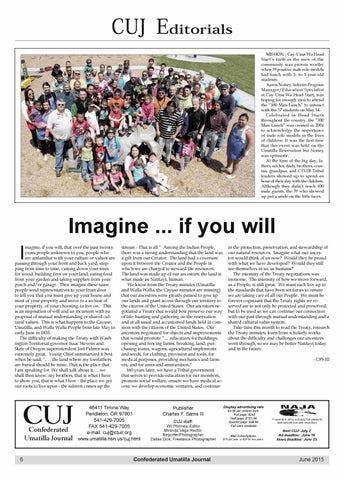
d itor i a l s MISSION — Cay-Uma-Wa Head S tart's fait h i n t h e m e n o f t h e community was proven worthy when 39 positive male role models had lunch with 3- to 5-year-old students. Aaron Noisey, Interim Program Manager /Education Specialist at Cay-Uma-Wa Head Start, was hoping for enough men to attend the "100 Man-Lunch" to interact with the 37 students on May 14. C elebrated i n H e a d S t a r t s throughout the country, the "100 Man Lunch" was created in 2004 to acknowledge the importance of male role models in the lives of children. It was the first time t hat this event was held on t h e Umatilla Reservation but Noisey was optimistic. At the time of the big day, fathers, uncles, dads, brothers, cousins, grandpas, and CTUIR Tribal leaders showed up to spend an hour of their day with the children. Although they did n' t reach 100 male guests, the 39 who showed up put a smile on the little faces.
)
t 1
i
e
Lx P.
ma i ne... i magine, if you will, that over the past twenty
OU WI
for wood, building fires on your land, eating food from your garden and taking supplies from your porch and/or garage. Then imagine these same
stream — That is all." A m o n g the Indian People, there was a strong understanding that the land was a gift from our Creator. The land had a covenant upon it between the Creator and the People in which we are charged to steward the resources. The land was made up of our ancestors; the land is what made us Natitayt, human. We know from the Treaty minutes (Umatilla
people send representatives to your front door
and Walla Walla, the Cayuse minutes are missing )
to tell you that you must give up your house and
that our ancestors were greatly pained to give up our lands and grant access through our territory to the citizens of the United States. Our ancestors negotiated a Treaty that would best preserve our way of life: hunting and gathering on the reservation and at all usual and accustomed lands held in common with the citizens of the United States. Our ancestors negotiated for objects and improvements that would promote "... education, for buildings,
years people unknown to you, people who are unfamiliar with your culture or values are
passing through your front and back yard, stopping from time to time, cutting down your trees
most of your property and move to a section of
your property, of your choosing, to live on. This is an imposition of will and an incursion with no
proposal of mutual understanding or shared cultural values. This is what happens to the Cayuse,
Umatilla, and Walla Walla People from late May to early June in 1855. The difhculty of making the Treaty with Washington Territorial governor Isaac Stevens and State of Oregon superintendent Joel Palmer was extremely great. Young Chief summarized it best when he said, ".. . the land where my forefathers are buried should be mine. That is the place that
I am speaking for. We shall talk about it... we shall then know, my brothers, that is what I have to show you, that is what I love — the place we get our roots to live upon — the salmon comes up the
Confederated Umat i lla Jou r na l
opening and fencing farms, breaking, land, purchasing teams, wagons, agricultural implements and seeds, for clothing, provision and tools, for
in the protection, preservation, and stewardship of our natural resources. Imagine what our ances-
tor would think of us now? Would they be proud with what we have developed? Would they still see themselves in us, as humans? The intensity of the Treaty negotiations was immense. The intensity of how we move forward, as a People, is still great. We must each live up to the standards that have been set for us to ensure we are taking care of all our People. We must be forever cognizant that the Treaty rights we reserved are to not only be protected and preserved, but to be used so we can continue our connection with our past through mutual understanding and a shared cultural value system. Take time this month to read the Treaty, research the Treaty minutes, learn from scholarly works
about the difhculty and challenges our ancestors went through, so we may be better Natitayt today and in the future.
— CFS III
medical purposes, providing mechanics and farmers, and for arms and ammunition." 160 yearslater,we have a Tribal government that serves to provide education for our members, promote social welfare, ensure we have medical access; we develop economic ventures, and continue
46411 Timine Way Pendleton, OR 97801 541-429-7005 FAX 541-429-7005 e-mail:cuj@ctuir.org
Publisher Charles F. Sams III CUJ staff:
w w w.umatilla.nsn.us/cuj.html
Wil Phinney, Editor Miranda Vega Rector, Reporter/Photographer Dallas Dick, Freelance Photographer
Confederated Umatilla Journal
Display advertising rate $4.50 percolumninch. Full page: $243 Half page: $121.50 Quarter page: $58.50 Full color available Mail Subscriptionst $15 per year or $28 for two years
11 awards in 2014, including first places for best editonal and best news story
Next CUJl July 2 Ad deadline: June 16 News deadline: June 23
June 2015
p-
d
o l u vv n s
Cayuse Tech should fund programs, hire members B Bob Shi
e n t o wer
his article is my own personal position and is not intended to reflect the position of any other member (s) of the Board of Trustees. When the CTUIR develop and build our business enterprises there are, at least, two major outcomes that are expected. The first is that the enterprises will eventually provide funding for our tribal programs and services. The second is that the enterprises will provide jobs for our qualified tribal members. CTUIR tribal members are the owners (shareholders) of Cayuse Technologies (CT). The owners of any business can rightfully expect that they will benefit from that ownership. Our administration has programs and services who serve our tribal people, and community. These programs include the elders, land acquisition, language, recreation, and scholarship programs, to namea few. CT should be helping to fund these programs so they canserve and benefitour people, and community. However, although CT has been operating for eight years, they still do not contribute financially to support these important programs and services. Yes, CT does pay nominal lease fees and business taxes to the tribe, but these are basic requirements for any business anywhere to operate. CT did, once a year, make a funding contribution to the Community Picnic. But this year they have refused to even make this once a year contribution. In complete contrast, from day one Wildhorse Resort 8z Casino has been providing millions of dollars every year to fund and support tribal departments, programs and services. CT has a Board of Directors (BOD) that has policy and oversight authority for the management of CT. It is this Board that makes the management agreements for CT; the Board of Trustees (BOT) does not. When CT first opened for business, they started a management agreement with Accenture, a management consultant firm based in Atlanta, GA. This was a similar agreement to the five-year agreement that Wildhorse Resort Gaming had with Capitol Gaming. Capitol Gaming would train WRC staff how to operate a gaming/lodging business, and after five-years they packed their bags and left. The overall success of WRC attests that they can operate independently of a management firm. This aligns with the concept and tribal goal of economic sovereignty and independence. However, in contrast, after eight years the CT Board
T
of Directors still have their management agreement with that provides CT funding for the CTUIR budget, the Accenture even though Accenture no longer provides BOT would then distribute these funds to our departmanagement training services. Of course, this means CT ments, programs, and services. is still paying a considerable fee to Accenture. CTUIR tribal member employment at CT. The From last month's CUJ, we have learned that Acnumbers speak for themselves: There are about 380 centure is basically an expensive "middle man" for employees at Cayuse Tech, and only eight or nine are CT; Accenture gives leads and arranges business work CTUIR enrollees. There was one tribal member in contracts to CT. However, CT has been an operating management there, but now that number is zero. business for eight years and they should have estabThere are numerous CT employees who commute lished and networked themselves in the industry by from outside of our reservation so the wealth that is now to make their own work contracts. generated here in our tribal community is extracted The job duties and responsibilities for the General and invested and spentelsewhere. So what do we, as Manager (currently open) position at CT include, "to the tribal owners, benefit from Cayuse Technologies? establish and maintain strong relationships with Fortune Not much. 500 clients". Other requirements for the posiThis article is nothing against the tion include, "business development"; "board hourly CT employees; I understand e abOUt and owner (CTUIR) relationships"; "client that numerous CT line employees 38Q lOyeeS development and relations". participate in volunteer capacities yUSe Tech, Had all the GM's (former and current ) at at that serve our community. However, CT met all of these job duties they would and Only eigh t I d o h av e i ssues with Cayuse Tech be operating independently and separately Or njne re management and BOD. I have never o c c e n ture a e r et g y e a rs' n e once heard or seen either of these two CTUIR nrollees. management ranks, there is also a "Busigroups advocate for CTUIR tribal ness Development" position. This position There W as one interests, although they are fully speaks for itself, as far as job duties go. aware that CTUIR tribal members trjbaj me mber Cayuse Tech should have cut the umbiliare the owners of the business that gement cal cord from Accenture a few years ago, provides them with well-paid jobs and not continue to be dependent on them. and positions. Accenture interests This dependency is one reason why CT is nUmbel Is zero. are obviously their only concern and not contributing to the tribe; they are paypriority. ing Accenture big-time for services that CT By the very nature of their busishould be doing themselves. ness, it is not realistic to expect Cayuse Technologies Two of the CT Board members (including the chairto contribute to the CTUIR budget as much as WRC, but by fairness and common sense they need to start man) are retired Accenture management executives and they continue to benefit financially from the mancontributing something. It is interesting that Acagement agreements between CT and Accenture, and centure and Cayuse Technologies management are would not want to see the agreements discontinued. having a mid-level staffer speak for both businesses. This is a conflict of interest. Clearly, as a loyal trooper, all he spoke of was the The second agreement is the operating agreeAccenture and Cayuse Tech party line. Mr. Newman ment between the CTUIR Board of Trustees, and the writes, "to generate more revenue for the tribe". My CT Board of Directors. This agreement needs to be response is, "what does this mean, 'more revenue', revised so there is an allocation plan that includes CT Cayuse Tech generates no revenue for the tribe now". profit funds for the tribe. CT for too long has con(except the aforementioned nominal lease fees and sistently been given a free pass here; the BOT again taxes). recently approved a CT five-year business plan which Yes, we do have economic and political roles and contained no funding for the tribe. Two of us BOT responsibilities, and influence, in the region and members voted against the five-year plan because it beyond, but first and foremost, we have an overarchcontained nothing for the tribe (the owners). ing responsibility and Constitutional duty to meet the The operating agreement will be on the agenda for needs of our tribal members first. In the context of revision at a forthcoming meeting between the BOT Cayuse Technologies, we can, and must, do better in and the BOD. If the Board of Trustees and the Cayuse meeting these tribal needs. bobshi e n t o w e r@ctuir. Tech Board of Directors are going to, "protect and or ~ . 541-429-7371. promote the best interests of the Confederated Tribes of the Umatilla Indian Reservation", then the revised Bob Shippentower isa member at large of the Board of Trusteesfor the Confederated Tribes of the Llmatilla lndian Reservation. operating agreement must include an allocation plan
etter s Bucks golf teams say thanks The Pendleton High School golf teams would like to thank Wildhorse for the use of the course for our practices and tournament. Your facility is great for practicing all aspects of one's game. The staff at Wildhorse has given many hours of instruction to our golf team members. Thankyou to Mike Hegarty head Golf Professional and Clint Ables, assistant Golf Professional. The pro shop staff has made us feel welcome. We want to thank also Sean Hoolehan and his crew for a wonderfully maintained golf course. Without your backing we would not have done as well as we did this year. The girls had a fantastic year with a very young team. T h ey wo n m any t o u rna-
June 2015
to
the
ments this year and gained valuable experience. The girls placed fourth at District and thus qualified for the OSAA Championships at Trysting Tree in Corvallis. The girls took home the fourth place trophy at the OSAA Championships. The boys had a season that was very good also. They placed fourth at District and thus qualified for the OSAA Championships at Emerald valley in Creswell. The boys finished seventh at the OSAA state golf championships. Thank you again for all you do for these young golfers. They have experiences that will last them a lifetime. Coach Terry Prouse and I are very proud of them and what they have accomplished this year. Nels Nelson, PHS boys golf coach Terry Prouse, PHS girls golf coach
Confederated Umatjlla Journal
d it or Plass humbled by election Thank you to everyone who supported me in my successful campaign for the Zone 7 position on the BMCC Board of Education. I am deeply grateful to all who endorsed my candidacy, including the CTUIR Board of Trustees; to the hard-working members of my campaign team; and to those who contributed money or services, posted yard signs, wrote letters, or helped in many other ways. I feel honored and humbled by the confidence that voters have shown in me, and I will work hard to represent Zone 7 residents effectively and to help guide BMCC toward a successful future. Susan E. Plass Pendleton
l vvan a c •
PUBLIC HEARING NOTICE
May 2015 From the Department of Science and Engineering
NOTICE IS HEREBY GIVEN that the Natural Resources Commission (NRC) of the Confederated Tribes of the Umatilla Indian Reservation (CTUIR) will hold the following public hearing: Conditional Use ¹CU-15-001 — Applicant, Kevin Provance, Black 8 Veatch, on behalf of ODOT State Radio Project, 5886 Meadows Road, Suite700, Lake Oswego, OR 97035, is requesting Conditional Use approval to replace an existing 40 foot telecommunications tower with a new180' tower and associated equipment. The proposed location is within an existing fenced lease area of tax lot 1N340500-01300 owned by Lieuallen Ranch, Inc, in the Poverty Flats area, section 5 of Township 1N Range 34 East. Access is proposed across the Lieuallen property via a dirt road that connects with Emigrant Hill Road to the south. The property is zoned Big Game Grazing Forest (G-1). Telecommunication towers are permitted as a Conditional Use within this zone. The use is subject to the standards in Section 17.005 (15) and approval criteria in Section 6.015 (Conditional Uses)
Weather information summarize data taken at the Pendleton Weather Station Lat 45 40 N and Lon -118 51 Wfrom May 1 to May 31. Temperature is reported in degrees Fahrenheit and time in Pacific Standard Time. The average daily temperature was 60.5 degrees with a high of 90 degrees on May 29 and a low of 36 degrees on May 3. With a departure from normal of 2.7 degrees Total precipitation to date in December was 1.81" with greatest 24hr average 1.03" May 12-13. 12 days out of the month had precipitation level greater than .01 inches with 5 days greater than 0.10 inches and with 1 day greater than 0.50". There was a departure of 0.46" from average for the month of May. Snow, Ice Pellets, Hail total for the month: 0.0 inches with greatest 24 hour: 0.0 inches. Greatest Depth: 0.00 inches. The averagewind speed was 7.7 mph witha sustainedmax speed of52 mph from the West on May 31. A peak speed of 68 mph occurred from the West on May 31. The dominant wind direction was from the West. There were 14 clear, 16 partly cloudy and 1 cloudy day(s) in the month of May. Air Quality Index values remained stable in the low range throughout the month of May.
•
The hearing will be held Tuesday, June 9, 2015 at 9:00 a.m. in the Nixyaawii Governance Center Wanaq'it Conference Room (L202) on the Umatilla Indian Reservation, 46411 Timine Way, Pendleton, OR. The public is entitled and encouraged to attend the hearing and to submit oral or written testimony regarding the request. To obtain additional information, contact the Tribal Planning Office at, 46411 Timine Way, Pendleton, Oregon, 97801 or call (541) 276-3099. Matilda Hoisington, Secretary Natural Resources Commission
•
Thefinishing places forthe sixth annual Language KnowledgeBowl were wrongin the caption under a photo on Page 3/n the Aprilissue ofthe CUJ. Here's how the fin ishing p/aces should have been: 1, Pishpish haasht, (I/I/apato High Schoo/);
•
Submittedby the Yegowhawk Resource Management Committee The Yegowhawk EyeCare and Vision Policy,which defines eye exam and eye glasses replacement criteri a,has been changed to bettersuitour
community's needs. The updated policy which applies to Purchased/Referred Care or PRC eligible customer-owners (PRC used to be called Contract Health Services butwas changed to PRC bythe Indian Health Service), has beenunder review in order to make the policy and eyebenefit more clear. The first part of the new policy reads as follows:
"Yegowhawk Tribal Health Center (YTHC) realizes the importance for this service in the community and a policyto ensure ag eligible members are able to receive this valuable benefit. The YTHC will have in place a policy for ensuring coordination of care for all Purchased/Referred Care(PRC) eligible patients in need of
eyeglass/vision services every two years. YTHC provides referrals for optometry/ophthalmology services with PRC eligibility per federal regulations 42CFR. Patients must comply with all federalregulations regarding alternate resources under the payer of last resort rule. Ag outside referrals for optometry/ophthalmology services shall follow existing YTHCPRCpolicies and guidelines." The revi sed policy creates a S400 benefitforexams and eyeglasses fora 2-yearperiod. The following table helps describe what that benefit covers for eligible patients.
PRC every 2 years
Total PRC
YES
YES
(1 exam)
up r)
NO
NO unless medically necessary
NO uoless medically necessary
$0-$400 not to exceed
If a patient has an alternate resource such as Medicaid, employer-sponsored health insurance (e.g., HealthComp) orother type of insurance, that resource will be used first before the YTHC benefit will be applied. Anyof thePatient Care Coordinators can answer questions about the new and improved policy which the Health Commission approved during theirregularmeeting on May 12th. In the meantime, here are a few Frequently Asked Questions (FAQs)we 'veheard thatm ight help. Eye Care & Vision Policy FAQs How frequently can Ihave eyeglasses replaced2
1 pair eyeglasses every 2 years if needed (see table above)
Do I haveto go somewhere specificforeitherexams oreyeglasses2 No, but the patient is responsible if the $400 allowance (which kicks-in after your alternate resource is applied), is expended in the 2-year period. What if I'm 62 or older or am diabetic7 Special considerations can be made, such asm ore frequentexams, forpatientsw ith unique needs such as diabetesorotherconditions that affect their vision. These willbe reviewed on a case-by-case basis. We believe this policy will be well received by our eligible customer-owners. It has been discussed and reviewed by internal YTHC committees
Pendleton Pioneer Chapel received three prestigious awards in 2009
and workgroupsand provides a valuable benefi t as long asourannualresources and budgetcan coverthe costs. Ifyou have any questions please call Purchased Referred Care staff or the Patient Care Coordinators.
+ The Oregon Funeral Directors Association Award of Funeral Service Excellence Mass Service for
+ The Best Of Eastern Oregon Award as voted by the readers of the East Oregonian
Louise Hall Moe St. Andrews Church Saturday, June 27th —1 p.m. Reception to follow at Kateri Hall
+ Pendleton Chamber of Commerce 2009 Business of the Year
(In lieu of flowers, p/ease contribute to St. Andrews Mission, Pendleton, Oregon orAntelope I/a//ey College Foundation, 3041 I/I/estAvenue K, Lancaster, California 93646, for a memorial bench in her honor).
PE1WLETOX P I O N E E R t :M AP K I . )!cslexzszz-Bistsnp Our expenenced fanxly provides carmg, compassionaie care mcluchng
2ton & Va&ri Wartin zsz S2' 2iyers Ave
Burial Services — Military Services Cremation — Monuments
Per asretors Oft pzaoz
Pfiona 541-276.122z
Monuments 8t Headstones
pjIGJNEERR<OCK
h,
tdL MONUMHK 201 Crafton Rd POB 348 eldendale, Wa 98620 509-773-4702 We offel an array of Nonuvnenzs and Headstones. Available in a wide variety of sizes, colors and designs. Call today ta lealra lnrtore.
www.pioneerrock.com
Burns Mortuary
www.betterheadstones.com I
• I
•
I
• 9
I
•
'
•
o f P E N D L ET O N ~
336 S% DORION, PENDLETON
.S 4 (8&ICIM
onfedera ed Umatilla Journal
(54I) 276-2331 June 20 5
CRITFC is hiring for the following position: FULL-TIME, STAFF ACCOUNTANT. This position provides accounting support to various functions within the organization, with a focus on off-site locations, by providing analysis of budgets and expenditures, tracking invoices and purchase orders, compiling information for decision-making and other work as needed to assist in the meeting of programmatic goals. The position also provides back-up support for the payroll function. It also assists in internal and external audit activities, prepares general ledger journal entries; assists in special project management; and performs other work as assigned. Visit http://www.critfc.org/jobs/staff-accountant/ for a full job description and instructions on how to apply. The closing date is June 19, 2015. FULL-TIME, FIELD MARKETING SPECIALIST. The Field Marketing Coordinator position is a function of the Salmon Marketing Program within the Finance and Operations Department and coordinates the salmon marketing program which is designed to increase the economic benefit oftreaty fisheries to tribal fishers. This position utilizes a strong marketing background Ilgp and a good understanding of marketing components as they relate to world markets and the four tribe's commercial treaty fisheries. The position also requires good interpersonal skills as it interacts with the four tribes and other tribal entities, tribal fishers, wholesale and retail buyers and agencies to help identify, funding, sales opportunities and to provide training. It also requires budget management skills to ensure funds are secured to meet programmatic needs. The position is full-time and is required to be available for full-time work during the commercial fisheries seasons. The position also requires a valid driver's license. Visit http://www.critfc.org/jobs/field-marketing-specialist/for a full job description and instructions on how to apply. The closing date is June 19, 2015. FULL-TIME, FISHERIES GENETICIST. We are seeking a Fisheries Geneticist with experience in population genomics, association mapping, and mixed stock analyses. This position is part of CRITFC's Fishery Science Department, but will be located with the genetics group at the Hagerman Fish Culture Experiment Station in Hagerman, ID. This research group is involved in testing conservation, evolution, and ecological theories related to salmonids and other fishes. The employee will work under the Lead Geneticist, in association with CRITFC geneticists and technicians, as well as staff of the Fishery Science Department in Portland, OR. Efforts will focus on applying empirical genetics/genomics data to address questions related to conservation and recovery of steelhead, Chinook, sockeye, and coho salmon, sturgeon, lamprey, and other fishes ofthe Columbia River Basin. Visit http://www.critfc.org/jobs/fisheries-geneticist// for a full job description and instructions on how to apply. The closing date is June 19, 2015. FULL-TIME, BIOMETRICIAN. The Fishery Scientist(Biometrician) works on projects involving the modeling of the population dynamics of Pacific salmon. The incumbent will serve on the Pacific Salmon Commission ChinookTechnical Committee, an inter-agency technical committee that models chinook salmon stocks and fisheries along the Pacific coast. Visit http://www.critfc.org/jobs/ fishery-scientist-biometrician/ for a full job description and instructions on how to apply. The closing date is June 30, 2015. FULL-TIME, HARVEST MANAGE M E N T SCIENTIST.The Harvest Management Scientist assists the tribes in planning and coordination of tribal harvest in the Columbia River Basin for CRITFC's four member tribes. The Harvest Management Scientist works within various harvest management forums to implement tribal fisheries consistent the treaty fishing rights case law. The Harvest Management Scientist works with tribal policy makers and staff to develop and implement fisheries consistent with tribal objectives. The Harvest Management Scientist also works with tribal policy makers and staff in coordination of artificial propagation reform to achieve goals and objectives consistent with treaty fishing rights case law and regional management processes. Visit http://www.critfc.org/ jobs/fishery-scientist-harvest-management/for a full job description and instructions on how to apply. The closing date is June 30, 2015. FULL-TIME, HATCHERY PRODUCTION COORDINATOR. The Hatchery Production Coordinator (John Day Mitigation) works with tribal policy makers and staff to develop and implement a salmon hatchery mitigation program consistent with tribal objectives. The Coordinator works in regional processes to monitor regional salmon hatchery production and implement tribal initiatives. Visit http:// www. critfc. org/jobs/hatchery-production-coordinator/for a full job description and instructions on how to apply. The closing date is June 30, 2015. PATROL OFFICER. Columbia River Inter-Tribal Fisheries Enforcement (CRITFE) Patrol Officers are directly responsible for carrying out all enforcement and protective patrols by foot, vehicle and boat on the main stem Columbia River (Oregon and Washington shores) and its environs and also patrol at the In-lieu and Treaty Fishing Access sites (TFAS). Patrols are dictated by CRITFC/CRITFE policy, Tribal policy, contractual obligations of the Law Enforcement Department, and at the direction of patrol supervisors. Closing date July 6, 2015. Visit http:// www.critfc.org/critfc-employment-opportunities/ for a full job description.
June 2015
CTUIR Board of Trustees n
Chair Gary Burke
General Council Chair Alan Crawford At-large BOT Members: Armand Minthorn Justin Quaempts Bob Shippentower Woodrow Star
Vice Chair Leo Stewart Treasurer Aaron Hines
Secretary Kat Brigham CTUIR Deputy Executive Director: E x ecutive Director: David Tovey Debra C roswell
General Council Meeting
Nixyaawii Governance Center,June 1S 2 p.m.
-
~DraA a enda:
1. General Council Chairman Report - Alan Crawford, GC Chair a. Workforce Protection Act 2. First quarter Finance Report - Aaron Hines, BOT Treasurer 3. Dept. of Community k Economic Development annual report - Bill Tovey, DECD Director
CTUIR Express Phone Directory
Tribal Court 541-276-2046
Human ReSOurCeS
DePartment Of Children and Family Services 541-429-7300
Science 8 Engineering/Air Quality Burnline 541-429-7080
Enrollment Office 541-429-7035
Senior Center 541-276-0296
Finance Office 541-429-7150
TERF 541-276-4040
FinanceCredit Program 541-429-7155
Confederated Umatilla Journal 541-429-7399
Confederated Umatilla Journal
541-429-7180
NUmbef of Enf ol)ments pel yeef sInce 3.991 une 2015 U date Beadline I:asl lpproachinO for lanii Bny-Bacil Offers Offer ¹:
Wave¹i
Wave 2-C Wave 2 Wave 2-A
Deadline
Status of Offers Listed Below:
¹1053 gune12rb 2015 Nailed 4/28/15 ¹823 LBBP is acce tin packets based on available funds * ¹889 LBBP is accepting packets based on available funds * 163
*For areprint~replacement offerpackages please see any localOS T offlce orcallTrust Beneficiary Call Center at 888)678-6836. You may submit your offers while the appraisal date is still valid. Offer ¹ can be found on upper righthand corner of documents. Please notice that all offers are accepted as remaining funds are available and time and resources allow. Please visit CTUIR or LBBP website at: • CTUIR eb¹ite¹ : ~ t i "h rt I t i b Iomm ni - d v l o m n l a n d-man m e n t m a ' l l -lan -b - back- r r LB B P website:www doi ov u b a ck ro ram
•
54'63
m
Back round Im lementation:
919293 949 5 9 6 9 79 8 9 9 0
1 2 3 4 3 i6 7 S 9
I ll 12 13 14
The Land Buy-BackProgram is a voluntary program where you may choose to sellyour fractionated interests of allotments. Any fractionated shares you sell will remain in Trust forthe CTUIR. fi ~~ w as obligated for land purchases and separate funding was designatedforimplementation ofthethree (3)components: u Outreach[Explaining LBBP Process u Land Characteristics ) Mapping bi Appraisals of 400 allotments
Im ortant Contacts: Andrea Hall
CTUIR, Umatilla Tribal Land Monday-Friday
Bu -Backpro ram OST, Ofiice of Special Trustee Fiduciary Trust
"8"Notary Public-ORBR"
Kevin Moore B~Notary Public-ORR*R
Leslie "Sass" LeCornu
7:30-4:00pm[PST Monday-Friday 7:30-4:00pm[PST
Officer, Umatilla A en CTUIR Acquisition St
Monday-Friday 7:30-4:00pm[PST Monday-Friday 7:00-6:00pm[MST Sat. 8:00-12:00 m
«8"Notary Public-ORR*»
Dis osal Real Conve nce Trust Beneficiary Call Center (TBCC) for: HM Account Management
541i 429-7490 541i 278-3786 541i 276-3792 888i 678-6836
C all TBCC to check the Status of LBBP Offer or to Re ister as a Willi n S e l l e r Monday-Friday 8 55 ) 359-7434
CTUIR, Umatilla Land Buy-Back Contact Center 10:00-6:00pm(PST *closin 6 19 15 * Notice: Contact Center is closing Friday, June 19th, 2015. Please refer all questions to the Umatilla Land Bu -Back Coordinator at 541 429-7490.
Inheritance Code: l~t t ¹ t : Th CTU I R I h it C d pp dB d I T R R I t i ¹ 08 028 April7,2008 and approved by BIA on May 16, 2008. The CTUIR declares its intent to exercise its rights to prevent the transfer of trust lands within the Umatilla Indian Reservation to a person named ina willwho isnotan enrolled member of theConfederated Tribes.Please reference CTUIR Inheritance Code at: h : c t u i r.or ss tem files InheritanceCode. df.
M issed a Deadline for Com le '
a n Offer Pac e ? :
Missed a Deadline?To accept your offer, you may return any late submissions that will be reviewed based on capacity, appraisal expiration, and the availability of funds. Please understand we cannot guarantee acceptance of late submissions. You will receive a Fair Market Value (FMVI for any land interests you sell, based on your share in the whole tract, plus $75 base payment per offer package.Please seecomplete instructions in offerpackage. [1( IMPORTANT - J30 NOT~S th e D eed until you are in front of Notary Public with proper identification. Check that your legal name is correctly listed for accuracy. ~ 2~ F T ¹ l lidDB
Pl
R t
t
ll p
"' 0 C d : + "" " " ' " " ' "' — '"' —" —
ith 8
O Original Deed,® Purchasable Interests Inventory Detail O Purchasable Interests Inventory Summary.(Note:Wave 1 and Wave 1-A Offers have Expired) [3[Send directlyto the DOI Processing Center.Keep a copy foryour records.
Tribal member enrollment total hits 3,000 mark pains." "We have to find places for our people MISSION — Everyone, please welcome to live but it can be done," Burke said. to the world Ezra Rae Squiemphen, the " We'll p r o bably o u t grow t h i s b u i l d daughter of Melissa Van Pelt and Chance ing (Ni x y aawi i G o v e r nance Center ) Squiemphen. already." She was born April 29, but on June 1, Burke said "We're just scratching the 2015, she became the 3,000th enrolled surface. There's just this much money tribal m e m ber o f t h e C o n f e d erated and this much land t hat w e're faced Tribe of the Umatilla Indian Reservation with." (CTUIR). On average, about xx people — mostly Ezra happened to be the second child children — are enrolled as CTUIR memenrolled June 1 and one of six children bers each year. The highest number was enrolled June 1 and 2, said Elfrina Lubrin, in 1995 when 330 people enrolled. That a clerk in the CTUIR Enrollment Office. was when Wildhorse Resort 8z Casino Hitting that 3,000 mark has "h u ge was shifting to a higher gear. significance" for the CTUIR, according to Today, it's rarely adults, Lubrin said. Board of Trustees (BOT) member Justin Hardly anyone relinquishes tribal memQuaempts. bership from other tribes to move to the "It attests to the fact t hat C ayuse, Umatilla Reservation, she said. Some Umatilla and Walla Walla people were living here are unable to enroll anywhere here and are still here," Quaempts said. because they don't have enough blood "Since the Treaty, there have been many of any tribe, or do not have a parent or things to prohibit our growth but we're grandparent enrolled. still here in the modern day. We're still here and growing." The number of enrolled members can be Gary Burke, BOT Chairman, said the disputed depending on whoyou talkwith and growing numbers represent "growing which enrollment rolls are discussed.
Wave Offer Detail: A¹ Di
si18i15
1,138accepted offers;54% acceptance rate oflandowners totaling $8,605,240 00 with $3,508,01200remainin; returnin 7,025 acres back to CTUIR.
Whereabouts Unknown "WAU": If you are listed on 0$ce of Special Trustee (OST) Where Abouts Unknown (WAU) List for the UmatillaAgency. You ~mus update your address first in order to receive a Land Buy-Back Offer replacement packet fromyour local OST Office. Please contact OST located at the Umatilla Agency@ 541 278-3786oran localOSTOfficein ourarea.
Willin Seller: Callthe TBCC at~878~68 6 to Registeras a MtjQ g~Se ~e. You can also callto check status of your Land Buy-Back offer. Your payment will be deposited into your Individual Indian Money (IIM) account or a check will be issued and mailed to your most current address. IF you do not want sell o ur fractionated interests, ou will not need to do an i n .
IMPORTANT NOTICE: All Information ~ma be subject to change-
TRIBAL NIEMBERS: This notification formally announces that applications are now being taken &om Tribal Members who wish to serve on the Commissions/Committees listed below. Appointed members will receive a $100.00 stipend per meeting effective January 1, 2015 once the minutes have been approved on CTUIR pay days.
1 position for Credit Board - 3 year term, meet on the 2" and 4'" Tuesday of each month at noon. 1 position for Education and Training Committee — 2 year term, meet on the 1" and 3" Tuesday of each month.
2 positions for Election Commission — GC Appointment term ends Dec. 31, 2015, meetingheld as needed
Thank you for Participatiny with the Umatilla Land Buy-Back Proyrarn for Tribal Nations For Our Future Generations...
1 position for the Water Commission — 2 year term, meet the 1" and 3" Tuesday of each month at8:30am 2 positions for the Umatiila Cultural Coalition -2 year term, meet as needed to review and act upon applications (No Stipend)
Qe'ci gew'yew!
xx
L Fh N
u 'u y
8
S
A
8
I.
I
All applications will be due on June 22, 2015 by 4:00 PM and BOT will make appointments onJune 29,2015.
bb
D ~h
Id A
Ie r D
T
I
U e
O
8
m
Id 8
>» «< URBatiiia Tribal Land Bur-BBck ProgiUm >» «< COnfedeiUted TribeS Df the Umatilla indiBU ReSerVatiOn - 46411 Timine WBy, PendletOn, OR 97801
10
Applications available at the Nixyaawii Governance Ccnicr or online atwww ctuir or ovcinmcot/commiiiccscommissions Completed applications should be submittedio the Nixyaawii Governance Center lobby. For more information, call 541-276-3165. Completed applications areio be returned to the Nixyaawii Governance Center switchboard desk. If you have any questions, pleasecontact Kat Brigham, BOT Secretary 541-429-7374 or Doris Scott, Secrctary II at 541-429-7377.
Confederated Umatilla Journal
June 2015
CTUIR Native Amer ican Small Business bay Luncheon-June 10
Short news Farmers Market tokens to be given to elders MISSION — The Elders Program will distribute Farmers Market to elders age 55 and older every two weeks starting June 12. Each elder will receive 515 in tokens through the Confederated Tribes' Department of Children and Family Services. The tokens will be distributed at the Senior Center from 8 a.m. to noon, and at the DCFS office at the Nixyaawii Governance Center on the following dates: June 12 and 26;July 10 and 24;Aug. 7 and 21; Sept. 11 and 25; and Oct. 9. For information, contact DCFS at 541-429-7300 or the Senior Center at 541-276-0296. If for any reason the Senior Center is closed due to a death, the CTUIR Housing Department (adjacent to the Senior Center) will distribute the tokens at the same time.
CRITFC Salmon Camp near Lapwai in July CAMP WITTMAN — Youth entering sixth through eighth grades are eligible to attend the Tribal Salmon Camp sponsored by the Columbia River Inter-Tribal Fish Commission July 13-17 at Camp Wittman near Lapwai, Idaho. The camp is free. Applications are due June 9 and are available at critfc.org /forkids-home /salmon-camp. For more information contact Tana Atchley at tana@critfc.org or call 503-238-0667.
Interviews to focus on school experiences
Join usin celebrating and honoring Native Amer ican entrepr eneur s. One lucky business owner will win a trophy and $5000 in cash!
Wednesday, June 10, 2015 Wildhorse Resort R. Casino - Cayuse Hall11:45 AM to 1:00 PM Lunch served at 12 Noon
PENDLETON — A study about Native American youth's experiences in public schools is being completed by Julie Smith, a doctoral student at Lewis and Clark College in Lake Oswego, Ore. The study will collect and analyze stories of Indian youth to contribute to an understanding of social practices supporting and hindering educational achievement and attainment. "In this study young adults who have recently completed K-12 education in Pendleton will be invited to tell their story of their schooling experiences in a group listening circle and an individual interview," said Smith. On May 11 the Board of Trustees for the Confederated Tribes of the Umatilla Indian Reservation (CTUIR) agreed to endorse the project in a 5-1 vote understanding that participants of the study will consist of Tribal member's ages 18 to 21 years old. Recruitment will be conducted in July, pending approval by the Lewis and Clark Institution Review Board. Three opportunities to participate will then be available in July and August. Listening circle locations will be in Pendleton and individual interviews will be arranged with each participant at a mutually acceptable location.
Community Forum Senior Center - August 25 - 5:30 p.m. - Potluck
Tickets: S20 Guest Speaker: Natalie Charley, E.D. Taala Fund - a Native American CDFI operating on the Qninault Reservation
CallBusiness Development Services today to reserveyour seat.Deadline is Friday,June 5.
Community Watch June 11 at 5:30 p.m. - Senior Center Agenda: SORNA
e IJqiive<
Saving you time, troubleandmoney!
Frazier ONceSup ly rwr Wororw e roR lreroro o/yeor eoslooeer
III-2ll-llll 222 S,Melw Pewileten, OR. www.freeiereNieeew pply,ewm
1I/y'
SusinLps Dava<epirtmnT5aavlels 88fpnig2VIIIipe ertpNSptaIII VIIISIII8$$8$5QfCSpd
www.wildhorsebds.com 46510 Wildhorse Blvd. Pendleton, OR 541-966-1920
12
1
Serving AreaSusinesses foroverIOOyears.
Frazit.r Office Supply
JII SHOP gatm,r, Like Us on
Our Business is taking care of your Business! (541)276-1121~227S.Main wPendleton wwwfrazierofficesupplysem
Confederated Umatilla Journal
June 2015
A star e r o m our universe A
membership. This was a highly controversial matter, one star fell ou t o f
ou r u n i v e rse recently — a star
that was paradoxically hot and cold, and usually always herce — that star was my m o t h er, Florence Halfm oon.
Many of you might not know Florence, as her sphere of influence (especially later in her life) tended to be towards her family. As a young woman, Florence was engrossed with family life; a life that included learning from her in-laws, the greater Halfmoon family. Not only did Florence learn from her in-laws the of the seasonal rounds, spending time
at Celilo, camping at Johnson Creek, Meacham and Cold Springs (Mt. Adams), Florence engaged in a life that was truly her calling and she rose to meet it. Providing for her own children and the extended
that split families asunder and, despite the highly charged and divisive political atmosphere in the community, my
mother stood by my father throughout the process. Florence, was always compassionate and caring of activities that benefit children; she was an active participant on the parent committee of Head Start when one of her granddaughters was enrolled at CayUma-Wa in the mid-1990's. Moreover, Florence was a dedicated supporter when Head Start was initially brought to the CTUIR back in the 1960's. It wasn't just children that my mother supported. When members of the American Indian Movement came t hrough, Florence provided f ood fo r t h em, as w ell; i t might not have been rib-eyes or beef steaks, but thanks
to good hunters in her family, she could always provide some kind of
Halfmoon family was part and parcel of Florence's daily life. Like many
deer or elk in the roaster. In 1998, Florence, Frenchy, Levi and Helen M o r r ison, Ar t M c C on-
o ther ladies, our m o t her p r o v i d ed
baked goods, and other food for quonset hut gatherings, as well as
ville and my family were part of a group called Circle of Friends. As a group, Circle of Friends fund-raised to provide baskets/gift cards for
family fu nctions. When there were c hildren at St. Andrews who di d n ' t have food for lunch, Florence made
sure that those kids had food, as well.
Gaff fighter Andrew Williams caught this monster spring chinook over the Memorial Day weekend on the Upper Umatllla River on the Umatilla Indian Reservation. Using a gaffhook, Williams pulledin the big fish, which measured401/2 inches long and weighed 35 pounds. CUJ photolDallas Dick
'Summer Splash' BBQ in August will include CTUIR employee families MISSION — Instead of hosting a Christmas Banquet as the primary employee annual celebration, the Confederated Tribes of the Umatilla Indian Reservation (CTUIR) will host a "Summer Splash" event for all employees and their families. " The event was created pr i m a r i l y because numerous employees expressed a desire to bring their fam i lies to our annual Christmas Banquet, but due to limited funds and space at the banquet location, family members could not be accommodated," saidDeputy Executive Director Debra Croswell in an email sent out to all CTUIR staff. A group of employees are organizing the event and plan to offer employee and family activities, put up a photo booth, offer prizes and provide a free meal. As for the Christmas Banquet, which was once the employee main event,the CTUIR will keep it simple by hosting a dessert potluck in the Board of Trustees chambers and hold an employee recognition by honoring those with 5, 10, 15, 20 and 20+ years of service with gifts. Further details on both events will be posted as the time draws closer.
June 2015
F lorence was w ha t w a s k n o w n a s a hom em a k er; e v er y y e a r s h e
seniors for Christmas. It was these t ypes of a c t i v i t i e s t h a t t y p i f i e d Florence — she never had a qualm
put up jams, jellies, syrups, fruits, vegetables, meats, and pickles. My
about whipping out her checkbook
mother also learned to dry roots, tea, f ruit and meat, and you could fi n d eels, sturgeon, salmon, and other hsh in her freezer. At home growing up there wasn't a Sunday that went by that she didn't have pie or cake or some other dessert on the table. My mother was a herce woman, and had a hard life before she came to marry my father. Florence had a compassionate side, as well, and was very vocal about injustice; many times she supported what she saw and believed in, and who she saw and believed in — she often didn't mind telling you either. In the late1960s, there was a severe housing shortage here on the reservation; my mother and other notable and venerable women decided to do something about it. Florence went to the Blue Mountain Economic Development Commission (BMEDC) and sought guidance on how to relieve the housing situation; she was advised to conduct a housing survey and return w i t h th e results.
Florence, Joan Burnside, Janie Pond, Lillian Spino, and Ina Broulliard were the courageous ladies that went out into the community to conduct the housing needs survey. These ladies uncovered the obvi ous fact that fam i l i es were living in desperate housing conditions, and relief
should be provided as soon as possible; Florence was the point person to relay the information to the BMEDC, w hich she did. As a result, the housing authority w a s soon empaneled, and the original housing units here on the reservation were established, and soon after the 1201's were built. These ladies, my mother included, have never been formally recognized for their work in paving the way for the first housing units to be established on the Confederated Tribes of the Umatilla Reservation (CTUIR).
Also in the 1960's my mother supported my father and many members of the Confederated Tribes of the Umatilla Indian Reservation when the Lands Claim
settlement was about to occur; a group of people called the Progressives distributed a mimeographed newsletter to Tribal members describing the pros and cons of distribution of the Lands Claim Settlement to the Tribes (governing body) versus distribution to the General Council
to help a friend in need. My mother loved to give, to help, to listen and to advocate. O ver t h e y e a r s , m y
mother supported my father Alphonse in hi s p o l i t i cal acti v i t i es. In the late 1960s, there was strife within the Tribes over mismanagement of Tribal funds a nd resources, which culm i nated in t o tal recall of t h e
governing body, and my father was elected to the Board of Trustees (BOTs) at that time. As a child I recall the smoky rooms, the heated discussions, the hsheries meetings in Portland w it h C l if f P icard and m y f a t her, the mi m eo-
graphed newsletters going out to Tribal members — all with no salary or wages for those serving on the BOTs.
Throughout all this, my mother supported every effort made for the beneht of the Tribal membership — my dad's attendance at the hsheries meetings, the political unrest, the cost of mim eographing and m ailing newsletters to Tribal members to keep them abreast of the audit — these things came out of their own pocket. When she came to this community and laid down
roots, the CTUIR (in many ways) became her people. My mother was truly invested in this community; so many names/families became her community — names of women, s ome whom are long gone, and some who are with u s s till — and her best friend and former neighbor w ith u s still, Joan. And, alw ays, the St. Andrews community Yes, a star fell out of our universe — her name was Florence Halfmoon; she did burn hot and cold and herce,
and she had passion, fire and some days she'd go toe-totoe with you. She was bold, but she had such a tender heart when you got down to it. Many people won't know o f her contributions to our reservation, but we would n ' t have housing like it is now, nor Head Start before were it not for her diligent efforts and those of other stalwart and venerable ladies in whose shadow I stand, and for whom
I give thanks. And now another great lady has gone to join the company of those who have gone before me; a bright star in my universe who once shone so hercely has
passed out of sight...Florence Halfmoon will be greatly missed.
— Gretchen Halfmoon
Pald Announcement
Confederated Umatilla Journal
13
50ga T
'rISHEEl"Illlv
KhctLE f.
j
<BCHE.P,
h
'
Princesses Rose bound Happy CanyonPrincesses Mary Harris,left,and Josephine Penney, wave to parade watchers in Dayton, Wash., recently. The young ladies are traveling to the Rose Paradein Portlandin early June . They were to be introduced on the floor of the Oregon Legislature before riding in the parade on Saturday, June 6.
'TEACI-! EP, I!'(tlNtt! tlf!
Spencer, Picard-Squiemphen bring new ideas to NCS board By the CUJ MISSION — Briana Spencer is 24 years old and has purple hair. She intends to bring a young voice to the Nixyaawii Community School Board. LaDonna Picard-Squiemphen has a grandson at Nixyaawii and is a former a ppellate court j u d g e o n t h e W a r m Spr!ngs Reservation. She has designs on changing the school's handbook, particularly when it comes to athletic travel. Spencer thinks she knows a li tt le ab ou t h i g h school. After all, in four years she a tte n d e d f i v e Bnana Spencer Pendleton, Hermiston, Hood River, Reno, and at Nixyaawii on the Umatilla Indian Reservation. She also had a two-month stint in New Orleans during her sophomore year w he n she coul d n' t a t t end school for lack of paperwork. Du r i ng her freshman and sophomore years she attended three different high schools. Spencer has held a dozen jobs, starting in 2006 as a barista in a coffee cafe in New Orleans when she didn't attend school. For the Confederated Tribes, she's worked at Kinship Cafe, Wildhorse
14
Resort 8z Casino, Mission Market, Cayuse Technologies, the Department of Economic and Community Development / Land Acquisition, and currently, since August of 2013, she has been a helpdesk support representative in the Office of Information Technology. In the middle of all that she was the Native American Student Club Office Assistant at Blue Mountain Community College, interned at KCUW Radio, and was down for six m o n ths w it h sp inal surgery. She also was appointed secretary to the Washington State Indian Education Association Board. Spencer, who serves on the Tribes' Education an d T r a i n i n g C o m m i t t e e, thought she was too busy to apply the first time Nixyaawii School Board nominations came around. When the deadline was extended,she saw that the Board was mostly older. "I hardly saw anyone my age," she said."I wanted to break that idea that you have to be older. I want young people on the school board. I want to show young people you don't have to be a parent or a grandparent to make a difference. I went through school; I know what it needs; I can tell you what it needs." What it needs, she said, is a building the students can call their own. But she isn't coming in w ith set priorities. "I want to see what the school board is all about. It sounds like they've been getting stuff done," she said, pointing
to improvements at the current school building and celebrations like the recent 10-year anniversary. Picard-Squiemphen currently works as a Title 7 education coord i nator at NCS. She helps students, focusing on i mprov in g c h r o ni c a b senteeism an d poor grades, and what causes those behaviors. She tutors kids, helps them stay on track, helps with forms and applications, and makes sure they are ready or at least at a desk with a pencil for SAT or ACT tests. She remembers one student that didn't care about school. "He wanted to quit. He had three and a half credits to go and I made him come to school whether he wanted to or not. I picked him up. We worked one on one and he was a quick learner. I pushed him and he finished his math in n i ne days and those three and a half credits in 18 weeks." T hat's what i s m ost r ew a r d in g f o r Picard-Squiemphen, who i s en rolled Warm Springs, but is a "proud Umatilla descendant." As a teen, and no w a s a co unselor, Picard-Squiemphen believes she has a connection w it h s t u dents that should give her a un ique perspective as she makes decisions on the School Board. "I know how students feel when they are behind and they want to catch up but they want to be pulled out ofclass. I grab them in the hallway quickly, or before or after school. I want them to able to knock
Confederated Umatilla Journal
on my door and say could you please help me," Picard-Squiemphen said. Picard-Squiemphen was taught to live off the reservation before she was to live on the Warm Springs Reservation. She thinks that has prepared her for the job she does, and prepares her, too, as a new member of the school board. She isn't sure how, but she wants more parent involvement from students who need it m o st. She w ants to " r e c r u i t more students, help g rades, i m p r o v e teachers, and get more teachers." I t was th e s t u dent handbook that r eally p r o m p t e d her interest in th e School Board position. LaDonna "Some of it is unpicard-Squiemphen fair," she said. "I know it's a small school, but why can't we afford to spend the night when we go on long trips? I asked my grandson, 'Why aren't we feeding you guys?' We need to replenish, stop and eat our athletes. If you get on the bus at 4, play at 8 and go through Echo at 11:30, why can't they stop and eat?" Spencer and Picard-Squiemphen will be sworn in at 4:30 p.m. at the Nixyaawii Community School Board meeting. They will officially take office at the July meet-
June 2015
ews CTUIR
members learn a traditional skill, Kapin making M ISSION — Tamast l ik t C u l t u r a l Institute held two steel Kapin making sessions during the month of May. A Ka pi n i s t h e t o o l t h a t N a t i v e Americans use to dig traditional roots as part of their first food gathering. Starla (Patinawi ) Green, instructor of the class, is an enrolled tribal member from W ar m Sp r i ngs Reservation of Oregon. She has spent three years making Kapin's after taking a class at The Museum at Warm Springs. Green was raised on a ranch and was taught at a young age how t o c r eate things with welding. " Hun d r eds of p e o ple di g b u t n o t very many know how to make Kapins," said Green. Each session was four h o ur s l o n g, although m a k in g a K a pi n t a kes less than an hour. The sessions were openhouse style taking i nto consideration the number of p eople attending, the limited welding tools, and gave participants time to coordinate around their work schedules. "It wasn't hard after I got the hang of it," said Dena Brown, Tribal member of the Confederated Tribes of the Umatilla Indian Reservation. T o host a c l a ss, con tact G r een a t starlagreen73@gmail.com.
Starla Green, Kapin instructor, is showing participants of the class how to attach a wooden handle onto the medal rod that will be heated and formedinto the Kapin digging tool. Members of the classin the background that are watching herdo thisis Janie Winn, Leigh Pinkham Johnson, Deana Brown, and Janice Hill.
To the left, Green holds a fifty year old Kapin thatis still functional. The Kapin is a cherished family heirloom. To the rightis the forger thatis used to burn the metal rods. • +P'
Moses gets 90 days in jail for felony assault MISSION — Michelle Marie Moses will spend her weekends in the county jail for the next three months with another 90 days on electronic monitoring after pleading guilty to felony domestic abuse assault for i n t entionally stri k ing Ray MacDonald with her vehicle on Aug. 1 of last year. Moses was initially arrested on three charges, including attempted criminal homicide, after she reportedly ran over MacDonald, described as her "domestic partner," as he walked through Wetlands Park on the Umatilla Indian Reservation. W itnesses saw the incident, w h i c h resulted in charges of assault and hi t a nd run fo r M o s es, according t o t h e police report. According to that report,
MacDonald told police the SUV driven by Moses hit him, then backed up and hit him again. Moses' lawyer o f f ered a d i f f e rent story, but it was mute at the sentencing. "Three months in jail is an exceptional deal," said Kyle Daley, prosecutor for the Confederated Tribes of the Umatilla Indian Reservation. "The basis of the deal doesn't really matter. MacDonald was walking away when the defendant intentionally ran him down and left him. She fled to her mother's house without regard if he was injured or dead." Daley's argument for tougher punishment was also mute since the sentencing agreement was part of the plea deal. He noted, however, that Moses had a long history of battery, including four cases in Pendleton — one in which she attempted
to hit MacDonald with an SUV similar to the case at Wetlands Park. She was found guilty in only one of those cases when the victim chose not to file and the case was dismissed. Moses told the court she is making positive strides to help herself and her family. "I have some anger issues, alcohol, but I'm sober as we speak. I don't want my children to turn out like me, and alcoholic like me," she said. A mother of five — ages 12, 12, 9, 8 and 1 — Moses is engaged in domestic violence treatment as well as drug-and-alcohol treatment. She is employed and, according to her attorney, "she and MacDonald are done." Moses told the court she was remorseful.
"I wish I could go back, but I can't," she said. "I realize I could have put Mr. MacDonald in jeopardy and I'm glad he didn't get hurt." In addition to th e jail t i me, Judge Dave Gallaher sentenced Moses to three years of probation and a litany of routine requirements, such as alcohol and drug treatment /abstinence from a l c o hol; mental health evaluation; batterer's intervention; letter of apology; 200 hours of community service; and prohibition from possessing weapons. Gallaher said he would allow Moses to serve her time on weekends with electronic monitoring at home. "This is going to be very difficult for you to do and I hope you are successful," the judge said. "You face a significant sentence if you don't."
Canned Heat? When was the last time you heard Canned Heat? Catch that kind of rock'n roll music with Michael Jackson on KCUW 104.3 fm
June 2015
Confederated Umatilla Journal
15
i story ,
CCC built July Grounds complex in 194'i
r adit i o n
u ltu r e
ohtooh sphpE, ~ asphp CPnle SPhnl
s' a a x' 5
Z 5 v44 ' A ~ " ~ ~t
1JV
hpaph sqac 0
a
r
uh
I
yhP
'I
o s'
'h
pp~ pp
ppN
O>h
+
LEGEND Flppplpppp o Outhppppp a
0
wplpt avsppptp+ Trpp pl • lltlhpc' t
J~
From the Confederated Tribes' Cultural Resources Protection
laal~a4ai+ , he Civilian Conservation Corps (CCC) was one of President Franklin Delano Roosevelt's New Deal public relief programs to aid struggling Americans during the Great Depression. Beginning in 1933 just weeks after Roosevelt's inauguration, the CCC Program continued until 1942. The CCC-Indian Division Program (CCC-ID) was housed in the Office of Indian Affairs. CCC-ID enrollees did not have to meet the age requirement of 18-25 years, they could be married, worked in camps on their reservation or other reservations, or appear daily at the Agency to participate in 1941 Photo Caption: Roadway in work. This allowed Umatilla Campground. the enrollees to live with their families. CCC-ID enrollees often worked on forest improvements, range developments, and soil control projects on tribal lands. The Umatilla Tribe's Cultural Resources Protection Program (CRPP) has been conducting research at the National Archives in Seattle to acquire copies of BIA records which detail projects undertaken by CCC-ID Umatilla Agency. We have learned that the enrollees worked on improvements to the [then] newly re-acquired Johnson lands, the Old Chief Joseph Gravesite and Cemetery at the foot of Wallowa Lake, the creation of the July Grounds in Mission and various other projects including roadside fire hazard reduction projects, fire suppression activities, construction of check dams, cisterns, and ditches, and insect pest control. Educa.s tional opportunities and training were also provided for enrollees. Starting in January of 1941, movies were shown on Friday evenings. Development of the July Grounds in Mission entailed clearing the area of brush for the camp ground, planting vegetation, and construction of the interior roadway, race track, baseball fields, bath house, community building, and dance tent. The July Grounds were used for gatherings and dances, with families beginning to gather a few days before the Fourth of July. According to Nik-Ya-Wey-Ma Tahm-Tine, the Umatilla CCC-ID newsletter that was produced three times a month, Willie Wocatsie held a feast at the July Grounds on Tuesday, July 2, 1941.
= liIWL
T
op h»P a
hhhh SChtt L h ll 00
Development of the July Grounds in Mission entailed clearing the area of brush for the camp ground, planting vegetation, and construction of the interior roadway, race track, baseball fields, bath house, community building, and dance tent.
Jan. 31, 1941 Caption: Project¹52 - Bath House, Front View
Images reproduced from the National Archives in Seattle.
'Ph
• a' ,, VI,
Lodge - Indian dance tent adjacent to race track and ball grounds.
The menu included huckleberries, roots, watermelon, and fry bread. A seven-piece orchestra from Lapwai led by Pete McCormick entertained the community on July 3-5, 1941. Dance Committee Members Elsie Conner, Maudie Hayes, Nancy Hayes and Eliza Bill indicated that attendance at the dance exceeded their expectations. On July 11 of that year, 30 lodges were still up at the grounds and Chief Clarence Burke indicated that on July 13 horse racing, foot races, Indian contests,old Indian games and an evening dance would end the celebration. Baseball games were played regularly at the July Grounds. According to Nik-Ya-Wey-Ma Tahm-Tine, the starting line-up for the CCC-IDs first baseball
onfedera ed Umatilla Journal
game in March 1941 against the Penitentiary Mavericks at Walla Walla would be picked from the following players: Cy Webb and Punk James, catchers; Elmer Johnson, Red Alexander, Russell Bob, Cliff Meacham, G. Slickpoo, Dave Allen and Peter Lloyd, infielders; Art Crowley, H. Shippentower, Chief Scott, Charles McKay, Dave McKay, ElzieFarrow and John Spencer, outfielders; John Wahsise, Walter Pond, Alex Shippentower, Sherman Alexander and Joe Bettles, pitchers. If you have information or photographs from the CCC era to share, please contact Dara WilliamsWorden of the CRPP Oral History Program. She can be reached at 541-429-7205 or darawilliams-worden@ ctuir.org.
June 20 5
,gT
ues a ,
une
Celebrate at Wildhorse. Available to all CTUIR members*: • $35 SPECIAL COURTYARD ROOM RATEon June 7, 8 and 9 • 50% OFF total bill at Traditions, June 9 • FREE single scoop ice cream cone at Mission Market, June 9 *
Must show tribal ID to receive discounts and or special offers. Hotel offer subject to availability. Limit one room per member, per night. No discounts can be combined. 50% off Traditions exludes alcohol.
WII.DHORSK I K S ORT 4 CA S I N O Casino • Hotel • Golf • Cineplex • RY • Museum • Dining Travel Plaza • •
l ll
•
•
•
June 2015
•
•
•
0
0
•
•
•
0
-
•
•
•
•
•
-
•
• I
•
Confederated Umatilla Journal
-
•
•
-P
8C
Nixyuumii Community School
Elij ah Bevi s
Charlotte Barkley
Tiya-po Farrow
Frances Gomez Chalakee
Pete Gomez Chalakee
Karen Jackson
Rachael Monahan
Sharice Quaempts
'h!hI
h
Nathan Nez
Ronnie Sampson
Lizzy Spino
Leon Totus
Weston-
McEmen High School Cedric Hall
Clarice Huesties
Pendleton High School
h"
Bear Allen
Unity Bearchum
lg
Cody Belgards
Kelsee Cody
Virginia Conner
Tayler Craig
Wews? Smait us at cu'@ctuir.or 18
Confederated Umatilla Journal
June 2015
P
Pendleton High School ...,.... vv
Levi Fitzpatrick
Dillon George
Noel (Namake) Juette
Agnes KvammeOertwich
PHS Not Pictured:
Paul Sheoships
Angel Simpson
High
Antoinette Crowe
School
Taylor Everano Ashley Winn
Danny Tappo
Pendleton Alternoti Ue
School
Av
iI'
Shayla Looslie
Dora Mulkey
Billy Walton
Erica Willhite
v
June 2015
Confederated Umatilla Journal
19
Summit takes aim at sexual assault investigation, VAWA MISSION — Ellen Rosenblum, Attorney General for the State of Oregon, and Kyle Daley, Prosecutor for the Confederated Tribes of the Umatilla Indian Reservation (CTUIR), were among speakers May 1920 at the Tribal, State 8z Federal Summit held at Wildhorse Resort 8z Casino. The semi-annual summit was orga-
N
H Y
nized by Family Violence Services and roughly 100 people from across Oregon attended. Some of the sessions included topics such as Sexual Assault Investigation, Sex Trafficking in Indian Country, Strangulation and the Violence Against Women's
VAWA w a s o r i g i n a ll y p a ssed by Congress in 1994 which created special provisions in the U.S. immigration law to protect victims of abuse who are not citizens of the U.S. However, if a domestic violence case happened in Indian country in which a non-Native American was involved, Tribal courts had no jurisdiction to prosecute. "Effectively, it was legal for a nonNative to beat the hell out of an Indian," said Umatilla Tribal Police Officer Dave Williams, who is non-Native. "Historically, for me, we didn't get a lot of help from the Feds ... it wasn't important to them. It was just another assault." I n 2013 pr o v i s i on s w er e m a d e t o VAWA to allow Tribal governments to prosecute non-Indian domestic violence offenders in certain cases. Williams explained in an example stating that even though Puerto Rico is an American territory, if he went there a nd commi t ted a c r im e he w o u l d b e prosecuted according to Puerto Rican law. He felt that the same ideals should be upheld in Indian country. The Umatilla Indian Reservation is one of three Tribes who were selected to participate in a VAWA pilot project, which ended in April 2015. The pilot project was to see how tribes would do because of opposition by some in Congress, according to Daley. As of now, two other tribes have implemented the act. Within the last two years the CTUIR has had four VAWA cases: Three have
Act (VAWA).
P A Y
N
RE .
Don't call an expensive plumber or pay national franchise fees when all you need is a professional e wer a n
D r a in C l ea n e r !
Locally-owned with fair pricing and integrity. • • • •
Sewer and Drain Cleaning Septic Tank Pumping Drain Field Restoration High Pressure Sewer Line Jetting
• Sewer Line Video Inspection Servic • Portable Toilets • Backhoe and Dump Truck Service
Sewer and Orain Cleaning
•
•
FastServiceDay or Night!Never an overtime charge. < CCB: 197219• DE: 38882 • Licensed-Bonded-Insured
II I I I ljM]'II F ind I n n e r P e a e e
t hrough Ma k i n g Baby Moeeasins
c oncluded and on e i s s t il l p e n d i n g . CTUIR was the first tribe to convict a nonIndian defendant for a protection order violation. They were also the second tribe to convict a non-Indian for a domestic violence assault. " Prosecution i t s elf ha s been v e r y smooth, mainly because the Umatilla Tribe already had all the systems in place," said Daley. "They just weren't codified until 2013." "When a crime occurs on the reservation local courts should have jurisdiction. It's easier and more effective because it's dealing with people living in the community," said Daley. "The only concern we had was in our first case. The defendant's attorney expressed concern that the Tribe was going to make an example out of it. However, the sentence was within the Oregon sentencing guidelines. The Tribes are not looking to make an example out o f anyone. They w ant t o be fair an d consistent of what someone would see elsewhere." Rosenblum, whose speech was titled Oregon's Perspective, stated: "It's important that the state government work w it h t r ibal governments to coordinate on many levels, including law enforcement. It's also important that we carry your voice to the legislature, because sometimes the legislature adopts statutes without tribes in mind. But we share something else in common; Oregon and the nine federally recognized tribes share mutual recognition that violence against women is a challenge that can best be addressed by working together ... We especially applaud the Umatilla Tribe's leadership in its pilot project to exercise special domestic violence criminal jurisdiction ... We will be interested to hear how that concurrent jurisdiction may affect collaboration between different governments in p rosecuting these offenders."
•
•
•
•
•
•
•
•
•
•
•
•
•
•
•
•
•
•
June 17 Bc 18 5:30-Spm Presented by CTUIR Tribal Vocational Rehabilitation
fL
h
•
Ha p p y 4 th B ir t h day •
e
S avaya Cm-M i n t h o r n L ove Mo m a n d D a d •
•
•
•
•
•
•
•
•
•
•
•
•
•
•
•
•
CAMP CRIER
FIRST FRIDXYS XRE FREE!
DAILY UMATILLA NEWS SHOW 8-9 A.M. M-F
Pendleton, OR www.tamastslikt.org
on KCUW104.3 FM
54I-429-7700 Mon-Sat, I Oam-5pm
0
•
onfedera ed Umatilla Journal
June 20 5
•
Space art crashes into NCS Mission Art class
4»" ' ,' Ir, P
M ISSION — Artist G abe A z u r e spent tw o d ay s teaching students f rom th e N i x y a a w i i C o m m u n i t y
I:,
School (NCS) how to do Space Art. F or the f i r s t t i m e a s a n a r t i s t , A zure wa s i n v i t e d t o t e ach f o u r c lasses on Space Art . A f u l l t i m e stay-at-home dad, Azure has been
k
doing Space Art for hve years. Da-
In top photo, Gabe Azure is teaching Space Art to Lizzy Spino and to the right, Karen Jackson puts her training to the test by creating her own Space Art masterpiece.
mian Totus and Mi chelle Van Pelt, i nstructors at N CS, in v i ted A z u r e to teach a class after hearing about
-~a
Halloween Space Art he did for the NCS Language Program.
Below is a finished print that was created by one of the students.
"He wanted to teach others how to use spray paint in a positive expressive way instead of using it for
graffiti or tagging," said his wife, Syreeta Azure.
Space Art is done by using a mixture of spray paint colors, stencils,
glossy poster board, and magazines. Through bl en d in g t e chniques, shaping of magazine paper and the
CUJ Photos bu Dallas Dick
artist using his fingertips, artwork resembling o u ter space is created. With the same techniques, artists
If interested in booking Gabe Azure
can create landscaping designs.
contactSyreeta Azure at 541-429-7858
PAR1YAT G R IL L
hC'
.a e'
I
P
0
8 c B A R - B —Q
AVPA3 'S LIV' JlNIK
/ gT'll
m-nmrmre
a
-t
0367%KPA7?OJ'
C.
I •
Night Club Ambiance Under the stars!
•
9 to Midnight
READY TO QUIT TOBACCO'? Talk to your provider, pharmacist or call Behavioral Health 541.278.7528
Y ELLO W H A W K T RIBA L H E A L T H
Mention Battle of the Bars 2oz5 Champion Drink "Sundown Buckaroo" forQ2 offI a33 SE 4 t" St
YELLOWHAWK IS A TOBACCO-FREE FACILITY
C ENT E R June 2015
Sundown Grill, LLC
Confederated Umatilla Journal
Pendleton OR, 978ox See Facebook: Sundowngrlllandbarbq
21
IVlorel season has arrived
We Care Rural Healfh Clinic Is now CHI St. Anthony Hospital Family Clinic and is recognized as a
M ISSION — Pickers had to w a i t a the age of 8 and says that there are no month for rain, but the payoff was worth restrictions for enrolled Tribal members i t for t hose searching for th e h i g h l y to gather on Federal public lands lands. sought-after Morel mushrooms found According to the United States Departat the base of firs in the Blue Mountains. ment of Agriculture, (non-tribal ) mushM us h roomers on room huntthe Umatile rs, r e c r e la National ational and Forests and commercial, Wa I I o w aawait the arW hit m a n r ival of th e a re r efungi every q uire d t o Spring. d ispla y a i .J)I) . i~j~v, "It' s a r ecreatio n good year," pass in the tE ,s said Cheryl windshield $ S hi p p e n of their vetower, Plant hicle when E col o g i s t u sin g a for the Condesignated f ede r a t e d f ee t r a i l T ri b e s o f head. Th e the Umatilla MaIheur CUJ photoslMrranda Vega Rector Indian ResN ati o n a l e rva t i o n . Forest does "There's been a lot of rain and there are not require a recreation pass. Northwest a lot of them." Forest Passes cost 55 for each day pass or S hippentower took her fam ily o u t QO for an annual pass. Recreation passes picking and was very satisfied with the are available at Forest Service Offices and results, gathering a few bags of Morels. online through Discover Your Northwest Shippentower has been picking since at http:// w w w . d iscovernw.org /.
PATIENT ~ 'CENTERED PRIMARY CARE HOME PROGRAM *ttetter coordinate your care *Listen to your concerns L answer questions *A fter hour nurse consult *Y our health care providers help connect you with the care you need in a safeL timely way
)/s
:~l.gh g '
j
*For foiiow up, be sure you know when your next appointment is
WALK-INS WELCOME - APPOINTMENTSPREFERRED 541-278-8183 f CHI St. AnthonY Hospital 1312SW2nd St.
FAMILY CLINIC
"
Pend leton, OR
www.sahpendletonscom
•e tk;
't
Elcatraz: iock Life on the R
'e
8c the Native 2hnerican
~
Va.
Occupation 1969-1971
541-276-7272
June 27 - Oct. 24 Ia
S •- - •= - • • -
-
.
•
•
'
•
.- %
m
613 SW Emigrant mB
We make it, you bake it.
FIRST FRIDXYS 2LRE FREE! Exhibits, Museum Store Open Mon-Sat, l Oam-Spm Kinship Cafe Open I Iam-2pm 54 l.429.7700 www.tamastslikt.org
Open Daily 10 a.m.- 9 p.m.
,:"::Do : something today that your future self will thank you for";;::::: 22
Confederated Umatilla Journal
We g/ad/y accept EBT.
June 2015
Minthorn will turn from training to teaching MISSION — After dedicating two years helping adults meet their fitness goals, Lynette Minthorn is trading in her sweat pants for college text books. Minthorn became the fitness trainer for the Diabetes Prevention Program t hrough Y e l l o w h aw k T r i b a l H e a l t h Center after graduation f rom Eastern Oregon University in 2013. She earned a Bachelor's Degree in Science with a concentration in Exercise, Science, and Sport along with a second concentration in Physical Education and Health. Born and raised on the Umatilla Indian Reservation, Minthorn adjusted well into her new career by teaching a water aerobics class, kettle bell class, spin class, and one-on-one fitness training. Asa fitness trainer, Minthorn has been working on her ow n healthy l i festyle through healthy eating, exercise and weight loss. "In high school I was overweight," said Minthorn. "In college I was introduced to healthy eating and it went on from there. It was a snow ball effect." M inthorn a c k n o w l e d ges that h e r weight loss journey has been sped up since working at YTHC and that getting her dog Kota has provided a lot of spiritual and emotional healing. "He's my partner," said Minthorn who takes Kota on daily runs. During her free time Minthorn volunteered as the assistant coach for the Nixyaawii Community School girls bas-
vr
R l
s'l
Lynette Minthorn and Kota sit outside near her office during her last week as the Yellowhawk Fitness Trainer. CUJ photoslMiranda Vega Rector
ketball team, and assisted Robby Bill in the Youth Wellness Program and Xalish lacrosse team. "I've transitioned from needing help to being a helper," said Minthorn. Being actively involved with the youth inspired Minthorn to pursue a Master's Degree in Education with a secondary endorsement in Health, Physical Education, and Special Education.
Wildhorse pays out over $4.9 million in May PENDLETON — Wildh orse Resort and Casino g av e ou t S 4,911,633 in
S 2,500 or m o r e , a n d 1 0 1 w e r e f o r
jackpots during the month of May. A total of 4,680 Wildhorse guests
jackpots were worth more than S8,000 and 20 of those were won. The highest
won a minimum S 5 00, averaging
jackpot was worth S20,000. To date, Wildhorse has paid out over S23,000,000 in jackpots over S500.
S158,000 in winnings a day. Of those 4,680 jackpots, 1,002 were w orth S1,200 or m o re, 224 w ere f o r
"I found myself working with kids and being around young beautiful minds," said Minthorn. "It sounds like a cliche but it's the truth, the kids keep me young." M inth or n w i l l s t a r t t h e t w o - y e a r Master's program on June 22at Portland State University. Minthorn is receiving a competitive grant through the American Indian Teacher Program, which will pay her tuition i n - f ul l fo r t h ree academic
terms and one summer term; awards a monthly stipend to pay for living expenses; pays for some graduate school fees; and provides health insurance coverage. "I can't say that two or three years ago my long-term goal was to be a teacher but I can say that in the last two or three years I have enjoyed spending time with kids and being able to relate to them." A fter graduation, Minthorn w il l b e required to w o r k i n a T i t l e 7 school for at least one year, but she hopes to eventually return to the Umatilla Indian Reservation. " I don't think of the people I wo r k with as clients, they're fr iendships," said Minthorn whose last day at YTHC was June 4. Minthorn thanks the members of the community, Nixyaawii Boosters Club, D epartm en t o f E d u c a t i on , R a m o n a Halcomb, Kathy Barkley, Dave and Viki Lange, and those who helped her to apply for the Master's program, for all their support. S he sends a special thanks to h e r mother, Rosetta Minthorn. "Thanks to my mom who makes many sacrifices for her children. You fuel my ambition and gave me the reason to be the woman I am today."
Frsto 5.5 ltdty
Yoga 5dsntityttl
(EFER BttEATHEI
S4,000 or more. Some of the larger
Ore on Trail Galler y
'I've transitioned from needing help to being a helper.'
T r ad i n g P OSt
Jut.v 16 — 19, 2015
l at '.
8 a.m. to 5 p.m.
on cal l 24 hours daya 541-922-5123
621 SiXth St. in dOWntOWn Umatilla
•
Eve n ings 541-922-5567
Co m m ercial and brain tanned buckskin • 6 w h i te buckskin dresses • Dentilium shell dresses • Mo n ey cowrie dress All old style trade cloth dresses
Yoga, Yoga Nidra, Paddle Board Yoga, Buti Yoga, Yoga Faith, Meditation, Uive Musieend tnorei Clgtutes held on Pendleton Round-up Arenedtt in Pendleton Convention Centet in Pendleton Oregon
Healing Hands On Servicesl Massage,EFTTapping, Acupunctute, Arotnatherapy, Reiki VandarSpace Avalahle. Chargesdo apply foeVendar Space, HandsOn Heallngservlces,and Paddle goacd'Voga st Mchsy Aesevvolr
Register online Todaynh y
~ Large stock of moccasins - all sizes ~ E x tra Large Dark Otter ~ Men's old st le buckskin shirts • Beaded antique old and new shawls • Tule mats • Men's, women's5 children's hard-sole fully beaded mocassins• Roaches, shelldresses for women and children e White buckskin dresses forwomen and children • Old style trade cloth dresses forchildren• White 3Xlarge deerhides• Otter hair wraps • Wing andjingle dresses for women and girls • Large stock commercial and brain-tanned hides
June 2015
ogarQUndUP.('Qrn
VAer e KaetAeets Kee
June 4th - American Flag Day
Confederated Umatilla Journal
23
Women of 1877 Nez Perce War to be honored at Tamkaliks in July WALLOWA — The story of the men who fought in the Nez Perce War of 1877 has beentold and the men have been honored. Now it is time to honor the women warriors. The women in the 1877 war fed the people, nursed the injured, moved the camp, cared for the elderly and children, fought with weapons, buried the dead, were held as prisoners of war and died. T he honorin g w i l l b e h e l d a t t h e Tamkaliks Celebration July 17-19 in Wallowa as part of the grand entry for each session, during the Saturday morning horse parade and during an Honor Dance Saturday evening. Careful attention will be paid as to who is going to be recognized. To assure that all of th e actual descendants are honored, each person who believes they are a descendant of women warriors (by written or oral history ) or descendants of listed Male Warriors of the 1877 war must register their descendancy with Celeste Whitewol f a t 5 0 3-970-8004, Celeste. Whitewolf@gmail.com or write to 9770 S.W. Ventura Ct., Tigard, OR 97223. The information collected will be given to the Wallowa Band Nez Perce Trail lnterpretive Center for their archives. Gifts will be distributed to each female descendant honored. The public's help is needed to contribute to the honoring gifts. D o n ated canned salmon, dried fish, dried meat, roots and other traditional "First Foods" are particularly appreciated. Gifting of these "First Foods" recognizes the strength of the Women Warriors in 1877. Shawls, tote bags and any other adult w o men items are also appreciated. Please give your donations to members of the planning committee,
I
e
'
e I
,2
Julia Whitewolf and daughter Cecilia Stevens Julia Whitewolf's father He-Mean-Hih-Hih (Whitewolf) is a named participant of the Nez Perce War of 1877. Julia is a direct descendant ofold Joseph (Tu-eka-kas). One ofhisfourwives was lp-as-ship-ap-l on-chon-my. Theirdaughter was Pa-ca-te-le-cot-sat, an unnamed participate of the War and the mother of Whitewolf. Celeste Whitewolf, Julia's great granddaughter, as an "Artist in Residence" will be discussing the Whitewolfheritage and teaching weaving at the Josephy Center for Arts 8 Culture June 14-26, 2015.
mail to Ms. Whitewolf or bring them to the Tamkaliks Celebration. Planning committee members are Confederated Tribes of Umatilla: Etta Conner, Celeste Whitewolf with Tessie Williams as advisor. Nez Perce Tribe: Loretta Halfmoon, Charlotte Watters, Leslie Randall with Wilford Scott as advisor. Colville Band of Nez Perce: Nancy Broncheau Johnson with Charlie Moses as advisor.
I
e
I
'
Celebrating Nixyaawii Community School Salleen Wildbill, the 20-month-old daughter of Colleen Wildbill, a graduate of the Class of 2006, was among the people gathered May 28 for the 10-year celebration at Nixyaawii Community School.
i
ooo i
r j 7
P
, t''I
Alumni from Nixyaawii Community School who attended the 10-year celebration May 28 included, from leR, Naomi Wildbill, Joel Salt, Tramaine Moses, lan Sampson, Colleen Wildbill, Isaiah Welch, Marcus George, Randy Robinson, Toshina John, Martin Bettles and Syreeta Azure.
I
June 18th
(~I
GRAND OPKNLNG
N XP P A . ' S We finance & refinance Cars, Truehs, RV's, Boats RTV's, Motorcycles or Horse trailers El at
•
I
I
I
o
I o
o
o
'
o
I
I
QO
APR OAC
s
', I I I I
UMATILLA COUNTY FEDERAL CREDIT UNION
911 SN Dorlon, Pendleton, Or. 97801 541-278-8317 or 800-3248842 * Reflnnnces must be from other flnanclal InstltIrtlons
24
(Pendleton's newest corner store) Soda • Candy Gum • Chips • Cookies Ice Cream Cones • Rootbear Floats Dry Goods • Paper Products • Jerky Collectable Sports Gear Specialty Jewelery Handmade Items - Rare Things Hand Drums by Les Minthorn
633 SE Emigrant Ave Corner of 7th 8 Emigrant Monday-Saturday 541-805-5447
Don't forget: Wish dad a Happy Father's Day June 21
Confederated Umatilla Journal
June 2015
Talent Show brings back 'vivid memories'
Martin Betties sings from the heart.
The Talent Show organized by the New Beginnings Coalition is about simple fun, the way it was when today's adults were children. "In our coalition meetings we reminisced of early years, back when we did things simply but with great meanings," said Wenona Scott. "The Talent Show was one of those vivid memories that we felt we needed to bring back." Now in itsthird year back, the show gives participants an opportunity to take a healthy risk and showcase "yourself in a brilliant light." At the same time, Scott said, the event is all about protection and prevention, giving folks an alternative to the harmful effects of alcohol or drugs. "And what better way than to have fun, sing our hearts out, share a hilarious joke or beat a hand drum," Scott asked. "Sharing talent and making magic is good medicine for ourselves and our community."
4
Gabriel Picard drums and sings while Keisey Burns looks on at the Talent Show organized by the Behavioral Health Program from Yellowhawk Tribal Health Center.
Dancing a jig were Becky Greear, Peggy Bronson, Adolph Laso, Wenona Scott and Dorothy Diede
American Legion Post Commander takes over Veteran Services Program MISSION — Toni Cordell, who served e ight years in th e U .S. A r my , i s t h e new Veterans Service Representative / Program Manager for the Confederated Tribes of the Umatilla Indian Reservation
(CTUIR). She is tasked to provide services to tribal veterans who have served honorably in the U.S. Armed Forces and their dependents with assistance in obtainingearned veteran rights, entitlements and benefits. Cordell has long ties to the Umatilla Reservation as part of the Minthorn family. Her maternal grandparents are Joseph and Cecilia (Raymond) Greene and her paternal grandparents are William (U.S. Army and WW2 Veteran ) and Mamie (Patawa) Minthorn. Antone Minthorn (U.S. Marine Corps ) and Zelma Greene-Minthorn are her parents. Khrystal and Naomi, her daughters are tribal members and grew up on the
We are so proud of you! Love you, Dad, Mom, and the boys
reservations. Michael, her son, grew up in North Carolina and currently resides in New York. Cordell served in the Army from 1983 to 1991. She returned to the CTUIR community in 1996 and worked at Wildhorse Resort 8z Casino for 10 years. She has
ber since 1997, she also has served as chaplain and adjutant. She also currently is serving as Aid to the Department of Oregon Commander. The Veterans Service office is in the west wing of the Nixyaawii Governance Center. Office hours are Monday through
•
•
. '
•
•
• •
•
•
•
-•
0
•
•
•
•
•
II
•
•
•
I
•
•
•
4
0 •
•
s
•
'
•
•
e
I
• •
•
•
•
•
•
'I
'Il'
I
•
June 2015
an Associates of Arts degree from Blue Mountain Community College and she studied ecological engineering at Oregon State University. Cordell is currently Commander of George St. Denis Post 140, Department of Oregon's American Legion. A mem-
4 •
•
•
•
4
•
k WRISR
• •
•
Confederated Umatilla Journal
Y ELL O W H A W K T Rl B A t H E A I T H C EN T E R
25
Joni Morris $.2$.15 Philip Bauer 7.10.15 Garratt WilkinsL The Parrotheads 7.24.15 Don't Stop Believing 8.21.15 TICKETS ON SALE NOW<
$24 GENERAL SEATINGl5$39 PREMIUM SEATS $10 PARTY PASS CAN BE ADDED. INCLUDES MEET 8 GREET WITH THE BANDS!
RIVERS EVENT CENTER
26
Confederated Umatilla Journal
June 2015
Drought affects streams, but upper Umatilla Basin groundwater sufficient Drought: When the T4/aterisn't there Td/hen 2/ou need it.
D rought is an a r b i t r ary t er m t h a t depends on the circumstances in which water is needed and if there's a shortage of water for a period of time. California has experienced four years of drought where both the amount of rain and snowfall are way below ave rage. These conditions are tough t o "weather" for all uses of water. Oregon, on the other hand, has had near normal rainfall (84-98% of normal), but extremely low snowpack due to very warm winter temperatures. Average snowpack at the High Ridge station in the Blue Mountains is 23 inches in early May but this year it was 0 inches. In essence, the Umatilla Basin is experiencing a "hydrologic" drought due to low snowpack and earlysnow melt causing e xtremely low i n stream flows for t h i s time of year. I nstream fl ow s fo r f i s h m i g r a t i o n and surface-water diversions for irrigation are affected by the extremely low streamflows. Less affected is dryland winter wheat farming since the May rains have offset the dry spring growing conditions. What lies ahead is variable weather mixed with both floods and droughtslike in the past, so in the future. What lies underground is a vast source of groundwater that provides a buffer to the onset of drought for the people living on the Umatilla Indian Reservation. Groundwater, in aquifers, provides nearly all the drinking water for household and municipal uses, and helps to irrigate crops. In addition, groundwater is essential to the health of the Umatilla River, streams, springs and wetlands. Fortunately, the upper Umatilla River Basin has sufficient groundwater supplies to support domestic, municipal, commercial and irrigation uses and instreams flows for fish and wildlife. We are indeed fortunate to have groundwater for use, especially in times of drought when surface-water runoff is limited. Groundrd/ater drou ht? Not so ar .
The Water Resources Program (WRP) in the Department of Natural Resources for the Confederated Tribes of the Umatilla Indian Reservation (CTUIR) have been monitoring groundwater aquifer levels on the Reservation for 35 years and have not seen abnormal changes or declines due to this year's drought. There are adequate groundwater supplies to meet current demands on the resource. Groundwater levels are relatively stable and have recovered from summer lows of last year. H istorically , g r o u n d w a t e r l e v e l s fluctuate with the spring-to-fall season a s much as 100 feet, but recover w i t h recharge from rain and snowmelt. The Umatilla Basin has had years like this in the past with low snowpack, which
June 2015
Why conserve?
The sfngTe most important reason residents of the CTUIR should be conservative in their use of water is: Nearly all water consumed on the Reservation is groundwater. This groundwater starts out as rain and snow in the Blue Mountains and travels incredibly slowly, up to 50 miles and down through thousands of feet rock and soil toward the Reservation. The water drawn from wells in the Mission area has been radio-carbon dated at over 5,000 years old. For that reason alone, we should be conserving water. Think about it ... when we fill a glass of water, brush our teeth, water our garden, flush the toilet, fill a pot for cooking our dinner ... we are using water that fell to the earth 5,000 years ago. This is truly a connection to our ancestors, which we should honor by not wasting it. By utilizing the native plants around us for landscaping, we are recognizing their ability to survive here. Many tree species including cottonwood, Ponderosa pine, and juniper have deep root systems which allow them to survive drought. Waterthem enough to survive their first 5 years or so, and you will have a tree that lives for about 100 years. There are also many native grasses and shrubs which only need watering when they are first transplanted. After that, they are very resilient to dry conditions. The following website provides a list of native plants that might work for your yard: http://www.plantnative.org/rpl-imw.htm ... tor
r
p.k .
WII.DNO .I ESOII e
e 8
tgg e
III
e
e
8' e I
'
'
I
more info contact David Haire, CTUIR, Water Resources Program Manager
More conservation tips: Things people can do to conserve water at home (modfffed from http://eartheasy.com/live water savfng.htm): Check pipes, hoses,faucets, couplings, and toilet bowls for leaks Put plastic bottles or float booster in your toilet tank Replace plumbing fixtures with flow restrictors or no-touch controls Take showers instead of baths and take shorter showers Turn off the faucet while brushing teeth Don't leave the water running while cleaning vegetables or doing dishes Use the dishwasher and washing machine for only full loads Convert/replace high water-demand landscaping plants with native, drought resistant lawns, shrubs and plants Put a layer of mulch around trees and plants Water lawn only when necessary Deep soak the lawn to reach the roots and reduce evaporation Water during the early parts of the day and avoid watering when it's windy Use a broom, not hose, to clean driveway and sidewalks
FFJJJJv7Jjv
Fv
og'
I( Whenyoubuy: I
One 24-pack cans,Two 12-pack I cans or Eight 2-Liter bottles I 7up, Squirt, A&W, Sunkist,
caa
Canada Dry, Regular or Diet caused groundwater levels to peak in January and February, so this year's early peak is not unusual. In general, groundwater levels in basalt aquifers are stable. However, pr o l o nged d r o u gh t can significantly impact the availability of groundwater resources, and for some time afterward. It takes time- sometimes years or even decades — for drought effects and over-pumping to be seen in groundwater levels. This is one reason why the WRP mo n i t ors w ater levels monthly (and spring sites annually ) on the Reservation — to know if or w hen a downward trend occurs as a result of d rought or o v er-pum p i ng. WRP w i l l continue to monitor water levels to assess impacts on groundwater supplies from abnormally low snowpack or dry years, over-development from pu m p ing and climate change.
Retailer: toreceiveprompt payment, contactyour Pepsi Cola Salesrep., arsendtlis couponto: 4480Westgate, Pendleton, OR97801. Youwil receivefacevolueplusGChandgng in acmrdance with ouroier. Consumermustpay deposit. Cmhvalue 120th af1C. Olfergoodin Urnalila, Mwrow8 GrantCounties.
I
PEND-7DP-06-2015 OFFER EXPIRES6/30/2015
When you buy:
I
One 24-pack cans,Two 12-pack cans or Eight 2-Liter bottles Pepsi, Diet Pepsi, Cherry Pepsi, Pepsi lhrrlax, and Mountain Dew, Regular or Diet Retailer: toreceiveprompt payment, contactyour PepsiCola Salesrep., msendtlis couponto: 4480Westgaie, Pendleton, OR97801. Yauwil receivefacevalueplus GChandgng in acmrdance wilh ouroHer. Consumermust paydeposit. Cash value120th of 1C.OlfergoodinUmalila, Mwrow8 Grant Ceuniies.
Kate Efy is the Lfmrr/i/frr Basin Hydvo/ogisf in the Water Resources Pvogrrrm, Deprrv/menf of Nrrhrvrrf Resources fov the ConfedevrrfedTvibesof the Lfmrruffrr fndirrn Reservation.
Confederated Umatilla Journal
PEND-7DP-06-2015 OFFER EXPIRES6/30/2015
•
I
•
•
•
'
•
27
Nixyaawii Chamber awards logo contest winner $200
C QMME R C E
CHA1VIBER oF
MISSION — Roberta Lavadour, f rom the Pendleton Center fo r the Arts, w o n t h e l ogo contest for the N i x y aawii C h amber of Commerce. After review ing ei ght o t h er admissions, the chamber voted on Lavadour's submission for the
left, logo created by R ober t a Lavadour that won the contest
5200 win. Her design incorporated graphics into the Nixyaawii name that was selectedby consensus. "We ap p r eciate the i n t e rest shown in submitting a design for promoting the Nixyaawii Chamber," said L o r ena T h o m p son, President of the chamber.
L Q r.' ~~ W
+*'4 M6'k le Iefices Vilid Afay 18-Z4 ZNS
e Maytag 4 Piece Stainless Steel Kitchen Package
~R699
save$817 AFTER REBATE
Dishwasher
Range
(MDB4949SDM) • Steam Sanitize • 4 Blade Stainless Steel Chopper
(MER8700DS) • AqoaLift Self-Cleaning Technology • EvenAir Convection
Mlsrowlve
Rigitiio(irsit5r (MMV4206DS) (MSP261 D4MIDM) • Stainless Steeli Cavily • FreehL~oek Cieieper vitlthi Hi'U'liiilildtty Cioet~rell 8 Handle • tnterlor Cookirq Raok Mndese Qeel Heretiie
MSRP $3516
Rebate on Select Maytag Applian 5/1 5/31 2015. *See store for details.
I(tIONTHSSPECIALFINANCING! "
I
I
j I 'll
28
'
•
•
I
vcsQ VISA
'I
Confederated Umatilla Journal
June 2015
Left to right: Skylar Crowe, Sunshine Fuentes, Ella Mae Looney, Shandiin Horton Moreno, Teata Oatman, Marisol Rodriguez, Cecillie Rose and Amanda Hull posing with their certificates of completion from the Healthy Relationships c/ass
Thank you letters L
Yellowhawk Tribal Health Center's New Beginnings Coalition, SubstanceAbuse Prevention and the Circles of Hope Program would like to thank the community for participating in YTHC's 3rd annual Talent Show. All the performers dazzled us with their gifted talents. Performers included Ariana Joan Britton; CTUIR Youth w/ the Flag Song, Denny Evans, Justin Williams; YTHC Behavioral Health; Tania Wild Bill and Jason Hogge (Wild Thunder); Randy Davis; Jim Turk; Kelsey Burns; EllisAshley; Breanna Matamoros; Tanaya Totus; Sophia Totus; Claire and Summer Wild Bill; Becky Greear and Peggy Bronson (Sonny 8 Cher); Gabe; Carina Vasquez-Minthorn; Katty, Marie andAliyah; Arzine and Taylor; Dillon Burns; Kiara; and Martin Bettles. A special thank you to our Cayuse/Nez Perce Sister and celebrity Elaine Miles. You were a great emcee - you kept the enthusiasm and energy up. It was great to get to know you and welcome you home. We thank Anson Crane, from Red Crane Records, for the music and sound engineering. You were integral in quality audio services, very professional. We especially were impressed with the basketball tricks from J-Stylez. Thanks for the entertainment and the talk of where you come from and where you're going next. Keep up the inspiration. Big thanks to Jacintha Stanley, she designed the awesome buttons for our participants. She is a wiz with art and design. Even across the miles, she has our back. Thanks Jay. We were able to offer some awesome prizes courtesy of our local businesses, thank you very kindly: Big John's Pizza; Mr. TV; CTUIR Elders Program; Govinda's Garden; Sundown Grill; Round-Up Athletic Club; Joe's La Fiesta; Thimbles Fabric N More; Golden Fountain; Dickie'sBBQ; Echo Bike 8 Board; Blue Hawk Beads; Tom Bailor/Blue Mountain Movement Center; DG Gifts; Arrowhead Travel Plaza; Armchair Books; Pendleton Public Library; Pendleton Coffee Bean; Pendleton Athletic; Wagon Wheel Barbershop; William Shawaway; El Charrito; and Eastern Oregon Children's Museum. Thanks again to everyone! We look forward to even more fun next time! Qeci yew yew, New Beginnings Coalition and YTHC Substance Abuse Prevention and Circles of Hope Programs
0a
J,
l
'v
CUJ photolMIranda Vega Rector
Students receive certificate of completion M ISSION — Par t i c i p a n t s i n t h e "Healthy Relationships Girls' Group" received a certificate of completion for attending the four-month course. Initially the class was going to be an eight-week course, but the girls decided they wanted to continue until the end of the schoolyear. They met once a week at the Nixyaawii Community School with Amanda Hull, Family Violence Services
Ad vocate. During their four m o n ths together t hey di scussed d i f f e r ent w a y s t h a t healthy and unhealthy relationships affect their lives. The focus was not fully on romantic relationships, but also on the relationships they have with themselves, their bodies, family members, friends, and the commu ni ty. They d i scussed topics such as dating violence, boundar-
ies, body image, consent, sexuality and technology safety. Girls' Group will resume in the fall and Family Violence Services plans to start a Guys' Group as well. The girls who attended the group were from Nixyaawii Community School, but any students are welcome to participate. Amanda Hull can reached at541-4297414 or at amandahull@ctuir.org.
Living C ulture ,
Village '
-~gg
?'
Every Saturday May 30-Sept. 5
l
llAlIIQALI 0 ilPNA TOT'N FAMiLY llEJQliIIINQ OI/ifL O'Agft E $'PECIAL SS YEARS ANn oLBER IIS RESALIA
~E
4 of
OR JL P ' ANI!EIE/ ~
J uly Celebrstiun Pnw-wnw JVLY %9„XISXE
Riesnelein, Wsshtngtnn
.IEIN' ' ntt
'
FIRST FRIDXYS 2LRE FREE!
TERF UP EVERYBODY
Exhibits, Museum Store Open Mon-Sat, 10am-5pm
Kinship Cafe Open I I am-2pm
Don't use Styrofoam June 2015
t -r
Pendleton, OR 541.429.7700 www.tamastslikt.org
Confederated Umatilla Journal
29
NCS art students show off, sell limited editions prints MISSION — After three months of diligent work, a select group of students from the Nixyaawii Community School presented their artwork during the First Impressions: Student Art Exhibit held at Crow's Shadow Institute of the Arts
in our p r in t stu d io," said K arl D a v i s, Executive Director of CSI, in an email. "They all wo rked so hard to pr oduce some absolutely brilliant prints. They were very focused on their art and responded to direction really well. There were times that they struggled with getting a print right, but they persevered and the results were always positive." The exhibit will be available to view u ntil June 19 f ro m 9 a .m . t o 5 p . m . Google the location at 48004 St. Andrews Road in Pendleton, Oregon. For further information call 541-276-3397.
(CSIA). In February f ive students were selected by Nixyaawii instructor Michelle Van Pelt to participate for the first time in a pr in t s t u di o u n de r th e t u t elage of Crow' s Shadow T a m a r i n d - t r ained Master Printer Frank Janzen. The class was made possible by a grant from the Oreg7on Arts Commission Arts Build Communities Fund. The five selected students were Shandiin Horton Moreno, Arlen Blue Thunder, Nathan Nez, Pete Gomez Chalakee, and Frances Gomez Chalakee. Students were instructed in l i nocut printmaking and produced their ow n limited edition prints, which are available for purchase at the well-attended exhibit. They were involved in planning and organizing the exhibition and set their own prices on each of their prints. Money collected from the artwork wil l go to each individual artist except for the prints created by Van Pelt, who will d onate the money back into the A r t ' s program. Once all the prints are sold, the plates, which were hand carved to
Left to right: Shandiin Horton Moreno, Nathan Nez, Pete Gomez Chalakee, and Frances Gomez Chalakee posing in the Crow's Shadow Institute of the Arts. CUJ photos by Miranda Vega Rector
make the prints, will be destroyed. The first two p r i nts to be sold were created by H o r ton M o r eno. While in Portland, Janzen had the prints set out for showing tw o w e eks before prices had been set. A woman from a Portland t our r e q u ested t o p u r c h ase H o r t o n Moreno's prints. Once a price was set, she purchased the prints immediately. In fact, each student artist sold prints to someone in which they had no personal relationship with. Janzen says that it's
very re-assuring for artists to be able to sell they're work to strangers. Another student artist, Pete Gomez Chalakee, was accepted into the Institute of A m e rican In d ian Ar t i n Santa Fe, New Mexico and his sister, Frances Gomez Chalakee, will be applying there as well. "They were good kids," said Janzen, "Really great to work wi th." "I can't express how proud I am of t he students and th e w o r k t h e y d i d
CELEBRATING OUR EMPLOYEES
WlI.IHORSE R KSORT & CAS I N O
Congratulations to Kaylindi Nevil Our employee of the Month for June! Here is what Kaylindi's nominator said about her:
WIP ( I
®
Delicate Dawn tty Shandiin Horton Moreno
EhhPLOYEES OF THE hhONTH!
I believe Kaylindi should get Employee of the Month because she is kind and hard working. She gets everything done on time if not ahead of time and is very efficient in her work. She is very helpful and willing to take time away from things she needs to do to help other members of her team to succeed at their projects and still manages to get all of her work done too. She helps her project stay efficient and on task, allowing all things needed to be done, to be done on time if not ahead of time. She upholds the core values by: Diversity: She is always working hard and going above and beyond what's expected of her Integrity: She is truthful and honest even when you
wouldn't want her to be ha-ha Quality: She works hard to get the right information out quickly and correctly Work Ethic: She gets not only her own work done quickly and efficiently but she helps others with theirs as well Teamwork /Family: She is centered around our project and makes sure we all have the help and supplies we need Harmonious Heart: She is so caring and considerate. For Example: my aunt just passed away and I was informed of it while here at work. She took me aside to make sure I was ok and that I didn't need anything. Nominated by: Katie Gamble
Henry Sorg F 8 B Kitchen Utility Support Henry works very hard for us and he do s a lot of work in a sh rt amou t of time. Hen is al ays friendl
Marla Reeves Slot Floor Worker Front Line Marla is a team player who always thinks of ot ers. Hercusto er servi e is immeasu able and e always re embers er team a d the specia vents t t happen in their li es.
Dusty Minthorn Security Officer Lead Dusty is a great supervisor! He is very pat ent and underst ndin with all the offi ers and ew officers. usty is al ays there t help out rlend a ha dto assis all the offi ers in every a ect o e i r job.
•••• r
TECHNOLOGlES 30
Casino • Hotel • Golf • Cineplex • RV • Museum • Dining T r a v el Plaza 800.654.9453 't't Pendleton, OR t't 1-84, Exit 216 t't wildhorseresort.com
Confederated Umatilla Journal
June 2015
SUICIDE PREVENTIQN
BKCOMK A COMMIJ1VITY C OALITION MKM B K R .
0
) s
a
"peak tJp
aith
Reac Ont- Live
HEALING
'Eeliev ~0
HiE+/ N@y'i'~g>~~I Hppg Q
HELg P
WHEAPLNG Q
NECe HOPE
~ vorE
• r
I
INTERESTED
Contact: Deb Shippentower
Community Engagement Specialist 541-215-1961
June 2015
Confederated Umatilla Journal
e
DATE: April 6, 2015 BOT Present: Gary Burke, BOTChairman; Aaron Hines, Treasurer; Kat Brigham, Secretary; Bob Shippentower, Member; Armand Minthorn, Member; Woodrow Star, Member, Justin Quaempts, Member andAlan Crawford, General Council Chairman. Leo Stewart, Vice Chairman on travel status. Quorum present. Old Business. None. Resolution 15-022: Topic: Service Line Agreement for Grange Housing Project. BOT approved the Service Line Agreement with PacifiCorp and authorizesthe ED to execute. Motion passed unanimously. Resolution 15-023: Topic: Amendments to Rabbi Trust Agreement. BOT approved amendment to the Rabbi Trust Agreement and directed the Office of Legal Counsel to work with Oregon Legal Aid on pending appeals to ensure Tribal members are able to receive these needed benefits from Social Security and Medicaid. Motion carried unanimously. Resolution 15-024: Topic:Cayuse Technologies 2015 Budget and 5 Year Plan. BOT acknowledges Cayuse Technologiesdid submitted the 2015 Budget at the January 7, 2015 work session and directed them to follow up with the CTUIR ED on appropriate coordination to improve timely audit field work and preparation, and the 2016 budget to be approved by the Board by improving coordination with the BOT starting with participation in routine management meetings and engage in proactive disclosure and coordination when planning policy level contacts with Congressional, state legislative, local elected
•
officials, and Federal/State agencies M otion carries 5 for (Armand Minthorn, Kat Brigham, Aaron Hines, Alan Crawford, and Woodrow Star) — 2 against (Bob Shippentower and Justin Quaempts) — 0 abstaining. Other Board Action:Amended BOT Donation Criteria. During work session conducted on April 1 the BOT reviewed and approved amendments to the BOT Donation and amended the form. The changes included increasing the maximum age to 24 years of age and increase the donated amount from $150 to $200. Move to change the BOT Donations criteria to increase the maximum age to 24 and increase the amount to $200 for the Individual Donation amount and these changes areshown on the attached revised BOT Donations Form and to receive monthly reportson those denied and accepted. Motion carries 7-0-0. BOTTravelReports. 1) Kat BrighamApril2 to Boardman to meet with Portland General Electric. BOT Leave and Travel Requests. 1) Kat Brigham, Polled travel to depart after BOT meeting on April 6 and return April 7 to attend Columbia River Hatchery Tribal/Federal meeting. Travel, April 9-10 to attend G2G meeting at Salem. Travel, April 17 to Hood River for Tribal Fish Co. meeting. 2) Gary Burke Personal Leave April 10'"; 3) Bob Shippentower Personal Leave from 104 PM onApril 6'" 8'" and10'" 4) Justin Quaempts Personal Leave April 7'" and 10'"; DATE: April 13, 2015 BOT Present: Gary Burke, BOT Chairman; Leo Stewart, Vice Chairman; Aaron Hines, Treasurer; Kat Brigham, Secretary; Bob Ship-
~
•
•
pentower, Member; Armand Minthorn, Member; and Alan Crawford, General Council Chairman. Woodrow Star, Member, and Justin Quaempts, Member on personal leave. Quorum present. Old Business. None. No Resolution. Other Board Action:GIR Taxation by Aaron Hines. Aaron reported his February 12, 2015 memo to the BOT regarding interim process where any taxable tangible gifts provided to CTUIR employees after January 1, 2015 will need to have an additional amount paid to the employee on their paycheck to alleviate the tax impact of the award to the employee. A motion was made tohave the ED and the DED develop proposed amendment to the CTUIR Fiscal Management Policy that will allow entities of the CTUIR to give giftsto theiremployees without the employee incurring tax. Although the annual FMP review process is currently underway, it will not be completed until summer, so the BOT would like an interim policy presented for consideration by May 30, 2015 to minimize impacts to employees. Motion carried unanimously. BOT Travel Reports. 1) Kat Brigham April 9 8 10, G2G/CTUIR meeting at Salem. April 7 to Portland for Columbia River Fish Hatchery meeting; and 2) Leo Stewart, travel March 30'" to San Diego for NIGA Convention. BOT Leave and Travel Requests. 1) Kat Brigham, travel April 15 to Portland to meet with EPA representatives; 2) Gary Burke, travel April 15 to Portland to meet with EPA representatives; and 3) Leo Stewart Personal Leave for April 13'" from 10:30 to 4 PM and May 17'" from 1-4 PM.
DID YOU KNOW? Spiritually, the Tribes do not separate themselves from the surrounding natural world. Individuals have a personal relationship with the Creator through the sweathouse and individual Weyekin. Larger groups reinforce this personal relationship with the land and the Creator in the long house. The longhouse is the community center where Indian people come together as a community to practice religion, to mourn, to socialize, and to celebrate the occasion.
Gathered from www. CTUIR.org
FRKI'GH7 HAVLING STORAQK TANKS FUEL
Chevme,
Nalls 'Ntella, 'WIA
DATE: April 20, 2015 BOT Present: Gary Burke, BOT Chairman; Leo Stewart, Vice Chairman; Aaron Hines, Treasurer; Kat Brigham, Secretary; Bob Shippentower, Member; Armand Minthorn, Member; Woodrow Star, Member, and Justin Quaempts, Member. Alan Crawford, General Council Chairman on travel status. Quorum present. Old Business. None. Resolution 15-025: Topic: Support for Climate Change Adaptation Grant Proposal. The BOT supports the submittal ofthe grant application prepared by the DOSE to the BIA Climate Change Adaptation Grant Program and directs staff to take all necessary steps to submit the application by the April 24, 2015 deadline. Motion carried unanimously. Resolution 15-026: Topic: Agreement for Project Management Services for Tribal Health Center Project. The BOTauthorized Yellowhawk Chief Executive Officer to execute the Project Management Service Agreement with Wenaha Group Inc., appropriates funds from the Yellowhawk third-party revenues in the Health Services Fund generated in 2014to pay for services under the agreement; and the BOTdirectsthe Yellowhawk Project Team to take the following steps in furtherance of the new Tribal health facility project: a) identify financial institutions; b) work with the Wenaha Group to develop an RFP for architect and engineering services, select a qualified firm, and negotiate a contract for architect and engineering services; and c) submit the loan commitment letter for approval at the same time as or prior to seeking approval of the architect and engineering services contract all to be approved by the Tribal Health Commission and BOT. Motion carried unanimously. Other Board Action: 1) Land Buy Bank Program (LBBP) Letter by Bill Tovey, Department of Economic 8 Community Development (DECD) CTUIR response to LBBP Listening Session that includes comments on their experience under the Land Buy Back Program (LBBP), providing comments on improvements on implementation of the LBBP both on CTUIR Reservation and throughout Indian Country. Motion carried unanimously to approve a revised letterto LBBP Manager. 2) Letter to BIA regarding NW Pipeline Right-of-Way (ROW) by Bruce Zimmerman. Current ROW expires on December 15, 2015. A BOT work session is scheduled to discuss the NW Pipeline Corp. ROW renewal and invite Umatilla BIA Superintendent participation. Motion to approve letter carried unanimously. BOTTravel Reports. 1) Kat BrighamApril 15, EPA meeting at Portland to seek EPA support to protect treaty rights. April 13, Touchet lrrigation District meeting. April 17, Tribal Fish Co. LLC meeting at Hood River. BOT Leave and Travel Requests. 1) Kat Brigham, travel, Friday April 24 to The Dalles to attend Four Chairs meeting. Cancel trip to CRITFC meeting on April 23 — 24. 2) Armand Minthorn approved by poll for Personal leave from April 22 to 24. Approved by poll for travel onApril 28-29to Salem for reburial. 3) Bob Shippentower, Personal leave April 20, 22 8 24 from 1 — 4PM each day. 4) Woodrow Star, Cancel PL and travel on April 22 to Salem.
Sophia TaulaLieras on her graduation day.
1205 N. 11th 5OQ-527 =34OO 1-SOO-572-89OO
ILIGmnde, OR Pemdle)on, OR SO4 21st Street 5 1 3 S.W.6th 54I1 - 276-3363 54l =963-4932
Sophia Taula-Lieras, daughter of Peggy Peterson and Toese Taula, received her Master's Degree in Social Work from Boston University in Boston, Mass. On June 15.
vnew.@yrnesoiI.com 32
Confederated Umatilla Journal
June 2015
Willamina flag flap keyed by CTUIR banners at PHS hanging by the beginning of next school year. PENDLETON — Whether or not the "I assumed all o f t h e schools had Confederated Tribes of Grand Ronde [CTUIR] flags, but none of our elemen(CTGR) should be able to hang their flag tary schools do. We since purchased all in the Willamina High School gym is at of the flags to hang on Flag poles inside issue, as is a request by the gym," said Tr icia the Willamina School M oon ey , A s s i s t a n t Board that the Grand 'It's a gesture for Superintendent of the Ronde's pay 525,000 for Pendleton School Disour parents who the privilege of hangtrict. "For us it w asn't ing it there. understand what anything intentional, it It all stemmed from was an assumption that the flag represents a flag of the ConfederI made that they were and for our kids ated Tribes of the Umaall there." tilla Indian Reservation "We just asked them that live on the (CTUIR) posted on the and they did it," said reservation, it wall at Pendleton High K at Brigham, CTU I R represents who School gymnasium. Board of Trustees memThe controversy was ber who recalls when they are. Even if a ired in a n A p r i l 2 9 the Pendleton School they don't fully story in Smoke Signals, District hung the CTUthe CTGR newspaper. understand what I R flag i n t h e g y m . It reported that Trib"We're here, and evthe flag is, they can al Court Administrator eryone needs to know identify with it ... Angela Fasana asked it," she said. the Willamina School its right for all our "For the Pendleton Board to display a tribal School District, displaystudents, not just flag after visiting Pending the flag is a good Native American leton High School and thing for our kids," said noticing that the flags Mooney. "It's a really kids.' of the U n i te d States, good working relationthe State of O r e gon, ship that the school has a nd the CTUIR w e r e with the tribe. Honorhanging in the gym. ing culture is a good thing. It's a gesture In fact, Pendleton High School and for our parents who understand what the S unridge M i d d l e S c hool b o t h h a v e flag represents and for our kids that live CTUIR flags hanging in their gyms. Flags on the reservation, it represents who they have been purchased for all Pendleton are. Even if they don't fully understand schools, including the Board Room for what the flag is, they can identify with it the District School Office, and should be ... its right for all our students, not just
Native American kids." and will be displayed in accordance with the Following Fasana's request, Yamhill U.S. Flag Code. County News Register printed that WilThe district shall display a flag from a lamina School Board Chair Craig Johnson federally recognized sovereign nation located proposed charging the Grand R-onde within district boundariesif the sovereign naTribe 525,000 for a five-year contract to tion requests and provides an appropriately hang the Tribal flag, with the money split sizedflag. evenly between academics and athletics. The district will determine the location of Johnson also expressed his concern that the flag (gymnasium only) and what an aphanging the tribal flag would invite those propriate size would befor the flag. of other ethnic background, including All flags will be displayed in accordance German, Hispanic, or Swedish descent, with federal and state laws. to request that their flag be hung as well and that hanging the United States flag, in his opinion, is sufficient. "They ought to remember, this was our [Indigenous] land first," said Kat Brigham, CT UI R B o ar d o f T r u s t ees member. "The Federal Government has Treaties with the Tribes. They have established, a very long time ago, a different type of relationship with Tribes and that makes a difference," said Mooney. Hanging of the flag was listed as a discussion item during a Willamina District School Board meeting held on May 12, and therefore no action was taken. More than 100 people attended the meeting and twelve spoke in favor of the flag being hung in the school. A decision is to be held at another meeting on June 23. Since the May 12 meeting Willamina School District d e v eloped a r e v i sed policy for flags, which may put the issue to rest. The revised flag policy would include: Display of flags other than the United Statesflag and Oregonflag will be limited to the flags of legally recognized sovereign nations located within district boundaries
The free service includes a full range of estate planning to Umatilla Tribal members, including: • Wi lls Drafting • Options regarding fractionation of trust lands. • Leaving whole interests to heirs
• Leaving interests to classes of heirs as joint tenants • Gift deeds
•
4
S •
•
•
•
•
• Land consolidation options and sales • Durable Powers of Attorney
•
•
•
•
• Health Care Directives •
•
•
•
•
• Other documents related to Estate Planning •
June 2015
Confederated Umatilla Journal
•
33
co~grut~lutk ~s to IHkzi Rcuri'g~ez u~u' thu~k pou forpo~r geNYs of PePL,cPtloH to the' coPKPKKH,L,tp thPt &e seMe FvtJo+ th ls ~wJ our~p ofpour Life chensh e~e~g ~ovxe~t u~u'huvefu~!
%anwl '
~ Qy~~™
Retiremeut t omip mePvts thPtit's t&xe for P aeehu'PAvdvt turd
t
I
~ > sa
W ~g / ((®y)P)> me +7
~q(+c4w)>+)~
((~c(«)))'
We'd Lihze to thau,k! evergou,efor their pA Vti,CipAti,o~ Av4 SuppoVt i,~ thiS gCAr'SBB'~
Au,~uai Fu~ ~~ . Lool6~ forward to Ay.l
34
Confederated Umatilla Journal
June 2015
a mana n u w i "taking care of ourselves" ver the next several months the staff of Yellowhawk Tribal Health Center's Community Health Department will provide a series of health information articles "Wellness Works", which address risk factors that contribute to chronic disease. This article is the first in that series. Chronic d i sease is a l o n g - l asting d isease that can be controlled but no t cured. T h e f o u r l e a d i n g c a u ses of chronic disease, which account for most of the deaths in the United States, are cardiovascular disease (heart disease and stroke ), cancer, chronic respiratory disease(COPD, emphysema and asthma ) and diabetes. Nearly half of these occur before the age of 70. Heart disease and cancer are the leading causes of death for American Indians in the Northwest. Health damaging behaviors such as diets high in salt, fat, refined carbohydrates and sweet-sugary drinks, along with ph y sical inactivity an d t o bacco use have been directly associated with chronic disease. T h ese behaviors are r eadily changed and mod i fied in o u r daily lives and are the same for men and women worldwide. The impact of these health behaviors are expressed in our lives as an increase in blood pressure, blood glucose levels, blood lipids and our weight, which contribute to the development of a chronic disease. Our age and geneticmake-up are set, yet health behaviors accumulate over a person's lifespan and can be an important component in developing and the severity of chronic disease. Limitations in function, health, activity and work are common complaints for people living with chronic diseases that affect the quality of their lives as well as the lives of their families. Efforts to prevent chronic disease include smoking cessation; dietary counseling; exercise programs; and control of blood pressure, blood sugar, and cholesterol (all of these are provided at YTHC ). T he Wo rl d H e a l t h O r g a n i z a t i o n speculates that if the health damaging behaviors were eliminated, almost all heart disease, stroke and diabetes could be prevented as well as nearly half of cancers. Although elimination of these behaviors from our daily lives is unlikely, prevention and risk reduction of chronic diseasecan be achieved through adopting healthier lifestyle choices. Beginning with finding a good balance in our lives, focusing on eating a diet that is high in fiber (fruits, vegetables and grains ), reducing the amount of refined carbohydrates (highly processed foods such as those found in fast food and vending machines) and the amount of fats, sweet sugar and alcohol drinks. Committing to a more active lifestyle, which includes at least 60 minutes of play per day for children and 150 minutes per week of moderate physical activity for adults can also help. A v o i d ing tobacco products and limiting exposure of second hand smoke to our children can help them live a healthier life too. Misconceptions regarding health and chronic disease persist, such as there is no one else to blame except for ourselves
June 2015
for our chronic disease. In reality, where we live matters and without access and knowledge of what a healthy lifestyle involves (fresh fruits and vegetables and access to safe places to play and walk ) and support in our families or communities, making healthy choices can be difficult and can be a contributing factor to developing a chronic disease. Over the next several months we will be providing information to help you prevent and manage chronic disease. Become informed, join the conversation. Every time you see your provider, nurse or pharmacist use the ASK ME 3 questions to better understand your health: 1) what is my main problem 2 ) what do I need to do and 3 ) Why is it important for me to do this? Tips for Clear Health Communication I will askthe 3 questions I will bring a friend or family member to help me at my doctor visit I will make a list of my health concerns to tell my doctor or nurse I will bring my all my medications when I visit my doctor or nurse I will ask my pharmacist for help when I have questions about my medications. -by Yellowhawk Tnbal Health Center
peeeeeeeeeeeeeeeeeeeeeeeee 0
lloppy
o
)
I 8th Iirthdoy Dezireoe Love mom t tomily o 0 0
•i
0 0 0 0
+oooo oooooooooooooooooooood'
Looking for a new
i I I
'I
' l l
i
I
I
let<Ne let Vell Fiaenced.' 2013Toyota Corolla S 154SS 999 dMrn3.99 I S4 months pymt 19S mosoac
®
fg
2014Chevy Cruze 2LT loaded with leather 14SSS999 dMrn 3.99 I S4 months pymt 190 mosoac
Q
2002GMCEnvoy XL 3rd row seating, sunroof, wheels SHARP Only S995 2006Chevy Impala LS loaded Only 7SSS
2006Ford Freestyle Leather Loaded, DVD ' player Only SSSS
QOU?
Call
me.
Q~© = IZ~
Kimberly Weathers
Head 2 Toes Full Service Salon 8 Spa 1904 SW Frazer I 541-379-0010
(541) 98$-9298 (541) 278-1408 800 8E Courf, Pendleton
Confederated Umatilla Journal
Buy, Sell, Consign! * Warranties " EZ Financing Available
*
KII399
'VCH I C L
K
H I 6 T C? I I V I I I P D I I T S
35
Animals Continued from Pa e 2
•
•
•
•
•
•
•
•
•
•
•
•
S
S
8 •
o
o • • • •
•
r
•
•
•
•
e •
•
•
•
a
•
R
•
•
Ludwig/Oksenvaag/Fuson
Merrill Lynch
Christopher S Fuson, C(k)P™, CFP®
1201 Pacific Avenue, ¹1800 Tacoma, WA 98402
Vice President Wealth Management Advisor Portfolio Manager, PIA Program
866.597.8314
Biologist Brian Ratliff, who recently counseled a man to leave an elk calf he found on the Wallowa-Whitman National Forest alone (see photo). "Never assume an animal is orphaned. If you saw the parent killed or the animal is injured, call ODFW, Oregon State Police or a wildlife rehabilitator." U nfortunately, people do p ic k u p fawns, calves or other young wildlife and take them home this time of year. While they might be well-intentioned, this can lead to the animal's early death. Young animals taken from the w il d m i ss the chance to learn important survival skills from the parent animal like where to feed, what to eat, how to behave as part of a group and how to escape from predators. Research on deer shows that fawns that miss this vital learning rarely survive as long as their wild-reared counterparts, e ven after care by a licensed wil d l i f e rehabilitator. If an animal is injured, or truly orphaned, it needs special care. Oregon's 40 licensed wildlife rehabilitators have the knowledge and facilities to provide this care. They use methods that limit human interaction and mimic the animal's natural lifestyle as much as possible, so the animal has the best chance of survival when returned to the wild. Taking animals out of the wild, transporting them, or keeping them at home are all violations of state law. Earlier this month, Oregon State Police cited an Eagle Point woman for unlawful possession of a prohibited species for keeping a halfblind western pond turtle as a pet for seven months.
866.597.8314 Marcie Green FinanciaI Advisor
JUNE
253.597.8341
Merrill Lynch
Life's better when we're connected
Bank of America Corporation
C(k)p isa registeredtrademarkof The RetirementAdvisor University, Inc. Certified Financial Planner Board of Standards Inc. owns the certification marks CFPe, CERTIIFIED
FINANCIALPLANNER and CFPe in the U.S. Merrill Lynch Wealth Managementmakesavailable productsand services offered by Merrill Lynch, Pierce, Fenner@ Smith lncorporated ("MLPFtks'), a registered brokerdealer and member SIPC,and other subsidiaries of Bank of America Corporation. ("BofA Corp.").
lnvestment products: Are Not FDICInsured Are Not Bank Guaranteed Ma Lose Value
5th: Nicholas Jones 7th: Talia McLaughlin 13th: Samnuel Jones 13th: Brittney Eickstaedt 13th: Tehya Gillpatrick 13th: Gay 18th: Sean VanPelt 22nd: Jami Coley 26th: Tiona Morrison 28th: Ginella Thompson
he Bull Symbol, Merrill Lynch Personal lnvestment Advisory, Merrill Lynch and Life's better when we're connected are trademarks of Bankof America Corporation. 6 2015 Bank of America Corporation. All rights reserved.
~P
V 1 FATH1ER'S DAV
CALL TODAY! 541-276-7885 73569 McKay Lane Pendleton, OR
Pioneer Consfrucfion
Don't know what to get dad? www.pioneerasphalting.com 36
Help him out with some summer projects. Load up on concrete and rock or get him a Gift Certificate. Confederated Umatilla Journal
June 2015
Wildhorse won't use pot in preemployment drug screening MISSION — Because nearly 80 percent of its employee applicants come from o ff reservation w h ere m ar ijuana w i l l be legal on July 1, Wildhorse Resort 8z Casino no longer will prohibit a person from getting a job if pot is found in their pre-employment drug screening. "HR (Human Resources) will continue to do a pre-employment alcohol and drug test," Gary George, CEO at Wildhorse, said in an e-mail. "Because marijuana becomes legal July 1 and knowing that marijuana stays in your system for a long time (30 days), having marijuana in your system will not prohibit a person from getting a job at WRC." George continued, "This doesn't violate any Tribal law as I know it. A person cannot grow,sell,possess, smoke and /or manufacture marijuana on the Umatilla Indian Reservation. Futhermore, just like a n employee cannot show up to w o r k drunk, an employee cannot show up to work stoned. WRC will be able to monitor and will continue to do a 'for cause' alcohol and drug test during employment." "Personally," George wrote, "I don't see any difference between marijuana and alcohol. Except for Wildhorse and the Coyote Business Park, alcohol is illegal on the Umatilla Indian Reservation. At the present, marijuana is illegal on the Umatilla Indian Reservation. "The marijuana issue is new and we're all struggling with how to deal with it."
Happy Birthday
Shop With Us First 8 Save
Mandove
'
•
'
Lr
Happy Father's Day, Dad We are so proud of you, keep up the good work! But most of all, know you are loved very much. Love, Dara, Luka k Family
Melanie Square 1810 SW Court Ave. Pendleton
,Rttegld
PI1: 541-429-4210
-
r - , „e liN,-
Senior's Day (55+) June 18 Or every 3rd Thursdy of the month 8 a.m. to noon 5% off grocery bill
Hrs: 8am-9pm
/
I
I' • '
~~ P~e F~~!
IC,
kjP
CLINICAL DIRECTOR OPPORTUNITY
if ('f'l
Yellowhawk Tribal Health Center
Marijuana
Located On The Confederated Tribes of the Umatilla Indian Reservation
Continued from Pa e 1
However, if the offender decides to plead not guilty then the charge is no longer a violation. It then is treated as a federal misdemeanor, which carries more weight, and would then involve Daley. " I think i t' s (enforcement ) going to be straight forward like anything else," Umatilla Tribal Police Chief Tim Addleman said in a meeting with Public Safety Department Director Ray Denny and Tribal Attorney Brent Leonhard. "It might come as a surprise to some," Leonhard said. "Signs are going up at the casino," added Denny. In spite of the illegality of marijuana on the Umatilla Indian Reservation, statistics show "rampant" use. In a PowerPoint presentation to the Board of Trustees in January, Leonhard repeated an Alcohol and Drug report /survey that showed: Nearly 60 percent use by adults under 25 years old; Just over 50 percent for adults 25 to 50 years old; 50 percent use for adults over 50 years old; Vast majority began using at age 18 or younger; 7 percent of males and 2 percent of females began use at age 9 or younger.
June 2015
In North Eastern Oregon — Pendleton Area
Yellowhawk Tribal Health Center houses a fully accredited ambulatory, primary care medical facility located on the Confederated Tribes of the Umatilla Indian Reservation, ten minutes from Pendleton, OR, in the foothills of the beautiful Blue Mountains. We are looking for a highly motivated, dedicated Clinical Director to join our fu ll time, two-three provider practice. We offer excellent hours in a team environment, a well-funded and well-equipped clinic, a competitive salary, and an outstanding benefits package with relocation assistance, and a signing bonus. Ask us about possibleloan repayment. No shift work, no on-call, no weekends, no OB! Come and experience our culture and a rewarding practice where the focus is on quality patient care.
For more inform a t ion p l ease contact
Janyce Quaempts YTHC, PO Box 160, Pendleton, OR 9780 1 541.278.7549 ' an ce u a e m t s
ellowhawk.or
see our website at Yellowhawk.org Confederated Umatilla Journal
YELLQthtHAWK
TRIBAL HEALTH
37
o
•
•
• •
•
•
•
•
•
•
NOTICE of CTUIR 2015 Bighorn Sheep and Rocky MountainGoat Limited Entry Hunt
•
o
•
CTUIR 2015-2016 Tribal Treaty Hunting Seasons and Bag Limits For Bi Game and U land Game Birds FdamfJS (MULE DEER)
The CTUIR Fish and Wildlife Commission, in recognition of the Treaty reserved right to harvest bighorn sheep and Rocky Mountain goat and of the highly sensitive political and biological nature of the harvest of these reintroduced populations will use a hunt tag draw system for tribal harvest of these species in Oregon. The draw system will be conducted to optimize hunt opportunities to benefit the greatest number of tribal hunters possible. Applicants must be at least 18 year of age to apply. Permit applications and complete application procedures will be available from Fish and Wildlife Program Staff or Fish and Wildlife Commission or on the CTUIR Web site. Hunt drawing will be conducted in public by the Commission at the Hunter's Forum Meeting at 5:00 pm on June 23, 2015 in the General Council Chambers. This method and the public setting, will assure that no bias is introduced to the draw program and provide clear accountability to the public.
* Excl ' S t s rke Ex erimental forest, Mill Creek Watershed limited, hu n t s Season: Au t 1 - December31,2015 Ba Limit: Bu cks and Does
PPIJt/gll(vft/HIIE-TAILED DEER) Oif Umatilla Indian Reservation On Umatilla Indian Reservation
Sea s on:Au s t 1 — December 31, 2015 Bag Limit: Bucks and Does Seas ont en Y e sr Round Ba Limit: Bucks andDoes
8'flwlikfa
(R O CHIf MOUNTAIN ELK)
' *Excl Stark Ex erhnental forest, Mill Creek Watershed limited en hunts Season:Au t 1 - Au t 2 4 , 2015 Ba Limit: An Elk Season:August 25 — October 15, 2015 Bag Limit: Closed to Branch Antlered Bull Rifle Hunting. Only spike bulls and antlerless elk can be hunted with rifle. Arch h u n ' o f an el k ermitted. Season: Oct. 15,- Nov. 30, 2015 Ba Limit: An Elk Season: December 1 — December 31, 2015 Bag Limit: Closed to Braneh Antlered Bull Hunting. Antlerless or Spike Bulls
Onl
Summary of Bighorn Sheep and Rocky Mountain Goat Controlled Hunting in CTUIR Ceded Area 2015 Species/Bag Limit
Hunt Area
8 dttrllffllP (PRONGHORN ANTELOPE) Season:Au t 1 — December 31, 2015 B
Description
Season
Tags Available
Elkhorn
Season:September 1-November 30,2015 (8 tags)
Wenaha ew for 2015
Season:September 1-November 30, 2015 (1 tag)
September 1 — November 30, 2015
95% public lands. That part of ODFW Unit 51 south of Hwy 7
September I - December 31,2015
Burnt River
36% public lands All of ODFW Unit 64
Augustl - December 31, 2015
That part of Unit 48 beginning where the N Fork John Day Rvr crosses Hwy 395; west along the NFJD Rvr to Ditch Creek, norih along Ditch Cr to FR 53; east along FR 53 to Hwy 395; south along H 3 9 5 , oint ofbe innin
August 1 — December 31, 2015
72% public lands. All ofODFW Unit56
CLOSED Due to disease loss
45% public lands
One Rocky Mt. Bill Goat One Rocky Mt. Billy Goat
Elk Horn Wenaha
September 1 — November 30, 2015
100% public lands That portion of ODFW Unit 56 in the Wenaha Wilderness Area
One Bighorn Ram
Burnt River Canyon Lookout Mountain Potamus
All of ODFW Unit 51
One Bighorn Ram One Bighorn Ram
One Bighorn Ram
Wenaha
uck sand Does
8'dan/ (ROCKh'MOUNTAIN GOAT) Bag Limit: One Billy with special tag only. See synopsis for application and tag drawing details
TBllm Jt (BIGHORN SHEEP) Lookout Mt
Season:S tember 1- December 31,2015 (I tag Season:Augustl - December 31, 2015 (3 tags)
Potamus Wenaha
Season:A u st 1 - December 31 2015 1 Closed
Montana
Season:January 1" — March 31, 2016
ta
fJ «dig
Bag Limit: One Ram with special tag only. See synopsis for application and tag drawing details.
(BISON) Bag Limit: Any bison January 1 — February 28, Bulls and calves only in March, no Cow hunting late season. Special tags and pre-hunt orientation required.See s no sisfor details
E'0 'fgyyf 'd (C OUGAR) Season:Open Year Round
Bag Limit: No spotted kittens or females with spotted kittens.Kill report required witbin 72 hours ofharvest.
Season:Open Year Round
Bag Limit: No sows with cabs less than one year old.Kill report required within 72 hours ofharvest.
WaSWdSJIO/7'uy'ff
Season:August 1 — December 31, 2015
OUNTAIN GROUSE QUAIL, PHEASANT, PARTIDGE deCHUKAR
Season:September 1 — December 31, 2015
Applicanon Ueadline Uate: close ot business (4 pm) Monday, June 22th, 201b
NOTE: ROCKY MOUNTAIN GOATS AND BIGHORN SHEEP ARE LOCATED IN EXTREMLY STEEPAND RUGGED TERRAINAT HIGHER ELEVATIONSAND HUNTERS SHOULD BE INGOOD PHYSICAL CONDITION.
Fdku'
(B L ACK BEAR)
UPLAND GAME BIRDS Either Sex,
Season:Open Year Round *e Unless otherwise stated in the regulations table, no limit to the number of animals that may be harvested. Wasdng wildlife is illegal. Prudent conservation of the resources is the responsibility of each hunter.
Notice of Proposed Changes to 2015-2016 Treaty Big Game Hunting Regulations for Public Comment Pursuant to authorities outlined in Section 2.06 and 2.07 of the Fish and Wildlife code of the Confederated Tribes ofthe Umatilla lndian Reservation (CTUIR), the CTUIR Fish and Wildlife Commission opensthe 30 day comment period on proposed changesto the treaty hunting regulations for 2015-16. The proposed changes include modifications to the Rocky Mountain goat limited entry hunt to add a tag opportunity in the Wenaha Unit in Oregon. These proposed modifications were in response to growing interest in the hunts. At the end of the 30-day comment period, the Commission may adopt the proposed changes, adopt as modified in response to comments or suspend the changes. Proposed changes are as follows: I E x ansion of the hunt areas for Rock Mountain oats as follows: Wtta W Wenaha ew for 2015
( R OCKY MOUNTAIN GOAT)
Season: September 1-November 30, 2015 (1 tag)
Wapiti Ranch Horse Training Colt Starting; Soft 8 Gentle Touch Training 15 years Experience
gifts 4 30 S W P END L E T O N 38
DiCk Bobbit @ 541-215-0758 Summerville, OR
$500 per month includes pickup, feeding 8 boarding
2nd ,O R 9 7 8 0 1
When reading to your baby, read the same book over and over. Remember, your baby will love books becuase your baby loves you.
Confederated Umatilla Journal
June 2015
Wanapa Road
Eatern Oregon CenterforIndependentLiving V ice-Cha i r m a n L e o S t e w a r t , Z i m m erman said heavy-industrial land i s currently hard to find in Oregon. Zimmerman said state agencies have told him many companies won't talk about siting unless a road, sewer and utilities are in place.
Continued from Pa e 3
CTUIR Tax Administrator. "It gives us more tools, more options to market," Zimmerman told M i n t horn. "We need to increase our marketing effort ... and rethink our marketing strategies." Responding to a question from BOT
Americans with Qisabilities Act
(ADA)Annual Celehration 25' Anniversary foi
I I il3 cl l
The Americans with Disabilities Act (ADA) has
I = I 1 & i CRI I1 i l l C~I1't.cll
I RC~C CRWIC~I l/ I
helped fulfill the promise of an equitable America for millions of individuals living with disabilities.
clC ilikl/
foi
TWO F REE +PPLIANCES l Location: 72292 South Market Rd 97801 Pendleton, OR
Phone Fax Number: 541-278-6960
Email: terfmngr@gmail.com
L
~
~
~
~
~
~
Saturday,Jaly 25', 2015
Number:i~541-276-4040
~
~
~
~
t aJ
10:00 AM to 1:00 PM Roy Raley Park 1205 SWCourt (Next to Roundup Grounds) Pendleton, OR
Twenty five yearsagothe Americanswith Disabilities Act was signedinto law, making life better andmoreequal for people with disabilities. EasternOregonCenter for Independent Living (EOCIL) celebratesthat victory with an
You Matter..... •
•
•
•
0
•
•
s •
•
•
•
•
•
ADA Celebration Day.
•
I h7I
Proclamation letter will be read and signed by the Mayor of the City of Pendleton during the celebration.
J
FREE TO THEPUBUC
.p. •
Help us celebrate!
There will be food, games for children, andgift raffles. We hope to see everyone there celebrating this monumental
legislation. If you havequestions regarding theADA Celebration Day please feel free tocall Bobbi at 541-276-1037 or email atbobbi eocil.or
EOCIL 322 SW 3' Street, Pendleton, Oregon www.eocil.or EOCIL is the only local State of Oregon CILAccredited Resource and
1-800-273-TALK (8255)
Advocacy Center for People with Disabilities residing in Umatilla, Morrow, Baker, Malheur, Union, Grant, Harney, Hood River, Wallowa, Wheeler, Sherman, Gilliam and WascoCounties.
June 2015
Confederated Umatit ta Journal
39
DNR, BIA team Up to burn down Wanaket Prescribedburn aims to restore diverse habitats for migratory birds and other wildlife species UMATILLA — The Department of Natural Resources (DNR) for the Confederated Tribes of the Umatilla Indian Reservation (CTUIR) and the Umatilla Agency BIA collaborated on a prescribed fire project May 14 at Wanaket Wildlife Area near Umatilla. The CTUIR owns and manages that property, which is adjacent to the Columbia River. The intent of the project was to burn piles and tumbleweed to protect, enhance, and restore diverse habitats for migratory birds and other natural wildlife species. It was noted that there are different native plants that have replaced the noxious weeds that have been burned the past two years.
Individuals from the DNR W i l d l ife Division were trained and received qualification for wildland fire work. The National Wildfire Coordinating Group training included intensive classroom time and completion of the Work Capacity Test. The Work Capacity Test or "Pack Test" consists of walking three miles in under 45 minutes with 45 pounds. "I appreciate the merit of the Wanaket Rx Project and the chance to gain experience from other programs," Darron Williams BIA Fire Management Officer said in a press release. "It was beneficial to formulate ideas and objectives with another department about enhancing wildlife habitat and timing the burn to lessen the impact to the waterfowl. Working together now, helps build crew cohesion when we perform on wildland fire and prescribed burn projects in the future."
•
•
•
•
In theNatter of the Estate of: Charlene Jeanette Freeman Probate NotP0000831811P
Ide n tification Not 141U000194
Legal Desc. Allotment:
5 TR
1-2/1N/35E
724
Agyregated
Share
Fraction
Acres
.25
20.55:82.23
$'20,500.00
Tota:
$20,500.00
*Subject to Life Estate
In the Natter of the Estate of: Probate NotP0000057111P Allotment.
MUM 175
Tri b e: Grand Ronde
Johnny Woungh-Pi Jim, Sr. Tribe: Yakama
Ide n tification Not 124U001305 Aggregated Fraction
Share Acres
Fair Market Value
26/3N/34E
1/5
16:80
To Be Determined
TBD
Probate NotP000095916IP
Re amona Lucei Ide n tification Not 145U003165
e t
Photo courtesy Darron WitIiams, BIA Umatrtta Agency Pire Management Officer
•
27-34 3N 3SE 3-24 3N 35E 3 1N 33E 12-13 2N 34E
C177 C182 C315 1052
0142857143 0142857143 0071428571 .0142857143
TBD
1.11:77.43 2.15:150.29 55:76.60 1.14:80
TBD
TBD TBD
Total:
Fair Market Value
Legal Description 5 TR
In the Matter of the Estate of:
•
Wanaket Manager Rich Scheele, left, and Jack Mills, from the Department of Natural Resources, work on a prescribed burn project May 14 at Wanaket Wildlife Area near Umatilla.
TBD
In the Matter of the Estate of: Esther Thomas Probate NotP0000082241IP Allotment: WWS2 WW89 WW91 C177 C178 C182 C184 C315 1052 1178
Tribe: Colville
Ide nti fication Not 101U003040
Legal Desc.
Aggregated
5 TR 6 2N 34E 32 3N 34E
Fraction OSSSSS6 1666667 1666667 1666667 0555556 1666667 .1481481481 .0833333 1666667 .OSSSSS6
14-32/2-3N/34E 27-34/3N/35E
27 3N 35E 3-24 2N 35E 4 2N 35E 3 14N 33E 12-13 2N 3SE 22 2N 34E
Share Acres 44.444:80 26.01:156.06 6.667:40 12.905:77.43 8.547t153.84 25.048t150.29 4.444:80 6.383:76.6 13.333:80 4.444:80
Fair Market Value 5,500.00 35,500.00 16,916.67 21,666.67 10,277. 78
31,200.00 6,233.33 13,750.00 8,000.00 2,922.22
Tri be: Warm Springs
In the Matter of the Estate of: Gladys M. Thompson Legal Desc. Allotment:
WW56-D MWW56-D
WW168-A
Aggregated
STR
4/2N/33E 4/2N/33E 4/2N/33E
Share
Fraction
Acres
.004166667
.16: 40.43
530.42
.004166667
.16: 40.43
To Be Determined
.0238095238
.1190: 5
*Subject to Life Estate
Fair Market Value
Total:
3,023.81 $3,554.23
Probate Not P0000103559IP
Identi cation Not 145U002223 Aggregated Share Fraction Acres
Allotment:
Legal Desc. 5 R
WWS6-D
4/2N/33E
.00 3 5 714286
Tri be tWarm S rin Fair Market Value
457.14
.14 4 :40.43
$457.14
*Subjectto Life Estate
In the Matter of the Estate of: Johnita Mamie Yallup
In the Matter of the Estate of: Le nora Buck Seelatsee Probate NotP000122473IP
Legal Desc. Allotment:
WW168A
ProbateNorP000100262IP
Tribe: Warm Springs
Iden tification No. 14SU003167 Ayyregated
STR
4/2N/33E
Fraction
Share Acres
.023095238
.1190:5
Allotment:
Fair Market Value
In the Natter of the Estate of: Gabriel J. Selam
Legal Desc. Allotment ¹
C69 1403
Tribe: Yakama
Ide n tification Not 124U004941 Agyregated
5 TR
Fraction
Share Acres
4,28,29,33/1 S/N/33E
1/15
10.67:160
312,666.67
.6.44:19.33
$5,300.00
1/2N/35E
Fair Market Value
$17,966.67 In the Matter of the Estate oft Probate NotP0000117923IP
El sie A. Selam Tribe: Yakama
Id e ntification Not 124U002364
Legal Desc. 5 TR
Aggregated Fraction
Share Acres
.18851851852
7.407:40
$23,092.59
M1242
9/2N/33E 36/1N/33E
.0810185185
6.48:80
TBD
MUM209-B
7/2N/33E
.18851851852
7.407:40
Allotment:
UM209
Fair Market Value
WW89 WW91
40
4/1N/33E
1/3510
0.23:80
Tribe: Yakama Fair Market Value
$42.74
This notice is to serve as the Offlctal CTUIR Noticea 0 t ian ta Purchasefor the above referenced estate that the Confederated Tribes of the Umatilla Indian Reservation ("CTUIR") of Oregon will exercise its Option to Purcbase under the authority of the CTUIR Inheritance Code* any and all interest/s of the above referenced trust or restricted allotments at fair market value pursuant to Secnon 105(C)(4)e. CTUIR InheritanceCode Section 1.05(E) — Tnbal Member Right to Purchass. Eli 'bili Re uirements: Any member of the Confederated Tribes owning an interest in a trust land parcel where the Confederated Tribes has filed a Notice of Purchase pursuant to Sections 1.05(D)(2), (3) and/or (5) of this code may purchase such lands in the place of the Confederated Tribes if: a. T h e member of the Confederated Tribes owns an interest in the subject trust parcel on the date of death of the decedent; b. The eligible member of the Confederated Tribes Eles his/her notice of intent to purchase the interest in the subject trust parcel with the Secretary of the Board of Trustees within 30 days aller publication of the purchase by the Confederated Tribes in the Tribal newspaper; and c. The eligible member of the Confederated Tribes' right to purchase under this subsection shall be subject to the requirements that the fair market value of the interest in trust lands as determined by the Secretary [of the lnterior] must be paid as set forth in section 1.05(C)(4) of this code, and shall be subject to the rights of the surviving spouse and Indian lineal descendant set forth in section L05(C)(2), (3) and (7). d. The eligible member of the Confederated Tribes deposits payment in the amount equal to the fair market value of the subject trust parcel, of interest therein, with the BIA Umatilla Agency Superintendent which payment shall be accompanied by the identiEcation of the decedent, the probate case number and trust parcel in question. The eligible member must make the full payment for the subject trust parcel, or interest therein, within 60 days of filing its notice of intent to purchase. In such an event, the eligible member shall be authorized to acquire the interest in the subject parcel in the place of the Confederated Tribes.
Please contact the CTUIR Land Projects Program at (541) 429-7488 if you have any questions, concerns, or to request a copy ofthe Inheritance Code. The Inheritance Code can also be viewed at:ht //www umatilla nsn us/InheritanceCode df.
DI A NNA MAE SAMPSON TAHKEAL
Probate NotP0000084809IP
Allotment:
Share Acres
TBD
$23,092.59 In the Matter of the Estate of:
Aggregated Fraction
$42. 74
To Be Determined
$ TBD
Probate NotP000082023IP
UM72
Ide n ti ficationNot124U006259
Legal Desc 5 TR
Tribe: YAKAMA
Iden tification Not 124U006833
Legal Desc. 5 TR
32 3N 34E 14-32/2-3N/34E
Aggregated Fraction
0142857143 .0142857143
* The CTUIR Inheritance Code was approved by the Board of Trustees of the Confederated Tribes of the Umatilla Indian Reservation (CTUIR) per Resolution No. 08-028 (April 7, 2008) and approved by the Secretary of the Interior,
Share
Acres
2.23:156.06 57:40
Fair Narket Value TBD TBD
2008) in accordance w it h Bureauof Indian Affairs on May 16,2008 (effective 180 after approval = November 12, the Indian Land Consolidation Act, [P.L. 97-459, 25 U.S.C. Ch. 24 i2201-2221].
Confederated Umatilla Journal
June 2015
r I
Nll DHORSE I KSORt & CA $ I N O NOREWINNER5,MDREOFT
I
)
~>48>Z'~ ~5
C' FF95594r 731 A
C7
I ' ii
~
I '
e
June 2015
I '•
~
e •
i•
i
i
I I '
•
•
•
e
I
•
I
•
I
•
•
I
e
I
•
Confederated Umatilla Journal
I e
•
•
I I I
•
•
e
I I
Wildhorse Foundation announces firtst quarter grants PENDLETON - The Wildhorse Foundation, a community benefit fund established by the Confederated Tribes of the Umatilla Indian Reservation (CTUIR) as a result o f i t s g a m in g o p e r ation, hosted their annual Recipients Luncheon Wednesday, May 6, in R i v ers Events Center at Wildhorse Resort and Casino. More than 150 grant recipients from 2014 enjoyed a specially prepared lunch as Wildhorse Foundation Chairperson, Kathleen Peterson, presented details on funding for the last year. The Wildhorse Foundation awards grants to applicants that cover the areas of pu b lic health and safety, education, the arts, historic
preservation, gambling addiction services, salmon restoration, environmental protection, and c u l t u ral a c t i v i t i es. A heavy emphasis of the giving fell under the Public Safety category followed by Education, Public Health and Historic Preservation. CTUIR has a long history of charitable giving. Over 1,400 local and regional nonprofits have benefited from more than 58.47 million given by the Foundation since its inception in 2001. Because the Wildhorse Foundation's annual funding comes from a percentage of the Wildhorse Resort 8z Casino's net revenue, as the resort's business grows so grows the
Foundation's annual grant total. In 2014, almost 5950,000 was distributed to 156 organizations in the Foundation's giv ing area, wh ich i n cl udes Umatilla, Union, Morrow and Wallowa counties in Oregon; Benton, Columbia and Walla Walla counties in Washington; and National Indian organizations. During the l u ncheon, a Pendleton Wool Blanket was presented to Patricia Hall in appreciation for her service on t he Wild h orse Foundation Board o f Directors. The Foundation also spoke about changes to their app lication process. With each application, the Wil dhorse
a ter you quit smo ing, yeur ris e ea r t is e a se is cut in hal .
• I I
•
SMOKEFREE
quitnow.net/oregon 42
ore on Confederated Umatilla Journal
F oundation is requiring a W9. A d d i tionally, now only one copy of a grant is required to be submitted instead of one original and five copies. Following th e l u n ch, the Foundation Board consisting of Chairperson P eterson, Vice-Chairman Phil H o u k , Secretary /Treasurer George Murdock, plus members Woodrow Star and Debra Croswell, met to discuss the 2015 First Quarter Grant A p p l i cants. A t o tal of 5191,971.17 was awarded to 33 organizations. $6,000 — Advantage Smiles for Kids, Redmond, Orthodontics for At Risk Kids. $700- Arts Council of Pendleton, Pendleton, Learning Younger Program. $3,050 — Athena — Weston School District, Athena, Purchase Balance Ball Chairs to improve focus of children in the classroom. $2,000- Blue Mountain Kees Cemetery, Weston, Repair memorials in the cemetery. $7,500, Blue Mountain Community College Foundation, Pendleton, Purchase and install a linear move irrigation system at the BMCC Agriculture Farm. $10,000, City of Athena, Athena, Funds to be used to repair municipal pool. $10,000, City of Joseph, Joseph, Native American Dance Arbor. $8,000, City of Pendleton, Purchase self-contained breathing apparatuses and a fit test machine. $5,000, City of Weston, Weston, Repair the roof on City Hall. $7,500, Columbia River Community Health Services, Boardman, Public defibrillators. $5,000, CTUIR Public Works Department, Pendleton, Purchase chairs for the longhouse. $5,000, Desert View Elementary, Hermiston, Purchase iPad minis for 2"~ grade dassrooms. $2,500, Greater Enterprise Main Streets Group (GEMS), Enterprise, Main Street PA system. $10,000, HelixSchool, Helix, Repair flood damage at the park. $10,000, Helix School, Helix, Purchase iPad for kindergarten through fifth grade as well as accessories. $5,000, Highland Hills Hementary School, Hermiston, Create iPad learning stations for each first and third grade classroom. $5,000, Hurricane Creek Grange ¹608, Joseph, Make bathroom handicap accessible. $15,000, Ione Rural Fire Protection District, Ione, Purchase SCBA's and spare cylinders. $5,000, Island City Elementary School, Island City, Purchase Chrome Books. $5,000, Joseph Volunteer Fire Department, Joseph, Purchase of Thermal Imaging Camera. $2,500, Kiwanis Club of H ermiston, iCanBike Program. $5,000, Milton-Freewater Cemetery M a i n t enance District ¹3 , M i l t o n-Freewater, Paving and asphalt costs to i m p r ov e access to grave sites. $10,000, North Powder Valley Charter School, North Powder, Funds used to build a 40 x 90 ft. shop. $7,300, Pendleton Round-Up Association, Pendleton, Installing underground cables and providing the spider boxes for electrical services to teepees. $5,000, Pendleton Youth Football Program, Pendleton, Youth football equipment and helmet replacement. $7,500, Pilot Rock RFPD, Pilot Rock, Public defibrillators. $5,934, Riverside High School, Boardman, Funds to be used for the course and materials required to teach the 3D Printing and Manufacturing Slalls Class. $2,183, Special Olympics Oregon Union County, La Grande, Fees for the Special Olympics for Union, Hermiston, Pendleton, and Milton-Freewater. $5,000, Sunridge Mid dle School, Pendleton, Chrome Book Lab. $3,350, Time of Remembrance, Richland, To help pay for hotel expenses and meals for surviving families to attend the tribute for the Pacific NW Fallen Warriors. $5,000, Tonya's House, Inc., Pendleton, Replacement of front porch and stairs. $1,000, Umatilla County HistoricalSociety, Pendleton, Funds to be used to support the operating budget during the first year of operation for the Bargain Counter in its new location. $4,700, Umatilla-Morrow County HeadStart, Inc., Hermiston, Car seats for low income families.
June 2015
Plus, savese per gallon with
your REWARBI SN TN RKZcard.
Check our dally gas prlcesonllne at arrowheadtravelplaza.corn. Must be 18 or older to enter. Enter from June 1 — 30, 2015. Drawing will be held July 1, 2015. Winner will be notified and announced on Arrowhead's Facebook page prior to July 2, 2015. Management reserves the right to alter, suspend or withdraw offer / promotion at any time.
locltIedIIext tjoÂŽflldhorse Resort8 CIsieo. 800.654.9453:: Pendleton, OR:: I-84, Exit 216:: wildhorseresort.com Owned and operated by CTUIR.
'I~GvF +eaR
650-5455.BA
June 2015
Confederated Umatilla Journal
43
o vvvvun i t y Next CUJ: July 2 News deadline: June 23 Ad deadline: June 76
sfbatl ~
~he~ • «g QQ.rrl/
l'
«see )
ee 0 g5at, 72 Hour Notice Ensure you call wi in 72 hours of an Emergency Room Visit. Call 5414.278.7514 / 215.1946 to report the visit.
Referrals Needed for Each Visit " Call our PCC's to ensure you have au-
thorization before you go to any visit. This will help ensure you are not denied payment. earl ?~
U d ate " Tn ensure YTHC nas
all your demographic information to give the best medical care to our patients, ensure eligibility & provide the best possible services to our community - an update at least once a yearis required. (This is not the regular medical information sheet needed by providers at each visit.)
Medical Billin Statements - Please continue to bring Purchased/Referred Care (PRC, formally CHS) any medical statements or invoices you receive. By law, medical offices & hospitals are required to bill the patient so they know the charges incurred. In order
for YTHC to help ensure these get paid, it is necessary the YTHC receives a copy of the bills from you. You can email, mail, fax, drop by, or have delivered a copy of those bills. YTHC
wants to ensure these get paid timely.
Y ELLOW H A W K TRIBAL H'E:ALTH C ENT E R I •
s •J
?
I-.»'
$ >e.". 'sqte'~~.WM4@~sgrtt!9„"~~ , .
Weyekin Bill, first place winner, and Clifford Banister, second place winner, at the beginning of the 10 k race.
'
;
CUJ photos by Miranda Vega Rector
Weyekin wins again at 33rd Fun Run MISSION — With 138 registered participants and several walk/ r un , 12-year-old Mackenzie Kiona placed first at 6 sideline supporters, the 33"" annua12015 Yellowhawk Fun Run minutes and 45 seconds. Second place was 8-year-oldJaydon Hoffert. proved to be a success amongst participants. P articip a nt s f r o m t h e U m a t i l l a I n d i a n R e s er v a t i o n , New this year was the location of the setup and routes of the town of Pendleton, and the race. Ly nette Min thorn, s ome from H e r m i s ton w e r e former F i t n ess T r a i n er , a samongst the crowd. Several sisted the planning commitfamilies and their young chilt ee in c r e a t in g n e w r o u t e s d ren competed in no t o n l y for all the races, which i nV e the races, but in a tug-of-war c luded going u p E m i g r a n t game, hula hoop contest, and R oad, t u r n i n g a r o u n d a t o ther activ i t i es. The en t i r e t he intersection o f C r o w ' s event was free. Shadow Institute of the Arts, Weyekin Bill, 20, won the and circling around the July 1 0-kil o m e te r r a c e f o r t h e Grounds to the finish line. third time. He also won when A ll acti v i t ies and l u n c h he was 15 and 17 years old. w ere l o c a te d i n t h e c o o l He completed the 6.2-mile grass near the July Grounds track in 40 m i n u tes and 54 which p r o v i d e d b l e achers seconds. Second place wi nand shade for par ticipants. ner was C l i f f o r d B a n i s ter, M any i n t h e c r o w d w e r e W eyeki n' s m i d d l e s c h o o l complementing the new setCUJ photos by Miranda Vega Rector coach. up area and seemed to enjoy "I've been ru n n ing abou t the free hot dog and burger 30 miles a week," said Bill. "I l unch t h a t w a s p r o v i d e d wanted to work my way up to along with fruit and water. m ore but I thought it w o u l d All gifts for a raffle were be good enough for this race." donated by local sponsors. Bill spent about one month Rosenda Shippentower won t he " E l d e s t P a r t i c i p a n t " training for the competition. "Going up the hill, the heat award, and Baby Stanger, was really getting to me; I had Cecelia Muniz' unborn baby, to remember that it would all won the " Y o u ngest Participant" award. be downhill at the end." Troy Elk wo n the 5K (3.2 Event sponsors and partn ers inclu ded K C U W , U S mile) race with a time of 22 minutes and 53 seconds. His Forest Service, Pepsi, Arne's s ister, Acosia Red Elk, w a s Royal Thrones, Nike, Tom second. It was their first time Bailor, Club 24, Round-Up competing together. Red Elk A thletic Club, Wendy H i n joked that she participated for kle, Tania Wi l d b i ll, D u stin fun and didn't expect to place B reshears, Virgil's at C i m but when she saw her brother myotti's, Chuck Overstreet, passing everyone, including Stephanie Temple, Pendh er, she decided to tr y a n d l eton C i n e m as, Pend l e t o n One of the many families who participated in the Fun Run who reside keep up with him. W oolen M i l l s , a n d W i l d in Pendleton, From left to righ: Chase, Thor, Grady, Corrin, and Riven A s for the 1K, or .6 m i l e horse Resort 8z Casino. Endicott.
'921
' • I
•
•
44
I
Confederated Umatilla Journal
June 2015
Solid squad wins Mammoth Cup fundraiser for Tamastslikt
Pendleton Bucks golf teaminclude, from left, freshman dared Geier, sophomore Brayden Pulver, junior Reilly Hegarty, sophomore Nathan Som, senior Dillon George, and Coach Nels Nelson.
Pendleton Bucks golfers finish seventh at state PENDLETON — Throughout the year, Pendleton High School's golf team could count on tribal member Dillon George, the son of Gary and Kelly George, for quiet leadership. The Bucks completed a successful season with a seventh place finish at the state tournament after earning somewhat a surprise fifth place qualifying spot at the regional tournament in Bend. L ast year, the Bucks played in t h e four-team Columbia Basin Conference so qualifying for state wasn't so tough. This year, it was different. Pendleton was part of the 16-team Special District 2 that sent just five teams and the 10 lowest individuals to Emerald Valley Golf Course in Croswell near Eugene for state. Five other teams made it a total of 10 squads competing at state. Led by junior Riley Lankford, Pendleton entered state with higher expectations, the least of which was to beat Hermiston. That didn't happen, but the Bucks gave it a go.
At the end, Pendleton finished seventh; Hermiston was fourth. In a field of 50 golfers, Lankford was 13'"; Brayden Pulver 30'"; George 34~ and Jared Geier was 38~. "Dillon was in every match. He was a mainstay and we always could count on him," said Coach Nels Nelson. "He was kind of not real talkative, but a real leader," Nelson said. Nelson noted that George is a scholarathlete and it showed on the golf course, particularly around the greens where much concentration is needed. "He has a wonderful short game," Nelson said. "He can get up and down from any place and he has a wonderful touch with a putter." Nelson will be losing two seniors, but he thinks George helped keep the core group of underclassmen strong. "They all went along well; they rooted for their teammates. It was a good gelled unit," Nelson said. "I don't know where Dillon is going next but I wish him all the luck."
Be a supporter of local businesses
It would have been a surprise if a team as stacked as this one didn't win May 17 at the annual Mammoth Cup. The foursome of Leo Stewart, Nathan Dick, Louie Dick and Michael Van Pelt earned top gross honors in the four-person scramble at Wildhorse Resort Golf Course in the major fundraiser for Tamastslikt Cultural Institute. This year 11 foursomes participated in the tournament. The first place team included D ick, who t r ied his skill o n t h e P GA ci r c u i t ; Q u a e m p t s , w h o carries a handicap of 0; Van Pelt who is on the edge of single digit handicap; and big Leo Stewart, whose handicap makes him agreat partner. They ou tscored th e secondplace team of Gary and Q u i n cy George, Kelly Wechter and David Liberty, and the third place team of Gordon Campbell, Tom Rodriguez, Troy Rodriguez and Garrell Moore. On the net side (with handicaps), first place went to another big Leo. A one time heavyweight h igh school w r estler from H e r m ison, Leo K a r n o w sk i t e a m e d with his sister, Kathy Karnowski, Fred Beickel and Francisco Castellanos. In a scorecard playoff, second place went to the team of Dou g Kacena, David Rohn, Jeremy Barkley and Jake Kosey. Taking third was Pha Soeum, Chazz Webb, Tim Strickland and Darryl Bliss. Side game w i n n e r s : C l o sest to the pin-Chazz Webb; longest drive, w o m e n - S u z a nn e S t e el; longest drive, men-Cody Warner; longest putt-Thad Jackson.
Teammates Louie Quaempts, left, and Michael Van Pelt, get a look as Leo Stewart's putt comes up short of the hole. They'll get their turn in the four-person scramble format at the Mammoth Cup. Standing outside the frame was the fourth member of the team, Nathan Dick. CUJ photolDallas Dick
AA Meetings
I
Contact Yellowhaw Tribal Health Clinic 541-966-9830
Happy Bir thdoys
LLC
l<O14, AI.L YOXJ14, SIXOOTI i%4 i%)<K))S
(,lc04J)>
Gloria VanPelt Granddaughter Katherine Baker
THEIjkPY
I'e Aim to Have the iaeest Prices.
Both on June 11 June 2015
Confederated Umatilla Journal
45
Native American student sues his school's district to wear Eagle feather
Christian Titman. Photo from Facebook
San Francisco — When a California s chool district refused to let a N a t i v e American student wear his eagle feather to his high school graduation, he sued. Christian Titman, 18 year old enrolled member of the Pit River Tribe, wanted to mark his achievement and honor his heritage by wearing the feather his father gave him, according to the lawsuit filed. Titman's attorneys came to an agreement with Clovis Unified School District officials on June 2 allowing him to wear the feather, after a judge recommended the two parties try and reach a resolution on their own.
Get Moving - walk, jog, play a sport - Exercise
Nixyaawii boys record number of firsts Golden Eagles take Oistrict title to qualify for state tournament MISSION — District champions. Winners of their home invitational at Wildhorse and the Buffalo Peaks invitational at Union. Individual bests at district and state tournaments. The first par in one golfer's career. A top placing at state eluded Nixyaawii Community School, but not because it wasn't for lack of effort — it was some kind of bug that buzzed in and forced the disqualification of the team's consistently best player. Individuals on the team — Tiya-po Farrow, Riley Lankford, Elijah Bevis, Hunter Melton, and Wilbur Oatman — improved dramatically as the season began, peaking at district and state, most notably at the district tournament played at Pendleton Country Club. Nixyaawii's nemesis all year long, Heppner, held a one-shot lead after the first day of the Special District 3 for Class 1, 2 and 3A schools. Then the Golden Eagles came swooping down the fairways. Lankford, a freshman from Pilot Rock, added a 77 to his first day 79 to win medalist honors. Farrow went 81-78 to take third. Bevis and Melton between them shaved 20 strokes on their first day scores. And the Golden Eagles beat the tar out of Heppner by 43 strokes to win the district title going away. It was a season of firsts. It was the first time Nixyaawii went to state as a team or with an individual. Melton, playing his third 18-hole round, shot a 97 at Buffalo Peaks, the up and down hilly course at Union. Bevis had his two lowest rounds of 86 at district and state. Lankford shot his three lowest rounds by winning district, and with his second round at state where he finished 19. At state, the good fortune ran out on
h
Members of the Nixyaawii Community School golf team are, left to right, Hunter Melton, Riley Lankford, Tfya-po Farrow, Wilbur Oatman and Eljiah Bevis.
the second day. On day one, both Farrow and Lankford were in the top 20 with scores of 82 and 84, respectively. The team was seventh. "We were feeling good about that," Coach Ryan Heinrich said. "We knew one through four was insurmountable but with a good day two we could be in the top five and be the top 1A school. Our g oal was to shoot our normal rounds Tiya-po and Riley in the low 80s or high 70s and Elijah and Hunter under 95 and we could move into fifth or sixth. We had 20 strokes on the eighth place team." But after dinner on Monday night Farrow wasn't feeling well. That night it was worse. He teed off and shot 41 on the front nine. On track for the high 70s or low 80s. Coach Heinrich gave him a Gatorade at the turn but after the 10~ hole it was apparent he couldn't go on. A cart brought him back to the
clubhouse where he had to disqualify himself. That meant that the score of Ni xyaawii's fifth man, Oatman, was counted for the team t o t al. Oatman has been improving but his score wasn't what the Golden Eaglesneeded to move up on the scoreboard. Farrow was so sick the team left him with family who took him to seek medical care. The team is losing senior Farrow and Bevis, but there's a good group coming back in Lankford, Melton, and Oatman, who had the first par of his career at state. Also expected on the squad will be Ira Ashley who turned out but hurt himself playing basketball before the season began, and Lennox Lewis. "We'll have a good shot at it again next year," Coach Heinrich said. "State was a great experience. A lot of water and a lot of balls lost, but they had fun."
. US.Cellular.
Vouhave a voice. We Help make it wireless. Helle Better; With our Lifeline Calling Plans, U.S. Cellular' offers discounted wireless service to participants of certain government assistance programs. 'Ib get more information or to apply, visit us at uscellular.comllifeline or give us a caH at 1-800-447-1339. To fmd out if you qualify for the Lifeline Program, contact the Oregon Telephone Assistance Prograrn at rspf.org or 1-800-848-4442.
t s26 4s
v
your plan includes:
4
7OG Anytime Minutes Unlimited Incoming Calls and Text Messaging Free activation ($3G value)
e s
7
Ibinpswewantyouloin ow:Lifelineis afederal govemment benefit programandonlyqualified persons may participate. Lifelineservice ma y not betransferredteany other individual. Applicants must presentdocumentation of household incomeorparticipationin qualifying programs. Lifeline is only availableforonephonelineper household, whetherlandlineorwireless.ilhe LifelineCalling Planftifeline discounts areavailableonlytoresidentsin stateswhereU,S.Cellular isaneligible telecommunications carrier (LIC).Io purchasethis LifelineCapingPlanor toreceive Lifelinediscounts, you mustparticipatein oneof theeligibleprogram s andresidewithintf.S. Cellular's ET CcoverageareabasedontheZIPcodeof your homeaddress. Liifegnesubsidiesmay only beappliedonceperhouseholdoneitheryourlandline oryourwirelessservice.Eligibility to receiveLifelinediscountswil Ibe dforin 47CFRSec, 54.f01, Additional termsandconditionsapply. Seestoreor uscellular,comfordetails, ©20f3 U,S,Cellular verified annually, LifelineCapingPlans support all ofthefederal universalservicespirov»de
46
Confederated Umatilla Journal
June 2015
Pilot Rock faces Weston-McEwen for state title Soon after the CUi hit the streets, Pilot Rock and Weston-McEwen were to be playing for the Oregon Class 2A State Championship. From the same conference, the two teams battled through different sides of the state bracket to end up facing each otherin the finale. Weston-McEwen has no Native players, but Pilot Rockhas a handful, including sophomore ace pitcher Tehya Ostrom, pictured at right, and junior Madison Dave at second base, pictured below. Other players from Nixyaawii Community School are Stacy Fitzpatrick, Desiree Maddern, and Abby Ward.
p,
1
g CULTv~
ÂŽOT@ '>~~
~ goURNg +Cp
k+
+++
CM
The Tarnastslikt Trust Board of Directors Thank You! Presenting Sponsor:Wildhorse Resort &. Casino
~(
Confederated Tribes of the Umatilla Indian Reservation
US Bank Konami Gaming
Pendleton Bottling Co./Pepsi
NW Public Affairs
CHI St.Anthony Hospital Port of Kennewick
Bally Technologies Attitude Marketing
Strategic Wealth Management
East Oregonian
xLonghouse giveaway k namings ~i > ~
Aristocrat Technologies Clover Island Inn
Esprit Graphic Communications Walla Walla Union Bulletin
~rrrrrrrrrrrrrrrrrrrrrrrrrrrrrrrrrrrrrrrrrrrrrs~
Aruze Gaming America
Karen Goering
Ainsworth Game Technology
Hester & Zehren
'
•
(
I
Eva k Bernadine Watchman June 27th at 8:00 a.m. Stone setting first followed by
And the many supportive contributors to our raffle!
3Vews?
SmaiCus: cu'@ ctuir.or
FIRST FRj:DEYS XRE FREE! www.tamastslikt.org
54 I -429-7700 Mon-Sat, l Oam-Spm
June 2015
I
Confederated Umatilla Journal
47
D aA • ~l
MGREWINNERS.MGREGFlEN. 0KS©RT®CASI80
Casino:: Hotel:: Golf:: Cineplex:: RV:: Museum:: Dining:: Travel Plaza &00.654.9453::Pendleton,OR:: l-&4,Exit216::wgdhorseresort.com
Saturdays in June. Grand prize drawing June28 at5pm
' I $
I
I
•
I
I
II I 0
O •
•
•
•
e
•
•
•
•
•
•
e
•
A •
. ~ kQ '
I
TICKETS ONSALE NOW! S24 GENERAL SEATING::$3$ PREMIUM SEATS S10 PARTY PASSCAN BEADDED. INCLUDES MEETIIGREET WITH THE BANDS!
SEATING IS LIMITED. I
$$$$$$$721$
I
I
I
I
«I I 't~
I
I
I
FATHER'5DAYGIVEAWAY
'
'
I
' I
I
I
I
I
V, ,
; . . . fI( I ,
TN .
DON'7 STOP
SZ.MG INHNT5EATNRAWINN5ANO ASWEETTREATWAITINGFDRDADATRUBWllD.
OEuEDING
A TRIRUTE TO JOURNEY
Drawings 11am-5pm. Sweet Treats while supplies last. •
• '
HIT A"EE ASSIE" IIANOANOWIN A5EAT INTHElA SYEGAS$250,000 SE
MASTER O,ASSIK.
Shuffle ' gpog
T '4
PLUS HLRILEITRIES'
I
I
~
@/gzgM
'fJ3:
l
GA ONERIzEs
+iiIi g5Q
T
T
I T
''
I
I
I
I
I I '
III
Qualify during the entire month of June.
IT
f
48
Confederated Umatilla Journal
June 2015