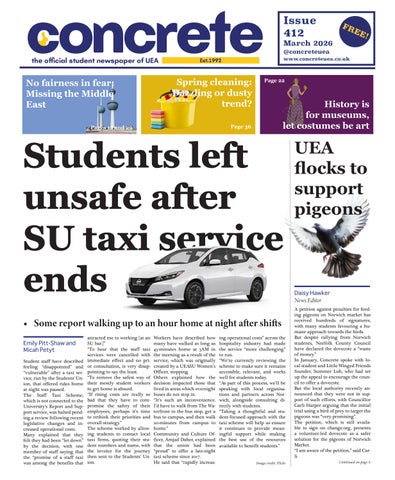
CONCRETE 412

Page 1


Students left unsafe after SU taxi service ends

UEA flocks to support pigeons

• Some report walking up to an

Emily Pitt-Shaw and Micah Petyt

Student staff have described feeling “disappointed” and “vulnerable” after a taxi service, run by the Students' Union, that offered rides home at night was paused.

The Staff Taxi Scheme, which is not connected to the University's Report and Support service, was halted pending a review following recent legislative changes and increased operational costs.

Many explained that they felt they had been “let down” by the decision, with one member of staff saying that the “promise of a staff taxi was among the benefits that

attracted me to working [at an SU bar.]”

“To hear that the staff taxi services were cancelled with immediate effect and no prior consultation, is very disappointing to say the least.

“To remove the safest way of their mostly student workers to get home is absurd.

“If rising costs are really so bad that they have to compromise the safety of their employees, perhaps it’s time to rethink their priorities and overall strategy.”

The scheme worked by allowing students to contact local taxi firms, quoting their student numbers and name, with the invoice for the journey then sent to the Students’ Union.

Workers have described how many have walked as long as 45-minutes home at 3AM in the morning as a result of the service, which was originally created by a UEASU Women’s Officer, stopping.

Others explained how the decision impacted those that lived in areas which overnight buses do not stop in.

“It’s such an inconvenience.

I’d have to walk from The Waterfront to the bus stop, get a bus to campus, and then walk 20-minutes from campus to home.”

Community and Culture Officer, Amjad Daher, explained that the union had been “proud” to offer a late-night taxi scheme since 2017.

He said that “rapidly increas-

ing operational costs” across the hospitality industry had made the service “more challenging” to run.

“We’re currently reviewing the scheme to make sure it remains accessible, relevant, and works well for students today.

“As part of this process, we’ll be speaking with local organisations and partners across Norwich, alongside consulting directly with students.

“Taking a thoughtful and student-focused approach with the taxi scheme will help us ensure it continues to provide meaningful support while making the best use of the resources available to benefit students.”

Hawker News Editor

A petition against penalties for feeding pigeons on Norwich market has received hundreds of signatures, with many students favouring a humane approach towards the birds.

But despite rallying from Norwich students, Norfolk County Council have declared the dovecote a “waste of money.”

In January, Concrete spoke with local student and Little Winged Friends founder, Summer Loh, who had set up the appeal to encourage the council to offer a dovecote.

But the local authority recently announced that they were not in support of such efforts, with Councillor Carli Harper arguing that the initial trial using a bird of prey to target the pigeons was “very promising”.

The petition, which is still available to sign on change.org, presents a volunteer-led dovecote as a safer solution for the pigeons of Norwich Market.

“I am aware of the petition,” said Carli.

Preparing, pride, and more preparing

As daffodils begin to bloom and students slowly start to gather in The Square for a touch of pint-fuelled sunbathing, the Concrete team has been working hard and hand-inhand with the SPA team for the national conference at the end of the month.

From volunteering their time at the event to making an array of over 150 paper flowers for table décor, both writers and editors have played a vital role in making this all come together – and most importantly, showing up for one another.

At the end of February, when the shortlists were announced for the categories that will be awarded at the same national conference, we’d set our hopes high: one shortlist.

Out of a possible 25 categories and having submitted over 40 applications, we had humbled ourselves, decided that what really mattered was having just one person or part of the paper recognised for the outstanding work they contribute each month.

As members gathered in the office, party rings and lemonade splayed across the table like we were at a sixyear-old’s birthday party, we understood why only one shortlist would have mattered.

Because, ultimately, we are shortlisting each other every day. From con-

stant check-ins with co-editors to pub crawls and an endless stream of heart reactions to every message in our Teams channel, we’re awarding each other every day. Ultimately, that care and community was recognised. The team received a flurry of ten shortlisted articles or individuals, with each announcement met with a cheer so loud it echoed throughout the corridors.

It felt like nothing short of a miracle. The most shortlists ever received by Concrete since the start of the awards several years ago, and an even bigger privilege to have received them while hosting the same conference.

Anyone that knows me will know how often I use the word proud. I may as well get it tattooed on me.

A friend even pointed out to me that, since September, I have sent 107 group messages to editors and, after doing my own bit of data analysis, I found that 40per cent of these involved gushing about how great my team are.

I’ll never stop shouting it from the rooftops, and probably for the rest of my life. Concrete has been the best thing to ever happen to me, and I will always be so proud of my little blue and yellow family. We hope you enjoy reading this issue, and feel the love and attention poured into it. Now, off to go and get that tattoo.

"Broken system" for SEND children in Norfolk

Pool president calls for more women to join sport

Why is 'feminit' still an insult?

Beyond the Epstein files: Power escaping accountability Home of the

How the Sainsbury Centre is championing female artists

New SU officers elected: What does this mean for you?

No fairness in fear: Missing the Middle East

Pay attention: Is tech training us to struggle with focus?

The science of procrastination

Tackling sustainablity with Women's Rugby

The women's politics of tree-hugging

How No33 is making its way to No1

A home cooked meal with a mother's love

I treasure Carrie Bradshaw, but I never want to be her

Thank you to the women who've shaped me

Micro-trend temptation

Local roots, big results

Letting women drive the change

Alysa Liu skates to Olympic gold

UEA flocks to support pigeons

Continued from front page

“But the comments we’ve had in favour of pigeon deterrence, both in terms of trader engagement, and in terms of conversations we’ve had with businesses in the city centre are overwhelmingly in favour.”

“I’m very proud of the fact we are responding to trader sentiment. I think it’s very regrettable there are a handful of people that persist in feeding pigeons in a suitable place.”

Although the dovecote faces pushback from the government, many Norwich students and locals are still keen to help the pigeons of the market.

“Many people find that feeding or watching the pigeons helps with their mental health, especially since we barely have any wildlife to interact with in our city,” Summer said.

“Their coos are calming to listen to, and it is grounding to watch them.”

The popularity of the petition, now signed by over 4,000 people, lead to change.org officially advertising the campaign on their UK social media pages.

Despite Norwich City Council’s comments, Summer said she was “hopeful” that her activism could change the general public’s opinion on pigeons.

“I think this account has proved just how many people care about pigeons. If the council aren’t willing to do anything, I’m hopeful Norwich locals can make a difference instead.”

In an effort to raise further awareness about pigeons in Norwich, Little Winged Friends has started hosting workshops in the community.

This included a ‘decorate your own flapping pigeon’ workshop, led by local artist Alice Lee, where attendees crafted wooden pigeon toys at The Garnet.

The goal was to provide a free space to inform the public about misconceptions pigeons face.

UEA warns after meningitis outbreak

UEA students are being warned about meningitis following the death of a student at the University of Kent. In an official statement from @ unikentlive on Instagram, it was confirmed one of their students had died following an outbreak of meningitis in Canterbury. The UEA has since sent campus-wide correspondence reminding staff and students of meningitis symptoms. The university has urged students who think they might be experiencing any symptoms to seek urgent medical help and encouraged students to ensure they are registered with a GP in Norwich.

‘Being Woman’ exhibition opening in Norwich

An art exhibition is coming to the city focusing on what it means to be a ‘woman’. 26 artists will have their work on show offering a variety of mediums. These pieces show women at different points in their life making the exhibition a journey through history. The launch event was at Mandell’s Gallery, Elms Hill on Sunday 8 March March, which happened to be International Women’s Day. Entry is free until the closing date of 18 April.

Student awarded PHD funding by British Heart Foundation

Macy Hall

“If pigeons really spread that much disease, then most people would be infected, since pigeons are everywhere,” Summer said.

With Summer’s campaign and activism visible on campus, students have said that they are more eager to help than ever before.

“I wasn’t aware it was such an issue before, but hearing of the petition I realised just how insane the entire situation is,” said creative writing student Wallis Crane.

“I love seeing the pigeons in town, it’s a part of its charm. They’re so cheeky and cute, and it’s kind of horrifying to think the council are so unfazed by birds of prey hurting them.”

Law student Louisa Gravelle added: “I signed the petition, and I’d definitely help out more.”

“I hope that people can be made aware pigeons are not as dirty and disease-ridden as they think,” she said.

“Pigeons do not spread any more diseases to humans than other animals. They have an unfairly earned reputation.”

A UEA student has been awarded a Discovery Research PhD studentship by the British Heart Foundation. Lauren Jay has been granted over £130,000 for a research PHD on early cardiovascular development. The project will explore how early blood vessels form during heart development, using advanced genome-editing techniques and high-resolution imaging in chick embryos. The research will study how physical forces influence developing cells. Understanding these processes aims to reveal new clues about how congenital heart and blood vessel conditions begin.

New UEASU officers elected

Ruby-May Elger

Five new full-time officers have been elected following weeks of campaigning and voting for the roles. The salaried positions include Megan Alridge for Activities and Opportunities, Anisah Tufal for Community and Culture, Gray Prothero-Gibbs for Undergraduate Education, Jaz Brook for Campaigns and Democracy, and Amin Jawrawala for Postgraduate Education. A further 11 students were elected for unpaid, part-time roles, including Tobias Lambe who will return as Disabilities (Open Place) Officer, and four non-portfolio officers.

Daisy Hawker
Mia Lutchman

“Broken system” for SEND children in Norfolk

Parents in Norfolk have said that they’ve endured waits “up to 15 years” for their children to receive an autism diagnosis.

According to statistics, the current wait time for a professional assessment in the county is between three and five years.

Chair of Thrive Autism, Colin Lang MBE, has seen the struggle first-hand with his two neurodivergent grandchildren.

“The current system in Norfolk is broken,” said Lang.

“Anyone with a child with special educational needs is forced to fight for everything they need.

“We have seen parents wait six months just for a response after applying for a diagnosis.”

The charity supports families in the region and hopes to build a centre with 20 rooms which meets the demands of the neurodivergent community.

The average cost of a private diagnosis in the UK is between £1,715 and £3,000.

Families who do not have the money must remain on the NHS waiting list af ter a doctor's referral.

One young girl recently received her di agnosis through the Thrive Autism after waiting for five years.

She was in extreme circumstances and desperate for help before the inter vention.

The charity plans to use local pro viders to take more children off the list for less than £750.

Lilli is the founder of Autism Ex plorers, a community group for SEND families in Norfolk, and was re cently diagnosed with ADHD.

She said the confirmation helped her un derstand how and why she does things.

“Since having a diagnosis I understand myself so much better,” said Lilli.

“A diagnosis confirms it for yourself and allows you to access so much more support.

“I hope to see people accept that not everyone is the same.”

The Norfolk Community Health and

asfor and tism for children under 18, said they were “working closely with [their] Ined Care to address waits and children people rement are

continue to work partners to develop a Neurodiversity Transformation Programme which will offer a new way of supporting children, young people, and families as soon as they recognise that they may need some support.”

UEA project remembers amateur female filmmakers

M. Johnston.

A new project at The University of East Anglia is highlighting female amateur filmmakers whose creative work has been previously unacknowledged. Women in Focus is an initiative that works with the East Anglian Film Archive and Irish Film Archive to uncover the work of women amateur filmmakers throughout history.

The original project started in 2023 under the name Women in Focus: Developing a Feminist Approach to Film Archive Metadata and Cataloguing, led by Sarah Arnold and Keith M. Johnston from the UEA Film and Television studies.

It began with the aim of developing new approaches to help appropriately archive and credit the works of amateur women filmmakers and ensure the recognition and preservation of their projects.

“Women's histories are constantly overlooked in favour of male filmmakers,” said Women in Film researcher, Keith

“That is, in part, because many archive collections were donated by men - this led to collections being associated wholly with their name rather than understanding there might be collective or collaborative work across different films.”

Now, it has been released as a ‘toolkit’ document that will aid archivists and researchers.

The sixteen-page document outlines several problems with current amateur film archival, which disproportionally lead to the obscuring of the women who participate in these projects.

Among the issues raised is the lack of appropriate metadata for the projects, an issue that is common in the archival of amateur films.

According to researchers on this project, the misattribution or loss of appropriate metadata means entire filmographies are lost, and many female collaborators are omitted.

“This is increasingly important when most people search archives using a webbased search or browse function,” added Keith.

“Inaccurate metadata can obscure these women even further.” Their proposed solution is to acquire the additional information on the projects from their donors via interviews or questionnaires, hoping to give as much insight as possible on the roles involved in the production. Although the project has the aim of highlighting women in the amateur film industries’ work, the researchers believe many of these strategies proposed can be extended to filmmakers from other marginalised groups. In addition to metadata for films, Women in Focus has also brought forward the biographies of women filmmakers and creatives who had previously been obscured. Their works are now available across several archives and collections.

The Toolkit for Archiving Women’s Amateur Film as well as more information on the project and collaborators are available on the UEA Research Groups and Centres website.

Third officer exits Students’ Union

A third full-time officer has resigned from the Students’ Union following the election of five new sabbatical roles.

Olivia Hunt, who was the Activities and Opportunities Officer, handed in her notice after securing “exciting new opportunities.”

The officer, who spent almost two full academic years in her position, said that it had been a “privilege to work with students, UEA, UEA Sport and the SU team.

“I’m incredibly grateful for the opportunities that I’ve had in this role, and UEA will always hold a special place for me.

“I’m excited to see how the new officers shape the future of the SU and wish them all the best.”

UEASU Chief Executive Officer, Jumara Stone, said that she could “not be prouder” of what Olivia had achieved in her tenure.

“She has made some incredible changes for the betterment of students and the student experience.

“From re-envisioning committee training, to launching an affordable Hyrox-style fitness event, she has always considered how to best represent students.

“We wish her all the best for her future and look forward to hearing more of her successes.”

Olivia is the third full-time officer to have left the Students’ Union this academic year, following the resignation on Chris Kershaw in November and Bhaskar Shivanna in January.

Her last day employed by the union was stated to be 16 March 2026.

M.J. Aguilar Chapa

A 'wheely' good fundraiser for Norfolk sanctuary seekers

Norfolk asylum seekers and refugees will be provided with bikes and parts through an initiative by The University of East Anglia and Norwich Bicycle Repair Cooperative (NBRC).

The NBRC aims to keep cycling accessible and affordable, working alongside campus-based ‘Dr-Bike’ to offer services such as same-day repairs, free cycle health checks and subsidised parts.

Olga Sovenko, a Ukrainian refugee, and her two daughters, Luiba and Zoia, are just one of the families they’ve helped.

After fleeing Ukraine in March 2022, they came to the UK through the Homes for Ukraine programme and

funding from the British Academy for forcibly displaced Ukrainian scholars.

“Dr Bike are really great,” said Olga.

“They have repaired the girls’ bikes and replaced them when they outgrew them and even gave Luiba a pink one – her favourite colour.”

However, the project needs funding to continue helping people like Olga.

The fundraiser hopes to raise £500 to pay for bike parts, like tyres, wheels, brake pads, saddles and helmets - they have only raised £140, 28% of their goal.

In 2018, the UEA was recognised as a University of Sanctuary by the City of Sanctuary organisation.

This status, accredited to over 50 UK universities, is given to those who create a culture of respect and inclusivity to sanctuary seekers.

Madi Dutton, UEA’s Sanctuary Liaison Officer, who works within the University

long-term partnership with NBRC”.

“Whilst the wonderful staff at NBRC ensure we can offer this support by working on the bicycles in their own time, we urgently need financial support to cover the cost of the parts.”

“Every donation, no matter how big or small, will make a huge difference.”

Charlie Smith from NBRC said that

helping the sanctuary community with bikes

“gives them the freedom they have here looking

“We have seen firsthand how impactful this initiative is, from ensuring that sanctuary scholars can travel to the campus with ease to reducing social isolation.”

Since 2020, the UEA and NBRC have been working together to provide the local sanctuary community with access to ongoing free repair services and renovated bikes.

Pool president calls for more women to join sport

The President of UEA’s Pool and Snooker Club, Poppy Fenn, has said that she hopes having a female president will make the society a more welcoming place for women.

Poppy, who enjoyed playing pool in pubs before coming to university, said she was convinced to join UEA Pool and Snooker at the Sports Fair in 2023, when the Social Secretary persuaded her to join what was only two women in the club at the time.

After enjoying her time so much in the club, Poppy worked her way up to the role of President and Women’s Captain for UEA Pool and Snooker.

She now hopes that a female president can make the club seem like a more welcoming place for women.

While playing casually in pubs, she said she had experienced mild misogyny as a woman in a male dominated sport.

“[The men] look at you like ‘Why is she in here?’” she said.

She recognised this judgement, often taking place in the form of stares or comments, as discouraging women from getting involved.

But Poppy confirmed she had received or witnessed only a small amount of harassment when playing pool at UEA and other universities compared to casual pub settings.

“Of course, there is potentially more that I’ve not experienced myself, but my overall experience has been overwhelmingly positive.”

In the 2026 BUCS tournament, Poppy came 9th out of 170 female student pool players and placed 2nd in the recent Southern Universities’ Pool Tournament, despite only starting competitive pool at university.

Citing her success in university competitions as motivation, Poppy is current-

ly working towards joining the England Student Team, which consists of four female student pool players who represent the country.

She thinks that pool has helped her with transferable skills for the world of employment.

“I’ve had opportunities to be on councils, which has given me transferable skills in organising competitions and succeeding under pressure.”

There are now four women in UEA

Pool out of 40 members.

When asked about what she would say to a female student thinking of joining UEA Pool and Snooker, she said simply:

“Just give it a go!”

“We are all just people, it might look intimidating, but we really aren’t.

“The club is inclusive, and everybody is happy to welcome new people, no matter their gender, age or ability level.

“The aim is just to get better at pool and have fun with friends.”

COMMENT

Pruning the branches of sexism won't kill the roots of the patriarchy

You can trim a tree’s branches every spring, but if you never dig up the roots, it will always grow back. This is especially relevant when thinking about women’s issues. Discussions about the patriarchy has lingered for years, however how society views it has changed. It seems everyone has a different view on what this system entails. Many of us wish it could be discarded quickly like Ken’s mentality in Barbie (2023) when he said, “To be honest, when I found out the patriarchy wasn’t about horses I lost interest.”

This fictional take on the effects of patriarchy did reflect on real world impacts gender inequality has on everyone. However, like many other attempts at criticising inequality, it was surface level. Surface level activism (also known as performative activism) is actions such as using a hashtag relating to a certain issue to signal support for a cause without committing to lasting change. The Barbie movie did not make any real-life changes. In the digital age, it seems issues such as genocide and racism are trapped in a trend cycle.

If you take the United States pulling out of Afghanistan in 2020, many social media posts at the time aimed at shedding light on the poor treatment of Afghan women. Six years on, it feels like the world has left them behind for other causes. The internet has both democratised the information we post and consume yet has somehow made an algorithm where you see a post about human rights violation with the post below it usually being something completely different such as AI slop.

Surface-level activism is not a new phenomenon; however social media has amplified the problem. When it comes to criticising a system so deep-rooted such as the patriarchy it is common to feel a sense of apathy. In 2014, a popular “This is what a feminist looks like” t-shirt was

launched by the Fawcett Society (charity campaigning for gender equality) and worn by high profile figures such as Ed Miliband. This not only was textbook performative activism, but the discovery that those producing the garment were sweatshop workers making 62p an hour in poor conditions showed the dark side of the short-lived movement. Critics argue it was hypocritical for a feminist campaign to rely on the exploitation of women in the global garment industry. A decade on from this controversy, the debate on ethics surrounding fashion feminism still holds relevance due to the ongoing exploitation of workers (both men and women) who make these “powerful” garments.

Intersectionality, meaning multiple identities combine to form unique experiences, is important to consider when understanding that no two people experience the patriarchy or other oppression the same way. For example, the rise of the “tradwife” in the west is a lifestyle choice women can make for themselves, however for women living in countries with stricter gender roles they do not have this choice. The patriarchy isn’t just a women’s issue, it affects everyone, yet even in 2026 it feels the feminist movement still focuses on middle/upper class white women similarly to the beginning of the movement. It’s true this demographic faces challenges due to their gender, however a working-class woman of colour faces another two forms of discrimination, racism and classism. This is neglected by white feminists and shows the importance of inclusivity in movements.

If we want this tree gone, we need to dig deeper with more volunteers. It isn’t an easy task, however everyone can do their part in both recognising just how ingrained this system is in our lives and challenging it.

Why is ‘feminist’ still an insult?

One of my earliest memories of engaging with political discussion as an adolescent was picking up on the frequency of the term ‘feminist’ being thrown around as an insult at school. A ‘pink haired feminist’ or a ‘triggered social justice warrior’ were pejoratives that signalled that identifying with feminism was a clear pitfall into losing social standing amongst groups that were comforted by a misogynist and anti-intellectual status quo. The word feminist took a measurable nosedive in the online culture of the mid 2010s with the conflation of feminism as an intersectional liberationist identity with uninformed radicalisation, pettiness and physical ugliness amidst the proliferation of meme culture online, primarily on social media platforms like Facebook, Twitter and YouTube. Gamer Gate is an important modern case study that can allow us to peek more at how online communities including video gaming, social media and political commentary communities displayed their shallow propensity for progressiveness within their spaces. It captures the zeitgeist of online men talking about feminism and shows how so many negative traits have been attributed to the feminist identity.

The Gamer Gate culture war arose prominently as a media scandal involving online male gamers attacking women with followings in their spaces, most prominently media critic and blogger Anita Sarkeesian.

Sarkeesian’s ‘Tropes vs. Women in Video Games’ was a crowdfunded YouTube series, broadcasted on her Feminist Frequency YouTube channel between March 2013 and April 2017. The series called into question the assumed roles and portrayals of female characters in video games and related media. Notably, the series begins with a discussion of the ‘damsel in distress’ trope, think Princess Peach from the Super Mario Bros. games. Sarkeesian makes the point that “the popularity of their ‘save the princess’ formula essentially set the standard for the industry [and] the trope quickly became the go-to motivational hook for developers as it provided an easy way to tap into adolescent male power fantasy”. The ensuing virality of Sarkeesian’s statements as well as other feminists online who agreed or shared similar sentiments displayed further that feminist critique of video game culture was seen as unfairly encroaching on a nonpolitical space, or even bigoted itself against the category of ‘gamer’. Before the series even began, the crowdfunding alone was enough to encourage death and rape threats against Sarkeesian, causing her to flee her home. One gamer even developed an independently hosted game: ‘Beat Up Anita Sarkeesian’ where you could click to bludgeon Sarkeesian, returning variously intense gory images of Sarkeesian’s bloodied face.

In the 2020s, online monetizable and algorithmic media has hugely rewarded anti-feminist creators such as Andrew Tate in what has been widely heralded as a conservative backswing

from the ‘woke’ 2010s. These creators would have you believe that you are part of a majority that is exhausted with diverse identities being represented in world media, and feels as though ‘traditional’ values are under attack, with the goal of protecting the cultural and political dominance of the man (especially the white, heterosexual, able-bodied cisgender man).

It is becoming increasingly difficult to follow modern conservative media trends, especially with large, government affiliated organisations like Charlie Kirk’s Turning Point USA sponsoring and employing burgeoning levels of new conservative influencers to reinforce the core tenets of modern conservatism. Markedly, anti-feminist action such as supporting legislation to criminalise abortion and contraceptive resources, conflating transgender people with paedophiles or sex offenders and strict conformity to biblical teachings, including promoting the aesthetic of being a trad-wife, or total submission of the woman to her male counterpart in heterosexual relationships.

‘Feminist’ is a loaded term, dripping with histories and remaining as countercultural as ever in the wake of new forms of fascism that we see across political, digital and societal planes.

Image credit: Fig Oakes

Beyond the Epstein files: Power escaping accountablity

In the United Kingdom, we are lucky enough to have the remnants of something called accountability. Nobody is above the law.

Here, at least, the unfolding revelations of the Epstein files triggered some tangible legal consequences. Former Prince Andrew was arrested by Thames Valley Police. To be entirely clear, this arrest was not for child sex offences, but on suspicion of misconduct in public office - specifically, allegations of leaking confidential government trade documents to Jeffrey Epstein. Yet the point stands: a man born

into the highest echelons of global privilege was taken into police custody.

Days later, Lord Peter Mandelson, a titan of the Blairite British political establishment, and recent Starmer hire, faced the exact same fate. He was arrested on suspicion of misconduct in public office too, but the details of this are a bit blurrier. Britain, it seems, is willing to act.

Now, compare this concrete action to the United States, where accountability has mutated into a grotesque form of political theatre. In America, some say the justice system and congressional oversight are frequently weaponised for partisan spectacle rather than genuine consequence.

Consider the endless congressional hearings. Hillary Clinton was forced to sit and testify before an oversight committee about her connections to Epstein, despite multiple investigations concluding she didn't see or do anything warranting criminal charges. The US system has eagerly issued hundreds of subpoenas to just about anyone remotely connected to Epstein, dragging private citizens into partisan mudslinging contests that rarely result in

actual justice. Meanwhile, those with more documented ties to Epstein in the US continue to evade the inside of a jail cell. Bill Clinton, whose extensive flights on Epstein's private jet and close ties to the financier are a matter of public record, has also testified, downplaying his connections. He says he was unaware of Epstein’s seedy doings. We have to believe him. This is the same system that impeached him for lying about a consensual affair. It now seems entirely paralyzed when faced with allegations of elite corruption.

The UK arrests of Andrew and Mandelson prove that even the most powerful can face the police, even if it takes the slow wheels of bureaucracy. The US prefers to substitute real justice with closed-door hearings, endless subpoenas, and a twotiered system where the truly elite remain perpetually out of reach.

Computers were a women’s world

For me, history is at its most exciting when I find tales of people’s brilliance which never had the chance to shine. Sometimes talent is ignored or erased altogether. But at the very least, sometimes talent is recognised decades later, as is the case of Margaret Hamilton. Margaret Hamilton was the lead software engineer for NASA’s Apollo programme. While the world watched astronauts step onto the Moon, she was part of the brains behind the code making it possible. She was the only woman on the team at the MIT Instrumentation Laboratory that developed the onboard flight software for the Apollo program, eventually becoming director of the program altogether. In the 1960s, software was considered secondary to hardware; it was clerical women’s work. Prior to the introduction of digitalised computer, women quite literally were the “computers” --in this

context meaning a person who manually solved complex mathematics at fast rates. As computers became closer to what we know today, Hamilton insisted computer code was engineering. She is even credited with helping to popularise the term “software engineering”, a term which demanded the legitimacy of computer science in the space race. When NASA’s Apollo 11 began its descent to the Moon in 1969, the onboard computer was overloaded. In that tense moment, it was Hamilton’s prioritisation alarm system she designed and fought to include. The code focused on critical functions when overwhelmed with data, which saved the landing. But of course, as soon as the field gained prestige and financial power, the gendered dynamics shifted. Computer science became a boys’ club, and the same work that had once been dismissed became elite. Physics and computing are now spaces where women often feel they must prove themselves more than their male counterparts. I have experienced the

subtle underestimation firsthand being the only woman in a computer science class as a teenager.

The surprise when you understand something technical, the assumption you are less capable, even from teachers. It is this atmosphere which made me feel too small to continue what I had an interest in, not picking it up again until much later in life. That, and the fact Computer Science clashed with Drama, of course. Unlike me, Hamilton carried on working in rooms where she was the only woman. She brought her young daughter, Lauren, to the lab because childcare support was limited. When Lauren accidentally caused a simulation crash during a test, Hamilton realised the software needed better error protection. She advocated for changes but was initially told they were unneces sary. We know now those same safeguards later proved critical. Still, the fact she only received major public recognition dec ades later, including the Pres

idential Medal of Freedom in 2016, shows how slow history can be to catch up to the achievements of women in history. The famous photograph of Margaret Hamilton with the stacks of printed code the size of her has always moved mel. Even in a world not truly appreciating her labours, she smiles, proud of her achievements. In today’s context, her smile seems persevering, as if she knows there will be starry-eyed young women such as myself who can read of her efforts and feel more inspired.

Once upon a

women were not only the world of computers, rather they were the computers. Then came the men and the machines, and in just under a decade, the roles completely reversed. Even to this day, a conscious pushback against STEM being male dominated still sees only less than a quarter of computer science students female in the UK.

But perhaps, then, the lesson can be this: the value of a field shifts with power, but talent does not. When I read of Margaret Hamilton, I am reminded to do what makes me happy despite what others think. She did not wait for permission to be taken seriously. She did it anyway.

Image credit: GetArchive

Image credit: Pexels

HOME OF THE WONDERFUL

Inside BUCS: How UEA Sports teams are performing this season

BUCS stands for British Universities & Colleges Sport, and it is the national ruling body of UK competitive higher education sport. BUCS aims to use sport to enhance the student experience. The University of East Anglia (UEA) has entered 23 sports out of the 55 available. Below is a roundup of UEA’s league positions (as of 03/03/2026):

*Rank and points will be representative of all UEA teams (men’s, women’s, mixed and open) competing in that event, unless specified otherwise.

Overall, UEA is placed 41 out of 144 in the league, with 1008 points. UEA Men’s is 44th with 365.5 points. UEA Women’s is also 44th, with 361 points. UEA Mixed and Open is 33rd, with 281.5 points.

Standout athletes and teams: American Football’s Joshua Aina has made the GB Devel-

opment Squad. Before joining the Pirates, he had no experi ence playing the sport, making this achievement, over two sea sons, even more impressive.

UEA’s Boxing has seen some great fights, with a handful of fighters narrowly missing out on wins in their semi-final matches due to split decisions. Amongst them include Signý Ósk Sig urðardóttir and Vice President, Sachin Kambli.

UEA Men’s Hockey defeated University of Nottingham to reach the final of the BUCS Mid lands Cup, where they will face the University of Loughborough in the final.

The Men’s Lacrosse Team has had an undeniably successful season, winning 6 out of their 7 matches. Scoring 62 goals, they dominated the league, earning themselves a promotion to Tier 1 next season.

Things have also been looking up for UEA’s Mixed Volleyball, who have become the Develop ment League Winners. According to a report conducted

club night to all those involved in UEA Sports, where dressing up to fun themes is common-

Sports clubs also do extensive work with charities, with a notable mention of UEA Women’s Rugby’s campaign ‘Let It Hang,’ which raises awareness of breast

The future of UEA Sport seems to be in equally good hands as it's passed over from Olivia Hunt to Megan Aldridge, who has already promised to build an even bigger community between clubs and make memberships more accessible along the way. Clearly, UEA Sport provides something for everyone, whether that be a chance to socialise, to compete, or to improve your

Image credit: Public Domain Pictures

HOME OF THE WONDERFUL

How the Sainsbury centre is championing female artists

It’s Women’s History Month and the Sainsbury Centre, the art gallery and museum situated on the University of East Anglia’s campus, is a prime place to visit.

In 2018, Tania Moore, now Head of Exhibitions, was a budding curational talent. Moore found that there was a significant gender imbalance in the Centre’s collection, with women making up only 18 per cent of the named artists.

Relying on gifts and fundraising as a way to gain new art made it extremely hard for the Centre to improve this percentage. Hence, when it became a recipient of the Art Fund’s New Collecting Award, launched in 2015 to give UK museums funding to diversify collections, Moore used £80,000 of the fund budget to procure the works of several international female artists.

Among these artists were Mona Hatoum, a Palestinian-born multimedia and instal lation artist, Shawanda Corbett, a US-born ceram ic and performance art ist, Wangechi Mutu, a Kenyan visual artist, Cornelia Parker, an English visual artist and Rachel Knee bone, a British sculptor.

Rosy Gray, Head of Living Art at the Centre, shared some her favourite works by

these fe male artists.

Gray found Hatoum’s Composition with Circles I a particular favourite. Using seven strands of her own hair, Hatoum creates circles, refer encing the geometry present in minimalist art. However, she subverts minimalism’s detached

aesthetic and concealment of artistic craftmanship by forcing the bodily to be present through hair, making it a piece ripe with tension and transformation.

Another piece that Gray commended was Corbett’s acrylic painting Let’s straighten it out, with its bold colours and shapes.

Mutu’s unique use of layering different printmaking materials and techniques in The Original Nine Daughters was also highlighted. Depicting nine different beings, hybrids between women and animal-like goddesses, who wear stilts and boots, but also have claws and antennae, she redefines what it means to be seductive and powerful, while also challenging historic violence and misrepresentation of black bodies.

Gray also highlighted Parker’s inventive repurposing of the bullet in Bullet Drawing. Exploring how object’s hold memory, while also being in dialogue with conflict, Parker’s work explores vulnerability at

parts.

Moore detailed that she saw his diversification “as a starting point,” despite the grant’s finiteness. So, what work has the Centre been doing since to continue celebrating female artists?

In November, the Centre introduced a new exhibition called Seeds of Hate and Hope (running until May 17th), which explores artistic responses to global mass atrocities, like ethnic cleansing and genocides. As part of this, there are three stand-out female artists. Hatoum’s Hot Spot, a stainless-steel globe that depicts the entire world in the dangerous glow of red, is the fore image for this exhibition.

Kimberly Fulton Orozco, a multidisciplinary artist who explores the tensions of being a multicultural Indigenous woman, and Indre Serpytyte, a Lithuanian artist who uses her art and photography to make her country’s emotional past more tangible, also feature. Gray also highlighted a recent acquisition of Martine Guitierrez’s Demons, Yemaya ‘Goddess of the Living Ocean,’ p94 from Indigenous Women,’ which uses Andy Warhol’s Interview magazine format to celebrate Mayan Indian herit-

Glyndebourne I, which explores the fluidity of movement through the layering of body

Infantino elected FIFA president, ten years on

Ten years ago, in the March issue (323) of Concrete, the sport section published a piece covering Gianni Infantino’s election as FIFA (Internation Federation of Association Football) President, sharing cautious optimism on a new era.

Sepp Blatter’s 17-year presidency had ended in scandal amid the 2015 corruption crisis, which saw senior FIFA officials indicted on charges including racketeering, wire fraud and money laundering. Blatter was found to have breached FIFA’s ethics rules over an “unjustified payment” to Michel Platini, his deputy and a leading candidate to succeed him.

Infantino was framed as a reformer, promising to place football “at the centre of the stage.”

nificantly engaged in global politics. At the draw for the 2026 World Cup, which will be hosted by the US, Mexico and Canada this summer, Infantino presented U.S. President Donald Trump with the inaugural “Fifa Peace Prize.” The award recognised Trump for “his tireless efforts to promote peace,” and called the prize “one of the great honours of my life.”

The pro-Trump sentiment did not stop there. In February this year, Infantino attended a high-profile meeting with Donald Trump’s Board of Peace in Washington DC, where he briefly wore a red “USA” hat. The image reignited debate over FIFA’s political neutrality and sparked questions from internal sports governance bodies.

It’s clear that the Centre has taken significant steps to include more female artists in their collections

since 2018, celebrating a diverse range of female artists and mediums, while also giving them a voice in important discussions, like global conflict.

Concrete’s coverage captured a pivotal moment for the Federation with term limits introduced, female representation on the council promised, and Infantino promising transparency. While the tone was wary, it remained hopeful for the future.

The mood was one of relief. With Blatter and Platini removed from office, FIFA’s credibility had been left in tatters. The Concrete article’s language echoed the era’s desire for transparency and change in the world of Football.

A decade on, that optimism feels more complicated. While Infantino has reformed FIFA internally, he has become sig-

Looking back, this 2016 Concrete article reminds us how reputations evolve. At the time, Infantino represented a clean break from scandal. Ten years on, he has steered football into international diplomacy, for better or worse. The shift highlights how student journalism from a decade ago capture a snapshot of a moment before global events reshaped reputations within the world’s most popular sport.

Image credit: Robyn Srikandan
Angus Coulson HOTW Editor

HOME OF THE WONDERFUL

New UEASU officers elected - but what does it mean for you?

Five new officers have been elected following weeks of campaigning. But who are they - and most importantly, how will their manifestos impact the future of the Students' Union?

Ruby-May Elger and Daisy Lester

With the UEA Students' Union elections over and announced, what promises have the successful candidates made in their campaigns, and how could it affect the future of the university?

Following weeks of voting and campaigning across campus, the new union team are stepping in. After seeing three officers from last years cohort resign, we also saw no re-runs from previous candidates, leading to the stepping in of an all-new team.

First off, Megan Alridge, the new Activities and Opportunities Officer, graciously congratulated all the successful nominees, and thanked those who voted for her. Her campaign focused on more inclusion in sports and societies, with a “push for payment plans so everyone can join,” as well as more regular SU events and better communication.

If implemented, payment plans could help spread the steep costs of many

sports clubs and societies, with a base sport membership alone costing £55 (not including specific sports joining fees or additional costs). This would be hugely beneficial for lower-income students, or those on funding plans deviating from the standard SLC package.

Next, Jaz Brook, the new Campaigns and Democracy Officer, is graduating from her part-time role as Environment Officer last year, focusing on fighting “against the creeping commercialisation of campus services” as well as increased "transparency and student consultation before new commercial contracts are signed”. She would like to “give power back to students”, hoping to fight for improvements to student accommodation contracts and pricing protections. As seen from her previous tenure and founding of her own activist company, Jaz is clearly passionate about activism. We'd be surprised if we don't see positive change from Jaz’ position.

Anisah Tufal's campaign highlighted research and collaboration, as well as “fundraising for groups that support Equality, Diversity and Inclusion” on campus. Previously the People of Col-

our Officer, Tufal has now been elected as the new Communities and Cultures Officer. She was also previously a committee member for Headucate, an award-winning society around mental health, and aims to continue advocating access and awareness of mental health services. While her campaign was more understated, it focused on achievable goals, and with her wealth of experience in student support roles, it's expected her actions will speak louder than empty promises ever could.

Gray Prothero-Gibbs is our new Undergraduate Education Officer, whose campaign promised greater transparency surroudning tuition fee spending and ensuring “that the quality of [students] education matches the value for money”. Their main concern is making terminology and signposting more accessible for students – a popular complaint amongst the campus demographic. Whilst it is unclear how they aim to do this, with their experience as Disability Officer it’s sure that they will highlight areas for improvement that may not be obvious to the able-bodied and neurotypical.

Their postgraduate counterpart, Amin Jawrawala promised to “address the pay disparity between UKRI and UEA stipends and push for fair and equal pay for all” postgrads – a specific and measurable goal, though it will be interesting to what extent this issue can be addressed.

Across all campaigns, there is also a focus on increased feelings of belonging for students, and student empowerment in decisions. And, with a voter turnout of 26.5 per cent - up almost 6% from last year - it will be interesting to see how the student body will engage with the new officers.

We're looking forward to seeing the changes implemented by the new team after summer break and expect it to be exciting to see how they improve upon last years group.

Image credit: Students' Union

INTERVIEW

No fairness in fear: Missing the Middle East

Born and raised in Kuwait, Nada recalls colourful markets tainted with the smell of fresh coffee and spices. But now, the sounds of nightly sirens echo in the distance as the prospect of war nears.

“We’re foodies,” Nada grins, placing her palms face down on the table in excitement.

Smile unfaltering, she begins to recite a recipe for machboos, a fragrant rice dish served with tender lamb. Somewhere in between the steps of boiling rice and adding seasoning, she whispers, “it tastes like home.”

For just one moment, as Nada stirs the pot of aromatic meat and grains in her small kitchen in Norwich, her whole family joins her. Stood around the stove, laughing and sharing stories, they prepare to eat.

Apart from, they are not really there. Instead, her parents and younger sibling reside 2,830 miles away in Kuwait.

For Nada, a serving of machboos is the closest she’ll come to her home country until nearby conflict ends.

The young woman’s face is stung with uncertainty as she explains that, since the United States and Israel launched attacks on Iran, sirens have rung through the still air of the night in Kuwait.

“The scariest thing is not the sirens themselves,” Nada says. “It’s been having to learn what each of them mean.”

Like learning the language of war, she explains that each sound signifies a different scenario. Some suggest safety, others imply danger. All are terrifying echoes of what is happening across the Middle East.

But Nada remains surprising ly light about the situation, despite lengthy days of fast ing and sleepless nights.

“We have a dark sense of hu mour, as Arabs,” she laughs.

“I heard a man say that once this is all over and the sirens have ended, he’ll sleep for five days with no alarm.”

Perhaps it’s this light-hearted out

look on life that is keeping so many going. Or perhaps it’s memories of a softer youth, one carefree, safe and filled with colour.

Despite Nada’s polite nature, she insists that she was albeit growing up. “I was the naughty one in my family,” she confesses. It’s hard to imagine, as she sits with her hands politely crossed in her lap, pausing occasionally to hear my own anecdotes. She recalls riding her bike around the local neighbourhood, accompanied by

er brother is now, in seventh grade,” she says. “But we didn’t have to worry about the things that he does now. I’m not sure, but I think he understands war.”

It’s a word that few children should be able to spell, let alone understand the torment of. Like a lurking shadow, it’s stands behind a closed door, waiting for one stray bullet or weaponised decision to open it.

As Nada describes her situation, she’s careful to dodge the word that would purse her lips and burden those listening like a monosyllabic stab to the chest.

“I hate it. I can’t say war in the same sentence as my home country. It doesn’t belong there. It shouldn’t be anywhere near Kuwait. It’s just not fair.”

Through what if’s and it might’s, Nada’s smile remains. It is obvious that, despite the five years she’s spent away from home, she has hope. She tells me that many think that conflict is common in the Middle East. She reminds me that manmade death is

BOOKS - CREATIVE - FASHION - FILM + TV - MUSIC - EVENTS

An interview with Ebi Fegha - Why women's memoirs matter - Sinkhole at the Holloway - What’s on in Norwich - Feminists in fashion - Album reviews - And more!

Letters from the editors

Dear reader,

This is the penultimate Venue of the year, and with that the penultimate issue of my Concrete career, which is kind of a scary thing to think about. I don’t know with what I’ll do with all my extra time once our May issue goes to print, maybe I’ll pick up some of my hobbies again— or spend more time at the pub.

The last few weeks have been some of the longest and busiest of my university career. Between dissertation workshops, Concrete meetings, piles of reading to do, my part-time job picking up, and trying to figure out what I’m supposed to do after I graduate, I think I’m going slightly insane. But, I’d say it’s all worth it when the sun comes out, and students gather in the Square for a 2pm snakebite. Pimm’s season is just around the corner, and that makes diss work all that more bearable. Besides, you’re only a student once (unless I end up in a panic masters’)!

Besides, it cannot all be doom and gloom when you are currently holding one of the best student papers in the UK & Ireland, with a Venue cover shot by one of the country’s best student photographers (#humblebrag). That’s right, we are officially Student Publication Award shortlistees, and what a great look for us as this year’s SPANC host!

With the SPAs at the end of the month, life here at Concrete has been non-stop, and as excited as I am for the conference, I am even more excited for the three weeks of break I’ll get afterwards, when I can hope to finally fix my sleep schedule.

I hope you all have a restful Easter holiday, and if you’re planning on spending most of it knee-deep in the disserta tion trenches, then know that we’re in this together!

Sincerely,

Books....................................................................p16

The verse of a nation: Irish poetry

Why women's memoirs matter

Rethinking écriture féminine

Reviews: The Persians by Sanam Mahloudji, The Bell Jar by Sylvia Plath, How to Get Into the Twin Palms by Karolina Waclawaic

Creative................................................................p18

Stampede

From the breakfast table

Kneeling Woman

Just Because!

Photo spread by Sasha Ouvry

Fashion................................................................p22

New York Fashion Week in review

Clothes by women, for women

History is for museums, let costumes be art

Venue En Vogue: What’s in for March?

Film + TV.............................................................p24

In defense of girly films

Hello everyone,

I love March! The sun starting to shine again always fills me with hope and an excitement for new beginnings. One of my housemates has bought some daffodils for the house, and every time I see them I truly feel like spring has arrived.

Daffodils are also my mum’s favourite flowers. I can see why – their vibrant colour and seasonal associations make them feel so optimistic. Just recently it was Mother’s Day and seeing daffodils everywhere made it impossible to not think of my mum.

She is one of the most important women in my life and, cliché though it is to say, I really would not be who I am were it not for her. It almost doesn’t feel right to think of her as just one of the billions of women on this planet, but the truth is that each and every one of these billions of women is incredibly important. Whether it is through changing laws or simply being a good parent, women impact every aspect of our lives. With both Mother’s Day and Women’s History Month occurring this March, we’ve decided to focus this month’s issue on women. All of the editors this month have worked so incredibly hard to write and edit everything that is in this paper, and they have come out with some absolutely wonderful writing that will hopefulspire you to think about some of the fabulous female ures in your life.

This is one of my favourite issues I have worked on this year. I hope you enjoy reading it!

The end of the sex symbol

Reviews: Legally Blonde, Wasteman, A Knight of the Seven Kingdoms

Music....................................................................p26

The death of the pop group

The forgotten genius of Clara Schumann

Reviews: The Roches by the Roches, Tapestry by Carol King, Diamond Life by Sade

Events...................................................................p28

Why Y2K sells out every time

What's on in Norwich

Cover by Micah Petyt

- Robyn Srikandan

A slice of home at the Sainsbury Centre: In conversation with Ebinipere Fegha

Ebi Fegha’s time at UEA began when, after having completed a bachelor’s degree in English and communications back home in Nigeria, she moved to Norwich for a master’s degree in international development.

“I’d worked in marketing across different industries,” she says. “Fashion, real estate, healthcare… At my core, what I was interested in was media development.”

Ebi’s interest in media and marketing

colourful prints. I love art in the form of fashion. I love things that are really colourful and vibrant because I'm Nigerian and a lot of the work that we, well, a lot of the works I grew up seeing at works I grew up seeing are very vibrant, very colourful and things like that.”

As Ebi quickly learned, the Sainsbury Centre team is made up of a myriad of backgrounds, both artistic and non-artistic alike, and she was quick to adapt to the industry, where she has now been working since 2023.

“I think the Sainsbury Centre is fabulous. It's a fabulous building, it's a fabulous collection, the fabulous space,

with art backgrounds.

“The people who come in every day are not just art specialists, they love art for art’s sake. They love to engage with it, they love to be in this space, they just love beauty and creativity.”

One of the Sainsbury Centre’s core values is its dedication to making art accessible for the average enjoyer, and Ebi credits these values as having changed her perception of museums overall.

“[The Centre believes] there is no right or wrong way to behave in a museum. You don't have to just pose and look up. We believe that art is for everyone. We're trying to break down the barriers that people have with going to museums. We believe that people should form a connection with us. They should engage with us in their own way.

“And some of the ways in which we've done that is to encourage people to hug the Henry Moore sculpture, you know, step into the glass box and become work, lie under the Giacometti and tell it your secrets… These experiences are very different, they’re not what you’d expect from a museum.

“And I guess what’s different for me now [after working at the Sainsbury Centre] is that, when I travel and go to other museums, I’m more appreciative of what goes on behind the scenes. And since I work in marketing, I'm always like eager to see what other people are doing, in other museums.”

Having lived away from Nigeria since doing her masters’, Ebi notes finding traces of home in art galleries, even when she is not looking for it.

“I don’t go around searching for Nigerian art, but since I work in the arts, I get exposed to so much different work. One of my favourite pieces in our collection is Yinka Shonibare’s mask, it's very colourful and vibrant. I love it so much, it's so energetic. It's just a mask, but it's made with an African print that I find really, really beautiful.

“Things like that catch my eye because that's my lived experience. That's what I grew up seeing. I’m not restricted to African art, I love all art forms, but based on my background, I’ll have an affinity with

“It feels like when you’re on holiday, and you eat something that tastes like your mum cooked it. That’s the only way I can explain it, it just feels so familiar. I see art that isn’t African or Nigerian and still resonate with them, but the only difference is that sense of familiarity.”

As a closing question, I ask Ebi about the importance of art and museums in today’s

age, when the arts grow increasingly undervalued by the government.

“Museums have to evolve and understand what’s happening today,” she replies. “We [at the Sainsbury Centre] are very aware that the world as we know it is changing. As a museum, we’re constantly reinventing what it means to be a museum in the 21st century. In 2023, we shifted our approach to programming from artist-led exhibitions to doing exhibitions that respond to fundamental societal challenges.

“The big ones explore what are the biggest questions people have in their lives, and we use arts to explore these. We get [the questions] directly from our audiences, so it's very topical, it's very now, it's very much about what’s going on in the world today.

“I think that the museum can be a space to have those conversations, you know, not to answer, but to explore the questions through art, because art is a reflection of the experiences of the artist. We’ve been looking at what’s happening in the world, with questions like ‘Can we stop killing each other?’ or our next exhibition, in May, on the meaning of life.

“Museums are typically known for the past—ancient things—not really reflecting what's happening. And so, with what we've done, we're challenging museums as we know it.”

In the age of AI, Ebi highlights people’s craving for authenticity, and how museums contribute to this human-ness.

“People just want to escape the AI world. You get that authentic experience in the museum; genuine human connection that technology cannot replace.

“You can put your phone away in the museum and have a fantastic time. We typically get a lot of people who want that, they want that in-person experience, a space where they can come in and have a workshop, they want to paint something away from their screens, away from their phones. We get a lot of parents who come to our mini studio sessions who just want to do something with their kids, make something with their hands…

“I think museums play a very critical role, but they have to evolve and get with the programme. I feel very lucky to be doing what we [at the Sainsbury Centre] are doing now.”

You can visit the Sainsbury Centre from Tuesday to Friday to explore objects and art from across the world.

Image credit: Kate Wolstenholme

The Persians is an impressive debut novel following three generations of Iranian women. Set between 1942 and the mid-2000s, it feels intimate despite the vast scope it fits into 367 pages. The prose weaves the past and present together with Elizabeth and her granddaughter, Niaz, in Iran during regime changes and societal upheaval. Meanwhile in the USA, her daughters, Shirin and Seema, and great-granddaughter, Bita, grapple with changed fortunes and social expectations.

Each of these five women have distinct point of views (POVs) grounding them with emotions and desires to make them feel like real, flawed people. Even in the other POVs, Shirin is the one who always grabs your attention. It is character driven, meaning that at times, it might feel as though nothing is happening before everything is suddenly happening all at once. But stick with it - despite its varying pace, the characters’ strong voices will pull you through.

The Bell Jar by Sylvia Plath

by Avery Hewitt

The Bell Jar is a semi-autobiographical cult-classic by Sylvia Plath that follows Esther as she wrestles with the question “to live or not to live”, because simply existing isn’t enough. She buries herself in her studies, but it leaves her feeling inadequate. She turns to a relationship but becomes depressed and isolated. She ends up in a mental hospital where she is forced to lose herself before she begins to rebuild her life brand new. She imagines a fig tree where each fruit is a path of her future. As she observes her options, the fruits begin to rot until she comes to a decision, but the choices have all fallen. The “fig tree” analogy is my favourite passage of literature, and The Bell Jar my favourite novel. If there’s a book that makes you truly reflect on your life, it’s this one.

How to Get Into the Twin Palms by Karolina Waclawaic

by Tabitha Woolcott

Anya is estranged: from her Polish heritage, her American present, her disapproving mother and the city of Los Angeles (LA). Getting into the Twin Palms, a nearby nightclub exclusive to Russians, seems like the key to finding her place. Hell-bent on seducing Lez, a mysterious older Russian, Anya whittles herself into a series of different women with cold self-awareness. Bodily experience is vivid, foregrounded. Polish cooking leaps out, briny and sour. Skin and hair dye are itchy. LA is smelly and oppressively smoky. Through a slippery series of vignettes, we watch Anya flounder as wildfires close in on the city. This girl cannot catch a break — things wrench from comedic to heartbreaking at the turn of a page. Breezy-quick, darkly funny, visceral in its uncomfortable sensory detail, this book really captures the reeling uncertainty of young womanhood.

In the lead-up to St Patrick’s Day, it feels especially important to reflect on the role poetry has played in shaping and sustaining Irish identity. Irish poetry is not simply a literary tradition; it is a cultural lifeline. Across centuries of colonisation, famine, political upheaval and migration, poetry has preserved language, memory and a distinctly Irish sense of self. One of the most influential poets in this tradition is W. B. Yeats. Writing during the Irish Literary Revival, Yeats drew heavily on Irish mythology and folklore to imagine a cultural identity separate from British rule. Poems such as “Easter 1916” respond directly to political events, transforming rebellion into art and commemorating those who fought for in-

The Persians by Sanam Mahloudji The verse of a nation Nobody's Girl: Why women's memoirs matter

Content warning: this piece contains mentions of sexual abuse and suicide

Put plainly, the Epstein Files document the crimes of Jeffrey Epstein and Ghislane Maxwell: sex trafficking, abuse, exploitation. Yet what lies in Viriginia Roberts Guiffre’s memoir, Nobody’s Girl, was more horrifying than anything that can be put into words. The memoir’s blurb calls it a “riveting and powerful story of an ordinary girl who would grow up to confront adversity.” This is indeed true, but it barely scratches the surface. Guiffre’s prose is powerful but not sensationalised; she knows what she writes cannot fully express the atrocity of Epstein and Maxwell’s systematic, calculated abuse. The unimaginable. Yet it happened.

Nobody’s Girl is ultimately a call to solidarity. It implores that readers look beyond the spectacle of scandal and challenge the pow-

dependence. His famous refrain, “a terrible beauty is born,” captures the tension at the heart of Irish national identity: pride intertwined with loss.

Later in the 20th century, Seamus Heaney offered a different, but equally powerful, exploration of identity. Growing up in Northern Ireland during the Troubles, Heaney’s work often explores landscape and labour. In poems like “Digging,” he connects the physical act of farming with the intellectual labour of writing, grounding Irish identity in land, history, and family. His Bog Poems, meanwhile, link contemporary violence to ancient ritual, suggesting that Ireland’s present cannot be separated from its past. Irish poetry is also inseparable from questions of language. Writers such as James Joyce experimented with Hiberno-English and the rhythms of Irish speech, challenging dominant literary norms.

More recently, poets like Gail McConnell explore queerness, memory, and inherited conflict, complicating traditional ideas of what Irish identity looks like. Their work reminds us that Irishness is not static; it evolves with each generation. To uplift Irish voices is to recognise that poetry has long been a form of resistance and self-definition. In a country where storytelling is woven into everyday life, poetry gives shape to collective memory and personal experience alike. It holds grief and celebration in the same breath, reflecting a nation marked by both struggle and resilience. On St Patrick’s Day, as Irish culture is celebrated around the world, poetry offers something deeper than green symbols and parades. It offers language — and through language, a living, breathing identity.

er structures that protect abusers. Guiffre writes not just for herself, not just for other Epstein victims, but for a society that too often turns a blind eye when women cry for help. Her story fosters empathy, but it also forces readers to confront an atrocity that thrived in plain sight.

Tragically, Guiffre committed suicide in April 2025, shortly before Nobody’s Girl was published. That knowledge consumes every page. Though she narrates many moments of resilience and love, her passing is a reminder that recovery is not linear. Survival is not the same as healing, and sometimes the biggest demons can’t be fought.

Guiffre’s story aligns with other women’s memoirs that recount hardship and determination, namely Malala Yousafzai’s I am Malala and Joan Didion’s The Year of Magical Thinking. Both women endured horrific trauma, but Didion continued to write amidst her grief, and Yousafzai continues to be a pioneer for women’s education, the very thing that nearly

caused her death. Their stories testify to resilience. Guiffre’s does too, but it also exposes the limits of recovery in the face of such heinous physical and psychological torture. So, why do women’s memoirs matter? The answer is simple: if someone had listened sooner, if Epstein was held accountable for his crimes, Guiffre might be alive today.

Guiffre’s story is just one example of why it is essential to believe women, to listen to them, to support them. Change rarely begins on a large scale. If women’s memoirs continue to be read, criminals like Epstein can be brought to justice, one book at a time.

When people say “oh, you can tell this was written by a woman,” what do they actually mean? Is there really a difference in how men and women write? According to Helene Cixous, there is. Renowned French literary critic and feminist, Cixous postulated the theory of écriture féminine in her 1975 essay The Laugh of the Medusa. The theory centres around the idea that “woman must write herself,” meaning that women’s writing has something about it that’s unconsciously feminine. Aiming to combat the male-dominated literary canon, écriture féminine creat-

er she feels there’s something different about how she writes.

Kinch identifies as queer and proposes that expectations of what readers want to read is influential to her writing process.

feminine expression is treated in the book world - frankly, trivial.

At my primary school, World Book Day was a very exciting day. I fondly remember teachers telling everyone to calm down, confiscating props that were deemed “too distracting” and students being taken out of class to have their photos taken for the local newspaper. For my final World Book Day, which came at the grown-up age of 11, I dressed up as Arthur Dent from Douglas Adams’ The Hitchhiker’s Guide to the Galaxy. The novel follows Dent as he becomes the only human to escape Earth before it’s destroyed. Dent, an alien named Ford Prefect, and the friends they meet along the way, hitchhike their way around the galaxy attempting to find the meaning of life.

My Arthur Dent costume consisted of me wearing a dressing gown and holding a towel. Rather cleverly, in my 11-year-old mind, I had

ed a new writing style that truly reflected women’s experiences and desires, rejecting linear and logical modes of writing in favour of a more fluid and experimental style. Eccentric language, disruptions in text, gaps, silences, puns.

The theory, however, has been critiqued for reinforcing gender stereotypes, as well as promoting an experimental writing style which can be hard to read, doing the adverse of what it intended. So, is écriture féminine still a valid explanation for women’s writing today? Does it allow a place for all women, especially queer women?

We asked a female UEA writer, Isabelle Kinch, to share her writing experiences, and wheth-

The unmarketable woman: rethinking écriture féminine My last World Book Day

cut out a paper fish and attached it to a hair clip, as well as designing my own front cover for The Hitchhiker’s Guide to the Galaxy this might sound a bit bizarre, especially if you have not read the book, but stay with me! I walked into school that morning accompanied by the BFG young broth and I was proud of my self for hav ing dressed up that way. When I sat down in class,

“Thoughts of the mar ketability of idea[s],” Kinch said, has often led to her “abandoning [her] rogue prose prospects before [she’s] even written the first sentence.” The book market makes Kinch’s most authentic writing seem without audience, suggesting that true feminine expression, especially regarding queerness, is unwanted by readers.

Kinch has a particular inclination for writing romance, “perhaps the most unoriginal sentence I have ever written,” she says. Romance is a typical form of feminine expression – what does that say? The way romance is received as fun, unchallenging literature says something larger about how

our teachers asked us who we were. When I told them I was Arthur Dent, they didn’t believe I had read the book! I was outraged; I could never lie on World Book Day.

I often think about 11-year-old Grace being tragically undervalued. I wonder in this age of social media, where mobiles are often found in primary schools, if these children still dress up. If there are children in ridiculous outfits that they’ve made themselves, and if they are as passionate about their chosen books. It’s crucial we read. Crucial we see a different way of life and understand different worlds. So, how will you be celebrating World Book Day this year?

Image credit: Flickr, Grace Barnett

Kinch’s romance writing has “a special focus on LGBTQ+ themes,” but with the rise of popular books such as Heated Rivalry, about two male hockey players falling in love, readers “seem to only endorse gay books” while “lesbian stories are pushed to the background.”

What she’d truly like to write about is two women “who have their souls intertwined in that dizzying and electrifying experience of falling in love.” But often, Kinch “stops [herself] from putting pen to paper.”

From Kinch’s perspective, it’s not only inherently feminine linguistic techniques that shields her writing from the literary world, but instead the turned-up noses at sapphic fiction. The limited applicability to Cixous’ theory of écriture féminine here proves exactly why we need to celebrate these stories. Queer feminine writing is still deemed as alien and unmarketable, simply for the fact that it’s related to women Despite this, Kinch is hopeful “we can get there” and maybe, one day, lesbian fiction can be held in high esteem by booksellers and readers alike.

Why? “Because in [her] head, this imaginary novel has no opportunity to become any kind of bestseller,” not unless her two protagonists are men. This mental block, she says, “has come from years of observing” fictional sapphic love being given two fates: fading into the background or ending in catastrophic heartbreak. “I wish I could have some faith in the wider community outside of lesbians and supportive, sapphic-loving allies to read what I wish to share with the world. I wish I could write with the confidence that the kind of love I am portraying isn’t seen as lesser or not as palatable to the wider market.”

New and upcoming

Polly Dye

Books

Editor

Cleopatra by Saara El-Arifi - Out now Queen. Seductress. Witch. Cleopatra finally gets to tell her story on her own terms thanks to Saara El-Arifi, bestselling author of Faebound and The Final Strife. An enthralling reimagining of the iconic Egyptian queen, Cleopatra challenges historical records written by men in a fierce reclamation of her legacy. The story begins with the death of Cleopatra’s father, upon which she is forced to inherit the throne and corule alongside her brother. What follows is a groundbreaking story of devotion, tyranny, and cultural legacy that will leave you reeling. Though El-Aarifi’s name is plastered on the cover, this is truly a story told by Cleopatra, who has risen from the sands of time to finally be granted her humanity. If you had a passionate Egyptology phase at eight-years-old, this is the perfect read to celebrate International Women’s Day.

Son of Nobody by Yaan Martel - Out 2 April

From the author of Life of Pi, Son of Nobody is a moving story following a Classics scholar, Harlow, who discovers a hidden account of the Trojan War in the Bodleian Library. As the sole translator of the text, Harlow dedicates it to his beloved daughter, Helen. Despite the 2,000-year gap between Ancient Greece and modern day, the text reveals an intriguing personal message to his child. Martel’s masterful storytelling proves that the thread of time has not frayed; humans remain united in grief, ambition, and regret. A mix of memoir, poetry and footnotes, this novel reads like the work of a scholar, creating an intimate and visceral read.

Be sure to catch Martel’s discussion about this masterful book on Friday 27th March as part of UEA Live’s Spring Programme. Head to www.uealive.com for more details.

Second Shift

After "What Work Is' by

Some people take the train and walk with work hanging out their mouths like dog tongues. You know what work is. Tonight, you talk it to glass desks in London as we spill it over your countertops, put it to our lips, on wet forkfuls of steak. Subtle, you keep your work with the olive oil. Fresh in our linen. Slender as an iMac. Hush like Christmas morning, fine as snipped hair falls to ring a white basin. We clamor — kids, clientele, wheeling through your office like the zodiac. There’s the sly cheek of your Emmy, yes, gold cap along a line of homely teeth. Cookbooks, kept appointments. The wink of your work. You, hot fist bearing the upper crust: we, redwoods, skyscrapers, quarries of sandstone, pressing petty day’s residues into your inbox. Your warm side. Your hand-rolled gnocchi. Your time at the bottom of the garden in the gloaming, hands deep in the tarragon. Oh, we can hardly stand it! We dish-wash, grocery shop. Wring out our work at your feet, plaintive as puddles, woeful as bells. Sleek like a wristwatch, you sparely even tick. Hand us the hours. Like clockwork

Shared Bed

Una Ewings

A dead woman lies in the bed beside me

there’s a moment of peace between us but skeletons shouldn’t squeeze your hand back I push her limbs off my skin but they contain no will of their own falling limply back onto my bare legs

Her body is too heavy to move I struggle away from her corpse the absence of life frightens me Falling backwards blood stains on the carpet blood on my hands room spins

Stampede

With eyes as dark as her spirit, And hair as wild as her soul, A girl who loves to the limit, Both the wolf and the foal, Both the done and the dry, One who loves and lets lie, One who see's not the being, One who changes not changing.

A clamour of grating Gilt grippers tried to frame her But silence is shaming, Denies all forms of glamour, Sticks out again and again, Spiky barbs catching, The tapestry of ego, And tearing the curtain down. This muteness is regal, This flame burns hot, But beauty is real, Illusions are not. That's all such metal can see.

heaving in drunken stupor I turn back to her but she has vanished before I can carry her away when I wake my hands are empty her ghost haunts my sheets

A girl, shining in their tapestry. She's a girl with blood in her fingers. A girl with tears on her face. A girl whose fear lingers. Whose love springs at pace. A lady of luck and of loveliness. A proponer of bets unsteered. A gambler, a healer and seamstress, Who patches the torn and the feared.

She's the girl I see in the mirror, Who sits next to you tonight, She's the one we hear talking, Then, silence held, out of sight, She's that memory of breathing After running too fast. She's the hope that keeps going, As if, all it knows will last.

Just Because!

Just because I am a girl, I can’t be good at sciences and maths

Just because I am a girl, I can’t play football No, I won’t stand for it! Just because I am a girl, I can’t be clever

Just because I am a girl, I can’t be a company CEO No, I won’t stand for it! Just because I am a girl, I can’t be a top MP in the cabinet

Just because I am a girl, I can’t walk down the street alone at night without being scared I’m fed up of these just because’s And the stereotypes and the comments Stop… Stop… it now! End the sexism, end the conflict, And end the divide between girls, boys and everyone else in the world End it now because I WON’T STAND FOR IT!!

From the breakfast table

Pia Subong

There are many perks to having a nurse as your mother. She’ll be caring and kind and look after you when you are sick. She will also come home from work with amazing stories that make you giggle and admire her drive and dedication.

Stories of her elderly and confused patients, wandering around and making her and her colleagues laugh. The stories of patients that have been admitted, that are around the same age as me. The one about the 19-year-old patient that she used slang on, that I introduced her to, to help him take his medication. She tells me that she said things like, “Bro, you won’t get better if you don’t take your meds, on God” and I cringe over my bowl of cereal. I am still surprised that it worked. Those are my favourite parts. There are other parts too.

The not-so-funny stories she takes home and regales over a cup of instant coffee.

She told me about this young patient she had, around 18 years old who was admitted for mental health troubles. She told me about this other patient she had, around 20 years old who was admitted for something similar. The list goes on.

My mother tells me how she thinks of me when she treats them, how she cries in the break room when her mind accidentally drifts into thinking about me in their situation. Tears are spilt over countless breakfasts, as she emphasises how these young people’s families are affected. How she sees mothers crying over their children, helpless in their situations. She thinks about what she would do if she was them and prays to never experience it her self.

My mental health has never been very good.

In a way, this has scared me straight.

This is not to say that I have been “cured” of any mental illness, out of fear, but now I am not afraid to get help. Out of love for my mother, out of the love and care she has for others, out of the fact that I would never want to put her through anything bad, I will get better. I don’t want to be another memory in a different nurse’s brain, another story for someone else to tell over breakfast, or a reason for my mother to cry.

I will get help, and I will get better. I love my mother and I will get better for her, if not for myself. I will get help, and I will get better.

That is one of the many perks to having a nurse as your mother.

I have known many women

I have known many women, loud women, quiet women, happy to share a smile women so sweet they make my teeth ache. From these women, some are early, some are late, most are great. I have known many women. Hairstyles quick changing, like conversations, serious to aimless, with no clear warning. Watch them grow like precious flowers before my eyes. I have known many women, finding themselves day by day.

Stood beside them, nothing but pride in them. The women I’ve known Are a mosaic in my mind.

Kneeling Woman

Here I am, in eternal supplication, will you ever forgive me? The world’s most hated woman.

Meeting you was enchanting, like being wrapped in a golden fleece. I fed you my wisdom like a doting lover, preserving your life like my own depended on it. Taught you that trick with the rock, that set those men on each other. And as we sailed away, the only thanks I received was a demand to chop, chop, chop, until my brother floated north, east, south, west, simultaneously.

But at least I had you, and that would never change. You promised and for a while, it was true. Together we grew as a family, two sons, your most precious treasures. Until that wasn’t enough. Nothing could settle your insatiable appetite for more, more, more. So, when you told me you were leaving, maybe you can forgive me for being confused because I would have killed my own blood for you. But, dear, you knew that only too well, didn’t you?

Glauce was her name, the most beautiful you said. My body raged for days on end, unable to wake from my daze of betrayal. So, I concocted that enchantment, caressed it into her wedding dress. Had your sons deliver it. Her agonising screams as she burnt not enough.

You hadn’t paid for what you did to me. And in my supplication, the gods didn’t listen. So, I had to take those treasures away, even though they were mine too. And it hurt to see their small hands and curly hair covered in blood, like the knife was being plunged into my own flesh. But you made me, didn’t you?

Another collateral to your flimsy loyalty.

So, I kneel, but my head isn’t bent, and I’m not begging for forgiveness. I’m posed like a runner in the blocks, waiting to be hunted and I ask you again, did I deserve it, dear? Am I the wickedest woman to ever live, or am I simply a product of your carelessness?

Mother and Child (1913) David Quinn

Where did that sentiment Emerge?

Two heads, vertical, remain alert

To the danger she cannot shoulder or bare upon the torso. Very slow, her protective stoop was shaped, juxtaposed With the easy fabric of past-masters and their stunned Madonnas.

As a boy, Henry took to oil not as preserve, But for the real, conscious touch of mother and child.

River Island closure sees another loss for Chantry Place

Last month, Claire’s Accessories announced its impending closure after entering administration, with Select and Quiz at Castle Mall following suit: River Island’s Chantry Place location will be the next major chain to depart from Norwich’s retail scene. Once a staple high street brand, the chain is one of many currently facing difficulties, and entered a program of restructuring last year which saw the loss of 200 jobs. It is notable that today’s failing chains are typically those catering to young adults and the student market: it’s evidence of our changing habits as clothes-shopping moves steadily into the digital sphere, where competition from international ultra-fast retailers like Shein is unavoidable for British highstreet brands previously advertised as affordable options.

Local boutique welcomes spring with new Bridgerton inspired range

If you’ve frequented the City Centre’s iconic Royal Arcade, you’re likely familiar with Lady B Loves and their vintage-style womenswear displays. The female-owned local business features items from beloved retro-inspired and alternative brands like Banned and Hell Bunny, as well as the designs of owner Jenny Bealy. Bridgerton lovers looking to support Norwich businesses should look out for her newest limited-edition collection: you’ll find swing skirts and dresses with Regency-inspired details like pearls and patterns designed in partnership with tattoo artist Shanice Bramwell, all infused with the colours of spring!

History is for museums, let costumes be art

Historical inaccuracy is rife in current media. Emerald Fennell has placed a wealthy woman from the 18th century in a sheer chiffon dress; Bridgerton has more fake nails than it has mentions of Lady Whistledown. This has caused quite a lot of conversation amongst the general public: some feel that these pieces create unrealistic ideas about the past. But why do we care so much? Is art not supposed to push boundaries?

Fennell’s Wuthering Heights may have missed the mark on book accuracy with its plot, but does fashion need to be part of that conversation? Historical accuracy doesn’t need to have

much importance on screen for good reasons. There are so many places in which we can take a dedicated walk through fashion history, and our televisions do not always have to be one. Part of what made Fennell’s film so visually explosive was its costumes. The point of this adaptation throughout seemed to be experimentation with dramatic visuals, not total recreation of the 18th century. It’s okay that Catherine is wearing a sheer pink dress — that’s part of the charm. It is overdramatic and vibrant. Walls so decorative they look like someone robbed a jewellery shop must be accompanied by outfits equally as beautiful. This is not to say there is no place for frustrations over historical inaccuracy. In a world that is becoming less and less media liter-

ate, some people take everything they see as gospel. Keeping some authenticity also helps the believability – it gets distracting being taken out of the 19th century by the presence of fake lashes, a problem Bridgerton’s third series was particularly at fault for.

However, in their currently airing fourth season they seem to be much more aware of this, and have tried to strip it back to the period a little. There is a fine line which designers have to walk when working on period pieces. In the end, they cannot please everyone. The key is to remember that television is art and entertainment, so of course it will play with expectations — that’s half the fun!

Clothes by women, for women

Fashion’s relationship to feminism is, admittedly, quite complicated. Despite constituting a key consumer-base, women consistently lack representation in the industry’s upper echelons — a 2024 report by Drapers found that women make up only 19% of fashion’s executive roles. We’ve all encountered clothes so impractical they’re actually baffling, or advertising that invents obscure flaws for us to dress up.

We can think of clothes as a kind of cultural text or a way of constructing gender. Feminists, therefore, have pointed to womenswear’s function as an instrument of oppression, dictating an exclusive way to perform femininity. But fashion is also an art

form, capable of effecting more than just the dominant ideal; women have a historic and continuing place in its creation, too, from medieval weavers to the heads of fashion houses who are taste-making today.

Despite the industry’s male dominance, women are designing women. Their visions of femininity – complex, cultured and strikingly creative – are disrupting the status quo by representing the nuances of womanhood. Here are just three to look out, whose designs are hitting runways right now!

Maxina Brewer

A rising star and recent Central Saint Martins graduate, Brewer’s much-hyped collection for the institution’s MA show snagged her the L’Oreal Professionnel Award for Young Talent. Deconstructive, neon and absurd, like athlei-

sure pulled from an alien rave, her ‘Breakcore’-inspired designs link dysphoria and euphoria, desire and imitation. The looks are decorated with upcycled Specsavers lenses, which mirror and distort at once. ‘My collection was about how I build myself as a woman, as a trans woman,’ Brewer told Women’s Wear Daily; her work brings a deeper experience of dressing to the forefront, visualising the way inspiration and insecurity go hand in hand as we use fashion to shape ourselves.

Dilara Findikoglu

When her work was excluded from a Central Saint Martin’s press show, Findikoglu launched her own guerilla show in response. Ever since, she’s been channeling rebellion and championing feminism through fantastical glam-goth designs that imagine women as warri-

ors decked in dense, decorative armour: ‘fighting for freedom, fighting for the body, fighting for equality’, as she told Purple Magazine in 2024. Combining her love of horror and medieval aesthetics with a desire to confront the conservative values of her religious childhood, her work is resplendent with detail – her SS26 collection ‘Cage of Innocence’ balances bedazzled armour-like corsets, fetish accessories and asymmetrical gauntlets with soft white ruffles and nods to personal vulnerabilities (an open bag, its contents threatening to spill). Her characters step out of their cages, self-possessed, complex and always extreme.

Zeina Issa

Currently an MA student at Central Saint Martins, Issa is a designer to watch. Drawing on her Syrian heritage and childhood in Abu

Dhabi, her designs bring in experimental materials (from wooden beads and 3D prints to chandelier crystals and grass!) to create unexpected textures and movement. These mesh with trendy cowl necks and favoured motifs from her personal style into ensembles that embrace the ‘unapologetic loudness’ of the women she grew up around (10magazine). Bellydancers are a particular source of inspiration –her MA collection features a pair of headphones bedecked in coin tassels to reimagine traditional headwear, paired with up-cycled vintage dancing belts. Her designs balance past and present femininity, and are incredibly fun!

Tabitha Woolcott
Tabitha Woolcott
Violette Douglas
Tabitha Woolcott Fashion Editor

New York Fashion Week in review

New York Fashion Week is one of the biggest fashion events of the year, and the 2026 Autumn/Winter collections shown last month were not to be dismissed. We saw a return to minimalistic tailor-

ing blended with textured, multi-layer silhouettes – and whilst the theme of “back to basics” was demonstrated through the clothing, statement accessory pieces were used to do the opposite and set a perfect balance between creative vibrance and functional wearability.

Powder blue became a main colour of the season after a 33% visibility boost on the runway as noted by Heuritech, with designers such as Marc Jacobs subtly incorporating pops of blue through a pair of gloves, a brooch, tights, or a bag.

Alongside this colour trend, people have become obsessed with fun and jaunty hats, with numerous showgoers photographed wearing them in between shows. The likes of Chloe King and Naomi Elizée have inspired

many individuals to adopt a new style with these elegant yet witty hats – a growing trend to watch for sure! Vertical stripes have replaced polka dots as this year’s dominant pattern, and velvet emerged as one of the key textile showcases for the A/W collection, with Ralph Lauren, Colleen Allen, and many more contributing to this trend. Many reports have described the commercial realism of these collections as the key takeaway this February, ap-

plauding designers for responding to the challenging economic climate they are currently facing and choosing to focus on meeting customers’ desires and demands for high-value that is versatile, and can be styled in multiple ways. This has led to the minimalistic pieces we have seen this season being incredibly well received by audiences and consumers, who cannot seem to stop talking about the event!

Photos [L-R]: Violette Douglas, Tabitha Woolcott

Fashion magazines and feminism

Fashion magazines are one of few industries dominated by the presence of women. But many argue that the sector praises only the most attractive, tearing women down and promoting unrealistic beauty standards. Fashion magazines can be seen as a safe haven – a product by women for women. They give women a voice in a society where we often lack it, and frequently push for all ages and types of women to be seen. Over the last few years, magazines such as Vogue and Elle have prided themselves in modelling all body types, races and abilities to allow fashion to be more accessible to everyone. If you see the same genre of girls modelling all the outfits, it suggests that is the ‘norm’. Thus, these magazines go above and beyond to showcase their clothing in a diverse way. Seeing someone who looks like you on the front of a fashion magazine

boosts self esteem.

However, as much as they can boost confidence they can also destroy it. Fashion magazines traditionally portray the conventionally attractive ‘perfect’ woman. With the flawless body, clear skin, impeccable hair – it is simply impossible to be so incredibly perfect in the real world. The use of photoshop and editing tools create a dynamic of perfection which women are expected to meet. By promoting unrealistic beauty standards, women feel inferior to the pictures they see and therefore insecure in themselves. Although they pose as helpful and relatable, they tie us to unrealistic standards, destroying female self esteem.

Vogue magazine, first published in 1892, was originally a weekly high society journal. It published news, traditions of high society and social etiquette and reviewed books and plays. This was at a point in history that clothes were handmade, either at home or tailored by dress makers. Over 130 years later, the industry has

shifted due to the development of factories, so clothing can be produced in masses and sold at a fixed price. Famous for its high editorial quality, Vogue was the first magazine to publish with a coloured front page in 1932. Donyale Luna became the first black model to appear on the front page in the March 1966 issue, a revolutionary moment in women’s history. By 1988 the magazine shifted to focus to the body, not just the face, to get the image of the ‘whole woman’. Vogue has since further championed itself as a voice for all women, using a diverse range of women from all walks of life. The magazine shows that any woman can wear beautiful clothes, regardless of age, ethnicity, ability. It was never about the women, but the clothing itself. Often referred to as Cosmo, the first Cosmopolitan issues were originally marketed as a fashion magazine with advice on ‘traditional’ female activities. Things such as cooking, cleaning and family life were discussed. Now

it has changed with a more prominent focus on fashion and even has articles on sports. Cosmo was first published in 1886 as a family and women’s magazine in New York.

In 1965 Helen Gurley Brown became chief editor and radically changed the magazine. What once was essentially a self help book for housewives was now career advice for single women. Brown used the magazine over her 32 years as editor as a way to remove and challenge the stigma around women and sex. She believed unmarried women should have sex and more importantly enjoy it, and crafted the magazine accordingly. Although she was often criticised for such views, they are still prominent themes in Cosmo over 60 years later. From openly discussing sex and sexuality, the pill and the risk of catching HIV, Cosmo was a magazine crafted for the next generation of women. As society shifted from patriarchy to a more independent generation

Venue en Vogue: March ‘26

Icy pastels

Pastels? For spring? While groundbreaking they may not be, there’s something so healing about breaking out the bright colours after the drabness of winter. Right now we’re seeing cooler hues with a dominance of icy blue, a fresher take on the powder blue that reigned last autumn. Spice things up by mixing and matching different shades to create your own spring colour palettes – layering is the trick here! A frosty green shirt under a peachy jumper, or maybe a creamy-yellow corset top…

Capris, culottes, bermudas...

This returning trend might be a collective transitional step towards shorts while the weather's still just too cold for them. A Y2K staple, we saw baggy bermuda shorts throughout last summer – to meet the lower spring temperatures, though, they’ve extended into cosier culottes, which bring a breezy, playful edge to a skirtlike silhouette. The slimmer-fitting ca pris are finally making their much heralded return to the mainstream, too: flared fits are the most popular, and offer a great twist on the classic jumper ‘n’ jeans combination.

of women, the magazine was right on trend.

Fashion magazines can be seen as a safe haven – a product by women for women. They give women a voice in a society where we often lack it, and frequently push for all ages and types of women to be seen. Many magazines nowadays pride themselves in modelling all body types, races and abilities to allow fashion to be more accessible to everyone. However, as much as they can boost confidence they can also destroy it. Fashion magazines traditionally portray the conventionally attractive ‘perfect’ woman. With the flawless body, clear skin, impeccable hair – it is simply impossible to be so incredibly perfect in the real world. The use of photoshop and editing tools create a standard of perfection which women are expected to meet. Although they pose as helpful and relatable, magazines tie us to unrealistic standards, destroying female self esteem.

Fringes

galore!

Maybe we’re all just craving festival season… This trend seems to be in a perpetual state of resurfacing, and for good reason. There’s no better way to add interest to an outfit than by staging a fun textural moment! Fringes come with so many options, too: opt for a classic Western fringed jacket, a fringed necklace for a lower-key pop of detail, a fringed bag, or (my favourite) a fringed boot. If you fancy a bit of DIY, sewing on a fringe is a great way to revitalise an item you’re bored with — or cut your own into a t-shirt, if you’re patient enough for it!

In defence of girly films

At the 2024 Golden Globes, comedian Jo Koy notoriously made a misogynistic joke towards Greta Gerwig’s Barbie, feeding into the longstanding discourse that girly films should never be taken seriously. A film – on the surface a pink, sugary-sweet utopia, but in reality, a powerful tribute to

womanhood and the effects of patriarchy – was brushed aside as a story about “a plastic doll with big boobies”. This isn’t the first girly film to receive such sexist backlash. Depictions of femininity in cinema are viewed as cringey by various film bros; stories of romance, female success, struggles and celebrations of girly culture are never viewed as a cinematic masterpiece compared to male-dominated films

such as The Godfather or Pulp Fiction. Women authentically being proud of themselves and celebrating their femininity is almost something to be feared.

Now more than ever, we see young women rejecting these films as real cinema. Cringing and hiding away from these celebratory depictions of womanhood and confident femininity is perhaps a reaction to the way patriarchy treats girliness as something to be ashamed of. Overdressing in pink, liking girly pop songs and being obsessed with fashion and makeup automatically declares women as dumb and ditsy. Think how Elle Woods is treated in Legally Blonde;

never taken seriously because of her bubbliness and love for pink. Yet, this remains a culturally vital film for women, encouraging them to embrace girliness and that femininity does not equal unintelligence. The romcom has always been dismissed as unworthy cinema. Twilight is perhaps one of the most infamous examples of this. Yes, many lines and scenes are memorably comedic, but at its core, this is a story of a woman simply falling in love and navigating high school. Why is this so cringey? The simplicity and giddiness of the romcom means it is never taken seriously. A lack of method acting or grand, sweeping cinematic shots dismisses these films as

cinematically worthy. Yet films about the complexities and vulnerability of love are equally significant. Twilight means a great deal to many women who grew up with it, teaching them about true love.

Films like Barbie, that expose the beauty and struggles of femininity, are vital in cinema. For young girls watching, girly films about romance or life can teach them to embrace their womanhood and to confidently and unapologetically be themselves. Women can do incredible things, even dressed head to toe in pink sparkles.

Emerald Fennell and the female auteur

Following from the recent release of Emerald Fennell's Wuthering Heights, and the subsequent discourse surrounding her work, Fennell is an interesting case study of the feminist auteur. Auteur, a term meaning “author”, was coined by François Truffaut (French filmmaker and actor) in the 1950s and reworked by Andrew Sarris (American critic) in the 1960s. It refers to a director whose personal vision and style are so present in their films that they become comparable to the author of a text. A feminist auteur is typically a female filmmaker who challenges male-dominated narratives with a unique cinematic style. Fennell comes from an upper-class background, as exemplified through her education at a top boarding school and later the University of Oxford to study English. She is, in some cases, referred to as a “nepo baby”: her mother, Louise (née MacGregor) Fennell, was a screenwriter and novelist, while her father, Theo Fennell, is a jewellery designer with famous clients including Elton John. Emerald Fennell's career in television and film initially began as an actor, appearing in popular productions such as Netflix’s The Crown as Camil-

la Parker Bowles, and BBC’s Call the Midwife as Nurse Patsy Mount. In 2013, Fennell pivoted toward writing, and by 2019, she became the head writer and executive producer of Killing Eve, for which she received an Emmy for Outstanding Writing, having previously been nominated as an actress.

Promising Young Woman is the first of Fennell's three works in which she serves as both screenwriter and director. Starring Carey Mulligan, the film follows a woman seeking revenge against the men who harmed her best friend in the past. It is a gripping, funny, emotional and occasionally terrifying watch, with plenty left to reflect on and analyse. This groundbreaking piece won Fennell an Oscar for Best Original Screenplay, making her the first woman to win in the category since 2007. As her debut feature, the film established Fennell as a filmmaker capable of combining striking visual style with a sharp exploration of the female experience, cementing her reputation as a feminist auteur.

Fennell's second feature film Saltburn moves away from a feminine focus to make a comment on class. However, much of it remains centred on the female gaze, similarly to Wuthering Heights. This focus is what, in union with Fennell's incredible writing and directorial skills,

makes her work inherently hers with a clear confidence to push the limits in her portrayals of love and sex. Like much of what is popular within female circles, her expression of pleasure and longing is seen by many as disturbing, destruc tive and unnecessary, while in fact for others, while extreme, it is an honest demonstra tion of fantasies and yearning which many in today's society crave. Fennell states she made Wuthering Heights as she did to capture the primal response she had when she first read it as a teenager. Audiences of Fennell's third film Wuthering Heights wanting to see an ac curate adaptation of Brontë's novel may be disappointed, however, if the aim is instead to see a film which is cine matically beautiful to watch, full of emotion and complex, real people with an original soundtrack by Charli XCX which works phenomenally well, you will thoroughly enjoy yourself. Saltburn’s subtle soci etal commentary and its dra matic plot twist demonstrates Fennell’s skills by draw ing the audience with the complexity of each character. However, these two films speak on class through the perspective of portraying middle/

lower class greed rather than speaking negatively of the upper class who, in both cases, open their homes to destruction. Maybe this is Fennell's commentary on the dangers of capitalism or seemingly just plaining. One post claimed that you are either a ‘Hamnet’ girl or a ‘Wuthering Heights’ girl. As someone who gave both 5 stars, it is interesting that within the feminist circle women who enjoy Wuthering Heights are being put down almost as if they have less emotional intelligence or lack media literacy. With Christopher Nolan's The Odyssey coming out later this year it will be all telling to see if this project with rumours of adaptation accuracy will receive the same level of discourse being more male dominated.

Photo credits: Wikimedia Commons

The end of the sex symbol

Although online consensus seems to find that the sex symbol is still alive and kicking, Google also fails to offer up any suggestions of such an icon within 2020s cinema. While this might be in part due to the largely dramatic roles undertaken by some of today’s biggest stars, making their acting the central conversation rather than their looks, as is the case for Margaret Qualley in The Substance or Mikey Madison in Anora, it can most largely be attributed to ever-changing beauty standards and an obsession with plastic surgery. With these standards having become readily attainable with the help of some of Hollywood’s best doctors, movie screens are now oversaturated with the sight of conventional attractiveness, veneers, and Ozempic.

In recent years, the closest Hollywood has had to a sex symbol has been Sydney Sweeney, who has become a conservative ideal, with her blonde hair, blue eyes, and lack of clear political affiliation. This image has been

carefully curated for her, from her Euphoria costume design to her promotional bathwater sale, clearly painting her as an object of desire.

However, Sweeney broke the internet last summer when an American Eagle jeans campaign came under fire for its seemingly white supremacist undertones, using “Sydney Sweeney has great jeans” as a selling point. If the implied conservatism wasn’t enough—though the lack of condolences for 60’s icon Brigitte Bardot’s recent passing may suggest audiences no longer turn a blind eye to that sort of thing— the campaign was also an homage to an old Calvin Klein advertisement, which featured an underage Brooke Shields showing off her jeans in increasingly risqué poses, reminding audiences of the media industry’s long legacy of exploiting the female body.

Shields was still a teenager when she became one of the biggest sex symbols of the 1980s, and much of the abuse she suffered was brought to light by her 2023 documentary Pretty Baby. By using the Calvin Klein ad as inspiration, Sydney Sweeney’s American Eagle campaign only emphasised

the discomfort of trying to recreate sexy advertisements in a post Me-Too climate, with the general population now painfully aware of what many “sex symbols” had to endure to reach that title.

That is not to say that sex no longer sells. Films like Babygirl, The Idea of You, or even Academy Award-winning Anora prove that there is still a space to be sexy in Hollywood, albeit with careful curation and intimacy coordinators. Yet, even on these press tours, the focus remains on the actresses’ work, rather than on their bodies.

Slowly but surely, the industry is turning away from its constant objectification of the female form, drifting away from the “hot or nots” of yesteryear. And yet, strict beauty standards still see women’s bodies put under a microscope, from audiences accusing Millie Bobby Brown of getting lip injections in Stranger Things 5 to Rachel Zegler’s race being a central topic of criticism for her role in Snow White, proving that, despite the days of the sex symbol being behind us, Hollywood’s sexism unfortunately remains.

A Knight of the Seven Kingdoms (2026)

review by Alfie Thompson

As the latest addition to the Game of Thrones universe, A Knight of the Seven Kingdoms has hit the ground running, with record-breaking ratings and rave reviews. It also offers a remarkably grounded and heartfelt story for an IP better known for crowns, dragons, and excessive amounts of sex. We follow Ser Duncan the Tall (Peter Claffey) and his mysterious young squire, Egg (Dexter Sol Ansell), as they journey to compete in a tournament and earn Duncan recognition as a Knight of the Seven Kingdoms – which, as the title suggests, proves easier said than done. But when Duncan follows his knightly vows and protects the innocent by attacking a royal prince, he is thrown into an ancient trial where his life, honour, and friendships are all on the line. The show provides an intimate, character-driven story and a refreshingly light, optimistic counterpoint to the brutal, high-stakes nature of Game of Thrones: it’s undoubtedly worth a watch!

Legally Blonde (2001)

review by Avery Hewitt

The girl-power film that proves you can do anything you put your mind to.

Legally Blonde follows Elle Woods on her journey from a fashion merchandise major whose dream is to marry her rich boyfriend and sit by her LA pool, to the strong, independent woman she becomes when her world is turned upside down. She is set on following her now ex-boyfriend, Warner, to Harvard Law School to pretend that she is serious, so he will want her back. She fights hard to get into Harvard, and starts to become top of her class, slowly realising that not only does she not need Warner to be happy, but she is also able to make herself happy by proving to herself and everyone who doubted her how amazing she can be. Despite proving herself to be serious, she never loses her individual sparkle, proving that you can push yourself to be the best, without losing who you are along the way.

(2025)

review by Terrell Bryan

Wasteman showcases an impressive debut from director Cal McMau, delivering a raw and unnerving point of view of life inside the modern UK prison system. Starring David Jonsson alongside Tom Blyth, the film explores imprisonment through a lens that feels both contemporary and disturbingly real.

Opening in the aspect ratio of a mobile phone, Wasteman immediately highlights how prison violence becomes spectacle in the social media age. Tight close-up shots and confined settings create an overwhelming sense of claustrophobia, placing audiences directly within the tension and grittiness of prison life.

Jonsson gives a compelling performance as Taylor, an inmate unexpectedly offered early release, while Blyth plays an unpredictable cellmate, Dee, bringing chaos and danger to every scene he occupies. Their uneasy relationship drives much of the film’s emotional weight.

Rooted in social realism and inspired by real prison conditions, Wasteman feels hard-hitting, raw and painfully relevant to today's society.

Wasteman

Diamond Eyes by Sade

42 years ago, English band Sade released their debut album Diamond Life: a goosebump raising, smooth like silk compilation of jazz, soul and the haunting vocals of front woman, Sade Adu. The album begins with “Smooth Operator,” sultry and deliciously sophisticated, a track that transports you to a smoke clouded cocktail bar in the 1980s. Right up until it’s last track, “Why Can’t We Live Together,” the album is a dreamy amalgamation of saxophone, bass and a laid-back persona laced with buttery vocals and a soothing tone that feels like an embrace. Nigerian born Sade is famous for her sophisticated image, not just her lyrics that encourage peace, love and compassion, but her elegant style, making her an icon and inspiration for many Black women. Sade promotes a female empowerment that doesn’t have to be loud; confidence can be soft and subtle, whilst encouraging emotional depth and resilience.

The Roches by The Roches

Released a month after women’s history month in 1979, three sisters with big lungs put out their first ever album, named after themselves: The Roches. The Roches cover themes of love and loss, sisterhood, and marriage; their powerful harmonies and bright guitar sounds come together to create a record that could be likened to a religious experience. It’s a silly and playful album, littered with ditsy ditties about wanting your old job back, and emotional ballads, such as “Hammond Song,” about losing a misguided family member to poor decisions. Teaming up with guitarist Robert Fripp (who you may know from the band King Crimson) to create the most ethereal guitar solo in modern history, it is just one in 10 tracks of brilliance from the Roche sisters. Named as the “Best Pop Record of 1979” by The New York Times, The Roches is an album that I could not recommend enough!

Women working harder in the music industry

Women in music often have to work ten times harder than men just to achieve the same amount of popularity and respect. The first ever song to reach number one on the UK singles chart was Here in My Heart by Al Martino in 1952. It wasn’t until a year later that Lita Roza released “How Much is That Doggie in the Window?” which became the first woman-made song to claim the top spot.

Billie Eilish created the short film and album interlude Not My Responsibility to assert her right to be herself, not conform to societal expectations, and call people out for thinking that they have a right to comment on what women do with their bodies. She asked questions like, “is my value based only on your perception?” which address the body shaming she received when she reached adulthood and began to move away from wearing the loose

fitting clothes many fans were used to seeing. It also highlights the pressures the industry had put on her to look a certain way.

Pop singer Gracie Abrams is frequently criticised and labelled undeserving for being a “nepo baby”. Many of her songs have gone viral on social media platforms like TikTok, helping her create a dedicated fanbase and commercial success. She has already gained one UK number 1 single and a UK number 1 album after only releasing music herself for seven years. So even after finding commercial success and online popularity, she is still a celebrity that people love to hate.

Comparing her success to ROLE MODEL, who is said to have worked his way up in the industry “traditionally” through talent, his success is attributed to effort rather than taking advantage of the ready-made connections. This, however, is often said about artists like Abrams. Interestingly, ROLE MODEL’s ex-girlfriend is social

media star, Emma Chamberlain. It could be said that she has done a lot of the heavy lifting when it came to his online presence. Chamberlain helped put his name on the map and gave a kickstart to his career by posting photos with him and talking about him in interviews. So why is it that men can freely use their connections, but women cannot without being called out?

That being said, it is ultimately Abrams who has been met with more commercial success than ROLE MODEL. This just pushes the rhetoric that people hate to see a woman win and proves that women are just as capable, if not more, of putting in hard work and earning their place in the industry justly.

by Avery Hewitt

Tapestry is singer-songwriter Carole King’s most famous album. It includes some of her most popular songs such as “I Feel The Earth Move” and “It’s Too Late,” as well as songs made famous by other singers but were written by King like “Natural Woman,” which is often associated with Aretha Franklin. If you are a fan of Gilmore Girls, you will recognise the song “Where You Lead” which is the hit TV show’s theme song, and avid fans will recognise King as the character Sophie Bloom in a few episodes across the series. Every song on this album highlights Carole King’s exceptional musicianship: her piano playing, her voice, her lyricism. If you enjoy Tapestry, try Rhymes & Reasons, or check out the musical Beautiful about King's life, set to her music. For me, this is one of very few albums out there that I can confidently call a non-skip album.

Photo credits: Wikimedia Commons
Tapestry by Carole King

The death of the pop group

The white bedroom walls where a photo of JLS used to be pinned are empty. Only Harry Styles remains an icon of boyband pop prophetism. At the Brit’s, he danced around to new Euro-summer inspired techno endeavour “Aperture”, leaving fleeting glimpses into the past land of Simon Cowell, Little Mix and One Direction that seem so distant now.

But don’t worry, I remember dancing around to the Black Eyed Peas in a Fanta-induced frenzy, picking my favourite 1D

icon like I was seeing Paul McCartney get out of a plane in the 60s. All that glitter and glamour that was so innocent and free and harmless at the time. There was “What Makes You Beautiful” parading from the 02 and back across every radio station to an incessant bender of youthful euphoria. Where did it all go? Did it have to die? What can I do with this grief?

It seems that pop groups of the 2010s have taken their last breath. Look around, and you might notice that the boyband and girl group are gone. But are they really? With the rise of groups such as

Loona, BLACKPINK, BTS, and so on, one could argue that the pop group has not died but merely shifted cultural focus. With the rise of these groups, a conversation about industry ethics and manufactured talent has risen to prominence - one that stayed seemingly docile during the initial rise of groups such as One Direction during the 2010s. Perhaps the culture’s growth into conversations about ethics in the pop industry - especially in the light of Liam Payne’s death - is what has propelled these conversations to the forefront of the discourse.

On The Rest Is Entertain-

ment podcast, Marina Hyde and Richard Osman undertook a masterfully practiced confrontation of the industry figurehead, Simon Cowell. Here they directly raised the humanitarian ethics of building a pop group full of young impressionable people to his face – showcasing how far the conversation has been pushed in the last ten years. An ignorance of these ethics in the early 2010s perhaps allowed for a blissful enjoyment of these groups without serious consideration about what was truly at work.

I take another issue with the ethics of the pop group, for I cannot see most of them without looking at them through a veil of micro fibered plastic. That is to say that music to me, in simple terms, is a place for direct, honest self-expression. Bare your soul, make a stance, protest, express love, hate –whatever. But manufactured pop groups often are not an expression of the members but rather an expression of what

the industry knows will make money. So then capitalism is truly what enters the stage, with a veneered smile, singing about the superfical shallowness of love, to rake in the cash. I imagine The Backstreet Boys sat feeble in separate armchairs, being handed a sheet of lyrics by a half-sentient computer saying “keep quiet, stand for nothing, stay pretty, and sing on boys!” I think therein lies the core point – perhaps the pop group has died because authenticity has shifted back into the focus of the mainstream. Chappell Roan, Charli XCX, dare I say Matty Healy - people want pop stars that are pop stars, not a figurehead for a great machine filled with songwriters, producers and execs. The cultural pendulum swung back. It took some of that 2010s blissful ignorance with it.

The forgotten genius of Clara Schumann

Imagine a world where glass ceillings were stationed above you, taunting you with what was achivable, but isolating your talents. This was reality for German pianist Clara Schumann, and still is for many women today. You might be more well versed with Schuman’s husband, Robert Schumann, who was a composer

in the early 1800s. Even in my syntax, Clara Schumann seems to be shadowed by the name of her infamous counterpart, but there is an angering truth behind this.

A child prodigy and highly sought after solo pianist, Clara Schumann was touring and composing for the best part of six decades. She was spurred on by the demanding force of her father but nonetheless he was invested in the promise of his

daughter’s talent. This all changed, however, when she married her husband, who she had met when she was around 10, and he 9 years her senior. Clara’s father was less than pleased. Because of her young age and the hindrance it caused her music career, her father refused to give parental aproval, but the two lovers neglected those worries and sued him for the right to wed. From then on Clara Schumann

was Robert Schumann’s muse and contemporary, inspiring and influencing his compositions. Under the demands of raising a family, Clara’s musical talents were put on the backburner. In her diary she wrote, “I once believed that I possessed creative talent, but I have given up this idea; a woman must not desire to compose—there has never yet been one able to do it. Should I expect to be the one?” It is so devestating to hear a woman of

such talents undermind herself, shadowed by the reputation of her husband. This feeling was only aggravated after Robert Schumann’s death – an everlasting shadow over his wife’s legacy.

If you want to empowerer female musicans, Clara Schumann is a perfect start. Her “3 Romances,” will soothe as well as haunt your understanding of what it is to be a woman working in a man’s playhouse.

Why Y2K sells out every time

Ever since Y2K vs 2010s began a couple of years ago, it has consistently been an LCR hit, selling out every time.

LCR veterans may fondly remember the glory days of Damn Good, which was, in many ways, Y2K's predecessor.

A weekly Tuesday club night, it featured a different theme every week, from 'Zoo Party' to 'Horrible Histories.'

Though themed nights might sound fun, the number of attendees eventually dropped

so low that the floor would have no suspicious stickiness at the end of the night, and there would be absolutely zero sweaty queue at the bar.

On the other hand, every so often, Damn Good had 90s and 00s-themed nights, which were ridiculously popular. These sold out almost as quickly as Y2K tickets do, but their lack of frequency lead to Damn Good’s waning popularity and eventual death (as a weekly event) two and a half years ago.

A universal truth, however, is that students love a night out, and they love a theme. Y2K

Working the Norwich Science Festival

Last month, thousands of visitors of all ages enjoyed the activities, shows, and talks at the Norwich Science Festival.

Over the course of a week, the Festival hosted events exploring diverse areas of science with something for everyone; from science bubble shows and heart dissections, to late night 'Explorium' sessions, talks on cinema and AI, and a multi-sensory trip through microbe worlds.

As a volunteer, I helped with four of the activities throughout the week. The first related to my final year project, during which we spoke to visitors the Nor folk Wild life Trust's Sweetbriar Marshes, (one of Norwich's new est nature reserves) and the biodiversity conserva tion efforts taking place. This involved asking children to place toy animals on different areas on a map of the reserve and explaining why they would expect the

animals to live there. And, of course, handing out many stickers! It was a joy to get people excited about science relating to the work I care about.

Later on in the week, I helped run activities organized by the Science Festival's Making Connections project. This project gave me the opportunity to collaborate with local community groups and professional science communicators to get people interested in science. Towards the end of the week, we guided visitors through the activities we'd planned and shared the ideas that fueled them. These included children using invisible ink and UV light to explain bee vision, inspecting bean plants under a

bly to be involved in planning and delivering scicommunication projects, helping facilitate visitors' learning about our world, and to explore the knowledge shared by the scientists throughout the week.

Image credit: PICYRL

is so perfect - it’s a theme that everyone at UEA can relate to, with everyone having been born during or before the 2000s. The DJ sets have a cheesy charm that themeless nights like Sports Night and now-defunct A-List and Movement don’t, even if there is a lack of noughties hits.

At peak times in the year, such as September and October, Y2K sold out more than a week in advance. Though this time of term will probably have less demand, you still want to secure your ticket at least a few days in advance. With Y2K as a fashion trend being so popular lately, it’s also a

great night to pull out your most fun retro fits and coordinate with friends. As with all club nights, though, never wear an outfit that you’re not okay with getting covered in spilled VK!

For those who are less into clubbing but want a cheeky one-off night out, Y2K is a great shout. It’s only one floor, meaning that you’re much less likely to lose your friends, but it’s always busy enough that you really do feel a real club vibe there. And, perhaps most importantly, the music is always sing-along hits, perfect

Sinkhole at the Holloway

UEA's newest rock band, Sinkhole, played a gig at the Holloway at the end of February.

The Holloway is a wonderfully old school venue, with steps leading down to a small cellar with great acousticsm sparking an electric atmosphere. Seven songs made Sinkhole's setlist, with three covers and four originals, and the show kicked off with a rendition of Alice in Chains' 'We Die Young.' More than just good musicians, Sinkhole are real performers.

Connor Murphy is a classic front man, with an enigmatic stage presence and a natural ability to engage with the crowd; a perfect fit for the gen-

re. Elliot Weston and Freddie Winfield have an inextricable stage partnership, the perfect foil for one another, forming an electric guitar-heavy wall of sound that makes the band feel distinct. Tom Anstead's over-driven bass offers a fresh take on the role, a prominent part of both his original song and their cover of Muse's 'Hysteria,' while Dylan Stone doesn't put a single stick wrong, fuelling the driving engine with heavy crash cymbal grooves. Head tilts, claps, and dancing filled the room, telling you everything you need to know about crowd response to this gig: Sinkhole are ones to watch.

Image credit: Jamie Mann

INTERVIEW

Continued from page 12

She explains that, what is going on in nearby Iran, impacts everyone. Not merely through empathy, but through community.

“Where I’m from, everybody knows each other. It’s one of the few places that I’ve been in the world where you know the names and family of each face you see on the street.

“I know the restaurant worker, she knows the gym instructor, they know the market vendor, he knows my parents. It’s an incredible sense of community, and that’s what makes it home. That’s what makes it safe.”

She reels the connections off as if a memorised list of those she waves at as she goes between day to day errands in town. Starting her day off with a fresh coffee made with high quality beans, which she emphasises is the only type of coffee one should drink, she ducks from the gym to the Mubarakiya Old Market.

Tempted by the rich colours and smells of seafood, the Souk comes to life within the small room in which we are sat.

“You can buy anything. Makeup, carpets, fresh meat and fruits.”

ing true.

“I’m surprised at how many people pray for things, even if they’re not religious, without realising. It shows how much faith the

And everyone will come together to celebrate Eid al-Fitr. It shows that we’re strong, and even stronger together.”

Sat in front of me, Nada appears to embody such community in every possible way. Between asking for my thoughts and opinions, listening intently to each answer as if I were reciting the key to a secret code, her nature is anything but selfish. We return to talking coffee. As I sip on my black americano, now tepid but still drinkable, Nada tells me that I should visit Kuwait “to get a taste of

Nada gasps between each product she names, as if she’s stood at each stall, running her fingers over each item and asking questions before deciding to pur chase. It is clear that her heart lies in Ku wait, patiently awaiting her return.

“I’m so excited to go home. I miss my day-to-day with my family. When I’m back, I’ll wake up, go to the gym, and spend the rest of my time with my mum. I really, really miss my mum.”

With this, Nada’s face shows the first sign of longing. Her eyes, still so bright and full of life, become vaguely weary, as if she has wished to be closer to her family every day for the past 1,825 days that she’s been away from home.

But, at this suggestion, Nada nods sub tly. “I pray every day for it.”

She describes the sensation of praying, a feeling that she says doesn’t translate out of her second language. “It’s like a sense of reassurance that fills your whole body. It’s really hard to put into words, but you know it when you feel it.”

Nada compares it to like making a wish when you blow out candles on a birth day cake. Apart from, there is no fiction al oath to not tell those around you what you prayed for, and no risk of it not com

Pay attention: Is tech training us to struggle with focus?

From TikTok to Instagram Reels, today our digital lives are built around speed. Content is short, auto-played, and algorithmically personalised. There is always something new waiting. It’s convenient, of course, but it may also be reshaping how we tolerate boredom, effort and delay.

Many platforms rely on what psychologists call “variable reinforcement schedules”. Rewards for your dopamine receptors, which can take the form of new likes, messages, comments or content updates arrive unpredictably, triggering dopamine pathways associated with anticipation and motivation.

The uncertainty of when these “rewards” will arrive is keeps us scrolling. It’s the same behavioural principle used in slot machines. We are not powerless, but we are being nudged.

Over time, this design may condition us to expect constant stimulation. University work, by contrast, often demands the

opposite: sustained attention, delayed gratification and the ability to sit with complexity.

Reading a dense theory text cannot compete with an infinite feed of easily consumable visually stimulating content, tailored to our exact interests and engineered to refresh every few seconds. While many students will brush off a study session broken up by scrolls and messages in the group chat for a quick Red Bar pint as multitasking, research suggests this is actually “taskswitching”. Each switch carries a cognitive cost. Working memory becomes strained, comprehension dips and mistakes in crease.

When studying happens alongside no tifications and group chats, the brain is constantly resetting rather than deepen ing focus.

There are wider cultural signals too. Teachers and lecturers increasingly re port students struggling with long-form reading, and literacy organisations have warned of declining reading for pleasure among young people. While it would be simplistic to blame

TikTok alone, educational policy, pandemic disruption and economic stress all matter. This makes it difficult to ignore the shift in how attention is trained. Crucially, attention is not disappearing. Students can spend hours gaming, editing videos or deep-diving into niche online communities.

may need to actively reclaim focus rather than assume it will come naturally. Maybe the question is no longer whether technology affects attention; we know now it clearly does. The real question is whether universities and students themselves are ready to push back againstsigned to shatter attention

The science of procrastination

Have you ever put off the dishes? Maybe an assignment, or a summative? Maybe you've experienced that infamous lecture from your parents on 'being lazy' - where the blame inevitably ends up landing on your phone? Well, it's not our phones that are to blame - but our own biology. People have been procrastinating since way before technology. So, the idea that this is something the age of social media has brought about is untrue. However, technology isn't completely guilt-free. Procrastination is where we delay a task or action because we anticipate a negative emotional impact. Instead, our brains prioritise short-term, low-effort dopamine hits -common ones being social media and junk food. So, although social media isn't the root cause of procrastination, it definitely offers an easy-access cop-out. The biology behind procrastination is actually rooted in fear — it’s a survival strategy. Our brain is wired to treat stressful tasks the same way we once treated real physical threats, and often creates a 'freeze' avoidance response. You may find yourself putting off an assignment

because you have anxiety about failing or not performing the way you want to.

This is our moder-day equivalent to the hesitation our ancestors may have found themselves in (like putting off a patrol or hunt out of anxiety that it could fail and end in more than just a bad grade).

White Rose Research Online discussed one of the biggest counter-attitudes to procrastination: citing The Principles of Psychology, it reads that despite our awareness of having different selves over time, we also have a "consciousness of personal sameness". This means we tend to prioritise our present selves, despite knowing that our future selves will face the consequences. This would suggest that an attitude that exercises self-compassion for our future selves, can help counteract our tendency to procrastinate and implement added stress on our future selves.

Changing your attitude understandably takes time, so if you're looking for shortterm aid in the mean-time, there are of course some classic tips. These include breaking your work into manageable steps, the five minute rule, removing distractions, and working with friends to hold each other accountable.

Hopefully an understanding of the science behind your behaviour can help you take a step forward in counteracting the tendency to procrastinate, rath-

er than beating yourself up so much. And, of course, complete that assignment.

The gender data gap: Medicine built around the male body

Tackling sustainability with Women's Rugby

As the winners of the sustainability award for two years running, UEA Women's Rugby has been consistently outstanding in protecting and campaigning for the environment and the land they play on.

However, the pressure of this reputation is no match for the current sustainability officer - Daisy Donnelly - who has only been further motivated to conjure new ways to increase the club's positive environmental impact, using more creative means to make the club's mission fun.

A recent venture has been two 'Veggie Weeks', where the team is tested on their competitive nature to go vegetarian for the week and come up with fun meals. This has been a successful occurrence each year for the club, but they have managed to achieve even greater participation this year.

The club is also mindful of the rising use of AI and the impact that AI has on the environment. They have used their social media platform to educate others on this issue with informative (and aesthetic) instagram posts.

It is also important to the team, that all

the stunning work done by the committee members - especially the public secretaries - on their social media, is completely AI free. Instead making productive use of the talent of the club's members.

A recent post launches an upcoming community initiative - 'Colney Clean up',

which is a volunteer litter pick, occurring later in March and aims to improve the local area and UEA's own home grounds one piece of litter at a time.

Daisy has expressed that she has been "really impressed with the team's attitude this year as it’s been very positive in terms of learning about changing habits to be more sustainable and getting involved in the sustainable events." - outlining the positive effects working as a team can have, even off the pitch.

The women's politics of tree-hugging

In a remote Himalayan village -1974, a group of women stand between commercial loggers and a forest. They did not hold weapons. They did not hold signs. They simply held the trees and each other in their arms and hearts.

This image comes from the Chipko Movement, named after the Hindi word chipko, meaning “to cling”. It began in the early 1970s in what is now Uttarakhand, India, emerging in response to state-backed commercial logging that prioritised private contractors over rural communities.

Forests were auctioned off to outside companies while villagers, who depended on those forests for survival, were excluded from decision-making.

The environmental consequences were immediate. Deforestation in the fragile

Himalayan region intensified soil erosion, triggered landslides, and reduced access to firewood and clean water.

But the brunt of this ecological damage fell on women, who, in these mountain villages, were primarily responsible for gathering firewood, collecting water, and tending livestock. The receding forests increased their daily labour - springs dried up and journeys grew longer, translating into physical exhaustion for women.

In 1974, when loggers arrived in the village of Reni while many of the men were away, a woman named Gaura Devi mobilised local women to confront them. The women of Reni clung onto the trees and refused to move - adamant that if these men were to cut the trees, they would have to cut through the protestors first. This act of resistance transformed the movement. What started as a regional protest against unfair logging contracts became a global symbol of grassroots

environmentalism, one in which women were at the forefront of defending their communities against extractive econo mies.

Earlier actions led by activists such as Chandi Prasad Bhatt had laid the groundwork for the movement, draw ing on Gandhian principles of non-violent resistance. But was the leadership of rural women that gave Chipko its moral force and international resonance.

The movement gained wider recognition through the advocacy of Sunderlal Bahuguna, and in 1980, India’s government announced a 15-year ban on commercial green felling in the Himalayan forests until the green areas were fully restored.

Yet the significance of the Chipko Move ment extends beyond policy reform. It exposed the gendered dimensions of en vironmental crisis long before “climate justice” entered mainstream vocabulary. The women of Chipko were not protest ing because they liked trees. They were defending water sources, food securi ty, and the conditions that made their everyday labours possible.

Their resistance anticipated a prototype for what would later be defined as “ecofeminism” - the idea that environ-connected. In both cases, systemsAs we marktory Month, the image of the Chipko women wrapped arounderful to this day. It serves as a reminder that inist history is written even in

above all, we remember tection can be radical, and ance can take the form of

STUDY BREAK

The newest loo

The crème de la crème of toilets, these premium thrones lie at the far end of campus, in the New Science building. Your own private poo pad, no cubicles will you find here - only personal rooms for your personal business.

Owing to their out of the way location and specialised subjects, these loos are seldom used, and so clean you could eat off them (not recommended). The locks are robust and trustworthy (with the disabled even having a haptic sensor) – rest assured you will remain unbothered, even if not in your lane.

With huge mirrors to fix even the biggest bad hair day, one of the only discernible downsides to these exceptional commodes are the small (she said it’s about average, actually) sinks, which can leave

hand drip residue on the otherwise crisp linoleum floor.

But never fear, for these beautiful bogs house the futuristic Dyson Airblade hand dryers – your jeans be saved. Got a big job in mind (or gut), have no fear, these toilets also boast what can only be described as a most assertive flush, banishing skid marks and last nights kebabs with ease.

For all their beauty, class, and privacy, one thing stands out about these tip-top toilets: they do lack soul. Like a designer plain white tee, they are luxury and do what they do supremely well, but they don’t have a particular personality, and you certainly won’t make any friends because of them.

BATHROOM SCORE: 4.5 snobby loos out of 5

Image Credit: Jamie Green

March: Pet of the Month

Meet the finest specimen to walk the planet, Gizmo.

Gizmo is a Siamese British shorthair who came into News Editor, Daisy Hawker's life in 2010 after a black cat came to herin a dream.

There were only two kittens left, one was sleeping peacefully the other was climbing upside down his cage and hissing. Obviously, they had to get the insane kitten. He's named after the gremlin Gizmo because her nan, who is a witch, stroked him so much his ears went flat and he looked like a gremlin. He is the best cat in the world! He loves to cuddle to the point it's almost both-

ersome, but Daisy says she can't really complain because she cherishes every special moment she gets to share with him!!

He's also super cheeky and smart. He knows how to trick people into giving him food, he loves to joke around and play. But he is a bit of a menace. He fights off dogs five times his size and they have been known to be too afraid to walk near Gizmo. His rambunctious nature is how he lost his tail, got his jaw knocked off, ear ripped and got heterochromia. It's a miracle he's still going at 15.

His favourite food is yoghurt and his favourite song is Stale Cupcakes. He loves to go on walks but does not wear a lead; they are free range pets. (Gizmo did eat his collar and lead in 2011 but we don't talk about that!)

Gizmo truly is my best friend. People don't always understand when I say a soulmate can exist in animal form. He's got me through so much and has been a loyal companion for fifteen years. Even fifteen more years with him wouldn't be

How No33 is working its way to No1

Being within the top 25 of restaurants in Norwich, acknowledged by TripAdvisor and winning ‘readers favourite cafe' in 2024 as regarded by the Norwich Evening News, it is safe to say that No.33 cafe & bar has cemented itself in the culinary, all-day-brunch serving, competitive world as a Norwich staple. It stands at an impressive 4.5/5 stars on TripAdvisor with over 1,000 reviews. Regardless of statistics, No.33 initially opened in 2006 aiming “to provide a hub for the people of Norwich to unite in their passion for brunch, coffee, and cake.” Since the expansion in 2023 into Chapelfield Gardens (the bus passes it if you go to Red Lion Street), the service provided speaks for itself. Having been there myself on a fair few occasions now since starting this year, I can see where the hype is coming from. Fortunately, I have only had to queue on two occasions, for like most popular food spots, it is all about the timing. Now by no means is there a science to this, I truly believe it is pure coincidence, but nevertheless you will eventually be seated and welcomed in. I don’t remember waiting longer than 15 minutes. Once you step into the space a server will take you to a table accommodating for your group, now I have been in both rooms, but I am also aware that there is an upstairs I am yet

to venture towards yet. There is a separating wall which divides the rooms and on the right is the bar/coffee/cake/ till area and then beyond that is the pass where the kitchen dish out various orders and I must say I am a fan of the overall aesthetic of the space.

To the left is the predominant seating area and every time I have visited it has been nearly full, so the reviews and the buzz around this spot have by no means subsided and have remained rather consistent throughout its 20 year journey.

On to the food. Granted I am not going to spout to you everything that is on the menu as they have a website for that very purpose and I do not want to diminish their work and their contributions. However, I will talk about the menu itself and that it is very accommodating for all food requirements and dining types - even dedicating a whole side of the A3 menu to vegan dining. Now their key premise is brunch so you won’t find any dinner sort of foods, however I hope to think that there is something for everyone as it is very versatile.

I would personally recommend this cafe if you’re in a hurry or wanting to sit down for a longer more in-depth dining experience, for I believe they accommodate for either situations and I hope you end up walking away happy if you do try it out.

Image credit: Will Witham

Cooking up inequality

We see clips of so-called red pill influencers’ spewing nonsense online about what a ‘real man is’ and enthusiastic keyboard warriors dying on the hill of ‘women are meant for the kitchen’. But how and why did this notion come to fruition? Well, this outdated stereotype has no clear origin. Some online believe that it naturally occurred as an extension of motherhood, rather than the view that women are too feeble to be ‘providers’. Whereas some are adamant that differences in biology have pushed gender roles.

Long ago, it was the norm that a woman’s place was in the home, and the fates of men were to be breadwinners. Then came the World Wars, where we saw more women entering the workforce due to men being off at war. After the war ended, men returned to the workplace and women returned to their household duties. The traditional role of the ‘housewife’ lingered on for many years until women re-entered the world of work (thanks to feminist movements). Sociological con-

cepts like dual burden and the division of labour, highlight that although yes, women are employed now. However, women still do most and if not all the housework and childcare etc.

Speaking to my housemate about secondary school canteens, we could relate that it was always a male figure who’d manage the kitchen staff full of all women. Statistics show that despite the even split of female and male food workers; most executive positions (like the head chef or managerial) are held by men. The Office of National Statistics reported in 2018 that 17% of chef positions were occupied by women. Additionally, just 8% of Michelin star restaurants are headed by women. What makes this the case? Could it be that men are more qualified for the job? Or that men have a stiff upper lip and are more authoritative than women? Surely not, biology has nothing to do with how well one can cook nor can it determine leadership capability. This isn’t unique to the food industry, as a result; problems like this and the gender pay gap are widely protested among all professions. To achieve real change, we need to teach the men of tomorrow how to cook too. Strong words of advice are to not treat your mum like your personal chef, spend quality time with her and ask if she can teach you one weekend during break. Or if she’s busy, learn from YouTube videos or cooking shows, and perfect a dish to surprise her on Mother’s Day.

What’s all the Buzz?

If you’re looking for an excuse to have a buzz ball tonight, look no further. are pre-mixed cock tails that come in a spherical container which bounce like a ball once they are empty. The idea for Buzz Balls came about when 47-yearold Texan high school teacher Merrilee Kick was marking homework, trying to of a way to make some extra cash as she was go ing through a divorce and was about to lose her home. In an interview she was asked “why Buzz Balls?!” and responded, “I chose booze because it thrives in good times and thrives even more in bad times”. Well

Buzz Balls took off and now the company has an estimated worth of $1bn.

Will Witham

A home cooked meal with a mother’s love

My mum and I have experimented with our challah recipe over the past few years. We’ve tried chocolate, cinnamon, poppyseed, but we always come back to her usual recipe. For Shabbat, we make two, but this is how to make one loaf.

Ingredients:

For the dough:

7 grams of dry yeast (typically one sachet)

1 cup of warm water

1 tsp sugar

1 egg

¼ cup of honey

3 tbsp of oil

1 tsp of salt

4 cups of flour (add the flour slowly towards the end; you’ll know if you need more or less)

For the egg wash:

1 egg

2 tbsp of honey

1 tbsp of vanilla

Method:

Step 1:

Dissolve the yeast and sugar in a half cup of warm water in a bowl. Let it sit for about 15 minutes until it’s frothy.

Step 2:

Add the egg, honey, oil, salt, remaining half cup of water, and 3 cups of the flour. Mix until a loose batter forms.

Step 3:

Add the rest of the flour. Go slowly towards the end. You may need slightly more or less. The dough should be soft but not sticky.

Step 4:

Once the dough has enough flour, knead it for a couple of minutes. If you can, do this by hand. If not, a stand mixer will work.

Step 5:

Cover the dough and place it in a warm place to rise for an hour and a half; it should double in size.

Step 6:

Punch the dough down and let it rest for another 10 minutes.

Step 7:

Separate the dough into three parts and roll them into long strands. Braid the strands and tuck the ends underneath to tidy it.

Step 8:

Place the challah on a baking tray and let it rise for another hour.

Step 9:

Beat the egg with the honey and vanilla and gently brush over the loaves. Bake at 180°c for approximately 35-45 minutes. The challah should be golden on top, and firm on the bottom.

Step 10:

Share with family or friends and enjoy!

Image credit: Macy Hall

Spring cleaning: Dazzling or dusty trend?

Lighter evenings, warmer breezes, a feeling of hope in the air. It’s been a particularly dreary winter, with many parts of the UK experiencing rainfall every day in January - but spring is slowly beginning to peek its way through.

With the promise of season change comes a phrase familiar by its cliche - ‘spring cleaning’.

January might be labelled as the month of new beginnings, but humans, like all animals, are supposed to spend the cold months conserving energy for the spring. Perhaps instead the springtime should be reframed as the real fresh start. A spring clean is often just the thing to awaken this rejuvenation.

The concept of ‘cleaning’ up one’s life to foster a sense of peace is inherent to human nature, with records of the trend dating as far back as the 1800s. The lighter evenings of spring became a time to clean out the dust and soot formed from burning oil lamps and coal fires. Spring cleaning is also traditional in China preceding the Chinese New Year, as a welcoming of good fortune. In Jewish tradition, many people deep clean their homes ahead of Passover. Modern notions of spring cleaning can often revolve around the idea of clearing out old clothes. There are numerous charities and sites in Norwich, including the Red Cross and Oxfam, accepting clothing donations to send to both Ukraine and Palestine. Now is certainly the time to think about what we actually need in our lives and what may be of more use to others.

Financial advantages are an unexpected benefit of spring cleaning. Taking an inventory of things you own can lead to discoveries of forgotten items, preventing the need for repurchases. It can also prompt selling things that no longer serve us. Apps such as Vinted and Depop have grown exponentially, with Vinted boasting over seventeen million users in the UK alone. The rise in the ‘pre-loved’ marketplace has increased sustainability and saves money - what’s not to love!

A generation of technology has brought with it new meanings to the idea of a spring clean. Digital resets are just as important in springtime physical ones: From deleting old photos, to unfollowing those Instagram accounts that no longer bring you joy. Digital de-cluttering frees up a surprising amount of brain space and makes room for calmer thinking and new energy. The ‘Dumb Phone’ app is a program that transforms smartphones into plain, minimalist devices. It removes colourful apps, detoxing smartphones to their very basic purpose of placing calls, texting and alarms. Our brains can become very noisy, especially in an age where we find ourselves scrolling at any available spare moment. So, since our devices are inevitably here to stay, it might be worth stripping them back - even if just for a period of digital detox.

So, new beginnings can come all throughout the year, at the start of the month - or at the start of a season. If your new year's resolutions have gone out the window, use springtime as a chance to ‘spring-clean’ your life and start anew.

I treasure Carrie Bradshaw, but I never want to be her

I’ve begun watching Sex and The City, and even during the first episode I pondered the age-old question: are you a Carrie, a Samantha, a Charlotte or a Miranda?

I want to be Carrie Bradshaw - the glam-

orous newspaper columnist - but multiple internet quizzes later I realise I am Charlotte. Isn’t she the boring one? She seems less fun for being naive and wanting stability. I now find myself becoming a proud Charlotte. In truth, I saw things I don’t like in myself - and in the others I see what I think I need.

I want Miranda’s intelligence, and sharp-

ness: strategic, but never cold - she’s certain when speaking her mind.

I want Samantha's confidence: she is fearlessly herself, and fully embraces pleasure, ambition, and pride.

I want Carrie’s openness to new (often uncertain) experiences, her creativity and her effortless style. She’s magnetic, drawing people in with humor and charm.

I want to change to be each one of them - but somehow they never want to replace who they are - instead they challenge and inspire each other because of their striking differences. This is rather Charlotte of me, but I agree with her famous sentiment “maybe we could be each other's soulmates.”

Soulmate: a person ideally suited to

another as a close friend or romantic partner.

I look around at all my female friends, some single and some dating. They are most definitely a perfect match for me - or rather perfectly unmatched. They each have something brilliant which I need a bit more of in me.

For Carrie, series one doesn’t start until she’s 32 - so that means as 20-somethings we’re in a low-budget indie prequel. To my own Mirandas, Samanthas, Carries, Charlottes: I cannot wait to love, to learn, and to grow alongside you.

Image credit: Natalie O'Dell

An image of my world

My professor made me do it: 5 pages a week, every week, for the course of the semester. I wanted to laugh. Ma’am, do you know who you’retalkingto?I’ve got more half-filled journals and empty Google Docs than condiments in my fridge.

Peddled as they are as the gateway to total mindfulness, journals are like lip balm: forgotten before they’re finished. When life gets in the way, the hobby becomes hard work, and the journal’s inevitable death knell sounds -– ‘journal burnout’ has always kept me from boasting a completed project, beautifully laidout like the ones splashed across social media. We hear that consistency is key; we see brutal, honest writing that unlocks untapped healing potential. We simply don't have the time or energy. We put the journal down, maybe beat ourselves up a bit, leave mindfulness to the professionals with their Studio Ghibli washi tape. I had to figure out how to realistically fit 5 pages of journalling into my week. The journal had to be something I wanted to look at, something easy to access, something that didn’t ask me for more than I was capable of giving. So I turned to my trusty Notes app, and gave myself an order: every time I was going somewhere, I had to journal.

On the bus to campus, or while walking to work, I would jot down my observations. I began with the weather, interesting conversations, nutshelled accounts of nights out. To get over that squirmy ‘talking-to-myself’ feeling, I drafted the notes like funny texts to a friendly future-self. Informality helped me shake that expectation of perfection — this was, in fact, enough. A journal’s true purpose, once you sweep away lofty labels like ‘self care’ and ‘productivity’, is to document. Bit by bit, I was collecting an authentic image of my world at 21. In my search for journal fodder, everything suddenly seemed noteworthy. I copy-and-pasted quotes, inserted pictures, noted favourite songs. I began to go out more, paid better attention, wrote down facts and educational experiences. Now my journal is a library of everything I’ve learned and loved. It actually energises me, rather than draining me! Scheduled sessions of ‘gratitude’ have morphed into being genuinely grateful.

Give yourself an accessible time and place to journal. Keep the practice entertaining. Crucially, remove the pressure — the green-juicing hyperproductive Journal Gods won’t smite you if you don’t want to write about your darkest fears! You can experiment. You can drift away during a 5-day exam cram and return like nothing happened. You can be inconsistent: just don’t stop. As I’ve learned, even a sentence a week can build into something you’ll look back on forever.

When you’re busy and stressed, things feel empty and bleak. I’m so glad I have my journal: the messy, funny proof of my surprisingly full life.

Micro-trend temptation

Swimming through polka dot appreciation posts mixed with advertisements for butter yellow dresses, I am starting to think it’s impossible to keep up. There is always some new trend that pops up for ten minutes before it ends up donated to your nearest charity shop.

Fast fashion is as unsustainable for our bank accounts as it is for the planet. So, I have found a better way for us. Conscious fashion is not about being boring. It is about being clever. Take it from the girl who barely fit her wardrobe in the car when she moved into halls this year - you don’t need to buy new.

That is not to say I have never bought clothes from Primark or fallen into Urban Outfitters and come out with a new top. Yet these instances are be-

coming farther and fewer between. In 2025, I bought brand new clothes maybe three times - and still my entire style has been overhauled monthly. How? It’s simple: learning how to layer.

I have discovered this winter that the ultimate cool girls are not the ones who own the most clothes, they are the ones who know how to make their clothes work for them, to layer, to adapt. For example, that boring white t-shirt you never wear, learn how to sew a button to it, iron on a patch to it; switching it up can be simple. Additionally, you could simply wear it underneath one of your summery tops that sits collecting dust in the cold. If you find yourself with an oversized t-shirt that fits uncomfortably you can cut the neckline and create an off the shoulder number.

Accessories, accessories, accessories.

Find a second hand belt you love, cheaper and more environmentally conscious with endless possibilities to layer it on over skirts, trousers, jeans and provide a whole new look. If you are brave or cold enough hats are also a great way to re-style a look, maybe that farmer cap your grandad has sitting around could be the perfect chic addition.

Whenever I am feeling bored with my wardrobe I turn to Pinterest or Instagram for my favourite fashion girls to give me something to emulate. By paying attention to shapes and colours of other people’s outfits you would be shocked how much of it you probably have sitting in your bedroom; by being creative and open to a little compromise there is no reason you’ll have to buy anything new!

You can stay on trend without having to bully your bank account.

Thank you to the women who've shaped me

I’m Avery and I love Y2K/2010s music. I love Tuesday nights in the LCR, and my sisters are to blame.

My two big sisters bestowed much wisdom on me as I grew up, most of it I’m not willing to put in a newspaper that my mom reads, but one special one is their music taste. One Direction, Olly Murs, Florence +The Machine all ruled our car journeys. Being the youngest I had no chance with the aux cord, so I embraced it. I went on to develop my own taste in music, but you better believe I still know every word to that Tuesday night setlist.

I’m Avery and I am determined, independent, and slightly stubborn. All qualities I inherited from my mother that I wouldn’t change in either of us. My mum taught me to never back down and never let people treat you less than you deserve. She taught me how to write a wicked complaint letter and how to tell your boss to go do one in office friendly words. She taught me never to take nonsense from someone who doesn’t know what they’re talking about and to never let anyone treat you less-than because you are a woman.

I’m Avery and I want to be a teacher. Teachers have played life changing roles in shaping who I am today.

On my Year 11 leavers shirt, Mrs D wrote “never stop being you!” and I’ve stuck to that promise, knowing that my differences make me powerful. She stood up for me when no one else

would, and that’s a difference I can’t wait to make in a child’s life when I go into teaching.

Mrs HH told me being an English teacher is the best job in the world, and I must follow my heart into teaching. Every day of my English degree I’m grateful for how her passion for her job inspires me.

Miss W taught me the most valuable lesson of all; any problem can be fixed with a fruity tea and a diet coke. And if it can't, then it’s a problem not worth worrying about.

I’m Avery and I am easily influenced.

My student flat is a mix of wonderful individuals, each with their own quirks and habits and I have begun adopting them myself.

Millie and I have the uncontrollable urge to repeat at double volume anything our midlands flat- mate says anytime her accent differs to ours. An inside joke means Justin Tim berlake’s song SexyBack makes me laugh uncontrollably, gaining me

some weird looks when I burst into hysterics in the middle of the club .

I’m Avery and I embrace life. My Grandma loves to remind us grandkids “enjoy life because it goes so fast” and as she tells me all the stories of the incredible things she has done, she inspires me to make the most of the time I have.

When I came to university I had very set expectations of things I wasn’t going to do because I was too nervous or had pre-decided that I wasn’t going to like it. But recalling my Grandma’s wise words I gave it a go anyway - and I’m glad I did. Stretching my limits and exceeding my expectations has brought me joy and has taught me valuable lessons.

She also has taught me never to hide away who I am. Life is too short to pretend to be someone you’re not. So who -

nah Hassler writes, “I am a mosaic of everyone I have ever loved, even just

When I look at my own life, I know it’s true. I am thankful to be made up of all

SPORT

Lionesses start World Cup qualification campaign

The Women’s World Cup is the only trophy missing in the Lionesses trophy cabinet. The current European Champions are just about to begin their chance of qualifying for the 2027 World Cup which will be in Brazil – the first time the tournament has been hosted on South American soil.

The Lionesses will have to compete in a group that contains Ukraine, Iceland and current World Champions Spain, who beat Sarina Wiegman’s side 2-1 in Australia back in 2023. The team who finishes first in the group will automatically qualify for the biggest tournament in women’s football, with play offs determining the rest of the competitors from Europe.

The Lionesses start their campaign with an away trip to Ukraine, being played in Türkiye due to the ongoing conflict between Ukraine

and Russia. Then they will play Iceland in front of a sold-out Wembley Stadium.

As well as the regular faces such as Hannah Hampton, Chloe Kelly and skipper Leah Williamson, new players will be aiming to gain their first caps for the national team.

One of these is Poppy Pattinson.

The 20-year-old plays for London City Lionesses, the only independent club in the WSL (Women’s Super League). This season is their first in the top tier of women’s football, and are currently sitting in 6th in the table, a phenomenal achievement for the Bromley-based side who are in their inaugural season in the WSL.

Since the Euros win last July, the Lionesses have played and won four friendlies –beating Australia, Brazil, China and Ghaha. They only conceded one goal against Brazil back in October.

One of the standout players during these friendlies has been Georgia Stanway –who has scored five goals in these four

games – including a hat trick against China at Wembley. The central midfielder has been a mainstay in Lioness squads since her debut in 2018, where she also scored in a friendly against Austria. The 27-year-old has made 88 caps as of March 2026, playing a big part in the recent history of the Lionesses. Most notably she scored a stunning strike in extra time to knock out Spain in the 2022 Euros – a tournament the Lionesses later went on to win.

Other players who have stood out recently include Aggie Beever-Jones. Only 22 years old, she has made her mark on a national and international level. On her first senior start for the Lionesses in April of last year, she scored a half hour hat trick against Portugal. Overall, the Chelsea forward has 7 goals in 16 caps – meaning she scores a goal almost every other game. Lucia Kendall has also been someone who despite being young has already made great steps into making herself into a household name for the na-

tional team. Kendall, 21, plays for Aston Villa in the WSL. She made her England debut in October 2025 as part of the ‘homecoming’ series for the Lionesses following their Euros retainment in July of the same year. Her debut against Australia also led her to being awarded the Player of the Match award. She later scored her first goal for her country in the next game, a 2-0 win over Ghana. This was even more special for Kendall, as the game was played at St Mary’s – the home of Southampton FC Women – where she won two promotions from the third tier of women’s football and also made over 100 appearances for the south coast side.

These qualifying games will show how ready the Lionesses are to compete for the biggest trophy in women’s football, hopefully on the 25th July 2027, we will be cheering on a victorious world champion Lionesses side.

Image credit: Maddie Reader

Alysa Liu skates to Olympic gold

Alysa Liu’s double gold at the Milano Cortina Winter Olympics marks one of the most remarkable comebacks in recent figure skating history, signalling a shift away from years of Russian dominance on the podium.

After Beijing 2022, Liu retired at 16, telling fans she had achieved all of her skating goals. The decision appeared final. Yet two years later, Liu returned to competition with a renewed love for the sport, debuting new routines to music she had chosen, an alternative personal style, and a presence that felt entirely her own.

Arriving in Milan with momentum from

her 2025 World Championship win, Liu skated with calm confidence and unmistakable joy. Her short programme to Laufey’s Promise moved audiences, landing as a quiet self-portrait of return, while her free skate unfurled a gleeful “golden girl” ease as she claimed gold ahead of Kaori Sakamoto.

By opting for clean doubles and triples

over ultra-C elements, Liu challenged skating’s recent fixation on technical difficulty, reaffirming the value of execution and artistry. She is the first U.S. woman to win Olympic gold since 2002. But more importantly, Liu didn’t just come back to win – she came back on her own terms for the love of her art.

Maddie

Local roots, big results

East Anglia is home to some of the most inspirational female athletes, with one of the region’s greatest athletes arguably being known as two-time UEFA European Champion Lauren Hemp. With female participation in sports growing, it is important that young girls have athletes just like them to look up to for guidance and support.

Lauren Hemp demonstrates this frequently and even visited a Girls Only Soccer School Programme in Norfolk last summer to talk about her journey and success, with hopes of encouraging younger generations while proving that anything is possible if you work hard enough.

Amy Conroy is a highly respected wheelchair basketball player from Norwich who represented Great Britain in the 2012 Paralympics. Conroy provides representativeness to younger individuals who are less able and inspires younger people to let nothing get in the way of their passion. Conroy has repeatedly opened up about how long it took the sports star to accept her disability and realise that disabilities do not have to hold you back – that every child is equal and sport gave Conroy the confidence she didn’t know she could have – empowering young girls to break through the barriers and stigma surrounding disability.

Jessica-Jane Applegate is further proving disability doesn’t need be a barrier in sport, and before recent retirement has won 15 medals for her Paralympian swimming, advocating representativeness for neurodivergent athletes after being diagnosed with Autism. Long’s legs being amputated below the knee has been difficult to come to terms with, opening

Mikel Arteta faces former coach

up about how she would often get frustrated over her disability and how it held her back. But like Amy Conroy, she learned that disability doesn’t hold you back, it just makes you work harder and children that feel like they are not the same as everybody else, physically or mentally, should still work towards what they want because it will pay off. Another athlete creating more recent change within younger generations is Norwich sprinter Serena Grace, who recently won the under twenty-three 200m title in Birmingham last summer. This is only one of countless of titles she has been honoured, and she confesses in an interview that she is just getting started. She has placed top ten in multiple races in multiple cities, including Wales and Cambridge and reports that her greatest achievement to date is becoming an Outdoor British Championships semi-finalist, Grace spoke about how “it was one of the largest stages I had ever been on” and how the younger version of herself never would have believed her eyes.

Serena Grace is an avid mentor for aspiring athletes in primary schools across the East Anglian region, as part of the Sports for Champions initiative, which encourages early participation in athletics.

It is important for young generations to hear success stories and to be given an encouraging push to believe they too can be like many of the successful sports stars that have come from Norfolk and the surrounding East Anglia region.

Women are becoming frequently represented in sports more each year, working on closing the once prominent gender gap in athletics through equal discussion by media outlets and the mentoring of younger generations to keep that spark alive.

Women are becoming a force to be reckoned with in the sporting world; and with 47 per cent of girls aged five to 16 now engaging in team sports in the UK, East Anglia could be harbouring the next breakout female athlete. Image credit: Wikimedia Commons

The struggle between a former student and their old master is a popular trope that has played out in recent editions of the nation’s favourite melodrama. The battle between Pep Guardiola’s Manchester City and Arsenal, managed by his former assistant Mikel Arteta, has been a definitive part of the Premier League in the 2020s. Now they’re going up against each other again with a trophy on the line in the final of the Carabao Cup. Both sides seem to be in relatively good form. Arsenal appears to have recovered from their wobble against Wolves by hammering Spurs 4-1 in the north London derby, though of course it was only Spurs. While Manchester City are again looking ominous. Despite their relatively experienced squad they won four of their last five games.

Arsenal are still tentatively the favourites for this one-off game. As mentioned, Manchester City’s squad is inexperienced, especially in the defence. March Guehi was bought from Crystal Palace in January and has gone straight into a backline that is still learning how to play together, and they may struggle against Arsenal’s set piece prowess. Arsenal, on the other hand, has one of the best defences in Europe. If that defence can hold off Haaland, their path to victory seems straightforward, only of course, if they hold their nerve. For these two teams this game means more than the trophy. It’s now a two-horse race between them for the Premier League title, and the winner of this game will have all the momentum going into the end of the season. As well as for the crucial game on the 18th of April between these teams that may well decide who will win the Premier League.

Letting women drive the change

F1 Academy launched in 2023 and is an all-female junior category, which performs at the same level as Formula 4. It intends to nurture the progress of young women, aged 16-25, in motorsports. The 2026 season follows seven Formula 1 race weekends, providing the drivers with racing experience on technical circuits. The increased track and testing time aims to better equip women with the tools to progress to elite levels of motorsport. In 2024, a wild card driver was introduced to give increased chances for women to get racing experience, and this position also gave a boost to regional talent, proving to be effective, with many of these wild car drivers securing permanent seats in the coming F1 Academy seasons.

When first launched, F1 Academy could only be watched on live streams provided by their social media due to lack of funding and following. However, this has since changed, with F1 Academy now shown on channels such as Sky Sports F1, allowing its fanbase to grow. F1 Academy was also given its own Netflix docuseries, F1: The Academy - the allocation of this docuseries alone shows the improved interest and support of women in motorsport. Notable successes

from F1 Academy include Doriane Pin’s career. Since winning the 2025 F1 Academy championship, she has been announced as Mercedes-AMG’s F1 Development Driver and a driver for the Duqueine Team in the infamous Le Mans 24 Hour race. Also, their Discover Your Drive (DYD) supported drivers featured on ¼ of all 2025 senior category podiums, with four drivers being recruited onto F1 team junior programmes. F1 Academy still receives a substantially reduced amount of media coverage compared to other Formulas, their media being predominantly written or photo-based, rather than video-based ones, which see higher viewer engagement. For the 2026 season, there are no female racers in F1, F2 or F3. There is also a noticeable lack of female representation off the track in motorsports. While 2025 saw the first ever full-time female driver engineer in the form of Laura Mueller for Haas’ Esteban Ocon and the rise of recognition for Hannah Schmitz, Red Bull’s Principal Strategy Engineer, there is still an absence of women on the grid. While F1 Academy’s DYD aims to improve this, with events and workshops to inspire girls aged 8-18 to pursue motorsports careers, on or off the track, there's still a lot to be done.

Grace Mahon
Deputy Sport Editor

PUZZLES

DOWN Great Hernames by

1 Voluptuous (5)

6 "Thx" counterpart (3)

9 Campers, for short (3)

12 Aviation legend (7)

15 Math subj. (4)

16 Brain scan, for short (3)

17 "Revolution From Within" author (7)

18 Journalist Kupcinet and sportscaster Cross (4)

19 Gender-affirming treatment (3)

20 "Balderdash!" (8)

22 Auto racer Fabi (3)

23 "Blitzkrieg Bop" surname (6)

26 Govt. aid to the disabled in the US (3)

27 Famous for her diary, surname (4)

29 Golfer Aoki (4)

30 Ovens for buns, but not loaves (5)

32 Radium and Polonium two time Nobelist Winner (5)

33 Catalyst of the Civil Rights Movement, on the bus? (5)

35 Like Switz. in WWII (4)

36 First to stab Caesar (5)

37 Secret agent (3)

38 Hydrocarbon suffix (3)

40 Blog feed letters (3)

42 Leading UK charity against Fuel Poverty, abbr. (3)

43 Yolky Christmas drink? (6)

45 Tolkien monster (3)

47 World renowned Poet, Singer and Activist, Maya (7)

49 Marker maker (7)

53 Groups of three (5)

54 "Ain't I a woman?" speaker (5)

56 She/___ (3)

57 Scope (5)

58 Highlander (4)

59 Blown away (4)

60 Pen points (4)

61 Founder of Modern Day Nursing (11)

64 Moolah (4)

65 "Dedicated to the ___ Love" (3,1)

66 Area of expertise (6)

67 Sugar suffixes (4)

68 Expansive (4)

69 Literary Genius of "Sense and Sensibility" (6)

Want to know the answers or read your full horoscope? Visit www.concreteuea.co.uk for the solutions and monthly zodiac fortunes. Or, contact ueaconcretepuzzles@gmail.com to suggest puzzles and themes.

Illustrations by Robert Wilkinson / @rob_wilkinson_art on Instagram

1 French possessive (3)

2 Bowler, for one (3)

3 Wrath (3)

4 Army helicopter (7)

5 Camera brand (5)

6 Lingers (8)

7 English Mathematician and worlds' first computer programmer, ___lace (4)

8 Texting format, for short (3)

9 Run through (8)

10 Open the door please Sawyer? (8)

11 Cpl.'s superior (3)

13 Freshen (5)

14 Corp. logos, e.g. (3)

15 Supreme Court justice since 1993 (8)

21 Matriarch of the Cullen Family in "Twilight" (4)

22 Cutting, of a sort (7)

23 Tears (4)

24 "By yesterday!" (4)

25 Mother, Shelley or Bloody? (4)

27 TV monitor in the US (3)

28 Mauna ___ (Hawaii's highest point) (3)

31 Bridge bid, briefly (5)

34 Most wise (6)

39 "TBH" alternative (3)

41 Alphabetize, e.g. (4)

43 Self-centered sorts (7)

44 Power problems (7)

46 Cheer syllable (3)

47 General assemblies?(6)

48 Eat like a rabbit (6)

49 ___ classic (4)

50 "Hang on a second …" (2,4)

51 Actress Sobieski with a repetitive first name (6)

52 Jacinda ___, New Zealand prime minister who, at 37, was the world's youngest female head of government (6)

53 Dance that takes two (5)

55 Strike two? (5)

58 "Suits" actress Torres (4)

59 F.B.I. workers: Abbr. (4)

61 Remembrance Day mo. (3)

62 Peggy Lees' 1975 Hit, "___ Woman" (2,1)

63 Modern, in Munich (3)

Horoscopes

Mar 21 - Apr 19

Feb 19 - Mar 20

This upcoming month is all about finance for you. Begin by taking a revision of your budget, and if you dont have one now is the time. This combined with a newfound confidence provides you with the willpower and the determination to get going. Use the added funds to finance the end of the month and splurge on something for yourself!

The sun in your sign is going to give you the courage to assert yourself and empower those around you with your spark. Tread carefully as your increase in confidence will lead to an increase in aggression; either a helpful tool to move past obstacles, or a downpour of impulsive decisions. Remain grounded if you want to be reliable, but don’t be afraid to let go in the end of the month.

Apr 20 - May 20

The start of this month signals the end of a big assignment so look out for new endeavours. Towards the end of the month you will see an uptick in leadership roles being offered to you, whether that be a position at work or leading the charge in group mini-golf, it's important to be confident in your ability to lead others.

Turn static files into dynamic content formats.

Create a flipbook
CONCRETE 412 by Concrete - the official student newspaper of UEA. - Issuu