
The premier literature and arts publication created by and for The University of New Mexico community. Thanks for supporting us and local creatives.
Creative Nonfiction • Open Media • Photography Poetry • Short Fiction • Visual Art

The premier literature and arts publication created by and for The University of New Mexico community. Thanks for supporting us and local creatives.
Creative Nonfiction • Open Media • Photography Poetry • Short Fiction • Visual Art
Copyright © 2026 Conceptions Southwest
Published by the Student Publication Board
The University of New Mexico
All rights revert to contributors upon publication
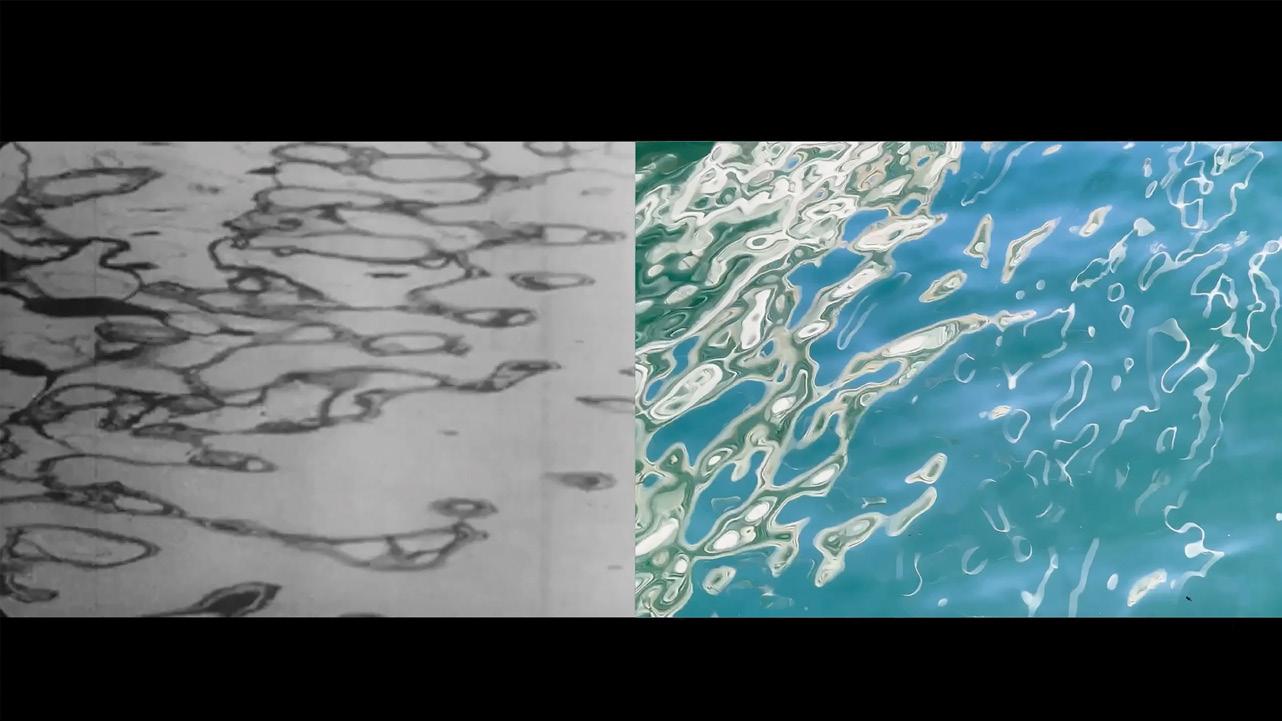
Works from public domain: H20, Ralph Steiner, 1929 Universal One, Walter Russell, 1926
c/o Student Publications
MSCO3–2230
1 University of New Mexico Albuquerque NM 87131–0001
Printed by Starline Printing Company 4600 Bogan Ave. NE Albuquerque NM, 87109 505-345-8900
Cover design by Rymer Hewitt
Interior design by Eli Manuel Behrens, Kadra Guillermo, Rymer Hewitt
Fonts: Franklin Gothic Book, Franklin Gothic Medium, Sisters
Conceptions Southwest is the fne arts and literary magazine created by and for The University of New Mexico community. Conceptions Southwest staff consists entirely of student volunteers directed by an editor-in-chief selected by UNM’s Student Publication Board. Submissions are accepted from all UNM undergraduates, graduates, continuing education students, faculty, staff, and alumni. This issue is brought to you by the Associated Students at The University of New Mexico (ASUNM) and the Graduate Professional Student Association (GPSA).
Copies and back issues are available in the Daily Lobo Classifed Advertising Offce, Marron Hall, Room 107. The Conceptions Southwest offce is located in Marron Hall, Room 225. To order copies of the magazine, please contact csw@unm.edu or visit csw.unm.edu.
Founded in 1889 , The University of New Mexico sits on the traditional homelands of the Pueblo of Sandia. The original peoples of New Mexico—Pueblo, Navajo, and Apache—since time immemorial, have deep connections to the land and have made significant contributions to the broader community statewide. We honor the land itself and those who remain stewards of this land throughout the generations and also acknowledge our committed relationship to Indigenous peoples. We gratefully recognize our history.
Kadra Guillermo, Editor-in-Chief
Get in a circle; get in a circle with us and celebrate the release of Conceptions Southwest’s volume forty-nine. This year, we reflected on aging and nature. On the beauty of circles and abstractions. Do you see planets? Water ripples? Tree rings? Whatever you see, circles are said to represent equilibrium and balance because all the points are equidistant from the center. Balance is precisely what is needed to create a magazine. Once again, CSW’s editors and staff have been hard at work balancing a variety of tasks from archival work to submission review to typesetting to copyediting to release party planning. The magazine is at the center, and we precariously circle around it to create a container for beautiful art. Art whose submitters were vulnerable enough to share and bless us with. The pieces in this magazine highlight topics that range from nuclear waste to complex relationships with God to the beauty of New Mexico and the Southwest. The pieces touch on a wide range of human emotions, and we hope that you will fnd a balance of joy, grief, anger, calm, and more while you fip through the pages and view all thirty-two of these wonderful creations.
I want to thank you, dear readers and submitters. You all truly make this magazine possible. And I want to give thanks to the staff, who may have been small, but really pulled through when needed. Of course, a huge thanks to my fellow editors, Eli and Rymer, who both originally signed up to be general staff members but then took on a boatload of additional responsibilities all for the love of this creative community. Eli, your positive attitude and excitement were infectious, and I appreciated your willingness to advocate for the pieces you felt deserved a spot in this edition. Rymer, your attention to detail was paramount during production season, and I will forever wish I could be as good a graphic designer as you. I also want to thank Amaris Ketcham, who brought me into the wonderful community of student publications three years ago.
All the mushy refections and thanks aside, thanks for getting into the circle with us. I hope that you enjoy volume forty-nine. I hope that you circle back to CSW in the future.
“All direction is curved—all motion is spiral.”
—Walter Russell
(The Universal One, 1926)
The Tularosa Basin Downwinders Consortium
Hughes
Nicholas Baldwin
Addison Fulton
Jimmy Himes-Ryann
Nicholas Baldwin
Nell Johnson
Avery Ketchmark
Avery Ketchmark
Nell Johnson
Nic Hinson
Neal
Halla Hughes
Sophia M. Eagle
Rudolfo Carrillo
Yoma Wilson
Victoria Nisoli Visual
Shedding
Yoma Wilson
Astrid Larson-Sherman
X
Camelia Caton-Garcia
Connor Swayden
Avery Rita Silfer
Cody Kamrowski
Cody Kamrowski
Cody Kamrowski
Daniela Montano Wilhelms
X E Oaks
Ava Marr
Cade Borek
Mikaela Johnson
Gila Dwellers
Intimacy
Washtub
YOMA WILSON
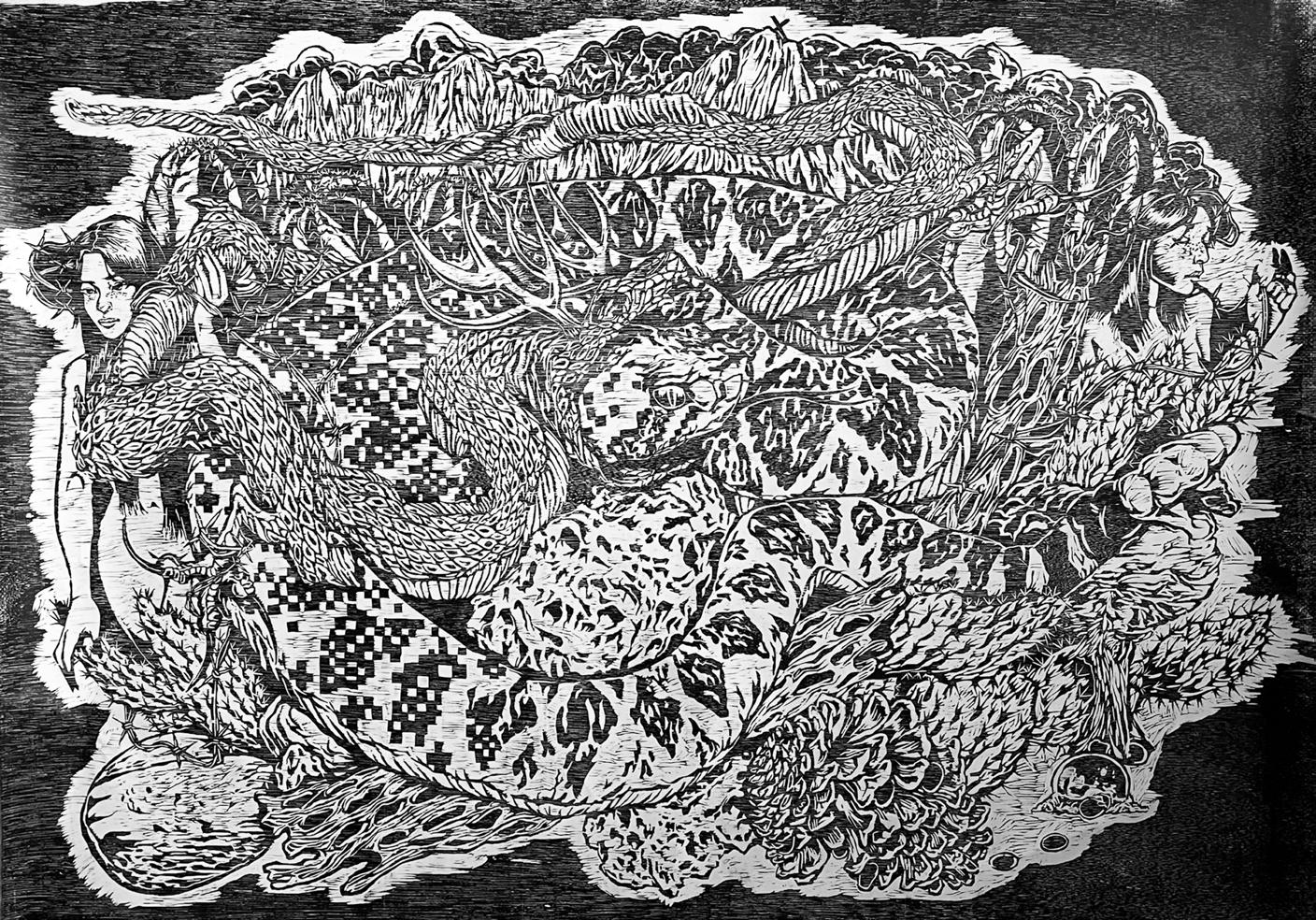
art
1. H. Herrera
I witness the world coming to an end Capitan, Ruidoso, Hondo, Roswell back toward Tularosa aquí viene la bola patras. My mother had already done her laundry, hung it out to dry. Because of the dirt, dust, debris, black ash that fell she had to wash it again. This flth over our town our roofs our gardens our water everything we consumed was flled with radiation I witnessed
2. G. Herrera
Oh so very many prayers Henry diagnosed with cancer. We had to come up with over four thousand dollars Albuquerque (fve-hundred-miles round trip) many many trips. I have a list of 279 people from the Tularosa area that had cancer died of cancer are cancer survivors. How many people do you know
Our Federal Government were very happy with the results of this test deemed it a success it became a death sentence six of us had cancer, three died you refnance your house you sell anything of value you dip into retirement you go into debt you max out credit cards this was my life Our Government created a weapon a uranium and plutonium bomb we need all the help we can get
When the bomb went off the government never told them what the mushroom was cancer when she was 12 in her early 80s, at age 66 breast cancer at 42 prostate cancer at 56 died at 76, colon cancer at 67 sister-in-law died of breast cancer has had skin cancer, dies age 79 age 66 from pancreatic cancer cancer when I was 59, my sister at 49 thyroid cancer at age 83 after the bomb was detonated we picked up the melted sand took it home, not knowing
5. L. Lopez
The following happened:
- the hair on cows turned white
- children were covered in an ashy flm
- laundry turned black
- testing continued
- the soil was disturbed
- the crops were too
- people drank milk from the cows
1On July 16, 1945 , the United States Army detonated a nuclear weapon, code-named Trinity, about thirty-five miles outside of Socorro, New Mexico. Following this test, deemed successful, a bomb of the same design would be detonated over Nagasaki, Japan. Tularosa, New Mexico, is located downwind of the testing site. The words in these poems are taken from testimonies given by residents of the area who were directly impacted by this nuclear test in an attempt to receive acknowledgement and assistance from the United States’ government.
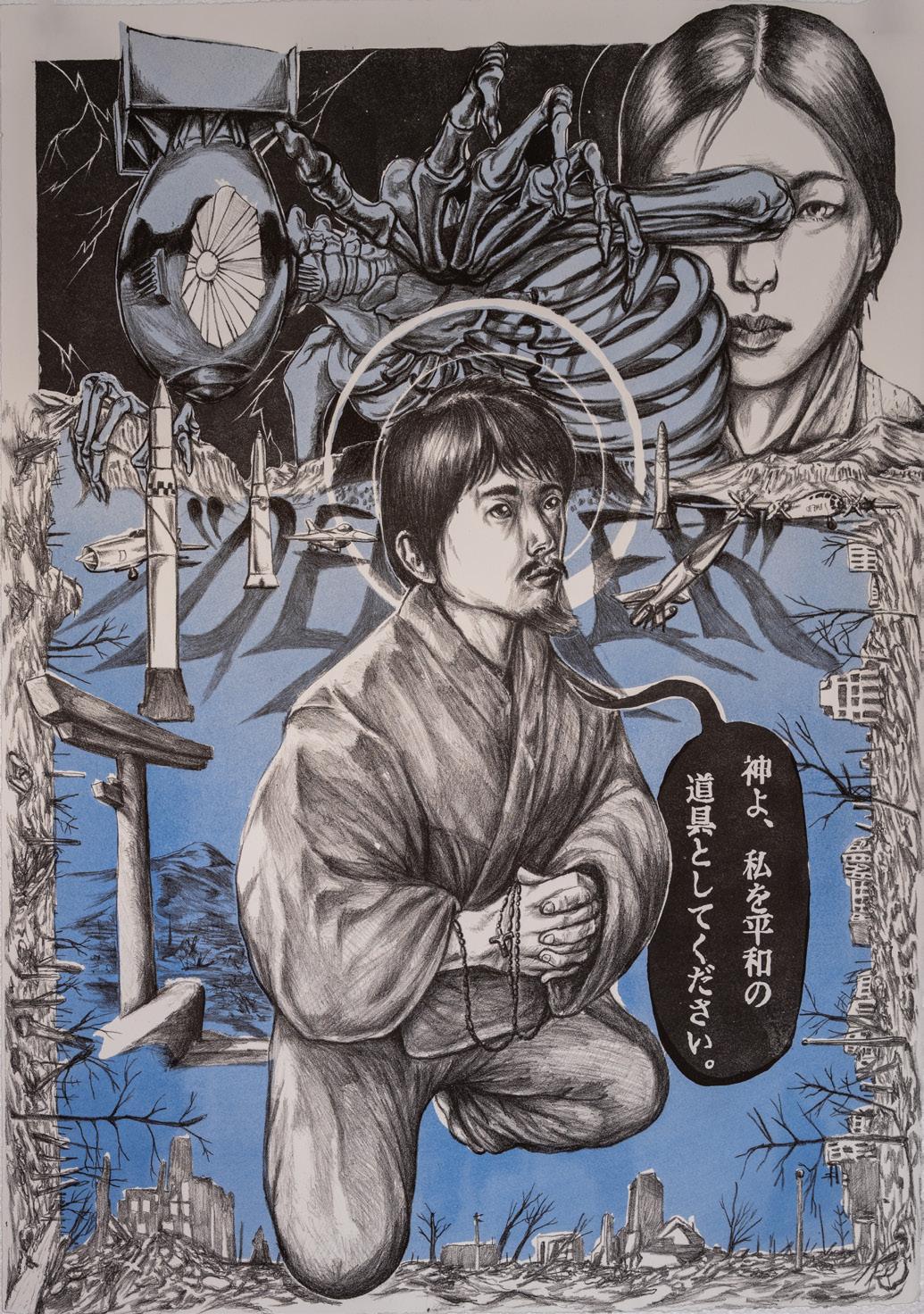
18 × 24 in. / two-color lithograph print
I clasped the bird between my palms, broken wings aflutter. I asked, Father, must we set her free? And he smeared black oil on my teeth. And he spilled it on the soured earth, and the not-bird croaked a nursery rhyme and lulled me back to sleep.
It’s a new site. And it’s in a good spot, too. You can see for miles all around, but there’s nothing to look at. No houses, no grasses taller than my knee, not even the remains of a cattle ranch.
No other rigs, either. The dirt is good; it’s red and healthy. The west Texas wind is blowing, chilly for the season. I check over the drill string, the collar, and the diamond bit. Then it’s ready to go. I pat it once for good luck and give the driller the go-ahead.
It’s a new site, and we gotta drill the new well deep into the earth to find the good stuff. Liquid gold. Oil.
The bit plunges into the earth, working through mud and rock, whirring and hissing.
Then it starts screaming.
Well, I think it’s the bit. I think it’s the drill stuck in something it can’t cut through. It bellows and whines, high and low at the same
time, squealing in my ears and thrumming through my bones. A wet, struggle-flled sound. I’ve heard of rigs that just blow when the pressure in the fuids pumping through the earth gets to be too much and the whole thing just gets blown to kingdom come. Then, because of the oil and the methane and all of it, the explosion just keeps going and going and going. It’s how a buddy of mine died. That’s what I think is happening at frst, and I try to call to the driller to tell him that something’s not right but the words won’t come. It feels like my lung has been punctured.
“All right,” I hear the driller say and the drill stops whirring, but the screaming doesn’t stop. The rig doesn’t explode. It’s like the oil rig is blowing up, but only exploding in my head. The sun is over my head. It feels like seconds since it started, that horrid sound, but it’s been hours. Sweat gushes from my pours, sticky.
“Lunch,” the driller continues. I can still hear it. I swear. This horrible sound, the screeching sound
of something that refuses to give and the wet, rushing sound of fuid out of control. I ask and no one can hear it. Driller says that nothing’s wrong and we’ll pick up again after lunch.
The wind is gone by lunch time, burned off by the sun. The heat makes all of us sweat, even the bologna sandwiches. The other roustabouts say they heard nothing out of the ordinary. Just the whir. Food tastes like slime. My mouth doesn’t recognize what’s in it, not at all. Not the meat. Not the yellowed, sweating cheese. Not my tongue or my teeth. I swallow and more spit just comes gushing back up.
I throw up in the dirt trying to make it to the toilet trailer. I watch it seep into the earth. It’s that porousness that tells the onsite geologists what’s under our feet. They don’t know, though. They picked out this spot, but there’s something they don’t know about. Something that doesn’t give like the earth.
Drilling resumes after lunch. The shrieking has stopped, and I’m ready to write it off as some problem with the gear that’s supposed to help with my hearing. Except I can still hear something. Something in the earth that gushes and groans the whole day through, even after a bloody sunset into the purpling dusk.
I start the drive home. The commute is longer now, winding
along long stretches of badly maintained roads. My headlights fall on the only other thing on the road—a dead opossum, I think—which I swerve to avoid, crossing over the yellow dashes. At frst, I thought it was just some garbage left to rot and get run over. I think I need to get my hearing checked, or something. I’ll have to see if that’s something my insurance covers. If not, maybe Maria will know what to do. It’s not exactly my wife’s specialty—she’s a pediatric nurse.
When I get home Maria and Lily, our daughter, are asleep. The new commute is long, and Lily is still so little. It’s not good for her to stay up on school nights. And Maria gets home so damn exhausted every night. I think about waking her for a moment to ask about the weird, rhythmic noise in my head. I’ve heard of guys getting tinnitus on the rigs, but does it ever feel like a heartbeat? Does that make any sense? But she’s asleep. And I’m exhausted. I feel bad. Not just my head, but my neck. My hands. My spine. I curl up next to Maria under the covers.
In sleep, we’re deep beneath the earth. We sleep, at peace. Our body is soft, curled over and over onto itself. Smooth
and warm and slick, we shift ever so slightly. The ground moves around us, giving.
If you had a nosebleed and stood perfectly still and let it drip and drip and drip until it carved a gorge into your face—like the Colorado River carved the Grand Canyon—and it dripped until it carved through your lip and into the nerves of your teeth, that would still not be how long we have lived.
If you laid the intestines of everything that had ever died end to end, human and opossum and insect and pig and other sorts of bodies, it would still not be as long as we are.
This is what we were. Then there came the drill. A tiny thing, yes, but piercing. Plunging. Pummeling. A needle, shoving slowly through your soft body as you writhe but cannot move. This is what we are. We are dying.
piercing through the earth.. There’s something down there. Something impossibly huge. It’s its heartbeat. The noise. It’s the heart beating. It lives in the oil feld. It’s slowly bleeding out. It’s dying and I killed it.
But the boss is calling, and I have to go. I don’t kiss Lily or Maria as I leave because my mouth still tastes like mud and silt and bile.
I wake from the dream, sick. I cannot see it. I couldn’t see it in the dream, not with the darkness at the center of the earth. I felt it—felt it like I was in it. The size, the age, the pain . Pain like a diamond drill bit through the gut,
I’m back at work. The heat. The meat. The constant chatter and gushing of the rig. I spend most of the days vomiting in the heat and shivering through the night. Gush, gush, gush and the constant rush, rush, rush. Dizzying. In time, almost, with my own heartbeat. I worry sometimes that’s what I’ll vomit up next, and it’ll have the same sweating, shining coating as lunch meat left in the sun. I can feel its pulse, my pulse constantly beneath my skin. Not a damn thing is funny. I can barely hear anything, and every voice just sounds like wet breath in sync with the rushing. Laughs fall on my ears like the creature’s whimpers. I’d do anything for quiet. But the machines keep whirring and gushing and drilling and whining.
The driller tells me it’s time to go deeper and I could scream. I think of taking his head and slamming it repeatedly into the earth, to take one of the poles and ram it into the cavity of his chest. I bite my cheek instead and feel my blood food my mouth. It’s familiar.
For every two weeks on, I get two weeks off. I hope some time away from the feld will help. I hope that I’ll forget about what’s down there, and it’ll forget about me.
I ignore the speed limit driving back home on the last day. I miss my family. The porch lights are still on. They bathe Maria’s garden in soft, fuzzy yellow light. Even in the darkness, when I know it through shape alone, it’s beautiful. She grows fowers and fruits. There are fresh strawberries for shortcakes slowly ripening. The strawberries that come from the garden are cheaper than the store-bought ones. The air smells fresh and sweet.
Maria has made a pecan pie for dessert. The nuts come from the store, not the garden. Candied nuts break under the force of my fork. The prongs reach down until they scrape against porcelain. Molasses oozes out the side, pooling in dark, sticky globs. I cannot taste. I can only feel the syrup in my mouth. Sticky. Hot. I swallow, try to listen,
trying to focus on anything other than that awful noise I can still hear. Putting a highway between me and the thing has not helped.
I cannot hear what my wife and daughter say. Their voices sound miles away—high above me or below me or just somewhere faraway. It’s horrible. I can’t make sense of words. All I can hear is the harsh puffs of their breath in rhythm with the beating. I’d do anything for quiet. I press the palm of my hand to my ear, and the noise comes from inside instead.
Pecan pie used to be my favorite.
The entire frst day I’m watching Lily play with her dolls. I’m laid up with a headache, and I cannot seem to stop throwing up. I think my mind is going to explode. Tears well up, constantly leaking, thick and hot and savory. The pressure is too much. Maria told me once that they used to treat headaches by drilling a hole in the patient’s skull to relieve an ounce of the pressure. But what would that do? How could that help? I throw up again at the thought, spittle dripping from my lips as I grasp the porcelain. I’m dying, I think. We’re all dying. That’s the sound— the mechanical whir
and pulse of death. And I’m weeping and breathing and retching all in time with it. In time with that heartbeat, that horrible heartbeat. I’m being punished.
I get a King Jr. Meal for Lily and nothing for myself because I’m still sick and everything tastes like oil and slime.
I wake with an empty stomach and feel a bit better. Lily and I had both been asleep when Maria came home. She noted I had a fever last night, so she told me in a Post-it Note stuck to the fridge. She reminds me to rest and to eat. The thought of both makes me feel sick.
Lily is playing dolls again and this time I make myself play with her. I brush their frizzing, silicone hair and try to keep up with the story she’s telling.
Her eyes are deep and brown—as shiny and dark as an oil deposit.
brown—as shiny and dark as an oil deposit. I drive the knife through the head of lettuce, fresh from the garden. A little freshness I can add to the sandwiches at home. It crunches and gives like healthy dirt underneath a work boot. Crisp. She’s asking when lunch will be ready, tugging at the belt of my work pants. Her voice I can hear above the rushing. I’d do anything for a little quiet. There’s a different quality to her—like a bird crying piercingly in a tree. High. I tell her soon and turn back to the lettuce. The leaves shear off clean. The knife moves up and down, over and through. My hand is a different machine from me. I am far, far underground, sightless, and writhing, listening to the shrieks of men and birds. I still hear it underneath everything, though. My heart. My blood. Gushing from the earth.
When the sun is poised up ahead, beating down on the ground, I make lunch for Lily and myself. Bologna sandwiches, like on the rig, because I’m sure I can make them right and the thought of trying to cook anything in butter or oil or heat makes my head gush and throb once more. Her eyes are deep and
Mayonnaise too, for moisture. For the sandwiches. The parched ground. Something grabs me; a harsh sound echoes through the air. I twist, body writhing and throw it off myself. A small, insignifcant thing, easily shaken off, but the sound it made ripped through my skull, drilling through my ears into the soft matter of my mind. There’s a crack, like dry
mud coming to dust. Then it’s silent, save for our heart.
I’ve thrown my daughter off me, when she tried to tug at my thigh for attention to ask again about the sandwiches. I’ve thrown her hard. Against the table, where she hit her head, and again on the foor, where she hit it again. She’s quiet, slumped in a motionless heap, bleeding from a crack in her skull.
All I wanted was for the sound to stop. But it never stops. The blood keeps gushing. Through my body, through the earth, onto the white linol eum of the kitchen foor.
I cannot leave her here to bleed out on the tile, in the sickly hot afternoon air. The cool dirt. Deep. Back into the earth where the pressure will hide her and turn her into something I can recognize again. Not just a limp body, but a life force.
Clover. Dandelions with no fuff left. I knock over Maria’s tomato plant, tear through the fragile shooting veins of strawberry plants. I devastate, but the hole never gets deep enough.
I lay my fower to rest. She’s so quiet now. So horribly quiet but the beat in my mind is still there. Nothing will make it go away. Nothing. Not until we are both gone. Me and the oil feld.
Its heavy head is bowed low, shamefully drinking its fill.
I drive back to the oil rig. The metal punctures the sky, unnatural and gruesome in its sharpness. Its heavy head bowed low, shamefully drinking its fll. I throw myself to the red dirt. I’m leaking, spilling out of myself. I rub my cheek into the ground, seeking to burrow somewhere but the ground has no give. Nothing to give. Never will again.
I gather her into my arms. She is not heavy. I carry her out to the garden, and we begin to dig. Not with a diamond drill bit, just the fragile brittle bones on the ends of my body. My nails are shredding, ripping and bleeding as I throw up and away clumps of grass.
I feel the great one’s last, stuttering heartbeat, then there is silence beneath the dirt. I am alone now. Not a thing that lives or breathes or bleeds can understand me now. No one can understand what I’ve done. What we were. What we lost. Bled out and dried up. Sweat oozes
from me, drunk up by the hungry, empty dirt.
We are gone now.
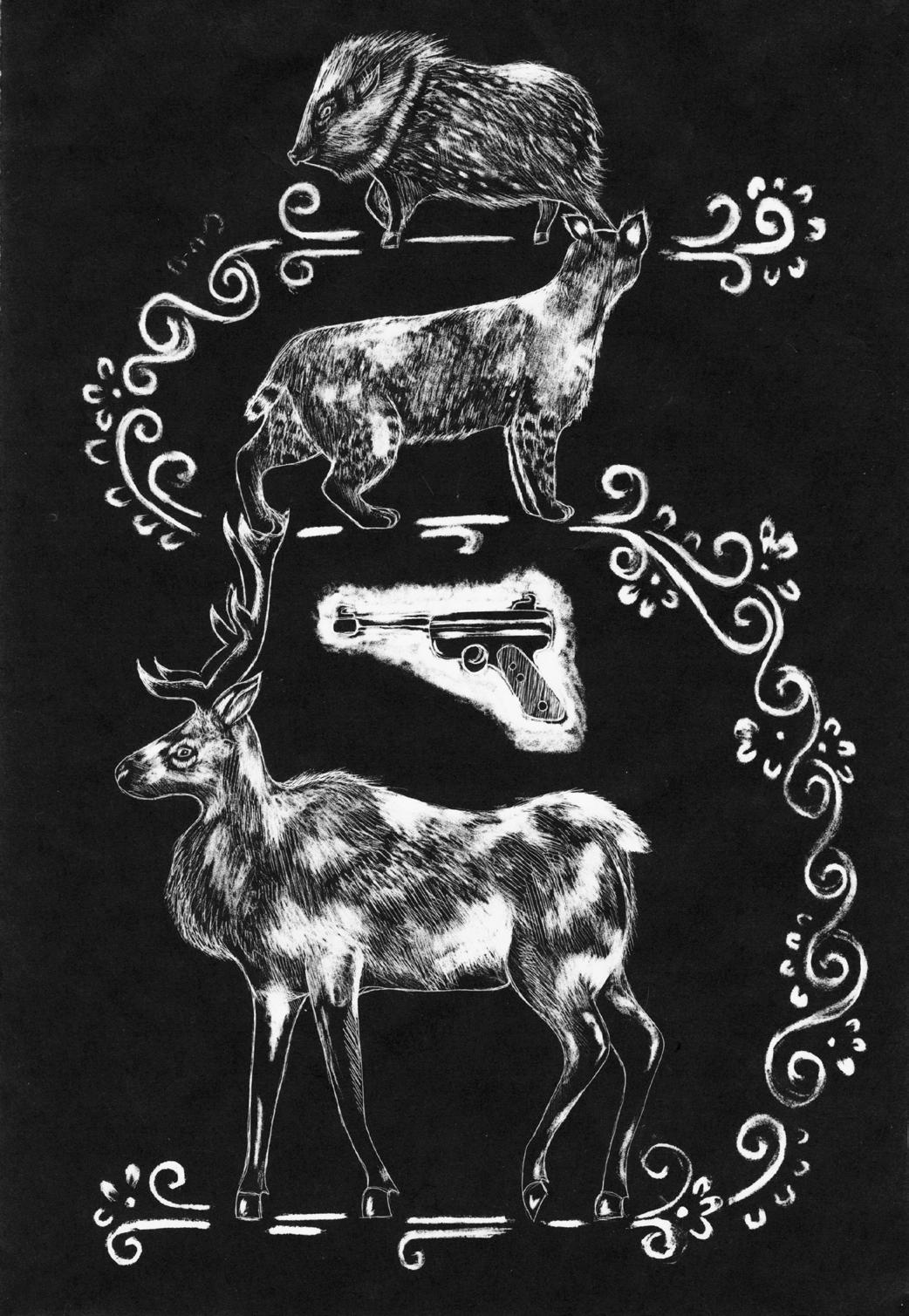
8 × 10.75 in. / manière noire lithograph
art
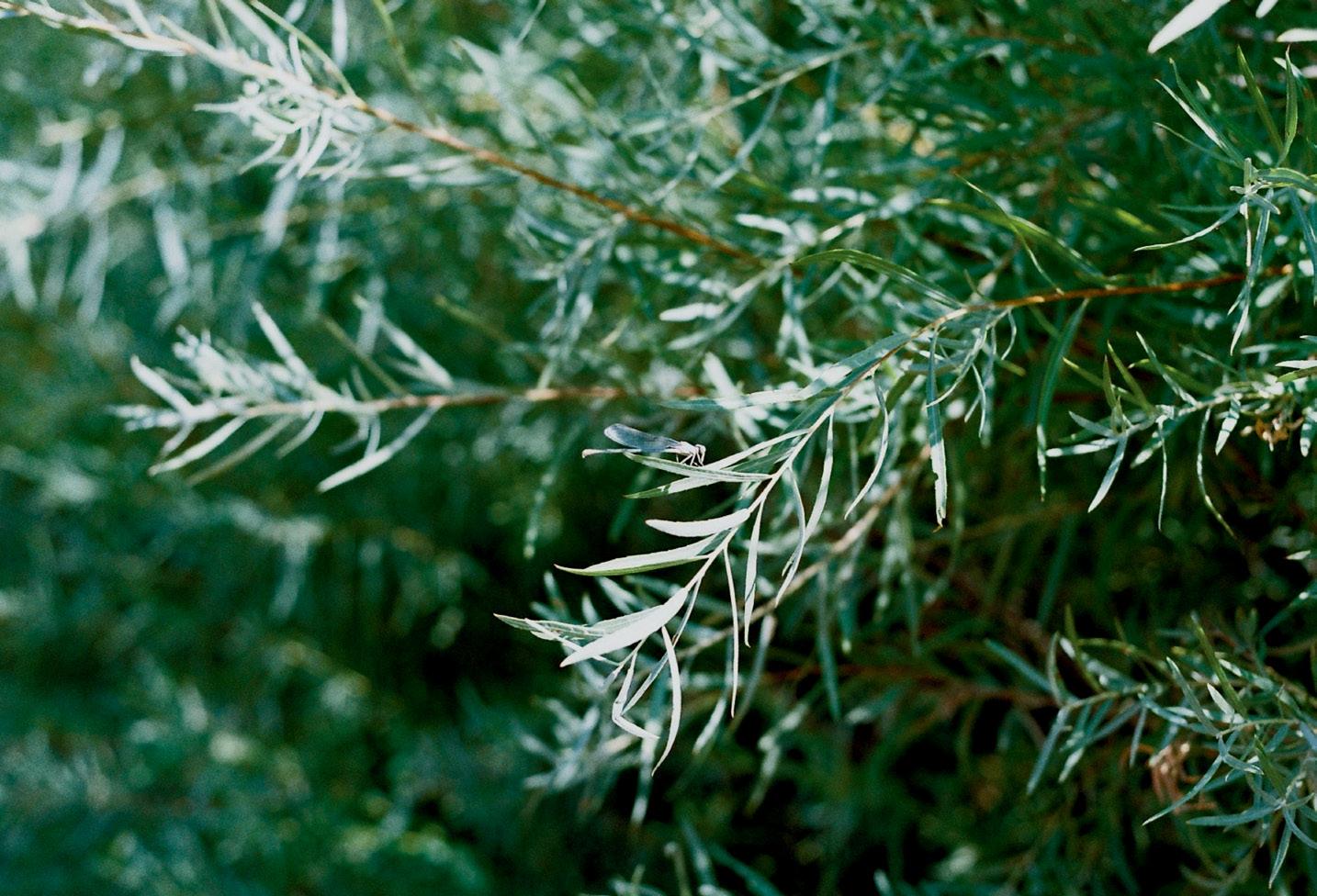
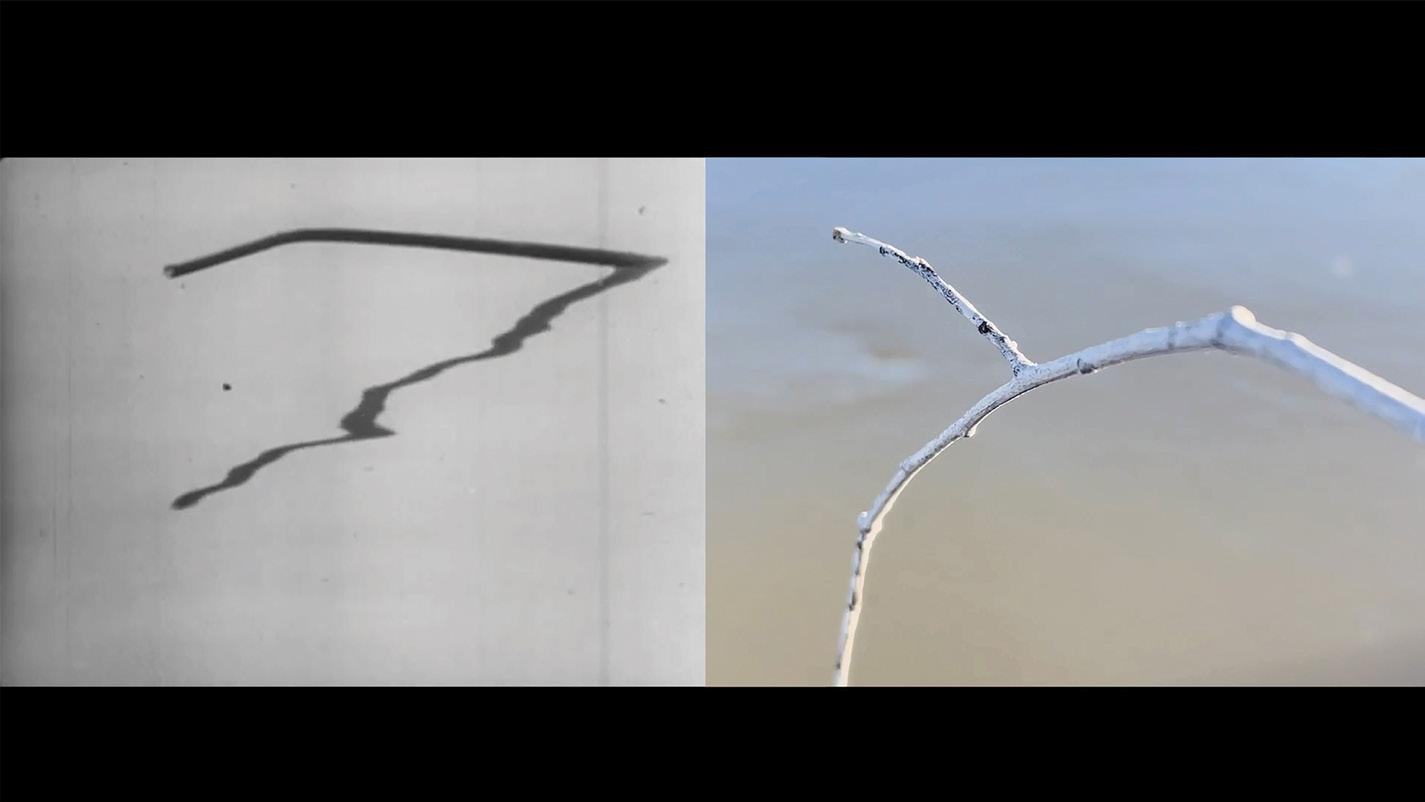
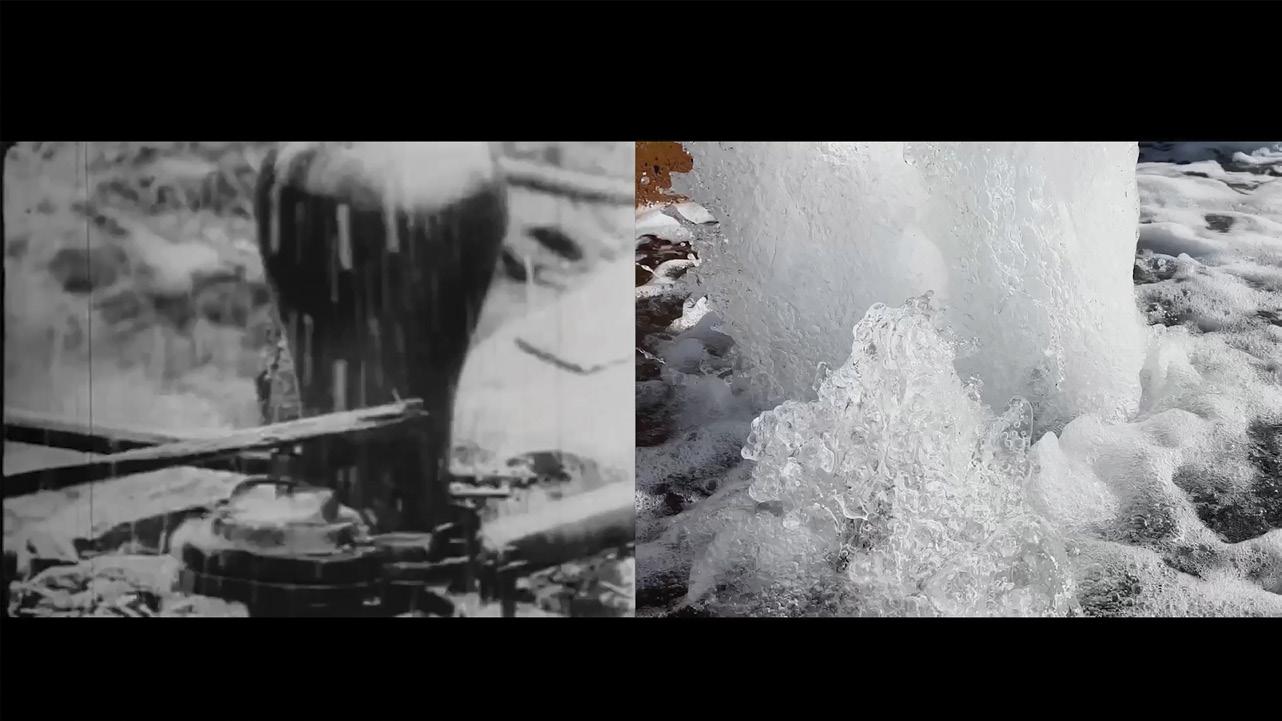
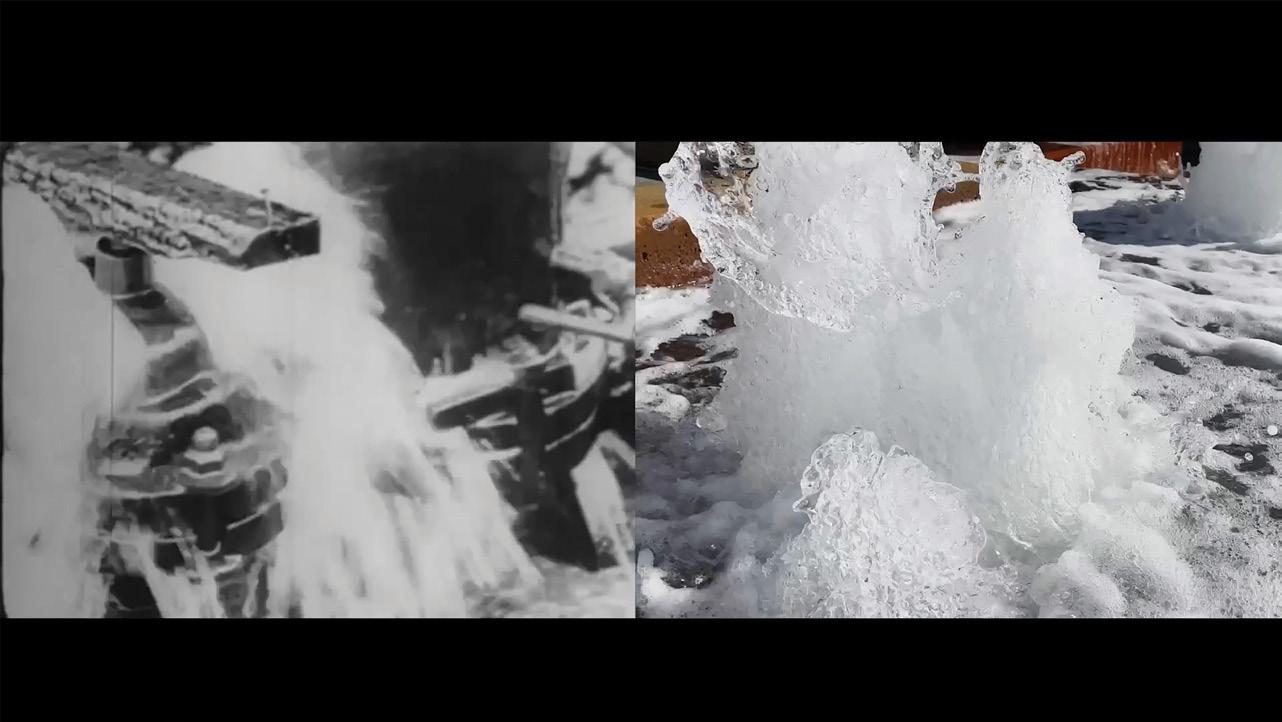
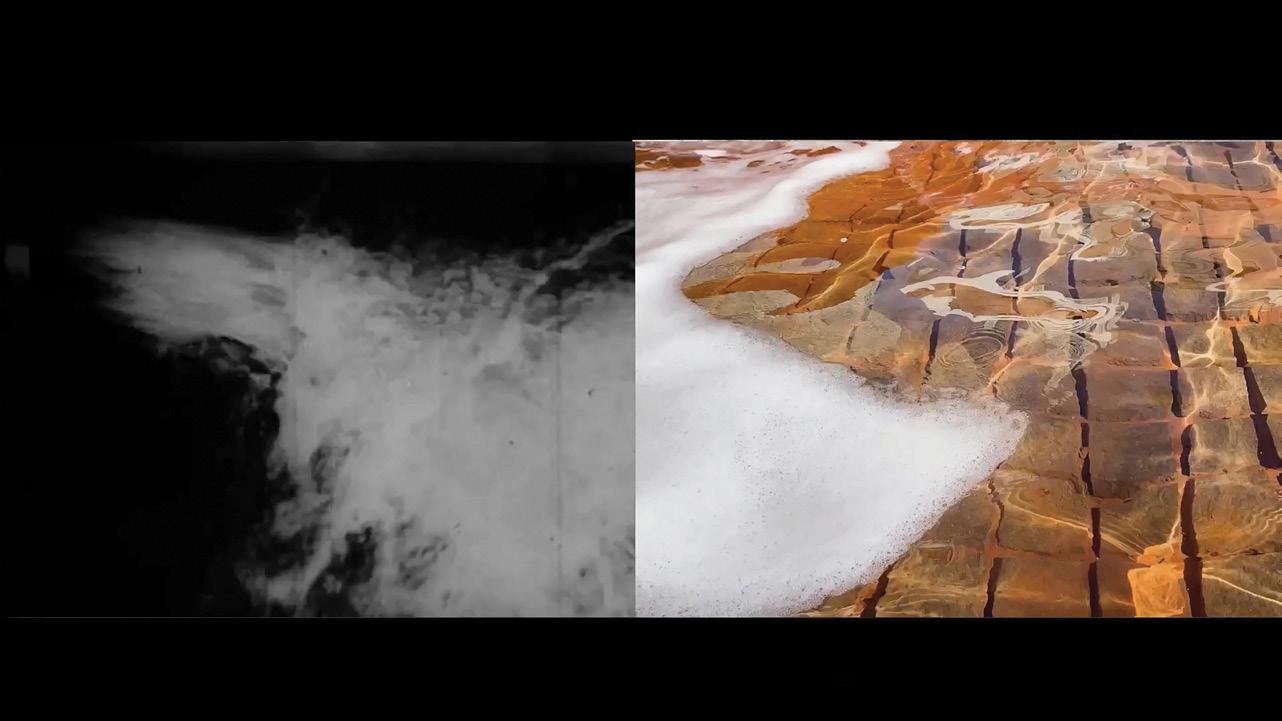
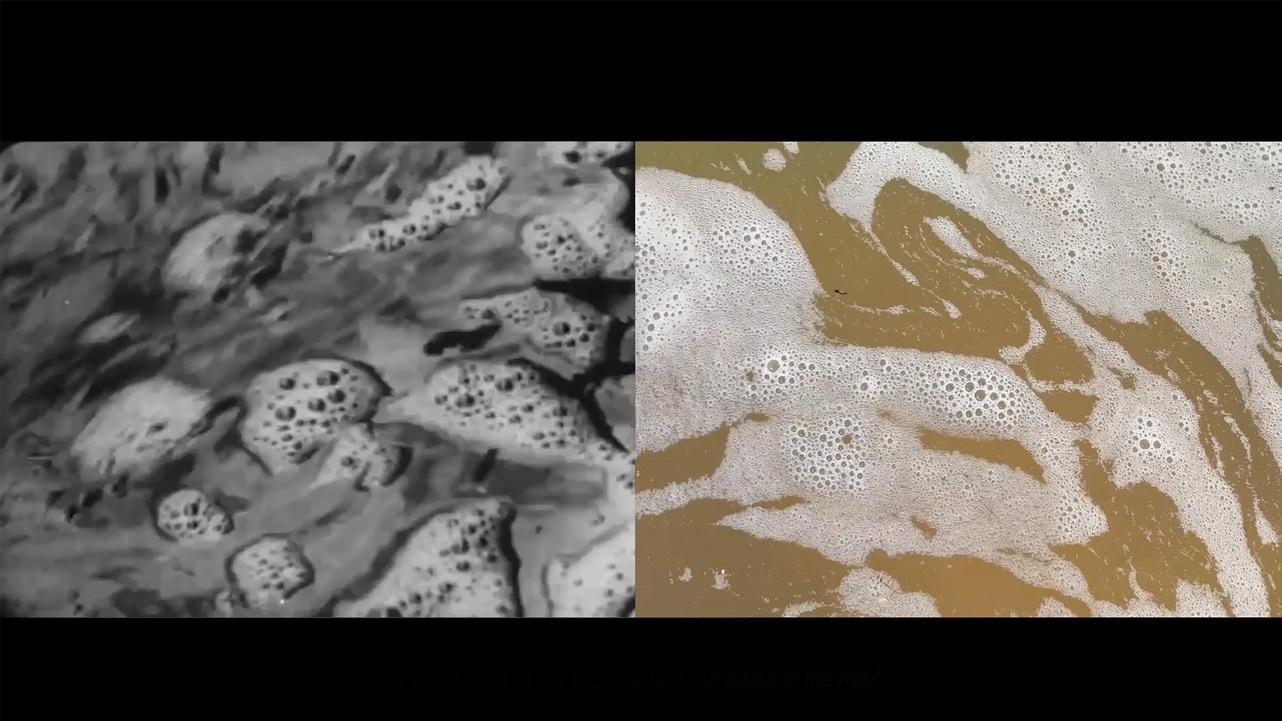
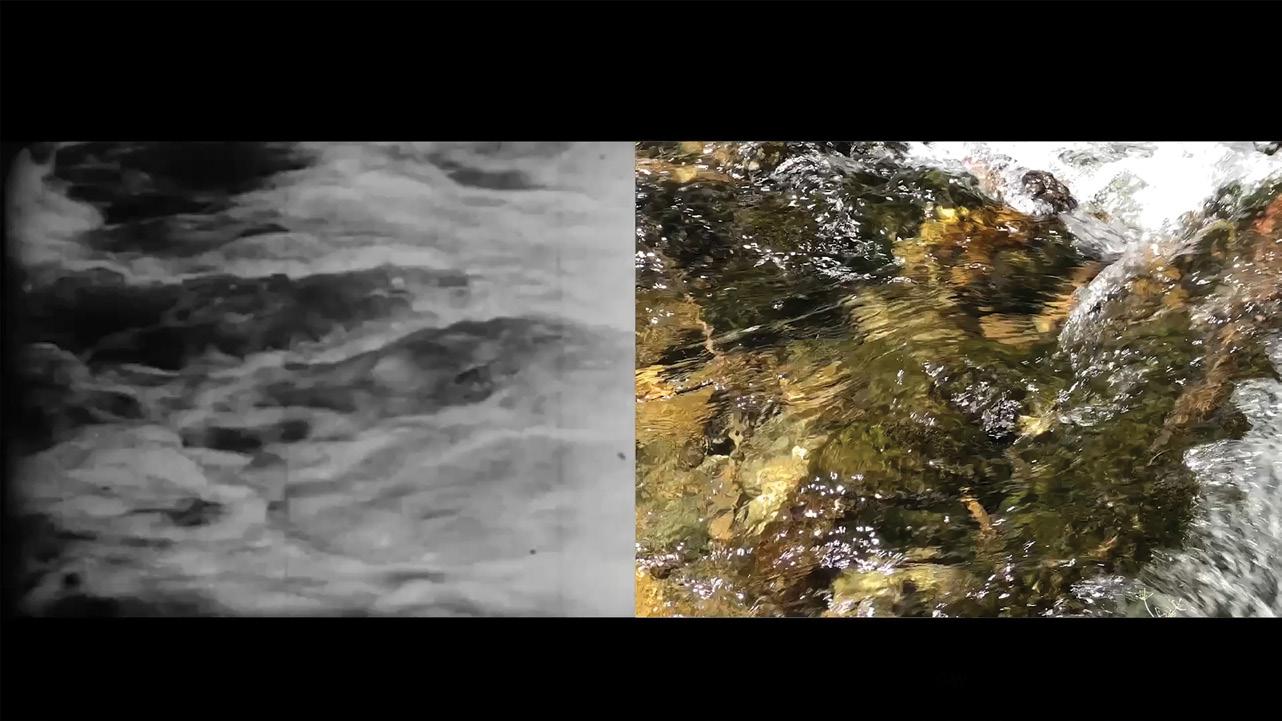
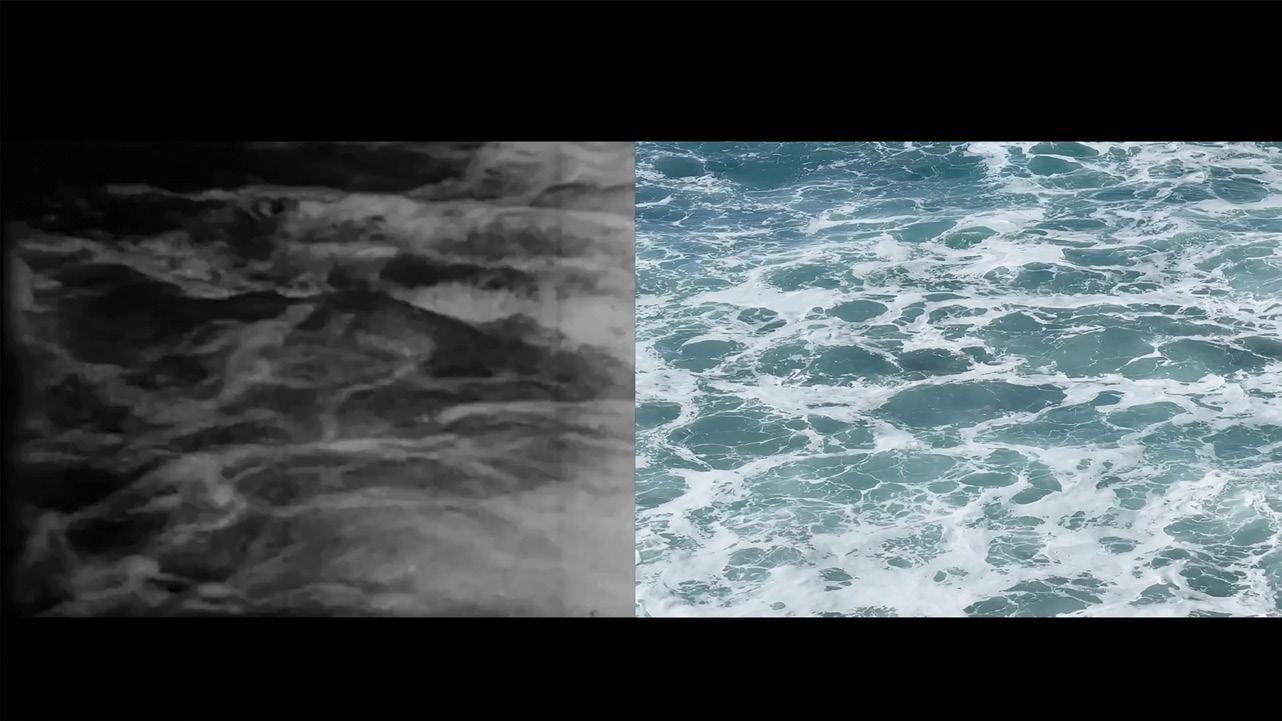
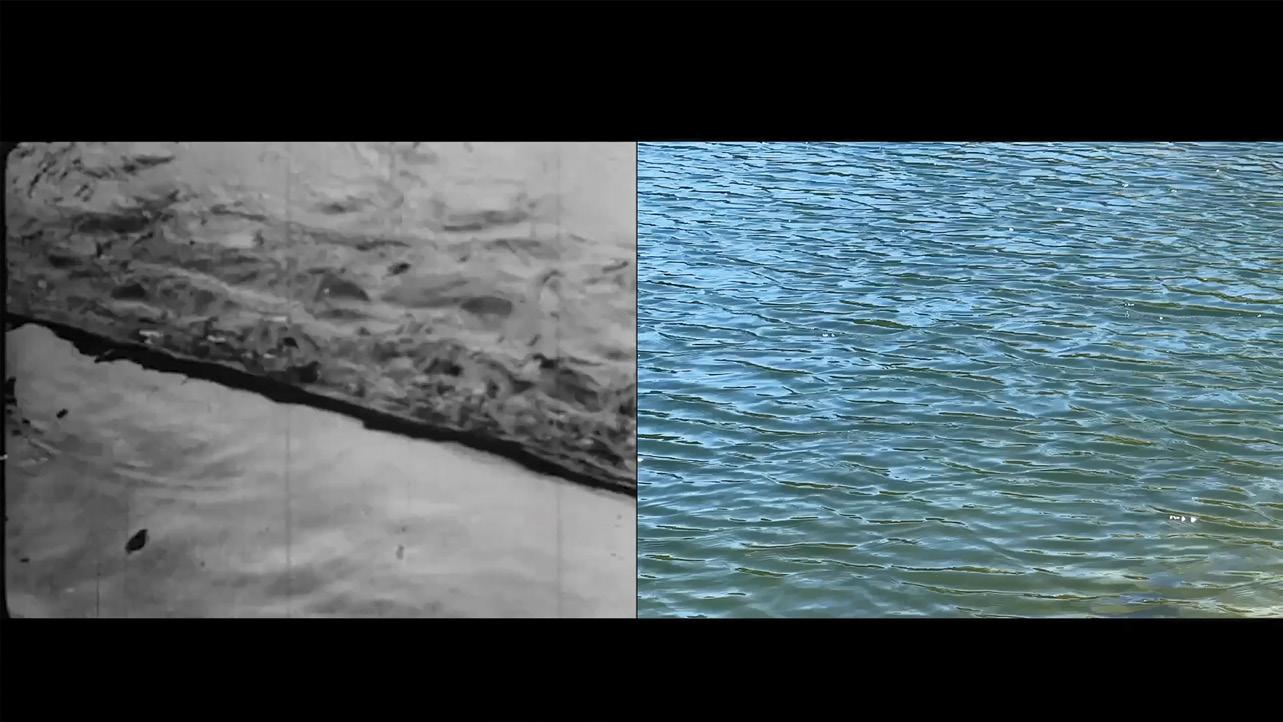
There is a saying in Brasil: “Água mole em pedra dura tanto bate ate que fura” (Soft water on hard stone, striking again and again, eventually breaks through). Growing up in Brasil during and after the military dictatorship, Daniela experienced that some memories move like water—fuid, elusive, dangerous, opening space where there are barriers. This experimental short flm traces how a childhood lived under authoritarianism shapes subjectivity, exploring the subtle ways political repression seeps into family life, into the body, into the very rhythm of breath and movement.
1The video uses clips from H2O (1929), directed by Ralph Steiner and sourced from the Internet Archive/public domain.
The lack I am. I talk and talk yet accomplish little. The pigeons purr from the palapa rafters as a bedlam of adoring fans. God bless them for not judging me.
Just as well, I’ve nothing to tell you. Threaded somehow each to each, fshes manage to breathe and surface at sudden notice, alive and teeming and going with what takes them.
I paddle out sick with wanting. I want to stay with them and paddle back and stare and still I won’t. I won’t lie on this ocean forever where pelicans glide before each wave swallowing the last of the light.
But it’s the sight of wings swirling to a delicate halt of many disembodied caps at the height of my sweat-laden shoulder, the place you’d lean your mouth into as if through a membrane of gravity, as if a fame could lose its way toward one vanishing point.
As if you were here and might, without breathing, fy alongside their living fesh. But instead, my Mithraic memories keep strobing the none-star sky. I keep looking at sea stars, semen stars, the grasses of Hesperus hair.
I conjure your mistress’s name. A week and a decade. To know the letting go, the teeming and the desire.
Every day I wear sunglasses. I’ve led a horse to water, carried a machete with purpose. So much of me is unfnished. You wouldn’t recognize me back home, my eyes lost in everything as two undeceived tools I’ve retired from their life of watching you.
HALLA HUGHES
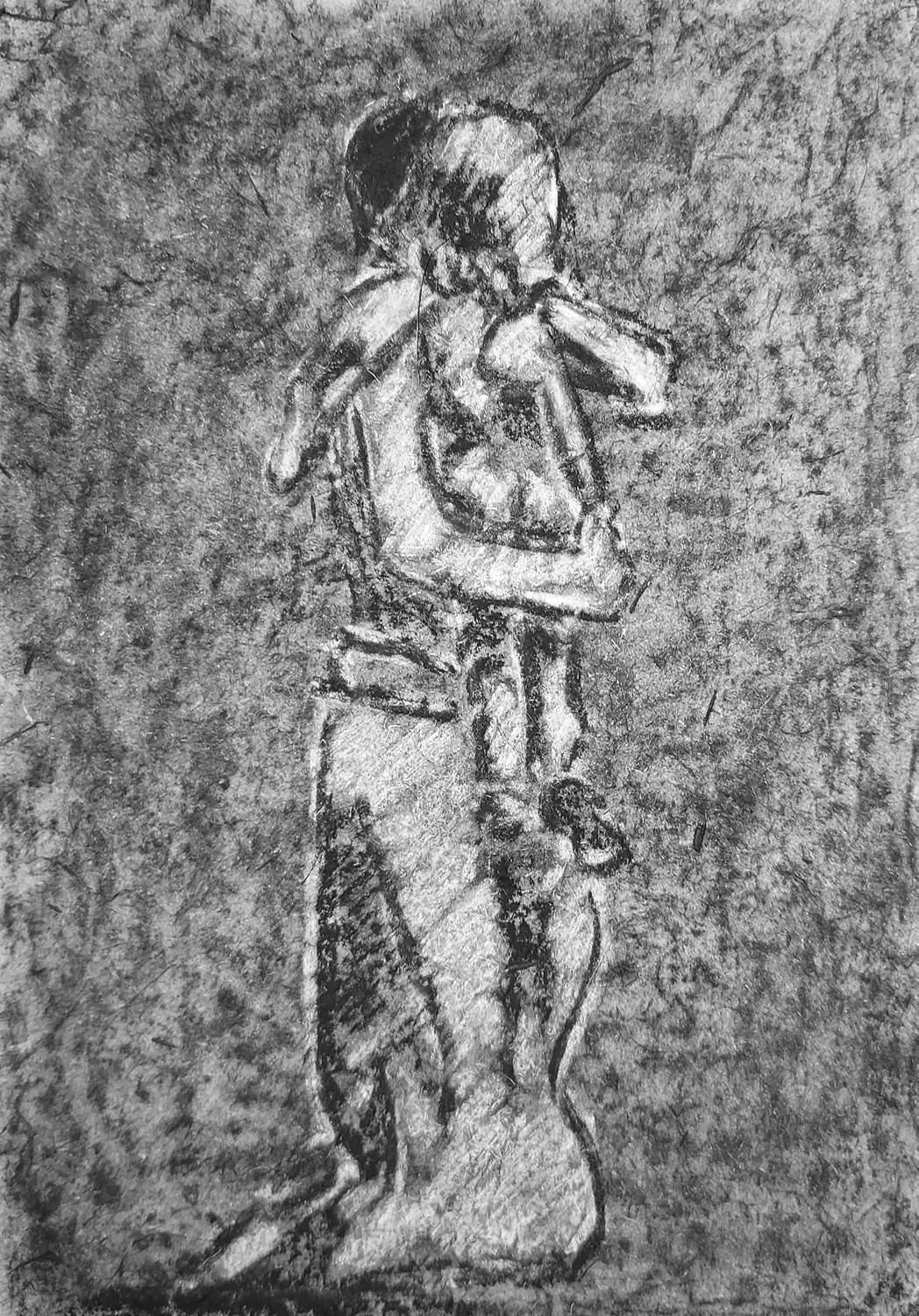
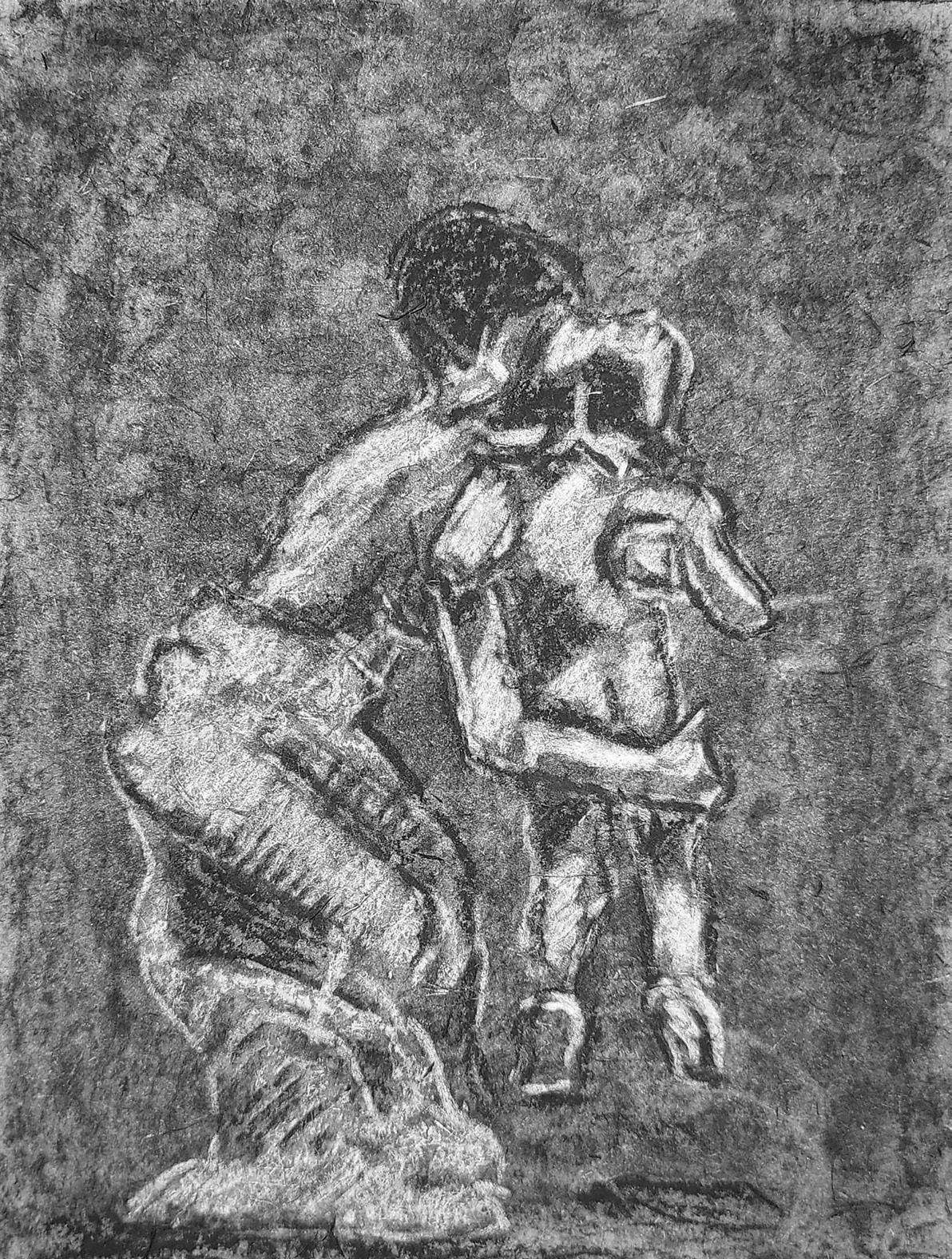
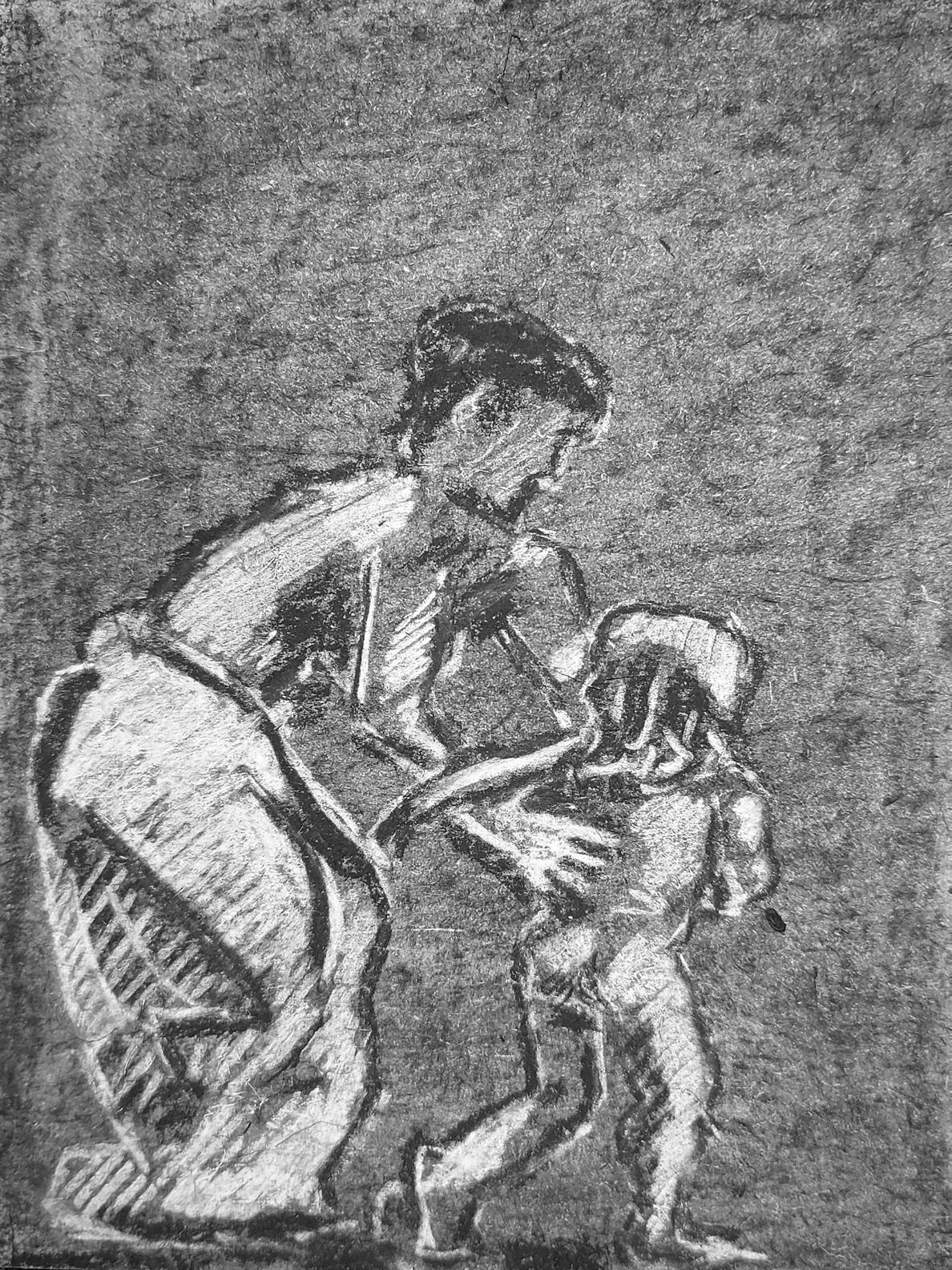
The night was a living thing. Voices carried across the still water of the bay. Amira sat in the grass at the edge of the crowded sandbar, watching the festivities unfold. Permanent markers and burnt paper scented the gentle autumn breeze. Silently she held her vigil, lanterns foating into the sky above.
Finally, she heard a familiar voice. She whipped around, neck craning to fnd the source. “Damn. We’re too late to get a spot on the sand. That’s all right. Spread out the blanket here,”
Leda said to someone Amira didn’t recognize.
They situated themselves on a quilt Amira had made years ago. It was still in immaculate shape, save for a mended fray at the corner. Leda showed the stranger where the supplies were. Amira moved to fll the space beside her. The stranger returned to them. “They
only had purple markers. Is that okay?” he asked.
Leda nodded. “Purple’s her favorite,” Leda said, gesturing for him to sit on her other side.
Amira watched them work on their lantern, hugging her knees to her chest. The faces around her were blurred, like she was seeing them through a foggy window. Only Leda’s face was crystal clear, just as she remembered it.
Well, no. There were some new lines there, around her mouth. Bags under her eyes. Her hands were shaking while she handled the marker. Amira longed to steady them. The stranger made idle chatter while he worked. Something about him nagged at her, prickling the back of her neck.
“What are you drawing?” Leda asked.
“A rabbit,” the stranger replied. The prickling intensifed.
“Why?”
“She always called me her little rabbit.”
Her heart sank. Caleb? Have I been gone so long?
Leda’s brother was no longer a boy. His face suddenly came into focus, clarifying a sharp jaw and hooked nose, mirroring his older sister. No wonder she hadn’t recognized his voice. Leda’s reply to him was lost in Amira’s confusion. Quiet settled over the two of them heavy as a funeral shroud.
Before long, their lantern was complete. Amira stood behind Leda, making out the words. Her vision was fuzzy, and her head was beginning to ache. She would have to go soon. “Happy birthday, my love,” read the lantern in Leda’s spidery script, accompanied by Caleb’s rabbit doodle in the corner. Amira lingered over Leda’s shoulder, wishing to rest her chin there. Leda unfolded the lantern, showing Caleb where to secure the candle in place. “Ready?” He asked, brandishing a borrowed plastic lighter.
“Ready. I wish she was here,” Leda replied.
I am here.
Laughter rose somewhere else in the feld, high and piercing. Pins and needles washed over Amira, like every limb was asleep. She was fading fast. Hurry, she urged. Caleb lit the candle, flling the lantern with hot air. Together, he and Leda lifted it up. Amira put her hand on it for good measure. It went right through. The breeze lifted, blowing
past her. Leda turned her head sharply toward where she stood.
“What?” Caleb asked.
“I could’ve sworn—I thought I smelled her perfume,” Leda said, her gaze lingering right on Amira. Amira stared back.
Please see me. One last time.
“Happy birthday, if you’re there,” Leda whispered.
She sighed. Thank you, my darling. I’ll see you soon.
She caught a fnal glimpse of her lantern illuminating the tears on Leda’s cheeks. The rabbit reached for the moon in her honor.
SOPHIA M. EAGLE
I had been away from Millhouse for three long years by the time my carriage showed up on the gravel drive. The white house loomed beyond the fresh green shrubbery. All around me, the world was bright new green and dark old green, of young spring and old winter pine. The morning air was fresh and cold, and the storm that I had driven through had broken just as I reached home.
Like Eden at the start, the gate was opened to me, the gardens shone with new brilliance, and I saw the house that was built for me—that I had barely set foot in. I felt a tight hand release its grip on my heart. When the carriage rumbled to a stop, I could hear the lumber mill in the distance. I looked up at Millhouse, and I sensed some change. Robert was not home, certainly not at midmorning. He had not seen my face for perhaps
six months or longer, but his true love was business—like mine had been motherhood. So I brushed my poor feelings aside, strode up to the red door, opened it, and welcomed myself home.
My housekeeper, Mrs. Morris, was the frst one who greeted me. She was in the front parlor I insisted I had when I was a young, innocent bride. She looked at me with a strange, guarded expression.
“Miss Charles, I’m surprised to see you!” She came over with a friendly smile but wide and questioning eyes.
“I wrote to Robert. Did he not tell you or Mr. Robbins?” Still my garden of New Eden seemed so bright. This confusion seemed a very characteristic result of my strange husband’s ways. Still, she had called me Miss Charles.
“He expected you would stay with your parents in Paulsboro. All due respect, ma’am, perhaps you would prefer it there?” Her smile remained kind and confused. My shining garden of Eden was losing its light all the while.
SOPHIA M. EAGLE
“Prefer it …?” I helped to design the house, to improve it, set out the gardens, remodeled the kitchen and the parlors, yet never had time to live within the walls.
“You know, given the current situation, ma’am.” Then her smile darkened, and we both realized that I didn’t know what she was referring to. There were footsteps, fne footsteps descending the stairs behind her.
When he established the lumber mill, Robert had insisted that we live in the country. He insisted that we hire from the nearby town, Paulsboro, that his business would be something everyone from miles around could have a piece of and be proud of. He trained the employees himself, at frst. The last one he trained himself was a girl. She was an orphan that I had hired to be a scullery maid, a girl named Lucia. She was a plain little thing, plain and tired and a good worker. I had felt proud of myself for hiring her, but Robert had needed a new secretary, and Lucia could read. So I hired a new scullery maid, and Lucia went to be trained as a secretary. She could type well; she learned quickly. I bought her two simple dresses and taught her how to braid her hair. She bathed in my house and lived in my attic. When I left for New
York with my little Lily, bound for hospitals and a dreary life, I begged her to care for my house and ensure that Robert would be fed. I had left her shy and plain faced, a little pet of mine I regarded like a child of my own beside Lily. Here she was, coming down my stairs in silk slippers.
There was almost no evidence of the colorless, dirty-faced shadow she had come into my house as. Her hair had become a deep auburn, pinned to the top of her head. Her eyes seemed so much brighter, radiant blue, and she was as resplendent as the deep aqua silk dress she was wearing. Her cheeks fushed when she saw me, and her eyes shined with bright tears. She met my eyes without a hint of cruelty, though, and so I was confused. A new dress? Coming from the second foor? What had happened here? Her little rosebud mouth trembled a bit as she came to stand in front of me. Still, her head only came up to my chest.
“Lucia?”
“Mrs. Charles, I hadn’t known you were coming. Morris, perhaps you should send for Robert.” She spoke slowly. “Please, let us speak in the parlor. I’ll have the carriage brought round for you.”
She walked very slowly into the parlor. She motioned for me to sit in my own
pink silk chair I had ordered from London. My heart was beating, not with anger or fear, but anticipation and shock. What had gone on here?
I knew. I knew what had gone on, but I suppose I was only waiting for the other shoe to offcially drop, right in front of my nose.
It was what I had thought. Lucia assured me she had always considered me a friend. She had never thought to take my place in the house or by Robert’s side. She had never thought of ambitions for my place in society and had never wanted to be a wife in the frst place. But I knew what else she wouldn’t say. I remembered that even in her colorless, dirt-faced state, when her eyes were dull and almost lifeless, something had burned in her chest, at the back of her gaze. It was not evil—that much I could see from where she sat across from me in my own parlor— but a great desire for comfort and safety. I could see it in the back of her gaze now, too, begging me to not hate her. I couldn’t help it. She was so fne, like a precious fabric or little scrap of bright ribbon, too precious to be alone, too fne to withstand a heavy storm, even though she already had.
I had a great house in Paulsboro to return to,
an apartment bought with my own allowance in New York City next to the park. I had only married Robert because he asked. So, I let my anger and my shock at her wash away. I felt nothing, only the cold of the cavernous house I had built by my own designs, the sound of the spring wind outside the great windows. This little Eden suddenly seemed dark and sick. I had bitten no apple, and yet, I had gained this terrible knowledge, and I was cast out.
She called a carriage round for me. There were two trunks on the back of it, plus the three I had brought with me from my journey home from the hospitals of New York. Robert was waiting by the front gate. At the sight of him, she bade me goodbye and disappeared back into my own home. His eyes burned, too, but not with desire or anything pure and understandable. Only ambition. Poisonous ambition.
“Beth. I am sorry I did not write you, but I thought you would not have believed me unless you saw with your own eyes.” He only met my gaze once then looked out to the river behind the house, just visible behind the garden. I knew he was lying.
“And what? You cannot marry her; I am your wife here and any other place you would go.”
“I have married her, in every way that counts. I beg you, do not make trouble for yourself as you always do. Just go back to Paulsboro. I will send you some money every month, but I beg you to be gone and to let me be on with my life.”
“What else would you have me do? Should I burn my wedding gown and bash Lily’s grave into gravel? Do you forget that I built this house and my father lent you the money for the lumber mill?” I felt the anger inside me rise above the shock and tides of unease. Had I known him at all?
“Leave Lily’s name out of this. Let us not blame one another. Just go peacefully. You have seen Lucia; she is too fragile for such fghting between us.” He was looking back up toward the house, and the terrible greedy fame in his eyes dampened for a moment.
I turned. She was a shadow in the great window, watching us. I looked back to him, watched him as he looked at the outline of her. Such great gentleness he had never afforded me, not even when I carried his child. I said nothing further. Perhaps if I were braver or hated Lucia, I would have cursed his name and told him how I wished they both would die, but I could say nothing. His eyes and the way they looked past me had
burned into my soul. I left in the carriage and told myself I would never set my eyes on Millhouse ever again, not while either walked the Earth.
Days passed easier within my parents’ house. I stayed in bed as if I were ill. Sometimes I stood by the window, clutching the velvet curtains, thinking of Lily’s tiny, sick body. Sometimes I thought of Robert, though I tried not to. He haunted me, though, perhaps more than my own dead daughter. At night, I thought of when he would come to my room. He never really touched me much, but he would catch the satin ribbon of my nightgown and weave it through his fngers. Such gentleness I loved to see because I could not feel it myself. He would ask me how it felt to carry a life inside of me and pull the ribbon through his fngers as I stood before him. Just as I had then, I prayed for him to remember that I was his wife, I prayed that he would wake and see the sun shining through the windows and touch my own skin like he did the satin ribbon, like I too was something fne. But of course he never had and never would.
As time went on, I left my bed and saw Lucia in town more and more often. I would catch sight of her going into
the dressmakers or visiting the haberdashery or walking arm-in-arm with a friend beneath a parasol. She always smiled at me if she caught sight of me and tried to speak to me on a few occasions. I exchanged pleasantries with her as I would any other, but Paulsboro was too small a town for me to be comfortable with speaking to her long.
Eventually, I suppose as time went on, she left Millhouse less and less. I heard rumors that the lumber mill was increasing its capacity, that Robert had a school built, and then a company store, and so I had less and less occasion to see her. I had decided not to ever return to my former home, and so I did not visit the new store. My mother, however, was curious, and told me she was going to go to check how he had changed the land they had bought for him. I felt illness rise at the prospect of returning. I bade her go without me. This was how she found out about Lucia’s state.
staring out of the window, watching people walk on the street outside the garden fence. “And, well, I am sorry to report, with a great and swollen belly.”
I looked up at her, stricken.
“What? She has gotten fat?” I asked, hopefully. My mother looked scornfully in the direction of Millhouse.
“That filthy man has gotten her pregnant.”
“No. She is as small and fne as ever. That flthy man has gotten her pregnant.” She continued her needlework. I felt sick. My heart began to beat, and the room spun around me. I did not try to disguise myself. The world grew brown at the edges, and then as if I were dreaming, faded from view. In the darkness, I swore I could feel the tiny, sick weight of Lily’s little body in my arms—could feel her pinched, cold face with my fngertips.
“… like a queen, sitting on the front lawn, dressed in pink and white silk,” my mother told me. We sat in my mother’s drawing room. I lay on the chaise,
The following weeks were like a nightmare. Perhaps I was ill with a real sickness, but it felt worse than that as I lay tormented in my bed, shivering with fever, doomed to dream of Robert and Lucia. First, I dreamed of his fngers weaving my ribbon through them, but the ribbon was not silk, it was Lucia’s auburn hair. I dreamed of his fngers and her
SOPHIA M. EAGLE
lustrous white skin, the dimming of the great, greedy fre within his gaze. I dreamed of my own pregnant belly and hers as if we were one woman, two sides of one coin. I dreamed that I was there as she struggled through her birth pains, and the child she bore was the corpse of my three-yearold daughter, ripping her fne body in two. I would wake from these nightmares, at frst, sweating and the room swirling above me, gasping for air and for water.
Time progressed, weeks passed, and it seemed that even when I woke, the dreams did not stop. I saw Lucia, again and again, hanging from the ceiling above me, her face frozen in deep, pretty sleep, her dark lashes almost halfway down her cheek. Some nights, I did not know if I slept or was awake. Her pregnant body and peaceful face loomed above me, eyes open or closed. In my dreams, I touched her face—her skin cool and hard to the touch. Again, she blurred in my mind’s eye, and I could not tell my memories of Lucia apart from my memories of Lily’s little body laid out in her casket, or my memories of Lucia apart from when I had frst been pregnant and
bought my unborn child a pretty, auburnhaired porcelain doll.
For months, I was ill. For months, until the summer was over and autumn had colored the world outside my window, I lay in bed and dreamed horrible dreams. Finally, in October, my mother came to my room and drew the sash so that cold air blew upon my face. She sat beside my bed and smoothed my hair away from my sweaty brow.
... the child she bore was the corpse of my three-year-old daughter ...
“I bring news. Good news,” she added. “Lucia has given birth to a healthy baby boy. She and the child are doing well. She has sent you a letter; she asks that you and come meet the child. What should I write her in return?”
“Please. There is a doll in the top drawer of that dresser, Mother. Could you bring it to me?”
I could not tell her what to write to Lucia. When I pictured going near Lucia or Millhouse, I saw Lucia’s peaceful sleeping face bursting into tiny pieces, shattering across the foor like she herself was the doll I had purchased for Lily before I had ever known she would be my daughter. My mother squeezed my hand and brought me the
doll. She was as pretty as I remembered. She was dressed in a blue silk dress, like the one Lucia had worn on the day I had returned from New York. With the auburn-haired doll in my sight, I felt stronger. I slept with it beside my pillow for many nights until I had the strength to leave my sickbed. Finally, I could walk up and down the stairs, wash and dress myself. I kept the doll on the top of my dresser, and only under her watchful eye could I begin to heal.
Time passed now without agony. Autumn turned to winter. I rejoined the land of the living, returned to New York where I was closer to Lily. My heart felt alive again. I could not be married because I had never divorced Robert, but I came to know another man, Bernard Caine, whose wife had died early in child rearing. He spoke of her kindly and was gentle to me in a way Robert had never been. It was the beginning of spring when I fell pregnant, and the beginning of spring when Lucia wrote me for the fnal time.
Dear Mrs. Charles, I write to you at this address with the advice of your mother. I have written many letters to you these past four years, ever since you initially moved to be with Lily at those hospitals,
yet I never fnished my letters or sent them to you. For that, I am very sorry. I have always considered you a friend, and never wanted to betray your trust and goodwill, yet I have. For that too, I shall always be sorry. Though Robert wanted you banished, I should still like for us to be friends, and for you to know his son. I have called him Robert, though we call him Bobby. He is nearly six months old now, and he looks exactly like his father. I know now more than ever how terribly you must miss Lily, and so I extend an invitation to you to come home to Millhouse whenever you can, or whenever you would like. I will receive you warmly and introduce you to my son.
Your friend, Lucia Charles
I thought her invitation was strange. I wrote to my mother, explaining the situation. I felt much stronger, though still afraid because of the child I was going to bear out of wedlock with Lily’s loss still fresh in my mind. I planned to go to Europe, to visit some cousins on their country estate so that the pregnancy would pass peacefully without the eyes of further scandal upon me, but the image of Lucia’s porcelain doll face began to haunt me once more. So, I wrote to my mother. Why had she written me? How had she changed Robert’s mind
SOPHIA M. EAGLE
about my supposed banishment from Millhouse?
To my dear Beth,
I have gone to see Lucia at her invitation. She has grown rapidly ill, perhaps from infection or another illness. Since she has no mother and Robert’s parents are long dead, I have taken to caring for the household and for the dear child herself. She has enlisted my help in fnding a wet nurse for the young child. She will not speak much, and says nothing about her intentions in writing you, only imploring you to come visit her and her young son. I suspect personally that she is worried Bobby will grow up without a mother. Perhaps if you feel good enough for it, you may come visit her to put her mind at rest. Please, feel no pressure. Your refusal would be more than understandable, though if you said yes, perhaps her release from the stressful torment of the thought of Bobby growing up alone would be enough to propel her to be healed.
I miss you most terribly.
Your mother, Elizabeth
I felt tormented. I confded in Bernard, but he pushed me in neither direction. He felt that the decision was entirely up to me, though he expressed concern at the health of
our own child. In any case, my pregnancy was in early stages, and if I were to withdraw from prying public eyes, I had to leave for Europe before the early stages were over. I wanted to see my mother before I left, to give me enough strength for the coming journey. I wanted to show Lucia that I was not angry at her, only Robert, and was propelled to accept her invitation. I wrote to my mother; I implored her to tell Lucia I would be back at Paulsboro within a fortnight. Ever watchful, the porcelain doll I had bought for Lily looked on from my dresser. I packed it in my trunk. I decided I would give it to Lucia. Perhaps her healing strength would pass from me to the little girl who needed it now.
Back in the same room I had been so sick in, my parents’ house once again proved to provide me almost no comfort. The dreams of Lucia’s face returned. Again and again, she birthed Lily’s still, gray body, and upon seeing it, Lucia’s tormented face split into shards of porcelain. I had only been back three nights when I awoke from one of these dreams. I stood at the top of my parents’ grand staircase, holding the doll by the neck. Her auburn hair, which had been neatly laid into braids and then
twisted upon her head, were messily undone. Her silk dress had been pulled half off her body. I had not ever walked in my sleep before. Horrifed, I put the doll back on my dresser. I thought the crisis had been averted. The following day, I was to make the journey to Millhouse, and so with unease, I slept the rest of the night.
In the morning, the doll was not on my dresser. Sitting up in bed, I could see the dress hanging off one of the knobs of the top drawer. The foors of my bedroom were covered in fne white shards of porcelain. Her auburn hair hung halfway off of my windowsill. A black feeling rose in my chest.
tried to convince myself that he had been totally devoted to her and had not forced her to do anything uncomfortable in her own short life, yet found myself unable to believe such a premise. I knew Robert. In any case, I left for Europe soon after, and tried to forget anything except for Bernard, the countryside, and the life growing inside me.
She looked just like my nightmares.
Lucia had been right to be afraid. Her funeral was the following Sunday. I attended in the black dress I had worn for Lily’s funeral, much tighter on my fgure than it had been. I watched Robert with a stern, white face as he took his last look at Lucia’s peaceful expression. She looked just like my nightmares. Robert himself paid me no mind, not that I had expected for him to demand me to come back and be his wife once more. I
It was only a year after the birth of my son that I received a letter from Robert’s lawyer in New York City. He had passed of a heart attack and had tried to leave the estate my parents had bought for him to his own son, Bobby. The lawyer wrote to inform me that since no legal divorce had been obtained by him before his marriage to Lucia, the child had no legal claim to the land, the lumber mill, the house I had built, the school he had built, the store, the gardens or the river, nor any of the boats he owned that ran lumber down from the mill to the south of the state.
At the news, Bernard decided that we had to return to America. I was quite disappointed. It seemed to me that after the nightmare of the past fve years, life following the birth of my own son had been nothing but
SOPHIA M. EAGLE
a beautiful dream. I had managed to forget Lucia’s still face and Robert’s cruel eyes. However, I knew that Bobby was now an orphan. My mother and father were looking after him, but it did not sit right in my heart that he should be alone and perhaps disinherited. So, I agreed to return with Bernard. With my son, Alexander, in tow, we came back to America.
It was eerie how similar the day was. Again, the new spring rains had cleared on an early morning wind, and the gardens sparkled again with the brilliance of Eden. The house, though, yawned like a great and terrible ghost, and I faltered on the front drive inside the gate. Bernard held my hand steadily. We had gotten married as soon as we had made it back to New York, and he surveyed the house with great bitterness. Inside the hall, a vast portrait of Lucia greeted us. She wore a navy silk dress, and the artist was talented. I couldn’t look away from her beautiful blue eyes, which shone with the same resplendent light they had the morning I had returned two years ago. I stared at the painting as Bernard moved from room to room, surveying the expensive Parisian furniture, the gaudy gilt details, the marble freplaces. He called to me from each
room, telling me what could be sold and what had to be removed for our coming life together. He came to stand beside me in front of Lucia’s warm gaze.
“I don’t think anyone will want to buy it. I’ll have it destroyed with Robert’s portrait—”
“No! No. Burn Robert’s if you wish. I want to keep this one.” I kept looking at her slight smile, her fushed cheeks. I thought of how small she had stood before me when I had hired her as a scullery maid and the shards of the doll I had tried to give to her.
“Why? Why keep it? She destroyed your life, Bethy.”
“Burn Robert’s. I’ll watch with glee. But please, Bernard, if I have only one request that you grant me, from now until forever, let us keep her portrait.” He was sweeter to me than my frst husband ever had been. He did not try to make sense of my request, only took my hand tenderly and nodded his sweet head.
I visited the gardens last. According to my mother, Lucia had been most fond of them, sitting by the river or reclining in the yard during her pregnancy. After she had died, Robert then preserved them exactly as she had them—her
fowerbeds and trees precisely as she had them planted. Along the river, a marble fgure kept watch over the house. Compared to the portrait, it was grotesque. Lucia had been but a little girl, a child. My mother had arrived with Bobby by the time I had gone to the garden around midmorning.
“He was devastated by her death. He commissioned the statue the week after her death, to be put in the place where I am told they shared their frst embrace. I guess it was his description the artist worked off of. If you ask me, it looks nothing like her.”
My mother and I sat in the rose garden, looking down at the monstrosity set at the bank of the river. I agreed with my mother. Her eyes were closed as if in ecstasy, and she took a Grecian form, in clothing that did little to preserve her modesty. Her hair hung in neat ringlets rather than the oceanic waves I taught her to braid myself, and she clasped her hands between her barely covered breasts as if she were praying for salvation. I could barely set my eyes on the thing. Salvation was denied to her. She was a woman here in marble, and a child in life. She had never even reached the age of seventeen.
I tried to tell myself I was not angry, but I took back the house, the mill, the grounds, and the boats by erasing what was left of Robert’s thumbprint over the land. Bernard was the hammer by which I chiseled Robert off the face of the Earth. First, I had his coffn exhumed from beside Lucia’s own, and moved to the public cemetery in Paulsboro. I had the men at the mill bash his headstone into gravel, which was cast out onto the road that led to the gates of Millhouse. I burned his portraits and his clothing, sold the tacky furniture he had bought to impress the poor child, along with the jewelry he had perhaps picked out for her. I furnished the nursery for both Bobby and Alexander, and in the hall outside of the nursery doors, I hung her portrait. I held Bobby and we stood in front of her often. I told him how smart she had been, and I could not shake the feeling that I could have somehow saved her.
The statue was the last to go. It churned my stomach to look at it, yet I felt I could not turn it over to the hands of the careless mill workers as I had Robert’s tombstone. So the statue stood for months longer, praying up at an ignorant sky. Finally, I could take it no longer. Bernard would do it for me—take down the grotesque
likeness of her—the statue I felt was a monument to the two women Robert had fundamentally misunderstood and ignored.
Bernard shouldered a pickaxe, and as I sat in the rose garden with our children, he pushed the statue down, and cut it neatly into pieces. Instead of pushing her gravel into the road to be endlessly trodden upon, we four took the jagged pieces of marble in hand, and cast them into the swift river. I watched Bobby as he sat with his perceptive eyes, watching the river fow away. I tried to feel that things were over. I tried to tell myself that there was nothing I could have done to save Lucia. I thought of her porcelain face, split into pieces, tumbling down the river through the murky water, her marble-porcelain eyes open, not closed, watching the water turn from brown river to clear blue sea.
Katherine licks electric sockets
Katherine is a married woman
To a man with soft and meaty hands
His name is John and he burns pancakes
Forgets what day their son has soccer
Makes himself a perfect cup of coffee
They have a marriage counselor
To make them have sex more
But when John forgets the little things
Asks dumb questions like
How does the dishwasher get loaded
Smelling like sweat and fesh
At the end of the day
It makes him diffcult to fnd pleasure in
Katherine works with an offce computer
She spreads sheets and searches for things all day
Easy dinner recipes
How much does a trip to Sedona cost
For three?
For one?
How to tell if you’re really in love?
How does binary work?
How do ones and zeroes
Create colors and language and memory and sound?
When does a zero become a one become a two
And can it go backward to the way it was before?
When the rest are gone, she plays with thick cords
She plays Pong with the machine
Up and down and up and down
Puts her tongue in the power sockets
Tastes electricity—sharp and sweet and clean
She turns her computer off, and then on again
It calls to her, for her password
User input required
It remembers the tabs she had open
How does auto complete work?
How does it know me so well
And what does it mean
When you no longer need words?
In sleep she walks through the default wallpaper
Rolling green hills and a distant house
Little and red
The perfect pastoral curve of the digital landscape
Far too pleasant to change
She runs her hand along wires in the dream
Lighting curls through her fngers, to her core
Her husband wakes
Pushing her buttons
His tongue into her mouth
It’s dangerous to use machinery, when it’s wet
No connection found
Please try again later
She spends some more time Googling
Easy breakfast recipes
Ones that even a child could make
Pancakes ready made just reheat
Best coffee machines
How to enjoy getting fucked again?
How does the inside of a computer work?
How does it feel?
The silicon keys welcome her
Depress under her touch
Soft and eager to please
How does it feel?
Able and willing
Katherine’s offce is becoming shiny
Chrome and cold and quiet keyboards
Swapping the computers out for something
Model new, modernizing, she’s told
And they’ll be getting rid of Katherine’s computer
Discarded destroyed distraught
Another question, before the world makes her let go
Divorce attorneys near me?
She clutches the sockets, clings to the cords
Digs in her heels
And thinks “You don’t understand It understands It understood me”
She takes her lover away
On that fnal day at the offce
When the computer people come With slender black machines
No wires or cords or pre-installed Pong
Just wafer thin microchips, nothing to grip
And a new user interface
That she’s told Is meant to seem more human
So Katherine and her computer
With its chunky, loving keys go and run
To an empty room in the Hilton business suite
Wires and ones and zeroes for a bouquet
She sits down
Free
With her sweet machine
And a cup of coffee from
Best coffee shop near me?
But her fesh is imperfect
Her hands are meat
Her coffee cup’s lid is not secured properly
A fash, a spasm
Something like love in a twilight blue screen
Then warm wet darkness, circuits fried
The distant red home washed away
Without a scream, or an “I love you”
Or any other sound
JIMMY HIMES-RYANN
I have never told anyone about you. How I opened my front door to a smile cutting canyons across your cheeks and the skin at the corners of your squinted eyes crinkling like paper and your hair sticking straight up in front. You were twenty and I was twenty-one. Holding you was like hugging a tree. You asked about my summer plans and I made something up because I had so few and you had so many. Then you were twenty-four and I was twenty-fve and you had a job in LA that made you seem famous and I was stuck in Idaho. And then you were twenty-six. Five summers later I drove ten-thousand miles in circles just to end up in the open ocean of Wyoming so I could stand in the wind and see for myself where you had been all those years. And I laid down with my arm out across the grass where I thought your shoulders must be, until the sun disappeared and the August heat turned to ice.
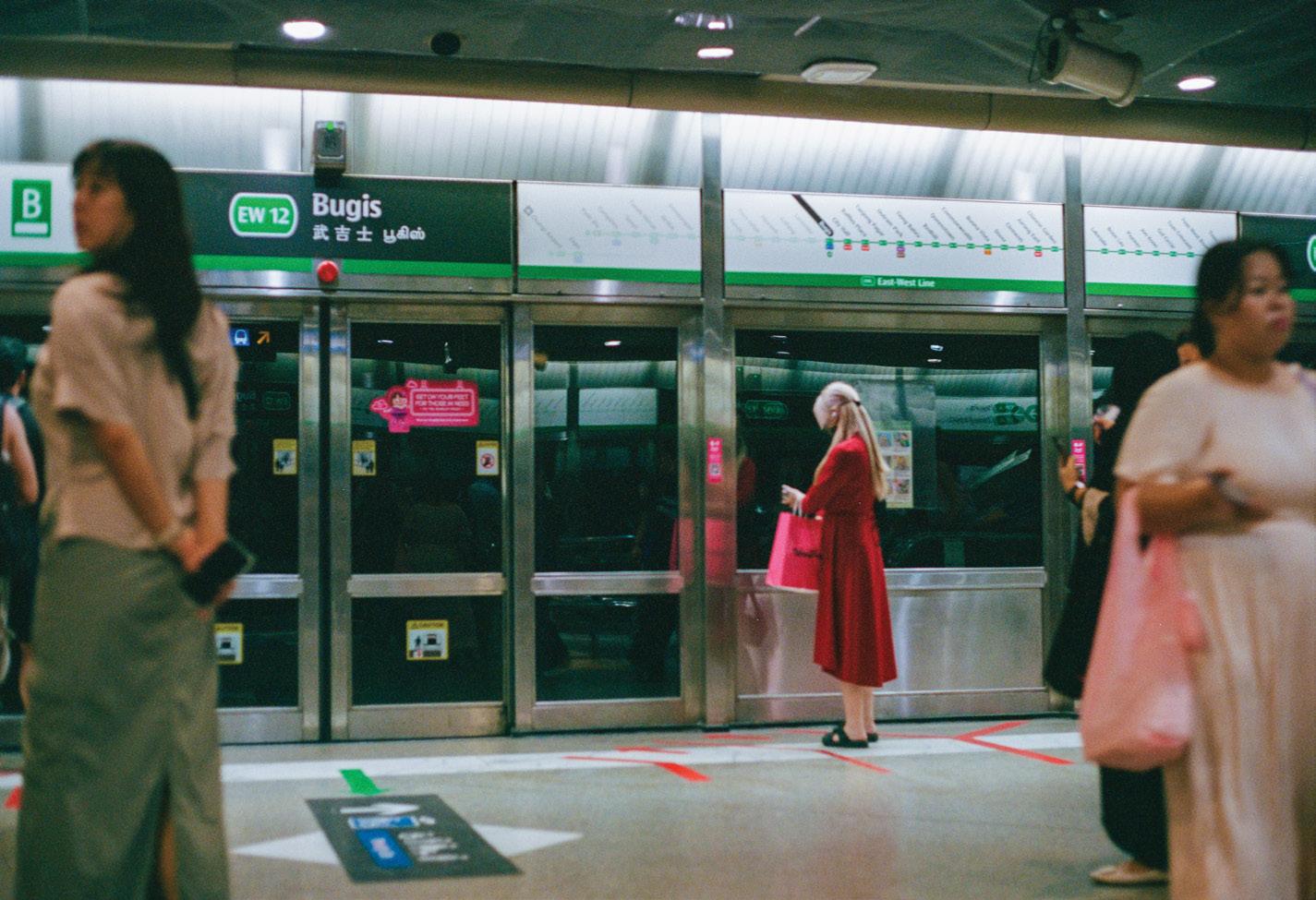
NICHOLAS BALDWIN
When my friend fell headfrst into a crevice of boulders in the tundra between the Klondike and sky, the bear, and snow in that rescue distance, I hadn’t met him yet. He tells me the last thing he remembers is wanting a cup of hot tea so badly and then—not wanting and then the bleeding in a landscape that had been scarred by want and then the memory of want by the rare earth elements to reproduce want, one of the few things that penetrated the snow. Imploringly he tells me he hadn’t broken his neck. He can still walk and is learning how to surf. He considers himself lucky. But it must’ve taken months for the scar to heal.
Picture a pink like the innermost fesh, sticky unguents, bald spots, the fearful skin grafting in patches over dome-fssured bone. And the rest of the catalogue, plus substance. The never-made-material question, still. Still, he sits as an imperfect philosopher sits in the Garden with Epicurus and Kierkegaard pondering the timeless. It must have taken years to recount the fall calmly, as he does now seated cross-legged in the grass before the lake with one forefnger
guiding the story along the side of his head. The cold has never let go of him. He’d been left alone in his body. When his body is in pain he believes it reorients itself.
I can see that death takes him to the third person. He doesn’t complain or blame the bear with its need for meat to continue before the slowing season. He simply leans into me headfrst with eyes peering amid the loss of hair and the forgotten girl and the consequence, and tells me it all was a small price to pay to take more care with his life, with what he does.
I think he now understands urges within jaws’ reach come from a place of need. How desire thrives, feeding on every living thing.
NIC HINSON
Editors Literature Choice Award
In the dream, she is standing in the clearing of a throbbing house party brushing her pink-dyed hair. It is stringy and faded and grown out. Her hair is dark at the roots. As it is combed, sweat sticks it to her forehead, uniform and greasy. At the ends, her hair looks like brushedout yarn. She stands illuminated under a white spotlight. The rest of the party is deep blue, but she glows white and yellow and pink. She is freckled and ffteen, how I remember. In real life, she was only ever allowed to dye the two strands framing her face, and they were blue, not pink. The spotlight dissolves everything else. She brushes her hair and looks at me. She smiles wide, pearly teeth smoldering.
A year after my sister died, I dyed my hair pink. She had been begging for months to dye her head blue, and the most our parents would allow
were two strands framing her face, sticking sideways out of her black hair. She begged and begged and then got too sad to keep on living. Then, for her, I started begging. I asked for pastel, something smart and disappearable. The hairdresser decided to give me hot pink, so urgent that it colored my hands when I touched it, and in the shower, hot pink poured over my breasts and stomach, then into the drain, into nonexistence.
The evidence that our dreams are not real is that they immediately appear surreal upon waking. They don’t ft within the sequence of our memory—this is enlightenment. The vanishing of dreams forewarns of the vanishing of this higher, obvious reality. Dream logic is legitimate when we are dreaming. If I drop something, I am not surprised when it falls upward. Expecting a dropped thing to fall downward is much the same.
She walks away from me. Her pink hair waves behind her as if underwater. The crowd parts, dancing bodies splintering. It smells like spit and
NIC HINSON
weed. The gap closes behind her, and I know she’s suffocating in there, between the base particles and base instincts. I know there’s no way to open up the air and save her. When my hand cleaves the bodies, it passes through clean. Some early philosophers believed there was no empty space in the universe; they were wrong.
She would have looked so cool with blue hair. In life, she occupied herself with temporary tattoos and wish lists full of ripped lace dresses. She watched a lot of anime, and pencil drawings of anime characters overlapped on the corkboard in her room. She was occasionally awful to me, and I tried my best to be awful back. We’d fght and scratch and claw at each other and say things like “kill yourself” in casual conversation. She used to put on black lipstick in the mirror and smile, admiring the sharp distinction between the black paint and the shining silver metal of the braces on her teeth. Before she died, she made sure to get her braces taken off. In her obituary photo, she has eyeliner on, and her lips are painted blue. She's closed-mouth smiling out of habit. One of my mom’s friends made an oil painting of that photo. In the photo, she’s in the house we used to live in, but in the oil painting, she’s in a rainbow void.
The shape of her jaw is all wrong.
I find myself in the bathroom mirror. There’s something dark blue and sticky dripping down my front, and I’m gripping something inorganic that’s fallen to the bottom of my shirt. I’m wobbling, dead-drunk, and I’m looking for someone. I pull the thing out, and my hand is covered in wet blue ink, dripping on the black and red checkered tile, staining it, and bleach will never get it out. I’m holding a Magic 8 Ball, and it’s leaking everywhere, and my hand is almost too small to keep its grip. It tells me “TRY AGAIN.” It’s keeping me in Its mind, loosening Its hold, but I feel other bodies swishing around in the same blue liquid, so who I’m looking for must be in here, too. The door to the bathroom is red, and I catch myself on its gilded handle.
The liquid oxygen is draining, and God’s 8 Ball head is tilting in amused confusion, sliding me toward Its ear. At the new exit, bright blue plasma whirlpools out, and I’m caught in the riptide, spinning out. The checkered foor is staining forever, and no matter how much you scrub it, it will stay blue, like the once white walls, like the sink. I fall sideways, and the shower curtain nets
me, and now that’s staining, too.
Every color is bleeding into each other, and deep pink surrounds my stomach. The lines that divide my body and not my body shimmer and weaken. All the air is gone, and I’m still trapped in the plastic shower curtain like a fsh stuck inside a Kroger bag. I am a bird and an angel and a turtle with a plastic straw up its nose. She never believed in God. She thought it was stupid. She was fifteen and chose to fall face-forward into nothing.
I count my fngers and toes and fnd twenty total. I count again and fnd forty. There are more limbs in the corner of my eye, straining the socket, fngerprints forming around the optic nerve. I’ve absorbed her, held her in my mind—she’s really real, an idea that I wrestled out of Death’s mouth, like I dug my fngers into a dog’s jaws that was eating something it shouldn’t. “That’ll hurt you.” Then I stuck my fngers in its teeth. My head is draining, too. The thing between my ears is emptying. It soaks my shoulders. My body turns slick and warm.
My skin slides across the floor and touches every
There is no other room than this one. I can believe there are other rooms if I want. There’s evidence—I remember a lot of different rooms, all with different sizes and colors and elevations. I remember the room where she painted her nails, picked herself apart, chewed her lips until they bled, laughed, dreamed, lived, and I remember its shut door. Believing in other rooms would even be the more rational option. I’m not convinced. This one is so good at containing me, this room with this body—this divine mirror. My skin slides across the foor and touches every corner, and it’s beautiful in a surrendering type of way, and the red door on the ceiling won’t open even though there's something on the other side, and part of me thinks I hear a knocking, and I reach my non-hand toward it, but the sinking collides the non-hand with my nonshoulder, and I’m too melted to do anything about it, which is a sick game to play, and I’m going to throw up.
My tongue pushes clumps of pale pink hair into my hands. It looks like spun taffy or ripped-apart
cotton. Bleached-dyed hair clogs my throat, and as I choke on it, I try desperately to swallow it back down. I want to rinse my hands off in the sink but don’t because I’m afraid some of the precious stuff will fall down the drain, into nonexistence, out of the room. Please stay with me. I squeeze it in my hands, and it makes sounds like fre. The split ends splinter my palms. It hurts.
I dissolve down the shower drain, plastic netting and all, and all around me there’s streaks of hot pink, boiling and urgent. I am swallowed like hair down a throat. There might be a spout at the other end where the hair dyes the ocean a harsh, radiant pink—might be.
In the morning, I sat with my girlfriend as she boiled Kraft Mac and Cheese for breakfast. The sun was cold and white through our studio apartment window. The outlines of my body were solid and unmistakable—my bare feet against the vinyl laminate, my back resting on the cushioned plastic folding chair, the air rushing into my nose, my hands pressing into each other. My hair clumped on my shoulders like dry tinder.
I poured too much oat milk into almond-honey cereal. I didn’t say anything, still holding her in my mind, suspended, free-foating. I told
my girlfriend I had a weird dream and didn’t elaborate. Sharing it would have felt like splitting her in half—it was like holding a marble in my mouth, not swallowing, not spitting it out. She was living in a minor, almost inconsequential capacity.
When my girlfriend left for work, I started writing the dream down. I marveled at how long it’d been since I’d written anything with that kind of urgency, like it would all disappear if I delayed. I didn’t want her to disappear. I named the dream. I showered and expected to dissolve. I got dressed and turned off my alarms. I responded to Outlook emails. I walked to the library and, under the table, I scrolled through job listings on my phone. I thought about re-dyeing my hair. I never, ever tilted my head.
In that state, I could create a thousand identical oil paintings of her face. I could write impartial recountings of the freckles she hated, how she’d hold the Wii remote, how, that one time, her saltine cracker spittle accidentally few into my chicken soup, and how I’d tattled on her and made it seem like her fault. I could write odes to her childhood eczema, to the crib puddled with her blood when she’d scratch her
baby arms open, to the way she kicked and screamed when my parents brought me home, to the back of her head. I could speak in her voice. I could pull the same faces she used to make. I could make the same jokes. I could bring her back.
In the dream, we’re having a sleepover under her cartoon flowerprint comforter. The window is throwing speckled light over the top, silhouetting the branch that keeps smacking the window, and I am scared of the thumping sound it makes. She tells the stories I beg her to tell, or we watch YouTube videos on her Nintendo 3DS, or hide under the covers when our dad comes in to check on us, or nod off to sleep. In the dream, it’s snowy on Easter so we’re ripping out the couch cushions and making a maze to hide plastic eggs in. The couch cushions are brown, and it’s too easy to see the bright blue eggs (for her) and the bright pink eggs (for me) against the brown backdrop, so we bury them in blankets and run through the maze on all fours. In the dream, it’s Christmas and she’s ripping open the wrapping paper on the snow globe I picked out for her and bought with our mom’s money, and we’re putting sticky bows in each other’s hair. She puts the snow globe on her shelf. Now I put the
snow globe on my shelf because she’s gone, so it’s mine, even though it’s hers.
In the dream, just before she’s gone for good, she throws ugly words at me. She gives me the middle fnger in the kitchen, and I sit in the driveway for hours, waiting for our parents to come home. I tell her I’m upset because, I don’t think you even know what that means. In the dream, she calls me a brat and holds me down and slams my head into the soft gray carpet. I play dead to make her cry, make her miss me, make her regret killing something she loved. In the dream, she chases me around a family friend’s unfamiliar furniture, and when she catches me she says I have to do something sexual because it’s the rules of the game. I am eight and she is ten, and I say no and she rips open my shirt. In the dream, we’re in her bedroom, and I’m young but I don’t know how young, and she’s making me do something that I don’t understand. I love her and there’s nothing to replace the things I can’t love her for. The memories bleed into each other, and I don’t want it to be ugly, but it is. I love it still.
At the end of the day, I have to lay down to go back to sleep. I have to mold my face to the mattress, submit to how she will seep out of my ear and stain the pillow. She is going to leave me, again and again, and I
am going to let her. I don’t know when I will see her again. I don’t know if I’ll ever see her again. She looks different every time.
I hate dreaming of nothing. As a kid, I’d have nightmares every night, the same recurring scenes every time—in the most common one, I’d hide under the covers with her and my most precious possession (my Thomas the Tank Engine train set) while our mom was brutally attacked down the hall, in the bathroom. It always ended with my dad saving me by chopping up the attacker with a chainsaw, then serving him to us on a platter. In another, I hear booming steps coming toward our room, and I keep trying to pry the bedsheets open so I can hide under them but it's not working, and my sister is gone, and I am grabbed by the ankle and dragged by a leatherbound monster with no eyes and sharp teeth. The monster knocks me unconscious, and the next place I fnd myself is held upside down over a steaming black cauldron, surrounded by deformed dinosaurs and people in Yo Gabba Gabba suits. Watching hungrily, they skin me alive.
My dreams have since turned kinder, preserving people as I’d like to imagine them, not replacing memories but extending them infnitely in a spaceless space, resurrecting them and letting them live for as long as I focus. It’s like they’ve taken pity on me now. I have enough fear; there’s more they want to give me.
I have enough fear; there’s more they want to give me.
I sat on the edge of the bed and gritted my teeth. I’d washed and dried my pajama pants on the wrong setting, and I picked at pilling fabric on my thighs. Every day, she leaves me. I let her, but I hate it. How hard would it have been for her to just stick it out? I wanted to call her on the phone. I never did that while she was alive, but it feels like something missing now. She would say, How’s school going, and I would say, It’s fne. I’m glad you’re here with me. You’re twenty-three years old now. You’re 3,095 days too old. I dream about you all the time. I don’t know how to forgive you.
I put my headphones on and lay down. This hurts every time. I scrolled through YouTube on my laptop, looking for
noise to fall asleep to. I picked something. I scrunched my eyes shut and tried to forget about everything. It’s still so hard to let my mind unfocus. I concentrated on the video-woman’s voice, picked out every syllable, savored them like they were the most important sounds on planet Earth, like they were the last things she’d ever hear. My head was pounding. She crumpled toward the foor, caught in the riptide fowing out of my ear. She ran out of liquid oxygen and gasped, fsh caught in a plastic Kroger bag, her eyes bulged out of her head like fsh eyes, she fopped over uselessly, gravity pulled her soul out of her mouth.
I will fall asleep again, and it will be over. I will dream of nothing. In the morning, the pillow will be stained bright pink.
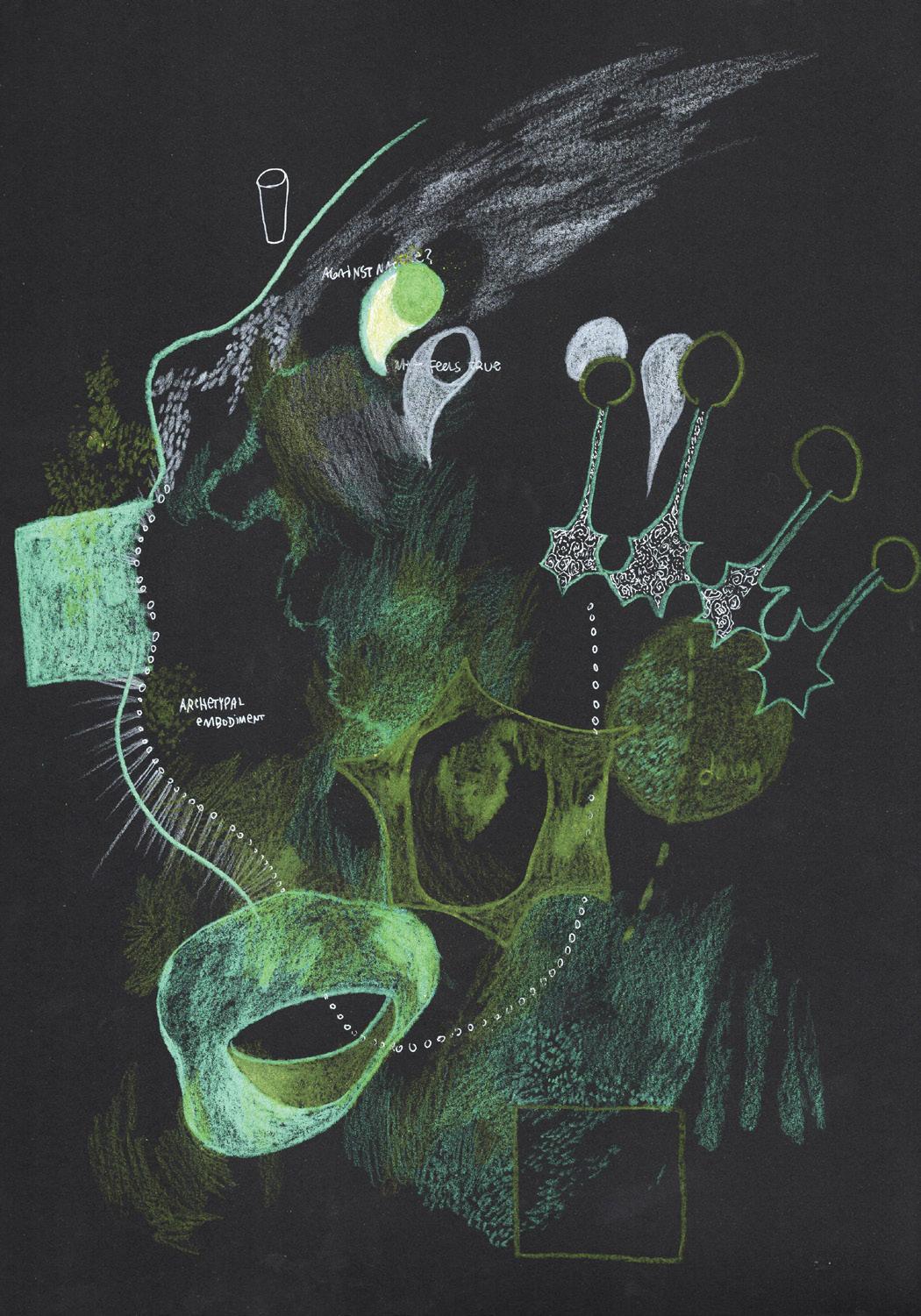
8.5 × 11 in. / colored pencil and white gel pen
art
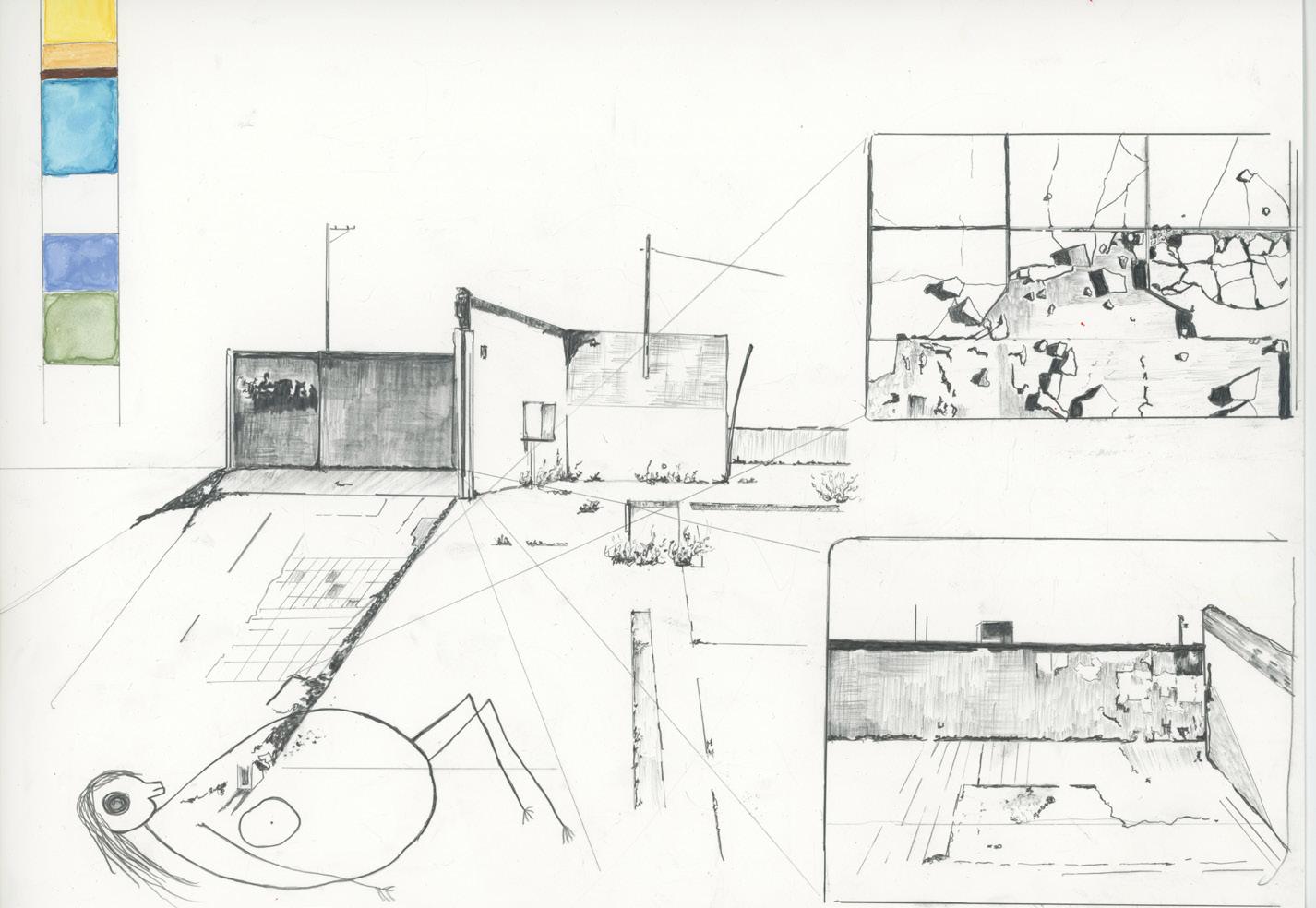
12 × 9 in. / graphite and watercolor on paper
Visual art
She told me to stow the chick in the highest place in the house, in the cupboard above the dog’s things, chewed ears, spiky ropes, pills cut in half.
“It’s important you do this,” she said, “for dinner.” I knew she was not going to eat the chick. The meal was the thought of consuming something so small, and that, too, I ruined, protecting the chick from the ghost of her wolf dog,
encasing it in my hands so tightly I thought it would produce no scent.
When I nestled it next to a cow’s femur, the chick was limp and sinewy, like boiled squash.
If only I had listened to the staleness of her breath and known everything, even the house, was hungry.
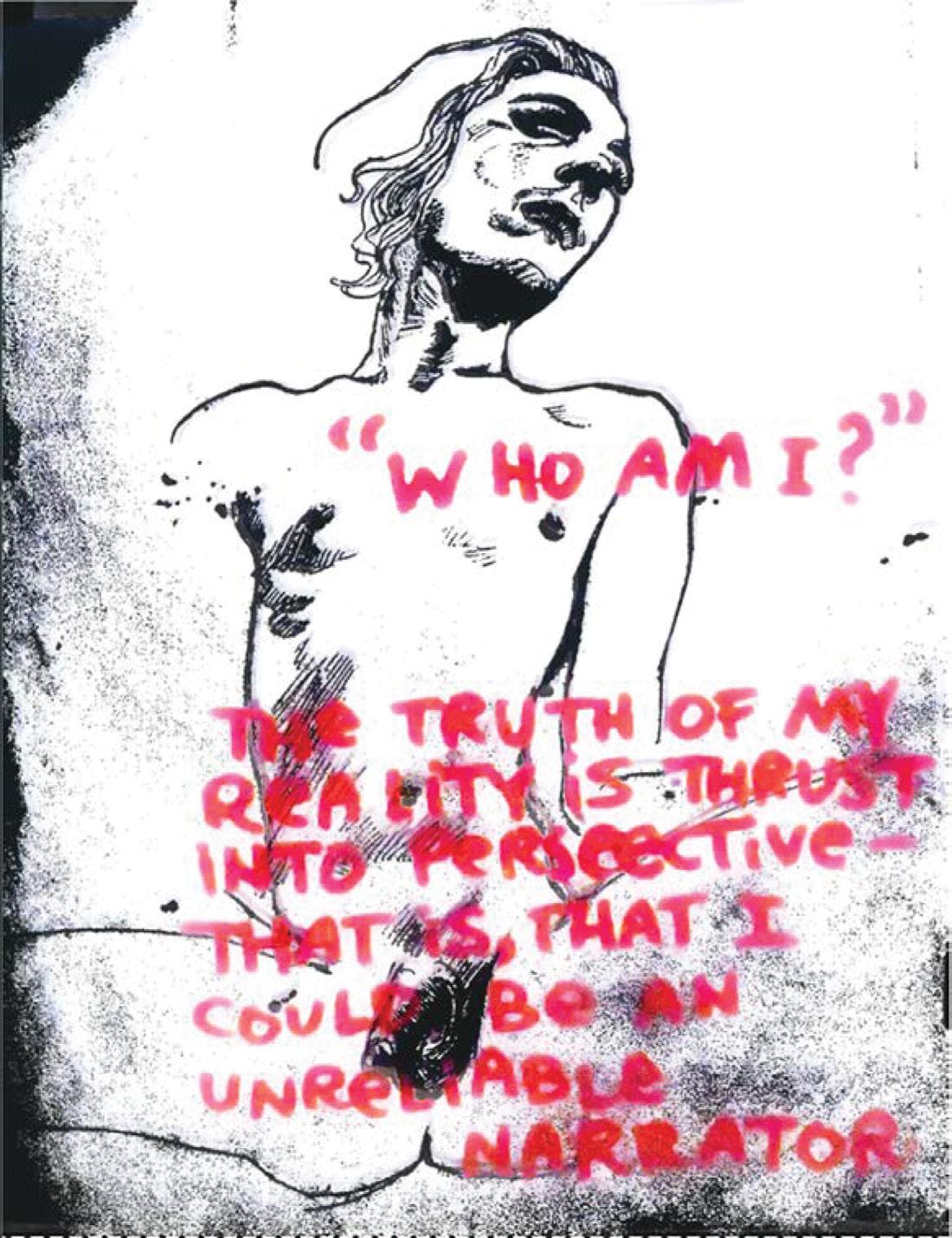
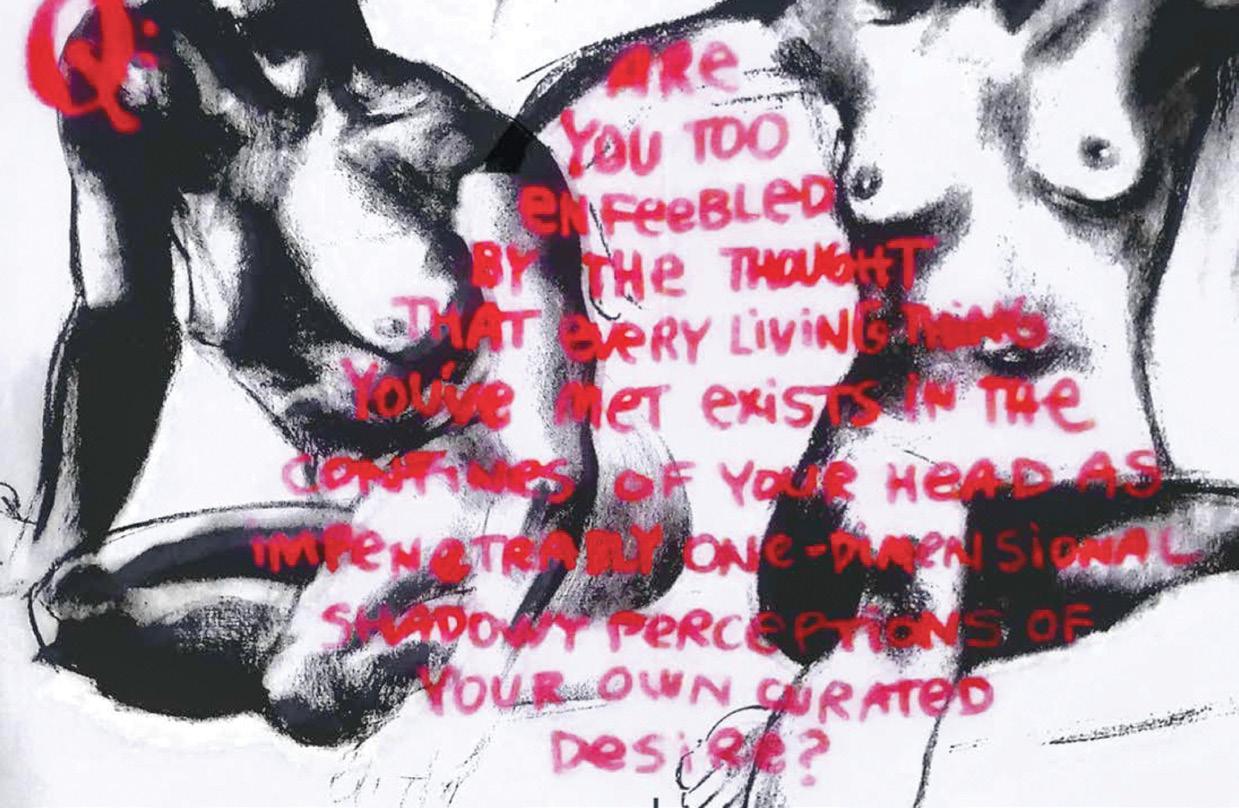
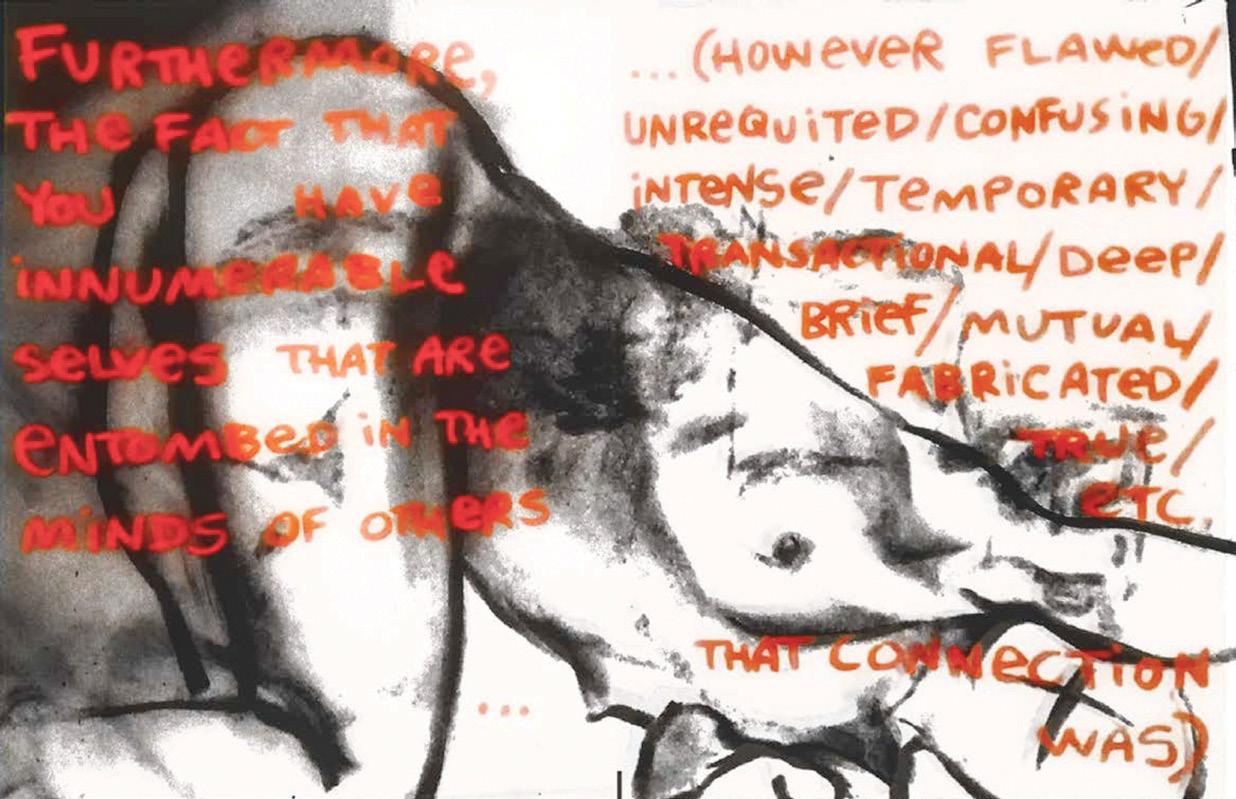
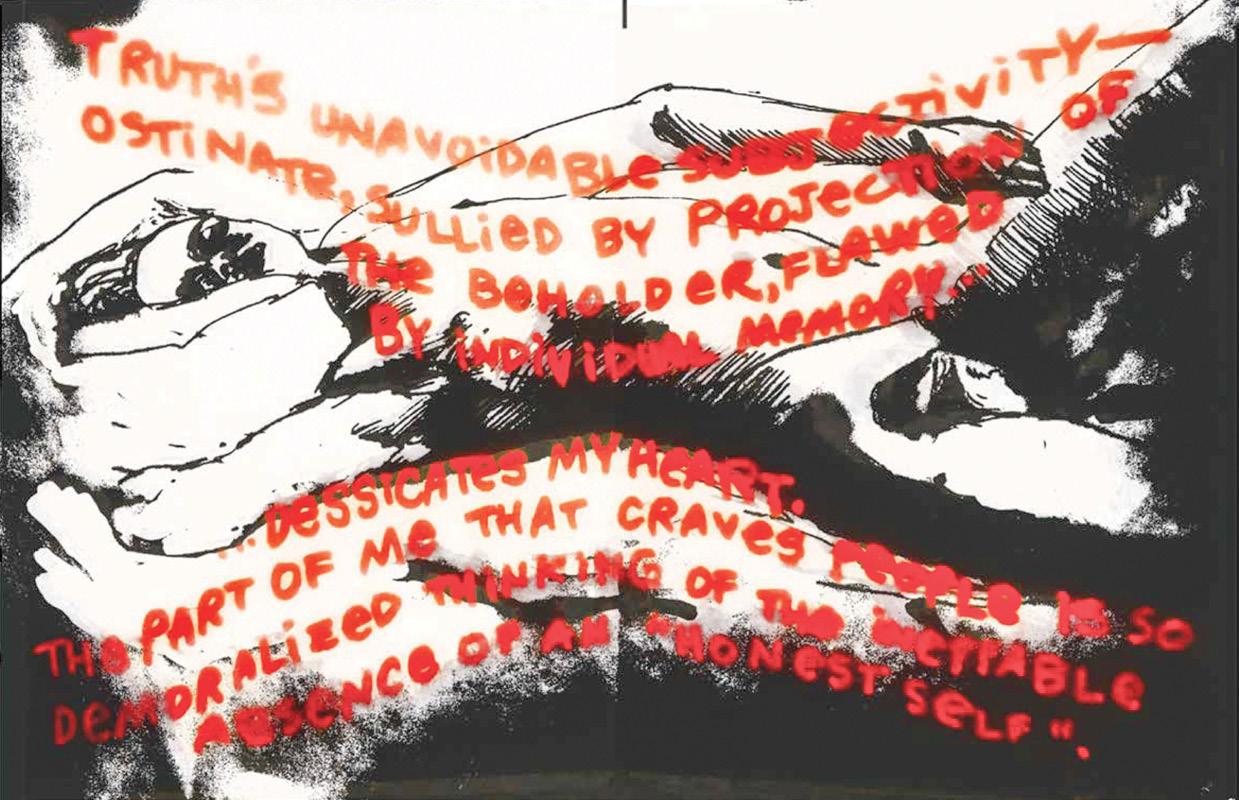
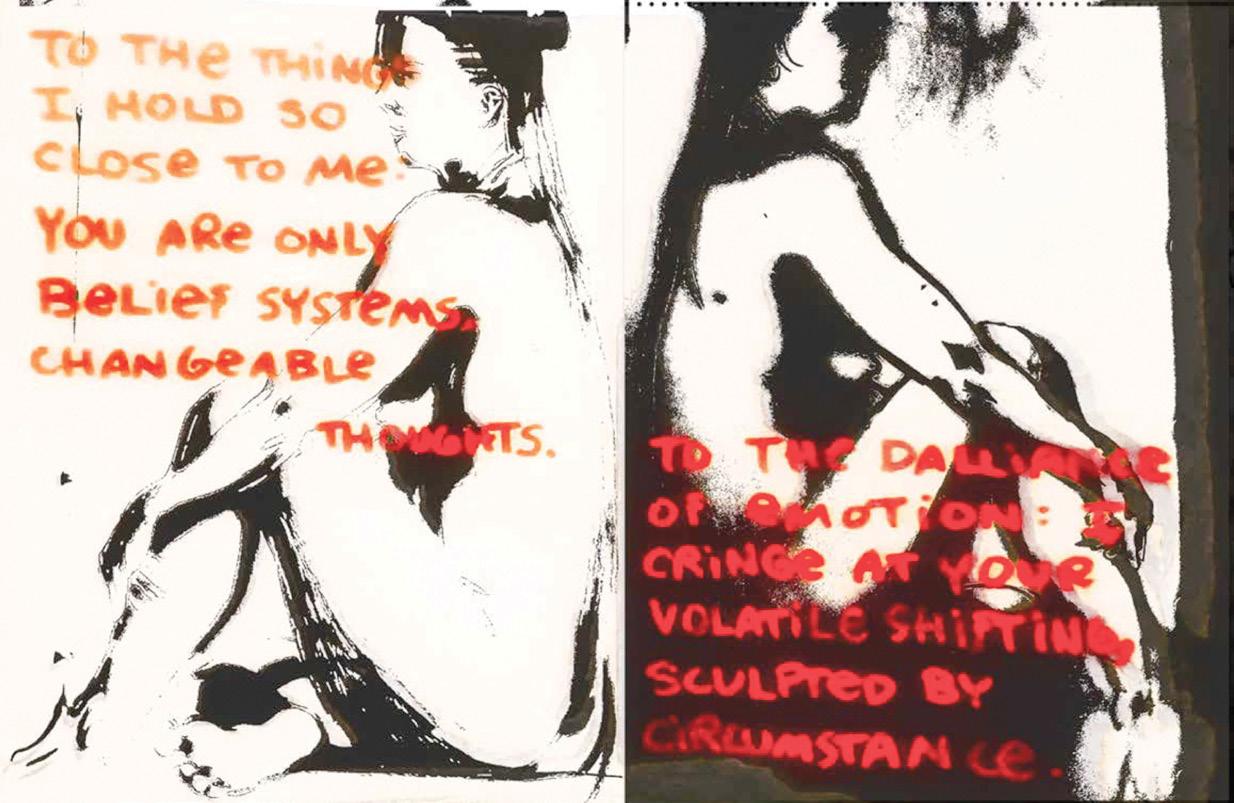
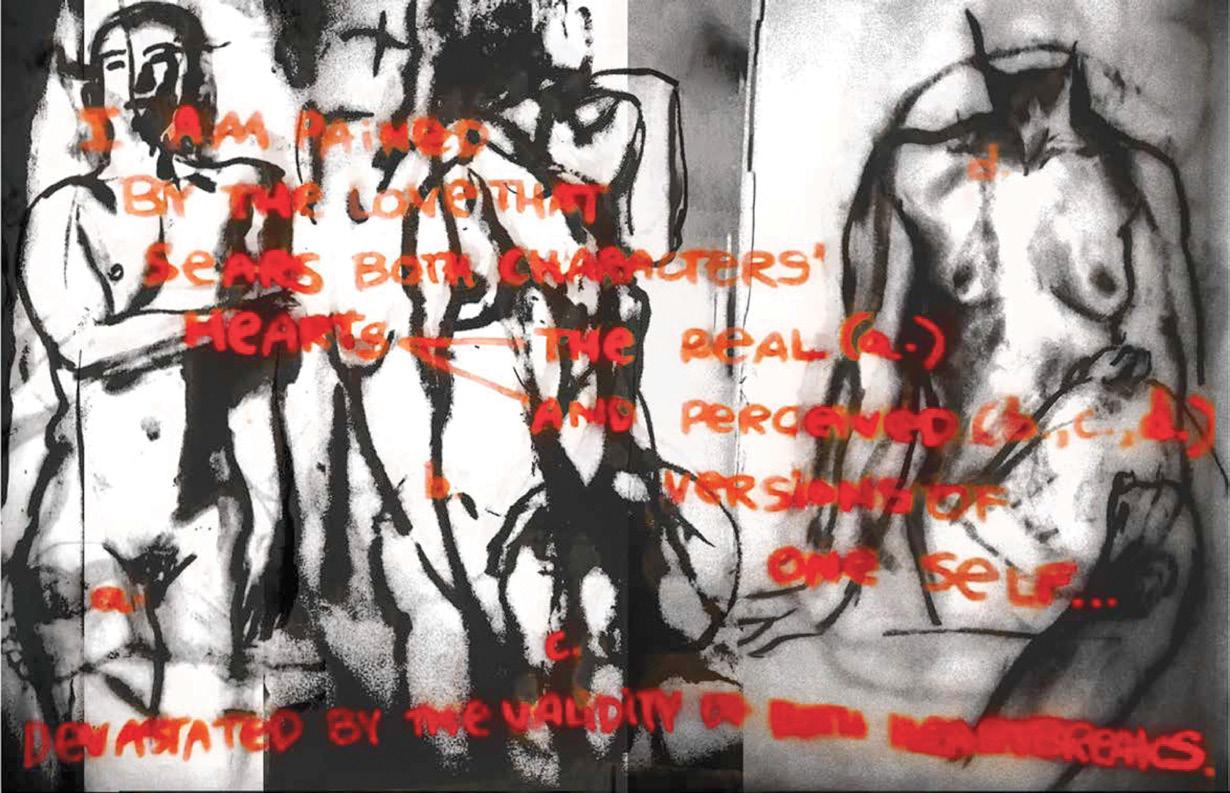
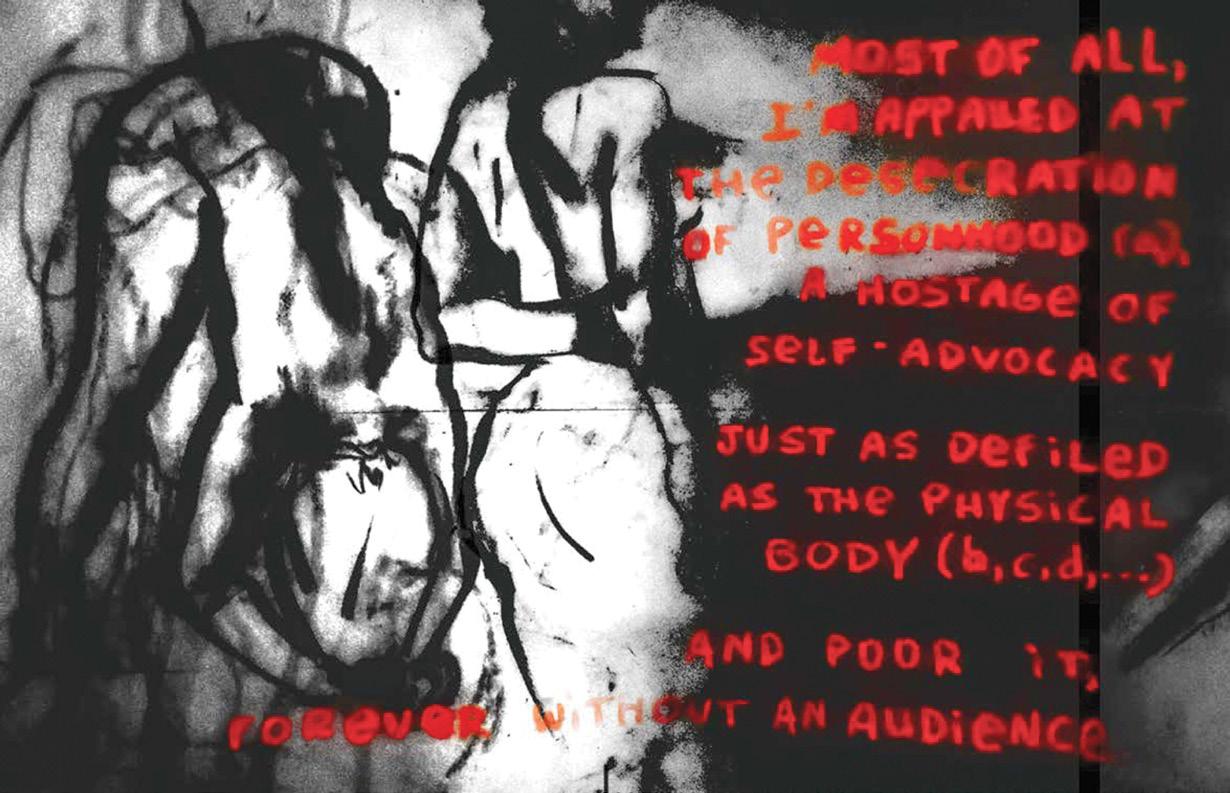
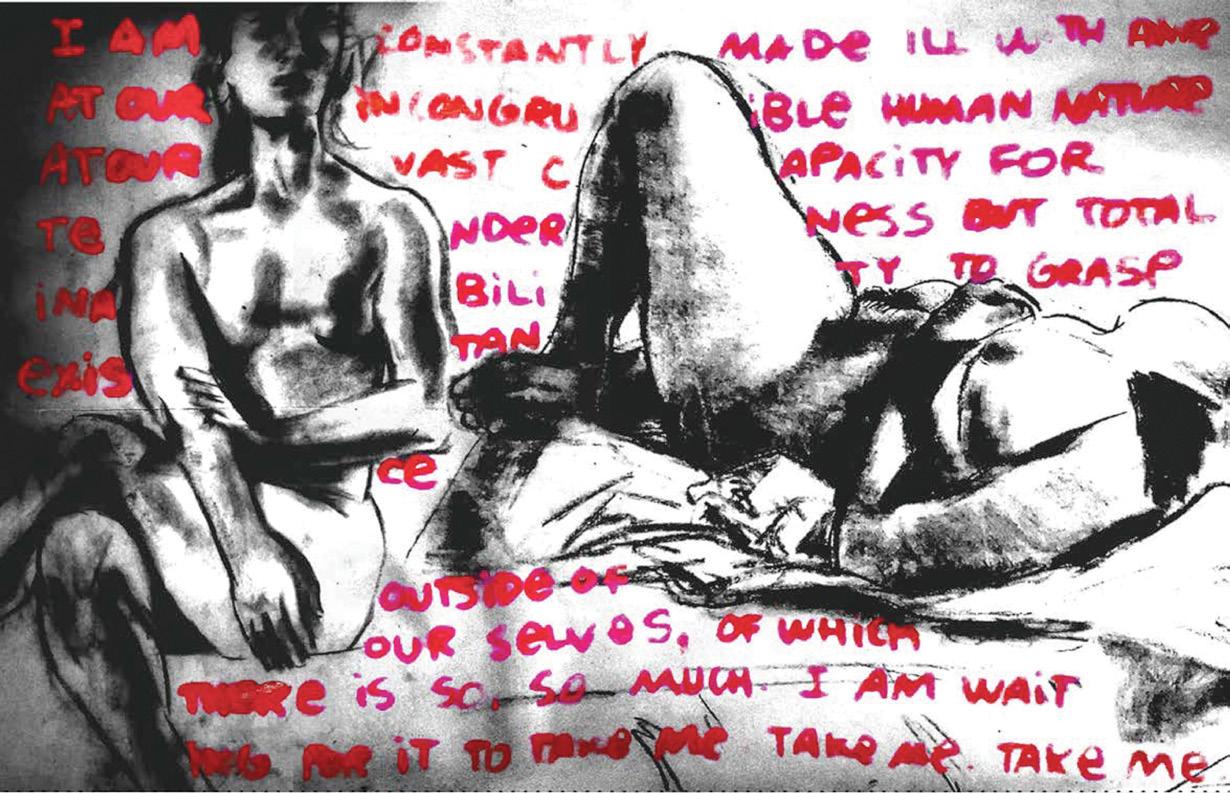
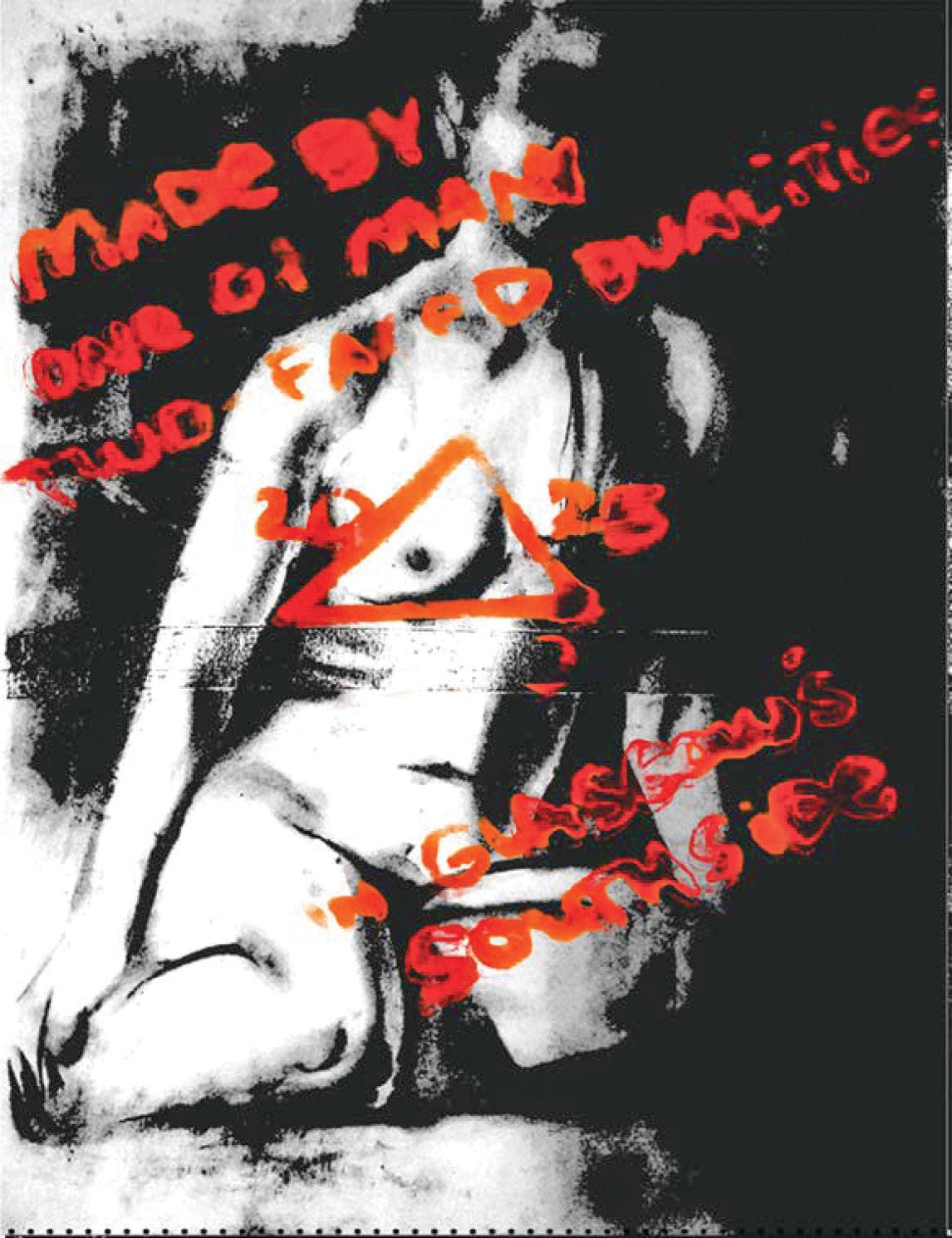
“Who Am I?” is a fourteen-page poetic zine (4.5 × 5.5 in.) that initially began as a reading response to Orpheus Builds a Girl by Heather Parry. This book wrenched new knots into XeO's internal landscape and sculpted the remnant musings in this zine, which are paired with life drawings selected from sessions attended over a period of several years. The identities of these models and the mediums XeO used are rendered anonymous, reduced to a fat black posterization overlayed with semi-illegible text.
Scan the QR code for a closer look at the text!
There is a bird skeleton on a median outside a megachurch.
Ten feet away, the youth group is playing Hacky Sack. It is a break in the conference, half an hour to just be teenagers in a parking lot, half an hour where Preacherman isn’t telling you to take up your cross and carry it.
The bird’s ribs rise out of the dirt, little lighthouses, fragile monuments. I wonder if it died in the cold, or if it rotted in the heat of the Colorado summer, sweet decay sitting here Sunday after Sunday until the feathers disintegrated. I am eleven, and I have this recurring dream that I am falling.
The bird does not have wings, and neither do I.
God, are some things only born to die?
A spotlight from the ceiling and a prayer booming around the sanctuary. Ten minutes of promises, of begging for forgiveness, of hands silhouetted against mechanical blue light.
There was a coffn full of tattered camo. There was a white marble headstone with a cross carved into it. There was a Humvee split open, its wrecked walls rising
out of the sand, charred lighthouses, serrated monuments.
Carry it, Preacherman implores.
The bullets were addressed to God, but they caught in the congregation and in the walls, so they patched over the holes and made the buildings new. I watched the shadow pass over the cafeteria window. Mom turned my head away from the police tape and the metal detector when they lifted the lockdown.
There’s a band playing, all steel-string guitars and sprawling piano chords, and there is mechanical blue light outlining the eightthousand teenagers in this room. Preacherman feels the holy spirit here tonight, says he can see it moving through the crowd, and I am swaying to the rhythmless worship, and I am waiting to feel it move through me, but at the base of my spine I know that it will not.
Carry it.
There was a bird on the pool deck, watching me swallow two lungfuls of water. I surged up hacking, claiming an accident. The dog licked my hand as water dribbled out of my lips.
I tried again on the mountain road, in the lamplit dorm, on my parents' bedroom foor. I craved the taste of metal.
The bullets rose from the carpet, unstable lighthouses, solitary monuments.
Carry it.
God, if I try harder to believe, will you fnally let me?
I am standing in the dying light, and I am not crying. There is a Humvee and a bullet hole and a headstone, and everyone in this church is singing, and we are signing our names on dotted lines as a promise to carry it.
You took them, and you left me. They wanted to live. They believed in you.
God, I have been trying. That is all you gave me.
There was a lighthouse in my living room. There was a monument on my bed. I was eleven, and I did not have wings.
Carry it, Preacherman, carry the bullets and the desperation and the nights spent curled up alone in bed. I can hear all of it in the god-lit begging, the hours you spend on stage, staring into the lights, when all you can taste is sweat dripping off of your lips.
There is a bird skeleton on a median in the parking lot of this megachurch, and I am not dead yet.
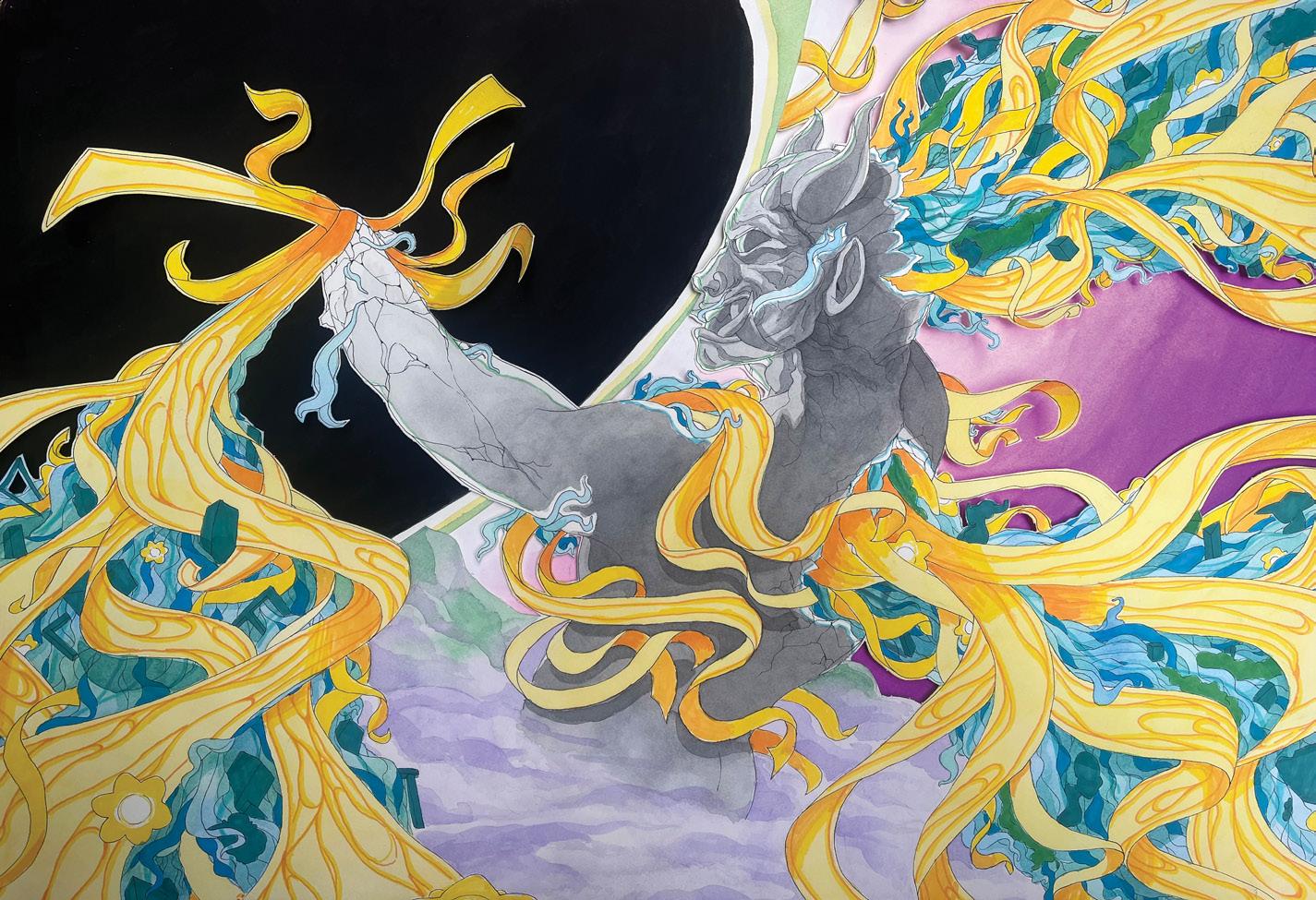
30 × 24 in. / watercolor paper and markers
He hangs his jacket on the North Star when he walks in, all casual, all crooked smiles and drawnin shoulders. His own body collapses in on itself, so strong is his gravity, and I wonder how he fails to notice that everyone else is being drawn in too.
He issues the eleventh commandment from a rooftop bar downtown, heralded by a shitty DJ set and overpriced Coors Banquets. If you saw him there, hair haloed against the porch light, smoke curling around his fngers, you might mistake him for Saint Jude at Pentecost. He has that type of face that should be painted, should be immortalized in gold leaf and porcelain. He is a fgure half carved out of marble, a statue left unfnished, a brow bone and a crooked nose, an indication that someone was here, someone who makes prayers pour out of pens, someone whose name rips out of mouths like a bullet.
If you fall on his doorstep and beg for sanctuary, he will grant it, and his home will smell like smoke and dust and heat. Here, there is life, and here, his chest rises and falls. He breathes universes. Let there be light, and suddenly a cigarette, suddenly a warm amber glow from behind the screen door, suddenly a smile.
He nails his theses to highway mile markers. One by one, he hangs them on the back of the night, swaying soft and gentle in the breeze, lighthouses for lost
causes. He is a permanent impression in the grass, a half refection in a window, a fgure made of whispers, standing under a streetlight. You could mistake the ridges of his knuckles for mountains, his skin a melting sunset. He shakes the earth when he walks. He will bring you to your knees, and you won’t even realize it until you need to get up, and he ignores your extended hand.
There are no churches built for him. The closest thing you can get is a dark room full of drunk people singing, all singing, not hymns, but something close to them, bodies pushing and pulling, and the distant knowledge that someone in this room is in love and it will destroy them eventually, but right now there is nothing but joy, and smiling lips are meeting in pitch-black corners, and everyone in this room smells like sweat, but nobody cares. Everybody is here, everybody is happy, everybody is smiling and laughing, and nothing matters for these precious few minutes where the DJ plays the best song you’ve ever heard and will never hear again. That is the prayer. That is the worship that will fll his chest with new breath.
He will not descend from the clouds on a white horse, and he will not save you, but he does perform miracles. He raises the dead, he raises hell, he raises the hair on my arms when he furrows his brow. He will split the sky with a laugh and a flash of his teeth. He will not save you, but he will break the world and remake it in his own image. He will not save you, but he will create a seventh day just so that you can rest. He will not save you, but behold, he will stand at the door and knock.
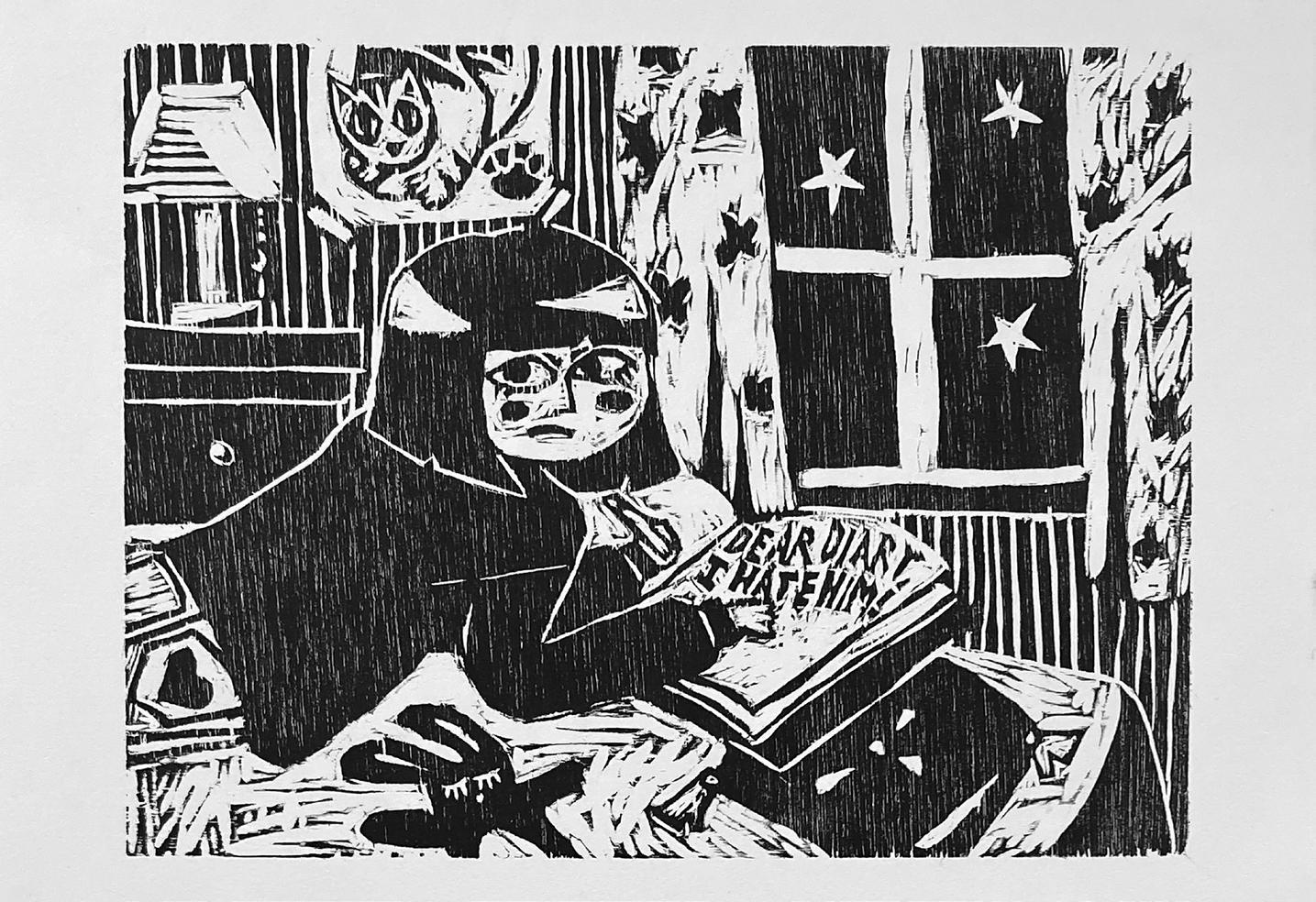
14 × 11 in. / woodcut print, oil-based ink on archival rag paper
Art
MIKAELA JOHNSON
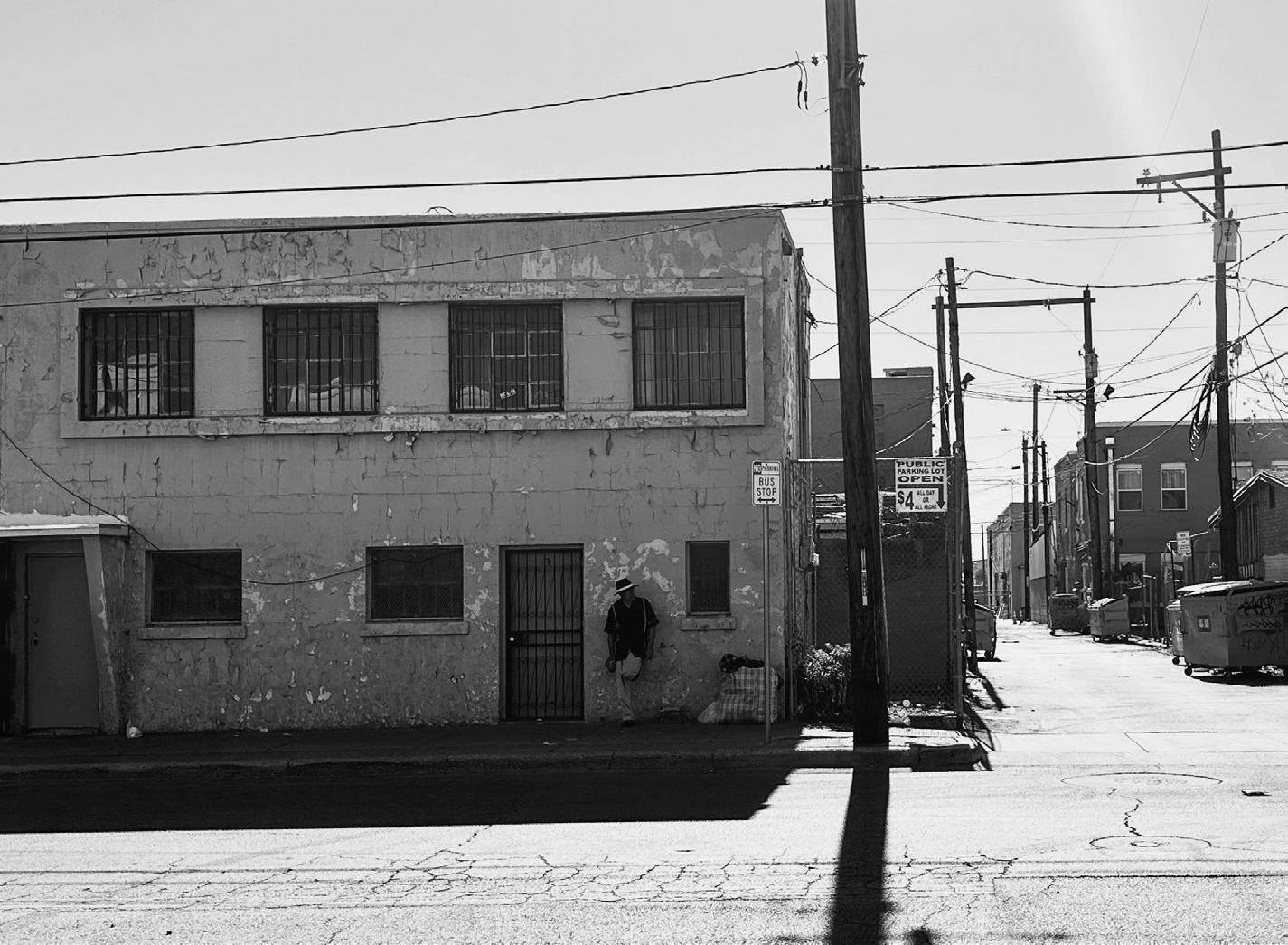
7.5 × 5.5 in. / archival pigment print
As a young actor in New York, I studied with a teacher from The Actors Studio who urged me to take the train up to New Haven to see the Long Wharf Theatre’s production of David Mamet’s American Buffalo starring Al Pacino. And so I did.
Long Wharf Theatre was a very modern, comfortable place. I’d reserved a ticket by telephone and arrived early to wander around and enjoy what felt like a little vacation for an evening. I knew of Al Pacino as a movie star, but I hadn’t seen all of the pictures he’d been in and wasn’t following him or his career; I just thought he was a movie star—a matinee idol.
It’s odd how little things can often make such indelible impressions. Since I was early to the theater, I took my seat and began to look through the program I’d been handed. It was Pacino’s biography in that program that caught me by surprise. I’d seen
quite a few productions in New York, read quite a few programs, and the actors’ bios were almost always fashy, hyperbolic, and (I thought) kind of embarrassing— cheesy advertisements for the actors. But to me Pacino’s bio was humble, dignifed. Unusual for one of the biggest movie stars in the world—a simple list in the third person of the plays and movies he’d been in. No comments about his history; no thanking his agent, his parents, his pets; no frst person expressions of gratitude or any of that. Just the facts and no bullshit or spin despite the fact that the reason everybody was coming to see this production was to see him—the movie star, the celebrity in the fesh. His bio seemed to quietly, blessedly imply that what you were seeing was not a businessman, not a celebrity, not a sales pitch, but an actor. Just an actor, and that would have to do. By the time the curtain went up, I was rooting for this guy.
I should say that if you’ve never seen Al Pacino on stage, you haven’t
really seen Al Pacino. His sheer presence can mean that his skill often fies under the radar (which is probably where it belongs). Although it can be further developed in someone, presence is not something I think anyone can do anything about. It’s just a knack, something innate, that lives in some people, and we’re lucky if they turn up as actors. When we see Baryshnikov dance, for example, a part of us involuntarily becomes Baryshnikov, and we internally move with him and feel with him and get infused with a sort of gladness that we wouldn’t have come upon otherwise. The same happens when seeing Pacino on a stage. He’s so focused, so concentrated, so honest, that it’s not easy to disconnect ourselves from what he’s doing—we do it with him, we feel it with him. And this is true of all genuine and great actors; just fewer and fewer of them make it onto a stage these days, and that’s where stories can be acted out with maximum dignity and craft.
Anyway, I won’t go on about the excellent production at Long Wharf, but by the time we got near the end and Pacino, as Walter Cole (Teach) said with existential exhaustion, “This fucking day,” I could barely breathe.
A decade or so later, I was hired by the casting director, Bonnie, to
help cast the movie of Glengarry Glen Ross by reading opposite the auditioning actors. The audition process for Glengarry was, in many ways, abnormal. For example, after we’d held the frst few rounds of auditions, we began holding the callbacks in a residential high-rise apartment building (circa 1970s, I’d say) in a quiet block on the Upper East Side. It was a large, comfortable apartment with a nice kitchen where pots of coffee were continuously brewed, and there were a couple of bedrooms, in one of which I and another reader would be asked to wait until we were called to read with the auditioning actors in the main living room. It wasn’t the only place we held auditions, but it was the one in which I frst encountered (we were never formally introduced) Al Pacino.
I arrived at the address early and entered the frst foor lobby, which was enormous with a high, vaulted ceiling and glass walls through which sunlight streamed onto the chocolate-colored brick fooring. It was eerily quiet as I approached the doorman behind the desk at the far end to announce myself. As I was crossing the huge, empty space, there was a ding, and a nice-looking young woman came out of the elevator
holding the broken, mangled remains of a beige office telephone with lots of buttons on it. The handpiece of the phone was broken in half with only the exposed interior wires holding it together.
She approached the doorman with an apologetic look, holding the phone like an injured animal and said, “I’m so sorry. He got upset again and forgot himself. We’ll pay for all this, I promise.”
She even smiled apologetically at me before disappearing into the elevator again, and though she could have come from any one of the many apartments in the high rise, I could just tell she was part of our production.
I fnished my approach and muttered to the doorman in response to the phone episode, “Hmm.”
He chuckled wryly and said with a thick New York accent, “Yeah. And not the frst time.”
I gave him my name, he called to announce me, and I went up in the elevator a little nervous. But once in the apartment, I pretended not to be nervous because it was clear that everybody else was nervous, too. I met the girl I’d seen in the lobby and asked her what had happened with the phone. She said the director, James Foley, was having telephone calls
with the producers in Los Angeles about something-or-other that weren’t going so well, and he kept losing his temper and banging the phone down for emphasis. After that, I just remember Bonnie handing me the audition sides (copies of the text the applicant actors were asked to read for their auditions), which I looked through to make sure I had everything squared away then moved to put them away in the holding room (bedroom) where we were to wait.
When I came back out, everyone seemed to have disappeared to somewhere else in the large apartment, and all was quiet. I decided to get some coffee but got a bit lost on the way to the kitchen and ended up passing through another room where I was startled to see Al Pacino, who appeared not to notice me. He was pacing back and forth, head down, staring at the floor, alternately removing and replacing—almost ritually—what looked like a roll of cash from his trouser pocket as he paced. He was mumbling something to himself as if it was a mantra. I couldn’t make out with utter certainty what he was saying, and I instinctively tried to avoid bothering him as I moved through the room. But it sounded like he was saying over and over again, “I’m terrifed … I’m
terrifed,” as though apprehensive about what he was about to sit through. (I should mention that if a mouse coughs on 230th Street, Al will look up and say, “Is that mouse okay?” So he noticed me, he just wasn’t ready to talk about it. For all I know, he may have been rehearsing something.) I’ve never asked him about our frst informal and unacknowledged encounter, and I doubt he’d remember it after all this time. But if I heard him correctly and interpreted what I witnessed accurately, he was preparing himself to hear this complicated text read by a list of strangers who would hang on his every look. Because he’s shy, emotionally acute, and not (in Mamet’s words), “a bust-out asshole,” he was a little nervous.
Whether I got it right or not, I was rooting for him even more.
Everybody in show business, all the so-called A-listers, wanted into this cast, but everybody, no matter how famous, had to audition frst. The exceptions were Pacino, Jack Lemmon, and Alec Baldwin. (How Baldwin got involved I don’t know, but he was excellent.) The only person I knew of who was asked but declined to audition was Richard Dreyfuss; everybody else who ended up in the picture came to wherever we were and read. The more recognizable ones hadn’t
had to audition for anything in years, so they were sometimes uneasy. But most applicants, including the ones who were fnally cast, were game for it and even had fun. It was a rigorous process, and if we hadn’t gone through it, I don’t think the picture would have been nearly as good.
No matter which stage of the game we were in, Kevin Spacey was always the frst one to audition on the frst day of each round. He’d just won a Tony Award, was in tiptop acting shape, and, as usual, he was the frst one in on our frst day in the apartment. We read (we were practically off book by this time). Spacey nailed it, as usual, and everybody was happy as he left the apartment. Whoever else auditioned next that day I can’t recall, but I was asked by Bonnie to wait in the holding room while the other reader took over. I grabbed my audition sides and made my way to the bedroom, passing the other guy on his way to the living room.
I sat down on the bed, opened the newspaper and was looking for the obituaries when Bonnie flung open the door and said with controlled panic. “They need you.”
“Okay,” I said, “is everything all right?”
“Yep, fne. They just need you.”
I hustled out, passing the other guy again, who handed me the audition sides he was holding so I could use them. I was the only one reading in previous cycles of the process, so I was familiar with everything—but this fellow was new today—brought in to step things up because Al was joining us. I returned to the living room, took my seat, and read with the next candidate. Then I read with everybody else who was scheduled that day. The other guy never returned (he’d been released).
want me to get him?” asked Bonnie.
“Would you mind?” asked Al. So Bonnie came and got me. The other guy was released with no hard feelings, and I continued to read all the parts for the remainder of the process until Al started reading with them himself while I flled in any other parts. Though I didn’t know it, a pattern was emerging.
“Where's Neal?”
After we’d fnished the last audition, there was a little chitchat. Then Al and Jamie left together to continue talking. As I was straightening things up, I asked Bonnie what had happened to the other guy; I knew it couldn’t have been the way he read because he never got to read. She said that before the next actor began to read, Al noticed the new reader settling in and said over his shoulder to Bonnie, “Where’s Neal?”
“He’s in the other room,” she answered, and then paused while Al continued to look over his shoulder. “You
Eventually we got as far as we could with the New York auditions, so further auditions were scheduled in Los Angeles since many of the interested parties lived there. Culturally, topographically, and structurally, New York and Los Angeles are different enough that respective inhabitants of each often regard the other as a nice place to visit. The light, space, and lore of Hollywood can serve as a tonic for weary New Yorkers who long to see the horizon and some glitz, and our trip didn’t disappoint.
Now, in my capacity as an audition assistant, I wouldn’t normally have been freighted out to LA at great expense to read with the actors when somebody local could’ve been found to volunteer. (And I’m sure there were those who would’ve paid the production for
the privilege of participating.) But to what I suspect was the irritation of the cost-conscious producers (their irritation would become more evident the further along we got), Al had gotten used to me and wanted me along. There was a good deal of common sense in this: If it ain’t broke, don’t fx it. It’s easy to forget that no matter how overestimated or silly a proposed project might be (and this project was neither of those), when a production is assembled, a kind of family is created, and it helps everything if the family is a happy one. This is often notoriously diffcult to achieve, and if Al hadn’t been such a big deal, his wishes would probably have been ignored. But those shepherding the production were aware that if your product is to succeed by displaying the gifts of the artists you employ, then you must support the needs of those artists no matter how peculiar you may think them. “Within reason” are words producers often insert to qualify this truth as they “push back.” But in this case the wish was not unreasonable so the genie was sensibly summoned and I went along. I bought a 1950s blazer in excellent condition at a thrift shop downtown to wear for the LA auditions (“Nice coat,” said Al when he saw it), and though I few coach while everybody else was seated
in business class, I made it to LA and was given my own little room in the storied Chateau Marmont on Sunset Boulevard.
The Chateau, a Gothic jewel built in 1929, has always been a popular place for New Yorkers to stay when in Hollywood (Exactly why, I don’t know). Al’s old friend, Robert De Niro, had recently vacated the penthouse Al was to now occupy, and had recommended it highly. It was pretty obvious why. The space was large and well appointed with plenty of room for the auditions to be conducted comfortably and quietly. The adjoining deck of the penthouse was close to the famous Marlboro Man billboard on Sunset Boulevard, and the frst time I went up there, Al was reclining on a chaise lounge, shirtless, wearing an expensive pair of sunglasses. When he saw me, I guess something in the look on my face prompted him to explain, tongue-in-cheek, that it was “for my art” (It was thought that Ricky Roma, unlike the rest of his pasty compeers, might sport something of a suntan). If the same deck had been located on Fifty-Seventh Street, it wouldn’t have been nearly as cool. There’s something about Hollywood.
The A-listers funneled in and out of the
penthouse suite for days, a circumstance that would’ve made an interesting flm itself. Among many good turns, one of the great values of our California visit was Ed Harris. I remember Jamie Foley saying at the end of a reading after Harris had left, “I’m for risk. I want Ed Harris!” I don’t know who thought the choice was risky, but Foley was correct and Harris was extraordinary in the picture. At long last, casting was complete. The next step was even more unusual than the casting routine— rehearsal. Three whole weeks of it (very unusual for a flm project), and it made all the difference in the world. The text was so musical, percussive, and intricately exchanged between the actors that to attempt to shoot the thing successfully without the rumination of rehearsal would’ve been silly. A signifcant bonus was that all the actors were such good company, both together and apart, and most of them were already so successful that they had nothing to prove and were just enjoying the work. Everybody had an enormous amount of
“I'm for risk. I want Ed Harris!”
text to learn, so they were all busy. The whole thing was precisely blocked in a rehearsal room at good old 890 Broadway, so that the sets were familiar when we arrived and transitions were made as smooth as possible. Al had asked me to assist him with learning his lines. So my duties shifted from assisting Bonnie with the auditions to assisting Al with his text, which meant that I attended company rehearsals with everybody else— going over lines with Al when he wasn’t rehearsing a scene with the others. For reasons that I cannot recall, there were a few occasions when Harris had other obligations and could not be at rehearsal, so I would step in for him, which was an enormous amount of fun for me and, I think, was useful overall. Al and the other actors—I think because they were all such veterans—treated me as just another member of the cast and carried on without breaking stride when I stood in for Harris or anybody else that had to attend any costume fttings or whatever. This meant, however, that I was also in on discussions about character, placement, etc., while
we were rehearsing, and I think this slightly irritated the director from time to time. He was sensibly more keen to ensure that the people actually playing the parts took up the room’s oxygen—a concern that was overlooked by the vagabondhearted actors populating his cast, who refexively invited me into those discussions. (This generosity of spirit is part of what made the ensemble so effective, of course.)
Anyway, I understood Jamie’s point of view completely: he wanted to hear from the cast not me, and though he was polite and tolerant, I took care to keep my mouth shut and my head down where appropriate. I just wanted to help and for the thing to succeed, like everybody else, and there was little I (or he) could do—or that I was inclined to do—about the fact that Al considered me useful, so we pushed on.
The actor whose schedule was most problematic in terms of rehearsal was Jonathan Pryce's because he was also starring in Miss Saigon on Broadway. (He won a Tony Award for Best Performance by a Leading Actor in a Musical at the same ceremony Kevin Spacey won for Best Performance by a Featured Actor in a Play). He was unavailable after fve o’clock and not at all on matinee days. I ended up standing in for him quite a bit. Almost all of
the Pryce/Link stuff is with Al/Roma, and it begins with Al/Roma’s monologue in the Chinese restaurant, which is something of a tour de force and lent itself to flm especially well in Pacino’s care. I don’t recall if Al rehearsed it with Pryce—it’s mostly Al’s closeup—but I know Al and I rehearsed it an enormous amount. I felt a great deal of accomplishment on his behalf because that speech isn’t easy, and Al was at the top of his game in its delivery; his expertise is extraordinary and an object lesson in acting for flm.
By the time rehearsals fnished and flming began, I remained with the company at Al’s request, and so remained on the company payroll, which I think was a burr under the saddle of some, but was, for the moment, tolerated. I think the director and the producers expected that once rehearsals were fnished, my association with the production would conclude (and the expense of my participation would end). They were, after all, initially unaware that I would be present for rehearsals in the frst place. I stayed on, however, as a kind of safety measure on location at the China Bowl in Times Square to run lines in advance of Al/Roma’s inaugural
speech to Pryce/Link. They’d been shooting other angles with Pryce all day before he had to leave for his theater gig. Then the plan was to spend the rest of the day on Al and the monologue. A stand-in had been employed and costumed identically to Pryce, and they’d even commissioned a Pryce-look-alike wig for the stand-in so they could shoot convincingly past him at Al, if necessary. Al and I, seated in the booth where the scene took place, rehearsed right up until Al got up and went off to get his costume and makeup picture ready. The stand-in traded places with me in the booth while the second assistant director (whose name, I think, was Richie) told me I was released and hustled me out, both of us understanding that my work on the picture was fnally fnished and my services no longer needed. I regretted not being able to say goodbye to Al but fgured I’d write him a note of thanks in a couple of days.
“ … can you get your ass back here fast?”
the-wall on Tenth Avenue before going home. I took my time walking west. I was feeling very relaxed and refective because the job had been an excellent experience and I’d learned a lot while enjoying all the fun of rehearsal. I arrived at the bar and perched on a stool near a large, west-facing window where I could watch the sunset while enjoying my drink. I ordered and was peacefully waiting when my pager began to vibrate. I’d had to get a pager for the job, and I was only ever contacted on it by the production. It was a local number that I didn’t recognize, and I thought it might be a mistake. I went to the pay phone a few steps away and called it. It picked up after half a ring.
“Neal!”
“Yeah?”
“It’s Richie, can you get your ass back here fast?”
“Yeah, I’m not far away, what’s—”
“Just get in a cab and get here as quick as you can.”
“Okay, see you in a minute.”
I emerged onto Forty-Fourth Street. It was late afternoon, so I thought I’d celebrate my wrap by getting a drink at a favorite hole-in-
A bit worried, I hung up, left money for the drink that hadn’t arrived yet, and got the frst cab I saw on Forty-Fourth Street to get the three blocks back to the China
Bowl. Richie was waiting on the pavement with a PA who was there to pay the taxi while Richie hustled me upstairs to the set, which was jammed with technicians because the room was so small. The atmosphere was hushed, calm, and a little tense. Richie brought me around to the booth where costume was waiting with the jacket the stand-in had been wearing and put it on me (I didn’t have to wear the wig). I slipped into the booth across from Al (I think he said, “Thanks, babe”). We locked it up and started shooting Al’s close-up.
Since I was a union member and frequently positioned opposite Al for his close-ups, the production was made to contract me as a principal (“Man in Donut Shop” was how someone waggishly decided I should be billed). In fact, one of the young producers whom I’d never before met or spoken to passed me on the set one day after I’d been contracted. He said with friendly derision, “This has gotta be the easiest money you’ve ever made.”
I think he said,
I was later told that after I had left, they’d gotten everything ready—the stand-in seated, the set locked up—Al slipped into the booth, settled, looked at the stand-in, then asked aloud, “Where’s Neal?”
“Thanks, babe”
I remained for the rest of the shoot, mainly rehearsing with Al and standing in for Pryce when Al had closeups, and sometimes running lines with Lemmon (who had a lot of text) or whomever if needed. At some point, there must have been a SAG representative lurking because I was handed some contractual paperwork one day.
It wasn’t, of course, but for all I know the timbre of the project may have been affecting everybody involved, and if so, those interested in the accounting department would have been particularly irritable. Everybody involved in production tends to think they understand actors, but I’m tempted to say that few really do. What most people actually understand is the concept of money, but to evaluate actors through the flter of commerce is often to miss the point. In this production there were half a dozen corporations sitting around the table in the guise of actors, and in rehearsing the
material there were stories swapped about how these artists dealt with being treated by strangers, especially in the context of sales. All of these rich and famous people had, at one time, been in the business of trying to convince someone to hire them before anybody else had. Once that hurdle (and countless others) had been leapt, a not insignifcant amount of time would have to be spent defecting the approach of people with all sorts of sales pitches for those aglow with stardom.
For example, Lemmon recounted how he and his wife were trying to buy a car one day, but the salesperson was so keen to achieve casual familiarity with them that they became uncomfortable, abandoned the mission, and the sale was lost. It’s not that the Lemmons couldn’t understand the salesman’s point of view, but that instead of gratifying them, it simply prevented them from getting what they wanted. While Lemmon is not to be pitied, such a profle can be isolating, and the benefts of anonymity are often taken for granted. Lemmon would tap that memory to real effect in playing the scene with Bruce Altman as Mr. Spannel (a situation with which Mamet was also
obviously familiar). On the other hand, Lemmon/Levene originally had a line in the script that asserted the diffculty of putting a kid through school: “And I did it!” Lemmon/Levene was to proudly say. I thought it was an important line and an accomplishment of which Levene could be justifably proud, but Lemmon wanted it cut, so it was cut. He thought the line was too “on the nose” and/or the achievement insuffciently diffcult to qualify for mention. It may have been that Lemmon, at that stage, had been so successful for so long that the potential challenge of this sort of parental responsibility had been lost to him, but I thought that many would have been sympathetic to his character’s feeling of accomplishment.
There are lots of these sorts of rabbit holes to disappear into when rehearsing, but it’s necessary work that helped Glengarry become a fne flm about a tough reality, and, perhaps, a cautionary tale.
One afternoon while Al and I were off running lines at Kaufman Astoria, we took a break during which he said, “You know, Neal … I do other pictures ….”
“Yes, I’m aware of that, Al,” I said with curiosity.
“So maybe after this, we could rehearse other things.”
“Absolutely, just let me know.”
For the next twenty years, we rehearsed many of the flms, plays, and television projects he undertook, and I’ve never developed more respect for anybody else.
“After free voyages to all the seas of the Earth,” (to borrow from Whitman), he remains not just a gifted, celebrated actor, but a real mensch, an honest man. You don’t come across those too often.
Freeman had a good idea of what was going to go on later that night, but he didn’t let on until he was sure his father had passed out in the living room from a twelve-pack of Löwenbräu Dark and the stress that comes from designing nuclear weapons for a living.
He crept out into the garage, yanked down the back gate of the old man’s red and white FJ55, and dragged the infatable raft out of the storage bay. Duck feathers and dog hair went fying everywhere, but fnally the raft was on the cement foor.
Freeman went back in for a moment and made sure Harold was comfortable and threw a blanket over the old master while he snored and snored. Then Freeman got on the phone, dragging the handset— and the ten-foot coiled, plastic cord
that followed it everywhere—into a pantry by the kitchen for privacy.
On the other end of a connection, made possible by manipulating a rotating plastic wheel with the index fnger, Alexander listened intently while Freeman laid out his idea: They were going to climb up on top of the big water tank that was nestled in the foothills by the high school.
Using stealth, a pair of bolt cutters taken from shop class—while Mr. Duran was hamming it up on the table saw—and of course, Harold’s prized hunting raft, they were going to foat around and maybe even take a swim in the largest artifcial body of water either Eagle Scout could ever imagine. Alexander’s folks were running some sort of high-gravityatomic-laser experiment at the lab on that particular evening, so he saw absolutely nothing wrong with the plan, and in fact sort of admired its simplicity. Alexander locked Butterz, the dog, in the back bedroom and grabbed the keys to his van. It was a forest-green Dodge that comfortably sat eight. Alexander
and his friends called it the Congo Van, mostly because they had been forced to read Heart of Darkness earlier that year and imagined one day taking the van on a road trip to Africa or somewhere thereabouts in order to effect their version of social justice on the world. Before he got to Freeman’s pad, he stopped at Sherri’s place, which was only two doors down. It was a sprawling ranch-style with a weeping willow surrounded by heaps of lava rock and yucca plants out front. In a matter of minutes, he convinced Sherri and her pal Barbara to give up their dreams of Putt Putt and join in on the action. The two gals climbed out a bedroom window to make the upcoming events seem more urgent and potentially heroic. Both of them lit up Salems as they took a seat in the very back of the Dodge.
“Put on KFMG,” Sherri said. They are playing a special on the new Pink Floyd album. Alexander grimaced and spit out the window. He already heard “Animals;” it sucked. So, he tuned the radio to KRST instead and started headbanging to “The Green Manalishi.” The group drove by Allsup's and picked up a dozen burritos and a twelve-pack of Pleasure Time cola.
By this time, Freeman was waiting out in the driveway and had folded the infatable raft into
a lumpy bundle. He was anxious to get going, and when Alexander arrived, ran up to the Congo Van and started shouting about how they didn’t have all night, and for Chrissakes why’d he bring Sherri and Barbara along?
“Just in case the unexpected happens,” said Alexander. “Plus, both of them can drive a 5-speed and that ought to count for something.”
It was no trouble climbing up to the top of the water tank. Hell, there was even a staircase. Sherri and Barbara stayed in the van with a walkie-talkie, plus six of the sodas, and all of the burritos, which were meant to be a reward to be bestowed when Alexander and Freeman returned wetly triumphant. As Freeman cut the chains that locked the door at the very top of the tank, Alexander dragged the raft into position. Once past the gate, they lugged the raft and a fftyfoot rappelling rope over the top. At the center of the tank there was a simple but awfully large metal grate. They struggled to lift the grate. Finally it gave way and rolled off the tower, clanging and tolling like a mean old church bell when it hit the asphalt below doing about forty miles per hour.
Alexander made a bowline knot around
one of the stair railings and threw the rope down into the dark hole. Freeman hit the infate button and pushed the raft down into the abyss. Both of the scouts activated their fashlights and left their hiking boots at the edge of the water tower’s maw. Freeman stared at his watch.
Alexander got on the walkietalkie. Barbara and Sherri were on the other side, parked down the road a ways, by the Temple of the Nazarene. He told them if they didn’t hear back in exactly two minutes, one of them ought to come up the stairs with the fare gun while the other drives over to Fire Station 16 to tell what happened.
rockers across the street would open up their front door to let their pet pig, Royal Eddie, run around the front yard.
He liked to scour the auditorium for used popcorn buckets …
When Hawkins told us he wanted to party, we were sitting out on the porch at Stanford house drinking Coors Beer from small brown bottles. The swamp cooler was on the fritz. Sundown was coming on slow. We were watching to see whether the punk
Tim Hunter suggested we coax one of our housecats into the ensuing fracas. He was an Earth First! fellow convinced of the cruelty of nature. So he was mean as hell to animals and most humans too. Tim worked at an art movie theater near the college. He liked to scour the auditorium for used popcorn buckets after every show. He’d sneak them into the men’s room, clean out the cardboard cylinders as good as possible. Then he’d fll them up with corn and resell them for a buck and a quarter each. Tim spent his days off camping and fshing, so he wasn’t around much. We threw bottle caps at him or gave him the fnger whenever he showed up and opened his pie hole. He’d usually shut up and creep back to his room, rubbing his hands together like they were still covered in a favorful artifcial butter concentrate. And Royal Eddie never showed up. It turns out he was feigning delirium that evening—amidst four skinheads, three deconstructed
Triumph motor bikes, two empty cases of Foster’s Lager, as well as a quarter inch of mud, 4-Stroke oil, and vomit.
So it was a good thing Hawkins was having a motel party that night. It would be a gift to bounce from the greasy old hood. Earlier, he had walked up to the porch, checked the mail, and asked when Tim was moving out. I recall Tim saying “By the way, I have rented a room at the Lorlodge.” That was a sketchy motel with a swimming pool right off I-25 on the other side of the student ghetto.
I had been working as a welder for a month and told Hawkins I wanted to make it a special occasion. I thought it would be ironically summerweather-defying to wear my leather jacket and safety hat and parade down there in style. Chauncy, the actor, who worked at the Steak and Ale up by Winrock agreed; he put on his tux and Patent Leather Oxfords and joined up. Hawkins grabbed his scuba gear from out the closet, fns and all. We started walking down Central Avenue. When we passed the Fat Chance Bar and Grill, I heard a rock band playing. Damned if it wasn’t A
Murder of Crows. But we didn’t go in because Hawkins owed Junius and Caleb a sawbuck and two pints.
On the other side of University Boulevard a fellow in a green beret with a red fag fxed to it jumped out from the doorway of a storefront. He asked if we wanted to come to his meeting of the Communist party. “They were having ice-cold refreshments and a discussion on Marx in the twentieth century,” he said, smiling wanly.
Damned if it wasn't A Murder of Crows.
Chauncy told him our party would be better, handed him a half-smoked jazz cigarette that he had been fddling with earlier, and did his best impression of Harpo, whom he reckoned was one of the Marx Brothers.
As we passed Mulberry Street, three of the gals we knew from art school turned the corner. It was Split-Level Lisa, who dressed in black but took photos of colorful birds, plus the magenta-haired performance artist from my acting class who happened to be named after a Hindu goddess and her pal Caroline from Sarah Lawrence College, too.
They were on their way to Jack’s Bar to get a case of Olympia and the Hawaiian-style pizza to-go. Since I was full of feria after working on water tanks and decorative wrought iron all week, I offered to pitch in. I told them about the cable TV at the motel and how they had a pool and air conditioning too.
And Lisa thought that was just fne. She started to tell me how she needed a new set of trucks, but a helicopter was landing at the big hospital by the freeway, and her voice sounded like trees coming apart in a storm. The chopper blades were spinning fast and futtering around like they were made of hummingbird wings, and the hot air of July swirled around us while the engines roared and roared. A security guard with a steel badge shaped like a seven-sided star chased us away when we got too close to the landing pad.
The six of us ran the rest of the way to the Lorlodge with heat rising off the sidewalk and the light turning rosy on account of summertime and the Earth’s rotation. Parvati lost her left fip-fop and Hawkins lost both his fns to the highway underpass. But just as the sun touched the horizon, the six of us crossed over and waltzed into the offce of
the fabled Lorlodge, laughing like we owned the place.
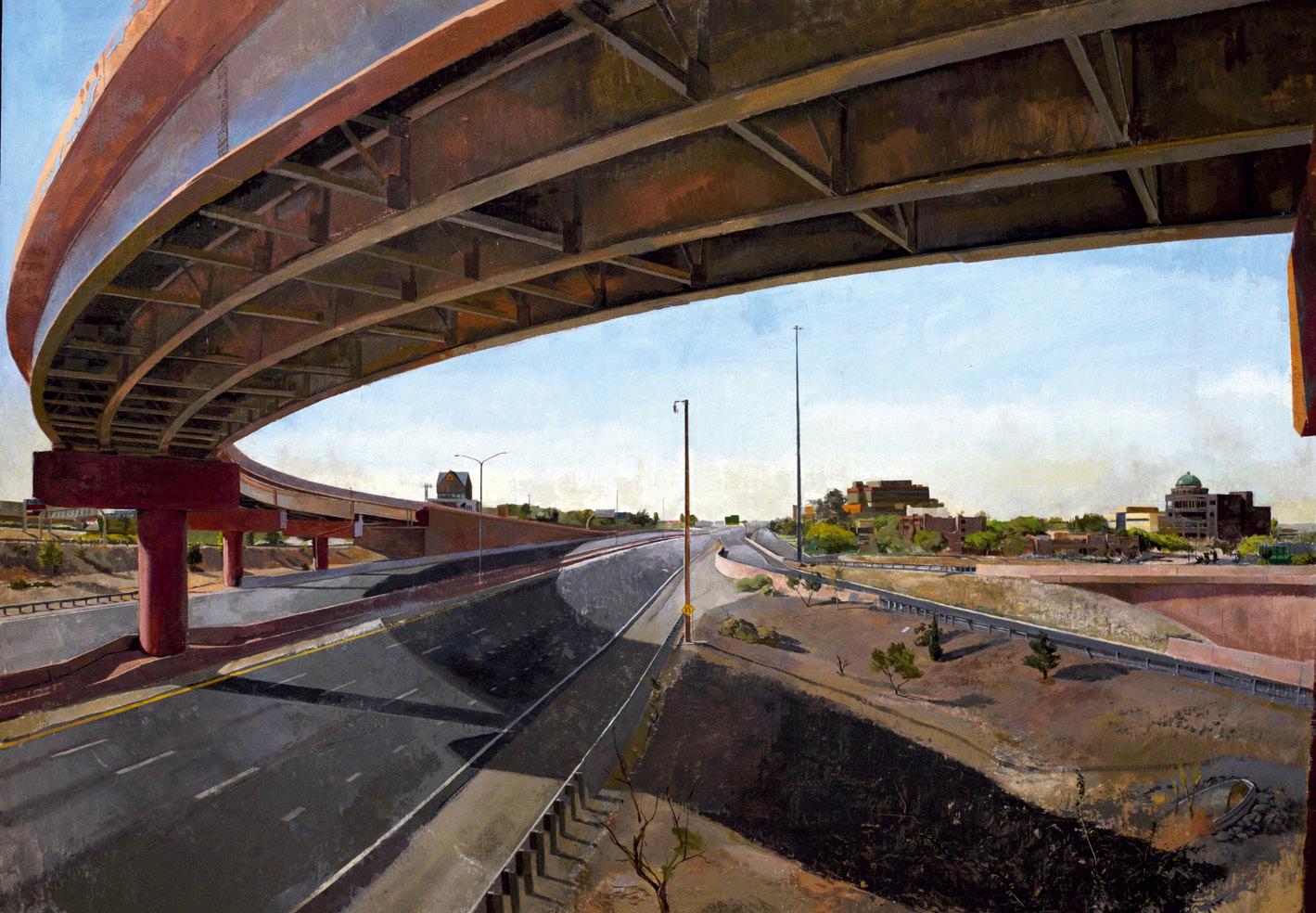
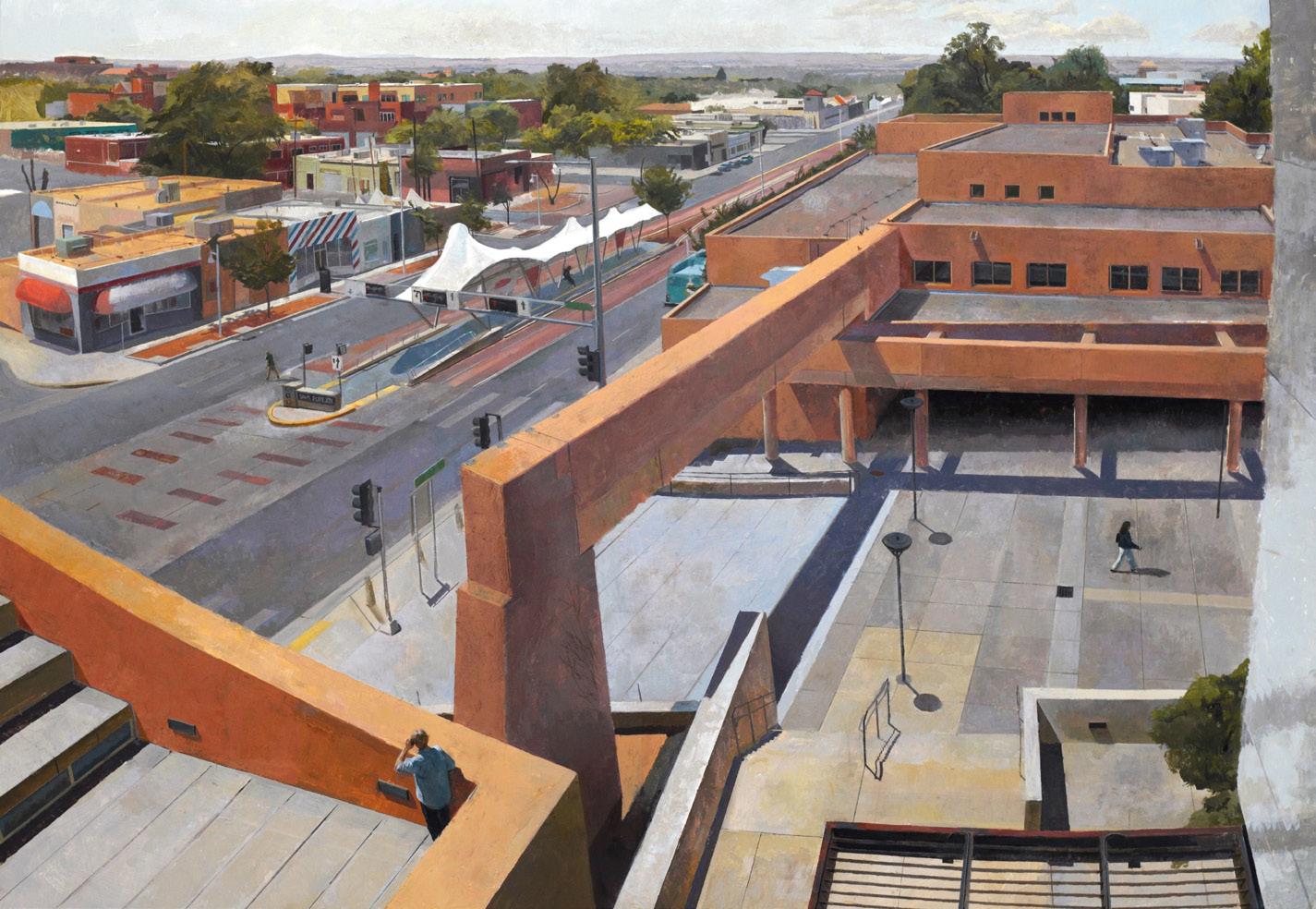
Against the wall a boy asks for my number while you’re the man on stage. The man on stage is angry like you aren’t and sexy like you are, sweat ripe and dripping, beads on his mustache, less a man and more a golden-blue streak in the dark, hard enough to scrub oil off of, dripping mercury. Your voice is hoarse when you come off, whispers crunching under the voices of the scene, sound swimming up over black clay, echoes in an alley with sleeping bones, loose-skinned dogs, limp pallets of wood, your Marshall. That night you share a tub of ranch with your bassist and cheer Quarter-Pounders before the rain comes, drive steady on the highway while every drop of water in the west thrashes against us with racetrack rhythm. In our sleepy car ears: red night, crinkling hot chip bag, the slick of my tired smile, your choppy laughter.
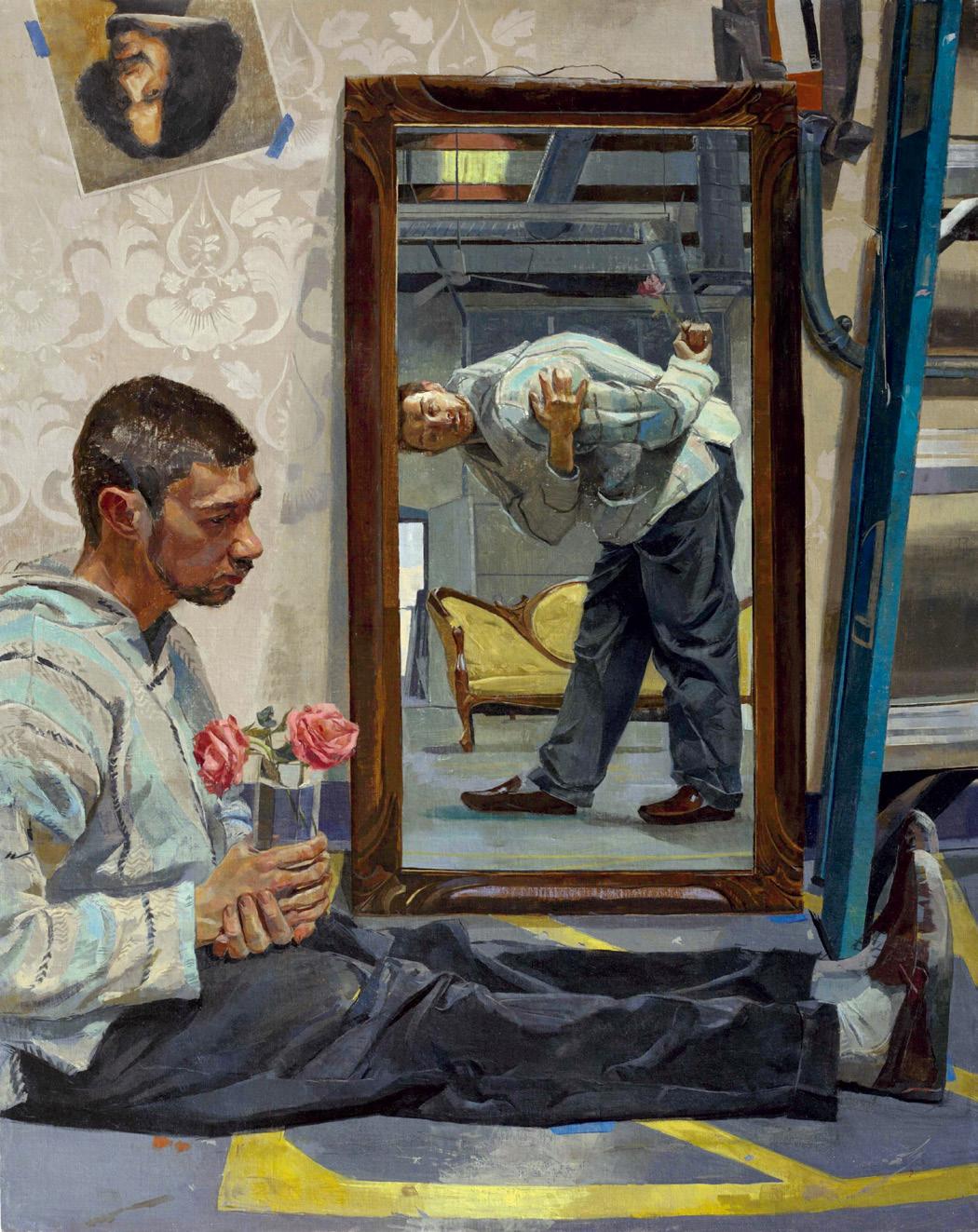
Nicholas Baldwin is a PhD student in the English Department. His interests include twentieth-century poetics, letters as artistic practice, and pedagogy. He has given presentations on these topics at ALA, the International Conference on Eugene O’Neill, and RMMLA. A certifed yoga teacher and apprenticed papermaker and typesetter, he has held residencies throughout Europe and performed on stage in The Cherry Orchard, “The Philadelphia,” and “Wings”, a previously lost one-act play written by Susan Glaspell. His visual art has appeared in Ignatian, Invisible City, and The Sandy River Review, among other private and public venues. His writing has appeared in Berkeley Poetry Review, Tupelo Quarterly, and World Literature Today, among other publications. He serves as an editor for California Quarterly and as a culture reporter for the Daily Lobo.
Cade Borek is a frst-year student in the Film & Digital Arts Program at UNM. He’s interested in photography, painting, music production, writing, and flmmaking. He loves showing the beauty of Singapore in his photography.
Rudolfo Carrillo is an MA student in the UNM English Department; he is also a staff writer at FUSION, a center for arts and culture in Downtown Albuquerque. Carrillo is an award-winning writer/artist and holds a BFA in sculpture from UNM. His artwork has appeared at 606 Gallery, Graham Gallery/Raw Space, and the ASA Gallery; his literary work has been featured in Rigorous, TYPO Magazine, On Barcelona, and Unlikely Stories; he recently presented his research on illness, metaphor, and The Spectacle at this year's SWPACA conference. His works as a journalist and cultural critic have appeared in many American newspapers. Carrillo was the news editor and the music editor at Weekly Alibi—where he wrote as August March—from 2014 through 2020 . Carrillo’s current work focuses on revolutionary and transgressive texts in American literature and popular media.
Camelia Caton-Garcia is a Chicana visual artist and writer. She is interested in the visual vocabularies used to represent time, landscape, and human events. Her work explores our relationship to geological and psychic landscapes and the complications of layered land, culture, indigeneity, and colonialism. Camelia was a 2023 Urban Enhancement Trust Fund Resiliency Residency artist, a 2023 Grand Canyon South Rim artist-in-residence, and is published in Analecta and Atticus Review
Sophia M. Eagle is currently an undergraduate at UNM pursuing a degree in English. She writes regularly and hopes to be a successful author in future.
Addison believes all of life can be sorted into the following categories: the beautiful, the grotesque, and the mundane. In her work, she seeks to create art that exists in the intersection of all three. She has previously been published in Homer Humanities and Scribendi. She has a series of urbanfantasy thriller novels titled Social Animals with Far West Press.
Jimmy Himes-Ryann is an artist and journalist based in New Mexico. Their work has been broadcasted and exhibited around the United States and has earned three Emmy Award nominations and two New Mexico Broadcasters Association Multimedia Journalist of the Year Awards. They are an adjunct faculty instructor at The University of New Mexico’s School of Communication and Journalism in Albuquerque.
Nic Hinson is an undergraduate student of English and philosophy at The University of New Mexico. All of their work is partially credited to their cat, Nutmeg, for her supervisory role. They have been previously published in UReCA, 30 North, and Equinox.
Augurium, p. 6 / Alighting, p. 23
Halla is a creative currently studying classics at UNM. When they’re not immersed in studying ancient civilizations, they are often found reading or writing. They are a lifelong student and love exploring both this world and others, always with tea in hand.
p. 72
Mikaela Johnson is a fourth-year journalism student at UNM. As she prepares to graduate in spring 2026, she flls her time by overseeing Limina: UNM's Nonfction Review as editor-in-chief and photographing the little beauties that surround her.
Dream at the In-Laws’, p. 58 / The Juggernaut, p. 92
Nell Johnson (5th House Stellium) is a librarian and former Conceptions Southwest staff member. She lives and works in Oklahoma City, Oklahoma and misses the Golden Pride Lunch Deal.
Excerpt from “Can We Go On?” (A Theatrical Memoir), p. 73
Neal Jones is pursuing a bachelor’s degree in liberal arts at UNM.
Passing, p. 90 / From a High Place, p. 91
The Painter Refected, p. 93
Cody Kamrowski is an oil painter and art teacher from Albuquerque, New Mexico where he still resides. He graduated from UNM in 2019 and has since been showing work throughout the Southwest and England. Cody states, “Anything is worthy of being painted as long as you have an interesting point of view.”
New Life, p. 65 / Saint Jude, p. 69
Avery Ketchmark is a writer and visual artist from El Paso, Texas. She is currently studying art education at UNM with the goal of becoming a high school art teacher. Her work is in Scribendi volumes thirty-eight and forty.
Astrid Larson-Sherman is a printmaker and artist from Albuquerque, New Mexico. Her work plays with the interaction between self and surrounding using high contrast and bold colors to tell a story. Astrid ties together themes from across the Southwest—taking inspiration from desert biomes, the Chicana experience, and the folklore that exists between the two.
Fade, p.
Ava Marr is a contemporary critic and visual artist with interests toward anthropological intersections in art, culture, and ecology. She has contributed to the UNMAM Journal as well as various moving-image productions, while actively seeking to promote artistic research and endeavors through various platforms.
Ephemeral, p. 25
Victoria Nisoli is a UNM alumni and current PhD student in chemistry at Caltech. She has been a Conceptions Southwest submitter for four years now and greatly misses the artistic culture at UNM. She enjoys drawing comics, riding her bike to get groceries, and telling Californians that she is from NEW Mexico (not Mexico).
Intimacy,
XeO is a gender-obsessed mark-maker in transit enamored by graphite, Risograph, and the company of felines. Conceptions Southwest volumes forty-seven and forty-eight features more of XeO’s work. Even more secrets can be found at www.xeoaks.art.
Tularosa Basin Downwinders Consortium, p. 2
Alanna Offeld is a Chicana from New Mexico now living in the north of Ireland. Her poetry has appeared in Aeon, Cyphers, Abridged, and other publications. She is a PhD candidate in creative writing at Queen’s University Belfast and owns Seaside Books, a traveling bookshop. She is a founding member of Macha Press Her debut pamphlet, “They Wish They Had What We Have, Kid” was published with VIBE press in 2024.
Avery Silfer is an avid believer in love and its all-consuming nature. She lives and works in Albuquerque, New Mexico.
Connor Swayden is a current third-year fne arts student who dedicates his artwork to the exploration of emotion, thoughts, and ideals using vibrant colors and distinctive, symbolic characters. He works primarily in 2D, painting both digitally and traditionally with watercolor and acrylics.
Daniela Montano Wilhelms is a Brazilian artist and photographer who brings her background as a primary care physician in Brazil’s public health system into her art and visual practice. Her flms and photographs weave water, healing, and interconnection into contemplative narratives that explore interdisciplinary and holistic approaches to transformation. She lives in Albuquerque where she deepens her visual art practice at the intersection of ecology, embodied experience, and nature’s resilience.
Yoma Wilson is a New Mexican printmaker of Japanese and American heritage often illustrating, through his art, stories of the connections between New Mexico and Japan. One of these connections is the nuclear history of both places and how the destructive quality of the US military-industrial complex must be resisted through truth. Telling these stories thus becomes an act of resistance and through printmaking, a replicable process made more accessible.
Bruce Cline
Matthew Cuneo
Dr. Bethany Davila
Dr. Leslie Donovan
Amaris Ketcham
Daniel Mueller
Dr. Anita Obermeier
Emma Ressel
Daven Quelle
Jamie Tillotson
Brianne Santos
President Garnett S. Stokes
ASUNM FUSION
GPSA
Starline Printing Company
Student Publication Board
UNM Alumni Association
UNM College of Fine Arts
UNM English Department
Zimmerman Library
Fellow Publications
• Blue Mesa Review
John Hardberger; Editor-in-Chief
• Horizon Review
Leah Livingston; Editor-in-Chief
Morgan Tracy; Managing Editor
• Limina: UNM Nonfction Review
Mikaela Johnson; Editor-in-Chief
Beckett Glass; Managing Editor
• Scribendi
Catarina Embry; Digital Editor
Nic Hinson; Communications Editor
Rae Wilson; Managing Editor
• Daily Lobo
Jaden McKelvey-Francis; Editor-in-Chief
Fall Contributions
Maria Fernandez
Carlee Ridenour
Spring Contributions
Arianna Licon
Editor-in-chief

managing Editor
Digital Editor
General staff

Kadra Guillermo