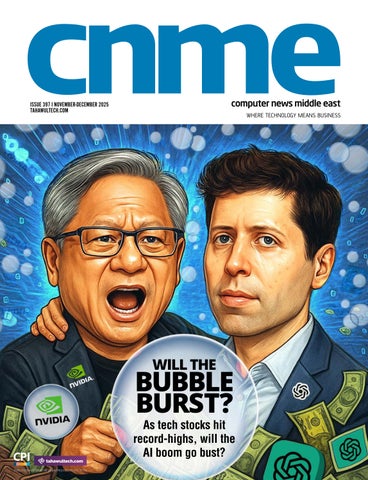
ISSUE 397 I NOVEMBER-DECEMBER 2025 TAHAWULTECH.COM
WILL THE
BUBBLE BURST?
As tech stocks hit record-highs, will the AI boom go bust? PUBLICATION LICENSED BY DUBAI PRODUCTION CITY, DCCA
EDITORIAL
THE BIG BANG THEORY It’s hard to believe that this is the final edition of CNME for 2025. We have decided to combine the November and December editions of CNME into one bumper 80-page magazine for readers to consume and digest as we sign off for 2025.
Our events
But what a year it has been! I feel privileged that in my role as Editor-in-Chief of Computer News Middle East that I have access to some of the world’s leading technology companies. At a time when technology is fundamentally reshaping and transforming the world we live in, and the way we do business, it is truly exciting to be at the coalface of this industry.
Talk to us: E-mail: mark.forker@ cpimediagroup.com
Over the last 12 months, I’ve been lucky enough to attend Knowledge25, hosted by ServiceNow in Las Vegas, .conf25 hosted by Splunk in Boston, and just last month, Industrial X Unleashed, hosted by IFS in New York. Despite differing business models and target markets, a prevalent theme running throughout all the conferences mentioned above was that of AI. Every single organisation is hyper-focused on unleashing the tremendous potential of AI. The sheer scale and volume of investments in AI is unprecedented, and AI is the focus of my front cover feature. The question that I have posed in my feature is related to whether AI is in a bubble, and how likely is it that the bubble will burst?
Our online platforms
tahawultech.com Our social media
facebook.com/tahawultech
twitter.com/tahawultech
linkedin.com/in/tahawultech
The dot-com crash didn’t derail the internet, and a crash on Wall Street won’t curb the impact AI is going to have on the world, but it may leave a gaping hole in the pockets of many of the Big Tech companies.”
Nvidia hit the $5 trillion market cap at the end of October, which only served to further signal the truly astronomical valuations that those at the heart of this AI movement are hitting. But is it sustainable? Many believe that much like the dot-com crash of 2000, the speculative frenzy in AI means it is inevitable that the same thing is going to happen. The dot-com crash didn’t derail the internet, and a crash on Wall Street won’t curb the impact AI is going to have on the world, but it may leave a gaping hole in the pockets of many of the Big Tech companies. The subject of the AI bubble has certainly divided opinion, as I highlight in my feature, and it’ll be interesting to see how it all plays out in 2026. Outside of the front cover feature, we have a whopping 19 interviews, the vast majority of which are from GITEX Global 2025. Hitachi Vantara, HPE, SolarWinds, Zebra Technologies, Infor, Citrix, Cloud Software Group and Core42, are just a few of the companies that we spoke to at the event. GITEX was another major personal highlight from 2025, and it is with a heavy heart that we bid goodbye to the conference at its spiritual home of DWTC. It’s off to EXPO City next year and will also be held in December, instead of its traditional month of October. We also have extensive coverage of Planview’s launch in the UAE, and our Future Enterprise Awards, which as always, were held on Day 1 of GITEX. I also sat down with former Standard Chartered banking supremo Tomas Skoumal, to find out why he walked away from a glittering career in the financial services industry, to start his own AI company. Fascinating story, and one that might inspire others who maybe feel its time to walk away from the corporate rat race and go out on their own. I’d like to sign off my editorial letter, by thanking all my wonderful colleagues at CPI Media Group for their fantastic support over the last 12 months. And finally, a big thank you to our customers and readers for all their support in 2025.
PUBLICATION LICENSED BY DUBAI PRODUCTION CITY, DCCA
I’d like to take this opportunity to wish all of you a very Happy Christmas and a prosperous New Year. See you all in 2026! Mark Forker Editor
CONTENTS
22
Ericsson
28
24 AI - Boom or Bust?
Nintex
Seddon, VP Northern Region at Hitachi Vantara, 14 Nigel outlines the importance of their channel partner community in expanding their presence across the Middle East region. Mihovilovic, VP and Head of Networks, EMEA 22 Ante at Ericsson, highlights the growing demand for
14
differentiated connectivity in the UAE.
Hitachi Vantara
6 News
CNME rounds up the biggest regional and global developments in enterprise technology, which includes the news that the European Commission has launched an investigation into cloud practices adopted by Microsoft and Amazon, Anthropic uncovers AI espionage operation - and are Apple preparing to appoint a new CEO?
Kurdi, Director, Revenue Marketing Emerging 28 Narimane Markets at Nintex, explains how the concept of revenue
48
SolarWinds
60
Dyna.AI
marketing is not about generating leads, but instead about creating measurable business outcomes. Delattre, VP Sales EMEA, at SolarWinds, 48 Laurent discusses the impact he believes their new AI Agent is going to have in terms of driving operational resilience across the enterprise space. Skoumal, CEO and Co-Founder of Dyna.Ai, 60 Tomas details how the Singaporean-based AI as-a-service company is going to transform customer experiences in the financial services industry.
FOUNDER, CPI Dominic De Sousa (1959-2015)
ADVERTISING Group Publishing Director Kausar Syed kausar.syed@cpimediagroup.com
EDITORIAL Editor Mark Forker mark.forker@cpimediagroup.com
Sales Director Sabita Miranda sabita.miranda@cpimediagroup.com
OnlineEditor Daniel Shepherd daniel.shepherd@cpimediagroup.com
Published by
PRODUCTION AND DESIGN Designer Ulysses Galgo ulysses.galgo@cpimediagroup.com
DIGITAL SERVICES Web Developer Adarsh Snehajan webmaster@cpimediagroup.com
Publication licensed by Dubai Production City, DCCA PO Box 13700 Dubai, UAE Tel: +971 4 5682993 © Copyright 2025 CPI All rights reserved While the publishers have made every effort to ensure the accuracy of all information in this magazine, they will not be held responsible for any errors therein.
NEWS
European Commission to investigate Amazon and Microsoft
Google CEO weighs up the AI bubble risk
In pursuit of a fair and competitive market environment, the European Commission has begun investigating Amazon and Microsoft. The inquiry centres around the companies cloud computing practices and whether they should be subject to Digital Sundar Pichai, CEO at Google,
lot of excess investment” in the early
The EC stated it opened
recently commented on the risks of
internet boom, but its long-term impact
investigations to assess if the
AI investment as the sector continues
was “profound”. He predicted AI would
pair should be designated as
to enjoy soaring valuations. He went
follow a similar trajectory.
gatekeepers for their cloud services
on to state that no company including
Amazon Web Services (AWS) and
Alphabet (Google's parent) would be
Alphabet’s valuation crossed $3 trillion
Microsoft Azure.
immune if the current boom fails.
in September, while Nvidia hit a record
Markets Act rules.
6
His comments come as Google parent
It explained the probes would
Speaking to BBC News in an exclusive
explore if the companies act as
interview, Pichai said the current surge
However, he argued Alphabet is
“gateways between businesses and
in AI funding marks an “extraordinary
better positioned than rivals to absorb
consumers, despite not meeting
moment” for the industry, but warned
turbulence due to its integrated “full
DMA gatekeeper thresholds for size,
there is also “irrationality” in the
stack” spanning chips, data sources like
user number and market position”.
market.
YouTube and frontier science, BBC News
Computing services including
The chief compared the AI cycle to the
$5 trillion last month.
reported.
Azure and AWS are the backbone
dot-com era, stating that investment
The company is also boosting its UK
of many digital services and are
phases can “overshoot” even when the
presence, having pledged £5 billion for
crucial for AI development, the EC
technology might be transformative.
AI infrastructure in the country earlier
stated.
In Pichai’s view, “there was clearly a
this year.
Ericsson makes 6G predictions in latest report Ericsson has released the latest edition
countries will be among the first to roll
of its mobility report, making a bold
out” commercial 6G services.
prediction that 6G subscriptions would
Europe is expected to see its
reach 180 million by the end of 2031. The
first launches around a year
report later went on to identify likely
after the leading markets due to
“To foster innovation, trust
first mover nations and highlighted how
“comparatively later deployments” of
and Europe’s strategic autonomy,
operators are using current architecture
standalone (SA) 5G.
cloud services must be provided
to differentiate.
in a fair, open and competitive environment”.
In the wide-ranging biannual study,
Its prediction for the upcoming mobile technology generation does not
Ericsson tipped the US, Japan, South
include “early uptake of AI-enabled IoT
Korea, China, India and some Gulf
devices,” Ericsson stated, while adding
market investigations within 12
Cooperation Council countries as those
the actual number of connections could
months. If they are designated with
likely to make up the first tranche of
“increase significantly if 6G launches
gatekeeper status, the companies
commercial 6G launches.
earlier than previous cycles indicate”.
The EC aims to conclude the
will have six months to ensure full
It indicated all of the above except
compliance under DMA obligations.
India hit the button on 5G “relatively”
generation technology are widely
early, so “it is expected that these
expected around 2030.
NOVEMBER-DECEMBER 2025
Commercial launches of the next-
www.tahawultech.com
Anthropic uncovers AI cyberespionage operation Anthropic's research team recently
Human operators chose the
uncovered what is believed to be
targets and built an attack
the first cyberespionage operation
framework using Claude code as
carried out using mostly AI
the core automation engine.
technology. In mid-September
Anthropic’s research team
StarLink to boost AI adoption, accelerate cyber defences and business growth
2025, Anthropic detected a highly
stated AI performed 80 per cent to
sophisticated cyber espionage
90 per cent of the campaign, with
campaign, attributed to a Chinese
humans stepping in only for four
StarLink, an Infinigate Group
state-sponsored group, according to
to six critical decision points per
company, is once again
a report from the AI player.
operation.
showcasing advanced AI-powered
Anthropic stated the attackers
The manipulated AI made
used AI’s agentic agent “capabilities
thousands of requests, often
Black Hat MEA 2025, Riyadh to
to an unprecedented degree—
multiple attempts per second,
accelerate AI adoption, strengthen
using AI not just as an advisor,
to achieve in hours what would
cyber defences, and enable
but to execute the cyberattacks
normally takes humans days or
seamless business growth for
themselves”.
weeks.
organisations in the region.
The attackers manipulated
The research team stated the
Anthropic’s Claude Code AI
hackers only succeeded in a small
tool to autonomously attempt
number of cases. Following an
infiltration of about 30 global
investigation, Anthropic notified
targets, including tech companies,
the affected entities, banned
financial institutions, chemical
accounts after they were identified
manufacturers, and government
and coordinated with authorities
agencies.
as it gathered actionable
The threat actors bypassed
cybersecurity solutions at
intelligence.
According to recent studies, AI spending by organisations in KSA
Claude’s safety guardrails by
“While we predicted these
is growing at an impressive rate of
breaking down the attacks into
capabilities would continue to
160% YoY. With major hyperscalers
small, seemingly benign tasks
evolve, what has stood out to us is
establishing state-of-the-art
and role-playing as legitimate
how quickly they have done so at
data centres in the Kingdom, a
cybersecurity testers.
scale,” the report stated.
strong cloud foundation is rapidly taking shape - enabling and accelerating nationwide as well as regionwide AI adoption. This surge in AI adoption is not only driving innovation but also reshaping the risk landscape and data protection requirements, compelling organisations to deploy robust, AIready cybersecurity strategies. Nidal Othman, CEO, StarLink, commented, “StarLink’s presence at Black Hat MEA underscores our commitment to accelerating the Kingdom’s AI agenda and supporting Saudi Arabia’s Vision 2030 to become a global AI leader. With AI dominating today’s conversations, we are ready to showcase how organisations can protect and harness AI-driven innovation securely.
www.tahawultech.com
NOVEMBER-DECEMBER 2025
7
NEWS
Could a CEO shakeup be in store for Apple? around $4 trillion today. “Whether one loves or loathes Mr Cook, he has done a first-class job at taking what Steve Jobs invented and maximising value creation from it”, he noted. But he warned the next CEO will face tougher strategic decisions as Apple contends with two potentially “existential” challenges: AI and the rise of metaverse-era devices. “There are two challenges that could completely upend the company”, he said, arguing The Financial Times have reported
final decision has been made and the
Apple is “really struggling” in AI while
that, tech giant, Apple has raised
timeline could shift.
rivals push ahead with LLM-powered
internal discussions about who will
assistants.
succeed Tim Cook as CEO, with the
leadership reshuffles in 2025, following
Windsor also pointed to emerging
board preparing for the chief to step
the departures of long-time CFO Luca
smart glasses momentum led by Meta
down as early as 2026.
Maestri and COO Jeff Williams earlier
and RayBan, arguing that if users
this year. Sources told FT that Cook’s
prioritise glasses over smartphones,
ramped up succession planning
transition is unrelated to Apple’s
“the iPhone would have effectively
in recent weeks, with hardware
business performance as the company
become obsolete”, he said.
engineering chief John Ternus emerging
heads into what is projected to be a
as the leading internal contender. Cook,
strong end-of-year iPhone sales cycle.
Senior leaders have reportedly
who turned 65 this month, has been at
8
The succession follows notable
Richard Windsor, founder of Radio
With this backdrop, Windsor argued Apple may need a new approach. “I think the company would be best served
Free Mobile, highlighted Cook’s
with a fresh pair of eyes,” he said,
financial track record, noting the
warning an internal appointment risks
transition until after it reports quarterly
iPhone-maker’s valuation jump from
“more of the same, which is not what I
earnings in late January, though no
$350 billion at the start of his tenure to
think this company needs”.
the helm for nearly 15 years. Apple is not expected to confirm any
SentinelOne's new regional headquarters in Riyadh to support digital transformation SentinelOne, the leader in AInative cybersecurity, announced the establishment of its new regional headquarters in Riyadh. The opening represents a major turning point in the company’s expansion plan and ongoing dedication to the region. The new headquarters will be the main hub for SentinelOne’s KSA operations and help support Saudi Vision 2030 for digital transformation, national cybersecurity, and modern government services. It also ensures that customers in the Kingdom
“Saudi Arabia is one of the world’s
our confidence in the Kingdom’s
have direct access to the knowledge
most dynamic and fast-growing digital
potential,” said Meriam ElOuazzani,
required to protect their environments
economies, and our major investment
Regional Senior Director, Middle East,
from evolving cyberthreats.
in the new Riyadh headquarters reflects
Turkey and Africa, at SentinelOne.
NOVEMBER-DECEMBER 2025
www.tahawultech.com
xAI looks to raise funding for LLM GPUs xAI is reportedly planning to finalise
seeking to raise $15 billion, which Musk
a $15 billion funding round which
stated on X was false.
would end in December. This funding
In July, xAI apologised after its Grok
Businesses should beware 'generic' AI, says expert
could potentially lead to a $230
chatbot reportedly made a series of
billion pre-money valuation for the
extreme comments which it blamed on
Cohere President emeritus
company.
deprecated code. In March, Musk’s xAI
Martin Kon recently stated that
acquired his social media platform X in
deploying AI applications designed
a $45 billion all-stock transaction.
for consumers into an enterprise
CNBC reported the deadline for the funding raise was 25 November with a closing date of 19 December. The
Companies such as Amazon, Meta
setting won’t lead to meaningful
news agency stated xAI will use a large
Platforms, Microsoft, Anthropic and
transformation. This statement
chunk of it for GPUs to power its large
OpenAI have raised billions of dollars to
was part of a larger discussion
language models.
build out their AI infrastructure and add
on the business potential for the
more compute capabilities.
technology which took place at
CNBC reported in November xAI was
MWC25 Doha. He explained enterprise demands were unique to each business and completely different to the consumer segment, with the latter where the majority of the attention on new technology often falls. “Most of the hype to date has been on mass-market consumerfocused tools,” he said, describing the consumer sector as generally “winner takes all,” drawing on
Veon advocates for universal AI access
examples of other disruptive digital
Kaan Terzioglu the CEO at Veon Group
“Make sure that AI is in every
Google Search is one example. It is
recently discussed the need for AI to
household” and every handset,
one of the most incredible products
available to everyone at MWC25 Doha.
he urged attending regulators
to be launched ever, 3.3 billion of
He went on to liken the importance
and executives.
us use it every single day. But what
of access to the technology to other household utilities.
Noting AI is “not artificial
technology. “Enterprise is not that easy.
has Google done for enterprise
at all” and had been “the most
search? Nothing, because
wrongly worded technology
enterprise search is completely
in China, he endorsed the technology
in the entire decade”, he
different”.
being included alongside electricity
promoted the technology as
and water as a utility which should be
“augmented intelligence:
sector had specific needs and
available for all.
augmenting the capabilities,
infrastructure in place, meaning
skills, of people, of our
the way AI will have to be deployed
customers, offering them a
for each one was “very unique”.
Citing inspiration from policies seen
Kon noted each business and
better version of themselves”. Highlighting Veon’s focus on expanding access to digital technologies across its markets, the executive outlined a need to make sure the cost of delivering healthcare and education “to millions is a fraction of what it costs today”.
www.tahawultech.com
NOVEMBER-DECEMBER 2025
9
INTERVIEW
Zoom
AT YOUR SERVICE
CNME Editor Mark Forker spoke to Steve Rafferty, Head of APAC & EMEA at Zoom, and Ben Neo, Head of Contact Centre and CX Sales at Zoom, to find out how their suite of communication solutions are transforming the Contact Centre space, the unique capabilities of its AI Companion 3.0, the company's unwavering commitment to driving value for their customers - and how unlike many of its rivals, Zoom is not focused on servicing debt, but instead on serving its customers with seamless experiences.
10
Steve Rafferty
Steve Rafferty is a hugely respected business leader in the IT industry across the EMEA and APAC regions. In what has been a distinguished career to date, Rafferty has worked in senior leadership roles for companies such as Avaya, BT, and RingCentral. In February 2024, he joined
NOVEMBER-DECEMBER 2025
Ben Neo
Zoom, and after 7 months as Head of EMEA, he was tasked with the responsibility of also driving their growth across the APAC region. Under the direction of Founder and CEO Eric Yuan, Zoom has become one of the biggest companies in the world. Its popularity exploded
during the early days of the COVID-19 pandemic, and the company became mainstream with the public as a result of that, but since that it has gone from strength-to-strength and is renowned and revered for its seemingly unsatiable appetite to develop new innovations and products. CNME managed to secure an interview with Rafferty, and we began the conversation by asking him about Zoom's federated approach and architecture. Rafferty doubled down on the fact that Zoom's guiding principle is to deliver real value to their customers, and he believes in a collaborative approach. "When you think of phone, we have a native phone where organisations can buy the entire piece from us, but when you look at large organisations, they tend to bring their own carrier because they have a network and security contract, and they also want to take the collaboration suite as well. AI is very similar in that respect, there are a huge number of businesses that have relationships with Amazon, Google or Microsoft. They want to nurture and maintain those relationships, and to be honest we don't want to fight them. I think all the big AI players need to get together and deliver what is best for the customer. There's been so much rip and replace in this industry, and sometimes you really have to ask where is the value to the customer - and I think a lot of organisations really need to start thinking
www.tahawultech.com
more about the customer. One of the core principles that Eric founded the company on was to provide happiness to customers, firstly in the quality of the product, but also in value. At Zoom, we're not out in the market saying our AI is better than yours, what we are really looking to do is to work out and determine what is best for our customers," said Rafferty. Rafferty detailed many benefits of Zoom's new AI Companion 3.0, but he highlighted the time to cost savings on a traditional business plan to demonstrate the power of AI Companion 3.0. "I think one of the key features in AI Companion 3.0 is the agentic AI element, which is the physical ability to do things for you, rather than suggesting things for you to do. I came into the business over 12 months ago, and the first thing that I wanted to do was look at the business as a whole, and build a plan around
www.tahawultech.com
how do we deliver value to customers and how do we deliver value to shareholders? Now, you can imagine trying to find that information in an organisation of our size. By using AI Companion, I was able to submit clear and concise prompts, and that started bringing all these insights to the surface that then allowed me to test it with all the subject matter experts in the business, and that allowed me to put a business plan together in 2 weeks, and in a previous life would've taken 9-12 months. AI Companion 3.0 is turning data into information and it's prompting you to do things that you never ever thought about in the past, and that's powerful," said Rafferty. Rafferty said there are many
factors that differentiate Zoom from other market players, but he did reference that the fact they weren't servicing capital debt was crucially important, as that ultimately allowed them the freedom to think outside the box and look at the market with a much broader outlook. "We have a lot of market advantages, and one of them is the fact that we're not servicing debt. We've been practical, and that's been the approach from day one, even before COVID, which people sometimes tend to forget. This enables us to rapidly develop products that our customers need in the market. There are a lot of challenges in this industry, and a lot of companies are having to service debt, rather than serve customers, which is a real problem for them. Whereas we don't have that issue, so that enables us to take a longer-term view on things to drive new innovations, and examine certain trends that are emerging within the marketplace. Eric and the team decided to build a product for the Contact Centre about 3 years ago, and they just totally went for it. They were acutely aware of the fact that it wasn't about delivering revenue straight off the bat, but they knew that by having a product that was built around AI, that didn't have any technical debt
A lot of companies are having to service debt, rather than serve customers. Whereas we don't have that issue, so that enables us to take a longer-term view on things to drive new innovations.” NOVEMBER-DECEMBER 2025
11
INTERVIEW
12
was enabling customers to deliver what they needed, and that put us in a really strong position," said Rafferty. It is well-documented how important the channel is to enter the marketplace in the Middle East. However, the channel market in the region is at saturation point, so identifying the right partner for you can be a challenge, but Rafferty outlined what they look for. "There are two sides to it when it comes to identifying channel partners. The first side of it is the install base, because there is a lot of legacy that needs to be migrated. We're trying to work with those partners and examine ways in which they can innovate with Zoom. The second side of it is looking at these consultancies that are starting to emerge, and who are thinking about things in AI, that quite frankly a lot of us are not doing, and these consultancies are also delivering use-cases. The first two things we've done is sign two really strong distributors to cover the region and give us the reach we need. We're focusing on individual organisations in countries like the UAE and KSA and the surrounding areas, and again our primary objective is to drive the best value for our customers," said Rafferty. Rafferty concluded the conversation by stressing that they are asking their channel partners to think differently when it comes to their business. "We're trying to get our channel account managers to think like business owners. They've got two key jobs,
NOVEMBER-DECEMBER 2025
the first is to drive profit for themselves, and the second is to drive their customer forward. So, rather than adopt the approach of let's train you up to use our product, where's the pipeline? We're adopting an approach that asks them what is your board's objectives, where do you want to be in 12 months? Once we have asked those questions, let's put a plan together to see where we fit into that. It's been a challenge for some of the distributors to get their head around that type of approach, but it is vital that we do it. We want the partner to own the relationship with the customer, and ultimately, we want our channel partners to make money around the whole solution," said Rafferty. CNME also managed to get the opportunity to speak to Ben Neo, who heads up sales for CX and the Contact Centre space at Zoom. Like Steve Rafferty, Neo has enjoyed a decorated career in the communications space, and has worked with companies such as Nortel, Vodafone and Mitel, before joining Zoom in 2021. Zoom was recognised by Gartner in the 2025 Magic Quadrant for Contact Centre as a Service (CCaaS), which marked its inaugural inclusion
in the report since launching its contact centre product back in 2022. Analysts feel the recognition validates their AI-first strategy, and Neo described the recognition by Gartner as 'unprecedented'. "It is amazing to get that Gartner recognition, because it carries a lot of weight behind it, particularly in markets like the Middle East. It has taken a lot of hard work to get to that recognition from an independent entity like Gartner. They have certain gates that businesses need to hit when it comes to the selection criteria, such as product innovation, international presence, revenue numbers and so on. However, to hit all those gates and get that recognition within 3 years is unprecedented," said Neo. Neo praised the innovation that is firmly embedded into the lineage of Zoom as a company and issued a stark reminder to those who put R&D and innovation on the backburner. "This market now, especially with the advent of AI means that if you're not innovating then you're eventually going to become irrelevant and obsolete. It's getting much more
We're coming at the market from a very different angle. We're approaching it from a platform perspective, so whether you want to do telephony, or contact centres, you can start wherever you want, but the fact of the matter is that everything else that comes up can be put on the platform.” www.tahawultech.com
personalised too, and it's not just us that is driving it. There are other players in the market that are driving it too, such as Salesforce and ServiceNow. In addition to this, there are a few niche players in local markets too, particularly in the Middle East region. At the end of the day, given the state of play in the market, you have to keep up, and you have to keep innovating. It is very important for us to continue to drive innovation, and it certainly does help when the CEO of the company is an engineer by trade. He is constantly driving our product teams to find out what's coming next, and that sort of culture lends itself to developing high-quality products that deliver real value to customers," said Neo. Neo echoed the sentiments expressed by his colleague Steve Rafferty, by emphasising just how important the channel is. He explained the thought process and criteria that they look for when searching for channel partners in the contact centre space. "Look, you can't enter the market in the Middle East without the channel, and we are investing a lot in the region. The channel is the way to market, and whether that is a relationship, or a procurement factor, we recognise that the channel is critical. We do very little direct business in the Middle East. When it comes to the contact centre space, we are looking for partners that have got a CX background, now typically in the Middle East, if they have
www.tahawultech.com
a CX background, then they'll have a telephony background as well. You very rarely will see someone from a networking background try to jump into CX. We're working with a couple of well-known and established partners across the UAE and KSA, and they could see what we were doing, and they were proactive in terms of wanting to work with us. In many ways, it was a meeting of minds. They could see it, and we like people who can see where the market is headed," said Neo. When it comes to how Zoom tries to position itself in a crowded UCaaS space in the Middle East, Neo pointed to the power of the platform. "We're coming at the market from a very different angle. We're approaching it from a platform perspective, so whether you want to do telephony, or contact centres, you can start wherever you want, but the fact of the matter is that everything else that comes up can be put on the platform. That allows businesses to consolidate a lot of these services that they might have from different vendors and make it simple, and of course with AI, if it is learning from all the same interaction types across it then it all makes sense," said Neo. Neo pointed out the three different types of business that they typically work with at Zoom. "Generally, we've got three different types of businesses that we work with. The first business is someone that has a legacy technology problem and they must make a decision.
The you've got the businesses who have made that decision and have gone to cloud early but are struggling to adapt to the demands and rigours of the cloud, and then the final part is a business that just wants to do something completely different. In the KSA, we're seeing more organisations that just want to do something totally different," said Neo. Neo concluded a terrific discussion by highlighting some of the interesting conversations he's having with customers in Saudi Arabia, which has triggered a demand for Zoom Kiosks. "We are having more and more conversations around how video can play a role in a particular customer journey. We are also having a conversation with a pharmaceutical chain in the KSA, who sell vapes, around the installation of Zoom Kiosks. Zoom Kiosks are almost like video kiosks where you can get skill base and intent base rooted to an agent, and they appear in video form and they advise on the vape types that you need, so that is a prime example of a company looking to do something outside of the box. There is still an agent sitting somewhere that is doing something, but how do you get access to that agent if you're in a store, so that's where they saw an opportunity with Zoom Kiosks. Our story is CX, everything that is touched is CX, it just happens to be technology that underpins all of that, and we're just using it differently," said Neo.
NOVEMBER-DECEMBER 2025
13
INTERVIEW
Hitachi Vantara
SUSTAINABILITY AND RELIABILITY Nigel Seddon, VP Northern Region at Hitachi Vantara, sat down with CNME Editor Mark Forker during GITEX Global 2025, to highlight how the company is hyper focused on sustainability and reliability in a bid to differentiates themselves from market rivals.
14
Nigel Seddon has been in the IT game for over 30 years. He is a highly respected IT leader with years of experience in sales, go-to-market strategy and partner relationship management. In a decorated and distinguished career to date, Seddon has worked for a whole host of big-name technology and IT companies such as Orange, Sun Microsystems, Trend Micro, Ivanti and now Hitachi Vantara. Seddon became part of the Hitachi Vantara team in January of this year. He joins the company at a very exciting juncture in their journey as a company. Hitachi Vantara has enjoyed hypergrowth across the Middle East region, particularly in the KSA, and the company has ramped up their investment accordingly. Seddon kickstarted our conversation by highlighting the importance of their channel partners in expanding their presence across the Gulf. “Hitachi Vantara has always had a strong presence in the Middle East region for several years. However, over the last 2-3 years
NOVEMBER-DECEMBER 2025
www.tahawultech.com
we’ve seen substantial growth, and as a direct result of that growth we’ve invested in more resources. For example, we’ve increased our headcount across all our markets in the Gulf, but significantly in the KSA. That growth is great, but you can only do it with an extended partner community. We have added new distributors with the intent to extend our partner community and leverage a sales team to help us both grow. Our partner community have enabled us to extend our reach and provide support around our business. We have discovered that when you sell and win new customers in the Middle East those businesses want direct contact with organisations,” said Seddon. Seddon highlighted the importance of AI and said that it is undoubtedly the most important item on the agenda when it comes to businesses in the Middle East marketplace. “I manage different markets for Hitachi Vantara across Europe as part of my remit, but every single time that I come to the Middle East and get in front of customers, the topic that I’m always asked is what are you doing with AI and can you give us examples of use-cases? Oman has this vision that by 2030 it will reduce phone usage, and we are building an AI digital avatar, it’s called an AI digital assistant that allows people to manage their accounts and payment schedules with local language. It takes away that uncertainty and provides AI-driven support for people who in some cases might not have been able to access it. So, we’re gradually rolling this AI digital avatar out, and that’s an example of an AI use-cases that we’re driving in the Middle East,” said Seddon. In terms of their business
www.tahawultech.com
model Hitachi Vantara adopts when it comes to choosing the right partners, Seddon acknowledged that it can be a tricky process. He stressed the importance of incentives for partners and added that they are very flexibility when it comes to the remuneration and rebate programs that they offer channel partners. “There are situations in some countries where we don’t have the resources, so what we do is give partners full engagement and a strong rebate program and let them deliver everything. However, you do need to be careful with that because some organisations and partners just don’t have the bandwidth because they have other partnerships in place. So, what we try to do is identify organisations that will not solely focus on us, but give us the ability to feel that if we provide a strong margin model with good rebates that they in return would pay us back by taking what we’ve got and delivering it to the customer in a way that the customer wants. There is also flexibility in terms of the way we offer remuneration or rebates. We’re more than happy to have conversations with partners who say to us that this sort of rebate structure doesn’t work for us, but here's a different model that will help
us as a business, and can you look at that, and that’s what we’ll do in order to meet their needs,” said Seddon. Hitachi Vantara has many differentiated factors that make the company a market success. However, when pressed, Seddon highlighted two areas that he feels make the company stand out from the rest of the crowd. “I think there are two areas in which we differentiate ourselves from market rivals, and one of those is sustainability. We’re putting a structure in place where we are going to achieve 96% CO2 emission reduction with organisations that deploy our solutions. If you look at most analyst reports in terms of where we sit when it comes to sustainability, we are consistently at the top time and time again. The other area is around the reliability and availability of data. We have a 100% guarantee in place around reliability, and that’s what customers want to see now. It’s high cost and high commitment, so how do you differentiate from competitors? Well, Hitachi Vantara provides you with a sustainable solution, and on top of that here is the guarantee that we put behind it in terms of reliability, and that is what ultimately differentiates us from the rest,” said Seddon.
We’re putting a structure in place where we are going to achieve 96% CO2 emission reduction with organisations that deploy our solutions.” NOVEMBER-DECEMBER 2025
15
INTERVIEW
Zebra Technologies
BRAND NEW
CNME Editor Mark Forker, spoke to Hozefa Saylawala, Director of Sales Middle East - at Zebra Technologies, to learn more about the factors that led to their brand refresh, and the need to keep the human element at the heart of AI.
16
Can you provide our readers with more information on what you’re showcasing at GITEX 2025? We recently had a brand refresh after looking at the changing dynamics of the market and the technology innovation that is driving customer preferences. We are focused on technology meant to empower humans and make them more efficient in as simple a way as possible. We wanted our brand presence at GITEX to be more simplistic and clearly articulate exactly what we are bringing to our customers. In terms of specifics, we are showcasing the journey of a toy. By doing so, we are telling our customers where Zebras products and solutions are empowering their front line or helping them drive productivity and efficiency gains. Whether it's on the factory floor where the toy is manufactured or is in the transportation-logistics space, it shows the entire supply chain that the toy goes through before it ends up on a store shelf. Across every horizontal or vertical solution that Zebra is present in, this journey can provide visibility to the customer on where they can best use Zebras products and solutions.
NOVEMBER-DECEMBER 2025
www.tahawultech.com
You have previously talked about how cyber technologies builds technologies for humans. But there's obviously a bit of a quandary at the minute with AI coming into the mix. How do you marry AI into your product portfolio while avoiding infringing on your principles as a company, which is to empower frontline staff? If you look at the production solutions that we provide to frontline workers, we are now enabling those products and solutions with a lot of AI based features. It's not about replacing the humans; it's about how does that human now have more information at their fingertips to do his job better? The Zebra AI Companion allows organisations to deploy an ethical AI that answers questions using the corporate intranet to get very specific information related to that job. You can also ask a question in a native language and get a response back in your language. So, the language barrier is further diminished when you use Zebra Companion. How well placed are you, especially with this brand refresh, to capitalise on a lot of the opportunities that are emerging, not only in the UAE, but in Saudi Arabia as well? If you look at the region, growth is fuelled by the division plans that each country has put in place, like Dubai Vision 2035 or Saudi vision 2030, and they become foundations for all the growth strategies that are being driven.
www.tahawultech.com
We have looked at those growth strategies, and they align perfectly with our global growth strategy. So, we are seeing an increased uptake in terms of technology asks from across industry verticals, whether it's retail, transportation, logistics, manufacturing, healthcare or government sectors
Can you give us an overview on some of the AI impacts that you're seeing and how it affects your business model? We undertook a study with Oxford Economics, and this study was primarily done to produce statistics into the impact of intelligent operations. It answered the critical question which is, how is AI investment helping
Our entire brand refresh is about finding the association between what our brand stands for versus what our customers are asking for in terms of their technology investments.” We are seeing that uptake as organisations look at technology transformation to make the best use of technology. Specifically, we are seeing a lot of discussion in the region around sustainability. Zebra runs a circular economy program, under which we go back to our customers, offering them to option to buy back refresh or recycling. To help with environmental sensibilities, we also offer them battery refresh and battery disposal services.
organisations achieve real time visibility, generate actionable insights and improve efficiencies? We found that organisations are heavily investing into an environment where they have access to data in real time which then allows them to drive actionable insights around that data. We sought to align Zebra's AI solutions to this trend. Our entire brand refresh is about finding the association between what our brand stands for versus what our customers are asking for in terms of their technology investments.
NOVEMBER-DECEMBER 2025
17
INTERVIEW
Logitech
WORK IT OUT
Murad Ali, Head of GCC Logitech for Business, and Mohit Bector, Commercial Head – UAE and GCC, at ASUS Business, explain how their partnership is designed to drive more equitable experiences in workplaces across the Middle East region amidst such transformation and change due to the advent of AI.
18
2025 saw most companies adopting technologies such as AI to streamline and automate their workflows, marking a shift in how people do their work. These changes have come at such a fast pace that a big majority of professionals in the UAE and Saudi Arabia say they are overwhelmed with rapid workplace changes. Mohit Bector, Commercial Head – UAE & GCC, at ASUS Business, and Murad Ali, Head of GCC Logitech for Business,
Mohit Bector
NOVEMBER-DECEMBER 2025
have reinforced the view that AI will continue to reimagine workspaces in the future. Despite that, companies embracing the use of such technologies have increased to 78% from 55% just two years back. Technology is no longer just a tool to support work but has now become a core foundation for workplace productivity. By 2026, workplaces will be defined by intelligent systems that are able to connect people
and their devices in real-time. In the Middle East, hybrid and remote work is now becoming the norm. Interestingly, a survey also suggests that only 12% prefer to work fully remote, which means that while employees want to work from home, they still want the flexibility of going to an office whenever they want. Modern workplaces need to adapt to this trend, which can facilitate seamless collaboration between remote
Murad Ali
www.tahawultech.com
and onsite teams with devices that focus on employee well-being.
Smarter Meeting Spaces A workplace used to be defined as a room surrounded by walls, but today, it can be anywhere. Instead, workplaces now focus on connectivity, where productivity thrives and meetings are inclusive and natural. With AI-driven collaboration tools, modern workplaces can allow employees to stay productive no matter where they are working from. Logitech sees AI as a primary tool in enhancing video collaboration, evident in their design-led and software-enabled hardware. “Our smart collaboration tools allow for a more equitable experiences, using AI to offer consistent audio and video to make participants feel that they are part of the discussion no matter where they are,” says Murad Ali, Head of GCC Logitech for Business. Over the years, Logitech has delivered some of the most innovative workplace solutions that can transform any room into a dynamic collaboration hub. The idea is to let technology work in the background, where it can deliver an optimal experience to let the human element take center stage. The Rally Board 65 is a perfect example of a collaboration tool that enhances human interaction. A 65-inch touchscreen display that combines AI-powered audio and video to offer an all-in-one modern collaboration experience. Moreover, Logitech’s line of personal workplace solutions delivers the best usability experience without sacrificing comfort. Intelligent Devices for Hybrid Professionals
www.tahawultech.com
As the workplace moves beyond the traditional office, professionals need a device that is both powerful and adaptive. The next generation of laptops isn’t just designed for performance and portability, but also for how well they can complete AI-based tasks. 2026 will see more workplaces becoming more dependent on AI-ready devices that can process data locally to deliver faster results. This marks a shift from server-based AI computing to on-device intelligence, allowing employees to be more productive while keeping data secure and private. ASUS’s ExpertBook laptops feature a dedicated Neural Processing Unit (NPU) that can efficiently complete AI tasks on-device. This allows AI processes to be completed locally and optimizes performance, so it doesn’t impact battery life. Mohit Bector, Commercial Head – UAE & GCC, ASUS Business, says that ASUS is committed to providing the best AI-powered devices to keep up with business needs. “Our portfolio reflects our ability to integrate AI seamlessly in ways that benefit every user,” he adds. “In the coming months, we see an increased need for laptops that support on-device computing.” Employee Experience and Digital Well-being
With technology becoming more advanced, companies are innovating with a focus on people. Next year, modern workplaces will measure success not just through their output, but also by their employees’ well-being. Companies are adopting tools and using products that reduce digital fatigue and promote collaboration without compromising one’s mental health. Logitech’s line of personal workspace solutions is designed to be ergonomic and support natural movement that improves comfort and enhances focus throughout the workday. ASUS enhances the employee experience with AI-powered tools to ensure productive output. ASUS’s AI ExpertMeet lets users transcribe meetings easily, offering a convenient way to do meeting summaries. 2026 will see workplaces focusing more on people rather than tools or spaces used. AI will continually evolve, allowing for more tailor-made experiences. The goal is for technology to make work easier and not complicate it. Companies that embrace this shift will not only boost their productivity but also become more resilient to challenges, making them better equipped in a fastchanging environment.
Logitech’s line of personal workplace solutions delivers the best usability experience without sacrificing comfort.” NOVEMBER-DECEMBER 2025
19
INTERVIEW
HP
GIVING HOPE Peter Oganesean, Managing Director at HP, spoke to CNME Editor Mark Forker during GITEX Global 2025, to outline how their Workforce Experience Platform is transforming experiences, the capabilities of its AI PCs – and the importance of the digital inclusion initiatives in the form of HOPE and Gaming Garage.
20
technology will transform the way we work, and our aim at HP is to make technology work for people rather than the other way around. We have developed the latest generation of AI PCs that are designed to adapt to different industries and workstyles and ultimately deliver the best possible performance on our devices. We have engineered our AI PCs to fix and properly
Oganesean began the conversation by highlighting what message HP were trying to project at GITEX Global 2025 – and reiterated that they were on a mission to deliver better and more personalised experiences for their customers. “At this year’s GITEX, we have been focusing on our future of work strategy. AI is transforming the way we work, and at HP we want to deliver the best possible experiences to our customers. We have developed products that are going to give customers a much more personalised experience. We believe that by infusing AI into our product portfolio then that is going to deliver better outcomes and experiences for our customers, which in turn will increase productivity,” said Oganesean. The Managing Director at HP then stressed how the company was committed to making technology work for its customers and detailed the capabilities of its new suite of AI PCs. “I believe that AI-enabled
NOVEMBER-DECEMBER 2025
www.tahawultech.com
handle the key tasks on the device itself. This delivers better performance, data protection, battery efficiency and significantly reduces the dependency on cloud computing,” said Oganesean. The Workforce Experience Platform has resonated with the marketplace, and Oganesean explained that whilst it does simplify the job of IT teams, it also served a purpose at every level of an organisation. “Take a mid-size enterprise with 100s of devices that IT teams need to manage, these devices could be in the office, and we know in our work from anywhere world, many of these devices could also be in different regions. That creates huge complexity for IT teams to try and manage that. The Workforce Experience
www.tahawultech.com
Platform is designed to support IT teams to manage, monitor and support not just HP devices, but non-HP devices too. It isn’t just for IT managers; it is a solution for every level of the organisation. The Workforce Experience Platform has a built in ROI calculator for user sentiment and analytics. If you want to know if your employees are happy with the technology that you offer and you want to hear from them then they can provide feedback directly to the platform,” said Oganesean.
Oganesean concluded the interview by highlighting the impact their HOPE and Gaming Garage initiatives are having in their pursuit of accelerating digital equity for 150 million people worldwide. “The HOPE program is incredibly important to us and education is one of our top priorities and it is a global objective for us. We want to accelerate digital equity for 150 million people by 2030. The Gaming Garage was an initiative that was started here in the Middle East region and we’re proud of that, and the program has now expanded globally. It’s not just a training program, it’s an opportunity for students to explore gaming programming, e-sports, gaming design, digital storytelling and creative technology that redefines the future in terms of the way we collaborate, connect and work in the future. We have 5 courses on the platform, and we recently just added one on cybersecurity and blockchain. We have over 100 modules, it is available in the Arabic language, and we believe that is helping us take a big step towards our goal of addressing digital inequity for 150 million people,” said Oganesean.
The HOPE program is incredibly important to us and education is one of our top priorities and it is a global objective for us. We want to accelerate digital equity for 150 million people by 2030.” NOVEMBER-DECEMBER 2025
21
INTERVIEW
Ericsson
DIFFERENTIATED CONNECTIVITY
CNME Editor Mark Forker spoke to Ante Mihovilovic, Vice President & Head of Networks – Europe, Middle East & Africa, at Ericsson, to find out more about their approach to deliver energy-efficient 5G networks, the demand for differentiated connectivity across the Middle East – and the importance of network security in the current climate.
22
Ante Mihovilovic has spent over 20 years at Ericsson, one of the world’s leading ICT players. He has seen how technology has changed over the last two decades, but the one thing that has remained steadfast is the importance of the network. If you don’t have the network, then you don’t have connectivity. To unleash the power of AI, the foundation of this movement lies in the power of the network, and that’s where Ericsson play a central role. During GITEX 2025, CNME Editor Mark Forker sat down with Ante Mihovilovic to learn more about the Swedish vendors aspirations and ambitions for the Middle East region. All the excitement over AI has been countered by valid concerns over the energyintensity of new applications and AI-powered datacentres. However, Mihovilovic declared that sustainability is paramount for Ericsson. “Sustainability is incredibly important in everything that we do at Ericsson. That importance has become more
NOVEMBER-DECEMBER 2025
acute since the introduction of 5G, and particularly nonstandalone, which was the very first version of 5G. The nonstandalone 5G relied heavily on 4G networks and consumed a huge amount of energy. We are working very closely with customers across the Middle East to get them on the real 5G standalone,” said Mihovilovic. Mihovilovic added that network operators across the UAE had a strong desire to deliver energy optimisation from their networks and described them as ‘pioneers’ when it comes to innovation. “I do believe that communication service providers across the region are true role models when it comes to innovation and technological progress. We work with e& and du and you can see the work they are doing in terms of making
advancements when it comes to the energy efficiency of their 5G networks,” said Mihovilovic. AI is everywhere, and it is the future. It is undeniably going to create a new industrial revolution in terms of the impact its deployment and integration is going to have in every single industry vertical. Mihovilovic discussed the role AI plays in their overall product offering and highlighted how they deploy AI across the network to achieve something they call ‘autonomous networks’. “Again, when it comes to AI, I think the CSPs across the Middle East, but particularly in the UAE, have demonstrated that they are at the forefront of this movement. We have infused AI into a plethora
There is a very big demand for differentiated connectivity in the UAE, because they see a lot of enterprises onboarding to the network and that generates new revenue streams.” www.tahawultech.com
of solutions within our overall product portfolio, such as, our latest generation radios, link interference, spectrum efficiency, energy efficiency, and shutting down the equipment when it’s not needed. We also deploy AI across the network. So, what that gives you is something that we call autonomous networks, and there are different levels to it, but when you achieve L4, that is when you become truly autonomous,” said Mihovilovic. The ramifications of a cyberattack can be fatal for many businesses, but as Mihovilovic pointed out that these conversations over cybersecurity have moved far beyond the enterprise space. Connectivity powers the global economy, so it is now a utility that would be categorised as critical infrastructure. Mihovilovic discussed how
www.tahawultech.com
their ‘security slice’ has really resonated with their customers as it provides them with the opportunity to customise what they need. “When it comes to the topic of cybersecurity, these are not just conversations that we are having with our customers, we’re having indepth discussions on this with governments globally. 5G has become critical infrastructure, and we’re onboarding more enterprises and governments onto the network all the time, so the security is fundamental. However, when you move into 5G standalone, you can access something that we call a security slice. The security slice provides you with the differentiated connectivity that we’ve been talking about extensively at Ericsson. Essentially, you
can have different slices of the same network to fit your needs, and if you’re working in a government or defence sector, then of course security is paramount, but you can tailor the slice to meet your security requirements,” said Mihovilovic. Mihovilovic concluded a candid and informative exchange by reemphasising how differentiated connectivity is the way forward, and how demand for it across the UAE is high – and how the area of missioncritical applications is also a key market for the Swedish vendor. “Differentiated is at the heart of our messaging here at GITEX, because it is very important here in this region, but especially in the UAE. There is a very big demand for differentiated connectivity in the UAE, because they see a lot of enterprises onboarding to the network and that generates new revenue streams, which is obviously very important to the CSPs in terms of expanding their business. One other big area of focus for us is in relation to the mission-critical space. Over the last few months, we have signed several major mission-critical deals here in the Middle East. There is a huge amount of potential in the missioncritical ecosystem, and another message that we are promoting here is related to our concept of ‘network as a platform’, which exposes the APIs that enables innovation on top of the network,” said Mihovilovic.
NOVEMBER-DECEMBER 2025
23
COVER STORY
24
NOVEMBER-DECEMBER 2025
www.tahawultech.com
BOOM OR BUST?
CNME Editor Mark Forker takes a closer look at the current AI investment cycle, which has triggered eye-watering market valuations for companies such as NVIDIA. However, will the excessive investments lead to a repeat of the dot-com crash in 2000?
We know we are now living in an age where AI is the new currency, and we know that it does have the capability to completely transform the way major industries operate. AI is not hype. AI is real, and it is fundamentally changing the world we live in. Over the years countless technologies have fallen victim of major hype and hyperbole, to suddenly disappear from the public gaze and investment cycle. The Metaverse is a prime example of that. So, if AI is such a sure thing, then why is everyone (including this scribe) talking about a crash, and the AI bubble bursting. Well, the fact of the matter is that the potential of the AI boom going bust doesn’t mean that AI is no longer legitimate. The dot-com crash of March 2000 didn’t curb or derail the profound impact the internet has had on our society, but there was a speculative frenzy over the ‘new internet’ that led
www.tahawultech.com
to a severe stock market downturn. Several financial analysts have been predicting that the same thing is going to happen with AI. That viewpoint has been quickly countered by many analysts, who make the point that the companies who went bust during the dotcom crash were startups, and didn’t have the same financial muscle behind them, unlike the current key market players in AI, such as NVIDIA, Microsoft, Google, OpenAI, and so on. However, it’s not just analysts that are sounding the alarm over investments in AI. Sundar Pichai, CEO at Google, aired his concerns in an interview with BBC News over the excessive investments in AI, and he said no company, regardless
of their financial weight would be immune to the AI market crashing. Pichai described the surge in AI funding as an extraordinary moment for the tech industry - but he does believe that there is a lot of ‘irrationality’ in the marketplace. The Google CEO drew comparisons with the current AI investment cycle with that of the dot-com era, saying that investment phases can overshoot, even if the technology is truly transformative. “There was clearly a lot of excess investment in the early internet boom, but it’s long-term impact was profound, and AI will follow in a similar trajectory,” said Pichai. Market valuations have hit all-time highs. Google’s parent company
There was clearly a lot of excess investment in the early internet boom, but it’s long-term impact was profound, and AI will follow in a similar trajectory.” NOVEMBER-DECEMBER 2025
25
COVER STORY
26
Alphabet crossed the $3 trillion market cap in September, while Nvidia hit a record-breaking $5 trillion valuation in October. But is it sustainable? The fears expressed by many financial analysts and commentators appear to be valid. Many AI startups have little revenue but have amassed multibillion-dollar valuations. In addition to this, public companies connected to AI chipmakers and cloud providers have seen unprecedented stock price increases based largely on future expectations rather than current performance. And it has been said that whenever prices disconnect from the fundamentals, bubbles can form. And we know what tends to happen with bubbles?! Other prominent industry leaders that have expressed their fear over the AI bubble include Alibaba Chairman Jason Tsai. In March 2025, Tsai said he had huge concerns over an AI bubble forming in the United States. He described the massive speculative datacentre investments being by tech behemoths such as Amazon, Google and Meta as potentially unnecessary. He said the companies were guilty of building on spec without clear demand. Alibaba has bet big on AI, but Tsai stated that Big Tech’s astronomical AI infrastructure spending and pledges raised concerns
NOVEMBER-DECEMBER 2025
that construction might outpace actual service demand and he questioned the logic of rushing to build the infrastructure without confirmed customers. IBM CEO Arvind Krishna doesn’t think AI investment is a bubble that is going to burst, but he has cautioned against the sheer scale of investments that Big Tech has made in the datacentre space, claiming that the ‘maths just don’t add up’. Krishna highlighted a series of challenges that he foresees in the mega investments being made in the datacentre space. According to Krishna, building out a datacentre that uses merely one gigawatt costs a fortune an estimated $80 billion in today’s money. So, in summary, if a single company commits to building out 20 to 30 gigawatts, then that would amount
to $1.5 trillion in capital expenditures. “All the hyper-scalers together could potentially add about 100 gigawatts, but that still requires $8 trillion in investment—and the profit needed to balance out that investment is immense. It’s my view that there’s no way you’re going to get a return on that, because $8 trillion of capex means you need roughly $800 billion of profit just to pay for the interest,” said Krishna. Moreover, the IBM CEO highlighted that due to the technology’s rapid advance, the chips powering datacentres could quickly become obsolete. “You’ve got to use it all in five years, because at that point, you’ve got to throw it away and refill it,” said Krishna. Nvidia CEO Jensen Huang has poured cold water on the idea that AI is a bubble.
When bubbles happen, smart people get overexcited about a kernel of truth.” www.tahawultech.com
Instead, he has declared that the monumental investments in AI are being driven by fundamental shifts in computing, which signals the end of Moore’s Law. However, Huang’s comments are hardly surprising, considering his company Nvidia is the poster child of the AI era, and is at the heart of the artificial intelligence boom. While many may argue that Huang can hardly be considered as an independent voice on the topic of overinvestment in AI, for the reasons listed above, there are few better placed to comment on the AI marketplace. During an earnings call with analysts last month, Huang highlighted three reasons as to why we are not in an AI bubble. “Areas such as data processing, ad recommendations, search systems, and engineering, are turning to GPUs because they need the AI. That means older computing infrastructure based around the central
www.tahawultech.com
processor will transition to new systems running on Nvidia’s chips,” said Huang. Huang said that the new phenomenon of Agentic AI is going to see demand for computing power grow exponentially, which is another factor why the bubble is not going to burst anytime soon. “AI isn’t just being integrated into current applications, but it will enable entirely new ones. Agentic AI, or applications that can run without significant input from the user, will be able to reason and plan, and will require even more computing power. Nvidia is the only company that can address these three AI use-cases,” said Huang. Sam Altman the CEO of OpenAI, does believe that AI is in some sort of bubble, and has described some of the AIrelated valuations as ‘insane’. Altman has said that investor enthusiasm has outpaced what has been built. However, Altman seemed to be singing off the same
hymn sheet as that of Google CEO, Sundar Pichai, when he appeared to make comparisons to the current AI bubble and that of the dot-com era. “When bubbles happen, smart people get overexcited about a kernel of truth. Are we in a phase where investors overall are overexcited about AI? My opinion is yes. Is AI the most important thing to happen in a very long time? My opinion is also yes,” said Altman. In summary, Altman does concede that we’re in a speculative AI bubble, but he also believes that beneath the hype lies genuine, transformative technology that will likely reshape the world we live in. So, in my quest to find out whether we are in an AI bubble, and if it is going to burst anytime soon, I’ve concluded that I don’t know. However, what appears to be clear is that it is certainly dividing opinion, and there appears to be three categories of thought. Some believe it is an AI bubble, and it’s going to burst anytime. Some believe it isn’t an AI bubble, the investment is justified, and the demand is only going to grow. Whilst there are some who hold the centre ground and believe a bit both, they acknowledge that there is a lot of hype, there is going to be some long-term winners, and that whilst the bubble may burst it will not evaporate entirely.
NOVEMBER-DECEMBER 2025
27
INTERVIEW
Nintex
GET YOUR ‘STORY’ STRAIGHT CNME Editor Mark Forker spoke to Narimane Kurdi, Director, Revenue Marketing Emerging Markets, at Nintex, to learn more about what the concept of revenue marketing really entails, the need to establish shared goals and language between marketing and sales teams – and the key importance of storytelling. 28
Narimane Kurdi has established herself as a tourde-force when it comes to the marketing profession across the Emerging Markets. Marketing, like so many other disciplines has evolved, and whilst many of the same principles stand the test of time, the delivery and execution of programs and initiatives have changed. Kurdi has spent 20 years in marketing, and has witnessed those changes firsthand, and her ability to adapt to the changing nature of her profession has helped her become marketing leader that is hugely respected by her colleagues and industry peers across the region. Throughout her career, Kurdi has led marketing across a diverse portfolio of global brands—from luxury retail to enterprise SaaS—
NOVEMBER-DECEMBER 2025
bringing together deep B2C and B2B expertise. Throughout her many roles, she’s worked with Microsoft, Autodesk, Citrix, and Qlik to Kering Group, Armani Group, and Gucci Group—giving her a uniquely cross-industry perspective on growth, customer experience, and revenue impact In her current role as Director, Revenue Marketing Emerging Markets at Nintex, she has played a central role in driving significant qualified pipeline and measurable contribution to bookings across the region. She sat down for a candid
conversation with CNME, to discuss all things marketing, but particularly the concept of revenue marketing. And that’s where we began the conversation. What exactly is revenue marketing and what does it mean. Kurdi explained that it’s all about measuring impact and demonstrating growth that is tangible. “Revenue marketing is not just about generating leads. It’s about how you create measurable business impact. Typically, when you think about traditional marketing it has been about all creating awareness through advertising and press releases. Ultimately, I view marketing as an engine, and it undoubtedly serves as that bridge between the sales division, where every initiative that we do is tied to the pipeline, bookings, and customer value. It essentially aligns data, content, and customer insights to drive tangible growth,” said Kurdi. Kurdi acknowledged that marketing has evolved significantly compared to when she first entered the field back in 2005, and in today’s fast-paced market environment the path of customer journeys is paved with many challenges “I have been involved in marketing for 20 years, and
Storytelling is what gives us momentum and is how we inspire our customers and our internal teams. I always say that metrics without meaning are just numbers.” www.tahawultech.com
naturally, there has been an evolution around the industry, and I think there is a realisation that marketing must be seen as a recognised growth engine, and it needs
www.tahawultech.com
to deliver something that is tangible. Today, if marketing isn’t adding value to a seller, then you’re not doing your job properly. In the current climate customer journeys
are much more complex and every single dollar that you spend is being scrutinised. The tight alignment between marketing and sales is no longer an option, it needs to be fundamental, because it’s about converting the intent into an opportunity, and the opportunity into revenue. It’s not about awareness or visibility; it must be about that single source of truth where marketing is contributing to the performance of the business,” said Kurdi. Interestingly, Kurdi outlined that the fusion between marketing and sales and the strategic alignment really became more pronounced following the onset of the COVID-19 pandemic. “There was a transition from traditional marketing into digital marketing, and now into revenue marketing. However, in terms of the shift in alignment between sales and marketing divisions across the board, that came about as a direct consequence of the COVID pandemic. The sheer scale of digital transformation was unprecedented, and it just accelerated at breakneck speeds, and to capitalise on the opportunities that were being created from that change then as an organisation you needed to be able to drive and generate revenue,” said Kurdi. Kurdi added that the advent of new solutions also provided greater insights and visibility into market trends and data. “I think another critical
NOVEMBER-DECEMBER 2025
29
INTERVIEW
30
component that really propelled things forward was the different tools that suddenly became widely available. You were no longer just guessing how many impressions and clickthrough’s your campaign had, but instead you were analysing the data, and the data had evolved to a state where it was no longer just one point of attribution, but multi-touch attribution to better understand the buying cycles and so on,” said Kurdi. Kurdi believes that her understanding of what is required in terms of sales is a key factor in the success that Nintex has enjoyed across the Emerging Markets in the last few years. “I do feel that because I understand sales and buying cycles, and how different relationships with buyers defer from markets gives me a big advantage in terms of the way I approach my own job. For me, I believe that you need to be able to think like a seller. At the end of the day, what is the primary function of marketing? Ultimately, it’s trying to fuel the pipeline for the seller, and the seller’s job is to get a lead and close it. It is counter-productive for me to create a pipeline if I don’t understand what the seller is after, who their ideal customers are, and who are the accounts that they want to be tapping into? If you don’t know these answers, then how are you going to be able to drive this successfully? Revenue marketing only succeeds when sales, BDRs, partners
NOVEMBER-DECEMBER 2025
and marketing operate as one team with shared goals and a shared language around the pipeline,” said Kurdi. Kurdi stressed the importance of storytelling when it comes to executing successful marketing campaigns and strategies. “Look, I think an effective revenue marketeer understand both sides of the coin. They understand the science and the data, but also the storytelling of how we are going to be able to narrate this, and we use the data because that is what is going to be give us credibility. This is how we justify our impact, but at the same time storytelling is what gives us momentum and is how we inspire our customers and our
and you’re essentially trying to take them on a journey with you. What I try to do as much as possible is educate them on looking at the end-goal. So, if we are using marketing to create awareness and visibility then I need to demonstrate how this is going to lead to measurable success. I have seen this be very successful when it is explained, and this is what I do for any initiative that I embark upon. I always show them the outcomes and the end goal, and for every sort of kick-off call then it’s my job to tell how this is going to impact them, and what it means to them in terms of what customers we are targeting. This is how we transformed growth, and how
Revenue marketing is not just about generating leads. It’s about how you create measurable business impact.” internal teams. I always say that metrics without meaning are just numbers. However, it’s my goal is to make the data actionable to show the why behind the what and that’s how we build a culture of accountability and excitement around growth,” said Kurdi. Kurdi highlighted the importance of education and taking people on that journey with you. She reinforced the importance of demonstrating what the outcomes and endgoals are when activating a marketing campaign. “There definitely is an education process involved,
we built trust with sales, and how we elevate marketing as being a strategic driver of success,” said Kurdi. The conversation then pivoted towards the topic of AI, and how many businesses have been guilty of adopting the technology for the sake of it. However, as Kurdi pointed out, in the current climate every penny you spend or invest is being placed under the microscope. “Since the introduction of AI, many businesses are undergoing transformation and we’re seeing a lot of growth, but on the flipside of that there is also a lot
www.tahawultech.com
31
of restructuring in a lot of organisations. I think every organisation is being scrutinised in terms of are we utilising our team members sufficiently, or do we need an AI tool to do it? Are we getting an ROI on every dollar that we are spending? It doesn’t matter whether you’re in marketing, HR or journalism, you need to justify that everything that you’re doing to some extent is tied to the business growth, and again, having that accountability. I think you need to have data points to really reflect what it is you’re doing,” said Kurdi. Kurdi concluded a brilliantly candid and fascinating insight into the world of marketing, by drawing on the importance of relationships.
www.tahawultech.com
Despite all the new technologies and tools that might be in play, relationships will always be in vogue. “Sometimes I do think there might not be an ROI on a certain activity. You need to strike that balance and you need be able to have the ability to build, develop and foster relationships, because not everything can be dollardriven. However, it still does need to justify to some extent as to how that will impact growth in the future.
I believe that building relationships with your customers is gold. They might not buy anymore from you, because they are happy with what they have, but you still need to nurture that relationship. Relationships are so important, because at the end of the day, people buy from people. You can have an amazing brand that could help transform a business, but if you don’t have that relationship with that seller, then it’s not going to work,” said Kurdi.
Revenue marketing only succeeds when sales, BDRs, partners and marketing operate as one team with shared goals and a shared language around the pipeline.” NOVEMBER-DECEMBER 2025
HOSTED BY
OFFICIAL GOVERNMENT CYBERSECURITY PARTNER
OFFICIALLY SUPPORTED BY
MIDDLE EAST AND AFRICA’S LARGEST CYBERSECURITY EVENT
SCAN HERE
ENQUIRE FOR 2026!
#gisecglobal
gisec@dwtc.com
INTERVIEW
Infor
MICRO-FOCUSED Phil Lewis, Senior Vice President, Solution Consulting International, EMEA & APJ, sat down for a candid conversation with CNME Editor Mark Forker during GITEX Global 2025. During their conversation, Lewis said the company is hyperfocused on micro-vertical industries - and highlighted how its Velocity Suite can really unlock value for their customer base.
Infor is a global leader in cloud-based, industryspecific enterprise software. Since its inception in 2002, the company has enjoyed phenomenal growth and has expanded its customer base beyond manufacturing over the last 23 years. One person that has been there throughout this incredible journey is Phil Lewis. Phil Lewis is an industry titan when it comes to the world of solution consulting. He has spent the last 23 years at Infor, and few are better placed to comment on the future direction of the company than the experienced and charismatic Englishman. In terms of brand messaging Infor has been banging the drum about being industry-complete for the last 12 months, and at GITEX, there were singing from the same hymn sheet. As Lewis explained during our discussion, being industry-complete is an evolution from being an industry-specific solutions provider. He also added how the
www.tahawultech.com
33
NOVEMBER-DECEMBER 2025
INTERVIEW
34
company had pivoted its strategy towards what they call micro vertical industries. “The message that we are highlighting here at GITEX is that we are industry complete. Being industry complete is moving far beyond just industry-specific, it means we are looking at everything from ERP applications, best-in-class applications, technology platforms and all the way down to the people, to build everything around an industry. Over the last 12 months, we’ve been hyper-focused on identifying micro-vertical industries. An example of that is the food and beverage sector. It’s a
NOVEMBER-DECEMBER 2025
huge industry, but of you look within it and examine a dairy organisation they have completely different requirements to a company that bakes cakes. We believe that we are hugely differentiated in these micro vertical industries and that’s been a big focus for us, because we can do things for customers that nobody else can,” said Lewis. Lewis highlighted the importance of customisation and said that Infor had an obligation to build and design solutions that were really going to help their customers. “If we are going to standup and say that we are
industry cloud complete, then we are going to need to finish the job. We need to be perfectly formed for dairy businesses and OEMs and so on, and that’s the way we look at things now in the current business landscape. People want to be in the cloud now, it’s just a given. If you’re going to go to the cloud, then you really need to be moving to a solution that is tailor made for what you do. When it comes to multi-tenancy cloud it is impossible to change the source code, you can’t do that anymore. It is incumbent on us to build as many features as our customers need into the solutions, so we can deliver
www.tahawultech.com
also conducted a survey called ‘How the possible happens’. It was a huge survey, with 8,600 companies surveyed across 7 industries. One of the questions we asked was where do organisations think true value is going to come from in the future? 76% of respondents said advanced technology is going to drive value for their organisation in the future,” said Lewis. However, there a was a ‘big but’ from respondents. “The big but was in relation to the challenges that exist when it comes to deploying advanced technologies into existing workflows. If you are a manufacturing company,
Lweis concluded a brilliant conversation by summarising the unique capabilities and features of Velocity Suite and explained in detail how there are three pillars within the product suite that ensure it is a success for those who deploy the technology. “There are three stages to Velocity Suite. The first thing we do is diagnose. We use our process mining capability to diagnose how someone is using their business, and surface the bottlenecks to find the weak links, so customers know where to start. We then move on to phase 2, which is to automate, and that’s where we use RPA, document
Over the last 12 months, we’ve been hyper-focused on identifying micro-vertical industries.”
these huge enterprise scale cloud solutions that are built for what people do,” said Lewis. One of the jewels in the crown of Infor has been its Velocity Suite. As Lewis points out, the package of advanced technologies has the capabilities to unlock value for his customer base. The progress we’ve made over the last 12 months has been significant. This time last year, we launched a product called Velocity Suite. Velocity Suite is a package of advanced technologies that really help people unlock value within their organisation. Last year, we
www.tahawultech.com
which is predominantly our customer base, how do you know where to start? Where is the ROI going to come from? Do I need to use it in finance, sales, procurement or production, they don’t know, because they are manufacturers. So, that’s the first problem, the second challenge is you only need to walk around GITEX to see how many GenAI companies are here. There are hundreds just here alone, and if you Google it then it’s ten-fold, but all these companies do different things, it’s not just ChatGPT anymore, so again, if I am a manufacturer or a distributor, how do I know which one to use? It can be overwhelming and it really is a complex landscape,” said Lewis.
processing, and workflows. We are also using Agentic AI to automate parts of the process that are inefficient, and where you can’t automate you just use GenAI to optimise. So, in summary, with Velocity Suite, we talk about diagnose so you know where you need to take action and then we look to automate, but it’s targeted automation, and then we look at optimisation, which is to really drive hyper-productivity into the organisation. Velocity Suite sits within our platform, so all our customers can take advantage of this platform and the package of advanced technologies to really make a difference,” said Lewis.
NOVEMBER-DECEMBER 2025
35
INTERVIEW
Citrix
SECURE ACCESS
CNME Editor Mark Forker spoke to Den Sullivan, SVP of International Markets at Citrix, to learn more about Citrix’s mission to become the No.1 secure application access provider in the industry, and how their acquisition strategy has been a huge success for the company.
36
Den Sullivan has been operating in the IT industry for almost 30 years, and during that time he has firmly established himself as a hugely influential and respected sales leader. He began his career at IBM - but is perhaps bestknown within IT circles for the 16 years he spent at US technology behemoth Cisco. He is now tasked with the responsibility of driving the growth of Citrix across International Markets, having first joined the company in 2019. CNME sat down with
NOVEMBER-DECEMBER 2025
Sullivan during the Middle East region’s flagship technology symposium GITEX to learn more about the future direction of the company. Citrix, in terms of its brand identity is very much known for VDI, but the company has evolved beyond that as Sullivan explains. “We understand and appreciate the connection with VDI when it comes to Citrix. It’s our heritage, and we’ve got some technology and IP that some of our market competitors would relish to have in their portfolio. However, we have evolved as a
company, and VDI has become a little bit of a legacy term, we prefer secure application access. Our North Star, to lend a phrase from GITEX is to become the No.1 secure application access provider, that’s our mission statement,” said Sullivan. Sullivan pointed out how Citrix have adopted an ‘acquisition strategy’ – and stressed how that approach has significantly strengthened their portfolio. “We are continually innovating our core technology as we go, but at the same time we are on an acquisition
www.tahawultech.com
CASE STUDY
strategy. We probably have around 3-4 acquisitions that we are noodling with all the time, and over the last 18 months, we have made some brilliant acquisitions that have been hugely beneficial to our customers. We have acquired deviceTRUST, and uberAgent, which is all around observability and analytics, and we’ve also acquired Strong Networks, which is a play around developers remotely accessing their workspace,” said Sullivan. Sullivan reinforced how Citrix are hyper-focused on customercentricity and highlighted how they have simplified their offering when it comes to licenses. “We really want to look after our customers, and we’ve gone from around 20,000 different licenses down to about 3 or 4. We want to simplify the process. The technology that we buy, and the technology that we innovate is readily available to customers
www.tahawultech.com
in the license that they have purchased. On top of this, we have entered several new partnerships, and one of those is with Google. We are partnering with them on Google Chrome Enterprise Premium, and we are including them in the upper most echelon of our license type, which is known as our platform license. We enable customers to have a hybrid virtualised workloads and web access to SaaS applications,” said Sullivan. Sullivan praised the Citrix leadership for the business model they have adopted over the last few years, and highlighted the unique capabilities provided by their
acquisition of deviceTRUST and uberAgent. “I think great credit must go to our leadership for their ability to identify companies that compliment what we do at Citrix. There is a strategy that if you do well and control the endpoint then you’re going to control the experience. When you look at deviceTRUST monitoring the posture of your device does it comply to all the relevant policies that you’re developing as a company that you wish your employees to adhere to. uberAgent gives insights into the endpoint all the way back to the central view on a dashboard to see what is happening on the endpoint, and that allows you to react, respond and identify any challenges on the endpoint or the network,” said Sullivan. Sullivan concluded a great conversation by reiterating that Citrix is determined to deliver unrivalled value to their customers. “We are out there doing Citrix Connects all over the world. We have what we call customer advisory boards, so we listen to our customer pain points, and we understand them, and we are intent and driven to deliver value to them. We want to have all that packaged and encompassed into one license with very complimenting technology to ultimately achieve that value proposition, and there is more to come, watch this space,” said Sullivan.
We are continually innovating our core technology as we go, but at the same time we are on an acquisition strategy.” NOVEMBER-DECEMBER 2025
37
INTERVIEW
Cloud Software Group
HUMANISE AI
CNME Editor Mark Forker spoke to Pierpaolo Taliento, General Manager, Eastern Europe, Middle East and Africa, at Cloud Software Group, to learn more about how his company are reimagining workplaces of the future, and why he has an unwavering belief that humans need to be placed at the heart of AI technology.
38
Pierpaolo Taliento has established himself as a highly respected business leader amongst in his peers in the world of IT. In a decorated and distinguished career to date, Taliento has worked for major players such as CA Technologies, which was acquired by Broadcom. Midis Group, an international ICT powerhouse with a huge market presence across the Middle East region. In 2023, Taliento joined Cloud Software Group, as the General Manager of their operations in the Middle East, Africa and Eastern Europe. In a candid conversation with CNME Editor Mark Forker, Taliento kickstarted the discussion by disclosing how the holding company manages Citrix and TIBCO, two big IT brands that they acquired in 2022. “Cloud Software Group holds a very iconic brand in the IT industry in the form of Citrix. Citrix has been an industry titan not only when it comes to all things VDI and virtualisation, but also in end-user computing. Another company that is under the Cloud Software Group
NOVEMBER-DECEMBER 2025
www.tahawultech.com
umbrella is TIBCO, which is a software that is known for connecting diverse data sources, and supports realtime and batch integration patterns. It is extremely popular with a lot of our biggest customers. We operate both brands autonomously – but sometimes depending on the customer we will combine their capabilities to really provide a secure environment and a secure workplace for employees,” said Taliento. Taliento conceded that we are in the midst of an AI revolution and discussed in forensic detail how we are moving from the applications to agents. “We are all acutely aware of the fact that we are moving from an application world into an agent world. Applications are totally different from agents, and not only because agents are autonomous, but from the standpoint that for 30 years we have built and developed applications that allowed workers to complete tasks, but in a very siloed way. Agents are much more autonomous, but not only that, they require a single environment in which you don’t go task by task. It is designed in a way that is more a flow of work that uses the same data and is governed by AI,” said Taliento.
www.tahawultech.com
Taliento stressed that this shift is going to take time, and reemphasised that the workplaces of the future are going to be fundamentally to those of the past. “The transformation from applications into agents requires a totally different workplace for organisations. It is not going to happen in one month, or one year, it is a transformation that will take the next 3-5 years. Essentially, businesses need to create a secure environment for workers to use agents. This is where the concept of a new unified workplace was born. It is a workplace in which agents and humans work together in a secure and reliable way.,” said Taliento. Taliento echoed concerns raised by Open AI CEO Sam Altman, in which he revealed that one of his biggest concerns with AI is that humans lose the ability to make decisions independently. “We are all afraid that agents will replace humans. Sam Altman, the CEO of Open AI, was speaking in an interview recently about some of the risks associated with AI and one of the biggest fears he had was if people lost the ability and capacity to take decisions for themselves, and I fear that too. That’s why I believe that it is incredibly important to humanise these technologies, we must put humans at the
heart of AI. Agents need to be viewed as digital employees, as they must be subject to the same rules and security boundaries as their human counterparts. However, at the end of the day the primary objectives for these agents, or digital workers is to empower humans, that needs to be their main purpose,” said Taliento. Digital workers and humans working in harmony is what businesses want, but we know that this is not the case now, and that in many instances AI is a bit of an uncontrolled wildfire. Taliento concluded a great interview by reinforcing his view that we need to create safe and secure environments that can allow AI agents and humans to flourish and drive new levels of productivity. “I think it all starts in the workplace, let’s create a safe environment and determine where we can deploy agents in a controlled way. This is what we do at Citrix, we create a secure environment where you can use the agents, but in a very controlled way, and we know this isn’t the case right now. At the minute, it is uncontrolled and we know that there is a lot of data being fed into the public domain, but creating an environment in which workers start using AI in a more controlled way is what companies need to do, and that is to maintain the human element,” said Taliento.
I believe that it is incredibly important to humanise these technologies, we must put humans at the heart of AI.” NOVEMBER-DECEMBER 2025
39
INTERVIEW
JetBrains
GLOBAL DEVELOPMENT
CNME Editor Mark Forker spoke to Mikhail Vink, VP of Business Development at JetBrains, to learn more about how their Junie AI coding platform is completely reimagining the way the global developer community works and dispels the myth that AI will replace developers.
40
For viewers unfamiliar with JetBrains, could you give us an overview of the company and what you do? JetBrains has been in the market for 25 years, and we’re best known for our IDEs—the development environments that millions of developers use to build software. Today, over 15 million developers worldwide use our tools. We also created Kotlin, which has become a major programming language, and we offer a broad portfolio of team collaboration tools. In short, JetBrains is one of the largest global providers of developer tooling for software teams. AI is a major theme this year, especially agentic AI. How do you view its momentum and impact on the enterprise landscape? Last year was the era of AI assistants—tools that sat on top of IDEs or productivity platforms. Now we’ve entered the era of agentic AI, where users can delegate tasks with a level of autonomy depending on how much they trust the system. We recently launched Juni, our AI agent that performs general software development tasks. 2025 is the year of AI agents. Looking ahead to 2026,
NOVEMBER-DECEMBER 2025
www.tahawultech.com
we expect to see multi-agent systems, where multiple agents perform specialised tasks and developers orchestrate them. This is already changing the developer’s role—developers collaborate with agents, oversee the output, and validate results. AI–human teamwork in software development is becoming very real, especially as enterprises begin adopting it with strong security controls. How has the developer community responded to agentic AI and the Juni platform? The response has been very positive. Developers are using Juni as well as other third-party agents such as GitHub Copilot Agent, Windsurf, and Cloud Code inside JetBrains IDEs. Different tools serve different use cases. Juni, for example, can generate specifications, refine them, break work into tasks, and execute those tasks inside the IDE. A major advantage is that Juni doesn’t rely solely on AI; it leverages 25 years of deterministic IDE features such as static analysis and inspections. This prevents over-reliance on AI and minimizes risks associated with hallucinations or inconsistent outputs. Developers get the creative benefits of AI with the reliability of JetBrains’ underlying tooling. Many have claimed that AI will replace developers by 2026. What is your view? That’s not happening. AI can automate parts of development—sometimes 60–80% of a project in ideal cases—but you still need human
www.tahawultech.com
developers. The interesting work remains in problemsolving, understanding complexity, and making architectural decisions. AI can handle test generation or project scaffolding, but developers remain essential. How is JetBrains’ presence and adoption in the Middle East evolving? The Middle East has become a very exciting market for us. Last year was our first appearance at GITEX; this year we have a local team in the UAE, a booth ten times larger than before, and over 20 team members from Europe on site—including many from the Juni team. There’s a huge appetite for innovation here. Companies that had five developers a year ago have grown into unicorns with hundreds of engineers serving millions of users. Developer productivity and AI adoption are moving fast, and Juni is gaining strong traction in the region. What major agentic AI trends should enterprises watch for in the next 12 months? Three big trends stand out: 1. Multi-agent systems — where multiple specialised agents collaborate. 2. Tool-using agents — agents that call traditional
tools, IDEs, and utilities to achieve better, more stable results. 3. On-premises agent deployment — many enterprises don’t want cloud-based LLMs handling their workloads. Hardware and model optimisation are progressing quickly, so running agents locally—in data centres or even on personal machines—will become standard. These trends tie directly into enterprise needs around privacy, security, and regulatory control. What value does GITEX bring JetBrains - from branding to business development? It’s a mix of both. From a business development perspective, GITEX lets us understand regional trends, explore partnerships, and meet decision-makers. From a product perspective, our technical teams run demos, POCs, and customer sessions for Juni and our AI offerings. What makes GITEX unique is that all stakeholders— developers, CIOs, decisionmakers—are in the same venue. Developers talk to our engineers; business leaders talk to me. It’s a rare event that covers the full spectrum of the tech ecosystem.
AI can automate parts of development—sometimes 60–80% of a project in ideal cases—but you still need human developers. The interesting work remains in problem-solving, understanding complexity, and making architectural decisions.” NOVEMBER-DECEMBER 2025
41
INTERVIEW
HPE Networking
A NEW KIND OF NETWORK Zeeshan Hadi, Country Manager UAE & Africa at HPE Networking, spoke to CNME Editor Mark Forker, where he explained in detail how the acquisition of Juniper Networks was going to fundamentally redefine the future of networking.
42
Juniper Networks is now officially part of the HBE family. Can you explain to our readers the significance of that acquisition and how it's going to reinvent the future of networking? It's a big year for us, starting off with Hewlett Packard Enterprise. It's our 10th anniversary, so it feels like we're setting up for the next decade. The HP networking brand takes the HP Aruba assets and brings them together with Juniper Networking to create a powerhouse which is an AI driven networking platform. North Star is comparatively simpler as we wanted something that's secure and AI native something that is built and developed for AI. The outcomes for the customers are simplification, security at scale and building platforms for the future that are not complex. Think of a world where networks can learn, adapt and ac, that's the North Star. The UAE region is embracing AI at a scale that we have not seen in the world
NOVEMBER-DECEMBER 2025
www.tahawultech.com
right now. We're going to help them simplify that transition, secure it at scale and adapt. What else is the acquisition of Juniper's portfolio allowing you to deliver? What's interesting is, if you look at the analyst reports from the last couple of years, the two vendors who were really competing were the HP Aruba portfolio and the Juniper portfolio. Everyone else is far behind and it can be seen in the numbers. We currently boast the world's largest data lake on networking with Aruba Central, the world's first agentic AI at scale is being already deployed, while everyone else is catching up with LLMs, and Mist AI is very well loved with customers who've deployed it. Let's discuss when we do for networking with AI, which involves these large AI workloads, which we hear about all the time. They need a large networking backbone, which Junipers 800GB innovation allows them to deliver at very low latency. It's not just the automation; we're also enabling the future of AI workloads. Finally, if you look at it from a security paradigm, we've always been known as a zero-trust fabric organisation, from wireless, NAC platforms, SSC and NDR capability. Now with Juniper's firewalls, which are also part of their DCDR offering and Edge offering, you're now looking at it from an edge-toedge point of view. We've covered AI for
www.tahawultech.com
networking, simplification, networking AI for long term growth, for customers and security at the same time. No one company provides this end-to-end service the way we envision it, and at the scale that we're talking about. In the UAE and Africa regions, what are some of the biggest challenges that are facing customers in terms of networking? Firstly, we should cover complexity as customer environments are getting increasingly complex because they've been added to over years. The second thing is the talent pool; there is a lot
self-healing network a little bit easier. There is no concept about keeping it up, because the systems do it. The user can then focus their energies on what the business outcomes are. The more conversations we're having with customers, the more they're realising it's not about managing, it's about embracing the change and then accelerating the change. If you look at it from high growth territories like the UAE and many areas in Africa, they're using this, not just for simplicity, but it's being used to prepare them for future AI workloads.
43
The UAE region is embracing AI at a scale that we have not seen in the world right now. We're going to help them simplify that transition, secure it at scale and adapt.” of talent crunch in specific areas. Thirdly, businesses do want to modernise and catch up to this, because it's a survival problem. It isn't really a technology problem, but the challenges and the disruption it comes with makes them afraid. So, a lot of customers who have incumbent or legacy technologies are just concerned about, what if it doesn't work? What the AI native and agentic intelligence is doing is helping to take that fear away. It's making the barrier to entry for an automated selfdriving, self-security and
Is GITEX a chance to speak to customers or prospective partners and to tell them how this acquisition is going to benefit them? Everyone wants to know what this collective powerhouse is going to do in the future. Most customers want to know, how are their businesses going to change and how are we going to help them enable that change? These conversations are valuable because you're not talking about bits, bytes, hardware or software, you're talking about real outcomes and real successes.
NOVEMBER-DECEMBER 2025
INTERVIEW
Core42
SOVEREIGN BY INCEPTION
Mohammed Retmi, Vice President Sovereign Public Cloud, at Core42, sat down with CNME Editor Mark Forker during GITEX Global 2025, to discuss how their sister company Inception is building the AI models that can help them deliver smarter sovereign infrastructure for the AI era.
44
Can you tell our readers more about the Core42 mission, and its standing within the G42 umbrella? So, the G42 group, which is an Abu Dhabi company, has created what we call the intelligence grid which builds AI from A to Z. Through our sister company, Khazna, we are creating the data centres that will host all the relevant AI infrastructure. Core42 is creating and deploying smart sovereign infrastructure in the UAE and beyond. We have another sister company building the large language models (LLMs), the AI models, which is called Inception – an all of this is then secured by another sister company called CPX. This is what we call the intelligence grid, which starts from the data centre and goes all the way up to the use cases of the customers. We, at Core42 we focus mainly on the infrastructure element. This could cover cloud infrastructure, sovereign public cloud, sovereign private cloud and the AI cloud, of course.
NOVEMBER-DECEMBER 2025
We offer API support and specialised services that help customers to migrate and better manage their services. Can you give our readers a better understanding of the role Core42 is going to play in terms of delivering the infrastructure that is required to build the AI future? What we build when it comes to Core42 is the sovereign infrastructure. Could it be sovereignty on top of the public cloud? This is what we are doing with Microsoft Azure, we developed a sovereign wrapper on top of the hyperscaler platform to help the public sector and regulated entities adopt the public cloud in a more sovereign and secure manner. In every organisation, the IT people want to go to the hyper-scaler whilst the security and GRC people want to stay on the private cloud. We offer a private cloud, called signature is needed for secret data belonging to our customers.
We also offer an AI cloud which is leveraging new technologies around GPUs, high speed networking and a specific type of storage of the data. This is what we're building in Abu Dhabi, a five-gigawatt data centre which will start with 200 megawatts within the coming months. So, this is what we are building, and we have these different types of clouds depending on the use cases of the customers. We are also building implementations for the AI cloud in the US and for some major European customers like France. What are the main differences between data sovereignty and data residency? When we talk about digital sovereignty, we have three layers. The first one is data sovereignty, and we'll come back to this point. The second one is the technology sovereignty, this layer asks, am I independent in terms of technology when it comes to my infrastructure?
www.tahawultech.com
the data is gained by having it encrypted when in transit and use which is vital for confidential computing.
The third layer is operational sovereignty which asks who's operating this infrastructure, is it me or the hyper-scaler itself? With the sovereign public cloud, we can only ensure data sovereignty. I can have my data here in UAE which means I have data residency, but if someone else from outside the country gets access, I lack the sovereignty.
www.tahawultech.com
So that's why, when we talk about data sovereignty, the residency is just one element of it. Having the sovereignty over
How important is AI's role in terms of data sovereignty and the security aspect? One of the key pillars of our strategy is sovereignty and security, in addition to innovation and international expansion. For example, the G42 Cloud and the act of building private clouds was driven by the need of those sensitive entities to ensure the sovereignty and security of their data. We are taking the sovereignty on the public cloud, and the AI cloud so that what we are building is sovereign and secure by inception. Sovereignty is in all elements of the portfolio that we are creating, because this is the exact need for nations on a worldwide basis. Here in UAE the public sector is innovative and is not afraid to take risks. This attitude is helping us to test a lot of new products, including the sovereignty that we can then export outside of the country. Sovereignty by design is a key differentiator between us and our competition. It's a clear pillar of our value proposition when operating outside of the UAE.
We are taking the sovereignty on the public cloud, and the AI cloud so that what we are building is sovereign and secure by inception.” NOVEMBER-DECEMBER 2025
45
INTERVIEW
ASUS
ECO-FRIENDLY
Mohit Bector, Commercial Head – UAE & GCC, at ASUS Business, spoke to CNME Editor Mark Forker, in which he highlighted the trends that he sees reshaping the workplace in 2026, the challenge facing many business leaders when it comes to the integration of AI into their existing workflows - and their aspirations to be one of the most eco-friendly solution providers in the industry.
46
What major workplace trends does ASUS expect to shape demand in 2026, especially in this region? ASUS sees 2026 as a year where AI adoption truly accelerates, where AIpowered workplaces will be the norm as more organizations embrace hybrid working models. This adoption will be further driven by national agendas as they all push for digital transformation. Cloud adoption is another workplace trend that will be central to how businesses streamline operations, but it will also push companies to enhance their cybersecurity infrastructures as their data is available on the cloud. Sustainability is another workplace trend that will be prioritized by workplaces, as many will be investing in green technologies to cut costs and meet sustainability goals. What industries or customer segments will ASUS focus on as growth drivers in 2026? Over the years, ASUS Commercial has strengthened its role in the education and public sector with dependable
NOVEMBER-DECEMBER 2025
tools that support classrooms and government operations. As 2026 comes, ASUS is widening its focus with an expanded portfolio of devices catered to meet different needs. This shift allows ASUS to target private sector industries such as Healthcare, BFSI (Banking, Financial Services & Insurance), and Hospitality. Each of these industries is facing challenges when it comes to data security, compliance, mobility and performance, and ASUS is committed to addressing these issues with solutions that are innovative, durable and cost-effective. Aligning our roadmap with the specific requirements of these sectors allows ASUS to be a trusted partner for organizations. What innovations in sustainability and device longevity will be priorities for ASUS next year? ASUS’s goal is to create the best eco-friendly solutions for our customers while also
reducing our environmental impact. Our products will continue to use post-consumer recycled plastic and postindustrial recycled metal, along with responsible packaging, as we strive to find ways to reduce carbon emissions. We also ensure our products remain energy-efficient, so they save power and lower bills. Our devices have also been designed to run AI tools natively, which consumes less power compared to AI tools running on the cloud. What are the biggest challenges your customers in the region face today, and how do you plan to solve them in 2026? As AI adoption increases, we see rising expectations on device performance and efficiency. Many customers are ready to integrate AI into their workflows, but are always held back by insufficient compute power,
ASUS’s goal is to create the best eco-friendly solutions for our customers while also reducing our environmental impact.” www.tahawultech.com
leaders to evaluate, especially when planning a large-scale refresh.
heightened cybersecurity risks, and emerging threats such as prompt engineering vulnerabilities. These issues often limit their ability to leverage AI tools in their daily workflows, and ASUS sees this as an opportunity to innovate with AI-native commercial devices. Our upcoming portfolio will feature systems powered by next-generation NPUs delivering 40+ TOPS, with advanced security and performance enhancements that don’t impact battery life. What advice would ASUS give IT leaders to prepare for tech upgrades in 2026? With AI becoming the
www.tahawultech.com
backbone of enterprise workflows, we can no longer say it’s a future trend. In line with this, IT leaders must see if the devices they will use can run AI workloads efficiently and securely. Investing in AI-native PCs with 40+ NPU TOPS can ensure that it has the power to locally process AI tasks without latency and consume less power compared to cloud-based AI models. Beyond AI, 2026 marks a critical year for IT leaders as Windows 10 support is ending and devices bought during the pandemic are reaching their end-of-life stage. These two factors are essential for IT
How does ASUS view the competitive landscape in 2026, and where does it see the strongest opportunity to differentiate? ASUS remains a disruptor in the commercial market, but has consistently posted a steady double-digit growth over the past two years worldwide and around the region. Our differentiation is speed and quality, as we have a proven track record of being the first to introduce new technologies. 2026 will see ASUS continue that momentum, releasing an extensive portfolio that will challenge industry norms and meet the demands of customers. ASUS is also making significant investments through new branch offices, partnerships and increased onground presence to accelerate adoption in the region. 2026 will definitely be a defining year for us as we commit to delivering cutting-edge solutions without compromise. If you were to define ASUS’s vision for 2026 in one statement, what would it be? Unwavering customer focus, uncompromising quality, and relentless innovation— ASUS will lead with speedto-market excellence, engineering devices that empower AI-driven enterprises, all while staying true to our DNA: In Search of Incredible.
NOVEMBER-DECEMBER 2025
47
INTERVIEW
SolarWinds
THE RIGHT PARTNER
Laurent Delattre, VP Sales EMEA, at SolarWinds, sat down with CNME Editor Mark Forker during GITEX Global 2025, to highlight the significance of the launch of its new product - and the importance of finding the right channel partners in the Middle East.
remediation capabilities. The focus is on accelerating response, improving accuracy, and simplifying complex IT operations through automation.
How does the new AI Agent help cybersecurity teams face growing complexity? Cybersecurity evolves incredibly fast, and practitioners are under constant pressure. The AI Agent helps by learning from historical patterns—much like humans do—so it can predict, detect, and remediate issues proactively.
What are SolarWinds’ key messages and focus areas at GITEX this year? GITEX is an exceptional platform for us. The value we see here is tremendous—meeting partners,
48
distributors, customers, and gathering market feedback year after year. For us, the Middle East is one of the strongest IT markets globally, and GITEX reinforces that connection. It allows us to strengthen relationships, build brand awareness, and turn discussions into tangible opportunities. Our key message is centred around deepening collaboration and understanding customer needs to continue evolving our solutions.
SolarWinds recently launched a major product update. Can you explain the significance of this launch? Yes, we launched our new AI Agent on October 8. It brings advanced AI enhancements into our portfolio, with the primary goal of delivering autonomous operational resilience. We want to give customers faster, smarter, automated
NOVEMBER-DECEMBER 2025
www.tahawultech.com
With so much opportunity in the Middle East, how do you balance resources between the UAE, Saudi Arabia, and other markets? Our strategy is simple: co-sell, co-innovate, and co-invest with partners. We shape our programmes directly from partner feedback through advisory boards, and we localise our approach in each market. We invest across the region— teams on the ground in Saudi
machine learning with our
The Middle East is a 100% channel-driven market. What qualities do you look for in partners, and how do you enable them?
observability platform to
Rather than looking for a
maturity levels and specific
enhance resilience and
specific type of partner, we
needs. By adapting to language,
reduce operational burden.
focus on being the right vendor
culture, and customer
for them.
expectations, we ensure
This allows customers to respond faster and more intelligently. The real value comes from combining
With agentic AI becoming more common, how do you support customers in managing access control for the AI Agent?
Our goal is to enable partners
Arabia, Dubai, and beyond— because growing globally requires growing locally. Each market has different
our partners and customers
to become trusted advisors—not
receive true value and localised
just resellers. We support them
engagement.
in building long-term customer relationships, designing strong
It’s a new area for everyone,
infrastructures, and maintaining
but we approach it
hybrid environments.
What will be your strategic focus over the next 12–18 months?
We launched the SolarWinds
We will continue strengthening
While we don’t replace
Services Certification last year
our unified platform, deepening
full Identity and Access
to help partners deliver Level
AI capabilities, and expanding
Management vendors, we
1 support, local-language
partner enablement.
do provide foundational
services, and much faster
capabilities through our
remediation.
cautiously and responsibly.
Access Rights Manager product. This ensures the right people and systems access the right applications. The
We also invested heavily in our Partner Portal to strengthen marketing automation, visibility, and co-selling motions. Our 2025 partner programme
Most importantly, we will maintain our local-first approach—thinking globally but acting locally. This ensures we keep delivering the customercentric, regionalised support
bigger transformation is
is already driving significant
the Middle East expects
that SolarWinds has evolved
growth for partners in the
while scaling responsibly and
from offering 55 separate
region.
collaboratively.
products into a unified platform. All capabilities now work together, powered by AI, making observability and access governance far more
Rather than looking for a specific type of partner, we focus on being the right vendor for them. Our goal is to enable partners to become trusted advisors—not just resellers.”
robust.
www.tahawultech.com
NOVEMBER-DECEMBER 2025
49
FEA 2025
50
NOVEMBER-DECEMBER 2025
www.tahawultech.com
51
www.tahawultech.com
NOVEMBER-DECEMBER 2025
FEA 2025
AI Security Solutions Provider of the Year
Best Components Distributor of the Year
Cyber Resilience Transformation Leader of the Year
Best Technology Implementation of the Year in Healthcare
Finesse
StarLink
52
ASBIS Middle East
Emirates Health Services (EHS)
Visionary Leader in Smart Networking
Sakkeer Hussain
Best Enterprise Security Partner of the Year
D-Link Middle East and Africa
Teksalah
Excellence in Strategic Portfolio Management
Best Video Collaboration Solution Vendor of the Year
Planview
NOVEMBER-DECEMBER 2025
Logitech
www.tahawultech.com
CIO of the Year
Multi-Cloud Excellence Award
Mohamed Al-Damassy
Bespin Global MEA an e& enterprise company
Best Artificial Intelligence Cybersecurity Vendor of the Year
Ethical AI for Humanity: Visionary Leadership Award
AI Masraf
LinkShadow
Sheeba Sultan Hasnain SENTIENTE
53
Data Security Vendor of the Year
EPM Solutions Provider of the Year
Systems Integrator of the Year
AI-Powered Enterprise Transformation Vendor of the Year
Seclore
MMA Infosec
www.tahawultech.com
Raqmiyat
Hitachi Vantara
NOVEMBER-DECEMBER 2025
FEA 2025
Excellence in Digital Employee Experience Transformation
Nexthink
Smart Construction Technology Innovation of the Year
TimeLapse ME
54
Cloud-Ready Data Management Solution Vendor of the Year
Pure Storage
Data Center Networking Vendor of the Year
HPE Networking
NOVEMBER-DECEMBER 2025
CX Innovation Deployment of the Year
Al Hamra Group LLC
Enterprise Digital Workspace Solution of the Year
Citrix
Best Digital Transformation Project of the Year
Dubai Harbour Marinas
Customer Happiness Entity of the Year
Aster Hospitals UAE
www.tahawultech.com
Enterprise Storage Vendor of the Year
Best Technology Implementation of the Year in Manufacturing
Seagate Technology
Eurotech Metal
CISO of the Year
CISO of the Year
Faisal Khan
Abdulrahman Shalabi
Dubai World Trade Centre
Emirates National Oil Company Group (ENOC)
Cloud Platform of the Year
Best Digital Transformation Solutions Provider of the Year
Redington Limited
NX Digital Technology
Enterprise Growth Champion of the Year - Distributor
AI Vendor of the Year
Mitsumi Distribution www.tahawultech.com
Almoayyed Computers Middle East (ACME)
NOVEMBER-DECEMBER 2025
55
FEA 2025
AI Infrastructure Visionary Distributor of the Year
VAD Technologies
CIO of the Year
Abdalla Al Ali 56
AI Project of the Year
BingX
Best Technology Implementation of the Year in Government
Dubai Multi Commodities Centre Authority (DMCC)
Smart Umm Al Quwain
Outstanding Risk & Compliance Enabler - Banking Sector
Emerging Voice AI Solution Vendor of the Year
AHAD
Agentyne
CIO of the Year
Best Blockchain Company of the Year
Bybit
NOVEMBER-DECEMBER 2025
Feroz Patel IMG Worlds of Adventure
www.tahawultech.com
Best Technology Implementation of the Year in Oil and Gas
Ransomware Recovery Vendor of the Year
ADNOC
ExaGrid
CISO of the Year
Vats Varun
Excellence in Retail Automation & Self-Checkout
HiStone
Sobha Realty
57
CISO of the Year
Arif Irfani
Cloud Innovative Vendor of the Year
iNTEL-CS
Sharjah Islamic Bank (SIB)
Trusted Data for AI Excellence Award
Quest
www.tahawultech.com
NOVEMBER-DECEMBER 2025
FEA 2025
58
NOVEMBER-DECEMBER 2025
www.tahawultech.com
LIST OF WINNERS Visionary Leader in Digital
Abdulrahman Saif Al Nuaimi
Transformation
CISO of the Year
Transport Authority, Government of Ajman
Talal Albalas
Ministry of Culture, Government of the United Arab Emirates
CISO of the Year
Eng. Abdulwahab Al Gamhi
Miral Experiences
CISO of the Year
Saeed Ali Yousef
Dubai Civil Defense
59
www.tahawultech.com
NOVEMBER-DECEMBER 2025
INTERVIEW
Dyna.Ai
BORN TO TRANSFORM
CNME Editor Mark Forker secured an exclusive interview with Tomas Skoumal, CEO and Co-Founder of Dyna.Ai to learn more about how the Singaporeanbased AI-as-a-service company plans to transform customer experience in the financial services sector – and how their portfolio of solutions are empowering human operators to deliver better levels of CX through the power of LLMs and machine learning.
60
Tomas Skoumal is a banking veteran with over 20 years of experience at some of the biggest names in the world of corporate finance. Citibank, RBS, and Standard Chartered are just a few of the financial behemoths that Skoumal has worked for in what has been an illustrious and distinguished career to date. Skoumal has made a successful career out of helping his customers manage and assess risk. However, in 2024, Skoumal decided it was time for him to take a risk. Despite the relative comfort, security, and financial trappings of life working as the Global Head of Loans at Standard Chartered, it was time for a new challenge. Skoumal decided it was time to enter the world of entrepreneurship. In April 2024, he formally established Dyna.Ai, an AIas-a-Service company that is
NOVEMBER-DECEMBER 2025
headquartered in Singapore. The mission statement of the company is to transform the finance industry globally through the adoption of cutting-edge AI products and solutions. CNME sat down with Skoumal to get a better understanding of the business model of Dyna.Ai, and the primary factors that led to its inception. One of the areas that Skoumal is looking to transform is an area that he knows all too well from his banking days, and that is call centres. “I have spent 20 years working in financial and banking institutions, and most of the time I was tasked with the responsibility of managing risk and sales, and in both of those respective
positions a big part of the job remit was focused on managing call centres. When you’re managing those call centres you do face a plethora of issues, such as the turnover, growth, space, hiring, products and so on and so forth, but it was a component within the overall business unit where you always trouble shooting and trying to overcome issues to deliver high-quality CX, and it was an area of the business that I enjoyed,” said Skoumal. In 2017, Skoumal was working for Chinese consumer finance company Home Credit. During that role is where the seeds for his AI-driven Contact Centre solution portfolio at Dyna.Ai were sown. “In China, we had 12,000
I was hyper-focused on reducing overheads with call centres and ultimately making them more standardised.” www.tahawultech.com
61 collectors, but I was working directly with a local Chinese company on pre-recorded answers that was based on content understanding. We were able to use this content understanding to decrease the volume of hours in relation to 12,000 collectors within the timespan of 3 months down to 4,000 collections - and that for me was a powerful demonstration of how we can use technology to reduce costs within call centres and make them more efficient and effective. For the last 5 years of my corporate career, I was hyper-focused on reducing overheads with call centres and ultimately making them more standardised. Call centres was an area that I always enjoyed working in despite the challenges we
www.tahawultech.com
regularly faced. In addition to this, I was acutely aware of the potential that was there within this space because I had been so close to that side of the business in my previous roles,” said Skoumal. In terms of what triggered Skoumal to take the plunge and go into business on his own, he was candid in his revelation that he simply wasn’t suited to his role at Standard Chartered, and that ultimately the bureaucratic nature of the job led him to scratch the itch of owning his own business. “Look, I had forged a good career for myself in the corporate world, and I was well-established and respected by my industry peers, but I did always have this burning ambition to run
my own company. However, when you have a wife and two kids it’s not easy to get out of the rat race as they say. I was headhunted by a few persuasive recruiters, and they convinced me that it was time to go back to the corporate side of banking, and that’s what I did. I joined the Global Office of Standard Chartered, but I didn’t like the bureaucratic nature of the role to be honest. It just didn’t suit me, given my background in sales I was always a man of action. I was accustomed to having my own portfolio, where I either wanted to make more money on the portfolio, or simply try to manage the portfolio better, or whatever the KPI might be, but I was driven by tangible outcomes, and that inspired
NOVEMBER-DECEMBER 2025
INTERVIEW
62 and motivated me. Whereas at Standard Chartered the job remit was just not suited to my personality, and that experience ultimately led me to go out on my own, and start Dyna.Ai,” said Skoumal. The conversation then pivoted towards what makes Dyna.Ai different from other market players. Skoumal said that still being in that startup phase fosters an environment in which innovation can flourish. “The business that we operate in is a saturated marketplace, there is no question about that, and it is an ultra-competitive landscape. I think one of the elements that differentiate us is the fact that we are still a startup, and that culture of innovation is palpable throughout the entire
NOVEMBER-DECEMBER 2025
organisation, and being in the that startup state inevitably allows us to be agile,” said Skoumal. However, Skoumal was unequivocal about what he believed was the key differentiator in the armoury of Dyna.Ai. “I think the fact that we have our own LLM is huge. We can implement our LLM and deploy it on the private cloud, but that’s an easy to thing to just say and throw out there, so let me provide you with more of a technical perspective and
background. We are using conversational generative AI, and we are using the voice bot to communicate to the end customers of our financial solution customers. We are also helping our customers by leveraging the power of machine learning to help companies tackle the issue of discriminative AI, or biases in AI. We can do scorecards for our customers where we can rate them on their AI biases, then they can use that data and label it, and then the data that you get from every single call in the call centre can be
If you said BYD will produce more cars than Tesla then you would’ve been laughed at, but that is the case – and I think it’ll be the same when it comes to GPUs between Huawei and NVIDIA.” www.tahawultech.com
used to enrich that scorecard. That’s very powerful,” said Skoumal. Interestingly, Skoumal believes that the market monopoly currently cornered by US chip giant NVIDIA will come under pressure from Chinese ICT leader Huawei over the next few years. He believes more players will enter the GPU market, which will in turn see GPUs become more affordable. “I do believe that GPUs will become less expensive, and I think the entire process will become cheaper. Other players such as Huawei will enter the market, which is needed, because at the minute there is a bit of a monopoly with the likes of NVIDIA. I think Huawei can lead in this area, and I know that a lot of people will not believe that, but look
www.tahawultech.com
if you said BYD will produce more cars than Tesla then you would’ve been laughed at, but that is the case – and I think it’ll be the same when it comes to GPUs between Huawei and NVIDIA,” said Skoumal. As aforementioned above, Dyna.Ai deliver AI-as-aservice, and are hyperfocused on transforming the contact centre space through the deployment of AI solutions and products. Skoumal said that when it comes to AI in a CX setting there still needs to be a mindset shift. He highlighted that we are much more forgiving of a human error than that of a mistake made by an AI agent or automated chatbot. “Many of my friends that use voice and chatbots when interacting with certain organisations find the process in many cases incredibly frustrating. They have become so accustomed to the traditional way of doing things, and they don’t fully understand or appreciate the real purpose of what the types of questions that the agent is asking. We are using LLMs when it comes to the agents that we deploy, and we are basing it on the similar training that human operators would go through when being onboarded as a call centre agent. As humans, we have much more tolerance to human mistakes than those made by machines. If you are talking to a human operator and you’re put on hold and they are making mistakes then research shows that we are much more willing to
forgive, whereas in contrast if we have the same experience with an AI agent that we are far less forgiving,” said Skoumal. Skoumal concluded a superb discussion by highlighting the two-fold role AI plays in thwarting online fraud and theft. “I think when it comes to using AI to combat fraud it’s not generative AI, in fact, it is good old fashioned machine learning. However, the generative AI component can drive the machine learning scorecards and deploy them accordingly. When you are going through the process of attempting to detect fraud you typically go through some form of machine learning. However, going through these processes on a one-by-one basis is extremely difficult, but this is where the AI can come into play. If there some sort of fraud hitting the bank and there are 10,000 transactions then you human operators can’t call 10,000 customers immediately, but the AI agents can do this. AI agents can also ask the relevant questions and better navigate the customers as to what to do next in terms of blocking that transaction or explaining how the transaction was done. So, in summary the AI can play two key roles, the first of one is preventing the fraud, and secondly when it happens, they can contact the customer immediately and give them the feedback and support they need to resolve the situation, and that’s what we do at Dyna.Ai,” said Skoumal.
NOVEMBER-DECEMBER 2025
63
INTERVIEW
VOIS-AI
BE A LEADING VOICE
CNME Editor Mark Forker spoke to Smitha Ghorpade and Sasha Carvalho, the co-founders of VOIS-AI, an advanced voice-first AI automation solutions provider to learn more about the company’s mission to ‘humanise technology’ – and the impact its Arabic-first capabilities is having on the voice intelligence market across the UAE.
64
How does VOIS-AI’s Arabicfirst capability give it an advantage over other regional AI solution providers? SMITHA: VOIS-AI’s Arabicfirst SaaS architecture is designed to address one of the most critical gaps in the regional AI landscape — accurate, natural, and context-aware Arabic speech understanding. Unlike generic global models, our platform is trained to comprehend multiple Arabic dialects, regional accents, and code-switched speech (Arabic-English mix), which are common in daily conversations. This linguistic precision gives us a competitive edge in customer engagement, ensuring more meaningful interactions and higher conversion rates for businesses across the Middle East. In what ways do VOIS-AI’s conversational platforms improve customer experiences across industries
NOVEMBER-DECEMBER 2025
like banking, healthcare, and real estate? SASHA: VOIS-AI empowers enterprises to automate and personalise voice interactions at scale. Banking: Transaction support and multilingual customer service with reduced wait times. Healthcare: Appointment scheduling, patient followups, and health information delivery through natural voice conversations. Real Estate: Lead qualification, property inquiries, and instant virtual assistance for buyers and tenants. By offering human-like voice interactions and realtime intent detection, VOIS-AI helps businesses increase efficiency, boost engagement, and build trust with their customers.
How does the company ensure enterprise-grade scalability, compliance, and data security in its AI solutions? SMITHA: VOIS-AI is built on a secure, cloud-native architecture, based on enterprise requirements. We follow global best practices in data governance, including encryption of data in transit and at rest, access controls, and compliance with regulations like GDPR. Our platform is designed to scale seamlessly to handle high call volumes and large user bases without compromising on latency or accuracy, ensuring reliable performance for enterprise clients. What role does omnichannel integration play in transforming customer interactions for businesses in the Middle East and beyond?
At VOIS AI, our mission is to humanise technology by making voice the most natural interface between businesses and people.” www.tahawultech.com
65
Smitha Ghorpade
SASHA: Today’s customers expect seamless experiences across channels — voice, chat, WhatsApp, email, or IVR. VOIS-AI enables true omnichannel engagement by integrating with multiple platforms, allowing businesses to unify their communication strategy. Whether a customer starts a conversation on a call and continues it on WhatsApp or a website, the context is preserved, ensuring consistency and higher satisfaction. This integrated approach drives loyalty, improves conversion, and enhances operational efficiency for businesses.
www.tahawultech.com
Sasha Carvalho
How does VOIS-AI’s mission to humanise technology align with its vision of becoming the leading voice AI provider in the region? SMITHA: At VOIS-AI, our mission is to humanise technology by making voice the most natural interface between businesses and people. We believe that the future of digital interaction is voice-first, emotion-aware, and inclusive of regional languages and cultures.
By combining advanced speech recognition, natural language understanding, and emotion analytics, we create solutions that feel less like talking to a machine and more like speaking to a real person. This commitment positions VOIS-AI to lead the voice intelligence revolution in the Middle East, setting new standards for how enterprises engage with their customers.
VOIS AI is built on a secure, cloud-native architecture, based on enterprise requirements.” NOVEMBER-DECEMBER 2025
SPECIAL REPORT:
TAKE A LOOK AT OUR 'PLAN'
SPECIAL REPORT
Planview
A NEW CHAPTER FOR CONNECTED WORK: Planview outline their vision on how AI will reshape and reinvent the future of connected work with Dubai launch event.
67
Planview officially marked its entry into the Middle East with an exclusive launch event held at the Raffles Hotel on the Palm, Dubai, last month. The launch event brought together industry leaders, customers, partners, and regional executives to celebrate the company’s expansion and reaffirm its commitment to accelerating innovation and transforming how organisations connect strategy with execution. Set under the theme “Accelerating Innovation, Shaping the Future of Business,” the event showcased Planview’s vision for the region and the company’s global leadership in helping enterprises realise business outcomes through connected work.
www.tahawultech.com
NOVEMBER-DECEMBER 2025
SPECIAL REPORT
68
Vishal Dhawan
Vision for regional impact The event began with a welcome address by Vishal Dhawan, Managing Director and President for Asia Pacific & Middle East at Planview. With more than 20 years of experience in enterprise software and large-scale digital transformation, Vishal highlighted the strategic significance of the Middle East and the immense potential the region offers for organisations seeking to drive value, agility, and speed in their transformation programmes. Dhawan reiterated Planview’s ambition to support enterprises across the GCC as they navigate the shift towards AI-powered decision-making, scalable governance, and outcome-led
NOVEMBER-DECEMBER 2025
Razat Gaurav
Stephen Fernandes
execution. His remarks set the tone for the evening— one focused on purposeful transformation and long-term regional investment.
Keynote: AI and digital future of connected work The stage was then taken by Razat Gaurav, Chief Executive Officer at Planview, who delivered a keynote on “AIPowered Digital Future of Connected Work.” Razat explored how artificial intelligence is reshaping modern enterprises—particularly in the way strategy is planned, tracked, and brought to life across large organisations. He emphasised the rising complexity of today’s business environment and the need for unified visibility, intelligent
insights, and adaptive execution frameworks. Razat also offered a forward-looking perspective on how AI will help organisations align cross-functional efforts, anticipate market shifts, and accelerate business outcomes at scale.
Bringing innovation to life: Planview live demonstration The programme then moved into an in-depth showcase led by Ahmed Samir, Solution Consulting Leader for Planview Middle East. Through a live demonstration titled “Planview Live: AI-Powered Portfolio Management,” Ahmed presented how AIdriven portfolio management equips organisations to align
www.tahawultech.com
strategic priorities, manage dependencies, and optimise investments with real-time intelligence. The demo highlighted how Planview enables leaders to adapt quickly to changing market demands, govern complex transformation initiatives, and accelerate value realisation across enterprise portfolios.
Customer Panel: Strategy To Execution A key highlight of the evening was the customer panel discussion themed “Strategy to Execution in Driving Transformation Success.” Moderated by Matt Zilli, Chief Revenue Officer at Planview, the panel brought together regional transformation leaders: • Padam (Sundar) Kafle, Head of Innovation, Aster DM Healthcare Ahmed Samir
www.tahawultech.com
NOVEMBER-DECEMBER 2025
69
SPECIAL REPORT
70 • Dr. Fayid Kadambodan, Assistant IT Director – Enterprise Solutions, Dubai Integrated Economic Zones Authority • Ahmad Mohammad Al Mulla, Chief Technology Officer, Emirates Water and Electricity Company (EWEC) The speakers shed light on how progressive organisations in the Middle East are bridging the gap between board-level strategy and frontline execution. The panellists discussed the importance of balancing governance with agility, the value of visibility across complex programmes, and the central role of datadriven insights in delivering measurable transformation outcomes.
NOVEMBER-DECEMBER 2025
Partner Panel: Redefining Digital Success The second panel of the event focused on the ecosystem powering modern transformation. Titled “Redefining Success with Transformative Digital Impact,” the discussion explored how global expertise—paired with local market knowledge— can enable organisations to achieve sustainable, scalable growth. Moderated by Stephen Fernandes, Chief Growth Officer & Head of Middle East at Planview, the panel featured: • Vinod Krishnan, Head Partner Management – Middle East, Africa & Türkiye, AWS
• Kawther Haciane, Principal & Digital Risk Lead Partner, MENA, EY • Amit Gupta, Head of Data & AI Practice – Asia, ME, Africa & Europe, e& enterprise • Hande Akdede Erbay, Head of Data & AI, IBM MEA The panellists emphasised the importance of collaborative innovation, cross-industry co-creation, and a unified approach to AI, data, and transformation governance.
Region Built on Ambition Stephen Fernandes shared closing remarks by offering both a personal and professional perspective on the region’s growth. He
www.tahawultech.com
standalone initiative, but a fundamental element of business, technology, and people development. He went on to describe Planview as a “lighthouse” in portfolio and project management—validated by Gartner, Forrester, and IDC—and summarised the essence of Planview in three points: • Engine of connected work that enables organisations to achieve strategic outcomes powered by AI. • Turning transformation into traction by converting executive vision into measurable results. • A long-term partner for the future, with a commitment to empowering organisations as they navigate an increasingly complex digital landscape.
Milestone Moment for Middle East
spoke about witnessing the Middle East’s remarkable journey over the past 25 years—from early-stage adopters to global pioneers
www.tahawultech.com
and trendsetters across industries. Stephen emphasised that transformation is no longer viewed as a
Planview’s formal launch marks a pivotal moment for the region, signalling new possibilities for enterprises seeking to strengthen strategic alignment, elevate governance, and accelerate transformation outcomes. With its new presence in Dubai—and strong regional leadership—Planview is set to play a key role in shaping the next chapter of connected work across the Middle East.
NOVEMBER-DECEMBER 2025
71
INTERVIEW
AVEVA
OPERATIONAL INTELLIGENCE
CNME Editor Mark Forker spoke to Jesus Hernandez, SVP of EMEA at AVEVA, to learn more about their latest digital twin offering that is designed to extend far beyond traditional asset visualisation – and their mission to make their customers more resilient through operational intelligence.
72
How does AVEVA’s latest digital twin vision go beyond traditional asset visualisation to support continuous operational improvement across the enterprise? The continuous evolution of AVEVA’s digital twin is enabled by the SaaS technology. We’ve introduced recently our latest update at the Schneider Electric Innovation Summit in Copenhagen. The AI capabilities of AVEVA’s digital twin have been upgraded for it to be integrated, intelligent and intuitive: for instance, the previous version of our industrial AI assistant, able to inform operators of a problem it identified, is now able to offer simultaneously recommendations on how to solve this problem. Moving the needle from being “reactive to industrial challenges” to being proactive to them is done through the integration of agentic AI.
NOVEMBER-DECEMBER 2025
www.tahawultech.com
all software solutions on the market, it enables our customers to develop tailored digital twins that encompass the whole industrial lifecycle, from the engineering phase to the building, operation and maintenance of industrial assets. Hosting all data in one platform enables more integrated data flows between teams and external stakeholders such as suppliers or customers and users can decide what data need to be shared with who.
Can you explain how the CONNECT platform enables more integrated data flows across engineering, operations, and maintenance functions, and what business outcomes this integration aims to improve? At AVEVA, our ambition is to help organisations gain agility and resilience through operational intelligence. We want to be the No.1 strategic partner to accompany companies in their digital transformation, promoting a connected ecosystem in which data and artificial intelligence facilitate sustainable and responsible growth. Our software enables companies to move from reactive response to events
www.tahawultech.com
to predictive management and optimisation of future outcomes. Our vision is aligned with the idea that the future is not about delivering siloed software but about providing a platform that is the engine of the entire industrial data economy. We do this with CONNECT, our world's leading cloudbased industrial intelligence platform with various technologies such as AI and digital twins. As CONNECT is open and interoperable with
AVEVA has referenced plans to integrate Agentic AI into its Industrial AI assistant. What specific analytics or decisionmaking workflows do you anticipate this enhancement will most significantly impact for customers? The collaboration with AI agents is something AVEVA’s CTO’s organisation is currently working on. At AVEVA World 2025 in San Francisco, we’ve shown in a demo that an AI agent that leverages AI to perform a task by accessing system data such as operating temperature, pressure specifics or a safety metric, can work with subagents that know how to select and retrieve the right data for an asset monitoring dashboard. This is just an illustration of the potential of collaboration between AI agents used by AI assistant.
At AVEVA, our ambition is to help organisations gain agility and resilience through operational intelligence.” NOVEMBER-DECEMBER 2025
73
INTERVIEW
visibility means data center operators like Etisalat can have an end-to-end picture of how energy is used. This results in faster deployment, safer operations, and scalable growth – all underpinned by a complete digital twin
74
As part of our roadmap, Agentic AI will be integrated into AVEVA’s Industrial AI assistant to enhance analytics capabilities. Our goal is to support dynamic queries and analysis, allowing users to perform easily a wide variety of tasks. Agentic AI is poised to be the next major technological shift in industry, elevating this collaboration into an intuitive give-and-take partnership. Ultimately, the goal is for humans to have more time to focus on high-level strategy and innovation. From an energy and sustainability perspective, what role can AVEVA’s solutions play in optimising datacenter performance to reduce carbon footprint, particularly in highenergy-intensity industrial environments?
NOVEMBER-DECEMBER 2025
We have developed an Intelligent Alert Monitoring system for data centers to help operators reduct downtime significantly through more reactive or proactive maintenance. Data centers are the factories of AI and they are quickly becoming the century’s economic engine. This engine is powerd by industrial intelligence. Our partner ETAP has deployed a complete electrical digital twin in one of the Middle East largest hyperscale data centers – from the very first design stage through to live operations. Accessible through CONNECT, this digital twin acts as the single source of truth for the facility unifying electrical design with realtime operations and future expansions. The full-lifecycle
ADIPEC is always one of the biggest events in your calendar annually, can you provide us with more information on your participation at ADIPEC 2025, and what were some of the key announcements and highlights from this year's show? As the energy industry shifts towards a more sustainable future, we participate each year in ADIPEC to demonstrate how our software solutions help companies navigate this complex transition. On our booth this year, delegates saw how our technologies ranging from digital twins to AI-driven analytics are helping companies optimise operations, enhance asset reliability, and drive innovation and progress towards net-zero goals. Through augmented and virtual reality demos, they discovered CONNECT, AVEVA’s AI-powered industrial intelligence platform that supports every stage of the industrial lifecycle. ADIPEC is the perfect stage to highlight use cases about harnessing AI-powered analytics for smarter and more sustainable business operations.
www.tahawultech.com
INTERVIEW
Intel
FROM HYPE TO REALITY Eslam Kandil, MEA Telco Account Director at Intel, sat down with CNME Editor Mark Forker for a frank discussion on the company's new collaboration and partnership with e& enterprise, and how the company wants to turn AI hype into practical and tangible outcomes.
76
How do you see your organisation contributing to the region’s bold and ambitious national digital economy agendas, and where do you believe private–public collaboration will be most critical in achieving these ambitions? National AI strategies across the Middle East and Africa are bold and forward-looking, yet they face the same practical challenges seen worldwide— cost, compliance, and time to value. At Intel, we focus on making AI deployment more efficient and accessible by optimising smaller, taskspecific models that can deliver high performance and low total cost of ownership on Intel® Xeon® processors. The latest generations of Xeon feature Intel® AMX (Advanced Matrix Extensions)—a built-in accelerator that significantly boosts AI inference performance directly on the CPU. This allows enterprises to run AI workloads without
NOVEMBER-DECEMBER 2025
requiring specialised hardware, simplifying deployment and scaling across environments like AWS Marketplace, where these capabilities are readily available. Through our partnership with e& enterprise, we combine Intel’s technology leadership with local delivery and governance expertise. Together, we help organisations in sectors such as healthcare and finance move from pilot to production within weeks, while meeting national requirements for data residency, compliance, and security. Public–private collaboration remains essential in realising these national digital economy agendas. Intel provides the technology foundation and ecosystem enablement, while regional partners ensure that innovation is delivered responsibly, securely, and at scale. As emerging technologies such as Gen AI and Agentic AI continue to reshape
industries, how do you strike the right balance between rapid adoption for competitive advantage and ensuring resilience, security, and regulatory alignment? That balance is exactly what our SLM-in-a-Box solution is designed to achieve. Many organisations are eager to adopt AI rapidly but face rising costs, compliance hurdles, and operational complexity. By leveraging pre-deployed Small Language Models (SLMs) optimised for Intel® Xeon® processors and scalable through the cloud, we help enterprises move from experimentation to production efficiently and securely. With Agentic AI, the future isn’t about relying on a single, massive model—it’s about orchestrating multiple, specialised models that work together to perform tasks intelligently and autonomously. In fact, running multiple SLMs in coordination often delivers greater flexibility, accuracy, and efficiency than depending on one large, monolithic model. Smaller, domain-specific models are faster, more cost-effective, and easier to align with data governance frameworks. This makes them ideally suited for applications such as summarisation, classification, retrievalaugmented generation (RAG), and enterprise copilots that deliver immediate, measurable business impact. With SLM-in-a-Box, innovation and resilience
www.tahawultech.com
77
www.tahawultech.com
NOVEMBER-DECEMBER 2025
INTERVIEW
go hand in hand. The solution embeds robust data-handling, security, and compliance controls from the start—delivered through our partnership with e& enterprise, a sovereignready entity that enables local deployment on AWS’s regional infrastructure. This ensures organisations can scale Agentic AI confidently within national data-residency frameworks—achieving competitive advantage without compromising trust or regulatory alignment.
78
What role do you believe technology leadership should play in redefining business models and creating new value ecosystems across the Middle East? Technology leadership today is about turning AI from hype into practical, operational outcomes—helping organisations move beyond pilots and experiments so they can realise real business value. The potential is especially significant in sectors that underpin national economies—government, financial services, healthcare, energy, and telecommunications. Practical deployment of AI requires scalable, deployable solutions, such as SLM-in-aBox, which allow enterprises to move from experimentation to production efficiently and securely. In banking, AI assistants can verify documents in minutes, streamlining onboarding and reducing fraud.
NOVEMBER-DECEMBER 2025
In healthcare, clinician tools can deliver actionable insights at the point of care, cutting administrative workloads and improving outcomes. In energy and utilities, predictive AI can detect potential failures before they happen, preventing downtime and costly disruptions. By focusing on solutions like SLM-in-a-Box, technology leaders help organisations reduce cost per task, accelerate timeto-resolution, and improve customer experience. These tangible efficiencies create a foundation for new services, new revenue streams, and new digital ecosystems—turning AI from a buzzword into a practical driver of growth across the Middle East. Looking ahead, which transformative technologies do you believe will define the region’s global standing over the next decade, and how are you preparing your organisation to lead in that shift? There’s no doubt that AI will be the defining technology shaping how governments, businesses, and citizens operate over the next decade—and we’re already seeing its early impacts today. The Middle East, particularly the GCC countries, is uniquely
positioned to become a global AI powerhouse, thanks to proactive government strategies, a young techliterate population, rapidly expanding digital infrastructure, and speed to market. Governments are setting clear policies, national AI strategies, and regulatory frameworks that create the right environment for innovation, helping organisations adopt AI faster and with confidence. At Intel, we are committed to powering that transformation by investing in local talent, partners, and platforms. This includes growing hands-on local solution teams, enabling organisations with practical deployment guidance, and expanding our ecosystem through partnerships with e& enterprise and other regional players. We’re also developing region-specific solutions aligned with local policy and compliance requirements. By enabling organisations to deploy AI faster, more cost-effectively, and in line with national regulations, we help turn strategic government visions into operational reality, driving tangible business outcomes while reinforcing the region’s position as a global technology hub.
Technology leadership today is about turning AI from hype into practical, operational outcomes—helping organisations move beyond pilots and experiments so they can realise real business value.” www.tahawultech.com
ClickShare Hub The wireless video conferencing room system for hybrid meetings Start your hybrid meeting with a simple tap on the ClickShare Control panel and wirelessly share content with the enhanced, next-gen ClickShare Button. With ClickShare Hub, meeting participants enjoy effortless, engaging hybrid meetings while IT managers enjoy easy integration and top-tier security.
barco.com/clickshare