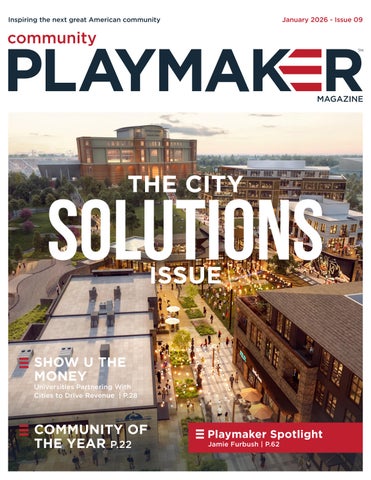
Community Playmaker - Issue 09 - The City Solutions Issue

Page 1


THE CITY ISSUE SOLUTIONS

We serve municipal leaders of communities large and small by bringing together the intersection of tourism, economic development, amateur sports, and recreation in a way that no one else does. We bring private-sector innovation to government leaders to help protect and secure the future of sport, recreation, and tourism in America.

Editor in Chief

Ashley Whittaker

Feature Editor

Johnny Crosskey

Digital Editor

Johnny Crosskey

Assistant Editors

Ali Yenchick

Ally Azzarelli

Ashley Worsham

Contributing Writers

Matt Swenson

Michael LoRe

Ally Azzarelli

Suzanne Wentley.

Advertising Inquiries

Creative Team

Tristan Makaroff

Ashley Kimmel Makenna Parks

Research Coordinator

Jenna Capuano

Website Manager Nicolas Desranleau

Event Manager

Alize Farhat

email: sales@communityplaymaker.com

General Inquiries

email: info@communityplaymaker.com

Playmakers,

Among the many hats that city leaders wear each day is that of problem solver. Not only do municipal leaders take the 10,000foot view of their communities to determine how they can be improved, but they’re also on the ground working with partners, agencies, and citizens to enhance the quality of life for everyone.

This edition of Community Playmaker, The City Solutions Issue, celebrates the work leaders throughout the country are doing to meet the challenges their communities face. We take you to Gardendale, Alabama, where mayor and lifelong resident, Stan Hogeland’s vision for increasing access to recreation led to the creation of Bill Noble Park, dubbed as “America’s Community Park.”

And we’re excited to introduce you to the 2025 Community of the Year, Hays, Kansas. This community of over 21,000 residents takes a passionate and strategic approach to solving a variety of issues, from water conservation to providing recreational opportunities for all citizens.

It’s our hope that this issue inspires you to think differently about the challenges your city faces and arms you with the necessary tools to take them head-on.

Peace, love, and public service,

Johnny

Managing Editor, Community Playmaker Magazine

Issue 09: Winter 2026

No part of this publication may be reproduced in any form or by any means, electronic or mechanical, without the permission in writing from the publisher, except small excerpts for review purposes. Submitted work, reviews, ads, and photographs are copyrighted by their respective owners.

Copyright Community Playmaker Magazine 2026.

The Sports Facilities Companies are a proud partner and sponsor of Community Playmaker.

RELOCATION INCENTIVES

4 U.S. CITIES & STATES THAT WILL PAY YOU TO MOVE THERE

In Tulsa, Oklahoma, Pawnee City, Nebraska, and cities throughout the U.S., communities are rolling out welcome mats.

As remote work gained popularity in the wake of the COVID-19 pandemic, so did tempting relocation programs and homebuying incentives. In fact, over 70 communities are actively offering incentives to people to relocate.

Why Are Cities Paying People to Relocate?

Communities are competing for talent, energy, and growth. These incentives increase an area’s population, help revitalize local economies, can fill workforce gaps, and breathe new life into once-quiet main streets. They can also mean the difference between being categorized as a city versus a village, as seen in places like Pawnee City, Nebraska.

For those seeking affordability, communi-

ty, and a fresh start, relocation incentive programs represent more than a financial boost — they’re an invitation to belong. In this article, we examine how relocation incentives in four communities are transforming the American landscape, what motivates cities to offer them, and why relocating to a new city can be one of the smartest investments.

Additionally, homebuying incentives provide individuals with the opportunity to relocate or access financial assistance while searching for housing.

Image Source: Newton Housing Development Corp.

Tulsa Remote Drives Over $600 Million Into the Local Economy

Supported by the George Kaiser Family Foundation, Tulsa Remote has grown from 70 remote workers when it launched in 2018 to more than 3,400 in 2025. Those accepted into the program receive a $10,000 grant to help with relocation to Tulsa, Oklahoma.

“Tulsa Remote started as an experiment, which we believed would help diversify the economy and give back to Tulsans. And we really see that being true through this research,” Tulsa Remote Managing Director Justin Harlan told News 6. “For every 100 people that we bring to the city, there are 60 jobs created at a local level.”

In addition to financial support, par-

Ascend WV Attracts 1,000 New Residents, Keeps 97%

Ascend WV was created by West Virginia University’s Brad and Alys Smith Outdoor Economic Development Collaborative. The initiative reflects WVU’s landgrant mission to strengthen the state’s economy and enhance quality of life. It’s funded through a mix of private donations, state support, and grants — including a $25 million gift from Brad and Alys Smith to WVU.

By welcoming remote workers to live, work, and explore in West Virginia, the program is creating a ripple effect of growth and vitality across local communities.

Designed to attract professionals to the state’s breathtaking mountain towns, Ascend WV blends financial incentives, community connection, and outdoor adventure. Participants receive a generous relocation package — including $12,000 in support, free access to outdoor gear, coworking spaces, and curated social events — all designed to help them settle

into life in “Almost Heaven.”

“The Ascend program continues to grow by leaps and bounds, and granting these once-in-a-lifetime opportunities is a testament to the increased interest and excitement around West Virginia,” said West Virginia Tourism Secretary Chelsea Ruby.

Since its launch in 2021, the program has received over 58,600 applications, proof of its appeal. Retention has been equally impressive: among those who’ve participated for at least four months, 97.3 percent have chosen to stay. In September, the program expanded to include a Charleston-area offering, boosting incentives to over $20,000 for new arrivals.

“This new incentive helps make it easier for new residents to put down roots in our friendly communities and great state. I’m looking forward to all the Ascenders who will call Almost Heaven their home,” added Ruby.

ticipants gain membership in a thriving community of remote professionals, along with access to social, networking, and resource-sharing opportunities. Tulsa Remote presents Tulsa as an affordable and vibrant place to live and work, backed by local support systems that help new residents integrate and thrive.

The results speak for themselves. According to Harlan, 70 percent of participants remain in Tulsa after completing the program. A recent study by the W.E. Upjohn Institute found that every $1 invested in Tulsa Remote generates more than $4 in local economic benefits. The program is also six times more effective at creating jobs than traditional business incentives.

Image Source: Visit Tulsa
Image Source: Ascend WV

Pawnee City, Nebraska, had roughly 865 residents in 2024 and only 834 as of 2025. The community is working hard to stay above the 800-person mark, the threshold that would reclassify it as a village. The city wants to avoid village status because reclassification could lead to a loss of tax revenue, making it harder to fund essential services like schools and a hospital.

In response comes the Vision 2030 initiative. This Pawnee City New Homes program is an exciting revitalization push focused on constructing 25 new single-family homes and 25 rental homes distributed across the community.

“In the virtual workplace, people can work from anywhere … we just have to of-

fer them a reason to choose Pawnee City,” says Steve Glenn of the local Economic Development Council.

The goal? To attract families, professionals, and retirees seeking a mix of rural calm and essential amenities, including investments in parks, beautification, and community amenities such as the Van Horn Park amphitheater and new pickleball courts.

The program offers a $50,000 down payment assistance — for qualifying buyers, this amount is provided as a 0 percent interest, no-payment second mortgage, helping to reduce the upfront cost of homeownership. To access this benefit, applicants must qualify for a conventional

first mortgage and meet income thresholds based on household size (up to 120% of the area median income).

These efforts are supported by a $650,000 grant from the Nebraska Affordable Housing Trust Fund and the generosity of local alums and donors through the nonprofit Pawnee City BOLD.

Beyond housing, the program incorporates quality-of-life elements, including parks, trails, community events, childcare, quality schools, and access to medical care. Its goal is twofold: to stem rural population decline and foster a sustainable, vibrant community through growth, new residents, and renewed economic activity.

Pawnee City’s $50,000 Housing Incentive Program
Image Sources: Wikimedia Commons

149 New Homes and Counting: Newton’s Steady Growth Story

First launched in 2014, the Newton Housing Initiative in Newton, Iowa, was designed to stimulate new home construction, enhance housing quality, and fuel the city’s tax base. The program offers up to $10,000 cash and a “Get to Know Newton” welcome package to buyers of newly built, owner-occupied single-family homes valued at $240,000 or more (excluding land).

“For a while, we weren’t growing,” said Newton Housing Development Corp. Housing Director Bruce Showalter. “The 2020 Census showed our highest popu-

lation ever — but after the Maytag closure, we’d lost about 500 people.” Once home to the iconic appliance manufacturer, Newton suffered when Whirlpool acquired Maytag in 2006, shuttering its headquarters and eliminating roughly 3,000 local jobs.

By 2011, no single-family permits were issued. A housing study confirmed the community’s fears: families were leaving, the population was aging, and few young households were moving in. The initiative became Newton’s comeback plan — funded annually through the city budget and active through June 2026.

Homes valued under $240,000 can qualify for tax abatements through the CityWide Urban Revitalization Plan. To be eligible, each home must be fully completed, certified for occupancy, and equipped with a radon remediation system to ensure safety and compliance.

Since its inception, the program has helped permit 149 new single-family homes, averaging 15 per year — a steady pace that reflects Newton’s resilience and renewed appeal as a growing, familyfriendly community.

Cities that host the country’s biggest, most boisterous, and most watched events make it look so easy. Fans arrive, the stadium or arena lights up, and everything seems to fall neatly into place. But anyone who works in municipal operations knows the real work happens long before the gates open.

Whether it’s WrestleMania, Formula 1, the FIFA World Cup matches, or the NCAA Women’s Final Four, these cities consistently demonstrate how to welcome tens of thousands of visitors while keeping daily life moving for residents. Their approaches offer a practical blueprint for communities of any size.

Early Planning Wins

Big events usually enter a city’s planning pipeline months or years before they arrive. Tampa is known for getting everyone around the same table early: law enforcement, fire rescue, transportation, public works, emergency management, and venue operators.

“It starts with an RFP… then going out to our venue partners, host institution partners, our city, our county — everyone who needs to sign off. You must get all the people on board first to make sure we can do what’s being asked,” explains Tampa Bay Sports Commission Senior Vice President of Events Claire Lessinger,

who was instrumental in coordinating the city’s hosting of events such as the NCAA Women’s Final Four and Super Bowl LV.

Dallas takes a similar approach, but with a regional lens. Major events ripple across Dallas, Fort Worth, Arlington, and a cavernous airport system, underscoring the need for alignment.

As Dallas Sports Commission Executive Director Monica Paul — a driving force behind Dallas being selected as a Host City for the FIFA World Cup 2026™ — explains, “Collaboration is everything. In North Texas, we work across 133 cities, large and small, and every jurisdiction has a role. You can’t deliver an event of this scale unless everyone shares the same vision from the start.”

Dallas also builds specialized teams for mega-events like the World Cup. “We built an entirely new team — each person is an expert in their area. Some had never worked on a major event before, but the bid process gave them a foundation. Now it’s all about execution,” says Paul.

Safety at Scale

Keeping people safe is always the top priority. Tampa uses layered security zones, drone monitoring, and real-time intelligence tools to maintain situational awareness.

“We bring all key decision makers to the table early … There’s a lot of proactive planning for safety and security,” says Lessinger.

Dallas approaches safety with a regional, multi-agency command structure. “Security is the number one thing that keeps people up at night,” Paul says. “The world has changed — keeping athletes, teams, fans, and residents safe is our top priority.”

Dallas has been meeting with expert planning teams for two years, working within a framework developed in coordination with the White House. “All 16 host cities meet weekly with the White House task force. It’s powerful to have federal, state, and local agencies aligned on safety and security,” Paul adds.

Keeping People Moving

If transportation breaks down, the entire event experience suffers. Dallas relies on Dallas Area Rapid Transit rail, parkand-ride hubs, and temporary shuttle systems around AT&T Stadium. “One of our responsibilities is transporting ticket holders to the match,” Paul explains. “We don’t have a rail line to Arlington, so we’re creating a central rail-to-bus system. That requires deep analysis of arrival patterns, fan behavior, and how different fanbases travel.”

Photo credit: Tampa Bay Sports Commission

“The Last Mile is critical. Streets that are normally open may be closed. Shuttle systems, bus bridges, rideshare zones — it all has to be carefully mapped. We’re coordinating with the Texas Department of Transportation and every city to avoid conflicts with major construction and keep movement as smooth as possible.”

Tampa, which also doesn’t have an extensive public transportation footprint, relies on signal timing shifts to help prioritize traffic flows, dynamic message boards, extended streetcar service, and rideshare corridors.

According to Lessinger, “Once the footprint falls into place … we create a transportation and parking plan. We encourage fans to use the free streetcar from Ybor City (Tampa’s historic district) to downtown to relieve pressure.” With larger events, the city aims to “over-communicate and educate attendees to think differently from a typical [Tampa Bay] Lightning game,” she adds.

Hotels and Visitor Support

Tampa’s hotels coordinate block reservations citywide to prevent shortages. “Hotel planning for big events in Tampa starts very early,” explains Lessinger.

“We’re fortunate to have amazing hotel partners here,” she adds. “We help by creating leads and connecting hotel GMs with the event organizer. As we get closer to the event, teams, headquarters, and media are locked up and designated.”

“We then shift to fan housing, something we promote on our site. We understand the remaining inventory in the community and help push and promote where fans can land via our host site, showing proximity, price points, flags, and star levels, allowing us to create a strong customer service experience for fans,” she explains.

Regarding World Cup preparations in Dallas, Paul says, “We have more than 130,000 hotel rooms in the region, with more being built right now. Add in Airbnb, and short-term rentals, and capacity is strong, because we’re hosting the International Broadcast Center, some groups will be here for months, so we’re also planning long-term stay logistics.”

Photo credit: Tampa Bay Sports Commission
Photo credit: North Texas FWC Organizing Committee

Keeping Residents in the Know

Strong resident communication is one of the biggest predictors of event-day success. Tampa uses neighborhood-specific text alerts, apps, and social posts to give locals clear expectations about closures, crowd sizes, and transit changes.

Dallas releases event-day guides mapping everything from road closures to shuttle access. Region-wide digital message boards also help keep drivers informed in real time.

“Not everyone sees the planning that leads up to these events … Communication is a big part. We constantly communicate so

“We help by creating leads and connecting hotel GMs with the event organizer. As we get closer to the event, teams, headquarters, and media are locked up and designated.” explains Lessinger

people understand where to park, entry protocols, clear bag policy — all of it,” says Lessinger.

Constant communication builds trust. When people feel informed, they’re more likely to support and celebrate major events rather than dread the disruption.

Lessons for Any City

No matter the size of your community or the scale of the event, the fundamentals stay the same:

• Start planning early

• Build one unified framework

• Layer security thoughtfully

• Protect mobility for everyone

• Coordinate visitor services

• Communicate clearly and often

As Paul puts it, “Whether you’re a big city or a small one, the sooner you start talking and aligning vision, the better. Half the work is getting everyone on the same page from the very beginning.”

Dallas and Tampa show that excellence isn’t luck — it’s structure, partnership, and a shared commitment to creating extraordinary experiences for visitors while respecting the people who call the city home.

Photo credit: North Texas FWC Organizing Committee

FROM VISION TO VALIDATION

WHY FEASIBILITY IS VITAL FOR SPORTS, RECREATION, AND EVENT VENUES

When communities imagine new sports or recreation venues, enthusiasm often out-paces evidence. Leaders see the promise of new tournaments, visitor traffic, and community pride. However, without the right data to support it, even the best ideas can grow faster than the market can sustain — leaving projects that cost more, take longer, and fall short of expectations.

That’s where feasibility and market studies help.

What Is a Feasibility Study: Understanding True Demand Before You Build

Consider a feasibility study as an early-stage assessment that doesn’t just forecast numbers but creates alignment between community goals and real-world demand. If conducted properly, a feasibility study can lay the groundwork for a facility that’s successful from its first game

day to its tenth anniversary and beyond. “Right-sizing the facility to the market opportunity is everything,” said Dan Morton, vice president of pre-development services at The Sports Facilities Companies. “Communities have different definitions of success … Maybe it’s operating income, maybe it’s community service, maybe it’s sports tourism, but you can’t achieve any of those without first understanding what the market can support.”

From Vision to Validation

A practical way to frame the process is a funnel that moves from goals to evidence to recommendations, as described by Morton. At the top, leaders define what success means.

The analysis then evaluates demand by drive-time segments: local users within about 30 minutes for weekly classes, leagues, training, and practice; subregional users for more specialized programming; and regional visitors willing to

travel four to six hours or more for tournaments and multi-day events.

Fitness use is more convenience-driven and typically centers around a 10-minute trip from work or home, which affects membership and programming assumptions.

Clarity Before Construction: The Why Behind Feasibility Studies

Feasibility studies are the bridge between idea and execution, translating community goals into a program, size, and business model the market can sustain — from concept through funding and design. Done early, they right-size the scope, clarify trade-offs, and give funders and stakeholders confidence that plans are grounded in evidence, not assumptions. Most importantly, they align expectations of what success means for residents, teams, and visitors with what the market will actually support.

Image Sources: The Sports Facilities Companies

FEASIBILITY STUDIES HELP:

Quantify demand across local, subregional, and tournament travel markets to match programming and capacity.

Test revenue, expense, and staffing scenarios to produce a defendable operating financial forecast.

Indicate competitors and gaps to differentiate amenities and programming, rather than duplicating supply.

Surface capital, phasing, and partnership options that reduce risk and unlock funding.

Catch design missteps before they become costly — ensuring your facility is built to fit the community’s true needs from the start.

Establish performance KPIs and monitoring methods to ensure forecasts align with actual operating data.

Avoiding Expensive Errors

It’s easy for community leaders to skip the feasibility study step within the development process, thinking it will help cut costs. However, this can defer risks.

Morton has seen projects move into design or construction based on assumptions that later collapse under scrutiny. He has seen groups spend hundreds of thousands on design documents, only to have experts come in and say, ‘Wait, you’re overbuilt, or you’re missing the mark for your market.’ They then end up paying twice — once for the incorrect plan and again to rectify the issue.

Skipping this step often leads to overprogrammed or underutilized venues that fail to meet the community’s needs. Even when such projects succeed, they do so inefficiently, usually requiring last-minute changes and rework that could have been prevented with early analysis.

Differentiation: Finding Your Niche

Another benefit of early feasibility planning is understanding how to complement, rather than compete with, existing providers.

“In most towns, there’s already a YMCA, a parks and rec facility, or a fitness club,” Morton said. “You’ll always share some overlap — basketball courts are basketball courts — but your programming, design, and amenities can be differentiated.”

By mapping what others already offer, planners can identify service gaps and unmet demand. Perhaps the local Y focuses on youth leagues but doesn’t have the space for adult recreation or tournaments. Nearby cities might host weekend baseball, but they often lack multi-sport fields that can accommodate soccer, flag football, and lacrosse.

Those differences help new facilities meet a real market need rather than simply splitting the same players across more venues, and they make it easier to secure funding and community support.

Real-World Results

Rocky Mount Event Center in Rocky Mount, North Carolina

When Rocky Mount, North Carolina, first envisioned its downtown venue, the plan resembled a traditional spectator arena. Feasibility work shifted that thinking.

“We looked at what the city wanted — more people downtown, more restaurant traffic, more activation — and realized a pure arena wouldn’t get them there,” Morton recalled. “We recommended a more flexible model focused on youth and amateur sports density.”

The redesigned facility still accommodates concerts and seated events but prioritizes convertible courts and high-use layouts that draw visitors year-round. The result? A venue that not only met but amplified its original civic goals — creating a steady pulse of activity that supports nearby businesses and complements ongoing

downtown redevelopment.

In 2024, the Rocky Mount Event Center hosted 28 tournaments, attracting over 105,000 visitors from more than nine different states. Those events generated $26.77 million in economic impact, underscoring the facility’s dual role as both a local gathering place and a significant driver of regional tourism.

Sand Mountain Park & Amphitheater in Albertville, Alabama

Sand Mountain Park was once a patchwork of aging fields and amenities. City leaders had a big vision: modernize local recreation while creating a destination that could attract visitors and drive economic development.

“Their parks system had just evolved over time,” Morton said. “We came in from the very beginning — walking the old fields, meeting with stakeholders —

to design a facility that worked for both residents and visitors.”

What resulted is a balanced model that combines community recreation, aquatics, sports fields, and an amphitheater for live entertainment within a single regional destination. The $58 million, 129-acre Sand Mountain Park and Amphitheater now welcomes local families daily, driving substantial visitor spending through tournaments and concerts, showing how thoughtful, data-driven planning can connect community service with tourism growth.

“From day one — touring the old baseball fields — the study informed the right mix: amphitheater, aquatics, and indoor/ outdoor fields, enabling the city to elevate community programming while driving visitation and economic development,” described Morton. “Today, we operate the facility at scale.”

Image Sources: The Sports Facilities Companies

In 2024, the park generated $22 million in economic impact, fueling new retail and hospitality developments that continue to reshape the Albertville landscape.

How Feasibility Informs the Future

Modern feasibility studies are not a oneand-done report. They’re dynamic tools that evolve with real data.

Morton points to The Sports Facilities Companies’ forecasting model, which continuously updates using performance

metrics from hundreds of managed facilities nationwide. “Every week we get new data — participation, revenue, expenses — and we feed that back into our models,” he said. “That helps us predict with better accuracy what a new facility can realistically achieve.”

For cities and developers, this living data offers a clear advantage: it grounds vision in evidence. Leaders can make smarter tradeoffs, prioritize high-value uses, and design venues that stay relevant for decades.

Bottom Line

Feasibility isn’t red tape — it’s the foundation of success. Communities that start with market evidence design smarter, seek funding more confidently, and deliver venues that perform effectively.

“When you start with the market and build from there,” Morton said, “you reduce risk, accelerate delivery, and create places that work — for residents, for visitors, and for the regional economy.”

AI’s EXPANDING FOOTPRINT

THE ECONOMIC, ENVIRONMENTAL, AND COMMUNITY IMPACTS OF DATA CENTER GROWTH

As artificial intelligence (AI) becomes more widely adopted, its rapid growth is prompting new discussions about cost, impact, and sustainability.

On one hand, AI is eliminating repetitive tasks, assisting with healthcare, enhancing cybersecurity, and elevating fraud detection for financial institutions. Beneath the surface, however, data centers powering these systems are under increasing scrutiny and pressure, sparking debate among residents in areas affected by these facilities.

01000111 01101111

01101111 01100100

00100000 01101101

01101111 01110010

01101110 01101001

01101110 01100111

00100000 01100100

01100001 01110110 01100101 00100001

AI Data Centers: A Complicated Neighbor

While hosting a data center can create new job opportunities and generate significant tax revenues for local governments — funding schools, roads, and emergency services — communities are facing complex consequences.

The massive server farms, cooling plants, and grid connections required for each AI deployment can bring environmental and social implications for cities, neighborhoods, and the planet.

Without thoughtful governance and clear guidelines, technological progress can quickly become a source of debate in city halls.

Like much of Northern Virginia, Loudoun County was once a rural, agricultural community before it evolved into a technology corridor, with AOL establishing its headquarters there in the mid-1990s.

Today, over 70 percent of the world’s internet traffic is estimated to flow through the county, due to the presence of platforms such as Amazon, Google, and Meta, as well as over 43 million square feet of operational data-center space.

AI’s explosive growth has accelerated demand for high-performance computing infrastructure, making Loudoun a critical center for training and deploying AI models. Data centers generate more than $1 billion in yearly tax revenues, nearly a

third of the county’s total revenue, while occupying less than 3 percent of its land.

According to the Northern Virginia Technology Council (NVTC), in 2023, data centers brought 78,140 jobs and $31.4 billion in economic output to Virginia. However, as Loudoun nears its data center capacity, local leaders are shifting their focus towards a more diverse economic growth strategy

How Loudoun County Became Data Center Alley
Image Sources: Adobestock

The energy demands of generative AI are pushing data centers into a new league of consumption. Elsa A. Olivetti of MIT’s Decarbonization Mission told MIT News, “What is different about generative AI is the power density it requires … a generative AI training cluster might consume seven or eight times more energy than a typical computing workload.”

According to the 2024 U.S. Data Center Energy Usage Report by Lawrence Berkeley National Laboratory, data centers already account for more than 4 percent of national electricity consumption, a number expected to rise sharply.

Utilities are working to meet rising demand, prompting some to adjust or delay elements of their decarbonization plans. “This is adding tremendous strain to the system at a time (when) we are attempting to decarbonize,” former FERC Chair Neil Chatterjee told The Washington Post. One projection suggests that data-center-driven gas generation could soon amount to 10–30 percent of current U.S. gas demand.

The Dire Need for Cooling

When it comes to data centers, cooling is key. They often use evaporative towers, chilled-water loops, or direct liquid-immersion systems — all of which rely on local water supplies. In many cases, the wa-

ter-per-kwh ratio can reach two liters, straining already water-stressed regions.

According to Bloomberg, nearly two-thirds of data centers built or planned since 2022 are in areas facing water scarcity. Most of this growth is concentrated in five states, accounting for about 72 percent of all new facilities built in regions experiencing high water stress.

Emissions Beyond Electricity

The environmental footprint extends beyond carbon. The manufacturing, disposal, and cooling systems of data centers introduce pollutants like PFAS (“forever chemicals”), fluorinated-gas refrigerants, and e-waste from rapid hardware turnover.

Noise, Air, and Quality of Life

Residents living near data center clusters have questioned the hum of fans, the sound of generators, and the aesthetics of massive cooling towers. In some suburban settings, these mechanical operations may become more noticeable.

Though most operations are electrically driven, backup generators emit pollutants like nitrogen oxides and particulate matter. A 2024 study by the University of California found that U.S. data centers could cause more than $20 billion in public health damage by 2030.

Powering the AI Boom

Economic Incentives vs. Environmental Impacts

In Tennessee, qualified data centers that invest at least $100 million and create 15 new full-time jobs, paying at least 150 percent of the state’s average wage ($58,700 per year, according to the Tennessee Department of Revenue), can receive sales tax exemptions on computer hardware, software, cooling, and power infrastructure, and receive a reduced 1.5 percent rate on electricity used in their operations.

Kartik Hosanagar, co-director of the Wharton Business School’s AI Research Center, told NPR that most data centers typically employ between 100 and 200 people. In contrast, according to McKinsey & Company, a large data center, such as a 250,000-square-foot facility, can generate up to 1,500 construction-phase workers and create more than 50 longterm operational positions. Each on-site job can also spur an estimated 3.5 additional jobs in the surrounding economy

through related infrastructure and service needs.

Despite the economic benefits, the city of Memphis, Tennessee, faces the broad challenge of balancing economic development with public health.

After Elon Musk’s xAI campus, Colossus, opened in South Memphis, residents in the nearby Boxtown neighborhood reported a rise in respiratory illnesses, igniting debates over corporate responsibility. In 2025, the Southern Environmental Law Center, representing the NAACP, announced its intent to sue over unpermitted gas turbines.

Soon after, the county health department cleared xAI to operate 15 temporary turbines, fueling controversy among residents. Memphis and Shelby County rank among the nation’s “most challenging” places for individuals with asthma according to the American Lung Association’s most recent State of the Air report.

The city of Memphis, Tennessee, faces the broad challenge of balancing economic development with public health

Prince George’s County: Planning Before Building

While many regions are reacting to data center growth, Prince George’s County, Maryland, is working to get ahead of it. “That’s why we have a task force,” said Wala Blegay, Esq., representative from the Office of the County Executive.

“The task force is put together so we can look into infrastructure issues, environmental issues, all of those things.” The county currently has no large data centers but is proactively studying their potential impact on zoning, energy demand, and water use.

“We really don’t want the data center to be anywhere near people,” Blegay explained. “We want it to be in a remote area far away from residents.”

By establishing designated areas and setting environmental safeguards in advance, the county aims to balance competitiveness with community protection — learning, as Blegay noted, “from other jurisdictions so we won’t make mistakes that could be detrimental to the safety of residents.”

A Call for Balance in Santa Clara

In Santa Clara, California, home to nearly one-third of Silicon Valley’s data centers, Councilman Kevin Park is urging balance. His city earns more than $40 million a year from about 60 facilities, but he questions the long-term value. “They provide revenue without adding traffic or congestion,” Park said. “But we have to ask: what’s the real benefit to residents?”

While construction brings temporary jobs, operations require few workers and strain local resources. “We’re considering doubling our power supply, not because residents are using more, but because of data centers,” he noted. “If your power goes out, it’s inconvenient. But if your water goes out, that’s a crisis.”

Park believes cities must rethink land use. “What is a data center doing in the middle of an entertainment district? It doesn’t create community or experiences. Would perhaps a retail space, a stadium, or a sports center better benefit the community?”

The Future: Risks, TradeOffs, and the Choices to Come

Park’s thoughts mirror those of many civic leaders nationwide. “We can’t look at data centers in isolation,” he said. “They’re part of a larger system that affects energy, housing, and livability. If we don’t set clear limits, we’ll end up defining our cities by their power consumption instead of their people.”

Rapid advances in chip efficiency and cooling technology could ease the strain, but only if regulation keeps pace. Park believes local voices must guide these decisions: “I’m not here to rule, I’m here to amplify the people’s voice. If residents feel ignored, then we’re failing at democracy.”

Ultimately, the future of AI infrastructure depends on whether cities choose foresight over convenience, transforming data centers from potential burdens into engines of sustainability, equity, and resilience.

IMPACT: AI

Data centers generate more than . .

IN LOUDOUN COUNTY, VA: $1

1/3 of the county’s TOTAL REVENUE

occupying less than percent of its LAND 3 PERCENT

in yearly TAX REVENUES

NORTHERN VIRGINIA TECHNOLOGY COUNCIL (NVTC) <2023>

Data centers brought . . . .

78,140

jobs

. $3.14 BILLON in ECONOMIC IMPACT

DATA CENTER ENERGY USAGE REPORT BY LAWRENCE BERKELEY NATIONAL LABORATORY <2024>

Data centers account for more than of national ELECTRICITY CONSUMPTION

BLOOMBERG

4 PERCENT

NEARLY of data centers built or planned since 2022 are in areas facing WATER SCARCITY

2/3

COMMUNITY PLAYMAKER’S 2025 COMMUNITY OF THE YEAR

Hays KANSAS

Is your community lucky enough to be by the ocean or the mountains, blessed with attractions or landscapes that make growth and development easy? Hays, Kansas, is not one of those places.

Yet despite this — or perhaps because of it — local leaders and elected officials have worked for decades to build a welcoming and prosperous small town. Today, Hays is financially strong, supporting all generations with fun events and modern facilities, and well-prepared for the future.

From the brick streets of downtown to its new, state-ofthe-art high school and community center, Hays offers a strong sense of place that supports its residents while intentionally attracting visitors and developers.

Community Playmaker is proud to announce Hays, with its 21,000 residents, as the 2025 Community of the Year.

KANSAS

Settled by Volga German immigrants from Russia in the 1880s, Hays was once the “Wild West.” Now, it is an exceptionally safe shopping hub for small towns throughout northwest Kansas with a retail pull factor of 1.8, meaning that for every 1,000 residents, 800 visitors shop as well. Thanks to that sales tax revenue, they enjoy one of the lowest property taxes in the state.

Hays is also home to Fort Hays State University, which brings a youthful energy, artistic opportunities, and a progressive perspective to the town. It’s filled with hard-working residents willing to dedicate their time and resources to helping Hays stand out.

“The people of Hays are doers. They’re passionate about their community,” said Sandy Jacobs, who was born in Hays and has served as the mayor for the last nine years. “We have a can-do attitude. It takes investment in the community to

have a good quality of life and be a place to raise children. We are willing to take that path together.”

Helping to Make Memories

Melissa Dixon, now the executive director of the Hays Convention and Visitors Bureau, moved to town when her husband was hired by the university 11 years ago. At first, she was worried there wouldn’t be a lot to do. She was quickly reassured.

In particular, the downtown — once empty and blighted like so many traditional downtowns in the 1980s — had benefited from a significant revitalization effort. City leaders worked with a developer to renovate seven buildings, improve the streetscape, and, most recently, add a pavilion. That’s where the farmer’s market, symphony concerts, and holiday gatherings take place. Thanks to the state’s oldest arts council, Hays residents can also enjoy seasonal art walks downtown.

“It is really special. When the streets turn to brick, you know you’re downtown,” Ms. Dixon said. “It’s always full of people.”

Gathering spaces are plentiful in Hays. Last year, the city cut the ribbon on the Bob and Pat Schmidt Community Center, a multi-generational facility that includes a dedicated senior center and childcare. Funded through a mix of city and county grants, private donations, and support from the Kansas Children’s Cabinet and Trust Fund, the center reflects a community-wide investment in shared space.

The family-friendly town also recently opened a $1 million park filled with specialized equipment for children with disabilities to its long roster of playgrounds and parks. There’s also the Bickle-Schmidt Sports Complex, which hosts local sports groups and regional tournaments throughout the year.

Image Sources: City of Hays
“...we continued that momentum, investing in parks and quality of life, streets, water, and sewer infrastructure,” explained Dougherty

And then there are all the events. The Oktoberfest downtown features polka music, plenty of beer, and Volga German cultural foods like bierocks (yeast rolls stuffed with seasoned ground beef and cabbage) and spitzbuben (buttery cookies filled with fruit jelly). The kite festival and the bicycle tour of the local, historic chapels are favorites of Ms. Dixon and her family.

“We have so many free and affordable things to do here,” she explained. “We’re always looking to help people make great memories in Hays.”

Focus on Infrastructure

Of course, all the events and holiday lights are worthless if the city doesn’t run effectively. That’s what really makes Hays shine. For more than 20 years, city officials have focused on investing in infrastructure. Those investments have all paid off.

“The city went through some relatively lean financial years. My predecessor started cleaning things up, and we continued that momentum, investing in parks and quality of life, streets, water, and sewer in-

frastructure,” explained Toby Dougherty, the city manager since 2007.

With savings from sales tax revenues, they’ve been actively upgrading the 130 miles of streets, 120 miles of water and sewer lines, and 1,500 manholes. A revenue bond helped fund a new $40 million wastewater treatment facility.

They’re also in the final phases of constructing a 70-mile water line to bring potable water into Hays from an area of the state with a more reliable aquifer. The project has been held up in legal battles, but next year, they hope to start the $140 million project to increase their available water by 5,000 acre-feet a year. In the meantime, they’re focused on water conservation efforts.

“Water is an issue in Hays,” Mr. Dougherty said. “When we get in a decadal drought, think of the 1930s Dust Bowl – no matter how well we use the water, it won’t last.”

And yet, Hays residents are known for coming together to find solutions. Mayor Jacobs highlighted an initiative about eight years ago called “Strategic Doing.” In the event, around 300 people from all sectors brainstormed ways to improve the community.

“You cannot do one thing and throw it out. You have to stay with it so it can be sustainable,” she explained.

Future Growth for Hays

Like in so many places in the nation, Hays is also struggling with housing. Doug Williams, a Hays native and executive director of Grow Hays, said regional economic development depends on having adequate housing.

“We are trying to expand the housing stock, working with developers to promote housing,” Mr. Williams said. “You

City Manager Toby Dougherty

can’t recruit 120 people to a community if they don’t have somewhere to live.”

That’s exactly what he’s recently done. A company called Agiliti, which manufactures medical equipment, was considering leaving Hays. Instead, they worked on an incentive package for the abatement of property taxes and benefits for employment guarantees. The company kept its 130 employees and pledged to bring in another 120 to 150.

Grow Hays partnered with a not-forprofit developer to build an additional 66 houses, many of which are pricecapped, over the next few years. All the houses have sold, and there are another 50 people on the waiting list.

Meanwhile, Fort Hays State University has enrolled around 3,800 students on campus and offers online classes for an additional 6,500.

For younger students, there’s a new $143 million high school funded by a school bond passed by the voters three years ago. There is a new football field, culi nary arts classes in a commercial kitch en, and even a jewelry-making lab.

being a little girl visiting downtown with her aunt, who stopped on every corner to say hello.

“Everything we did was gathering, collaborating, and community. That’s how I live,” she said. “You want to make sure you’re a welcoming community. This is home.”

“The high school solidified knowing that we made the right move when we decided to move here,” Ms. Dixon said. “Both of my kids are there, and it’s gorgeous. It feels like they really are home.”

And for times when Hays residents want to get away? No problem: Hays Region al Airport offers two direct flights a day to Denver, which is an international hub. City leaders hired a consultant to encour age competitive prices, free parking, and short lines.

Mayor Jacobs, who was recently reelected for another four-year term, said her favorite thing about her community is her neighbors. She has early memories of

UNIVERSITIES BLEND SPORTS AND ENTERTAINMENT THROUGH NEW MIXED-USE DEVELOPMENTS DESIGNED TO GENERATE MUCH-NEEDED REVENUE AND ADD COMMUNITY AMENITIES

On the site of a formerly rundown parking lot in Ames, Iowa, the future of the college sports experience is taking shape — the first of what will be eight new buildings, a new 78,000-square-foot medical facility, is nearing completion at Iowa State University. By late 2027 or early 2028, restaurants, retail, office space, an amphitheater, and a hotel should be up and running in CyTown, the nation’s first multi-use district on a college campus.

The $200 million project combines some of the top economic development trends, including medical tourism, music tourism, sports tourism, and mixed-use hospitality to create an experience that university officials expect to pay for itself. In fact, 75 percent of the funds needed for the project will come from land monetization, with the balance from leasing 20 CyTown Suites and fundraising.

Among the explicit goals stated on the project’s website is to attract and retain students, university employees, entrepreneurs and innovators, and visitors.

Amid the rising costs of athletics, most apparent in the high-priced coaches and Name, Image, and Likeness (NIL) policies that allow student-athletes to be paid, universities are in an arms race to generate revenue to stay competitive. Sections of college campuses near athletic facilities are being transformed into hubs for students, residents, and visitors to congregate on game days and off-days alike.

Universities are not the only big winners in this new trend. Communities will also benefit from new amenities that enhance their hometowns, making them even better places to live, work, and play. As an extension, local companies and organizations will gain access to a larger pool of talented workers eager to lay stakes in booming municipalities.

Game-Changing Developments

Make no mistake, these are places to eat, drink, live, play, and work. While tailgating might be a sacred tradition for some, the next generation of sports fans is looking for a more curated experience.

At Iowa State, the development began with a simple question, says Nick Joos, senior athletic director of communications. “How can we turn this land into something that can serve our community and be a place to go 365 days a year?”

If the model sounds familiar, it should. It’s the standard for professional sports franchises to create social districts around their stadiums. CyTown takes the best of Titletown in Green Bay, Wisconsin, and the Power & Light District in Kansas City, Missouri. The same model is also being adopted at many youth sports complexes, eager to create an experience for the whole family and not just the athletes.

CyTown is being developed by the Omaha-based Goldenrod Companies, the same company behind The Battery

surrounding Truist Park, home of the Atlanta Braves. The Battery includes the Coca-Cola Roxy, a music hall, and a slew of restaurants and retail in a pedestrian-friendly district in suburban Cobb County. Goldenrod is also designing The Grounds at Wake Forest University, a 100-acre mixed-use development that’s repurposing blighted land where the old R.J. Reynolds Tobacco Factory once stood.

The firm’s influence is evident when studying blueprints for the new college experience.

Building The Grounds

Both Iowa State and Wake Forest, in Winston-Salem, North Carolina, are fortunate to own campus grounds that are already in need of redevelopment.

“The land there was generating no tax dollars for the city and the county, and also looked like crap,” says Wake Forest Athletic Director John Currie. “It’s now going to look great, and it’s going to be fun. And we’re also going to really add to the tax base for the city and the county.”

As karma and coincidence have it, two of the key principals on The Grounds are Wake Forest alumni: Coleman Team, president and managing partner at the Winston Salem-based Front Street Capital, and Adam Parker, senior vice president of Carter, a national real estate investment and development firm headquartered in Atlanta.

(continued on p. 32)

State

• Projected 1.3 million annual visitors, including students and university employees

• 40 acres

• Office space

• Private event venues

The Grounds at Wake Forest

visitthegrounds.com

• 100-acre mixed-use development in the Deacon Boulevard area

• $1.3 billion in economic impact in the first 10 years

• 130,000 square feet of office space

• Creekside at The Grounds (student housing)

• Loft condos

• Expanding sidewalks, adding bike-friendly paths, and improving pedestrian crossings between Wake Forest University and The Grounds cyclones.com/feature/cytown

• Living units

• McFarland Clinic

• Sukup Cylo Amphitheater

• Food, beverage, and retail

• Planting over 200 trees and 30,000 native plants at Upper Silas Creek

• 42,000 sq.-ft. pedestrian-friendly retail village

Crossroads District at Mississippi State University

msucrossroads.com

• 15 acres

• 122-room Hotel Madelon with fullservice restaurant and rooftop bar

• Entertainment district connecting the campus, Cotton District, and downtown Starkville

• New home for the Ulysses S. Grant Presidential Library

• Planned pedestrian land bridge

• Residential living for faculty and staff

• A 700-space parking garage is planned for the north side of University Drive near the district

East Texas A&M University’s New Events Center (Name TBD)

• Approximately 2,500 stadium seats

• Arcade and other family entertainment amenities

• Plaza with an outdoor entertainment space with a stage

• Buffalo Wild Wings

• 800+ new parking spaces

• Master plan includes an auxiliary gym, restaurant spaces, and a hotel

Image Source: East Texas A&M University

While both are strong businessmen knowledgeable on major projects like this, they’re eager to help Wake Forest return to the glory days of Tim Duncan and Randolph Childress, while also giving back to the city of about 250,000 residents.

“This is a really extraordinary example of public, private partnership in developing a very blighted area of a community,” says Parker.

They say the $40 million in grant funds are worth the investment, as The Grounds is projected to generate $1.3 billion in its first 10 years, to say nothing of the added tax revenue and beautification of Upper Silas Creek, including planting over 200 trees and 30,000 native plants.

A building for student housing set to open in 2027 is already under construction, and will be followed by office space for university employees. A pedestrian-friendly retail village, complete with 42,000 square feet of local and regional shops, chef-driven restaurants, and outdoor gathering spaces, will tie the project together.

If all goes well, the first phase of the project will be a “beachfront” for future development, says Team. “This is acting as a very vibrant activator for a university, but also really a vibrant activator for a community that’s in need of diversified economic development,” he says.

Sports Entertainment

Such projects are harnessing the massive power of college sports, says Eric Sullivan, a partner at The Sports Facilities Companies and native Michigander. “Sports are a billboard for higher education,” he says. “What these projects are doing is creating excitement.”

Not only do games, particularly football and basketball contests, draw massive crowds to campus that drive revenue to the school, but they’re also economic drivers even without the added mixed-use developments underway.

A study conducted by Destination Ann Arbor, home of the Michigan Wolverines, found that the 2024 U-M football season generated $226.7 million in direct visitor spending from attendees residing outside Washtenaw County. On average, each home game contributed approximately $28 million in direct visitor spending to the local economy.

Likewise, Wake Forest already hosts more than 260 event days per year, with more than 750,000 patrons attending events such as university sports, the Carolina Classic Fair, Winston-Salem Thunderbirds games, the ATP Winston-Salem Open, and other concerts and shows.

Such significant numbers highlight the vast presence that institutions of higher education have in their communities, especially in mid-sized university towns like Ames, Ann Arbor, and Winston-Salem.

Lynn Spruill, mayor of Starkville, Missis sippi, home of Mississippi State Univer sity and the smallest municipality within the Southeastern Conference, prides her self on the strong town-gown relationship she’s built in her three terms in office.

While the football team may struggle in the standings, other sports like soccer, softball, and women’s basketball have achieved significant success, creating a buzz around town.

Without the presence of a Division I

sports program in one of the country’s highest profile conferences, Starkville would not be in a position to add the new 15-acre Crossroad District featuring a boutique hotel, restaurants, and retail stores, says Spruill. The driving forces behind the master plan are Mississippi State University, in collaboration with West Side Funds Inc., a for-profit affiliate of the Mississippi State

University Foundation.

Spruill says the new amenities are a win for college students, the community, and visitors.

“Athletics drives most of the energy that’s associated with the community,” she says, “People want to be part of a winning team.”

itors bureau worked in conjunction with Learfield Communications, the University of Michigan’s official publicity partner, to create four videos starring student-athletes enjoying the sights, tastes, and sounds of the city.

Football and basketball may get most of the headlines, but the magnetic power of all sports shines through in Destination Ann Arbor’s marketing efforts. The convention and vis-

The featured athletes play on a variety of teams, ranging from football to field hockey, and receive NIL dollars for the promotional work. Amy Karbo, Destination Ann Arbor’s vice president of marketing, says the video series attracted significantly more social media impressions than standard content.

“It didn’t matter if the athletes were from some of the bigger sports like football or played smaller sports,” says Karbo. “Our videos performed well across the board. The power of sports resonates with our followers and the people who are interested in our brand.”

In a case where what’s good for the university is also a benefit to locals, the University of Michigan has begun to host concerts in the Big House,

the school’s fabled football stadium. Zach Bryan’s September 2025 performance debuted the new stadium initiative, setting a new U.S. record for the largest ticketed concert, with an attendance of 112,408 fans.

Such notable music events, including Metallica playing at Lane Stadium at Virginia Tech (the football team famously storms the field each game to “Enter Sandman”), are valuable fundrais ers for the colleges. Joos adds that Iowa State is already lining up acts that would previously have played in Des Moines.

East Texas A&M, along State Highway 24 in Commerce, Texas, is getting into the act with the groundbreaking of a multiuse event center set to open in fall 2026 that will anchor an events district. The surrounding area will include a plaza, an outdoor entertainment space with a stage, and more than 800 new parking spaces. A Buffalo Wild Wings restaurant is already open in the area.

The $70 million venue will be home to the school’s basketball teams, which recently jumped to Division I. It will also host major university and community events, including graduations, concerts, conventions, and special gatherings.

“Our plan is to monetize the center to the best of our ability,” says Travis Ball, executive director of business services and chief procurement officer at East Texas A&M University.

Where the Money Is Going

Revenue from shows, games, and incoming developments can be used in myriad ways, all of which improve school facilities, enhance the university’s reputation, and strengthen recruiting efforts.

CyTown’s funds will go toward upgrades and future maintenance of its athletic centers, which were first envisioned as major gathering hubs by former ISU President James H. Hilton in the 1950s, notes Joos. The district is expected to generate $200 million over its first 20 years.

Other upgrades include a pedestrian bridge and relocation of an RV Park to free space for community gatherings.

It’s easy for sports fans to draw a direct connection to these new revenue-generators and the new practice of paying athletes, but the reality is more complicated.

Wake Forest’s Currie says The Grounds won’t directly contribute to NIL funds, but will enhance the university’s existing revenue streams, such as tuition and grants.

“The Grounds, just like other aspects of our campus, whether it’s a really nice recreation center for our students or worldclass classrooms and laboratories for our faculty, strengthen the overall business model,” he says.

“The community is the big beneficiary here. They’re the ones getting a whole new center of gravity in town,” adds Parker.

Image Source: The Grounds
“With LS&S, we have been able to significantly increase the level of service to the community, while also reducing annual costs.”
- Mayor of Moreno Valley, CA

THIRD PLACE Building the

HOW MODERN RECREATION FACILITIES ARE TURNING VISITORS INTO RESIDENTS

Situated between Cherokee Lake to the north and Douglass Lake to the south, Morristown is a burgeoning city in Tennessee. The city straddles Hamblen and Jefferson Counties and attracts outdoor enthusiasts looking to enjoy boating,

fishing, camping, hiking, biking and disc golf—Morristown is the disc golf capital of Tennessee—its three industrial parks and proximity to I-81, 25E and 11E means Morristown welcomes up to 19,000 people per day, including approximately 55 percent of its workforce coming in from other counties.

Clearly, the city’s visitors love what they’re seeing and experiencing. Since 2020, Morristown’s population has grown 8.25 percent from 30,549 to 32,994 in 2024.

“We took a philosophy of, ‘If all of you are driving here to do all of those things, you ought to just live here,’” Morristown Mayor Gary Chesney said. “It’s helped spur housing growth and our city population.”

As of August, there were 861 residential units under construction in Morristown, with 403 single-family homes and 458 multi-family units in the works, according to local real estate agent Amy Shrader.

Not only is Morristown building new homes to meet this increased demand— with the population estimated to grow by another 3,000 people over the next five years, according to Chesney—but the city is also expanding its public works and utilities to support its new residents.

Morristown has built three new firehouses over the past 10 years and continues

to update transportation routes to ease traffic flow and expand utility services, such as garbage collection.

The Community’s New Third Place

One of the city’s newer and more significant amenities is Morristown Landing.

Located on Merchants Green Blvd. off 11E, Morristown Landing is a 115,000-square-foot multi-purpose recreation and events center. Featuring a multi-lane swimming pool, family aquatic center, fitness center, four hardwood basketball or six hardwood volleyball courts, climbing walls, childcare, meeting and event spaces, and an outdoor splash pad, Morristown Landing is a recreational renaissance for the city.

It doesn’t just give nearby residents a reason to visit, but, more importantly, a reason to stay.

Morristown Landing currently has over 8,400 members and has sold 43,075 day passes over the last 12 months. The facility has seen 526,969 people pass through its doors in the past 12 months. Not bad since officially opening on June 17, 2023. The city also owns a “pretty good size” piece of land near Morris-

town Landing, which it can utilize for further development should it need to add additional amenities and services to meet the demand of current residents and/or new ones.

“Facilities like this are kind of a trend where cities are thinking not just about infrastructure, but quality of life and amenities for towns,” said Andrew Fischer, Morristown Landing Recreation & Events General Manager. “I think this is a great example of that and how people are using our facility. We have great membership numbers, and it’s not just about basketball, swimming, volleyball, or pickleball—it’s really a place for the community to gather.

“It’s kind of that third space where it’s not work and it’s not home, it’s somewhere for

people to go and meet other like-minded individuals that are interested in healthy living or being active, and they can all kind of gather around that.”

A Big Vision for Recreation in a Small Community

Another critical community space can be found in Artesia, New Mexico. Located directly between Roswell and Carlsbad, Artesia is less than four hours from Albuquerque and Santa Fe; even Lubbock, Texas, is still nearly three hours away.

With a close-knit community of fewer than 13,000, Artesia not only prides itself on its high school sports success—including 32 state football championships—but also on its amenities for residents and visitors alike.

The Artesia Aquatic Center features a natatorium with two indoor pools, an eight-lane competition pool, and a 60-foot-long, four-lane flexible/training warm-up cool-down pool. The outdoor facility boasts a 4,000-square-foot recreational pool shaped as a bulldog in honor of the high school’s mascot.

The aquatic center is getting a new neighbor in a two-story recreation center. Replacing the town’s 45-year-old rec center, the new facility, slated to open in early 2026, will include space for pickleball courts, basketball courts, a weight room, track, and more.

“It’s about creating a sense of place with the rec center,” said Luke Burns, city of Artesia Communications Coordinator.

“You can think about people being active and the benefits that come along with that, but there’s a vision to have it be

a community builder. It’s another way of building community and getting to know people around you.”

Certainly a benefit for the local community, the modern amenities may also entice others to relocate to Artesia, just like Burns did from Washington State.

“For a town this small, I think it would be a big surprise to a lot of people who don’t know what Artesia is about to see that caliber of facilities available in town,” he said. “Artesia prides itself on being a good place for families to come in and settle, so offering good facilities like this new rec center and our aquatic center helps with that.

“These are things that add to the quality of life for families.”

The Midwestern Model for Quality of Life

In Dublin, Ohio, sports and rec play an integral part in conjunction with accessible housing, premier public education, regional highway access, and a burgeoning economy as major factors in quality of living. So much so that the city located just northwest of Columbus recently ranked No. 1 among small cities in Ohio, according to WalletHub.

And along with accolades from Wallet-Hub are investments from big business. Over 20 corporate headquarters call Dublin home, including Cardinal Health, Quantum Health, UnitedHealthcare, the Wendy’s Company, Nestlé, and OCLC.

Employees of these companies, along with others in the city of approximately 50,000 residents, are treated to a plethora of activities via Dublin’s 64 parks and 130 miles of paved bike trails. The community is also home to the Dublin Community Recreation Center, which includes basketball courts, a weight room, multi-purpose and leisure pools, fitness studios, bocce courts, and a walking track.

“(Recreation) plays a couple different roles,” said Joshua Bricker, Sports & Leisure Sales Manager for Visit Dublin Ohio. “Dublin is very much a family city and it’s what we pride ourselves on. Obviously a lot of people want to have a nice, active

lifestyle and want their kids involved in things as well. The city has always had a priority in making sure it has an abundant amount of recreational programs available to its citizens.”

From Morristown to Artesia to Dublin, each community shows how investing in recreation creates far more than new amenities—it builds belonging. These facilities strengthen local identity, support families, attract new residents, and fuel economic growth. Their stories prove a simple truth: when cities prioritize spaces where people can connect, play, and grow, the whole community moves forward.

THE POWER OF THE HOME TEAM

HOW PRO SPORTS FUEL COMMUNITY PROGRAMS

Arthur Blank, the businessman, philanthropist, and owner of the Atlanta Falcons and Atlanta United FC, is famous for saying there is no finish line. The sentiment is true on the field, as teams renew their quest for a championship each season, but it is arguably more evident in the communitybased work.

The Arthur M. Blank Family Foundation has issued over $1.3 billion in grants to support education, youth, parks, community redevelopment, and health and

wellness initiatives. Never satisfied, he is already looking ahead to the 2026 FIFA World Cup, which will play eight games, including a semifinal, in Atlanta as a catalyst for future projects.

“Arthur Blank’s philanthropy is deeply rooted in his belief that we should strengthen the communities where we live and work,” says Fay Twersky, president of the Arthur M. Blank Family Foundation.

“His ownership of professional sports franchises puts him in a unique position

to leverage the unifying power of sports, and we always love to support young people playing together, learning teamwork, leadership skills, and a positive future orientation. But Arthur’s vision extends beyond this. Through the Arthur M. Blank Family Foundation, he and his family are taking on the key issues of our day, like mental health and climate change, so that we can improve the world one person, one family, one community at a time.”

Blank’s efforts are exceptional, as evidenced by the awards he has won, includ-

Image Source: Arther M. Blank Family Foundation
“Participating in sports benefits kids’ physical and emotional well-being, while teaching invaluable life lessons of teamwork and leadership,” says Millman

ing the 2021 ESPN Sports Philanthropist of the Year. Yet Blank is not alone in using his good fortune through sports to benefit others.

Pro sports teams across the country offer a variety of giveback programs designed to promote a greater quality of life in their communities. Efforts include supporting nonprofits and charities, encouraging youth to participate in sports and maintain a healthy lifestyle, and providing neglected neighborhoods and citizens with access to and opportunities for goods and services they would not otherwise have.

Here, we profile three notable examples of where professional sports franchises have stepped up to the plate for their hometowns.

Atlanta

Narrowing down Blank’s contributions to Atlanta is challenging, as the co-founder of The Home Depot, he has extended his hand on many fronts, including through sports.

“Giving back and improving the lives of others is in the DNA of our portfolio of businesses,” says AMB Sports and Entertainment Senior Vice President of Community Engagement and Sports Philanthropy Chris Millman.

“Participating in sports benefits kids’ physical and emotional well-being, while teaching invaluable life lessons of teamwork and leadership. Our team strives to increase sports participation for underserved middle and high school youth

in Metro Atlanta by providing access to athletics and improving the quality of the sports experience,” adds Millman.

Initiatives include:

Flag Football

In 2018, he used his influence and resources tied to the NFL’s Falcons to launch a pilot program for girls flag football in Gwinnett County, a suburb of Atlanta. Nineteen high schools participated the first year. Within two years, Georgia was the fourth state to sanction girls flag football as an official high school sport. In 2024, more than 7,000 girls participated in girls flag football at over 270 high schools throughout Georgia.

Without a finish line, the Foundation provided grants to 304 Georgia high schools

Image Source: Atlanta Falcons

in the Spring of 2025 to either launch a girls flag football program (45 schools launched a team) or support an existing program for the upcoming season. The efforts benefited more than 9,000 athletes.

In August, the Falcons hosted their fifth annual Girls Flag Football College Showcase presented by Children’s Healthcare of Atlanta. During the event, 200 Georgia high school girls had the opportunity to go through a combine-style workout at Mercedes-Benz Stadium in front of college coaches from the NCAA D-II, NCAA D-III, NAIA, and NJCAA levels free of charge.

14 colleges attended the showcase, and 23 offers were made for girls to continue their flag football careers at the next level. More than 150 girls have received offers to play flag football at the collegiate level during the showcase’s first five years.

Road to 100 Pitches

In connection with Atlanta United FC, the wildly popular Major League Soccer team, the Atlanta United Community Fund kicked off its efforts in September 2020 to develop or refurbish 100 mini-pitches, futsal courts, or fields across Georgia to provide access to soccer in underserved communities.

As of Fall 2025, $4.8M has been invested in building GA 100 pitches (the international term for soccer fields) across Georgia, with 40 pitches completed or in development. The most recent addition is located in McDonough at Alexander Park. Other new fields are in Decatur, Clarkston, Rome, Rockmart, and Norcross, areas that are benefiting from the presence of high-quality playing surfaces.

Blank also played a significant role in US Soccer, moving its headquarters to Atlanta.

Mercedes-Benz Stadium

Mercedes-Benz Stadium, home to the Falcons and United, is the first professional sports stadium in the world to achieve LEED Platinum Certification. It is also a driving force for development on-site and in the surrounding neighborhoods.

In 2018, The Home Depot Backyard, a 13-acre greenspace on the site of the former Georgia Dome, added space for arts and culture events, entertainment, and community activation.

The Foundation has also donated $106 million to Atlanta’s Westside since 2007. Recent grants include $10 million to establish 1,750 new affordable housing units and $6.2 million to provide 200 female residents in the Westside with guaranteed income over three years to increase their financial stability.

Image Source: Atlanta United
Image Source: Adobestock
Image Source: Arther M. Blank Family Foundation

Health Care

Arthur M. Blank Hospital, a 19-story, 2-million-square-foot facility, opened in September 2024 in North Druid Hills, making good on a $200 million grant to Children’s Healthcare of Atlanta in 2020. It is the largest healthcare project ever in Georgia. Relatedly, the Foundation has donated $16 million to individuals with mental health challenges since 2022.

Tampa Bay Lightning

When Jeff Vinik became owner of the Tampa Bay Lightning in 2010, the NHL franchise’s charitable work was minimal at best. Just as the team went on to become a star on the ice, winning two Stanley Cups under Vinik’s tenure, the franchise is a standout for its work off the ice as well.

Elizabeth Frazier, executive vice president of Community Development and Social Impact at the Vinik Sports Group and executive director of the Lightning Foundation, has spent the bulk of the last 15 years implementing giveback opportunities. In that span, the organization has donated nearly $70 million to the Tampa Bay area.

The most visible aspect of the efforts is the Lightning Community Hero program. At each home game since 2011, a local community champion has been awarded a $50,000 grant designated to the charities of their choice. Overall, in 14 seasons of the program, the Lightning have celebrated 634 Community Heroes and distributed $34.07 million in 1,214 donations to 709 nonprofits throughout the Tampa Bay area.

Frazier notes the program continued despite an NHL lockout that cut into a large section of the season and during the COVID pandemic, when the league, as well as the country, went on lockdown.

“It’s more than just about giving $35 million in donations for the program,” says

Frazier. “Even more importantly, it’s educating our fans about all the different ways that they can get back and make a difference. It’s inspirational.”

The Lightning’s efforts also include its Community & Hockey Development program, launched in 2015 to grow hockey in the region. Since its founding, the Community & Hockey Development Team has visited more than 1,150 schools and donated street hockey equipment, handed out over 213,000 Lightning-branded street hockey sticks, and introduced more than 5,000 kids to the game of ice hockey in the Tampa Bay area, according to the team’s website.

Of course, the Lightning winning the Stanley Cup in 2020 and 2021 has cer-

tainly elevated interest in hockey and the team as well, Frazier adds.

Initiatives include learn-to-skate opportunities, ball hockey programs, and (naturally) ice hockey experiences for boys and girls. Frazier notes that the team connects sports to STEM through lessons on angles and on how the team keeps the ice at the proper temperature for games and practices.

The youth activities primarily take place at The Lightning Made Training Center, an indoor community center operated by the Tampa Bay Lightning. The facility includes two 60’x30’ ball hockey rinks, a 60’x30’ synthetic ice sheet, and a flexible space used for fitness training and birthday parties.

Image Sources: Tampa Bay Lightning

Washington Nationals

The 2019 World Series champions, the Washington Nationals, received the 2024 Allan H. Selig Award for Philanthropic Excellence. The honor was in recognition of a decade’s worth of philanthropic work through the Washington Nationals Youth Baseball Academy, the franchise’s impactful charitable arm.

The Academy combines the use of sports (baseball and softball) as a leadership tool with academic and community enrichment programs. In its first 10 years, the Academy served more than 6,000 children through its after-school and summer programs. Success stories include:

Amir Makle, a product of the program who earned a scholarship to attend Morehouse College, where he played catcher. In his free time, he is one of 17 program alumni who serve as a volunteer or on the Academy’s coaching staff.

Janiya Freeman, who joined the Academy as a rising third grader with no baseball or softball experience, became a key player on the team that won the Jennie Finch Classic in 2022. She was also captain of her high school softball team.

“It’s our responsibility as the representatives of the national pastime in the nation’s capital to invest in the community where we live, work, and play baseball,” says Lauren McCarthy, vice president and executive director of the Washington Nationals Philanthropies.

“The city went without a baseball team for a generation, so we’re building a culture of baseball and using it as a vehicle for positive character development and improved outcomes among area youth who can use it most.”

According to the Nationals, 90 percent of participants demonstrate growth in at least one social-emotional capacity each session, with high percentages enjoying

better grades and improved math competency.

Connections to the major league team are built through player ambassadors, who over the years have included Ian Desmond, Anthony Rendon, Josh Bell, and Josiah Gray.

The efforts go beyond athletics, specifically targeting improved access to food. Nationals Philanthropies delivers 100,000 meals each year through the Academy’s weekly produce market (the only yearround option of its kind in D.C.’s Ward 7), healthy-food store, and multiple meal distribution programs.

“A focus on nutrition and food access has been a core value of Academy programs since the beginning,” says McCarthy. “Every initiative has evolved to meet the evolving needs of the community we serve, ultimately resulting in the organization’s delivery of more than 1 million meals into the community since 2018.”

Image Sources: Washington Nationals

PLAY THEPOWER OF

HOW PARKS & RECREATION CENTERS ARE REBUILDING AMERICA’S HEALTH—AND ITS HOMETOWNS

Need proof that recreational facilities can change the lives of everyday citizens? Mayor Stan Hogeland’s first job in Gardendale, Alabama, was keeping score for basketball games at the local civic center. As a 14-year-old, he earned $1.33 per hour, but putting a price tag on the experience is nearly impossible.

You see, Hogeland would meet his future wife there a few years later. In 2025, they celebrated their 45th anniversary. It is also where Hogeland fell in love with the many aspects of operating sports, recreation, and cultural venues.

Hogeland is fortunate in that he achieved his dream job—no, not the mayor of his hometown, but rather the Director of Gardendale’s Parks and Recreation Department. In 2012, he retired from that dream job and went into politics. A fixture of Gardendale, Hogeland is now in his third term as mayor, having won each race unopposed.

Given that background, it’s hardly surprising that the crowning achievement of his time in office is the construction and spring 2023 opening of Bill Noble Park, a $32 million project meant to bring the community together. Bill Noble

Park includes 10 turf diamonds, one turf multi-purpose field, 8 tennis courts, 12 pickleball courts, a basketball court, sand volleyball court, walking path, and a firstclass playground.

“I felt like the kids in our community deserved to play in a nice facility, and not on the same fields that I played on when he was a little boy,” Hogeland says.

“The dream has come true,” adds the mayor, referring to the facility that Gardendale affectionately calls “America’s Community Park.”

Making a Difference

Community parks have long been places to congregate for children’s playdates on the playground, youth sports games, holiday festivities, or to take a walk (with or without a furry friend). Now, though, they are also the front lines against a growing health crisis, particularly among children.

According to a 2025 study by the UCLA Center for Healthier Children, Families & Communities, the health of children in the United States has significantly deteriorated across nearly every major indicator over the past 17 years.

Among the findings is that diagnoses of anxiety, depression, and eating disorders more than tripled in some cases, while childhood obesity increased from 17.0 to 20.9 percent. Generally, children reported trouble sleeping, physical symptoms like fatigue and pain, and feelings of loneliness and sadness.

Regardless of age, parks and recreation centers are places meant to bring joy and encourage physical activity. Exercise not only triggers muscle growth but also releases endorphins, which the Mayo Clinic refers to as “the brain’s feel-good neurotransmitters.” These chemicals can increase feelings of happiness and reduce feelings of pain, according to the Mayo Clinic.

The event includes an educational component as well as activities like pickleball, bingo, and chair massages that promote social, mental, and physical health.

And in late 2024, Highlands hosted a Holiday Pickleball Tournament that drew 100 players from the mid-Atlantic region. The event supported the Robert Sonneborn Family WVU (continued on p. 46)

Image Sources: The Sports Facilities Companies

Given the benefits associated with a day of shooting hoops and kicking the ball around, it’s only natural that communities like Gardendale and Wheeling, West Virginia, have turned their sports facilities into hubs to promote better health for their citizens.

According to the most recent statistics available, Alabama’s rate of adult obesity is 39.2 percent, fifth-highest in the nation, and youth (ages 10-17) obesity rate is 22.1 percent. Meanwhile, West Virginia is the state most affected by obesity, according to the American Diabetes Association. Approximately 582,000 adults in West Virginia, or 41 percent of the population are considered obese, and the rate is expected to increase to 58 percent by 2030. The National Survey of Children’s Health reports that West Virginia has a 24.1 percent obesity rate among children, second-highest behind Mississippi.

Nationally, roughly 42 percent (110 million) of American adults and 15 million children and adolescents are affected by obesity. Almost 500,000 annual deaths are attributable to excess weight.

Highlands Sports Complex in Wheeling, West Virginia has been a unifying force in Ohio County since opening five years ago, says Harvey Greenidge, the facility’s general manager throughout its existence. The complex includes six basketball/ volleyball courts, a full-size indoor turf, a full-size outdoor rectangular field, four batting cages, a play-climb area, arcade, on-site cafe, and meeting space.

Of note, Highlands Sports Complex in 2021 became the first U.S. sports facility to achieve WELL Building

Certification from the International WELL Building Institute. The recognition centers on building design that promotes the physical, mental, and social health of those who use the building. Ten criteria include air, water, nourishment, light, sound, materials, movement, thermal comfort, mind, and community.

“We’re making a difference in everyone’s lives,” says Greenidge. “There are opportunities for local kids that they frankly would not have had without this sports complex.”

Wheeling, about 45 minutes from Pittsburgh and 90 minutes from Columbus, Ohio, was in need of a boost when the facility opened, notes Greenidge. The town of 26,000 lost steam as factories, once the key drivers of the local economy, closed. Greenidge says Highlands is bringing business back to the community.

Regardless of age, parks and recreation centers are places meant to bring joy and encourage physical activity. Exercise not only triggers muscle growth but also releases endorphins, which can increase feelings of happiness and reduce feelings of pain.

Local recreation teams and travel tournaments come to play at the facility. But it is also a valuable asset for the community at large. Residents can walk the track for free, and out-oftown guests can enjoy the amenities for $5.00.

The sports facility is a bright spot that has triggered spending at hotels and restaurants, as well as spurred the opening of new businesses for locals and travelers to enjoy and build up tax revenue. Meanwhile, a healthier economy encourages new residents. Greenidge, for instance, moved to town to run the facility. He and his family are thriving in their adopted hometown, he says. All told, the facility’s estimated economic impact over the past five years is $167 million.

More than Money Matters

While Highlands Sports Complex and Bill Noble Park can be considered economic drivers in their communities, their overall impact is greater. The natural gravitational pull of these sites makes them natural venues for community gatherings and fundraisers that are often related to combating health challenges.

Highlands has held a health expo for seniors for two consecutive years, reaching an age group that is at risk of the country’s epidemic of loneliness and isolation, as diagnosed by Dr. Vivek H. Murthy, the two-time U.S. Surgeon General.

Medicine Northern Region Outpatient Center.

Such benefits are difficult to measure, and why Mayor Hogeland refused to pursue an economic impact report prior to the development of Bill Noble Park.

“I didn’t want the city council and others to buy in based solely on money,” he says. “I wanted to build a nice park for our community to enjoy. And then on weekends, we flip a switch and turn it into an economic development engine.”

Economics aside, there are some encouraging measurements that Jesse Newsom, general manager of Bill Noble Park, points to for success:

• This year, the park has welcomed 58,000 spectators, 20,000 participants, and 800 teams from throughout the county.

• Local youth leagues attracted 763 children from baseball to cheerleading.

• Programs like art classes and summer camps had 318 participants.

• Adult sports featured 216 competitors.

In reflecting on the venue’s impact, Newsom said, “Bill Noble Park is more than a sports complex—it’s the heartbeat of Gardendale. It’s a place where families gather, neighbors connect, and our community thrives through both athletics and recreation. From world-class fields and facilities to innovative programs, events, and activities for all ages, the park provides something for everyone. We’re proud to be recognized not only as the premier destination for sports in the Southeast, but also as a true community hub where recreation, programming, and family experiences come together to create lasting memories.”

The direct and indirect economic impact for 2025 is $7,283,607.

Hogeland’s passion comes from his childhood spent playing on the same site where the new park now sits. He recalls the joy and the areas for improvement. For instance, girls played at different fields a few miles away during his youth. His marching orders for the new Bill Noble Park were for it “not to be a boys’ park or a girls’ park, but a kids’ park.”

As a pleasant surprise, the age range covers the gamut in Gardendale. Late teens and early 20-yearolds are patrolling the pickleball courts as often as their elders.

Each holiday season, Bill Noble Park is everybody’s park, as it hosts Halloween, Christmas, Easter, and July 4 celebrations. The park also honors First Responders through its National Night Out celebrations.

And, per the mayor’s orders, the gates at Bill Noble Park are never locked. All are always welcome to play.

Enduring Impact

While it may seem like all fun and games to kids, the playtime builds a foundation for long-term success on many fronts. According to data from The Aspen Institute’s Project Play Summit, active kids are six times more likely to become active adults.

Related effects include reduced chance of obesity, or engaging in smoking, drinking, and other bad habits; increased rates of higher grades and going to college; better chance of higher salaries and greater productivity at work, plus lower healthcare costs.

An article from the Mayo Clinic spells out the benefits:

“The benefits of activity are universal, including for children with disabilities or different abilities. Participation in sports and activities can promote overall wellness and help kids with disabilities maintain a healthy weight, which is a common problem. Participation, especially in team sports, can also promote a sense of belonging.”

COMMUNITY IMPACT

» This year, the park has welcomed 58,000 spectators, 20,000 participants, and 800 teams from throughout the county.

» Local youth leagues attracted 763 children from baseball to cheerleading.

» Programs like art classes and summer camps had 318 participants.

» Adult sports featured 216 competitors.

$7,283,607 2025 economic impact **for bill noble park

OVER THE RAINBOW

COMMUNITIES TURN BLIGHTS INTO BRIGHT SPOTS THROUGH REDEVELOPMENT PROJECTS

When Mayor Jon Costas would drive past the intersection of Lincolnway and Campbell Street in downtown Valparaiso, Indiana, he’d shake his head. Just one mile from downtown stood an abandoned warehouse with the potential to be a community game-changer.

In many senses, the site is a “unicorn,” says Kevin Nuppnau, Valpo Parks Director, when referring to the uncommon nature of the site.

The factory has been razed as part of a

redevelopment project that will total between $20 million and $30 million. Among the biggest challenges in restoring the site is that 50,000 square feet of it requires thermal remediation. This is also the reason why the site sat empty for many years.

As such, the building was a blight in every sense of the word. But when restoration and redevelopment are complete, the project could very well be a model for all communities seeking to create bright spots from the ashes.

According to the U.S. Environmental Protection Agency, brownfield and blighted sites can present risks to human health and the environment, and hinder community revitalization. Developers can be wary of the costs and resources required to address both environmental and economic challenges. Typically, it requires local community action to ignite reuse in these areas, notes the EPA.

Once the investment is made, there can be many benefits, including improved quality of life, expanded local tax bases, new businesses and jobs, and increased neigh-

Image Source: Chattanooga Lookouts

borhood amenities and green spaces (such as a new park).

By 2027, Valparaiso hopes to debut its new superstar. The site will include three basketball courts—fitting for the city whose namesake university once made the NCAA Tournament’s Sweet 16 in a dramatic fashion. The courts will also be used for volleyball and pickleball. Additionally, a 25,000 sq.-ft. outdoor playing surface for football, soccer, and lacrosse will be a part of the complex.

On the building’s east side, which was better maintained, the community center will host a senior center, toddler educational programming classrooms, a children’s museum, and government office space.

The museum will be new, but many of the other uses are relocating to a more centralized location. “We’re going to be

able to operate much more efficiently,” says Nuppnau.

Cleanup and restoration projects occur regularly across the country, but the location of this 17-acre plot of land makes the Valparaiso situation unique.

“Erlanger Park will offer a tremendous step forward in the overall ballpark experience.” says Kopf

“Some of these facilities, when they’re built new, are on the outskirts of town or in a more remote area because that’s where the land is available,” Nuppnau says.

Not so in Valpo. The development is within the Central neighborhood and just off the city’s major thoroughfares. City leaders are mindful of the impact on residents in and around the zone, particularly given environmental concerns.

The Valparaiso Redevelopment Commission owns the site, with funding for the project coming from a mixture of state bonds, a grant tied to blighted areas, and cash on hand. The Parks and Recreation Department will operate it once completed.

Outside the playing and enrichment areas, plans from the development commission and the mayor’s office include adding

hundreds of new parking spots and at tracting new, like-minded businesses, such as a yoga studio, a health care provider, and a coffee shop.

Remarkably, the project is not the only major restoration initiative in the city of 35,000. Through its “rePLAY” $10 mil lion initiative, the parks and rec depart ment upgraded and enhanced 10 existing parks in 2025. “We don’t take it for grant ed because it doesn’t happen very often that $40 million is invested into quali ty-of-life amenities,” Nuppnau says.

Building Around the Chattanooga Lookouts

Along the same lines as Valparaiso but on a much larger scale, Chattanooga, Tennessee, thinks it will hit a home run with the revitalization of its South Broad District.

In 2022, the Hamilton County Com mission and Chattanooga City Council approved a plan to issue $80 million in bonds to build a mixed-use development centered around the city’s minor league baseball team, the Chattanooga Look outs. Construction is ongoing on the 140 acres of the dilapidated Wheland Foundry and U.S. Pipe sites.

Once completed, the project is expected to generate more than $1 billion in new investment and $2.3 billion in econom ic impact in the area. The team hopes to play ball at Erlanger Park, as the sta dium will be called, by opening day in April 2026.

Dan Kopf, the Lookouts’ director of public relations, says the stadium will be a huge attraction. “Erlanger Park will offer a tremendous step forward in the overall ballpark experience. It has been thoughtfully designed with the fan in mind, featuring a 360-degree concourse, state-of-the-art video boards, a kid zone,

HOW CITIES ARE BECOMING THE NEW HOLLYWOOD

When producers of the movie Twisters were scouting out filming locations, small Oklahoma towns like Burbank, El Reno, and Okarche weren’t at the top of the list. Yet, in the end, millions of dollars’ worth in revenue were funneled into these communities.

How did they do it?

“Georgia was offering a better incentive than Oklahoma,” explained Jeanette Stanton, Director of Oklahoma’s Film and Music Office. “But creatively, the story was told better in Oklahoma. We had to work with Universal as to why we made

the most sense. You have to sell your state.”

Cities throughout the nation are vying to become the next Hollywood. Attracting film and television producers can pave the way for an economic development pathway that connects with local industries ranging from hospitality to catering to secondhand shops.

In Oklahoma alone, filming streaming series and movies, including Twisters, has added up to $500 million in revenue since 2021, Stanton said. As the state — and, separately, local cities — improve their incentive packages, they expect to become even more competitive in catching the at-

tention of film and television producers.

But as with Twisters, financial incentives are only part of the picture. Local municipalities and state film offices alike must have an in-depth understanding of the needs of the industry, support experienced and motivated crew members, and position themselves effectively to get noticed.

“A lot of communities have seen the economic benefit with their hotels, vendors, and businesses,” Stanton said. “And there’s the notoriety of seeing your town on the silver screen. They want these productions in their towns.”

Image Source: Boiling Point Media

Setting Up Incentives

More than 40 states nationwide, plus even more locations globally, have incentives in place to attract the film and television industry. These range from tax breaks to cash rebates, and they play a powerful role in bringing productions to town, said Andrew Jara, the film liaison for the nonprofit Film Las Cruces in New Mexico.

“You get [up to] 40 percent (back) of any dollars spent in New Mexico,” he said. “The incentives definitely help to bring people here. This last year, we haven’t gone a month without having a production.”

In New Mexico, producers start with a 25 percent state rebate. If they agree to film 60 miles outside the big cities, they can qualify for an extra 10 percent. And if they shoot in a qualified filming facility like a ranch or studio, they’ll get an extra 5 percent back. For the multi-million-dollar budgets, that adds up.

Last year, that investment brought $10 million into Las Cruces alone, Jara said.

Stanton agreed that incentive packages are “critical to the business development and recruitment of film.”

For Twisters, it helped that part of the film could be produced in Oklahoma City. There, local elected officials approved a 5-10 percent cash-back incentive in addition to the 20 percent state-sponsored cash rebate for qualified expenditures.

To receive the rebates, producers must complete a rigorous application to pre-qualify their estimated spending on

labor, goods, and services. Once the shoot is wrapped, an independent CPA will review the expenditures and complete a report. The film office reviews the report and a final version of the application before working with the state tax commission to approve a payout.

“This investment in the state helps local businesses,” she said. “We have a long list of notable mainstream productions and a lot of small productions, too. Films under $3 million also provide great impact and hire local crew.”

Image Sources: Oklahoma Film & Music Office
Image Source: Oklahoma Film & Music Office
Image Source: Melinda Sue Gordon
Image Source: FX & Shane Brown

Knowing the Industry

While the economic piece is important, states and municipalities also must have a clear understanding of what’s necessary to make a film or television production run smoothly. In Las Cruces, there are two schools that train crew members. This helps producers save money since they don’t have to bring in crew from Albuquerque or other cities.

“We constantly hear from producers that the Las Cruces crew is great to work with,” Jara said.

That’s just the beginning. Jara constantly coordinates with different vendors and city departments. For example, a recent movie production had a car explosion in the script. That required conversations with police, fire, and emergency personnel.

In Oklahoma, a film-friendly community certification program is offered. This ensures there is a local film liaison who can help with whatever is needed.

Attracting film and television producers can pave the way for an economic development pathway that connects with local industries.

Another movie hired a local Mexican caterer to provide meals for the set. But after the second week of enchiladas for two meals a day, Jara was called in to gently encourage the caterer to mix up the menu. When a production needed a laundromat at 3 a.m., it was another call. Extra lumber and building materials from a local warehouse? More port-o-potties? A locksmith? A priest? Jara was there to pick up the phone.

“It’s a lot of community input and reaching out,” he said. “We want to keep the productions and the municipalities happy. It helps us all.”

“Not everyone has a film background. We provide an education,” she said. “Our office has a really great relationship with cities throughout Oklahoma. We want to be good partners to them and help them understand what will happen when a production comes to their town.”

Preparing for the Pitch

Jara said he has a large list of local vendors to share with producers interested in filming in Las Cruces. But he’s also got something else: an average of 300 days of sunshine every year.

“That’s a big advantage of production,” he said. “But in Portland, for example, it’s rainy, and they’re setting movies there.

Image Source: Oklahoma Film & Music Office
Image Source: Impact Produtions

Certain landscapes or snow, we can’t provide that. It’s all about finding what is beneficial about your community.”

That’s where crafting your pitch comes in. In Las Cruces, Jara often highlights the diverse landscape of the nearby desert of White Sands National Park, the rocky Organ Mountains-Desert Peaks National Monument, and the green farmland of Hatch, New Mexico. Las Cruces has played California, Asia, and Texas backdrops on the screen, Jara said.

It’s the same with Oklahoma. It’s not as flat as many think, and the state has the most bodies of water of any state in the na-

tion. The Art Deco buildings of Oklahoma City have even stood in for New York City shots, Stanton said.

Film liaisons, whether they work for nonprofits contracted with local cities, in departments within local governments, or within state offices, can search the IMDbPro database to connect with scouting agents in pre-production.

To be successful with these cold calls, they need local municipalities to have up-todate location photos, a clear permitting process, a list of available resources, and a willingness to make a production work.

“Sometimes, a location scout will look online to find looks (locations) in a town, and they’ll make a connection with the community,” Stanton said. “You may have one hour to talk about your assets, the hotels, the restaurants that can stay open late, and the vacant property for a film production office.”

After all, it’s a competitive industry with new incentives being launched. Wisconsin, for example, recently announced a potential 30 percent tax credit for qualified films starting in 2026.

The question is: Is your community ready for prime time?

Image Source: Apple; Oklahoma Film & Music Office

JAMIE FURBUSH

LEADING FRANKENMUTH, MICHIGAN, TO A FUTURE ROOTED IN HISTORY

Even before her husband asked her to be his bride in a horse-drawn carriage in the Bavarian town of Frankenmuth, Michigan, native Jamie Furbush loved the city. They held their wedding reception at the Bavarian Inn, and they moved to town permanently a few months later.

“Now it’s been 24 years, and it’s the only home my kids have ever known,” said Furbush, the President and CEO of the Frankenmuth Chamber of Commerce and Convention and Visitors Bureau.

“I’m very proud to now call Frankenmuth my home. We’re really rooted in values around here.”

Frankenmuth, located an hour and a half north of Detroit and a stone’s throw from Lake Huron, was founded in 1845 by German settlers. Known as “Michigan’s Little Bavaria,” the town is built in a classic European architectural style that gives visitors a sense of being far away without

leaving the state.

“Many of the families here are multi-generational descendants of the settlers, so there are a lot of deep-rooted, vested people who live here, go to church here, and own businesses here in town,” she said.

And she should know — in her position with the CVB, she’s tasked with supporting local business owners while working with other community leaders to shape the future of Frankenmuth.

Thanks to this collaboration, a lot is going on in Frankenmuth these days. Around three million tourists come to this little town of 5,000 residents annually to experience their official Munich-sanctioned Oktoberfest, the world’s largest Christmas store, and famous chicken dinners. New water parks and a planned sports complex are making it even more popular with families who already love its distinctive feel.

From Hospitality to Hometown Growth

Furbush, having grown up in southeast Michigan, started her career in hotel sales, banquet planning, and tourism. So, when her husband’s job was transferred in 2002 and they were looking to move, it was a dream to work as the Meetings and Convention Sales Manager with Frankenmuth’s CVB.

Six years later, she took over the role of President and CEO and became even more invested in promoting the town’s festivals, attractions, and events.

“The Convention and Visitors Bureau, we’ve been in the marketing business for our entire existence. We help tell the story, and we help fill in the gaps so people can work together,” she explained. “If the community is successful, the businesses

Image Sources: City of Frankenmuth

can be confident enough to expand.”

Her team works closely with the city manager, elected officials, and the school superintendent. Furbush and her team sit on a variety of city committees, including the parks and recreation department, for example. In turn, the mayor and the city manager have seats on the CVB’s board of directors. This creates a relationship built on transparency and a willingness to consider different perspectives and priorities.

“Our three million friends who visit us each year allow us to have amenities that a community of 5,000 could never have,” explains Smith

“I like to think we’re like two sides of the coin,” said Bridget Smith, Frankenmuth’s City Manager. “She makes me move faster, because she always thinks the government takes too long, and I make her slow down a little bit to consider all the potential impacts.”

The result is a measured and exciting future. One that community leaders can envision as natural growth on the town’s already-strong economic and cultural foundation.

Sports Tourism Is Her Next Goal

Over the next three to five years, Furbush and her team are focused on a big project: enhancing sports tourism.

“We’re a small town with three or four baseball fields. Most weekends of the summer, we have tournaments,” she said. “People love coming here, but we never had a facility to target bringing more people in.”

In 2024, the town succeeded in attracting the Memorial Cup, a Canadian hockey league championship. Furbush wants that to be just the beginning.

By focusing on attracting more tournaments by building a sports complex, she hopes to fill some of the slower shoulder seasons, keep hotels full, and even support the growth of surrounding towns through the overflow of tourists.

Smith said the city was on board with the plan because it creates opportunities

for residents to use world-class facilities during the week for Little League games and adult sports events alike.

“Our three million friends who visit us each year allow us to have amenities that a community of 5,000 could never have,” Smith explained. “From the city’s perspective, it’s all about how we balance what is best for the residents while providing exceptional service for our visiting friends in terms of things like public safety, waste treatment, and sidewalks.”

Furbush said she expects to see private developers building more hotels in the area in the coming years. The Mill at Zehnder Park, a boutique-style hotel and new landmark lounge in a renovated historic mill, is scheduled to open next year.

“It’s nice to offer, in a small destination, something for everyone,” Furbush said. “We have an affordable, limited-service Frankenmuth Motel, water park properties, and now an exclusive boutique hotel for the special events in your life.”

Collaboration Is Key to Success

While Furbush is proud of her team at the CVB, she said the community’s long-term success only happens when they work together with all stakeholders.

“Collaboration is a superpower in Frankenmuth,” she said, echoing the same mantra that Smith shared.

“We always have all the partners at the table,” Furbush continued. “We don’t always agree. We want to make sure we have the checks and balances to grow with intention and caution, in a way that works.”

An example she gave was the town’s efforts during the height of the COVID lockdown. Area business owners held Zoom meetings to reimagine ways to keep the popular Christmas season while staying safe.

“Our current Christmas experience was

born out of COVID. We used the time to position ourselves to improve the future,” she said. “We didn’t have an ice rink or a 40-foot singing tree before the pandemic.”

Seeing the Big Picture

In her leadership role, she often takes the bird’s-eye view to see what’s missing or how tourism-focused businesses can improve. She said she shares requests she hears from visitors, such as consistent signage or extended restaurant hours, with local entrepreneurs.

It’s a warm relationship. Everyone in town is happy to work together for the future, as the effort builds on a long history started by their German ancestors, she explained.

“We are hard workers with high expectations,” she said. “Our business community contributes together. They want things done nicely, and they’re willing to pitch in to make sure it’s done well.”

Image Sources: City of Frankenmuth

JOIN THE CONVERSATION

WesleyChapel FLORIDA

Wiregrass Ranch Sports Campus is a 98,000-sq.-ft., multisport facility in Wesley Chapel, Florida (just north of Tampa). While the venue is a regional hub for indoor and outdoor tournaments and events, it also plays an important role in the surrounding community. Each day, Wiregrass Ranch hosts countless leagues for youth as well as signature non-sporting events, including its holiday celebrations. Through events and programming, this venue has become an important economic driver and key quality of life agent for the region.

SUBSCRIBE

Turn static files into dynamic content formats.

Create a flipbook