The Palace nightclub in Saugus offered something for everyone
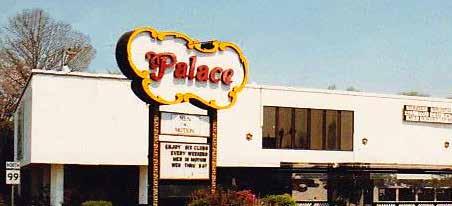
The Palace nightclub in Saugus offered something for everyone






REQUIREMENTS FOR UPLOADING YOUR OWN
By Jennifer Benson, AArP MAssAchusetts stAte Director
PHOTO: You may upload a photo to the template if (1) it was downloaded from the Digital Asset Hub, or (2) you can document that AARP has all necessary legal rights to use the photo, including identifiable individuals, artwork and trademarks in text and logo, in this template.
Navigating today’s job market can feel overwhelming, especially for workers over 50 who often face unique challenges like age bias, shifting skill requirements, and evolving workplace norms. That’s where AARP steps in. Through a wide range of programs and resources, AARP empowers experienced professionals to stay competitive, confident, and connected.
The minimum suggested size for the photos is 4500 x 2700 pixels.
Image resolution is best reviewed in “Preview” mode.
Become an AARP Massachusetts volunteer and be part of a powerful force for good, protecting the rights and well-being of people 50-plus and their families. Use your time and talent to write letters, advocate online or in person, participate in events, and meet with decision-makers.
Giving back. Making friends. Changing lives. Volunteer opportunities with AARP—a nonprofit, nonpartisan organization—are open to people of all ages. Find your place ataarp.org/volunteerhere

For more information about photography and usage rights, please review the Local Photography Guidance & Rules One-Sheet on InfoNet.
One of AARP’s most impactful offerings is the Skills Builder for Work program. This online learning platform provides access to hundreds of self-paced courses in high-demand areas such as technology, project management, and leadership. Whether you’re brushing up on Microsoft Office or exploring a new career path in human resources or nonprofit management, these courses help you earn certificates that demonstrate your commitment to lifelong learning; a major advantage in today’s skillsdriven economy. AARP members even receive exclusive discounts, making professional development affordable and accessible.
And it’s not just technical skills. AARP emphasizes soft skills like communication, adaptability, and problem-solving — qualities employers value as much as experience. By combining practical training with personal growth, AARP ensures older workers can confidently meet the demands of a rapidly changing workplace. Finding the right opportunity is easier with AARP’s Job Board, which connects job seekers to employers who value experience. Many of these companies participate in AARP’s Employer Pledge Program, signaling their commitment to age-diverse workplaces. This pledge helps reduce barriers and gives candidates peace of mind that their expertise is appreciated.
To help applicants stand out, AARP offers the Resume Advisor, a free service that provides personalized feedback to make resumes shine. Pair that with expert career advice, articles, and webinars, and you’ve got a toolkit for success. AARP also hosts virtual job fairs and networking events, giving job seekers a chance to connect directly with recruiters, a huge advantage in today’s competitive market.
Not everyone wants another traditional job. Many experienced workers are exploring entrepreneurship or flexible career paths. AARP’s Small Business Resource Center offers practical guidance for starting, growing, or selling a business. Whether you’re launching a consulting practice or building an online store, AARP provides tools to turn ideas into thriving ventures.
Beyond individual resources, AARP advocates for systemic change. Through initiatives that combat age discrimination and promote multigenerational teams, AARP helps create workplaces where experience is seen as an asset. Their efforts extend to public policy, ensuring older workers have equal access to training, benefits, and protections.
The pace of change in the job market is accelerating, research shows nearly half of today’s job skills could become obsolete within a few years. For workers 50 and older, staying competitive means embracing continuous learning and leveraging networks that recognize their value. AARP’s programs not only provide practical tools but also foster confidence and resilience, ensuring experience remains a strength, not a barrier.

By shAron oliver contriButing Writer
REGION – Victor “Moulty” Moulton, Cape Cod native and legendary drummer for the 1960s garage band the Barbarians, lost his left hand in 1959 when a homemade pipe bomb exploded just when he started playing drums at age 14. However, the loss of an appendage did not make him miss a beat on the skins or in life and inspiring others.
The Barbarians (Moulty, Bruce Benson, Jerry Causi and Ronnie Enos) formed in the artsy enclave of Provincetown in 1964 and were often touted as the American counterpart for The Rolling Stones. Their “pirates on the beach” look consisted of leather sandals, open necked/ bloused sleeved shirts, and black jeans. Adding to the allure, the band’s image was capped off with Moulty’s modified hook-shaped prosthetic left hand with a notch in the end of a drumstick allowing him to play the drums. By some accounts, females were really drawn in by not just his drumming skills but his movie-star good looks and his extra-long dark locks of flowing hair.
stories of the Barbarians’ early beginnings. The pioneering drummer briefly returned to the music scene in the 90s with a new incarnation of
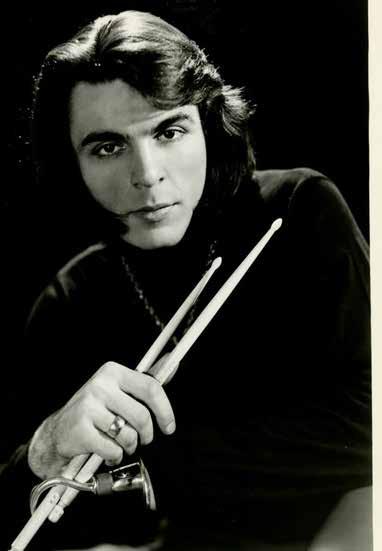
Cape Cod native Victor
1981. It kinda blew me away when I realized he was the same guy. He was an influence on me in a couple of different ways. Last I saw of him he was putting on a karate demonstration with Bay State School of Karate during the Quincy Sidewalk Bazaar. Must’ve been in the late 70s or early 80s. I wonder what he’s up to these days.”
Cult following
Before the group disbanded in 1968, they had performed in “The T.A.M.I. Show” concert film and the musical variety show “Shindig.” They also had a hit song in 1965 titled “Are You a Boy or Are You a Girl?.” Moulty received a name check in the lyrics of the Ramones’ song “Do You Remember Rock and Roll Radio?” with the line, “Will you remember Jerry Lee, John Lennon, T. Rex and Ol’ Moulty?”
Post-music career
In a Rat Tales interview, Moulty explains why his band did not want to open for other bands and shares
the Barbarians that included his two sons. He went on to work for the real estate firm Jack Conway & Company, Inc. and taught karate for a while. Moulton, now 80 years old and living in Abington, also ran his own carpet and upholstery cleaning business for many years. Some of his former karate students took to Facebook to express their thoughts.
Sean Moore wrote:
“He was my karate teacher in Quincy. Knew him well!”
Tim Sheehan added:
“Moulty was also a black belt instructor of Okinawa karate and self-defense.”
Mark Kennedy recalled:
“Moulty was my karate instructor when I was a kid. I had no idea that 10 years before that he’d been a rock star as well. When I finally heard the Barbarians I was in high school in
50 years experience providing 24 hour care.
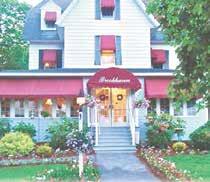
Medical coordination and support services for: - Dementia - Parkinson’sElderly folks with medical needs who can no longer live alone
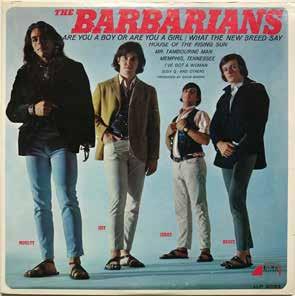
The Barbarians also had a minor hit titled “Moulty,” which is an autobiographical tale chronicling Moulty’s life overcoming adversity and the loss of his hand. Although it barely made the Billboard charts, the song did gain a cult following.
In a 2015 interview with Garagerocktopia, Moulty states, “I had so many people tell me, ‘I was going to commit suicide, or there were things I never would have done if I hadn’t heard that song. I had a lot of teens react to it. Their problems may not have seemed a big deal to adults, but when


Propelled by Victor “Moulty” Moulton’s explosive drumming, the Barbarians released an album in 1965 and hit number 55 on the U.S. Billboard Hot 100 with the song “Are You A Boy Or Are You A Girl.”
you’re a teenager, those problems seem very real.”
He added, “I overcame something. I didn’t want to be a drummer – I wanted to be a great drummer. Learning to play drums with that hook was the hardest thing I ever did. And I thought if I did that, it would inspire others to overcome their own problems.”
Scan to watch Moulty and the Barbarians play “Hey Little Bird” in “The T.A.M.I. Show” concert film:




By MAtt roBinson contriButing Writer
ARLINGTON – Usually, when interviewing a musician or artist, the first question is something along the lines of “When and how did you get into your art?”
Try to sneak this question by Grammy-nominated harpist, composer, and inspirational keynote speaker Deborah Henson-Conant, however, and she will quickly turn the tables on you.
“It’s more like ‘How did music first get into you?’” she suggested, and then responded to her own reframed query by explaining, “I was never not into music!”
Music in the home
Though she only remembers a few record albums in her childhood home (among which were the soundtrack to “South Pacific,” Ken Nordine’s clever “Word Jazz,” an album intended to help listeners learn Russian and an opera album that had the vocal track
removed so people could sing along), Henson-Conant insists that there was always music in the home.
“Music was the way that my relatives communicated with me,” the 72-year-old Arlington resident observed, noting that each family member had a signature song. “I don’t remember a time when people weren’t singing to me.”
She also recalls that nearly everyone in her family had a piano and that she was encouraged to experiment with it to her musical heart’s content.
“I was allowed to play with musical instruments basically as if they were toys,” she said. “Nobody stopped me from exploring the piano, short of taking it apart, which was frowned upon.”
As music was such a part of her household, it was also odd for Henson-Conant to go outside the home to hear it.
“You didn’t have to join an a capella group or a choir to do this,” she noted, “everyone just did it. You didn’t go somewhere to hear music — you
just played it.”
In fact, she and her brother often brought people to her home to experience the level of musical mastery that she enjoyed on a daily basis.
“My brother used to say to his friends, ‘I’ll bet I can make you cry without touching you.’ And they’d be like, ‘Oh, yeah?’ And he’d say, ‘Yeah, come home with me.’ They’d come home and he’d say to our mother, ‘Mom, sing to them. Sing them an aria.’ She’d put on her ‘Music Minus One’ record and sing. Even little kids would just start crying because it was just so emotional!”
That emotion and the musical power her mother held has had a deep and lasting impact on Henson-Conant, as had the way her mother and aunt (another talented vocalist) were treated by others in their field.
“I saw both my mother and my aunt — powerful, beautiful women — lose auditions because they didn’t ‘look right with the leading man,”

Henson frowned. “That impacted me deeply and I swore that I will never be dependent on someone else to tell me whether I can perform or not and that the shows I write will always be performable by the greatest performer, regardless of how they look.”
Though Henson-Conant impresses legions of fans with her performing talent and unique sense of style, her dedication to independence and focus on substance over (visual) style is consistent and important. It has brought her to the attention of and into collaboration with people who otherwise might not have been heard.
Among her most impressive partnerships has been a performance of her original composition “Baroque Flamenco” (which had been premiered by the Boston Pops) by Ukrainian artist Iryna Lytvynenko, a virtuoso of the Ukrainian national instrument known as the bandura, who asked Henson-Conant for permission to adapt the piece herself for bandura and Ukrainian folk orchestra.
The wearable electric harp was the perfect companion for musical storytelling.
“In the midst of a war zone in near blackout conditions [with] no heat in the rehearsal room [and] only a generator to light the stage,” Henson-Conant said of Lytvynenko’s premier, “she got so many flowers she could not take them off the stage!”
Early aspirations as a composer
Speaking of her compositions, Henson-Conant explains that she wanted to be a composer from the time she was young.
“When other kids were doing sports or sending off box tops,” she grinned, “I was sending songs into the copyright office.”
In fact, she actually credits her compositional proclivities with her hyphenated name.
“My parents split when I was around a year old,” she recalled. “Eventually, my mother remarried a man named Larry Conant, but my father, Burt Henson, lived on the West Coast. So I was called Deborah Conant on the East Coast and Deborah Henson on the West Coast.”
Taking a tip from fellow composer Nikolai Rimsky-Korsakov, she combined the two identities into one and continued forging her own path.
“Now I get to live by performing, teaching and composing,” she maintained. “I play music I love…with stories that are funny, or tender or deep. I walk on stage as myself and let that transformation happen when a human


“When other kids were doing sports or sending off box tops,” says harpist Deborah Henson-Conant, “I was sending songs into the copyright office.”
Photo/Jake Jacobson
becomes the music they’re playing.”
Teaching others Henson-Conant also teaches other harpists how to improvise and create their own music through her Hip Harp Academy, just as she does with her own instrument that is always near to her heart.
While the harp has become her weapon of choice in the fight for musical inspiration and individuality, Henson-Conant first explored musical theater.
“Stories with music were what made my world spin,” she recalled, noting that she composed her first musical at the age of 12. “I always identified as a creator of musical theater. The thread that brought it together for me was the storytelling and the opportunity to embody character in the music.”
Ever the independent, Henson-Conant found an instrument that was not among the more popular and made it her own. Instead of standing tall on the side of the stage, her harp (like her music) is personal, nimble, and ready for almost anything.
“The wearable electric harp was the perfect companion for musical storytelling,” she proclaimed. “It could
be not just an orchestra, but a prop, a costume, a set and even a character. I thought I’d chosen it as a practical way to make a living while writing music –only to discover it was a powerful way to tell those stories and bring them alive on stage!”
Creating a legacy
The rest, as they say, has been musical history; one that Henson-Conant is now striving to catalog and contain in an ambitious project for which she seeks outside support.
“After decades of performing my own original pieces on stages worldwide,” she says on the website for the DHC Legacy Project (www.hipharp. com/legacy-project), “I know what it means to have music that unlocks and empowers an artist’s self-expression.”
As only a small percentage of her catalog has been published, she is asking fans and friends for donations to help her finish this project so that her music can be available for the international players and fans she has encountered throughout her career.
“I think of it more like inviting people to take part in making sure this music can empower a new generation of players,” she explains “I got to be the laboratory. They’re the legacy!”

By shAron oliver contriButing Writer
HYANNIS – Unlike Lee Harvey Oswald, Richard Paul Pavlick is hardly a household name. Oswald, of course, is known for assassinating Brookline native and 35th president of the United States John Fitzgerald Kennedy (JFK) on November 22, 1963. Interestingly, the lesser-known Pavlick had positioned himself to carry out the same evil act in 1960.
Known for political rants Pavlick was born in Boston in 1887 to George and Augusta Pavlick and received his education in Boston public schools. He worked as a postal employee in Boston after serving in the U.S. Army during World War I. After retiring from the post office, the 73-yearold relocated to Belmont, New Hampshire, where he was known for his angry political rants, criticism of the government, and hatred for Catholics with a particular ire for the Kennedy clan and their wealth. Ironically, Ancestry.com records show he was baptized in the Roman Catholic Church in South Boston on April 22, 1887.
After JFK defeated Richard Nixon in the 1960 presidential election, Pavlick made the ill-fated decision to

kill the 43-year-old former U.S. senator from Massachusetts. He started traveling to the Kennedy compound at Hyannis Port, photographing their home, checking out the compound’s security and even casing the family compound in Palm Beach, Florida. Believing security was weaker in Florida, Pavlick set his plan in motion to blow himself up, taking JFK with him.
Boston native Richard Pavlick plotted to kill president-elect John F. Kennedy in 1960 with his dynamite-filled automobile.

He packed his 1950 Buick with blasting caps, wire, outfitted the vehicle with a detonation switch and enough sticks of dynamite to blow up a small mountain. Pavlick then headed south. On December 11, 1960, he parked his vehicle outside the Kennedy compound and waited for JFK to leave his house to attend Sunday Mass so that he could ram his car into the president-elect’s limousine.
Plot foiled
There were two things that foiled Pavlick’s murderous plot. First, he sent a slew of bizarre postcards to Belmont postmaster Thomas Murphy. One of them mentioned details of his plan and how the town would soon hear from him “in a big way.”
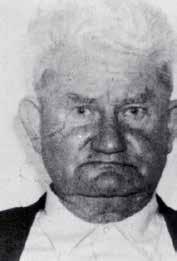
The presence of his family might have saved president-elect John F. Kennedy from an assassination attempt in Palm Beach, Florida in 1960.
Looking at the postmarks, Murphy noticed that Pavlick had been in the general areas JFK traveled. He called the local police who, in turn, called the Secret Service in Cambridge who then put out an alert.
Secondly, when Pavlick spotted JFK leaving the compound for Mass, he was not alone. Accompanying him were wife Jacqueline and the children, Caroline and John Jr., who was less than one month old at the time. Pavlick did not have designs
on killing the wife and children, only JFK. So, he resigned himself to try another day.
On December 15, Pavlick was arrested in Palm Beach for driving on the wrong side of the road with the dynamite still inside the car. He told police that he believed JFK bought the White House and the presidency. He also believed JFK would be loyal to the Pope and not to the United States. The shocking story became a footnote, losing its place in the headlines, after two planes collided in New York City, killing everyone on board except for a young boy who immediately became America’s new obsession.
Charges dropped after insanity determination
Pavlick, who had little to no family and a history of mental illness, was committed to a mental institution, pending charges, on January 27, 1961. The charges were dropped after he was deemed legally insane and remained institutionalized until December 1966. He remained under the watch of the Secret Service after his release from custody in 1966 and was portrayed in the 1983 miniseries “Kennedy.”
Richard Pavlick died in 1975 at age 88 at the Veterans Administration Hospital in Manchester, New Hampshire.

By DeBBie sPingArn contriButing Writer
BOSTON – There are over 62 bills in the Massachusetts State House affecting assisted living laws. Perhaps equally important for consumers is to understand the changing nature of these facilities.
Such residences house mostly senior citizens needing minor or more complicated assistance with physical, mental and memory needs. Independent living, assisted living and assisted living memory care are poorly regulated, leading to problems in what assistance can be provided when residents become sick, or need help with basic activities of daily living.
Amount of regulation subject to debate
Should assisted living memory care facilities be more strictly regulated and by which state agency? Now, many of the rules are made by the corporate entity that runs the facility and although government provides some regulation — some people think it’s not enough.
Because of public demand and situations like the tragic Gabriel House fire in Fall River in July 2025, the Assisted Living Residences Commission was formed in 2025 to study how to better regulate, monitor and take care of aging residents who live in assisted living residences and long-term care facilities. It will issue reports focusing on legal problems and possible fixes for issues faced by assisted living residences.
State Senator Patricia Jehlen has sponsored several bills including S409 which is “An Act to Authorize Common Sense Health Services in Assisted Living.” Currently, a resident residing in, for example, a memory care facility who needs assistance with eye drops, bandage changes, antibiotic creams to be applied to a cut, or oxygen ser-
vices, for example, must call in a visiting nurse or other agency outside the facility for help. This complicated situation, where a resident or family needs to call his or her physician, procure an evaluation, get an order and then wait days or weeks for a nurse to come and administer the service needs to be changed, according to proposed legislation.
Staffing concerns
“Care is going downhill, it is really concerning,” said a worker at a memory care facility in the metropolitan Boston area. The front desk employee, who wanted to remain anonymous, cited unsafe practices she sees from her position at the front desk, where many of the calls from family members first come in.
“When residents pull a call cord for help,” she noted, “it could be 30 to 45 minutes for a response.”
Staffing regulations are items on a number of proposed legislative bills. Currently, “special care” units as they are named commonly refer to memory care assisted living facilities. No less than two staff members are required to be on duty at all times. Contracts written by owners of facilities often refer to staffing levels being determined by the number of people in a unit. These units often have 14 to 15 elderly residents with various needs and stages of dementia, which can include wandering, aggression, apathy, poor eating habits, mobility issues and lack of one-to-one companionship.
The front desk employee added that many residents entering such facilities are “not independent,” and this is confirmed by studies showing assisted living memory care residents in particular are sicker and frailer. There are often long waits for long-term care skilled nursing facilities to have availability. This, coupled with payment and long Medicaid waits complicate care for the elderly with degenerative
brain diseases. Alzheimer’s disease, Parkinson’s disease dementia, Lewy Body Dementia, frontotemporal dementia and other disorders often require staff with some knowledge of

There are dozens of bills related to assisted living pending in the Massachusetts state legislature.
these disorders. But CNAs sometimes have little training in dementia care.
Dementia training involves specialized skills and requires employees to have not only the skills but also compassion and energy to deal with a difficult population of elders. Some residents with early-onset disease present a different set of challenges for care workers and families.
High demand and cost of care
Financial issues loom large. Unlike Gabriel House, which accepted Medicaid, many area facilities only accept cash. Costs can be upwards of $14,000 per month and include little more than a room and three meals a day, and help with ADLs (activities of daily living). Some residents may sit waiting for help for hours until other residents are cared for.
Massachusetts is grappling with increasing numbers of elderly need-
ing long-term care. “A state-commissioned study,” said The Boston Globe in a December 10 story by health writer Kay Lazar, “released earlier this year envisioned a program to be funded by a mandatory payroll tax in much the same way Medicare and Social Security taxes are automatically deducted now.”
Agency to regulate assisted living in question
Which state agency is best suited to regulate assisted living? The Department of Public Health or the Department of Health and Human Services? Yet another question for the legislature to answer. Memory care units can be classified as medical units, because degenerative brain diseases that afflict such residents are medical issues. For now, it remains to be seen how the myriad of bills addressing issues of assisted living will be passed or not, however amended, or enforced. A bill signed into law on September 9, 2024, by Gov. Maura Healey allows assisted living facilities to provide oxygen, eye drops, wound care and other basic health services. However this is something that can be accepted or not by the owners of such facilities. Many will choose not to, based on increased need for trained staff and associated costs to administer those services.
Educating the public
Many residents of the Commonwealth don’t know how assisted living residences operate. Often, when asked, they react with surprise when they learn who pays for it. “That isn’t covered by Medicare?” some people ask. A web search indicates that “fifty-eight percent of adults think Medicare covers long-term care.” In addition to stronger laws regulating assisted living residences, stronger public education around financing and problems facing care for those over the age of 65 is likely needed.
By lAney hAlsey contriButing Writer
SHREWSBURY – Every Saturday, the chairs at Ken’s Barbershop in Shrewsbury’s Edgemere neighborhood were full. Jazz music hummed in the background as barber Ken Jordan chatted with customers.
But after 64 years of haircuts, Ken’s is now officially closed for good. It’s more than just a locked door – it’s the end of an era in Edgemere.
Growing up, Jordan would hang out at the neighborhood barbershop, and at 20 years old, he started cutting hair. He worked in Worcester for a few years before setting up shop along Route 20 in 1962. The rest is history.
“All these years that I’ve been running my own shop, not one time did I feel like I’m going to work,” Jordan said. “That’s how much I always liked it.”
Although he lives in Worcester, Jordan was so close to Shrewsbury that he’d often joke he could walk to work. For nearly 30 years, he did.
Jordan cut hair for generations of families — grandparents, parents, children. Customers would return and tell
him, “You cut my hair when I came in with my grandfather.”
“A lot of the people that moved away from here used to come around the neighborhood,” Jordan said. “They were curious to check and see if I was just still alive. I got a kick out of that, and it was always nice to see them.”
Beyond cutting hair, Jordan remains a fundamental part of the neighborhood because of his care for the community.
“Some people would get sick, and I’d always cut their hair,” Jordan said. “I would go to their house and cut their hair, and after a few months, they’d be healthy and able to walk back in. That’s what I enjoy, helping them when they couldn’t come in.”
On November 22 of last year, customers organized a tribute to Ken’s Barbershop. All day, people came by and signed cards: “I knew a lot of people liked me, but I didn’t know they liked me this much,” Jordan said.
The event was organized by Joe Gabriella, a Shrewsbury native and Jordan’s longtime friend.
“I can’t tell you how many people thanked me profusely for organizing


this, so they got their chance to say a little something to Ken and write something,” Gabriella said. “It filled my heart, not only for him, but what a nice service it was to everybody that they got to say something to him.”
Gabriella grew up across the street from Jordan’s shop and embodies the deep-rooted tradition the barbershop represents.
“I got my first haircut from him, my son got his first haircut from him, my brother got his first haircut from him,” Gabriella said, “That’s just the way it went in Edgemere. You brought your son to Ken for his first haircut. Everybody knew that.”
For Gabriella, the tradition reflects what kind of neighborhood Edgemere is — and how deeply Jordan was woven into its center.
“Edgemere’s a very tight-knit neighborhood,” Gabriella said. “And Ken’s the patriarch. … As long as he was there, he gave everybody that sense of family. If people want to emulate somebody with good family values and how to treat people, this is the guy,” Gabriella said.
While Jordan had never planned
on retiring, a serious fall led to multiple brain surgeries. Despite recovering well, he no longer has the energy required to be on his feet all day.
“The worst thing about this is I’m not going to miss giving haircuts, I’m going to miss all those people,” Jordan said.
As for retirement, Jordan’s plans are to spend as much time with his wife, children, and Gabriella (his “adopted son”) as he can.
“The friendly neighborhood barber” may be putting down his clippers, but Jordan’s kindness and legacy will be forever part of the fabric of the community.
“That’s the important thing,” Jordan said. “I want to thank everybody who came through that door.”



By colin MccAnDless contriButing Writer
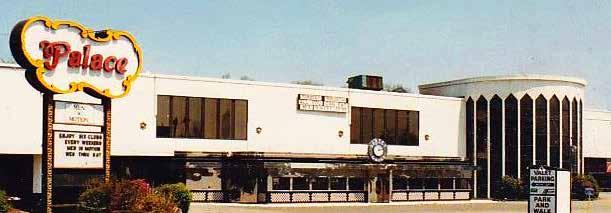
SAUGUS – To those who once experienced it either as patrons or staff, the Palace nightclub in Saugus belongs in the pantheon of New England nightclubs.
One of a kind
Entertainment mogul Russell Robbat owned the Palace, which operated from 1982-2006, with its heyday in the late ‘80s and ‘90s. One of the musicians who assisted in the opening of the Palace and helped elevate the entertainment scene there, DJ “Captain” Wendell (Wendell Edmunds), called it a “one of a kind place,” noting that it housed 15 different clubs in one building.
Edmunds first started working for Robbat in 1975 at his chain of clubs Brothers Four, which had three locations across Massachusetts. He started as a singer but eventually transitioned to turntables and spinning records.
As the name implies, Robbat and his three brothers George, Allen and Steve ran the business. This was where Robbat initially launched the multiroom nightclub concept. He continued expanding on that concept and solicited nightclub ideas from staff, said Edmunds, who currently serves as a group expert for the official Palace Nightclub Facebook page, which has 14,000 members. Robbat ultimately decided he wanted to take all their ideas and combine them into one club venue.
When the Chateau de Ville in Saugus became available in 1981, Robbat procured the square footage he needed to achieve his lofty ambitions. This facil ity, which had previous ly served as a function hall and catering event space that hosted wed dings and proms, was high class and boasted a spiral staircase, chande liers and a grand piano, remembered Edmunds, who worked there 20-plus years. It opened on Valentine’s Day, 1982.
test listen. “It was perfect sound,” stated Edmunds.
Robbat steadily built out his vision. People came. And so did the musicians. LL Cool J. Snap! Technotronic.
Marky Mark. Lisa Lisa. Tavares. The Palace drew luminaries including Matt Damon, Ben Affleck, the Wahlberg brothers, members of New Kids on the Block, Marvin Hagler and legendary Celtics players like Larry Bird. “Everybody who was anybody came through,” proclaimed Edmunds.
Charlie Koehler, a former Palace employee from 1989-1996 who worked full-time in sound and lighting during the day and five nights a week as a DJ under the moniker Charlie K, said that the club, positioned along Route 99, was “perfectly situated between cities” and that its location “couldn’t be better.”
Because it operated as an event venue in the 1970s, the rooms were expansive. Koehler, who also serves as a Palace Facebook page admin, remembered that the place could hold 5,000 people. He described it as “the biggest club ever in New England.” At its height, it was regarded as one of the largest nightclubs in

The Palace spanned the Prince, Madonna and underground eras, and Robbat had a premier sound system and the best lighting in stalled, creating the ideal environ ment to capture the spirit and ener gy of these vibrant musical periods. According to Edmunds, the Palace used the same sound system as the re nowned Studio 54 disco nightclub. He recalled traveling to New York City to meet with Richard Long, who designed Studio 54’s sound system, to give it a
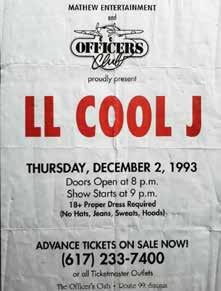
In addition to regular DJs, live shows by wellknown acts like LL Cool J were held in the various clubs within The Palace in Saugus.
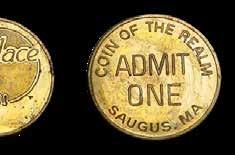
For select patrons, the Palace nightclub in Saugus offered a membership called the “Coin of the Realm” that granted you VIP access and other perks like skipping lines.
Everyone who worked there had a colorful personality, from parking attendants to DJs. “How the place even functioned I can’t even tell you,” quipped Koehler. His introduction to the Palace came during one of its Under 21 Nights when he experienced it as a customer and then started going regularly.
According to Wicked Local, Robbat kept things fresh and constantly innovated, invariably introducing two new club themes. Robbat traveled around the world searching for novel club trends and ideas to bring back to Massachusetts. “Every 18 months he’d do something new,” said Edmunds.
Koehler and Edmunds both recalled how each room in the Palace offered something different; there was disco, reggae, Top 40, a heavy metal club, a Cowboys Club, the Officer’s Club, a male exotic dancing show and later, a Latin room and a hip-hop room would be added. “There was something for everyone in that club,” asserted Edmunds. “It was like Disneyland.”
Koehler said that to call Robbat a visionary in the club scene “would be an understatement.”
“He had no problem dropping a lot of money on a concept.”
He also characterized the Palace’s general manager Chris Scott, who served as its GM for the club’s entire existence, as a “larger-than-life guy in every way, shape or form.”
“Chris was an absolute trip.” Koehler, who left the Palace in 1996 to form his sound and lighting company TKO Sound, said he still keeps in touch with some of the management today.
renovations
of the ‘90s. It was such a fruitful, happy time,” he reminisced. Edmunds remembered that the BBC was a gigantic room with five or six bars and massive bass speakers that people would dance on.
The Palace featured everything from celebrity singers and a mechanical bull to a foam pit filled with bubbles and a UFO that could fit a person inside it. This mobile spaceship came out of the wall and could lower singers over the audience. “Every corner of that place had something going on,” recounted Koehler.
Violence led to demise
A series of violent incidents, including a fatal stabbing on New Year’s Eve 2001 in the Officer’s Club, ultimately led to the Palace’s demise. Edmunds recollected that this was a sad and tragic incident but added that the town had been trying to close the Palace down for a while by this point because they “always thought it was trouble.” “But it was well run,” he asserted.
In 2006, the building was auctioned off and Robbat sold the 22-acre property to Lowe’s Home Improvement store, according to Wicked Local. The Palace itself may be physically gone, but it’s certainly not forgotten.
Fond memories endure
Former staff commemorate the club by hosting an annual Palace Party Reunion welcoming past patrons, employees and friends. DJ Eddy K launched the inaugural party. Since then, it’s been either him, Edmunds or others who have coordinated it. Additionally, the “Men in Motion” male revue show that the Palace started remains in in business today.
Another thing Palace management would periodically do is renovate the main room and change the décor. Koehler recollected that the second main room renovation was the Bahama Beach Club, referred to as the BBC, replete with giant fake palm trees, trucked-in sand, a beach volleyball court, surfboards that doubled as tables, thatched roofing and piles of coconuts. It may have been campy, but it was Koehler’s favorite club. “It cap-
On the Palace’s Facebook page, the fond memories endure as people post pictures and “share old war stories,” as Koehler put it.
“There will probably never be another place like it,” reflected Edmunds. the country. Edmunds believes it might actually have been the largest — and would see between 12,000-15,000 people pass through its doors per week.
MichAel PernA Jr contriButing Writer
WORCESTER – In the early 1800s, a group of businessmen from Massachusetts and Rhode Island had an idea of how to capitalize on the burgeoning success of the Industrial Revolution. They decided to pursue the building of a canal that would allow for a cheaper, faster way to transport goods between the rapidly developing industrial center of Worcester and Providence, Rhode Island, using the Blackstone River as a base to construct the canal.
Required 48 canal locks After being proposed in 1790 by a group of Rhode Island businessmen, it took until 1825 before the state of Massachusetts agreed to the project and construction was begun. The river had to be cleared of rocks and rapids, and several dams had to be removed. The Blackstone Canal would eventually extend forty-six miles between the two cities. The canal was opened in 1827, with the barge “Lady Carrington” making the first trip up the canal to Worcester.
Due to the difference in elevation between the two cities – 450 feet – it was necessary to construct 48 stone canal locks to allow barges to be raised or lowered. The canal was built using shovels, spades and pickaxes, with Irish immigrants doing most of the work.
Within the city of Worcester, the canal ran from Thomas Street, through downtown, then passed just west of what is now Union Station, then down Harding Street. It then met up with Mill Brook and created an island near what is now Crompton Park – the area became known as “The Island.” This area later became home to many of the Irish workers that had constructed the canal.
Barges used for cargo
The barges used were 72 feet in length and nine-and-a-half feet wide. Pathways were constructed along the canal to allow horses to pull the barges, two for each barge, reportedly moving at about four miles per hour. Each barge could carry roughly 35 tons of cargo. The trip between the two cities would take two days and saved about $3.80
per ton of cargo, a significant improvement over the horse-drawn wagons used in those days.
The canal’s use of water sometimes created problems — ice could form, flooding could occur, or droughts could reduce the flow of water and cause the canal to close.
The canal provided the impetus for Worcester and surrounding mill towns to become an industrial hub, allowing for the cheaper and faster transportation of the goods being produced in the area. The result was the area becoming known as the “birthplace of the American Industrial Revolution.”
Replaced by railroad Soon, industrialists in the Boston area took note of the canal’s success. Their reaction was to expand the railroad system in the area. By the late 1840s, the Providence and Worcester Railroad was put into operation, offering faster and more reliable transportation. This
had an adverse effect on the canal’s operations, and the Blackstone Canal was closed in 1848.
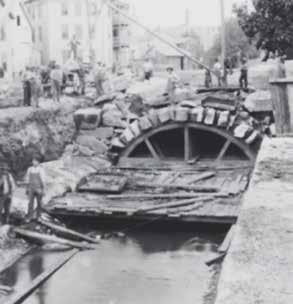
The canal itself was still used on occasion, but eventually was used as a sewer. By the 1890s, it had been arched over and mostly forgotten.
Resurrecting its story
In recent years, efforts have been made to resurrect the canal’s story.
accepting
for


The Blackstone Canal lasted a mere 21 years, closing in 1848 after competition from railroads

The Blackstone Heritage Corridor was created and a booming business area, known as the Canal District, has attracted all kinds of stores, restaurants, nightclubs and even the Worcester WooSox baseball team, located at Polar Park.
Although the Blackstone Canal is long gone, its story carries on as a part of Worcester’s past.

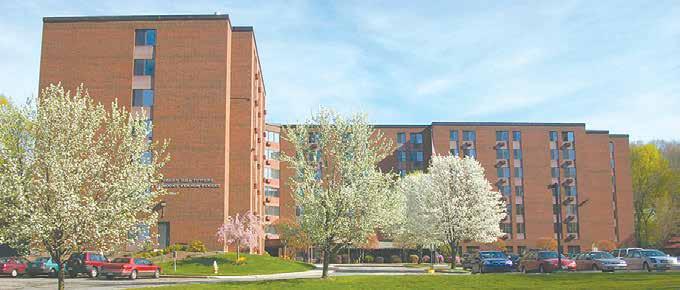
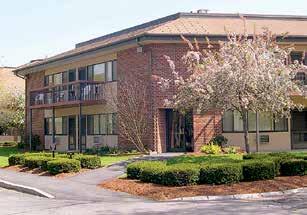
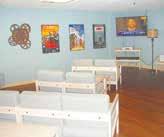
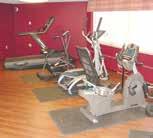
Within the building amenities include:
• A Theater-like media center
• Handicap-accessible lounges on every floor
• Library equipped with two computers and free internet access
• Physical fitness center
• Game room with billiard table
• Community room with bingo board and large screen TV
27 Mount Vernon Street, Worcester, MA • O ffice O pen D aily 8:00 am - 4:30 pm
To receive an application please call 508-755-6062 TDD# 508-755-0228
Now accepting applications for 62 years of age and older and those who are under 62 years of age and are permanently disabled.
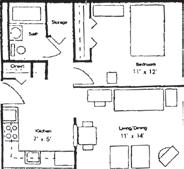
• Contemporary styled 1 & 2 bedroom apartments
• New kitchens with built-in microwaves and granite-like countertops
• Small pets welcome
• Heat and Hot water included
• Bus route / ample parking
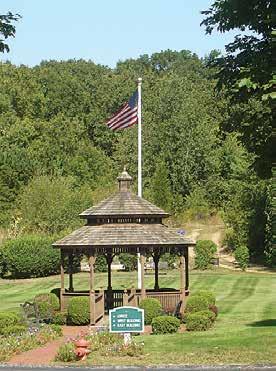
• Beautiful landscaped grounds with gazebo


By shAron oliver contriButing Writer
REGION – Fans of the British drama series “The Bletchley Circle” are already familiar with the wartime code breaking women of Bletchley Park depicted in the program. The four main characters signed orders of secrecy about their work deciphering German messages during World War II. Two of the husbands thought their spouses were going to book club meetings.
College women recruited
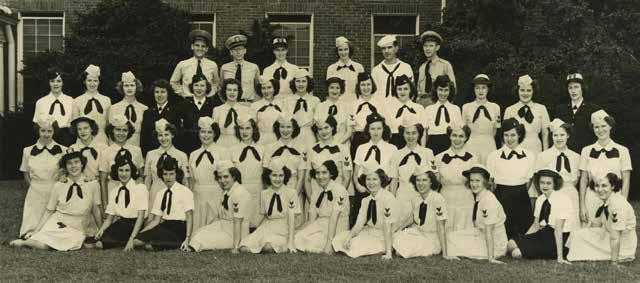
For a few women from the New England area, deciphering German and Japanese military codes was a stark reality. Following the shocking attack on Pearl Harbor in December 1941, educated women with degrees were being recruited from colleges around the nation, including Mount Holyoke, Radcliffe, Smith and Wellesley. Several of the 11,000 female code breakers came from the Seven Sisters schools of Massachusetts.
Anne Barus Seeley of Yarmouth was one such recruit. One day in the early 1940s, the Smith College history major was approached by the dean, asking her to attend a clandestine meeting in the science building. She and 10 other “A” female students were chosen for their “brains and stick-toitiveness.” They were first asked “Do you like crossword puzzles” and “Are you engaged?” Many of the women excelled in math and foreign languages.
The Smith women attended se-
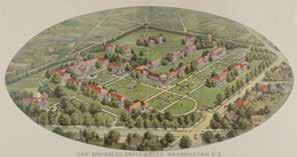


cret training sessions in a biology lab on campus and after Seeley graduated in 1942, she was sent to Washington, D.C., telling her parents she had a job working in communications for the Navy, but she was really working in a guarded annex at American University with other code groups. Male and female code breakers arrived in Washington by the busloads, immediately increasing the city’s population.
Seeley’s job duties involved lots of mental math and one of her skills was the ability to detect simple mistakes the enemy made in their coded messages. However, Seeley insisted she was only a cog in a big machine. Her story is told in Liza Mundy’s book “Code Girls: The Untold Story of the American Women Code Breakers of World War II.”
Just like the characters on “The Bletchley Circle,” the women had to keep their assignment a secret even from their families. Seeley shared that once they all arrived in Washington, they were responsible for finding their own housing. While she shared a large house with nine other women, some of the recruits had to share rooms and communal lavatories.


Elizabeth “Betty” Green Crist was another Smith graduate who worked as a code breaker. Massachusetts-born Elizabeth Reynard helped established WAVES (Women Accepted for Voluntary Emergency Services), the newly created Women’s Naval Reserve where she was the first to be appointed a lieutenant. Seeley eventually returned to South Yarmouth where she enjoyed kayaking and sailing. She passed away in 2018 at the age of 97.
Code-breaking triumphs
Thanks to code breaking, the U.S. military learned the locations of enemy ships, their payloads, and travel routes. The women deciphered an average of 126,000 enemy messages a month. Breaking German codes also led to General Dwight Eisenhower’s decision to land American troops at Normandy instead of Calais.
In 1945, it was a woman code breaker who became the first American to discover that World War II had officially ended. “The recruitment of these American women — and the fact that women were behind some of the most significant individual code-breaking triumphs of the war — was one of the best-kept secrets of the conflict,” Liza Mundy wrote in her book “Code Girls.”
To this day, many family members never knew the role their loved ones played in the history of World War II. As the late Ann Barus Seeley once said in a Smith College article dedicated to the female alum who served their country, “We have to fight this war, so I said yes to the Navy.”



Northborough resident has seen it all in her 100 years
By evAn WAlsh contriButing Writer
NORTHBOROUGH – Evelyn Grenier, who has lived in the town of Northborough for 68 years, celebrated her 100th birthday recently.
Raised in Worcester, Grenier grew up listening to her dad’s opera on his Victrola Record Player. Before getting married, she worked as a secretary. She had a victory garden to supplement food supplies during wartime. She was one of thousands who celebrated the end of WWll in front of Worcester City Hall.
She married the love of her life and childhood sweetheart Otis Grenier in 1951. After six years of marriage, they settled in charming Northborough, in the middle of hayfields. They had five children. Grenier always cooked breakfast, packed a brownbag lunch, and had dinner ready at 5:00 p.m., when the family sat around the kitchen table together.
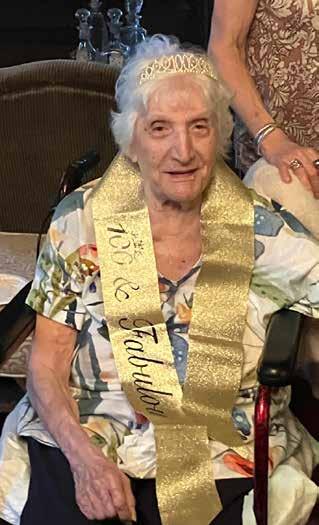
Evelyn Grenier of Northborough, who recently celebrated her 100th birthday, survived everything from scarlet fever to COVID-19, a near-drowning, and being scheduled to fly on one of the hijacked 9/11 planes.
It expired at age 100.
When her five children were old enough to fend for themselves, she was eager to go back to work. She worked mother’s hours at the old Country Candle Factory in Northborough for many years. There, she met Elaine Priest and they became best friends. They did everything together. Grenier retired at age 70.
Evelyn and Otis were married 60 years. Shortly after, Otis passed away at age 85. Evelyn has remained in the same home since. Evelyn was independent into her 90s. She passed her driver’s license test at age 95.
Grenier remembers when Hitler was alive. She survived the Great Depression. She survived scarlet fever. She almost drowned when her sister, Elvia, and she went “too far out swimming at the lake and a man with a boat pulled them out just before her last breath.”
To celebrate their 50th wedding anniversary, she and Otis were headed to California, originally scheduled to fly from Boston to Los Angeles on one of the hijacked 9/11 planes, but a last-minute flight change to Santa Barbara saved them. She also survived COVID-19.
She is blessed with five grandchildren, who love her dearly.
(Jesus taught them saying)
“Peace I leave with you; My peace I give to you. I do not give you as the world gives. Do not let your hearts be troubled and do not be afraid.”
~ John 14:27
By MAriAnne lyons Delorey, Ph.D.
“Empathy is the starting point for creating a community.”
– Max Carver
While visiting someone’s house the other day, I commented to the couple living there that if they had some salt, I would gladly throw it down for them as the walkway was very iced over.
“Nah,” the older woman said. “I’m pretty spry for my age, I’ll be fine.”
I nodded my understanding, not wanting to overstep, offend her, or be patronizing.
But then I got to thinking. As a lifelong property manager, we don’t care for our homes solely for the benefit of the people who live there. This idea may ruffle the feathers of many Americans, who are brought up to believe that property rights are sacred. But unless we live in the middle of nowhere, there are plenty of other people for whom we must maintain our property. Generally, these people can be considered invited and uninvited.
Invitees should absolutely be considered when planning your maintenance. I am not sure why the older woman in the scenario above did not consider that we would want to salt the walkway for us who were visiting her, but she didn’t. Making sure your invited guests are safe should be a no-brainer.
Moreover, even uninvited guests should be considered. Consider Girl Scouts selling cookies, neighbors looking for a cup of sugar, or even someone who is at the wrong house. Aren’t these people worthy of safety?
While these people may be kept away with a “No Trespassing” sign, the reality is that even still there are people whose business (and our own needs) bring them to our houses. Think of the people who deliver mail and packages, the person who reads the water meter, and emergency responders. These people deserve to do their jobs without risk of harm to themselves, even if we did not expect them.
Emergency responders in particular warrant a fuller review of reasonableness of maintenance standards precisely because we don’t always know when we will need their help. Unpopular though my opinion may be, I think we owe our first responders some basic maintenance both outside and inside the house.
Outside maintenance includes making sure house numbers are clearly visible plus passage to necessary areas (front door, meters, oil tank) to include snow removal and treatment of icy areas or, in warmer weather, a path free of overgrowth.
Inside maintenance includes clear passage around the home to areas where there are common emergencies. This includes no obvious tripping hazards or clutter near
• Gas lines
• Water main
• Dryer • Kitchen
• Bathrooms

While this may seem like a lot, I like to explain to my residents who struggle with clutter and housekeeping that if there is ever a fire, you don’t need to think about what you would need to escape, but rather how a firefighter unfamiliar with your apartment, carrying 50 pounds of equipment could find you in a smoke-filled, unlit apartment, in order to get you out safely.
Granted, having interior housekeeping standards sounds like a bridge too far when you start the conversation with salting a walkway for an invited guest. Perhaps we are not there quite yet. However, as we saw during the pandemic, the rights of individuals do need to be carefully weighed against the safety of first responders so they can continue to serve our communities.
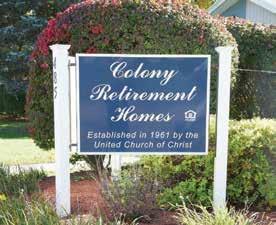
Marianne Delorey, Ph.D., is the executive director of Colony Retirement Homes. She can be reached at 508-755-0444 or mdelorey@colonyretirement.com and www.colonyretirementhomes.com. Archives of articles from previous issues can be read at www.fiftyplusadvocate.com.

By JAnice linDsAy contriButing Writer
It’s February, so I’m conducting extensive research for yet another history paper, which I will present to friends some time in February or March, as is our custom.
Each year, the five of us tell each other we must be crazy, this paper-writing is so much work, we’re not going to do it again. Then we do it again. This is our ninth time. It started quietly in 2016 when we were among 30 or 40 students who took an adult education class about 12th century Europe. We didn’t know each other then, except as nodding acquaintances from being in other classes. Somebody mentioned that it would be interesting to keep learning about the Middle Ages, in a seminar outside the class structure. Our instructor, a retired college professor, offered to facilitate. We five signed up, along with a few others who have since wandered away.
Every year, we pick a broad theme — the 14th century, medieval cities, Joan of Arc — then we each choose a specific topic to delve into. For the 14th century, one of the subjects was treatments for people who caught the Black Death. For Joan of Arc: Joan as a cultural icon in the United States in the late 19th
and early 20th centuries (odd but true). For medieval cities: how rules of prostitution varied among cities. Those are just examples — at least five papers for each of eight big topics.
Some people think that history is boring. Not us. How could someone be bored learning about mudlarks, people who have earned money digging artifacts out of the mud of London’s Thames River? Or a 16th century pirate who was such an accurate observer and note-taker that his maritime charts can still be used today? Or the history of the thimble? Or 18th century English gardens?
Research always turns out to be more work than we anticipate. We think we’re picking a small topic and find there are no small topics. Once we get into a topic, it goes deeper and wider than we expected. Even the littlest thing (like the thimble) has a cultural context, historical context, materials context, etc. Then we find those rabbit holes, those subjects that look interesting and invite us to dig deeper, but are a bit outside the topic. Some year, our theme might be “rabbit holes I managed to avoid.”
Why do we keep doing this? It’s partly our shared interest in history and our enjoyment of the research. But also, over these years, we’ve developed a deep friendship among us. We enjoy each other’s company, presenting or not. We like to intrigue, entertain, inform, encourage, and appreciate each other. Each

of us lives in her own world of work, volunteering, family. Our worlds intersect here, in the past. That’s how friendship works, at intersections.
For this year’s series, we’re studying events that were happening during our own childhoods and/or that affected us. Our subjects, as always, range all over the place. The history of laundry and how the washing machine changed women’s lives. Tin Pan Alley and what it meant for American popular music. Resistance to Adolf Hitler within Germany. The post-war reconstruction of West Germany. Senator Joe McCarthy and the “Red Scare.”
We began our journey in Europe in the 12th century. We’ve worked our way into our own centuries, into the Arab world, Asia, and to the Americas. Who knows what we’ll study next? Or maybe we won’t. Maybe this year, we will finally decide “We’re not doing this again.” But we’ll probably continue. Our own history argues in favor of it.
Contact jlindsay@tidewater.net.
By shAron oliver contriButing Writer
BOSTON – He may not have worn a trilby hat or walked around with a lollipop in his mouth like television’s fiction al New York City Police lieu tenant Theo Kojak (played by Telly Savalas), but Boston’s Robert Fawcett was equally tough and compassionate. The police detective known as “The Bear” made a last ing impression on residents of East Boston for being that rare neighborhood cop who kept people in check and looked out for them as well.
Legend in his time
Perhaps his son Timothy, then a Saugus police officer in 2007, described his father best when he said, “He was an old-time cop who sometimes threw out the book. He would just give a kid a kick in the seat of the pants if he thought that would be more effective than an arrest.”
The son added, “When he got to the office, there would be six people waiting to speak to him, hoping he would get them off the hook.”
Boston lawyer Ronald A. Wysocki stated, “He was a legend in his time. In his heyday, teenagers in East Boston had two heroes: Joe Barboza, the thug (and Mafia hit man), and Bobby Fawcett, the policeman. It was unusual for teens to admire a policeman.”
Several people took to Facebook to confirm and share their memories.
Joseph Piantedosi shared:
“Funny story. Bobby came looking for me and I was at a friend’s house. He knocked on the door and said open the door, I want Joe out. My friend said, do you have a warrant, and he said here’s my warrant and knocked the door down. Funny now but not then.”
Anne McDonough Bowen remembered:
“I remember him very well .. One of the finest.. He made many walks taking misbehaved kids home to their parents.”
John Rizzo recalled:
“I remembered him chasing me through the railroad tracks in Eastie as a kid yelling, ‘Rizzo I’m going to tell your dad.’”
The six-foot-tall Fawcett, whose unorthodox ways earned him quite the reputation, worked for the Boston Police Department from 1958 to 1981. He was also known for making selec-
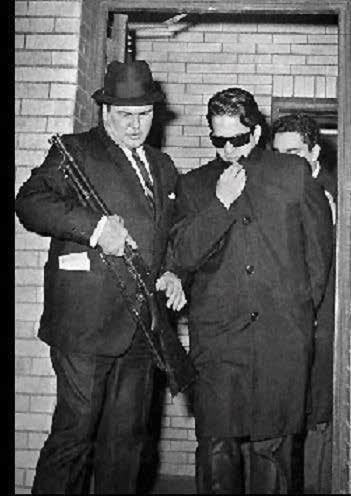
Legendary Boston police officer
Robert “The Bear” Fawcett escorting Mafia hit man and informant Joseph “The Animal” Barboza to court during the mid-1960s.
Photo/Courtesy of Boston Police History
tive busts with recommendations for certain criminals being “let off” to become informants. His methods were not viewed as brutal but merely practical and he challenged the department to show any clouds in his reputation. They never did.
Of course, not everyone appreciated being told right from wrong. There was a time when someone placed dead fish under the springs of his car. Other incidents included sugar poured into his gas tank, tires having been cut 13 times and his own vehicle being stolen three times.
In 1961, Fawcett gave chase to two teen perpetrators joyriding in his vehicle. The car had been stolen from his home late one night. While riding in a cruiser with his partner Detective Robert Wilson, Fawcett spotted his car. The officers made a “U” turn, forced the car off the road and arrested the occupants, a 16-year-old Roxbury youth and a 19-year-old from Jamaica Plain. The teens admitted to stealing the car but claimed they found it on Columbia Road in Dorchester.
Fawcett, along with 34 officers and 24 detectives, were transferred to a department aimed at putting more cops on the street in 1974. But after he was demoted to patrolman and assigned to walking a beat in Charlestown, a large crowd gathered at East Boston High School to protest this change, with one woman shouting, “We want our supercop back!” He returned to East Boston the next year.
As several people have attested, you did not grow up in East Boston without knowing the name Robert “The Bear” Fawcett or his reputation. Robert Fawcett passed away in 2007.

• Need more money each month to cover the higher cost of living?
• Still have a mortgage payment or high credit card balances?
• Need money for house repairs or improvements?
• Feel anxious about NOT having enough money today or in the future?
Looking for a Solution? Maybe You Fit:
Are you 60 years old or older? Do you own a home?
A REVERSE MORTGAGE MAY BE THE ANSWER
I Will Guide You & Create a Plan
After a short conversation, I will be able to determine if you qualify and then share the exact action steps to successfully implement a plan.
Please call or text me at (781) 724-6221 or email me at av@powhse.com
I am passionate about educating people about reverse mortgage and will explain the pros & cons so that you will be fully informed if a reverse mortgage is the best choice for you.
There is no cost to learn about reverse mortgages. But the cost is immense to realize later that a reverse mortgage may have overcome your financial concerns, needs, and challenges. Over my 30 plus year career, the one word that hurts the most is – regret, regret of not taking action. Please feel comfortable contacting me.
When used properly, a reverse mortgage allows a qualified borrower the option to receive tax free cash up front, or a monthly check, or a line of credit to access cash when desired with NO minimum or required monthly mortgage payment. A reverse mortgage has no impact on Medicare or Social Security benefits. You still own your home and can prepay without penalty. Top uses include paying off a current mortgage and credit cards, augmenting retirement cash flow, medical needs, home improvements, and peace of mind knowing cash is available. I look forward to learning what success looks like for you. (Note – you are required to pay ongoing real estate taxes and property insurance and meet other loan guidelines.) You’ve Worked Hard All Your Life, Now Let Your Home Work For You
Alain Valles Reverse Mortgage Specialist
781-724-6221
A great place to start is get your free “How to Use Your Home to Stay at Home” 36-page book. This is the official reverse mortgage consumer booklet approved by the U.S. Department of Housing & Urban Development and published by the National Council on Aging.
To receive your free copy, please call me at (781) 724-6221 or email me at av@powhse.com
I am also available to evaluate your specific situation, answer your questions, and calculate how much money is available to you.
Alain Valles was the first designated Certified Reverse Mortgage Professional in New England. He obtained a Master of Science from the M.I.T. Center for Real Estate, an MBA from the Wharton School, and graduated summa cum laude from UMass Amherst. He is the senior reverse mortgage loan officer MLO#7946 at Powerhouse Funding Corp. NMLS #1740551. He can arrange but does not make loans. Alain can be reached directly at (781) 724-6221 or by email at av@powhse.com
By shAron oliver contriButing Writer
BOSTON – The average person of a certain age can remember Oscar Meyer’s Wienermobile commercials. However, there is one special advertising vehicle that only those from Massachusetts were privy to see. Perhaps nowhere near as sturdy as the famous Wienermobile, the WGBH Channel 2-Mobile wobbled through suburban communities from the Cape onto Route 128, destined for Boston as a fundraising gimmick during the mid-1970s.
A rickety fundraising vehicle
At the time, motorists were accustomed to anything from Daimlers to dune buggies racing through the streets but only the 11 feet, 3 inches high and 6 feet wide by 10 feet long monstrosity shaped like the number two made residents do a double take. The station’s August fundraising target was set for $450,000 with faithful viewer Mrs. John Hamsel of Mansfield being the first contributor to stuff money into one of the vehicle’s currency slots.
Two people recalled their firsthand experiences to WGBH:
Deb Gibbs:
“One of my first assignments when I started working at GBH in 1975 for Chris Pullman was to find a garage to store the 2-Mobile. I remember saying to Chris — “what exactly is a 2-Mobile?”. He said come with me and I followed him out to the parking lot. He pointed to the 2-Mobile. My first thought was I’m out of here. Somehow I managed to find a garage in Allston and the 2-Mobile found a home.”
The WGBH Channel 2-Mobile, built for promotional and fundraising purposes, was sure to draw attention when it was spotted around Boston during the 1970s.
John Kerr:
“Ah, yes. The 2-Mobile was driven from the Cape to the station as a fund-raising/publicity gimmick. Chris Pullman, Design Manager, had a hand in it, as did the indomitable Sylvia Davis, and many others. It was fun and stunning to see but wobbled in the slightest crosswind and was risky to drive. We did a fund-raising shot of it crossing the reservoir between Waltham and Lincoln — a fun adventure. We did whacky stuff back then to call attention to our need for contributions. Viewers would walk up to the 2-Mobile and give the driver a dollar or two and cheer it along. Wild.”

Mobile adventures
Referring to the 2-Toys, Kerr, a former WGBH Development Manager, also added, “I can’t remember how many of the wooden wonders we actually sold, nor do I recall whether the 2-Mobile actually arrived back at the studios stuffed with contributions. But it did make for some excitement



and notice. One sunny afternoon, for example, we drove it nonstop through the guard gate at Hanscom Air Base, where we were supposed to have advance permission to enter. Cameraman Boyd Estus, splayed out on the roof of a chase vehicle, recorded the surprised look on the guard’s face. We thought he’d perhaps salute as we teetered through. But instead, he looked alarmed and grabbed for his phone. By the time we stopped the thing, two military police vehicles pulled up and demanded to see our permit. Today, we’d be taken to the brig.”
Indeed, the plywood frame was a sight to behold especially on windy days as pointed out by Tony Sestito on Facebook:
“I want to know where that
thing went, what chassis it was built on, and how it didn’t blow over in a moderate wind while driving down the highway.”
Likewise, Myles Gordon posted, “Hope it didn’t try to squeeze the underpass on Storrow Drive.”
A relic of yesteryear, the Channel 2-Mobile along with the mini version 2-Toys prompted grins and hopes of supporters of children’s programs wanting to see the contributions flow. Even though the temperamental 2-Mobile was a challenge to drive and often needed the assistance of volunteers to help forge it along, the rolling advertising campaign managed to lure potential donors in town squares, shopping malls and highway rest stops during its journey.


By shAron oliver contriButing Writer
REGION – Howard Phillips “H.P.” Lovecraft may have been from Providence, Rhode Island but the famous writer of weird, horror, fantasy, and science fiction showed lots of love for the Commonwealth by setting some of his most chilling stories in the now bygone era of the state.
Story set in Boston’s North End Case in point, his story “Pickman’s Model” is set mostly in Boston’s North End and was published in the October 1927 issue of “Weird Tales.” Apparently inspired by a building in the North End, Lovecraft wrote that when he visited the neighborhood with Donald Wandrei, he found “the actual alley and house of the tale utterly demolished, a whole crooked line of buildings having been torn down.”
Arkham Sanitarium appears in the short story “The Thing on the Doorstep” and may have been inspired by the Danvers State Insane Asylum in Danvers which appears in Lovecraft’s stories “Pickman’s Model” and “The Shadow over Innsmouth.” The story “The Dunwich Horror” implies that Miskatonic University is an elite university on par with Harvard and that both schools are the two most popular schools for the Massachusetts “Old Gentry.”
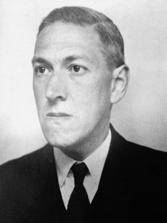
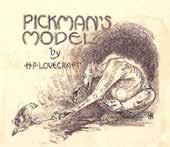
The story is centered around fictional artist Richard Upton Pickman and his horrifying “deviltry and morbidity” paintings. His works are so graphically ghoulish that they result in the revocation of his membership in the Boston Art Club and his ostracism from the city’s artistic community and the story’s narrator and friend, Thurber, tells a frightening tale about his tormented pal.
Horror writer H. P. Lovecraft set many of his stories in “Lovecraft Country,” his fictionalized area of northeastern Massachusetts.
Sending more chills down the spine, Pickman’s great-great-greatgreat-grandmother was supposedly hanged by Cotton Mather during the Salem witch trials of 1692. Interestingly, Pickman and Upton are actually old Salem names. As the story continues, Pickman vanished in 1926 (a date only given in Lovecraft’s “History of the Necronomicon”) and reappears as a ghoul in “The Dream-Quest of Unknown Kadath” (1926).
Fictional town
In the short story “Dreams in the Witch House,” Walter Gilman, a student of mathematics and folklore at Miskatonic University, rents an attic room in the “Witch House,” a house located in the fictional town of Arkham, Massachusetts, that is rumored to be cursed. The house once harbored Keziah Mason, an accused witch who disappeared mysteriously from a Salem jail in 1692.

In a letter to F. Lee Baldwin dated April 29, 1934, Lovecraft wrote that “[my] mental picture of Arkham is of a town something like Salem in atmosphere [and] style of houses, but more hilly and with a college (which Salem lacks). I place the town and the imaginary Miskatonic River somewhere north of Salem, perhaps near Manchester.”
The places he wrote about in these stories and others are now known as “Lovecraft Country,” the fictionalized area of northeastern Massachusetts where many of his horror stories are set.
Profoundly morbid streak
In a 1930 letter to pulp fiction writer and creator of Conan the Barbarian, Robert E. Howard, Lovecraft tried to explain his fascination with New England as a setting for weird fiction: “It is the night-black Massachusetts legendary which packs the really macabre ‘kick.’ Here is material for a really profound study in group neuroticism; for certainly, none can deny the existence of a profoundly morbid streak in the Puritan imagination.”
Rod Serling, one of the most celebrated screenwriters and producers of weird, horror, fantasy, science fiction and macabre, appears to have also been a fan of Lovecraft and Boston. He adapted “Pickman’s Model” for an episode of “Night Gallery.” Serling’s “The Masks” episode of “The Twilight Zone” involves a family from Boston visiting their wealthy patriarch in New Orleans and stars Lowell native Milton Selzer as Wilfred Harper.
Heavily influenced by Boston-born king of macabre Edgar Allan Poe, Lovecraft has also influenced a number of musicians and the world of gaming. H.P. Lovecraft died in 1937 at the age of 46.


Escape the Winter Blues and Experience our Warm and Inviting Affordable Assisted Living Residence in Historic Downtown Gardner !
Heywood Wakefield Commons offers worry-free living at affordable rates in private apartments with services available such as:
• Daily social activities & programs
• Three chef-prepared meals daily
• Assistance with personal care needs
• Medication reminders
• Laundry & housekeeping services
• Safety checks
• Dedicated, caring staff 24/7

For more information or to schedule a tour, call Kristy Livingston at (978) 632-8292 or email info@hwcommons.com .

By shAron oliver contriButing Writer
BOSTON – Not everyone can take the frigid temps or thigh-high snow drifts common to Massachusetts, yet plenty are still drawn to the state’s many charms. The late tropical rocker Jimmy Buffet was one prime example. One day in February 1979, the “Margaritaville” singer, who hated cold weather, found himself sitting in a Bruins’ sports bar feeling quite homesick and desperate to leave.
Escaping a Boston snowstorm
During an appearance on the “Drifting Cowboy Podcast,” Buffet’s long-time collaborator Mac McAnally recently recalled, “He’s got a song called ‘Boat Drinks,’ and it’s about not wanting to be in cold weather, and he never wanted to be in cold weather. But he was in Boston, and one of the Bruins had a sports bar, and he’s sitting in the sports bar, and it was freezing, and it was snowing. An ad came on about cheap flights to the Caribbean, and he’s just like, ‘I’m going.’ He went out to get a cab, there was a cab line right outside the bar, but the front cab, the driver wasn’t in, and the door was standing open. Jimmy stole the cab. He got, he got in the cab, and he drove it to the Boston airport, got out of it, left it running with the keys in it just like he found it.”
Although he faced no consequences for stealing a cab so that he could get to the airport and purchase a ticket to “St. Somewhere,” Buffet of-
fered up a defense in the liner notes in his 1992 box set “Boats, Beaches, Bars & Ballads.”
He wrote: “It was February in Boston, and I was cold and wanted to go home. I was in a place owned by Derek Sanderson, who was a very famous player for the Boston Bruins in the ‘70s. I came out of the bar and couldn’t find a cab except for the one that was running in front of the nearby hotel. There was no driver in it, and I was too cold to care about the consequences. There is an old Navy expression which says, ‘Beg forgiveness, not permission.’ I hopped in and drove back to my ho tel. I did leave the fare on the seat.”
Nantucket plane crash
That would not be the only time Buf fet experienced a moment of escape while visiting the Bay State. An avid pilot, Buffet was taxiing his nine-pas senger twin-engine plane at Nantuck et in 1994 when he hit a sudden swell. He told the National Transportation Safety Board, “Just prior to lifting off the water, out of the corner of my left eye, I spotted some contrary water what looked to be to me some kind of swell, and decided to pull the power, but before I could do so, the plane veered extremely to the right.” The plane then nose-dived into the water and capsized.
Fortunately, his aviation survival training kicked in. He swam away and was soon picked up by a passing boat. Buffet returned to the state twice to record two live al
bums. The first at the Tweeter Center for the Performing Arts (now Xfinity Center) in Mansfield in 2003 and at Fenway Park in 2004.
Death and legacy
The singer-songwriter, author and businessman passed away in 2023 at age 76 from a rare and aggressive form of skin cancer, leaving behind a legion of devoted fans known as “Parrot Heads” who will always have songs like “A Pirate Looks


ASSISTED LIVING FACILITIES
Bigelow Village – Rutland
Congregational Retirement –Melrose
Brookhaven Assisted Care – West Brookfield Heywood Wakefield Commons – Gardner
SUBSIDIZED HOUSING
Colony Retirement – Worcester
Green Hill Towers – Worcester
Sherwood Village – Natick
By sAnDi BArrett contriButing Writer
Spending time with your grandchildren is a wonderful gift and we love every exhausting minute. During the colder months, however, it can be a challenge to keep them joyfully entertained and unplugged. Below is a list of popular outdoor and indoor winter events across Massachusetts and a few off-the-beaten path adventures to round out your multi-gen winter days.
Outdoor activities
It is a given, it will be cold. Embrace the chill and enjoy days filled with brilliant sunshine and outdoor adventures.
If you head into Boston during February be sure to check out Frostival. During February the Copley Square Winter Activation event is a Winter Olympic-themed immersive experience.
The Rose Kennedy Greenway Carousel is open Fridays, Saturdays, and Sundays for the little kiddos. The seasonal Ferris wheel is scheduled to be open during the February Frostival event. Bundle up -– it can be freezing or even much colder while enjoying a panoramic view of the city.
An iconic Boston winter activity, skating on the Boston Common Frog Pond, is a bucket list activity. Admission is free if your munchkin is less than 58 inches tall. They also offer skate rentals if you need a pair of blades for the day.
There are three great ski areas in central Massachusetts: Nashoba Valley Ski Area in Westford, Ski Ward in Shrewsbury, and Wachusett Mountain in Princeton. Of course daylight skiing and boarding are always a big hit, along with lessons and rental packages. Nashoba Valley Ski Area and Ski Ward offer tubing for non-skiing fun (tubing for Nashoba Valley Ski Area is in Littleton). Night skiing is an addictive experience and is a popular attraction at Nashoba Valley Ski Area and Wachusett Mountain.
Another fun nighttime event is the Full Moon Hike at the Fruitlands Museum in Harvard. Pre-registration is required for the Tuesday, March 3 hike. There are additional evening events sponsored by The Trustees of Reservations across their conservation areas including DeCordova Sculpture Park in Lincoln, Crane Estate in Ipswich, and Worlds End in Hingham.
Indoor activities
If heading outside is too cold for you, there are plenty of events happening across the state where you are indoors all warm and cozy.
Boston Children’s Museum is offering their Snowmazing! event. Try your hand at sock skating and building igloo forts. The program runs through February 22.
Magic Wings Butterfly Conservatory in South Deerfield immerses you in a glorious tropical paradise. Explore the indoor conservatory that is home to 4,000 exotic and domestic butterflies.
The Ecotarium in Worcester is an indoor/outdoor science and nature museum offering cool exhibits for kids of all ages. It is the perfect spot to learn about science while having fun.
The American Heritage Museum in Hudson represents U.S. conflicts from the Revolutionary War to current day events. Tanks, planes, missiles, and more depict our military ingenuity. Even grown kids will be amazed by the collection of artifacts.
Patriots football fans will love visiting the Patriots Hall of Fame in Foxboro. Stand inside a Tom Brady huddle, and you will feel small surrounded by his teammates. Test your jumping skills with the vertical jump test where you go up against Devin McCourty’s leaping reach. Afterward, wander through Patriot Place where you can dine, bowl, shop, and more.
The Worcester Railers Hockey Club offers fast ice action like the
Bruins but at a fraction of the cost. Alternatively, the Boston Fleet women’s hockey team plays at the Tsongas Center in Lowell for a fabulous on-ice show.
If you’re ready for a winter getaway with the kiddos, try Great Wolf Lodge in Fitchburg. The gang will love the indoor waterpark — perfect to chase away the winter blues. You can also book a day pass, no need to stay overnight to enjoy all the water-focused fun.
Escape rooms are super trendy for tweens and teens. There are several great options where you can test out your deductive reasoning. Live Action Escapes in Worcester and Westborough, Escape Games Worcester, Breakout Games in Marlborough, and The Escape Game in Dedham are just a few of the options to consider.
Another perfect adventure for the older set are the upgraded classical arcades. Level99 and Immersive Gamebox in Natick, Apex Entertainment in Marlborough, and Pixel Paradise Video Gaming Center in Lexington offer a variety of immersive gaming.
Time to shake off the cabin fever and get out and play.


Snow tubing at local ski resorts is a fun winter activity for the grandkids that doesn’t require the skills or equipment necessary for alpine skiing.
Photo/Pexels.com
No need to be overwhelmed. Just focus on the
We’re here to provide you with all the information you need to make an informed decision about the next step for you or your loved one’s journey – whether that be finding a facility with a program specializing in your healthcare needs, or simply a facility close to family. It is our highest priority to make our residents safe, comfortable, happy, and healthy. We’re here to help.

& more!