
Either/Orchestra jazz band founder Russ Gershon celebrates 40 years


Either/Orchestra jazz band founder Russ Gershon celebrates 40 years

Get the caregiving help you need, when you need it. Your
caregiving
journey can be challenging in all kinds of ways.
AARP is here to help you take care of what matters most. Get answers, connect with other family caregivers and find local resources.
To learn more, visit aarp.org/caregiving.


By Jennifer Benson AArP MAssAchusetts stAte Director
As the holiday season brings warmth and generosity, scammers ramp up their efforts to take advantage of unsuspecting consumers. From fake charities to fraudulent shipping alerts, the festive period is a prime time for cybercriminals to strike. According to AARP’s Fraud Watch Network, more than 80% of U.S. consumers have encountered holiday-related scams, making awareness and prevention more critical than ever.
Common holiday scams to watch for One of the most prevalent scams involves bogus online shopping sites and social media ads that mimic major brands. These deceptive campaigns lure shoppers with irresistible deals, only to deliver nothing, or worse, steal personal information. Another growing threat is the “card declined” scam, where consumers are tricked into re-entering payment details after a fake error message, resulting in double charges or data theft.
REQUIREMENTS FOR UPLOADING QR CODES:
The QR code seen on this template must be deleted or changed. QR codes must be created in the Uniqode platform using your AARP account. Download either .jpg or .png format for use in the template.
Charity scams also surge during the giving season. Fraudsters exploit goodwill by creating fake websites or posing as legitimate organizations through pushy telemarketing. Always verify a charity’s credentials before donating, and avoid giving under pressure.
Gift card scams remain popular, with criminals draining funds from cards before recipients even leave the store. To stay safe, purchase cards kept behind counters or directly from retailers’ websites. Delivery scams are another seasonal hazard, with phishing emails and texts masquerading as shipping notifications from UPS, FedEx, or USPS.
For information about licenses, training and support, review the QR Code Guidance on InfoNet or contact BrandHelp@aarp.org.
According to an AARP survey, 25% of U.S. adults have had a package stolen from outside their home and 34% have received a fake shipment notification. Porch pirates steal packages from people’s front doors and scammers send fake shipping notifications hoping you’ll call and provide them with money or sensitive information. Ask shippers if packages can be held at their location for pickup or have them delivered in a discreet place out of easy view. If you haven’t placed an order, or a shipping notification urgently requests demands for payment or personal info, ignore it.
REQUIREMENTS FOR UPLOADING YOUR OWN PHOTO: You may upload a photo to the template if (1) it was downloaded from the Digital Asset Hub, or (2) you can document that AARP has all necessary legal rights to use the photo, including identifiable individuals, artwork and trademarks in text and logo, in this template.
The minimum suggested size for the photos is 4500 x 2700 pixels.
To help you navigate these threats, we invite you to a special edition of our Fraud Talk Tuesday webinar on December 9 at 12 noon: “Holiday Fraud Talk Tuesday: Protecting Yourself from Deed Scams and Illegal Debt Collection.” This 30-minute session will unwrap the legal protections you need to safeguard your property and peace of mind during the most vulnerable time of year.
Image resolution is best reviewed in “Preview” mode.
During the webinar, you’ll learn how criminals impersonate property owners and forge documents to steal real estate, and how to spot red flags before it’s too late. If you miss the event, you can catch a recording on our AARP Massachusetts YouTube Channel.
For more information about photography and usage rights, please review the Local Photography Guidance & Rules One-Sheet on InfoNet.
AARP Fraud Watch Network™ is a free resource for all. AARP can help you learn how to proactively spot scams, get guidance from our fraud specialists if you’ve been targeted, and feel more secure knowing that we advocate at the federal, state, and local levels to protect consumers and enforce the law.
Stay vigilant and proactive this holiday season. Scammers thrive on urgency and distraction, but with awareness and a few smart precautions, you can keep your celebrations joyful and secure. Verify before you click, shop only through trusted sources, and never share personal information under pressure. Remember, protecting yourself isn’t just about avoiding loss; it’s about preserving peace of mind for you and your loved ones. For more tips and expert guidance, join our upcoming Fraud Talk Tuesday webinar or visit the AARP Fraud Watch Network™. Together, we can make this season about cheer not fear.
Jennifer Benson is the State Director for AARP Massachusetts. For more articles visit www.fiftyplusadvocate.com.
By evAn WAlsh contriButing Writer
HUDSON – Linda LeSage laid nine pieces of paper across her dining room table, using Scotch tape to secure them in place. On one end of the table, she wrote 1924; on the other, 2021. She created a timeline, and, as memories came to her, put them on the sheet.
Those became her chapters. She wrote every sentence longhand before it was converted to text.
All LeSage’s effort was in an attempt to honor one person: Jean V. Beddow-Arnth, an English woman who dealt with childhood sickness, immigrated to America with only $543 to her name, and went on to found Jean’s School of Gymnastics in Marlborough.
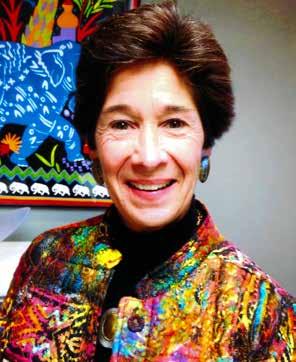
“There was a great passion you could see within her that wasn’t selfcentered,” says author Linda LeSage, about Jean V. Beddow-Arnth, the Hudson woman she profiled in her book “A Cuppa Tea with Miss Jean.”
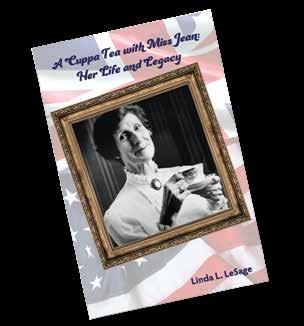
Jean in front of the fireplace, asking her about her motivations and backstory. “This won’t be a particularly interesting book,” Jean, always humble, would joke.
Jean remembers World War II well, and “left incredible footprints on the sands of time,” said LeSage.
“Coming from England, there was a sophistication about her. There was a great
passion you could see within her that wasn’t self-centered — it was about giving back to kids. It was about more than herself. Jean represented to me, personally, someone I could look up to. She was determined, she was independent,” said LeSage.
For LeSage, seeing people discover Jean’s story is well worth the effort.
“It warms my heart,” she said.
The book, “A Cuppa Tea with Miss Jean,” can be found at Islay’s Terrace (Hudson), Serendipity (Hudson), and Word on the Street (Marlborough), as well as online on Amazon, Target, and Walmart’s websites. For more information, visit https://lindalesage.com/.
“It’s a story about a woman who left a long legacy of giving back to her community. It’s an immigrant’s story, it’s a woman’s story,” LeSage told the Fifty Plus Advocate. “She had a storied life. And I knew I wanted to write that story.”


LeSage knew Jean her whole life — she was a “second-mother,” a dance teacher, and a mentor to her. As time went on, the two became friends and business partners at Jean’s School of Gymnastics, later deciding to travel the world together.
LeSage had never been a writer, but she knew Jean’s life was a story she had to share. She’d speak to

In our recent Eldercare Resource Guide, we printed incorrect contact information for Blackstone Housing Corporation. This is the correct address and phone number:
Blackstone Housing Corporation
8 1/2 Early Village Dr., Blackstone, MA 01504 Phone: 508-883-9802
Disregard the website listed. Please contact them by phone. We sincerely apologize for our error and any confusion it may have caused.



By shAron oliver contriButing Writer
REGION – In December of 1929, Maine floatplane pilot William Wincapaw started a time-honored tradition. He loaded his plane with candy, coffee, newspapers and other items and dropped them from his cockpit as he flew over New England lighthouses. As time went by, he and his 16-year-old pilot son William Jr. were joined by a young Winthrop high school teacher named Edward Rowe Snow who was an expert aerial photographer of his favorite subject, lighthouses.
Widely known for his stories of pirates and maritime history, Snow wrote over forty books, some of which were staples in New England homes. The author of more than 100 publi-
cations, mostly about New England coastal history, Snow became famous as a historian of the New England coast and was a popular storyteller, lecturer, preservationist, and treasure hunter after his 1935 publication of the book “The Islands of Boston Harbor.” Another classic is his “Storms and Shipwrecks of New England,” which was published in 1943.
The face of Flying Santa Sadly, Wincapaw was killed in a plane crash in 1948, having suffered a heart attack while taking off in Maine. Even though Snow was not a pilot, he was able to take over primary responsibilities of the project, thanks to having no trouble finding others to fly him around and he quickly became the face of the Flying Santa.
According to his daughter Dolly Bicknell, who accompanied her

Colony Retirement Home III is congregate housing for seniors. Enjoy nutritious “Home Cooked Meals,” served in our attractive dining room with your neighbors and friends.

father on flights from being a toddler through her teens, “Dad loved being Flying Santa. He did it for 40 years and enjoyed dropping presents to the keepers and their families. He and my mother would assemble all the gifts in the basement of our home for weeks leading up to Christmas. He paid for about 90 percent of it.”
Those gifts largely consisted of products donated by New England sponsors and included everything from coffee, tea, Gillette razor blades, rubber balloons, chewing gum, dolls and pen and pencil sets. The plane would circle the towers three times: once to signal, once to make the drop, and a third time, to check the drop.
A Christmas flight in 1940 would be the beginning of Anna-Myrle Snow accompanying her husband in spreading Christmas cheer. This was also the first year that Wiggins Airways became involved, providing
the charter and their pilot Charles Cowan. Over the next 60 years, the company would be the provider of a number of “sleighs,” from prop planes to helicopters.
In 1941, Rowe Snow and pilot Al Leckscheid took off on Christmas morning to drop packages in over 35 locations. Aside from being the Flying Santa, Snow is fondly remembered for his writings and weekly radio show as well, evident by the following Facebook remarks.
Chris Connolly wrote:
“Amazing man for his knowledge of Boston Harbor history. He was called the Flying Santa, dropping off Christmas presents to the lighthouse keepers.”
Louise Carella chimed in:
“Loved listening to him on the radio!”
Joe MacDonald recalled:

Call Monday thru Friday, 9am to 5

“Growing up on Humarock Beach in the 60s, he was quite the celebrity around town.”
A special delivery
During one delivery drop to a keeper’s family at Cuttyhunk Island, a package containing a doll for 5-year-old Seamond Ponsart got smashed on a rock. The little girl was devastated. Hearing the news, Snow decided he would deliver a doll to young Seamond. He chartered a helicopter from Wiggins Airways to safely deliver the doll with his own hands. Arrangements had been made for the Ponsart family to meet Santa and his helicopter when it landed at the nearby Gay Head lifesaving
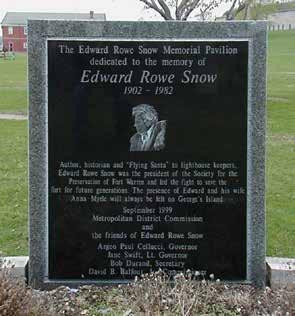
Edward Rowe Snow, the Flying Santa of New England lighthouse keepers, is remembered with this memorial plaque on Georges Island in Boston Harbor.
station.
Once a sought-after guide to old Boston, regional lighthouses, and the harbor islands, Edward Rowe Snow passed away at the age of 79 on April 12, 1982. In August 2000, a plaque was dedicated to Snow on Georges Island in Boston Harbor. A Boston Harbor ferry boat was also named for him.



• Diabetic Footcare
• Ulcers & Non-
• Gout



info@trustedlikefamilyhomecare.com
www.trustedlikefamilyhomecare.com




By MAtt roBinson contriButing Writer
REGION – For Monica Vegelj, straightening people out is both a figurative and literal mission.
In addition to being a schoolteacher, which she came to as a second career, she’s also a certified practitioner of the Alexander Technique. It’s an educational method that teaches individuals to change harmful postural habits and move with greater ease by increasing awareness of the body's use. Its proponents say that it has helped thousands of people improve not only their posture, but their health. The goal is to overcome pain and other limitations through gentle physical and verbal guidance.
Vegelj, a 59-year-old New Hampshire resident, studied the Alexander Technique for several years under the supervision of Newton-based practitioner Ruth Kilroy, who traces her training back to Frederick Matthias Alexander, the inventor of the technique. Vegelj, who teaches the technique often for Massachusetts clients, originally learned about the Alexander

Technique from another practitioner, Adam Bailey, who led an introductory group session for parents at her child’s school.
“We made observations about our habits in walking backwards and forwards,” she recalled. “I was impressed with the teacher’s ability to direct our attention in such a way that we all found something astonishing and new in these seemingly simple daily acts.”
Embracing the technique
Apparently, Vegelj was not only inspired to take a new view of her own ways of moving in the world, but also at what she wanted to do in it moving forward.
But first, she had to stand up.
“Volunteers were chosen for individual work,” Vegelj explained. “Adam invited us to make observations about their stance, as well as their habits as they sat down and stood up. I could see that the person was not perfectly upright, but with a very light fingertip touch and some verbal directions, the volunteer achieved a much more upright stance.”
When Bailey asked for another

•
• Medication reminders
• Laundry & housekeeping services
• Safety checks
• Dedicated, caring staff 24/7
For more information or to schedule a tour, call Kristy Livingston at (978) 632-8292 or email info@hwcommons.com .
volunteer, Vegelj eagerly raised her hand.
“I will never forget our verbal exchange when Adam guided me out of the chair,” she said. “It felt like learning how to breathe.”
Amazed at the transformation she

had observed, Vegelj decided to dedicate her teaching path to helping others realign their lives by straightening out how they use their bodies. “I couldn’t help reflecting on the enormity of the lived experience,” she noted. “One moment I was sit-
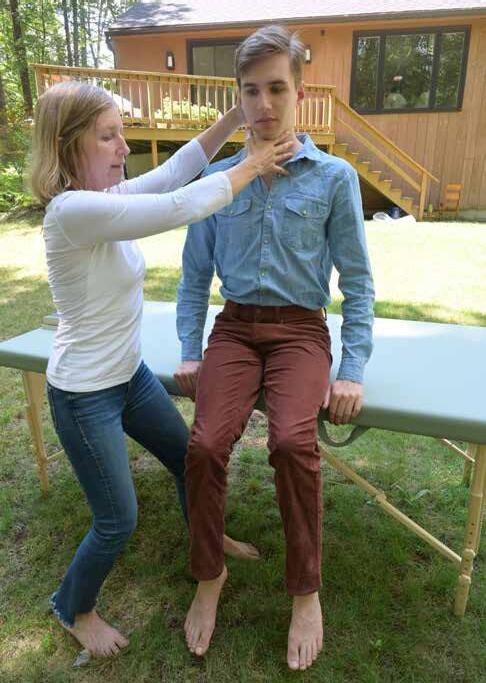
In addition to being a schoolteacher, Monica Vegelj is also a certified practitioner of the Alexander Technique, an educational method that teaches individuals to change harmful postural habits and move with greater ease. Photos/ Submitted
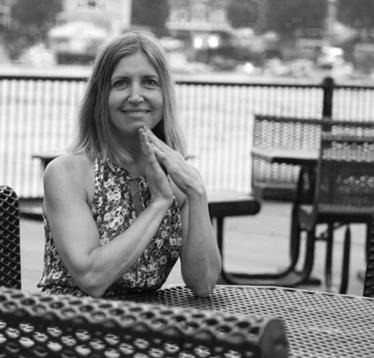
ting down, then without much effort whatsoever, almost no effort, I was standing.”
Education as a calling Educators are considered a rare breed by some people. They dedicate their lives to supporting other people and deal with long hours and low pay, and hope that they can make a difference and help other people improve their own lives.
While some see teaching as a job, many of those engaged in it say they know it is a calling.
For Vegelj, that calling came early. “It started when I was a four-year-old child,” Vegelj recalled. “I trained three little kittens in our home to walk!” And while this early introduction to early education may seem a bit too cuddly to count, Vegelj maintained that her passion for teaching and supporting others (regardless of age or species) was authentic.
If cat training does not do it for you, Vegelj has another example of her educational endeavors from just a few years later.
“My first grade teacher asked me
It’s not so much that I chose education, but rather that education chose me!
to assist my classmates with math,” she recounted. And though she admits to thinking it odd that the teacher was asking her to teach something she had just learned herself, Vegelj was game and again made her best efforts to help others in apparent need.
That experience launched me into peer tutoring,” Vegelj reasoned, “which continued throughout high school and college.”
Even in her extracurricular pursuits, instructors saw in Vegelj a natural proclivity to teaching. “As a child, I practiced gymnastics,” she said, “and I was approached by the owner of the gymnastics club to coach the preschool and kindergarten-aged children. I had this part-time teaching job throughout high school.”
Even when her true professional path took a turn away from teaching, she was unable to completely abandon the gift that so many others had seen in her since her earliest days.
“In my first profession as a registered dietitian, I was hired by the hospital where I did my internship to work in outpatient nutrition education and counselling,” Vegelj ex-
plained. “So even as a health care professional, I worked as a teacher.”
All of these experiences led Vegelj to a conclusion that had apparently been shared by many others-
“It’s not so much that I chose education,” she admitted, “but rather that education chose me!”
Launching her second career
Though her educational examples continued to build, Vegelj did not formally reenter a school until it was time for her own children to do so. As she dutifully toured various options in her area, she sought a place where her children could get the type of academic and life support that she had hoped to provide to cats and gymnasts and others throughout her life.
Once her children were enrolled and engaged in a Waldorf-inspired private school, Vegelj found her old yen for teaching coming back. She soon found herself getting more involved at the school — first as a parent, then as a volunteer, then as a member of the parent association and a member of the board of trustees, and eventually as a Waldorf-trained teacher.
As is true of all teachers, Vegelj continued to learn as she taught. The lesson in particular that would have a profound impact on her own professional and personal paths was the introductory workshop at the school about the Alexander Technique. And becoming a certified practitioner was a long and complex path.
“This process takes three years,” she explained, “during which one is confronted daily with pernicious and persistent ways of one’s own habits. If you approach with anxiety, fear of any kind, judgement, or frustration, all
of these responses interfere with the work, If you, on the other hand, enjoy the process, then the rewards are incredible.”
While the Alexander Technique can work for people at any age, Vegelj sees special benefits for older people like herself.
“The Alexander Technique can be particularly valuable for the elderly by helping them address common challenges associated with aging and improve their overall well-being,” she maintained. She cited noted improvements in posture and balance, which are key to fending off injury and degenerative diseases.
For example, she said Alexander students are often able to maintain the gait of their younger days instead of becoming shufflers. It can also help people of any age learn how to inhibit what Vegelj cites as “unhelpful patterns” of behavior and movement and “direct themselves more efficiently,” making pain a less common visitor as well. Also, as the technique is an education and not a form of treatment, people who learn it can be constantly observing and supporting themselves, even between lessons.
“So long as you have the ability to think,” Vegelj maintained, “you are able to practice the Alexander Technique.” And as it is based in thought and energy, she explained, she said it is far more efficient and effective than many other forms of treatment.
“If we are all exerting so much undue effort in the simple act of standing, sitting and getting up,” Vegelj observed, “imagine how much more we are capable of if we could learn to direct our energy more efficiently?”
By shAron oliver contriButing Writer
BOSTON – Waltham filmmaker Vincent Straggas’ new film “Life on the Other Planet” is not your typical rockumentary. Although Boston is home to juggernaut groups like Aerosmith, Boston, the Cars and the J. Geils Band, Straggas’ focus is more on the lesser-known talent from Boston’s rock scene during the mid-70s to mid-80s. He was also not afraid of bringing the former adult entertainment district known as the “Combat Zone” in the forefront as part of the aura of the times.
As Straggas explained to The Boston Globe, “You really had to know the grittiness of the city to understand where this attitude of this music came from.”
Interviews and archival footage The documentary showcases interviews and archival footage, featuring artists like The Atlantics, John Butcher Axis, Willie Alexander, DMZ, The Neighborhoods, Girls Night Out, The Lyres, Robin Lane, Mission of Burma, Human Sexual Response, the Modern Lovers, the Nervous Eaters and many more.
“Life on the Other Planet” takes care to not be ordinary and goes down a road less traveled, which includes the “Bosstown Sound” 1960s marketing campaign by MGM Records to draw attention to Boston’s psychedelic rock bands.
The filmmaker told WBUR’s Sharon Brody, “It really was about a time that defined the local music scene that hit between 1974 and really up to 1985-86 and it also encompasses Boston. Boston at that
time wasn’t as clean and beautiful. It had a lot of troubles. There were a lot of seedy places that bands were able to play in, and it was a time of not so much innocence, but it had a purity to it.”
Debut at local theater
The film made its debut at the Regent Theatre in Arlington on October 24, with a live performance by the Nervous Eaters. Those who were present had much to say about it.
Mark Steele wrote on Facebook:
“Last night Ruthie and I went to see ‘Life on the Other Planet,’ a film produced, shot and edited by my friend Vincent Straggas. I helped in the finishing of it and have seen it 30 times or more but last night was special. The evening opened with a live set by The Nervous Eaters and they were followed by the film. The Regent Theater in Arlington was filled to capacity. Before the film started the audience was buzzing. During the film they applauded and laughed and sang along. It was a true pleasure to assist Vinny with this project and to work alongside of him. He has created a document that will last a long, long time.”
Steele later added, “We are planning one for The Cabot in Beverly but no date yet. I’ll let you know.”
Brad Hallen added:
“What a night last night!!! Sold out crowd at The Regent Theatre for the premiere of Vincent Straggas film ‘Life on the Other Planet.’ Thanks to everyone who came and supported him and The Eaters had a blast playing for you all as well.
“They turned away so many people at the door last night (over a hundred I heard) that they booked another showing November 19 and the people that couldn’t get in bought tickets for that showing. The



film is basically about the music scene in the ‘70s and ‘80s but just as much about the city of Boston in general at that time. Congratulations to Vin and ev eryone involved.”
“Life on the Other Planet” gives a clear por trait of what Boston and its rock music was like back then. Vincent Straggas is an Emmy-Award win ning producer and writer whose public-broadcast ing achievements range from studio directing and post-production editing for such series as “Mas terpiece Theatre,” “Mys tery!,” “Evening at the Pops,” “Degrassi High,” “Zoom, “ and “Where in the World is Carmen Sandiego?”
For information about future screenings, go to https://www.lifeontheotherplanet.com.
The new documentary film “Life on the Other Planet” is a tribute to many of the lesser-known bands from Boston’s rock scene during the mid-70s to mid-80s.


The Nervous Eaters, featured in the new documentary film “Life on the Other Planet” were a popular band in Boston’s rock clubs during the 1970s and 1980s, and performed live at the movie’s debut screening.
By shAron oliver contriButing Writer
MEDFORD – While New York City is typical thought of as the stronghold of the Mafia in the United States, the Massachusetts mob had one dubious distinction over their New York brethren. It was in 1989 in the city of Medford, just north of Boston, that the FBI captured the first and only Mafia induction ceremony on tape.
Peacemaking gesture
New England crime boss Raymond “Junior” Patriarca wanted to make peace with a renegade faction that had killed a family underboss in Connecticut and wounded another mobster outside a Saugus pancake house. Patriarca wanted to baptize four new members into the fold and start afresh. Unbeknownst to him and other wise guys, Angelo Mercurio, a mob soldier and FBI informant, was about to break their code of silence. After being shown where certain mobsters would be “made,” Mercurio made a phone call and tipped off FBI agents John Connolly and James A. Ring on an upcoming induction ceremony.
After receiving a weekend furlough from a state prison to attend “family business,” Vincent Federico borrowed his sister’s home at 34 Guild Street in Medford where he, along with Robert “Bobby” DeLuca, Richard Floramo and Carmen Tortora were inducted on October 29, 1989. The four men took a blood oath after pricking their trigger fingers, burned holy cards, and pledged their loyalty and their lives to the Mafia. Unbeknownst to them, FBI agents posed as utility men had run a wire the night before from that house to a home owned by an agent who coincidentally lived on the same street.
Patriarca told the men that they came highly recommended, did everything they had to do, stayed the course but to not let it go to their heads. He warned against taking advantages to make money or abusing people and if they didn’t let it go to their heads or abuse it, they will have a “happy, happy, happy, life.”
Words of warning Biagio DiGiacomo, a capo born in Sicily, administered the oath in Italian and offered words of warning such as the only
way out was death and “there was no hope, no Jesus or Madonna who could help them if they ever shared this secret with anybody. This Thing cannot be exposed.”
Consigliere Jo seph “RJ” Russo asked Tortora if had any brothers. Russo spewed loyalty scenarios to which Tortora replied, “yes” he would kill his own brother if he were a rat or cause any of them harm and “yes” he would leave his dying mother if called to “family” emergency.
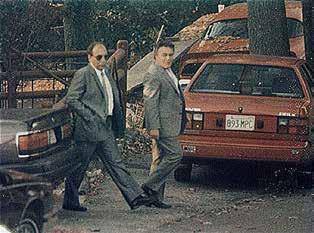
Meanwhile, at the surveillance post on Guild Street, agents had photographed the men arriving and departing. After indulging in a little wine, dinner and discussion of mob rules, Russo and Ferrara stayed behind to scoop up crumbs and open the windows to air out any smell of smoke before the owner returned home. Just before locking the door, agents heard Ferrara say, “Only the {expletive} ghost knows what really took place over here today by God.”
accepting Applications for 62 years of age and older and those that are under 62 years of age and are
During a later criminal trial, a defense attorney’s motion to suppress the tapes was denied. Prosecutors argued that the tapes were essential in proving that Mafia, also known as La Cosa Nostra, Italian for “This Thing of Ours” existed and were engaged in racketeering, under federal law. The hierarchy of the New England mob and many of those present on that October day were indicted and sentenced to prison. In 2004, Robert Parisien, the FBI agent who planted the bugs that yielded the recording of the Mafia induction ceremony, died while scuba diving near Kettle Island off Massachusetts. The cause of death is believed to have been a heart attack.


By MichAel PernA Jr. contriButing Writer
SHREWSBURY – After last year’s release of my book “Spag — His Life and Legacy,” many more stories about Anthony “Spag” Borgatti and his namesake store have come to light. The lasting popularity of this business is amazing, especially considering the original store closed over 20 years ago, in 2004.
Stories from all over
The stories began to surface as soon as the book was published and came from all angles — people that I have known for years and years all of a sudden revealed that they once worked at Spag’s. People from all over New England had Spag’s stories. People had Spag’s stories from all over the world.
Here are some examples.
A friend that I’ve known for 30plus years, who is a retired social worker — when he heard about the Spag’s book — all of a sudden came out with: “I worked at Spag’s when I was in college.” My immediate response was, “You did? I never knew that.” “Yes, I worked at the fishing tackle counter.
One day, this oddly dressed customer was buying all kinds of fishing lures. He had a strange accent. I said, ‘Excuse me sir, but your accent sounds kind of like Bela Lugosi, or like you’re from Transylvania.’ The customer, with his strange accent, responded, ‘That’s because I am from Transylvania. I am buying all these lures for my friends back there.’”
A cousin’s husband — again I’ve known this person for over 30 years: “I worked at Spag’s every summer and on school breaks when I was in high school and college.” Once again, my response was, “You did? I never knew that.” “Yes. The thing I remember most was every year at the annual Christmas party Spag would have for his employees (each one would receive a bonus, even if part-time, and a fruit basket), when it was my turn to get my bonus, Mrs. Spag wouldn’t give mine to me unless I gave her a kiss on the cheek first.”
The mechanic that works on our cars at his local garage: “When my father was serving in Korea when he was in the army, one of his fellow soldiers asked where he was from. He said, ‘Leominster, Massachusetts.’
the man sitting next to us. It turned out he was a Quincy police officer. When he asked where we lived, we said, “Shrewsbury, just outside of Worcester.” He responded, “Is Spag’s still there? I used to go there all the time.”

begins with your ability to choose. Choose us for exceptional results.
The other soldier responded: ‘I’ve never heard of that place. Is it anywhere near Spag’s?’”
While on Cape Cod sitting on a bench at Smuggler’s Beach in Yarmouth, an older couple sat down on the bench next to my wife and myself. We were all enjoying watching the waves breaking on the sand and the cool breeze. My wife and the other woman struck up a conversation, which led to the question, “Oh, where are you from? We live north of Boston but come to the Cape often. How about you?” “We live in Shrewsbury.” “Oh, where Spag’s was. We used to go to Spag’s all the time.”
Whatever you need
During a local author’s event at the Shrewsbury Public Library, a professor from a nearby college, who, as it turned out, had emigrated from Lebanon many years ago, stopped by to reminisce about Spag’s. He said, “You know, when I first came to this country years ago, I hadn’t even moved into my apartment yet. All I had with me was what was in my suitcase. I was getting a ride to my apartment from a friend – he took me to Spag’s and said, ‘Whatever you need for your apart ment you can find in this store’ — and he was right.”
While hav ing breakfast at “Grumpy’s” — a well-known restau rant in Dennis on the Cape — we struck up a conversation with
During a Spag’s talk at the Shrewsbury Public Library, I was telling the audience about several stories that had surfaced since the Spag book had come out. One such story was that how, on his daughter’s birthdays each year, all the money that had been earned in the store that day would be given to the daughter whose birthday it was.
At that point, a man who was sitting with a woman in the front row raised his hand. I said, “Yes, do you have a question?” He responded, “May I introduce Dr. Jean Borgatti, Spag’s daughter?” I said, “Of course,” and I asked her, “Am I doing okay? Did I make any mistakes?” She replied, “No, you are doing fine. The only thing is, I don’t ever remember getting any of that money on my birthday.”
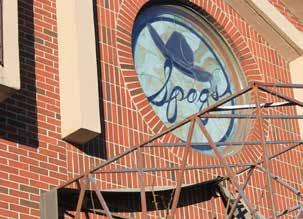
A mysterious ending And finally, a lasting Spag’s mystery. The son of one of my (now deceased) boyhood friends told me that, when Spag’s was closing, he asked if he would be able to take some photos of the store before it was torn down. He was given permission to do so. One of the photos, shown here, is of the iconic stained-glass “Spag’s” window that had been installed in the addition to “Spag’s Schoolhouse.”
The plan was to donate the window to the town library to preserve part of the Spag’s legacy. The contractor who was demolishing the building in 2016 had erected a scaffolding and carefully packaged the window to allow it to be safely transported to its new home. When the workers returned the next day, the window had vanished. No one knows where it went, and it hasn’t ever been seen since.

By shAron oliver contriButing Writer
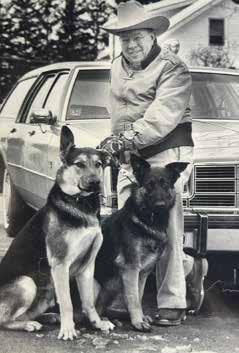
WORCESTER – Sometimes it is the least famous person who can make the most lasting impression. They don’t always have to do much or be internationally known. Such is the case with Walter Joseph Barch of Worcester, better known as The Whistler or The Fox, as he called himself.
Long daily walks in the area Trim, fit and seemingly without an ounce of unwanted fat, Barch routinely trotted throughout Worcester and surrounding towns such as Clinton, Shrews bury, Holden, Leicester and Westbor ough during the 1970s, 1980s and early 1990s. Barch whistled along the way, often wearing a painter’s cap and a bright yellow slicker bearing words de tailing his life’s story. He said he walked at least 30 miles a day, so that he could never be accused of being somewhere he was not and whistled so he could never be accused of sneaking up on a person. People waved or blew their car horns when they saw him. He was a familiar face to many and a friendly person to greet who could imitate bird calls and emit ear-piercing whistles.
Jimmy Conway wrote on Facebook:
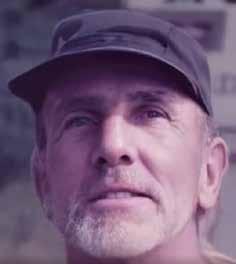
always wore. You’d yell ‘Whistler,’ and you get that great whistle back. Seems like life was different back then IMHO.”
Joe Mattero also wrote:
“I was kid, I used to hear him first, then see him. Very pleasant individual who loved to say hello and give you a whistle in the note of a tune of whatever came into his mind. Sometimes he would wear a cardboard sign around his neck covering his chest and back with information on both sides stating I think places he had once been and people he had known or knows. All of us kids in my neighborhood would ride our bikes behind him listening to him as he walked upbeat to wherever his own destination lay. Fun memories!”
water State Hospital for the Criminally Insane.
Michael Barch, his nephew, believed he was innocent and took poor legal advice. Describing his uncle as a gentle soul who never once got into trouble since his release from prison, Michael recalled one Christmas when his uncle visited his brother (Michael’s father) in the hospital and asked why the family had no Christmas tree. With lack of money being the reason, Walter took Michael, along with his brother and sister to buy a tree, decorations, lights, toys and food for the family.
“I remember him like it was yesterday. We’d be playing in the street, and we could hear him whistling away, always looking forward to waving to him and saying hello.”
Kal Jones added:
“He had his life history written on back of his sleeveless yellow raincoat he
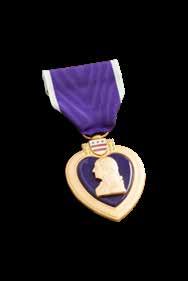
Troubled past Life had not always been kind to Barch. He once worked in construction, fought as a professional lightweight boxer with 23 undefeated fights under his belt, served in the military as an antitank gunner and paratrooper during World War II and was a Purple Heart recipient. Years following his discharge, Barch was arrested for the assault of an eight-year-old girl and sentenced to 10 years in prison. At one point, he was even transferred from the former Norfolk State Prison Colony to Bridge-
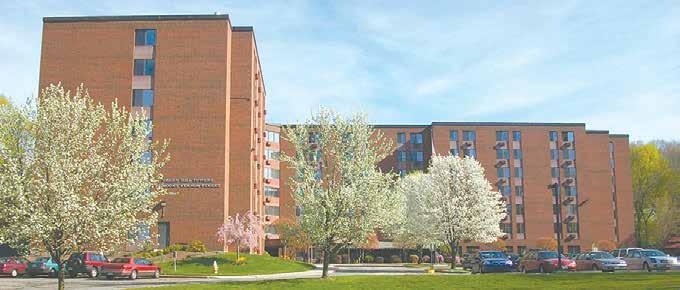
Within the building amenities include:
• A Theater-like media center
• Handicap-accessible lounges on every floor
• Library equipped with two computers and free internet access
• Physical fitness center
• Game room with billiard table
• Community room with bingo board and large screen TV
27 Mount Vernon Street, Worcester, MA • O ffice O pen D aily 8:00 am - 4:30 pm
To receive an application please call 508-755-6062 TDD# 508-755-0228
Now accepting applications for 62 years of age and older and those who are under 62 years of age and are permanently disabled.
Applicants must meet HUD
As for how he got the nickname The Fox, Barch once explained that while at Bridgewater State Hospital, people would ask doctors if he was crazy or not to which doctors often replied, “Yes, crazy like a fox.” Barch received a key to the city of Worcester in March of 1995.
Refusing treatment while lying ill in a hospital, social workers reached out to Barch’s nephew, Michael. Test results showed he had cancer of the colon which unfortunately had already widely spread. Walter Barch died in October 1995 at the age of 73 but generations of Worcester area residents still remember him fondly 30 years after his passing.
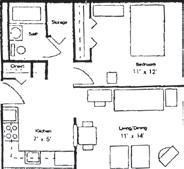
• Contemporary styled 1 & 2 bedroom apartments
• New kitchens with built-in microwaves and granite-like countertops
• Small pets welcome
• Heat and Hot water included
• Bus route / ample parking
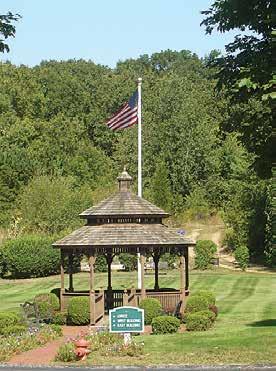
• Beautiful landscaped grounds with gazebo



By nAnce eBert contriButing Writer
HAMILTON – Gen. George S. Patton, one of the most renowned if controversial leaders of the U.S. Army in World War II, was also a longtime resident of the bucolic town of Hamilton.
Marriage to local woman
A California native, Patton’s Massachusetts ties began when he married Beatrice Banning Ayer in 1910 in Beverly Farms. She was the daughter of wealthy Boston industrialist Frederick Ayer. In 1928 they bought a large property in Hamilton where they raised their three children, which would become known as the Patton Homestead. After remaining in the family for 85 years, it was given to the town of Hamilton by Patton’s descendants, and it’s now open to the public.
With this year marking the 80th anniversary of World War II’s end and his death, Gen. Patton’s turbulent legacy has provoked more interest than usual in his career. As a general, he displayed military brilliance but exhibited a controversial personality that made him feared by many.



Short temper and strong language His forceful actions and short temper led to a lot of problems during his career. It is said that his vulgar speeches earned him the nickname “Old Blood and Guts” among his troops.
“Battle is the most magnificent competition in which a human being can indulge,” Patton once said. “It brings out all that is best; it removes all that is base. All men are afraid in battle. The coward is the one who lets his fear overcome his sense of duty. Duty is the essence of manhood.”
Patton was born in San Gabriel, California in November of 1885. As a young boy, he had difficulty reading and writing and even had to repeat a year at West Point when he could not pass mathematics. While he struggled with school subjects, he was a brilliant leader. He did finally graduate from the United States Military Academy at West Point in 1909.
In 1943, during the Allied campaign in Sicily, Patton humiliated and physically lashed out at two soldiers. This incident almost cost him his career, and he was severely reprimanded by Gen. Eisenhower, who he shared a friendship with that lasted two decades. Both attended West
Point, with Eisenhower graduating six years after Patton.
Patton was known as a very aggressive military leader. His leadership
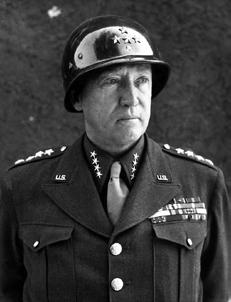
Gen. George S. Patton, both a renowned and very controversial leader of the U.S. Army in World War II, was also a long-time resident of Hamilton.
style was embodied in some of his most famous quotes, including, “ Lead me, follow me, or get out of my way,” and “The object of war is not to die for your country but to make the other bastard die for his.”
Defeating the Nazis
Under his command, the Third Army moved into Germany and Czecho-
slovakia and helped defeat the last German major offensive on the western front at the Battle of the Bulge. In April 1945, Patton was promoted to temporary four-star general but was removed by Eisenhower from his leadership of the Third Army for making inflammatory remarks concerning denazification policies.
Patton died at the age of sixty on December 21, 1945, 80 years ago this month, of a pulmonary embolism following a car accident in Heidelberg, Germany. He is buried in the American Cemetery in Luxembourg.
His wife Beatrice died in 1953 after falling from a horse at the Myopia Hunt Club in South Hamilton, where she was part of a hunt with her brother and other riders. Gen. Patton was also an avid horseman and it has been suggested that head injuries from playing polo in his youth might have contributed to his odd behavior in his later years.
Movie contributed to his legend Patton was immortalized in American pop culture by the 1970 movie “Patton” about his life during World War II, starring George C. Scott in the title role. The film would go on to win seven Academy Awards, including Best Picture, Best Director and Best Original Screenplay.





By sheAlAgh sullivAn contriButing Writer
NORTHBOROUGH – Bob Ryan has covered 20 NBA Finals, 11 Olympic Games, and so many World Series that he jokes he lost count.
His latest assignment? The Northborough Senior Center.
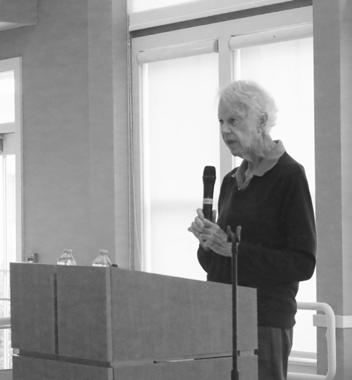
Ryan stopped by the Northborough senior center in October to give a talk to local residents: “Why Are We So Crazy About Sports?” Ryan discussed the cultural impact of sports; talked with locals about his career, thoughts on artificial intelligence, and sports betting; and pondered what the future of sports looks like.
“These are my people,” Ryan told the Fifty Plus Advocate. “I love that I don’t have to explain my references.”
Ryan was invited to the center by the Friends of the Northborough Senior Center.
“We always like reading his stuff. It’s really good,” said Vin Femia, the Friends’ communication coordinator.
Ryan has been called a “quintessential sports writer,” having written for The Boston Globe since 1968. Though he retired in 2012, Ryan is a columnist emeritus at the Globe.
After graduating from Boston College, Ryan kickstarted his career as a sports intern at
the Globe. Throughout his career, he covered virtually every major sport, though he was known for his basketball coverage, particularly of the 1970s Boston Celtics. He’s published 14 books and was named Sportswriter of the Year by the National Sports Media Association four times.
Ryan told the Senior Center it was all just meant to be.
“I don’t ever remember a time in my life where we weren’t at a game, going to a game, or getting ready to go to a game, you know?” Ryan said. “So was it planted in me. My destiny was set early. I’m very grateful for it.”
While he’ll always remember covering the playoffs and championships, it was the stories of individuals that have stuck with him the most, Ryan told Northborough residents.
“I’ve been really lucky,” Ryan said.
I love that I don’t have to explain my references.


By MAriAnne lyons Delorey, Ph.D.
“A problem well stated is a problem half solved.”
- John Dewey
I had never heard of John Dewey before sitting down to write this column. It turns out, he was instrumental in changing the American educational system and switching the emphasis from rote memorization to experiential learning. This educational shift turned the focus on the learner and helped develop critical thinking.
John Dewey made a significant mark in education. Now, aging services needs a thinker like him to push that industry forward.
Having just attended a global conference about aging, I can attest that aging services is solving lots of problems. There were seminars on how to lead in a crisis, how to rebrand, how to do more with less, how to grieve through music, and how to redevelop your property. There were some, but very few focusing on person-centered care and otherwise understanding the experience of aging and caregiving.
A while ago I was talking to a resident and trying to convince her to accept some help. I started by saying that she could get somebody to clean her apartment, thinking that this would be so appealing to her. I couldn’t have been more wrong. She countered, “Why would I want somebody to clean for me? That’s the only exercise I get. I need that.” I learned an important lesson that day. We are of limited help to other people if we can’t even define the problem the same way.
While I was at the conference, I looked around the room, and I wondered how many people have truly been hands-on caregivers. Yes, some may work in caregiving organizations. But how many people have changed diapers, spoonfed people, and held the hands of people as they took their last breath. I believe until you provide hands-on care, it is very difficult to see the world through the eyes of the people who need the care and the people who help the most.
As it stands many hands-on professional caregivers are marginalized because they are female, poorly paid, and often linguistic or racial minorities. They do not have power and families do not listen to their concerns.
While this conference was aimed at people much higher up in caregiving organizations, I do wonder how much more valuable the seminars would be if they were led by the people who actually provide the care. I wonder how we would define the problems and how much closer we would be defining solutions if we were all working together.
I would love to see a conference that focused on experiential learning – for the caregiver, the elder, the caregiving execs, and the families. Let’s face it, we can all use a bit of hands-on learning on how we can best cope with increasing frailty and dependency.
When Dan Rather interviewed Mother Teresa, he asked her how she prayed, and she simply said, “I listen.” He then asked, “Well then, what does God say?” Mother Teresa responded, “He listens.” She then said, “And if you don’t understand that, I can’t explain it to you.”
Our ability as caregiving professionals to listen and then listen again is the only thing that can really set us apart. Doing so will help us understand the real problem and find real solutions.
Marianne Delorey, Ph.D., is the executive director of Colony Retirement Homes. She can be reached at 508-755-0444 or mdelorey@colonyretirement.com and www.colonyretirementhomes.com. Archives of articles from previous issues can be read at www.fiftyplusadvocate.com.

By JAnice linDsAy contriButing Writer
When we moved into our house 22 years ago this month, a knee-high balsam grew in the middle of the small, cleared field that was our back yard.
When the tree had grown to four feet tall or so, I decorated its branches for the holidays with bright red balls and tied a velvety red bow on its top.
Within a couple of years, the tree had grown too tall for me to reach the top. An up-and-coming young balsam took the teenager’s place. This second balsam was replaced by a third. The third was replaced by a young hemlock in a corner of the field, red balls shining in the sun so that they seemed to be lit from within.
Now the first tree is 35 feet tall, and no little ones grow near the house.
Trees grow and change, but they keep their treeness. The balsam keeps its piney fragrance, the hemlock its laciness of tiny needles.
And so it is with festive holidays — mine happens to be Christmas — always changing yet unchanging.
At Christmas, we sing songs people have enjoyed for generations. Along with “Greensleeves”
(what child is this…) the lullaby whose words were written in the 17th century, we sing “White Christmas” from the 1940s and each year we consider adding new ones. Songs change, but the need to celebrate with music does not.
We light candles. Maybe some of them are powered by electricity, but they glow just the same. Methods change, but we long for the light.
We enjoy traditional foods. Mince pies, a favorite of mine, have contributed to Christmas feasts for seven or eight centuries. (Any leftovers are for breakfast on December 26!) But we add our own traditions, too. Our family’s traditional Christmas breakfast is a plate of dinner rolls baked in the shape of a Christmas tree, frosted in green, decorated with nuts and dried fruits. Foods change, but not the impulse to celebrate together over a shared meal.
We bring a tree and other greens into the house. Maybe some of them are artificial. No matter. We need to remind ourselves that the cycles of nature turn and return. The world outside will be green again.
Artwork and figurines remind us of the holiday’s essence. For our first Christmas, Dick and I bought an inexpensive manger scene at a discount department store. The figures were three-dimensional, but cardboard with a shredded cardboard
filling, painted to look like wood. We planned to buy a nicer creche when we were more prosperous. But that one collected memories. When our son was two years old, he had a “grab and toss” phase – he was very fast – and one of the wise men bit the dust. Its replacement doesn’t quite match. When my mother wrote a poem imagining a cat in the stable on that first holy night, I added a white ceramic kitten, even less of a match.
We never did buy another creche. We made this one our own. Nearly six decades later, it’s still the first decoration to come out at the beginning of the holiday season.
A strong silken thread weaves through holiday season after season, connecting us with all those who have celebrated before us and all those who will celebrate after us, each generation adding a little something of its own.
Each year, people complain about the commercialization of Christmas, all that buying and frenzy. But you can always hold onto that thread of holiday meaning. Once you’ve grasped it, nobody can take it away. Contact jlindsay@tidewater.net
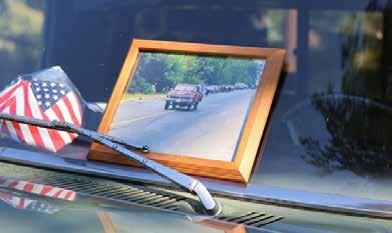
About 100 former racers and some of their classic cars gathered at the Marlborough Fish & Game Association for an A&M racetrack reunion in October.


By evAn WAlsh contriButing Writer
MARLBOROUGH – The roaring engines, the acceleration, the competitive spirit.
In the 1970s, drag racing at the A&M — an unofficial-but-popular track once located near Hayes Memorial Drive in Marlborough — was all the rage. The races were competitive, and technically illegal, but today, they’re the type of memories that bring people together.
In October, about 100 former racers gathered at the Marlborough Fish & Game Association for an A&M reunion. The event, now in its eighth year, features dozens of vehicles, food and drink, music, and the opportunity to swap stories with friends from decades ago.
“Drag racing is like that — everybody gets along, everybody helps one another,” said Steve Bush, the lead organizer of the event. “It’s just to get all the guys who used to race at the A&M back together. You get down there Sunday at 11 a.m., race all day, then the cops would show up at 4:30, 5 p.m. and say it was time to go — they were really good.”

Change Brings Uncertainty — Are You Prepared?
I’m hearing:
• Social Security and VA benefits might be changing
• Retirement accounts plummeting
• Real estate values dropping
• Tariffs increasing
• Higher real estate taxes & insurance costs
• More expensive doctors, prescriptions, and at home care
• Credit card balances growing
• Children & family financial needs increasing
• Being forced to sell your home
In addition to cars, there were also some old photos of races during the A&M racetrack reunion held at the Marlborough Fish & Game Association recently.
Photos/Evan Walsh
Standing by their cars — some with pictures of what they used to look like on the raceway years ago — former racers shared memories of the A&M. For many, it represented joy, adventure, and rebellion; the feeling of high-speed competition has been impossible to forget.
“Here’s the routine: On Saturday night, you cruise through Main Street at about 8 p.m. — there would be cars on both sides, up and down, Camaros, Fords, Mustangs. You’d go by and pick out a car you want to race. At 11:30, you’d head to the A&M — just as the police were switching their shifts,” said Chris Mutti, one of the reunion attendees.
Added Rich Felix: “It was a fun place to go.”
But despite the competitiveness — and the fact that racing at the A&M seemed to go away, or at least fundamentally change, in the midto-late ’80s – the bonds made at the racetrack have withstood the test of time. Sure, there were cars, pictures of the track, and more.
But what many were there for, they said, was the community.
“It’s our heritage and way of life. It’s more than just the cars,” said Bob Laptewicz, another attendee.
• And, of course, the unknown financial surprises that we all face
The Good News —
Reverse Mortgages May Be The Solution
A reverse mortgage may be your solution to reducing financial stress and being able to afford your home. A reverse mortgage is a government guaranteed loan that allows qualified 62-years or older homeowners to receive tax-free cash when needed or desired.
Primary Benefits of a Reverse Mortgage Are:
• No monthly mortgage payments are required
• Note — you are responsible to pay your homeowners insurance, real estate taxes, and meet loan guidelines
• Eliminate your current mortgage or equity line payment
• Receive a lump sum amount of cash, a monthly check, and/or a line of credit that grows as you get older
• Easier income qualification than conventional loans
• No minimum credit score required
• May be used to pay off current mortgage and other debts
• You continue to own and control your home
Alain Valles Reverse Mortgage Specialist 781-724-6221
A great place to start is get your free “How to Use Your Home to Stay at Home” 36-page book. This is the official reverse mortgage consumer booklet approved by the U.S. Department of Housing & Urban Development and published by the National Council on Aging.
To receive your free copy, please call or text me at (781) 724-6221 or email me av@powhse.com
I am also available to evaluate your specific situation, answer your questions, and calculate how much money is available to you.
Alain Valles was the first designated Certified Reverse Mortgage Professional in New England. He obtained a Master of Science from the M.I.T. Center for Real Estate, an MBA from the Wharton School, and graduated summa cum laude from UMass Amherst. He is the senior reverse mortgage loan officer MLO#7946 at Powerhouse Funding Corp. NMLS #1740551. He can arrange but does not make loans. Alain can be reached directly at (781) 724-6221 or by email at av@powhse.com
By MAtt roBinson contriButing Writer
CAMBRIDGE – When self-described “jazz obsessive” saxophonist Russ Gershon started the Either/Orchestra in Cambridge in 1985, Ronald Reagan was president and the wreckage of the Titanic had just been discovered.
Now, 40 years later, Gershon’s “small big band” is still playing its idiosyncratic mix of large-ensemble jazz tunes. That is one of the reasons he feels there is so much excitement about the return of the Grammy-nominated and Boston Music Awardwinning Either/Orchestra (E/O) to the Regattabar in Cambridge on December 17.
“It seemed to make perfect sense that we make our ‘re-debut’ at the Regattabar, where we’ve been playing since the 80s,” said Gershon.
Musical family
Born in 1959 and raised near New York by a “lifelong musician” mother who played in a community orchestra that featured an annual accompaniment of Gilbert and Sullivan operettas, Gershon was exposed to a wide range of sounds as a child and those diverse influences continue to play in his head (and his horn) today.
“I grew up with one foot in pop, one foot in jazz and a background in classical music,” he maintains, citing performances by Rostropovich, Marian Anderson, and Teddy Wilson
among his early exposures to music.
Having had his mind blown by the Beatles at the age of five, Gershon also gravitated to such radio rulers as Herb Alpert and the Tijuana Brass and the made-for-TV band the Monkees.
Citing a concert by Sly and the Family Stone when he was in ninth grade as a “game changer,” Gershon says that a pivotal moment on his path toward playing jazz was a concert by Alice Coltrane, Pharoah Sanders and Rahsaan Roland Kirk for which his father had procured tickets.
“Game over!” Gershon grinned. “I became a jazz obsessive.”
Though he had started piano lessons at seven and violin at nine, actual dreams of John Coltrane led him to land on the saxophone.
“Jazz [is] such a powerful musical and cultural conversation,” he observes, “that I felt compelled to join.”
Street education And while his lessons were productive (as proven by his decades of performances), Gershon says that his real “education” in music came on the streets of New York and the clubs
that were often underneath them.
“Growing up around New York City in the 1970s,” he said, “I was able to hear in person every generation of jazz player, a fantastic education. Now, as a music teacher and leader of younger musicians, I feel like I have to pass along the lessons of those experiences.”
Also during his teen years, the Nonesuch Explorer series introduced him to international sounds and he became a fan of the politically-charged Nigerian musician Fela Kuti. In the
out over 100 of other folks’ albums.”
Speaking of other folks, when not performing with E/O, Gershon gigs with his jazz trio, his Latin Bugalú band Lookie Lookie, and a band that plays early ‘70s Miles Davis music called Liisten to This.
Started as a rehearsal band
When asked how E/O came to be, Gershon recalls studying for a stint (as so many musicians do) at Berklee College of Music to shore up his music theory chops after he graduated from

late ‘70s the advent of punk and new wave brought him under the influence of such artists as Talking Heads and Television.
While in an eclectic rock band called the Decoders in the early ‘80s, Gershon learned how to self-produce records. As a DJ in high school and as jazz director at Harvard’s WHRB-FM, Gershon also learned earlier how records were promoted. These lessons would serve him well when he started his own label — Accurate Records — in 1986.
“After I had started the Either/ Orchestra, I realized that I could put out a jazz LP just like the rock bands I had been in,” he reasons. “So I brought my production, promotion and radio knowledge together and made our first album.”
Partnering with Cambridge-based Rounder Records for distribution, Gerson had all the pieces in place to produce and sell his own records and those of other artists he enjoyed.
“One thing led to another,” Gershon muses, “and I wound up putting
Harvard.
“At the end of that period, I wanted to keep developing my new skills,” he explains, “so I started a rehearsal band, luring a motley mob of players to my house on Monday nights to play my charts.”
As so many friends showed up regularly, Gershon was frankly concerned that the group was too big to make it as a “working” band. However, they booked a performance space anyway and, on December 17, 1985, Either/Orchestra (or “E/O” as it is known to its legions of devoted fans) was born.
“The name came to me the morning after I heard Wayne Shorter play at Jonathan Swift’s,” Gershon said, name-checking an old favorite while predicting a follow-up question. “Even though I was a philosophy major in college, I didn’t intentionally name it after Kierkegaard’s book ‘Either/Or.’”
A large and diverse lineup over the years
While composing for the group, Gershon strove to create music that would keep him interested and entertained if he were in the audience. It turned
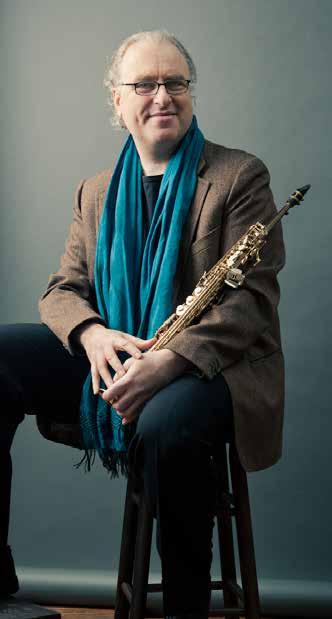
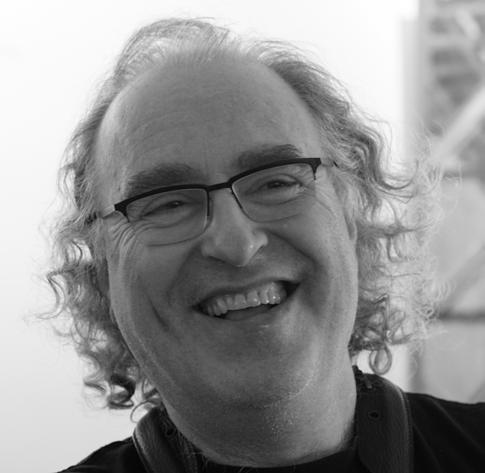
Self-described “jazz obsessive” saxophonist Russ Gershon started the Either/Orchestra in Cambridge in 1985.
out his instincts were correct, as the group gathered a strong following right away. The fact that E/O has enjoyed the influences and inspirations of over 60 artists (including such locally-sourced legends as John Medeski, Josh Roseman, Matt Wilson, and Miguel Zenón) has not hurt either, as the various members have brought their own influences to the music and their own friends to many shows.
“I’ve had so many incredibly talented people come through,” Gershon observed. “Everybody has left their mark on the group. So there are layers of musical history embedded in our repertoire.”
As diverse as their influences and membership have been, E/O has also enjoyed unique touring opportunities, including playing with members of the legendary Boston rock band Morphine and performing in Addis Ababa as part of an Ethiopian music festival in 2004.
“We were the only US band to do so,” Gershon recalled proudly, “and the first US big band in Ethiopia since Duke Ellington’s in 1973!”
E/O returned to Ethiopia in 2011 to perform music by Nerses Nalbandian, a refugee of the Armenian genocide who became the music director at Emperor Haile Selassie’s National Theater.
“We have continued to collaborate with Ethiopians,” Gershon noted, adding that a recording of one of these performances is due out soon.
Broad retrospective planned
In the meantime, Gershon is getting ready for the E/O reunion at the Regattabar on December 17, at which the current 10-piece “core” band will perform music from all 12 albums, as well as some cuts that are yet to be recorded but that always seem to please their crowds.
“It’s been a surreal experience, listening back to 40 years of music,” Gershon marveled. “Getting together to play has been very exciting, with so much history, and also several new members who are feeling the E/O vibe for the first time. We’ll do two completely different sets on December 17, so fans…will get quite a tour!”













Massachusetts governor signed a redistricting bill two centuries ago that led to term gerrymandering
By shAron oliver contriButing eDitor
BOSTON – These days, you would be hard-pressed to find someone who has not heard of one state after another threatening to bring the manipulating strategy of gerrymandering into play. What some may not know is how this practice, which is considered a corrupt way of drawing district lines in favor of a particular political party, got its name. Merriam-Webster describes gerrymandering as “the practice of dividing or arranging a territorial unit into election districts in a way that gives one political party an unfair advantage in elections.”
Governor signed bill
The term is a portmanteau of Elbridge Gerry, the fifth vice president of the United States and a salamander. Gerry, who was governor of Massachusetts in 1812, signed a bill that created a partisan district in the Boston area that was compared to the shape of a mythological salamander.
Known as the “Brusque Maverick,” Georgia delegate William Pierce described Gerry as a “gentleman in principles and manners” known both for his “integrity and perseverance” and for being a “hesitating and laborious speaker” who talked at length “without respect for elegance or flower of diction.”
The Marblehead native was also a founding father and signer of the Declaration of Independence but the “wild-eyed” Gerry did refuse to sign the Constitution, claiming it had gotten the
balance of power between states and the national government wrong. He successfully argued for Congress’ power to override presidential vetoes.
While governor, Gerry signed the redistricting bill in 1812 with reluctance, according to his son-in-law and biographer James T. Austin. In “The Life of Elbridge Gerry,” Austin wrote, “He urged to his friends’ strong arguments against its policy as well as its effects.
… He hesitated to give it his signature and meditated to return it to the legislature with his objections.”
The redrawn state senate district in Massachusetts stretched from near Boston to the New Hampshire border, and sliced up Essex County, a political stronghold for the Federalist Party. The reshaped district elected three Democratic-Republicans that year, breaking up the county’s previous delegation of five Federalist senators.
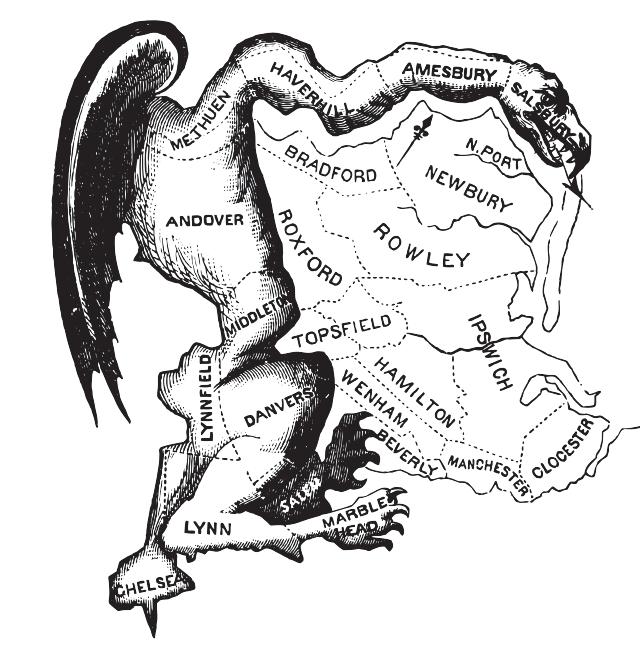
inent Federalist. When conversations focused on the detested redistricting bill, illustrator Elkanah Tisdale drew a picture map of the district as if it were a monster, with claws and a snake-like head on its long neck. One dinner guest remarked that it looked like a salamander. Poet Richard Alsop, who often collaborated with Tisdale, suggested it resembled a “Gerry-mander” instead. Another, yet less credible, version of the term’s origin credited painter Gilbert Stuart, famed portraitist of George Washington, with drawing the monster on a visit to a
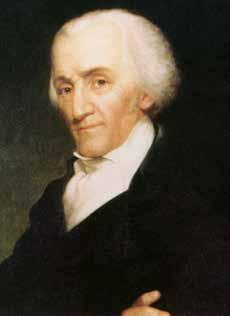
Massachusetts governor Elbridge Gerry signed a redistricting bill in 1812 that created a partisan district in the Boston area that was said to resemble a mythological salamander.
HOUSING Bigelow Village – Rutland
LIVING Congregational Retirement –Melrose
Term likely originated at dinner party
According to an 1892 article by historian John Ward Dean, the word “gerrymander” was coined at a Boston dinner party hosted in March 1812 by a prom-
Massachusetts governor Elbridge Gerry signed a redistricting bill in 1812 that created a partisan district in the Boston area that was said to resemble a mythological salamander.
newspaper office.
Tisdale’s illustration headlined “The Gerry-mander,” appeared in the March 26, 1812, edition of the Boston Gazette with a fanciful satire joke about the beast having been born in the ex-
treme heat of partisan anger. It had the caption: “Many fiery ebullitions of party spirit, many explosions of democratic wrath and fulminations of gubernatorial vengeance within the year past.” The word gerrymander gained popularity by the 1820s but was not entered in Webster’s Dictionary until 1864. According to H. L. Mencken’s book “The American Language,” the reason for it not being added earlier may have been due to Noah Webster’s family friendship with Elbridge Gerry’s widow. Gerry died in 1814, two years after signing the bill.
Massachusetts is not alone when it comes to odd-looking gerrymandered maps. Ohio has its “Lake Erie Monster” and Pennsylvanians have to live with “Goofy Kicking Donald Duck,” but the Massachusetts “Gerry-mander” map may be the most freakish looking of them all.
SUBSIDIZED HOUSING
Colony Retirement – Worcester
Green Hill Towers – Worcester Sherwood Village – Natick
*_____________________________ EMAIL _ *Your phone number is required to process your request. It will be used only in regard
that you have marked. ASSISTED LIVING FACILITIES Brookhaven Assisted Care – West Brookfield Heywood Wakefield Commons – Gardner
By sAnDi BArrett contriButing Writer
REGION – Holiday gifts can be more than a simple trinket. Gifts that speak to the recipient’s passions show thoughtful planning — and travelers love planning! Spending time with your loved ones is another precious gift; consider an overnight stay or long weekend getaway with your favorite person or your entire family.
Beach breaks
Booking a gifted beach getaway is a surefire way to set the stage for an unforgettable adventure. Massachusetts has so many gorgeous beaches. Consider Gloucester and the Beauport Hotel for a luxurious beach getaway. A pre-planned summer toes-in-thesand weekend will surely chase away the winter blues.
For the younger generations, Skillmaticks makes an outdoor game for ages 4-7. “Found It! At the Beach/ Smart scavenger hunt” comes with 50 waterproof cards to keep busy little bodies engaged in the adventure.
Waterproof and sandproof beach mats are one of the best beach creations ever. No worries about lugging heavy, wet, and sandy blankets. Amazon has lots of beach mat options for you to compare. They come in a variety of sizes, colors, and patterns.
Hiking adventures
Great day hikes await your footfalls across the Commonwealth. From the Blue Hills Skyline Loop in Quincy to the Cape Cod Rail Trail to Bish Bash Falls Trail in the Berkshires, you will enjoy gorgeous scenery while racking up your step count.
For a luxurious treat, wrap up your Berkshires hiking adventures with a wellness stay at Canyon Ranch in Lenox. With an array of spa services, outdoor recreation, pool, and dining room, it is the perfect gift for a health-conscious enthusiast.
An unusual gift are the Firefly recovery devices; they help with circulation to speed recovery. They are a great option for a strenuous hiker. They are also perfect for long haul flights by stimulating blood flow.
Cold weather escapades
There are several wonderful local ski areas, perfect for day trip skiing.
An overnight option is Jiminy Peak Mountain Resort in Hancock. They offer great skiing and several onsite resort options. Perfect for a family getaway gift – downhill and bonding.
If you are out and about in the chilly New England weather, car batteries can be a troublesome issue. A remote car battery charger is the perfect gift for the winter outdoor enthusiast. Amazon has lots of great options.
The traveler who loves to ski will enjoy the illustrated book “The Man Behind The Maps: Legendary Ski Art ist James Niehues.” A collection of 200 ski resort trail maps.
Camping escapes
Book a yurt at Nickerson State Park and experience an untraditional way to camp. Located on the Cape in Brew ster, the state park is close to tons of Cape Cod fun.
Campers who enjoy cool weather camping will love wearing a heated vest. The battery operated heating el ements circulate throughout the vest keeping the wearer toasty without impeding arm movement. Amazon offers several vendors for you to pe ruse.
Travel guides
A travel guide can open your eyes to adventures you never knew existed. The “Massachusetts Travel Guide” and the “Massachusetts Bucket List Adventure Guide” are both available on Amazon along with other great local guide books.

A great planning app, Wanderlog offers a free version for basic trip planning and a pro version with a monthly and yearly rate. The pro version has offline access (important for travel where Wi-Fi is intermittent), road trip route optimization, and a document attachment feature. Planning the trip is half the fun and Wanderlog is a solid planning assistant.

Massachusetts has over a dozen National Park sites including Cape Cod National Seashore, Minute Man National Historic Park, and other his toric sites and recreation areas. The “National Geographic Complete Na tional Parks of the United States” book from Layitflat.com is a comprehensive National Parks guide and would make a great gift for the National Parks wanderer.

“A Sound Heart is Life to the Body.”
Proverbs 14:30
God’s command for us is to love ourselves means, in part, that we are to do nothing that will bring harm to ourselves... God gave His law to mankind not to diminish man’s fun or to put damper on man’s ability to experience life fully: Rather, He gave the law so that man might avoid circumstances that would produce physical, material, emotional or spiritual harm.

- Charles F. Stanley




No need to be overwhelmed. Just focus on the
We’re here to provide you with all the information you need to make an informed decision about the next step for you or your loved one’s journey – whether that be finding a facility with a program specializing in your healthcare needs, or simply a facility close to family. It is our highest priority to make our residents safe, comfortable, happy, and healthy. We’re here to help.

the QR code or visit NextStepHC.com/locations to find a Next Step facility that is perfect for your individual needs, plus virtual 3D tours & more!