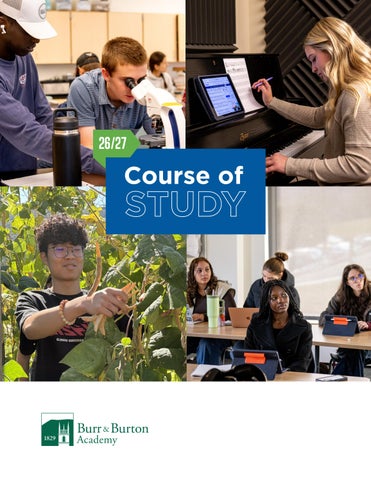
26/27
![]()

26/27


February 2026
Dear Students:

This Course of Study represents something both simple and profound: choice. Within these pages are courses, experiences and challenges that will shape how you spend your time, stretch your thinking, and discover more about who you are and who you are becoming.
At Burr and Burton Academy, we believe deeply in both breadth and depth. We want you to build real strength in areas that matter to you, while also encountering ideas, disciplines, and perspectives that may feel unfamiliar at first. Some of the most meaningful learning happens when you lean into a challenge, follow a curiosity, or take a risk on something new.
As you make your selections, think intentionally. Ask yourself not only What am I good at? but also What might help me grow? Choose courses that demand effort, invite creativity, build skills, and spark genuine engagement. This catalog reflects the care, imagination, and expertise of a faculty committed to helping you do just that.
Your time at BBA is precious. You will not take every course in this book, but the choices you make will matter. Own them. Use them well. And remember that learning is not only preparation for the future; it is also a way of fully inhabiting the present.
I am excited to see how you shape your path.
Go, Bulldogs!
Sincerely,

Mark H. Tashjian Headmaster
Note: While we hope to be able to offer every course listed in this booklet, on occasion a course is canceled due to lack of enrollment, scheduling difficulties, or other similar circumstances. Conversely, we may add additional courses that will be announced at an appropriate forum.

Burr and Burton Academy’s mission is to educate students intellectually and morally for a life of responsibility, integrity, and service.
Burr and Burton delivers on its mission through its core values:
• Engaging, vigorous educational experiences
• Respect for individual differences
• The highest standards of performance and behavior
• A mindset of perseverance and reflection
• A supportive and caring community
• Joy and a love of learning
2/ Introduction
Academic Program
Graduation Requirements, Grading System and Credits
7/ Creative Arts
Media and Performing Arts
Visual Arts and Design
18/ Farm and Food Studies: Courses at the Hildene Farm
20/ Humanities
English and English Language Development
Social Studies
32/ Mountain Campus Program
34/ Physical Education and Wellness
37/ STEM: Science, Technology, Engineering and Mathematics
Mathematics
Science
Computer Science, Engineering, Robotics, and Technology
52/ World Languages
57/ Flexible Pathways: Personalized Learning Opportunities Dual Enrollment Independent Study Off-Campus Study
Early College
Work-Based Learning: Internships Tools, Techniques and the Trades
Southwest Tech Programs
61/ Programs and Resources to Support Burr and Burton Students Health Center
International Program
Library Services
School Counseling
MTSS: Multi-Tiered System of Supports Student Accessibility Services
Student Success Program Target Program
73/ Four-Year Academic Plan Worksheet
Photography credits: James Chandler ‘10
Becca Allen
Nora Hefner
Jarren Hewes ‘27
Abby Lalor
Peter MacFarlane
Jessica Miksis
Claire Isherwood
This publication is designed to help students map out their studies at Burr and Burton. In order to thoughtfully plan their curriculum, students should consider the courses that they need to take each year, as well as their college and career goals, and ask these questions:
What subjects interest me and why? In what subjects have I been most engaged? What courses am I curious about and might like to explore?
What kind of student have I been? What kind of student do I aspire to be?
What type of education will I need beyond high school in order to fulfill my college and career goals?
Students work with their school counselor to design a plan of study. This includes ensuring the fulfillment of graduation requirements and setting academic goals. In selecting courses, students should be aware of graduation requirements, as well as the sequencing of courses in certain disciplines. A worksheet located on the inside back cover of this booklet is available to help students draft a four year high school plan.
School counselors, faculty advisors, and teachers are all available to support students in this process. Students are encouraged to challenge themselves at the highest appropriate level and to explore the rich array of courses that Burr and Burton offers.
The Burr and Burton Academic Program is guided by its mission and core values and has three components:
1
Throughlines: the BBA Spires
2
Subject-Centered Objectives
Skills and habits of mind supported throughout academic and co-curricular programs.
Essential concepts and skills in academic domains applied in authentic situations.
3
Essential Experiences
Opportunities for authentic learning that prepare students to be successful, engaged citizens.
Social Studies
• Use history and social science skills and content to understand one’s identity, different cultures/ perspectives, and current global issues in our interdependent world.
Preparedness Participation
Citizenship
Wellness Communication Problem Solving Integrative Thinking
• Locate, evaluate, and use diverse academic resources to construct evidence-based arguments.
• Understand and exercise rights and responsibilities within a democratic society. These include inclusivity and belonging for all members of society.
World Languages
• Demonstrate level-appropriate proficiency in interpersonal, interpretive and presentational communication.
• Demonstrate level-appropriate cultural competency.
Visual Arts
• Plan, create/prototype, present, and respond to/ reflect on art that one sees and makes.
• Connect art to historical and cultural contexts.
Media and Performing Arts
English
• Read for academic purposes and for pleasure.
• Construct meaning collectively and individually through speaking, listening, reading, and writing in a variety of genres.
• Explore and better understand diverse perspectives of the world through reading, speaking, writing and listening.
• Practice mindfulness and metacognition through reflective writing and journaling.
• Read and create strong arguments.
Mathematics
• Collaborate and communicate using mathematical reasoning.
• Employ different mathematical approaches to problems, think critically, and persist through challenges to solve them.
• Use technology as an aid to facilitate mathematical work and the exploration of data, probability and statistics in real-world applications.
Science
• Ask testable questions, conduct investigations, and analyze data to draw meaningful conclusions.
• Apply biological, chemical, and physical principles to create models, conduct lab-based inquiries, and tackle novel questions.
• Develop data literacy and critical thinking skills to make informed decisions about health and environmental issues that affect both personal and community well-being.
• Present findings and communicate them effectively.
• Engage in the creative, collaborative process of making art with social impact.
• Strengthen creative skills through the study of craft and technique.
Physical Education and Wellness
• Develop strategies and interpersonal skills to cultivate emotional wellbeing.
• Employ healthy behaviors and physical activity to promote life-long wellness, enjoyment, selfexpression, and positive social interaction.
Digital Exploration
• Explore new and emerging technologies/interact with computers to create original products and solve problems.
• Integrative, immersive learning experience.*
• Service to the school and to the greater community.*
• Presentations/Exhibitions/Demonstrations of Learning.
• Participation in activities/experiences that lead to personal wellness.
• Participation in activities/experiences that contribute to and cultivate a culture of belonging.
* required for graduation
Beginning with the class of 2028, students are required to participate in and successfully complete at least one integrative, immersive learning experience. Integrative, immersive courses and experiences prioritize meaningful engagement and interdisciplinary connections. These experiences aim to cultivate deep learning, curiosity, and the ability to apply knowledge in real-world contexts. They are place-based, work-based, and/or experiential, resulting in engaged students who see the value and relevance of their education.
Students can fulfill the integrative, immersive learning requirement in any of the following ways:
Choose one of the following:
• Farm and Food Studies: any two classes
• World Language: level 3 plus participation in an overseas international exchange
• Southwest Tech: one full semester
• Model United Nations: Honors MUN plus participation in 2 conferences
• Success Program: Prep for Success plus Taconic and Green Mentorship or Big Brothers Big Sisters or an Opportunity Grant that furthers postesecondary goals
• Science and Field Experience: Biology, a Farm and Food Studies science class, or CP Data Science plus a science-sponsored research trip or field experience
• Participation in the Governor’s Institute of Vermont
• Work-based Learning Internship paired with a relevant academic class (for example, an internship in athletic training plus CP Sports Medicine)
• Visual Arts: two visual arts classes paired with a solo or group art show/exhibition
Option 2:
Complete TWO experiences in ONE category:
• Media and Performing Arts: a dance, drama, music, or cinema class; Debate Club; fall or spring play
• Engineering and Technology: Robotics Foundations, CP or Honors Advanced Robotics and Engineering, CP Engineering Through Computer Aided Design, CP Advanced Engineering, CP Programming 1 or 2, Honors or AP Calculus, Project Bike Tech, Science Olympiad
• Civics and Leadership: CP Climate, Leadership and Change; CP SS 2 or Honors U.S. Government; Close Up trip to Washington, D.C.
• Writing and Media: CP Creative Writing, public reading, publication in Manchester Journal or VTDigger, staff of Bulldog Bulletin or Between Ranges, BBA Library Internship
• Neurodiversity, Sport, and Wellness: Neurodiversity in Sport and Wellness, Special Olympics or Unified Sports, related workbased learning or service learning
• Business and Finance: CP Entrepreneurship, CP Small Business Start Up, Personal Finance, Student Accessibility Youth Employment, related work-based learning internship
• Trades and Applied Design: geometry and woodworking, CP Engineering Through Computer Aided Design, Tools, Techniques and the Trades, work-based learning internship
Although world language classes are not a Burr and Burton graduation requirement, they are frequently a college admissions requirement. College-bound students should plan accordingly.
All students must be enrolled in 1 English and 1 social studies course each year.
A student who is a member of a Burr and Burton competitive sports team for a season is eligible for a one-third credit exemption toward the physical education requirement.
A student who is a cast or crew member of a fall or spring theater production is eligible for a one-third credit exemption toward the arts requirement.
Students must fulfill their yearly service-learning requirement. 9th and 10th grade students complete service requirements through scheduled days of service; an additional 25 hours of independent service to the community is required for graduation. Students can access support in fulfilling their service hours
by contacting Burr and Burton’s service learning coordinator.
Courses that fulfill requirements for graduation in more than one discipline are listed under both disciplines.
Burr and Burton requires 28 credits for graduation. The total number of credits includes 19 from required core courses, supplemented by credits from elective courses.
Core Course Requirements
4
4
and Science 7 (4/3 or 3/4)
1
1
Exploration 1
Burr and Burton uses a letter grading system and letter grades have the following numerical equivalents:
The following table indicates the values given at different course levels for weighted GPA.
Repeatable courses, such as Instrumental Music
Ensemble, allow students to earn a grade as well as the associated credit each time the course is taken. Retaken courses are classes that students take more than once in order to improve mastery. After completing a retaken course, the student’s original grade and the new grade both appear on the student’s transcript and are averaged into the grade point average. Retaken courses each earn a credit on the transcript but count as a single credit in fulfilling graduation requirements.
Honor Roll is announced annually in June and is based on all final course grades for the year. To qualify, a student must have attended Burr and Burton for the entire academic school year on a full-time basis. Honor roll designations are calculated using an unweighted GPA, and fall into two categories: Headmaster’s List (an overall grade point average of 4.00) and Honors (an overall grade point average of 3.50 or higher). Any student who fails a course, receives an incomplete, or has an empty grade for any course is ineligible for honor roll status. Students may appeal their honor roll standing by contacting their school counselor.
Burr and Burton does not rank students. At graduation, Burr and Burton recognizes a select group of Valedictory Scholars who have achieved a 4.8 GPA (average of weighted and unweighted GPAs). Two members of this select group of scholars are chosen to speak at graduation. Graduation honor cords are awarded to all students with a cumulative, unweighted GPA of 3.75 at the start of the second semester of senior year.
All students are required to take a minimum of four core academic courses each year, ideally with two each semester. Core academic courses are defined as classes that fulfill graduation requirements in English, social studies, math and science. Students are also expected to take four elective courses each year, for a total course load of 8 credits. Seniors are expected to take at least three elective courses and earn a minimum of 7 credits.
A maximum of 9 credits per academic year may appear on a student transcript and count toward a student’s GPA. Any independent study courses or dual enrollment courses beyond the two dual enrollment courses covered by state vouchers and outside of the Burr and Burton Course of Study are taken at the expense of the student and are not calculated into a student’s GPA. They will be denoted on the transcript if taken through an accredited program and if there are no more than 9 credits in any academic year.
• 9th grade to sophomore year: 6 credits.
• Sophomore to junior year: 13 credits.
• Junior to senior year: 20 credits.
• Seniors need a minimum of 28 credits to graduate. Transfer students who arrive at Burr and Burton with a credit deficit may graduate with 26 credits.
All course prerequisites must be satisfied before a student can enroll in a course. Students should pay careful attention to prerequisites when selecting courses.
The process of academic planning represents a great deal of effort on the part of students, parents/ guardians, faculty, staff and administrators. Therefore, students are strongly encouraged to remain in the courses that are on their schedule at the beginning of the school year; it is expected that this is a final decision on their part and that they will see the course through to completion. Once classes begin, it becomes
very difficult to change schedules, so students should be prepared to remain in their chosen classes. In cases where a course drop is necessary, students may add/ drop courses during the first five days of classes. Courses dropped before this time will not appear on the student’s record. Courses dropped after the deadline will be recorded as a W (Withdrawn).
Students considering college athletic participation at the Division 1 or Division 2 level should include courses approved by the NCAA in their four-year plan. These courses are at the College Preparatory level or higher. For specific information, students can refer to the NCAA Clearinghouse resources online at http://www. ncaa.org/student-athletes/future, or speak to their school counselor.
• Class titles prefaced by CP are taught at the College Preparatory Level.
• Class titles prefaced by Honors are taught at the Honors Level.
• Class titles prefaced by AP are taught at the Advanced Placement Level.
• Classes without one of the above designations are taught at the General Level.
• Class titles prefaced by DE (Dual Enrollment) are weighted at the Advanced Placement Level.
• All classes, unless otherwise indicated, fulfill 1 course credit.
Accurate and secure permanent records and educational files are maintained for each student by the school registrar. Transcripts and other permanent records are prepared and forwarded upon written request.
The mission of the media and performing arts department is to provide high quality artistic opportunities for students. Classwork, performances, and exhibitions are designed to nurture creative spirit, promote design thinking skills, and advance creativity. Students engage in the collaborative process of making art with social impact, and they strengthen creative skills through the study of craft and technique.
Most media and performing arts courses are “level-blended,” allowing for multi-year study. Levels are defined as:
Foundations: Entry-level course.
Studio: Second year in a specific discipline. Prerequisites: a suggested grade of B or higher in the foundations level course as well as teacher recommendation.
CP Advanced Projects: Third year in a specific discipline. The individualized curriculum is co-created with each student. Prerequisites: a suggested grade of B or higher in a Studio level course.
One arts credit from any of the visual arts and design or media and performing arts course offerings is required for graduation, as is one digital exploration credit, which can be fulfilled through media arts and music technology course offerings. Other disciplines, including STEM and visual arts and design, offer opportunities to fulfill the digital exploration credit as well. See course descriptions for information on credits.


A student who is a cast or crew member of a fall or spring theater production is eligible for a one-third credit exemption towards the arts requirement. Students must participate in three theater productions to be exempt from the arts credit. Students in performing arts classes can fulfill the integrative, immersive learning experience graduation requirement through participation in any two of the following experiences: 2 performing arts classes (dance, drama, music, cinema), participation in the Debate club, participation in a fall or spring play.

1 arts or 1 physical education credit
What does it take to be a dancer? This course is designed to provide students with the basic techniques needed to express themselves through the art of movement. Students explore a variety of dance styles, the use of body conditioning, the understanding of the body in motion, and are introduced to techniques and concepts of dance. Students of any level, beginner through advanced, are welcome. Foundations of Dance students perform with the Dancer’s Studio and Advanced Projects ensemble.
1 arts or 1 physical education credit
Dance Studio provides students with the intermediate and advanced techniques needed to express themselves through the art of movement. Students continue to explore a variety of dance styles, the use of body conditioning, the understanding of the body in motion, and further their techniques and concepts of dance. Dancer’s Studio students continue to perform with the Foundations and Advanced Projects ensemble.
PREREQUISITE: Successful completion of Dance: Foundations.
1 arts or 1 physical education credit
Experienced dancers who successfully completed Dancer’s Studio benefit from an exploration of additional movement genres, advanced choreography, and the development of leadership skills in the dance studio. The individualized curriculum focuses on the needs of the student and the genre of study. Students receive individual feedback, mock audition sessions, and assistance from industry professionals. Advanced Projects students continue to perform with Dancer’s Studio and Foundations of Dance ensemble.
PREREQUISITE: Successful completion of Dance Studio or permission of the teacher.
1 arts or 1 digital exploration credit (see credit options under course titles)
Students who take this class as a “double block” earn 2 credits.
Students in the Film, Media, and Theater Production class learn how to tell stories while discovering their unique artistic voice, ultimately creating multiple projects that can be shared in film or on stage. This team-taught
class led by industry professionals provides students with opportunities to write, produce, and generate several films, media, and theatrical productions. Students explore film and theater history, critically analyze storytelling styles, and learn how to write, perform, direct, produce, operate cameras, and edit. Projects are shared during the annual Dance, Drama, and Film Showcase at the end of each semester, as well as the annual Film Festival at the end of the school year. This is a repeatable course. Students can focus on areas of interest, denoted in the course titles below.
1 arts or 1 digital exploration credit
Students who focus on cinematography learn how to tell engaging stories using film cameras and techniques employed by Hollywood production companies. At first, students complete specific assignments to help build their cinematic vocabulary and technique. Students progress to developing their own projects and experimenting with different filmmaking styles, including music video production. Throughout, students gain experience using cameras, lights, microphones, and editing software to share their stories.
1 arts credit
Students who focus on acting learn basic acting techniques to create believable, three-dimensional characters for stage and film. Through monologues, scene work, and feedback from peers and instructors, they build acting skills and confidence. Students collaborate with peers when creating original pieces for stage and film. Students are given time to research, prepare, and film college audition pieces as needed.
FILM, MEDIA, AND THEATER PRODUCTION: DIRECTING
1 arts credit
Students who focus on directing interpret scenes and monologues. They study effective communication and collaborate with actors during the rehearsal process for both stage and film. Students direct scenes for film projects and for the Dance, Drama, and Film Showcase at the end of the semester.
FILM, MEDIA, AND THEATER PRODUCTION: MUSICAL THEATER
1 arts credit
Students who focus on musical theater are introduced to its history in the U.S. Depending on interest, students are offered an opportunity to build upon skills learned in additional acting, dancing, and voice classes to enhance their song interpretation and performance abilities. Students are given time to research, prepare, and film college audition pieces as needed.
1 arts or 1 English elective credit. This course fulfills the senior English credit if taken during senior year. Students who focus on writing create original monologues, commercials, PSAs, scenes, plays, and screenplays. They read and study plays, screenplays, and informative texts. Students also draft personal and persuasive essays, and they review films and live performances. Students come to understand and appreciate the synergy and creativity that occurs when creative storytelling transitions from the page to the stage and screen, while learning the differences and similarities between the two genres.
1 arts or 1 digital exploration credit
Technical Theater introduces students to a basic understanding of principles of scenic design, lighting design, sound reinforcement, and other technical aspects of the theater. Working closely with the Riley Center’s technical director, this select group of technicians develops the necessary skills to run all backstage operations for school and community productions, including set construction, tool safety, sound and light programming, and systems for theater management. Requirements may include running crew for evening and weekend performances. Course enrollment is limited and is at the discretion of the teacher.
1 arts or 1 digital exploration credit
Designed for students who enjoy watching animated films, doodling or making flip book cartoons, this course introduces the basics of 2D animation. Students create their own animated films, complete with sound effects, cameras, and original artwork, using Toon Boom Animation Studio.
1 arts or 1 digital exploration credit
Students who wish to learn more advanced animation techniques and improve their animation skills use Toon Boom’s latest software release, Toon Boom Harmony, to explore animation on a deeper and more complex level. PREREQUISITE: Successful completion of Digital Animation: Foundations.

1 arts or 1 digital exploration credit
Students pursue individualized advanced animation projects. PREREQUISITE: Successful completion of Digital Animation Studio.
1 arts or 1 digital exploration credit
This course introduces students to digital photography equipment, materials, programs, processes and philosophies. The exploration includes both the historical and contemporary significance of photography across cultures. The main focus is on artistic expression. Students learn the technical aspects of a digital singlelens reflex camera, and the use of the exposure triangle (ISO, aperture and shutter speed) in purposefully creating photographic art. Elements and principles of art are introduced to help students understand composition and the aesthetics of photography. Using high-quality computers and software, students learn to edit and craft engaging compositions. Students create individual websites to showcase their portfolios.
1 arts or 1 digital exploration credit
Students who want to go deeper into their study of photography get a more comprehensive look at image structure, camera control, lenses, photographic vocabulary, history, and renowned image makers. The curriculum also covers lighting techniques and the studio environment. PREREQUISITE: Successful completion of Digital Photography Foundations with a suggested grade of B or higher, as well as teacher recommendation.
1 arts or 1 digital exploration credit
Students interested in this course submit a curricular proposal for consideration. This portfolio-building class is for students who wish to explore the photographic process at an advanced level. PREREQUISITE: Successful completion of Digital Photography Studio with a suggested grade of B or higher, as well as teacher recommendation.
1 arts or 1 digital exploration credit
Foundations of Digital Graphic Design teaches students how to effectively communicate ideas by using symbols, images and words to create clear and meaningful messages. By applying design thinking and iterative processes, students learn to employ elements of design and bring order and clarity to their work. Students design logos, posters, product packaging, web pages and ads.
DIGITAL GRAPHIC DESIGN:
1 arts or 1 digital exploration credit
Students who wish to further their artistic and creative abilities in graphic design can delve into an advanced study of software, technique, and design thinking through individual exploration and project creation.
PREREQUISITE: Successful completion of Digital Graphic Design: Foundations with a suggested grade of B or higher, as well as teacher recommendation.
1 arts or 1 digital exploration credit
Students interested in a deeper study of graphic design submit a curricular proposal for consideration. This is a portfolio-building class for students who wish to explore the design process at an advanced level. PREREQUISITE: Successful completion of Digital Graphic Design Studio with a grade of B or higher, as well as teacher recommendation.
1 arts or 1 digital exploration credit
Students learn how to think and design like an engineer to build and program “autonomous” robots, including a battlebot, a racecar, a climber, and more. This course is ideal for students who enjoy tinkering, building with LEGO, taking things apart to see how they work, and/or those who are curious about how engineers design the products and technologies we use every day.
1 arts or 1 digital exploration credit
Students learn how to design and code 2D and 3D video games with game engines such as Construct 3, Roblox Studio, and GameMaker Studio. This class is ideal for students who enjoy strategy games, digital art, and, of course, playing video games. No previous programming experience is necessary.
1 arts or 1 digital exploration credit
Students who want to design 3D or VR video games explore the world of visually stunning 3D game engines like Unreal and Unity. These are the game engines used to design popular games such as Fortnite, Call of Duty, Ark: Survival, and Final Fantasy. PREREQUISITE: Successful completion of Video Game Design: Foundations.
1 arts or 1 digital exploration credit
Students pursue individualized advanced video game design projects. PREREQUISITE: Successful completion of Video Game Design Studio.
1 arts credit
This class provides musicians with an opportunity to learn a new instrument or advance their musicianship on a familiar instrument. Students build foundational skills through practice habits, research, and reflection, with the assistance of a teacher specializing in the student’s area of interest.
1 arts credit
Students who wish to continue their musical journey build upon the skills, techniques and topics studied in Applied Music Foundations, guided by a teacher specializing in the student’s area of interest. PREREQUISITE: Successful completion of Applied Music: Foundations.
1 arts credit
Students further explore music through project proposals, research, presentations, and reflections, guided by a teacher specializing in the student’s area of interest. PREREQUISITE: Successful completion of Applied Music Studio.
1 arts or 1 social studies elective credit
Classic Music History highlights the development and history of Western European music from Antiquity, the Middle Ages, the Renaissance, the Baroque, the Classical and the Romantic Periods. Students listen, watch, read, research, take field trips, meet special guests, and pursue integrative projects. Those wishing to pursue advanced topics/projects may take this course for honors credit.
1 arts or 1 social studies elective credit
Contemporary Music History highlights the birth of music in the U.S., including Jazz, American Roots, Electronic Music, Broadway, and Rock & Roll. Students listen, watch, read, research, take field trips, meet special guests, and pursue integrative projects. Students who wish to pursue advanced topics/projects may take this course for honors credit.

1 arts or 1 social studies elective credit
Students explore multicultural music from around the globe through listening, watching, reading, researching, taking field trips, meeting special guests, and pursuing integrative projects. Students who wish to pursue advanced topics/projects may take this course for honors credit.
CP/HONORS MUSIC
1 arts or 1 digital exploration credit
This class explores the fundamentals of music theory through composition, analysis, and aural skills. Students use a variety of technology, tools, and resources. Students who wish to pursue advanced topics/projects may take this course for honors credit.
INSTRUMENTAL MUSIC ENSEMBLE
1 arts credit
Instrumental Music Ensemble is a large, collaborative performance group for students who enjoy making music together. Students perform on brass, woodwind, percussion, or orchestral string instruments and take part in a variety of musical experiences, including concerts, assemblies, and community performances. Students should have basic familiarity with their instrument and with reading music.
CP ADVANCED INSTRUMENTAL MUSIC ENSEMBLE
1 arts credit
Students who have been in the instrumental music ensemble for at least two years continue to perform with the instrumental music ensemble and serve as musical leaders for the group.
1 arts credit
The vocal music ensemble welcomes singers interested in exploring a wide variety of musical styles, developing singing techniques, and building community via concerts, festivals, and collaborations.
CP ADVANCED VOCAL MUSIC ENSEMBLE
1 arts credit
Students who have completed two years of membership in the vocal music ensemble continue to perform with the vocal music ensemble and serve as musical leaders for the group.
MUSIC PRODUCTION: FOUNDATIONS
1 arts or 1 digital exploration credit
Students in Music Production learn to edit, mix, and produce music in Logic Pro along with strategies to compose and create original songs using music theory. Students gain knowledge of audio editing as well as essential skills for manipulating MIDI and audio information. Basic skills for music composition are introduced, and aspiring musicians are provided with AI-assisted tools to help enhance their ability to compose and produce original music, regardless of their level of experience. Throughout, students complete various projects, including creating playlists, analyzing songs, creating original compositions, scoring music for films, and more. Students of all levels of ability are welcome.
1 arts or 1 digital exploration credit
Students continue their exploration of digital music. In addition to reviewing and improving foundational skills, students have opportunities to learn recording techniques, mixing and mastering skills, advanced synthesis, and other new skills while creating digital music. PREREQUISITE: Successful completion of Music Production: Foundations.
1 arts or 1 digital exploration credit
Students are guided through project proposals, research, presentations and reflections on any music production topic. PREREQUISITE: Successful completion of Music Production: Studio.
1 arts or 1 digital exploration credit
Students with an interest in creating music for movies, commercials, or animation explore the creative process of the film music composer and learn how music adds to the dramatic underpinnings of the visual experience. Students digitally create musical events for movie shorts, commercials, and other dramatic material. Students of all levels of ability are welcome.
1 arts or 1 digital exploration credit
Students in Film Scoring at the studio level work closely with cinematography students to create digital music for original productions. Students act as producers and composers, collaborating with film directors to provide audio that matches their creative vision. PREREQUISITE: Successful completion of Film Scoring: Foundations.

1 arts or 1 digital exploration credit Students are guided through project proposals, research, presentations, and reflections on any film scoring project. PREREQUISITE: Successful completion of Film Scoring: Studio.
1 arts or 1 digital exploration credit Students in Songwriting learn to compose and record original music on an instrument of their choice. In addition to learning basic editing techniques in LogicPro, students gain essential skills in recording vocals and instruments. Basic music composition and music theory skills are also introduced, and aspiring musicians are provided with AI-assisted tools to help enhance their ability to compose and produce original music. Throughout, students complete various projects, including writing and recording original songs. Students of all levels of ability are welcome.
1 arts or 1 digital exploration credit Students continue their exploration of songwriting. While reviewing and improving foundational skills, students have opportunities to learn new recording and composition techniques, as well as other skills useful to writing and recording original music. PREREQUISITE: Successful completion of Songwriting: Foundations.
1 arts or 1 digital exploration credit Students are guided through project proposals, composing, and recording original songs. PREREQUISITE: Successful completion of Songwriting: Studio.
The mission of the visual arts department is to provide the opportunity for students to explore and express their personal ideas and collective understandings within a larger context through the study and creation of original works of art/design. Visual arts and design courses:
• Promote visual literacy through the intentional use of media, materials, technique, and the elements and principles of design, in order to communicate meaning.
• Challenge students to look carefully and critically at art in order to see connections through personal, historic, and cultural contexts.
• Develop curiosity and agency through an interdisciplinary approach to problem-solving as students plan, create, present, and respond to art that they see and make.
• Build community and foster cultural awareness.
• Engage students in the process of creating art as a reflection of the human experience.
Many visual arts courses are “level-blended,” allowing for multi-year study. Levels are defined as:
Foundations: Entry-level course.
Studio: Second year in a specific discipline. Prerequisites: a suggested grade of B or higher in the foundations level course and strong habits of learning assessments.
CP Advanced Projects: Third year in a specific discipline. The individualized curriculum is co-created with each student. Prerequisites: a suggested grade of B or higher in a Studio level course, or permission of the teacher.
One arts credit from any of the visual arts and design or media and performing arts course offerings is required for graduation. See course descriptions for information on credits. Students in visual arts classes can fulfill the integrative, immersive learning experience graduation requirement through participation in any two of the following experiences: 2 visual arts classes, and participation in a solo/group art show.
This course is offered every other year (Offered in 2026-2027)
1 arts credit
In Art of Nature, students explore place, perspective, and materials by making art in the outdoors. Students learn how to make materials such as charcoal, ink, paper, dyes, and brushes from the natural environment to deepen their relationship with the tools they use to create. Hand-made materials are used to practice and challenge students’ fine art techniques, with the landscape as an ever-changing studio. The range of values, hues, and perspectives offered by the land at Hildene Farm allows students to refine their observational skills. Students document the changing landscape and their material-making by building a portfolio using media that may include drawing, painting, sculpture, printmaking and fiber arts. This class takes place primarily at the Farm and Food Studies classroom at Hildene Farm. Most classes are held outdoors. PREREQUISITE: Successful completion of Visual Arts: Foundations or Design: Foundations.
1 arts credit
Ceramics: Foundations introduces students to the medium of clay, from its raw state to the finished project. Students practice hand building skills, including pinch, coil, and slab building methods. Basic wheel throwing techniques are also introduced. Discussions, demonstrations, and projects focus on creating traditional
tableware, ceramic sculpture and vessels, and glazing processes. Students explore the world of ceramics, both past and present, and draw from personal experience to complete projects. There is a strong emphasis on developing students’ artistic voice, aesthetics, and ideas.

1 arts credit
Students build upon their hand sculpting and wheel throwing skills as they continue to develop their personal voice and aesthetic. Projects are both teacher and student-directed. Students participate in the management of the ceramics studio, including kiln loading, clay preparation, and glaze maintenance. Prerequisites include a grade of B or higher in the Ceramics: Foundations course and strong habits of learning assessments.
1 arts credit
Teachers and students work together to create a curricular plan focused on building a cohesive body of work centered on students’ goals. Students participate in the management of the ceramics studio, including kiln loading, clay preparation, and glaze maintenance. PREREQUISITE: Successful completion of Ceramics Studio, or permission of the teacher.
1 arts or 1 digital exploration credit
By engaging in a series of creative projects, technical practice, and problem solving, students in this course seek to acquire understanding of the basic elements and principles of design, to utilize the design process, and to develop technical skills of craftsmanship, problem solving, and conceptual visualization. In order to make two and three dimensional projects, students learn various design tools and techniques, both traditional and contemporary, common to the field. Knowledge and skills acquired in this class provide students with the critical foundation for further explorations in art and design, including graphic design, product design, interior design, architecture, fashion, animation, and the fine arts.
1 arts or 1 digital exploration credit
In this project-based course, students take a deeper approach to the design process, explore compositional skills, and utilize more design tools and techniques. Students also focus more closely on creative problem solving, the balance of functionality and aesthetics, more nuanced approaches to communicate their ideas, and the ethical role of the designer in society. Students work with the teacher to focus on their particular field of design. PREREQUISITE: Successful completion of Design: Foundations, Digital Graphic Design: Foundations, or Visual Art: Foundations.
1 arts or 1 digital exploration credit
In this project-based course, students further their study within a particular design field of their choosing. Students create a proposal for a self-designed and directed

project that shows sustained, meaningful, and nuanced investigation into a particular aspect of design. Projects may be interdisciplinary or a focused exploration of a specific design principle, skill, or challenge. Alternatively, students may work within a more structured environment on projects developed by the teacher. PREREQUISITE: Successful completion of a Studio level visual arts course, or permission of the teacher.
See course descriptions under media and performing arts.

See course descriptions under media and performing arts.
1 arts credit
This course introduces students to the methodologies of 3D art, the history of sculpture through the ages, and what the current state of sculpture looks like. Students
engage with a multitude of materials, tools, and styles to create objects that speak to an individual’s need to express and create. The course is focused on teaching students how to approach a variety of media with either the subtractive or additive method of sculpting. Utilizing tools safely and effectively, students manipulate, attach, distort, carve, and color to bring an idea to fruition. By understanding the elements and principles of art, students plan and execute work that touches upon the necessary visual elements to build a portfolio that shows technical ability and style.
1 arts credit
This course provides the building blocks for good observational drawing and leads to the exploration of a variety of painting and mixed media techniques. It is designed to help identify and sharpen the creative ideas behind artwork while delivering the skills necessary to express those ideas. Learning and applying the elements and principles of art and design to produce unique art projects that reflect their understanding of these concepts, students develop critical thinking skills, a curious mindset for arts exploration, and the confidence to fully experience art through their own personal aesthetic.
1 arts credit
Students have the opportunity to further develop their skills, ideas, and appreciation of art through assignments that center on personal artistic voice. This course provides students with the opportunity for more in-depth study within a specific area of the visual arts, along with deeper exploration of personal aesthetics. Students may focus on painting, drawing, mixed media, and/or fashion and fiber studies. PREREQUISITE: Successful completion of Visual Art: Foundations or Design: Foundations.
1 arts credit
Students focus on developing a body of work for critical review, as well as tailoring a portfolio for submission to colleges, art schools, and/or careers in the arts. The curriculum is project and student- driven and requires a highly motivated artist. PREREQUISITE: Successful completion of Visual Art Studio or permission of the teacher.
1 arts credit
Honors/AP art courses are designed for highly motivated art students contemplating the pursuit of an art degree at the college level. Students research, create, analyze, and respond to their own artwork as well as the works of others as they prepare for the AP exam. The exam requires a well-developed inquiry question, and a fully developed portfolio that demonstrates the student’s investigation into the overarching theme through an advanced, well-constructed body of work. Because preparing for the AP exam and developing a portfolio is an intensive process, students are encouraged to pursue AP Art as a full year (every-other-day) course. If taken for two full semesters every day, students earn one honors credit and 1 AP credit. Students pursue this class independently, with the support of a visual arts teacher; strong self-directed learning skills are necessary. PREREQUISITE: Successful completion of CP Advanced Projects and Portfolio, as well as permission of the teacher. Students opting to take the AP exam are responsible for the exam fee of approximately $110 (fee reduction applications are available in the school counseling office).
Juniors and Seniors
3 CCV credits
1 Burr and Burton elective credit
Students explore the fundamentals of jewelry making, including sawing, piercing, filing, sanding, and surface enrichment while creating chains, pendants, earrings, necklaces, pins, bracelets and rings. Using metals, paper, beads, stones, found objects, fibers and recycled materials, students design and construct pieces of wearable art. Students also investigate jewelry as a craft and fine art and discuss the cultural and historical
significance of jewelry as adornment. PREREQUISITE: Successful completion of any foundations-level visual arts class. This course fulfills the arts requirement for graduation.
1 arts credit
This foundational woodworking course introduces students to designing and building projects out of wood using hand tools, portable power tools, and woodworking machines. Students are introduced to project design using 3D modeling tools, as well as to material selection, planning, layout, and safety in woodworking. Students build several projects that utilize increasingly complex design and woodworking skills as the class progresses, and finish their projects using a variety of hand-applied finishes.
1 arts credit
Students move on to more complex projects in woodworking and design. They learn to construct advanced wood joints, including dovetail and mortise and tenon, and are introduced to a variety of more advanced woodworking and finishing skills, including frame and panel construction, inlay, veneering, shaping wood, and spindle and bowl turning. At least one of the projects is required to benefit the school or community. PREREQUISITE: Successful completion of Woodworking: Foundations.
1 arts credit
Students who have the knowledge and skills to work safely and independently in the shop with minimal supervision may take CP Advanced Projects. Possible areas of focus include advanced furniture making, cabinet making, and woodturning, but any areas of woodworking may be pursued with permission. PREREQUISITE: Successful completion of Woodworking Studio and permission of the teacher.

Farm and Food Studies students have the unique opportunity to learn on-site at Hildene Farm, with its dedicated BBA classroom and garden, and access to a four-season greenhouse, just a few minutes from campus. Burr and Burton and Hildene share institutional commitments to integrity, service, civic responsibility, and sustainability, making for a strong educational partnership.
In Farm and Food Studies classes, integrative, experiential, place-based learning serves these core goals:
Giving students opportunities to approach nature and agriculture with curiosity and wonder.
Students spend time getting to know the land, from soil particles to the mountain and valley landscape.
Opportunities to see, feel, observe, ask questions, and work directly with the land allow students to deepen their relationship to place.
Teaching students the skills to care for land for human use, healthy natural systems, and future generations.
Students learn by doing, participating directly in management of food crops and the ecosystems that surround them. Skill-building is guided by regenerative methods, practices of collaboration and scientific inquiry, and by principles of equity and sustainability.
Empowering students to use their skills to make positive change.
Students explore authentic, local issues in collaboration with community partners. They become a part of the food
system and make meaningful contributions to food access, land stewardship, and agricultural learning in the broader community. Many Farm and Food Studies students extend their impact by pursuing college and career pathways in land management, agriculture, and environmental sciences.
Encouraging students to seek joy and connection through the land.
Students get outside, get their hands dirty, and become a part of something bigger. Land connects students with each other, with farmers and scientists, with neighbors and community organizations, with plants and animals, and with their own identities and aspirations.
The integrative, immersive learning experience graduation requirement is fulfilled by two academic courses in Farm and Food Studies over the course of a student’s time at BBA. Students can also fulfill this requirement by taking one Farm and Food Studies course and completing a farm internship, or one Farm and Food Studies science course and a trip or field experience sponsored by the science department.
While the core of the Farm and Food Studies program is farm-based courses, students also have opportunities to participate in the program through internships, class visits, community service experiences, summer farm employment, and student club


1 arts credit
In Art of Nature, students explore place, perspective, and materials by making art in the outdoors. Students learn how to make materials such as charcoal, ink, paper, dyes, and brushes from the natural environment to deepen their relationship with the tools they use to create. Hand-made materials will be used to practice and challenge students’ fine art techniques, with the landscape as an ever-changing studio. The range of values, hues, and perspectives offered by the land at Hildene Farm allows students to refine their observational skills. Students document the changing landscape and their material-making by building a portfolio using media that may include drawing, painting, sculpture, printmaking and fiber arts. This class takes place primarily at the Farm and Food Studies classroom at Hildene Farm. Most classes are held outdoors. PREREQUISITE: Successful completion of Visual Arts: Foundations or Design: Foundations.
Juniors and Seniors
1 science credit
Ethnobotany connects botany with human tradition through hands-on, project-based learning. Students develop their understanding of plant anatomy, physiology, and ecology, as well as uses of plants as medicine, materials, food, and cultural touch points through scientific inquiry and practical skill-building. Labs, field work, research, and collaboration enable students to learn about key plant processes including photosynthesis, growth, defense, and reproduction. Plant science topics are complemented with skills in practical and cultural uses of plants; students make foods, teas, salves, tonics, fiber, dyes, and much more out of plants harvested from the school garden and surrounding ecosystems. Examination of the links between botanical knowledge and human society emphasize Indigenous perspectives and traditional ecological knowledge, as well as reflection on students’ own relationships with the natural world. This class takes place primarily at the Farm and Food Studies classroom at Hildene Farm. PREREQUISITE: Successful completion of or concurrent enrollment in a biology class.
1 elective credit
In Farm to Plate, students develop the basic skills and knowledge needed to grow and prepare farm-fresh food. Students work as a team to grow, harvest, process, and cook vegetables and herbs at the Hildene Farm gardens and greenhouse. While developing these skills, students practice collaborating with peers, engaging in hands-on learning, observing natural phenomena, and growing toward achievement of personal and academic goals. Students share the experience of creating meals and recipes together, and they contribute to food access programs in the local community. They also have opportunities to learn how food interacts with the environment and their bodies, and to explore the farm and surrounding ecosystems. This class is designed to make agricultural and culinary experience accessible to all learners, and includes opportunities for peer mentorship for interested students. This class takes place primarily at the Farm and Food Studies classroom at Hildene Farm.
Sophomores, Juniors, and Seniors
1 science credit or 1 social studies elective credit
In Food Systems, students explore the connections between land, food, and community. They practice systems thinking by examining the lifecycle of food from production to consumption and investigating the impacts of different food system models. Hands-on experience growing food and scientific investigation of agricultural inputs and outputs help students build skills for food production and land management. By partnering with local food access programs, students put their skills to work making positive change in the community. Classroom, lab, and farm experiences are complemented by visits and projects with agriculture and food professionals in the community. Students taking this class in the spring semester also participate in maple sugaring and learn about the importance of maple syrup production to our local environment, community, and culture. This class takes place primarily at the Farm and Food Studies classroom at Hildene Farm. PREREQUISITE: Successful completion of Foundations of Science or STEM.
1 science credit
In Sustainable Agriculture, students build a foundation in the skills and understanding needed to successfully and sustainably grow food. Working on site at Hildene Farm, students plan, prepare, and plant the BBA garden each spring. Hands-on land management is complemented by scientific investigation of soil properties, nutrient cycling, seed growth, and regenerative agricultural methods. Students have opportunities to explore other farm activities, including livestock and pasture management, habitat conservation, and maple sugaring. Food produced by students becomes part of the local food system through class projects, BBA food services, and food access organizations in the community. Collaboration with local agricultural professionals and food access organizations are essential to this course, enabling students to have a positive impact on the broader community. This class takes place primarily at the Farm and Food Studies classroom at Hildene Farm. Students have the option to take this course for general credit with permission of the teacher and their school counselor. PREREQUISITE: Successful completion of Foundations of Science or STEM.
1 elective credit
Internships are available through Farm and Food Studies, focusing on vegetable production and management. Interested students should see Work-Based Learning for more details on the internship process and reach out to the Farm and Food Studies Coordinator.
In English courses at Burr and Burton, students:
• Read for academic purposes and for pleasure.
• Construct meaning collectively and individually through speaking, listening, reading, and writing in a variety of genres.
• Explore and better understand diverse perspectives of the world through reading, speaking, writing and listening.
• Practice mindfulness and metacognition through reflective writing and journaling.
• Read and create strong arguments.
Four credits in English are required for graduation. Students are required to take a minimum of one English course each year at Burr and Burton (9-12). While students may take senior elective courses in sophomore or junior year, these courses do not replace the required senior year English course. Students in English classes can fulfill the integrative, immersive learning experience graduation requirement through participation in any two of the following experiences:
CP Creative Writing, public reading, publication in the Manchester Journal or VT Digger, staff of the Bulldog Bulletin or Between Ranges, or a senior English class paired with a BBA library internship.

literary genres and culture. The essential skills and understandings from both English and social studies are combined to offer students context and connection, as well as opportunities to explore issues and themes from multiple perspectives and make global connections that
technology, and the culture of Burr and Burton. Using historical as well as contemporary issues as a lens, students consider the following essential question: what does it mean to be human? Through this question, students explore the themes of individualism and
community, tradition and change, and culture as a source of power. Students write memoir, poetry, fiction, and response to text essays; they work towards synthesis of evidence and the development of arguments. Texts include The Poet X, Darius the Great Is Not Okay, and Born a Crime, as well as classic and contemporary science fiction. The course features projects involving oration, debate, art, and music as students develop an understanding of the human condition through literature, history, art history, and philosophy.
1 English credit
How do stories shape us? How does voice shape story? Through the study of world literature and oral tradition, students examine these questions as they read and write about a variety of themes, places and perspectives. Students take the concepts and skills they learned in CP Humanities 1 and apply them to increasingly complex tasks, including personal narrative and response-toliterature analytical essays. Potential readings include Macbeth, selections from Greek mythology, and a range of fiction choices, including novels based on student choice. Students also read a variety of short stories, essays, and poems. After completing the course, students are prepared to take either one of the two Advanced Placement English courses or CP/Honors English 3. PREREQUISITE: Successful completion of CP Humanities 1. Students who wish to pursue advanced reading assignments and writing/research projects may take this course for honors credit.
Sophomores and Juniors
1 English credit (fulfills the CP English 2 or 3 requirement)
1 physical education credit
In this course, students explore what it means to “live well in this place” by learning with, from, and alongside one another in the outdoors. Through a blend of hiking, hands-on projects, storytelling, reading, writing, and reflection, students develop both leadership skills and a deeper relationship to the land and community around them. Students practice place-based observation and inquiry through an investigation of Vermont’s ecology and land history — through hikes to local cellar holes, interpretive walks, maps, land records, and readings such as Tom Wessels’s Reading the Forested Landscape Students read and discuss adventure, survival, and nature writing (including Indian Creek Chronicles, selections from the Orion essay collection Wonder and Other Survival Skills, and excerpts from Emerson, Thoreau, and Joseph Bruchac). Fire-building and campfires, Harkness and shared storytelling serve as both practical skills and community-building rituals. Each week includes outdoor adventures on and around the Mountain Campus and nearby National Forest lands. Students are encouraged
to step outside their comfort zones while helping create a brave, inclusive learning community. This class takes place at the Burr and Burton Mountain Campus. Students who wish to pursue advanced reading and writing or research projects may take the course for honors credit. Prerequisite: Successful completion of CP Humanities 1 (sophomores) or CP English 2 (juniors).
Sophomores
1 English credit (fulfills the CP English 2 requirement)
1 science credit (fulfills the chemistry requirement)
How do we understand and communicate our impact on the environment? This interdisciplinary course blends environmental chemistry, literature, ethics, and realworld action to explore humanity’s evolving relationship with the natural world. Students engage in field-based scientific research, literary analysis, and creative expression to investigate historical and contemporary environmental issues. Using the Mountain Campus and surrounding ecosystems as a living laboratory, students apply chemistry principles to study pollution, climate change, and sustainability. Simultaneously, they explore land use ethics through literature, philosophy, and creative nonfiction, considering how language shapes environmental understanding and advocacy. This course emphasizes curiosity, problem-solving, communication, and leadership through collaborative fieldwork, research projects, and community engagement. Students read and write fiction, nonfiction, and poetry, with assignments such as literary analysis, scientific writing, research papers, personal narratives, and advocacy projects. Students also design and implement action plans addressing local or global environmental challenges, developing the skills to communicate scientific ideas effectively and drive meaningful change. This class takes place at the Burr and Burton Mountain Campus. Students who wish to pursue advanced reading assignments and writing/research projects may take this course for honors credit. PREREQUISITE: Successful completion of CP Humanities 1 and CP Foundations of Science or Foundations of STEM.
CP/HONORS CONSERVATION BIOLOGY AND ENVIRONMENTAL LITERACY: PRINCIPLES AND PRACTICES
Juniors and Seniors
1 English credit (fulfills the CP English 3 or senior English requirement if taken during senior year) or 1 social studies elective credit
1 science credit (fulfills the biology requirement or science elective credit)
How do we best preserve and provide access to nature? What are the ethics of conservation? In this course, students jump into the role of a conservation biologist, learning the fundamental principles of biology while
exploring humanity’s impact on the world through scientific research, field studies, and literary analysis. By bringing writing and science together, students engage in both ecological inquiry and personal reflection, understanding how storytelling shapes environmental attitudes and actions. Students complete unit capstones that blend scientific research with narrative storytelling, journalism, and/or poetry. Students also have the opportunity to extend their learning through travel with the science department to locations such as Yellowstone, Costa Rica, Bermuda, or Belize in the spring or summer. This class takes place at the Burr and Burton Mountain Campus. Students who wish to pursue advanced reading assignments and writing/research projects may take this course for honors credit. PREREQUISITE: Successful completion of CP English 2 and a chemistry class.
1 English credit
How does experience contribute to culture and individual identity? Through the study of literature, primarily from U.S. authors, students examine this question as they read and write about a variety of times, places, and perspectives. Students take the skills and concepts they learned in CP Humanities 1 and CP English 2 and apply those skills to increasingly complex tasks, including synthesis, analysis, and personal writing. Potential readings include The Crucible, The Great Gatsby, The Color Purple, Boys in the Boat, Into the Wild, Catcher in the Rye, The Round House, When the Emperor Was Divine, and various essays, short stories, and poetry.
After completing the course, students are prepared to take either one of the two Advanced Placement English courses, or a senior English course. Students who wish to pursue advanced reading assignments and writing/ research projects may take this course for honors credit. PREREQUISITE: Successful completion of CP English 2.
2 credits (1 English, 1 social studies)
May be taken as an alternative to CP English 3 and CP SS 3 What does it mean to live in the United States and be an American? Through the study of United States history and American literature, students in this class explore what this nation is, what it has been, and what it could be. Co-taught by an English teacher and a social studies teacher, this interdisciplinary course asks students to investigate how the American perspective has been expressed artistically by reading poetry, short stories, novels, and plays from some of the country’s greatest writers. In addition, students study how the story of the United States has been told historically, using narratives and essays of the past and present. Authors may include American poets, Frederick Douglass, Tommy Orange, F. Scott Fitzgerald, Tim O’Brien, Julie Otsuka, and Arthur Miller. Throughout, students write research and personal essays to demonstrate their understanding of diverse American experiences and identities. The course culminates in a project that synthesizes this understanding with a personalized vision of what America means to each student. Students who wish to pursue advanced reading assignments and writing/ research projects may take this course for honors credit. PREREQUISITE: Successful completion of CP English 2 and CP SS 2 or Honors U.S. Government and Politics.


Juniors and Seniors
1 English credit
This course fulfills the junior English requirement or the senior English requirement if taken during senior year. Sophomores who have successfully completed CP English 2 are eligible if space is available.
AP English Language and Composition is a study of rhetoric, a class on argument and persuasion. Students learn rhetorical strategies and devices to become more effective writers and readers of argument. Writing tasks focus on synthesizing sources to support arguments, developing positions through frameworks that extend a line of reasoning, using evidence effectively, and writing with a mature style that embraces complexity. Students read challenging texts, including speeches, letters, essays, and a variety of nonfiction as they learn to recognize how the rhetorical situation relates to the purpose and strategies employed by authors. Current events are emphasized as students read and make arguments that are relevant to their world. Students also gain experience in public speaking though discussions, speeches, and debates. PREREQUISITE: It is recommended that students have an A- or better in CP English 2 or 3, and the endorsement of their English teacher. All students must complete the pre-course reading and essay requirements. Students opting to take the AP exam are responsible for the exam fee of approximately $110 (fee reduction applications are available in the school counseling office).
Juniors and Seniors
1 English credit
This course fulfills the junior English requirement, or the senior English requirement if taken during senior year. Sophomores who have successfully completed CP English 2 are eligible if space is available.
This is a literature course featuring novels, plays, short stories, and poetry. It focuses on literary analysis and interpretation. The course is taught seminar style; class participation is essential to the success of each student. Moreover, writing, both long and short essays, is a frequent component of the class. Student-teacher conferences are frequently required, as is public speaking in the form of both speeches and poetry recitation. Readings come from many periods in both U.S. and world literature, and may include: Four Souls, Ceremony, Beloved, A Tale of Two Cities, Much Ado About Nothing, Antigone, and a large variety of poetry and short stories. When possible, local authors visit to discuss their work, and students travel to the Manchester Community Library to interact with visiting writers. This course is designed to support student success in taking the AP exam. PREREQUISITE: Interested students should have the endorsement of their English 2 or English 3 teacher. Students must complete the pre-course reading and essay requirements. Students opting to take the AP exam are responsible for the exam fee of approximately $110 (fee reduction applications are available in the school counseling office).
The following courses are open to seniors and to recommended juniors and sophomores as an English elective if space is available. They fulfill the senior English requirement for graduation. Any sophomore or junior who enrolls in one of these courses must also take a senior English course during senior year, as senior electives cannot be taken in the place of standard sophomore or junior English classes.
1 English credit
Designed for the aspiring writer and for students who want to experiment with writing, the format of this class is a workshop, in which students create their own original work and give constructive feedback to fellow classmates. Students play and experiment with language and storytelling across a variety of genres, including memoir, plays and screenplays, poetry, short stories, novels and children’s books. Students write personal narratives, soliloquies, a one act play, poetry, short stories, journal entries and responses to specific readings. In the final weeks of the class, students study the novel and write a chapter of their own “would-be” novel. The course culminates with students developing a children’s book and polishing their favorite piece for publication in Between Ranges, the school literary magazine.
1 English credit
This English survey class allows students to tap into their interests, creativity, and life goals while furthering their skills in reading and writing. Students meet a range of rhetorical purposes in their writing, including effective communication, dynamic storytelling, expository writing, persuasion, synthesis of research, and personal writing. Students also participate in book groups, reading both fiction and nonfiction, with student choice of topics, and a focus on analysis of themes, purpose, and style. This class also features a range of units focused on specific aspects of literature and writing, including but not limited to journalism, science fiction, music history, creative writing, and philosophy. Students have the opportunity to focus on reading and writing tasks related to their own personal interest as they transition into college or the workplace. PREREQUISITE: Successful completion of CP English 3 or an AP English class.
1 arts or 1 English credit
Students create original monologues, commercials, PSAs, scenes, plays, and screenplays. They read and study plays, screenplays, and informative texts. Students also draft personal and persuasive essays, and they review films and live performances. Students come to understand and appreciate the synergy and creativity that occurs when creative storytelling transitions from the page to the stage and screen, while learning the differences and similarities between the two genres.
This course is offered every other year (Offered in 2027-2028)
Sophomores, Juniors, and Seniors
1 social studies or 1 English credit
With the events of the Nazi Holocaust as a focus, students engage in active study of human nature as it relates to the good and evil in each of us. The course explores fundamental questions about identity, belonging, and group dynamics: Who am I? What shapes my identity? Why do people form groups? What does it mean to belong? What happens when people are excluded from membership? Through study of how intelligent individuals and societies become perpetrators of evil, students examine the everyday choices that can lead to an ‘us vs. them’ mentality, while reflecting on their own decision-making, moral responsibility, and lessons that can be learned from the Holocaust. They view films including Schindler’s List and read, discuss, and debate works by Elie Wiesel, Adolf Hitler, Simon Wiesenthal and others. Students also investigate contemporary situations related to the issues raised in the course and create a final project in a medium of their choice.
1 English credit
Why do people tell stories? Why do communities tell myths and legends? What are the connections between story and identity? This course explores the vital role that storytelling plays in our lives and how it shapes our sense of who we are. Students read a variety of creation myths from around the world as well as diverse personal narratives. They study the pantheon of Greek and Norse gods and teach the class myths associated with these gods (from Edith Hamilton’s Mythology, Stephen Fry’s Mythos, and the prose and poetic Norse Eddas) through creative storytelling projects. Supplemental reading includes excerpts from The Power of Myth, The Hero with a Thousand Faces, Black Sheep: How Our Family Stories Shape Us, and theory by Carl Jung. Students write and revise essays, keep a daily response journal, and perform and present stories to their peers. The structure of the course offers students a pre-collegiate experience and allows for individualized research pursuits into myths and cultures not covered in the syllabus.
Juniors, Seniors, and Sophomores with permission of the teacher
1 social studies or 1 English credit
In this class, students examine the history of the Neurodiversity movement, how Neurodivergent people were marginalized in the past, and the ongoing bias, discrimination, and challenges that Neurodivergent people continue to face. Students learn how to discuss these topics affirmingly. The course is centered on authentic works by Neurodivergent people and focuses on learning from their lived experiences. Although students discuss many forms of Neurodivergence, the readings and course materials are primarily about Down’s Syndrome, Autism, and ADHD. This course offers a learning opportunity for students who believe in a more Neuro-Inclusive future and/or who want to learn more about Neurodivergent people or themselves; it also helps students to feel more comfortable engaging with and talking about Neurodivergence. Because this class involves discussing sensitive topics, Neurodivergent people (and very empathetic allies) are advised to meet with the teacher prior to the start of the course, to create a communication plan.

The English Language Development program at Burr and Burton Academy offers students the instruction and support needed to succeed in an immersive English environment. Vermont students identified as English language learners are required to receive English language instruction, as are international students who have not yet met Burr and Burton’s required level of English proficiency. All international students must matriculate into at least one core Burr and Burton English class before graduation.
The following English Language Development classes are offered for students who are not native speakers of English. The purpose of these classes is to advance language ability so that students have the foundational skills to be successful communicators. Students are placed in the appropriate course level based on their WIDA or Duolingo scores.
ENGLISH LANGUAGE ARTS 1
ENGLISH LANGUAGE ARTS 2
ENGLISH LANGUAGE ARTS 3
ENGLISH LANGUAGE ARTS 4
The Mixed-Level English Language Arts (ELA) class, part of the broader English Language Development (ELD) program, is designed to support multilingual learners across all proficiency levels, from beginners to advanced students. Guided by Universal Design for Learning (UDL) principles, this class offers a personalized, supportive, and dynamic environment where students can build essential English skills while engaging with diverse texts, podcasts, and creative projects. Differentiated activities and collaborative learning ensure that every student has the opportunity to enhance their reading, writing, speaking, and listening abilities in meaningful and challenging ways.
Students in this class progress through one of four levels— ELA 1, 2, 3, or 4—earning credit as they demonstrate mastery of skills and tackle increasingly advanced tasks. The program takes learners on a comprehensive journey of language acquisition, beginning with foundational skills for daily life and academic tasks. As students grow, they expand their academic vocabulary and learn to communicate more effectively through structured discussions, analyses of stories and podcasts, and clear organization of ideas in writing and speech. At
advanced levels, students refine their critical thinking and communication skills, synthesizing information from multiple sources, composing essays, and participating in thoughtful discussions. The final stage fosters intellectual independence, with students annotating complex texts, leading discussions, and producing polished essays and presentations.
Collaborative learning in mixed-level groups fosters peer support, shared growth, and a sense of community. Flexible pathways allow students to choose tasks that align with their individual goals and abilities, fostering ownership of their learning. A strong emphasis on realworld skills ensures students develop the practical communication and academic language necessary for their future success.
The Language of Literature focuses on reading and analyzing poetry, short stories, and novels. Students explore both popular and classic literature with an emphasis on authors from the U.S. In addition to active reading, writing is a central component: students draft literary analyses, complete a research-based project, and construct and deconstruct argumentative essays. Daily activities reinforce grammar, usage and mechanics. Students learn how to embed quotes, use MLA formatting, punctuate properly, and avoid the pitfalls of plagiarism. Highly recommended for advanced level students planning to attend U.S. colleges.
NORTH AMERICAN HISTORY: THE FIRST AMERICANS THROUGH THE CIVIL WAR
This student-centered class strengthens students’ critical thinking skills while simultaneously helping them gain a chronological understanding of North American history. It is intended for students who are new to the U.S. education system and who do not yet have the foundational knowledge and/or reading comprehension skills to succeed in CP World and U.S. History classes. The curriculum is offered in two parts; students can take
additional language-based academic support in order to succeed in their core classes. Students may take the course in conjunction with other language development classes and may repeat the course for credit with permission of the teacher. Students are graded on a pass/fail basis.
Enrichment opportunities based on student interest include: Writing club, TED-ED club, Book club, TOEFL test preparation, and programs on academic honesty.

The mission of the Burr and Burton social studies department is to educate students in the areas of history and social sciences by preparing students today to shape the world tomorrow. Courses in the social studies department build skills in reading, writing, research, speaking, and critical thinking. Social studies students:
• Use history and social science skills and content to understand one’s identity, different cultures/perspectives, and current global issues in our interdependent world.
• Locate, evaluate, and use diverse academic resources to construct evidence-based arguments.
• Understand and exercise the rights and responsibilities within a democratic society. These include inclusivity and belonging for all members of society.
Four credits in social studies are required for graduation; three of these credits must be in a core social studies course and one credit must be in a social studies elective course. Students are required to take a minimum of one social studies course each year at Burr and Burton (9-12). While students may take elective courses in sophomore or junior year, these courses do not replace the required senior year social studies course. Students in social studies classes can fulfill the integrative, immersive learning experience graduation requirement through participation in any two of the following experiences: CP Climate, Leadership and Change; CP SS 2 or Honors U.S. Government; Close-Up trip to Washington, D.C.
2 credits (1 English, 1 social studies)
This year-long class is a simultaneous exploration of literary genres and culture. The essential skills and understandings from both English and social studies are combined to offer students context and connection, as well as opportunities to explore issues and themes
from multiple perspectives and make global connections that lead to in-depth understanding. Students learn how to become active readers and develop their writing skills in a variety of genres. Students transition to their new school through an orientation to the library, the technology, and the culture of Burr and Burton. Using historical as well as contemporary issues as a lens, students consider the following essential question:
what does it mean to be human? Through this question, students explore the themes of individualism and community, tradition and change, and culture as a source of power. Students write memoir, poetry, fiction, and response to text essays; they work towards synthesis of evidence and the development of arguments. Texts include The Poet X, Darius the Great Is Not Okay, and Born a Crime, as well as classic and contemporary science fiction. The course features projects involving oration, debate, art, and music as students develop an understanding of the human condition through literature, history, art history, and philosophy.
1 social studies credit
This course fulfills the integrative, immersive learning experience graduation requirement when paired with the Close-Up Trip to Washington, DC or CP Climate, Leadership, and Change.
The United States was founded on the belief that people have certain natural rights, but the nation’s history is a history of different groups of people fighting to win those rights. Is the U.S. closer to achieving the ideals upon which it was founded? The first of a two-part CP SS series, this course explores the roots and evolution of democracy, social movements in America, and the gaps that have existed between democratic ideals and reality. The course focuses on students’ continued development of persuasive writing, critical reading, and speaking skills. Students explore difficult questions concerning injustice, often through experiential and collaborative learning. Areas of study include the American Revolution, the U.S. Constitution, the women’s suffrage movement, slavery, the civil rights movement, and modern day reform movements. At the end of the course, students conduct their own research of a modern day civil rights issue and citizens who fought to make change. Assessments include nightly assignments, group and individual research projects, and the completion of a research paper/project. PREREQUISITE: Successful completion of CP Humanities 1.
1 social studies credit
This course examines the United States and the world in the 20th and 21st centuries. Major themes include the rise of U.S. imperialism, the world at war, and issues of wealth and poverty in economic development. Students explore domestic and foreign policy of the 20th century, focusing on the questions “What is the proper role of the federal government in the lives of its citizens?” and “How and why do nations engage with each other?” The course requires daily preparation and participation. Assessments include nightly assignments, group and individual research projects, unit exams, documentbased questions and the completion of a research paper/ project. PREREQUISITE: Successful completion of CP SS 2 or Honors U.S. Government and Politics.
Sophomores, Juniors, and Seniors
1 social studies credit
May be taken as an elective or in place of CP SS 2
This course fulfills the integrative, immersive learning experience graduation requirement when paired with the Close-Up Trip to Washington, DC or CP Climate, Leadership, and Change.
Honors U.S. Government and Politics is for students who want to make sense of how the U.S. political system really works. Students examine democratic theory and the various institutions and processes of the U.S. government. They push their critical thinking, collaboration, and problem-solving skills. The class is at the pace of, and has the demands of, a rigorous honors level course. Nightly reading assignments are required. Assessments include formal and informal discussions, position papers, research, and action projects. In election years students work to gain an understanding of the current election cycle and engage in election-related civic participation. PREREQUISITES: It is recommended that students have a grade of B+ or better in the preceding CP Humanities course/CP SS course, or a B- in AP History. Students who are interested but do not meet the grade recommendation must have department chair approval.
2 credits (1 English, 1 social studies)
May be taken as an alternative to CP English 3 and CP SS 3 What does it mean to live in the United States and be an American? Through the study of United States history and American literature, students in this class explore what this nation is, what it has been, and what it could be. Co-taught by an English teacher and a social studies teacher, this interdisciplinary course asks students to investigate how the American perspective has been expressed artistically by reading poetry, short stories, novels, and plays from some of the country’s greatest writers. In addition, students study how the story of the United States has been told historically, using narratives and essays of the past and present. Authors may include American poets, Frederick Douglass, Tommy Orange, F. Scott Fitzgerald, Tim O’Brien, Julie Otsuka, and Arthur Miller. Throughout, students write research and personal essays to demonstrate their understanding of diverse American experiences and identities. The course culminates in a project that synthesizes this understanding with a personalized vision of what America means to each student. Students who wish to pursue advanced reading assignments and writing/ research projects may take this course for honors credit. PREREQUISITE: Successful completion of CP English 2 and CP SS 2 or Honors U.S. Government and Politics.
Juniors and Seniors
1 social studies credit
May be taken as an elective or in place of CP World and U.S. History 3
This in-depth study of U.S. history is at the pace of, and has the demands of, a rigorous college-level course. Starting with a review of the pre-contact and colonial eras, students study the political, economic, social, geographic and other factors that shaped the nation. Taught in a seminar format, the course demands daily preparation and participation. Students have significant nightly reading assignments and many writing opportunities. Text readings are continually supported with additional primary and secondary sources. A significant summer assignment is required. PREREQUISITES: It is recommended that students have a grade of B+ or better in CP SS 2 or a B- or better in Honors US Government. Students who are interested but do not meet the grade recommendation must have department chair approval. Students opting to take the AP exam are responsible for the exam fee of approximately $110. (Fee reduction applications are available in the school counseling office.)
All students are required to take one social studies elective during their senior year. Most courses are also open to juniors and sophomores as electives, but participating as a sophomore or junior does not exempt a student from the senior year social studies elective requirement.
This course is offered every other year (Offered in 2027-2028)
Sophomores, Juniors, and Seniors
1 social studies credit
This course examines the rise and fall of world civilizations from its beginnings in Mesopotamia up to the Middle Ages. Areas of focus include, but are not limited to: ancient Greece, ancient Rome, early Chinese dynasties, Dar al-Islam, Egypt, and Indigenous American empires. The curriculum covers the governments, cultures, traditions, conflicts, and key leaders of civilizations as well as the origins of major world religions. Students are introduced to the forces that have molded modern cultures and traditions. These dynamic societies and their crucial contribution to humanity are brought to life through archeology, architecture, primary sources, document based questions, and projects. Students should expect nightly assignments, as well as larger unit assessments such as tests, formal writing samples, and projects.
Sophomores, Juniors, and Seniors
1 social studies credit
This course fulfills the integrative, immersive learning experience graduation requirement when paired with CP SS 2 or Honors U.S. Government and Politics. Climate change is impacting human and natural communities across our world, with communities that have contributed the least to climate change already feeling the greatest effects. What solutions are at work in Vermont, the United States, and across the globe to mitigate the immediate impacts of climate change? What solutions are needed to adapt to change in the future? Students in this class examine the scientific consensus on climate change and learn about the role of climate in the current state of political affairs, social justice, business entrepreneurship, the media, and systems change theory. Students consider the mindsets, actions, and knowledge needed to be resilient in a changing world. Both individual action and systemic solutions are addressed through the use of Drawdown Learn, a comprehensive solution-based approach to addressing global carbon emissions and the regenerative communities that these changes will build.
Juniors and Seniors
1 English credit (fulfills the CP English 3 or senior English requirement if taken during senior year) or 1 social studies elective credit
1 science credit (fulfills the biology requirement or science elective credit)
How do we best preserve and provide access to nature? What are the ethics of conservation? In this course, students jump into the role of a conservation biologist, learning the fundamental principles of biology while exploring humanity’s impact on the world through scientific research, field studies, and literary analysis. By bringing writing and science together, students engage in both ecological inquiry and personal reflection, understanding how storytelling shapes environmental attitudes and actions. Students complete unit capstones that blend scientific research with narrative storytelling, journalism, and/or poetry. Students also have the opportunity to extend their learning through travel with the science department to locations such as Yellowstone, Costa Rica, Bermuda, or Belize in the spring or summer. This class takes place at the Burr and Burton Mountain Campus. Students who wish to pursue advanced reading assignments and writing/research projects may take this course for honors credit. PREREQUISITE: Successful completion of CP English 2 and a chemistry class.

Juniors and Seniors
1 social studies credit
Contemporary Issues is a study of modern world and national issues. The dynamic nature of these issues means that course content changes yearly. Current political and social conditions, international conflicts, important legislation, national and international economic conditions, major ideologies, the United Nations and other areas are all a part of this course. Special use of videos, periodicals, and up-to-date readings are emphasized. There is considerable use of discussion, debate, seminars, and simulations as a means of trying to solve problems. Students are assigned nightly reading, regular projects, papers and presentations.
Sophomores, Juniors, and Seniors
1 social studies credit
This course fulfills the integrative, immersive learning experience graduation requirement when paired with CP Small Business Start-Up and/or a work-based learning internship.
Entrepreneurship is designed for any student interested in working on real-world problems with local leaders, businesses, and nonprofits. Based on the Babson College philosophy of entrepreneurship, where students practice play, empathy, creation, experimentation, and reflection, this class is not just for students interested in business. While students learn how to create a business model, they also develop creative thinking, collaboration, and problem-solving strategies so they can apply entrepreneurial thinking to multiple contexts. Students work with local businesses, charities, and/ or organizations to help research and solve problems, and make recommendations to local leaders on how to solve economic problems in the community. Students also work in teams to develop student-generated business, invention, or nonprofit ideas, with space to seek funding and investment for their ideas. Students
work closely with others, are pushed out of their comfort zones, learn how to speak in front of crowds, give and accept constructive criticism, lead, follow, design, make prototypes, fail, and iterate.
Sophomores, Juniors, and Seniors
1 science credit or 1 social studies elective credit
In Food Systems, students explore the connections between land, food, and community. They practice systems thinking by examining the lifecycle of food from production to consumption and investigating the impacts of different food system models. Hands-on experience growing food and scientific investigation of agricultural inputs and outputs help students build skills for food production and land management. By partnering with local food access programs, students put their skills to work making positive change in the community. Classroom, lab, and farm experiences are complemented by visits and projects with agriculture and food professionals in the community. Students taking this class in the spring semester will also participate in maple sugaring and learn about the importance of maple syrup production to our local environment, community, and culture. This class takes place primarily at the Farm and Food Studies classroom at Hildene Farm. PREREQUISITE: Successful completion of Foundations of Science or STEM.
This course is offered every other year (Offered in 2027-2028)
Sophomores, Juniors, and Seniors
1 social studies or 1 English credit
With the events of the Nazi Holocaust as a focus, students engage in active study of human nature as it relates to the good and evil in each of us. The course explores fundamental questions about identity, belonging, and group dynamics: Who am I? What shapes my identity? Why do people form groups? What
does it mean to belong? What happens when people are excluded from membership? Through study of how intelligent individuals and societies become perpetrators of evil, students examine the everyday choices that can lead to an ‘us vs. them’ mentality, while reflecting on their own decision-making, moral responsibility, and lessons that can be learned from the Holocaust. They view films including Schindler’s List and read, discuss, and debate works by Elie Wiesel, Adolf Hitler, Simon Wiesenthal and others. Students also investigate contemporary situations related to the issues raised in the course and create a final project in a medium of their choice.
This course is offered every other year (Offered in 2026-2027)
Sophomores, Juniors, and Seniors
1 social studies credit
One of the great misnomers in history is the “Dark Ages.” In fact, the period from the fall of Rome to the emergence of the Renaissance was full of cultural, political, military, and philosophical activity. Students in this class come to understand the many ways that Medieval European society shaped the world we live in today. How did religious groups interact? Did the Magna Carta influence modern democracies, or just consolidate power for a few nobles? How did literature and science advance? How was modern Europe forged out of this period? Students explore these questions and others as they learn about the influence of religion on the structure of society, as well as the castles, nobility and warfare that characterized the politics of this time period. Students conduct quality research and produce papers and projects via cross-disciplinary work to demonstrate their learning.

Juniors and Seniors
1 social studies credit
The purpose of the AP course in microeconomics is to give students a thorough understanding of the principles of economics that apply to the functions of individual decision makers, both consumers and producers, within the economic system. It places primary emphasis on the nature and functions of product markets and includes the study of factor markets and of the role of government in promoting greater efficiency and equity in the economy. It is at the pace of, and has the demands of, a rigorous college-level course. Significant nightly reading assignments are required. PREREQUISITES: It is recommended that students have a grade of B+ or better in the preceding CP SS course, or a B- in AP US History. Students who are interested but do not meet the grade recommendation must have department chair approval. Students opting to take the AP exam are responsible for the exam fee of approximately $110. (Fee reduction applications are available in the school counseling office.)
Sophomores, Juniors, and Seniors
1 social studies credit
The United States military is an important institution in American statecraft and foreign policy. This class explores the role of the military in American society, its relationship with civil government, and its place in a democracy. Topics covered include the civil-military relationship, military strategists from Sun Tzu to John Warden, WWII, Vietnam, and military interventions in the post-Cold war era. Guest speakers include a Navy SEAL, an Army Green Beret, a submarine crewman, an Air Force fighter pilot, an Army general, a helicopter pilot, and others. As a final project, students analyze continuity and change in military service from WWII to the present day.
Sophomores, Juniors, and Seniors
1 social studies credit
This course fulfills the integrative, immersive learning experience graduation requirement.
Honors Model United Nations introduces students to the organization and actions of the UN and other international organizations. Students become well versed in modern day political, social, economic and environmental conflicts, and learn how these conflicts are negotiated and solved. This course includes a great amount of discussion and debate; students take an active role in the daily class dialogue. One significant component of the course is participation in two Model United Nations conferences, at which each student represents a different country and advocates its opinions while solving international problems. Students are asked to contribute funds to defray the cost of attending a Model UN Seminar off campus; scholarships are available. PREREQUISITE: department chair approval.
CP/HONORS CONTEMPORARY MUSIC HISTORY
CP/HONORS
1 arts or 1 social studies credit. See course descriptions under media and performing arts.
Juniors, Seniors, and Sophomores with permission of the teacher
1 social studies or 1 English credit
In this class, students examine the history of the Neurodiversity movement, how Neurodivergent people were marginalized in the past, and the ongoing bias, discrimination, and challenges that Neurodivergent people continue to face. Students learn how to discuss these topics affirmingly. The course is centered on authentic works by Neurodivergent people and focuses on learning from their lived experiences. Although students discuss many forms of Neurodivergence, the readings and course materials are primarily about Down’s Syndrome, Autism, and ADHD. This course offers a learning opportunity for students who believe in a more Neuro-Inclusive future and/or who want to learn more about Neurodivergent people or themselves; it also helps students to feel more comfortable engaging with and talking about Neurodivergence. Because this class involves discussing sensitive topics, Neurodivergent people (and very empathetic allies) are advised to meet with the teacher prior to the start of the course, to create a communication plan.
Seniors
1 social studies credit
AP Psychology is designed to help students gain knowledge of what psychology really is, understand their own behaviors and the behaviors of others, and to correct misconceptions about human behavior. This year-long course is designed for students who wish to earn three college credits while in high school, and who are highly motivated to read and write about areas of psychology. Assessments include chapter tests, projects, and daily quizzes. A summer assignment is required. Text: Myers’ Psychology for AP (Worth, 2024).
PREREQUISITES: It is recommended that students have a grade of B+ or better in the preceding CP World and U.S. History course, or a B- in AP History. Students who are interested but do not meet the grade recommendation must have department chair approval. Students opting to take the AP exam are responsible for the exam fee of approximately $110. (Fee reduction applications are available in the school counseling office.)
Seniors. Recommended Juniors as a social studies elective if space is available.
1 social studies credit
CP Psychology is designed to help each student gain knowledge of what psychology really is, understand their own behaviors and the behaviors of others, and to correct misconceptions about human behavior. Topics covered include research methods, the biological foundation of behavior, sensations and perceptions, states of consciousness, learning, lifespan development, gender and sexuality, personality, social psychology, and psychological disorders and treatments. Assessments include chapter tests, projects and daily quizzes. Text: Psychology 3E by Ernst (Worth).
1 math or 1 social studies credit
This course fulfills the integrative, immersive learning experience graduation requirement when paired with CP/Honors Entrepreneurship or a work-based learning internship.
This course focuses on teaching students the practical knowledge, skills and methods for writing a business plan based on a business model. Local small business owners help students to learn basic microeconomic concepts, principles of accounting and finance, and strategies for managing customers, employees and resources. Students learn about business model generation and how to build/create a business through problem solving, researching potential target markets, and marketing. Students are expected to build and iterate a business model, develop a plan to bring their product to market, budget expenses, and develop financial documents (including income and cash flow statements). At the end of the course, students have a better understanding of how to create and build a viable small business. PREREQUISITE: Successful completion of the algebra and geometry math requirements.

Courses at Burr and Burton’s Mountain Campus in Peru, Vermont invite students to engage in place-based, immersive, integrative study of the surrounding landscape and community. The experiential classes are supplemented and blended with fieldwork, local resources, and professionals to enhance the learning experience. A variety of classes are offered each year to students in different grade levels so that students have more than one opportunity to participate in immersive, integrative experiences at the Mountain Campus.
Classes at the Mountain Campus fulfill the integrative, immersive learning experience graduation requirement.
The following courses will be offered at the Mountain Campus in the 2026-2027 school year:
Sophomores and Juniors
1 English credit (fulfills the CP English 2 or 3 requirement)
1 physical education credit
In this course, students explore what it means to “live well in this place” by learning with, from, and alongside one another in the outdoors. Through a blend of hiking, hands-on projects, storytelling, reading, writing, and reflection, students develop both leadership skills and a deeper relationship to the land and community around them. Students practice place-based observation and inquiry through an investigation of Vermont’s ecology
and land history — through hikes to local cellar holes, interpretive walks, maps, land records, and readings such as Tom Wessels’s Reading the Forested Landscape. Students read and discuss adventure, survival, and nature writing (including Indian Creek Chronicles, selections from the Orion essay collection Wonder and Other Survival Skills, and excerpts from Emerson, Thoreau, and Joseph Bruchac). Fire-building and campfires, Harkness and shared storytelling serve as both practical skills and community-building rituals. Each week includes outdoor adventures on and around the Mountain Campus and nearby National Forest lands. Students are encouraged to step outside their comfort zones while helping create a brave, inclusive learning community. Students who wish to pursue advanced reading and writing or research projects may take the course for honors credit. Prerequisite: Successful completion of CP Humanities 1 (sophomores) or CP English 2 (juniors).
Sophomores
1 English credit (fulfills the CP English 2 requirement)
1 science credit (fulfills the chemistry requirement)
How do we understand and communicate our impact on the environment? This interdisciplinary course blends environmental chemistry, literature, ethics, and realworld action to explore humanity’s evolving relationship with the natural world. Students engage in field-based scientific research, literary analysis, and creative expression to investigate historical and contemporary environmental issues. Using the Mountain Campus and surrounding ecosystems as a living laboratory, students apply chemistry principles to study pollution, climate change, and sustainability. Simultaneously, they explore land use ethics through literature, philosophy, and creative nonfiction, considering how language shapes environmental understanding and advocacy. This course emphasizes curiosity, problem-solving, communication, and leadership through collaborative fieldwork, research projects, and community engagement. Students read and write fiction, nonfiction, and poetry, with assignments such as literary analysis, scientific writing, research papers, personal narratives, and advocacy projects. Students also design and implement action plans addressing local or global environmental challenges, developing the skills to communicate scientific ideas effectively and drive meaningful change. Students who wish to pursue advanced reading assignments and writing/research projects may take this course for honors credit. PREREQUISITE: Successful completion of CP Humanities 1 and CP Foundations of Science or Foundations of STEM.
Juniors and Seniors
1 English credit (fulfills the CP English 3 or senior English requirement if taken during senior year) or 1 social studies elective credit
1 science credit (fulfills the biology requirement or science elective credit)
How do we best preserve and provide access to nature? What are the ethics of conservation? In this course, students jump into the role of a conservation biologist, learning the fundamental principles of biology while exploring humanity’s impact on the world through scientific research, field studies, and literary analysis. By bringing writing and science together, students engage in both ecological inquiry and personal reflection, understanding how storytelling shapes environmental attitudes and actions. Students complete unit capstones that blend scientific research with narrative storytelling, journalism, and/or poetry. Students also have the opportunity to extend their learning through travel with the science department to locations such as Yellowstone,
Costa Rica, Bermuda, or Belize in the spring or summer. Students who wish to pursue advanced reading assignments and writing/research projects may take this course for honors credit. PREREQUISITE: Successful completion of CP English 2 and a chemistry class.
Sophomores, Juniors, and Seniors
1 physical education credit
1 elective credit
This course is designed for students who love the outdoors, working and playing within a strong community setting, and have a curiosity about learning and themselves. It offers a true interdisciplinary experience. Rather than focusing on a specific subject area, this course offers students the opportunity to experience the full spectrum of what the Mountain Campus has to offer. This includes maple sugaring, wilderness first aid, Vermont ecology, woodworking, gardening, guitar, storytelling, leadership development, local homestead discovery and history, firewood processing, hiking, and other outdoor adventures. Students have the opportunity to design their own learning experiences based on their interests.


The goals of the physical education departmental are for students to:
• Understand and cultivate self-awareness, respect for self and others, and a growth mindset.
• Respectfully advocate for themselves and others.
• Develop personal values, beliefs, and an appreciation for individual differences.
• Develop strategies and interpersonal skills to cultivate emotional well-being.
• Employ healthy behaviors and physical activity to promote life-long wellness, enjoyment, self-expression, and positive social interaction.
Two physical education credits are required for graduation: one credit is completed in the 9th grade year with Wellness and the second credit is completed with one physical education course or dance class. The second physical education credit can also be earned through a Burr and Burton sponsored, pre-approved extracurricular commitment. For example, a student who is a member of a competitive sports team for a season is eligible for a one-third-credit exemption toward the physical education credit. Students must participate in three approved extracurricular credits to be exempt from the physical education credit.
1 wellness credit
Wellness is a comprehensive health class, required for graduation, designed for 9th graders and sophomores. The curriculum focuses on communication, relationships, mental and emotional health, nutrition, human sexuality, and substance misuse. Students engage in cooperative games, the challenge course, social-emotional learning, and mindfulness practice. Students are assessed through projects, group discussions, and active class participation. This course is required and can be taken in 9th or 10th grade. It is required for 10th grade transfer students who have not previously taken a Wellness or Health course. Students enrolled in Prep for Success fulfill the Wellness graduation requirement as part of the Prep for Success class.
Juniors and Seniors
1 physical education credit
In this class, students explore the concept of “self” with a growth mindset and ask the question, “How can I be the best version of myself?” Other essential questions include: How do I take care of my body? How do I identify and manage my emotions? How do I make informed decisions about the relationships in my life? What strategies and techniques help me to work through challenges? Topics of study include nutrition, brain science, physiology, social sexuality, and relationships. Students learn skills such as food preparation and meal planning, stress management, emotional regulation, communication, and advocacy. The class includes regular group discussion, self-reflection, time outside, and physical movement. PREREQUISITES: Successful completion of Wellness and status as a junior or senior. Open to interested sophomores if space is available.
1 physical education credit
This class is designed for students who want to engage in a variety of group-based fitness formats to improve total body strength and overall fitness. Students participate in group cardiovascular workouts, including interval and Tabata-style training; barre, circuit, core, and kettlebell workouts; strength training classes; and yoga and recovery. Students learn proper exercise technique, are introduced to fitness classes they can access after high school, and get out into the community to experience a fitness class at a local studio. Students set personal goals, reflect, and work to develop healthy habits.
1 physical education credit
This class is designed for students who want to build a foundation of fitness and learn the habits of a healthy lifestyle. Students begin the class with a self-assessment and are introduced to foundational movements, basic lifts, lifting progressions, and nutritional concepts. Basic technique is taught; movements and lifts are built upon to show progressions and variations. Throughout the course, students learn to follow a workout, track workouts/progress, and write personal reflections. At the end of each phase of the strength program, students reflect on their progress, assess technique, reassess their goals, and identify habits that helped and hindered them. This is a repeatable course; students taking it a second time must have a B or higher in the preceding course or permission of the teacher. Students who repeat the class have the opportunity to design more advanced and personalized programs.
1 arts or 1 physical education credit
See course descriptions under media and performing arts.
Sophomores and Juniors
1 English credit (fulfills the CP English 2 or 3 requirement)
1 physical education credit
In this course, students explore what it means to “live well in this place” by learning with, from, and alongside one another in the outdoors. Through a blend of hiking,
hands-on projects, storytelling, reading, writing, and reflection, students develop both leadership skills and a deeper relationship to the land and community around them. Students practice place-based observation and inquiry through an investigation of Vermont’s ecology and land history — through hikes to local cellar holes, interpretive walks, maps, land records, and readings such as Tom Wessels’s Reading the Forested Landscape. Students read and discuss adventure, survival, and nature writing (including Indian Creek Chronicles, selections from the Orion essay collection Wonder and Other Survival Skills, and excerpts from Emerson, Thoreau, and Joseph Bruchac). Fire-building and campfires, Harkness and shared storytelling serve as both practical skills and community-building rituals. Each week includes outdoor adventures on and around the Mountain Campus and nearby National Forest lands. Students are encouraged to step outside their comfort zones while helping create a brave, inclusive learning community. This class takes place at the Burr and Burton Mountain Campus. Students who wish to pursue advanced reading and writing or research projects may take the course for honors credit. Prerequisite: Successful completion of CP Humanities 1 (sophomores) or CP English 2 (juniors).
Sophomores, Juniors, and Seniors
1 physical education credit
This course fulfills the integrative, immersive learning experience graduation requirement when paired with participation in Special Olympics or Unified Sports, or service learning/work-based learning.
In this course, students partner with peers with disabilities to develop and enhance the skills necessary to support a lifetime of health and wellness, leisure, recreation, and sports participation. The curriculum emphasizes skill-related activities, individual and gross

motor development, lifetime fitness, socialization, and overall health and wellness. Students learn a variety of strategies to communicate, adapt, and modify activities while supporting the design and implementation of inclusive experiences for learners with disabilities. Additional topics include effective communication, appropriate modifications, understanding cognitive and physical disabilities, community awareness and engagement, and exploration of related careers. Throughout the course, students actively participate in creating and maintaining a safe, collaborative, and engaging learning environment that promotes inclusion, respect, and meaningful participation for all. This class is a repeatable class; students taking it a second time must have a B or higher in the preceding course or permission of the teacher.
9th graders and Sophomores
1 physical education credit
Sport Education provides students with the opportunity to experience and participate in a variety of team and lifetime sports. Students practice sport-specific skills and enhance their overall physical literacy. Students also explore what sportsmanship looks like, sounds like, and feels like. Each student is given the opportunity to take on the different roles of successful teams– captains, equipment managers, referees, and players– and reflect on their experiences in each role.
Sophomores, Juniors, and Seniors
1 physical education credit
Students in this class take an in-depth look at the skeletal and muscular system, with a focus on sports medicine. They learn the bones, their markings, muscles, actions, attachment points, and how muscles work. Common injuries are examined, with a consideration of risk, mechanism, treatment, and rehabilitation. Students also examine the sports medicine team and current issues in sports today.
Sophomores, Juniors, and Seniors
1 physical education credit
1 elective credit
This course is designed for students who love the outdoors, working and playing within a strong community setting, and have a curiosity about learning and themselves. It offers a true interdisciplinary experience. Rather than focusing on a specific subject area, this course offers students the opportunity to experience the full spectrum of what the Mountain Campus has to offer. This includes maple sugaring, wilderness first aid, Vermont ecology, woodworking, gardening, guitar, storytelling, leadership development, local homestead discovery and history, firewood processing, hiking, and other outdoor adventures. Students have the opportunity to design their own learning experiences based on their interests. This class takes place at the Burr and Burton Mountain Campus.
1 physical education credit
This class is based on the eight limbs of yoga, with a focus on connecting the mind and body through the physical practice of yoga. Students are introduced to a variety of yoga styles, such as Hatha, Vinyasa, Ashtanga, Restorative, Yin, and Yoga Nidra. Students understand alignment and learn the key poses in each asana category of standing postures, forward bends, backbends, twists, and inversions. Breath is a focal point in each class and pranayama practices are taught. Ultimately, students learn a variety of yoga sequences that incorporate pranayama, asanas, and meditation. Through individual practice, students become more aware of their bodies, mind, emotions, and energy level. Assessment is based on participation, self-reflection, content knowledge, and the creation of an individual sequence. This is a repeatable course; students taking it a second time must have a B or higher in the preceding course or permission of the teacher.

Students in STEM classes can fulfill the integrative, immersive learning experience graduation requirement through participation in the following experiences:
• A biology class, a Farm and Food Studies class, or CP Data Science plus participation in a research trip/field experience sponsored by the science department.
• Two experiences from the following list: Robotics: Foundations, CP/Honors Advanced Robotics and Engineering, CP Engineering Through Computer-Aided Design, CP Advanced Engineering, CP Programming 1 or 2, Honors/AP Calculus, Project Bike Tech, participation in the Science Olympiad.
The mission of Burr and Burton’s mathematics department is to engage all students in collaborative learning that builds critical and creative thinking, conceptual understanding, problem-solving skills, and mathematical fluency. In supportive classroom environments, mathematics teachers foster curiosity, clear communication, and independence, while nurturing an appreciation for the beauty and real-world relevance of mathematics.
Students are required to take a total of 7 credits in science and mathematics in a 4/3 combination of their choice. Within this requirement, each student must obtain a credit in both algebra and geometry.
For many students, the purchase of a scientific calculator will be sufficient for their math classes at Burr and Burton. The department strongly recommends that students who plan on taking one or more standardized tests (AP, SAT, ACT) purchase a graphing calculator as soon as possible, in order to become familiar and comfortable with how it works. The department keeps an updated list of suggested calculators.

Placement for incoming 9th graders is based on prior class achievement, scores on standardized tests, and the recommendation of previous teachers. If students desire a placement that differs from teacher recommendations, or if a student is moving into Burr and Burton from a school that is not a sending town, a placement exam is administered to ensure appropriate placement. The goal is to find a placement for each student where they will find success. With sufficient motivation and achievement, students have access to a broad array of courses, regardless of starting point.
*Students wishing to move to an honors level of study need to demonstrate mastery in their current CP course (recommended grade of B+ or higher) and receive a recommendation from their current teacher.
2 credits (1 math, 1 science)
This year-long entry level course provides 9th grade students with a solid foundation in applied mathematics and science. Students gain a holistic understanding of the interconnectedness of mathematics and science. Through a combination of hands-on labs, data collection, and analysis, students develop essential skills that bridge the gap between theoretical concepts and real-world applications. They build valuable skills in mathematical modeling of linear equations and scientific inquiry, setting a strong foundation for further studies in mathematics and science. Students successfully completing this course may advance to Conceptual Geometry or CP Algebra 1, and CP Chemistry.
1 math credit
CP Algebra I is the foundational cornerstone for high school mathematics; it has a strong focus on collaboration and problem solving. This course builds
on computational experiences with different number sets to extend an understanding of how to manipulate mathematical expressions, equations and functions. Various representations of linear functions and inequalities help students develop connections and deepen their understanding of mathematical structures. It is a skills-based course that includes functions and function notation, solving equations, graphing and writing equations of lines, inequalities, systems of equations, exponent properties, and an introduction to polynomials. Students utilize appropriate tools including mental math, pencil and paper, and technology. Students successfully completing this course advance to Conceptual, CP, or Honors Geometry.*
1 math credit
Honors Algebra 1 is presented through a problemcentered approach, where students utilize and extend their aptitude through engaging problems. The design allows students to be supported in a tailored manner, as class time offers opportunities to work with the teacher,
and whole-class discussion unpacks different solutions. Like CP Algebra 1, content includes extensive work with variables, equations and inequalities, various forms of linear equations and inequalities, the use of tables and graphs, exponents and an introduction to polynomials. Appropriate computational tools (mental math, pencil and paper, and technology) are utilized throughout. Resources include the Exeter Academy Year 1 Problem Set. Students successfully completing this course advance to CP or Honors Geometry.
1 math credit
Conceptual Geometry includes applications of geometry in everyday life, geometric constructions as a way to understand measurement and to see relationships, and deductive reasoning. Math construction tools (compass and straight edge), measurement tools (ruler and protractor), and dynamic geometry software are all used in various applications and explorations. Integrated projects challenge students to apply geometric principles creatively, fostering a deep understanding of fundamental concepts. Successful completion of this course fulfills the geometry requirement, allowing advancement to Personal Finance, CP Data Science, CP Small Business Start-Up, or another math elective.
1 math credit
CP Geometry explores the intricacies of shapes, angles and spatial relationships, incorporating deductive reasoning and the use of logic in mathematical proofs. This course supports students in developing a deep understanding of geometric concepts essential for analytical thinking and problem solving. A variety of tools (both physical and technological) are utilized for student exploration and teacher-directed presentations. Communication and collaboration are important components of the course, and algebra is embedded throughout. Students successfully completing this course may advance to CP Algebra 2, Honors Algebra 2*, or CP Data Science.
1 math credit
Like Honors Algebra 1, Honors Geometry is presented through a problem-centered approach, where students utilize and extend their aptitude through engaging problems. This design allows students to be supported in a tailored manner, as class time offers an opportunity to work with the teacher, to work in small peer groups, and to engage in whole-class discussions that unpack strategies for solutions. Students are asked to apply their strengths in algebra throughout the course. Topics include coordinate and Euclidean geometry in two and three dimensions. Students successfully completing this course may advance to CP Algebra 2, Honors Algebra 2, or CP Data Science.
1 math credit
CP Algebra 2 is a course that moves students beyond concrete reasoning to focus on solving, graphing, and applying higher-level functions and relations. Linear, quadratic, cubic, and polynomial functions are studied. Various forms of technology are used to support analytic methods and to give students visual representations that nurture an intuitive understanding. Problem solving is an important component. PREREQUISITE: Successful completion of CP Algebra 1. Students successfully completing this course may advance to CP Pre-Calculus, CP Data Science or another math elective.
1 math credit
The accelerated pace of Honors Algebra 2 is for students who have demonstrated both an aptitude for and a deep interest in mathematics. The focus of this rigorous course is helping students to move beyond concrete reasoning and on to abstract reasoning related to solving, graphing, analyzing, and applying higher-level functions and relations. Linear, quadratic, cubic, and polynomial functions are studied. Graphing utilities are used to support analytic methods and to give students visual representations that nurture an intuitive understanding. Students successfully completing this course may advance to CP Pre-Calculus, Honors Pre-Calculus, or another math elective.
1 math credit
CP Pre-Calculus focuses on the structure of math and the relationships between numerical, graphical, and algebraic forms. The exploration of trigonometry and logarithmic functions allows students to extend their knowledge and understanding of the concept of functions and their inverses. Work with trigonometry includes extensive study of graphs, equations, identities, and applications. Students also explore conic sections and rational functions. Graphing utilities are used to support analytic methods and to give students visual representations that nurture an intuitive understanding. Students successfully completing this course may advance to Honors Calculus, Honors/AP Statistics, or another math elective.
1 math credit
Honors Pre-Calculus, designed for the most ambitious and capable math students, focuses on the structure of math and the relationships between numerical, graphical, and algebraic forms. The exploration of trigonometry and logarithmic functions allows students to extend their knowledge and understanding of the concept of functions and their inverses. Additional topics include
conic sections and rational functions, as well as an extensive study of derivations with trigonometry and trigonometric expressions as algebraic objects. Graphing utilities are used to support analytic methods and to give students visual representations that nurture an intuitive understanding. An important focus is abstract reasoning, in addition to the skills of algebraic manipulation. Students successfully completing this course may advance to Honors Calculus, AP Calculus, Honors/AP Statistics, or another math elective.
1 math credit
Honors Calculus furthers students’ ability to work between graphical, numerical, analytical, verbal and written representations as they become familiar with differentiation and are introduced to the concept of the integral. Students study the behavior of functions and how calculus techniques are used to analyze and predict behavior of various functions, including algebraic, rational, exponential, logarithmic and trigonometric. Graphing utilities are used to support analytic methods and to give students visual representations that nurture an intuitive understanding. Students successfully completing this course may advance to AP Calculus, Honors/AP Statistics, or another math elective.
2 credits
In order to receive AP credit, students must complete the full 2 credits. Students who complete only the first semester receive honors credit.
AP Calculus continuously builds on foundational knowledge to provide conceptual understanding and procedural fluency in the traditional topics of a first and second college course in calculus. The approach is multi-representational, with concepts, results and problems expressed graphically, numerically, analytically and verbally. Emphasis includes clear communication of methods, reasoning, and justifications. Technology is used throughout to reinforce understanding, facilitate processes, and to assist in finding and evaluating results.
AP Calculus BC is a rigorous course that maintains a steady pace through demanding content. A strong interest in and curiosity for math is essential. Students opting to take the AP exam are responsible for the exam fee of approximately $110. (Fee reduction applications are available in the school counseling office.)
1 math credit or 1 digital exploration credit
The goal of this course is to help students find, analyze, and make sense of data in their everyday lives. Students learn how to ask statistical questions of data, collect data, and then appropriately analyze it using technology and statistical methods. Students make decisions and communicate stories and solutions to others, utilizing different technologies to help do this (Google Sheets, R, and Python). Students also learn how to create visuals that convey meaning to others. The course is taught using multiple units of overarching projects, and
students end the course with a portfolio of their data analyses across a variety of situations. PREREQUISITE: Successful completion of the algebra and geometry math requirements.
Juniors and Seniors 1 math credit
This course fulfills the integrative, immersive learning experience graduation requirement when paired with a work-based learning internship or Student Accessibility Youth Employment.
Is it possible to retire with a million dollars? Is it better to lease or buy a car? What are the advantages and disadvantages of using a credit card? Personal Finance is a course designed to prepare students for a lifetime of financial responsibility and independence. From insurance, loans, and investments to maintaining a checkbook and understanding paycheck deductions, real-life applications are explored in order to provide students with useful knowledge that will help them in daily life. Students collaborate and work through various activities and simulations as they investigate and learn about topics of particular interest, all in the name of better understanding their finances. PREREQUISITE: Successful completion of the algebra and geometry math requirements.
1 math or 1 digital exploration credit
This introductory programming course provides a comprehensive foundation in the principles of software development and hardware interaction. Through the programming language Python, students gain proficiency in fundamental programming concepts, including variables, data structures, control flow, and algorithmic thinking. Students build functional software applications and utilize Raspberry Pi microcontrollers to program hardware systems. Students also begin to investigate collaborative coding with Artificial Intelligence (LLMs) and understand the uses and drawbacks of co-writing software with Artificial Intelligence. Through hands-on projects and collaborative learning, students develop essential programming skills applicable to diverse domains in the digital age. This course requires no prior programming experience and is suitable for individuals seeking to acquire a foundational understanding of computer programming and its applications in both software and hardware contexts.
1 math or 1 digital exploration credit
This intermediate programming course focuses on the engineering of high-performance software through the study of compiled languages and advanced system architecture. Students select a technical specialization track—utilizing languages such as C++ (systems), C#
(interactive media), or Swift (mobile applications)—to apply strict data typing, manual memory management, and Object-Oriented Programming (OOP). Through the development of complex, self-directed projects, students prioritize the creation of efficient, optimized, and scalable code. The curriculum integrates professional industry workflows, including version control and debugging, requiring students to directly manage hardware resources and system memory. Through independent inquiry and a personalized project roadmap, students execute advanced concepts within their chosen technical domain. PREREQUISITE: Successful completion of Programming 1.
1 math or 1 social studies credit
This course fulfills the integrative, immersive learning experience graduation requirement when paired with CP/Honors Entrepreneurship or a work-based learning internship.
This course focuses on teaching students the practical knowledge, skills and methods for writing a business plan based on a business model. Local small business owners help students to learn basic microeconomic concepts, principles of accounting and finance, and strategies for managing customers, employees and resources. Students learn about business model generation and how to build/ create a business through problem solving, researching potential target markets, and marketing. Students are expected to build and iterate a business model, develop a plan to bring their product to market, budget expenses, and develop financial documents, including income and cash flow statements. At the end of the course, students have a better understanding of how to create and build a viable small business. PREREQUISITE: Successful completion of the algebra and geometry math requirements.
1 math credit
Statistics is the creation, collection, and interpretation of the data that surrounds us. The goal is to develop the skills to analyze, create, and present data in order to gain a better understanding of it and to share that understanding with others. Students learn how to use statistical software to interpret large and complex sets of data. This course is also designed to enhance students’ understanding of the statistics they encounter in everyday life; students design and present statistics and learn the tools for analyzing data quickly and efficiently. CP Statistics includes readings and responses, and student-driven data sets. Honors Statistics includes a deeper look into the specific topics, additional assessments, and a focus on detailed use. PREREQUISITE: Successful completion of CP Algebra 2.
1 math credit
Statistics is a course that teaches the concepts and tools for collecting, analyzing, and drawing conclusions from data. College majors such as business, engineering, health sciences, mathematics, psychology, sociology, and science typically require some study in statistics. AP Statistics offers students the opportunity for a non-calculus based college-level course. This vigorous and engaging class asks students to explore data by observing patterns and deviations from patterns; design a study, including decisions about what and how to measure; create models using probability; and use simulations and statistical inferences to confirm models. Students successfully completing this course may advance to Honors Calculus or AP Calculus. Students opting to take the AP exam are responsible for the exam fee of approximately $110. (Fee reduction applications are available in the school counseling office.)
PREREQUISITE: Successful completion of CP Algebra 2 (with a recommended B or higher and permission of the teacher), or students in the Honors/AP track.
1 math or 1 digital exploration credit
AP Computer Science A introduces the Java programming language while emphasizing universal language techniques like syntax, semantics and readability. Students gain mastery in programming concepts by using a subset of Java features that are required for the AP Computer Science A exam, including abstraction, algorithms, data structures, and objectoriented programming. This allows the student to understand and master important concepts that apply to programming problems in many additional languages. The curriculum prepares students for advanced college coursework and careers in computer science. Because this class is comprised of 9 units of study, it is recommended that students pursue this independent study for a full school year. Students pursue this class independently, with the support of the computer science teacher; strong self-directed learning skills are necessary.
PREREQUISITE: Successful completion of Algebra 1. Algebra 2 is recommended. Permission of the teacher is required.


The mission of the Burr and Burton science department is to inspire students to develop a passion for the sciences, foster their understanding of the natural world, and prepare them for a rapidly changing world. To accomplish this mission, all science courses offer authentic, inquiry-based labs and coursework that challenges students to think critically and solve problems. In science classes, students:
• Ask testable questions, conduct investigations, and analyze data to draw meaningful conclusions. Apply biological, chemical, and physical principles to create models, conduct lab-based inquiries, and tackle novel questions.
• Develop data literacy and critical thinking skills to make informed decisions about health and environmental issues that affect both personal and community well-being.
• Present findings and communicate them effectively.
Students are required to take a total of 7 credits in science and mathematics in a 4/3 combination of their choice. The curricular sequence of physics-based foundational science, followed by chemistry and then biology, encourages students to make connections between scientific disciplines and build upon prior knowledge. It is required that students follow this path and successfully complete a biology course. Upon completion of the three required courses, students have the skills needed to independently develop a scientific experiment or engineering project and present the results in the form of a formal lab report or scientific poster.
Students highly interested in the pursuit of scientific careers and college programs are encouraged to take more than one science class each year in order to optimize their choice of science electives. School counselors, in consultation with the science department, determine placement in the proper course.
2 credits (1 math, 1 science)
This year-long entry level course provides 9th grade students with a solid foundation in applied mathematics and science. Students gain a holistic understanding of the interconnectedness of mathematics and science. Through a combination of hands-on labs, data collection, and analysis, students develop essential skills that bridge the gap between theoretical concepts and real-world applications. They build valuable skills in mathematical modeling of linear equations and scientific inquiry, setting a strong foundation for further studies in mathematics
and science. Students successfully completing this course may advance to Conceptual Geometry or CP Algebra 1, and CP Chemistry.
9th graders
1 science credit
CP Foundations of Science introduces students to the process of scientific investigation, using concepts in physical science and mathematics. Students primarily use a modeling approach to discover the basic principles (laws) governing matter and energy. This
approach emphasizes that in the physical sciences, mathematical models are built to represent nature. The first such mathematical model students encounter is that of an object moving at constant velocity. As the course progresses, the models of nature become more sophisticated. Students discover the models (equations) through a process of scientific investigation, rather than being told what they are. The course explores topics such as linear motion, Newton’s Laws, energy, waves (sound and light), and electricity. PREREQUISITE: Students should be enrolled in CP Algebra or a higher level math class.
Sophomores, Juniors, Seniors, and 9th graders on an honors math track
1 science credit
This is an algebra-based physics class. The course includes topics in classical physics, such as uniform motion, uniformly accelerated motion, Newtonian mechanics, momentum, energy, waves, and nuclear physics. The design of the course is based on modeling, in which students learn physics by constructing scientific models that underlie each unit. Where possible, each unit begins with an experiment, through which students begin to flesh out one or more physical relationships, serving as a basis for a scientific model. 9th graders enrolled in Honors Geometry can opt to take Honors Physics 1, which not only covers topics in CP Foundations of Science in greater depth, but also covers additional content. Students will be better prepared for and more successful in Honors Physics 2, AP Physics, and college physics if they take Honors Physics 1. PREREQUISITE: 9th graders enrolled in Honors Geometry can opt to take Honors Physics 1. Students beyond grade 9 must have completed or be enrolled in Honors Geometry or a higher level mathematics course. This class is generally not recommended for 9th graders enrolled in Honors Algebra 1. 9th graders in Honors Algebra 1 must complete the course with an A or higher in order to enroll in Honors Physics 1.
Sophomores
1 science credit
CP Chemistry is a rigorous introductory-level science course that forms connections to the world by investigating natural phenomena. The course covers basic, classical chemistry, with emphasis on the theoretical and mathematical aspects of the science. Topics include atomic structure, bonding principles, the periodic table, chemical formulas, moles and mole theory, chemical equations and stoichiometry, solution chemistry, thermochemistry, and acid/base theory. PREREQUISITE: Successful completion of CP Foundations of Science, Foundations of STEM, or permission of the teacher. Successful completion of an algebra class is highly recommended.
Sophomores
1 English credit (fulfills the CP English 2 requirement)
1 science credit (fulfills the chemistry requirement) How do we understand and communicate our impact on the environment? This interdisciplinary course blends environmental chemistry, literature, ethics, and realworld action to explore humanity’s evolving relationship with the natural world. Students engage in field-based scientific research, literary analysis, and creative expression to investigate historical and contemporary environmental issues. Using the Mountain Campus and surrounding ecosystems as a living laboratory, students apply chemistry principles to study pollution, climate change, and sustainability. Simultaneously, they explore land use ethics through literature, philosophy, and creative nonfiction, considering how language shapes environmental understanding and advocacy. This course emphasizes curiosity, problem-solving, communication, and leadership through collaborative fieldwork, research projects, and community engagement. Students read and write fiction, nonfiction, and poetry, with assignments such as literary analysis, scientific writing, research papers, personal narratives, and advocacy projects. Students also design and implement action plans addressing local or global environmental challenges, developing the skills to communicate scientific ideas effectively and drive meaningful change. This class takes place at the Burr and Burton Mountain Campus. Students who wish to pursue advanced reading assignments and writing/research projects may take this course for honors credit. PREREQUISITE: Successful completion of CP Humanities 1 and CP Foundations of Science or Foundations of STEM.
Sophomores
1 science credit
Designed for students with a strong interest in the sciences, this introductory, lab-based course presents foundational chemistry concepts similar to those discussed in CP Chemistry, but with more emphasis on the theoretical and mathematical aspects. The pace of the class is faster and the amount of independent work is higher. Areas covered include the history of atomic theory, atomic structure, the periodic table, bonding principles, chemical formulas, moles and mole theory, equations and stoichiometry, the gas laws, solution chemistry, thermochemistry, and acid/base theory. PREREQUISITES: Students must have demonstrated excellent work in previous math and science courses and have a high level of interest in these areas. This is an accelerated class; it is recommended that students have a B+ or higher in Honors Physics 1 or an A in CP Foundations of Science. Students interested in enrolling in this course must have the endorsements of their math and science teachers.
This course is offered every other year (Offered in 2027-2028)
Juniors, Seniors, and Sophomores who have completed Honors Chemistry
1 science credit
AP Chemistry is equivalent to a college level general chemistry course that provides rigorous study in four major areas: structure of matter, states of matter, reaction, and descriptive chemistry. Students must be highly motivated to tackle this rigorous course. The class is structured around the six big ideas articulated in the AP Chemistry curriculum framework provided by the College Board. A special emphasis is placed on the seven science practices, which capture important aspects of the work that scientists engage in, with learning objectives that combine content with inquiry and reasoning skills. At the end of the class, students demonstrate a basic understanding of, and the ability to apply, mathematical solutions to problems involving atomic theory and structures, chemical bonding, nuclear chemistry, kinetic theory, solutions, reaction types, stoichiometry, equilibrium, kinetics, thermodynamics, and descriptive chemistry. Evaluation is based on homework, lab reports, and tests. Much of the class involves out-of-class homework and in-class lab work. Text: Chemistry, A Molecular Approach, 5th edition (N.J. Tro). PREREQUISITE: It is recommended that students have a B+ or higher in Honors Chemistry or an A in CP Chemistry and have completed or be enrolled in Honors Algebra 2 or a higher level mathematics course. Students opting to take the AP exam are responsible for the exam fee of approximately $110. (Fee reduction applications are available in the school counseling office.)
Sophomores, Juniors, and Seniors
1 science credit
CP Biology is a laboratory course designed to meet college entrance requirements; it prepares students for the content and workload expectations of either AP Biology or other introductory-level college science classes. This course is not necessarily a prerequisite for AP Biology. Topics include biochemistry, cellular biology, ecology, genetics, patterns of heredity, evolution, and using a systems approach to understanding human anatomy and physiology. Laboratory investigations are correlated to the Next Generation Science Standards and are designed to develop students’ critical thinking abilities, while allowing them to make relevant connections to current scientific events. Students are evaluated on their ability to integrate scientific knowledge, work independently, and communicate scientifically. PREREQUISITE: Successful completion of a chemistry class.
Juniors and Seniors
1 English credit (fulfills the CP English 3 or senior English requirement if taken during senior year) or 1 social studies elective credit
1 science credit (fulfills the biology requirement or science elective credit)
How do we best preserve and provide access to nature? What are the ethics of conservation? In this course, students jump into the role of a conservation biologist, learning the fundamental principles of biology while exploring humanity’s impact on the world through scientific research, field studies, and literary analysis. By bringing writing and science together, students engage in both ecological inquiry and personal reflection, understanding how storytelling shapes environmental attitudes and actions. Students complete unit capstones that blend scientific research with narrative storytelling, journalism, and/or poetry. Students also have the opportunity to extend their learning through travel with the science department to locations such as Yellowstone, Costa Rica, Bermuda, or Belize in the spring or summer. This class takes place at the Burr and Burton Mountain Campus. Students who wish to pursue advanced reading assignments and writing/research projects may take this course for honors credit. PREREQUISITE: Successful completion of CP English 2 and a chemistry class.
Sophomores, Juniors, and Seniors
1 science credit
Honors Biology is a laboratory-based course designed to provide additional rigor for students interested in the sciences who want to challenge themselves with greater independence in their learning at an accelerated pace. Students cover the topics of biochemistry, cellular biology, ecology, genetics, patterns of heredity, evolution, and anatomy and physiology. Students work throughout the semester to develop laboratory skills and are required to complete an independent research project as part of their final exam. Students also learn additional quantitative skills, such as spreadsheet management and introductory statistical analyses. This course is not necessarily a prerequisite for AP Biology. PREREQUISITE: Successful completion of Honors or CP Chemistry and successful completion of or current enrollment in Algebra 2. Students who achieve a B+ or higher in prerequisite courses are usually more successful in Honors Biology. A content/skills assessment is administered at the beginning of the course to help determine if Honors Biology is the correct placement.

Juniors, Seniors, and Sophomores who complete Physics and Chemistry in their 9th grade year 2 science credits
AP Biology is a full-year class that is organized around the Four Big Ideas: 1) The process of evolution drives the diversity and unity of life; 2) Biological systems utilize free energy and molecular building blocks to grow, reproduce, and to maintain homeostasis; 3) Living systems store, retrieve, transmit, and respond to information essential to life processes; 4) Biological systems interact, and these systems and their interactions possess complex properties. Lectures, discussions, labs and projects support these ideas and are designed to show the connections that exist between them. AP Biology is a challenging course with many long-term labs and opportunities for student-directed research. The class is designed to be a first year college level biology course. It is fast moving and demanding; the successful student has a strong track record in science classes and is interested in the subject. AP Biology can be taken as a student’s only biology class or it can be taken after CP or Honors Biology. Text: Biology in Focus (Campbell and Reece). PREREQUISITES: Successful completion of Honors or CP Chemistry and successful completion of or concurrent enrollment in Pre-Calculus. Students who achieve an A- or higher in prerequisite courses usually are more successful in AP Biology. A content/
skills assessment will be administered at the beginning of the course to help determine if AP Biology is the correct placement. Students opting to take the AP exam are responsible for the exam fee of approximately $110. (Fee reduction applications are available in the school counseling office.)
This course is offered every other year (Offered in 2026-2027)
Sophomores, Juniors and Seniors 1 science credit
Honors/AP Physics 2 is one of two non-sequential, algebra-based physics classes offered. It includes topics in classical and modern physics such as electricity and magnetism, fluid mechanics, thermal physics, quantum mechanics, special and general relativity, and particle physics. The design of the course is based on modeling, whereby students learn physics by constructing scientific models that underlie each unit specifically (and physics in general). Where possible, each unit begins with an experiment, through which students begin to flesh out one or more physical relationships that serve as a basis for a scientific model. Students who take both Honors Physics 1 and 2 will have a more complete foundation in physics and be better prepared for college level physics courses. PREREQUISITES: Successful completion or concurrent enrollment in Honors Algebra 2 or a higher level mathematics course and successful completion of either Foundations of Science with an A or Honors Physics 1. Students opting to take the AP exam are responsible for the exam fee of approximately $110. (Fee reduction applications are available in the school counseling office.)
This course is offered every other year (Offered in 2026-2027)
Juniors and Seniors
1 science credit
AP Physics C: Mechanics is similar to the first semester of a college course taken by students majoring in the physical sciences or engineering. This course is an in-depth study of the fundamental theories and laws of classical physics, with emphasis on problemsolving skills. Calculus is an integral part of the course. Placement in AP Physics C: Mechanics assumes that students successfully completed Honors Physics 1 and are ready to solve more complex problems, calculus-based problems, and perform challenging laboratory activities. The specific content of this course is determined by the College Board AP program and includes many of the topics from Honors Physics 1, as well as torque, rotational motion, and simple harmonic motion. These topics are explored in more depth; the problems are more complex, and sometimes involve integral calculus. Honors Physics 1, Honors Physics 2, and AP Physics C: Mechanics taken together provides students interested in physics and engineering with a good foundation for
calculus-based college physics courses. Students do not need to take Honors Physics 2 before enrolling in this class. AP Physics: C is not a substitute for Honors Physics 2, since the two courses cover different material. Text: Physics for Scientists and Engineers (Knight). PREREQUISITES: Successful completion of Pre-Calculus and Honors Physics 1. Students must also have completed or concurrently be enrolled in Calculus. Students opting to take the AP exam are responsible for the exam fee of approximately $110. (Fee reduction applications are available in the school counseling office.)
Juniors and Seniors
1 science credit
CP/Honors Anatomy and Physiology is a laboratory science course that provides a rigorous, in-depth study of the anatomy and physiology of the human body, emphasizing the integration of structure and function. The focus is on the chemical, cellular, and tissue levels of organization, and the structure and function of the histological, skeletal, muscular and nervous systems. In addition, special emphasis is placed on the interrelatedness of these body systems and how they relate to human disease and disorder. Laboratory work includes microscopic study of cells and tissues, dissection of preserved specimens (or computer based alternative) and simple physiological tests. This course is designed to meet the needs of students entering nursing and healthrelated science programs at the post-secondary level. It requires a strong ability to memorize. PREREQUISITE: Successful completion of CP/Honors/AP Biology, CP/ Honors Chemistry, and completion of or concurrent enrollment in CP/Honors Algebra 2.
1 science or 1 digital exploration credit
This project-based course provides a hands-on introduction to the engineering design process using Computer-Aided Design (CAD) software. Students develop valuable skills in digital modeling, simulation, and 3D printing while tackling increasingly complex design challenges. They master essential CAD tools, create physical prototypes using 3D printing technology, and work with clients to design, prototype, and refine in an authentic design environment. The course culminates in a team project where students address a real-world issue in the local community, applying their engineering skills to make a positive impact. This course emphasizes creativity, problem-solving, and teamwork, providing a solid foundation in engineering design principles and preparing students for future studies or careers in STEM fields. PREREQUISITE: Successful completion of a geometry class and CP Foundations of Science or Foundations of STEM is recommended but not required.
1 science or 1 digital exploration credit
This project-based course focuses on rigorous engineering analysis, technical documentation, and complex systems design. Students apply mechanical and civil engineering principles to ensure designs are not only visually accurate but physically viable. The curriculum centers on the validation phase of engineering: using Computer-Aided Design (CAD) software to perform Finite Element Analysis (FEA), test material properties, and simulate structural loads under real-world conditions. Students work in teams to produce comprehensive technical data packages, mastering the creation of professional blueprint sets, assembly instructions, and tolerance reports. Projects involve designing large-scale structural elements and intricate mechanical assemblies, requiring students to justify their decisions through calculation and simulation data. The course culminates in a capstone challenge where teams deliver a fully analyzed, construction-ready design solution to a client. This course emphasizes precision, technical communication, and data-driven decision-making, preparing students for professional or collegiate engineering environments. PREREQUISITE: Successful completion of CP Engineering Through CAD. Co-enrollment or completion of a physics class is strongly recommended.
Juniors and Seniors
1 science credit
Ethnobotany connects botany with human tradition through hands-on, project-based learning. Students develop their understanding of plant anatomy, physiology, and ecology, as well as uses of plants as medicine, materials, food, and cultural touch points through scientific inquiry and practical skill-building. Labs, field work, research, and collaboration enable students to learn about key plant processes including photosynthesis, growth, defense, and reproduction. Plant science topics are complemented with skills in practical and cultural uses of plants; students make foods, teas, salves, tonics, fiber, dyes, and much more out of plants harvested from the school garden and surrounding ecosystems. Examination of the links between botanical knowledge and human society emphasize Indigenous perspectives and traditional ecological knowledge, as well as reflection on students’ own relationships with the natural world. This class takes place primarily at the Farm and Food Studies classroom at Hildene Farm.
PREREQUISITE: Successful completion of or concurrent enrollment in a biology class.

Sophomores, Juniors, and Seniors
1 science credit or 1 social studies credit
In Food Systems, students explore the connections between land, food, and community. They practice systems thinking by examining the lifecycle of food from production to consumption and investigating the impacts of different food system models. Hands-on experience growing food and scientific investigation of agricultural inputs and outputs help students build skills for food production and land management. By partnering with local food access programs, students put their skills to work making positive change in the community. Classroom, lab, and farm experiences are complemented by visits and projects with agriculture and food professionals in the community. Students taking this class in the spring semester also participate in maple sugaring and learn about the importance of maple syrup production to our local environment, community, and culture. This class takes place primarily at the Farm and Food Studies classroom at Hildene Farm. PREREQUISITE: Successful completion of Foundations of Science or STEM.
Juniors and Seniors 1 science credit
Forensic Science invites students to step into the role of real-life investigators and uncover the truth hidden in evidence. In this hands-on, mystery-driven course, students analyze crime scenes, examine physical evidence, and use scientific methods to solve complex cases. From fingerprinting and DNA analysis to ballistics, toxicology, and digital forensics, students learn how science is used to crack cases and support justice. Students work collaboratively to think critically, ask the right questions, and piece together clues just like professional forensic scientists. Along the way, they develop strong skills in observation, data analysis, logical reasoning, and scientific writing. PREREQUISITE: Successful completion of a chemistry class. Students should have completed biology or be concurrently enrolled in a biology class.
Sophomores, Juniors, and Seniors
1 science or 1 digital exploration credit Biotechnology is an emerging field responsible for creating vaccines, analyzing human genetics, developing modern medicines, and curing disease. This course introduces important concepts in modern DNA and protein science with an emphasis on real world applications in drug discovery and development. Students learn about the Central Dogma of molecular biology and about emerging techniques in the biotechnology industry, from both a scientific and a business perspective. Twelve major laboratory investigations embody many of the fundamental techniques and concepts of modern molecular biology, including basic micropipetting, recombinant DNA technology (cutting and pasting genes into bacteria), DNA fingerprinting, gene amplification by PCR, and CRISPR Cas 9 gene editing technology. Students begin the course by researching local biotech companies, their products, their net worth, and job opportunities and prerequisites. PREREQUISITE: Successful completion of CP/Honors Chemistry, CP/Honors Biology, and successful completion of or current enrollment in Algebra 2. Students who achieve a B+ or higher in prerequisite courses usually are more successful in Intro to Biotechnology. A content/skills assessment is administered at the beginning of the course to help determine if Intro to Biotechnology is the correct placement.
This course is offered every other year (Offered in 2027-2028)
Sophomores, Juniors, and Seniors 1 science or 1 digital exploration credit
With the James Webb telescope, we are able to observe some of the earliest galaxies and the atmospheres of exoplanets. New ways to observe our universe like LIGO (gravitational waves) and ice cube (high energy cosmic rays) mean that we have entered the era of multi-messenger astronomy. We can look further back in time and at larger portions of sky, allowing us to better understand the origin of the universe, its fate and its composition. In this lab/activity-based course, students investigate the stars, galaxies and planets to better understand the Universe and the objects in our Universe. Discussion topics include the Big Bang and inflation, galaxy formation and classification, quasars, stellar evolution, black holes, supernovae, dark matter and dark energy, and exoplanets. In order to understand these topics, students explore important concepts in physics and astrophysics, including nuclear physics, Newton’s Laws, waves, electromagnetic radiation, Kepler’s Law, and Special and General Relativity. Simulations are employed as students analyze geophysical and astrophysical data to understand the theoretical and
experimental methods that have been used to learn the history of and to predict the future of Earth, the Milky Way Galaxy, and the Universe. Students enrolled in this course who participate in the Pulsar Search Collaboratory also have the option to earn college credit through that program. PREREQUISITE: Successful completion of CP Foundations of Science or CP/Honors Physics 1 and successful completion of or concurrent enrollment in CP/ Honors Algebra 2.
This course is offered every other year (Offered in 2027-2028)
1 science or 1 digital exploration credit
Robotics and Engineering is a “multi-craft” course that delves deeper into the field of robotics and integrates multiple disciplines, including computer engineering, mechanical engineering, electrical engineering, and manufacturing. Students begin with learning fundamentals in robotics, using the Tetrix system and Arduino sensors, to successfully build robots that accomplish various tasks while competing in engineering challenges. As students progress in their learning, they may work towards the completion of more advanced, honors projects that include coding and building robots from the ground up. Honors students gain a foundation in drafting and design principles using 3D printers; they continue to apply and use their skills and knowledge in the construction and programming of robotic systems, including wheeled mobile robots, drones (unmanned aerial systems), autonomous vehicles, and industrial robot manipulators. PREREQUISITES: Successful completion of CP Foundations of Science, Foundations of STEM, or CP/Honors Physics 1. Completion of Robotics: Foundations is NOT a requirement to enroll in this course.
1 science credit
In Sustainable Agriculture, students build a foundation in the skills and understanding needed to successfully and sustainably grow food. Working on site at Hildene Farm, students plan, prepare, and plant the BBA garden each spring. Hands-on land management is complemented by scientific investigation of soil properties, nutrient cycling, seed growth, and regenerative agricultural methods. Students have opportunities to explore other farm activities, including livestock and pasture management, habitat conservation, and maple sugaring. Food produced by students becomes part of the local food system through class projects, BBA food services, and food access organizations in the community. Collaboration with local agricultural professionals and food access organizations are essential to this course, enabling students to have a positive impact on the broader community. This class takes place primarily at the Farm and Food Studies classroom at Hildene Farm. Students have the option to take this course for general credit with permission of the teacher and their school counselor. PREREQUISITE: Successful completion of Foundations of Science or STEM.

1 science or 1 digital exploration credit
This project-based course provides a hands-on introduction to the engineering design process using Computer-Aided Design (CAD) software. Students develop valuable skills in digital modeling, simulation, and 3D printing while tackling increasingly complex design challenges. They master essential CAD tools, create physical prototypes using 3D printing technology, and work with clients to design, prototype, and refine in an authentic design environment. The course culminates in a team project where students address a real-world issue in the local community, applying their engineering skills to make a positive impact. This course emphasizes creativity, problem-solving, and teamwork, providing a solid foundation in engineering design principles and preparing students for future studies or careers in STEM fields. PREREQUISITE: Successful completion of a geometry class and CP Foundations of Science or Foundations of STEM is recommended but not required.

1 science or 1 digital exploration credit
This project-based course focuses on rigorous engineering analysis, technical documentation, and complex systems design. Students apply mechanical and civil engineering principles to ensure designs are not only visually accurate but physically viable. The curriculum centers on the validation phase of engineering: using Computer-Aided Design (CAD) software to perform Finite Element Analysis (FEA), test material properties, and simulate structural loads under real-world conditions. Students work in teams to produce comprehensive technical data packages, mastering the creation of professional blueprint sets, assembly instructions, and tolerance reports. Projects involve designing large-scale structural elements and intricate mechanical assemblies, requiring students to justify their decisions through calculation and simulation data. The course culminates in a capstone challenge where teams deliver a fully analyzed, construction-ready design solution to a client. This course emphasizes precision, technical communication, and data-driven decision-making, preparing students for professional or collegiate engineering environments. PREREQUISITE: Successful completion of CP Engineering Through CAD. Co-enrollment or completion of a physics class is strongly recommended.

1 math or 1 digital exploration credit
This introductory programming course provides a comprehensive foundation in the principles of software development and hardware interaction. Through the programming language Python, students gain proficiency in fundamental programming concepts, including variables, data structures, control flow, and algorithmic thinking. Students build functional software applications and utilize Raspberry Pi microcontrollers to program hardware systems. Students also begin to investigate collaborative coding with Artificial Intelligence (LLMs) and understand the uses and drawbacks of co-writing software with Artificial Intelligence. Through hands-on projects and collaborative learning, students develop essential programming skills applicable to diverse domains in the digital age. This course requires no prior programming experience and is suitable for individuals seeking to acquire a foundational understanding of computer programming and its applications in both software and hardware contexts.
1 math or 1 digital exploration credit
This intermediate programming course focuses on the engineering of high-performance software through the study of compiled languages and advanced system architecture. Students select a technical specialization track—utilizing languages such as C++ (systems), C# (interactive media), or Swift (mobile applications)—to apply strict data typing, manual memory management, and Object-Oriented Programming (OOP). Through the development of complex, self-directed projects, students prioritize the creation of efficient, optimized, and scalable
code. The curriculum integrates professional industry workflows, including version control and debugging, requiring students to directly manage hardware resources and system memory. Through independent inquiry and a personalized project roadmap, students execute advanced concepts within their chosen technical domain.
PREREQUISITE: Successful completion of Programming 1.
1 math or 1 digital exploration credit
AP Computer Science A introduces the Java programming language while emphasizing universal language techniques like syntax, semantics and readability. Students gain mastery in programming concepts by using a subset of Java features that are required for the AP Computer Science A exam, including abstraction, algorithms, data structures, and object-oriented programming. This allows the student to understand and master important concepts that apply to programming problems in many additional languages. The curriculum prepares students for advanced college coursework and careers in computer science. Because this class is comprised of 9 units of study, it is recommended that students pursue this independent study for a full school year. Students pursue this class independently, with the support of the computer science teacher; strong self-directed learning skills are necessary. PREREQUISITE: Successful completion of Algebra 1. Algebra 2 is recommended. Permission of the teacher is required.
1 arts or 1 digital exploration credit
Students learn how to think and design like an engineer to build and program “autonomous” robots, including a battlebot, a racecar, a climber, and more. This course is ideal for students who enjoy tinkering, building with LEGO, taking things apart to see how they work, and/or those who are curious about how engineers design the products and technologies we use every day.
This course is offered every other year (Offered in 2027-2028)
1 science or 1 digital exploration credit
Robotics and Engineering is a “multi-craft” course that delves deeper into the field of robotics and integrates multiple disciplines, including computer engineering, mechanical engineering, electrical engineering, and manufacturing. Students begin with learning fundamentals in robotics, using the Tetrix system and Arduino sensors, to successfully build robots that accomplish various tasks while competing in engineering challenges. As students progress in their learning, they may work towards the completion of more advanced, honors projects that include coding and building robots from the ground up. Honors students gain a foundation in drafting and design principles using 3D printers; they continue to apply and use their skills and knowledge in
the construction and programming of robotic systems, including wheeled mobile robots, drones (unmanned aerial systems), autonomous vehicles, and industrial robot manipulators. PREREQUISITES: Successful completion of CP Foundations of Science, Foundations of STEM, or CP/Honors Physics 1. Completion of Robotics: Foundations is NOT a requirement to enroll in this course.
1 arts or 1 digital exploration credit
Students learn how to design and code 2D and 3D video games with game engines such as Construct 3, Roblox Studio, and GameMaker Studio. This class is ideal for students who enjoy strategy games, digital art, and, of course, playing video games. No previous programming experience is necessary.
1 arts or 1 digital exploration credit
Students who want to design 3D or VR video games explore the world of visually stunning 3D game engines like Unreal and Unity. These are the game engines used to design popular games such as Fortnite, Call of Duty, Ark: Survival, and Final Fantasy. PREREQUISITE: Successful completion of Video Game Design: Foundations.
1 arts or 1 digital exploration credit
Students pursue individualized advanced video game design projects. PREREQUISITE: Successful completion of Video Game Design Studio.
1 elective credit
Project Bike Tech is a national program (projectbiketech. org) designed to educate high school students about bicycle construction and repair, and the science and technology behind it. Students learn the skills to assemble bikes and to troubleshoot and repair bike problems; they also explore careers in the bicycle industry as well as the skills needed to operate a small business. This entirely hands-on class takes place in a well-equipped bike shop, giving students the experience of choosing and using a variety of tools. While the work in the class is on bikes, the skills covered are applicable to a variety of fields, including design, engineering, equipment fabrication, and repair. An interest in bikes is helpful; however, the course is appropriate for anyone interested in building skills and knowledge in science, technology, engineering and math (STEM). Students who successfully complete the class receive a certification from Project Bike Tech, thereby opening opportunities for work in the bicycle industry. Open to students in any grade level.

The World Language Department educates students in language, culture, and communication so that they can thrive in an interconnected world. Courses build skills in listening, speaking, reading, writing, and cultural understanding. Students think critically, communicate effectively, understand world cultures, appreciate linguistic diversity, challenge biases, and promote inclusivity. The learning objective is for students to demonstrate levelappropriate proficiency in interpersonal, interpretive and presentational communication, as well as level-appropriate cultural competency.
Each world language curriculum is designed to be completed in six semesters by the average student. Students are assessed on their interpersonal, interpretive, presentational, and intercultural proficiency, using performance-based assessments. Students in the introductory levels of each language (levels 1 through 3) have the opportunity to move at a faster or slower pace, as necessary, to tailor their experience to their individual needs. Students who have completed at least one semester of the upper levels (4 and higher) are eligible to take the AAPPL test to qualify for the Vermont Seal of Biliteracy. Each language offers opportunities for foreign exchange on a biennial basis.
Students who complete level 3 of a world language and who participate in an overseas international exchange program fulfill the integrative, immersive learning experience graduation requirement.

In the introductory level courses, students develop skills in listening comprehension, speaking, reading, and writing. Students also learn about various aspects of the relevant culture. As students progress through each unit, they are assessed in each area of the language before advancing to the next level. This proficiency model provides time for students to spend a portion of class working independently on the Canvas platform. Students who complete 2 units in one semester receive .5 credit. Students who complete 4 units in one semester receive 1 credit. Students who complete 6 units in one semester receive 1.5 credits. Following successful completion of units 1-4, students progress to the level 2 course. Some students may require two semesters in the level 1 course to complete all 4 units before they move on to level 2. Students must complete all 12 units of levels 1-3 before they are eligible for the upper level courses.
In levels 4 and 5, cultural information is acquired through a variety of sources, using authentic language. Over two courses/semesters, students move from intermediate to more advanced grammar in order to facilitate the expression of more complex ideas. These courses focus on relevant history and culture, with the language becoming a familiar and comfortable means of expression, rather than a “foreign” language. Level 4/5 classes are honors level courses and can be taken in any order, but only once in each semester.
Successful completion of both level 4 and 5 courses is a prerequisite for AP courses.
1 elective credit
Based on communication and primarily conducted in French, this course has students developing reading, writing, listening, and speaking skills based on the theme of self-identity. Along with using the text Inspire Lycée, students learn through relevant activities and engaging topics. Culture is embedded throughout the curriculum and is used to introduce vocabulary and grammar. As their abilities grow, students begin to express themselves in full sentences and participate in small discussions. A variety of multimedia components are used to introduce lessons, as are whole class, hands-on activities. Interpersonal, interpretive, and presentational communication skills are assessed and are the focus. A cultural competency component is added toward the end of the semester.
1 elective credit
Conducted primarily in French, this course emphasizes communication by developing students’ reading, writing, listening and speaking skills. Students continue to build on and employ previous language through relevant topics, such as identity and social identity, while comparing Francophone cultures with their own. Students present, engage in dialogues, and interpret videos and films as well as stories. Culture is embedded throughout the curriculum and continues to be a vehicle
through which vocabulary and grammar elements are introduced. PREREQUISITE: Successful completion of French 1 with a grade of C or higher. A placement test or permission of the teacher is required for students who did not previously study French at Burr and Burton.
1 elective credit
In the French 3 class, primarily conducted in French, students continue to build on and employ previously acquired skills. Using content from Inspire Lycée 2, they learn vocabulary based on current, relevant topics. Culture is embedded throughout the curriculum and is used to introduce grammar and new verb conjugations. Students practice listening and speaking skills, as well as reading and writing in paragraph form. They begin to take part in discussions, and to present and express their opinion about engaging subjects. Students participate in several group projects of their choice throughout the semester. Assessments are based on interpersonal, presentational, and interpretive abilities. Completion of CP French 3 is recommended for the French exchange in Pau. Students typically take two full semesters to complete levels 2 and 3. PREREQUISITE: Successful completion of CP French 2 with a C+ or higher. A placement test or permission of the teacher is required for students who did not previously study French at Burr and Burton.
1 elective credit
Intended for students who have acquired basic skills and have a strong interest in improving them, this course is designed to provide students with the opportunity to improve their French conversational and writing skills through discussion on various topics. Primarily conducted in French, the class provides the opportunity for students to enhance their intermediate language skills. Students watch films, then interpret, present, and discuss them based on their themes. Grammar elements are reviewed and new ones are taught as more vocabulary develops. Students examine a variety of political, historical, and social justice themes, as experienced in French society.
PREREQUISITE: Successful completion of CP French 3 or 4, with a grade of B- or higher. A placement test or permission of the teacher is required for students who did not previously study French at Burr and Burton.
1 elective credit
Conducted primarily in French, this course allows students to improve their intermediary oral, written and cultural skills. Themes include relationships, cultural identity, politics, and the environment as they relate to the Francophone world. Films and novel excerpts are used as a vehicle to teach cultural competence and practice interpretive skills. Previous grammar is reviewed and new skills are presented so that students can improve both their writing and oral presentations.
PREREQUISITE: Successful completion of CP French 3 or 4, with a grade of B- or higher. A placement test or permission of the teacher is required for students who did not previously study French at Burr and Burton.
1 elective credit
Conducted entirely in French, this course is designed to prepare students for the Advanced Placement French Language and Culture examination, which centers on skills for real-world communication. The different sections of the exam are reviewed, practice exams are given, and each section is carefully analyzed. Students review grammar, expand vocabulary, work on writing skills, and discuss test-taking strategies. Short stories, poetry, literary excerpts and current events are read and analyzed. PREREQUISITE: A grade of B- or better in the preceding courses is recommended. A placement test or permission of the teacher is required for students who did not previously study French at Burr and Burton. Students opting to take the AP exam are responsible for the exam fee of approximately $110. (Fee reduction applications are available in the school counseling office.)
Every other year, there is an exchange with Burr and Burton’s sister school in Stuttgart, Germany (the next trip is planned for 2026-2027). It is recommended that students complete at least three semesters of German and complete level 3 before traveling to Germany as part of the exchange. Advanced German students also have the opportunity to spend a semester abroad at the sister school in Stuttgart.
1 elective credit
German 1 is designed to acquaint the new language student with the sound, look, and feel of what studying German is all about. Students develop listening comprehension and speaking skills, as well as reading and writing skills, with an emphasis on oral skills. Development of an extensive basic vocabulary and basic grammar is also emphasized. The themes explored are basic greetings/introductions, family and friends, everyday activities, likes and dislikes, and school.
1 elective credit
This course is designed to be a continuation of CP German 1. The themes explored are sports and free-time activities, travel, home, and holidays and celebrations. Students must complete units 5-8 before being eligible to continue to German 3. PREREQUISITE: Successful completion of German 1 with a grade of C or higher. A placement test or permission of the teacher is required for students who did not previously study German at Burr and Burton.
1 elective credit
This course is designed to be a continuation of CP German 2. The themes explored are food and restaurants, daily routines, public transportation and driving, and media/technology. Completion of German 3 is recommended for participation in the German exchange in Stuttgart. Students must complete units 9-12 before being eligible to continue to German 4/5. Students typically take two full semesters to complete levels 2 and 3. PREREQUISITE: Successful completion of German 2 with a grade of C+ or higher. A placement test or permission of the teacher is required for students who did not previously study German at Burr and Burton.
1 elective credit
In the first half of this course, students explore fairy tales, looking at the literary constructs and specifically at the fairy tales of the Grimm brothers. The second half focuses on the German-speaking country of Austria. Students learn about various aspects of Austrian culture, including the Austrian dialect. Throughout, students continue to expand their vocabulary and their advanced

grammar skills. PREREQUISITE: Successful completion of CP German 3 or 4, with a grade of B- or higher. A placement test or permission of the teacher is required for students who did not previously study German at Burr and Burton.
1 elective credit
This course examines the period of German history following World War II, through the reunification of Germany (1945 - 1990). Particular attention is given to the division of East and West Berlin and the Berlin Wall. Authentic resources are used to look at the impact that the government system had on individual lives. Throughout the course, students continue to expand their vocabulary and their advanced grammar skills.
PREREQUISITE: Successful completion of CP German 3 or 4, with a grade of B- or higher. A placement test or permission of the teacher is required for students who did not previously study German at Burr and Burton.
1 elective credit
Conducted primarily in German, this course is designed to prepare students for the Advanced Placement Language examination. The different sections of the examination are reviewed, practice exams are given, and each section is carefully analyzed. A thorough review of difficult grammar and vocabulary is undertaken, and test-taking strategies are discussed. Authentic materials and current events are used as a means of increasing comprehension and preparing students for the AP exam. PREREQUISITE: A grade of B- or better in the preceding courses is recommended. A placement test or permission of the teacher is required for students who did not previously study German at Burr and Burton. Students opting to take the AP exam are responsible for the exam fee of approximately $110. (Fee reduction applications are available in the school counseling office.)
Every other year, there is an exchange with Burr and Burton’s sister school in Cuenca, Ecuador (the next trip is planned for 2026-2027). Additionally, there are often trips to Spanish-speaking countries offered during the April break. Completion of Honors Spanish 4 is required for the Ecuador exchange. CP Spanish 1 or higher is recommended for participation in the trips. Advanced Spanish students also have the opportunity to spend a semester abroad at the sister school in Cuenca.
1 elective credit
CP Spanish 1 is designed to acquaint the new language student with the sound, look, and feel of what studying Spanish is all about. Students develop listening comprehension and speaking skills, as well as reading and writing skills, with an emphasis on oral skills. Development of an extensive basic vocabulary and basic grammar is also emphasized. The themes explored are basic greetings/introductions, everyday activities, likes and dislikes, school, family and friends, and descriptions.
1 elective credit
A continuation of CP Spanish 1, CP Spanish 2 consists of units focused on grammar, reading, speaking, listening, and intercultural components, which are practiced within a variety of themes. Students must complete units 5-8 before being eligible to continue to CP Spanish 3. PREREQUISITE: Successful completion of Spanish 1 with a grade of C or higher. A placement test or permission of the teacher is required for students who did not previously study Spanish at Burr and Burton.
1 elective credit
This course is designed to be a continuation of CP Spanish 2. CP Spanish 3 consists of units focused on grammar, reading, speaking, listening, and intercultural components, which are practiced within a variety of themes. Students must complete units 9-12 before being eligible to continue to Spanish 4/5. Students typically take two full semesters to complete levels 2 and 3. PREREQUISITE: Successful completion of Spanish 2 with a grade of C+ or higher. A placement test or permission of the teacher is required for students who did not previously study Spanish at Burr and Burton.
1 elective credit
“In Spain, the dead are more alive than the dead of any other country in the world,” wrote Federico García Lorca (1898–1936). His own tragic and untimely death not only cemented his legacy but also became a powerful symbol of the suppression of intellectual and artistic freedoms. This course explores those very freedoms as embodied in Lorca’s work and his collaborations with such avantgarde visionaries as Salvador Dalí and Luis Buñuel, and contemporary artistic pioneers such as Pablo Picasso and Juan Gris, known in their collective as the Avant Garde. Students discover how each artist used language, image, and/or film to challenge social norms and to reflect the vibrant cultural debates of their time, experimenting and pushing the arts forward. By learning about and through the work of these artists, students build vocabulary and comprehension skills while exploring symbolism, dream imagery, and narrative techniques in Spanish. Throughout the course, tailored language support introduces and reinforces grammar and vocabulary in context. Students, therefore, improve their Spanish proficiency in all four major areas (reading, writing, speaking, listening) while discussing culture, politics, and personal expression. PREREQUISITE: Successful completion of CP Spanish 3 or 4, with a grade of B- or higher. A placement test or permission of the teacher is required for students who did not previously study Spanish at Burr and Burton.

1 elective credit
According to Jean Epstein, “Cinema is a mirror painted with light,” illustrating how cinema reflects the political and cultural forces shaping a society. In this course, students deepen their Spanish proficiency by examining films that illuminate key historical and political moments in the Spanish-speaking world. In addition to touching on basic film terminology, discussions center on themes such as national and regional identity, political violence, border crossing, intolerance, and gender dynamics. Through guided viewings and student-led conversations, students build the vocabulary and grammatical tools needed to express increasingly complex ideas in both spoken and written Spanish. Students engage critically with film while strengthening skills in listening, speaking, reading, and writing. The course is conducted entirely in Spanish. PREREQUISITE: Successful completion of CP Spanish 3 or 4, with a grade of B- or higher. A placement test or permission of the teacher is required for students who did not previously study Spanish at Burr and Burton.
1 elective credit
This course is designed to prepare students for the Advanced Placement Language examination and is conducted entirely in Spanish. The different sections of the exam are reviewed, practice exams are given, and each section is carefully analyzed. A thorough review of difficult grammar and vocabulary is undertaken, and test-taking strategies are discussed. In terms of content, this course is an introduction to the landscape of the interrelated human experiences of migration and war. In an investigation of these topics, students consider how migrant identities are formed in the context of the host country and area, and how the presence of the migrant, in turn, changes their place of residence. PREREQUISITE: A grade of B- or better in the preceding courses is recommended. A placement test or permission of the teacher is required for students who did not previously study Spanish at Burr and Burton. Students opting to take the AP exam are responsible for the exam fee of approximately $110. (Fee reduction applications are available in the school counseling office.)
The Flexible Pathways Initiative, created by Act 77 of 2013, promotes opportunities for Vermont students to achieve postsecondary readiness through high-quality educational experiences that acknowledge individual goals, learning styles, and abilities. Flexible Pathways provides high-quality expanded learning opportunities, including academic and experiential components, which build and assess attainment of identified proficiencies and lead to secondary school completion, civic engagement and postsecondary readiness. Flexible Pathways is an all-encompassing term for opportunities that allow voice and choice in one’s education and that encourage students to apply their knowledge and skills to tasks of personal interest as part of the personalized learning planning process.
Vermont’s dual enrollment program allows eligible Vermont resident high school students to take two tuition-free college courses in their junior and/or senior year. Dual enrollment opportunities include summer courses and online courses as well as courses on a college campus. The college professor assesses student work, and grades are reported on both the Burr and Burton and the college transcript. Students are subject to the policies and procedures of the sponsoring college or university. Burr and Burton staff and faculty do not have oversight of course content or access to student progress. Expectations and assignments vary between sections/professors and courses are available on a firstcome, first-served basis.
At Burr and Burton, dual enrollment courses, unless taught by Burr and Burton faculty and/or offered on the Burr and Burton campus, fulfill elective credit, supplementing but not replacing Burr and Burton core academic courses. Because these are self-directed courses that require a high level of responsibility and independence, students must be juniors or seniors with a 3.0 or higher GPA, and must fully complete dual enrollment courses with a B or higher in order to take another. Students interested in taking a dual enrollment course should speak with their school counselor.
Dual enrollment tuition vouchers, available only to Vermont residents, do not cover the cost of additional fees or books. Eligible Vermont residents can request a
separate voucher to cover fees and books. Students who do not reside in Vermont have dual enrollment options, but there are tuition costs associated with them.
The dual enrollment courses listed below are offered on the Burr and Burton campus in 2026-2027.
This course is co-sponsored by the Community College of Vermont (CCV).
Sophomores and Juniors
1 Burr and Burton elective credit, pass/fail
Introduction to College and Careers is an online class designed to engage students in thinking about learning and education and the role these play in achieving personal and career goals. The college-level readings and assignments focus on strengthening skills in civil discourse, critical thinking, and interactive discussion. In addition, students explore the skills and expectations needed to be successful at the college level. Students learn and practice time management skills, understand the role of financial aid in paying for college, and explore the flexibility of post-secondary education options. Students hone their academic, technological, research and leadership skills and further their job interview and resume building skills. This course prepares students to take advantage of the two free dual enrollment vouchers that high school juniors and seniors are allowed under the Flexible Pathways legislation. It is supported by staff in the Student Success program. Enrolled students should expect college-level reading and writing assignments.
Juniors and Seniors
3 CCV credits
1 Burr and Burton elective credit
Students explore the fundamentals of jewelry making, including sawing, piercing, filing, sanding, and surface enrichment while creating chains, pendants, earrings, necklaces, pins, bracelets and rings. Using metals, paper, beads, stones, found objects, fibers and recycled materials, students design and construct pieces of wearable art. Students also investigate jewelry as a craft and fine art and discuss the cultural and historical significance of jewelry as adornment.
PREREQUISITE:
Successful completion of any foundations-level visual arts class. This course fulfills the arts requirement for graduation.
Burr and Burton allows students to pursue independent studies when they have a high level of interest in a particular subject for which there is no appropriate course in the regular offerings, if they need to recoup credit for a failed class, if there is a significant scheduling conflict, or if a student needs to master a particular subject in order to advance to a higher level course/fulfill a course prerequisite. Students who wish to take a world language not offered by Burr and Burton are required to first complete level three of a language offered at Burr and Burton. Independent Study students fill out an application in cooperation with their school counselor. The application is subject to approval by the relevant department chair and the academic dean. Applications are to be completed, signed and approved before the five day add/drop period of the semester for which it applies. Any fees for online independent study courses are the responsibility of the student and are due at the time of registration. Eligible students are juniors or seniors with a 3.0 or higher GPA. Students must complete their independent study course and achieve a B or higher in order to obtain approval to take another.
Burr and Burton students who demonstrate the appropriate motivation, independence and responsibility are allowed to pursue study away from the Burr and Burton campus. Applications are prepared in cooperation with the student’s school counselor and/or any teachers involved in implementing the plan. The application is reviewed by the academic dean and a recommendation is then forwarded to the headmaster. The headmaster makes the final approval for off-campus study plans. Students who intend to participate in any off-campus program during the school year, such as a semester travel program or ski program, must comply with the following guidelines:


• Students are required to complete the Off-Campus Study application application and contract by June 1st for fall semester or year-long plans and September 15th for spring semester plans. Students need to be in good academic standing and up-to-date with service learning requirements.
• Some courses may require that midterm and final exams be taken during the regular examination periods at Burr and Burton.
• If a student returns to Burr and Burton behind in coursework, it is the responsibility of the family to arrange and pay for tutoring so the student can meet the requirements of the Burr and Burton courses.
See the student handbook for additional information about this opportunity.
Rising seniors are eligible to apply to the Community College of Vermont’s Early College program. The Early College Program allows students who are Vermont residents to spend their senior year at CCV earning college credits and finishing their high school diploma, tuition free. (Students are responsible for all textbook costs and applicable fees.) Students in this program must enroll full-time for both the fall and spring semesters. Interested students should meet with their school counselor to discuss this option. Applications are due by May 1st for priority consideration, with a final deadline of August 5, 2026.
Burr and Burton offers a variety of on-campus internships and off-campus internship experiences in a community workplace. The purpose of internships is to provide opportunities for students to explore careers while improving their professional skills. While Burr and Burton has a rich array of curricular offerings, nothing can duplicate the real-world experience students discover in a workplace. Through internship programming, students discover new career pathways and simultaneously sharpen life skills taught in the classroom.
The internship site-supervisor ensures a safe working environment while holding students to high standards of conduct. Supervisors share their expertise and are in charge of creating the intern’s day-to-day experiences. They provide direct oversight, feedback, and evaluation. With the support of the work-based learning coordinator, the supervisor ensures that the intern has authentic opportunities to learn skills and knowledge specific to the career they are exploring.
The work-based learning coordinator monitors the placement and progress of student interns and provides support to the supervisor. The coordinator is ultimately responsible for determining grades using feedback and evaluations from the supervisor.
Juniors and seniors interested in pursuing an internship should speak with their school counselor and with the work-based learning coordinator.
Students who participate in a work-based learning internship paired with a class in the discipline of that internship fulfill the integrative, immersive learning experience graduation requirement.

Scan the QR Code below, or click on this link to learn more about the internship application process, and deadlines.

Scan the QR Code below or click on this link to see database of internship possibilities
Sophomores and Juniors
1 elective credit
This course fulfills the integrative, immersive learning experience graduation requirement when paired with a work-based learning internship.
This course is intended for sophomores and juniors interested in exploring professional career options in the building and mechanical trades, including construction, cabinetmaking, plumbing / HVAC, and electrical. It provides exposure to career and apprenticeship options, glimpses of the work they entail, and the tools they use. The focus is on developing related skills in math, writing and communications in the process of undertaking construction projects for the school and community, and on gaining exposure to a variety of tools and equipment in and out of the shop environment. The course also includes visits to job sites for discussion with professionals and a visit to Southwest Tech in Bennington.


The Southwest Tech Center in Bennington offers a wide variety of technical courses for students in southern and central Bennington County. Upon successful completion of a technical program, students have the skills needed to attain successful employment and/or to continue with higher education. Each tech program offers college credit opportunities through dual enrollment, Industry Recognized Credentials (IRCs), and/or workbased learning opportunities. Those who complete a tech program may also fulfill high school graduation requirements.
Programs take two years of half-day courses to complete. Students earn a combination of elective credits and core academic credits, depending on the program (see list below for credit information).
Sophomores and juniors considering enrolling in a tech program should complete an application and visit Southwest Tech to meet the teachers of the program of interest. Students must have satisfactory academic and attendance records to be considered for Southwest Tech programs. Transportation is provided to and from Southwest Tech from the Burr and Burton campus. For more information and an application, students can see their school counselor and visit www.svcdc.org. Students (with or without their parents/guardians) may arrange for tours of Southwest Tech.
Students who complete a full semester program at Southwest Tech fulfill the integrative, immersive learning experience graduation requirement.
Accounting & Finance IRCs: TestOut (Microsoft Office), Conover Workplace Readiness, Quickbooks, Link and Learn Basic Taxes. (Year one: 3 credits - 2 math, .5 tech/ Year two: 3 credits - 1 math. 3 embedded CCV college credits: Office Accounting.)
Automotive Technology IRCs: Certified Lube Technician, S/P2 Pollution Prevention, S/P2 Mechanical Pollution Prevention, VT State Inspection, Snap-On Multimeter, Snap-On Scanner, Tire Service, Valvoline Technician, ASE (Brakes, Suspension and Steering, Electrical/Electronic, Engine Performance), Maintenance and Light Repair, S/ P2 Automotive Service Safety. (Year one: 3 credits/Year two: 4 credits - 1 science.)
Building Trades IRCs: First Aid/CPR, OSHA 10, NCCER Construction Core Introductory Craft Skills. (Year one: 3 credits/Year two 3 credits - 1 math.)
Business Management IRCs: TestOut (Microsoft Office), Conover Workplace Readiness. (Year one: 3 credits/Year two: 3 credits - 1 math, .5 tech.)
Cosmetology IRCs: Licensed Cosmetologist, Barbicide, Ladies Sculpture, Hair Design, Color Design, Men’s Sculpture, Perm Design, Long Hair Design, Heart Saver First Aid. (Year one: 3 credits/Year two: 4 credits - 1 science.)
Culinary Arts IRCs: Servsafe Manager (Level 2), OSHA Culinary 10 (Level 1), VT First Class Server Training, Skills USA, ProStart. (Year one: 3 credits/Year two: 4 credits - 1 science. 5 embedded college credits through White Mountain Community College.)
Forestry & Heavy Equipment IRCs: Commercial Drivers License (CDL) class B; Game of Logging 1,2,3,4; OSHA 10; First Aid/CPR. College articulation agreements: Paul Smith’s College, Keene State College, Ohio Technical College. (Year one: 3 credits/Year two: 4 credits - 1 science.)
Human Services IRCs: First Aid/CPR, Mandated Reporter Training, VT Childcare Orientation, Shaken Baby Training (Year one: 3 credits/Year two: 3 credits - 1 social studies. 3 embedded CCV credits.)
Law Enforcement: IRCs: CPR/AED/First Aid, FEMA Introduction to Incident Command System (ICS), ICS for Law Enforcement, field experience with local law enforcement agencies. (Year one: 3 credits/Year two: 3 credits - 1 social studies. 3 embedded CCV credits.)
Manufacturing Technology IRCs: OSHA 10, NIMS Machining Level 1, American Welding Society, Certified SOLIDWORKS Associate, First Aid. (Year one: 3 credits–.5 tech/Year two: 3 credits - 1 math and 1 science.)
Medical Professions IRCs: American Heart Association (AHA) Basic LIfe Support, AHA Heartsaver First Aid, AHA Heartsaver Bloodborne Pathogens. Option to become certified EMT and/or LPN. (Year one: 3 credits/Year two: 3 credits - 1 science. Embedded CCV credits: Human Biology, Medical Terminology.)
Pre-Law IRCs: CPR and First Aid. (Year one: 3 credits/ Year two: 3 credits - 1 social studies. 6 embedded CCV credits.)
Video and TV Production IRCs: OSHA 10, Adobe Premiere Pro. (Year one: 3 credits–.5 tech/Year two: 3 credits - 1 science. 6 embedded CCV credits.)
Staffed by two full-time mental health clinicians, a full time nurse practitioner, and a program coordinator, the Burr and Burton Health Center provides a wide range of services to support students and their families. The center offers a private, confidential place for students’ emotional and physical needs to be addressed. Students can be seen for a variety of reasons, including medical needs, health education, and mental health counseling. The staff also facilitates outside medical and mental health referrals as needed, and consults with teachers and special educators to support students in their educational programs.

The main goal of the Health Center is to help ensure a smooth transition to high school and support students with their physical and social-emotional needs throughout their time at Burr and Burton. Special events and learning opportunities are offered to educate students and build important skills to maintain their wellness. Topics include healthy relationships, consent, depression and anxiety, substance use and abuse, sexual health, and more. In addition, the Health Center has a dedicated space, “Nate’s Corner,” that gives students a place to go when they may need a quick break. The room is designed to provide students with coping tools and positive distractions to help them reset and return to class.
The mission of the Burr and Burton International Program is to provide an engaging, vigorous American educational and cultural experience, thereby enriching each international student and the overall Burr and Burton community.
Burr and Burton serves international students who are highly motivated to live and learn in the U.S. The small size of Burr and Burton’s international program allows teachers and staff to give a great deal of personal attention to international students, thereby offering international students ample opportunity to improve their English and acclimate themselves to the school and community culture. Countries represented by international students at Burr and Burton typically include China, Japan, Thailand, Spain, Vietnam, Germany, France, Austria, Czech Republic, Slovakia, Croatia, Bulgaria, Bosnia and Herzegovina, Brazil, Ecuador, Haiti, Italy, Kenya, and Nigeria.
International students may enroll for one semester, one year, or multiple years. Students attending for multiple years are eligible to graduate from Burr and Burton, and many students go on to study at some of the most prestigious colleges and universities in the U.S. Burr and Burton provides school and college counseling support throughout the college application process; this includes registering for AP and SAT exams, organizing transportation to TOEFL exam sites, and providing opportunities to visit colleges and universities throughout New England, as well as New York City and Philadelphia.
The residential life program immerses students in a community that offers support from committed and compassionate adults, as well as engagement with peers. Teamwork, collaboration, and immersion in social experiences that promote learning are emphasized. At the core of the curriculum is a focus on belonging and respect, academic support and study needs, student leadership, communication, life skills, and adjustment to life in the United States. The residential life curriculum upholds the values embedded in Burr and Burton’s mission to educate students intellectually and morally for a life of responsibility, integrity, and service.

Burr and Burton provides English language instruction and support to all English language learners, thus giving them the skills they need to excel in their courses and gain advanced proficiency in English. In addition to English language development courses, Burr and Burton offers extracurricular opportunities like writing club, Ted-Ed Club and TOEFL test preparation. See course descriptions under English Language Development.
The Lisa B. Tuttle Library at Burr and Burton has an extensive collection of print and online resources to support the curriculum and enrich recreational reading for the entire Burr and Burton community.
In addition to having over 16,000 items in its collection, the library is a member of the Northshire Library Consortium, which provides access to the holdings of the Manchester Community Library and Manchester Elementary Middle School. The library also participates in Vermont’s interlibrary loan program. Multiple databases, as well as electronic ebooks and audiobooks, are available 24 hours a day, on or off campus, on students’ iPads and personal electronic devices.
A full-time librarian and library assistant collaborate with faculty in the classroom and in the library to prepare students to be lifelong learners who engage in critical and ethical exploration and creation. Students are encouraged to reach out to the staff for assistance with inquiry projects, research, and book selection.
Located within Founders Hall, the library has a variety of comfortable workspaces for small group collaboration, and/ or reading and independent work. Library hours are Monday through Thursday, 7:20 a.m. to 4:00 p.m., and Friday, 7:20 a.m. to 1:00 p.m.
1 elective credit
This internship provides students with an opportunity to experience the world of a school library. Students are exposed to various elements of the workings of a school library, including collection development, library programming, and patron services. Students expand their research skills, with the goal of being prepared for college-level research. They assist fellow students in searching the online catalog and databases, and in finding the perfect recreational read. Students gain practical experience in processing new materials, evaluating and organizing current materials, maintaining the space and equipment, marketing new resources and events, and developing interpersonal skills. Course enrollment is limited and at the discretion of the school librarian. This class fulfills the integrative, immersive learning experience for graduation when paired with a senior English elective.

All students work with a Burr and Burton school counselor throughout their time in high school. School counselors support students’ academic and personal development from their initial course selections to their transition to college or other post-graduate plans. They help students by identifying and developing their skills, interests, strengths, and values and then explore and create post-high school plans to align with those objectives. School counselors are student advocates, utilizing an approach that recognizes the whole student, and understanding that academic, personal, and social development are intertwined.
School counselors have three main areas of focus: academic counseling, career and college planning, and social-emotional development.
Academic counseling services include:
• Academic, curricular planning, and student scheduling.
• Academic support and student advocacy.
• Collaboration with teachers, advisors, and the Student Accessibility Services department.
• Standardized testing, including the Armed Service Vocational Aptitude Battery (ASVAB), PSAT, SAT, and ACT.
• Facilitation of placement in internships, at Target, at Southwest Tech, in Early College, and in off-campus study.
Career and college planning includes:
• Continuous integration and utilization of Scoir.
• Visits to and information about programs at Southwest Tech.
• Field trips and programs, such as the NEACAC college fair and college tour, the Reality Fair, Career & College Pathways, Sophomore Career Summit, the Career Expo, and a Burr and Burton alumni college and career fair.
• Hosting college admissions representatives.
• Fall and spring college nights and financial aid night.
• FAFSA completion assistance.
• Military exploration program.
• Workshops on Scoir, the Common Application, college essay writing, resume-building, and career interest surveys.
• Standardized test prep course.
• Fall orientation programming for grades 10-12.
• Mock college and job interviews.
• Senior spring transition day.
• Scholarship coordination.
• Summer opportunities.
• Individual and family meetings.
Social and emotional development support includes:
• Collaboration with outside providers.
• Partnership with the health center and the Success program.
• Referrals for counseling.

Burr and Burton contracts with High End Test Prep to offer a standardized test prep class for juniors. Students learn about test content, test timing, and test psychology. The course typically runs for multiple weeks during Wednesday morning Focus Block prior to the administration of the spring SAT. Specific information, such as course dates and pricing, is available each December in the school counseling office.
• Parent/student meetings.
• Teacher communication.
• Individual meetings.
• Working with student clubs and various programs.
• 9th grade orientation and ongoing mentorship.
• Transfer student orientation and follow-up programming.
Multi-Tiered System of Supports (MTSS) is an educational framework designed to provide targeted support to students. It is a comprehensive approach that addresses the diverse academic, behavioral and social-emotional needs of all students through a tiered system of intervention.
Burr and Burton provides timely, targeted support based on student needs. Tier 1 represents the core academic program, wherein all students receive engaging and vigorous learning experiences of essential grade-level course skills and content. Tier 1 meets most students’ needs. Some students need extra support to demonstrate proficiency in grade-level course essentials. The purpose of Tier 2 is for teachers and specialists, including an academic interventionist, to provide targeted academic and behavioral support during class time and/or during Focus Block. Tier 3 intervention is intensive academic and behavioral direct instruction in order to close foundational skill gaps.
Burr and Burton’s MTSS approach is designed to create a responsive and inclusive learning environment, ensuring that every student has the opportunity to succeed academically and socially. It promotes early identification of challenges and timely, targeted interventions to help students overcome obstacles to their learning.

1 elective credit, pass/fail
This class provides a quiet space for students to gain proficiency in their approach to completing assignments and managing their time. It is designed for students who might benefit from support in executive functioning and managing academic responsibilities/stressors. The course offers structured daily check-ins to help students improve organization, planning, time management, and task initiation. Students receive guidance in breaking down assignments, prioritizing tasks, and creating effective study routines. The goal of the course is to strengthen students’ independence, increase their academic confidence, and support their overall success in school by building practical habits that they can use both inside and outside of the classroom. Placement in this class is determined by the school counseling office in consultation with Student Accessibility Services and the Care for At-Risk Students (CARS) team.
The special services department is a collaborative team of educators that provides students with individualized, specialized instruction in order for students to access their highest academic potential and lead independent and fulfilling lives as contributing members of their communities.
A continuum of services – including individualized instruction, accommodations, and modifications – is available to meet student needs as identified through the IEP process. Students may work within one or both of the programs listed below.
A continuum of services is available to meet student needs. Students may work within one or both of the programs listed below.
The ACCESS/Transition Program (Accessing Community, Careers, and Education through Successful Self-Determination) provides students with individualized support for academic and practical skills. The program focuses on areas of functional academics, self-care, daily living skills, independent living, community access, and employment placement and training. Social competencies, including relationship building, perspective taking, and emotional regulation are explicitly taught and embedded throughout daily instruction. By making direct instruction available to students in every environment, the program balances the educational and extra-curricular opportunities at Burr and Burton with the necessary skills for students to become independent adults and contributing members of their communities.
The Learning Center offers support for students with IEPs who require direct instruction to meet the academic, social, emotional, and organizational expectations of general education classes. Through the Study Skills course, direct instruction is provided in the basic skill areas of need identified through the IEP process. Vermont-licensed learning specialists help students to identify and understand their learning challenges, provide foundational skill instruction in the content areas, teach specific basic skills, support organizational skill development and self-advocacy, collaborate with the students’ classroom teachers, and help students develop skills and strategies to manage behavior and social expectations. Instruction emphasizes explicit guided practice, reflection, and strategy development to promote independence and sustained engagement in general education classes.

Indirect services include consultation with classroom teachers, school administration, related service providers, and mental health clinicians; conferencing with parents; IEP development; case management; administration and interpretation of standardized assessments; and coordination with other professionals involved in the process of special education. Student Accessibility Services also collaborates with outside agencies to facilitate the transition of students to post-high school pathways.
The Student Accessibility Services team includes learning specialists, a speech and language pathologist, a board-certified behavior analyst, a youth employment specialist, reading specialists, a certified therapy dog team, and skilled support staff. In addition to these staff members, the team consults with an occupational therapist, physical therapist, vision specialist from the Vermont Association for Blind and Visually Impaired, and audiologist for students who are Deaf and Hard of Hearing based on individual student need.
1 elective credit, pass/fail
Study Skills provides a designated instructional period during the school day for students who receive special education services to access the specially designed instruction outlined in their Individualized Education Program (IEP). Instruction is delivered by Vermont-licensed special educators and is intentionally personalized to support students’ academic, organizational, social-emotional, and functional learning needs. Students receive targeted intervention and skill development in core areas such as reading, writing, mathematics, executive functioning, and functional or self-advocacy skills. Instruction emphasizes explicit teaching, guided practice, reflection, and strategy development to promote independence and sustained engagement in general education classes. In addition to direct instruction, learning specialists collaborate closely with general education teachers to strengthen student access to learning throughout the school day. This collaboration includes the application of Universal Design for Learning (UDL) principles, implementation of IEPaligned accommodations, and, when appropriate, thoughtful modification of learning tasks.


The Student Success Program is designed to support students who experience significant adversity in their lives. Rooted in the principles of Goals, Habits, Growth, the program helps students discover their strengths, develop independence, and chart purposeful paths toward career and life success.
The goals of the Student Success Program are for students to:
• Become self-reliant and resilient and have a strong sense of financial and social independence.
• Effectively navigate relationships and resources, with the goal of ultimately contributing positively to the greater good of the Burr and Burton community and society as a whole.
• Develop a sense of self-worth and advocacy through the process of setting and realizing personal and professional goals.
Through the program principles of Goals, Habits, Growth, students:
• Set clear, achievable goals and establish a future vision.
• Build routines and practices that lead to long-term success.
• Grow academically, socially, and personally.
Success scholars who participate in Big Brothers Big Sisters or the Taconic and Green Mentorship Program fulfill the integrative, immersive learning experience graduation requirement. Scholars can also fulfill the requirement through an Opportunity Grant or a work-based learning internship that aligns with their postsecondary goals.
1 wellness credit
9th grade Success scholars develop a future vision for themselves and set academic goals; they build relationships and an ability to self-advocate; they establish strong character and habits of mind, and they strengthen organizational and planning skills necessary to achieve goals and complete work independently.
Students analyze and discuss “success” through the completion of personality assessments and a series of interviews. They hone their academic, technological,
research and leadership skills, and develop strategies for being successful high school scholars. This course also covers Wellness topics such as communication, nutrition, mental and emotional health, substance abuse and human sexuality. Partnerships within the school and greater community are a key component of the course, as is an exploration of internship and job placement opportunities. PREREQUISITE: Successful completion of summer Success camp. Students enrolled in Prep for Success fulfill the Wellness graduation requirement as part of the Prep for Success class.
This course is co-sponsored by the Community College of Vermont (CCV).
Sophomores and Juniors
1 Burr and Burton elective credit, pass/fail
Introduction to College and Careers is an online class designed to engage students in thinking about learning and education and the role these play in achieving personal and career goals. The college-level readings and assignments focus on strengthening skills in civil discourse, critical thinking, and interactive discussion. In addition, students explore the skills and expectations needed to be successful at the college level. Students learn and practice time management skills, understand the role of financial aid in paying for college, and explore the flexibility of post-secondary education options. Students hone their academic, technological, research and leadership skills and further their job interview and resume building skills. This course prepares students to take advantage of the two free dual enrollment vouchers that high school juniors and seniors are allowed under the Flexible Pathways legislation. It is supported by staff in the Student Success program. Enrolled students should expect college-level reading and writing assignments.
.5 elective credit, pass/fail
This class is designed to help first generation collegebound students complete their college applications in the fall of their senior year. Sustained work on the college essay, the Common Application, and the FAFSA Form helps keep students on track through the critical fall months. Students also engage in scholarship research and scholarship application processes that help make college more affordable. With support from school counselors, students taking this class not only complete and submit their college applications, but also have a clear understanding of their post-high school options. Time allows for dedicated academic support in core academic courses.
Students do not receive academic credit for participation in these programs.
For three weeks in the summer of 2026, incoming 9th graders likely to enroll in the Prep for Success course are eligible to take part in a fun and interactive program that helps ease the transition from middle school to Burr and Burton. Students build relationships and a sense of community on the ropes course and through team-building exercises; grow confident in their academic, technological, and leadership skills, and become better readers, writers, and mathematicians through group activities. Regular field trips and workshops help students develop a future vision and set goals. Students who participate in summer Success camp enter high school with confidence because they have built friendships, made connections with teachers and administrators, and know Burr and Burton’s campus.
During Focus Block, Success scholars receive individual academic support as well as college application support. They also meet during this time to identify internship and job opportunities and to apply for grants, enrichment programs, travel opportunities, scholarships, and more.


The Target Program was established in 1998 as BBA’s alternative education program for students who need a small and highly personalized learning environment. Located in a satellite location on Richville Road in Manchester, the program’s mission is to meet the unique social, emotional, and academic needs of each student. Small class sizes allow faculty the opportunity to provide individualized instruction through core course offerings as well as a wide variety of electives that foster students’ curiosity and help prepare them for life after high school. In addition, Students have access to Specialized Services during the school day. Students who participate in the Target Program may also participate in classes on Burr and Burton’s main campus, as well as dual enrollment classes, work-based learning internships, and programs at Southwest Tech.
The Target program strives to develop the following skills in each of its students to help them be successful life-long learners and positive contributors to their communities: communication, integrity, accountability, perseverance, self-advocacy, and respect for self and others.
In addition to the core courses required for graduation, the following courses may be available to students at Target: Vermont History, Vietnam History, Culinary Arts, Digital Photography, Creative Writing, Personal Fitness, Basic Math, Algebra, Conceptual Geometry, Financial Literacy, Forensics, Vermont Ecology and Conservation, Chemistry, Earth and Space, Anatomy and Physiology, Wildlife Studies, Psychology, Wellness, Myth and Memoir, Environmental Science, Military History, History of the 1960’s, Contemporary Issues, Hands-on Creative Pursuits, and a variety of self-paced online courses.


Notes:
Grade 9 Course
Grade 11 Course
Graduation Requirements Checklist: 28 credits total
Core Course Requirements 19
English 4 (1 each year)
Social Studies 4 (1 each year)
Mathematics and Science 7 (4/3)
Physical Education 1
Wellness 1
Arts 1
Digital Exploration 1
Essential Experiences
Service Learning
Integrative, Immersive Learning Experience
12
Burr and Burton Academy is fully accredited by the New England Association of Schools and Colleges (NEASC) and is approved by the Vermont State Board of Education.
Course of 26/27

160 courses in a vast array of disciplines, all designed to offer engaging, vigorous educational experiences.