Michelle Kiec, Ph.D., Provost, Senior Vice President for Academic Affairs
Stephen Lee, Ed.D., Vice President for Enrollment Management and Student Affairs
Council of Trustees
John E. Wetzel, Chair
Karen Russell, Vice Chair
Michael K. Hanna Jr., Secretary
Daniel P. Elby, At Large Officer
Amy Brayford ’91
Krystjan K. Callahan
Steve Crawford
Akbar Hossain
Marian D. Moskowitz
Mark-Handy Phanor
Rep. Brad Roae
Dr. Carrie Rowe, Acting Secretary of Education
Governor Josh Shapiro
Ali Sina Sharifi
Dr. Robert Traynham
Neil R. Weaver
Dr. Christopher M. Fiorentino, Chancellor
Erik Evans, M.Ed., Vice President for University Advancement
Lisa Sharpe, Vice President for Fiscal Affairs and CFO
Patrick Henderson ’96
Susan Kefover
Brian D. O’Donnell
Angela C. Smith
Raymond Zaborney
Nathan Brinker, Student Trustee
Jessica Dodge, Student Trustee
Marvens Ravix, Student Trustee
Alumni Association Board of Directors
Hakeem Thomas ’17, President
Janet Tomcavage ’80, Vice President
Lynda Michaels ’87/’88M, Associate Vice President
Cori Cotner ’93, Member at Large
Rachel Melnick ’03, Member at Large
Cathy Zavacki ’99, Member at Large
Members: Gerald Douglas ’18, Nicholas Hoffman ’16, Lamar Oglesby ’07, Frankie Stokes ’15, Amanda Kelly Vasquez ’00, Melissa Wolf ’01
Bloomsburg University Foundation Board of Directors
Michael Gillespie ’95, Chair
Marc Steckel ‘93, Vice Chair
Craig Diehl ’82, Treasurer
Susan Fetterman, RN, MSN, MBA, FACHE, Interim Secretary
Nick Giuffre ’78, Corresponding Secretary
Members: Bill Bent ’83, Michael Boguski ’85, Julie Breiner ’77, Maria Cannon, Ronn Cort ’22 (H), Jahri Evans ’07, Sharon Gettel ’78, Drew Hostetter ’76, Eileen Lamy ‘91, Juli A. Miller ’92, Christen Mowad, MD, John Mulka ’66, Joel Showalter ’96, John Wolak ’82, Irvin Wright D. Ed., Terry Zeigler ’76
Editorial Board
Eric Foster, Lynda Michaels, Andrea O’Neill, Thomas Schaeffer, Douglas Spatafore Jr., Julie Stellfox, John Vitale
Photography
Contributing Writers
Eric Foster, Jaime North, Andrea O’Neill, Mary Raskob, Sarah Smeltz, Douglas Spatafore Jr., Julie Stellfox, John Vitale
Eric Foster, Jaime North, Sarah Smeltz Design Kerry Lord
CELEBRATING
You carry more than the degree you are about to receive. You carry a responsibility to lead with integrity, to serve with compassion, and to lift others as you move forward.
Accomplishment,
new beginnings, and new opportunities were celebrated at fall commencement.
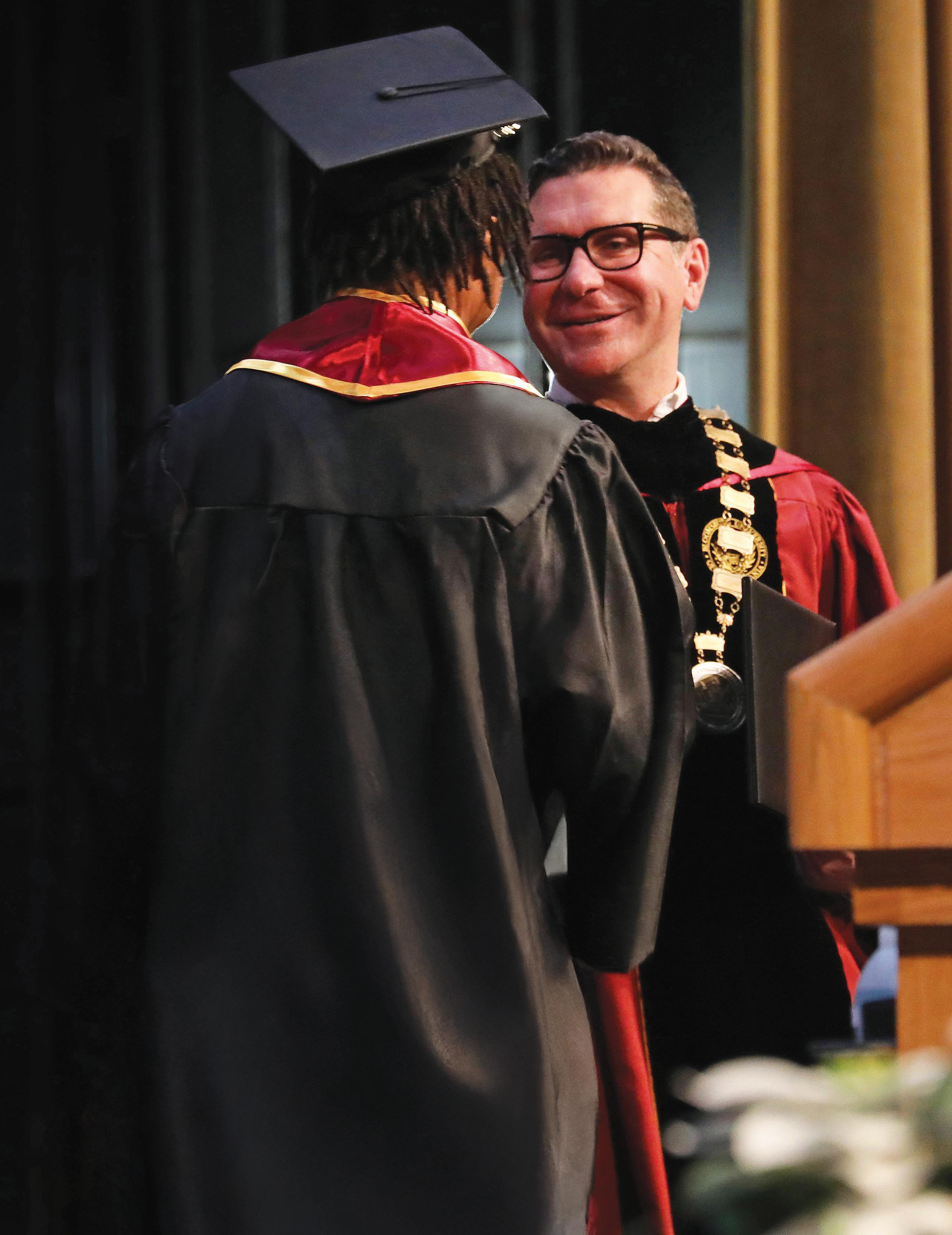
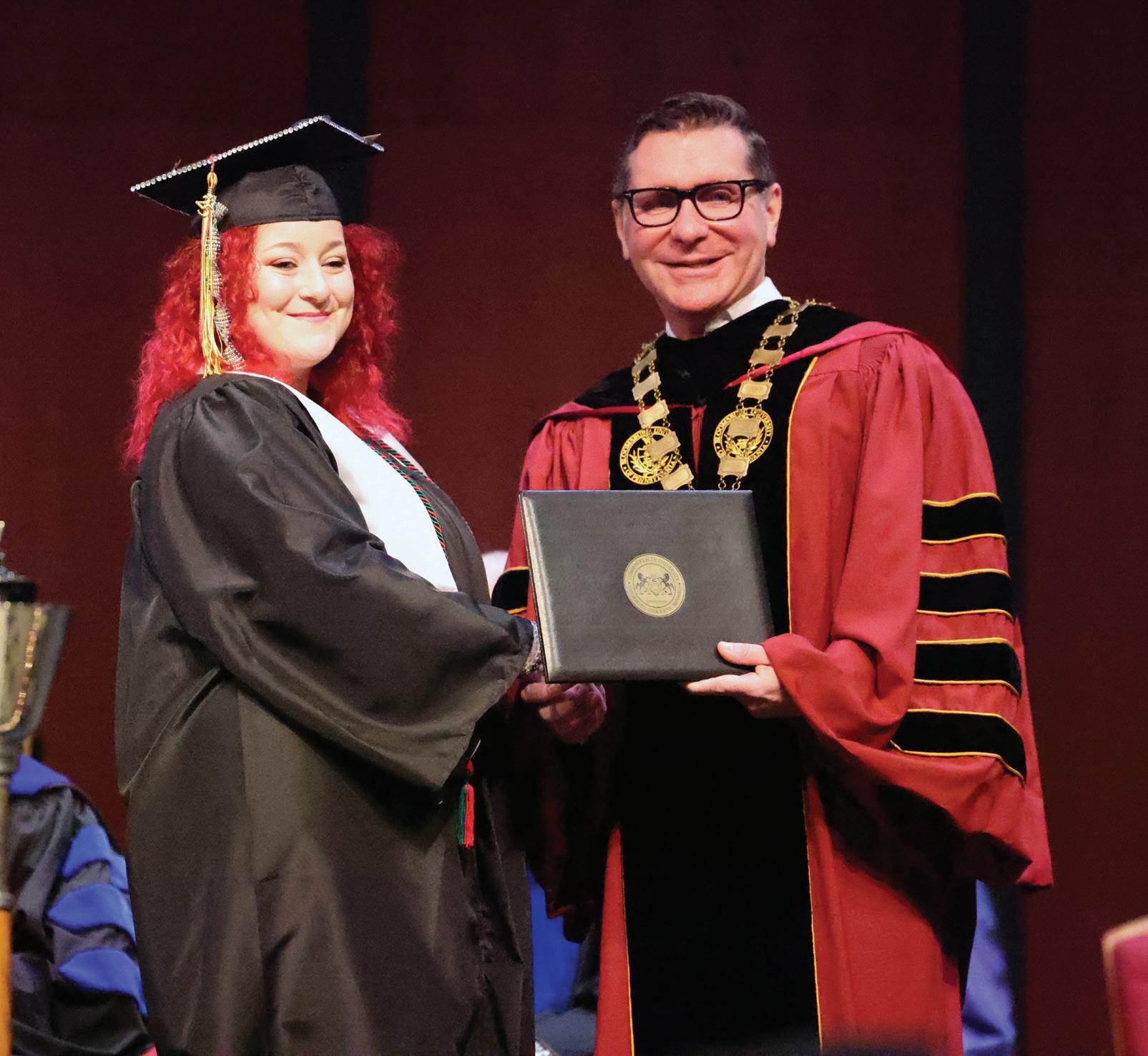
With December ceremonies held for the first time on each campus–Bloomsburg, Lock Haven, and Mansfield–commencement was also a celebration of new beginnings for CU.
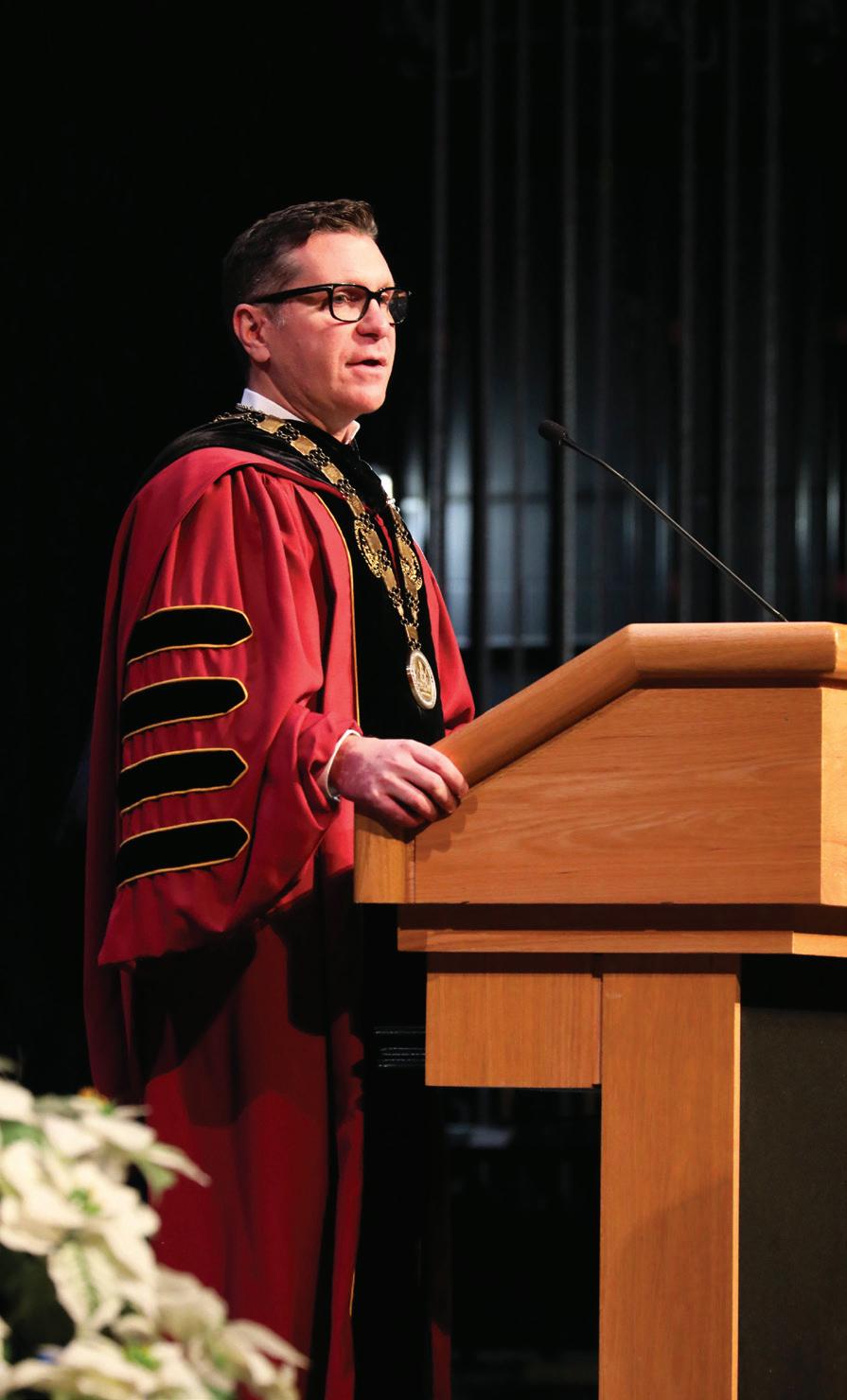
Interim president Jeffery Osgood spoke at selected ceremonies on each campus.
“Today is a day of celebration. It is a day of reflection. But more than anything, it is a day of profound possibility,” said Osgood.
Osgood became CU’s interim president on August 1, 2025, coming from West Chester University where he was executive vice president and provost, serving as the institution’s chief operating officer and chief academic officer. Osgood is currently the candidate under consideration in the search process for CU’s permanent president.
“Each of you reached this moment through perseverance, passion, and resilience. You navigated challenges, embraced opportunity, and demonstrated the grit and determination,” Osgood told the graduates. “You are here today not just because you made it through, but because you grew through what you faced.”
“Commencement, like the holidays, invites us to pause. To step out of the noise and remember what truly matters,” said Osgood. “The most important things in life are not found on a screen or a résumé line. They are found around tables, in living
rooms, on long drives home, in laughter with people who know us well, and sometimes in the quiet moment when a pet settles into our lap and reminds us what it feels like to matter.”
“I’m reminded of something Dick Van Dyke once said. He counted himself among the luckiest people in the world because he spent his life doing work he would have chosen even without reward. He said he felt lucky simply to bring a little light into the world.”
“At its best, education does exactly that. It lifts the human spirit. It awakens possibility. It calls the best in us forward and asks us to put it in service to something greater than ourselves.”
“Now you stand at the threshold of what comes next. The world you are entering is complex, fast-changing, and filled with real challenges, but also extraordinary opportunity.”
“Wherever your path leads, remember this: your knowledge is a tool, your passion is a guide, and your character is the foundation of your impact. Do not be afraid to take risks. Do not be afraid to challenge the status quo. Progress has always belonged to those willing to act with courage and purpose.”
“You carry more than the degree you are about to receive. You carry a responsibility to lead with integrity, to serve with compassion, and to lift others as you move forward.”
“Graduates, the world is waiting for your ideas, your voice, and your light.”
To Learn, Take acTion
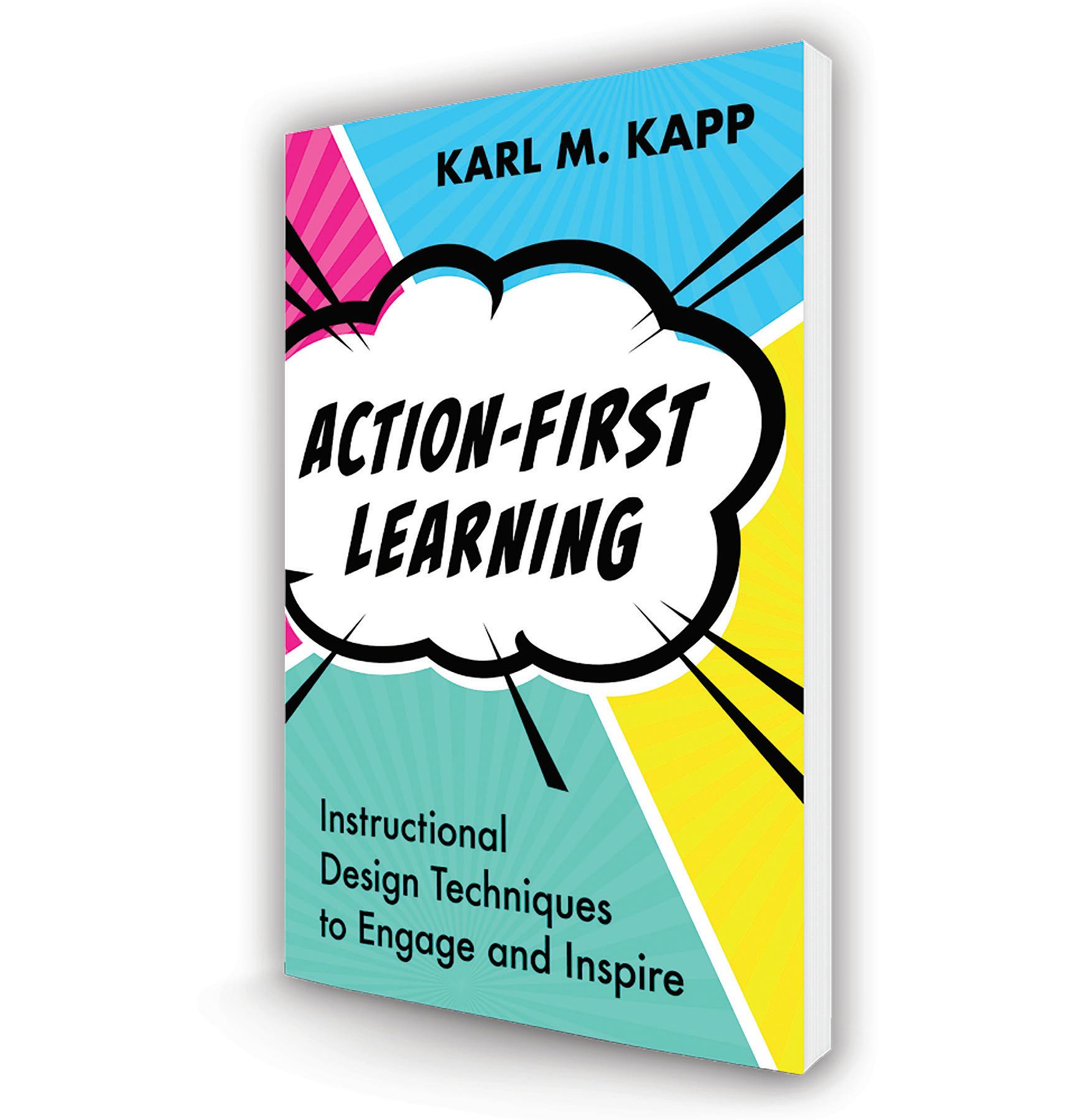
Karl Kapp Publishes ‘Action-First Learning: Instructional Design Techniques to Engage and Inspire’
Early in his career, long before he was a university professor, Karl Kapp worked as a trainer in industry. And to prepare for his new job, he attended training.
He recalls arriving at a training center in an industrial park. “I heard a lawn mower humming in the background as I took my seat near one of the windows. I saw an overhead projector at the front of the room next to a huge stack of slides the instructor would use to teach the class. Immediately, I struggled to stay engaged. The instructor monotonously recited information directly from the slides and his dog-eared teacher’s guide. He spoke with no emotion, as if unaware of the two dozen learners in the room. Slide after slide after slide.”
The lawn mower was a highlight of the day, and Kapp thought to himself, “There has to be a better way.” Kapp, professor of instructional technology and director of the Institute for Interactive Technologies at Commonwealth University, in April 2025 published Action-First Learning: Instructional Design Techniques to Engage and Inspire.
The author or coauthor of more than half a dozen books on the convergence of learning, technology, and business, Kapp’s latest book is making waves. On Amazon, it’s ranked 70th in books on “leadership training.”
In Action-First Learning, Kapp covers nine types of learning experiences in one volume—from card and board games, escape rooms, and branching scenarios to augmented reality and AI-powered coaching. Kapp also includes a chapter by instructional designer Amy Pape (a Commonwealth University alumna) about how to improve action-first learning by making it more accessible. Each chapter includes a case study, a design checklist, as well as tips on how to leverage AI to help create action-first learning.
“Academic research and personal experience all tell us that when learners do something right away during the learning process, they are more fully engaged,” says Kapp. “The immediate action sets the tone for the rest of the instruction. Action for action’s sake is not the goal of action-first learning.
The goal is purposeful and meaningful action—always tied to specific learning outcomes.”
Many of Kapp’s previous books are about using games and gamification in instructional design—a concept that has since taken off with his gamification and interactive learning courses on LinkedIn Learning, gamification built into learning platforms as a matter of course, and even gamification graduate certificates.
Nathan Brinker
CU Student Trustee
Nathan Brinker has been appointed to the Commonwealth University Council of Trustees. A junior health and physical education and pre-athletic training double major from Lock Haven, Brinker will represent the Lock Haven campus as a student trustee.
Brinker is a student employee in the Parsons Union Building at CU-Lock Haven and is involved with several campus organizations including serving as president of the Full Gospel Fellowship Club, a member of the Student Auxiliary Services (SAS) Board, and Student Government Board. In his position as student trustee, Brinker says he is interested in giving students a greater sense of connection across all Commonwealth University campuses.
“I believe I can be a voice of reason and understanding for both my campus and my peers,” Brinker writes in his trustee application.
“I often hear students share thoughts, both positive and negative about their experiences, but many don’t know how to express those ideas or where to direct them. I want to help change that.”
“Through SAS, I have been involved in evaluating and making financial decisions that affect many demographics on campus,” Brinker says. “It has helped me see how committed I can be to my peers, while also contributing to the future of the campus community.”
CU Website Wins Pair of International Golds
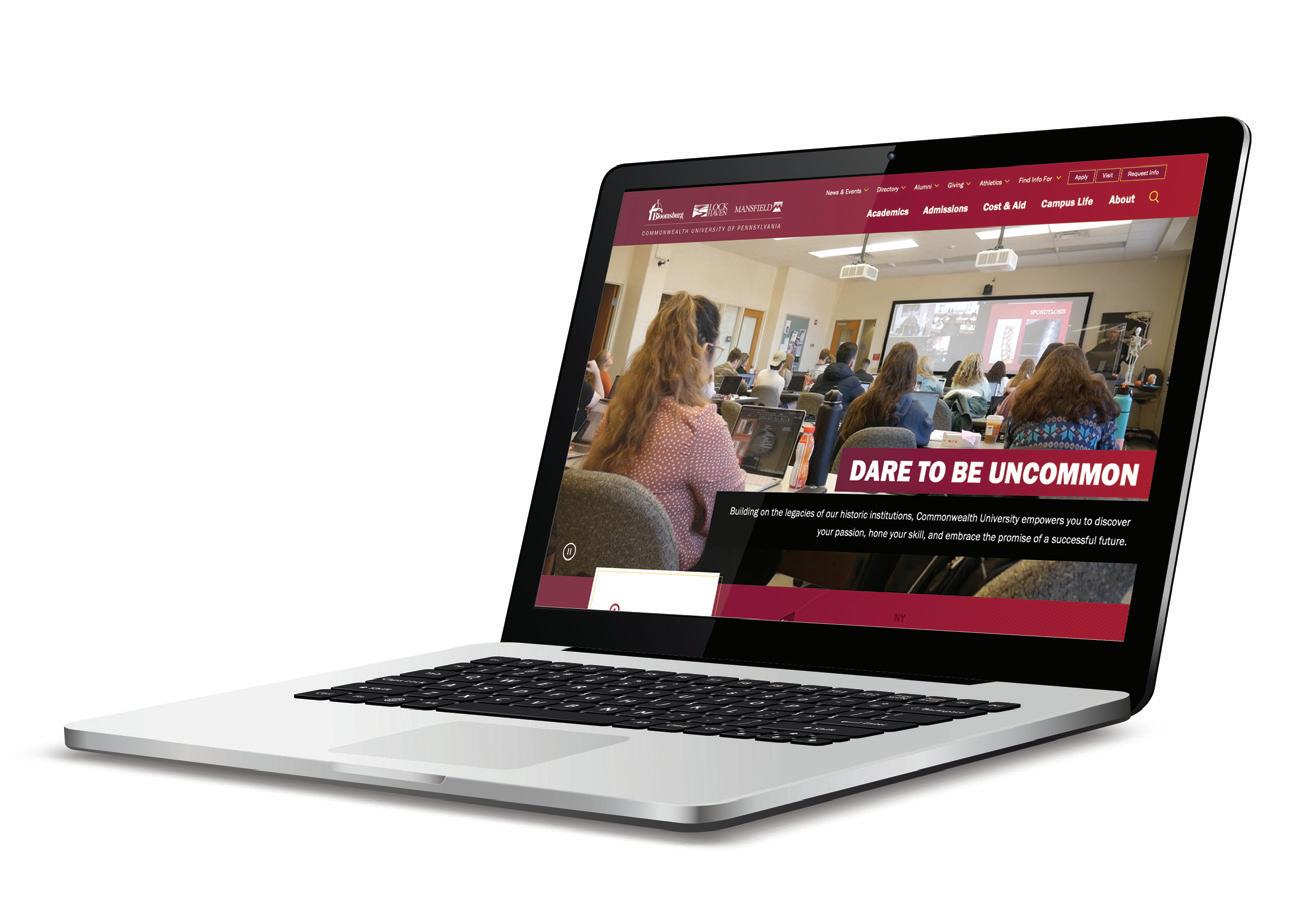
The CU Strategic Communications and Marketing team has earned international acclaim, taking home a pair of gold awards for the commonwealthu.edu website at the 2025 Hermes Creative Awards one of the world’s oldest and most prestigious creative competitions.
Administered by the Association of Marketing and Communication Professionals (AMCP), the Hermes Creative Awards honor outstanding work in traditional and emerging media. Each year, competition judges evaluate the international creative industry’s best work.
The CU website won gold in the Educational Institution Website category and received a second gold for Project Achievement in Website Consolidation, recognizing the successful unification of multiple university properties into a single, user-focused digital experience.
Launched in June 2024, the Commonwealth U website unified three legacy university websites and a microsite into
a single, cohesive platform. The website reflects the unique history, identity, and traditions of CU’s four campuses, while delivering a streamlined user experience. Features such as campus-specific filters for academic programs, news, events, and profiles allow users to tailor their web experience to their respective needs.
CU Awarded 5-Year TRIO Grant to Support Students
The U.S. Department of Education has awarded CU a federal TRIO Student Support Services (SSS) grant to improve college retention and graduation rates among low-income, first-generation students, and students with disabilities. The five-year (2025–30) grant total for CU is $4,855,160.
CU’s TRIO Student Support Services programs are led by campus-based directors including Kelly Foran (CU–Bloomsburg), Natalie Serafini Lombardi (CU–Lock Haven), and Kim Lamar Shelton (CU–Mansfield).
This grant will allow CU to further its commitment to ensuring all students regardless of educational barriers can succeed academically and develop personally at Bloomsburg, Lock Haven, and Mansfield.
Additionally, the directors stressed that the TRIO SSS program levels the playing field and strengthens the student-experience by equipping our students with the resources, guidance, and support to graduate.
Bloomsburg was awarded $332,393 per year for a total of $1,661,965, while Lock Haven was awarded $353,530 per year for a total of $1,762,650, and Mansfield was awarded $286,109 per year for a total of $1,430,545.
Chemistry Students Excel in National Chemistry Exam
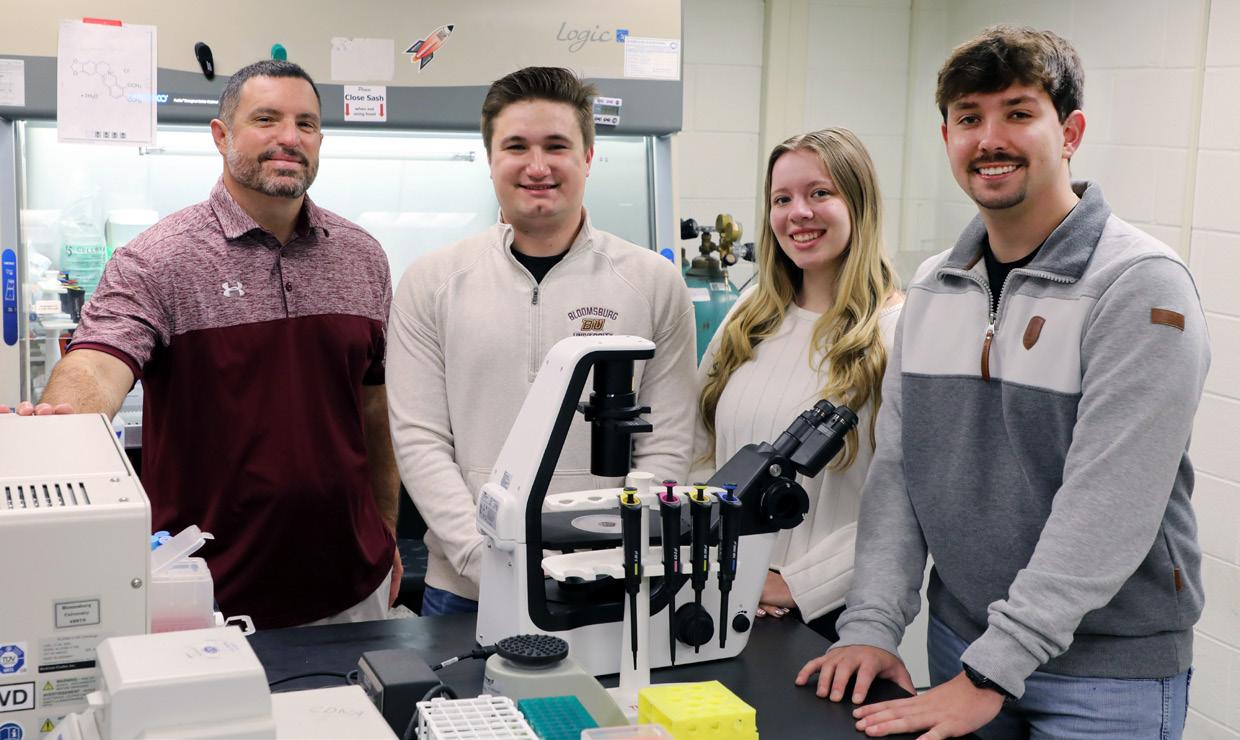
Three CU-Bloomsburg chemistry students have excelled in the 2025 American Society for Biochemistry & Molecular Biology (ASBMB) national accreditation exam.
The students, all chemistry majors with a pre-med concentration, are Lauren Boyer, of Bloomsburg; Andrew Faust, of Philipsburg; and Duane Milnes, of Northampton.
Only students from ASBMB-accredited institutions are eligible to take this external national assessment of BMB undergraduate learning. In 2025, over 1,000 students took the nationwide exam, and only 44% earned Proficiency (or higher). Boyer, who graduated in December 2025, earned Proficiency; Faust and Milnes both earned Highly Proficient (for their high scores) and will graduate in May.
The Bloomsburg campus biochemistry and chemistry area has been accredited since 2015 and was the first Pennsylvania State
CU Programs Earn Top Rankings
Several of CU’s master’s degree programs have achieved top rankings by outside organizations. CU was ranked No. 1 on the 2026 Best Master’s in Counseling Programs in Pennsylvania list by Counseling Psychology for its master’s in school counseling and master’s in clinical mental health counseling programs. Courses for both programs are delivered 100% online through a combination of synchronous and asynchronous classes with full-time and part-time options.
CU’s Master of Education in Curriculum and Instruction was ranked No. 1 in Pennsylvania for 2026, according to mastersineducation.org.
The 100% online Master of Education in Curriculum and Instruction program offers concentrations in alternative education and social, emotional, and behavioral wellness and includes the option to earn certificates in English as a second language, e-learning specialist, instructional game design, or an interest-based track.
System of Higher Education institution granted accreditation based on the university’s curriculum, high-impact student experiences, institutional supports, and faculty expertise. Historically, Bloomsburg students have earned Proficiency at a higher rate than the national average.
From left: Professor Michael Borland, students Andrew Faust, Lauren Boyer, and Duane Milnes.
BLOOMSBURG HOMECOMING 2025
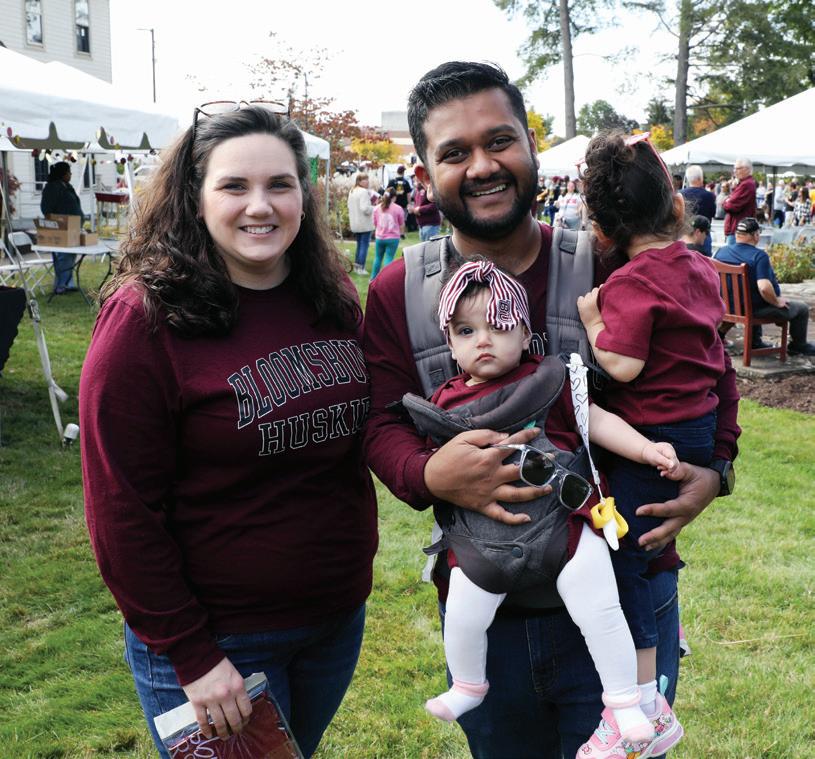
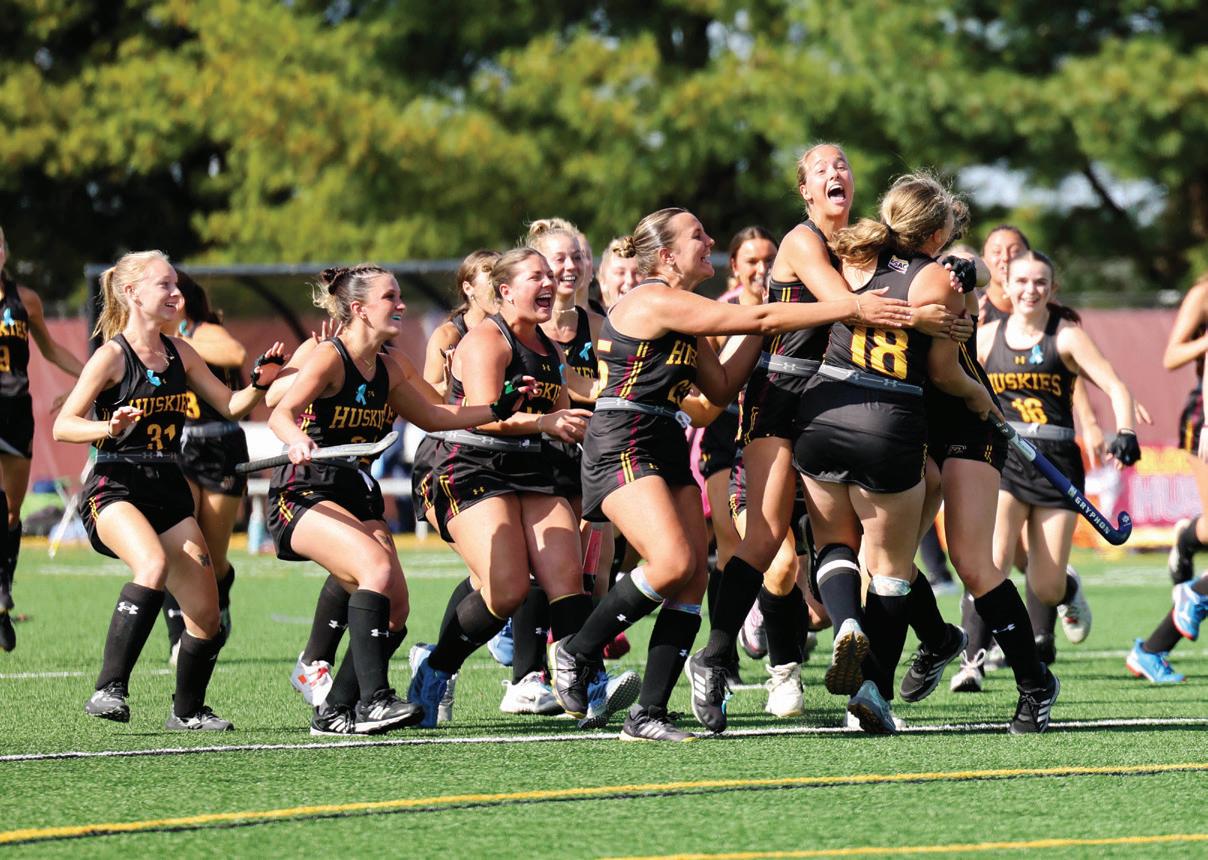
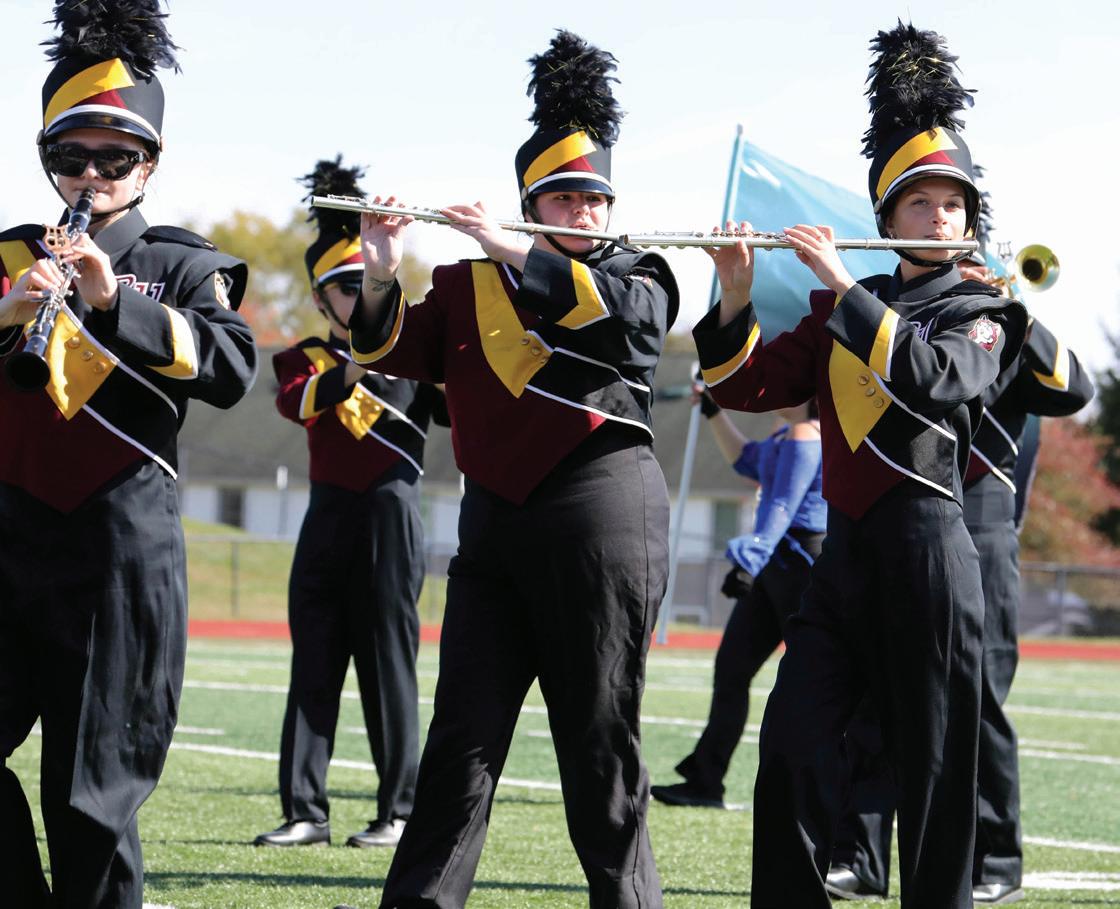
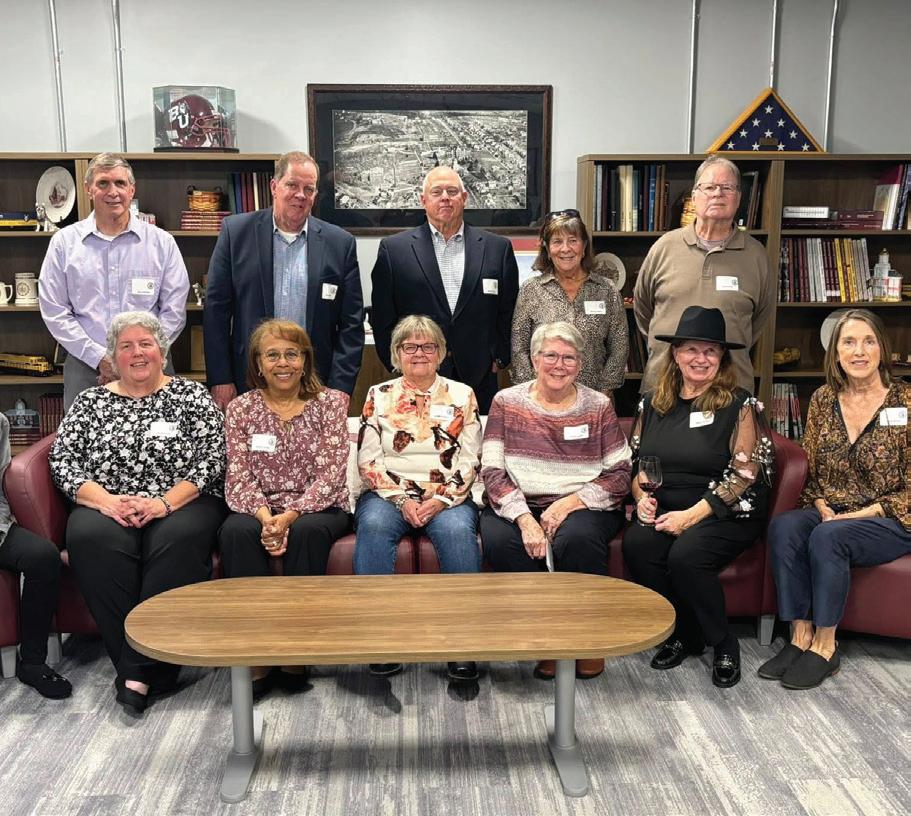
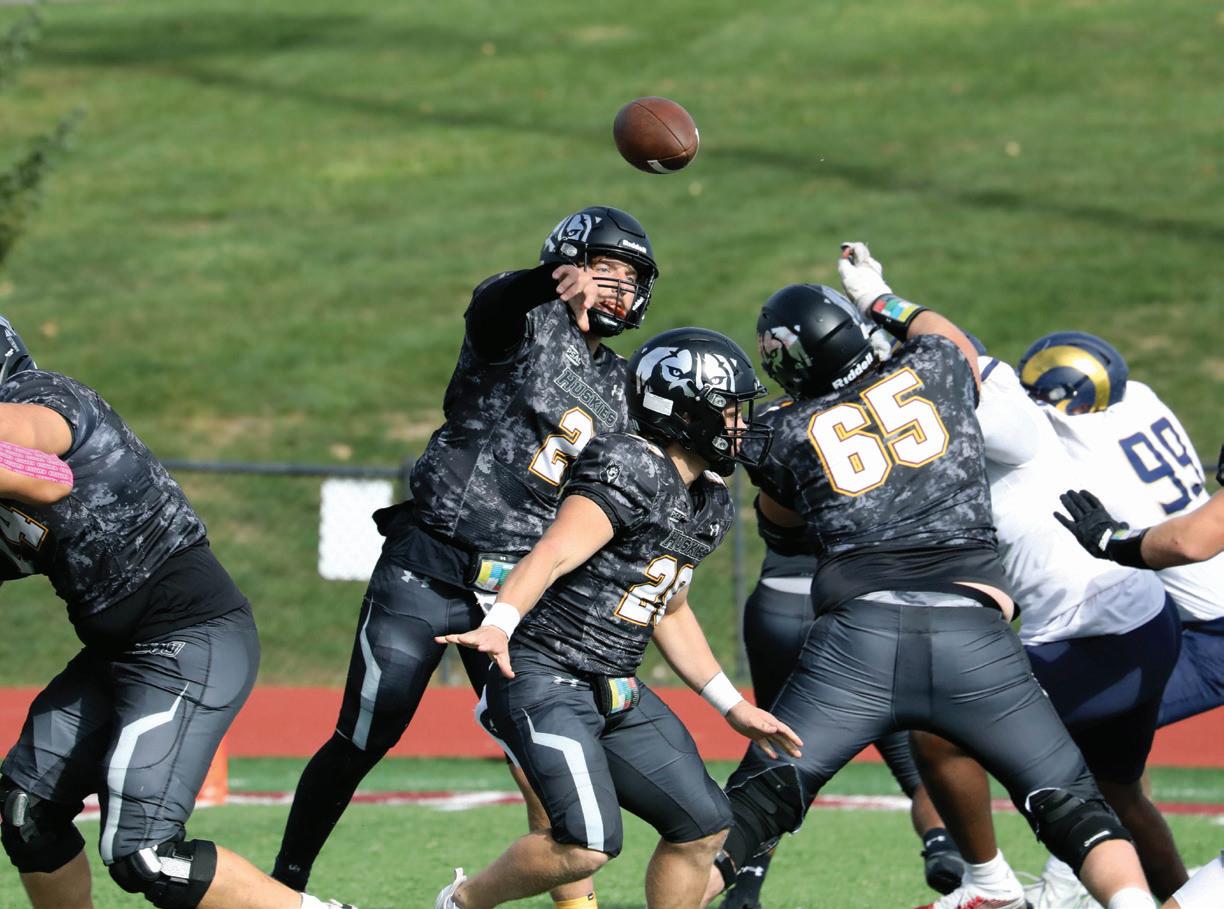
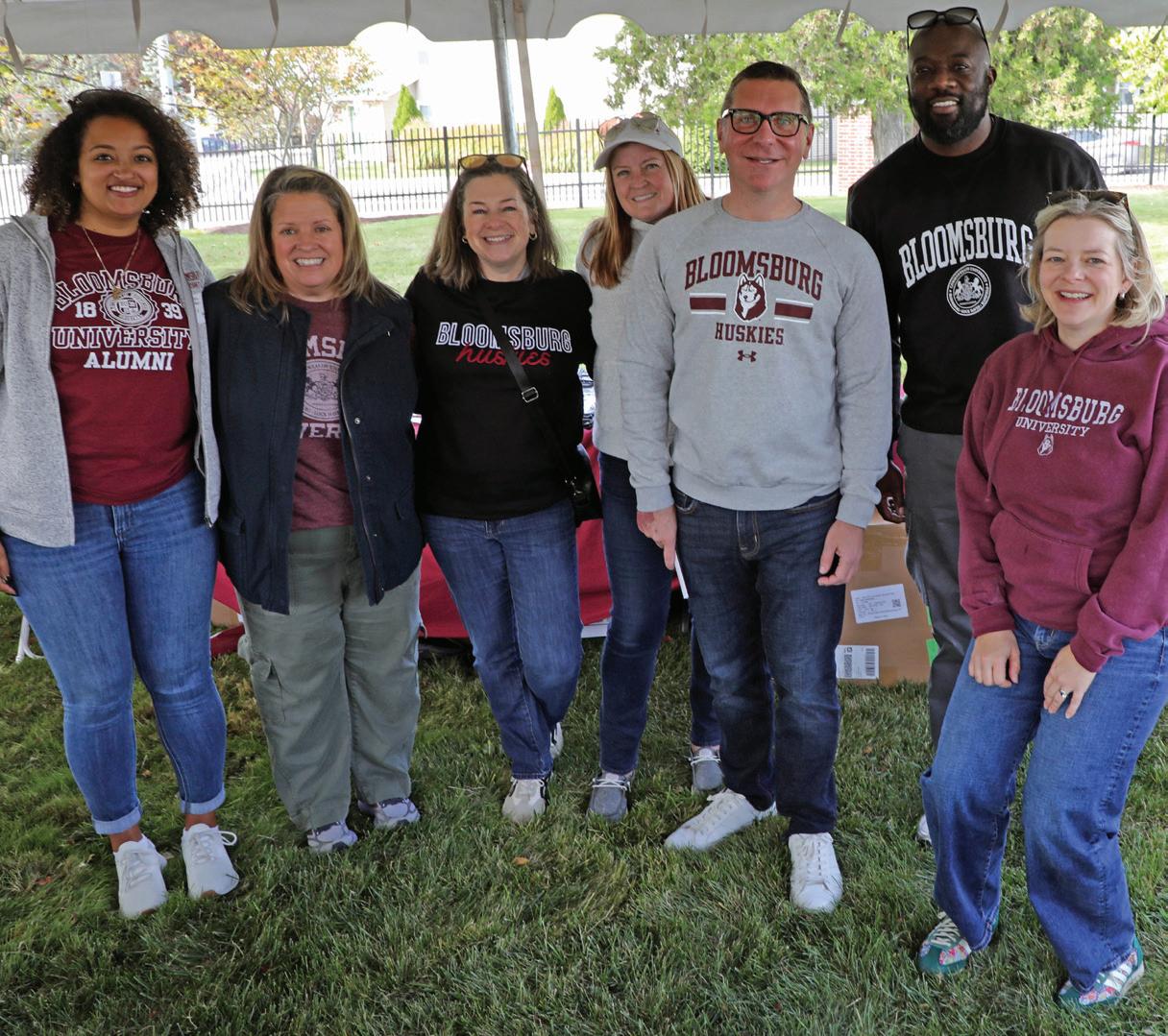
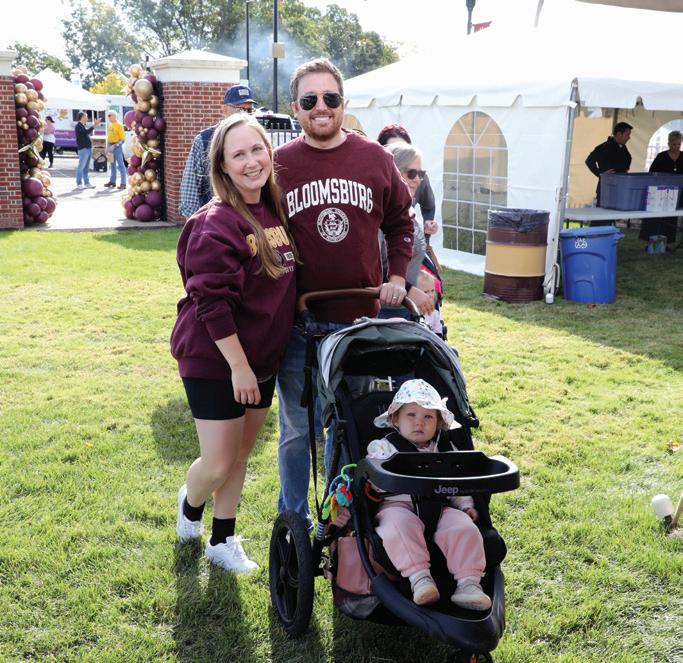
Huskies of all ages returned to campus for Homecoming from Friday, October 17, through Sunday, October 19. The weekend celebrations began with the Class of 1975 50th reunion reception at the Greenly Center on Friday evening. On Saturday, alumni were treated to a walking tour of campus led by archivist Robert Dunkelburger, followed by a tent party at Fenstemaker Alumni House. At the Steph Pettit Athletic Complex on upper campus, athletes competed in field hockey and football.
MccorMick ReiMagined
A HUB FOR HANDS-ON LEARNING
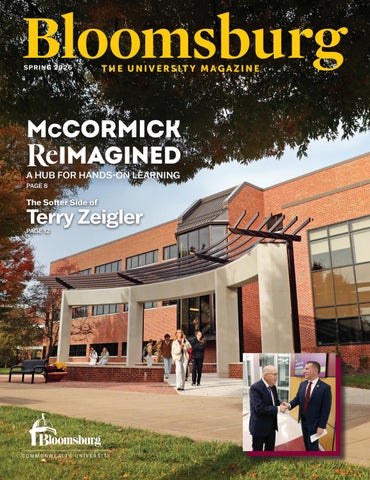
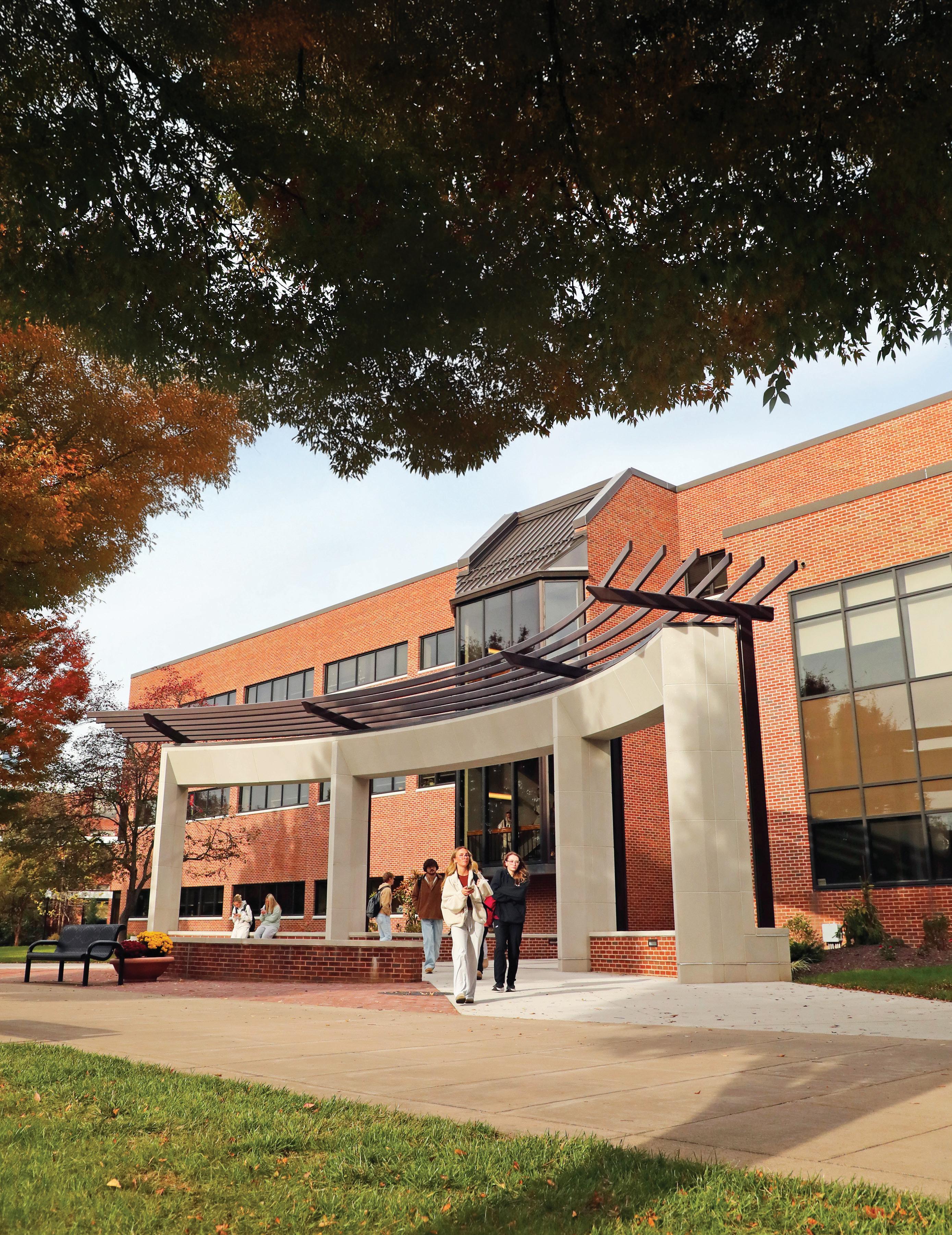
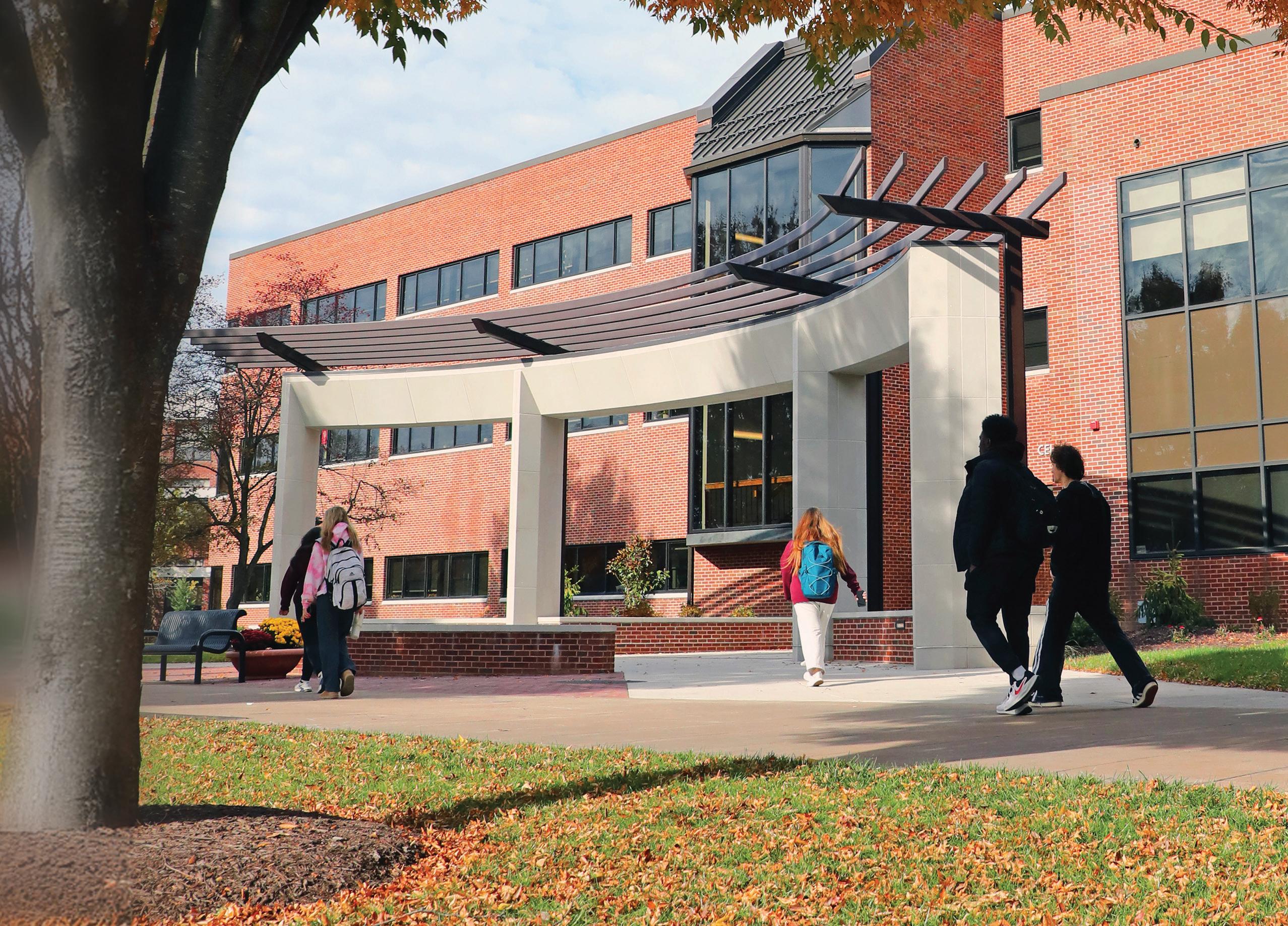
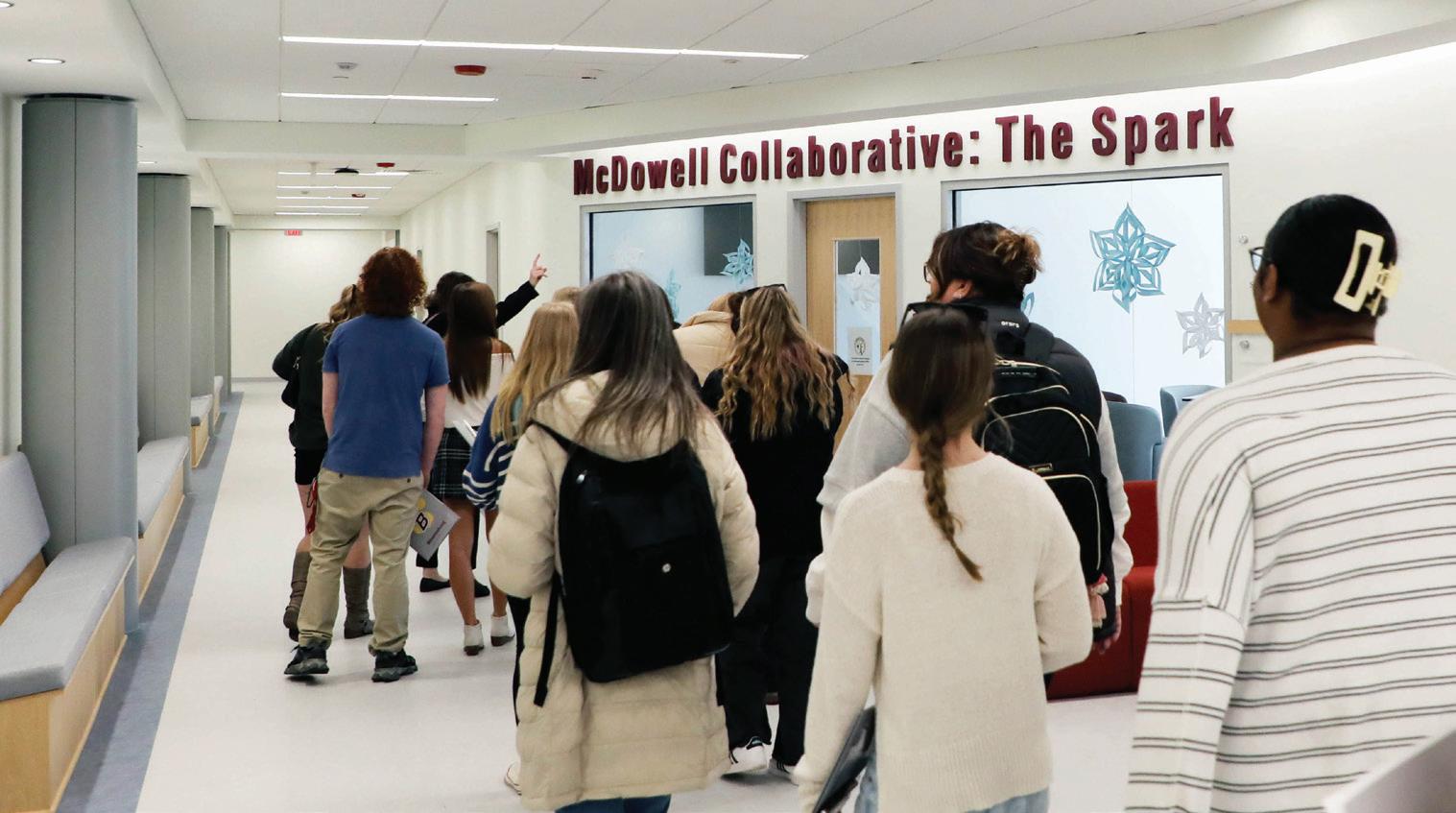
When the renovated McCormick Center was rededicated in September, it was more than a celebration for new windows and walls, fresh paint, bright lights, and wide hallways. It was a celebration of a vision made real by partnerships with committed alumni and corporate partners.
The renovation, begun in 2022, was funded by $22 million in state funding and supplemented by $14.1 million in contributions.
“Philanthropy powers the difference between buildings and breakthroughs,” says Erik Evans, vice president for university advancement, at the Sept. 8 ceremony. “State funding builds the walls, floors, ceilings—even the curtains. But what makes this space exceptional—the labs, the technology, the simulation equipment, the classrooms—comes from the generosity of our donors. You have given our students not just tools, but confidence.” (See sidebar for notable contributions.)
Today, at more than 106,000 square feet, including a 23,000-square-foot addition completed in 2007, McCormick Center serves as the home for numerous major programs, including nursing, media and journalism, education,
communication studies, and sociology and social work, that enroll nearly 2,000 students. In addition to academic departments, McCormick is also home to:
Breiner School of Nursing
Kerby Confer Media Center
The Diehl Center for Law School Preparation
The McDowell Institute Innovation Space.
And the largest capacity classrooms on campus
“With this transformation of the McCormick Center, we are not just adding classrooms—we are shaping leaders,” says Dr. Jeffery L. Osgood, CU interim president. “We are not just constructing walls—we are building opportunity. We are not just honoring the past—we are preparing the future.”
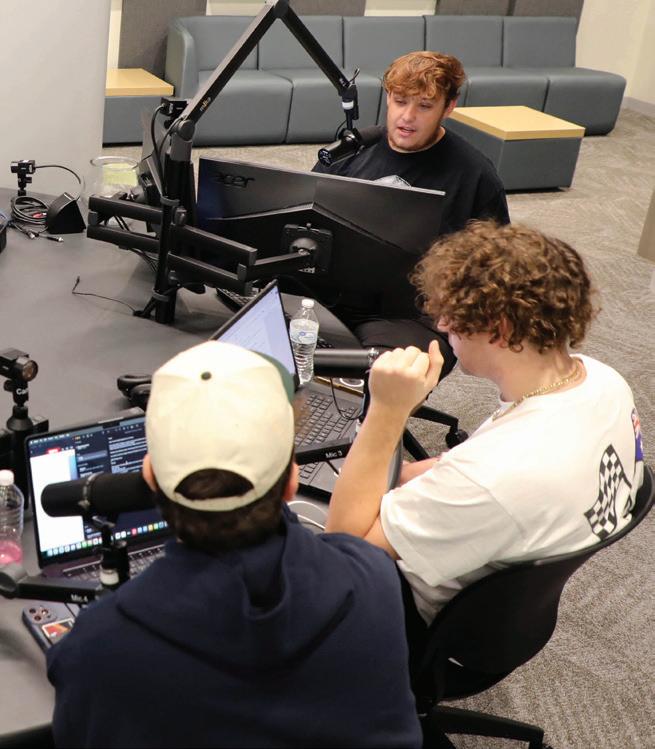
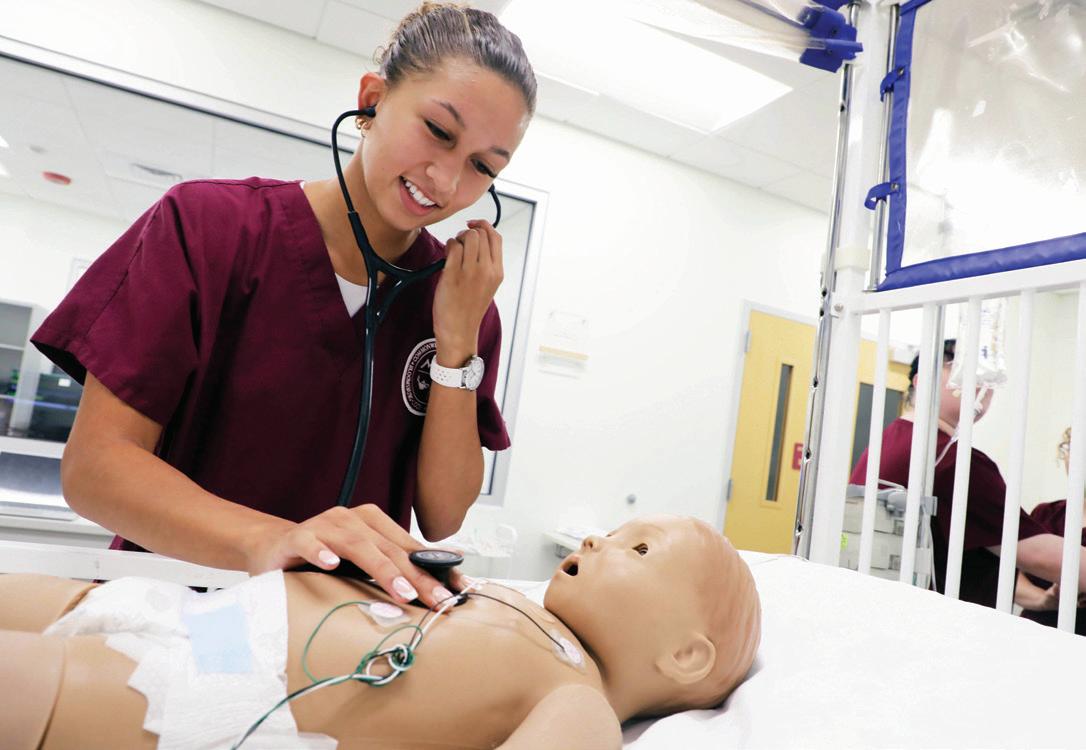
The renovated McCormick Center is still home to the campus’s radio station and television studios, now upgraded with the latest equipment and technology. In nursing, labs allow students to simulate practice in pediatric, maternity, surgical, community, and general health care environments.
Student trustee and nursing major Jessica Dodge spoke to the significance of the facility from the student perspective. “To walk into this building and see the incredible labs, classrooms, and technology—it feels like a vote of confidence in us,” she says. “It tells us that our university and its supporters believe in what we’re capable of becoming.”
Dr. James McCormick—former Bloomsburg President 1973 to 1983 and former PASSHE Chancellor from 1983 to 2001, for whom the building is named—reflected on its evolution: “When we first opened this building back in 1973, it was envisioned as a home for nursing and teaching. To see how far it has come—with programs and technology beyond what we imagined—is truly inspiring.”
NOTABLE CONTRIBUTIONS TO McCORMICK CENTER
— FIRST FLOOR —
Kerby Confer Media Center
Gifted by Kerby and Judy Confer
Diehl Center for Law School Preparation
Gifted by Craig Diehl
—
SECOND
FLOOR —
The McDowell Institute–Innovation Space
Gifted by Susan McDowell ’16H
— THIRD FLOOR —
Breiner School of Nursing
Gifted by Ed ’77 and Julie ’77 Breiner
Charles B. Degenstein Nursing Simulation Center
Gifted by The 1994 Charles B. Degenstein Foundation
Anatomage Classroom
Gifted by Geisinger Health
Peri-Operative Suite
Gifted by UPMC Life Changing Medicine
Obstetrics Sim Lab
Gifted by WellSpan Evangelical Community Hospital
Critical Care Sim Lab
Gifted by Patricia A. McDowell ’87H
Acute Primary Care Sim Lab
Gifted by The Tomcavage Family ’80 & ’21
Pediatrics Sim Lab
Gifted by Susan Fetterman ’04/’23M and the Fetterman Family
Conference Room and Classroom
Gifted by Ralph and Josephine Smith Fund and the Greater Susquehanna Valley Competitive Grant Program at First Community Foundation Partnership of Pennsylvania
Student Lounge
Gifted by The Bloomsburg Nursing Class of 1980
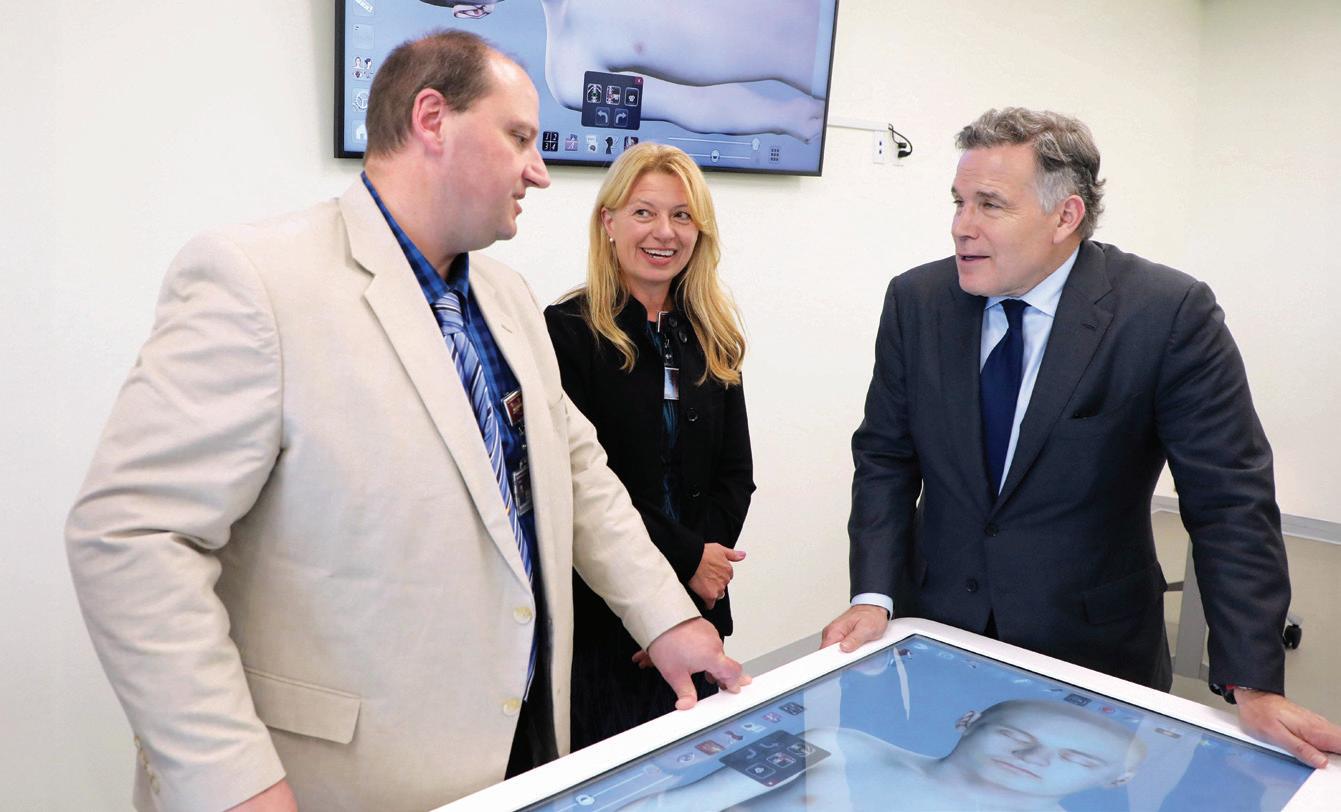
U.S. Senator David McCormick (right) at an Anatomage table, which provides the most advanced 3D anatomy and medical education images through state-of-the-art digitalized human cadavers.
McCormick Family and Friends Commit $1 Million to Endow Scholarship Honoring James and Maryan McCormick
Philanthropy powers the difference between buildings and breakthroughs.
— Erik Evans, vice president for university advancement
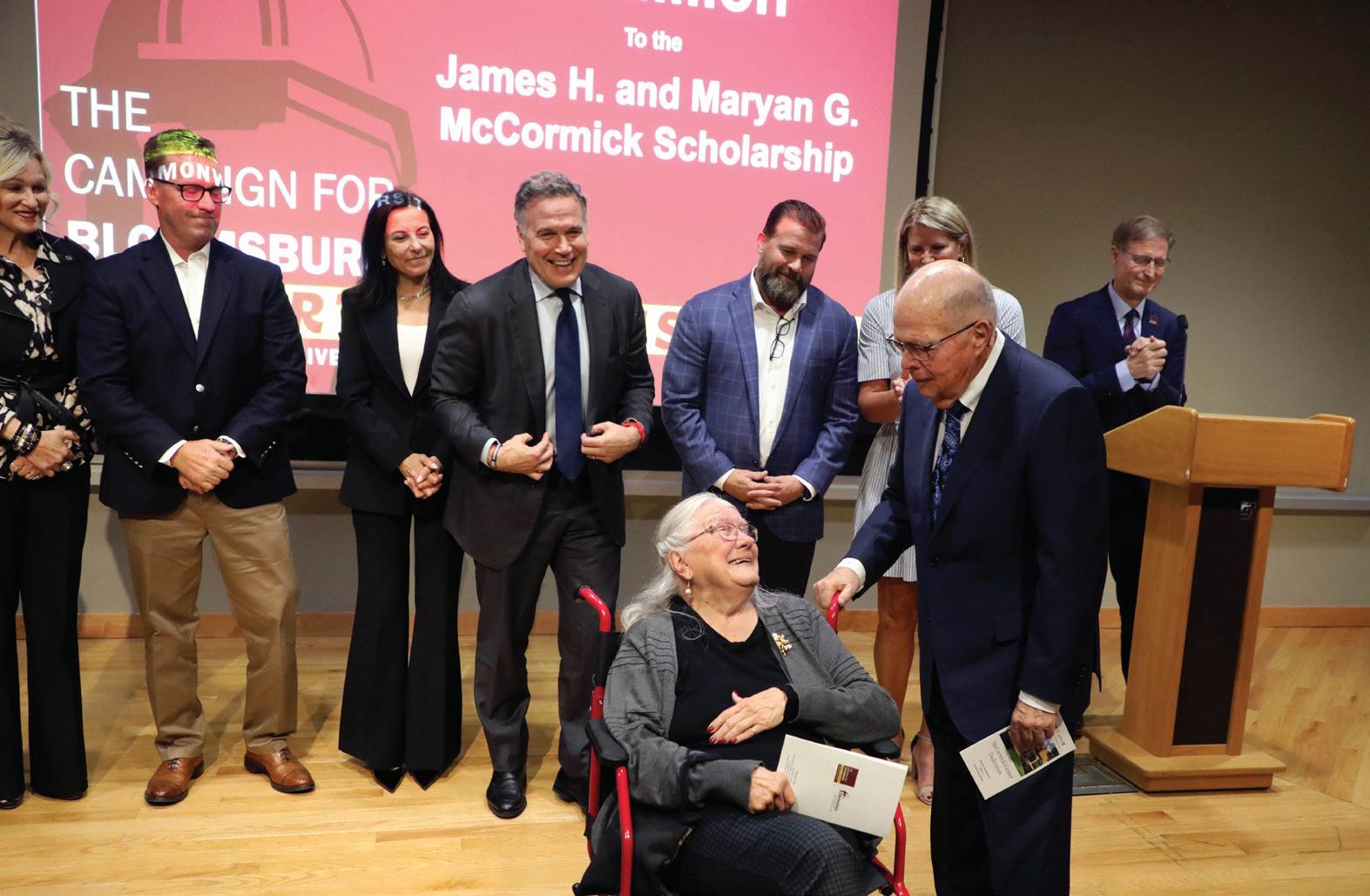
U.S. Senator David H. McCormick, his brother Douglas McCormick, their respective spouses Dina and Michele, and longtime family friend Daniel A. Klingerman, along with his wife Monica, have committed $1 million to the James H. and Maryan G. McCormick Scholarship CU–Bloomsburg.
The endowed scholarship honors the legacy of James and Maryan McCormick, who have collectively dedicated over 70 years to public education, by supporting Pennsylvania students with financial need.
“This scholarship is about more than honoring my parents’ names,” says Senator David McCormick. “It is about honoring their life’s work and their belief that every young person deserves the chance to pursue their dreams. We are proud to help ensure that legacy for future generations of Pennsylvanians.”
The announcement punctuated the dedication of the newly renovated McCormick Center.
“This is more than a gift—it is a promise,” says CU Interim President Dr. Jeffery L. Osgood. “By honoring Jim and Maryan, the McCormick family and their friends are
affirming that education is the great equalizer, the great accelerator, the great hope of Pennsylvania. They are saying to every young person with a dream: you belong here, you can grow here, you will lead from here.”
Douglas McCormick reflected on his family’s deep Pennsylvania roots and his parents’ values, noting his own educational journey from Pennsylvania to West Point and Harvard Business School before eventually founding Washington D.C.–based investment firm HCI Equity Partners. “My father always saw education as the great enabler,” he says. “By supporting future teachers, public servants, and leaders in the state they call home, this scholarship will extend his and my mother’s impact for generations to come.”
Senator David McCormick serves the Commonwealth in the U.S. Senate, and Daniel Klingerman employs more than 1,500 Pennsylvanians through his businesses, continuing his decades-long investment in the region’s economic vitality.
For Klingerman, a close friend of the McCormick family for decades, supporting this scholarship is a deeply personal tribute.
“Jim McCormick has been a mentor and role model to me and to countless others,” says Klingerman. “His leadership helped shape Bloomsburg and Pennsylvania’s system of higher education. This gift is a way to say thank you—for his vision, his friendship, and his extraordinary service.”
The James H. and Maryan G. McCormick Scholarship will provide half-tuition support (currently $4,500 annually) for up to four years to incoming, first-year students from Pennsylvania with financial need. Eligible majors include education, political science, leadership, and public policy—fields that reflect Jim and Maryan’s shared dedication to shaping future leaders and expanding access to education.
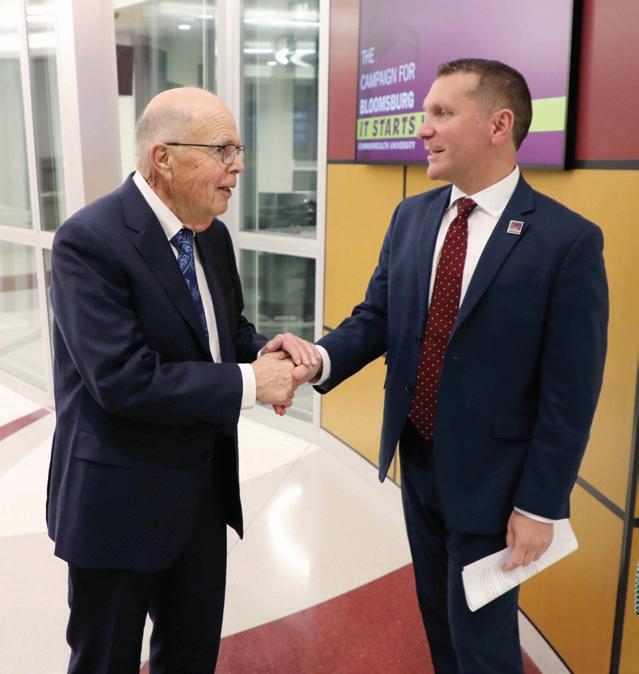
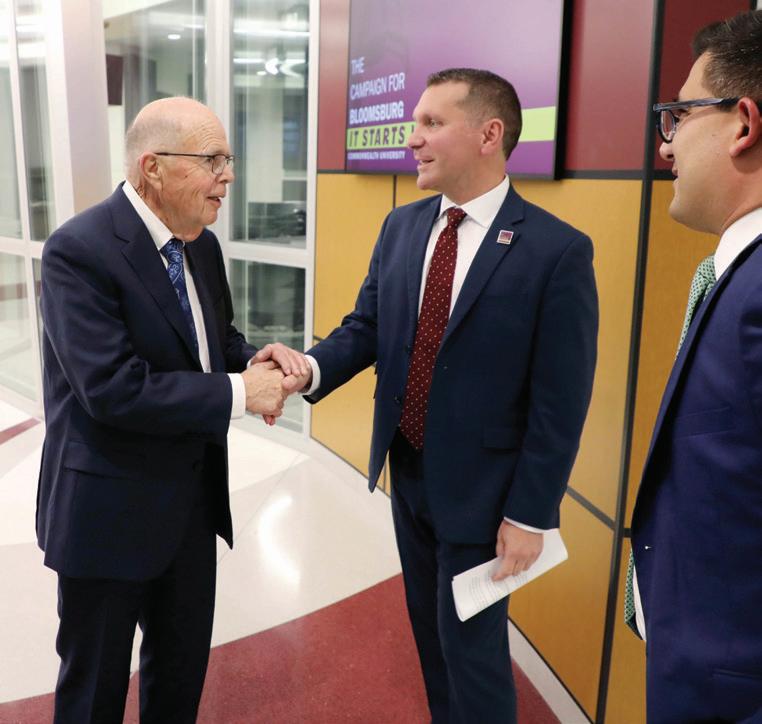
James McCormick speaking with CU Interim President Jeff Osgood.
“Today we celebrate a building that prepares students for the workforce,” says Osgood. “And through this scholarship, we celebrate a legacy that ensures those same students have the means to access a Bloomsburg education in the first place. That combination is how we change lives— and it’s exactly what Jim and Maryan devoted their lives to achieving.”
Breaking Records, Empowering Students: BU Foundation Celebrates Historic Year of Giving
The Bloomsburg University Foundation (BUF) raised $11.3 million in new gifts and pledges during the 2024–25 fiscal year, which ended June 30, 2025. This achievement follows last year’s record-setting $26.2 million, underscoring BUF’s central role in advancing The Campaign for Bloomsburg: It Starts With Us—the largest fundraising campaign in Commonwealth University–Bloomsburg’s history.
The campaign has secured more than $95 million toward bringing it within striking distance of its historic $100 million goal. This year’s results highlight the campaign’s three pillars—Attract, Prepare, Elevate—which expand access, enrich experiences, and elevate outcomes for every student.
2024–25 FUNDRAISING MILESTONES INCLUDE:
A record-breaking All-In Day of Giving with 2,800+ donors contributing over $310,000.
$8+ million in direct student support—the largest single-year total in BUF history.
61 major gifts of $25,000 or more, fueling campaign momentum.
$5.8 million in future gifts committed by 290 dedicated Golden Dome Society members, ensuring long-term financial stability and scholarship support for generations of Huskies.
$5.2 million in immediate-use funding to meet today’s student needs.
The Foundation’s efforts have also grown CU-Bloomsburg’s endowment to $92.5 million, providing enduring support for generations to come.
In fiscal year 2025, 1,433 CU–Bloomsburg students were directly supported through scholarships and Professional Experience Grants, with just over $2.5 million awarded to help them stay enrolled, reduce financial barriers, and pursue opportunities beyond the classroom. During the year, 4,656 donors contributed 10,434 gifts, with 2,157 making their very first gift. Nearly 80% of those gifts were under $250 and more than 90% under $1,000.
“Philanthropy is the cornerstone of opportunity for our students,” says CU Vice President for Advancement Erik Evans. “Our campaign is about more than reaching a dollar goal—it’s about ensuring that we are positioned to thrive for decades to come. We wouldn’t be where we are today without the vision and leadership of our campaign co-chairs, Steve Jones and Julie Breiner, and the dedication of our steering committee.”
The Softer Side of Terry ZeigLer
On the 15th anniversary of the ZIPD Conference, Zeigler is still committed to engaging with students.
When Terry Zeigler commits to something, he goes all in.
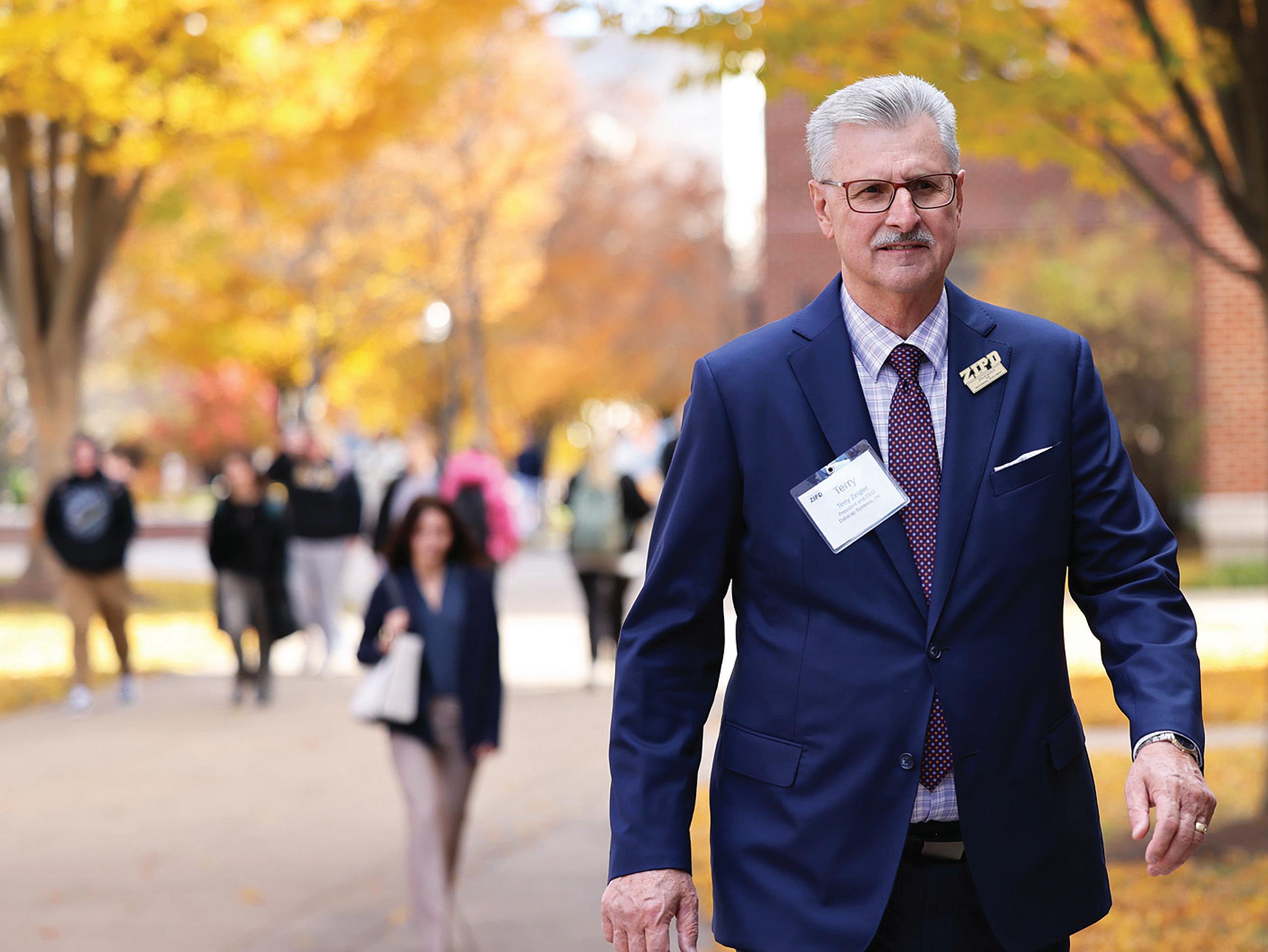
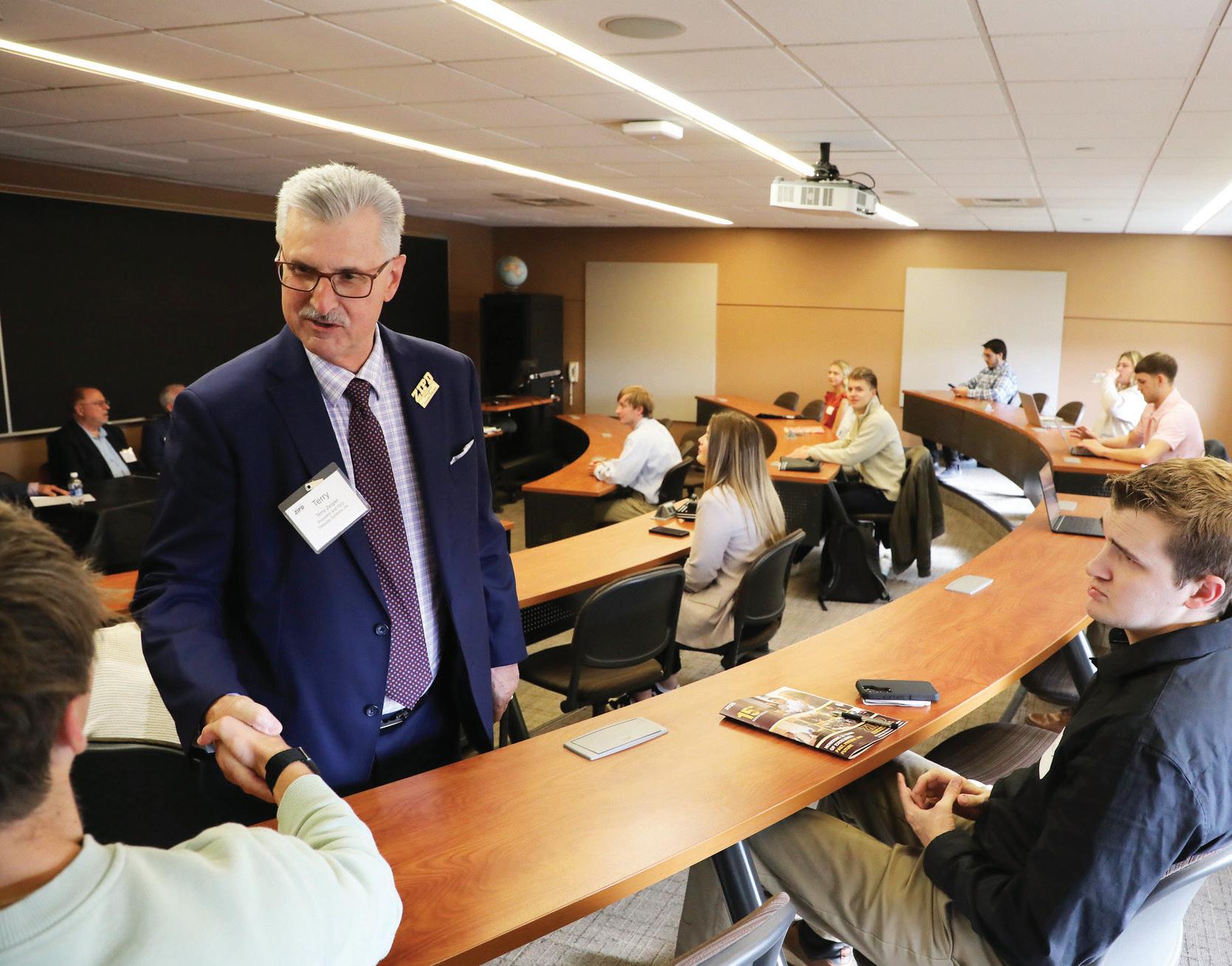
For 15 years, Zeigler, CEO of Datacap Systems, has been a regular presenter at the annual fall ZIPD (Zeigler Institute for Professional Development) Conference, greeting students with handshakes and sage advice on panels ranging from entrepreneurship, work-life balance, and ethics.
In 2016, Bloomsburg alumni Terry Zeigler ’76 and his wife JoAnn Schultz Zeigler ’77, and the Zeigler Family Foundation collectively contributed the largest philanthropic gift to the Bloomsburg University Foundation to name the university’s College of Business. The gift built upon the Zeigler Institute that had been established several years earlier to help students cultivate professional skills and develop a deeper understanding of how the functional areas of business interconnect.
For the students he interacts with, Zeigler delivers his insights with his trademark combination of no-nonsense toughness and warmth. Zeigler founded Datacap Systems from the remains of a cash register manufacturer at age 28. Now, the business has a footprint in nearly every retail business category, but its early years were no walk in the park.
“Raising funds was the number one problem,” he tells students. “The founders went without a salary for 18 months.” The employees were paid. “You don’t mess with a paycheck. You’re screwing with people’s lives.”
His message: founding a business and being an entrepreneur is not for the faint of heart. “I don’t work well for other people. But you’ve got to be willing to take the risk. Not everyone is cut out for it. You have to have stamina and tenacity.”
And he adds, your spouse or partner has to be all in as well, because you’re almost never entirely off the clock. “My work is mind share,” he says. “For example, when I’m driving, I may be thinking about an employee or client issue.”
Zeigler’s Datacap Systems was the first company to put automated payment systems in the cash register. It was an innovation that created an opportunity and a choice. “We had a very basic decision to make. Keep being a cash register company or transition to an electronics payment interface company.”
Zeigler navigated that fork in the road with deliberate strategy. In the transition to becoming a payments interface company, Datacap stopped marketing to new customers for registers, and over time, the registers were discontinued. “We started as a cash register manufacturer and became a payments interface developer,” he says. “We’ve made several major shifts in our 42 years.”
The overall goal: “I want to build something that is ‘repeatedly manufacturable.’ That is, create a ‘flywheel’ that can be repeatedly sold.”
The flywheel, “payment interfaces,” at Datacap is mirrored by a flywheel he created at Commonwealth—engagement. The ZIPD program has brought hundreds of other alumni back to campus, and this November, for the first time at Lock Haven and Mansfield as well, to share their expertise with students.
Ronn Cort ’22H, a member of the Bloomsburg University Foundation Board, is one of the industry leaders motivated to get involved in the university through Zeigler’s example. “His (Zeigler) commitment to the students and his commitment to this school inspired me to get involved,” says Cort, president of Dunmore, a Steel Partners Company that manufactures metallized films, foils, and fabrics, and former president and COO of plastics manufacturer SEKISUI KYDEX. “Because he does it for all the right reasons. It’s always about the students.”
“On my second or third ZIPD panel, the questions were impactful. Students are not just getting an education here, they are being prepared to contribute,” says Cort. “I know from having discussions with students who have become employees. They never feel like they’re done. They’re always learning, they’re always inquisitive. I think that comes from the ZIPD program.”
The greatest satisfaction is the impact we’ve had on the lives of the families of our employees. Helping people develop
personal wealth while doing meaningful work in a collaborative work environment
is a big deal to me.
—
Terry Zeigler ’76, CEO, Datacap Systems
The investment the Zeiglers have made in ZIPD continues to pay dividends just as their business has.
“The greatest satisfaction is the impact we’ve had on the lives of the families of our employees,” says Terry Zeigler. “Helping people develop personal wealth while doing meaningful work in a collaborative work environment is a big deal to me.”
And today at Commonwealth U, students are part of that big deal.
An Alumni Association Dedicated to Creating Student Opportunities
They are from New York, Virginia, New Jersey, Florida, and counties across Pennsylvania. Their class years span nearly 40 years, and they work in education, business, finance, marketing, mental health, and cybersecurity. Together, they are the Bloomsburg Alumni Association Board of Directors, serving as ambassadors and advocates on behalf of Huskies everywhere.
Alumni of every institution have varying awareness of and involvement with alumni associations that strengthen bonds between alumni. But these 13 board members have made Bloomsburg’s association a hub of alumni activity that extends the relationship to current students.
“The Alumni Association still has a hand in promoting tradition, memories, and reunions, but the modern Bloomsburg Alumni Association looks for how our alumni can have the biggest impact,” says Lynda Michaels ’87/’88M, associate vice president of alumni and professional engagement, the department that incorporates both the traditional career development office and the Alumni Association. “Alumni volunteers absolutely make a difference in the lives of students. More importantly, they are modeling what it means to be an alum and inspiring future alumni engagement.”
Board members are both ambassadors and advocates: Ambassadors for the university and the association by recruiting alumni volunteers and future Huskies, and advocates for new graduates seeking their first professional position, as well as for the continued investment in the university. It is a future-focused mission that supports strategic priorities of student success through alumni volunteerism.
By Andrea O’Neill ’06
“The university gave me opportunities and platforms that changed the trajectory of my life, and I see volunteering as a way to pay that forward,” says new board member Gerald Douglas ’18, an area PepsiCo sales manager who regularly recruits on campus. “It’s about staying connected to a community that invested in me, and continuing that legacy of impact.”
Building such a foundation begins with alumni sharing their wisdom and experiences with students so they have an edge in the hiring process, welcoming a fellow Husky as an intern to their department, hosting a group of students at their organization, speaking on a panel or in a classroom, and advocating for their company to recruit Bloom grads. Douglas and his fellow board members foster those kinds of connections.
College conferences like CASSH Con and COHST Pathways enable alumni to share the wisdom earned through years of professional experience with current students. Mentoring programs like the William ’83 and Elizabeth Bent Leadership Boot Camp foster deep student-alumni relationships around careers in the same industry. Spending part of a weekend on campus at the Career Intensive Bootcamp allows alumni to witness students make the transition into confident professionals in real time, and also provides them with an opportunity to help them do it. These programs both support student success and increase the likelihood that the students will stay engaged after they graduate.
“It’s about empowering others, creating connections, and building a foundation that lasts beyond any one person’s contribution,” says Douglas. “I’m in a position where I can leverage my experience in corporate leadership to support
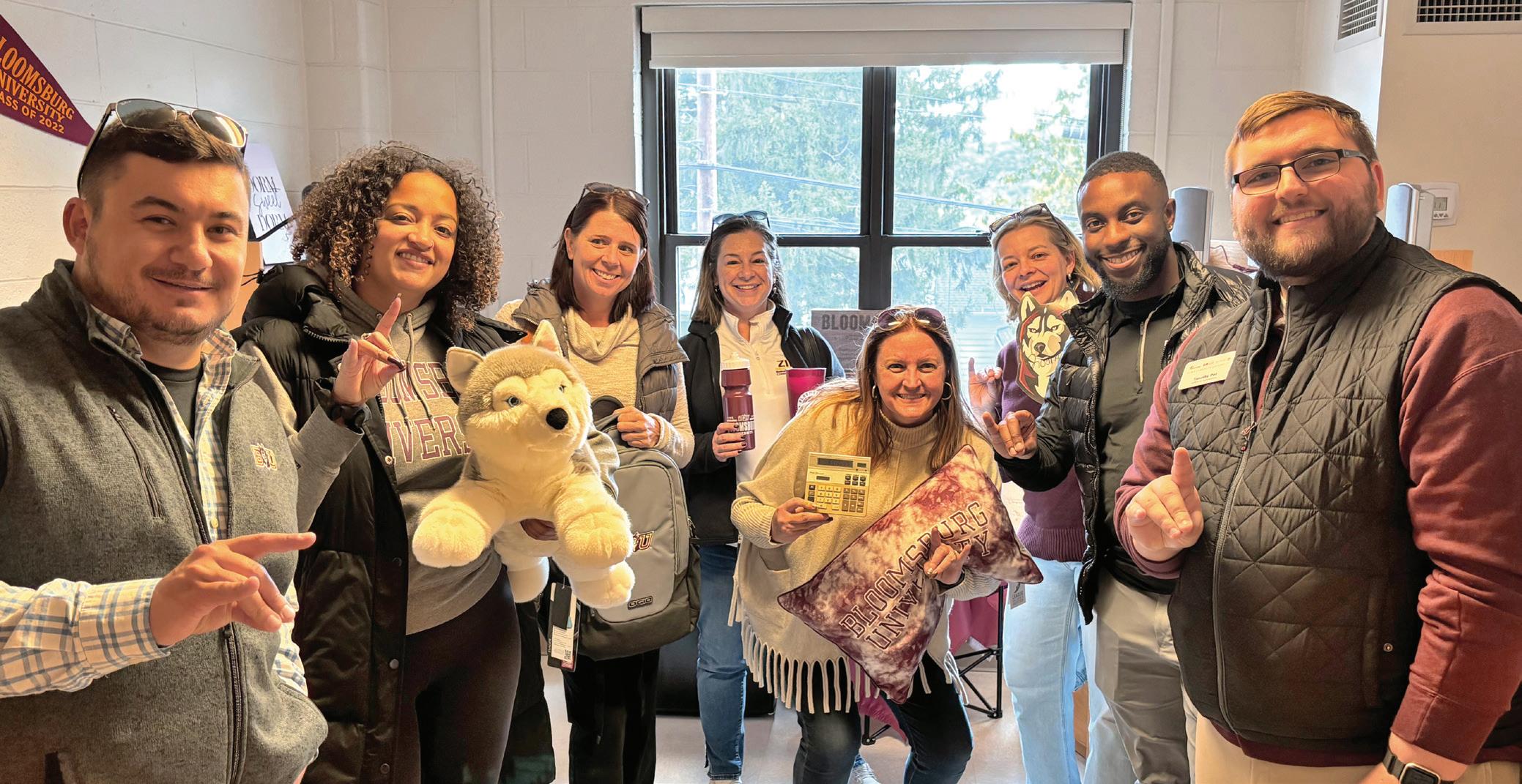
From left: Nick Hoffman ’16, Frankie Stokes ’15, Amanda Vasquez ’00, Melissa Wolf ’01, Cathy Zavacki ’98, Rachel Melnick ’03, Gerald Douglas ’18, and Timothy Pot, admissions graduate assistant and MBA student.
the next generation of students and alumni.”
Frankie Stokes ’15, marketing manager for CMI Media Group, first became engaged with the alumni association during a regional social in Philadelphia and later volunteered as a presenter for the Career Intensive Bootcamp and as a mentor for the William ’83 and Elizabeth Bent Boot Camp for Aspiring Leaders. It was her experience as a volunteer, and with fellow board member Melissa Wolf ’01, that inspired Stokes to join the board this fall.
“I don’t think I knew the board was an option,” says Stokes. “Talking with Melissa, I saw it was a way to be more hands-on. It’s been great learning so much about the workings of the university and how the collaboration happens on an administrative and system level.”
The learning opportunity isn’t always focused solely on students. The board recently created several online educational series using alumni industry expertise. AI for Everyday Life and Sip, Sip, Hooray! were fun learning opportunities open to all Bloom alums.
“Our alumni have a lot to offer by sharing their talents, skills, experience, and knowledge, and the alumni board is central to engaging with alumni,” says Hakeem Thomas ’17, board president. So much to offer, in fact, that whittling down the sheer number of possibilities to actionable plans that match the strategic priorities of student success can be a challenge. An individual’s talents and interests may drive them to make a difference as an ambassador of the university who encourages future students to find their home at Bloom, or as an advocate for the PASSHE system. Others may find their niche by creating programs and events of interest to alumni.
“There is always this negotiation between what alumni are excited about and what
the university needs,” says Michaels. “As long as we have those conversations, all the activities of the board will remain extremely relevant.”
Amanda Kelly Vasquez ’00, a licensed clinical social worker, is an alumna participant turned volunteer. She attended an alumni social near her home in Tampa, Florida, every year since its inception before choosing to become more involved. The third of three new board members, she returned to campus in October for her first Homecoming in nearly 20 years. She has since recruited her old roommate and several other Huskies in the Tampa area as new volunteers.
“I really love getting to connect with people,” says Vasquez. “I wouldn’t have thought to ask them to volunteer if not for being involved like this.”
For the impact that the alumni association has, the time commitment is less than one would think. Regularly monthly meetings, events, programs, and opportunities to meet with faculty, administrators, and student leaders may seem like being a board member would dominate one’s calendar. But the board is intentional in how it schedules meetings and events, often with virtual options.
The university gave me opportunities and platforms that changed the trajectory of my life, and I see volunteering as a way to pay that forward. It’s about staying connected to a community that invested in me, and continuing that legacy of impact. — Gerald Douglas ’18
“In a couple of hours a month, you can be a very involved, engaged, and impactful board member,” says Michaels. “The first step to becoming a board member is to get involved because that is how you understand what the needs and opportunities are.”
“It surprised me how dynamic and active the board really is. It’s not just symbolic. They care a lot about the students,” says Douglas. “It’s been incredibly rewarding to reconnect with the university from a leadership perspective and meet talented and passionate individuals who share a common purpose. There’s an opportunity to make an immediate impact.”
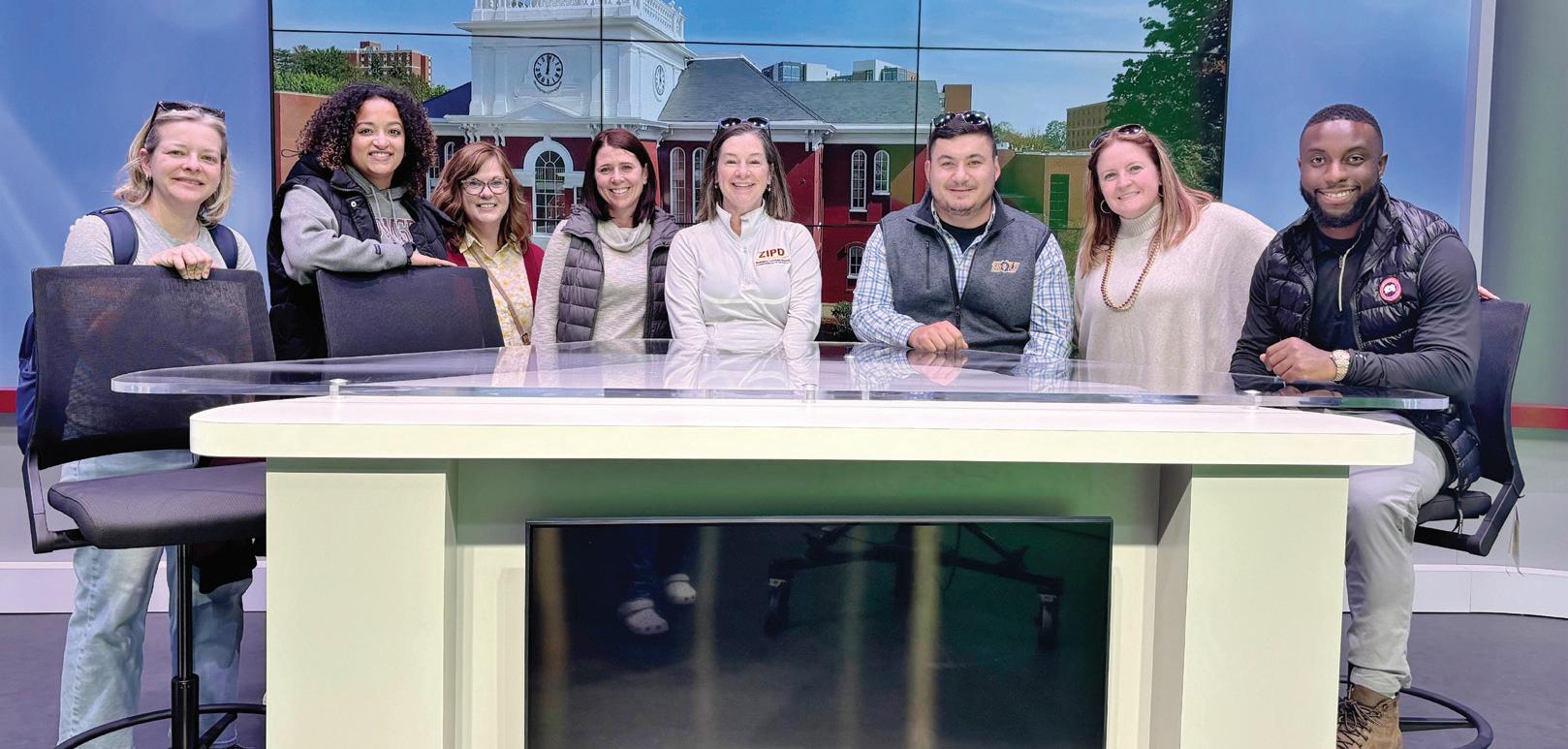
Shown from left in the new campus TV studio: Rachel Melnick ’03, Frankie Stokes ’15, Lynda Michaels ’87/’88M, Amanda Vasquez ’00, Melissa Wolf ’01, Nick Hoffman ’16, Cathy Zavacki ’98, and Gerald Douglas ’18. Board members missing from photos are: Cori Cotner ’93, Lamar Oglesby ’07, Janet Tomcavage ’80, and Hakeem Thomas ’17.
THROWING FOR
By Eric Foster
Kelly Leszcynski comes from a family of runners. But at Bloomsburg, she’s made her name sending javelins flying like lightning bolts.
As a high school freshman in Nazareth, she joined the track and field team, aiming to continue in the footsteps of her two older siblings as a distance and cross country runner. An allaround athlete who also played basketball and soccer, she was strong. So her coach suggested throwing—and the javelin it was.
Her first throw in a high school meet was 85 feet. By the end of her high school career, she was throwing 145 feet. As a member of the Huskies track and field team, Leszcynski has continued to build on those distances in electrifying fashion.
“I chose Bloomsburg because I knew I wanted to stay in Pennsylvania, and I wanted to play basketball,” says the senior middle-level math education major. “I loved the coaches and the campus. The track coaches also reached out to me.”
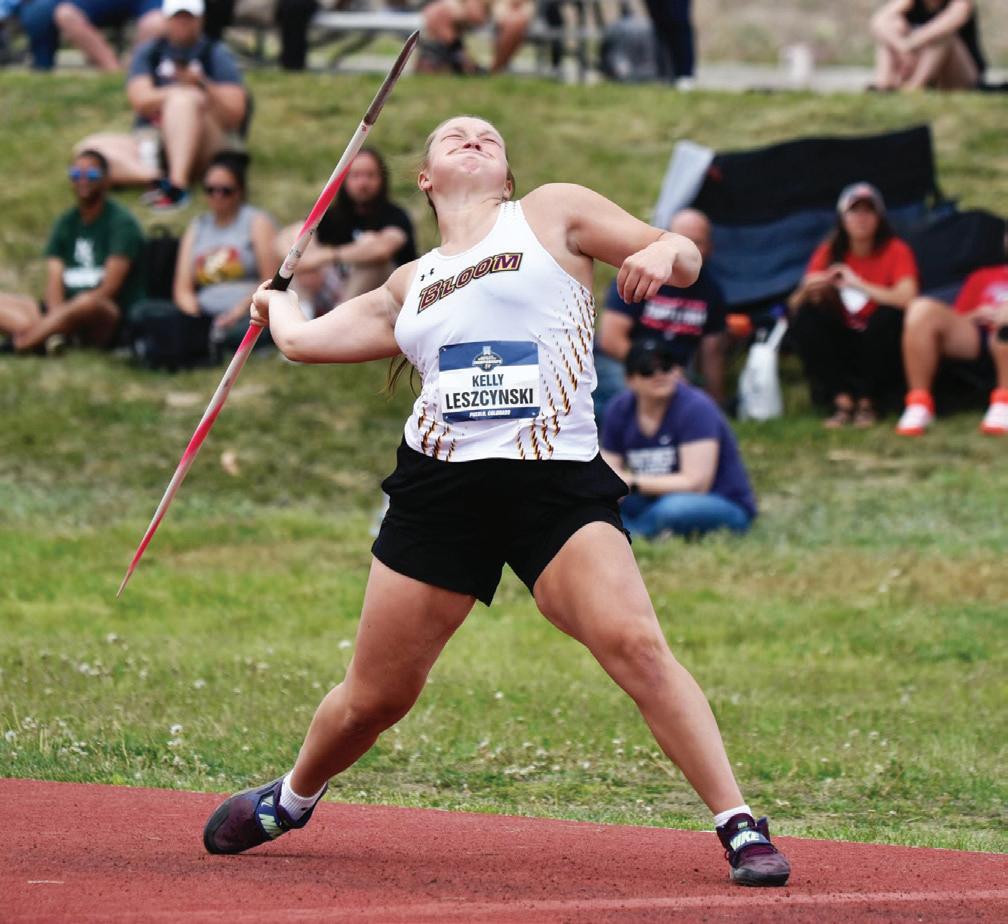
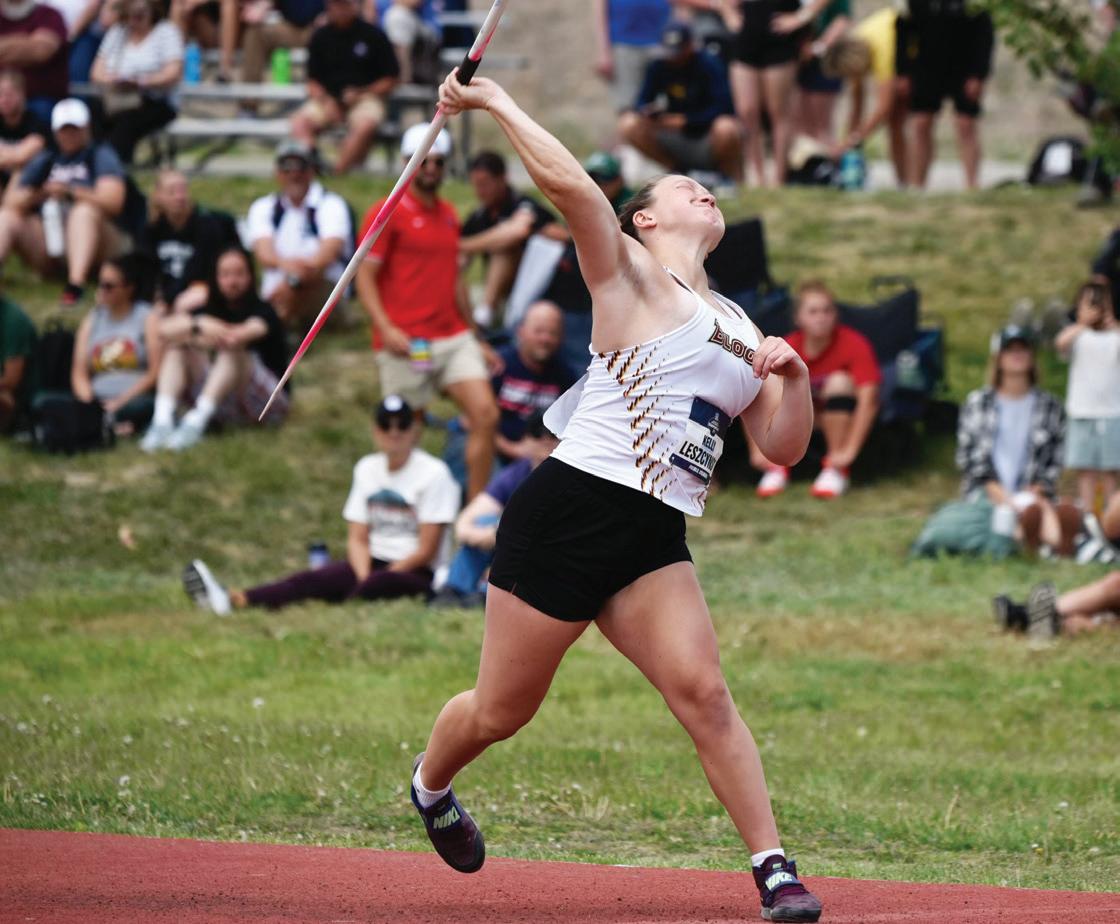
Last spring, Leszcynski became a National champion for the Huskies at the NACCA DII championship held in Pueblo, Colorado, winning the title with a school-record throw of 52.07 meters (170’ 10”), breaking her own school record she set at the qualifier with a throw of 50.40 meters.
The first national champion for head coach Bernie Empie and the first national champion for the Bloomsburg women’s track and field team, Leszcynski is the second individual national champion for the Huskies, joining Justin Shirk, who won the javelin in 2012 with a throw of 71.90 meters (235’ 11”).
Throwing a “jav” is not a matter of just having a strong arm and shoulder. “You throw with your whole body,” says Leszcynski. “The technique is very specific—you want to get all of the energy into the javelin.” Honing that technique entails practicing and hour to an hour and a half each weekday to prepare for Saturday meets. Only Sundays are off.
And the javs are not all the same. Though they all weigh 600 grams (21 ounces) and are approximately 7.5 feet long, they are designed to be thrown different distances. “Some are more forgiving of a mistake in technique. As the athlete gets better, the javelin is stiffer, more unforgiving of technique mistakes, but able to go farther.” Leszcynski knows when she’s had a good throw before the javelin even lands. “You can just feel it when it all comes together.
“At first I did the javelin because I was good at it. But as I get older, I am enjoying the sport more for its own sake and for the experiences it’s brought me.”
Leszcynski will graduate in the spring of 2026, but because she was out for a season with an injury, she has another year of eligibility—and is looking ahead to even longer targets for herself.
“Throwing coach Marcus Disbrow is a professional hammer thrower and inspired me to think about Olympic trials in 2028.” With her trademark grin, she adds, “I wasn’t too far off qualifying throws.”
From Husky to In F luencer:
Tik Tok cREAToR, mEREDiTH loUiSE , RETURnS To
BloomSBURg
It’s been a few years since she last stepped foot on campus, but this time, she returned in a whole new way. Meredith Louise ’19 shared her journey, her story, and a bit of her signature “internet best friend” energy with current CU–Bloomsburg students as a special guest speaker for the Future Business Leaders of America (FBLA) in October.
Meredith discussed how she transformed the lessons she learned at Bloomsburg into a career built on creativity, confidence, and connection. Today, she’s known to more than 840,000 followers across various social media platforms as “your go-to internet best friend girly,” a TikTok creator whose humor, authenticity, and warmth have made her a standout voice in the digital world.
At Bloomsburg, Meredith majored in supply chain management with a minor in information technology. She made it a point to get involved and take advantage of every opportunity—from workshops and résumé-building sessions to ZIPD networking events. “No matter where you end up, the skills you’ll learn are valuable and transferable,” she says, a lesson that still rings true as she balances her full-time 9-to-5 with being a full-time content creator. Students asked her everything from strategy tips and creative inspiration to how she
A noTE To PAREnTS
If this issue of Bloomsburg: The University Magazine is addressed to a daughter or son who has established a separate residence, please notify us of that new address by sending an email to: magazine@commonwealthu.edu
By Sarah Smeltz
stays motivated and what advice she’d give to aspiring creators. One message particularly struck a chord: “If you’re putting yourself out there authentically, people may not like you—it happens. Don’t water yourself down for them. Find your community.”
Meredith’s advice to people who wish to begin a content-creation journey was simple but powerful: stay consistent. Even when growth feels slow or uncertain, she emphasized that authenticity and consistency are what truly build trust—and an audience.
Looking ahead, Meredith shows no signs of slowing down. She plans to continue sharing cozy, real-life content—from recipes and daily routines with her husband to moments of laughter, self-care, and connection. She’s also expanding her creative reach across multiple platforms, continuing to build a space where her followers feel seen, supported, and connected.
Natalie Miller, president of Bloomsburg’s FBLA chapter, shares that inviting Meredith back to campus felt like the perfect fit— giving students the chance to learn not just how to break into the social media field, but what it’s really like once you’re in it.
If you’d like to follow Meredith and see more of her content, you can find her on TikTok, Instagram, and YouTube at @b1gbimbo. To learn more about Bloomsburg’s FBLA chapter and their ongoing work to support future business leaders, visit @bloomufbla on Instagram.
HappeningAT BloomSBURg
To see the full posts and to follow us on social media, scan the QR codes.
HUSKIES
GIVE BACK AT THE BIG EVENT ’25
Bloomsburg showed up in full force for The Big Event ’25! More than 800 Huskies spent the day raking, mulching, and beautifying nearly 175 sites across town—proving that community runs deep here.
A DAY IN BLOOM
From sunrise on the Quad to sunset over the Commons, every moment on campus shines a little brighter thanks to the people who call it home. Bloomsburg’s beauty isn’t just in the view—it’s in you.
WE REMEMBER
Bloomsburg paused to honor and remember the lives lost on September 11. Through reflection and a field of flags, we stand united in remembrance and gratitude.
SPRING BREAK, THE QUEST WAY
Our QUEST crew took adventure to new heights—literally— spending Spring Break climbing canyons, camping under the stars, and exploring the stunning Red Rock landscape. Missed out? Don’t worry, more adventures await!
WAnT To UnSUBScRiBE?
If you no longer wish to receive the print edition of the magazine, please notify us by sending an email to: magazine@commonwealthu.edu
REcEiVing DUPlicATE coPiES?
If you are receiving more than one copy of Bloomsburg: The University Magazine, please forward the mailing label panel from each issue you receive to: Bloomsburg: The University Magazine Arts and Administration Building 400 E. Second Street, Bloomsburg, PA 17815-1301
A
Quote to Launch a Teacher’s Journey
“Life is 10% what happens to you and 90% how you react to it.”
By Jaime North
It’s a quote Carly Dye first saw in fourth grade—a message she has since lived by and one she plans to proudly display in her own classroom someday.
“I think back to fourth grade when I had a really good teacher,” says Dye, a freshman CU–Bloomsburg early childhood and special education major. “I enjoyed Mr. (Michael) Underkoffler’s classroom so much. I wanted to help him with everything, and that’s when I realized, maybe teaching is for me.”
The fourth-grade classroom message stuck with her. “We said it every day. He ran his classroom around that quote. It’s something I definitely see myself doing when I’m a teacher.”
In fact, Dye began her teaching preparation before her high school graduation last spring. Dye spent her senior year at Milton Area High School, dually enrolled in CU’s Early College program, before becoming one of 180 early college students to start this fall as full-time CU students. “It’s definitely nice already
having college credits and knowing the campus a little bit,” says Dye. “I met a lot of the professors, which makes it a little less scary.”
Having already completed seven college courses will enable Dye to earn her bachelor’s degree in three years instead of four. While taking classes at Bloomsburg, Dye shadowed teachers through Milton’s early childhood education program, gaining exposure to lesson plans, behavioral management, large group instruction, and special education.
“I worked with adaptive gym students during my high school gym class, and I just loved working with them,” says Dye. “It made me want to add special education to my early childhood component.”
From that experience, Dye conducted research into how learning environments affected learning. She presented her findings last spring at Bloomsburg during the Frederick Douglass Institute for Academic Excellence’s annual poster session—further adding to her teaching resume before she began her first full-time semester of college.