The development of our Local Nature Recovery Strategy (LNRS) has been a collaborative process, with support from a wide range of individuals and organisations, as well as feedback from the general public. This document summarises our approach to ensure meaningful engagement across a broad audience.
Our strategy development has been reliant upon excellent partnership working and we have applied principles of transparency, inclusivity, and clear communication, as outlined in the LNRS statutory guidance. Engagement with land managers and other key stakeholders was prioritised. We have worked to ensure it has been consistent, regular and joined up, and that it will continue after the strategy has been published. We have focused on collecting quality, locally relevant opinions, advice and evidence from a wide range of stakeholders. This has helped to shape all aspects of the strategy and gives us confidence that its publication will be well received.
Herefordshire Council would like to thank all the individuals and organisations who supported the development of our LNRS.
2. Steering Group
Our Steering Group was established in June 2023 and held monthly meetings.
Membership includes:
• Natural England
• The Forestry Commission
• The Wye Valley National Landscape
• Herefordshire Wildlife Trust
• The Environment Agency
• Herefordshire Biological Records Centre
• The Countryside Land and Business Association
• The National Farmers Union
• The Wye and Usk Foundation
In addition, four working groups were established to focus on different aspects of strategy development. These comprised members of the Steering Group, with additional expertise brought in where required.
The groups were:
• Species Task and Finish Group, led by the Herefordshire Biological Records Centre (HBRC) and involving County Recorders and other taxa specialists and advisors
• Mapping, Data and Evidence Working Group, led by the council’s Nature Recovery Officer and HBRC supported by the Forestry Commission and Natural England
• Priorities and Measures Working Group, led by the council’s Nature Recovery Officer and involving special interest groups including Herefordshire Wildlife Trust, the Woodland Trust, the Environment Agency, the Forestry Commission and Natural England
• Stakeholder Engagement Working Group, led by the council’s Nature Recovery Officer and Talk Community initiative (the council’s directory of community groups and organisations) and involving Natural England, the Environment Agency, the Countryside Land and Business Association (CLA) and Farm Herefordshire.
3. Aims and objectives
The aim of the LNRS Engagement Plan was to ensure that wide and inclusive engagement was carried out during the LNRS development process. In addition to meeting the regulatory requirements for LNRS, transparent engagement will ensure the best outcomes for both nature and people.
A well-designed engagement plan linking with a wider range of stakeholders and consultees has:
• Ensured that decisions were taken were well informed
• Increased the likelihood of engagement with the finished LNRS since stakeholders and consultees have had a chance to engage with the process meaningfully throughout
• Built strong relationships with consultees and stakeholders
• Resulted in high quality, evidence-based decisions
The strategy has been co-designed with stakeholders as far as possible in order to create a robust and inclusive strategy that can be widely endorsed. This also aligned with LNRS Statutory Guidance and associated advice.
4. Key stakeholders
Three main groups of key stakeholders were identified at the start of the LNRS development (fig. 1):
The wider public and broader interest groups
Specialist interest individual/group consultees
Internal Council stakeholders
Internal Council Stakeholders included:
• Development Management Team
• Planning Policy Team
• Sustainability and Climate Change Team
1. Key LNRS stakeholders
• Built and Natural Environment Team
• Property Services and Highways
• Economic Development Team
Specialist Interest Consultees had access to the online questionnaire and were also invited to topic-specific webinars. They included local and national species/taxa experts and county recorders, as well as:
• Herefordshire Local Nature Partnership
• The Wye Catchment Partnership
• Friends of the River Wye
• Farm Herefordshire
• Herefordshire Rural Hub
• Parish Councils across Herefordshire
• Wyescapes Landscape Recovery
• Herefordshire Natural Flood Management Project
• Herefordshire Ice Age Ponds Project
• Malvern Hills National Landscape
• Herefordshire Meadows
• The National Trust
• The Duchy of Cornwall
• Earth Heritage Trust
• Floodplain Meadows Partnership
• CPRE Herefordshire
• Herefordshire Food Alliance
Figure
5. Timeline
Date
March 2024
Event/activity
• Presentation to the Local Nature Partnership
• Friends of the River Wye invited to Steering Group meeting
• Initial press release
• Welcome webinars for general public interest groups
June 2024
• Welcome webinar for farmers
• Online Engagement Survey 1 live *
• Market day stands in Hereford and the five market towns
July 2024
October 2024
November 2024
• County Recorders and species specialists’ workshop
• Newsletter produced
• Internal council workshops for Senior Managers, Members and Officers
• Self-serve webinar launched to support survey
• Update to Local Nature Partnership
• Attended Herefordshire Rivers Conference
• Map live on webpage and linked to survey 2
December 2024
January 2025
February 2025
March 2025
April 2025
May 2025
June 2025
July 2025
• Herefordshire Rural Hub Farmer pilot workshop
• Internal update to Officers
• Parish Councils webinar
• Land Agents event
• Article published in Herefordshire Wildlife Trust periodical Flycatcher
• Farmer workshops in Ross, Hereford and Leominster
• Additional farmer workshops
• Update to Local Nature Partnership
• Mapping engagement event
• Meeting with the Wye and Usk Foundation
• Attended local Big Green Businesses conference
• Landowner meeting with Duchy of Cornwall estate
* Online Stakeholder Engagement survey 1
The survey was available to the public via the Council’s website, and the following groups received invitations to respond to the survey:
• Landowners and land managers – distributed by Farm Herefordshire, Farming Clusters, CLA, NFU, TFA
• Golf Clubs
• Ministry of Defence
• Welsh Water and Severn Trent
• Herefordshire Council Highways Team
• Parish Councils and Community Groups – distributed by Talk Community
• Friends of the River Wye citizen science network
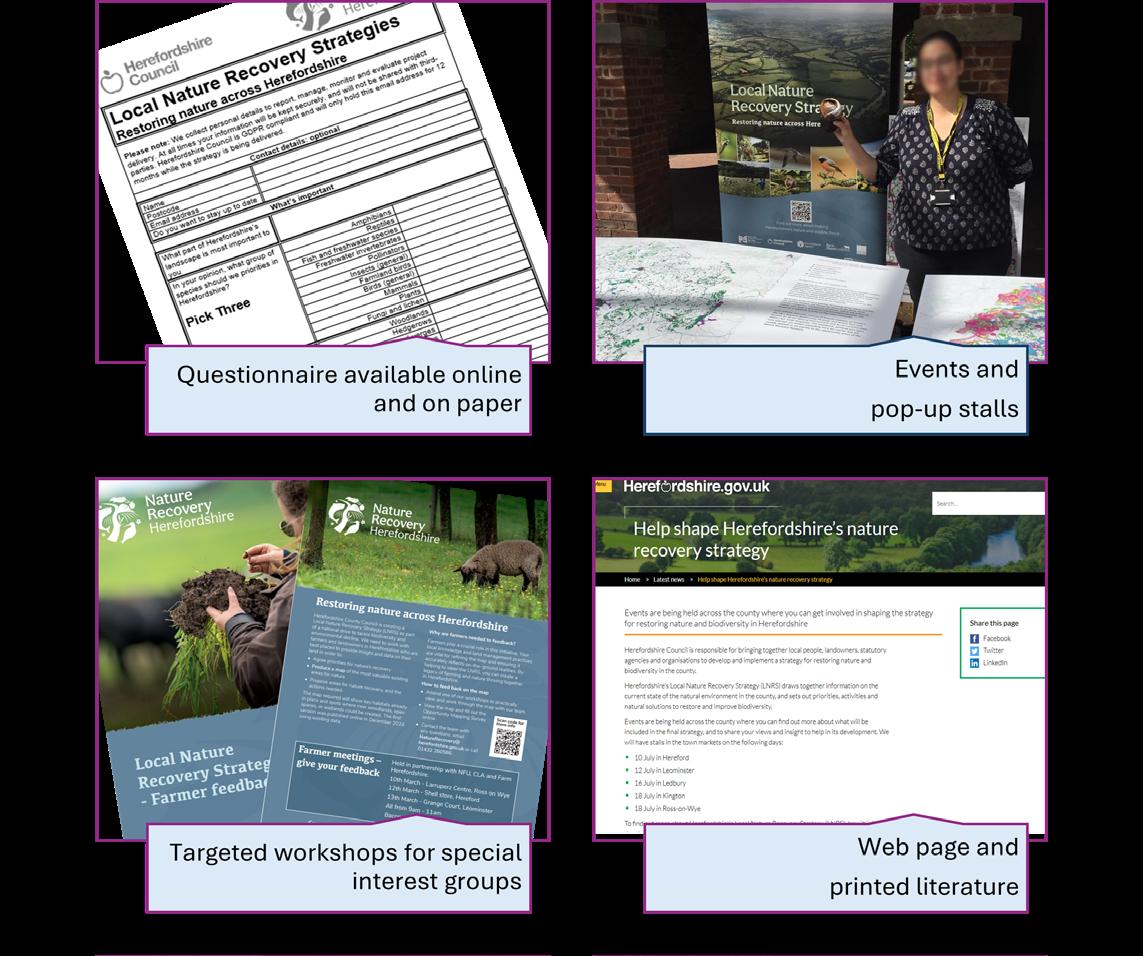
Various methods were employed to engage a wide audience with the development of the Herefordshire LNRS. These are summarised in Figure 2.
Surveys
We invited comments on the LNRS documents and maps through two surveys which were available on the Council website and also sent out to key stakeholders and consultees. The first survey focused on gaining feedback and input into the strategy documents and the second on the maps.
Events and pop-up stalls
We took information about the LNRS to the five market towns and Hereford city with stalls on market days. Using a large county map we were able to engage with members of the public, record comments and information and point them towards the online surveys. Information stalls and presentations were also taken to events such as the county Rivers Conference and the Big Green Business conference.
Targeted Workshops
In-person and online workshops were held for specific groups. These included:
• County recorders and species specialists
• Farmers, including a pilot with the Herefordshire Rural Hub followed by workshops in different locations around the county
• The Wye and Usk Foundation
• The Duchy of Cornwall, one of the largest landowners in the county
• Representative from Friends of the River Wye attended a steering group meeting
Early on in the process we presented to The Local Nature Partnership and followed this with regular updates and opportunities for them to feedback.
Website and printed literature
Draft maps and documents were published on a dedicated page on the council’s website. These coincided with the launches of the engagement surveys. The page was updated as the LNRS was developed and the minutes of the Steering Group were also published each month. We produced a newsletter about the LNRS as well as an article in the Herefordshire Wildlife Trust periodical The Flycatcher
Social media and press releases
There has been ongoing social media presence regarding the LNRS and media releases at key points to update on progress and promote engagement opportunities.
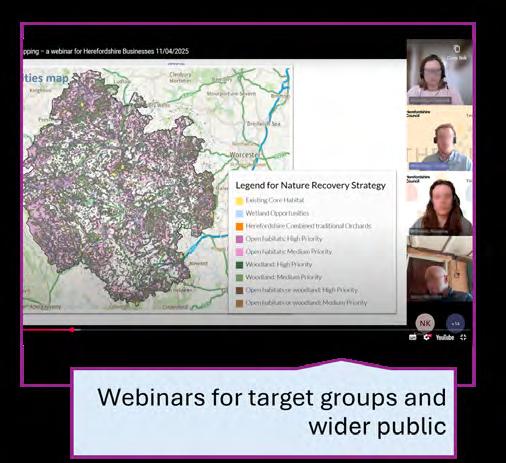
Webinars
Throughout the development stage we held a number of webinars, including:
• A welcome webinar for the general public
• Welcome webinars for the farming community and land agents
• A self-service recorded webinar to accompany the initial survey
• A webinar for Parish Councils
• Internal council webinars for officers and Members, one of which was attended by the Cabinet Member for the Environment
Social media and press releases
Webinars for target groups and wider public
Figure 2. Engagement methods
7. Outcomes
We successfully engaged with a wide range of people, receiving over 200 responses. A large proportion of this can be attributed to our supportive partners and key stakeholders, who disseminated the information to their wider networks. This demonstrates their backing for the strategy and their ambition for it to succeed.
Survey 1 - General (June 2024 – Dec 2024)
Looking specifically at survey 1, which was general questions about nature in Herefordshire (see Appendix I), we received 169 responses from a wide range of people and groups, including:
• Parish Councillors
• General public
• Local residents
• Retired
• Landowners
• Vets
• Volunteers
• Small-scale landowner
• Academics
• Charity sector / NGO
• Community Groups
• Consultants
• Developers
• Farm advisors
• Farmers
• Woodland / Forestry managers
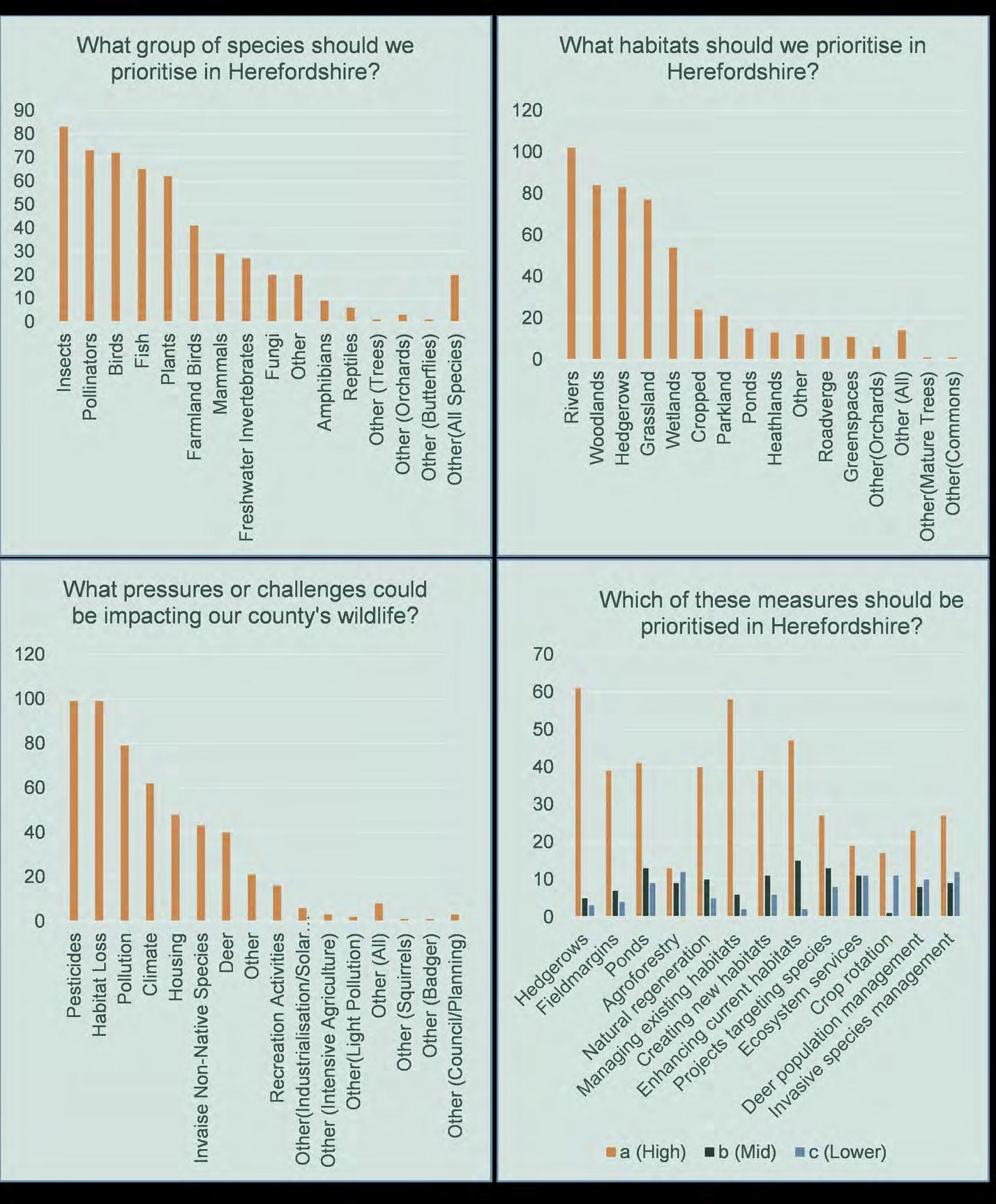
Key findings from survey 1 (figs. 3 and 4) show that insects and pollinators are the species groups people would most like the LNRS to prioritise. When it comes to habitats rivers were clearly the most selected, which is representative of their importance in shaping the county and in relation the current problems that they face which are regularly highlighted in popular media. Woodlands, hedges and grasslands were also highlighted to be a priority, with wetlands coming a close fifth. Respondents recognised pesticides, habitat loss and pollution as the key pressures impacting Herefordshire’s wildlife and said we should prioritise caring for hedges, field margins, ponds, and managing and enhancing existing habitats over creating new ones or enabling natural regeneration.
Figure 3. Survey 1 analysis
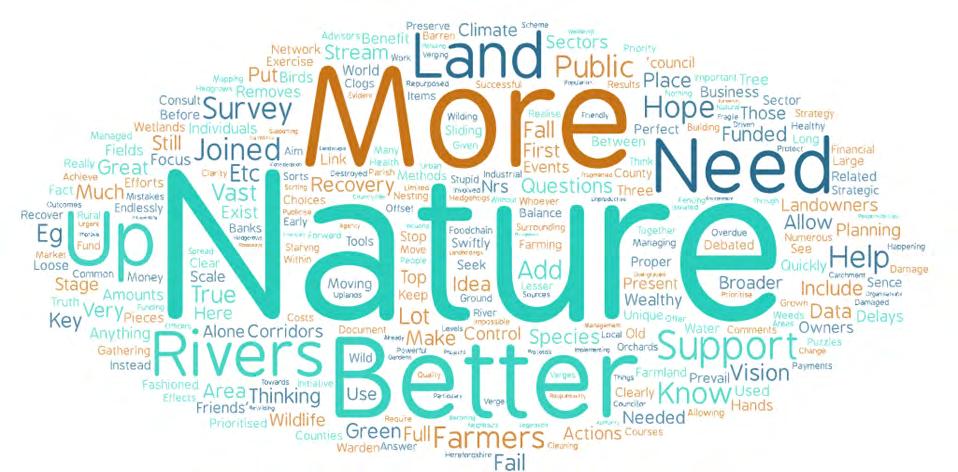
General comments about Nature Recovery in Herefordshire:
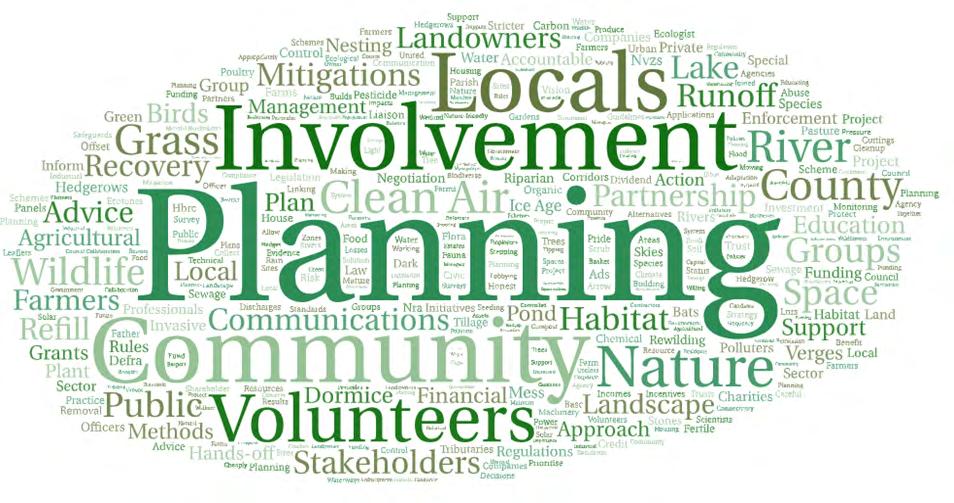
How could the actions and outcomes from the LNRS be achieved?
Figure 4. Word Clouds generated from survey 1 answers
We approached the Steering Group and key stakeholders to request their insights on the full second draft of the text on the description area and priorities and measures. The Earth Heritage Trust contributed text for the geology section of the area description, and the Floodplain Meadows Partnership and Herefordshire Meadows gave technical advice for the priorities and measures
Survey 2 – Mapping (Dec 2024 – June 2025)
Survey 2 focused on the mapping aspect of the LNRS and invited feedback and data correction in relation to specific locations and the appropriate measures as well as more general comments. Figure 5. shows a summary of the comments submitted and how we responded and made changes to our approach. They ranged from general comments about the mapping to providing detailed information based on local knowledge. The results were difficult to analyse compared to Survey 1 as the responses were in open text format with reference to locations marked on maps. Each one was carefully considered and many helped to shape the mapping process by providing data corrections and site-specific information while others fed into the text of the strategy documents. The responses highlighted where we needed to provide clearer explanation of how the maps were created and how to interpret and use them as well as better explanations around what measures are and how the strategy will be delivered.
5. Public feedback and our responses to Survey 2 - Mapping
What people said
A number of traditional orchards missing from the map
Green lanes and hedges provide excellent habitat but aren't mapped
Mapping doesn’t take account of new housing and other developments
Wetland opportunities mapped over homes and schools
Wording too technical e.g. least cost path analysis
Mapping misses off sites that are species-rich but not designated
Mapping misses off newly restored habitats e.g. species-rich meadows
Incorporate data from Hereford’s Community Green Infrastructure Map
Concern that ‘white space’ suggests no biodiversity value or potential
Additional opportunities for wetland creation identified
Woodland creation mapped on existing speciesrich grasslands
Incorporate agri-environment schemes into mapping
Concerns that high-grade agricultural land has been included in habitat measures
Historic parklands mapped as woodland measures
Ice Age Pond locations not mapped
Need to make it clear measures are opportunities not prescriptions
What we did
Missing orchards and sites no longer orchards were removed added where evidence available
Data-set too large to map but hedges are included in unmapped measures
Maps corrected to take account of recent developments
Wetland measures removed where overlap with homes etc
Clearer explanation has been provided in strategy documents of how maps were created
Cannot be added to APIB maps but added to opportunities map layers where evidence available
Adequate data for newly restored meadows are not available yet
These are sufficiently covered by the high priority built environment measures
Clearer explanation in strategy as to why areas have been left out of mapping and what implications are – LNRS guidelines advise habitat map covers 40-50% of county and many measures are left un-mapped
Mapping re-worked where evidence supported this
Maps corrected to ensure no overlap between APIB and ACIB layers
Not covered by APIB mapping guidelines and ACIB map is only for identifying new opportunities
Opportunities constrained on Grade 1 and 2 agricultural land. Provide clearer explanation that measures are not compulsory.
Maps corrected, historic parks and landscapes checked and inappropriate measures removed
Data not available but measures cover these
Clearer explanation in strategy documents of what measures are and that all are voluntary
Use of field boundaries on maps would be helpful A field boundary layer will be included for final map
Request to have land removed from APIB
Existing ancient woodland not included in measures layer
Clearer explanation needed about how APIB layer was created using designated sites from defined list
Clearer explanation that the APIB layer is existing designated habitats while measures are opportunities for new habitats
Figure
Events, workshops and webinars
The primary aim of the events was to raise awareness of the LNRS in Herefordshire and to point people to fill in the surveys. The responses shaped our development of the strategy content and mapping.
The Rural Hub workshop led to addition of an aerial map layer to the one that was displayed on the council website, to help people navigate the map. Parish councils requested that parish boundaries be added to the mapping. Respondents also helped to suggest mechanisms for the implementation phase of the strategy.
Local and national species specialists and County Recorders helped to select the species shortlist from a longlist of over 1000. They also advised on the species assemblages and the priorities and measures (as described in the species methodology).
Our partners Farm Herefordshire, CLA and the NFU helped us to reach farmer communities and to design our workshops to achieve meaningful dialogue with local farmers. As a result of our workshops with farmers we added field boundaries to the mapping. We also responded to requests from a small number of individual landowners to have their land removed from the mapping following a detailed process outlined in Appendix IV.
8. Conclusion and reflection
To develop a robust and comprehensive LNRS we have worked with a supportive Steering Group, using stakeholder working groups to look at specialist areas. We have reached out to the general public and wider stakeholders through in-person events and webinars as well as newsletters. We invited comments via two surveys; the first focussed on the priorities and measures, the second on the mapping.
Survey feedback and the work with stakeholders and working groups have guided decisions on habitat and species priorities and measures and ensured our mapping is as accurate as possible. Our work with species and habitat specialists, and with land managers and farmers, provided us with locally relevant, high quality advice and information.
Our aim throughout has been to have meaningful and productive engagement, applying transparent, inclusive and clear communication, to help us develop an LNRS that the people of Herefordshire will recognise as a strategy for them and their county that they are keen to deliver with us.
Appendix I
Survey 1 General Questions
1. What part of Herefordshire’s landscape is most important to you?
2. In your opinion, what group of species should we prioritise in Herefordshire?
3. In your opinion, what habitats should we prioritise in Herefordshire?
4. In your opinion, what pressures or challenges could be impacting our wildlife in Herefordshire?
5. What actions have you or your community undertaken for nature in Herefordshire? (no mow may, community tree planting, stewardship schemes)
6. a. What actions or outcomes would you like to see for nature and where in Herefordshire would you like to see this to happen?
b. How should this achieved?
7. Which of these measures should be prioritised?
• Hedgerows
• Field margins
• Ponds
• Agroforestry
• Natural Regeneration
• Managing existing habitats
• Creating new habitats
• Enhancing current habitats
• Projects targeting species
• Ecosystem services
• Crop rotation
• Deer population management
• Invasive species management
• Other
Appendix II
Survey 2 Mapping Questions
Q1. Please select all reasons for filling out this form:
• Data correction
• Measures that could be taken
• Providing local knowledge
• General feedback
• Other If other please specify
Q2. Please provide detail regarding the points you wish to make:
• Respondents added a point to the map
• pondents had a free text box to type their own information
Appendix III
Appendix IV
Management of conflict and risk
Managing
risk
Risk management during LNRS preparation was required to ensure that:
• The quality of the strategy was not compromised leading to negative impacts on a) stakeholder understanding of LNRS, b) willingness of stakeholders to participate in future delivery, or c) usability of the strategy as a tool for guiding nature recovery activity.
• The timetable of strategy production was not delayed once this had been agreed.
Factors that would increase the likelihood of these impacts occurring were considered to be:
• Objections from Supporting Authority leading to delays in proceeding to public consultation.
• Disagreement with neighbouring Responsible Authorities on cross-border issues/ mapping.
Risk management of these factors:
» Early engagement of Supporting Authority with process including representation on Steering Group and Task & Finish/Working Groups
» Follow LNRS guidance issued by Department for Environment Food and Rural Affairs and Natural England on process/procedural matters
» Workshops/webinars with planning officers
» Cross-Councillor engagement at political level
» Regular meetings with neighbouring Responsible Authorities to discuss matters of joint interest
• Limited availability of people to get involved.
• Consultation fatigue if individuals are approached on multiple occasions or being asked to engage with other apparently similar initiatives
Risk management of these factors:
» Balancing scheduled/structured meetings with allowing stakeholders to contribute during their own time
» Effective chairing of meetings to enable all to contribute and ensure contributions are recorded
» Recognising the contribution of key partners in LNRS preparation
» Regular updates to key partners and feedback to consultees so that progress and processing of their contribution is clear
» Close collaboration with key stakeholders and partners with close ties to interest groups likely to be most impacted
• Messaging too complicated/ nature recovery perceived as too complicated for the general person to engage with.
• Urgency of nature recovery not understood or people feeling it is not relevant to them.
Risk management of these factors:
» Well-structured consultation with easy-to-follow guidance using plain English and avoiding technical language
» Expectation management of what LNRS is and what it is not, and clear timescales for development and implementation
» Simple consultation questions and structure
» Non-mapped suggested measures that could apply anywhere within the county, including private gardens or community spaces
Managing conflict
The approach to managing conflict during the LNRS preparation process was informed by the Defra non-statutory guidance, which encourages collaborative working with partners to identify and resolve potential problems as early as possible.
Potential conflict could arise from:
1. Disagreements (on strategy content or mapping) between key partners represented on the Steering Group or the Task & Finish Groups.
2. Lack of/removal of support for or active opposition to LNRS content from Supporting Authority or neighbouring Responsible Authorities.
3. Landowners disputing the inclusion of their land within the Local Habitat Map.
1. Disagreements between key partners - Process of resolution
First stage, non-escalation:
• Both/all parties to be provided adequate opportunity to share their views and concerns in a respectful environment.
• Conflicting opinions to be discussed within the meeting or, if appropriate, a meeting to be convened for the purpose of the discussion OR matter added to the agenda of the next meeting.
• Group to discuss and reach consensus on a solution.
• Process of resolution (if escalation required):
• Request mediation, which in the first instance could be from the NE senior LNRS support officer (or their equivalent from another area if more appropriate) or a member of the RA senior leadership team.
• Parties to discuss and reach consensus on a solution.
2. Lack of support for LNRS - Process of resolution:
• A meeting to be convened to allow all parties adequate opportunity to state their views or concerns in a respectful environment.
• Attendees to discuss and reach consensus on a solution, with support from mediation if this is necessary.
3. Requests for removal of land from Local Habitat Map - Process of resolution:
• Land ownership or long-term/lifetime tenancy of requester to be confirmed
• Lawful inclusion of APIBs on the map to be explained
• Defra guidance signposted to indicate what LNRS will and will not be used for
• Opportunity to change mind prior to end of public consultation made clear
• Accurate map of land boundary to be obtained
• Non-APIB land to be removed from mapped Potential Measures/ACB layer
Appendix V
1.1 Aims of this Engagement Plan
The aim of this Local Nature Recovery Strategy (LNRS) Engagement Plan is to ensure that wide and inclusive engagement is carried out during the LNRS development process. Alongside meeting the regulatory requirements for LNRS transparent engagement will ensure the best outcomes for both nature and people.
A well designed engagement plan which links with a wider range of stakeholders and consultees will:
• Ensure that decisions are well informed.
• Increase the likelihood of engagement with the finished LNRS since stakeholders and consultees will have had a chance to engage with the process meaningfully throughout.
• Build strong relationships with consultees and stakeholders.
• Result in high quality decisions.
The Statutory Guidance1 and associated advice2 states that there will be a need to co-design the LNRS with stakeholders as far as possible, and this is reflected in this Plan.
1.2 Herefordshire LNRS Partnership Structure
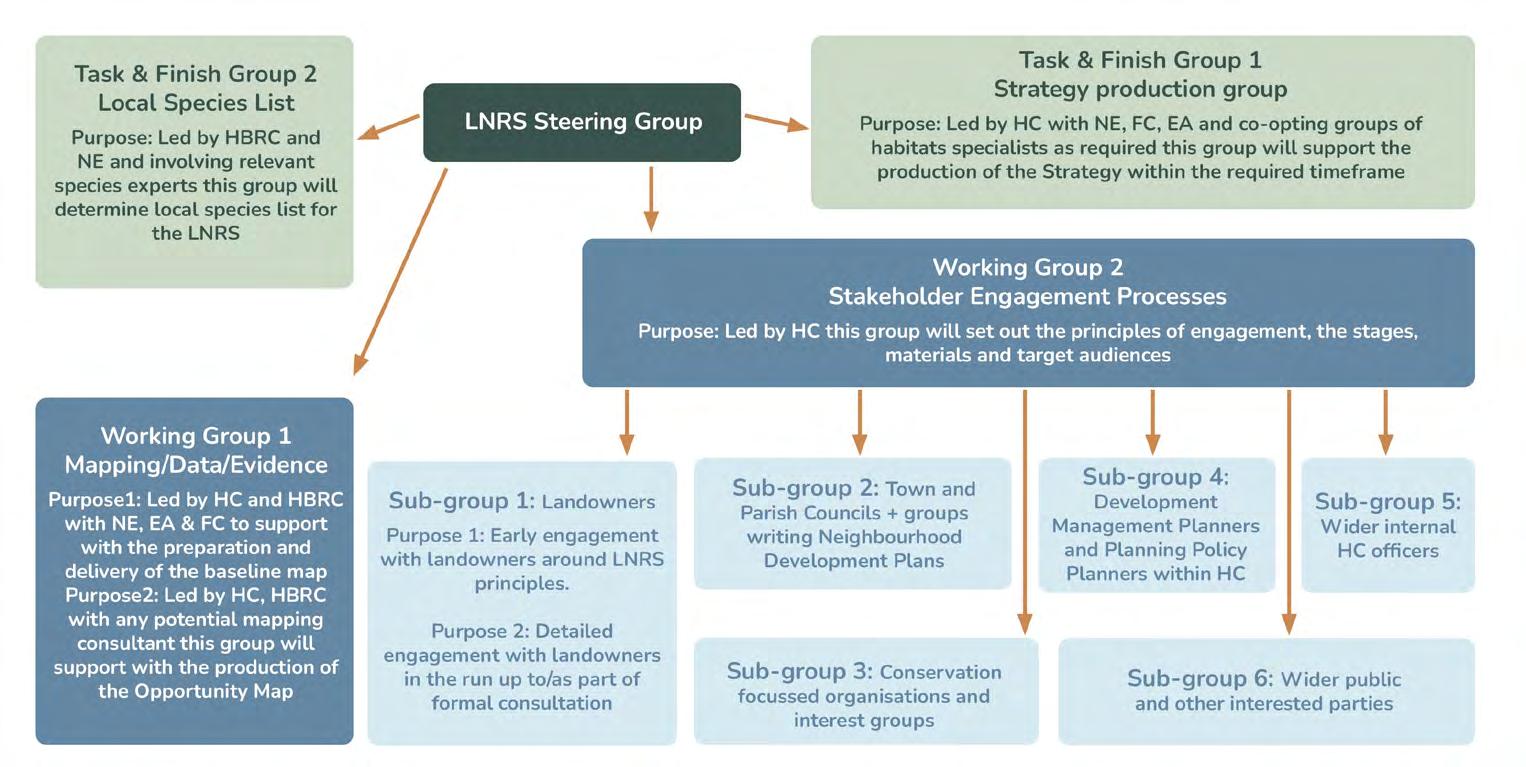
A key part of effective engagement is a clear and transparently structured partnership. The partnership structure below has been developed with the LNRS Steering Group in 2023 (Figure 1) and may be subject to review in the event that additional working groups become necessary.
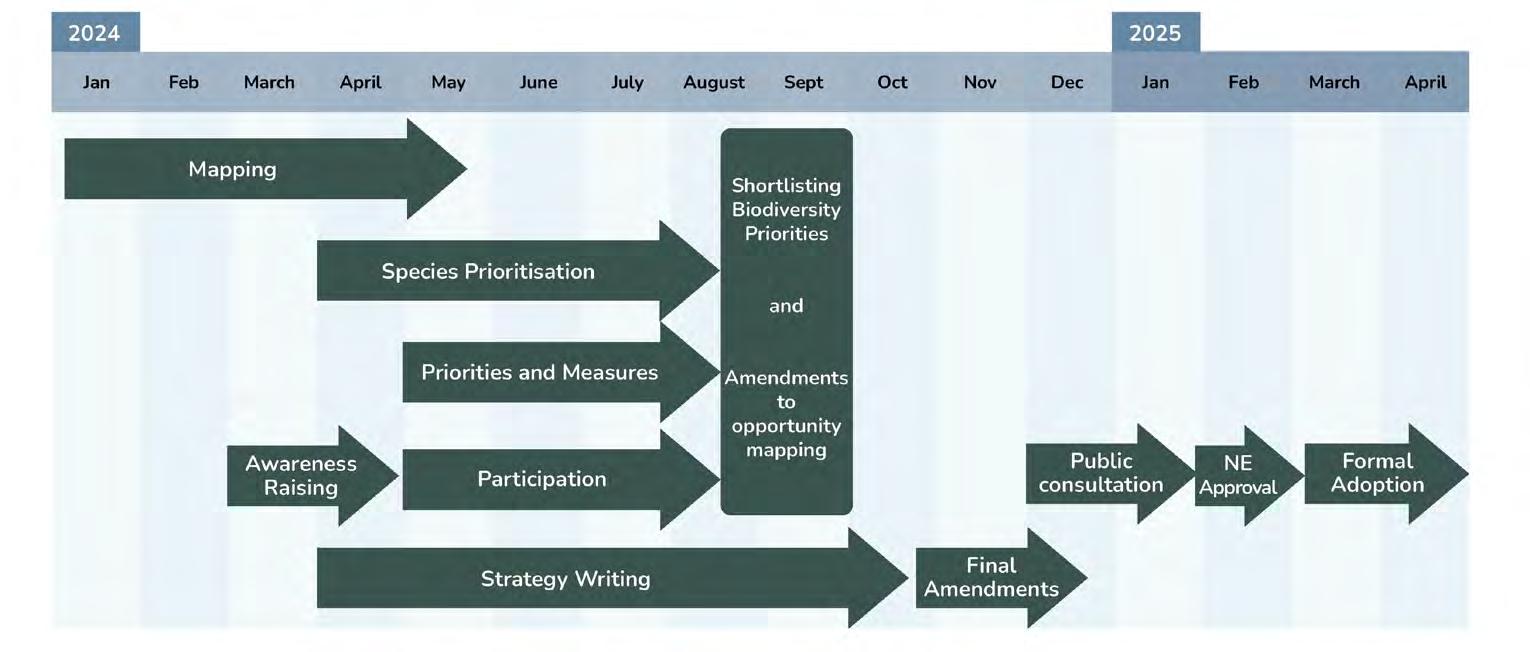
This Engagement Plan is the next step in identifying stakeholders, and in considering how and when they should be engaged with as part of the development of the LNRS. It is considered that engagement will take place alongside the opportunity mapping, writing of the strategy and identifying priorities and measures. It also considers methods of engagement suitable for different stakeholder groups and the different stages of the process. The Plan includes a working project plan (Figure 2) and contains a preliminary timeframe for delivery of the engagement, which will be regularly reviewed by the Stakeholder Engagement Process Working Group
Flexibility: Development of Local Nature Recovery Strategies is likely to an iterative process. It is therefore important the plan is not considered as fixed but is flexible so that it can accommodate changes and identify effectiveness of engagement through the process.
Figure 1: Herefordshire Local Nature Recovery Strategy Partnership Structure
Figure 2: Herefordshire Local Nature Recovery Strategy project timeline
1.3 Herefordshire proposed outcomes from engagement
The activities that have been outlined in the timeline include two stages; that will first raise awareness of the Local Nature Recovery Strategy in Herefordshire, and secondly involve participation to gain stakeholder input on three key elements of the Local Nature Recovery Strategy:
• What the priorities are for Natures Recovery in Herefordshire are (species, habitats and wider environmental benefits).
• What the potential measures are required to achieve priorities, in other words the actions needed to have the best outcome for nature.
• Identify where, on the spatial map, software or tool should priorities and measures take place
It is envisioned that the engagement on both the Local Habitat map and the Statement of Biodiversity Priorities could be done simultaneously. Other information that is hoped to be obtained for the Local Nature Recovery Strategy includes existing polices, plans and strategies (that could feed into development) and be informed by existing actions or projects that are happening within the county.
Challenges: Timescales are one of the biggest challenges that will face engagement, it is necessary that prior to engagement the opportunity mapping of least-cost pathways is completed and ready to present at the events. Exploring how this can displayed and communicated will be crucial to the success.
Funding and time capacity of staff will also have an influence on the level of engagement that will take place, it is therefore important that events are structured with a clear purpose and have a set timetable to deliver results by. It will also ensure that attendees are likely to attend rather than a ‘drop-in’ style event.
Levels of engagement are likely to vary and therefore awareness raising and communications prior to the events are just as important as the engagement during events to ensure maximum capacity of the right groups at the right times.
While it is important to try and seek consensus it is common in this kind of process for there to be conflicting or divergent opinions. Within the engagement process recognition will be given to diverging opinions and it is the intention of the Steering Group that the LNRS will not be prescriptive but will offer a range of options through which positive action for nature’s recovery can be taken depending on the specific range of factors in play in any given location.
1.4 Identification of Key Stakeholders
Stakeholder engagement relating to issues within the Natural Environment sector in Herefordshire is already strong with a large number of existing partnerships working on issues which relate closely to the LNRS. The Steering Group set out an early intention to utilise existing groups and partnerships as fully as possible in order to make best use of stakeholder resources and in order to embed the LNRS within these wider work streams.
Beyond those existing groups and partnerships, the Steering Group recognises the need for engagement with those who are involved in the implementation of the strategy and the need to engage more widely with both interested members of the public and those for whom the natural environment may not already be a priority.
December 2023: the Steering Group is working to establish where known stakeholders fit into the LNRS Organisational Structure and to set out an engagement process with the wider public and to identify those more difficult to reach groups.
February 2024: Working Group 2: Stakeholder Engagement Processes will oversee the planning and implementation of the engagement strategy that requires approval by the Steering Group. They have identified six groups of stakeholders (Table 1) to actively engage in the process, some of these stakeholders will require tailored engagement.
Table 1: Key Stakeholders
Engagement sub-group
Sub-group 1:
Landowners and Land managers
Sub-group 2:
Town & Parish Councils.
Organisations neighbourhood planning
Sub-group 3:
Conservation focused organisations and interest groups
Example stakeholder organisations
CLA NFU
Farm Herefordshire
Farmers and other private landowners
Forestry Commission
Highways England
Network Rail
Faith Groups (Church of England)
Educational establishments owning land
Water companies owning land
Businesses as landowners (Bulmers)
Town Councils
Parish Councils
Local groups undertaking Neighbourhood Development Plan
Herefordshire Wildlife Trust AONBs
National Trust interest groups (Herefordshire Meadows, Caring for Gods Acre)
Campaign to Protect Rural England (CPRE)
Access groups (Ramblers, HC PROW team)
Species Recording Groups (Bats, Amphibian and Reptile)
County Recorders
Ecologist consultants
Sub-group 4:
Development Management Planners
Policy Planners
Sub-group 5:
Herefordshire Council
Sub-group 6:
Wider public and other interested parties
Herefordshire Council Development Management Team
Planning Policy Team
Built and Natural Environment Team
Climate Change Team
Property Services and Highways
Economic Development Team
Public Realm (HC partners - BB and Hoople)
Education
General public
Local businesses
Youth groups, faith groups, schools & colleges
Other groups and individuals
1.5 Methods of Engagement
The advice on engaging stakeholders with LNRS3 sets out a process of initial awareness raising which should then develop into detailed, ongoing, targeted engagement with various stakeholder groups. It is important to tailor engagement methods to the needs and concerns of the stakeholders. Different stakeholders will require different information and will identify different opportunities and constraints for the strategy.
The levels of engagement and example methods required for each stage of the decision-making process has been outlined (Table 2). This will be continuously reviewed and where necessary an independent facilitator will be hired to manage individual stakeholder events or stages.
Table 2: potential Methods for Engagement
Possible Engagement Strategies Stakeholder
Stage 1: Awareness Raising
Stage 2: Participation
2a: Online Survey
2b: Initial consultation
2c: Engagement Tour
2d: Specific consultation
2e: High level consultation
Stage 3: Public Consultation
Sub-group 1 - 6
Sub-group 1 - 6
Sub-group 4 and 5
Sub-group 1 and 6
Sub-group 1 and 2
Sub-group 3
Sub-group 1 - 6
Stage 4: Draft LNRS Natural England
Stage 5: Adoption County Wide
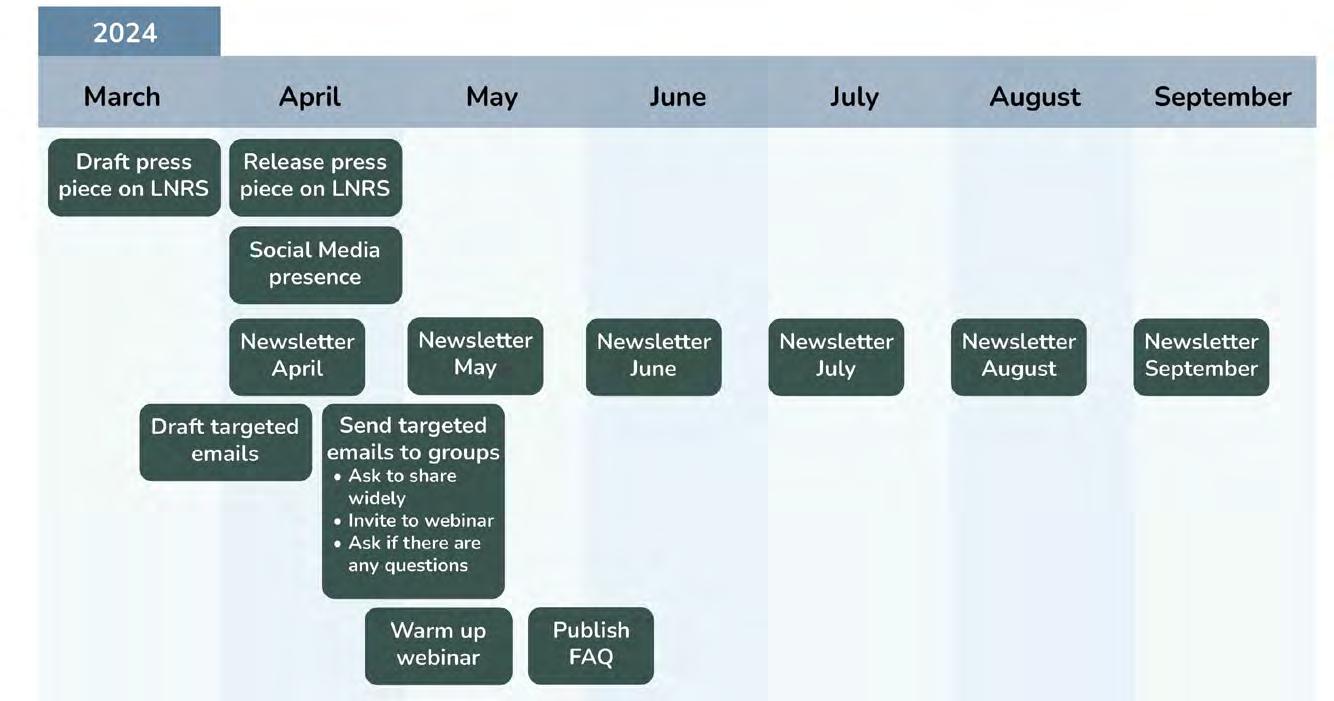
1.5.1 Stage 1: Awareness Raising
Possible types of Engagement
• Local Press
• Social Media – posts with attached photo and link to event
• Warm-up Webinar
1. Introduce LNRS (20 minutes)
• What it is? Why it is needed? What it means?
• Embed DEFRA video on LNRS
• What dates to keep in mind for further engagement?
2. Questions and Answers (10 minutes)
• Targeted emails to inform sub-groups
1. farming groups (CLA, NFU, Farm-Herefordshire, Farm Clusters)
2. parish councils (Talk-Community)
3. local partnerships and groups (HBRC)
4. ecology consultants
5. NGOs
3Local nature recovery strategies: Advice on governance and working with partners (04/05/2023)
• Frequently asked questions published
• Monthly newsletters
Detailed Description
Each group of stakeholders will need to understand the process in order to fully engage with it. They will want to know:
1. Why is this happening?
2. Who is responsible for the work?
3. What this means for themselves and their interests?
4. Where this provides opportunities for their interests and aims?
5. What it will cost and who is funding it?
6. Who to approach with questions and how their concerns will be managed?
7. What the timescales for change are?
8. How long it will last?
9. How can other stakeholders input to the strategy?
10. Is the strategy a tell or can people contribute and steer?
11. Delivery of the strategy? As in how it gets delivered on the ground
12. How it works / links in with other strategies
Suggested additional questions
Figure 3: Stage 1 – Proposed Engagement Timeline
Many stakeholder groups are already aware of LNRS and an initial engagement piece was released in the County when Herefordshire Council were confirmed as the Responsible Authority. There is potentially a lack of awareness currently among the wider public and hard to reach groups. Landowners/managers already engaged in partnership work in the County (Nutrient Management Board, Farm Herefordshire, CLA and NFU members) are likely to already be aware of LNRS. Individual landowners who do not currently engage with existing partnerships and who potentially are not members of NFU or CLA could be more difficult to reach but have an equally important role within LNRS.
So far we have:
• Created a webpage
• Created a web hosted record of the Steering Group’s papers and minutes
• Created an email address to serve as a first point of contact for LNRS work Naturerecovery@herefordshire.gov.uk
Beyond the initial, broad awareness raising, proposed engagement will need to distribute detailed information around LNRS to interested stakeholders. A primary route for this will be via the LNRS webpage hosted on the Council’s website which will provide information around what the LNRS is, its purpose, the process for producing the LNRS, principals of engagement and consultation and a broad, emerging timetable. Social media and traditional press will also be utilised here.
It is suggested that warm-up webinars that have been done with some success by other counties is undertaken by Herefordshire Council late April/early May which will then signpost people to Stage 2 events. The warm-up webinar will answer some of the questions above and include a frequently asked questions sections and open up to other questions this can then be shared with participants prior to other engagement. The benefit of this is that less time during the engagement session will be about the Local Nature Recovery Strategy but instead focus on the outcomes of the session.
Further to this broad awareness raising, engagement targeted at specific stakeholder groups will be undertaken. This work will focus around preparing specific stakeholder groups to engage in Stage 2 Participation. The Steering Group as of February 2024 has built a comprehensive stakeholder list around the Engagement Sub-groups identified and will
make specific contact with potential members of those groups using existing partnerships and networks, industry specific press, social media and direct correspondence. It is therefore important to tailor communications sent to partner organisations for each stakeholder group (particularly stakeholder group 1 and 2) to ensure the maximum participation.
More general information relating to the Local Nature Recovery Strategy will be provided in multiple places, online and on paper, to ensure that the information is made available widely. For example, so that people without access to the internet can still be informed. This stage will also direct people to places that they can make their opinions known, at stage 2.
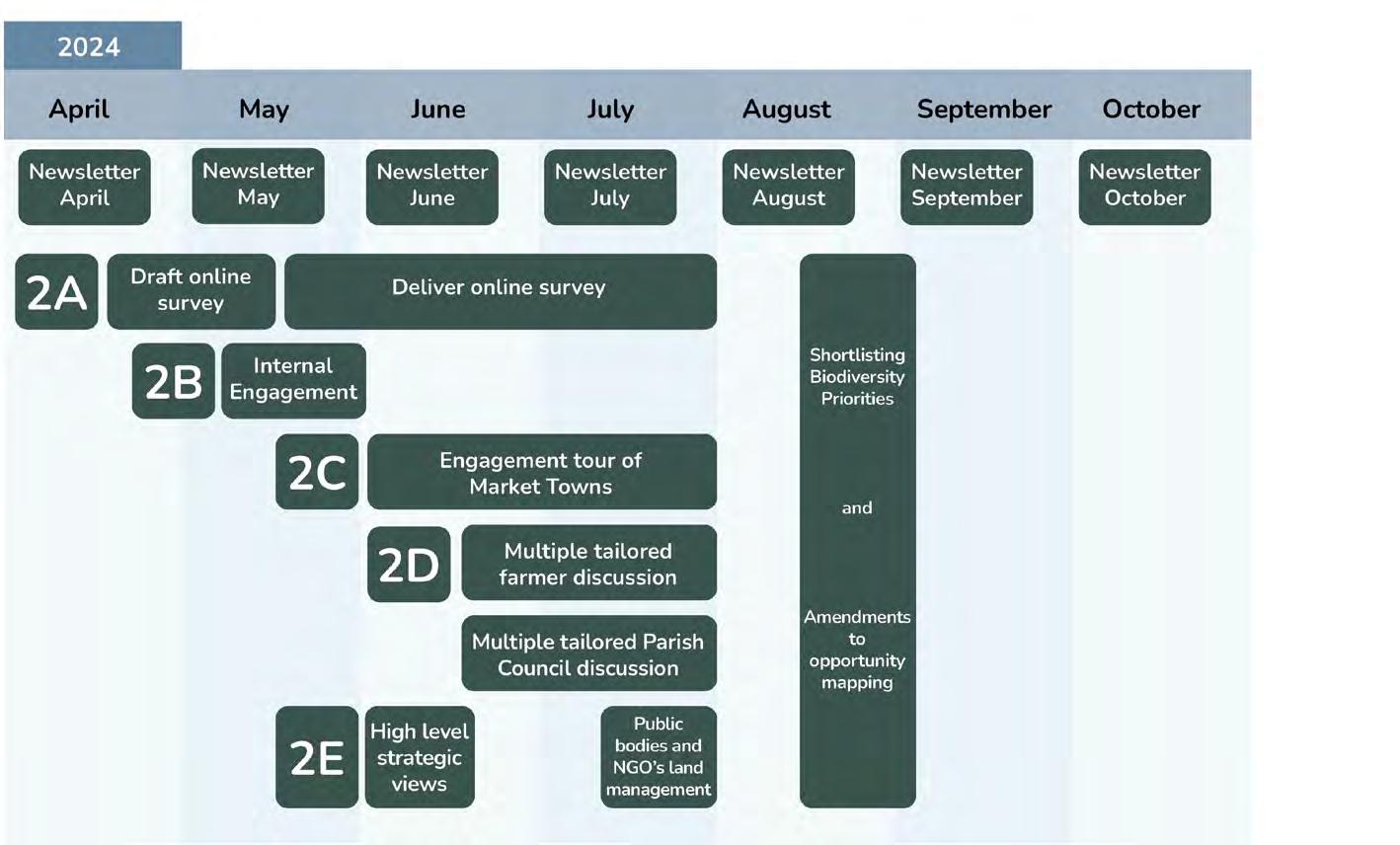
1.5.2 Stage 2: Participation
Possible types of Engagement
2A: Online Survey: General survey for priorities and measures
1. General LNRS Survey
Flavour of Questions
• What words come to mind when asked about Herefordshire wildlife and biodiversity?
This can be captured to produce a word cloud in the shape of Herefordshire, this was done by Buckinghamshire pilot.
• Of the species assemblages listed which do you think of as being important in Herefordshire? (list and rank top 3?)
• What changes for species and species assemblages is most important (pick 1 -increased abundance/ increased distribution/ increased resilience, other)
• Which habitats are important in Herefordshire? (list and pick/rank top 5?)
• How do we want the landscape to be changed (pick 1 - increased area/ better quality/ managed effectively)
• What does your vision for Herefordshire’s landscape look like? (tick all that apply? connecting hedgerows, increased number of ponds, sustainable farming, other)
• What are the most important ecosystem services for Herefordshire? (list and rank; including other)
• Where in Herefordshire is important to you?
Locate on a map – heat map
2. More specific LNRS priorities or measures
• Do you want to tell us about specific priorities and measures in the county of Herefordshire? (Yes / No)
• What is your priority; species habitats or wider environmental benefit
• What specifically do you want to see happen? particular outcome for priority listed
• What actions are required? for each priority and outcome listed
2B: Initial consultation
1. Internal consultation with Hereford Council
• To develop
2C: Engagement Tour (3 events - geographical spread)
1. Questions
• To align with the online survey
2. Spatial feedback mechanism.
• To develop
2D: Tailored Discussion
Stakeholder Group 1: engagement for farmers and foresters (3 events - geographical spread)
1. Questions; general chat
Flavour of Questions
• Of the species assemblages listed which do you know you have on your landholding?
• Of the species assemblages listed which is the most important to have on your land holding?
• What habitats do you have on your landholding?
• What habitats would you like to have on your landholding?
• What actions for nature do you currently do on your landholding?
• What actions would you like to do for nature if funding wasn’t an issue on your landholding?
2. Spatial feedback mechanism
• To develop
Stakeholder Group 2: engagement for parish councils (2 events maximum online and in-person)
1. Questions; general chat
• What species or habitats are important in your parish?
• Why are these species or habitats important aspects in the Herefordshire landscape?
2. Spatial feedback mechanism
• To develop
2E: High Level consultation
1. NGO’s, Public Bodies and Interest Groups strategic views (1 event)
• Are these species correct?
• Are there any missing?
• Which ones are most important for Herefordshire?
Flavour of Questions
• What changes do we want for species (increased abundance/ distribution/ resilience)?
• What are the most important habitats in Herefordshire?
• What habitats need their weighting increased in the opportunity mapping?
• Are there any habitats that are a lower priority for Herefordshire?
• What are the biggest challenges, pressures and negative influence that Herefordshire faces? (invasive species, phosphates, pollutants, poor management, intensive management practices)
2. NGO‘s and Public Bodies as landowners and land managers (1 event)
• What sites do you own or manage that are well connected to the wider environment?
• What sites do you own or manage that need better connectivity or poorly connected (surrounded by intensive agriculture)?
• Do you own or manage any statutory or non-statutory sites that need improving that should be considered in the LNRS for enhancement or restoration?
• Do you own or manage any sites that are being adversely impacted by internal or external influences? What are these impacts? (agriculture runoff?)
Figure 4: Stage 2 – Proposed Timeline
Detailed Description
Stage 2 offers a range of targeted opportunities for participation in the developing LNRS for various stakeholder groups beginning internally and then inviting participation externally. The format of this stage will vary depending on the stakeholder group being engaged and may include the use of specialist facilitators where appropriate. This stage will require stakeholders to provide detailed, evidenced information relating to their views on the LNRS strategy, and the information they require from it.
Stage 2 represents the main engagement opportunities in the LNRS process and will be set out in detail in 2024. The Steering Group are clear that wide ranging engagement opportunities must be offered but equally wishes to engage appropriately and meaningfully with different stakeholder groups. An approach which suits one stakeholder audience will not suit all audiences and some groups will require ongoing engagement while for other group’s one off events may be sufficient. The Steering Group aims to engage when there is meaningful information to be shared and on which views can be sought in order to ensure that each engagement opportunity is useful and moves the development of the LNRS forward.
Additional engagement activities/methods will be considered as this Engagement Plan develops and the program will aim to be responsive to the needs of stakeholders.
1.5.3 Stage 3 – Public Consultation
Detailed Description
At stage 3 the final draft report of the LNRS having been reviewed through the LNRS Steering Group and Working Groups will be circulated for comment to stakeholders (the breadth of those stakeholders to be agreed by Working Group 2) any necessary revisions made and reissued in a final version. This will be explored more fully closer to the time of Public Consultation (running over winter 2024)
1.5.4 Stage 4 – Draft LNRS
Detailed Description
At Stage 4 the Draft LNRS will be provided to Natural England, in their role as Supporting Authority, for their approval (early Spring 2025)
1.5.5 Stage 5 – Adoption
Detailed Description
At Stage 5 the LNRS will be finalised and adopted by Herefordshire Council. To be published March 2025.
1.6 Drawing Information from Feedback and Engagement Responses
The feedback and engagement responses need to be easily synthesised for ease of interpretation, and for views, opinions and evidence to be incorporated and integrated into the strategy.
1. Virtual events will be recorded and exploration of engagement software’s such as Miro Board could be utilised to record feedback.
2. In person events detailed notes will be taken, use of post-it notes and exploration of engagement software’s so that responses can be recorded in an engaging way and used in developing the LNRS.
3. Events associated with the engagement tour of market towns should align closely with the online survey, the benefit of this is include a repeatable structure, the outcomes and purpose are clear and by simplifying interpretation as can be added as response for the online survey so that there is one less data set to look through. While also allowing a mechanism to record additional information generated from open discussions.
4. In person tailored events for internal staff at Herefordshire Council, Land managers, Parish Councils and High level strategic views need clear questions even if delivered by an informal discussion. This will keep the engagement focused, on track and the outcomes will be useful that directly relate to the sections of the strategy.
1.7 Timetable for Engagement
It is widely acknowledged that timetables for LNRS production are ambitious and that well planned, resourced and implemented engagement strategies are going to be a cornerstone of LNRS production. While a draft timetable for Stage 1 and 2 have been produced (March 2024). It is important that timetables are considered fluid.
1.8 Review and Monitoring
This engagement plan is an iterative document and will be regularly reviewed.
Review of the success of individual engagement events will enable the LNRS to be as userfriendly and future-proof as possible. Feedback will be sought from stakeholders following engagement events and will be used to support ongoing reviews of this Engagement Plan.
Additionally, all workshops and consultee events will record the number of attendees, their organisations and what stakeholder group they represent. This will be used to monitor the levels of engagement both within and across the stakeholder groups as well as the retention of these groups.