While the CAA’s survey focused mainly on the quantum of provision rather than quality of education, it’s experience in this area suggests that quality and consistency of standards is an issue in many parts of the Commonwealth. Similarly, the survey reveals that Continuing Professional Development is only mandatory for 63% of respondents suggesting that the maintenance and development of professional standards may also be an issue. Another important consequence of low numbers of architects in many Commonwealth countries is the small pool of professionals from which national institutes are able to attract members, coupled with their relatively low earning potential (and hence low subscription levels; see chapter 7.2.5 and 7.1.5) thereby reducing the institutes ability to develop the profession (ie professional, educational and technical standards) and engage with government on issues of policy making. Membership rates (ie institutional membership/number of registered architects) range from 20% in Pakistan, 33% in India and 80% in the UK, suggesting that institutes need to do more to demonstrate value and relevance.
3
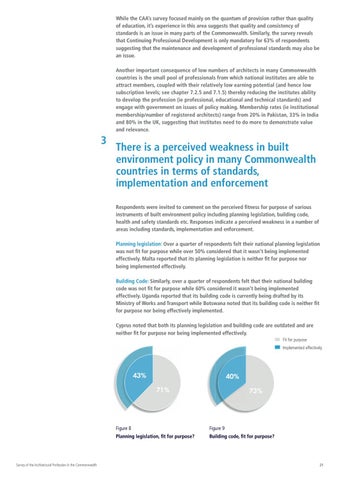
There is a perceived weakness in built environment policy in many Commonwealth countries in terms of standards, implementation and enforcement Respondents were invited to comment on the perceived fitness for purpose of various instruments of built environment policy including planning legislation, building code, health and safety standards etc. Responses indicate a perceived weakness in a number of areas including standards, implementation and enforcement. Planning legislation: Over a quarter of respondents felt their national planning legislation was not fit for purpose while over 50% considered that it wasn’t being implemented effectively. Malta reported that its planning legislation is neither fit for purpose nor being implemented effectively. Building Code: Similarly, over a quarter of respondents felt that their national building code was not fit for purpose while 60% considered it wasn’t being implemented effectively. Uganda reported that its building code is currently being drafted by its Ministry of Works and Transport while Botswana noted that its building code is neither fit for purpose nor being effectively implemented. Cyprus noted that both its planning legislation and building code are outdated and are neither fit for purpose nor being implemented effectively. Fit for purpose Implemented effectively
43%
40% 71%
Survey of the Architectural Profession in the Commonwealth
73%
Figure 8
Figure 9
Planning legislation, fit for purpose?
Building code, fit for purpose?
21