
BEETHOVEN, SCHUMANN & BRAHMS
FRIDAY, APRIL 17, 2026 AT 7:30PM
SATURDAY, APRIL 18, 2026 AT 3PM
OHIO THEATRE
ROSSEN MILANOV, CONDUCTOR
MAXIM LANDO, PIANO
BEETHOVEN
SCHUMANN
BRAHMS
Overture to Egmont, op. 84
Symphony No. 4 in D minor, op. 120
I. Ziemlich langsam - Lebhaft
II. Romanze: Siemlich langsam
III. Scherzo: Lebhaft
IV. Langsam - Lebhaft
-- INTERMISSION --
Piano Concerto No. 1 in D minor, op. 15
I. Maestoso
II. Adagio
III. Rondo: Allegro non troppo
Maxim Lando, piano
This concert is dedicated to the memory of Mark and Annie Bates by their loving family: Deborah, Hiroshi, Ken, Bryan, and Emily Yoshino.
The Columbus Symphony uses Steinway Pianos generously furnished by Graves Piano.
MAXIM LANDO, piano
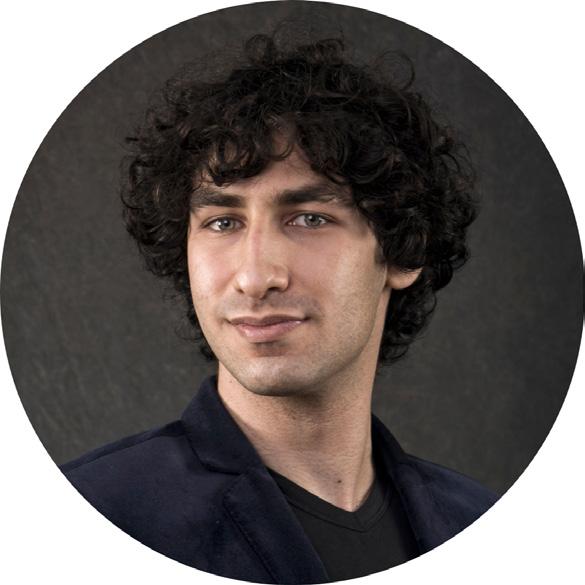
American pianist Maxim Lando was lauded by Anthony Tommasini in the New York Times for his “brilliance and infectious exuberance.” He is hailed as “one of the most brilliant and imaginative young pianists to emerge in recent years” (Gower Festival), “a total musical being” (National Review), and “a dazzling fire-eater” (ARTS San Francisco).
Maxim first made international headlines performing together with Lang Lang, Chick Corea, and the Philadelphia Orchestra led by Yannick Nézet-Séguin at Carnegie Hall’s 2017 Opening Night Gala. Since then, he has performed with major orchestras around the world including the Cleveland Orchestra, Pittsburgh Symphony, Toronto Symphony, Israel Philharmonic, Orpheus Chamber Orchestra, Mariinsky Theater Orchestra, Vancouver Symphony, Zurich Chamber Orchestra, St. Petersburg Symphony, and over 60 other orchestras across the United States and Europe.
Recent and upcoming highlights of 2025-26 include a nine-city U.S. tour with the Czech National Symphony Orchestra; appearances with the Arizona Musicfest Festival Orchestra, Frankfurt Opera Museum Orchestra, Orquesta Clásica Santa Cecilia, Belgrade Philharmonic, Sophia Philharmonic, and the Baltimore, Buffalo, Columbus, Charleston, Anchorage, and Princeton Symphony Orchestras; recitals featuring Lowell Liebermann’s brilliant new masterpiece Frankenstein; and a recording with the ORF Radio Symphony Orchestra Vienna.
Awarded the 2025 Khaledi Prize for Excellence and Innovation in Classical Music from Festival Napa Valley, Maxim is also winner of the 2022 New York Franz Liszt International Competition, 2022 Vendome Grand Prize, and top prizes at both the 2024 Cleveland International Piano Competition and 13th International German Piano Award. Maxim is the recipient of a Gilmore Young Artist Award and won the Young Concert Artists Susan Wadsworth International Auditions at age 16. His following recital debuts at Carnegie’s Zankel Hall and Kennedy Center Terrace Theater were hailed by the New York Times as concerts “You Won’t Want to Miss!” Dedicated to making classical music accessible to his own generation, Maxim has been featured on CNN, NPR, BBC, WQXR, Bavarian Radio, Euroradio’s Top Young Performers, Israel’s “Intermezzo with Arik,” and Russia’s TV Kultura.
Maxim’s concerts include venues such as Carnegie Hall, Alice Tully Hall, Beijing National Center for Performing Arts, Alte Oper Frankfurt, Louis Vuitton Foundation and Salle Cortot in Paris, Symphony Hall in Shenzhen, Kulturpalast Dresden, Tchaikovsky Hall in Moscow, and Chicago’s Millennium Park. He was invited by Lang Lang to perform for the historic opening of Steinway and Sons in Beijing.
Maxim partners frequently with violinist Daniel Hope and is passionate about chamber music and unusual repertoire. He has collaborated with Lynn Harrell, Julian Rachlin, and the Danish String Quartet among others, and plays regularly with Jupiter Symphony Chamber Players in New York City. Together with his German friend and violinist Tassilo Probst, his album Into Madness, recorded by Bavarian Radio on Berlin Classics, was awarded a 2023 International Classical Music Award (ICMA) as best chamber music recording of the year. It also received a double nomination for Opus Klassik, and the duo was honored at the National Forum of Music in Wroclaw, Poland.
Maxim is a Laureate of Artemisia Foundation, an alumnus of the Lang Lang International Music Foundation, and studies with long-time mentor Hung-Kuan Chen at The Juilliard School.
Mr. Lando appears by arrangement of Arabella Arts.
PROGRAM NOTES
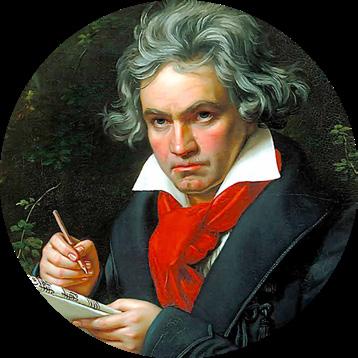
Overture to Egmont, Op. 84 (1810)
by Ludwig van Beethoven (Bonn, 1770Vienna, 1827)
Most recent Columbus Symphony performance: May 13-14, 2022; Rossen Milanov conducting.
Duration: 8’
Three years before Beethoven was born, the German playwright Gotthold Ephraim Lessing (1729-1781) published an important theoretical work on theatre called the Hamburg Dramaturgy.
In it, Lessing wrote at length about the role of music in spoken drama, an area in which he felt substantial changes were needed. Eighteenthcentury aesthetics insisted not only on music’s power to express human emotions but also its obligation to do so as fully as possible. According to Lessing, music for spoken plays should express the subject matter at hand, rather than just provide a background or a distracting entertainment.
In the same year, 1767, Christoph Willibald Gluck wrote a preface to his opera Alceste, in which he said: “My idea was that the overture ought to indicate the subject and prepare the spectators for the character of the piece they are about to hear.”
In the hands of Gluck, Mozart, and Beethoven, the genre of the overture became capable of dramatic expression, even exceeding Lessing’s postulates. Beethoven discovered entirely new possibilities in the overture, and when, between the second and third versions of his opera Fidelio, he turned to the spoken theatre to write Egmont, he incorporated incidental music into the drama like no one had ever done before.
The action of Goethe’s tragedy Egmont (1786) takes place in the 16th century, when Flanders was occupied by the Spanish. Count Lamoral van Egmont, scion of a noble Flemish family, was appointed governor of the province by King Philip II of Spain (the stepfather and rival of Don Carlos in Schiller’s tragedy and Verdi’s
opera). Seeing the suffering of his oppressed fellow countrymen, Egmont turned against the Spaniards and challenged the King to give freedom to the Low Countries. In response, Philip had Egmont executed in Brussels on June 4, 1568; this cruel act touched off a war of independence that eventually ended with the victory of the Flemish insurgents.
This story of a foreign oppression successfully challenged could never have been timelier than in the Vienna of 1809, occupied by Napoleon’s forces. And surely no composer had treated the themes of oppression, struggle, and freedom as often and as gloriously as Beethoven, whose opera Fidelio was about the liberation of a freedom-fighter from unjust imprisonment and whose Fifth Symphony culminated in a breath-taking transition from darkness to light.
Lessing had written in the Hamburg Dramaturgy: ”The overture must only indicate the general tendency of the play and not more strongly or decidedly than the title does. We may show the spectator the goal to which he is to attain, but the various paths by which he is to attain it must be entirely hidden from him.” The Overture to Egmont closely follows this precept, representing the “goal” (victory) through a transition from darkness to light not unlike the Fifth Symphony and the “Leonore” Overture No. 3.
The overture consists of three sections: a slow introduction, followed by a dramatic Allegro and a triumphant coda. The introduction is based on two themes, a forte chordal passage played by the strings and a doleful melody given to the woodwinds. A short transition leads into the passionate Allegro, written in a heroic style with reminiscences of the Fifth Symphony. The chordal passage from the introduction reappears as the Allegro’s second theme. Another dramatic transition ushers in the coda (concluding section), in which the fanfare of the horns and trumpets proclaims the triumph of the cause of freedom.
Goethe’s tragedy ends as Egmont confronts his executioners without fear; as the curtain falls, Goethe’s stage direction calls for a Siegessymphonie (symphony of victory) to be played by the orchestra; and that is exactly what Beethoven composed here.
PROGRAM NOTES
Symphony No. 4 in D minor, Op. 120 (1841, rev. 1851)
by Robert Schumann (Zwickau, Saxony, 1810 - Endenich, nr. Bonn, 1856)
Most recent Columbus Symphony performance: Nov. 3-4, 2007; Günther Herbig conducting. Duration: 29’
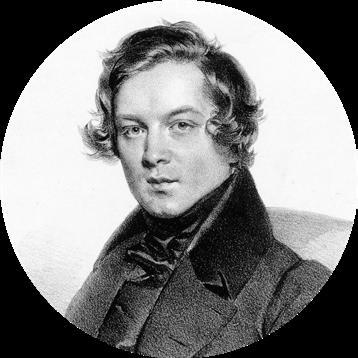
After Beethoven, writing symphonies was never the same again. In the words of the influential German musicologist Carl Dahlhaus, “Beethoven had transformed the symphony into a monumental genre … [that] manifested compositional ambitions of the highest order, the audience it addressed being no smaller than the whole of humanity.” Composers had to come to terms with the genre’s increased exigencies, and create works of universal appeal while trying to escape Beethoven’s stylistic influence.
Robert Schumann, who wrote only solo piano music during the first stage of his compositional career, had long been dreaming of taking up the Beethovenian challenge. During a trip to Vienna in 1838, he obtained the manuscript of Schubert’s “Great C major” Symphony from Schubert’s brother. After the work’s premiere, given by Felix Mendelssohn and the Leipzig Gewandhaus Orchestra the following year, he wrote to his fiancée, the great pianist Clara Wieck: “I was supremely happy and had nothing left to wish for, except that you were my wife, and that I could write such symphonies myself.” For her part, Clara wrote in her diary in 1840: “My highest wish is that he should compose for orchestra—that is his field! May I succeed in persuading him to enter it.”
And so it happened. The long-awaited wedding of Robert and Clara ushered in what was undoubtedly the most productive period in Schumann’s life. It was 1841 that became Schumann’s “symphony year,” during which he composed the Symphony No. 1 in B-flat
(the “Spring”), the Overture, Scherzo and Finale, and the first version of the present work (which would become No. 4 upon revision and publication a decade later).
The D-minor Symphony, which Schumann felt had special personal links to Clara, represented a major effort to rise to the Beethovenian challenge. If the older master had based entire movements on a single and very short motif (as in his Fifth), Schumann wanted to extend that procedure to an entire work and use the same motifs in all movements. He sought to increase the work’s inner cohesion even more by leading one movement into the next without a break, as Beethoven had done both in his Fifth and Sixth Symphonies, or in his “Sonata quasi una Fantasia” for piano in E-flat major (Op. 27, No. 1). In fact, when Schumann revised his work in 1851, he first intended to call it “Symphonic Fantasy,” before settling on “Symphony No. 4.” The composition, even so, is rather fantasylike in merging the four movements into a single uninterrupted flow of music, as well as in the considerable liberties taken with traditional musical forms. (The idea of dispensing with breaks between movements, introduced
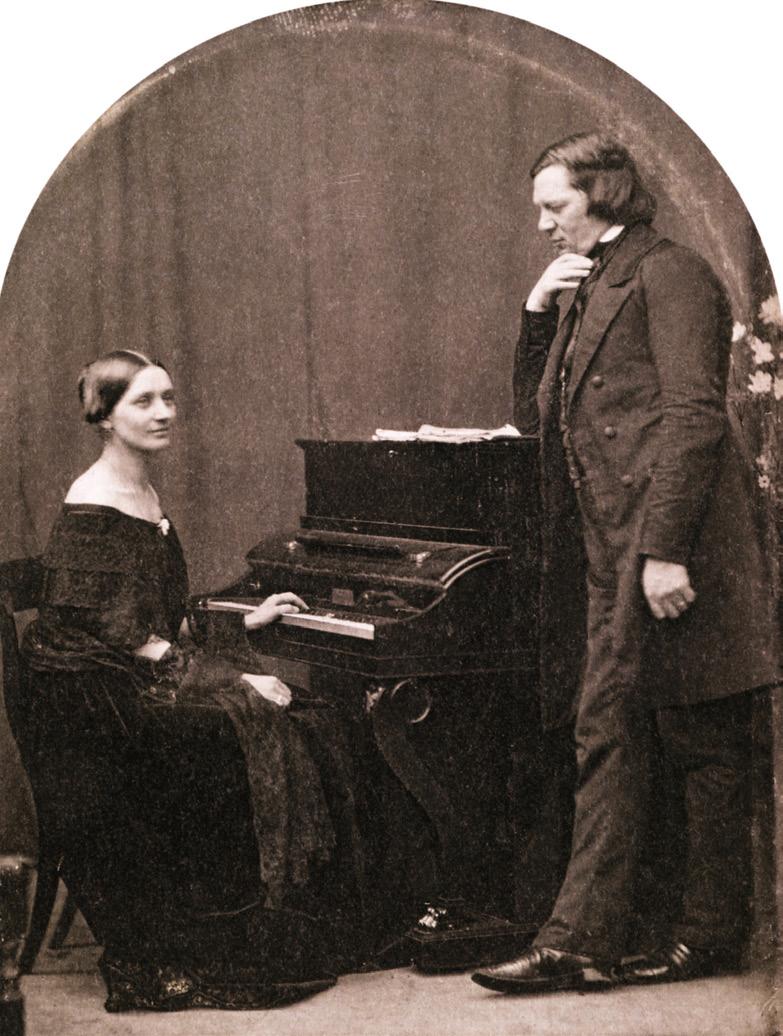
Clara and Robert Schumann in an 1850 daguerrotype.
PROGRAM NOTES
during the revision process in 1851, may have been inspired by Mendelssohn’s “Scottish” Symphony, premiered in 1842.)
The first movement opens with a slow introduction whose melodic idea will be heard throughout the Symphony. It is a majestic, solemn prelude characterized by the almost uninterrupted roll of the timpani. It gradually leads into a passionate and animated fast section. The exposition and the development sections are fairly regular, but there is no real recapitulation. Instead of repeating the themes heard previously, Schumann brings new material (a march in dotted rhythm that will return in the Finale) and introduces further variations on the main theme.
The second-movement “Romanze” opens and ends with a beautiful melody played in parallel octaves by the first oboe and the cellos. In between the two presentations of this theme, we hear two variations on the first movement’s slow introduction, one of them with solo violin. The return of the earlier melody leads directly into the boisterous third-movement Scherzo, marked by strong accents and a powerful rhythmic drive. The movement’s soft and gentle Trio stands in sharp contrast to the Scherzo itself.
Traditionally, movements of this type end with the repeat of the Scherzo proper. Beethoven in some cases repeated a Trio a second time but still closed with the Scherzo (S-T-S-T-S, as in the Seventh Symphony). Schumann, on the other hand, writes just S-T-S-T, replacing the third statement of the Scherzo by an unexpected slow section, based on previously heard material but entirely new in character. The tremolos of the strings and timpani create great excitement (not unlike the parallel passage in Beethoven’s Fifth), resolved by the first measures of the Finale, joyful and vigorous to the end.
Piano Concerto No. 1 in D minor, Op. 15 (1858)
by Johannes Brahms (Hamburg,
1833Vienna, 1897)
Most recent Columbus Symphony performance: May 22-23, 2015; Thomas Wilkins conducting; Anna Vinnitskaya, soloist. Duration: 42’
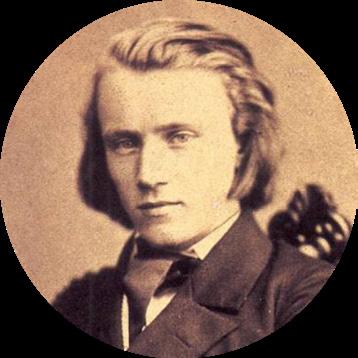
“I have always thought that some day, one would be bound suddenly to appear, one called to articulate in ideal form the spirit of his time, one whose mastery would not reveal itself to us step by step, but who, like Minerva, would spring fully armed from the head of Zeus. And he is come, a young man over whose cradle graces and heroes have stood watch. His name is Johannes Brahms … and he bears even outwardly those signs that proclaim: here is one of the elect.”
These prophetic words were written by Robert Schumann in an article titled “New Paths,” the last he wrote for the Neue Zeitschrift für Musik, Germany’s most important music journal, which he had cofounded and edited for the better part of two decades. The date was October 28, 1853. Brahms was barely twenty years old and had not composed anything but piano music and songs, although these already included three big piano sonatas. In addition, his piano playing was unusually expressive. A single visit by Brahms at the Schumanns’ house in Düsseldorf was enough to convince the older composer that “here was one of the elect.”
Sadly, with this article Schumann was not only welcoming “one of the elect”; he was also passing on the torch. Four months later, on February 26, 1854, he attempted suicide by throwing himself into the Rhine, and was subsequently taken to a mental asylum where he died two years later. Brahms was deeply shaken by these tragic events. Upon hearing the news of Schumann’s illness, he rushed
PROGRAM NOTES
to Düsseldorf to provide support for Clara Schumann, who was expecting her eighth child at the time. He fell passionately in love with Clara, fourteen years his senior, who was one of the greatest pianists of her day, and a woman of exceptional culture, intelligence, and charm. He was torn between his feelings of loyalty to his friend and mentor and his love for his friend’s wife, a love probably not unreturned, despite Clara’s devotion to her husband. After Schumann’s death, however, Brahms and Clara pulled apart, later settling into a warm friendship that was to last until Clara’s death in 1896. (Brahms himself died the following year.)
This emotional turmoil was further aggravated by a professional crisis for the young Brahms. The high expectations raised by Schumann’s glowing article weighed heavily on him. He received some valuable introductions as a result of that article, and got his first works published by the prestigious Leipzig publisher Breitkopf & Härtel. Nevertheless, he felt that he had yet to prove himself and to write the Great Work that would establish him as the new genius whose advent Schumann had prophesied. He made sketch after sketch, filled notebook after notebook, but was dissatisfied with everything he wrote. Two of the large-scale compositions started during this time were finished only 20 years later: the Piano Quartet in C minor (1875), and the First Symphony (1876), also in C minor. The third one, and the first to reach completion, was what eventually became the D-minor Piano Concerto.
In 1854, Brahms was reportedly working on a symphony, now lost. It has been suggested that these sketches already contained some of the music for the Concerto, but this cannot be proven as Brahms destroyed his sketches. By February 1855, he had decided on a concerto, but the work still caused him much trouble and worry. The music was sent back and forth between Brahms and his best friend, violinist-composer Joseph Joachim, whose advice Brahms trusted more than anyone else’s. The composer often despaired of ever being able to set right the “disastrous first movement, which cannot be born.”
Joachim was generous with his advice, freely criticizing what he did not like and working closely with Brahms on many details over a period of two years. In December 1857, Brahms lamented, “Nothing sensible will ever come of it.” By the next spring, however, he finished the concerto, and Joachim started rehearsing it with his orchestra in Hanover.
A performance had been planned for the spring of 1858, but that did not materialize. The premiere finally took place on January 22, 1859, in Hanover. Joachim conducted, and Brahms himself played the piano part. It was well received, if without any particular enthusiasm. In contrast, the second performance five days later, at the famous Gewandhaus in Leipzig, turned out to be the greatest fiasco of Brahms’s entire life. There the orchestra was led by a musician who did not know Brahms very well, one Julius Rietz. Brahms wrote to Joachim after the concert:
I played considerably better than in Hanover, and the orchestra was excellent. … The first and second movements were heard without the slightest motion. At the close, three pairs of hands attempted slowly to strike against one another, whereupon a perfectly unequivocal hissing from all sides forbade such demonstrations. Nothing further to report about that event, for nobody has yet said a word about the piece to me, with the exception of [concertmaster] Ferdinand David, who was very friendly. … I believe this is the best thing that could happen to one; it forces one to pull one’s thoughts together and stimulates one’s courage. After all, I am only experimenting and feeling my way as yet. But the hissing was too much, wasn’t it?
It is possible that the unusually intense dramatic quality of the concerto may have seemed too “modern” to early audiences. Even today, when Brahms isn’t “modern” any more, a sensitive listener will be struck by the timpani roll, followed by a melody that startles with its violent accents, interspersed with tension-filled pauses, and
PROGRAM NOTES
a tonal ambiguity resulting from the fact that the first cadence in D minor (the home key of the piece) does not arrive for an inordinately long time. An extended passage in the home key is not heard until the piano makes its first entrance with a soft, lyrical melody. Until then, the music constantly modulates, and it often remains unclear what key it is in. At the very beginning, the notes of the B-flat-major triad over a continuing drumroll on D produce a very unsettling effect, compounded by the repeated appearance of A-flat (emphasized by trills and accents), which produces a strong dissonance with the bass. The repeat of the same music a halfstep lower is an even stronger surprise.
Eventually, the movement settles into a fairly regular sonata form, with exposition, development, and recapitulation. But its dimensions are enormous, and the contrasts between the numerous themes are extreme. Beethoven’s Ninth Symphony (also in D minor), which Brahms heard for the first time during his years of struggle with the concerto, was a decisive influence. Among the many unforgettable moments in the first movement are the extended, hymn-like piano solo in a slower tempo and the haunting horn solo following shortly. The periodic returns of the dramatic initial theme retain their power and energy to the end.
The second-movement Adagio is one of Brahms’s most intimate musical statements. In the original manuscript, the movement bore a quotation from the Latin Mass: Benedictus qui venit in nomine Domini (“Blessed is He who comes in the name of the Lord”). The expressive theme, played by strings (violins muted) and bassoons, is taken over by the piano, which embellishes it with ornaments and figurations. The clarinets introduce a second theme, which leads to a brief forte exclamation. The first theme soon returns and, after a short and dreamlike cadenza, the movement ends with the sudden entrance of the timpani, silent until this point in the Adagio. The fact that the timpani does not play D (the pitch of the home key) but its dominant A results in a strange suspense at the movement’s end.
In the last movement, Brahms seems to pay tribute simultaneously to Bach and Beethoven. The polyphonic textures and vigorous syncopations of the main theme recall Bach’s Concerto in D minor, while Beethoven’s Concerto No. 3, in C minor, was a model in other respects. The central fugato, or section in imitative counterpoint, was certainly inspired by a similar passage in the Beethoven. If the first movement lacked a cadenza, the finale has two. The first, marked “quasi Fantasia,” is a series of figurations over a single sustained tone that is sometimes in the low, and sometimes in the middle or high register. This is followed by the modulation from gloomy and dramatic D minor to festive and serene D major, a change that gives the Rondo theme an entirely new character. We barely recognize the theme when the bassoons and oboes intone it with a dolce (“sweet”) sound quality. This variation on the theme leads into a brief orchestral fortissimo and then into the second cadenza (this one also based on an unchanging sustained tone, but more melodic than figurative in character). After this second cadenza, a short, jubilant coda ends the work.
At age 25, Brahms felt he had accomplished the Great Work he had aspired to write, but the response he had hoped for failed to appear Although subsequent performances were more successful than the disastrous Leipzig premiere, the composer was deeply wounded, and this may explain in part why he waited almost 20 years before completing his First Symphony.
Notes by Peter Laki