floating layers interwoven in expanding brightness
Lauren Cauley, violin
MAHLER
Mariel Roberts Musa, cello (World Premiere) .............................
Symphony No. 1 in D Major
I. Langsam Schleppend
II. Kräftig bewegt
III. Feierlich und gemessen, ohne zu schleppen
IV. Stürmisch bewegt
This concert is dedicated to the memory of Rhoma Berlin by the Berlin Family.
The world premiere of Jeffrey Mumford’s floating layers interwoven in expanding brightness is made possible by Jack and Zoe Johnstone and the Committee for the Johnstone Fund for New Music of The Columbus Foundation.
LAUREN CAULEY, violin
Violinist and improviser Lauren Cauley has quickly risen in New York’s avant-garde as an artist known for genre-breaking performances that expand the sonic possibilities of her instrument. Now a “mainstay of the local new-music scene” (New York Times), she’s built a reputation as an interpreter of “fierce precision” and “excellence uncompromised” (Cleveland Classical).
Lauren has worked with artists and composers such as Anahita Abbasi, Ambrose Akinmusire, Bedouine, Richard Carrick, Chance the Rapper, Ellie Goulding, Georg Friedrich Haas, Pauline Kim Harris, Ezra Koenig (Vampire Weekend), David Lang, George Lewis, Roscoe Mitchell, Jeffrey Mumford, Qasim Naqvi, Steve Reich, Sigur Rós, Cécile McLorin Salvant, Tomorrow X Together, Wadada Leo Smith, Zeynep Toraman, Emily Wells, Immanuel Wilkins, Saul Williams, Julia Wolfe, and Michelle Zauner (Japanese Breakfast).
Lauren maintains an international career with performances at festivals such as Venice Biennale, Acht Brücken, Newport Jazz, Beijing Modern Music Festival, Lincoln Center Festival, Darmstadt, Asphalt, Bang on a Can, ECLAT, Ear We Are, KLANG, New York City Electroacoustic Music Festival, Sons d’hiver, Winter Jazzfest NYC, Sympósio Internacional de Música Nova, and The Perlman Music Program. In addition to her work as a soloist, Lauren has performed with groups such as Ensemble Signal, Alarm Will Sound, Metropolis Ensemble, and the [Switch~ Ensemble].
As a sought-after collaborator and recording artist, Lauren has appeared on Grammy Award-winning and Emmy-nominated projects. Her playing has been broadcast on WNYC, Deutschlandfunk Kultur, ORF Radio Wien, WDR Köln, Radio SRF 2 Kultur, and NBC’s Saturday Night Live. Lauren can be heard on Albany Records, Atlantic Records, ATMA Classique, Blue Note, Bright Shiny Things, Chandos Records, New Focus Recordings, Physical Editions, and RVNG Intl. As a composer, Lauren has premiered her own work for violin and electronics at the Guggenheim Museum and been commissioned by Metropolis Ensemble.
As a guest artist and educator, Lauren has given performances and worked with students at universities around the world, including Bard College; Berklee College of Music; Chinese University of Hong Kong; Cornell University; Dartmouth College; Eastman School of Music; Harvard University; Princeton University; Shanghai Conservatory; Universidade Federal do Paraná; University of Alaska Anchorage; University of California, Berkeley; University of California San Diego; and Wesleyan University.
Lauren received her bachelor’s and master’s degrees in violin performance from the Eastman School of Music, where she served as teaching assistant to Charles Castleman. While at Eastman, Lauren was awarded a DAAD grant to study at the Bauhaus Universität in Weimar, Germany. After Eastman, Lauren attended the International Ensemble Modern Academy, Klangspuren Schwaz. In addition to performing, Lauren maintains a private teaching studio in Brooklyn. She plays a Parisian violin made by François Gaviniès in 1734. www.laurencauley.com
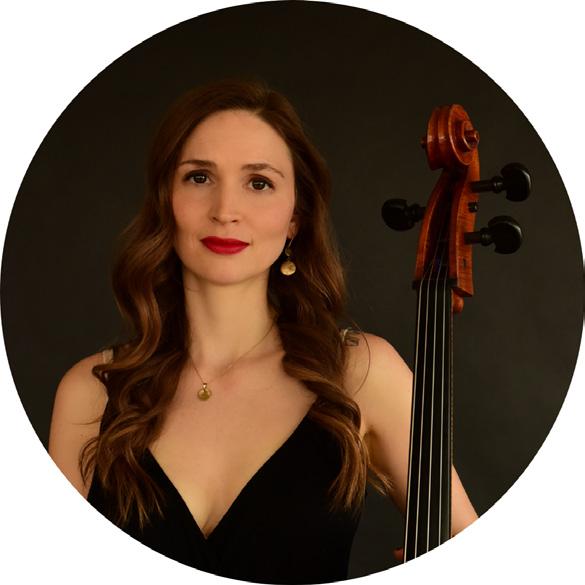
MARIEL ROBERTS MUSA, cello
American cellist and composer Mariel Roberts Musa, “one of the leading solo performers in new music” (Bandcamp), is widely recognized not just for her virtuosic performances, but as a fearless explorer in her field.
Her passion for collaboration and experimentation as an interpreter, improvisor, and composer have helped create a body of work which bridges avant-garde, contemporary, classical, improvised, and traditional music; and has established her as “one of the most adventurous figures on New York’s new music scene—one with a thorough grounding in classical tradition but a ravenous appetite for and tireless discipline in new work.” (Bandcamp).
Roberts Musa is celebrated for her “technical and interpretive mastery” (I care if you listen), and has appeared as a soloist and chamber musician across four continents, most notably as a member and co-director of the Wet Ink Ensemble, as well as with the International Contemporary Ensemble (ICE), Mivos Quartet, Bang on a Can All Stars, and Ensemble Signal.
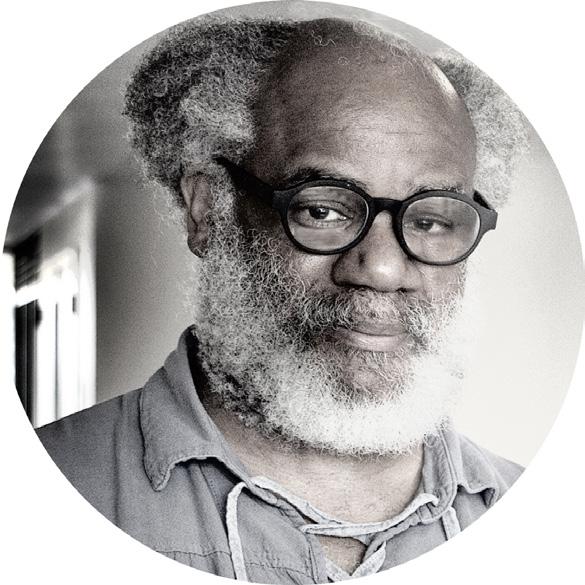
JEFFREY MUMFORD, composer
Born in Washington, D.C. in 1955, composer Jeffrey Mumford has received numerous fellowships, grants, awards and commissions.
Awards include the “Academy Award in Music” from the American Academy of Arts & Letters, a Fellowship from the Guggenheim Foundation, and an ASCAP Aaron Copland Scholarship. He was also the winner of the inaugural National Black Arts Festival/Atlanta Symphony Orchestra Composition Competition. Other grants have been awarded by the Ohio Arts Council, Meet the Composer, the Martha Baird Rockefeller Fund for Music Inc., the ASCAP Foundation, and the University of California.
Mumford’s most notable commissions include those from the Isabella Stewart Gardner Museum, the Koussevitzky Foundation, the Los Angeles Philharmonic Association and the Library of Congress (co-commission), the BBC Philharmonic, the San Antonio, Chicago and National Symphonies, Washington Performing Arts, the Network for New Music, cellist Mariel Roberts, the Fulcrum Point New Music Project (through New Music USA), Duo Harpverk (Iceland), the Sphinx Consortium, the Cincinnati Symphony, the VERGE Ensemble/National Gallery of Art/ Contemporary Music Forum, the Argento Chamber Ensemble, the Cleveland Orchestra, the Nancy Ruyle Dodge Charitable Trust, the Meet the Composer/Arts Endowment Commissioning Music/USA, Cincinnati radio station WGUC, the Walter W. Naumburg Foundation, the Fromm Music Foundation, and the McKim Fund in the Library of Congress.
His music has been performed extensively, by major orchestras, soloists, and ensembles, both in the U.S. and abroad, including London, Paris, Reykjavik, Vienna, The Hague, Russia and Lithuania.
Recent and forthcoming performances include the premiere of layering radiance . . . toward stillness by the Grossman Ensemble, let us breathe (solo cello) by Annie Jacobs-Perkins, of radiances blossoming in expanding air by Annie Jacobs-Perkins and the Post Classical Ensemble, conducted by Angel Gil-Ordeonez, wending by violist Jordan Bak, undiluted days by the Merz Trio and the Talea Ensemble, the premiere of ...fleeting cycles of layered air (solo violin) by Miranda Cuckson, as part of the Fromm concert series sponsored by Harvard University, brightness dispersed (cello and string orchestra) by The String Orchestra of Brooklyn, her eastern light amid a cavernous dusk, by Ensemble Connect, and a landscape of interior resonances by pianists Robert Fleitz and Steven Beck. Pianist Pina Napolitano will include his two Elliott Carter tributes in her European concerts in this and coming seasons and has recorded them as part her recently released CD entitled “Tempo e Tempi” (Odradek Records). He has also written a concerto for her entitled unfolding waves, which is scheduled to be premiered and recorded within the next year in Berlin.
Current projects include a new work for the String Orchestra of New York City (SONYC), cavernous echoes of expanding brightness, and a harp concerto for Anne-Sophie Bertrand. His new CD of recent concerti, entitled “echoing depths,” has recently been released on Albany Records / Parma Recordings.
Mumford has taught at the Washington Conservatory of Music, served as Artist-in-Residence at Bowling Green State University, and served as assistant professor of composition and Composer-in-Residence at the Oberlin College Conservatory of Music. He is currently Distinguished Professor at Lorain County Community College in Northern Ohio.
Mr. Mumford is published by Theodore Presser Co. and Quicklight Music and represented by Latitude 45 Arts.
PROGRAM NOTES
floating layers interwoven in expanding brightness (2025)
by Jeffrey Mumford (b. Washington, D.C., 1955)
This is the world premiere performance. Duration: 18’
With an extensive oeuvre that has won him rave reviews and prestigious awards for decades, Jeffrey Mumford has proven that so-called “high Modernism” is not necessarily soulless or devoid of feeling, as many people still seem to think. The American composer, who recently turned 70, knows how to endow complex harmonic and rhythmic structures with an intense dramatic charge. He constantly discovers new ways to convey passion and excitement and, through a particularly imaginative orchestration, achieves sonorities that can only be described as luminous.
Luminosity is a particularly important concept for Mumford, who frequently gives his works long poetic titles that almost always emphasize light and radiance. His earlier works include amid fleeting pockets of billowing radiance; to find in the glimmering air . . . a buoyant continuity of layering blue; radiances spreading from a world of resonant stillness – and now floating layers interwoven with expanding brightness, a double concerto for violin and cello cast in a single movement. Mumford’s series of highly evocative titles suggest a recurrent vision of atmospheric harmony, and each sound, each gesture, each musical idea is placed in the service of expressing that vision of light.
The composer has offered the following remarks on his piece:
Commissioned by the Columbus Symphony with assistance from the Johnstone Fund, floating layers interwoven in expanding brightness was written for violinist Lauren Cauley and cellist Mariel Roberts Musa, with whom I have collaborated on many occasions and whom I find particularly inspiring.
In this piece, I wanted to create a work that showcased the considerable talents of both soloists, who have an uncompromising and deep affinity for new music. Everything they play is informed by consummate musicianship, intelligence, vision, and a profound depth of purpose that communicates immediately and compellingly.
Writing this piece was a particular labor of love as ideas had been percolating for 15 years until the right formula presented itself.
I am very excited about the current direction my work is taking. Over the past few years, I have been focusing on images from my childhood –specifically, the energy and particular journey daylight (either direct or reflected) took through my bedroom window. In addition, I have more keenly focused on gradations and intensities of light as communicated by sound. I imagine distinct worlds within clouds as they define distance, which greatly fuels my imagination. In particular and most recently, my double concerto attempts to address these elements.
In short, I am trying to create an alternate reality in my work, my own heaven, as so much of the world we live in, is not enough.
The opportunity to share my work with the larger community is one that I cherish, and I am deeply grateful that the Columbus Symphony and Lauren & Mariel will bring it to life!
Symphony No. 1 (1888)
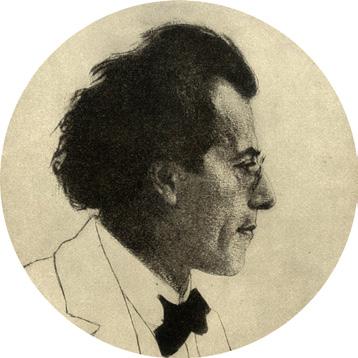
by Gustav Mahler (Kalischt, Bohemia [now Kalište, Czechia], 1860 - Vienna, 1911)
Most recent Columbus Symphony performance: March 5-6, 2010; Alondra de la Parra conducting. Duration: 56’
Like the hero of his first great song cycle, the young Mahler was a fahrender Geselle (“wayfarer”), and was anxious to become a
PROGRAM NOTES
Meister (“master”). Geselle was the traditional title given to young artisans who had passed the apprentice stage and often wandered from place to place assisting more experienced practitioners before setting up shop themselves. In his 20s, Mahler likewise moved from city to city, from one assistant position to the next, waiting for the big break that finally came in 1888, when he was appointed to his first important post as Director of the Royal Opera in Budapest (he was still only 28).
It was during these itinerant years that Mahler conceived his first symphony –arguably the most ambitious first symphony any composer had ever written. In fact, few composers under 30 have ever been so independent from influences as was Mahler. As he once remarked, Beethoven had started out as a Mozartian composer and Wagner as a follower of Weber and Meyerbeer; but he, Mahler, “had been condemned by a cruel fate to being himself from the start.”
During the 1880s, composers of symphonic music in the German-speaking countries were divided between the camps of “program” vs. “absolute” music. The former believed that music should be based on some explicit extra-musical ideas, taken from literature, philosophy or the visual arts, while the latter insisted that music could express only itself. Franz Liszt had recently introduced the genre of the “symphonic poem” and, following in his footsteps, the young Richard Strauss presented his first tone poems, including Don Juan and Death and Transfiguration, in 1888-89. Mahler was reluctant to join the programmusic camp, yet he was undeniably inspired by his readings, which had a definite influence on his music. His ambivalent attitude is evident from his hesitation about disclosing programs over the years.
At the Budapest premiere in 1889, Mahler called the work we now know as his First
Symphony a “Symphonic Poem in 2 parts.” On this occasion, the audience heard five movements, as Mahler had included an Andante, called Blumine, written in 1884. (It was originally part of the incidental music for a play.) The rest of the symphony was composed in 1887/88. Movements 1-3 comprised Part I; the last two movements made up Part II.
For the second performance in Hamburg, Mahler renamed the work “Titan: a Tone Poem in Symphonic Form.” He borrowed the name “Titan” from the eponymous novel by Jean Paul (Johann Paul Friedrich Richter), an influential German Romantic novelist who, many years before Mahler, had also been one of Robert Schumann’s favorites. The “titan” of the 900-page novel is a young Prince who evolves as a person thanks to his interactions with a colorful cast of secondary characters. Mahler, in any case, made no attempt to illustrate the characters or the plot in any way: his use of the word “titan” seems to be little more than a metaphor for the boundless energy of the music. In addition, Mahler provided programmatic titles for the two major parts of the work and also for the individual movements, sometimes augmented by additional comments:
Part I: “From the Days of Youth: Flower, Fruit, and Thorn Pieces.”
1. “Spring Without End” (The awakening of Nature after a long winter slumber)
2. Blumine
3. “Under Full Sail” (Scherzo)
Part II: Commedia humana
4. “Stranded!” Funeral March in Callot’s Style
5. “Dall’inferno” (an outburst of despair)
In 1896, when the work was performed in Berlin, Mahler removed all programmatic references and called the work simply “Symphony in D major.” Also, at this time, he deleted the “Blumine” movement and eliminated he division into two parts. The work was thus turned into a four-
PROGRAM NOTES
movement symphony, presented as a piece of absolute music. Yet even though all extra-musical references had been removed, the work wouldn’t be what it is, had Mahler not been thinking about things like nature, grotesque funeral marches and outbursts of despair at the time of writing.
The words “flower, fruit, and thorn pieces” from the 1893 program – words also taken from Jean Paul – must be interpreted as allusions to life’s “good and bad times” in general. And Mahler may have thought of some of his own tumultuous life experiences during the time of the symphony’s genesis. During his tenure in Kassel in 1884, he fell passionately in love with a soprano from the opera company named Johanna Richter, a relationship that, as Mahler later recalled, caused him “more pain than pleasure.” This affair inspired the Songs of a Wayfarer, a song cycle on Mahler’s own words, which is quoted in the First Symphony. Three years later in Leipzig, Mahler became romantically involved with Marion von Weber, wife of Captain Carl von Weber (grandson of the composer Carl Maria) – an affair that came close to causing a major scandal.
Yet the real “story” of the Symphony, which Mahler would want us to hear as a non-programmatic piece, lies in the way he expanded conventional symphonic form to produce this monumental work. Some of the procedures he used have literary parallels without being influenced by any literary program: the recall of the first movement’s material in the finale is like when a long-absent character in a novel suddenly reappears, and the extended passage in slow tempo in the same movement is like a parenthesis or a sub-plot. On the other hand, some of the procedures he used are eminently musical, like the introduction of certain genres that would recur throughout his entire symphonic output: the second movement Ländler (an Austrian folk dance) is a prototype of many a later Mahler movement, and the third movement funeral march likewise opens a long line of Mahlerian marches.
It wasn’t for nothing that the first movement was at one point called “Spring Without End.” The gradual awakening of spring is symbolized by a perfect fourth (Mahler called it “a sound of nature” in the score) over a sustained pedal. Everything grows out of this one interval, like a tree from a small seed. Even the call of the cuckoo, evoked by the clarinet, is a perfect fourth, although this bird knows only thirds in reality. In fact, the interval of the fourth serves as the unifying factor of the movement (and, indeed, of the entire Symphony). When the slow introduction yields to the movement’s main section, we hear the theme of the second of the Wayfarer songs: “Ging heut morgens übers Feld” (“I walked this morning through the field”), which also begins, significantly, with a perfect fourth.
It is said that Mahler had to change the beginning of the second movement Ländler because it sounded too much like one of Anton Bruckner’s themes. As it is, the theme sounds distinctly Mahlerian, echoing the early song “Hänsel and Gretel” written around 1880. A simple tune, rather unassuming in itself, is played by the woodwinds with great rhythmic energy; it is soon taken up by the full orchestra (with a large brass section comprising seven horns and four trumpets!). In the words of the late Michael Steinberg, longtime program annotator for the San Francisco Symphony, the Trio “fascinatingly contrasts the simplicity of the rustic, super-Austrian material with the artfulness of its arrangement. It is an early instance of what [German philosopher and musicologist] Theodor W. Adorno perceived as the essence of Mahler, the turning of cliché into event.”
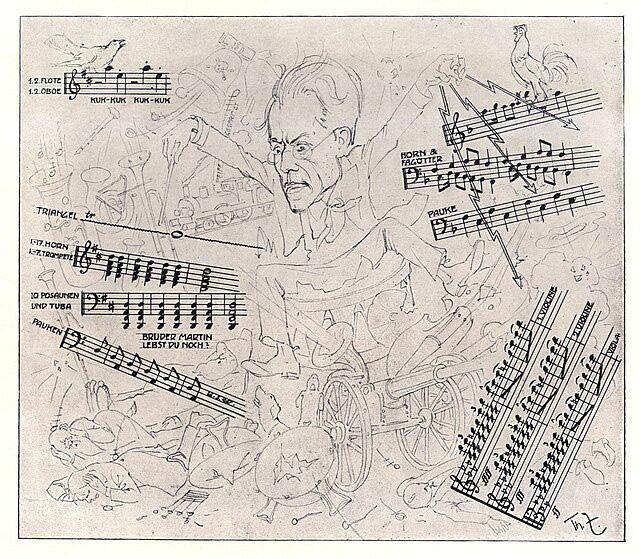
Early audiences clearly didn’t quite know what to make of the third movement. They couldn’t fail to recognize the popular “Frère Jacques” melody – transposed, bizarrely, into a minor key. The “alienation” of a familiar tune creates a unique mixture of humor, tragedy, mystery and irony. There follows an openly parodistic section whose unabashedly schmaltzy themes, played by oboes and trumpets, are reminiscent of klezmer music (Eastern European Jewish
Caricature of Gustav Mahler conducting his First Symphony. From “Illustriertes Wiener Extrablatt,” November 25, 1900.
instrumental folk music). As a total contrast stand the two quotations from the last “Wayfarer” song, almost transfigured and painfully nostalgic (“Auf der Strasse stand ein Lindenbaum”–”By the road stands a linden tree,” and “Die zwei blauen Augen von meinem Schatz”–”My sweetheart’s two blue eyes”). A more subdued recapitulation of the “Frère Jacques” tune and the klezmer material ends this most unusual movement.
The finale, which follows the funeral march without a pause, is the longest and most complex movement in the Symphony. It represents a progression from tragedy to triumph like many earlier symphonic finales, but the contrasts between the various emotions are more polarized than ever. The movement lacks tonal unity as it opens in F minor and closes in D major: in
the 1880s, this was quite a revolutionary way of handling tonality. We experience a lyrical second theme introducing us to a completely different world. Exuberant climaxes are followed by relapses into despair, and motifs from the first movement return, as mentioned above, to increase the dramatic tension even more. The work ends with a radiant D-major coda proclaiming the final victory.