SATURDAY, FEBRUARY 7, 2026 AT 7:30PM OHIO THEATRE -- INTERMISSION --
III. Saturday Night Waltz
IV. Hoe Down
Violin Concerto No. 2
Melissa White, violin
Symphony No. 1 in G minor, op. 13 (“Winter Dreams”)
I. Allegro tranquillo
II. Adagio cantabile ma non tanto
III. Scherzo: Allegro scherzando giocoso
IV. Finale: Andante lugubreAllegro moderato - Allegro maestoso
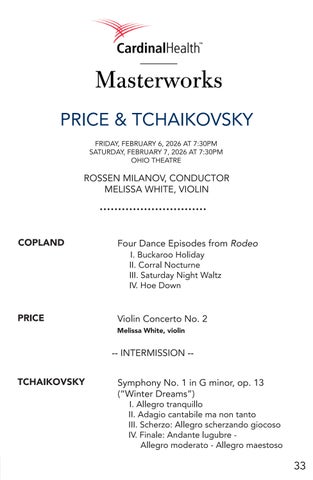
MELISSA WHITE, violin
American violinist Melissa White has enchanted audiences and critics around the world for her “warmly expressive and lyrical…glittering” playing (Chicago Classical Review) and for “making her violin sing elegantly” (Aspen Times). Ms. White’s rapid rise as a soloist has captured the attention of orchestras and audiences worldwide, many of whom already know her as a founding member of the Grammy-winning Harlem Quartet.
Highlights of the 2025–26 season include Ms. White’s debut with the Seattle Symphony; the world premiere of Sophia Jani’s Violin Concerto with the Dallas Symphony, and debut performances with the Mobile and Columbus Symphony Orchestras. She also returns for performances with the Johnson City Symphony and Northwest Sinfonietta, and will record a new concerto by Jonathan Bailey Holland with the Curtis Symphony Orchestra.
Recent and upcoming solo recital debuts for Ms. White include Boston Conservatory, the Spire Center in Plymouth, Philadelphia Chamber Music Society, Chamber Music Detroit, Davidson College, and The Isabel Bader Centre for the Performing Arts in Kingston, Ontario. Since 2023, she has also appeared in recital at Carnegie Hall, Corpus Christi Chamber Music Society, the Phillips Collection, and Purdue Convocations, among others.
Beyond orchestra and recital appearances, Ms. White relishes the opportunity to perform in chamber music settings alongside close friends and colleagues. In June 2023, she joined the Kaleidoscope Chamber Collective at London’s Wigmore Hall together with Hilary Hahn, and she reunited with the ensemble for performances in the 2023–24 season from Germany to major series along the East Coast, returning again to Wigmore in July 2025. Other recent chamber music engagements, beyond the Harlem Quartet, include appearances at the Spoleto Chamber Music Festival, Tippet Rise, Festival Napa Valley, San Francisco Conservatory of Music, and the Sarasota Music Festival.
A first-prize laureate in the Sphinx Competition, she has performed with such leading U.S. ensembles as the Cleveland Orchestra, the Boston Pops, the Louisville Orchestra, and the Atlanta, Baltimore, Colorado, Detroit, and Pittsburgh Symphony Orchestras. Internationally, she has appeared as soloist with Poland’s Filharmonia Dolnoslaska; with the Colombian Youth Orchestra in a tour of that country; with the Czech National Philharmonic; and as a recitalist in Baku, Azerbaijian, and Jelenia Gora, Poland. Her film credits include a violin solo in the soundtrack to Jordan Peele’s 2019 psychological thriller Us; and in addition to her numerous classical performances she has also performed alongside several pop artists including Pharrell, Bruno Mars, Alicia Keys, and Lauryn Hill.
Ms. White is a founding member of New York-based Harlem Quartet, where since 2006 her passion and artistry have contributed to performances hailed for “bringing a new attitude to classical music, one that is fresh, bracing and intelligent” (Cincinnati Enquirer). Together with Harlem Quartet, she has appeared in many of the country’s most prestigious venues, including Carnegie Hall, the White House, and the Kennedy Center; and toured throughout the U.S., as well as in Europe, Africa, Japan, and the United Kingdom. Harlem Quartet has collaborated closely with leading jazz musicians, including Chick Corea and Gary Burton, with whom their recording “Mozart Goes Dancing” won three Grammy Awards, including the Grammy for Best Instrumental Composition in 2013. Harlem Quartet was named quartet-in-residence at Montclair State University in the fall of 2021, and has served as the visiting quartet-in-residence at the Royal College of Music in London since 2016. In 2024, Harlem Quartet took home a Grammy for Best Classical Compendium for their work on “Passion for Bach and Coltrane,” with Imani Winds, A.B. Spellman, and jazz trio Alex Brown, Edward Perez, and Neal Smith. In 2025, Harlem Quartet earned its first Latin Grammy nomination for Best Instrumental Album with “Havana meets Harlem,” their collaboration with Cuban pianist-composer Aldo López Gavilán.
PROGRAM NOTES
Four Dances from Rodeo (1942)
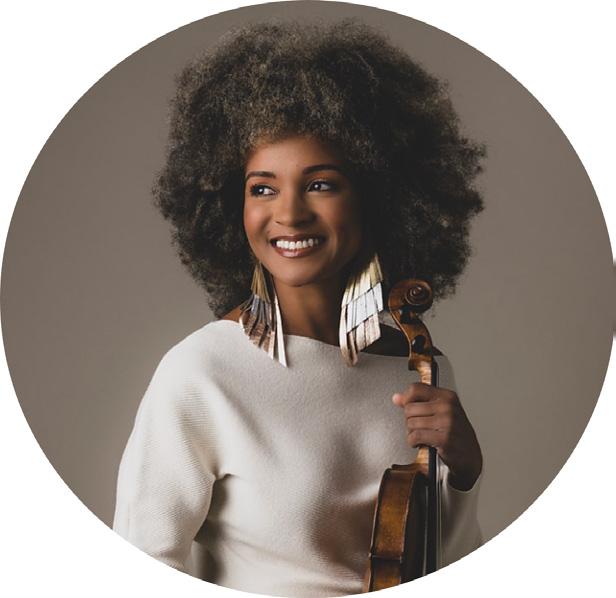
by Aaron Copland (Brooklyn, 1900 - North Tarrytown, New York, 1990)
Copland’s first ballet on an American theme, Billy the Kid (1938), was a sensational success. For the first time, an American ballet company had made a decisive move away from the classical tradition as represented by the influential Russian school and turned to a specifically American subject. Four years after Billy the Kid opened in Chicago, Copland received a phone call from Agnes de Mille, the celebrated dancer and choreographer, inviting him to write the music for a new ballet, to be performed by the Ballet Russe de Monte Carlo at the Metropolitan Opera in New York. When Copland heard that it was a cowboy ballet, he exclaimed: “Oh no! I’ve already composed one of those. I don’t want to do another cowboy ballet.” But de Mille assured him that it was going to be different this time – and it was. Unlike Billy the Kid, which had a dramatic and violent plot, Rodeo was all about romance. In de Mille’s words,
This is the story of the Taming of a Shrew – cowboy style. It is not an epic, or the story of pioneer conquest. It builds no empires. It is a pastorale, a lyric joke … the quieter and simpler the style the better. There are never more than a few people on the stage at a time … one must always be conscious of the enormous land on which these people live and their proud loneliness
Throughout the American Southwest, the Saturday afternoon rodeo is a tradition. On the remote ranches, as well as in the trading centers and the towns, the “hands” get together to show off their skill in roping, riding, branding, and throwing. Often, on the
more isolated ranches, the rodeo is done for an audience that consists only of a handful of fellow workers, womenfolk, and those nearest neighbors who can make the eighty or so mile runover.
The afternoon’s exhibition is usually followed by a Saturday night dance at the Ranch House.
The theme of the ballet is basic. It deals with the problem that has confronted all American women, from earliest pioneer times, and which has never ceased to occupy them throughout the history of the building of our country: how to get a suitable man.
In the ballet, the Cowgirl has a crush on the Head Wrangler and tries to impress him by riding a bucking bronco, but the horse throws her off and the Wrangler goes to dance with another girl. The Cowgirl, who has been wearing men’s clothes to look tough, changes into a beautiful dress and appears at the dance, making all heads turn. The Head Wrangler becomes interested, but now it’s the Cowgirl’s turn to prefer someone else.
Copland used old cowboy songs in three of the ballet’s four major sections. The first, “Buckaroo Holiday,” contains variations on the tunes “If He Be a Buckaroo by His Trade” and “Sis Joe.” There are no folk tunes in the next scene, “Corral Nocturne,” a tender, lilting slow movement (mostly) in asymmetrical 5/4 time. The nocturne is followed by a piano solo in ragtime style, evoking the kind of dance music heard in the country in the early 1900s. (Leonard Bernstein, whose friendship with Copland had started in 1937, later recalled that he had written sixteen bars of the piano solo.)
The dancing continues with the “Saturday Night Waltz,” in which the song “Old Paint” is alluded to, and finally with the popular “Hoedown,” which uses two square dance tunes: “Bonyparte” and “McLeod’s Reel.”
Agnes de Mille’s choreography, with its
PROGRAM NOTES
cowboy lopes and horse wrangling, gave the dancers of the Russian Ballet a hard time at the beginning. But it was well worth the effort: the premiere, on October 16, 1942, was a smashing success, followed by 78 more performances within a year.
Violin Concerto No. 2 (1952)
by
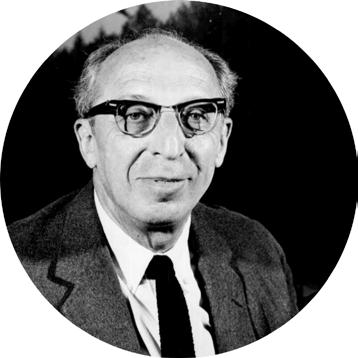
Florence Price (Little Rock, Arkansas, 1887 - Chicago, 1953)
This is the first performance by the Columbus Symphony. Duration: 16’
stage, fully embracing the entire Romantic concerto tradition. What is more: she managed to say something new in this traditional idiom, helped by her brilliant orchestration and her well-assured control of musical form.
The compact concerto is based on two principal themes – one march-like, the other cantabile (singing). They are heard in alternation throughout the composition, with each return bringing new variations on the themes and new virtuosic fireworks for the soloist. There are some exquisite solo moments for the celesta, the harp and the first flute, among others.
One of the most sensational musical discoveries in the 21st century so far occurred in 2009, when a large collection of musical scores was found in an abandoned home in St. Anne, Illinois, about 60 miles south of Chicago. The compositions were by Florence Price, whose First Symphony, premiered by Frederick Stock and the Chicago Symphony in 1933, was the first work by an African American woman to be programmed by a major orchestra. Yet in subsequent years, many of Price’s works remained unperformed and, following her death, her work was all but forgotten.
It was only after the spectacular findings in St. Anne had resulted in a slew of performances and recordings that Florence Price’s true greatness was revealed to the musical world. At the beginning of her career, Price, like her contemporaries William Grant Still and William Dawson, was following the advice Antonín Dvorák had given American composers back in the 1890s: use your native musical traditions to create new music. In the case of Price, that would be the Afro-American spiritual and the Black dance music of the antebellum South, in particular the juba that appears in several of her earlier works. Yet by the time she wrote her Second Violin Concerto in 1952, she had moved well past that
The concerto was written for Price’s friend, violinist Minnie Cedargreen Jernberg, who performed it several times in the 1950s, but only with piano accompaniment. After the full score had been discovered, the orchestral premiere of the concerto took place on February 17, 2018, in Bentonville, Arkansas. The soloist was Er-Gene Kahng (who subsequently made the first recording of the work); the Arkansas Symphony Orchestra was led by Steven Byess.
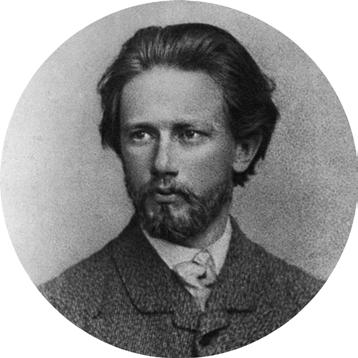
Symphony No. 1 (“Winter Dreams”)
in G minor, op. 13 by Piotr Tchaikovsky (Votkinsk, Russia, 1840 - St. Petersburg, 1893)
Most recent Columbus Symphony performance: December 6-7, 1991; Peter Stafford Wilson conducting. Duration: 43’
In 1840, the year of Piotr Tchaikovsky’s birth, Russian music had just begun to adopt Western forms and genres. The composer regarded as the “father of Russian music,” Mikhail Glinka, had finished his first opera, A Life for the Tsar, only a few years earlier (1836). The St. Petersburg Conservatory, the first institution in the country to offer advanced musical training, didn’t open its doors until 1862, with the celebrated pianist and composer Anton Rubinstein as its founding director. Tchaikovsky, who entered the conservatory in 1863, was therefore one of its first composition students.
PROGRAM NOTES
Although he had exhibited great musical talent since childhood, Tchaikovsky had reached the age of 23 before he decided to devote his life to music. It was only then that, giving up his job as a civil servant at the Department of Justice, he enrolled in the conservatory as a pupil of Rubinstein and Nikolai Zaremba. He graduated with honors three years later. Upon leaving school, he was immediately appointed to the faculty of the second conservatory of the country, which Anton Rubinstein’s brother Nikolai had just opened in Moscow. Tchaikovsky’s arrival in Moscow in January 1866 marked the beginning of a stellar musical career. A few months later, the 26-year-old budding composer embarked on his first large-scale symphony, something hardly any Russians had ever done. His only significant predecessor had been his teacher Anton Rubinstein, whose Second Symphony (“Ocean”) was written in 1851. Members of the “Mighty Handful,” in St. Petersburg, also tried their hand at symphonies around the same time: Rimsky-Korsakov’s First was premiered in 1865, Borodin’s in 1869.
A composer writing a symphony in Russia in the 1860s was, then, something of a pioneer, and Tchaikovsky was fully conscious of the difficulties and responsibilities involved in the task. The Symphony caused him more anguish and agony than any of his later works, resulting in rather frightening physical symptoms and a near nervous breakdown during the time of composition. Tchaikovsky complained to his younger brother Anatol about chronic insomnia and what he called recurrent “little apoplectic fits” (they might have been milder epileptic seizures). He was unhappy about the sluggish pace at which the Symphony progressed, and suffered a major setback when, during the summer of 1866, he showed his two former teachers what he had written. Both Anton Rubinstein and Zaremba were harshly critical of the work in progress, which did not help the composer, who was already plagued by self-doubt. Fortunately the other Rubinstein, Nikolai, was of a different opinion. He had been a friendly mentor since Tchaikovsky’s arrival in Moscow; he offered his younger colleague a room in his home, and even saw to it that Tchaikovsky was well dressed and in good company. Nikolai Rubinstein presented the new work both in Moscow and St. Petersburg, with great success. Yet Tchaikovsky was not entirely satisfied with the work and revised it substantially in 1874.
PROGRAM NOTES
Although Tchaikovsky provided the first two movements of his Symphony with descriptive subtitles, it would be an exaggeration to call the symphony program music. (At any rate, the third and fourth movements have no subtitles.) The composer simply associated some images with the first half of the work, but felt no need to do so in the second half.
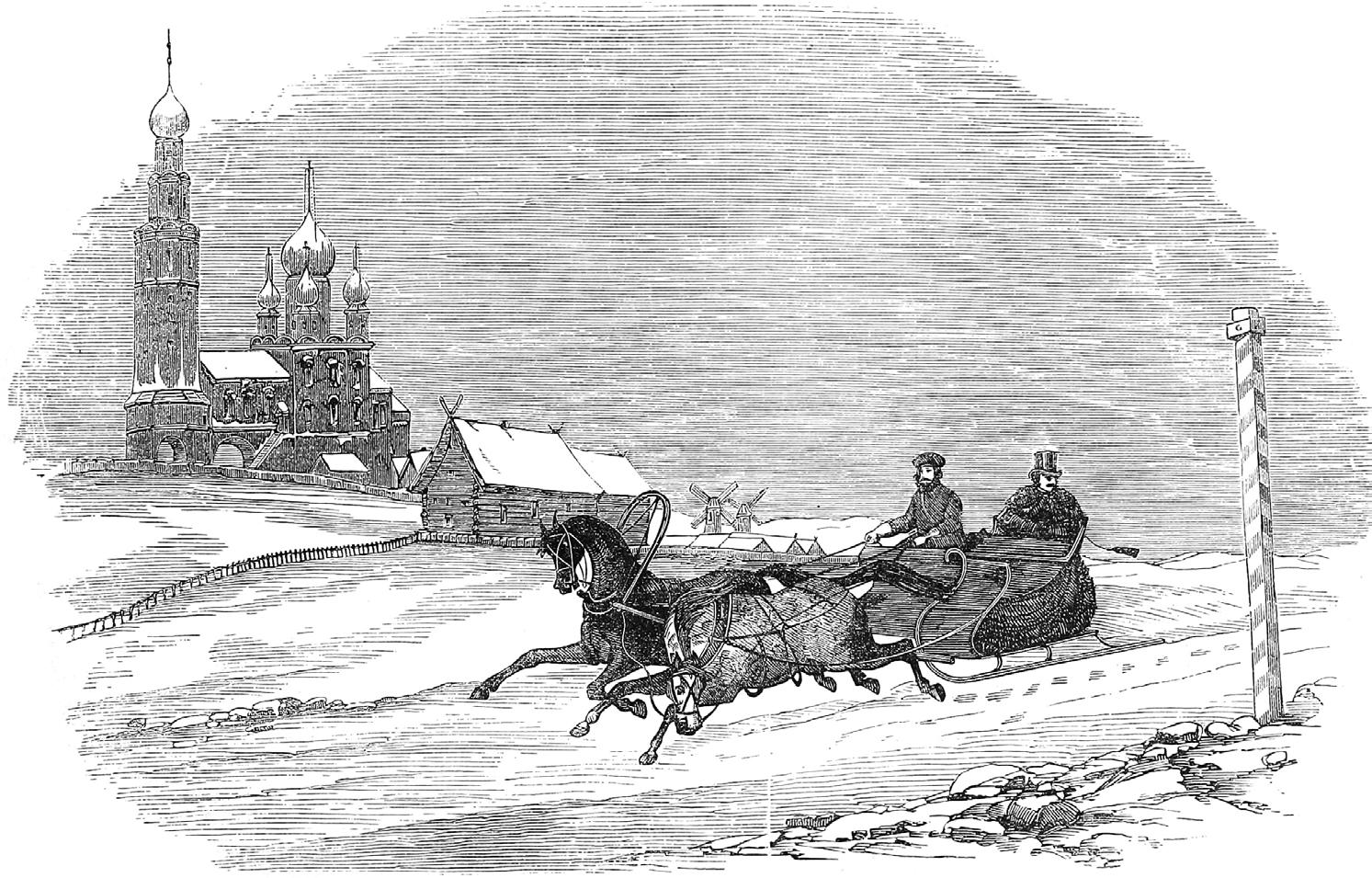
The first movement, “Reveries of a Winter Journey,” travels (or, one might say, wanders) from a “frosty” opening, with eerie string tremolos and slowly unfolding, brief melodic fragments, to brighter landscapes and then back to the opening frost. This journey is accomplished by means of the traditional sonata form, which allows Tchaikovsky to modulate from the initial, wistful G minor to the more radiant D major. The beautiful second theme, introduced by the solo clarinet, was newly written during the 1874 revision. The development section begins with a quartet of horns that sounds astonishingly like the Waltz of the Flowers from The Nutcracker, written 20 years later, and culminates in a powerful orchestral crescendo followed by three measures of general rest. The recapitulation repeats the minor-to-major “journey” from the exposition, but at the end Tchaikovsky unexpectedly reverts to minor. The movement concludes as mysteriously as it began.
The second movement, “Land of Desolation, Land of Mists” opens and closes, as mentioned before, with a quote from the overture The Storm. There are two new themes that are so similar to each other that they could be considered variants of the same theme. They are differentiated, however, by their tempo, alternating between “Adagio” and “Pochissimo più mosso.” The melodic flow is uninterrupted during the entire movement, as various instruments and sections of the orchestra take their turn playing segments of the seemingly endless melody. The haunting atmosphere is further enhanced by the rapid passages interjected by the solo flute. The main section of the scherzo is a masterful orchestration of the earlier sonata movement in which a simple, two-bar rhythmic phrase is presented in a multitude of melodic forms. The influence of Mendelssohn’s “fairy” scherzos cannot be denied in the main section, but the Trio, newly written for the symphony, takes us to a completely different
world. It is the first of several orchestral waltzes in which Tchaikovsky made that popular dance thoroughly his own. The recapitulation of the main section is followed by a coda combining both sections. The coda begins in a most interesting way with a timpani solo that decreases in volume from forte to pianissimo as the strings play the movement’s two themes in close succession.
The finale begins with an “Andante lugubre” introduction in G minor, with two bassoons intoning the fragment of a Russian folksong that will soon be heard in its entirety, played by the violins. The folksong, first heard in G minor, is repeated in the major as the tempo gradually accelerates. The principal “Allegro maestoso” tempo is announced by a jubilant new theme played by the entire orchestra. The folksong is reintroduced as the second theme in the unfolding sonata form. The development includes an extended fugato section, which has been criticized as serving no apparent purpose other than showing off what Tchaikovsky had learned during his three years at the conservatory. Yet the use of counterpoint here actually serves to increase dramatic tension and prepare the return of the jubilant tutti theme. This recapitulation, however, is dramatically cut short by a general rest, followed by a return of the “lugubrious” introduction. After this momentary slowdown, the tempo again begins to accelerate. This passage, written in 1874, has been widely admired as one of the work’s most original moments. It is characterized by contrary motion in the strings (simultaneously ascending and descending chromatic scales) accompanied by an ominous ostinato in the horns. Finally, the summit is reached; the Symphony ends with about two minutes of exultant fanfares with drums and pipes and celebration on a monumental scale.