The area music scene is thriving, but economic conditions for performers and venues aren’t sustainable. What would help?
35 COLUMBUS PARENT
A guide to summer camps for 2026, plus kid-friendly local attractions the whole family will enjoy. ON THE COVER: Longtime local
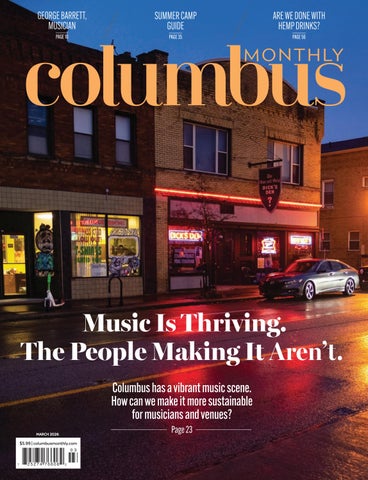
music venue Dick’s Den
Photos by Tim Johnson
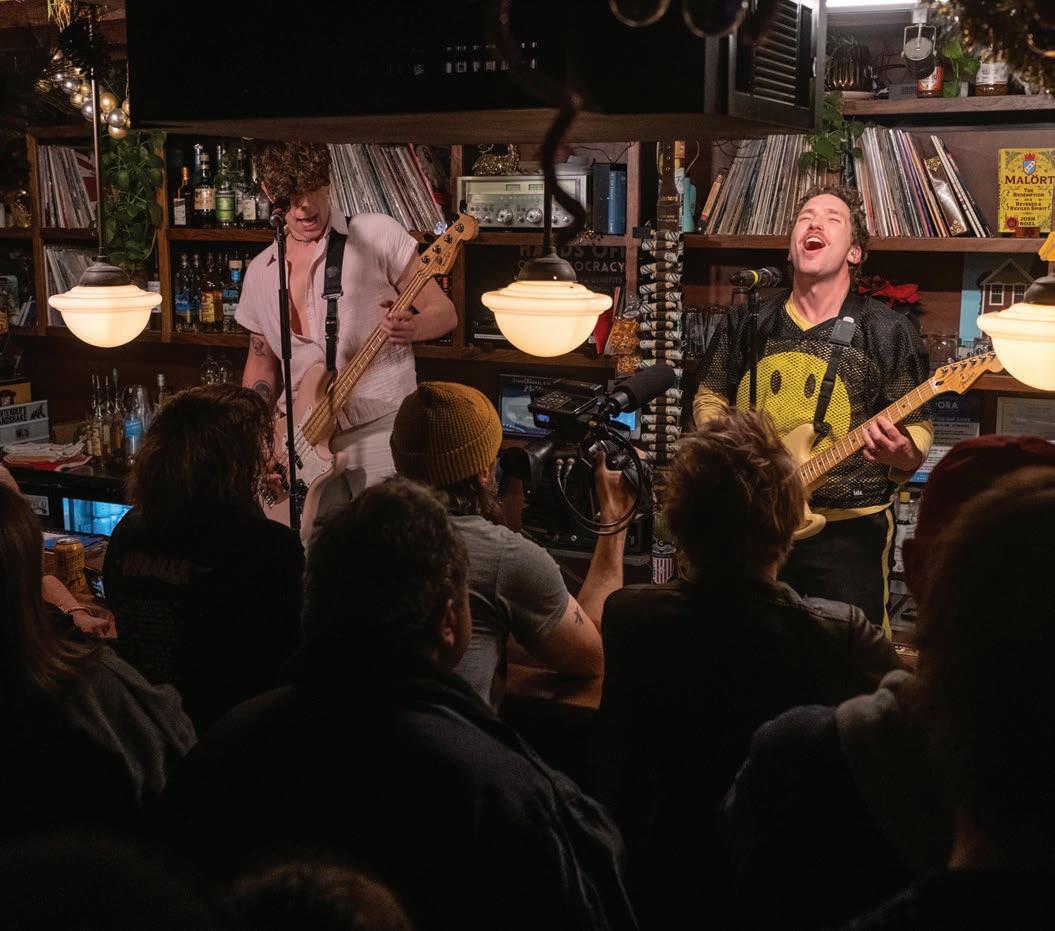
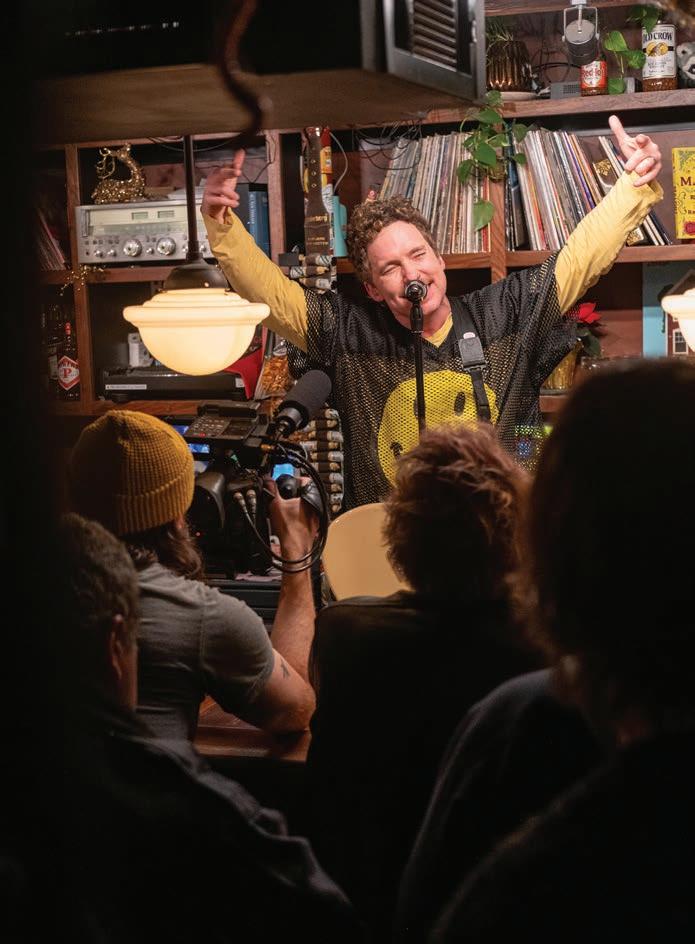
Lead singer David Eselgroth, right, and bass player Jake Floyd of the band The Orphan The Poet play a high energy show at Sweeney’s Walnut Street Tavern on Dec. 18.
EDITOR AND GENERAL MANAGER, DISPATCH MAGAZINES
Katy Smith
EDITORIAL FEATURES EDITOR
Linda Lee Baird ASSOCIATE EDITOR
Lucy Clark
CONTRIBUTING WRITERS
PHOTOGRAPHY
PHOTO EDITOR
Tim Johnson
ADVERTISING MULTIMEDIA SALES MANAGERS
Heather Kritter, Adam Trabitz
PRODUCTION DESIGNER
Rebecca Zimmer
MARKETING
MARKETING MANAGER
Lauren Reinhard
Amy Bodiker Baskes, Nicholas Dekker, Chris DeVille, Randy Edwards, Kevin Elliott, Emma Frankart Henterly, Kathy Lynn Gray, Donna Marbury, Aaron Marshall
Jill Moorhead, Laura Newpoff, Steve Stephens and Peter Tonguette
DESIGN & PRODUCTION PAGE DESIGNERS
Kathryn Biek, Kelly Hignite, Kaity Athialy, Hannah Patton
DIGITAL EDITOR
Julanne Hohbach
LETTERS: letters@columbusmonthly.com
ADVERTISING: advertise@ columbusmonthly.com
EDITORIAL/ADVERTISING OFFICES
605 S. Front St., Ste. 300 Columbus, OH 43215 614-888-4567
SUBSCRIPTIONS/CUSTOMER SERVICE 800-359-5633 columbusmonthly@omeda.com
Jill Moorhead
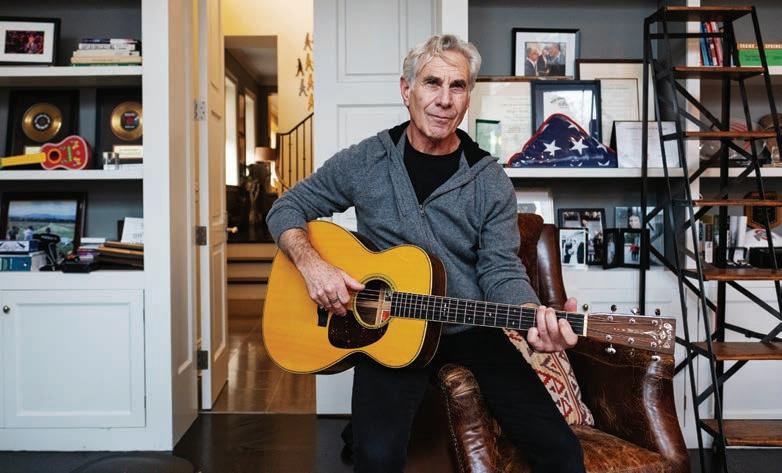
Meet George Barrett—the musician, who is the former CEO of Cardinal Health, Page 10. And, the longtime Columbus Monthly writer delves into how the city’s music scene can thrive, Page 23.
CONTRIBUTORS
Peter Tonguette
Some adults are navigating finances for their parents and children as well as themselves. Tonguette shares the challenges faced by the “sandwich generation,” Page 6.
Rhea Cunningham
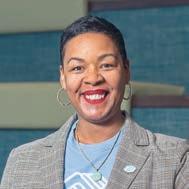
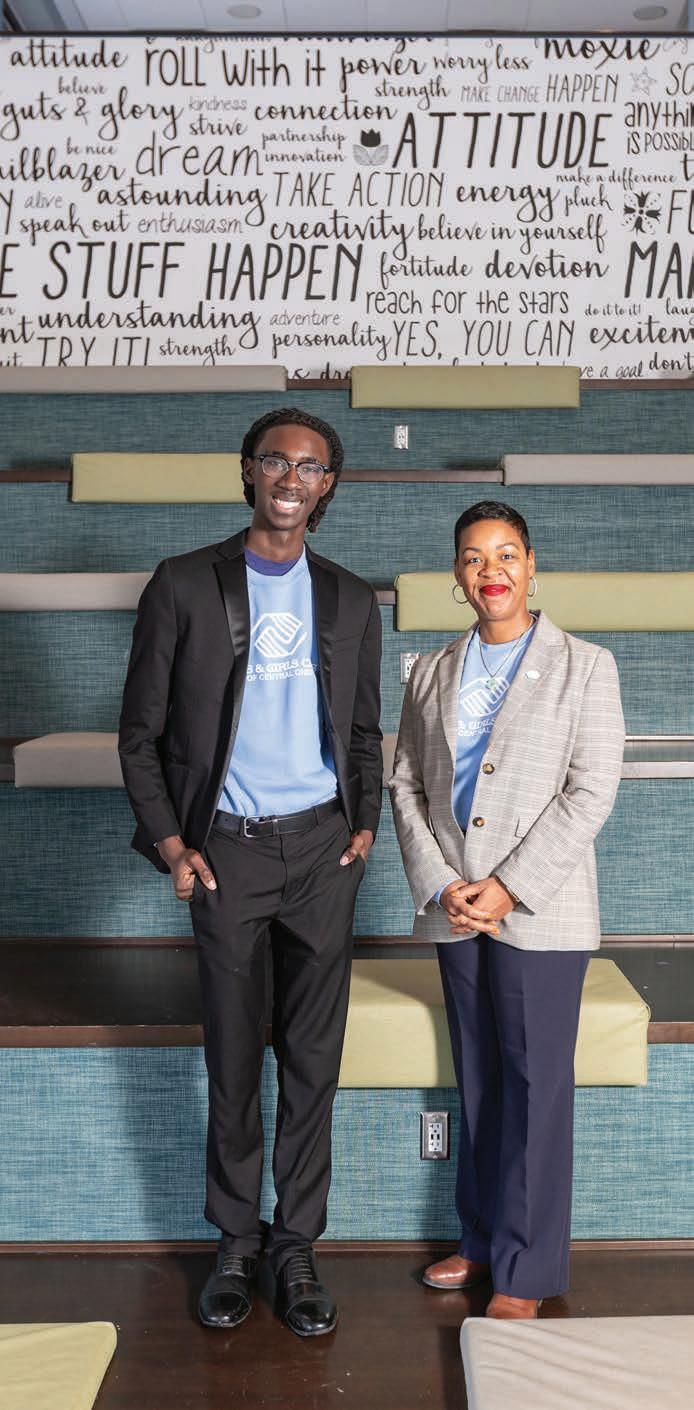
The new CEO of Boys & Girls Clubs of Central Ohio is a champion for middle schoolers ideating on their future careers and the contributions they are uniquely suited to make, Page 12.
Send letters to: Editor, Columbus Monthly, 605 S. Front St., Ste. 300, Columbus, OH 43215. Or email: letters@columbus monthly.com. A letter must include the writer’s name, address and daytime phone number. Letters will be edited for length and clarity. All letters sent to Columbus Monthly are considered for publication, either in print or online.
Email: letters@ columbusmonthly.com
What Makes a City Vibrant? A Few Ideas from Louisville
Are you an armchair urban planner? I think I definitely must be. Longtime Columbus Monthly freelance writer Jill Moorhead made me laugh when she introduced the concept as a favorite pastime of people in Columbus in her March cover story on how to make the city’s music scene financially sustainable for venues and musicians (Page 23). She writes that while Columbus might not need a designated music district, the city could benefit from policies that better support artists. People she talked to for the story advocate for giving musicians the means to play music as a career (you know, a job that has health insurance), not just a series of gigs. That, coupled with a real estate environment where venues could afford to purchase their buildings, neutralizing the threat of rapidly rising rents, could lead to more venues. The hope is that eventually, Columbus would become known as a top place to play and listen to terrific music.
Katy Smith katy@columbusmonthly.com
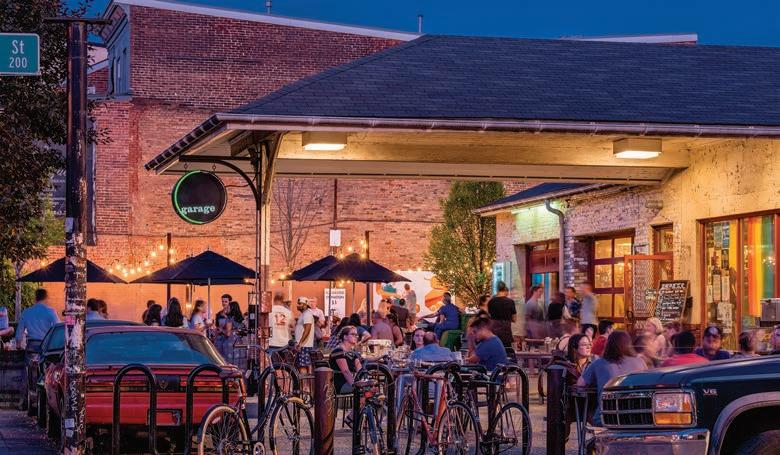
businesses gives the sense there is something to be explored around every corner. The mix of experiences isn’t neatly filed into the ground floors of new-build condo or apartment towers, with similar retail signs adorning a homogenized architectural backdrop like names on a bank of office mailboxes. Instead, it’s woven into the patchwork of existing buildings, many of which are historic. Patios are abundant, spilling into the street, tucked away in the spaces between buildings, or set back behind lovely gates, where hanging planters and fountains make for a charming dinner al fresco. We have glimpses of this in Columbus, but we could use more.
Of course, people paying attention know we already have a successful scene where you can lose yourself in live music most any night of the week. Music and the arts are a core ingredient in the recipe for a vibrant city, in my opinion. What else goes into the cocktail? As an armchair urban planner, I regularly ruminate on what Columbus needs, both when I’m out and about here at home or traveling in cities that have elements worthy of replicating. Here are two observations from a trip to Louisville (and by no means are these necessarily original ideas—but they have my support).
Organic density. While visiting Louisville for the first time in 2025, I had a wonderful time on a Friday night exploring NuLu east of downtown. Along historic East Market Street, a tapestry of restaurants, vintage shops, galleries and service
Green space. I do appreciate the parks in Columbus’ urban core, and I know city leaders are always considering how to build more natural areas into our Downtown environment. The Scioto Mile is a wonderful achievement. But so much of it is hardscaped sidewalks and bridges. Our Downtown and surrounding neighborhoods could benefit from more trees and expansive lawns on which to picnic, take a walk or simply lie in the grass and watch the clouds float by overhead. There is something so soothing about the experience of being surrounded by trees and green and flowers. Louisville was extremely fortunate to have parks designed in the late 1800s by Frederick Law Olmstead, the father of American landscape architecture who created Central Park in New York City. I realize our ability today to amass the acreage necessary for a project like Cherokee Park in Louisville is limited. But does it hurt to dream?
Garage Bar in NuLu
front & center
PHOTO COURTESY KEYVAN BEHPOUR
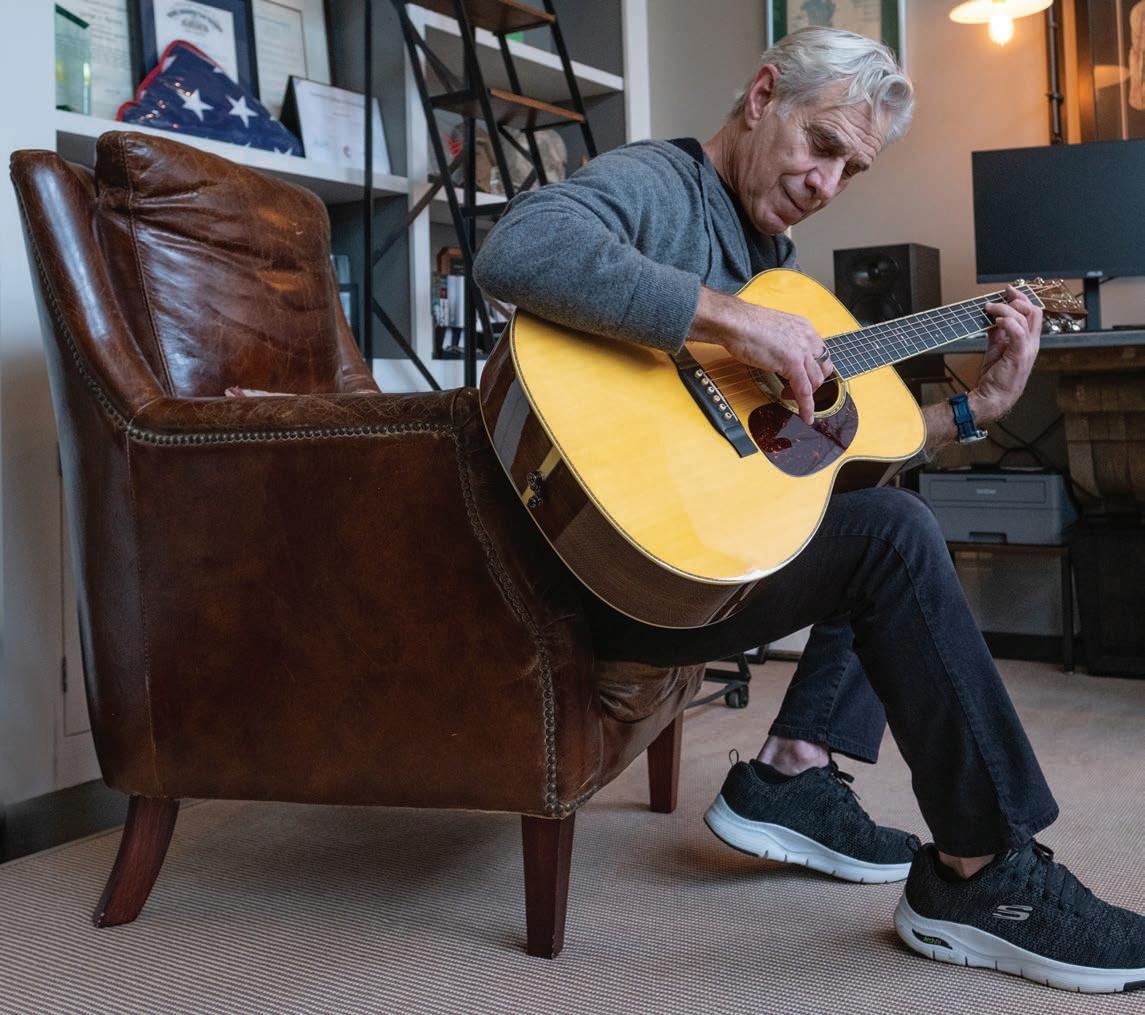
A Second Act Former Cardinal Health CEO George Barrett is embracing his lifelong love of music, performing in Columbus and beyond, Page 10.
From Boardrooms to Concert Halls
The musician and former CEO reflects on music and leadership.
By Jill Moorhead
George Barrett, the former CEO of Cardinal Health, is known as a business leader, a civic presence and a familiar face in boardrooms and classrooms. His career in health care took him around the world, and while his briefcase almost always traveled with him, so did his guitar.
In each hotel, Barrett made the same
request: access to a piano, just in case he had time to play.
Barrett’s career isn’t a straight line. It has bended toward music, toward leadership and back again, guided less by destination than by saying yes to opportunity. Long before he led organizations, Barrett learned to listen—really listen— in rehearsal rooms and on stage in en-
sembles, where no single voice carries the piece.
In recent years, that quiet persistence has become public again, culminating in two albums and a return to the stage.
Overture
“It was never not music,” Barrett says of his childhood home. He doesn’t re -
BY
PHOTO
TIM JOHNSON
ABOUT GEORGE BARRETT
Musician: Primarily vocals and guitar
Corporate Experience: Cardinal Health chairman and CEO, 20092017; U.S. market and North American leader, then global EVP, for Teva Pharmaceutical Industries, 1999-2008
Education: Bachelor of Arts, Brown University; MBA, New York University
Resides: German Village
member learning the guitar, but there are photos of him holding an instrument so large it nearly covered his face. Piano lessons followed, then the French horn. With a father who sang, a mother who wrote poetry and older brothers also immersed in music, it never occurred to him to imagine a life without it.
Barrett auditioned for the all-state choir and was named first-ranked tenor in his home state of Connecticut. He sought a college that would allow both his love for music and athletics to coexist. Barrett found that balance at Brown University, where he studied history and moved between rehearsal rooms
and the soccer field.
Then, a soccer injury forced Barrett to confront the possibility that one part of his life might be closing. It was crushing. It was then that David Josephson, a professor and mentor, stepped in. Barrett remembers him saying, “I know this is devastating, but we think your voice may be your life’s work. You need to take it seriously.”
“When I fell,” Barrett says, “he caught me.”
Development
At Brown, Barrett immersed himself in music. After graduating, he spent several years in New York playing and teaching music in Greenwich Village before an unexpected opportunity pulled him in a different direction.
“Sometimes you just have to say yes and try something,” he remembers. That “yes” led him into health care, one of the few fields, he says, that could have drawn him away from music. The work had impact. And coming from a family with a strong sense of duty, the decision fit—though it took time for his parents to warm to the idea. “In many families, when someone goes into the arts, everyone freaks out,” Barrett says, “In mine, when I said I wanted to leave music for business, my parents didn’t understand it.”
Barrett approached his work with a curious mind. Over the decades that followed, he held senior roles across Europe, the Middle East and the United States, eventually serving as CEO of Cardinal Health and on the boards of the Target Corp., Nationwide Children’s Hospital and the Rock and Roll Hall of Fame, among others.
The tenets Barrett absorbed through music helped shape his approach to leadership. “I’ve always been more interested in people than in titles,” he says. “Music taught me that early on. In an ensemble, you don’t lead by dominating. You lead by listening.” That instinct made him slower to judge and quicker to ask questions—whether he was working with a junior employee, a nurse or a stranger in uniform.
Creativity, too, always has been part of how he processes problems and situations. “Sometimes someone has to ask the question that isn’t being asked, or imagine the thing that hasn’t yet been imagined,” he says. His comfort on stage translated naturally into comfort
in front of people—and into an ability to mobilize them. Working in concert with others and drawing on individual strengths in service of a shared goal is a discipline that has served him equally well in boardrooms and onstage.
Coda
This past November, Barrett performed a sold-out 7 p.m. show at The Bitter End in Greenwich Village—the same room where he last played as a 24-year-old trying to decide whether music would be his life’s work. Then, the late hours and unhealthy culture surrounding the music grind wore on him. This time, in a different season of his life, the early show felt right. “It was a blast,” he remembers. “We were wide awake and vibrant, and afterward people went to dinner to talk about the show.”
While music never appeared prominently on his LinkedIn profile, it never disappeared, either. As his responsibilities grew, Barrett became more cautious about how—and where—he shared that part of himself. In corporate settings, he wasn’t sure how it would land. For years, the music stayed mostly private. He played and sang at home. He carried a guitar on the road. He gathered with friends quietly, away from the spotlight. He wasn’t ready to reconcile his passion with his public persona.
Still, the music found its way out. As people around him became aware of his talent, Barrett began performing. He played with the Columbus Jazz Orchestra, the Shadowbox Live band, the ProMusica Chamber Orchestra.
In 2023, Barrett released his debut album, Not Alone , produced by Emmyand Grammy-winning composer Brian Keane. Two years later, the pair partnered again on Rearrange Things
Barrett sits down every day in his German Village home studio to write, looking to the world and the issues around him—like homelessness and inequality—for inspiration. Music, like his work in health care, has become another way to make an impact.
Underneath it all is a belief that has followed him from rehearsal rooms to boardrooms: that people are always more than they appear. Titles, uniforms and nametags rarely tell the full story.
“Because I am different than I appear to be,” Barrett says. “I don’t fill in the blanks as fast as others. I am not what my title suggests I am.” ◆
George Barrett
Career Dreams
Children begin to imagine what their vocational futures hold as early as middle school. It’s a crucial time to engage them.
By Rhea Cunningham
When I think about the future of the Columbus region’s workforce, I don’t picture a distant generation—I picture the middle schoolers who walk into the Boys & Girls Clubs of Central Ohio each afternoon. They are curious, talented, full of possibilities and watching how we lead. The values we model and the opportunities we create will shape our region for decades to come.
As CEO of this nonprofit organization, my focus is clear: Expand access to experiences that help young people build identity, confidence, belonging and leadership. These foundational skills shape both their future careers and their contributions to our community.
Academic success remains essential, but it is only one part of what young people need to thrive. Workforce readiness begins long before high school graduation; it begins in middle school, when youth start discovering who they are, what they’re good at and where they might see themselves in the future. Research shows young adolescents are eager to match their strengths with potential career paths, and these early explorations shape what they believe is possible.
Yet today’s youth are navigating challenges that can narrow those possibilities: rising mental health concerns, limited exposure to careers, the rising cost of education and a rapidly evolving labor market. Many are still building the relationship skills—confidence, communication, adaptability—that employers consistently name as the most urgent workforce gaps. These skills cannot be taught through curriculum; they are developed through experiences, trusted relationships and spaces where young people feel seen, supported and safe to experiment.
PHOTO BY TIM JOHNSON
Boys & Girls Clubs member Caden Gadjigo, who founded an apparel business, and CEO
Rhea Cunningham
Boys & Girls Clubs of Central Ohio
Mission: To enable young people to reach their full potential by providing comprehensive and affordable after school and summer programs.
Founded: 1948
Annual revenue: $6.9 million
CEO: Rhea Cunningham
That’s where high-quality youth development programs matter. Clubs offer what classrooms alone cannot: Environments where youth build self-awareness, navigate conflict, practice leadership, advocate for themselves and discover a sense of purpose. These experiences cultivate the very competencies employers value most—collaboration, problem-solving and resilience.
I have seen this transformation firsthand. Through experiences like our Youth of the Year, Torch Club, Keystone Club, Rock the Mock and National Days of Advocacy, young people find their voice, gain confidence, learn teamwork and decision-making as well as develop critical thinking and presentation skills. These are not just activities; they are identity-shaping moments that produce vital skills to carry into the workplace.
My vision for the Columbus region is one where every young person has access to the relationships, experiences and opportunities that help them build identity, confidence and pathways to their future. Youth development is the foundation of workforce and community development. Early and intentional investment in young people’s social, emotional and leadership development strengthens families, supports the current workforce, and secures the long-term vitality of our region.
This work requires collaboration. I invite our community to get involved— mentor a young person, host a site visit, support a mock interview or advocate for youth-centered policies. The next generation of leaders is among us. Let’s ensure they step into adulthood with confidence, skills and a sense of possibility. ◆
Rhea Cunningham is CEO of Boys & Girls Clubs of Central Ohio.
Front & Center | Everyday Kindness Heroes
Gifting Experiences, Not Waste
A Bexley father launches a platform encouraging experience-based giving.
By Sophia Veneziano
Through celebrating birthdays and holidays with his three daughters, lifelong entrepreneur Mic Foster noted the many items his family began to accumulate.
Likewise, he observed a trend among birthday party invites from other families: “No gifts please.”
He turned this phrase into a digital platform that helps families create registries for experiences rather than physical gifts. His goal was to reduce clutter and replace some gifts with meaningful and memorable experiences.
With coding and technical help from Andrew Lively, another local father observing the same phenomenon, Foster created No Gifts Please.
“While the stuff is very nice, it is often quickly forgotten,” Foster says. “If you get 25 to 30 presents from friends and family, one or two of those items is used, and the rest of it just starts to pile up.”
Almost immediately after Foster and Lively released the platform at the end of September, its use increased rapidly—with users from coast to coast.
Lively says the technology was engineered to let users chip in to help pay for multiple experiences on the registry. “You can provide $20 to horseback riding lessons and $50 to football camp and provide them a more personal connection,” he says.
Foster and Lively also have created the Shared Generosity Fund, a needbased nonprofit arm of the company. Community members can contribute to this fund, which is used to help families with financial needs fully fund their registries. “The focus is on helping more children access meaningful, local experiences that might otherwise be out of reach,” Foster says.
Users have purchased over $1 million
in registry value on the site since autumn, Foster says.
The company’s website displays a toy counter of items that would have been purchased and eventually would have ended up in a landfill, had givers opted for toys instead of experiences.
As of early January, this number was at over 14,000 toys, Foster says. “We’re huge advocates as a family and as a company of having people get out and do things—not being on their screens, not sitting inside. Getting out in the world, developing as little people.”
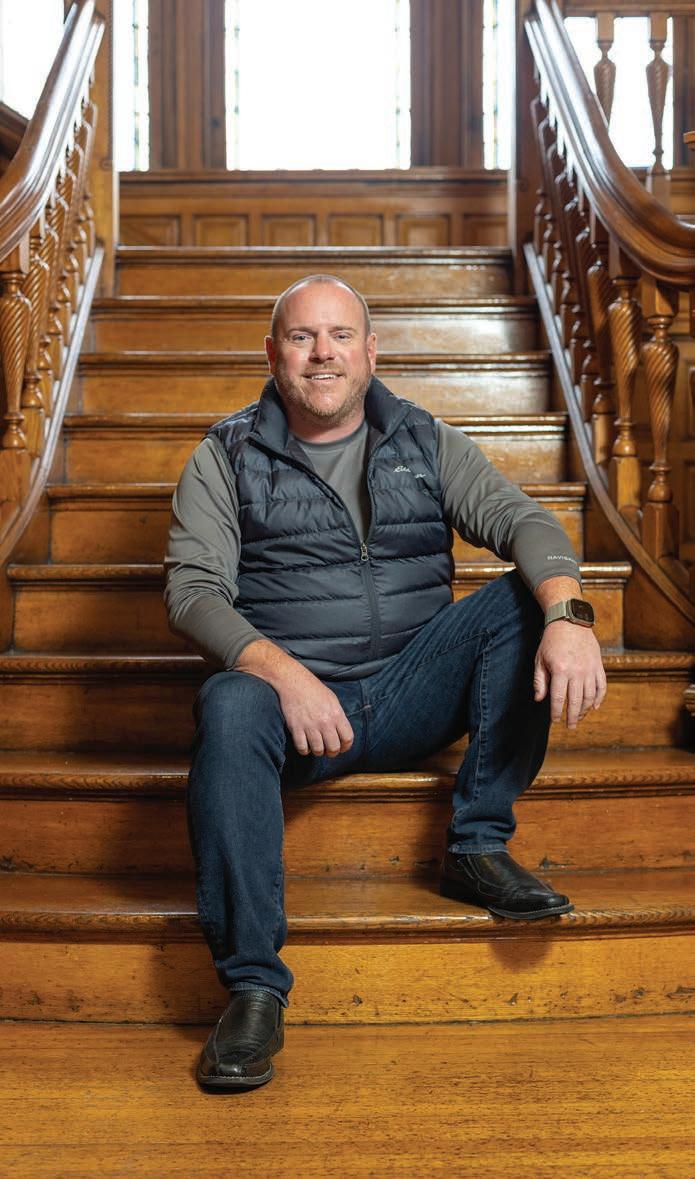
Mic Foster runs No Gifts Please from his East Broad Street office.
PHOTO BY TIM JOHNSON
EverydayKindness Heroes
Sometimes the beneficiary is a stranger. Sometimes it’s a friend, acquaintance or colleague. We look to honor those who perform extraordinary selfless acts to improve, heal and unite our community.
Consider lifting up the volunteer quietly aiding their neighbors or the community member tirelessly advocating for change. We need your help to recognize the kind, selfless heroes among us.
The Center for HumanKindness at The Columbus Foundation has partnered with The Columbus Dispatch to highlight those making our community a better place. Help us inspire kindness by suggesting people, initiatives, or organizations for Reporter Sophia Veneziano to profile. She can be reached at sveneziano@dispatch.com Learn
Front & Center | Health & Wellness
Brain Therapy
At NeuroAnimation, exercise with a virtual octopus is delivering results for people recovering from stroke and other neurological ailments.
By Zach Trabitz
When Ohio State University post-doctoral scholar Janeth Alexandra Garcia Monge suffered a stroke, she didn’t expect that an octopus would end up bringing her relief.
Monge, a physicist, was left with cognitive impairment after her stroke, which was challenging for her as someone who works with advanced math. After seeing an ad on Instagram, she sought treatment at the Columbus-based company NeuroAnimation, where she engaged in a novel form of therapy: controlling a
virtual animal.
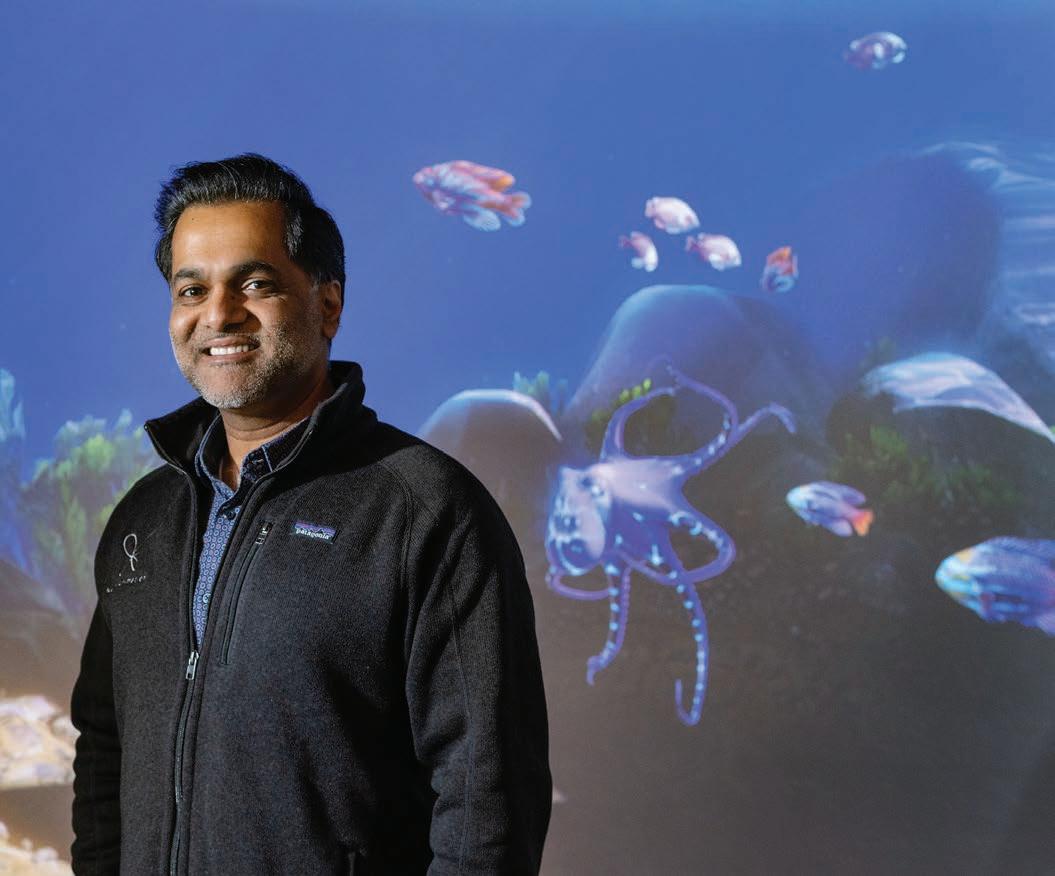
The therapy takes place in a theater at NeuroAnimation’s offices in New Albany, where clients are hooked up to a high-fidelity 12 camera system that tracks their movements. Clients undergo an hour of intensive cognitive motor movement where they control an animal, such as Kana the octopus.
“It’s not just randomly moving or playing a video game,” says Omar Ahmad, NeuroAnimation’s CEO, who is a computer scientist. “It’s almost like doing
surgery. It’s very conscious, complex motion planning, and it’s over an hour. It’s what we call true motor learning. After, they do an hour of consolidation, which is [where clients] try to do tasks or goals that they want to improve at.”
The therapy comes in two forms: either a three-week boot camp that is $9,000 and a total of 45 hours of therapy or a 12-week strengthening program that is $5,000 and a total of 24 hours of therapy. The program does not accept health insurance and does not require a
PHOTO BY TIM JOHNSON
NeuroAnimation CEO Omar Ahmad and the onscreen exercise involving a virtual octopus.
physician’s referral.
Ahmad, who previously was director of innovative biomedical engineering at the Johns Hopkins University School of Medicine, said the seemingly simple method of activating the brain with virtual exercises has shown radical results by activating a specific part of the brain.
“It’s called the dentate gyrus of the hippocampus, and it’s also responsible for creating new neurons in the brain,” Ahmad says. “It creates new adult neuronal stem cells, and they proliferate throughout the hippocampus. And even when there’s damage in the brain, [those cells] migrate to other areas of the brain. We’ve shown brain growth in the hippocampus. What we also hypothesize is that those brain cells probably migrate to damaged areas. That’s very hard to prove, but what we do see is the effect.”
Ahmad said the technology can be used by individuals who have suffered from strokes, but it also can assist with other cognitive ailments such as dementia and Alzheimer’s. “[NeuroAnimation] clients control a dynamic animal. When you’re moving it, you’re feeling the forc-
es of it, you’re interpreting them, you’re predicting them, you’re planning them, and that sends a cognitive load to the brain that’s super intense,” he says.
While she initially thought the process looked simple, Monge says it has been incredibly beneficial for her recovery.
“I think it was right after the second session that I started to notice differences,” Monge says. “The biggest one I noticed was driving. After the stroke, I had a lot of problems with depth perception, and when I was driving, I used to get very stressed and frustrated. I remember leaving after the second week of NeuroAnimation. I was driving and it felt so different. It was so much easier.”
Dr. David Whitt, a physician who founded Diley Medical Group, refers his patients to NeuroAnimation. He says the therapy has been instrumental in their recovery. “This therapy represents a true paradigm shift in how we may treat diseases of the brain,” Whitt says. “The therapy is noninvasive and carries essentially no risk—yet the potential benefits are extraordinary. I have seen patients with Parkinson’s disease, traumatic brain inju-
ry, autism and even major depression experience outcomes that were previously thought to be impossible.”
Monge says for her, other post-stroke therapies have been hit-or-miss, since they typically focus on physical recovery and not cognitive. “I noticed some doctors even thought, ‘You should be grateful that you are here, so you shouldn’t be complaining that you cannot do this thing,’ ” Monge says. “Of course, I’m grateful to be alive, but I wanted to keep going with my life.”
Monge says after completing the NeuroAnimation therapy, her ability to perform arithmetic has improved immensely. Her general quality of life also has improved.
“With all the frustration from my stroke, I was getting cranky, I was always mad,” she says. “With these therapies, my mood changed completely. My speech became easier, and my ideas became more fluid. It’s not like how I was before the stroke, of course, but it’s so much better, and I feel normal. Doing the therapy has been my best investment after my stroke. It was worth every penny.” ◆
Treating You with Care
Front & Center | Wealth Management
The Sandwich Generation
Financial planners offer pointers for adults who find themselves balancing their own needs with those of children and aging parents.
By Peter Tonguette
For those of a certain age, the term “sandwich generation” might call to mind comic-strip character Dagwood Bumstead, known for his love of both family and elephantine sandwiches. But it refers to a real and growing phenomenon: the generation of adults whose financial resources and attention are split among themselves, their children and their aging parents.
This family dynamic is strikingly different than what people experienced in decades past.
“Before we got to this idea of the sandwich generation, it was you going out and just taking care of yourself,” says Sarah Daya, central division lead for wealth planning and advice at J.P. Morgan Wealth Management. “Then when kids came into the picture, it was like, ‘OK, we’ll take care of the kids until we send them off to college.’ … What we’re seeing more and more is college kids that maybe are coming back and living at home. We also have more elderly folks who maybe can’t take care of themselves.”
With older adults attaining increased longevity and sometimes needing longterm care—as well as young people
encountering uncertain paths to independence—members of the sandwich generation need to plan carefully and prepare for the unexpected, financial planning experts say.
“It’s forcing families to have more proactive conversations,” says David Brinkman, a partner in the Columbus office of Schneider Downs Wealth Management Advisors who also is a CPA, Certified Financial Planner and Chartered Financial Analyst.
“These are always delicate conversations to begin with—anything related to money,” Brinkman says. “Now, when you’re going to be accountable for your parents, it’s really hard if you don’t have a full understanding of what their finances are.”
Experts agree that an essential starting point is for these individuals to fully assess the finances, starting with their own.
“I oftentimes run into clients who have all of these lingering accounts that are out there,” says Daya, such as people who switched jobs and have multiple retirement accounts, or who use several banks.
“That’s exactly where I’d start,” she says.
“Let’s take an inventory of what we’ve got … and then what are the expenses.”
The same financial picture should be
compiled for aging parents, especially in situations when long-term care might become necessary. “For somebody in the sandwich generation, you’ve probably got to build out two, maybe three balance sheets—one for yourself, the second one for your parents, and then the kids … [which] is relatively straightforward, if [the kids] even have any assets to begin with,” Brinkman says.
The process requires initiating talks about money that can be blunt but don’t have to be awkward. Daya suggests asking parents whether they have a financial plan, or when such a plan was last updated, as a good starting point. She also recommends taking simple steps toward getting more involved.
“It’s like, ‘Do you want me to write out this check for you? Do you want me to set up direct bill pay for you?’ ” Daya says. “A lot of times, parents are more receptive, especially these days I think, to having these conversations.”
Once an accounting has been made, those in the sandwich generation may need to prioritize their financial commitments. Daya considers saving for one’s own retirement to be nonnegotiable.
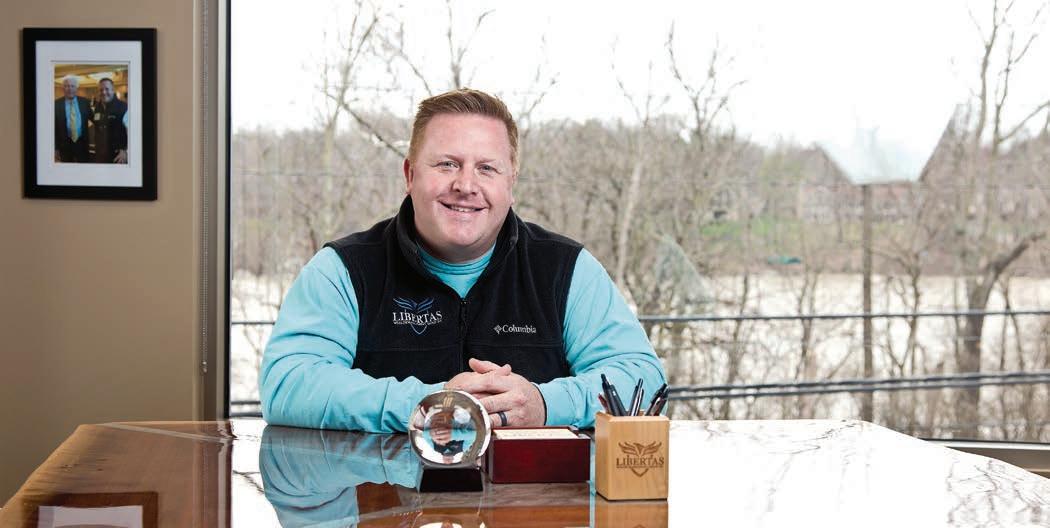
Adam Koós, president of Libertas Wealth Management Group Inc.
PHOTO BY ROB HARDIN
“Those are going to be the funds that they have to rely on,” she says.
On the other hand, “support goals” for offspring or aging parents can be financed in multiple ways. “A support goal could be something like paying for college,” she says. “While that’s important, there are going to be other strategies that we can use to fund college expenses.”
Daya also suggests building a strong emergency fund and utilizing flexible spending and dependent care spending accounts, which set aside pretax money for expenses related to day care, elder care or health care.
When it comes to aging parents, Adam Koós of Libertas Wealth Management Group Inc. suggests looking into longterm care insurance. The firm’s president and senior financial adviser recommends hybrid policies, “where the owners … can purchase a joint policy that covers them,” he says. “If they die and they never need long-term care, then the kids or grandkids or both get a tax-free death benefit.” If the insurance is needed for a nursing home or memory-care center, then “the death benefit that would otherwise have been paid to the next genera-
tion is accelerated and used while they’re living,” Koós says.
J.P. Morgan’s Daya recommends that grown children help their parents preserve the wealth they have earned by educating them about common schemes, including phishing and romance scams. “We’ve seen a lot more targeted schemes towards seniors,” Daya says. “A lot of times we get those phone calls, like, ‘There’s a loved one in trouble—can you transfer money in this amount?’ ”
The designation of a trusted contact person on a senior’s accounts is one tool to prevent fraud; others include credit
freezes, adding grown children to accounts and keeping close tabs on account activity. “That may result in paying for some nominal software that downloads your transactions and makes it easy to view in one spot,” Brinkman says.
Experts also say that hiring a financial adviser can be helpful to everyone concerned.
“You’ve got three stakeholders in this sandwich, and they all have different objectives and desires,” Brinkman says. “Even the most highly functioning family … doesn’t necessarily always proactively talk about every topic.” ◆
BAR ROOM
632 PARK ST THU FRI-SAT SUN 2–8 PM 2–10 PM 10–4 PM
David Brinkman
Sarah Daya
Photo: Ryan Chitwood
African American Leadership Academy Ascension Gala
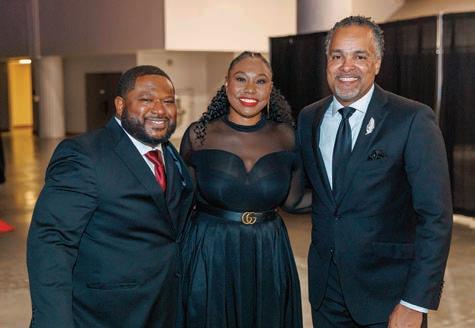
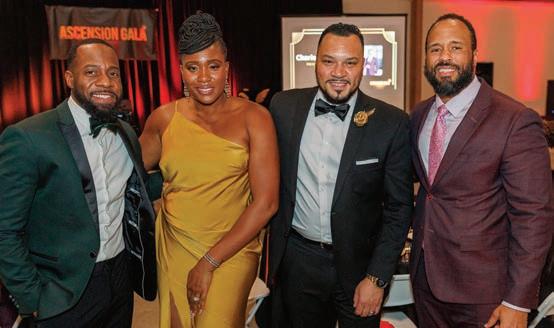
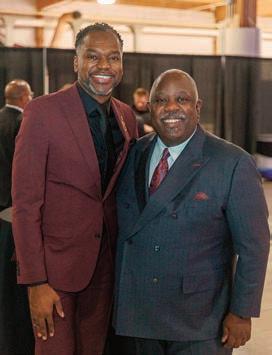
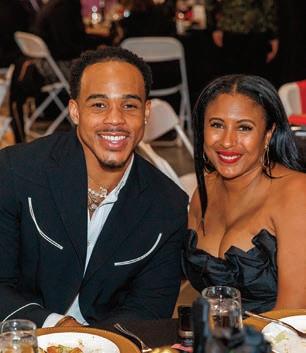
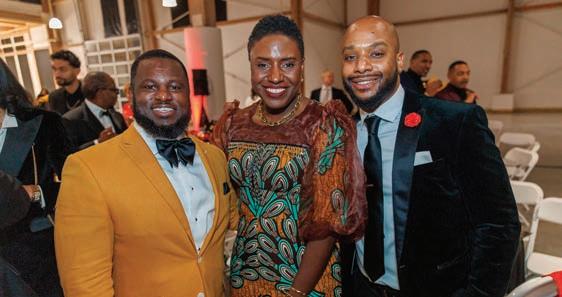
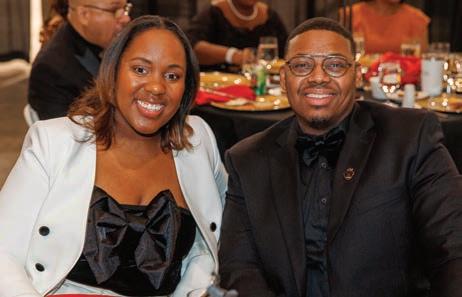
The African American Leadership Academy hosted its Ascension Gala and Catalyst Awards on Jan. 3 at the Cherry Valley Hotel in Newark. The event celebrated 20 years of advancing leadership across the Columbus region. More than 200 guests attended, including program alumni, community leaders and organizations whose work reflects AALA’s mission of developing diverse civic-minded leaders. Proceeds support AALA’s programming.
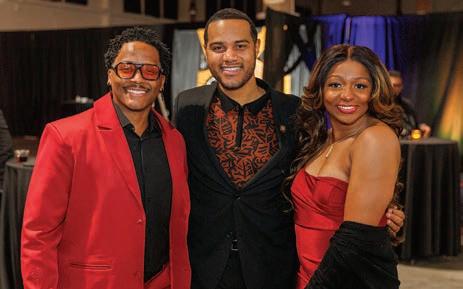
1 Theodore Harris, Natasha Coleman and Luke Fedlam
2 Andre Johnson, Habiba Bankston, Columbus City Council member Nick Bankston and Greg Corbin 3 Elon Simms and Derek Anderson 4 Chase Moore and Damika Withers
5 Mo Wright, Upper Arlington mayor Ukeme Awakessien Jeter and Sean Walton 6 Eryn and Sherome Hathaway
7 Alan Tyson, Terrence Myles and Ashlee Abraham
8 Larry and Donna James with Bo Chilton
Rev. Martin Luther King Jr. Birthday Breakfast
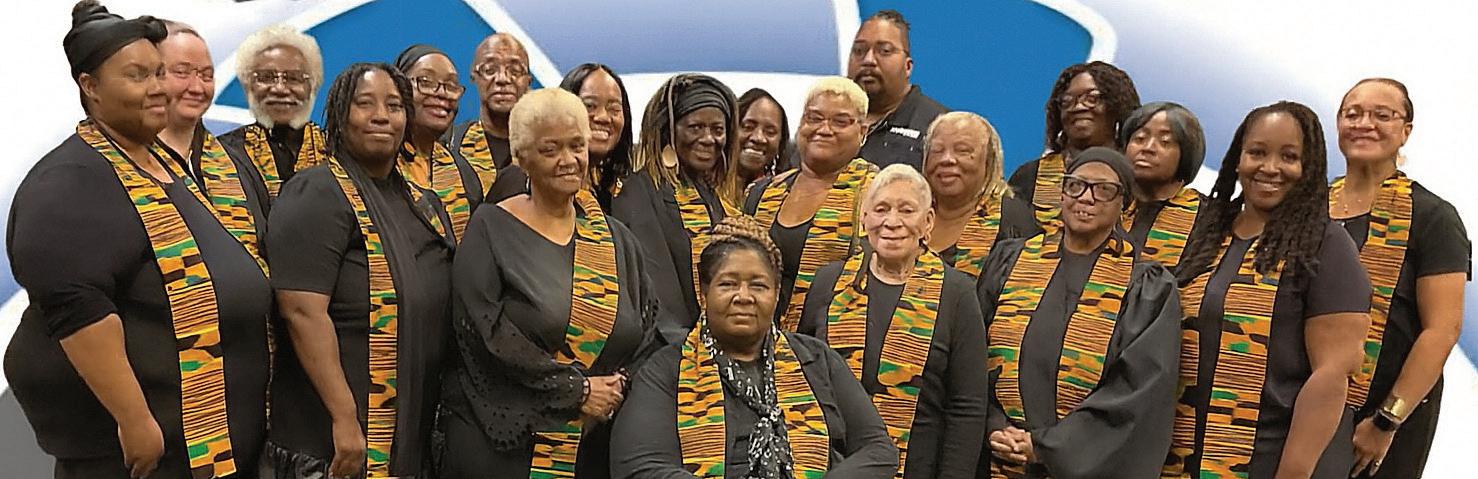
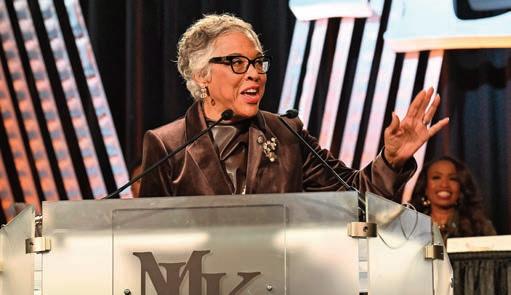
The 41st annual Rev. Martin Luther King Jr. Birthday Breakfast was held Jan. 19 at the Greater Columbus Convention Center. Approximately 1,500 people gathered to celebrate King’s legacy. Nationally renowned pastor and author Rev. Otis Moss III served as the event’s keynote speaker, and the breakfast also featured performances from the Columbus State Gospel Vocal Ensemble and Columbus Children’s Choir. The event was organized by the Martin Luther King Breakfast Committee Inc.
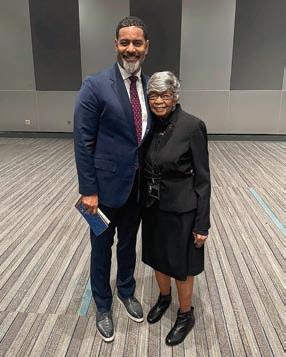
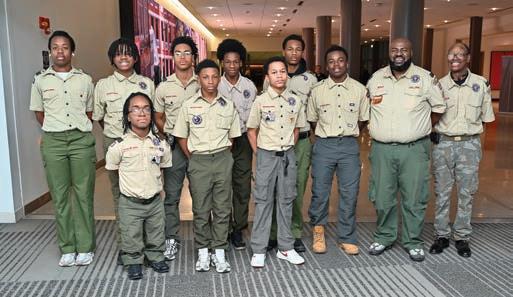
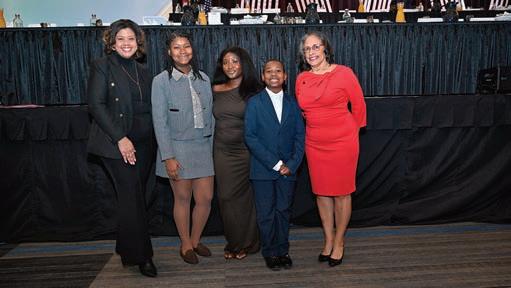
1 Columbus State Gospel Vocal Ensemble 2 Floyd Meadows, Rev. Otis Moss III and Rev. Donald Stinson Jr. 3 Rev. Otis Moss III and Dorothy Alexander 4 Congresswoman Joyce Beatty 5 Scouting America volunteers 6 Mia Prewitt, Amaiya Willis, Rebecca Idowu, Ali Russell Jr. and Columbus City Schools Board of Education president Antoinette Miranda 7 Rev. Otis Moss III
Best New Restaurants 2026
March 18, 2026 5:30-8 p.m.
Vitria on the Square
Experience the city's most exciting arrivals, from emerging cuisines to innovative takes on familiar classics –all in one venue.
Tickets include featured bites from each participating Best New Restaurant and live entertainment.
Event is 21 and older. Cash bar. Menus will not be published in advance and chefs will be unable to make modifications to their dishes.
Tickets on sale now:
All the Right Notes. None of the Guarantees.
Columbus has a thriving local music scene, culturally. Will creating a designated music district help musicians and venue operators afford to keep playing it?
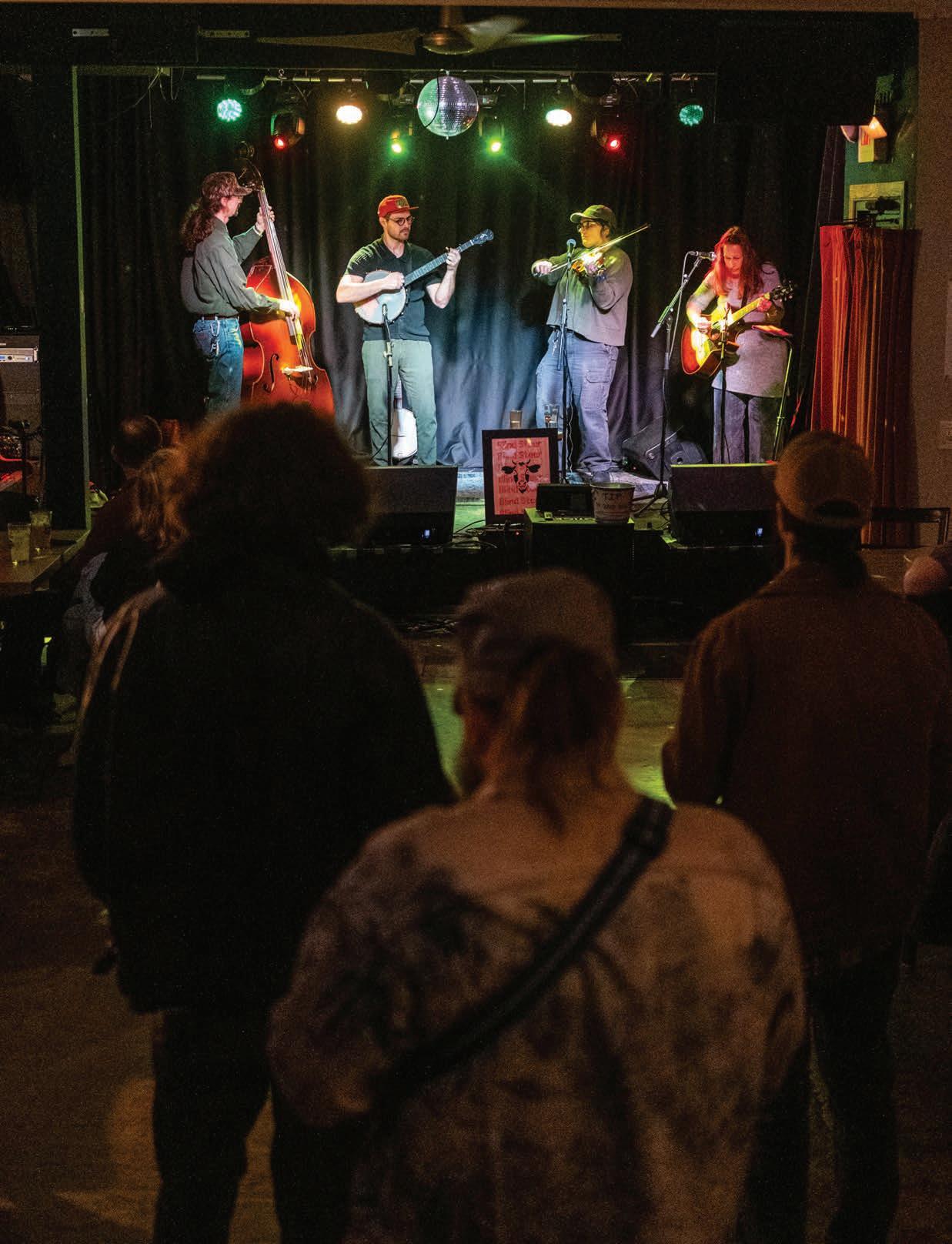
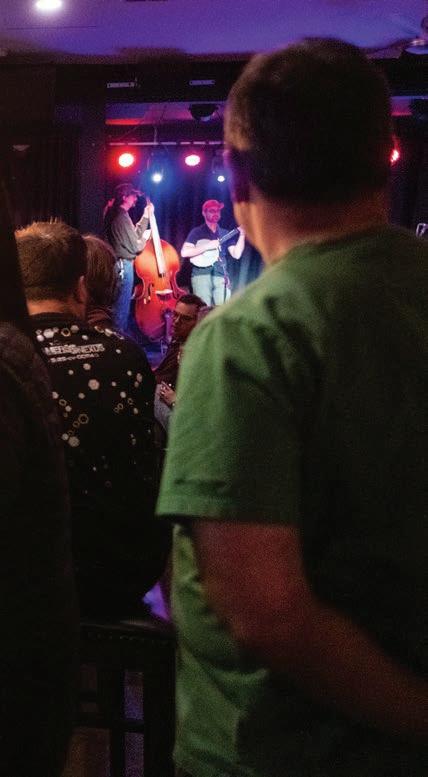
The Blind Steer bluegrass band played Jan. 8 at Rambling House Music Bar.
Story by Jill Moorhead | Photos by Tim Johnson
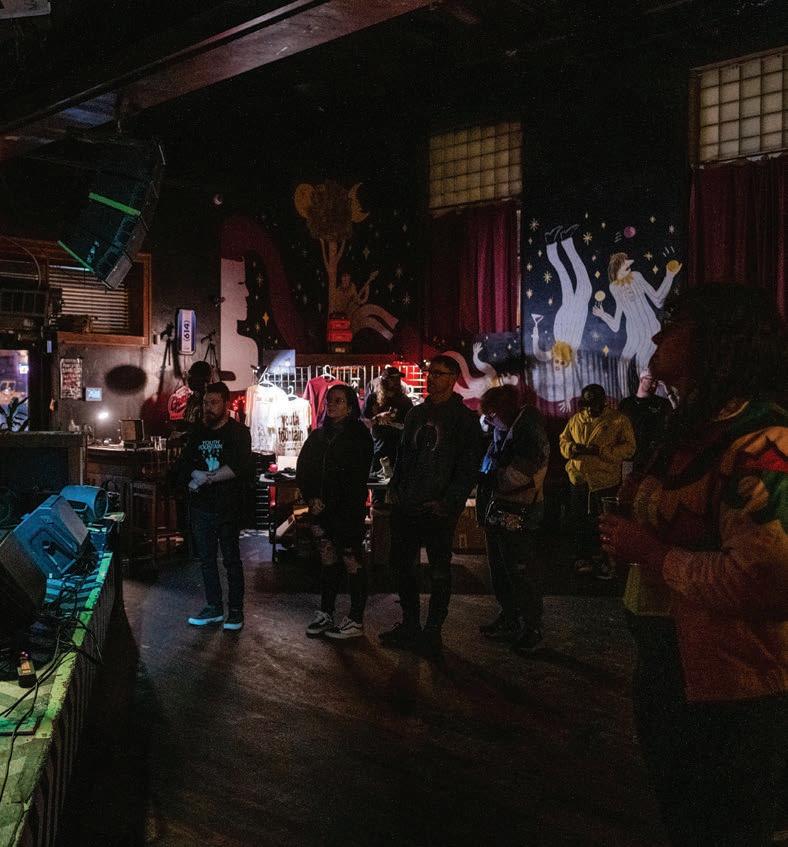
It’s a Thursday night at Sweeney’s Walnut Street Tavern in Franklinton, and the bar is sardine-can full.
People are stacked three deep in the narrow, house-meets-tavern neighborhood hangout, which has transformed from the Cheers-like hub of Franklinton’s creative class into a matchbox amphitheater. People spill onto the back deck, doors propped open, letting in the December cold. Two guys came from Indiana for this.
The area behind the bar has become a stage. Apple boxes are stacked to elevate Jake Floyd and David Eselgroth of The Orphan The Poet. The drummer is tucked into the front room, angled into a corner. He’s part of the Christmas decorations.
The normal rules of commerce don’t apply. Drink service has slowed to a halt. There are too many bodies, and besides, the bartender is playing bass. Phones are up, recording the same moment from 20 angles, while a handful of professional cameras are perched along the bar. The vibe is half house party, half documentary shoot, and everyone there understands as they’re shouting lyrics that they’re as much a part of the performance as the band. Something is happening here. Everyone can feel it.
Bar owner Jim Sweeney isn’t making a penny from this. If anything, a night like this risks alienating the regulars who came for something more predictable. But Sweeney keeps making the choice anyway—to make space for music, to let his bar operate as a hub with live music at least once a week—because he has a vision.
Behind the production is Jake Saxbe, stationed at one end of the bar, filming with two cameras at once. After decades documenting live music in Austin, Saxbe didn’t see Columbus being captured the same way—so he started doing it himself.
It began one afternoon when he wandered into Sweeney’s, met Floyd behind the bar, and fell into a conversation about music in Columbus: who was here, what was happening. What he found felt familiar—a cluster of creatives gathering around a bar. Filmmaker Josh Clark. Producer Keith Hanlon. Singer-songwriter Lydia Loveless. Sweeney. And, as often happens in Franklinton, an idea took shape and plans followed.
The concerts grew organically from there. Designed with an “NPR Music
Tiny Desk” feel in mind, they wondered what it would be like if live music was recorded in a tiny bar. “Lydia called Joey Viola, and they played, and we filmed it. And it was beautiful,” says Saxbe. The Orphan The Poet was the third of the series, which also includes performances by Loveless and Texas-based Ben Kweller.
“There’s no music venue in Franklinton,” Saxbe said on that Thursday evening at Sweeneys, “but there’s no question that this is the center of music in Columbus right now.”
Sweeney did not have a strategy for this impromptu series. There was no business plan or marketing rollout. No fliers for the next show. Just a bar, a band, a crowd, and some people who wanted to do something cool.
These are the kinds of nights people remember—and talk about later.
People, Not Buildings
In July 2024, advocacy group Music Columbus released an economic impact report quantifying the role music plays in the city’s economy. The findings
showed that music contributes hundreds of millions of dollars annually, supports thousands of jobs and touches nearly every sector.
One of the report’s recommendations—developed by TXP Inc., an Austin-based consulting firm—was to brand a specific district focused on music and entertainment. Columbus is no stranger to such designations. The Brewery District and Arena District emerged in the late 1990s and early 2000s, and today the city has 10 Designated Outdoor Refreshment Areas, or DORAs, designed to encourage walkability in both inner- and outer-ring neighborhoods.
The recommendation was clear about not replicating an existing model or simply labeling a neighborhood. The intent was to create a critical mass of venues and clubs that could market shows collectively, draw larger audiences and make live music easier to find for visitors. In other words, to help Columbus be recognized for the music it already has.
“A music district isn’t a building or a development,” says Amy Holihan, executive
director of Music Columbus. “It’s a system. We’re not in the development business. We’re in the people business. Buildings don’t make music. People do.”
There’s no single definition for a music district, and the term is not transferable from city to city. It’s not an Arby’s franchise. According to Rachel Skaggs, a researcher at Ohio State University whose work focuses on music ecosystems and cultural clustering, cities use the label to pursue very different goals. Some districts are formally designated through zoning and incentives, built to attract national touring acts and large-scale events. (Think: arena-driven entertainment corridors.) Others emerge organically, shaped by walkability, shared audiences and informal collaboration, like what has taken root in parts of Franklinton. Across policy, research and lived experience, music districts define more by function than form. At their most basic, they create density, coordination and visibility—making live music easier to find, easier to support and easier to sustain. But when policy comes into play, formal
districts can help protect the people who create that music from being displaced once attention follows.
Music policy expert Shain Shapiro, founder of Sound Diplomacy, cautions that cities often misunderstand music districts as shortcuts to economic growth. Districts only succeed when cities make deliberate choices to value cultural activity—not just property value—and to support what happens inside buildings as much as the dirt beneath them.
In that sense, the conversation happening now in Columbus isn’t about creating culture. We already have that. It’s about protecting it. Because despite frameworks and white papers, the burden of sustaining live music still falls on musicians, venue owners and workers taking on real financial and personal risk.
Behind the Bar
It’s the opening night of Rambling House Music Bar, and singer-songwriter Lydia Loveless is not on stage but behind the bar. Closed for two months under its third set of owners, the Old North Columbus venue reopened on a frosty December evening. New co-owners
Michelle and Tucker Bohm invited The Relentless Mules to play—a band that had opened the bar in 2014 and returned for its final show under the previous ownership.
“Here’s to round three,” one of the Mules says as the music begins on an icecold night fit only for the committed.
All eyes are on the Mules as they fill the room after seemingly endless futzing, tuning and sound-checking. But mine are on Loveless.
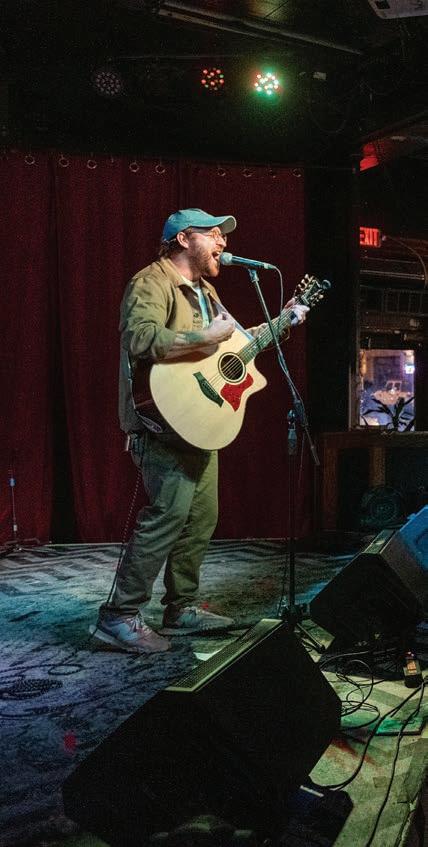
Lead singer David Eselgroth of the band The Orphan The Poet plays a high energy show at Sweeney’s Walnut Street Tavern Dec. 18.
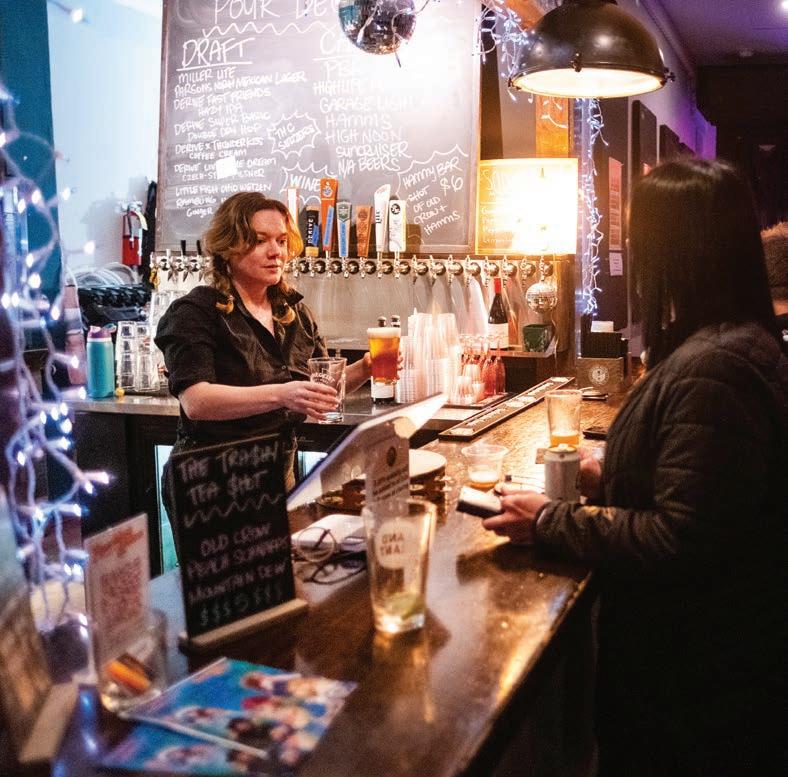
Local musician Lydia Loveless works the bar during a recent bluegrass show at Rambling House Music Bar.
Somehow, the musician—whom Pitchfork has likened to Tom Petty, Liz Phair and Loretta Lynn—isn’t onstage. She’s popping open Miller Lite ponies and pouring IPAs, a tragic misuse of hands capable of coaxing emotional trauma out of a guitar.
The singer-songwriter and co-producer of seven records has spent more than 20 years performing. She’s a fixture on public radio, with her own Tiny Desk Concert and appearances on WXPN’s World Cafe. When she tours, Loveless plays the role of gritty, self-effacing troubadour, carrying Columbus with her to rooms across the country and overseas.
But when she’s home, Loveless relies on multiple income streams: using her audio engineering certification to produce records for others at Secret Studio, a Franklinton-based recording space; leading an open mic at Rambling House; and slinging drinks where other musicians try to break even for the night. She stayed (and came back) because Columbus once made it possible to play music full-time without drowning financially. That calculus has changed. Despite her international following, the dollars don’t add up.
When she’s on the road, roughly 75 percent of her income comes from touring—door revenue, merch and album sales. It’s more lucrative, but it’s also
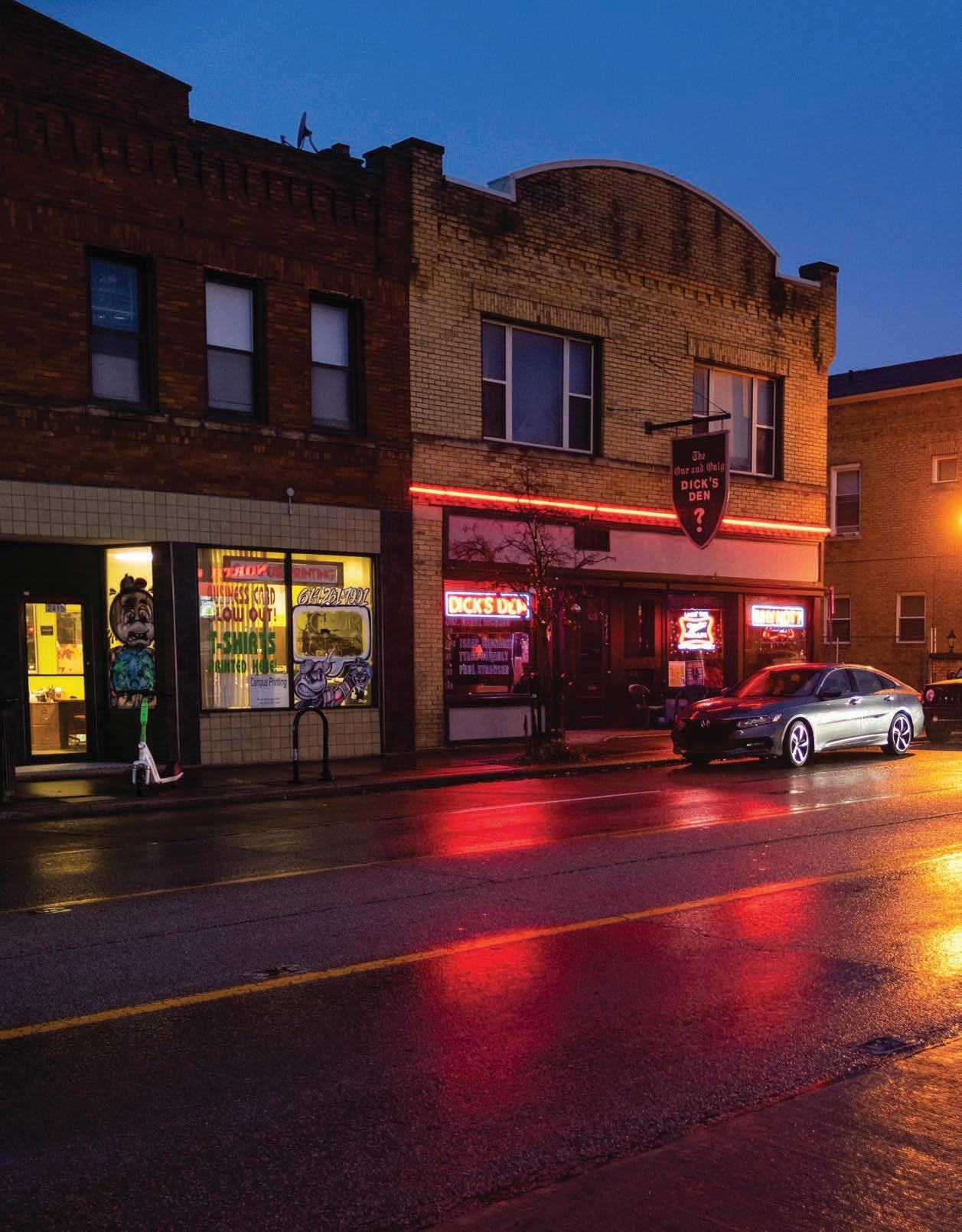
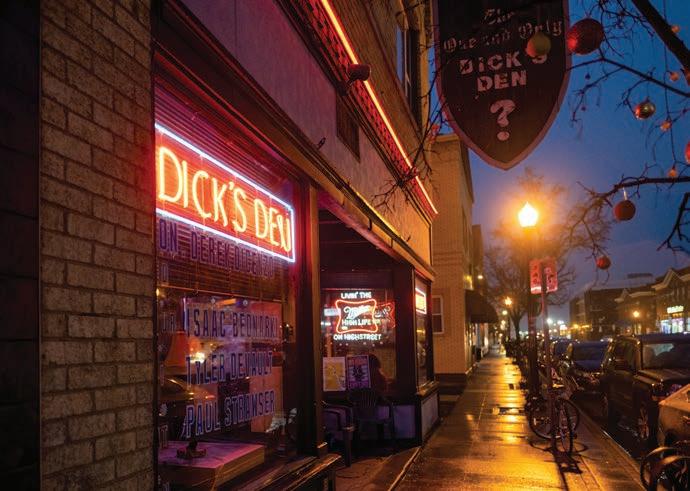
The iconic Dick’s Den in Old North Columbus
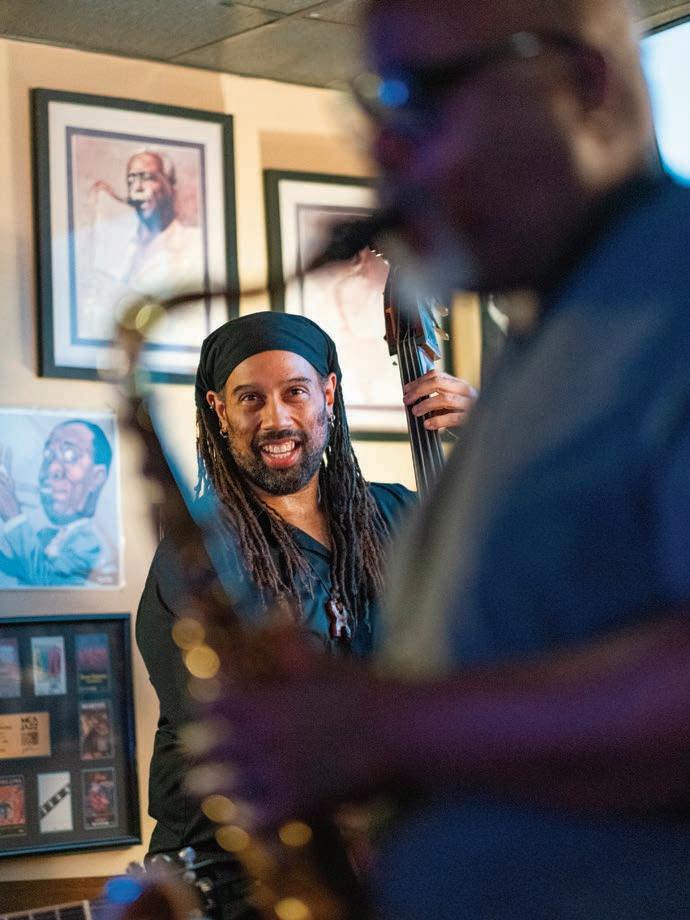
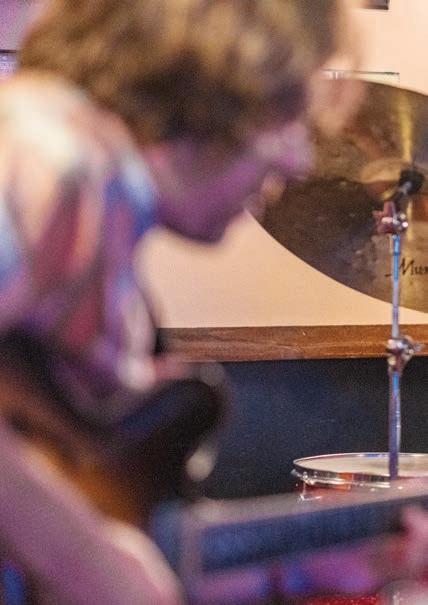
Bass player Dean Hulett performs at the Blu Note, which will open a Franklinton club this year.
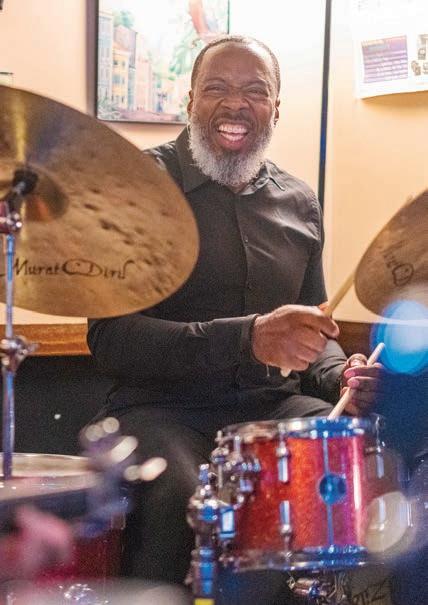
Drummer James Gaiters at the Blu Note
grueling: long stretches in a van, time away from home, and a pace that becomes harder to sustain over time.
Today, bartending is her primary source of income.
As with her lyrics, Loveless is blunt about economics. Playing her hometown, she says, often pays less than anywhere else. “Most people don’t think a show is worth more than $5, unless it’s an arena show,” she says of Columbus. In other cities, she averages a $30 cover.
But that those dollars stay local matters. “A dollar spent in the music economy stays in the local music economy for at least three cycles,” says Joey Gurwin, owner and producer at Oranjudio Recording and a former board member of Music Columbus. Those dollars pay for practice space, instrument repair, recording time, record pressing and sound professionals—small businesses supporting other small businesses.
“The fact that Lydia has to supplement her income slinging drinks when she’s created and impacted so much is bananas to me,” Gurwin adds. “She should be able to make a living wage just from her music. When you see Lydia behind the bar, you have to ask: How is this even possible?”
For Loveless, the conditions that once made creating music in Columbus possible are eroding. Housing and other costs
have risen. Space has tightened. Health insurance matters more now. Practice spaces are nearly nonexistent. The room for error has narrowed. It’s less lucrative to take artistic risks.
Her songs themselves are a risk. They’re hauntingly vulnerable, inviting listeners into a damaged interior landscape that’s as unsettling as it is compelling. That openness is its own gamble. But for Loveless, vulnerability doesn’t stop with the work. It extends into the economics of making it.
Writing songs, playing shows and staying in a city where the margins keep shrinking are all acts of risk. And those risks don’t belong to Loveless alone. Every independent venue that opens—or reopens—does so knowing the numbers may never work.
Because a city with music has a soul, texture, life. And maybe there’s something untrustworthy about safety and sure bets. Maybe the value of music can’t be fully captured in a report. And maybe the most authentic things don’t come with a logo and a tagline.
The Economics of Risk
Running an independent music venue is an act of dedication to an idea.
According to the National Independent Venue Association’s 2025 State of Live report, only 20 percent of independent music venues in Ohio considered themselves profitable in 2024. Most operate somewhere between breaking even and operating at a loss. The margins are thin by design—not because venues are mismanaged, but because live music itself is not a high-revenue use of space.
“Music is never going to be the most financially lucrative use of land,” says Shapiro. The multi-use structures ubiquitous in Columbus—those cocktails of apartments, retail and office space—are far more likely to produce reliable returns. Music, he explains, functions less as a profit center and more as a driver: It creates energy, foot traffic and identity for a neighborhood, even if the venue itself struggles to stay solvent.
For venues fortunate enough to own their own property—the “dirt,” as insiders refer to it—the risk is slightly mitigated. Sweeney learned this while visiting Rainey Street in Austin before opening his bar, which he envisioned being a part of a music street. Without a landlord, there’s more financial flexibility, and the risk of increased rent as an area gains
popularity is dampened. But ownership doesn’t change the underlying math. Whether renting or owning, live music is rarely a sure bet. More often, it’s a predictable loss absorbed in service of something larger.
At Sweeney’s Walnut Street Tavern, booking live music isn’t a financial play. “We do it because we’re trying to drive the neighborhood,” Sweeney says, adding that city policy could make that work easier. (Full disclosure: The writer previously had a romantic relationship with Sweeney.)
Recently, Sweeney’s joined a customer round-up program with the Franklinton Arts District, piloted in 2025 with LandGrant Brewing Co. In its first year, the initiative supported 45 performances and paid musicians more than $24,000.
Still, Sweeney is thinking beyond small-scale fixes. With decades of experience in city planning—including work with the Mid-Ohio Regional Planning Commission and the Franklinton Development Association—he sees music less as entertainment and more as civic infrastructure. What may register as a short-term financial loss, he argues, can generate long-term value for the neighborhood—or specifically Walnut Street—and for the city as a whole.
The Bohms understood the economics of running a music venue when they purchased Rambling House Music Bar. They expected thin margins, long hours and steady work. What motivated them was stewardship: Keeping a room open where music and community could continue to exist.
For any venue not associated with Live Nation or Ticketmaster, music is part of an economy of risk. It’s a bar choosing to host a band instead of playing the Ohio State game. And it’s a musician who performs knowing the payout may barely cover the night’s costs.
The economics of live music—that long-term vision Sweeney says could be a boon for the city—don’t reward caution. Instead, they depend on people willing to believe that the value of music—connection, culture, shared experience—extends beyond profit, and generally, that starts with the little guys: the ones with the most to lose.
The Armchair City Planner
Columbus has a favorite pastime that sits somewhere between civic pride and armchair urbanism. Beyond predicting
where the next Trader Joe’s or Fox in the Snow cafe will open—or sketching the city’s ideal Amtrak route on a cocktail napkin—there’s the enduring game of playing city planner.
Ask almost any music venue owner where Columbus’ next music district should be, and the answer is predictable: right here. Every neighborhood has its advocates. And the city has seen music scenes rise and disappear before—often casualties of the very development they helped spark. Gurwin still mourns the loss of South Campus, home to the former South Heidelberg and a collection of well-loved music and dance clubs that were bulldozed to make way for redevelopment. A few miles north on High Street was the venerable punk venue Stache’s, where the likes of Guided by Voices, Nirvana and Pavement played, today memorialized in a bumper sticker that reads simply: Stache’s… I was there. It closed in 1997.
At the risk of alienating venue owners and music advocates across the city, this story focuses on two areas where the conversation about music districts is already happening: one without a formal name, and one without a traditional music venue—North High Street and Franklinton.
In 2025, Columbus hosted 20,442 live music performances. This data, from Joel Treadway of Cringe.com, who has tracked live music performances inside I-270 since 1990, shows significant concentration in both areas.
Along and adjacent to the North High Street corridor, venues hosted 2,906 live music performances across 14 venues, including two record stores that regularly host shows. In the Franklinton Arts District, there were 582 performances across eight bars-with-music venues, along with a recording studio and two record stores.
Columbus does not lack for live music.
Franklinton: Planning, Permission and Walnut Street
For years, Franklinton has occupied a central place in Columbus’ creativity conversation. Long before it became shorthand for redevelopment or “potential,” it was a neighborhood where artists and musicians could afford to live near one another, open studios and try new ideas without catastrophic financial risk. It wasn’t a destination. It was a place to get stuff done.
That environment was intentional.
In 2012, the city of Columbus adopted the East Franklinton Creative Community District plan, establishing flexible mixed-use zoning and a local review board that allowed studios, cultural spaces and adaptive reuse projects that wouldn’t have been permitted elsewhere. The result was a neighborhood where creative work could exist without needing to prove immediate profitability.
Walnut Street offers that flexibility at a workable scale: a short, walkable block of old homes with enough density to support multiple creative uses. Sweeney and his partners were there from the start, assembling property with the explicit intention of supporting music-friendly businesses. Today, the block includes Sweeney’s Walnut Street Tavern, Secret Studio and Good Land, with more to come.
Franklinton functioned because experimentation was possible. Studios could open. Shows could be booked. Projects could be tested. Sweeney sees live music not as a profit center, but as something that builds cohesion and identity even when it doesn’t generate significant revenue.
Skip Weiler, president of the real estate company Robert Weiler Co., has been advocating for a music district in Columbus for more than a decade and believes Franklinton is the right place. He circulated a white paper among city leaders and arts organizations for years. “Everyone wants to do it,” he says. “And then nobody does anything.” Weiler has invested his own capital in the area, including Blu Note on Rich, a 10,000-squarefoot venue with an outdoor amphitheater opening later this year. He wants to see music every weekend on the bridges leading into the area. He wants to see all different types of venues. He wants to see musicians succeed and developers, the city and the county help to subsidize this vision. But it’s been a game of music district hot potato.
His frustration is simple: Momentum exists, but commitment lags. “Just formalize it,” he argues. “Say it’s a music district. That alone would change what happens next.”
North High Street: The District Without a Name
North High Street shows what happens when those conditions expand.
Along a relatively compact few city blocks—anchored by venues like The Summit Music Hall, Café Bourbon
Street, Ace of Cups, The Spacebar, Dick’s Den, Rambling House and Rumba Café—Columbus already has an area that functions like a music district, even without formal designation. On a given night, audiences can move easily between venues, choosing from multiple shows without commitment.
Treadway of Cringe.com considers the area near Hudson and High to operate as a district, even if he resists the label. “I don’t like that term,” he says. “But there are artists playing every night of the week, and many venues hosting multiple shows a day.” For someone who sees a couple hundred shows a year, there’s a good bet that he’ll be in that area.
Proximity is the point. As Music Columbus’ Holihan notes, density reduces risk for audiences. People aren’t buying into a single band or ticket; they’re choosing a place where music is reliably happening. If one show isn’t the right fit, another is a short walk away.
While The Summit and Ace of Cups tend to book a higher percentage of national touring acts, they exist alongside rooms like Spacebar. Dick’s Den, Rambling House, Café Bourbon Street, Rumba Café and Dirty Dungarees, a laundromat—all host a mix of local, national and occasional international performers. Record stores, bars and late-night food spots fill in the gaps, turning shows into nights out. What’s notable is what the area lacks. There’s no formal designation, shared marketing structure or coordinated policy protections—such as noise overlays or musician support programs. But it functions.
That tension sits at the center of Columbus’ music-district conversation. If systems like this already work—without branding, without policy, without protection—what happens when attention, investment and pressure increase?
Music districts, in practice, don’t begin with labels or marketing studies. They
emerge through use—and persist only as long as the people inside them can afford to keep showing up.
A Scene Is a Verb
Columbus has musicians, venues, inspiration and creative people willing to try big things. What it lacks—at least consistently—is participation and protection operating at the same time.
Music scenes don’t collapse from a shortage of talent. They collapse when the systems around that talent stop working. When audiences thin out. When margins for venues shrink. When artists can’t afford to live or create. When fines for sound violations become part of the operating costs. When visibility arrives faster than safeguards—and the people who benefit most from a vibrant scene aren’t the ones bearing its risks.
They also collapse in quieter ways. When audiences choose Netflix or Spotify over new tunes and solos. When stay-
ing home becomes easier than showing up. “If you want to have the option of seeing live music on a Friday night,” says producer Gurwin, “you should be doing that regularly on Friday nights.”
At the most basic level, live music survives because people show up. Ticket buyers, cover charges, bar tabs, merch sales, food truck barbecue—these aren’t side effects of a scene; they are the ecosystem. Recorded music builds awareness, but live performance is where costs concentrate and where income—however precarious—still exists. When audiences don’t show up, a system already operating on thin margins starts to fail.
But participation alone doesn’t determine whether scenes endure.
Loveless has built a national career, toured internationally and earned acclaim that reaches far beyond Columbus. And still, when she’s home, survival depends on stacking jobs—producing records, hosting open mics, bartending—because even packed rooms don’t guarantee sustainability. They certainly don’t provide dental insurance.
This is where policy enters the equation. When live music draws attention without protection, it accelerates extraction. Rents rise. Spaces disappear. The cultural activity that made a neighborhood attractive becomes a liability to the people creating it. Music policy expert Shain Shapiro cautions that cities often misunderstand this dynamic, treating music as a branding tool rather than infrastructure. Without deliberate intervention, it loses.
That intervention doesn’t require grand projects, signature buildings or naming workshops. It starts with zoning that allows music to exist, noise policies that protect venues, pathways to property ownership or long-term leases, and incentives tied to cultural use rather than redevelopment alone. These are not new ideas. They determine who gets to stay when attention follows.
The question facing Columbus isn’t whether it has a music scene. It’s whether the people who enjoy it—and the city that benefits from it—are willing to act like it matters.
Shared Responsibility
There is no single fix for sustaining a music ecosystem. But there is a pattern that works with shared responsibility.
Cities play a quiet, decisive role when zoning allows music to exist without
Columbus musician Alec Licata performs during a Jan. 9 benefit show at Ace of Cups on North High Street.
constant variance requests. When noise policies balance residents and venues before conflicts escalate, and incentives are tied to how much cultural enjoyment results from investment. Communities can support music by creating policies that help pay for health care for musicians, long-term venue leases and pathways to ownership. It all goes back to a city’s power structure—and its residents—seeing live music as infrastructure.
In Columbus, city noise ordinances are generally workable compared to peer cities, Holihan notes. But they are not designed with music in mind. Venues often navigate conflicts case by case, relying on relationships rather than structural protections.
Music Columbus is the connector— between artists and operators, between day-to-day realities and policy conversations, between economic data and lived experience. The venues are busy surviving. Musicians are busy working. Someone has to translate operator needs to policymakers and set up the Jotform polls.
Music supporters have the most imme-
diate power. Go to shows, even when it’s cold or the parking sucks. Pay the cover and scan the Venmo code near the tip jar. Buy the merch. Start with the record, but a T-shirt won’t hurt. Scenes don’t sustain themselves on hype or stickers or influencer listicles. They survive because people make choices with their time and money.
And artists will keep doing what they’ve always done. They’ll write songs without guarantees. Play rooms that might not fill. Take creative and financial risks because they can’t imagine doing otherwise. That part doesn’t need fixing.
What does need fixing is the assumption that music survives on passion alone.
It survives when audiences participate, organizations convene and cities—and the people in power—choose to protect what they benefit from. Because once it’s gone, it’s almost impossible to get back. (Just ask the guy with the “I still call it CD101” T-shirt.)
Closing
On a Thursday night in Franklinton, the music is still playing.
At Sweeney’s Walnut Street Tavern, people crowd around a bar that was never meant to be a venue. There’s no cover. No White Claw sponsorship. No guarantee that next week will look the same. Someone is filming. Someone is bartending. Someone is standing in the back of the bar, arms crossed, taking a risk with his life savings.
This is how music scenes actually work—not through branding exercises or master plans, but through a thousand small decisions made by people who believe it matters enough to show up.
Columbus does not lack talent. It does not lack venues. It does not lack momentum.
What remains undecided is whether participation and policy will move together—or whether the city will continue to benefit from music without protecting the people who make it.
Music districts don’t begin with press releases. They begin when someone opens a door, plugs in an amp, and trusts that the room will fill.
And they last only as long as people keep showing up. ◆
Sam Emerson Bodary plays with his band, Hello Emerson, at Rambling House on Jan. 7, 2024.
ALL’S NOT GREAT IN AUSTIN
A Cautionary Tale
Bridget Dunlap lives for free in a high-rise apartment on Rainey Street in Austin. Even from the 23rd floor, she can hear a guy badly covering Stone Temple Pilots. Rainey Street was her $25 million empire. Now, when she looks out her rent-free window (provided by a developer who hoped that her presence would “bring back the old Rainey”), she sees construction cranes and glass towers replacing the bungalows-turned-venues that once lined the street. She’s not proud of what it’s become.
“There are shards of my heart all over this street,” she says.
Dunlap is a hospitality entrepreneur who helped transform Rainey Street from a quiet residential block into one of Austin’s most recognizable nightlife corridors. Beginning in 2009, she opened a series of bars in old bungalows— laid-back, music-forward spaces that felt like music-fueled house parties with cheap drinks. For years, it worked.
What made Rainey Street possible, she says, was a mix of vision and accident. After the 2008 economic collapse, the street remained zoned as a central business district, which meant no required parking minimums. No one was building, and rents were cheap. That permissiveness allowed small operators like Dunlap to experiment without massive capital, and the scene grew organically.
Rainey Street gained national attention, but it turned out what happened inside the venues was not as valuable as the land beneath them. The city issued many permits for high-rise residential towers on a street never designed to absorb that kind of density. Construction took over and parking disappeared, with nightly rates for visitors climbing as high
as $80. Leases that once ran $1,800 to $2,500 a month crept upward—then spiked. $10,000. $20,000. One of Dunlap’s bars closed after a landlord demanded $32,000 a month.
At the same time, enforcement tightened. Venues were repeatedly ticketed for exceeding the city’s 78-decibel sound limit—rules that hadn’t meaningfully evolved alongside the district itself. Dunlap would pay the $200 ticket every night for each of her venues, knowing that it was a small fraction of the cost for staying in business.
Franklinton music scene guru Jim Sweeney went to Austin to visit Dunlap before it lost its charm, and he already could see the writing on the wall.
Dunlap, who now runs two bars on the street and owns the land for one, says her biggest regret was not securing the “dirt” for her buildings. When asked what Columbus could do to avoid the fate of Rainey, she underlined the importance of the city government working with the area, rather than in spite of it. Policy needs to be on pace with popularity, and needs to protect small business owners and guests and provide avenues for venues to own their buildings, or at least control their futures. “If the city works in concert with the scene,” she says, “it can be great.”
What happened on Rainey Street is not a surprise. It was the result of attention without restraint—of a city that celebrated the culture it helped create, then failed to protect the people who built it. As the street gained national attention, residential towers moved in faster than protections for existing venues. Rents rose. Venues closed. Noise complaints multiplied. And live music was slowly regulated out of the very place that made it valuable.
Stagger Lee closed in March 2024, squeezed out by rising rents amid Rainey Street’s transformation.
Jim Sweeney in 2022 sought out Bridget Dunlap in Austin to study Rainey Street firsthand.
AMERICAN HEART ASSOCIATION
ADVOCACY IN ACTION
Erin McFarland’s experience of nearly losing her mother inspired her to become a fierce advocate for women’s heart health.
By Lucy Clark
Two things motivate Erin McFarland: Increasing awareness for women’s heart health and inspiring women to talk to other women about their health. It all started in August 2024, when the Huntington National Bank marketing leader’s mother, Kathi Frankowski, started experiencing odd symptoms: dizziness, excessive sweating, throwing up and a heartburn-like sensation during exercise. Otherwise healthy at 75 and not experiencing the typical heart attack symptoms, Frankowski assumed she had food poisoning. When she consulted her primary care physician, it was recommended she take a heart stress test the next week. Frankowski was given both an exercise and chemical stress test and failed both—the latter of which made her physically ill. “She failed the first one in 30 seconds, and then the artificial one, she immediately got sick,” McFarland says. The doctors told her to schedule a follow-up appointment and sent her home.
The next morning, Frankowski was still feeling sick and went to the hospital. When McFarland arrived, she said the doctor was “as white as a ghost.” Frankowski had a 99 percent blockage in her left anterior descending artery, a condition that leads to the heart attack known as the widowmaker. “He said she had maybe days, but probably minutes or hours, to live,” McFarland says. Today, Frankowski is recovering well after her emergency heart surgery and getting back to being the spry, active and “aggressively healthy” woman McFarland describes. But the experi-
ence stuck with her. “I would consider us smart, educated, well-informed and proactive—we get our mammograms, we get out annual checkups, we get our bloodwork, yet no one has ever talked to us about heart health, which I think is absolutely crazy,” McFarland says. “I didn’t know what to do with all that energy.”
McFarland filled out an online form with the American Heart Association to share her story and quickly got involved with the organization’s annual giving society, Circle of Red, which is focused on women’s heart health. She won the local Woman of Impact competition in 2025 after raising over $20,000 and spreading awareness to her friends and colleagues about proactive heart health measures including coronary calcium scans, which check the heart’s arteries for calcium deposits.
While McFarland’s mother’s experience encouraged her to be active about her own heart health, what has been most impactful is her platform and ability to inform other women about heart health. “It’s important to make sure the women that I love, who I care
for and who I respect know the dangers of heart disease, to understand the symptoms and not ignore them.
“And demand you’re listened to. If you’re not, find the right doctors. Leverage your network.”
IN CASE YOU MISSED IT
Columbus Go Red for Women Luncheon
Hilton Columbus Downtown, Feb. 12
Attendees: 600
Fundraising Goal: $1.4 million
National Ranking: Fourth largest Go Red for Women Luncheon in the country
Designed to educate, inspire and mobilize the community to take action against the No. 1 killer of women—heart disease and stroke—this signature event empowers women with tools, resources and stories that can spark lasting change.
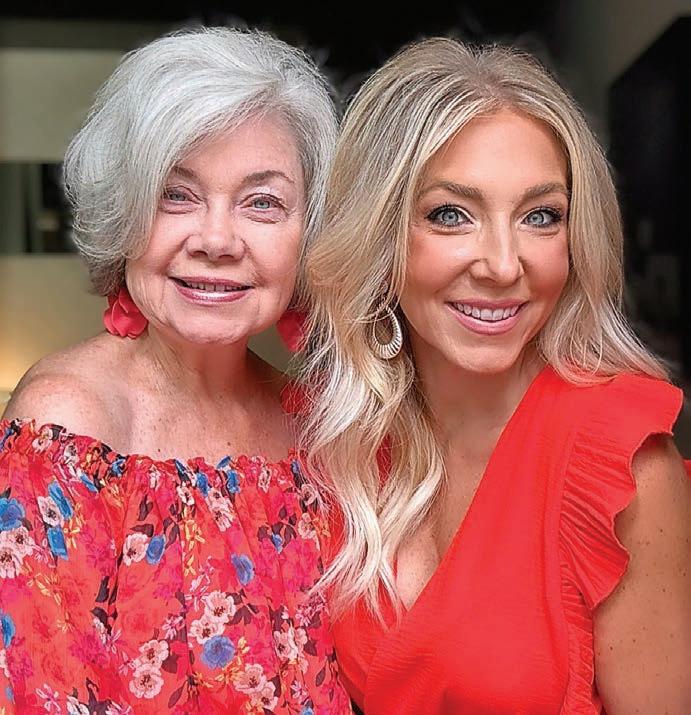
Erin McFarland, right, and mom Kathi Frankowski
PHOTO COURTESY ERIN MCFARLAND
AMERICAN HEART ASSOCIATION
PRIORITIZE YOURSELF
After surviving a heart health scare, Marian
Dancy used her newfound resources to recognize stroke symptoms in her mother.
By Lucy Clark
Mother of four and recruiter for the Franklin County Sherrif’s Office Marian Dancy was recovering from the birth of her fourth child in 2019 when she started experiencing a handful of concerning symptoms, including fatigue and swelling. “I chalked it up to being a tired, busy, postpartum career woman,” Dancy says. When she had a moment of vision loss at work one day, though, she sought medical attention.
Dancy’s physician didn’t see anything wrong—she was only 35 and healthy with no history of heart disease. Still, when her symptoms got worse, she consulted another doctor who thought it was due to a virus. When the issues continued to escalate, Dancy went to the emergency room and was misdiagnosed with pneumonia, at which point her health took a turn for the worse.
The week of Thanksgiving that year, Dancy found a last-minute opening with another physician. “My symptoms got so bad, I could barely walk in,” she says. Thankfully, her new doctor “immediately recognized something was going on” and realized she was experiencing heart failure—peripartum cardiomyopathy, to be exact.
Peripartum cardiomyopathy (also referred to as postpartum cardiomyopathy) is a condition that develops during the end of, or in the months after, pregnancy, and causes the heart muscles to weaken while its chambers enlarge. “The pumping capacity had gone down to 15 per -
cent, which is way low into the heart failure range,” Dancy explains.
She took her cardiologist’s recovery advice and started prioritizing her health and managing her stress levels, eventually volunteering with the American Heart Association. She was a member of the 2024 Go Red for Women class of survivors, too, where she learned crucial information about women’s heart health. “I learned that heart disease is the No. 1 killer of women, and that it shows up in any stage of life. It doesn’t discriminate,” Dancy says.
Dancy also learned about the presentation of stroke symptoms through a fellow survivor in her class. That
knowledge became vital when her mother suffered a stroke that year.
“She called me one day, and the way she was speaking was odd and out of order,” says Dancy, who prompted her mom to repeat sentences back to her. When she couldn’t, she called an ambulance to get her medical help. “She’s still on her recovery journey, but she’s here with us.”
The most important thing for women’s heart health, according to Dancy, is to advocate for yourself. “It’s really important to make sure that you’re making yourself a priority. Be willing to put the work in for yourself, because we want you to be able to share your story with the world.”
Marian Dancy
Some
heart conditions are more common in women than in men
When people think of heart attacks, they most often think of plaque or cholesterol blocking arteries to the heart. However, heart attacks can occur without plaque clogging those passageways, and those types of heart attacks are more likely to occur in women than in men.
Sometimes the wall of an artery can tear, a condition called spontaneous coronary artery dissection (SCAD). The tear can block blood flow to the heart and can happen to people even as young as in their 30s, says Laxmi Mehta, MD, a cardiologist at The Ohio State University Heart and Vascular Center.
“Treating a heart attack from SCAD is very different than treating a heart attack from plaque-clogged arteries. So, you’ve got to recognize that it’s happening,” Dr. Mehta says.
Doctors typically put in a stent to open blocked arteries, but people with SCAD often need to be treated just with medications. If they receive a stent, the tear in the wall of their artery can worsen.
Another heart condition more likely to happen to women is broken heart syndrome. That’s when the heart muscle temporarily becomes weak, unable to deliver enough blood throughout the body. Intense physical or emotional stress can cause broken heart syndrome.
It’s important for people with broken heart syndrome to be treated specifically for a weakened heart muscle.
Though broken heart syndrome can be fatal, most people fully recover after a few months on medications as their weakened heart muscle grows stronger.
Learn more about advances in care and treatment at The Ohio State University Heart and Vascular Center.
A special quarterly section of Columbus Monthly
EDITED BY JULANNE HOHBACH
PAGE 36
Summer Camp Guide
Check out our curated directory of traditional programs and specialized offerings in art, STEM, nature and more.
PAGE 42
The Go-To Guide: Family-Favorite Local Attractions
Find out what’s happening at 10 hot spots, including museums, science centers and the zoo.
Tennis at Columbus Academy’s Summer Experience
2026 Summer Camp Guide
From traditional day camps to specialized offerings for art, STEM, drama, special needs and more, here are 25 programs to keep kids busy when school ends.
The snow may still be flying, but it’s a great time to start thinking about summer. If you’re wondering how your children and grandchildren will spend their time after the last school bell rings, the Columbus region offers a wide variety of summer programs catering to all ages and interests.
To help guide your research, we’re pleased to bring back a smaller, curated version of our signature Columbus Parent Summer Camp Guide. The 2026 guide features 25 listings from a variety of arts organizations, parks and recreation departments, nonprofits, private schools and more. This special relaunch features an assortment of popular and notable camps—many of which are favorites of local families. Programs cater to a wide range of topics and budgets and run the gamut from partial-week enrichment offerings to summerlong experiences.
Listings include day camps and overnight programs and are organized into five categories: Arts, Educational Enrich-
ment and STEM, Multiple Category, Nature/Outdoors and Special Needs.
Information in the guide was submitted by camp organizers. Several local organizations opted not to participate because members fill most or all of their camp spots. If you don’t see your favorite program listed, try the organization’s website. Happy hunting!
ARTS
Columbus Children’s Theatre: Summer Theatre360
Ages: 5-15
Dates/times: 6/1-8/7; full day (6+ hours)
Description: Dive into a weeklong theater adventure. Our one-week, full-day camps are bursting with hands-on opportunities to perform, create and explore every corner of the stage. Students won’t just shine in the spotlight. They’ll roll up their sleeves behind the scenes, discovering scenic design, costuming and all the magic that brings a story to life.
Cost: $415
Camp location: CCT Studios, 177 E. Naghten St., Columbus
For more information: David Glover, david@columbuschildrenstheatre.org, 614-224-6673; columbuschildrens theatre.org
Columbus College of Art & Design: Creative Summer Workshops
Ages: 6-18
Dates/times: 6/1-7/18; full day (6+ hours) and half day (2-5 hours)
Description: Creative Summer Workshops allow kids in grades 1-12 to be creative, develop new techniques, and explore art and design. Led by skilled artists and educators, classes are held in weeklong increments Monday through Friday. With multiple sessions available, including morning (9 a.m. to noon), afternoon (1:30-4:30 p.m.) and all-day options, you can customize your experience by signing up for one or more weeks of creativity.
Cost: $225
A Columbus Children’s Theatre summer camp PHOTO COURTESY KYLE LONG PHOTOGRAPHY
Camp location: Columbus College of Art & Design campus, 60 Cleveland Ave., Columbus
For more information: Ellen Ellis, takeaclass@ccad.edu, 614-222-3242; ccad.edu/take-class/creative-summerworkshops
Columbus Museum of Art: Summer Art Workshops 2026
Ages: Grades 1-5
Dates/times: 6/8-6/12, 6/22-6/26, 7/67/10, 7/20-7/24, 8/3-8/7; full day (6+ hours)
Description: Students entering grades 1-5 can participate in five days of in-person instruction at the Columbus Museum of Art. Summer Art Workshop educators and teaching artists will lead children through lesson plans using a variety of materials to explore themes and engage their creativity. Students also will tour the CMA galleries and have downtime for lunch and fun in the sculpture gardens. Snacks are provided. Classes are limited to 20 students.
Cost: $350 member, $375 nonmember Camp location: Columbus Museum of Art, 480 E. Broad St., Columbus
For more information: Lydia Simon, lydia.simon@cmaohio.org, 614-629-0328; columbusmuseum.org
The Contemporary Theatre of Ohio: Summer Theatre Camp at the Riffe Center Ages: 8-14
Dates/times: 6/1-6/26, 7/6-7/31; full day (6+ hours)
Description: Take a thrilling, creative journey from imagination to applause with the Contemporary this summer. Students will work as a team to learn the full range of theatrical skills—from creating characters and scripts, to crafting costumes, to taking their final bow. They’ll have the opportunity to learn from experienced theater artists.
Cost: $545 to $585
Camp location: Riffe Center Theatres, 77 S. High St., Columbus
For more information: education@the contemporaryohio.org, 614-453-4602; thecontemporaryohio.org/education/ camps-and-classes
Lincoln Theatre: Patternz Summer Camp
Ages: 6-13
Dates/times: 6/15-8/7; full day (6+ hours)
Description: Facilitated by graduates of the Lincoln Theatre’s “Expand Your
Horizon” Artist Incubation Program, campers will begin each day with affirmations of excellence, then they will rotate through workshops in dance, theater, music and visual arts. At the end of each week, campers will put on a program for their families to show what they’ve learned.
Cost: $150 per week
Camp location: Lincoln Theatre, 769 E. Long St., Columbus
For more information: Quianna Simpson, ltsummerartscamp@gmail.com, 614500-3252; lincolntheatrecolumbus.com/ programs/patternz
New Albany Ballet Company: Summer Dance Camps
Ages: 2-9
Dates/times: 6/1-8/6; half day (2-5 hours)
Description: We offer fun summer, themed dance camps for ages 2-9.
Cost: $130 to $255
Camp location: New Albany Ballet Company, 5161 Forest Drive, New Albany
For more information: Ellen Selegue, ellen@newalbanyballet.com, 614-9399058; newalbanyballet.com
Ohio Craft Museum: Young Masters and Teen Camp
Ages: 5-17
Dates/times: 6/8-7/31; full day (6+ hours) and half day (2-5 hours)
Description: We offer five weeks of arts, crafts and camaraderie for children entering grades 1-6 and an additional two weeks of Teen Camp for 13- to 17-year-
olds that feature more detailed workshops. All supplies and light snacks are included in cost.
Cost: Starts at $135 per week for half days Camp location: Ohio Craft Museum, 1665 W. Fifth Ave., Columbus
For more information: Judi Young, jyoung@ohiocraft.org, 614-486-4402; ohiocraft.org
The Ohio State University School of Music: Ohio State Youth Summer Music Programs
Ages: Students entering grade 4 to 2026 high school graduates
Dates/times: 6/7-7/10; full day (6+ hours), half day (2-5 hours) and residential
Description: Each summer, the Ohio State School of Music welcomes student musicians to campus, where they participate in programs specifically designed to further their skills and their understanding of and love for music. Our dedicated faculty craft diverse and rich activities that provide meaningful musical experience. Select from one of 10 residential programs (with a commuter option) or day programs based on age, experience and interest.
Cost: $425 day camps and commuter option, $525 residential
Camp location: The Timashev Family Music Building, 1900 College Road, Columbus, and Ohio Stadium, 411 Woody Hayes Drive, Columbus
For more information: youthsummer music@osu.edu, 614-292-5272; go.osu. edu/ysmp2026
EDUCATIONAL ENRICHMENT AND STEM
PAST Foundation: Summer Experiences Ages: 5-16
Dates/times: 6/1-7/31; full day (6+ hours) and half day (2-5 hours)
Description: At PAST, summer isn’t a break from learning, it’s a chance to make learning come alive. Our STEM-focused summer programs give students the opportunity to explore real-world challenges through immersive, hands-on experiences. Whether indoors at our Innovation Lab or outdoors in the community, every program is designed to spark curiosity, build confidence and develop future-ready skills.
Cost: Starts at $150 per week
Camp location: PAST Innovation Lab, 1003 Kinnear Road, Columbus, and the Lawn at CAS, 2540 Olentangy River
An Arduino robotics camp at the PAST Foundation
Road, Columbus
For more information: Ashley Price, programs@pastfoundation.org, 614-3401208, ext. 1208; pastfoundation.org
The Sewing Hive: Teach Me To Sew Camp Ages: 9-17
Dates/times: 6/1-6/5; half day (2-5 hours)
Description: In Teach Me To Sew Camp, children learn to sew on a machine as they create three fun projects. They also learn about mending and making fashion that lasts. Several other youth camps also will be offered.
Cost: $250
Camp location: The Sewing Hive, 3455 Indianola Ave., Columbus
For more information: Jamie Hevener, studio@sewinghive.com, 614-549-6693; sewinghive.com
Dates/times: 6/1-7/31; full day (6+ hours) and half day (2-5 hours)
Description: Join our creative writing camp. Participants will write, draw and sometimes even act out their own stories and poems. Learn from real guest authors, artists and teachers who bring their passion to life with fun, wacky activities. Ignite your imagination and stretch your creativity with us. A twoweek Teen Summer Writing Intensive also is offered.
Cost: Starts at $200 for creative writing, $895 for writing intensive; scholarships are available
Camp location: Thurber Center, 91 Jefferson Ave., and the Carriage House, 65 Jefferson Ave., Columbus
For more information: Meg Brown, megbrown@thurberhouse.org, 614-4128840; thurberhouse.org
MULTIPLE CATEGORY
Boys & Girls Clubs of Central Ohio: Central Ohio Summer of Success Ages: 6-18
Dates/times: 6/8-8/7; full day (6+ hours)
Description: This full-day summer camp offers kids a safe, engaging place to learn, grow and have fun. Daily activities support academic success, healthy habits and leadership development through hands-on enrichment and group experiences. Campers build confidence, friendships and life skills. Breakfast, lunch and snacks are provided each day.
Cost: $125
Camp location: J. Ashburn Jr. Clubhouse, 85 Clarendon Ave., Columbus; Louella Hodges Reese Clubhouse, 96 Maholm St., Newark; Champion Companies Milo-Grogan Clubhouse, 1012 Cleveland Ave., Columbus; Oak Street Clubhouse, 565 Oak St., Marion; South Side Clubhouse, 280 Reeb Ave., Columbus; River Valley Clubhouse, 720 Columbus–Sandusky Road S., Marion
For more information: Kedada Bethel-Thompkins, kbethelthompkins @bgccentralohio.org, 614-221-8830, ext. 228; bgccentralohio.org/member ship-enrollment
City of Dublin Recreation Services Division: Summer Camps
Ages served: 4-14
Dates/times: 6/1-8/14; full day (6+ hours) and half day (2-5 hours)
Description: The City of Dublin Rec-
reation Services Division offers a variety of summer camps for preschoolers through teens that promote fun, learning and personal growth. Activities include sports, arts, swimming, nature exploration, field trips and team building, with specialty options in areas like STEAM, dance and athletics. Options include introductory camps for young children, multiweek camps, teen adventures and leadership-focused Counselor-in-Training opportunities. Accommodation support is available. Select programs are American Camp Association accredited.
Cost: Starts at $120
Camp location: Dublin Community Recreation Center and other local sites
For more information: Euan Baker, ebaker@dublin.oh.us, 614-410-4557, dublinohiousa.gov/dcrc/camps
Columbus Academy: Summer Experience Ages: 3-18
Dates/times: 6/2-8/7; full day (6+ hours) and half day (2-5 hours)
Description: Summer Experience 2026 is designed to meet the diverse interests of families and students from prekindergarten through 12th grade. Campers can explore a wide range of options including academics, arts and sciences, athletics and more, creating a customizable summer. Register for a single week, multiple weeks or all summer long. A new Adventure Day Camp allows students to explore trails, craft in the woods and play games across Columbus Academy’s 231 acres.
For more information: Alyssa King, summer_experience@columbusacademy. org, 614-509-2267; columbusacademy. org/summer
Columbus Recreation and Parks: Summer Camps Ages: 6-17
Dates/times: 6/8-8/14; full day (6+ hours)
Description: A variety of weeklong day camps are offered to pique the interest of any camper, including community center camps, therapeutic recreation, outdoor recreation, sports, drama, arts and ceramics.
Cost: $60 to $250
Camp location: Various sites throughout Columbus
For more information: Sheri-Lyn Wynn crpd_camps@columbus.gov, 614-6457000; columbusrecparks.com
Students at Columbus Academy’s Summer Experience
Girl Scouts of Ohio’s Heartland: Day Camp, STEM Camp and Resident Camp Ages: 5-18
Dates/times: 6/1-7/31; full day (6+ hours), half day (2-5 hours) and residential
Description: Girl Scouts of Ohio’s Heartland offers day camps, STEM camps and resident camps where girls across Central Ohio can get unforgettable outdoor adventures, hands-on STEM exploration and confidence-building experiences that last a lifetime. GSOH camps are open to all girls in grades K-12, whether they are in a Girl Scout troop or not.
Cost: Starts at $75 per week for day camp, $250 per week for STEM camp and $295 for resident camp
Camp location: Day camps, multiple area locations; STEM camps, Battelle STEM Leadership Campus at Camp Ken-Jockety, 1309 Hubbard Road, Galloway; resident camps, Camp Molly Lauman, 9130 Big Bear Creek Road, Lucasville
For more information: Patsy Sullivan, camp@gsoh.org, 614-878-3422; gsoh.org/ en/members/for-girl-scouts/camp-andoutdoors.html
JCC of Greater Columbus: JCAMPS
Ages: 6-13
Dates/times: 6/1-8/7; full day (6+ hours) and half day (2-5 hours)
Description: For 75 years, JCamps has been a summer home for the Jewish community and families across Central Ohio, welcoming campers from all backgrounds to learn, play and grow together. What began as a place to connect has become a beloved tradition filled with joyful Jewish moments, lifelong friendships and unforgettable summers that offer an exceptional camp experience. Bus transportation is included.
Cost: Starts at $385 per week
Camp location: JCC of Greater Columbus, 1125 College Ave., Columbus
For more information: Raeann Cronebach, rcronebach@columbusjcc.org, 614559-6253; columbusjcc.org/jcamps
The Wellington School: Wellington Summer Program
Ages: 4-18
Dates/times: 6/8-7/31; full day (6+ hours) and half day (2-5 hours)
Description: The Wellington Summer Program provides children entering prekindergarten through grade 12 the opportunity to discover new talents, learn essential skills and build lasting friendships through a wide array of half- and
Retirees have long faced an either-or choice in long-term care planning: stay at home without any provisions for care or move to a senior living community before you’re ready. But all-or-nothing thinking didn’t lead you to your cherished lifestyle. And it’s not what will help protect it.
ENTER A NEW MODEL that preserves your ability to age in place with asset protection, health navigators and a path to a senior living community only if — and when — you ever need it.
full-day camps including STEM, literacy, art, sports, yoga, nature, music, theater, chess, robotics, cooking and more.
Cost: Starts at $160 per week
Camp location: The Wellington School, 3650 Reed Road, Upper Arlington
For more information: Gina Spicer, summer@wellington.org, 614-324-1646; wellington.org/summer
Westerville Parks and Recreation: Westerville Parks and Recreation Camps Ages: 3-15
Dates/times: 5/26-8/14; full day (6+ hours) and half day (2-5 hours)
Description: Westerville Parks and Recreation camps provide a fun, safe and engaging environment where children can learn, play and grow. A variety of structured activities encourage creativity, teamwork and physical activity. Daily activities may include outdoor games, sports, arts and crafts, and group activities. Camps emphasize positive social interaction, active play and age-appropriate learning experiences. Whether your child is discovering new interests or strengthening familiar skills, camps offer a welcoming space to create new memories.
Cost: $120 to $290
Camp location: Various sites in the city of Westerville
For more information: Chelsea VanAssche, camp@westerville.org, 614-9016566; westerville.org/camps
Worthington Parks & Recreation: Community Center Summer Camps Ages: 4-15
Dates/times: 6/1-8/9; full day (6+ hours) and half day (2-5 hours)
Description: Worthington Parks & Recreation offers a wide variety of engaging summer camps designed to keep kids active, curious and connected all summer long. Programs include recreation-based day camps, sports and swim camps, creative arts, specialty camps and off-site adventures, all led by trained staff in a fun, supportive environment.
Cost: $65 to $400
Camp location: Worthington Community Center, 345 E. Wilson Bridge Road, Worthington
For more information: camps@ worthington.org, 614-436-2743; worth ington.org/summercamp
YWCA Columbus: YWCA Kids Place Summer Day Camp
Ages: 6-13
Dates/times: 6/1-7/31; full day (6+ hours)
Description: YWCA Columbus Kids Place—an all-inclusive, eight-week program packed full of enriching experiences, field trips and more—offers day camps in Columbus, Westerville and Gahanna. Campers will have fun and learn something new each day. With over 30 years of experience offering high-quality summer programs, YWCA Kids Place is licensed by the Ohio Department of Job and Family Services and offers expert staff and flexible scheduling.
For more information: Kristy Hylton and Mandi Buchwald, khylton@ywca columbus.org and mbuchwald@ywca columbus.org, 614-224-9121; ywca columbus.org/summercamp
NATURE/OUTDOORS
Camp Kesem: Camp Kesem at Ohio State University Ages: 6-18
Dates/times: 5/31-6/5, 6/7-6/12; residential camp
Description: Camp Kesem is a weeklong sleepaway summer camp that supports children through and beyond their parent’s cancer diagnosis. By offering free, creative, fun-filled programs that foster a lasting community, Kesem aims to ensure that every child impacted by a parent’s cancer is never alone.
Cost: Free
Camp location: YMCA Camp Tippecanoe, 81300 Stewart Road, Tippecanoe For more information: Emily Pfarrer and Anna Couch, osu@kesem.org, 614300-0241; kesem.org
Columbus and Franklin County Metro Parks: Metro Parks Nature Camps Ages: 3-16
Dates/times: 6/8-7/31; full day (6+ hours) and half day (2-5 hours)
Description: Nature camps aim to provide children with the opportunity and encouragement to foster a deeper connection with nature through the following principles: exploration, education, community building and steward-
PHOTO
Campers at Blendon Woods Metro Park learn archery skills from counselors.
ship. Campers will participate in outdoor recreation and education programs daily.
Cost: $85 to $220 per week; scholarships are available
Camp location: Various Metro Parks
For more information: Macy Tallarico, naturecamps@metroparks.net, 614-8956213; metroparks.net
SPECIAL NEEDS
Easterseals Central and Southeast Ohio: Hilliard Summer Day Camp
Ages: 3-17
Dates/times: 6/15-7/24; full day (6+ hours)
Description: A camp for children of all abilities. Our camp days are filled with fun activities like arts and crafts, handson learning, group games, outdoor play and self-directed playtime. This structured setting is designed to make sure that campers don’t lose the progress they’ve made in school the previous year.
For more information: Kathy Cordova, kcordova@easterseals-cseohio.org, 614-228-5523, ext. 1107; cseohio.easter seals.com/get-support/areas-of-support/ youth-programs/summer-day-camphilliard
Recreation Unlimited Farm and Fun Inc.: Recreation Unlimited
Ages: 8 and older
Dates/times: June 15 to July 31; residential camp
Description: Founded in 1958, Recreation Unlimited Farm and Fun Inc. is a 501(c)(3) not-for-profit organization serving individuals with disabilities and health concerns and is supported through the Recreation Unlimited Foundation. Recreation Unlimited provides year-round programs in sports, recreation and education, while building self-confidence, self-esteem and promoting positive human relations, attitudes and behaviors for individuals with disabilities and health concerns. Recreation Unlimited offers weekend camps, summer day and residential camps and a winter residential camp.
For more information: Natalie Hutton, camps director, nhutton@recreation unlimited.org, 740-548-7006, ext. 103; recreationunlimited.org
We offer camps & classes for children ages 2-18 in ballet, tap, jazz, modern, and hip hop. New camps include Toy Story, Ballerina Barbie, and K-Pop Demon Hunters, along with returning favorites Frozen, Tangled and many, many more!
Find out when you become a Columbus CEO Insider
Stay up-to-date with Columbus CEO’s mobile-friendly newsletter. Delivered straight to your inbox every other week, Columbus CEO Insider has the latest Central Ohio business news, executive profiles and happenings.
Sign up today at ColumbusCEO.com
Family-Friendly Local Attractions
Explore what’s new at 10 Columbus-area hot spots, including museums, science centers and the zoo.
By Heather Lofy
As you plan family outings for spring and beyond, there are plenty of exciting things to do at Columbus-area attractions.
Between hands-on museums, outdoor spaces and interactive exhibitions, these destinations offer year-round educational experiences and entertainment for all ages. Several also offer robust seasonal programming.
Looking for an excursion that’s farther afield? Check out our list of top day-trip destinations at columbusmonthly.com/ columbus-parent.
AHA! A HANDS-ON ADVENTURE
1708 River Valley Circle S., Lancaster aha4kids.org
Celebrating 18 years in 2026, AHA! children’s museum has more than 60 interac-
tive exhibits in its indoor space. Designed for kids 6 months to 8 years, activities include a creative STEAM zone, areas for block building and a train table. An outdoor nature playscape allows families to explore wooden structures, gardens, a trike track and more.
New and notable: Check out this year’s dinosaur-themed Sticker Club, part of the nature playscape. Each month features a new story and sticker to collect at the end of your visit.
Admission: $8 per person, free for children 12 months and younger
COLUMBUS MUSEUM OF ART
480 E. Broad St., Columbus columbusmuseum.org
There’s plenty for families to see beyond the world-class galleries. Explore
hands-on areas in the JPMorgan Chase Center for Creativity, join Open Studio Saturdays or take part in early learning tours. With interactive guides, art-making activities and special programs, the Columbus Museum of Art makes art accessible and fun for all ages.
New and notable: New this year is CMA Fun Fest, which will take place from 3 to 6 p.m. April 11. Families can enjoy special activities, art making, gallery exploration and more. Don’t miss the quarterly CMA Community Days, special Sunday events with free performances, tours and children’s activities.
Admission: $22 adults, $18 seniors, $16 students ages 18 and older, $16 children ages 4-17 and free for ages 3 and younger. Free admission on Sundays and from 5 to 9 p.m. Thursdays.
PHOTO COURTESY GRAHM S. JONES, COLUMBUS ZOO AND AQUARIUM
THE GO-TO GUIDE
The Mexican wolf habitat in the new North America Trek region at the Columbus Zoo and Aquarium
COLUMBUS ZOO AND AQUARIUM
4850 W. Powell Road, Powell columbuszoo.org
Known for its engaging exhibits and dedication to wildlife conservation, the Columbus Zoo and Aquarium lets visitors see animals from all over the world. Habitats include Asia Quest, Congo Expedition, North America Trek and the Polar Frontier. Adventure Cove offers seasonal amusement rides, and a robust lineup of special programs and holiday events is offered year-round.
New and notable: Still relatively new is the expanded North America Trek region, which opened in June. Another must-see: the zoo’s newest animal babies, elephant calves Rita Jean and Ollie and black bear cubs Ursula and Yzma.
Admission: $25.99 ages 10-59, $24.99 seniors, $19.99 children ages 3-9 and free for ages 2 and younger for residents of Franklin County. Rates for residents of other counties are higher. Winter tickets are discounted.
COSI
333 W. Broad St., Columbus cosi.org
COSI, the Center of Science and Industry, features over 300 interactive exhibits across themed areas including Ocean, Space, Gadgets and Life, plus Ohio’s largest planetarium and live shows. The American Museum of Natural History Dinosaur Gallery is a must-see. COSI also hosts special exhibitions throughout the year, as well as the communitywide COSI Science Festival.
New and notable: The Science Behind Pixar special exhibit continues through May 25. Learn about the filmmaking process and how animators bring characters to life using science and technology. New this year is the Verse holographic theater, where augmented reality glasses bring stories to life. Also, learn about prehistoric animals and the legends of dragons, unicorns and mermaids in the return of AMNH’s Mythic Creatures exhibition, running through Sept. 7.
Admission: Advance prices are $30 ages 13 and older, $28 seniors, $25 children ages 2-12 and free for children under 2; in-person tickets are $5 more. Special exhibits have an additional charge.
FRANKLIN PARK CONSERVATORY AND BOTANICAL GARDENS
1777 E. Broad St., Columbus fpconservatory.org
Franklin Park Conservatory and Botanical Gardens offers beautiful flowers, seasonal exhibits and an interactive children’s garden with play areas and water features. Families also can enjoy fun programs and special events throughout the year, including the beloved Blooms & Butterflies exhibition.
New and notable: Math in Bloom, a three-part series, allows visitors to connect mathematics to nature. Mark your calendars for March 14 (Pi Day), Aug. 8 (Infinity Day) and Nov. 23 (Fibonacci Sequence Day). The Color, Fly, Butterfly exhibition returns from April 25 to Aug. 23. Color your own butterfly and watch it play in a digital garden.
Admission: $25.20 ages 13 and older, $21 seniors, $17.33 children ages 3-12 and free for ages 2 and younger
THE KING ARTS COMPLEX
835 Mount Vernon Ave., Columbus kingartscomplex.com
The King Arts Complex offers cultural and educational programs that celebrate African American heritage, including art exhibits, performances, music festivals and community events. It also provides youth arts programs.
New and notable: Celebrate Earth Day at the King Arts Complex on April 18 with activities including line dancing, a food demonstration, recycling information and candle making. Additionally, mark your calendar for the Juneteenth celebration on June 19, featuring speakers
and performers. Both programs will take place from 9 a.m. to 4:30 p.m.
Admission: Varies by event. A family membership, $60, includes free gallery admission, complimentary ticket vouchers and event discounts.
NATIONAL VETERANS MEMORIAL AND MUSEUM
300 W. Broad St., Columbus nationalvmm.org
The National Veterans Memorial and Museum takes visitors on a journey throughout history to learn about veterans from all branches of military service. Families can explore interactive exhibits, rotating galleries and reflective spaces, such as the Remembrance Gallery and outdoor memorial grove.
New and notable: The annual Vietnam War Veterans Day “Welcome Home” Ceremony takes place March 28, with bestselling author Wil Haygood as the keynote speaker. Admission is free, but tickets must be reserved in advance. Also notable is a new partnership between the National Veterans Memorial and Museum and the Columbus Metropolitan Library. Various library branches will have an interactive Service-in-Action Nook, where visitors can celebrate service and community.
Admission: $18 adults, $16 seniors, $11 children ages 5-17 and free for ages 4 and younger, U.S. military veterans, active-duty military members and Gold Star families.
The Paul Busse Garden Railway exhibit returns in May to Franklin Park Conservatory and Botanical Gardens.
OHIO HISTORY CONNECTION
Ohio History Center, 800 E. 17th Ave., Columbus ohiohistory.org
The Ohio History Connection offers a wide range of events and exhibits at the Ohio History Center, from hands‑on activities and cultural celebrations to workshops, experiential tours and rotat ing museum exhibitions that explore the Buckeye State’s past. The center notably houses the Conway mastodon skeleton, named for Newton Conway, who discov ered it between Champaign and Clark counties in 1887.
New and notable: During the 2026 Ohio State Fair, the newly reconstructed Ohio Village will be open for a first look, and it’s included in fair admission. Ohio Vil lage will reopen in full for the 2027 sea son. Another draw is the Ohio History Connection’s exhibit, Ohio’s Story, in the fair’s new Ohio Showcase building. Pro tip: If you’re visiting the fair, park at the Ohio History Center, explore the build ing and use that entrance point to experi ence everything else the fair has to offer.
Admission: $16 adults, $14 seniors and college students, $10 children ages 4 12 and free for ages 3 and younger
WEXNER CENTER FOR THE ARTS
1871 N. High St., Columbus wexarts.org
Located on the Ohio State University campus, the Wexner Center for the Arts has art galleries, film screenings, talks
and more programs that invite visitors to create, watch, discuss and explore con temporary art.
New and notable: Musician and educa tor Claire Chase leads the Day of Listen ing on April 12, when guests will learn about composer and performer Pauline Oliveros. Admission is free, but a ticket is required. On the first Thursday of each month, the First Thursdays series allows guests of all ages to participate in free art making and activities.
Admission: Gallery admission is free, but there is a charge for some special events.
THE WORKS: OHIO CENTER FOR HISTORY, ART & TECHNOLOGY
55 S. First St., Newark attheworks.org
The Works interactive museum offers a blend of science, art and local history under one roof. Visitors can experiment in science labs, watch live glassblowing demonstrations, explore rotating art ex hibits and experience space shows in the SciDome planetarium.
New and notable: Tuesdays and Fridays are great days to visit because they boast additional programming. Creative Cor ner on Tuesday mornings allows chil dren ages 3 10 to make an arts and crafts masterpiece, while the Curious Kids pro gram on Fridays caters to ages 3 6.
Admission: $14 adults, $12 seniors, $10 for children ages 2 17 and free for ages 2 and younger
A worker dusts the Conway mastodon at the Ohio History Center.
The Poseidon water feature in COSI’s Oceans exhibit
home & style
BY TIM JOHNSON
PHOTO
Showstopping Features
Artwork by Powell-based Brian Riegel is displayed at a custom-built Upper Arlington home, Page 46.
Ravine Retreat
A custom Upper Arlington home boasts stunning views and hidden surprises.
Story by Lucy Clark | Photos by Tim Johnson
Few people get the chance to build a home tailored to their exact wants, needs and comforts. Yet when a couple purchased the lot for their Upper Arlington home on Slate Run Road for the gorgeous ravine views, their homebuilder Kevin Knight of Kevin Knight and Co. presented them with two options: renovate, which would be easier but wouldn’t tick the boxes of their entire wish list, or do a complete tear down. They opted for a tear down.
The 5,600-square-foot home honors the ravine that caught the homeowners’
attention in the first place. The foyer greets you when you step inside, sporting light oak floors, white walls and tall ceilings, which can be found throughout the home. Step further into the open living room-dining room-kitchen to see a large window framing the view of the flora below, where Slate Run, a tributary of the Scioto River, flows. On a frigid winter morning, you can see straight through the trees to the creek (plus the host of deer, foxes, turkeys and other wildlife that roam the property), as well as the custom-built playhouse for the
homeowners’ grandchild. In the warmer months, the homeowners and contractors alike boast about the lush and vibrant landscape.
The living room is centered around a sandstone fireplace made from Old Carolina Brick Co. bricks, which is one of the only remaining handmade brick factories in the country, located in Salisbury, North Carolina.
Knight and interior designer Nick Magoto of Eclectic Concepts opted for handmade brick and other natural, “flawed” materials to ensure the three-bedroom,
Kitchen featuring Danby marble countertops
six-bathroom home didn’t feel like a new build. The oak floors, for example, were intentionally selected with knots so they had a more lived-in feel. “[The homeowners] didn’t want to be the brand-new house on the street,” says Knight.
Warm hues from the burnt orange couch and handwoven Tibetan area rug help keep the room cozy, and they also help mirror the natural hues found outside, says Magoto. Black accents—the window grids, grand piano and beams on the vaulted ceiling—help bring a modern element, resulting in a room equal parts luxurious and inviting. “It’s sophisticated, yet casual,” Magoto says.
The kitchen features a large island with Danby marble countertops from Vermont, which is mirrored on the back-
splash. They’re textured to yet again create a sense of wear and life.
The kitchen, while frequently used, keeps a tidy look with a unique trick— the leftmost panel of the backsplash lifts from the bottom to reveal a recessed caddy, where the homeowners store their coffee pot, toaster and other frequently used appliances. The dining room sits in a round alcove, divided from the kitchen by a pizza oven with a sandstone facade to tie in with the fireplace.
At the end of a long hallway off the foyer is a round cut of wood—go left, and you’re in the primary bedroom, where heavy curtains and deep wood furniture pair with shades of cream and white for a high-end hotel feel. Go right for the bathroom, with reflective, warm brown
Photos clockwise from top left: Music rehearsal room; speakeasy sitting area; primary bathroom; home theater; comic books lining the hidden door to speakeasy
marble floors, a bright chandelier and a deep tub sitting beneath a window that opens onto the same natural landscape featured in the living room.
There are also two walk-in closets for each homeowner, one of which has a washer and dryer for quick loads of laundry, and a spiral staircase leading directly into the basement-level gym.
Another spiral staircase can be found next to the kitchen, which goes up to the second floor—containing two bedrooms, an ensuite half bathroom and an office/ drum room—and down to the basement level. Magoto’s intention with the design was to create a sculptural effect from any angle, making it equal parts functional and artistic.
The home’s basement is a world unto itself—there’s a theater sporting several large movie posters, comfortable seating in trademark scarlet-and-gray colors, a fold-up pool table, a gym and sauna, another guest bedroom, ensuite bathroom and a Zen room.
The Zen room’s windows offer a closer look at the landscape, but its most innocuous feature—a bookshelf lined with vintage comic books and boardgames—is where the real magic is hidden. Give it a push, and it’s like stepping into a movie— literally. Two movies have been filmed in the Upper Arlington home; Down to the Felt and My Mother the Madam.
A hidden speakeasy is the unexpected surprise behind the bookcase. The top half of the walls are a textured, velvety crimson, and the bottom half is mahogany wainscotting. The plaid carpeting and ceiling lined with the same sandstone brick as the living room and pizza oven make it feel like a true English tavern, which was Magoto’s vision.
If the immersive, vintage design whets your thirst, don’t worry: The bar is fully stocked with all you could need. If you can’t find the liquor to suit your taste, there’s a climate-controlled wine cellar in the room as well. Have a seat at a table or in the recessed, velvet-lined booth and get comfortable; you won’t want to leave for some time.
Magoto describes the home as “an entertainer’s dream,” and the homeowners agree. They proudly use every space of the tailor-made house, including hosting their friends, family and neighbors. ◆
Photos clockwise from top left: Spiral staircase; hidden door leads to the lower level speakeasy; beer can collection on display in the speakeasy; jungle-themed bathroom; primary bedroom
Top 25 Home Sales
Jan. 1-31, 2026
PRICE ADDRESS
$1.95M 7697 Somerly Ct., New Albany
$1.9M 2041 W. 3rd Ave., Marble Cliff
$1.85M 660 Woods Hollow Ln., Powell
$1.8M 3904 Farber Ct., New Albany
$1.8M 8159 Riverside Dr., Powell
$1.6M 5633 Travis Pointe Ct., Westerville
$1.5M 180 Lansing St., Columbus
$1.5M 3097 Sophie Ct., Galena
$1.47M 5390 Maple Dr., Lewis Center
$1.45M 1017 Riverpoint Ct., Powell
$1.44M 4340 E. Manor Ct., Dublin
$1.38M 8174 Windy Hollow Rd., Johnstown
$1.35M 415 E. South St., Worthington
$1.35M 1200 Wyandotte Rd., Grandview Heights
$1.33M 2063 Westover Rd., Upper Arlington
$1.33M 8500 Stonechat Loop, Dublin
$1.26M 9533 Tartan Ridge Ct., Dublin
$1.23M 4497 Corner Rd., Alexandria
$1.2M 10805 Arrowwood Dr., Plain City
$1.2M 7930 Thornbush Dr., Westerville
$1.2M 2000 Forestview Ln., Delaware
$1.18M 7833 Calverton Sq., New Albany
$1.13M 4470 Ackerly Farm Rd., New Albany
$1.05M 209 Springbrook Pl., Gahanna
$1.02M 6422 Albanese Circle, Dublin
queenbeejackie.com
food & drink
PHOTO BY TIM JOHNSON
A Murky Moment Intoxicating hemp beverages, like THC drinks from Rambling House, Athens Beverage and Seventh Son, are facing a ban in Ohio. How that affects businesses, Page 56.
What’s Next for Hemp Drinks?
An emerging Ohio industry faces a ban scheduled to go into effect in March. What does that mean for businesses?
The last six months have been rocky for producers of intoxicating hemp beverages in Ohio. In October, the industry learned that Gov. Mike DeWine was planning to ban these drinks in the state, causing retailers to begin selling off their inventory. Sure enough, the governor soon signed an executive order banning the sale of intoxicating hemp products containing more than 0.5 milligrams of THC per serving (marijuana sold in dispensaries was not impacted). The order
By Linda Lee Baird
was blocked by a judge, allowing the continued sale of these products.
Then the Ohio legislature’s Senate Bill 56 made significant changes to Ohio’s marijuana laws. Crucially for the hemp food and beverage industry, it allowed the banned hemp drinks to continue being sold by breweries and bars through the end of 2026. The governor vetoed that portion of the bill. Without further changes, sales of most of these locally produced beverages will cease when the
law takes effect March 20. It wasn’t until recently that hemp beverages and other edible THC products could be sold and produced in the state. “The origin of the THC beverage boom … is more connected to the 2018 changes in [federal] definitions of hemp and allowing hemp to be grown for agricultural purposes,” says Jana Hrdinová, administrative director of the Drug Enforcement and Policy Center at Ohio State University’s Moritz College of Law,
Photos by Tim Johnson
A variety of THC infused drinks from Rambling House, Athens Beverage and Seventh Son Brewing Co.
drawing a distinction from Ohio’s legalization of recreational marijuana in 2023.
That 2018 federal bill paved the way for states to make their own decisions about hemp products, Hrdinová says. But the bill didn’t take intoxicating hemp products into account. This created a loophole for the production of beverages and other edible intoxicating hemp products that contain less than 0.3 percent THC.
It also created a challenge due to a lack of associated regulation. Nick Wilkenson, purchaser of beer and low-proof spirits at Weiland’s Market in Clintonville, which also sells THC beverages, says when hemp drinks became legal, many of the first products available were unregulated and contained a synthetic type of THC called Delta-8.
These products raised alarms for policymakers, public health officials, doctors and others, Hrdinová says, noting “a real concern about the proliferation of Delta-8 products, including THC beverages, which were available for sale in places like gas stations or smoke shops, places where you can enter and purchase [these] things even if you are under the age of 21.”
But as that initial surge was occurring, small businesses across the state, including many breweries, saw an opportunity to increase their customer base with new options. Safe, high quality and well-regulated products—usually containing naturally-derived Delta-9 THC— were top of mind for some producers, even if the law didn’t explicitly require that.
Collin Castore, owner of Seventh Son Brewing Co., says the brewery has been producing THC-containing Green Buddy Beverages since April 2025 after receiving licensing and facility approval from the Ohio Department of Agriculture.
“We put ‘21 and over’ on all our cans, and we always have,” Castore says, explaining that a group of businesses like his has been asking the state for more regulation, wanting the products to be treated like beer. “We don’t want things that are packaged to look like candy for children, any of that stuff,” he says.
Hrdinová agreed that packaging designed to appeal to children was problematic. She also raised general consumer safety concerns. “There should be absolutely regulation about … products that are not safe being sold to consumers. And when I say not safe, I mean adulterated with heavy metals, mold, that type of stuff,” she says.
As it stands now, consumers are left
potentially confused as producers seek to demonstrate legitimacy in a market that several said can feel like the wild west.
Brewers are well-positioned for safe and effective manufacturing, Castore says, explaining that Seventh Son’s THC beverages are tested for impurities several times during the production process. “There’s a lot of food safety concerns that come in with non-alcoholic beverages,” he says, mentioning E. coli and listeria as potential problems. “It takes investment in proper equipment and experience with beverage and food safety guidelines to understand how to do so correctly.”
But he says production has been thrown into uncertainty over the past few months.
The brewery went from maintaining four or five weeks of THC beverage stock to two weeks’ worth, he says. It’s “thrown a big wrench into the production schedule” as the brewery needs time to switch
between different batch and can sizes used for beer and THC seltzer. “That’s made the canning process a bit more chaotic, and it’s just made things harder than they have to be,” he says. “And then we’re just planning on dwindling down March 19.”
But will these beverages that have become an important source of revenue for many businesses in the state—Castore says THC beverages are about 5 percent of Seventh Son’s taproom sales, and Wilkenson says they generate revenue roughly equal to 15 percent of Weiland’s beer sales—really just go away in a few weeks?
Hrdinová is anticipating significant lobbying at the state and federal levels in the coming weeks and months (recent federal changes to the definition of hemp are currently set to go into effect in November). “I don’t think we have seen the last word on hemp and THC infused beverages,” she says. ◆
Green Buddy Wild Blueberry THC soda from Seventh Son Brewing Co.
A Neighborhood Place for Pies
Warm up to Osteria Pizzeria, a cozy pizza restaurant in Olde Towne East.
By Linda Lee Baird
Confession: I can be skeptical when I hear that a pizza restaurant is opening in Columbus. It’s not that I don’t like pizza. It’s that, as a food writer who is also the mom of tween boys, I eat a lot of it and know there’s already plenty available.
So did Columbus need another pizza place when Osteria Pizzeria opened last April?
After trying it, I can say the answer is a resounding yes.
To be fair, Olde Towne East had a pizza vacancy at 892 Oak St., which previously housed a Yellow Brick Pizza and a Mikey’s Late Night Slice. The continuity was intentional: Brad Hobbs, owner and operator of the Olde Towne Partners restaurant group—which owns Osteria, the neighboring Olde Towne Tavern and Downtown spots The Walrus and The Woodbury—says he was approached by Mikey’s about taking over the property in 2024.
“We did not wish to see another vacant storefront on the corner that has brought so much joy and connection within the neighborhood,” Hobbs says. Continuing
to run the restaurant as a pizza place was the immediate plan. “We never wanted to deviate too far away from pizza, as that was something the neighborhood had always embraced.”
From the moment you walk in, the warm scent of house-made, fresh baked crust envelops you like a blanket. I was glad to settle into a booth with my sons on
SHORTHAND
Osteria Pizzeria
892 Oak St. Olde Towne East 614-869-0119 osteriacolumbus.com
Open daily for lunch and dinner
If you go: Osteria offers $10 weekday lunch specials until 4 p.m. and a weekday happy hour from 4-6 p.m. with $5 off pizzas and salads, $1 off drafts and half-price wine and well drinks.
a frigid January Tuesday and stay awhile. While the menu offers pasta, subs, salad and appetizers, pizza is the star of the show, not surprisingly. My son ordered a classic margherita ($14), which Osteria tops with olive oil and salt to round out its quintessential flavor. My Salame pizza ($18) consisted of large slices of thin cut salami layered under the cheese, which was topped with castelvetrano olives, red onion slivers and hot honey. The crust I’d been smelling since I walked in the door was light, pillowy, chewy and distinctive from the many other crusts I’ve tried in Columbus. (Though I didn’t try it this time, the focaccia is also made in-house.)
Osteria offers a generous happy hour, including $5 off pizzas and salads and half-price wine and well drinks every weekday from 4-6 p.m., as well as lunch and daily specials. They also have a small-but-effective kids’ menu that includes pepperoni and cheese pizzas ($8) and spaghetti with a large meatball ($8). The latter was served in an adult-sized bowl and gave my 12-yearold plenty to eat. ◆
BY
PHOTO
TIM JOHNSON
Italian salad, Sicilian Hot Honey sub, Vegetariana pizza and tagliatelle bolognese with alfredo sauce alongside cocktails
let’s eat
WHERE TO DINE THIS MONTH
Editor’s Note: Please call restaurants to check hours and menu availability.
$$$$ Very expensive, $30 and higher
$$$ Spendy, $21–$29
$$ Moderate, $13–$20
$ Affordable, $12 and under
NEW Restaurant has opened within the last few months. B Breakfast BR Brunch L Lunch D Dinner
Outdoor Seating
2026 Best New Restaurant
2025 Best Restaurant
Let’s Eat is Columbus Monthly’s guide to area restaurants. The list is updated monthly with picks from our editors. Send updates and suggestions to letters@columbusmonthly.com.
AMERICAN
The Blue Danube
After shuttering in 2018, the classic Old North restaurant has returned, albeit with a smaller menu than it once had. But you’ll still find deep fried starters, soups, salads and sammies—and a sense of Columbus history—to wash down with a cold beer. 2439 N. High St., Old North, 614-261-9308. D $$
Dirty Frank’s Hot Dog Palace
A hip hot dog joint with retro decor and oneof-a-kind wieners that can be topped with condiments such as sauerkraut, baked beans and Fritos. 248 S. Fourth St., Downtown, 614-824-4673. LD $
Flamin Feathers
Flamin Feathers is the second area restaurant from the owners of New Jersey-based Food Street. The restaurant focuses on Nashvillestyle hot chicken, which is available served as tenders, wings, sandwiches and on their signature Belgian waffle. The craveable Halal menu is rounded out with smashburgers, shakes and fried sides. 1329 Cameron Ave., Lewis Center, 614-396-7748. LD $$
Harvest Bar + Kitchen
From the owners of Harvest Pizzeria, these locations offer the same wood-kissed pies plus salads, sandwiches, burgers and more.
Visit columbus monthly.com to read about the latest restaurant openings.
940 S. Front St., Brewery District, 614-9477950; 2885 N. High St., Clintonville, 614947-7133. LD $$
The Keep Kitchen & Liquor Bar
This hotel restaurant is a convenient option for pre-theater dinner and drinks, offering LeVeque Tower luxury without being overly fussy. Menu items range from fresh oysters and pierogies to burgers and Arctic char. The adjacent bar is darkly lit with an emphasis on craft cocktails. 50 W. Broad St., Mezzanine Level, LeVeque Tower, Downtown, 614-2249500. BBRLD $$$$
Lindey’s
A Columbus institution, this upscale German Village restaurant with Upper East Side New York flair is a diner favorite, no doubt due to its classic and consistently good fine-dining fare and lush patio. 169 E. Beck St., German Village, 614-228-4343. BRLD $$$$
Local Roots
A downtown Powell restaurant with an eclectic menu that utilizes locally sourced ingredients and focuses on farm-to-fork dining. The menu offers salads, scallops, pizzas, calzones, steaks and a solid selection of Ohio beers. 15 E. Olentangy St., Powell, 614-602-8060. LD $$$
Northstar Café
Northstar’s menu has a healthful emphasis on organic ingredients served in a casual,
order-at-the-counter café setting. At peak times, it’s common to see diners lined up for the beet-laden veggie burger, pizzas, salads, rice-and-veggie bowls and oversized cookies. 4241 N. High St., Clintonville, 614-784-2233; 4015 Townsfair Way, Easton, 614-532-5444; 951 N. High St., Short North, 614-298-9999; 109 S. State St., Westerville, 614-394-8992. BBRLD $$
Roosters
The homegrown sports-bar chain is famous for its wings. The extensive menu also offers salads, chicken fingers, pizza and subs. 5511 New Albany Rd. W., New Albany, 614-775-1144; 7110 Sawmill Rd., Dublin, 380-204-6170; 897 City Park Ave., German Village, 614-444-8848; 1650 Stringtown Rd., 4850 Morse Rd., Gahanna, 614-245-8151; Grove City, 614-539-8711; 5225 Nike Station Way, Hilliard, 614-7776125; 1832 Henderson Rd., Northwest Side, 614-326-0216; 1041 Gemini Pl., Polaris, 614-896-6460; 4650 W. Broad St., West Side, 614-853-0118; 376 S. Hamilton Rd., Whitehall, 614-759-7778. LD $
Skillet
Chef Kevin Caskey has developed a huge following for his creative comfort food, served out of a cozy, no-reservations Schumacher Place space. The menu changes nearly daily to reflect whatever local ingredients the chef can source. 410 E. Whittier St., Schumacher Place, 614-443-2266. BBRL $$$
Lindey’s
Three Creeks Kitchen + Cocktails
Alumni of several well-known area restaurants are serving up classic dishes and creative cocktails at this family-owned eatery. Seafood and steaks feature prominently on the menu. 258 Granville St., Gahanna, 614468-8997. D $$$$
The Wine Bistro
Thick block tables, dark wood and autumn colors create a California-wine-country atmosphere at this local establishment. The menu includes small plates, fondue, bruschetta and antipasti. 1750 W. Lane Ave., Upper Arlington, 614-485-1750. LD $$$
ASIAN
Ampersand Asian Supper Club
Megan Ada’s Ampersand serves ramen, donburi rice bowls and more. This sister restaurant to Westerville’s Asterisk Supper Club also offers craft cocktails and a variety of sakes. 32 W. College Ave., Westerville, 614423-4454. LD $$
Bendi Wok N’ Bar
This Asian-inspired concept by the owners of Local Cantina is serving up curries, noodles, bahn mi sandwiches and creative small plates. Wash your meal down with a selection from the bar slinging sake and Tiki-inspired cocktails. 277 E. Livingston Ave., German Village, 614-754-7040; 160 W. Main St., New Albany, 614-245-4675. LD $$
Cobra
Though first-and-foremost a neighborhood bar, Cobra offers a creative menu of sandwiches, skewers and handmade pastas with Pan-Asian flavor profiles. Think: a chicken patty katsu sandwich, dan dan spaghetti and Cacio de Szechuan with mafaldine. The cocktails are on point, and the kitchen stays open late. 684 S. High St., Brewery District, 614-502-8863. D $$
Helen’s Asian Kitchen
A mix of Chinese-American, authentic Chinese and Pan-Asian dishes are served in a casual atmosphere. Don’t miss the pork buns, spicy stir-fried cauliflower and handmade dumplings. 1070 E. Dublin-Granville Rd., North Side, 614-987-5121. LD $$
Molly Woo’s Asian Bistro
Cameron Mitchell’s answer to P.F. Chang’s. The décor is striking, while the menu explores well-loved Pan-Asian favorites such as lettuce wraps, pad thai, sushi and cashew chicken. 1500 Polaris Pkwy., Ste. 220, Polaris, 614-985-9667. LD $$
Sakana Sushi Asian Fusion
A pleasant, full-service, Pan-Asian restaurant with a Thai spin offering an extensive sushi lineup and favorites such as steamed dumplings, Vietnamese summer rolls and tom yum shrimp soup. 7952 E. Broad St., Reynoldsburg, 614-8666160. LD $$
Tiger + Lily Bistro
This inviting Downtown eatery features modern takes on Pan-Asian cuisine, such as lemongrass chicken or teriyaki tofu in a rice or salad bowl, chicken broth-based ramen, bubble milk teas and seasonal crepe cakes. 19 E. Gay St., Downtown, 614-928-9989. BRLD $
ZenCha Café & Tea
This teahouse offers an excellent selection of international teas and an eclectic menu that includes breakfast favorites like pancakes and Japanese-inspired items like yakisoba. Brunch on weekends only. 2396 E. Main St., Bexley, 614-237-9690. BRLD $$
BAR FARE
Barley’s Brewing Co.
The microbrewery offers an expansive selection of brews, which can be enjoyed at the hand-carved, century-old mahogany bar alongside American bar favorites like grilled wings, nachos and burgers. 467 N. High St., Short North, 614-221-9767. LD $$
Gallo’s Tap Room
A dark, modern sports bar brimming with top-notch beers and an updated pub grub menu featuring burgers, wings and pizza. 5019 Olentangy River Rd., Northwest Side, 614-457-2394. LD $$
India Oak Grill
Patrons feel right at home at this quaint Clintonville tavern with comfy booths and a front patio. Menu highlights include the classic Italian sub, homemade chili, patty melt and fried bologna sandwich. 590 Oakland Park Ave., Clintonville, 614-2619355. LD $
Johnnie’s Tavern
Tucked between railroad tracks and the San Margherita neighborhood, this unassuming dive bar has a die-hard following—and with good reason. Try the burger or fried bologna sandwich. 3503 Trabue Rd., West Side, 614488-0110. LD $
The Pub in Gahanna
Not your typical sports bar, The Pub combines a comfortable Midwest vibe with a tropical tiki bar. Food is available from adjoining Nonni’s Pizza, with sandwiches, wings, stromboli and pizzas. 207 W. Johnstown Rd., Gahanna, 614471-4510. LD $
Red Door Tavern
This homey Grandview tavern is an old neighborhood favorite with a hearty menu that includes burgers, sandwiches, and fish and chips. 1736 W. Fifth Ave., Grandview, 614-488-5433. LD $$
Slammers
A casual Downtown and LGBTQ+ friendly hangout, serving pizza, subs and salads. 202 E. Long St., Downtown, 614-221-8880. LD $
Yogi’s Bar & Grill
A neighborhood sports bar and grill with music, large flat-screen TVs, a jukebox and gaming. The menu includes salads, sandwiches, wings, pizzas and wraps. 3880 Hard Rd., Dublin, 614-799-2660; 5857 Karric Square Dr., Dublin, 614-798-1772; 1126 W. Henderson Rd., Northwest Side, 614-914-8117. LD $$
CONTEMPORARY
Agni
At his fine-dining restaurant, chef Avishar Barua (Top Chef Season 18) entertains guests with multicourse tasting menus that showcase Barua’s Bengali roots, penchant for creative hijinks and live-fire cooking chops. Reservations are a must, or try snagging a bar seat. 716 S. High St., Brewery District, 614-674-6600. D $$$$
Astra Rooftop
The view from the top of the AC Hotel may bring you in, but Astra Rooftop has a menu that’s worth digging into as well. The real star here is the Flaming Tomahawk—a 32-oz bone-in ribeye that’s set aflame at your table—a spectacle and dining experience that’s made for sharing. Bring friends and enjoy. 517 Park St., Short North. D $$$
PHOTO BY TIM JOHNSON Cobra
Comune
Joe Galati’s restaurant and bar fills a void in Columbus with a plant-based approach to upscale dining. The seasonal menu includes shareable dishes like tahdig, house-made pita with dipping sauces, tempura cauliflower and semolina cavatelli. 677 Parsons Ave., Schumacher Place, 614-947-1012 D $$$
Flour Modern Pasta Bar
Whether you’re sampling the a la carte menu or ordering prix fixe, at Flour you’ll get bread, salad and innovative pasta dishes that draw from different cultures. The original cocktails and desserts are well worth trying here. 1540 Polaris Pkwy., Polaris, 614-3969100. BRD $$$
Gene’s
This newcomer to Old Dublin’s High Street is a cozy space in an old house and a sister restaurant to the Coast Wine House down the block. The menu changes regularly to incorporate seasonal ingredients, while the accessible wine and creative cocktail lists invite guests to linger into the evening. 91 S. High St., Dublin, 614-553-7050. D $$$
Isla
After hosting meals in their home through the Roy’s Avenue Supper Club, chef Andrew Smith and his wife Devoney Mills transferred the experience of communal fine dining to their new restaurant. Two groups of 14 guests are seated nightly at a shared table for a tasting menu, with a chef’s counter experience available on Thursdays for an additional cost. Advanced prepaid reservations are required. 116 E. Moler St., Merion Village. D $$$$
Sycamore
Sycamore is a welcome neighborhood hang featuring a carryout coffee window, full bar and a tastefully renovated dining room. Dishes range from an egg sandwich in the a.m. to grilled artichokes, whole branzino, lamb sugo and more. 262 E. Sycamore St., German Village, 614-754-1460 BLD $$$
EUROPEAN
Café Elena
A fusion bakery and restaurant with a Russian twist operated by a mother-daughter duo. Go for the freshly made pastries and delightful breakfast options such as crêpes, pancakes, skillets and more. 2054 Crown Plaza Dr., Northwest Side, 614-726-0726. BL $$
Hubert’s Polish Kitchen
A large counter-order operation in the North Market serving affordable, made-from-scratch Polish food, including kielbasa, pierogies and gotabki (cabbage rolls). 59 Spruce St., Short North, 614-220-8787. LD $
Mozart’s
A European eatery, bakery and wedding venue known for its pastries, schnitzels and strudels, as well as live classical music for
guests who choose to dine in. 4784 N. High St., Clintonville, 614-268-3687. BBRL $$
Pierogi Mountain
Located in the former Grass Skirt Tiki Room space, Pierogi Mountain offers a 50 percent vegan menu that includes a variety of handmade pierogi, chicken paprikash and house-made pork sausage and kraut. 105 N. Grant Ave., Downtown, 614-745-3139. LD $
FRENCH
Chouette
Occupying a stately space on the corner of Gay and High is Chouette, a French restaurant embracing bistro culture. The French wine list and authentic menu from Maitre Cuisinier Jaques Sorci will have you saying “oui.” Save room for the chocolate mousse. 66 N. High St., Downtown, 614-705-2665. LD $$$$
La Chatelaine French Bakery & Bistro
Handcrafted woodwork and a crackling fireplace lend the feeling of a French castle to this bakery, bistro and wine bar with equally inspired dishes that range from beef bourguignon to croissants. 65 W. Bridge St., Dublin, 614-763-7151; 1550 W. Lane Ave., Upper Arlington, 614-488-1911; 627 High St., Worthington, 614-848-6711. BL $$
The Refectory Restaurant & Wine Shop
At this Columbus icon, chef Richard Blondin puts more effort into a single plate than an ordinary restaurant does into an entire menu. Inside this church-turned-finedining spot, expect impeccable service and a world-class wine cellar to pair with your meal. 1092 Bethel Rd., Northwest Side, 614451-9774. D $$$$
GASTROPUB
101 Craft Kitchen
At this expertly executed gastropub (its owners could school others in the art of developing a restaurant), craft brews are paired with madefrom-scratch, seasonal dishes. 7509 Sawmill Rd., Dublin, 614-210-1010; 397 Stoneridge Ln., Gahanna, 614-934-5501; 817 Polaris Pkwy., Westerville, 614-776-4775. BRLD $$
Arch City Tavern
A gastropub specializing in shareables, pizza and sandwiches, to go along with its wide selection of craft beer, wine and spirits. Weekend brunch specials include shrimp and grits and breakfast pizza. 862 N. High St., Short North, 614-725-5620. BRLD $$$
Elevator Brewery & Draught Haus
In the historic Bott Brothers building Downtown, this brewpub’s stunning stained glass is contrasted by modern touches like a bar equipped with flat-screen TVs. Similarly, on the menu, it’s fish and chips and wings alongside vegetable lasagna and steaks. 161 N. High St., Downtown, 614-228-0500. LD $$$
Forbidden Root
This Chicago-based brewpub offers elevated bar fare to go along with craft brews featuring unique flavor profiles. 4080 Worth Ave., Easton, 614-414-6127. BRLD $$
High Bank Distillery Co.
High Bank’s dining room offers plenty of games, TVs and space for large groups. The cocktail menu puts the distillery’s own offerings to good use, while the food menu offers grown-up pub fare such pizzas, locally sourced beef burgers and seared salmon. 28 S. State St., Westerville, 614-380-3130; 1379 E. Johnstown Rd., Gahanna, 614-656-7343; 1051 Goodale Blvd., Grandview, 614-8265347. BRLD $$
The Pearl
Gastropub meets oyster bar at this Cameron Mitchell restaurant with a throwback vibe, craft beer and barrel-aged cocktails. 88 N. High St., Dublin, 614-695-6255; 641 N. High St., Short North, 614-227-0151. BRLD $$$$
Prohibition Gastro Lounge
A hip spot in quaint downtown Powell serving craft cocktails and elevated bar food such as truffle fries, duck tacos and scallop mac ’n’ cheese. 21 W. Olentangy St., Powell, 614-840-9100. D $$$
Shawnee Station Taproom and Kitchen
This family-friendly restaurant located near the zoo pairs excellent beers from Maumee Bay Brewing Co. with cuisine that takes the brewpub to the next level. The burger and beer combination is a classic here, but you’ll find fish, pasta and salads that are sure to satisfy your whole party. 6058 Glick Rd., Shawnee Hills, 614-376-0754. BRLD $$$
Shawnee Station Taproom and Kitchen
ITALIAN
Bar Italia
Rick Doody brings Lindey’s beloved bread to accompany classic Italian dishes at this Easton restaurant. Bar Italia’s approachable-yet-refined menu offers wood-fired pizzas, red sauce pastas, meaty entrees and an extensive wine list. 4145 The Strand W., Easton, 614-702-2022. LD $$$
Basi Italia
Nestled in the heart of Victorian Village, Basi Italia serves clean, simple Italian fare with innovative twists in a setting so intimate, you’ll feel like the chef invited you over for dinner. Basi offers one of the city’s best patios. 811 Highland St., Victorian Village, 614-294-7383. D $$$$
Cento
For his 100th restaurant, Cameron Mitchell brings Italian cuisine to German Village, leaning into familiar, beloved pastas and mains. Happy hour offers good deals on wine and appetizers, including the excellent artichoke heart served only at that time. 595 S. Third St., German Village, 614.696.6565. D $$$$
Claudiana Italian Restaurant
Tucked away in a shopping center is this white-tablecloth destination for classic Italian-American fare, with pizzas, baked gnocchi, lasagna, spaghetti alla vongole, filet mignon and more. 8475 Sancus Blvd., Polaris, 614-846-2236. D $$$
Iacono’s Pizza & Restaurant
The local chain’s homemade recipes were passed down from the owners’ Sicilian forebears. Pick from favorites like spaghetti, lasagna, meatballs and pizza. 4452 Kenny Rd., Northwest Side, 614-451-0234; 9303 Dublin Rd., Powell, 614-766-0444. LD $$ La Tavola
Chef Rick Lopez owns this popular Old World Italian restaurant in Grandview. Dotted with green and yellow accents, the setting is open and welcoming. The food is seasonal, rustic
Italian, with pizzas, housemade breads and pastas. 1664 W. First Ave., Grandview, 614914-5455. D $$$
Martini Modern Italian
Cameron Mitchell’s classy Short North staple offers classic Italian cooking in a modern, vibrant setting. 445 N. High St., Short North, 614-224-8259. D $$$$
Metsi’s Wood-Fired Italian
Chef BJ Lieberman has repurposed the space that was previously home to Hiraeth into an Italian restaurant named for his favorite baseball team. The wood-fired hearth is well-utilized in main dishes like osso buco and herbed snapper. A negroni-centric happy hour is offered from 4-6 p.m. 36 E. Lincoln St., Italian Village, 614-824-4516 D $$$$
Pelino’s Pasta
At their cozy restaurant, Vinny and Christina Pelino serve a prix fixe menu featuring house-made semolina pastas and seasonal ingredients. Don’t skip the scratch desserts. Menus change monthly. 245 King Ave., Dennison Place, 614-849-6966. D $$$$
Speck Italian Eatery
Chef Josh Dalton tackles rustic Italian fare at this buzzy Downtown spot in the Nicholas building. The menu ranges from mortadella on house focaccia to rigatoni Amatriciana to scallop risotto. 89 N. High St., Downtown, 614-754-8544. LD $$$$
Z Cucina di Spirito
An upscale Italian restaurant offering a blend of traditional and modern Italian flavors with an emphasis on sourcing local ingredients. 6584 Riverside Dr., Dublin, 614-916-9200; 1368 Grandview Ave., Fifth by Northwest, 614-486-9200. LD $$$
1173 Old Henderson Rd., Northwest Side, 614-451-5411. LD $$$
Fukuryu Ramen
Jeff Tsao, whose family owned the Kahiki Supper Club, brings his Melbourne, Australia, ramen shop stateside. It’s quick, modern, bustling and adds a little rock ’n’ roll to traditional Japanese fare. The Signature Tonkotsu and Red Dragon ramens are standouts. 4540 Bridge Park Ave., Dublin, 614-553-7392; 748 Harmon Ave., Franklinton, 614-696-6947; 2027 Polaris Pkwy., Polaris, 614 696-9682. LD $$
Fusian
Started by three childhood friends, Fusian is a fast-growing local chain that takes a fastcasual approach to sushi rolls and bowls. 4214 N. High St., Clintonville, 614-826-2392; 4190 Worth Ave., Easton, 614-532-8383; 855 W. Fifth Ave., Fifth by Northwest, 614-6704323; 7721 Sawmill Rd., Dublin; 79 S. State St., Westerville 614-426-4414. LD $$
Izakaya Ryu
Fukuryu Ramen transformed its Upper Arlington shop into an izakaya restaurant, serving small plates, bao buns, skewers and donburi rice bowls, though ramen fans can still get their noodle fix here. Signature cocktails and sake complete the menu. 1600 W. Lane Ave., Upper Arlington, 614-929-5910 LD $$
Kirin Noodle Bar
What started as a ramen shop now offers a wider menu, including sushi and a variety of appetizers such as karaage, chashu pork buns and hand rolls, with a selection of Japanese whiskys. 4227 N. High St., Clintonville, 614867-5356. LD $$
Kura Revolving Sushi Bar
At this interactive sushi restaurant, diners grab maki rolls, nigiri, sashimi and other items directly from a conveyor belt snaking around the restaurant. Other menu items include tempura, ramen, udon and desserts. Helpful robots deliver the drinks. 8833 Lyra Dr., Polaris, 614-835-7474. LD $$
Osaka Ton Katsu
For a taste of Japan that’s different from what you’ll find at the sushi and ramen restaurants scatted around town, try the tonkatsu pork at Osaka Ton Katsu. This cozy Downtown spot serves its namesake dish several ways, all of them crispy and delicious, with chicken also available. 194 S. High St., Downtown, 614-456-7709. LD $$
Satori Ramen Bar
JAPANESE
Akai Hana
This entertaining Japanese bento shop boasts some of the city’s best sushi and a wide range of Japanese and Korean entrées.
Tokyo native Seigo Nishimura runs this ramen spot in the North Market, serving a variety of Japanese ramen as well as gyoza, karaage, rice bowls and more. 59 Spruce St., Short North, 614-914-8799. LD $$
Yoshi’s Japanese Restaurant
This fine Japanese spot combines traditional Japanese cooking with modern twists. The PHOTO BY TIM
JOHNSON
Cento
large menu ranges from small plates such as sunomono and okonomiyaki to sushi, udon and Japanese curry. 5776 Frantz Rd., Dublin, 614-889-1275. D $$$
LATIN AMERICAN
Brazilian Grill & Bakery
A Brazilian market and restaurant specializing in prato feito (often abbreviated to PF), which are blue-plate specials with beans, rice, fries and salad, topped with traditional Brazilian meats. 5818 Columbus Sq., North Side, 614394-9254. LD $
Calero’s Bar & Grill
This Northland restaurant is serving affordable Salvadoran cuisine with a large menu that will leave you wanting to return for more. The pupusas are a must-try, but from breakfasts to steak dinners, anything you sample is bound to leave you satisfied. 1644 E. Dublin-Granville Rd., Northland; 614-394-8030. BLD $$
Cilantro Latin Fusion
The owners of Cilantro food truck have a dinein restaurant serving a mix of Colombian, Venezuelan and Ecuadorian fare such as arepas, pabellon, patacones and more. 4852 Sawmill Rd., Northwest Side, 614-754-1080, 614-966-1222; 993 King Ave., Grandview food truck; 5584 Hall Rd. Galloway food truck, 614-373-4080. LD $$
Choripán Argentine Grill
A South American restaurant specializing in an all-gluten-free menu featuring empanadas, wings, steak platters and choripán, a popular Argentine chorizo sandwich. 5927 Karric Square Dr., Dublin, 614-467-9288. LD $$
Ranchero Kitchen
Previously located in Saraga International Grocery, this Salvadoran eatery specializes in pupusas—thick tortillas stuffed with savory fillings. 984 Morse Rd., North Side, 614-985-0083. LD $$
MEXICAN
Cuco’s Taqueria
Once a Mexican grocery store with a tiny taco counter, Cuco’s has grown into a full-fledged, successful restaurant that still sells a few Mexican goods alongside ceviche, burritos, tamales, tortas and tacos al pastor. 2162 W. Henderson Rd., Upper Arlington, 614-8000302. BLD $$
El Acapulco Mexican Restaurant
A Mexican restaurant with a festive décor and atmosphere, serving tacos, enchiladas, chicken fajitas and carnitas. 7475 Vantage Dr., Worthington, 614-781-0751. LD $$
El Vaquero
A popular Mexican restaurant chain with a vibrant atmosphere, serving a large menu of fajitas, tacos, burritos, enchiladas and margaritas. 600 N. High St., Short North, 614670-4477; 8231 N. High St., Worthington, 614-
A hidden gem for authentic tacos, tortas, burritos and quesadillas with seasonal specials such as the carne asada platter. Food Truck, 3825 Indianola Ave., Clintonville, 614-598-9539. LD $
Los Guachos Taqueria
The brick-and-mortar version of the popular taco truck (461 Commerce Sq., West Side) offers all the truck favorites—authentic tacos, tortas and gringas—and, of course, the city’s best al pastor. 7370 Sawmill Rd., Dublin, 614726-9185; 1344 Cherry Bottom Rd., Gahanna, 614-471-4717; 5221 Godown Rd., Northwest Side, 614-538-0211; 1121 S. Hamilton Rd., Whitehall, 614-852-3000. LD $
Martha’s Fusion Kitchen
This hidden gem gleans praise for its delicious birria tacos, but don’t miss the pozole, enchiladas and other authentic Mexican dishes. 3331 Maize Rd., North Linden, 614914-8833. LD $$
Orale Güey Café Bar and Grill
Orale güey roughly translates to “come on, friend,” and your friends will be glad to join you at this Mexican breakfast and lunch spot on East Broad Street, where you’ll find authentic dishes and a full bar in a colorful setting. Fusion dishes like the Tres Leches French toast are standouts 3415 E. Broad St., Eastmoor. BL $$
Spicy Cup Bakery & Café
An authentic Mexican bakery serving coffee, tea and freshly made baked goods and desserts such as conchas, churros and tres leches. On the savory side, Spicy Cup offers tamales, empanadas and chilaquiles. 1977 E. DublinGranville Rd., North Side, 614-547-7117. BLD $
Taqueria Guadalajara
This no-frills but colorfully appointed, family-owned restaurant features authentic Mexican food that is heavy on flavor but light in cost, with tacos, tostadas, shrimp cocktail and fajitas. 2448 Home Acre Dr., North Side, 614-818-9727. LD $
STEAKHOUSE
The Barn at Rocky Fork Creek
While bourbon, barbecue and beef are king at Cameron Mitchell’s cozy steakhouse rehab of the old Hoggy’s barn, don’t miss the baked oysters, fresh salads and blackened red fish.
Predictably, some prices are on steroids. 1370 E. Johnstown Rd., Gahanna, 614-855-9840. BRD $$$$
Butcher & Rose
Cameron Mitchell gives the traditional steakhouse a bit of feminine balance with bright pink chairs and floral chandeliers in the Downtown restaurant located in the Preston Centre. The classic menu complements the modern decor, with steaks and chops taking center stage alongside lighter fare including seafood. 155 E. Broad St., Downtown, 614918-9819. LD $$$$
The Lounge at Final Cut
A contemporary American steakhouse inside Hollywood Casino featuring USDA prime beef, wagyu beef, Colorado lamb, lobster and an extensive wine list. 200 Georgesville Rd., West Side, 614-308-4540. D $$$$
The Top Steak House
For 70 years, this Bexley palace of beef has offered award-winning, high-end cuisine (filet mignon, pork and lamb chops, and seafood) in a dimly lit, vintage, 1960s-looking haunt. 2891 E. Main St., Bexley, 614-231-8238. D $$$$
York Steak House
Head back in time at the last remaining location of this wonderfully retro (and affordable) steakhouse with a popular salad bar and homemade desserts. 4220 W. Broad St., West Side, 614-272-6485. LD $$
THAI
Bamboo Thai Kitchen
This bright spot in a drab strip mall offers well-executed Thai staples like som tum (green papaya salad), flavorful green and red curries and pad thai, plus some Vietnamese, Korean and Chinese dishes. 774 Bethel Rd., Northwest Side, 614-326-1950. LD $$
Bangkok Grocery & Restaurant
A family-owned, carryout-only eatery specializing in authentic Thai fare for more than 30 years. Go for some of the city’s best pad thai, tom yum soup, nam tok and Thai curries. 3277 Refugee Rd., East Side, 614-231-8787. LD $
Erawan Thai Restaurant
Classic Thai and Vietnamese dishes highlight a large menu with many Southeast Asian favorites at this modest, family-owned restaurant in a strip mall. 3589 Refugee Rd., East Side, 614-237-9310. LD $$
Siam Orchid Thai Restaurant
Authentic Thai dishes served in an ornate setting, with tom yum gai, Panang curry, pad thai and pad prig. 7654 Sawmill Rd., Dublin, 614-792-1112. LD $$
Thai Grille
This modest spot serves Thai classics like pad see ew, tom kha gai, massaman curry and pad thai. 15 E. College Ave., Westerville, 614-865-4515. LD $$
Robin Yocum
Photos by Tim Johnson
Crime writer Robin Yocum’s office boasts the hallmarks from a scene in one of his seven mystery novels. His latest, The Last Hitman, was published in December.
Yocum says his vivid memories of growing up around the “grit and grind of coal mines and steel mills” helped him find his writing mojo and setting for his novels. His characters are often influenced by people he grew up with in the small towns along the Ohio River. Now, he writes from his home office in Galena.
Small-town newspaper sports writing eventually led him to work as a police and investigative reporter for The Columbus Dispatch before turning to media relations and writing novels in the early 1990s. He gives credit to his daily newspaper days for helping him become a diligent writer. “The creative fairy doesn’t drop dust on my house every day.
I don’t need absolute quiet to work. With 14 grandkids, days here can be utter chaos,” he says.
Yocum also hosts a podcast, Dead Before Deadline, covering crimes he reported at the Dispatch.
His office features a large sign from his father’s Standard Oil Co. (Ohio), or Sohio, service station in Brilliant that was repainted every year with the high school football schedule. Bookshelves are lined with sports trophies, autographed baseballs and black and white photos from his youth in the late 1960s and ‘70s.
While some of Yocum’s characters use sports to get out of decaying towns, Yocum says “writing was the ticket out for me.” Novels allow him to “create something uniquely mine, to start with a blank sheet and use my imagination and my words.” ◆
Robin Yocum’s father’s Weirton Steel badge Baseball signed by Babe Ruth’s daughter
Robin Yocum in his Galena home office
An Underwood manual typewriter that belonged to Yocum’s great-great-grandmother