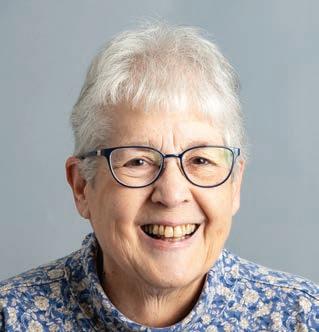
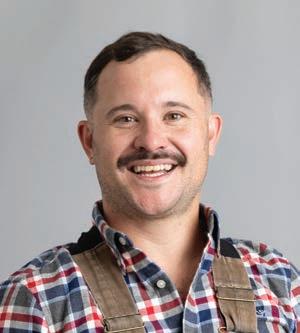
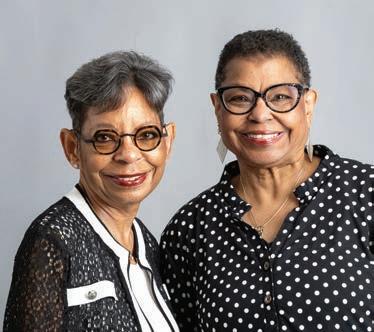
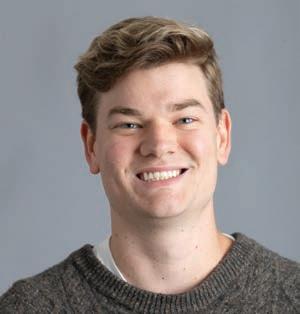
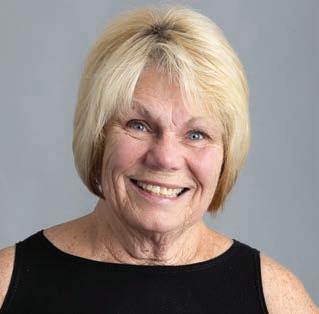
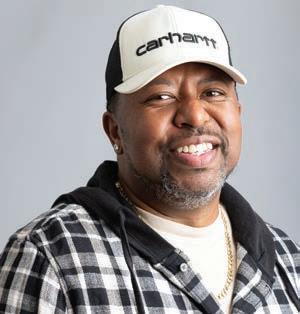
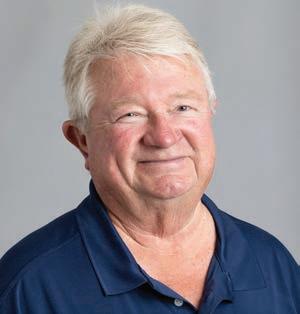
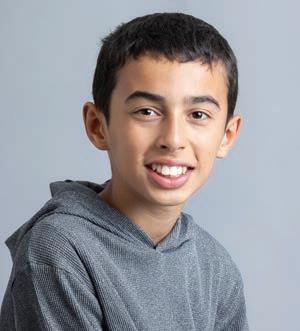
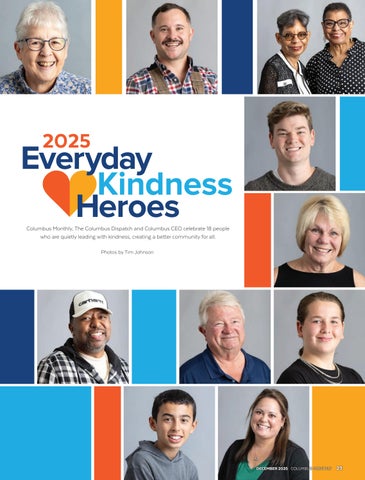
Columbus Monthly, The Columbus Dispatch and Columbus CEO celebrate 18 people who are quietly leading with kindness, creating a better community for all.
Photos by Tim Johnson
By Lucy Clark
“The greatest thing you’ll ever learn is just to love and to be loved in return.”
These words, with their origin from Nat King Cole’s hit song Nature Boy, serve as a personal mantra to Brent Dutcher, a board of directors member and driving instructor for Rides 4 Refugees. The nonprofit focuses on getting refugees driving instruction and cars, though Dutcher’s involvement hardly starts, or stops, there.
For refugees, the most important concern—second only to learning English—is becoming mobile. Studies show the number of jobs available by car is significantly higher than those available by walking or using public transit, Dutcher says.
After Dutcher and his wife, Pat, retired, they began traveling extensively. “The things that really interest us are geology, geography, architecture and culture,” he says.
Kabul, Afghanistan, fell to the Taliban in August 2021, and by that November, refugees were starting to resettle in Columbus.
The Dutchers’ church established the Indian Run United Methodist Church’s Refugee Support Team, and Dutcher became its co-leader in 2022. “Pat and I looked at each other and just said, ‘This is right up our alley,’ ” Dutcher says.
He didn’t stop at teaching people how to drive. “I started working with my church then to say, ‘Hey, what can we do to get cars for people?’ ” They’ve since built up a fleet of vehicles both for training and for families to use temporarily as they get on their feet.
Even still, there was the issue of helping people find permanent cars. Dutcher describes working with Rides 4 Refugees as “step two.” He already was sending people to the nonprofit for their grant program, which matches up to $4,000 for the cost of a vehicle, and he’s been a board member since 2024.
While his work primarily focuses on getting refugee families mobile, Dutcher and his wife have become deeply entrenched with the local Afghan community—their efforts are extensive, and include helping with health care, housing, banking, community events and more.
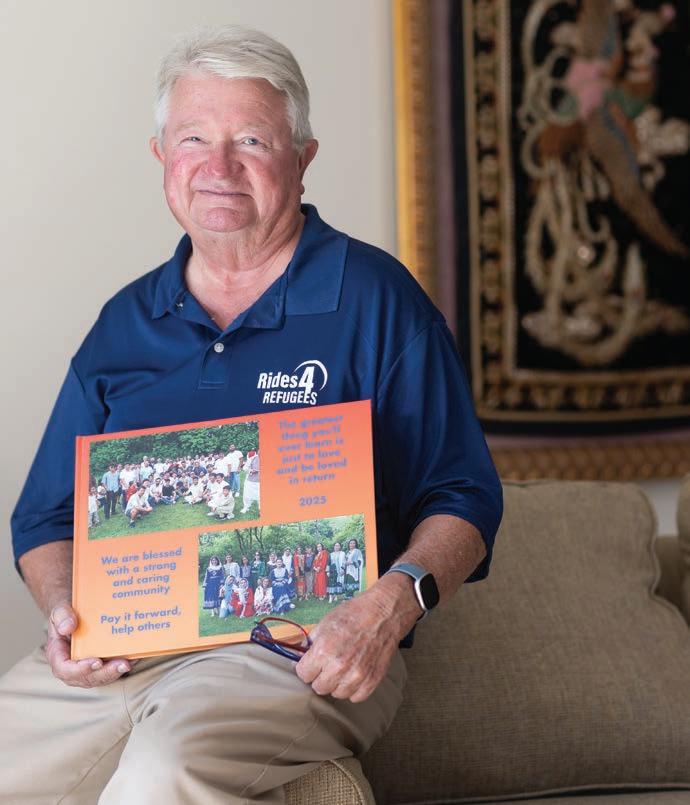
Dutcher’s work has helped 76 refugees get their licenses. Of these, 67 percent are women. He’s also helped acquire a total of 45 cars for families, 36 of which were acquired through Rides 4 Refugees.
“The word to describe Brent is ‘indefatigable,’ ” says Jean Childers, who works with Dutcher on the church’s Refugee Support Team along with her husband. “[Brent] told us in his younger life that other people at their church had helped his family in tough times, and he never forgot that. He is always looking for ways to help people. Always.”
His involvement, Dutcher says, has been anything but one way. “There’s nobody more highly compensated than me in terms of love and friendship.”
What is a challenge you have overcome?
It’s hard to answer that question. We’re just blessed beyond belief— we’ve got hundreds of friends we didn’t have two years ago.
What inspires you?
I would have to say God. I see the hand of God in so many things. When challenges do come up, He shows me the path I can take.
What keeps you engaged?
By Sophia Veneziano
With the Garden District Corp., Sean McKay doesn’t just grow plants. He grows people.
After planning to become a music teacher, McKay’s life was changed when he sat through a college class on plant science in 2013. This class ignited an interest in growing food and unveiling inequities in food systems, he says.
In the height of the COVID-19 pandemic in 2020, Sean McKay grew 700 pounds of food in his backyard that he donated to Lutheran Social Services.
After his husband, Corey Joseph Brown, pointed out that this operation was not sustainable for their home’s garden, McKay assembled a board and started the Garden District Corp. in May 2021. Just like the plants, the nonprofit started to grow.
The Garden District now manages eight community gardens and urban farms across the Columbus region.
One is a redesigned garden at Columbus City Schools’ Berwick Alternative Elementary School, which is just down the street from McKay’s backyard garden that started it all.
What is a challenge you have overcome?
Widening my social lens and truly understanding the complex intersections that exist within our food system ... how deeply issues like racial inequity, poverty, homelessness and food access are woven together.
What inspires you?
I’m inspired by the process of discovery—uncovering how history, culture and policy shape our communities—and by the chance to turn that understanding into meaningful action.
What keeps you engaged?
“Mission moments.” That’s what I call the everyday experiences that remind me why this work matters.
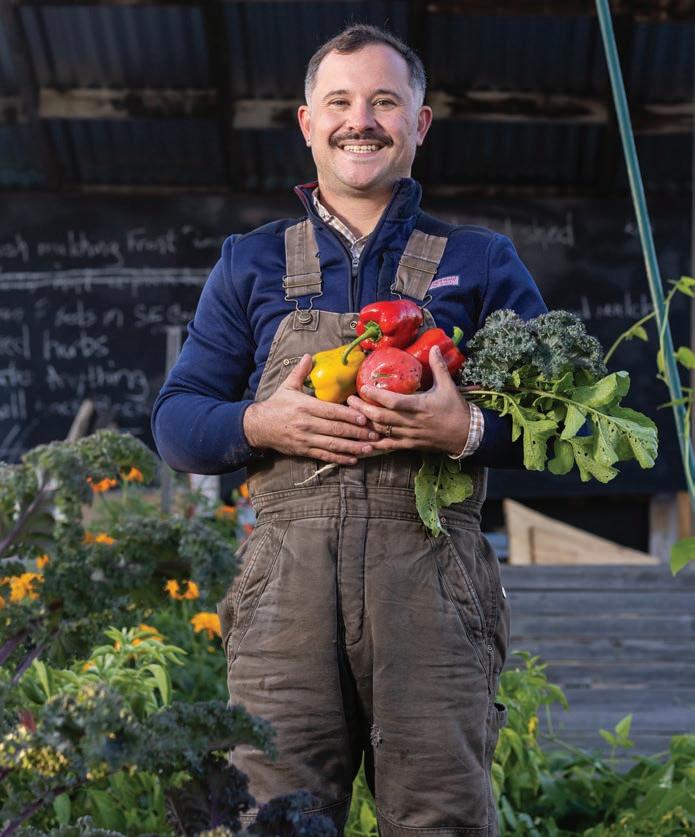
From these eight gardens, the nonprofit distributed over 5,000 pounds of food across the region and donated almost $23,000 to people experiencing food insecurity in 2024.
All this work is an unpaid, volunteer labor of love for McKay, or his “7-9” before his 9-5 as the farm education coordinator at Mid-Ohio Food Collective.
He said the combination of his work at MOFC and Garden District provides him the reach of a large nonprofit organization with the grassroots movement of a community-focused initiative.
Katie Young, the farm-to-school/ nutrition coordinator for Columbus City Schools, says McKay’s work brings
awareness to the possibilities of what gardens can do to build community, and he does it all with a smile on his face.
“I love the way that he’s very inclusive with all of our students. He wants to make sure all of them can have a positive experience with growing food,” she says.
“I don’t know that he sleeps,” Young adds. “He’s constantly doing for others.”
Beyond growing plants, fighting food insecurity and educating the next generation, McKay cultivates people.
He says that he believes farming is for everyone who chooses the path. While Brown playfully disagrees, joking that farming isn’t for him, he says he is McKay’s No. 1 supporter regardless.
Growing up without a lot inspired generosity in Kip Rooks, founder of Blessing
By Linda Lee Baird
Kip Rooks knows what it’s like to go without. He says when he was growing up, his family was often in need. And the people who helped them then inspired him from an early age. He recalls telling his mother when he was about 6 years old, “Mom, once I get older, we’re going to give back, God willing.”
Today, he’s fulfilling that long-ago promise in the Pataskala area where he was raised and now works as a Realtor. It started in 2019, when he gathered 20 Thanksgiving meals into his truck and gave them to those in need. “Every individual had a touching story that made me feel that we needed to do more. And those 20 meals went really quick,” he says.
The next year, he mobilized a team of volunteers to deliver 150 Thanksgiving meals. “And then it just kept growing. ... So now we have local churches that join our forces, Krogers, Meijers. It keeps getting bigger and bigger, and the need keeps getting bigger and bigger,” he says. This year, Rooks is on track to serve 450 meals.
But he wasn’t content to stop there. Instead, as he’s learned of more unmet
What is a challenge you have overcome?
I had a single mother. Growing up, we didn’t have some of the things the other kids had as far as material things.
What inspires you?
One of the inspirations comes from my childhood, knowing that there was someone there to help us when we were in need. But also my children—I want to set a good example for them.
What keeps you engaged?
Family keeps me going and committed. And then also a lot of people depend on me, and I don’t want to let anyone down.
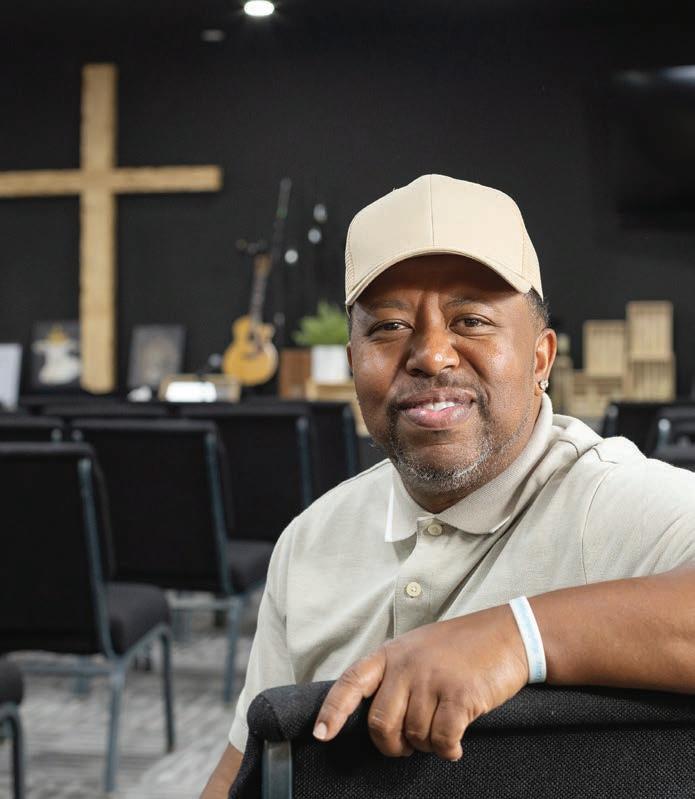
needs, he’s found additional ways to help, formalizing his commitment to service through his nonprofit, Blessing Hands.
Rooks now organizes an annual backto-school drive, filling backpacks with supplies for area kids. He helps families create holiday memories through a Christmas event, where they receive gifts, cookies and pizza, and visit with Santa and the Grinch—all at no cost. This too was inspired by Rooks’ childhood.
“At the Summit Station Lions club [in Pataskala], they used to do a Christmas event where they’d have Santa Claus come and you sit on his lap. … We actually used that exact same location, and I brought that back,” he says.
Rich Scott, a member of the Lions Club who has helped during some of Rooks’ events, calls Rooks “by far one of the kindest people I’ve ever met.” Scott praised the behind-the-scenes work that Rooks puts into these events, securing donations and coordinating volunteers. “His voice is so impeccable,” Scott says. “When he asks, they know that there’s a need.”
From founding the Charles J. Rooks “24” Memorial Scholarship in his late brother’s name to mobilizing cleanup following tornadoes in Pataskala, Rooks steps up wherever he can. “And we’re not done yet. We’re constantly trying to find ways that we can help the community,” he says.
The sixth grader from Westerville balances running cross country with giving back to his community.
By Sophia Veneziano
Five years ago, the Suttle family committed to finding a way to give back to the community once a month, every month.
While it would have been easy for the family to get too busy for service over the many months, the rhythm eventually became a routine.
Through this pledge, the family’s eldest of three boys, Micah Suttle, began volunteering with Seeds of Caring, a nonprofit that connects kids to community service, when he was just 7 years old.
“I would probably say that even the smallest things can help. You should get every person you can involved, because the more the merrier, and every small piece helps,” the now 12-year-old says.
This includes putting together care kits for those who need extra help, picking up trash around town, and making cards for people in the hospital or who are moving to a new home, among other acts of service.
“Thinking about how good this could make other people feel, that just encourages me to keep going,” the Westerville
What is a challenge you have overcome?
Battling nerves before my races.
What inspires you?
Seeds of Caring has inspired me to help the community. It taught me that I can make a difference, even as a kid. [Middle distance runner]
Yared Nuguse inspires me as a runner because he’s really good but also OK with just being different and being himself.
What keeps you engaged?
I just like knowing that I’m helping other people who need it, and maybe something I do puts a smile on their face.
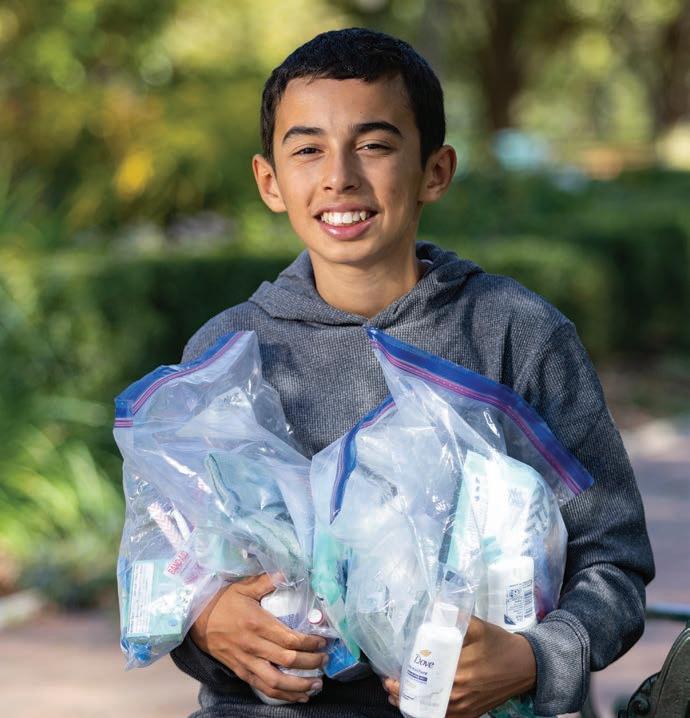
sixth grader says.
Micah’s mom Markita says there is no better compliment as a parent than to watch her child, on his own accord, want to help other people and to try to make his community better. He now asks his mother when his next Seeds of Caring event will be.
Since he was in the third grade, Micah has taken community service into his own hands. Inspired by Seeds of Caring, he selects a nonprofit to support and teaches his classmates about each group’s mission.
This includes facilitating an annual volunteer activity for his peers.
In past years, he selected Seeds of Caring, the Columbus Diaper Bank and Home for Families. This year, he would like to collect holiday toys for
kids involved with Franklin County Children Services.
When he isn’t volunteering, Micah can be found running or playing basketball. When he grows up, he wants to be an Olympic athlete. The young runner competed in the Ohio Cross Country Middle School and Elementary School State Championships in late October. He was the state runner-up in the elementary division in 2024. He explains he can manage the stress and pressure well and he hopes he can inspire other kids to add volunteering to their busy schedules.
Markita says watching her son balance community service activities and athletics makes her proud as a former athlete herself. “He’s constantly thinking about little ways to make things better,” she says.
By Sophia Veneziano
Alicia’s Closet is truly a family affair.
The group’s founder and executive director, Maya Ward, personally learned about the needs of foster families when she and her husband, Eric, adopted their daughter, Alicia—the namesake of the Columbus area nonprofit—and her brother EJ in 2018, a few months before starting Alicia’s Closet.
While the couple made the decision to foster children in 2017, Ward’s journey with the foster care system started many years earlier. Her late father, Ricard Eugene “Gene” Ayers, worked in social work, primarily with teens and young adults aging out of foster care.
“A lot of this and my heart for this is due to his influence in my life, even as a young child, just being aware of the need that existed,” Ward says. “It is a cool thing to be doing this to carry on his legacy, and, of course, for our own family. We’re
What is a challenge you have overcome?
Leaving the classroom. It was a huge part of my identity for so long. To start over and pivot to something completely new was difficult to say the least.
What inspires you?
The families we serve. The kids. There is such brokenness in this world, they are working against so much and they continue to overcome so much every day. It’s an incredible blessing and privilege to walk alongside them.
What keeps you engaged?
For many families, life has given them every reason to give up, but they keep going. And that is contagious. It reminds me that what we’re doing is about so much more than clothing or tangible items or providing a service—it’s about dignity, hope, ongoing connection and relationships built on trust and care.
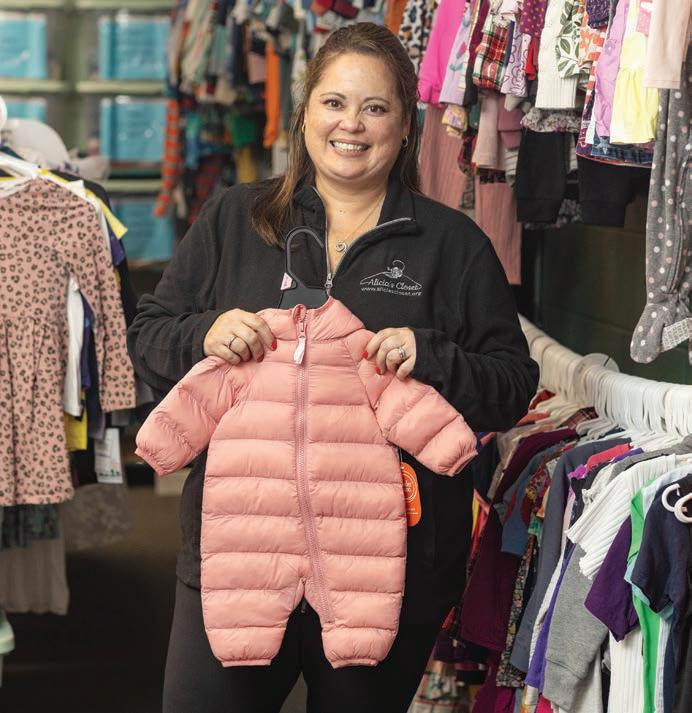
on both sides of things.”
The nonprofit now operates a free store, support groups and respite programs for area foster care families.
It also organizes special programming, like its upcoming Help for the Holidays wish list program, that supports kinship families, reunified families and former foster youth—groups that often are not eligible for foster care resources.
“Our kids have walked in the shoes of the children that we serve,” she explains.
Crediting her Christian faith with her inspiration to leave her career as a teacher launch the nonprofit, Ward says she is thankful for the families who have entrusted her and her team with their lives and stories.
“This organization is not about me. I can’t take credit for this organization. I really can’t,” Ward says. “It’s an un-
expected thing to be led to run something like this when it’s completely off the trajectory that you were thinking.”
Through Alicia’s Closet, Ward became close friends with another mother, Molly Thompson. Alongside her husband, Zach, Thompson began adopting a sibling group of four in 2020.
The couple finalized the adoption of their youngest child in March 2025.
Thompson explains this community support helped her family as it navigated the challenges associated with foster care and adoption. For the Thompsons, this included learning to take breaks and lean on others for support.
“Maya really makes sure to empathize with families, and it actually works because she knows what all of us are going through. She’s been there herself with her family. She’s just so warm and welcoming,” Thompson says.
A 13-year-old is paying his mother’s lucky lottery ticket forward in spades.
By Sophia Veneziano
During the COVID-19 pandemic, Robin Kefauver bought a few $5 50/50 raffle tickets to support those in the service industry who were struggling financially.
When she found out she won the $275 prize, Kefauver donated her winnings to the same cause. Reflecting on the donation, she says her young son, Carter, then 8, was a bit confused by her generosity.
“He said, ‘That’s a lot of money you gave away. Why did you give away so much money?’ And I just simply told him, ‘I didn’t give away $275. I gave away $5. I chose to be kind with $5, and I was lucky enough to be able to give them all of it,’ ” Kefauver recalls.
“And he said, ‘I want to do that. I want to start making people happy with $5.’ ”
From there, the family began “sprinkling” kindness.
They purchased $5 gift cards for the young boy to pass out to sanitation or postal workers to make them feel seen and appreciated.
That lasted until the $5 gifts started to add up, forcing the family to limit the boy to give only five gift cards per week.
Hoping to ramp the operation back up once again, Kefauver made a post on Facebook explaining what they were doing and asking for support.
“By the next morning, Carter had
What is a challenge you have overcome?
Dyslexia: Learning to read and literacy is the largest and most important thing. It’s 100 percent the reason Carter Kindness has free kindness book boxes.
What inspires you?
Family and kindness in general. Every act of kindness inspires me to do more!
What keeps you engaged?
Seeing people benefit from my platform’s kindness keeps me going.
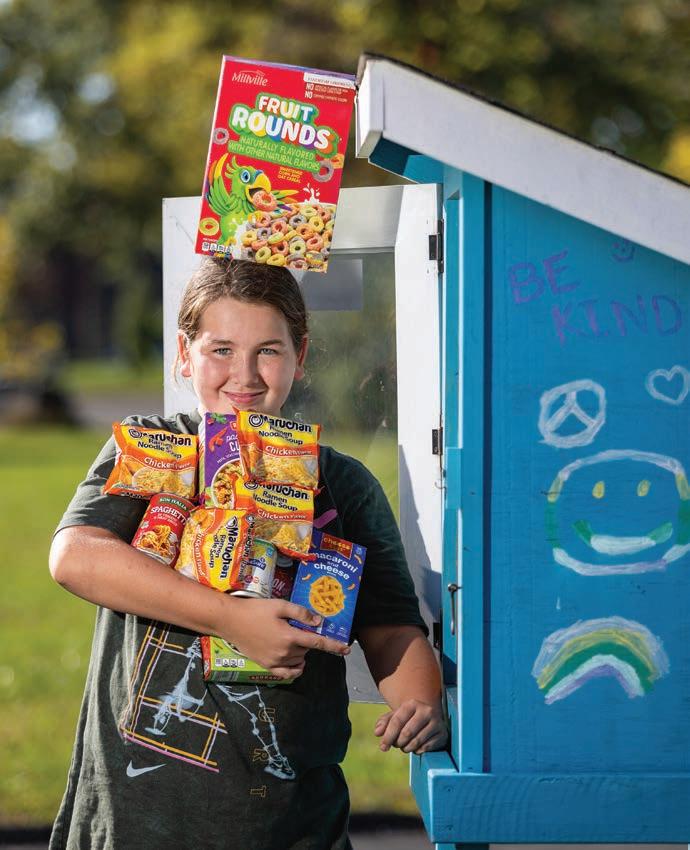
$700,” his mother says. “And then it just never stopped.”
Now a local movement, “Carter Kindness” works to fight food insecurity, improve literacy and promote all-around kindness. Carter, now 13, says his No. 1 goal in the operation is “filling tummies.”
The group has 1,500 members on Facebook and has been working to gain nonprofit distinction.
The movement has two “blessing boxes” of food and three free little libraries of new books. It collects dresses for school dances and passes out holiday baskets for members of the community.
Those who want to support Carter Kindness can donate to the cause through an Amazon Wishlist, on Cash App at “$Kefauver50” and on Venmo at “CarterKindness.”
The group additionally launched the Carter Kindness Scholarship to celebrate graduating seniors at Whitehall-Yearling High School who plan to attend college or technical school and have practiced kindness in the community.
Carter Kindness is not planning to slow down anytime soon.
The 13-year-old boy says his work won’t be done until he’s 99.
By Sophia Veneziano
Driving from his home in Dublin to his workplace near Easton Town Center, Collin Marshall couldn’t help but notice the trash on the side of the road.
“It was always sad to see. And I started thinking, ‘Man, someone should just come here and clean it up,’ ” Marshall says. “I figured, why not have that be me?”
He bought a trash grabber and some bags and began taking walks to clean up trash near his apartment in his free time.
Feeling like he found a fun and fulfilling way to make a difference in his community, Marshall made a series of posts on Reddit inviting others to join him in his trash-cleaning efforts.
Two others joined and 10 bags of trash were filled during the first official week.
In a matter of months, Marshall was leading a group ranging from 20 to 50 volunteers that would show up to various sites throughout central Ohio each weekend to clean up trash.
Marshall said he originally attended a trash cleanup held by the city of Colum-
What is a challenge you have overcome?
I temporarily lost my vision from a severe viral eye infection a few years ago. I try not to take anything I have for granted now.
What inspires you?
Seeing a small idea be able to effect change across the city. These ideas can catch on and lead to momentum in so many other areas. It helps me realize that redemption for people and places in our community really can be achieved.
What keeps you engaged?
Understanding it’s a constant journey of unlearning things that aren’t meant for us and relearning important lessons that can transform the way we live.
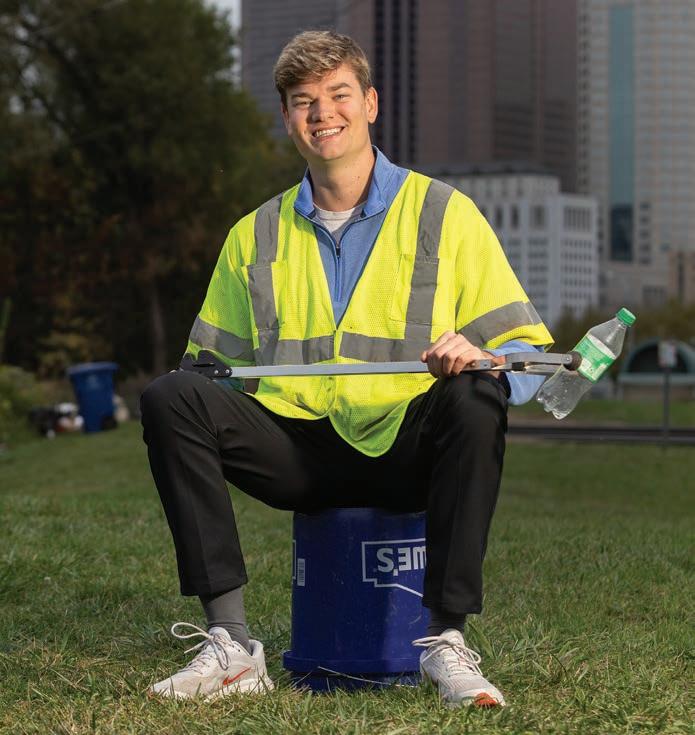
bus and its Keep Columbus Beautiful initiative several years before he started his own cleanings. The city office is now a partner of the volunteer-led group, providing supplies for the work and arranging trash pickups once it has been collected and bagged.
Volunteers can get connected to the group on Reddit, where Marshall posts sign-up forms. He also started a Venmo account, @TrashParty614, to collect money for supplies.
The group has disposed of discarded tires, shopping carts and propane tanks in addition to more routine trash. Altogether, this added up to over 48,000 pounds of garbage collected as of early October.
Beyond making the area a cleaner and more beautiful place, Marshall says a goal is to create a community of people
to connect not only with what he calls “forgotten spaces,” but also one other.
This has included cleaning and connecting with homeless encampments— giving attention to forgotten people, along with the spaces society has overlooked.
Sarah Bramley has been one of Marshall’s core volunteers who now helps with planning and organizing.
Like many others, Bramley got involved through one of Marshall’s posts on Reddit.
Noting the grassroots nature of organizing, Bramley says she has been moved by the diverse group of people who show up to make a difference, build community and make central Ohio a better place.
“It’s really just reinforcing how accessible something like this really is,” Bramley says.
An annual winter drive honors the memory of her late son’s kindness and generosity.
By Sophia Veneziano
Years ago, Jordan Alexander Moore was driving and saw a young man on the side of the road wringing his hands in the cold winter air.
He pulled over and gave the man his gloves, explaining to a friend in the car alongside him that he would go buy new gloves later, but he wanted to make sure the stranger had them in that moment.
On May 6, 2016, the then 27-year-old passed away after falling while at work in tree services.
That same year, his mother, Toni Williams Moore, began collecting hats, socks, scarves, and—of course—gloves for the homeless in her son’s memory.
When Moore started collecting in 2016, she received seven boxes of items. By the ninth year in 2024, the drive had expanded to 66 boxes.
Throughout 2025, Moore has collected items for her 10th annual winter drive, which has now expanded to all kinds of items to give to the United Methodist Free Store on Parsons Avenue.
“He’d be impressed,” she says of her late
What is a challenge you have overcome?
Grief is ongoing. It’s a process. I’ve come a long way. I will never get over the loss of my son, Jordan. I take it day by day and sometimes minute by minute.
What inspires you?
We are inspired by Jordan. I am so proud of him and the fact that he wanted to help people less fortunate than he was.
What keeps you engaged?
Having a goal, a purpose. When you lose a child, you have to find a purpose. Mine has been to make sure I live my life to make my son proud.
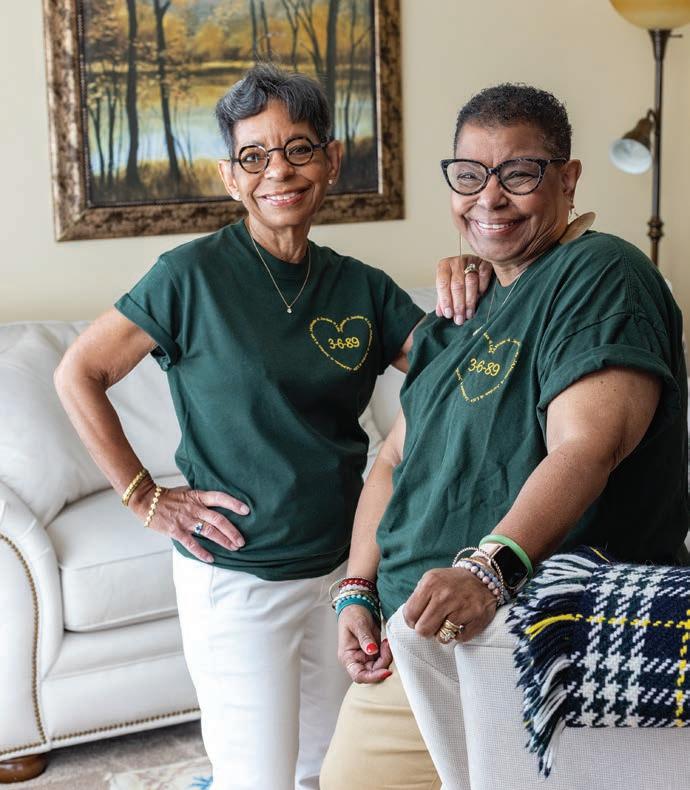
son. “I truly believe he’s smiling down and thinks it’s a good thing.”
The Columbus mother wraps boxes of items each year to donate for those in need each December, since Jordan loved Christmas. She will continue to collect items through the beginning of December, before dropping off the gifts around Dec. 20.
As Jordan’s friends have become more involved with the project, Moore and her sister, Terri Williams Miller, who helps organize the annual drive, learned stories of Jordan’s kindness from them.
Since he was a child, Jordan inspired those around him. He was the only child in the neighborhood who would stop
and play with the youngest neighbor. He drove friends to job interviews with him—even as he interviewed for the same position—in the hopes one of them would get the job. Both Moore and Miller explain they are trying to continue the impact Jordan made in his 27 years.
“For me, it’s bittersweet. I feel like I’ve gotten to know Jordan better since he passed,” Miller says through tears.
“He was even better than I thought he was, and I never knew it. So, to hear all these things and to not know it when he was here, it made me sad to know, but it also made me happy because I knew he was special.”
After her aunt changed her perspective on incarcerated people, Karen Thimmes began working to change their lives.
By Sophia Veneziano
In the early ‘90s, Karen Thimmes’ aunt, Emma Cox, would write her letters from Tennessee describing a group of women that would go a nearby prison to chat with the inmates and hold a Bible study.
Previously believing everyone in prison was simply a “bad guy,” Thimmes says hearing of this connection changed her perspective toward incarcerated people.
Her aunt sent her a copy of Prison Legal News magazine, and she began reading of prison happenings and legislation. In the magazine, she read two stories of Ohio prisoners, John Perotti and Dan Cahill, who were protesting prison conditions while incarcerated.
The articles encouraged readers to write to the prisoners, and Thimmes took action out of curiosity.
“I started a correspondence with both of them, and they were telling me a lot about prison life that I was unaware of: prison conditions and horror stories,” she said of the two men, now both deceased, who became her friends and changed her life.
What is a challenge you have overcome?
My challenges seem to be largely tech-related, as I am an older person and do not grasp technology very well.
What inspires you?
My prison friends know there is somebody out here who cares about them, who sends them news articles, cartoons, birthday and Christmas cards.
What keeps you engaged?
Knowing my “people” depend on me ... and care about me. I can’t just suddenly drop out of their lives! I’ve been doing this work for over 30 years and can’t stop now!
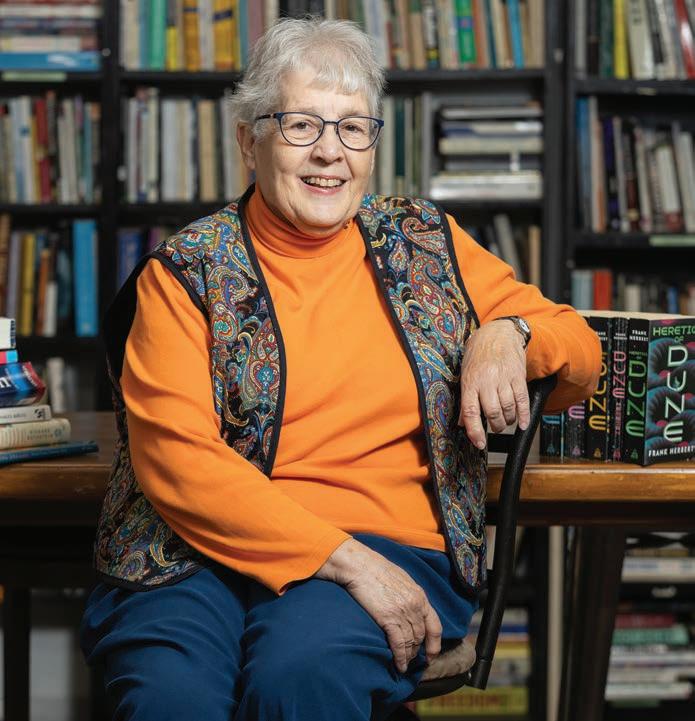
“It made me more eager to start fighting the system and getting involved.”
The now 80-year-old visited each man in prison, and when Cahill was released, he came to live with her for several months.
A few years later in the mid ‘90s, Thimmes learned a chapter of Citizens United for Rehabilitation of Errants (CURE) was launching in Ohio. She attended the first meeting, excited to get involved, and she walked away as the group’s secretary.
It was while working as CURE Ohio’s secretary that Thimmes met Michel Coconis, a social worker who has spent her career working with inmates on death row.
Coconis was impressed by the sheer number of letters that Thimmes would send each year atop the countless nights
she spent driving to pick up individuals being released from the Franklin County Corrections Center.
“She had this huge collection of letters that she got back from people. I read two years’ worth, which was over, I don’t know, 4,000 letters,” Coconis says.
Thimmes continued writing to inmates, and she built a network of nearly 30 prisoners with whom she would keep regular contact over the years to come.
One such friend was Patricia Wernert, who began her incarceration in 1976 on an aggravated murder charge and was originally sentenced to death. Her sentence was commuted to 20 years to life in 1978.
Wernert, her longtime friend, was released in February 2025, after 48 years inside.
A family’s effort to help people experiencing homelessness became a regular activity.
By Sophia Veneziano
People experiencing homelessness are often invisible to those with a roof over their heads.
One group, Saints Alive, doesn’t just think of the homeless on the streets: it joins them there.
Almost six years ago, Margie Thompson and her brother, Jim Toner, started cooking hot dogs and handing out bags of chips from the back hatch of Thompson’s car. The charity was part of outreach by St. Aloysius Parish, where their brother, Father Patrick Toner, was a priest with the Catholic Diocese of Columbus.
The group rapidly grew in just a few months, and it has developed into a fullscale operation with a base of 30 volunteers in five years.
The team started going out every Sat-
What is a challenge you have overcome?
As we were growing in the beginning, figuring how to transport all of our supplies to our distribution location. Saints Alive is God’s ministry, whenever we had a need and couldn’t figure how to fix or acquire something, a door would open and God would say, “Come this way, I got you covered.”
What inspires you?
The people on the street 100 percent. These people have my heart. They are so grateful, loving, giving. They make me want to be a better person.
What keeps you engaged?
First of all, it’s the people, they have become my family. Second, it’s our long-time visitors who come to tell us that because of us, they have gotten into an apartment or got a job.
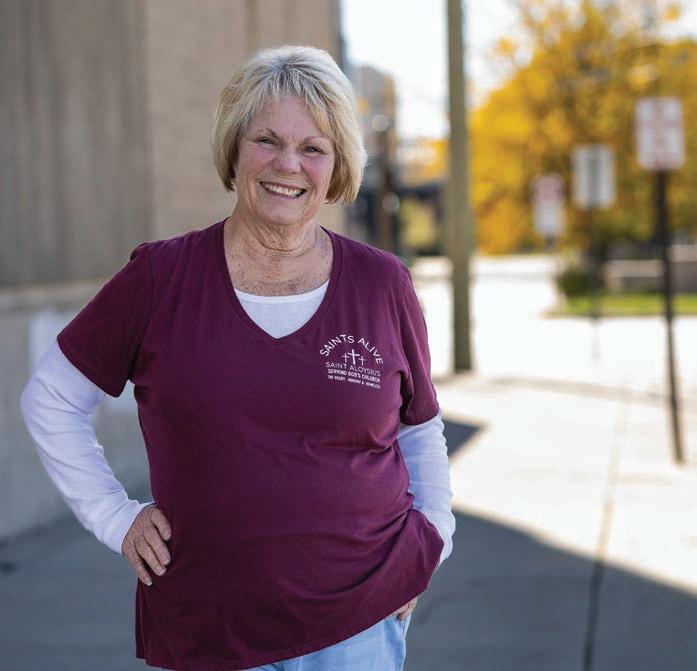
urday morning at 9:30 a.m. to the corner of West Broad Street and Davis Avenue in Franklinton to serve a hot meal and hand out groceries and warm clothing to people struggling with housing insecurity.
“They have told us, ‘We feel invisible. Nobody will look at us.’ When we heard that, we made sure we knew their names when they came through,” Thompson says.
Thompson’s husband, Wayne, says the group has grown to a sizable team of volunteers that now includes his 94-yearold mother, Betty.
“I’ll say for myself, I never paid attention to the homeless. You know, I’d see them on the street and everything,” he says. “I learned quickly that they’re just like everyone else. They need the help.”
As of October, due to economic constraints, the group had to suspend its Saturday mornings. It still serves hundreds of sandwiches, snacks and water bottles
every Wednesday afternoon and supplies camps with socks and other items.
For Saints Alive, the work extends beyond time volunteering.
Margie said she has built genuine friendships with the people the group serves. Saints Alive helped 15 people find housing and has partnered with Nationwide Children’s Hospital to help get groceries to families in need.
One of the individuals the Thompsons helped find housing is Jonathan “Eagle” Benson, who lived in a homeless camp for years.
“It was 1:30 in the morning when my propane went out, and it was in the middle of a blizzard. I called Margie, and she literally drove from her home,” Benson says. “Without their church’s beauty and their help, I honestly don’t think I would be here to this day. I think I would have probably frozen that night.”
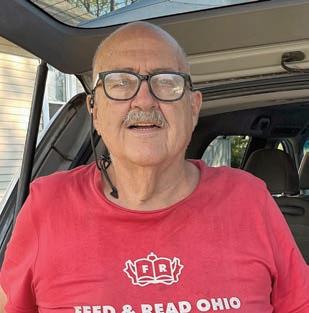
Founder, Feed and Read Ohio
What makes you a hero? “We take food, hygiene products, children’s books and backpacks to food insecure families, but most importantly, we take love, hope, encouragement, respect, recognition and sometimes laughter to them.” This fall, Jacques’ team organized supplying 109 school bags for children for the 2025 school year. Currently, much of his work is focused in Linden and East Columbus, but he has served families for over 20 years across Columbus and in Athens.
What is a challenge you have overcome? At 72 years old, I started to learn another language. It has allowed me to get closer to the families that I help so that they trust me and I am able to help them more completely.
What inspires you? The families that I am fortunate to know. They go to work everyday at low paying jobs that are frequently demeaning and unfulfilling just to provide for their [needs].
What keeps you engaged? The love, respect and trust these families show me. I consider them family and they consider me family.
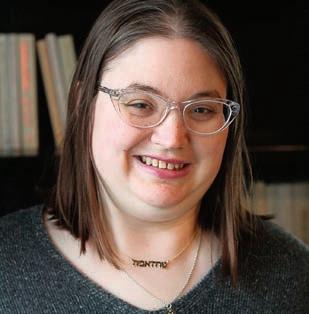
Community volunteer and advocate for Ohioans with disabilities
What makes her heroic: Katz volunteers at multiple organizations including the Red Cross and with local arts groups such as the Harmony Project, where she is also a performer. She initiated an annual food drive to benefit Neighborhood Services Inc., where she volunteers weekly. And while she has faced social challenges as a person on the autism spectrum, Katz uses her voice to advocates for Ohioans with disabilities. In her own words, “I do whatever I can to make sure other people are happy. My life motto: Think of others before yourself.”
What is a challenge you have overcome? When people are short with me, not losing my temper. ... Another challenge is [that] people assume I am too young to make a difference. You are never too young to make a difference!
What inspires you? When I see ... people who are young making a difference, it keeps me motivated to do better in the world. And the friends I have made doing projects also ... inspires me to do more service work.
What keeps you engaged? Wanting to see the big impact I have on society and the friends that I volunteer with continue to push me to do better.
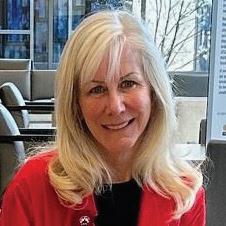
Volunteer at local hospitals and for Canine Companions
What makes her a hero: I have been doing ‘pet therapy’ for the last 25 years and every time I enter a hospital I see people (adults, children, patients and staff) smile. Hospitals can be very stressful places and I hope to bring a few moments of joy to everyone I meet there.
What is a challenge you have overcome? When I first started taking a dog into hospitals it was not a common sight. I’ve had to advocate and demonstrate how beneficial pet therapy can be.
What inspires you? I am inspired by the strength I see in the staff, the families and the patients I meet every time I visit a hospital. If I can make the day brighter for just one person when I visit it makes my life that much more fulfilling.
What keeps you engaged? The people! I have met so many wonderful folks in my years volunteering and they have enriched my life immensely. I can only hope that I have touched their lives in a positive way.
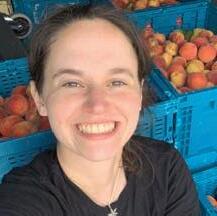
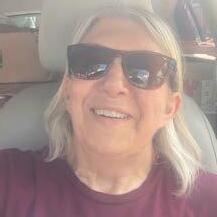
What makes them heroes? Rials: Susan and I are the directors of Columbus Food Rescue—which means we organize volunteers to pick up excess food from businesses and organizations [and deliver it to] agencies serving folks in need. CFR also operates Ro’s Kitchen, where some of the surplus food we rescue gets transformed into ready-to-eat meals that we deliver to organizations whose visitors may not have regular access to kitchens or cooking equipment.
What is a challenge you have overcome? Swinford: Fear of failure, of not knowing what we’re doing, of doing things wrong. This was especially true when we first took over food rescue at the onset of the pandemic, because so much was uncertain

Directors of Columbus Food Rescue
in the arenas we were operating in.
What inspires you? Swinford: The people on the front lines, working without much fanfare or support, choosing daily to face the Sisyphean task of making food accessible to those who need it. Rials: We meet so many individuals who work with food ... who go out of their way to try to keep that food from going uneaten.
What keeps you engaged? Rials: I remember that our work ... also connects to working for access to education, to healthcare, to housing, to dignified work conditions, to a livable planet. Swinford: I’m engaged because being a part of [food access and food justice] is one of best ways I could imagine spending my time.

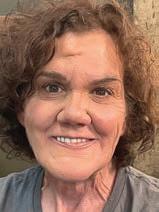
First Presbyterian Church, Delaware
What makes them heroes? Rev. Jennifer Eastman Hinkle is the pastor of the First Presbyterian Church in Delaware, overseeing mission work including Laundry Love, which provides regular laundry services and snacks to the community and is organized by Jim Dietz, and the Kitchen Ministry, which provides over 170 bimonthly meals and is spearheaded by Emily Hinton.
What is a challenge you have overcome? Hinkle: Sometimes it is difficult to find people who are willing to give their time and monetary gifts to support our mission and ministry. However, our leadership continues to think outside of the box to make things happen.
What inspires you? Dietz: Being with others, caring about them and seeing them succeed and hearing their stories. It is amazing when others allow me into their space and share a small part of their journey—they inspire me.
What keeps you engaged? Hinton: When working to feed those in need, a deep sense of purpose keeps me going. Every meal served is a tangible way to make a difference in someone’s life, reminding me that even small actions can have meaningful impact. ... It’s about being part of a compassionate network that cares, supports and uplifts those who need it most.
The Columbus Dispatch, Columbus Monthly and Columbus CEO and our partners—Center for HumanKindness at the Columbus Foundation and sponsors AEP Ohio and United Way of Central Ohio—will honor the 2025 class of Everyday Heroes at a Dec. 3 awards reception at Vitria on the Square, where two top Everyday Kindness Heroes will be announced. The Columbus Foundation’s Center for HumanKindness will provide grants to all honorees to bestow on the nonprofits of their choosing: $300 for five semifinalists, $500 for eight finalists and $3,000 each for the top two Everyday Kindness Heroes, who are chosen by the judges.
The following individuals reviewed dozens of Everyday Kindness Heroes nominations and chose the finalists and semifinalists included in this feature package.
Jill Geiger Director, Content & Communications United Way of Central Ohio
Julanne Hohbach Editor Columbus CEO
Laura Arenschield Vice President, Customer Experience AEP Ohio
Kate Oliphint Director, Center for HumanKindness The Columbus Foundation
Katy Smith
General Manager, Dispatch Magazines and Editor, Columbus Monthly
Sophia Veneziano
Everyday Kindness Reporter
The Columbus Dispatch/Dispatch Magazines
Eric Wygle
Marketing Promotions & Community Affairs Manager
The Columbus Dispatch