Upper School Course Description Guide
GRADES 9-12

Additionally, students must complete a course in health, Ethics and Community and public speaking in order to meet graduation requirements Completed in junior year, the public speaking component is seen as a right-of-passage to many Columbus Academy students, as they spend roughly three weeks in focused preparation for delivering a speech to the entire Upper School
Through myriad experiences both in and out of the physical classroom, students are taught to problem solve, collaborate, think critically, write effectively and speak honestly and thoughtfully. Teachers and advisors develop into mentors, and when combined with parental support, endeavor to nurture the whole student
Building on skills and habits emphasized and practiced in middle school, upper school students are encouraged to further develop an ability to advocate for their own learning, organize and manage a multi-layered schedule of academic, athletic, service and social responsibilities, and stretch the levels of their intellectual curiosity
Columbus Academy aspires to graduate young men and women who desire to be life-long learners that recognize the importance of an examined life, individual responsibility, and a duty to others
Graduation Requirements
Twenty credits are required to graduate. The following credits are part of the graduation total:
4 credits of English
4 credits of Mathematics (including Algebra 2)
3 credits of a single World Language or two credits of two World Languages
3 credits of History: Human Geography, Modern World History/Honors Modern World History, and United States History/Honors United States History
3………credits of Science: Biology, Chemistry and Physics
1………credit of study in the Fine Arts or Performing Arts
All students must take a minimum of 5 credits of academic courses per year
In addition to the graduation requirements outlined above, students must satisfactorily complete the following in order to receive an Academy diploma: Ethics and Community, Health, Freshman Research, 3 credits of Physical Education, the Junior Speech, the Senior Project, Summer Reading Requirements and the Community Service Requirement (50 hours) All full credit courses taken in the senior year must receive a passing grade

4 C r e d i t s R e q u i r e d
T h e U p p e r S c h o o l E n g l i s h p r o g r a m u p h o l d s t h e s c h o o l ’ s a c a d e m i c t r a d i t i o n
o f e x c e l l e n c e a n d r e w a r d s r i g o r o u s e f f o r t a n d a c c o m p l i s h m e n t b y
p r o v i d i n g a p p r o p r i a t e a c a d e m i c c h a l l e n g e s t o t h e s c h o o l ’ s f u l l r a n g e o f
s t u d e n t s : w e d e v e l o p a s o l i d b a s e o f l a n g u a g e s k i l l s ( r e a d i n g , t h i n k i n g ,
s p e a k i n g , w r i t i n g ) i n E n g l i s h 9 a n d b u i l d o n t h a t b a s e i n s t a n d a r d,
a d v a n c e d, a n d h o n o r s - l e v e l c o u r s e s i n g r a d e s 1 0 - 1 2 .
T h e t e x t s w e r e a d o f f e r o p p o r t u n i t i e s f o r o u r s t u d e n t s t o v i e w t h e w o r l d
f r o m a d i v e r s e r a n g e o f p e r s p e c t i v e s ; d i s c u s s i n g a n d t h i n k i n g c r i t i c a l l y
a b o u t t h o s e t e x t s a l l o w s t u d e n t s t o e n g a g e m a n y v a r i a t i o n s o f t h e h u m a n
c o n d i t i o n t h e i n t e l l e c t u a l , e t h i c a l , m o r a l , e m o t i o n a l a n d e c o n o m i c i s s u e s
r a i s e d b y t e x t s p r o d u c e d a c r o s s a w i d e r a n g e o f g e o g r a p h y a n d t i m e ;
w r i t i n g a b o u t t h o s e t e x t s a l l o w s s t u d e n t s t o a r t i c u l a t e w i t h p r e c i s i o n s o m e
o f t h e p r o d u c t s o f t h a t e n g a g e m e n t I d e a l l y , a c t i v e a n d t h o u g h t f u l
e n g a g e m e n t w i t h t e x t s ( a n d e a c h o t h e r ) p r o v i d e e t h i c a l m o d e l s , c a n
e n c o u r a g e e m p a t h y a n d c o m p a s s i o n , a n d h e l p y o u n g p e o p l e l o c a t e
t h e m s e l v e s i n a w i d e r w o r l d
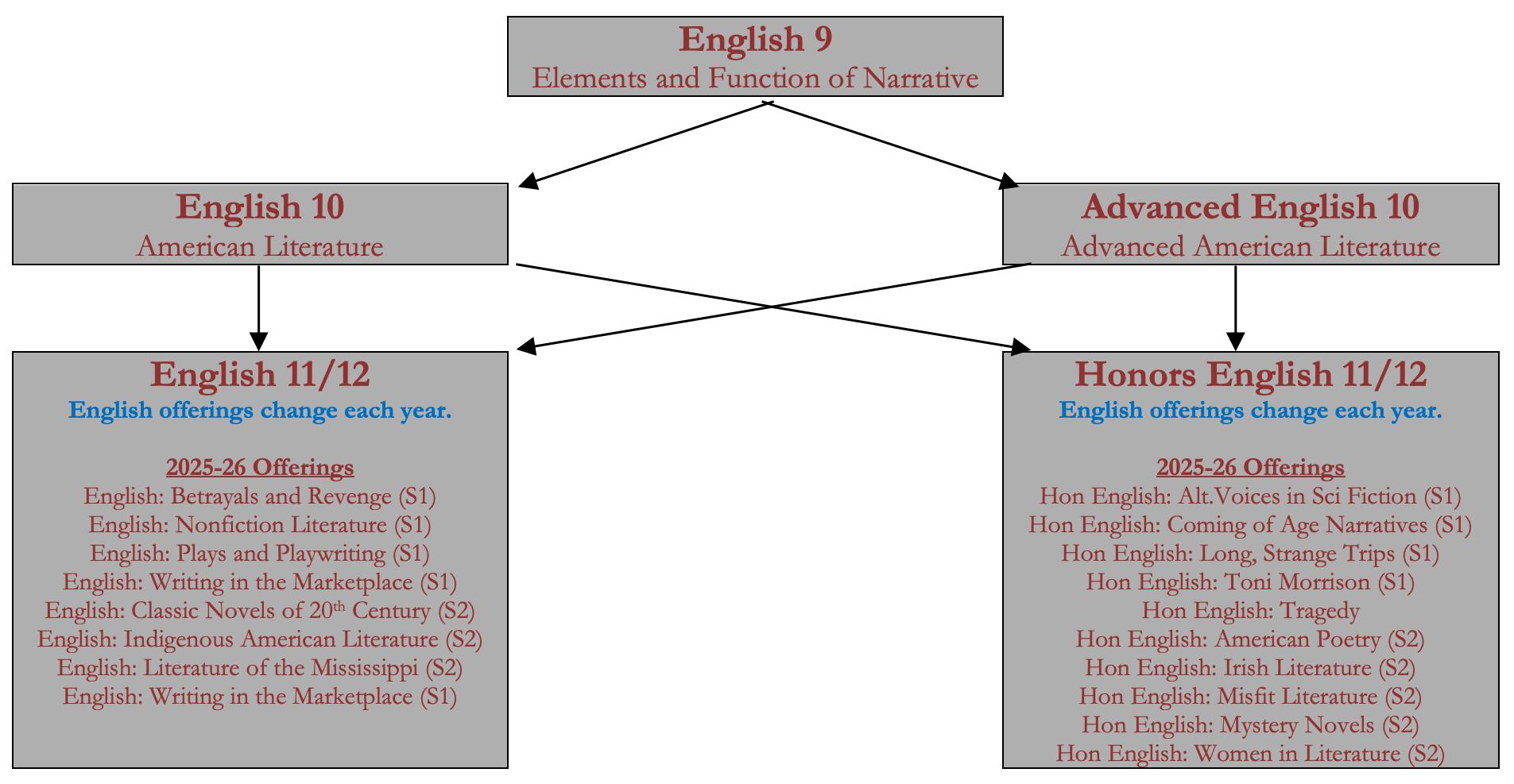
English Department Flow Chart
Students will be expected to meet the NCTE Standard for reading: Students apply a wide range of strategies to comprehend, interpret, evaluate, and appreciate texts They draw from prior experience, their interactions with other readers and writers, their knowledge of word meaning and other texts, and their understanding of textual features Students apply knowledge of language structure, media techniques, figurative language, and genre to create, critique, gather and synthesize information.
Skills learned at the middle-school level will be reinforced and expanded upon in grades 9- 12
Advanced and Honors students will read both more difficult and a greater number of texts and demonstrate greater competence in comprehension and interpretation
Students will analyze and evaluate elements of written texts. Specifically, students will be able to: identify the historical, social and cultural context of the setting and explore its significance. explain how voice and narrator affect the characterization, plot and credibility analyze variations of recurring themes within and among texts analyze the relationship between texts and their historical contexts analyze the relationship between form and content, demonstrating an awareness of how formal choices shape argument and effects on readers. analyze and critique organizational patterns and techniques including repetition of ideas, appeals to authority, reason and emotion, syntax, and word choice that authors use to accomplish their purpose and reach their intended audience
analyze how complex characters (e g , those with multiple or conflicting motivations) develop over the course of a text, interact with other characters, and advance the plot or develop the theme evaluate ways authors develop point of view and style to achieve specific rhetorical and aesthetic purposes (e.g., through use of figurative language, irony, tone, diction, imagery and symbolism), citing specific examples from the text to support analysis. determine the meaning of words and phrases as they are used in the text, including figurative and connotative meanings; analyze the impact of specific word choices on meaning and tone, including words with multiple meanings or language that is particularly fresh, engaging, or beautiful analyze how an author’s choices concerning how to structure a text, order events within it (e.g , parallel plots), and manipulate time (e.g., pacing, flashbacks) create such effects as mystery, tension, or surprise.
compare and contrast an author’s use of direct and indirect characterization, and ways in which characters reveal traits about themselves, including dialect, dramatic monologues, and soliloquies examine an author’s implicit and explicit philosophical assumptions and beliefs about a particular topic
English 9: Elements and Function of Narrative (Full Year, 1 Credit)
The ninth-grade year focuses on stories from around the world. Students will be exposed to short stories, novels, poetry, and drama Students will be asked to demonstrate their comprehension by describing and discussing the elements of literature (i.e setting, plot, and character), analyzing the author’s use of language (i e figurative language), comparing and contrasting styles, inferring theme and meaning and responding to texts in critical and meaningful ways Students will write narrative, compare and contrast, descriptive, and informational forms with an emphasis on literary analysis
Formal, informal, and timed writings will be assigned in response to literature and to writing prompts. Within the writings, students will draw conclusions, collect evidence to support their conclusions, evaluate their evidence, and articulate the relationship between their evidence and their conclusions Vocabulary, grammar, reading, and visual literacy skills will be correlated with the study of literature and in preparation for standardized testing
At the ninth-grade level, students will write essays in a variety of forms, in literary analysis Skills introduced at this level, as well as those that were introd will be reinforced and expanded on throughout the CA English curriculum S writers by participating in a process for writing including prewriting, organizin editing, and when possible or appropriate, publishing. Students will edit writi capitalization, punctuation, spelling, sentence structure, and paragraphing.
Throughout the year, students will: employ a wide range of strategies as they write and use different writing process elements appropriately to communicate with different audiences for a variety of purposes apply knowledge of language structure, language conventions, media techniques, figurative language, and genre to create, critique, and discuss print and non-print texts. use writing as a medium for thought in both timed and untimed contexts. write responses to literature that extend beyond summary by organizing insightful interpretation around several clear ideas, premises or images support judgments with specific references to the original text, other texts, authors, and to prior knowledge and correctly cite and effectively incorporate that evidence into their arguments
English 10: American Literature (Full Year, 1 Credit)
Through a study of American literary history, students will explore the development of a national literature as it shapes and is shaped by the culture from which it arises The class will include the rich variety of texts that have formed American literature since its origins in the texts of European contact up until the contemporary literary spheres Readings will be drawn from a number of literary traditions and a variety of genres, including non-fiction, fiction, poetry, and drama Building upon the critical analysis skills introduced in English 9, formal, informal, and timed writings will be assigned in response to literature and to writing prompts, as well as in the vocabulary units. Students will also develop effective skills in the research, organization, writing, and presentation of speeches
At the tenth-grade level, students will write essays in a variety of forms including argument, comparison and contrast, and literary analysis. Along with new skills, those introduced in previous years will be reinforced and expanded on. Students will continue to develop as writers by participating in a process for writing including prewriting, organizing, composing, revising, editing, and when possible or appropriate, publishing Students will edit writing for correct grammar, capitalization, punctuation, spelling, sentence structure, and paragraphing While the general writing objectives for Regular and Advanced classes are similar, it is expected that Advanced students will demonstrate a greater degree of mastery and sophistication in skills and understanding, particularly in the realm of rhetoric. Areas of consideration include sophistication of syntax and diction, thorough development of ideas, appropriateness of support, precise relationship between claims and evidence, and effective organization to advance the particular argument
Throughout the year, students will: employ a wide range of strategies as they write and use different writing process elements appropriately to communicate with different audiences for a variety of purposes apply knowledge of language structure, language conventions, media techniques, figurative language, and genre to create, critique, and discuss print and non-print texts. use writing as a medium for thought in both timed and untimed contexts write responses to literature that extend beyond summary by organizing insightful interpretation around several clear ideas, premises or images support judgments with specific references to the original text, other texts, authors, and to prior knowledge and correctly cite and effectively incorporate that evidence into their arguments.
Like English 10, Advanced English focuses on a study of American literary history Students will explore the development of a national literature as it shapes and is shaped by the culture from which it arises The class will include the rich variety of texts - some more challenging than in English 10 - that have formed American literature since its origins in the texts of European contact up until the contemporary literary spheres. Readings will be drawn from a number of literary traditions and a variety of genres, including non-fiction, fiction, poetry, and drama. The course emphasizes close reading skills as a foundation for analysis and seeks to deepen critical thinking skills in relation to the readings while encouraging an understanding of how those skills can be applied to the texts we encounter daily Formal, informal, and timed writings will be assigned in response to literature and to writing prompts, as well as in the vocabulary units Students will also develop effective skills in the research, organization, writing, and presentation of speeches
Prerequisite: A final grade of A- or higher in English 9 and faculty recommendation
At the tenth-grade level, students will write essays in a variety of forms including argument, comparison and contrast, and literary analysis Along with new skills, those introduced in previous years will be reinforced and expanded on Students will continue to develop as writers by participating in a process for writing including prewriting, organizing, composing, revising, editing, and when possible or appropriate, publishing. Students will edit writing for correct grammar, capitalization, punctuation, spelling, sentence structure, and paragraphing While the general writing objectives for Regular and Advanced classes are similar, it is expected that Advanced students will demonstrate a greater degree of mastery and sophistication in skills and understanding, particularly in the realm of rhetoric Areas of consideration include sophistication of syntax and diction, thorough development of ideas, appropriateness of support, precise relationship between claims and evidence, and effective organization to advance the particular argument.
Throughout the year, students will: employ a wide range of strategies as they write and use different writing process elements appropriately to communicate with different audiences for a variety of purposes apply knowledge of language structure, language conventions, media techniques, figurative language, and genre to create, critique, and discuss print and non-print texts. use writing as a medium for thought in both timed and untimed contexts. write responses to literature that extend beyond summary by organizing insightful interpretation around several clear ideas, premises or images support judgments with specific references to the original text, other texts, authors, and to prior knowledge and correctly cite and effectively incorporate that evidence into their arguments
English 11/12: American Literature
In Grades 11 and 12, students have a choice of semester courses at the standard or honors level. These courses are generally either single-author or thematic in nature; ideally, each year both levels of courses offer a mix of canonical and less-traditional subjects Honors classes prepare for the AP English Literature and AP English Language tests in alternate years Literature in even-numbered years, Language in odd-numbered years In all courses, students examine both the formal qualities of literary texts and how those texts are influenced by their context They examine how ethics and morality guide characters and how these texts explore ethical questions. A major goal of these courses is to learn to read significant works of literature critically, with enjoyment, and with an appreciation of their form, content and context Another goal of the courses is to develop students’ skills as writers To that end, students write a number of informal, in-class writing assignments and Moodle forum entries, as well as longer expository and interpretive formal essays and creative pieces These writing assignments require students to communicate the fruits of their interpretive labor, while developing skills that they will use for the rest of their academic and professional lives.
Honors course prerequisite: Final grade of at least A- in Standard English 10 or Standard English 11/12; or a final grade of B in an Advanced English 10 or Honors English 11/12; and faculty recommendation.
English: Betrayals and Revenge (S1) (Semester 1
In this course, we will spend the first part of the one of the greatest writers of fiction in the Eng who has a mind of her own, as she experiences social classes of the time, more than 200 years a topics of betrayals in friendship, jealousy amon Whether such injustices and acts of vengeance ca and how empowerment can lead to self-knowl
Maupassant’s shorter works; these texts are dark circumstances or their choices, with little control short stories by Anton Chekhov
English: Nonfiction Literature (S1) (Semester 1, ½ Credit)
In this class, we will read about individuals who intentionally immerse themselves in nature. Some go to test themselves, others seek revelations about the universe, and a few just go to enjoy the solitude
We will read excerpts from Native Americans and from Henry David Thoreau, who believed that civilization anesthetized people and prevented them from authentically experiencing life We will hear about a young man who tries to find himself trekking around the country, and from an average guy who tried to hike the entire Appalachian Trail to get “reacquainted” with America. At the other end, we will read about an extreme surfer and a free diver who puts his life at risk in the depths of the ocean While we can learn something from their experiences, we can also investigate their writing styles and techniques to figure out how they make nature and their own experiences inspiring, cautionary, and even funny In addition to traditional writing assignments, students will be asked to examine their own relationship with nature and do some journaling, photographing, and recording of nature where they can find it
Units may include:
Native Thoughts: Living on the land
Thoreau: Nature’s best salesman: Excerpts from Walden and other works
Bryson: Nature as your Frenemy: A Walk in the Woods
Krakauer: A Reality Check: Into the Wild and short stories
Nester: Humans challenging Nature: Deep
English: Plays and Playwriting (S1) (Semester 1, ½ Credit)
Plays and Playwriting will provide students with a creative outlet to explore their imaginations and express their ideas through the medium of drama It is a fun and engaging course that allows students to develop important skills in writing, critical thinking, and communication Throughout the course, you will engage in critical analysis of plays while also developing your own writing style We will study the elements of dramatic structure, including character development, plot, setting, and dialogue. You will write your own short plays and will learn how to develop ideas, create characters, and construct a plot Guest playwrights will offer guidance and encouragement, and you will have the opportunity to submit a short play to Madlab Theatre’s Young Writers Short Play Festival, giving you the chance to see your writing brought to life by theater professionals
English: Writing in the Marketplace (S1) (Semester 1, ½ Credit)
Students will research present, real-world business problems. Creative problem-solving, critical thinking, public speaking, researching, writing, and revising will be key aspects of this interactive class This class will have a team-based structure, and the strength of each team will rely heavily on each student’s ability to work independently while working with and for the team Collaborating with local entrepreneurs, students will have opportunities to tackle the challenges business owners face We will read The Culture Code by Daniel Coyle NOTE: This course may only be taken in one semester
English: Classic Novels of 20 Century (S2) (Semester 2, ½ Credit) th
In this class, we will be reading three novels that were, for generations, taught as part of the canon of American Literature While the diversification of the canon has been a welcome development, these stories have a lot to offer to students in 2025 The novels of Hemingway, Faulkner, and Salinger offer insight into timeless concerns like love, family, war, coming of age, race, and gender The novels let us see into the American cultural past and, by seeing where we have come from, help us understand why we need a diverse canon. The books also offer opportunities to see various literary techniques employed Narrative structure, chronology, dialogue, and symbolism are often used in ways that might be unfamiliar to the high school reader So, while the books are from a different era, there is much to be learned from them We hope you will invest yourself in the reading and class and come away richer for it Probable texts include Hemingway’s A Farewell to Arms, Kesey’s One Flew Over the Cuckoo’s Nest, and Salinger’s The Catcher in the Rye
English: Indigenous American Literature (S2) (Semester 2, ½ Credit)
In our reading of Indigenous American literature, we will examine the realities of Manifest Destiny, invasion, and occupation Our main text, Ceremony, written by Leslie Marmon Silko–a 1981 recipient of a MacArthur Foundation Grant (also known as the Genius Grant) “follows Tayo, a half-Pueblo veteran of the Second World War, who has come back from the Pacific with P.T S.D., tormented by the knowledge that the United States government used him and other Native men for its war, giving those lucky enough to survive nothing in return. It remains one of the most important works of Native American literature ” Shorter works and excerpts from writers Lousie Erdrich and Tommy Orange will also be included in this course
English: Literature of the Mississippi (S2) (Semester 2, ½ Credit)
In this course, we will examine literature that comes out of the American South around its great, symbolic river, including works by Jesmyn Ward, William Faulkner, and others, as well as two of the most talked-about novels in American literature: Mark Twain's Adventures of Huckleberry Finn from 1884 and Percival Everett's James, the National Book Award winner of 2024 Literature from this region grapples with some of the biggest questions in American history: What is freedom? What is justice? And how do we confront the legacy of slavery and racism? After exploring short works by other writers, we'll unpack Twain's use of satire, his complex characters, and the potent reasons Huck Finn continues to spark debate. Then, we'll flip the script with Everett's James, a brilliant reimagining of Huckleberry Finn from Jim's perspective. Everett's novel is a sharp, witty, and powerful response to Twain, giving voice to a character often overlooked and offering a fresh take on the themes of race, identity, and storytelling In this class we will explore the stories we tell ourselves about America, and how those stories shape who we are Be prepared to challenge your assumptions, engage in lively discussions, and discover the enduring power of literature to illuminate the past and speak to the present Note: These texts contain language and themes that can be challenging, but they are essential for understanding American literature and history.
English: Writing in the Marketplace (S2) (Semester 2, ½ Credit)
Students will research present, real-world business problems Creative problem-solving, critical thinking, public speaking, researching, writing, and revising will be key aspects of this interactive class This class will have a team-based structure, and the strength of each team will rely heavily on each student’s ability to work independently while working with and for the team Collaborating with local entrepreneurs, students will have opportunities to tackle the challenges business owners face. We will read The Culture Code by Daniel Coyle. NOTE: This course may only be taken in one semester.
Honors English: Alternative Voices in Science Fiction (S1) (Semester 1, ½ Credit)
Some of the best science fiction involves a writer projecting his or her values and interests onto an imagined future or imaginary other world As such, science fiction can be aspirational or cautionary it can express our fondest wishes or deepest fears In the early decades of the genre, writers mostly white, English-speaking men brought the sandworms of Dune, the monoliths of 2001, and the Lensman space operas to life. Great stuff! In recent decades, though, other voices voices of women, of non-English speakers, of people of color have brought a wider range of interests and ideas and cultures to the genre What are their imagined futures, and what might their imagined worlds tell us about our own? Possible texts: Solaris (Lem), The Comet (DuBois), Binti (Okorafor), The Wandering Earth (Cixin Liu), The Left Hand of Darkness (LeGuin) This course will help prepare students for the AP English Literature and Composition exam in May
Honors English: Coming of Age Narratives (S1) (Semester 1, ½ Credit)
The coming-of-age story presents a child’s transition to adulthood. Attempts to document this passage are as varied as individuals’ experiences This course will identify the genre’s common themes while considering the role of historical and cultural context We will consider literary and nonfiction depictions, as well as film representations of coming of age Possible texts may include We the Animals by Justin Torres, The Catcher in the Rye by J D Salinger, Their Eyes Were Watching God by Zora Neale Hurston, Boyhood directed by Richard Linklater, Moonlight directed by Barry Jenkins, and/or Girlhood directed by Celine Sciamma. This course will help prepare students for the AP English Literature and Composition exam in May
Honors English: Long, Strange Trips (S1) (Semester 1, ½ Credit)
“Who’s there?” This brief question serves as the impetus for Shakespeare’s Hamlet, but it also captures a query at the center of all great literature Through encounters with these ancient and modern classics, students in this honors course will study how characters confront essential existential human questions about who they are, what they desire, and how far they’re willing to go to satisfy those desires We will take into account the way flight from human brutalities like war and slavery can compromise the autonomy of these characters and sometimes warp their ability to confront these questions at all Texts may include the following: Homer’s The Odyssey (excerpts), Shakespeare’s Hamlet, and Whitehead’s The Underground Railroad This course will help prepare students for the AP English Literature and Composition exam in May.
Honors English: Toni Morrison (S2) (Semester 2, ½ Credit)
Toni Morrison once said of her profession as a novelist that “[t]he ability of writers to imagine what is not the self, to familiarize the strange and mystify the familiar, is the test of their power.” This course will focus on the literary powers of this Nobel-Prize-winning novelist who is often considered one of the best American writers of all time We will read Toni Morrison classics as well as her later publications, and we will study her path to writing. We will watch interviews and read articles pertaining to Morrison’s views on writing and race, and we will closely analyze her works. Her novels often contain elements of magical realism, and her style, though she writes in prose, is often compared to poetry Texts might include The Bluest Eye, Beloved, A Mercy, and Sula This course will help prepare students for the AP English Literature and Composition exam in May
Honors English: Tragedy (S2) (Semester 2, ½ Credit)
In its everyday sense, the word “tragedy” can be used to describe a difficult situation or event, whether large or small. In literature, however, tragedy is a specific genre that follows certain conventions, highlighting a tragic hero in circumstances that reveal a fatal or “tragic” flaw In this course, students will first examine tragedy in its classical form through ancient Greek plays such as Oedipus Rex and Antigone Students will then study Shakespeare’s tragedy, Hamlet, before moving into more modern versions of tragedy such as Miller’s Death of a Salesman or Achebe’s Things Fall Apart This course will help prepare students for the AP English Literature and Composition exam in May.
Honors English: American Poetry (S2) (Semester 2, ½ Credit)
This honors course will serve as a grand tour of classic and contemporary American poetry. Early in the semester, we will read and revisit classic English poems as prototypes, considering their influence on poetry’s evolution in the United States We will then examine the way poetic forms have provided both poets and their readers with crucial cultural ballast during turbulent times Shakespeare wrote over 150 sonnets, but in our study of sonnets written by American poets such as Robert Frost, Countee Cullen, Elizabeth Bishop, and Tracy K Smith, we will seek to understand why the form is far from exhausted. More broadly, we will examine why poetry endures and why it continues to resonate with our experiences of love, grief, anxiety, joy, and apprehension. Texts will be provided by the instructor. This course will prepare students for the AP English Literature and Composition test in May
Honors English: Irish Literature (S2) (Semester 2, ½ Credit)
This course will introduce students to Irish literature through a selection of poetry, drama, and fiction
Students will explore key themes such as the relationship between Ireland and England, the impact of religion and mythology, and the struggle for independence. We will discuss the role of Irish literature in shaping national identity and promoting cultural heritage. Possible texts may include Dubliners by James Joyce, The Importance of Being Earnest by Oscar Wilde, The Country Girls by Edna O’Brien, and teacher-provided poetry and short stories This course will prepare students for the AP English Literature and Composition test in May
Honors English: Misfit Literature (S2) (Semester 2, ½ Credit)
A misfit is someone who doesn’t blend well with the dominant culture, someone whose thoughts and actions, identities, or both place them outside norms. They are often conspicuous, considered audacious, or even completely shunned This juxtaposition between normality and abnormality provides insight about society and misfit alike It’s not surprising that many authors have selected these misfits to serve as important characters or narrators in their works, taking advantage of their quirkiness and contrast to add interest and conflict to their stories We will also examine the different tropes common in tragedy and comedy to help us view the stories through those lenses. Potential texts include A Confederacy of Dunces by John Kennedy Toole, There There by Tommy Orange, Less by Andrew Sean Greer, and The Human Origins of Beatrice Porter and Other Essential Ghosts by Soraya Palmer This course will prepare students for the AP English Literature and Composition test in May
Honors English: Mystery Novels (S2) (Semester 2, ½ Credit)
Mystery novels offer a fascinating window into a society, telling us much about its values and fundamental assumptions. What do we consider a crime? Whom do we task with finding the perpetrators and bringing them to justice? What constitutes justice? Is the detective a representative of the state in all its power and reach, or is the detective an outside rival, standing apart from society’s mainstream, leveraging wits and nimbleness against the state’s power and scope? Does the solving of a mystery depend upon carefully-defined procedure or upon bursts of inspiration is the detective a scientist or an artist (or both)? Possible texts: “The Purloined Letter” (Poe), “A Scandal in Bohemia” (Doyle), Murder on the Orient Express (Christie), The League of Frightened Men (Stout), The Maltese Falcon (Hammett), The Big Sleep (Chandler), An Unsuitable Job for a Woman (James). We will likely view film versions of some of these texts as well This course will prepare students for the AP English Literature and Composition test in May
Honors English: Women in Literature (S2) (Semester 2, ½ Credit)
For thousands of years, women in literature have wielded their power in many ways: starting companies, families, or even wars. These female protagonists may be both independent and interdependent, often using their strength to reject societal expectations. As we investigate texts focusing on compelling female characters, we will ask questions such as these: What unique challenges do female protagonists face, particularly in comparison to their male counterparts? What role do historical contexts and societal constraints play in these protagonists’ life choices? In seeking answers to these questions, we will analyze how women’s narratives often unfold through a distinctly feminine lens, where personal growth and self-realization are inextricably linked to relationships with family, romantic partners, and community members. Possible texts may include Hawthorne’s The Scarlet Letter, Hurston’s Their Eyes Were Watching God; short stories by Kate Chopin, Lauren Groff, Jhumpa Lahiri, and Charlotte Perkins Gilman; and films such as Passing, The Color Purple, and The Age of Innocence This course will help prepare students for the AP Literature exam in May

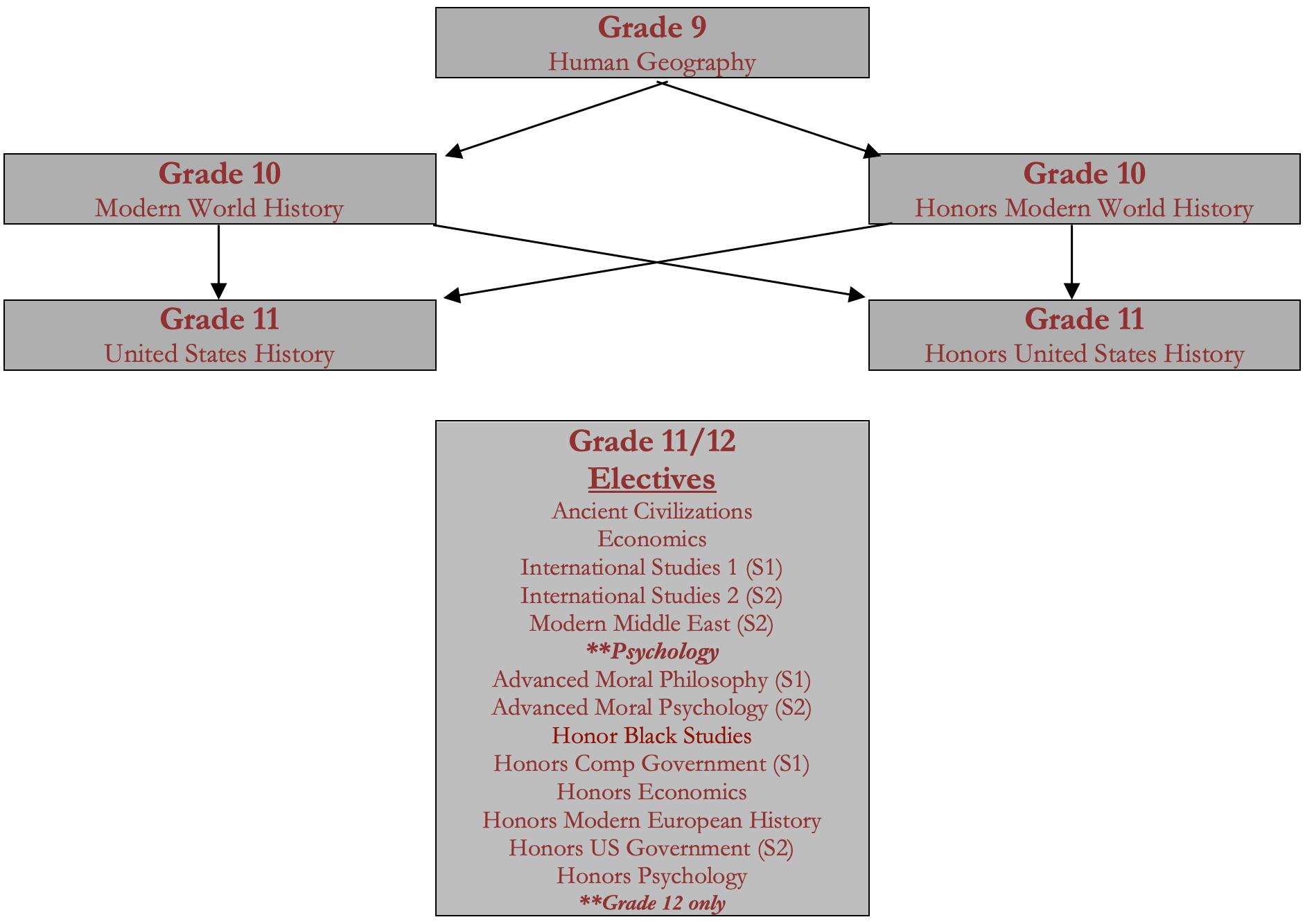
3 C r e d i t s R e q u i r e d - 1 E a c h i n H u m a n G e o g r a p h y , M o d e r n W o r l d H i s t o r y
o r H o n o r s M o d e r n W o r l d H i s t o r y , U n i t e d S t a t e s H i s t o r y o r H o n o r s U n i t e d
S t a t e s H i s t o r y
T h e m i s s i o n o f t h e U p p e r S c h o o l H i s t o r y a n d S o c i a l S c i e n c e D e p a r t m e n t i s
t o p r e p a r e s t u d e n t s t o b e t h o u g h t f u l a n d a c t i v e l y - e n g a g e d c i t i z e n s i n a n
i n c r e a s i n g l y c o m p l e x a n d i n t e r c o n n e c t e d w o r l d T h e d e p a r t m e n t ’ s p r o g r a m
i s r o o t e d i n a f o u n d a t i o n o f w o r l d h i s t o r y , g e o g r a p h y a n d g l o b a l i s s u e s ,
c o m p l e m e n t e d b y a n e x a m i n a t i o n o f U n i t e d S t a t e s h i s t o r y a n d a n a r r a y o f
e l e c t i v e s i n b o t h h i s t o r y a n d t h e s o c i a l s c i e n c e s . A l l o f t h e d e p a r t m e n t ’ s
o f f e r i n g s p r o v i d e a b a l a n c e b e t w e e n s k i l l d e v e l o p m e n t a n d c o n t e n t
k n o w l e d g e , a n d e m p h a s i z e a n a c t i v e c o n s i d e r a t i o n o f t h e r i g h t s a n d
r e s p o n s i b i l i t i e s o f c i t i z e n s h i p , b o t h n a t i o n a l a n d g l o b a l , a s w e l l a s a n
a p p r e c i a t i o n f o r t h e c o m p l e x i t y a n d d i v e r s i t y o f t h e h u m a n e x p e r i e n c e
I n t h e i r j o u r n e y t h r o u g h t h e p r o g r e s s i o n o f H i s t o r y a n d S o c i a l S c i e n c e
c o u r s e s , s t u d e n t s w i l l d e v e l o p a n d h o n e t h e a b i l i t y t o a n a l y z e e v i d e n c e
f r o m a v a r i e t y o f s o u r c e s , t o t h i n k a n a l y t i c a l l y a n d c o n t e x t u a l l y , t o
u n d e r s t a n d a m u l t i t u d e o f p e r s p e c t i v e s a n d h i s t o r i c a l i n t e r p r e t a t i o n s , a n d
t o c o m m u n i c a t e e f f e c t i v e l y , b o t h v e r b a l l y a n d i n w r i t i n g I n t h e p r o c e s s ,
t h e y w i l l g a i n a d e e p e r u n d e r s t a n d i n g o f h u m a n s ’ i n t e r a c t i o n s w i t h e a c h
o t h e r a n d w i t h t h e e n v i r o n m e n t ; o f t h e h i s t o r i c a l f o r c e s t h a t h a v e s h a p e d
t h e m o d e r n w o r l d ; a n d o f t h e l o c a l , n a t i o n a l , a n d g l o b a l c o m m u n i t i e s i n
w h i c h t h e y l i v e . T h e g o a l o f t h e H i s t o r y a n d S o c i a l S c i e n c e p r o g r a m i s t o
s u p p o r t t h e C o l u m b u s A c a d e m y ’ s b r o a d e r m i s s i o n o f d e v e l o p i n g
“ t h o u g h t f u l , r e s p o n s i b l e , c a p a b l e a n d c o n f i d e n t c i t i z e n s e a g e r t o e n g a g e i n
a p l u r a l i s t i c a n d e v e r - c h a n g i n g w o r l d ”
History Department Flow Chart
Human Geography (Full Year, 1 Credit)
Human Geography provides students with a foundation for further Upper School studies through an exploration of cultural geography and contemporary global issues, along with opportunities to practice and develop skills in research, analysis, reading, and writing The course will examine the forces that have shaped the modern world through the lenses of several social sciences including geography, history, economics, and sociology After an introductory examination of both world geography and global issues, units will explore a variety of topics including: governance and human rights, culture and identity, world religions, human interaction with the environment, demographics, migration and urbanization, and globalization and world trade. This course will emphasize global themes, processes, and connections among cultures Analysis and contextualization of current events and global issues are ongoing, integral elements of this course
Modern World History (Full Year, 1 Credit)
This course will thematically examine the development of humans and complex societies, from the global convergence of the 15th century CE to the present day. The course will analyze the continuing development of increasingly sophisticated social, economic, and political systems. Interaction with the environment, the impact of technological innovation, and global interconnections are all recurring themes It will also examine the roots of the major ideologies of the present, including democracy, socialism, capitalism, nationalism, imperialism, and globalism, in an attempt to understand and relate these forces to modern society The analysis and contextualization of current events and global issues are ongoing, integral elements of this course.
United States History (Full Year, 1 Credit)
This course is taught within a chronological framework, with special emphasis on themes such as American identity, the growth of democracy, civil rights and liberties, economic development, the environment, the impact of technology, cultural diversity, the individual and society, the influence of religion, and the U S role in world affairs The course requires students to explore and evaluate divergent viewpoints, and examine various historical perspectives, including the arts, literature, and cultural artifacts of the time. The development of critical thinking and writing skills is emphasized, and the successful completion of a capstone research paper is a course requirement
Honors United States History (Full Year, 1 Credit)
The objectives of this rigorous course are to learn the history of the United States and to develop the skills to “think like a historian ” Critical and comparative thinking, self-awareness, and respect for opposing viewpoints are essential skills in understanding, maintaining, and supporting democracy. Students will develop a broad understanding of the United States’ social, political, economic, and cultural development; as well as its role in global history Students will also build the skills of historical thinking and writing, including understanding historical causation, patterns of continuity and change over time, and periodization; using comparison and contextualization; crafting a cogent historical argument using relevant historical evidence; and interpreting sources To achieve these objectives, students will rely on extensive use of both primary and secondary sources. This course will prepare students for the Advanced Placement Examination in United States History.
Prerequisite: A final grade of A- in Modern World History or a B in Honors Modern World History and faculty recommendation.
Ancient Civilizations (Full Year, 1 Credit)
This class is an introduction to the history and culture of the ancient civilizations of Mesopotamia, Egypt, Persia, Greece, Rome, China, and India. It provides a background of the chronological development of these civilizations and then traces their political, economic, and social development up through the beginnings of the postclassical period (500 CE) Together we will examine some of the major themes of early world history, including the interaction between humans and the environment, state formation, cultural diffusion and cultural conflict, the role of religion, and the evolution of social and economic structures over a period of 3000 years
Economics (Full Year, 1 Credit)
Economics is designed to develop students’ economic reasoning thro principles of economics, the economy of the United States and its economics, and important concepts of personal finance and financial l history of economic theory and an introduction to the basic princi microeconomics will be presented in the first semester The secon understanding of these principles in the context of personal finance The concepts of financial literacy by covering the following topics: Saving and Taxes, Credit Card and Credit Markets, and Budgeting and Consume analytical writing, in the application of basic mathematics to economic c primary documents will be important objectives of the course Jo introspective opportunities for students to apply concepts on a personal scale, as well as to analyze a variety of scenarios from a third-party perspective
International Studies 1 (Semester 1 Elective, ½ Credit)
This first semester course will examine the modern histories of Latin America and Southern Africa. Students will explore the diverse cultural footprints of each region and seek to understand current issues in both local and global contexts, and in doing so develop their cultural literacy In a multidisciplinary way we will examine a variety of aspects of culture, including: history, language, literature, art and music, religion, identity, geography, political and economic systems, and cultural assimilation (or lack thereof). Students will draw primarily from text materials and their own research and will work frequently in groups to critically examine the many facets of these regions, their development, and their relations with others. This course is a complement to International Studies 2: although it is not required to take both courses, they approach different regions of the world similarly and thus will provide a more complete understanding of four different regions if taken in sequence
International Studies 2 (Semester 2 Elective, ½ Credit)
This second semester course will examine the modern histories of South Asia and East Asia. Students will explore the diverse cultural footprints of each region and seek to understand current issues in both local and global contexts, and in doing so develop their cultural literacy In a multidisciplinary way, we will examine a variety of aspects of culture, including: history, language, literature, art and music, religion, identity, geography, political and economic systems, and cultural assimilation (or lack thereof) Students will draw primarily from text materials and their own research and will work frequently in groups to critically examine the many facets of these regions, their development, and their relations with others. This course is a complement to International Studies 1: although it is not required to take both courses, they approach different regions of the world similarly and thus will provide a more complete understanding of four different regions if taken in sequence
Modern Middle East (Semester 2 Elective, ½ Credit)
The goal of this seminar-style course is to provide students with new channels of information to study the diverse aspects of the modern Middle East, resulting in a more nuanced understanding of a world region that is often defined in very severe and finite ways. Students will be asked to explore the cultures, politics, and recent histories of the Middle East through a variety of media, including written sources, film, and music We will discuss some or all of the following topics: the creation of the modern Middle East (and why it is called “the Middle East”); the role of Islam inside and outside of the region; U S foreign policy toward the Middle East; understanding the Palestine/Israel conflict through music; the non-Arab Middle East; and the interplay between resources, religion, and politics Additional topics will be discussed based on the interests and input of the students.
Psychology (Full Year Elective, 1 Credit)
Psychology is a senior-only survey course which involves the study of behavior and mental processes
Most of the course will be spent learning about normal human behaviors and the techniques that psychologists use to research these behaviors Topics discussed include research methods, the biology of behavior, sensation and perception, stress and adjustment, learning, memory, cognition, motivation and emotion, life-span development of behavior, personality, and gender and sexuality.
Advanced Moral Philosophy (S1) (Semester 1 Elective, ½ Credit)
In this course students will study the classical modes of normative ethical reasoning. Much time and attention will be given to the three leading schools of thinking: utilitarian, deontological, and virtuebased ethics The laws and language of these ways of reasoning are widely used in public debates and around contentious social issues and economic policy, and clear links will be established where relevant In addition, students will learn how these philosophies undergird competing visions for organizing society and the role of government in the lives of citizens Finally, students will explore how the concept of justice is understood by each school of thought, and how that understanding might logically take root in culture and the minds of its citizens.
Prerequisite: A final grade of A- in Modern World History or a B in Honors Modern World History, or a B- in United States History or in Honors United States History, and faculty recommendation.
Advanced Moral Psychology (S2) (Semester 2 Elective, ½ Credit)
Evolutionary theory has opened new doors to exploring our moral ideas and instincts. Once the exclusive domain of theologians and philosophers, moral ideas have been increasingly the subject of psychologists This course will introduce students to the complex but rapidly growing study of moral psychology This approach to understanding our moral lives does not depend on the existence of a moral deity, not does it require that people be impartial or perfectly rational Students will learn how the pressures of natural selection may have favored traits such as cooperation and empathy, which over time, may have emerged as human virtues of honesty, fairness, and compassion. While powerful in explaining where such virtues may have originated, moral psychology is far less useful as a guide to future actions. Students will end their studies in this course by grappling with the implications of this shortcoming Is this a cause for despair, an excuse to grab for power, the proof of the necessity of human reason, or the basis for a leap of faith?
Prerequisite: A final grade of A- in Modern World History or a B in Honors Modern World History, or a B- in United States History or in Honors United States History, and a faculty recommendation.
Honors African American Studies (Full Year Elective, 1 Credit)
This survey course focuses on the historical, political and social contributions of the African Diaspora Students begin this journey in precolonial Africa before moving through the era of enslavement and resistance, then pushing as far forward as contemporary political and social movements around the globe While working through understanding the multiple histories of the African Diaspora, students will use the foundations of history, sociology, philosophy, and literary and data analysis to explore the various dimensions of African American studies. Much of the work done in class will center around the reading of primary sources and historical texts that often conflict Discussion and participation are necessary aspects of this course and students will be expected to engage with the texts, their classmates and instructor during each class This course will prepare students for the Advanced Placement exam in African American Studies
Prerequisite: A final grade of A- in Modern World History or a B in Honors Modern World History, or an A- in United States History or a B in Honors United States History, and faculty recommendation.
Honors Comparative Government (S1) (Semester 1 Elective, ½ Credit)
This one-semester honors course in Comparative Government and Politics introduces students to the fundamental concepts used by political scientists to study the processes and outcomes of politics in a variety of global settings. It aims to illustrate the rich diversity of political life, to show available institutional alternatives, to explain differences in processes and policy outcomes, and to communicate to students the importance of global political, social, and economic changes In addition to covering the major concepts that are used to organize and interpret what we know about political phenomena and relationships, students will apply these concepts through in-depth studies of specific countries and their governments (Great Britain, China, Russia, Iran, Nigeria, and Mexico) This course prepares students for the Advanced Placement Examination in Comparative Government.
Prerequisite: A final grade of A- in Modern World History or a B in Honors Modern World History, or a B- in United States History or in Honors United States History, and faculty recommendation
Honors Economics (Full Year Elective, 1 Credit)
Honors Economics gives students a thorough understanding of the principles of economic systems. The course places particular emphasis on the study of national income and price determination, and develops the students’ familiarity with economic performance measures, economic growth, and international economics Textbook readings, primary source readings, simulations, group projects, and individual problem-solving activities are used to build understanding In addition, short papers on current topics and a presentation on a selected topic are required The course will prepare students for the Advanced Placement Examination in Macroeconomics.
Prerequisite: A final grade of A- in Modern World History or a B in Honors Modern World History, or a B- in United States History or in Honors United States History, or faculty recommendation.
Honors Modern European History (Full Year Elective, 1 Credit)
Honors Modern European History is a chronologically organized study of Western civilization from approximately 1300 CE to the present. It offers a comprehensive examination of the foundations of the Western world, including religious beliefs, intellectual movements, and political and economic ideologies such as liberalism, democracy, industrialism, capitalism, socialism, and imperialism Students will examine the themes of political, social, and cultural change in European history through multiple perspectives, and will also consider issues of historiography through the analysis of primary and secondary sources This course helps students prepare to take the Advanced Placement Examination in May.
Prerequisite: A final grade of A- in Modern World History or a B in Honors Modern World History, or a B- in United States History or in Honors United States History, and faculty recommendation.
Honors US Government and Politics (S2) (Semester 2 Elective, 1/2 Credit)
This course is designed to survey the United States federal government and political systems Students will learn to interpret and analyze the Constitution, important political documents, and data to better understand the American national government and the political actors who interact with it. Course themes include constitutionalism, liberty and order, civic participation in a representative democracy, competing policy making interests, and methods of political analysis Students will be prepared to take the Advanced Placement U S Government Examination in May
Prerequisite: A final grade of A- in Modern World History or a B in Honors Modern World History, or a B- in United States History or Honors United States History, and faculty recommendation.
Honors Psychology (Full Year Elective, 1 Credit)
Honors Psychology is a college-level introduction to the major topics in psychology From the biological foundation of the human animal to the power of our social environments and our own selfconstructed identities, this course carefully examines the roots of human behavior, cognition, and emotion. This examination includes a study of how the self develops from a dependent infant to an independent adult, as well as the remarkable diversity of personalities that make the study of human beings so complex and yet fascinating This course emphasizes both the research findings and the research methods that make psychology a rigorously empirical field of study Honors Psychology helps prepare students to take the Advanced Placement Psychology Exam in May
Prerequisite: A final grade of A- in Modern World History or a B in Honors Modern World History, or a B- in United States History or Honors United States History, and faculty recommendation.

4 C r e d i t s R e q u i r e d - I n c l u d i n g A l g e b r a 2
I n t h e U p p e r S c h o o l m a t h e m a t i c s p r o g r a m a t C o l u m b u s A c a d e m y , s t u d e n t s
f o l l o w a t r a d i t i o n a l c o u r s e s e q u e n c e ( A l g e b r a 1 , G e o m e t r y , A l g e b r a 2 , a n d
P r e c a l c u l u s ) . S t a n d a r d , a d v a n c e d , a n d h o n o r s p a t h w a y s p r o v i d e d i f f e r e n t
l e v e l s o f c h a l l e n g e t o m e e t t h e l e a r n i n g n e e d s , i n t e r e s t s , a n d m a t h e m a t i c a l
a b i l i t i e s o f e a c h s t u d e n t I n a d d i t i o n t o t h e c o r e m a t h c u r r i c u l u m , s t u d e n t s
c a n t a k e e l e c t i v e c o u r s e s i n Q u a n t i t a t i v e R e a s o n i n g , A d v a n c e d C a l c u l u s ,
A d v a n c e d S t a t i s t i c s , C a l c u l u s - B a s e d P r o b a b i l i t y a n d S t a t i s t i c s ,
M u l t i v a r i a b l e C a l c u l u s , a n d m u l t i p l e C o m p u t e r S c i e n c e c o u r s e s .
C o n n e c t i n g t o t h e M a t h V i s i o n o f C o l u m b u s A c a d e m y , a l l s t u d e n t s i n t h e
U p p e r S c h o o l w i l l d e v e l o p P r o b l e m S o l v i n g s k i l l s , R e a s o n i n g s k i l l s , a n d a
G r o w t h M i n d s e t T o f o s t e r P r o b l e m S o l v i n g a n d R e a s o n i n g , a l l s t u d e n t s
w i l l e n g a g e i n r i c h , n o n - r o u t i n e p r o b l e m s i n v o l v i n g l o g i c , v i s u a l i z a t i o n ,
r e p r e s e n t a t i o n s , a n d m o d e l i n g T h e s e c h a l l e n g e s w i l l h e l p t o d e v e l o p a
m i n d s e t i n w h i c h m i s t a k e s a r e v a l u a b l e p a r t s o f t h e l e a r n i n g p r o c e s s a n d
i n d i v i d u a l g r o w t h i s a c r i t i c a l c o m p o n e n t o f a s s e s s m e n t .
Mathematics Department Flow Chart
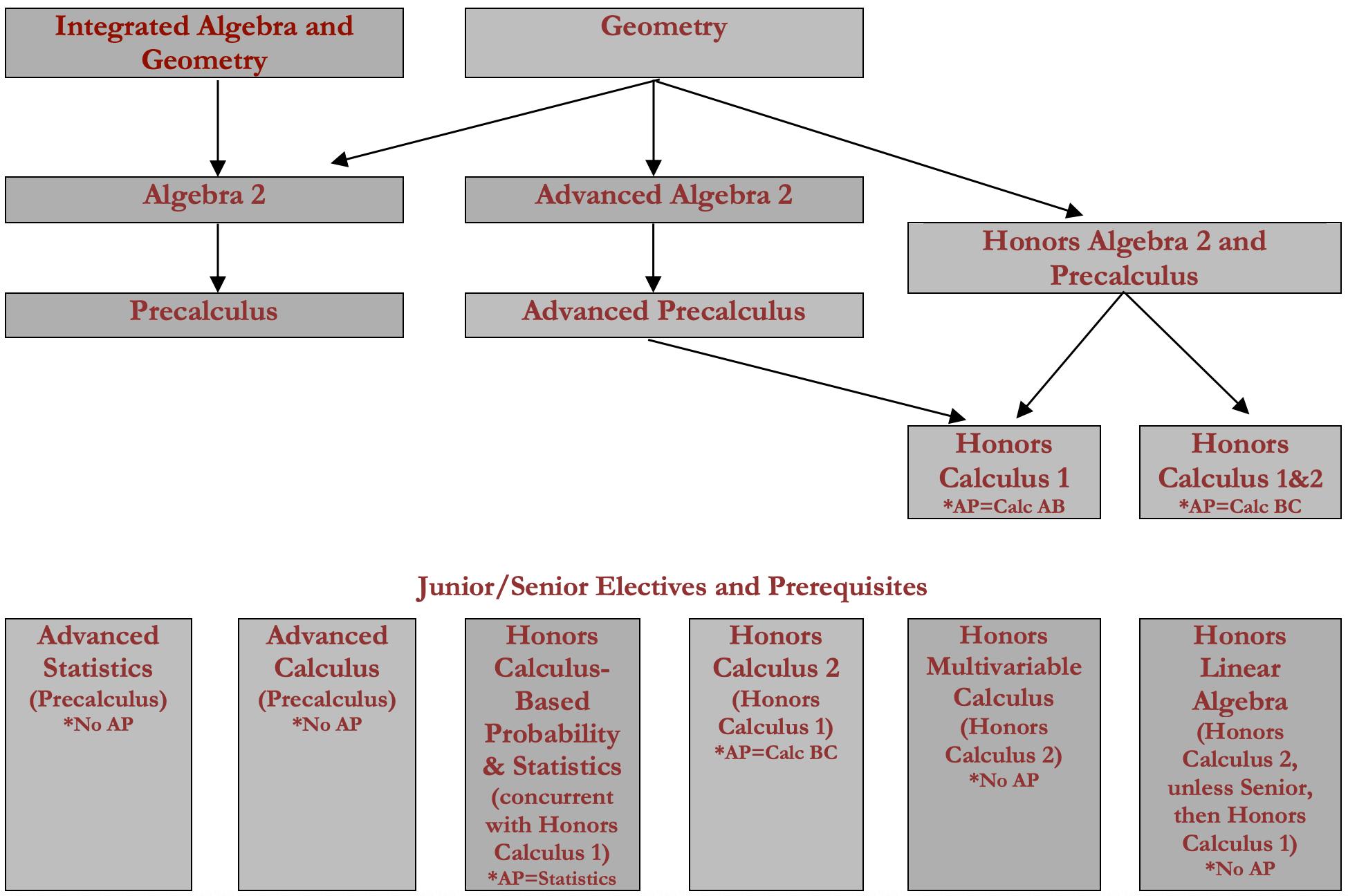
Integrated Algebra B (Full Year, 1 Credit)
Integrated Algebra B is the second year of out Integrated Algebra sequence In this course, students will learn the content of Algebra 1 and Geometry in order to set them up for success in Algebra 2 Topics covered in Integrated Algebra B include the study of functions (quadratics, polynomials, and exponential) and analytic Geometry (distance formulas, the Pythagorean Theorem, the Midpoint formula, the equation of a circle, perimeter, area, volume, and triangle trigonometry).
Prerequisite: Pre-Algebra
Geometry (Full Year, 1 Credit)
In Geometry, students will explore the concepts of Euclidean geometry, congruency, and similarity within the context of triangles, quadrilaterals, polygons, and 3-D figures, surface area and volume, basic trigonometry, coordinate geometry. The curriculum is designed to incorporate deductive reasoning, algebraic manipulation, and technology as students develop a greater understanding of proofs, logic, observation, measurement and description Geometry provides the foundational concepts and thought processes required for Pre-Calculus, Calculus, and standardized tests Throughout this course, there is an emphasis on problem solving, proof, communication, and effective use of technology
Prerequisite: Algebra 1
Algebra 2 (Full Year, 1 Credit)
In standard-level Algebra 2, students will review the concepts introduced in Algebra 1 and deepen their understanding of algebraic operations, simplifying expressions, solving equations, and graphing functions while exploring linear functions and systems, quadratic functions, radical functions, rational expressions and equations, exponential functions, logarithmic functions, conic sections, and basic statistics. Throughout this course, there is an emphasis on processes, communication of mathematics, and effective use of technology Upon successful completion of this course, students have learned the core concepts required for the SAT exam and are prepared to take Precalculus
Required Materials: TI-NSpire CX calculator
Prerequisite: Algebra 1 and Geometry
Advanced Algebra 2 (Full Year, 1 Credit)
In Advanced Algebra 2, students also review the concepts introduced in Algebra 1 and deepen their understanding of algebraic operations, simplifying expressions, solving equations, and graphing functions while exploring linear functions and systems, quadratic functions, radical functions, rational expressions and equations, exponential functions, logarithmic functions, conic sections, and basic statistics. Upon successful completion of this course, students have learned the core concepts required for the SAT exam and are prepared to take Advanced Precalculus. Throughout this course, there is an emphasis on problem solving, communication of mathematics, and effective use of technology This advanced course is designed for students who enjoy mathematics, seek a greater level of challenge, and accept the responsibility that accompanies an advanced mathematics course
Required Materials: TI-NSpire CX calculator
Prerequisite: Geometry AND permission of the department
Honors Algebra 2 and Precalculus (Full Year, 1 Credit)
Honors Algebra 2 and Precalculus combines the topics of two math courses in one school year Students will deepen their understanding of algebraic operations, simplifying expressions, solving equations, and graphing functions while exploring linear functions and systems, quadratic functions, radical functions, exponential functions, logarithmic functions, and conic sections. In the Precalculus section of the course, students will study polynomial functions, rational functions, right triangle and unit circle trigonometry, trigonometric functions and their graphs, inverse trigonometric functions,
trigonometric identities, trigonometric applications, sequences and series, probabil Honors Algebra 2 and Precalculus is designed for students with a very strong aptitude and a willingness to accept the responsibility that accompanies a rigorous mathemat accelerated pace. This course prepares students for Honors Calculus 1 & 2.
Required Materials: TI-NSpire CX calculator
Prerequisite: Geometry AND permission of the department
Precalculus (Full Year, 1 Credit)
In Precalculus, students will build upon the concepts learned in Algebra 2 and us modeling as foundation to develop a deeper understanding of polynomial fun , functions, exponential functions, logarithmic functions, logistic functions, logistic functions, vectors, and matrices After reviewing the concepts of trigonometry introduced in Geometry, students will learn about trigonometric functions and their graphs, inverse trigonometric functions, trigonometric identities, and their applications Throughout this course, there is an emphasis on problem solving, real-world applications, and effective use of technology Upon successful completion of this course, students are prepared to take Calculus.
Required Materials: TI-NSpire CX calculator
Prerequisite: Algebra 2
Advanced Precalculus (Full Year, 1 Credit)
In Advanced Precalculus, students will build upon the concepts learned in Advanced Algebra 2 to develop a deeper understanding of various types of functions. Topics studied include polynomial functions, rational functions, exponential functions, logarithmic functions, matrices, unit circle trigonometry, trigonometric functions, inverse trigonometric functions, trigonometric identities, and equations, laws of sines and cosines, polar coordinates, parametric functions, vectors, sequences and series, binomial theorem, induction, combinatorics and probability, and an introduction to Calculus Advanced Precalculus is designed for students who have a very strong command of Algebra 2 concepts, plan to take AP Calculus in the future, and accept the responsibility that accompanies a rigorous mathematics course. This course prepares students for Honors Calculus.
Required Materials: TI-NSpire CX calculator
Prerequisite: Advanced Algebra 2 AND permission of the department
Advanced Statistics (Full Year Elective, 1 Credit)
This non-calculus-based statistics course introduces students to the major concepts and tools used to collect, analyze, and draw conclusions from real-world data. Students will explore themes in exploring data, sampling and experimentation, probability and simulation, and statistical inference, with the option to take the Advanced Placement exam Students will use technology, investigations, problem solving, and writing as they build conceptual understanding Students who are on track to take Honors Calculus 1 should NOT take this course Instead, they should take the Honors Calculus-Based Probability and Statistics (HCPSTATS) course.
Required Materials: TI-NSpire CX calculator
Prerequisite: Precalculus or Advanced Precalculus AND permission of the department OR Algebra 2 and permission by the department to take as a senior.
Advanced Calculus (Full Year Elective, 1 Credit)
This course covers the content of a first semester college Calculus course. Students who have completed Precalculus or Advanced Precalculus will learn about limits, differentiation, antidifferentiation, definite and indefinite integrals, and applications of Calculus using exponential and logarithmic functions Students will have the option of taking the Calculus AB Advanced Placement Exam
Required Materials: TI-NSpire CX calculator
Prerequisite: Precalculus or Advanced Precalculus and permission of the department
Honors Calculus 1 (Full Year, 1 Credit)
This is an honors course, providing mastery of Calculus topics commensurate with a first semester college Calculus course In preparation for the AP Calculus AB exam, students will learn about the limits and continuity of functions, derivatives and their applications, integrals and their applications, advanced integration techniques, differential equations, and volumes of solids of revolution. Students will be expected to take the AP Calculus AB exam This honors-level course is designed for students who enjoy mathematics, have a strong command of Precalculus concepts, seek a greater level of challenge and accept the responsibility that accompanies a rigorous mathematics course Throughout this course, there is an emphasis on problem solving, real-world applications, and effective use of technology.
Required Materials: TI-NSpire CX calculator
Prerequisite: Advanced Precalculus or Honors Algebra 2 and Precalculus
Honors Calculus 1 and 2 (Full Year, 1 Credit)
This is an honors course, providing mastery of Calculus topics commensurate with the first and second semester of a college Calculus course. In preparation for the AP Calculus BC exam, students will learn about limits and continuity of functions, derivatives and their applications, integrals and their applications, advanced integration techniques, differential equations, volumes of solids of revolution, infinite sequences and series, Taylor Polynomial approximations and Taylor series, and parametric, polar, and vector functions Students will be expected to take the AP Calculus BC exam This honorslevel course is designed for students who enjoy mathematics, have a very strong command of Precalculus concepts, seek a greater level of challenge and accept the responsibility that accompanies a rigorous mathematics course. Throughout this course, there is an emphasis on problem solving, real-world applications, and effective use of technology
Required Materials: TI-NSpire CX calculator
Prerequisite: Advanced Precalculus or Honors Algebra 2 & Precalculus
Honors Calculus 2 (Full Year Elective, 1 Credit)
This is an honors course, providing mastery of Calculus topics commensurate with the second semester of a college Calculus course In preparation for the AP Calculus BC exam, students will review the concepts taught in HCALC1 and learn about advanced integration techniques, infinite sequences and series, Taylor Polynomial approximations and Taylor series, and parametric, polar, and vector functions Students will be expected to take the AP Calculus BC exam This honors-level course is designed for students who enjoy mathematics, have a strong command of HCALC1 concepts, seek a greater level of challenge and accept the responsibility that accompanies a rigorous mathematics course. Throughout this course, there is an emphasis on problem solving, real-world applications, and effective use of technology
Required Materials: TI-NSpire CX calculator
Prerequisite: Honors Calculus 1
Honors Calculus-Based Probability and Statistics (Full Year Elective, 1 Credit)
This rigorous course develops the mathematical underpinnings of probability and mathematical statistics The focus of the first semester is probability Topics studies will include axiomatic probability, discrete and continuous univariate and bivariate distribution functions and their properties, special and commonly used distributions, and large-sample approximation In the second semester students develop and apply inferential statistical methods, including interval estimation and hypotheses testing for one and two means or proportions, tests for independence in categorical data, analysis of variance with multiple comparisons, and simple and multiple regression models.
Students will learn to formulate research questions, design appropriate surveys or experiments, and analyze resulting data Substantial focus is on providing a rigorous development of principles that link these inferential methods At the end of this extensive course, all students are required to take the Advanced Placement Statistics exam.
Required Materials: TI-NSpire CX calculator
Prerequisite: Honors Calculus 1 or Honors Calculus 1 & 2 or concurrently enrolled in Honors Calculus 1, Honors Calculus 1 & 2 or Honors Calculus 2 AND permission of the department
Honors Multivariable Calculus (Full Year Elective, 1 Credit)
Honors Multivariable Calculus generalizes the major ideas from Calculus (rates of change, differentiation, optimization, integration, etc ) to functions of more than one variable, providing a study of paths and surfaces in space These generalizations are applied to study mathematical objects in three or more dimensions This course introduces vector analysis, partial derivatives, multiple integrals, and some matrix algebra Additional course objectives include a better understanding of series and introductory topics in linear algebra Mathematical software is used to enhance visualization and understanding of course concepts.
Required Materials: TI-Spire CX calculator
Prerequisite: Honors Calculus 1 and 2 or Honors Calculus 2 AND permission of the department
Honors Linear Algebra (Full Year Elective, 1 Credit)
In Honors Linear Algebra, students explore the foundational concepts and methods that underpin much of higher mathematics and its applications in science, engineering, and economics. Students will develop an understanding of vector spaces, matrices, linear transformations, and systems of linear equations The course emphasizes both theoretical framework and practical applications of linear algebra
Topics include the following:
Vectors and vector operations in two and three dimensions
Matrix operations, determinants and inverses
Solving systems of linear equations using Gaussian elimination
Vector spaces, subspaces, basis and dimension
Eigenvalues, eigenvectors and diagonalization
Orthogonality, projections and least squares solutions
Through lectures, problem-solving and real-world applications, students will enhance their analytical skills and gain tools to tackle problems across diverse disciplines. Honors Linear Algebra is designed to build a solid mathematical foundation, preparing students for further studies in mathematics, engineering, computer science and related fields
Computer Science Flow Chart
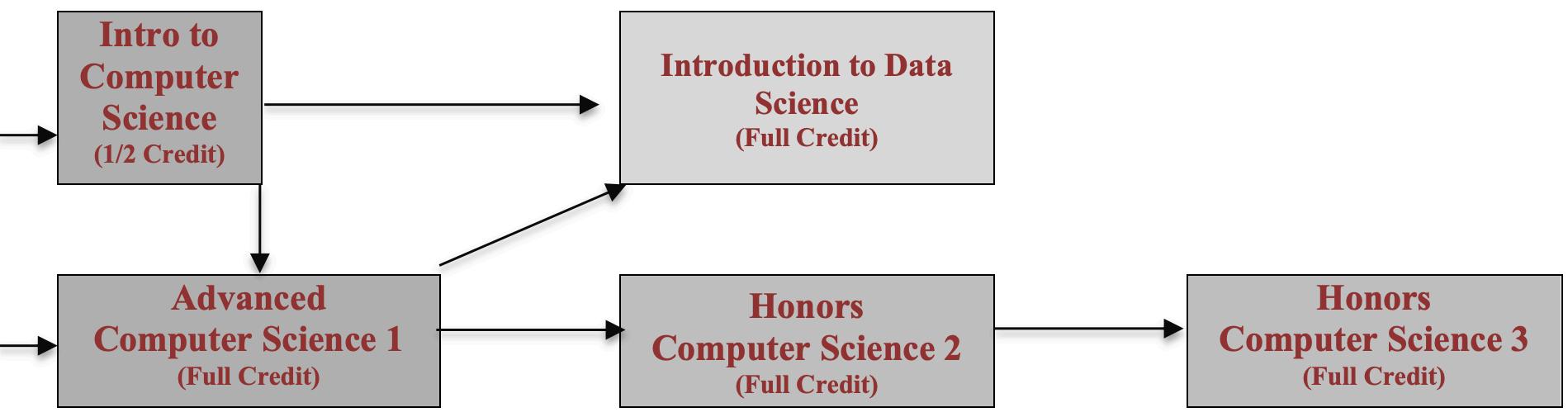
Introduction to Computer Science (Full Year, 1/2 Credit)
This course provides a gentle introduction to computer science by teaching core programming constructs (conditionals, loops, variables, and functions) Through a gentle pace, students complete projects written in HTML/CSS, and JavaScript This course is recommended for students who are interested in computer science and in developing their own programs No prior experience is necessary. This class is available to students in grades 9-12. This course does not prepare students for the Advanced Placement Computer Science exam.
Introduction to Data Science (Full Year, 1 Credit)
This course provides an introduction to data science principles including data cleaning, data visualization, and classification/prediction algorithms Students will learn programming basics in Python and R through a variety of lab assignments and projects This course is available to all students in grades 10-12 who are interested in exploring concepts of big data, machine learning, and/or applying statistical methods to real world problems.
Prerequisite: Introduction to Computer Science or Advanced Computer Science 1 and permission of the department This course is not open to students in or who have taken Honors Computer Science 2 or Honors Computer Science 3
Advanced Computer Science (Full Year, 1 Credit)
Advanced Computer Science is an introduction to computer science using the Java programming language This class is modeled on a college-level programming course that embraces the objectoriented paradigm In addition to core programming constructs (conditionals, loops, variables, and methods), students also study more advanced topics including data structures (arrays and arraylists) and writing and using classes By the end of the year, students will be able to independently develop substantial programs. This class is available to students in grades 9-12. No prior experience is necessary. Students who continue on to take Honors Computer Science 2 in a subsequent year will prepare to take the Advanced Placement Computer Science A exam then
Prerequisite: Must be concurrently enrolled in an advanced or honors level mathematics course OR permission by the department
Honors Computer Science 2 (Full Year, 1 Credit)
This course is modeled after a collegiate level data structures course. The data structures covered are linked lists, stacks, queues, binary search trees, hash tables, sets, and maps In addition, more complex searching and sorting algorithms and recursive techniques are covered
Prerequisite: Honors Computer Science 1
Honors Computer Science 3 (Full Year, 1 Credit)
This honors-level course will introduce students to a variety of topics selected from a typical undergraduate computer science curriculum The goal of the course is to develop a deeper understanding of computer science as more than just programming Topics addressed include: how information is measured, how computers work, how programming languages are developed, what the limits of computation are, how the internet works, and how computers can behave intelligently Students complete projects that relate to these topics.
Prerequisite: Honors Computer Science 2

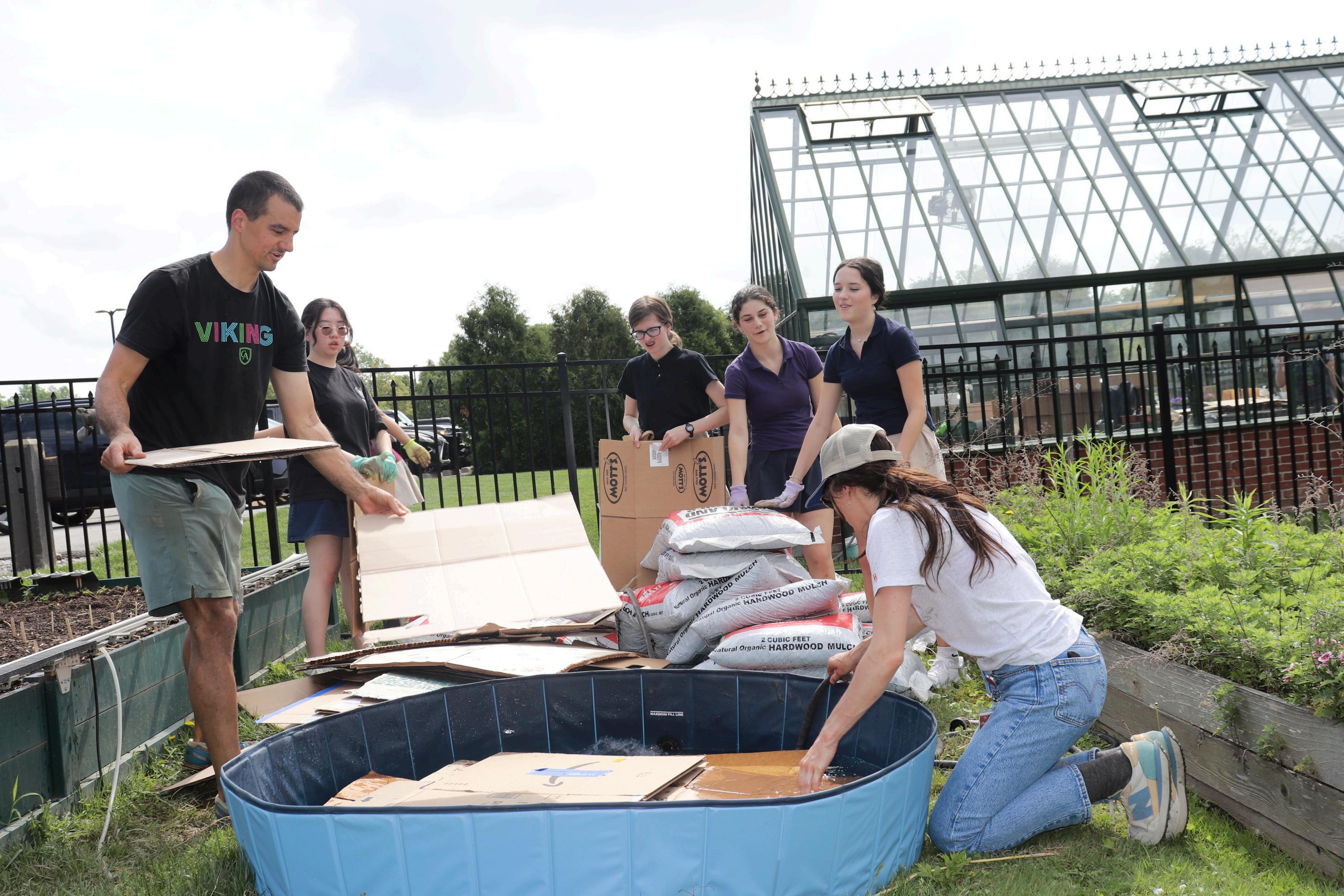
3 C r e d i t s R e q u i r e d - I n c l u d i n g B i o l o g y , C h e m i s t r y a n d P h y s i c s
T h e g o a l o f t h e s c i e n c e p r o g r a m i n t h e U p p e r S c h o o l i s t o p r o m o t e a n d
e n h a n c e s c i e n t i f i c k n o w l e d g e a n d p r o b l e m - s o l v i n g s k i l l s . S t u d e n t s t a k e
c o r e c o u r s e s i n b i o l o g y , c h e m i s t r y , a n d p h y s i c s , w i t h a s e l e c t i o n o f t h r e e
A d v a n c e d P l a c e m e n t c o u r s e s o f f e r e d a s s e c o n d - y e a r o p t i o n s I n a d d i t i o n ,
w e o f f e r s e v e r a l e l e c t i v e c o u r s e s i n t h e f i e l d s o f a n a t o m y a n d p h y s i o l o g y ,
a s t r o n o m y , e n v i r o n m e n t a l s c i e n c e , a n d r o b o t i c s
E a c h c o u r s e p r o v i d e s s t u d e n t s w i t h a n o p p o r t u n i t y t o h e i g h t e n t h e i r
s c i e n t i f i c l i t e r a c y b y i m p a r t i n g a c l e a r u n d e r s t a n d i n g o f t h e s c i e n t i f i c
m e t h o d t h r o u g h s k i l l s o f o b s e r v a t i o n , e x p e r i m e n t a t i o n , d a t a i n t e r p r e t a t i o n
a n d a n a l y s i s , c r i t i c a l t h i n k i n g , a n d c o m m u n i c a t i o n S t u d e n t s l e a r n t o w o r k
c o o p e r a t i v e l y i n t e a m s , u s e t e c h n o l o g y e f f e c t i v e l y , a n d v a l u e l i f e - l o n g
l e a r n i n g , w h i l e i n c r e a s i n g t h e i r a w a r e n e s s o f s o c i e t a l i s s u e s a n d c a r e e r
o p p o r t u n i t i e s
Science Department Flow Chart
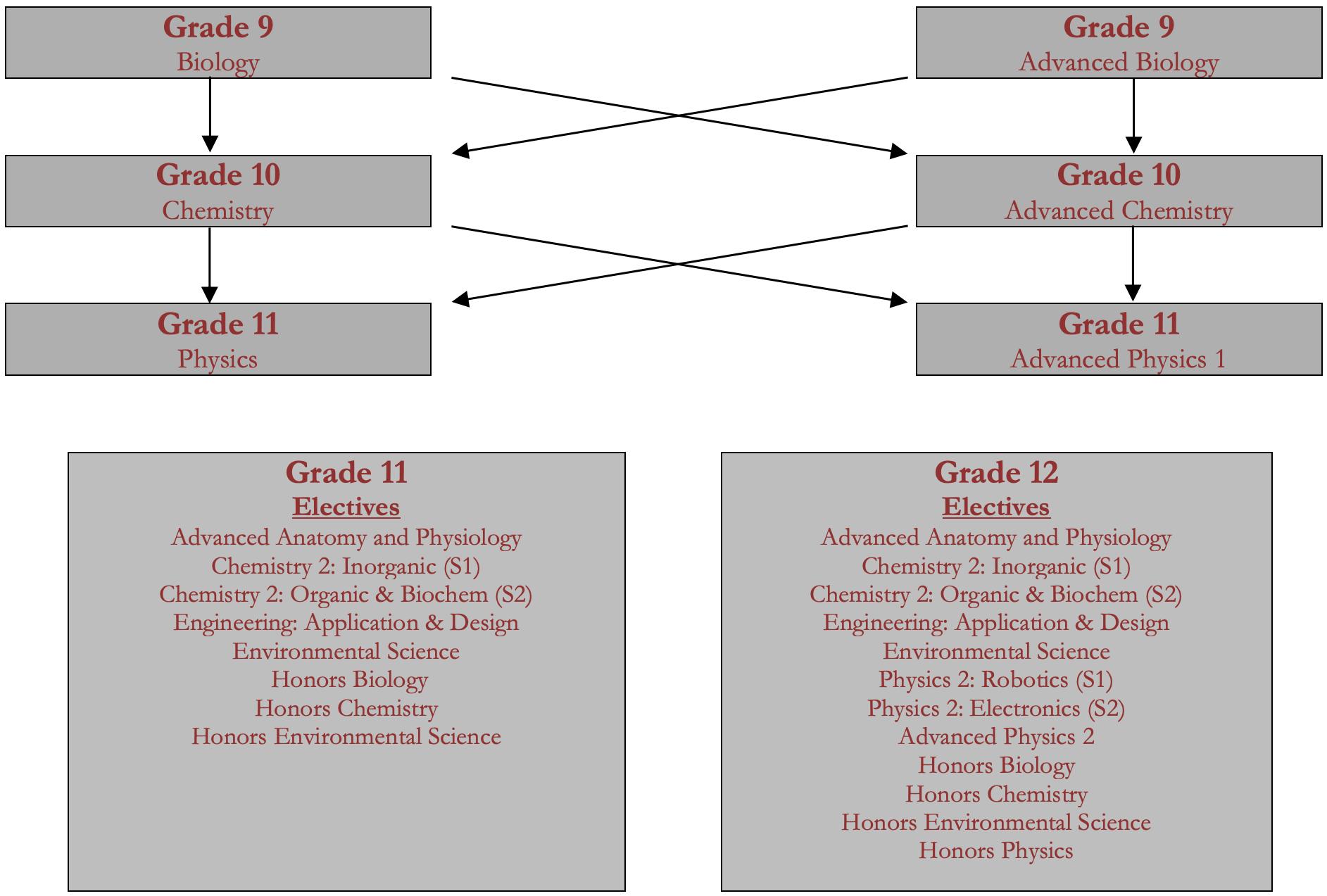
Biology (Full Year, 1 Credit)
Science, ecology, evolution, cell biology, and biochemistry are presented in the first semester, while systematic diversity of life, genetics, molecular biology and an overview of DNA, genetics, and human biology are studied second semester This course emphasizes real world applications of these concepts Laboratory and classroom activities stress a hands-on approach to science There is ample room in the Biology curriculum to spend extra time on a given topic or to explore special topics in order to meet the needs and desires of each group of students.
Prerequisite: Algebra 1 concurrent
Advanced Biology (Full Year, 1 Credit)
Science, ecology, evolution, animal behavior, and biochemistry are presented in the first semester, while cell biology, molecular biology, an overview of DNA and the cell cycle, genetics, the systematic diversity of life, and human biology are studied second semester. A large part of class time is spent on laboratory activities for which students will be expected to complete lab reports using standard scientific format There is time in the year to explore inquiry-based learning In addition, students will be expected to think on both a concrete as well as a conceptual level
Prerequisite: Recommendation from 8th grade science teacher and Algebra 1
Chemistry (Full Year, 1 Credit)
Chemistry is designed to help students gain understanding into the composition and properties of matter as well as how matter reacts In addition to studying the structure of the atom, topics include chemical bonding, stoichiometry, periodicity, study of the physical states, solutions and acid-base chemistry Practical application of chemistry is stressed through problem solving, and laboratory investigation is an integral part of the course.
Prerequisite: Algebra 1
Advanced Chemistry (Full Year, 1 Credit)
Advanced Chemistry is a traditional chemistry course that emphasizes depth of understanding and challenging problem solving Topics include the structure of the atom, chemical bonding, stoichiometry, periodicity, physical states, solutions, acid-base chemistry, kinetics, and equilibrium chemistry. Practical application of chemistry is stressed through problem solving, and laboratory investigation is an integral part of the course Problem sets and laboratory investigations are presented at a challenging level
Prerequisite: Advanced Algebra 2 concurrent and recommendation of biology teacher
Physics (Full Year, 1 Credit)
Students enrolled in this course will spend a full year exploring classical physics topics such as mechanics, electromagnetism, and wave phenomena Considerable emphasis is placed on conceptual understanding of these topics, but students are also expected to become proficient in quantitative problem solving Laboratory work is especially designed to deepen understanding and provide a true hands-on experience of the phenomena under discussion Advances in technology that strengthen the course are continually being integrated into the program, both in the traditional classroom setting and in the laboratory. Physics is a fast-paced, rigorous course that covers a wide range of topics.
Prerequisite: Algebra 2
Advanced Physics 1 (Full Year, 1 Credit)
Advanced Physics is a course designed to offer a greater challenge than stan students who are strong in science and mathematics This course explores the matter and energy and how they interact, with a strong emphasis on algebra Physics Topics include motion, forces, energy, waves, sound, light, and electr application of Physics is stressed through problem solving. Laboratory investiga of this advanced course.
Prerequisite: Advanced Algebra 2 AND recommendation of chemistry teacher
Advanced Anatomy and Physiology (Full Year Elective, 1 Credit)
Anatomy and Physiology is the study of the structure and function of the huma designed to provide an opportunity to investigate the various organ systems tha body, their structures, functions and commonly associated pathologies. Through direct instruction, dissections, case studies and project-based learning, students will develop skills such as problem solving, critical thinking and be able to participate in classroom discussion regarding our course of study and various common pathologies associated with the human body Annual field trips include a visit to the cadaver labs at OSU and participation in a suturing lab at OUCOM in Dublin, Ohio
Prerequisite: Biology and Chemistry
Chemistry 2: Inorganic Chemistry (S1) (Semester 1 Elective, 1/2 Credit)
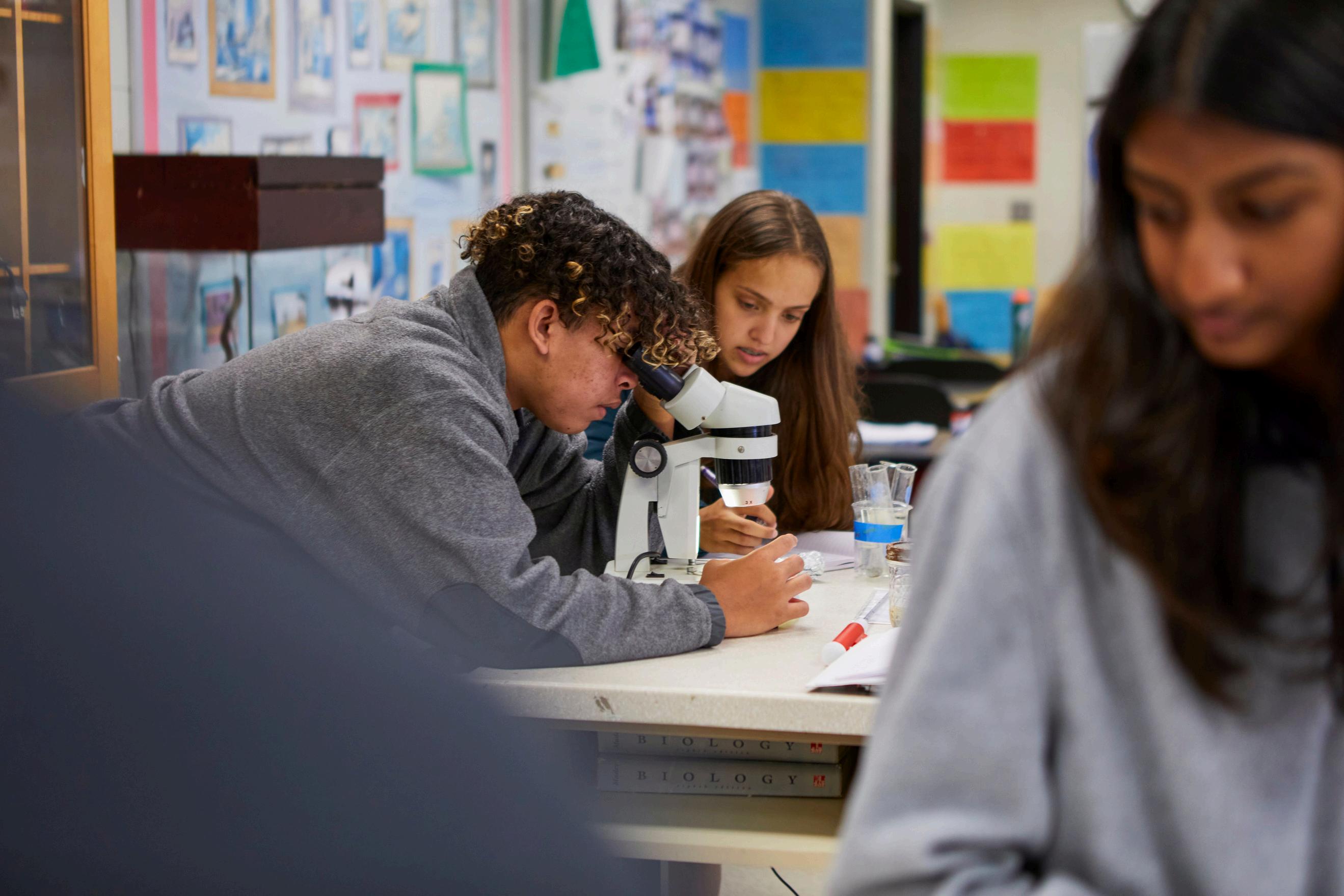
This one semester chemistry course will continue the study of matter This course is designed for students who wish to further their understanding in chemistry with more advanced topics The course will provide a short review of stoichiometry in relation to solids, liquids and gasses Further investigations will cover equilibrium reactions, advanced acids and bases, advanced thermodynamics, nuclear chemistry as well as transition metals and coordination compounds. Concepts and application of content will be reinforced both in a classroom setting as well as through laboratory investigation
Prerequisites: Biology, Chemistry, Algebra 2
Chemistry 2: Organic & Biochemistry (S2) (Semester 2 Elective, 1/2 Credit)
This is a one-semester course that extends fundamental concepts in chemistry in relation to biological systems. Topics such as equilibrium and acid/base chemistry will be explored. This class will include a review of basic inorganic chemical structures along with an introduction into basic organic structures Other topics will include proteins, enzymes and nucleic acids Concepts and application of content will be reinforced both in a classroom setting as well as through laboratory investigation
Prerequisite: Biology, Chemistry
Engineering: Application and Design (Full Year Elective, 1 Credit)
This foundational course introduces students to the world of engineering and the principles of design and problem-solving Particular emphasis will be placed on the engineering design process, STEM and entrepreneurial thinking Students will explore key concepts such as the engineering design processes, material properties, mechanics, product design and electronics Through project-based assignments, students will engage in designing and building prototypes using a wide range of tools and technology, and use of several computer utilities essential to engineering, including Sheets, Fusion 360, Easel and Lightburn Most projects will utilize hands-on construction with application of 3D printing and machining techniques A combination of individual and group work will encourage teamwork and communication skills while students develop critical thinking abilities essential to engineering By the end of the course, students will have a comprehensive understanding of how engineers solve realworld problems, preparing them for more advanced engineering topics in the future.
Prerequisite: This Elective is available to Juniors and Seniors
Environmental Science (Full Year Elective, 1 Credit)
Environmental Science is a hands-on interdisciplinary course for juniors and seniors Principles of biology, chemistry, and physics are employed to understand natural earth systems and environmental issues. Geology, oceanography, climatology, and basic astronomy apply to the physical sciences, while ecology and species diversity relate biology to “Health of the Planet” issues Some topics are also discussed from a social perspective, including environmental regulation, resource allocation, agricultural methods and population This class includes a substantial amount of time out of the classroom doing actual field investigations.
Prerequisite: Biology and Chemistry
Physics 2: Robotics (S1) (Semester 1 Elective, 1/2 Credit)
Robotics is a physics application course designed to give students hands-on experience with fundamental principles of physics. Students follow a robotics curriculum that includes engineering design, basic robot design, computer-aided drawing (CAD) design, robot programming, and robot building Application of forces, torques, conservation of momentum, and conservation of energy are used extensively throughout the program The students also engage in a group project where they build a robot that competes in a FIRST Technology Challenge type of competition The class incorporates cooperative learning: Students have the opportunity to take on different roles within a group as they build a competition robot. Student learning is assessed through individual projects, group projects, and performance assessments Students’ semester exam grade is based on the performance of their group robot in a competition
Prerequisite: Physics
Physics 2: Electronics (S2) (Semester 2 Elective, 1/2 Credit)
This course introduces students to the Arduino board that allows them to design and produce a wide variety of projects Student begin the semester using basic electronic principles to design a variety of circuits These circuits are controlled by an Arduino board that is connected to a variety of actuators The system demonstrates how Ohm’s Law and other physics principles are applied when making electric circuits. Students incorporate sensors into their design to control the actuators through the Arduino board Linear motion, rotational motion, momentum, energy, electricity, and magnetism are concepts necessary to understand the sensors and actuators used in classroom projects The class is designed to be a hands-on, project-oriented class with assessments based on projects designed, built, and tested by the students. Students also learn how to program in the Arduino IDE. No prior programming experience is necessary. At the end of the course, students produce a major project based on a theme introduced at the beginning of the semester
Prerequisite: Physics
Advanced Physics 2 (Full Year, 1 Credit)
This second-year physics course continues the study of matter, energy, and their interactions This course is designed for students who are strong in science and mathematics, with an emphasis on the algebrabased mathematics of physics and practical application of physics through problem-solving Laboratory investigation is an integral part of this advanced course Topics include fluids, thermodynamics, electric field and potential, electric circuits, magnetism and electromagnetic induction, geometric and physical optics, and an introduction to modern physics. Completion of Advanced Physics 2 will prepare students, if they choose, to take the Advanced Placement Physics 2 exam
Prerequisites: Advanced Algebra 2, either Chemistry or Advanced Chemistry, and either Physics or Advanced Physics.
Honors Biology (Full Year Elective, 1 Credit)
Honors Biology is intended to be the equivalent of a two-semester college-level introductory biology course Students will continue to develop their understanding of biology through an exploration of topics including evolution, cellular energetics, hereditary information storage and transfer, and biological systems interactions There will be an emphasis on inquiry-based investigation that will provide students with an opportunity to apply content, science and statistical practices. Honors Biology students are required to take the Advanced Placement Examination.
Prerequisite: Biology, Chemistry
Honors Chemistry (Full Year Elective, 1 Credit)
This course is designed to be the equivalent of the general chemistry course taken during the first year of college. Students in this course will build on the foundation provided during their first year of high school chemistry. The primary objective is for each student to maximize his/her understanding of fundamentals and develop competence in dealing with chemical problems This course will help students to think clearly and to express their ideas with logic and clarity Students are required to take the Advanced Placement Examination
Prerequisite: Biology and Chemistry
Honors Environmental Science (Full Year Elective, 1 Credit)
This course is designed as an Advanced Placement course in the environmental sciences Students will develop their understanding of the interrelationships of the natural world through a variety of inquirylab investigations and field work Concepts including energy transfer, interactions between earth systems, interactions between different species and the environment, and sustainability will be primary focuses for the course. Students will spend significant time honing their skills in explanation of environmental concepts, analysis of data (both visual representations and writings), as well as application of quantitative methods in solving problems in preparation for the Advanced Placement Exam Students are required to take the Advanced Placement Examination
Prerequisite: Biology and Chemistry
Honors Physics (Full Year Elective, 1 Credit)
Honors Physics is a second-year Physics course for seniors, although selected students may choose to take Honors Physics as a first-year Physics course as a junior This course explores the relationship between matter and energy and how they interact Honors Physics covers advanced topics including mechanics, electricity, and magnetism This course places a strong emphasis on problem-solving, utilizing algebra, differential calculus, and integral calculus Honors Physics includes a laboratory component, whereby students will conduct labs to strengthen their critical thinking skills and understanding of the topics. Upon completion of Honors Physics, students will be required to take b th th Ad d Pl t Ph i M h i d Ad d Pl t Ph i El t i it &
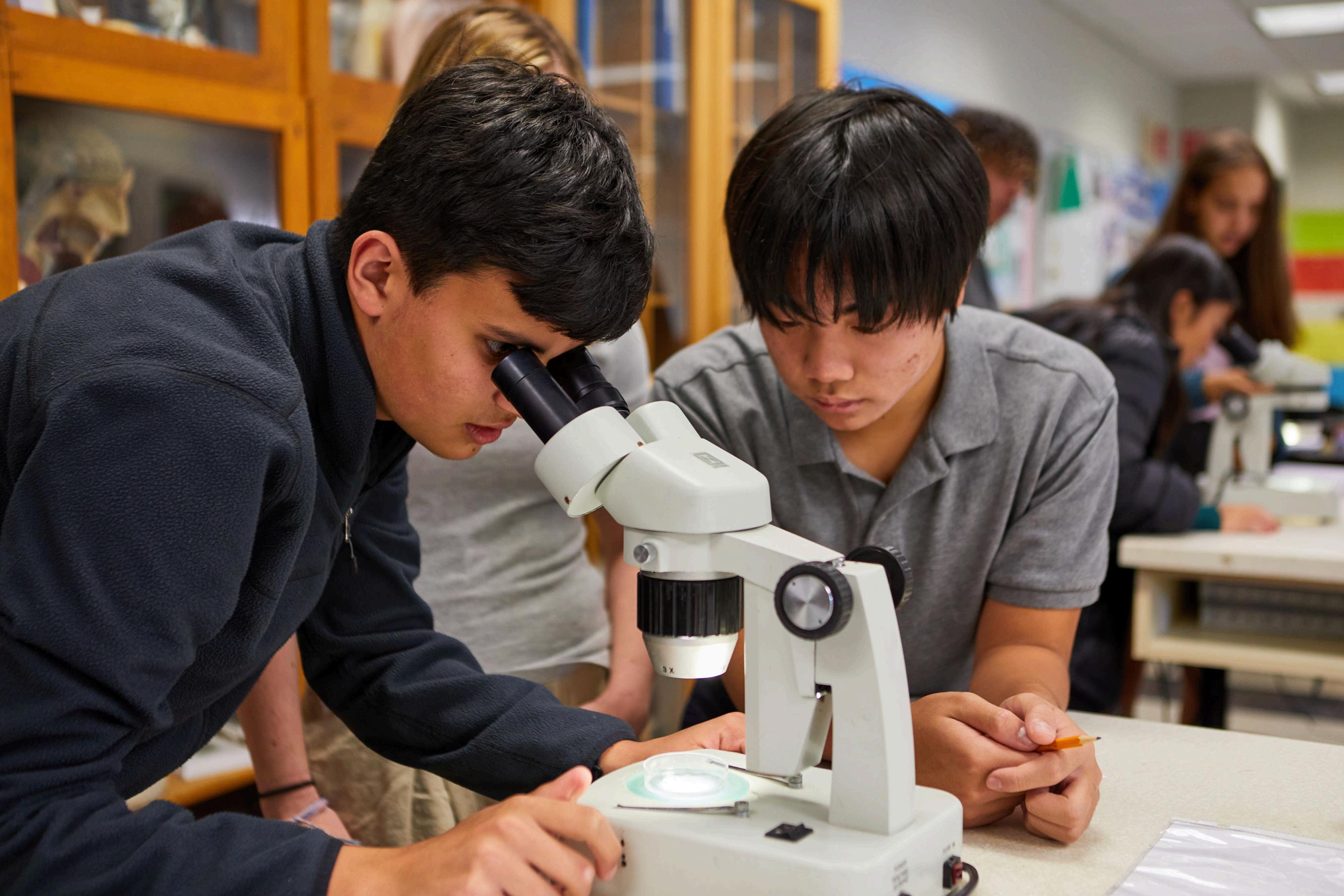

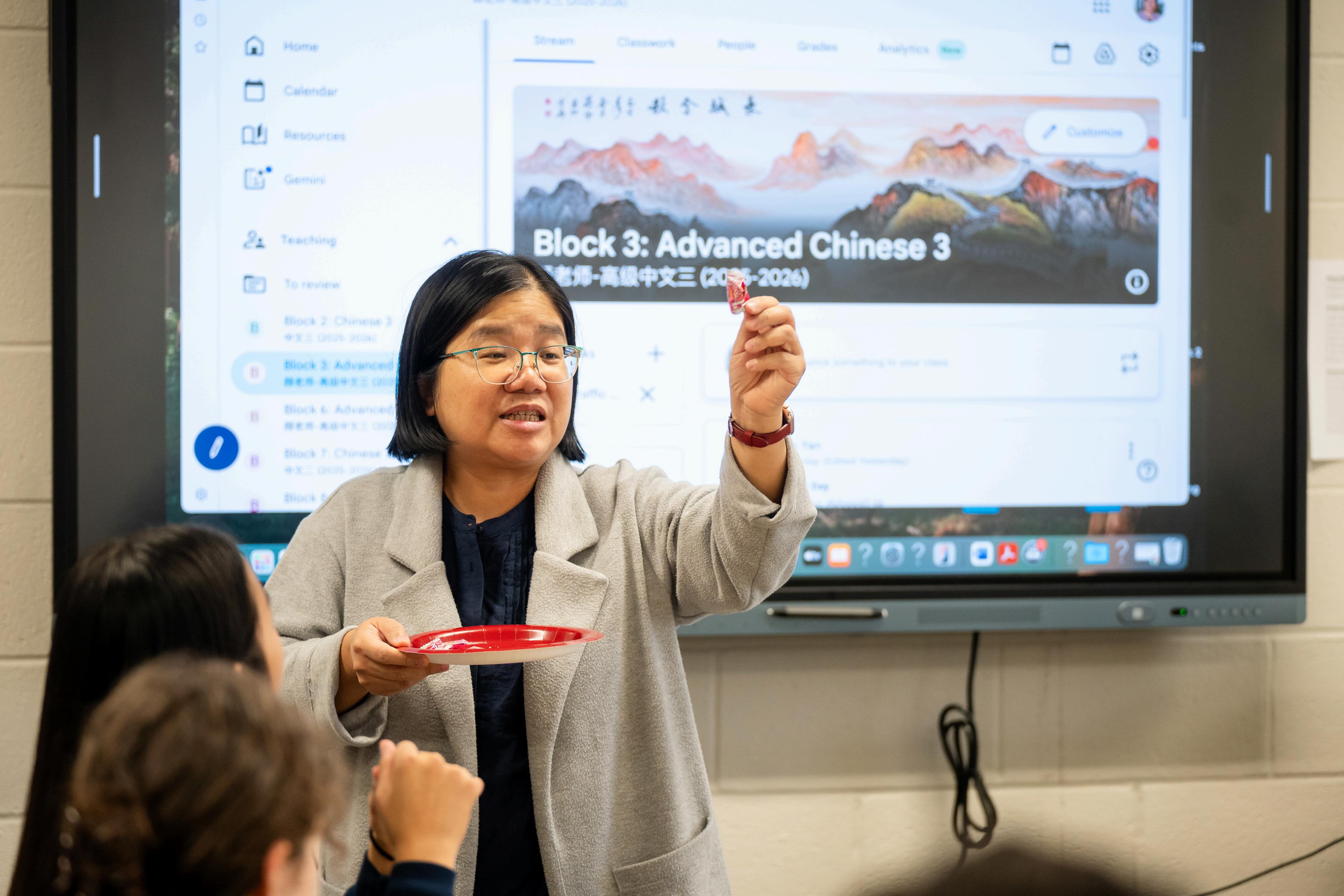
3 C r e d i t s R e q u i r e d - S i n g l e W o r l d L a n g u a g e
o r 2 C r e d i t s R e q u i r e d - T w o W o r l d L a n g u a g e s
T h e C o l u m b u s A c a d e m y ’ s W o r l d L a n g u a g e s D e p a r t m e n t o f f e r s l a n g u a g e
a n d c u l t u r e i n s t r u c t i o n i n o r d e r t o e n h a n c e t h e s t u d e n t s ’ e d u c a t i o n a l
e x p e r i e n c e T h e d e p a r t m e n t f o s t e r s t h e a b i l i t y t o c o m m u n i c a t e s u c c e s s f u l l y
i n a n o t h e r l a n g u a g e a n d t o e n g a g e w i t h d i f f e r e n t c u l t u r e s T h r o u g h t h e
s t u d y o f l a n g u a g e a n d c u l t u r e s , s t u d e n t s d e v e l o p o p e n - m i n d e d n e s s , a
s e n s e o f c o m m u n i t y , a n a p p r e c i a t i o n o f d i f f e r e n c e s , a n d t h e a b i l i t y t o
e m b r a c e m u l t i p l e p e r s p e c t i v e s .
I n o r d e r t o g r a d u a t e , s t u d e n t s i n U p p e r S c h o o l m u s t c o m p l e t e t h r o u g h
l e v e l t h r e e o f C h i n e s e , L a t i n o r S p a n i s h , r e s p e c t i v e l y S t u d e n t s c a n a l s o
e l e c t t o c o m p l e t e t h r o u g h l e v e l t w o o f o n e l a n g u a g e a n d t h e n t h r o u g h
l e v e l t w o o f a n o t h e r i n o r d e r t o s a t i s f y t h e g r a d u a t i o n r e q u i r e m e n t
B e y o n d t h e r e q u i s i t e c o u r s e w o r k , s t u d e n t s u s u a l l y t a k e a l a n g u a g e
t h r o u g h t h e i r s e n i o r y e a r .
U p p e r S c h o o l w o r l d l a n g u a g e c l a s s e s e m p h a s i z e t h r e e m o d e s o f
c o m m u n i c a t i o n : i n t e r p r e t i v e , i n t e r p e r s o n a l a n d p r e s e n t a t i o n a l S t u d e n t s
r e a d , l i s t e n , s p e a k a n d w r i t e a b o u t a u t h e n t i c t e x t s , h i s t o r y , c u s t o m s a n d
c u r r e n t e v e n t s
World Languages Department Flow Chart
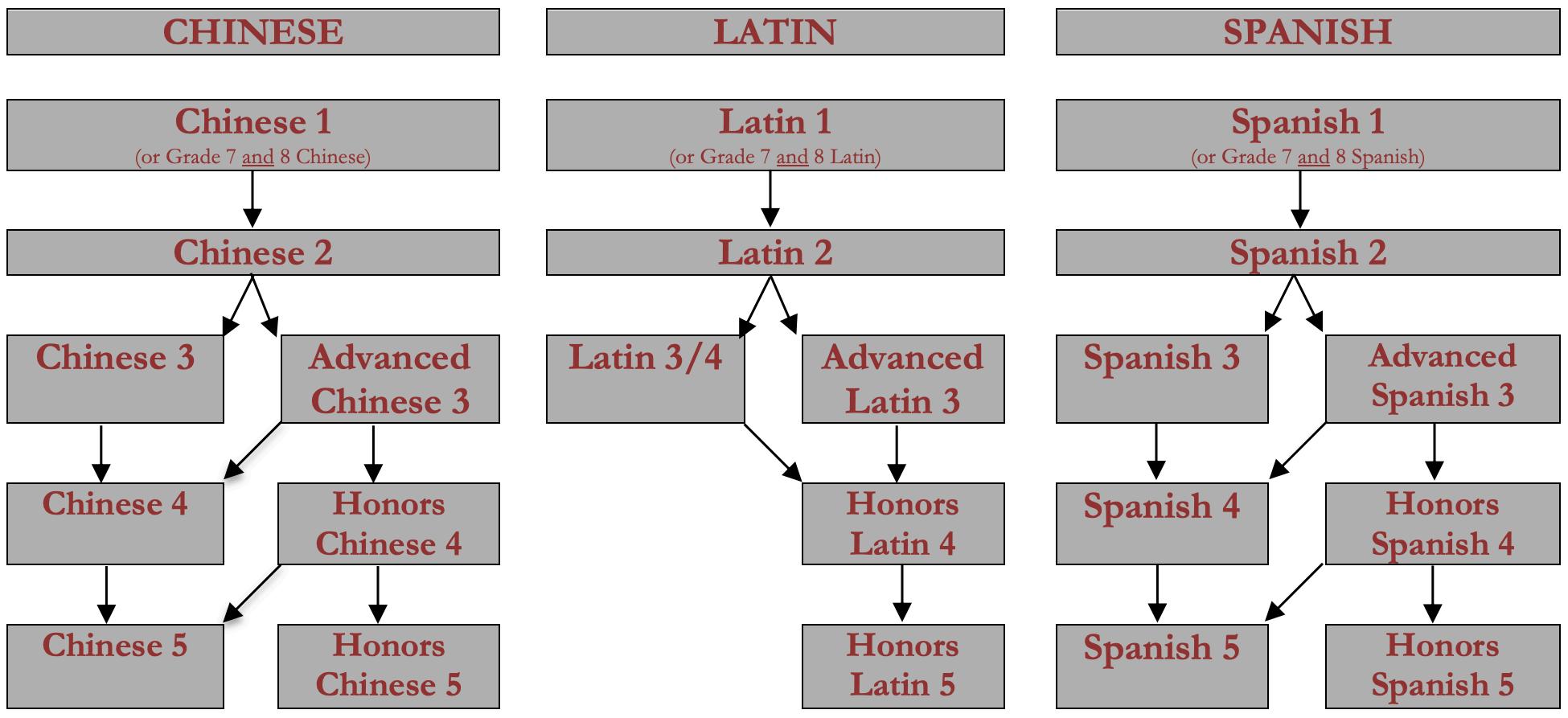
Chinese 1 (Full Year, 1 Credit)
Chinese 1 is a yearlong course in Beginning Chinese The course is designed for students who have had no prior exposure to Chinese language It offers introduction to the pinyin system, fundamental grammatical structures, basic vocabulary and character forms of modern standard Chinese (Mandarin) Emphasis will be placed on all four skills (listening, speaking, reading and writing) While linguistic aspects of the Chinese language are the primary focus, introduction to the social and cultural background of the language will also form an important part of study, which are embedded with the five C’s of foreign language learning: communication, cultures, connections, comparisons, communities *Students will be expected to earn at least a C and have a faculty recommendation in order to advance to Chinese 2
Chinese 2 (Full Year, 1 Credit)
Chinese 2 is designed for students who have had exposure to the Chinese language that includes the sound system, essential grammatical structures, basic vocabulary and character forms of modern standard Chinese (Mandarin) The emphasis in this class is on continuing vocabulary growth and sentence patterns in communicative contexts, and building a solid foundation in pronunciation Students will expand their ability to carry out simple conversations in Chinese on a limited range of topics Reading and writing (using simplified characters) will be developed in conjunction with speaking and listening skills. Students will be expected to speak, read, and write all new words that appear in vocabulary lists in the main textbook to continue to Chinese 3 unless otherwise noted by the instructor
Prerequisite: A final grade of C or higher in Chinese 1 and faculty recommendation
Chinese 3 (Full Year, 1 Credit)
Chinese 3 is designed to develop and refine proficiency in all four language skills – reading, writing, listening, and speaking. Conducted mainly in Chinese, this course includes grammar review, vocabulary development, and engages students in communicative exercises Learning materials include a selection of contemporary articles as well as literary, cultural, and multimedia texts Reports and oral presentations strengthen student understanding of the target language This course completes the world language graduation requirement
Prerequisite: A final grade or final exam grade of at least a C in Chinese 2 and faculty recommendation
Advanced Chinese 3 (Full Year, 1 Credit)
Advanced Chinese 3 is the third-year study of Mandarin Chinese This course is designed to develop and refine proficiency in all four language skills Conducted entirely in Chinese, Advanced Chinese 3 includes grammar review, vocabulary development and engages students in communicative exercises. Reading materials include a selection of contemporary articles and literature, as well as culturally authentic texts, such as short stories, newspaper articles, and Chinese idioms Reports and oral presentations strengthen understanding of the target language This course not only completes the World Language graduation requirement, but is also designed to prepare students for standardized national foreign language testing
Prerequisite: A final grade of B+/A- in Chinese 2 and/or faculty recommendation
Chinese 4 (Full Year, 1 Credit)
This course is designed for students who have completed the foreign language requirement and wish to build on their Chinese language proficiency and cultural understanding The students will expand their vocabulary and grammatical structures while integrating five skills: listening, speaking, reading, writing and character recognition through typing. Taught in Chinese, the content includes current issues, idioms, literature, and cultural topics in the target language. The materials include films, songs, online materials and news.
Prerequisite: A final grade of C+ or higher in Chinese 3 and/or faculty recommendation
Honors Chinese 4 (Full Year, 1 Credit)
Honors Chinese 4 is a Pre-Advanced Placement course that is in alignment w Placement format The course is designed for students who are interested in pursu proficiency in listening, speaking, reading, writing and character typing skills Ta Chinese, the students will honor the language pledge The course focuses on the la lens of Chinese culture. Honors Chinese 4 emphasizes the development of coh writing skills through the building of rich vocabularies and complex sentence materials include idioms, tang and song poems, current issues, cultural topics, film in the target language Communicating with exchange students in China through one of the learning objectives
Prerequisite: A final grade of A- or higher in Chinese 3 and/or faculty recommendation
Chinese 5 (Full Year, 1 Credit)
Chinese 5 is designed as a natural sequence to Honors Chinese 4 The course consists of extensive communicative drills, the study of complex sentence patterns and grammar, and reading and writing The class is conducted in Chinese and uses natural tones and speed for listening comprehension The textbook is of an intermediate level, and the students are able to maintain their language skills and make transition to a mid-second year college course. The students are introduced to formal written language and they keep up with Chinese current issues with authentic materials. By the end of fifth year Chinese, most Chinese language students will have some language immersion experiences from our trips abroad
Prerequisite: A final grade of C+ or higher in Chinese 4 and/or faculty recommendation
Honors Chinese 5 (Full Year, 1 Credit)
Honors Chinese 5, an Advanced Placement course, consists of intense speaking drills, the study of complex sentence patterns and grammar, advanced reading, and advanced writing Conducted in Chinese, the course uses a college textbook, authentic materials, and is at an upper intermediate level Activities include debating, giving campaign speeches, presenting career choices, and covering cultural topics in depth Students are introduced to formal written language and classics reading, and they keep abreast of current Chinese issues Upon completion, students will comfortably transition to a latesecond or third year college course. By the end of Chinese 5, almost all Chinese language students will have taken a trip to China and will have benefitted greatly from participating in a trip abroad. This course also prepares students to take the Chinese Advanced Placement Examination
Prerequisite: A final grade of A- or higher in Honors Chinese 4 and/or faculty recommendation
Latin 1 (Full Year, 1 Credit)
Latin 1 stresses reading and translation, the mastery and pronunciation of Latin vocabulary, basic grammatical structures, the building of a stronger English vocabulary and grammar through study of the relationship of the two languages, and an introduction to ancient mythology and Roman history Special attention is paid to developing English vocabulary through the study of Latin roots Students learn to understand 4 main verb tenses, the basics of noun declension, and simple prepositional phrases *Students will be expected to earn at least a C in order to advance to Latin 2
Latin 2 (Full Year, 1 Credit)
Latin 2 is a continuation of Latin 1 with the general philosophy remaining unchanged: reading Latin with confidence, providing insight into Roman culture, and improving English skills through the study of Latin Greater attention is paid to sustained reading with emphasis on more sophisticated grammatical and syntactical structures, including passive verbs, participles, and subjunctive constructions.
In addition, the content of the stories and the cultural material are used as a basis for oral discussion stressing the comparisons and contrasts between the elements of ancient Roman society and today’s society
Prerequisite: A final grade of C or higher in Latin 1 and/or faculty recommendation
Latin 3/4: Topics in Latin Literature (Full Year, 1 Credit)
This course is a continuation of students’ Latin studies, with the opportunity to explore a variety of topics in original Latin literature Topics will rotate each semester, and previously learned grammar will be reviewed in context Authors and topics may include Caesar’s De Bello Gallico and the war in Gaul, Catullus and his poetry, ghosts and ghost stories in Pliny, and Vergil’s retelling of the Trojan War in the Aeneid
Prerequisite: A final grade of C or higher in Latin 2 and/or faculty recommendation
Advanced Latin 3 (Full Year, 1 Credit)
Advanced Latin 3 is an introduction to Latin prose and poetry with an emphasis on Roman historical texts Attention is paid to developing sustained reading of original Latin texts, and the most complicated aspects of Latin grammar are introduced. Students read works by Eutropius, Pliny, and Catullus. This course not only completes the World Languages graduation requirement, but also introduces the first units of the Advanced Placement curriculum which will be continued in Honors Latin 4
Prerequisite: A final grade or final exam grade of at least A- in Latin 2 and/or faculty recommendation
Honors Latin 4 (Full Year, 1 Credit)
Honors Latin 4 is a course that offers an intensive study of Latin prose and poetry with an emphasis on the letters of Pliny and Vergil’s Aeneid By the end of this course, students will be able to translate large sections of prose and poetry with comprehension, scan dactylic hexameter, recognize rhetorical devices and figures of speech and contextualize the literature they read within Rome’s social and political milieu The pace and scope of this course provides the student with the opportunity to take the Advanced Placement Exam, if they choose.
Prerequisite: A final grade of A- or final exam grade of at least a B+ in Advanced Latin III and/or faculty recommendation
Honors Latin 5 (Full Year, 1 Credit)
Honors Latin 5 is a seminar-style class designed for students who have completed the four-year Latin program. The course consists of critical reading and evaluation of literary works. Grammar is thoroughly reviewed Emphasis is placed on lyric poetry, philosophy, and comedy
Prerequisite: A final grade of C or higher in Latin 4 or Honors Latin 4 and/or faculty recommendation
Spanish 1 (Full Year, 1 Credit)
In Spanish 1, students are given the vocabulary and grammar tools necessary to express themselves in everyday communicative tasks using both the present and past tenses Emphasis is put on the basic language skills of reading, writing, speaking, and listening, and on the principles embodied in the five C’s of foreign language: communication, cultures, connections, comparisons, and communities This course is designed for the student with no previous knowledge of the language; it can, though, also be used as a review of Spanish studied previously. *Students will be expected to earn at least a C and have faculty recommendation in order to advance to Spanish 2.
Spanish 2 (Full Year, 1 Credit)
Spanish 2 is conducted in Spanish and is a continuation and expansion of the vocabulary and grammatical structures learned in Spanish 1 Students will be able to communicate utilizing all tenses to express past, present, and future as well as opinions and hypotheticals Students participate in conversations, discussions, and oral and writing exercises The students are exposed to authentic materials such as news articles, music, television commercials, soap operas, as well as literary selections like poetry and short stories. Students will be expected to achieve at least a C in order to continue to Spanish 3 and/or an A- to continue to Advanced Spanish 3
Prerequisite: A grade of C or higher in Spanish 1 and faculty recommendation
Spanish 3 (Full Year, 1 Credit)
Spanish 3 is designed to develop and refine proficiency in all four language skills – reading, writing, listening and speaking. Conducted entirely in Spanish, it includes grammar review, vocabulary development, and engages students in communicative exercises Reports and oral presentations strengthen proficiency skills of the target language This course completes the world language graduation requirement
Prerequisite: A final grade or final exam grade of at least a C in Spanish 2 and/or faculty recommendation
Advanced Spanish 3 (Full Year, 1 Credit)
Advanced Spanish 3 is designed to develop and refine proficiency in all four language skills – reading, writing, listening, and speaking Conducted entirely in Spanish, it includes grammar review, vocabulary development, and engages students in communicative exercises Reading materials include a selection of Harry Potter and the Sorcerers’ Stone. Reports and oral presentations are used to strengthen proficiency skills of the target language. This course not only completes the world language graduation requirement; it is also designed to prepare students for standardized national foreign language testing
Prerequisite: A final grade or final exam grade of at least A- in Spanish 2 and/or faculty recommendation
Spanish 4 (Full Year, 1 Credit)
Spanish 4 is designed for students who are interested in pursuing higher language proficiency in listening, speaking, reading, and writing Students will communicate with native speakers, write about selected literary topics, and discuss current events and personal issues with relative ease Taught completely in Spanish, this course also includes a review of advanced Spanish grammar After completing extensive reading, students will produce written projects and present oral reports.
Prerequisite: A final grade of at least C in Spanish 3 and/or faculty recommendation
Honors Spanish 4 (Full Year, 1 Credit)
Honors Spanish 4 is a Pre-Advanced Placement course that is in alignment with the Advanced Placement format The course is designed for students who are interested in pursuing higher language proficiency in listening, speaking, reading, and writing. Students will communicate with native speakers, write about selected literary topics, and discuss current events and personal issues with relative ease Taught completely in Spanish, this course also includes a review of advanced Spanish grammar After completing extensive reading, students will produce written projects and present oral reports Students will prepare for the SAT Subject Test based on instructor’s recommendation Honors Spanish 4 is designed for students interested in taking the Spanish Language Advanced Placement Examination in the following year.
Prerequisite: A final grade of at least A- in Advanced Spanish 3 and/or faculty recommendation
Spanish 5 (Full Year, 1 Credit)
Spanish 5 is designed as a continuation and expansion of Spanish 4 It is a course for students not interested in taking, or ready to take, the Advanced Placement Examination who desire to develop further knowledge of Spanish grammar, vocabulary, and conversation skills in the context of a broad study of Spanish history and culture Special emphasis is placed on current events At this level, research papers, reports, and oral presentations integrating technology are important ways of developing the students’ presentation skills, cultural awareness, and language proficiency.
Prerequisite: A final grade or final exam grade of at least C and/or faculty recommendation
Honors Spanish 5 (Full Year, 1 Credit)
This intense course is intended to prepare students for the Advanced Placement Examination Students at this level are studying a course equivalent to a third-year college course in advanced Spanish composition and conversation. According to the College Board standards, this course emphasizes the use of Spanish for active communication, and it encompasses aural/oral skills, reading comprehension, grammar, and composition The overall objectives are: to comprehend formal and informal spoken language, to acquire vocabulary and a grasp of structure to allow the easy and accurate reading of newspaper/magazine articles and modern literature in Spanish, to compose expository passages, and to express ideas orally with accuracy and fluency. This course also seeks to develop language skills that are broadly useful and that can be applied to various activities and disciplines
Prerequisite: A final grade of at least B+ in Honors Spanish 4 and/or faculty recommendation

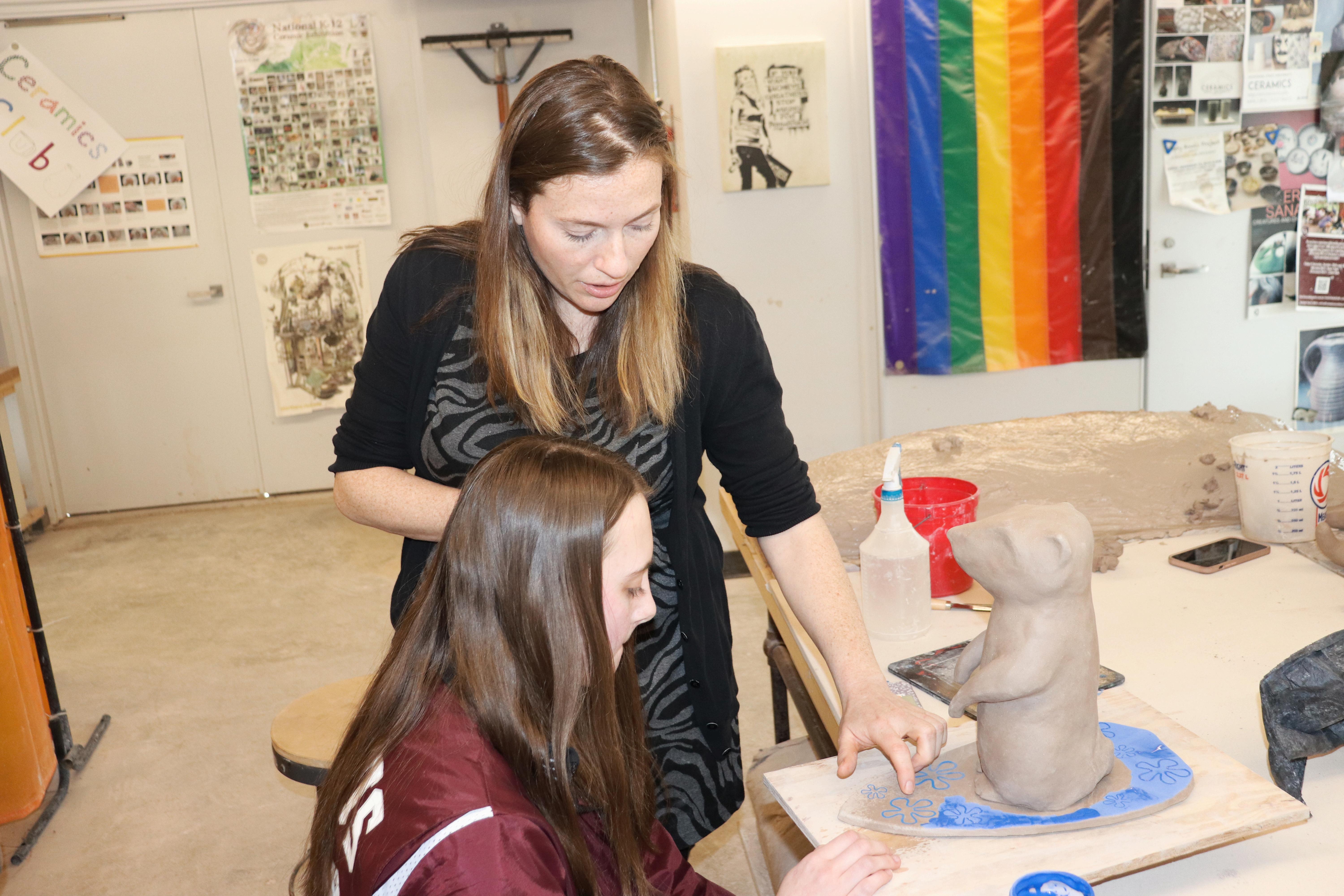
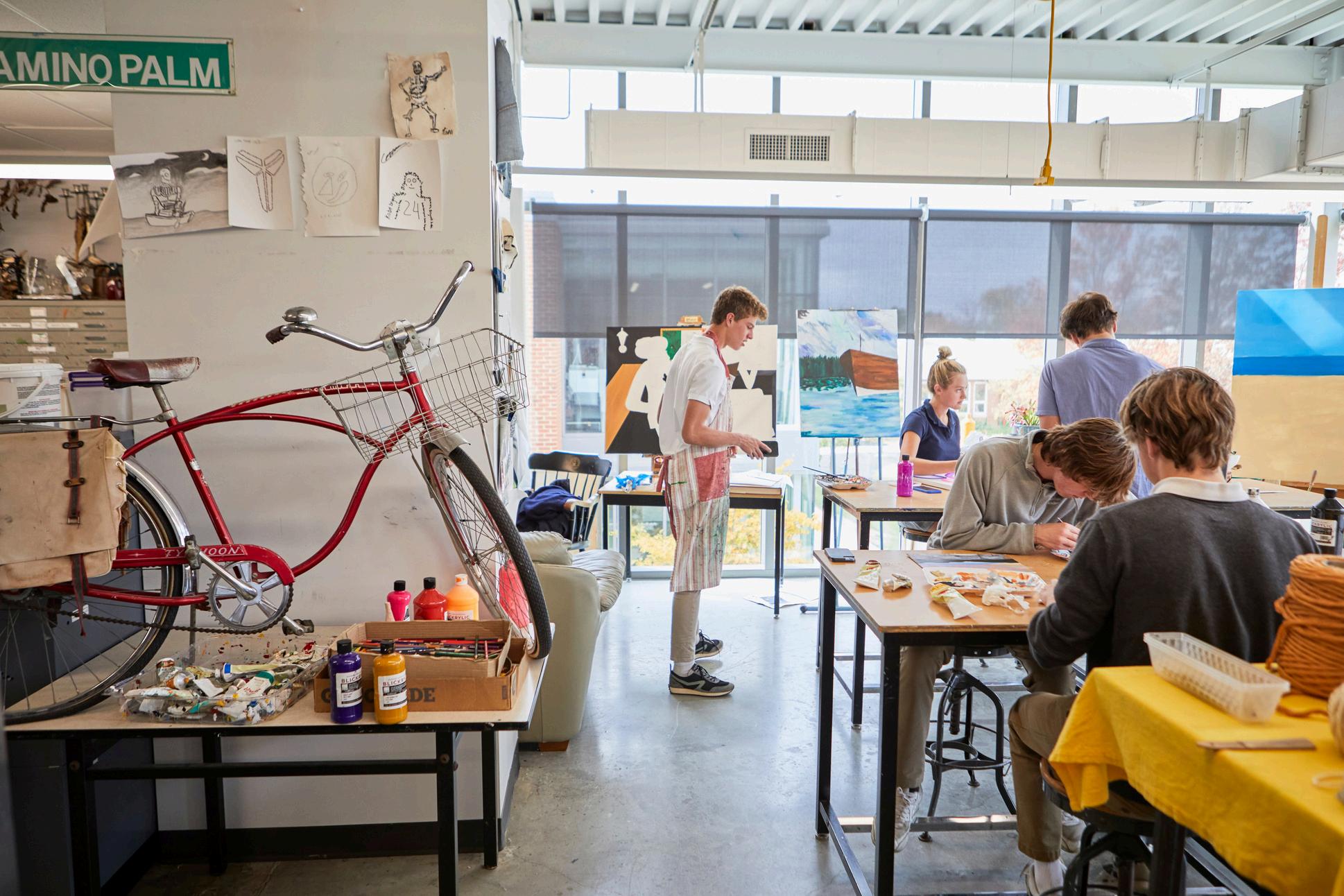
Foundations of Studio Art (Full Year, 1/2 Credit)
In this course, students study the formal elements and principles of design and composition as well as selected artists and styles through a variety of techniques and mediums. Foundations of Studio Art is a prerequisite for all Fine Arts courses
2-D Studio Art (Full Year, 1/2 Credit)
This studio-based course explores the techniques, composition, and content of drawing and painting Students study the works of past and contemporary artists' works and become acquainted with a variety of drawing materials and opaque and transparent painting mediums. Students are asked to express growth and individuality through their use of materials Keeping an up-to-date, high-quality personal sketchbook is a requirement Students who wish to take this class for a second time should request 2DSTART2
Prerequisite: Foundations of Studio Art or Portfolio
Ceramics 1 (Full Year, 1/2 Credit)
Ceramics 1 is an introduction to making functional vessels on the potters’ wheel as an expressive art Students will focus on physical throwing skills, three-dimensional design concepts and creative problem solving as they relate to the functional ceramic vessel Over the course of the school year, students will make cylinders, bowls, mugs, lidded jars, and sculptural vessels
Prerequisite: Foundations of Studio Art
Ceramics 2 (Full Year, 1/2 Credit)
Ceramics 2 is an intermediate studio course Students will continue their understanding of the decorative and functional arts on the potters’ wheel Over the course of the school year, students will work with stoneware and porcelain to create teapots, large vessels, and intricate sets of work Students will also learn the process of how to mix clay, glazes, and fire gas and electric kilns.
Prerequisite: Ceramics 1
Ceramics 3 (Full Year, 1/2 Credit)
This course provides opportunities for intense studio experiences and portfolio development Students are encouraged to participate in local and statewide competitions. Students must be self-motivated as the workload is demanding. Upon electing to take this class, students declare a major area of study. This course is available to Juniors/Seniors only
Prerequisite: Previous art experiences and the recommendation of the instructor
Ceramic Sculpture (Full Year, 1/2 Credit)
Ceramic Sculpture is a studio-based introduction to hand-built ceramic sculpture Students will learn various methods of working with clay including coil, slab, solid, and extruded forms Students will explore surface design and texture with paints, glazes, and mosaic work Emphasis will be placed on technical skill, the relationship of form to concept, and the processes used in making ceramic sculpture. Students will make abstract, representational, and human/animal sculptures.
Prerequisite: Foundations of Studio Art
Graphic Design (Full Year, 1/2 Credit)
This course introduces students to the art of visual communication through images, symbols, and text Students will work to represent ideas and deliver messages through visual compositions Adobe Illustrator and InDesign will be used to learn the importance of graphics, typography, and layouts. Traditional hands-on techniques will be combined with digital processes for a fully immersive experience
Prerequisite: Foundations of Studio Art
Photography 1 (Full Year, 1/2 Credit)
Photography 1 students learn about the various functions of the camera as well as how to control composition and exposure to produce excellent images The emphasis will be on capturing images digitally and manipulating them through the use of Photoshop and other photo editing applications
Prerequisite: Foundations of Studio Art
Photography 2 (Full Year, 1/2 Credit)
Second-year photography students are encouraged and expected to develop a body of images that demonstrate a high level of conceptual thought, originality, technical skill, and personal vision The Photography 2 course emphasizes creative thinking and individual expression through independent work on conceptually themed projects
Prerequisite: Foundations of Studio Art and Photography 1
Portfolio Art (Full Year, 1 Credit)
This course provides opportunities for intense studio experiences and portfolio development Students are encouraged to participate in local and statewide competitions Students meet daily and must be self-motivated as the workload is demanding Upon electing to take this class, students declare a major area of study This course is available to Juniors/Seniors only
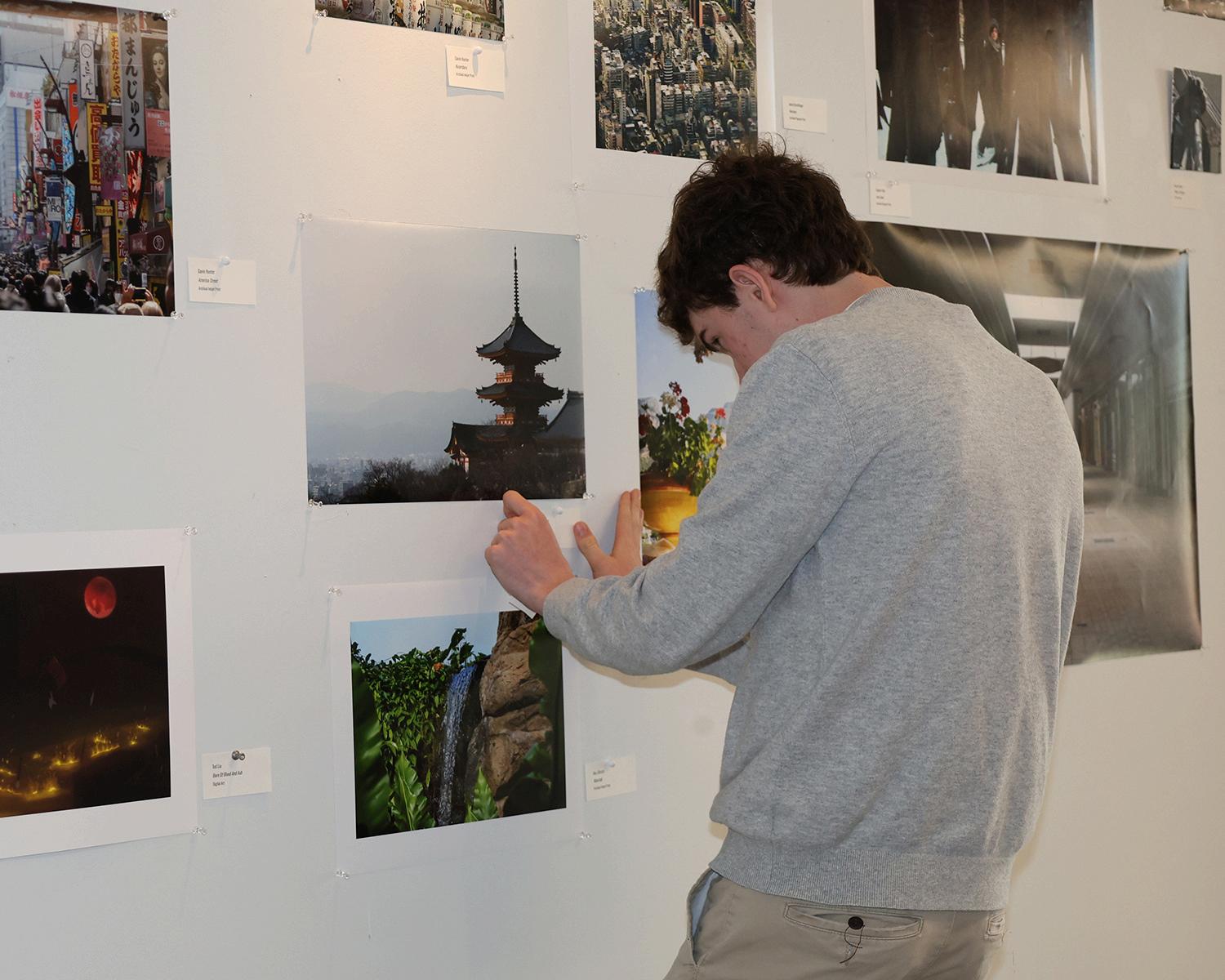
Treble Choir (Full Year, 1/2 Credit)
Treble Choir is open to soprano/alto singers in grades 9-12
This course is rec soprano/alto students who are new to the choir program, Upper School and/o Academy
Students will learn:
Sight reading skills
Healthy singing, including breath support and quality of tone
Interpretation of music including: tempo, phrasing, expression, style and dynamics
A variety of quality choral literature
Proper music technique including: note accuracy, rhythmic accuracy, articulatio posture
Intonation, including how to blend and balance with an ensemble
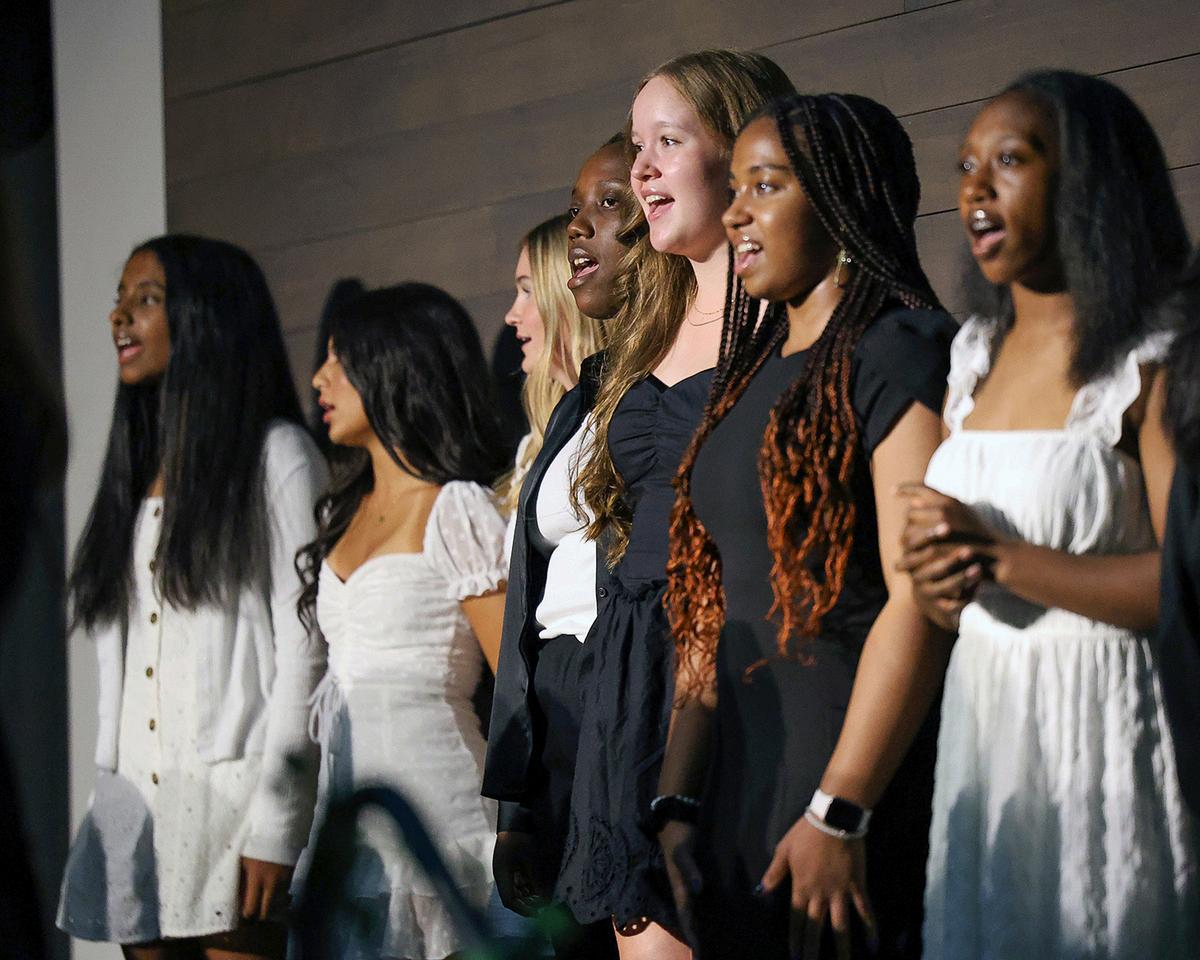
The Treble Choir will perform at the Fall Concert, Winter Concert, Cabaret, and Commencement. Members of this group are also eligible to compete in OMEA Solo and Ensemble Instructor approval is needed if a student can only schedule 2 of the 3 class meetings during the 6-day rotation
Tenor/Bass Choir (Full Year, 1/2 Credit)
Tenor/Bass Choir is open to tenor/bass singers in grades 9-12. This course is recommended for tenor/bass students who are new to the choir program, Upper School and/or to Columbus Academy
Students will learn:
Sight reading skills
Healthy singing, including breath support and quality of tone
Interpretation of music including: tempo, phrasing, expression, style, and dynamics
A variety of quality choral literature
Proper music technique including: note accuracy, rhythmic accuracy, articulation, diction, and posture
Intonation, including how to blend and balance with an ensemble
The Tenor/Bass Choir will perform at the Fall Concert, Winter Concert, Cabaret, and Commencement Members of this group are also eligible to compete in OMEA Solo and Ensemble Instructor approval is needed if a student can only schedule 2 of the 3 class meetings during the 6day rotation
Camerata (Full Year, 1 Credit)
Camerata is a course for any returning soprano, alto, tenor or bass singer in Grades 9-12 (including participation in CA's 8th grade choir) This course emphasizes skills required to be a strong ensemble singer including: performance skills, rehearsal technique, vocal technique, and musicianship. Camerata also focuses on music theory and sight-reading skills to enhance singers' ability to analyze and perform choral music Any student that is new to the choral program will be asked to perform a vocal assessment for Mr Jenkins to determine the best vocal fit
Students will learn:
Sight reading skills
Healthy singing, including breath support and quality of tone
Interpretation of music including: tempo, phrasing, expression, style, and dynamics
A variety of quality choral literature
Proper music technique including: note accuracy, rhythmic accuracy, articulation, diction, and posture
Intonation, including how to blend and balance within an ensemble
Students meet 6 days out of 6. Camerata will perform at the Fall Concert, Winter Concert, Cabaret, and Commencement. Depending on the year, Camerata may also compete at OMEA Large Group Competition Members of this group are eligible to compete in OMEA Solo and Ensemble
Prerequisite: Recommendation of the instructor
Academy Concert Band (Full Year, 1 Credit)
The Concert Band is open to all An evaluation may be requested to determine the student’s proficiency The Concert Band performs in at least three required concerts, which may include OMEA District Contest for Large Group as well as the OMEA Solo and Ensemble Contest Concepts covered include intonation, tone development and articulation, rhythmic literacy, and ensemble techniques (i.e blend and balance).
Pep Band- performs popular music at home football games and a few select weekend basketball games as well as pep rallies
Concert Band- performs at fall, winter, and spring concerts levels of music comparable to OMEA
Class C and B band music as well as various film and contemporary band music Also performs at Commencement in June
Solo & Ensemble- students are encouraged to participate in this event, though it is not mandatory and does not affect a student’s grade.
Academy Jazz Ensemble (Full Year, 1/2 Credit)
The Jazz Ensemble offers students an opportunity to explore the Jazz experience in both performance and musicianship More advanced instrumental experience is strongly recommended for this course; an audition required for all instrumentalists. Students perform in a number of settings, including the spring’s All That Jazz dessert concert, a Fall concert, and various festivals around Columbus. Although this course is open to freshmen and advanced middle school musicians, a full year of Concert Band is highly recommended Jazz Ensemble is considered an advanced course and requires a moderate amount of home practice This class meets during zero period (7:15-8:00am) Mondays, Tuesdays, and Thursdays with occasional Friday rehearsals
Styles covered include swing, latin, rock, samba, ballad, be-bop and blues. Artists covered include Duke Ellington, Dizzy Gillespie, Herbie Hancock, Glenn Miller, Benny Goodman and Miles Davis
Improvisation is a major component of this course and will be taught through the Blues, as well as 16-bar forms
Solo & Ensemble- students are encouraged to participate in this event, though it is not mandatory and does not affect a student’s grade
Academy String Orchestra (Full Year; 1/2 Credit)
Academy String Orchestra is open to students in Grades 9-12 This class focuses on repertoire for high school orchestras including music from an assortment of genres such as pop, rock, classical, and jazz Performances typically include at least three major concerts, OMEA solo and ensemble competition, and community concerts Touring trips are planned every three years
Advanced Orchestra (Full Year; 1 Credit)
Advanced Orchestra is open to students in Grades 9-12 This class focuses on original music from classical and contemporary periods Performances typically include at least three major concerts, OMEA large group contest, solo and ensemble competition, and community concerts This class receives weighted grades Touring trips are planned every three years
Students are accepted by audition or recommendation.
Music Theory (Full Year, 1/2 Credit)
The first year of Music Theory introduces the fundamentals of music including, but not limited to, notes, rhythm, intervals, chords, and voice leading At the end of the course, students will be able to analyze music written in four-part harmony (Bach-style) as well as compose their own four-part harmonic pieces.
Units covered include:
Note literacy
Rhythmic literacy
Intervals
Chord structures
Figured Bass, Roman Numeral Analysis
Voice leading
Composing melodies
Chord progressions
Honors Music Theory (Full Year, 1/2 Credit)
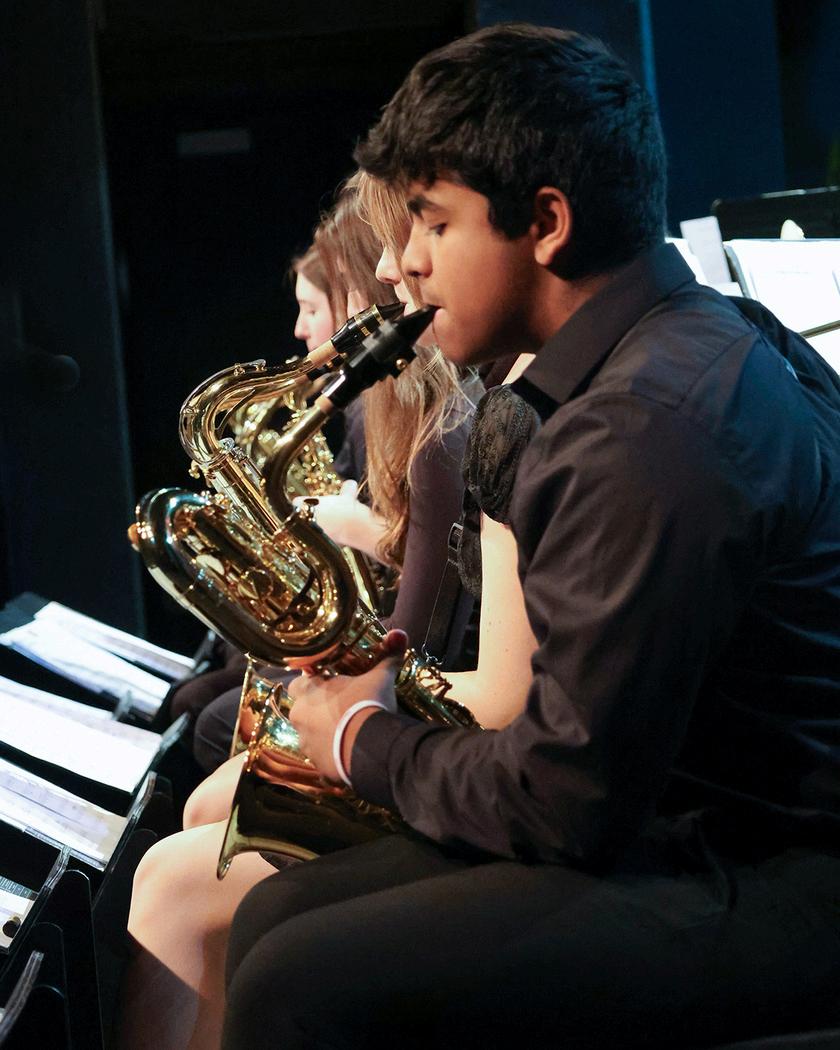
The second year of Music theory continues to build upon the fundamentals of music Areas of study focus heavily on aural skills rather than the analytic, written work of Music Theory 1. Students may be asked to take an entrance exam to be admitted to Honors Music Theory. At the end of this course, students will be ready to take the AP Music Theory Exam (not required)
Prerequisite: Music Theory and Teacher Recommendation
Units covered include:
Sight-singing using Solfege
Melodic Dictation
Harmonic Dictation
Secondary Dominants
Non-Chord Tones
Basic Form and Analysis
Error Detection (aural)
Modal concepts
Forms (Sonata, AABA, etc )
Performance concepts (tempos, techniques, etc )
Technical Theater (Full Year, 1/2 Credit)
Portfolio Technical Theater (Full Year, 1 Credit)
This class is for students who are looking for a deeper understanding of “the other side of the stage”. The Portfolio Technical Theater class meets 5 times per 6-day rotation. The Technical Theater course meets 3 times per 6-day cycle This is an Independent Study course that will allow students who are interested in theater to further their studies within a specific field Each student will take on a technical responsibility for multiple Columbus Academy productions The specific field or interest will be decided by the student and instructor Students will finish the class with a portfolio showcasing each individual’s work within his or her field of interest which can also be used for college entrance applications. This class is limited to 12 students. Students will explore projection, sound, lights, set, props, costumes and stage management
Foundations of Studio Art is strongly recommended
Prerequisite: Interview and instructor approval required
Art History (Full Year Elective, 1/2 Credit)
This course is a survey covering two and three-dimensional art forms and architecture from prehistory to the present The vision and record of artists and designers are emphasized At its conclusion, students should have a greater appreciation for creative personal expression and be prepared to look at art insightfully The History of Art: A Global View (Robertson/Hutton) is the primary text Supportive studio exercises and writing compliment classes Independent study offers the opportunity for students to consider taking the Advanced Placement Examination.
Theatre and Stage Movement (Full year, 1/2 Credit and 1 PE Credit)
In the first semester, students will survey techniques and practitioners founded in modern and theatrical movement and dance techniques to make performance pieces that tell a story, achieve strenuous physical practice and can be performed in a yearly Fall concert in conjunction with the Orchestra In the second semester, students will explore the art of acting using techniques inspired by past and present practitioners of theatre. Integrated methods foster creation of founded characters and stories, while focusing on a collaborative and empathy-driven art form through plays, scene work, theatre games, and monologues (classical and modern; scripted and original pieces) Students will also explore stage combat skills which may include basic sword fighting, pratfalls, and hand-to-hand, with an emphasis on consent and safety Projects in this course will be crafted to the individual needs, skill level, and interests of the student, and could provide material for college auditions and portfolios This course gives students the opportunity to earn two PE credits
Prerequisite: Open to all grade levels. Teacher approval. No previous dance or theatre experience is required. Students are able to repeat this course yearly.
Acting and Directing Intensive (Full year, 1/2 credit)
This class is for students who have a committed interest in theatre, plan to study theatre in college as a major, minor, or elective study, and/or want to pursue the performing arts as an adult. Students will explore classical and modern acting techniques for the stage, practice advanced scene study, and create an audition portfolio Students will hone their craft with physical training techniques such as Viewpoints and Suzuki, as well as explore ways of devising original work through Moment Work and advanced improv techniques Students will also learn the ins and outs of directing for the stage, covering topics such as: script analysis, pre-production planning, how to run auditions, blocking methods, and interpersonal skills Students who participate in the class will be encouraged to apply for the positions of MS Musical Student Director and US Fall Play Student Director and US Musical Student Director. Projects in this course will be crafted to the individual needs, skill level, and interests of the student, and could provide material for college auditions and portfolios
Prerequisite: Open to Juniors and Seniors only. Teacher approval and/or completion of Theatre and Stage Movement Students are able to repeat this course if they so choose
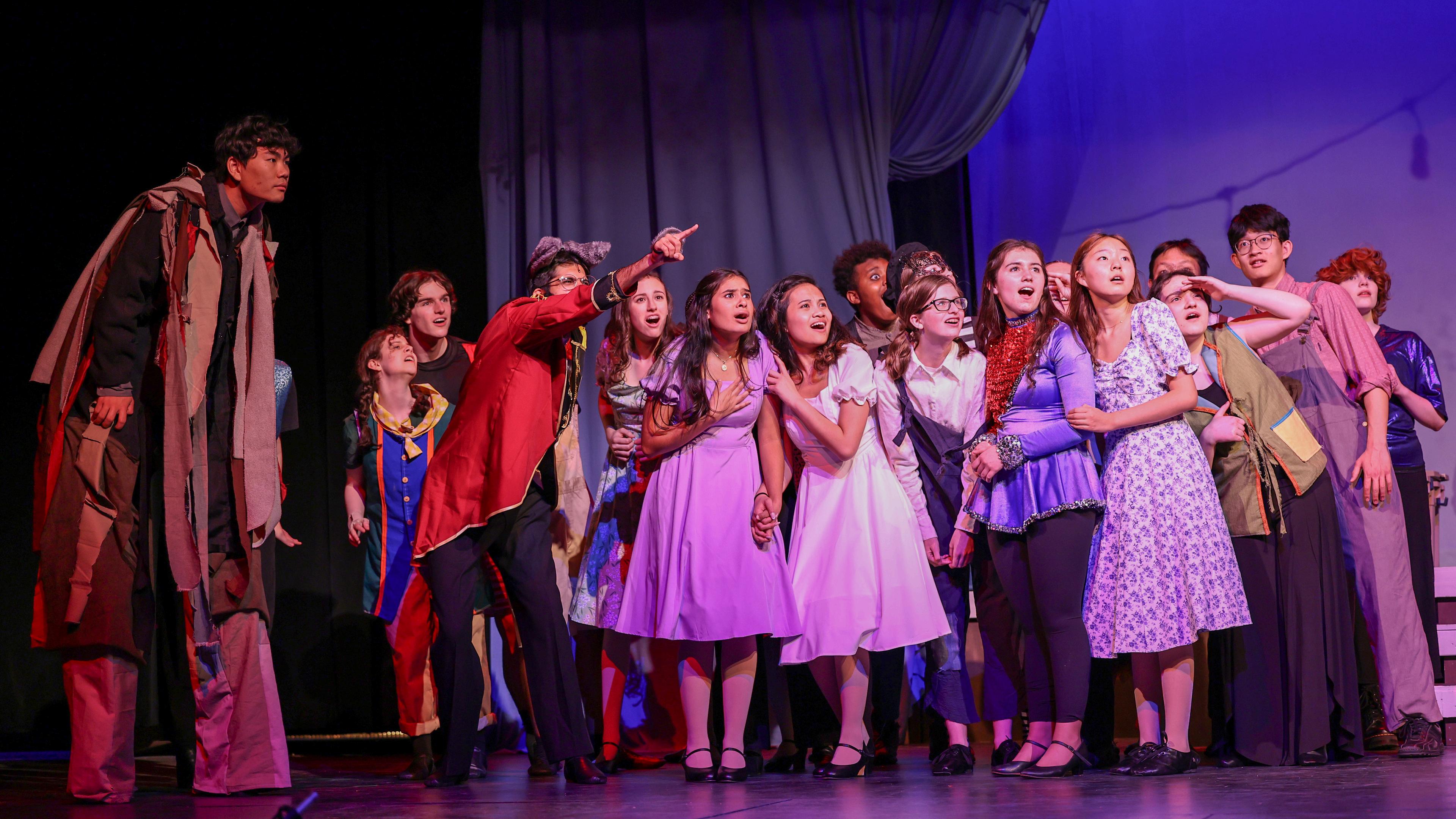

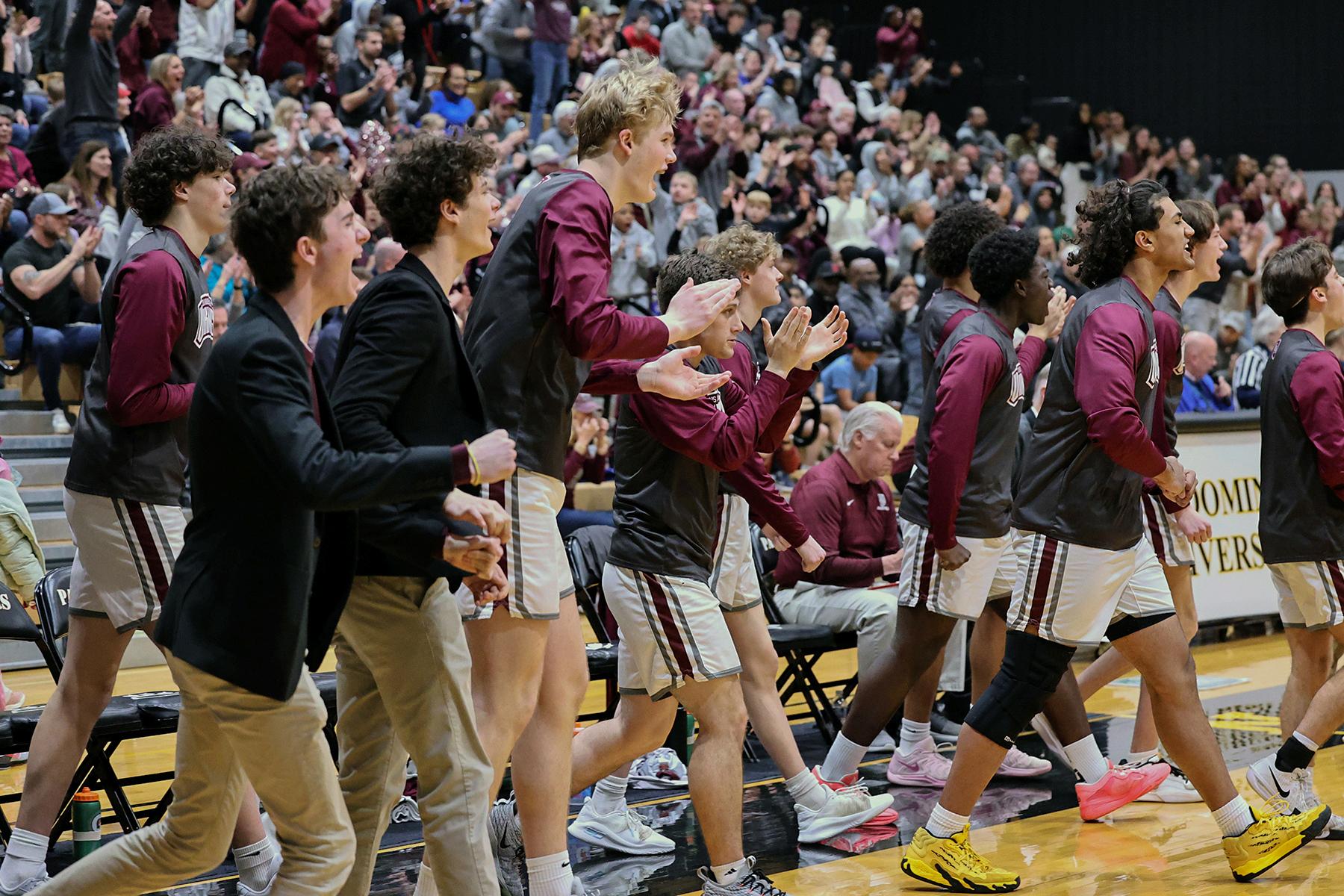
3 C r e d i t s R e q u i r e d
For students entering the Upper School as a Freshman, a total of three Columbus Academy Physical Education credits is required. For students entering as a Sophomore, a total of two Columbus Academy PE credits is required For students entering as a Junior, a total of one Columbus Academy PE credit is required Columbus Academy PE credits may be obtained by completing a season on one of our athletic teams, by taking the full-year Theater and Stage Movement class, or by submitting a Physical Education Alternative Form for participation on an athletic team for a sport/activity that is not offered at Columbus Academy A student may earn no more than one credit per year
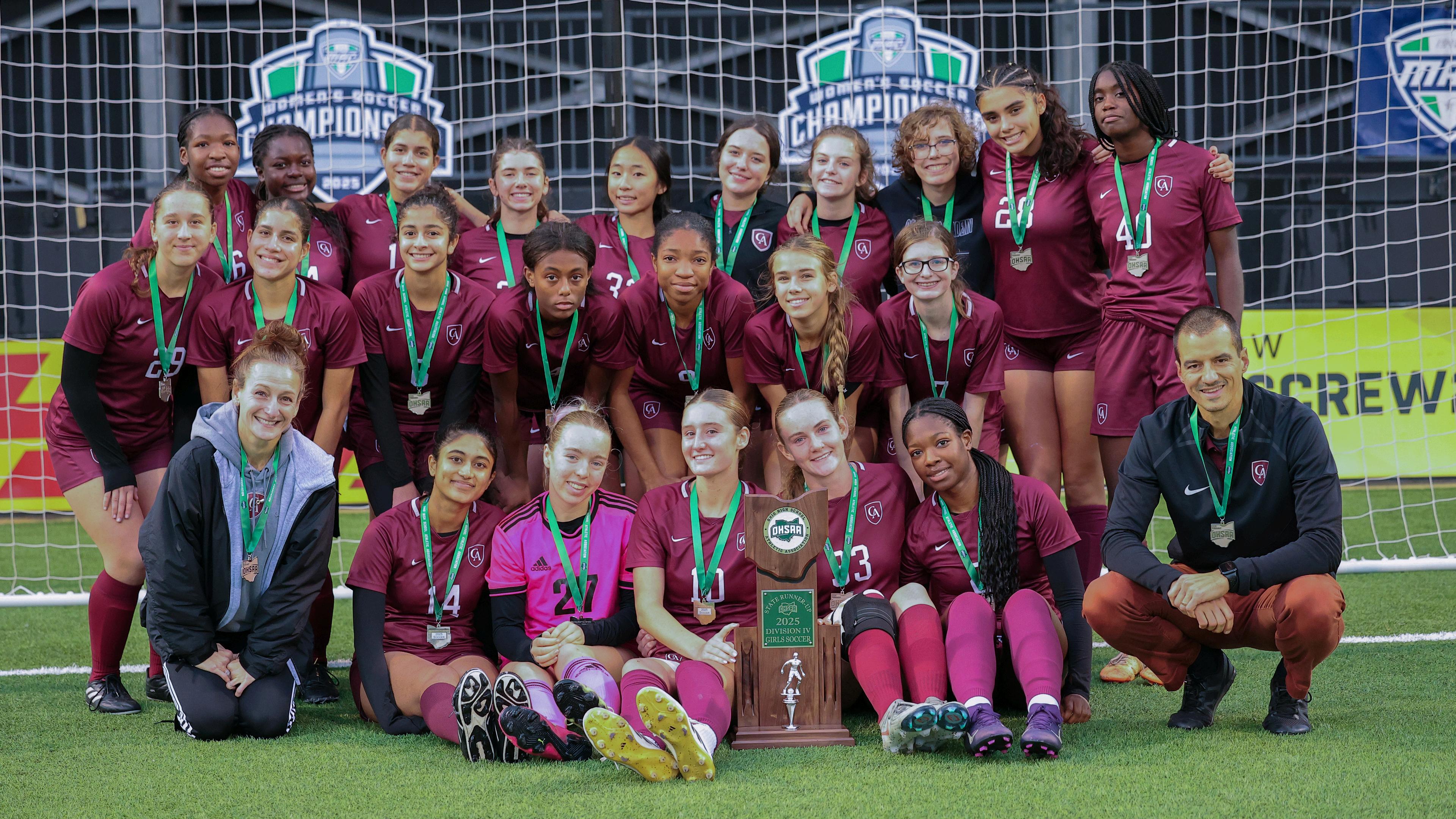

Ethics and Community (Full Year – REQUIRED for Grade 10)
This course focuses on building the knowledge and skills necessary for well-being and positive community contribution. Students begin by identifying their current character strengths, which are expected to evolve with life circumstances. The course emphasizes using these strengths positively, exploring moral identity and values that guide long-term identity development It incorporates concepts from positive psychology and education, highlighting six categories of human flourishing: purpose, engagement, relationships, health, emotions, and accomplishment Special focus is placed on positive emotions and relationships, with skill development in these areas prioritized Students also learn and practice making ethical decisions, applying their character strengths in meaningful ways. By integrating these elements, the course aims to help students lead healthy, meaningful, and flourishing lives.
Freshman Research (Full Year – REQUIRED for Grade 9)
Emphasizing guided inquiry and the research process, the Freshman Research class will introduce students to research and study skills that will compliment research that is required in many of their other classes. This course will build a foundation for thinking critically and conducting more in-depth research as they progress through high school. Topics include choosing, narrowing and broadening topics; gathering, identifying, evaluating, and organizing many types of information; proper citation; and digital citizenship (copyright, plagiarism, fake news)
Health (Full Year, 1/4 Credit – REQUIRED for Grade 9)
The Health curriculum is based on the concept of providing the knowledge and skills necessary for students to make responsible, well-informed choices that promote a healthy lifestyle. The students are encouraged to take personal responsibility and to utilize critical thinking skills when looking at current health topics and how they impact their daily lives Topics include personal and mental health, drug and alcohol prevention, stress management, eating disorders, human growth and development, relationships, sexually transmitted diseases, cancer awareness and early detection, and CPR certification Students will participate in a variety of teaching and learning methods such as class discussions, role-playing, videos, projects, tests, and demonstrations.
Beginning Journalism (Semester 1 or 2 Elective, 1/4 Credit)
This one-semester course introduces reporting techniques to students who are new to journalism Exercised will include drills in covering arts and entertainment, news, and sports Attendance and completed homework assignments account for the class’s grade This course is a prerequisite for staff positions on the student-led school newspaper, The Academy Life
Journalism 2, 3, or 4 (Full Year Elective, 1/4 credit)
This is a full-year class for 2nd, 3rd, and 4th year Academy Life staff members Students who are enrolled in this class are required to post bi-weekly articles in a specifically assigned category Class attendance and meeting deadlines are required
Journalism Editor 2, 3, or 4 (Full Year Elective, 1/2 credit)
This is a full-year class for 2nd-, 3rd- and 4th-year Academy Life editors. Editors will meet twice a week, compose editorials and opinions, proofread staff articles.
Prerequisite: Beginning Journalism and Journalism 2
Public Speaking (One Semester, 1/4 Credit – REQUIRED for Grade 11)
Public Speaking, a required course for juniors, introduces students to various techniques of oral expression Each student learns to overcome natural fears and speak with relative ease, clarity and organization Enunciation, expression, eye contact, volume, poise, and the content of each presentation are evaluated. A formal speech, delivered to the Upper School and parents, fulfills a graduation requirement and upholds one of Columbus Academy’s oldest traditions.
Yearbook Editor (Full Year Elective, 1/2 credit)
This is a full-year class for 4th year Caravel staff members The yearbook is a long-standing Academy tradition dating back to 1916 and has evolved over time into an over 300-page reflection on the year past. Caravel editors will be integral in the design process, providing input on the overall direction of the yearbook style guide, layout and design, and assisting with the editorial process. Some required meetings outside of allotted class time may be required
Prerequisite: Yearbook
Global Online Academy (One Semester or Full-Year Elective)
Columbus Academy is a member school of Global Online Academy (GOA), a not-for-profit consortium of more than 120 independent schools from around the world. Started by a group of independent schools looking to bring the benefits of online learning to their teachers and students, GOA prepares students for a global future by providing new, modern ways for students to learn and teachers to teach The mission of Global Online Academy is to reimagine learning to empower students and educators to thrive in a globally networked society; to deepen learning through courses that equip students with the knowledge, skills, and dispositions to be successful in high school, college, career, and life. GOA teachers think differently about how they design student learning experiences and learn from working with educational leaders to ensure they have the strategies and tools to lead innovation and change
Malone Schools Online Network (One Semester or Full-Year Elective)
The Malone Schools Online Network (MSON) provides motivated upper-level students at participating Malone Schools with many academically challenging courses that enhance each member school’s existing curriculum. These interactive seminars bring students together from across the country with dedicated teachers in real time MSON joins the best of independent school education with the latest video conferencing technology to chart new territory in online learning Unlike GOA classes with more flexible schedules for asynchronous lessons and synchronous group work, MSON classes meet synchronously online on two specific weekdays in one-hour blocks For the 2025-26 school year, rising juniors may apply for any fall, spring, or year-long MSON classes that do not conflict with their CA schedule. Rising seniors may apply for any fall courses. At this time, MSON classes are not yet available for underclassmen.
Extracurricular Offerings in the Upper School Each year the Upper School offers extra-curricular options Students who have genuine interest are encouraged to get involved in one or more activities. In addition to the list below, new clubs are welcomed which are all-inclusive and must have a faculty sponsor We encourage student initiative in the forming and developing of activities
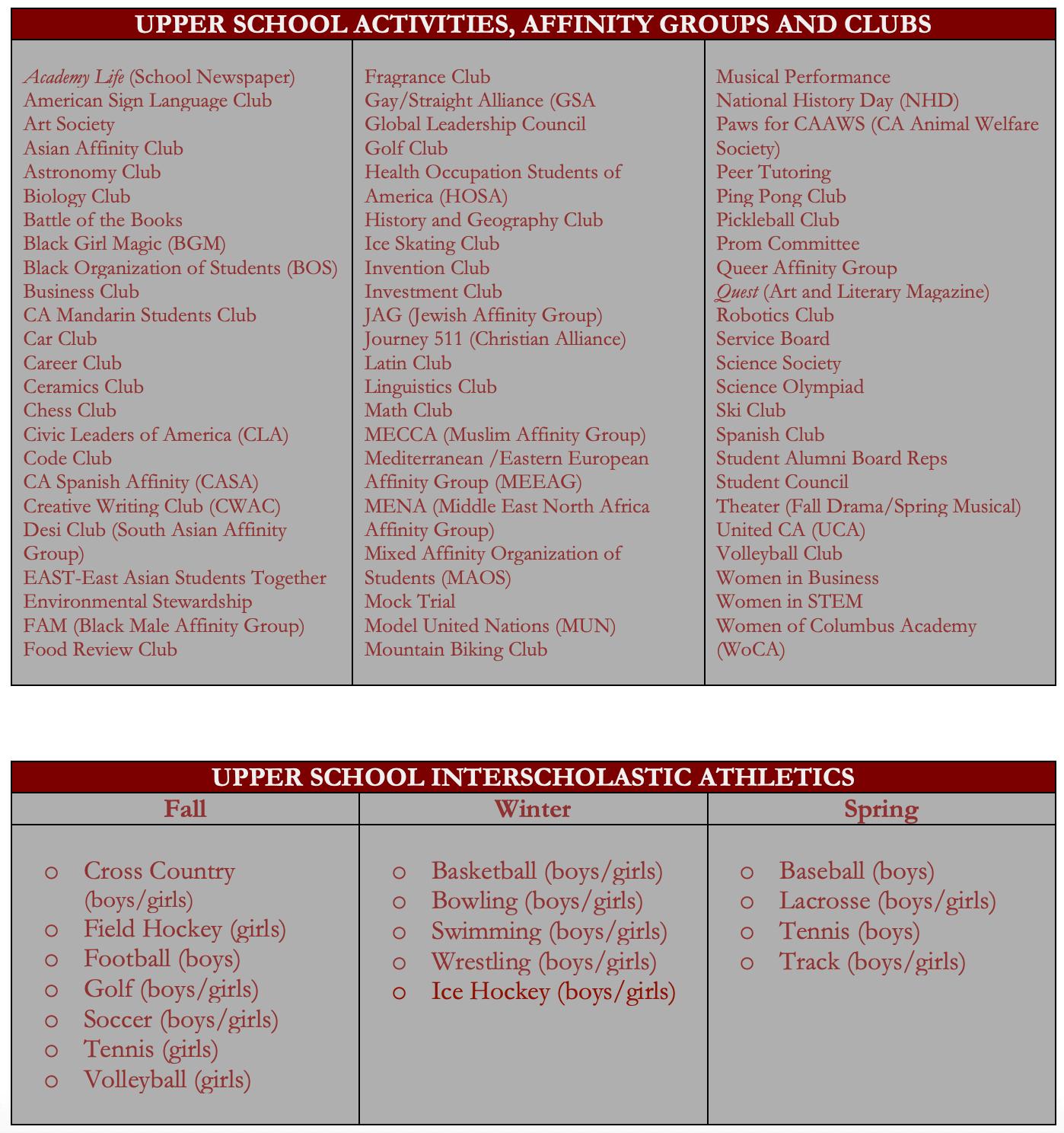
A sliding scale of grade weighting is used to determine grade point average (GPA) Standard weighting on a four-point scale will be applied to normal college preparatory courses An additional ten percent weight will be added to grades in “Advanced” courses, and an additional fifteen percent weight to grades in “Honors” courses See the chart on the next page for listings of course weights
Advanced courses indicate accelerated versions of our college-preparatory courses. Honors courses indicate those designed predominantly to prepare students for a college level, external examination Courses that cover two years’ worth of material in one year are also included Prerequisite criteria must be met for entry to Advanced and Honors courses
Weighted (wGPA) grade point averages are reported on the transcript and on documents sent to colleges and scholarship agencies. The Columbus Academy does not calculate class rank.
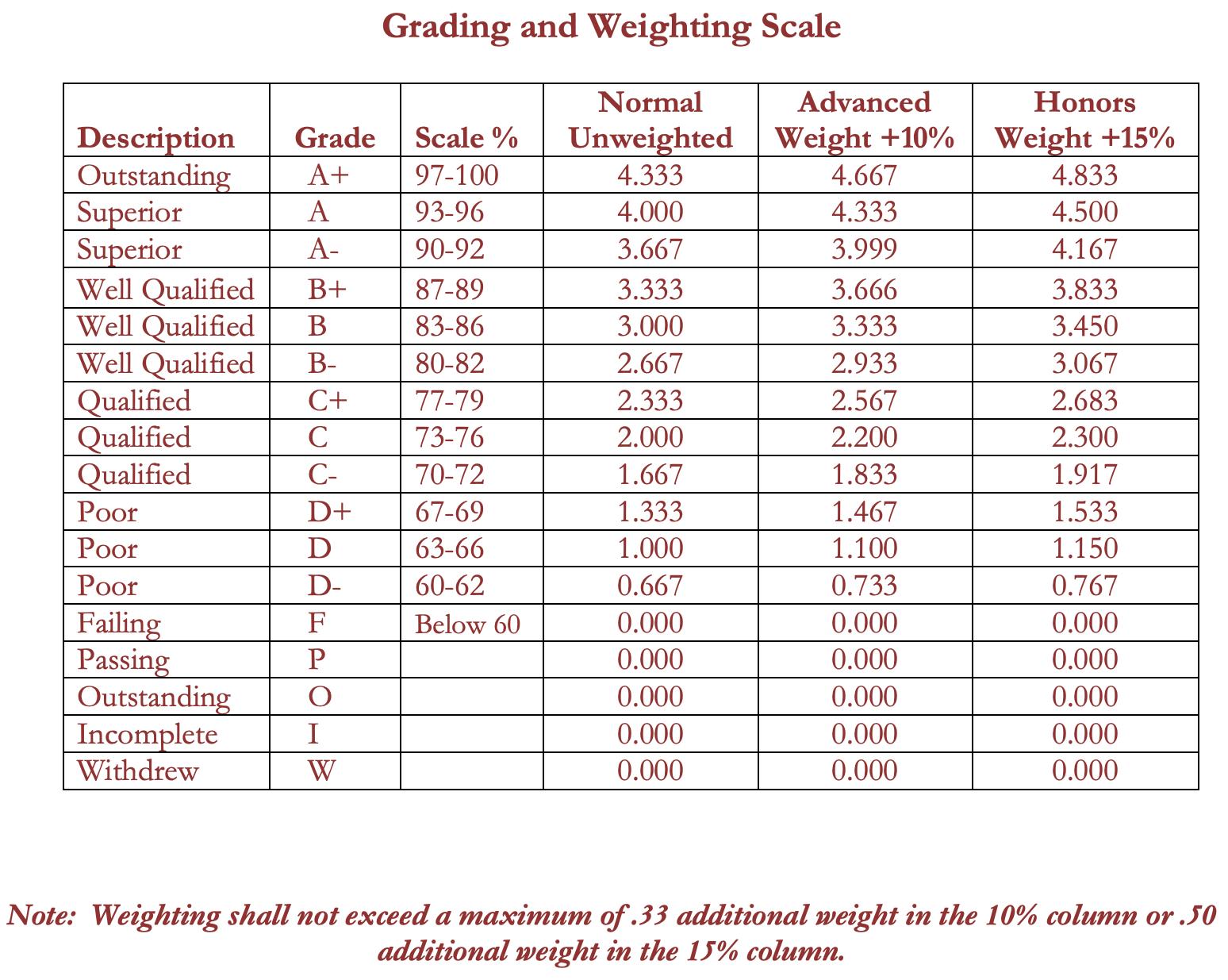
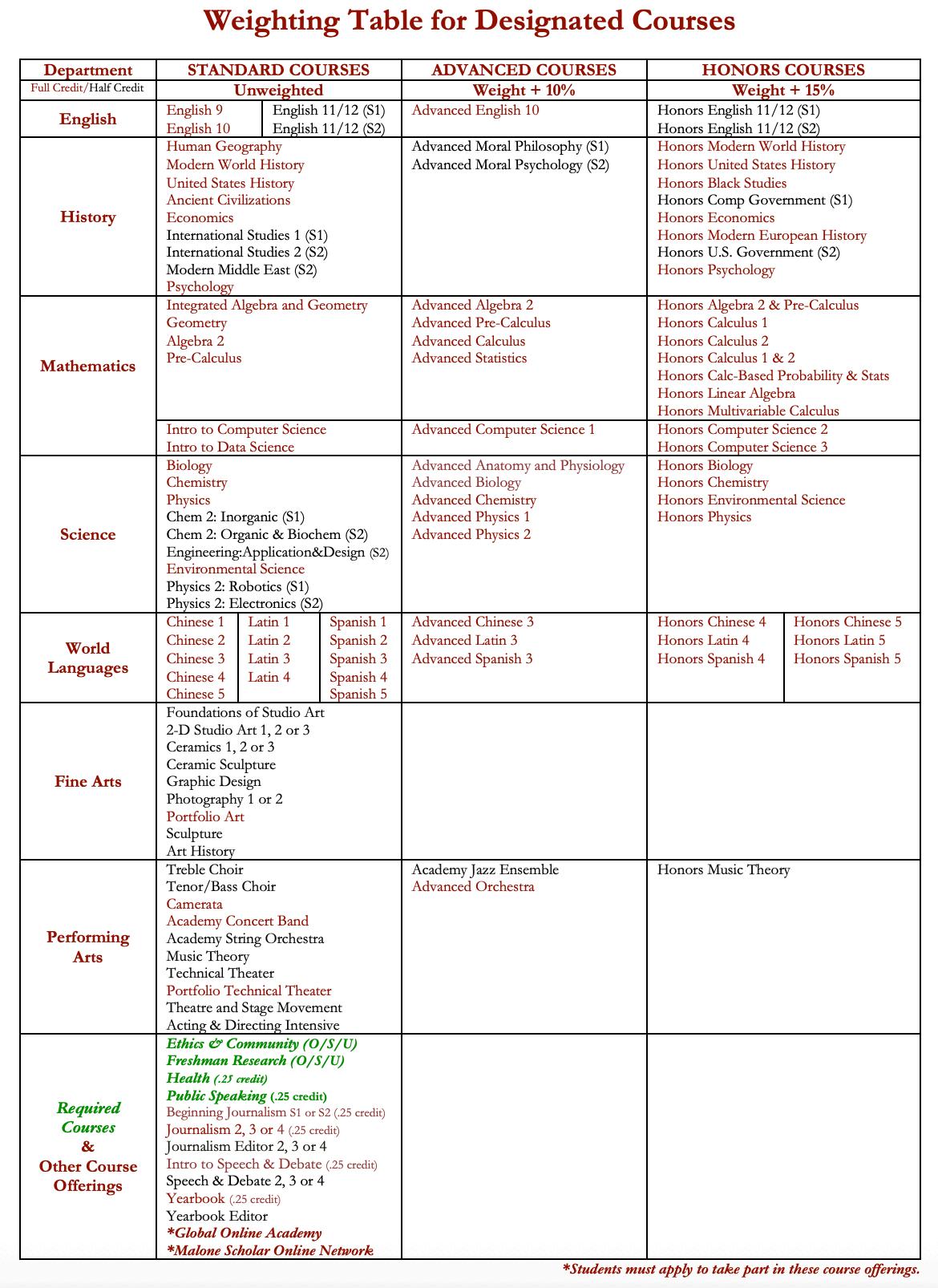
Admission Into Advanced and Honors Courses
All students must inform their current instructor(s) about their intention to appeal course recommendation(s) by the specified date in May.
English
To go from an Advanced or Honors class to the next level Honors class requires a B or better and the recommendation of the instructor
To go from a non-weighted class to the next level Advanced or Honors class requires an A- and the recommendation of the instructor
Students who were not recommended for an Advanced or Honors Class and who wish to appeal their placement may do so by meeting with their current instructor and submitting their course request form by the first week of May. Students may appeal the decision by submitting one analytical graded writing assignment from the current school year and a letter to the department These submissions will be due mid-May Students electing to go through the appeals process must also take a timed writing assessment
History
To go from an Advanced or Honors class to the next level Honors class requires a B or better and/or recommendation of the instructor
To go from a non-weighted class to the next level Advanced or Honors class requires an A- or better and recommendation of the instructor.
Students who were not recommended for an Advanced or Honors Class and who wish to appeal their placement may do so by meeting with their current instructor and submitting their course request form by the first week of May Petitioning students may be asked to meet with their current teacher and the History Department Chair and will be required to take a timed writing assessment.
Math
Placement decisions are based on a combination of previous course grades and classroom work, teacher recommendations, student aptitude and interest, and standardized test results Continuation in Advanced or Honors courses is based upon these criteria as well as overall student schedule balance.
Students who were not recommended for an Advanced or Honors Class and who wish to appeal their placement may do so by meeting with their current instructor and submitting their course request form by the first week of May At that time, all petitions for appeal will be reviewed by the Upper School Mathematics Placement Committee. A placement test may be required to inform the placement decision.
Computer Science
To go from an Advanced or Honors class to the next level Advanced or Honors class requires a B or better and recommendation of the instructor.
To go from a non-weighted class to the next level Advanced or Honors class requires enrollment in an advanced or honors level mathematics course or an A- quiz average and recommendation of the instructor
Science
To go from an Advanced or Honors class to the next level Advanced or Honors class requires a B+ or better and recommendation of the instructor
To go from a non-weighted class to the next level Advanced or Honors class requires an A or better and recommendation of the instructor
Students who were not recommended for an Advanced or Honors Class and who wish to appeal their placement may do so by meeting with their current instructor and submitting their course request form by the first week of May. A student petitioning to enter Advanced Chemistry or Advanced Physics may be asked to demonstrate math and science proficiency and must meet with Advanced Chemistry or Advanced Physics teacher Students petitioning to enter Advanced Biology must meet with Advanced Biology instructor Petitions must be submitted to the Department Chair by the Wednesday before Commencement.
World Languages
To go from level 2 to Advanced level 3 requires an A- or better, consideration of final exam, and/or recommendation of the instructor
For all languages: To go from an Advanced or Honors class to an Honors class requires an A- or better, consideration of final exam, and/or recommendation of instructor
Students who were not recommended for an Advanced or Honors Class and who wish to appeal their placement may do so by meeting with their current instructor and submitting their course request form by the first week of May.
Because of the difference in pace and depth between non-weighted classes and Advanced/Honors classes, with rare exceptions, students in non-weighted classes will not be placed in Advanced or Honors classes. These students may be placed in Advanced or Honors classes at the discretion of the instructor and the Department Chair

B o d y P r e s i d e n t / V P M e m b e r s h i p t o t h e S e r v i c e B o a r d i s o p e n t o a
S c h o o l s t u d e n t s ; h o w e v e r , m e m b e r s a r e b o u n d b y a n n u a l c o n t r a c t
A m i d d l e m a n a g e m e n t t i e r a n d i n t e r n a l a d v i s o r y b o a r d k n o w n a s
S h a p e r s s e r v e s a s t h e S e r v i c e B o a r d ’ s a d v i s o r y t e a m S h a p e r s ( a b o
g r a d e ) a r e d r a w n f r o m t h e S e r v i c e B o a r d m e m b e r s h i p a n d m u s t p e
p o s i t i o n s I n a d d i t i o n t o t h e s e a c t i v i t i e s , t h e S e r v i c e B o a r d m a n a g
U p p e r S c h o o l c o m m u n i t y s e r v i c e g r a d u a t i o n r e q u i r e m e n t
F o r a n e x p l a n a t i o n o f t h e S e r v i c e B o a r d ’ s p o l i c i e s a n d p r o c e d u r e s
r e g a r d i n g t h e U S S e r v i c e r e q u i r e m e n t , p l e a s e s e e t h e S e r v i c e B o a r d
w e b s i t e : s i t e s g o o g l e c o m / c o l u m b u s a c a d e m y o r g / s e r v i c e b o a r d
Curricularly generated community service opportunities are developing in a range of areas both on and off of Columbus Academy’s campus Upper School ceramics students make hundreds of bowls for our annual Empty Bowls/Soup for Shelter event held each December. All proceeds from the event are used to support a Habitat for Humanity Wall Build each August. Columbus Academy’s longest service tradition, Kids 4 Kids, involves nearly every student in the Upper School The school also hosts blood drives and many other community service events
While many service related activities also fall under the auspices of the Service Board, clubs, student organizations, and the other two divisions enjoy the opportunity to pursue programs that fit with their practices or are age-appropriate. Club generated activities need to abide by Columbus Academy’s fundraising and service policies. Questions concerning acceptable activities should be directed to the Service Department and its chair
As part of its mission to develop responsible citizens who are “eager to engage in a pluralistic and ever-changing world,” Columbus Academy requires its Upper School students to engage in community service work. Through school programs and a fifty (50) hour graduation requirement students will be encouraged to develop the habit of sustained community service.
In order to receive a Columbus Academy diploma, upper school students are expected to attend one (1) Service Day per year and to complete fifty hours of community service: five (5) hours in support of CA programs or at CA and forty-five (45) hours off CA’s campus with one agency, group, or at one site
To fulfill the off-campus portion of the service requirement, students have the freedom and flexibility to select their own agencies in order to pursue individual interests so long as their work meets with the approval of the Service Board Prior to starting the requirement, every Upper School students’ service work must be approved by the Service Board For information regarding the Service Board’s practices, policies, paperwork, and guidelines, please see the Service Board website
Students have about 4 years* to complete the requirement. They may begin fulfilling the requirement once they have completed the eighth grade and must be finished with the off-campus portion of the requirement by the second Wednesday after spring break of the senior year The five CA hours must be completed prior to a senior’s departure for the senior project in May
Students who miss an annual Upper School Service Day will have five (5) hours added to their graduation requirement. The only acceptable excuses for absence are religious observation and death of an immediate family member. Failure to complete the 45 hour off-campus portion of the requirement by the second Wednesday after spring break of the senior year will result in a senior’s forfeiture of senior project choice and any hours accrued to date Fifty hours will be added to the senior project hours (~60 hours), and the student will complete ~110 hours of community service during the senior project period in May of the senior year