DISEaSE IDEntIfICatIon Jeff Miller jeff@millerresearch.com
MarkEt rEport
Ben Eborn napmn@napmn.com
potato growErS of waShIngton Dale Lathim
EDItorIaL InforMatIon
Potato Country is interested in newsworthy material related to potato production and marketing. Contributions from all segments of the industry are welcome. Submit news releases, new product submissions, stories and photos via email to: editor@ColumbiaMediaGroup.com.
aDVErtISIng SaLES
For information about advertising rates, mechanics, deadlines, etc., call (208) 520-6461 or email dave@PotatoCountry.com.
SuBSCrIptIonS
U.S. $24 per year / Canada $40 per year / Foreign $80 per year Subscriptions can be entered online at: potatocountry.com/subscribe or call (503) 724-3581.
Email address changes/corrections to: brian@ColumbiaMediaGroup.com or send to Potato Country, PO Box 333, Roberts, ID 83444. Potato Country magazine (ISSN 0886-4780), is published eight times per year and mailed under a standard rate mailing permit at Idaho Falls, Idaho and at additional mailing offices. It is produced by: Columbia Media Group, PO Box 333, Roberts, ID 83444 Copyright 2025. All rights reserved. No part of this publication may be reproduced or transmitted in any form or by any means, electronic or mechanical, for any purpose without the express written permission of Columbia Media Group.
2026 Buyers’ g
There are a lot of moving parts involved in growing and marketing a potato crop - from needing the right products to protect your crop from pests and pathogens to having the right equipment to efficiently navigate the season. For most growers, packers and shippers, this translates into a constant to-do list, shopping list and wish list.
Whether your list has you searching for a new harvester or just some innovative irrigation equipment, you’ll find an extensive list of suppliers in Potato Country’s 2026 Buyers’ Guide. Think of the following pages as your rolodex of resources available to help you enjoy a successful season, from seed to storage.
fErtILIZErS & growth proMotErS
CultivAce
17887 SE Grand Island Rd. Dayton, OR 97114 (503) 559-6972
www.cultivacegrowth.com
info@CultivAceGrowth.com
Liquid fertilizers carefully formulated to provide the essential nutrients plants need, ensuring optimal growth and productivity
Diamond K
1720 S Red Hills Dr Richfield, UT 84701 (435) 896-8870
www.diamondkgypsum.com
Tom Tankersley
Sales Manager
tom@diamondkgypsum.com
Aqua-Drive is a non-ionic surfactant designed to improve soil wetting and penetration of treated irrigation water. It reduces the surface tension of water to as much as 60%, allowing water to flow into the soil profile.
C rop I nput S
Redox
130 S 100 W
Burley, ID 83318 (208) 678-2610
www.redoxgrows.com
Redox Bio-Nutrients focuses on sustainable plant nutrition. Each Redox Bio-Nutrients product has been scientifically developed to address specific plant needs in four key areas: Abiotic Stress Defense, Soil Health, Root Development and Nutrient Optimization.
Regen Ag Nation
25094 Homedale Rd Wilder, ID 83676 (208) 861-1233
regenagnation.com
Agriculture is changing....Learn or be left behind!
4951 Olivas Park Dr. Ventura, CA 93003 (805) 650-8933
info@jhbiotech.com Innovation for a greener earth
Vive Crop Protection (208)248-4387
www.vivecrop.com ndrake@vivecrop.com Averland FC nematicide
The Idaho Potato Commission delivers another reminder on the importance of authenticity.
If you’re not going to be 100% genuine, you better be careful! The Idaho Potato Commission playfully highlights the pitfalls of inauthenticity in its latest commercial, in which a man confesses to his girlfriend that he hasn’t been 100% authentic. Fortunately, she takes it in stride – until he reveals the potatoes he’s served aren’t genuine Idaho® potatoes either, reminding viewers why it’s so important to look for the “Grown In Idaho®” seal. The ad will air nationally on popular networks including TBS, TNT, Food Network, Discovery, HGTV, ID, Hallmark, and TLC. Additionally, it can be seen on streaming platforms like HBO Max, Discovery+, Hulu/Disney+, and Tubi.
View the spot anytime at IdahoPotato.com
2026 Buyers’ g u ide
EQ u I p ME nt
BaggIng & paCkagIng
Ellips US A
P.O. Box 601
Wenatchee, WA 98807
(206) 915-4926
john.albert@ellips.com www.ellips.com
Internal defects have nowhere to hide with world-leading Ellips TrueSort™ technology. It precisely analyses the internal quality of each potato and detects a multitude of defects at incredible speed such as internal browning, flecking, glazing, freeze damage, dry matter, hollow hearts and more.
We design and install a variety of vegetable handling and potato processing equipment. From single machines to full vegetable handling & grading systems. Dealers for Tong Engineering and Nicholson Machinery
SyMACH Palletizers
315 27th Ave NE
Minneapolis MN 55418 (612) 760-8864
tim.bos@bwpackaging.com www.symach.nl/en/ Specialists in potato palletizing, pallet wrapping, and conveying systems
Tong USA (Tong Engineering Ltd) 5050 W 72nd Street Fremont, MI 49412 (231) 924-5647
sales@tongengineering.com us.tongengineering.com
Whether you require potato sizing and sorting, dirt elimination, unloading, washing or bin and bag handling, Tong offers the complete handling solution from field to pack, from single machines to complete lines.
Van Doren
East Wenatchee 10 NE Cascade Ave East Wenatchee, WA 98802 (509) 886-1837
www.vandorensales.com Custom Produce Handling Solutions
Yakima, WA 1211 Alder St #100 Union Gap, WA 98903 (509) 469-9006
Grand Rapids, MI
5311 Plainfield Ave. NE Ste. A Grand Rapids, MI 49525 (616) 316-3980
Calcium phosphite and metabolites
Potatoes, peanuts, corn, soybeans, potatoes, vines, stone and pome fruits, strawberries (suspended concentrate)
Apply at tuber initiation through early bulking
Timing Nutrients to Impact Yield
Recommended at 32 fl oz/A
Support your potato crop when it needs it the most
For more information visit HELMcrop.com. NUTRIGENOMIC PERFORMANCE ADVANTAGES shows that aCalsa SC amplifies protein synthesis, accelerates starch and sucrose pathways, and provides comprehensive protection against environmental stress, potato growers to achieve maximum yield potential.
Timing is crucial in farming. The ability to provide your potato crop with the nutrients it needs exactly when it needs it to maximize yield potential is a game-changer in helping each plant make the most of the complex tuber initiation phase when the foundation is set for yield and quality.
RUSSET BURBANK: Central Michigan, 2024
yield potential — in numbers and quality. This is the goal of aCalsa SC, especially when it comes to potatoes and increasing tuber initiation and development. Through three distinct performance mechanisms, aCalsa SC gives your crop the boost it needs exactly when it needs it.
Enhances Vigorous Growth
aCalsa SC helps plants develop the strength to be prepared for potential environmental stressors and encourage consistent development. By maximizing carbohydrate storage in vines and stolons, aCalsa SC
1600 | Tampa, FL 33602 connect@helmagro.com
Inc.
SC_Fact Sheet_Potatoes
Scan QR code to learn more about what calcium can do.
BaggIng & paCkagIng (Cont.)
Volm Companies
Antigo, WI
1804 Edison St Antigo, WI 54409 (800) 253-4737 info@volmcompanies.com volmcompanies.com
Idaho Falls, ID 3721 W 65th S Idaho Falls, ID 83402 (208) 524-0600
Pasco, WA
5702 Industrial Way Ste 101 Pasco, WA 99301 (509) 547-3437
Fresno, CA 3440 S East Ave Ste 104 (800) 253-4737
Monte Vista, CO 1100 S County Rd 3 E Monte Vista, CO 81144 (719) 852-5315
1601 W. Pine Street Union Gap, WA 98903 (509) 955-8400 josh@yakimalabel.com www.yakimalabel.com Custom packaging labels
CoVErS
E-Z Tarp
6 South 1000 West Blackfoot, ID 83221 (208) 684-3734
www.ez-tarp.com The automatic truck tarper
harVEStErS harVEStIng
Greentronics LTD.
75 Arthur Street North Elmira, ON N3B 2A1 (519) 669-4698
www.greentronics.com
RiteTrace automated track and trace system. Records and tracks loads from known field locations to known storage locations. Included HarvestView software generates Field and Bin maps with reports by load, field, and date. Integrates with Greentronic’s RiteYield yield monitor, specially developed for root crop and vegetable harvesters. Both systems are available to run on displays from John Deere and Trimble, allowing users to view a yield map and other details in real time. Free demo program.
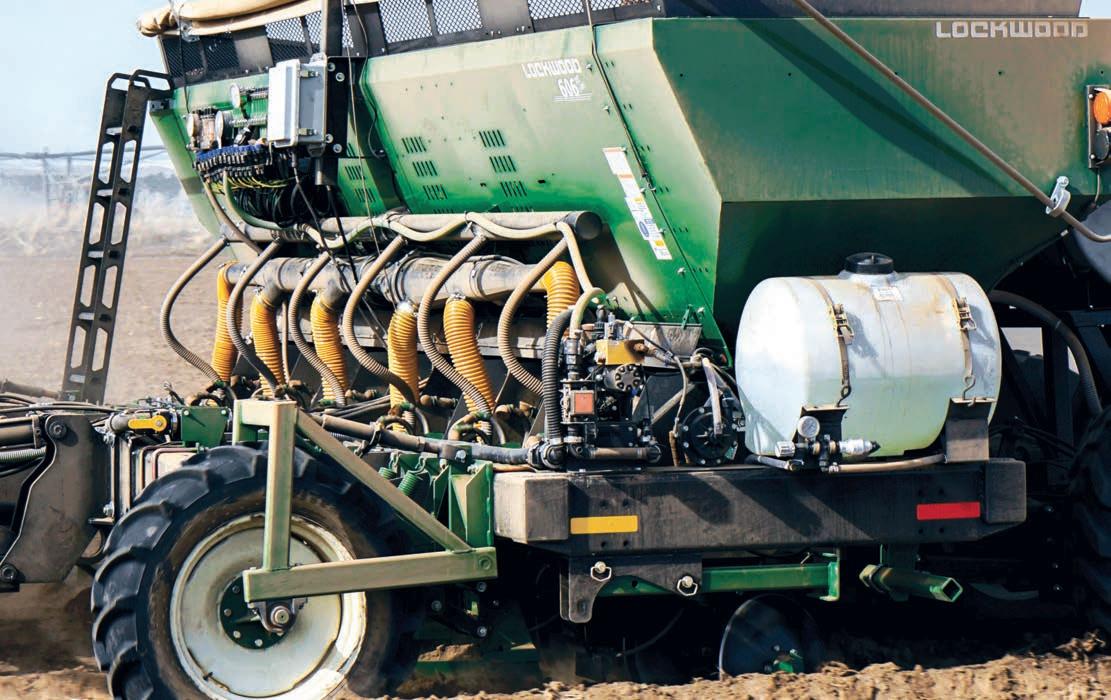
Lockwood Manufacturing (800) 247-7335
www.lockwoodmfg.com Planting, Handling, and Harvesting Equipment
Mayo Mfg. (800) 223-5873
sales@mayomfg.com
mayomfg.com
Potato piling, conveyor lines, grading, wash and shipping systems
Milestone 395 West Hwy 39 Blackfoot, ID 83221 (800) 574-1852
www.Milestone-Equipment.com
Lockwood Manufacturing (800) 247-7335 www.lockwoodmfg.com Planting, Handling, and Harvesting Equipment
Monosem Inc. 1001 Blake St. Edwardsville, KS 66111 (913) 438-1700
75 Arthur Street North Elmira, ON N3B 2A1 (519) 669-4698
www.greentronics.com RiteWeight in-line conveyor system
Star Manufacturing & Design LLC 1557 South SandHill Road Orem, UT 84058 (801) 225-4180
www.allstarmfgllc.com
Milestone 395 West Hwy 39 Blackfoot, ID 83221 (800) 574-1852 www.Milestone-Equipment.com
tILLagE
R & H Machine
115 Roedel Avenue
Caldwell, ID 83605 (800) 321-6568
rh@rhmachine.com
www.rhmachine.com
Long-wearing chrome alloy
truCkS & traILErS
Spud Equipment
Bruce: (208) 390-5920
Evan: (208) 757-8481
Max: (701)740-7574
www.SpudEquip.com
Western Trailers
251 W Gowen Rd. Boise, ID 83716 (888) 344-2539
www.westerntrailer.com
All Star Manufacturing & Design LLC
1557 South Sand Hill Road Orem, UT 84058 (801) 225-4180 www.allstarmfgllc.com
Lockwood Manufacturing (800) 247-7335 www.lockwoodmfg.com Planting, Handling, and Harvesting Equipment
Mayo Mfg. (800) 223-5873
sales@mayomfg.com mayomfg.com
Potato piling, conveyor lines, grading, wash and shipping systems
Milestone 395 West Hwy 39 Blackfoot, ID 83221 (800) 574-1852
www.Milestone-Equipment.com
Spud Equipment
Bruce: (208) 390-5920
Evan: (208) 757-8481
Max: (701)740-7574
www.SpudEquip.com
Western Trailers
251 W Gowen Rd. Boise, ID 83716 (888) 344-2539
www.westerntrailer.com
2026 Buyers’ g
auCtIonEErS
Booker Auction Co.
31 Eltopia West Road Eltopia, WA 99330 (509) 297-9292 www.bookerauction.com
ConSuLtIng LaBS
Potato Inspections
Ag World Support Systems PO Box 1696 Moses Lake, WA 98837 (509) 765-0698 www.AgInspections.com
The Leader In Ag Inspection Services
Stukenholtz Laboratory Inc. P.O. Box 353, 2924 Addison Ave. E Twin Falls, ID 83301 (208) 734-3050; (800) 759-3050 www.stukenholtz.com
MISC .
fInanCE
Pinion Global 6125 Sky Pond Drive Suite 200 Loveland, CO 80538
Judah Cofer 970.685.3425
Judah.cofer@pinionglobal.com www.pinionglobal.com
Pinion is a global leader in food and agriculture consulting and ‘Top 100’ U.S. accounting firm. With roots dating back to 1932, the firm is embedded in helping the food-supply chain from policy to plate. Pinion provides specialized agribusiness advisory in tax and accounting, USDA farm programs, farm financial management, succession planning, land and water management, sustainability, and more
IrrIgatIon
Skone Irrigation & Supply 2051 W. 1st Warden, WA 98857 (509) 349-7364
1304 E. Hillsboro Pasco, WA 99301 (509) 545-8420
www.SkoneIrrigation.com Accurate Sprinkler Packages
partS
Noffsinger 500 6th Ave. P.O. Box 1150
Greeley, CO 80632 (970) 352-0463 or (800) 525-8922
98 Fort Hall Ave. American Falls, ID 83211 (208) 226-7777
American Falls, ID 83211 (208) 226-7777
N570 6th Court
LINDSAY CORPORATION
Endeavor, WI 53930
LINDSAY CORPORATION
Main Office (608) 981-2488
2222 N. 111th St. Omaha, NE 68164
Onion Sales
2222 N. 111th St. Omaha, NE 68164 www.zimmatic.com
www.zimmatic.com
Doug Bulgrin
NEBRASKA IRRIGATION, INC.
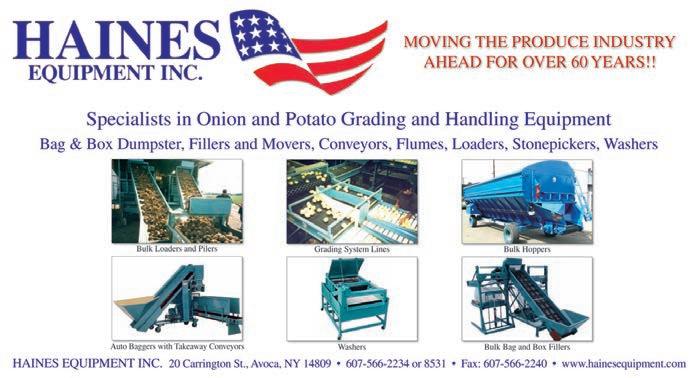
www.hainesequipment.com Hainesinc@aol.com
NEBRASKA IRRIGATION, INC.
Cell (608) 697-6775
Columbus, NE
Columbus, NE Rexburg, ID Dodge City, KS (800) 397-1100
doug@gumzfarmswi.com
Potato Sales
Rexburg, ID Dodge City, KS (800) 397-1100
Tom Bulgrin
www.nebraskairrigation.com
www.nebraskairrigation.com
Cell (608) 697-2137
VALLEY EQUIPMENT & IRRIGATION
tom@gumzfarmswi.com
VALLEY EQUIPMENT & IRRIGATION
EQUIPMENT
398 W. Hwy. 39 Blackfoot, ID 83221 (208) 785-7017
398 W. Hwy. 39 Blackfoot, ID 83221 (208) 785-7017 www.valleyequip.valleydealers.com
www.gumzfarmswi.com
www.valleyequip.valleydealers.com
VALMONT INDUSTRIES, INC.
DIKERS/ CULTIVATORS/RIPPERS
2012 Milestone 72”
DIKERS/ CULTIVATORS/RIPPERS
2005 Spudnik 9060 Cult. Shaper diker
2012 Milestone 72”
2000 Better Built 60” 3ph
P.O. Box 358
VALMONT INDUSTRIES, INC.
Gumz Farms is a 4th Generation farm that is proud to offer Wisconsin grown yellow and red onions and red and yellow potatoes. We are your Midwest connection and pack produce year round.
P.O. Box 358 7002 N. 288th St. Valley, NE 68064 (402) 359-2201 www.valmont.com
7002 N. 288th St. Valley, NE 68064 (402) 359-2201 www.valmont.com
For 65 years, Agri-Stor Companies has been trusted for solving postharvest storage challenges. With our quality chemistries and expertise in custom application techniques, your stored product will have the best opportunity to stay healthy throughout the long storage season. We are committed to providing quality treatment plans backed by University-Based research. From disinfecting to sprout inhibiting and sprout elimination, we have a full line of quality products, including organics, to handle your specific needs. Visit our website for more information.
1,4GROUP,
Inc.
2307 E. Commercial Street Meridian, ID 83642 (208) 887-9766
info@14group.com
www.14group.com
1,4GROUP delivers sustainable storage solutions for potatoes through bio-control products and innovative technologies. Our portfolio includes dormancy enhancers, sprout control, rescue treatments, and efficient, eco-friendly application systems. Committed to supporting farmers worldwide, we help preserve fieldfresh quality throughout the entire storage season.
S torag E
GroupAg
(208) 356-7800
info@groupag.com
www.groupag.com
GroupAg is a full-service post-harvest solutions company specializing in potato storage ventilation, humidity control, and post-harvest chemical applications. We help growers create and maintain ideal storage conditions to maximize crop quality and value from harvest to shipment. GroupAg proudly represents and distributes trusted industry brands, including: Decco, 1,4 Group, BioSafe Systems, BTU Ventilation, Forte Humidifiers, Johnson Thermal Systems, A-TEC Indirex, and Chief Agri.
Industrial Ventilation, Inc.
723 E. Karcher Road Nampa, ID 83687 (208) 463-6305
www.ivi-air.com
ConStruCtIon / StoragE BuILDIngS
Titan Steel (208) 793-0892
www.titansteelidaho.com
Authorized builders for Varco-Pruden and Meridian
rEfrIgEratIon / MonItorIng / ControL panELS
Agri-Stor Companies
(208) 733-7000
www.agri-stor.com
Agri-Stor Companies helps growers take control of their potato storage with Gellert’s AgriStar Control Panel. Over the past 65 years, Agri-Stor has sold its proprietary Control Panels for a wide range of post-harvest products. With its new User Interface, it has even more adaptability and is the most user-friendly panel in the industry! Features include a full color, interactive touch screen, easy to understand programming with full sentences and no confusing icons. The Agri-Star Panel has historical graphing capabilities giving growers all the data they need to make storage trend decisions and keep their potato storage working at optimum performance. Visit our website for all the details.
Gellert Company
(208) 736-7000
www.gellert.com
Since 1964, Gellert has led the Post-Harvest Storage Industry with the expertise and equipment to help growers minimize storage challenges and maximize product quality. With our proprietary equipment, growers can rest assured their storage environment has the most efficient and effective ventilation, humidification, and refrigeration to hold their product during storage. Gellert is fully-loaded to continue bringing new technology, state-of-theart products, and enhanced storage design solutions to help the industry thrive. Visit our website for more information.
Industrial Ventilation, Inc. 723 E. Karcher Road Nampa, ID 83687 (208) 463-6305
www.ivi-air.com
DISEaSE
IDEntIfICatIon QuIZ
Dr. Jeff Miller, a plant pathologist, is the president and CEO of Miller Research, Rupert, Idaho. He can be contacted by phone: (208) 531-5124; cell: (208) 431-4420; jeff@millerresearch.com
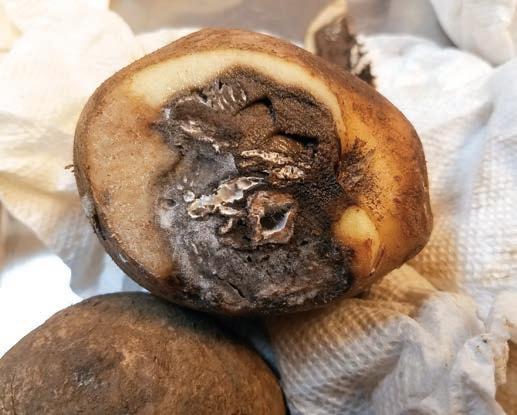
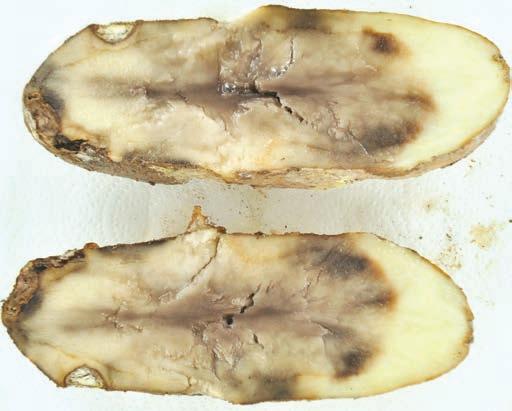
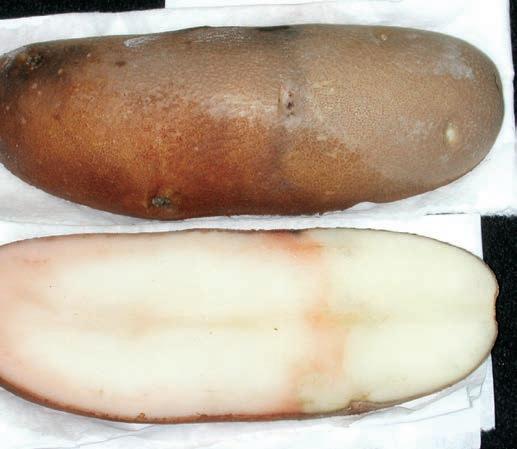
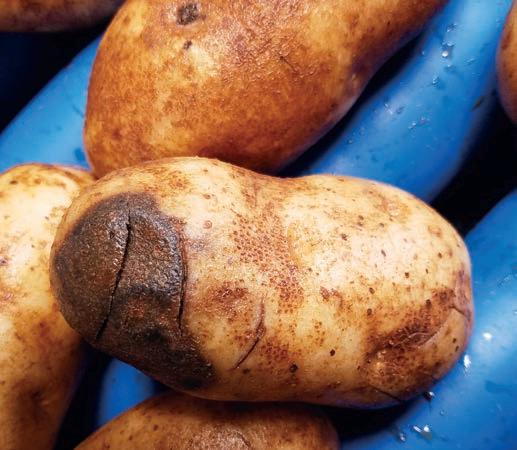
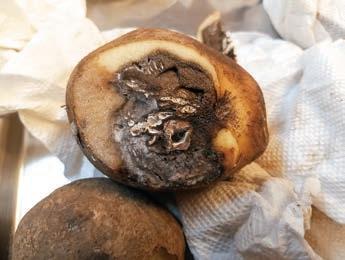
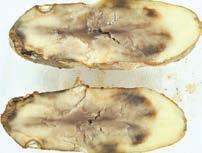
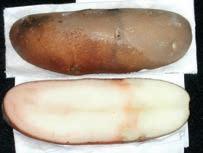
Your storage manager just called to say some tubers were beginning to decay in the cellar. The initial diagnosis is water rot. Which of these photos is typical of water rot? C A D B
Growing Quality Seed For 70 Years!
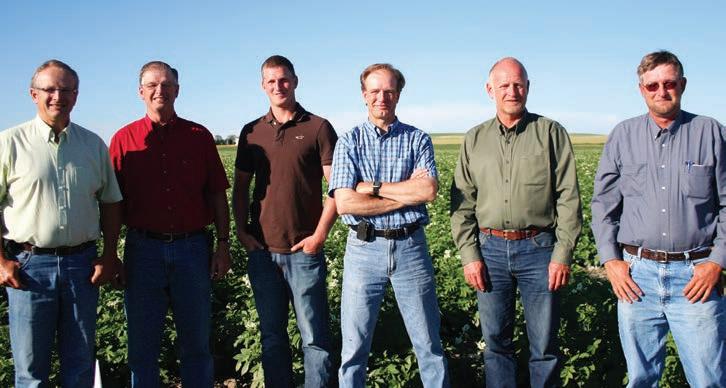
Left to right: Sid, John, Jonathan, Carl, Nick and Cliff.
reverse trade Mission takes International Chefs to Idaho
Story and photos by John O’Connell, University of Idaho
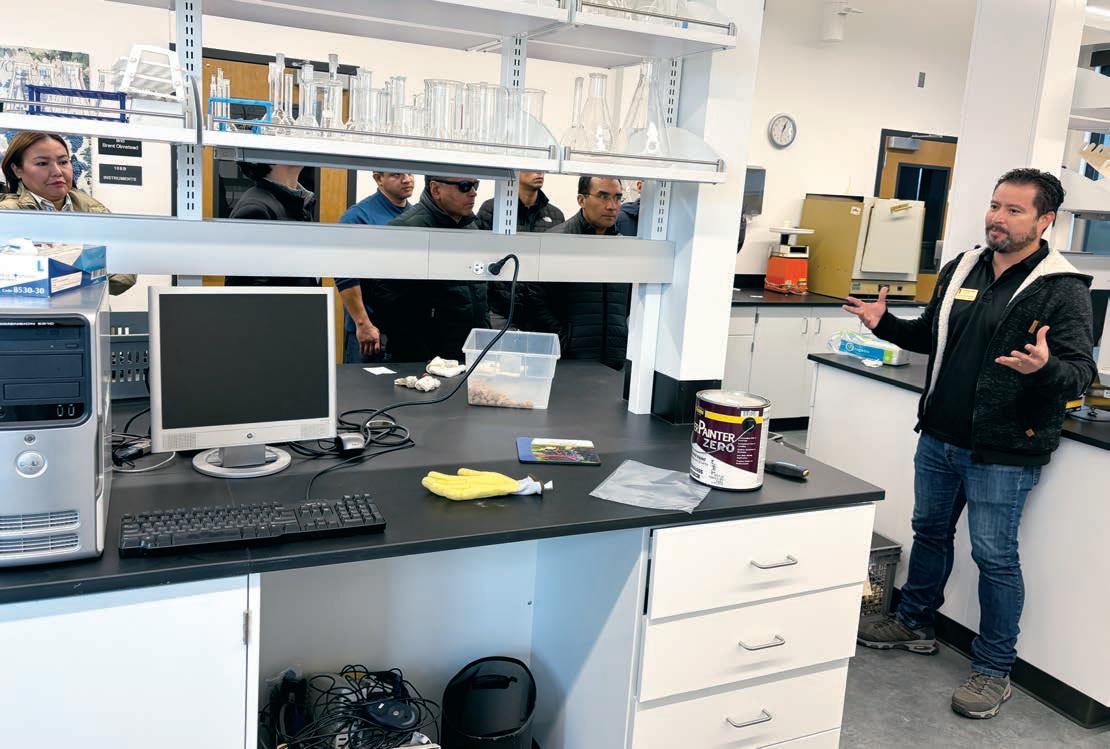
Thirty-one chefs from throughout the world recently toured a new laboratory at the University of Idaho’s Parma Research and Extension Center, witnessing how cutting-edge research contributes to Idaho potatoes’ famous quality.
The chefs, many of whom conduct culinary research and development for large international eateries and restaurant chains, made a stop at U of I’s year-old, 9,600-square-foot Idaho Center for Plant and Soil Health as part of a reverse trade mission organized by Potatoes USA.
Potatoes USA invited chefs from a dozen global markets for U.S. potatoes to join the tour. Chefs were chosen based on the volume of U.S. potato products they’re already using and their potential to increase their U.S. potato orders.
“The work being done in Parma reflects the U.S. potato industry’s commitment to science-based programs, ensuring U.S. potatoes remain the global standard for consistency and excellence,” said Marisa Stein, Potatoes USA global marketing director.
The group also visited Idaho potato farms, frozen potato processing facilities,
and a facility specializing in snack food and potato processing research and development, educating the chefs about the U.S. potato supply chain. The trip concluded in Chicago, where the chefs experimented with U.S. potatoes and created their own innovative products.
Making Impressions
Domingo De Obaldia, a chef who owns several restaurants in Panama, including five Doxi’s Chicken Fingers locations, rode aboard a potato harvester at a Treasure Valley farm and couldn’t believe how efficiently the machine unearthed and
Mike Thornton, an emeritus professor of plant sciences who specialized in potato and onion agronomy, speaks to international chefs participating in a Potatoes USA reverse trade mission, making a stop at the Idaho Center for Plant and Soil Health at the University of Idaho's Parma Research and Extension Center.
loaded spuds. He was also impressed by the rigor and sophistication of the potato research findings presented by UI Extension faculty in Parma.
“Coming here and seeing all the studies they do to make Idaho potatoes as world renowned as they are in terms of quality, production, yields and all of that — it’s incredible,” De Obaldia said. “As far as the research goes, this helps me solidify the knowledge that the product I use in my restaurant is top quality and it’s been studied and investigated and made specifically to be what I need it to be.”
Chefs were especially interested in the modern irrigation systems used on the farms they visited, as well as the emphasis that farmers place on keeping foreign materials out of their crops.
James Woodhall, a UI Extension specialist of plant pathology who organized the Parma tour, relished the opportunity to share the university’s new Idaho Center for Plant and Soil
Health with an influential international audience. Parma faculty who presented to the chefs highlighted the center’s important contributions toward potato variety development, minimizing impacts of potato insect pests, advancing storage physiology science and diagnosing diseases, including efforts to predict risk and prevent crop infection.
“The new facility is one of the best facilities in the western U.S.,” Woodhall said. “It’s good to show we’re working in a quality, cutting-edge environment. If we have the right environment to do the work, then we’ll also have the quality, cutting-edge research and provide that information to our stakeholders.”
Boosting Business
Potatoes USA hosts a reverse trade mission annually, alternating between inviting international chefs and then importers and distributors working in international food retail and food service.
The reverse trade missions are funded with USDA Market Access Program dollars, in addition to a 10% match from Potatoes USA.
About 20% of the U.S. potato crop is exported internationally, and Potatoes USA’s reverse trade missions have played a major role in boosting global demand. For example, participation in a past reverse trade mission led Grupo Barrio, a leading restaurant group in Nicaragua, to grow its potato purchases by 50%, and L.A. Chicks, a fast-casual chain in the Philippines, began sourcing U.S. fries valued at approximately $17,000 annually.
“This is a monumental experience for these chefs,” Stein said. “They’ll go back and remember this experience for years to come, and they’ll talk about it.”
Armando Falcon-Brindis, a University of Idaho Extension specialist of entomology, discusses research conducted to benefit the potato industry at the University of Idaho’s Parma Research and Extension Center and its new Idaho Center for Plant and Soil Health.
the grower's toolbox Protecting Potatoes From Nematodes
By Inga Zasada, Nematologist and PAPAS Project Co-Director
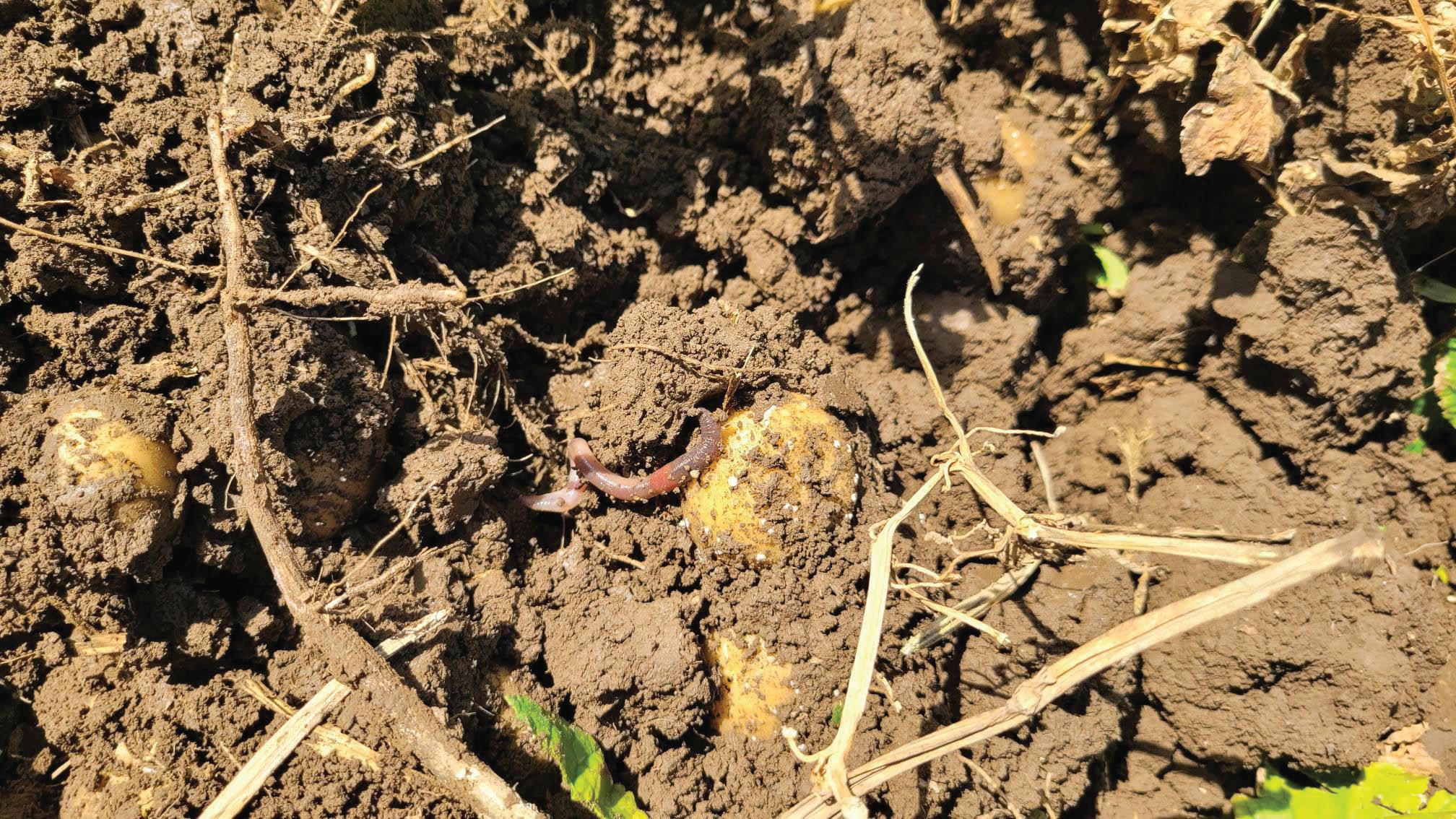
You can’t see them, but they’re there: tiny, persistent pests that threaten one of America’s most valuable crops. Potato nematodes don’t just damage roots. They can devastate yields, restrict market access and persist in the soil for years. Unchecked, nematode infestations can lead to significant crop loss –sometimes reducing yields by up to 60% – and economic impacts through trade and planting restrictions and affected tubers not meeting market or export standards.
Managing plant-parasitic nematodes is essential for maintaining healthy potato crops, minimizing yield losses and ensuring high-quality tubers. However, the ongoing difficulty and expense of managing nematodes in potato production is a challenge for the industry. For decades, growers have fought these invisible enemies with fumigation, crop rotation and strict sanitation
measures. While these practices remain essential, other management options need to be considered.
nematode-resistant Varieties
Planting nematode-resistant potato varieties can significantly reduce damage from nematodes. Resistant varieties are
bred to withstand nematode attacks, limiting their spread and reproduction. Although resistant varieties represent one of the most sustainable and effective measures for plant pest control, commercially acceptable potato varieties resistant to plant-parasitic nematodes are extremely limited in the U.S.
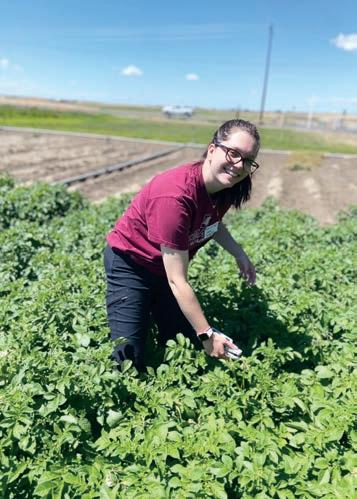
Oregon State University graduate student Gabby Studebaker conducts field research on the impact of root-knot nematode levels on potato quality and yield.
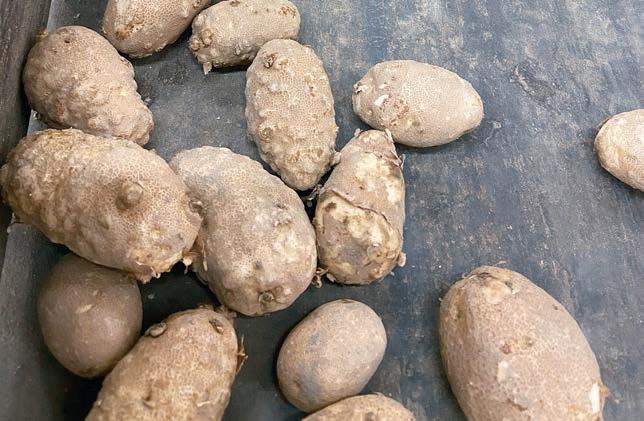
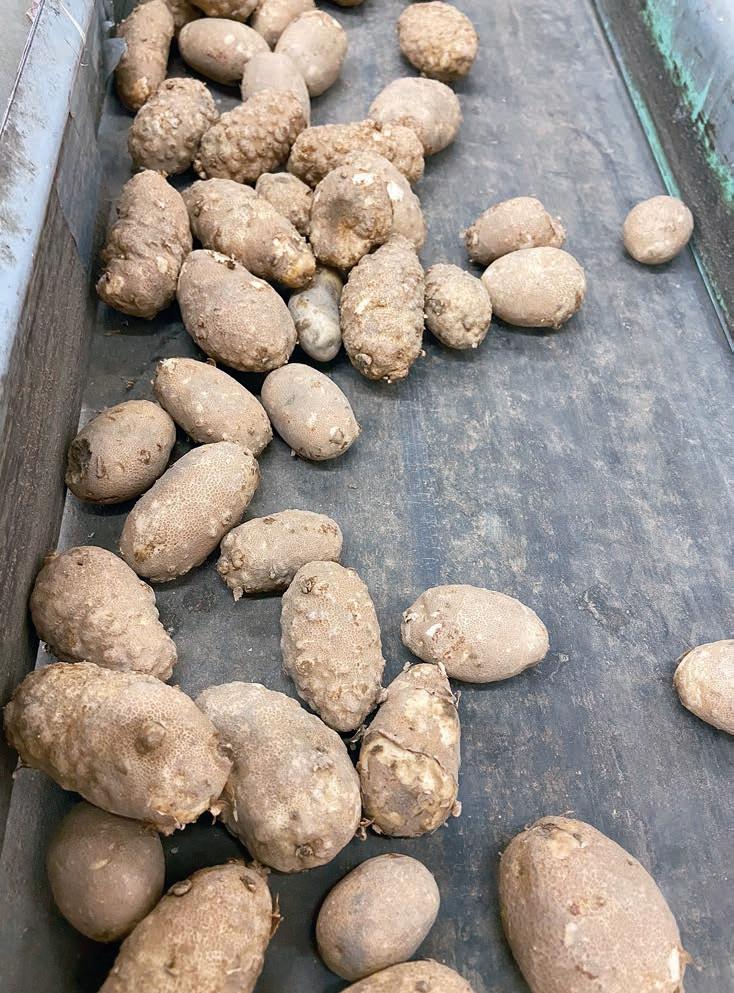
Potatoes show damage from Columbia root-knot nematode.
fumigants and nematicides
Soil fumigants or nematicides can help reduce the number of nematodes in soil. However, applications are costly and can account for about 10% of total production costs. Plus, many frontline products have been banned or voluntarily withdrawn from the market while others suffer supply chain problems. These treatments should be part of an integrated management plan and used judiciously due to cost and environmental impact.
Prevention is always more effective and cost-efficient than trying to control an established nematode population. Infested seed is one of the primary ways nematodes can spread. Always use certified seed potatoes. Nematodes can be spread through soil stuck to plant materials, clothing and equipment. Ensure farm equipment, vehicles and tools are cleaned thoroughly when moving between fields.
Despite these efforts, nematodes remain among the most challenging and costly pests in potato production.
That’s why growers, researchers and industry leaders are investing heavily in the next generation of nematode control strategies. By combining genetic resistance, biological products and precision data tools, the industry is moving from reacting to infestations toward prevention.
new tools and Insights
PAPAS (Potatoes & Pests: Actionable Science Against Nematodes) is a multiinstitutional research collaboration that brings together nematologists, potato breeders, chemists, economists
and growers from across the U.S. to create more effective and sustainable management strategies. This team is tackling major challenges in potato nematode management through:
● Developing and testing new potato varieties with resistance to key nematode species. Resistant varieties could become one of the most effective, long-term management tools for growers.
● Formulating new nematicide chemistries from litchi tomato (Solanum sisymbriifolium) and other bio-based compounds with nematicidal activity.
● Improving diagnostics for faster, more accurate nematode identification.
● Developing predictive models of nematode pressure and economic impact for more precise management efforts.
● Educating the next generation of potato researchers.
● Engaging farmers by hosting onfarm trials, field days and workshops. Plant-parasitic nematodes are a complex challenge, but with careful management and the latest research-driven solutions, growers can limit their impact, protect yields and secure the future of potato production.
Visit potatonematodes.org for the latest insights and research updates in potato nematode management.
Potatoes are grown in soil without potato cyst nematodes (left) compared to small tubers resulting from potato cyst nematode damage (right).
These photos show symptoms of tuber decay problems.
Photo A is Fusarium dry rot. It is typically a dry, granular decay. However, sometimes moisture can be observed with the rot.
I have seen photos B, C and D all referred to as “water rot.” These are examples of Pythium leak (Photo B), pink rot (Photo C) and bacterial soft rot (Photo D). The common usage of “water rot” is typically associated with Pythium leak (Photo B). Tubers affected by Pythium will “leak” water when they are squeezed. With time in storage, almost all tubers with decay will develop bacterial soft rot, regardless of what started the infection. When this happens, tubers can appear to leak water even if they aren’t affected by Pythium.
As a result, the term “water rot” may not be helpful in diagnosing a problem in the cellar. It is much more helpful to obtain a specific diagnosis to know for sure if you are dealing with Pythium leak or something else that has made the tubers soft.
Grain Treater USC LP2000 w/ seed wheel more at sPuDeQuiP.com
Fusarium dry rot
Pythium leak
Pink rot
Bacterial soft rot
Volm partners with Dutch Equipment Developer
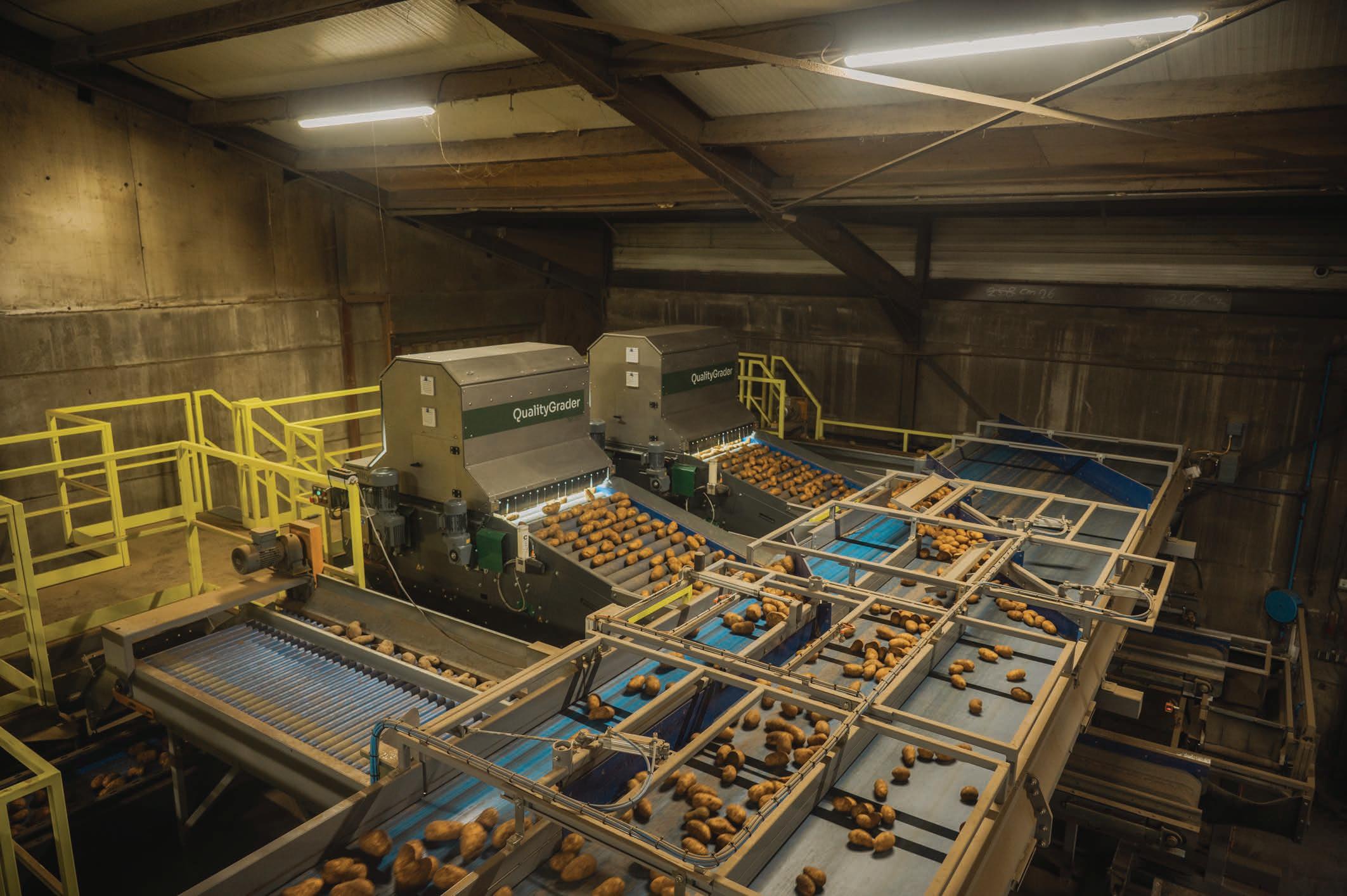
Volm Companies has signed a new dealership agreement with Flikweert Vision, a Netherlandsbased provider of equipment for the potato and onion industries. The partnership will help Flikweert expand its international footprint and allow Volm to expand its equipment portfolio with the addition of Flikweert’s Divider and Quality Grader.
The Divider is an optical sorting machine that separates foreign objects from field crops. Using AI technology to process up to 120 tons per hour, the machine is built to optimize product flow, resulting in less wear, product damage and waste down the line.
The Quality Grader uses a combination of AI and advanced camera technology to sort up to 20 tons of product per hour.
IpC adds three
The Idaho Potato Commission (IPC) has welcomed three new commissioners: Scott Mickelsen, Doug Ruff and Brad Russell.
Mickelsen is the business manager at Rigby Produce and has decades of hands-on experience in the potato packing industry. Having grown up working alongside his father and brothers, he has been immersed in Idaho’s potato business since childhood.
Ruff owns Ruff Times Farms, which he runs alongside his sons. A third-generation Idaho farmer and University of Idaho graduate, Ruff also holds a CPA license, bringing a blend of business expertise and agricultural experience to the commission.
Russell is the director of global potato procurement for Simplot Global Food. He has 10 years of experience in fry processing and 18 years in potato procurement.
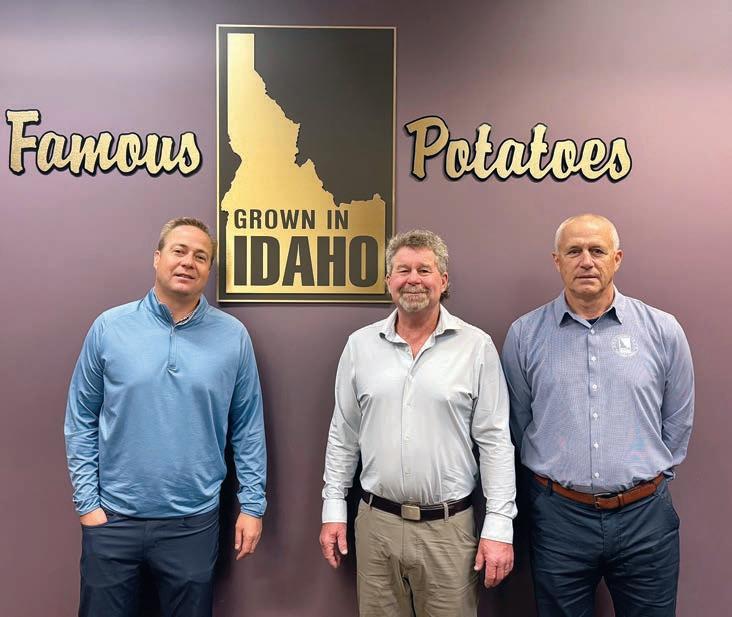
From left, Scott Mickelsen, Doug Ruff and Brad Russell join the Idaho Potato Commission.
the real-world Cost of the federal Shutdown
By Kam Quarles, CEO, National Potato Council
Whenmost Americans think of a government shutdown, they think of political posturing, pointscoring via social media memes, and the general messiness of doing business in Washington, D.C. It often seems like a distant drama that doesn't really touch their lives. But for U.S. potato growers, and for the broader American agricultural industry, these funding lapses have real, immediate and costly consequences. As I write this in mid-October, three weeks into the government shutdown, I think back on the missed opportunity to advance a major policy priority: U.S. potato fresh market access in Japan.
This isn’t a small opportunity. The industry estimates that full access to the Japanese market would increase our global fresh potato exports by 10 to 15 percent, injecting an estimated $150 million annually into the pockets of American potato growers and bolstering paychecks along the entire potato supply chain. It is a long-sought priority that has been languishing after three decades of frustrating trade talks, stymied by protectionism from the Japanese government.
As we flew to Tokyo earlier this month, we believed we were in the best position in years to finally get this moving. The shutdown changed that calculation.
The timing of the federal funding lapse was tremendously unlucky. At the last minute, USDA Secretary Brooke Rollins was forced to cancel her participation in our mission to Japan. While Undersecretary for Trade Luke Lindberg capably led the remaining delegation, the absence of the secretary, and the weight of her Cabinet-level voice, took a significant amount of wind out of our sails.
Managing the Chaos
It is an unfortunate truth that when we negotiate trade deals for American agriculture, we are never just going up against our foreign competitors. We are always up against that foreign competitor and their government. That is why comprehensive USDA trade programs are so critical – they are the leverage we need to push back against extreme tariffs, foreign subsidies and non-tariff barriers that distort the market and hurt our family
The shutdown not only disrupted our current mission but also forced the cancellation of the USDA’s broader T.R.U.M.P. trade mission to Japan and Taiwan, which included dairy, grains, poultry and soybean organizations. And we face the threat of a similar cancellation for a planned mission to Mexico in November.
The market access agreement with Japan is not complicated to conclude but requires a concerted push past existing protectionism. I remain optimistic that upcoming diplomatic efforts, including a visit by President Donald Trump and the expected installation of a new Japanese Prime Minister, Sanae Takaichi, could finally provide the spark we need.
But we cannot afford this shutdown to drag out for more weeks (or months). This latest shutdown demonstrates that the impact of the federal government’s closure is felt far outside of D.C. and delays trade opportunities that could benefit our
Ecorobotix tests algorithm in potatoes
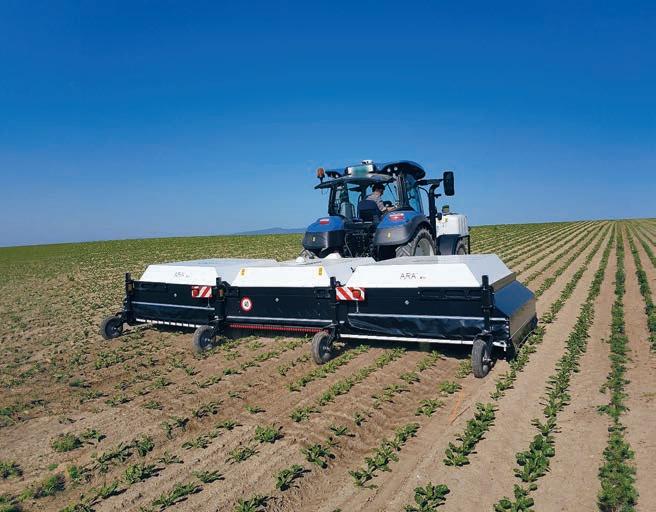
Ecorobotix is launching a series of algorithms currently under development for its ARA Ultra High Precision Sprayer, including an algorithm for use in potatoes. The algorithm is available free of charge while it’s being refined. This launch phase allows producers to test the company’s upcoming technological advances in new crops.
The Ecorobotix sprayer uses cameras and AI to distinguish crops from weeds and make targeted chemical applications. Supporting more than 25 crop algorithms and capable of recognizing over 40 weed species, the sprayer can help growers reduce inputs by up to 95%, according to the company.
Visit www.ecorobotix.com.
Jh Biotech Introduces Biostimulant
JH Biotech, Inc.’s new soluble seaweed extract, Kelp Star, is a natural plant biostimulant designed to promote healthy plant growth, improve soil health and maximize crop yields. Derived from Ascophyllum nodosum kelp, Kelp Star provides a concentrated source of essential nutrients, minerals and natural growth factors. When applied, the product is said to enhance the plant’s ability to absorb and utilize nutrients, leading to increased vitality and improved resistance to environmental stressors such as drought or temperature fluctuations.
Visit jhbiotech.com.
Year-End wrap-
Though North America’s 2025 potato crop varies by region, total production in the processing states and provinces is expected to be down only 0.4% from the 2024 crop. Europe’s 2025 potato crop is expected to increase relative to the previous year. In this article, we explore the North American and European frozen processing potato supply situation and its potential impact on frozen product sales and consumption.
uS Supply Situation
U.S. potato production (as of press time) is expected to match the size of the 2024 crop at 421 million cwt. If realized, the 2025 potato crop would be 0.4% larger than the five-year average. In the Columbia Basin, production will likely fall 5%-6% below the 2024 crop. The yields and quality for most early processing potato varieties were exceptional – the best ever produced. However, reports suggest that yields for full-season varieties have been slightly above average and similar to last year’s crop. Idaho growers planted 315,000 acres of potatoes in 2025, the same as they planted in 2024. Reports from growers across Idaho suggest that processing potato yields were near record levels for most varieties. In addition, recovery
rates are above average. Storage space was limited in some areas. If our forecast is accurate, Idaho’s production could exceed the 2024 crop by 4%-5%. It would be the state’s second-largest potato crop since 2018, behind 2023.
September in the Midwest was one of the warmest on record. Reports indicate that the warm weather gave potatoes a late-season yield boost. As a result, frozen processing supplies are expected to be slightly above budget in the Midwest processing states. High temperatures only allowed growers to harvest potatoes early in the morning or late in the evening. Some finished harvesting without being able to dig for a single full day. Growers and processors are pleased with the size and shape of this year’s processing potatoes, though the large size has resulted in slightly lower specific gravities. Growers in both Minnesota and North Dakota report above-average yields. In Wisconsin, yields for processing potatoes were better than expected; however, there may be some quality issues due to the late-summer heat.
Maine should have an adequate supply of potatoes for processing. Growers planted nearly the same acreage as last year despite contract reductions. Yields for processing potatoes were close to average. The state experienced ideal harvest conditions, which allowed growers to finish digging earlier than usual. Maine growers are pleased with the quality of this year’s crop. They have been shipping extra potatoes to Prince Edward Island, Canada, where local raw product supplies are limited.
Canadian Supply Situation
At 124.4 million cwt, Canada is expected to produce its third-largest potato crop on record, down 2.9%
from the 2024 crop. The industry has expanded processing capacity in Alberta. Raw product supplies in Alberta are up this year, though they are down in Manitoba. Combined production in those provinces is currently expected to exceed the 2024 crop by 1%-2%. In the eastern part of the country, production is expected to be down in Prince Edward Island, New Brunswick and Quebec. To cover the supply gap in Prince Edward Island, the major processor has started importing potatoes from Maine and New Brunswick. Potatoes will likely be shipped from the Prairie Provinces to New Brunswick next spring.
Overall, Canadian fryers should have access to enough raw product to operate plants at planned levels through the 2025-26 processing season, though it may require importing potatoes from other growing areas. On the other hand, U.S. fryers should not need to import processing potatoes from Canada this year.
European Supply Situation
Growers in the EU’s top five French fry exporting countries – Belgium, the Netherlands, France, Germany and Poland – planted more potatoes this year than they did in 2024. Current estimates are that the five major exporting countries planted a combined 2.54 million acres of potatoes this year, 7.4% more than they planted in 2024, according to World Potato Markets, a European publication. The EU’s MARS crop monitoring service expects yields to exceed 2024 levels in Belgium, France, the Netherlands and Poland. However, yields are projected to fall short of last year’s record in Germany. Based on current acreage and yield estimates, the top five European exporting countries are expected to produce 921.5 million cwt
rap-up
of potatoes for the 2025 crop. That is 75 million cwt more than those countries produced in 2024, an 8.9% increase.
Impact on french fry Sales
North American fryers have been able to expand global French fry sales during the past several months. North American fryers shipped 0.6% more frozen potato products to offshore markets during the year ending July 31 than they did a year earlier (August data are not available due to the federal government shutdown). Though North American potato production is down slightly from last year, raw product supplies are sufficient for the 2025-26 processing season.
EU frozen product sales were held back by competition and raw product supply constraints last year. EU exports were down 6.3% during the year ending July 31. However, potato production is up significantly for the 2025 crop. Both North American and European fryers could produce more French fries and other frozen potato products during the 2025-26 processing season.
French fry demand growth has been relatively steady. Global French fry exports were up 4.9% during the 12 months ending July 31. Global exports have grown by an average of 4.3% per year during the past 10 years. Raw product supplies should be adequate in the major processing regions of North America for a modest 1%-3% increase in sales. However, market constraints, global competition and economic uncertainty may hold production and sales from the 2025 crop below our estimate.
By Ben Eborn, Publisher, North American Potato Market News
• Though production is down from last year in the Columbia Basin, raw product supplies
• Canadian fryers should have access to enough raw product to operate plants at desired levels, though potatoes may have to be imported from other regions to cover local supply gaps.
• Potato production in the top five European French fry producing countries is expected to increase relative to the 2024 crop.
• Global French fry sales could increase during the next 12 months, given the raw product supply situation in both north america and Europe.
potato harvest wrap-up: Strong Starts and Steady Quality
By Dale Lathim, Potato Growers of Washington
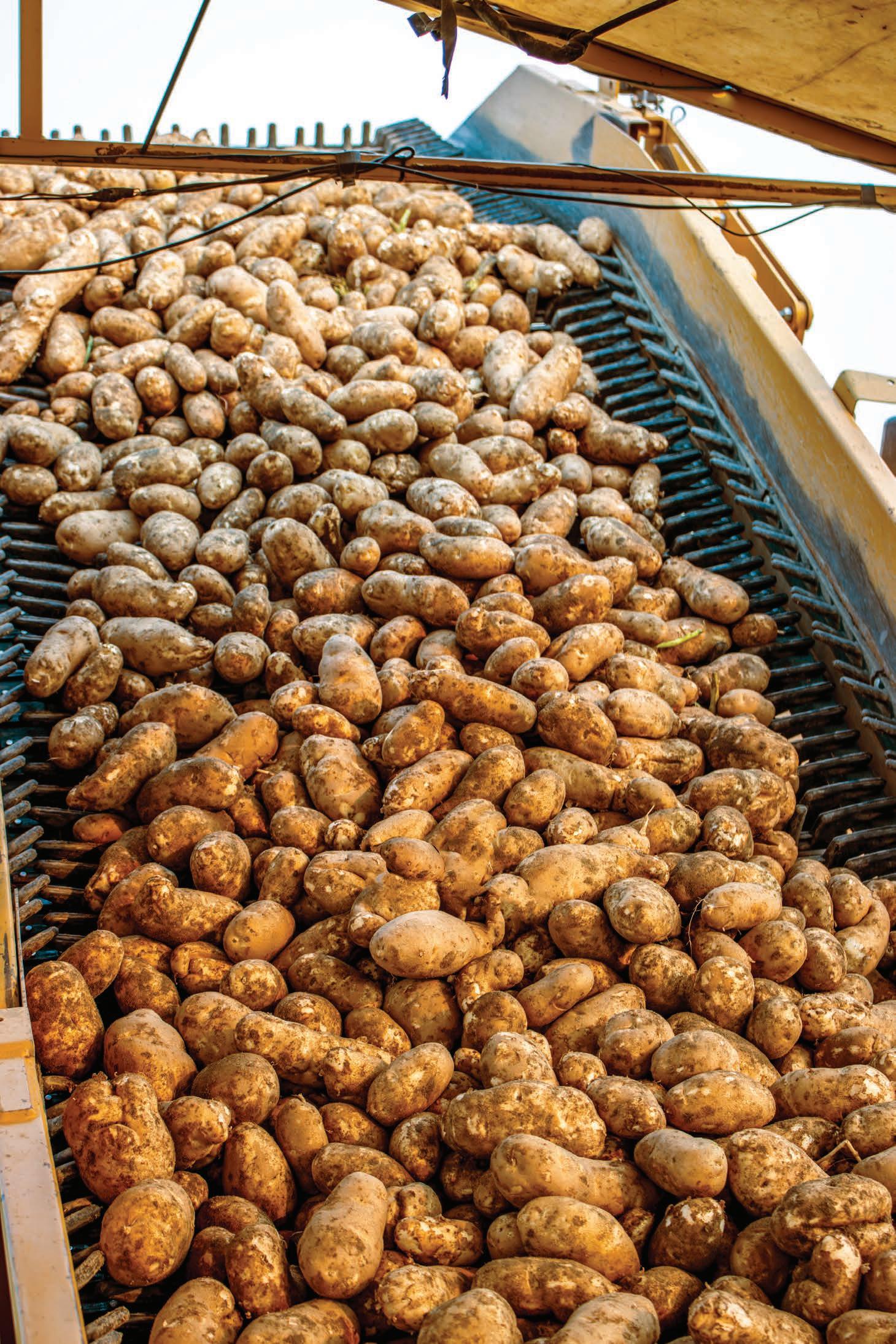
Asthe dust settles on another potato harvest, there’s plenty to celebrate this season. Growers kicked off the year with some of the strongest early yields on record, paired with exceptional
quality right out of the gate. These early results set a hopeful tone for the season and made for spirited conversations throughout the industry.
While the great quality persisted throughout the harvest, the story shifted a bit for the full-season varieties. Yield numbers for these potatoes settled closer to average as August brought
"Growers kicked off the year with some of the strongest early yields on record, paired with exceptional quality right out of the gate."
a mix of weather-related challenges. Upper-level haze seemed to filter out some of the needed solar radiation for photosynthesis, and warmer than normal nighttime temperatures prevented the normal growth and bulking during August.
Despite my early expectations of above average yields, this year’s outcome proved more balanced. Fortunately, the forecasted huge surplus of contract overages and open potatoes never fully materialized. While not all of the potatoes have found a home in the human food chain, the amount being diverted is far less than I and many others anticipated.
One big reason for the manageable surplus lies in the actions of major processors. Lamb Weston stepped in to purchase many contract overages, not just from its own growers but from some competitors as well. Simplot also played its part, taking care of most of its own contract overages.
Looking ahead: Storage Crop Shows promise
As the storage season begins, there’s more good news to share. The storage crop is holding up very well, with fewer early storage issues than usual needing attention. Potato quality remains high, and both growers and processors are optimistic about a smooth transition into the winter months.
All in all, this year’s harvest stands out as a testament to the resilience and adaptability of our potato community. With strong early yields, great quality and swift responses from processors, we’re closing the books on another successful season and already looking forward to what next year will bring.