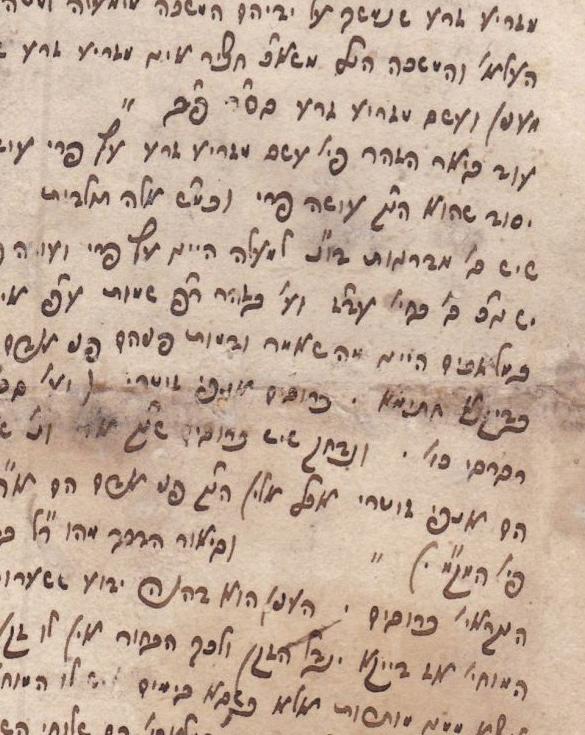
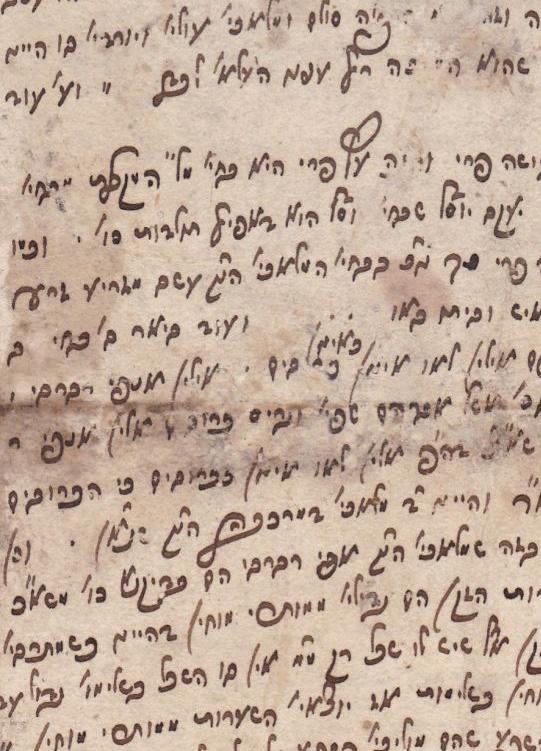
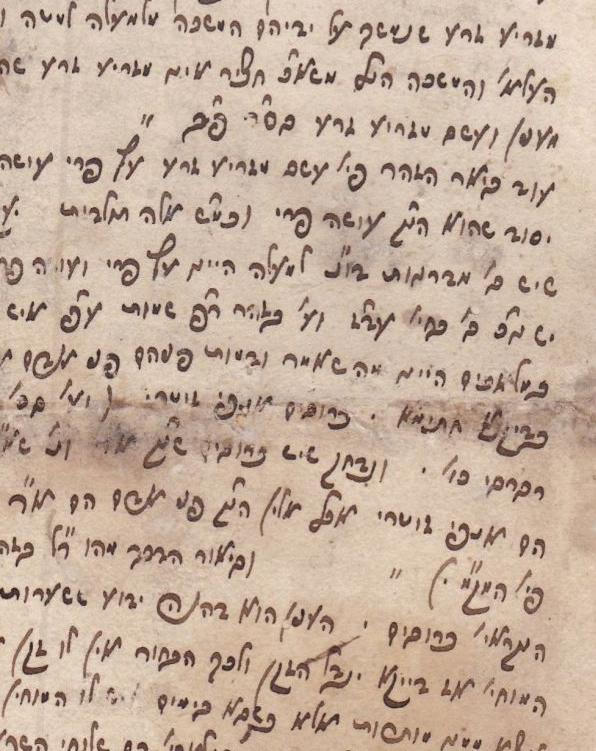
By the Grace of G-d 11th of Kislev, 5739 Brooklyn, N.Y.
Blessing and Greeting,
After a long interval, I was pleased to receive your letter. May G-d grant the fulfillment of your heart's desires for the good. Thank you very much for your good wishes in connection with the Festival of Lights. In light of the saying of our Sages, "One who blesses others is blessed by G-d Himself," G-d will surely bless you generously with a happy and bright Chanukah.
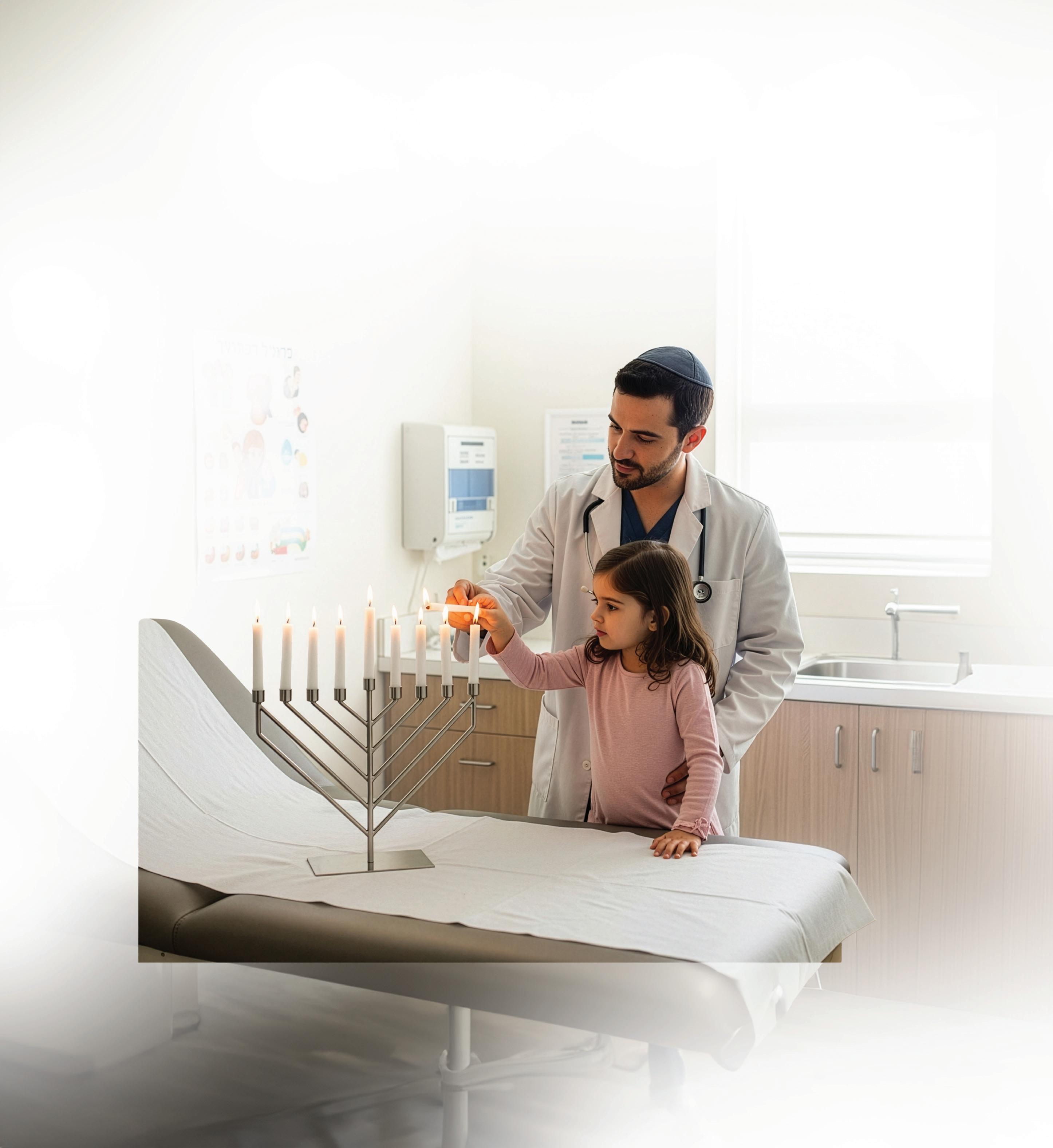
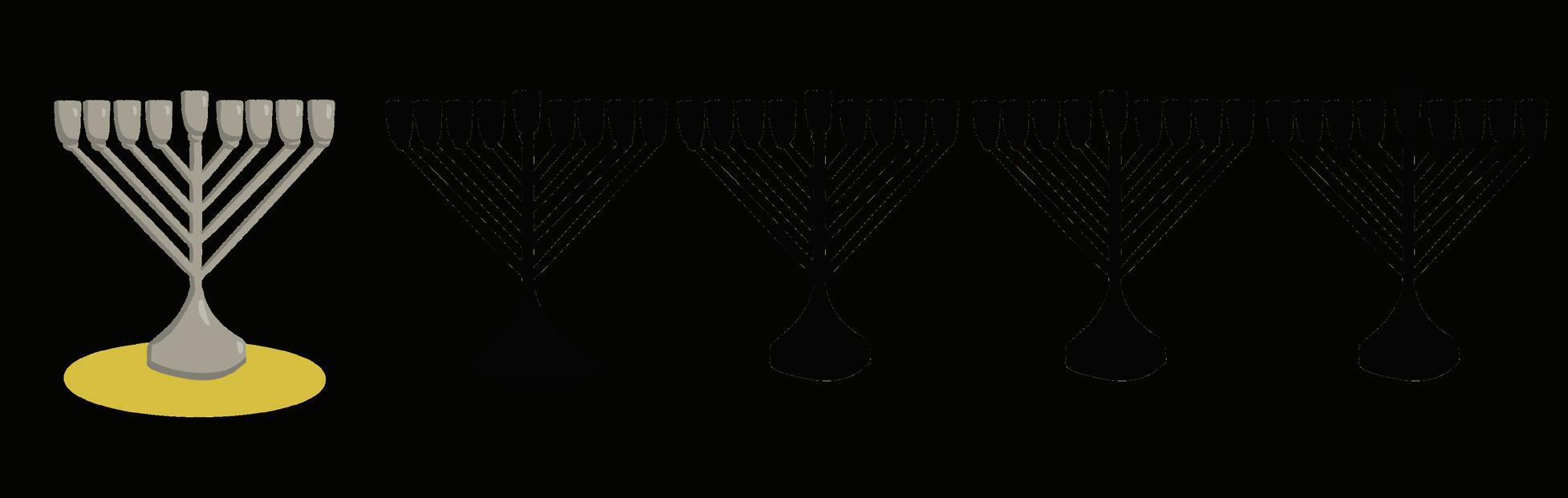
As you know, the Chanukah lights, which are kindled in increasing numbers from day to day, symbolize the light of the Torah and mitzvot, which should likewise be on the increase from day to day, thereby also widening the channels to receive G-d's blessings in a growing measure, both spiritually and materially - in the good that is plain to see, even as the Chanukah lights are visible to the human eye.
Furthermore, the Chanukah lights teach us a clear lesson that matters of goodness and holiness, Torah and mitzvot, should be on the increase even in the case of
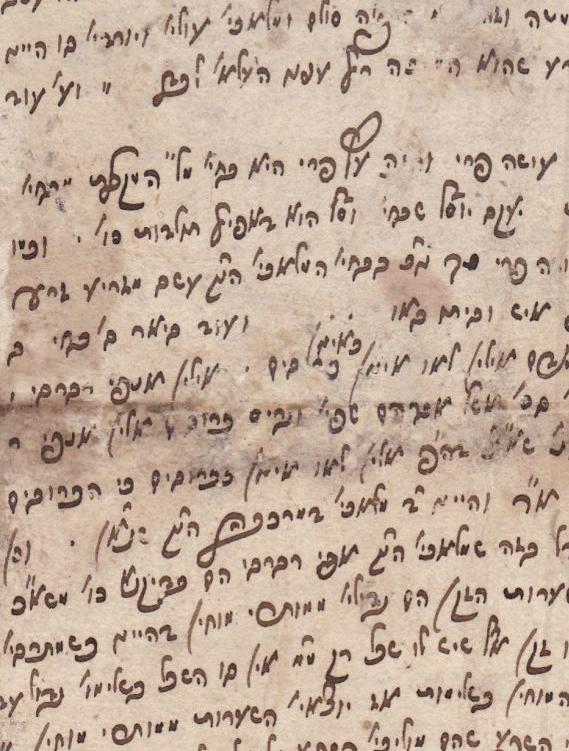
Dvar Malchus
Making Hiddur the Rule
A lesson from how the Chanukah candles are lit, increasing each day
those who have attained a high level of "hiddur” in Torah and Mitzvot— contrary to a prevalent view that, having attained a high and satisfactory level, it is sufficient to maintain this high level on an even keel. Apart from the fact that merely maintaining the high level does not comply with the rule of "Maalin b'Kodesh," the Chanukah lights clearly and emphatically indicate that even in hiddur itself the same principle applies. For on the second night of Chanukah, the greatest possible hiddur is to light two candles; yet if one should light two candles on the third night of Chanukah, the mitzvah of Ner Chanukah will be fulfilled, but the hiddur would be lacking. And even after one lights three candles on the third night, showing that one knows of, and is complying with, the rule, it is still not sufficient to do so only once or twice, but it is necessary to add an additional candle each subsequent night, for a total of seven days of hiddur. Seven consecutive days, of course, constitute a basic period in time, a complete week, corresponding to the Seven Days of Creation. Thus, by practicing Hiddur Mitzvah of Ner Chanukah for seven consecutive days, the absolute rule is established that hiddur in Torah and mitzvot must be practiced every day of the week, each day exceeding the previous
day, however satisfactory it was.
Needless to say, these basic lessons of Chanukah are not limited to Chanukah itself, but apply each and every day of the year, as in the case of the teachings and instructions of all our festivals. To cite one example, although Pesach is celebrated once a year, the experience of Yetzias Mitzraim is not confined to Pesach alone, but has to be experienced every day of the year, in terms of spiritual liberation through the Torah and mitzvot without restraint. Similarly in the case of Chanukah and the Chanukah lights, which have to be reflected in our everyday life throughout the year, making each day brighter with the light of Torah and mitzvot than the foregoing day, as mentioned above. There is surely no need to expand on any of the above points, since you can do it yourself on reflection.
Nor is there any need to dwell on the lessons of Yud Tes Kislev, which will surely not pass unnoticed by you.
May G-d grant that you should have good news to report in all above. Wishing you a bright and inspiring Chanukah.
With blessing, /Signed: Menachem Schneerson/
Publisher
Mica Soffer
Editor Rabbi Yehuda Ceitlin
Associate Editor
Mendy Wineberg
Contributing Writers
Asharon Baltazar
Tzemach Feller
Sari Kopitnikoff
Chana Kornfeld
Sarah Pinson
Sruly Meyer
Tzali Reicher
Mordechai Schmutter
Raizel Serebryanski
Binyomin Weiss
Design
Chana Tenenbaum
Photo Credits
JEM/Living Archive
ADVERTISING
ads@COLlive.com
718-427-2174 ext. 2
EDITORIAL INQUIRIES OR SUBMISSIONS
Editor@COLlive.com
718-427-2174 ext. 1
SUBSCRIPTION
To receive a printed copy of the magazine (U.S. addresses only): COLlive.com/magazine
COLlive Magazine is published in print and online periodically by the COLlive Media Group Inc. and is distributed across the United States. COLlive does not endorse any products or services reported about or advertised in COLlive Magazine unless specifically noted. The acceptance of advertising in COLlive Magazine does not constitute a recommendation, approval, or other representation of the quality of products or services or the credibility of any claims made by advertisers, including, but not limited to, the kashrus or advertised food products. The use of any products or services advertised in COLlive Magazine is solely at the user’s risk and COLlive accepts no responsibility or liability in connection therewith.
FROM THE PUBLISHER
It’s Chanukah time, and that means we are all in a celebratory mood. For Lubavitchers, the days are divided between family gatherings, Mivtzoim, and the many public Menorah lightings taking place near and far.
This month’s issue reflects, in various ways, the idea of sharing light and the enduring struggle for truth and identity—core themes of Chanukah.
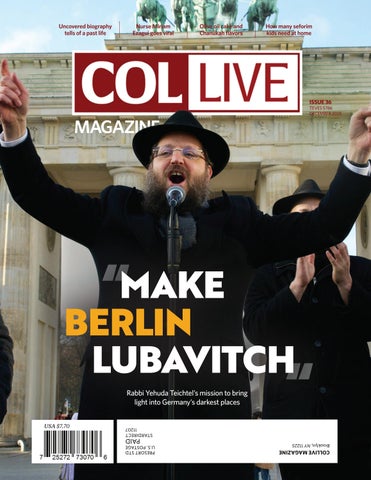
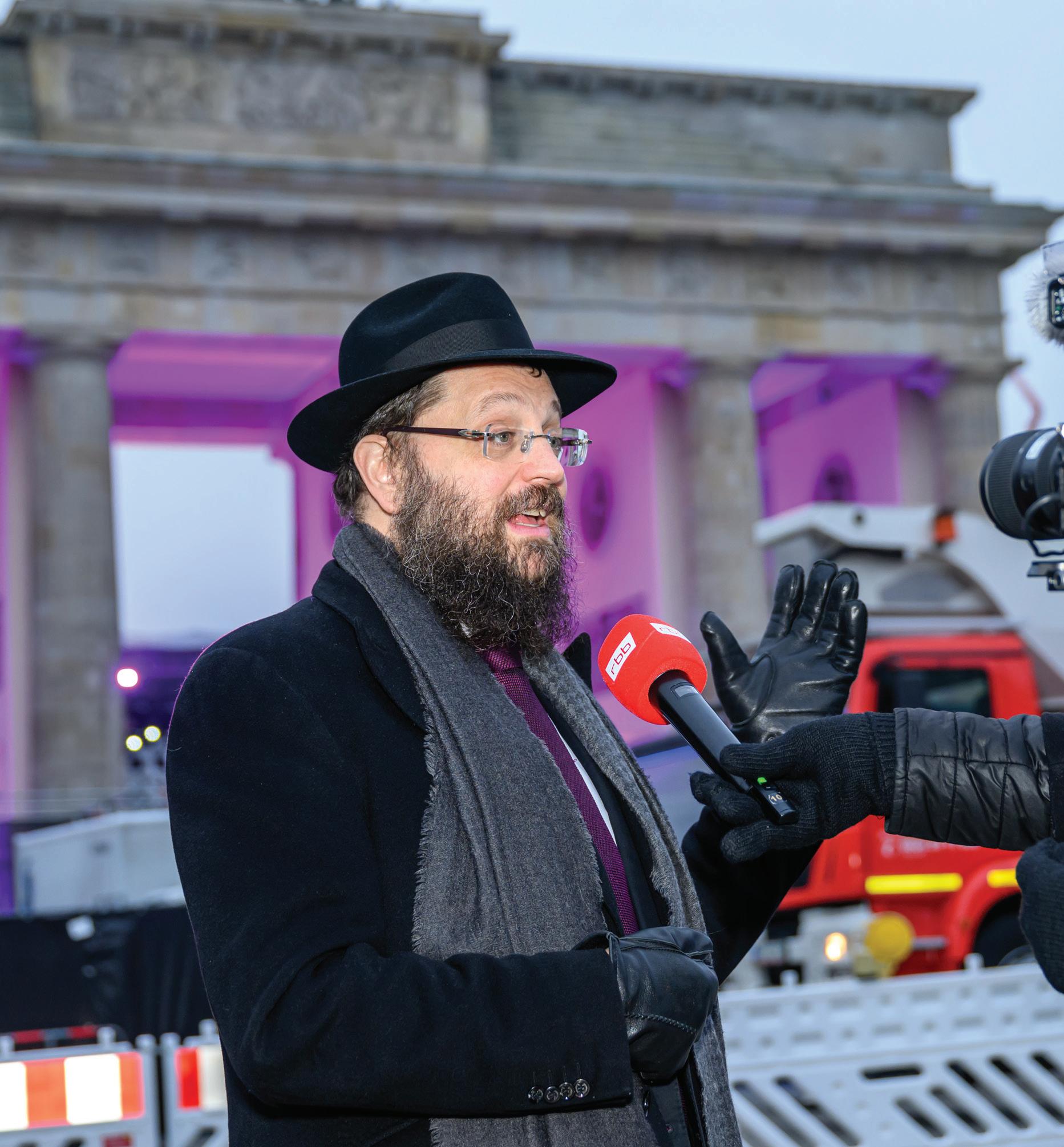
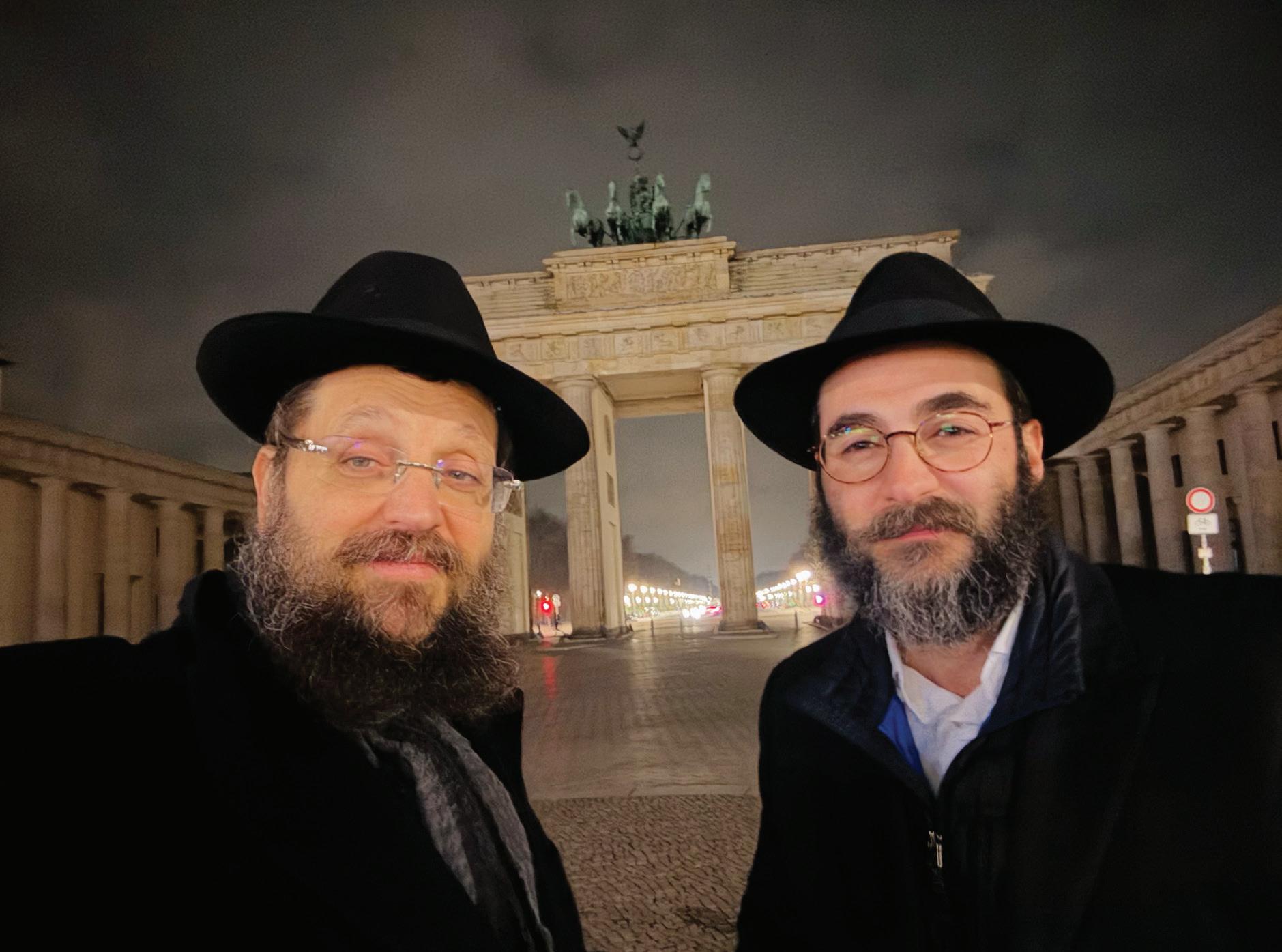
Our cover story takes readers to Berlin, where our editor reports on the 20th anniversary of the Menorah at the iconic Brandenburg Gate. Perhaps more than any other, this Menorah symbolizes the triumph of light over darkness and the remarkable growth of Chabad in Germany’s capital.
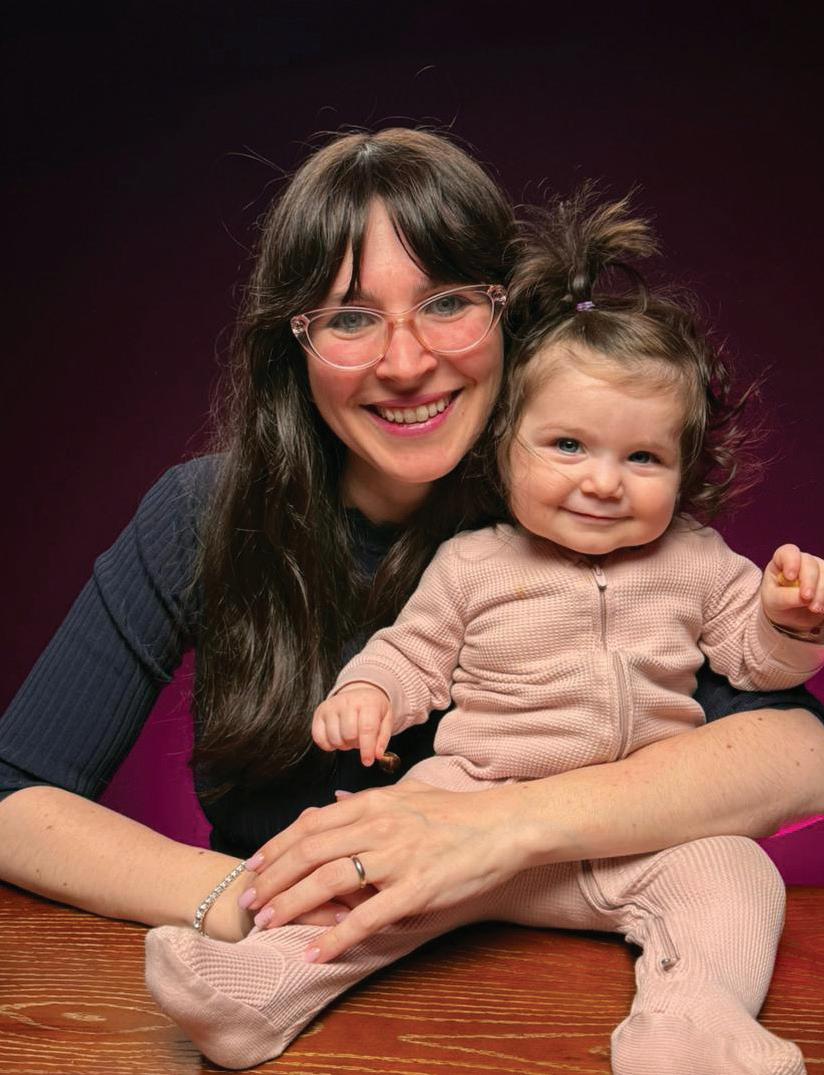
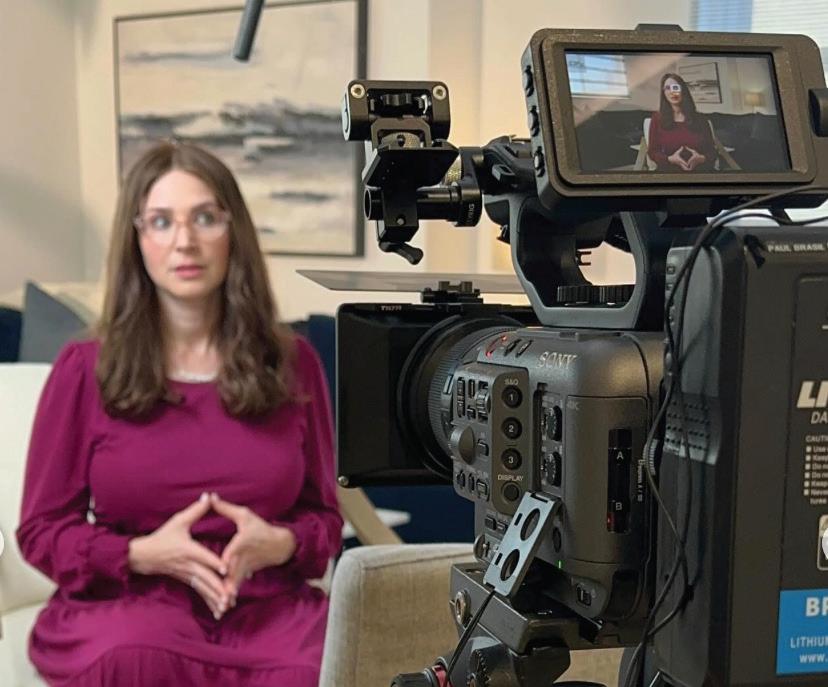
In another arena—the often shadowy corners of the web, better known as TikTok—a Lubavitcher nurse, Miriam Ezagui, stands up for truth by openly sharing her frum life and dispelling common stigmas. She has become an unlikely viral star, doing so with a smile and a camera.
We also feature a newly translated biography that provides a rare window into Lubavitch of old: the memoir of Reb Pinchas Dov Goldenshteyn, known as Pinye Ber. Written more than 150 years ago, it vividly captures the hardships of the shtetl and his personal encounters with the Tzemach Tzedek and the Rebbe Maharash.
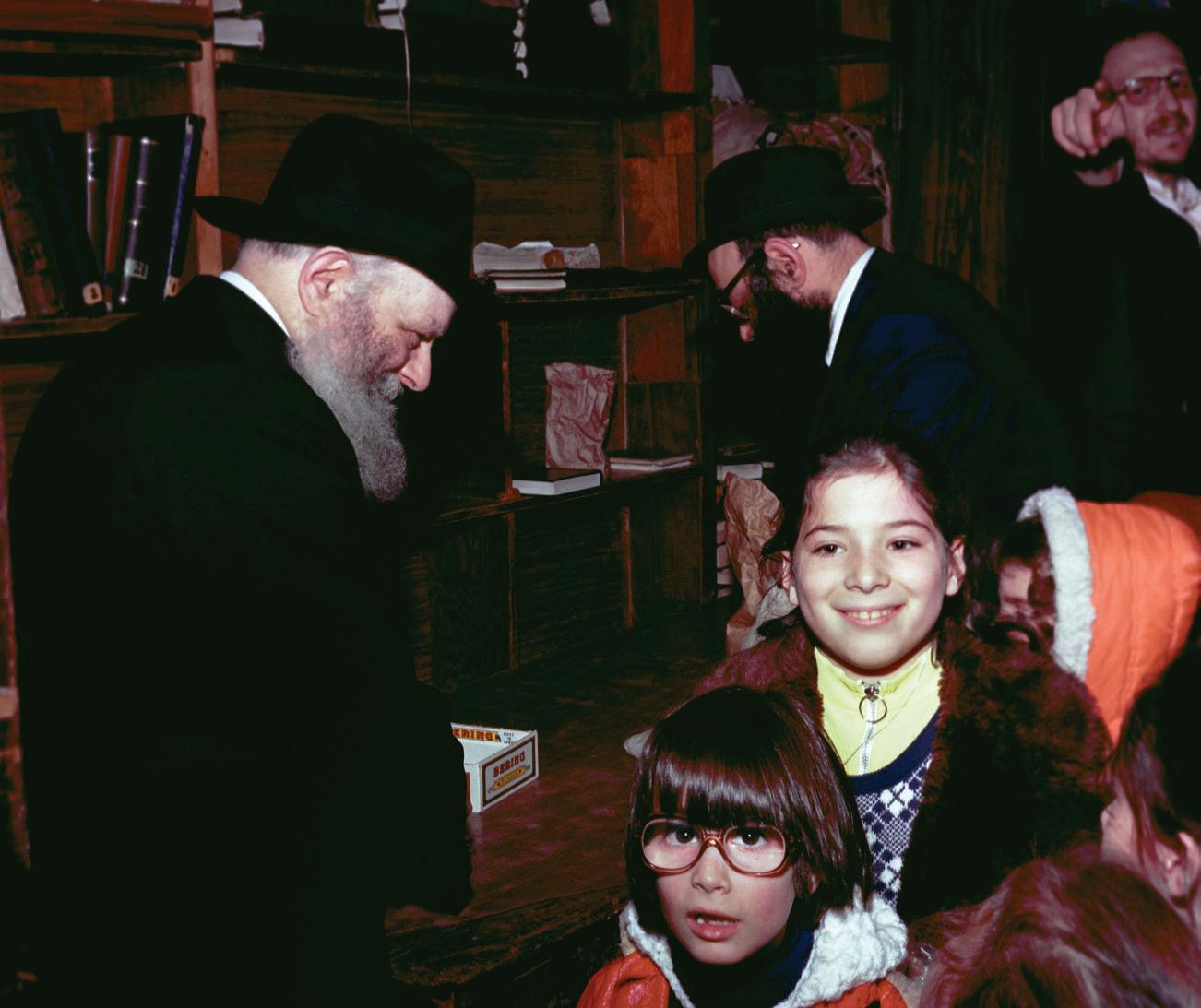
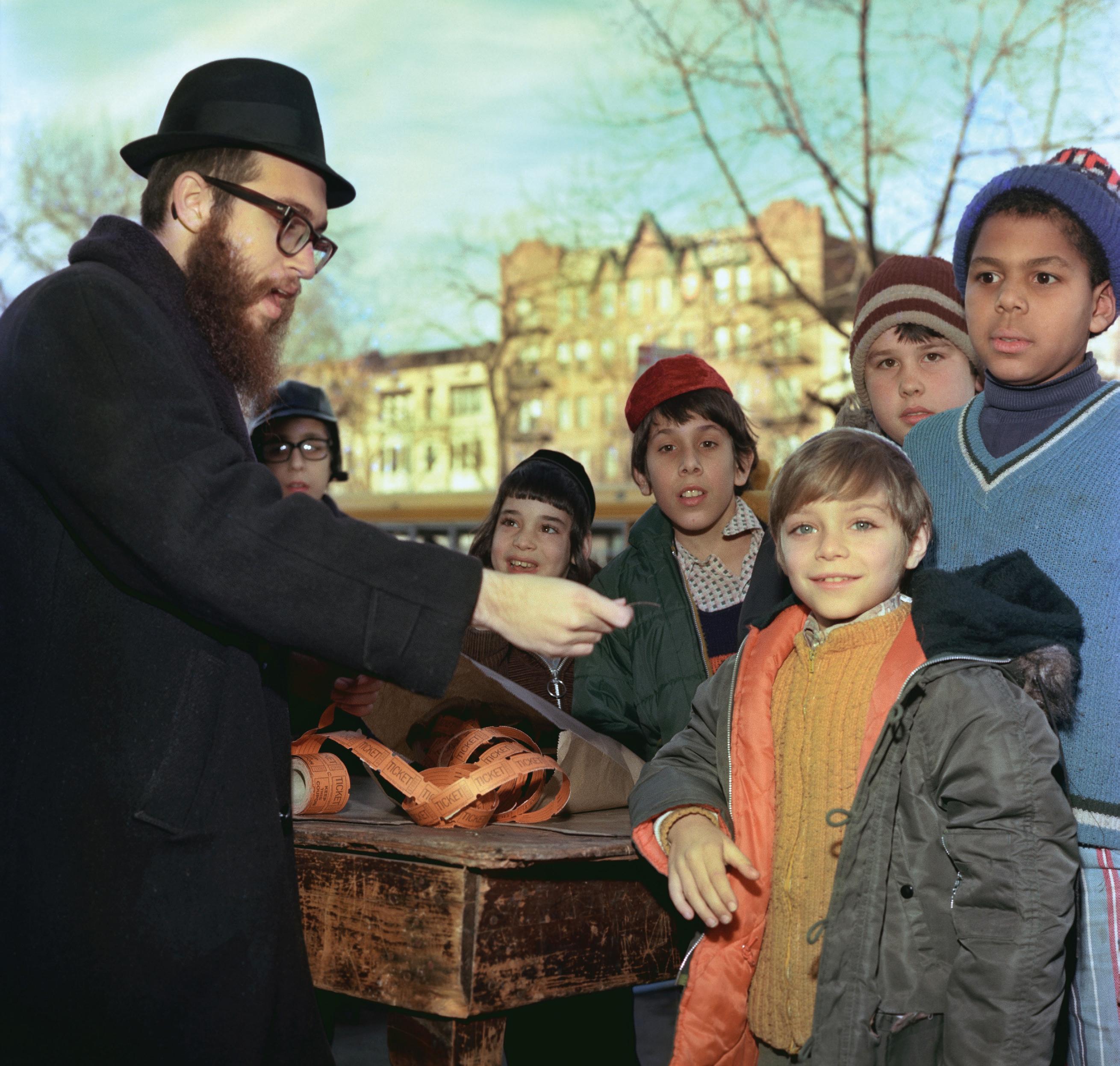
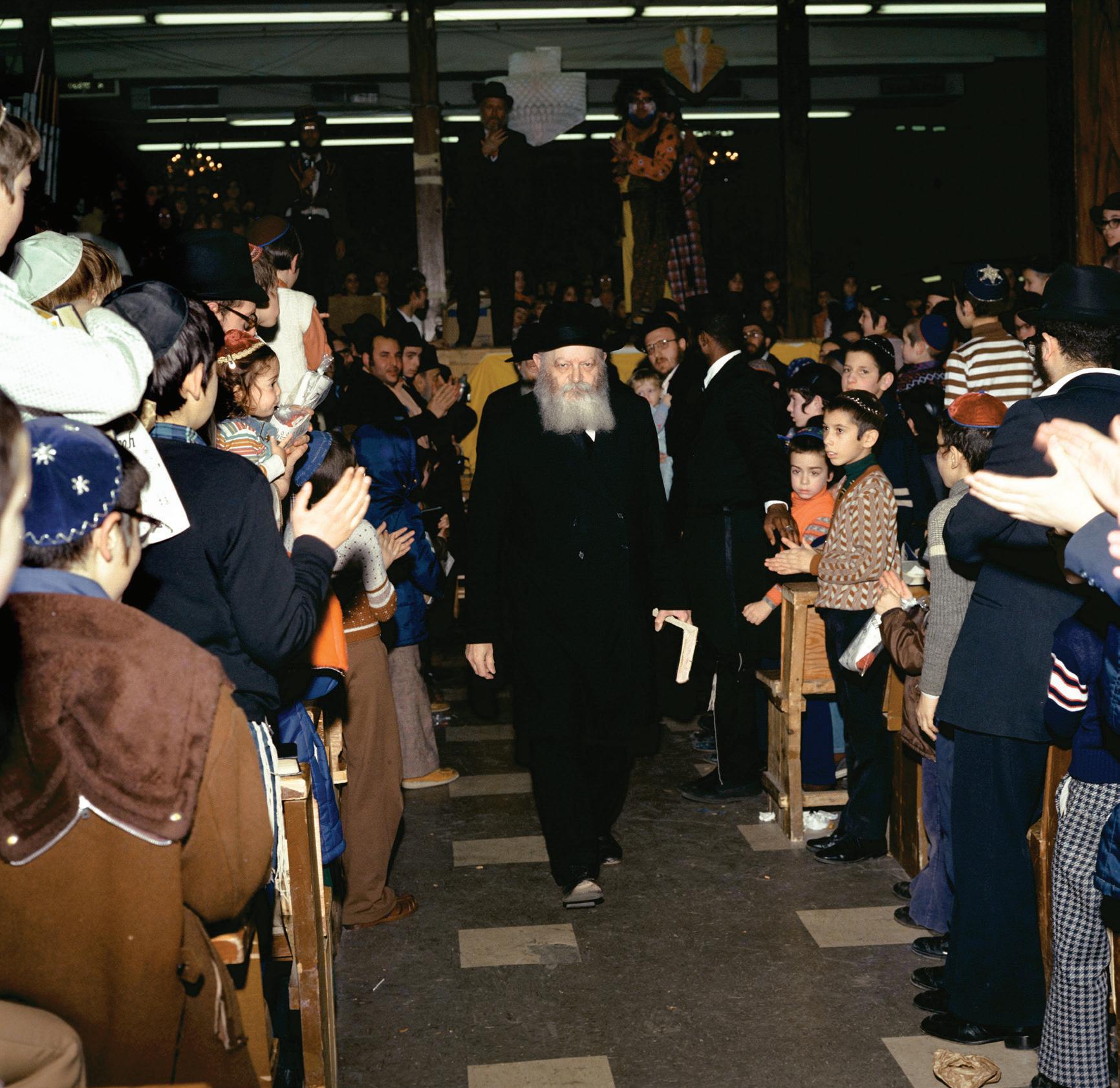
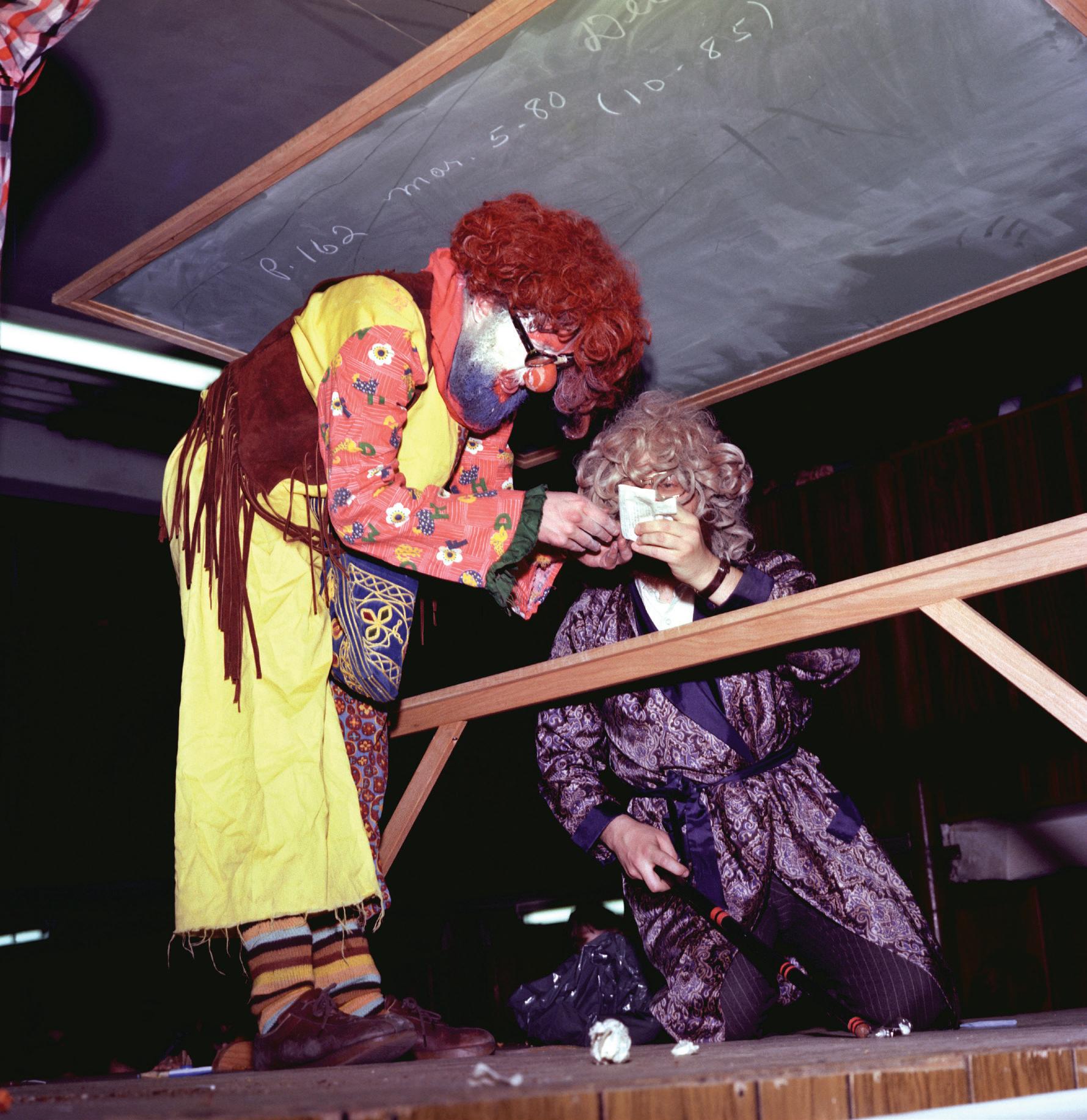
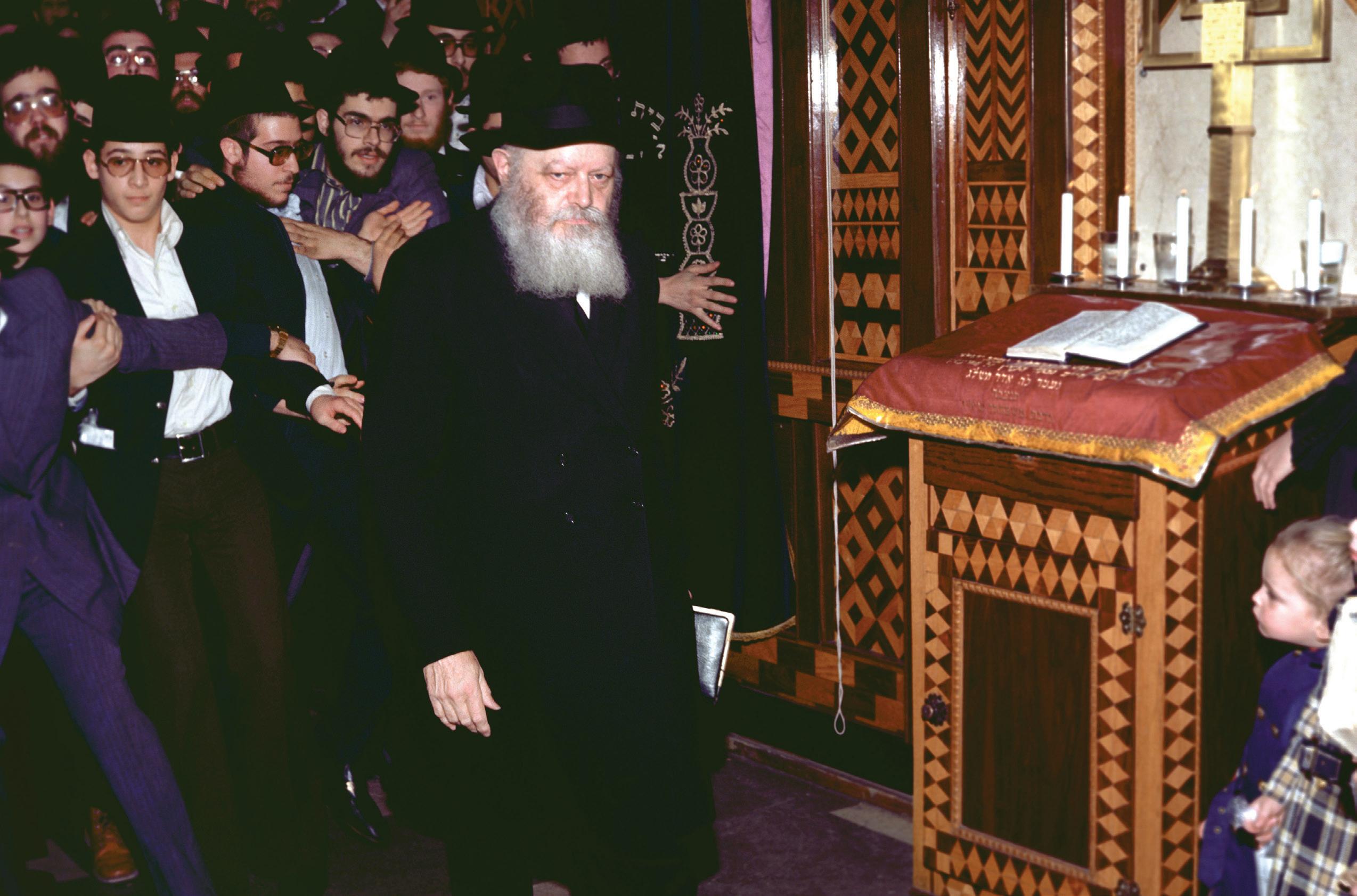
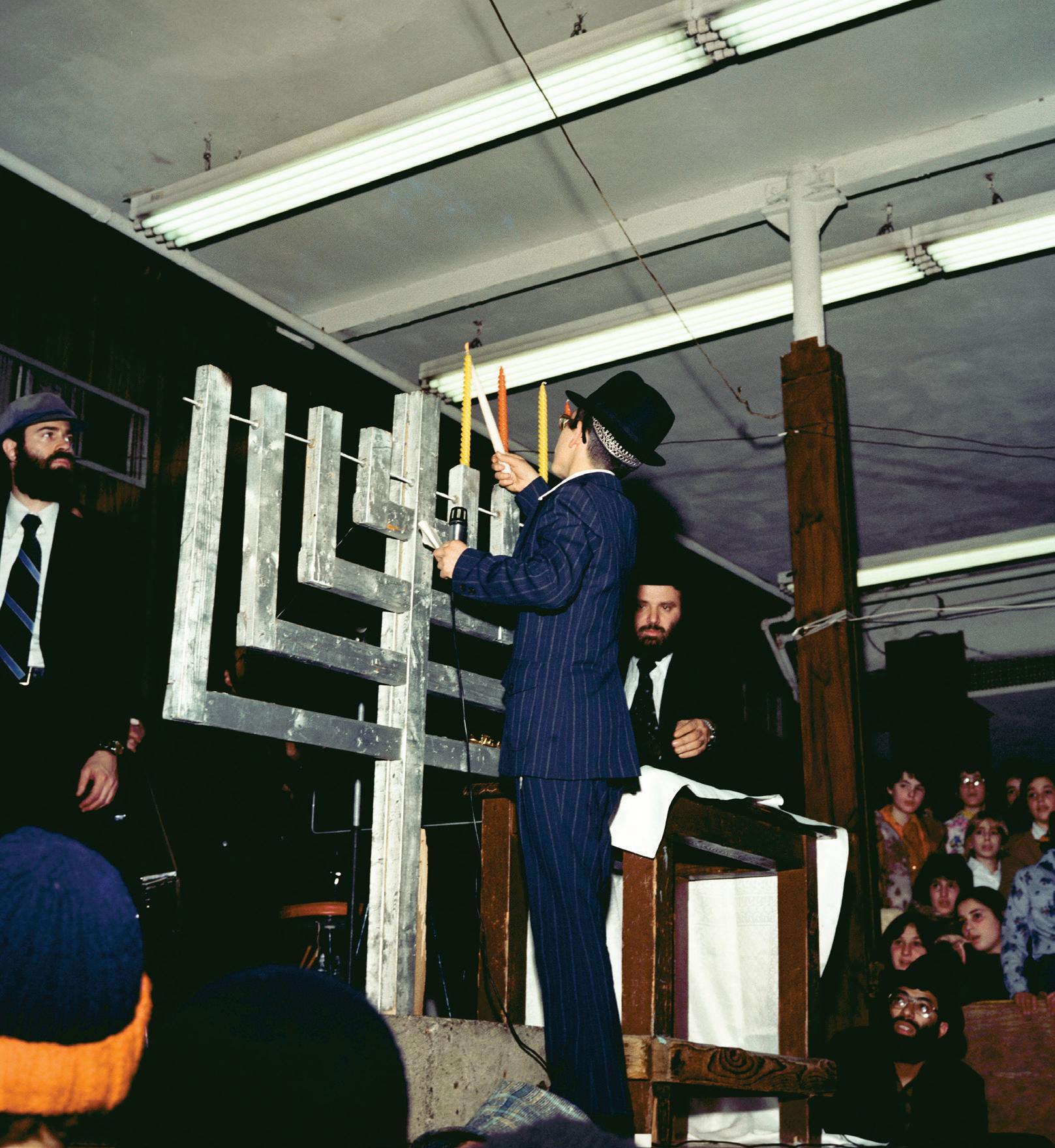
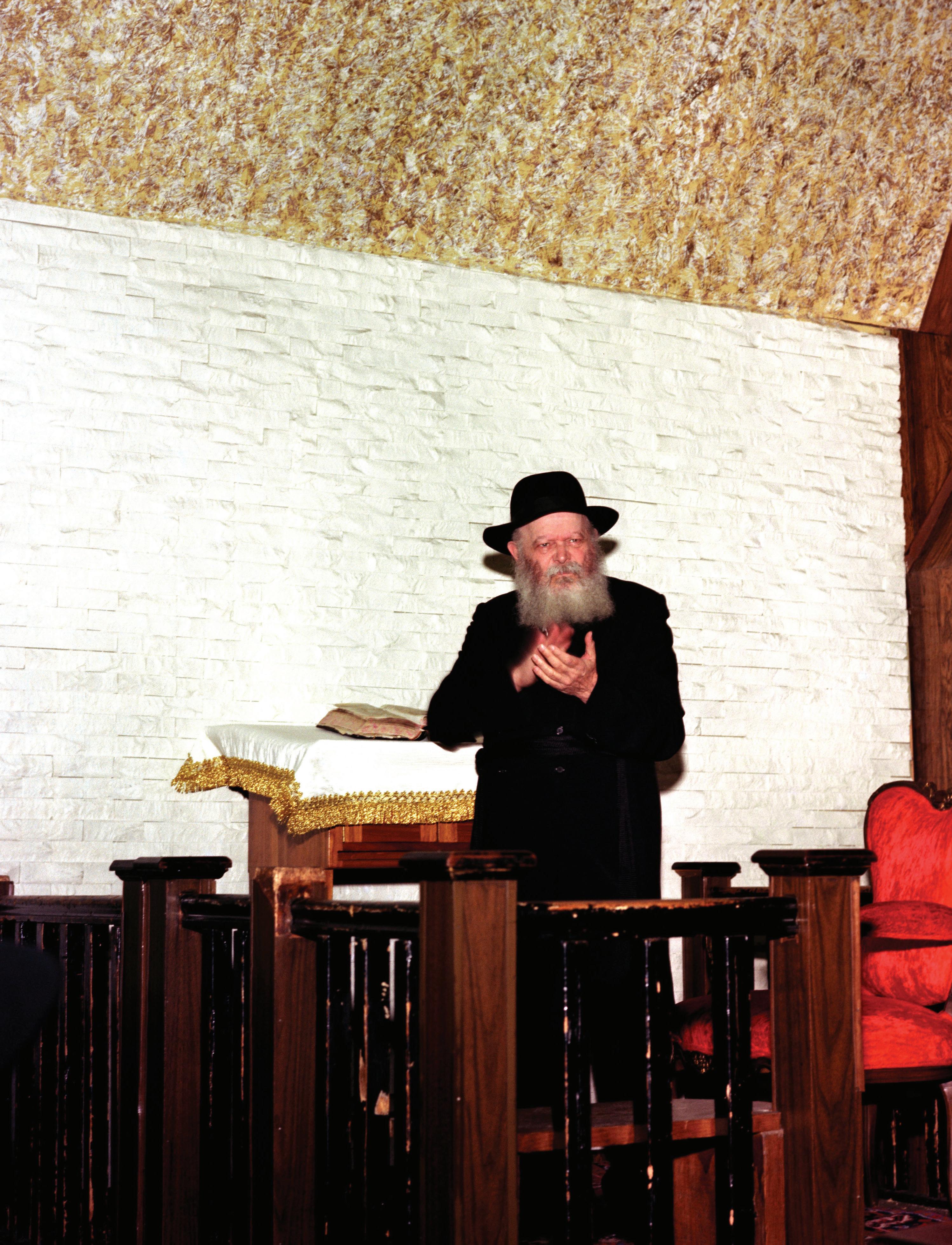
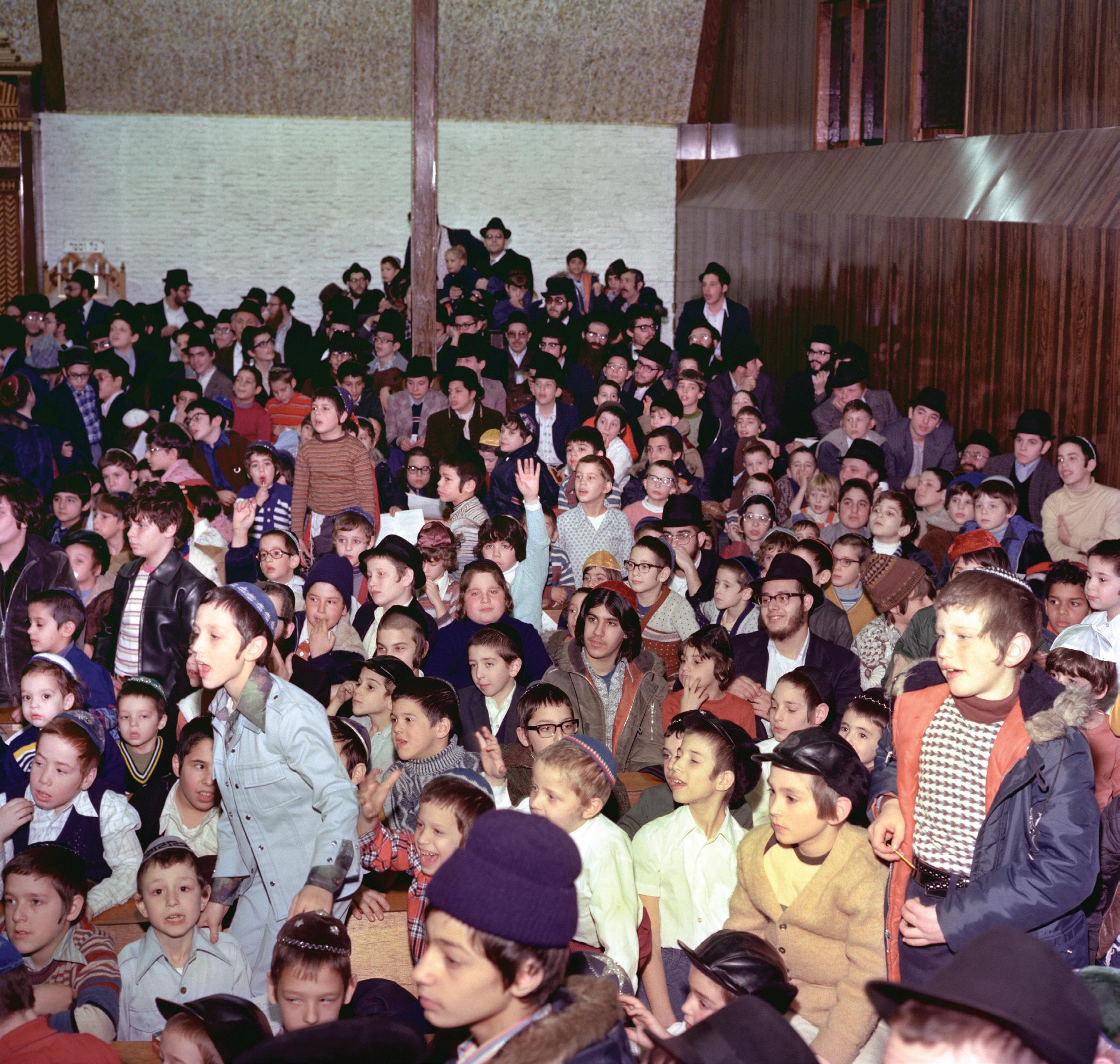
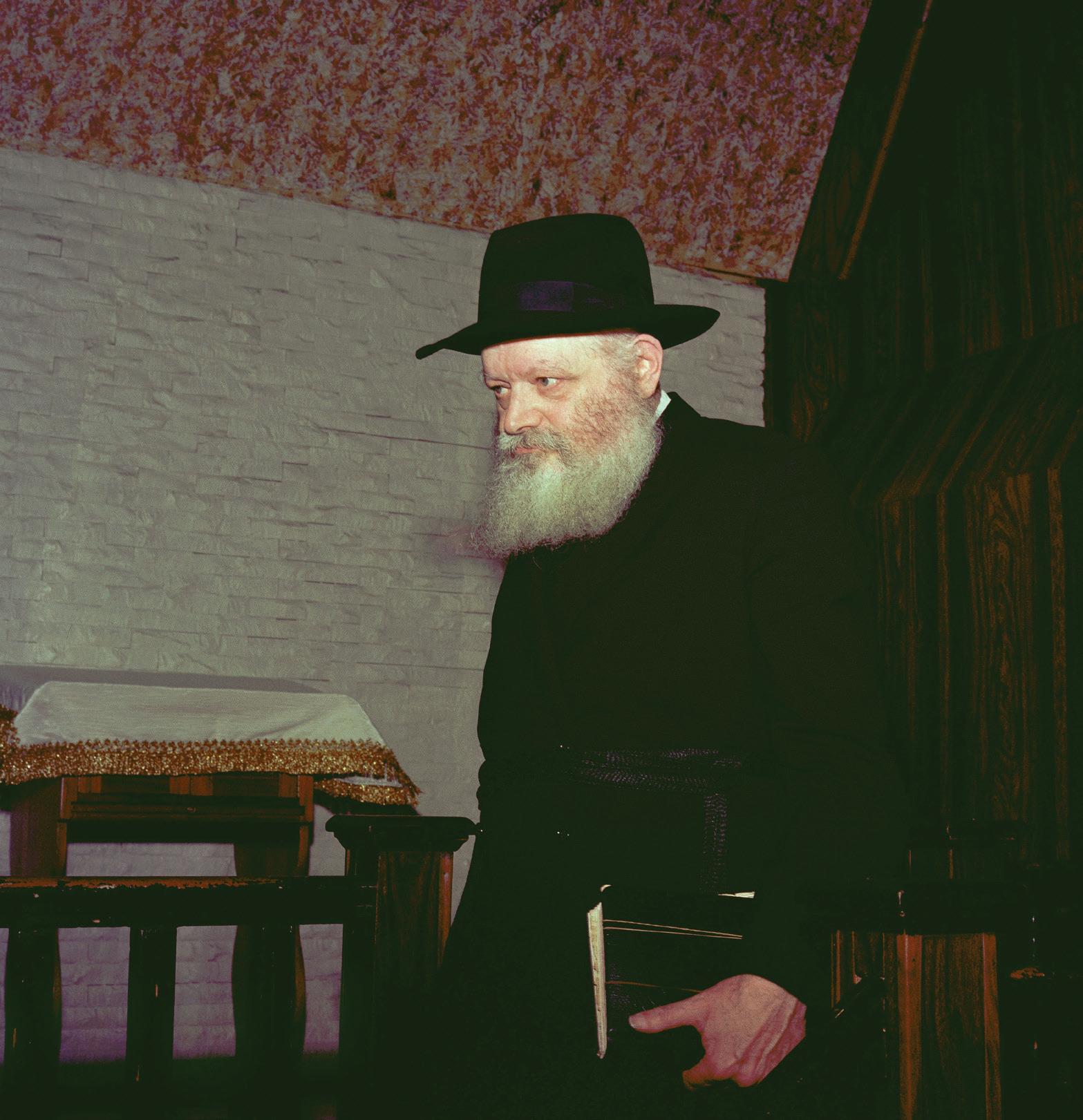
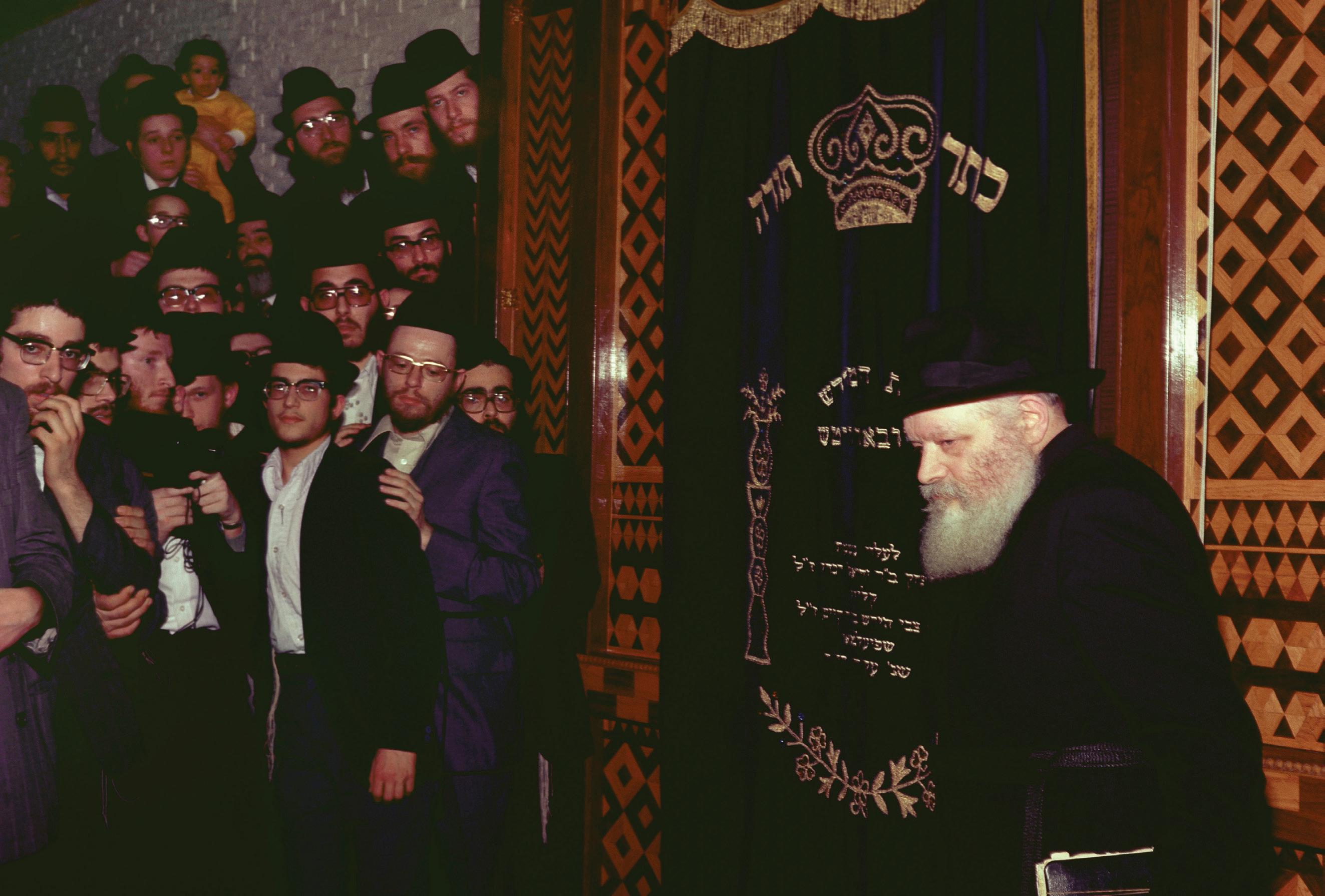
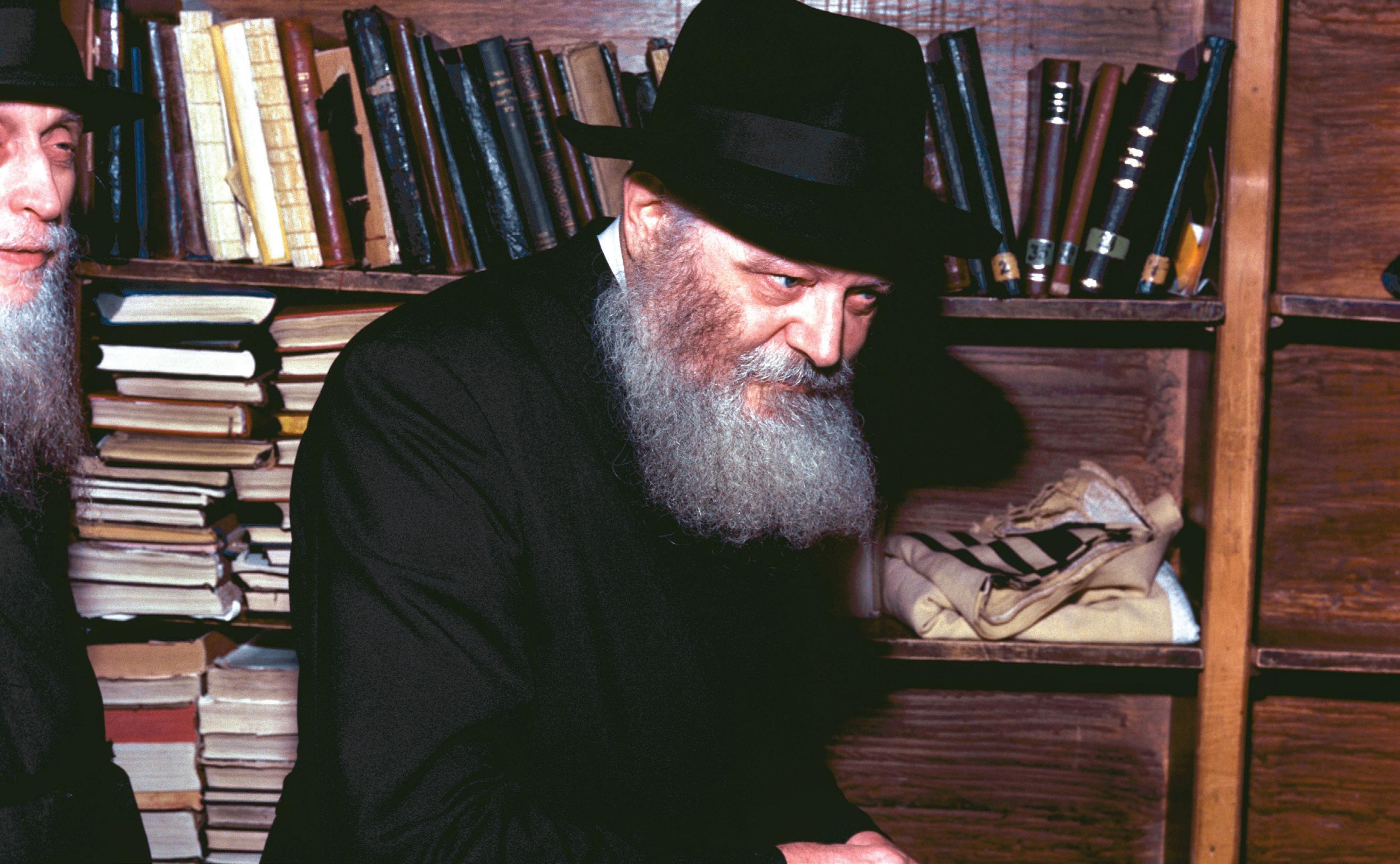
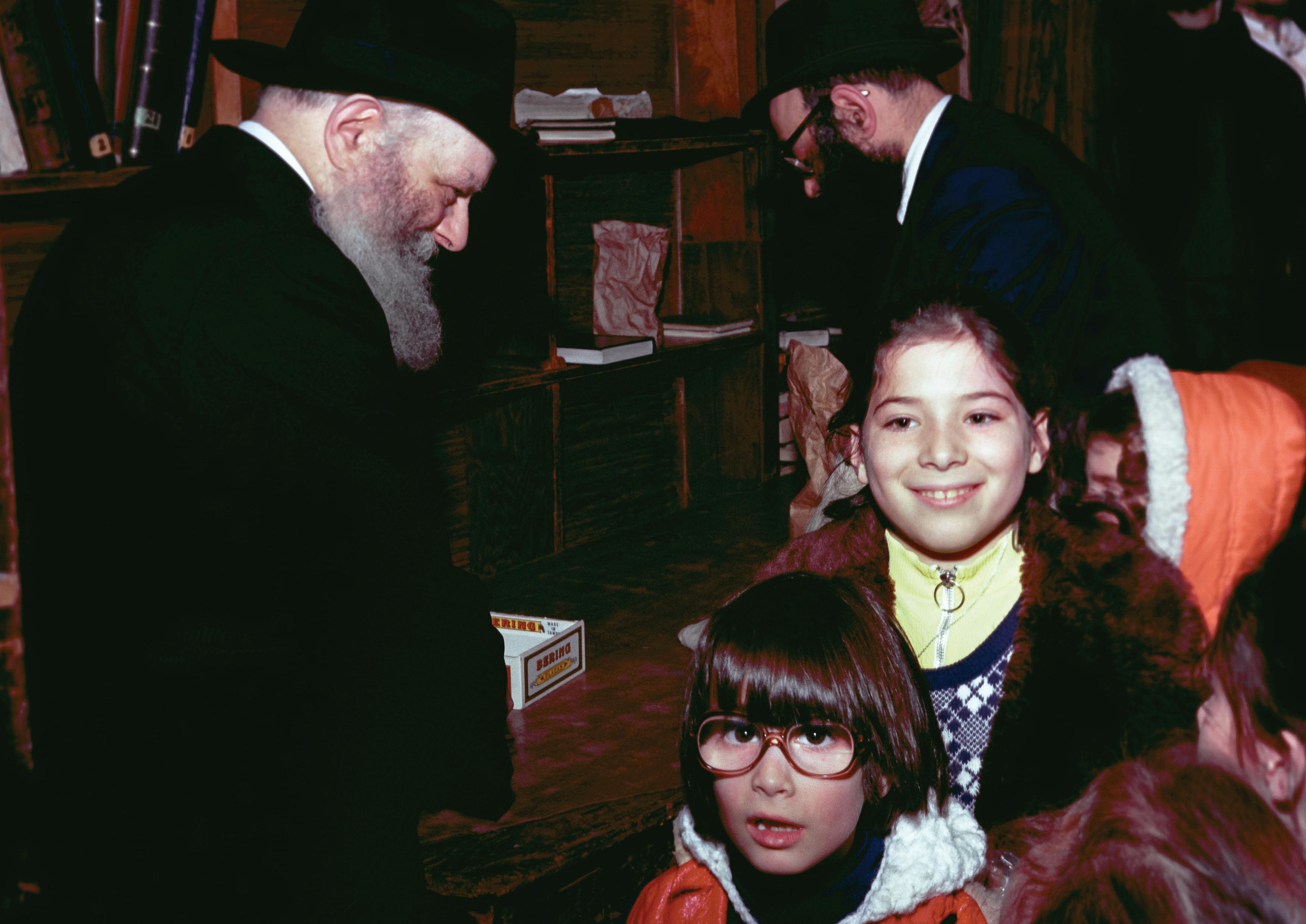
Our monthly gallery of the Rebbe, curated by JEM, offers a nostalgic look at a children’s rally at 770 on Chanukah 5737, highlighting the Rebbe’s profound care for Jewish children learning in New York City’s public schools. Each child received Chanukah gelt, a gesture that surely left a lasting impression.
Additional Chanukah content includes the story behind the Maggid’s delayed Menorah lighting, recipes for a delectable Chanukah spread, and a lighthearted guide offering unsolicited advice on setting up your Menorah.
We are excited to share this new issue with you, reflecting the blessing we recite: “in those days, at this time.” May you find a few peaceful moments to enjoy it as the candles burn brightly.
Happy Chanukah, MICA SOFFER
CHOOSE
AD
TOURO CHOOSE
Touro University is all in on one mission—your excellence. We’re here to help you become exceptional: highly successful, purpose-driven and ready to make a meaningful impact. The first step? Choose Touro. We’ll take you where you want to go.
HANNA SONIGO, RN, BSN, MEDICAL ICU NURSE THE SCHOOL OF HEALTH SCIENCES, TOURO UNIVERSITY FUTURE DOCTOR OF NURSING PRACTICE (DNP)
By Rabbi Yehuda Ceitlin
In the City of Lights
During a recent trip to Europe, I had a few free hours in Paris, France and took the opportunity to meet family and stop by a patisserie. With some time still remaining, I walked over to one of the city's most iconic attractions: the Eiffel Tower.
The sun had already set, making the tower's golden lights appear even brighter and more spectacular. I sat on a concrete bench at the Esplanade Joseph Wresinski, facing the tower, and watched it glow as I enjoyed a flaky almond croissant.
The tower has not changed since my last visit several years ago; nonetheless, it remains magnificent to behold. As time went on, I began to notice and
appreciate something different, something right in front of me that is easily overlooked.
Gathered at the lookout was a large mix of people from all walks of life and nationalities. There were elders and families with children, couples on dates, groups of teenagers, and solo tourists. People offered to take photos for one another, stepped aside for a better view, and showed simple courtesy. There were no instructions on how to behave, no enforcement of any kind. A shared sense of humanity hovered in the air.
In the area, there was also a group of Iranian dissidents handing out dates and playing Persian music. One of them, named Bayan, approached me and made a point to tell me that
"we love your people and Israel. It is just the ayatollahs who don't.” It felt as if the light of the tower had created, even briefly, a kind of communal courtyard for the world.
It struck me how Chanukah carries a similar message about the power of light in public spaces.
In the Al HaNissim addition to our davening, we describe how the Chashmonaim "lit candles in the courtyards of Your holy house." At first glance, the wording is puzzling. The Menorah stood in the Heichal (sanctuary), deep within the Bais Hamikdash in Yerushalayim. Why would we mention the courtyards?
After the Greeks were defeated,
the Chashmonaim rededicated the entire Bais Hamikdash, purifying it from years of defilement. When they went to kindle the Menorah, they found only one unblemished cruse of olive oil. Miraculously, it lasted eight days instead of one until fresh oil was ready.
The Rebbe explained (Likutei Sichos, vol. 25, pages 235-242) that as part of that celebration, additional lights were lit throughout the courtyard of the Bais Hamikdash. These were not the ritual flames of the Menorah but festive lights marking the restoration of holiness (making good use of all the olive oil that didn’t have a seal on them). As a result, the light spilled outward, beyond the sacred interior, into the
areas where the public could gather.
In this detail lies a deeper lesson. Judaism does not reserve its light for inner chambers or cloistered halls. Chanukah established a new model of illumination: light meant to face outward. That is why the menorah is placed at the doorway and in public spaces. The Chachamim encouraged us to kindle light that does not remain private, but instead enters shared space and touches the lives of people who may not have expected to encounter it.
That idea echoed in my mind as I looked at the Eiffel Tower and the crowd around it. The tower’s lights were beautiful, yet what moved me was the atmosphere
they created, strangers treating one another with dignity, courtesy, and warmth.
Chanukah is an opportunity to bring holiness into the courtyards and the public squares, and to create moments when we stand beside people whose stories are different from our own. As we kindle the menorah this year, may we remember that its message is both the light in our home and the light we bring to the people around us.
Rabbi Yehuda Ceitlin, Editor of COLlive.com and COLlive Magazine, is the Associate Rabbi of Chabad Tucson-Young Israel in Tucson, Arizona. He coordinates the annual Yarchei Kallah gathering of Chabad Rabbonim and Roshei Yeshiva
Dr. Mordechai
Kedar has a grand plan for the Middle East – if anyone will hear it
with A
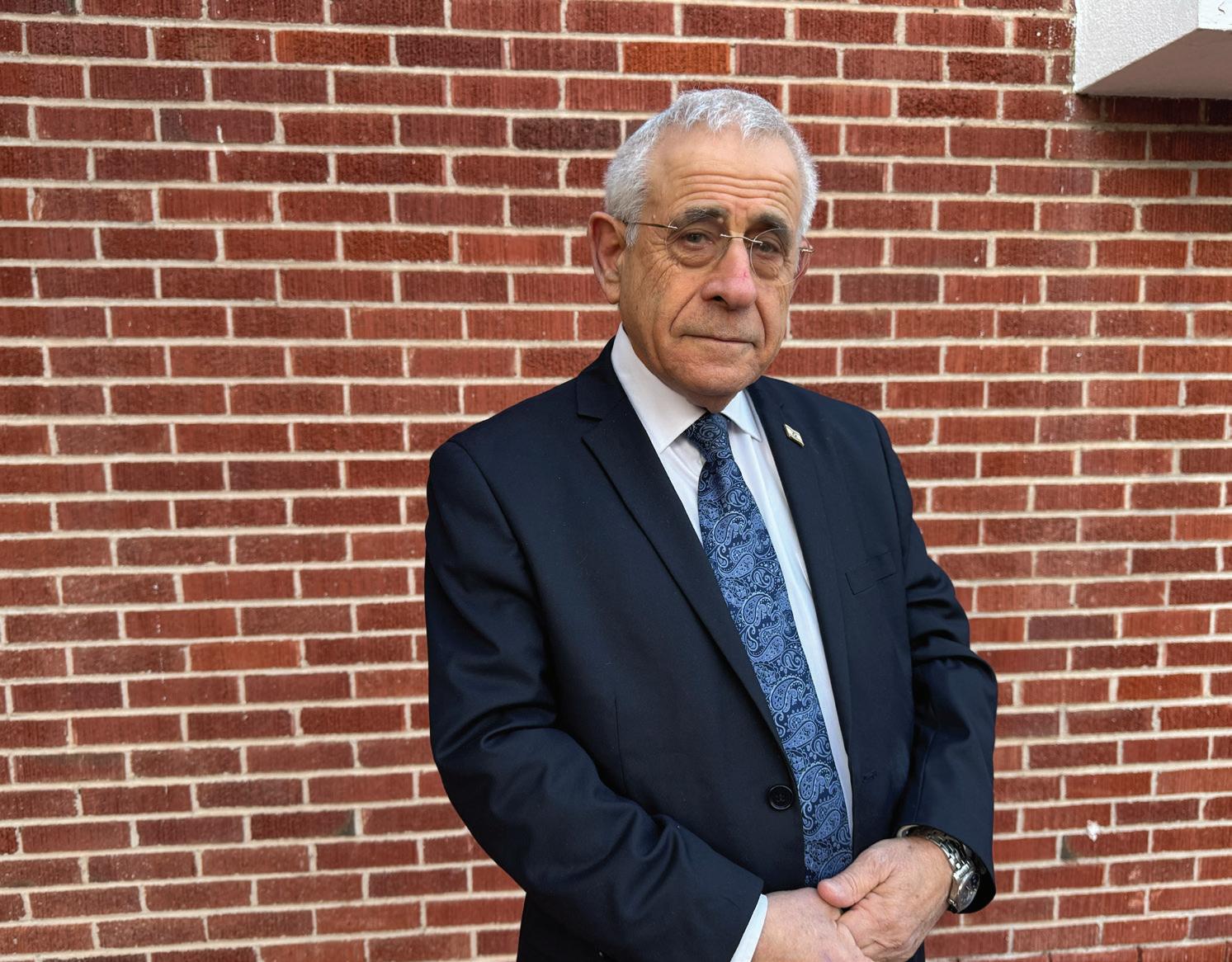
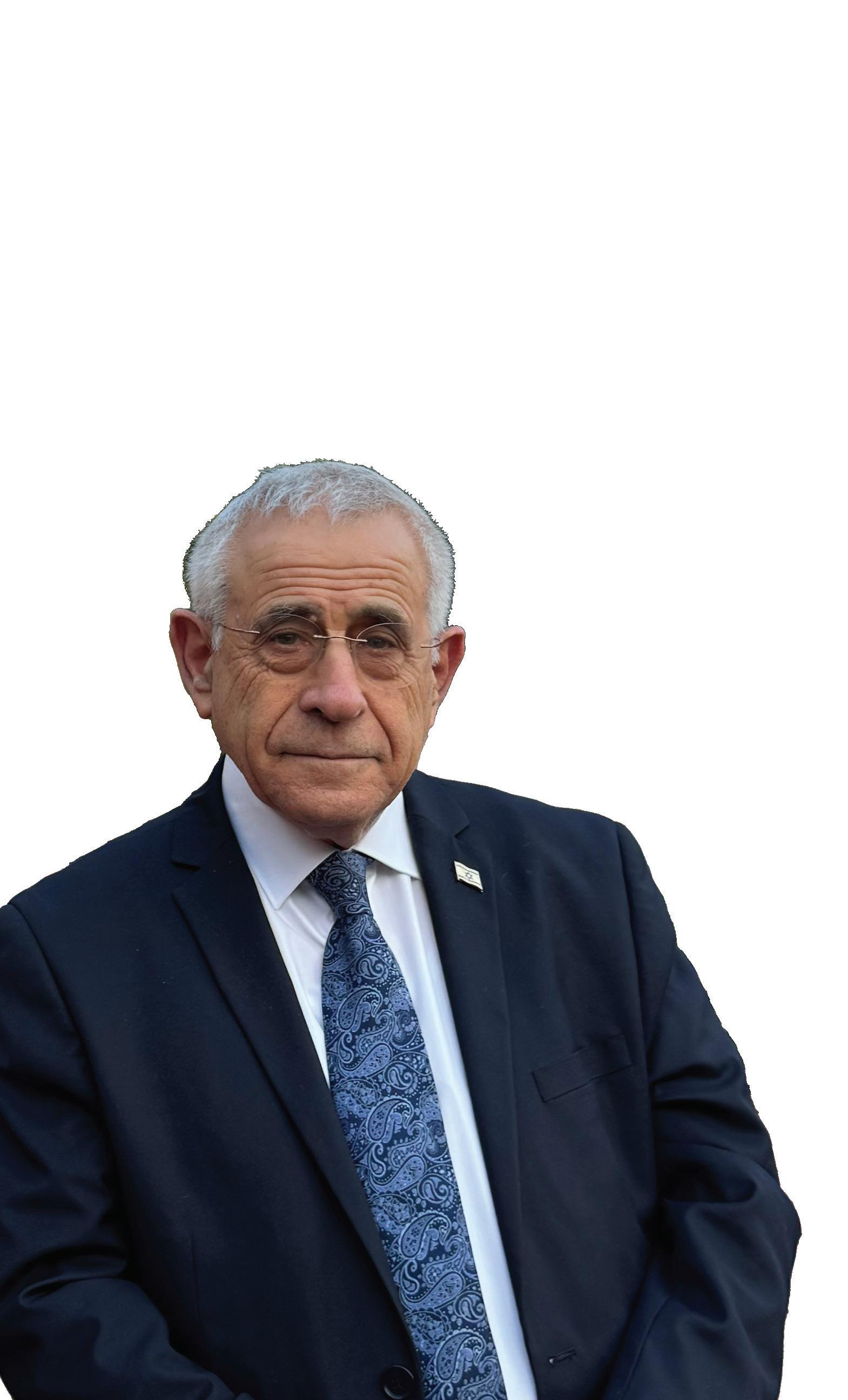
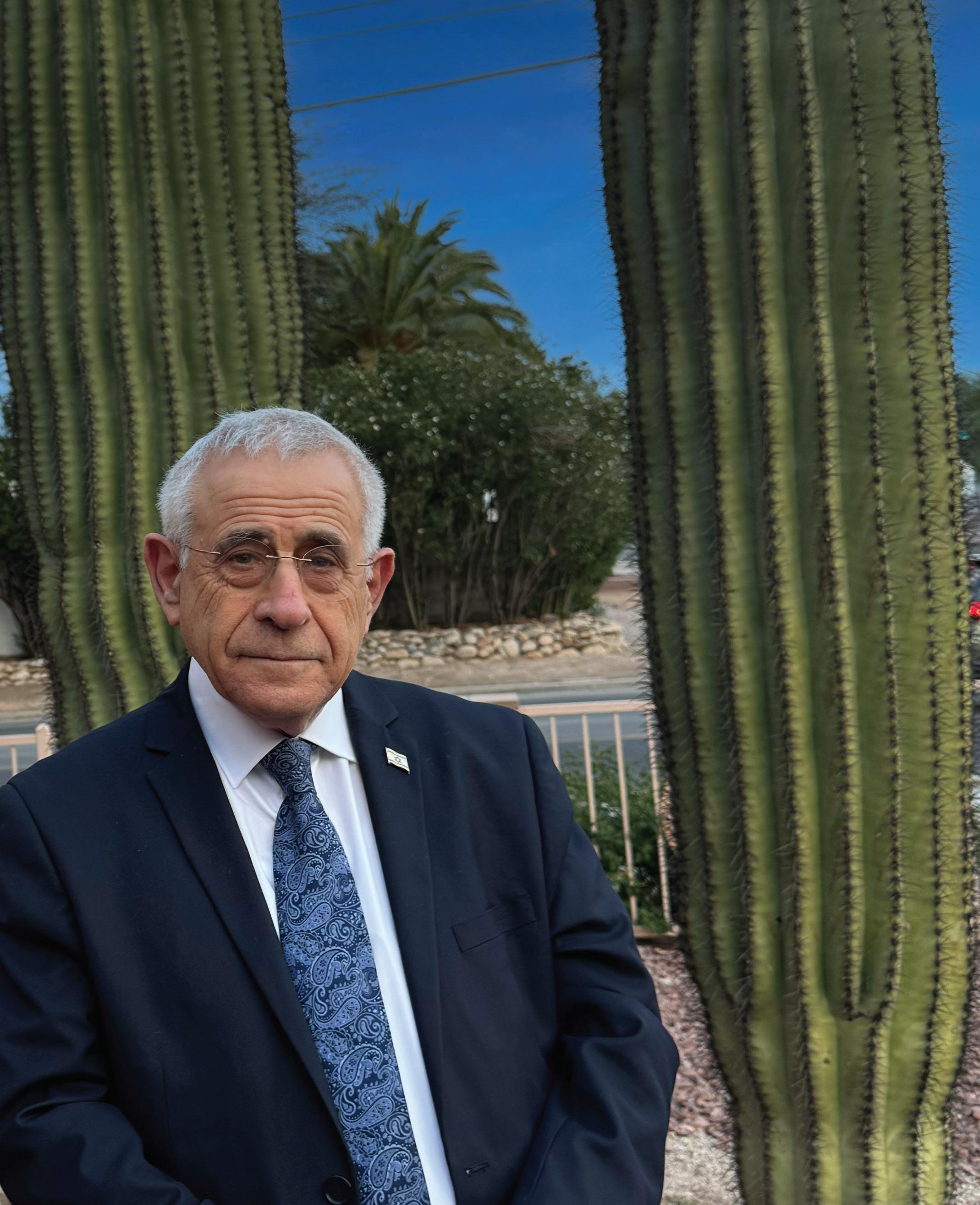
scanning the flow of cars with a calm yet alert expression behind his rimless eyeglasses. After 25 years as an intelligence officer in the Israel Defense Forces (IDF), situational awareness is second nature to him.
When his ride pulled up and he recognized the driver, he offered a warm, “Sholom Aleichem!” He then noted, “In Israel, I carry a gun with me at all times. It isn’t possible to do so while traveling. And here I actually feel safer. In Israel, it would not be difficult for the Iranians to hire someone to find me.”
Sadat Center for Strategic Studies, Dr. Kedar is one of Israel’s most outspoken critics of the Iranian regime. He has written extensively on the ethnic fragmentation of Iran as a possible pathway to regime change. As one of the only Arabicspeaking Israeli pundits regularly appearing on Arab television, he became a familiar face during the aftermath of October 7.
From 2009 to 2025, Dr. Mordechai Kedar spoke at more than 100 Chabad centers, shuls, and Jewish institutions worldwide, averaging about 9 Shabbaton programs each year. Communities that repeatedly hosted him included Palm Beach,
demand for his lectures on the Middle East and Jewish affairs.
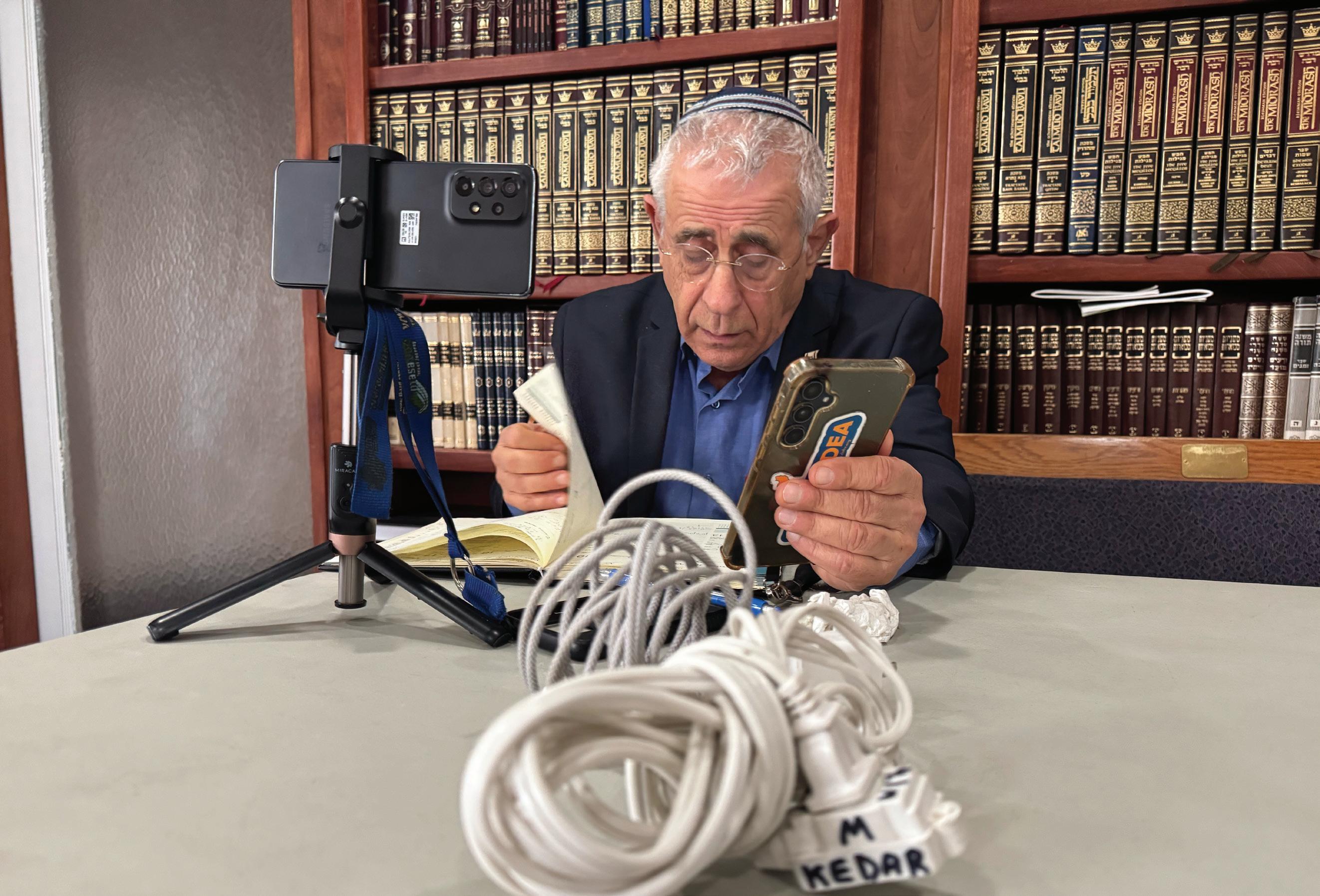
His most recent tour brought him to Toronto, Los Angeles, Arizona and New York, during which he was interviewed by COLlive Magazine and the Viktor Frankl Podcast, hosted by Rabbi Daniel Schonbuch and Lori Fein, Esq. The following excerpts are from that conversation.
What do you think about President Donald Trump’s plan for Gaza—the “20-point peace plan”?
Dr. Kedar: I’m surprised it’s called a peace plan. Peace requires
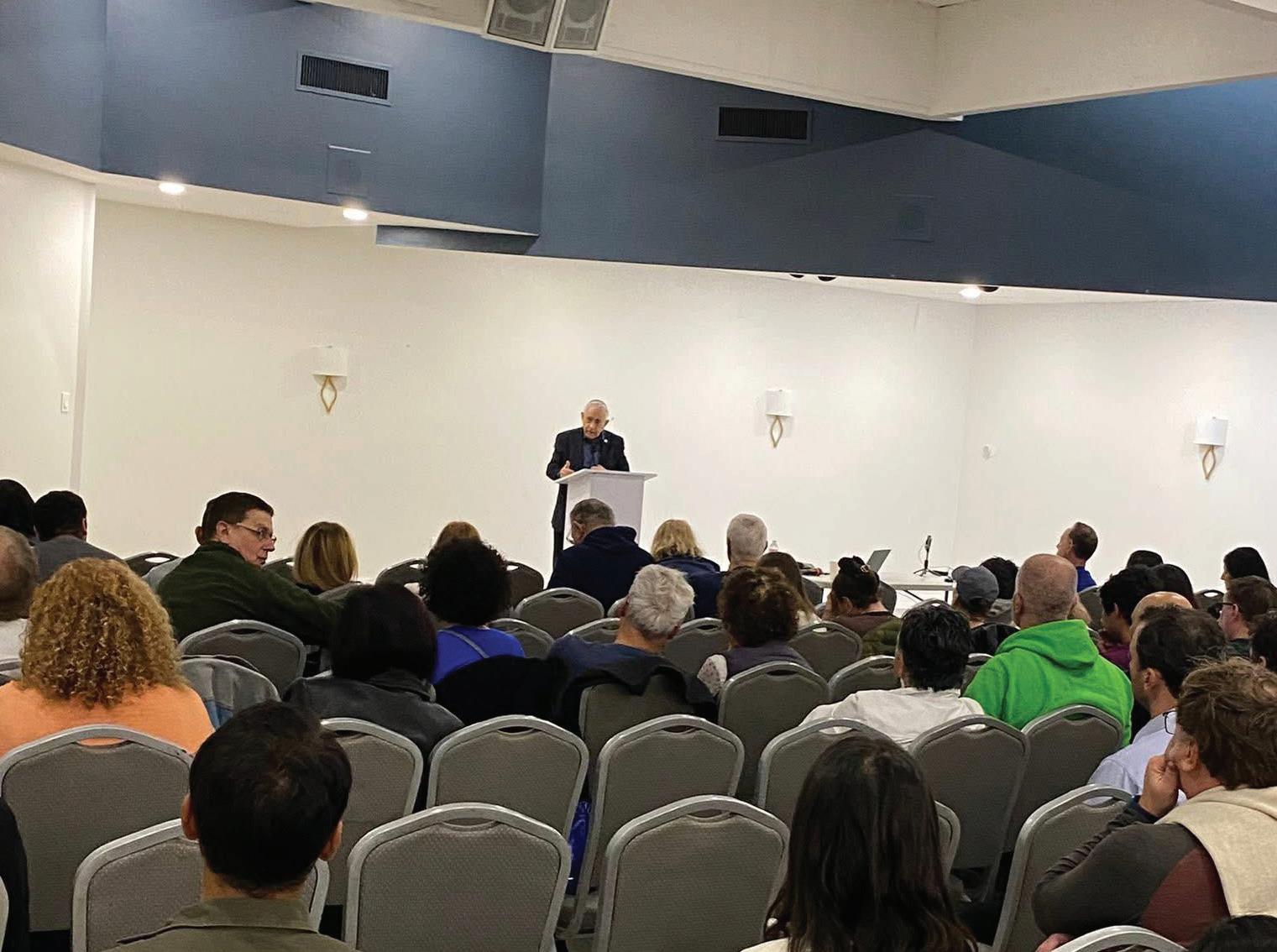
Dr. Mordechai Kedar being interviewed at Young Israel-Chabad Tucson in Arizona
walk into Hamas ranks to take their weapons. Hamas has sacrificed Gaza just to keep the weapons. They will not give them up. Second, the coalition itself is divided. Qatar and Turkey want Hamas to survive. Saudi
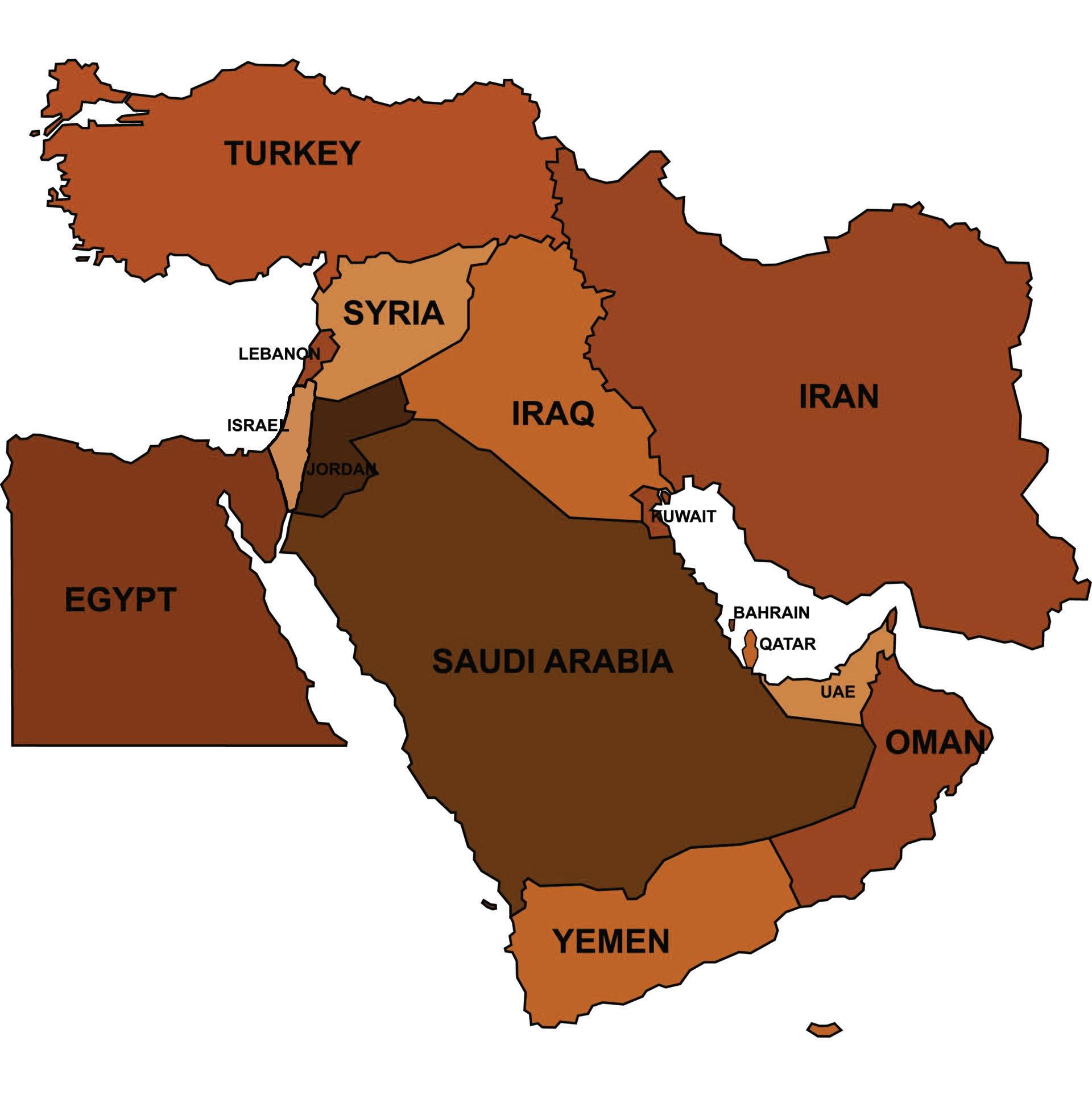
states include Kuwait, Qatar, the seven emirates of the UAE, Oman, and Saudi Arabia.
Many think success comes from oil, but that’s wrong. Iraq and Libya have oil and are hell on earth. Dubai has almost no oil
Abu Dhabi to Al-Nahyan. Saudi Arabia to Al-Saud. These leaders were tribal leaders two hundred years ago, riding camels in the desert. Today, they drive golden Lamborghinis—but the leadership structure is still clan-based. They
Dr Mordechai Kedar speaking to a crowd at the Chabad Israel Center in Phoenix
adopted modern technology, not Western values. The clan system is the only stable system in the Middle
So to solve the Palestinian issue,
For more than twenty years, I have advocated establishing an emirate in each major Arab city in Judea and Samaria—the so-called West Bank— and Gaza. Before the October 7 war, I addressed them together, but since the war began, and many Gaza clans have been shattered, I’m not certain
Where do Hamas and Gaza fit into
Dr. Kedar: Hamas understands the clan-based culture that dominates
continue to try to weaken or control the clans—because the clans are the only social force that can truly
Were those Gaza shootings during resistance to Hamas clan-based
run themselves locally. Israel would handle security, prevent the importation of dangerous weapons, and maintain strategic control around them. There are many global examples of semiindependent enclaves surrounded by another country. With agreements, this could benefit both sides.
What would happen to Mahmoud Abbas and the PA?
Dr. Kedar: Either they dissolve because no one needs them, or they become an umbrella federation of the emirates, like the UAE, which is a federation of sovereign emirates. The decision would be theirs. Israel’s concern is security.
What are Israel’s biggest military threats over the next decade?
Dr. Kedar: Egypt’s militarization in Sinai matters. Turkey matters too. Erdogan’s neo-Ottoman ambitions are real. A Turkish colleague once told me, “You Jews dreamed for two thousand years about returning to your land and did it. Why shouldn’t we dream about lands we controlled a hundred years ago?”
wiping Israel off the map on one side, and countries that have no problem with Israel and have even normalized relations, such as the United Arab Emirates, Bahrain, and Morocco on the other.
Saudi Arabia belongs to this second camp. Saudi Arabia was a victim of Iran even before Israel was. I am not afraid of the Saudis at all. If they were not afraid of Iran, they would have normalized relations with Israel long ago. So regarding the F-35 issue: I’m not worried. Saudi Arabia wants stability, not war.
Also, Saudi Arabia has another enemy: Qatar. Qatar is aligned with Iran and though it plays a duplicitous role today in peacemaking, it is a serious enemy of Saudi Arabia—and of us.
Do you foresee normalization between Israel and Saudi Arabia in the near future?
possible in Gaza—this system can replace Hamas’s jihadism and the Palestinian Authority’s lawlessness. emirates have? What powers would
Dr. Kedar: I’m not sure they even want full sovereignty, and I wouldn’t impose it. But they should not be because absorbing all those Arab Jewish majority. So the cities would
That mindset is part of Turkey’s strategic vision. Add to this that many in the Islamic world reject Jewish historical claims entirely, and instead argue that Jews are Khazars with no link to ancient Israel. They deny our legitimacy but accept Ottoman legitimacy— so restoring the Ottoman sphere feels logical to them.
What are your thoughts about the U.S. approving the sale of F-35 fighter jets to Saudi Arabia?
Dr. Kedar: The Middle East is sharply divided between countries (primarily Iran) that are wholeheartedly committed to
Dr. Kedar: There are already elements of normalization. Since the Abraham Accords were signed, Saudi Arabia has allowed Israeli flights to pass over Saudi airspace on the way to the Emirates and Bahrain. That is partial normalization already.
What should Jews in America keep in mind when supporting Israel?
Dr. Kedar: The American Jewish community is diverse, from ultra-Orthodox to liberal reform, and views on Israel vary widely. But every Jew in America must remember: if America becomes unsafe, the only safety net is Israel.
By Rabbi Yehuda Ceitlin - Berlin
MAKE BERLIN LUBAVITCH
Rabbi Yehuda Teichtel’s mission to bring light into Germany’s darkest places
Photos: Roland Halbe
Two unmarked dark vehicles were parked outside the Jüdische Gemeinde Chabad Berlin on a recent Thursday afternoon. Standing beside the Audi A8 sedan and the BMW X5 SUV were two men with earpieces, wearing suits that casually concealed the firearms on their belts. They waited patiently, but attentively scouted their surroundings.
Then, the silence was disrupted as Rabbi Yehuda Tiechtel, 53, suddenly burst out of the tall, stained-glass door of the building on Münstersche Strasse in the Wilmersdorf area of southwestern Berlin. He waved to someone nearby, commented to another, all while still talking on the phone. He was flanked by two more plainclothes police officers.
"Wohin gehen wir?" Where are we going? they asked.
Abgeordnetenhaus, he replied.
It is the Berlin House of Representatives, located near the former Berlin Wall, which U.S. President Ronald Reagan famously called to tear down. Only a part of the wall remains today as a historical monument to the time when the city was bitterly divided between West Berlin and the communistcontrolled East Germany from 1961 to 1989.
As Rabbi Tiechtel approached the Audi, a police officer opened the door for him and waited until he was fully inside before closing it. I moved to the other side and opened the door myself. It was heavy, suggesting
that its window was bulletproof and that the door might be reinforced. A second officer quickly approached me, stating that I was interfering with her duties and that I should wait for their signal before entering or leaving this vehicle.
And with that, we sped off through the streets to our destination, with the driver occasionally flashing a blue light to pass slower vehicles. When one car suspiciously inched too close to ours, the SUV sped up and cut that car off, pushing it to the shoulder of the road, punished like a student who disrupts the classroom.
Rabbi Tiechtel, the Americanborn Chief Rabbi of Berlin, is one of a handful of individuals who have such security. Others include the Governing Mayor of Berlin Kai Wegner, the U.S. Ambassador to Germany, and the Israeli Ambassador to Germany, Ron Prosor.
Because of Rabbi Tiechtel’s long, grueling working hours, with Shacharis to begin the morning and a late-night Shulchan Aruch class to wrap up the day, police have two shifts covering him, with personnel rotating in the middle of the day. There is also a police car assigned to patrol his home 24/7.
When he finally ended the call, Rabbi Tiechtel briefly became available to satisfy my curiosity about his security detail. “I didn’t ask for this,” he explained. When he asked the
police why he specifically needed protection, they told him, “You are the public face of Jewish life here. It is our duty to protect you.”
BERLIN, OF ALL PLACES
The duty to safeguard Jewish life is embedded in the German psyche today. In the 80 years since the Holocaust, Germans have carried the guilt and shame of Nazi atrocities and pursued a national reckoning unlike other European countries. Under Wiedergutmachung, “making the good again,” they invested heavily in financial, legal, and educational restitution, paying over $95 billion to survivors, restoring property, and building a strong diplomatic alliance with Israel.
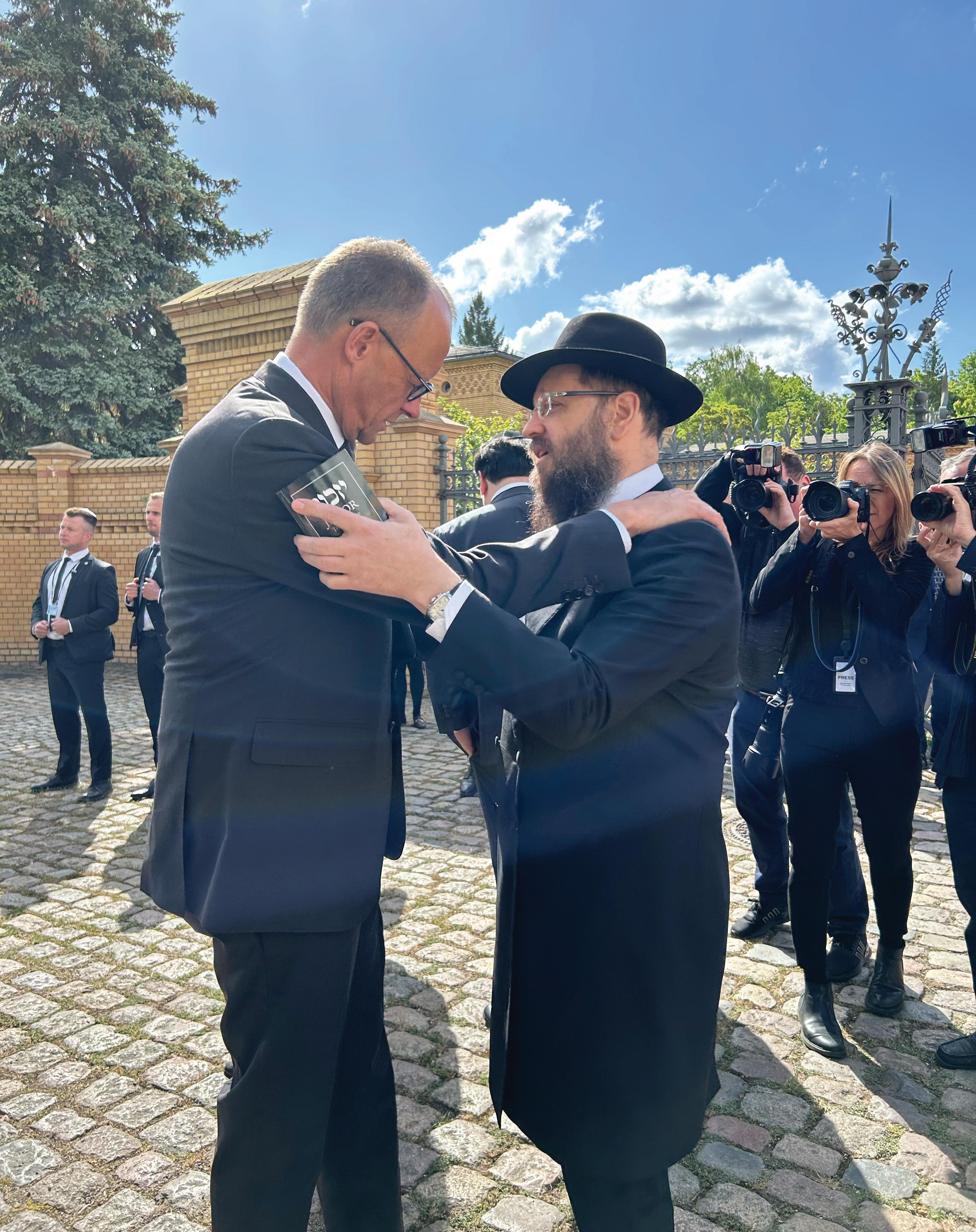
On our way to the Berlin State Parliament, we passed by the Memorial to the Murdered Jews of Europe, a stark field of 2,710 concrete slabs, serving as a silent tribute to the Nazi-created graveyard. Rabbi Tiechtel regularly visits such memorials, alongside dignitaries such as the chancellors Angela Merkel, Olaf Scholz, and Friedrich Merz. For him, it is personal and not just ceremonial.
His great-grandfather was Rabbi Yissachar Shlomo Tiechtal, a Hungarian rabbi and author of rabbinic responsa who was murdered on a transport train to Auschwitz during the war. His grandfather, Rabbi Chaim Menachem Tiechtel, escaped to Marseille with two brothers but was caught by the Nazis and sent to a
Chancellor of Germany Friedrich Merz embraces Berlin's Chief Rabbi Yehuda Tiechtel during a memorial for the Holocaust
labor camp. They managed to escape and hid in orphanages and forests. He survived, immigrated to Yerushalayim, and raised a distinguished Chabad family.
Having had the honor of interviewing his late grandfather, I asked Rabbi Tiechtel what inspired him to go on Shlichus to Berlin and what his grandfather's reaction was. After all, his eight siblings serve on Shlichus in the United States. He is the only one in Europe, and in Germany, of all places.
As we continued driving, Rabbi Tiechtel shared background details, juggling text messages and emails without breaking his fast-paced speaking rhythm.
“My siblings and I were brought up by the Rebbe and our parents,” he said. “We were raised in Crown Heights, and after school, we would hang out at 770 Eastern Parkway. My grandparents, R’ Meir and Sima Itkin, lived next door, so we absorbed it all.
“My father, Rabbi Shlomo Tiechtel of Yeshiva University, is a selfless chossid who sees only the good in people, and my mother, Mrs. Shaindel Tiechtel, who led Bais Rivkah in Crown Heights for more than 47 years, is a force of energy. I don’t remember a Shabbos without guests. We grew up with a strong sense of Shlichus.
“I remember the Rebbe’s farbrengen on Purim 5742, when the Rebbe said that we need to ensure all Jews worldwide observe the four Mitzvos of Purim. I asked my father, ‘Does the Rebbe really expect us to reach every single Yid?
In Japan, too?’ My father said, ‘Yes! We have to stop thinking provincially.’ So why did I end up in Berlin? Because that's where we were needed.”
As for his grandfather’s reaction, Rabbi Tiechtel said that at first, his grandfather grew silent when he mentioned the city's name. After a few moments of contemplation, his grandfather said, “Go in good health. Davka this place needs light more than anywhere else. This will be the greatest victory over them.”
IN THE NAZI MANSION
Living under the shadow of darkness and defeat can be taxing. During an early morning walk, I observed many Germans walking outside in the gray, gloomy autumn weather, often looking down and avoiding eye contact. Itzik Nini, an Israeli who has lived in Berlin for 20 years, validated this impression. “There are better seasons when you see beautiful leaves in all colors,” he said. “Still, when I first arrived, I thought the sky here wasn't as blue as in Israel.”
Nini was born in the town of Binyamina in northern Israel to parents of Turkish and Tunisian origin. His parents spoke Ladino in private conversations that the children wouldn’t understand. Nini met his wife in Israel (she’s originally from S. Petersburg in Russia) and they moved to Germany, where she works as an architect and teacher. Rabbi Tiechtel employs him as the housefather of Yeshiva Chabad Berlin.
“Before this was a yeshiva, Rabbi
Tiechtel used this building for the Chabad school,” Nini said. “Our two sons studied here. Although there were few students, they received an excellent education. Both were accepted into medical school and will soon complete their degrees. Only one in 100 students gets accepted to medical school here. Their success is thanks to their studies at Chabad.”
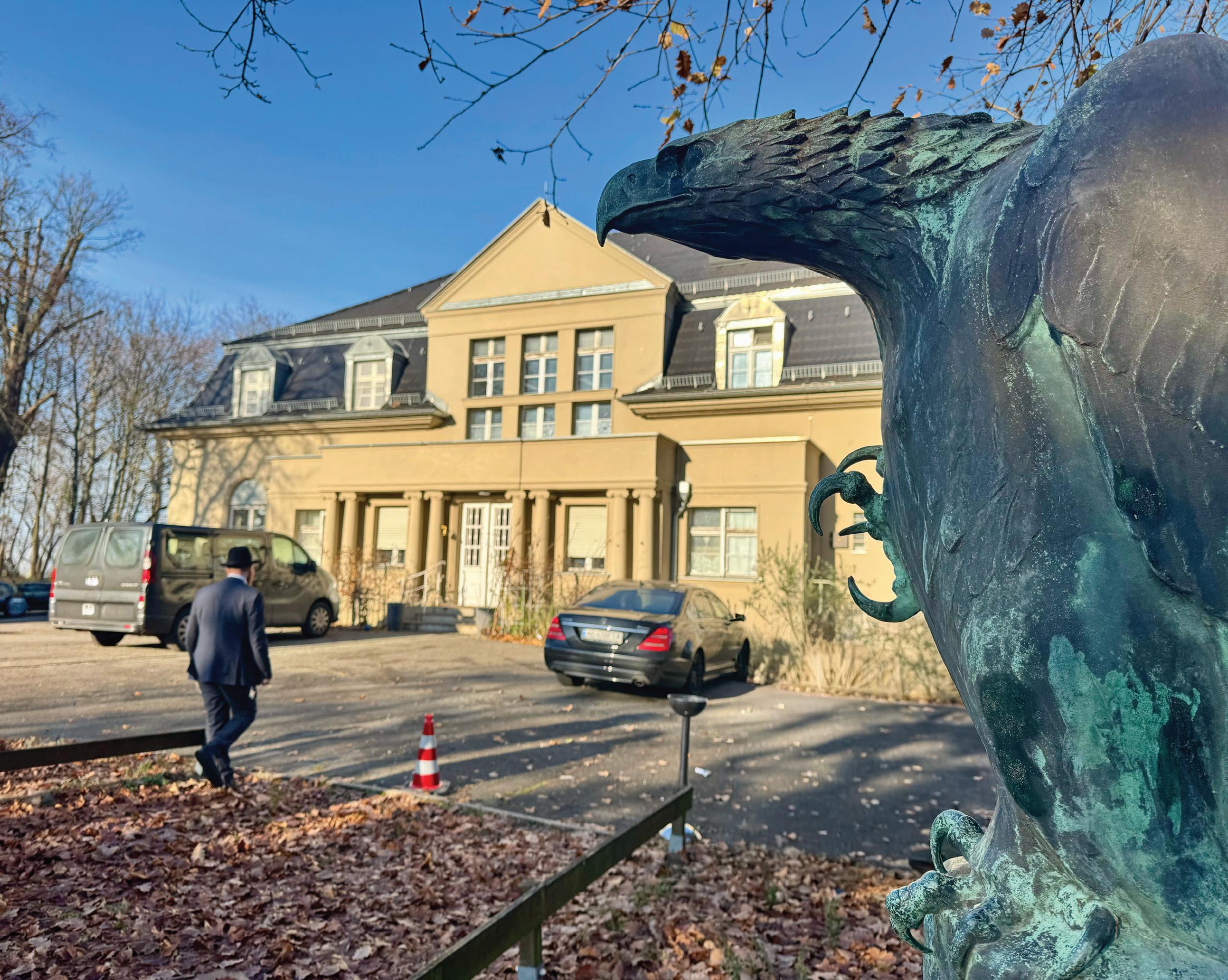
The Yeshiva is located within the 30-acre Park Ruhwald in the Spandau area. A private road through the park leads up to the tan-colored mansion. Standing at the entrance is a bronze sculpture of the Imperial Eagle, the national emblem of Nazi Germany. There is no remnant of a swastika, but two bullet holes are visible on its left side. Legend has it that a ranking Nazi official once lived here, which explains such coveted seclusion within an urban setting.
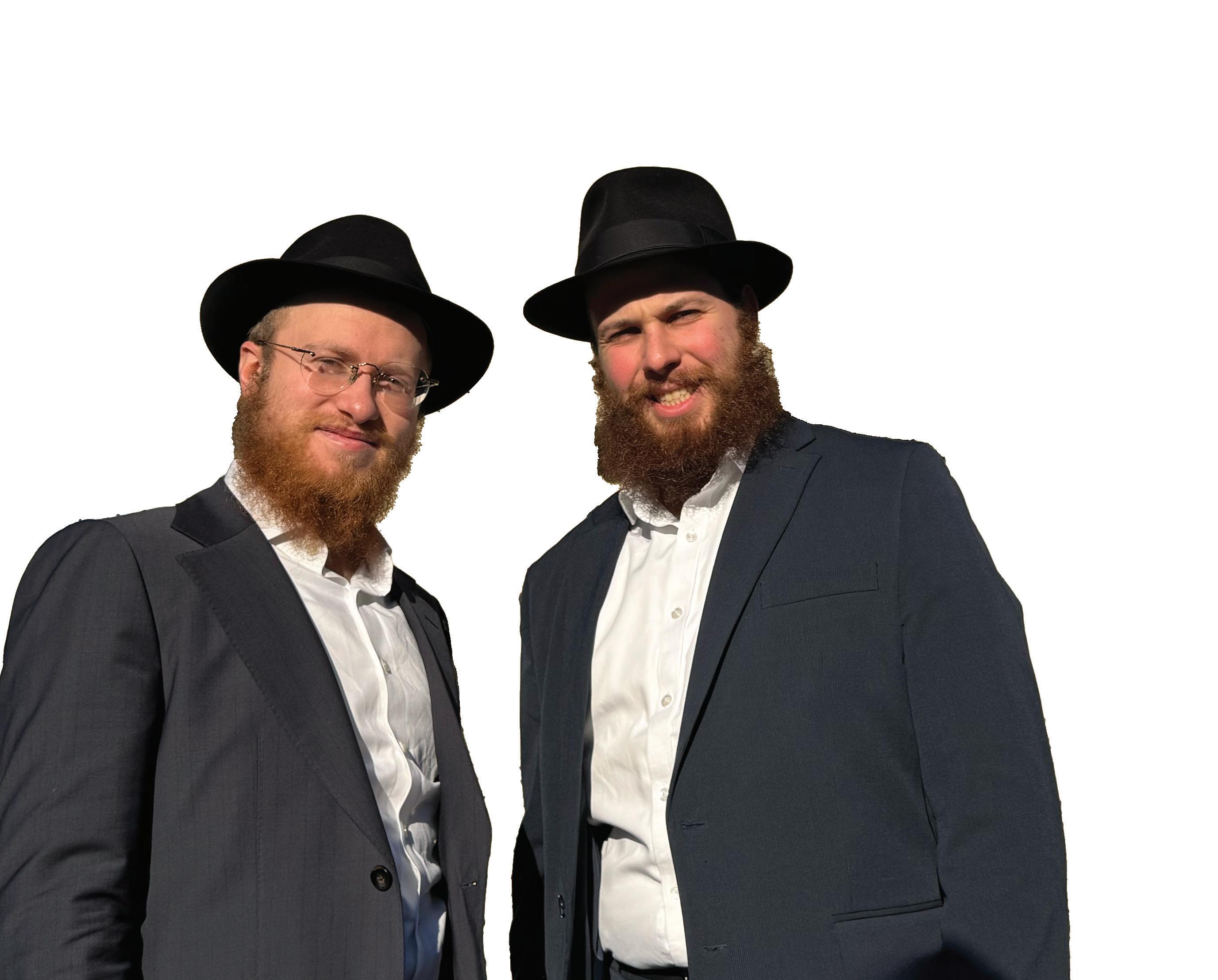
Its rooms are now filled with energetic young bochurim and the lively sounds of davening and learning. The institution, led by Shluchim Rabbi Yechiel Weber and Rabbi Elisha Pavlotsky, caters to Mesivtaage children of Shluchim and Torah-minded youngsters from the community. Signs on the bulletin boards are written in German, Hebrew, and Russian.
That’s because a significant portion of Berlin’s Jewish community comprises Russianspeaking Jews who arrived after the collapse of the Soviet Union in 1991. Germany opened its doors to these immigrants as part of its historical responsibility to rebuild Jewish life, offering work permits, social
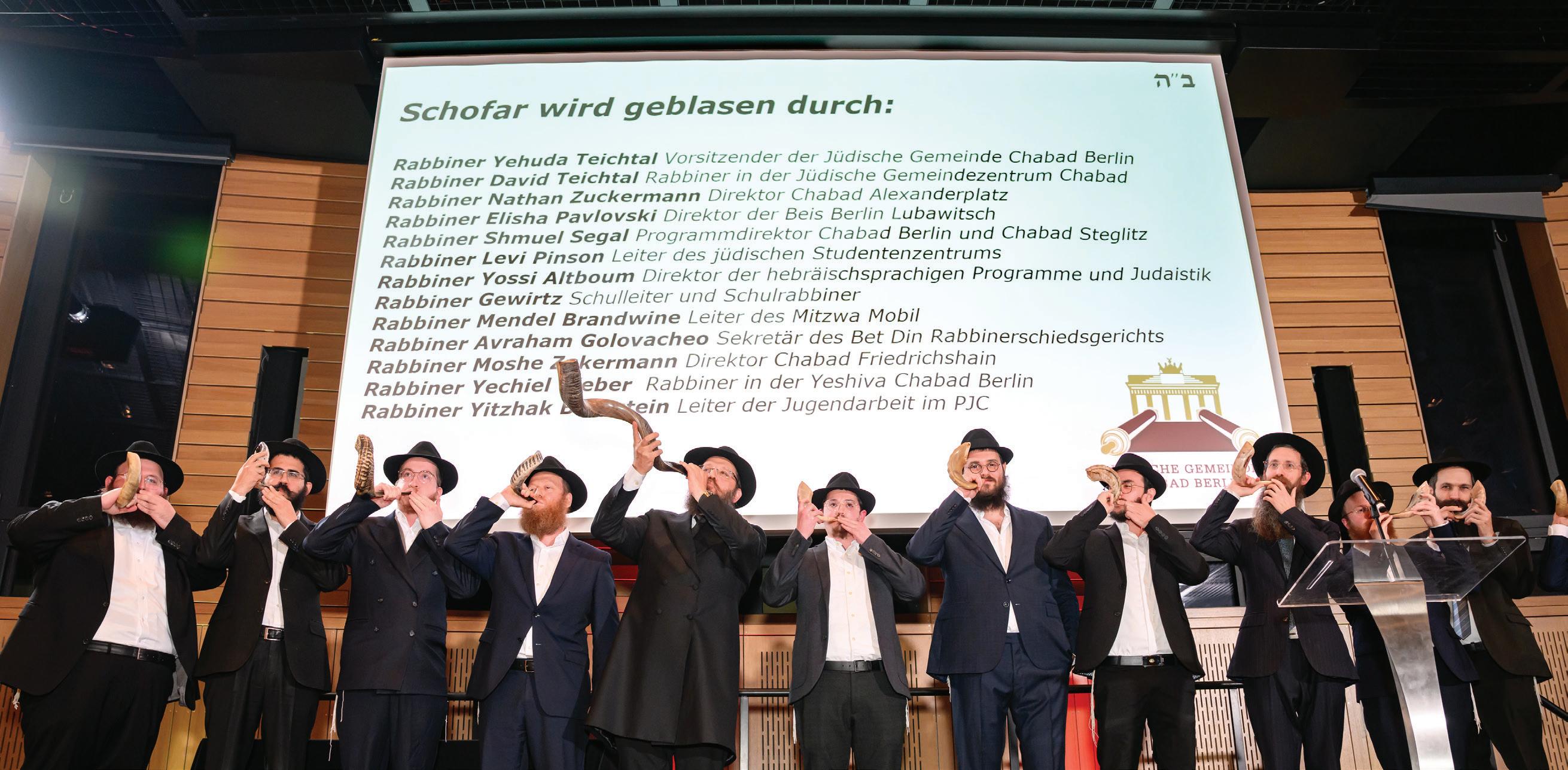
Chabad Shluchim in Berlin sound the shofar during a pre-Rosh Hashana reception
Rabbi Yechiel Weber (left) and Rabbi Elisha Pavlotsky, who direct Yeshiva Chabad Berlin
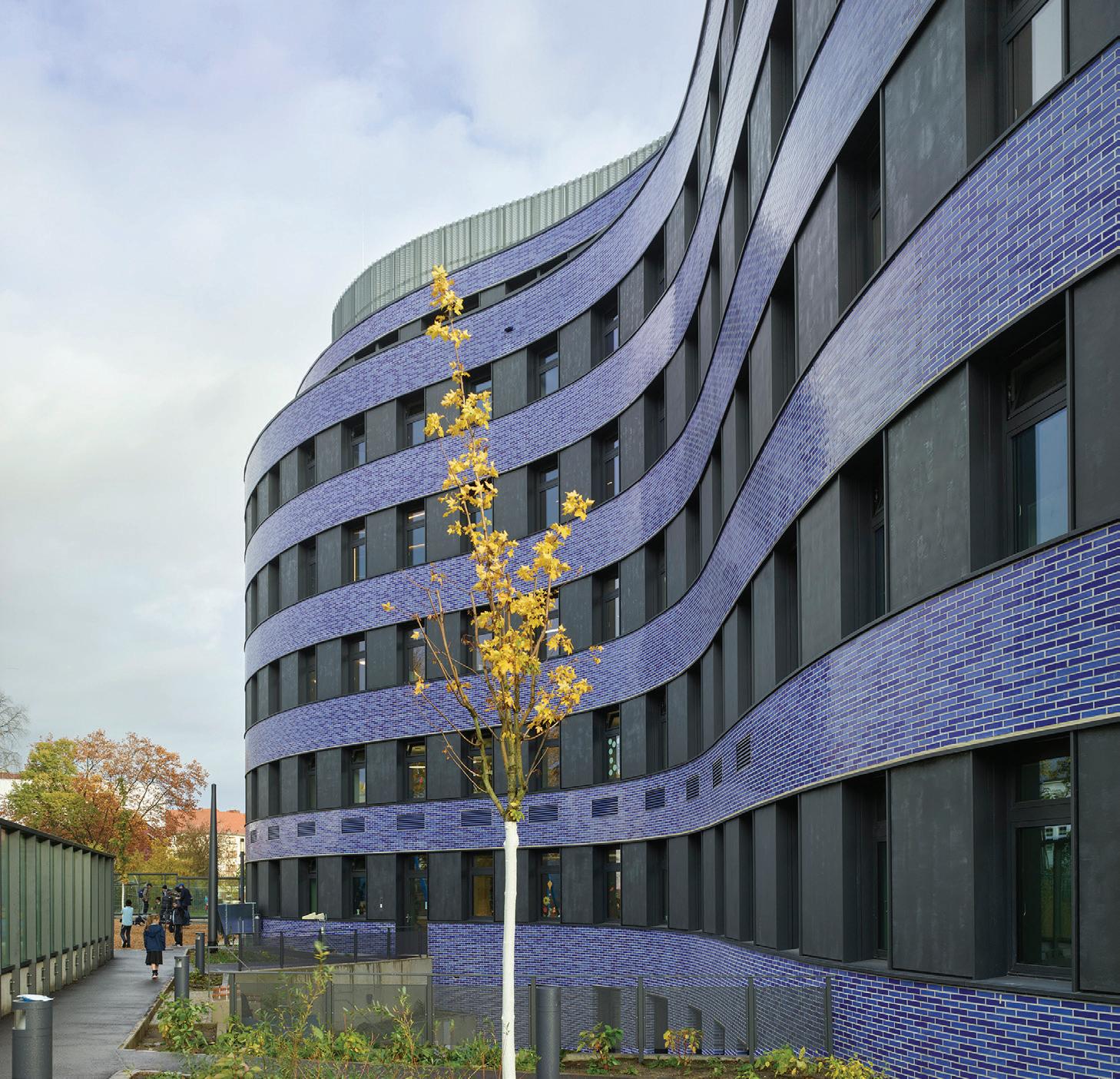
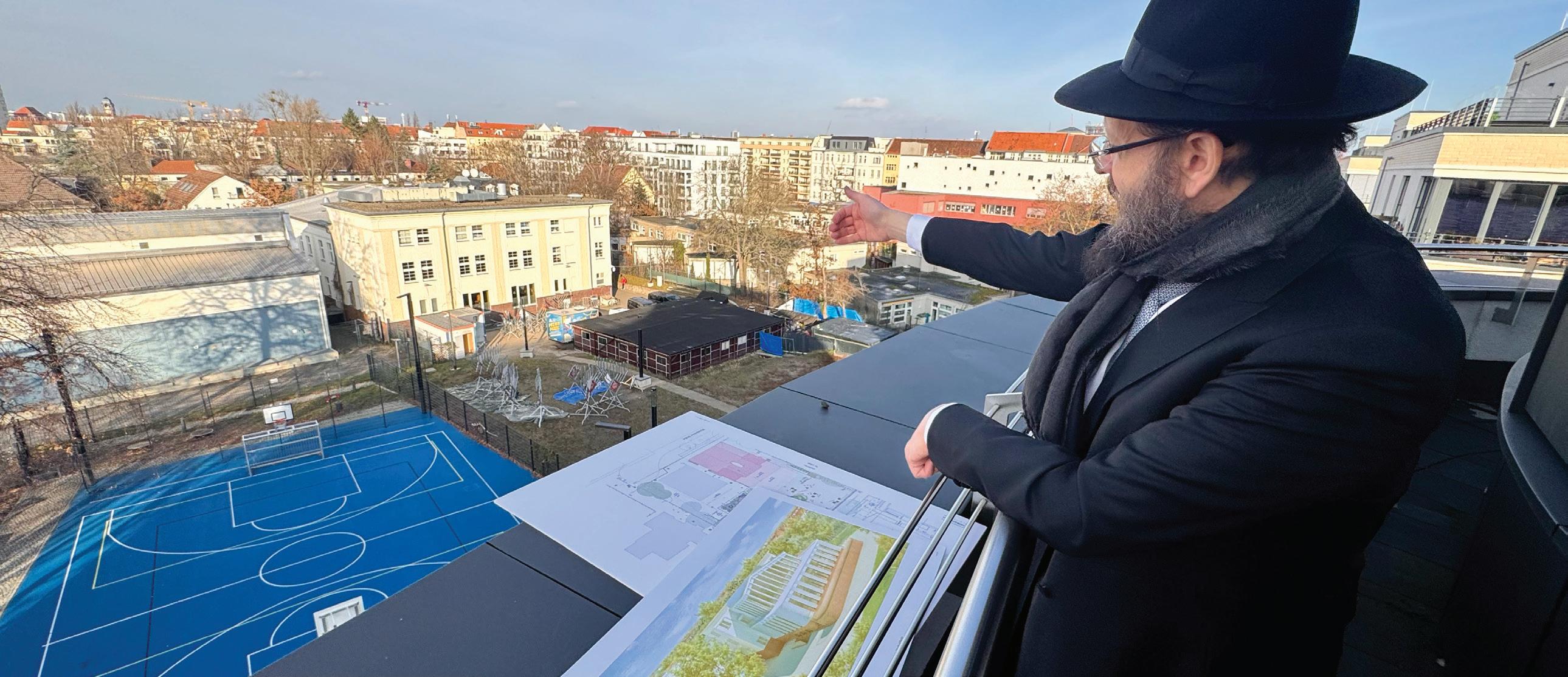
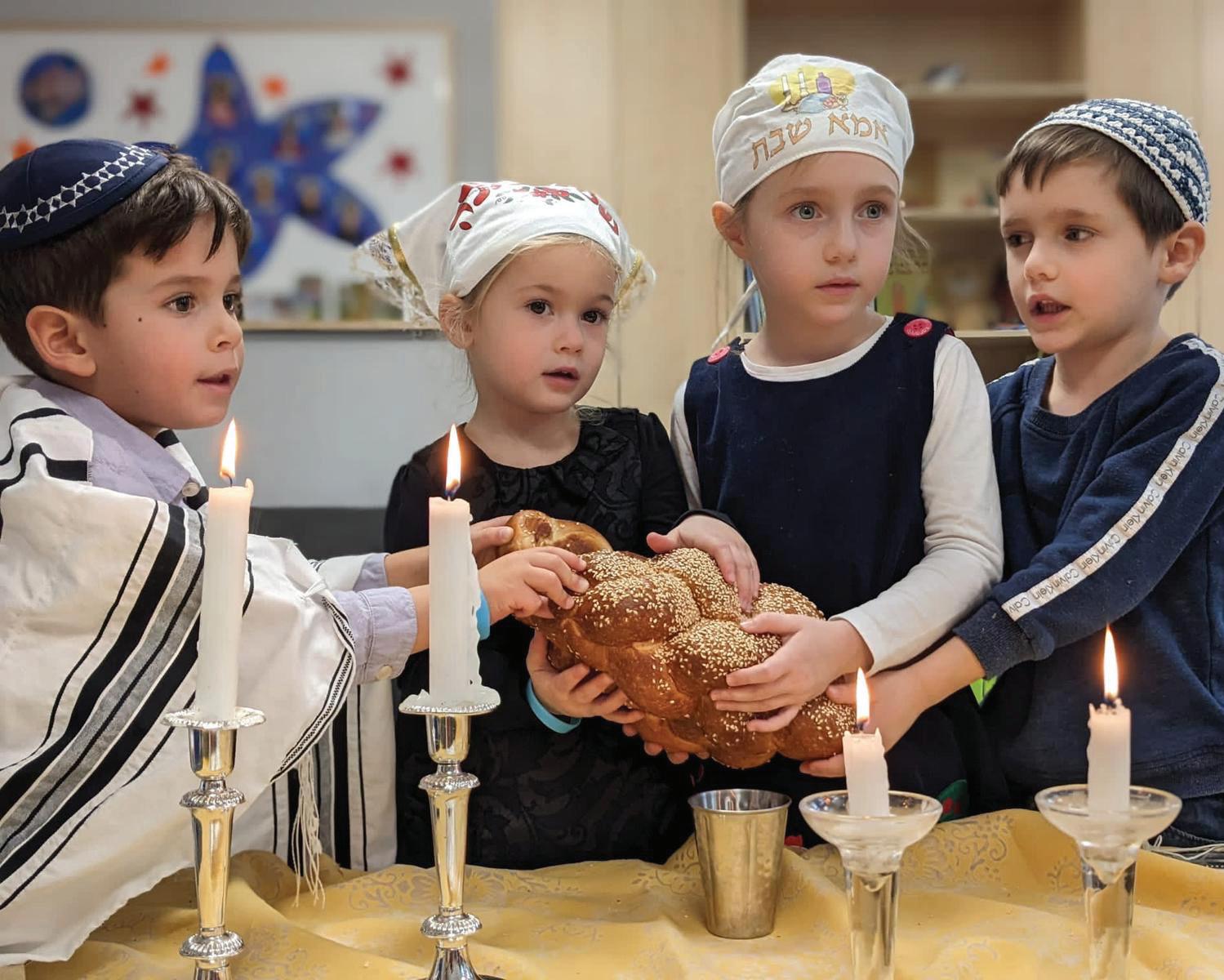
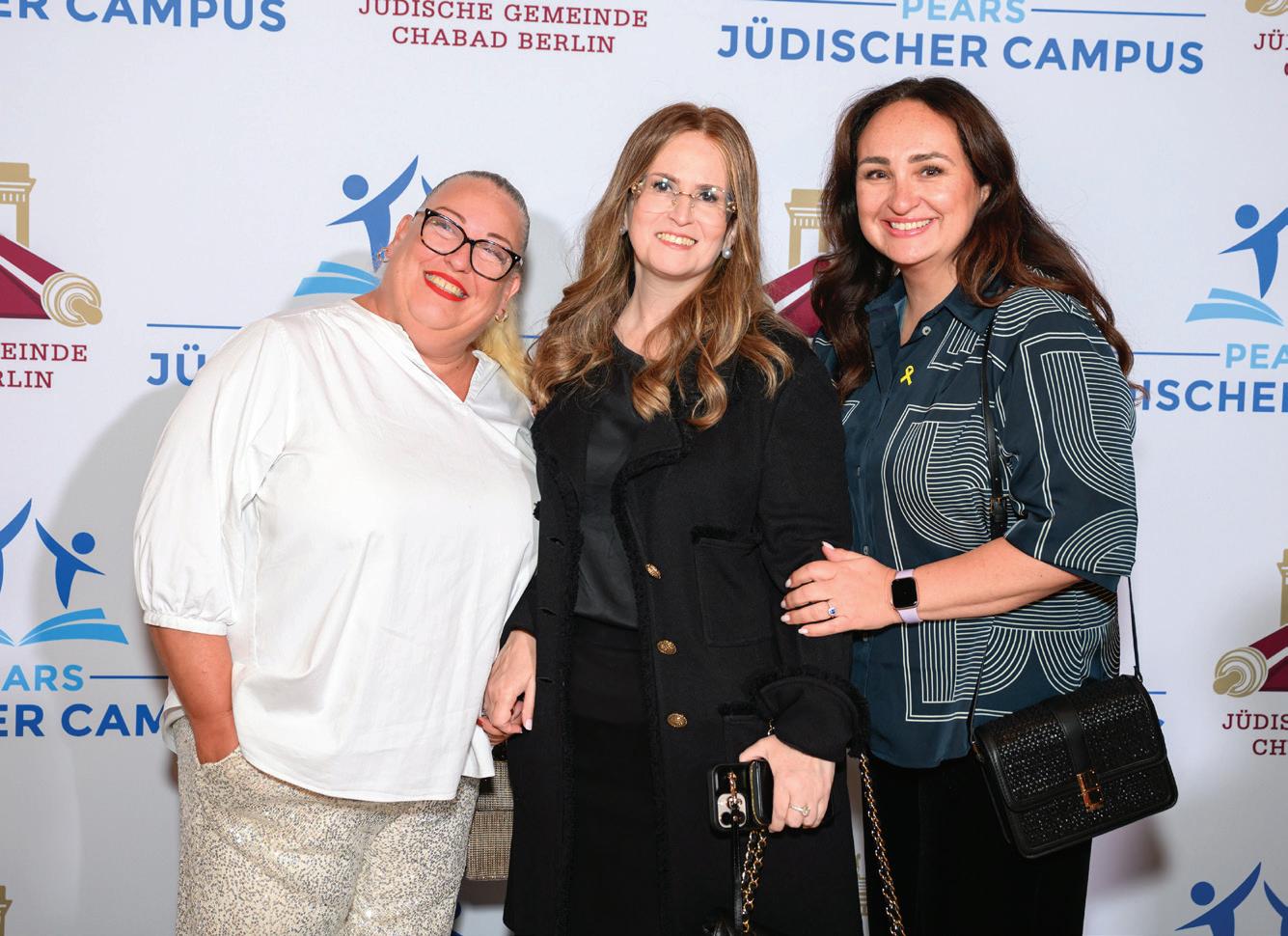
The staircase at the Pears Jewish Campus and the building's facade; Rabbi Tiechtel pointing to the planned expansion of Chabad Berlin across the Pears Campus; children preparing for Shabbos; Rebbetzin Leah Tiechtel with Ronit Gaudenzi and Julia Chibac from the kindergarten administration
benefits, language courses, and housing support. Another sizable group is the Hebrewspeaking community that moved from Israel.
A more recent wave came with the Russian invasion of Ukraine in February 2022. With many Jews fleeing from the Russian attacks, Rabbi Tiechtel moved quickly and resourcefully to accommodate those finding refuge in Berlin. He rented an apartment building, where he housed 100 families, and appointed Shluchim to serve their physical and spiritual needs. The building is called Beis Lubavitch Berlin.
A large photo of the Rebbe greets those entering, and a tefillin stand is perched in the entrance lobby. On a recent Friday, the dining hall buzzed with activity as preparations were underway for Shabbos. Rabbi Tiechtel noted that in Chanukah 5745 (1984), the Rebbe wrote a letter to Russian-speaking Jews in Berlin, encouraging their dedication to Judaism. “The address the Rebbe sent it to was right here on the corner,” he said with excitement. “That impact is clearly felt today.”
THE BEST FOR THE BEST
Before entering that car ride, Rabbi Tiechtel showed me around the most recent crown jewel: The Pears Jewish Campus, the largest Jewish center built in Germany since the war. Standing back-to-back with the Chabad Berlin building, it stands out in Berlin’s landscape with its cool purple bricks, round design,
and Jewish-themed pop-art gate.
The seven-story, 90,000-squarefoot complex includes a school with more than 400 students and a convertible basketball-ballroom space used for weddings, cultural, and community events. The government, foundations, corporations, and private donors funded its $60 million construction. “This is a place of joy and celebration,” Rabbi Tiechtel stated the obvious, as we watched children enjoying their lunch break.
Walking by, Ronit Gaudenzi, who directs the 150-student kindergarten, invited Rabbi Tiechtel to be present when they put on their upcoming Chanukah performance.
“Your grandson will be playing Matisyahu!” she told him, hoping to seal the deal. He promised to add it to his calendar.
As he climbed up additional floors, Rabbi Tiechtel stopped to speak to a group of teenagers. One of them was Amit Studnik, the grandson of a Jew who learned in Cheder in the Polish shtetl of Białystok. “Where are you holding with putting on Tefillin?” he asked the youngster.
“I put on my grandfather’s every day,” Amit answered.
Rabbi Tiechtel is both pleased and not pleased to hear that. “That's good,” he said at first. “But do you also use your grandfather’s iPhone? You should be getting your own pair. Please give your mother a call. I’d like to speak to her.”
Amit called his mother, who is
currently visiting Israel.
Rabbi Tiechtel took the phone and, in a boisterous voice, said, “Amit is an outstanding boy. I want you to bring back the best Tefillin from Israel for him. You know where Kfar Chabad is? Go there and speak to Rabbi Vilenkin. Take down his number and tell him that I sent you. The best boy needs the best Tefillin.” She agreed.
When we reached the roof, Rabbi Tiechtel pointed to the left. “You see that building? That was the Reich Ministry of War Planning. A stone's throw away, Jewish children are now learning Torah. Everyone should be coming here because it's a Jewish school, but some come here because it's a good school. We have been in the top-ranking schools. Could you imagine the nachas the Rebbe has from such a school?”
He recounted the story of a Jewish resident of Berlin, Faivel Kogan, whom the Rebbe insisted not to leave Berlin and work with Rabbi Avrohom Yitzchok Glick from London to aid Berlin's Jews. Kogan would visit the Rebbe before Rosh Hashana and receive lekach (honey cake) “for West Berlin.” In 5750 (1989), the Rebbe gave him two handfuls of cake, saying it was for “gantz Berlin” (all of Berlin). The wall soon fell, unifying the city. “The Rebbe instructed him to ‘mach Berlin Lubavitch,’ which I see as our mission today.”
Rabbi Tiechtel and his wife Leah, the daughter of Holon’s Chief Rabbi Yochanan Gurary, moved on Shlichus to Berlin in 5756 (1996). They started by establishing a Chabad House, followed by a kindergarten. Soon after, they opened a Jewish
library and a Mikvah. Today, there are 10 Chabad centers in Berlin, which are directed by 13 Shluchim couples. In 2020, he was appointed Chief Rabbi of Berlin.
“There are 13 shluchim working together, shoulder to shoulder, jointly carrying the entire mission,” he said. “It is a collective effort, and each of them contributes to everything that is being accomplished. No one is doing this alone. It is unified achdus in action.”
“When we first arrived, we didn’t know how we would exist,” he recounted. “Some were threatening us, and it was very difficult. Everything that is happening now is the Rebbe’s merit and strength. All the brachos, all the success, are entirely the Rebbe's. This is especially meaningful since the Rebbe himself lived five years in this city, which gives everything we do such profound depth and connection.”
Back when the Tiechtels arrived, there were 9,000 Jews in Berlin. Today, there are 50,000 people. The Shluchim serve different areas and demographics (such as Israelis, teens and university students). There’s even a Mitzvah Mobile that drives around to unreached places. Chabad operates a Beis Din and a kashrus agency that certifies three dairy cafes and two meat restaurants.
“I have a motto about working with people,” Rabbi Tiechtel said. “First they ignore you; then they fight you; and then they join you. People today want to be associated with Lubavitch. We are fulfilling the Rebbe’s wish to make Berlin Lubavitch.”
ONE MORE LIGHT
Our ride arrives at the Berlin State Parliament, and we both step out. The air is chilly but not cold, and we head to the
entrance, passing a large group of people singing carols. Our security team flashes their badges to let us skip the metal detectors and the pocketemptying process. Waiting for us are leaders of the Green Party. Rabbi Tiechtel uses the opportunity to record a video with them, which his social media team will later post.
We went upstairs to a conference room with green wallpaper and tall ceilings. Name tags for all, including Josef Gordon, CEO of the Chabad Berlin campus, were ready. The meeting focused on rising antisemitism and the Jewish community's needs. Rabbi Tiechtel urged me to join, and others didn’t mind, but I struggled with fatigue after a long flight. Midway, I excused myself and stepped out.
Walking through the magnificent hallway lined with busts of past politicians, I was stopped by Aldona Niemczyk, a parliament member from the
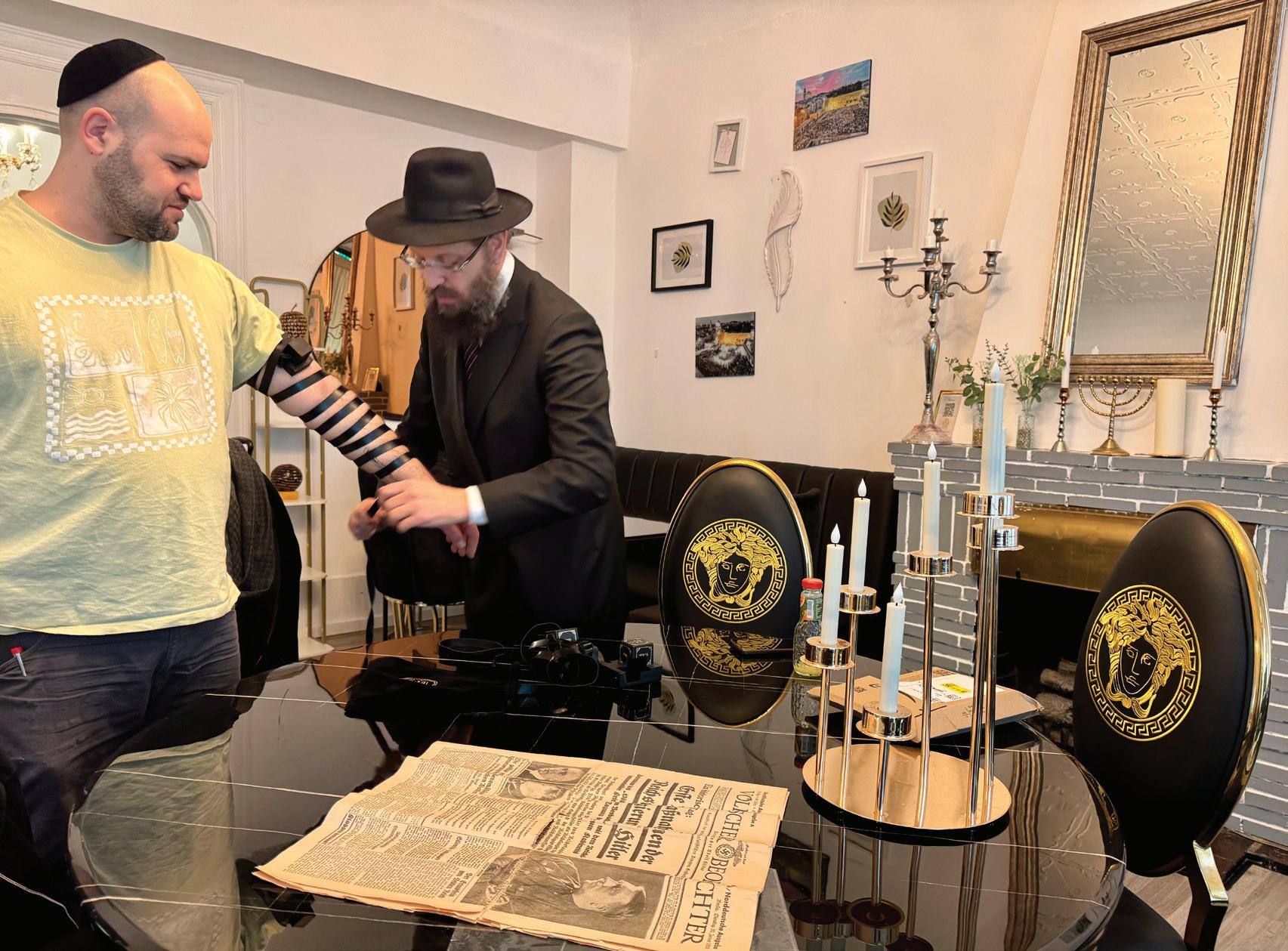
Rabbi Yehuda Tiechtel puts on Tefillin with an employee of the King David Garden hotel in front of a newspaper about Hitler's rise found in its attic
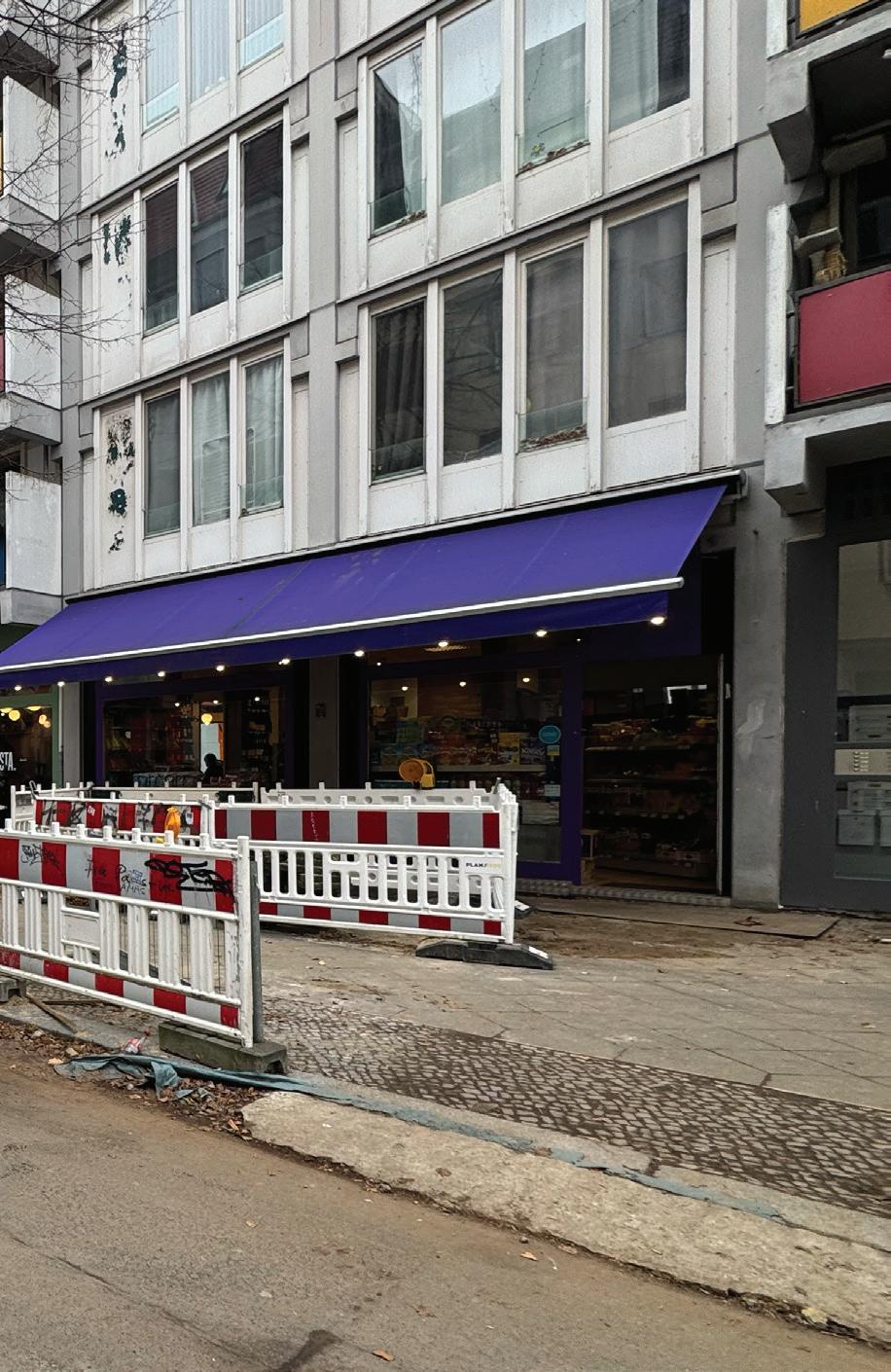
Chabad’s Mitzvah Mobile outside the Kosher4all grocery in Berlin
Christian Democratic Union (CDU).
“Wo ist Rabbiner Tiechtel?” (Where is Rabbi Tiechtel?) she asks in German.
Using Yiddish, I reply that he is in the conference room and should be out in about five minutes. She understood my Yiddish as broken German and said she would wait for him.
Upon stepping into the hallway, a couple already caught Rabbi Tiechtel for a quick word. Niemczyk then got her turn.
“I’ve been trying to reach you,” she said. “You have all these Menorah lighting events, and I want to organize one here with you as well.”
As we walk down the red carpet of the parliament, flanked by the police officers, Rabbi Tiechtel tells her, “There are 30 Chanukah events that I’m personally scheduled to be at over the 8 days of the holiday. But we’ll make it work! I would
love to do it.” Both the rabbi and the parliament member seem to be equally excited about the idea, and they part ways.
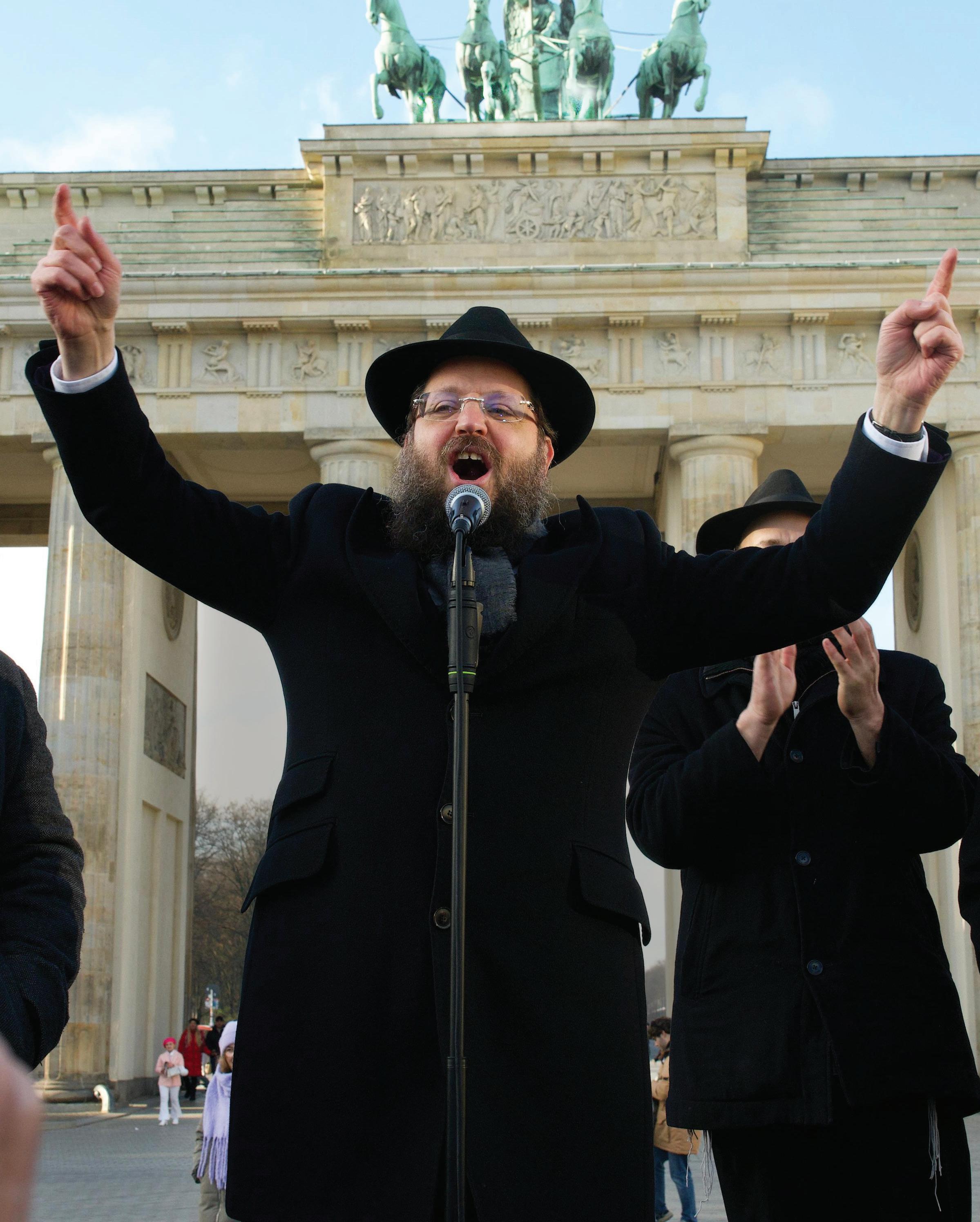
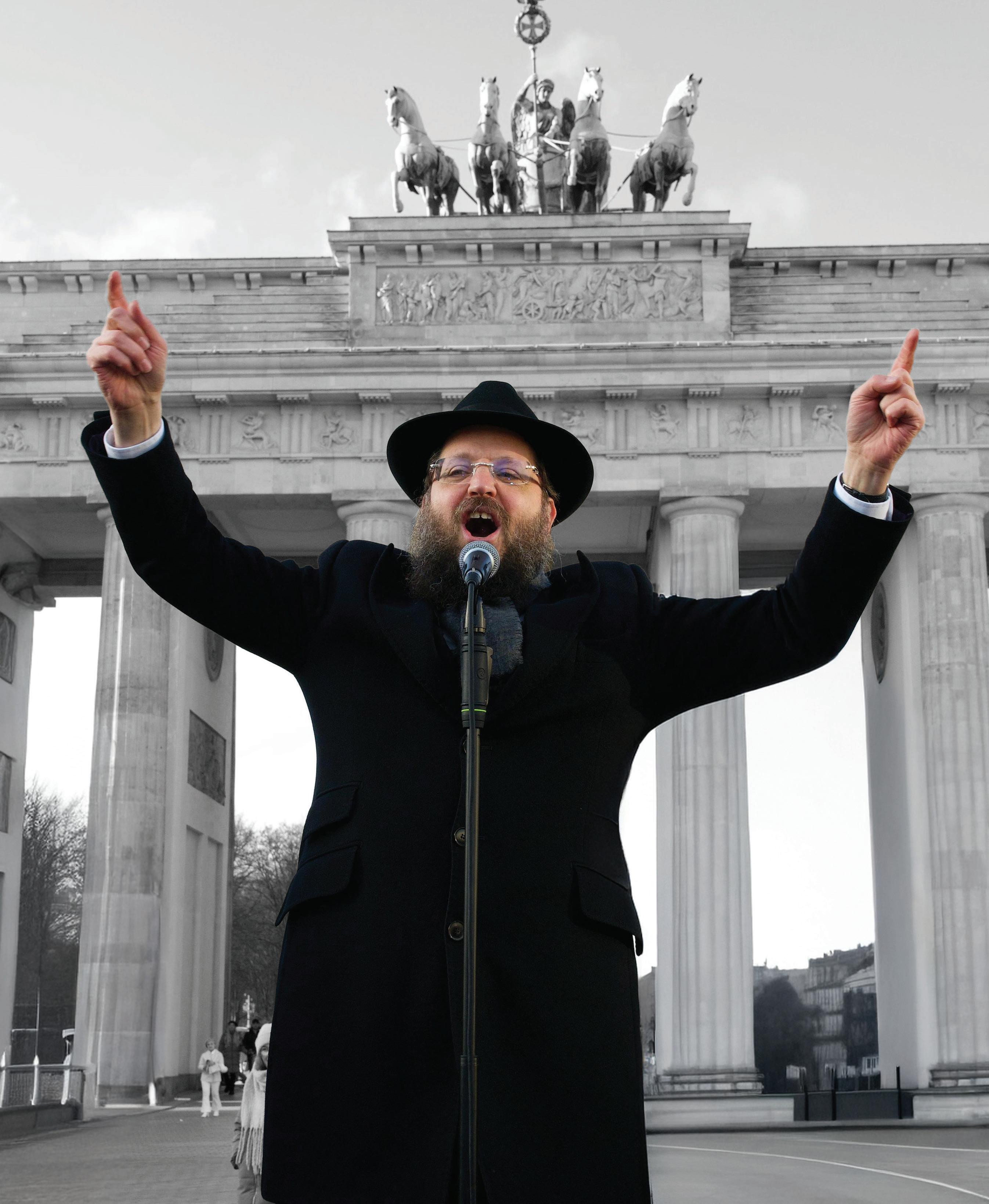
Chabad centers in Berlin indeed have 55 public Menorah-lighting ceremonies and Chanukah celebrations planned this year, with the most famous being at the Brandenburg Gate. The Menorah that stands in front of the historic landmark has become one of the most iconic Chanukah images in the world. Each year, a photo of the Brandenburg Menorah is widely shared online alongside a photo of the Nazis using the Brandenburg Gate for hateful propaganda.
This Chanukah will mark the 20th year that the Brandenburg Gate Menorah has been proudly built. Lighting it will be Israel’s Chief Rabbi Kalman Ber and Julia Klöckner, President of the Bundestag. After the celebration, a private reception will be held at the U.S. Embassy,
which stands to the south of the gate.
“It wasn’t simple,” Rabbi Tiechtel notes, about how it originally went up. “We faced a lot of opposition. They said this area is only reserved for displays of national interest. I told them, what is more in the national interest than showing renewed Jewish life in Germany?!
“After we succeeded in putting it up, we were told one year that our Menorah is offensive because it overshadows the holiday tree donated by the Norwegians. So I had the Norwegian Foreign Secretary write an official letter stating that it was fine with them. It was a lot of effort, but all this is worth it because what is a greater symbol than the victory of light over darkness and the power of the Rebbe, than this Menorah?”
Just like his grandfather had envisioned.
Rabbi Yehuda
Tiechtel and COLlive
Magazine Editor Rabbi Yehuda Ceitlin at the Brandenburg Gate
By Tzali Reicher
The Unlikely Social Media Star
How a labor and delivery nurse became one of the most recognized Jewish voices online
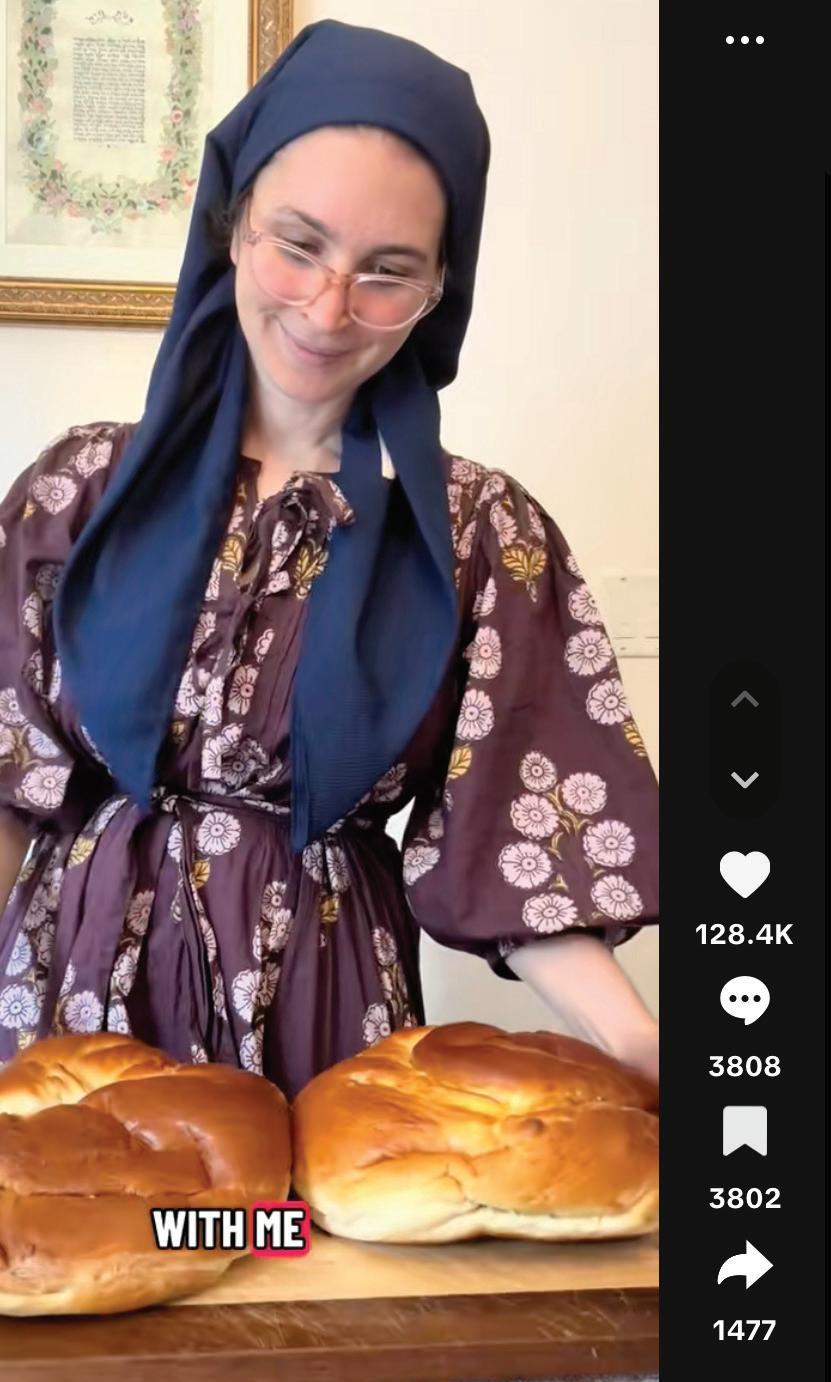
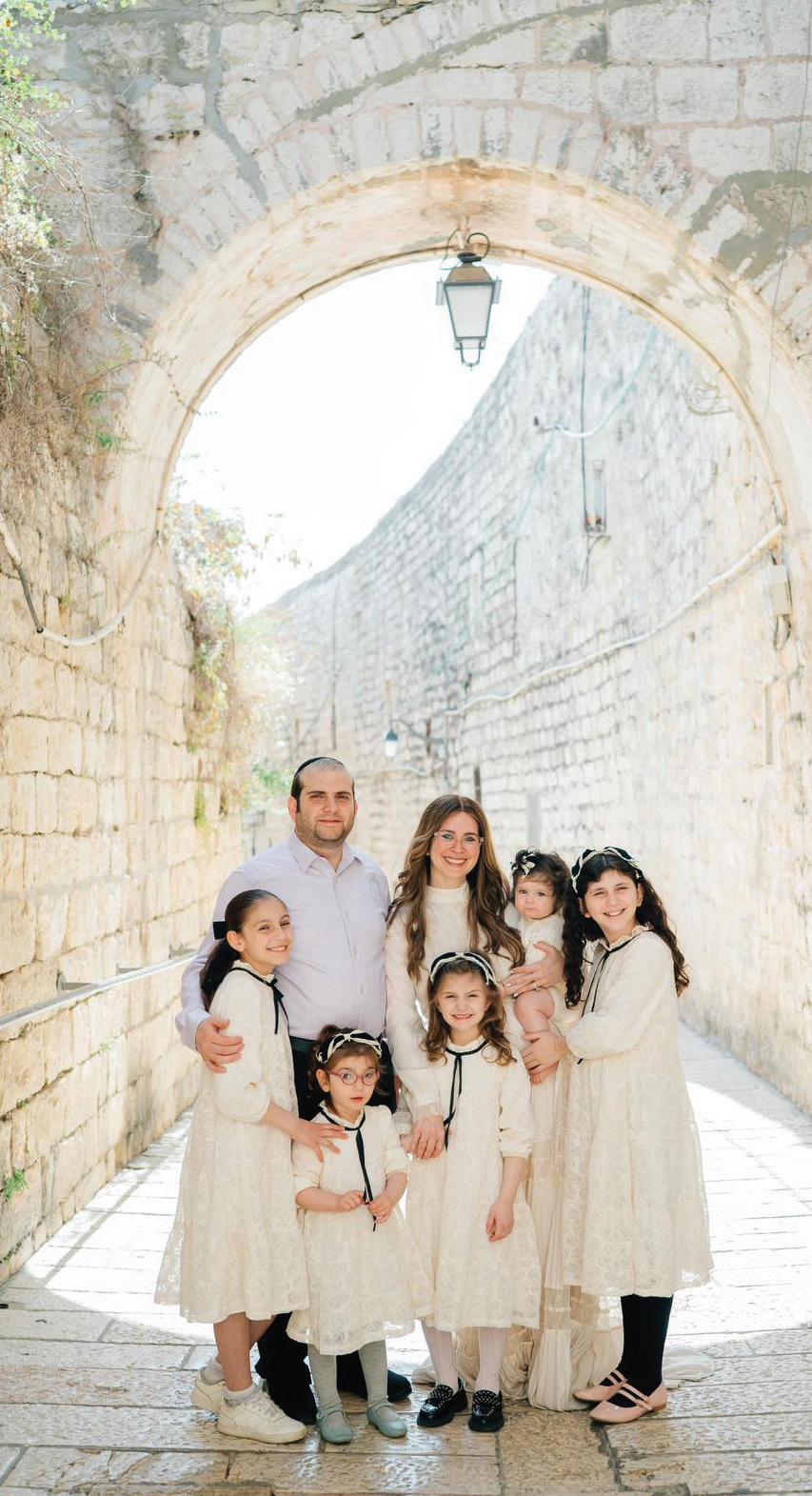
IIIf you had told Miriam Ezagui three years ago that she would amass 1.4 million Instagram followers and 2.3 million TikTok followers, she would have laughed. The Brooklyn-based labor and delivery nurse, mother of five girls, and proud member of the Chabad community never set out to become a social media sensation. Yet today, she stands as one of the most influential Jewish voices online, using her platform to educate, inspire, and build bridges between communities.
Ezagui (nee Malnik), now 39, grew up in Clarksville, Maryland, and her journey to Jewish observance began when she was nine years old. Her parents, Leon, an insurance broker turned investment advisor, and Judi, a teacher and pillar of support for her family, connected with Rabbi Hillel and Chani Baron in Columbia- the next town over-
and began embracing a chassidic lifestyle.
The transition to a frum lifestyle wasn't easy for young Miriam. Living too far from the Chabad House to walk on Shabbos, the family often stayed with the shluchim and other frum families. This helped Miriam gradually build friendships that made the adjustment smoother.
“My parents gave me the freedom to find my own path, which I very much appreciated,” Ezagui reflects. “They let me come along on the journey at my own pace. For example, they gave me the option of choosing between public school and Jewish day school. I wanted to finish elementary school in public school, and they let me do that. I moved over the next school year.”
This patient approach from her parents allowed Miriam to
embrace her Jewish identity organically, and she enjoyed her high school and seminary years in the Chabad system, graduating from the Machon Alta seminary in Tzfat.
From a young age, Miriam was drawn to motherhood and children, and knew she wanted to work in labor and delivery. Her choice to become a nurse was strategic: the flexible scheduling would allow her to balance starting a family with her professional passion.
“I love being in the delivery room,” she says. “It's not just my job, it's my passion.”
After completing three years of college in Maryland, Ezagui moved to New York, where she married her husband Aaron and began raising their family of five daughters, while enjoying her career.
An Accidental Influencer
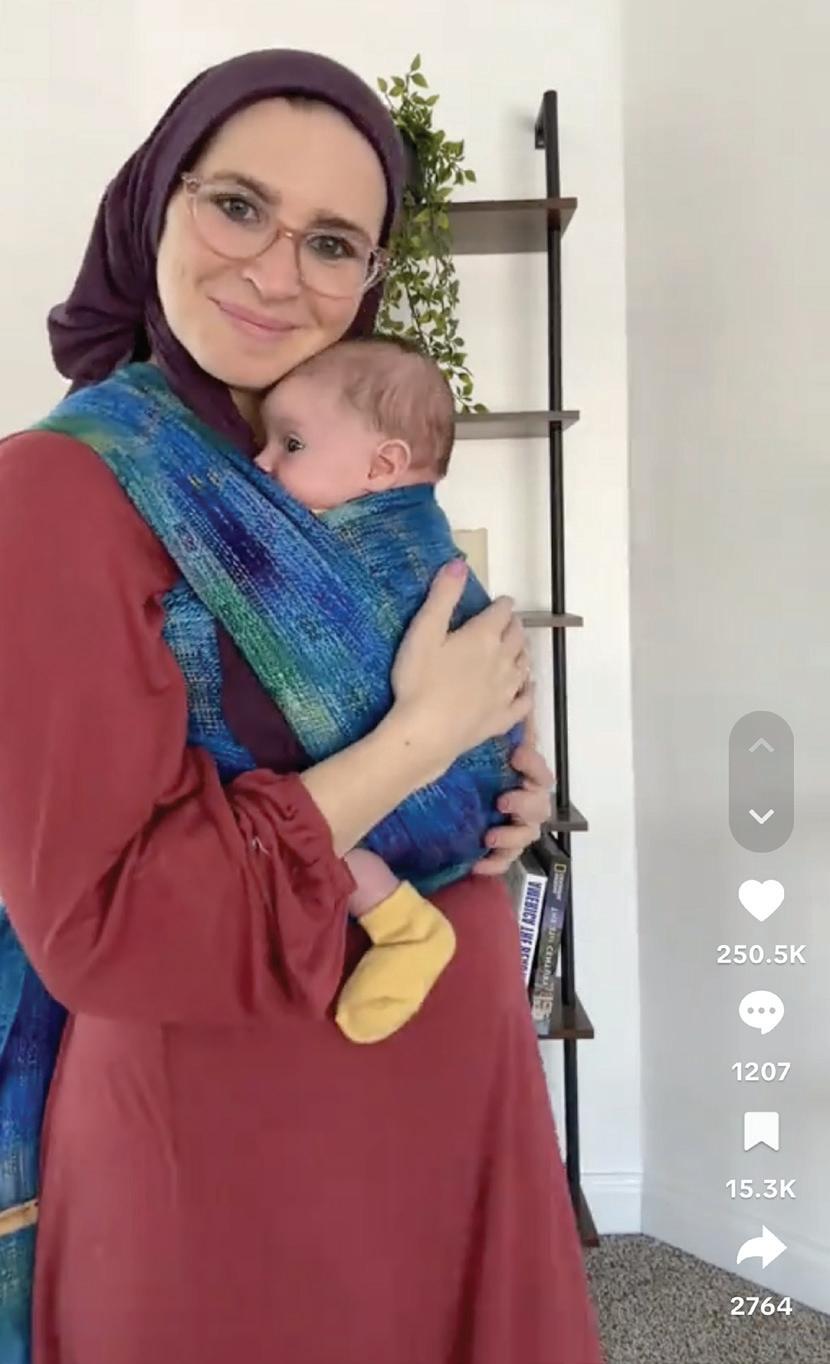
Ezagui’s entry into becoming a content creator on social media was anything but planned. She didn’t use Instagram, and only visited Facebook groups that served as supportive communities for expectant mothers. She also participated in groups that discussed a creative interest of hers: babywearing and handwoven wraps.
“It’s a whole niche community of people who enjoy carrying their children in these wraps. They’re basically works of art, made of different fibers, materials and styles, and a whole world of people who love sharing how they wear and accessorize them.”
Spending time at home recovering after giving birth to her fourth
child in early 2022, Ezagui began posting TikTok videos demonstrating babywearing techniques, with no intention of identifying herself as a Jewish mother or becoming an influencer.
“It gave me something to do, and a reason to dress up and wrap up my baby,” she laughs. “It’s amazing to think that’s how it all started.”
Exclusively posting about babywrapping, Ezagui didn’t share much about her identity or faith, amassing tens of thousands of followers interested in the babywrapping niche.
The turning point for how she began opening up about herself came when television host Whoopi Goldberg made controversial comments about the Holocaust, callously dismissing the Holocaust as “not about race … it’s about man’s inhumanity to other man.”
As the granddaughter of two Holocaust survivors, Ezagui felt compelled to respond.
“I was concerned about being seen as a Jew online, particularly on TikTok- which is known to generally have an antisemitic undercurrent,” she admits. “I was worried about the reaction, but I decided to address the comment, about how it was incorrect and hurtful. To my surprise, the video was very well received. I started to feel more comfortable sharing more about myself, and my Judaism.”
Two months later, while spending Pesach with family, she asked her Holocaust survivor grandmother to appear on her channel during Yom Tov at her parents' house and talk about her experience. Those videos went viral, with one reaching an astounding 24 million views.
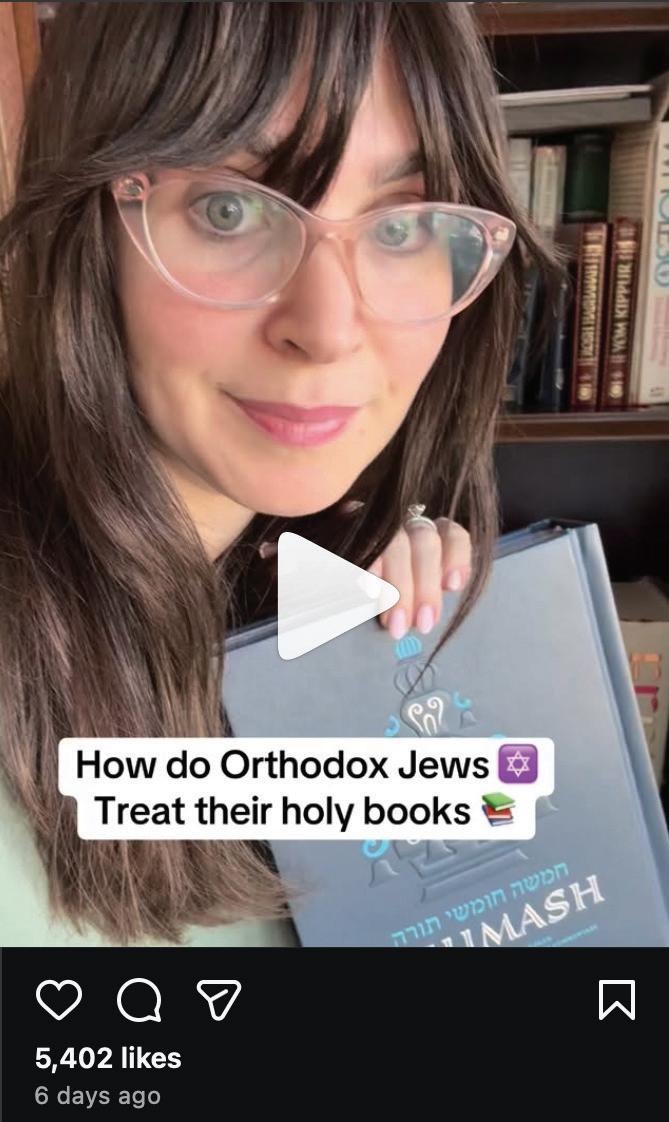
“I saw how much these videos resonated, and decided to share more about Jewish culture and customs with the world,” she explains. “I saw it as an opportunity to demystify our community, and help the world see the truth about what Yiddishkeit really is, instead of the conspiracy theories uneducated antisemites are sharing unchecked on these platforms.”
Rather than simply responding to hate with condemnation, Ezagui focuses on education and relationship-building.
“I saw that there are two types of antisemitism," she explains. “There's baseless hatred that can never be changed. But there are people who dislike Jews because of disinformation, and I saw this as an opportunity to break stigmas and educate them. I see how when people understand who we are, they can really appreciate and respect our community.”
Ezagui has countless stories and messages that demonstrate the real-world effects of her content: non-Jewish healthcare workers who now understand Jewish dietary laws and can help Jewish patients find kosher food; medical staff who finally understand the purpose of Shabbos elevators; people understanding what a kosher symbol is on the food they eat, and countless individuals who have gained a deeper appreciation for Jewish traditions and customs.
One particularly moving story involved a frum woman in a remote area who went to a hospital where the nurse, familiar with Ezagui’s content,
immediately understood her taharat hamishpacha concerns as well as helped her arrange for kosher food.
There are also the many Jews who are exposed to Jewish practice for the first time in their lives, and share with her that they have begun taking on mitzvahs.
“I love these messages,” she says. “It’s incredibly validating, and shows the value in just explaining who we are.”
Initially building her following on TikTok, Ezagui expanded to Instagram in October 2023, which brought her to the attention of the frum community. “Since the frum community wasn't really on TikTok, only non-Jewish people were recognizing me out in the real world. After building an Instagram following, frum people started noticing the work I was doing.”
The period following October 7th presented Ezagui with her greatest challenge yet. Her immediate support for Israel triggered a torrent of hate on TikTok that quickly and unceasingly spilled into the real world. People inverted the legacy of her Holocaust surviving grandmother to ask how Ezagui could support a ‘genocide’, and questioned her ethics as a nurse if she could support Israel.
“It was a scary time,” she admits. “I wanted to stop the hate, so I said something that the community wasn't ready to hear – we were still mourning. The biggest takeaway I learned is that despite the pressure of people expecting their favorite social media person to publicly come
out with a statement that agrees with them, it's okay to not have all the answers. It's okay to be a person and feel.”
While Ezagui treasures the feedback and validation her work receives, success has come with its challenges. She faces a stream of hate daily, but notes that every person that puts themselves out there online is abused equally just for daring to share a bit about themselves. What gets to her the most is when people film reactions to her videos on their own accounts and platforms, and direct their audiences to flood her pages with hate and vitriol. When TikTok was awash in antisemitic content following October 7, and when Jewish creators were being piled on, Ezagui signed an open letter to TikTok with dozens of Jewish celebrities and creators, highlighting the problem and giving specific pointers on what can be done to make the platform better.
“To their credit,” she says, “they really took the time to hear us. We had a meeting with TikTok executives in the United States, and they heard our concerns and committed to making changes. Ultimately, antisemitism is the oldest hatred in the world, and TikTok is not responsible for curing that, but I’ve seen how they’ve implemented changes and filters to ensure hateful content isn’t amplified and spread through the main feeds and algorithms like it was before.”
TikTok also organized for Jewish creators to join the March of the Living, the annual pilgrimage to Auschwitz. Ezagui was one of the creators who joined the trip.
“Walking through the death camp was an intensely emotional experience," she remembers. “As the granddaughter of someone who was imprisoned there, while being pregnant, felt like such a testament of our victory over those who persecuted us just a few short decades ago. It really spoke to the power of our Jewish continuity and strength."
Ezagui is immensely appreciative of the warm and appreciative feedback she gets from her fans online, and in person. She doesn’t mind the positive attention that comes her way, or the people who stop to talk to her and ask for a selfie.
“The only negative is that I can no longer be anonymous online or when we're out, and a kid is acting up, it feels like everyone’s eyes are on us, waiting to see how we’ll react,” she notes with a laugh. "I wouldn't change any of this, but that's the only downside.”
“Posting online is a very solitary thing, and when people come to me to say they enjoy my content, it confirms that people appreciate it,” she says. “People rush up and are nervous and apologetic, but I always tell them if you’re excited to meet me, I’m excited to meet you.”
As she continues to navigate her role as an unlikely social media star, Ezagui remains grounded in her original mission: demystifying Jewish people and practices to people of all backgrounds, and breaking down invisible barriers. Her platform may have millions of followers, but at its heart, it remains what it always was: one person sharing her truth, one video at a time.
SOME MAY SEE IT DIFFERENTLY
Impaired vision is more common than you may think.
Ahava Vision offers complete eye care, from comprehensive exams to vision therapy by our team of world-leading vision experts.
By Motti Wilhelm
A Glimpse into Lubavitch of Old
The fascinating memoir of Reb Pinches Dov Goldenshteyn, a chossid of the Tzemach Tzedek
I“I wanted to see what the Rebbe was doing while alone in his room. At eleven a.m., I peeked in through the keyhole of the door. Since the Rebbe's table was facing me, I was able to see that he was still and praying in his talis and tefillin…
The simplicity with which the Rebbe, the tzadik of the generation, conducted himself cannot be found in Poland.”
“In that room where the Rebbe resided were two walls completely covered with holy Jewish books. Along the third wall stood a small bed and a large chest, and along the fourth wall stood an armchair on which the Rebbe sat. Near the armchair was a makeshift table and two stools. You would not find such a magnificently simple study in Poland either! ‘Fortunate is the eye that saw all this.’
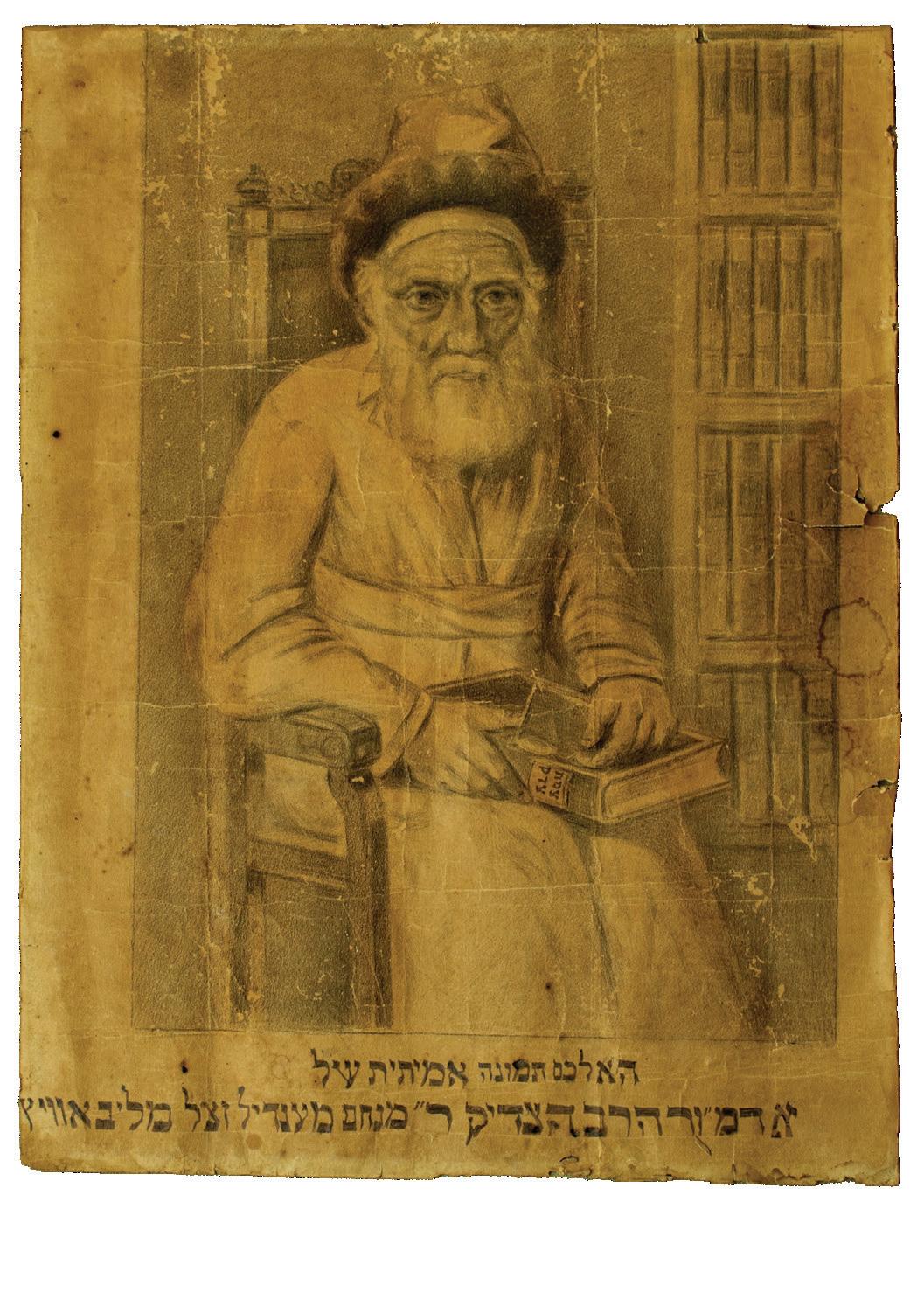
This vivid scene was written more than 150 years ago, and remarkably, it describes the Tzemach Tzedek, the third Chabad Rebbe. Its author, a colorful and intriguing figure who
considered himself a Lubavitcher chossid, left behind one of the very few contemporary accounts of the Tzemach Tzedek and his court, especially from a frum perspective. His memoirs, published in archaic Yiddish in 1928, went largely unnoticed for decades. A chance discovery led to a short excerpt being printed in a Lubavitch publication; from there, it reached the hands of a young bochur, Michoel Rotenfeld.
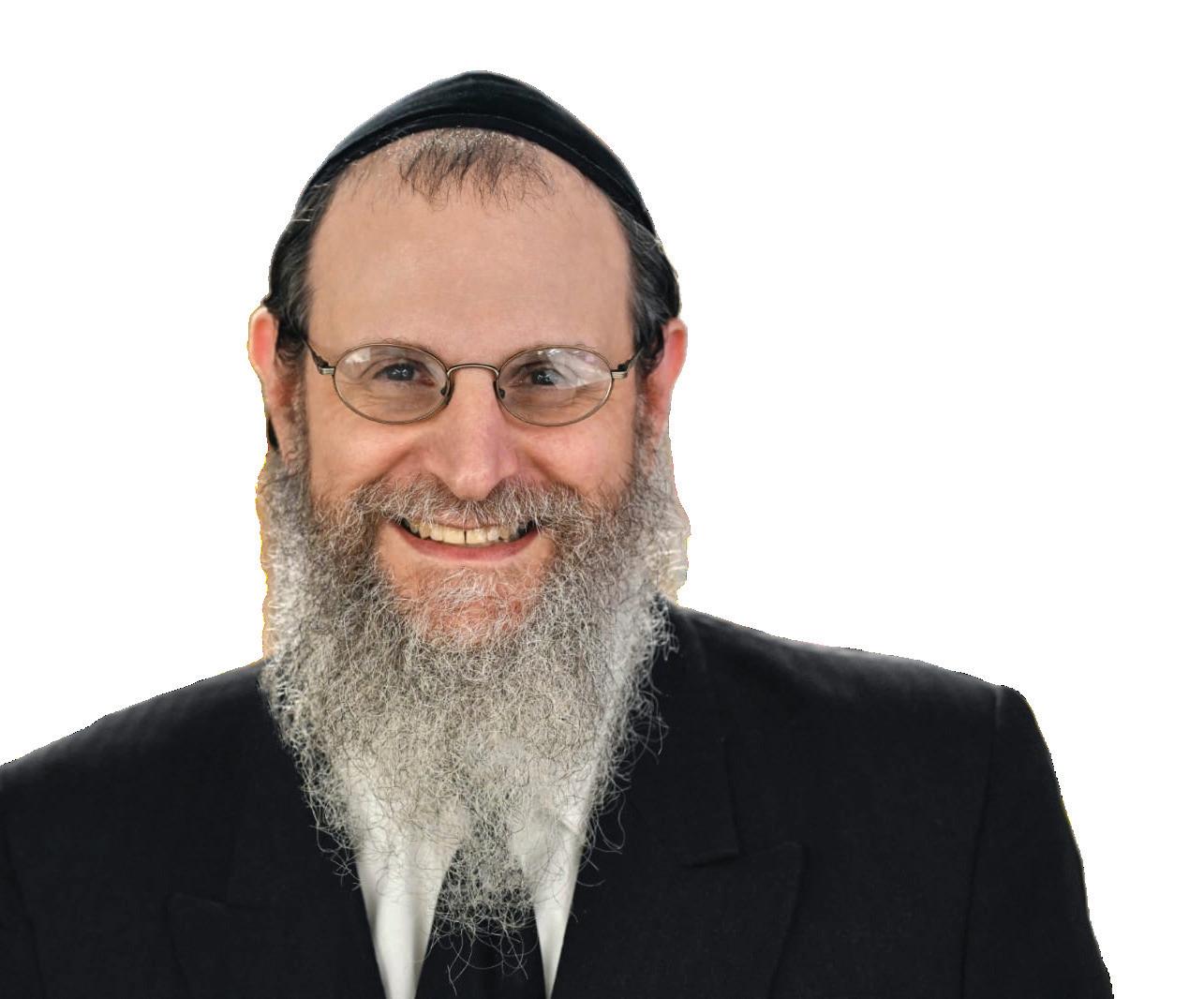
Intrigued, Rotenfeld set out to learn more about the entire memoir. That curiosity grew into a 20-year project: a full translation into English. The result was recently completed with the publication of two volumes of The Shochet, released by Touro Press.
Here is the story of how one Lubavitcher brought the long-lost writings of another Lubavitcher— forgotten for 150 years—back into the light, ultimately turning them into a bestseller.
In the 1980s, while learning in the yeshiva in Kfar Chabad, Michoel Rotenfeld came across a new publication: Kerem Chabad, a periodical edited by the renowned Chabad historian and scholar Rabbi Yehoshua Mondshine.
As he flipped through its pages, one article caught his attention. It featured a memoir by a chossid recounting his visits to the Tzemach Tzedek and the Rebbe Maharash, an excerpt taken from a much larger Yiddish work and translated into Hebrew for the journal.
Fascinated by what he read, Rotenfeld wanted to read the full book. But he wasn't able to locate a copy. It would take several years of effort just to get his hands on one.
The book he eventually discovered was Mein Lebens-Geshichte, the autobiography of Pinches Dov Goldenshteyn, known affectionately as “Pinye Ber.”
In it, he recounts his life story, beginning with his early childhood in cheder in Tiraspol, in what is today’s Ukraine, and continuing all the way through his later years in Petach Tikvah, Israel.
“I saw right away that it was unlike any autobiography I had ever seen,” Rotenfeld recalls.
“For starters, in the nineteenth century, there were almost no frum Yidden writing autobiographies or memoirs. Most of the Jewish autobiographies from that era were written by maskilim, so-called enlightened Jews, who had already abandoned traditional Yiddishkeit. They wrote about what they viewed as a disappearing world, and everything they recorded was filtered through that mindset.
“Pinye Ber was not writing about some ancient, forgotten culture. It was real for him. He lived it.
“Besides for that, his openness and honesty, the way he writes the unfiltered and unvarnished truth… no-one else wrote like that.”
Opening with basic information about his parents and hometown, Pinye Ber’s memoir quickly moves into his childhood in the shtetl, with its struggles, hunger, and daily hardships. He offers a stark, yet absorbing, portrait of that world, addressing everything from his cheder rebbi (“no better than a Spanish inquisitor”) to his sister’s husband (“a loafer who was used to others preparing his food for him, cleaning his clothes, and giving him a groschen”).
At the same time, he paints a warm and vivid picture of his parents’ devotion and hard work, the honor accorded to Torah learning, and the everyday rhythms and personalities that made up shtetl life.
His life story continues with a series of struggles and small triumphs that together open a window into shtetl life. He describes his difficulties with the draft law, exasperated by his lack of proper papers. He recounts traveling from town to town in search of relatives who might help him, only to find impoverished family members who had not a spare kopek, or others who simply took advantage of him.
He also tells how he was essentially maneuvered into a shidduch by a well-to-do family who promised a generous dowry, only for them to lose their fortune soon after. Even so, he did not abandon his kallah, whom he describes as having been raised “coarse and uncultured,” but who soon became, with his help, “a fine, sophisticated woman.”
Of particular interest to Lubavitcher chassidim and scholars of Chassidic history are his vivid accounts of two visits to Lubavitch: one during the
lifetime of the Tzemach Tzedek, and a second during the era of the Rebbe Maharash. With his rich pen and unmistakable voice, he describes not only his private meetings with the Rebbeim and the guidance they gave him, but also the atmosphere of Lubavitch itself: the chassidim, the guests, the daily bustle, and the unique environment that surrounded it all. Pinye Ber also offers biting commentary on the difference between Chabad chassidim and Polisher Chassidim, whom he disparaged by writing “even an uneducated woman can achieve the status of a Polish Chossid because one does not need to study Torah to do so.”
Pinye Ber goes on to describe his attempts to earn a livelihood, eventually deciding to become a shochet. But he is immediately met with corruption and hostility from members of the community he joined in the Crimea for everything from not being a Tolna chossid, to his refusal to let those who were used to skimming from the shechita fees continue doing so. These struggles continued in one form or another for nearly 35 years, until he moved to Eretz Yisroel hoping for some peace. Instead, he found himself confronting the outbreak of World War I, the Turks using Jews as human shields, British troops commandeering his home, and a host of other upheavals that keep the story exciting right until the end.
Throughout the memoir, Pinye Ber makes it clear that he had two primary goals in writing his life story: first, to demonstrate the hashgacha protis that guided every stage of his life, how Hashem repaid those who wronged him and ensured he always had what he
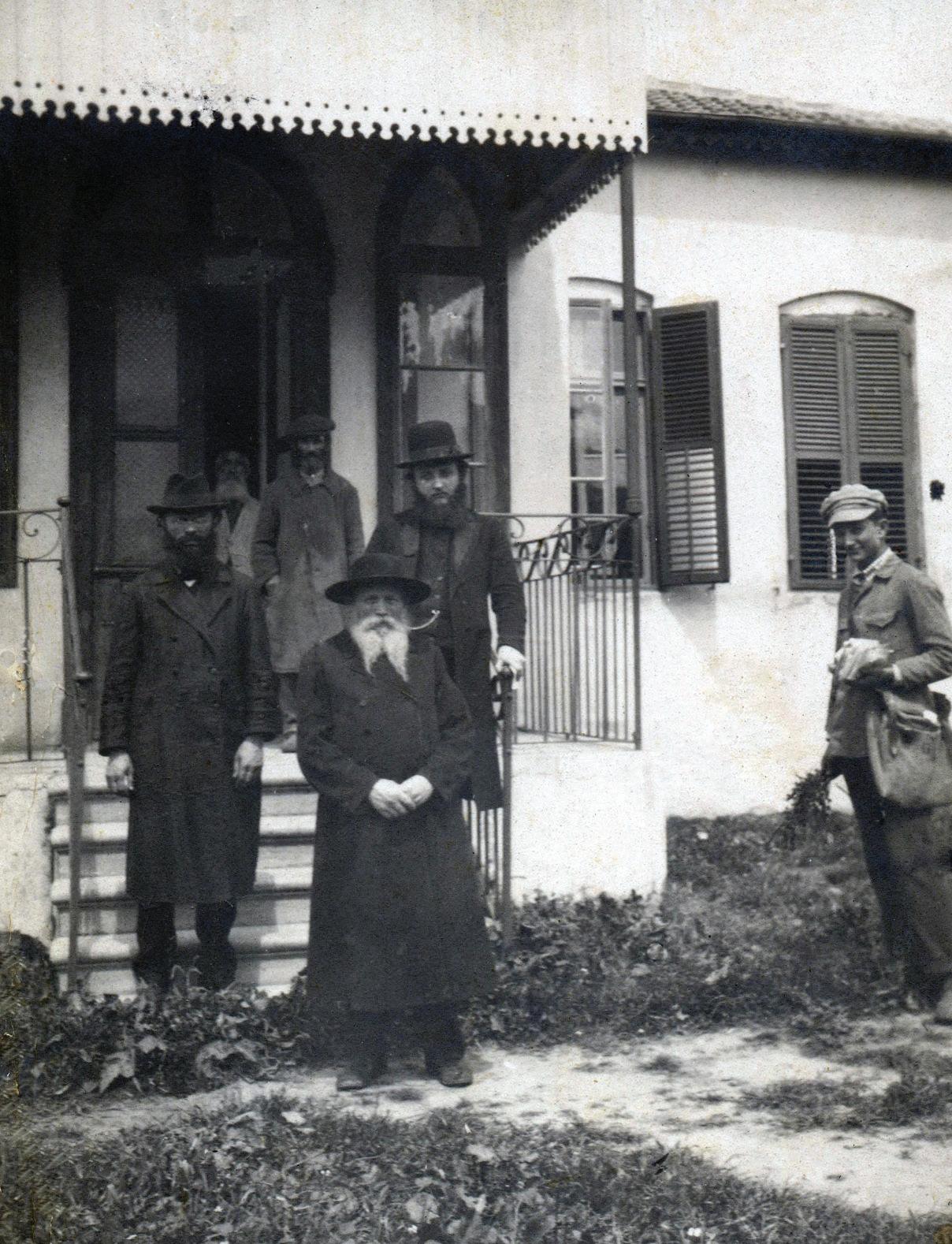
A 1922 photo of Pinkhes-Dov Goldenshteyn, standing in the foreground. Standing on his right is Rabbi Yisroel Aba Tzitron, the rabbi of Petach Tikva and the son-in-law of the Rogatchover Gaon
needed, and second, to reach out to his own children, most of whom had drifted away from Yiddishkeit, in the hope of drawing them back.
Having finally read this fascinating story and wanting to learn more
about the author and his life, Rotenfeld continued digging until he located a granddaughter of Pinye Ber living in Petach Tikvah, the very city where her grandfather had spent his final years. She was delighted to speak about him and soon connected Rotenfeld with other relatives, including a cousin in America, Cynthia Unterberg. Cynthia owned a copy of her grandfather’s memoir, but since she didn’t know Yiddish, she had never been able to read it. She had long hoped to find someone willing to translate the
“I never had that in mind,” Rotenfeld says. “All I wanted was to learn more about her grandfather. But she urged me to take it on. I spoke to some friends who told me I was uniquely suited for it, both because of my language skills and because I have the knowledge of Yiddishkeit to understand the world Pinye Ber was describing. So I agreed and began translating.”
This was in the early 2000s. In the nearly twenty-five years since, Rotenfeld got married, became a father, and began working at Touro University, where he now serves as Associate Director of Libraries. Through every stage, he continued working on the translation of Mein Lebens-Geshichte.
Over the years, unexpected personal connections also
Ber. Pinye Ber’s second wife, Feyge, is buried beside Rotenfeld’s greatgrandmother in the Petach Tikvah cemetery. And his own grandfather had operated a bookstore in the city during the years the memoir was published, meaning he likely sold the original book himself.
Rotenfeld traveled twice to Israel and once to Ukraine to explore the locations described in the memoir. His work went well beyond translation: he cross-checked dates, ages, and events against historical records and even compared passages within the book itself to clarify inconsistencies.
addendum. The addendum had already included letters from Pinye Ber and other supplementary material, and this newly uncovered interview enriched it even further.
Upon the release of the first volume, it quickly became an instant classic, selling far more copies than either Rotenfeld or Touro had anticipated. Despite being an academic publication, it found its way into virtually every frum bookstore, as readers eagerly snapped up this uniquely vivid account of a bygone world.
When he finally completed the translation, he spent an additional two years writing an academic introduction, which was essential, he explains, for any academic press to consider publishing the work.
“I spoke with friends about which publisher might take it on. We agreed that a classic frum publisher wouldn’t print the memoir as is; it doesn’t always present the idealized shtetl life people imagine. But many academic publishers weren’t interested either. They only want books about scandal in the Orthodox world, and this wasn’t scandalous enough. Thankfully, Touro University Press recognized its value, and they agreed to publish it.”
The first volume was published in September 2023, and the second volume was published, after several delays, in January 2025. Rotenfeld notes that the delay, though entirely beyond his control, ultimately worked out for the best. In the interim, he discovered a newspaper interview with Pinye Ber, which he translated and added to the book’s
Rotenfeld says he has received feedback from every corner of the Jewish world, and even from outside of it. “I’ve even received messages from non-Jewish readers who found it remarkable.”
Rotenfeld attributes the book’s appeal both to Pinye Ber’s rich writing style and to the fact that this memoir is truly one-of-a-kind.
“There are a few other frum memoirs from that time period, even some written by rabbonim. But they’re rare, and they’re fundamentally different. When an important person writes a memoir, you’re mainly learning about his life. When someone like Pinye Ber writes, he’s describing regular life, the daily reality that everyone around him lived.
“Certainly in the chassidishe world, writing an autobiography wasn’t considered a very chassidishe thing to do. It only really became normalized from the 1940s, when the Frierdiker Rebbe urged people to record their memories.
“Here, though, you have a rich, detailed, insider’s description of the world of chassidim and Rebbeim. It’s an important book from many different angles.”
In addition to its historical value, Rotenfeld says that he hopes that Pinye Ber’s underlying message woven throughout the book will continue to be transmitted.
“My hope is that Pinye Ber’s message of bitachon, of belief in hashgacha protis, and the joy he maintained despite so many hardships will be passed on,” Rotenfeld says. “People have told me the book reads almost like a mussar sefer. Here’s a person who lived through unimaginable difficulties and still kept a positive spirit and deep trust in Hashem. So if we’re dealing with a broken air conditioner, or even facing a surge of antisemitism that still pales in comparison to what he endured, should we lose our trust in Hashem?”
“People have said that they found his story both humbling and encouraging. And I hope that message will permeate me as well.”
By Raizel Serebryanski
BEHIND THE COUNTER
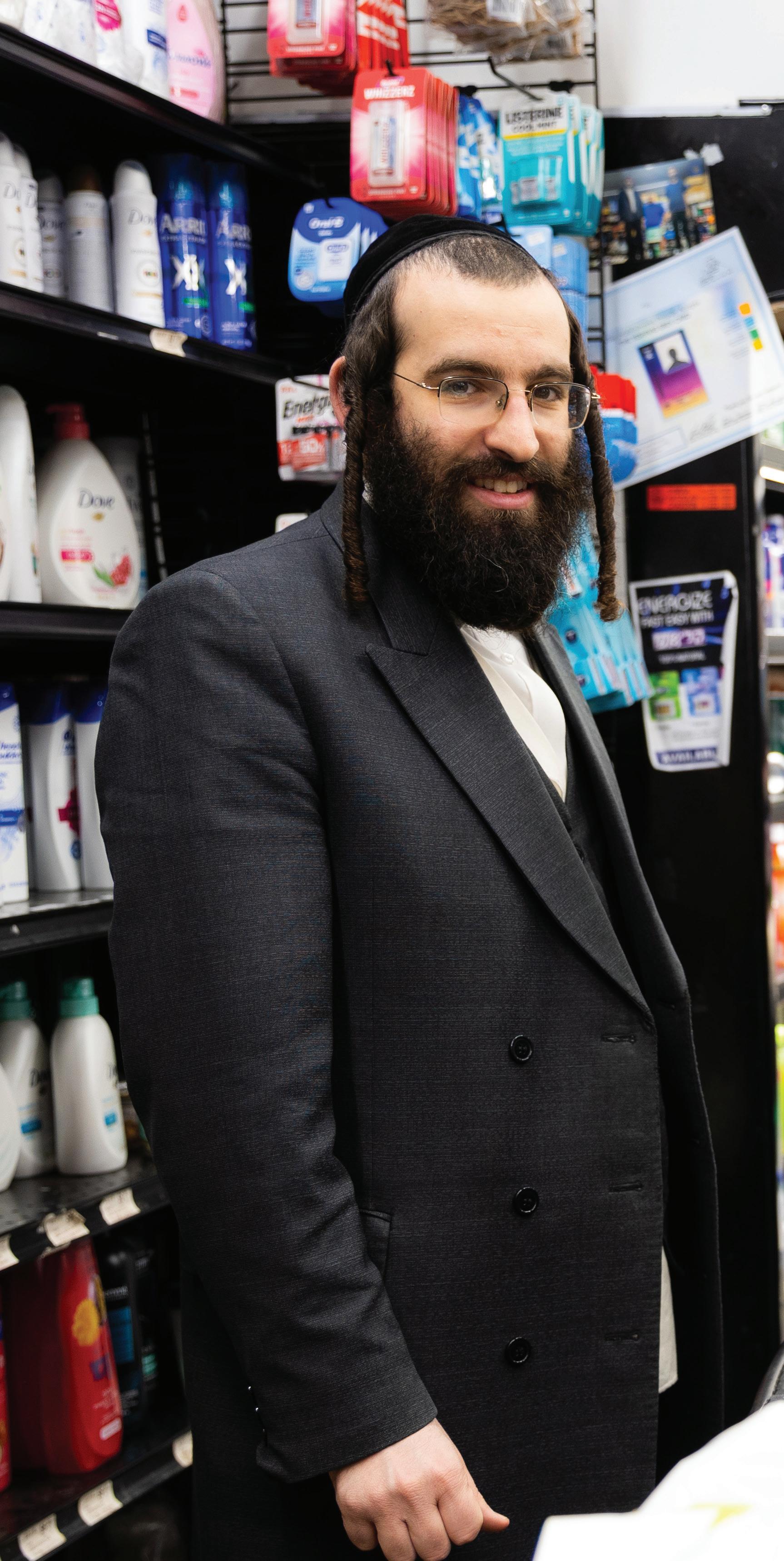
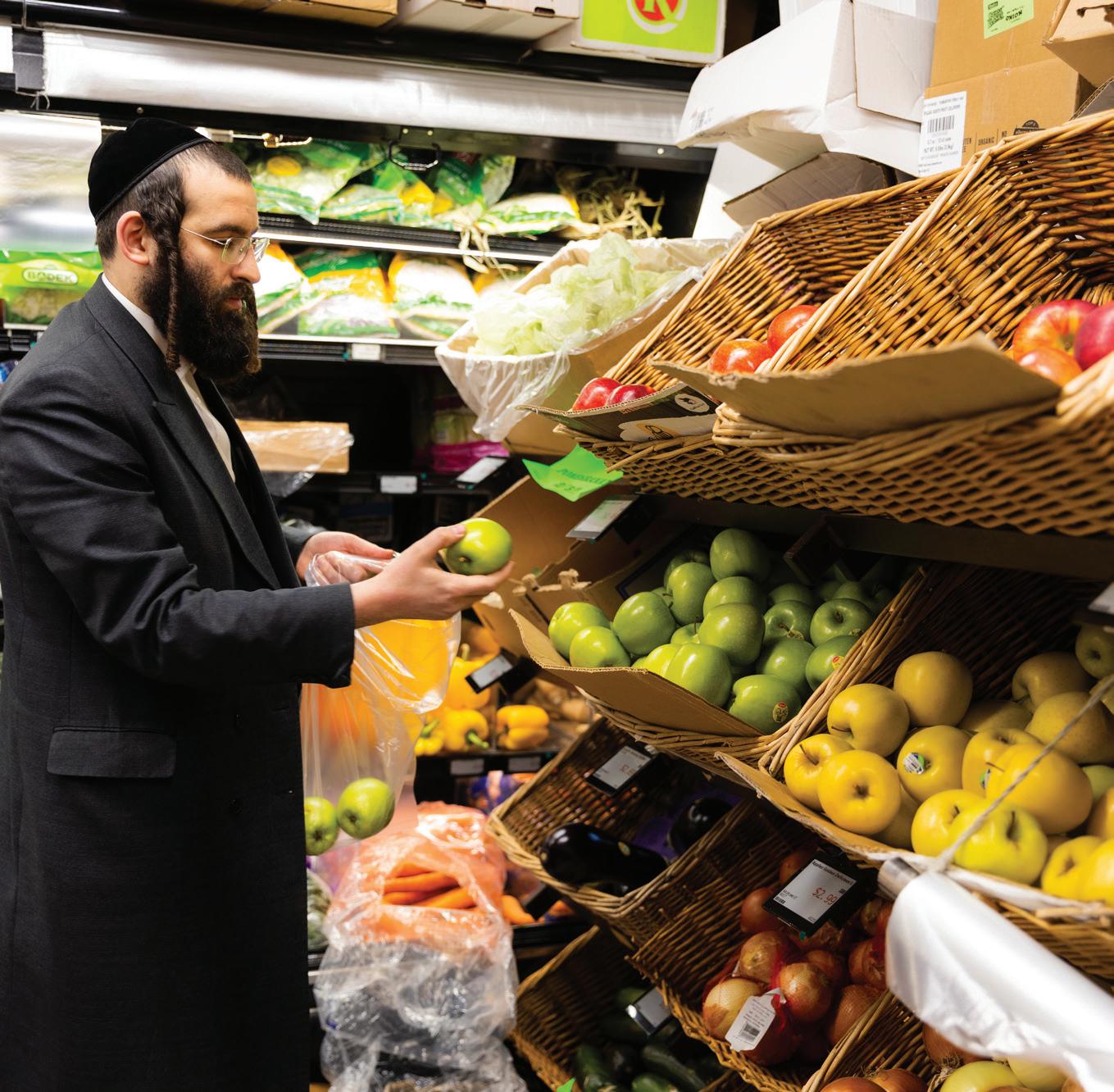
The Satmar grocer serving Lubavitchers in Crown Heights
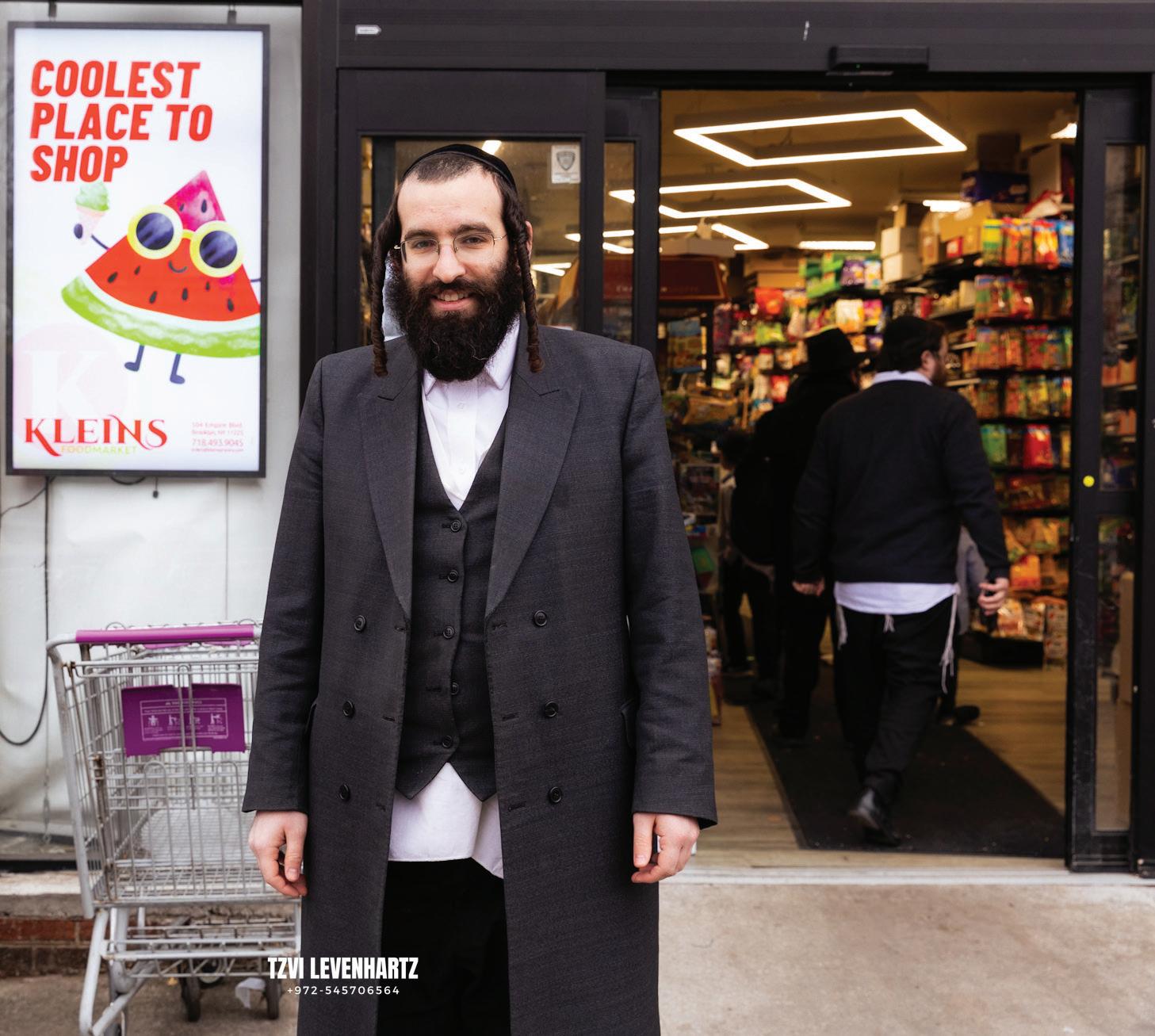
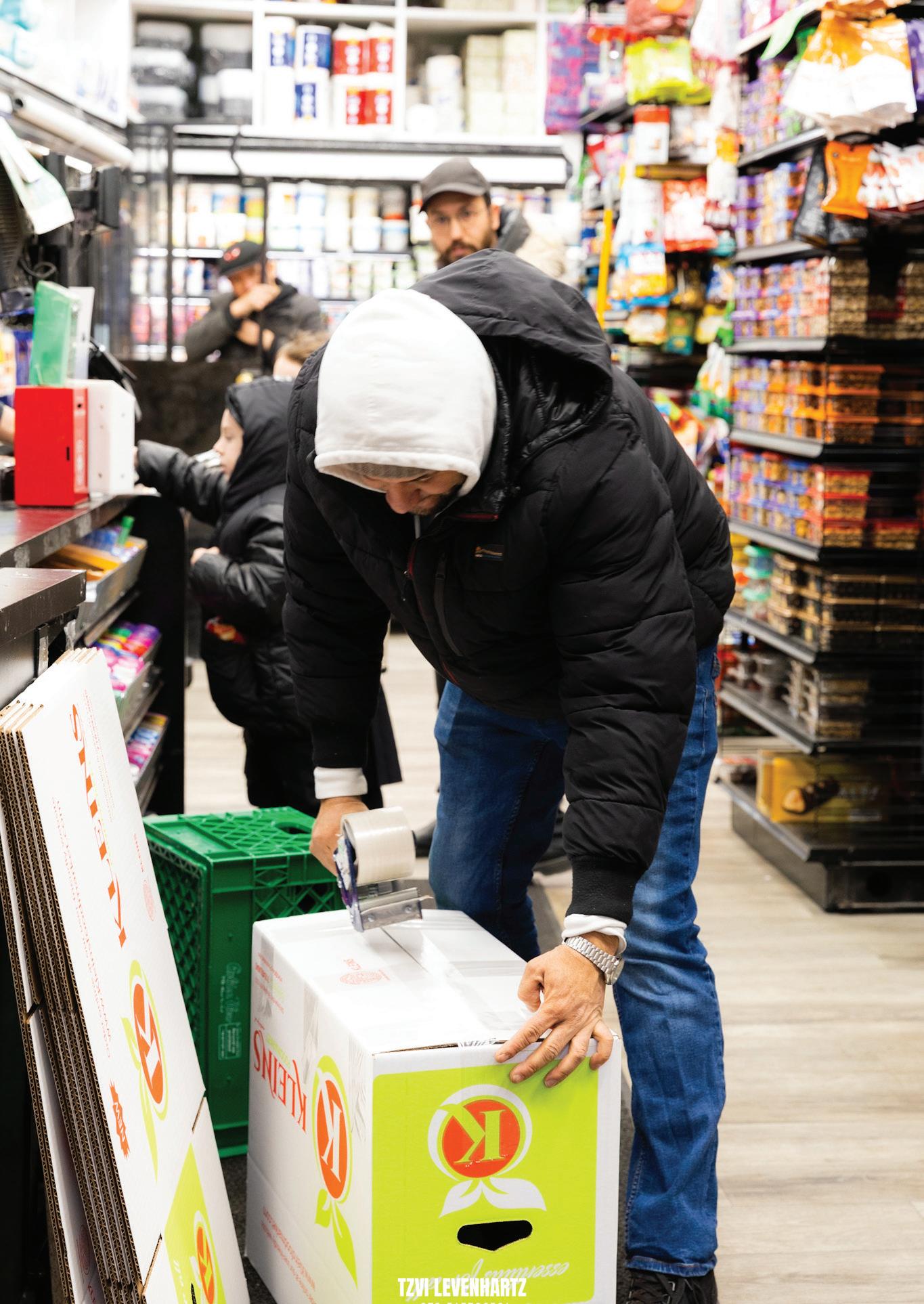
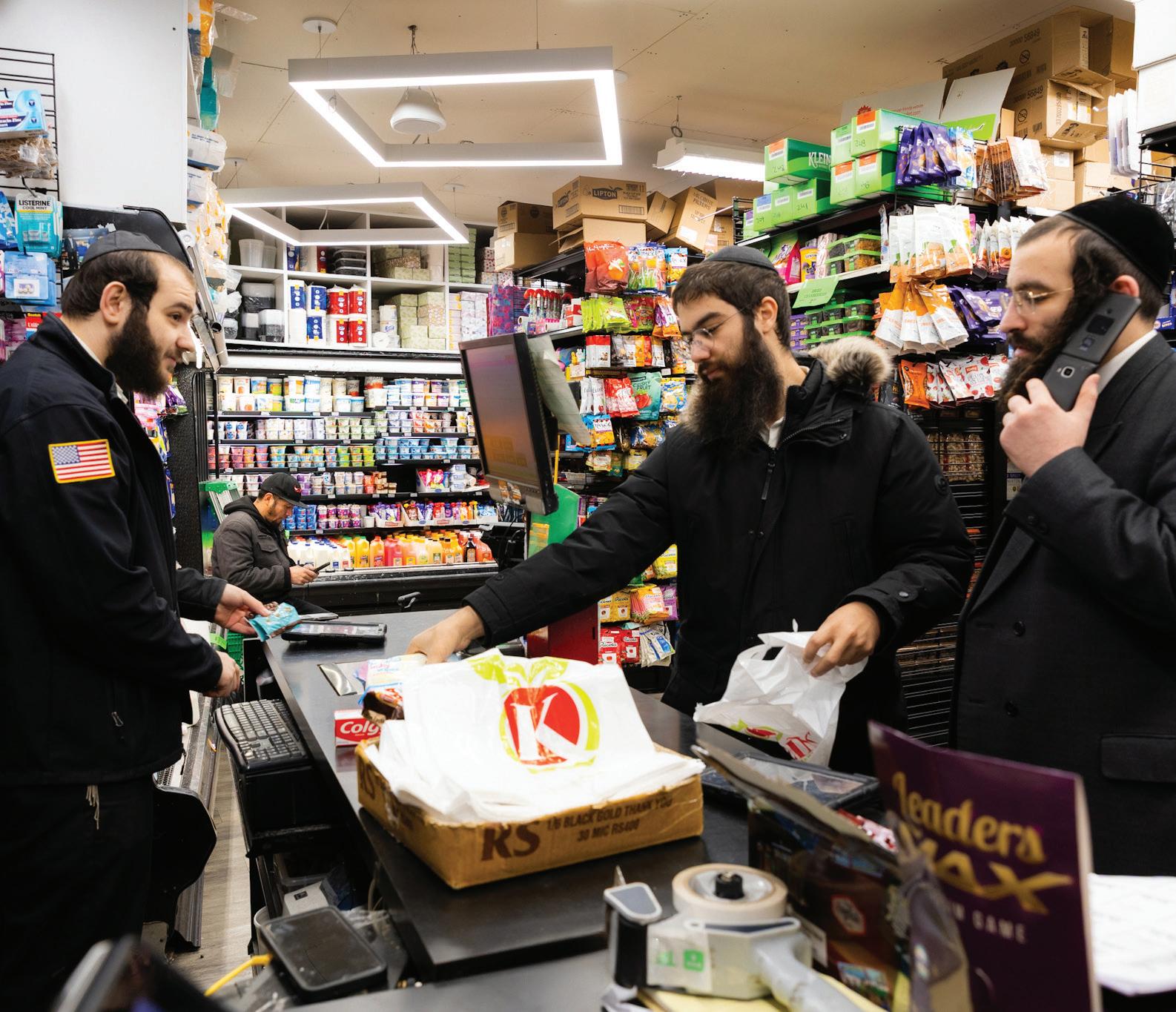
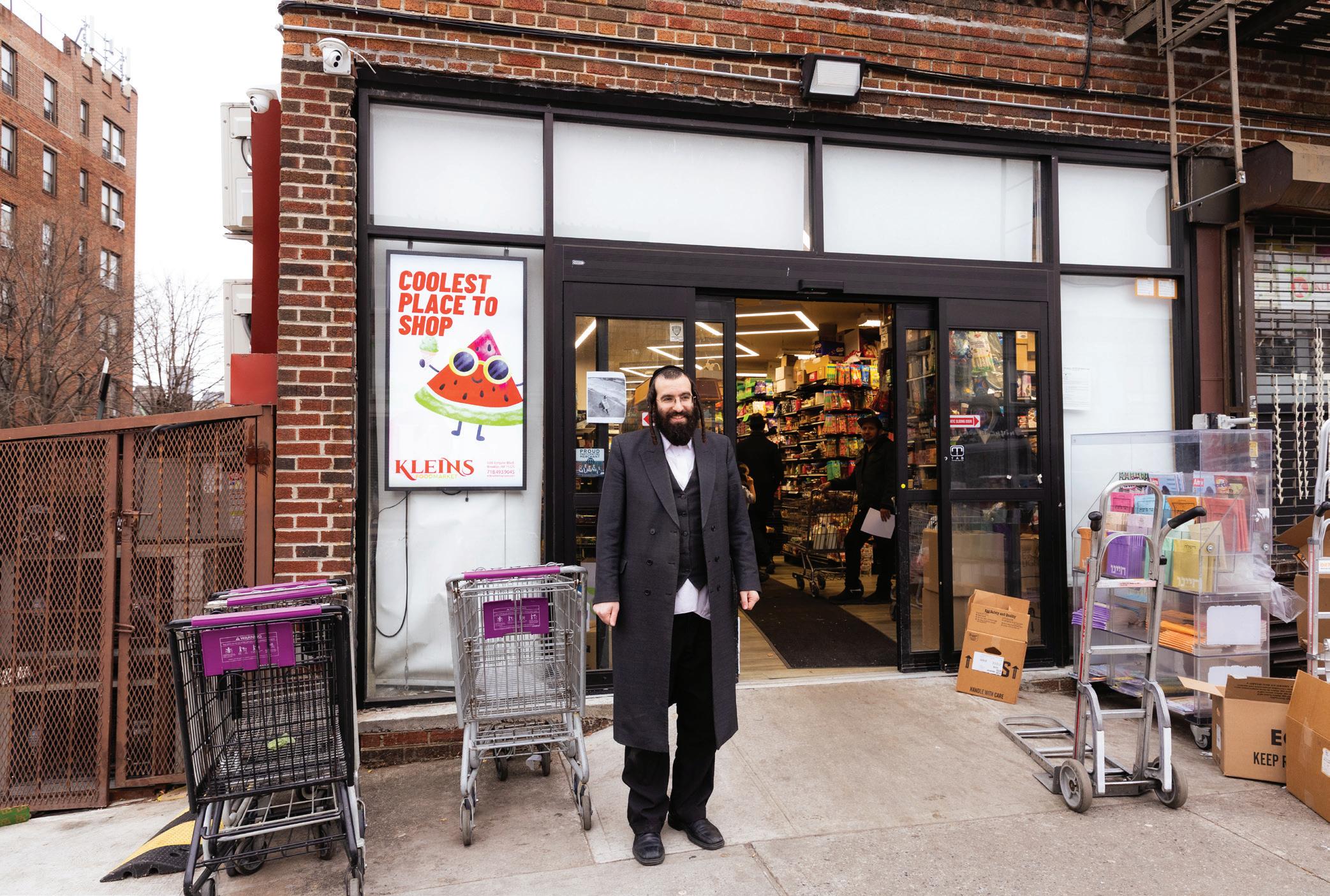
Among Crown Heights residents, Klein’s grocery on Empire Blvd. was always known as a small, heimishe grocery. Despite recent upgrades, it has retained its warmth. Recently, I watched the owner R’ Avrum Simcha Klein give instructions to a worker, finishing with, “But first, it’s hot today—go grab yourself a cold drink.” That moment made me wonder what it’s like for him to run this beloved Crown Heights grocery. Here is our conversation.
First, are you related to Klein’s Nuts or Klein’s Ice Cream?
No, we’re not related. However, as we work together, we have a close friendship, and I consider them family.
How did you get to be the owner of Klein’s?
Klein’s was opened in 1953 by my grandparents, Zindel and Blima Klein, Satmar chassidim who lived on Montgomery Street. It is, as of now, the oldest kosher grocery in Crown Heights. When they bought it, it was called Tel Aviv Bakeshop, and it was small, with just one storefront.
My Zeide used to run it in a very old-fashioned way. He’d weigh each loaf of bread on the scale. If it were exactly 2lbs, he’d sell it for the price of a full 2lb loaf, but if it were more, he’d sell the extra slices separately, to make a few extra cents.
Your father used to use a bread slicer…
It was my Zeide’s machine. We still have it, but don’t use it anymore.
A few years in, aside from selling
baked goods, my Zeide started stocking milk, cheese, and other groceries. When he eventually started stocking produce too, he realized it was time to take off the sign, and the name was changed to Klein’s Grocery.
During the time my Zeide was running the shop, a man came in once and asked if he could pay the bill for a certain friend of his who had a big “card” (account before the days of computers) at Klein’s but had lost his parnosa. My Zeide found that person’s card and quickly ripped it up, telling the man that his friend doesn’t owe anything.
And then your father took it over?
When my father Moshe Shmiel grew up, he married my mother and moved to Williamsburg. This is where my siblings and I grew
up, and where I still live now, just a 10-minute drive from Crown Heights.
In 1994, when my grandparents passed away, my father took over the store, and eventually also the two adjoining storefronts, so now Klein’s is the three combined.
For all you readers who have visited Klein’s when my father ran it, you would know his style. My father didn’t even have a computer. He opened the shop at whatever time he arrived and closed it at whatever time he wanted to leave. His motto was “Hashem gives parnasa,” and despite his lack of “business structure,” he always had everything he needed his whole life! (And he had 13 kids!) My father is my inspiration.
The winter before Covid, my
father went for a well visit, doing all the recommended testing for his age. Dr. Eli Rosen gave him a clean bill of health. Nevertheless, two days after Purim, he caught Covid in the original wave, and sadly, within a month, on Shabbos Hagadol of 2020, he passed away.
This was when I was in Kollel, right after my Shana Rishona. That month, the shop was closed (it was Covid and Pesach, anyway). After that, my siblings and I agreed that I would take over the shop and support our mother.
How was your transition into management?
Coming straight from Yeshiva and Kollel, I had no prior work experience, and my father's business lacked established
systems, so I had no idea where to begin.
Fortunately, my sister, who had worked there previously, guided me initially. The timing helped; with schools closed due to Covid, I mobilized a team of nieces and nephews to help. We began going through every shelf and clearing out expired items. We then reorganized the entire store, displaying all products logically by category.
After six weeks, I implemented a computer system. Concurrently, my wife spearheaded a complete rebranding effort with assistance from her parents’ print shop, Lee Printing. Store redesigns were executed with the help of my cousin, Yoel Englander. Yerachmiel Fried redesigned our new fridges.
Now, Boruch Hashem, we have a beautiful store, a dedicated staff of nine, and our groceries include a full line of produce, bakery, meat and dairy. Our newest efficiency is taking orders via WhatsApp.
We see some of your family members in your shop. Can you tell us who they all are?
My aunt Aidy Wertzberger works at the store twice a week; she has been since she was twelve. As a girl, she used to help out in the mornings, and when the school bus would come to the corner, she’d grab a pack of potato chips from the shelf for recess and run to catch it.
(Recently, a customer walked into the store, and upon seeing it remodeled for the first time, said,
“Wow, everything is new!” and then she turned and saw my aunt, and said, “Oh! You're not...” It was cute!)
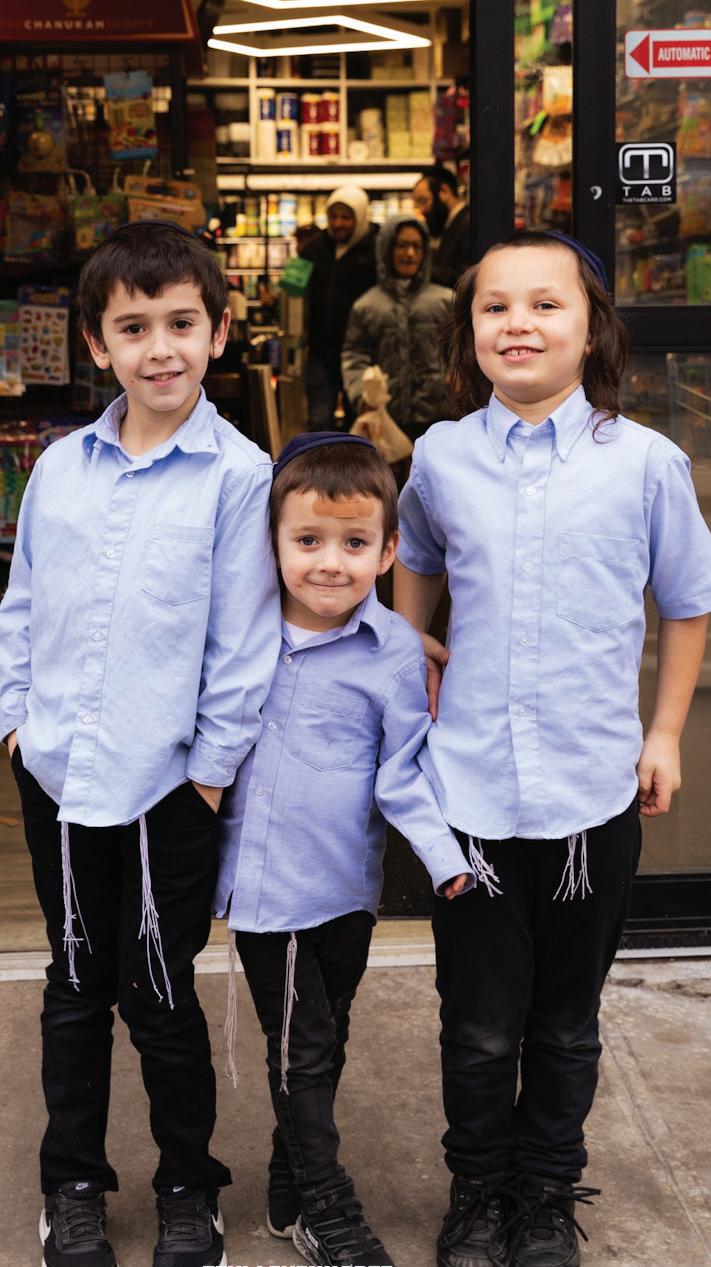
My sister Aidy Pollack worked here for 18 years, until recently. My wife Leah makes the page of weekly specials. (And for all those who are asking, don’t worry, photos of the items are going to be added soon!) I bring my kids to the shop when there’s no school (and yes, of course, I’ve taken them to the Jewish Children’s Museum).
What has the learning curve been like serving Lubavitchers?
The first Chanukah I worked in Crown Heights, I couldn’t understand why the 44-cup sets of pre-filled oil weren’t selling.
I found out that Chabad has an inyan to use beeswax candles for Shamoshim, so they have no use for 44 cups of oil. (Now, I make sure to stock the 36-pack.)
I didn’t know why there were requests for yartzeit candles before Shabbos Shuva, until I learned of the Chabad minhag of teshuva licht.
Customers come in year-round asking for Shehecheyanu fruit for their birthdays. Where I’m from, reciting a Shehecheyanu on fruit is not allowed besides for on Rosh Hashana. And birthdays are not a thing to be celebrated; certainly not a reason to distribute anything in school. It was only the Lubavitcher Rebbe who made a shturem about birthdays.
When customers come in wearing Shabbos clothes, I now know it means it’s a chassidishe Yom Tov. In Williamsburg, the only chassidishe yom tov we make a big deal of is Chof Alef Kislev (the day the Satmar Rebbe, Reb Yoel, escaped Nazi Germany) and even then, we don’t wear Shabbos clothes.
How do Lubavitchers shop differently from Satmar Chassidim?
In Williamsburg, the husband is in charge of the finances, and the wife is in charge of grocery shopping. She buys whatever food the family needs, and he figures out how to pay for it. In Crown Heights, the wives are also involved in the finances and therefore they shop accordingly, keeping to a budget.
For example, if I put Amnon Frozen Pizza on special, no other brand will sell that week because everyone will buy only Amnon’s. In Williamsburg, the specials don’t sway their choices as much. They just select whichever brand their family eats. Similarly, if Andy Boy lettuce goes up to $9.99 one week, 98% of Crown Heightsers will put it back on the shelf, whereas in Williamsburg, if they need lettuce, they just get it. Which products are popular in Crown Heights?
Crown Heightsers often ask for herbs, such as dill, parsley, etc. This does not exist in Williamsburg. Crown Heightsers also buy a lot of basmati rice and sushi products. In Williamsburg, they buy croutons, which is not popular in Crown Heights. Sourdough is wanted everywhere these days.
In Williamsburg, every Shabbos, we have the same traditional
food – gefilte fish, chopped liver, egg, chicken, etc. – there are no surprises! In Crown Heights, it’s not like that. Crown Heightsers don’t even always make cholent! Coming from a mainly Yiddishspeaking area, how do you view Crown Heights'Yiddish?
Here, the men speak to me in Yiddish more than the women do, though I do hear mothers speaking to their children in Yiddish. The Rebbe wanted people to speak Yiddish.
Every Chanukah, one of the items that sells is Izzy and Dizzy cards, which come in Yiddish or English. I usually just stock English, but last year, I got both. I was very impressed that groups of Oholei Torah boys came in to buy the Yiddish ones specifically. Anything else you’re impressed by in Crown Heights?
A customer came in before Rosh Hashana, and handed me an envelope of $2000 to put into whichever accounts needed it. Another guy, Yossi Stern, gives me a few hundred every few weeks for the same thing.
In Williamsburg, they are all very impressed by the Shluchim and how Yidden have a warm home to stop in, no matter where they are in the world.
Did you ever meet the Rebbe?
Never personally, as I was born after Gimmel Tammuz. My father did grow up knowing the Lubavitcher Rebbe, and he got dollars. The Rebbe did not shop at Klein’s (he shopped at Kahan's Superette), but my family does have a history with the Rebbe. In 5710, my Zeide built the first mikvah in Crown Heights. Until then, the Rebbe would walk 45 minutes on a Shabbos to use a
Mikvah in Flatbush, but when my Zeide built this Mikvah on Eastern Parkway, the Rebbe would use it.
Do you have a smartphone? No, only a basic flip phone with text.
How do you run a business without a smartphone?
You run it better! In Williamsburg, 80% of people do not use a smartphone. Just checking WhatsApp status alone can take away all your time and headspace.
I daven in a 7:10 minyan every morning, and I do not bring any phone to Shacharis at all. Then from 8 AM, I’m available on my flip phone. During work hours (8 AM-8 PM, when the store is open), I have a computer there with a strong filter. Then I leave work, which means really leaving work because I’m not bringing any computer or smartphone with me. In the evenings, I have a shiur with a chavrusa – I really don’t know how people can manage to keep a shiur if they have a smartphone.
With a regular phone, people only call you if it’s important. By having a smartphone, you are keeping yourself available for work 16 hours a day, and letting people disturb you at all hours of the day and night. True, without a smartphone, you might miss a good deal – but being as attached to work as smartphones make you be, is what I call killing yourself on the way to building your business.
What’s next for Klein’s?
I am working to lower our prices on all our items. I want Klein’s to have the best prices in Crown Heights.
By Mendel Cohen Photos: JEM/The Living Archive
A highlight of Chanukah with the Rebbe was the annual rally for Jewish children who attended public schools. In 5737, after a particularly festive and joyous rally, the Rebbe announced that he would personally distribute Chanukah gelt to every child present. The following gallery captures moments from that unforgettable rally.
Public School Children Arrive in 770
The excitement was palpable as children from public schools across New York City arrived at 770 for the much anticipated Chanukah rally. The Sunday afternoon event had been arranged by the NCFJE for children in the Released Time program and their parents. Hundreds of people converged on 770 and the shul was packed.
CHAN UKAH Chanukah Children's
27 KISLEV - 3RD DAY OF CHANUKAH
The Rebbe Enters
At 3:30 pm, the Rebbe entered the shul for Mincha while the orchestra played music. On the way to his place at the front of the shul, the Rebbe smiled affectionately at the children he passed by.
A Memorable Program
Rabbi JJ Hecht a"h, director of the NCFJE, led and emceed the program in his irresistible and energetic style. The children enjoyed performances, raffles, and refreshments before the Rebbe arrived.
A Joyous Menorah Lighting
Before Aleinu, the large menorah at the front of the shul was lit by a young yeshiva bochur, Levi Baumgarten. The crowd sang “Haneiros Halolu” together with the band and the Rebbe looked at the children with a warm smile throughout the entire niggun. By “al nisecha,” the Rebbe clapped his hands strongly for a few minutes.
A Palpable Chayus
After Aleinu, the orchestra played “Al Tira,” and again the Rebbe clapped his hands for several minutes. The Rebbe’s radiant face displayed his immense pleasure from seeing all the children gathered.
Reliving the Story
The Rebbe then asked Rabbi Leibel Groner to tell Rabbi JJ Hecht that the children should recite the 12 Pesukim and that he should speak about the story of Chanukah. As the children said the 12 Pesukim, the Rebbe said the words along with them.
One to Enjoy, One to Give
The Rebbe then informed the organizers that he wished to give Chanukah gelt to each of the children—two dimes, one for tzedakah and one for them to use as they choose. The Rebbe went down from the bimah and headed to the back of 770 for the distribution, encouraging the singing along the way.
Chanukah Gelt for All
The Rebbe personally gave each child Chanukah gelt and wished them a freilichen Chanukah. He then gave to all the counselors, mazkirim, and even the photographers. The distribution finished at 5:00 pm, and the Rebbe began singing “Al nisecha” as he left 770 and headed home.
A little more warmth goes a long way.
Chinuch atters
Presented by Sarah Pinson and the Menachem Education Foundation (MEF)
Ask the Mechanech
We don’t live in a large house. Should we push our kids to get more Seforim now or wait until they grow up and get married?
When I was fifteen, after a full summer of working as a learning teacher, I saved enough to buy my first set of seforim—just three volumes of the Rebbe’s ma’amorim, but they were the first seforim that were truly mine. I still remember the weight of them in my hands, and as I walked down Kingston Avenue holding them, I felt the pride, the effort, and the sense that I was finally starting my own library. Even today, with their covers torn and pages worn, they remain among my most treasured possessions.
I also remember Hey Teves that year. The Rebbe encouraged everyone to buy seforim from Kehos. My classmates had money saved from babysitting or from home. I had neither. I went to the store just to feel the excitement, but I could only stand on the sidelines as a window shopper. Wanting so much to participate, yet being unable to, was a feeling I never forgot.
This comes to mind when asked what to tell a child who wants to buy
seforim but lives in a home with no space for them.
First, we validate and encourage. A child’s desire to own seforim is beautiful and should never be dismissed. But we also teach an important lesson: even one sefer is precious. A single volume, chosen with sincerity and used with love, can mean far more than shelves of books that are never opened.
And we remind them of a simple truth:
-Hashem does not ask a person what is impossible. Accepting real limitations is not a weakness; it is the beginning of mature, Chassidishe thinking.
So we encourage our child to buy what he or she can—one sefer, two, or three a year—and to treat them as treasures. A true library doesn’t begin with space; it begins with value. Because in the end, it’s not the size of the bookcase that counts. It’s the depth of the connection to the sefer itself.
Answer by Rabbi Enan Francis, MS.Ed, Head of School, Torah Day School of Houston, TX
Chinuch Happenings
Menahel Leadership Retreat to Take Place in February
Menahelim from schools around the country will gather in Cooper City, Florida, on 5-6 Adar / February 22-23 for two days of workshops, collaboration, and networking to build leadership capacity, exchange ideas, and gain Chinuch inspiration.
Morah Tiechtel Chinuch Tour Makes its
First Stop in Monsey
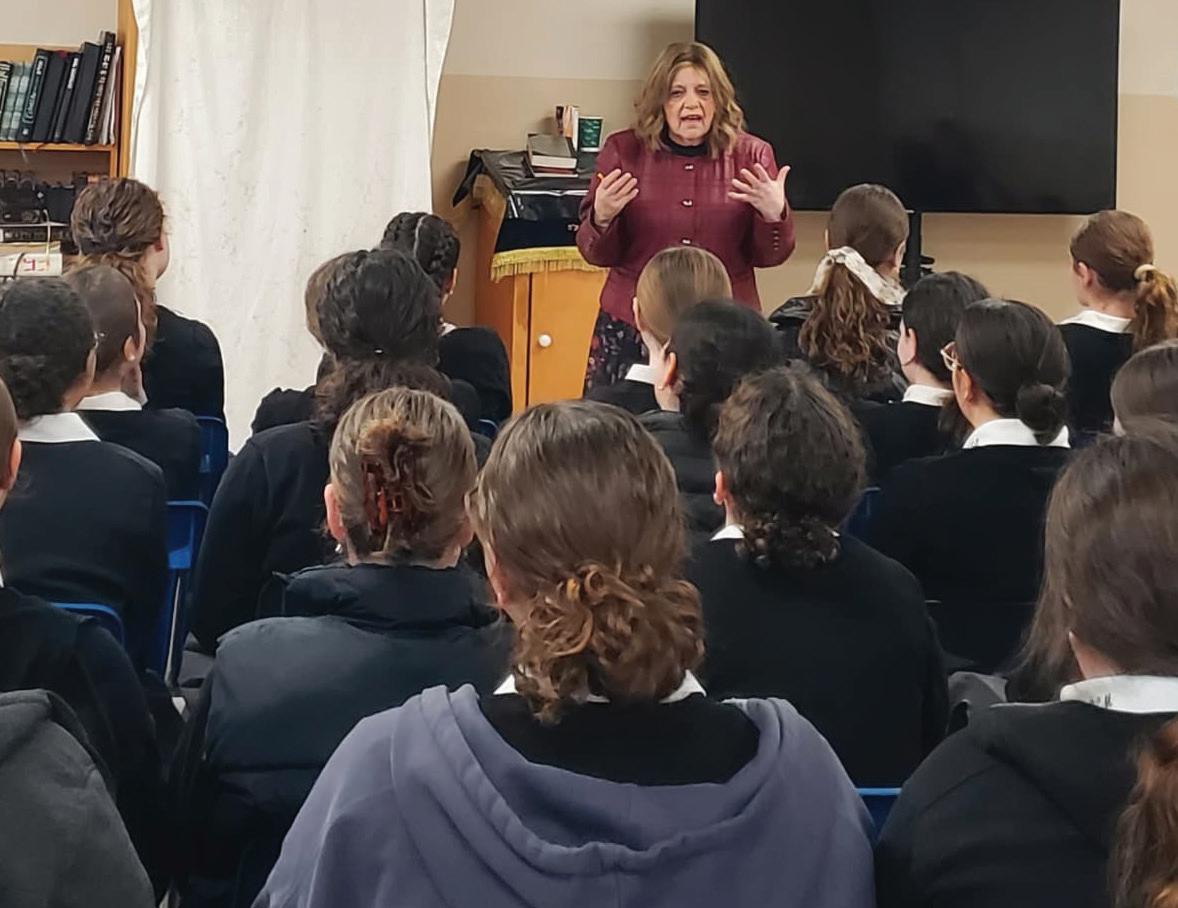
Morah Shana Tiechtel’s Chinuch Tour in honor of 50 years since Mivtzah Chinuch began in Bais Chaya Mushka High School in Monsey, New York, where she spoke to the eleventh and twelfth grade students on the topic of “Making Chassidus Real.” She continued at Cheder Chabad of Monsey Elementary School, where she addressed teachers at a beautiful luncheon on “Why Teach” and highlighted the beauty of the Shlichus of Chinuch. Morah
Tiechtel also inspired the eighthgrade girls to cultivate a positive life perspective in her address titled “The Terrible Wonderful Day.” Staff and students in Monsey shared how much they enjoyed Morah Tiechtel’s engaging talks, inspiration, humor, and interactive presentations. “The feedback from teachers and students was all so beautiful,” shared Mrs. Chaya Rosenbluh, principal of Cheder Chabad of Monsey.
For more: mymef.org/chinuchtour
Meet the Chinuch Shlucha
Mrs. Mushka Lew
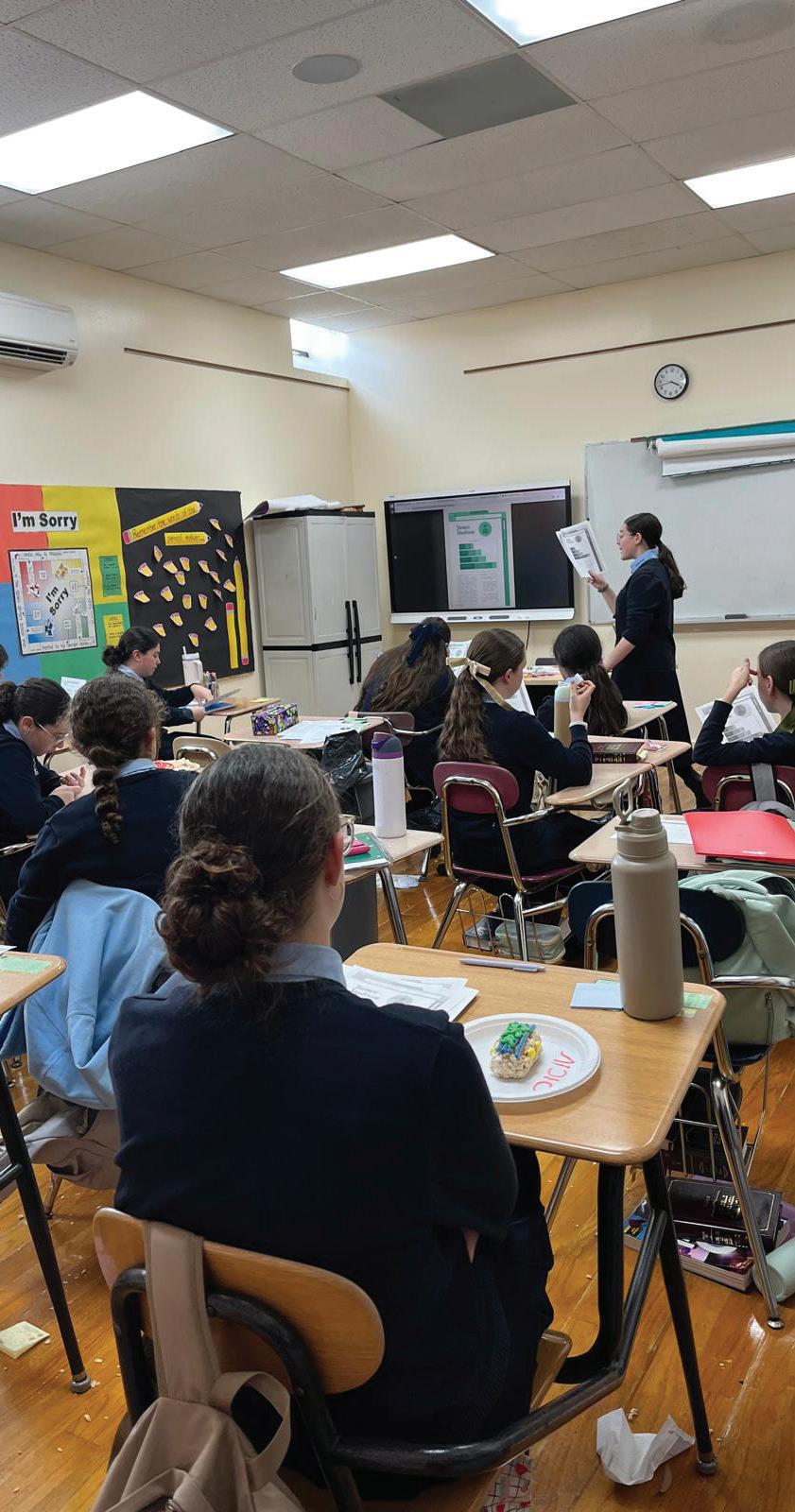
Seventh and eighth-grade American History teacher at Bnos Menachem Junior High in Crown Heights
What made you choose to become a teacher?
While in Seminary Bais year, the principal of Bnos Menachem Elementary asked me to consider being a maternity leave substitute for the fourth grade. The first week was very difficult, but I ended up figuring it out, and I connected with the girls. I entered the classroom for fun, loved it, and have been in it ever since. Give us a glimpse into your classroom:
My class is 75% frontal teaching, and I like to mix things up with partner work, videos, exploring primary sources, or discussions. We get into a lot of discussions because I also teach current events once a week. How do you make learning history interesting?
I use examples from Torah and current events when I teach because it makes it more relevant to the girls. When they understand how a president made a certain decision around the time when the Rebbe spoke about something, it’s very powerful. When we talk about slavery, cur-
rent events with Eretz Yisroel, elections, or other topics that come up in history and current events, we approach it with Torah’s perspective, and it’s such a beautiful lens to have. I hope that the girls feel pride and gratitude that we have Hashem and Torah, so that when we learn about moral dilemmas in class, we have the answers from Torah that people didn’t necessarily have then.
What is something that you feel passionately about as a teacher?
I feel passionately about the girls tasting the success that comes from working hard. I want them to use their brains a little more than they did yesterday. When a girl gives in her essay or test, I tell her that I don’t care what her mark is, but that she is handing in her best work. I believe in holding students to standards and expectations - not ones that are too high for them to reach - but ones that make them feel that they need to push themselves a little bit and taste the reward.
Who are your Chinuch role models?
My biggest Chinuch role model is my grandmother, Mrs. Bluma Rivkin, who is a teacher at Slater Torah Academy in New Orleans. She has been in Chinuch for over 50 years, and is still learning things about Chinuch. She will hear a new idea or read a book, and her first reaction is, “How do I incorporate this?” To her, Chinuch is a constantly changing and exciting process, and I find that very inspiring.
My other Chinuch role model is my high school principal,
Mrs. Yehudis Farkash from Ohel Chana High School in Los Angeles. From the minute I walked into ninth grade until I graduated, I felt that she cared. It didn’t matter how many times she had to discipline me; there was always this feeling that she cared about me.
What are the toughest parts of teaching?
One of the toughest parts is keeping the energy and momentum going for myself and my students. One of the solutions that works for me is to keep reminding myself that I’m human and that they’re human, and that a girl can have a bad day and there doesn’t have to be a reason for it - she just needs a little bit of grace and compassion.
What do you find is the most rewarding?
I love seeing the girls' brains turning, or when girls ask questions that show they are thinking ahead. I love it when they debate their opinions. We’re learning about the Revolutionary War in seventh grade, and it’s always fun to see who becomes a patriot and who becomes a loyalist.
Tell us about your life outside of school.
Besides teaching, I’m a wife and mother. I write songs, produce Kululams and direct choirs. People hire me to play guitar at their events and kumzitzs.
Any final word to share?
I love my students, my job, and Bnos Menchem as a school. I feel very blessed to be able to do something that I love!
The Rebbe’s Words
“...Regarding the place of the Chinuch of children of Anash, may they live: It is clear that our holy Nesi’im, the Rebbeim of Chabad, are the ones actually running the Chinuch institutions of Chabad of all kinds: Yeshivos, Talmud Torahs, trade schools, girls’ schools, etc.
How fortunate is that each and every one from Anash (and all of our Jewish brothers are in the category of Anash), that the chinuch of their sons and daughters is in these institutions. It is good for them materially and spiritually, and in a revealed way…”
With blessing,
The Rebbe
(Free translation)
Chinuch Tip
by Mushkie Lipsker @evergrowingeducator
Bringing School to the Shabbos Table This Chanukah
The best learning is when lessons are taught organically, without the kids even realizing that they are being taught. One way of doing that is in the kitchen.
With Chanukah in the air, a Chanukah-themed Shabbos menu is a simple way to bring school learning home. Beyond kids answering a list of Parsha questions, it’s about them using what they learned in school to plan Shabbos and share it with the family.
Younger elementary children can help with simple kitchen preparation such as measuring, counting, and mixing (bringing in numbers, fractions and real-life skills into the kitchen). They can also design handwritten place cards for the table. If the child just learned how to write in script, here’s a great time for them to practice how to write their siblings’ names. Older children can choose a phrase from V’al Hanisim to put on the place card, selecting one that speaks most to them.
Older children can also take on a bigger role in planning the foods and decorations. They might help plan a menu, suggest dishes, or come up with creative names that connect to what they learned
about Chanukah. You can suggest things to them, such as Israeli salad, Pareve Greek salad and latkes, and let them come up with the rest. Encourage them to write up a menu based on the halachos, minhogim and themes of Chanukah.
At the meal, you can have a menu card (designed by a child) and/or turn it into a challenge, with the family or guests seeing how many connections they can come up with that relate to Chanukah. Watch them come up with connections that no one even thought of. This open-ended activity is a great way to learn what your children learned, to hear their Chanukah takeaways, and to get a peek into their classrooms and what their awesome teachers taught them.
This activity goes beyond connecting the creations to what the kids learned at school. Each food can also spark a discussion of different Chanukah topics, such as the shape of the Menorah, the purpose of Chanukah gelt, and Chanukah themes. You can also use the opportunity to teach new halachos at your table, such as Ikar and Tafel with chocolate bark that has pretzels on it, or why we eat fish on Shabbos in general, when you try the dreidel-shaped Gefilte fish.
Planning this Chanukah Shabbos also brings the four C’s (communication, collaboration, critical thinking, creativity) to life without focusing on them explicitly. Children communicate their thinking, collaborate with siblings, think critically about connections, and use creativity to design and present their ideas. These four C’s are essential skills for a 21st-century world, as technology rapidly advances each day.
And hey, not only does it encourage these great skills and give you a peek into the classroom, but you'll also be left with a beautiful Shabbos Chanukah table!
Help the raw latke make its way through the spilled oil all the way to the frying pan!
How many differences can you find?
How many times can you find the word oil? Look horizontally, vertically, and diagonally, in any direction.
What comes next in the pattern?
Find the menorah’s matching shadow.
Why did the chocolate coin apologize?
To find the answer, cross out every B, C, and D below.
HISTORY’S HEROES
CRAFT. PAINT. BAKE. EXPERIMENT.
5,000
NEXT MONTH SUPPLIES LIST
-Empty Water
Bottl e
-Wooden Craft
Stick (about 6 inches in length)
-Ribbon -Bobbin
-1 oz. Container
-Cla y
- Scissors/Hole
Puncher
CONTEST
WIN 2 FREE MUSEUM TICKETS
Finish the monthly project, snap a pic, and email us at info@jcm.museum for a chance to win 2 tickets to the Jewish Children’s Museum. Let’s get creating!
2 . THE NUGGET
Sara went through difficult times in her life, including being taken captive by Pharaoh first and then Avimelech. Despite the challenges she went through, the days of her life were equally good in the sense that she filled them all with serving Hashem completely. And that is why the Torah says “This was the life of Sara,” because her life wasn’t about what she physically went through, but about her spiritual life. This included how she fulfilled the 3 Mitzvos specifically connected to women: Shabbos candles, Challah, and Taharas Hamishpacha.
4 .F UN FACT
Sara was also called by the name Yiskah which comes from the word in Hebrew “to see,” because she saw with Ruach HaKodesh. (Megillah 14a)
1 .L IFE STORY SNIPPET
Sara, the wife of Avraham, was the first of our Imahos and a Neviah, (of which there are seven in the Torah.) After being childless for many years, with great self-sacrifice she offered her maid, Hagar, as a wife to Avraham. Finally, at the age of 90, she was blessed with her own child, Yitzchak, who was to be the continuation of the Jewish nation.
3 .B RINGING IT DOWN
Difficulties may come up in our lives, but rather than focus on them, we can be like Sara and choose to focus on living life – and true life is Torah and Mitzvos. For example, if you feel unimportant because your family can’t afford as many gadgets and new clothing as some of your friends, try to re-focus: remember that true life is not about the physical things we have, but the Mitzvos we do.
5 .Q UESTION TO CONSIDER
What is one additional Mitzvah you can fill your day with?
Begin with an 8x8 square of paper. Fold it diagonally in half, then reopen and fold the corners to meet by the crease.
Now, fold the other two corners in to meet in the center crease. Crease well.
Glue down the flaps. Make sure it is smoothed down nicely.
ORIGAMI SHABBOS CANDLE BOX SARAH
Open up your square.
Now open up your square. You should have nice grid of crease lines. Cut 4 small lines according to the marks shown.
add some more glue to the other flaps to hold everything together.
Now we are done! Repeat steps 1-12 with the second piece of paper to make your lid. You can add a small sticker to the center corners to hold everything in place.
Place 2 tealights inside the box and close it up. Decorate the template, don’t forget to write the candle lighting time! Glue on to the cover of the box.
Rotate your square 90 degrees to the left, then fold it in half towards the left. Crease well and reopen your paper.
Add some glue (either glue stick or liquid glue will work) to the first two lines on each side as shown.
Fold in both flaps as shown. Smooth well.
Tada! Your handmade Shabbos candle kit is ready to light up the world!
SOME MAY SEE IT DIFFERENTLY
Impaired vision is more common than you may think.
Ahava Vision offers complete eye care, from comprehensive exams to vision therapy by our team of world-leading vision experts.
comprehensive eye exam today:
By Sruly Meyer
KosherSpread
Four delightful recipes perfect for Chanukah
Sruly Meyer runs a marketing agency in Hollywood, Florida. He is also a home cook, recipe developer, and online influencer. He is passionate about food, travel, and Jewish parenthood. @srulycooks
CHANUKAH delight
Chanukah Olive Oil Cake
Ingredients:
• 13/4 cups all-purpose flour
• 1 cup sugar
• 1 teaspoon baking powder
• 1/2 teaspoon baking soda
• 1/2 teaspoon salt
• 3 large eggs
• 3/4 cup high-quality olive oil
• 3/4 cup orange juice
zest, and vanilla.
4. Pour the wet mixture into the dry and whisk gently until smooth. Don’t overmix.
5. Pour into the pan and bake for 40–48 minutes until the top is golden and a toothpick comes out clean.
6. Let it cool fully. Dust with powdered sugar or decorate with orange slices and a light drizzle of olive oil.
Zucchini Latkes
Ingredients:
3. Fr y:
Heat a thin layer of oil in a skillet over medium-high heat. Scoop small spoonfuls of batter into the pan and gently flatten. Fry 2 to 3 minutes per side until golden and crisp.
4. D rain & serve: Transfer the cooked latkes onto a paper towel.
Giant Skillet Latke
Instructions:
1. Grate potatoes on the large holes of a box grater or use a food processor.
Ingredients:
1. 4 large russet potatoes, peeled
2. 1 large onion
3. 2 eggs
4. 1/4 cup flour
5. 11/2 teaspoons salt
6. 1/2 teaspoon white pepper
7. 1 teaspoon baking powder (helps it fluff)
8. 1/2 cup oil for the pan
2. Place patatoes in a bowl and squeeze out as much moisture as you can. Reserve the liquid for 5 minutes, then pour off the water and keep the starchy paste at the bottom
3. Grate the onion and squeeze out excess liquid. Add to the potatoes.
4. Mix the batter: Add eggs, flour, salt, white pepper, baking powder, and the saved potato starch. Mix well. The mixture should feel thick and scoopable, not loose.
5. H eat your skillet: Use a 10- or 12-inch cast-iron or heavy nonstick skillet. Pour in enough oil to generously coat the bottom — about 1/4 inch deep. Heat until shimmering.
6. Form your giant latke: Carefully add the mixture and pat it down evenly.
7. Cook uncovered on medium heat for 10 to 12 minutes until the bottom is deeply golden and crisp.
8. Flip: Slide the latke onto a large plate. Place another plate on top, flip, then slide back into the pan. Add a little more oil if needed and cook the second side for another 8 to 10 minutes.
9. For extra thickness and even cooking, place the whole skillet in a 375°F oven for 10 minutes.
10. Let it cool for 10 minutes before slicing into wedges.
Chanukah Sugar Cookies (Pareve)
Ingredients:
1. 3/4 cup vegan butter or margarine, softened
2. 3/4 cup sugar
3. 1 large egg
4. 1 teaspoon vanilla
5. 2 1/4 cups flour
6. 1/2 teaspoon baking powder
7. 1/2 teaspoon salt
Instructions:
1. Mix the softened margarine and sugar until smooth.
2. Add the egg and vanilla and mix again.
3. In another bowl, whisk flour, baking powder, and salt.
4. Add dry ingredients into the wet and mix until it forms a dough.
5. Chill dough for at least 1 hour so the shapes stay clean.
6. Roll out your dough to about 1/4 inch thick.
7. Cut out your Chanukah shapes. Tip: Cazenove sells wonderful Chanukah Cookie Cutters, available in most Kosher stores or online!
8. B ake at 375°F for 10 to 12 minutes until the edges just start to look golden.
9. Cool completely before decorating!
Decorating Tips:
• Make a simple icing with powdered sugar, a splash of water or non-dairy milk, and a little vanilla.
• T int icing blue and white with food coloring.
• Add blue sprinkles, silver sugar, chocolate coins crushed for a fun topping.
• Use a piping bag to outline a dreidel or menorah
By Asharon Baltazar
The Candle that Waited
A story of one rescue, and a light delayed in Heaven
On the eve of Chanukah, the study hall of the Maggid of Mezritch filled with quiet concentration. The Maggid’s students moved about deliberately, preparing themselves for the moment their Rebbe would light the first candle.
The honor of handing the burning shamash into the hands of the Maggid belonged to one of his wellknown students, Rabbi Zusha of Anipoli. Rabbi Zusha spent much of his life on the road, wandering through distant villages and forgotten Jewish outposts, drawing people back one soul at a time. Yet each year, without fail, he arranged his travels so he would return for the first night of Chanukah in the Maggid’s court.
The last pale ribbon of daylight slipped from the windows, and darkness swallowed the modest wooden building. The menorah’s wicks, fluffy and white, stood ready. The students waited, shifting in
place, glancing again and again toward the Maggid’s door. Rabbi Zusha was also nowhere to be seen. Minutes passed, then an hour, and the silence in the room grew thick with unasked questions. No one said it, but all felt it: the Maggid was not late at all. He was waiting.
Near midnight, the door finally opened. The Maggid stepped out, walked to the menorah without a word, and lit the first candle without any help. The students watched in silence. He offered no explanation and left the students steeped in their puzzlement.
The next morning, Rabbi Zusha appeared at the Maggid’s court, shivering in the biting cold. Snow clung to the hem of his coat. His boots squished unpleasantly as he crossed the room, leaving dark, melting prints in his wake. His body sagged with weariness, but Rabbi Zusha’s face held a quiet brightness, as if he carried something warm
inside him.
The students asked after his well-being and told him about the Maggid’s unusual delay the night before. Rabbi Zusha listened wordlessly, his face betraying no emotion, and went at once to prepare for the morning prayer.
That evening, after the Maggid lit the second Chanukah candle, he gathered his students for a festive meal. This was a rare hour of elevation. The students chanted the holiday’s special melodies, voices rising and falling in easy harmony. Between the songs, the Maggid shared mystical and novel Chassidic teachings. Excited chatter bubbled throughout the room, then slowly softened. At last, during a pause that seemed to arrive on its own, the Maggid turned to Rabbi Zusha. “Tell us,” he said, “why you were late for the first candle this year?”
An abrupt hush moved through the
room as the Maggid gazed at Rabbi Zusha. All eyes followed. Rabbi Zusha shifted slightly in his seat, then lifted his head.
“As you know,” he began, “each year I direct my wanderings so I can return for the first Chanukah candle. I would not trade that moment for anything in the world. But this year, a fierce storm overtook the roads. Snow fell in heavy sheets. The wind cut straight through my coat. My fingers and toes went numb.
“By the time I neared the town, my strength began to slip. I knew that if I faltered again, the cold would take me. There was not a soul in sight. I gathered what little strength remained and forced myself toward a nearby village, toward the home of my friend, Yankel.
“When I reached his door,” Rabbi Zusha said, his voice quieter now,
“his wife opened it in tears, their children clinging behind her. That morning, Yankel had gone into the forest for work and had not returned. She was certain something had gone wrong.
“In that moment, I understood why my journey had been delayed. Without sitting down, without warming myself, I turned back and let the storm swallow me again.
“The forest had become a blur of white and shadow. Snow stung my eyes. The wind swallowed every sound. I no longer knew one path from another.
“Then,” he said faintly, “my foot struck something soft.”
“It was Yankel. He lay across the trail, half-buried in snow, his lips blue, his breathing weak. I lifted him, rubbed warmth into his temples, and dragged him through the drifts. Step by step, gasp by gasp. “By the time we reached the house,
the storm had begun to ease. I kicked open the door, and Yankel’s children rushed forward, caught between relief and fear. Using the last of my strength, I set Yankel down beside the roaring oven and wrapped him in thick blankets. I tipped his head and gave him a few swallows of strong spirits. Slowly, he came back to himself.
“It was close to midnight,” Rabbi Zusha said. “We lit the first Chanukah candle and thanked Hashem for the miracles of the past, and for miracles of the present –saving Yankel from death.”
When he finished, the room remained still. The Maggid studied him for a long moment.
“Because you saved a Jewish life,” the Maggid said at last, “the first candle was not lit in Heaven until you lit it down here.”
(Translated from Sichat Hashavua #1354)
By Mordechai Schmutter
How To Set Up Your Menorah
Do non-Jews even know how to use foil?
The most essential part of making Chanukah is lighting the menorah. Followed by – in order from most to least essential –doughnuts, playing dreidel, doughnuts, latkes, presents, chocolate shaped like money, doughnuts, and that party your shul makes where someone wins a gym membership. So you might as well do it right:
Where to Set It Up
Fire professionals say you should set up your candles at least ten feet from anything flammable, such as wood. Unfortunately, you have to put your menorah near the doorpost, so what are you gonna do? I would say you should remove your door and move it to a safe area, such as where you’ll be dancing. Then, when the candles go out each night, you can reinstall the door so you can go to bed.
Your other option is to light your menorah outside, taking care to move and replant any bushes
or trees that may present a fire hazard. Some people light in a fish tank, because there is no recorded instance of there ever being a fire in a fish tank. But just in case, you should remove all of the fish before you light.
Setting Up Your Table
-Ideally, you want a table that doesn’t shake.
-Most people use folding tables. Those two sentences are unrelated. Once you have a table, you need to take all the foil that you used to line the walls of your kitchen on Pesach that you were unsure of how to throw out – all those 10-foot lengths of bulletproof foil – and repurpose it into lining your entire living room. We don’t know what Yidden did before the invention of foil. Do nonJews even buy foil? What do they use it for? They make big meals like twice a year.
Note that you don’t do anything like this for Shabbos candles. All your
wife gets is a tray, and then you have a full Shabbos meal next to it.
Choosing a Menorah
There are a lot of decisions to make here. For example, do you want a menorah or a chanukiyah? They look exactly the same to the naked eye, so make sure to ask the person at the store to point you to the right section. So he knows what kind of customer he’s dealing with. He will probably recommend you buy one of each.
Sure, some people will tell you that a menorah has seven branches, and a chanukiyah has nine. But all the seforim call the thing that we light a menorah. So I say that maybe a menorah has branches, while a Chanukiyah has sports equipment, choo-choo trains, cats, soda cans, Dreidels, and for some reason, fire trucks. I am not sure what choo-choo trains have to do with Chanukah, and neither does the Taamei Minhagim.
Choosing What You’re Lighting
OPTION #1: CANDLES
This is the preferred lighting method of kids. Candles are easier to light because all you have to do is pick out pretty colors from the box, and then ask an adult to clean out yesterday’s debris and melt in today’s.
Plus, the kids get all excited about the candles, because fun fact: The different colors taste different.
A standard box comes with 44 candles, which is enough for one person for the entire Chanukah, provided no candles are broken. So you should probably check in the store, like with eggs. How is one candle broken if the entire box is standing-room only? Shouldn’t it be all or none?
OPTION #2: OIL
In general, people prefer to use olive oil because it played a big role in the story. The story isn’t about how the Chashmonaim could only find one lone candle that wasn’t broken – all
the other candles had been cracked in half by the Greeks, in a mad spree, or by accident – and they could only find this one candle, and it was yellow. They checked through all the boxes. And to get new candles back then, it took 8 business days. You had to go to the honey farm, and get some beeswax, and then run, because you’d woken up all the bees… I actually don’t know how to make candles. For all I know, it might take 8 days.
The main downside of oil is that somehow – and we blame science – it travels through all the layers of silver foil to make your table greasy. No matter how much foil you put down, your table will be covered in oil. Is this another reason Chazal suggested we just light outside?
How to Light
First, you need to bring a lit candle from the stove, which is nowhere near the doorpost of where you are lighting. Some people keep a lighter near their menorahs, but you have kids, so no thanks. You’d rather walk
across your house really slowly with your hand in front to protect it from the wind. I have no idea how people who light outside pull this off. It’s hard enough to borrow fire on Yom Tov when it’s nice outside.
Once you’ve brought the fire to the lighting station, you’re going to need to stand there with the tiny candle burning down while everyone else gets their acts together. As soon as you give up and blow it out, they’ll be ready.
Once you’ve lit, you can sing Haneiros Halalu. Many families join hands and dance, although you should not be dancing near the menorahs if your floor is any kind of shaky and the menorahs are placed on a folding table.
When you’re done, you can sit down, carefully, and enjoy the menorah from the relative comfort of your bulletproof-foil-lined couch.
Happy Chanuk—Oh wait; mine went out.
Looking for short term or a place to settle
We’re here to help no matter how you classify
Whether you’re a first time renter or looking for a bigger space, if you’re buying a home in Crown Heights or out of town, COLlive Classifieds has you covered!
If you’re looking to rent or sell
Whether you’re a homeowner or a real estate broker, COLlive classifieds is here to help!
+ Post classified
Our track record speaks for itself.
Over the past 7+ years, members in more than 30 states have submitted over 330,000 medical needs for sharing, from routine, minor care to major events such as maternity, surgeries, cancer treatments, heart attacks, and strokes. Each has been handled with care and in full accordance with our Sharing Guidelines. No member has ever reached the $1,000,000 per-incident limit, and members are assured they cannot be terminated for developing a new condition after joining.
United Refuah also undergoes external financial audits to ensure transparency, accountability, and a strong foundation of responsible sharing.
Our teenage daughter was hospitalized in a leading pediatric hospital for five days with severe GI symptoms. Esther, our United Refuah case manager, guided us every step of the way and helped us significantly reduce the hospital costs. Even after discounts, our bill came to nearly $40,000. The funds were shared promptly by an overnight bank transfer, allowing us to focus on our daughter’s recovery instead of the bills. We’re so grateful to be part of a community that truly cares.