

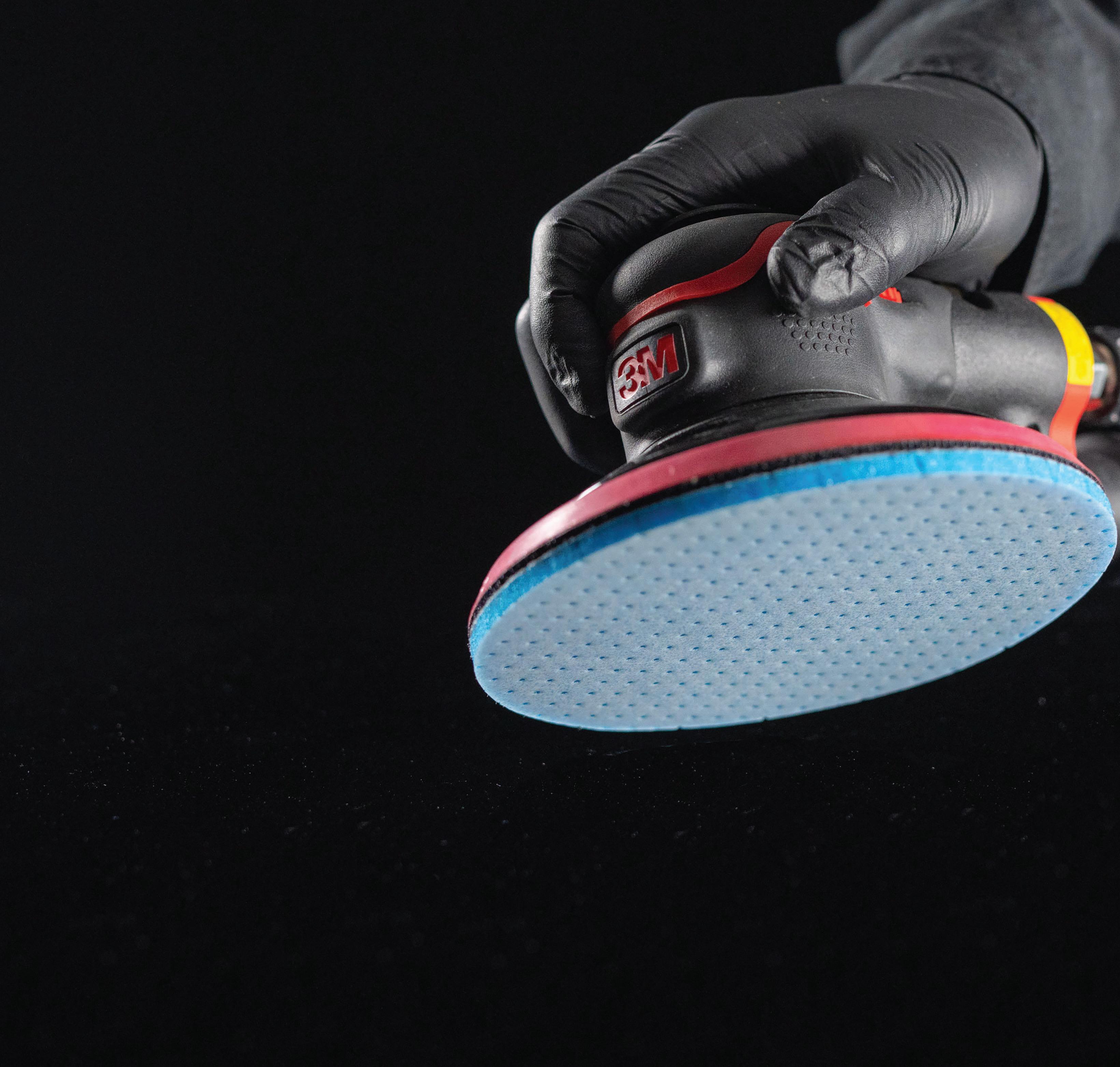
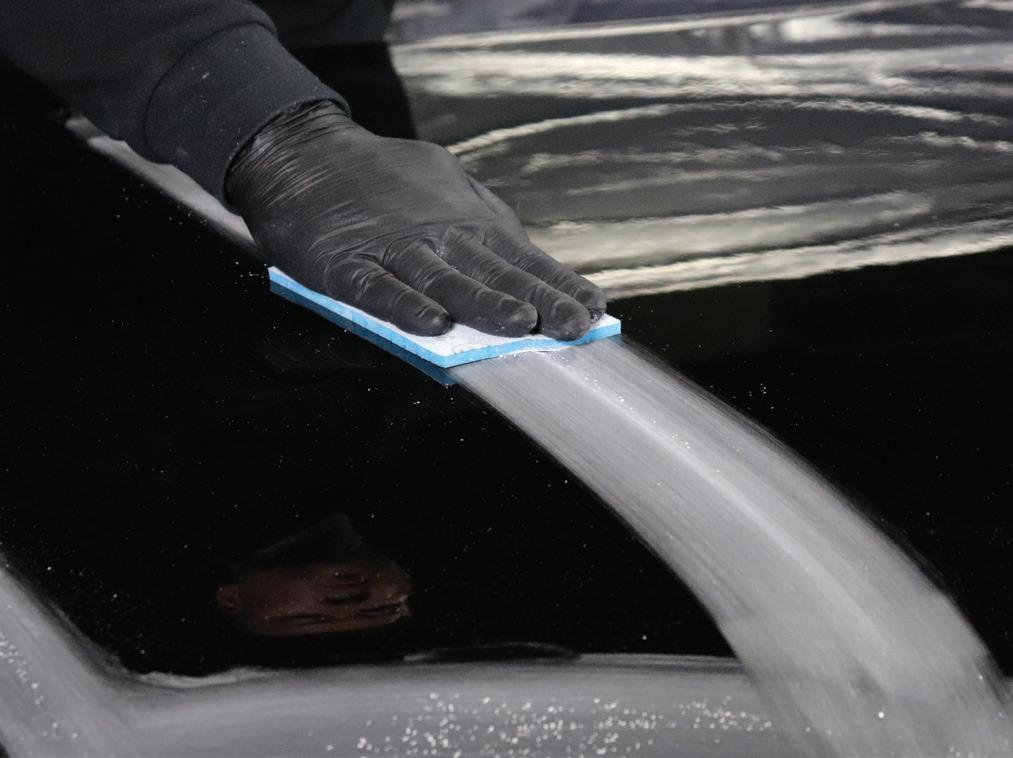
3M™ Hookit™ Flexible Foam Abrasives combine flexible aluminum oxide abrasives with a soft foam backing to create a high performing, versatile blending abrasive for dry or wet use with machine or by hand.
in Flexible Foam Abrasive Sheets Take




OEMs are considering collision repair at the design stage. It’s about time.
BY DARRYL SIMMONS
In collision repair, nothing really starts or ends with the accident.
A vehicle arrives damaged. A technician repairs it. The car goes back on the road. Years later it may return for another repair, another owner, another life. Good repairs keep vehicles moving through that cycle.
That loop is something everyone in the collision repair business understands. What is interesting now is that the rest of the automotive industry is beginning to organize itself around that same idea.
The newly fashionable term is circularity
Circularity simply means keeping materials in use for as long as possible instead of treating vehicles as disposable products. Repair, reuse, remanufacturing and recycling become part of a continuous cycle.
More importantly, sustainability, it turns out, also means profitability.
Electric vehicles add another dimension to the discussion. Battery packs contain valuable minerals such as lithium, nickel and cobalt. Those materials cannot simply be discarded when a vehicle reaches the end of its life. Manufacturers are developing systems to refurbish battery packs, repurpose them for energy storage and eventually recycle them to recover those minerals for future batteries.
All of this forces manufacturers to think differently about vehicles. Instead of designing only for assembly at the factory, engineers are beginning to consider what happens years later — when that same vehicle is repaired, dismantled or recycled.
PUBLISHER
Darryl Simmons publisher@collisionrepairmag.com
ASSOCIATE PUBLISHER
Orest Tkaczuk | orest@mediamatters.ca
ART DIRECTOR
Yvonne Maschke | yvonne@mediamatters.ca
ASSISTANT EDITOR
Mackenzie Grant | mackenzie@mediamatters.ca
INTERIM EDITOR
Gideon Scanlon | news@collisionrepairmag.com
AUDIENCE ENGAGEMENT MANAGER
William Simmons | william@mediamatters.ca
VP OF INDUSTRY RELATIONS & ADVERTISING
Gloria Mann 647.998.5677 | gd.mann@rogers.com
INDUSTRY RELATIONS ASSISTANT Wanja Mann 705.928.0653 | wanjamann1@gmail.com
Manufacturers are realizing that recovering materials, extending product life and reducing waste is not just good environmental policy. It protects supply chains, reduces dependence on volatile raw material markets and lowers long-term production costs.
For collision repair facilities, this shift could bring practical benefits. When vehicles are designed with disassembly, reuse and material recovery in mind, components can become easier to access, remove and reinstall. That kind of thinking has the potential to reduce complexity and improve repair cycle times.
And frankly, it is about time.
“CIRCULARITY MAY BE A NEW WORD, BUT KEEPING VEHICLES AND MATERIALS IN SERVICE LONGER HAS ALWAYS BEEN PART OF COLLISION REPAIR.”
This shift is starting to influence how vehicles are designed in the first place — and that is where the collision repair industry enters the conversation.
Across Europe, automakers are rethinking how vehicles are engineered so materials can remain in circulation longer. Engineers are studying how vehicles come apart, how parts can be reused and how materials can be recovered without losing their value. The industry often refers to this as design for disassembly, but the practical implication is straightforward: vehicles are being designed with their entire life cycle in mind.
And that includes repair.
BMW in Europe recently took a major step in that direction. BMW is building a closed-loop recycling system for end-of-life vehicles. The focus is not simply dismantling vehicles but recovering high-quality materials and parts.
BMW contributes expertise from its Recycling and Dismantling Centre, where engineers study how vehicles can be taken apart and how parts and materials can be recovered efficiently.
Stellantis is moving in a similar direction. Through its European SUSTAINera program, the company is expanding the use of remanufactured parts, recycled materials and extended vehicle life strategies. Stellantis has also established circular economy hubs where vehicles are dismantled, usable components are recovered and materials are prepared to re-enter the manufacturing supply chain.
Repairers have long worked on vehicles designed primarily for assembly efficiency, not for repair. If circularity pushes manufacturers to think more carefully about how vehicles are repaired and how materials are preserved, that shift could benefit both the environment and the repair process itself.
In this issue of Collision Repair, our Counting Carbon feature looks at how this thinking is already beginning to reach the repair side of the industry. Insurers and manufacturers are starting to measure the carbon impact of repair decisions, including the difference between repairing a component and replacing it with a newly manufactured part.
Those discussions are still developing, but they point to something larger. Collision repair facilities extend the life of vehicles every day. Every properly executed repair preserves materials that have already been manufactured, transported and installed. Vehicles stay on the road longer and valuable resources remain in use.
Circularity simply gives that reality a name.
For decades, the collision repair industry has been keeping vehicles in that circle. Now manufacturers are beginning to design vehicles around the same principle. When they do, repair will not just be part of the process after a crash.
It will be part of the plan from the very beginning — and that recognition could change the conversation about repair in ways this industry has been waiting for a long time to see.

DIGITAL OPERATIONS MANAGER Cassie Doyle | cassie@mediamatters.ca
MEDIA PRODUCTION SPECIALIST Dayna Dicuangco | dayna@mediamatters.ca
DIGITAL MEDIA
Natalie Dinh | natalie@mediamatters.ca
CONTRUBUTOR
John Ascheman, Stefano Liessi Jay Perry, Matt Piotrowski
Chelsea Stebner
SUBSCRIPTION
Single edition $7.99 One-year $39.95 ( 6 issues) Collision Repair™ magazine is published bimonthly, and is dedicated to serving the business interests of the collision repair industry. It is published by Media Matters Inc. Material in Collision Repair™ magazine may not be reproduced in any form without written consent from the publisher. The publisher reserves the right to refuse any advertising and disclaims all responsibilities for claims or statements made by its advertisers or independent columnists. All facts, opinions and statements appearing in this publication have been compiled and included with the permission, though not necessarily the endorsement, of the editor, or of independent columnist contributors, and are in no way to be construed as those of the publisher, or as endorsements of them.
PRINTED IN CANADA ISSN 1707-6072
CANADA POST CANADIAN PUBLICATIONS MAIL SALES PRODUCT AGREEMENT No. 40841632
RETURN POSTAGE GUARANTEED
Send change of address notices and undeliverable copies to: 317 Reid St., Peterborough, ON K9J 3R2

“We acknowledge the financial support of the Government of Canada”



Collision Repair magazine is published by Media Matters Inc., publishers of:







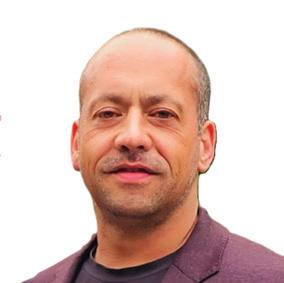
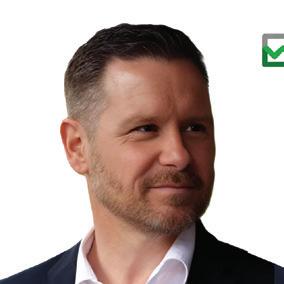
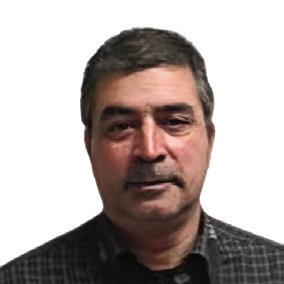


DANNY SALINAS
Axalta Coating Systems appointed Danny Salinas account manager for its Pacific West region in late February. The Calgaryborn Southern Alberta Institute of Technology graduate will focus on strengthening partnerships and supporting growth across western Canada. Salinas brings more than 31 years of automotive refinishing experience and has worked on vehicles ranging from passenger cars to Team Canada’s luge fleet. Market sales manager for the Pacific Canada Region Nell WheelerMislangs said, “Danny brings deep technical expertise, leadership experience, and a genuine passion for the trade.” collisionrepairmag.com/15818229
MICHAEL GOLDING
Michael Golding of Allianz UK joined the Plastic Repair Alliance Council in February. The council was established in 2025 to standardize plastic repair processes globally. Golding brings more than 38 years of motor accident repair and insurance claims experience and oversees repair network strategy at the London-based insurer. He will contribute to efforts to gather real-world repair data and develop consistent methodologies and certification frameworks worldwide. collisionrepairmag.com/15818117
JOE DA CUNHA
Atlantic Collision Group appointed Joe da Cunha director of business development and vendor relations in February to execute its five-year growth strategy across Southern Ontario. He will focus on strengthening vendor partnerships, expanding revenue opportunities and supporting scalable operations. Da Cunha brings more than 40 years of leadership experience across the automotive and insurance industries. He said, “My focus will be on aligning business strategy with our growth objectives, optimizing partner performance and delivering measurable revenue gains as the company moves forward with its five-year plan.” collisionrepairmag.com/15818130
KEREN BINMAHAR
UAP Inc. appointed Keren Binmahar senior marketing manager in February. She is responsible for leading national marketing strategy, directing go-to-market planning and coordinating cross-functional collaboration across UAP’s Canadian network. Binmahar brings more than a decade of progressive experience in sales, marketing and account leadership, including more than 13 years at Mirka Canada. She described the move as marking “a new chapter” with “exciting challenges and opportunities.”
collisionrepairmag.com/15817564
PHILIPPE-ANDRÉ BISSON
Uni-Select Inc. promoted Philippe-André Bisson to head of product marketing in February, expanding his mandate across its mechanic and paint, body and equipment divisions. He joined the company in December as channel marketing lead for the paint and collision department. Bisson brings senior marketing leadership experience from roles at Fix Network World, General Motors and Kia Canada Inc. He said, “I’m grateful for the confidence placed in me and excited to contribute to the next phase of our organization’s strategic direction.” collisionrepairmag.com/15817394
Solera appointed Omar Nabil vice-president of sales and country leader, Canada insurance, in mid-February as part of a strategic expansion of its Canadian operations. Based in the Greater Montreal area, he leads the company’s national insurance business and works to deepen relationships with insurers and repairers as digital claims workflows and AI-enabled tools accelerate. Nabil brings nearly two decades of sales leadership and technology-driven market growth experience. He said, “Canada’s claims industry is entering an exciting new phase of innovation and modernization.” collisionrepairmag.com/15817237
While stocks last
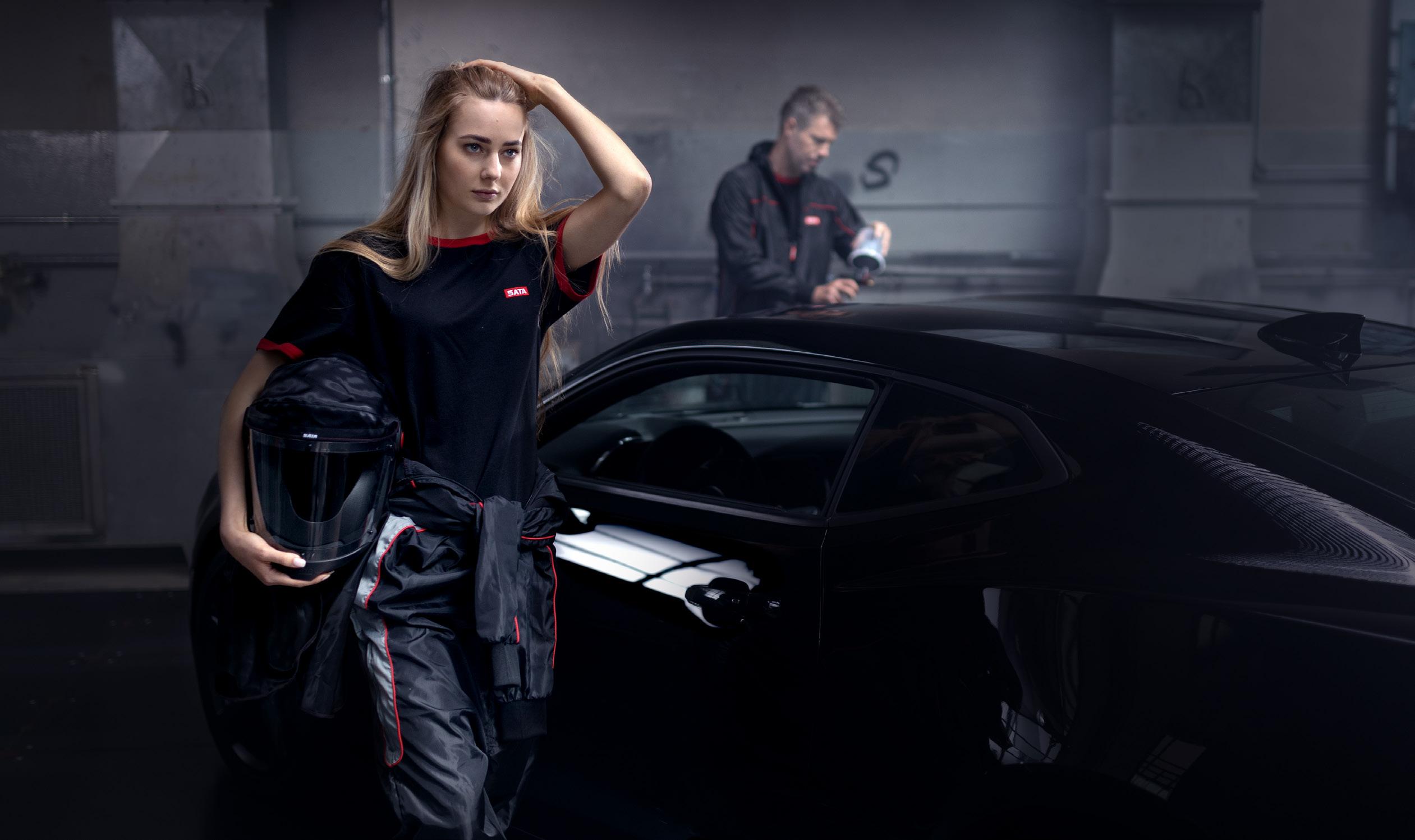
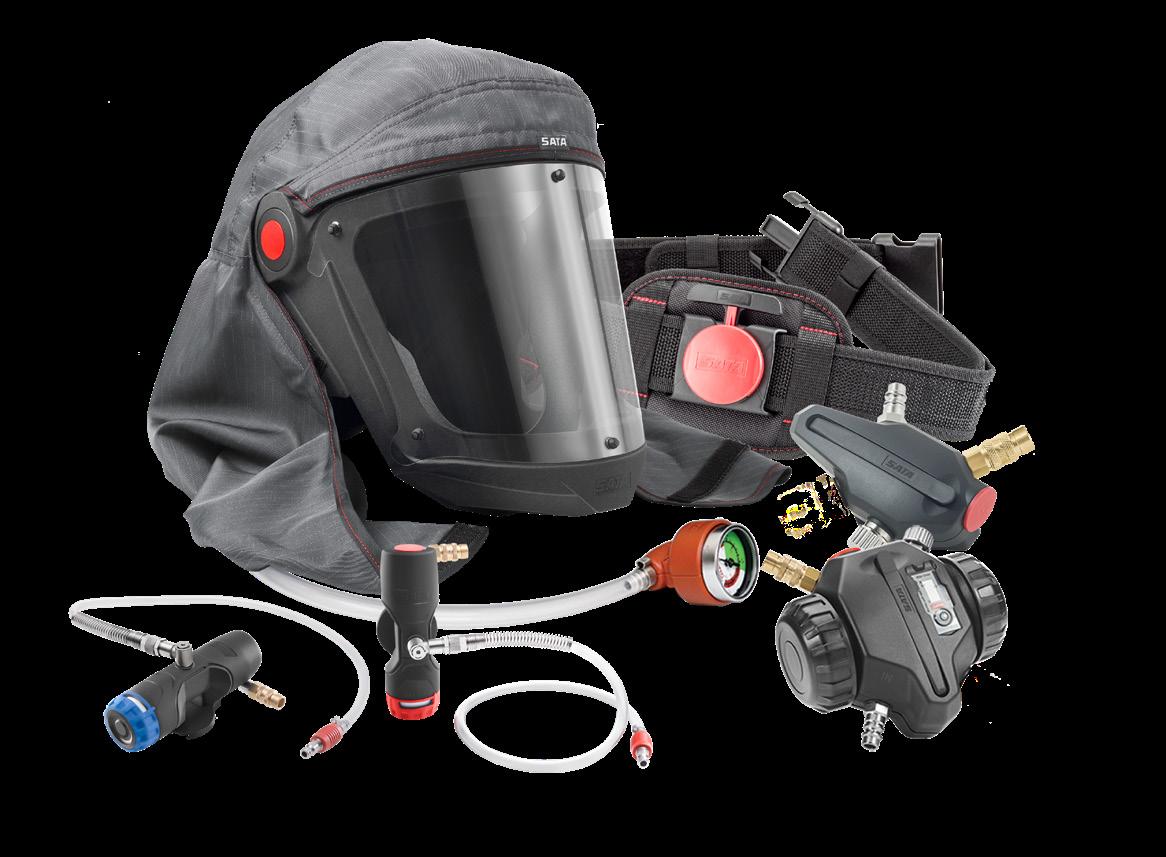
The SATA air vision 5000 offers a completely redesigned way of supplied breathing air. The respiratory hood not only ensures high breathing air quality but also a low noise level. The modern, ergonomic design fits with almost any head shape and can be individually adjusted in size, height and position.
The SATA air vision 5000 offers a completely redesigned way of supplied breathing air. The respiratory hood not only ensures high breathing air quality but also a low noise level. The modern, ergonomic design fits with almost any head shape and can be individually adjusted in size, height and position.
Little operating costs, quick pay-off of purchase costs
Soft-stream flow-optimized air distribution in the hood
Reduced sound level: 64 dB (like a conversation in 1m distance)
Absolute safety through external supply of clean air to the booth – up to 100 times TRK* value and suitable for continuous use
No inhalation resistance, very comfortable breathing
Little operating costs, quick pay-off of purchase costs
Soft-stream flow-optimized air distribution in the hood
The SATA CCS Discs (Color Code System) allows personalization of hood, SATA air regulator and SATA air carbon regulator
Reduced sound level: 64 dB (like a conversation in 1m distance)
Absolute safety through external supply of clean air to the booth – up to 100 times TRK* value and suitable for continuous use
Ergonomic design with individual adjustment options and one-hand operation of the visor
No inhalation resistance, very comfortable breathing
Ergonomic design with individual adjustment options and one-hand operation of the visor



Single solvent resistant tear off visors over an aperture in the front of the mask, ensuring 100% visibility and reduction in light reflection
Available SATA air warmer and SATA air cooler
The SATA CCS Discs (Color Code System) allows personalization of hood, SATA air regulator and SATA air carbon regulator
* TRK – Technische Richtkonzentration
Single solvent resistant tear off visors over an aperture in the front of the mask, ensuring 100% visibility and reduction in light reflection
Available SATA air warmer and SATA air
In a fast changing collision repair landscape, few brands achieve longevity without losing relevance. For 25 years, ProColor Collision has done just that, building a trusted global presence while staying true to the local roots and entrepreneurial spirit that define its network.
As ProColor Collision marks its 25th anniversary in Canada, the milestone represents more than time, it reflects a legacy of craftsmanship, adaptability and a shared commitment to raising the standard of collision repair across the country.
What began as a belief in strong relationships and shop level pride has grown into a respected global network, powered by independently owned businesses and supported by the strength of Fix Network.
From its earliest days in Canada, ProColor Collision was built on a simple but powerful idea: local operators know their communities best and when supported by a strong brand and shared standards, they can deliver exceptional results.
Over the past 25 years, ProColor shops have earned trust one repair at a time, investing in their people and growing alongside the communities they serve. That steady, values driven approach has been key to the brand’s enduring strength.
“Reaching 25 years in Canada reflects the trust our franchisees have earned in their communities and the pride they take in showing up for customers every day,” says Steve Leal, President & CEO of Fix Network. “ProColor Collision has grown because it’s built on strong local businesses, meaningful community relationships, and a network that supports and stands behind its franchisees.”
The collision repair industry has evolved dramatically over the past two and a half decades with introducing advanced vehicle technologies, new materials, ADAS systems and heightened repair standards. ProColor Collision has evolved right alongside it.
Through ongoing investments in training, OEM aligned repair practices, equipment and technology, ProColor shops are equipped to repair today’s increasingly complex vehicles safely and efficiently. Network collaboration and knowledge sharing have ensured that innovation isn’t siloed, it’s shared.
This ability to adapt while maintaining consistency has helped ProColor build credibility not only with customers, but with insurers and industry partners across Canada.
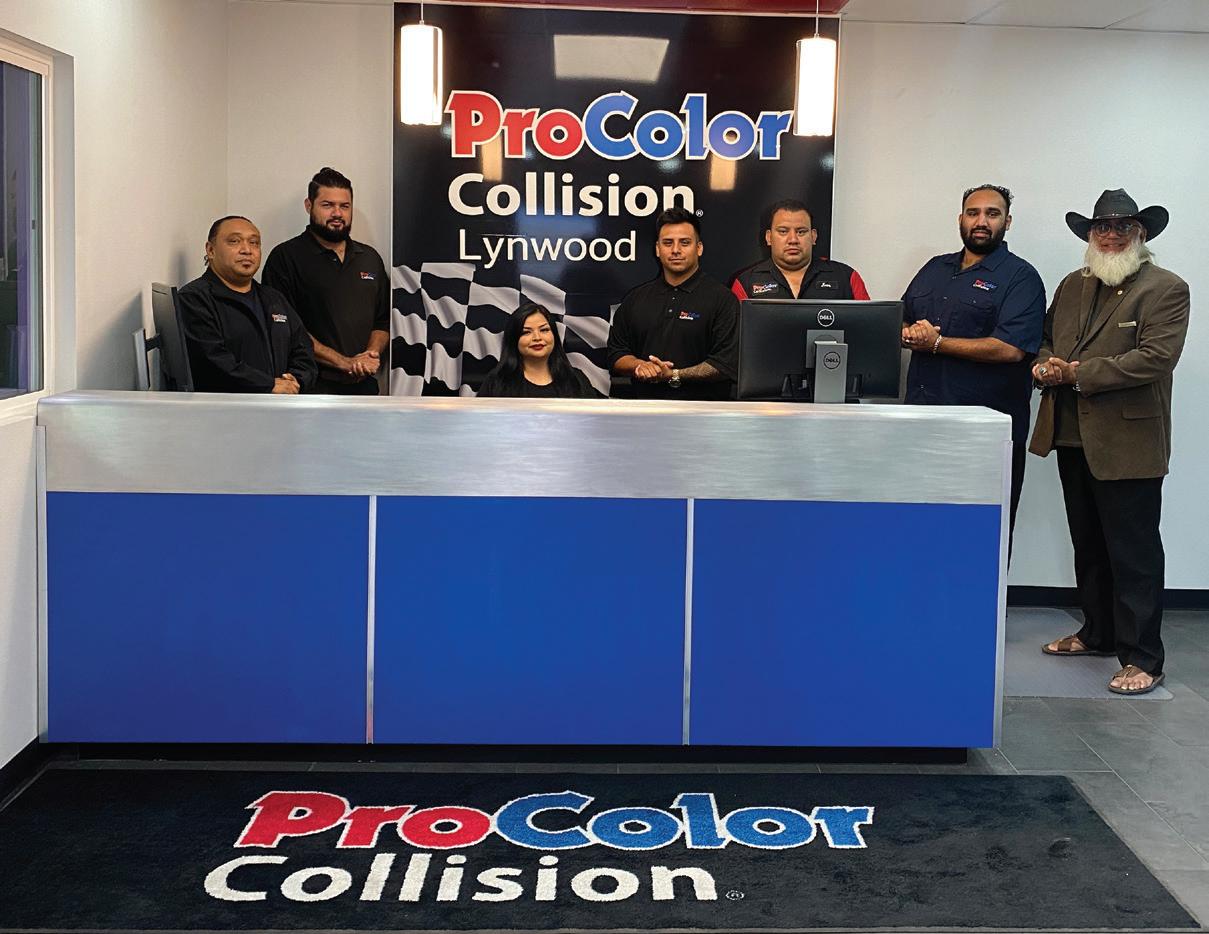
ProColor Collision was built on the belief that collision repair is equal parts discipline and craft. It’s not just about meeting OEM standards, but about mastering the details that define a proper repair: how a panel sits, how lines flow, how everything comes together seamlessly. Across the network, that philosophy shows up in shops led by owners who take personal ownership of their work and their communities, approaching every repair with precision, pride, and purpose. That mindset is on display in the United States, where Saadi Qazi, owner of ProColor Collision Lynwood, Bakersfield Central, and Bakersfield Southwest, continues to push the craft forward. Through hands on training at Spanesi Americas, Saadi sharpened his mastery of setup, fixturing, and repair planning. Where high end tools meet instinct, and innovation shows up as cleaner lines and flawless execution.
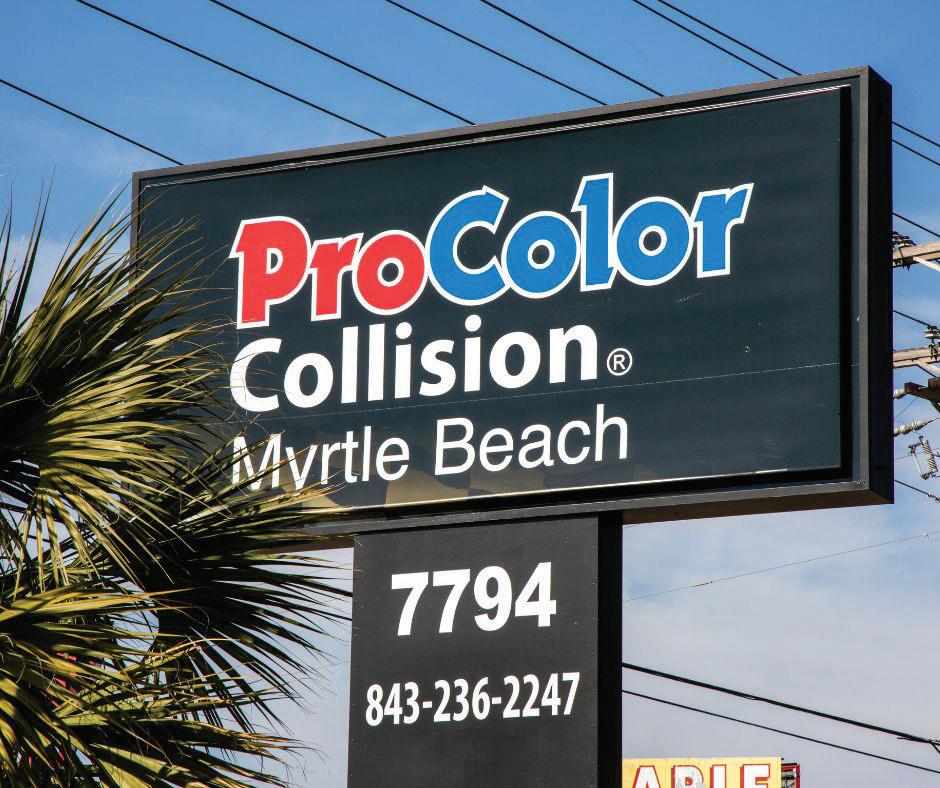
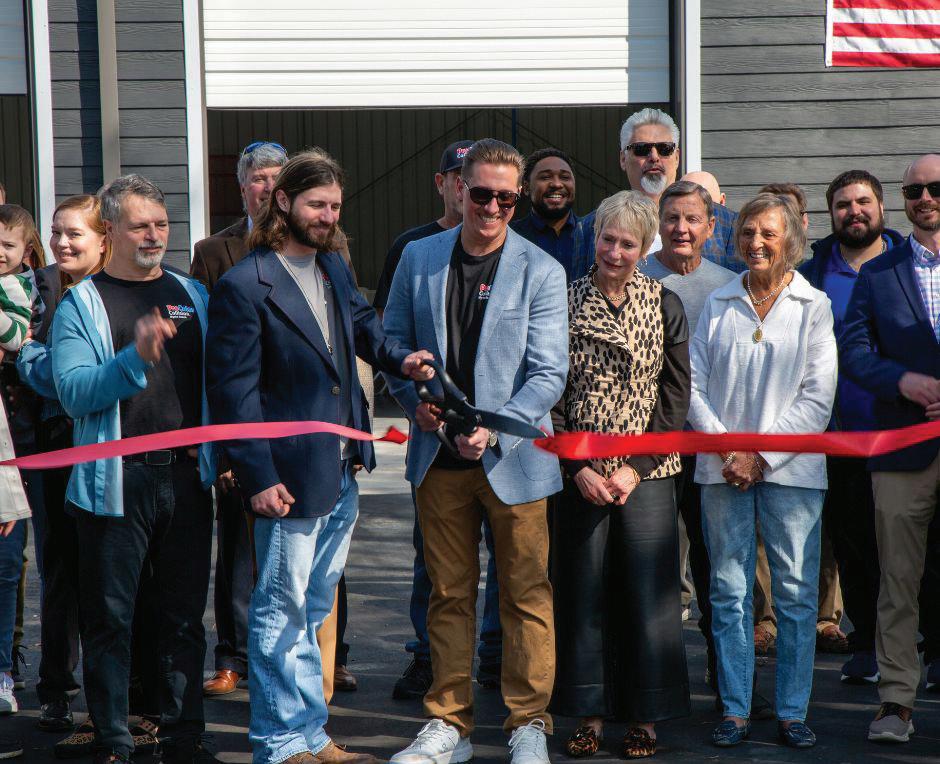
That same energy is moving east. The opening of Collision Myrtle Beach marked more than a ribbon cutting, it was a statement. Owners Evan Anderson and John Masetti launched ProColor’s first location in the state with a shop built on intention and pride, surrounded by a community ready for something different.
Being part of ProColor means balancing autonomy with alignment: shop owners retain their entrepreneurial independence while benefiting from national scale, operational support, trusted partnerships, and a brand that stands for reliability and professionalism.
That balance has helped ProColor franchisees remain competitive in an increasingly complex industry, without sacrificing the local relationships that define their success.
As a key brand within Fix Network, ProColor Collision benefits from the collective strength of a diversified automotive services organization. This connection enables collaboration across brands, access to national initiatives, and alignment with a long term vision for the future of automotive repair.
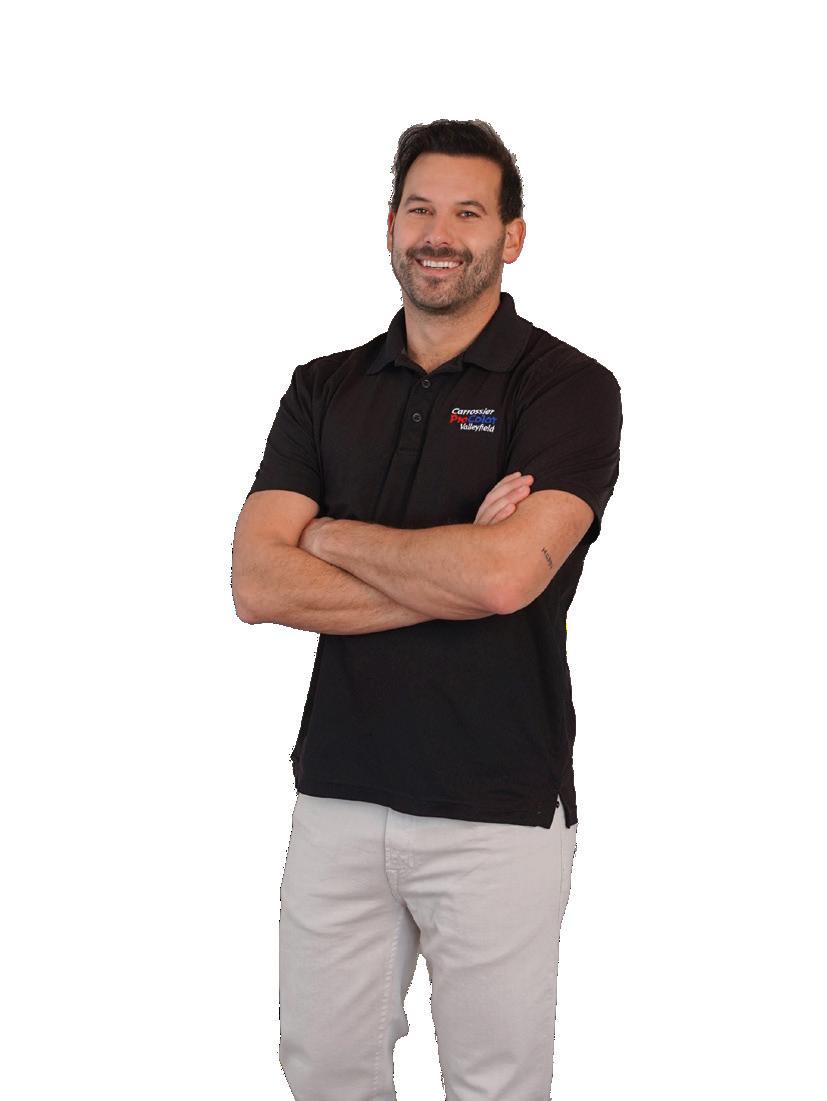
In Canada, ProColor Valleyfield exhibits this commitment. Led by Vincent Éthier, the shop continues to grow while preparing for expansion to meet rising demand without sacrificing quality. With roots dating back to 1985 and nearly two decades under the ProColor banner, this is experience sharpened by time and matched by more than $40,000 invested in local community initiatives this year alone.
That commitment strengthens trust, deepens relationships, and reinforces ProColor’s long standing reputation as a network of businesses that care about the communities they serve.
“ProColor Collision represents everything we value at Fix Network, strong local leadership, operational discipline, and the willingness to evolve,” adds Leal. “This milestone belongs to every franchisee, technician, and team member who has contributed to the brand’s success over the past 25 years.”
For many ProColor locations, community engagement is not an initiative, it’s a responsibility. From supporting local programs and charities to mentoring the next generation of technicians, ProColor shops continue to play an active role beyond repair bays.
ProColor Collision’s anniversary is a celebration of shared values, collective effort and enduring partnerships. It’s a recognition of the franchisees who lead with pride, the teams who deliver quality every day, and the customers who have placed their trust in the brand for a quarter century.
As ProColor Collision looks to the future, its mission remains clear: support strong local operators, deliver safe and high quality repairs and continue raising the standard, today, tomorrow and for decades to come.

For more insights visit the Fix NetworkCanada YouTube channel.
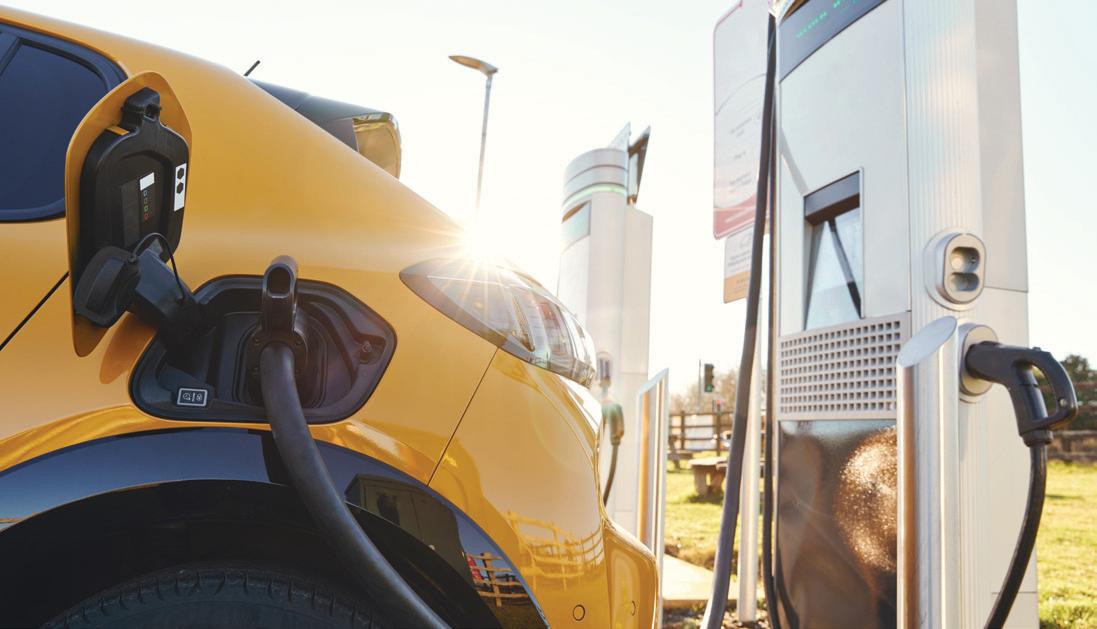
Canada’s shift to electric vehicles is slowing as consumers weigh cost, charging reliability and confidence, according to new data released by Ernst & Young. The firm’s annual Mobility Consumer Index, released March 19, found 30% of potential EV buyers in Canada reconsidered or postponed purchases amid broader economic and geopolitical uncertainty, while preference for internal combustion engine vehicles rose from 44% to 58% year over year. Battery electric vehicle preference fell from 15% to 7%, with hybrids holding at 17% as buyers looked for a middle ground between fuel savings and familiar refuelling.
collisionrepairmag.com/15816060
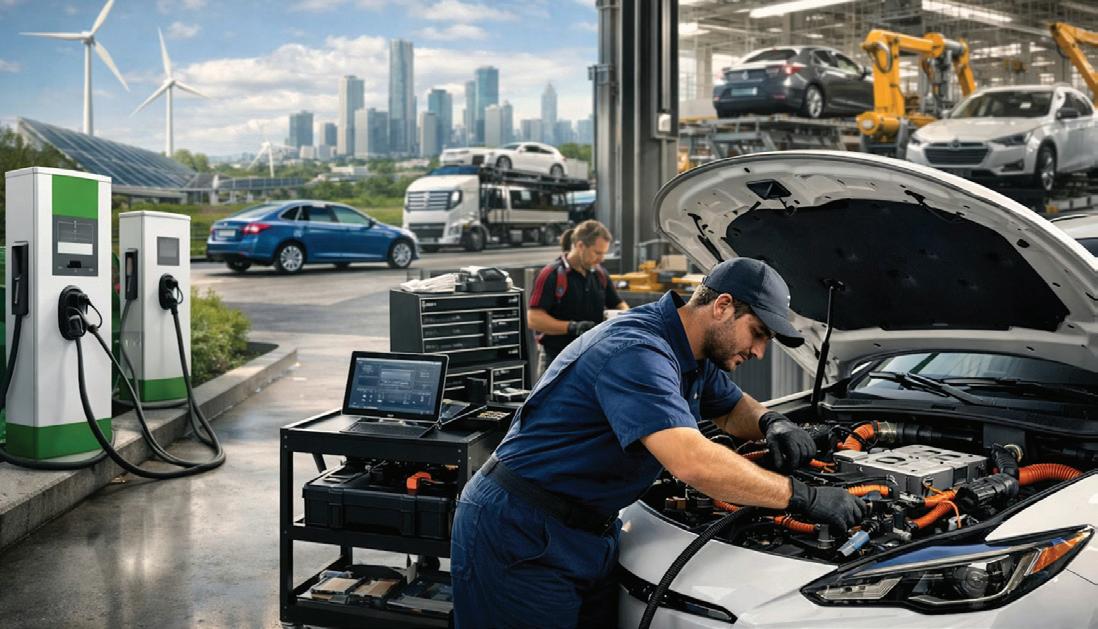
Canada’s new Automotive Strategy signals accelerating EV growth, with targets of 75% EV sales by 2035 and 90% by 2040. More than $97 million has been committed to charging infrastructure, fleet programs and EV education, alongside a $2.3 billion EV Affordability Program offering incentives of up to $5,000 for eligible vehicles. Stronger emissions standards will replace availability mandates, keeping electrification on track. For collision repair facilities and insurers, rising EV volume means increased demand for high-voltage expertise, battery diagnostics, OEM-compliant documentation and ongoing technician training.
collisionrepairmag.com/15817289
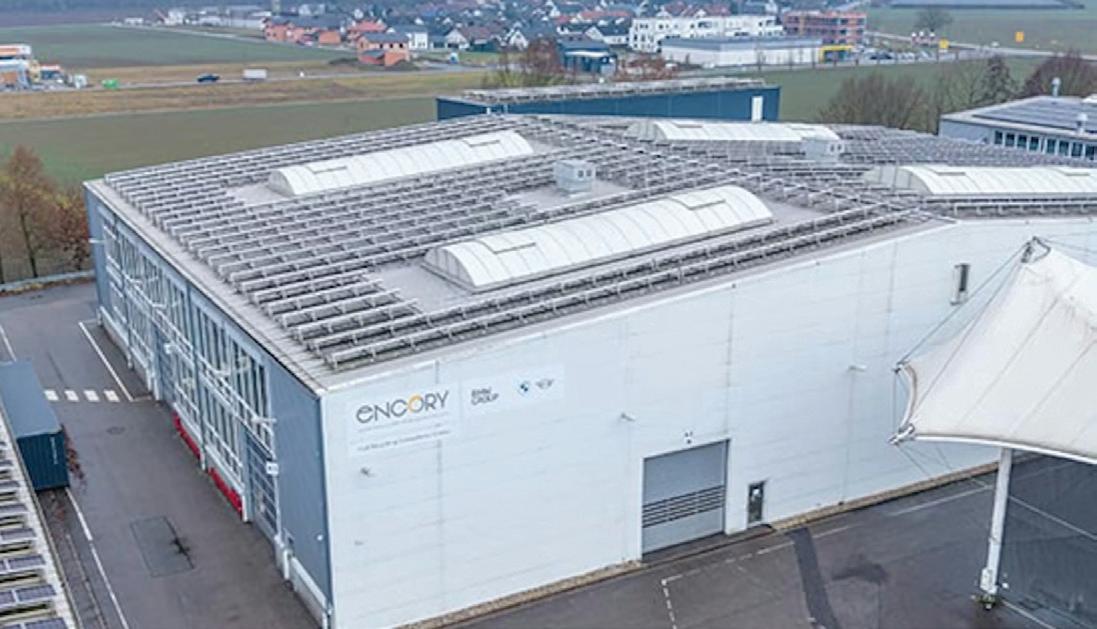
BMW Group and Encory GmbH have opened a battery recycling facility in Salching, Germany, aimed at returning production scrap directly to the manufacturing cycle. The Cell Recycling Competence Centre will mechanically dismantle residual material and battery cells without chemical or high-temperature treatment, using what the companies call “innovative direct recycling.” At full capacity, the site is expected to process roughly 50–90 metric tonnes annually, with recovered materials reused in pilot production. Encory will operate the facility, which is expected to employ about 20 people.
collisionrepairmag.com/15816965
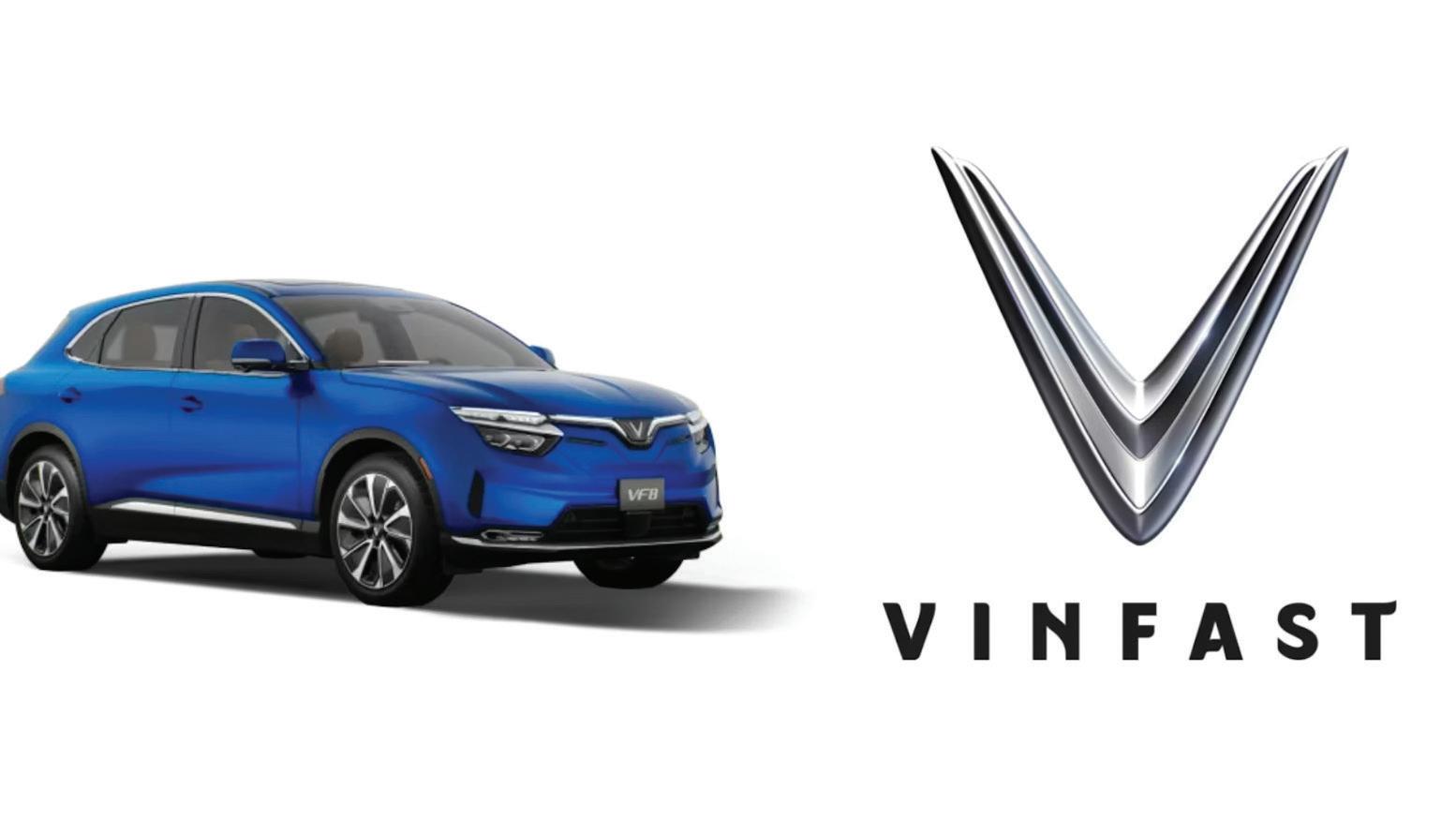
The VinFast VF8 is now eligible for the Government of Canada’s $5,000 federal EV incentive under the Incentives for Zero-Emission Vehicles program as of Feb. 16, 2026. Combined with provincial programs, total rebates can reach up to $18,000, bringing the SUV’s starting MSRP to $35,070 with eligible credits applied. VinFast positions the midsize electric SUV as a premium model backed by a 10-year or 200,000-kilometre warranty. The rebate marks another step in the brand’s Canadian expansion within the competitive EV market.
collisionrepairmag.com/15818607





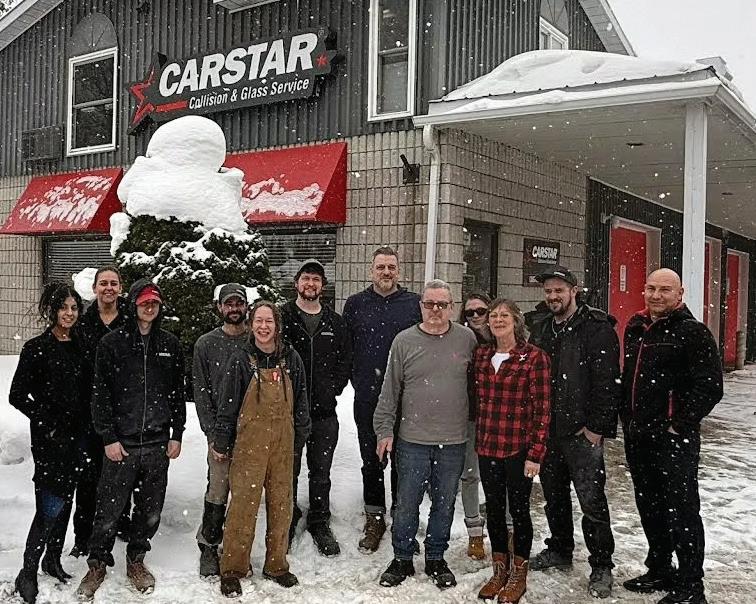
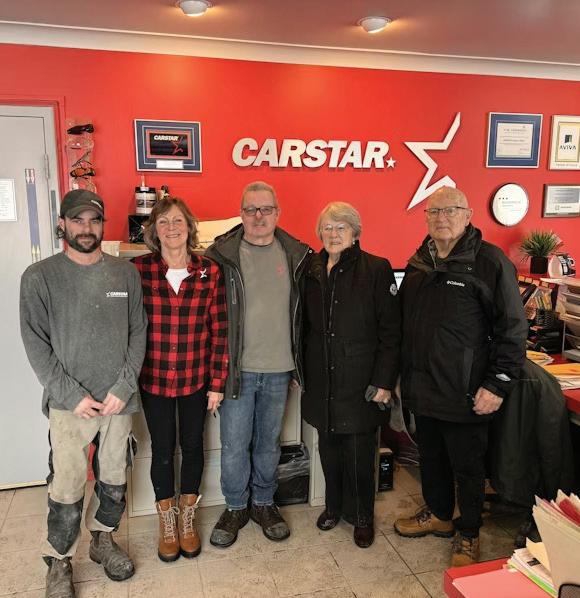
CARSTAR Fergus has been acquired by Saputo Capital Collision Group, marking the end of the Giles family’s 70-year connection to the facility. Mark and Kathy, owners since 1996, recently completed their final days onsite. SCCG leadership says the focus will be preserving the shop’s culture while introducing modernized systems and OEM-aligned standards. Lauren Benge has been appointed location manager, overseeing daily operations and team development as the eight staff members transition into the new ownership structure. collisionrepairmag.com/15817043
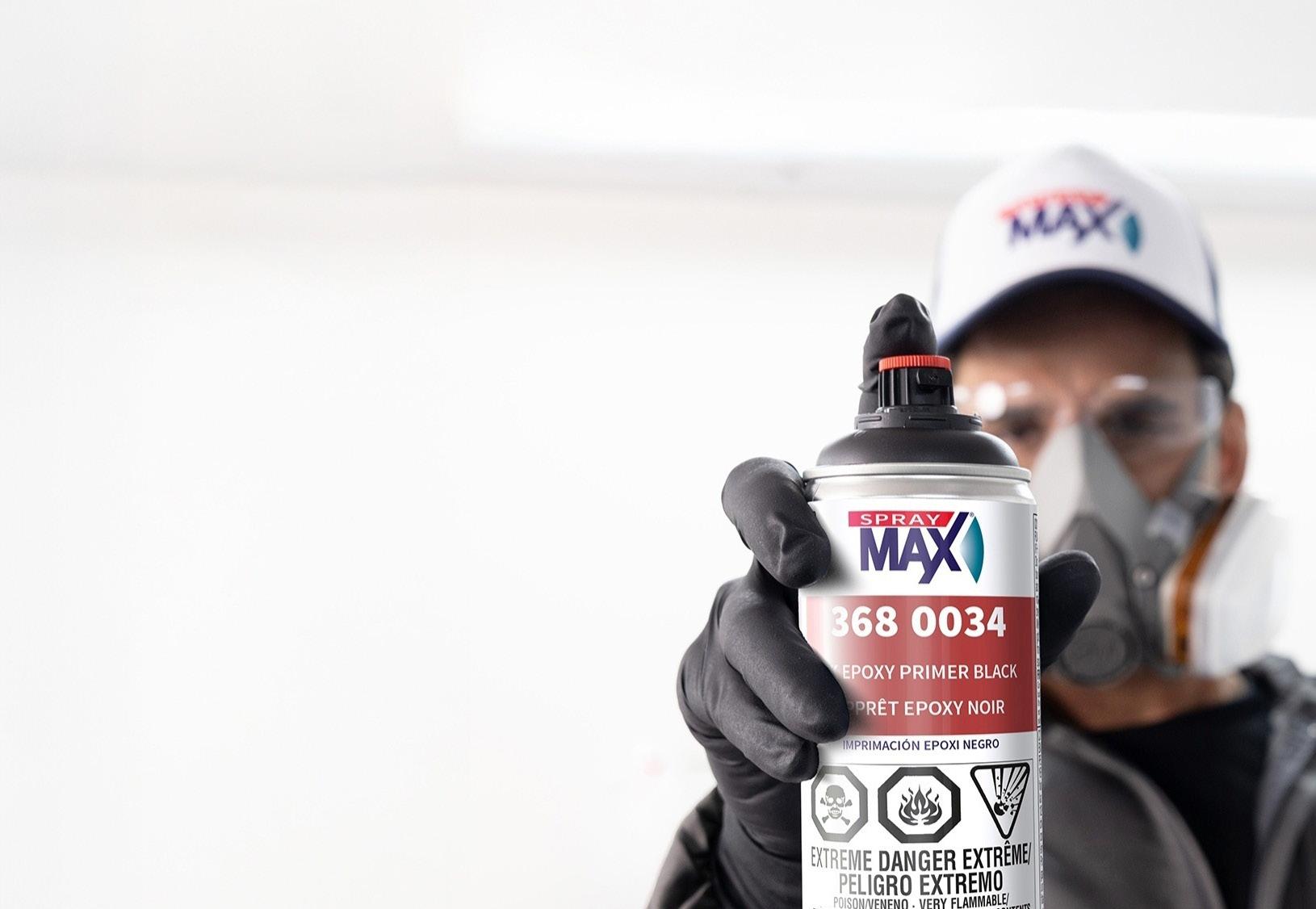
For repairs, restoration and new parts.
Excellent adhesion and corrosion protection properties
Smooth flow, resulting in ease of use
Outstanding insulating & sealing properties
Recoatable with all solvent and water-borne basecoats, as well as single stage topcoats
Long potlife: 72 hours / 68°F
“ I opened a small body shop in 1991 to complement our family Nissan dealership. For the first 10 years, keeping up with collision repairs was a constant struggle—until we joined CARSTAR. The support and resources from the CARSTAR network have been a game-changer. Thanks to their guidance, we were able to double the size of our facility and grow our sales tenfold over the last 20 years. We are proud to be part of the CARSTAR family and grateful for the role they’ve played in our continued success.”
— Mark MacDonald Owner, CARSTAR Sydney


AutoTrader has launched a ChatGPT integration allowing Canadian consumers to search vehicle listings using conversational prompts, positioning it as a first among domestic marketplaces. Users can request vehicles by criteria such as body type, fuel type or location, view listings within the chat and link to full details to contact sellers.Built in partnership with OpenAI, the feature reflects growing demand for natural language search and may expand dealer exposure. The integration is available in English and French through ChatGPT’s Apps section.
collisionrepairmag.com/15816123
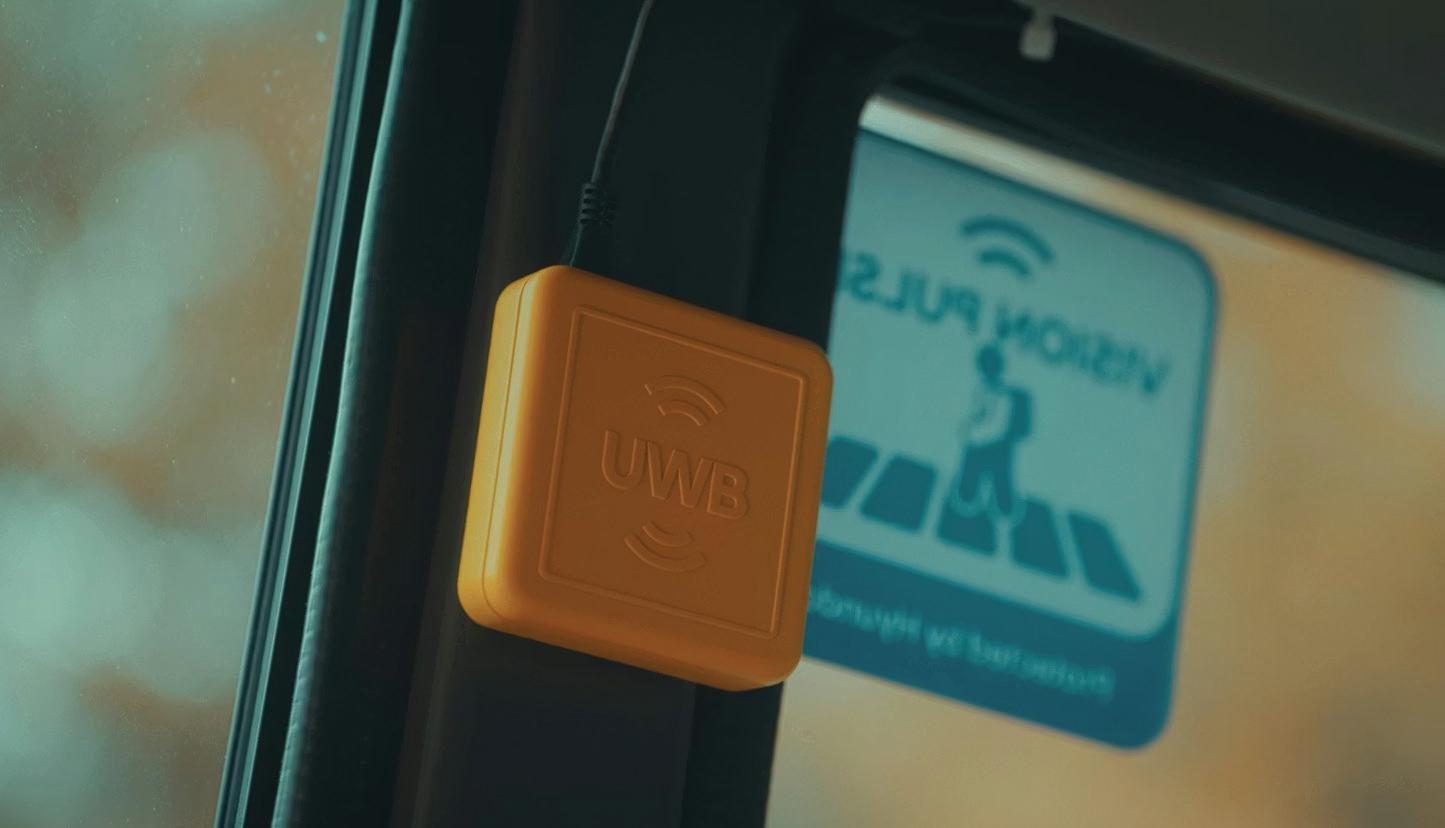
Hyundai Motor Company and Kia Corporation have unveiled Vision Pulse, a safety technology using ultra-wide band signals to detect vehicles, cyclists and pedestrians beyond a driver’s line of sight. UWB modules measure signal travel time between equipped objects, calculating positions in real time and issuing alerts. The system detects objects within 100 metres with 10-centimetre accuracy, maintaining 99% detection in poor conditions. Pilot programs are underway in South Korea, with mass-production applications still under review.
collisionrepairmag.com/15816205
New reports point to rapid growth in the global advanced driver assistance systems market. Research and Markets projects expansion from US$35.44 billion in 2025 to US$94.94 billion by 2033, while Future Market Insights forecasts growth from US$280.5 million in 2026 to US$818.2 million by 2036. Yet readiness remains uneven. Revv reports 86% of North American shops perform calibrations in-house, but only 21% have fully optimized processes, underscoring operational gaps as ADAS adoption accelerates.
collisionrepairmag.com/15816499
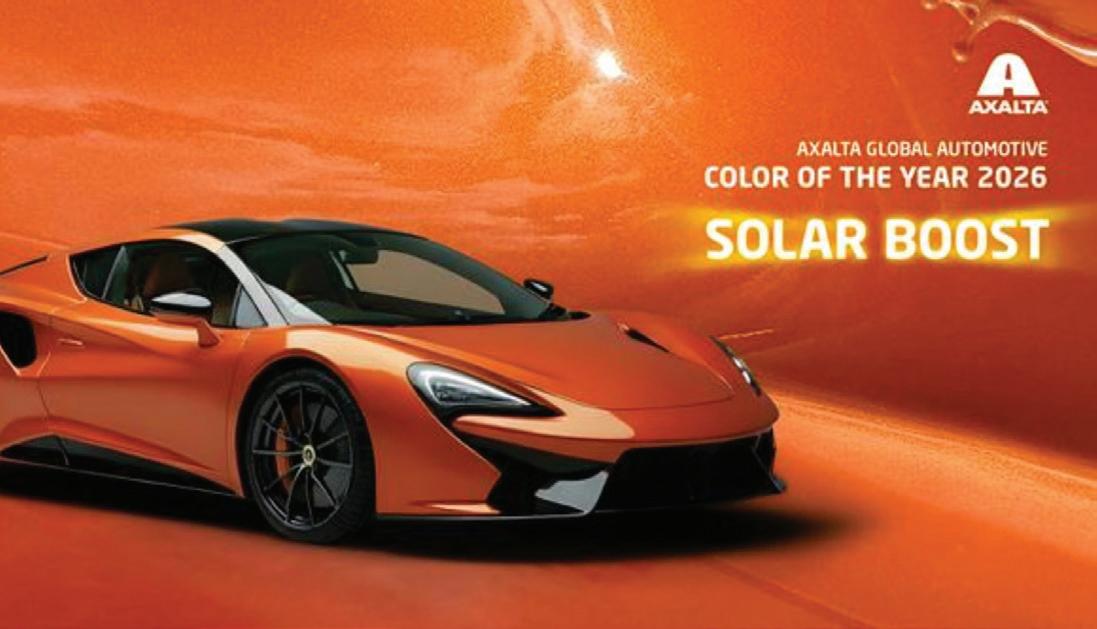
Axalta Coating Systems has named Solar Boost its 2026 Global Automotive Color of the Year, citing growing demand for expressive vehicle finishes. The selection follows global colour research linking orange to optimism and individuality, particularly among younger buyers and EV consumers. Company research shows more than 80 percent of buyers consider colour a key purchasing factor. Solar Boost marks Axalta’s 12th Global Automotive Color of the Year, part of its broader forecasting efforts supporting OEM design strategies.
collisionrepairmag.com/15817185
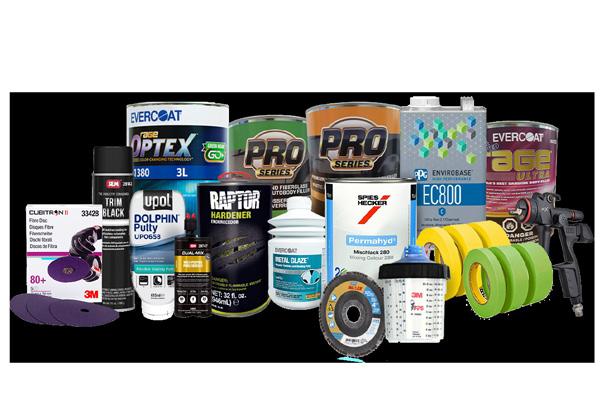
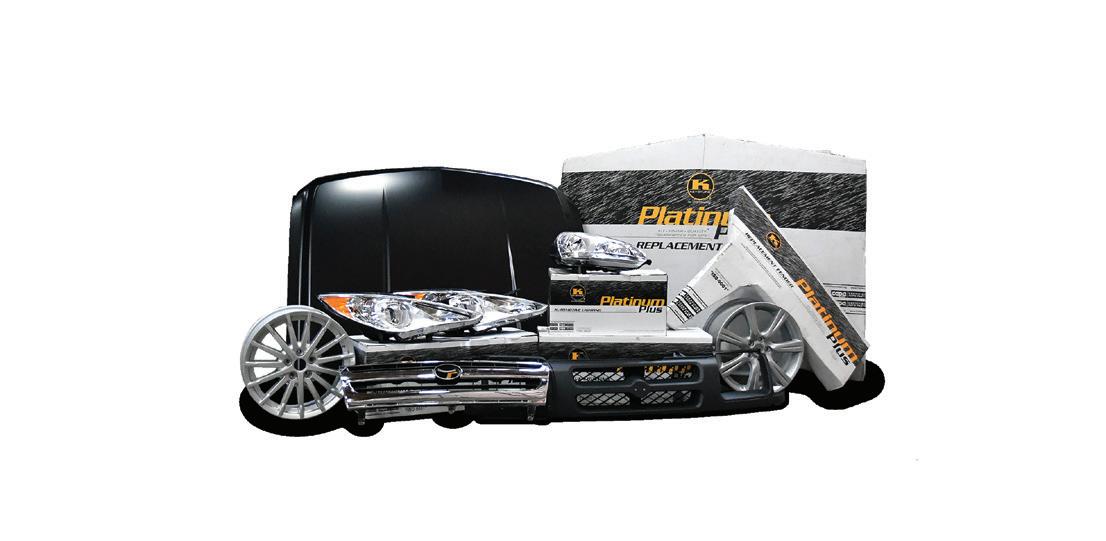
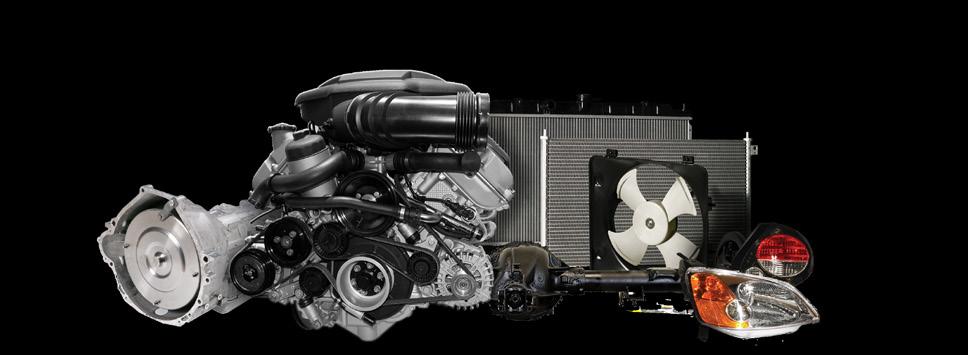
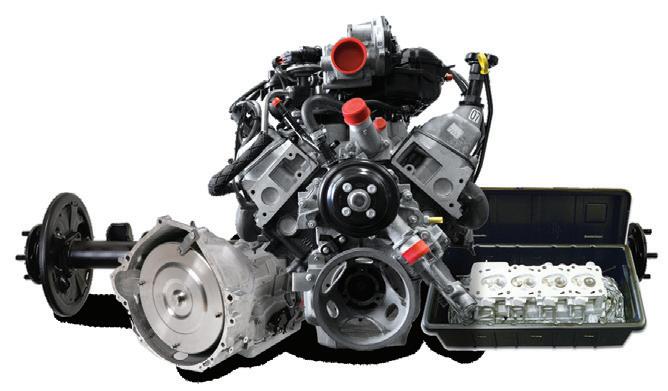
With more than 500 locations across North America and thousands of dedicated employees to serve you, LKQ has the automotive parts you need.
Whether it’s Paint, Aftermarket, Recycled, or Transmissions & Engines, we’ve got it!




Definity Financial Corporation has closed its $3.3 billion acquisition of Travelers’ Canadian P&C operations, lifting combined annual gross written premiums to about $6.3 billion and placing it among Canada’s top five property and casualty insurers. The insurer reported a Q4 2025 combined ratio of 89.9%, improved from 90.3% a year earlier, with underwriting income rising to $111.5 million. Personal auto premiums increased 9.7% in the quarter, while full-year net investment income reached $215.7 million, up from $198.2 million in 2024.
collisionrepairmag.com/15817366
Insured losses from severe weather in Canada totalled $2.4 billion in 2025, down from a record $9.4 billion in 2024, according to Catastrophe Indices and Quantification Inc.. Despite the drop, 2025 ranks as the country’s 10th costliest year on record. Major events included an ice storm in Ontario and Quebec, Prairie wildfires and storms and flooding in British Columbia. Insurance Bureau of Canada noted annual insured losses now routinely exceed $1 billion, reflecting intensifying severe weather trends.
collisionrepairmag.com/15816773
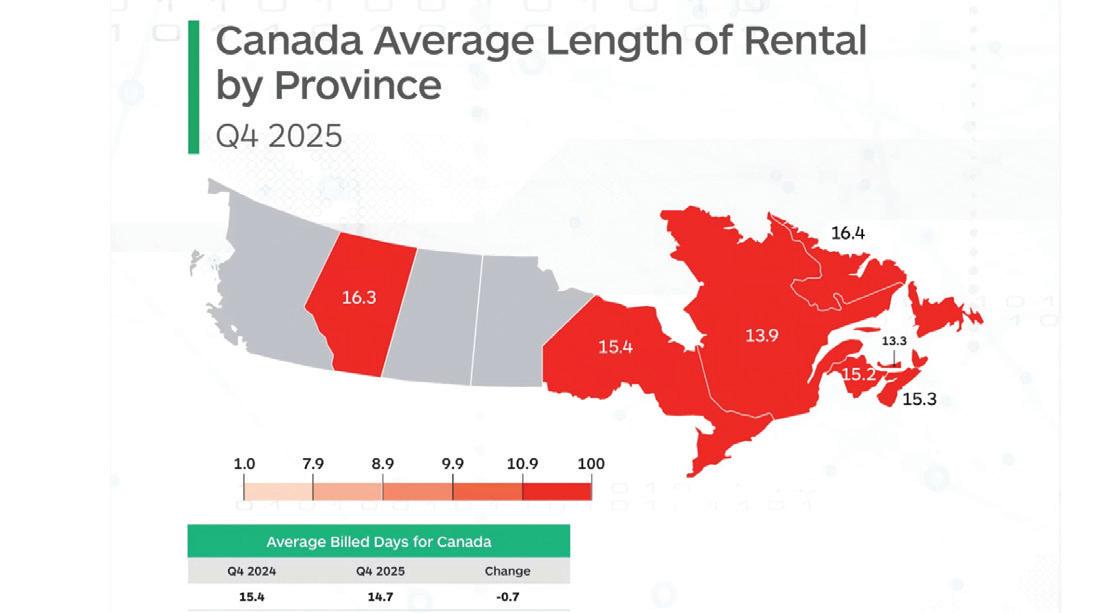
Enterprise Rent-A-Car reports Canada’s average collision-related length of rental fell to 14.7 days in Q4 2025, down 0.7 days year over year, signalling gradual stabilization. Newfoundland and Labrador recorded the highest LOR at 16.4 days, while Prince Edward Island was lowest at 13.3 days. Drivable claims averaged 12.2 days, while non-drivable claims reached 24.6 days. Total loss rentals dropped to 17.7 days. The report also noted newer vehicle model years and increased use of alternative parts in repairs.
collisionrepairmag.com/15816644
Claims satisfaction among Canadian auto insurance customers reached 81% in 2025, up eight points from 2023, according to the 2026 study from Rates.ca. The survey of 14,676 Ontario drivers found improving claims experiences even as 36% chose insurers primarily for price. CAA Insurance Company ranked first overall for the third year, followed by Intact Insurance, while Northbridge Insurance led in claims satisfaction. The report noted rising awareness but limited adoption of usage-based programs.
collisionrepairmag.com/15816019

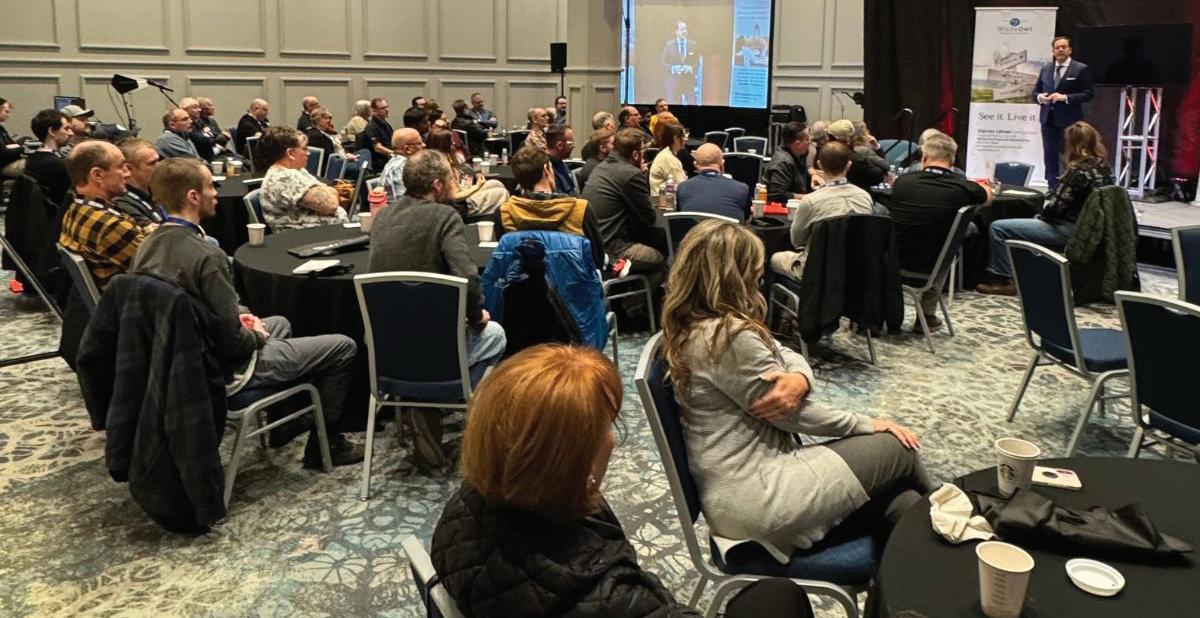
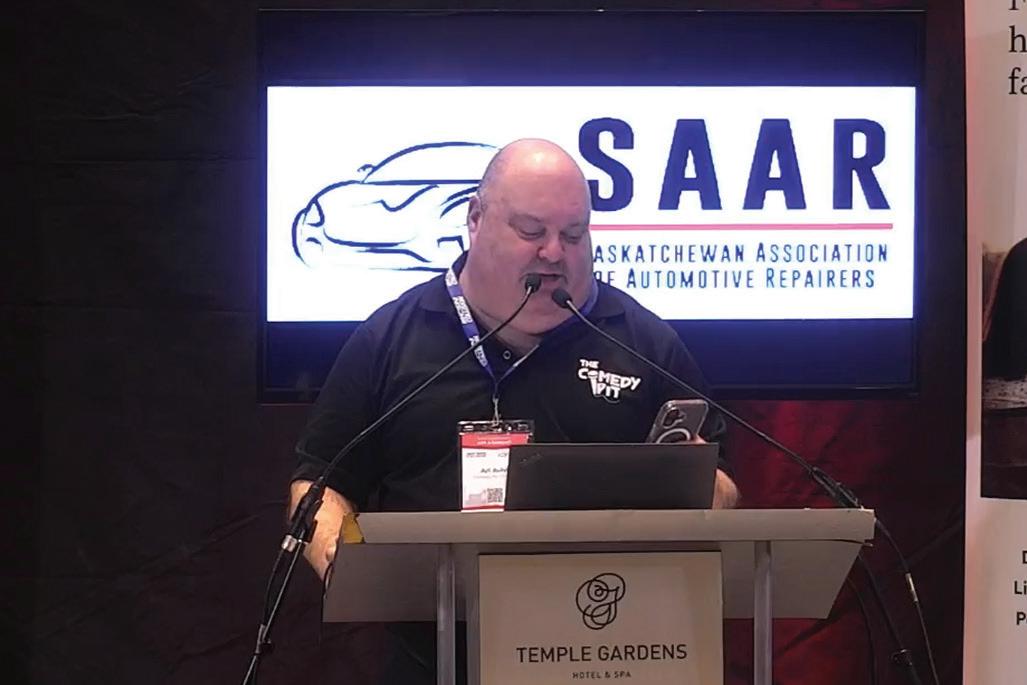
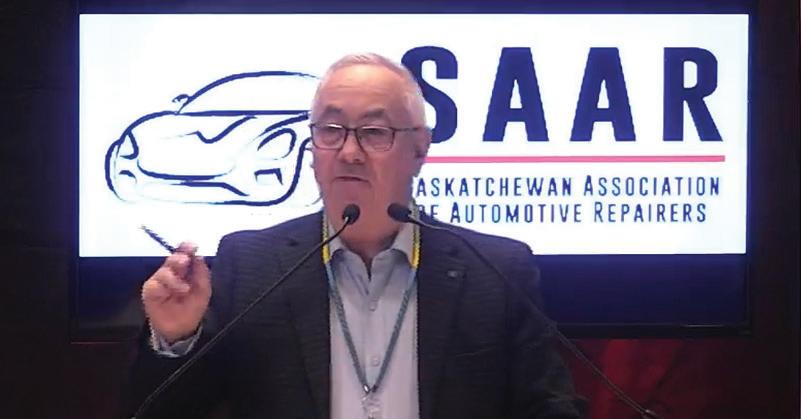
Akeynote on succession planning set the tone at the Saskatchewan Association of Automotive Repairers’ 2026 spring AGM and conference, which focused on how unprepared many business owners remain for leadership transition.
“Our keynote speaker, Tom Deans, absolutely knocked it out of the park,” said Tom Bissonnette, SAAR executive director and conference organizer, writing in the association's circular. He said the estate planning advisor “talked for 90 minutes straight without notes or PowerPoint and had everybody absolutely riveted.”
Deans’ message centred on the risks of failing to plan ahead, particularly for shop owners with accumulated assets and businesses tied to family outcomes.
“His talk was aimed mainly at business owners, but pretty much anybody who has created any kind of wealth portfolio would be well advised to at least read his books or attend one of his speaking engagements,” Bissonnette told Collision Repair.
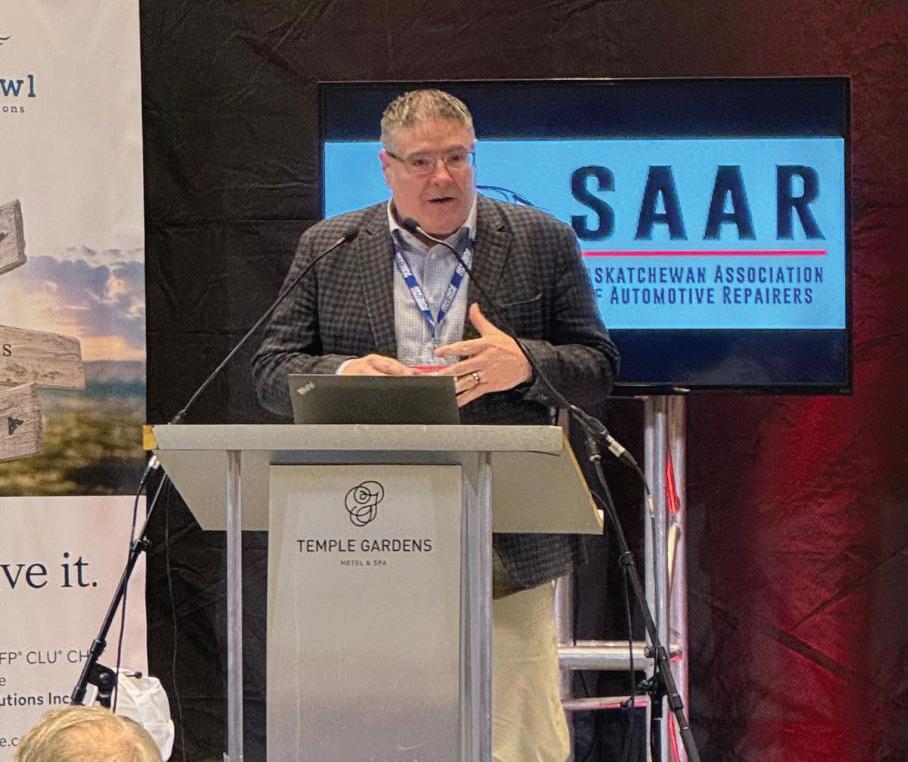
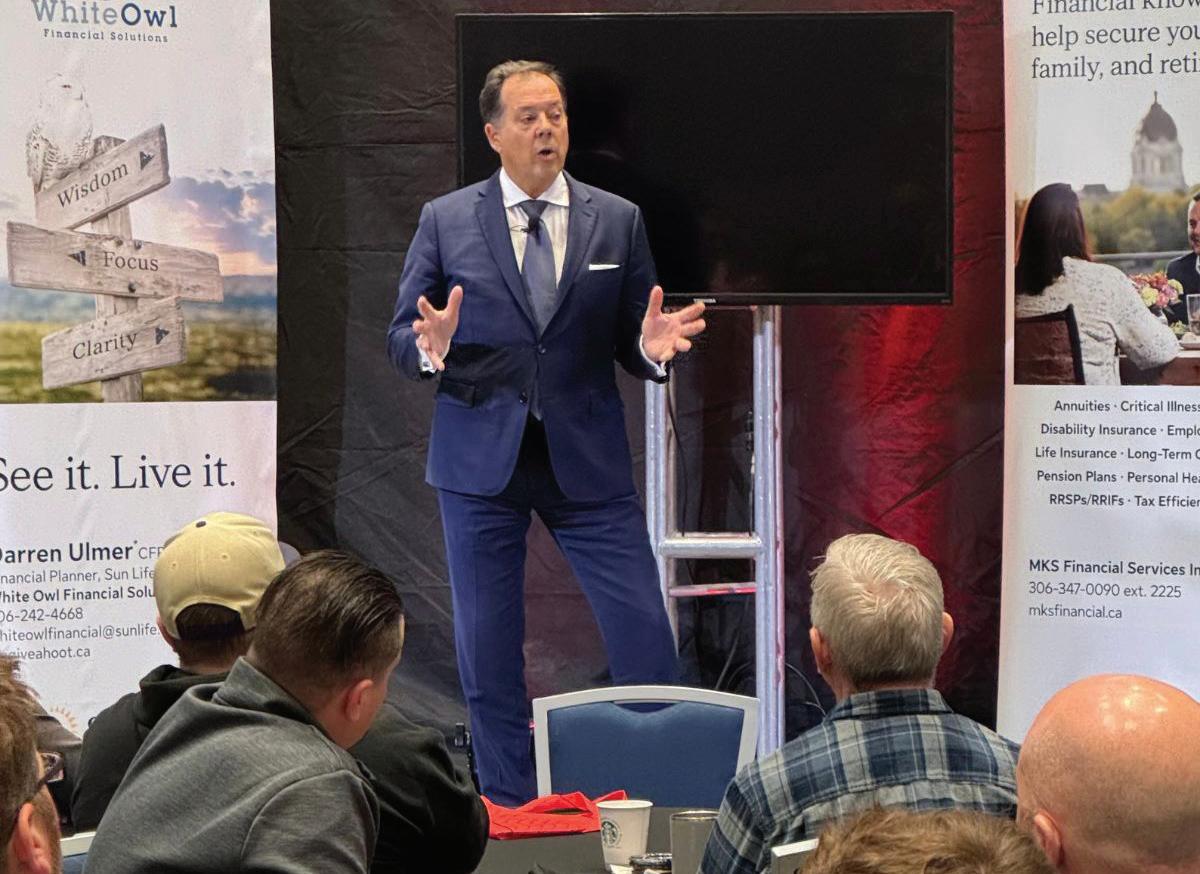
He noted that Deans’ presentation included one suggestion many collision business owners have failed to heed: to ensure their successor is appointed prior to their death. “The one key thing I heard is that you need to have a will and share what’s in it with your family before anything goes sideways.”
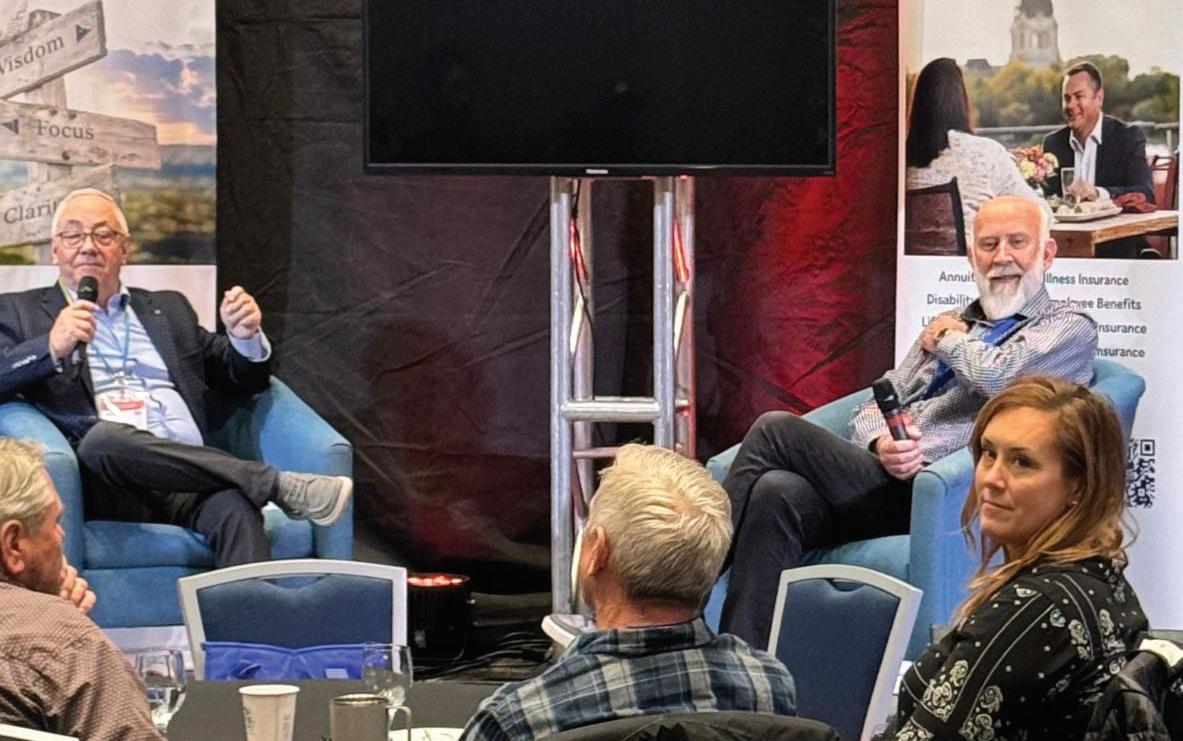
Similar themes emerged during the panel that followed the keynote, which brought together Darren Ulmer of White Owl Financial, Regina financial planner Mike Spicer and Mackenzie Tulloch of McDougall Gauley LLP to discuss estate planning, financial transparency and other legal considerations tied to ownership transition.
Discussions later in the conference shifted toward operational pressures, particularly Saskatchewan Government Insurance’s planned Parts Autonomy program.
“The Parts Autonomy program has a number of people concerned because they’re not sure how this change is going to affect their
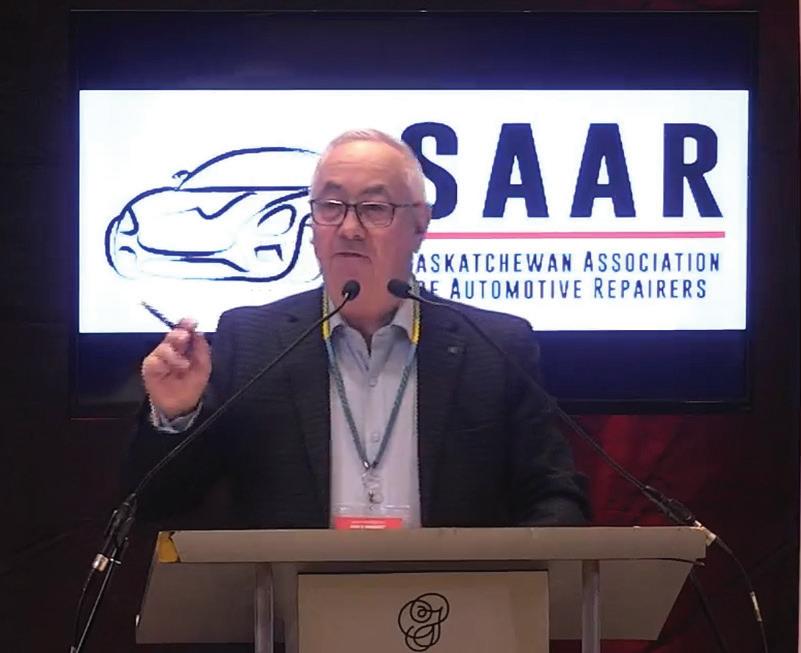
business,” Bissonnette told Collision Repair.
The program, already in place in Manitoba, is designed to give shops more flexibility in parts sourcing if they meet insurer targets, but requires closer tracking of parts performance.
SGI vice-president Ciaran Downes told attendees the insurer is facing financial pressure, with no rate increases since 2014 limiting room for additional compensation to repairers.
Despite that, recent discussions resulted in measures including paid time for OEM repair planning, funding for training and a 4.5% increase in door rates over three years.
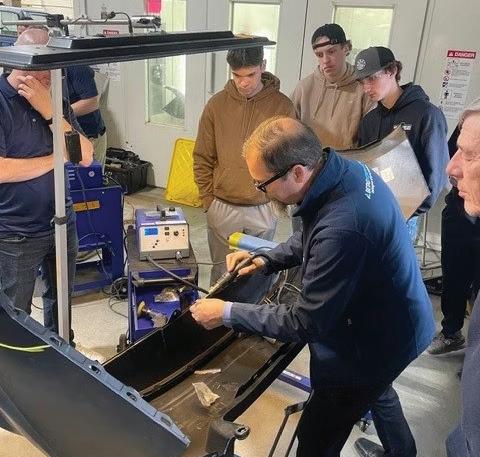
“We have a good working relationship with SGI and we need to understand that we have to work with them for everybody to be sustainable,” Bissonnette told Collision Repair Training and workforce development were also emphasized throughout the event. About 130 students took part in Friday sessions on
ADAS and plastic repair at Peacock High School. Kelly Roberts, the performance engineering director of BETAG North America and a widely respected voice in the Canadian collision industry, was among those who delivered training sessions during the event.
“The feedback that we received from all of the training attendees was super positive, especially with the students participating at the Peacock training events,” Bissonnette wrote.
Additional sessions featured Scott Sinclair of I-CAR Canada on training needs, and presentations from PPG’s Tom Parnell and Manitoba shop owner Norm Bruneau covering shop financials and operations.
The event concluded with a banquet recognizing past president Terry Beattie.
Bissonnette noted in the circular that the association’s next event will be a golf tournament in June and added it may be his final one as organizer.
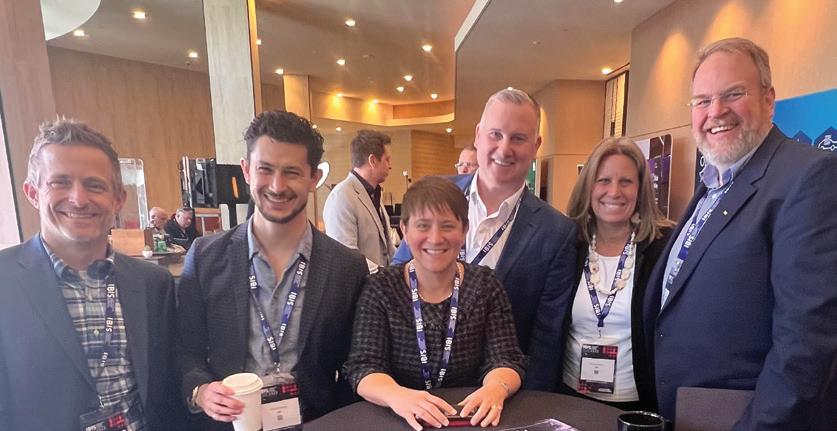
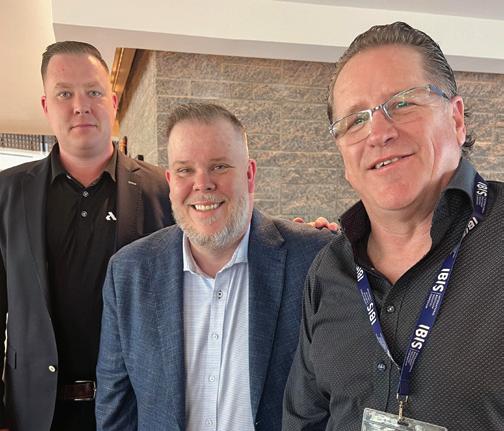
IBY DARRYL SIMMONS
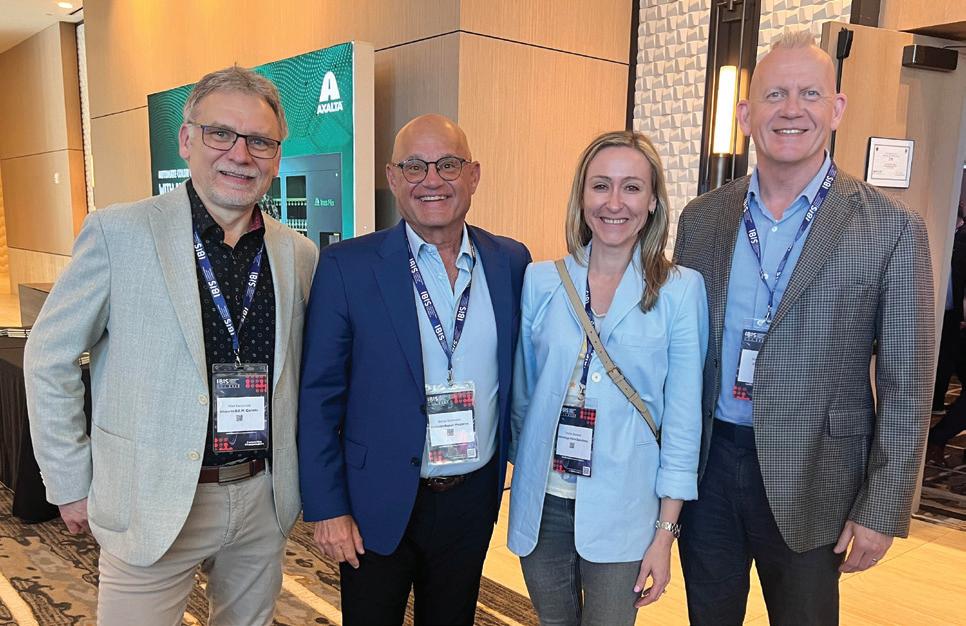
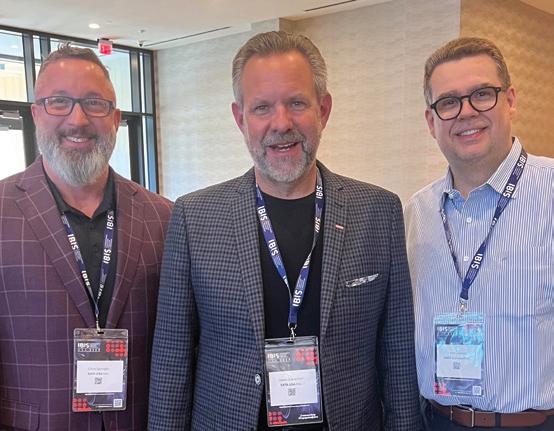
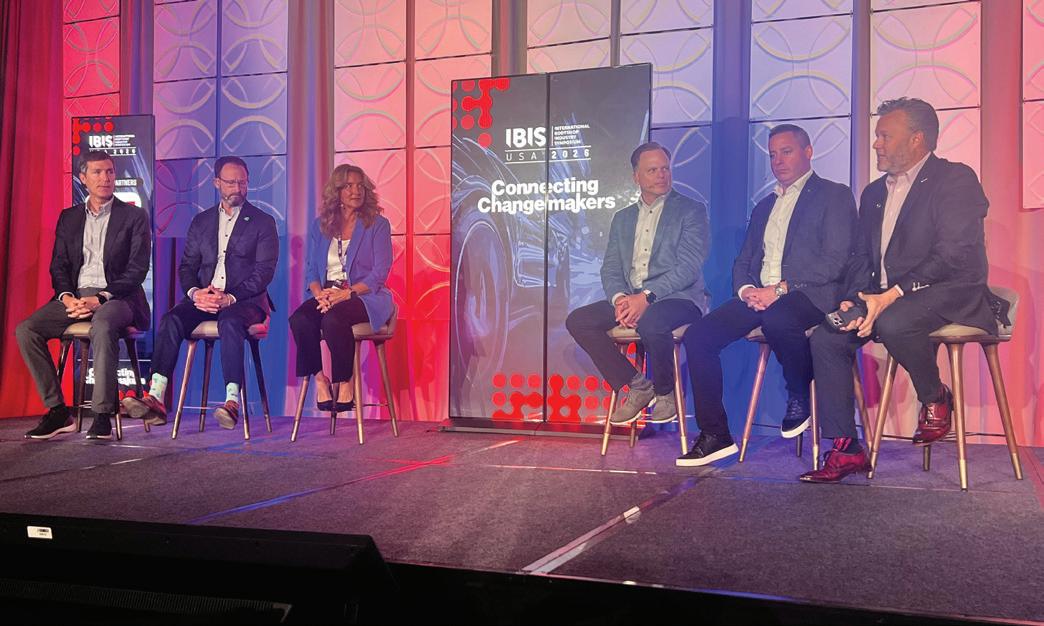
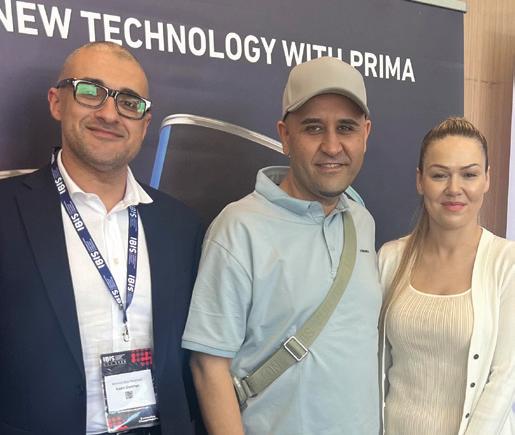
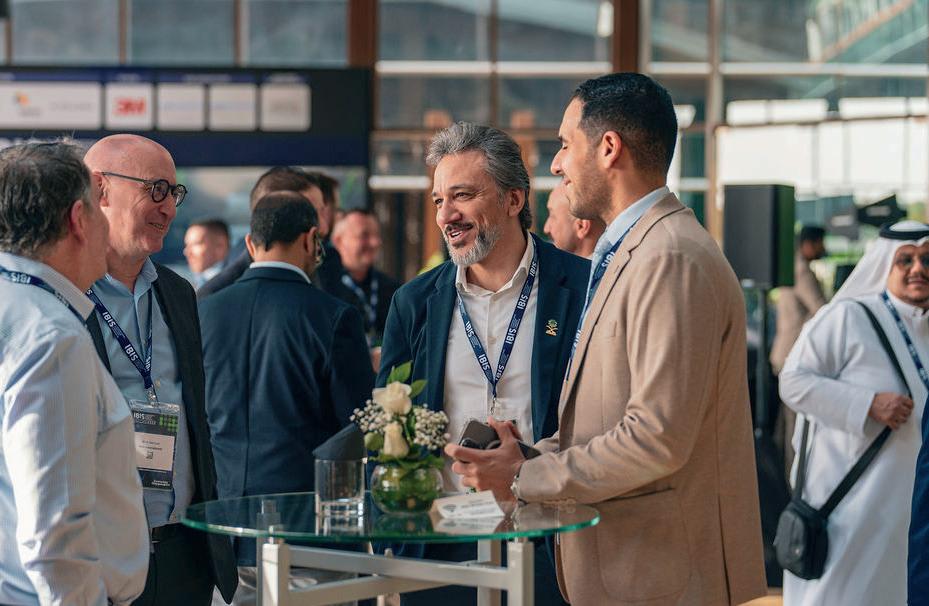
f there was one clear takeaway from IBIS U.S.A., it’s this: the path forward for collision repair will be shaped by those willing to challenge how the industry thinks, learns and works. Collision repair leaders gathered in Scottsdale to discuss the structural and technological pressures reshaping the industry. Events like this — where ideas are tested, debated and shared — are where that shift begins.
The conversation opened with a hard truth. As an industry, we’re not as good as we think we are — and the risk of getting it wrong is rising fast.
For years, success meant ensuring a vehicle performed in a second collision. That still matters. But today, with ADAS, the stakes are higher. Shops now play a role in helping drivers avoid accidents altogether. Miss a calibration or rely on outdated methods, and the consequences go beyond a poor repair — they become real safety risks.
That message was reinforced by Jeff Peevy of I-CAR, who pointed to a deeper issue: the industry isn’t struggling with tools — it’s struggling with mindset. Complexity is accelerating. Sensors, cameras and joining methods are evolving quickly, yet many repairs are still approached with old habits. Peevy’s message was simple: learning velocity
matters. Not what you know — but how fast you can learn and unlearn. Experience still has value, but its shelf life is shrinking.
EV risk was another clear focus. Dirk Fuchs of the Energy Security Agency pointed to battery handling, storage and transport as growing operational exposures. Standards like NFPA 855 are quickly becoming baseline, while tighter transport regulations will require certified packaging and trained staff across the entire operation.
The conversation around AI brought it back to the shop floor. Keith Crerar of asTech pointed to a reality every shop recognizes: the problem isn’t a lack of talent — it’s process. Estimators are buried in disconnected systems, spending more time figuring out the job than planning it. The opportunity is practical—remove repetitive steps, improve how information is interpreted and reduce uncertainty earlier in the repair. Shops that streamline workflow and improve communication, especially with customers, will move faster and build trust without adding workload.
The afternoon session challenged the industry to look beyond the shop. With consolidation, insurer influence, emerging fleet models and shrinking margins, the question was direct: is the future being
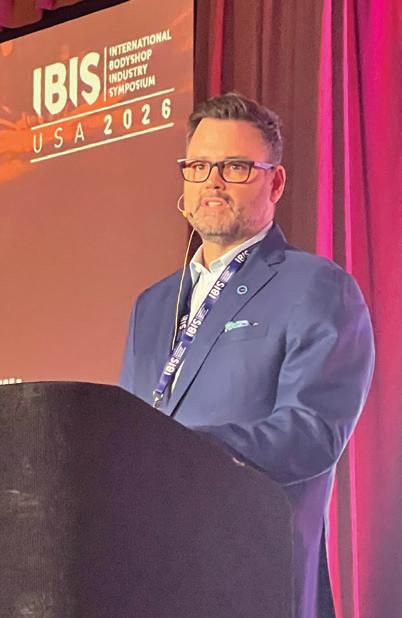
shaped — or simply accepted? The idea of “changemakers” came into focus here. Those willing to question the current model, align around what proper repair actually requires and take an active role in defining what comes next will influence where the industry lands.
Running through the entire day were the familiar themes. Shops are being asked to take on more — training, compliance and increasingly complex repairs — while write-offs increase and the number of accidents decrease.
But there was also something more constructive beneath it. When leaders from across the industry come together — OEMs, shops, insurers, technology providers — there’s an opportunity to close gaps, challenge assumptions and move forward with a clearer, shared understanding. That’s where progress starts.
IBIS U.S.A. didn’t just highlight the challenges. It showed where the momentum is coming from. And if there’s a key to success in a market this complex, it’s this: conversations like these — real, honest and sometimes uncomfortable — are what turn an industry into a community of “change-makers.”
IBIS has announced that its flagship global event, the IBIS Global Summit 2026, will take place at the Andaz Vienna Am Belvedere in Vienna from 16–18 June 2026, with early bird registration now officially open.
The annual Summit will once again bring together senior leaders from across the collision repair and wider automotive ecosystem, providing a unique platform for insight, connection and high-level discussion focused on the future direction of the industry.
Held under the global theme Connecting Changemakers, the 2026 edition will continue IBIS’s evolving conference format, designed to enable more meaningful interaction, deeper collaboration and practical outcomes for decision-makers across the international market.
The Summit attracts influential stakeholders from across the sector, including:
• Multi-site operators and independent bodyshop leaders
• Insurance companies and vehicle manufacturers
• Technology and solution providers
• Paint, materials and coatings specialists

The IBIS Global Summit has long been recognised as a key meeting point for the industry’s most senior figures - a forum where strategy is debated, partnerships are formed, and the future of collision repair is shaped.
Early bird registration is now available for a limited time, offering delegates the opportunity to secure their place at a preferential rate.
https://ibisworldwide.com/ibis-globalsummit-2026/ibis-global-summit-2026registration/
Organisations looking to position themselves at the centre of the global collision repair conversation can benefit from a range of IBIS partnership opportunities, designed to maximise brand visibility, industry access and commercial impact.
The IBIS Global Summit 2026 will welcome changemakers from around the world to Vienna this June, continuing its mission to connect the leaders shaping the future of the automotive collision repair industry.
For the latest updates, visit www.ibisworldwide.com or follow IBIS Worldwide on LinkedIn.
Contact Emily Miles at emily@ibisworldwide.com for all registration bookings and queries.
Contact Louise Cooke at louise@ibisworldwide.com for all event-related enquiries.
For partnership enquiries, contact Suzie Scott, IBIS Worldwide Head of Sales, at suzie@ibisworldwide.com or call +44 7545 068455
16 – 18 June 2026 Andaz Vienna Am Belvedere, Austria


Join us for the IBIS Global Summit 2026, taking place from 16 – 18 June in Vienna. This year’s summit provides a structured, multiday conference for senior professionals across the collision repair industry to exchange evidence-based insight, benchmark best practice, and build meaningful professional relationships.
From data-led sessions to structured networking and roundtable discussion, delegates gain practical insight and strategic perspective to support informed business decisions.
Experience three days of insightful content, collaborative discussion and high-quality engagement, set within the dynamic and historic surroundings of Vienna.

In an industry increasingly shaped by consolidation, scale and short-term thinking, 40 years of independence is more than a milestone — it is a deliberate choice.
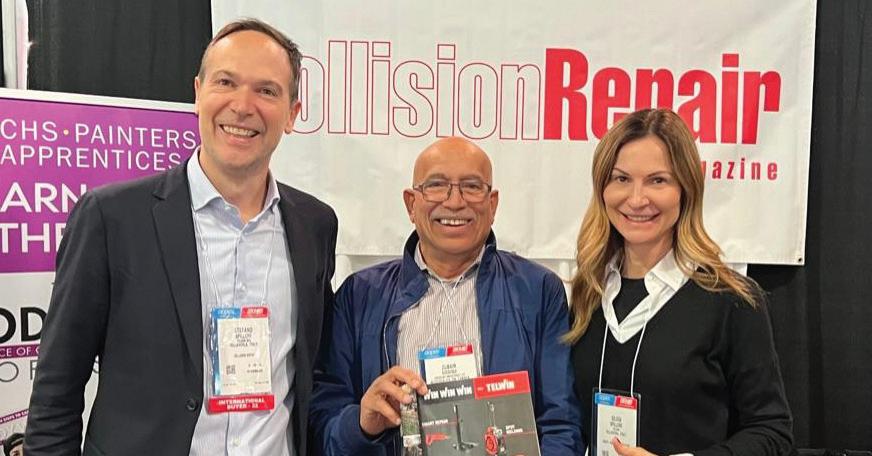
For Zubair Siddiqui, president of Crescent Industries, that choice has defined four decades of business. Founded in 1986, Crescent has remained independent in a market where independence is becoming rare, earning trust not through size or volume, but through consistency, accountability and a genuine commitment to its customers.
Longevity alone, however, is not what makes Siddiqui’s story worth telling. What sets Crescent apart is its continued relevance. Over four decades, Siddiqui — known throughout the industry as Zuby — has adapted to sweeping changes in materials, coatings, equipment and OEM repair expectations,
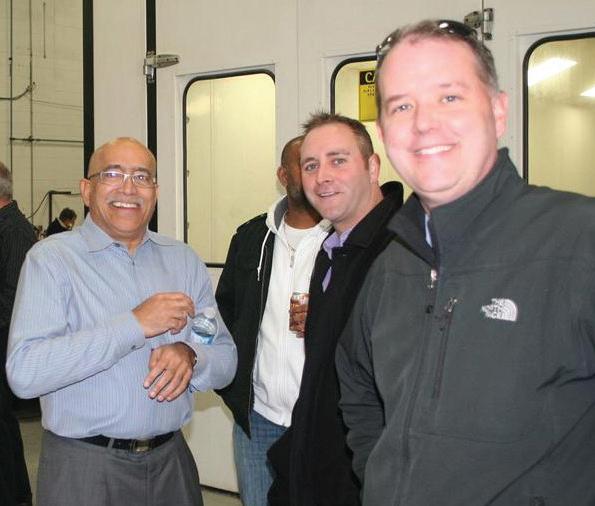
while staying true to a core philosophy built on transparency, relationships and care.
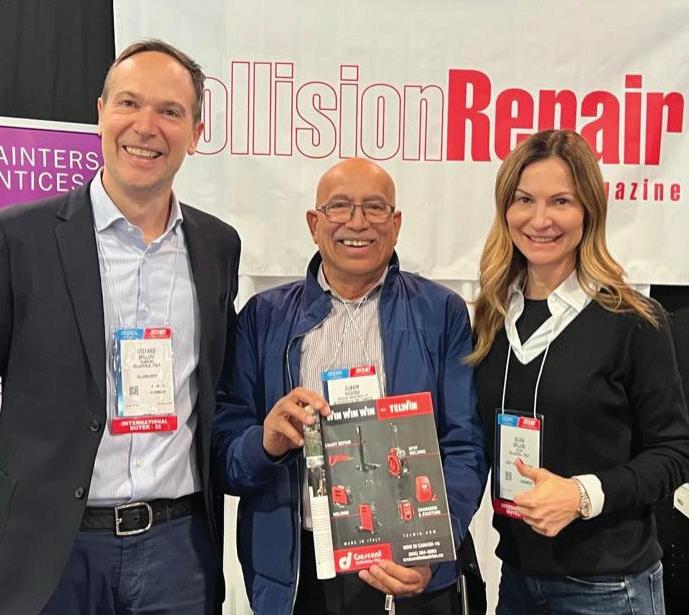
That philosophy is evident in Crescent’s carefully assembled product lineup. Over the years, the company has built longstanding partnerships with global industry leaders such as 3M and BASF, relationships that speak to credibility earned over time rather than negotiated scale. More recently, Zuby added Telwin, a globally recognized Italian manufacturer of welding machines, cutting systems and battery chargers, marking the inclusion of a mainstream international name brand aligned with the technical demands of modern collision repair.
These decisions are not departures from Crescent’s past, but extensions of it.
Crescent Industries began without a grand plan. In the mid-1980s, Zuby was working in the shoe and leather manufacturing business
and looking for a new direction when a chance meeting in the United States altered his course.
“I met a guy in the U.S. who showed me an isocyanate hardener we could sell at about half the price the big paint companies were charging,” he recalls.
Armed with a single product and determination, he began calling on collision repair shops directly. The work was handson and personal — making calls, answering questions and delivering product himself. Early sales were modest but consistent, enough to show there was room in the market for a supplier focused on fairness and follow-through.
The name Crescent Industries came from his father. “He told me to name it that,” Zuby says. “I didn’t question it.”
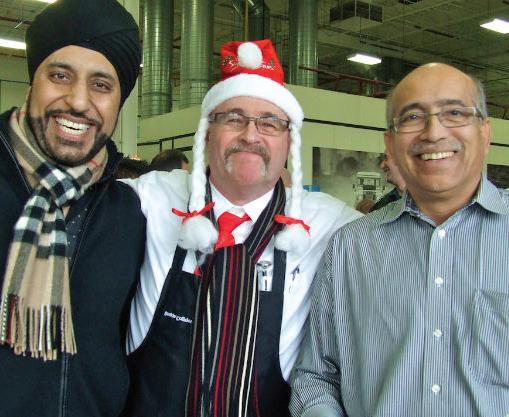
Over time, Crescent grew steadily alongside
"EQUIPMENT IS ONLY AS GOOD AS THE SUPPORT BEHIND IT."
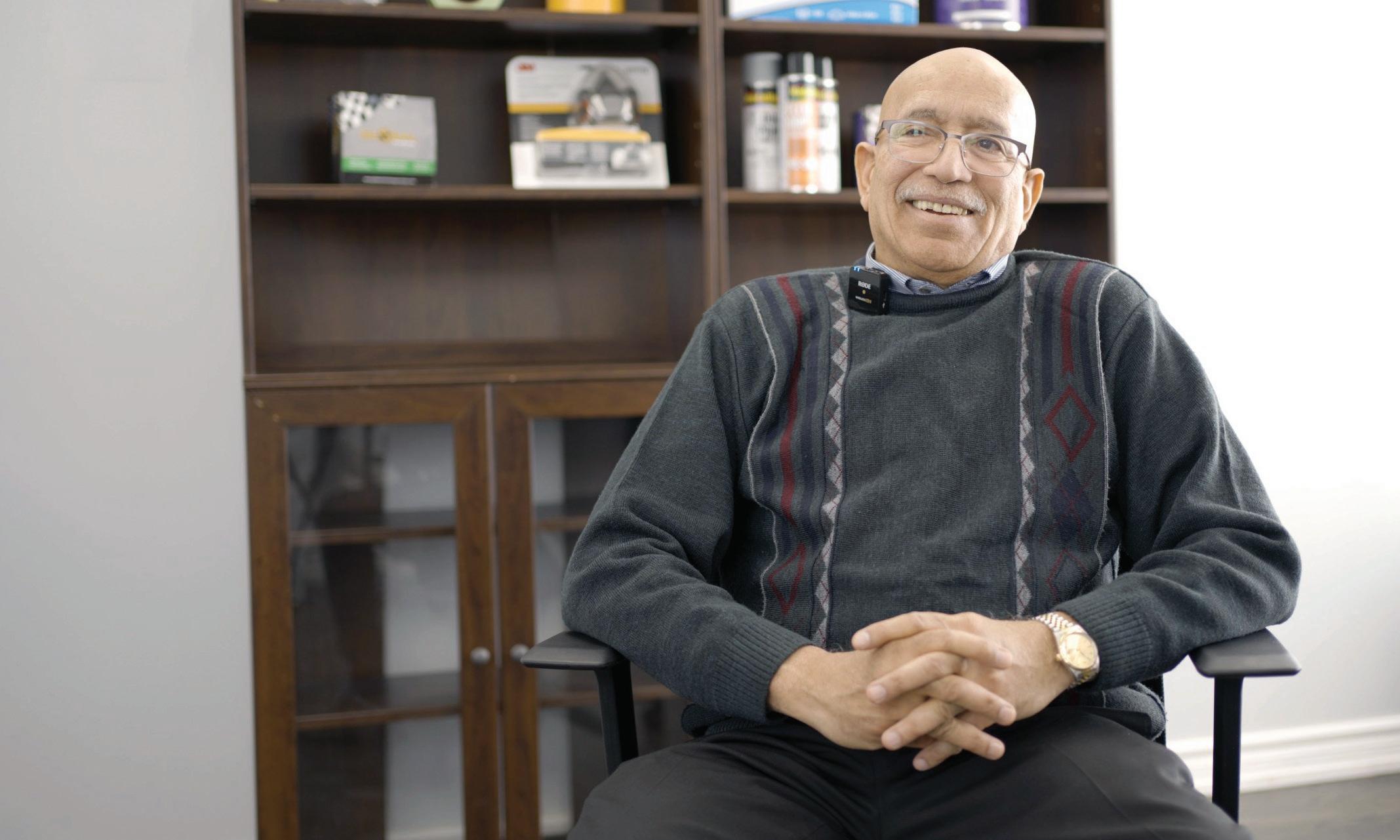
"BEING INDEPENDENT MEANS YOU'RE ACCOUNTABLE EVERY DAY. YOU DON'T GET TO HIDE BEHIND A HEAD OFFICE."
the collision repair industry itself. As vehicle construction, coatings and repair procedures became more complex, Crescent’s offering expanded accordingly. What began with a single hardener evolved into a comprehensive lineup of paint, body and equipment solutions tailored to the real-world needs of Canadian bodyshops.
A defining element of Crescent’s success has been Zuby’s ability to build and maintain relationships — not only with customers, but with manufacturers.
“They were built by doing what we said we’d do,” he says. “Consistency matters.”
That same thinking guided the decision to bring Telwin into Crescent’s lineup. As welding and joining become central to safe, OEM-compliant repairs, Siddiqui saw the need to offer globally recognized technology, supported locally with training, service and realistic expectations.
“Equipment is only as good as the support behind it,” he says.
— ZUBAIR SIDDIQUI
Rather than treating Telwin as a simple product addition, Zuby remains closely involved in how the brand is introduced in Canada, ensuring it fits Crescent’s service model and the realities of Canadian shops.
It is the same approach that has guided every major decision over the past 40 years: careful selection, honest guidance and accountability.
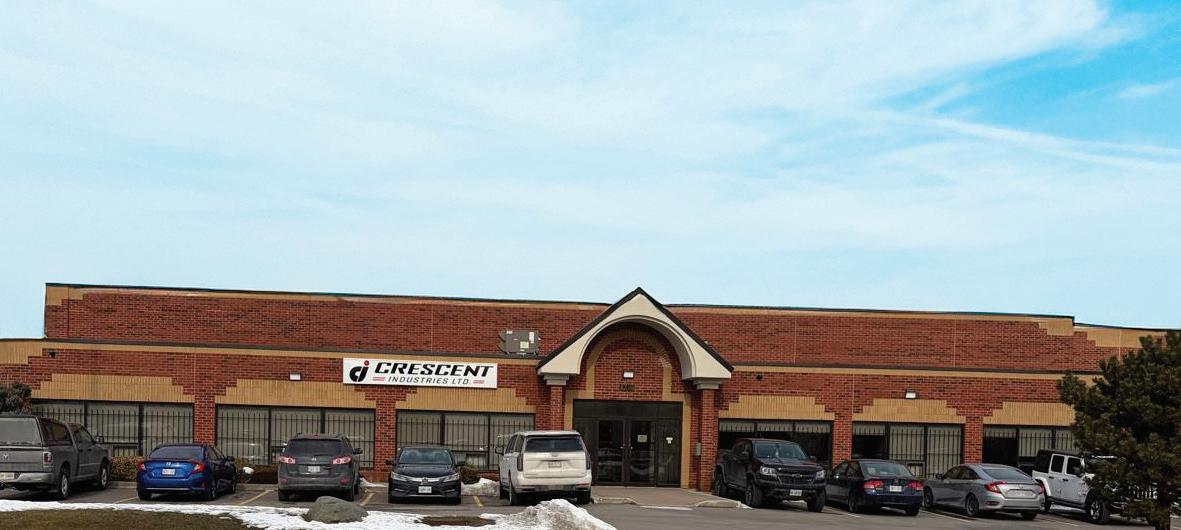
Today, Crescent Industries operates from a 35,000-square-foot facility on Midway Blvd., supported by a fleet of delivery vehicles serving customers throughout the Greater Toronto Area and as far west as London, Ontario. The company’s staff are known for their product knowledge and accessibility — qualities Siddiqui insists are essential.
Customer service, he says, is what sustains independence.
“We carry products at every price point,” Zuby explains. “But we’re always clear with customers about what they’re buying. Even budget products have to be the best in their category.”
That transparency has earned Crescent long-standing loyalty, with many customers relying on the company not only for materials, but for practical insight as repair requirements continue to evolve.
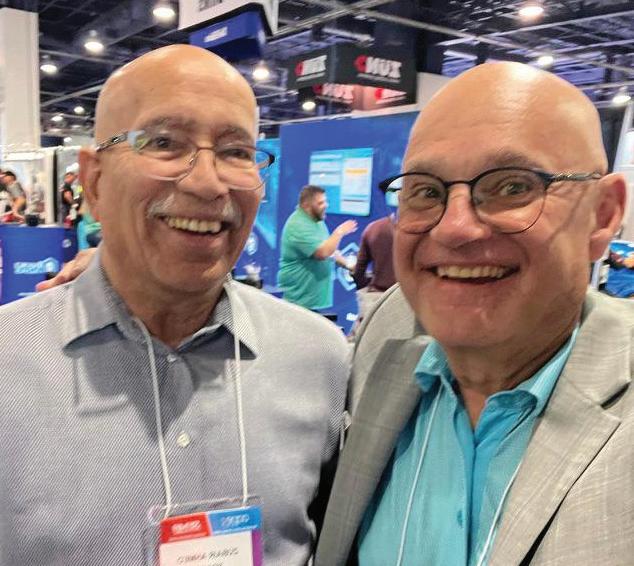
Those who work with Zuby describe him as approachable, consistent and deeply invested — in his customers, his team and the industry itself. Even after 40 years, he remains closely engaged, still listening, still learning and still adapting.
As Crescent marks its 40th anniversary, Zuby is focused less on nostalgia and more on relevance.
“Being independent means you’re accountable every day,” he says. “You don’t get to hide behind a head office.”
The milestone is not a finish line. It is proof that independence can endure, care can scale, and that trust — earned patiently over time — remains one of the most valuable assets in the collision repair industry.

BY CHELSEA STEBNER, PARR AUTOBODY
The world lost a good one.
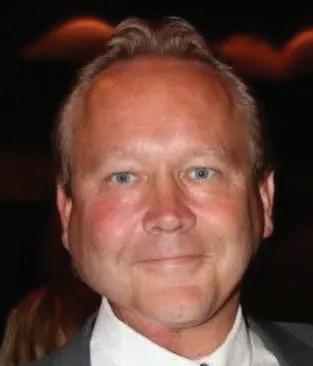
Who knew that back when I was a younger woman, Tom Bissonnette would take me to Dodge City Collision to meet the Dons? The first thing Don Swick said to me was, “Nice skirt”—or that 25-ish years later, I would call him one of my dearest friends.
Don was one in a million. He lit up a room. He made us wonder how in the world he got away with so many one-liners and offsides. He was quick-witted as hell.
Don Swick started his career in the collision industry working with Tom Bissonnette at Parr Auto Body managing the parts department. He was young, brash and very funny. He walked the line a little too close and Tom fired him! But, in true Don fashion, he quickly overcame that and a year later Tom hired him at Dodge City Collision. Throughout his life and his career, he maintained strong friendships and rose
to become an influential individual in the collision repair industry.
Don was hired at PPG as a Territory Manager in Saskatchewan and the first thing he did was bust the glass ceiling and move 55 ish shops over to PPG in the first few months. He quickly earned Top Performer for the Canadian Team. He held several roles in PPG: Territory manager, business solutions manager, Western Canadian team lead, Western Canadian regional manager and strategic accounts manager. He nicknamed himself the Franchisee! Don was influential in the success of many Saskatchewan shops by leading them (and maybe forcing some of them) to join the MVP Roundtable groups. Shops such as ours, Giles Midtown Auto Body, Regina Auto Body, and many more across Canada were encouraged and became better because of Don. He retired in 2024 after an incredibly successful career in collision repair.
I think he was like the Elvis of Collision Repair. Famous for all sorts of things! Don knew many shop owners, leaders, and industry representatives all the way across North America. He always encouraged, inspired and influenced his circle with positivity and how well you could do. Don also wasn’t afraid to tell you that you could do better! And then, he helped you to figure out how. He was a cheerleader of collision repair shops. Dare I say he was an ‘influencer’?
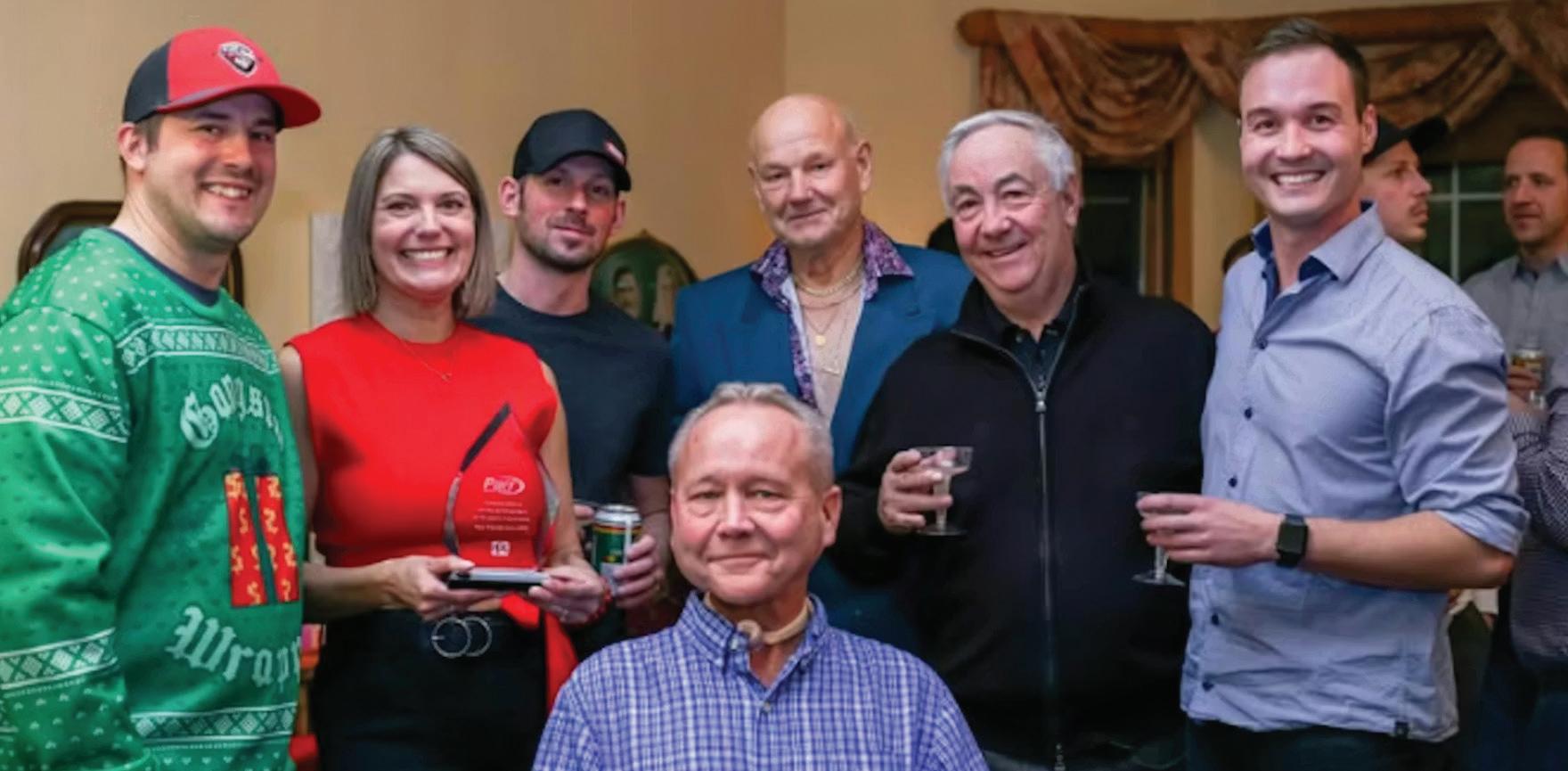
Don lived his personal life much like his work life. He passionately loved his family and friends; fishing and boating and the Bruins. He loved food and fine wine and loved sharing it with all those around him. He carried on a tradition that was passed down from his parents Jules and Laura. He, his wife Rae, daughter Serena and sons Alec and Evan hosted a legendary party every Boxing Day. In true Ukrainian fashion
“DON WAS A LARGER-THAN-LIFE CHARACTER KNOWN FOR HIS QUIRKY SENSE OF HUMOUR, QUICK WIT AND UNPARALLELED CHARISMA. HE HAD A REMARKABLE GIFT FOR GETTING AWAY WITH THINGS THAT WOULD HAVE LANDED MOST PEOPLE IN HOT WATER, MAKING HIM THE LIFE OF ANY PARTY AND THE SOURCE OF COUNTLESS STORIES.”
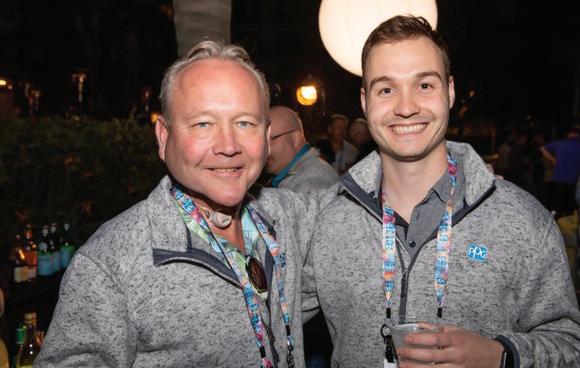
“DON LIVED LIFE WITH A GUSTO THAT MANY OF US ONLY DREAM OF. TO KNOW DON WAS A GIFT. HE BROUGHT JOY, LAUGHTER AND AN INCREDIBLY POSITIVE ATTITUDE TO ALL OF THOSE IN COLLISION REPAIR.”
it was filled with perogies, sausage and the secret sauce, Ukrainian hooch. If you worked in collision repair and were in the Saskatoon area, you were invited to the Swick house.
For our team here at Parr, he was what you’d call a lifer and a Parr Ambassador. He did recruit Paul Carrobourg away from us and bring him over to PPG. Paul is now the regional manager for Canada West, which happened with our blessing. He has always been part of our team and remains a valued member of our Parr family. He hosted Parr’s 70th Anniversary in his home in 2022 with live music, food and cheer.
A couple of years ago, when Don was going through cancer treatment, we held a fundraiser and challenge with our team called “Sweatin’ For Swick”. We, along with a long-time customer of Parr’s and friend of Don’s raised several thousand dollars for Ride for Dad (a charity directed to prostate cancer
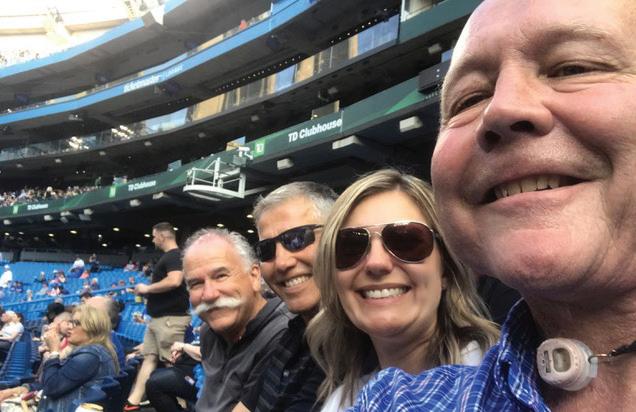
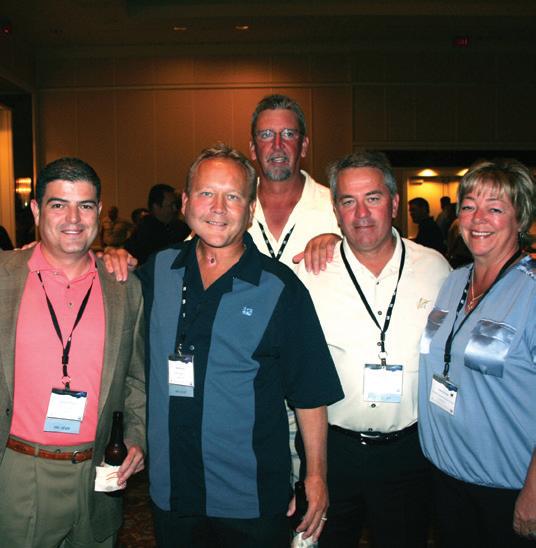
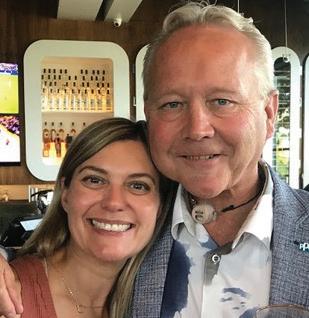
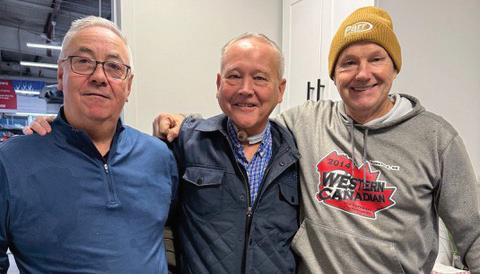
research) Parr wouldn’t be who we are today without the influence of Don.
He was the man of many lives and was the most resilient person I know. Don faced challenges and tragedy in his life. He lost his sister when he was just a kid himself and their family also lost their baby daughter Darcey. He fought and won the cancer battle four times. Don lived life with a gusto that many of us only dream of. To know him was a gift. He brought joy, laughter and an incredibly positive attitude to all of those in collision repair. He will be remembered with stories, laughter, and a few tears.
If we take anything away from Don’s vivid life it is to strive for it all. But do it with joy. Live your life, love your family, love your work and appreciate each moment that you have.
Those of us in collision repair, and all the lives he touched are better because we had the opportunity to know Don.
“IF YOU KNEW OUR DEAR FRIEND DON, YOU LOVED HIM. DID YOU KNOW HE WORKED AT PARR AUTO BODY BACK IN THE DAY? THIS FELLA HAS HAD AN IMPACT ON MANY PEOPLE THROUGH HIS WELL LOVED LIFE. HE WILL BE REMEMBERED FOR LIVING LIFE TO THE FULLEST, HAVING FUN, AND HAVING OUR BACKS.”
— THE PARR AUTO BODY TEAM

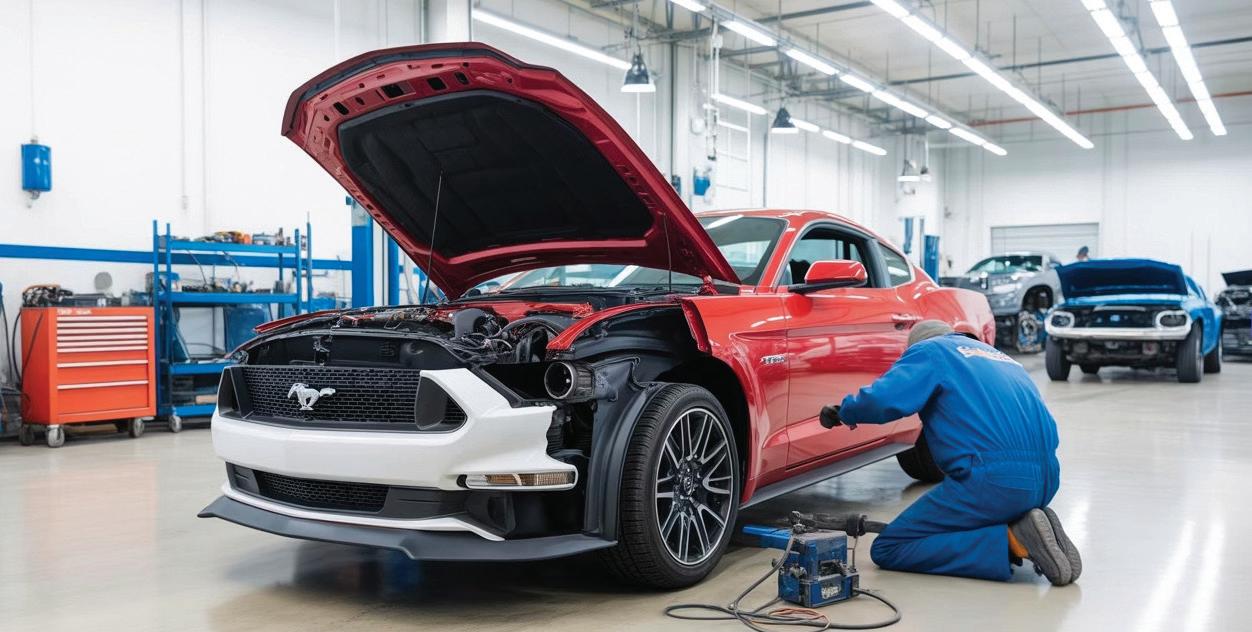
The latest Pulse of the Industry report for February 2026 provides a detailed snapshot of performance across Canada’s collision repair sector, drawing on more than 60,000 repair orders nationwide. Compiled through a collaboration between Collision Repair and AutoHouse Technologies, the report tracks key performance indicators across the country, with all financial metrics presented on a pre-tax basis.
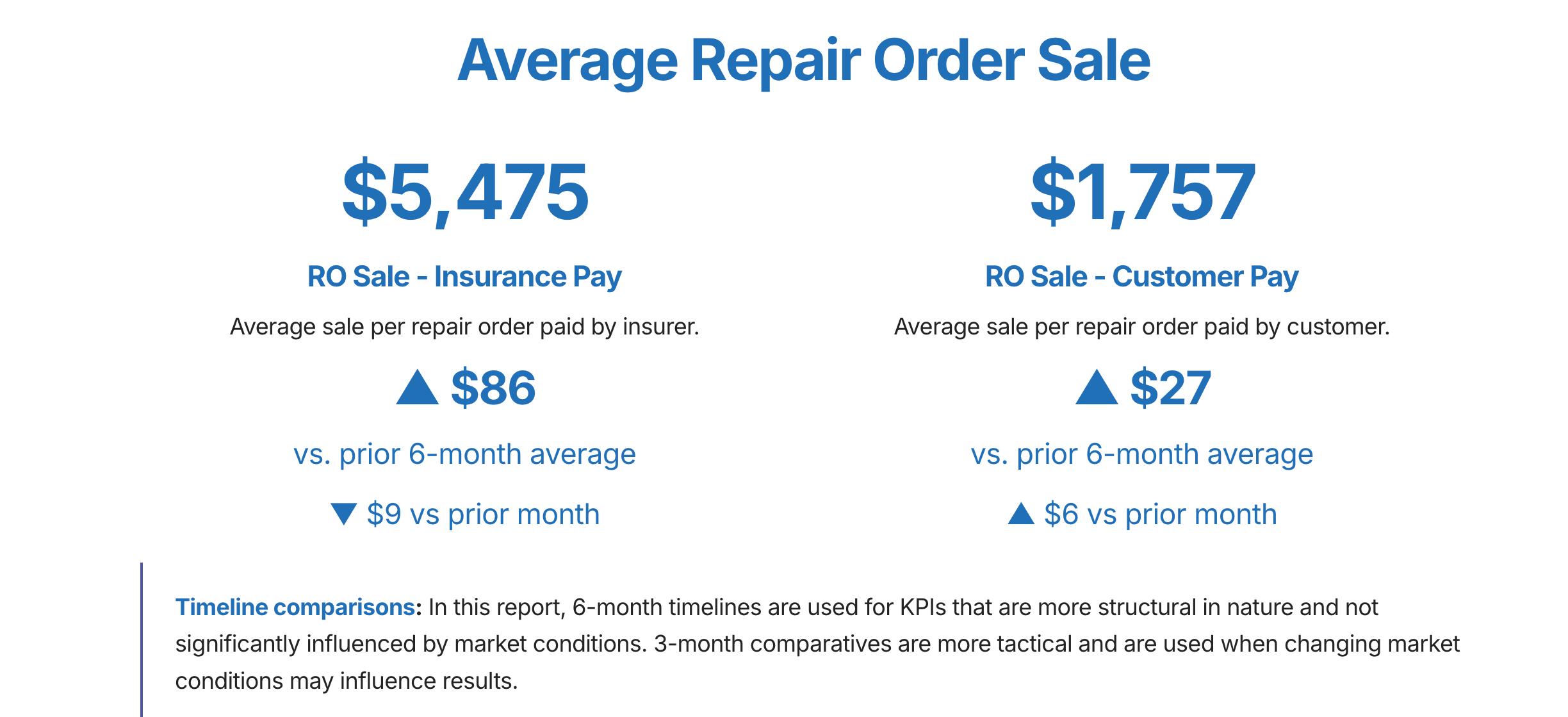
Average insurer-paid repair orders reached $5,475, an increase of $86 compared to the prior six-month average though down $9 from the previous month. Customer-paid repair orders averaged $1,757, rising $27 compared to the prior six-month average and increasing by $6 month-over-month. The data reflects sustained upward pressure on repair severity even as monthly gains moderate.
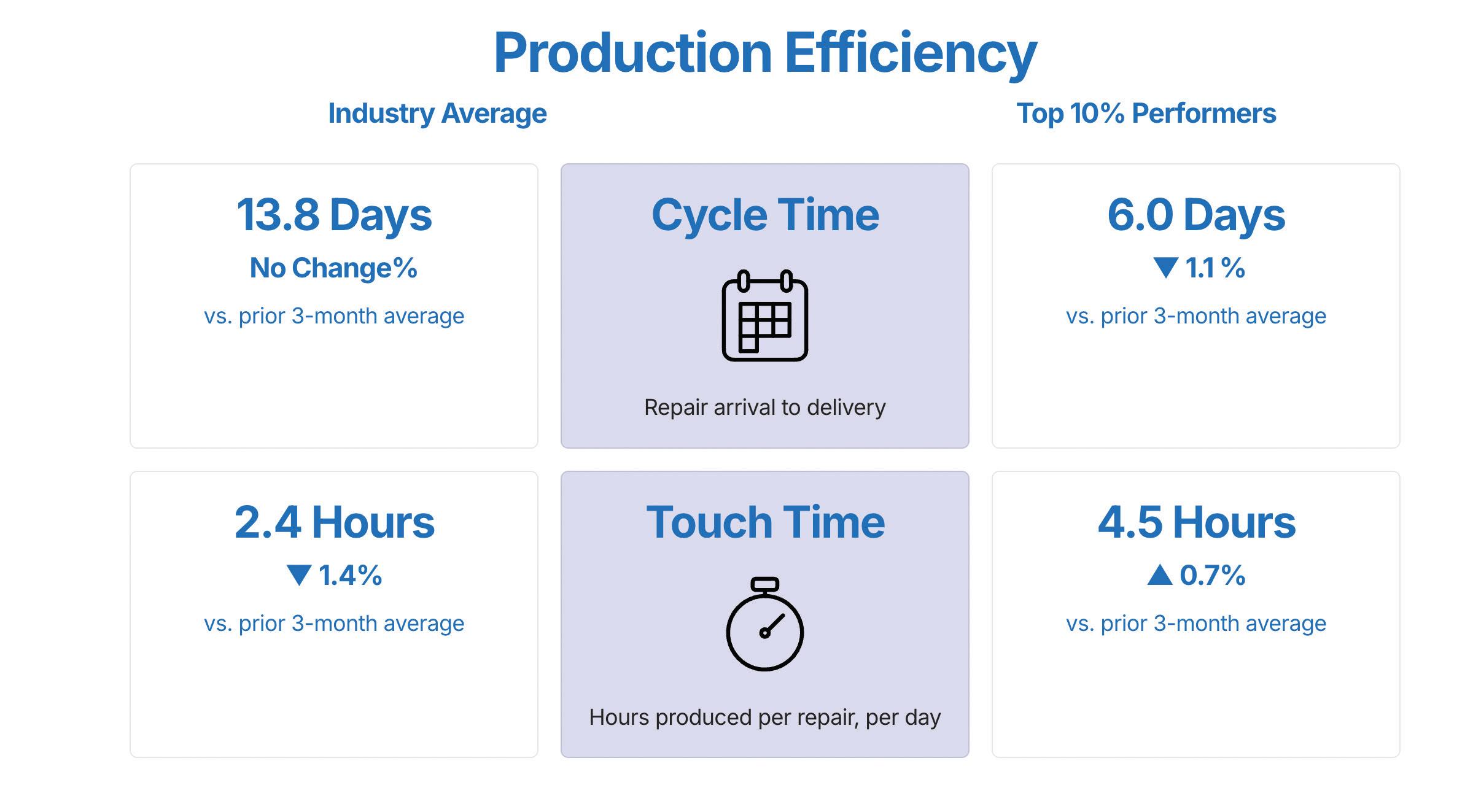
The industry’s average cycle time measured from repair arrival to delivery held at 13.8 days compared to the prior three-month average. Top-performing facilities maintained a six day cycle time, improving 1.1% over the same benchmark. The widening gap highlights a continued split between high-performing operators and the broader market.
Collision repairers averaged 2.4 hours produced per repair order per day, a 1.4% decrease from the prior three-month average. The top 10% achieved 4.5 hours, increasing 0.7% over the same period, reinforcing the performance divide in labour productivity.
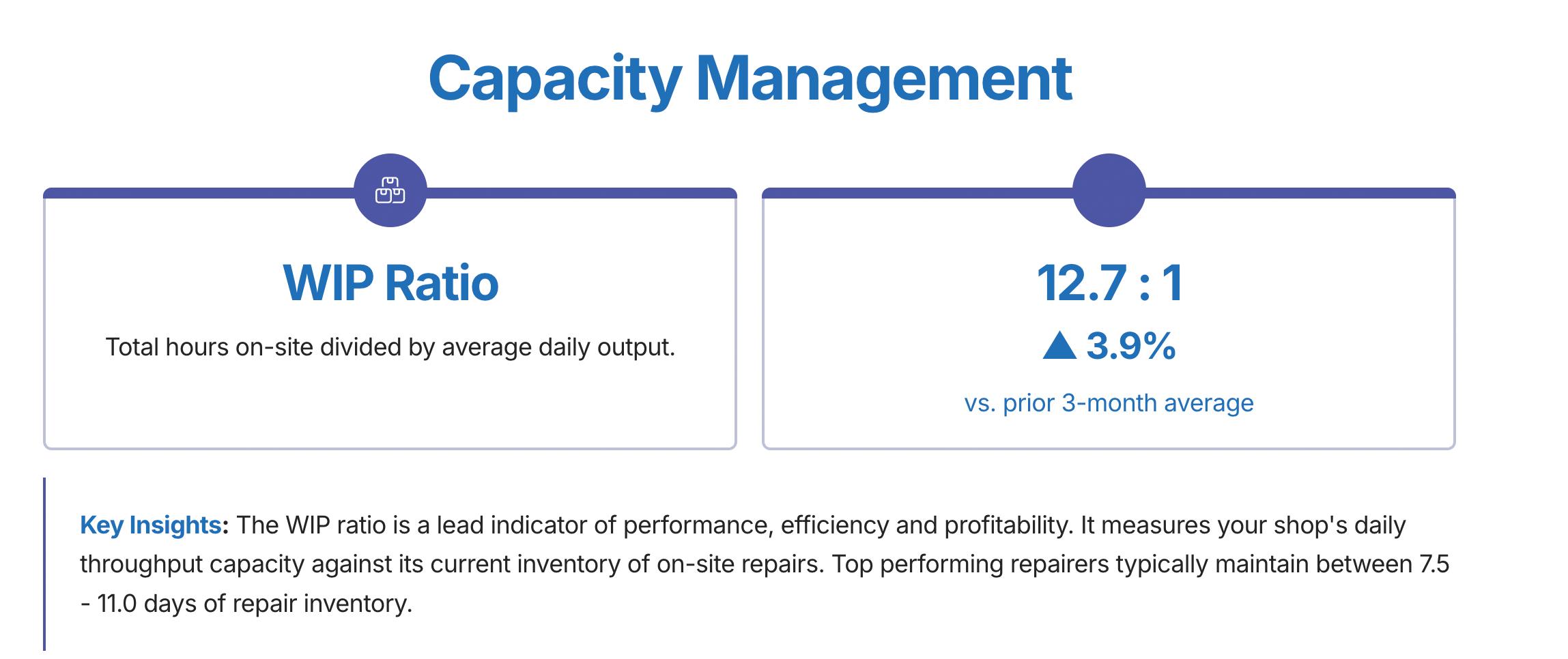
The industry’s work-in-progress ratio reached 12.7:1, up 3.9% compared to the prior three-month average. The report identifies this metric as a leading indicator of efficiency and profitability, with top-performing shops typically maintaining between 7.5 and 11 days of repair inventory. Current levels suggest growing imbalance between incoming volume and completed repairs.
Taken together, February’s data underscores a clear trend: repair values continue to rise but production efficiency remains uneven, with top-performing facilities extending their lead as the broader industry absorbs longer cycle times and higher inventory levels.
collisionrepairmag.com/pulse-of-the-industry/article/15819388/ exclusive-report-pulse-of-the-industry-feb-2026
Curious how your shop stacks up?
Our enhanced benchmarking tool compares your performance against national, provincial and regional peers. Using real operational data - not surveys - you can quickly identify where to improve efficiency, boost throughput, and grow profitability. Learn more to see if benchmarking is a fit for your business.
Learn more at autohousetechnologies.com/crmpulsereport
Pulse of the Industry is the result of a powerful collaboration between Collision Repair magazine, Canada’s leading collision industry publication, and AutoHouse Technologies, the nation’s foremost provider of real-time repair performance analytics. Compiled from over 60,000 monthly repair orders completed by Canada collision repairers. All information has been normalized, with variance thresholds applied to remove anomalies and ensure data integrity.
BY JOHN ASCHEMAN, DIGITAL PERFORMANCE MANAGER, 3M AUTOMOTIVE AFTERMARKET DIVISION
New technologies, rising customer expectations and more complex repairs to increasingly complex vehicles add up to a period of rapid change in the collision repair industry. Specialized procedures and increased use of sublet labour introduce even more variables. Those shifts bring new challenges. Repair timelines continue to expand beyond earlier predictions and traditional methods of tracking repair progress — such as estimating completion dates solely by labour hours per day — are no longer sufficient. To provide strong customer service, clear and transparent communication has never been more important.
The industry is moving away from manual processes toward AI-powered efficiencies. Digital intake represents a pivotal shift in how collision repair centres manage customer interactions. Instead of time-consuming paperwork and in-person assessments, digital tools allow customers to upload photos for faster, more convenient preliminary estimates. AI-driven platforms integrated into mobile apps can analyze damage from just a few photos, identify affected panels and suggest repair lines. This accelerates the process and frees staff from much of the work of writing estimates so they can focus on higher-value tasks such as customer consultation. A growing number of companies are entering

REPAIR TIMELINES CONTINUE TO EXPAND BEYOND EARLIER PREDICTIONS AND TRADITIONAL METHODS OF TRACKING REPAIR PROGRESS ARE NO LONGER SUFFICIENT.
CLEAR
this space, offering solutions that expand communication among customers, insurers and repair centres.
Different stakeholders often have different priorities in the repair process. Insurers may value speed and cost efficiency while customers often appreciate detailed visibility into the repair process, including updates and photos. Clear communication and transparency between the collision centre, insurers and the customer can strengthen trust and improve alignment among all parties.
Increased transparency can also help ensure customers understand what their policies include, what has been approved for payment and when out-of-pocket costs may arise. Discussing these items early — such as preferences for OEM parts or additional expenses — helps set clear expectations and supports productive
communication among shops, insurers and customers.
Even the most successful collision repair business will occasionally encounter an unhappy customer. What matters most is how quickly and effectively the issue is resolved. There are several ways to measure customer service success, from anonymous surveys to online reviews. Because these tools provide valuable feedback, they can drive meaningful improvements within a repair centre and help address customer concerns with empathy and prompt action.
Anyone who uses the internet knows that handling a single adverse event well can leave a stronger positive impression than many routine positive reviews.
Some things change while others remain constant. The collision repair industry has more tools than ever to improve the customer experience: digital intake, enhanced
JOHN ASCHEMAN
transparency, effective management of customer-insurer expectations and stronger complaint-prevention strategies. The challenges these tools address, however, have existed for generations. While technology can simplify processes, the human element remains essential. At their best, digital and AI-based tools amplify meaningful customer engagement rather than replace it. It takes both people and technology to ensure expectations are met throughout the repair process.
When managed effectively, transparency benefits everyone. It keeps all parties informed about delivery timelines and provides clarity when delays occur or additional work becomes necessary. New digital tools play a dual role: they contribute to greater complexity but also support the person-to-person communication that keeps everyone aligned.
John Ascheman is digital performance manager in the Automotive Aftermarket Division at 3M, where he works with collision repair businesses on repair planning, shop workflow and the integration of digital tools into estimating and production processes. He also develops training programs and regularly presents at industry events and education sessions focused on improving repair accuracy, technician training and operational efficiency in modern bodyshops.
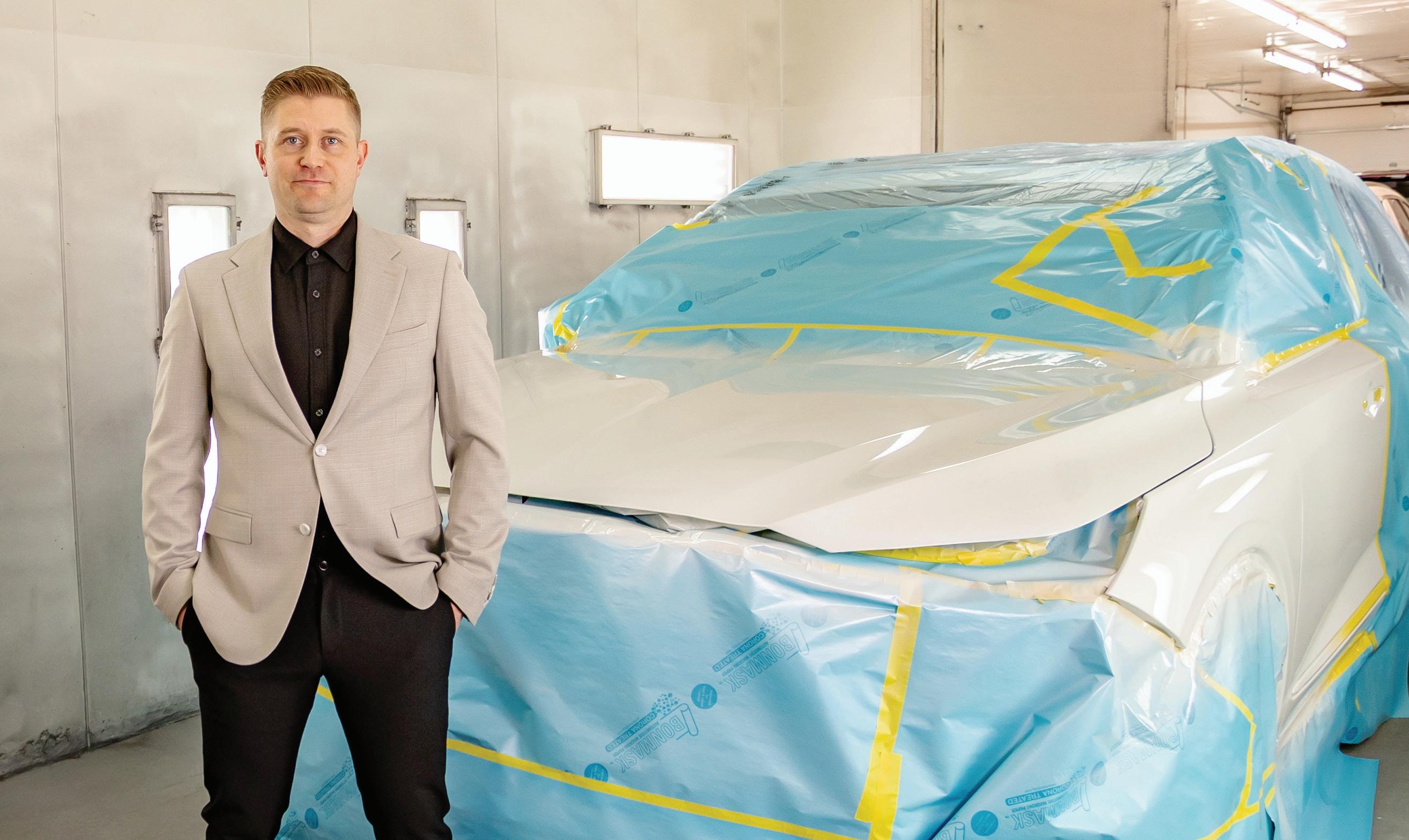
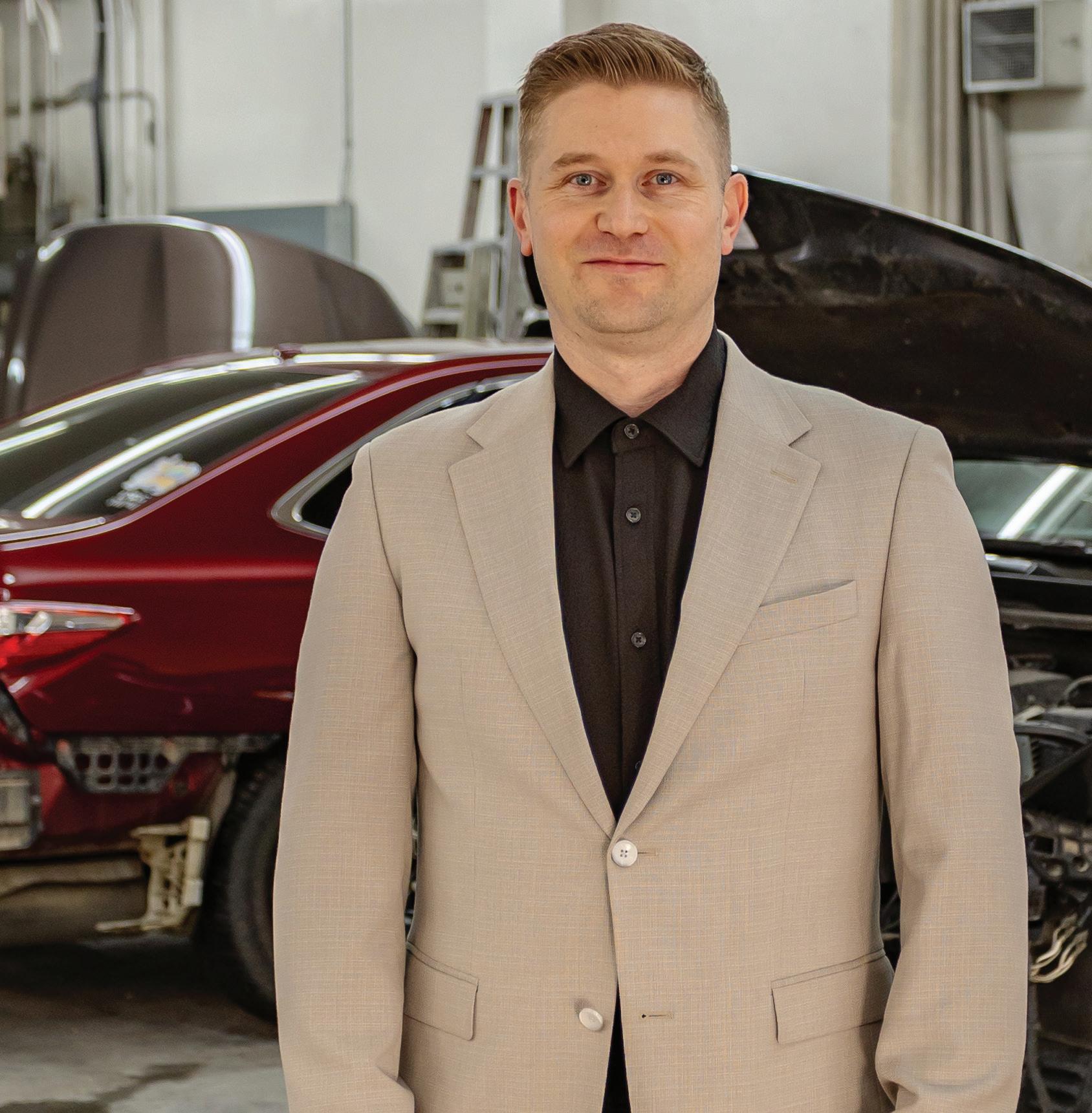
KBY MACKENZIE GRANT
BY MATT PIOTROWSKI
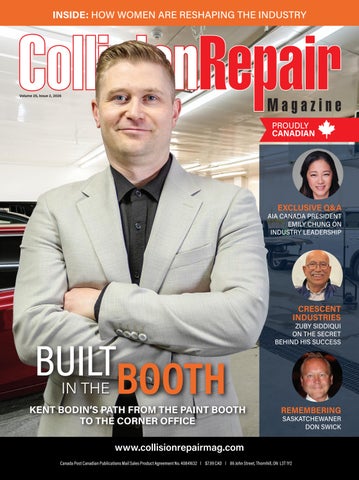
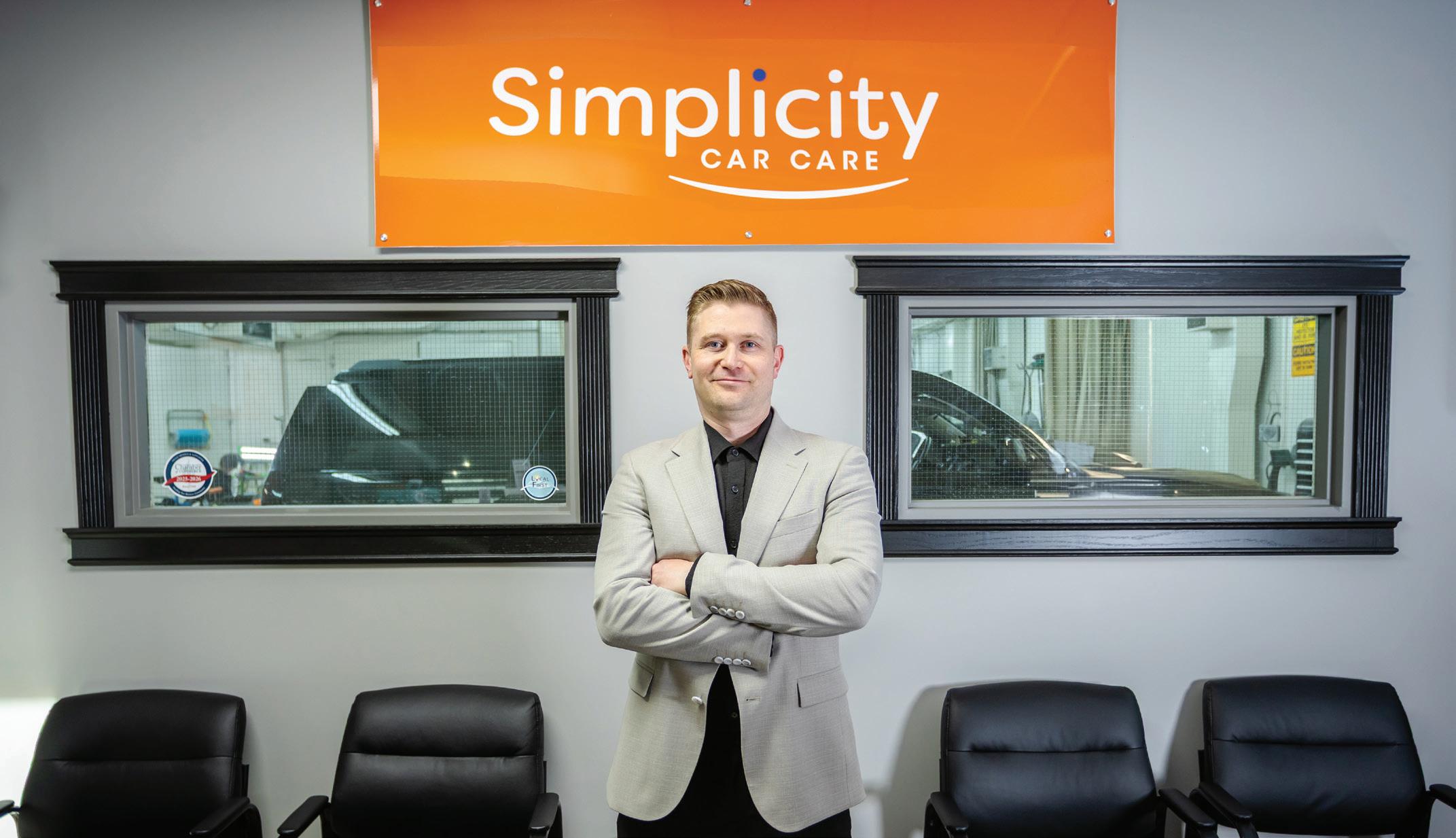
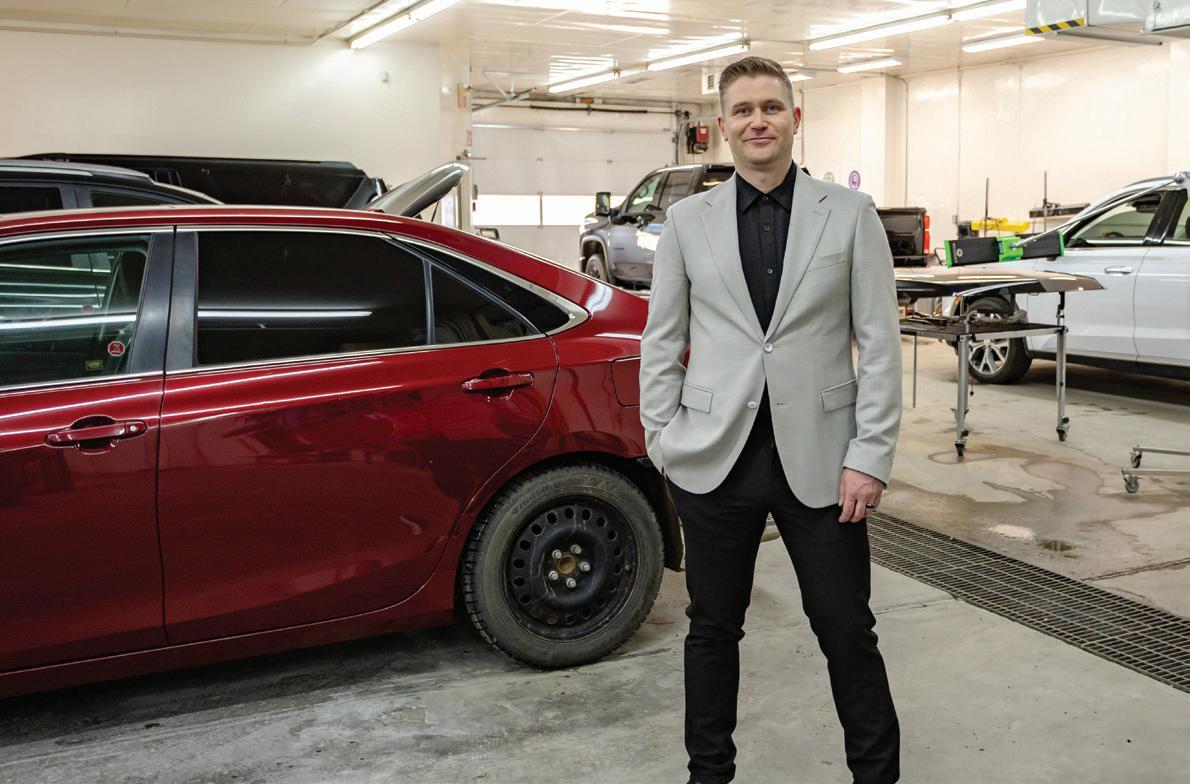
ent Bodin did not set out to own a collision repair facility. In 2005, he graduated high school and started sweeping floors at a Medicine Hat bodyshop a week later, taking a job that happened to be available and committing to see where it might lead.
“I really kind of had no idea what I was getting into,” he says. “I just started at the bottom.”
There was no formal collision repair program at his school. A shop teacher with bodyman experience had introduced him to the trade, but most of Bodin’s education would happen on the shop floor. He cleaned cars, emptied garbage cans and handled whatever tasks were needed, gradually learning how a repair facility actually runs.
“You’ve got to pay attention to detail and take pride in your work,” he says. “It doesn’t matter if you’re emptying the garbage or writing an estimate — it’s all important.”
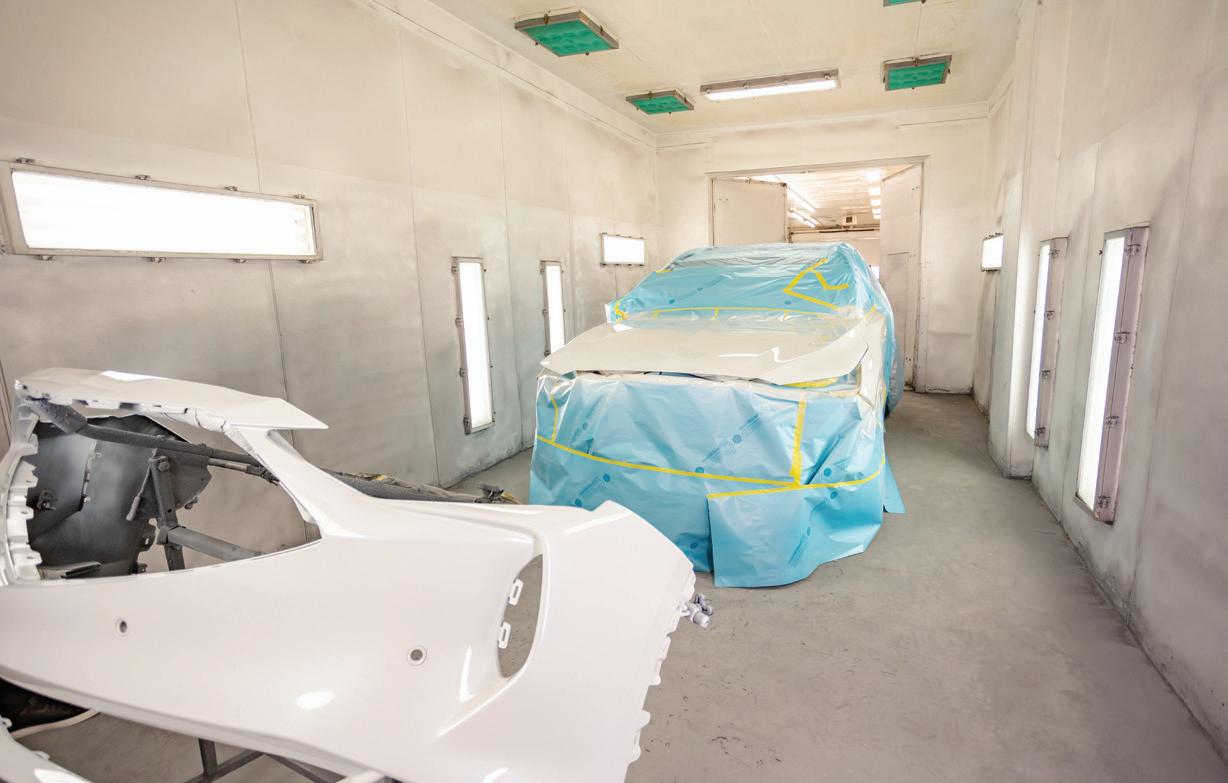
That philosophy carried him from detailing into prep work and, within months, into the paint booth. Painting became the first role where he saw a long term path for himself. The precision, the pace and the visible end result made the work tangible.
“I liked painting,” he says. “That finished product is always kind of rewarding. You can actually see what you accomplished.”
Bodin earned his journeyman certification in prep and paint and spent more than a decade refining his skills. He built confidence in the booth, but he did not stop there. When the shop’s longtime pre appraiser retired in 2015 and 2016, ownership asked whether he would consider learning estimating. The move meant stepping
away from the tools and into customer conversations, supplements and scheduling pressures.
“You learn one part of it, and then it’s like, what can I do next?” he says. “You’ve done the cleaning, you’ve painted for years, you’ve worked in the office — you kind of want to push yourself a little further.”
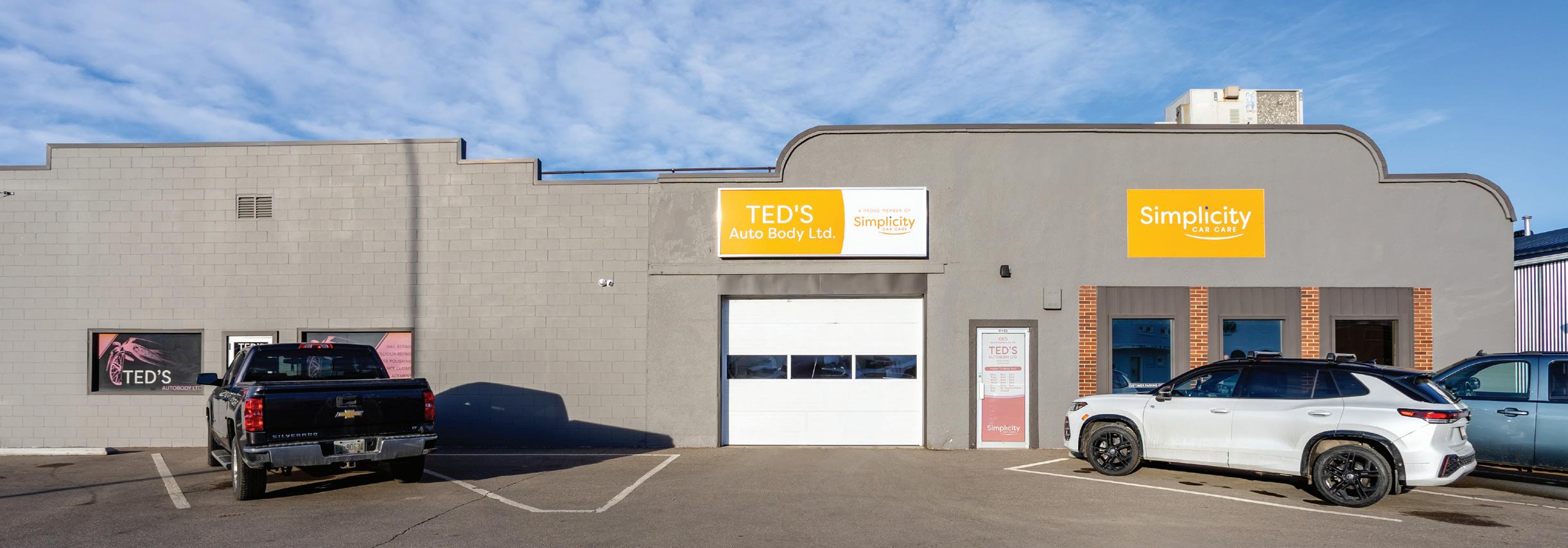
By the time the opportunity to purchase the business came forward in 2022, Bodin had worked in nearly every role in the shop. The operation now runs as Simplicity Car Care Medicine Hat, after joining the Simplicity banner the year prior. The shop itself carries a long legacy in the community, having operated for more than six decades as Ted’s Autobody LTD.
“I feel really fortunate to have had the opportunity to buy such a reputable shop,” Bodin says. “Ted’s Autobody has been serving our city and surrounding area for over 60 years. The previous owners did a great job building that trust and reputation, and I’m proud to carry it on.”
Ownership brought a different kind of challenge. Many of the technicians had been there for years, some longer than him. The dynamic shifted overnight.
“Going from being just one of the employees to overseeing the team was a challenge,” he says. “All of a sudden you’re being asked, ‘What do you want me to do now?’ And you think, why are you asking me? But now it’s my decision.”
“TREAT PEOPLE FAIR, AND THEY’LL BE FAIR TO YOU. IT’S NOT COMPLICATED. YOU RESPECT THEM, YOU CARE ABOUT WHAT THEY’RE DOING, AND THEY’LL TAKE PRIDE IN THE PLACE TOO.”
Rather than overhaul the culture, Bodin leaned into what he had learned over time — steady leadership and mutual respect. In a city of roughly 64,000 residents with about 10 bodyshops, reputation matters and turnover can be costly.
“Treat people fair, and they’ll be fair to you,” he says. “It’s not complicated. You respect them, you care about what they’re doing, and they’ll take pride in the place too.”
He offers similar advice to young technicians entering the trade, especially those discouraged by starting wages or slow early progress. He understands the temptation to move on.
“I was tempted when I first started to go find a different job too,” he says. “But if you stick with it and absorb everything you can, the more you learn, the more valuable you become.”
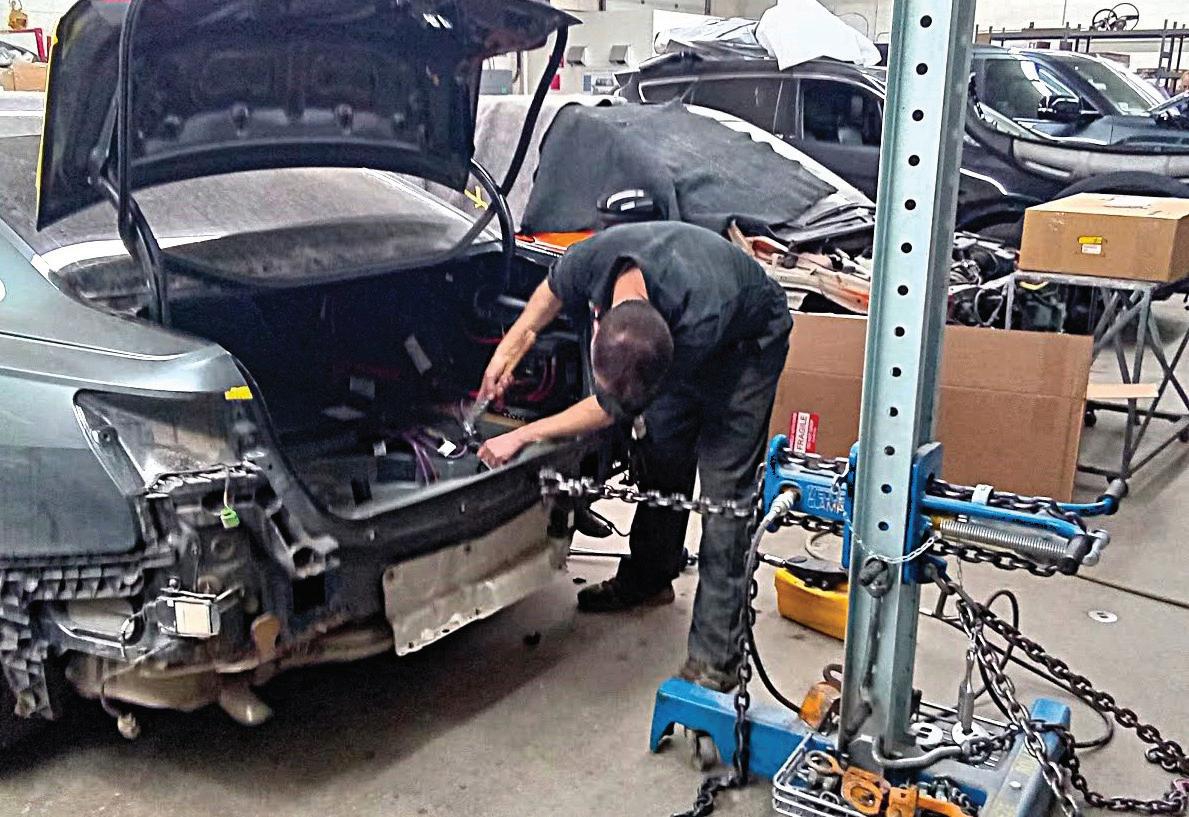
That steady accumulation of knowledge continues to shape the business. Bodin has invested in updated equipment, including a
— KENT BODIN
glue pulling system, to align with modern OEM procedures that emphasize repair over replacement. While electric vehicle volume remains limited in southeastern Alberta, advanced driver assistance systems and recalibration requirements are increasingly part of the estimating process.
“You’ve got to keep up with learning and technology,” he says. “If you don’t adapt to it, you’re going to get left behind.”
For him, growth has never been about sudden leaps. It has come from learning each role thoroughly, building confidence step by step and moving forward only when he is ready for the next challenge.
“Kent exemplifies exactly what we look for in a franchisee,” says Domenic Ieraci. “His leadership in Medicine Hat reflects a deep commitment to operational excellence, community engagement and delivering an outstanding customer experience. We’re proud to have him representing our brand in the market.”
For Bodin, the goal remains simple — continue building on the foundation that was laid decades before he arrived, ensuring the shop remains a trusted fixture in Medicine Hat for years to come.
“While the history of this shop is built on decades of hard work, transitioning from a painter to an owner meant I needed more than just technical skill — I needed a proven system,” says Bodin. “Joining the Simplicity Car Care banner was the turning point that allowed me to focus on the shop floor while they handled the heavy lifting of the business backend. The value of being part of the network is the immediate access to advanced data analytics, streamlined insurance relations, and a peer group of owners who have already navigated the challenges I face daily. It took the guesswork out of the transition. Instead of trying to reinvent the wheel, I could lean on a national brand that prioritizes efficiency and growth. Simplicity gave us a roadmap to ensure the shop remains a fixture in Medicine Hat for another 60 years.”
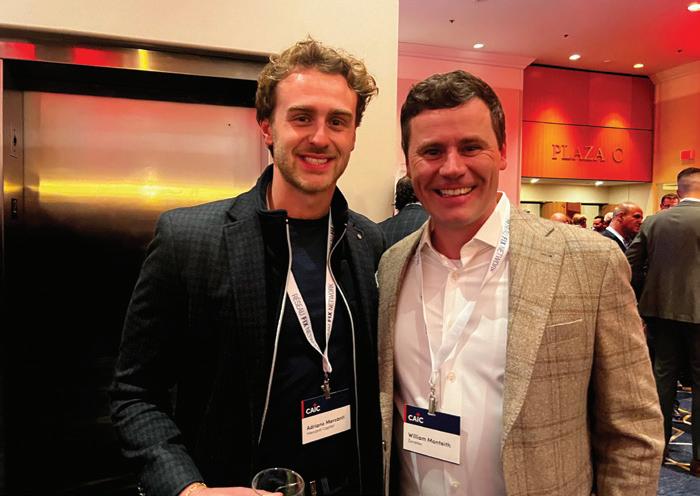
BY WILLIAM SIMMONS
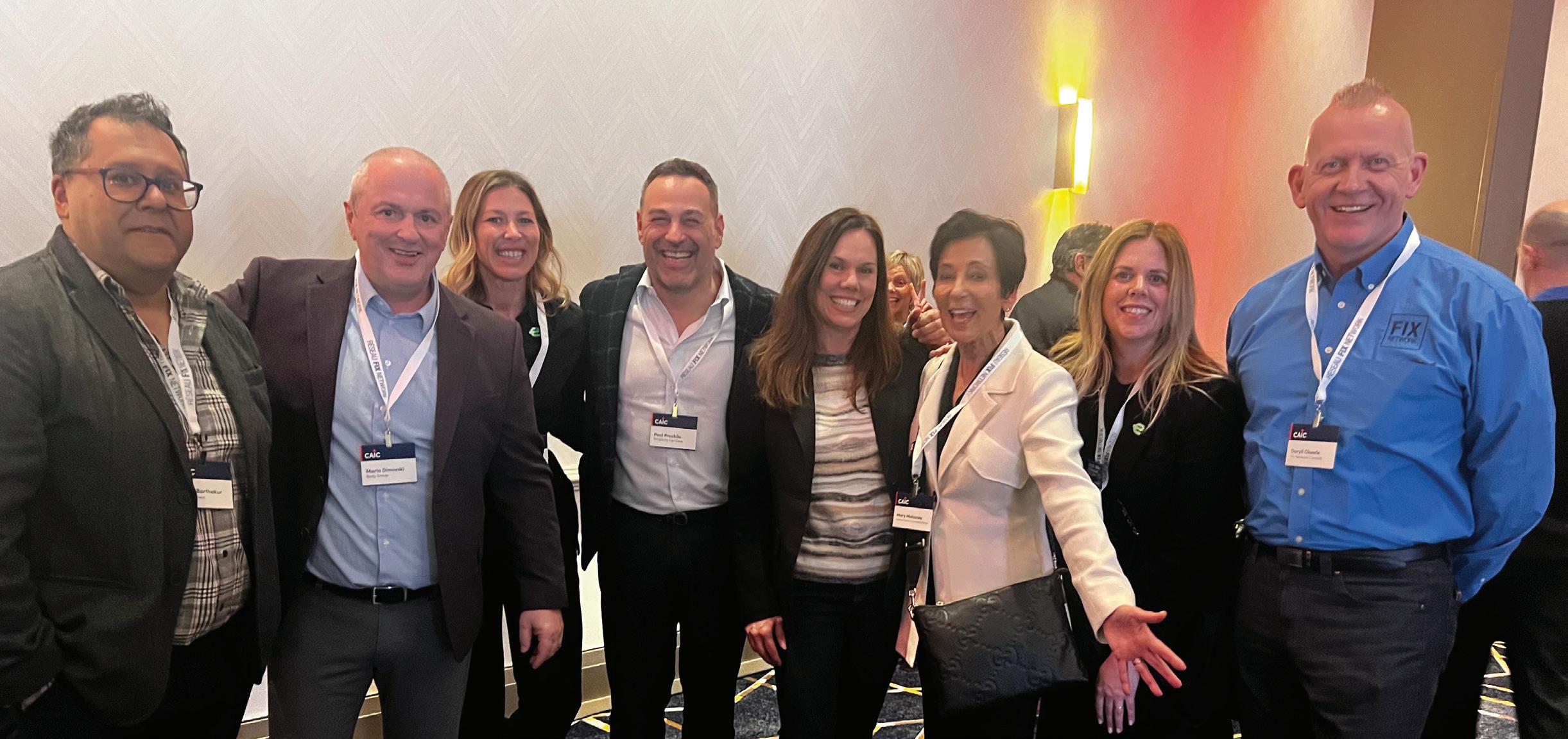
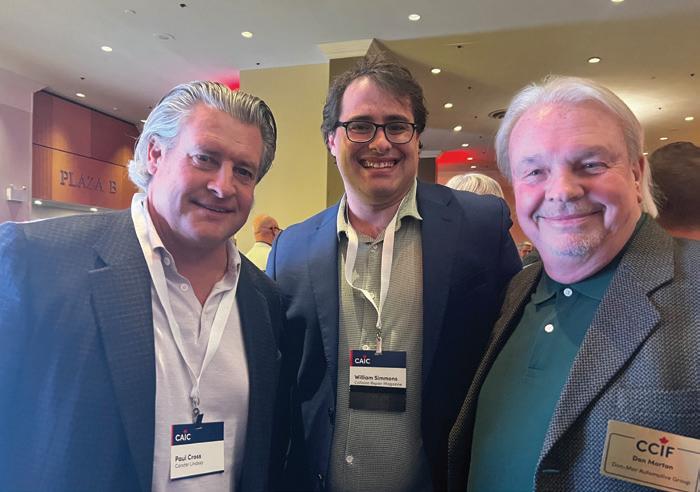
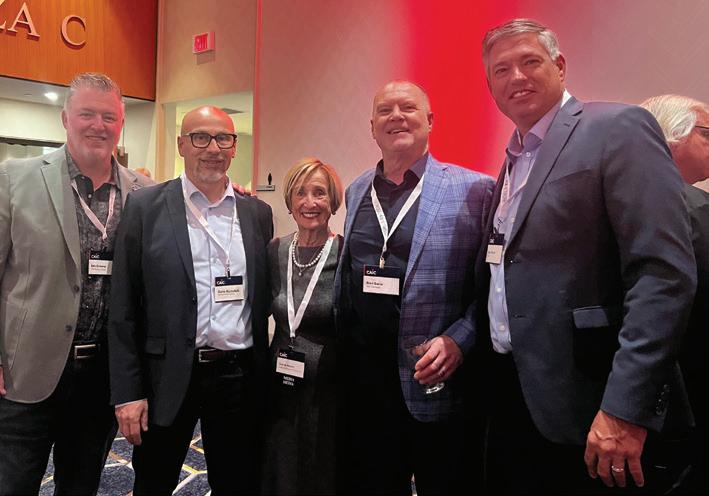
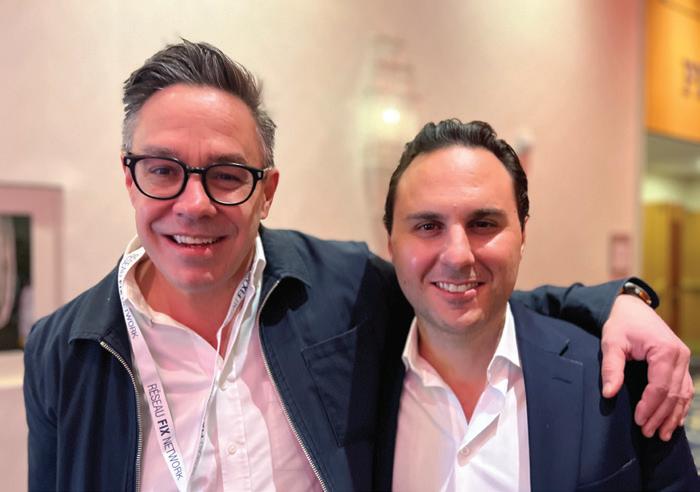
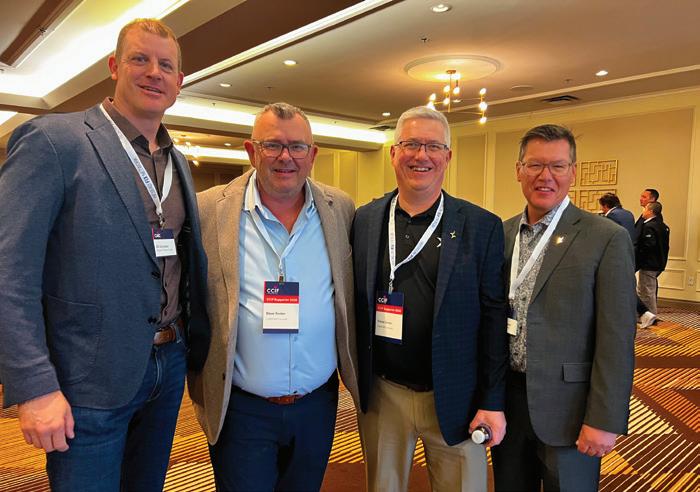
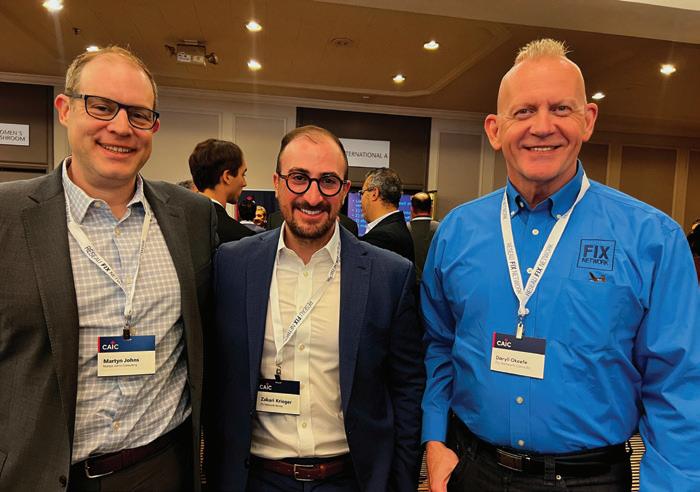
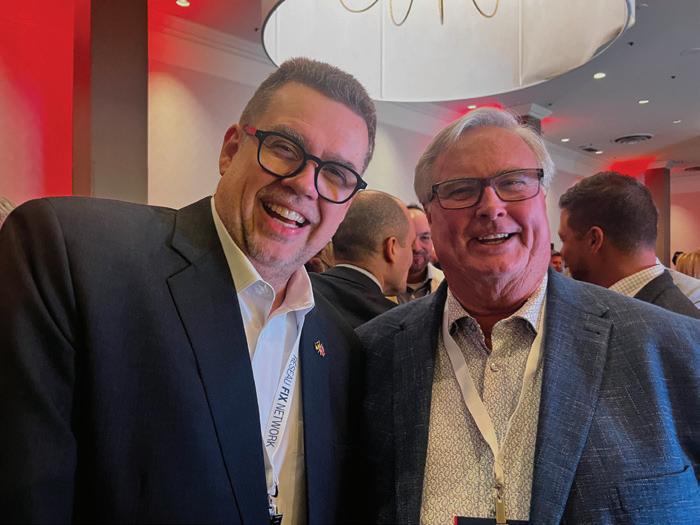
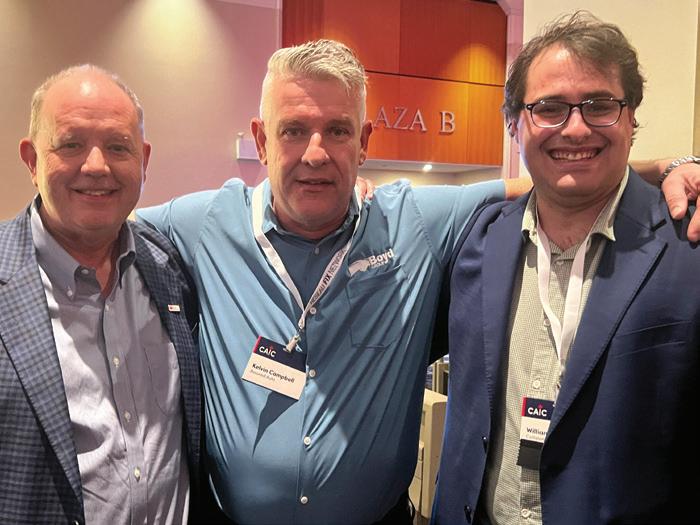
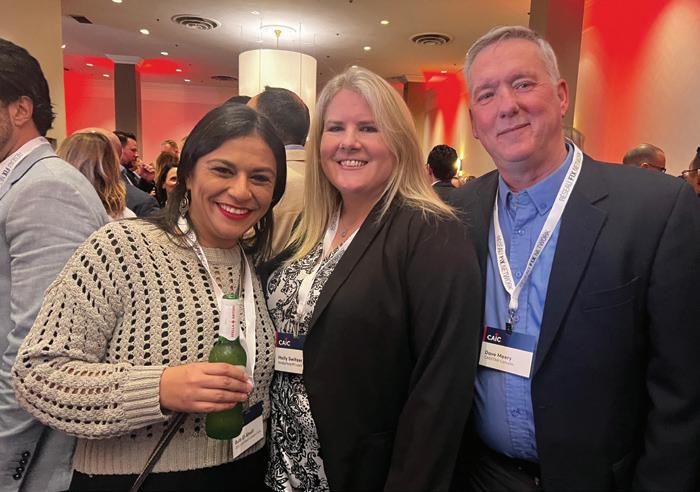
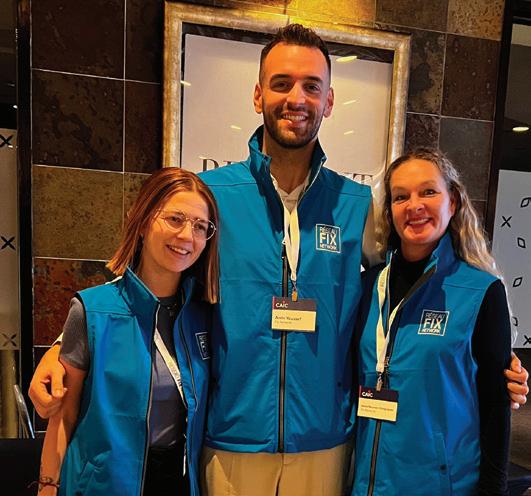
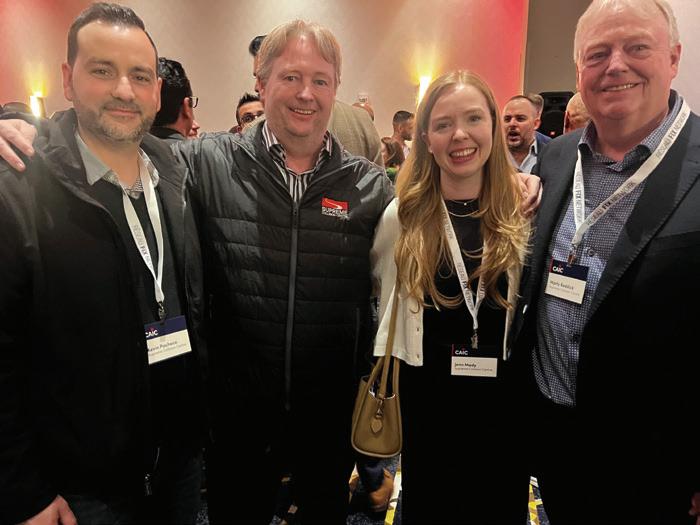
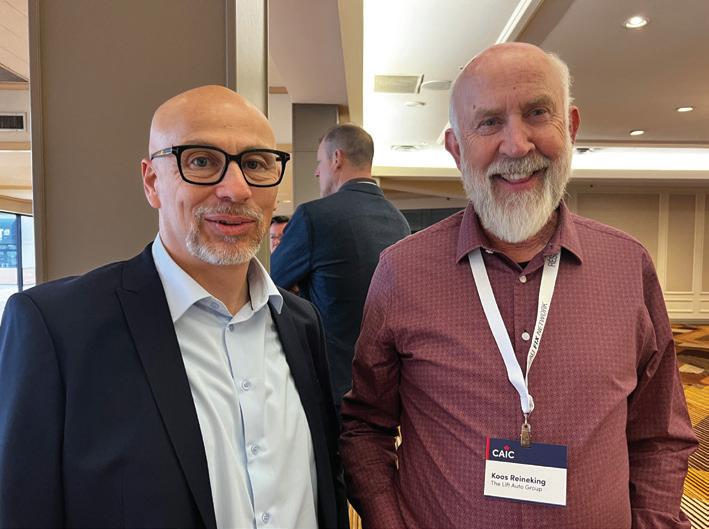
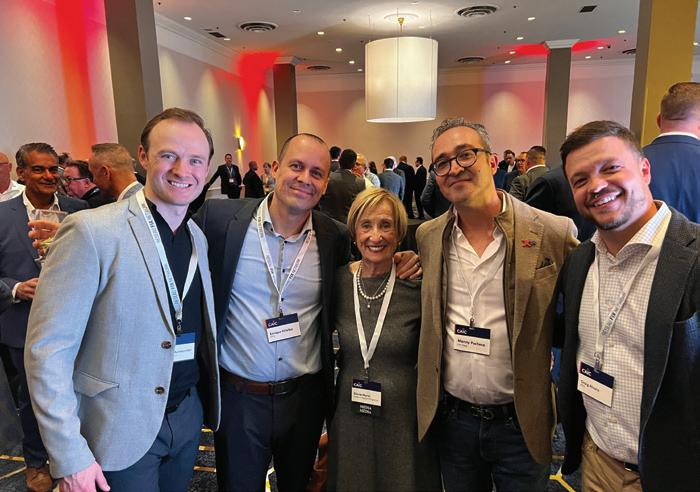
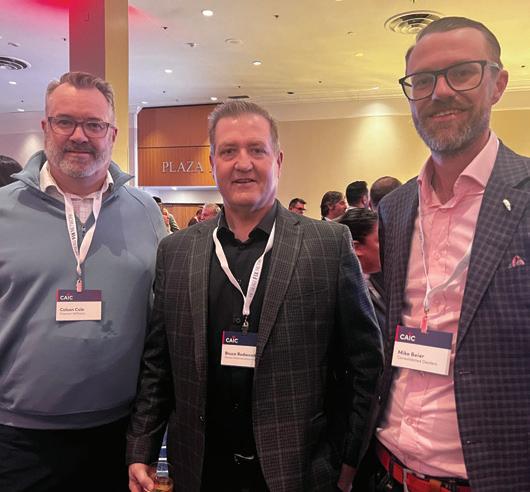
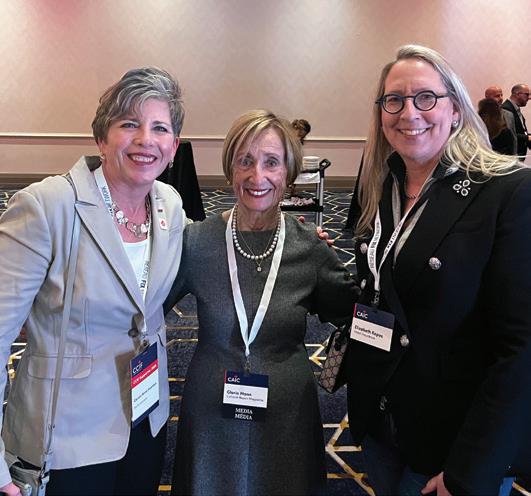
Canada’s auto repair and maintenance sector is confronting a labour shortage rooted as much in retention as recruitment, industry leaders said following the Canadian Auto Care Industry Conference, held March 12–13 at the Delta Hotels Toronto Airport & Conference Centre in Toronto.
The sold-out event brought together repair shops, parts suppliers, insurers and service providers from across Canada, with workforce challenges emerging as a central theme.
Speakers said the shortage reflects structural issues inside shops that are pushing workers out faster than new ones can be brought in.
“Retention strategy, in my opinion, is the best strategy,” Saifullah Sanaye, CEO of The
Mechanic and Technician Upskilling Canada, a Canada-based training organization, said during a workforce panel. “If you keep having to recruit, you need to ask yourself what’s going on in your organization.”
Sanaye identified the cost of entry as a key barrier, particularly for new technicians expected to supply their own tools.
“My tools are probably $60,000,” he said. “Tools are expensive. Shops need to provide more tools for those learning technicians.”
Other panelists said hiring practices are already lagging behind technological change.
“A lot of companies are still hiring people for the role tomorrow,” said Hitesh Patel of
Transtar Industries, a Cleveland, Ohio-based powertrain parts supplier. “AI can build a presentation pretty quickly and analyze your data faster than someone building models in Excel.”
Employers should instead prioritize adaptability and long-term potential, he said. “What’s their potential and where can they grow in the future?”
Chris Theodoratos of Mr. Lube + Tires Canada, headquartered in Richmond Hill, Ont., said bias in hiring continues to limit growth.
“Maybe you’re hiring somebody that’s just like you,” he said. “But if you’re trying to expand your business,
maybe you need somebody with a different experience.”
He also distinguished mentorship from sponsorship, arguing advancement depends on leaders actively advocating for employees.
“A mentor is basically a coach,” he said. “Sponsorship is advancing. Who are you picking… to move to the next stage?”
Shannon Miller of Accelerate Auto, a Canada-based workforce development organization, said efforts to widen access to automotive careers remain essential, framing diversity initiatives as a question of equal opportunity.
“Very often it’s just about equal opportunity,” she said, adding that structured mentorship
helps break down barriers and build pathways into the trade.
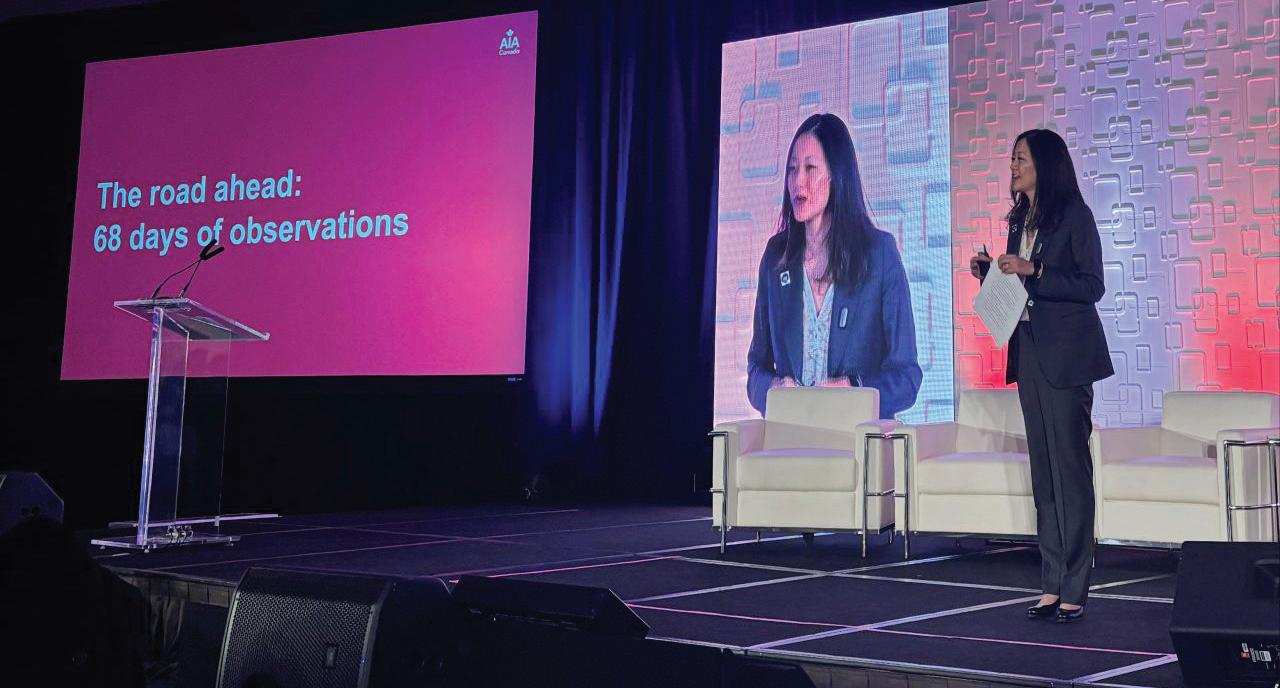
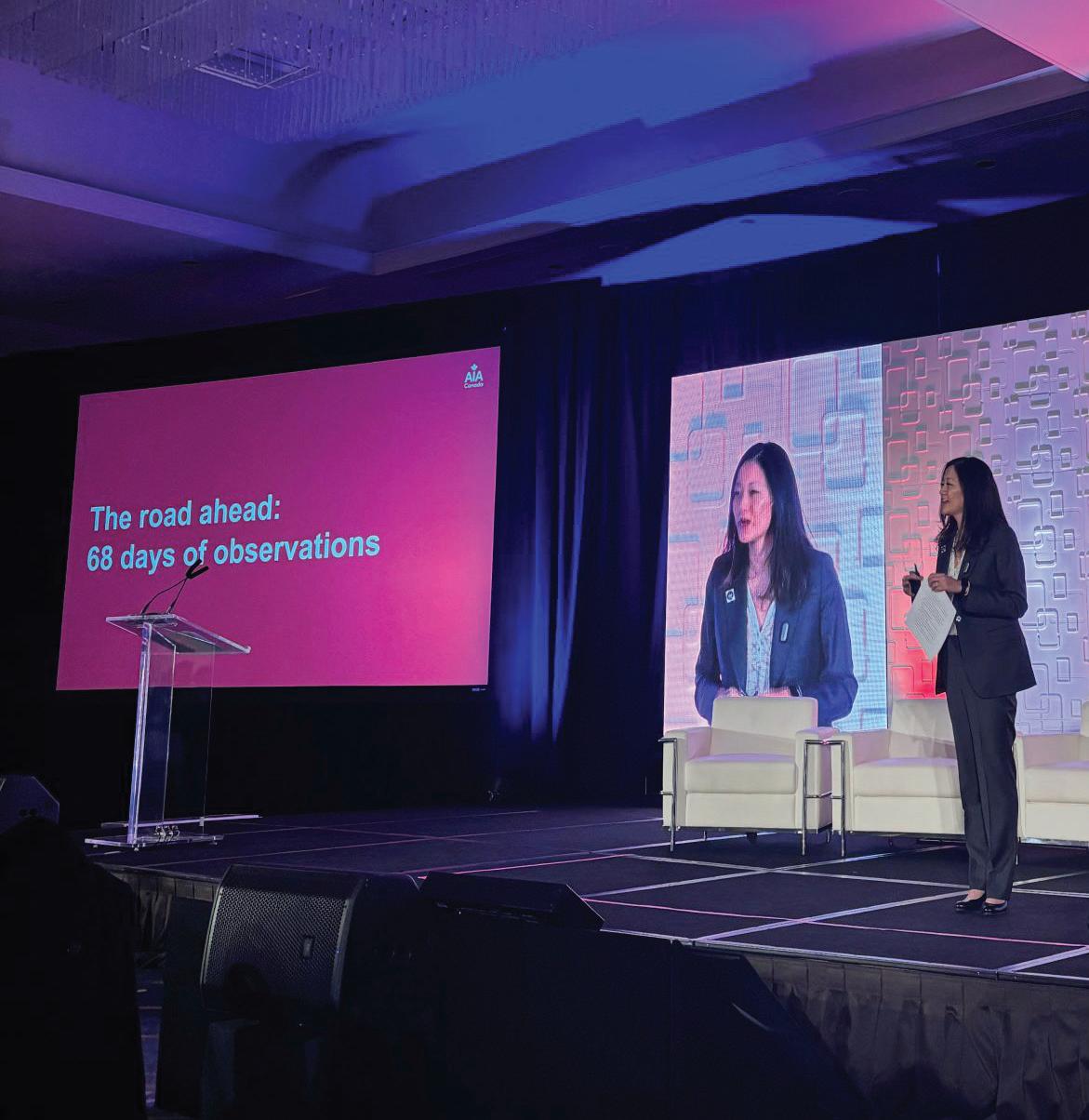
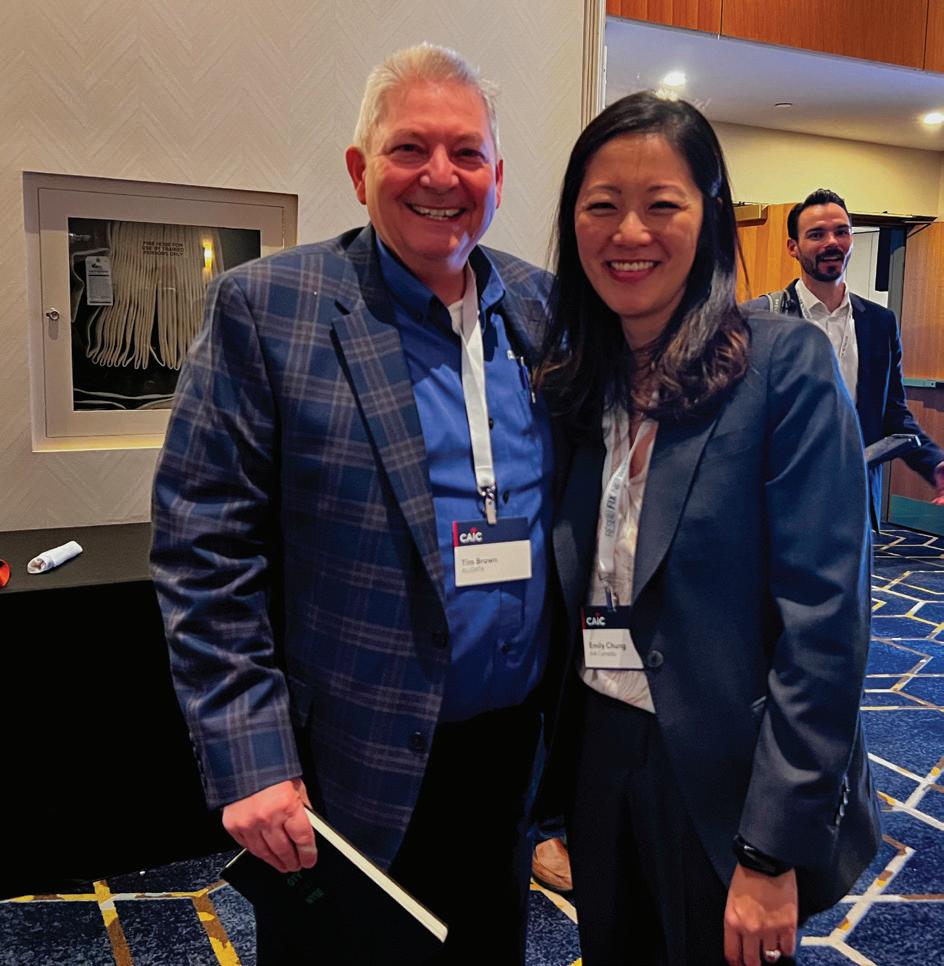
Workforce concerns extended to education and early career awareness. Emily Chung, president and CEO of AIA Canada, headquartered in Ottawa, said the sector is engaging potential workers too late.
“I believe the decision of where they’re going after high school starts at a very young age,” she said. “We could be there presenting automotive as a very viable career option at an even younger level.”
She also pointed to gaps in teacher training as vehicle technology evolves and said closer coordination between industry, government and schools is needed.
The panel was moderated by Stephanie Cooney-Mann of UAP Inc., a Montreal-based automotive parts distributor.
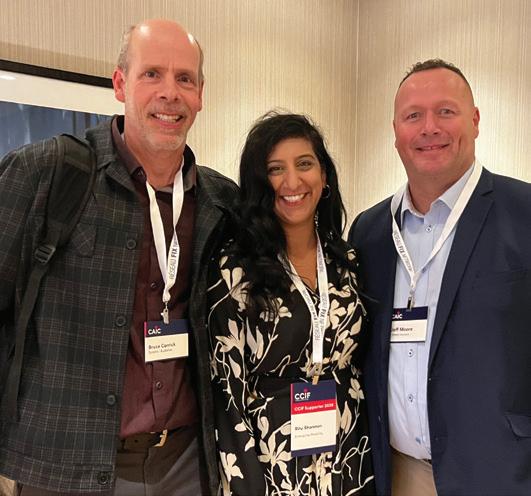
Alongside the conference, the Women’s Industry Network held a Toronto gathering tied to the Canadian Collision Industry Forum, drawing nearly 30 participants and marking expanded Canadian sponsorship and upcoming student scholarships, according to co-chair Ritu Shannon of Enterprise Mobility, headquartered in St. Louis, Missouri.
The conference’s workforce discussions pointed to a consistent conclusion: without changes to workplace conditions, hiring strategies and early talent development, the sector’s labour shortage is unlikely to ease.
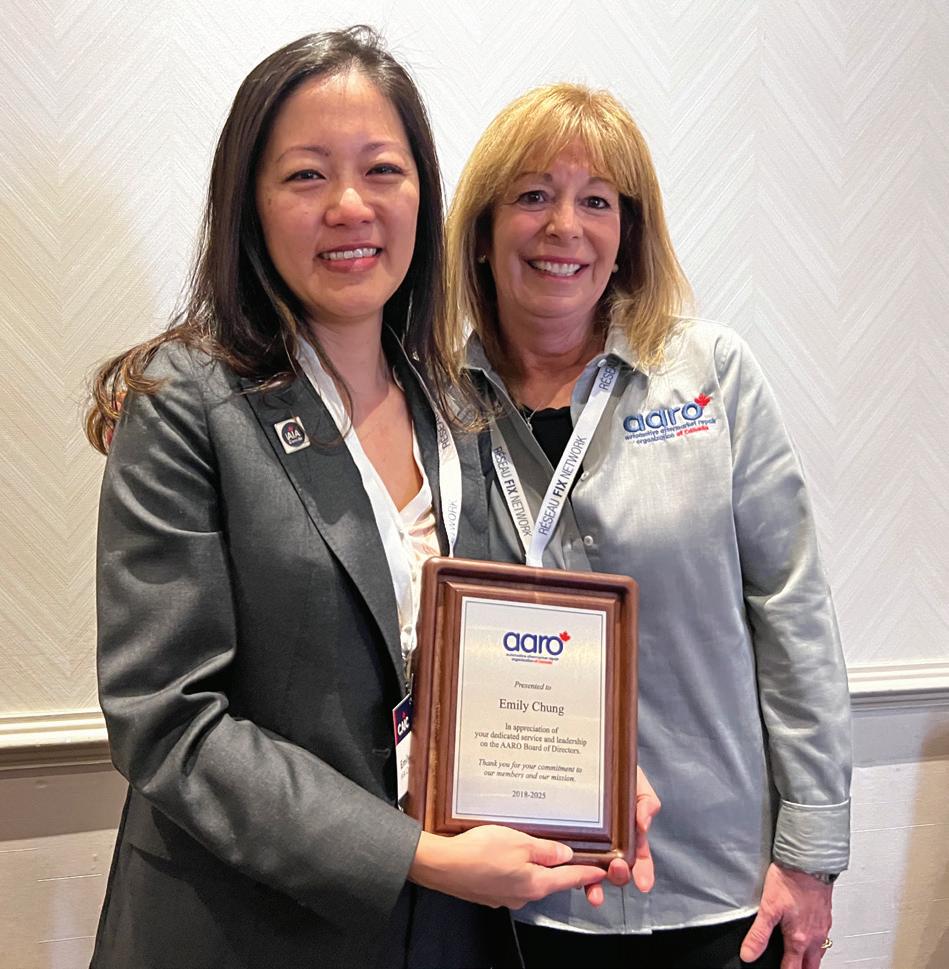
When Emily Chung stepped into the role of President and CEO of the Automotive Industries Association of Canada, she made it clear that her first priority would be listening. After years as a mechanical shop owner, an instructor at Georgian College and a journalist covering the automotive aftermarket, Chung brings firsthand industry experience to the role.
Chung, a qualified technician herself, understands the business from the shop floor up. She has managed technicians, invested in equipment, navigated training requirements and seen firsthand how quickly vehicle technology is changing the demands placed on repairers.
While her background is rooted in mechanical, she is now immersing herself in the distinct realities of collision — an environment shaped by OEM procedures, advanced safety systems and increasing complexity. In this Executive Vision conversation with publisher Darryl Simmons, Chung shares what she is learning, how she views the evolving Right to Repair discussion and why the collision repair industry’s growing technological and training demands must be part of the conversation around attracting and developing the next generation of repair professionals.

COLLISION REPAIR ASKED A FEW KEY QUESTIONS — HERE’S WHAT EMILY CHUNG HAD TO SAY.
DARRYL SIMMONS: You’ve described your first few months as a time of listening, testing assumptions and understanding stakeholder appetite. What have you learned so far about the collision repair sector?
EMILY CHUNG: There are both similarities and differences between the mechanical and collision sectors. Many members are eager to have a strong national voice. Another similarity is that rapid advancements in vehicle technology are significantly impacting how vehicles are repaired. In addition to that, the absence of compulsory trade certification in some provinces creates inconsistencies in repair standards and expectations for repair completion.
It is also clear that the collision sector involves more intricate nuances in customer management and business relationships. There are distinct challenges related to control over repairs, including access to information, parts procurement, payment processes, adherence to proper repair procedures, and the delivery of customer satisfaction.
DS: Right to Repair is often discussed as a single issue, but you’ve noted that collision experiences it somewhat differently than mechanical. How do you define Right to Repair in 2026 — and what parts of that conversation do you believe need to evolve?
EC: In 2026, Right to Repair still means equal access to repair and diagnostic information between original equipment manufacturers (OEMs) and the auto care sector and preserving the consumer’s choice of where to service their vehicle. We are not seeking free or proprietary information, but the ability to repair vehicles properly and safely. The conversation must evolve to address workforce development. Without access to information, shops cannot train technicians, and trade schools cannot properly prepare apprentices, worsening labour shortages. Voluntary frameworks such as CASIS have significant limitations and do not cover newer vehicles, underscoring the need for a modern legislative solution.
DS: Access to OEM repair information does not automatically translate into the ability to repair a vehicle safely or properly. How can AIA help the industry navigate the distinction between information access, liability, tooling, training and the real-world execution of modern OEM repair procedures?
EC: The first step is securing access to OEM information. Without it, the distinctions between liability, tooling, training, and execution are irrelevant. Access enables shops to understand required procedures, risks, and equipment. However, proper execution depends on having the right tools, appropriate training, and clear accountability. AIA Canada can support the industry through continued education, practical guidance, and ongoing advocacy with government and stakeholders to align access, standards, and workforce readiness.
DS: You’ve outlined four pillars for collision under AIA Canada’s evolving vision: training (I-CAR Canada), events, government advocacy and thought leadership. How do you see those pillars working together to deliver measurable value to the broader collision ecosystem?
EC: AIA Canada’s four pillars — advocacy, workforce development, member engagement, and innovation and insight — are interconnected and mutually reinforcing.
Workforce development, including I-CAR Canada training, strengthens technical competency and career pathways. Member engagement, through forums such as CCIF, creates space for collaboration, shared learning, and business improvement. Innovation and insight provide data and forward-looking initiatives that help shops adapt and compete. Advocacy amplifies these efforts by representing the sector not only to government, but also to insurers, OEMs, educators, and consumers.
Together, these pillars build a stronger, more informed, and more sustainable collision ecosystem.
DS: Mechanical labour rates in many markets significantly exceed collision labour rates, despite the increasing technical complexity, safety implications and OEM-driven requirements in collision repair. Historically there were reasons for that gap — but do those reasons still apply? And from your perspective, what would it take to move collision labour rates closer to parity with mechanical, if parity is warranted?
EC: Keeping up with vehicle complexity and original equipment manufacturer (OEM) repair and certification requirements requires large investments in tools, training, equipment, software and access to information.
At the same time, keeping up with insurer and consumer service demands has increased administrative burdens, requiring increases in nonproduction staffing. Further, collision repairers are competing with other high paying trades to retain current technicians and attract new entrants to the industry.
The industry may be well advised to establish a reasonable minimum return on investment (ROI) required for a shop that meets the AIA Canada statement on National Minimum Standards for Collision Repair to remain sustainable, pool data resources to establish if parity is required, and start any necessary negotiations on a solid financial foundation.
DS: If we fast-forward 10 or 20 years, what would you hope collision repair professionals say about your impact on AIA and on the industry?
EC: In 10 or 20 years, I would hope collision repair professionals say that I genuinely cared about the industry and used the association to meaningfully advance the collision sector. That under my leadership, AIA Canada delivered on its four pillars in a way that equipped shops with the knowledge, tools, and resources to excel. I would also hope they say we strengthened alignment across the industry, reducing tension and reinforcing a more united automotive sector, both collision and mechanical.
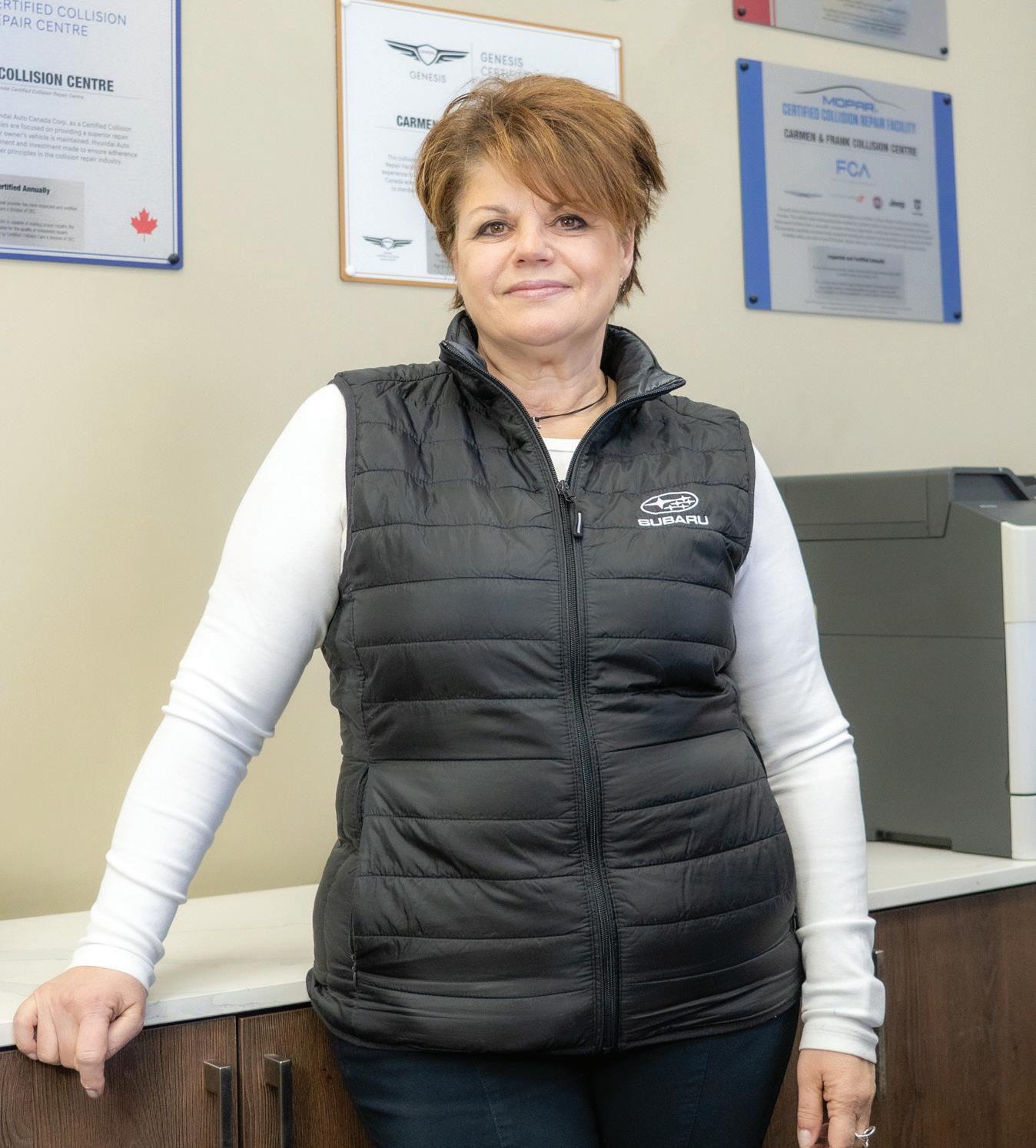
FROM MENTORSHIP TO COMMUNICATION, THE CARMEN & FRANK COLLISION CENTRE MANAGER REFLECTS ON THE STRENGTHS WOMEN BRING TO AN EVOLVING INDUSTRY
Voula Vavougios did not enter collision repair through a traditional path. She stepped into leadership at Carmen & Frank Collision Centre following the passing of her husband, who had been leading the business. In the middle of personal loss, the shop still needed direction, employees still needed support and customers still needed reassurance.
“One misconception can be that women are more suited for the customer service side and less for operational or technical roles,” Vavougios said. “I navigated that by immersing myself in every aspect of the business.”
The collision repair industry has long been male dominated, particularly on the technical side. Yet leadership in a modern repair facility requires a broad skill set. Communication standards influence customer satisfaction scores. Coordination between estimators,
technicians and front office staff impacts production efficiency. Transparency with insurers can determine how smoothly a repair moves through the system.
That immersion became her strategy. By developing working knowledge across the shop floor and front office, she grounded her authority in competence.
“We work as a team — front office, estimators and technicians — all aligned around production goals and customer satisfaction,” she said. “We care about cycle time and efficiency but we also care about doing things the right way and creating an environment where employees feel respected and valued.”
Vavougios believes women often bring strengths that align naturally with the evolving demands of collision repair leadership.
“One key strength is emotional intelligence, the ability to read situations, understand a
“ONE MISCONCEPTION CAN BE THAT WOMEN ARE MORE SUITED FOR THE CUSTOMER SERVICE SIDE AND LESS FOR OPERATIONAL OR TECHNICAL ROLES. I NAVIGATED THAT BY IMMERSING MYSELF IN EVERY ASPECT OF THE BUSINESS.”
— VOULA VAVOUGIOS
customer’s stress and respond with empathy,” she said. “Clear, patient and transparent communication reduces misunderstandings with customers, insurers and the team.”
In collision repair, empathy is not abstract. Customers are often navigating accidents, insurance claims and unfamiliar processes. Clear explanations and proactive updates reduce uncertainty. When communication improves, so does alignment within the shop.
“Success depends on coordination,” Vavougios said. “When you combine technical excellence with empathy, communication and accountability you create both high performance and strong customer loyalty.”
Her leadership philosophy extends beyond customers to mentorship within the team. Growth, she said, begins with clarity.
“Employees need to understand what success looks like and what the next level requires. Exposure to new responsibilities builds confidence,” she said. “Honest feedback, delivered with support, strengthens performance.”
As advanced materials, EV repairs and ADAS calibrations continue to reshape the sector, continuous learning has become nonnegotiable. Vavougios prioritizes ongoing education through I-CAR, OEM repair updates, seminars and hands-on workshops to ensure her team remains current. In an environment where certification and knowledge define credibility, preparation becomes the equalizer.
For young women considering collision repair or management, her message is direct.
“Do not be intimidated by the fact that it is traditionally male dominated. Competence, curiosity and commitment speak louder than gender.”
Vavougios’ path into collision repair may have been unexpected, but her experience reinforces a broader truth. Effective leadership in this industry is defined by accountability, resilience and the ability to align people and process.
IT’S NOT WHAT YOU THINK, BUT WHAT YOU KNOW THAT REALLY MATTERS
BY STEFANO LIESSI
Let me begin with a helpful tip: never write an article about insurance communication and relations while you are on hold for 15 minutes listening to muzak from the very parties involved.
Following a New Year’s resolution — not mine, but someone else’s — I am now back in a Zen zone, eating kale and not sweating the small stuff.
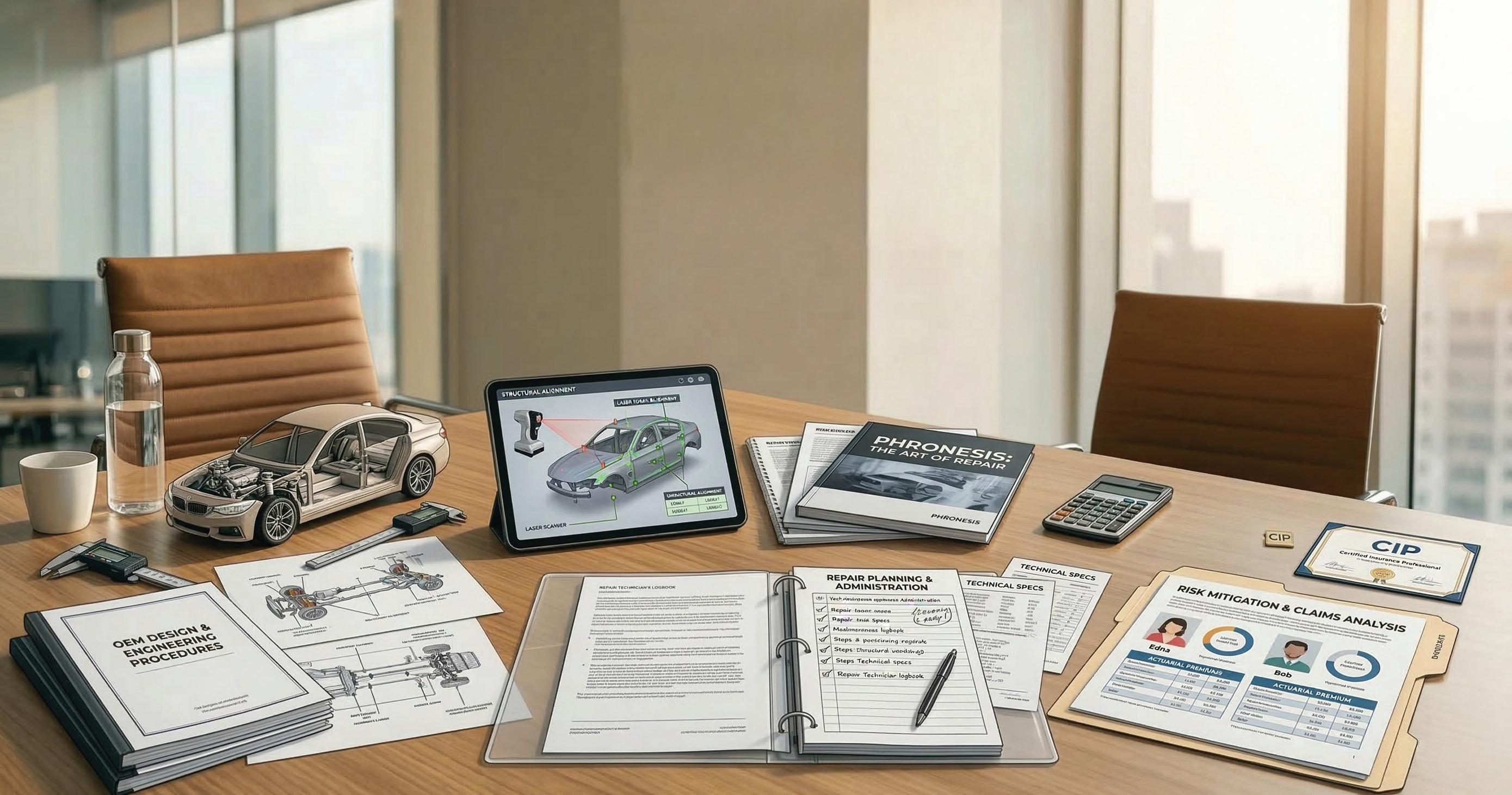
In the collision repair industry, there has been some confusion and misinterpretation about who does what. Without clarity, we are all swimming in mud. Let’s break the components down into something simple.
To begin with, we have the original equipment manufacturer, or OEM. This group designs and manufactures vehicles. They spend a great deal of time and money researching and developing ways to make vehicles economical yet safe under the guidelines presented by government legislation.
Just the research that takes place before a prototype ever sees an assembly line is monumental. For example, the E63/64 BMW 645i was first shown to the public at the 2003 Frankfurt Auto Show. BMW invested millions — millions — in the design of that vehicle before it ever took physical form.
The point here is that OEMs do not spend money on frivolity during production. If something is on the vehicle, it serves a purpose. This is where repair procedures begin to set a
REGARDLESS OF WHETHER YOU ARE AN INSURER, A SHOP OWNER OR A TECHNICIAN, WHEN EVIDENCE SUPPORTING AN OPERATION IS PRESENTED, IT MUST BE ACCEPTED.
precedent. OEMs do not repair vehicles, they design them — sometimes with repair in mind. Next comes the repairer: the collision repair facility and the technicians who physically repair the vehicle.
With education focused on the repair process and practical wisdom — also known as phronesis — these individuals repair vehicles. In some cases, technicians are versed in all aspects of the trade, including structural alignment, outer panel repair and refinishing.
Some specialize in a single area. A refinishing technician, for example, may focus exclusively on coatings and avoid preparation work entirely.
The skill sets of these individuals may also extend into the front office in the form of repair planning and administration. These technicians need the cognitive ability to understand and apply the procedures outlined by engineers at the OEM level.
Those millions BMW spent? Much of that investment goes into engineering. That engineering becomes the procedures technicians rely on during repair.
So far, we have OEMs that design, engineer and build vehicles but do not repair them. We have technicians who repair vehicles but do not design or engineer them. Both are educated and proficient in their respective fields. Each understands the other’s challenges but is not trained to perform those roles.
Yet both are expected to produce a finished
product of like kind and quality at the end of their work.
Insurers serve another critical role in the process: risk mitigation. Insurance providers assess data and calculate the probability of events that could lead to damage requiring repair. When you sit down with an insurance provider, they ask a series of questions to build a profile and determine your risk level. From there, actuaries and underwriters assign a premium.
Edna is 58 years old and drives to bingo twice a week and occasionally to the mall. Her premiums are lower than Bob’s, who drives frequently through the downtown core and has a tendency to speed. Bob presents a greater collision risk.
The business model is essentially a gamble. Ideally, neither Edna nor Bob will have a collision, and the premiums collected can be invested for a return. That’s how insurers generate profit.
Many skilled staff in insurance offices hold a CIP designation — Certified Insurance Professional — which is not easy to obtain. With that training comes the ability to adjust claims, investigate losses and even pursue actuarial work.
When a collision occurs, the wager is called. The insurer must pay. Adjusting the loss often means finding ways to reduce the payout, which is where discussions begin about parts selection and repair methods.
Still with me?
OEMs design and manufacture vehicles but do not repair them. Technicians repair vehicles but do not engineer them. Insurers insure against collision damage but do not design, engineer or repair vehicles.
Now we have established the playing field. Sometimes the lines blur among these three groups. Even a little perceived knowledge can become a dangerous weapon.Is collision repair an absolute science? Not even close. The variables are often enormous.
Used parts or aftermarket parts. Required repair operations. Different ways to complete the same task. Who says what — and why? This is where communication in our industry often becomes complicated.
Let’s clarify something important: all parties are trying to make a profit. That is a fair expectation. Understanding the role and
limitations of each participant is the key to effective communication.
Will there be grey areas? Absolutely. Can those areas be managed? Absolutely — with substantiated knowledge, practical wisdom and documented facts. If procedures specify an operation, it must be performed, documented and compensated. If expertise indicates there is a better method and that expertise is supported by documentation, then that method must also be performed and compensated.
The biggest challenge in communication is the misuse of perception. Perception is the recognition and interpretation of sensory information, often influenced by attitude, motivation or personal gain. In simple terms, it is what we think about something.
Inference, on the other hand, is a conclusion drawn from evidence and logical reasoning.
It is what we know. Regardless of whether you are an insurer, a shop owner or a technician, when evidence supporting an operation is presented, it must be accepted. Move on. Don’t waste time expressing what you think about something. That has little merit. No one cares — especially the courts.
In my opinion — and you are entitled to my opinion — obtaining proper documentation to support your inference in a grey area carries far more weight than relying on perception from a questionable source.
This works for everyone involved.If procedures or agreements say one thing and there is nothing to support otherwise, the conversation is over.
Time to move on. Simple. Straightforward communication. Communication we can care about.



Stefano Liessi is the Training and Curriculum coordinator for Color Compass Corporation. He is also a Red Seal technician and refinisher. Stefano enhances his 40 years of experience with 15 years of I-CAR instruction and a post-secondary degree. He also trains Skills Alberta students and has brought home Part Number:
Clear Visibility: Allows for easy inspection and precise application without removing the sheeting.
Superior Adhesion: Stays securely in place, even in high-traffic areas, preventing any accidental overspray.
Durable Material: Made from robust, tear-resistant plastic that withstands the rigors of a busy collis center.
Easy Application and Removal: Simple to apply and remove, saving valuable time and effort.
Versatile Use: Suitable for a variety of vehicle sizes and shapes, making it an essential tool for any aut body shop.
Ensure your paint jobs are protected and pristine w Proline Performance Products' clear overspray protective sheeting.
www.colorcompass.com

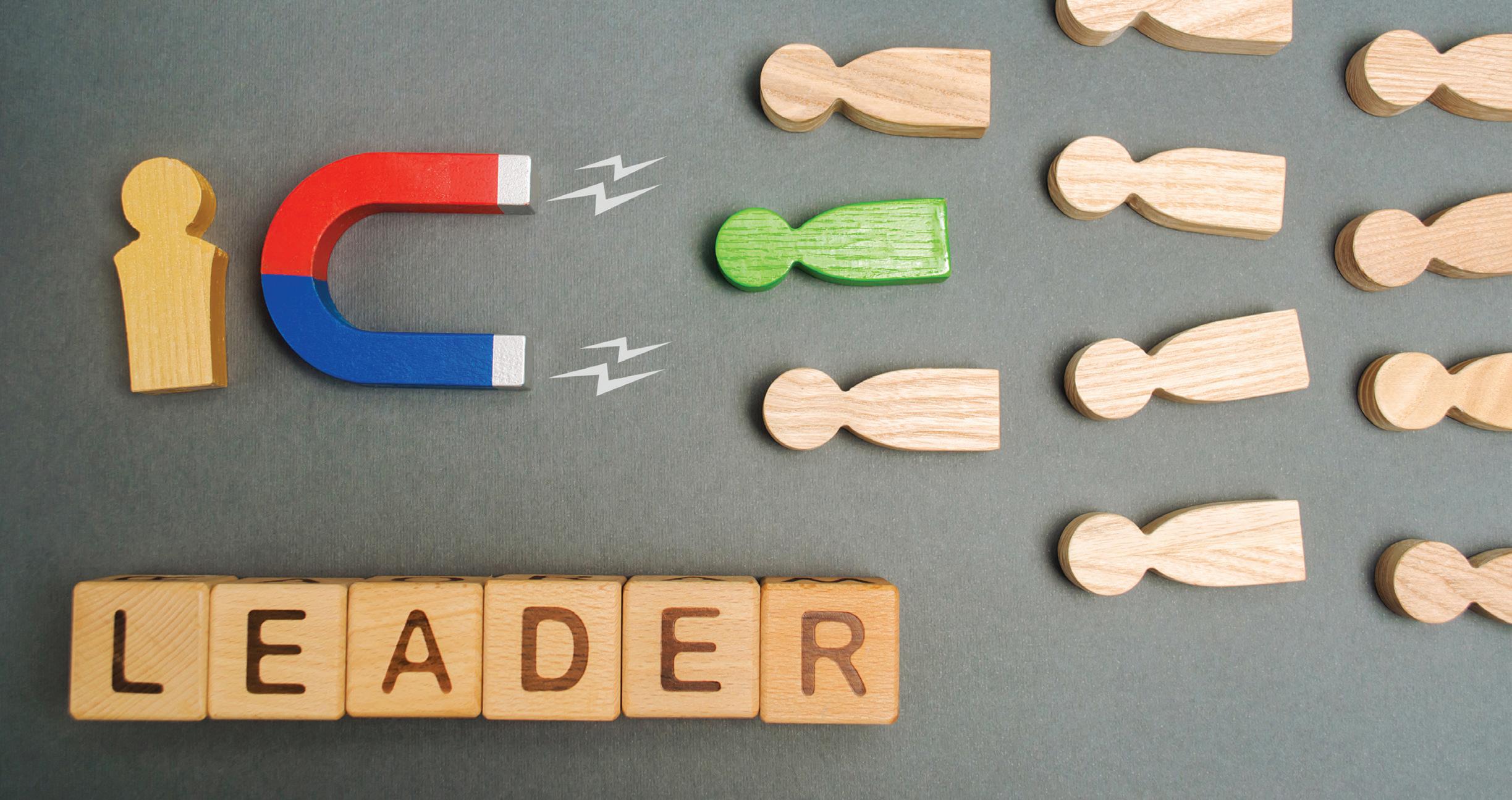
BY JAY PERRY
Quite a few years ago during Q&A at a speaking engagement, I was asked what is the common denominator among truly great leaders. The question is very valid because when you think of leaders you know of, there exists a tremendous variance in style. Some are commanding (e.g. Steve Jobs), charismatic (Nelson Mandela), quiet & understated (Tim Cook) and some are bombastic (you can fill in your own example from the current news headlines). There are many other types too. My answer for the question was focused on great leaders, and that trait is humility. When you see someone that practices humility what you are seeing is a display of openmindedness. Humble people know (and embrace the idea that) they do not know everything. Now intellectually we all know that is true — that we don’t know everything, but do we practice it? That take humility to display that kind of honesty and vulnerability in public.

JAY PERRY
We can learn something from everyone. Case in point could be learning something from a child, a stranger, a celebrity, a learned person, someone holding down a lowly station in society. If we are open-minded we can learn and that starts with humility.
Many leaders get caught up in the concept that to lead means you have all the answers and you never show differently as that could be a weakness. What a sad and wasteful viewpoint. So many opportunities are squandered because of that approach. That person shuts themselves down to possibility of improvement which is the ultimate purpose of leadership — to take others to a better state or condition.
Research proves that humility is a trait that elicits the best response in team members. A study done in 2021 shows that the trait of humility actually inspires others to take on the leadership role (Journal of Organizational Behaviour May 2024). What happens in the
Jay Perry is the founder of Ally Business Coaching, a process improvement and leadership development firm, and co-author of the book Success Manifesto with Brian Tracy. Jay is also an education partner with California Coast University in Santa Ana, California. He can be reached at jayperryally@gmail.com.
For more columns by Jay Perry visit collisionrepairmag.com/15738685
IF WE ARE OPEN-MINDED WE CAN LEARN AND THAT STARTS WITH HUMILITY.
behaviours of humble leaders is they exhibit an appreciation of other’s contributions, respect and recognition.
I recently heard Alex Kopacz, Canadian Olympic gold medalist, relate the story of his coach, Olaf Hampel, and how Olaf focused on Alex and not upon his own achievements. He listened to Alex and encouraged experimentation and resisted any temptation to impose a “his way or the highway” attitude, thus displaying openmindedness, thus humility. He didn’t have to do that as his credentials were impeccable. Olaf was a two-time Olympic gold medalist, a fact that Alex learned indirectly months into their relationship.
That’s humility, and is so appropriate in the world we live in today. There is so much noise out there, people clamoring for attention whether personal, political or to vacuum your pocket. True and great leaders do not do that. They, like Olaf, make it about the people they lead to greatness. Business leaders impact lives in an exponential way, both directly and especially indirectly throughout their careers. Make your leadership legacy one displaying humility as it is the sure way to be the one who’s driving.
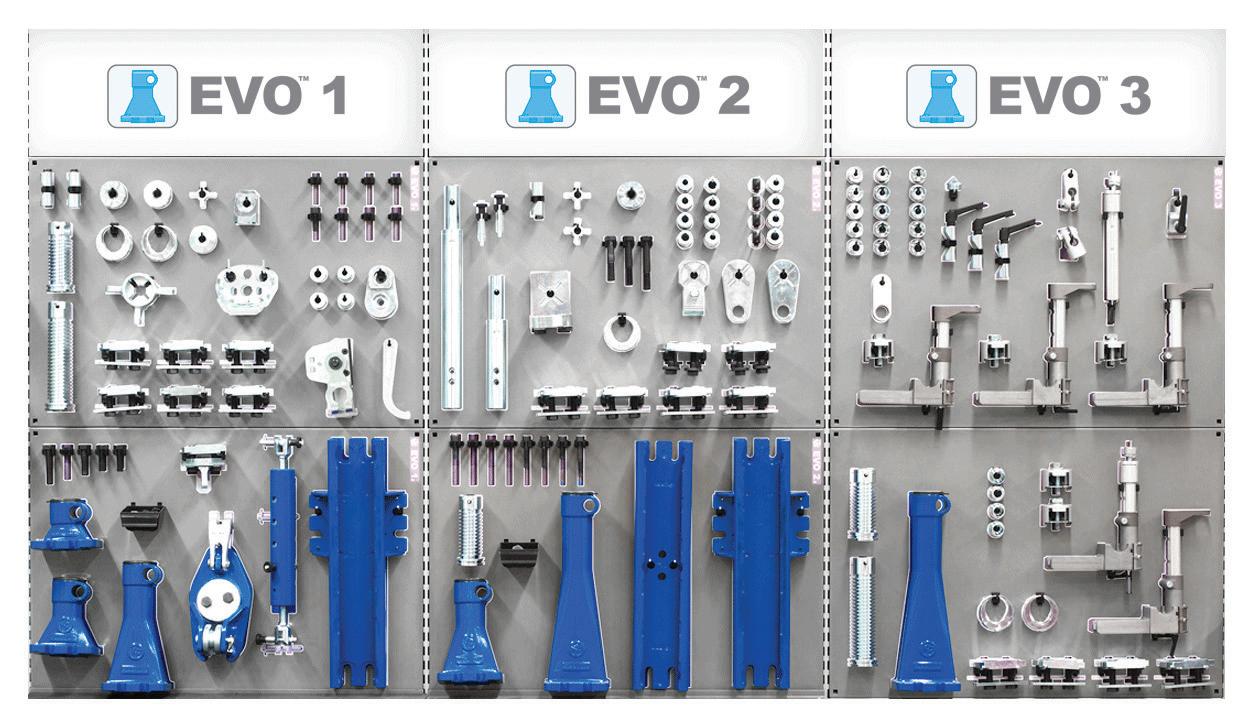
EVO™ Universal Anchoring and Holding System provides secure, adaptable anchoring for a wide range of vehicles. Its modular components offer flexibility and precision during structural repairs. Built for durability and ease of use, EVO™ ensures safe, efficient repair processes—making it a valuable addition to any professional collision repair workshop.

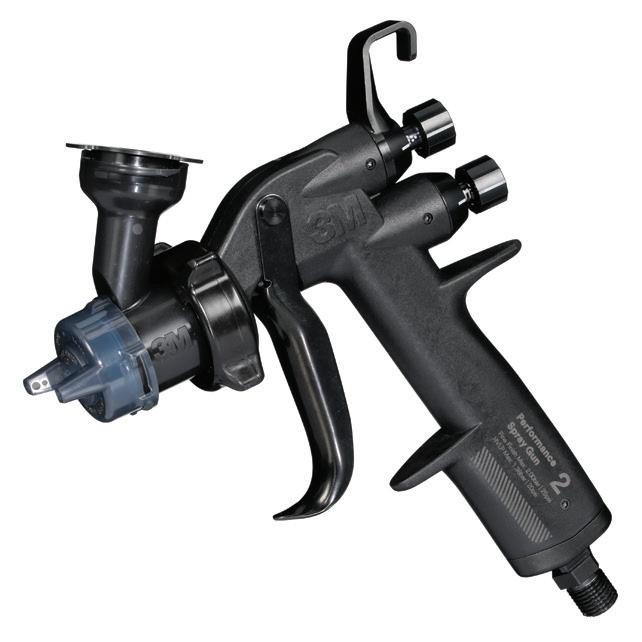
3M™ Performance Spray Gun 2 is the next generation of the 3M™ Performance Spray gun; a very versatile spray gun built for the modern painter. Capable of spraying a wide range of coatings, its impact-resistant composite body makes it one of the lightest spray guns available. Its optimized design with a sleek gun frame, laser marked control knobs and redesigned comfort trigger help to provide an enhanced spraying experience.
collisionrepairmag.com/15735853

kecotabs.com
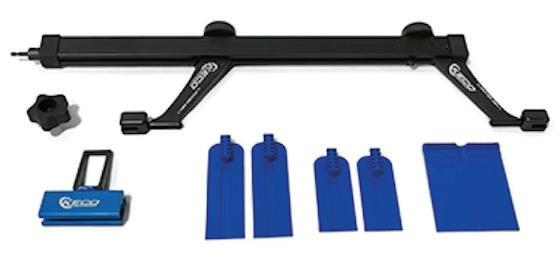
K-Power Midrange (Gen 2) Lateral Tension Tool
The KECO K-Power Midrange (Gen 2) is a 26” lateral tension tool engineered for controlled large-area Glue Pull Repair. By applying balanced side-load force, it stabilizes panels and directs metal flow to support primary pulls. A 1/4” impact receiver delivers positive lock with compatible drivers, while outward-angled legs increase spread across mid-size and larger damage. A stationary anchor leg and powered moving foot allow fast positioning and precise tension control. Built with a high-strength aluminum beam and precision steel legs.
collisionrepairmag.com/15817889

collisionrepairmag.com/15752356

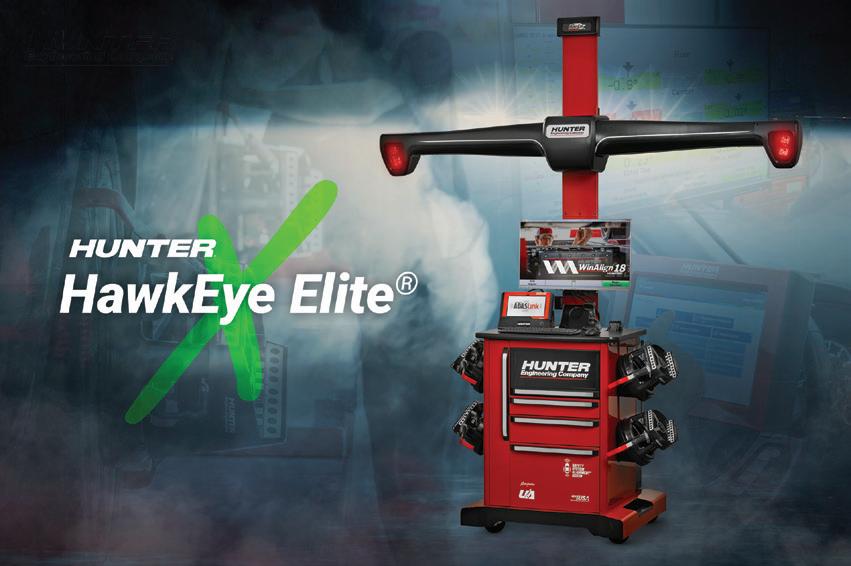
The new HawkEye® Elite Xpandable configuration is a future-proof alignment and ADAS system that’s expandable to Hunter’s Ultimate ADAS® for laserguided static calibrations. The new system comes standard with Quick Grip® adapters, standard-setting WinAlign® software and specs database and the ADASLink® diagnostic scan tool with secure gateway ability for dynamic calibrations, pre- and post-scans, and steering system resets. Most notably, the new configuration provides a seamless upgrade to Hunter’s award-winning, best-in-class Ultimate ADAS® static calibration system that cuts target setup time by up to 70 percent via laser-guided precision.
collisionrepairmag.com/15771715

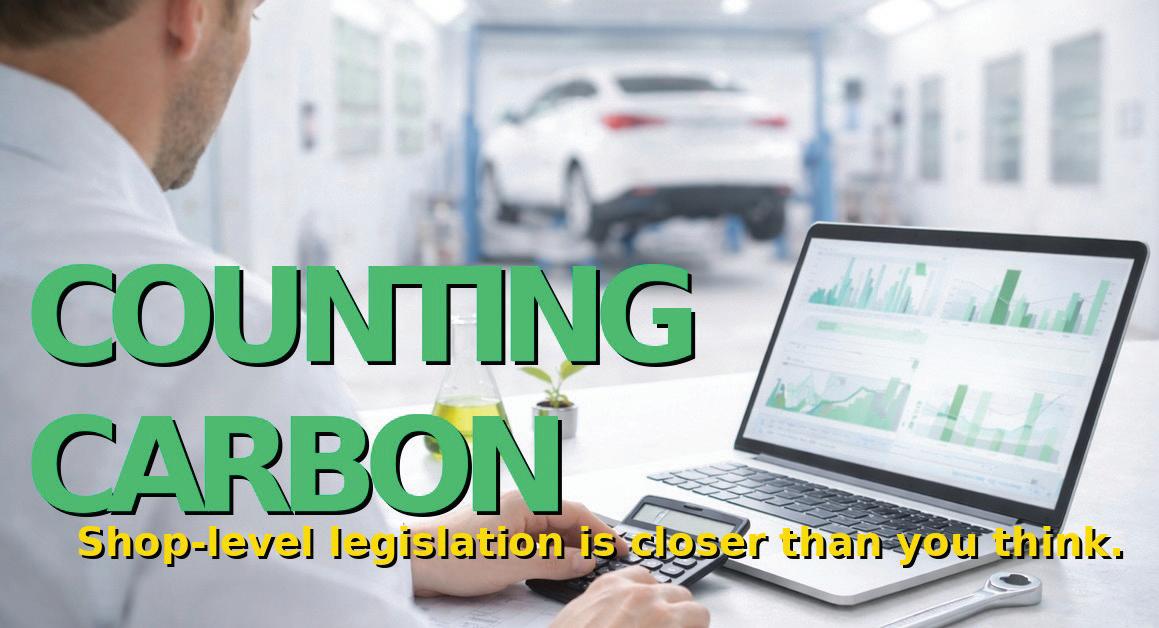
BY DARRYL SIMMONS
One of the more interesting signals about where the collision repair industry is heading didn’t come from a trade show floor or a supplier announcement. It came from a scientific journal.
Yes, scientists are now studying collision repair.
Not casually, either. With detailed models, engineering analysis and the kind of process mapping normally used to examine factories and manufacturing lines. When that level of attention starts showing up in academic research, it usually means the work being done inside today’s repair operations has become important enough — and complex enough — to deserve serious study.
A paper published in 2025 in the Journal of Engineering titled “ A Novel Model to Quickly Assess the Environmental Impact of Automotive Collision Repair Workshops” takes exactly that approach. The researchers set out to calculate the environmental footprint of collision repair operations by breaking down the activities inside a collision repair facility and measuring the impact of each one.
Instead of treating a repair business as one large operation, the researchers examined the individual services that take place inside a collision repair facility — washing vehicles, sanding panels, straightening metal, refinishing surfaces and running curing cycles in a spray booth. Each activity was analyzed for its environmental inputs and outputs, including water consumption, electricity demand, solvent use, waste generation and emissions.
The goal, according to the authors, is to allow repair facilities to “quickly measure their environmental footprint and identify which operations create the most impact.”
To build that model, the researchers essentially mapped the workflow of a repair operation the way an engineer studies a production line. Each task was treated as its own process with measurable inputs and outputs. Water consumption, electricity demand, compressed air use, solvent evaporation, waste materials and emissions were all assigned environmental values so they could be included in the larger calculation.
Once the analysis begins, even routine shop activities take on a surprising level of detail. Vehicle washing brings water consumption, detergents and wastewater management into the equation. Sanding operations introduce dust generation, abrasive materials and energy consumption from electric tools and extraction systems.
Refinishing operations receive particularly close attention. Anyone who has watched a spray booth move through a heating and curing cycle will understand why. Paint preparation, solvent use, air filtration, heating cycles and curing time all contribute significantly to the environmental footprint of the process. The researchers describe their method as “a structured approach to quantify the environmental impacts associated with each repair activity.” By mapping these individual steps, the model builds a detailed picture of how the environmental footprint of a collision repair facility develops piece by piece.
From that analysis, the researchers reached several conclusions worth highlighting.
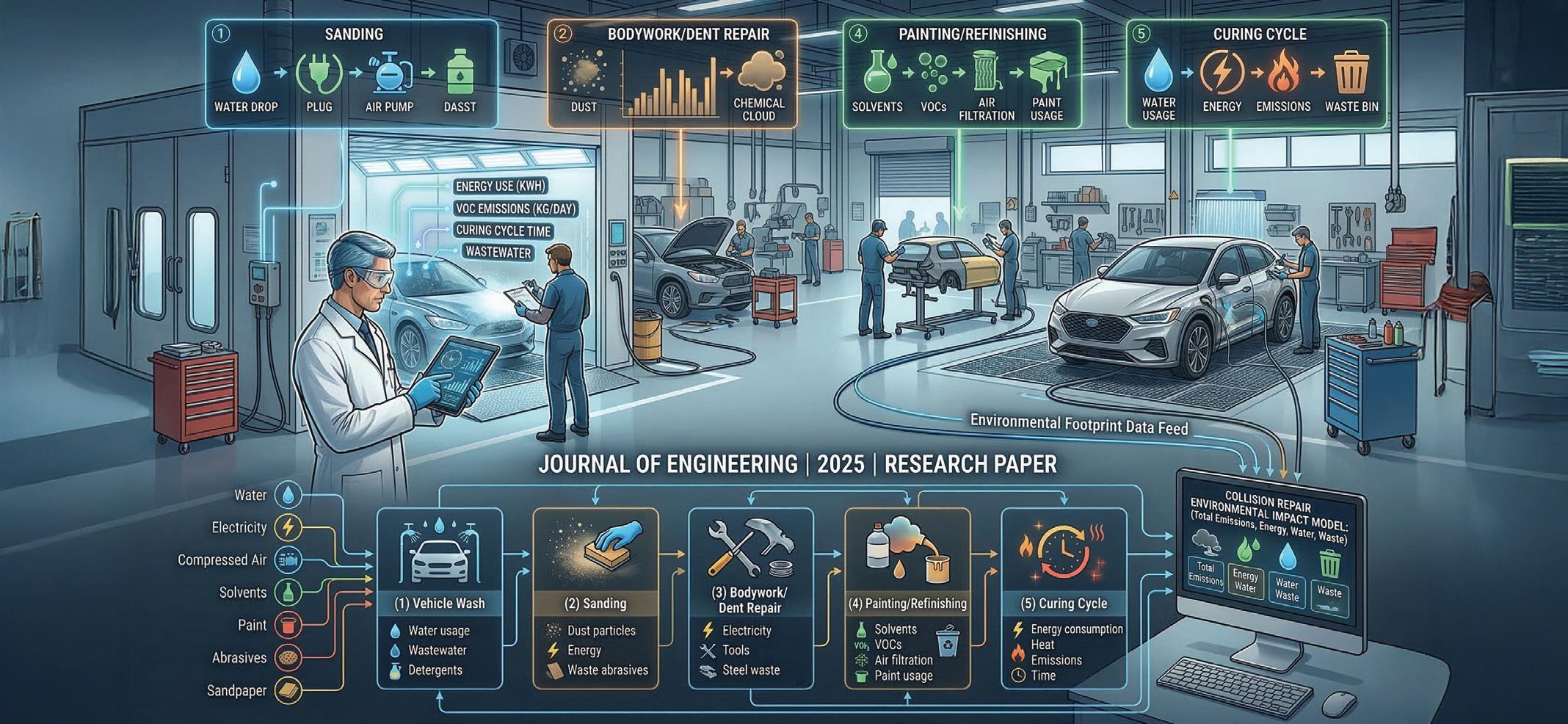
A new engineering model published in the Journal of Engineering (2025) transforms the traditional auto bodyshop into a data-driven environment. By breaking down every stage of the repair process — from initial washing and sanding to energy-intensive spray booth curing — researchers can now quantify the specific environmental footprint of each activity.
The main outcome of the study is the model itself. The researchers proved that a collision repair shop’s environmental impact can be calculated by breaking the operation into individual services and assigning environmental indicators to each one. In their words, the model makes it possible to monitor emissions and environmental performance linked to specific repair activities.
They also built a simple monitoring tool around the model so companies could apply it without needing deep technical expertise. The intent is that a shop or company could plug in operational data and receive an estimate of its environmental footprint.
One of the clearest findings is that not all repair work contributes equally to environmental impact. Certain operations — particularly refinishing and energy-intensive processes — account for a disproportionately large share of emissions and resource consumption.
By isolating each service step, the model highlights which activities have the most negative environmental impact, allowing businesses to focus improvement efforts where they matter most.
The paper points out a major gap in the literature: despite growing pressure around sustainability, there has been very little structured research on environmental performance in collision repair shops. The authors argue that the industry has lacked clear tools or indicators to measure impact in the first place.
Their model is meant to fill that gap by providing a standardized way to evaluate environmental performance.
The model isn’t just about reporting emissions. The authors frame it as a continuous improvement tool. Once environmental impacts are quantified, companies can monitor progress over time and adjust operations, equipment choices or processes to reduce their footprint.
In other words, measurement becomes the first step toward operational change.
The broader conclusion of the paper is that collision repair will not be exempt from the wider push toward sustainability in the automotive sector. The researchers place the work within the “triple bottom line” framework — environmental, economic and social performance — suggesting that environmental metrics will become part of how businesses evaluate success.
For the collision repair industry, that means environmental performance inside a collision repair facility could eventually be monitored in the same structured way shops already track productivity, cycle time and materials usage.
The paper doesn’t tell shops exactly how to become greener.
What it does show is that the industry is now being studied closely enough that environmental impact can be measured in detail. Once measurement exists, standards, benchmarks and reporting requirements usually follow.
That’s the real takeaway. The science is starting to catch up with the collision repair industry.
Anyone interested in seeing the level of detail the researchers applied to everyday repair operations can read the full study here: https://onlinelibrary.wiley.com/doi/10.1155/je/8863257
Full paper: Ricardo Pinto et al., “A Novel Model to Quickly Assess the Environmental Impact of Automotive Collision Repair Workshops,” Journal of Engineering, 2025.

PROFITABILITY RETURNED, BUT INSURERS ENTERED 2026 WARY OF THE STRUCTURAL RISKS THAT NEARLY BROKE THE MARKET TWO YEARS EARLIER
Auto insurers entered 2026 ready to grow again, but Patrick Sullivan said the industry was moving carefully. Profitability had returned. Confidence had not.
“The last couple of years were interesting to say the least,” Sullivan told attendees during the February CIECA webinar Navigating the Sea of Insurance Trends in 2026. “Carriers went through the full gamut of emotions since 2020.”
After historic underwriting losses in 2022, insurers raised rates sharply to stabilize their books. By late 2024, most had returned to profitability and remained there through 2025. That recovery reopened the door to growth, but it did not erase the underlying structural risks.
“[Auto insurers] were hungry for growth in 2026, but at the same time there were underlying trends that really worried them,” Sullivan said. “[Profitability] came back, but the risks that caused the losses never really went away.”
The most significant of those risks was repair severity. The average cost to repair a vehicle nearly doubled over the past decade, rising to $4,768 by the third quarter of 2025 from roughly $2,500 in 2008.
Patrick Sullivan, senior editor and conference co-chair of Auto Insurance Report.
“[AUTO
INSURERS] WERE HUNGRY FOR GROWTH IN 2026, BUT AT THE SAME TIME THERE WERE UNDERLYING TRENDS THAT REALLY WORRIED THEM. [PROFITABILITY] CAME BACK, BUT THE RISKS THAT CAUSED THE LOSSES NEVER REALLY WENT AWAY.”
“That was a fundamental change in what it took to repair a car,” Sullivan said. “[Repair severity] did not spike and then come back down. It moved up, and it stayed there.”
ADAS often receives the blame for rising costs, but Sullivan said the data tells a more limited story. Vehicles fully equipped with ADAS now represent roughly one-third of the U.S. fleet and reduce claim frequency by about 33%, largely by preventing minor crashes.
“That wasn’t really what was driving the problem,” he said. “[ADAS] was cutting low-severity claims, not offsetting high repair costs.”
Instead, Sullivan pointed to how vehicles are designed. Safety performance and feature content dominate engineering priorities. Repairability does not.
“Vision Zero really defined how OEMs approached vehicle design,” he said. “[OEMs] focused almost entirely on saving lives, very successfully, but that left blind spots around severity.”
He described watching a driver tear a side mirror off her vehicle in a dark parking garage — a small mistake that became an expensive repair.
“No amount of technology was going to fix that,” Sullivan said. “[Once you add cameras, sensors and motors], a simple mistake turns into thousands of dollars.”
When traffic volumes returned after the pandemic, risky driving habits returned with them.
“When people came back on the road, they didn’t change how they drove,” Sullivan said. “[Drivers] kept driving faster. They stayed distracted. They crashed harder than anyone expected.”
The result was 2022.
“We were unable to find a year worse than 2022,” he said. “[In the industry data], you probably had to go back to the first time someone mispriced a Model T to see something comparable.”
Insurers responded by raising rates aggressively. Large carriers increased premiums by an average of 16.9% in 2023. Increases slowed in 2025 once profitability stabilized.
“They had to raise rates to keep paying claims,” Sullivan said. “[Without those increases], the math didn’t work.”
Total losses added further pressure. Roughly 22.8% of claims ended as total losses, the highest level on record, even with used vehicle values still elevated.
“THAT
WAS A FUNDAMENTAL CHANGE IN WHAT IT TOOK TO
REPAIR
A CAR.
[REPAIR
SEVERITY] DID NOT SPIKE AND THEN COME BACK DOWN. IT MOVED UP, AND IT STAYED THERE.”

“YOU CAN’T ADAS YOUR WAY OUT OF A HAILSTORM. [SOME LOSSES] HAVE NOTHING TO DO WITH DRIVER BEHAVIOUR OR SAFETY SYSTEMS.”
“It took far less damage to total a car than it used to,” he said. “[Vehicle complexity] pushed cars over the line faster.”
Vehicle mix compounded the problem as consumers continued shifting into heavier SUVs and pickup trucks.
“At the same speed, those crashes were simply more severe,” Sullivan said.
Economic pressure also distorted frequency data. Higher deductibles and tighter household budgets led some drivers to absorb losses instead of filing claims.
“I don’t think people were actually having fewer accidents,” Sullivan said. “[Many drivers] just didn’t want to file a claim.”
Even advanced safety systems offered no protection against weather-driven losses.
“You can’t ADAS your way out of a hailstorm,” Sullivan said. “[Some losses] have nothing to do with driver behaviour or safety systems.”
By early 2026, insurers were profitable again. Growth returned to the agenda. Caution remained.
“They might have been fat and happy,” Sullivan said, “but [auto insurers] were still worried.”
collisionrepairmag.com/ 15816567

BY GIDEON SCANLON
Modern vehicles are marvels of engineering ones that are becoming very costly to repair!
Shops now handle machines packed with cameras, radar sensors and software systems. The process takes longer and the bills run higher. The nature of damage has changed. What once looked minor often is not. A light bump once meant cosmetic work. Today it can trigger diagnostics, sensor checks and system calibrations. A tapped bumper may involve radar units or ADAS.
Dealing with this complexity is the central challenge facing the collision industry. Businesses are developing new processes in response. CCC Intelligent Solutions reports scans on 88% of direct repair program estimates by the third quarter of 2025. Calibrations appear on 36%.
Average claim severity reached US$4,768 through the third quarter of 2025. Labour rates rose 3%
But safer does not mean simpler. Nor cheaper. It is difficult to see prices falling, even in the long term. The industry is still in the midst of a worsening labour shortage. At the beginning of 2026, some 6,800 vacancies were unfilled. Modern vehicles demand diagnostics, documentation and specialized procedures. Trained technicians are in short supply, and the leading businesses in this industry will likely have to pay dearly to secure the talent they need.
Customers and insurers often struggle to understand the benefit of scans post-accident calibrations. Few will follow the finer points of market forces or labour shortages. What they see are higher bills and longer cycle times.
Communication has therefore become another challenge for the industry. Collision professionals work with technical language that can sound opaque to anyone outside the trade:
MODERN VEHICLES CARRY COSTLY TECHNOLOGY. OLDER VEHICLES ARE OFTEN WORTH LESS THAN THE COST OF FIXING THEM. THE MIDDLE GROUND IS DISAPPEARING.
year over year. Total loss frequency climbed from 22.1% to 22.8%. More than 72% of those losses involve vehicles seven years old or older.
And therein lies the rub. Older vehicles are often worth less than the price of putting them right. The repair middle ground is disappearing. The fleet is also aging. S&P Global Mobility places the average vehicle age at 12.8 years. Shops now manage both ends of the spectrum: sophisticated new vehicles and aging ones that quickly become writeoffs.
Electric vehicles show where the trend is going. Repairable battery-electric vehicle claims in Canada reached 4.77% in 2025, up 24 percent year over year. Average EV severity reached $7,253. In the third quarter, 85% of EV parts spending involved original equipment parts, compared with 62% for internal combustion vehicles.
None of this argues against safer vehicles. Automatic emergency braking reduces frontto-rear crashes by 50% and injury crashes by 56%.
scans, calibrations, ADAS procedures, sensor alignments, software resets. To a technician these are routine steps. To a customer they can sound mysterious, even suspicious.
When people hear unfamiliar terms attached to a rising bill, the instinct is to assume they are being taken for a ride.
That perception creates friction where clarity is needed most. Collision professionals must now do more than restore damaged vehicles. They must translate the work itself.
Plain explanations matter. Customers need to understand why modern vehicles require diagnostics after a minor impact, why sensors must be recalibrated and why manufacturer procedures cannot be skipped. Without that understanding, legitimate work can look like unnecessary expense.
Modern vehicles are truly wonders of scientific acheivement. Explaining how to repair them, however, is more of an art.