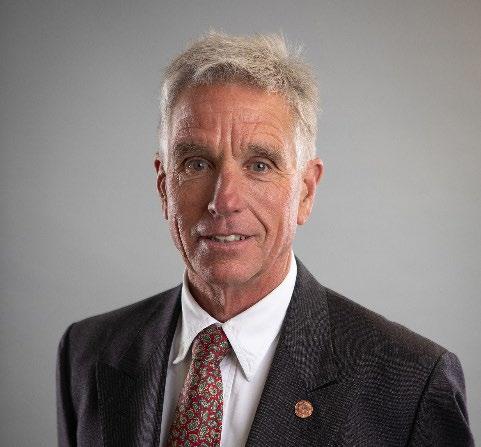
On behalf of Council, I am pleased to present Naracoorte Lucindale Council’s Annual Report for the 2024/25 financial year.
The report shows we delivered important services and projects, while also working to ensure our community was supported and engaged throughout a difficult year. Cost of living pressures, coupled with unprecedented drought, posed many challenges for our community and we remain particularly mindful of these issues as we move into a new financial year.
In 2024/25, Council continued with its commitment to meeting the goals of our Strategic Plan, while adhering to the forecasts of our Long Term Financial Plan. However, while we have robust and well-considered plans in place, Council continues to review these to ensure our investments remain appropriate and prudent.
In late 2025, Council’s financial sustainability will come under the spotlight as the Essential Services Commission of SA undertakes its review into our performance and strategic plans. We’re looking forward to receiving ESCOSA’s advice as we continue to strive for a sustainable overall financial position that ensures current and future ratepayers continue to receive appropriate levels of service and projects that support our community’s aspirations.
Projects progressed in the past year included an approximate $1M investment in the Naracoorte
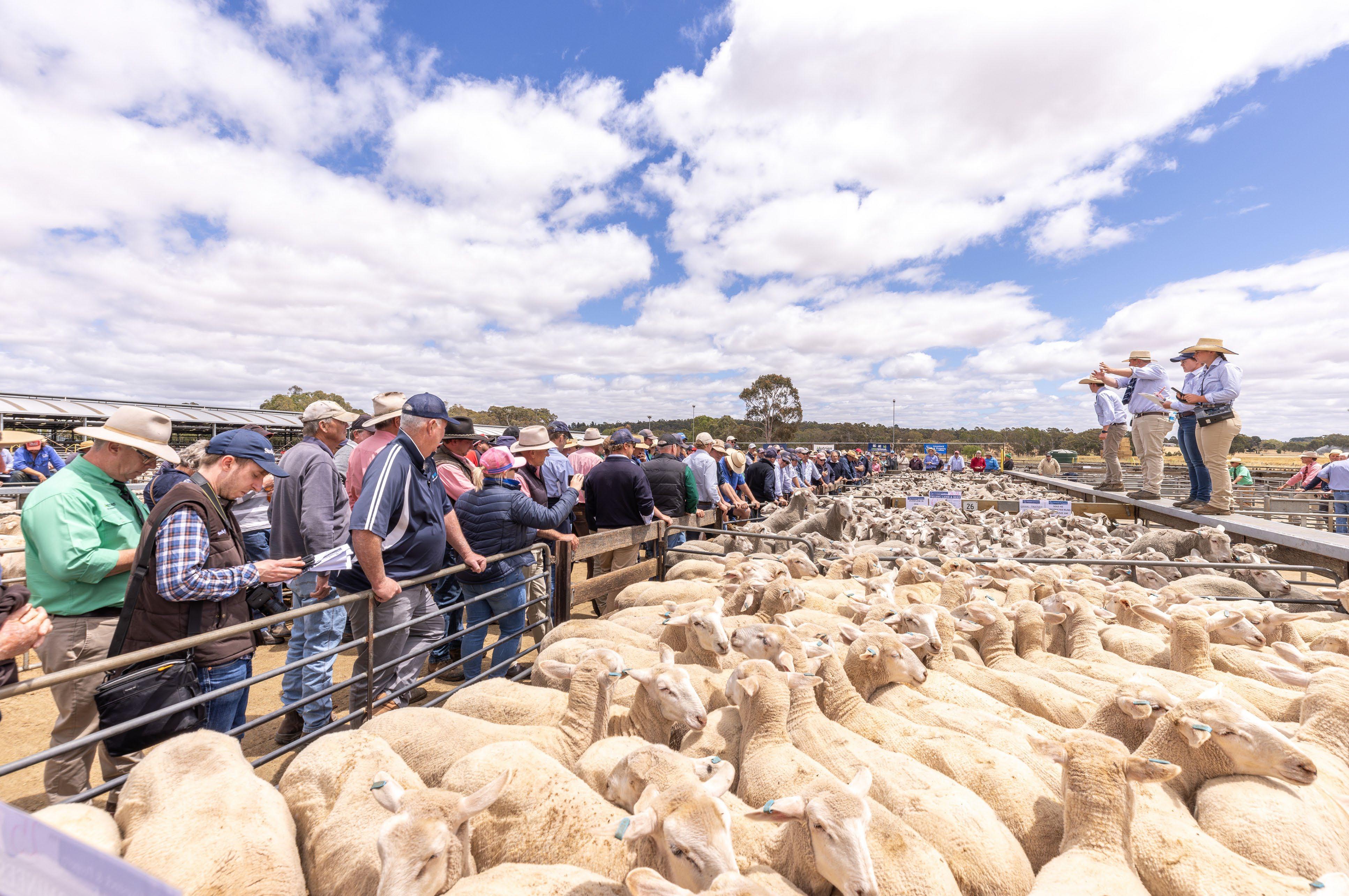
Regional Livestock Exchange, where the installation of electronic identification equipment and infrastructure upgrades to sheep yards was largely completed. Council worked closely with the Department of Primary Industries and Regions SA to deliver the mandated sheep and goat electronic identification requirements.
Other key projects delivered included:
• Major road reconstruction projects on Miles Road, Diagonal Road, Premier Drive, and Clarksons Road
• Major road reseals on Gap Road, Railway Terrace (Frances) and Bool Lagoon West Road
• Sealing of the floor and walls at the iconic Naracoorte Swimming Lake
• Accessible car parking in Moore Street, Naracoorte, as part of the Pioneer Park Masterplan
• Roof replacement at the Lucindale War Memorial Hall
Work also progressed on plans to rejuvenate the Naracoorte town centre and Lucindale main street, while a feasibility study was progressed for a hybrid indoor pool for the swimming lake. Council will consider these matters early in the 2025/26 financial year.
You can read more details of the key projects and events of the past year in this report.
In early 2025, we bid farewell to CEO Trevor Smart who retired from Council and left behind a 40-year career with local government. I want to congratulate Trevor on his stellar service to local government in South Australia and thank him for his dedication to the Naracoorte Lucindale Council and community.
I also want to thank my fellow Council Members and employees who have continued to work hard to deliver on our plans for the community.
Mayor Patrick Ross
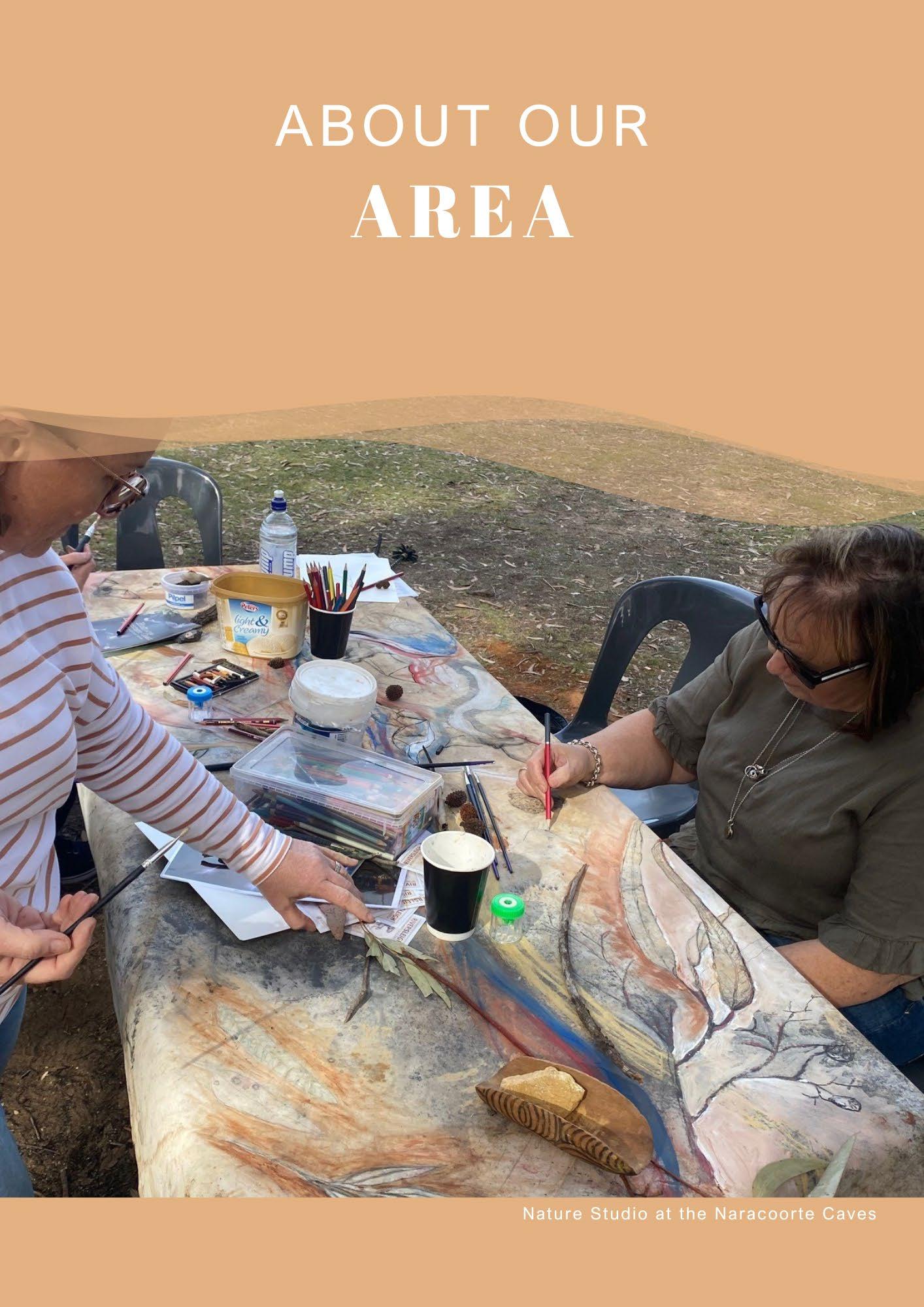
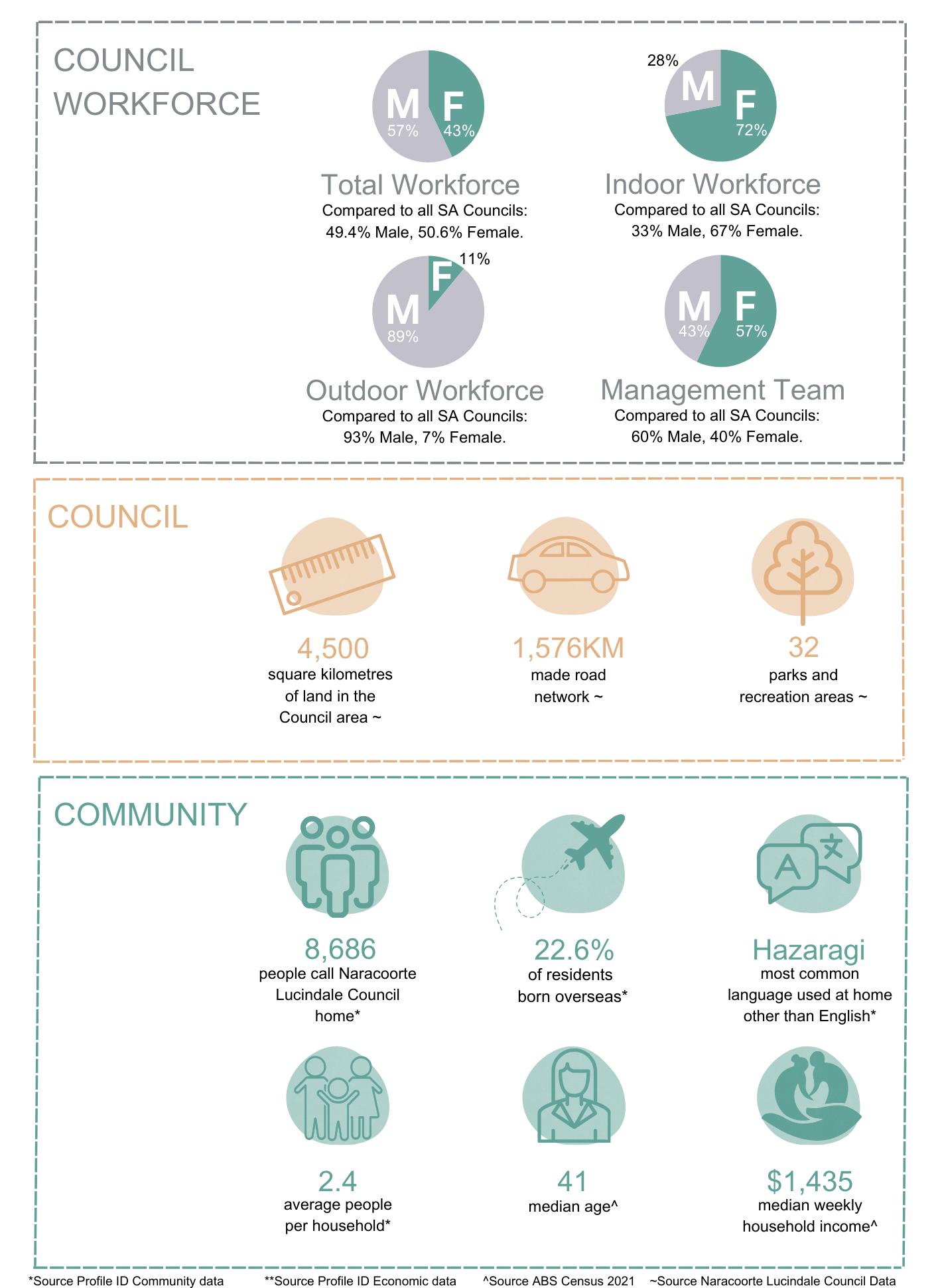
Our region is home to almost 8,700 people (2021 Census) and the population is forecast to grow as people move to the region and families grow.
Located in the heart of the Limestone Coast Region, Naracoorte Lucindale Council is the natural service and business hub for many communities in both South Australia and Western Victoria. Located 330km from Adelaide and 440km from Melbourne we are blessed with natural attractions, prime agricultural land, reliable rainfall, accessible underground water, a diverse and strong community and a vibrant rural economy, including the wine growing region of Wrattonbully and the neighbouring wine regions of the Coonawarra and Padthaway.
The Naracoorte Lucindale Council district covers 4,500 square kilometres with 70% of the land being Primary Production; a significant economic contributor to the Limestone Coast, with livestock, horticulture, cropping and viticulture all important to the Council area.
Naracoorte is our largest town, offering residents and visitors a range of accommodation, dining, sporting and recreational, business, retail and service options. The tight-knit community of Lucindale is the second largest township and is located 40km west of Naracoorte, halfway to the Limestone Coast coastline. Our other smaller communities of Hynam, Frances and Kybybolite contribute to our rich fabric and heritage, and offer something individual, special and unique.
The climate in Naracoorte makes it the perfect destination all year round The spectacular Naracoorte Caves National ParkSA’s only World Heritage listed site - and the free Naracoorte Swimming Lake are key attractions. Our established and extensive trail network provides quality opportunities for outdoor enthusiasts to either walk or cycle and a chance for visitors to see the abundant local wildlife. Dotted around the region are lakes and camping opportunities to enjoy, and fabulous hospitality experiences abound to sample local food and wines.
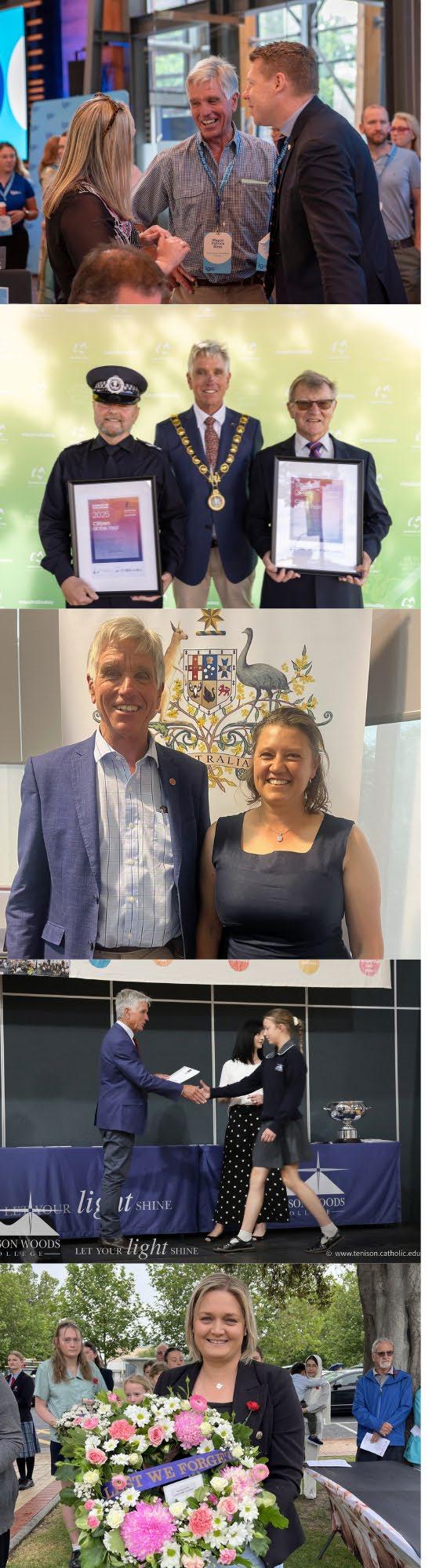
Images: 1. Mayor Ross at the LGA OGM. 2. Australia Day Citizens of the Year. 3. Mayor Ross & Deputy Mayor Goodman. 4. Mayor Ross at the Tenison Woods School Graduation. 5. Cr Crossling at Remembrance Day.
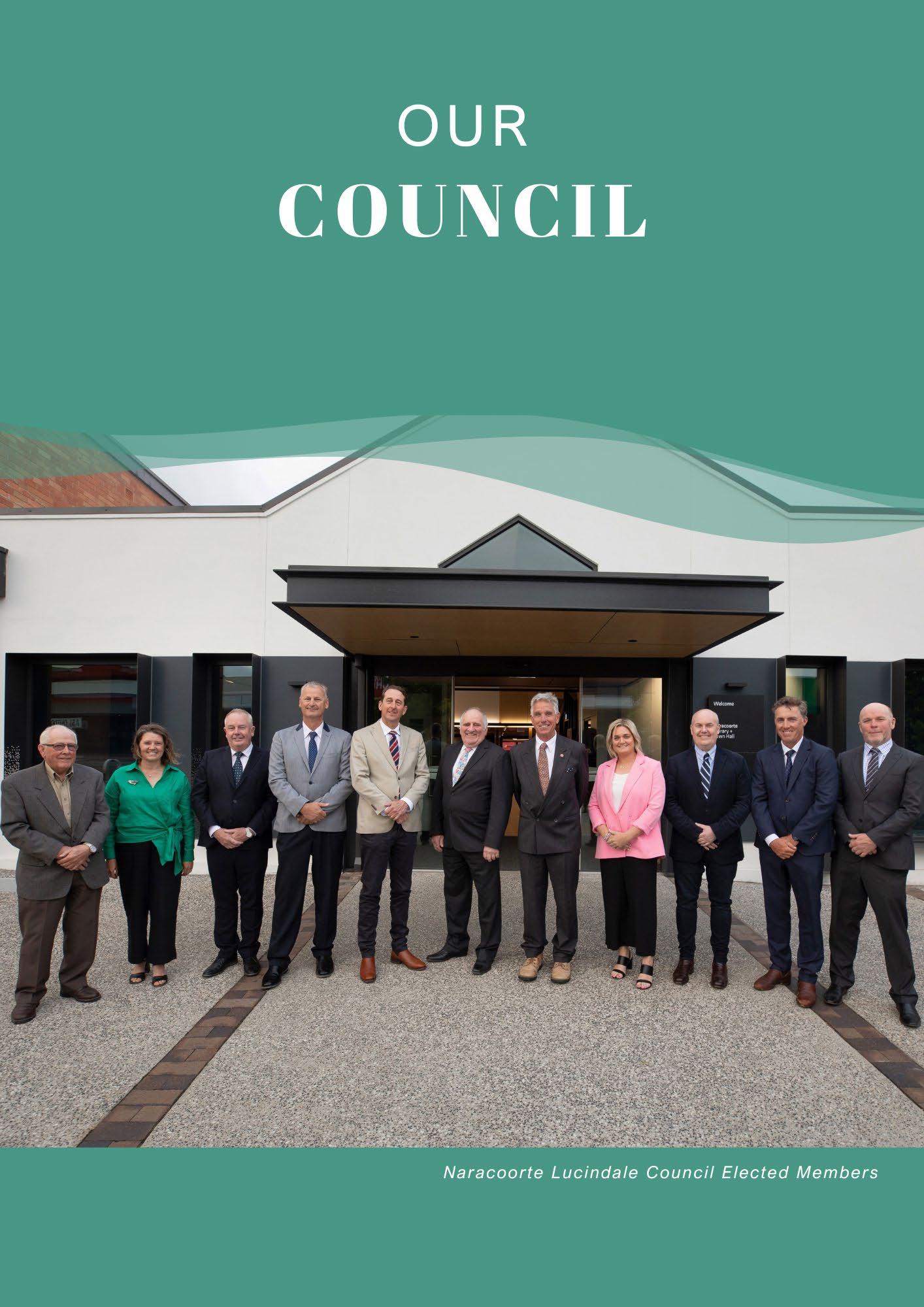
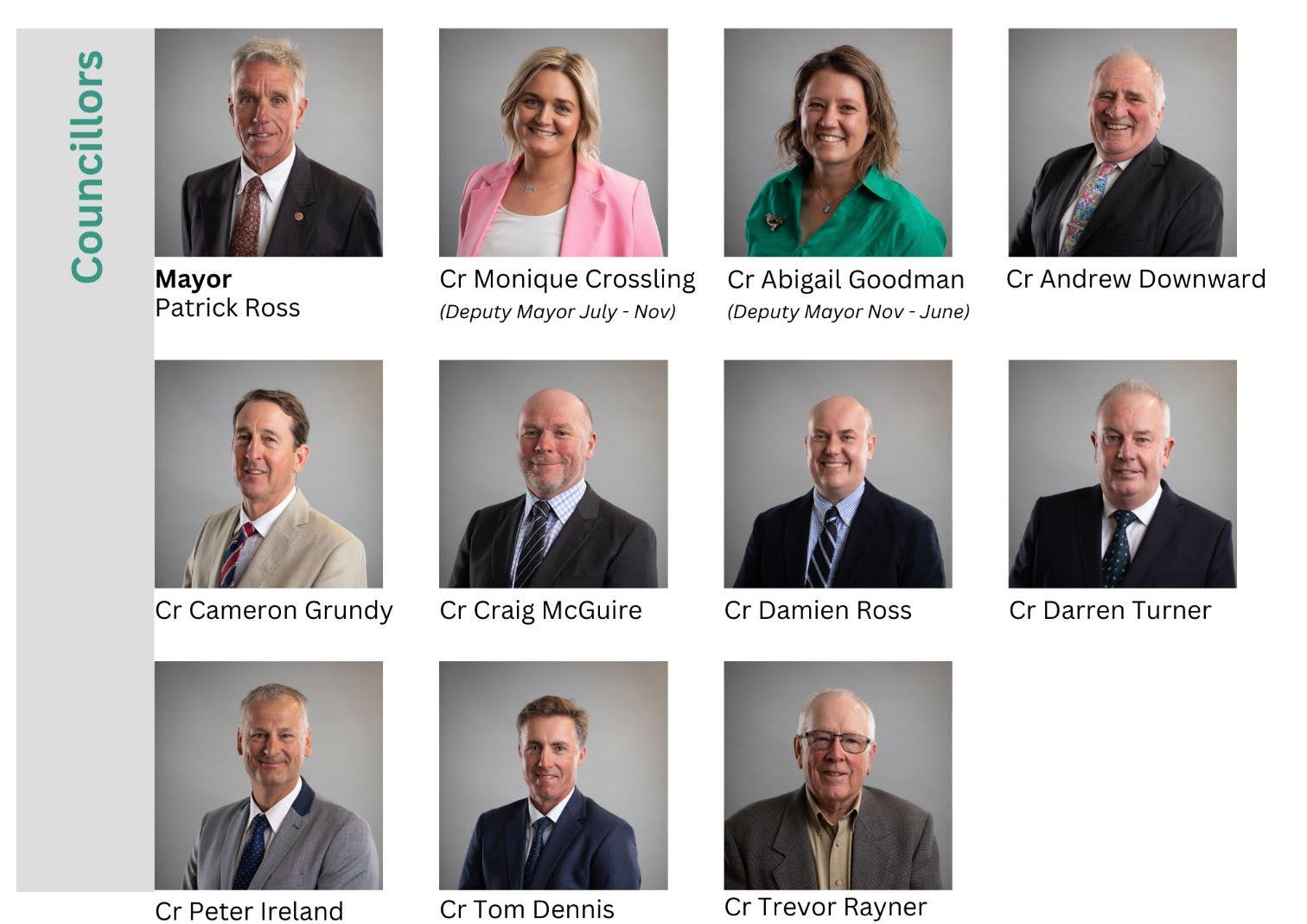
Naracoorte Lucindale Council has 11 Elected Members, comprising the Mayor and 10 Councillors.
The Mayor is elected by the community and presides over Council meetings, and is the official spokesperson for Council.
All Council members have been elected by the community to represent their interests. The Elected Members shape the strategic directions and policies for Council as a whole
Council meetings are held in the Council Chambers at DeGaris Place Naracoorte and other places, on the fourth Tuesday of each month at 5.00pm. Meetings are open to the public and Council encourages attendance. In June 2023 Council introduced the livestreaming of Ordinary and Special Meetings to improve accessibility for our community. Meetings are live streamed via council’s Facebook Page and recorded and published on Council’s website.
Council Committees are formed under Sections 41 & 125 of the Local Government Act 1999 and are created to assist in the performance of Council’s functions.
Every 8 years, in accordance with Section 12 of the Local Government Act 1999, Council is required to review the composition of the Council.
Council commenced a review in October 2024 which was completed in March 2025
During community consultation conducted as part of the representation review, three submissions were received. All three submissions were supportive of the Council’s position to retain the existing structure, so no changes were made to Council’s representation structure.
The next representation review will commence during 2032-33.
The table below shows a comparison of the elected representation quota for Naracoorte Lucindale Council compared with similar size and type of Councils in South Australia for the year 2024-2025.
*Data source: Electoral Commission SA 2024 (available from LGA SA)
As part of its commitment to good governance, Council has in place an Audit & Risk Committee which acts as an advisory committee to Council, with a majority of independent members providing recommendations to Council. The main functions of the Committee include:
• Financial Reporting, including reviewing annual financial statements, and proposing and providing information relevant to a review of Council’s Strategic Management Plans
• Naracoorte Regional Livestock Exchange (NRLE) - monitoring and oversight of the NRLE
• Liaison with Council’s auditors in regards to Council’s financial affairs and the management of audits
• Internal Controls & Risk Management Systems - review the adequacy of Council’s accounting, internal controls, reporting and other financial management systems and practices of Council on a regular basis
The Audit & Risk Committee Annual Report can be viewed as an appendix to this report.
The Strategic Asset and Planning Committee provides advice and recommendations to Council that align to outcomes in Council’s Strategic Plan, including:
• The extent to which Council’s strategic planning and development policies accord with the Planning Development and Infrastructure Act, and consideration of any amendments to the Planning Codes and Guidelines as they may impact on Council’s district
• Development and review of Council’s Asset Management Plans
• Assessment and advice on Council’s expenditure programs for annual budget purposes
• Overview of Council’s Open Space and community projects and strategies
Chief Executive Officer Recruitment, Performance Review and Remuneration Committee
The purpose of the Chief Executive Officer (CEO) Recruitment, Performance Review and Remuneration Committee is to ensure that sound principles of human resource management are applied to the employment of the Chief Executive Officer.
The purpose of this board is to:
• To have a strategic overview of the development, construction and general operations of the Naracoorte Regional Livestock Exchange
• To monitor the financial performance of the Naracoorte Regional Livestock Exchange
Independent representatives are selected for their business acumen and working knowledge of the livestock industry.
Northern Limestone Coast Regional Assessment Panel (RAP)
Naracoorte Lucindale Council, Tatiara District Council and Kingston District Council constitute the Northern Limestone Coast Regional Assessment Panel (RAP) which was established in 2020 under the Planning, Development and Infrastructure Act 2016 (PID), the Planning, Development and Infrastructure (General) Regulations 2017 and the Planning and Design Code in regional South Australia
The Northern Limestone Coast RAP replaced the Council Assessment Panel for each Council to enable a more consistent approach to planning across the three Council areas, as well as creating opportunities for resource sharing and providing greater efficiency in the assessment process for planning applications.
Under Section 76 of the Local Government Act an Elected Member is entitled to an Annual Allowance which is set independently by the Remuneration Tribunal of SA.
The allowance effective from November 2024 was:
Mayor
$67,240
Deputy Mayor
Presiding Member
$21,012
$21,012
Elected Member $16,810
Travel Allowances
• Fully maintained Council vehicle for travel related to official duties, with no private use.
• Council owned and maintained computers
• Mobile phone allowance ($60 per month)
• Reimbursement of expenses relating to functions attended
• Reimbursement of internet access (up to $150 per quarter)
• Council owned and maintained computers
• Reimbursement of expenses relating to functions attended
• Reimbursement of approved childcare expenses while representing Council
• Reimbursement of travel expenses
• Reimbursement of internet access (up to $150 per quarter)
Elected Members are also entitled to receive reimbursement for travel within the area of Council and dependent care expenses associated with attendance at Council and Committee meetings:
• 30 to 50 kms from Council’s principal office - $496
• 50 to 100 kms from Council’s principal office - $847
• 75 kms from Council’s principal office - $1,270
• 100 kms from Council’s principal office - $1,802
Council Committee Allowances
In accordance with the requirements of Section 80A of the Local Government Act 1999 and Section 8AA of the Local Government (General) Regulations 2013 Council has developed a comprehensive training and development program for Elected Members.
This program includes:
• Elected Members that are new to Council must undertake and complete all modules in the Local Governments Associations Training Standards in their first year of election to office.
• Elected Members participate in an Induction Program within the first few months following Council elections. This training program includes the following components:
o Introduction to Local Government – Roles and functions of Elected Members
o Legal Responsibilities
o Council and Committee meetings including meeting procedures
o Financial Management and Reporting
o Council’s Strategic Plan and supporting documents such as the Annual Business Plan, Budget, Long Term Financial Plan and Asset Management Plans
o Governance
o Risk Management
o Work Health and Safety
o Conflict of Interest
o Code of Conduct
• If an Elected Member is re-elected, then they are encouraged to complete all modules in the Local Governments Associations Training Standards in their first year of re-election to office.
Additionally, Council has adopted an Elected Members Training and Development Policy.
In 2024-2025, the following Elected Member training was undertaken:
• Mayor Ross - Mayor and CEO Forum – 26 July 2024
• Cr Goodman, Cr Crossling, Cr Ireland, Cr Grundy, Cr Turner, Cr McGuire – Mandatory Mid Term Refresher Training – 18 November 2024
• Mayor Ross, Cr Ross, Cr Dennis, Cr Downward, Cr Rayner - Mandatory Mid Term Refresher Training (catch up) – 22 January 2025
• Cr Goodman – Deputy Mayor Forum – 21 February 2025

Images: 1. Mayor Ross at the Children’s University Graduation. 2. Cr Crossling with the 2024 Naracoorte High School Captains at their graduation. 3. Mayor Ross with Community Chest grant recipients. 4. Cr Rayner accepting his 30 years of service with local government certificate at the LGA AGM. 4. Cr Downward at a local business opening.
At 30 June 2025, Council had 59.71 full time equivalent positions, employing 74 people across the organisation.
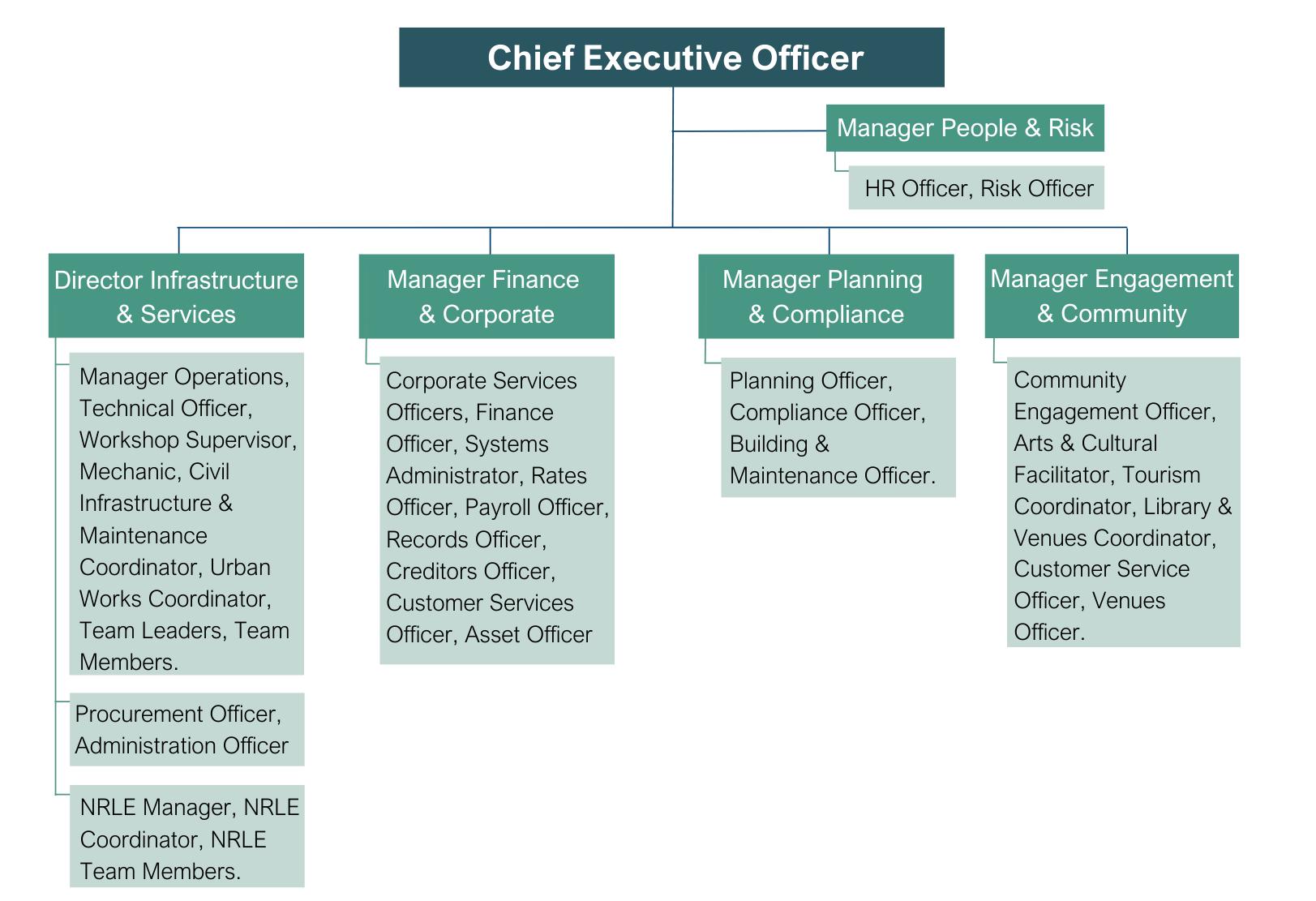
Salary packages for senior executive officers (as at 30.06.2025) include salaries in a band of $108,000 – $215,000.
Chief Executive Officer
Director Infrastructure & Services
Manager Finance & Corporate
Manager Operations
Manager Engagement & Community
Manager Planning & Compliance
Manager People & Risk
$215,000 Unrestricted private use of vehicle and mobile phone
$170,000 Unrestricted private use of vehicle and mobile phone allowance
$132,000 Restricted private use of vehicle and mobile phone allowance
$125,000 Restricted private use of vehicle and mobile phone allowance
$126,000 Restricted private use of vehicle and mobile phone allowance
$130,670 Restricted private use of vehicle and mobile phone allowance
$108,000 Mobile phone allowance
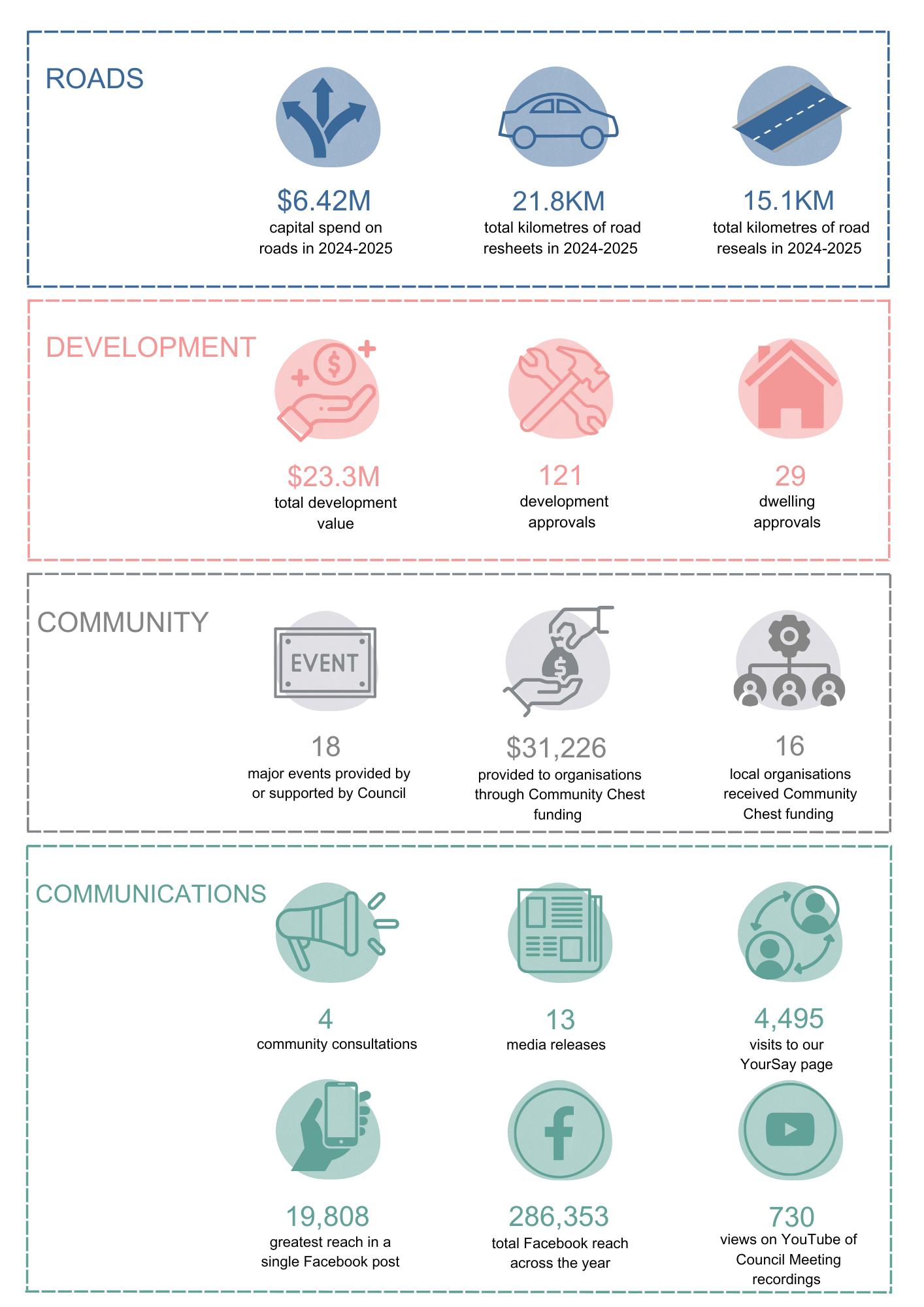
Council’s Public Consultation and Community Engagement Policy sets out how Council will engage with the community in its decision-making processes. During 2024-25 Council sought comment from the community on the following:
• Two draft leases for Lucindale Recreation Reserve
• Community Budget Submissions 2025-26
• Review of Council’s Representation Structure
• 2025-26 Draft Annual Business Plan & Budget
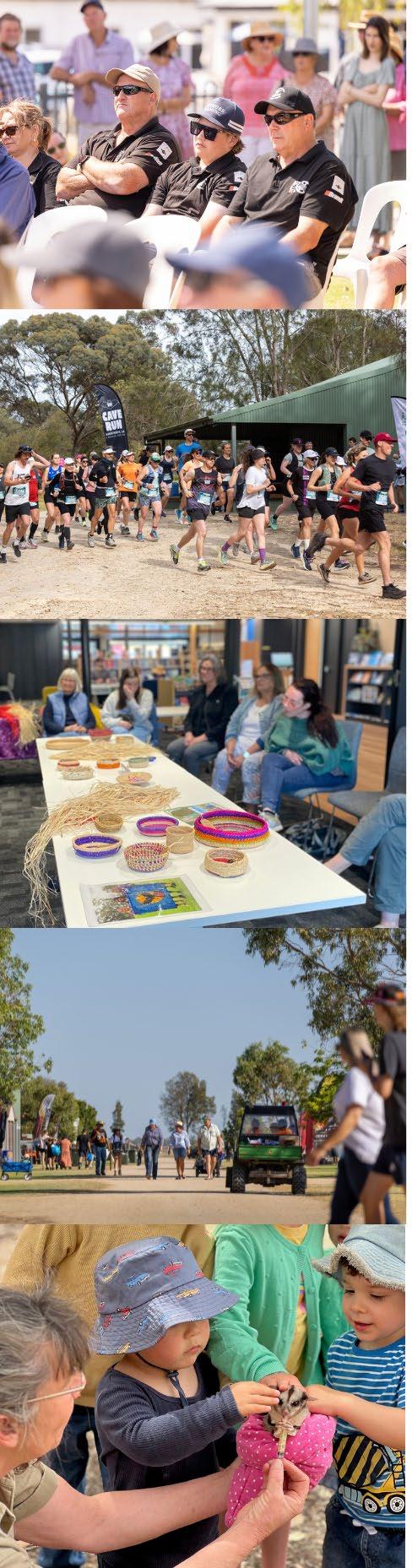
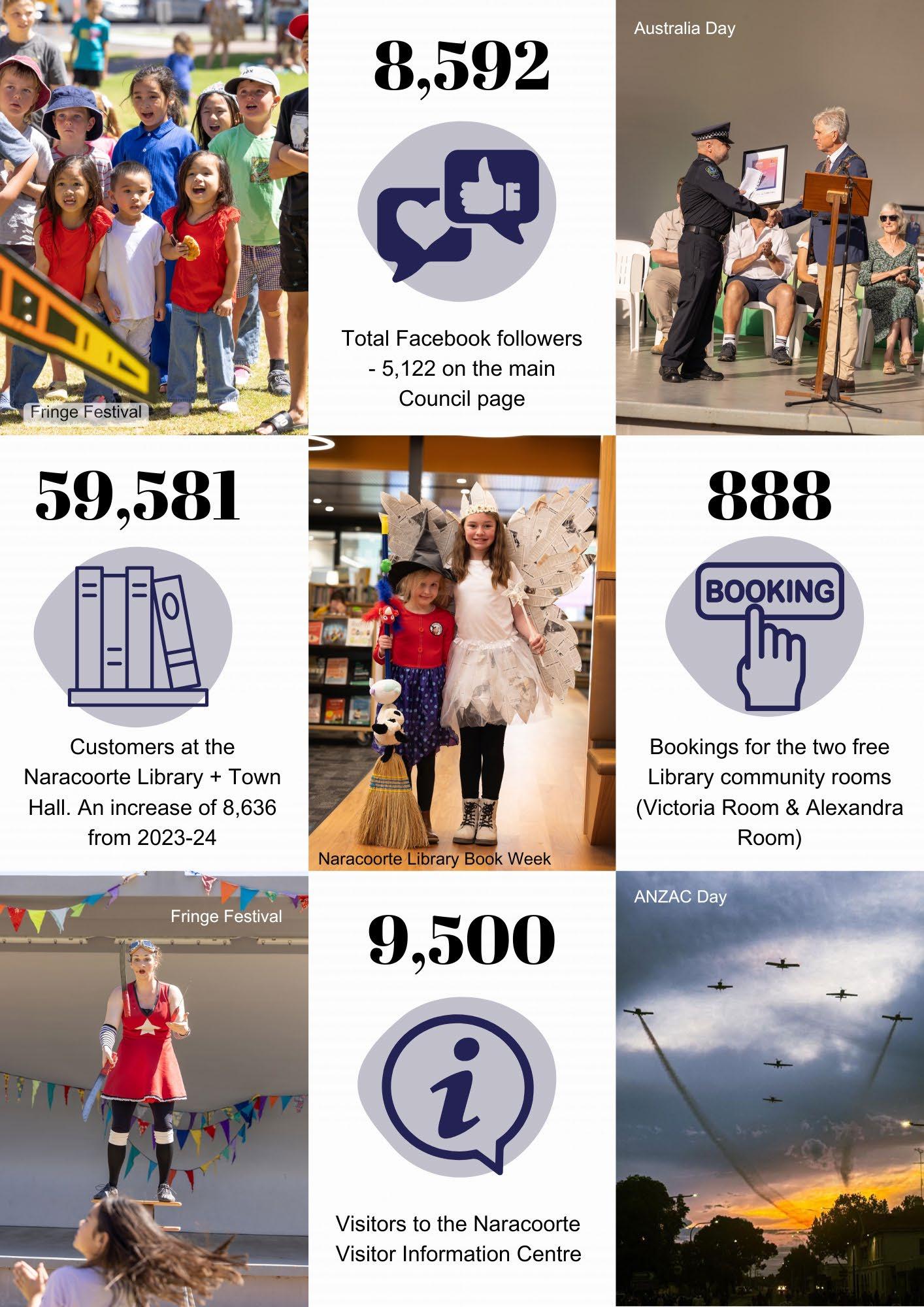
Throughout 2024-25, a number of major events were provided for the community by Council or with Council assistance (financial and in-kind support) including:
• 2024 Australian Dirt Kart Titles
• Naracoorte Show
• Teys Naracoorte Multicultural Sports Carnival
• Naracoorte World Heritage Festival
• Cave Run
• Remembrance Day
• Lucindale Christmas Street Party
• Australia Day Celebrations in Naracoorte and Lucindale
• TASTE the Limestone Coast Festival
• Lucindale Show
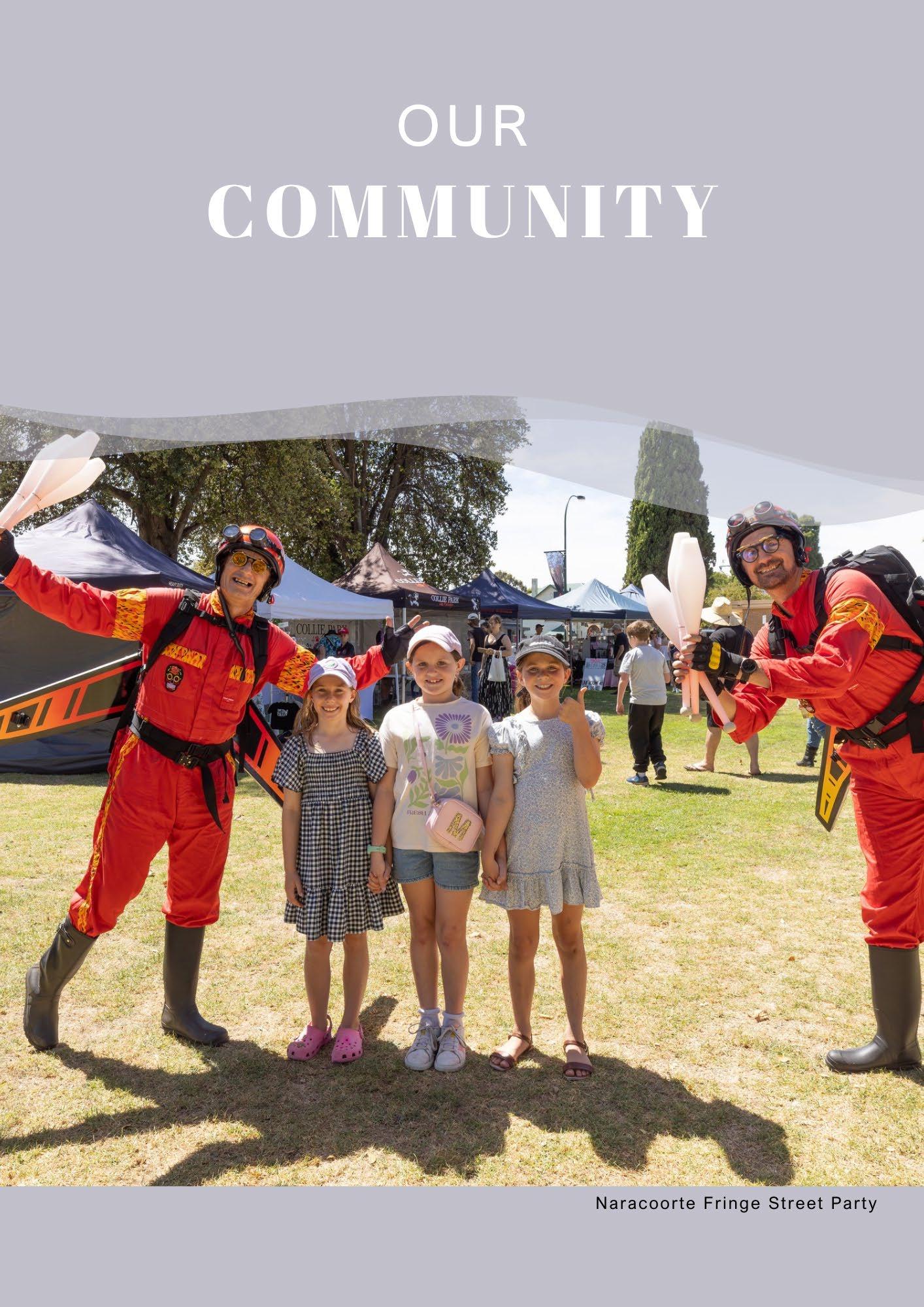
• Naracoorte Fringe Street Party
• Naracoorte Harmony Day Children’s Festival
• Naracoorte Harmony Day Wish Festival
• South East Field Days at Lucindale
• ANZAC Day
• 3 Australian Citizenship ceremonies

Council and Council committees may from time to time discuss an item of business in confidence and as a result exclude the public from attending the meeting for the period taken to discuss the relevant item. The Local Government Act 1999, Section 90(3) (a) to (n) sets out the criteria for when this may occur.
Following is a summary of the number of occasions the provisions listed in Section 90 (excluding the public during debate) or Section 91 (documents to be kept confidential for a period of time) were used during 2024-2025 and orders from previous years that remain operative at 30 June 2025.
• 15 orders to move into confidence were made in 2024-2025, and of these 15 orders were made to retain reports, minutes and other documents in confidence All of these orders were released from confidence before 30 June 2024.
• 13 orders from prior years were released from confidence.
• 4 orders remained operative at the end of the financial year (there are no items which remain in confidence prior to July 2021.)
2323/07/20242
23/07/2024
27/08/2024
17/09/2024
22/10/2024
22/10/2024
26/11/2024
Contract 109818-2425 – Upgrade of Clarkson’s Road, Naracoorte k Released
Contract 109612-2425 – Upgrade of Premier Drive, Naracoorte k Released
Contract ROAD 109867-2425 – Diagonal Road Design – Stage 2 k Released
Chief Executive Officer Report - CEO Recruitment a Released
Contract 109818-2425 – Upgrade of Diagonal Road, Coles – Stage 1 k Released
Urban works – Kerbing Replacement Program 2024-25 k Released
Contract 202526-12 – Council waste and recycling services, Street Sweeping Operations and Waste Transfer Station Operations k Released
17/12/2024 LATE ITEM - CEO Recruitment, Performance Review & Remuneration Committee – CEO Recruitment a Released
28/01/2025
28/01/2025
Chief Executive Officer Report – LCLGA Future Proofing a & j Released
Contract VG6711000055-2425 – NRLE, Supply and Installation of Sheep eID scanning panels k Released
28/01/2025 LATE ITEM – Strategic Asset & Planning Committee k Released
25/02/2025
25/03/2025
Contract VG6711000055-2425 – NRLE, Supply and Installation of Sheep eID scanning panels k Released
Chief Executive Officer Report – LCLGA Future Proofing a & j Released
22/04/2025 Naracoorte Regional Livestock Exchange BoardNRLE Lighting Automation k Released
24/06/2024
Contract 202526-10 Bitumen Works k Released
Each year Council receives an annual general-purpose grant from the State Government Grants Commission. In 2024-2025, $4.413M was received in general purpose grants which is expended at Council’s discretion and $1.014M in road funding. The amounts include an advance payment of approximately 50% of the 2025-26 State Government Grants Commission Financial Assistance Grants.
Council also applies to the State and Federal Government for additional funding to support its planned projects. These are competitive grant rounds and are tied to particular projects.
Successful grant applications allow Council to maintain a high level of services, facilities and amenity across our district while ensuring sustainable finances.
Council is required to develop and maintain procurement policies, practices and procedures. Council’s procurement policy is directed towards:
• Obtaining value in the expenditure of public money
• Providing for ethical and fair treatment of participants
• Ensuring probity, accountability and transparency in procurement operations
Policies in regards to contracts and tenders provide guidelines on:
• The contracting out of services
• Competitive tendering and the use of other measures to ensure that services are delivered cost effectively
• The use of local goods and services
• The sale or disposal of land or other assets
• 1 Expiated (nuisance)
• 0 prosecuted
• 14 abatement notices issued (nuisance)
• 0 civil penalties
• 0 court orders made by the courts
Remuneration paid or payable during 2024/2025 to the auditors for work performed for the annual audit of Council’s financial statements pursuant to Section 128 of the Act was $17,900. There were no (0) expenses associated with other remuneration of auditors.
Staff images taken throughout the year.

As required by the Local Government Act 1999, Council has a Grievance/Review of Decisions Policy, outlining how decisions of Council or other people acting on behalf of Council are reviewed. There were no applications for review of decisions during 2024-2025
Council has 48 Community Land Management Plans relating to land classified as community land such as sporting and recreation areas, parklands, cemeteries, reserves and forestry plantations.
A Freedom of Information Statement is published annually in accordance with the requirements of the Freedom of Information Act 1991. One (1) Freedom of Information application was received during 2024-2025.
There were no applications brought forward from the previous year and there were no unfinished applications at 30 June 2025
Inquiries or requests for information under the Act should be forwarded to: Freedom of Information Officer Naracoorte Lucindale Council PO Box 555, Naracoorte, SA 5271.
Council is required to keep and maintain the following registers in accordance with the Local Government Act 1999 Registers
• Members Register of Interests
• Members Register of Allowances and Benefits
• Officers Register of Remuneration, Salaries and Benefits
• Officers Register of Interests
• Fees and Charges
• Community Land Management Plans
• Public Roads
• By-Laws
• Building Upgrade Agreements
• Register of Interests (Regional Assessment Panel Members)
• Elected Members Disclosure of Conflict of Interests
• Land Management Agreements
• Confidential Orders
• Register of Gifts and Benefits (Members and Officers)
• Register relating to Training and Development (Members)
• Council Resolutions Codes
• Elected Member Behavioural Standards
• Code of Practice for Access to Council Meetings and Associated Documents
• Employee Behaviour Standards
• Code of Practice for Meetings of Council and Council Committees
• Code of Conduct for Child Safe Environments Policies
The following are mandatory policies that are required by the Local Government Act 1999.
• Caretaker Policy
• Procurement Policy
• Public Interest Disclosure Policy
• Customer Service and Complaints Handling Policy
• Road and Place Naming Policy
• Elected Members Allowances and Support Policy
• Order Making Policy
• Public Consultation and Community Engagement Policy
• Child Safe Environment Policy
• Internal Controls Policy
Regulation 35(2) states that Council must provide a summary of the details (including costs) of any gifts received by Elected Members of employees above the value of $50. The following gifts were received during 202425.
Value of Gift
Elected Members NIL declared
Employees
Two gifts to the approximate value of $180
A combined amount of $59,608.56 was expended through Council Credit Cards during the 2024-2025 year.
As prescribed by Section 131(1a) of the Local Government Act Council can report legal costs incurred to the value of $36,203.90 for the financial year. Some of these legal costs were recoverable.
As described under Schedule 4, Clause 1, of the Local Government Act, Council must provide a summary of the details of any interstate or international travel undertaken by members or employees of the Council during the relevant financial year funded in whole or in part by the council. During 20242025 interstate travel to the value of $560 was undertaken by one employee of Council. There were nil interstate or international trips taken by members of the Council.
As prescribed under Schedule 4, Clause 1, of the Local Government Act, Council must provide a report relating to contraventions of Chapter 5 Part 4 Division 2 by members of the Council during the relevant financial year.
Regulation 35(a1) requires the following information to be included in the Annual Report:
a) The total number of contraventions of Chapter 5 (Members of Council) Part 4 (Member integrity and behavior) Division 2 (Member behavior) during the relevant financial year.
For Naracoorte Lucindale Council in 2024-2025, there were nil (0) contraventions.
b) The total costs incurred by the Council in relation to dealing with complaints alleging contravention of Chapter 5 Part 4 Division 2 and any referrals of such complaints to the Behavioural Standards Panel during the relevant financial year.
Regulation 35(2b) clarifies that for the purpose of the reporting requirements under 35(a1)(b), total costs incurred will be taken to include any legal costs and costs of engaging persons or consultants for the purposes of dispute resolution in respect of complaints, but to exclude any costs associated with the use of administrative resources of the Council or Council staff.
For Naracoorte Lucindale Council in 2024-2025, there were nil (0) costs incurred.
Council is required to report on Elected Member health and safety duties under section 75G of the Local Government Act 1999.
There were no member contraventions of section 75G during the 2023/2024 financial year.
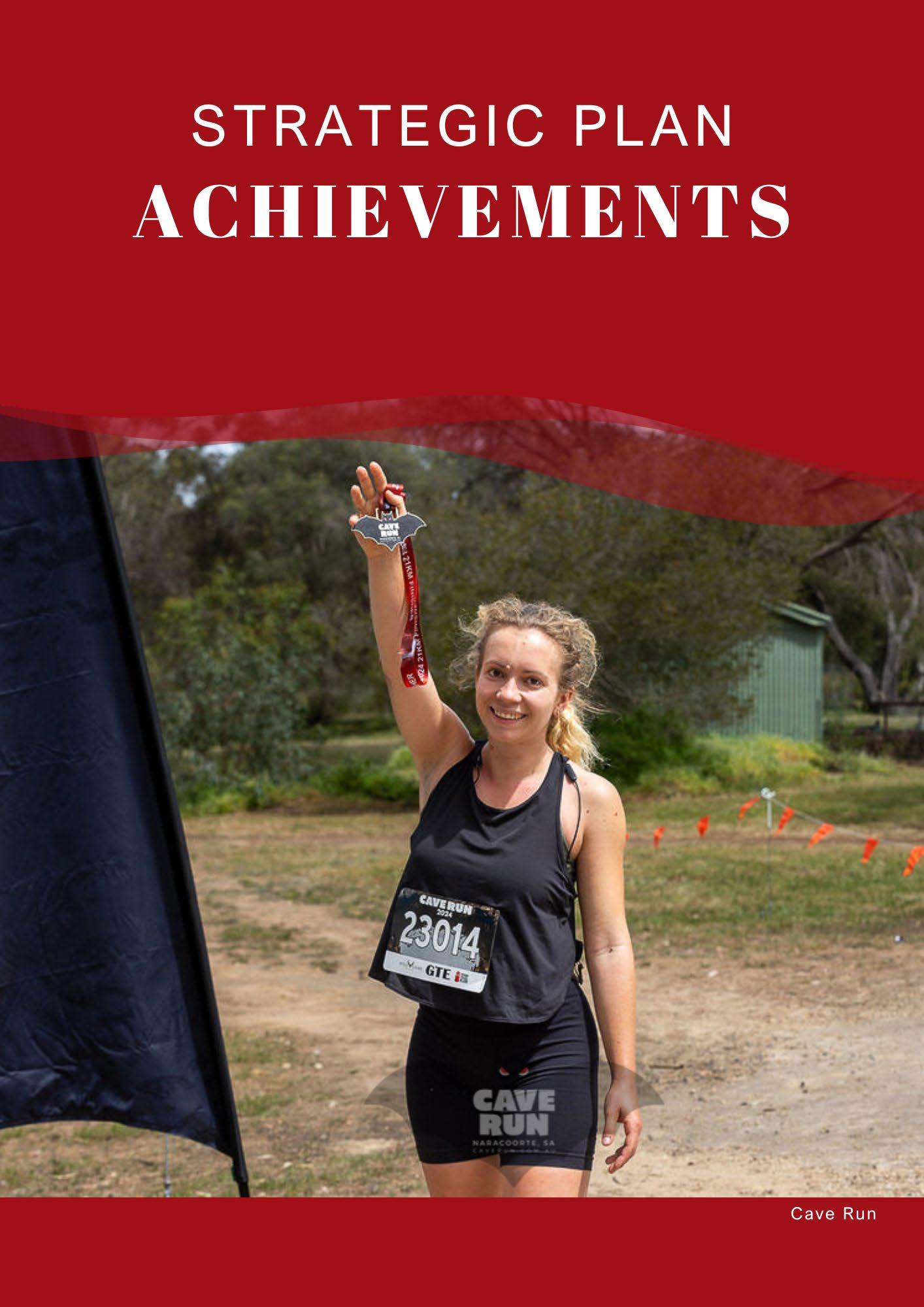
Council developed a new Strategic Plan 2023-2033, which was endorsed in June 2023, and the Priority Actions timelines were endorsed in August 2023.
The Strategic Plan sets the desired outcomes, and priority actions for the future and helps inform the Council’s Long-Term Financial Plan and Asset Management Plans.
The six key strategic directions for the Council for the 10-year period from 2023 to 2033 are:
1. Plan for and manage growth
2. Embrace our cultural diversity
3. Grow the visitor economy and our regional service hub
4. Preserve our natural environment and enhance our built assets
5. Invest in key infrastructure and assets
6. Activate our recreation, events, arts and culture opportunities
The Plan also identifies a suite of more than 30 priority actions for the 5-year period from 2023 to 2028.
The status of priority actions from 2024-2025 (aligned to each key strategic direction) is highlighted in the following table:
completed ● annual ● ongoing ● not completed
1
Develop and implement a strategy for housing (permanent and temporary accommodation, rural living, affordable, for workers, different price points, potential to repurpose current buildings and available spaces) including clarity about the Council’s roles.
2 Develop and implement a framework to identify opportunities for cultural representation in Council projects.
2
Develop and implement an approach to engage with young people to help shape decision making and enable them to become directly involved in projects that impact their community.
2 Design and undertake an audit and provide a report on opportunities to generate multi-use of facilities in our Council area.
3
Work with local businesses and relevant stakeholders to develop and implement a Regional Business Hub and Visitor Economy Plan that clearly defines the Council’s roles.
3 Investigate and report on opportunities to be a preferred location for conferences.
4
Prioritise and implement projects set out in the Naracoorte Creek Masterplan in collaboration with Landscape SA Limestone Coast.
5 Work with the Naracoorte Regional Livestock Exchange Board to scope and develop business cases for potential improvements (and funding sources) to maintain high levels of service.
6
Develop a Council-wide plan for recreation, arts, and culture that includes a Facilities Audit and the potential for multi-use facilities as well as the opportunities for re-purposing existing facilities that are no longer fit for purpose or under utilised
Key project achievements in 2024-2025 as identified in Council’s Annual Business Plan include:
completed ● annual ● ongoing ● not completed
Key Project Achievements
NRLE sheep eID project
NRLE infrastructure upgrades
Swimming Lake – sealing of floors and walls
Hybrid indoor facility scoping/feasibility study for the Swimming Lake
Pioneer Park Masterplan
Comments
Near completion at end of 2024-2025
Including IT upgrades, major and minor plant and equipment, D Yard pens, fencing and bore infrastructure
Carried over to 2025-2026
Irrigation upgrade and replacement carried over to 2025-2026
Pioneer Park Masterplan Moore Street car parking & accessible park
Memorial Oval bin surrounds
North Parklands fire mitigation fencing
Leicester Street Playground concept designs and consultation
Naracoorte Creek Weirs
Extensive program of reseals and resheets
Significant road reconstruction projects
Naracoorte Rejuvenation Plan
Jenkins Terrace footpath
Gap Road – barrier
Old Robe Road & West Avenue intersection
Smith Street kerbing & watertable works
Caves Valley Drain stormwater
Naracoorte Depot
Roof replacement at Lucindale War Memorial Hall
LED lighting Naracoorte Art Gallery
Internal doors Harry Tregoweth Retirement Village
New pumps for Lucindale CWMS
IT upgrades for the Naracoorte Council
Offices and Naracoorte Library + Town Hall facility
Carried over to 2025-2026
Clarksons Road, Premier Drive, Diagonal Road and Miles Road
Festoon lighting installed in Naracoorte Town Square
Carried over to 2025-2026
Tender awarded
Lunchroom doors and dog pound wash down system
Security cameras at the Swimming Lake and Market Square Recreation Area Capital ordered awaiting on supplier
Plant & machinery upgrades
Continued delivery of Council-funded events
Continued delivery of Country Arts SA programming and events
Community Art Program – grant program
- Naracoorte Fringe Festival
- Harmony Day Children’s Festival
- Teys Naracoorte Multicultural Sports Carnival
- Remembrance Day
- ANZAC Day
- Cave Run
- Australia Day
- Citizenship ceremonies
Our Arts & Cultural Facilitator worked in partnership with Council and Country Arts SA to support local artists, arts organisations and community groups located in the Council area to identify and realise their artistic and cultural aspirations
$10,000 granted to 2 community art projects including a mural in the Bat Cave of the Naracoorte Library (completed) and resurfacing the basketball court at Market Square Recreation Area (ongoing)
Community Chest
$29,826 granted to 15 local community groups
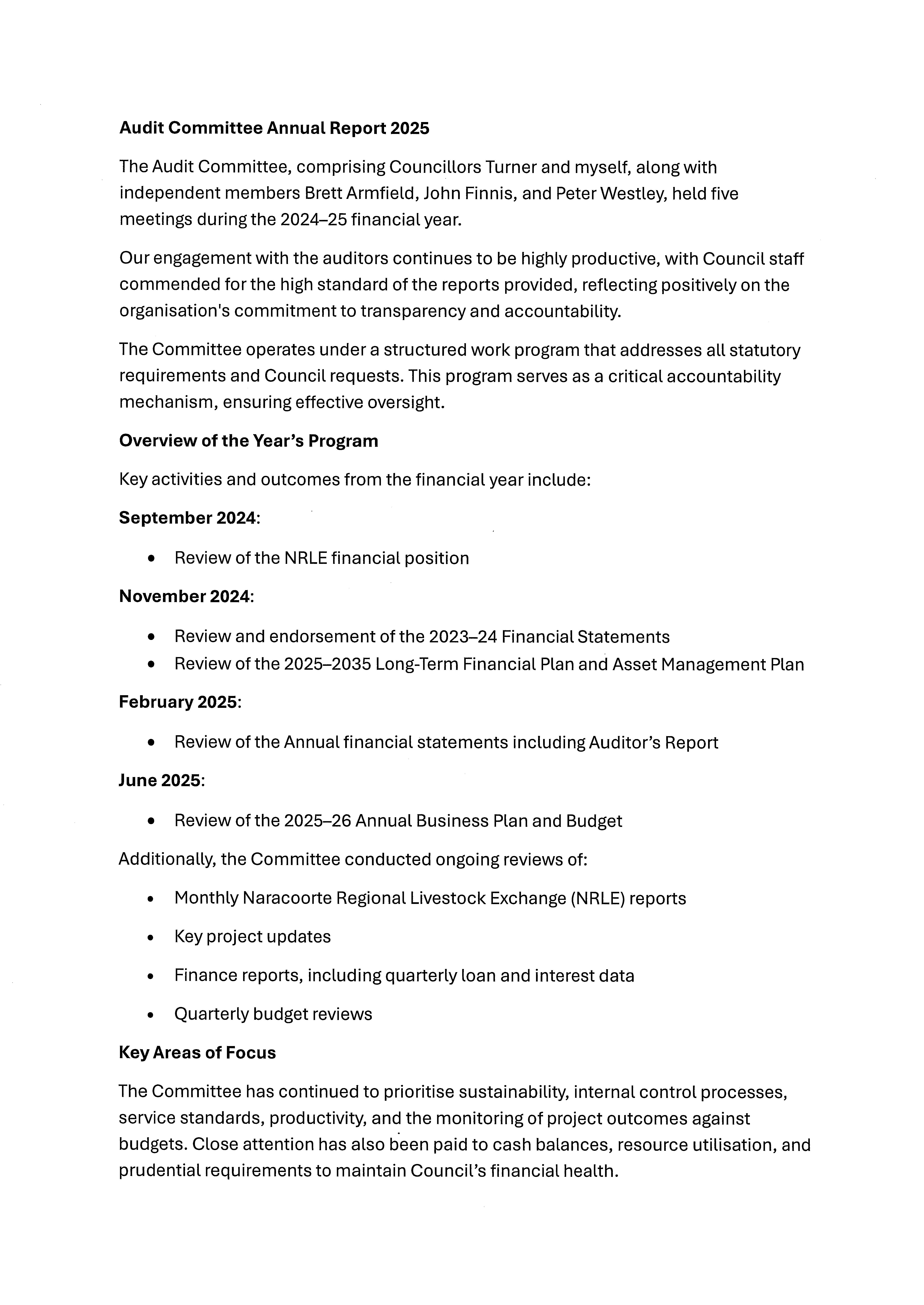
The Audit Committee, comprising Councillors Turner and rnySetf, along With independent members Brett ArmfieLd, John Finnis, and Peter Westley, held five meetings during the 2024-25 financial year.
Our engagement with the auditors continues to behighly productive, with Council staff commended for the high standard ofthe reports provided, reflecting positively onthe organisation's commitment totransparency and accountabiLity.
The Committee operates under astructured work program that addresses aLLstatutory requirements and Council requests. This program serves asacritical accountabiLity mechanism, ensuring effective oversight.
Keyactivities and outcomes from the financial yearincLude:
September 2024:
* ReviewoftheNRLEfinancialposition
November2024:
* Review and endorsement ofthe 2023-24 Financial Statements
* Review ofthe 2025-2035 Long-Term Financial Plan and Asset Management Plan
February 2025:
* ReviewoftheAnnuaLfinancialstatementsincLudingAuditor'sReport
June 2025:
* Reviewofthe2025-26AnnualBusinessPlanandBudget
Additionally, the Committee conducted ongoing reviews of:
* Monthly Naracoorte RegionaL Livestock Exchange (NRLE) reports
* Keyproject updates
* Financereports,incLudingquarterLyLoanandinterestdata
* Quarterly budget reviews
Key
The Committee has continued to prioritise sustainabiLity, internal control processes, service standards, productivity, and the monitoring ofproject outcomes against budgets. C(ose attention has also been paid to cash balances, resource utilisation, and prudential requirements tomaintain Council's financial heaLth.
The NRLE's activities and performance remain astanding item onthe Committee's agenda.
* ESCOSAreviewtocommenceinAugust2025
Commission isanadvisory body, providing advice toall councils across afour-year cycle. Theaim ofthe body istoprovide independent, risk-based advice toassist counci(s when making long-term financial and investment decisions ror the benefit of ratepayers.
* Appointment ofnew auditors asGaLpins have completed their statutory 5-year term ofoversight.
With the appointment ofnew CEO, KeLlyWestelL, the following (and not Limited to) items will bebrought toreview:
* Master PLANSthat feed intO the Long-Term Financial Plan and Asset Management Plan
* Asset management
* Focus onCouncil's Strategic Risk
* Rate Review Committee's View
The Committee ispleased to report that Council finances arewell-managed, with good cost controL maintained throughout the financial year.
Acknowledgements
Iwould Liketothank all Committee members, Councillors, the CEOs (both out going Trevor Smart and neW Kelly'WeStell), and senior management far their ongoing support and dedication tothe work ofthe Committee.
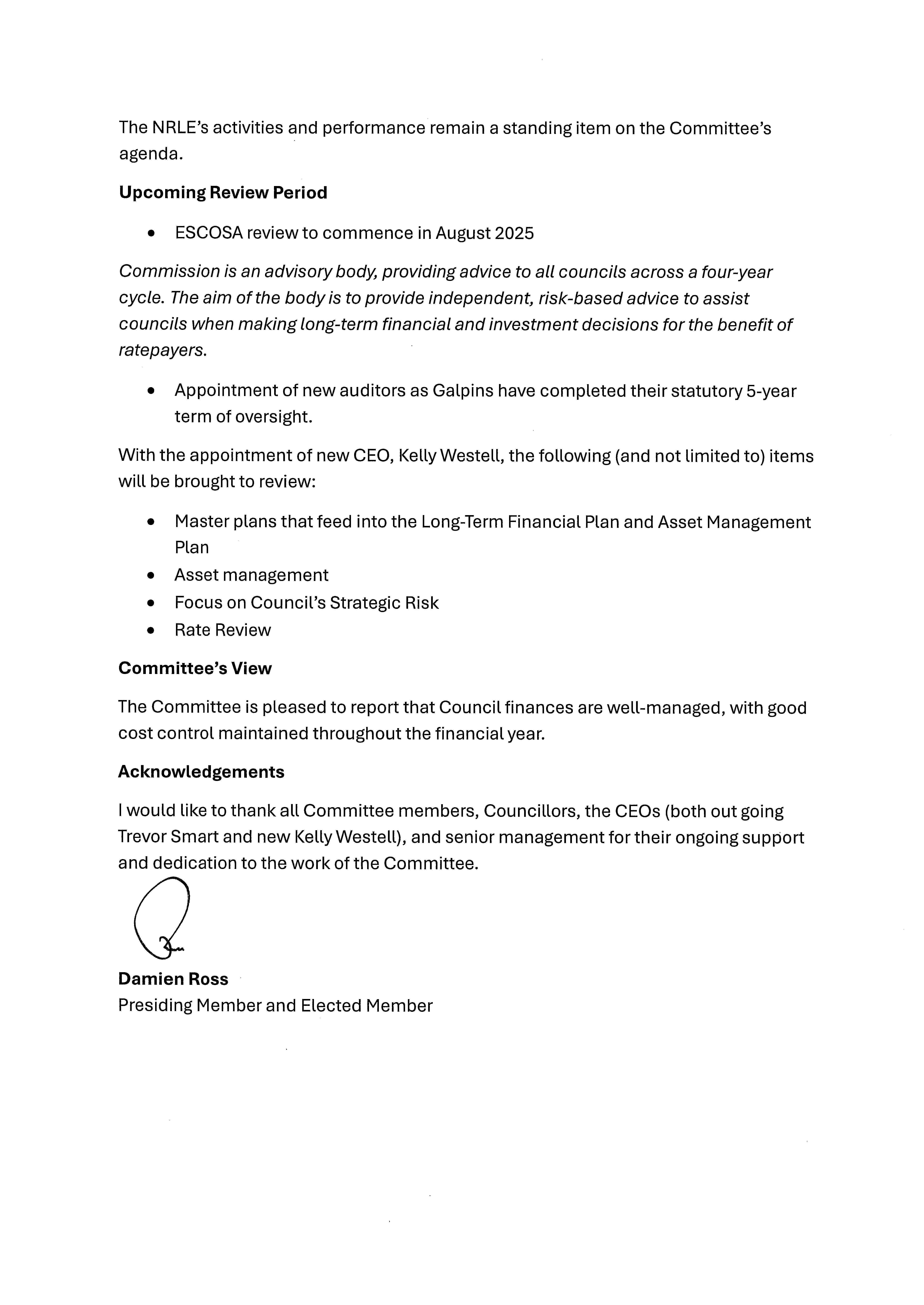
Damien Ross Presiding Member and Elected Member

for the year ended 30 June 2025
We have been authorised by the Council to certify the financial statements in their final form.
In our opinion:
• the accompanying financial statements comply with the Local Government Act 1999, Local Government (Financial Management) Regulations 2011 and Australian Accounting Standards,
• the financial statements present a true and fair view of the Council’s financial position at 30 June 2025 and the results of its operations and cash flows for the financial year,
• internal controls implemented by the Council provide a reasonable assurance that the Council’s financial records are complete, accurate and reliable and were effective throughout the financial year,
• the financial statements accurately reflect the Council’s accounting and other records.
Kelly Westall Chief Executive Officer
25th November 2025
Mayor
25th November 2025
Statement of Comprehensive Income for the year ended 30 June 2025
The above Statement of Comprehensive Income should be read in conjunction with the accompanying notes.
Statement of Financial Position as at 30 June 2025
The above Statement of Financial Position should be read in conjunction with the accompanying notes.
of Changes in Equity for the year ended 30 June 2025
The above Statement of Changes in Equity should be read in conjunction with the accompanying notes.
Statement of Cash Flows for the year ended 30 June 2025
The above Statement of Cash Flows should be read in conjunction with the
Notes to and forming part of the Financial Statements for the year ended 30 June 2025
The principal accounting policies adopted by Council in the preparation of these consolidated financial statements are set out below.
These policies have been consistently applied to all the years presented, unless otherwise stated.
1.1 Compliance with Australian Accounting Standards
This general purpose financial report has been prepared on a going concern basis using the historical cost convention in accordance with Australian Accounting Standards as they apply to not‐for‐profit entities, other authoritative pronouncements of the Australian Accounting Standards Board, Interpretations and relevant South Australian legislation.
The financial report was authorised for issue by certificate under regulation 14 of the Local Government (Financial Management) Regulations 2011 dated 28th October 2025.
1.2 Historical cost convention
Except as stated below, these financial statements have been prepared in accordance with the historical cost convention.
1.3 Critical accounting estimates
The preparation of financial statements in conformity with Australian Accounting Standards requires the use of certain critical accounting estimates and requires management to exercise its judgement in applying Council’s accounting policies. The areas involving a higher degree of judgement or complexity, or areas where assumptions and estimates are significant to the financial statements are specifically referred to in the relevant sections of these Notes.
1.4 Rounding
All amounts in the financial statements have been rounded to the nearest thousand dollars ($’000).
Naracoorte Lucindale Council is incorporated under the SA Local Government Act 1999 and has its principal place of business at DeGaris Place, Naracoorte SA 5271. These consolidated financial statements include the Council’s direct operations and all entities through which Council controls resources to carry on its functions. In the process of reporting on the Council as a single unit, all transactions and balances between activity areas and controlled entities have been eliminated.
(3) Income recognition
The Council recognises revenue under AASB 1058 Income of Not-for-Profit Entities (AASB 1058) or AASB 15 Revenue from Contracts with Customers (AASB 15) when appropriate.
In cases where there is an ‘enforceable’ contract with a customer with ‘sufficiently specific’ performance obligations, the transaction is accounted for under AASB 15 where income is recognised when (or as) the performance obligations are satisfied (i.e. when it transfers control of a product or service to a customer). Revenue is measured based on the consideration to which the Council expects to be entitled in a contract with a customer.
Notes to and forming part of the Financial Statements for the year ended 30 June 2025
Note 1. Summary of Material Accounting Policies (continued)
In other cases, AASB 1058 applies when Council enters into transactions where the consideration to acquire an asset is significantly less than the fair value of the asset principally to enable the entity to further its objectives. The excess of the asset recognised (at fair value) over any ‘related amounts’ is recognised as income immediately, except in the case where a financial asset has been received to enable the council to acquire or construct a recognisable non-financial asset that is to be controlled by the council. In this case, the council recognises the excess as a liability that is recognised over time in profit and loss when (or as) the entity satisfies its obligations under the transfer.
In recent years the payment of untied grants (financial assistance grants / local roads / supplementary grants) has varied from the annual allocation as shown in the table below:
2020/21
$3,435,913
2021/22 $4,166,048
2022/23 $4,649,059
$3,229,581 + $206,332
$3,497,489 + $668,559
$3,587,644 + $1,061,415
2023/24 $311,659 $3,467,990 -$3,156,331
2024/25 $ 5,427,150 $3,679,072 +$1,748,078
Because these grants are untied, the Australian Accounting Standards require that payments be recognised upon receipt. Accordingly, the operating results of these periods have been distorted compared to those that would have been reported had the grants been paid in the year to which they were allocated.
The Operating Surplus Ratio disclosed in Note 13 has also been calculated after adjusting for the distortions resulting from the differences between the actual grants received and the grants entitlements allocated.
Cash Assets include all amounts readily convertible to cash on hand at Council’s option with an insignificant risk of changes in value with a maturity of three months or less from the date of acquisition.
Receivables for rates and annual charges are secured over the subject land, and bear interest at rates determined in accordance with the Local Government Act 1999. Other receivables are generally unsecured and do not bear interest.
All receivables are reviewed as at the reporting date and adequate allowance made for amounts the receipt of which is considered doubtful.
All financial instruments are recognised at fair value at the date of recognition, except for trade receivables from a contract with a customer, which are measured at the transaction price. A detailed statement of the accounting policies applied to financial instruments also form part of Note 12.
Inventoriesheldinrespectofstoreshavebeenvaluedbyusingtheweightedaveragecostonacontinualbasis,afteradjustment for loss of service potential. Inventories held in respect of business undertakings have been valued at the lower of cost and net realisable value.
Notes to and forming part of the Financial Statements for the year ended 30 June 2025
Note 1. Summary of Material Accounting Policies (continued)
6.1 Initial recognition
All assets are initially recognised at cost. For assets acquired at no cost or for nominal consideration, cost is determined as fair value at the date of acquisition.
All non-current assets purchased or constructed are capitalised as the expenditure is incurred and depreciated as soon as the asset is held “ready for use”. Cost is determined as the fair value of the assets given as consideration plus costs incidental to the acquisition, including architects' fees and engineering design fees and all other costs incurred. The cost of non-current assets constructed by the Council includes the cost of all materials used in construction, direct labour on the project and an appropriate proportion of variable and fixed overhead.
Capital works still in progress at balance date are recognised as other non-current assets and transferred to infrastructure, property, plant & equipment when completed ready for use.
6.2 Materiality
Assets with an economic life in excess of one year are only capitalised where the cost of acquisition exceeds materiality thresholds established by Council for each type of asset. In determining (and in annually reviewing) such thresholds, regard is had to the nature of the asset and its estimated service life. Examples of capitalisation thresholds applied during the year are given in Note 7. No capitalisation threshold is applied to the acquisition of land or interests in land.
6.3 Subsequent recognition
All material asset classes are revalued on a regular basis such that the carrying values are not materially different from fair value. Significant uncertainties exist in the estimation of fair value of a number of asset classes including land, buildings and associated structures and infrastructure. Further detail of these uncertainties, and of existing valuations, methods and valuers are provided at Note 7.
6.4 Depreciation of non-current assets
Other than land, all infrastructure, property, plant and equipment assets recognised are systematically depreciated over their useful lives on a straight‐line basis which, in the opinion of Council, best reflects the consumption of the service potential embodied in those assets.
Depreciation methods, useful lives and residual values of classes of assets are reviewed annually.
Major depreciation periods for each class of asset are listed in Note 7. Depreciation periods for infrastructure assets have been estimated based on the best information available to Council, but appropriate records covering the entire life cycle of these assets are not available, and extreme care should be used in interpreting financial information based on these estimates.
6.5 Impairment
Assets whose future economic benefits are not dependent on the ability to generate cash flows, and where the future economic benefits would be replaced if Council were deprived thereof, are not subject to impairment testing.
Other assets that are subject to depreciation are reviewed for impairment whenever events or changes in circumstances indicate that the carrying amount may not be recoverable. An impairment loss is recognised for the amount by which the asset’s carrying amount exceeds its recoverable amount (which is the higher of the present value of future cash inflows or value in use).
Where an asset that has been revalued is subsequently impaired, the impairment is first offset against such amount as stands to the credit of that class of assets in Asset Revaluation Reserve, any excess being recognised as an expense.
6.6 Borrowing costs
Borrowing costs in relation to qualifying assets (net of offsetting investment revenue) have been capitalised in accordance with AASB 123 Borrowing Costs The amounts of borrowing costs recognised as an expense or as part of the carrying amount of qualifying assets are disclosed in Note 3, and the amount (if any) of interest revenue offset against borrowing costs in Note 2.
Notes to and forming part of the Financial Statements for the year ended 30 June 2025
Note 1. Summary of Material Accounting Policies (continued)
7.1
Creditors are amounts due to external parties for the supply of goods and services and are recognised as liabilities when the goods and services are received. Creditors are normally paid 30 days after the month of invoice. No interest is payable on these amounts.
Amounts other than grants received from external parties in advance of service delivery, and security deposits held against possible damage to Council assets, are recognised as liabilities until the service is delivered or damage reinstated, or the amount is refunded as the case may be.
Borrowings are initially recognised at fair value, net of transaction costs incurred and are subsequently measured at amortised cost. Any difference between the proceeds (net of transaction costs) and the redemption amount is recognised in the income statement over the period of the borrowings using the effective interest method.
Borrowings are carried at their principal amounts which represent the present value of future cash flows associated with servicing the debt. Interest is accrued over the period to which it relates, and is recorded as part of “Payables”. Interest free loans are initially recognised at fair value with any difference between fair value and proceeds recognised in the profit and loss. The loan is subsequently measured at amortised cost with interest being recognised using the effective interest rate method.
Liabilities for employees’ entitlements to salaries, wages and compensated absences expected to be paid or settled within 12 monthsofreportingdateareaccruedatnominalamounts(includingpayrollbasedoncosts)measuredinaccordancewith AASB 119 Employee Benefits.
Liabilities for employee benefits not expected to be paid or settled within 12 months are measured as the present value of the estimated future cash outflows (including payroll based oncosts) to be made in respect of services provided by employees up to the reporting date. Present values are calculated using government guaranteed securities rates with similar maturity terms.
Weighted avg. discount rate 3.35% (2024, 4.44%)
No accrual is made for sick leave as Council experience indicates that, on average, sick leave taken in each reporting period is less than the entitlement accruing in that period, and this experience is expected to recur in future reporting periods. Council does not make payment for untaken sick leave.
9.1 Superannuation
The Council makes employer superannuation contributions in respect of its employees to the Hostplus Superannuation Scheme. The Scheme has two types of membership, each of which is funded differently. Details of the accounting policies applied and Council’s involvement with the schemes are reported in Note 15.
(10) Provisions for reinstatement, restoration and rehabilitation
Close down and restoration costs include the dismantling and demolition of infrastructure and the removal of residual materials and remediation and rehabilitation of disturbed areas. Estimated close down and restoration costs are provided for in the accounting period when the obligation arising from the related disturbance occurs and are carried at the net present value of estimated future costs.
Although estimated future costs are based on a closure plan, such plans are based on current environmental requirements which may change. Council’s policy to maximise recycling is extending the operational life of these facilities, and significant uncertainty exists in the estimation of the future closure date.
year ended 30 June 2025
Note 1. Summary of Material Accounting Policies (continued)
The Council assesses at contract inception whether a contract is, or contains, a lease. That is, if the contract conveys the right to control the use of an identified asset for a period of time in exchange for consideration.
The Council recognises lease liabilities to make lease payments and right-of-use assets representing the right to use the underlying assets.
The Council recognises right-of-use assets at the commencement date of the lease. Right-of-use assets are measured at cost, less any accumulated depreciation and impairment losses, and adjusted for any remeasurement of lease liabilities. The cost of right-of-use assets includes the amount of lease liabilities recognised, initial direct costs incurred, lease payments made at or before the commencement date less any lease incentives received and the estimate of costs to be incurred to restore the leased asset.
Right-of-use assets are depreciated on a straight-line basis over the shorter of the lease term and the estimated useful lives of the assets, as follows:
IT equipment 3 years
The right-of-use assets are also subject to impairment. Refer to the accounting policies above - Impairment of non-financial assets.
At the commencement date of the lease, the Council recognises lease liabilities measured at the present value of lease payments to be made over the lease term. In calculating the present value of lease payments, the Council uses its incremental borrowing rate or the interest rate implicit in the lease.
The Council applies the short-term lease recognition exemption to its short-term leases of machinery and equipment (i.e., those leases that have a lease term of 12 months or less from the commencement date). It also applies the low-value assets recognition exemption to leases of office equipment that are considered to be low value. Lease payments on short-term leases and leases of low-value assets are recognised as an expense on a straight-line basis over the lease term.
In accordance with UIG Abstract 1031 “Accounting for the Goods & Services Tax”
• Receivables and creditors include GST receivable and payable.
• Except in relation to input taxed activities, revenues and operating expenditures exclude GST receivable and payable.
• Non-current assets and capital expenditures include GST net of any recoupment.
• Amounts included in the Statement of Cash Flows are disclosed on a gross basis.
The AASB has issued Australian Accounting Standards and interpretations which are not effective at 30 June 2025, these standards have not been adopted by Council and will be included in the financial statements on their effective date.
Council applied for the first time certain new standards and amendments to existing standards, which are effective for annual periods beginning on or after 1 January 2024. Council has not early adopted any other standard, interpretation or amendment that has been issued but is not yet effective.
AASB 2020-1: Amendments to Australian Accounting Standards – Classification of Liabilities as Current or Noncurrent
AASB 2020-1 amends AASB 101 to clarify requirements for the presentation of liabilities in the statement of financial position as current or non-current. It also clarifies the meaning of ‘settlement of a liability’.
AASB 2022-6: Amendments to Australian Accounting Standards – Non-current liabilities with Covenants
AASB 2022-6 amends AASB 101 to improve the information an entity provides in its financial statements about liabilities from loan arrangements for which the entity’s right to defer settlement of those liabilities for at least 12 months after the reporting period is subject to the entity complying with conditions specified in the loan agreement.
AASB 2022-10: Amendments to Australian Accounting Standards – Fair Value Measurement of Non-Financial Assets of Not-for-Profit Public Sector Entities.
AASB 2022-10 amends AASB 13 – Fair Value Measurement for the fair value measurements of non-financial assets of notfor-profit public sector entities not held primarily to generate net cash inflows.
Council has adopted all amendments mentioned above required for the year ended 30 June 2025. The adoption of these amendments did not have a material impact on the financial statements.
Standards issued by the AASB not yet effective
The AASB has issued new and amended Australian Accounting Standards and Interpretations that are not effective as of 30 June 2025. These standards have not yet been adopted by Council and will be incorporated into the financial statements upon their effective dates. The following list identifies all applicable new and amended Australian Accounting Standards and Interpretations that were issued but are not yet effective as of 30 June 2025.
AASB 2024-2: Amendments to the Classification and Measurement of Financial Instruments
AASB 2024-2 amends AASB 9 Financial Instruments and AASB 7 Financial Instruments: Disclosures to clarify how the contractual cash flows from financial assets should be assessed when determining their classification. The amendment also clarifies the derecognition requirements of financial liabilities that are settled through electronic payment systems.
This standard is effective for annual reporting periods beginning on or after 1 January 2026.
The amendment is not expected to have a material impact on the financial statements once adopted.
AASB 18: Presentation and Disclosure in Financial Statements.
AASB 18 replaces AASB 101 as the standard describing the primary financial statements and sets out requirements for the presentation and disclosure of information in AASB-compliant financial statements. Amongst other changes, it introduces the concept of the ‘management-defined performance measures’ to financial statements and requires the classification of transactions presented within the statement of profit or loss within one of the five categories – operating, investing, financing, income taxes and discontinued operations. It also provides enhanced requirements for the aggregation and disaggregation of information.
This standard is effective for annual reporting periods beginning on or after 1 January 2028.
Council is currently assessing the impact the amendment will have on the financial statements once adopted.
Notes to and forming part of the Financial Statements for the year ended 30 June 2025
Note 2. Income
(a) Rates
(c) User charges
Note 2. Income (continued)
(f) Other income
(g) Grants,
and contributions
(i) Sources of grants
Notes to and forming part of the Financial Statements for the year ended 30 June 2025
Note 3. Expenses
(b) Materials, contracts and other expenses (i)
Notes to and forming part of the Financial Statements for the year ended 30 June 2025
Note 3. Expenses (continued)
Note 4. Asset
Notes to and forming part of the Financial Statements for the year ended 30 June 2025
Note 5. Current assets
(b) Trade and other receivables
(c)
Note 6. Non-current assets
(b) Other non-current assets
Notes to and forming part of the Financial Statements for the year ended 30 June 2025
Note 7. Infrastructure, property, plant & equipment and investment property
Notes to and forming part of the Financial Statements for the year ended 30 June 2025
Note 7. Infrastructure, property, plant & equipment and investment property (continued)
Notes to and forming part of the Financial Statements for the year ended 30 June 2025
Note 7. Infrastructure, property, plant & equipment and investment property (continued)
Information on valuations
Accounting procedure: Upon revaluation, the current new replacement cost and accumulated depreciation are re-stated such that the difference represents the fair value of the asset determined in accordance with AASB 13 Fair Value Measurement: accumulated depreciation is taken to be the difference between current new replacement cost and fair value. In the case of land, fair value is taken to be the current replacement cost.
Highest and best use: For land which Council has an unfettered right to sell, the “highest and best use” recognises the possibility of the demolition or substantial modification of some or all of the existing buildings and structures affixed to the land.
Much of the land under Council’s care and control is Crown land or has been declared as community land under the provisions of the Local Government Act 1999 Other types of restrictions also exist.
For land subject to these restrictions, the highest and best use is taken to be the "highest and best use" available to Council, with a rebuttable presumption that the current use is the "highest and best use". The reason for the current use of a large proportion of Council’s assets being other than the “highest and best use” relates to Council’s principal role as the provider of services to the community, rather than the use of those assets for the generation of revenue.
Fair value hierarchy level 2 valuations: Certain land, and the buildings and structures thereon, are shown above as being based on fair value hierarchy level 2 valuation inputs. They are based on prices for similar assets in an active market, with directly or indirectly observable adjustments for specific advantages or disadvantages attaching to the particular asset.
Fair value hierarchy level 3 valuations of land: Valuations of Crown land, community land and land subject to other restrictions on use or disposal, shown above as being based on fair value hierarchy level 3 valuation inputs, are based on prices for similar assets in an active market, but include adjustments for specific advantages or disadvantages attaching to the particular asset that are not directly or indirectly observable in that market, or the number and / or amount of observable adjustments of which are so great that the valuation is more fairly described as being based on level 3 valuation inputs.
Fair value hierarchy level 3 valuations of buildings, infrastructure and other assets: There is no known market for these assets and they are valued at depreciated current replacement cost. This method involves:
• The determination of the cost to construct the asset (or its modern engineering equivalent) using current prices for materials and labour, the quantities of each being estimated based on recent experience of this or similar Councils, or on industry construction guides where these are more appropriate.
• The calculation of the depreciation that would have accumulated since original construction using current estimates of residual value and useful life under the prime cost depreciation method adopted by Council.
• This method has significant inherent uncertainties, relying on estimates of quantities of materials and labour, residual valuesandusefullives,andthepossibilityofchangesinpricesformaterialsandlabour,andthepotentialfordevelopment of more efficient construction techniques. Accordingly, formal sensitivity analysis does not provide useful information.
Capitalisation thresholds used by Council for a representative range of assets are shown below. No capitalisation threshold is applied to the acquisition of land or interests in land. $
Notes to and forming part of the Financial Statements for the year ended 30 June 2025
Note 7. Infrastructure, property, plant & equipment and investment property (continued)
Estimated useful lives
Useful lives are estimated for each individual asset. In estimating useful lives, regard is had to technical and commercial obsolescence, as well as legal and other limitations on continued use. The range of useful lives for a representative range of assets is shown below, although individual assets may have an estimated total useful life of greater or lesser amount:
Other assets
Land and land improvements
Council being of the opinion that it is not possible to attribute a value sufficiently reliably to qualify for recognition, land under roads has not been recognised in these reports. Land acquired for road purposes during the year is initially recognised at cost, but transferred to fair value at reporting date, effectively writing off the expenditure.
Earthworks is assessed as a component of land under roads and as such it has been assessed that no reliable value can be attached to earthworks.
Freehold land and land over which Council has control, but does not have title, is recognised on the cost basis. No capitalisation threshold is applied to the acquisition of land or interests in land.
to and forming part
for the year ended 30 June 2025
Note 7. Infrastructure, property, plant & equipment and investment property (continued)
Freehold land and land over which Council has control, but does not have title, is recognised on a fair value basis.
Land recognised at fair value level 3 has been valued as at 1 January 2024 applying Site Values per the Valuer General’s valuation. The Valuer General describes their valuation method as follows:
Statutory property valuations aim to reflect market value and are based on how the market has performed in the prior calendar year. The Date of Valuation is 1 January, and valuations come into effect on 1 July each year. Mass appraisal is the primary valuation methodology adopted in South Australia and is a widely accepted methodology, utilised across many parts of the world. Through the course of the year, Land Services SA collect data, undertake research and analysis with the aid of sales evidence and market reports on behalf of the Valuer-General. Properties that are similar in nature, possibly due to locality, land size, property type, vintage, size of equivalent main area and use are grouped into sub-market groups. The research and analysis is utilised to indicate how the market has performed relative to each of those sub-market groups. The result of such analysis is the adoption of an index which is applied to every property within that particular group.
The Valuer General further notes that statutory valuations are used solely for the purposes of rating and taxing.
Council considers the Valuer General’s valuation to be an appropriately accurate approximation of fair value. The valuation of level 3 land involves significant unobservable inputs. For crown land, community land and other land subject to restrictions classified as level 3, whilst no discount rate has been applied, a significant unobservable input is a discount that theoretically applies to these land values in recognition of the ‘restrictions’ associated with the land, in particular the lack of ability to sell the land or put it to an alternative use.
Additions are recognised at cost.
Buildings and other structures
Buildings and Other Structures include Buildings & Other Structures, Transfer Station, Regional Livestock Exchange, Swimming Lake, Open Space and Aerodrome.
The Regional Livestock Exchange, Swimming Lake, Open Space and Aerodrome include assets which are valued at Fair Value and on a cost basis.
Buildings and other structures which are valued at Fair Value were revalued by Martin Burns, AAPI CPV #63977 of Liquid Pacific as at 1 July 2024.
Additions are recognised at cost.
Bridges (including major culverts)
Bridges (including major culverts) were revalued at Fair Value by Aaron Armistead, AAPI CPV #18353 of Preston Rowe Paterson as at 1 July 2019.
Additions are recognised at cost.
Infrastructure
Road seals and pavements were inspected, dimensions validated and valued at depreciated current replacement cost as at 30 June 2024, by Nigel King, Director, Talis Consultants Pty Ltd. Talis Consultants Pty Ltd analysed historical project costs and unit rates provided by Council and reviewed them in the context of commonly adopted rates across the industry and deemed to fall within an acceptable range. Council’s methodology was reviewed and deemed as appropriate.
Kerb & Watertable and Walkways were inspected, dimensions validated by Infrastructure Management Group Pty Ltd as at 1 July 2022. Using prior year projects as the reference point, unit rates for Kerb and Watertable are reviewed annually by Council Officers as at 1 July 2024.
All other infrastructure assets, including drainage, stormwater, were valued at depreciated current replacement cost as at 1 July 2016, based on unit rates calculated on the value of work undertaken during the previous reporting period. Unit rates are reviewed on an annual basis.
Additions are recognised at cost.
Plant and equipment
These assets are recognised on the cost basis.
All other assets
Notes to and forming part of the Financial Statements for the year ended 30 June 2025
Note 7. Infrastructure, property, plant & equipment and investment property (continued)
These assets are recognised on the cost basis. Naracoorte Lucindale Council
Notes to and forming part of the Financial Statements for the year ended 30 June 2025
Note 8. Liabilities
(c) Provisions
Note 9. Reserves
(a) Asset
Notes to and forming part of the Financial Statements for the year ended 30 June 2025
Note 9. Reserves (continued)
(b) Other reserves
Purposes of reserves
Asset revaluation reserves
The asset revaluation reserve is used to record increments and decrements arising from changes in fair value of non current assets (less any subsequent impairment losses, where applicable).
Other reserves
Community chest reserve
The Community Chest Reserve acknowledges community grants given by Council but not claimed by Community Groups as at 30 June 2025.
Development reserve
Reserve to allow for future development in the Council district. May be used to assist community groups and sporting bodies with expansion that has a proven community benefit.
Lucindale Library reserve
Lucindale Community Library. Commitment at amalgamation.
Open space reserve
Developers Contribution towards open space reserves.
Plant machinery reserve
Major Plant, Assigned Vehicles and Fleet ordered but not yet received.
CWMS reserve
Balance of fees collected from Lucindale CWMS Scheme held for future renewals & maintenance.
Notes to and forming part of the Financial Statements for the year ended 30 June 2025
Note 10. Assets subject to restrictions
$
The uses of the following assets are restricted, wholly or partially, by legislation or other externally imposed requirements. The assets are required to be utilised for the purposes for which control was transferred to Council, or for which the revenues were originally obtained.
Open Space Reserve
Cash contributions received from developers in lieu of the provision of open space as part of a land division proposal. It is a condition ofthecontribution that thefundsarespenteither directlyontheprovisionofopenspaceorrecreation (eg.playground) or the planning for such infrastructure.
Community Waste Management Scheme (CWMS) Reserve
Balance of expenditure and income in relation to Council's CWMS Scheme. Required by legislation to be preserved for expenditure in relation to future upgrades and/or maintenance of the Scheme.
$ '000
(a) Reconciliation of cash
Cash assets comprise highly liquid investments with short periods to maturity subject to insignificant risk of changes of value. Cash at the end of the reporting period as shown in the Statement of Cash Flows is reconciled to the related items in the Statement of Financial Position as follows:
Notes to and forming part of the Financial Statements for the year ended 30 June 2025
Note 11. Reconciliation to Statement of Cash Flows (continued)
(c) Financing arrangements
Unrestricted
Notes to and forming part of the Financial Statements for the year ended 30 June 2025
Note 12. Financial instruments
Recognised financial instruments
Bank, deposits at call, short term deposits
Accounting policy:
Initially recognised at fair value and subsequently measured at amortised cost; interest is recognised when earned.
Terms and conditions:
FixedTermDepositsarereturninginterestratesbetween4.24%and4.25%(2024:1.3%and5%).DepositsatCallarereturning an average interest rate of 3.9% (2024: 4.55%).
Carrying amount:
Approximates fair value due to the short term to maturity.
Receivables - rates and associated charges (including legals and penalties for late payment)
Accounting policy:
Initially recognised at fair value and subsequently measured at amortised cost. An impairment provision is recognised using the expected credit loss method.
Terms and conditions:
Secured over the subject land, arrears attract interest of 0.76% (2024: 0.75%). Council is not materially exposed to any individual debtor, credit risk exposure is concentrated within the Council's boundaries in the State.
Carrying amount:
Approximates fair value (after deduction of any allowance).
Accounting policy:
Initially recognised at fair value and subsequently measured at amortised cost. An impairment provision is recognised using the expected credit loss method.
Terms and conditions:
Unsecured, and do not bear interest. Council is not materially exposed to any individual debtor, credit risk exposure is concentrated within the Council's boundaries.
Carrying amount:
Approximates fair value (after deduction of any allowance).
Accounting policy:
Initially recognised at fair value and subsequently measured at amortised cost. An impairment provision is recognised using the expected credit loss method.
Terms and conditions:
Amounts due have been calculated in accordance with the terms and conditions of the respective programs following advice of approvals, and do not bear interest. All amounts are due by Departments and Agencies of State and Federal Governments.
Carrying amount:
Approximates fair value.
Notes to and forming part of the
for the year ended 30 June 2025
Note 12. Financial instruments (continued)
Accounting policy:
Initially recognised at fair value and subsequently measured at amortised cost. An impairment provision is recognised using the expected credit loss method.
Terms and conditions:
Amounts due have been calculated in accordance with the terms and conditions of the respective legislation.
Carrying amount:
Approximates fair value (after deduction of any allowance).
Accounting policy:
Liabilities are recognised for amounts to be paid in the future for goods and services received, whether or not billed to the Council.
Terms and conditions:
Liabilities are normally settled on 30 day terms.
Carrying amount:
Approximates fair value.
Accounting policy:
To avoid inconvenience when complying with the separate audit requirements imposed by the relevant legislation, amounts are carried at nominal values.
Terms and conditions:
Pursuant to Commonwealth legislation certain intending residents are required to contribute amounts on an interest free basis. The amounts are subject to certain deductions as prescribed by the legislation, the balance being repaid on termination of tenancy.
Carrying amount:
Approximates fair value for short tenancies; may be non-materially overstated for longer tenancies.
Accounting policy:
Initially recognised at fair value and subsequently at amortised cost using the effective interest rate.
Terms and conditions:
Secured over future revenues, borrowings are repayable (describe basis); interest is charged at fixed (or variable - CAD) rates between 5.25% and 5.43% (2024: 5.30% and 5.43%).
Carrying amount:
Approximates fair value.
Notes to and forming part of the Financial Statements for the year ended 30 June 2025
Note 12. Financial instruments (continued)
The following interest rates were applicable to Council's borrowings at balance date:
Notes to and forming part of the Financial Statements for the year ended 30 June 2025
Note 12. Financial instruments (continued)
Credit Risk represents the loss that would be recognised if counterparties fail to perform as contracted. The maximum credit risk on financial assets of the Council is the carrying amount, net of any impairment. All Council investments are made with the SA Local Government Finance Authority and are guaranteed by the SA Government. Except as detailed in Notes 5 and 6 in relation to individual classes of receivables, exposure is concentrated within the Council's boundaries, and there is no material exposure to any individual debtor.
Market Risk is the risk that fair values of financial assets will fluctuate as a result of changes in market prices. All of Council's financial assets are denominated in Australian dollars and are not traded on any market, and hence neither market risk nor currency risk apply.
Liquidity Risk is the risk that Council will encounter difficulty in meeting obligations with financial liabilities. In accordance with the model Treasury Management Policy (LGA Information Paper 15), liabilities have a range of maturity dates. Council also has available a range of bank overdraft and standby borrowing facilities that it can access.
Interest Rate Risk is the risk that future cash flows will fluctuate because of changes in market interest rates. Council has a balance of both fixed and variable interest rate borrowings and investments. Cash flow fluctuations are managed holistically in seeking to minimise interest costs over the longer term in a risk averse manner.
Notes to and forming part of the Financial Statements for the year ended 30 June 2025
Note 13. Financial indicators
These Financial Indicators have been calculated in accordance with Information paper 9 - Local Government Financial Indicators prepared as part of the LGA Financial Sustainability Program for the Local Government Association of South Australia. Financial Indicators overview
1. Operating Surplus Ratio
This ratio expresses the operating surplus as a percentage of total operating revenue.
2. Net Financial Liabilities Ratio
Net Financial Liabilities are defined as total liabilities less financial assets (excluding equity accounted investments in Council businesses). These are expressed as a percentage of total operating revenue.
Adjustments to Ratios
In recent years the Federal Government has made advance payments prior to 30th June from future year allocations of financial assistance grants, as explained in Note 1. These Adjusted Ratios correct for the resulting distortion in key ratios for each year and provide a more accurate basis for comparison.
3. Asset Renewal Funding Ratio
Asset renewals expenditure is defined as capital expenditure on the renewal and replacement of existing assets relative to the optimal level planned, and excludes new capital expenditure on the acquisition of additional assets.
Notes to and forming part of the Financial Statements for the year ended 30 June 2025
Note 14. Uniform presentation of finances
The following is a high level summary of both operating and capital investment activities of the Council prepared on a simplified Uniform Presentation Framework basis, adjusted for timing differences associated with prepaid Federal assistance Grants required to be recognised as revenue on receipt in accordance with Australian Accounting Standards.
All Councils in South Australia have agreed to summarise annual budgets and long-term financial plans on the same basis.
The arrangements ensure that all Councils provide a common 'core' of financial information, which enables meaningful comparisons of each Council's finances.
Annual net impact to financing activities (surplus/(deficit)) 3,780 (5,318)
Notes to and forming part of the Financial Statements for the year ended 30 June 2025
Note 15. Superannuation
The Council makes employer superannuation contributions in respect of its employees to Hostplus (formerly Local Government Superannuation Scheme and Statewide Super). There are two types of membership, each of which is funded differently. Permanent and contract employees of the South Australian Local Government sector with Salarylink benefits prior to 24 November 2009 have the option to contribute to the Accumulation section and/or Salarylink. All other employees (including casuals) have all contributions allocated to the Accumulation section.
Accumulationonlymembersreceivebothemployerandemployeecontributionsonaprogressivebasis.Employercontributions are based on a fixed percentage of ordinary time earnings in accordance with superannuation guarantee legislation (11.50% in 2024/25; 11.00% in 2023/24). No further liability accrues to the Council as the superannuation benefits accruing to employees are represented by their share of the net assets of the Fund.
Salarylinkisadefinedbenefitschemewherethebenefitpayableisbasedonaformuladeterminedbythemember’scontribution rate, number of years and level of contribution and final average salary. Council makes employer contributions to Salarylink as determined by the Fund’s Trustee based on advice from the appointed Actuary. The rate is currently 6.3% (6.3% in 2023/24) of “superannuation” salary.
In addition, Council makesaseparate contribution of 3%of ordinary time earnings for Salarylink membersto their Accumulation account. Employees also make member contributions to the Salarylink section of the Fund. As such, assets accumulate in the Salarylink section of the Fund to meet the member's benefits, as defined in the Trust Deed, as they accrue.
The Salarylink section is a multi-employer sponsored plan. As the Salarylink section's assets and liabilities are pooled and are not allocated by each employer, and employees may transfer to another employer within the local government sector and retain membership of the Fund, the Actuary is unable to allocate benefit liabilities, assets and costs between employers. As provided by AASB 119.34(a), Council does not use defined benefit accounting for these contributions.
The most recent actuarial investigation was conducted by the Fund's actuary, Louise Campbell, FIAA, of Willis Towers Watson as at 30 June 2023. The Trustee has determined that the current funding arrangements are adequate for the expected Salarylink liabilities. However, future financial and economic circumstances may require changes to Council’s contribution rates at some future time.
Council also makes contributions to other superannuation schemes selected by employees under the “choice of fund” legislation. All such schemes are of the accumulation type, where the superannuation benefits accruing to the employee are represented by their share of the net assets of the scheme, and no further liability attaches to the Council.
Notes to and forming part of the Financial Statements for the year ended 30 June 2025
Note 16. Contingencies and assets/liabilities not recognised in the balance sheet
The following assets and liabilities do not qualify for recognition in the Statement of Financial Position, but knowledge is considered relevant to the users of the financial report in making and evaluating decisions about the allocation of scarce resources.
1. Land under roads
As reported in the Financial Statements, Council is of the opinion that it is not possible to attribute a value sufficiently reliably for these assets to qualify for recognition, and accordingly land under roads has not been recognised in the reports. Land acquired for road purposes during the year is initially recognised at cost, but transferred to fair value at reporting date, effectively writing off the expenditure.
2. Potential insurance losses
Council is a multi-purpose organisation providing a large range of building, parks infrastructure, playgrounds and other facilities accessible to the public. At any time, it is likely that claims will have been made against Council that remain unsettled.
Council insures against all known insurable risks using a range of insurance policies, each of which is subject to deductable "insurance excesses", the amount of which varies according to the class of insurance.
Council has recognised the potential losses arising from claims known at reporting date based on average historical net cost (including insurance excess) of similar types of claims. Other potential claims not reported to Council may have existed at reporting date.
3. Legal expenses
Council is the planning consent authority for its area under the Development Act 1993 (as amended). Pursuant to that Act, certain persons aggrieved by a planning decision of the Council may appeal. It is normal practice that parties bear their own legal costs. At the date of these reports, Council had no notice of appeals against planning decisions made prior to reporting date. All known costs have been recognised, but the amount of further costs cannot be known until the appeals are determined.
Notes to and forming part of the Financial Statements for the year ended 30 June 2025
Note 17. Related party transactions
Key management personnel
Transactions with key management personnel
The Key Management Personnel of the Council include the Mayor, Councillors, CEO and certain prescribed officers under section 112 of the Local Government Act 1999. In all, 20 persons were paid the following total compensation:
$ '000 2025 2024
The compensation paid to key management personnel comprises:
Amounts paid as direct reimbursement of expenses incurred on behalf of Council have not been included above.
Receipts from key management personnel comprise:
Other than amounts paid as ratepayers or residents (e.g. rates, swimming pool entry fees, etc.), one (1) member of key management personnel was affiliated with the purchase of a portion of closed road by Southern Australia Wool Products Pty Ltd. The sale of the land parcel generated income of $100,000 for Naracoorte Lucindale Council.
Parties related to key management personnel
KMP and relatives of KMPs own retail businesses from which various supplies were purchased as required either for cash or on 30 day account. Purchases from none of these individual businesses exceeded $2,761 during the year.
One (1) close family member of key management personnel are employed by Council in accordance with the terms of the Award, and as recorded in the public Register of Salaries maintained in accordance with section 105 of the Local Government Act 1999.
Key management personnel or close family members (including related parties) lodged a total of three (3) planning and building application during the year. In accordance with the Local Government Act 1999, these persons declared conflicts of interest and took no part in the assessment or approval processes for these applications.
Two (2) planning and building approvals, with and without conditions, were granted during the year.
One (1) member of key management personnel was affiliated with the purchase of a portion of closed road by Southern Australia Wool Products Pty Ltd. The sale of the land parcel generated income of $100,000 for Naracoorte Lucindale Council.
General Purpose Financial Statements for the year ended 30 June 2025
Independent Auditor's Report - Financial Statements
General Purpose Financial Statements for the year ended 30 June 2025
Independent Auditor's Report - Internal Controls
Naracoorte Lucindale Council
for the year ended 30 June 2025
To the best of our knowledge and belief, we confirm that, for the purpose of the audit of Naracoorte Lucindale Council for the year ended 30th June 2025, the Council’s Auditor, Galpins Accountants, Auditors & Business Consultants has maintained its independence in accordance with the requirements of the Local Government Act 1999 and the Local Government (Financial Management) Regulations 2011 made under that Act.
This statement is prepared in accordance with the requirements of Regulation 22(3) Local Government (Financial Management) Regulations 2011.
Kelly Westell CHIEF EXECUTIVE OFFICER
Date:
Damien Ross PRESIDING MANAGER OF AUDIT AND RISK COMMITTEE
for the year ended 30 June 2025
I confirm that, for the audit of the financial statements of Naracoorte Lucindale Council for the year ended 30th June 2025, I have maintained my independence in accordance with the requirements of APES 110 – Code of Ethics for Professional Accountants,Section290,publishedbytheAccountingProfessionalandEthicalStandardsBoard,inaccordancewiththe Local Government Act 1999 and the Local Government (Financial Management) Regulations 2011 made under that Act.
This statement is prepared in accordance with the requirements of Regulation 22 (5) Local Government (Financial Management) Regulations 2011.
Tim Muhlhausler CA, Registered Company Auditor Partner
GALPINS ACCOUNTANTS, AUDITORS & BUSINESS CONSULTANTS
Date:






July 2025 marked the beginning of a new chapter for the Limestone Coast Local Government Association (LCLGA) following significant changes to our structure to realign with our core purpose. Charlotte Edmunds joins the LCLGA as Executive Officer to lead our collaborative advocacy agenda under the new model.
The LCLGA Board comprising Mayors Liz Goosens (Vice President), Kylie Boston, Jeff Pope, Patrick Ross, Lisa Ruffell and myself, look forward to working with Charlotte to deliver outcomes for the Limestone Coast region, its member councils and communities. As we continue work to define our strategic priorities under the new structure, the 2025/26 year will see a strong focus on tourism through the development of the new Limestone Coast Destination Management Plan, along with taking an active part in the South Australian Tourism Commission’s Regional Tourism Review. Enabling infrastructure for growth and connecting communities within and to our region will also be a key focus.
We will continue to work with Regional Development Australia Limestone Coast on the recently adopted Regional Growth Strategy and the Drought Resilience Plan.
As a result of the new LCLGA model, the delivery of some programs will change. The Limestone Coast Sporting Academy will transition into a standalone not-for-profit organization and the Connected and Active Communities Program will be auspiced through a member Council.
On behalf of the Board I thank Colin Byles for once again stepping into the role of Interim Executive Officer and for his guidance and commitment to transitioning the LCLGA to its new governance model.
I also acknowledge the LCLGA staff, who through the re-structuring process will no longer be employed by the organization and thank them for their dedication and commitment to the LCLGA during their tenure.
We acknowledge the productive working relationship we enjoy with Federal Member for Barker Mr Tony Pasin MP, Member for Mount Gambier Mr Troy Bell MP and Member for McKillop Mr Nick McBride MP.
The historic investment in mobile telecommunications infrastructure in the Limestone Coast as a result of a partnership between Telstra, the LCLGA, Federal and State Governments and industry will not only make the Limestone Coast the most connected region in South Australia, but it also serves as a reminder about the power of collaboration.
The LCLGA recognises that working with stakeholders, including the Local Government Association of South Australia, the South Australian Tourism Commission, Government Ministers and Departments Members of Parliament and our member Councils is paramount to ensuring the long-term social and economic sustainability of our region.
My thanks go to my fellow Mayors, Elected Members and Chief Executive Officers for their ongoing support and commitment to make the ‘Limestone Coast Better Together’ as we begin this new phase of the Limestone Coast Local Government Association.
On behalf of the Limestone Coast Local Government Association, I am pleased to present the 2024/25 Annual Report.

This document is the Annual Report of the Limestone Coast Local Government Association (LCLGA) Inc. for the period 1st July 2024 to 30th June 2025 and was prepared pursuant to the Local Government Act 1999 to report to Constituent Councils on the work and operation of the Association for the preceding financial year.
This report details the activities of the Association to represent and serve the six Constituent Councils and to advance the Limestone Coast communities through effective advocacy, facilitation, project delivery and innovation.
LCLGA was established as a regional body on 6th October 1885. LCLGA is a regional subsidiary representing its Constituent Councils and is established pursuant to Section 43 of the Local Government Act 1999 by the Constituent Councils.
The Association is comprised of the following Constituent Councils:
1. City of Mount Gambier
2. District Council of Grant
3. Kingston District Council
4. Naracoorte Lucindale Council
Under its Charter, LCLGA’s objectives are to:
5. District Council of Robe
6. Tatiara District Council
ö Work in Association with both the Local Government Association of South Australia (LGASA) and the Australian Local Government Association.
ö Undertake co-coordinating, advocacy and representational roles on behalf of its Constituent Councils at a regional level.
ö Facilitate and coordinate activities of local government at a regional level related to social, environmental and community development with the object of achieving improvement for the benefit of the communities of its Constituent Councils.
ö Develop, encourage, promote, foster and maintain consultation and co-operation and to strengthen the representation and status of local government when dealing with other governments, private enterprise and the community.
ö Develop further co-operation between its Constituent Councils for the benefit of the communities of its region.
ö Develop and manage policies which guide the conduct of programs and projects in its region with the objective of securing the best outcomes for the communities of the region.
ö Undertake projects and activities that benefit its region and its communities.
ö Associate, collaborate and work in conjunction with other regional local government bodies for the advancement of matters of common interest.
ö Implement programs that seek to deliver local government services on a regional basis; and
ö To effectively liaise and work with the State and Commonwealth Government and instrumentalities on a regional basis for the general enhancement of the region.
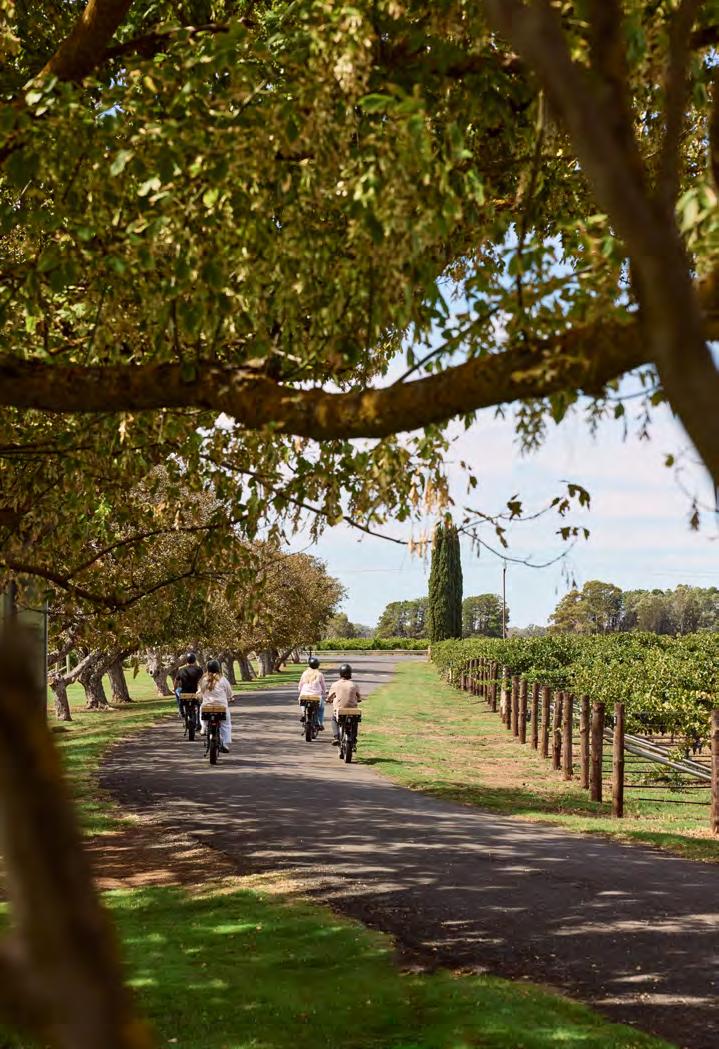
The LCLGA Board comprises nominated representatives from each of the Constituent Councils and is chaired by the LCLGA President. Each Constituent Council can nominate up to two Deputy Board Members.
Council
City of Mount Gambier
Tatiara District Council
District Council of Grant
Kingston District Council
Naracoorte Lucindale Council
District Council of Robe
Delegate
President Mayor Lynette Martin (OAM)
Vice President Mayor Liz Goossens
Mayor Kylie Boston
Mayor Jeff Pope
Mayor Partick Ross
Mayor Lisa Ruffell
Deputy Board Member/s
Deputy Mayor Josh Lynagh
Deputy Mayor Lynton MacKenzie
Deputy Mayor Brad Mann
Deputy Mayor Jamie Parkins
Deputy Mayor Abigail Goodman
Deputy Mayor Nick Brown
The Board held six ordinary bi-monthly General Meetings, and The Annual General Meeting during 2024-25. Meetings are hosted by Constituent Councils on a rotational basis.
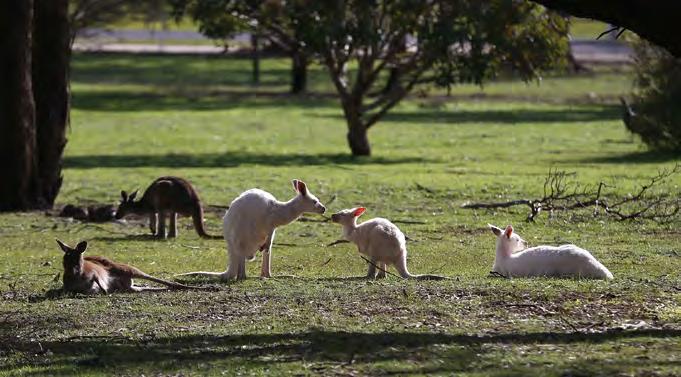
In accordance with the LCLGA Charter, the positions of LCLGA President and Vice President are appointed at the Annual General Meeting, held in February.
At the Annual General Meeting in February 2025, Mayor Lynette Martin was elected as LCLGA President, to serve in the position for a period of 12 months. Mayor Liz Goossens was elected as LCLGA Vice President.
During 2024-2025, Deb Brokenshire was appointed Interim Executive Officer from 1st July 2024 to 12 September 2024. Colin Byles was appointed Interim Executive Officer from 13 September 2024 to 30 June 2024. Charlotte Edmunds was appointed Executive Officer from 23 June 2025 onwards.
Dean Newbery and Partners are the appointed Auditor.
During 2024-2025, LCLGA engaged the following staff to deliver regional programs:
Under the Constitution of the LGASA, regions are represented via appointed members to serve on the LGA Board and the South Australian Regional Organisation of Councils (SAROC).
SAROC is an important LGA committee for non-metropolitan Councils.
Membership is drawn from each of the six non-metropolitan Regional Local Government Associations with members meeting bi-monthly to discuss the key issues affecting non-metropolitan Councils.
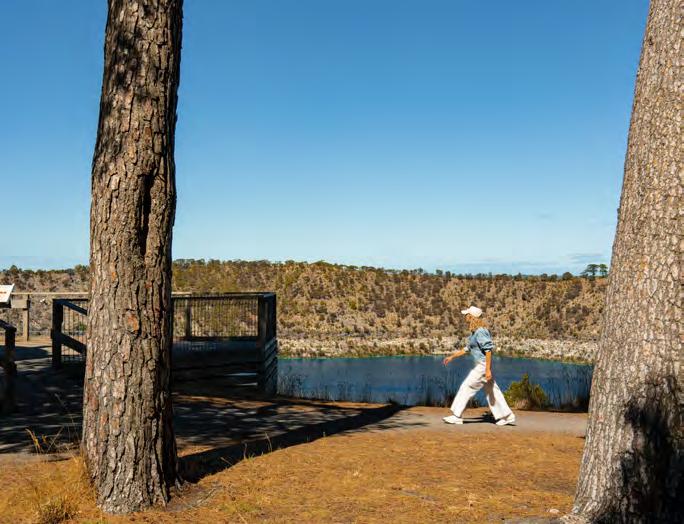
To undertake specific projects or fulfil areas of operational responsibility, LCLGA convenes a number of committees and working parties. LCLGA acknowledges the work of all who have contributed to the following committees and working parties throughout 2024-2025.
Representatives as at 30th June 2025
LCLGA Roads and Transport Management Group
Abdulah
Mr Daniel Willsmore
Mr Dave Worthley
Mr Peter Halton
Mr Tony Jordan
Brett Holmes
Colin Byles
LCLGA Audit & Risk Committee
Ms Amanda Stevens
Ms Biddie Shearing
Ms Rebecca Perkin
City of Mount Gambier
District Council of Grant
Ms Tess Armfield Kingston District Council
Ms Josie Collins Naracoorte Lucindale Council
Ms Camille Lehmann
Ms Kelly Hutchinson
Ms Emma Clay
Ms Nicole Croser
Ms Kate Napper
Ms Emma Herring
Mr Colin Byles
District Council of Robe
Tatiara District Council
Wattle Range Council

LCLGA has numerous representatives on working parties, boards and committees including State Government boards, cross border bodies and regional boards and committees. This representation allows LCLGA to keep in touch with communities and contribute to new and existing initiatives.
During 2024-2025, LCLGA made or continued the following appointments to other organisations.
South Australian Coastal Councils Alliance (SACCA)
Green Triangle Freight Action Plan


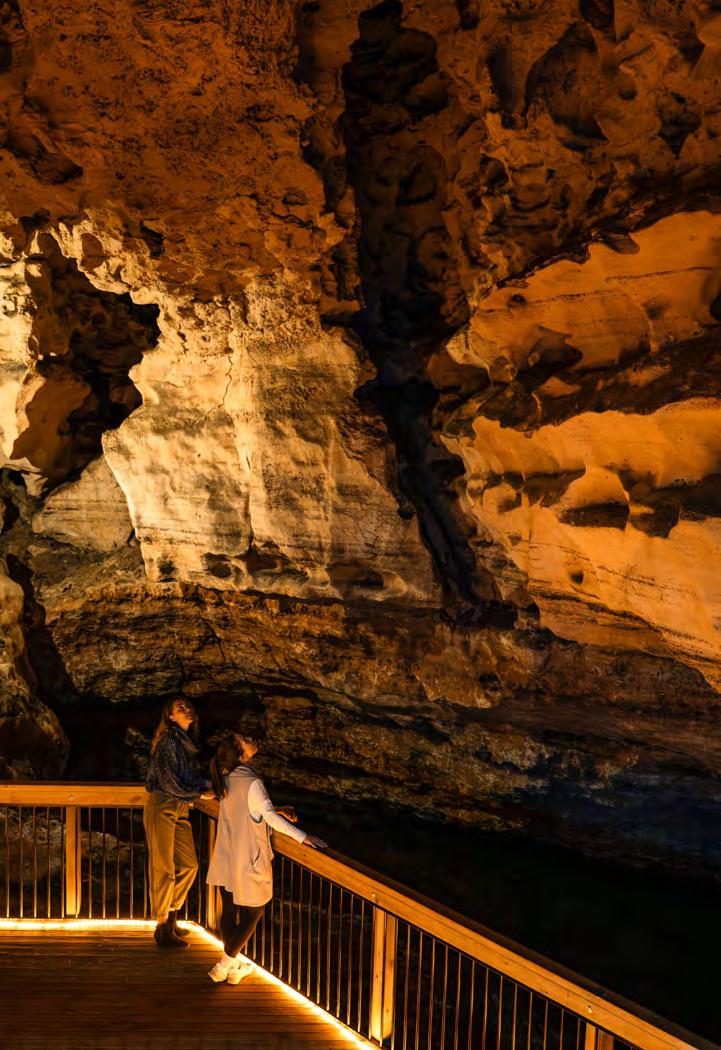
Destination Development continued as a strategic function of the Limestone Coast Local Government Association (LCLGA) throughout the 2024–25 financial year, with a focus on building a sustainable and highperforming visitor economy for the region in partnership with constituent councils and the South Australian Tourism Commission (SATC).
The Limestone Coast tourism region recorded $662 million in visitor expenditure for the year ending December 2024; the highest of any South Australian region outside of Adelaide, and an increase of $136M on the prior year. This is consistent with an upward trend in visitation and expenditure experienced over the past decade (with the exception of COVID-19 impacts). While influenced by many factors, these results underscore the relevance of the visitor economy to the region and the opportunities for continued growth.
The 2024-25 year saw the conclusion of Destination Development as a project undertaken and funded by the LCLGA, as we embark upon transition to a new tourism model in response to the recommendations of the South Australian Regional Tourism Review.
Furthermore, the refreshed South Australia Tourism Plan 2030, publised by the State Government in June, outlines a strategy to grow regional tourism from $4 billion to $5.1 billion. The Limestone Coast stands in a strong position to contribute to this goal.
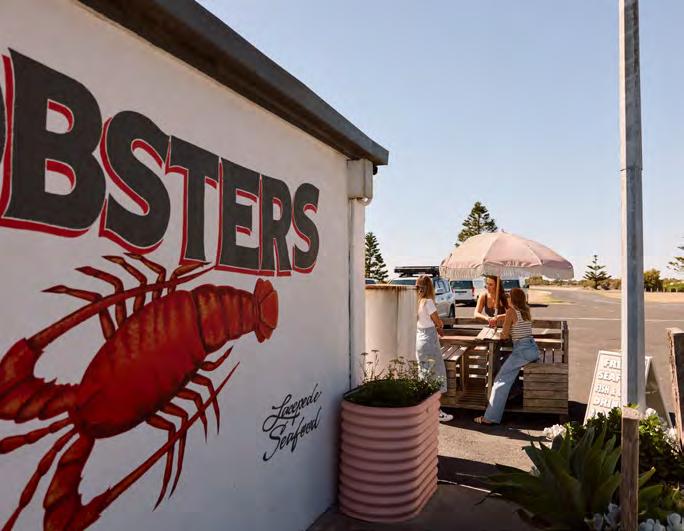
Throughout the year the LCLGA remained focused on delivering outcomes aligned with the Destination Development Strategy 2025 - a regional framework established to guide coordinated action across marketing, experience development, industry capability, advocacy, and collaboration.
Destination Development highlights delivered during the reporting year included:
ö @limestonecoast Facebook and Instagram reached a combined organic audience of 2.86 million, with strong engagement and follower growth (+30% on Facebook, +5.3% on Instagram). This reach was further amplified through reposting by prominent accounts - including @southaustralia, Glam Adelaide, and South Aussie with Cosiextending visibility to an audience of millions.
ö The Limestone Coast Destination Website (visitlimestonecoast.com.au) attracted over 183,000 page views and more than 79,000 new users, with strong engagement driven by long-form blog content that highlights visitor experiences and supports trip planning. Blogs generated 56,632 views, with users spending an average of 52 seconds per post - nearly double the site-wide average. Top-performing topics included Sinkholes and Swimming Hotspots of the Limestone Coast and Fishing in the Limestone Coast.
ö Maintained regular quarterly e-newsletters to prospective visitors, sharing seasonal inspiration and ‘what’s on’ information - helping drive traffic to the website and increase blog engagement.
ö The Website also delivered over 6,700 direct leads to Limestone Coast businesses via Australian Tourism Data Warehouse (ATDW) listings.
ö Represented the Limestone Coast at state and national tourism forums, including Destination Australia, the national Regional Tourism Organisation Forum (March 2025), and the South Australian Tourism Conference (June 2025).
ö Ongoing engagement with cross-border and state-level tourism partners to represent regional priorities and foster collaboration
ö Supported a week-long digital content shoot in the region led by the SATC (March 2025), contributing to the Limestone Coast’s presence in the new Simple Pleasures destination brand platform
ö Assisted with the delivery of SATC-funded regional marketing initiatives, including South Aussie with Cosi and Hello SA TV campaigns
ö Continued distribution of a bi-monthly Limestone Coast Tourism Industry Updates e-newsletter to industry contacts, and management of the regional tourism industry Facebook group with more than 670 members.
ö Maintained investment in monthly tourism data snapshot reports (prepared by Localis Analytics) to provide up-to-date regional insights and performance comparisons with neighbouring regions such as the Great Ocean Road and Grampians.
ö Facilitated strong operator engagement in SATC’s Experience Development Program and the Tourism for Good storytelling workshop co-hosted with TiCSA and The Tourism Collective in Mount Gambier
ö Supported and strengthened regional input into the Gather Round Festival of Footy campaign and associated road trip promotions
ö Coordinated a comprehensive content refresh of the Limestone Coast regional visitor guide
ö Supported the delivery of two online ATDW workshops specifically for Limestone Coast businesses
The next phase of regional tourism strategy commenced during the 2024–25 reporting period, with consultation on a new Limestone Coast Destination Management Plan (DMP) progressing across the region. The DMP is being developed in partnership between the Limestone Coast Local Government Association (LCLGA) and the South Australian Tourism Commission and is intended to provide a shared framework to guide regional tourism priorities and investment through to 2030.
The DMP also presents an opportunity to reaffirm regional needs and build on the strong foundations laid through the Destination Development function. Work on the DMP will continue into the latter half of 2025, progressing alongside a broader period of transition for regional tourism in South Australia - including a statewide review of how tourism is structured and funded. The DMP provides an important opportunity to reaffirm the Limestone Coast’s regional priorities and will help inform the region’s focus areas moving forward.
LCLGA remains the appointed Regional Tourism Organisation (RTO) for the Limestone Coast, with coordination support provided through a part-time Regional Tourism Manager appointed through to 30 June 2026 funded by the South Australian Tourism Commission.

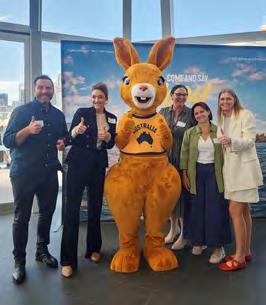

The conclusion of the Destination Development function on 30 June 2025 marks the end of a defined period of strategic, regionally coordinated tourism activity - shaped by sustained council and SATC investment, and guided by the Destination Development Strategy 2020–2025. With this transition, it is timely to reflect on the broader shifts and outcomes delivered throughout the life of the Strategy.
When the Strategy was adopted, 2018 tourism statistics were used to establish targets across core areas including visitor expenditure, visits, and nights. These benchmarks were set before the onset of COVID-19, which brought ongoing challenges throughout the Strategy’s implementation.
Despite this, the Limestone Coast tourism region recorded several notable outcomes:
ö Visitor expenditure increased from $337 million to $662 million over the life of the Strategy - exceeding the 2025 target of $479 million.
ö For the year ending December 2024, the Limestone Coast recorded the highest visitor expenditure and highest total visitor numbers of all South Australian regions outside of Adelaide.
ö Overnight visits rose from 617,000 to 807,000, and visitor nights from 2 million to 2.26 million - nearing target.
A regional legacy has also been created through sustained investment in digital storytelling, which has helped elevate the profile of the Limestone Coast and inspire visitation by promoting events, attractions, and experiences across the region.
This work spanned the introduction of Limestone Coast social media platforms, development of a regional destination website, and region-wide curated content creation.
Since their founding in 2020, and through to June 2025, the @limestonecoast Facebook and Instagram channels have collectively:
ö Reached a combined organic audience of over 7.5 million
ö Published 2,353 posts
ö Grown their follower base by 882% on Facebook and 2,715% on Instagram
ö Maintained high engagement rates - 6.2% on Facebook, 8.4% on Instagram
ö Been amplified by major media and tourism partners, including Tourism Australia, SATC, ABC, Glam Adelaide, Adelady, and South Aussie with Cosi
In just over three years (website analytics were first implemented in June 2022), the Limestone Coast Destination Website - visitlimestonecoast.com.au - has recorded:
ö More than 187,000 unique visitors
ö Over 397,000 total page views
ö An average of 11 direct leads per day to Limestone Coast businesses via ATDW listings - totalling over 12,000 leads.
This sustained focus on regional storytelling has played a valuable role in elevating the Limestone Coast’s visibility and profile as a destination. In 2023, the region was named one of SATC’s top-performing destinations on social media - a milestone that reflected the cumulative impact of consistent, high-quality content creation and digital coordination at a regional level. The @limestonecoast social channels have contributed to broader promotion by showcasing optimised, engaging content that aligns with state-wide destination marketing efforts and encourages further content creation and amplification.
More recently, the Limestone Coast was recognised as Australia’s number one destination in Australian Traveller’s Top 100 Greatest Getaways (May–July 2025 edition) - a reflection of the region’s growing appeal and momentum, and a positive marker as the current strategy period draws to a close.

The Connected and Active Communities (CAC) Project is a place-based approach that aims to address poor levels of physical activity participation at a local level by investing in the strengths of our communities through a partnership approach.
Limestone Coast Local Government Association (LCLGA) and The Office for Recreation, Sport and Racing (ORSR) recognises that those living within our regional communities are the experts in their own lives, and through proactive engagement aim to work with and harness this expertise to inform, co-design and implement initiatives that have lasting impact.
By partnering with local communities, the CAC Project identifies opportunities to elevate the capacity of volunteers, decision makers and local leaders to create and deliver innovative and effective sport and recreation initiatives.
Harnessing diversity as a key strength of our region, the CAC Project connects and leverages traditional and nontraditional networks to bring communities together and positively impact physical activity participation rates through locally tailored solutions.
The CAC Project has delivered the following in the reporting period;
11 students between the ages of 15 and 17 from across Limestone Coast have started the journey to participate in the inaugural Office for Recreation, Sport and Racing and Duke of Edinburgh Awards Young Leaders Program. This is a fully subsidised program with no cost to the participant.
Key highlights of the Young Leaders Program include:
ö Learn Understand the inner workings of a sporting club, the issues affecting sport and how to make sporting clubs more accessible to the community.
ö Develop your communication skills, leadership and emotional intelligence and undertake sporting medical support training.
ö Experience - Get first-hand experience within a community sporting club and apply your skills & learning practically.
The course consists of –
ö Physical Recreation 6 months of Physical Activity (1 hour per week for 6 months)
ö Voluntary Service 3 months of volunteering at a community organisation/sporting club (1 hour per week for 3 months)
ö Skill Development - 5 workshops:
- How to increase participation in sport (delivered by ORSR) ·
- How does a sporting club run (delivered by ORSR)
- Improving your communication (deliverer TBC)
- Developing your life skills and emotional intelligence (delivered by Global Community Sports)
- Maintaining your members health (delivered by SA Sports Medicine Association)
- Communication workshop, focussing on the following areas:
- Confidence, running a meeting, Grant writing, Having difficult conversations, How to influence, Social media training.
Plus 1 of either:
ö Community Coaching Essential Skills (Delivered by Australian Sports Commission) Community Officiating Essential Skills (Delivered by Australian Sports Commission).
ö Adventurous Journey Overnight stay at AFL Max (TBC) Tour of new ORSR/SASI Cultural Awareness Training (delivered by Tjindu Foundation).
This program is free of costs to the participants, and they are able to gain a minimum of 10 SACE Points, by completing the program. We have at least 1 person from all 7 council areas in the program
The CAC Program delivered Child Safe Officer, Responsible Service of Alcohol, Grant Writing, Grant Readiness, Cultural Inclusivity and Food Safety Supervisor workshops across the region in the reporting period.
The CAC Officer was apart of the selection Panel for the inaugural Power of Her Sport Awards and attended the Award Ceremony on the 12th March. The Naracoorte Little Athletics Club was successful in the Champion Local Club – Regional section and Chloe Mackenzie was a joint winner in the emerging leader category.
Chloe created the very first South-East junior girl’s cricket group to assist in the development of junior girls as well as to give them an opportunity to play and train with only other girls. Previously, junior girls in the southeast were only able to play cricket in a mixed gender competition, so Chloe created a ‘Girls only’ group to support and encourage them early on in their cricket journey.
By conducting training sessions at various cricket grounds in the Limestone Coast region eg. Naracoorte, Penola and Mt Gambier, Chloe ensures ‘girls only’ cricket is inclusive and accessible at regional local cricket clubs. Sometimes she travels over 200kms after her working day just to conduct a ‘girls only’ training session.
ö The CAC Officer has worked with multiple clubs on a range of Funding Programs.
ö The CAC Officer worked with the EQUiPP Project through Uni SA on Co-designing an educational campaign for people living with chronic pain in the Limestone Coast and Western Victoria. The aim of this study, EQUiPP: Co-design Workshops, is to engage with locals to co-design a chronic pain-targeted educational intervention that is specific to your community.
ö For this study, we are running a workshop with people who live and/or work in the Limestone Coast. EQUiPP is a research project with a bold vision: to change the way Australians understand pain. www.equipp.org.au
Project based around soccer and migrants. We are supporting soccer in the Tatiara, with a focus on the migrant community’s needs, by exploring ways in which the strengths of the community can be leveraged to create positive physical activity outcomes to establish active lives and connected communities.
There are currently multiple forms of informal Soccer participation occurring in the community. We have supported Senior Soccer with equipment and Governance support. This program has now expanded into having a Basketball component to it. This is proving to be very successful.


The CAC Officer worked with the South Australian Sports Institute (SASI) Paralympic section to activate Physical Activity opportunities for people in the Limestone Coast. SASI have agreed to come down for a 4-day initial visit to work with clubs, councils and schools to look at setting up sustainable and ongoing disability sport programs for young and old in the region.
These programs will be supported by and managed by the SASI Paralympic team and the CAC program. They will be grass root programs open to young and old. There will also be Talent Identification Testing run for young athletes with a disability with a hope to add a Paralympic section to our local Academy.
The Limestone Coast Local Government Association (through the Connected and Active Communities Program), in partnership with the Office for Recreation Sport and Racing, The City of Mount Gambier and University of SA Mount Gambier Campus was proud to present 'The Power of Her' - an inspiring event dedicated to celebrating and empowering females in sport. The event was held at Wulanda Recreation and Convention Centre on Thursday 21st November.
The Power of Her brought together influential voices, thought leaders and change makers for an unforgettable day and night of connection, learning and growth.
The event was held in two parts.
The first, a Schools specific session, for female students, held in the morning that discussed topics relevant to those in attendance, not only in sport but in everyday life. Topics such as, Body Image, Leadership, what it takes to reach their goals and How to navigate life changes that happen to them as they grow.
The students then heard from Paris Olympic Bronze Medallist Caitlin Parker, in an inspiring talk about breaking down stereotypes and overcoming barriers. Then a keynote address from Former Australian Diamond Captain Natalie Von Bertouch and current Thunderbird Premiership Captain Hannah Petty, which engaged the crowd and involved them in the discussion.
Questions from the students were then forthcoming, and so engaged where the students, we ran out of time for all the questions. Students were able to approach the presenters for photos and to discuss things personally before they left.
The second session saw keynote addresses from Natalie Von Bertouch and Caitlin Parker, along with a panel discussion with Natalie, Caitlin, Nicola Jensen (Pelvic Pain Foundation), Holly Bailey (Play Like a Girl Foundation), Hannah Petty, Lorraine Pitman (The Embrace Collective) and former Limestone Coast Regional Sporting Academy member and current South Australian Sports Institute Cycling athlete Sarah Dally.
The event was packed with powerful ideas and insights, engaging presentations, lively conversations and personal stories. Not to mention highly practical tools to empower change in gender equality. Both sessions were superbly led by Limestone Coast born, Channel 9 News Presenter Alice Monfries as MC.
Never before have we seen such a collection of sporting legends and leaders in significant female focused areas come together on the Limestone Coast in one setting. Over 200 people came to both sessions.
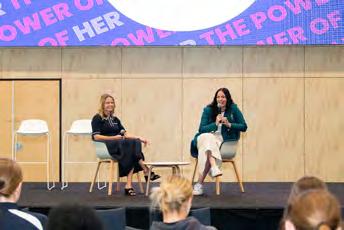

The CAC program worked with Feel Better (Mental Health Professionals) to develop and roll out the Switch The Play: A Grassroots Mental Health Program for Sporting Clubs.
Switch The Play is an innovative grassroots mental health program designed by FeelBetter Limestone Coast for implementation within sporting clubs. The program aims to provide ongoing, consistent, and accessible mental health and well-being support to club members and the broader community.
The program provides localised easily accessible mental health support for sporting clubs, with support being long term and ongoing in nature to avoid the gap often experienced with fly-in-fly-out mental health models which provide information however do not provide the tangible mental health support that clubs need at the times when it is needed.
Not having ongoing accessible support is viewed as a barrier to clubs embedding mental health and wellbeing as a natural part of their operations, as clubs are already normally overburdened with role responsibilities being managed mostly by volunteers.
Having access to accredited mental health social workers to support and guide designated club wellbeing support persons will enable reduction of the fear and responsibility likely associated with a person agreeing to take on a volunteer role of this kind.
Understanding that support will be readily available to the volunteer within the wellbeing role will we envisage make it much easier clubs to present the role to their club and for a club person to agree to being attached to the role.
Program Objectives:
1. Reduce stigma surrounding mental health support-seeking
2. Reach a wide demographic, particularly adult males and young men
3. Address high male suicide rates in rural and remote South Australia
4. Provide informal, less confronting support at a grassroots level
5. Normalise mental health discussions within sporting communities
Program Design:
ö Implementation within sporting clubs
ö Dedicated wellbeing role attached to each club
ö Access to accredited mental health social workers – FeelBetter Limestone Coast
ö Online group sessions for wellbeing club contact available
ö Individual consultations for wellbeing contact available
ö Website materials and resources on mental health topics available at any time
ö Critical incident support available provided by AMHSW FeelBetter Limestone Coast
Partnered with Department of Child Protection and are in the early phase of running a project that will provide children at risk with opportunities to participate and benefit from sport they choose to be involved in. Children and Sports have been selected and are being supported through the CAC program to be able to attend trainings and games and to be able to do so safely.
Facility Planning and Governance Support
Delivered a Facility Analysis report which will provide valuable data in partnership with Naracoorte Lucindale Council about the viability and future of facilities in their council area.
The CAC Officer also continued to provide many clubs across the region with Governance and off field support, including, Constitution, Strategic Planning and Grant/Funding support.

In partnership with the Office for Recreation, Sport and Racing and the LCLGA, the Limestone Coast Regional Sporting Academy (LCRSA) inducted its first Inductees in October 2017 and commenced working with these Athletes in November, as part of a Pilot Program.
Since then, the LCLGA have been successful in meeting certain requirements from the ORSR and have continued to obtain funding to run the program ongoing. Once again, the LCLGA partnered with the ORSR and the seventh year of the LCRSA was launched in October 2023. The program was also supported through the Local Government Research and Development Scheme funding program.
We were pleased to welcome back Hockey SA, Tennis SA, SASI Cycling, Swimming SA, Mount Gambier Pioneers, SA Country Basketball and Athletics SA as official partners of the Academy. We also welcomed for the first time Glenelg Football Club as a partner in a new AFLW Program.
We were able to offer skill-based sessions for athletes in these sports and coaching development for local coaches as well. We also continued to offer a Lonestar program for athletes from any sporting background.
The LCRSA inducted 82 athletes into the Academy for the 2024/25 iteration.
These athletes are provided with a 12-month Gym membership, a 12-month Elite Athlete Strength and Conditioning Program (2 sessions a week at the gym

To identify regional sporting talent

To educate and develop youth in the region
and an at home program), Coaching, Educational Sessions (Sports Psychology, Media Training, Coping with Pressure, Sporting Routines and Sports Nutrition), and High-level testing at the University of SA’s High Performance Centre in Adelaide.
We are also able to live stream our Education sessions to athletes across the region who are unable to attend due to travel.
The program has given the athletes the chance to understand the training and preparation requirements to become an elite athlete, as well as improve their performances at school as well as on the field or track.
We also continued our partnership with Uni SA, who provide us with the venue for our Education sessions and Testing. The LCRSA is extremely pleased to also be supported by the M & G Hotel Group, who have provided us with 30 nights of free accommodation for athletes and families, as well as a reduced rate for athletes and families on an ongoing basis.

To provide pathways to State and national representation

To develop the skills of regional coaches
Outside of these four main sporting objectives, our key goal is to help young people become leaders in our communities.
The Limestone Coast Regional Sporting Academy (LCRSA) has officially adopted an independent governance structure, marking its evolution from being managed by the Limestone Coast Local Government Association (LCLGA). This pivotal development represents a major step forward for athlete development in South Australia, enhancing the support available to emerging sports talent across the region.
The LCRSA is set to become the first regional academy in South Australia to operate under an independent governance model. This transition has been carefully considered by the LCLGA, with thorough due diligence conducted to assess the benefits of independent operations. The Academy will now be managed and operated locally, with strategic and operational support from Regional Academies of Sport Ltd (RAS Ltd), its parent organisation, which provides expertise in governance, strategy and risk, finance, marketing and more.

The move to independence will allow the LCRSA to access a broader network of expertise, resources and support, while continuing to deliver tailored programs that reflect the region’s sporting culture and aspirations.

With the Brisbane 2032 Olympics on the horizon, now is the time to invest in the next generation of regional talent. Programs delivered in the Limestone Coast, and those still to be developed, will not only nurture future sporting stars but also help shape a stronger, more resilient generation, equipped for life beyond the playing field. It’s an incredibly exciting time to be an emerging athlete in South Australia.

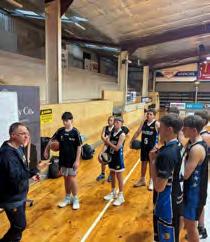
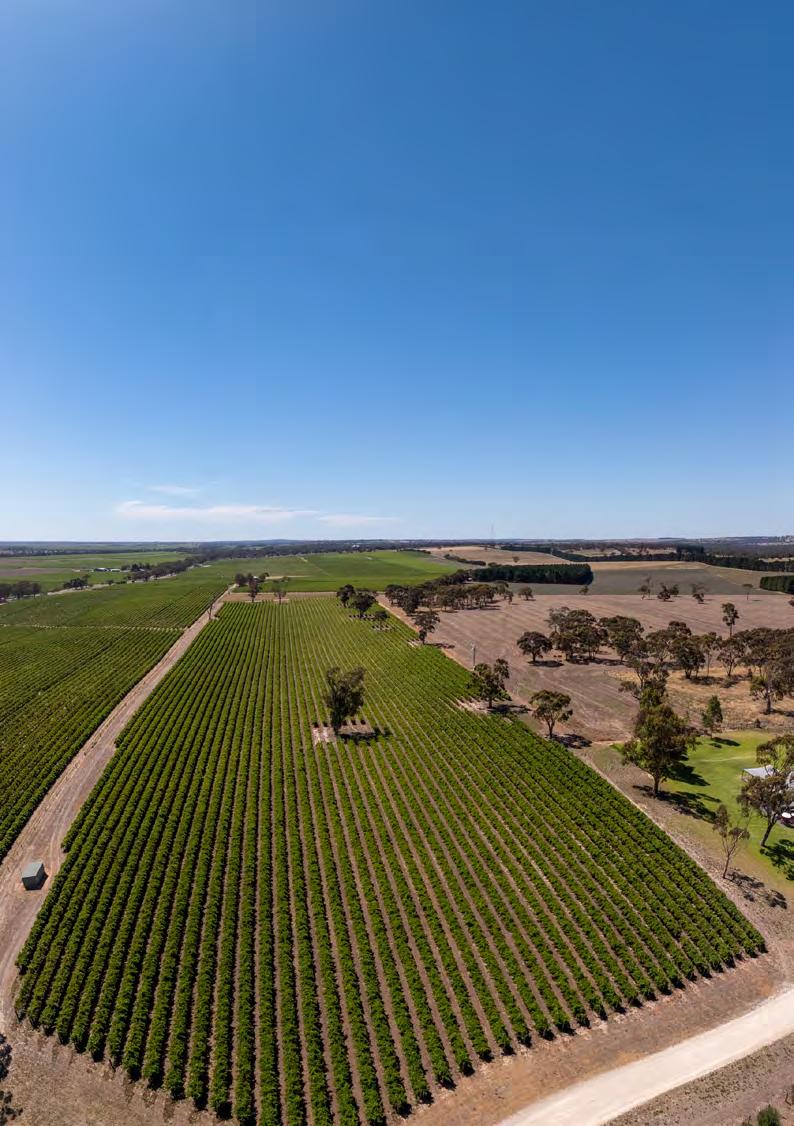
30 JUNE 2025
STATEMENT OF COMPREHENSIVE INCOME for the year ended 30 June 2025
Comprehensive Income Amounts which will not be reclassified subsequently to operating result Changes in revaluation surplus - infrastructure, property, plant & equipment
COMPREHENSIVE INCOME
This Statement is to be read in conjunction with the attached Notes.
(58,458)
OF FINANCIAL POSITION as at 30 June 2025
This Statement is to be read in conjunction with the attached Notes.
STATEMENT OF CHANGES IN EQUITY for the year ended 30 June 2025
This Statement is to be read in conjunction with the attached Notes
STATEMENT OF CASHFLOWS for the year ended 30 June 2025
CASH FLOWS FROM INVESTING ACTIVITIES
CASH FLOWS FROM FINANCING ACTIVITIES
This Statement is to be read in conjunction with the attached Notes
Notes to and forming part of the Financial Statements for the year ended 30 June 2025
Note 1 - MATERIAL ACCOUNTING POLICIES
The principal accounting policies adopted in the preparation of the financial report are set out below. These policies have been consistently applied to all the years presented, unless otherwise stated.
1.1 Compliance with Australian Accounting Standards
This general purpose financial report has been prepared in accordance with Australian Accounting Standards as they apply to not-for-profit entities, other authoritative pronouncements of the Australian Accounting Standards Board, Interpretations and relevant South Australian legislation.
1.2 Historical Cost Convention
Except as stated below, these financial statements have been prepared in accordance with the historical cost convention.
1.3 Critical Accounting Estimates
The preparation of financial statements in conformity with Australian Accounting Standards requires the use of certain critical accounting estimates, and requires management to exercise its judgement in applying Limestone Coast LGA’s accounting policies. The areas involving a higher degree of judgement or complexity, or areas where assumptions and estimates are significant to the financial statements are specifically referred to in the relevant sections of this Note.
1.4 Rounding
All amounts in the financial statements have been rounded to the nearest dollar ($).
2 The Local Government Reporting Entity
Limestone Coast Local Government Association (Association) is incorporated under the SA Local Government Act 1999 and has its principal place of business at Level 1, 9 Bay Road, Mount Gambier, SA, 5290. These financial statements include Limestone Coast Local Government Associations direct operations and all entities through which Limestone Coast Local Government Association controls resources to carry on its functions. In the process of reporting on Limestone Coast Local Government Association as a single unit, all transactions and balances between activity areas and controlled entities have been eliminated.
3 Income recognition
The Association recognises revenue under AASB 1058 Income of Not-for-Profit Entities (AASB 1058) or AASB 15 Revenue from Contracts with Customers (AASB 15) when appropriate.
In cases where there is an ‘enforceable’ contract with a customer with ‘sufficiently specific’ performance obligations, the transaction is accounted for under AASB 15 where income is recognised when (or as) the performance obligations are satisfied (i.e. when it transfers control of a product or service to a customer). Revenue is measured based on the consideration to which the Association expects to be entitled in a contract with a customer.
Income from Local Government Council Contributions includes income for “pass-through” expenditure for Regional Development Australia Limestone Coast (RDALC), SA Coastal Councils Alliance (SACCA) and the provision of heritage services.
Cash Assets include all amounts readily convertible to cash on hand at Limestone Coast Local Government Associations option with an insignificant risk of changes in value with a maturity of three months or less from the date of acquisition.
Other receivables are generally unsecured and do not bear interest.
All receivables are reviewed as at the reporting date and adequate allowance made for amounts the receipt of which is considered doubtful.
Notes to and forming part of the Financial Statements for the year ended 30 June 2025
5 Payables
5.1 Goods & Services
Creditors are amounts due to external parties for the supply of goods and services and are recognised as liabilities when the goods and services are received. Creditors are normally paid 30 days after the month of invoice. No interest is payable on these amounts.
5.2 Payments Received in Advance & Deposits
Amounts received from external parties in advance of service delivery, are recognised as liabilities until the service is delivered or damage reinstated, or the amount is refunded as the case may be.
6
6.1 Salaries, Wages & Compensated Absences
Liabilities for employees’ entitlements to salaries, wages and compensated absences expected to be paid or settled within 12 months of reporting date are accrued at nominal amounts (including payroll based on costs) measured in accordance with AASB 119.
Liabilities for employee benefits not expected to be paid or settled within 12 months are measured as the present value of the estimated future cash outflows (including payroll based on costs) to be made in respect of services provided by employees up to the reporting date. Present values are calculated using government guaranteed securities rates with similar maturity terms.
Weighted average discount rate 3.927% (2024 3.929%)
Weighted average settlement period 1 year (2024, 1 year)
No accrual is made for sick leave as Limestone Coast Local Government Assoications experience indicates that, on average, sick leave taken in each reporting period is less than the entitlement accruing in that period, and this experience is expected to recur in future reporting periods. The Association does not make payment for untaken sick leave.
7 GST Implications
In accordance with UIG Abstract 1031 “Accounting for the Goods & Services Tax”
Receivables and Creditors include GST receivable and payable.
Except in relation to input taxed activities, revenues and operating expenditures exclude GST receivable and payable.
Non-current assets and capital expenditures include GST net of any recoupment.
Amounts included in the Statement of Cash Flows are disclosed on a gross basis.
8 Leases
At the inception of a contract, the Association assesses if the contract is a lease. If there is a lease present, a right of use assets and a corresponding lease liability is recognised by the Association where the Association is a lessee. However, all contracts that are classified as short-term leases (lease with remaining lease term of 12 months or less) and leases of low value assets are recognised as an operating expense on a straight-line basis over the term of the lease.
9 New Accounting Standards and UIG interpretations
The Association has assessed all the standards / interpretations which are not yet effective and have determined that there is no expected material impact on the reported financial position or performance.
Notes to and forming part of the Financial Statements for the year ended 30 June 2025
Notes to and forming part of the Financial Statements for the year ended 30 June 2025
NOTE 3: Expenditure
Notes to and forming part of the Financial Statements for the year ended 30 June 2025
NOTE 4: Assets
and Cash Equivalents
NOTE 5: Liabilities
Notes to and forming part of the Financial Statements for the year ended 30 June 2025
NOTE 6: Reconciliation of Cash Flow Statement
(a) Reconciliation of Cash
Cash Assets comprise highly liquid investments with short periods to maturity subject to insignificant risk of changes of value. Cash at the end of the reporting period as shown in the Cash Flow Statement is reconciled to the related items in the Balance Sheet as follows:
(b) Reconciliation of Change in Net Assets to Cash from Operating Activities
Non-cash items in Income Statement
Add (Less): Changes in Net Current Assets
(c) Financing Arrangements
Unrestricted
Notes to and forming part of the Financial Statements for the year ended 30 June 2025
NOTE 7: Financial Instruments
All financial instruments are categorised as loans and receivables.
Accounting Policies - Recognised Financial Instruments Bank, Deposits at Call, Short Term Deposits
Accounting Policy: initially recognised at fair value and subsequently measured atamortised cost, interest is recognised when earned
Terms & conditions: Deposits are returning interest rates between 4.15% and 4.55% (2024: 4.30% and 4.55%).
Carrying amount: approximates fair value due to the short term to maturity.
Receivables - Fees & other charges
Receivables - other levels of government
Accounting Policy: initially recognised at fair value and subsequently measured at amortised cost. An impairment provision is recognised using the expected credit loss method
Terms & conditions: Unsecured, and do not bear interest. Although the association is not materially exposed to any individual debtor, credit risk
Carrying amount: approximates fair value (after deduction of any allowance).
Accounting Policy: initially recognised at fair value and subsequently measured at amortised cost. An impairment provision is recognised using the expected credit loss method.
Terms & conditions: Amounts due have been calculated in accordance with the terms and conditions of the respective programs following advice of approvals, and do not bear interest. All amounts are due by Departments and Agencies of State and Federal Governments.
Carrying amount: approximates fair value.
Liabilities - Creditors and Accruals
Accounting Policy: Liabilities are recognised for amounts to be paid in the future for goods and services received, whether or not billed to the Association.
Terms & conditions: Liabilities are normally settled on 30 day terms.
Carrying amount: approximates fair value.
Notes to and forming part of the Financial Statements
for the year ended 30 June 2025
Note 7: Financial Instruments (Cont.)
The following interest rates were applicable to Limestone Coast LGA at balance date:
All carrying values approximate fair value for all recognised financial instruments. There is no recognised market for the financial assets of Limestone Coast Local Government Association. Risk Exposures:
Credit Risk represents the loss that would be recognised if counterparties fail to perform as contracted. The maximum credit risk on financial assets of the Association is the carrying amount, net of any impairment. Except as detailed in relation to individual classes of receivables, exposure is concentrated within the Limestone Coast LGA boundaries, and there is no material exposure to any individual debtor.
Market Risk is the risk that fair values of financial assets will fluctuate as a result of changes in market prices. All of the Associations financial assets are denominated in Australian dollars and are not traded on any market, and hence neither market risk nor currency risk apply.
Liquidity Risk is the risk that the Association will encounter difficulty in meeting obligations with financial liabilities. In accordance with the model Treasury Management Policy (LGA Information Paper 15), liabilities have a range of maturity dates.
Interest Rate Risk is the risk that future cash flows will fluctuate because of changes in market interest rates. The Association has a balance of both fixed and variable interest rate investments.
Notes to and forming part of the Financial Statements for the year ended 30 June 2025
NOTE 8: Uniform Presentation of Financial Statements
Less Net Outlays in Existing Assets
Capital Expenditure on renewal and replacement of Exising Assets
Add Back Depreciation Amortisation and Impairment
Proceeds from Sale of Replaced Assets
Less Net Outlays on New and Upgraded Assets
Capital Expenditure on New and Upgraded Assets
Amounts received specifically for New and Upgraded Assets
Proceeds from Sale of Surplus Assets
Lending / (Borrowing) for Financial Year
This Statement is to be read in conjunction with the attached Notes
Notes to and forming part of the Financial Statements for the year ended 30 June 2025
Note 9 – Contingent Liabilities and Contingent Assets
At 30 June 2025, the Association is unaware of any liability, contingent or otherwise, which has not already been recorded elsewhere in the this financial report.
Note 10 – Capital Commitments
At 30 June 2025, the Association is unaware of any capital or leasing commitments which have not already been recorded elsewhere in the this financial report.
Note 11 – Events after the end of the reporting period
There were no events subsequent to 30 June 2025 that need to be disclosed in the financial statements.
Note 12 – Economic Dependence
Limestone Coast Local Government Association is dependent on the Local Councils within its jurisdiction and other funding bodies for the majority of its revenue used to operate the business. At the date of this report, the Board believe that the Local Councils and other bodies will continue to fund the Association.
Note 13 – Capital Management
The Board controls the capital of the entity to ensure that adequate cash flows are generated to fund its programs and that returns from investments are maximised within tolerable risk parameters. The Board ensure that the overall risk management strategy is in line with this objective. The Board operates under policies approved by the board. Risk management policies are approved and reviewed by the Board on a regular basis. These include credit risk policies and future cash flow requirements. The entity’s capital consists of financial liabilities supported by financial assets. There has been no changes to the strategy adopted by the Board to control the capital of the entity since the previous financial year.
Note 14 – Related Party Disclosure
The Key Management Personnel of the Council include the Board of Management and Executive Officer. In all, four people were paid the following total compensation:
The specific banding of key management personnel and Board of management from the Limestone Coast Local Government Association Incorporated during the year was as follows;
Notes to and forming part of the Financial Statements for the year ended 30 June 2025
Other related parties includes close family members of key management personnel and entities that are controlled or jointly controlled by those key management personnel individually or collectively with their close family members.
Note 14 – Related Party Disclosure (Cont.)
There were no transactions with other related parties.
Related Party Entity
received from Related Party during the Financial Year 2025
INDEPENDENT AUDITOR’S REPORT
TO THE MEMBERS OF THE LIMESTONE COAST LOCAL GOVERNMENT ASSOCIATION
Opinion
We have audited the accompanying financial report of the Limestone Coast Local Government Association (the Authority), which comprises the Statement of Financial Position as at 30 June 202 5, the Statement of Comprehensive Income, the Statements of Changes in Equity, the Statement of Cash Flows for the year then ended, and notes to the financial statements, including a summary of significant accounting policies , and other explanatory information and the Certification of the Financial Statements
In our opinion, the accompanying financial report presents fairly, in all material aspects, the financial position of the Authority as at 30 June 2025, and its financial performance and its cash flows for the year then ended in accordance with the Local Government Act 1999, Local Government (Financial Management) Regulations 2011 and the Australian Accounting Standards
Basis for Opinion
We conducted our audit in accordance with Australian Auditing Standards. Our responsibilities under those standards are further described as in the Auditor’s Responsibilities for the Audit of the Financial Report section of our report. We are independent o f the Authority in accordance with the auditor independence requirements of the ethical requirements of the Accounting Professional and Ethical Standards Board’s APES 110 Code of Ethics for Professional Accountants (the Code) that are relevant to our audit of the financial report in Australia. We have also fulfilled our other ethical responsibilities in accordance with the Code.
We believe that the audit evidence we have obtained is sufficient and appropriate to provide a basis for our opinion.
Responsibility of Management and Those Charged with Governance for the Financial Report
Management is responsible for the preparation of the Authority’s financial report in accordance with Australian Accounting Standards , the Local Government Act 1999 and the Local Government (Financial Management) Regulations 2011, and for such controls as Management determines is necessary to enable the preparation of the financial report is free from material misstatement, whether due to fraud or error.
In preparing the financial report, Management is responsible for assessing the Authority’s ability to continue as a going concern, disclosing, as applicable, matters relating to going concern and using the going concern basis of accounting unless management either intends to liquidate the Authority or to cease operations, or has no realistic alternative but to do so.
Those charged with governance are responsible for overseeing the Authority’s financial reporting process.
Our objectives are to obtain reasonable assurance about whether the financial report as a whole is free from material misstatement, whether due to fraud or error, and to issue an auditor’s report that includes our opinion. Reasonable assurance is a high level of assurance, but is not a guarantee that the audit conducted in accordance with the Australian Auditing Standards will always detect a material misstatement when it exists. Misstatements can arise from fraud or error and are considered material if, indivi dually or in the aggregate, they could reasonably be expected to influence the economic decisions of users taken on the basis of financial report.
As part of an audit in accordance with the Australian Auditing Standards, we exercise professional judgement and maintain professional scepticism throughout the audit. We also:
• Identify and assess the risks of material misstatement of the financial report, whether due to fraud or error, design and perform audit procedures responsive to those risks, and obtain audit evidence that is sufficient and appropriate to provide a basis fo r our opinion. The risk of not detecting a material misstatement resulting from fraud is higher than for one resulting from error, as fraud may involve collusion, forgery, intentional omissions, misrepresentations, or the override of internal control.
• Obtain an understanding of internal control relevant to the audit in order to design audit procedures that are appropriate in the circumstances, but not for the purpose of expressing an opinion on the effectiveness of the internal control.
• Evaluate the appropriateness of accounting policies used and the reasonableness of accounting estimates and related disclosures made by those charged with governance.
• Conclude on the appropriateness of the Authority’s use of the going concern basis of accounting and, based on the audit evidence obtained, whether a material uncertainty exists related to events or conditions that may cast significant doubt on the ability to continue as a going concern. If we conclude that a material uncertainty exists, we are required to draw attention in our auditor’s report to the related disclosures in the financial report or, if such disclosures are inadequate, to modify our opinion. Our conclusions are based on the audit evidence obtained up to the date of our auditor’s report. However, future events or conditions may cause the Authority to cease to continue as a going concern.
• Evaluate the overall presentation, structure and content of the financial report, including the disclosures, and whether the financial report represents the underlying transactions and events in a manner that achieves fair presentation.
We communicate with those charged with governance regarding, among other matters, the planned scope and timing of the audit and significant audit findings, including any significant deficiencies in internal control that we identify during our audit.
DEAN NEWBERY

SAMANTHA CRETEN Director
19 August 2025
Auditor’s Independence Declaration under Section 22 of the Local Government (Financial Management) Regulations 2011 to the Limestone Coast Local Government Association
I confirm that, for the audit of the financial statements of the Limestone Coast Local Government Association for the year ended 30 June 2025, I have maintained my independence in accordance with the requirements of APES 110 – Code of Ethics for Professional Accountants, Part 4A, published by the Accounting Professional and Ethical Standards Board, in accordance with the Local Government Act 1999 and the Local Government (Financial Management) Regulations 2011 made under that Act.
This statement is prepared in accordance with the requirements of Regulation 22 (5) Local Government (Financial Management) Regulations 2011.
SAMANTHA CRETEN DIRECTOR
19 August 2025
The Limestone Coast Local Government Association (LCLGA) extends its sincere appreciation to its constituent councils for their continuing support and collaboration.
We acknowledge the valuable contributions and guidance of all board Members over the 2024-25 year: President Mayor Lynette Martin (OAM) - City of Mount Gambier, Vice President Mayor Liz Goossens - Tatiara District Council, Mayor Kylie Boston - District Council of Grant, Mayor Jeff Pope - Kingston District Council, Mayor Patrick Ross - Naracoorte Lucindale Council and Mayor Lisa Ruffell - District Council of Robe.
The 2024-25 year has been one of significant change for the Association as we have embarked upon a shift towards an advocacy focused structure.
The transition period of the LCLGA during 2024-25 was led by highly experienced and capable leadership. Deb Brokenshire served as Interim Executive Officer from June 2024 for a three-month term whilst the strategic direction was established. Colin Byles then took over the interim position to lead the Association’s structural transition including the recruitment of a new Executive Officer to lead the new advocacy-focused organisation going forward. We wholeheartedly thank Deb and Colin for their collective efforts over the past 12 months.
Equally, each of the LCLGA staff members have demonstrated integrity and professionalism of the highest regard during the transition period ensuring programs continued seamlessly throughout the various changes and challenges that comes with organisational restructure.
Immense appreciation and respect is extended to Tony Elletson, Connected & Active Communities Officer; Kate Napper, Destination Development Manager; Emma Herring, Destination Development Coordinator; Rhiannon Zammit, Limestone Coast Regional Sporting Academy Administrator; and Paul Manfrin, Corporate Services Officer.
The Australian Local Government Association, the Local Government Association of SA (including support via the Regional Capacity Building Program, which funded both regional tourism marketing activities and the Limestone Coast Regional Sporting Academy), and the five other regional local government associations in SA continue to provide guidance and support to the LCLGA, for which we extend our gratitude.
Our strong working relationship with Regional Development Australia Limestone Coast board members and staff also remains an invaluable component in advancing the region’s interests and strengthening our economic future. We look forward to continuing to partner with RDALC towards achieving our shared goals.
While the 2024-25 period has been one of transition, the founding principles have remained at the forefront of decision making and continue to guide us into the next chapter of our 140-year-old Association. While each council is unique in its circumstance and situation we are united in a shared responsibility and vision for the future of our region. We are committed to continued regional collaboration that crosses council boundaries to ensure effective solutions and shared burdens.
Our potential for growth is strengthened by local government cooperation to drive the social, environmental and community development goals, always ultimately advocating for the region’s best asset - its people.
We look forward to the LCLGA continuing to play a vital role in shaping and supporting the future of our region as we have done since 1885.
Better Together.
Charlotte Edmunds Executive Officer LCLGA