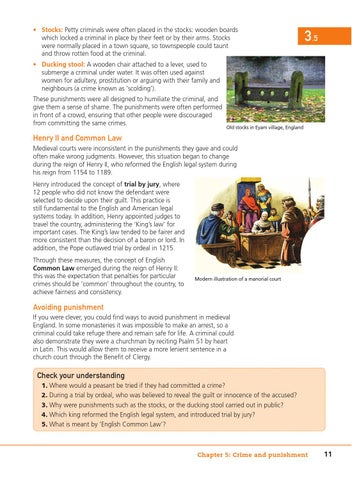
• Stocks: Petty criminals were often placed in the stocks: wooden boards which locked a criminal in place by their feet or by their arms. Stocks were normally placed in a town square, so townspeople could taunt and throw rotten food at the criminal.
31.5.1
• Ducking stool: A wooden chair attached to a lever, used to submerge a criminal under water. It was often used against women for adultery, prostitution or arguing with their family and neighbours (a crime known as ‘scolding’). These punishments were all designed to humiliate the criminal, and give them a sense of shame. The punishments were often performed in front of a crowd, ensuring that other people were discouraged from committing the same crimes.
Old stocks in Eyam village, England
Henry II and Common Law Medieval courts were inconsistent in the punishments they gave and could often make wrong judgments. However, this situation began to change during the reign of Henry II, who reformed the English legal system during his reign from 1154 to 1189. Henry introduced the concept of trial by jury, where 12 people who did not know the defendant were selected to decide upon their guilt. This practice is still fundamental to the English and American legal systems today. In addition, Henry appointed judges to travel the country, administering the ‘King’s law’ for important cases. The King’s law tended to be fairer and more consistent than the decision of a baron or lord. In addition, the Pope outlawed trial by ordeal in 1215. Through these measures, the concept of English Common Law emerged during the reign of Henry II: this was the expectation that penalties for particular crimes should be ‘common’ throughout the country, to achieve fairness and consistency.
Modern illustration of a manorial court
Avoiding punishment If you were clever, you could find ways to avoid punishment in medieval England. In some monasteries it was impossible to make an arrest, so a criminal could take refuge there and remain safe for life. A criminal could also demonstrate they were a churchman by reciting Psalm 51 by heart in Latin. This would allow them to receive a more lenient sentence in a church court through the Benefit of Clergy.
Check your understanding 1. Where would a peasant be tried if they had committed a crime? 2. During a trial by ordeal, who was believed to reveal the guilt or innocence of the accused? 3. Why were punishments such as the stocks, or the ducking stool carried out in public? 4. Which king reformed the English legal system, and introduced trial by jury? 5. What is meant by ‘English Common Law’?
Chapter 5: Crime and punishment
95281_P002-015.indd 11
11
01/08/16 2:43 PM