Unit 2: Norman England
The feudal system Under the control of William and his Norman knights, English society was transformed, and a rigid social structure developed. The higher up you were, the more land, wealth and power you held. The lower down you were, the poorer and less free you became. English society had a clear hierarchy, shaped like a pyramid: the few at the top were the strongest, and the many at the bottom were the weakest, owing their duty and service to those above them. Anyone below you was your ‘vassal’, and anyone above you was your ‘lord’. This social structure was called the feudal system.
The king Right at the top of the feudal system was the king. It was believed that the king was appointed by God, and only those with royal blood, who were descended from William the Conqueror, could sit on the throne. The king was answerable only to God, and all who lived in his kingdom were his subjects. However, the king still needed loyal friends to rule different parts of his kingdom on his behalf.
The barons For this reason, the king granted land to his barons, around 200 of the most powerful knights in the country. In return for their land, the king’s barons had to pay homage to him and swear an oath of fealty. This meant that if ever there was a war, the barons had to fight on behalf of their king. In the centre of their vast stretches of land, barons built fortified castles to keep them safe from enemy attacks. Some had the noble title of ‘Earl’, and their titles and lands were hereditary, meaning that they passed down from the father to his eldest son.
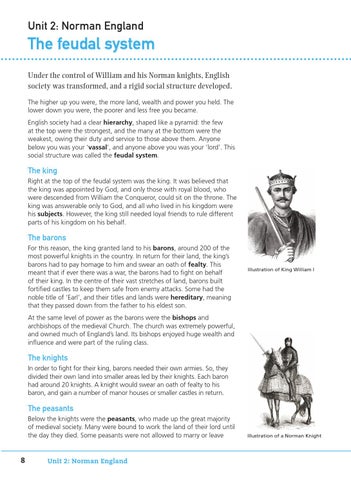
Illustration of King William I
At the same level of power as the barons were the bishops and archbishops of the medieval Church. The church was extremely powerful, and owned much of England’s land. Its bishops enjoyed huge wealth and influence and were part of the ruling class.
The knights In order to fight for their king, barons needed their own armies. So, they divided their own land into smaller areas led by their knights. Each baron had around 20 knights. A knight would swear an oath of fealty to his baron, and gain a number of manor houses or smaller castles in return.
The peasants Below the knights were the peasants, who made up the great majority of medieval society. Many were bound to work the land of their lord until the day they died. Some peasants were not allowed to marry or leave
8
Illustration of a Norman Knight
Unit 2: Norman England
95274_P002-015.indd 8
01/08/16 2:34 PM