When Alfred was a young boy, his mother encouraged him to read and memorise a book of Old English poetry. At the age of 40, Alfred asked a Welsh bishop called Asser to teach him to read and write Latin. Asser later wrote a biography of Alfred, and recorded “from his cradle, he was filled with the love of wisdom above all things”.
1.4.1
Having learnt Latin, Alfred was able to translate important books – particularly about Christianity – into Old English, helping to spread Christianity amongst his people. This was a remarkable achievement, and England would have to wait another 200 years before it was again ruled by a king who could read and write. Alfred also oversaw the writing of the Anglo-Saxon Chronicle – an enormous history book which kept a record of every important event that happened in England until 1154. In 899, Alfred died. King Alfred’s rule laid the foundation on which his descendants would build the unified Anglo-Saxon Kingdom of England. He remains the only king in English history to be remembered as ‘the Great’.
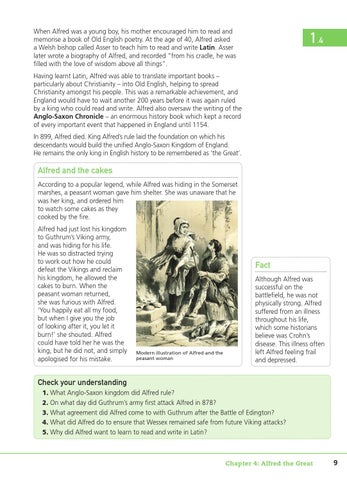
Alfred and the cakes According to a popular legend, while Alfred was hiding in the Somerset marshes, a peasant woman gave him shelter. She was unaware that he was her king, and ordered him to watch some cakes as they cooked by the fire. Alfred had just lost his kingdom to Guthrum’s Viking army, and was hiding for his life. He was so distracted trying to work out how he could defeat the Vikings and reclaim his kingdom, he allowed the cakes to burn. When the peasant woman returned, she was furious with Alfred. ‘You happily eat all my food, but when I give you the job of looking after it, you let it burn!’ she shouted. Alfred could have told her he was the king, but he did not, and simply apologised for his mistake.
Fact
Modern illustration of Alfred and the peasant woman
Although Alfred was successful on the battlefield, he was not physically strong. Alfred suffered from an illness throughout his life, which some historians believe was Crohn’s disease. This illness often left Alfred feeling frail and depressed.
Check your understanding 1. What Anglo-Saxon kingdom did Alfred rule? 2. On what day did Guthrum’s army first attack Alfred in 878? 3. What agreement did Alfred come to with Guthrum after the Battle of Edington? 4. What did Alfred do to ensure that Wessex remained safe from future Viking attacks? 5. Why did Alfred want to learn to read and write in Latin?
Chapter 4: Alfred the Great
95267_P002-015.indd 9
9
01/08/16 2:32 PM